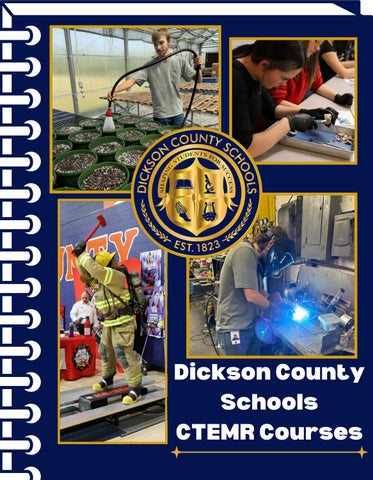
Dickson County Schools CTEMR Courses
Advanced Manufacturing Advanced Manufacturing
Robotics & Technology PRINCIPLES OF ENGINEERING AND TECHNOLOGY Principles of Engineering and Technology is a foundational STEM course for students exploring careers in engineering and technology. Students learn the engineering design process, evaluate designs, use basic sketching, drawing techniques, and 3D solid modeling, complete simple design projects, and communicate solutions effectively. This course, along with all others in this pathway use an Engineering Notebook.
DIGITAL ELECTRONICS Digital Electronics introduces students to the basic components of digital systems and how to use them to design more complex circuits, by the use of simulators and real physical circuits. Students learn the functions of digital components such as gates, flip-flops, and counters, and use them as building blocks in larger designs. They will implement circuits using programmable devices and communicate their designs clearly through technical documentation. By the end of the course, students can design and explain a complete digital system.
ROBOTICS & AUTOMATED SYSTEMS
Robotics & Automated Systems introduces students to how robots and automated systems are used in industry. Students learn basic robotics history, programming, circuit interfacing, and robot testing and maintenance. They will use engineering notebooks throughout the course.
ENGINEERING PRACTICUM Engineering Practicum is a capstone course where students apply engineering skills in a professional setting. We design a product using research, communication, teamwork, and the design process that could solve a real-world problem, all while exploring ethical and professional responsibilities. The course prepares students for postsecondary study and careers in engineering and technology.
WORK-BASED LEARNING (WBL) Tennessee’s Work-Based Learning (WBL) program lets eligible juniors and seniors earn high school credit through internships, apprenticeships, and paid work experiences. Students build on classroom skills to develop employability skills that prepare them for college and future careers.
Industry Transfer Agreement: Industry Credentials Offered Credentials Offered Autodesk Inventor Certified User
Advanced Manufacturing
Mechatronics PRINCIPLES OF MANUFACTURING This course prepares students to perform industrial maintenance and welding tasks in an advanced manufacturing setting. Students gain skills in electromechanical systems, safety practices, SMAW and MIG welding, electrical systems, AC/DC motors, instrument calibration, drive systems, pipe fabrication, metal properties, and quality control. Students design, build, and program robotic systems while demonstrating their learning through a hands-on capstone project.
MECHATRONICS I Mechatronics I is an applied course in the Manufacturing cluster designed for students interested in careers such as mechatronics technician, maintenance technician, electromechanical technician, or manufacturing engineer. As the first course in a two-part sequence, it introduces the basic electrical and mechanical components of mechatronic systems and how they work together with instrumentation, controls, and embedded software. Students apply these concepts through hands-on robotics projects and automation systems.
MECHATRONICS II
Mechatronics II is an advanced course for students interested in careers such as mechatronics technician, maintenance technician, or electromechanical technician. Building on Mechatronics I, this course covers pneumatic, electro-pneumatic, and hydraulic control circuits, as well as basic digital logic and programmable logic controllers (PLCs) for industrial robotics and automated manufacturing systems.
WORK-BASED LEARNING (WBL) Tennessee’s Work-Based Learning (WBL) program lets eligible juniors and seniors earn high school credit through internships, apprenticeships, and paid work experiences. Students build on classroom skills to develop employability skills that prepare them for college and future careers.
Dual Enrollment
Industry Industry Credentials Offered Credentials OSHA 10Offered General Industry SNAP-On-Precision Measurements SNAP-On Multimeter SNAP-On Hand Tool Identification and Safety Lean Six Sigma Welding Safety Principles of Welding
Advanced Manufacturing Advanced Manufacturing
Welding/Industrial Maintenance PRINCIPLES OF MANUFACTURING
This course prepares students to perform industrial maintenance and welding tasks in an advanced manufacturing setting. Students gain skills in electromechanical systems, safety practices, electrical systems, AC/DC motors, instrument calibration, drive systems, pipe fabrication, metal properties, and quality control.
WELDING I
Welding I prepares students with the foundational skills needed for cutting and welding in the advanced manufacturing industry. Students learn essential safety practices, how to read and create drawings (including basic CAD), identify and use joint designs, lay out parts for fabrication, perform basic SMAW welding, understand metal properties, and apply quality-control practices.
WELDING II Welding II builds on Welding I, giving students opportunities to perform more complex cutting and welding tasks in advanced manufacturing. Students expand their skills in safety, gas metal arc welding (GMAW/MIG), flux-cored arc welding (FCAW), gas tungsten arc welding (GTAW), and quality-control methods.
WELDING III Welding III builds on Welding II, giving students opportunities to perform more complex cutting and welding tasks in advanced manufacturing. Students expand their skills in safety, gas metal arc welding (GMAW/MIG), flux-cored arc welding (FCAW), gas tungsten arc welding (GTAW), and quality-control methods. *Due to space limitations, this class is limited to 12 students. Students must be approved by the welding instructor.
WORK-BASED LEARNING (WBL) Tennessee’s Work-Based Learning (WBL) program lets eligible juniors and seniors earn high school credit through internships, apprenticeships, and paid work experiences. Students build on classroom skills to develop employability skills that prepare them for college and future careers.
Dual Enrollment
Industry Credentials OfferedIndustry Credentials Offered AWS-SENSE Entry Level Welder NC3 L.E. Flux Cored Arc Welding NC3 L.E. Gas Metal Arc Welding NC3 L.E. Gas Tungsten Arc Welding NC3 L.E. Shielded Metal Arc Welding NC3 L.E. Welding Safety
NC3 L.E. Principles of Welding OSHA 10 General Industry SNAP-On-Precision Measurements SNAP-On Multimeter SNAP-On Hand Tool Identification and Safety
Agriculture Agriculture
Agriculture Mechanics AGRISCIENCE
A laboratory science course that prepares students for biology, subsequent science courses, and postsecondary pursuits. The content includes ecology, biological processes, sexual and asexual reproduction, and a study of the chemical and physical laws that govern life processes. This course helps students understand the important role agricultural science serves as the industry moves into the 21st century.
PRINCIPLES OF AGRICULTURAL MECHANICS
An intermediate course introducing students to basic skills and knowledge in construction and land management for both rural and urban environments. This course covers topics including project management, basic engine and motor mechanics, land surveying, irrigation and drainage, agricultural structures, and basic metalworking techniques.
AGRICULTURE POWER AND EQUIPMENT
An applied course in agricultural engineering with special emphasis on laboratory activities involving small engines, tractors, and agricultural equipment. The standards in this course address navigation, maintenance, repair, and overhaul of electrical motors, hydraulic systems, and fuel-powered engines as well as exploration of a wide range of careers in agricultural mechanics
WORK-BASED LEARNING (WBL)
Tennessee’s Work-Based Learning (WBL) program lets eligible juniors and seniors earn high school credit through internships, apprenticeships, and paid work experiences. Students build on classroom skills to develop employability skills that prepare them for college and future careers.
Industry Credentials Offered NC3 Snap-On Hand Tool ID and Safety Tennessee Forest Worker
Agriculture Agriculture
Horticulture Science AGRISCIENCE
A laboratory science course that prepares students for biology, subsequent science courses, and postsecondary pursuits. The content includes ecology, biological processes, sexual and asexual reproduction, and a study of the chemical and physical laws that govern life processes. This course helps students understand the important role agricultural science serves as the industry moves into the 21st century.
PRINCIPLES OF PLANT SCIENCE & HYDROCULTURE Principles of Plant Science and Hydroculture introduces students to the science of plant growth, including plant health, reproduction, biotechnology, and the basics of hydroponics and aquaponics. Students who complete the course are prepared for advanced horticulture studies. *Offered at DCHS
GREENHOUSE MANAGEMENT
Designed to prepare a student to manage a greenhouse operation. Students in this class will learn to produce various ornamental crops and food crops. An understanding of structures, crop selection, and growing systems will be explored. As populations continue to expand, the importance of food production in a climate-controlled environment increases.
LANDSCAPING & TURF SCIENCE
Landscaping and Turf Science is an applied course designed to provide challenging academic standards and relevant technical knowledge and skills needed for further education and careers in landscape design, maintenance, and turf management. Content includes site analysis and planning, principles of design, and plant selection and care techniques. Upon completion of this course, proficient students will be prepared to pursue advanced study of landscaping and turf science at a postsecondary institution. *Offered at CWHS
WORK-BASED LEARNING (WBL)
Tennessee’s Work-Based Learning (WBL) program lets eligible juniors and seniors earn high school credit through internships, apprenticeships, and paid work experiences. Students build on classroom skills to develop employability skills that prepare them for college and future careers.
Industry Credentials Offered Tennessee Forest Worker Certification Commercial Applicators
Agriculture Agriculture
Veterinary Science Technology AGRISCIENCE
A laboratory science course that prepares students for biology, subsequent science courses, and postsecondary pursuits. The content includes ecology, biological processes, sexual and asexual reproduction, and a study of the chemical and physical laws that govern life processes. This course helps students understand the important role agricultural science serves as industry moves into the 21st century.
SMALL ANIMAL SCIENCE
Small Animal Science Technologies is an intermediate course for students interested in careers such as veterinarian, veterinary technician, or vet assistant. The course covers anatomy and physiology of small animals, industry careers, leadership, and history. Students who complete the course are prepared for advanced veterinary and animal science studies.
LARGE ANIMAL SCIENCE
An applied course in veterinary and animal science for students interested in learning more about becoming a veterinarian, vet tech, vet assistant, or pursuing a variety of scientific, health, or agriculture professions. This course covers anatomy and physiological systems of different groups of large animals, as well as careers, leadership, and history of the industry. *Offered as a Dual Credit through MTSU at CWHS
VETERINARY SCIENCE TECHNOLOGY
An advanced course in animal science and care for students interested in learning about becoming a veterinarian, vet tech, vet assistant, or pursuing a variety of scientific, health, or agriculture professions. This course covers principles of health and disease, basic animal care and nursing, clinical and laboratory procedures, and additional industry-related career and leadership knowledge and skills.
WORK-BASED LEARNING (WBL)
Tennessee’s Work-Based Learning (WBL) program lets eligible juniors and seniors earn high school credit through internships, apprenticeships, and paid work experiences. Students build on classroom skills to develop employability skills that prepare them for college and future careers.
Industry Credentials Offered
Certified Vet Assistant Elanco Fundamentals of Animal Science
Dual Credit
Arts, Entertainment Arts, Entertainment & & Design Design
Audio/Visual Production A/V PRODUCTION I A/V Production I is an introductory course in the Arts, A/V Technology, & Communications cluster for students exploring audio/visual production careers. Students learn the stages of production—pre-production, production, and post-production—while developing basic camera, audio, and equipment skills. The course covers career exploration, A/V history, and legal considerations, and students begin building a portfolio to continue through the program sequence.
A/V PRODUCTION II
A/V Production II builds on A/V Production I, advancing students’ skills with industry lighting, audio equipment, and the research and writing needed for production planning. Students learn to plan, capture, and edit more complex projects independently and in teams. The course also examines ethical, legal, technological, and business issues in the A/V field. Students continue developing their program portfolios.
A/V PRODUCTION III
A/V Production III is an advanced course preparing students for careers or further study in audio/visual production. Students independently and collaboratively create full productions, with optional work-based learning. Using industry-standard tools, they complete all phases of production—from planning to distribution—and study policies, media distribution, and live event production. Students continue building their portfolios and finish the course ready for entry-level work or postsecondary programs.
APPLIED ARTS PRACTICUM
Applied Arts Practicum is a capstone course where students apply skills from previous Arts, A/V Technology, & Communications classes in professional settings. Through a year-long project, they strengthen problem-solving, communication, teamwork, and project management while learning industry expectations and ethical practices. The course is customizable and may include lab work or internships, service learning, and job shadowing. By completion, students are prepared for postsecondary study or entry-level employment, supported by a portfolio showcasing their work.
WORK-BASED LEARNING (WBL)
Tennessee’s Work-Based Learning (WBL) program lets eligible juniors and seniors earn high school credit through internships, apprenticeships, and paid work experiences. Students build on classroom skills to develop employability skills that prepare them for college and future careers.
Industry Credentials Offered Adobe Premiere
Arts, Entertainment Arts, Entertainment & & Design Design
Digital Arts & Design DIGITAL ARTS & DESIGN I Digital Arts & Design I is a foundational course for students interested in art and design careers. Students learn the principles and elements of design, the design process, and how to use industry tools to create effective visual communications. They develop basic skills in illustration, typography, and photography, explore careers and design history, and begin building a digital portfolio. This course also offers Adobe Professional Industry Certification.
DIGITAL ARTS & DESIGN II
Digital Arts & Design II builds on skills learned in Digital Arts & Design I. Students perform advanced software operations to create complex photos and illustrations, apply design principles, and produce layouts for various applications. The course also covers industry knowledge, career exploration, and business concepts. Students continue developing their digital portfolios, and the class offers Adobe Professional Industry Certification.
DIGITAL ARTS & DESIGN III
Digital Arts & Design III is the third course in the program of study and builds on skills from prior courses. Students create advanced multimedia projects, web pages, 3D models, and animations using industry-standard software. They apply research to strengthen project outcomes and study professionalism, ethics, careers, and project management. Students also continue developing their digital portfolios, and the course offers Adobe Professional Industry Certification.
APPLIED ARTS PRACTICUM Applied Arts Practicum is a capstone course where students apply skills from prior Arts, Technology, and Communications courses in professional settings. Through internships or lab work, they refine problemsolving, teamwork, and project management skills, explore ethical issues, and build portfolios to prepare for postsecondary study or careers.
WORK-BASED LEARNING (WBL)
Tennessee’s Work-Based Learning (WBL) program lets eligible juniors and seniors earn high school credit through internships, apprenticeships, and paid work experiences. Students build on classroom skills to develop employability skills that prepare them for college and future careers.
Industry Credentials Offered Adobe Certified User:
Illustrator Photoshop
Dual Enrollment
Construction Construction
Architectural & Engineering Design ARCHITECTURAL & ENGINEERING DESIGN I (CAD I) Architectural & Engineering Design I is a foundational course in the Architecture & Construction cluster for students exploring engineering and design careers. Students learn freehand sketching, technical drawing, and measurement skills, complete design projects, and communicate outcomes. The course also covers career exploration, the history of architecture and engineering, and begins building a portfolio for future courses.
ARCHITECTURAL & ENGINEERING DESIGN II (CAD II) Architectural & Engineering Design II is the second course in the program, where students advance their technical drawing and modeling skills to solve design problems. Students learn to use CAD software to create multi-view, sectional, auxiliary, and 3D drawings, connect drawings to physical layouts through modeling, and continue building a portfolio for future courses.
ARCHITECTURAL & ENGINEERING DESIGN III (CAD III)
Architectural & Engineering Design III is an advanced course where students apply technical drawing and design skills to architectural and mechanical projects. Students strengthen problem-solving and criticalthinking skills, use data collection and analysis to inform designs, work with industry-specific technology, and continue building a portfolio for future courses.
WORK-BASED LEARNING (WBL) Tennessee’s Work-Based Learning (WBL) program lets eligible juniors and seniors earn high school credit through internships, apprenticeships, and paid work experiences. Students build on classroom skills to develop employability skills that prepare them for college and future careers.
Industry Credentials Offered AutoDesk AutoCAD Certified User Autodesk Revit
Dual Enrollment
Construction Construction
Structural Systems FUNDAMENTALS OF CONSTRUCTION
Fundamentals of Construction is a foundational course in the Architecture & Construction cluster. Students learn about construction fields, career pathways, safe tool use, and interpreting drawings. The course covers measurement, applied math, building systems, materials, and an overview of the construction industry.
STRUCTURAL SYSTEMS I
Structural Systems I prepares students for residential and commercial carpentry. Students learn to frame floors, walls, ceilings, roofs, and stairs, safely use tools, interpret drawings, and apply measurements and math. The course also covers construction principles, project management, and portfolio development throughout the program.
STRUCTURAL SYSTEMS II
Structural Systems II is an advanced course building on Fundamentals of Construction and Structural Systems I. Students learn advanced framing, structural loads, and interior/exterior finishes, including roofing, siding, drywall, doors, and trim. They interpret drawings, estimate materials, follow safe practices, and explore industry principles, business, and project management while continuing portfolio development.
WORK-BASED LEARNING (WBL)
Tennessee’s Work-Based Learning (WBL) program lets eligible juniors and seniors earn high school credit through internships, apprenticeships, and paid work experiences. Students build on classroom skills to develop employability skills that prepare them for college and future careers.
Industry Credentials Offered NCCER Core Curriculum NCCER Carpentry Level One NCCER Carpentry Level Two
Dual Enrollment
Civics, Public Civics, Public Service Service & & Safety Safety
Criminal Justice CRIMINAL JUSTICE I Criminal Justice I is the Year 1 course in the Criminal Justice and Correction Services program of study. It serves as a comprehensive survey of how the law enforcement, legal, and correctional systems interact with each other in the United States. Upon completion of this course, proficient students will understand the context of local, state, and federal laws, the concepts of crime control and the judicial process, and the importance of communications and professionalism in law enforcement
CRIMINAL JUSTICE II
Criminal Justice II is the Year 2 course in the Criminal Justice and Correction Services program of study. Upon completion of this course, proficient students will understand the impact of the constitution on law enforcement, law enforcement, and police procedures, alcohol and beverage laws, sentencing, and the importance of communications and professionalism in law enforcement..
CRIMINAL JUSTICE III: FORENSIC CRIMINAL INVESTIGATIONS
Forensic Criminal Investigations is a Year 3 course that teaches students the science of criminal investigations. Students learn crime scene procedures, criminal behavior, and scientific inquiry, analyze evidence through simulations and case studies, and explore careers, legal principles, and the evolution of forensic science.
Criminal Justice Practicum
Criminal Justice Practicum is a capstone course in the Law Enforcement and Correction Services program of study that provides students with hands-on experience and reinforces knowledge and skills from previous coursework. Students develop competencies in communication, critical thinking, problem solving, ethics, leadership, teamwork, and legal responsibilities. Instruction may occur through school-based labs or workbased learning experiences such as cooperative education, mentoring, and job shadowing. *Offered at DCHS
WORK-BASED LEARNING (WBL)
Tennessee’s Work-Based Learning (WBL) program lets eligible juniors and seniors earn high school credit through internships, apprenticeships, and paid work experiences. Students build on classroom skills to develop employability skills that prepare them for college and future careers.
Industry Credentials Offered FEMA 100 ICS FEMA 200 Incident Command FEMA 703B NFIMS FEMA 700.B FEMA 800.D IS-5.A: An Intro to Hazardous Materials Basic Life Support E911 Basic Telecommunications Recreational UAS Safety Test (TRUST)
Dual Enrollment
Digital Technology Digital Technology
Networking Systems COMPUTER SCIENCE FOUNDATIONS
Computer Science Foundations (CSF) introduces students to key areas of information technology, including Networking, Coding, Web Design, and Cybersecurity. Students complete core standards and two focus areas, gaining knowledge of IT careers, professional organizations, and ethical issues in the field. Depending on their focus, students also learn digital theory, project management, client relations, web writing, and cybersecurity basics. By the end of the course, students are prepared to choose an IT pathway for further study.
COMPUTER SYSTEMS
Computer Systems is an intermediate course designed to prepare students with work-related skills and aligned certification in the information technology industry. Content provides students the opportunity to acquire knowledge in both theory and practical applications pertaining to hardware, operating systems, safe mode, command prompt, security, networking, printers, peripheral devices, laptops, mobile devices, troubleshooting, and customer service management. Upon completion of this course, proficient students will have acquired skills and knowledge to install, configure, and maintain computer systems.
NETWORKING
Networking is an advanced course designed to emphasize the conceptual and practical skills necessary to design, manage, and diagnose network hardware and software. Upon completion of this course, proficient students will identify types of networks, understand the layers of the open systems interconnection (OSI) model, prevent security risks, and apply troubleshooting theory to the successful execution of networking tasks. Course content covers transmission control protocol, internet protocol, wired and wireless topologies, switching and routing, network hardware, wireless networking, and network operating systems (NOS)
WORK-BASED LEARNING (WBL)
Tennessee’s Work-Based Learning (WBL) program lets eligible juniors and seniors earn high school credit through internships, apprenticeships, and paid work experiences. Students build on classroom skills to develop employability skills that prepare them for college and future careers.
Industry Credentials Offered COMP TIA ITF+ COMP TIA A+
Dual Enrollment
Digital Technology Digital Technology
Coding COMPUTER SCIENCE FOUNDATIONS
Offers students exposure to various information technology occupations and pathways such as Networking Systems, Coding, Web Design, and Cybersecurity. Activities include Python programming, physical computing, Raspberry PI microcomputers, and introductory electrical engineering.
CODING I
Coding I is a course intended to teach students the basics of computer programming. The course places emphasis on practicing standard programming techniques and learning the logic tools and methods typically used by programmers to create simple computer applications. Upon completion of this course, proficient students will be able to solve problems by planning multi-step procedures; write, analyze, review, and revise programs, converting detailed information from workflow charts and diagrams into coded instructions in a computer language; and will be able to troubleshoot/debug programs and software applications to correct malfunctions and ensure their proper execution.
CODING II
Coding II is an advanced course designed to build on the foundational skills learned in Coding I, focusing on problem analysis, algorithm development, and the implementation of complex programming solutions. The course emphasizes the use of advanced programming techniques and logical reasoning to create and refine applications. Upon completion of this course, proficient students will be able to analyze problems, design algorithms, and implement solutions using high-level programming languages such as FOCUS, Python, or SAS. Students will practice writing, testing, and debugging code to ensure proper program execution, while developing the skills to select appropriate languages, development environments, and strategies for the software development life cycle. Course content is reinforced through a variety of individual and group projects, which strengthen students’ ability to think critically, troubleshoot errors, and produce efficient, error-free programs.
WORK-BASED LEARNING (WBL)
Tennessee’s Work-Based Learning (WBL) program lets eligible juniors and seniors earn high school credit through internships, apprenticeships, and paid work experiences. Students build on classroom skills to develop employability skills that prepare them for college and future careers.
Industry Credentials Offered COMP TIA ITF+ COMP TIA A+
Dual Enrollment
Education Education
Teaching as a Profession INTRODUCTION TO TEACHING AS A PROFESSION Introduction to Teaching as a Profession is a foundational course for students interested in careers in education. Students learn about the history of U.S. education, career pathways, and how human development influences learning, while creating portfolio artifacts that continue throughout the program.
TEACHING AS A PROFESSION I Teaching as a Profession I (TAP I) is an intermediate course for students interested in education-related careers. Students learn instructional components, teaching strategies, assessment types, student learning, special populations, and educational technology while completing educator observations and portfolio artifacts.
TEACHING AS A PROFESSION II
Teaching as a Profession II (TAP II) is an applied-knowledge course for students interested in learning more about becoming a teacher, school counselor, librarian, or speech-language pathologist. This course covers classroom management, concepts of higher-order thinking, differentiating instruction, and strategies of effective classroom planning. Students in this course will demonstrate their skills in laboratory settings while building a course portfolio of work, which they will carry with them throughout the program of study.
FOUNDATIONS OF EDUCATION
Students must meet APSU Dual Enrollment admissions criteria (3.0 high school GPA or 21 ACT composite). Students who successfully complete the course earn 2 credit hours for Austin Peay State University’s EDUC 2100: Foundations of Education. The course explores the social, philosophical, and historical foundations of education, standards-based instruction, and ethical responsibilities of educators through lecture, discussion, and hands-on activities. Students study effective teaching roles, learning styles, diversity, curriculum, standards, assessment, and student life, with opportunities for periodic school observations.
WORK-BASED LEARNING (WBL)
Tennessee’s Work-Based Learning (WBL) program lets eligible juniors and seniors earn high school credit through internships, apprenticeships, and paid work experiences. Students build on classroom skills to develop employability skills that prepare them for college and future careers.
Industry Credentials Offered Adult, Infant, and Child CPR/AED/ First Aid
Dual Enrollment
Healthcare and Healthcare and Human Human Services Services
Dietetics and Nutrition INTRO TO HUMAN STUDIES
Introduction to Human Studies is a foundational course for students interested in becoming a public advocate, social worker, dietician, nutritionist, counselor, or community volunteer. This course covers human needs, an overview of social services, career investigation, mental health, and communication. Artifacts will be created for inclusion in a portfolio, which will continue to build throughout the program of study.
NUTRITION ACROSS THE LIFESPAN
Nutrition Across the Life Span is for students interested in learning more about becoming a dietitian, nutritionist, counselor, or pursuing a variety of scientific, health, or culinary arts professions. This course covers human anatomy and physiological systems, nutrition requirements, as well as social, cultural, and other impacts on food preparation and integrity. Artifacts will be created for inclusion in a portfolio, which will continue to build throughout the program of study.
NUTRITION SCIENCE AND DIET THERAPY
This applied nutrition course explores the role of diet in health and disease. Students learn to develop nutrition care plans, assess community nutritional health, and understand diet-disease relationships. The course emphasizes disease prevention and treatment, with portfolio artifacts compiled throughout the program.
WORK-BASED LEARNING (WBL)
Tennessee’s Work-Based Learning (WBL) program lets eligible juniors and seniors earn high school credit through internships, apprenticeships, and paid work experiences. Students build on classroom skills to develop employability skills that prepare them for college and future careers.
Industry Credentials Offered ServSafe Food Handler
Healthcare and Healthcare and Human Human Services Services
Emergency Services HEALTH SCIENCE EDUCATION
Introduction to broad standards that serve as a foundation for Health Care Occupations and functions across health services. Units included are academics in health care communications systems, legal responsibilities, ethics, teamwork, and safety practices.
ANATOMY AND PHYSIOLOGY
An upper-level course designed to develop an understanding of the structures and functions of the human body, while relating those to knowledge and skills associated with pathophysiology. Upon completion of this course, proficient students will be able to (1) apply the gross anatomy from earlier courses to a deeper understanding of all body systems, (2) identify the organs and structures of the support and movement systems, (3) relate the structure and function of the communication, control, and integration system, and (4) demonstrate a professional, working understanding of the transportation, respiration, excretory, and reproduction systems.
EMERGENCY MEDICAL SERVICES
The EMS program of study gives students an understanding of professional and ethical issues related to emergency care. The course builds on the knowledge and skills from previous courses in the EMS program of study and introduces students to the roles and responsibilities of an Emergency Medical Responder (EMR). Students learn to recognize and respond to medical and traumatic emergencies, perform patient assessments, provide basic life-saving care, and safely assist higher-level medical personnel. Instruction includes hands-on skills practice, scenario-based learning, and an emphasis on patient safety and professionalism. Upon completion, students will be proficient in communication, critical thinking, problem solving, information technology, ethical and legal responsibilities, leadership, and teamwork, preparing them for further training or entry-level opportunities in the emergency services field
EMT DUAL ENROLLMENT
EMT Dual Enrollment is a capstone course in the Emergency Medical Services program of study and is designed to prepare students to pursue careers in the field of emergency medicine. Upon completion of this course, proficient students will be able to: identify careers and features of the EMS system; define the importance of workforce safety and wellness; maintain legal and ethical guidelines; correlate anatomy and physiology concepts to the patient with a medical or traumatic injury; and perform EMS skills with a high level of proficiency. If taught by an EMT instructor, students will be given the opportunity to sit for the National Emergency Medical Responder certification.
WORK-BASED LEARNING (WBL) Tennessee’s Work-Based Learning (WBL) program lets eligible juniors and seniors earn high school credit through internships, apprenticeships, and paid work experiences. Students build on classroom skills to develop employability skills that prepare them for college and future careers.
Industry Credentials Offered Emergency Medical Responder Emergency Medical Tech License CPR- Basic Life Support
Dual Enrollment
Healthcare and Healthcare and Human Human Services Services
Nursing/Therapeutic Services HEALTH SCIENCE EDUCATION
Introduction to broad standards that serve as a foundation for Health Care Occupations and functions across health services. Units included are academics in health care communications systems, legal responsibilities, ethics, teamwork, and safety practices.
ANATOMY AND PHYSIOLOGY
An upper-level course designed to develop an understanding of the structures and functions of the human body, while relating those to knowledge and skills associated with pathophysiology. Upon completion of this course, proficient students will be able to (1) apply the gross anatomy from earlier courses to a deeper understanding of all body systems, (2) identify the organs and structures of the support and movement systems, (3) relate the structure and function of the communication, control, and integration system, and (4) demonstrate a professional, working understanding of the transportation, respiration, excretory, and reproduction systems.
MEDICAL THERAPEUTICS
Provides knowledge and skills to maintain or change to the health status of an individual over time. This could include such careers or career areas as dental, dietetics, medical assistance, home health, nursing, pharmacy, respiratory, social work, nutritionist, physician, psychiatrist, psychologist, veterinarian, gerontology service provider, medical practice owner, and attorney for health care.
CLINICAL INTERNSHIP
A hands-on, supervised learning experience in a healthcare setting such as a hospital, nursing home, rehabilitation center, or medical office. Students apply classroom knowledge to real-world patient care, develop professional skills, practice safety and compliance standards, and explore career pathways in health care.
Industry Credentials Offered Adult, Infant, and Child CPR/AED/First Aid Certified Clinical Medical Assistant Certified Patient Care Tech
Healthcare and Healthcare and Human Human Services Services
Therapeutic Services HEALTH SCIENCE EDUCATION
Introduction to broad standards that serve as a foundation for Health Care Occupations and functions across health services. Units included are academics in health care communications systems, legal responsibilities, ethics, teamwork, and safety practices.
ANATOMY AND PHYSIOLOGY
An upper-level course designed to develop an understanding of the structures and functions of the human body, while relating those to knowledge and skills associated with pathophysiology. Upon completion of this course, proficient students will be able to (1) apply the gross anatomy from earlier courses to a deeper understanding of all body systems, (2) identify the organs and structures of the support and movement systems, (3) relate the structure and function of the communication, control, and integration system, and (4) demonstrate a professional, working understanding of the transportation, respiration, excretory, and reproduction systems.
DENTAL SCIENCE I Dental Science is an applied course in the Therapeutic Services program of study intended to prepare students with an understanding of the roles and responsibilities of the dental health care professional within the application of dental care. Upon completion of this course, proficient students will be able to differentiate the many careers in dentistry, assess, monitor, evaluate, and report on the dental health of patients/clients, and relate this information to overall health, apply appropriate dental terminology, and perform clinical supportive skills.
DENTAL SCIENCE II Dental Science II is an applied course in the Therapeutic Services program of study intended to prepare students with an understanding of the roles and responsibilities of the dental health care professional within the application of dental care. Upon completion of this course, proficient students will be able to differentiate the many careers in dentistry, assess, monitor, evaluate, and report on the dental health of patients/clients, and relate this information to overall health, apply appropriate dental terminology, and perform clinical supportive skills.
Industry Credentials Offered
Adult, Infant, and Child CPR/AED/ First Aid Certified Dental Assistant
Dual Enrollment
Management and Management and Entrepreneurship Entrepreneurship
Business Management & Administration INTRODUCTION TO BUSINESS AND MARKETING
Introduction to Business and Marketing is an introductory course providing an overview of Business Management, Marketing, and Finance career clusters. Students explore business principles, leadership, ethics, and careers while reinforcing academic skills in communication, math, and economics through business-focused activities.
BUSINESS COMMUNICATIONS
Business Communications develops students’ oral and electronic communication skills for professional settings. Students learn social media, electronic publishing, design, layout, composition, and video conferencing, and demonstrate effective methods for creating and delivering professional publications and presentations.
BUSINESS MANAGEMENT
Business Management introduces students to the key activities, challenges, and decisions involved in running a successful business. Students explore business organization, ethics, communication, decision-making, personnel, safety, professional development, and careers, while using the internet, word processing, and spreadsheet tools to enhance practical skills.
ACCOUNTING I
Accounting I introduces concepts and principles based on a double-entry system of maintaining the electronic and manual financial records for a sole proprietorship, a partnership, and a corporation. It includes analyzing business transactions, journalizing, posting, and preparing worksheets and financial statements. *Offered at DCHS
BUSINESS & ENTREPRENEURSHIP PRACTICUM
Business & Entrepreneurship Practicum is a capstone course that allows students to apply business and marketing skills by developing and launching original business ideas in simulated or real-world settings, including startups, incubators, or work-based learning experiences. Upon completion, students are prepared to continue developing their ventures or pursue postsecondary studies. *Cougar Swag Practicum offered at DCHS
WORK-BASED LEARNING (WBL)
Tennessee’s Work-Based Learning (WBL) program lets eligible juniors and seniors earn high school credit through internships, apprenticeships, and paid work experiences. Students build on classroom skills to develop employability skills that prepare them for college and future careers. *Hawks Nest Press Practicum offered at CWHS
Industry Credentials Offered SWA Professional Communication Certificate TOSA DigComp
Dual Enrollment
Transportation Transportation
Maintenance & Light Repair MAINTENANCE & LIGHT REPAIR I
The Maintenance and Light Repair I (MLR I) course prepares students for entry into Maintenance and Light Repair II. Students explore career opportunities and the requirements of a professional service technician. Content emphasizes beginning transportation service skills and workplace success skills. Students study safety, tools, equipment, shop operations, basic engine fundamentals, and basic technician skills.
MAINTENANCE & LIGHT REPAIR II
The Maintenance and Light Repair II (MLR II) Students study and service suspension and steering systems and brake systems. Students also study and service automotive HVAC systems, engine performance systems, automatic and manual transmission/transaxle systems, and practice workplace soft skills. Upon completing all of the Maintenance and Light Repair courses.
MAINTENANCE & LIGHT REPAIR III
The Maintenance and Light Repair III (MLR III) course prepares students for entry into Maintenance and Light Repair IV. Students study automotive electrical systems, including general electrical systems, starting and charging systems, batteries, lighting, and electrical accessories.
WORK-BASED LEARNING (WBL)
Tennessee’s Work-Based Learning (WBL) program lets eligible juniors and seniors earn high school credit through internships, apprenticeships, and paid work experiences. Students build on classroom skills to develop employability skills that prepare them for college and future careers.
Industry Credentials Offered NC3 Snap-On TPMS Certification Snap-On Multimeter Certification Snap-On Electronic/Mechanical Torque Snap- On Battery/Starting & Charging Snap-On Hand Tool ID and Safety Certification OSHA 10 609A-AC Certification
Dual Enrollment
The Dickson County School’s Work Based Learning program currently has 175 students placed with a wide variety of businesses and industries. These high skill, high wage, in-demand jobs directly correlate with each student's interests, aptitudes, and CTE Programs of Study. Through these Work-Based Learning experiences, our students get hands-on, real -world experience, and can potentially earn extra income.
Jake Tennsco
Emma District Attorney’s Office
Haley Razor Sharp Retrievers
Hayley Dickson City Fire Milam MAC Excavating
Jaiden Dickson Water Authority
Isabella Centennial Elementary
Madison All Animals Veterinary Hospital
ASE B K R WO
DL
NI EAR
NG
tion a c u d E ical n h c e dT n a r e Care
CTE
Jamie Larkins jlarkins@dcstn.org
Cougar Paws offers dog grooming and washing services for teachers/staff. Dogs may be dropped off in the morning of their scheduled day, and picked up that afternoon after school.
Charles Taylor ctaylor@dcstn.org Creek Wood Construction student’s can build woodworking projects such as picnic tables, hunting blinds, benches, and chicken coops, etc...
Ed Elliott eelliott@dcstn.org Email Orders to: DCLaser@dcstn.org DC Laser Design students can personalize/engrave award plaques, insulated cups, coasters, and more.
Shane Rye jrye@dcstn.org Creek Wood Media offers commercial video production, promo video production, live event video coverage, and event highlight video coverage.
Vance Hardin ahardin@dcstn.org
Creek Wood Welding provides fabrication services. Products include signage and gates, etc...
Mark Dawson tdawson@dcstn.org DC Cougar Construction students make wood working projects such as porch swings, tables, picnic tables, cornhole boards, and more. Anita Russell arussell@dcstn.org dchsdigitalarts.com/shop. DCHS Creative/ Digital Arts and Design students can make products such as yard signs, fat heads, large paper posters, vinyl banners, window security coverings , insulated cups, and more
Danielle Galford dgalford@dcstn.org
Hawks Nest Press offers products such as window vinyls, yard signs, shirts, stickers, buttons, cups, banners, monograms, and more.
Zachary Lalumondier zlalumondier@dcstn.org Cougar Swag (DC Business Management) offers Cougar “swag” such as t-shirts, stickers, car decals, etc....
A school-based enterprise (SBE) is a student-run business that operates within a school and provides goods or services to meet real market needs. SBEs give students hands-on experience in marketing, finance, hospitality, and management while reinforcing classroom learning. They may sell items like spirit wear, signs, welding or woodworking projects, or other products. SBEs help students gain real work experience and build leadership, communication, and management skills. Used for decades by educators and DECA advisors, they are aneffective tool for preparing students for college and careers.
Schoo
l
d Base
Ent
ri erp
ses
tion a c u d E ical n h c e dT n a r e Care Career and Technical Technical Student Student Organizations Organizations
CTE
FFA makes a positive difference in the lives of students by developing their potential for premier leadership, personal growth and career success through agricultural education. https://www.ffa.org
https://fcclainc.org
https://tsaweb.org/about
To promote personal growth and leadership development through Family and Consumer Sciences education. Focusing on the multiple roles of family member, wage earner, and community leader, members develop skills for life through character development, creative and critical thinking, interpersonal communication, practical knowledge, and career preparation. The Technology Student Association enhances personal development, leadership, and career opportunities in STEM, whereby members apply and integrate these concepts through intracurricular activities, competitions, and related programs
The mission of HOSA is to empower HOSA-Future Health Professionals to become leaders in the global health community through education, collaboration, and experience.
https://hosa.org SkillsUSA is the #1 workforce development organization for students. We empower students to become skilled professionals, career-ready leaders and responsible community members. From our mission to our reach, from our brand to our history, learn who we are, what we do and why we do it. https://www.skillsusa.org
https://www.fbla.org
FBLA inspires and prepares students to become community-minded business leaders in a global society through relevant career preparation and leadership experiences.
O CTS
’s
cation u d E l hnica c e T d n a r e Care
CTE
DCHS FFA
CWHS FFA
DCHS HOSA
CWHS HOSA
DCHS FCCLA
CWHS SKILLS USA
DCHS TSA
CWHS TSA
MIddle School
CTE
Dickson County School District offers Career and Technical Education (CTE) opportunities in all middle schools. By integrating CTE subjects at this level, students gain early exposure to practical skills and knowledge that can pave the way for successful high school and future career pathways. This early foundation not only enriches the traditional academic experience but also helps students discover their interests and talents in various fields such as technology, engineering, agriculture, and more. Encouraging hands-on learning and real-world applications, CTE courses can foster critical thinking, problem-solving skills, and a sense of direction for students, equipping them with the tools they need to thrive in an ever-evolving workforce.
MIddle School
CTE
6th grade - Career Awareness: Career Awareness is an intro class that helps you get the basics on different career options. It covers things like what successful leaders have in common, how your skills and strengths match up with college and jobs, and gives you a peek at what careers are out there. By the end of the course, you'll understand your own strengths and skills, be able to talk about careers that interest you, and learn about different job paths, colleges, and employers in your area. You'll also get to practice soft skills like teamwork, advocating for yourself, and communicating well, along with some technical skills like managing your time and setting goals. It’s best to do Career Awareness before moving on to Career Exploration and Career Planning. 7th grade - Career Exploration Career Exploration is a class to help you build on what you already know about careers and check out all kinds of different options. You’ll do stuff like reflect on yourself and set goals using a career assessment tool, look at your academic strengths and progress, research college or job options and what they need, and figure out what classes, activities, and experiences can help you explore. By the end, you’ll be able to use your skills and strengths to set real goals for school and your career, talk about careers that fit with what you’re good at and your plans, and find ways to explore careers in your community. You’ll also work on soft skills like teamwork, speaking up for yourself, and communicating well, along with practical skills like managing your time and setting goals — all skills you’ll need for work. It’s best to do this course after Career Awareness and before Career Advising and Planning. 8th grade - Career Advising Career Advising and Planning is a course that helps you get a good grip on figuring out and planning your career. It covers stuff like: (a) figuring out your own academic strengths and how they fit with what you want to do in the future; (b) checking out different career options based on your skills, classes, and personality; (c) understanding how to pay for college and beyond; and (d) taking part in real-world learning experiences that can help with career planning. By the end of the course, students will be able to use what they know about their strengths and interests to research different paths for college and work success. This includes making plans for high school classes, prep materials for careers, and creating profiles of their ideal jobs. It’s usually best to take this course after Career Awareness and Career Exploration.
for more information on DCs Cte... visit our website: https://www.dcscte.org
Follow us on social media: Cte Dickson
Cte Dickson
@DCS_CTE