SCOTLAND’S NUMBER ONE STUDENT MAGAZINE
sourcemagazine.org.uk
UCAS READY
What you need to know before you apply
TO UNI AND BEYOND
AUTUMN / WINTER 2026
THE HUMAN TOUCH
The skills that still matter in an AI world
Where could your degree take you?
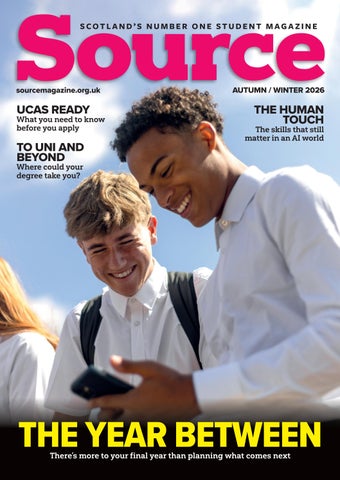
THE YEAR BETWEEN There’s more to your final year than planning what comes next
TEXTBOOKS REVISION GUIDES PRACTICE WORKBOOKS Clear and comprehensive support for National 5 & Higher exams
Save 30% using the code SOURCEMAG
www.leckiescotland.co.uk Offer ends 31st December 2026
// welcome SCOTLAND’S NUMBER ONE STUDENT MAGAZINE
SourceMagazine @SourceMag @source.magazine PUBLISHER
Denise Connelly denise@dcpublishing.co.uk
EDITORIAL CONTRIBUTORS
Eilidh Hamilton Heather Tracey Kate Stevenson Melissa Holmes
DESIGN AND PRODUCTION
Lucy Baillie lucy.baillie@dcpublishing.co.uk
SALES
Marian Mathieson marian.mathieson@dcpublishing.co.uk
www.sourcemagazine.org.uk DC Publishing Ltd, 198 Bath Street, Glasgow, G2 4HG Tel: 0141 212 8913
Inside this issue, we're looking at where your choices could take you.
T
here’s a lot to think about at this point in the year. Applications are getting under way, and decisions about courses and careers are becoming real. That’s where this issue of Source comes in. If you’re thinking about university, we look at choosing the right course and getting your UCAS application into shape. We also look at college and different routes into work, because there’s more than one way to get where you want to go. We’ve also got careers in healthcare, and look at the skills employers will still need as AI changes the way we work. And on page 25, we’re reminding you that while the decisions you’re making now matter, so does enjoying your final year.
Source
contents STUDY 4 SAVE THE DATE
Key dates for applications, funding, exams and results across the year ahead.
6 YOUR GUIDE TO COLLEGE ©DC Publishing Ltd 2026. All rights reserved. No part of this publication may be reproduced or used in any way without prior written permission from the publisher. The views expressed in this magazine are not necessarily those of DC Publishing Ltd. The publisher takes no responsibility for claims made by advertisers within the publication. Every effort has been made to ensure that information is accurate; while dates and prices are correct at time of going to print, DC Publishing Ltd takes no responsibility for omissions and errors.
Courses, college life and where your qualification could lead.
9 TO UNI AND BEYOND
Thinking about a degree? See where different subjects could take you.
20
14 UCAS: READY TO APPLY?
Choosing your courses, filling in your application and writing the new personal statement.
30 KEEP YOUR BRAIN SWITCHED ON
Podcasts for revision, study breaks and switching off.
MONEY 12 CASH COURSE
Bank accounts, budgeting and apps to help you keep track of your money.
WORK 17 HEALTH CHECK
Could a career in healthcare be right for you? We look at some of the options.
20 THE HUMAN TOUCH
The skills that will still matter as AI changes the way we work.
23 23 THAT'S A JOB?
Film, gaming and some of the less obvious careers you might not have considered.
LIFE 25 THE YEAR BETWEEN
Making plans for the future matters, but don’t forget to enjoy your final year too.
28 SKILLS FOR LIFE
Phone calls, speaking up and the everyday skills you’ll need after school. www.sourcemagazine.org.uk
3
// study
Dates can change, always che ck the relevan t official website
SAVE THE DATE From applications and funding to exams and results, here are the important dates to know during the school year ahead
15 OCTOBER 2026
The UCAS deadline for applications to Oxford and Cambridge, and most courses in medicine, dentistry and veterinary medicine, is 6pm on 15 October.
AUTUMN 2026
Many large employers begin advertising apprenticeships and school-leaver programmes during autumn. There is no single deadline and some employers close applications once they have received enough, so it is worth looking early. Check the careers pages of companies you are interested in and search current vacancies at apprenticeships.scot.
BEFORE CHRISTMAS
If you are applying to university, aim to have your application ready before the holidays. Still considering college? Check when applications open for the courses you are interested in. Each college sets its own dates and some courses fill up quickly. 4
www.sourcemagazine.org.uk
This is also a good time to look again at all your options. Compare course content, entry requirements, travel and accommodation before deciding what will suit you best.
13 JANUARY 2027
The main UCAS deadline for most undergraduate courses beginning in 2027 is 6pm on 13 January. There is much more to a university application than meeting the deadline. Turn to pages 14 and 15 for help completing yours.
JANUARY TO MARCH Keep checking for college courses, apprenticeships and jobs with training. Vacancies can appear at any point and each will have its own closing date. You do not need to settle on one route before applying. You can apply for university, college and apprenticeships, then make your final decision when you know which offers you have.
SPRING 2027
Going to university? Remember that applying for a course and applying for funding are two separate things. Check saas.gov.uk to find out when applications for 2027/28 funding will open. You do not need your exam results or a confirmed place before applying. Use your first-choice course and update your application later if anything changes.
26 APRIL TO 3 JUNE 2027
The National Qualifications exam diet begins on Monday 26 April and ends on Thursday 3 June. Download the official timetable at qualifications. gov.scot and check the date and start time of each of your exams.
10 AUGUST 2027
Results day. Before school finishes for summer, check how you will receive your results and make sure your contact details are correct.
Join a vibrant community where being a student is about so much more than just studying. It’s your chance to meet new people, experience new things and grow your confidence.
YOUR GUIDE TO
College College isn’t just about getting a qualification. It can prepare you for work, give you a route into university or help you decide what you want to do next. Here’s what you need to know before you apply
M
ore than 209,000 students study at colleges across Scotland. Some arrive knowing exactly what career they want, while others are still working it out. You don’t need to have your whole future planned before you apply. College gives you the chance to try something different, build your skills and see where it takes you.
WHY CHOOSE COLLEGE? Unlike school, college allows you to focus on subjects that genuinely interest you. Courses are often more hands-on and career-focused, so you can learn the skills you’ll actually use in the workplace while gaining recognised qualifications. There’s a huge range of courses and levels to choose from. You could study anything from construction, engineering and childcare to beauty therapy, hospitality, media, music or sport. How you learn can be different too. Depending on your course, you could spend time in workshops, work on projects, complete a placement or gain experience with employers alongside your classes. If sitting in a classroom and studying for exams isn’t how you learn best, college could suit you.
DIDN’T GET THE GRADES YOU WANTED? Results day doesn’t always go to plan. If you didn’t get the grades you were hoping for, it doesn’t mean you have to give up on the career or subject you had in mind. 6
www.sourcemagazine.org.uk
Colleges offer courses at different levels, so you can start at the level that’s right for you and build your qualifications from there. For some students, college also offers another way into university. If you already have a degree course in mind, check where your college qualification can take you before you apply. Some colleges and universities have agreements that allow students to move straight into the second or third year of a related degree.
WHAT CAN YOU STUDY? There are several types of qualifications you can take at college. National Certificates (NCs) give you skills and knowledge in a particular subject and can prepare you for work or further study. Higher National Certificates (HNCs) and Higher National Diplomas (HNDs) are higher education qualifications recognised by employers and universities. An HNC is generally equivalent to the first year of university-level study, while an HND usually takes two years of full-time study. Around 8,675 students move from Scotland’s colleges to university each year, with many able to go straight into the second or third year of a degree. Former UHI student Rachel Hinde started with an NC in Business and Accounting before completing an HND and then a degree. She told UHI Inverness: “Having a good grounding in the HND gave me the motivation to progress to degree.” Going from an HNC or HND straight into a later year of a related degree is known as articulation. It isn’t available for every course, so
if university is part of your plan, ask the college about its links with universities when you’re choosing where to study.
GO AND HAVE A LOOK An Open Day gives you the chance to see what a college is actually like rather than trying to choose from a website. Look around the campus, see the facilities and speak to the people who teach the course. Current students can also give you an idea of what it’s really like to study there. Ask what a normal week looks like, how much time you’ll spend on campus and if the course includes placements or work experience. If
// STUDY
you’re hoping to go to university later, ask where students from the course have gone on to study. Think about the basics as well. How will you get there? How long will it take? What will travel cost? A course might sound perfect, but you’ll still need to get there every week.
HOW DO YOU APPLY? Applications are done directly through the college’s website. You will need to give details of your qualifications, choose your course and tell the college a little about why you want to study it. Popular courses can fill up, so it’s worth applying early. Application
dates differ between colleges and courses, so check the website of the college you’re interested in and make a note of any deadlines. Your guidance teacher or careers adviser can help too. When you’re comparing courses, don’t just look at the name. Check what you’ll study, how the course is assessed, the qualification you’ll get at the end and what you could do afterwards.
WHAT WILL IT COST?
on your age, circumstances and the course you’re taking. HNCs and HNDs are classed as higher education and have different funding arrangements from other college courses. If you’re not sure what you’re entitled to, speak to the college’s student funding team. They can tell you what help is available and how to apply. Take your time, look at your options and choose the course that feels right for you.
For most students in Scotland, tuition fees for eligible full-time college courses are covered, so you won’t have to pay them yourself. You could also get help towards living costs and travel, depending
FIND OUT MORE Search for college courses and careers advice at myworldofwork.co.uk and find information on student funding at saas.gov.uk www.sourcemagazine.org.uk
7
Your local, flexible, affordable route to a degree! With great facilities, smaller class sizes, plus greater affordability and flexibility, Fife College is the perfect place to start your journey towards a higher education or degree qualification. Find out more at fife.ac.uk/degrees
Fife.ac.uk | 0344 248 0115 | info@fife.ac.uk
A4-Source Magazine Advert degrees.indd 1
03/09/2026 11:50
D N A I N TO U D N O Y E B
// study
law, for example – will d an n, io at uc ed e, nc ie sc – medicine, veterinary en-ended. What sort of op e or m e ar rs he Many university degrees ot t Bu ecific line of work. land you a job in a very sp s could you get with your chosen degree? career
I
f you’re choosing Highers, thinking about university applications or simply wondering what on earth you might do with your future, it can be easy to feel that picking a degree means picking a career for life. Thankfully, it doesn’t. Vocational degrees tend to lead directly to a profession. Study medicine, become a doctor. Study dentistry, become a dentist. Study
history, become…? Other degrees – like history – give you a toolkit of knowledge and skills that can be used in dozens of different jobs. There’s an endless range of degrees out there, and a never-ending number of job roles you could find yourself working in, no matter what degree subject you choose. Even a career-specific course, like medicine, opens up a vast range of options. Take medicine, for example,
and you could find yourself working as a GP, psychiatrist, surgeon, cardiologist, or anaesthetist. According to the most recent figures from HESA (Higher Education Statistics Agency), the most popular subject areas for study in the UK are business and management, subjects allied to medicine, social sciences, computing, design, creative and performing arts, and engineering www.sourcemagazine.org.uk
9
// study
and technology. When it comes to individual subjects, UCAS handles more applications for law than any other subject, closely followed by psychology, computer science, then sport science.
DOWN TO BUSINESS For the almost 600,000 students studying business and management, the range of roles available is vast. You might find yourself working in chemicals, utilities, retail, health, agriculture or construction, in roles as varied as project management, data science, operational research, supply chain management, business development, risk management, or insurance underwriting. The range of skills you’ll develop when studying business and management would also serve you well in advertising and marketing, construction management, human resources, and retail management – almost every organisation needs people who understand money, customers, teams and how organisations operate. You may even end up running your own business if you develop an entrepreneurial spirit.
LEGAL EAGLE Those studying law might assume their future involves a courtroom, a suit and an intriguing-looking wig. Becoming a solicitor or advocate is an obvious route – if you do want to qualify as a solicitor, check with The Law Society of Scotland that your degree offers a recognised route into the profession. However, these roles aren’t your only options. A law degree will help you develop skills in analysing information, interpreting complex material, building arguments, researching, and communicating clearly. Those skills can be useful in areas including politics, government, the civil service, business, compliance, human resources, journalism, financial services, consultancy and the charity sector. 10 www.sourcemagazine.org.uk
HUMANITIES HERO You might think a history degree would lead you directly to museum work, but history graduates are trained researchers, writers and critical thinkers. With a history degree, you might work in museums, archives or heritage, but careers in journalism, politics, the civil service, law, publishing, research, communications or business are also open to you. You could even find yourself working in recruitment, where communication and people skills are highly valued. The same applies to subjects such as politics, philosophy and sociology: a non-vocational degree doesn’t mean a lack of career opportunities. The key is to think about what your degree teaches you to do, rather than just what the degree is called.
a technology job that didn’t exist when you were in school! Computing graduates can move into AI, software development, cybersecurity, data analysis, user experience (UX) and web development. And you won’t be limited to working in computing, either – technology is important in many industries. Banks need cybersecurity experts, hospitals need people who understand health technology and data, universities need researchers, and retailers need people to build and manage online services.
YOU WANT MORE?
Of course, your degree is only part of the story, because work experience, volunteering, parttime jobs, hobbies, societies and personal projects can all help you build skills and demonstrate what you can do to future employers. You don’t have to follow the Psychology is another degree traditional uni route either where the obvious career – a – Graduate Apprenticeships allow psychologist – isn’t necessarily people aged 16 and over to the only outcome. If you study for a degree while want to become a being in full-time clinical psychologist, paid employment, educational which means you psychologist or get to combine The key is to another specialist university study think about what psychologist, with workplace you’ll need further experience (and your degree qualifications and earn money while teaches you to do training. But a you’re at it). psychology degree So when you’re can also be useful choosing your degree, for careers involving don’t panic if you don’t people, behaviour and have your entire future communication. That might mapped out at 17. Instead, think mean a role in human resources, about what you enjoy, what you’re recruitment, marketing, research, good at, and what you’d like to learn social care, education, mental more about. Then investigate where health services, market research, or those skills could take you. the charity sector.
DEEP THINKER
SCREEN TIME A computing science degree might scream ‘software developer’ at you when it comes to career options, but the tech sector is huge and evolving. By the time you graduate, you might be working in
FIND OUT MORE Graduate Apprenticeships: apprenticeships.scot Skills Development Scotland: skillsdevelopmentscotland.co.uk
Thinking about your next step after school? Explore our exciting range of 2027 courses, from access courses to degrees.
Visit one of our Open Days
+ Wednesday 13 January, 2-5pm + Saturday 6 March, 10am-2pm + Thursday 17 June, 2-5pm
Download our NEW 2027 Prospectus Find the right course and start planning your future today. www.perth.uhi.ac.uk
UNDERGRADUATE OPEN DAY 2026 Saturday, 7 November Join us at our open day to gain a better insight into our range of undergraduate courses and get a real feel for studying at QMU.
Keep an eye on our website for updates and to book a place.
Business Education Health Sciences Media, Communication and Creative Industries Performing Arts Psychology and Sociology
www.qmu.ac.uk
// money
CASH COURSE
Bank accounts, budgeting apps, overdrafts... there are a few money things you’ll hear a lot more about once school finishes. Get ahead now with our quick guide
M
oney can come with a whole language of its own. Interestfree overdrafts, direct debits, spending pots, credit scores... knowing what some of it means, and what to look out for, can make things a lot easier later.
START WITH YOUR BANK
Got a bank account already? Chances are you haven’t thought too much about it. It’s worth knowing what else is out there and what to look for. If university or college is the plan, student bank accounts will come into play next year. Banks compete for students, with deals including cash, railcards and other perks. Don’t choose on the freebie alone. Compare what the account offers and what happens when your course ends. It’s worth doing your homework before deciding which one suits you. Going into an apprenticeship or work? Compare current accounts too. You don’t have to stay with the bank you’ve always had.
GET THE APP
Budgeting sounds much more complicated than it needs to be. There are apps that will do most of the number crunching for you. Snoop can connect to your bank account and sort spending into
categories, while Emma can bring different accounts together in one place. Your own banking app could have plenty built in too, from spending breakdowns and alerts to separate pots for different things. MoneyHelper also has a free Budget Planner. You can put in different figures and see what happens, which is handy if you want an idea of how far money might stretch.
WHAT’S AN OVERDRAFT?
This one is worth knowing before you’re offered one. An overdraft lets you spend more money than you have in your account. Student accounts can come with an interest-free overdraft, but interestfree doesn’t mean free money. If you use £300 of it, you owe the bank £300. And don’t assume the biggest overdraft automatically means the best account. Look at the whole deal. 12 www.sourcemagazine.org.uk
A FEW CLICKS
Have a look at MoneySavingExpert’s bank account comparisons and see what different accounts offer. Try the MoneyHelper Budget Planner with some made-up figures. Open your own banking app and find out what tools are already sitting there. There’s no need to have a budget worked out now. The useful bit is knowing what’s available, what the banking jargon means and where to go when you have questions. A little money know-how now can save a lot of figuring it out as you go later.
FIND OUT MORE Visit moneyhelper.org.uk for free money guides and tools, and moneysavingexpert.com for bank account comparisons.
Visit www.irn-bru-carnival.com/accessibility for accessibility information
UCAS: READY TO APPLY? Applying to university for 2027? From choosing your courses to writing your personal statement, here’s what you need to know to get your UCAS application ready
14 www.sourcemagazine.org.uk
I
f university is part of your plan for next year, now’s the time to get your UCAS application moving. You might already have your course choices in mind, or still be deciding where you want to go, but there’s plenty you can be getting on with. For most undergraduate courses, applications aren’t due until January, but some have a much earlier deadline. If you’re applying to Oxford or Cambridge, or for most medicine, dentistry and veterinary courses, your application needs to be submitted by 15 October. For everyone else, use the next few months well. Look properly at your course choices, check the entry
requirements and give yourself time to work on your personal statement rather than leaving it all until January.
APPLICATION
Once you’ve set up your UCAS Hub account, you can start adding your personal details, education and qualifications and any employment experience. You can save your application and come back to it, so tackle it a section at a time. Check your qualifications carefully and remember to include those you’re currently studying, not just the ones you already have. You can apply for up to five university choices and you don’t need
// study
Give yourself plenty of time to work on your personal statement
to put them in order of preference. Universities won’t see your other choices either. Spend some time on this part. Courses with similar titles can be very different once you look at what you will actually study. Check the modules, entry requirements, how you will be taught and assessed and any opportunities for placements or studying abroad. Think about the university as well as the degree. If you’re moving away, have you looked at accommodation and what it costs? Is the university spread across a city or based on one campus? How easy will it be to get home? Go to an open day if you can and speak to students already on the course. Ask what they like about it – and what they don’t.
PERSONAL STATEMENT
The personal statement looks different for 2027 applicants. Instead of one long piece of writing, you will answer three questions: Why do you want to study this course or subject? How have your qualifications and studies helped you to prepare for this course or subject? What else have you done to prepare outside of formal education, and why are these experiences useful? There are 4,000 characters, including spaces, across the three answers. You can divide them up in the way that suits what you have to say, but each answer needs to be at least 350 characters. For the first question, get past “I’ve always been interested in…”. What is it about the subject that interests you? Maybe a particular topic at school caught your attention, or you’ve read a book, listened to a podcast, watched
a documentary or followed something in the news that made you want to know more. Give them something specific. For question two, don’t repeat the qualifications already listed on your application. Pick out things you’ve studied that are relevant to the course. It could be a project you enjoyed, a piece of research or an assignment that challenged you. Explain what you took from it and the skills you developed. The final question is about what you’ve done outside school. Work experience is worth including, but so are part-time jobs, volunteering, caring responsibilities, sport, clubs and other interests. Think about what these experiences have taught you and how they could help you at university. For example, if you work in a café on Saturdays, don’t just tell them you have a part-time job. You could talk about dealing with customers, working in a busy team and balancing a job with your studies. Read your answers out loud before you submit them. If there are words or phrases you would never normally use, change them. It should sound like you.
KEY DATES Stick these in your calendar now
15 OCTOBER 2026
Deadline for Oxford and Cambridge, and most courses in medicine, dentistry and veterinary medicine/science.
13 JANUARY 2027
Main application deadline for most undergraduate courses.
25 FEBRUARY 2027 UCAS Extra opens.
30 JUNE 2027
Applications received after the 30 June deadline are automatically entered into Clearing.
1 JULY 2027
Last day to add a course choice through UCAS Extra.
2 JULY 2027 Clearing opens.
YOUR REFERENCE
Your reference will normally be written by a teacher or another member of staff who knows you academically. It gives universities more information about your academic ability and suitability for higher education. Your referee can also explain any circumstances that have affected your education. Your school will add the reference to your application before it is sent to UCAS. Check with your teacher or guidance staff to find out how your school handles applications and when they want yours completed.
YOU’VE APPLIED. WHAT NEXT?
Once your application has been submitted, you can keep track of decisions through your UCAS Hub. A conditional offer means there are requirements you still need to meet, usually exam results. An unconditional offer means you’ve already met the academic requirements for the course.
Depending on the subject, you could also be asked to attend an interview, sit an admissions test or submit a portfolio. Check for these when you’re researching your courses so you know what to expect. Once you’ve heard back from your universities, you’ll choose your firm choice – the one you most want to attend – and can also choose an insurance choice as a back-up. If you’ve used all five choices and don’t get any offers, UCAS Extra gives you a chance to apply for another course, one course at a time. Clearing opens in the summer, giving you another opportunity to find a university place. For now, focus on getting your application right. Look closely at your course choices, give yourself plenty of time to work on your personal statement and ask for help if there’s anything you’re unsure about.
FIND OUT MORE Get more information and start your application at ucas.com www.sourcemagazine.org.uk 15
,
A career with the Northern Lighthouse Board could take you to some of the most remote and beautiful parts of Scotland and the Isle of Man.
We employ ENGINEERS, MARINERS, ELECTRICAL & MECHANICAL TECHNICIANS, and we offer APPRENTICESHIPS
Visit our website to find out more www.nlb.org.uk
// work
k c e h C Health
Thinking about a career in healthcare? From nursing and medicine to dentistry, physio and pharmacy, we look at some of the jobs out there, how to get started and where they could take you
W
orking in healthcare could mean delivering a baby, taking an X-ray, helping someone get back on their feet after an accident or treating patients in a dental chair. There are hundreds of different roles across the NHS, including plenty you might not have thought about before.
NURSING
There are four main types of nursing: adult, children’s, mental health and learning disability, so nursing can look very different depending on the path you choose. At the University of Dundee (dundee.ac.uk), students spend half their time at university and half on placement. Child nursing students could find themselves on children’s
wards, in neonatal intensive care, with community teams or caring for children in their own homes. There’s also a simulated hospital ward at Ninewells where students can practise before heading out on placement. Dundee was ranked first in Scotland for overall student satisfaction in Children’s Nursing in the 2025 National Student Survey. There are nursing courses across Scotland, with college also offering routes towards a nursing degree. Check which type each university offers and the placements available.
MEDICINE
There are five medical schools to choose from in Scotland: Aberdeen (abdn.ac.uk), Dundee (dundee.ac.uk), www.sourcemagazine.org.uk 17
// work
MEET MOLLY Edinburgh (ed.ac.uk), Glasgow (gla.ac.uk) and St Andrews (st-andrews.ac.uk). How the courses are taught, when you start working with patients and where you go on placement can vary, so it’s worth comparing them. You’ll need to sit the UCAT, and entry is competitive. You can apply to a maximum of four medical courses, leaving your fifth choice for a different course. If you can, get along to open days and speak to students about what studying medicine is really like.
DENTISTRY
There are two places to study undergraduate dentistry in Scotland: the University of Dundee (dundee. ac.uk) and the University of Glasgow (gla.ac.uk). Both BDS degrees take five years. Expect plenty of science and practical work. Dundee students train and treat patients in Dundee Dental Hospital, while Glasgow students are based at Glasgow Dental Hospital & School. You’ll also need to sit the UCAT as part of the application process. But what’s dental school actually like when you’re the one doing it? We asked Molly, who has just graduated from the University of Dundee.
PHARMACY
Pharmacists are experts in medicines and work in community pharmacies, hospitals and GP practices. You can study pharmacy in Scotland at the University of Strathclyde (strath.ac.uk) or Robert Gordon University (rgu.ac.uk). At Strathclyde, students get experience in hospital, community and primary care settings throughout the course.
MORE OPTIONS
Doctor, dentist, nurse and pharmacist are just the start. Physiotherapists work with people whose movement has been affected by illness or injury, while occupational therapists help people who find everyday activities difficult. Diagnostic radiographers use X-rays, CT and MRI scans, while therapeutic radiographers work with people having cancer treatment. 18 www.sourcemagazine.org.uk
Molly started studying dentistry at the University of Dundee in 2020, just as COVID turned university life upside down. The disruption meant her course took six years, but this summer she graduated. She is now completing her vocational training in a dental practice. Why did you decide on dentistry? I knew I wanted to work in healthcare and I liked that dentistry was practical as well as academic. I also really liked the idea of working with patients. What is studying dentistry actually like? It’s hard work and there’s a lot more to it than I expected. The practical side was always my favourite, especially once we started seeing patients. You also get really close to everyone on your course, as it’s quite a small group compared with other degrees. Do you remember treating your first patient? Yes! I was so nervous. Even though you’ve practised everything beforehand, it feels completely different when there’s actually someone sitting in the chair.
There’s also podiatry, orthoptics, speech and language therapy, dietetics, paramedic science and prosthetics and orthotics. Glasgow Caledonian University (gcu.ac.uk) and Queen Margaret University (qmu.ac.uk) both offer a range of healthcare courses. If one of those job titles is new to you, NHS Scotland Careers (careers. nhs.scot) explains what different healthcare professionals do and how to get into each job.
STRAIGHT TO WORK
University isn’t the only way into healthcare. Healthcare support workers work alongside nurses, doctors, midwives and therapists, helping to care for
I felt more confident quite quickly though. What do you wish you’d known before starting? Probably not to put so much pressure on myself. You’re there to learn and nobody expects you to know everything from day one. What advice would you give someone applying now? Speak to dentists and dental students and ask lots of questions.
patients. You can apply directly for a vacancy or get started through a Modern Apprenticeship. If you know you want to work in healthcare but aren’t sure about university, have a look at the other routes too. You don’t need to have it all figured out yet. Look at some of the roles you haven’t heard much about as well as the obvious ones. You might find the job that suits you isn’t the one you first had in mind.
FIND OUT MORE For healthcare careers, visit careers.nhs.scot. Find university courses at ucas.com and Modern Apprenticeships at apprenticeships.scot
YOUR SKILLS IN SERVICE YOUR LIFE IN BALANCE JOIN THE ROYAL NAVY RESERVES Ready to make a difference in your spare time? As a Reservist, you’ll gain new skills, travel the world, and support real operations – all while balancing your career, studies or family life. Be part of something extraordinary, without a full-time commitment.
WHY ROYAL NAVY RESERVES? X Play a key role in supporting the Royal Navy’s operations X Make friendships for life X Learn new skills
FOR MORE INFORMATION, SCAN THE QR CODE, CALL 0345 600 3222 OR VISIT ROYALNAVY.MOD.UK/CAREERS
X Gain leadership opportunities X Pay and pension benefits X Travel all around the world
THE HUMAN TOUCH
Before you’ve even entered the world of work, you might be worrying that AI will take your job. But the future of work probably won’t be humans or AI – it will be humans who know how to work with AI
20 www.sourcemagazine.org.uk
// work
I
f you’re thinking about what to do after school, you might have wondered whether artificial intelligence (AI) is going to have an impact on the career you’re considering… or whether it might even replace it altogether. AI is already changing the way people work. From creating marketing content and analysing data to allowing businesses to predict what customers want, AI is becoming part of everyday working life. But there’s something important to remember: AI doesn’t make your skills irrelevant. In many careers, it makes them more important. The job market in five or ten years may look different from the jobs people do today. But the ability to think, communicate, solve problems, understand your subject, and work well with other people will still matter.
NOT JUST TECH
Think about AI, and you might immediately think of computer programmers, robots, or people working for big tech companies. However, you don’t have to be an AI expert to work alongside AI. Joseph studied mechanical engineering at degree level before undertaking an MBA at the University of the West of Scotland, and now works in electronics distribution. He uses AI every day to help him carry out his role as a global supply planning manager. “It’s very useful for me,” he explains. “In writing emails, I use AI to fine tune what I want to say, and I ask it to summarise long email threads to save me reading through.” AI lightens his workload, helping streamline tasks that were once manual, analyse large amounts of data, and identify patterns that would be difficult and time-consuming to spot manually. “Writing SQL code [Structured Query Language used in databases] used to take days,” says Joseph. “Now I use AI to help me refine it until I get the final code.”
WE NEED PEOPLE Joseph’s approach shows how AI can complement technical
skills, rather than replace them – because people still need to understand the information AI churns out, and need to be able to communicate that information to colleagues, stakeholders and bosses. It’s the same across many industries. A nurse might use technology to help analyse information about patients, but they still need medical knowledge, judgement and empathy. A teacher might use AI to help prepare classroom resources, but they still need to understand their pupils and know how best to support them. It’s clear AI can be a useful tool – but humans need to know how to use it. The Future of Jobs Report 2025 found that AI and big data are the fastest-growing skills needed by employers; but creative thinking, resilience, flexibility and agility, along with curiosity and lifelong learning, are also expected to continue to rise in importance. That means – whether you’re choosing subjects, applying for college or university, or considering an apprenticeship – you need to consider a future where technology skills and human skills are equally important.
skills that all businesses need.” So, what should you learn? Start with skills that are connected to the subjects and careers you’re interested in: that might mean developing your scientific knowledge, getting a deeper understanding of how businesses work or, if you’re keen on law, learning how to research, construct an argument, and communicate clearly. Then add skills that help you work alongside technology. Learn how to ask good questions, and how to check if information is accurate – critical thinking skills are essential. Practise how to explain complex ideas, work on your problem-solving, and hone your communication skills, because being able to listen, collaborate as part of a team, or explain an idea to others are skills AI can’t do or learn for you.
Being able to listen, collaborate, or explain an idea are skills AI can’t do or learn for you
HUMAN SKILLS
Joseph agrees, saying: “Being able to communicate your ideas clearly is one of the biggest skills you need in any role because, while AI can help you to write, AI is not going to speak for you.” Research suggests that human skills could become even more valuable as AI becomes more capable. A 2025 analysis from the World Economic Forum explains: “As organisations come to grasp the full extent of what AI can do, they’re also coming to terms with all that it can’t do – those tasks that require the uniquely human
BE AWARE
Being AI aware – rather than AI-dependent – will be vital in future careers, as employers will still need staff with creative minds who can think and make decisions independently, come up with original ideas, and question information. If you’re good at something, understand your subject and know how to use technology to your advantage, AI doesn’t have to be something to fear. Rather than asking ‘Will AI take my job?’, ask ‘How can AI help me become better at the job I want to do?’. View AI as another tool to add to your skillset. Get comfortable using it, but ensure you develop the soft skills necessary to carry out the tasks that AI simply never will.
FIND OUT MORE Learn how to build skills for your future career at myworldofwork.co.uk www.sourcemagazine.org.uk 21
McCalls Highlandwear
THAT’S A JOB?
// work
Ever watched the credits at the end of a film and wondered what half the jobs actually are? From finding locations for TV dramas to working on the games you play, there are careers out there you probably haven’t come across yet
A
sk someone to name a job in film and TV and they’ll probably start with actor, director or camera operator. The credits at the end of a programme tell a different story. When the second series of Netflix drama Dept. Q began filming in Scotland this year, its training programme offered trainee roles across 16 different areas. They included props, set decoration, costume, locations, special effects, sound, construction and visual effects. No formal qualifications were required, although applicants had to be 18 or over.
GETTING STARTED
Applications for that programme have closed, but Screen Scotland (screen.scot) regularly lists training schemes and opportunities for people looking to get into the industry. Many of its new entrant programmes are paid. There are opportunities before you leave school too. The BFI Film Academy
(bfi.org.uk/filmacademy) offers free training and careers support for young people aged 16 to 25. Its Scotland hub, run by Screen Education Edinburgh, includes introductory courses for 16 to 19-year-olds, along with events and masterclasses.
MORE THAN CODING
Games are another good example. A studio needs programmers, but it also needs people to create characters and environments, record and design sound, test games for faults and keep a project running to schedule and budget. One of the less obvious jobs is games producer. Producers aren’t sitting writing lines of code all day. Their job is to keep development moving, manage schedules and resources and make sure different teams are working together. There are also jobs in quality assurance, community, marketing and operations. Into Games (intogames.org) has a free Careers Hub covering roles across animation, art, audio, design, programming, production and quality
assurance. Its community is free to join and runs events and industry Q&As for people interested in games.
WHAT ELSE?
And it doesn’t stop with screen and gaming. Hospitals employ clinical photographers. Football clubs need performance analysts. Museums employ conservators. Fashion brands need garment technologists. The energy industry needs people to monitor offshore equipment and study its effect on the environment. Some of these jobs need a degree. Others have college, apprenticeship or training routes. The world of work is bigger than you think. Take a closer look at what’s out there. FIND OUT MORE Search careers and opportunities at My World of Work (myworldofwork.co.uk).
www.sourcemagazine.org.uk 23
IDEAS | PEOPLE | TRUST
R A E Y E H T BETWEEN
Sometimes the next step only becomes clear once you’re already moving
// LIFE what you’re doing Everyone wants to know S6 than applications next, but there’s more to on – who recently and exams. Eilidh Hamilt gree at the embarked on a Master’s de ving completed University of Glasgow, ha – reflects on why it’s four years at St Andrews nal year of school important to enjoy your fi while you’re still in it
S
o, what are you doing next year?” It’s the question you’ll probably hear most often during S6. University? An apprenticeship? A job? A gap year? Or something else entirely? By now, you might have an answer. Or maybe you have absolutely no idea, and that’s ok! S6 is a strange time. Everyone’s talking about what comes next, while you’re still trying to make the most of what’s happening now. You might be thinking about applications and exams, but you’re also planning prom, making memories with your friends, and realising this is the last year you’ll spend at school. There’s plenty to look forward to, but plenty to enjoy before it’s all over.
"
WHAT COMES NEXT?
For many people, S6 is when the future starts to feel real. At 17, you’re making choices about the next few years of your life while working out how you want your future to look. Thankfully, those decisions don’t have to be permanent. Choosing a university course doesn’t map out the rest of your life – and neither does undertaking an apprenticeship, going for a job, heading off travelling, or taking time to work things out. Plans change – it’s part of growing up. I never knew I’d go on to do a Master’s degree. My undergraduate degree was in French and Spanish, but my interest in journalism grew from modules I took during my fourth year. One interest led to another, and I found myself choosing a different direction for postgraduate study. You can’t always predict where your interests will take you – sometimes the next step only becomes clear once you’re already moving.
www.sourcemagazine.org.uk 25
// LIFE
DON’T MISS OUT
S6 is not just about leaving school, but also everything that happens before you leave. Looking back, I didn’t expect the memories of S6 to be the ones I’d miss most. The people I spent it with, the routines, the excitement of leaving – those are the memories I appreciate most. When I moved to St Andrews, I made new friends, lived away from home, and became a very different version of myself. I loved that experience, and it was the best decision for me. However, when I think about the part of high school that stayed with me most, it’s my final year. It’s those final school photos and Christmas celebrations, sitting in the same classroom with people you’ve known for years, conversations that last all lunch break, and jokes that make no sense to anyone else. It’s prom: getting ready with your friends, taking too many photographs, and wondering how everyone grew up so quickly. It’s the leavers’ events and final days before life starts pulling you in different directions. These moments might seem ordinary while they’re happening. You probably won’t realise which lunch, walk home, or conversation you’ll be 26 www.sourcemagazine.org.uk
having for the last time ever. We’re often so busy waiting for the next chapter that we forget we are living one right now.
MAKE THE MOST OF IT
There’s nothing wrong with being excited about the future, because you should be. Leaving school can be exciting: new places, people, subjects and versions of yourself to discover. But you don’t have to rush towards them. You can be excited about university and still feel sad about leaving school, and you can be ready for a change and still want to hold on to the life you have now. Both can be true. So think about what comes next. Fill out the forms, make the applications, study for your exams. But make time for everything else too. Go to prom. Take silly photos. Go for coffee after school. Make plans for the summer. Appreciate the teachers, routines and people that have become such a normal part of your life. You don’t need to spend every second making S6 productive. Some of it can just be fun. In hindsight, I would have done things a little differently. I spent so much time worrying about friendships
but, by the end, there was a strange sense of community between everyone: people working together to make prom happen, arranging study groups, and making plans despite the usual divisions. I was so focused on where I fitted in, I didn’t always appreciate the fact we were all still sharing our lives together (or, at least, sharing a lunch hall).
DIFFERENT DIRECTIONS
Eventually, S6 will end. The final exam will be finished, the last school day will arrive, and you’ll walk through those gates knowing you’ll never be a school pupil again. Then September will come, and everyone will start doing different things. Some will move away, some will stay close to home, some will go to university, some will start working, and some will still be deciding. You don’t need to have everything figured out at 17. One day, S6 will be something you look back on. You might not remember every exam or deadline. You’ll probably remember the people you were with, the things you laughed about and the days you didn’t want to end. For now, you are still in it. So enjoy it.
Skills FOR LIFE From making a phone call to speaking up in a group, everyday situations can help build skills that will be useful at college, university and work
W
hen was the last time you phoned somewhere instead of sending a message or booking online? How would you feel about walking into a room where you didn’t know anyone, giving your opinion in a group or telling someone you disagreed with them? We spend a lot of time learning the skills we need to pass exams and gain qualifications, but communication, organisation, teamwork and problem-solving can be just as useful when you leave school. They’re often called soft skills, or meta-skills, and employers take them seriously. The 2024 Employer Skills Survey for Scotland found that 72% of employers considered meta-skills such as problem-solving, critical thinking, communication and leadership important when recruiting. That put them ahead of relevant work experience and academic qualifications.
MAKE THE CALL
Most of us can arrange almost everything from our phones without actually speaking to another person. You can order food, book tickets and sort out appointments without having a conversation. It’s convenient, but being comfortable speaking on the phone is still useful. You might need to call a college, speak to your GP surgery, arrange an interview or contact someone at work experience. If someone at home usually makes appointments for you, try doing the next one yourself. Before you call, write down why you’re calling and what you need to ask. Having a few notes in front of you can make it feel less daunting. 28 www.sourcemagazine.org.uk
SPEAK UP
Speaking up gets easier the more you do it. That could mean contributing to a class discussion, asking a question at an open day or giving your opinion during a group project. If it makes you nervous, start small. At your next open day or careers event, set yourself the challenge of asking one question rather than letting someone else do the talking. Good communication isn’t all about talking either. Listening, asking questions and taking on board a different point of view matter too. All of these are chances to practise without pressure.
GET INVOLVED
You don’t need a long CV or loads of work experience to practise working with other people. At college, university or work, you won’t always get to choose who is in your group. Learning how to compromise, divide up jobs, listen and get something finished together matters. A sports team, drama group, volunteering role, part-time job,
Problem-solving doesn’t mean finding a brilliant answer to a huge problem
school committee or club can all give you practice. Even group projects at school count. Next time you’re given one, volunteer to take responsibility for one part, from organising who does what to presenting the finished work.
WORK IT OUT
When something goes wrong, it’s tempting to immediately ask someone else what to do. Sometimes you’ll need help, but give yourself a chance to work it out first. Missed a train? Find another route. Group project going off track? Work out what still needs done and suggest a plan. Two deadlines on the same day? Decide what needs your attention first. Problem-solving doesn’t mean finding a brilliant answer to a huge problem. Often it’s about staying calm, looking at your options and deciding what to do next. If something doesn’t work, think about what you could do differently next time. Knowing when to ask for help matters too.
GET ORGANISED
Nobody is born knowing how to juggle deadlines, appointments, shifts, coursework and a social life. Organisation is something you learn. It’s also something employers notice. The Employer Skills Survey found that managing time and prioritising tasks was the most common people or personal skill missing from applicants for skillsshortage vacancies. Start with a system you’ll actually use. Google Calendar lets you add deadlines, appointments and reminders, while Microsoft To Do
// LIFE
can help break bigger pieces of work into smaller jobs. A paper diary or a list on your phone works just as well if that suits you better. If coursework is due in three weeks, don’t just add the final deadline. Work backwards and set smaller dates for research, writing and checking your work. It’s a simple habit that will be useful when nobody is reminding you about every deadline.
TAKE THE FEEDBACK
Being told you could have done something better isn’t always easy, but learning how to take feedback is a skill in itself. Instead of only looking at the mark on your next piece of work,
read your teacher’s comments. If you’re not sure how to improve, ask: “What’s the one thing I could do better next time?” If you have a parttime job, ask your manager too. It works the other way too. You’ll sometimes need to give an opinion someone might not agree with. Being able to do that clearly and respectfully takes practice.
KEEP BUILDING
You won’t become brilliantly organised because you downloaded a calendar app, and one phone call probably won’t turn you into a confident speaker. These skills build gradually, often without you noticing. Pick one thing you’d like to get better at and start there. Make
the call you’d usually avoid, ask a question, take responsibility for something in a group or start keeping track of your own deadlines. You’re not expected to leave school knowing exactly how a workplace operates or feeling confident in every situation. Every time you do something for yourself, deal with someone new or work out what to do when something doesn’t go to plan, you’re building skills you can take with you wherever you go next.
FIND OUT MORE learn more about
the skills you have and how to develop them at myworldofwork.co.uk www.sourcemagazine.org.uk 29
// study
KEEP YOUR BRAIN SWITCHED ON
Had enough of staring at your notes? Give your eyes a break and stick your headphones on. We’ve picked six podcasts to keep your brain switched on, help with revision and take some of the stress out of studying
STUFF YOU SHOULD KNOW
There’s a lot you don’t have time to cover at school, and that’s where Stuff You Should Know comes in. Hosts Josh Clark and Chuck Bryant talk about pretty much everything, from history and science to strange facts and everyday things you’ve probably never given much thought to. Scroll through the episodes, pick something that catches your attention and you could come away knowing something completely new.
PHILOSOPHIZE THIS!
Don’t let the name put you off. You don’t need to know anything about philosophy to get into this podcast. Stephen West talks through famous thinkers and some of the big ideas that have shaped the way we see the world, without making it feel like another lesson. Some of the subjects are pretty big, but they’re easy to follow and West has the kind of voice you can happily listen to while you’re getting on with something else.
30 www.sourcemagazine.org.uk
PRESS PLAY
Your next study break starts here
TED TALKS DAILY
You’ve probably watched a TED Talk at some point, but they’re just as easy to listen to. TED Talks Daily covers a huge mix of subjects, so you could hear about science one day and psychology, technology or culture the next. With lots of shorter episodes to choose from, you can fit one into the walk to school, your journey home or a break from revision.
THE EXAM STUDY EXPERT
This is the one to try if your current revision technique involves reading the same page five times and hoping something eventually sticks. Cambridgeeducated psychologist and study coach William Wadsworth gets into the science behind studying, with advice on memory, revision, motivation and preparing for exams. Different guests join him along the way, and you might pick up a few tricks that save you from spending so long staring at your notes.
OWNING IT: THE ANXIETY PODCAST
Exams can bring a lot of pressure, and sometimes revision isn’t the only thing you need help with. Caroline Foran’s Owning It looks at anxiety, why it happens and what you can do when it starts getting in the way. It’s not specifically about exams, but if stress is making it difficult to concentrate, sleep or get through your revision, it could be worth putting your headphones on for this one.
YOU’RE DEAD TO ME
If history isn’t usually your thing, this might change your mind. Greg Jenner is joined by a historian and a comedian in each episode to talk about everything from ancient Rome and medieval Korea to the history of tea and underwear. It’s funny, easy to follow and packed with the sort of facts you’ll end up telling someone else later. With more than 150 episodes to choose from, pick a subject that sounds interesting and you might be surprised by how much you learn.
to Orkney and Shetland Your holiday in the beautiful Northern Isles begins as you set sail with NorthLink Ferries. The comfortable and reliable service offers sailings from Aberdeen to Lerwick, Shetland, with regular calls into Orkney’s capital of Kirkwall. Alternatively travel from Caithness to Orkney’s port of Stromness. This 90 minute journey on MV Hamnavoe is the only sailing to Orkney which passes the iconic sea stack, the Old Man of Hoy.
northlinkferries.co.uk Operated by
Shetland Orkney Mousa Broch, Shetland – One of the best-preserved Iron Age brochs, built 2,000 years ago.
Skara Brae, Orkney – A settlement of houses which were occupied 5,000 years ago.