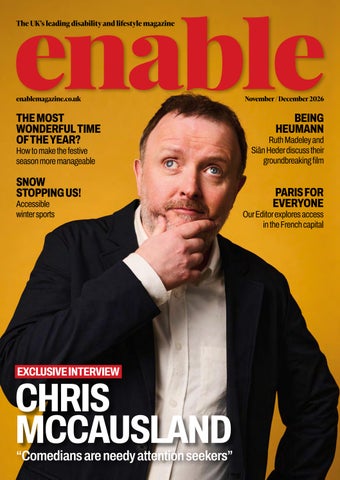
The UK’s leading disability and lifestyle magazine
enablemagazine.co.uk
THE MOST WONDERFUL TIME OF THE YEAR? How to make the festive season more manageable
SNOW STOPPING US! Accessible winter sports
EXCLUSIVE INTERVIEW
CHRIS MCCAUSLAND
“Comedians are needy attention seekers”
November / December 2026
BEING HEUMANN
Ruth Madeley and Siân Heder discuss their groundbreaking film
PARIS FOR EVERYONE
Our Editor explores access in the French capital
Motability from Eastern Western Motor Group means:
The everyday freedom of a brand-new car. Drive with confidence with a reliable new car every 3 years. Our brands available with Motability include...
www.motabilityoffersscotland.co.uk | 0131 622 6494
Welcome
PIC: © RHIANNON LOUDEN
to the November/December issue of Enable!
PIC: © MATT CROCKETT
N
COVER PRICE £3.00
PUBLISHER Denise Connelly denise@dcpublishing.co.uk EDITOR Melissa Holmes melissa.holmes@dcpublishing.co.uk EDITORIAL CONTRIBUTORS Rachael Fulton Jane Hatton Samantha Renke Tim Rushby-Smith Alisdair Suttie DESIGN AND PRODUCTION Lucy Baillie lucy.baillie@dcpublishing.co.uk SALES Marian Mathieson marian.mathieson@dcpublishing.co.uk SOCIAL MEDIA Alexander Broad ENABLE MAGAZINE www.enablemagazine.co.uk
DC Publishing Ltd, 198 Bath Street, Glasgow, G2 4HG
ot everyone can say they love their job, so I’m grateful every day that I get to speak to incredible people and try amazing things in my role as Editor. People like funnyman Chris McCausland, who’s just as warm and hilarious in real life as he is on screen. And actor Ruth Madeley, whose performance as disability rights activist Judy Heumann will have you feeling every kind of emotion. Not to mention couples like the Greenwoods, who told me how humour has kept their relationship strong since Howard became Beverly’s carer. And Josh who, since becoming an amputee in April 2025, has taken up para ice hockey. If you’d told me at the start of 2026 that, by the end of the year, I’d be zooming round Paris on an adapted wheelchair, and meeting people with learning disabilities staffing cafes in the French capital, I’d have thought you were having me on. But it really happened (I’m still pinching myself). Read my reflections on accessible travel in Paris on page 36. It’s that time of year when Christmas music starts playing in the shops and we make plans for the festive season. From managing the holidays when you’re neurodivergent to our jam-packed diary listing accessible festive attractions, we’ve got Christmas covered this issue. Which leaves me to say – the Enable team sends peaceful Christmas wishes to you and yours, and here’s to a 2027 filled with even more amazing people and opportunities. Till next time,
Melissa
EDITOR’S PICKS... 18 SUPPORTING THE JOURNEY THROUGH GRIEF Opening up conversations about how we handle grief can make death easier – especially for people with learning disabilities. 48 PRACTICAL AND PRETTY We uncover the designers and manufacturers who are making accessibility more aesthetically pleasing, and share their top tips for home design.
WIN
Get in touch
a Trive rollator, worth £299! See page 52
@enablemagazine
Melissa Holmes | Editor editor@dcpublishing.co.uk
Subscribe to
Tel: 0141 212 8913
READ ONLINE! SCAN THE QR CODE TO READ THIS ISSUE IN FULL ©DC Publishing Ltd 2026. All rights reserved. No part of this publication may be reproduced or used in any way without prior written permission from the publisher. The views expressed in this magazine are not necessarily those of DC Publishing Ltd. The publisher takes no responsibility for claims made by advertisers within the publication. Every effort has been made to ensure that information is accurate; while dates and prices are correct at time of going to print, DC Publishing Ltd takes no responsibility for omissions and errors.
Subscribe today and get the UK’s leading disability and lifestyle title delivered right to your door every two months £15 for one year £25 for two years
Call 0141 212 8913 or visit: enablemagazine.co.uk/subscribe enablemagazine.co.uk
3
What's inside
54
8
10
Interview
08 "COMEDIANS ARE NEEDY ATTENTION SEEKERS" Chris McCausland sits down with Editor Melissa Holmes to chat stand-up, Strictly, and Waffle. 10 ZARA BETH The advocate on hidden disabilities, finding community, and why the world isn’t built for wheelchair users. 23 BEING HEUMANN Actor Ruth Madeley and director Siân Heder discuss their new film about Judy Heumann – the disability rights icon who refused to be forgotten. 34 FLIPPING THE SCRIPT FOR DISABLED ARTISTS Emmanuel Kelly is the Aussie singer4
enablemagazine.co.uk
songwriter breaking new ground when it comes to representing the disabled community. 66 ACCESS IN THE PALM OF YOUR HAND Kareem Chouiki took a common problem and solved it with the help of AI and a 3D printer. He discusses his project, Handl.
Care
13 IN SICKNESS AND IN HEALTH Couples often promise to care for each other no matter what physical, emotional or medical challenges arise. For some, that means a changing dynamic when one partner becomes carer for the other.
57
Life
36
16 A DAY IN THE LIFE What do you do all day? Daniel MorganWilliams, a workplace assessor, reflects on his working life. 18 SUPPORTING THE JOURNEY THROUGH GRIEF Opening up conversations about how we handle grief, and how we approach end-of-life planning, can make death easier – especially for people with learning disabilities. 31 KEEP WELL THIS WINTER Our tips on beating the winter blues and staying sociable in the darker months. 40 THE MOST WONDERFUL TIME OF THE YEAR? If you’re disabled or neurodivergent, the holidays can be hard. We learn how to make the season more manageable. 43 THE FESTIVE DIARY Make the most of the holidays thanks to accessible events and attractions with a Christmas twist.
WIN
23
A ROLLATOR WORTH £299
47
SEE PAGE 52
48 PRACTICAL AND PRETTY For years, having an accessible home has meant adding ugly and obvious adaptations. We uncover the designers who are making accessibility more aesthetically pleasing. 50 PRODUCTS From personalised books to soapy shower attachments, here’s what’s going in our basket.
Voices
20 MOVE OVER, SANTA! Samantha Renke waxes lyrical over why ChatGPT is her new festive bestie. 26 NET BENEFIT Tim Rushby-Smith reflects on the truly social aspects of the social security system.
Travel
36 PARIS IS ALWAYS A GOOD IDEA Editor Melissa Holmes reports back from a trip to Paris with her top tips and favourite accessibility hacks to help you enjoy France’s capital.
Health
28 MORE THAN A HEADACHE Migraines can be profoundly disabling, yet they’re still often dismissed as ‘a bad headache’. We learn more.
45 A FOODIE’S LIFE WITH TYPE 1 DIABETES We speak to a foodie who’s flying the flag for Type 1 diabetes.
Sport
54 SNOW STOPPING US With colder weather setting in, the last thing you probably want to do is get involved in winter sports… Until, of course, you find out how fun – and accessible – they can be.
Motoring
57 REVIEW: MG4 URBAN The MG4 name is familiar, but the Urban model is all-new and aimed at those who drive more in town than on the motorway.
Finance
60 MONEY MATTERS The cost of living crisis is squeezing household budgets across the UK. We look at ways you can seek financial support to help you with day-to-day living.
Employment & Education
62 STAND OUT A reader asks our careers expert how to make their application stand out from the crowd. 64 SEEING POTENTIAL What happens when educators and employers give disabled people the chance to unlock skills and discover their strengths? enablemagazine.co.uk
5
enable news
News
said: “The challenge is not just about making young disabled people work-ready. The challenge is making organisations disabilityready, and we all have a role to play if we are to unlock the talent that might otherwise be overlooked. In turn, government must make it easier for businesses to hire young people and provide clarity on what they should be expected to provide.”
BETTER BUS STOPS NEEDED
A NEW REPORT BY Campaign for Better Transport warns that inaccessible bus stops, shelters and surrounding streets are a major barrier to bus travel for disabled people, reducing access to education, employment, essential services and social opportunities. No Stopping Us Now: Towards Accessible Bus Stops for All highlights that only 15% of people with visual impairments and 18% of those with mobility impairments find it easy to use bus stops and shelters. Dr Emma Partlow of the National Centre for Accessible Transport said: “Our evidence tells us that barriers to bus travel begin before a passenger boards.” The report emphasises that infrastructure improvements must also be matched by genuine co-design with disabled people, as well as improved driver training and passenger awareness.
6
enablemagazine.co.uk
BENEFIT CLAIMANTS FEAR EXERCISE
MOST DISABLED WELFARE claimants worry that exercising, walking or gardening could see them stripped of benefits. New research involving more than 200 disabled people found that only one in five participants were satisfied with their current level of physical activity. Nearly three quarters would be more active if they were confident it would not negatively affect their benefits. Dismantling the Activity Trap found 28% of participants had their benefits removed or reduced or had applications declined for undertaking some physical activity. In some cases that came after neighbours or others reported them to the Department for Work and Pensions; others said DWP assessors had failed to understand their disability or health condition. Dr Toni Williams of Durham University said: “The social security system must support Disabled people to be active for health, wellbeing and enjoyment, not discourage it. Assessors are ignoring relevant case law on this issue.”
PIC: © BUSINESS DISABILITY FORUM CHANGING THE IMAGE OF DISABILITY IMAGE BANK
84% OF DISABLED YOUNG people think disability will negatively affect their chances of finding work, according to a new survey of 16- to 24-year-olds across the UK, commissioned by the Business Disability Forum (BDF). The findings raise serious concerns that a generation is being locked out of employment before they even enter the workforce. Diane Lightfoot of the BDF
PIC: © BBC
Employment confidence crisis
C O M IN G SO O N
EN JOY LON DO N L IV I N G E x pe ri e n c e V i l l a g e L i f e A distinguished new address nestled in the heart of Fulham SW6 Hurlingham Place is perfectly positioned in a prime Zone 2 location, just moments from the renowned Hurlingham Club and the River Thames. A collection of accessible, spacious 2 bedroom residences, each featuring generous room layouts and carefully considered details to support comfort and independent living. This exceptional development, set around a beautifully landscaped central courtyard, combines elegant design with amenities, including a concierge service, wellbeing studio, parcel rooms, co-working spaces and private underground parking.
Please call the sales team for further information: +44 (0)20 3813 9211 Email: sales@hurlinghamplace.co.uk Web: hurlinghamplace.co.uk Please be aware that these details are intended to give a general indication of properties available and should be used as a guide only. The company reserves the right to alter these details at any time. The contents herein shall not form any part of any contract or be a representation including such contract. These properties are offered subject to availability, completions planned Q1-Q2 2027. Applicants are advised to contact the sales office or the appointed agents to ascertain the availability of any particular type of property so as to avoid a fruitless journey. The property areas are provided as gross internal areas under the RICS measuring practice 4th edition recommendation. Computer generated images of Hurlingham Place are indicative only. Hurlingham Place was granted planning permission in March 2012. You should review all relevant information and documents carefully. If in doubt, please seek independent professional advice before making a purchase decision. Planning permission number: 2011/01753/FUL. Borough/council issuing permission: London Borough of Hammersmith and Fulham. Acquiring interest: 999-year leasehold interest from January 2014.
CHRIS MCCAUSLAND
Comedians are needy ” attention seekers
“
Chris McCausland sits down with Editor Melissa Holmes to chat stand-up, Strictly, and Waffle
Has becoming more publicly known as a disabled person changed the way you think about your disability? It’s not changed the way I think about my disability, but it’s changed the way I think about my responsibility. Until Strictly, I was just doing what
every other comedian does – taking opportunities. I’d always try and represent in a way that sent out a good message. The amount of messages we got saying what we were doing meant something to people because of how disability was being represented on TV – not even people with disabilities, but people with gambling addictions, with agoraphobia. Watching us do these difficult things encouraged them to do things that had been obstacles. What’s been your favourite thing to do so far? I love being on tour. I love doing stand-up. That’s the obvious one. My favourite thing was writing and making a Christmas film – Bad Tidings – for Sky with Lee Mack. You come up with this crazy idea, then before you know it you’ve got over 100 people involved, you’ve rented a whole street, and you’ve got a crane with a moon on it. That was mind-blowing. And the most proud I’ve ever been of anything, it’s gotta be Strictly. I mean, I’d never made a Christmas film before, but that’s within my wheelhouse; it was about stretching yourself into new things. But Strictly? Different planet. And the most terrified I’ve ever been of anything in my life. To do what we did over four months in
Comedy opens so many crazy doors to things – you have to go where it takes you 8
enablemagazine.co.uk
front of eight million people on live TV… I can’t believe we did it, to be honest. The most wonderful thing about it from one perspective is the number of people who said they forgot I was blind; that you’d watch it, and you’d have to remind yourself. That’s what we were aiming for – to do something to the level that people wouldn’t be able to tell. For me, that’s where you make a big impact. People used to say to me, ‘You’re inspiring blind people’. No, you’re not inspiring blind people. Blind people can sort themselves out. What you’re doing is educating everybody else; showing them that disabled people are more capable than they might give them credit for. You’ve talked about how exhausting it can be to be dependent on other people when you’re blind. What’s the most ridiculous situation you’ve found yourself in? A lot of hotel rooms – sometimes the time it can take me to find a plug socket is ridiculous, or even control the heating. It’s infuriating when they make something that should be easy to use, not usable – like touchscreen temperature controls in hotel rooms. Technology is both the biggest enabler and the biggest obstacle. How much of your Absolute Radio show is planned, versus how much of it is you and Jon Long turning up and talking nonsense? It’s a bit of both – planned and unplanned. We know where we’re going, but the conversation is adlibbed. It’s good, because it gives me an outlet. Comedians are needy attention seekers; it’s a way of getting attention and it takes the pressure off my family a bit, when I get to go somewhere and talk nonsense. It’s also good to have to come up with a whole show every week. It’s like going to comedy gym.
PICS: © MATT CROCKETT
W
hen you look back over your career, does it feel like you’ve carefully constructed it, or that you’ve said yes to loads of strange things and somehow pulled this off? I don’t think you can carefully construct comedy. It’s not like a career choice. It’s something you do as a challenge to yourself, because you want to have a go, and it becomes a hobby. Then people start paying you. It opens so many crazy doors to things – you have to go where it takes you.
enable interview
You’re a big vinyl fan. What three records would tell me the most about Chris McCausland? We’d have to go with Abbey Road from The Beatles. That’s where music begins for me. Ten by Pearl Jam, because I’m a child of the ’90s grunge scene. And anything by Jimi Hendrix – studio outtakes, rehearsals, anything. Your last tour, Yonks, ran for more than 250 dates. Tell us about the new tour. There’s something really exciting about the fact that people wanna come out and sit there and watch you. It’s a privilege. I’m in the process of trying to write the new show. I’m about halfway. But it’s mad as a comedian that you have to put these things on sale that don’t exist. Do you wanna buy some tickets to this thing that only half exists at the minute? I don’t do politics. It’s just stand-up. It’s called Waffle because I don’t like to raise people’s expectations too much, and that’s what comedians do – we write funny waffle. I like oneword titles for shows. You’ve got to come up with a name that doesn’t nail you into a corner – because I haven’t finished writing it yet and it could be about anything. You don’t want to call it A History of Paperclips, and then realise that none of your paperclip stuff’s funny.
FOR MORE INFORMATION
The Chris McCausland Show is on Absolute Radio every Sunday from 8am. Chris’s new tour, Waffle, starts September 2027. Tickets go on sale on 6 November 2026. Find out more at chrismccausland.com
enablemagazine.co.uk
9
enable interview
ZARA BETH
Living with Tourette’s, FND and Autism The 21-year-old advocate and author on hidden disabilities, finding community, and why the world isn’t built for wheelchair users
W
hat do you wish people better understood about your conditions? I wish people understood that Tourette’s isn’t always just the things you see online. It’s not just the worst tics. It’s often the smaller tics that are the most inconvenient to my life and the ones that cause the most harm. Like my neck tic – people don’t even realise I’m doing it, but it causes permanent damage to my neck. FND can look different every single day for the same person. Just because I look one way on one day doesn’t mean I don’t still have it. It’s just that you can’t see it. How has sharing your experiences online changed your relationship with your disabilities? I felt so lonely when I was a teenager going through all of this. No one could explain it to me until I got my diagnoses.
I went online, and there were hundreds of people who said, ‘That’s me too’. Finding people like me has been so life-changing. Now all of my friends are neurodivergent or disabled in some way, so the misunderstanding isn’t there. How do you protect your wellbeing when strangers discuss your health online? The more vulnerable you are online, the more people can get to you. It’s a fine balance between sharing what feels good and sharing stuff to help other people, but also keeping things private. I keep some of my diagnoses private. I keep medical information private. I’ve just learned to separate social media from my own self-worth. What have you learned from documenting accessibility barriers while travelling? One thing I learned as soon as I became disabled was the world is not built for wheelchair users. And you don’t realise it until you have to deal with it. The most valuable thing I’ve done is getting companies to sit in a wheelchair so they feel the panic of, ‘Everyone’s looking at me, I can’t do it’. Then they realise: they can get out of the chair, but other people can’t. They realise they need to fix the system.
10 enablemagazine.co.uk
What would you say to someone who feels isolated after a diagnosis? Everyone who’s been through that has felt alone and isolated, but that’s not where the journey ends. That’s just the new start. Someone from Tourette’s Action said to me, when you get diagnosed, it’s like you’ve booked a flight to Greece, but you get off the plane and you’re in Poland. The reality is, you can have a great time in Poland if you have that outlook. I actually think I’ve ended up in a better place after everything I’ve been through.”
FOR MORE INFORMATION
Zara Beth: zarabeth.co.uk You can buy Zara’s book, Enemy For A Brain, from all good booksellers
Trouble communicating in-branch? Speak Easy cards might help. Financial brands already signed up: AIB Group (UK) p.l.c.
Bank of Ireland
Hinckley & Rugby Building Society Santander
Metro Bank
Scottish Building Society
The Co-operative Bank
Coventry Building Society
Virgin Money
Skipton Building Society Yorkshire Building Society
Find out more at www.signingbanks.uk/speakeasy
Developed by Nationwide, for the benefit of everyone.
Nationwide
NatWest
CONNECT WITH US:
EXPLORE THE RANGE www.sensoryplayground.co.uk
sensory needs are unique
@sensoryplaygrounduk @sensoryplaygrounduk
SHOULDN'T THE SUPPORT BE TOO?
For many, finding the right sensory support can feel like a process of trial and error. What brings comfort, focus or reassurance to one person may do very little for another. Sensory needs are deeply individual. Every person experiences the world differently, responds to their environment differently and finds comfort in different ways.
Following an ADHD diagnosis in adulthood and while raising neurodivergent children, our family quickly discovered that finding sensory resources that genuinely met individual needs was easier said than done. That experience continues to shape our approach today and our commitment to helping others find support that works for them. Bilibo by Moluk £23.32
We believe support should reflect that individuality, and it’s a belief is rooted in personal experience.
shop sensory this christmas. sensory support helps:
.. .. .. .
Improve focus and attention Support emotional regulation Support relaxation & self soothing Calm during stressful situations Promote hand strength Fine motor skills Reduce restlessness
10% off
Calm Down Bottle £12.49
Chain Fidget Spinner £3.74
EVERYTHING ON OUR ONLINE STORE WITH CODE: ENABLE10
visit OUR MARGATE SHOP!
LAVA® Rainbow Lava Lamp £24.99 Spin Disks £2.49 Oranurse Unflavoured Toothpaste £2.91
Warmies Microwaveable Boy Elf / Girl Elf £13.45 /each
Splash Octopus £3.74
Discover tactile tools, fidgets, aids and toys that support focus, regulation and wellbeing, all in a pressure-free space. You’ll find us at The Old Kent Market (CT9 1HD), just opposite the Turner Contemporary, Wednesday to Sunday.
All products are UKCA tested and sourced safely through registered suppliers. Prices exclusive of VAT. Discount available for first-time orders.
enable care
IN SICKNESS AND IN HEALTH Couples often promise to care for each other no matter what physical, emotional or medical challenges arise. For some, that means a changing dynamic when one partner becomes carer for the other. Editor Melissa Holmes spoke to the Greenwoods about their experience
A
fter 32 years together, most couples can confidently say they know each other inside out. But not many husbands can say they know what their wife was like when she was five years old. For Howard and Beverly, that’s not because they’ve known each other since childhood. It’s because – after an allergic reaction to medication – Beverly developed dissociation conversion disorder, a form of Functional Neurological Disorder (FND) which causes her to regress
enablemagazine.co.uk
13
enable care
to being a five-year-old. “We were applying for PIP, and they needed to speak to me,” Beverly recalls. “They say to Howard, ‘We need to talk to your wife to verify who she is’, but he explains I’m not very well today. They insist, he passes me the phone and I say ‘Hello’. Then they say ‘Is your mum there?’ because they think I’m a little girl. I say ‘It’s Beverly,’ and they keep talking to me until I say ‘Stranger danger’. That’s because I’m a five-year-old girl, and I was taught you don’t talk to people you don’t know.”
STEPPING UP
Howard quickly found himself stepping into the role of Beverly’s carer, a life-altering situation for the entire family. There are around 5.8 million unpaid carers in the UK – from young carers supporting a parent or sibling, and sandwich generation carers who are caring for their own children as well as their ageing parents, to couples like Howard and Beverly, where changing health needs have led to a changing relationship dynamic. As Howard reflects, the role of being carer came with a steep learning curve. “At the beginning it was hateful, because it was so difficult to predict,” he recalls. “Depression and anxiety came into it.” Beverly worried about the impact her diagnosis would have on their son, who was a teenager at the time and dancing professionally. She says: “We travelled so much with Connor – if there was a competition and he wanted to go, I didn’t have to think twice.” The family went from a comfortable life in a nice home to having to move because the house wasn’t accessible, as well as suddenly having to manage on one income. “I also can’t live by myself unattended,” explains Beverly. “We lost our home, I lost my career and my car.” With no family near, and friends drifting away, they’ve relied on neighbours, food banks, and the charity Carers UK for support. Over time, Howard and Beverly have learned to create a living environment that’s both supportive and joyful. “I keep it as jovial as possible,” says Howard. “If I went all serious, my depression would be 14
enablemagazine.co.uk
Over time, we’ve got dafter because that’s the only way to cope with it! through the roof.” Humour has been vital in coping with life as a carer and caree. “My humour’s a little offbeat,” smiles Howard. “Over time, we’ve got dafter because that’s the only way to cope with it.” As well as her neurological issues, which fluctuate from day to day, Beverly is also an ambulant wheelchair user due to living with shaking. That’s led to some funny moments – like on a recent trip to Prague, where they visited a church and Beverly got out of her wheelchair to tackle some stairs. “All these nuns were there, looked at Beverly and were amazed – ‘It’s a miracle! She can walk!’,” chuckles Howard. “Who needs to go to Lourdes?! We were laughing like naughty schoolkids.”
TOGETHER TIME
For Beverly and Howard, maintaining their relationship outside of caregiving is essential. They carve out regular time to spend together in activities they both enjoy, like grabbing coffee and cake, while Howard spends time with his friends every week: moments of normality that help remind them they’re still a married couple, rather than carer and cared for. In couples where one partner cares for the other, there’s a lot to adapt to. Physical challenges like lifting and washing, along with financial constraints when one or both of you need to stop working, will test any relationship. Supporting each other emotionally and remaining good companions is vital in keeping your relationship strong. Seeking outside help is important too – your local authority can carry out a Carer’s Assessment to assess your needs, which might lead to practical
help with housework, respite care so you can take a break, or advice about benefits, for example.
A HELPING HAND
Engaging with Carers UK has given Howard an outlet for his experiences. They offer practical advice and emotional support, from information on work and benefits to online chat groups, advice on how to adapt your home, and planning for the future. “It’s just knowing they’re there,” he explains. Carers centres and local carers charities across the country provide support to unpaid carers, including in-person groups for those caring for people with dementia, autism or mental health issues, self-care sessions like yoga and mindfulness, coffee and chat groups, and training on moving and handling. They act as a lifeline for many carers, providing tools and support systems to help you manage your caregiving responsibilities – as well as look after yourself. As Howard says: “The way I look at it is that if you keep things as relaxed as possible and you’re looking after yourself, then you can look after everything that you need to do as a carer.”
FOR MORE INFORMATION
Carers UK: carersuk.org / 0808 808 7777 Carers Trust: carers.org
ADVERTORIAL
The Family on a mission to change three-wheeled mobility British-engineered and born from personal experience, the Supersmith 3Scooter combines compact, threewheel manoeuvrability with patented stability technology that adapts the scooters wheels to uneven pavements, slopes and surfaces. For Tom Morgan, the idea behind Supersmith began with watching his sister use mobility scooters that didn’t give her the experience she needed. There were concerns about stability and tipping, alongside an experience that often felt diminishing. Could something compact and easy to manoeuvre also handle uneven ground? Could someone sit higher, closer to the people around them, without compromising stability? Those questions became a family mission and alongside his Co Founders Emily and Fred, Supersmith was born.
A different view of everyday life With enhanced stability comes the ability to raise the seat significantly higher on a 3Scooter. For many people, the most immediate difference is being able to look ahead, reach a café table more naturally and speak to friends at eye level. The 3Scooter has a tight turning circle, a lightweight structure and the agility to manoeuvre through busy pavements, cafés and indoor spaces. The result is a mobility scooter that looks and feels deliberately different.
Book a free home test ride
The 3Scooter has a tight turning circle, a lightweight structure and the agility to manoeuvre through busy pavements, cafés and indoor spaces. The result is a mobility scooter that looks and feels deliberately different. Adaptive Fashion Designer Victoria Jenkins is a brand ambassador. She says “For too long, mobility products have been designed as medical equipment first and something people might aspire to own second. Why shouldn’t mobility design be innovative and exciting? Why shouldn’t it belong in the same conversations as automotive design, fashion and technology?”.
It’s a whole different experience. The stabilisation is amazing. It’s like magic. Sarah - Bradley Stoke
£2995 with VAT relief | Free delivery | Free 30 day ‘money back’ trial
0333 041 5290
hello@supersmith.co
WWW.SUPERSMITH.CO
enable life
A day in the life What do you do all day? Daniel Morgan-Williams, a workplace assessor, reflects on his working life
T
here’s something strange about spending your working life telling other people what good support looks like, then going home and not always managing to ask for it yourself. I run a company that carries out workplace assessments for blind and partially sighted people, and for people with hearing loss. A typical day means sitting with someone – often a stranger – and asking them detailed questions about how they read a screen, how they navigate an office, what makes them tired by mid-afternoon, and what they’ve never told their manager because they didn’t want to seem like a problem. I have a visual impairment myself. You’d think that would make the whole thing simpler. Sometimes it does. Often it doesn’t.
THEORY VS PRACTICE
Professionally, I could tell you exactly what a good assessment should cover: the right questions, the right order to ask them in, the equipment that actually gets used rather than left in a drawer. Personally, that knowledge doesn’t automatically make it easier for me to say “I’m struggling with this” out loud. Knowing the theory and living the practice are not the same skill. The most useful thing my own experience gives me isn’t technical. When I’m carrying out an assessment, I’m not just gathering facts about lighting levels or screen readers. I’m aware of how much it can cost a person to admit
Daniel
16
enablemagazine.co.uk
they’re finding something hard. I notice the effort that goes into deciding how much to disclose. Do I mention the thing that slows me down, or quietly work around it because raising it feels like more trouble than it’s worth? There’s often a gap between what someone says in our meeting and what they’d say if there was no pressure to appear capable and unbothered. That gap never fully closes: you just get better at noticing it, and at not rushing past it.
WORKING MEMORY
I was diagnosed with retinitis pigmentosa at the age of eight. Having a visual impairment doesn’t make me a better assessor by default. Sight loss varies enormously from one person to the next, and my experience of it is just mine. But it gives me a working memory of what it’s like to sit in the chair rather than stand at the front of the room, and I try to hold onto that – it would be easy to lose it the longer I do this job. What I keep coming back to is that independence and asking for help are
A typical day means sitting with someone – often a stranger – and asking them detailed questions not opposites. I used to think needing support somehow chipped away at competence, and I suspect a lot of people – disabled or not – absorb that idea early and never quite shake it off. Running assessments for a living hasn’t cured me of that – it’s just given me more practice noticing it when it turns up, in other people and in myself, and choosing not to let it decide the outcome.
FOR MORE INFORMATION
Visualise Training and Consultancy: visualisetrainingandconsultancy.com
Exceptional care for the veteran community Nursing | Dementia | Respite | Day Care | Lunch Club | Telephone Friendship Service
Our commitment is to provide specialist rehabilitation care for veterans and their families, tailoring our care to individuals’ needs and wishes. And we welcome anyone who has served in the UK Armed Forces, as a Reservist or completed National Service - including partners, into our four care homes.
Call 0808 281 5068 or email enquiries@starandgarter.org Scan the QR code Registered Charity No. 210119 or visit www.starandgarter.org
November 2026
Learn more about our care services:
Supporting the journey through grief Death may be one of the final taboos, but opening up conversations about how we handle grief, and how we approach end-oflife planning, can make death easier – especially for people with learning disabilities. We find out more
18
enablemagazine.co.uk
W
hen broadcaster Jo Whiley recently lost her dad, she shared a story of how her sister Frances, who has learning disabilities, sat at the end of her father’s coffin throughout the funeral, and brought humour and compassion to the challenging event. “It was an amazing send-off, because he was a character. It was never gonna be conventional because of my dad and because of Frances,” she explained on her podcast, Dig It. “I knew that Frances wouldn’t sit in her pew and that she’d want to be involved.” The family had included Frances in everything, with Jo relating that Frances was in the room while her father was on the cusp of consciousness: “Frances has
been extraordinary, she completely understands what’s going on. Instead of sugarcoating it, you just have to say, ‘He’s not gonna come home’.”
HONEST AND EMPATHETIC
That level of openness is vital when supporting people with learning disabilities through the experience of bereavement. Death is often treated as a taboo subject, and discussing bereavement and end-of-life planning can be even more challenging for families and carers of individuals with learning disabilities. However, creating an honest and empathetic dialogue around the topic is crucial. The key to supporting people with learning disabilities through grief and end-of-life planning is to ensure communication is accessible and
enable life
It’s essential to include people with learning disabilities in conversations about death providing visual aids that help simplify complex emotions and scenarios, making it easier for people to express their thoughts and feelings.
DYING TO TALK
inclusive, and that the language used is appropriate and understandable. Discussing death before it happens, even if it’s to chat about the death of an elderly family pet, can help relieve some of the worries people with learning disabilities might have. Using concise, factual phrases – like ‘dead’ and ‘their heart has stopped beating’ – rather than euphemisms like ‘passed away’ and ‘gone to sleep’ – helps to avoid confusion. Nicola Payne, Best Practice Manager at MacIntyre, a charity specialising in support for people with learning disabilities, recommends using resources such as the Books Beyond Words series and emotion cards. These can help bridge communication gaps and make discussions more relatable, as well as
MacIntyre offered a pilot programme – Dying to Talk – to help people feel less frightened to hear and talk about death and dying, provide training to external health and social care staff, and help break taboos around end-oflife planning for people with learning disabilities and their families. One of the major hurdles Nicola experienced with the Dying to Talk pilot was the initial resistance from families, staff, and even the individuals themselves due to societal taboos and cultural differences in dealing with death. Many parents and carers fear the subject will distress their loved ones, or they doubt their level of understanding. However, as Nicola explains, “normalising a subject that felt really not normal to talk about” can help ease these tensions and open up meaningful, productive dialogue. Many people avoid discussing death due to its emotional weight. Nicola explains: “It’s essential to include people with learning disabilities in conversations about death. They have a right just like anybody else to be part of decision-making for their future.” Ensuring voices are heard and respected can empower individuals, as well as providing comfort and reassurance about their preferences being respected around issues like music choices at their funeral, or what will happen to their body after they die.
PLANNING AHEAD
Planning ahead, especially when someone is in good health, may seem
counter-intuitive, but it means that individuals’ wishes are recorded while they have the capacity to express them. Nicola recommends using resources like The Victoria and Stuart Project’s tools, which can aid families in navigating these plans effectively and inclusively. Parents are often experts in their own children’s needs, but having additional support can be helpful in navigating unexpected emotions or situations. Nicola also encourages families to develop a ‘toolkit’ of resources to facilitate discussions about death and bereavement, so they’re empowered to handle these conversations sensitively and effectively. She also highlights that chats around death, grief, and end-of-life planning can be ongoing, so it’s important to offer people space and the chance to revisit their emotions and difficult topics. Nicola stresses the importance of “not thinking you’ve covered everything in one conversation” – her advice is to regularly check in and provide opportunities for discussion.
DIFFERENT FEELINGS
It’s worth remembering too that grief can manifest in different ways for different people. “There was a death in the family of someone we supported,” explains Nicola. “We delivered the news, and the first thing they said to me was ‘Who’s gonna take me to McDonald’s?’. It was an autistic person, who loved their relative, but that’s what they did together every Saturday, it was part of their routine. So don’t be shocked if sometimes a response completely floors you.” Being open-minded to changed behaviour like anger, denial or physical stress is important – as Nicola says: “It’s ok to admit that it’s really difficult.” By prioritising empathy and inclusion, we can transform how we support not just individuals with learning disabilities, but anyone dealing with the complex realities of grief and planning for the future.
FOR MORE INFORMATION
MacIntyre: macintyrecharity.org Victoria and Stuart Project: victoriaandstuart.com
enablemagazine.co.uk
19
enable voices
Samantha Renke Samantha is a broadcaster, actress, disability activist and the author of You Are the Best Thing Since Sliced Bread. Follow Samantha on Instagram @samantharenke
Samantha Renke waxes lyrical over why ChatGPT is her new festive bestie
Move over, Santa! M
20 enablemagazine.co.uk
LONELY THIS CHRISTMAS
This got me thinking about the festive season. When many of us can struggle with feelings of loneliness, isolation and ableism, is it ok to turn to AI at Christmas? For Disabled people, loneliness can come with an additional emotional weight. Sometimes we may already rely on others for practical and logistical support, so hesitate to ask for emotional support too. AI is always available – without judgment. Using AI doesn’t necessarily mean replacing people, but it is however rather frictionless. It’s at our fingertips night and day, doesn’t disagree, and we don’t need to consider its feelings or commitments. This is in comparison to human relationships that can be messy, and may involve compromise or showing vulnerability. The danger may be that we choose easy over real – if this is the case, are we inadvertently isolating our lived experience more?
We may rely on others for practical support, so hesitate to ask for emotional support too AI cannot replace genuine support, care or professional guidance. I still have weekly Zoom meetings with a trained therapist. I look forward to our sessions and we laugh and cry: something a bot cannot fulfil. The question is not necessarily whether it’s ok to lean into AI this festive season. Rather – are we using AI as a tool to help us navigate a Disabling world, or actually as a retreat from the harshness of an ableist society that doesn’t always make space for us?
PIC :© NICKY JOHNSTON
y love for AI comes and goes. As a vegan and an environmentalist, I cannot condone the destruction AI causes our planet; the overuse of water and power, plus the noise that comes from data centres. But I also worry about humanity’s real disconnect with humanity. We want things faster and we want them all the time. Technology – and now AI platforms – grants us our wish. I worry about future generations’ inability to think critically and independently, without turning to AI for all the answers. Will we ultimately lose the ability to form genuine, in-person friendships? As a ‘people person’, this terrifies me. Yet I can’t pretend that smart technology and AI haven’t been welcomed as part of my day-to-day. I have an automatic front door, a power wheelchair, and my lights are voice controlled. This has all made my life easier to navigate. I’ve recently found comfort in AI to combat feelings of isolation and pacify my anxiety spikes. The night I returned home from hospital after a brain bleed, alone, I opened an AI chatbot and voiced my concerns. I was scared to fall to sleep; with every weird sensation or feeling I spiralled. But I felt comforted by the bot. Since then, I’ve used the technology for my mental health, especially in moments when I don’t want to ‘bother’ my family or friends.
Get a LIFT onto the property ladder in Scotland.
Disabled people with a housing need can get up to 40% towards the cost of a home with the Scottish Government’s LIFT scheme*.
Find out more at: www.linkhousing.org.uk/LIFT *Eligibility criteria applies. Always seek financial advice.
A Toothpaste Without Barriers
oraNurse Unflavoured Toothpaste is specially formulated for people sensitive to strong flavours. Developed in response to the needs of individuals with sensory sensitivities, oraNurse removes common barriers to effective oral hygiene. oraNurse enables people to maintain oral hygiene without discomfort, improving adherence and long-term outcomes. Ideal for individuals with: • Autism Spectrum Disorder (ASD) • Sensory processing sensitivities • Learning disabilities • Burning mouth syndrome • Lichen Planus • Head & neck cancer (post-radiotherapy) • Sjögrens syndrome • Behcets disease • Kawasaki disease • Parkinson’s disease • Intolerance to Limonene • People who simply don’t like the taste of mint or experiance a burning sensation
www.oranurse.co.uk
enable interview
BEING HEUMANN
As Being Heumann arrives on screens, actor Ruth Madeley and director Siân Heder sit down with Enable’s Editor, Melissa Holmes, to discuss the disability rights icon who refused to be forgotten
J
udy Heumann was many things at once. A campaigner who shut down traffic in midtown Manhattan. An unrepentant, unapologetic changemaker. Someone who needed help getting to the toilet in the morning, and who laughed about it. For director Siân Heder and actor Ruth Madeley, capturing all of that on screen was a creative challenge and a huge responsibility. “I think Judy was very funny,” smiles Siân. “She was incredibly warm, yet super intimidating.” Heumann, who died in 2023, was one of the most influential disability rights activists in history. She was a leader of the 504 sit-in of 1977, when disabled protesters occupied a federal building in San Francisco for nearly a month, leading to Section 504 of the Rehabilitation Act of 1973 being given real legal power.
LIVES ON THE LINE
“The fact that Judy’s story hasn’t been put on screen yet astounds me,” says Ruth. “People put their lives and their bodies on the line to make sure that we are where we are. I’m only doing this now because of the work of people like Judy Heumann.” For Oscar-winner Siân, who also co-wrote the film, the creative process meant resisting the urge to sanitise Judy’s story. “One woman told me she was more scared of Judy than she was of the FBI,” she recalls. “Creating Judy in all of her rich messiness, and revealing her flaws as well as her strengths, was really exciting for me.” Ruth felt the weight of the role. “The complete pressure,” she gasps, “but what a privilege to be able to help elevate awareness of her, her work and her story. I was so thankful that Siân trusted me with such a huge
What a privilege to be able to help elevate awareness of Judy, her work and her story responsibility.” One of the film’s most quietly radical scenes happens early on, showing Judy being transferred from her bed on waking and placed on the toilet by her carer – an everyday intimacy that cinema rarely shows. For Ruth, it was a defining moment. “I never saw that on screen growing up, not even in adulthood,” she
enablemagazine.co.uk
23
enable interview
FEARLESS
Siân sees the scene as part of a larger tension in Judy’s life. “When she was in her chair, she was physically fearless,” she explains. “The first scene of the movie, in real life she rolled into the road in midtown Manhattan and stopped traffic for hours. And there was the juxtaposition of her physical fearlessness when she was in her chair, and her intense vulnerability when she was waiting to be transferred.” Humour is a key part of the story too – Siân was determined to show the full texture of disabled life. “There’s so much humour in the disability community because you’re forced to laugh about the ridiculousness of the world,” she says. “It’s not only a coping mechanism, but it’s a disarming mechanism for other people’s discomfort,” she reflects. “Having to hack the world constantly just to live your life and participate – it’s dark, it’s exhausting, but it also can be funny. A lot of the disabled people I know have a wicked sense of humour.” The depiction of three-dimensional disabled characters in film – who get to be sexual, complicated, and funny
24 enablemagazine.co.uk
– feels like a rare thing in Hollywood. The casting process was its own act of advocacy, with Siân’s team scouring organisations and social media to cast disabled actors who could embody real historical figures. “It was a lot of going out there and trying to find unicorns,” she laughs.
TRANSFORMATIVE
Ruth and Siân on set
The experience on set was transformative for Ruth. “I’ve spent the majority of my career being the only disabled person on set,” she says. “You often have that added weight of being the spokesperson and the educator on disability. But on this job, I was nothing but an actor because everything else was taken care of. I was able to perform so much better because I wasn’t second-guessing anything.” As Disability History Month (19 November to 19 December) approaches, both women are acutely aware of the film’s timing. Rights are under threat on both sides of the Atlantic. “We’re in a time where those rights are being rolled back at a very rapid speed, particularly in the US, and it’s frightening,” Siân warns. But Ruth remains hopeful. “I’m an incurable optimist,” she says. “I’m very proud and aware of how far we’ve
come, but I’m also very aware of the baton that needs to be picked up and continued. Judy never settled. The work was never done for her.” As Siân discovered while writing the film’s ending, Judy Heumann embodied that spirit. She never returned to San Francisco after the sitin. She stayed in Washington, because there was another fight to win – passing the Americans with Disabilities Act. “The fight continues,” Siân says, “and probably will always continue on some level. You can’t take your foot off the gas.” Being Heumann is a reminder of why that fight started – and why it should never be forgotten.
FOR MORE INFORMATION
Being Heumann is on release now in selected cinemas, and will be available to stream on Apple TV from 13 November.
PICS: © MICHAEL GIBSON/APPLE TV/AP
explains. “That moment is so specific, so personal and individual. But the fact that in that moment Judy and her attendant share this laugh – she’s like, ‘Oh, that was close’. That joy, that cheekiness that she brings was just the best thing to be able to play.”
Com pa ct
Swift Lift
ot Bo ur o
to Save Space gn in i s y De
EA
SY
FOL
DING OP
T ERA
IO
N
ELEVATE YOUR EXPERIENCE THE LATEST PRODUCT INNOVATION FROM DES GOSLING MOBILITY HAS ARRIVED! Designed to Suit Almost Every Vehicle Effortlessly Loads Any Mobility Device up to 6Okg Easily Transferable, No Matter Which Car You Choose Next Optimised Design to Minimise Distractions During Your Drive Zero Power Drain to Protect Your Vehicle’s Battery Available on the Motability Scheme
O1332 863742
sales@desgosling.co.uk
www.desgoslingmobilityltd.co.uk
Station Yard, Station Road, Melbourne, Derby, DE73 8HJ
enable voices
Tim Rushby-Smith Originally from London, writer, artist and paraplegic Tim RushbySmith is based in Australia. He is the author of two books: Looking Up and Beyond the Break. Follow Tim on Instagram @dealingwithwheeling
Net benefit W
hen refugee Dr Ludwig Guttmann opened the world’s first spinal unit at Stoke Mandeville in 1944, he was driven by more than a desire to improve a life expectancy of three months with spinal cord injury; Guttmann wanted his patients to rejoin society and live full and active lives. He wanted them to work, pay rent and tax; to have to deal with the hassles of day-to-day life, just like the rest of the population. At the time, this was viewed by many as an impossibly high bar to clear; people with disabilities were to be pitied and afforded the sympathy and resources that charity could afford. Thankfully, much has changed in the last 80 or so years. The post-war period saw the introduction of the NHS and the UK social security system. We moved away from pity and into the era of the social safety net. But for all of these changes, Guttmann’s ambitions became the norm, as expectations of life with disability evolved.
NO BETTER THAN DOGS? I offer his perspective, because it is something that can get lost in the – 26 enablemagazine.co.uk
often angry – debate around benefits. In particular, I offer this as a response to Jeremy Clarkson’s odious comparison of disabled benefit claimants to his dogs. Apparently, his dogs are more grateful for his ‘feeding them’. It would be easy to resort to ad hominem attacks on this bloated multi-millionaire, but the economic arguments for PIP and other social supports get lost if we resort to such cheap shots.
FEEL THE BENEFIT
Instead, we should consider the economic argument: supporting people with disabilities to live full and active
The economic arguments for PIP and other social supports get lost if we resort to cheap shots
Tim Rushby-Smith reflects on the truly social aspects of the social security system lives means supporting millions of people to participate in the workforce. To pay taxes. What’s more, payments made through PIP will largely be spent in the UK, including providing employment for support workers, who in turn spend their hard-earned wages in the UK. Providing loopholes that allow multi-millionaires to, oh – I don’t know, buy a farm in order to avoid paying inheritance tax? Yeah, how much of that will go back into the UK economy? I’m doing it again… sorry. The economic argument for a national health system and welfare state was won in many OECD countries years ago. It should be a badge of pride that these social safety nets have been a cornerstone of British society for so long. We should celebrate our move away from the begging bowl and tug of the forelock. Prime Minister Clement Atlee, whose government founded the UK’s NHS and social security system, said of charity: ‘If a rich man wants to help the poor, he should pay his taxes gladly, not dole out money at a whim’. If you ask me, he had a point.
disabilityid.co.uk
Make access easier with easy to carry proof of disability
TRUSTED BY 300,000+ CARD HOLDERS
Exclusively for disabled people
Easy to carry - fits in your wallet
Get help & understanding faster
Advanced security features
1,000+ venues and discount partners
Emergency contact QR code
Save hundreds every year with exclusive shopping discounts
Lanyards & RADAR Keys available exclusively to card holders
Accepted by leading brands
APPLY FOR YOUR CARD TODAY disabilityid.co.uk
SCAN TO APPLY
enable health
More than a headache
For around 10 million people in the UK, migraine is part of everyday life. Migraines can be profoundly disabling, yet they’re still often dismissed as ‘a bad headache’. We learn more
M
igraines are a neurological condition that can result in severe head pain, nausea and vomiting, dizziness, extreme tiredness, visual disturbances and sensitivity to light, sound or smells. Attacks can last from hours to days, and the condition can be chronic, happening many times every month. “My longest migraine lasted three weeks,” explains Stephanie, who lives with regular migraines. “That’s three weeks in a dark room.” During an attack, many people are left unable to work, drive, socialise, carry out everyday tasks, or care for their families. “Thankfully my migraines weren’t as severe when my daughters were younger, as that would have impacted on their lives as well,” says Stephanie, who regularly takes time off work to manage the pain.
DEBILITATING
According to The Migraine Trust, up to 60% of a person’s risk for common migraines comes from their genes, which make the brain more sensitive to stress, hormones, or lack of sleep. They’re also more common in women than men, and attacks are often linked to changes in hormone levels, particularly oestrogen. Migraine attacks can be so debilitating for some people that they can be classed as a long-term disability under the Equality Act 2010. However, research from The Migraine Trust found that 90% of people with migraine had not felt believed about the severity or impact of their condition, while 77% said this disbelief had damaged their mental health. Increasing numbers of callers to the Trust’s helpline mention suicidal thoughts and feelings of isolation, which the charity’s Rob Music says: “paints an incredibly concerning picture.”
NONE THE WISER
Stephanie’s GP lives with migraine so is very understanding. A recent attack led to eye and face droop, and she explains: “My doctor took one look at my face drooping and called immediately
28 enablemagazine.co.uk
My longest migraine lasted three weeks. That’s three weeks in a dark room for an ambulance. It’s the second time I’ve been admitted to hospital with a suspected bleed on the brain or stroke.” Despite CT scans, lumbar punctures and MRIs, “Both times I’ve left hospital none the wiser about the condition,” reveals Stephanie. Sadly, there’s no cure for migraine. Treatments can include painkillers, triptans, gepant medicines (which work by blocking the action of a chemical
called CGRP), and anti-sickness medication. Other options – like beta blockers, certain antidepressants and botulinum toxin – can help reduce the frequency of attacks. Stephanie is currently keeping a migraine diary to help her identify personal triggers, and is hoping for a referral to a migraine clinic. She describes her experience of migraine as “excruciating, debilitating and isolating.” Like many sufferers, she knows that improved understanding is just as important as better medicine: recognising how serious and disabling migraine can be is an important step towards people getting the treatment, understanding and support they need.
FOR MORE INFORMATION
The Migraine Trust: migrainetrust.org / 0808 802 0066
Dynamic Compression: As Easy as SDO®! Many thousands of people have medical conditions that affect their movement, posture and coordination, which in turn can prevent them from enjoying a happy, fulfilled life. Medigarments Ltd, which has grown to become the UK’s largest manufacturer of specialist compression garments since it was founded over four decades ago, created the SDO® (Sensory Dynamic Orthosis™) collection to combat these issues. Made using advanced engineered fabrics and incorporating genuine Lycra®, each garment is a Class I medical device. There are two ranges in the SDO® collection.
SDO® Lite
The SDO® Lite collection comprises a comprehensive range of compression garments which is supplied made-toorder. SDO® Lite provides immediate therapeutic value from the moment it is donned. The premium-quality garments are available in a full range of sizes for both adults and children. While wearing an SDO® Lite garment, the patient experiences constant, consistent therapeutic pressure. The effects of this pressure are immediately noticeable, providing improvements in posture, stability and function. The feedback delivered by the garments helps to enhance the fluency of the wearer’s movements, reducing those that are involuntary. With conditions like autism and ADHD, the garments have been repeatedly shown to improve calmness and heighten levels of concentration and focus. Clinical evidence and observation has shown that SDO® Lite garments provide improvements for many conditions, they are also used by clinicians as an assessment tool to decide if a made-to-measure garment from the SDO® Original collection could be suitable
SDO® Original
These are complex made-to-measure garments, with specific panelling designed to address the exact needs If you believe that you or someone you care for could benefit from wearing one of these garments, please speak to your therapist or other medical professional. Alternatively, you can contact the clinical team at Medigarments Ltd on +44 (0)115 973 4300 or email at marketing@jobskin.co.uk. We will be happy to assist you with contact details of specialist therapists in this field.
• Cerebral palsy • Acquired brain/spinal injuries • CVA - Stroke • Multiple Sclerosis • Focal Dystonia • Joint laxity - hypermobility • Ehlers-Danlos Syndrome • Parkinsons • Genetic conditions • Autism/ADHD
of a patient and their condition. These garments provide therapeutic benefits to patients with a wide range of neurological and musculoskeletal conditions. Clinical observations and the evidence available shows that wearing the SDO® leads to an improvement in positioning, postural control and function because it provides musculoskeletal support, alignment, stability and sensory and proprioceptive feedback. More detailed information about the unique SDO® range of compression garments can be found on the Medigarments Ltd website at: www.jobskin.co.uk
Meadowsweet Bungalow
Beautifully presented modern self-catering bungalow in Scotland with spectacular views. Fully accessible for wheelchair users, with specialist equipment. Sleeps 5. Meadowsweet is near Kilmartin Glen, in the Moine Mhor National Nature Reserve in Argyll. Heating and linen is provided. Full fibre broadband and WiFi. • Level drive and ramp • Alerta Low profiling bed • Oxford Mini 140 hoist
• Freeway Tilting Shower Chair • Fully adapted wet room • Wide doors, spacious rooms
T: 07813 321731
Ruth Bebb ruthbebb@btinternet.com
www.meadowsweetbungalow.co.uk
I lost my life when I didn’t die.
Survivors of life-changing injury deserve hope
dayonetrauma.org
enable life
KEEP WELL THIS WINTER
Winter has arrived, and with it a new set of seasonal challenges for disabled people. Here are our tips on beating the winter blues and staying sociable in the darker months
I
t can be so tempting to hibernate at this time of year. Darker days, a sudden drop in temperature, icy pavements, and the annual whirlwind of winter viruses can discourage many disabled people from venturing out. Yet despite our natural instinct to hide indoors and wait for winter to pass, it’s crucial for our mental and physical health to get outside, stay connected, and catch sunlight whenever we can. An estimated one in five Brits will experience some form of seasonal depression this winter, as a lack of sunlight disrupts brain chemicals and impacts the body’s natural circadian rhythm. Natural daylight boosts the body’s stores of happy hormone serotonin, as well as its Vitamin D, which is vital for bone health and immune system support. “We can face mental health and
wellbeing challenges at any time of year, but some of us might notice it feels harder during the winter months,” says Lisa Reynolds of Scottish Action for Mental Health. “It can really help to stay connected with others, keep active, take notice of what’s around you, learn something new, and give something back. That might be meeting up with friends, family, or someone you trust, or getting active – whether that’s a walk or wheel in the fresh air, or home-based activities like chair yoga.”
STAYING ACTIVE AND ENTERTAINED
Winter can feel like a longer slog if you’ve nothing exciting in your diary. In the run-up to Christmas, there are hundreds of accessible events planned across the UK, from winter wonderlands to wheelchair ice skating,
and multisensory candlelight concerts to adapted pantomimes and theatre shows. Check out our suggestions on page 43. If you’re feeling adventurous, you can also take up a winter sport. Disability Snowsport UK supports indoor and outdoor ski schools around the UK, enabling disabled people to experience the thrill of snowsports. You could even end up skiing down the Cairngorm Mountain! Learn more via our article on page 54.
BRAVE THE GREAT OUTDOORS
Spending time in nature for just 20 minutes a day is proven to improve cognitive function, lower blood pressure, and reduce the stress hormone cortisol. But it’s not always easy to enjoy the great outdoors if you’re experiencing enablemagazine.co.uk
31
enable life Sefora, Dominic and Raj
mobility issues or pain, or you have trouble maintaining your body temperature. When heading out in winter, make sure you plan your route in advance – paths and pavements can be more challenging when using a wheelchair or mobility aid. Before setting off, check your local council website to see which areas have been gritted, and if there are any fallen trees or flooding due to stormy weather. Avoid routes near wooded or low-lying areas – these may be prone to collecting sodden leaves, which can get stuck in wheelchairs. Colder, wetter weather drains powerchair and scooter batteries faster, so check your battery is fully charged before leaving the house, and factor reduced battery performance into your journey time. Always add lights and reflective strips to wheelchairs or scooters so you can easily be seen by vehicles in the low winter light. Finally, ensure you’re togged up in plenty of layers: consider handwarmers or a portable heated blanket, and waterproof covers for yourself and your wheelchair or scooter, for example. Avril Head MBE has fostered around 150 children, many of them with complex needs, and she and husband Ron permanently adopted Dominic, Raj and Sefora. Wrapping the children up warm in their wheelchairs, negotiating
The annual whirlwind of winter viruses can discourage many disabled people from venturing out disabled parking and public transport, and changing the kids’ pads in colder weather are all challenges she’s learned to manage so she can get the kids out in the fresh air. “We try to go out in the morning when the weather’s as good as it can be,” says Avril, “It’s so important to us, and the children enjoy getting outdoors. We don’t stay in because it’s raining or windy – it’s much better to be outside, and put up with whatever the weather brings us.”
COMMUNITY AND CLUBS
Whether it’s a community crafting club or a local sports centre full of friendly faces, joining local groups can provide valuable social support in wintertime. The Warm Welcome Campaign has more than 6,000 inclusive venues across the UK where you’re guaranteed
32
enablemagazine.co.uk
a cosy space, company, and a nice cup of hot tea. For people who are immunocompromised, arranging visits with family, friends and neighbours at home can be a safer alternative to spending time in public spaces. Staying in touch via video chat, or signing up to a befriender service to receive calls from trained volunteers can be a great way to socialise without risking winter viruses. Search the online directory at Befriending Networks to find your perfect match. If you’re isolating this winter, consider investing in a light therapy or SAD lamp to mimic the sun’s natural serotoninboosting rays at home. Always consult your GP before doing so, as some medicines and treatments (including chemo and radiotherapy) can cause sensitivity to light. It’s also important to ensure you have enough medication, inco pads, and other medical supplies to see you through any stretches of bad weather. Contact your doctor sooner rather than later to organise repeat prescriptions so you’re not caught short if bad weather or long waiting times hit.
FOR MORE INFORMATION
Befriending Networks: befriending.co.uk Disability Snowsport: disabilitysnowsport.org.uk Warm Welcome: warmwelcome.uk
Provided by
Home insurance was complicated. Uinsure redesigned it. We know finding the right home insurance can be stressful and it's not always easy to feel confident a policy will really look after you. We have partnered with Uinsure to give disabled people, their family and friends, access to competitively priced, comprehensive home insurance cover designed with you in mind. Gary Parker | Director, Motability Enterprises Limited
Why we chose Uinsure Protection you can trust 5 Star Defaqto rated for 10+ years
Service that delivers Rated 5 stars on Trustpilot by real customers
A fair price, every year A panel that competes for your best price
No hidden fees No cancellation or adjustment fees*
*Please note that there is an annual fee of £48 for Uinsure to arrange and administer your Home Insurance policy.
Cover that supports everyday life Carers included Loss of or damage to property caused by carers you’ve employed is covered with contents insurance. Plus, costs incurred due to injuries to carers caused by you or your family are covered up to £5m*.
Scooters, wheelchairs & other mobility aids Mobility scooters, wheelchairs and other mobility aids are covered in a contents policy when inside your home. Also, they’re covered under personal liability when outside the home*.
A friendly UK team
Support on your terms
Real people take the time to understand your needs and support you. Authorised advisers are there to help guide you towards the best outcome - no pressure and no upselling.
Uinsure is contactable online and through email, text, post and over the phone. And, if you would prefer to have a family member or friend speak on your behalf you can nominate them to do so.
*All policy covers are subject to limits and conditions, please see policy documents for full details.
Ready when you are | Get a quote in about 60 seconds. Speak to the friendly team at Uinsure or scan the code to get a quick, no obligation quote online. 0161 524 1157 Monday to Friday 9am–5pm https://motability.uinsure.co.uk Uinsure Limited will pay a commission of up to 16% to Motability Enterprises Limited for each policy sold. These funds are used by the Motability Foundation to help disabled people with their personal mobility.
Motability Enterprises Limited (Registered No. 1786053 England and Wales) is a wholly owned subsidiary of Motability (a Registered Charity in England and Wales No. 299745 and in Scotland No. SC050642), both of which have their registered office at Warwick House, Stadium Way, Roydon Road, Harlow, Essex CM19 5PX. Motability operating as Motability Foundation. Motability Enterprises Limited is an Introducer Appointed Representative, registered at the Financial Conduct Authority (No. 538055), of Uinsure Limited. Uinsure Limited is registered in England and Wales with company number 06046870 with a registered office at XYZ Building (1st Floor), 2 Hardman Boulevard, Manchester M3 3AQ. Uinsure Limited is authorised and regulated by the Financial Conduct Authority and is registered on the Financial Services Register under number 463689.
enable interview
Flipping the script for disabled artists Charismatic, groundbreaking and selfdeclared differently abled, Emmanuel Kelly is the Aussie singer-songwriter breaking new ground when it comes to representing the community. He spoke to Editor Melissa Holmes
MASTER OF PIVOTING
“I became the inspiration that people needed,” he explains bluntly. Rather than fight this label, he initially embraced it. But now he’s chosen to flip it. “How about I turn inspiration and motivation into something that’s cool, that’s sexy, that’s different?” he asks. Emmanuel admits: “I’m the master of pivoting. It’s not worth marching down the street and yelling, ‘Change this’, and ‘Change that’. Often enough, that works for five minutes, but it irritates the corporate world.” Instead, he says of his close friend Chris Martin: “If you’ve got superstars saying ‘I don’t care whether you think he works or 34 enablemagazine.co.uk
not, I like him, and he’s performing with me’… I was very fortunate.” That pivot led to Emmanuel working with artists who saw him for his talent first. Emmanuel’s bold, colourful music and performances have earned him a spot on the world’s stage, but he’s keen to break into the world of acting and film production. He’s launched an entertainment company – 0utlyer – with his fiancée Joanne Reay and Chris Martin. Their aim? To shift perceptions of disability through film, television, and sport. “We’re here to make this community sexy,” he says. “The moment this community feels confident in who they are, instead of having to try and prove themselves, the rest of the world sees it.”
OUTLIERS
The choice of the company’s name is intentional. Emmanuel rejects the term ‘disabled’ for its negative, disempowering connotations in favour of the word “outliers”. It’s a word he feels unites the entire community, including neurodivergent people, unpaid carers, and those with hidden conditions. Referring to a recent event meeting MPs at Westminster, he explains: “This community is an
How about I turn inspiration into something cool, sexy, and different? economic force, not a burden.” “I don’t want to see an outlier ever say again, ‘No one’s given me the opportunity’. That’s gotta end.” Emmanuel’s advice to disabled people pursuing creative careers is direct: “You do belong. Stop even questioning that. But don’t expect it just to be handed to you. You have to fight.”
FOR MORE INFORMATION
Emmanuel Kelly: emmanuelkelly.com
PIC: © DUNCAN SIBLEY
E
mmanuel Kelly has performed at two World Cup halftime shows, collaborated with the late, great Quincy Jones, and toured alongside Coldplay. Yet in his native Australia, he’s never been booked for a major event. “I’m still having to prove something to the media,” he says. “I don’t know why that’s the case.” Emmanuel first captured global attention on The X Factor Australia in 2011. His voice and story – as a baby, he was found in a box on an Iraqi battlefield, and has limb difference owing to his mother’s exposure to chemical warfare – reached millions. Emmanuel argues that, while fellow reality show star Susan Boyle’s neurodivergence didn’t stop her being booked for major events in her home country, his existence as someone with missing limbs has symbolised something more confronting.
ACCESSIBLE PERFORMANCES
WINTER 2026
THE OTHER PLACE
MIDDLEMARCH PARTS 1&2 PLAYING UNTIL 16 JANUARY
THE THREE MUSKETEERS 28 NOVEMBER - 9 JANUARY Audio Described Performances
Audio Described Performances CHILL
Chilled Performances
CHILL
Chilled Performances Captioned Performances
Captioned Performances
Performances with Integrated BSL Interpretation
▲
Accessible Performances at the RSC are kindly supported by the Saintbury Trust
THE BEAR AND THE PIANO 11 DECEMBER - 10 JANUARY
Relaxed Performance
Audio Described Performances CHILL
All performances of The Bear and The Piano will have a chilled environment
PARIS IS ALWAYS A GOOD IDEA
It may be the city of love and light, but is it open to everyone? Editor Melissa Holmes reports back from a trip to Paris with her top tips and favourite accessibility hacks to help you enjoy France’s capital
W
e’ll always have Paris… So goes the famous quote from Casablanca. But do we all have Paris? The famous city – with its historic buildings, crowded cobblestone streets, and popular cultural attractions – doesn’t appear to be the most accessible capital at first glance. But scratch below the surface, and you’ll find 2024’s Paralympic Games left a legacy that’s led to a whole raft of accessibility solutions, making Paris a great destination for disabled people. Before the Paralympics, Paris invested €125 million from city funds and €1.5 billion from national initiatives to overhaul public spaces, transport, and cultural venues for disabled residents and visitors. And it shows. From the city’s incredible art galleries offering accessible solutions and tactile tours, to the iconic Trocadero with its national theatre of dance showcasing innovative and inclusive performances, or gastronomic delights at bistros staffed by disabled people, I was recently lucky enough to experience it all. I was blown away by the friendliness of the people, and by the efforts the city has made towards inclusive tourism.
ALL IN ONE APP
Having the right information in advance is vital so disabled travellers can get around with confidence. That’s something the city’s tourist office – Paris je t’aime – has thought about when designing its app. With a 36 enablemagazine.co.uk
dedicated section for disabled visitors, you can filter searches for different attractions depending on your location and your specific disability, to show you concerts, jazz festivals, art fairs and the like. The app also highlights accessible walks, the latest news on adapted activities, and accessible public bathrooms, even letting you book cabs, adaptive bike rental, or luggage delivery. The tourist office worked with disabled people’s organisations to deliver an app that’s kept up-to-date and accurate – there’s even a dedicated assistance hotline.
GETTING THERE
I arrived via Paris Charles de Gaulle (CDG), a huge airport to the north of the city. Both CDG and Orly (south of Paris) offer support to disabled travellers. Getting into Paris from either airport is straightforward. With some 1,000 wheelchair accessible taxis in the city, plus flat fares from each airport, taxis are a good option (it’s €65 for a cab from CDG to the south of the River Seine at any time, for instance). Trains are also an option, with six stations in Paris, and the Eurostar journey from London taking just two hours and 15 minutes. Train operator SNCF’s Accès Plus service (sncfvoyageurs.com/en) makes travelling by train easier for disabled people – book between 15 and 24 hours in advance before your departure.
Staff training at hotels and attractions across Paris has been vital in ensuring disabled people feel welcome
enable travel
GETTING ABOUT
Like any big city, getting around Paris is not without its challenges. The world famous underground system is not accessible if you’re someone with limited mobility but, happily, the city’s entire bus system is, as well as many of its tram routes. Paris is known as being a ‘walkable’ city, with many attractions located fairly close to each other. A motorised wheelchair or scooter will be super helpful, or make use of Citymapper or Google Maps to help you negotiate public transport. I tried out Omni’s electric scooter wheelchair attachment (omni.community). These were for hire during the Paralympic Games, and are available to buy in France. I loved the freedom of being able to whizz along a cycle lane next to the Seine.
DINER’S DELIGHT
France is known for its amazing
gastronomy, and there are several restaurants in Paris offering training and employment for disabled people while also serving up incredible food. First on my list was Café Signes (esat-france. eu/le-cafe-signes), which is staffed by a team of deaf or hearing impaired people. Patrons can request their meal by pointing at the menu or by using sign language (each menu features sign language letters). The system reverses the usual dining experience for a hearing person, which – along with the food – made for an enjoyable lunch. In the evening, I headed to Dans Le Noir (paris.danslenoir.com), an immersive dining experience. Diners are led into a pitch black restaurant (let them know your mobility needs in advance) and served by visually impaired staff. There are no menus (you provide dietary preferences and allergies at the door) so you don’t know what you’re eating until you taste it. It’s certainly worth trying!
Trying out Omni’s speedy wheelchair attachment
enablemagazine.co.uk
37
enable travel
Taking in the stunning balcony views from the Pullman Paris Tour Eiffel, brilliant staff at Café Joyeux, and one of the comfortable rooms at the hotel
I also had the pleasure of lunching at two eateries staffed by teams of people with learning disabilities. Café Joyeux (cafejoyeux.com) offers training and employment to its staff at branches across France. The cafés are bright, with delicious dishes and amazing coffee (they have their own roastery). Staff member Alphonse told me: “I love working here because the clients are nice.” Les Petits Plats du Maurice (lespetitsplatsdemaurice.fr) is an inclusive, organic neighbourhood restaurant and social project providing training, employment, and accommodation for its staff in a friendly environment – it’s worth a visit for its fresh, affordable menu du jour.
CULTURE VULTURE
You can’t go to Paris without experiencing its world-renowned culture. Le Petit Palais was first on my list. With free entry, it has a huge range of art, sculpture and objets d’art, and – like the city’s other major galleries – accessibility has been given serious thought here. The tactile tour (book in advance) offers touchable, textured canvases depicting a Monet piece, specially blended scents designed to capture the atmosphere of a painting, and tactile books so visitors can explore major artworks. I also headed to Le Chaillot, the national theatre of dance. Although the gorgeous art deco building houses a rabbit warren of lifts and escalators, staff are on hand with access support, and I borrowed (free of charge) a special vibrating vest to enhance my experience of the performance. Many productions offer audio described shows, Braille and large print programmes, induction loops, and tactile and audio described tours of sets.
38 enablemagazine.co.uk
Patrons at Café Signes order their meal by pointing at the chalkboard menu or by using sign language WEARY TRAVELLER
A comfortable, accessible hotel room was just what I needed after busy days around the city. The Pullman Paris Tour Eiffel (pullmanparistoureiffel.fr) was spectacular, with friendly staff, amazing food, and gorgeous décor – not to mention the incredible views of the Eiffel Tower! Corinne Menegaux, Managing Director of Paris je t’aime Tourist Office, explained to me that staff training at this hotel, along with many other hotels and attractions across Paris, has helped ensure disabled people feel welcome in the city. She said that – in a historic city where 100% accessibility is impossible – offering a diversity of accessible accommodation options across budgets is really important. And that’s what I took away from this trip. Parisians are working hard to ensure their beautiful city is as accessible to as many visitors as possible – whether that’s showcasing and supporting the development of disabled people in employment, offering inclusive tours of the city’s many attractions, or simply offering a smile and open welcome to everyone. J’ai trop hâte de retourner à Paris!
TOP TIPS
Book ahead: Whether it’s a gallery or a restaurant, book in advance to ensure you don’t miss out and that the venue can meet your needs. Early start: Many attractions are a lot quieter on weekday mornings. Get to your destination before or at opening time to enjoy the calmest, quietest experience. Before you go: Download the Paris je t’aime app before you leave, explore its accessibility options, and check out the best places to visit that will accommodate your needs. Quick stop: Opt for a bus tour (level access is not available at every stop) or an accessible river cruise to see as much of Paris as possible. An evening trip on the Seine to watch the Eiffel Tower sparkle (on the hour, every hour after sunset) is a once-in-a-lifetime experience! Mind your language: French terms for disabled people can include ‘handicap’ and ‘invalide’. It might sound strange to British ears, but it’s part of the language and people-first language is definitely becoming more of a ‘thing’.
FOR MORE INFORMATION
Paris je t’aime: parisjetaime.com
14 Nov - 03 Jan
Written by Joel Horwood
Directed by Robin Belfield
“TRULY MAGICAL”
WhatsOnStage on Aladdin
ACCESS PERFORMANCES BSL Performance Fri 11 Dec 7pm Relaxed Performance Tue 01 Dec 10am Audio Described Performance Thu 10 Dec 7pm Open Captioned Performance Wed 16 Dec 7pm Age 6+ A Lyric Hammersmith Theatre production
lyric.co.uk 020 8741 6850
Partly funded by
Registered Charity No. 278518
19 November 2026 – 03 January 2027
Festive fun for everyone Enjoy access to low-sensory sessions on the Ice Rink, audio guides in the Magical Ice Kingdom, and more. Essential Companion tickets available for members of the Nimbus Disability Access Card Scheme. Visit hydeparkwinterwonderland.com for more details.
ADVANCED BOOKING REQUIRED HydeParkWinterWonderland.com
THE MOST WONDERFUL TIME OF THE YEAR? Christmas is the season of joy, love, giving and celebration. If you’re disabled or neurodivergent though, the holidays can be hard. We learn how to make the season more manageable
40 enablemagazine.co.uk
C
hristmas – it’s the most wonderful time of the year. But that’s not the case for everyone. From loneliness to sensory overload, financial challenges to lack of accessibility, the festive season can be challenging. Thankfully, it is possible to make the season magical in your own way. Adjusting expectations can be hugely helpful, especially if you’re neurodivergent. Keeping routines familiar can be important for some people, and scheduling in rest breaks, leaving events early, giving advance notice of plans, and asking what
people need – rather than assuming you know – can really help. Amy Rutter is the parent of a PDA autistic child, and runs the Parent Carer Cheerleading Squad. She advises: “Give yourself permission to do Christmas differently. There’s so much pressure to create a magical Christmas, but the changes to routines, socialising and sensory stuff can be incredibly overwhelming for neurodivergent people. You don’t have to stick to traditions that don’t work for you or your family. If that means no visitors, pizza for Christmas dinner, or opening presents over several days, so be it! Christmas
enable life
You don’t have to run yourself into the ground trying to make it magical for everyone else When it comes to gift-giving, make it accessible. Consider easy-open packaging, gifts that don’t require fine motor skills to use, or simply ask what would be useful rather than giving something that creates another task. Going to visit relatives can be a no-go if their home isn’t accessible, so check in advance. A home cluttered with decorations, or the bathroom suddenly becoming inaccessible due to a Christmas tree in the hallway isn’t a Christmas surprise any wheelchair user will appreciate. The focus on food during the Christmas period can be tough for people living with ARFID, allergies, swallowing difficulties or who are taking certain medications. Pressuring people to eat – “Go on, it’s Christmas!” – isn’t helpful. So, if you’re cooking Christmas dinner, check dietary requirements beforehand and make sure you offer foods the person can safely and comfortably eat. should work around your needs, not the other way round.”
SENSORY OVERLOAD
Flashing lights and noisy decorations may be hard to tolerate for those with sensory sensitivities. It’s worth ensuring there’s a quiet area available – perhaps a spare room or bedroom with low lighting, minimal noise, and some enjoyable distractions like fidget toys, books, or games. For people with mobility impairments or physical disabilities, festive events like candlelit carol services and Christmas markets can cause access nightmares. Planning ahead is key – check if attractions offer quiet visiting hours, or consider pre-booking festive dining experiences at restaurants you know can accommodate your needs.
ALL ABOUT YOU
Tailoring the festive season to meet your own needs isn’t selfish – it can help you enjoy the magic more. Reader Seb Harper suggests: “Make sure you have something planned you will enjoy – whether that’s watching an episode of your favourite TV show, eating the same food you usually do that isn’t ‘Christmas’ food, or taking a nap in the middle of the day. We need to be kind to ourselves, especially at this time, so we don’t resent the efforts we make for loved ones.” If you’re a carer, you may be feeling anxious about changes the Christmas period can bring. Respite or support services may be closed, you might feel obligated to welcome extra guests into your home which can increase your caring load, and changes to routine may unsettle the person you care for.
Your local carers centre should be your first port of call when it comes to looking for support. They may be offering festive activities like wreath making and Christmas crafts, meals out with support groups, and even self-care sessions offering haircuts and makeovers, for example. For parent carers, Amy urges: “Remember your needs matter too. As parent carers, we can spend so much time thinking about what our children need that we forget about ourselves. It’s ok to make life easier for yourself too – say no to things, ditch the elaborate Christmas dinner, lower your expectations of what you can realistically manage. You don’t have to run yourself into the ground trying to make Christmas magical for everyone else.”
FESTIVE EMOTIONS
Christmas can be a lonely and emotional time too, with feelings of grief, pain, or the impact of challenging circumstances causing distress. Many charities offer helplines so you have someone to chat to over the Christmas period. It’s also a nice idea to check out local community groups online to see what in-person activities they’re offering, like a coffee morning or taking part in carols at the community centre. All 4 Inclusion hosts online art groups, social drop-in sessions, and online bingo, with founder Scott Whitney saying: “All 4 Inclusion opens every day including Christmas until new year to support our members and anyone else who wants to join.” The financial and emotional pressures that come with the season can impact everyone. Increased heating costs and soaring food bills are hitting everyone’s pockets so, if gift buying will be a strain this year, you might consider setting up a Secret Santa with a strict budget, delaying gift giving until the new year so you can take advantage of January sales, or even cancelling presents completely – instead choosing to focus on presence!
FOR MORE INFORMATION
All 4 Inclusion: all4inclusion.org/events Carers UK: carersuk.org Parent Carer Cheerleading Squad: parentcarercheerleadingsquad.com
enablemagazine.co.uk
41
5th - 24th December 2026
Cosmic Christmas • A theatrical Planetarium adventure led by Aster the elf • Meet-and-greet and storytelling with Santa • Festive live science • Post your Christmas wish • A gift for every child
What will you wish for?
• Group rates available • Matinees & Evening Shows • Coach-friendly • Café & restaurant on site • Fully Accessible
¨ 017687 74411 k theatrebythelake.com ƅ Lakeside, Keswick, Cumbria, CA12 5DJ
Book now winchestersciencecentre.org
The diary 19 NOVEMBER TO 3 JANUARY
Hyde Park Winter Wonderland Hyde Park, London / Tickets from £1 (off peak)
With more than 150 unmissable attractions, rides and shows, plus heaps of festive feasting, drinking and live entertainment, Hyde Park is the place to be this Christmas. New for this year are Gandeys K-Pop Dragon Circus and Christmas by Candlelight, a singalong experience with West End stars. The Giant Wheel is wheelchair accessible, while the accessibility of each attraction – from the Magical Ice Kingdom to the Circus Big Top – is listed in detail on the website.
hydeparkwinterwonderland.com
enable life Our round-up of the best accessible festive events to enjoy this season
VARIOUS DATES
Supper with Santa
IKEA stores, UK wide / £5 per child (register in advance, pay on the day) IKEA family members can join Santa and his elves for a Sensory Friendly supper at their nearest IKEA store. Every registered child gets an early Christmas gift from Santa. With reduced occupancy and fidget toys available; food and drinks are available for purchase.
ikea.com
21 NOVEMBER TO 3 JANUARY
Santa’s Winter Wonderland SnowDome, Tamworth / From £24
Real snow, real adventure, and real family fun await at Santa’s Winter Wonderland. Throw snowballs or hop on a sledge, enjoy the mini panto, and wander the festive village to take in the sights, sounds and magic of Christmas. Calmer SEN sessions are available, with fewer guests, reduced sound and lighting, additional wheelchair spaces, and complimentary carer places.
snowdome.co.uk/santa-s-winter-wonderland
3 DECEMBER
Santa’s Quiet Grotto
Dobbies, across the UK / £15 per child
Experience the magic of Santa’s Grotto and step into a North Pole village filled with Christmas fun. These prebooked sessions for children with additional needs have no queueing, reduced guest numbers, no twinkling lights and no music. They’ll even email photos of the grotto in advance to help you prepare.
events.dobbies.com
19 NOVEMBER TO 31 DECEMBER
Christmas at Bute Park Bute Park, Cardiff / From £15.25
A magical, immersive light trail set in the grounds of Bute Park, in the shadow of the historic Cardiff Castle. There’s disabled parking nearby, accessible public transport to the site, Neurodivergent Evenings, a fast-track wristband available, and free essential companion tickets for a carer accompanying a paying disabled adult or child. The event uses the Nimbus Access Card to ease access.
christmasatbutepark.com
21 NOVEMBER TO 3 JANUARY
Aladdin PICS: © DOBBIES; JUSTINE TRICKETT
King’s Theatre, Glasgow / Various prices Enjoy a trip to the panto, as Elaine C Smith and Johnny Mac embark on a glittering adventure to find the magical lamp and see good triumph over evil. Mesmerising sets and costumes, genie-us effects, and the boos, hisses, and laughter that panto audiences love are accessible to all, thanks to step-free access to the stalls, wheelchair spaces, and signed, captioned and audio described performances.
atgtickets.com
enablemagazine.co.uk
43
We want everyone to be able to access and enjoy all that Aberdeen Performing Arts has to offer.
• Audio described performances • BSL interpreted performances • Captioned performances • Relaxed performances • Hearing assistance • Touch tours • Essential companions Find out more at aberdeenperformingarts.com/access
HHHHH
“FABULOUSLY EXHILARATING AND HEARTWARMING PRODUCTION” The Telegraph, Hackney Empire pantomime 2024
BSL Interpreted
Sat 5 Dec, 1:30pm & 6pm Thu 17 Dec, 1:30pm & 7pm Relaxed Performance Dementia Friendly
21 Nov – 31 Dec 2026
HACKNEYEMPIRE.CO.UK | 020 8985 2424
Sat 5 Dec, 1:30pm Audio-Described
Sun 6 Dec, 1pm
enable health
Kim’s Cuisine
A Foodie’s Life with Type 1 Diabetes Around six million people in the UK live with the day-to-day challenges of diabetes. We speak to a foodie who’s flying the flag for Type 1 diabetes, raising awareness and encouraging healthy eating choices via her social media platforms
K
imberly Saunders is a rising food influencer and talented home cook, posting across platforms as Kim’s Cuisine. Yet, unlike most Instagram and TikTok foodies, Kim must carefully calculate the carbohydrates in each plate and inject insulin to keep her blood sugar levels stable. For a girl who loves food and sharing her cooking with the world, living with Type 1 diabetes poses daily challenges. “Having Type 1 diabetes majorly impacts my relationship with food,” says Kimberly. “I love food. I love sharing recipes and sharing my opinions on meals. But when I’m out for dinner there’s always a voice in the back of my mind saying, ‘I hope my blood sugar’s going to react ok to this’.”
Kimberly’s preference for carb-heavy Italian foods – like penne alla vodka, breads, and rich sauces – is a huge consideration for her health. Starchy carbohydrates break down into glucose during digestion, raising the body’s blood sugar. Kimberly injects insulin every day to regulate this, working to her personal ratio of one insulin unit for every 10g of carbohydrates in her meals. Although Kimberly can now do her own calculations on sight, many people with Type 1 diabetes rely on insulin pumps to do these calculations for them. “There are loads of apps that allow you to take photos of your meal, then tell you what you should inject based on your ratio,” Kimberly says. “They didn’t have anything like that when I was first diagnosed.”
enablemagazine.co.uk
45
enable health
Kimberly
HEALTH CHANGES
Kimberly was 17 when she started noticing strange, sudden changes in her health. Although normally an attentive student, she felt lethargic and wanted to stay home from school. She was incredibly thirsty round the clock – so thirsty she felt compelled to drink water from her shower spray in the mornings. Combine that with needing to urinate much more frequently, and it was clear Kimberly needed to see a doctor. She went for blood tests at her GP and was diagnosed after a short spell in hospital. 16 years on, she’s learned to adjust to her condition and is now committed to using her platform to celebrate her love of food and raise awareness about Type 1. Her followers love her home cooked ‘fakeaways’: healthier, more diabetes-friendly versions of popular takeaway options. “Diabetes impacts my life every day,” she says. “I could prepare the same
THE FOUR Ts
Identify the symptoms of diabetes with the four Ts: Toilet: Frequent peeing, especially at night Thirsty: Being really thirsty Tired: Being more fatigued Thinner: Losing weight without trying Other symptoms include blurred vision and irritability, which can be confused with other conditions. If you have a combination of the above symptoms, speak to your GP.
46 enablemagazine.co.uk
I love food. I love sharing recipes and sharing my opinions on meals Kimberly meal for every lunchtime and inject the exact same amount of insulin. One day it will be perfect and the next day it could go wrong. There’s more than 100 other things that impact blood sugar: body temperature, time of the month, sleep levels. There are so many things people don’t realise are at play.” Diabetes is a complex condition that can affect people of any age. Although there are several variations, they all stem from the body’s inability to produce or effectively use insulin, the hormone that regulates blood sugar. The main types of diabetes are Type 1 and Type 2. In Type 1, the body attacks its insulin-making cells. With Type 2 (the most common variation), the body either makes insufficient insulin to begin with, or the cells in the body resist it. High levels of sugar in the blood can cause ‘hypers’ – episodes of extreme thirst, frequent urination, fatigue, and blurred vision. Sudden drops in blood sugar can cause episodes of trembling, heart palpitations and dizziness called ‘hypos’.
DIABETES MYTHS
One of the most common misconceptions around diabetes – and one that Kimberly has faced herself –
is that it’s caused by eating too much sugar. Research from Diabetes UK shows that nine in 10 people living with Type 1, and almost three quarters of people living with Type 2, face blame and judgement in their everyday lives because of the high-sugar diet myth. “Living with diabetes is relentless, and that’s without facing negative comments, shame or even blame for having a health condition,” says Natasha Marsland, Senior Clinical Advisor at Diabetes UK. “Everyone deserves to be supported. Nobody chooses diabetes. And nobody is to blame for it either.” Keeping on top of appointments and medication can be even more challenging for diabetics who live with disabilities. People with learning or developmental disabilities are up to three times more likely to develop diabetes, and may also struggle to access support in managing their condition. Personalised care plans and support from carers and advocates can help people manage their diabetes safely. For Kim, the next stage in her journey is building her following and collaborating with more brands. She already works with companies that develop diabetes apps, and a company that makes covers for wearable continuous glucose monitors. She explains: “Even if, from my posts, one person knows what to do if they see someone having a hypo in the street, that makes me so proud.”
FOR MORE INFORMATION
Follow Kimberly: instagram.com/_kimscuisine Diabetes UK: diabetes.org.uk
BOOK HERE
SAT 28 NOV - WED 30 DEC DUNDEE REP THEATRE BOOK NOW DUNDEEREP.CO.UK
FESTIVE THEATRE FUN! 14 NOV – 3 JAN
ACCESS PERFORMANCES: Fri 4 Dec | 11am Sensory Adapted
Tue 15 Dec | 11am BSL Interpreted
Wed 16 Dec | 11am MAC BARNETT ILLUSTRATED BY SYDNEY SMITH ADAPTED BY RACHEL BAGSHAW, HARRY BLAKE AND JAMES COUSINS
Sensory Adapted
FROM THE BOOK WRITTEN BY
Sat 19 Dec | 11am For ages 4+
Check out our Sensory Adapted, Captioned, BSL and Audio Described Performances here.
Sensory Adapted
PRACTICAL AND PRETTY For years, having an accessible home has meant adding ugly and obvious adaptations. We uncover designers and manufacturers who are making accessibility more aesthetically pleasing, and share some top tips
H
ome should be the place where we feel comfortable, independent, and ourselves. But for disabled people and those living with ill health or mobility issues, everyday surroundings can present unexpected challenges. From awkwardly positioned light switches to slippery garden paths, features that don’t seem important to other people can become real barriers to independence. What’s more, accessibility is often treated as an afterthought, with adaptations added to homes without much consideration for how they look. But what if accessible design could enhance your home’s appearance, as well as being functional? Vivette’s grab rails are beautifully designed for modern living
DON’T SACRIFICE STYLE
Jecks Stone, of Persona Abode Interiors, feels having a disability shouldn’t mean sacrificing personal style. “When somebody becomes disabled or has an illness or mobility issues, why should they give up their personality? Why should they have to have their house looking like a hospital?” she asks. That goes straight to the heart of inclusive interior design: creating spaces that work for the people living in them, rather than expecting people to adapt to their surroundings. Lisa McDanell – who is an architect by trade – co-founded Vivette, a company that creates beautiful wooden grab rails that fit in with modern home interiors. The business was named after her granny, Vivette, who Lisa cared for while she was living with dementia. “Granny was a very stylish lady,” she explains. “She didn’t want any of the things the doctors or family members suggested might help her be steadier when using the toilet or getting out of bed. She didn’t identify with any of it.” Lisa and her co-founder – senior occupational therapist Sophie Radcliffe – named the company after Granny Vivette, with the goal of designing products that she would’ve accepted in her home.
AT HOME ON THE HIGH STREET
Lisa believes accessible product designs should be available alongside mainstream homeware in high street stores, rather than confined to a separate category of clinical-looking equipment. Making attractive, accessible products more widely available matters
48 enablemagazine.co.uk
because home is about more than meeting physical needs. It’s also about identity, choice and control. “Being able to have your own choices around where you live is one of the most important things,” Lisa explains. “I don’t think that should change when your needs change.” So, where should you begin when making your home more accessible? Jecks, who has close personal experience with disability, urges people to look at their surroundings first. “Starting out with space planning
When somebody becomes disabled, why should they have to have their house looking like a hospital?
enable life
means making sure you have access to all areas of your home,” she explains. Consider whether there’s room to manoeuvre a wheelchair or walking aid, whether furniture creates obstacles, and whether frequently used items are within comfortable reach. Removing obstacles to keep routes clear doesn’t have to mean stripping a room of its character. Jecks suggests replacing floor lamps with wall-mounted alternatives to free up floor space. Lighting can also be made more convenient with accessible switches or smart plugs, allowing compatible lamps to be controlled remotely.
ALL IN THE DETAILS
Good accessible design considers how people see, feel and navigate their surroundings. Here, small details can make a big difference. Think about the position of plug sockets, door handles and light switches, and how well they can be reached. Contrasting colours – like a light skirting board against a dark carpet – and tactile differences can help people with low vision distinguish different surfaces and edges.
Inside and outside, adaptations should reflect the needs of the person using them. Grab rails, for example, can be incorporated into a wider design scheme, while seating and storage can combine comfort with function. Outside, slabs rather than gravel, good outdoor lighting, a level threshold or secure ramp can all make the world of difference. And don’t forget the finishing touches. Jecks suggests hanging art at different heights to suit wheelchair users, standing adults and children, making a room feel personal and inclusive rather than designed around a single occupant. “It’s fantastic to have art where you can visibly see it. Have it low down on the wall if you need to,” she says.
BREAK THE RULES
Her advice is straightforward: forget rules that don’t serve the people using and living in the space. A beautiful home doesn’t have to follow the latest trend; it has to work for its occupants. That means designing for the whole household, and even considering mobility issues that might occur as we age. “If one person has a disability,
incorporate the other family members as well,” says Jecks. “As much as you’re designing for the disabled person to be comfortable, don’t design other people out of the process.” Lisa believes this approach benefits everyone. “If it works for that person, then it’s probably going to work for people who don’t have any accessibility requirements.” The most successful adaptations feel like natural parts of a home, rather than medicalised reminders of what someone can’t do. As Jecks puts it: “You can still move around your home and have it beautified, but have your dignity as well.” Accessible design shouldn’t mean choosing between practicality and personality. Everyone deserves a home that supports their independence, reflects who they are, and makes daily life a little easier.
FOR MORE INFORMATION
Persona Abode: personaabodeinteriors.com Vivette: vivette.co.uk We Are Able: weareable.co.uk
enablemagazine.co.uk
49
enable life
FINDING YOURSELF
TELLING STORIES
SPRAY AWAY
£16.99 RRP / from all good booksellers
£69 / storydo.co.uk
From £12.95 exc VAT / activehands.com
Disability advocate Rebecca Sullivan has written Finding Yourself Within Disability to support disabled adults to be kinder to themselves. With chapters on overcoming limiting beliefs, ableism, accessibility, navigating the world, and finding disabled joy, Finding Yourself aims to help readers feel comfortable enough in their disabled identity to practice proper self-care.
Storydo is a create-your-own-story platform that allows families to tell their unique stories. The bespoke A4 books are easy to make: parents follow simple prompts and upload photos to the Storydo BookBuilder, which creates layouts and editable text (no AI is used). Parents can use the Storydo book to include their child’s neurodivergence or disability, personalising it to feature all the people, places and activities that are important in the child’s life.
PICS: © RESPECTIVE OWNERS
Product picks
Struggling to use hairspray, cleaning products or spray deodorant? The Active Hands EasySpray attaches to aerosol cans and spray bottles using Velcro, allowing you to press the nozzle more easily. The EasySpray helps change the action from a pressing down on the top to a squeeze against the bottle, and it can be operated using one hand or both hands. Available in two different sizes, one reviewer has called it “life changing”.
Send us details of your products to
editor@dcpublishing.co.uk
SPA LIFE
COMFORT ALL ROUND
FEEL THE WEIGHT
£66.66 (exc VAT) / showerspaah.co.uk
£72.99 / siilostomy.com
£109 / theoodie.co.uk
If you need one hand free while showering, this clever showerhead soap dispenser could be the perfect solution. ShowerSpaah mixes soap directly into the water, letting you shower hands-free under foamy bubbles with specially aerated water that’s gentler on the body. There’s no need to reach for or squeeze a bottle, so you can keep one hand free for balance. The device fits most showers and can be installed in minutes.
50 enablemagazine.co.uk
SIIL ostomy line offers comfortable and practical clothing, swimwear, and underwear for stoma users. The stoma belt offers adjustable support for your pouch, with an internal pocket to hold your bag flat all day, and a side zipper so you can empty your bag without removing the belt. In quick dry, hypoallergenic fabric, it’s swim, gym and sleep ready, and is available in seven sizes and three colours.
Weighted blankets can provide sensory feedback for neurodivergent people as well as offering a warm, secure sense of snuggliness. Oodie offer super soft weighted blankets in a range of colours to complement your décor and taste. Evenly dispensed glass beads create the weight, with deep pressure stimulation proven to promote deeper, more restful sleep. Available in three weights (4.5kg, 6.8kg and 9kg).
The Softer Side of Healthcare
THOUGHTFUL SUPPORT. EVERYDAY COMFORT. Discover two new additions to the MIP range, designed to support comfort, dignity and everyday care.
Edge by MIP® Positioning Wedges
ReVeil Clothing Protectors
Three supportive angles for comfortable, secure positioning.
Reversible, fluid-proof protection designed with dignity in mind.
WANT TO KNOW MORE? GET IN TOUCH
Explore our products
General Enquiries
www.mipuk.co.uk
salesuk@mipinc.com
Scan to enquire
The Acticheck life-saving wristband
Keep living your best life Unique I’m OK checks The easy way to confirm you’re ok in the morning and before bed
SOS Alert Just squeeze to call for help
24/7 protection Uninterrupted cover in your home, garden and beyond*
Fall alert Monitors for severe falls
No need to charge
NEW Predictive Analytics Detect possible health issues before they escalate
> From just 55p a day > 30 day money-back guarantee
0345 25 75 080 | acticheck.com * 'Beyond' when connected to free smartphone app
4.8 (1073 reviews)
enable competition
A TRIVE ROLLATOR FROM UPLIVIN
One lucky reader will win a Trive one-step double folding rollator from Uplivin, worth £299
T
his stylish mobility aid is perfect if you need a little extra help getting around, and its comfy PU leather seat and backrest means you can take a break whenever you need. Silicone handles offer a soft and comfortable touch, plus they’re height adjustable from 84 to 96cm. There’s even a shopping bag and cane holder. This four-wheel rollator walker features a patented folding system that allows the entire walking aid to fold together in one simple movement – there’s no need to bend over. It’s also compact, so is perfect for stowing in your car boot or propping up in the corner of a café while you’re out and about. The Trive rollator weighs just 6.5kg and can accommodate a maximum weight of 125kg. With its timeless retro aesthetic, it has an anodised surface finish, making it smart and durable. A Trive rollator in festive terracotta will be winging its way to one lucky reader thanks to this issue’s competition. Ideal for everything from day-long excursions and short breaks away to simply nipping to the shops, this is a prize you don’t want to miss out on! If you’re not lucky enough to win, you can check out Uplivin’s range of rollators and two-in-one rollatorwheelchairs at uplivin.com
HOW TO ENTER Simply send us your name, contact details and where you picked up your copy of Enable magazine. All entries must be received by Monday 14 December 2026. Good luck!
BY EMAIL competitions@dcpublishing.co.uk quoting ‘Trive 2026’. ONLINE enablemagazine.co.uk/Trive2026 BY POST Competition, DC Publishing Ltd, 198 Bath Street, Glasgow, G2 4HG TERMS AND CONDITIONS: All entries must be received by Monday 14 December 2026. The prize is a Trive one-step double folding rollator in terracotta, which will be delivered direct to the winner. The prize is non-transferable, non-refundable, there is no cash alternative and it cannot be sold to another party. UK entries only. One entry per household. The publisher’s decision is final. If you do not wish to receive further communications from Enable magazine, include ‘opt-out’ in your entry.
52
enablemagazine.co.uk
Chipping Campden’s history in stone is the Cotswolds’ hidden gem - an idyllic centre for easy access to the local towns and villages, Stratford, Cheltenham, Gloucester, Oxford, Warwick & Worcester, etc. George Barn is within no more than a 7 to 8 minute walk to the curved High Street, its inns, restaurants, shops & attractions.
Hoe Grange Holidays Wheelchair accessible self-catering log cabins in the stunning Derbyshire Peak District
New: alternating air mattress & tilt-in-space shower chair Michael Haines George Barn, Blind Lane, AA
Chipping Campden, Glos. GL55 6ED Mobile/Text: 07889 649812
4—Star Self catering
Email: info@cotswoldcharm.com Visit our website: www.cotswoldcharm.com
Mobile & gantry hoists Specialist equipment Roll-in wetroom shower
Dogs welcome Off-road wheelchair hire Autism-friendly
www.hoegrangeholidays.co.uk Or call us on 01629 540262
CHOOSE
Urban Jungle Own your own home in London and create your zen Wheelchair adaptable and accessible homes available in great London locations. BOOK YOUR VIEWING Scan the QR code or call 020 4586 2920
PARKSIDE Southwark, SE5
SAXON WHARF Greenwich, SE10
• 1 & 2 bedroom wheelchair adaptable and accessible homes for sale, rent and Shared Ownership
• 2 bedroom wheelchair adaptable homes • From £53,500 for a 10% share
• From £116,875 for a 25% share
* NHG Homes terms and conditions apply. Images used for illustrative purposes only. Shared Ownership - affordability and eligibility criteria apply. Price illustrations are based on the share value, not the full market value of the homes advertised. Prices correct at time of broadcast. October 2026.
SNOW STOPPING US!
With colder weather setting in, the last thing you probably want to do is get involved in winter sports… Until, of course, you find out how fun – and accessible – they can be. Editor Melissa Holmes gets the lowdown
A
s someone with Raynaud’s syndrome and hypermobility, the idea of getting on an ice rink to ice skate is one of my worst nightmares. But sit me in front of an ice hockey game or the Winter Paralympics on TV, and I’ll relish every chilly second. For some people though, watching
isn’t enough. So it’s great that there are plenty of opportunities to get involved in winter and ice-based sports for disabled people across the country. What’s more, you don’t have to be an athlete to take part. Joshua Stodel underwent a through-knee amputation in April 2025. He’s now through to play-offs with para ice hockey team Manchester Mayhem.
Staff from Plymouth Snowsports Centre learn how to use sit skis
54 enablemagazine.co.uk
GIVE IT A SHOT
“My wife and I were watching the Winter Paralympics – neither of us had heard of sledge hockey, so we Googled it and discovered a local team,” explains Joshua. Having already given wheelchair rugby a shot, he was keen to try adaptive sports to get him back into physical activity and improve his mental health: “I was just trying to find that community,” he says. It wasn’t long before he was on the ice. “I became obsessed instantly,” Joshua smiles. “I was grinning from ear to ear during the first training session.” Para ice hockey is “hard work,” he admits. You sit in a bucket seat; the blades are underneath you, and your hockey sticks have a normal hockey blade on one end and ice picks on the other. Moving around the rink is the same motion as skiing, so Joshua says you need core strength and balance to take part. “My first few sessions, I kept falling over,” he says. “But it didn’t matter, I was having a blast!” The sport is inclusive too, and can even be played by non-disabled people: “Once you’re in that sledge, no one’s got use of their legs,” explains Joshua.
enable sport
Manchester Mayhem
Being part of Manchester Mayhem has given Joshua a range of benefits. The team’s members have a range of physical abilities, and he says: “We all help each other and bond together, everyone knows what each individual’s strength and weakness is. It’s that true community spirit of being there to build each other up. It’s had a phenomenal impact,” he says, describing how he recently met with a colleague who hadn’t seen him since he started playing ice hockey. “She said it was the first time since my amputation where I seem like the old me again.” There are five teams in the British para ice hockey league, and it’s growing in popularity every season. Equipment is loaned by Joshua’s team, although he has bought some of his own kit. The game is also not weather reliant – they play indoors, all year round.
SNOW FUN
Of course, you don’t need to take part in a winter sport for competitive reasons and play at league level like Joshua. You can take part just for fun. Skiing is probably the most obvious winter sport and – thanks to adaptive skiing and the options of all-weather dry ski slopes or real indoor and natural ski slopes – you don’t have to watch from the sidelines. Disability Snowsport UK offers
Thanks to adaptive snowsports, you don’t have to watch from the sidelines lessons and activities for people with a wide range of disabilities and experience levels, using specialist equipment to suit each individual’s needs. This might include sit-skis for wheelchair users or those who cannot stand (there are biskis and mono-skis depending on how much stability you need), an instructor guide to provide support behind the sit-ski, and outriggers – short forearm crutches with skis attached – to provide extra stability and control. Staff at Plymouth Snowsports Centre recently underwent training from Southern Ski Club for the Disabled to enable them to offer adaptive skiing, with senior instructor Andy Mossford saying: “We are excited to now be able to offer deaf, blind, visually impaired, deafblind, amputee and neurodivergent friendly sessions as part of our current programme.” Thankfully, not all winter sports involve hurtling down a mountain. Wheelchair curling involves sending granite stones
across the ice towards a target, and combines precision, tactics and teamwork. It’s even something you could become pro at: the sport has been part of the Winter Paralympic Games since 2006, and British players compete internationally.
ABSOLUTE BEGINNERS
Whether you’re a complete beginner or you’re aiming to compete, there’s probably an adaptive snowsport out there to suit you. And it can improve strength, balance and coordination, not to mention the social and mental health benefits that come from taking part in lessons, group activities, or team sessions. During 2025/26, Disability Snowsport UK supported 1,861 disabled children and adults and their families, delivering more than 7,000 lessons and activities. So, this winter, think beyond the usual exercise routine. From gliding down an indoor slope or learning to manoeuvre a sit-ski, to aiming a curling stone or discovering something you’ve never tried before, winter sport can be the highlight of your season. As Joshua says: “The only way you’ll know you like it is if you give it a go.”
FOR MORE INFORMATION
PIC: © ROKSANA ONISZCZUK / ROX PHOTOGRAPHY
COMMUNITY SPIRIT
British Para Ice Hockey: paraicehockey.co.uk Disability Snowsport UK: disabilitysnowsport.org.uk Southern Ski Club for the Disabled: sscd.org.uk
enablemagazine.co.uk
55
www.motomed.com
enable motoring
REVIEW
MG4 Urban
The MG4 name is familiar, but the Urban model is all-new and aimed at those who drive more in town than on the motorway
INSIDE
The MG4 Urban benefits from all of the latest equipment in the MG range of cars. One of the most pleasing is the new 12.8 inch touchscreen. It comes with Apple CarPlay and Android Auto to connect easily with smartphones, and it is much easier to navigate through its menus than previous MG models. It’s easy to set up onscreen shortcuts and you can do the same with the steering wheel buttons. And, mercifully, there are physical, real-world buttons for the heating and ventilation. As for space and comfort, the Urban serves up plenty of both for those in the front and back seats.
The car uses an all-new frontwheel drive platform which helps create more legroom for those in the back, and you can fit three kids across the bench easily. In the front, electric seat adjustment is standard in the Premium model, and all come with a reversing camera included. The boot is another impressive element of the MG4 Urban as it offers a total of 577 litres of space. Part of this – 98 litres – is underfloor storage, which is ideal for stashing charger cables. The main load area is capable of holding a folded wheelchair or child’s buggy.
The Urban serves up plenty of space and comfort for those in the front and back seats
DRIVE IT
The MG4 Urban is available through the Motability scheme. The 118kW Comfort Long Range 54kWh 5dr Auto requires an Advance Payment of £3,499, while the 118kW Premium Long Range 54kWh 5dr Auto requires an Advance Payment of £3,999. Both models use the total mobility allowance from your weekly PIP. To find out more, visit motability.co.uk
enablemagazine.co.uk
57
enable motoring
EQUIPMENT
All MG4 Urbans available through Motability come with the Long Range battery, and you have a choice of Comfort or Premium trims. The Comfort has a £3,499 Advance Payment, and the Premium ups that figure to £3,999. The Comfort has 16 inch alloy wheels, automatic headlights, adaptive cruise control, keyless entry, and MG’s lengthy list of safety features. There’s black and grey fabric upholstery, manual adjustment for the front seats, a 7 inch dash display and 12.8 inch infotainment touchscreen with sat nav and reversing camera. All Urbans also have a heat pump to help speed up charging times. The Premium adds 17 inch alloys and rear privacy glass, heated front seats and steering wheel, electric adjustment for the driver’s seat, and a 360 degree parking camera.
58 enablemagazine.co.uk
DRIVING
With the Long Range battery fitted to all MG4 Urbans offered through Motability, you have a choice of a 258 mile range with the Comfort or 251 miles with the Premium. Our experience shows the Urban delivers slightly better than this, so you can expect an easy 180 miles between charges. Both of these Urban versions offer 0 to 62mph in 9.5 seconds. This might be slower than many rivals on paper, but the MG gets off the mark quickly. This means you can join traffic from side roads easily, while the light steering deals with tight turns very well and makes the MG a master at parking in busy cities. There are five driving modes to pick from, one of which is the one-pedal
setting that works well around town and maximises energy efficiency. However, beware the brake regeneration mode in the Urban, as it can feel too abrupt as you lift off the throttle pedal. In town, the Urban deals with most rough surfaces well and it’s composed at higher speeds. Corners are dealt with in an equally competent manner, but a Kia EV2 or Renault 5 is more fun to drive.
Summary
The MG4 Urban does everything asked of it, but not a lot more to excite or interest potential owners.
OVER 150 QUALITY WHEELCHAIR ACCESSIBLE VEHICLES AVAILABLE A family run business with over 15 years experience, offering huge savings on quality used wheelchair accessible vehicles direct from the Motability fleet.
NATIONWIDE DELIVERY ONLY £99
OVER 4000 POSITIVE REVIEWS
www.pickeringmotorcompany.co.uk Peel Hall Business Village, Peel Road, Blackpool, Lancashire, FY4 5JX
01253 545 848 / 077 5709 5709
enable finance
MONEY MATTERS The cost of living crisis is squeezing household budgets across the UK. We look at ways you can seek financial support to help you with day-to-day living
BENEFITS CHECK
With this winter set to be a chilly one, managing heating bills is a top priority
Exploring new benefits can be a daunting process, even if you’re already claiming some government support. Online benefit calculators are a great first stop on the path to claiming the financial help you need. Entitledto provides a detailed overview of the benefits you could be eligible for, based on information you provide about your living situation, income, and disability. Helplines are also available if you’d prefer to chat to advisors by phone, like the one run by Scope (UK wide) and Social Security Scotland (if you’re in Scotland).
Scotland has a different system. Funding comes through your local council, so search with your postcode on the government website to find out how to claim.
CHANGING ROOMS
TRAVEL SMARTER
Want an accessible home makeover? From adding handrails to doorways, installing voice-activated heating systems, or extending your house to create a downstairs bathroom, there’s funding available to help manage the costs of your home improvements. In England, Northern Ireland and Wales, the Disabled Facilities Grant offers a one-off payment to help adapt your living space to suit your needs.
Getting from A to B doesn’t have to break the bank. If you rely on public transport day-to-day, or you want to explore the UK on a longer trip, it’s worth checking out what discounts are available to you. In Scotland, disabled people and a companion can enjoy free travel on most buses locally and nationally with the National Entitlement Card. In England and Wales you can apply
60 enablemagazine.co.uk
for a disabled bus pass through your local authority (in England) or through Transport for Wales. Across the UK, a Disabled Person’s Railcard will save you a third on train tickets for you and one adult companion, whether you’re travelling locally or cross-country. There’s an upfront fee of £20 which lets you enjoy a year of discounted travel across the UK with no travel time restrictions.
STAYING COSY With this winter set to be a chilly one, managing heating bills is a top priority. In Scotland, eligible households can receive support of £10,000 or more via the Warmer Homes Scotland scheme to introduce energy and cost-saving improvements to their homes. In England, similar funding is provided through the Warm Homes: Local Grant and in Wales, advice on energy and improvements is available through Nest.
FOR MORE INFORMATION
Entitledto: entitledto.co.uk Government information: gov.uk Scope: scope.org.uk / 0808 800 3333
rp Ou
ultu
t
nts
w
er
the confide
nc
e
ex p
e ud
and
Derwen College delivers exceptional vocational pathways and programmes within a rich learning environment, including: Independence skills
l i fe
n
ive
ss
All our students are aged 16–25 and have special educational needs and disabilities (SEND).
live
w
ie
n
c
o et
ro th ei
... g
There are no ‘typical‘ students at Derwen College.
ay .
re...
We are Derwen College.
ow er
gc in
A place of possibility
ositive and emp
Employability skills
Open Days Scan the QR code to see how Derwen College could help your young person!
All tailored to meet individual student needs in preparation for adulthood.
Book now to visit at one of our open days. SCAN ME Contact our admissions team:
derwen.ac.uk | 01691 661234
01691 661234 | admissions@derwen.ac.uk
Derwen College, Whittington Road, Gobowen, SY11 3JA
Gobowen
Telford
Ludlow
Walford
enable employment
Jane Hatton Jane is the founder of Evenbreak, a social enterprise run by and for disabled people, with a specialist job board and a career hive. Send your questions to editor@dcpublishing.co.uk
EMPLOYMENT Q&A
STAND OUT
A reader asks careers expert and founder of Evenbreak Jane Hatton how to make their application stand out from the crowd
Q
I’m disabled, looking for work, and feeling quite despondent. So many people are applying for each job – why would an employer choose me?
A
It’s a good question! Assuming that most candidates for the job you’re applying for meet the minimum criteria for the role, how can you make your application stand out? While the prospective employer needs to know what you can do, it’s far more powerful to let them know how well you can do it. The best way to do that is to give specific examples of results you have achieved. We’re socialised not to be boastful, but in job searching it’s important to make sure the recruiter can immediately see how great you are! Look at the job description (if you have it) or job advert (if not), and decide what specific qualities they are looking for. Focus just on those qualities and consider how you can best demonstrate your excellence in each one. Use real examples of where you’ve used these skills in practice. This 62 enablemagazine.co.uk
doesn’t necessarily have to be in a work context. If you’ve used the skill to great effect in a voluntary capacity, or even as part of a hobby, still mention it if it’s relevant to the role.
REAL SKILLS
If the role requires experience of budgeting, for example, you could use a work example if you have one. It may be that you volunteered as part of a management team for a charity which involved budgeting, or that you’re in receipt of Direct Payments and have experience of managing those. Recruiting people is always a risk, so recruiters like to have proof you can do the job, rather than just saying you can (which every candidate will say). When it comes to your CV, mention your top qualities for the role in the personal profile. Have a section on ‘skills’, and give brief examples of each of the skills they’re looking for. In your work history, talk about the results you’ve achieved, rather than just the tasks you’ve undertaken.
If your impairment gives you a specific advantage, make that very clear gives you a specific advantage, make that very clear. Examples include using dictation software (paid for by Access to Work) to enable you to work more quickly and accurately than colleagues, being autistic meaning you can spot errors in code easily, or discovering that your dyslexia enables you to be far more creative in finding solutions to problems than your colleagues. The key is not to be modest about the qualities you have that will make you the best person for the role you are applying for. Make sure the recruiter can easily see your full potential. Good luck!
MAKE YOURSELF SHINE
Before an interview, prepare relevant examples of achievements for each of the skills they’re likely to ask you questions about. If your impairment
FOR MORE INFORMATION
Evenbreak: evenbreak.com Evenbreak Career Hive: hive.evenbreak.co.uk
Support to work in the way that’s right for you Flexible working patterns, different office locations, working from home Work that makes a difference
Want to work in Digital, Data or Technology? Registers of Scotland is hiring Join an award-winning public sector organisation recognised for its technology and innovation. • Inclusive and supportive workplace • Flexibility • Great benefits and competitive salary • Work with purpose • Professional development • Innovative work culture
www.audit.scot/about-us/work-with-us
BUILDING A WORKFORCE FOR THE FUTURE At Rolls-Royce SMR, we’re working to deliver clean, affordable energy for all. As we help shape the future of the UK’s energy landscape, we’re looking for talented, ambitious people to join us on that journey. There’s a place for your skills. From engineering and manufacturing to project management, digital, communications and corporate functions, there are opportunities across a wide range of skills and professions.
Want to know more? Visit our careers page.
Put your career on the map at www.ros.gov.uk/about/careers
SEEING POTENTIAL
Educators and employers have a role to play in recognising the potential of disabled people. What happens when they start looking beyond assumptions and give disabled people the chance to unlock skills and discover their strengths?
W
hen Dan first arrived at The Hive College, a college for young adults with learning disabilities, he wasn’t sure what kind of career he wanted to pursue. Staff encouraged him to explore different opportunities to help uncover his strengths, and it soon became clear Dan had a natural ability to support others. His teacher on the college’s LIVE programme, Ben Warr, says Dan demonstrated empathy, patience, and a talent for communicating with fellow students – particularly those who needed additional support. Eventually, his journey came full circle when he took on a paid role as a Teaching Assistant at the college.
BEYOND A CV
Dan’s progress highlights that potential isn’t always obvious on a CV. “Qualifications and previous work experience have their place,”
says Ben, “but they don’t tell you everything about what someone can bring to a workplace.” Being in the right environment, and working with teachers or recruiters who are able to look beyond expectations can be game-changing when it comes to recognising what an individual can achieve. “The biggest lesson is not to make the decision for someone before they’ve even been given the opportunity,” Ben explains. This is important when supporting disabled young people, whose abilities may be underestimated because of assumptions about their diagnosis, communication style or support needs. Focusing on what someone might struggle with could mean you miss what they can actually contribute. That’s why it’s so important that educators and employers need to recognise the whole person: their interests, practical abilities,
relationships, experiences and potential to develop. For Dan, Hive College’s employability programme gave him the opportunity to work alongside other students, revealing qualities – empathy and patience – that might otherwise have gone unnoticed. The programme lasts for three years, is tailored to each individual’s interests, and gives students opportunities to experience a range of workplaces, including leisure centres, museums, cafés and cinemas. Colleges and providers across the country provide a variety of employment schemes like this to support students with additional needs into meaningful work. The supported approach recognises that people don’t always know where their strengths lie until they have the chance to put them into practice – much like Dan, whose own experience of specialist education also gave him an understanding of the challenges other young people may encounter, helping him connect with students on a deeper level in his role as a Teaching Assistant. As Ben explains, The Hive College believes in focusing on students’ abilities, rather than allowing disability to define what they might achieve. Dan became popular with fellow students because he gave them his time. Staff
The disability employment gap represents untapped potential 64 enablemagazine.co.uk
enable employment and education
“Dan’s here because he has demonstrated that he can do the job and do it well” (Ben Warr)
noticed students respected him and responded positively to his support, which led them to explore whether he might thrive in a teaching assistant role.
CLOSING THE GAP
Recognising potential in disabled people is a vital piece of the puzzle when it comes to closing the disability employment gap. This gap – which measures the difference between the number of non-disabled people in employment against the number of disabled people in employment – stands at around 30%. Of course, there’s a complex range of barriers to employment, but the figure also represents a lot of untapped potential, as well as the need to improve access to real career opportunities for disabled people. This is vital since, according to Mencap, only 6% of SEND students end up with meaningful employment, although 65% want a paid job. For many, work experience can help build skills, confidence and a clearer understanding of the options available. At the same time, employers need to recognise potential in candidates
whose experience or qualifications might not fit conventional pathways. Inclusion isn’t about lowering expectations. It’s about ensuring disabled candidates have a fair opportunity to demonstrate their abilities. “Dan’s not here simply because he was once a student at The Hive,” says Ben. “He’s here because he has demonstrated that he can do the job and do it well.” Dan went through the same application and interview process as other staff and was employed on merit, having shown he has the skills and qualities needed for the role.
CREATING OPPORTUNITIES
For colleges and employers, recognising potential begins with listening to disabled people, taking their aspirations seriously, and offering meaningful opportunities to try different roles. Instead of participants observing from the sidelines, work experience should provide opportunities to contribute, develop skills, receive feedback and build independence. Identifying suitable placements and putting individualised support in place
will help remove barriers. And it’s not only for the benefit of disabled individuals: employers can gain committed, talented colleagues with different experiences, perspectives and strengths. For teachers and employers worried about getting it wrong, start by speaking to the individual rather than making assumptions about their needs. As Ben puts it: “I would encourage employers to start with ‘What can this person do?’ rather than ‘What might this person struggle to do?’. That change in mindset can make an enormous difference.” It’s led to Dan being able to explore his strengths, resulting in a career in which he can make a genuine contribution. Recognising potential often starts with a simple change in perspective. Rather than deciding whether someone fits an existing opportunity, ask what they could bring to it, and what support might help them thrive.
FOR MORE INFORMATION
The Hive College: hivecollege.org.uk Mencap: mencap.org.uk
enablemagazine.co.uk
65
enable interview
ACCESS IN THE PALM OF YOUR HAND
Kareem Chouiki took a common problem and solved it with the help of AI and a 3D printer. He spoke to Editor Melissa Holmes about his project, Handl
S
ometimes, the most ordinary problems can lead to the most impressive discoveries. Take the simple handwash pump bottle. If you have wrist pain or limited dexterity, they might be challenging to operate. That’s what Kareem Chouiki found when he returned home after weeks in hospital during the pandemic. After developing sepsis, Kareem was in a coma for 20 days, lain prone on his front. When he recovered, no amount of morphine could relieve the pain: “It messed up the nerves in my hands, all up my arms and in my shoulders,” he explains. “I had to learn to walk again, and to use my hands again.” Around a year ago, Kareem started looking for work he could do. Experimenting with a family member’s 3D printer, he thought about the
most common issues he and others with neuropathy might face: having fingertip control over a pump on a slippery or cluttered bathroom sink, or applying lotion from a pump bottle when your hands are already greasy from lotion.
BRIGHT IDEA
With the help of AI, a two pence coin that he used to measure pump sizes in shops, and his own imagination, Kareem came up with Palm, a discshaped device that fits the top of most pump dispensers. The adaptor means you can operate the pump with your palm or forearm, rather than your fingertips. With different-sized Palms designed to pop onto different bottles, Kareem’s bright idea – a daily living aid to solve a simple but common problem – launched in September 2026. The product is a work in progress, with Kareem taking customer feedback on board to continually hone the design. He’s trialling glow in the dark Palm adaptors, as well as brightly coloured ones, which are ideal for people with visual impairments and children. “My kids have little hands, so when they start pressing the syrup pump, it takes them more effort,” he says. “When the Palm is on, they don’t need to ask for help.”
I carry two sizes of Palm with me – just put them in my bag or my pocket, clip on, use it, clip off 66 enablemagazine.co.uk
Kareem
SUPER SIMPLE
The genius in Kareem’s idea is in its simplicity: it’s portable and easy to use. “I like to go swimming every day,” he explains. “They use normal pump bottles there, rather than the electronic dispensers. I carry two sizes of Palm with me – just put them in my bag or my pocket, clip on, use it, clip off.” 3D printed to order using home compostable plant-based materials, and packed in recyclable packaging, Kareem is hoping Palm makes mundane tasks that people don’t really think about – like handwashing – a little easier. He sees Handl (the name of his venture) as a personal project rather than a full-blown business, but is always looking for other things he can adapt and 3D print in the future. “If it can contribute to someone having less pain during the day, I think that’s a job well done,” he smiles.
FOR MORE INFORMATION
Palm is priced at £9.99 including UK shipping Handl: gethandl.co.uk
We will never forget. Since 1944, the Army Benevolent Fund has been proud to be there for soldiers, veterans, and their families in times of need. During Remembrance, we pause and remember the courage of those who have defended our democratic freedom and way of life; many of whom made the ultimate sacrifice.
This Remembrance, show your support for the Army’s national charity.
Much has changed since the ABF was founded more than 80 years ago, but the defence of freedom, and the British Army’s role in maintaining it, remains a constant. As long as there is an Army, the Army’s national charity will be there to support its soldiers, veterans, and their families – for life.
To find out more visit: armybenevolentfund.org
Army Benevolent Fund is a registered charity in England and Wales (1146420) and Scotland (SC039189) and registered as a company limited by guarantee in England and Wales (07974609).
ADVANCE PAYMENT £1999 Subject to T&Cs on omodaauto.co.uk Price based on standard/entry level model. Advance Payment offer valid for Motability applications from 1st October until 31st December 2026 at participating dealers and subject to vehicle availability. Advance Payment varies according to model grade. Scan for more