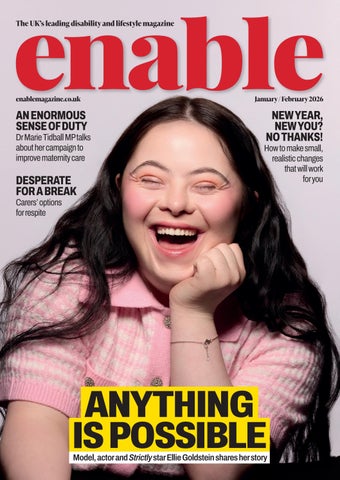
The UK’s leading disability and lifestyle magazine
enablemagazine.co.uk
AN ENORMOUS SENSE OF DUTY
Dr Marie Tidball MP talks about her campaign to improve maternity care
DESPERATE FOR A BREAK
January / February 2026
NEW YEAR, NEW YOU? NO THANKS!
How to make small, realistic changes that will work for you
Carers’ options for respite
ANYTHING IS POSSIBLE
Model, actor and Strictly star Ellie Goldstein shares her story
Motability from Eastern Western Motor Group means:
The everyday freedom of a brand-new car. Drive with confidence with a reliable new car every 3 years.
Talk to us today www.motabilityoffersscotland.co.uk 0131 622 6494
Our brands available with Motability include...
Welcome
...to the January/February issue!
PIC: © ZUZIA ZAWADA
I
COVER PRICE £3.00
PUBLISHER Denise Connelly denise@dcpublishing.co.uk EDITOR Melissa Holmes melissa.holmes@dcpublishing.co.uk STAFF WRITER Kate Stevenson kate.stevenson@dcpublishing.co.uk EDITORIAL CONTRIBUTORS Jane Hatton Samantha Renke Tim Rushby-Smith Alisdair Suttie DESIGN AND PRODUCTION Lucy Baillie lucy.baillie@dcpublishing.co.uk SALES Marian Mathieson marian.mathieson@dcpublishing.co.uk ENABLE MAGAZINE www.enablemagazine.co.uk
DC Publishing Ltd, 198 Bath Street, Glasgow, G2 4HG Tel: 0844 249 9007
READ ONLINE! SCAN THE QR CODE TO READ THIS ISSUE IN FULL ©DC Publishing Ltd 2026. All rights reserved. No part of this publication may be reproduced or used in any way without prior written permission from the publisher. The views expressed in this magazine are not necessarily those of DC Publishing Ltd. The publisher takes no responsibility for claims made by advertisers within the publication. Every effort has been made to ensure that information is accurate; while dates and prices are correct at time of going to print, DC Publishing Ltd takes no responsibility for omissions and errors.
t’s 2026 already?! Where does the year go? One of the highlights of the past few months for me was – as always – watching Strictly. So it was my absolute pleasure to interview dancing queen, model and actor Ellie Goldstein about her experiences on the show, and what it’s like being a role model for disabled young people. As ever, this issue is full of interesting and inspiring interviews, from a discussion with Dr Marie Tidball MP about her campaign to improve maternity care for disabled people, to chatting with Jordan Adams about finding out if he carried the inheritable brain condition that led to his mother’s death. We look at a groundbreaking children’s TV show which incorporates new accessibility technology, discover the changes happening around public and private transport for disabled people, and learn how to find and work with a PA to boost your independence. With a focus on how increased BSL use is opening the world up for deaf people, along with an article on why the Disabled Facilities Grant isn’t fit for purpose, there’s something for everyone this issue. Of course, we couldn’t let January and February go by without thinking about our resolutions for the year ahead. But instead of impossible goals, we consider how you can make small changes that will work for you – no gym membership or expensive fad diets required! Till next issue –
Melissa
EDITOR’S PICKS... 44 MIXING UP REPRESENTATION I speak to TV producer and creator Rebecca Atkinson about her children’s programme, Mixmups, and how tech is making viewing more accessible than ever. 23 GIVE US A BREAK With thousands of carers at breaking point due to lack of support, I find out more about the situation, and share my game-changing experience of respite.
WIN
the latest Kindle e-reader! Turn to page 59
Get in touch
@enablemagazine
Melissa Holmes | Editor editor@dcpublishing.co.uk
Subscribe to Subscribe today and get the UK’s leading disability and lifestyle title delivered right to your door every two months £15 for one year £25 for two years
Call 0844 249 9007 or visit: enablemagazine.co.uk/subscribe enablemagazine.co.uk
3
What's inside
30
8
48
Interview
08 ANYTHING IS POSSIBLE From cover girl to dancefloor whirls, model, actor and Strictly star Ellie Goldstein shares her story. 10 HOLLY MORRIS: AN EXPERT IN SERIOUSLY GREAT LOUSY ADVICE Writer, comedian and podcaster Holly Morris tells Kate Stevenson what it felt like to find the missing piece of her life after her autism and ADHD diagnoses. 30 AN ENORMOUS SENSE OF DUTY Dr Marie Tidball MP talks exclusively to Editor Melissa Holmes about her groundbreaking MaternAble campaign to improve maternity care for pregnant disabled people, and her journey to Parliament. 33 A LICENCE TO LIVE Jordan Adams had a 50% chance of 4
enablemagazine.co.uk
developing a fatal brain disease. He decided that knowing would be better than running from it. 53 ROLLING INTO READING He’s flaky, he’s funny, and he’s getting kids reading. Roxanne Hoyle, one half of the iconic duo LadBaby, tells Kate Stevenson how she and her husband are making reading accessible for all. 66 THE WRITE WAY FORWARD Reporter Grace Marner is making disabled voices impossible to ignore. She speaks exclusively to Enable about being named Journalist of the Year.
Health
15 A DIFFICULT CONVERSATION Opening up about mental health struggles is tough. By sharing your problems with your GP, you’re taking the first step towards brighter days.
56
33 Life
12 NEW YEAR, NEW YOU? NO THANKS! New Year’s resolutions can be challenging to stick to, especially if you have a disability, health condition, or caring responsibilities. A mindset expert suggests how to make small changes that will work for you in 2026 and beyond. 20 FINDING A PA: A PRACTICAL GUIDE For many disabled people, a Personal Assistant (PA) can help you live independently, safely and with dignity. How do you find the right person, and how does it work? 26 THE COST OF WAITING The Disabled Facilities Grant is there to provide home adaptations for disabled people who need to make changes to their home, like widening doors, installing grab rails, or building a downstairs bedroom. But it’s not as straightforward as it sounds.
WIN
44
THE LATEST AMAZON KINDLE E-READER WORTH £95 – TURN TO PAGE 59
41 BREAKING THE SILENCE How new technology and the rise of BSL are giving hope to the deaf community. 44 MIXING UP REPRESENTATION Editor (and TV geek) Melissa Holmes chats to TV producer and creator Rebecca Atkinson about her children’s programme, Mixmups, and how technology is making viewing more accessible than ever. 47 THE DIARY From Van Gogh to Celtic music and starry starry nights at the Dark Skies Festival: our round-up of the best accessible events.
Voices
38 MORE THAN A MOTHER Tola Andu has spent nearly two decades raising her son Kevin, who is autistic. She shares the joys, challenges, and realities of motherhood that often go unseen.
50 PRODUCT PICKS Our pick of the latest products, including a Braille version of UNO and a loud vibrating alarm clock.
36 CHAIRS AND GRACES Columnist Tim Rushby-Smith on the complex relationship he shares with his wheelchair.
Employment & Education
Motoring
Care
48 ON THE MOVE With the start of the new year, we look at recent changes in public and private transport which may help or hinder disabled people’s access to the world.
56 CUPRA TERRAMAR Our reviewer takes this mid-sized SUV out for a spin, finding it brings a welcome dash of dynamism and chic to the very crowded sector.
18 BRING ON 40 Columnist Samantha Renke reflects on her upcoming milestone birthday, and the impact of changes she's made recently.
23 GIVE US A BREAK Thousands of unpaid carers are at breaking point due to a lack of support. Editor Melissa Holmes learns more.
61 DYSPRAXIA DILEMMA Disability employment expert Jane Hatton offers jobseeking advice for a reader with dyspraxia. 63 MIND THE GAP How can we close the disability pay gap when so many barriers to employment still exist?
enablemagazine.co.uk
5
enable news
News
Carer benefits scandal blamed on DWP errors THE GOVERNMENT HAS PROMISED to reassess cases of overpaid Carer’s Allowance dating back to 2015, after the long-awaited report into the overpayments scandal highlighted: “Outdated computer systems, lack of join-up between different DWP systems, and lack of records of accessibility needs” which all hampered effective administration. The review, headed by Liz Sayce OBE, focused on the scandal affecting thousands of unpaid carers who were required to pay back benefit overpayments they didn’t even know they owed – in some cases up to £20,000. If carers earn more than £196 per week in employment, they
lose the full amount of Carer’s Allowance: the so-called ‘cliff-edge’ policy. One carer was forced to repay £4,331.60 after exceeding the earnings limit by just 1p. The DWP failed to notify carers of overpayments in a timely manner, with penalties spiralling, leaving carers in debt and some facing criminal charges. The government said that, where averaging of earnings payments could have been lower, it will repay or write off debt, including where money has been repaid in full. Helen Walker of Carers UK said: “The move to reassess cases and repay or write off debt in certain circumstances is unprecedented in our view, a righting of a clear wrong.”
48% OF WEBSITES RISK EXCLUDING DISABLED PEOPLE
NEARLY HALF (48%) OF UK websites need accessibility improvements in 2026, otherwise they risk excluding visitors with disabilities, according to new research. Travel and tourism companies have the worst online accessibility, with 79% of websites needing improvement, while two in five charity websites could do better. The State of Accessibility Report by brand communications agency Warbox analysed more than 1,200 UK websites across 14 sectors to uncover issues and reveal those that are digitally inclusive. Warbox director Mark Fensom comments: “The Website Content Accessibility Guidelines were published over 25 years ago, yet many brands are still struggling to provide an inclusive online experience. As more businesses shift to e-commerce and the search landscape evolves, accessibility is even more important to reaching customers.”
6
enablemagazine.co.uk
EXISTING MEDS TO TREAT DEMENTIA?
A NEW STUDY HAS identified three existing medications that could be repurposed to treat or prevent Alzheimer’s. Around one million people in the UK live with dementia, which is the UK’s biggest killer. Repurposing medicines already approved for other conditions offers a quicker, safer and cost-effective route to potential new treatments for dementia. Of the three treatments, the shingles vaccine was found to be the most promising: previous studies show people who had the jab could be 16% less likely to develop dementia. Prof Fiona Carragher of Alzheimer’s Society said: “Dementia devastates lives, but we believe research will beat it.”
Experience the freedom to drive with the OMODA 5 on the Motability Scheme. Combining bold design, premium technology, and advanced driving aids, this vehicle delivers comfort, safety, and style. With adaptable options and Motability Accredited staff, OMODA is here to help you find the perfect car for your mobility needs.
ADVANCE PAYMENT FROM £499 Scan the QR code or visit omodaauto.co.uk/motability to learn more. Subject to T&Cs on omodaauto.co.uk. Price based on standard/entry level model.
Scan for more
ANYTHING IS POSSIBLE W
hen Ellie Goldstein’s face appeared on my laptop screen, I couldn’t help but smile. More than her youthful energy (Ellie is only 24), and more than her pretty face (which has appeared on the cover of Vogue, making her the first model with Down’s syndrome to grace the illustrious title) – it was Ellie’s boundless energy and enthusiasm that radiated through the screen’s pixels. It’s the same infectiously positive attitude that saw her become an audience favourite when she appeared on the latest series of Strictly Come Dancing, and which has led her to model for some of the biggest fashion and beauty brands, including Gucci and Adidas. As a young woman who is breaking down barriers in fashion and disability representation, what’s she most proud of? “All my work is meaningful,” she smiles. “Because I love everything that I do.”
She’s a trailblazing model, actor, and writer. And she’s only 24. Editor Melissa Holmes sits down with cover girl and Strictly star Ellie Goldstein to ask – what’s next?
Ellie and Vito on Strictly
COVER GIRL
There’s a lot to love when it comes to Ellie’s work as a model. She tells me her favourite campaign so far was shooting with underwear brand Victoria’s Secret PINK, and shares her favourite elements of modelling: “The camera and being on set – all the stylists and the clothes. I get to wear all different types of clothes and have different hairstyles.” With its world of sequins and glamour, it’s easy to see why Ellie’s segue from modelling and into Strictly was a smooth one. “Your relationship with your dance partner Vito was beautiful,” I tell her. “He was like your big brother.” “Yeah,” Ellie replies, smiling widely. “And I’m his little sister – it’s really cute!” “Training was really really fun,” she reveals, explaining how Vito used cardboard cut-outs of the judges to help her. Ellie was able to memorise routines by watching them back on repeat, and used live band tracks to help her learn the moves by heart. 8
enablemagazine.co.uk
“The live dances were a really good experience. We got voted out,” she says, waving her hand dismissively while grinning: “but never mind that!”
MAKING MOVES
Of course, being voted off Strictly isn’t the end for most contestants, and Ellie reveals she’s still making moves with her professional dance partner, Vito Coppola – she even had plans to meet up with him the day after our interview. She also explained she is taking part in the live Strictly tour, a challenging experience that will see her join other contestants and professionals on
stage to perform 30 dates across the UK in January and February. So what has appearing on screen in front of millions of viewers doing complex dances to a live studio audience taught Ellie? “I’ve learned I can face any challenges, I can learn quickly, and I should be confident,” she states, self-assured. Ellie clearly doesn’t have a problem with confidence, saying: “I love signing autographs and taking selfies and photographs with people.”
TRAILBLAZING TALENT
Ellie credits her family for keeping
enable interview
PICS: ©BBC/GUY LEVY; ZUZIA ZAWADA
All my work is meaningful, because I love everything that I do
her motivated and inspired. She’s a woman of many talents, having made her acting debut last summer in the BBC’s adaptation of Enid Blyton’s classic Malory Towers. She’s even written a book, Against All Odds, about her life experiences so far, and is blazing her own path in the world of fashion. Her favourite dance on Strictly was the Tango, performed to Lady Gaga’s Abracadabra on what became her last live show. We reckon Ellie and Vito’s joyous Barbie-themed samba to Dance the Night during Movie Week must’ve been extra special too – back in 2023, Ellie supported toy maker Mattel in launching the brand’s first Barbie with Down’s syndrome, as part of their Fashionistas line. The range, including
dolls who use wheelchairs, prosthetic limbs and hearing aids, was created to empower more children to find a doll that represents them. At the time, Ellie told the press: “Seeing the doll, I felt so overwhelmed – it meant a lot to me. Diversity is important as people need to see more people like me out there in the world and not be hidden away.” From acting and writing to modelling and dancing, Ellie’s achieved a lot. She’s a proud advocate for people with learning disabilities, and an ambassador for Mencap. What would she like young disabled people to know about achieving their dreams? “Try and achieve what you want in life, to be who you are,” she confides. “You can be equal to everyone else in the world, and me as well!”
So what’s next for Ellie? “To keep getting opportunities,” she tells me. “More acting, more modelling – in New York hopefully – and presenting. I want to be Tess on Strictly, or I could be Claudia and give out all the scores!” Her dream project would be to work on Vogue again, and she’d love to continue her involvement with Strictly. “Dancing has been such a special thing,” she shares. And, finally, what does she want people to know about her and her achievements? “Anything is possible!”
FOR MORE INFORMATION
Follow Ellie: instagram.com/elliejg16_zebedeemodel Catch the Strictly Live Tour from 23 January to 15 February. Find out more: strictlycomedancinglive.com
enablemagazine.co.uk
9
enable interview
HOLLY MORRIS: an expert in seriously great lousy advice Writer, comedian and podcaster Holly Morris received her ADHD diagnosis at 28, followed by an autism diagnosis three years later. She tells Kate Stevenson what it felt like to find the missing piece of her life
O
n a quiet morning in London, Holly Morris remembers sitting at her kitchen table with a cup of tea growing cold beside her thinking: “There has to be a reason I feel like this. I can’t be the only one who finds life this… confusing.” She was 28 when she finally got the answer: ADHD. “And the wild part?” she laughs. “I found out I was autistic too. Every single moment of my life – every struggle, every sensitivity, every weird little strength – it suddenly all made sense. I felt so relieved.” But that clarity was soon followed by grief. “A few weeks later, I just felt sad for all the previous versions of myself,” she admits. “The little girl who didn’t know why everything felt so overwhelming.
10 enablemagazine.co.uk
Every single moment of my life – every struggle, every sensitivity – it all made sense The teenager who thought everyone else got some guidebook to life. The adult who assumed everyone else was just better at coping.”
UNAPOLOGETICALLY HOLLY Now, after years of trying to fit into a world that didn’t seem designed for her, Holly speaks openly about embracing both her ADHD and autism. Yet, learning to be more compassionate towards herself hasn’t been easy. “I used to talk to myself like I was a lazy idiot,” she adds bluntly. “Now I tell myself, ‘Holly, you did great today’. And I mean it.” One of her favourite tools is her ‘done list’. “I write down everything I’ve done, like brushing my teeth, or doing the washing. I used to only see what I hadn’t achieved, but now I can look and go, ‘You nailed it’.” Therapy has also been transformative: “I always say my brain feels like a big, tangled ball of
wool. Therapy straightens the threads enough that I can breathe.” And, raised in a family where humour was medicine, Holly leans on comedy to help her navigate the world: “If something’s hard, we joke about it. If something’s painful, we joke about it. For me, comedy is relief.” That spirit runs through her new podcast, Lousy Advice, co-hosted with her partner Rory. “The internet is full of awful advice,” she explains. “So I thought, why not admit we’re the ones giving it? It’s silly, but it’s honest. And honesty connects people.”
PAVING THE WAY
Perhaps the hardest part has been showing the world her unmasked self: “One day I realised no one actually knew me,” she says softly. “They knew the agreeable version I performed, but that wasn’t me. Now I’m choosing myself, even if it doesn’t or can’t please everyone.” She calls this phase her ‘roadworks’. “Right now the road’s kind of closed,” she laughs. “But eventually I’ll reopen the lanes, slowly, and in a way that doesn’t make me fall into potholes anymore.” It won’t happen overnight but, as Holly says: “Progress, however slow, is worth celebrating.”
FOR MORE INFORMATION
Listen to the Lousy Advice podcast on Spotify Follow Holly: instagram.com/hollymorrisss
The freedom of your own home in a community setting Housing 21 is a leading not for profit provider of Extra Care and Retirement Living for over 55s. We operate in 215 local authority areas across England, managing over 24,000 Extra Care and Retirement Living properties. Our apartments and bungalows are designed to allow you to live independently within a community setting. Enjoy the comfort and security of your own home, make the most of our on-site facilities and communal areas, meet new people and make new friends.
Pet friendly
On-site Care Team *Extra Care only
Couples stay together
Feel safe and secure
Closer to family and friends
Castlestead View, Burton Road, Oxenholme, LA9 7F
Fern Meadows, Brickell Way, Faringdon, SN7 7ZH
Minterne Apartments, Fountain Park Way, London, W12 7LR
Michaelmas Court, Heath Road, Thurston, Suffolk, IP31 3XB
South Hayling Court, Hayling Island, Hampshire, PO11 9EH
Lowarth Morbies, Malpas Road, Truro, Cornwall, TR1 1QN
Properties available through shared ownership and social rent* *Terms and conditions apply Our team are here to help. Get in touch to find out more:
08082710454
housing21.org.uk
New Year, new you? No thanks! New Year’s resolutions can be challenging to stick to, especially if you have a disability, health condition, or caring responsibilities. Read our guide on how to make small changes that will work for you in 2026 and beyond 12
enablemagazine.co.uk
W
ith every New Year comes the feeling we should make resolutions, instigate lifestyle changes, or create a fresh start. 39% of resolutions made in 2024 were around health and fitness, while 29% of people vowed to work on their finances. But if you’re managing on a low income, face mobility challenges, or have caring responsibilities, you may be wondering how you’re supposed to afford, manage, or make time for any new hobbies, activities or goals.
ALL-OR-NOTHING
January, with its New Year energy, may feel like the perfect opportunity for a ‘do-over’, but this self-imposed pressure often has the opposite result. In fact, one in five people didn’t keep any of their resolutions into 2025, while other figures show that 80% of resolutions are already broken by the first week of February. People abandon their promises to themselves for all sorts of reasons. Big goals can be overwhelming if they’re not planned out, and the all-or-nothing
enable life
80% of resolutions are already broken by the first week of February draining you, and what tiny tweaks might help make things better.
START SMALL
A great way of making changes can be to start with just one thing. Instead of a huge goal, like ‘I’ll work out five days a week’, begin with a micro-change. You can’t go from zero to gym bunny in a few months if that doesn’t work for your lifestyle. But you probably can manage five minutes of squats while waiting for the washing machine to finish, or some weighted bicep curls from your wheelchair before breakfast. When you start small, you can progress slowly at a pace that suits you. And doing something is better than doing nothing at all. These micro-changes don’t need to be fitness related. You might like to introduce a manageable, small ritual to support your wellbeing – a change that doesn’t require major time, energy or physical capacity. This might mean taking two minutes for a grounding breathing exercise while you sort out today’s medication, using a mobility aid or batch cooking to help save your ‘spoons’, or simplifying a task you already do every day, rather than adding something new to your routine. approach can lead you to see a single error as a complete ‘failure’, making giving up seem the easiest option. Creating softer goals which are aligned with your values – which don’t create pressure to become a different person, and which place no expectation to ‘fix’ elements of yourself and your life – are far more effective. Instead of seeing the New Year as a time for total transformation, position it as a gentle reset. It’s a chance to take stock of what’s working, what’s
HABIT STACKING
Teaming up with a friend, or ‘body doubling’, can also help you make changes. Mindset coach Janey Holliday (janeyholliday.com) suggests: “If you meet someone for coffee but want to increase your movement, get a takeaway drink so you can walk and talk.” Similarly, you can habit stack, as Janey explains: “If you want to keep your house tidier and work on self-improvement, you could use the time you spend cleaning to listen to an inspiring podcast.” Rather than putting yourself under
more pressure because it’s New Year, consider how many demands are already placed on you. If fatigue or low mood are a challenge, spend a minute each evening reflecting on what drained you that day, and what gave you space to breathe. If you write this down or save it as a note on your phone, it might help you recognise patterns and catch stress or low mood before they become overwhelming. Similarly, it’s a nice idea to recognise and celebrate your wins by keeping a ‘done list’ rather than a to-do list. You could reflect on one thing you did well each week, focusing on your perseverance and resilience, rather than your productivity. Sometimes you don’t need to do or be more; you just need to honour what you already are.
REFRAME SELF-CARE
Self-care usually makes us think of spa breaks or wellness retreats. Those are beyond the means of many people, so let’s reframe self-care. Make a list of activities which give you a small hit of dopamine (the happy hormone). You could include stretches and mindful breathing, listening to soothing music and snuggling under a soft blanket while your cared-for person naps, wrapping up warm to sit in your garden under the night sky, or preparing small comforts in advance for high-activity days. Pick something manageable from your list every day, and see how much better you feel after some you-time. Janey, who is the single parent-carer of a child with SEN, says it’s hard to stick with goals if you’re dysregulated. “It’s really important – especially if you’re a carer – to regulate first. You don’t need to do a hard task or meet a goal to ‘earn’ pleasure, joy, rest or rejuvenation. Often, when you prioritise these, achieving the goal becomes more manageable.” Nurturing yourself first, making one small change at a time so you can build on it, and celebrating your wins are all effective ways of working towards a more fulfilled you. Remember, there’s no deadline to ‘improve’ – you don’t need to set targets, create a vision board or make huge lifestyle changes just because it’s January. And choosing rest, selfkindness and ease is growth. enablemagazine.co.uk
13
Find out how our products with their innovative and unique features could benefit you. Sheaths
Leg bags
A variety of options that are easy to use and made to ensure a secure, reliable and very comfortable fit.
We have a range of unique urine drainage bags to suit everyone’s lifestyle and needs.
(latex-free) (latex-free)
All sheaths available in a variety of sizes.
Bendi Bag (specifically designed for wheelchair users) Comfort Original (contains latex)
Comfort Plus (latex-free with doublesided adhesive tape)
Leg bag straps (latex-free)
Discreet Thigh Bag (ideal for summer, sports, and even some short clothing) Children’s Bag (small capacity and proportions)
For more information or sample requests, please scan the QR codes, visit the website or contact the helpline on:
01604 595 696 quoting ENABLE/J/F
helpline@manfred-sauer.co.uk www.manfred-sauer.co.uk/nephsys.asp
Comfort Bag (7cm shorter in length than many 750ml bags)
Products shown
Available on prescription
We also offer a FREE HOME DELIVERY SERVICE providing a personal service from a professional team.
Please call Prescriptions: 0800 999 5596 for more details.
enable health
A DIFFICULT CONVERSATION Opening up about your mental health struggles can be really tough. But, by sharing your problems with your GP or a mental health professional, you’re taking the first step towards brighter days
I
t’s an awful feeling. Getting out of bed everyday becomes a challenge, the simplest task takes forever, and your motivation is at rock bottom. The symptoms of low mood, depression or anxiety can sneak up on you. Speaking to your friends and family is the last thing on your mind, and having a wash, getting dressed, or even eating decent food have fallen off your daily to-do list. You’re certainly not alone. Poor mental health impacts one in four people in the UK. For disabled people, the stats are even higher – around 30% of people with a long-term physical health condition also have a mental health problem. And, when they have an impact on your ability to carry out day to day activities, depression and
anxiety are classed as disabilities in themselves. The latest research for NHS England found that people with physical health conditions have more than double the rate of common mental health conditions than those without. There are many reasons for this, including experiencing chronic pain which can cause low mood, enduring social isolation due to lack of accessibility in the outside world, and financial concerns owing to managing on benefits or fears around facing job or housing insecurity. Poor mental health impacts carers too: Carers UK found that an increasing number of unpaid carers are experiencing poor mental health because they cannot take a break from caring. According to The
enablemagazine.co.uk
15
enable health
State of Caring 2024 report, 35% of respondents said they have ‘bad’ or ‘very bad’ mental health. Being a carer can lead to anxiety over your caredfor person’s wellbeing, worry over finances, high stress, and isolation.
A PROBLEM SHARED
So what can you do to get out of a dark patch? The old adage – a problem shared is a problem halved – is especially true when it comes to mental health. But talking about your emotions doesn’t always feel comfortable. “I’m part of the generation where we don’t really open up about this sort of thing,” explains Martin, a stroke survivor who uses a mobility scooter. “I’d been going to my local Men’s Shed to get myself out of the house, but I hit a rough patch and stopped going. A couple of the lads from the Men’s Shed noticed, got in touch, and we went out for a coffee. That’s when I told them how I was really feeling.” Men’s Sheds is an international movement where men of all ages (and some women too) come together, converse, and connect around practical activities like woodworking, repairing, restoring, or carrying out tasks to benefit the local community. Martin’s pals from Men’s Shed recognised he was struggling. “They suggested I phone the doctor,” reveals Martin. “I didn’t want to make a fuss, but I went to the appointment and my GP was great. I was worrying over nothing – I suppose they deal with this stuff all the time.” Martin’s right: a third of GP appointments involve talking about mental wellbeing, so no one should feel daunted about speaking to their doctor. And if getting ‘found out’ is a worry, bear in mind that doctors must keep everything you tell them confidential (unless they think you’re at risk of seriously harming yourself or someone else). Martin was prescribed antidepressant medication, which is “taking the edge off,” he says. “And my doctor referred me to CBT, which is like training your brain to help you feel better. It’s meant to be really good.” Martin’s back at the Men’s Shed, and finds the friendships and activities there have helped boost his mood. For Becca, who cares for her disabled younger sister, making the call to her surgery was a difficult step. “I felt
16
enablemagazine.co.uk
The old adage – a problem shared is a problem halved – is especially true when it comes to mental health such an idiot, telling the receptionist I was feeling sad and worrying about leaving the house,” she admits. “But the staff reassured me, and sorted me out with an appointment that same day.”
NO SHAME
Becca was worried she’d forget what she wanted to say, so she made a list of issues she wanted to tell her doctor about. “I hadn’t been sleeping due to worrying about my sister, and I wasn’t eating well either,” she says. “My brain gets foggy, so having my notes was really helpful.” Becca’s GP took the time to listen to her circumstances and understand more about her caring responsibilities. She diagnosed Becca with generalised anxiety, and spoke to her about the possibility of going on
medication. 8.7 million people were prescribed antidepressants in England between April 2023 and March 2024, so they’re a trusted and effective method of treatment, which no one should feel ashamed about needing. Becca’s GP also signposted her towards her local Carers Centre and community mental health team. With the support of the Carers Centre, Becca has found fortnightly respite care for her sister, and has started going on health walks offered by her local council’s wellbeing team, which her GP told her about. “Getting out into the fresh air and talking to people has made a big difference,” she reveals. “Three or four months ago I could barely leave the house. But speaking to the GP really helped. And each walk is a step on my journey to feeling better about myself, meeting new people, and giving me a break from caring. I don’t feel so isolated anymore.”
FOR MORE INFORMATION
Campaign Against Living Miserably: thecalmzone.net / call 0808 585858 (open 5pm till midnight) Carers Trust: carers.org Mental Health Foundation: mentalhealth.org.uk Men’s Sheds: menssheds.org.uk Mind: mind.org.uk Samaritans: samaritans.org / call 116 123 (open 24/7)
M
FRIEN Y DL
AUTIS
UNFLAVOURED TOOTHPASTE
3 great reasons to smile! 1000ppm/ 1450ppm FLUORIDE PROTECTION
NON FOAMING
OraNurse® is an unflavoured toothpaste specially formulated for people sensitive to strong flavours. It contains the daily recommended fluoride, is SLS free (non-foaming) and gentle on teeth with an RDA (relative dentin abrasion) value of 29.68
UNFLAVOURED
OraNurse Unflavoured Toothpaste is designed with sensory sensitivities in mind, making it a trusted choice for autistic individuals who find traditional toothpastes overwhelming. Free from flavourings, colourings, and sodium lauryl sulphate (SLS), it offers a gentle, neutral brushing experience without strong tastes or foaming agents. This makes daily oral care more manageable and less stressful for those with heightened sensory awareness. Despite its mild formulation, OraNurse still provides excellent protection against cavities and plaque. Recommended by dental professionals and carers alike, it is ideal for both children and adults. Whether at home, in schools, or care environments, OraNurse helps promote independence and comfort in oral hygiene routines. Make brushing a positive experience with OraNurse.
enable voices
Samantha Renke Samantha is a broadcaster, actress, disability activist and the author of You Are the Best Thing Since Sliced Bread. Follow Samantha on Instagram @samantharenke
Columnist Samantha Renke reflects on her upcoming milestone birthday, and the impact of the life changes she’s made over the past year
BRING ON 40 T
BOUNDARIES
Truthfully, it’s been hard. But I want to share what has worked, and what I’ve learned from setting better boundaries. One of the biggest changes has been building an exercise routine. Just ten minutes each day helps me plan, focus, and carve out time for me. If something interrupts that time, I’m annoyed! It’s taught me to let other things wait until I’ve finished my morning exercise… and
18
enablemagazine.co.uk
the endorphins are magic. I’ve also become vegan. Cooking with purpose and precision has helped me slow down too. I plan my meals, sit down to eat, and no longer skip food or grab something on the go. I’m not saying you all need to go vegan (even if I secretly wish you would), but prioritising your health truly helps you be more present. Finally, I’ve started setting firmer boundaries with loved ones. My home backs onto a lovely park, and friends often invite me for dog walks, usually when I’m already in bed, exhausted. The old, people-pleasing me would drag myself out for a quick stroll. Now, I’m brave enough to say no, or suggest a phone chat instead.
STEPPING BACK
I’ve also stopped being the default organiser or the one who always replies straight away. Often, people leave it to their Disabled friend to arrange accessible meetups. I get the logic, but sometimes we just want others to anticipate our needs and take the reins.
Being your authentic Disabled self can feel lonely and misunderstood I’ve stepped back from those who don’t make that effort. I simply don’t have the capacity to juggle it all. I’ve lost a few friends who took my boundaries personally. It’s not personal: I’m just bloody exhausted. I’m tired of educating others, and minimising my needs. I’m being selfish and that’s ok. Being your authentic Disabled self can feel lonely at times. But, now that I’m honouring my body and mind, I’m discovering who Samantha really is. And that’s kind of beautiful. This year I’m continuing to be a little bit selfish – but in all the best ways. Bring on 40!
PIC :© NICKY JOHNSTON
his time last year, I shared my desire to slow down. Not to give up on my ambitions, but to stop living by ableist standards, to stop comparing myself to those with enabled privilege. I need more sleep than my pre-Disabled peers. I live with daily pain. When I drop something, it takes twice as long to pick it up. If I have work in London, I get up at 4am because I take longer to get ready, and need to minimise the accidents that might happen if I’m not fully focused. I was burnt out. Mostly because I constantly feared that, if I made my needs known, I’d be left behind. This year, I turn 40. A milestone. And a shift. I’m prioritising my health more than ever – learning to slow down and manage my expectations, rather than those imposed by an enabled world.
enable life
Finding a PA:
A Practical Guide For many disabled people, a Personal Assistant (PA) can help you live independently, safely and with dignity. How do you find the right person, and how does it work?
P
roviding support with everything from washing, dressing and toileting to meal preparation and social activities, PAs can – literally – open doors for disabled people, supporting them to live independently and take control of their own lives. However, when you take on a PA, you also become their employer. Managing the employee/employer relationship, and even finding a PA in the first place, can be challenging. Many people pay for their Personal Assistant via Direct Payments or a Personal Budget. This money comes from your local authority once you’ve been assessed as being eligible for care support. Others may fund a PA privately through their benefits, wages, family contributions or savings.
WHERE TO START?
When it comes to finding a PA, your local authority should have a care directory or PA register. You can also check out boards like UKCIL.com, or advertise your need for a PA via local carers’ centres, word of mouth or community noticeboards. When advertising, be clear about the hours of work required, specific duties, physical tasks, preferred experience and any training the person might need. Your local carers centre or disability advocacy service may be able to support you with this. You may also need some support during the interview process, during which you can ask questions around whether the person is comfortable with the physical aspects of the role, how they handle confidentiality, how flexible their schedule is, and what they’d do in a specific emergency, for example.
20 enablemagazine.co.uk
BOUNDARIES
It’s also important to discuss boundaries, especially if the PA will work in your home, and set expectations from day one, including things like the importance of good timekeeping, the limits of the role, not carrying out personal tasks in work time, and maintaining a mutually respectful relationship. Don’t forget to ask for references and carry out an Enhanced DBS check (known as a PVG check in Scotland) – your Direct Payments support service can usually help you with this. As an employer, you’ll be responsible for sorting out a contract of employment, paying wages, arranging PAYE, tax and National Insurance, and organising employer’s liability. You’ll also need to keep payroll and employment records, and offer statutory leave and sick pay. This may sound like a lot, which is why many councils fund a payroll service or Direct Payment support service to manage PAYE on your behalf. If you take on a PA through an agency, the agency is the employer rather than you, but it’s likely you’ll pay more for the service.
WHEN IT WORKS
The right PA can be lifechanging. A good PA provides consistency, independence and reassurance. And,
A good PA provides consistency, independence and reassurance although being an employer can feel daunting, support is available – from recruitment to payroll and management. Taking the time to find the right person, set expectations, and maintain open communication will help build a strong, respectful working partnership that enhances your autonomy.
FOR MORE INFORMATION
Being the Boss: beingtheboss.co.uk Carers UK: carersuk.org/direct-payments Scope: scope.org.uk/advice-and-support/ hiring-pa-for-home-care
Specialist Medical Travel Insurance
All medical conditions. All ages. All destinations.
10%
With 25 years experience, you can trust AllClear Travel Insurance to protect you and your trips.
¹
OFF BA SE PRIC E Code: M O
T10
Voted UK’s No.1 for Customer Care² 24/7 English speaking emergency helpline with up to unlimited medical cover Up to £25K cancellation cover ³ AllClear will make a contribution of up to 20%* of your premium to Motability Enterprises Ltd.
Travel Insurance 2018-2025
EXPERT RATED
Scan to call
Call our UK Call Centres FREE
0808 164 1807 allcleartravel.co.uk/motability 1. Discount applies to the base premium of an AllClear Travel Insurance policy. Base Premium means the premium payable for a Policy excluding IPT, administration fees (where applicable), any medical premium and any add-ons. Discount expires at 23:59 on 30/04/2026. 2. UK Broker Awards, Customer Service Award 2024. 3. Providing you have purchased a policy which includes cancellation cover. *AllClear will make a contribution to Motability Enterprises Ltd of up to 20% of your premium. These funds are used by Motability Foundation to help disabled people with their personal mobility. IPT - Insurance. Premium Tax is charged at 20% and is included in the total premium that you pay. Motability Enterprises Limited (Registered No. 1786053 England and Wales) is a wholly owned subsidiary of Motability (a Registered Charity in England and Wales No. 299745 and in Scotland No. SC050642), both of which have their registered office at Warwick House, Stadium Way, Roydon Road, Harlow, Essex CM19 5PX. Motability operating as Motability Foundation. Motability Enterprises Limited is an Introducer Appointed Representative (Firm Reference Number 538055) of AllClear Insurance Services Limited. AllClear Travel Insurance is arranged by IES Limited, which is registered in Gibraltar company number 117274. Registered Office: 1st Floor, Portland House, Glacis Road, Gibraltar, GX11 1AA. IES Limited is licensed and regulated by the Gibraltar Financial Services Commission number FSC25393 and trades into the UK on a freedom of services basis, FCA FRN 824283. AllClear Travel Insurance is administered by AllClear Insurance Services Limited, registered in England No. 04255112. Registered Office: AllClear House, 1 Redwing Court, Ashton Road, Romford, RM3 8QQ. Authorised and Regulated by the Financial Conduct Authority firm reference number 311244. AllClear is a registered trademark.
to Orkney and Shetland Your holiday in the beautiful Northern Isles begins as you set sail with NorthLink Ferries. The comfortable and reliable service offers sailings from Aberdeen to Lerwick, Shetland, with regular calls into Orkney’s capital of Kirkwall.
Shetland Orkney Jarlshof, Shetland – A multi-period archaeological site which was occupied for 4,000 years.
Alternatively travel from Caithness to Orkney’s port of Stromness. This 90-minute journey passes the iconic sea stack, the Old Man of Hoy. From booking, to boarding, then experiencing the journey onboard, we have a range of services and accessible facilities available that can be tailored to your needs.
northlinkferries.co.uk Operated by
The Italian Chapel, Orkney – A beautiful place of worship built in 1943 by Italian prisoners of war.
enable care
GIVE US A BREAK From physical health problems and financial worries to burnout, thousands of unpaid carers are at breaking point due to a lack of support. Editor Melissa Holmes learns more about what help is available, and shares her own experience of game-changing respite
U
npaid carers are the backbone of the UK’s social care system, with 5.8 million people providing unpaid care to family members and friends who are disabled, older or who have a chronic health condition and need support, according to research by Carers UK. Their efforts are worth an estimated £184 billion to the economy every year. But their value is pegged at a measly £83.30 per week – the rate of Carer’s Allowance (known as Carer Support Payment in Scotland), for those who qualify for the benefit.
Juggling caring responsibilities with work, parenting, and the other demands of life can be challenging. Carers are entitled to support, and there is help out there. Your local council is a good place to start – they can carry out a Carer’s Assessment (Adult Carer Support Plan in Scotland), to identify what additional help you may be eligible for, like training in safe moving and handling techniques, emotional support, or respite services. Your cared-for person can also have a needs assessment to find out what
65% of unpaid carers feel overwhelmed because they haven’t been able to take a break enablemagazine.co.uk
23
enable care
support they might benefit from. Your local authority may support you with finding a respite carer, sitting service or even short breaks service. Paying for these options might mean using Direct Payments, or you could apply for funding from an organisation like Carers Trust, or see what grants may be available to you via turn2us.org.uk/get-support. However, Carers UK has found that most carers providing substantial care are not receiving Carer’s Assessments and, for those who have been assessed, 47% are left waiting to receive the support identified by their assessment. The charity’s latest State of Caring Survey found 65% of unpaid carers feel overwhelmed because they haven’t been able to take a break. The same research found that 30% of unpaid carers are spending more than £100 of their own money every month on the costs of care.
AT THEIR LIMIT
What’s more, respite services, which offer a lifeline to parents and carers by providing accessible short breaks or daytime activities to disabled children and adults, seem to be stretched to the limit. Recent months have seen the closure of several supported activities schemes and respite services in the UK, with reduced local authority funding, and staff recruitment and retention challenges being identified causes. In October 2024, Revitalise, the UK’s last remaining provider of holidays with 24-hour care for people with complex disabilities, closed its centres completely. It cited “insurmountable financial challenges,” with service users left devastated by the closure of the charity, which had been running for 60 years. Carers Centres provide a lifeline to many carers who are feeling close to burnout. Having someone to talk to and knowing you’re not alone can make the world of difference, but being able to take an actual break from your caring responsibilities is where the magic really happens. Your Carers Centre might signpost you towards other organisations that can help – from a sitting service via The Royal Voluntary Service to give you a few hours’ respite each week, to a Family Fund grant which helps families with a disabled child with the cost of a break away. As a single parent-carer to a child 24 enablemagazine.co.uk
Melissa on her Carefree Break
with additional support needs, I’ve personally benefited from help offered by my local Carers Centre. As well as relevant support groups and checkin calls, they introduced me to the Carefree Breaks scheme. Carefree Breaks is a charity that transforms empty hotel rooms into vital breaks for full-time unpaid carers. Hotels across the UK donate to Carefree out of their excess capacity, so carers who qualify can take two breaks per year, choosing a location and dates that suit them. You’ll pay an admin fee of £38 per break and need to cover the cost of transport and meals, but breakfast is often included. The breaks are for carers (plus one extra, if there’s space), so you can take your spouse, partner or even a child. Most importantly, you can’t take your cared-for person, so it only works if someone else can step up and care for them while you take your break.
MAKING A DIFFERENCE
My most recent Carefree break – for two nights in October – was a lifesaver: I felt at breaking point with stress. Having
someone else prepare breakfast and do the washing up, relaxing with a book while taking in incredible views, and heading out for solo walks to clear my head helped me to truly switch off and focus on my needs. In challenging moments as a carer, I can take myself back to the memory of standing by a loch, gazing at a rainbow emerging across the autumn sky, breathing in the cool, fresh air… That break really helped make a difference. I know not every carer can leave their cared-for person with another trusted individual (I was wracked with guilt the whole time I was away) or even afford the admin fee for a Carefree Break. So, if you haven’t already, turn to page 12 for some gentle self-care ideas you can take into the year ahead – because taking care of yourself means you can take better care of your loved one.
FOR MORE INFORMATION
Carefree Breaks: carefreespace.org Carers Trust: carers.org Carers UK: carersuk.org
THE FUTURE IS OURS TO SHAPE Only 5% of people with a learning disability are in paid employment, but 86% want a job. Emily and her family worried the workplace might not welcome her. Then they found Mencap. With the right support, Emily gained confidence, learned new skills, and secured a job she loves. A gift in your Will to Mencap can help more people like Emily unlock their potential, open doors, challenge injustice, and shape a future where everyone belongs.
Order your free gifts in Wills guide today at www.mencap.org.uk/enablemagazine
Your legacy can change lives. Because the best way to predict the future, is to create it.
The Acticheck life-saving wristband
Whatever happens, wherever it happens, whenever it happens, help is at hand Unique I’m OK checks The easy way to confirm you’re ok in the morning and before bed
SOS Alert Just squeeze to call for help
24/7 protection Uninterrupted cover in your home, garden and beyond*
Fall alert Monitors for severe falls
NEW Predictive Analytics Detect possible health issues before they escalate
NEW Alternative velcro wristband
> From just 52p a day > 30 day money-back guarantee
0345 25 75 080 | acticheck.com *Coverage via smartphone app when away from home
4.8 (800 reviews)
enable life
The cost of waiting The Disabled Facilities Grant is there to provide home adaptations for disabled people who need to make changes to their home, like widening doors, installing grab rails, or building a downstairs bedroom. But it’s not as straightforward as it sounds
A
cross the UK, thousands of disabled people are living in homes that actively endanger them. Not because help doesn’t exist, but because the system that was designed to protect them has become painfully slow, underfunded and unfit for purpose. The Disabled Facilities Grant (DFG) should be a straightforward solution, but instead it often traps many people in dangerous limbo for months or even years.
DANGEROUS DELAYS
According to Disability Horizons, requests for DFGs rose by 27% from 2015 to 2019. Some councils are taking more than two years to deliver adaptations, far beyond the legal 12-month limit. On average, the time from application to completion is 247 working days, and almost half of councils had at least one example of missing the initial six-month deadline to approve or deny applications. These delays are not mere inconveniences: they are dangerous. Every day spent waiting means bathing in unsafe bathrooms, navigating stairs that could cause a fall, or living in rooms that cannot be accessed without pain or risk. For people with progressive conditions, time isn’t just precious; it’s critical. Some decline so quickly that by the time adaptations are completed, they no longer meet their needs. Others have died while waiting.
CHARLOTTE’S STORY
Charlotte’s story sits squarely within this national crisis. As a young mother with rapidly progressing MND, she needs a ground-floor bedroom and wet room. Her occupational therapist
26 enablemagazine.co.uk
agrees adaptations are urgently needed, yet funding delays mean she’s still waiting. Charlotte’s father, Bob, says watching her struggle is horrific: “As a father, being unable to protect your children or help when they need you most makes you feel inadequate.” Her family has been pushed into considering options they never expected: loans, crowdfunding, and temporary measures. “At first, we were confident the discretionary grant would come through,” says Bob. “When we were told it was no longer available due to budget pressures, we had to look at other options. Now it seems remortgaging may be our only choice, especially as Charlotte’s mother has already given up work to support Charlotte’s husband, who is now her full-time carer.” The truth is stark. Disabled people are being forced to live in unsafe homes because councils cannot meet demand, funding caps no longer reflect real costs, and no fast-track system exists for terminal or rapidly progressing conditions. “Time doesn’t stand still, and it’s accelerated for people with MND. We don’t have time to wait,” sighs Bob. “The system feels archaic. Policies haven’t been properly reviewed for years, and people with MND, and other progressive conditions, pay the price.”
We don’t have time to wait for the funding, or for planning permission to be approved TAKE ACTION NOW
You can help push for faster home adaptations using the MND Association’s e-action tool at act.mndassociation.org/202511-Unlock-the-Door It automatically emails your local councillor to push for a fast-track DFG process and better funding for people with terminal or progressive conditions.
QUIET MAGIC
Seeking a magical, fun-filled day out that’s also accessible? Seek no more – you’ve found your Golden SnitchTM! We chat to Chris Crawford, who is autistic, about his Relaxed Tour trip to Warner Bros. Studio Tour London – The Making of Harry Potter
S
o many of us have wonderful memories of the magic of Harry PotterTM – whether it’s growing up reading the books, watching the films on repeat, or continuing to indulge in everything that’s part of the wizarding world. But, for influencer Chris Crawford, that association is even closer: “I have strong nostalgic memories of Harry Potter, from reading the books as a child, through to auditioning for the films – unsuccessfully may I add!” Still keen to get close to the magic, Chris took his wife Zaynab and two of their children to a Relaxed Tour at Warner Bros. Studio Tour London – The Making of Harry Potter. For autistic and neurodivergent people, visitor attractions can be hard to navigate. That’s why Warner Bros. Studio Tour London offers a host of accessibility features, and Relaxed Tours – which are perfect for Chris, who is autistic. With quieter soundscapes, increased lighting, and fewer visitors, Relaxed Tours are ideal for neurodivergent people.
MAGICAL ANTICIPATION
The Studio Tour is located next to Warner Bros. Studios Leavesden, the working film studios where all eight Harry Potter films were made. At the Studio Tour, you can discover thousands of iconic props, costumes and authentic film sets from the magical film series across two soundstages and a Backlot, bursting with animatronic
It felt like you were truly immersed in the world of Harry Potter 28 enablemagazine.co.uk
creatures, breathtaking special effects, and enchanting seasonal features. “It was really exciting just stepping out of the car and making our way to the building,” explains Chris, reflecting on his initial impressions. “You could see the anticipation lighting up in my son’s face. The kids were super excited, and the staff were very accommodating, and very calm.” Thanks to the accommodations put in place for the Relaxed Tours, Chris says: “It felt a lot less overwhelming than it could have been! My son is seven, he hasn’t been diagnosed with autism but he’s showing very similar traits I had when I was that age. One thing for him is explaining how long things might take; managing his expectations for what will and what won’t happen. Just to know there weren’t going to be long queues or an overwhelming number of people was helpful for him.” Chris was able to plan their visit thanks to the Studio Tour’s detailed online Autism and Visitor Support and Accessibility Guides, and knew staff would be on hand to answer questions or offer any extra support required during the tour.
SPELLBINDINGLY IMPRESSIVE
And the magic started the second they passed through the doors: “As soon as you stepped into the space, going through the ticket barriers, there’s this large Hungarian Horntail dragon over the big entrance space. It was really impressive.” Chris was particularly
mesmerised by the experience of visiting Gringotts Wizarding BankTM: “When you walked in, the vast scale of it, the attention to detail – it felt like you were truly immersed in the world of Harry Potter.” Chris’s kids had a great time in the Forbidden Forest, although he says: “I think their favourite element was flying on the broomsticks in the green screen area, especially getting the video afterwards, showing them flying around.” Trying ButterbeerTM at the Backlot Café – “It was extremely sweet!” – also gave the family the opportunity to take a break: “It was an early hour, so it was quiet,” he told us. “It felt like there was a wider range of seating options. Eating there could’ve been an overwhelming experience. But it was like a reprieve, giving you a moment to recuperate.”
enable advertorial
Staff are always on hand to direct visitors to breakout spaces and quieter areas such as Sensory Rooms, plus there are Sensory Support Bags available, filled with items to make the whole experience more accessible. “It’s a good idea to have these on offer, to pre-empt as many different needs as possible,” reflects Chris. “My experience as an autistic person is very different from another person’s, so I think people taking the time to understand what others’ experiences are like, what their needs are, and to try and make accommodations is vital.”
IMMERSED IN THE WIZARDING WORLD
Chris was impressed by the experience of the Relaxed Tours at Warner Bros. Studio Tour London. He also learned lots of new filmmaking facts about the Harry Potter film series, saying: “After
you’ve entered the Great Hall and you come through into some of the exhibits afterwards, it talks about the different Directors of each film, and what was most special to them about the story, and how they wanted to bring some of their own magic into the story. It was really interesting – in terms of how they wanted to create a twist, or how the characters grow up through the years.” From various props on display in the shopfronts down Diagon AlleyTM, to being able to venture through the Great Hall, pull up a Mandrake in Professor Sprout’s greenhouse, or follow the footsteps of thousands of HogwartsTM students onto Platform 9 ¾TM, the Studio Tour allows visitors to go behind-the-scenes of the wizarding world, learning how filmmakers brought the magic to life on screen. And the same goes for visitors with additional needs too, with thoughtful
accommodations made for wheelchair users, Tactile Tours, British Sign Language Tours and Audio Assistance for blind and deaf guests, and essential companion tickets available. So, what are you waiting for? Touch the Portkey or grab your Floo PowderTM, and transport yourself to an enchanting, bewitching and awe-inspiring day out to discover the filmmaking magic.
FOR MORE INFORMATION Warner Bros. Studio Tour London’s Relaxed Tours will run on the following dates in 2026: 8th February, 6th June, 27th September and 5th December. For more information on accessibility, and to book tickets, visit wbstudiotour.co.uk. Tickets must be booked in advance. Follow Chris: instagram.com/chrisgmcrawford
enablemagazine.co.uk
29
ALL CHARACTERS AND ELEMENTS © & ™ WARNER BROS. ENTERTAINMENT INC. PUBLISHING RIGHTS © JKR.
Chris loved exploring with his family
AN ENORMOUS SENSE OF DUTY Dr Marie Tidball MP talks exclusively to Editor Melissa Holmes about her journey to Parliament and MaternAble, her groundbreaking campaign to improve maternity care for pregnant disabled people
I
t was during her bookingin appointment with her midwife that Marie Tidball first realised how difficult the healthcare system can be for pregnant disabled women. The newly-qualified midwife repeatedly asked Marie to explain what her disability is. “I said: ‘I’ve got foreshortened arms and a digit on each hand’. She kept looking at me, then looking at my body and asking me to explain again – then I realised I was in the middle of a Two Ronnies sketch. She thought I was saying I had ‘four shortened arms’ and she was looking for the other two arms. That was the moment I realised it was going to be a bit problematic.” Experiences like this are one of the reasons Marie – now Dr Marie Tidball, Member of Parliament for Penistone and Stockbridge since 2024 – launched her MaternAble campaign. The nationwide initiative brings together pregnant disabled women, parents, researchers, Royal Colleges and health professionals. The campaign’s goal? To embed an inclusive maternity care pathway for disabled women into NICE guidelines, improve training, and transform support.
ALARM BELLS
Marie’s pregnancy was a worrying time. “No one seemed to know how my disability might interact with my pregnancy, which was surprising,” she says. Her excitement and joy was tempered by a referral for genetic counselling, focused on the idea that her baby would inherit her disability. “That was never even a consideration – we knew my disability wasn’t genetic in any case!” She found the experience “really upsetting,” saying it “set off alarm bells.” Asking a registrar if she’d be able to have a vaginal birth, she recalls: “He asked me to lay on the bed, fully dressed, 30 enablemagazine.co.uk
Marie stands outside the Houses of Parliament; and pictured with her baby daughter
enable interview and asked if I could open my legs. That was his way of determining if I’d be able to have a natural birth, although I’d had a King’s Procedure in my hip and wear a prosthetic leg.” Marie eventually needed a Caesarean because her baby’s heart rate dropped. Disabled women are 30% to 69% more likely to have a Caesarean birth, which can mean extra complications and longer recovery. The same research – by The London School of Hygiene & Tropical Medicine and the Missing Billion Initiative (MBI), which underpins the MaternAble campaign – shows disabled women are also 44% more likely to experience stillbirth or infant mortality than non-disabled women. Marie believes the goals of MaternAble will help women with a wide range of health conditions both before and after birth. “It would change attitudes towards disabled women having healthy sex lives, having babies, and being able to give birth in a safe and inclusive way where their pregnancy is celebrated,” explains Marie. She’s confident the findings of the campaign will also form part of the government’s rapid review into maternity care. The need for post-birth support is essential too, with the MBI report finding breastfeeding levels are 35% to 70% lower among disabled mothers. MaternAble is working with REMAP to develop adaptive prams, cots and baby equipment, so disabled parents don’t need to spend time researching options during an already stressful time.
DO GOOD THINGS
Marie’s professional background is in law, with a special interest focusing on how disabled and neurodivergent people are treated in the criminal justice system. She’s also a founding director of the Oxford University Disability Law and Policy Project. How would she describe her journey into politics? “Having a very visible physical disability – and as a woman – it’s tough,” she states. “I’m not going to deny it.” Feeling she must overcome assumptions and outperform nondisabled colleagues, she told me: “I’ve had to be very driven, which gives you the fire to get things done, but it’s hard.” She wants to make her constituents proud, and is grateful to all those who worked with her to help her win her seat in Parliament, especially with physical tasks like knocking on doors and delivering leaflets: “That collectivism is
I feel an enormous sense of duty to do as much as I can for disabled people what the Labour party’s about for me.”
IT’S EVERYONE’S PARLIAMENT
In Parliament, Marie has worked with disabled colleagues to set up the first disability parliamentary Labour group, and with whips, the Speaker and the modernisation committee to improve accessibility in the ancient buildings. “The more there is the sense that this space is for disabled people, the more it filters through to the expectation that we should have more disabled people represented in Parliament,” Marie states
proudly. “This Parliament belongs to all of us. It’s not an elite – it’s everyone’s Parliament.’’ She told me: “I always say to people who think they might want to get into politics: ‘Don’t be an MP because you want to be, become an MP to do good things’.” Often asked whether she gets nervous before addressing the House of Commons, Marie admits: “I’m always extremely nervous in the days beforehand, but not when it happens. There are 14 million other disabled people sitting in wheelchairs or standing behind me – a lot of disabled people don’t have a chance to do this job. So I feel an enormous sense of duty to do as much as I can while I’m here – for my constituents, and for disabled people.”
FOR MORE INFORMATION
Follow Marie: instagram.com/drmarietidball REMAP: remap.org.uk The Missing Billion Initiative: themissingbillion.org
enablemagazine.co.uk
31
PICS: © HOUSE OF COMMONS
SAFE AND INCLUSIVE
Com pa ct
Swift Lift
ot Bo ur o
to Save Space gn in i s y De
EA
SY
FOL
DING OPERA
TI
ON
ELEVATE YOUR EXPERIENCE THE LATEST PRODUCT INNOVATION FROM DES GOSLING MOBILITY HAS ARRIVED! Designed to Suit Almost Every Vehicle Effortlessly Loads Any Mobility Device up to 6Okg Easily Transferable, No Matter Which Car You Choose Next Optimised Design to Minimise Distractions During Your Drive Zero Power Drain to Protect Your Vehicle’s Battery Available on the Motability Scheme
O1332 863742
sales@desgosling.co.uk
www.desgoslingmobilityltd.co.uk
Station Yard Yard, Station Road Road, Melbourne, Derby, DE73 8HJ
PIC: © ARUK
enable interview
Jordan (right) and his brother Cian
A Licence to Live
Jordan Adams had a 50% chance of developing a fatal brain disease. He decided that knowing would be better than running from it
W
hen Jordan talks about his mum, his voice softens. He remembers her as warm and bright – “The happiest person to be around,” he recalls. When Jordan was 13, things began to change. His mum, Geraldine, became quiet, withdrawn, and forgetful. At first, the family thought it was grief, as Geraldine had lost her father three years earlier. One weekend, Geraldine called Jordan’s sister asking why she wasn’t waiting outside school to be collected. But it was a Saturday. “She’d never got something like that wrong before,” he says. “She was always there for us, and always on time. It was just so out of character.” Unbeknownst to Jordan, their dad had already started seeking help.
His wife’s worried friends encouraged him, because they’d noticed the same unsettling changes. What followed was a long stretch of uncertainty, with appointments, scans, and conflicting diagnoses. Then, at just 47 years old, Jordan’s mum was diagnosed with FTD: a rare, hereditary form of dementia. “Dad sat us down and told us she had six to ten years,” recalls Jordan. “There was no cure. No treatment. We just had to give her as much love as we could.”
IN YOUR GENES?
The next six years were harrowing for the whole family. Together they cared for Geraldine as the illness advanced. Eventually, she forgot how to drive, how to dress for the weather, and even how to recognise her own children. “Some
enablemagazine.co.uk
33
enable interview
Jordan pictured with his mum, top right, and with his family and friends during fundraising activities
Knowing gave me my life back. It gave me clarity, purpose, and a reason to make the most of every day things I had to do for her, she would never have wanted me to do,” says Jordan. “But we did them because we loved her.” Sadly, Geraldine died at home on 14 March 2016, in the same room where, six years earlier, Jordan and his siblings had been told about her fate. Jordan was only 20. Grief hit each sibling differently. Jordan went down the route of partying and drinking; his brother struggled with anxiety; and his sister became convinced she would inherit the same condition. “We all coped in different ways,” explains Jordan. “But none of it was easy.” In the end, Jordan left adolescence carrying a kind of trauma no young man should shoulder: grief, guilt, exhaustion, and the knowledge that FTD could be waiting for him.
WOULD YOU WANT TO KNOW?
Jordan didn’t. Not at first: “I’d always said I didn’t want to know.” His sister Kennedy did. The spitting 34 enablemagazine.co.uk
image of her mum, she believed she carried the gene and was determined not to pass it on. In 2018, she received the news she was not a carrier. The relief was overwhelming. Everything Jordan had been burying rose to the surface. His sister could move forward and plan her future, while he felt he couldn’t. “I’d bottled it up for so long,” he says. “After Kennedy’s result, my life unravelled. I couldn’t live with the uncertainty anymore. I needed the answer.”
A WEIGHT OFF
Jordan began the genetic testing process and, in September 2019, aged just 23, he was told he carried the MAPT gene mutation. He would likely develop FTD in his forties. Strangely, he doesn’t describe the news as devastating. “For the first time, I knew where I stood,” he admits. “It felt like a weight off my shoulders. I could make decisions. I could actually live.” He began to see the diagnosis not as a countdown, but as clarity, which he says allowed him to move on
with intention. He threw himself into advocacy and research, participating in studies at UCL and fundraising for Alzheimer’s Research UK. Alongside his brother Cian – who in 2023 learned he also carries the gene – Jordan channelled his fear into action, raising funds and awareness. He describes his diagnosis not as a life sentence, but as “a licence to live. I understand why people think knowing is worse but, for me, not knowing hurt more.”
CAN YOU OUTRUN A GENE?
Since his diagnosis, Jordan has had to make deeply personal decisions. He married his wife Annie in 2023, partly because of his understanding of time. Together, they’ve had to confront choices most couples never face. When Annie unexpectedly became pregnant, they agreed they could not knowingly pass on the gene. After genetic testing confirmed the baby was a carrier, they made the heartbreaking decision to terminate the pregnancy: “It was the toughest decision of our lives,” says Jordan, his face full of emotion. They’re now pursuing IVF using preimplantation genetic diagnosis, so they can end the hereditary line once and for all. It’s just one example of how Jordan has to think about the future in ways most people his age never do. He’s considered care plans, financial provisions, wills, and even the songs he’d like at his funeral. He’s also made the decision to live through the disease as openly as possible, hoping his experience will contribute to research that may one day help others. If you had a 50% chance of inheriting a terminal brain disease, would you want to know? Most people say they wouldn’t, and Jordan understands why. But he also knows the power of turning towards the truth, rather than away from it. “Knowing gave me my life back,” he says. “It gave me clarity, purpose, and a reason to make the most of every day.”
FOR MORE INFORMATION
Follow Jordan: instagram.com/theftdbrothers
enable voices
Tim Rushby-Smith Originally from London, writer, artist and paraplegic Tim Rushby-Smith is based in Australia. He is the author of two books: Looking Up and Beyond the Break. Follow Tim on X @trushbys
Chairs and Graces Columnist Tim Rushby-Smith on the complex relationship he shares with his wheelchair
I
n a few days I will take receipt of my first new (non-sport) wheelchair since 2011. I must confess to a degree of apprehension about the ‘grand reseating’. Following my spinal cord injury, it was six years before I was confident enough to move to a fully custom wheelchair with no adjustability. During that time, I constantly tweaked and fiddled with my chair, seeking the optimal balance of comfort and manoeuvrability, while reducing the risk of me tipping out backwards (I did that a lot, and still do occasionally). Upon getting into my new chair 13 years ago, my first thought was, ‘Oh no. This isn’t right at all’. I discovered that, however ‘well scripted’ a new wheelchair is, what follows is a two-way process, whereby the user breaks in their new wheelchair and the wheelchair breaks in its new user.
AN EXTENSION OF ME
Spending nearly every waking hour in my wheelchair, I have become acutely aware of tiny details. I imagine it is much the same as when an amputee gets 36 enablemagazine.co.uk
used to a prosthetic limb. My chair has become an extension of me, to such a degree that I can feel if someone touches it, or when my tyre pressures are just slightly down. My current chair is still perfectly functional, and has never failed me, save for a broken footplate which was my own doing and merely required a bit of welding. So, you may ask, why the new one? Well, this chair has helped to shape me: after 20 years of wheelchair use, I am developing a scoliosis or curvature of the spine. With the new ride, my posture will change slightly, but my shoulders will also be happier as it will be nearly 10kgs lighter, making getting in and out of the car less arduous. To
This chair has helped to shape me: after 20 years, I’m developing scoliosis
be fair, the difference in weight is mostly because of the handcycle attachment bracket and chunky wheels that adorn my current wheelchair. They will continue to do so, as that chair takes on the exclusive role of outdoor fun-wheels.
TECH NERD
All of this is a tech nerd’s field day, allowing me to talk carbon fibre, titanium, 3D printing, and so on, about which I find cycling enthusiasts most receptive (or most polite). I think they can relate to the wheel-based tech, and seem to find it easier to shift away from the perception of the wheelchair as an embodiment of disability; a taboo; a symbol of loss. For me, it has never been those things. When I first left my hospital bed 20 years ago, the wheelchair was an enabling device. It took me outside for the first time post-injury. I rejoined the ‘moving’. While my relationship with being on wheels has not been universally positive by any means, I have never seen myself ‘wheelchair bound’. Maybe it’s time to coin a new phrase… Who likes ‘wheelchair enabled’? On second thoughts, maybe I’ll just stick to ‘wheelchair user’.
www.motomed.com
Medimotion A4 Ad Loop.indd 1
03/02/2022 13:05
More than a mother Tola Andu has spent nearly two decades raising her son Kevin, who is autistic. She shares the joys, challenges, and realities of motherhood that often go unseen
W
hen Tola Andu talks about her son Kevin, her whole face changes. The softness in her eyes, the warmth in her voice, and the humour that slips into her words reveal the unconditional love she has for her son: “Kevin made me the woman I am today. He’s taught me to see the world in ways I never would have on my own.” For almost 20 years, Tola has navigated the complex, beautiful, and often misunderstood world of raising an autistic child. Through her social media accounts @RaisingKevin_, she offers something rarely seen in mainstream portrayals of disability: a joyful, nuanced, and deeply human view of caregiving.
A MOTHER’S LOVE
But behind every bright moment she shares is a reality that other parent carers of autistic children will understand: caring for someone who’s autistic, especially into adulthood, transforms parenthood in ways that are both profound and lifelong. “Before Kevin, I had this picture in my head of what motherhood would look like,” she says with a small laugh. “School runs, teenage drama, maybe the occasional slammed door. But when Kevin was diagnosed, the whole script changed. I had to unlearn the expectations and learn him instead.” She became fluent in his silent language. Now she knows when the twitch of his hand means he’s uncomfortable, and how his eyes shift when he’s excited. “Kev doesn’t just speak with words, but he communicates with intention,” adds Tola. “My job is to pay attention.” 38 enablemagazine.co.uk
EMBRACING MOTHERHOOD
And, of course, caring for a neurodivergent child comes with its own set of challenges: “There are days I am just so tired; not the ‘I need a nap’ tired, but the kind that sits in your bones,” she admits. “Being Kevin’s carer is full-on. There’s no clocking out.” Tola has to be on her toes, ready to manage sensory triggers, anticipate meltdowns, and navigate public spaces. Despite all that, she wouldn’t change it for the world: “Kevin gives me these moments – tiny, beautiful
moments that make everything worth it,” she smiles. “When he bursts into laughter at something only he finds funny, or when he reaches for my hand without being prompted – those moments feel like sunlight.” Every day is different, but she’s found a rhythm that works for them both. “I had to stop chasing the version of motherhood I thought I’d have,” admits Tola. “Once I embraced the version I actually have, everything softened.”
STANDING FIRM
Tola never planned to become an
enable care
autism advocate. At first, she was just sharing some videos of Kevin enjoying music or posting little snapshots of their routine. But the response was immediate, especially from Nigerian parents: “I realised people weren’t seeing these kinds of stories enough,” remembers Tola. “Stories where autism wasn’t treated like a tragedy.” Now her advocacy is a natural part of her caregiving. “When I speak up for autism acceptance, I’m speaking up for my son,” she says firmly. “I’m speaking up for every child who communicates differently, and every mother who feels unseen.” Tola also openly discusses cultural misconceptions and how disability can be shrouded in shame, denial, or spiritual blame in many African communities. “I’ve heard it all now,” she shrugs. “People have told me to pray harder, to try healing programmes, to have more discipline with him, or to hide him from the world.” “There were days in the early years when I felt like I was parenting against a whole culture. Not because people were cruel, but because they simply didn’t understand,” explains Tola. “You learn to grow a thick skin, but you also learn to stand firm in who your child is.” Her mission, she says, is to shift the narrative: “I want Nigerian families to know there is nothing wrong with having a neurodivergent child. The only thing wrong is the stigma.”
THE GREATEST PRIVILEGE
In a culture that often misunderstands autism, her bond with Kevin matters even more. The stories they share online show that young adults like him deserve understanding and respect. “I had to unlearn what society told
PICS: COPYRIGHT OF RESPECTIVE OWNERS
I had to stop chasing the version of motherhood I thought I’d have
Tola and Kevin won the Voice of Change Award at the 2025 TikTok Awards
me motherhood should look like,” acknowledges Tola. “Once I let go of that version and embraced the one in front of me, I found peace.” The future, for her, is not about forcing Kevin into a world that isn’t ready for him; instead, it’s about helping build a world that is. “I want him to grow into adulthood surrounded by acceptance,” she says. “Not pity, not judgment, but acceptance.” Right now, they’re dreaming of one day running a mobile café together. And as we end our interview, Tola
smiles warmly, in the way only mothers do when speaking about their children. “People think Kevin changed my life,” she says. “But really, he changed how I see life, and that’s a gift I don’t take for granted. Being his mother is the greatest privilege I didn’t know I needed.”
FOR MORE INFORMATION
Follow Tola and Kevin: instagram.com/raisingkevin_ Help make Kevin’s dream come true: gofund.me/56fc0f14f
enablemagazine.co.uk
39
A FRANTIC ASSEMBLY PRODUCTION, CO-PRODUCED BY CURVE, MAYFLOWER SOUTHAMPTON AND LYRIC HAMMERSMITH THEATRE
v
29 JAN – 28 FEB 2026
lyric.co.uk | 020 8741 6850 Tickets from £10*
Our prices increase with demand so book early for the best prices.
*
Boundary pushing ballet Audio described performance and touch tour Saturday 25 April at 2:30pm
Don Quixote
Mary, Queen of Scots
Gentleman Jack
English National Ballet
Carlos Acosta’s joyful explosion of Spanish sunshine, spectacular dance and vivacious comedy.
My First Ballet: Cinderella
With audio described performances and touch tours available, there are more ways to experience the movement.
enable life BSL user Richard MacQueen and his family
BREAKING THE SILENCE How new technology and the rise of BSL are giving hope to the deaf community
I
n recent years, there’s been a noticeable increase in awareness of British Sign Language. From BSL being recognised as a language in its own right in England, Wales, and Scotland in 2022, to Rose Ayling-Ellis winning Strictly and Tasha Ghouri appearing on Love Island, public perceptions of the deaf community are shifting. According to the RNID, one in three adults in the UK are deaf, have hearing loss or tinnitus, while three children are born deaf every day. There are 151,000 BSL users, 87,000 of whom are deaf. But people who use BSL aren’t just ‘speaking with their hands’. BSL has a different vocabulary and syntax to English, so for people who’ve been deaf since birth or childhood and have
BSL as their first language, subtitles or written English are not an adequate alternative. This leaves deaf BSL users feeling stressed, confused and isolated in many aspects of everyday life – from education to understanding medical appointments.
AN AWFUL TIME
That’s something Richard MacQueen knows all too well. For two days, Richard believed he’d been diagnosed with HIV after a nurse mistakenly signed ‘thumbs up’ when discussing his test results in A&E. “I was worried it was going to result in me dying,” he reveals during an online interview using a BSL interpreter. “I’ve got young children. It was an awful time for me and my family – really emotional.”
When an interpreter was found, Richard learned he had pneumonia – not that it was ‘good news’ that he didn’t have HIV, as the nurse had signalled. Richard is profoundly deaf, and BSL is his first language. He describes the lack of awareness of his need for an
Imagine if all the world could sign, there would be no barriers for me Richard MacQueen enablemagazine.co.uk
41
enable life
interpreter as: “a systemic issue. It’s a big challenge for people like doctors, who don’t see deaf people daily. They don’t realise that you need a qualified registered interpreter for things like this, especially linked to health.”
IN CONTROL
BREAKING DOWN BARRIERS This is something Strictly finalist Tasha Ghouri discussed at an event in Westminster hosted by the All-Party Parliamentary Group on Deafness. Tasha said: “Growing up deaf, I’ve experienced first-hand the barriers and challenges that so many people still face. We call on the government to take these issues seriously, ensure services like healthcare are improved, barriers to employment are overcome and the voices of deaf people are truly heard.” Sadly, the recent Kingdon Review identified a catalogue of failings in children’s hearing services, revealing
Learning BSL boosts memory, concentration and problem-solving 42 enablemagazine.co.uk
Tasha Ghouri and Georgia Meacham
that more than 300 children in England have been harmed because of repeated errors made in paediatric audiology. The National Deaf Children’s Society wants government to invest in audiology services to lay the groundwork for a more cost-effective, accessible paediatric audiology service that’s fit for the future. All the same, some barriers are being broken down with more young people being taught basic BSL. And a BSL GCSE will soon be on the cards as awarding bodies can now develop their own courses. George Crockford of the National Deaf Children’s Society explains: “It’s only right that BSL users should have the opportunity to achieve a GCSE in their own, legally recognised language; as well as affording hearing learners the opportunity to learn BSL and play their part in breaking down barriers to communication.” Richard supports the idea of a GCSE, saying: “It’s going to make a massive difference. Young kids, their minds are like a sponge. I grew up going to Scouts – all of them were hearing and my mum taught them how to sign. I still see friends from there occasionally, and
they still remember how to sign.” It also makes economic sense: a recent report shows that teaching BSL to young deaf children (90% of whom are born to hearing parents) and their families delivers an impressive economic return on investment, resulting in “more taxpaying deaf adults who contribute even more to the UK economy,” says Rebecca Mansell of the British Deaf Association. Learning BSL boosts memory, concentration and problem-solving skills. It also promotes empathy and communication, so there’s a strong case for teaching it in schools. Richard describes education as: “a powerful weapon. Some people in the deaf community are very lonely; they feel isolated. So this is hopefully going to help them feel involved and included in society.”
FOR MORE INFORMATION
British Deaf Association: bda.org.uk Deaf Action: deafaction.org National Deaf Children’s Society: ndcs.org.uk RNID: rnid.org.uk Signport: signport.com
PIC: © PIERS ALLARDYCE
Things look set to change though, with the launch of SignPort, a potentially life-changing app which puts interpreter booking in the hands of BSL users, transforming access to healthcare and other vital services. Richard spent ten months involved with the app’s pilot scheme, and says: “It’s massive. It gives me the control. If I’m in hospital and the staff don’t know how to communicate with me, I can bring my phone out, go into my SignPort account, and organise an interpreter.” Created by Scottish charity Deaf Action and Burrotech, the app was made with support from the Scottish Government’s CivTech programme. “The app is creating a bridge between users and interpreters,” says Richard. Richard feels positive about the app and is seeing a change in awareness of BSL. “I was born deaf,” he states. “I’m really happy with who I am. I just wish society would change their attitudes. Imagine if all the world could sign, there would be no barriers for me.”
The most visited immersive experience in the world
From 22 January Winchester Science Centre
BOOK NOW VANGOGHALIVE.CO.UK
Created and Produced by
Presented by
Mixing up
REPRESENTATION TV accessibility hasn’t had much of a shake-up since the introduction of subtitling on Teletext… until now. Editor (and TV geek) Melissa Holmes chats to TV producer and creator Rebecca Atkinson about her children’s programme Mixmups, and how technology is making viewing more accessible than ever
R
emember Ceefax, and the marvel that was page 888 – subtitles? Widely used from the 1980s until digital services, like the BBC’s red button, took over in the late 1990s, subtitling via Teletext opened up a world of programming to deaf viewers. Now, of course, we can enjoy a plethora of accessible programming in the palm of our hands – with ondemand services, audio description and subtitling available to many viewers across TV shows and films. We’ve even seen the birth of choose-your-own adventure television, where viewers can shape the narrative, like Black Mirror: Bandersnatch and You vs Wild. But what if technology could be utilised to improve the viewing experience for disabled viewers?
Rebecca Atkinson
44 enablemagazine.co.uk
CHILD’S PLAY
Rebecca Atkinson has long been involved in promoting accessibility. Starting with the world of children’s toys, her Toy Like Me campaign was born out of frustration at a lack of disability representation in children’s toys. “There was nothing that spoke to the disabled child and communicated to them they were valued,” she explains. The campaign put pressure on manufacturers including Lego, Mattel and Hasbro to do better by their customers. “It went viral,” smiles Rebecca, “and I’m pleased to say you can now get Barbie and Lego figures with far greater representation.” But there’s always more to be done, and Rebecca had television in her sights. Having worked with a major toy brand, she found their resulting prototype was “steeped in stereotypes.” She realised it wasn’t enough to ask non-disabled designers to do better: “I needed to show them, not tell them, how to create disabled characters which were truly authentic and joyful, and then place them in a compelling and magical world which was a flight of fancy, and spoke directly to the experience of childhood disability.” And so Mixmups was born. Based on her own experience of being partially deaf and partially sighted, along with feedback from focus groups of disabled children, Mixmups presents an accessible, colourful world based on the social model of disability. Episodes focus on play and having fun, not on disability. Each character – animated by the
studio that brought Bob the Builder and Tim Burton’s Corpse Bride to life – has been carefully designed to reflect real disabilities.
AUTHENTIC REPRESENTATION
“A child who uses a wheelchair told me she’d been asked if she slept in her chair, because people so rarely see a character transfer out of their chair,” explains Rebecca. “The character of Giggle is based on the body shape and movement of one of the
There’s a level of detail which pushes Mixmups beyond the representation seen in most kids’ shows
children involved in the programme’s development. She can walk short distances and has a curvature of the spine, so she has an authentic gait. It’s this level of detail that pushes Mixmups beyond the representation seen in most kids’ shows – which are often created by non-disabled people.” She continues: “Pockets has tunnel vision like me, so I drew on my use of mobility tools – guide dog and white cane – in different situations to build an authentic portrayal of partial sight.” The characters are also based on play theory, with different types of play – a neat and tidy player, an expressive, creative player – helping the programme resonate with pre-school children and the way they experience the world. So where does technology come in? Rebecca wrote 52 episodes of Mixmups in a six-year labour of love. When it was taken on by Channel 5’s children’s arm – Milkshake! – she realised deaf children who couldn’t yet read wouldn’t have access to the programme. This led her to think about
access beyond just subtitles, audio description (AD) and BSL signing. Rebecca, who has worked in television for almost three decades, explains: “We took interactive TV tech and created Mixmups with Ultra Access® – a service where viewers can choose from 14 access features, including turning down background sound, simplifying visuals, and preparing for the episode through bonus content. They can then mix up their own bespoke TV access package which plays on screen.”
REVOLUTIONARY
There are more than 4,000 ways to watch the programme with Ultra Access® – making it the first truly bespoke accessible viewing experience. “It’s quite revolutionary,” enthuses Rebecca, “and we want every family with a disabled child and every SEN teacher to know it’s there and use it in their classroom.” With a culture of inclusion running within the production of the programme, fans of all ages and abilities, and Ultra
Access® technology which could be applied to future programmes, Mixmups has received plenty of accolades, including being nominated twice for Best Pre-School Programme in the Broadcast Awards. Rebecca wants to see more disabled people in decision-making positions in all industries, saying: “For too long, our stories have been mis-told by non-disabled people, which traps us in a perpetual state of trying to change perceptions of disability and remove attitudinal barriers.” She feels Mixmups is testament to what happens when a disabled person is given the chance to express disability culture in a magical way. She finishes: “I’m truly grateful I was able to make this show for children and families, and I hope it will be watched and treasured for many years.”
FOR MORE INFORMATION
Catch Mixmups on Channel 5 on weekend mornings at 06:20, and via My5 through your smart TV or at channel5.com/mixmups-series
enablemagazine.co.uk
45
PIC: © BETH MOSELEY; CHANNEL 5
enable life
Hoe Grange Holidays Wheelchair accessible self-catering log cabins in the stunning Derbyshire Peak District
New: alternating air mattress & tilt-in-space shower chair
Mobile hoists Specialist equipment Roll-in wetroom shower
Dogs welcome Peaceful location Autism-friendly
www.hoegrangeholidays.co.uk Or call us on 01629 540262
Woodcombe Lodges & Cottages
Chipping Campden’s history in stone is the Cotswolds’ hidden gem - an idyllic centre for easy access to the local towns and villages, Stratford, Cheltenham, Gloucester, Oxford, Warwick & Worcester, etc. George Barn is within no more than a 7 to 8 minute walk to the curved High Street, its inns, restaurants, shops & attractions.
Set in 3 acre gardens on a quiet country lane on the edge of the Exmoor National Park yet within 1 mile of shops, pubs and restaurants with the beach and promenade beyond. Dog friendly. Sleeping for 2 to 10, Games room, free wifi, laundry room, children’s swings. Three disabled access single storey lodges with wet rooms, shower wheelchairs, ramped access and adjacent parking.
Michael Haines George Barn, Blind Lane, AA 4—Star Self catering
01643 702789
woodcombelodges@outlook.com
woodcombelodges.co.uk
Chipping Campden, Glos. GL55 6ED Mobile/Text: 07889 649812 Email: info@cotswoldcharm.com Visit our website: www.cotswoldcharm.com
The diary 22 JANUARY TO 22 MARCH
Van Gogh Alive
Winchester Science Centre / £30
Immerse yourself in the world of Van Gogh with this enchanting multisensory experience, where you can interact with art through the play of light, colour and sound. Accessible facilities throughout the Science Centre.
winchestersciencecentre.org
enable life Send your upcoming events to editor@dcpublishing.co.uk
UNTIL 22 FEBRUARY
Infinite Bodies
Somerset House, London / From £19.50 This groundbreaking exhibition explores how the work of visionary choreographer Sir Wayne McGregor CBE pushes the limits of movement, data, and physical intelligence. A series of multisensory, interactive works – along with dancers performing in the space in real time – will send shivers down your spine, according to reviews. Relaxed Session on 23 January 2026, 9.30 to 11am.
somersethouse.org.uk
UNTIL 16 JANUARY
Museum of Austerity
Young Vic Theatre, London / From £15
15 JANUARY TO 1 FEBRUARY
Celtic Connections Glasgow / Various prices
Glasgow’s annual folk, roots and world music festival hosts more than 300 events across multiple genres. Celtic Connections eclipses dark winter nights with a kaleidoscope of internationally renowned music, offering concerts, ceilidhs, art exhibitions and workshops. Accessibility varies between venues.
celticconnections.com
13 FEBRUARY TO 1 MARCH
Dark Skies Festival
PICS: ©KRIS KESIAK
Yorkshire / Various prices
The North York Moors and Yorkshire Dales National Parks host their 11th Dark Skies Festival. Nighttime activities include stargazing safaris and mindful activities. During the day, check out art workshops and a themed trail at Aysgarth Falls (where you can hire an all-terrain wheelchair via access-the-dales.com). Contact organisers for access details.
This powerful, award-winning fusion of theatre, history, and humanity makes its London debut. Blending theatre, documentary, and extended reality, it confronts the realworld consequences of austerity and systemic welfare failure in the UK. Audience members enter an immersive gallery that lays bare what happens when the state's safety net fails. Each 45-minute performance offers in-headset captions, audio description, the assistance of a sighted guide host, and optional removal of sensitive content. Age 18+.
youngvic.org
31 JANUARY TO 8 FEBRUARY
National Storytelling Week
Online / nationwide / Various prices, some events free Providing a joyful opportunity to celebrate the power of stories, National Storytelling Week is an invitation to everyone to immerse themselves in telling, sharing and listening to stories. From folk and fairy tales to memories passed down through generations, celebrate the week online or at libraries, spoken word events and clubs across the country. Accessibility varies.
sfs.org.uk/nsw
darkskiesnationalparks.org.uk enablemagazine.co.uk
47
On the move
With the start of the new year, Editor Melissa Holmes takes a look at recent changes in public and private transport, which may help or hinder disabled people’s access to the world
48 enablemagazine.co.uk
S
ince I started writing in the disability sector some two decades ago, public transport has always been the one topic that comes up again and again. From wheelchairs being damaged by airline companies, to train passengers being left on platforms, or bus drivers zooming past disabled people, sometimes it feels nothing has changed over the years. Let’s not underestimate how important being able to get out and about is for thousands of disabled people. Having transport that works for you might mean you can stay in work, access medical appointments more
easily, enjoy an active social life, and be part of society. Barriers impact mental and physical wellbeing, independence, confidence and overall life choices. Transport is no small matter. Research from the National Centre for Accessible Travel found 92% of disabled people questioned face barriers on at least one mode of transport. This, along with problems like cluttered and badly designed streets, unreliable step-free access, and poor staff assistance, means 79% of disabled people travel less often, 67% don’t make as many spontaneous journeys, and 70% say travel costs them more.
enable life
ERASING FREEDOM?
One of the biggest headlines we’ve seen recently around transport is changes to the long-running Motability scheme. After furore on social media that disabled people were getting ‘high end’ cars through the scheme (which are paid for through the person’s own money in the form of a large Advance Payment, and through their Personal Independence Payment, rather than being at any additional cost to the taxpayer), so-called ‘premium’ cars were removed. The shift away from luxury vehicles is intended to place the focus on vehicles that meet disabled peoples’ needs and represent value and purpose – safe, reliable and affordable to run. The November 2025 Budget also revealed that, from July 2026, most Advance Payments for cars leased through Motability will become subject to 20% VAT, and the current 12% insurance premium tax exemption will be removed. With these changes, the Scheme revealed it “anticipates the average Advance Payment (upfront cost) of a vehicle will increase by around £400.” The changes have been labelled “punitive,” “baffling” and “unjust” by Disability Rights UK. Meanwhile, the Motability Collective Campaign Group told the Chancellor: “Taking away choice doesn’t create equality, it erases freedom.”
THE RIGHT TRACK
Things are looking slightly brighter for disabled rail users, with the publication of the government’s Accessibility Roadmap, which outlines a long-term vision for a more accessible railway. Published alongside the Railways Bill (which sets out plans to overhaul Britain’s rail network through the creation of Great British Railways – GBR), the Accessibility Roadmap includes plans for change, like improving support services, providing accessible travel information, and keeping accessibility at the forefront of transport planning. When the whole system becomes
Start taking practical steps, like encouraging independence in daily tasks The new Great British Railways app promises to be a one-stop shop for passengers
92% of disabled people face barriers on at least one mode of transport nationalised by the end of 2027, one of GBR’s most welcome plans is a one-stop app, allowing travellers to check journeys, buy tickets, and book Passenger Assist services across the whole network. In the meantime, changes are already underway. The seven train operators which are already in public ownership delivered a range of accessibility improvements last year. For example, c2c partnered with GoodMaps to introduce digital wayfinding across its stations, and TransPennine Express introduced enhanced BSL screens at Manchester Airport station as well as adapting station toilets to be stomafriendly.
ON THE BUSES
The Bus Services Act came into force in October 2025, meaning passengers will be protected from sudden cuts to crucial routes, and training will be provided to drivers on how to handle anti-social behaviour (and better support disabled passengers). The legislation means local authorities can set up their own bus companies, allowing them to run services so that passengers, not profit, come first. Most
importantly for disabled passengers, The Act introduces a new requirement for authorities to produce bus network accessibility plans, with a focus on improving the travelling experience for disabled passengers, putting them at the heart of consultation and planning. Travel to the EU is changing too: the new Entry/Exit System (EES) will be fully operational by April 2026. NonEU travellers (including those from the UK) will need to provide fingerprints and a facial image at border crossings for short stays in the Schengen area (that’s most EU countries, plus Iceland, Norway, Switzerland, and Liechtenstein). This replaces manual passport stamping, and is being made as accessible as possible for disabled travellers, with in-person assistance available and accessible kiosks in place at airports, ports and train stations across the EU. Wherever you’re venturing to over the next 12 months, things look set to change for disabled drivers and passengers – for better and worse! As always, before any journey, plan ahead as much as you can, be aware of your rights when using public transport, book assistance before your journey (for airports and train travel), and be prepared to advocate for yourself (by asking people to move from a wheelchair spot, or putting in a complaint when poor service happens). Safe travels!
FOR MORE INFORMATION
Motability: motability.co.uk National Centre for Accessible Travel: ncat.uk Transport For All: transportforall.org.uk
enablemagazine.co.uk
49
PICS: © DEPARTMENT FOR TRANSPORT
While it may seem like getting out and about has been problematic for many years, with little hope of improvement, 2025 saw some important developments in the world of transport – both good and bad.
enable life
REVOLUTIONARY COMFORT
3D printing technology company Carbon is enabling manufacturers to make radically better wheelchair cushions. Their lattice-based 3D printed cushions offer improved air flow so heat is dissipated, humidity is reduced and comfort is enhanced. The washable cushions distribute pressure more evenly to manage microclimates around the skin, enabling customisable support for any body shape. Find out more: pr@carbon3d.com
BREW TIME GO FURTHER
The Avon BattBoost is designed to extend the travel range and increase usage time of your 24V mobility scooter, powerchair or electric wheelchair. Giving you more power, for longer, the BattBoost is compatible with lead acid, AGM, gel and lithium batteries. They offer longer life and more cycle charges, plus they’re lighter in weight for easier handling. Prices vary / bblbatteries.co.uk
PICS: ©RESPECTIVE OWNERS
Product picks
This lightweight kettle has been designed for people with limited reach, mobility, dexterity and strength. Its rotating cradle means you only have to tilt to pour, eliminating lifting, straining, or trying to balance and aim when pouring hot water. The bold design is perfect for those with visual impairment or people living with dementia. Use with the Uccello Grip Mat for even greater stability. £59.95 (VAT relief available) / shop.alzheimers.org.uk
Send us details of your products to
editor@dcpublishing.co.uk
GYRO-POWERED WHEELCHAIR
PLAY TIME
WAKE UP CALL
If you live with hearing loss and struggle to get out of bed on these dark mornings, the Wake ‘n’ Shake Dynamite 95dB alarm clock with vibrating bed shaker and super bright circle of red LED flashing lights is the ideal solution. Optimise the alarm’s settings to suit your needs, use the bed shaker under your pillow to wake you but not your partner, and even charge smart phones and electronics via the USB port on the alarm clock.
Described as a self-balancing personal transporter for people with mobility limitations, the Evo PT is an all-terrain, two-wheeled device that uses an Auto Safety Gyro System to maintain balance automatically. Like a Segway, users control movement through shifting their body weight, plus there’s a joystick or steer bar for turning. The Evo PT is an innovative, compact and futuristic design, so hands-on demo and professional assessment are recommended before purchase.
£11.99 / from all good toy sellers
£56.39 (VAT relief available) / rnidconnevans.co.uk
£12,640 (VAT relief available) / myevomobility.com
The world’s most popular card game, UNO, is now more accessible than ever. Makers Mattel have launched a Braille version, designed so blind, lowvision and colourblind players can fully enjoy the classic game that’s brought generations together for more than five decades. The deck includes 108 cards featuring Braille inscriptions indicating colour, number, or action, as well as special quick-start reference cards also in Braille, ensuring an accessible experience from the very first game.
50 enablemagazine.co.uk
Enable Magazine A6 Advert lift down 133x92 print file.pdf 1 13/08/2025 15:44:03
C
Affinity Homelift
Renowned for quality. Known for reliability. Everything you’d expect and nothing less from your trusted lift provider. For homes. For public spaces. For People.
Hinge-Side Finger Protection for Your Doors
Quick & easy to fit For internal & external doors
M
Y
Suitable for all door types
CM
MY
5-year guarantee
CY
Available in white, black, grey & anthracite grey
CMY
K
TSL1000+ Step Lift
Portable Platform Lift
Whether it’s for your family home or a busy public space, Terry Lifts has the right solution for you. Thoughtfully designed, expertly installed, and manufactured right here in Britain to the highest standards.
Longridge Trading Estate, Knutsford, Cheshire, WA16 8PR www.terrylifts.co.uk - 01565 752800
Keep Fingers Safe Year After Year VISIT US AT ZEROPLUS.CO.UK OR CALL US ON: 01785 282910
Naidex is Evolving 2026 Marks The Beginning Of A New Era 25 March - 26 March 2026
Birmingham NEC
Five Shows in One 12,000 visitors 300 exhibitors 250 speakers The UK's leading event for disability, accessibility, and independent living
Join the Naidex Community! marketing@naidex.co.uk Visit www.naidex.co.uk to find out more!
ROXANNE HOYLE
enable interview
ROLLING INTO READING He’s flaky, he’s funny, and he’s getting kids reading. Roxanne Hoyle, one half of the iconic duo LadBaby, tells Kate Stevenson how Greg the Sausage Roll is on a roll, and how the couple are making reading accessible for all
R
oxanne Hoyle still remembers the moment her mum realised something was different. “The kitchen windows had steamed up,” she explains, laughing softly. “And I wrote my name on the glass completely backwards. Mum was like, ‘Wow, and also oh no’. That was the start of realising I didn’t learn the way other kids did.” For Roxanne, reading wasn’t a cosy childhood pastime. It was a puzzle with flipped letters, and words sliding around the page. “It felt like everyone else had the instruction manual and I didn’t,” she explains. It’s that girl, the one who felt she didn’t fit the mould, who now co-writes the Greg the Sausage Roll series. She does it because, as she grew up and became an adult, somewhere along the way Roxanne realised something important: reading doesn’t need to be intimidating, perfect, or formal. It just needs to feel possible.
TURNING PAGES
Studies have repeatedly shown how powerful reading can be for our wellbeing. The University of Sussex found that reading for just six minutes can reduce stress by up to 68%. The NHS even lists reading-based programmes, such as the books on prescription programme Reading Well, as tools to help manage anxiety and depression. And research shows that reading for 20 minutes a day boosts vocabulary, improves attention span, and supports mental resilience. It’s the same principle as exercise: little and often can work wonders. But none of that matters if a child looks at a book and becomes anxious: “When you grow up neurodivergent, you learn very quickly what is and isn’t going to work for you,” explains Roxanne. “But books shouldn’t feel like a test; they should feel like joy.”
When I look out at a classroom full of kids, I want them to know: you’re not broken. You’re just different enablemagazine.co.uk
53
enable interview
That’s why the newest book in her series is an explosion of dinosaurs, chaos and Greg-shaped mischief. In other words, it’s bright, bold, and understandable from the images alone. “We want kids to see the story before they read it,” she smiles. “If you’re dyslexic, or have ADHD or ASD, visuals can be a safe way to encourage reading.” And the approach is working – she receives positive messages from parents nearly every day: “One mum told me her son hadn’t picked up a book in years. Then he found Greg – the silly sausage roll – and something clicked. That’s why we keep writing more.”
BETWEEN THE LINES
She and her husband, Mark, built their stories in the least traditional way possible. “The books start with us chatting in the kitchen,” laughs Roxanne. “We exchange voice notes, jokes, and go back and forth like two kids making up a movie in our heads.” After all, Roxanne herself struggled in school. She’s not a writer who aced every English class. Instead, she’s the girl who turned the solar system into a Madonna parody to pass a science test: “I used movement and music to learn, and I think these strategies should be encouraged more. There isn’t one right way to learn.”
NOT BROKEN
54 enablemagazine.co.uk
ones and viral videos to sold-out book signings – but, behind the silliness, there’s a purpose. “We never set out to be ‘the sausage roll authors’,” Roxanne says, laughing. “But kids loved him, and parents kept asking us to write more because their children were finally reading. How can you walk away from that?”
ON A MISSION
And really, that’s the heart of this. It’s not about a tasty pastry snack, but a mission to encourage children to read without fear: “If a backwards-writing little girl from a steamed-up kitchen can grow up to write books, imagine what a child could do if they never felt shut out in the first place.” And maybe that’s the real magic of Greg the Sausage Roll, because once a child turns the first page, a whole new world opens up for them.
FOR MORE INFORMATION
Follow Roxanne: instagram.com/ladbabymum Greg the Sausage Roll: Dinosaur Adventure by Mark and Roxanne Hoyle (illustrated by Gareth Conway) is available from all good booksellers RRP £7.99 (Penguin Random House Children’s UK) Reading Well: readingagency.org.uk/reading-well
54
PICS: © ROB SMALLEY
Today, she gets to stand in front of classrooms of children and prove to them they can do it too. “It means everything to me because I was the girl who was told she wasn’t academic and wouldn’t amount to much,” remembers Roxanne. “So when I look out at a classroom full of kids, especially at the ones who feel like they don’t belong in the top sets, I want them to know this: you’re not broken. You’re just different, and being different is powerful.” Of course, diagnosing dyslexia is still expensive and slow, even in 2026. Support also varies wildly between schools. “Parents tell me they’re fighting for help every day,” reveals Roxanne. “But there are resources out there like the British Dyslexia Association, local charities, and online communities. It’s important to know you’re not alone.” Greg the Sausage Roll might look like a running gag that got wildly out of hand – from Christmas number
The simple, safe and effective way for everyone to support their bone health. Clinically proven to: Prevent and combat osteoporosis Increase bone mineral density Build muscle mass and strength Boost circulation to reduce inflammation, joint stiffness and pain Improve balance, coordination and mobility
Find Fin nd out more The only patented, medically-certified, Low-intensity Vibration therapy device.
MARODYNELIV.CO.UK 01432 678 681 | hello@marodyneliv.co.uk
REMS Scans - Know your bone strength A simple bone density scan can assess your fracture risk. That’s why we now offer quick, radiation-free REMS scans in Herefordshire, the West Midlands and Wales, suitable for anyone wanting a clearer picture of their bone health. Contact us using the information above to find out more.
REVIEW
CUPRA TERRAMAR Cupra brings a welcome dash of dynamism and chic to the very crowded mid-sized SUV sector
INSIDE
As the biggest SUV in Cupra’s current line-up, the Terramar is spacious for those in the front and rear seats. There’s no seven seater option like you get with its close relative, the Skoda Kodiaq, but that does mean there’s a generously sized boot. The exact amount of room in there depends on whether you choose a petrol or plug-in hybrid version, but both will stow a folding wheelchair, albeit with a high load sill due to the SUV styling. The load floor’s base can be dropped to increase boot space, and the rear seats are divided 4020-40 for versatility. Anyone sitting in that middle rear seat will find it 56 enablemagazine.co.uk
less than ideally comfortable, as the Terramar prefers more sculpted outer chairs. Also, the high window line means smaller or younger passengers are left staring at the funky door panel design, rather than the outside world. Up front, the driver’s view is of a stylish dash, even if we’re not fans of the infotainment’s ease of use. All-round vision is excellent, and there are parking sensors and a top-view camera to help in tight spots. The raised driving position is ideal, plus the seats are supportive. All Terramars come with a heated steering wheel, however the V1 trim misses heated front seats and electric adjustment.
GET IT THROUGH MOTABILITY
The Cupra Terramar is available via the Motability scheme. There are six different models available, from the 1.5 eTSI 150 V1 5dr DSG with an Advance Payment of £2,995, to the 1.5 eHybrid 272 VZ1 5dr DSG, which requires an Advance Payment of £7,895. All options are paid for using the total mobility allowance of your Personal Independence Payment. Find out more at motability.co.uk
enable motoring
The Terramar lives up to Cupra’s sporty reputation
EQUIPMENT
Cupra Terramar drivers are well catered for with the V1 trim that has 18 inch alloy wheels, a powered tailgate with hands-free opening, keyless entry and starting, and all-round parking sensors and camera. You also get sporty bucket seats in the front, 12.9 inch infotainment touchscreen, wireless phone charging, heated steering wheel, and ambient lighting. The V2 gains 19 inch wheels, adaptive cruise control, dynamic road sign recognition, advanced lane assistance, and Intelligent Park Assist. You also find wraparound interior lighting, electrically adjusted and heated front seats with position memory, and a driver’s head-up display. The VZ1 is much the same as the V2 but comes with a more powerful engine, while the VZ2 trim is not offered through Motability.
DRIVING The Cupra name has always been attached to cars with a sporty nature and the Terramar lives up to this in the way it drives. It’s confident and capable in corners, and offers better than usual steering interaction than most SUVs. A welcome surprise is how compliant the suspension is over dimpled surfaces – even bigger craters don’t upset its harmony. Our only disappointment is the overly long travel of the brake pedal and its lack of initial response, though you do get used to it over time. Cupra offers the Terramar with a choice of front- or four-wheel drive depending on which engine you choose. We’d stick with the more affordable front-wheel drive options as
the all-wheel drive doesn’t add much to the driving appeal. The plug-in hybrid engines all offer an electric driving range of more than 70 miles, so they are ideal for town use, but don’t dismiss the 1.5 and 2.0 litre standard petrol models. The 150hp 1.5 is perfect for most needs, while the 204 or 265hp 2.0 litre delivers strong acceleration.
Summary
Mixing sporty style with top drawer comfort, the Cupra Terramar is a sleek alternative to its many rivals.
enablemagazine.co.uk
57
Royal Navy and Royal Marines Charity is the principal charity of the Royal Navy. We are at the heart of supporting our Royal Navy, Royal Marines and Royal Fleet Auxiliary personnel and their families, past, present and future.
ROYAL NAVY
ROYAL NAVY
ROYAL NAVY
ROYAL NAVY
We will remember them
One Navy. One Family. By Your Side. rnrmc.org.uk The Royal Navy and Royal Marines Charity is a company limited by guarantee registered in England and Wales (no. 6047294) and is a registered charity (no. 1117794) and Scotland (SC041898).
For more information, visit our website by scanning the QR code
enable competition
THE LATEST KINDLE E-READER This issue, one lucky Enable reader will win a 16GB Amazon Kindle e-reader, worth £94.99, to enjoy reading anywhere
PIC: © AMAZON INC
I
f reading more books was one of your resolutions this year, then you’ll be in for a treat if you win this issue’s competition prize! The latest Kindle model from Amazon boasts 16GB of storage for thousands of books, magazines and comics, plus it’s the lightest, most compact model yet. The glare-free 6” display has a brighter front light and higher contrast ratio, as well as faster page turns for an enhanced reading experience. Offering distraction-free reading, one charge provides up to six weeks of battery life. Plus you’ll get three months of Kindle Unlimited, a subscription that unlocks access to millions of books, thousands of audiobooks and selected magazine subscriptions. The device also offers a host of accessibility features, including VoiceView screen reader which provides spoken feedback allowing you to navigate your device and read books with text-tospeech, inverted colours, and adjustable font size and appearance. Studies have found that people who read for pleasure have higher self-esteem and a greater ability to cope with difficult situations. It’s also associated with better sleeping patterns. Whether you want to chill with a magazine on the couch, devour your favourite novel in a coffee shop, or check out a new bestseller while you’re on the bus, what are you waiting for? Enter now for your chance to win.
HOW TO ENTER Simply send us your name, contact details and where you picked up your copy of Enable magazine. All entries must be received by Monday 16 February 2026. Good luck!
BY EMAIL competitions@dcpublishing.co.uk quoting Kindle Jan 2026 ONLINE enablemagazine.co.uk/KindleJan2026 BY POST Competition, DC Publishing Ltd, 198 Bath Street, Glasgow, G2 4HG
TERMS AND CONDITIONS: All entries must be received by Monday 16 February 2026. The prize is the latest Amazon Kindle 16GB e-reader with ads, which will be sent to the winner. A three-month subscription to Kindle Unlimited is included in this prize; once this ends, the prize recipient will be responsible for further subscriptions. The prize is non-transferable, non-refundable, there is no cash alternative and it cannot be sold to another party. The contents of the prize may differ from the images and descriptions included here. One entry per household. The publisher’s decision is final. If you do not wish to receive further communications from Enable magazine, include ‘opt-out’ in your entry.
enablemagazine.co.uk
59
INCLUSIVE FUTURES
Shape your talent with apprenticeships at Liverpool Hope University Ready to take your career to the next level? A degree apprenticeship offers a unique, accessible and supportive pathway to build on your invaluable experience, gain a full university degree, and unlock new opportunities all while remaining employed and earning a salary. Liverpool Hope University is currently offering apprenticeship opportunities in: Physiotherapy Primary Teaching Social Work Youth Work
Apprentices at Liverpool Hope University will benefit from a flexible approach to learning with opportunities for both full time and part time employees to study, with access to tailored learning support. 1st in the North West for Academic Support 1st in the North West for Mental Wellbeing Services 1st in the North West for Student Satisfaction
Get in touch to find out more today apprenticeships@hope.ac.uk hope.ac.uk/apprenticeships/
enable employment
Jane Hatton Jane is the founder of Evenbreak, a social enterprise run by and for disabled people, with a specialist job board and a career hive. Send your questions to editor@dcpublishing.co.uk
EMPLOYMENT Q&A
DYSPRAXIA DILEMMA Q
I have dyspraxia, and I’m finding it really difficult to organise myself to search for jobs. Do you have any tips?
A
Everyone with dyspraxia will experience different barriers and have different access needs. Here are some tips from Holly, an Evenbreak ally who has lived experience of dyspraxia. She finds many aspects of job hunting challenging – from writing a CV in chronological order to organising her thoughts at interview. Here are some strategies she’s found helpful. 1. Keep your CV up to date It’s easier to add one element at a time, such as a new job or recent qualification, than write your CV from scratch each time. It’s good to keep a generic cover letter too – this will be easier to adjust for each individual job application. Look online for CV formatting tools and templates you can put your own details into. Before you submit your CV to an employer, ask a friend or family member to check it over to ensure it reads well and there are no glaring mistakes.
Jane Hatton, disability employment expert and founder of careers service Evenbreak, answers a reader’s question about looking for a job
2. Narrow your job search When searching for a job online, narrow down your search criteria as much as possible, so you’re not overwhelmed by too much information. 3. Make a list from the job description and specification Carefully read the job description and person specification. Make a list of each duty or requirement listed, writing one example of how you meet it. You can do the same with the person specification. 4. Give yourself time to check before submitting Allow plenty of time to re-read and edit your application before the deadline. 5. To disclose or not to disclose? Holly always discloses her dyspraxia when applying for jobs, but it’s entirely your decision. If you disclose, you can ask for reasonable adjustments at your interview, such as extra time between questions to organise your thoughts. Remember to highlight the strengths you’ve developed, such as great determination to succeed, and good problem-solving skills as a result of having to find solutions to work around your dyspraxia.
6. Check your journey to the interview If your interview is in person, do a trial run of the journey in advance, so you don’t worry about getting lost on the day. If map reading is an issue, Google the interview location to help you find it. 7. During the interview Don’t be afraid to ask the interviewer to repeat the question or rephrase it if you need them to. It can also be useful to prepare one or two questions you might want to ask, to demonstrate your interest in the job role. Look on Evenbreak (evenbreak.com) for jobs with employers who are actively trying to attract disabled candidates, and set up alerts for the kinds of roles you’re interested in. If you require personalised career support, visit the Career Hive (hive.evenbreak.co.uk). These services are free of charge.
FOR MORE INFORMATION
Access to Work: gov.uk/access-to-work Evenbreak: evenbreak.com Evenbreak Career Hive: hive.evenbreak.co.uk Read Holly’s full blog: blog.evenbreak.co.uk/ 10-top-tips-for-job-searching-with-dyspraxia
enablemagazine.co.uk
61
We’ve equality at our core. We’ve been named as a disability confident employer by Jobcentre Plus and have a positive attitude towards job applications from disabled people. As we progress, we’ll continue to improve the way that we support our staff, customers, and stakeholders, regardless of disability, gender, ethnicity, age, religion, or sexual orientation.
Our Diversity and Inclusion strategy is a priority at RoS. It’s not a one off or an event, it is an ongoing process, and we will work for our colleagues to feel safe, supported and included at work. We want to be an employer of choice, attracting and retaining the best and widest possible pool of talent.
ros.gov.uk/about/careers
Support to work in the way that’s right for you Flexible working patterns, different office locations, working from home Work that makes a difference
www.audit.scot/about-us/work-with-us
enable employment
MIND THE GAP Editor Melissa Holmes considers how we can close the disability pay gap when so many barriers to employment still exist
W
ould you accept a job offer if the employer told you you’d be working November and December with no pay? That’s what thousands of disabled people are doing in theory – through no fault of their own – thanks to the disability pay gap. Conversations about pay fairness usually focus on gender or race, but disabled people continue to earn significantly less than their nondisabled peers. In the UK, disabled employees earn an average of £2.35 per hour less than non-disabled staff: that’s the disability pay gap, which stands at 17.2%.
A NEW EQUALITY BILL
The disability pay gap is not the same as unequal pay for the same job, which is illegal in the UK. Businesses with more than 250 employees have been required to report their gender pay gap since 2017, and that gap has been gradually decreasing over time. Hopefully the same will happen
once employers begin to report race and disability pay gaps, which will be required under the proposed Equality (Race and Disability) Bill. Bethany Bale from Disability Rights UK explains: “Gender pay gap reporting has been effective in highlighting the barriers women face in employment – not only to their employers but also to the public.” She says it’s placed accountability on employers to act, and continues: “It’s essential – particularly as the disability employment gap continues to grow, and as Disabled people are disproportionately impacted by the cost-of-living crisis – that we introduce mandatory disability workforce reporting.” The disability pay gap is more nuanced than the gender pay gap, since disability is not a binary or uniform characteristic. The pay gap for people with a mental health condition may be bigger than that for people with a mobility impairment, for example. Plus, more disabled people are
Disabled employees earn an average of £2.35 per hour less than nondisabled staff enablemagazine.co.uk
63
enable employment
economically inactive due to complex barriers, which affects pay statistics.
STRUCTURAL INEQUALITIES The disability pay gap reflects structural inequalities: disabled people are less likely to be hired, promoted, or paid well over the course of their careers. Disabled candidates can be overlooked when employers make assumptions about productivity, reliability, or the cost of reasonable adjustments. So is it any wonder there’s a gap? The disability pay gap works out at an earnings loss of £82.25 per week, or £4,300 every year, for a disabled worker. Add on the consequences of the disability price tag – the average £1,095 extra that disabled households pay per month compared to nondisabled households (covering costs like higher utility bills to keep warm or power mobility aids, specialist support, and the costs of adaptive equipment), and it’s clear disabled people are drawing the short straw – especially when simply accessing employment can be a battle in itself.
AN EMPLOYMENT GAP TOO?
Research by the Disability Policy Centre found that one in three disabled people who are in work are working part-time. Disabled people are more likely to be self-employed, or to work in the public sector or smaller organisations, and more likely to be in junior roles. The disability employment gap (the difference between disabled and non-disabled employment rates) stands at 28%. Closing the employment gap would mean 2.8 million disabled people would need supporting into work. This will
We need an economy that allows Disabled people to thrive – not one that traps them in poverty Paul Nowak, TUC 64 enablemagazine.co.uk
require 880,000 new part-time roles – at least ten times the level of current suitable vacancies. Given the economic climate and the barriers disabled people face when it comes to finding suitable employment, that seems an insurmountable goal. Combined with the disability price tag, all of this will make closing the disability pay gap even more challenging.
MORE PROTECTION
The Employment Rights Bill is proposing changes to better protect people in low-paid or zero hours contract roles, including better flexible working rights, guaranteed hours, and statutory sick pay starting from day one of illness, rather than day four. TUC General Secretary Paul Nowak explains: “This government’s flagship Employment Rights Bill will help tackle insecure employment – something Disabled workers are disproportionally affected by. We need an economy that allows Disabled people to thrive, not one that traps them in poverty.”
WHAT TO DO
What can we do about the disability pay gap? While disabled people aren’t responsible for closing it – that’s up to employers and government – we can all help challenge inequality. Knowing your rights is a great place to start. Understanding issues like reasonable adjustments, flexible working, and equal
pay can empower disabled workers to advocate for themselves and challenge decisions in the workplace. You’re entitled to ask for reasonable adjustments from the interview stage onwards – requesting adjustments can improve your performance and confidence, as well as boosting your career progression. And, when it comes to job hunting, seek out employers who have positive track records around employing disabled people and offering flexible working: remember not all workplaces are equally inclusive. When you do bag that dream role, remember that pay secrecy benefits employers, not employees. Talking about pay with colleagues (if it feels safe to do so) can highlight disparities, and help you gather evidence if you need to challenge unfair treatment. You can also join a trade union, staff network, or disability advocacy group, which will provide you with support and help amplify your voice. Collective action has been key in pushing for workplace changes – it was the TUC who first called for disability pay gap reporting. As the saying goes, we rise by lifting others.
FOR MORE INFORMATION
Disability Policy Centre: thedisabilitypolicycentre.org Disability Rights UK: disabilityrightsuk.org TUC: tuc.org.uk
A Meaningful Life at Kisimul Nurturing Meaningful Lives Through Therapeutic Care and Support At Kisimul, therapeutic care is at the heart of everything we do. Our purpose is to empower every person we support to live a fulfilling and happy life. This belief underpins our Meaningful Life Model, a holistic and deeply personalised approach to care and support. We work in close partnership with each individual, alongside those most important to them, to understand what a meaningful and productive future looks like from their perspective. From this shared understanding, we create a bespoke roadmap of goals that span every aspect of daily life. By ensuring consistency across settings, we build stability, promote emotional regulation, and achieve the best possible outcomes for each person. Kisimul’s approach is rooted in therapeutic understanding. We prioritise emotional wellbeing by recognising what truly motivates each person.
Central to this approach is Kisimul’s on-site therapeutic services team. Our dedicated psychology and therapy professionals work collaboratively with care, education teams and families to ensure every aspect of a person’s development is considered. Together, they assess day-to-day needs, helping individuals feel safe, connected and emotionally supported. Therapeutic input includes emotion coaching, proactive support strategies, and carefully designed support plans, all tailored to the individual.
FREE Dysphagia Webinar 21st January 2026 12pm - 1pm Join our therapeutic team to deepen your understanding to dysphagia and gain insights into evidence based approaches to safe eating and drinking.
To learn more about our Meaningful Life Model visit www.kisimul.co.uk/meaningful-life or email meaningful.life@kisimul.co.uk
BOOK HERE
enable interview
The Write Way Forward Reporter Grace Marner is making disabled voices impossible to ignore. She speaks exclusively to Kate Stevenson about being named Journalist of the Year
W
hen Grace found out she had won Journalist of the Year at the 2025 Sense Awards, she felt a mix of disbelief and pride: “If I’m being completely honest, my initial reaction was ‘I don’t deserve this’,” she admits. “But if past Grace could see the person and the journalist that she’s become, she’d be very proud. And I am very proud to have won the award.”
JOURNALIST OF THE YEAR
Grace’s journey into journalism started after she got life-changing news. During her first year of university, she was diagnosed with Ehlers-Danlos Syndrome (EDS): “It wasn’t the label that I wanted, but it was the validation that actually I had been struggling… that I wasn’t just making a fuss.” Growing up, Grace often felt dismissed; often told that her pain wasn’t real. It was this feeling that inspired her to become a journalist. “It’s given me the opportunity to make sure other people are heard,” she says, “especially those who, like me, feel like they’re not being listened to.”
CHAMPIONING VOICES
Of course, breaking into journalism wasn’t easy. Her early freelance jobs were demanding, and Grace often had to push through some serious health struggles. “There was a time where I genuinely thought I was going to have to give up work because I was struggling so much,” she reveals. “It didn’t help that I felt I had to work extra hard to prove myself.” Despite her challenges, she’s turned her experiences into a mission to amplify disabled voices, which Grace believes are often overlooked in the mainstream media. 66 enablemagazine.co.uk
It’s important they recognise they’re not just their disability: they’re a whole person At Newsround, she works hard to ensure disabled children are also included in stories in the way they want to be. “It’s important they recognise they’re not just their disability: they’re a whole person. It’s not their job to educate other children – unless they want to,” reminds Grace.
PRESS-ING FOR CHANGE
She also shares her experiences on TikTok, openly talking about hidden disabilities like EDS and endometriosis. For Grace, her work is about forming communities and breaking down isolation: “At first, I wanted people to feel less alone,” she reveals. “But the fact that other women have reached out for help after seeing my story? That keeps me going.” Through her work and advocacy, Grace continues to use her career to spotlight important issues in the disabled community. Now, she’s encouraging other aspiring disabled journalists to join her on her mission to be heard. As she concludes: “Being disabled means you have a different view on the world. You are unique, you are valuable, and you are needed and wanted in newsrooms.”
FOR MORE INFORMATION
Follow Grace: instagram.com/grace.marner
MAZDA WITH THE MOTABILITY SCHEME M A Z D A C X- 3 0 F R O M £ 0 A D VA N C E PAY M E N T * Scan the QR code to discover more about the Mazda CX-30 on the Motability Scheme
*Model shown: Mazda CX-30 140ps Exclusive-Line e-Skyactiv G with a recommended OTR price from £30,380, available on the Motability Scheme with a Civilian Advance Payment of £999. Model may not be to UK specification. Civilian Advance Payment of £0 is available on Mazda CX-30 140ps Prime-Line e-Skyactiv G only. Model shown features Soul Red Crystal paint (£950). Premium paint colours are available at no additional cost to Motability Scheme Customers. OTR Price includes VAT, number plates, delivery, 12 month road fund license, first registration fee, 6-year or 100,000 mile warranty, and 3-years European roadside assistance. Test drives subject to applicant status and availability. Motability Scheme vehicles are leased to customers by Motability Operations Ltd (Registered Company No. 1373876), City Gate House, 22 Southwark Bridge Road, London, SE1 9HB. Motability Scheme orders only. Subject to availability for vehicles ordered between 01.01.2026 and 31.03.2026, registered by 30.06.2026.