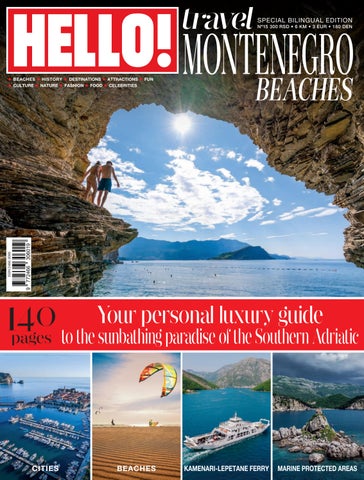
travel • •
•
• •
HISTORY DESTINATIONS NATURE FASHION FOOD
•
•
ATTRACTIONS CELEBRITIES
•
FUN
MONTENEGRO BEACHES Nº15 300 RSD • 6 KM • 3 EUR • 180 DEN
ISSN 2466-3069
• •
BEACHES CULTURE
SPECIAL BILINGUAL EDITION
personal luxury guide 140 to the Your sunbathing paradise of the Southern Adriatic pages
CITIES 001 Naslovna.indd 1
BEACHES
KAMENARI-LEPETANE FERRY
MARINE PROTECTED AREAS 3.8.2026. 15:42:06
002-003 Sadrzaj.indd 2
3.8.2026. 15:41:55
Contents
travel
MONTENEGRO BEACHES
PUBLISHER Color Media Events Mileve Simić 27 Novi Sad, Serbia Tel/Fax: +381.21/489-71-00
DIRECTOR Robert Čoban EDITOR-IN-CHIEF Žikica Milošević CREATIVE ART DIRECTOR Dragoslav Vrbaški WRITER, TRANSLATOR AND PROOFREADER FOR ENGLISH Žikica Milošević DESIGN Dragoslav Vrbaški MARKETING Dragan Vučević PROOFREADER Danka Krunić PHOTO JP Morsko Dobro/WOW Montenegro/Nebojša Nišić, Slaven Vilus, Filip Burzanović, JP Morsko Dobro, Žikica Milošević, Mladen Sekulić, Goran Zlatković, Alina Polhovceva, Youtube screenshots, Wikimedia/ Lessormore, Wikimedia/Hughbellamy, Wikimedia/Panoramio/Petr Kraumann, Wikimedia/Lovinkat, Wikimedia/Pudelek/Marcin Szalla, Arno Hoyer, Jovana Kvržić private collection, Wikimedia/Marcin Konsek, Wikimedia/Panoramio/Ines Lukić, Wikimedia/Oktoober, Wikimedia/Дим Фролин, Wikimedia/Wikarius, Wikimedia/Julo, Wikimedia/Alex Alishevskikh, Wikimedia/Krysi, Flickr, pixabay.com, PxHere, Pixahive, Facebook, Instagram, Panoramio,Arhiva Color Press Group, Robert Čoban, Ranko Maraš, TO Ulcinj, TO Herceg Novi, Vuk Ilić, WOW MONTENEGRO iz arhive TO Bar, TO Budva/DGTL Lab - creative agency, TO Tivat, Predrag Vučković (Extreme Photographer), and all the others mentioned in the particular articles, not necessarily mentioned in the impressum. SPECIAL THANKS TO: JP za upravljanje morskim dobrom Crne Gore, Budva, Montenegro
COASTAL CITIES AND TOWNS Summertime holidays are not just beaches – discover beautiful Montenegrin costal towns full of vibrant history and precious architecture .......... 16 BEACHES Vamos a la playa! You know you need it! Find out the endless variety of the beaches in every riviera ................................................................ 22 FERRIES Not Bryan, the real ferry! What’s a summer holiday without one? This one is a part of an epic history of Boka! ........................................ 34 STARS AND TRAVEL BLOGGERS Get some advice from celebrities and travel bloggers who travelled to spend their „holidays in the sun“ precisely in Montenegro! .............. 45 PORTS AND MARINAS The Port of Budva is arguably one of the nicest in the area – and there are several „Portos“ recently built .................................................... 75 PROTECTED MARINE AREAS We cherish our nature and protect the invaluable marine parks .................................................... 79 SUMMERTIME ADRIATIC FASHION! What to wear on holidays? .............................. 86
PRINTING Birograf Comp d.o.o. Anastasija Pulje 22, Zemun Telephone: 011/307-50-55 www.birograf.rs marketing@birograf.rs
EVENTS Not only fun in the sun – there are many events to attend here! Be there or be square – they once said – but it is forever valid! .................. 134 SOUTHERN ADRIATIC FOOD The cuisine here is a delicious mix of all the influences and peoples that met in Montenegro – that’s why you shouldn’t miss it! ................ 136
CIP – Каталогизација у публикацији Библиотека Матице српске, Нови Сад 338.48 HELLO! Travel / glavni i odgovorni urednik Žikica Milošević, 2015, br. 1 (dec.) - Novi Sad: Color Media Communications, 2015- , - Ilustr. 31 cm Mesečno ISSN 2466-3069 – Hello! Travel COBISS.SR -ID 300913415
Published under licence of HELLO! HELLO! is a trademark of HOLA S. A. All rights reserved. Republishing in whole or part without written permission is prohibited
002-003 Sadrzaj.indd 3
3
3.8.2026. 15:45:22
4
004-005 R.indd 4
3.8.2026. 15:45:50
5
004-005 R.indd 5
3.8.2026. 15:45:58
Editorial ČUVAJUĆI OBALU, STVARAMO BUDUĆNOST
6
PROTECTING THE COAST, SHAPING THE FUTURE
Poštovani čitaoci,
Dear Readers,
Crna Gora nije samo destinacija koju treba posjetiti, već mjesto kojem se čovjek uvijek poželi vratiti. Na svega nekoliko sati vožnje smjenjuju se beskrajne pješčane plaže, skrivene uvale, živopisni primorski gradovi, tvrđave koje svjedoče o bogatoj istoriji i jedan od najljepših zaliva svijeta. Upravo ta raznovrsnost čini naše primorje jedinstvenim i daje svakom posjetiocu priliku da pronađe svoj doživljaj. Od Velike plaže i Ade Bojane, preko barske i budvanske rivijere, do Bokokotorskog zaliva i hercegnovske obale, svaki dio crnogorskog primorja ima svoj karakter, svoju priču i poseban doživljaj. Neko će ga pamtiti po kristalno čistom moru, neko po šetnjama uz obalu, a neko po gostoprimstvu ljudi, autentičnoj gastronomiji i atmosferi mediteranskih gradova. To je bogatstvo koje nas izdvaja i koje sa posebnim ponosom predstavljamo svijetu. Kao direktor Javnog preduzeća za upravljanje morskim dobrom Crne Gore, svjestan sam odgovornosti koju nosimo prema prostoru koji predstavlja jedno od naših najvećih prirodnih i razvojnih bogatstava. Naš zadatak nije samo da upravljamo obalom, već da je čuvamo i razvijamo na način koji će omogućiti da njene vrijednosti ostanu sačuvane i za buduće generacije. Brinemo o plažama i kupalištima različitih kategorija, šetalištima i obalnoj infrastrukturi duž cijelog primorja, stvarajući uslove da svaki boravak na obali bude bezbjedan, uređen i prijatan. Istovremeno upravljamo i važnim sistemima koji povezuju našu obalu i doprinose njenom razvoju. Trajektna linija Kamenari–Lepetane predstavlja jednu od najvažnijih saobraćajnih veza u Bokokotorskom zalivu, dok Luka Budva ima značajnu ulogu u razvoju pomorskog saobraćaja i turističke ponude našeg primorja. Naš cilj nije samo da održavamo prostor kojim upravljamo, već da zajedno sa lokalnim samupravama doprinesemo stvaranju obale koja je uređena, dostupna i očuvana, ali i spremna da odgovori na očekivanja savremenih posjetilaca. Crnogorska obala nudi mnogo više od ljetovanja. Ona je mjesto susreta prirode, kulture, tradicije i savremenog načina života. To je prostor u kojem se može jedriti Bokokotorskim zalivom, uživati na pješčanim plažama juga, istraživati stare gradove, šetati uređenim rivama ili jednostavno zastati i uživati u pogledu na more koje je vijekovima povezivalo Crnu Goru sa svijetom. Zato vas pozivam da upoznate crnogorsku obalu, da otkrijete njene skrivene ljepote, doživite njenu raznovrsnost i osjetite mediteranski duh koji je čini posebnom. Vjerujem da ćete, kao i milioni ljudi prije vas, ponijeti najljepše uspomene i poželjeti da joj se ponovo vratite. Naš cilj je da Crna Gora bude destinacija kojoj se ljudi vraćaju, a čiji stanovnici mogu biti ponosni. Jer čuvajući obalu danas, stvaramo budućnost Crne Gore.
Montenegro is not merely a destination to visit – it is a place that inspires people to return time and again. Within just a few hours’ drive, visitors can experience endless sandy beaches, secluded coves, picturesque coastal towns, historic fortresses that bear witness to a rich past, and one of the world’s most beautiful bays. It is precisely this diversity that makes our coastline truly unique, offering every visitor the opportunity to create their own unforgettable experience. From Velika Plaža and Ada Bojana, across the Bar and Budva Rivieras, to the Bay of Kotor and the coast of Herceg Novi, every part of Montenegro’s shoreline has its own character, its own story and its own distinctive charm. Some will remember it for its crystal-clear waters, others for the leisurely walks along the promenade, while many will treasure the warmth of its people, its authentic cuisine and the atmosphere of its Mediterranean towns. This is the richness that sets Montenegro apart and one that we proudly present to the world. As Director of the Public Enterprise for Coastal Zone Management of Montenegro, I am fully aware of the responsibility we bear towards an area that represents one of our country’s greatest natural and developmental assets. Our mission extends far beyond managing the coastline; it is to protect, preserve and enhance it in a way that ensures its exceptional value will be safeguarded for generations to come. We care for beaches and bathing areas of various categories, promenades and coastal infrastructure along the entire Adriatic coast, creating conditions that ensure every visit is safe, well maintained and enjoyable. At the same time, we manage key facilities that connect our coastline and contribute to its continued development. The Kamenari–Lepetane ferry service is one of the most important transport links within the Bay of Kotor, while the Port of Budva plays a significant role in the development of maritime transport and the tourism offer of Montenegro’s coast. Our objective is not simply to maintain the areas under our care, but to work closely with local authorities in creating a coastline that is well managed, accessible and carefully preserved, while also meeting the expectations of today’s visitors. Montenegro’s coastline offers far more than a summer holiday. It is a place where nature, culture, tradition and contemporary Mediterranean life come together. Here, visitors can sail through the Bay of Kotor, relax on the sandy beaches of the south, explore ancient coastal towns, stroll along beautifully maintained waterfronts, or simply pause to admire the sea that has connected Montenegro with the wider world for centuries. I therefore invite you to discover Montenegro’s coastline, uncover its hidden treasures, experience its remarkable diversity and embrace the Mediterranean spirit that makes it so special. I am confident that, like millions of visitors before you, you will leave with unforgettable memories and a desire to return. Our ambition is for Montenegro to remain a destination to which people gladly return, and a country of which its citizens can be proud. By protecting our coastline today, we are shaping the future of Montenegro.
Mladen Mikijelj Direktor “JP za upravljanje morskim dobrom Crne Gore”
006-007 Uvodnici.indd 6
Mladen Mikijelj CEO “The Public Enterprise for Coastal Zone Management of Montenegro”
3.8.2026. 15:47:38
Editorial
DOBRO DOŠLI NA CRNOGORSKU OBALU – BISER JADRANA
WELCOME TO THE MONTENEGRIN COAST – THE PEARL OF THE ADRIATIC
Crnogorska obala je spoj prirodne ljepote, bogate tradicije i savremenog turizma. Ovdje se susreću kristalno čisto more, skrivene uvale, uređene plaže i mirne oaze za odmor, ali i brojni sadržaji za aktivan boravak na moru
The Montenegrin coast is a unique blend of natural beauty, rich tradition, and modern tourism. Here, crystal-clear waters meet hidden coves, well-maintained beaches, and peaceful retreats, alongside a wealth of opportunities for active holidays by the sea
C
rnogorska obala je mjesto gdje svako može naći za sebe dio koji će ispuniti njegova očekivanja i snove. Sa više od 80 jedinstvenih i osobenih obalnih lokaliteta i preko 550 kupališta, svaki posjetilac može doživjeti iskustvo po svojoj mjeri – od porodičnih plaža i sportova na vodi, do tihih, skrivenih mjesta u kojima priroda dominira. Od stijena do pijeska, od živosti do spokoja. Sa kristalno čistom vodom i mirisom borova i mediteranske vegetacije, crnogorska obala će vas opiti i odnijeti na mjesto gdje se osjećate kako ste oduvijek željeli – poletno ali opušteno, a gostoprimstvo domaćina će učiniti da se osjećate kao kod kuće. Posvećeni smo tome da obala ostane čista, bezbjedna i dostupna svima, jer prirodu doživljavamo kao zajedničko bogatstvo koje treba čuvati. Javno preduzeće za upravljanje morskim dobrom Crne Gore upravlja obalom, lukama, trajektnom linijom Kamenari–Lepetane, zaštićenim morskim područjima Platamuni, Katič i Stari Ulcinj kao i obalnom infrastrukturom, s ciljem da primorje ostane uređeno, sigurno i dostupno svima. Nautičko središte Luka Budva, kojim JP Morsko dobro takođe upravlja, sa skoro 600 vezova, pravo je mjesto za one koji vole da se otisnu na more na plovilima. Kroz ulaganja u infrastrukturu, zaštitu prirodnih vrijednosti i razvoj turističke ponude, čuvamo autentičnost obale i istovremeno je prilagođavamo savremenim potrebama. Istražite obalu i ostrva; otkrijte tok rijeke Bojane i adu koju je stvorila za naše rajsko uživanje. Pronađite za sebe mjesto na preko 300 kilometara morske obale, u tirkizu voda crnogorskog Jadrana. Uživajte u romantici skrivenih kamenih ponti i zidina starih gradova i sela načičkanih duž obale; uživajte u maestralu i zracima sunca. Pozivamo vas da otkrijete ljepotu crnogorske obale, pronađete svoju omiljenu plažu i doživite pravi Mediteran. Zagrlite more Crne Gore!
■
006-007 Uvodnici.indd 7
T
his is a coastline where everyone can find a place that fulfils their expectations and captures their imagination. With more than 80 distinctive coastal destinations and over 550 bathing areas, every visitor can discover an experience tailored to their preferences – from family-friendly beaches and water sports to secluded corners where nature remains untouched. From rocky shores to golden sands, from vibrant seaside resorts to tranquil escapes. With its crystal-clear waters and the scent of pine trees and Mediterranean vegetation, the Montenegrin coast will enchant you and transport you to a place where you can feel exactly as you have always wished – invigorated yet relaxed. The warmth and hospitality of the local people will make you feel truly at home. We are committed to ensuring that the coastline remains clean, safe, and accessible to everyone, because we regard nature as a shared treasure that must be protected. The Public Enterprise for Coastal Zone Management of Montenegro manages the coastline, ports, the Kamenari–Lepetane ferry service, the protected marine areas of Platamuni, Katič and Stari Ulcinj, as well as coastal infrastructure, with the goal of keeping the coast organised, safe, and accessible to all. Luka Budva, Montenegro’s leading nautical centre, also managed by the Enterprise, offers almost 600 berths and is the ideal gateway for those who enjoy setting sail and exploring the Adriatic by boat. Through continued investment in infrastructure, the protection of natural assets, and the development of tourism facilities, we preserve the authenticity of the coast while adapting it to contemporary needs. Explore the coastline and its islands; discover the course of the Bojana River and the island it created for our enjoyment. Find your own place along more than 300 kilometres of shoreline, surrounded by the turquoise waters of the Montenegrin Adriatic. Enjoy the romance of hidden stone pontoons and the walls of ancient towns and villages scattered along the coast; savour the maestral breeze and the warmth of the Mediterranean sun. We invite you to discover the beauty of the Montenegrin coast, find your favourite beach, and experience the true Mediterranean. Embrace the Sea of Montenegro.
■
7
3.8.2026. 15:47:48
HELLO! TRAVEL FOR LUŠTICA BAY
HELLO! TRAVEL FOR LUŠTICA BAY Promo
LUŠTICA BAY
LJETO S MEDITERANSKIH RAZGLEDNICA
A
utentične rezidencije, hoteli sa pet zvjezdica The Chedi Luštica Bay na promenadi, i novi hotel Centrale Luštica Bay by Angsana na Piazzi Centrale, jedinstveno gastro i šoping iskustvo, intenzivan ljetnji kalendar sa preko 120 događaja, budući golf teren kreiraju upečatljiv identitet Luštica Baya na Tivatskoj rivijeri. Cijela destinacijska kampanja pod sloganom Feel.Alive. predstavlja segment autentičnog personalizovanog putovanja, sa posebnim osjećajem prisutnosti u trenutku i edicijom Jadrana kakav je nekad bio. U nizu tih iskustava dobija se i luštički pasoš sa najistaknutijim lokacijama poluostrva, među kojima su i farma Moric i ribarsko selo Rose, ali i obilasci kotorske pjace subotom sa The Chedi šefom kuhinje, te aktivno učešće u pripremi jela. Pet plaža čini plavi potpis Luštica Bay destinacije: kultna plaža opjevana u singlu Đe se kupaš, crnogorskog rep dua Who See dobija novi koncept Pura Vida Beach. Signorina Beach Bar je postavljen na plaži Azzure sa predivnim pogledom na cijelu Luštica Bay. The Chedi Luštica Bay i Marina plaža su već prepoznate kao omiljene među rezidentima i gostima Luštica Baya, svaka na svojevrstan način.
T E C EDI LUŠTICA A
LA A
Tokom ljetnje sezone The Chedi Luštica Bay razvija seaside program osmišljen oko sporijeg ritma boravka uz more kroz wellness rituale, aktivnosti na vodi i gastronomska iskustva koja prirodno prate mediteranski način života. Blue Flag sertifikovana The Chedi Beach predstavlja plažu prepoznatu po visokom standardu kvaliteta mora, održivosti i usluge, uz atmosferu koja ostaje suptilna, opuštena i prirodno povezana sa obalom Jadrana.
ELL E
8
O CE T A LA I
The Spa by the Beach donosi wellness koncept kreiran za trenutke opuštanja u otvorenom seaside ambijentu. Fokus je na jednostavnom, balansiranom iskustvu koje povezuje more, tišinu i prirodan ritam ljeta. Tokom sezone organizuje se i Full Moon Sound Meditation, večernji ritual meditacije i sound healinga pod punim mjesecom. Kalendar Full Moon Sound Meditation događaja
008-011 Luštica Bay.indd 8
je rezervisan za zasebna iskustva, 31. maj – Blue Moon, 30. jun – Strawberry Moon, 29. jul – Buck Moon, 28. avgust – Sturgeon Moon, 26. septembar – Corn / Harvest Moon. Za goste koji žele aktivniji boravak na obali The Chedi Beach organizuje Kayak Trašte Tour, vođenu kayaking turu kroz mirnije dijelove zaliva i obale Luštice. Tokom cijelog dana dostupni su i SUP daske i kajaci direktno sa The Chedi plaže, namijenjeni individualnom istraživanju obale i laganom boravku na moru.
THE ROK BEACH BAR & LOUNGE
U okviru The Chedi plaže nalazi se The Rok Beach Bar & Lounge koncept smješten na kamenoj terasi uz samu obalu, sa pogledom prema otvorenom moru i zalasku sunca. Tokom dana The Rok donosi selekciju beach i street food jela inspirisanih mediteranskom obalom, uz pice iz tradicionalne peći, lagane ljetnje zalogaje i signature koktele. Atmosfera ostaje opuštena, sofisticirana i nenametljivo povezana sa seaside lifestyle konceptom hotela. Za ljubitelje ostriga nedjeljom se na The Chedi Beachu organizuje Oysters by the Shore — ritualno seaside iskustvo koje spaja svježe ostrige, šampanjac i lagani ritam popodneva uz more.
Za goste koji traže viši nivo privatnosti i komfora kabane nude izdvojen prostor uz more. Svaka kabana je zamišljena kao diskretno utočište uz obalu, uz personalizovan servis, dodatni komfor i ambijent kreiran za cjelodnevni boravak u potpunoj privatnosti. Iskustvo spaja luksuz bez eksponiranja, uz direktan kontakt sa morem.
SIGNORINA BEACH BAR
Signorina Beach bar, spaja moderan gastro pristup i energičnu dnevnu atmosferu. Koncept regionalno prepoznatljivog Ribarskog sela i Adriatica Beach cluba, kao i već omiljene Špilje u Luštica Bayu, dobija novu ediciju i na plaži Azzure. Resident DJ program doprinosi dinamičnom beach experience konceptu ovog ljeta. Plaža će biti podijeljena u zone za odrasle i porodice, kako bi svaki gost pronašao prostor za odmor i uživanje prema sopstvenim preferencijama. Signorina ima svoju ediciju i na promenadi Luštica Baya: italijanski gastro koncept inspirisan elegancijom i ležernom svakodnevicom Mediterana. Dodatni pečat ovom konceptu daje Ciao Ciao Bar, zamišljen kao mjesto cjelodnevnog druženja uz široku ponudu koktela, vina i premijum pića. Od jutarnjih kafa i laganih aperitiva, do večernjih koktela uz italijansku muziku i prepoznatljiv mediteranski vajb, Ciao Ciao donosi atmosferu italijanske rivijere u srcu promenade.
PURA VIDA BEACH
Posebno mjesto među novim sadržajima zauzima Pura Vida Beach — koncept smješten na plaži Pecka, jednoj od najljepših prirodnih plaža na crnogorskoj rivijeri. Prepoznatljiv boho stil, prirodni materijali, opuštena atmosfera i pažljivo kreiran muzički program čine ovu lokaciju idealnim mjestom za cjelodnevno uživanje uz more. Tokom dana gosti uživaju u laganom beach lounge konceptu, signature koktelima i atmosferi inspirisanoj svjetskim plažnim destinacijama, dok će večernji program donijeti organizovane događaje, DJ sesije pri zalasku sunca, nastupe i tematske večeri koje će Pura Vida Beach pozicionirati kao jednu od najatraktivnijih ljetnjih lokacija na Crnogorskom primorju.
3.8.2026. 15:58:00
FULL MOON PARTY
Nastup globalno prepoznatljivog David Moralesa otvorio je ljetnji kalendar događaja u Luštica Bayu u velikom stilu. Manda Moor podigao je temperature ljetnje zabave 30. juna, dok vrhunac sezone obilježavaju Ninetoes 29. jula i legendarni Inner City 28. avgusta. Izvođači različitih generacija i stilova dio su jedinstvenog serijala čiji su zajednički imenioci vrhunska muzika, dinamična atmosfera i noći koje se pamte. Svako veče Full Moon serijala otvoriće nastup azerbejdžanskog benda RAAM, dodatno uvodeći publiku u ritam noći pod punim mjesecom.
Smještena u pješčanoj uvali, Marina Beach je ležerna i privlačna plaža. U pravom duhu kulture boravka na plaži, ova živahna lokacija nudi raznovrsne sportske aktivnosti na moru, uz odličnu muziku, stvarajući vibrantnu atmosferu ispunjenu sjajnim raspoloženjem. Od ove godine zahvaljujući novom konceptu Beach Passa, gosti će imati mogućnost da kombinuju iskustva na više plaža otvorenih za sve posjetioce, kreirajući personalizovan doživljaj odmora u okviru destinacije. Za dodatne informacije o aktuelnim ponudama, rezervacijama i dostupnim paketima na plaži svi zainteresovani se mogu obratiti timu Feel Alive kancelarije u Luštica Bayu.
■
Photo: Promo
MARINA BEACH
LUŠTICA BAY A
A SUMMER DRAWN FROM MEDITERRANEAN POSTCARDS
collection of premium residences, the fivestar The Chedi Luštica Bay on the waterfront promenade, and the newly opened Centrale Luštica Bay by Angsana on Piazza Centrale come together to define the distinctive rhythm of life at Luštica Bay, Montenegro’s most compelling coastal destination. Add to that a vibrant culinary and retail scene, an extensive summer calendar featuring more than 120 events, and the anticipation surrounding the future golf course, and the result is a destination that feels both effortlessly sophisticated and deeply rooted in place. This year’s destination campaign, Feel Alive., celebrates a more personal and meaningful way to travel, one shaped by authenticity, spontaneity and a genuine sense of connection. It offers a glimpse of the Adriatic as it once was: slower, more intimate and wonderfully unspoilt. Among the experiences bringing this philosophy to life is the Luštica Passport, an invitation to discover some of the peninsula’s most treasured locations, from the family-run Moric Farm to the historic fishing village of Rose. Guests can also accompany The Chedi’s Executive Chef on a Saturday morning visit to Kotor’s centuries-old market before returning to prepare seasonal Mediterranean dishes inspired by the day’s freshest ingredients. Five beaches form the azure signature of Luštica Bay, each with its own character and atmosphere. The iconic Pecka Beach, immortalised in the Montenegrin hit song Đe se kupaš by rap duo Who See, introduces the new Pura Vida Beach concept this summer. Signorina Beach Bar takes its place on Azzure Beach, overlooking the bay in all its beauty, while The Chedi Beach and Marina Beach remain enduring favourites among residents and visitors alike.
THE CHEDI LUŠTICA BAY BEACH
This summer, The Chedi Luštica Bay embraces the timeless pleasures of Mediterranean coastal living through a thoughtfully curated programme of wellness rituals, water-based adventures and culinary experiences inspired by life by the sea. Awarded the prestigious Blue Flag,The Chedi Beach is recognised for its exceptional water quality, sustainability standards and attentive service.Yet its greatest luxury remains its atmosphere—understated, relaxed and naturally connected to the Adriatic landscape.
WELLNESS BY THE SEA
The Spa by the Beach introduces an open-air wellness concept designed around the restorative power of nature.
008-011 Luštica Bay.indd 9
Here, sea air, gentle movement and moments of stillness combine to create a sense of effortless wellbeing. Throughout the season, guests can take part in Full Moon Sound Meditation, an immersive evening ritual of meditation and sound healing beneath the moonlit sky. Sessions take place on: 31 May – Blue Moon 30 June – Strawberry Moon 29 July – Buck Moon 28 August – Sturgeon Moon 26 September – Harvest Moon For those seeking a more active connection to the coastline, the Kayak Trašte Tour explores some of the bay’s most secluded corners and hidden coves. SUP boards and kayaks are also available daily for independent exploration at sea.
THE ROK BEACH BAR & LOUNGE
Set on a stone terrace at the water’s edge, The Rok Beach Bar & Lounge enjoys uninterrupted views of the open Adriatic and spectacular sunsets. The all-day menu celebrates the flavours of the Mediterranean, from fresh beach-inspired dishes and woodfired pizzas to light seasonal bites and expertly crafted signature cocktails.The atmosphere is relaxed yet refined, a natural extension of The Chedi’s seaside lifestyle. Sundays bring one of the season’s most indulgent rituals: Oysters by the Shore, pairing freshly shucked oysters with chilled champagne and an unhurried afternoon by the sea. For guests seeking additional privacy, elegant cabanas offer a secluded sanctuary beside the water. Designed as intimate coastal retreats, they combine personalised service, enhanced comfort and uninterrupted sea views, luxury without ostentation, always connected to the landscape.
SIGNORINA BEACH BAR
Energetic, stylish and distinctly Mediterranean, Signorina Beach Bar introduces a fresh chapter in Luštica Bay’s beach scene. Building on the success of regional favourites including Ribarsko selo, Adriatica Beach Club and Luštica Bay’s beloved Špilja, the new concept brings together contemporary gastronomy, relaxed beach culture and a lively resident DJ programme. The beach is thoughtfully divided into adults-only and family-friendly zones, allowing guests to choose the atmosphere that best suits their day. Signorina’s spirit extends beyond the beach and onto the
9
3.8.2026. 15:58:11
Photo: Promo
promenade through an Italian dining concept inspired by the effortless elegance of the Mediterranean lifestyle. Complementing the experience is Ciao Ciao Bar, a stylish gathering place for everything from morning espresso rituals to sunset aperitivos and late-evening cocktails.With Italian music, a carefully curated drinks list and Riviera-inspired charm, it captures the essence of la dolce vita on Montenegro’s coast.
PURA VIDA BEACH
Among the season’s most anticipated openings is Pura Vida Beach, set on the iconic Pecka Beach—one of the most sought-after stretches of coastline in Montenegro. With its laid-back bohemian aesthetic, natural textures and carefully curated soundtrack, Pura Vida Beach channels the spirit of the world’s most celebrated beach destinations. Days unfold around signature cocktails, relaxed lounging and long afternoons beside the sea. As the sun begins to set, the energy shifts. Sunset DJ sessions, live performances and themed events transform the venue into one of the coast’s most vibrant summer destinations.
FULL MOON PARTIES AT PECKA BEACH
This year’s summer programme opened with a headline performance by globally renowned DJ David Morales, setting the tone for an unforgettable season. The series continues with Manda Moor on 30 June, Ninetoes on 29 July and legendary electronic music pioneers Inner City on 28 August. Bringing together artists from different generations and musical styles, the Full Moon series celebrates exceptional music, electric energy and unforgettable nights beneath the stars. Each event begins with a performance by Azerbaijani band RAAM, whose atmospheric soundscapes provide the perfect prelude to a night under the full moon.
MARINA BEACH
Nestled within a sheltered sandy bay, Marina Beach offers a more laid-back yet equally vibrant coastal experience. A hub for watersports enthusiasts, it combines sailing, paddleboarding and other activities with excellent music and a warm, sociable atmosphere. It is beach culture at its most relaxed and joyful. New this season, the Beach Pass allows guests to experience multiple beaches across the destination, creating a personalised itinerary tailored to their preferred pace and style of holiday. For reservations, beach packages and the latest seasonal experiences, guests can contact the Feel Alive Office team at Luštica Bay.
■
10
008-011 Luštica Bay.indd 10
E: feelalive@lusticabay.com T: +382 67 106 670
3.8.2026. 15:58:18
11
008-011 Luštica Bay.indd 11
3.8.2026. 15:58:21
HELLO! TRAVEL FOR DUKLEY RIVIERA Promo
Laguna Beach & Restaurant
Infinity Pool & Tapas
RIVIERA
C
12
Jedna ljetnja priča, ispisana na bezbroj načina
rnogorska obala oduvijek je imala posebnu energiju tokom ljeta. Miris soli u vazduhu, muzika koja dopire sa terasa uz more i tople večeri koje se pamte dugo nakon povratka kući. Ipak, malo je mjesta koja uspiju da objedine sve ono zbog čega ljudi vole Mediteran u jedno zaokruženo iskustvo. Dukley Riviera upravo je takvo mjesto. Smještena između Budve i Bečića, mora i borove šume, ova rivijera tokom ljeta živi gotovo bez pauze. Plaže, restorani, lounge zone i infinity bazen smjenjuju se duž rivijere, povezani šetnjom uz more ili prijatnom vožnjom električnim vozilima kroz prepoznatljive Dukley bašte koje pružaju predah tokom toplih ljetnjih dana. Tokom dana rivijera nudi potpuno različite atmosfere, od mirnih kutaka za opuštanje uz rashlađenu čašu šampanjca do glamuroznih beach club trenutaka sa prijateljima, dok predveče gastronomija i muzika postaju centralni dio doživljaja. Svako mjesto nosi svoju energiju i karakter, ali zajedno stvaraju osjećaj ljeta koje teče lagano, spontano i bez žurbe. Dukley Riviera podjednako privlači goste hotela i posjetioce iz cijelog grada i regiona. Upravo ta kombinacija privatnosti, pažljivo kreiranog sadržaja i široke ponude za one koji žele da dožive drugačiju stranu budvanskog ljeta daje cijeloj rivijeri poseban karakter.
012-015 Dukley Riviera.indd 12
Poseban dio iskustva predstavlja i dolazak morskim putem. Taxi brodić koji tokom sezone povezuje Dukley sa Starim gradom Budve pretvara nekoliko minuta vožnje u mali ritual ljeta, uz pogled na kamene zidine grada, jahte usidrene uz obalu i rivijeru koja se otvara prema pučini. Usluga je dostupna tokom cijelog ljeta i potpuno je besplatna, dok su gostima koji dolaze privatnim brodovima i jahtama na raspolaganju vezovi uz samu obalu.
BENEDICT CAFÉ
Na samom ulazu u rivijeru nalazi se Benedict Café, mjesto koje nosi onu laganu i bezbrižnu atmosferu tipičnu za mediteranska jutra. Mirna terasa okružena zelenilom, svijetao enterijer i miris svježe pripremljene kafe stvaraju prostor u kojem se dan prirodno usporava. Topla peciva iz Dukley pekare, šik jela za dijeljenje sa prijateljima, zdravi smuti napici i lagani brunch koncept čine Benedict jednim od onih mjesta na kojima se lako ostaje duže nego što je planirano. Posebno tokom jutra, kada cijela atmosfera djeluje mirno, lagano i potpuno odvojeno od užurbanog ritma grada.
LAGUNA BEACH & RESTAURANT
Laguna predstavlja srce dnevnog života na rivijeri. Tokom dana ovdje vlada vibrantna energija, uz muziku, rashlađena pića i duge ručkove u hladu,
dok se predveče atmosfera postepeno pretvara u jednu od najtraženijih gastro adresa ljeta. Meni je inspirisan Mediteranom i ljetnjim načinom života, pa se na stolovima smjenjuju svježa riba, morski plodovi, lagane paste, salate i jela stvorena za dijeljenje uz čašu vina ili koktel na suncu. Petak donosi Boho Social atmosferu rezervisanu za opušten uvod u vikend, dok su subote namijenjene Casa Riviera događajima koji plažni dan pretvaraju u veliko ljetnje druženje uz muziku, zabavni program i energiju po kojoj je Laguna prepoznatljiva. Nedjelje donose elegantniji Maison Laguna koncept, uz duge stolove, zalazak sunca i atmosferu koja podsjeća na najpoznatije mediteranske destinacije. Vrhunac sezone svakako predstavlja Laguna White Gala, prepoznatljivo ljetnje veče u bijelom koje okuplja goste uz muziku, večeru i energiju velikih ljetnjih proslava.
DUKLEY BEACH & BAR
Dukley Beach & Bar zamišljen je kao mjesto za potpuno opuštanje uz more. Prostrana uređena plaža, udobne ležaljke, lagana muzika i pogled na otvoreni Jadran stvaraju atmosferu privatnog ljetnjeg utočišta, iako se nalazite nadomak centra Budve. Kuhinja je prilagođena dugim danima na plaži, uz lagane mediteranske zalogaje, svježe salate, hladna pića i šampanjac koji se služe direktno do ležaljki.
INFINITY POOL CLUB
Smješten na najvišoj tački rizorta, Infinity Pool & Tapas predstavlja pravu rooftop destinaciju za duge ljetnje dane uz bazen i panoramski pogled na Budvansku rivijeru. Tokom dana ovdje se smjenjuju opuštanje uz infinity bazen, rashlađeni kokteli i ukusni zalogaji, dok zalazak sunca cijelom prostoru daje potpuno novu atmosferu. Pogled na Budvu, miris čempresa iz obližnje šume i večeri uz vino stvaraju osjećaj kojem se gosti iznova vraćaju. Koncept kuhinje zasniva se na tapasima, picama i jelima stvorenim za dijeljenje, uz pažljivo osmišljenu vinsku i koktel kartu. Posebnu prepoznatljivost Infinityju daju večeri inspirisane španskom gastronomijom, premium vinima i pata negra specijalitetima, uz atmosferu koja podsjeća na najljepše mediteranske rooftop lokacije.
SUMOSAN MONTENEGRO
Sumosan Montenegro već godinama važi za jedno od najprepoznatljivijih mjesta ljetnjeg života na Crnogorskom primorju. Poznati svjetski restoran savremene japanske kuhinje upravo je u Dukley
3.8.2026. 16:00:54
Laguna Beach & Restaurant
White Party | Laguna
rizortu otvorio svoj ekskluzivni koncept uz more, donoseći Budvi prepoznatljivu energiju jednog od najpoznatijih internacionalnih gastro brendova. Već treću sezonu zaredom predstavlja nezaobilaznu adresu tokom ljetnjih dana i večeri. Na meniju se nalaze prepoznatljive suši selekcije, sašimi, robata specijaliteti i moderna japanska jela po kojima je Sumosan poznat širom svijeta, dok kokteli i muzika cijelom prostoru daju potpuno drugačiji karakter nakon zalaska sunca. Tokom sezone posebno se izdvajaju Lunar Escape večeri inspirisane punim mjesecom, kada Sumosan postaje jedno od centralnih mjesta budvanskog noćnog života.
DUKLEY SEAFRONT RESTAURANT
Dukley Seafront Restaurant donosi elegantniju i mirniju stranu rivijere. Posebno iskustvo predstavlja Dining by the Sea dio restorana, smješten tik uz more između stijena,
uz ambijentalno osvjetljenje i laganu akustičnu muziku, zbog čega važi za jedno od najromantičnijih mjesta u Budvi. Meni je zasnovan na svježoj ribi, morskim plodovima, domaćim pastama, pažljivo biranim vinima i klasičnim mediteranskim ukusima pripremljenim u savremenom stilu. Pogled na osvijetljeni grad, lagana muzika i zvuk mora daju cijelom iskustvu posebnu notu elegancije bez pretjerane formalnosti.
SHALOM
SKENIRAJTE QR KOD I OTKRIJTE VIŠE O DUKLEY RIVIJERI
Shalom donosi topliju i intimniju atmosferu rivijere, inspirisanu bogatim bliskoistočnim ukusima. Kao jedini sertifikovani košer restoran u Crnoj Gori i regionu, donosi autentične ukuse i bogatu ponudu pažljivo pripremljenih jela. Veliki stolovi puni zalogaja, svježe pripremljen humus i mirisi začina stvaraju atmosferu zbog koje večeri ovdje gotovo uvijek traju duže nego što ste planirali.
Dukley Seafront Restaurant
■
reservation@dukley.com | +382 69 160 003
Infinity Pool & Tapas
13
012-015 Dukley Riviera.indd 13
3.8.2026. 16:00:59
Laguna Beach & Restaurant
Dukley Seafront Restaurant
Sumosan
Dukley Beach & Bar
RIVIERA
T
14
A Summer Story, Written in Countless Ways
he Montenegrin coast has always carried a special energy during summer. The scent of salt in the air, music drifting from seaside terraces, and warm evenings that remain memorable long after returning home. Yet few places succeed in bringing together everything people love about the Mediterranean into one complete experience. Dukley Riviera is precisely such a place. Nestled between Budva and Bečići, between the sea and pine forests, this Riviera comes alive throughout the summer season, almost without pause. Beaches, restaurants, lounge areas and an infinity pool unfold along the Riviera, connected by a scenic seaside promenade or pleasant rides in electric vehicles through the distinctive Dukley gardens, offering respite during warm summer days. Throughout the day, the Riviera presents entirely different atmospheres, from tranquil corners for relaxation with a chilled glass of champagne to glamorous beach club moments shared with friends. As evening approaches, gastronomy and music become the centrepiece of the experience. Each venue possesses its own energy and character, yet together they create the feeling of a summer that flows gently, spontaneously and without haste. Dukley Riviera attracts both hotel guests and visitors from across the city and the wider region. It is precisely this combination of privacy, carefully
012-015 Dukley Riviera.indd 14
curated experiences and a diverse offering for those wishing to discover a different side of summer in Budva that gives the entire Riviera its distinctive character. A particularly memorable part of the experience is arriving by sea. The water taxi connecting Dukley with Budva Old Town throughout the season transforms a short journey into a small summer ritual, offering views of the city’s stone walls, yachts moored along the coastline and the Riviera opening towards the horizon. The service is available throughout the summer and is completely complimentary, while berths directly along the shore are available for guests arriving by private boats and yachts.
BENEDICT CAFÉ
Located at the very entrance to the Riviera, Benedict Café embodies the light-hearted and carefree atmosphere typical of Mediterranean mornings. A peaceful terrace surrounded by greenery, a bright interior and the aroma of freshly brewed coffee create a space where the day naturally slows down. Fresh pastries from the Dukley bakery, stylish dishes designed for sharing, healthy smoothies and a light brunch concept make Benedict one of those places where guests effortlessly stay longer than planned. Especially in the morning, when the
entire atmosphere feels calm, relaxed and completely detached from the city’s pace.
LAGUNA BEACH & RESTAURANT
Laguna represents the heart of daytime life on the Riviera. During the day, a vibrant atmosphere prevails, with music, refreshing drinks and long lunches enjoyed in the shade, while towards evening it gradually transforms into one of the most sought-after gastronomic destinations of the summer. The menu is inspired by the Mediterranean and the summer lifestyle, featuring fresh fish, seafood, light pasta dishes, salads and plates created for sharing over a glass of wine or a cocktail in the sunshine. Fridays bring the relaxed Boho Social atmosphere, offering the perfect introduction to the weekend, while Saturdays are reserved for Casa Riviera events that transform a beach day into a lively summer gathering filled with music, entertainment and the energy for which Laguna is
3.8.2026. 16:01:17
Infinity Pool & Tapas
DUKLEY BEACH & BAR
Dukley Beach & Bar has been designed as a place for complete relaxation by the sea. A spacious landscaped beach, comfortable sun loungers, soft music and views of the open Adriatic create the atmosphere of a private summer retreat, despite being only moments away from the centre of Budva. The menu is tailored to long beach days, offering light Mediterranean bites, fresh salads, chilled beverages and champagne served directly to guests’ loungers.
INFINITY POOL CLUB
Situated at the highest point of the resort, Infinity Pool & Tapas is a true rooftop destination for long summer days by the pool, accompanied by panoramic views of the Budva Riviera. Throughout the day, guests enjoy relaxation by the infinity pool, refreshing cocktails and delicious bites, while sunset brings an entirely new atmosphere to the venue. Views of Budva, the scent of cypress trees from the nearby forest and evenings spent over wine create an experience that guests return to time and again. The culinary concept centres on tapas, pizzas and dishes designed for sharing, complemented by a carefully curated wine and cocktail selection. Infinity is particularly recognised for evenings inspired by Spanish gastronomy, premium wines and pata negra specialities, creating an ambience reminiscent of the Mediterranean’s finest rooftop destinations.
012-015 Dukley Riviera.indd 15
SUMOSAN MONTENEGRO
For years, Sumosan Montenegro has been regarded as one of the most recognisable venues of summer life on the Montenegrin coast. The globally renowned contemporary Japanese restaurant has established its exclusive seaside concept within Dukley Resort, bringing to Budva the distinctive energy of one of the world’s most celebrated international dining brands. For three consecutive seasons, it has remained an essential destination for summer days and evenings. The menu features the signature sushi selections, sashimi, robata specialities and contemporary Japanese dishes for which Sumosan is known worldwide, while cocktails and music transform the venue into an entirely different experience after sunset. During the season, the Lunar Escape evenings inspired by the full moon stand out as one of the highlights, turning Sumosan into one of the focal points of Budva’s nightlife.
DUKLEY SEAFRONT RESTAURANT
Dukley Seafront Restaurant presents a more refined and tranquil side of the Riviera. A particularly distinctive experience is offered through the restaurant’s Dining by the Sea concept, positioned directly by the water among the rocks, enhanced by ambient lighting and gentle acoustic music. As a result, it is widely regarded as one of the most romantic settings in Budva. The menu is built around fresh fish, seafood, homemade pasta, carefully selected wines and classic Mediterranean flavours prepared with a contemporary touch. Views of the illuminated town, soft music and the sound of the sea lend the entire experience an elegant character without excessive formality.
Photo: Promo
renowned. Sundays introduce the more elegant Maison Laguna concept, featuring long communal tables, sunset views and an ambience reminiscent of the Mediterranean’s most celebrated destinations. The highlight of the season is undoubtedly the Laguna White Gala, an iconic all-white summer evening that brings guests together through music, fine dining and the spirit of grand summer celebrations.
restaurant in Montenegro and the wider region, it offers authentic tastes and a carefully crafted selection of dishes. Large tables filled with sharing plates, freshly prepared hummus and the aromas of exotic spices create an atmosphere that makes evenings here almost always last longer than originally intended.
■
SCAN THE QR CODE AND DISCOVER MORE ABOUT DUKLEY RIVIERA
SHALOM
Shalom brings a warmer and more intimate atmosphere to the Riviera, inspired by the rich flavours of the Middle East. As the only certified kosher
reservation@dukley.com | +382 69 160 003
15
3.8.2026. 16:01:28
Cities and Towns
Herceg Novi GRAD OD HILJADU STEPENICA, MORA I ISTORIJE
Postoje gradovi koji vas osvoje na prvi pogled i oni koji vam se polako uvuku pod kožu. Herceg Novi pripada objema kategorijama. Dovoljno je da ugledate njegove kamene kuće kako se strmo spuštaju ka moru, da osjetite miris mimoze i čujete zvona sa starih crkava pa da shvatite da ste stigli u jedan od najneobičnijih gradova na Jadranu
S
mješten na samom ulazu u Boku Kotorsku, Herceg Novi je vjekovima bio prva luka, prvi pogled na zaliv i prva stanica putnicima koji su dolazili sa otvorenog mora. Zbog toga su ga osvajali, utvrđivali i oblikovali različiti vladari, ostavljajući mu slojevitu istoriju kakvom se rijetko koji grad može pohvaliti.
GRAD KOJI JE MIJENJAO GOSPODARE
Herceg Novi je osnovao bosanski kralj Tvrtko I Kotromanić 1382. godine pod imenom Sveti Stefan. Njegov položaj bio je toliko važan da je grad u narednim vjekovima prelazio iz ruke u ruku: vladali su njime bosanski velikaši, Turci, Mlečani, Španci, Austrijanci, Rusi, Francuzi i ponovo Austrijanci. Malo koji grad na Jadranu može se pohvaliti da je tokom svoje istorije bio pod toliko različitih zastava. Svaka od njih ostavila je trag u arhitekturi, kulturi i urbanom tkivu grada. Sam naziv Herceg Novi potiče od titule hercega Stjepana Vukčića Kosače, jednog od najmoćnijih vladara srednjovjekovnog Balkana. Upravo po njemu grad dobija ime koje nosi i danas.
GRAD TVRĐAVA
Prva asocijacija na Herceg Novi često su njegove tvrđave. Najpoznatija je Forte Mare, impozantno utvrđenje na samoj obali mora. Podignuta je još u srednjem vijeku, a kasnije su je proširivali i dograđivali Osmanlije i Mlečani. Danas je jedan od
simbola grada i mjesto sa koga se pruža spektakularan pogled na ulaz u Boku. Iznad starog jezgra nalazi se i Kanli kula, turska tvrđava čije ime u prevodu znači „Krvava kula“. Nekada zatvor, danas je jedna od najljepših ljetnjih pozornica na Jadranu. Tokom ljetnjih mjeseci ovdje se održavaju koncerti, pozorišne predstave i festivali pod otvorenim nebom. Treća velika utvrda jeste Fort Španjola, koju su, kako joj i ime kaže, podigli Španci tokom kratke vladavine početkom 16. vijeka. Iako je manje posjećena od drugih tvrđava, predstavlja važan podsjetnik na jednu od najneobičnijih epizoda u istoriji grada.
STARI GRAD I HILJADU STEPENICA
Za Herceg Novi često kažu da je grad stepenica i da zahtijeva dobru kondiciju. Procjenjuje se da ima više od stotinu različitih stepenišnih ulica koje povezuju obalu sa višim djelovima grada. Šetnja Starim gradom zato nije samo razgledanje spomenika već i prava mala avantura. Uske kaldrmisane ulice vode do živopisnih trgova, malih prolaza i skrivenih vidikovaca sa kojih se otvara pogled na more. Posebno mjesto zauzima Sat-kula Herceg Novog, jedan od najprepoznatljivijih simbola grada. Podignuta u 17. vijeku, kula i danas dominira starim jezgrom i predstavlja omiljeno mjesto susreta turista i lokalnog stanovništva. U blizini se nalazi i Crkva Svetog Mihaila Arhanđela, neobična građevina koja spaja vizantijske, romaničke i
orijentalne arhitektonske uticaje, što je savršen odraz istorije samog grada.
GRAD CVIJEĆA I MIMOZE
Zahvaljujući blagoj mediteranskoj klimi, Herceg Novi je poznat kao jedan od najzelenijih gradova na istočnom Jadranu. Tokom vjekova pomorci su sa svojih putovanja donosili egzotične biljke iz svih djelova svijeta, pa danas u gradu rastu palme, agave, kaktusi i brojne suptropske vrste. Najpoznatija manifestacija jeste Festival mimoze, koji se održava svake zime i predstavlja simbol dolaska proljeća. Ono što je počelo kao lokalna proslava s vremenom je postalo jedan od najznačajnijih festivala na crnogorskom primorju, sa nezaobilaznim mažoretkama u živopisnim uniformama.
ŠETALIŠTE UZ MORE
Jedna od najljepših aktivnosti u Herceg Novom jeste šetnja čuvenim šetalištem Pet Danica. Dugačko nekoliko kilometara, ono povezuje različite djelove grada i pruža stalan pogled na more, plaže i okolne planine. Upravo ovdje najbolje dolazi do izražaja ono što Herceg Novi čini posebnim: spoj planine i mora na malom prostoru. Dok se ispred vas prostire Jadran, iza grada se naglo uzdižu obronci planine Orjen, jednog od najimpozantnijih planinskih masiva na crnogorskom primorju. I ovdje počinju hercegnovske plaže, koje se pružaju kilometrima sa obje strane grada, različite i nepredvidive, po svačijem ukusu.
16
016-019 Herceg Novi & Eleven.indd 16
Foto: TO Herceg Novi/Vuk Ilić
VRATA BOKE
Za razliku od mnogih primorskih gradova koji žive isključivo od sunca i plaža, Herceg Novi nudi mnogo više. To je grad u kome se na svakom koraku prepliću različite civilizacije, religije i kulture. Grad tvrđava, stepenica, festivala i mediteranskog zelenila. Grad koji je vjekovima dočekivao putnike na ulazu u Boku i koji i danas ostaje jedno od najzanimljivijih mjesta na čitavom Jadranu. Ko jednom prošeta njegovim strmim ulicama i sjedne na neki od trgova sa pogledom na more, lako će razumjeti zašto Herceg Novi ima toliko vjernih poklonika – i zašto mu se ljudi iznova vraćaju.
■
3.8.2026. 16:03:53
Herceg Novi
THE CITY OF A THOUSAND STEPS, THE SEA AND HISTORY
There are cities that win you over at first sight, and those that quietly grow on you over time. Herceg Novi belongs to both categories. The moment you see its stone houses cascading steeply down towards the sea, smell the scent of mimosa in the air, and hear the bells of its old churches, you realise you have arrived in one of the most unusual towns on the Adriatic
S
ituated at the very entrance to the Bay of Kotor, Herceg Novi has for centuries been the first port, the first view of the bay, and the first stop for travellers arriving from the open sea. Because of this strategic position, it was repeatedly conquered, fortified and reshaped by different rulers, leaving behind a layered history that few towns can match.
A TOWN OF CHANGING EMPIRES
Foto: TO Herceg Novi/Vuk Ilić
Herceg Novi was founded in 1382 by the Bosnian king Tvrtko I Kotromanić under the name Sveti Stefan. Its position proved so important that over the following centuries it passed through the hands of numerous powers: Bosnian nobility, the Ottoman Empire, Venice, Spain, Austria, Russia, France, and again Austria. Few towns on the Adriatic can claim to have lived under so many flags. Each of these rulers left their mark on the town’s architecture, culture and urban fabric. The present name, Herceg Novi, derives from the title of Herceg (Duke) Stjepan Vukčić Kosača, one of the most powerful rulers of the medieval Balkans, after whom the city was ultimately named.
016-019 Herceg Novi & Eleven.indd 17
A CITY OF FORTRESSES
One of the first associations with Herceg Novi is its fortresses. The most famous is Forte Mare, an imposing stronghold on the seafront. Built in the Middle Ages and later expanded by both the Ottomans and the Venetians, it remains one of the city’s defining landmarks and offers spectacular views over the entrance to the Bay of Kotor. Above the
17
3.8.2026. 16:04:02
Foto: TO Herceg Novi/Vuk Ilić Foto: TO Herceg Novi/Vuk Ilić 016-019 Herceg Novi & Eleven.indd 18
Foto: TO Herceg Novi/Vuk Ilić
18
old town rises Kanli Kula, a Turkish fortress whose name translates as “Bloody Tower”. Once a prison, it is today one of the most atmospheric open-air stages on the Adriatic. During summer months, it hosts concerts, theatre performances and festivals under the open sky.The third major fortification is Fort Španjola, built - true to its name - by the Spanish during their brief rule in the early 16th century. Although less visited than the others, it remains a significant reminder of one of the more unusual chapters in the town’s history.
THE OLD TOWN AND A THOUSAND STEPS Herceg Novi is often described as a city of stairs, and it certainly demands a certain level of stamina. It is estimated that there are more than a hundred stairways connecting the waterfront with the upper parts of the town. Walking through the Old Town is therefore not just sightseeing, but a small adventure. Narrow cobbled streets lead to lively squares, hidden passages and unexpected viewpoints overlooking the sea. At the heart of the old centre stands the Clock Tower (Sat Kula), one of the city’s most recognisable symbols. Built in the 17th century, it still dominates the skyline and serves as a popular meeting point for both locals and visitors. Nearby is the Church of St Michael the Archangel, an unusual building that blends Byzantine, Romanesque and Oriental architectural influences - perfectly reflecting the layered history of the city itself.
A CITY OF FLOWERS AND MIMOSA
Thanks to its mild Mediterranean climate, Herceg Novi is considered one of the greenest towns on the eastern Adriatic. Over the centuries, sailors returning from distant voyages brought back exotic plants from around the world, resulting in a landscape filled with palms, agaves, cacti and various subtropical species.
Its most famous event is the Mimosa Festival, held every winter as a celebration of the arrival of spring. What began as a local tradition has grown into one of the most important festivals on the Montenegrin coast, complete with colourful parades and unmistakable majorettes in vibrant uniforms.
THE SEASIDE PROMENADE
One of the most enjoyable experiences in Herceg Novi is a walk along the famous Pet Danica (lit. Five Danicas) promenade. Stretching for several kilometres, it connects different parts of the town and offers continuous views of the sea, beaches and surrounding mountains. Here, more than anywhere else, the essence of Herceg Novi becomes clear: the close encounter between sea and mountain in a compact space. While the Adriatic unfolds in front of you, the slopes of Mount Orjen rise sharply behind the town, forming one of the most striking landscapes on the Montenegrin coast. And this is where the beaches of Herceg Novi Riviera, which stretches for kilometers on both sides of the city, begin - different and unpredictable, to suit everyone’s taste.
THE GATE OF THE BAY
Unlike many coastal destinations that rely solely on beaches and summer tourism, Herceg Novi offers something more. It is a city where civilisations, religions and cultures intersect at every step - a town of fortresses, stairways, festivals and Mediterranean greenery. For centuries, it has welcomed travellers at the gateway to the Bay of Kotor. Today, it remains one of the most fascinating places on the entire Adriatic coast. And anyone who has once wandered its steep streets and sat in one of its squares overlooking the sea will easily understand why so many people return to Herceg Novi again and again.
■
3.8.2026. 16:04:11
Porodični hotel Eleven sa 4 zvezdice se nalazi u elitnom delu Petrovca na svega 3 minuta hoda od plaže Petrovac i 7 minuta hoda od plaže Lučice. Okružen stablima maslina, našim gostima nudimo opuštajući odmor u mediteranskom ambijentu. Hotel je dizajniran u modernom stilu i idealan je izbor za goste koji žele komfor i intimnu atmosferu. Našom uslugom se trudimo da zadovoljimo potrebe i najvećih hedonista. Hotel sadrži 25 smeštajnih jedinica, od čega su 21 dvokrevetna soba, 2 trokrevetne sobe sa balkonom, jedan apartman sa jednom spavaćom sobom i jedan „president” apartman sa dve spavaće sobe od 100m2. U ponudi imamo i jednu sobu prilagodjenu za osobe sa specijalnim potrebama. Specijalne pogodnosti za porodice su i sobe koje se mogu spajati u jednu celinu. U okviru hotela su otvoreni bazen, lounge bar, restoran koji radi do ponoći, na raspolaganju vam stoji vinoteka, suvenirnica, obezbijeđena garaža (uz doplatu), agencija za jednodnevne izlete, transfere i rent-a-car,recepcija dostupna 24 časa i osoblje koje govori više jezika.
IX ULICA BR. 11, PETROVAC www.hoteleleven.me Instagram: @hoteleleven
016-019 Herceg Novi & Eleven.indd 19
3.8.2026. 16:04:16
Promo
HELLO! TRAVEL FOR CORIS ASSISTANCE
NAJVEĆI LUKSUZ NA PUTOVANJU DANAS JE
BEZBRIŽNOST
Darko Stupar, direktor kompanije CORIS Assistance Srbija
20
020-021 PR - CORIS - Bezbednost.indd 20
Zato je naš zadatak mnogo više od same reakcije. Cilj je da korisnik, gde god da se nalazi, oseti da je u sigurnim rukama - objašnjava Stupar. Od organizacije medicinske pomoći i koordinacije lečenja, preko transporta i podrške tokom putovanja, pa sve do pomoći vozačima na putu, CORIS danas pruža asistencijske usluge korisnicima širom sveta, oslanjajući se na međunarodnu mrežu partnera i višedecenijsko iskustvo u radu sa osiguravajućim kućama. Istovremeno, industrija asistencija prolazi kroz snažnu digitalnu transformaciju. Korisnici više ne žele da čekaju informacije ili prolaze kroz komplikovane procedure, već očekuju da ključne usluge budu dostupne odmah i na jednom mestu. Upravo iz takvih potreba, sestrinska kompanija CORIS Assistance-a - CORIS Dotas razvio je platformu 24SAFE i mobilnu aplikaciju kao deo te platforme, koja korisnicima omogućava pregled polisa, pokrića i asistencijskih usluga, kao i jednostavnu komunikaciju sa operativnim timovima kompanije. Tehnologija danas mora da pojednostavi život korisniku. Zato smo razvijali rešenja koja omogućavaju da informacije i podrška budu dostupni u svakom trenutku. Posebno nam je drago što je tržište prepoznalo taj pristup, pa je 24SAFE ove godine nagrađen priznanjem
Photo: Pixabay/Mario Renteria
C
rna Gora već godinama zauzima posebno mesto na turističkoj mapi regiona. Njene plaže, marine, planinski predeli i mediteranski način života privlače porodice, avanturiste, ljubitelje nautike i putnike koji od odmora očekuju više od samog sunca i mora. I upravo se u tome krije jedna od najvećih promena savremenog turizma. Dok se nekada luksuz merio brojem zvezdica hotela, ekskluzivnošću restorana ili veličinom jahte, danas se sve više povezuje sa osećajem sigurnosti i bezbrižnosti. Pravo pitanje više nije samo gde putujemo, već koliko smo sigurni da će neko biti uz nas ukoliko stvari ne krenu po planu - kaže Darko Stupar, direktor kompanije CORIS Assistance Srbija, koja ove godine obeležava dve decenije poslovanja na domaćem tržištu. U vremenu kada su međunarodna putovanja dostupnija nego ikada, očekivanja putnika značajno su porasla. Korisnici danas očekuju brzu reakciju, jasne informacije, dostupnost usluge u svakom trenutku i podršku koja prevazilazi klasične okvire osiguranja. - Asistencija je, pre svega, biznis poverenja. Ljudi nas najčešće upoznaju onda kada se suoče sa problemom – zdravstvenim, organizacionim ili logističkim.
Darko Stupar, direktor kompanije CORIS Assistance Srbija
za digitalnu transformaciju - ističe Stupar. Pored razvoja digitalnih servisa, kompanija nastavlja i regionalno širenje poslovanja. Jedan od najznačajnijih koraka napravljen je kroz strateško partnerstvo sa crnogorskom kompanijom Pro Assistance, čime je formiran CORIS Claims System – regionalna platforma za digitalno upravljanje štetama. Nova platforma integriše digitalnu prijavu štete, AI procenu oštećenja, video procene i automatizovanu obradu predmeta, sa ciljem da proces rešavanja šteta učini bržim, transparentnijim i efikasnijim za osiguravače i krajnje korisnike. Crna Gora je za nas mnogo više od tržišta na kojem poslujemo. To je prirodan prostor za razvoj regionalnih partnerstava i novih tehnoloških rešenja. Saradnja sa kompanijom Pro Assistance predstavlja važan korak u daljem razvoju naše grupacije i potvrdu da region ima znanje i kapacitete da kreira savremena rešenja za osiguravajuću industriju - kaže Stupar i ističe portal Osiguranje.co.rs kao još jedan pokazatelj da kompanija postavlja kao prioritet digitalizaciju procesa i olakšavanje korisninčkog iskustva. Pomenuti portal građanima omogućava da na jednom mestu uporede ponude različitih osiguravajućih društava i pronađu osiguranje koje najbolje odgovara njihovim potrebama. Za porodice koje ovog leta planiraju odmor, pripremljena je i posebna pogodnost. Svi korisnici koji preko portala Osiguranje.co.rs kupe porodično putno zdravstveno osiguranje na poklon dobijaju pomoć na putu ili kućnu asistenciju. Želimo da korisnici osete da sigurnost ne počinje na granici niti se završava povratkom sa odmora. Zato smo ovu pogodnost osmislili kao dodatnu vrednost koja prati porodicu i tokom putovanja i nakon povratka kući - objašnjava Stupar. Na kraju, bez obzira da li govorimo o odmoru na crnogorskom primorju, vikendu na jedrilici, porodičnom putovanju ili poslovnom putu, jedno se nije promenilo – svi želimo da putujemo bez brige. A upravo je bezbrižnost danas postala najvredniji luksuz koji jedno putovanje može da pruži. Sve to je moguće ako kroz adekvatno osiguranje imate asistencijsku kompaniju koja vas prati baš kako to u kompaniji CORIS Assistance kažu svojim sloganom - Everywhere. EveryCare.
■
3.8.2026. 16:07:18
Photo: Pexels/Kampus Production
THE GREATEST LUXURY IN TRAVEL TODAY IS
PEACE OF MIND M Darko Stupar, Director of CORIS Assistance Serbia
ontenegro has long held a special place on the region’s tourism map. Its beaches, marinas, mountain landscapes and Mediterranean way of life attract families, adventure seekers, sailing enthusiasts and travellers looking for more than simply sunshine and the sea. And that is precisely where one of the most significant shifts in modern tourism lies. Where luxury was once measured by the number of hotel stars, the exclusivity of a restaurant or the size of a yacht, it is now increasingly defined by something far more valuable: a genuine sense of security and peace of mind. The real question today is no longer just where we travel, but how confident we are that someone will be there to support us if things do not go according to plan,” says Darko Stupar, Director of CORIS Assistance Serbia, which is celebrating two decades of successful operations in the Serbian market this year. At a time when international travel is more accessible than ever before, travellers’ expectations have risen significantly. Customers now expect rapid response times, clear information, round-the-clock availability and assistance that goes far beyond the traditional concept of insurance. Assistance is, above all, a business built on trust. People usually get to know us when they are facing a problem—whether medical, organisational or logistical. That is why our role extends far beyond simply responding to emergencies. Our goal is to ensure that every customer, wherever they may be, feels they are in safe hands,” Stupar explains.
020-021 PR - CORIS - Bezbednost.indd 21
From arranging medical assistance and coordinating treatment, to organising transportation and providing support throughout a journey, as well as roadside assistance for motorists, CORIS today delivers assistance services to clients across the globe through an extensive international partner network and decades of experience working with insurance companies. At the same time, the assistance industry is undergoing a profound digital transformation. Customers no longer wish to wait for information or navigate complicated procedures; instead, they expect essential services to be available instantly and through a single, convenient platform. Responding to these changing expectations, CORIS Dotas, the sister company of CORIS Assistance, developed the 24SAFE platform and its accompanying mobile application. The platform enables users to view their insurance policies, coverage details and assistance services, while also providing straightforward communication with the company’s operational teams. Technology should make life simpler for our customers. That is why we have focused on developing solutions that ensure information and support are always within reach. We are especially pleased that the market has recognised this approach, with 24SAFE receiving this year’s Digital Transformation Award,” Stupar emphasises. Alongside expanding its digital services, the company continues to strengthen its regional presence. One of its most significant milestones has been the strategic partnership with the Montenegrin company Pro Assistance, resulting in the establishment of the CORIS
Claims System—a regional platform for the digital management of insurance claims. The new platform integrates digital claims reporting, AI-powered damage assessment, remote video inspections and automated case processing, making claims handling faster, more transparent and more efficient for both insurers and policyholders. „Montenegro is far more than simply a market in which we operate. It is a natural environment for developing regional partnerships and innovative technological solutions. Our cooperation with Pro Assistance represents an important step in the continued growth of our group and confirms that this region possesses both the expertise and the capacity to develop cutting-edge solutions for the insurance industry,” says Stupar. He also highlights the Osiguranje.co.rs portal as another example of the company’s commitment to digitalising processes and making the customer experience as simple as possible. The portal allows customers to compare offers from different insurance providers in one place and select the policy that best suits their individual needs. We have also prepared a special benefit for families planning their summer holidays. Customers who purchase family travel health insurance through the Osiguranje.co.rs portal will receive complimentary roadside assistance or home assistance services. We want our customers to feel that security does not begin at the border nor end when they return home from holiday. That is why we designed this benefit as added value that accompanies families both during their travels and after they return,” Stupar explains. Ultimately, whether we are talking about a holiday on the Montenegrin coast, a weekend spent sailing, a family vacation or a business trip, one thing has not changed— we all want to travel without worry. Today, peace of mind has become the most valuable luxury any journey can offer. And that peace of mind is made possible when comprehensive insurance is backed by an assistance company that stays with you every step of the way—just as CORIS Assistance promises in its slogan: Everywhere. EveryCare.
■
21
3.8.2026. 16:07:32
Beaches Na većem dijelu Jadrana ljudi odlaze na plažu zbog sunca, mora i odmora. U Igalu postoji mjesto gdje kupanje ima i drugu dimenziju – ovdje se dolazi i zbog zdravlja
BLATNA PLAŽA – Gdje more postaje terapija Blatna plaža decenijama je jedno od najpoznatijih prirodnih lječilišta na Mediteranu. Smještena uz Institut „Dr Simo Milošević“, postala je simbol spoja prirodnih resursa i savremene rehabilitacione medicine. Ono po čemu je jedinstvena jeste ljekoviti peloid – mineralno morsko blato koje je vjekovima nastajalo taloženjem sitnih čestica u plitkom priobalju. Bogato mineralima i organskim materijama, koristi se u terapijama kod reumatskih oboljenja, problema sa zglobovima, povreda
Igalo lokomotornog sistema i tokom postoperativne rehabilitacije. Tokom ljeta ovdje je uobičajen prizor ljudi koji na tijelo nanose tamno mineralno blato, ostavljaju ga da se osuši na suncu, a zatim ga ispiraju u toplom i plitkom moru. Ovaj jednostavan ritual postao je jedan od zaštitnih znakova Igala. Blagi ulazak u more i plićak koji se brzo zagrijava čine Blatnu plažu pogodnom za porodice sa djecom, starije osobe i sve koji više vole mirnije kupanje. Njena najveća vrijednost nije u spektakularnim pejzažima, već u jedinstvenom spoju prirode, zdravlja i tradicije. Zato je Blatna plaža mnogo više od običnog kupališta – ona je mjesto gdje more već generacijama postaje dio terapije. GRADSKA PLAŽA IGALO Neposredno uz šetalište Pet Danica prostire se Gradska plaža Igalo, najživlje kupalište ovog dijela Hercegnovske rivijere. Kombinacija sitnog
šljunka, nasutog pijeska i uređenih sunčališta privlači porodice, mlade i rekreativce, dok brojni kafići, restorani i sportski sadržaji stvaraju pravu ljetnju atmosferu. Zahvaljujući blagom ulasku u more i dobro uređenoj infrastrukturi, predstavlja jedno od najpopularnijih mjesta za cjelodnevni boravak na obali. PLAŽA STARA BANJA U neposrednoj blizini Instituta nalazi se plaža Stara Banja, mirnije kupalište koje često biraju gosti na rehabilitaciji, ali i oni koji žele opušteniji ambijent. Plitko i toplo more, prirodan hlad borova i blizina banjskog kompleksa čine je idealnim mjestom za lagano kupanje i odmor daleko od većih gužvi. PLAŽA KOD VILE GALEB Ispod nekadašnje Titove rezidencije, Vile Galeb, nalazi se malo kupalište poznato po izuzetno plitkom moru i ljekovitom morskom mulju. Okružena zelenilom i tihim dijelom obale, ova plaža posebno je pogodna za porodice sa djecom i posjetioce koji žele spojiti kupanje sa prirodnim blagodatima po kojima je Igalo poznato. PALMON BAY Savremeno uređena plaža hotela Palmon Bay donosi nešto drugačiji doživljaj mora. Ležaljke, uređeni prilazi, hotelski sadržaji i neposredna blizina bazena stvaraju ambijent koji odgovara gostima željnim udobnosti i potpunog odmora. Iako je dio hotelskog kompleksa, svojim izgledom lijepo se uklapa u dugu obalu Igala. NAUTILUS Na zapadnom dijelu igalske obale nalazi se plaža Nautilus, manje i mirnije kupalište koje vole lokalni stanovnici. Šljunkovita obala, uređeni pontoni i čisto more čine je odličnim izborom za one koji žele izbjeći najveće gužve, a ipak ostati nadomak šetališta, restorana i svih sadržaja koje Igalo nudi. Upravo raznolikost ovih kupališta pokazuje da Igalo nije poznato samo po ljekovitom blatu, već i po obali na kojoj svako može pronaći mjesto po svojoj mjeri.
■
22
022-023 Igalo.indd 22
3.8.2026. 16:10:25
Igalo
Across most of the Adriatic, people head to the beach for sunshine, the sea and relaxation. In Igalo, however, there is a place where swimming has another dimension – people come here for their health as well
quickly during the summer months, make Blatna Beach particularly suitable for families with children, older visitors and anyone who prefers calm swimming conditions. Its greatest value lies not in spectacular scenery, but in its unique combination of nature, health and tradition. Blatna Beach is therefore much more than an ordinary seaside resort – it is a place where the sea has been part of the healing process for generations.
VILLA GALEB BEACH Below the former presidential residence, Villa Galeb, lies a small beach known for its exceptionally shallow waters and therapeutic marine mud. Surrounded by greenery and tucked away in a peaceful part of the coast, it is particularly well suited to families with children and visitors wishing to combine swimming with the natural healing properties for which Igalo is renowned.
BLATNA BEACH – where the sea becomes therapy Blatna (literally “Muddy”) Beach has been one of the Mediterranean’s best-known natural therapeutic sites for decades. Located next to the Dr Simo Milošević Institute, it has become a symbol of the unique connection between natural resources and modern rehabilitation medicine. What makes it truly distinctive is its healing peloid – mineral-rich marine mud formed over centuries through the natural deposition of fine sediment in the shallow coastal waters. Rich in minerals and organic matter, it is used in therapies for rheumatic conditions, joint disorders, musculoskeletal injuries and post-operative rehabilitation. During the summer, it is a common sight to see visitors covering their bodies with the dark mineral mud, allowing it to dry in the sun before washing it off in the warm, shallow sea. This simple ritual has become one of Igalo’s best-known traditions. The gently sloping shoreline and shallow waters, which warm up
IGALO TOWN BEACH Stretching alongside the Pet Danica Promenade, Igalo Town Beach is the liveliest bathing area on the Herceg Novi Riviera. A combination of fine shingle, imported sand and well-maintained sunbathing areas attracts families, young visitors and recreational swimmers alike, while numerous cafés, restaurants and sports facilities create a vibrant summer atmosphere. Thanks to its gently sloping entrance into the sea and excellent amenities, it is one of the most popular places to spend an entire day by the coast.
PALMON BAY BEACH The modern beach belonging to the Palmon Bay Hotel offers a different seaside experience. Sun loungers, well-designed access points, hotel facilities and the nearby swimming pools provide a comfortable setting for visitors looking to relax in style. Although part of a hotel complex, the beach blends harmoniously into Igalo’s long waterfront.
022-023 Igalo.indd 23
STARA BANJA BEACH Located close to the Institute, Stara Banja Beach offers a quieter atmosphere and is often chosen by rehabilitation guests as well as visitors seeking a more peaceful setting. Its warm, shallow waters, natural shade provided by pine trees and proximity to the spa complex make it an ideal place for a relaxing swim away from the busiest parts of the coastline.
NAUTILUS BEACH On the western side of Igalo’s coastline lies Nautilus Beach, a smaller and quieter bathing area favoured by local residents. Its shingle shore, well-kept concrete platforms and clear sea make it an excellent choice for those wishing to avoid the largest crowds while remaining within easy walking distance of the promenade, restaurants and other local amenities. The variety of these beaches clearly demonstrates that Igalo is famous not only for its healing mud, but also for a coastline where every visitor can find a spot that suits them perfectly.
■
23
3.8.2026. 16:10:36
Beaches
Hercegnovska RIVIJERA GDJE PLANINA ULAZI U MORE
Hercegnovska rivijera je više geografska linija susreta nego turistički niz. Ovdje se planine Orjen i Lovćen gotovo direktno spuštaju u more, dok se obala širi i sužava u ritmu Bokokotorskog zaliva, jednog od najdramatičnijih zaliva Mediterana. Za razliku od otvorene Budvanske rivijere, ovdje je more mirnije, tamnije, dublje i nekako ozbiljnije – kao da 24 već pripada unutrašnjem, zatvorenom svijetu Boke
024-033 Hercegnovska rivijera.indd 24
3.8.2026. 16:14:19
Zaliv Verige
024-033 Hercegnovska rivijera.indd 25
25
3.8.2026. 16:14:24
Beaches
Rt Veslo
Mirišta
26
024-033 Hercegnovska rivijera.indd 26
Đenovići
HERCEG NOVI – plaže ispod tvrđava, stepenica i borova Herceg Novi je grad koji se ne otvara prema moru naglo, već u slojevima. Od planine Orjena, preko kamenih ulica Starog grada, pa sve do obale, sve ovdje funkcioniše kao vertikalni pejzaž. Zato i njegove plaže nisu klasične – one su umetnute između tvrđava, šetališta, stepenica i starih zidina, kao prirodni nastavak grada koji nikad nije prestao da se penje i spušta. Najprepoznatljiviji dio obale nalazi se u zoni Škvera, starog gradskog pristaništa i svojevrsnog srca morskog života Herceg Novog. Ovdje se smjenjuju mali betonski platoi, pontoni, kamenite obale i improvizovana kupališta, dok se ispred njih stalno pojavljuju jedrilice, barke i mali ribarski čamci. Škver, ili kako se zvanično naziva Plaža Žalo je gradski dnevni boravak uz more, mjesto gdje se kupa, razgovara, čeka brod ili jednostavno posmatra zaliv. Mnogi je nazivaju centralnom plažom Herceg Novog, a u njenom najbližem okruženju nalazi se veliki spomenik kralju Tvrtku. Nedaleko je i čuvena Plaža kod Tunela, još jedno od omiljenih mjesta onih koji ne bi da se šetaju daleko od centra grada. Nekoliko minuta hoda dalje obala se uvlači ispod Starog grada, gdje se pojavljuju manje gradske plaže i kamenite uvale. Ovdje se more bukvalno naslanja na istoriju. Iznad vode uzdižu se stari zidovi i kule, a iznad svega dominira osjećaj da je grad građen da gleda more, a ne da ga osvaja. Jedan od najimpresivnijih simbola ovog spoja jeste tvrđava Forte Mare, koja se spušta direktno ka obali i čuva ulaz u Stari grad. Plaže ispod nje
su male, stisnute između stijena i zidina, ali upravo zato imaju specifičnu atmosferu – kupanje uz osjećaj da ste doslovno ušli u istorijski kadar. Na uzvišenju iznad grada nalazi se i Kanli kula, monumentalna tvrđava koja danas služi kao ljetnja scena i kulturni prostor. Iako nije direktno uz more, ona definiše vizuelni identitet obale jer se sa njenih zidina otvara jedan od najljepših pogleda na zaliv i gradske plaže ispod. Dalje prema istoku šetalište vodi ka mirnijem dijelu obale, prema Savini, jednom od najljepših i najzelenijih djelova Herceg Novog. Ovdje se nalazi i manastirski kompleks Savina, okružen borovima i maslinama koji se spuštaju gotovo do mora. Plaže u ovom dijelu su kamenite, tiše i prirodnije, sa kristalnočistom vodom i manje urbane dinamike nego u centru. Savina je posebno važna jer predstavlja prelaz između gradskog i „baštenskog“ Herceg Novog – mjesta gdje arhitektura polako ustupa prostor prirodi. Kupanje ovdje ima potpuno drugačiji ritam: sporiji, mirniji, gotovo meditativan, uz zvuk borova i udaljeni šum grada. Šetnja dalje duž obale otkriva niz manjih betonskih i kamenitih plaža koje se nižu prema Meljinama. To su kupališta koja nemaju imena koja dominiraju mapama, ali imaju svakodnevnu funkciju – ovdje se živi ljeto, bez spektakla, ali sa konstantnim kontaktom s morem. Herceg Novi, u tom smislu, nema jednu „veliku plažu“. On ima čitav niz mikroplaža, stepenastih ulaza u more i urbanih kupališta koja prate njegovu topografiju. More ovdje nije odvojen prostor – ono je produžetak grada. I upravo zato ovaj dio rivijere djeluje toliko drugačije od Budve ili Petrovca. Dok se tamo ide „na plažu“, u Herceg Novom se ide „do mora“ – niz stepenice, kroz tvrđave, ispod borova, između kuća, dok se na kraju ne shvati da je cijeli grad zapravo jedna duga, razuđena obala. Dalje, dalje, uz obalu! Ulazak u ovaj dio obale najbolje se osjeća već na samom kraju Luštice, na mjestu gdje se priroda potpuno oslobađa urbanih struktura. Rt Veslo jedan je od najizolovanijih i najdivljijih djelova čitavog Crnogorskog primorja. Stijene koje se vertikalno spuštaju u more, vjetrovi koji dolaze s otvorenog Jadrana i potpuna odsutnost urbanizacije stvaraju pejzaž koji djeluje gotovo sirovo. More je ovdje izuzetno bistro i tirkizno, a dubina počinje naglo, pa je Rt Veslo više mjesto za posmatranje nego za kupanje. On je simbol onog drugog Jadrana – Jadrana koji još nije u potpunosti definisan turističkim rutama. Nekima koji su posebno zaljubljeni u “divlje” plaže – ovo je najljepša plaža u Crnoj Gori, pa i na Jadranu! Nekoliko uvala dalje nalazi se Uvala Dobreč, mala prirodna depresija urezana u obalu Luštice, dostupna samo brodom. Za razliku od dramatičnog Rta Veslo, Dobreč je mekši, zaštićeniji i gotovo intiman. Sitni šljunak, mirna voda i potpuno odsustvo buke stvaraju osjećaj izolovanog svijeta. Ovamo se često dolazi na kratke izlete iz Herceg Novog ili sa brodova koji kruže Bokom, upravo zbog tog osjećaja „skrivene Boke“ koji je sve rjeđi u savremenom turizmu. Kako se krećemo dublje u zaliv, pejzaž se mijenja i postaje urbaniji, ali nikad u potpunosti ne gubi kontakt sa prirodom. Verige, uski prolaz između Luštice i poluostrva Vrmac, predstavljaju
3.8.2026. 16:14:35
Baošići
jednu od najvažnijih geografskih tačaka Boke. Sa hercegnovske strane Veriga otvara se pogled na najdramatičniji dio zaliva – mjesto gdje se more sužava, a planine s obje strane djeluju kao da se gotovo dodiruju. Ovaj dio obale nema klasične plaže u turističkom smislu, već male kamenite pojaseve i improvizovane ulaze u more, ali njegova vrijednost nije u kupanju, već u pogledu. Verige su vizuelna tačka Boke, mjesto sa kojeg se razumije zašto se ovaj zaliv često opisuje kao fjord, iako geološki to nije. Ovđe se prostor sužava, svjetlo se mijenja, a voda dobija tamniji, gotovo metalni ton. Na samom ulazu u Bokokotorski zaliv, Hercegnovska rivijera skriva tri mjesta koja pokazuju koliko more može imati različita lica. Zelenika, Žanjice i Rose udaljene su svega nekoliko minuta plovidbe, ali svaka priča sasvim drugačiju priču. Zelenika je nekada bila jedna od najvažnijih pomorskih tačaka Boke. Nekadašnja austrougarska luka i željeznička stanica danas predstavljaju mirniji dio obale, poznat po dugim šetalištima, čistom moru i pogledu prema ulazu u zaliv. Upravo odavde često počinju izleti prema poluostrvu Luštica. Na njegovom zapadnom kraju nalaze se Žanjice (ili Žanjic), jedna od najpoznatijih plaža Hercegnovske rivijere. Sitni bijeli obluci, maslinjaci i izuzetno bistra voda stvaraju gotovo grčki pejzaž. Nedaleko od plaže nalaze se i čuveni podzemni tuneli za podmornice, građeni u vrijeme Jugoslavije kao tajna vojna baza uklesana u stijene. Danas su postali jedna od najzanimljivijih atrakcija za izletničke brodove koji otkrivaju manje poznatu istoriju Jadrana. Preko puta Žanjica nalaze se Rose, nekadašnje ribarsko i pomorsko naselje sa kamenim kućama koje kao da čuvaju ulaz u Boku. Uske kale, male ponte i mirne uvale čine ga jednim od
024-033 Hercegnovska rivijera.indd 27
Rose
najautentičnijih mjesta na crnogorskoj obali. Tokom ljeta Rose dobijaju i sasvim drugačiji ritam – budući da je ovo bila podmornička baza, u njenim napuštenim tunelima održavani su festivali elektronske muzike! Dalje ka zapadu nalaze se Baošići, naselje koje zadržava još izraženiji lokalni karakter. Ovđe je obala razuđenija, sa manjim pristaništima, starim kamenim kućama i improvizovanim kupalištima koja često koriste lokalni stanovnici. Baošići nemaju jednu dominantnu plažu – oni su niz manjih morskih tačaka koje zajedno formiraju duži
pojas kupanja i šetnje. U Baošićima se posebno osjeća ta svakodnevna, “živa” Boka. Rano ujutru more pripada ribarima i malim čamcima, dok se tokom dana prostor polako otvara za kupače i posjetioce. Uveče se sve ponovo vraća u mirniji ritam, uz refleksije svjetala na vodi i tišinu koja dolazi iz planina iznad zaliva. U ovom mjestu svakog februara održava se završna svečanost Praznika mimoze, pa vrijedi dodati – ako ste ovdje zimi. Na kraju ovog urbanizovanijeg dijela rivijere nalaze se Meljine, koje predstavljaju svojevrsni
27
3.8.2026. 16:14:44
Beaches
Ostrvo Mamula
28
spoj istorije, infrastrukture i mediteranskog pejzaža. Ovđe se nalaze stari vojni i bolnički kompleksi, što Meljinama daje specifičan arhitektonski sloj, različit od ostatka obale. Meljine su poznate po svojoj tvrđavi, sagrađenoj 1732. godine, koja je nekoliko vjekova služila kao vojna bolnica. Sagradili su je Mlečani, najprije kao odbrambeno utvrđenje. Plaže su uglavnom kamenite i djelimično uređene, a more je mirno i plitko u priobalju. Meljine su važne i kao ulaz u širi prostor Herceg Novog – mjesto gdje se gradski ritam polako razliva u rivijeru, ali i gdje rivijera dobija svoju urbanu završnicu. Šetalište koje odavde vodi ka centru Herceg Novog povezuje sve ove tačke u jedinstvenu liniju uz more, jednu od najdužih i najljepših na istočnom Jadranu. Kako se rivijera približava svom zapadnom i otvorenijem kraju, urbana struktura polako nestaje, a priroda ponovo preuzima glavnu ulogu. Ovo je dio hercegnovske obale gdje Boka počinje da se otvara ka Jadranu, a pejzaž postaje siroviji, zeleniji i razuđeniji. Naselja se rjeđe nižu, a između njih se vraća prostor tišine, borove šume i starih kamenih puteva koji vode ka moru. Prve u tom nizu su Njivice, malo primorsko naselje smješteno na padinama iznad mora sa pogledom koji se otvara ka ulazu u Boku, prema Herceg Novom i posljednjoj tački pred Prevlakom. Njivice imaju karakter mirnog ljetovališta, ali i mjesta gdje se boravak uz more odvija u nešto
024-033 Hercegnovska rivijera.indd 28
sporijem ritmu. Plaže su uglavnom šljunkovite i kamenite, sa prirodnim hladom borova koji se spuštaju gotovo do same obale. More u Njivicama izuzetno je čisto i mirno, što ovo mjesto čini pogodnim za duži boravak i porodični odmor. Za razliku od urbanijih djelova rivijere, ovđe nema velikih šetališta ni guste izgrađenosti – prostor je ostao razuđen, sa kućama koje prate reljef i prirodnu liniju obale. Enjoy the silence, što bi rekli Depeche Mode! Dalje ka zapadu dolazi se do jednog od najljepših i najskrivenijih djelova čitave Boke – Mirišta. Ovo malo naselje i zaliv nalaze se na Luštici i predstavljaju gotovo idealan spoj prirodne uvale, mirnog mora i mediteranske vegetacije. U Mirištima je plaža šljunkovita, sa blagim ulaskom u vodu i izuzetno čistim morem, dok se u pozadini nalaze borovi i masline koji stvaraju intimnu atmosferu. Mirišta su poznata i kao polazna tačka za izlete ka Plavoj špilji i okolnim uvalama Luštice, što ovom mjestu daje dodatnu dimenziju – ono nije samo destinacija, već i ulaz u širi prirodni prostor koji se najbolje doživljava s mora. U sezoni se ipak zadržava osjećaj mira, jer čak i kada ima posjetilaca, priroda ostaje dominantna. Na samom kraju ovog dijela obale nalazi se Arza, tačka gdje se istorija i pejzaž susreću na najsnažniji način. Tvrđava Arza, smještena na rtu Luštice, predstavlja ostatak fortifikacionog sistema koji je nekada štitio ulaz u Boku. Danas su
ostaci utvrđenja dio gotovo filmskog pejzaža, sa stijenama koje se strmo spuštaju u more i pogledom koji se otvara ka otvorenom Jadranu. Plaže u ovom području nisu klasične – to su male prirodne platforme, stijene i uvale koje zahtijevaju malo više truda da bi se do njih došlo, ali zauzvrat nude osjećaj potpune izolacije. More je ovdje dublje, snažnije i otvorenije nego u unutrašnjem dijelu zaliva, a vjetrovi sa mora oblikuju krajolik koji djeluje praktično netaknuto. Arza na neki način predstavlja završnu tačku Hercegnovske rivijere u njenom najprirodnijem obliku. Odavde se više ne osjeća kontinuitet naselja, već prelaz ka otvorenom moru i širem prostoru Jadrana. To je mjesto gdje se jasno vidi koliko je Luštica istovremeno i granica i početak – i zatvaranje zaliva i njegovo otvaranje ka beskraju. Hercegnovska rivijera tako se završava tamo gdje priroda ponovo postaje dominantna, a čovjek samo povremeni gost. Za razliku od južnijih djelova crnogorske obale, ovdje se ne pamti jedna dominantna plaža ili jedan spektakularan pogled, već čitav niz prelaza – od urbanog do divljeg, od zatvorenog zaliva do otvorenog mora. I možda je upravo u tome njen najveći kvalitet. Herceg Novi i njegova rivijera ne nude jednu sliku Jadrana, već njegovu punu dubinu. Od šetališta Meljina do stijena Arze, od mirnih Njivica do skrivenih Mirišta, ova obala ne traži da je brzo upoznaš – već da joj se vraćaš, uvijek iznova, iz različitog ugla.
■
3.8.2026. 16:14:51
Herceg Novi
RIVIERA WHERE THE MOUNTAINS MEET THE SEA The Herceg Novi Riviera is a meeting point between landscapes. Here, the mighty slopes of Mount Orjen and Mount Lovćen descend almost directly into the sea, while the coastline expands and narrows with the rhythm of the Bay of Kotor, one of the Mediterranean’s most dramatic natural harbours. Unlike the open coastline of the Budva Riviera, the sea here is calmer, darker and deeper, carrying the distinctive atmosphere of the sheltered waters of Boka Bay
Kamenari
024-033 Hercegnovska rivijera.indd 29
29
3.8.2026. 16:14:59
Beaches
Kumbor
Njivice
30
024-033 Hercegnovska rivijera.indd 30
Meljine
HERCEG NOVI – Beaches Beneath Fortresses, Stairways and Pine Trees Herceg Novi does not reveal itself to the sea all at once, but in layers. From the slopes of Mount Orjen, through the stone streets of the Old Town and down to the waterfront, the entire town unfolds as a vertical landscape. Its beaches reflect this unique geography. Rather than broad stretches of sand, they are woven between historic fortresses, waterfront promenades, stairways and centuries-old walls, forming a natural extension of a town that has always climbed the hillside while embracing the sea below. The best-known section of the waterfront is Škver (lit. “Square”), the town’s historic harbour and the heart of Herceg Novi’s maritime life. Here, small concrete terraces, pontoons, rocky shores and informal bathing spots alternate along the coast, while sailing yachts, fishing boats and traditional wooden vessels drift quietly across the bay. Officially known as Žalo Beach, Škver is the town’s open-air living room beside the sea - a place where people swim, meet friends, wait for boats or simply pause to watch life unfold on the water. Many regard it as Herceg Novi’s central beach, and nearby stands the imposing monument to King Tvrtko I, the founder of the town. Just a short walk away lies the popular Tunnel Beach, another favourite with those wishing to remain close to the historic centre. A few minutes further along the promenade, the coastline curves beneath the walls of the Old Town, revealing a series of intimate beaches and rocky coves. Here, history and the sea seem inseparable. Ancient walls and towers rise directly above the water, creating the impression that the town was built to admire the sea rather than conquer it. The finest symbol of this relationship is Forte Mare (Italian for “Maritime Fort”), the medieval fortress that descends almost to the shoreline while guarding the entrance to the Old Town. The small beaches beneath its walls are squeezed between stone ramparts and rugged rocks, yet it is precisely this setting that makes them so memorable. Swimming here feels less like visiting a beach and more like stepping into a living historical scene. High above the town stands Kanli Kula (Turkish for “Blood Tower), another imposing fortress that today serves as an open-air theatre and cultural venue. Although it does not sit directly on the waterfront, it defines Herceg Novi’s skyline, while its ancient walls offer one of the most spectacular panoramic views across the bay and the beaches below. Further east, the promenade leads towards the quieter district of Savina, one of Herceg Novi’s greenest and most peaceful neighbourhoods. Here stands the historic Savina Monastery, surrounded by pine trees and ancient olive groves that descend almost to the shoreline. The beaches in this part of town are rockier, quieter and more natural, with crystal-clear water and a noticeably gentler atmosphere than those closer to the centre. Savina marks the transition between urban Herceg Novi and its more tranquil, garden-like surroundings, where architecture gradually gives way to nature. Swimming here
3.8.2026. 16:16:04
follows an altogether different rhythm—slower, calmer and almost meditative, accompanied only by the whisper of pine trees and the distant sounds of the town. Continuing along the waterfront reveals a succession of smaller concrete and rocky bathing areas stretching towards Meljine. These are not beaches that dominate travel guides, but places that play an essential role in everyday life. This is where summer unfolds naturally, without spectacle, yet in constant dialogue with the sea. In that sense, Herceg Novi has no single defining beach. Instead, it offers a mosaic of intimate bathing spots, stepped entrances into the water and urban beaches shaped by the town’s remarkable topography. The sea is not a separate destination here—it is an extension of the town itself. That is precisely what makes this part of the coast feel so different from Budva or Petrovac. Elsewhere, people go to the beach; in Herceg Novi, they simply go down to the sea - descending stairways, passing beneath fortresses, walking through pine trees and between old stone houses until they realise that the entire town is, in essence, one long and beautifully indented shoreline. Further, further along the coast! The entrance to this part of the shoreline is best felt at the very edge of the Luštica Peninsula, where nature finally breaks free from any trace of urban form. Cape Veslo (Rt Veslo) is one of the most remote and untouched stretches of the entire Montenegrin coastline. Sheer cliffs drop vertically into the sea, winds arrive unhindered from the open Adriatic, and the absence of any development creates a landscape that feels raw and elemental. The water here is exceptionally clear and intensely turquoise, yet the depth begins almost immediately, making Cape Veslo more a place for contemplation than for swimming. It embodies the other Adriatic - the one that has not yet been fully shaped by tourism routes. For some devoted lovers of wild, unspoilt coastlines, this is not only the most beautiful spot in Montenegro, but on the entire Adriatic. A few coves further on lies Dobreč Bay, a small natural indentation carved into the Luštica coastline, accessible only by boat. In contrast to the dramatic cliffs of Cape Veslo, Dobreč is softer, more sheltered and almost intimate in character. Fine pebbles, calm waters and an absence of noise create the feeling of a hidden world suspended between sea and stone. Visitors often arrive here on short excursions from Herceg Novi or on boats crossing the Bay of Kotor, drawn precisely by that sense of a “hidden Boka” that is becoming increasingly rare in modern tourism. As the journey continues deeper into the bay, the landscape gradually becomes more urban, yet never fully loses its connection to nature. Verige Strait, the narrow passage between the Luštica Peninsula and the Vrmac Peninsula, represents one of the most important geographical points in the Bay of Kotor. From the Herceg Novi side, Verige opens onto the most dramatic section of the bay, where the sea narrows and the mountains on both sides appear to lean almost towards each other.
024-033 Hercegnovska rivijera.indd 31
This stretch of coast offers no conventional beaches in the tourist sense, only small rocky edges and informal entry points into the water. Yet its value lies not in swimming, but in the view. Verige is the visual axis of the Bay of Kotor - a place from which the entire character of the bay becomes legible. It is here that one understands why this landscape is so often described as a fjord, even though it is not one geologically. The space tightens, the light shifts, and the water takes on a darker, almost metallic tone, as if the bay itself were deepening into its own interior world. At the entrance to the Bay of Kotor, the Herceg Novi Riviera is home to three remarkable destinations that reveal the many faces of the Adriatic. Zelenika, Žanjice and Rose lie only a short boat ride apart, yet each offers a distinctly different experience. Zelenika was once one of the Bay’s most important maritime centres. Its former Austro-Hungarian port and railway terminus have given way to a quieter coastal settlement known for its pleasant waterfront promenades, clear waters and sweeping views towards the entrance of the bay. It also serves as the starting point for many excursions to the Luštica Peninsula. At the peninsula’s western tip lies Žanjic(e), one of the Herceg Novi Riviera’s best-known beaches. White pebbles, ancient olive groves and remarkably transparent water create scenery that would not look out of place on a Greek island. Just offshore are the famous submarine tunnels, carved into the cliffs during the Yugoslav era as part of a secret naval base. Today they have become one of the Adriatic’s most intriguing historical attractions, regularly visited by excursion boats. Across the bay stands Rose, a centuries-old fishing and seafaring village whose stone houses appear to guard the entrance to the Bay of Kotor. Narrow lanes, traditional waterfront terraces and peaceful coves preserve an atmosphere that has changed little over time. During the summer months, Rose used to acquire a new energy since it was a submarine base, and in its abandoned tunnels an electronic music festival used to be held! It may be best known for its shipyard, but Bijela also offers a series of small, well-maintained concrete terraces and modest sandy-pebble beaches, including Azzuro Beach, only a few kilometres from the Verige Strait in the direction of Herceg Novi. At the very entrance to the Herceg Novi Riviera lies Kamenari, a place of both symbolic and functional importance. This is where the ferry line connects the two sides of the Bay of Kotor, forming one of Montenegro’s oldest and most essential maritime crossings. Kamenari is also a small coastal settlement with modest bathing areas, rocky shores and views across to Lepetane on the opposite side of the bay. Although not a classic tourist destination, it carries a distinct atmosphere of everyday life by the sea - where ferries, boats and local traffic shape a slower, more functional Mediterranean rhythm. A small public concrete beach and a series of pontoons are used for swimming, making the sea here both infrastructure and landscape at once.
Žanjice
Mirišta
Dobreč
31
3.8.2026. 16:16:37
Beaches
Rose
32
As one moves deeper into the Herceg Novi Riviera, the coastline begins to shift in rhythm. The wild coves of Luštica and the dramatic passage of the Verige Strait are left behind, giving way to a chain of settlements that live with the sea, but never against it. This part of the Bay of Kotor was not designed to impress at first sight, but to endure - through daily routines, fishing traditions and long seaside walks that have become its most recognisable feature. The first in this sequence is Kumbor, a settlement long associated with organised summer holidays, which in recent years has gained a new dynamism while still preserving its essential Mediterranean calm. The shoreline here is a mix of rocky and landscaped bathing areas, with small beaches emerging between hotel complexes and pine vegetation. The sea is calm, almost glass-like, characteristic of the inner bay. Kumbor also occupies a transitional position between central Herceg Novi and the entrances to Zelenika and Đenovići, often feeling like a natural hinge of the Riviera. Despite development, it retains a slower rhythm of life, where days are measured less by events and more by tides. With its mixture of small beaches, gardens, olive groves and Mediterranean greenery, Kumbor is often considered by many as one of the highlights of the Herceg Novi Riviera. Immediately next to it lie Đenovići, one of the most developed and recognisable settlements along this stretch of coast. The waterfront
024-033 Hercegnovska rivijera.indd 32
promenade becomes the central public space here - a place of encounters, evening walks and a continuous summer rhythm that unfolds without haste. The beaches are mostly rocky or concreted, yet the sea remains exceptionally clean and calm, making Đenovići particularly suitable for family stays and longer summer holidays. This is where the defining character of the Herceg Novi Riviera becomes especially visible: the beach is not necessarily a natural sandy expanse, but a carefully balanced relationship between architecture, shoreline and water. Houses, hotels and promenades are not separated from the sea - they touch it directly. Further west lies Baošići, a settlement with an even stronger local identity. The shoreline here is more fragmented, with small piers, old stone houses and informal bathing spots used mostly by locals. Baošići does not have a single dominant beach; instead, it forms a continuous sequence of smaller coastal points that together create a long swimming and walking zone. This is where the everyday life of the Bay of Kotor is most visible. In the early morning, the sea belongs to fishermen and small boats, while during the day it gradually opens to swimmers and visitors. In the evening, everything returns to stillness, with reflections of lights on the water and silence descending from the surrounding mountains. Each February, the final celebration of the Mimosa Festival ends here, adding
a seasonal cultural highlight to its otherwise quiet rhythm. At the end of this more urbanised stretch lies Meljine, a place where history, infrastructure and Mediterranean landscape intersect. The town is known for its former military and hospital complexes, giving it a distinct architectural layer unlike most of the surrounding coastline. Its historic fortress, built in 1732, originally by the Venetians as part of the coastal defence system, once served as a military hospital. The beaches here are mostly rocky and partially arranged, with calm, shallow waters along the shore. Meljine also marks the eastern gateway to Herceg Novi, where the urban rhythm gradually dissolves into the wider Riviera, while the seaside promenade connects all these points into one of the longest and most scenic coastal walks on the eastern Adriatic. As the Riviera approaches its western and more open end, urban structures gradually fade and nature reasserts itself. This is the part of the Herceg Novi coastline where the Bay of Kotor begins to open towards the Adriatic, and the landscape becomes greener, wilder and more fragmented once again. The first in this sequence is Njivice, a small coastal settlement set on the slopes above the sea, with views stretching towards the entrance of the bay and Herceg Novi. It is a quiet holiday destination where life by the sea unfolds at a slower pace. The beaches are mostly pebbly and
3.8.2026. 16:16:56
Arza
rocky, shaded by pine trees that descend almost to the shoreline. The sea here is exceptionally clear and calm, making it ideal for longer stays and family holidays. Unlike the more urbanised parts of the Riviera, Njivice has no large promenades or dense development - the landscape remains open, with houses following the natural contours of the terrain. Enjoy the silence, as Depeche Mode once put it. Further west lies one of the most beautiful and secluded parts of the entire Boka - Mirišta. This small settlement and bay on the Luštica Peninsula combine a sheltered natural cove, calm waters and dense Mediterranean vegetation. The beach is pebbly, with a gentle entry into the sea and exceptionally clear water, framed by pine trees and olive groves that create an intimate atmosphere. Mirišta is also a starting point for excursions to the Blue Cave and other nearby coves, giving it an additional dimension as a gateway to a wider maritime landscape. Even in peak season, it retains a sense of calm, as nature remains the dominant presence. At the very end of this coastal stretch lies Arza, where history and landscape meet in their most powerful form. The Arza fortress, positioned on the tip of the Luštica Peninsula, is a remnant of the fortification system that once protected the entrance to the Bay of Kotor. Today, its ruins form part of a cinematic landscape of rocky cliffs and open sea views stretching towards the Adriatic. The beaches
024-033 Hercegnovska rivijera.indd 33
here are not conventional - they consist of small natural platforms, rocks and hidden coves that require more effort to reach, but reward visitors with a profound sense of isolation. The sea is deeper, stronger and more open than inside the bay, shaped by winds that give the coastline a raw, untouched character. In many ways, Arza represents the final point of the Herceg Novi Riviera in its most elemental form. From here, there is no longer continuity of settlements, but a transition towards the open sea and the wider Adriatic world. It is a place where Luštica reveals itself both as a boundary and a beginning - closing the bay while simultaneously opening it towards infinity. The Herceg Novi Riviera thus ends where nature once again takes full precedence, and human presence becomes occasional rather than defining. Unlike the southern parts of the Montenegrin coast, it is not remembered for a single iconic beach or one defining viewpoint, but for a continuous sequence of transitions - from urban to wild, from enclosed bay to open sea. And perhaps that is its greatest quality. Herceg Novi and its Riviera do not offer a single image of the Adriatic, but its full depth. From the promenade of Meljine to the cliffs of Arza, from the calm waters of Njivice to the hidden coves of Mirišta, this coastline does not ask to be quickly understood - it asks to be returned to, again and again, from different angles.
■
Žanjice
Žanjice
33
3.8.2026. 16:17:07
Attractions
TRAJEKTNA LINIJA KAMENARI-LEPETANE
Na mnogim mjestima trajekt je tek prijevozno sredstvo. Nešto što skraćuje put i štedi vrijeme. U Boki Kotorskoj, međutim, trajekt između Lepetana i Kamenara odavno je postao dio samog doživljaja zaliva. Putovanje traje svega nekoliko minuta, ali tih nekoliko minuta često ostaje u sjećanju duže od mnogih mnogo dužih putovanja
N
34
034-035 Trajekti.indd 34
a najužem dijelu Veriga, mjestu gdje se Boka gotovo zatvara sama u sebe, trajekti neprestano povezuju dvije obale. S jedne strane nalazi se Lepetane, malo naselje u sjenci tivatskih brda, a s druge Kamenari, kapija hercegnovskog dijela zaliva. Između njih prostire se more koje je vijekovima bilo put, granica, trgovačka ruta i pozornica susreta različitih kultura. Dok automobil polako ulazi na palubu, putnik ima priliku da zastane i uradi ono što danas rijetko činimo – da nekoliko minuta jednostavno posmatra. U daljini se vide padine obrasle mediteranskim rastinjem, kamena sela koja kao da izranjaju iz mora i vrhovi planina koji se uzdižu iznad zaliva. Kada je vrijeme vedro, čitava Boka izgleda kao prirodni amfiteatar u kojem su more i planine glavni glumci. Posebnu čar trajektu daju promjene svjetlosti. Ujutru sunce obasjava istočne obale i pretvara more u ogledalo. Predveče se planine pretvaraju u tamne siluete, dok se svjetla naselja polako pale duž obale. Čak i oni koji ovuda prolaze često priznaju da ponekad ugase radio, otvore prozor i jednostavno uživaju u prizoru. Trajektna linija postoji decenijama i postala je sastavni dio svakodnevice lokalnog stanovništva, ali i iskustva miliona turista koji svake godine dolaze u Boku. Ona nije samo najkraća veza između dvije obale već i simbol povezanosti čitavog zaliva. U vremenu mostova, tunela i brzih saobraćajnica, trajekt je sačuvao nešto od starog načina putovanja – osjećaj da je i sam put podjednako važan kao i odredište. Danas linijom upravlja Javno preduzeće za upravljanje morskim dobrom Crne Gore, koje je u državno vlasništvo vratilo organizaciju trajektnog saobraćaja i nastavilo tradiciju povezivanja dviju obala na najkraćem morskom prelazu u zemlji, sa flotom od 8 trajekata. Karte možete kupiti direktno na licu mjesta ili unaprijed putem zvaničnog sajta https://trajekt.me, kao i sajta ferrymontenegro. me, a trajekt saobraća neprekidno tokom dana i noći, sa polascima na svakih 15 do 20 minuta. Za većinu putnika to je praktično rješenje koje štedi desetine kilometara vožnje oko zaliva. Za zaljubljenike u Boku, međutim, trajekt ostaje nešto mnogo više od toga, jer između Lepetana i Kamenara ne prelazi se samo more. Prelazi se jedan od najljepših pejzaža Mediterana, mjesto gdje se planine spuštaju do same obale, gdje svako selo ima svoju priču i gdje pet minuta plovidbe može da pruži osjećaj putovanja kroz vijekove. Upravo zato ovaj kratki prijelaz ostaje jedan od onih malih rituala bez kojih je teško zamisliti Boku Kotorsku.
■
3.8.2026. 16:20:20
KAMENARI-LEPETANE FERRY LINE
In many places, a ferry is nothing more than a practical link between two roads. In the Bay of Kotor, however, the short crossing between Lepetane and Kamenari has long become an essential part of the experience itself. The journey lasts only a few minutes, yet it often leaves a deeper impression than far longer routes along the coast
A
t the narrowest point of the Verige (lit. “Chains”) Strait, where the bay almost closes in on itself, ferries continuously connect the two shores. On one side lies Lepetane, a small settlement nestled beneath the slopes of Tivat’s hills; on the other is Kamenari, the gateway to the Herceg Novi part of the bay. Between them stretches a strip of sea that has, for centuries, served as a route, a boundary, a trading corridor, and a stage for encounters between cultures. As cars slowly roll onto the deck, passengers are given a rare opportunity to pause and simply observe. In the distance, Mediterranean vegetation climbs steep slopes, stone villages appear to emerge directly from the water, and mountain peaks rise dramatically above the bay. On clear
034-035 Trajekti.indd 35
days, the entire Bay of Kotor resembles a natural amphitheatre, with sea and mountains sharing the role of main performers. The crossing is particularly striking because of the shifting light. In the morning, sunlight floods the eastern shore, turning the water into a mirror. By evening, the mountains become dark silhouettes, while the scattered lights of coastal settlements begin to glow along the shoreline. Even regular commuters often lower the windows, switch off the radio, and let the scenery take over. The ferry line has existed for decades and has become part of daily life for locals, as well as an unforgettable experience for the millions of visitors who pass through the bay each year. It is not only the shortest connection between two
sides of the bay, but also a symbol of its unity. In an age of bridges, tunnels, and high-speed roads, this short sea crossing has preserved something older and more human: the sense that the journey itself matters as much as the destination. Today, the line is managed by the Public Enterprise for the Management of Maritime Assets of Montenegro, which returned the organisation of ferry traffic to state ownership and continued the tradition of connecting the two coasts on the shortest sea crossing in the country, with a fleet of 8 ferries. You can buy tickets directly on the spot or in advance via the official websites https://trajekt.me and ferrymontenegro.me, and the ferry runs continuously throughout the day and night, with departures every 15 to 20 minutes during the summer season. For most travellers, it is a practical shortcut that saves dozens of kilometres of driving around the bay. For those who know the Bay of Kotor well, however, the ferry remains something more poetic - a brief passage through one of the Mediterranean’s most dramatic landscapes, where even five minutes on the water can feel like a journey through centuries.
■
35
3.8.2026. 16:20:29
Cities and Towns
Kotor GRAD KOJI JE NAU IO DA ŽIVI IZME U PLANINE I MORA
Postoje gradovi koji se ne mogu jednostavno opisati. Ne zato što nemaju jasnu priču, već zato što imaju previše slojeva. Kotor je upravo takav grad – istovremeno luka, tvrđava, trgovački centar, mediteranski lavirint i gotovo pozorišna scena na kojoj se istorija i danas svakodnevno odigrava
S
mješten na kraju jednog od najdubljih zaliva Mediterana, u okviru Bokokotorskog zaliva, grad je pritisnut između tamnih, strmih padina Lovćena i mirne, gotovo teatralno glatke površine mora. Ta geografska dramatičnost nije samo pozadina – ona je osnovni razlog zašto je Kotor postao ono što jeste. Kotor je od svojih najranijih dana bio grad koji je morao da se brani. Njegova istorija počinje u antičkom periodu, kada je na ovom prostoru postojalo naselje Acruvium, ali pravi razvoj počinje u srednjem vijeku, kada grad postaje važna tačka između Vizantije, Srbije, Mletaka i Osmanskog carstva. Najduži i najuticajniji period dolazi pod upravom Mletačke Republike, kada Kotor dobija svoj prepoznatljivi izgled – zidine, kule i utvrđenja koja se penju uzbrdo kao kameni talas. Te zidine danas predstavljaju jedan od najupečatljivijih fortifikacionih sistema u Evropi, a šetnja njima nije samo turistička atrakcija već gotovo fizički susret sa istorijom.
Foto: Ranko Maraš
GRAD KOJI JE NASTAJAO U ODBRANI
LAVIRINT KAMENIH ULICA
Ako postoji jedna stvar koja definiše Kotor, to je njegov Stari grad – kompaktna, zbijena cjelina u kojoj se lako izgubiš i još lakše pronađeš nešto neočekivano. Ulice su uske, kaldrmisane i često bez jasne logike za nekoga ko ih prvi put vidi. Ali upravo ta „nepravilnost“ čini grad živim. Svaki prolaz vodi ka nekom malom trgu, crkvi, kafiću ili skrivenom dvorištu. Dominanta Starog grada jeste katolička Crkva Svetog Tripuna, romanička katedrala posvećena zaštitniku grada. Podignuta u 12. vijeku, više puta oštećivana i obnavljana, ona je simbol kontinuiteta Kotora kroz sve istorijske lomove. Tu su i crkve poput Svetog Luke i Svetog Nikole, koje svjedoče o suživotu pravoslavne i katoličke tradicije u istom urbanom prostoru – nešto što je u Boki više pravilo nego izuzetak.
GRAD ZIDINA KOJE DODIRUJU NEBO
36
036-039 Kotor & Prčanj.indd 36
Iznad Kotora uzdiže se monumentalna tvrđava Svetog Ivana, do koje vodi više
od hiljadu stepenika. Uspon nije lak, ali je pogled sa vrha jedan od najpoznatijih na Jadranu – cijeli zaliv izgleda kao maketa, a grad kao da je neko pažljivo utisnuo između planina i mora. Te zidine nijesu samo vojni objekat. One su fizički dokaz koliko je Kotor bio važan i koliko je morao da se štiti. Svaki kamen na njima ima svoju ulogu u priči o gradu koji je vjekovima balansirao između velikih sila.
TRGOVI IVOT I MALE CE E
U Starom gradu život se odvija na trgovima. Najpoznatiji je Trg od oružja (očit venecijanski uticaj u imenovanju trga), nekadašnje vojno i administrativno središte, danas prostor kafića, muzike i svakodnevnog života. Kotor ima tu neobičnu sposobnost da bude istovremeno i spomenik i živi grad. Nije „muzej pod otvorenim nebom“ u klasičnom smislu – ljudi u njemu zaista žive, rade i kreću se istim onim ulicama kojima su prolazili trgovci i moreplovci prije nekoliko vjekova.
MORE KOJE JE OBLIKOVALO IDENTITET
Bez mora, Kotor ne bi postojao. Ali nije samo more ono što ga definiše – već način na koji je grad naučio da živi sa morem. U vrijeme kada
3.8.2026. 16:24:43
Kotor A CITY THAT LEARNT TO LIVE BETWEEN MOUNTAIN AND SEA There are cities that cannot be easily described - not because they lack a clear story, but because they contain too many layers. Kotor is precisely such a city: at once a port, a fortress, a trading hub, a Mediterranean labyrinth, and an almost theatrical stage on which history continues to unfold every day
S
ituated at the end of one of the deepest bays in the Mediterranean, within the Bay of Kotor, the city is pressed between the dark, steep slopes of Mount Lovćen and the calm, almost theatrically smooth surface of the sea. This geographical drama is not merely a backdrop - it is the very reason Kotor became what it is.
A CITY BUILT IN DEFENCE
su bokeljski kapetani plovili širom svijeta Kotor je bio administrativno i duhovno središte regiona. Pomorska tradicija Boke Kotorske ostavila je dubok trag u arhitekturi, kulturi i mentalitetu grada. Čak i danas, kada kruzeri ulaze u zaliv, Kotor dobija novu, gotovo filmsku dimenziju – kao scena koja se stalno resetuje, ali nikada ne gubi svoju suštinu.
kotorski karneval, zajedno sa ljetnjim festivalima i koncertima, pretvara uske ulice u pozornicu na otvorenom. Grad tada postaje nešto sasvim drugo – ne više samo istorijski centar, već prostor u kojem se Mediteran pokazuje u svom najživljem obliku.
KARNEVAL, MAŠKARE I GRAD KOJI VOLI IGRU
Možda je najtačnije reći da Kotor nije grad koji se „posjeti“. On se prolazi, penje, obilazi, ali prije svega – doživljava. Svaka ulica ima svoj ritam, svaka sjenka svoju priču, svaka terasa svoj pogled na zaliv. Zato se mnogi vraćaju. Ne zato što nijesu sve vidjeli, već zato što Kotor ne prestaje da se mijenja u zavisnosti od svjetlosti, godišnjeg doba i raspoloženja onoga ko ga gleda. Danas je to grad koji obožavaju već pomenuti kruzeri i njihovi putnici, i svi mu „opraštaju“ što nije pretjerano „plažna destinacija“, iako plaža ima duž cijele Kotorske rivijere, da se svide svakome. Na kraju, Kotor ostaje ono što je bio vjekovima – grad između planine i mora, između odbrane i otvorenosti, između prošlosti i života koji se i dalje uporno dešava unutar njegovih zidina.
Iako djeluje ozbiljno zbog svojih zidina i istorije, Kotor ima i razigranu stranu. Tradicionalni
KOTOR KAO ISKUSTVO, A NE SAMO DESTINACIJA
■
036-039 Kotor & Prčanj.indd 37
From its earliest days, Kotor was a place that had to defend itself. Its history begins in antiquity, when a settlement known as Acruvium existed here, but its true development started in the Middle Ages, when the city became an important point of contact between Byzantium, the medieval Serbian states, Venice and the Ottoman Empire. Its longest and most influential period came under the rule of the Venetian Republic, when Kotor acquired its distinctive appearance - walls, towers and fortifications climbing the hillside like a stone wave. Today, these ramparts form one of the most impressive fortification systems in Europe, and walking along them is not merely a tourist experience, but a physical encounter with history itself.
A LABYRINTH OF STONE STREETS
If there is one defining feature of Kotor, it is its Old Town - a compact, densely built ensemble where one can easily get lost and even more easily find something unexpected. The streets are narrow, cobbled and often without obvious logic for firsttime visitors. Yet it is precisely this “irregularity” that gives the city its life. Every passage leads to a small square, a church, a café or a hidden courtyard. At the heart of the Old Town stands the Cathedral of St Tryphon, a Romanesque church dedicated to the city’s patron saint. Built in the 12th century, repeatedly damaged and restored, it symbolises Kotor’s continuity through centuries of upheaval. Alongside it are churches such as St Luke’s and St Nicholas’, which bear witness to the
37
3.8.2026. 16:24:54
Foto: Ranko Maraš
Cities and Towns
A CITY OF WALLS TOUCHING THE SKY
Above Kotor rises the monumental fortress of St John, reached by more than a thousand steps. The climb is demanding, but the view from the top is one of the most famous on the Adriatic: the entire bay appears like a model, with the city carefully placed between mountain and sea. These walls are not merely military structures. They are physical proof of Kotor’s historical importance and the need to defend it. Every stone carries part of the story of a city that for centuries balanced between great powers.
SQUARES, LIFE AND SMALL STAGES
38
036-039 Kotor & Prčanj.indd 38
Foto: Wikimedia/Marcin Konsek
Life in the Old Town unfolds on its squares. The most famous is the Square of Arms, once a military and administrative centre, today a lively space filled with cafés, music and everyday life. Kotor has a rare ability to be both monument and living city. It is not a “museum under the open sky” in the conventional sense - people truly live here, work here and move through the same streets once used by merchants and sailors centuries ago.
THE SEA THAT SHAPED AN IDENTITY
Without the sea, Kotor would not exist. But it is not only the sea that defines it - it is the way the city has learned to live with it. During the era when the captains of Boka sailed across the world, Kotor was the administrative and spiritual centre of the region. This maritime tradition has left a deep imprint on the city’s architecture, culture and mentality. Even today, when cruise ships enter the bay, Kotor takes on a new, almost cinematic dimension- as a stage constantly reset, yet never losing its essence.
CARNIVAL, MASKS AND A PLAYFUL CITY
Although it appears solemn because of its walls and history, Kotor also has a playful side. The traditional Kotor Carnival, along with summer festivals and concerts, transforms its narrow streets into an open-air stage. The city becomes something entirely different - not only a historical centre, but a space where the Mediterranean reveals itself in its most vibrant form.
KOTOR AS AN EXPERIENCE, NOT A DESTINATION
Perhaps the most accurate way to describe Kotor is to say that it is not a city you simply “visit”. You walk through it, climb it, explore it - but above all, you experience it. Every street has its rhythm, every shadow its story, every terrace its view over the bay. That is why so many people return - not because they have not seen enough, but because Kotor never looks the same twice. Today it is a city adored by cruise passengers and travellers alike, even if it is “forgiven” for not being a beach destination. In the end, Kotor remains what it has always been: a city between mountain and sea, between defence and openness, between the past and a life that continues to unfold within its walls.
■
Foto: Ranko Maraš
coexistence of Orthodox and Catholic traditions within the same urban space - something that in the Bay of Kotor is more rule than exception.
3.8.2026. 16:25:05
Prčanj
MESTO GDJE BOKA USPORAVA
Na zapadnoj obali Kotorskog zaliva, između Dobrote i Stoliva, nalazi se Prčanj, jedno od onih mjesta koja najbolje pokazuju da Boka nije nastala samo od mora i planina, već i od vjekova pomorske tradicije dominira zalivom, dok unutrašnjost čuva vrijedna umjetnička djela i svjedoči o vremenu kada je Prčanj bio među najbogatijim naseljima Boke. Danas je Prčanj mjesto koje se otkriva polako. Umjesto velikih plaža, ovdje se nižu kamene ponte, mala kupališta i uređeni prilazi moru sa kojih pogled puca prema Vrmacu i Starom gradu Kotoru. More je mirno, gotovo bez talasa, pa se čini kao prirodni
Prčanj
WHERE BOKA SLOWS DOWN
On the western shore of the Bay of Kotor, between Dobrota and Stoliv, lies Prčanj, a settlement that perfectly illustrates how the bay was shaped not only by the sea and the surrounding mountains, but also by centuries of maritime tradition
D
uring the 17th and 18th centuries, Prčanj flourished as the home of prosperous sea captains and merchants, who transformed their fortunes into elegant stone palaces, churches and the long waterfront piers that still define the village today. Its most recognisable landmark is the magnificent Church of the Nativity of the Virgin Mary, one of the largest Baroque churches on
036-039 Kotor & Prčanj.indd 39
produžetak kamenih kuća koje prate obalu. Šetnja kroz Prčanj vodi uskim ulicama između palata, kapetanskih kuća i vrtova ispunjenih bugenvilijama, oleandrima i palmama. Ovdje se i danas osjeća duh vremena kada su jedrenjaci povezivali Boku sa Venecijom, Trstom i Levantom, a svaki povratak broda donosio novu priču sa Mediterana. Prčanj nije mjesto koje privlači glasnom zabavom ili velikim turističkim atrakcijama. Njegova najveća vrijednost krije se u miru, arhitekturi i ritmu života koji kao da prati sporo disanje zaliva. Upravo zbog toga mnogi ga smatraju jednim od najautentičnijih i najljepše očuvanih primorskih naselja u čitavoj Boki Kotorskoj.
■
Photo: Wikimedia/Lessormore
N
ekad značajno kapetansko naselje, Prčanj je tokom 17. i 18. vijeka bio dom brojnih pomoraca i trgovaca koji su bogatstvo stečeno na Mediteranu pretvarali u elegantne kamene palate, crkve i duge kamene ponte uz obalu. Najprepoznatljiviji simbol mjesta jeste monumentalna Crkva Rođenja Bogorodice, jedno od najvećih baroknih zdanja na istočnoj obali Jadrana. Njena kupola
Attractions
the eastern Adriatic. Its imposing dome dominates the shoreline, while the richly decorated interior recalls the period when Prčanj ranked among the wealthiest maritime communities in the Bay of Kotor. Today, Prčanj is best discovered at an unhurried pace. Instead of wide beaches, visitors find traditional stone piers, small bathing areas and carefully arranged access points to the sea, all overlooking Mount Vrmac and the
medieval town of Kotor across the bay. The water is remarkably calm, often appearing as a natural continuation of the stone houses that line the waterfront. A walk through Prčanj leads along quiet lanes bordered by historic captain’s residences, elegant palaces and gardens filled with bougainvillea, oleanders and palm trees. The spirit of the great sailing era still lingers here, recalling the days when ships connected the Bay of Kotor with Venice, Trieste and the ports of the eastern Mediterranean, returning home with stories from distant shores. Prčanj is not a destination defined by nightlife or grand attractions. Its greatest appeal lies in its tranquillity, remarkable architecture and the gentle rhythm of everyday life, seemingly set to the slow breathing of the bay itself. It is precisely this atmosphere that has made Prčanj one of the most authentic and beautifully preserved coastal settlements anywhere in Boka.
■
39
3.8.2026. 16:25:13
Cities and Towns
Risan
NAJSTARIJI GRAD BOKE KOTORSKE
R
Dok većina posjetilaca Boke Kotorske prvo pomisli na Kotor, Perast ili Herceg Novi, u dubini zaliva nalazi se mjesto koje je mnogo starije od svih njih
isan je grad čiji korijeni sežu više od dvije hiljade godina u prošlost, a njegova istorija vodi nas do vremena kada Rimskog carstva još nije ni bilo na ovim prostorima. Smješten u podnožju strmih padina Orjena, na sjeverozapadnom kraju zaliva, Risan je vjekovima bio važno trgovačko i pomorsko središte. Još u antičko doba bio je poznat kao Rizon ili Rhizon i predstavljao je jedan od najznačajnijih gradova ilirskog plemena Ardijejaca. Upravo ovdje
40
040-041 Risan.indd 40
je, prema istorijskim izvorima, boravila i ilirska kraljica Teuta, jedna od najpoznatijih ličnosti antičkog Balkana. Risan je u 3. vijeku prije nove ere bio čak i prijestonica ilirske države. Njegov položaj na obali zaštićenog zaliva omogućavao je razvoj trgovine i pomorstva, ali ga je istovremeno činio metom velikih sila koje su željele kontrolu nad istočnim Jadranom. Nakon ilirskih ratova grad ulazi u sastav Rimskog carstva i doživljava novi period razvoja pod imenom Rhizinium.
Najveće blago Risna danas potiče upravo iz tog vremena. Riječ je o ostacima rimske vile sa izuzetno očuvanim mozaicima, među kojima se posebno izdvaja prikaz boga sna Hipnosa. Smatra se da je to jedan od najvrjednijih i najljepših antičkih mozaika pronađenih na prostoru Crne Gore. Za ljubitelje istorije i arheologije ovo je nezaobilazna stanica prilikom obilaska Boke. Za razliku od turističke vreve Kotora i Perasta, Risan je sačuvao mirniji i autentičniji karakter. Njegova obala pruža predivan pogled na zaliv, dok kamene kuće i uske ulice podsjećaju na vremena kada je život u Boki bio usko povezan sa morem. Upravo ta opuštena atmosfera jedna je od najvećih prednosti ovog mjesta, koje je, zbog svog geografskog položaja, odlična baza za istraživanje cijelog zaliva. Posebnu draž gradu daje spoj mora i planine. Iznad Risna uzdižu se moćne padine Orjena i taj kontrast između visokih krečnjačkih vrhova i mirne morske površine stvara pejzaž koji svakom posjetiocu ostaje u sećanju. Danas je Risan možda mali grad po broju stanovnika, ali po istorijskom značaju zauzima posebno mjesto u Boki Kotorskoj. Od ilirske prijestonice i rimskog naselja do mirnog primorskog mjesta, on predstavlja živu vezu sa najstarijim slojevima istorije ovog jedinstvenog zaliva. Zato posjeta Risnu nije samo izlet na more već i putovanje kroz više od dva milenijuma prošlosti, koje možete osjetiti u šetnjama njegovim kamenitim ulicama, uz pokoju mačku koja se njima nježno šunja.
■
3.8.2026. 16:28:35
Risan
THE OLDEST TOWN IN THE BAY OF KOTOR
While most visitors to the Bay of Kotor first think of Kotor, Perast or Herceg Novi, deeper within the bay lies a place that is older than all of them
R
isan is a town whose roots stretch back more than two thousand years, taking us to a time when the Roman Empire had not yet established itself in this part of the Adriatic. Nestled beneath the steep slopes of Mount Orjen, at the north-western end of the bay, Risan served for centuries as an important centre of trade and maritime activity. In antiquity, it was known as Rizon or Rhizon and was one of the most significant settlements of the Illyrian tribe of the Ardiaei. According to historical sources, it was here that the Illyrian Queen Teuta, one of the most renowned figures of the ancient Balkans, held her court. In the 3rd century BC, Risan even served as the capital of the Illyrian state. Its location on the shores of a sheltered bay encouraged the development of commerce and seafaring, while at the same time making it a target for the great powers seeking control of the eastern Adriatic. Following the Illyrian Wars, the town became part of the Roman Empire and entered a new period of prosperity under the name Rhizinium. Risan’s greatest treasure today dates from that Roman era. The town is home to the remains of a Roman villa featuring exceptionally well-preserved mosaics, among which the depiction of Hypnos, the god of sleep, stands out in particular. It is widely
040-041 Risan.indd 41
regarded as one of the finest and most valuable ancient mosaics discovered in Montenegro. For lovers of history and archaeology, it is an essential stop when exploring the Bay of Kotor. Unlike the bustling tourist centres of Kotor and Perast, Risan has retained a quieter and more authentic character. Its waterfront offers magnificent views across the bay, while stone houses and narrow streets recall a time when life in the region
was inseparably connected to the sea. This relaxed atmosphere is one of the town’s greatest attractions and, thanks to its strategic location, makes it an excellent base from which to explore the entire bay. Part of Risan’s charm lies in the dramatic meeting of sea and mountain. Towering above the town are the imposing slopes of Mount Orjen, and the contrast between the rugged limestone peaks and the calm waters below creates a landscape that remains etched in the memory of every visitor. Today, Risan may be a small town in terms of population, but its historical significance gives it a special place within the Bay of Kotor. From an Illyrian capital and Roman settlement to a peaceful coastal community, it represents a living connection to the oldest layers of history in this remarkable bay. A visit to Risan is therefore much more than a trip to the seaside. It is a journey through more than two millennia of history, experienced while wandering its stone-paved streets -perhaps accompanied by one of the town’s many cats quietly making its way through the ancient alleys.
■
41
3.8.2026. 16:28:45
Cities and Towns
Perast
GRAD KOJI JE IZGRADILO MORE
Z
a razliku od mnogih primorskih mjesta koja su se razvijala postepeno, Perast je svoj najveći uspon doživio u vrijeme kada je Boka Kotorska predstavljala jednu od najvažnijih pomorskih oblasti Mediterana. Od malog naselja podno brda Sveti Ilija, tokom 17. i 18. vijeka izrastao je u grad bogatih kapetana, trgovaca i brodovlasnika čiji su jedrenjaci plovili širom svijeta. Danas je Perast nešto kao Mdina na Malti, samo ne toliko tih ‒ ima tek nekoliko stotina stanovnika, ali kada se prošeta njegovom obalom, teško je povjerovati da je riječ o tako malom mjestu. Gotovo svaka zgrada djeluje kao palata, gotovo svaki kamen nosi trag nekadašnjeg bogatstva, a svaki pogled vodi ka moru koje je vijekovima određivalo sudbinu grada.
GRAD KAPETANA I POMORACA
42
Istorija Perasta usko je povezana sa morem. Ime je dobio po ilirskom plemenu Pirusta, a tokom vladavine Mlečana grad postaje važna pomorska tačka na granici prema Osmanskom carstvu. Njegovi stanovnici bili su poznati kao vrhunski moreplovci i ratnici, a peraški kapetani uživali su veliki ugled širom Mediterana. U vrijeme najvećeg procvata Perast je imao flotu od više desetina brodova koji su trgovali sa lukama od Venecije do Levanta. Kažu čak da je ovo malo “carstvo” doživjelo puni sjaj tokom 17. i 18. vijeka, zahvaljujući trgovačkoj floti koja je plovila svijetom sa čak stotinu lađa. Bogatstvo stečeno na moru ulagano je u gradnju raskošnih kuća, palata i crkava, koje su i danas njegov prepoznatljiv dio. Posebno mjesto u gradskoj istoriji zauzima kapetan Marko
042-044 Perast.indd 42
Wikimedia/Marcin Konsek
Postoje gradovi koji su nastali pored mora, a postoje i oni koje je more stvorilo. Perast pripada ovoj drugoj grupi – gradova koji su izrasli iz mora. Na prvi pogled djeluje gotovo nestvarno: niz kamenih palata, nekoliko crkvenih zvonika, uska obala između planine i mora i dva ostrva koja kao da lebde na površini Bokokotorskog zaliva. Međutim, iza te “razgledničke” ljepote krije se priča o jednom od najneobičnijih gradova na istočnoj obali Jadrana
Martinović, koji je krajem 17. vijeka, po nalogu ruskog cara Petra Velikog, obučavao ruske mornare, tolika je bila slava nautičke “škole” Perasta. Tako je mali grad u Boki postao dio velike priče o stvaranju moderne ruske mornarice.
OSTRVO KOJE SU STVORILI LJUDI
Ako postoji simbol Perasta, onda je to svakako Gospa od Škrpjela. Za razliku od većine ostrva na Jadranu, ono nije nastalo prirodnim putem. Prema predanju, peraški mornari pronašli su na hridi ikonu Bogorodice (Gospe) i odlučili da na tom mjestu podignu svetilište. Tokom vijekova potapali su kamenje i stare brodove, stvarajući vještačko ostrvo koje danas predstavlja jednu od najpoznatijih atrakcija Crne Gore. Na ostrvu se nalazi Crkva Gospe od Škrpjela sa bogatom zbirkom umjetničkih djela, zavetnih ploča i predmeta koje su pomorci donosili sa svojih putovanja. Malo je mjesta na Jadranu gdje su istorija, legenda i vjera tako snažno isprepletani. Naspram njega nalazi se Ostrvo Sveti Đorđe, koje je, za promjenu, prirodno ostrvo sa starim benediktinskim manastirom i čempresima koji mu daju gotovo mističan izgled. Zajedno čine jedan od najprepoznatljivijih pejzaža cijelog Sredozemlja.
GRAD PALATA
Perast je poznat po svojim baroknim palatama, koje predstavljaju svojevrstan katalog pomorske moći nekadašnjih bokeljskih porodica. Među najpoznatijima su Palata Bujovića, danas sjedište gradskog muzeja, kao i palate Smekja (izgrađena u 18. vijeku od skupocjenog kamena
sa ostrva Korčula, najveća u Perastu, u njoj je danas luksuzni hotel), Balovića (poznata je po skladnoj, čistoj baroknoj fasadi i prelijepim prozorima, vjeruje se da je baš u njoj Njegoš napisao svoju poznatu ljubavnu pjesmu “Noć skuplja vijeka”), Bronza (specifična jer ima odbrambene elemente i puškarnice na fasadi ‒ budući da je imala “borbenu prošlost” ‒ porodica Bronza bila je poznata po hrabrim kapetanima koji su se borili protiv gusara i Osmanlija) i Zmajevića (nazivaju je i Biskupija jer su u njoj stolovala dva ugledna biskupa, Andrija i Vicko Zmajević, a na njenom pročelju nalazi se krilati zmaj, simbol porodice). Ove četiri palate predstavljaju vrhunac barokne arhitekture i svjedoče o zlatnom dobu, bogatstvu i moći starih peraških porodica. Svaka od njih ima svoju priču, specifičan izgled i istorijsku ulogu u Boki Kotorskoj. Njihove fasade, kameni balkoni i ukrašeni portali svjedoče o vremenu kada su lokalni kapetani donosili bogatstvo iz svih krajeva svijeta. Upravo zbog toga Perast često djeluje kao grad-muzej na otvorenom, mjesto u kojem je čitav istorijski centar sačuvan gotovo netaknut. Posebnu dominantu čini zvonik Crkve Svetog Nikole, visok više od pedeset metara. Sa njegovog vrha pruža se jedan od najljepših pogleda na Bokokotorski zaliv.
3.8.2026. 16:42:43
yet a stroll along its waterfront makes it difficult to believe that such a small place could possess such grandeur. Almost every building resembles a palace, almost every stone bears traces of former prosperity, and every view leads back to the sea that shaped the town’s destiny for centuries. Today, Perast is something of a Montenegrin equivalent of Mdina in Malta, although rather less quiet. It has only a few hundred residents, yet a stroll along its waterfront makes it difficult to believe that such a small place could possess such grandeur. Almost every building resembles a palace, almost every stone bears traces of former prosperity, and every view leads back to the sea that shaped the town’s destiny for centuries.
A TOWN OF CAPTAINS AND SAILORS
The history of Perast is inseparable from the sea. Its name is believed to derive from the Illyrian tribe of the Pirustae, and during Venetian rule the town became an important maritime outpost on the frontier with the Ottoman Empire. Its inhabitants gained a reputation as exceptional sailors and warriors, while Perast’s captains enjoyed prestige throughout the Mediterranean. At the height of its prosperity, the town maintained a fleet of dozens of ships trading with ports from Venice to the Levant. Some accounts even suggest that this small maritime republic reached its peak during the seventeenth and eighteenth centuries with a fleet numbering as many as one hundred vessels sailing the world’s seas. The wealth earned through maritime trade was invested in the construction of magnificent houses, churches and palaces that continue to define Perast today. A special place in the town’s history belongs to Captain Marko Martinović. At the end of the seventeenth century, acting on the orders of Tsar Peter the Great, he trained Russian sailors in Perast. Such was the reputation of the town’s nautical school that this
MJESTO GDJE VRIJEME SPORIJE PROLAZI
Za razliku od mnogih jadranskih destinacija koje su posljednjih decenija doživjele snažnu urbanizaciju, Perast je uspio da sačuva svoj karakter. U njemu nema velikih hotela, širokih bulevara niti užurbanog noćnog života. Umjesto toga, tu su kamene kuće, mala pristaništa, zvuk talasa i osjećaj da se istorija nalazi na svakom koraku. Možda upravo zato posjetioci često kažu da Perast nije grad koji se obilazi, već grad koji se doživljava. Dovoljno je sjesti na obalu, posmatrati kako se svjetlost mijenja na površini zaliva i slušati priče o kapetanima koji su odavde odlazili na putovanja duga hiljadama kilometara.
DRAGULJ BOKE
U zalivu punom izuzetnih mjesta, Perast je poseban. Nije najveći, nije najprometniji i nema najveće plaže. Njegova vrijednost krije se u nečem drugom ‒ u spoju istorije, arhitekture i pejzaža koji djeluje gotovo savršeno. Zbog toga Perast već vijekovima privlači putnike, umjetnike i zaljubljenike u more. A kada se sa njegove obale pogleda prema ostrvima koja izranjaju iz mirne površine zaliva, lako je razumjeti zašto mnogi smatraju da je upravo ovdje skriven jedan od najljepših prizora na čitavom Jadranu.
■
042-044 Perast.indd 43
Perast
THE TOWN BUILT BY THE SEA
Some towns were built beside the sea, while others were shaped by it. Perast belongs firmly to the latter category – the towns. At first glance, it seems almost unreal: a row of stone palaces, elegant church bell towers, a narrow strip of shoreline squeezed between mountain and sea, and two islands that appear to float upon the tranquil waters of the Bay of Kotor. Yet behind this postcard-perfect beauty lies the story of one of the most remarkable towns on the eastern Adriatic coast
U
nlike many coastal settlements that developed gradually over time, Perast reached its golden age when the Bay of Kotor was one of the Mediterranean’s most important maritime regions. From a small settlement beneath the slopes of Sveti Ilija (St Elijah) Hill, it grew during the seventeenth and eighteenth centuries into a town of wealthy captains, merchants and shipowners whose sailing vessels travelled across the known world. Today, Perast is something of a Montenegrin equivalent of Mdina in Malta, although rather less quiet. It has only a few hundred residents,
small settlement in the Bay of Kotor became part of the larger story of the creation of the modern Russian navy.
THE ISLAND CREATED BY HUMAN HANDS
If there is a symbol of Perast, it is undoubtedly Our Lady of the Rocks. Unlike most islands in the Adriatic, it is not a natural formation. According to local tradition, sailors from Perast discovered an icon of the Virgin Mary on a small reef and decided to build a sanctuary there. Over the centuries, they sank stones and old ships around the reef, gradually creating an artificial island that today ranks
43
3.8.2026. 16:42:56
Cities and Towns
among Montenegro’s most celebrated attractions. The island is home to the Church of Our Lady of the Rocks, which contains a rich collection of artworks, votive offerings and objects brought back by sailors from distant voyages. Few places on the Adriatic intertwine history, legend and faith so completely. Directly opposite lies Sveti Đorđe (St George) Island, a natural island crowned by an ancient Benedictine monastery and surrounded by cypress trees that lend it an almost mystical appearance. Together, the two islands form one of the most recognisable landscapes in the entire Mediterranean.
A TOWN OF PALACES
Perast is renowned for its baroque palaces, which together form a catalogue of the maritime power once wielded by the noble families of the Bay of Kotor. Among the most famous is the Bujović
Palace, now home to the town museum. Equally impressive are the Smekja Palace, the largest in Perast and built in the eighteenth century from valuable stone imported from the island of Korčula; the Balović Palace, admired for its elegant baroque façade and beautiful windows and traditionally associated with Prince-Bishop Njegoš and his celebrated love poem Noć skuplja vijeka (A Night More Precious than a Lifetime); the Bronza Palace, notable for its defensive features and loopholes, reflecting the military exploits of a family renowned for fighting pirates and Ottoman forces; and the Zmajević Palace, also known as the Bishopric, residence of the distinguished bishops Andrija and Vicko Zmajević, whose family symbol—a winged dragon—still adorns its façade. Together, these 4 palaces represent the pinnacle of local baroque architecture and stand as monuments to the wealth and influence of
Perast’s golden age. Their façades, stone balconies and ornate portals testify to a period when local captains brought riches home from every corner of the world. For this reason, Perast often feels like an open-air museum, a place where the historic centre has remained remarkably intact. Dominating the skyline is the bell tower of St Nicholas’ Church, rising more than fifty metres above the waterfront. From its summit, visitors can enjoy one of the most spectacular views in the Bay of Kotor.
WHERE TIME MOVES MORE SLOWLY
Unlike many Adriatic destinations that have experienced intense urban development in recent decades, Perast has preserved its unique character. There are no large hotels, broad boulevards or bustling nightlife districts. Instead, visitors find stone houses, small piers, the sound of waves and the sense that history is present at every turn. Perhaps that is why people often say that Perast is not a town to be visited, but a town to be experienced. It is enough to sit beside the water, watch the changing light across the bay and listen to stories of captains who once departed from here on voyages spanning thousands of kilometres.
THE JEWEL OF THE BAY
44
042-044 Perast.indd 44
In a bay filled with extraordinary places, Perast remains exceptional. It is not the largest town, the busiest port or the destination with the biggest beaches. Its value lies elsewhere - in the harmony of history, architecture and landscape that seems almost perfectly balanced. For centuries, Perast has attracted travellers, artists and lovers of the sea. And when one gazes from its waterfront towards the islands emerging from the calm waters of the bay, it becomes easy to understand why so many consider this to be one of the most beautiful views on the entire Adriatic coast.
■
3.8.2026. 16:43:11
Travel bloggers
Jovana Kvržić J
Pijsak i dinamika!
edna od mladih “travel blogerki” (kako se zovu savremeni putopisci koji svoja iskustva ponajviše dijele putem slika i kratkih priča na društvenim mrežama) u regiji kojoj se “vjeruje na riječ” kada govorimo o destinacijama – budući da ih je posjetila na stotine u više od sto zemalja svijeta. Pitamo je za mišljenje o – pa naravno – plažama i ljetnjim odmorima! Šta očekuješ od ljetnjeg odmora na plaži, odnosno moru? – Od ljetnjeg odmora očekujem da ne bude klasičan odmor gdje ću samo ležati na plaži, već da destinacija može da ponudi i dodatne aktivnosti. Volim da čak i mjesto koje biram za ljetovanje ima istoriju, zanimljive lokacije i dobre restorane. Koje su ti omiljene plaže? Preferiraš li pijesak, šljunak ili stijene? – Omiljene plaže su mi duge, bijele, peščane. Najljepše plaže na svijetu vidjela sam na Maldivima, ostrvu Sokotra u Jemenu i Dominikanskoj Republici. Koje su ti omiljene plaže u Crnoj Gori? – U Crnoj Gori su mi omiljene Kraljičina plaža u Miločeru i plaža Sveti Stefan, a kao mlađa sam obožavala Mogren, ali tamo već duže nijesam bila.
■
Sand and Dynamics!
O
ne of the young “travel bloggers” (as contemporary travel writers who mostly share their experiences through pictures and short stories on social media) in a region where people “take their word for it” when it comes to destinations – having visited hundreds of them in more than a hundred countries around the world. We ask her for her opinion on – of course – beaches and summer vacations! What do you expect from a summer vacation on the beach, or rather the sea? – I expect a summer vacation not to be a classic vacation where I just lie on the beach, but that the destination can also offer additional activities. I like that even the place I choose for my vacation has history, interesting locations and good restaurants. What are your favourite beaches? Do you prefer sand, pebbles or rocks? – My favorite beaches are long, white, sandy. I have seen the most beautiful beaches in the world in the Maldives, Socotra Island in Yemen, and the Dominican Republic. What are your favourite beaches in Montenegro? – In Montenegro, my favourites are the Queen’s Beach in Miločer and Sveti Stefan Beach, and when I was younger I loved Mogren, but I haven’t been there in a long time.
■
045 Jovanka Kvržić.indd 45
45
3.8.2026. 16:44:10
Beaches
46
Dobrota
046-055 Kotorska rivijera.indd 46
3.8.2026. 16:51:05
Kotorska
RIVIJERA IZMEĐU KAMENA, ZALIVA I TIŠINE MORA Kotorska rivijera je jednim dijelom, više unutrašnje more nego otvoreni Jadran, zaliv koji se uvukao duboko u planine i tamo ostao, miran i zatvoren, kao prirodni amfiteatar od vode i kamena. Drugim, manjim dijelom – izlazi na otvoreno more
O
vdje se ne dolazi zbog velikih plaža. Dolazi se zbog odnosa između mora i arhitekture, između starog kamena i refleksije vode, između jutarnje tišine i večernjeg svjetla koje se lomi o fasade starih kuća. Plaže su ovdje često uske, fragmentovane, ponekad improvizovane – ali zato imaju karakter koji se ne može svesti na širinu pijeska ili dužinu obale. KOTOR – grad u kojem plaža nije poenta, ali more jeste Kotor je prije svega grad kamena, istorije i zidina koje se penju uz planinu. I zato pitanje „plaže u Kotoru“ zvuči skoro kao paradoks. Ali more je tu – stalno prisutno, tik uz Stari grad, u obliku malih ponti, kamenih prilaza i improvizovanih kupališta. Kupanje u Kotoru nije iskustvo klasične plaže. To je više trenutak – ulazak u vodu sa kamenih stepenica, plivanje uz bedeme grada, pogled ka planinama koje se strmo spuštaju u zaliv. More je mirno, gotovo bez talasa, jer je zaliv duboko zaštićen. Ono što Kotor nema u „plažnom smislu“ nadoknađuje atmosferom. Rijetko gdje se može plivati dok gledate srednjovjekovne zidine, dok zvona sa crkava odzvanjaju iznad vode i dok se grad reflektuje na površini mora kao u usporenom filmu. Kotor je plaža bez plaže – ali sa jednom od najjačih vizuelnih scena na cijelom Jadranu. MUO – prvi red do zaliva Muo (od starijeg oblika „Mul“ – „mol“, „pristan“) malo je naselje odmah uz Kotor, praktično produžetak grada, ali sa znatno mirnijim ritmom.
Kotor
046-055 Kotorska rivijera.indd 47
Ovdje se obala sastoji od kamenih ponti, malih pristaništa i improvizovanih mjesta za kupanje koja lokalni stanovnici koriste generacijama. More je mirno i čisto, a pogled se otvara direktno na Kotorski zaliv i planine koje ga okružuju. Muo ima onu specifičnu „životnu“ atmosferu Boke – ljudi se kupaju ispred kuća, barke su vezane tik uz mjesta gdje se ulazi u vodu, a granica između privatnog i obalnog prostora gotovo da ne postoji. To je plaža svakodnevice, a ne turizma. I upravo zato ima posebnu autentičnost. PRČANJ – duga linija kamenog mira Prčanj se proteže duž jedne od najljepših linija obale u Boki. Nekad pomorsko naselje sa bogatom tradicijom, danas je mirno mjesto koje čuva svoj ritam između mora i kamenih palata. Plaže u Prčanju nijesu klasične. To su nizovi ponti, kamenih prilaza i malih uvala koje se nižu duž čitave obale. More je ovdje izuzetno mirno, gotovo staklasto, jer je zaliv zaštićen visokim planinama. Ono što Prčanj izdvaja jeste osjećaj kontinuiteta – šetnja uz obalu traje dugo, bez naglih prekida, i stalno se smjenjuju stari kamen, vegetacija i otvoren pogled na zaliv. To je mjesto za sporo kupanje, sporo kretanje i još sporije posmatranje. Možda je baš ova atmosfera nagnala Ivana “Iva” Visina da postane šesta osoba u istoriji koja je oplovila svijet! STOLIV – između donjeg i gornjeg svijeta Stoliv je specifičan jer se zapravo sastoji od dva dijela – Donjeg i Gornjeg Stoliva – i ta vertikalna
organizacija prostora već sama po sebi govori koliko je Boka posebna. Donji Stoliv se nalazi uz samu obalu i ovdje su plaže uglavnom u obliku kamenih ponti i manjih šljunkovitih djelova. More je mirno, a pogled se otvara ka suprotnoj strani zaliva i Verigama. Ono što Stoliv čini zanimljivim jeste mir. Ovdje nema urbane gužve, nema naglašene turističke infrastrukture – samo more, kamen i kuće koje se naslanjaju na obalu. Ime Stoliv povezujemo s jednim starim običajem, odnosno propisom, po kome je budući mladoženja prije ženidbe morao zasaditi stotinu maslina (na italijanskom „oliva“) i tek tada bi dobijao dopuštenje da nevestu odvede pred oltar. Stoliv je, dakle, „sto oliva“ – sto maslina! DOBROTA – duga gradska linija Boke Dobrota, nekadašnji gradić pomoraca čiju je tradiciju uništio Napoleon svojim oduzimanjem brodova mještanima, možda je najpoznatiji i najduži obalni pojas u Kotoru. Dobrota praktično spaja Kotor sa ostatkom zaliva i funkcioniše kao kontinuirana linija života uz more. Plaže u Dobroti su razuđene: male kamene ponte, šljunkovite „obalske tačke“ i uređeni djelovi obale koji se smjenjuju bez jasne granice. More je mirno, toplo tokom ljeta i idealno za duža plivanja paralelno sa obalom.Dobrota je zanimljiva jer spaja dva svijeta – staru bokeljsku arhitekturu i savremeni način života. Kuće se nalaze tik uz more, pa se često dešava da je granica između dvorišta i plaže gotovo neprimjetna. To je obala koja se ne „posjeti“, već se njome prolazi, živi i pliva.
Kotor
47
3.8.2026. 16:51:23
Beaches
PERAST – barokna pozornica na vodi Perast je vjerovatno najprepoznatljivija slika cijele Boke Kotorske. Mali barokni grad, ušuškan ispod strmih padina, sa dvije kamene ostrvske tačke ispred sebe – Gospa od Škrpjela i Sveti Đorđe – djeluje kao scena koja je već unaprijed komponovana. Međutim, on ima i „plaže“. One u Perastu nijesu klasične. Ovdje se kupanje odvija sa kamenih ponti, ispred palata koje su nekad pripadale pomorskoj aristokratiji. More je mirno, skoro nepomično, jer je zaliv u ovom dijelu posebno zaštićen. Plivanje u Perastu ima gotovo ceremonijalni karakter – ulazak u vodu ispred barokne arhitekture, pogled ka ostrvima i planinama koje stoje iza grada kao kulisa. Perast nije mjesto za duge plaže. On je mjesto za kratke, intenzivne trenutke u vodi, između dvije slike – kamena i neba.
Muo
RISAN – najstarija priča zaliva Risan se nalazi u najdubljem dijelu Kotorskog zaliva i smatra se jednim od najstarijih naselja u ovom regionu. Njegova obala je šira i otvorenija nego u Perastu, pa ovdje plaže imaju nešto više „prostora za disanje“. Plažni pojas je uglavnom šljunkovit, sa mirnim morem i blagim ulazom u vodu. Risan je manje turistički spektakularan, ali zato ima stabilnu, tihu atmosferu svakodnevice. Ono što ga izdvaja jeste osjećaj kontinuiteta – od antičkih mozaika u unutrašnjosti grada do mirnog zaliva ispred njega. Kupanje ovdje djeluje kao dio mnogo duže istorije mjesta. KOSTANJICA – mala obala velikog mira Kostanjica je jedno od onih mjesta koje se lako zaobiđe ako ne znate da postoji. A kada ga pronađete, djeluje kao da ste ušli u potpuno zaseban dio zaliva. Obala je kombinacija kamenih djelova i malih ponti, okružena zelenilom koje se spušta gotovo do mora. Kuće su rasute uz obalu, ali bez gustine urbanog naselja. More je ovdje izuzetno mirno, a pogled se otvara prema suprotnoj strani zaliva i planinskim masivima koji ga zatvaraju. Kostanjica je mjesto sporog ritma – bez žurbe, bez gužve, sa jakim osjećajem izolovanosti.
Trsteno
48
046-055 Kotorska rivijera.indd 48
Stoliv
LJUTA – tiha tačka između većih imena Ljuta je mala, gotovo diskretna obalna tačka između već poznatijih naselja Kotorske rivijere. Nema veliki turistički identitet, ali ima ono što često nedostaje popularnijim mjestima – potpunu prirodnost odnosa prema moru. Plaža je skromna, sa kamenim i šljunkovitim djelovima, ali more je čisto i mirno. Ljuta funkcioniše kao prolazna stanica zaliva, ali i kao mjesto gdje se lako ostaje duže nego što je planirano. MORINJ – spoj izvora i mora Morinj ima tužno ime – ali to ste mogli i pretpostaviti ako iole znate latinski. Naselje je, prema predanju, dobilo ime Morinj (od glagola „moriti“, italijanski „morire“ – umrijeti) zbog velikog pomora stanovništva u srednjem vijeku od kuge – čime je nestalo prvobitno ime Dragomanovići, koje je mjesto dobilo po dominantnoj porodici. Ali, preživio je i sada je jedno od najzanimljivijih mjesta na ovoj strani zaliva zbog specifične prirodne pojave – izvora slatke vode koji se miješaju sa morem. Upravo ta
3.8.2026. 16:51:40
kombinacija daje vodi posebnu svježinu i drugačiji osjećaj nego u ostatku Boke. Obala je razuđena, sa kamenim i šljunkovitim djelovima, okružena zelenilom i tradicionalnim kamenim kućama. More je mirno, ali sa stalnim blagim strujanjem koje dolazi iz unutrašnjih izvora. Morinj je mjesto koje se pamti po osjećaju vode – ne samo po vizuelnom utisku, već i po njenoj temperaturi, gustini i pokretu. ORAHOVAC – zaliv između maslina i mirne vode Orahovac je jedna od najljepših prirodnih uvala Kotorskog zaliva. Okružen maslinjacima i zelenilom koje se spušta gotovo do mora, on ima izrazito smiren, gotovo „unutrašnji“ karakter. Plaža je šljunkovita, sa nekoliko kamenih djelova i ponti, a more je ovdje izuzetno mirno i čisto. Zbog zatvorenosti uvale, voda se brzo zagrijava tokom ljeta, što Orahovac čini vrlo prijatnim za duže boravke u moru. Ono što ga izdvaja jeste odnos između prirode i naselja – kuće su rasute uz obalu, ali bez narušavanja pejzaža. Orahovac djeluje kao mjesto gdje je zaliv zadržao svoju prvobitnu ravnotežu. MARKOV RT – spoj prirode i savremenog ritma Markov Rt je jedan od zelenijih i uređenijih djelova Kotorske rivijere, smješten između Tivta i Kotora. Poznat po velikom parku i borovoj šumi koja se spušta ka moru, ovaj prostor ima gotovo parkovski karakter uz samu obalu. Plaža je kombinacija kamenih i šljunkovitih djelova, sa jasnim pristupima vodi i dobro očuvanim prirodnim okruženjem. Kao i svuda na Kotorskoj rivijeri, more je mirno kao ogledalo, a pogled se otvara ka centralnom dijelu zaliva. Markov Rt je zanimljiv jer spaja uređeni pejzaž i prirodnu obalu – bez ekstremne urbanizacije, ali sa jasnom infrastrukturom koja omogućava komforan boravak. TRSTENO – mala uvala otvorenog mora Trsteno se nalazi na spoljašnjem dijelu Kotorske rivijere i predstavlja jednu od rijetkih plaža koja je više „otvorenog“ karaktera u poređenju sa ostatkom zaliva.Plaža je šljunkovita, okružena zelenilom i niskim rastinjem, a more je ovdje nešto dinamičnije nego u unutrašnjim djelovima Boke. Upravo ta blaga otvorenost daje Trstenom drugačiji ritam – osjećaj da ste na prelazu između zaliva i pravog Jadrana. Zbog čiste vode i prirodnog okruženja Trsteno je popularno među onima koji traže jednostavnu, ali izražajnu obalu bez previše intervencija. PLOČE – kamen, platforme i duboka voda Ploče su poznate po specifičnoj strukturi obale – kombinaciji kamenih terasa, platformi (te otud i ime Ploče) i prirodno dubokog mora što je čini atraktivnom za plivanje i skakanje. Ambijent je otvoreniji i moderniji nego na klasičnim bokeljskim plažama, ali i dalje zadržava prirodni okvir brda i mora. Ploče su mjesto gdje se više osjeća energija ljeta nego istorijska tišina Boke – možda su zbog toga više primjerene mladima i onima mladog ili pak avanturističkog duha!
046-055 Kotorska rivijera.indd 49
Ljuta
GRADOVI I OBALA VJENČANI U LJEPOTI Kotorska rivijera je vjerovatno najneobičniji dio Crnogorskog primorja. Ona nije linearna obala, već slojevita struktura u kojoj se istorija, svakodnevni život i priroda prepliću bez jasnih granica. Od urbanog Kotora i Dobrote, preko baroknog Perasta i tihog Risna, do zelenih uvala Orahovca i modernijih plaža Trsteno i Ploče – sve zajedno čini jedan zatvoren, ali izuzetno raznovrstan svijet. Ovdje se ne traži „jedna najbolja plaža“ – jer ako želite „konvencionalno bolje plaže“, imate ih drugdje. Kotorska rivijera funkcioniše kao niz mikrolokacija, svaka sa sopstvenim ritmom i karakterom. Negdje se pliva uz srednjovjekovne zidine, negdje među maslinama, a negdje na kamenim platformama iznad duboke tamnozelene vode. I možda je to njena suština: Boka ne nudi more kao otvoreni prostor, već kao unutrašnji pejzaž – nešto što se ne posmatra samo očima, već i osjećajem pripadnosti prostoru koji je istovremeno i prirodan i istorijski, i tih i duboko živ. Za Kotorsku rivijeru potrebni su vam strpljenje, unutrašnji mir i – osjećaj za detalj!
■
49
3.8.2026. 16:51:56
Beaches
50
Markov Rt
046-055 Kotorska rivijera.indd 50
3.8.2026. 16:52:09
Kotor RIVIERA
WHERE STONE, SEA AND SILENCE MEET
The Kotor Riviera is, in its major part, less an open stretch of the Adriatic than an inland sea – a bay that reaches deep into the mountains and remains there, calm and sheltered, forming a natural amphitheatre of water and stone. The second, smaller part – faces the open sea
P
eople do not come here for vast beaches. They come for the relationship between the sea and the architecture, between centuries-old stone and shimmering reflections on the water, between the stillness of early morning and the soft evening light dancing across historic façades. The beaches are often narrow, fragmented and sometimes little more than improvised bathing spots, yet they possess a character that cannot be measured by the width of the sand or the length of the shoreline. KOTOR – A town where the beach is not the point, but the sea is Kotor is, above all, a town of stone, history and fortifications climbing dramatically up the mountainside. That is why asking about its beaches almost sounds like a contradiction. Yet the sea is everywhere – immediately beside the Old Town, in the form of small pontoons, stone jetties and informal bathing places. Swimming in Kotor is not a traditional beach experience. It is more of a moment: stepping into the water from ancient stone steps, swimming beneath the medieval walls, and gazing towards mountains that descend almost vertically into the bay. The sea is exceptionally calm, with scarcely a ripple, thanks to the shelter provided by the surrounding landscape. What Kotor lacks in the conventional sense of a beach, it more than compensates for with its extraordinary atmosphere. Few places allow you to swim while looking up at medieval ramparts, hearing church bells echo across the water, and watching the entire town reflected on the bay like a scene unfolding in slow motion. Kotor is, in many ways, a beach without a beach – yet it offers one of the Adriatic’s most unforgettable coastal panoramas. MUO – life in the front row of the bay Muo, whose name derives from the older form Mul, meaning „pier” or „landing place”, is a small settlement immediately beside Kotor. Although
046-055 Kotorska rivijera.indd 51
it is practically an extension of the town, it moves to a noticeably gentler rhythm. The shoreline is defined by stone pontoons, tiny harbours and simple bathing spots that local families have used for generations. The sea is calm and crystal clear, while uninterrupted views stretch across the Bay of Kotor towards the surrounding mountains. Muo captures the distinctly lived-in atmosphere of the Bay of Kotor. People swim directly in front of their homes, small boats are moored beside the very places where they enter the water, and the boundary between private life and the waterfront is almost invisible. This is not a beach shaped by tourism, but by everyday life – and that is precisely what gives it its remarkable authenticity. PRČANJ – A Long Shoreline of Stone and Serenity Prčanj extends along one of the most beautiful stretches of coastline in the Bay of Kotor. Once
a prosperous maritime settlement with a distinguished seafaring tradition, it is now a peaceful village where life unfolds gently between the sea and elegant stone palaces. Its beaches are far from conventional. Instead, the waterfront is lined with stone pontoons, small access points to the sea and intimate coves that follow one another along the shore. The water is exceptionally calm, almost glass-like, protected by the high mountains enclosing the bay. What makes Prčanj truly distinctive is its remarkable sense of continuity. A walk along the waterfront seems endless, without abrupt interruptions, as historic stone buildings, Mediterranean vegetation and open views across the bay merge into one harmonious landscape. It is a place for unhurried swimming, leisurely walks and even slower contemplation. Perhaps it was precisely this atmosphere that inspired Ivan “Ivo” Visin to become the sixth person in history to circumnavigate the globe!
Ploče
51
3.8.2026. 16:52:22
Beaches
Ploče
Prčanj
52
046-055 Kotorska rivijera.indd 52
STOLIV – Between the Lower and Upper Worlds Stoliv is unique in that it consists of two distinct settlements – Lower Stoliv and Upper Stoliv – and this vertical arrangement alone reflects the remarkable geography of the Bay of Kotor. Lower Stoliv lies directly on the waterfront, where bathing areas take the form of stone pontoons and small stretches of shingle beach. The sea is calm, while the views extend across the bay towards the Verige Strait. What makes Stoliv particularly appealing is its tranquillity. There are no crowds, no large-scale tourist facilities – only the sea, stone houses and a shoreline that has changed little over time. The village’s name is linked to an old local tradition. According to legend, a young man wishing to marry had to plant one hundred olive trees before he was granted permission to take his bride to the altar. Stoliv is therefore often interpreted as sto oliva – „one hundred olives” – a charming story that reflects the area’s deep connection with olive cultivation. DOBROTA – The Bay’s Long Waterfront Dobrota, once a prosperous seafaring town whose maritime wealth declined after Napoleon confiscated many of its ships, is today the longest continuous waterfront along Kotor Bay. In many ways, it forms the natural link between Kotor and the rest of the bay, creating an uninterrupted ribbon of life beside the sea. Its shoreline is wonderfully varied, combining stone pontoons, small shingle bathing areas and neatly arranged waterfront spaces that blend almost seamlessly into one another. The sea remains calm throughout the summer and is ideal for long swims parallel to the coast. Dobrota is fascinating because it unites two different worlds: the elegant architecture of the Bay of Kotor with contemporary coastal life. Historic houses stand directly beside the water, often making it difficult to distinguish where a private courtyard ends and the public shoreline begins. It is not a coastline that visitors simply come to see – it is one that is lived along, walked beside and enjoyed every day. PERAST – A Baroque Stage Upon the Water Perast is perhaps the most iconic image of the entire Bay of Kotor. This small Baroque town, nestled beneath steep mountain slopes and facing the two famous islets of Our Lady of the Rocks and St George, appears almost too perfectly composed to be real. Its beaches are anything but conventional. Swimming takes place from elegant stone pontoons set before palaces that once belonged to wealthy maritime families. The water is exceptionally calm, with barely a ripple, thanks to the sheltered nature of the bay. Swimming in Perast feels almost ceremonial: entering the sea against a backdrop of Baroque architecture while gazing towards the islands and the mountains rising behind the town like a theatre set. Perast is not a destination for long sandy beaches. Instead, it offers unforgettable moments suspended between stone, sea and sky.
3.8.2026. 16:52:37
RISAN – The Bay’s Oldest Story Situated at the innermost point of the Bay of Kotor, Risan is regarded as one of the oldest settlements in the region. Its waterfront is broader and more open than that of neighbouring Perast, giving its beaches a greater sense of space. The shoreline consists mainly of shingle beaches with calm waters and a gentle, family-friendly entrance into the sea. Risan may be less dramatic than some of the bay’s better-known destinations, yet it possesses a quiet confidence and an atmosphere rooted in everyday life. Its greatest distinction lies in its remarkable continuity. From the celebrated Roman mosaics inland to the peaceful waters stretching before the town, everything here feels connected to a history that has unfolded over thousands of years. Swimming in Risan feels like becoming part of that enduring story. KOSTANJICA – A Small Shore With Great Peace Kostanjica is one of those places that many travellers pass without ever realising it exists. Yet once discovered, it feels like stepping into an entirely separate corner of the bay. Its shoreline combines stone bathing areas and small pontoons framed by lush greenery descending almost to the water’s edge. Houses are scattered gently along the coast without creating the density of an urban settlement. The sea is exceptionally calm, while panoramic views extend across the bay towards the mountains beyond. Kostanjica moves at its own gentle pace, untouched by hurry or crowds, offering an almost complete sense of seclusion. LJUTA – A Quiet Stop Between Better-Known Neighbours Ljuta is a small and understated settlement tucked between the more familiar destinations of the Bay of Kotor. It has never developed into a major tourist centre, yet that is precisely part of its charm. Its modest shoreline combines stone and shingle bathing areas, while the sea remains remarkably clear and peaceful. Ljuta serves as a natural stopping point along the bay, yet many visitors find themselves lingering far longer than they originally intended. MORINJ – Where Freshwater Meets the Sea Morinj carries a rather sombre name, one that hints at its distant past. According to local tradition, the village takes its name from the word associated with death (local verb “moriti”, from the Italian verb “morire”), recalling the devastating plague that struck the settlement during the Middle Ages and virtually erased its original community. The village had previously been known as Dragomanovići, after the family that once dominated the area. Today, however, Morinj is one of the most distinctive places on this side of the bay thanks to a fascinating natural phenomenon. Freshwater springs emerge beneath the surface and mingle with the seawater, creating noticeably cooler, fresher conditions than elsewhere in the Bay of Kotor. The coastline alternates
046-055 Kotorska rivijera.indd 53
Kostanjica
Morinj
Trsteno
53
3.8.2026. 16:53:08
Beaches
Prčanj
between stone and shingle, surrounded by Mediterranean vegetation and traditional stone houses. Although the sea is calm, gentle currents created by the underwater springs constantly move through the bay. Morinj is memorable not only for its scenery but also for the unique sensation of the water itself – its freshness, texture and subtle movement. ORAHOVAC – A Bay of Olive Trees and Calm Waters Orahovac occupies one of the most picturesque natural coves in the Bay of Kotor. Surrounded by olive groves and dense greenery that reaches almost to the shoreline, it possesses an atmosphere of complete tranquillity. Its beach is mainly shingle, complemented by stone sections and traditional pontoons, while the water is exceptionally calm and remarkably clear. The sheltered nature of the cove allows the sea to warm quickly during the summer months, making Orahovac particularly pleasant for long, leisurely swims. What distinguishes Orahovac is the harmonious relationship between nature and settlement. Houses are gently scattered along the coast without disrupting the landscape, giving the impression that this is one of the rare places where the bay has preserved its original balance almost untouched.
54
MARKOV RT – Where Nature Meets Contemporary Comfort Markov Rt (the perfect translation would be “Cape Marko”) is one of the greenest and best-maintained stretches of the Kotor Riviera, situated between Kotor and Tivat. Renowned for its spacious parkland and fragrant pine forest descending gently to the shoreline, it possesses an atmosphere more akin to a coastal park than a conventional beach resort. The beach combines
046-055 Kotorska rivijera.indd 54
stone and shingle sections with easy access to the sea, all set within a carefully preserved natural environment. As elsewhere along the Kotor Riviera, the water is calm and mirror-like, offering uninterrupted views across the central part of the bay. What distinguishes Markov Rt is its successful balance between landscaped surroundings and an unspoilt coastline. It has avoided excessive urban development while providing the infrastructure needed for a comfortable and relaxing day by the sea. TRSTENO – A Small Cove Facing the Open Sea Located on the outer edge of the Kotor Riviera, Trsteno is one of the few beaches that feels more connected to the open Adriatic than to the sheltered waters of the bay. Its shingle beach is framed by Mediterranean greenery and low coastal vegetation, while the sea is livelier here than in the inner reaches of the Bay of Kotor. That subtle openness gives Trsteno a distinctive rhythm, creating the feeling of standing at the meeting point between the sheltered bay and the wider Adriatic. With its crystal-clear water and natural surroundings, Trsteno is particularly popular among visitors seeking an uncomplicated yet characterful beach where nature remains the main attraction. PLOČE – Stone Terraces and Deep Blue Waters Ploče is known for its distinctive shoreline, formed by natural rock terraces and swimming platforms from which it takes its name (“ploča” meaning literally “(stone) plate”) . It is also especially attractive for swimming and diving. The atmosphere is more open and contemporary than on the traditional beaches of the Bay of Kotor, while still framed by the dramatic scenery of mountains meeting the sea.
More than anywhere else on this coastline, Ploče captures the vibrant energy of summer rather than the quiet historic character of the bay. For that reason, it particularly appeals to younger visitors and to anyone with an adventurous spirit. Where Towns and Coastline are Joined in Beauty The Kotor Riviera is arguably the most distinctive stretch of Montenegro’s coastline. It is not a simple, linear shore but a richly layered landscape where history, everyday life and nature merge almost seamlessly. From the historic waterfronts of Kotor and Dobrota, through the Baroque elegance of Perast and the quiet charm of Risan, to the green coves of Orahovac and the more contemporary beaches of Trsteno and Ploče, every destination contributes to a remarkably diverse yet intimately connected coastal world. This is not a place in search of a single „best beach”. Those looking for long expanses of sand will find them elsewhere on the Montenegrin coast. Instead, the Bay of Kotor Riviera is best understood as a collection of unique micro-destinations, each with its own rhythm, atmosphere and identity. Here, you might swim beneath medieval fortifications, among ancient olive groves or from stone platforms overlooking deep emerald waters. That is the essence of the Bay of Kotor. It presents the sea not as an open horizon but as an intimate landscape - one experienced not only through its beauty, but through a profound sense of belonging to a place where nature and history exist in perfect harmony, where silence and life coexist effortlessly. To truly appreciate the Kotor Riviera, all you need is patience, a sense of calm, and an eye for the smallest details.
■
3.8.2026. 16:53:29
55
046-055 Kotorska rivijera.indd 55
3.8.2026. 16:53:37
Wikimedia/Marcin Konsek
Cities and Towns
Tivat
OD ARSENALA DO AZURNE OBALE BOKE Da je neko posmatrao Tivat prije samo stotinak godina, teško bi mogao naslutiti da će to biti jedan od najdinamičnijih gradova na crnogorskom primorju
N
ekada mirno mjesto u srcu Boke, sa vojnom lukom, radionicama i skromnim primorskim životom, danas je Tivat simbol transformacije – grada koji je iz industrijskog i pomorskog centra prerastao u jednu od najmodernijih marina na Mediteranu. Ipak, ispod te nove, gotovo „azurne“ slike, i dalje se vide slojevi istorije koji podsjećaju na to da je Tivat mnogo stariji i dublji nego što njegova današnja vizura sugeriše.
GRAD NASTAO OKO MORA I VOJSKE
Naziv Tivat vezuje se za antički period i ilirsko nasljeđe ovog prostora, ali njegov pravi razvoj počinje u srednjem vijeku, kada se Boka Kotorska oblikuje kao važna strateška i pomorska zona. I oko njegovog imena pletu se legende – neki kažu da je za njegovo ime „kriva“ ilirska kraljica Teuta, neki da je to od grčkog Teodos, „Božji put“, a neki pak da je naselje keltskog porijekla i da na keltskom ime znači „Grad“. Bilo kako bilo – osnovan je i njegova istorija je počela, a dovešće ga do mjesta „stecišta džet-seta“. Tokom vladavine Mlečana okolna naselja dobijaju na značaju, ali Tivat tada i dalje ostaje skromno mjesto u zaleđu velikih bokeljskih centara poput Kotora i Perasta. Prijelomni trenutak dolazi u 19. vijeku, kada Austrougarska monarhija prepoznaje strateški značaj Boke i u Tivtu gradi veliki pomorski arsenal – vojnoindustrijski kompleks koji će obilježiti identitet grada na više od jednog vijeka.
AR E AL
56
RCE TAROG TIVTA
Arsenal u Tivtu bio je jedno od najvažnijih vojno-pomorskih postrojenja na istočnom Jadranu.
056-059 Tivat & T Solila.indd 56
Ovdje su se popravljali, opremali i održavali brodovi austrougarske ratne mornarice, a grad je u tom periodu dobio snažan industrijski karakter. Oko Arsenala se razvija i urbani život – radničke kolonije, administrativne zgrade i infrastruktura koja oblikuje Tivat kao moderan vojni i tehnički centar svoga vremena. Danas je upravo taj prostor transformisan u jednu od najpoznatijih marina na Mediteranu – Porto Montenegro, čime je stara industrijska zona dobila potpuno novu, luksuznu i turističku funkciju. Transformacija Tivta u 21. vijeku jedna je od najdramatičnijih na cijelom Jadranu. Nekadašnja vojna luka i brodogradilište pretvoreni su u moderni nautički centar, sa jahtama koje danas dolaze iz cijelog svijeta. Porto Montenegro postao je simbol nove ekonomije grada – spoj luksuza, turizma i savremenog urbanog dizajna. Marina, stambeni kompleksi, hoteli i šetališta daju Tivtu gotovo mediteranski „resort“ karakter, koji ga jasno razlikuje od tradicionalnijih bokeljskih gradova. Ipak, zanimljivo je da se upravo na ovom mjestu najjasnije vidi kontinuitet: more je i dalje isto, samo su brodovi promijenili oblik. Nijesu više vojni – sada su za uživanje.
OSTRVA I MIRNIJA STRANA TIVTA
Iza modernog sjaja, Tivat i dalje ima svoju tišu, gotovo mediteransku dušu. Jedan od najljepših simbola tog dijela grada je kompleks Ostrvo cvijeća, koje je, uprkos svom imenu, danas malo poluostrvo koje je nekada bilo ostrvo, a u međuvremenu je povezano sa kopnom i poznato po maslinjacima, manastirima i mirnim šetnjama.
U blizini se nalazi i Gornja Lastva, staro selo iznad Tivta koje čuva tradicionalnu arhitekturu i pogled na cijeli zaliv. Upravo se tu vidi druga strana grada – ona koja nije pod uticajem luksuznih marina i turističkog razvoja, već sporijeg, lokalnog ritma života.
GRAD IZMEĐU AERODROMA I ZALIVA
Jedna od specifičnosti Tivta jeste i njegov aerodrom, koji se nalazi gotovo uz samo more. Malo
3.8.2026. 17:07:36
je mjesta na svijetu gdje avion slijeće tik uz obalu, između planina i zaliva, stvarajući gotovo filmski ulaz u grad. Ova infrastruktura dodatno je otvorila Tivat ka svijetu i učinila ga jednim od najdostupnijih gradova na crnogorskom primorju. Danas je Tivat grad kontrasta. S jedne strane, tu je luksuzna marina, savremena arhitektura i međunarodna publika. S druge, stara sela, maslinjaci i mirniji djelovi obale koji podsjećaju na njegovu prošlost. Ono što ga čini posebnim jeste upravo ta tranzicija – rijetko gdje se tako jasno vidi kako se jedan industrijski i vojni grad može transformisati u savremenu mediteransku destinaciju, a da pritom more ostane ista konstanta koja sve povezuje. Ne zaboravimo i tivatske plaže, različite i osebujne, koje mogu svakome ponuditi komadić raja Sredozemlja.
TIVAT AO OVA MEDITERA
A TA A
U širem kontekstu Boke, Tivat je danas nekako „najmlađi u duhu“, iako ne i u istoriji. Kotor nosi monumentalnost, Perast aristokratsku tišinu, Budva haos i energiju, a Tivat – savremeni, gotovo globalni identitet. Zato on često djeluje kao grad u pokretu, grad koji se još definiše. I možda je upravo to njegova najveća snaga: nije završen, nije zamrznut u prošlosti, već se stalno mijenja. A kada se sa obale Tivta pogleda prema zalivu, između luksuznih jahti i planina koje ga okružuju, jasno je da je ovaj grad pronašao svoj novi jezik – jezik Mediterana 21. vijeka. Tihe elegancije.
■
056-059 Tivat & T Solila.indd 57
Tivat
FROM ARSENAL TO THE AZURE RIVIERA OF THE BOKA BAY
If someone had looked at Tivat just a century ago, it would have been hard to imagine that it would become one of the most dynamic towns on the Montenegrin coast
O
nce a quiet settlement in the heart of the Bay of Kotor, with a naval port, workshops and modest coastal life, Tivat today stands as a symbol of transformation - a place that has evolved from an industrial and maritime centre into one of the most modern marinas in the Mediterranean. Yet beneath this new, almost “azure” image, layers of history remain clearly visible, reminding us that Tivat is far older and deeper than its contemporary appearance might suggest.
A TOWN BORN OF SEA AND MILITARY STRATEGY
The name Tivat is linked to the ancient period and the Illyrian heritage of this region, while its real development began in the Middle Ages, when the Bay of Kotor emerged as a key strategic
maritime zone. Legends surrounding its name vary: some connect it to the Illyrian Queen Teuta, others to the Greek Theodos (“God’s path”), while some suggest a Celtic origin meaning simply “town”. Whatever its etymology, the settlement has existed for centuries, and its history eventually led it towards an unexpected future as a hub of global yachting and luxury tourism. During Venetian rule, surrounding settlements gained importance, yet Tivat remained a modest place in the shadow of larger Boka centres such as Kotor and Perast. The turning point came in the 19th century, when the Austro-Hungarian Empire recognised the strategic value of the bay and established a major naval arsenal in Tivat—a military-industrial complex that would define the town for more than a century.
57
3.8.2026. 17:07:51
Cities and Towns
T E AR E AL
EART O OLD TIVAT
The Tivat Arsenal was one of the most important naval facilities on the eastern Adriatic. Here, ships of the Austro-Hungarian fleet were repaired, equipped and maintained, and the town gradually acquired a strong industrial identity. Around the arsenal, urban life developed: workers’ settlements, administrative buildings and infrastructure that shaped Tivat into a modern military and technical centre of its time. Today, this same area has been transformed into one of the most prestigious marinas in the Mediterranean - Porto Montenegro - giving the former industrial zone a completely new, luxurious and touristic function. The transformation of Tivat in the 21st century is among the most dramatic on the entire Adriatic. A former naval base and shipyard has become a global yachting destination, attracting vessels and visitors from around the world. Porto Montenegro now represents the symbol of the city’s new economy - a blend of luxury, tourism and contemporary urban
design. Marinas, residential complexes, hotels and promenades have given Tivat a distinctly Mediterranean resort character, setting it apart from more traditional towns in the Bay of Kotor. Yet the continuity is unmistakable: the sea remains the same, only the ships have changed form. No longer military, but leisure-oriented.
I LA D A D T E UIETER IDE O TIVAT
Behind its modern shine, Tivat still retains a quieter, more intimate Mediterranean soul. One of its most beautiful symbols is the complex known as the Island of Flowers, which, despite its name, is today a small peninsula that was once an island. It is known for its olive groves, monastic heritage and peaceful walking paths. Nearby lies Gornja Lastva, an old hillside village above Tivat that preserves traditional architecture and offers sweeping views of the entire bay. Here, the city reveals its other face - one that is not shaped by luxury marinas or tourism development, but by a slower, local rhythm of life.
A CIT
ET EE AIR ORT A D A
One of Tivat’s most distinctive features is its airport, located almost directly on the coastline. Few places in the world offer such a dramatic arrival, where aircraft descend between mountains and sea, creating a cinematic entrance to the city. This infrastructure has made Tivat one of the most accessible destinations on the Montenegrin coast. Today, Tivat is a city of contrasts. On one side lies a luxury marina, contemporary architecture and an international audience. On the other, traditional villages, olive groves and quiet coastal areas that reflect its past. What makes Tivat particularly compelling is this ongoing transition. Rarely is the transformation from industrial and military base to modern Mediterranean destination so clearly visible, while the sea itself remains the constant thread connecting all phases of its identity. Let’s not forget the Tivat Riviera beaches, all of them different and distinctive, which can offer everyone a piece of the Mediterranean paradise.
TIVAT A A E MEDITERRA EA
58
056-059 Tivat & T Solila.indd 58
OI T
Within the broader context of the Bay of Kotor, Tivat is perhaps the “youngest in spirit”, even if not in age. Kotor carries monumentality, Perast aristocratic silence, Budva energy and chaos, while Tivat offers a contemporary, almost global identity. It often feels like a city still in motion, still defining itself. And perhaps that is its greatest strength - it is not finished, not frozen in time, but constantly evolving. When viewed from its shoreline, between luxury yachts and the surrounding mountains, it becomes clear that Tivat has found its new language: the language of the 21st-century Mediterranean - quiet elegance in constant transformation.
■
3.8.2026. 17:08:01
Parks and reserves
Tivatska solila MESTO GDE PTICE IMAJU PRAVO PRVENSTVA
Na prvi pogled Tivatska solila ne liče na ono što većina putnika očekuje od crnogorske obale. Ovdje nema plaža, marina ni redova ležaljki. Umjesto toga, prostire se neobičan pejzaž plitkih laguna, slanih močvara i kanala u kojima se more susreće sa kopnom na sasvim drugačiji način. Upravo zbog toga Solila predstavljaju jedno od najvrednijih prirodnih područja čitavog Jadrana
N
ekad je ovo bilo mjesto na kome se proizvodila so. Još u srednjem vijeku tivatska solana bila je važan dio privrede Boke i jedan od izvora bogatstva obližnjeg Kotora. Iako je proizvodnja prestala još u 18. vijeku, a kasniji pokušaji obnove nijesu uspjeli, priroda je s vremenom preuzela glavnu ulogu. Nekadašnji bazeni za isparavanje danas su postali utočište za biljke i životinje koje su na drugim djelovima istočne obale Jadrana gotovo nestale. Posebni rezervat
prirode proglašen je 2008. godine i obuhvata oko 140 hektara močvarnog prostora u Krtoljskom zalivu. Solila su danas jedno od najvažnijih odmorišta ptica na njihovom velikom migracionom putu između Evrope i Afrike, poznatom kao Jadranski put preleta (Adriatic Flyway). Tokom proljećne i jesenje seobe ovdje se zaustavljaju hiljade ptica, dok mnoge vrste na Solilima provode i čitavu zimu. Zbog toga je ovo područje uvršteno među međunarodno značajna staništa
Tivatska solila WHERE BIRDS HAVE THE RIGHT OF WAY
At first glance, Tivat Solila bears little resemblance to what most visitors expect from Montenegro’s coastline. There are no beaches, marinas or rows of sun loungers. Instead, the landscape unfolds as a remarkable mosaic of shallow lagoons, salt marshes and winding channels, where land and sea meet in an entirely different way. It is precisely this unique environment that makes Solila one of the Adriatic’s most valuable natural sanctuaries
F
or centuries, this was a place of salt production. As early as the Middle Ages, the Tivat salt pans played an important role in the economy of the Bay of Kotor, supplying one of the region’s most valuable commodities and contributing to the prosperity of nearby Kotor. Salt harvesting came to an end in the eighteenth century, and later attempts to revive production proved unsuccessful. Over time, however, nature quietly reclaimed the landscape. The former evaporation ponds have evolved into a refuge for plants and wildlife that have disappeared from much of the
056-059 Tivat & T Solila.indd 59
eastern Adriatic coast. Declared a Special Nature Reserve in 2008, Tivat Solila covers around 140 hectares of wetlands in the Krtoljski Bay. Today, it is recognised as one of the most important resting places for migratory birds travelling between Europe and Africa along the Adriatic Flyway. Thousands of birds pause here during their spring and autumn migrations, while many species spend the winter within the reserve. Its international importance has earned Solila designation as an Important Bird Area (IBA), inclusion on the Ramsar List of Wetlands of International Importance, and
ptica (IBA), nalazi se na Ramsarskoj listi močvara od svjetskog značaja i dio je evropske mreže zaštićenih staništa Natura 2000. Do danas je ovdje zabilježeno čak 185 vrsta ptica, više od polovine svih koje se redovno mogu vidjeti u Crnoj Gori. U plitkoj vodi hrane se čaplje, galebovi, kormorani, gnjurci, patke i brojne vrste barskih ptica, dok su proljeće i jesen pravi praznik za ljubitelje posmatranja ptica. Nije rijetkost da se na jednom mjestu istovremeno vide desetine različitih vrsta. Jednako zanimljiv je i biljni svijet. Solila predstavljaju jedno od posljednjih velikih staništa halofitne vegetacije na istočnoj obali Jadrana – biljaka koje uspijevaju isključivo na slanom zemljištu. Najpoznatija među njima je caklenjača (Salicornia europaea), koja tokom jeseni poprima intenzivnu crvenu boju i čitav pejzaž pretvara u neobičnu kombinaciju zelenih, zlatnih i purpurnih nijansi. Danas kroz rezervat vode uređene staze i osmatračnice sa kojih posjetioci mogu posmatrati ptice bez narušavanja njihovog mira. To je jedno od rijetkih mjesta na Crnogorskom primorju gdje vrijeme kao da usporava. Umjesto zvuka talasa i ljetnje gužve, ovdje dominiraju vjetar, šum trske i let jata koja iz godine u godinu potvrđuju da priroda najbolje čuva ono što joj se prepusti.
■
recognition as part of the future Natura 2000 ecological network. To date, 185 bird species have been recorded here—more than half of all the bird species regularly observed in Montenegro. Herons, cormorants, grebes, gulls, ducks and numerous wading birds feed in the shallow waters, while spring and autumn transform the reserve into a paradise for birdwatchers. It is not uncommon to observe dozens of different species during a single visit. The plant life is equally remarkable. Solila preserves one of the last extensive habitats of halophytic vegetation along the eastern Adriatic— plants specially adapted to saline soils. Among the most distinctive is common glasswort (Salicornia europaea), which turns a brilliant crimson in autumn, transforming the wetlands into a striking tapestry of green, gold and deep red. Today, a network of walking trails and birdwatching hides allows visitors to explore the reserve without disturbing its wildlife. It is one of the few places on the Montenegrin coast where time seems to slow down. Instead of the sounds of crowded beaches, visitors are accompanied by the whisper of reeds, the breeze across the marshes and the sight of migrating flocks returning year after year - a quiet reminder that nature often preserves its greatest treasures when left to follow its own rhythm.
■
59
3.8.2026. 17:08:07
Beaches
Tivatska
RIVIJERA GDJE SVAKA OBALA IMA SVOJE LICE 60
Na prvi pogled Tivat djeluje kao grad koji je more prihvatio sasvim prirodno. Nema stari grad Budve, nema dugačkih pješčanih prostranstava Ulcinja, niti monumentalnih bedema Kotora. Umjesto toga, ovdje je more postalo dio svakodnevice. Šetališta prate obalu gotovo bez prekida, barke se mirno ljuljaju u mandraćima, a plaže se smjenjuju jedna za drugom – od gradskih kupališta do skrivenih uvala u kojima vrijeme kao da sporije prolazi
060-071 Tivatska rivijera.indd 60
3.8.2026. 17:25:06
Ostrvo Sveti Marko
060-071 Tivatska rivijera.indd 61
61
3.8.2026. 17:25:13
Beaches
Donja Lastva
T
ivatska rivijera možda nije najduža u Crnoj Gori, ali je među najraznovrsnijima. Na svega nekoliko kilometara mogu se pronaći uređene gradske plaže, prirodne šljunkovite uvale, pješčani zalivi, ostrva obrasla čempresima i borovima, pa čak i mjesta na kojima se pogled otvara prema najužem dijelu Bokokotorskog zaliva. Ovdje svaka plaža ima svoju publiku. Neke su stvorene za porodice, druge za jedriličare, treće za one koji žele da uz muziku provedu cijeli dan na obali, dok postoje i mjesta na kojima ćete čuti samo cvrčke i lagano zapljuskivanje mora.
Krašići Kalardovo
62
060-071 Tivatska rivijera.indd 62
BELANE – gradska plaža koja živi sa Tivtom Malo je plaža koje su toliko povezane sa gradom kao što su Belane. Nalaze se praktično na ulazu u centar Tivta i za mnoge predstavljaju prvo mjesto susreta sa morem čim stignu u grad. Belane nisu plaža na koju dolazite samo da biste plivali. One su dio svakodnevnog života Tivćana. Ujutru ovdje dolaze rekreativci na prvo kupanje, tokom dana porodice sa djecom, dok se predveče obala pretvara u jedno od najljepših mjesta za posmatranje zalaska sunca nad Bokom. Plaža je kombinacija sitnog šljunka i uređenih betonskih djelova za sunčanje, a more je zbog blagog ulaza pogodno za djecu i slabije plivače. Pogled se pruža preko čitavog zaliva, pa se gotovo neprestano mogu posmatrati jedrilice, ribarski čamci i jahte koje polako prolaze prema marini ili otvorenom moru. Belane imaju onu rijetku osobinu da nikad ne djeluju isključivo turistički. Čak i usred ljeta ovdje ćete podjednako često čuti lokalni govor i strane jezike, što čitavom prostoru daje prijatnu, autentičnu
atmosferu. Posebnu čar imaju ljetnje večeri. Kada sunce počne da zalazi iza planina, more dobija gotovo bakarnu boju, a šetalište postaje mjesto na kojem se grad okuplja bez ikakve žurbe. SELJANOVO – najljepši pogled prema Verigama Ako postoji dio Tivta koji posljednjih godina sve više privlači i stanovnike i goste, onda je to Seljanovo. Nekad mirno naselje uz more, danas predstavlja jedan od najljepših djelova tivatske obale, gdje se moderna arhitektura prirodno spaja sa starim kamenim kućama i mediteranskim zelenilom. Plaža Seljanovo proteže se duž šetališta, pa je gotovo nemoguće odvojiti kupanje od lagane večernje šetnje. Kombinacija šljunka, uređenih ponti i blagih kamenih prilaza omogućava svakome da pronađe dio obale koji mu najviše odgovara. Ono što Seljanovo čini posebnim nije samo more, već pogled. Sa obale se vidi gotovo čitav sjeverni dio Tivatskog zaliva, dok se u daljini nazire prolaz Verige – najuži dio Bokokotorskog zaliva, mjesto kroz koje vjekovima prolaze brodovi ulazeći u jedan od najljepših prirodnih zaliva Evrope.Tokom dana ovdje vlada živahna atmosfera. Djeca skaču sa ponti, kajaci i SUP daske polako klize po mirnoj površini mora, dok brojni kafići uz obalu stvaraju onaj opušteni mediteranski ritam zbog kojeg ljudi lako izgube osjećaj za vrijeme. Seljanovo je i jedno od najboljih mjesta za večernju šetnju. Kako sunce zalazi, svjetla s druge strane zaliva polako se pale jedno po jedno, stvarajući utisak da čitava Boka treperi na površini mora.
3.8.2026. 17:25:24
Verige
OPATOVO – između čempresa i kamenih ponti Nastavljajući obalom prema Lepetanima stiže se do Opatova, mjesta koje čuva onu staru atmosferu Boke prije velikih turističkih projekata. Plaža je uglavnom šljunkovita, prošarana kamenim pontama koje su karakteristične za čitav zaliv. Visoki čempresi i borovi pružaju prirodni hlad, dok mirno more gotovo uvijek ostaje pogodno za kupanje. Posebno je zanimljiv stari svjetionik, koji predstavlja jedan od prepoznatljivih simbola ovog dijela obale. Upravo zahvaljujući njemu, Opatovo ima onu razgledničku atmosferu kakva se danas rijetko sreće. Ovdje se ne dolazi radi spektakla, već radi mira. Knjiga, peškir i pogled prema planinama često su sasvim dovoljni za cijeli dan. DONJA LASTVA – gdje stara Boka i dalje živi Donja Lastva nije samo plaža, već i jedno od najljepših starih naselja tivatske opštine. Kamene kuće, uske ulice i male crkve spuštaju se gotovo do same obale, stvarajući utisak da je čitavo mjesto nastalo iz mora. Plaža prati naselje u nizu manjih kupališta, ponti i šljunkovitih djelova. Ovdje kupanje nikad nije odvojeno od života mjesta. Dok se djeca igraju u plićaku, nekoliko metara dalje mještani popravljaju barke ili ispijaju popodnevnu kafu u hladu smokava. Donja Lastva posebno je prijatna tokom ranog jutra. Tada je more gotovo potpuno mirno, a odsjaj kamenih fasada na površini zaliva stvara prizor zbog kojeg nije teško razumjeti zašto je Boka vjekovima inspirisala slikare i putopisce.
060-071 Tivatska rivijera.indd 63
Plavi horizonti
VERIGE – more između dvije obale Na najužem dijelu Bokokotorskog zaliva nalaze se Verige, mjesto koje nije poznato po velikoj gradskoj plaži, već po jednom od najljepših pogleda u Crnoj Gori. Ovdje se dvije obale približavaju jedna drugoj na svega nekoliko stotina metara, pa brodovi izgledaju kao da prolaze gotovo nadohvat ruke. Upravo zbog toga kupanje na ovom dijelu obale ima sasvim posebnu atmosferu. Kamene ponte i manje šljunkovite uvale pružaju mogućnost da se uživa u vodi dok ispred vas neprestano prolaze jedrilice, turistički brodovi i luksuzne jahte. More je izuzetno čisto zahvaljujući stalnom strujanju vode između unutrašnjeg i spoljnog dijela zaliva. Postoji i
zanimljiva legenda po kojoj naziv Verige potiče od lanaca kojima je nekad zatvaran prolaz kroz zaliv kako bi se spriječio ulazak neprijateljskih brodova. Istorija i legenda ovdje se prepliću gotovo jednako prirodno kao planine i more. Upravo na ovom dijelu obale postaje jasno koliko je Tivat drugačiji od ostatka Crnogorskog primorja. Ovdje plaže nisu odvojene od života grada niti od istorije Boke. One su njen prirodni nastavak – mjesta na kojima se jednako lako može provesti cijeli dan na suncu ili sat vremena posmatrajući kako zaliv mijenja boje sa svakim oblakom koji prođe iznad Lovćena. Ako je prvi dio tivatske obale bio priča o gradskim šetalištima, starim naseljima i zalivu koji se posmatra kao sa razglednice,
63
3.8.2026. 17:25:30
Beaches
Movida
drugi dio već ulazi u onaj „otvoreniji“ Tivat – prostor gdje se more širi, gdje se boje mijenjaju brže i gdje se plaže sve više oslanjaju na prirodu nego na urbani ritam. PLAVI HORIZONTI – najpoznatiji pješčani zaliv Tivta Ukoliko postoji plaža koja je Tivtu dala „razglednički“ status među ljubiteljima Jadrana, onda su to Plavi horizonti. Smješteni na poluostrvu Luštica, u širokoj i blago zakrivljenoj uvali, Plavi horizonti su jedna od rijetkih pravih pješčanih plaža u ovom dijelu Crne Gore. Ono što ih izdvaja već na prvi pogled jeste kombinacija finog pijeska i izuzetno plitkog ulaza u more. Voda se ovdje postepeno produbljuje, što je čini idealnom za porodice, ali i za sve koji vole dugo zadržavanje u plićaku, bez naglih prelaza. Boja mora na Plavim horizontima mijenja se tokom dana – od svijetlotirkizne ujutru do dubokoplave kada sunce počne da se spušta prema zapadu. Okružena borovom šumom i mediteranskim rastinjem, plaža ima prirodni okvir koji daje osjećaj zatvorenog, gotovo lagunskog prostora. Iako su jedna od najpoznatijih plaža u regionu, Plavi horizonti uspijevaju da zadrže balans između uređenosti i prirodnog ambijenta. Upravo ta kombinacija čini ih jednim od najprepoznatljivijih mjesta Tivatske rivijere.
64
OBALA ĐURAŠEVIĆA – moderni ritam mora Obala Đuraševića predstavlja potpuno drugačiji pristup obali u poređenju sa klasičnim prirodnim plažama Tivta. Smještena u zoni Luštice Bay, ona je dio savremenog koncepta plažnog života koji kombinuje more, muziku, gastronomiju i
060-071 Tivatska rivijera.indd 64
dizajn. Ovdje je sve pažljivo uređeno – od ležaljki do drvenih platformi koje se spuštaju ka vodi. More je i dalje glavni akter, ali ambijent oko njega stvara atmosferu modernog mediteranskog lounge prostora. Movida je mjesto gdje se dan ne dijeli strogo na kupanje i odmor, već se sve prepliće. Jutarnja tišina uz kafu, podnevno kupanje u mirnoj uvali i večernji zalazak sunca uz laganu muziku čine jedinstveni ritam ove plaže. Za razliku od prirodnih uvala Luštice, Movida je više koncept nego slučajnost prirode – ali upravo u tome leži njen identitet. Ona pokazuje kako se tivatska obala razvija u pravcu savremenog, ali i dalje duboko mediteranskog doživljaja mora. OBLATNO – skrivena uvala Luštice Oblatno je jedna od onih plaža koje se ne otkrivaju slučajno. Skrivena na Luštici, u manjoj uvali okrenutoj ka otvorenom moru, ona je kombinacija šljunka, stijena i kristalno čiste vode. Ono što je karakteriše jeste osjećaj izolovanosti. I kada ima posjetilaca, nikad ne djeluje prenatrpano. More je ovdje često življe nego u zalivu, sa blagim talasima koji dolaze sa otvorenog Jadrana. Oblatno je idealno za one koji žele jednostavnost – bez velikih objekata, bez urbane strukture, samo more, kamen i borovi koji povremeno prave hlad nad obalom. PECKA – mala tačka na velikoj obali Pecka je jedna od najmanjih i najdiskretnijih plaža tivatske opštine. Ne ističe se veličinom, već upravo suprotno – svojom skromnošću i prirodnim okruženjem.Ovo je tip obale gdje se ne dolazi ciljano zbog sadržaja, već radi mira. More je čisto, obala jednostavna, a atmosfera gotovo privatna, čak i u ljetnjim mjesecima. Pecka je više
pauza nego destinacija – mjesto gdje se zastane, uđe u vodu i nastavi dalje. KALARDOVO – između aerodroma i zaliva Kalardovo zauzima zanimljivu poziciju u Tivtu, u blizini aerodroma, ali uprkos tome zadržava svoj miran i opušten karakter. Plaža je šljunkovita, sa plitkim i toplim morem, što je čini pogodnom za porodice sa djecom. Okružena je zelenilom i ima širok pogled ka unutrašnjem dijelu zaliva. Ono što je posebno zanimljivo jeste kontrast – dok avioni povremeno prolaze iznad obale, ispod njih se odvija potpuno miran ritam kupanja i ljetnjeg odmora. Kalardovo tako postaje simbol Tivta kao mjesta gdje se svakodnevni život, turizam i infrastruktura prepliću bez konflikta, gotovo prirodno. KRAŠIĆI – duga linija života uz more Krašići su već nešto sasvim drugo u poređenju sa prethodnim plažama. To nije jedna uvala, već dugačak pojas obale na južnoj strani Luštice gdje se kuće, ponte i mala kupališta nižu jedno za drugim. Ovdje nema klasične „centralne plaže“. More se koristi direktno sa prostora ispred kuća, sa betonskih ponti, kamenih prilaza i improvizovanih mjesta za kupanje koja su vremenom postala potpuno normalan dio pejzaža. Krašići imaju snažan lokalni karakter. Ovo je mjesto gdje se more ne posmatra kao turistički resurs, već kao svakodnevni prostor za život. Ljudi se kupaju rano ujutru, peru barke, pecaju ili, jednostavno, sjede uz obalu. Upravo ta autentičnost čini Krašiće posebnim. Nema uniformisanog izgleda, nema jedinstvenog ritma – samo duga linija života uz more koja se proteže kilometrima. U ovom dijelu Tivta već se jasno vidi prelaz iz
3.8.2026. 17:25:53
Seljanovo
urbanog u prirodni, iz uređenog u spontani Jadran. Svaka plaža ima svoj identitet, ali zajedno grade širu sliku – obalu koja se ne troši na jedan model turizma, već živi u više paralelnih ritmova.
svega nekoliko minuta vožnje brodom od obale. Borova šuma, mir i odsustvo gradske buke stvaraju utisak da ste ušli u potpuno drugi svijet – iako ste i dalje u srcu Tivta.
OSTRVO CVIJEĆA – zeleni prag između prošlosti i sadašnjosti Ako smo prethodno pokazali Tivatsku rivijeru kao prostor kontrasta – od gradskih šetališta i mirnih zaliva do pješčanih laguna i modernih beach clubova – završni dio priče odlazi korak dalje od kopna. Ovdje more više nije samo obala, već prostor koji se širi ka ostrvima, zelenim tačkama u zalivu koje mijenjaju perspektivu čitavog Tivta. U Boki ostrva nikad nisu samo dekor. Ona su dio svakodnevnog pejzaža, istorije i ritma života na vodi. Ostrvo cvijeća, takođe poznato i kao Miholjska prevlaka zbog manastira posvećenog upravo svetom Mihajlu, nalazi se u neposrednoj blizini Tivta i, iako djeluje malo i nenametljivo, ima slojevitu prošlost. Nekada monaški kompleks, kasnije vojni prostor, danas je prepoznatljivo kao mirna zelena zona u okviru Tivatskog zaliva. Plaže na Ostrvu cvijeća nisu klasične u smislu dugih pješčanih pojaseva. Ovdje se obala sastoji od kamenih i šljunkovitih djelova, malih pristaništa i prirodnih kupališta između borova i čempresa. More je mirno, gotovo zatvoreno, pa djeluje kao prirodni bazen usred Boke. Ono što ovo ostrvo čini posebnim jeste osjećaj izolovanosti, premda je udaljeno
OSTRVO SVETI MARKO – tišina nekadašnjeg turističkog sna Preko puta Luštice, u širokom dijelu zaliva, nalazi se ostrvo Sveti Marko, najveće ostrvo u Boki Kotorskoj. Njegova obala je duga, razuđena i prekrivena vegetacijom koja se spušta gotovo do mora. Plaže na ostrvu uglavnom su prirodne – šljunkovite i kamenite, sa gustim mediteranskim rastinjem koje pruža hlad i osjećaj potpune izolacije. More oko ostrva izuzetno je čisto, zahvaljujući stalnoj cirkulaciji vode kroz zaliv. Sveti Marko ima i zanimljivu istorijsku dimenziju. Tokom druge polovine 20. vijeka ovdje je postojao turistički kompleks koji nikad nije u potpunosti razvijen, što je ostrvu ostavilo gotovo netaknutu prirodu. Danas upravo ta „nedovršenost“ predstavlja njegov najveći kvalitet. Kupanje na Svetom Marku nije klasično plažno iskustvo. To je više istraživanje obale, prelazak s jedne male uvale na drugu i osjećaj da ste dio prostora koji se nije prilagodio turističkim šablonima.
060-071 Tivatska rivijera.indd 65
Tivat kao „arhipelag“ iskustava Kada se sagleda u cjelini, tivatska obala i ostrva stvaraju utisak malog arhipelaga različitih iskustava. U jednom danu moguće je preći put od
urbane plaže Belane, preko pješčanih Plavih horizonata, do gotovo divljih uvala Luštice, a zatim završiti na ostrvu gdje nema ničeg osim mora, borova i tišine. Ta raznolikost je možda i najveća vrijednost Tivta. Za razliku od destinacija koje nude jednu jasnu sliku mora, Tivat nudi mozaik. Svaka plaža je komadić tog mozaika – različit po boji, teksturi i ritmu. Tivat je, u suštini, grad koji nikad nije u potpunosti odvojio kopno od mora. Plaže nisu skriveni dodatak, već prirodni nastavak ulica, naselja i ostrva. Ljudi ovdje ne „odlaze na more“ u klasičnom smislu – more je već tu, prisutno u svakodnevici. Zato tivatske plaže ne funkcionišu kao jedinstvena cjelina, već kao niz mikrosvjetova. Na jednoj strani moderne lounge zone, na drugoj stare kamene ponte, između njih prirodne uvale, borove šume, ostrva i prolazi. U toj raznolikosti leži i posebna ljepota Tivta – mogućnost da svaki dan na obali izgleda drugačije, čak i kada se ne promijeni lokacija. Od Belana do Svetog Marka, od Plavih horizonata do Krašića, Tivat ne nudi jednu plažu, već čitav sistem odnosa između mora i života. Neke plaže su glasne, druge potpuno tihe. Neke su uređene do posljednjeg detalja, druge ostavljene gotovo netaknute. Ali sve zajedno stvaraju jednu obalu koja ne pokušava da se definiše preko jedinstvenog identiteta, već raznovrsnošću. I možda je upravo to najtačniji opis Tivta – mjesto gdje more nikad nije isto iako je uvijek tu.
■
65
3.8.2026. 17:26:04
Beaches
Tivat
RIVIJERA WHERE EVERY COAST HAS ITS OWN FACE 66
060-071 Tivatska rivijera.indd 66
At first glance, Tivat seems like a city that has accepted the sea quite naturally. There is no old town of Budva, no long sandy expanses of Ulcinj, and no monumental ramparts of Kotor. Instead, here the sea has become a part of everyday life. Promenades follow the coast almost without interruption, boats sway peacefully in their mandrakes, and beaches alternate one after the other - from city baths to hidden bays where time seems to pass more slowly
3.8.2026. 17:26:15
Ostrvo cvijeća
67
060-071 Tivatska rivijera.indd 67
3.8.2026. 17:26:22
Beaches
T
he Tivat Riviera may not be the longest in Montenegro, but it is among the most diverse. Just a few kilometers away, you can find organized city beaches, natural pebble bays, sandy bays, islands overgrown with cypresses and pines, and even places where the view opens up to the narrowest part of the Boka Bay. Here, each beach has its own audience. Some are created for families, others for sailors, others for those who want to spend the whole day on the shore with music, while there are also places where you will only hear crickets and the gentle lapping of the sea. BELANE - A City Beach That Lives with Tivat There are few beaches that are as connected to the city as Belane Beach. The beach is located practically at the entrance to the centre of Tivat and for many it represents the first place of encounter with the sea as soon as they arrive in the city. Belane is not a beach you come to just to swim. It is a part of the daily life of the people of Tivat. In the morning, recreationists come here for their first swim; during the day - families with children do the same, while in the evening the coast turns into one of the most beautiful places to watch the sunset over Boka. The beach is a combination of fine gravel and concrete areas for sunbathing, and the sea is suitable for children and “weaker” swimmers due to its gentle entrance. The view extends over the entire bay, so you can almost constantly observe sailboats, fishing boats and yachts slowly passing towards the marina or the open sea. Belane has the rare characteristic that it never seems exclusively touristy. Even in the middle of summer, you will hear local speech and foreign languages equally often here, which gives the whole area a pleasant, authentic atmosphere. Summer evenings have a special charm. When the sun begins to set behind the mountains, the sea takes on an almost copper colour, and the promenade becomes a place where the city gathers without any rush.
68
SELJANOVO - The Most Beautiful View Towards the Verige Strait If there is a part of Tivat that has been increasingly attracting both residents and guests in recent years, it is Seljanovo. Once a peaceful settlement by the sea, today it represents one of the most beautiful parts of the Tivat coast, where modern architecture blends naturally with old stone houses and Mediterranean greenery. Seljanovo Beach stretches along the promenade, so it is almost impossible to separate swimming from a leisurely evening walk. The combination of pebbles, landscaped pontoons and gentle stone approaches allows everyone to find the part of the coast that suits them best. What makes Seljanovo special is not only the sea, but the view. From the shore, you can see almost the entire northern part of the Tivat Bay, while in the distance you can see the Verige Strait - the narrowest part of the Boka Bay (the Bay of Kotor), a place through which ships have passed for centuries entering one of the most beautiful natural bays in Europe. During the day, there is a lively atmosphere here. Children jump from the pontoon, kayaks and SUP boards slowly glide across the calm surface of the sea, while numerous cafés along the coast create that relaxed Mediterranean rhythm that makes people easily lose track of time. Seljanovo is also one of the best places for an evening walk. As the sun sets, the lights on the other side of the bay slowly turn on one by one, creating the impression that the entire Boka is flickering on the surface of the sea. OPATOVO - Between Cypress Trees and Stone Pontoons Continuing along the coast towards Lepetane, you reach Opatovo, a place that preserves the old atmosphere of Boka before the big tourist projects started. The beach is mostly pebbly, dotted with stone pontoons, which are characteristic of the entire bay. Tall cypresses and pines provide natural shade, while the calm sea almost always remains suitable for swimming. Especially interesting is the old lighthouse, which is one of the recognisable symbols of this part of the coast. It is precisely thanks to him that Opatovo has that
sightseeing atmosphere that is rarely encountered today. One does not come here for spectacle, but for peace. A book, a towel and a view of the mountains are often quite enough for the whole day. DONJA LASTVA - Where Old Boka Still Lives Donja (“Lower”) Lastva is not only a beach but also one of the most beautiful old settlements of Tivat municipality. Stone houses, narrow streets and small churches descend almost to the shore, creating the impression that the whole place was born from the sea. The beach follows the settlement in a series of smaller bathing areas, ponti and gravel areas. Here, bathing is never separated from the life of the place. While children are playing in the shallows, a few meters away the locals are repairing boats or drinking afternoon coffee in the shade of fig trees. Donja Lastva is especially pleasant in the early morning. Then the sea is almost completely calm, and the reflection of stone façades on the surface of the bay creates a scene that makes it easy to understand why Boka has inspired painters and travel writers for centuries. VERIGE - The Sea Between Two Coasts At the narrowest part of the Boka Bay (the Bay of Kotor) lies Verige Strait, a place that is not known for its large city beach, but for one of the most beautiful views in Montenegro. Here, the two shores come close to each other only a few hundred meters, so the ships seem to pass almost at arm’s length. This is exactly why swimming on this part of the coast has a very special atmosphere. Stone pontoons and smaller pebble bays offer the opportunity to enjoy the water while sailboats, tourist boats and luxury yachts constantly pass in front of you. The sea is extremely clean thanks to the constant flow of water between the inner and outer parts of the bay. There is also an interesting legend according to which the name Verige (lit. “Chain”) comes from the chains that used to close the passage through the bay in order to prevent the entry of enemy ships. History and legend intertwine here almost as naturally as mountains and sea.
Seljanovo
060-071 Tivatska rivijera.indd 68
3.8.2026. 17:26:31
Pecka
It is precisely on this part of the coast that it becomes clear how different Tivat is from the rest of the Montenegrin coast. Here, the beaches are not separated from the life of the city or from the history of Boka. They are its natural continuation - places where you can just as easily spend a whole day in the sun or an hour watching how the bay changes colors with every cloud that passes over Lovćen. If the first part of the Tivat coast was a story of city promenades, old settlements and a bay that looks like a postcard, the second part already enters the more „open“ Tivat - an area where the sea expands, where the colours change faster, and where the beaches rely more and more on nature than on the urban rhythm. Here begins a different feeling of the Adriatic. Less gulf intimacy, more open horizon, longer coasts and that specific Mediterranean rhythm that is not measured by hours but by light. PLAVI HORIZONTI – Tivat’s Most Celebrated Sandy Bay If there is one beach that has given Tivat its postcard status among lovers of the Adriatic, it is Plavi Horizonti (lit. “Blue Horizons”). Located on the Luštica Peninsula, within a wide and gently curving bay, Plavi Horizonti is one of the few genuinely sandy beaches in this part of Montenegro. What distinguishes it immediately is the combination of fine sand and an exceptionally shallow entrance to the sea. The water deepens gradually, making it ideal for families, but also for anyone who enjoys lingering in the shallows without sudden changes in depth. The colour of the sea changes throughout the day – from pale turquoise in the morning to a deeper blue as the sun begins to descend towards the west. Surrounded by pine forest and Mediterranean vegetation, the beach has a natural frame that creates the feeling of an enclosed, almost lagoon-like space. Although it is one of the bestknown beaches in the region, Plavi Horizonti manages to maintain a balance between careful
060-071 Tivatska rivijera.indd 69
Pecka
organisation and a natural atmosphere. It is precisely this combination that has made it one of the most recognisable places on the Tivat Riviera. OBALA ĐURAŠEVIĆA – The Modern Rhythm of the Sea Obala Đuraševića represents a completely different approach to the coast compared with Tivat’s traditional natural beaches. Located within the Luštica Bay development, it forms part of a contemporary beach-lifestyle concept that combines the sea, music, gastronomy, and design. Everything here is carefully arranged – from the sun loungers to the wooden platforms descending towards the water. The sea remains the main protagonist, but the setting around it creates the atmosphere of a modern Mediterranean lounge. At Movida, the day is not divided strictly into swim-
ming and relaxation; instead, the experiences flow into one another. Morning sitting quiet with coffee, midday swimming in a calm cove, and sunset accompanied by soft music create the distinctive rhythm of this beach. Unlike the natural coves of Luštica, Movida is more a concept than an accident of nature – and that is precisely where its identity lies. It demonstrates how the Tivat coast is developing towards a contemporary, yet still deeply Mediterranean, experience of the sea. OBLATNO – A Hidden Cove of Luštica Oblatno is one of those beaches that is not discovered by chance. Hidden on the Luštica peninsula, in a small cove facing the open sea, it combines pebbles, rocks, and crystal-clear water. What defines it is the feeling of seclusion. Even when visitors are present, it never feels crowded.
69
3.8.2026. 17:26:37
Beaches
Oblatno
The sea is often livelier here than inside the bay, with gentle waves arriving from the open Adriatic. Oblatno is ideal for those seeking simplicity – no large buildings, no urban structure, only the sea, stone, and pine trees casting occasional shade over the shore. PECKA – A Small Point on a Long Coastline Pecka is one of the smallest and most discreet beaches in the municipality of Tivat. It does not stand out because of its size, but rather because of its modesty and natural surroundings. This is the kind of coast people do not visit for facilities or attractions, but for peace. The sea is clear, the shore is simple, and the atmosphere feels almost private, even during the summer months. Pecka is more of a pause than a destination – a place to stop, enter the water, and then continue on your way.
70
KALARDOVO – Between the Airport and the Bay Kalardovo occupies an unusual position within Tivat, close to the airport yet remarkably successful in preserving its peaceful and relaxed character. The beach is pebbly, with shallow, warm water that makes it particularly well suited to families with young children. Surrounded by greenery, it offers broad views across the inner reaches of the bay. Perhaps its most distinctive feature is the contrast. While aircraft occasionally pass overhead, life below continues at an unhurried pace, defined by swimming, sunbathing, and the quiet rhythm of a summer day. Kalardovo has therefore become a symbol of Tivat itself - a place where everyday life, tourism, and infrastructure coexist naturally, without disrupting one another.
060-071 Tivatska rivijera.indd 70
KRAŠIĆI – A Long Shoreline Shaped by Everyday Life Krašići presents an entirely different character from the beaches described so far. Rather than a single bay, it is a long stretch of coastline along the southern side of the Luštica Peninsula, where houses, stone jetties, and small bathing areas follow one another almost continuously. There is no conventional central beach here. The sea is accessed directly from the waterfront in front of family homes, from concrete pontoons, stone platforms, and improvised swimming spots that have, over time, become an entirely natural part of the landscape. Krašići possesses a distinctly local identity. Here, the sea is not viewed primarily as a tourist attraction but as an everyday living space. People swim early in the morning, clean their boats, fish, or simply spend time beside the water. It is precisely this authenticity that makes Krašići so distinctive. There is no uniform appearance, no single rhythm - only a long shoreline where daily life unfolds beside the sea for kilometres. In this part of Tivat, the transition from the urban to the natural, from the carefully designed to the spontaneous Adriatic, becomes particularly evident. Each beach has its own identity, yet together they create a broader picture of a coastline that does not rely on a single model of tourism but thrives through several parallel rhythms of life. ISLAND OF FLOWERS – A Green Threshold Between Past and Present If the Tivat Riviera has so far revealed itself as a landscape of contrasts - from urban promenades and tranquil bays to sandy lagoons and contemporary beach clubs - the final chapter of its
story moves beyond the mainland. Here, the sea is no longer simply a shoreline but an open space extending towards the islands, green landmarks that transform one’s perception of the entire bay. In the Bay of Kotor, islands are never merely decorative features. They are part of the everyday landscape, the region’s history, and the enduring rhythm of life on the water. Ostrvo Cvijeća (Island of Flowers), also known as Miholjska Prevlaka (lit. St. Michael’s Strip) – known for the eponymous monastery - lies just offshore from Tivat. Although modest in size and appearance, it possesses a remarkably layered history. Once home to a monastic complex and later used for military purposes, it is now recognised as one of the quiet green retreats within Tivat Bay. The island’s beaches are unlike long sandy strands. Instead, the shoreline consists of rocky and pebbly sections, small jetties, and natural bathing spots nestled among pine trees and cypresses. The sea is exceptionally calm, almost enclosed, creating the impression of a natural swimming pool in the heart of the Bay of Kotor. What makes the island truly special is its sense of seclusion, despite being only a few minutes by boat from the mainland. Pine forests, silence, and the absence of urban noise create the feeling of having entered a completely different world, even while remaining in the very heart of Tivat. SVETI MARKO ISLAND – The Silence of an Unfinished Tourist Dream Across the bay from Luštica lies Sveti Marko Island (lit. St. Mark’s Island), the largest island in the Bay of Kotor, historically known as Stradioti. Its coastline is long, deeply indented, and covered with Mediterranean vegetation that reaches almost to the water’s edge. The island’s beaches
3.8.2026. 17:26:44
Opatovo
are predominantly natural - rocky and pebbly, shaded by dense Mediterranean woodland that creates a feeling of complete isolation. The surrounding sea is exceptionally clear thanks to the constant circulation of water throughout the bay. Sveti Marko Island also has a fascinating historical dimension. During the second half of the twentieth century, an ambitious tourist resort was planned here but was never fully realised, leaving the island’s landscape largely untouched. Today, that very sense of incompleteness has become one of its greatest assets. Swimming here is not a conventional beach experience. It is an exploration of the coastline itself - moving from one small cove to another and enjoying the feeling of being in a place that has never fully adapted to the expectations of mass tourism. TIVAT – An “Archipelago” of Experiences Viewed as a whole, Tivat’s coastline and islands create the impression of a small archipelago of contrasting experiences. In a single day it is possible to move from the urban atmosphere of Belane Beach, to the sandy shores of Plavi Horizonti, onwards to the almost untouched coves of Luštica, and finally end the day on an island where nothing exists beyond the sea, pine trees, and silence. This diversity is perhaps Tivat’s greatest strength. Unlike destinations that present a single, easily recognisable image of the sea, Tivat offers a mosaic. Each beach represents one fragment of that mosaic, distinct in colour, texture, and rhythm. At its heart, Tivat is a town that has never truly separated the land from the sea. Its beaches are not hidden additions to the landscape but natural continuations of its streets, neighbourhoods, and islands. People here do not simply „go to
060-071 Tivatska rivijera.indd 71
the beach“ in the conventional sense—the sea is already present, woven into everyday life. For that reason, Tivat’s coastline is best understood not as a single destination but as a sequence of interconnected micro-worlds. On one side are contemporary beach lounges; on the other, old stone pontoons. Between them lie natural coves, pine forests, islands, and narrow passages linking one landscape to the next. Within this diversity lies Tivat’s particular charm: every day by the sea can feel entirely different, even without changing location. From Belane to Sveti Marko Island,
Ostrvo Sveti Marko
from Plavi Horizonti to Krašići, Tivat offers not one beach but an entire network of relationships between the sea and everyday life. Some beaches are lively; others are defined by complete tranquillity. Some are meticulously designed, while others remain almost untouched. Together they form a coastline that refuses to be defined by a single identity, drawing its character instead from remarkable diversity. Perhaps that is the most accurate description of Tivat: a place where the sea is never quite the same, even though it is always there.
■
71
3.8.2026. 17:26:51
Cities and Towns
Budva
IZME U LEGENDI, ZIDINA I LJETNJEG HAOSA Ako Kotor djeluje kao grad koji je istoriju zatvorio u kameni lavirint, Budva je njegova potpuna suprotnost – grad koji je istoriju pustio da živi na ulici, uz muziku, gužvu, more i neprekidni ljetnji puls. Malo je mjesta na Jadranu gdje se tako direktno sudaraju antička prošlost i savremeni turistički ritam
S
mještena u srcu Budvanske rivijere, Budva, centar crnogorskog turizma, jedan je od najstarijih gradova na Jadranu. Njeni korijeni sežu više od 2.500 godina unazad, u vrijeme kada su ovo područje naseljavali Iliri i kada su prvi grčki i rimski trgovci počeli da stvaraju sredozemnu mrežu kolonija i luka. Prema legendi, grad je osnovao Kadmo, mitološki osnivač Tebe, koji je, protjeran iz Grčke, stigao na ove obale i tu pronašao novi dom i svoju boginju i ženu Harmoniju. Iako je to dio mitologije, ona se savršeno uklapa u karakter Budve – grada koji uvijek stoji negdje između istorije i priče, činjenice i mita.
TARI GRAD AO TVRĐAVA I CE A
GRAD OJI I ADA E
AVA
Za razliku od Kotorа, koji je volio da “naviga”, Budva je oduvijek bila otvorenija, življa i trgovački orijentisana. Njena luka je vijekovima bila važna tačka na jadranskim pomorskim rutama, a u modernom periodu grad se pretvorio u jedan od glavnih turističkih centara istočnog Jadrana. Danas je Budva poznata po intenzivnom ljetnjem životu – festivalima, klubovima, plažama i neprekidnoj energiji koja traje od jutra do kasno u noć. To je grad koji se mijenja u zavisnosti od sezone: zimi miran i gotovo introspektivan, ljeti bučan i prepun života. Plaže su budvanski gradski identitet – jer Budva nije samo Stari grad. Njena obala je niz plaža koje su postale simbol savremenog turizma na Jadranu. Među najpoznatijima su Slovenska plaža, Mogren i Jaz – svaka sa svojim karakterom. Mogren je možda i najfotogeničnija
plaža, smještena ispod stijena koje je okružuju kao prirodni amfiteatar. Do nje se dolazi stazom koja prolazi kroz tunel i duž litica, što je čini gotovo skrivenim draguljem uprkos blizini centra grada.
MITOVI I TORIJA I LOJEVI VREME A
Budva je kroz istoriju bila pod uticajem različitih civilizacija – od Ilira i Rimljana do Vizantije, Venecije i Osmanskog carstva. Svaki od tih perioda ostavio je trag, ali nijedan nije izbrisao prethodni. Arheološki nalazi u samom centru grada otkrivaju slojeve naselja koji se spuštaju duboko u prošlost. To znači da, dok šetate Budvom, doslovno hodate preko više istorijskih epoha istovremeno. A ipak, možda je najbolja definicija Budve upravo – kontrast. To je grad u kojem se antički zidovi oslanjaju na moderne barove, gdje se crkveni zvonici vide iznad neonskih reklama, i gdje se istorija ne posmatra sa distance, već se živi između kafića, plaže i kamenih ulica. U tom sudaru starog i novog leži njen identitet. Budva nije “ušuškani” mediteranski grad kao neka manja mjesta u zalivu – ona je otvorena, ponekad haotična, ali uvijek živa. Tokom ljeta Budva postaje velika scena. Festival Grad teatar, koncerti, ulični performansi i noćni život pretvaraju Stari grad i obalu u neprekidni performans. Sve djeluje kao da je grad
Wikimedia/Lovinkat
Najprepoznatljiviji dio Budve jeste njen Stari grad, opasan kamenim zidinama koje se direktno naslanjaju na more. Ovaj kompaktni prostor, danas pun restorana, galerija i uskih uličica, vijekovima je bio utvrđeni grad koji je štitio stanovništvo od napada sa mora. Mletačka uprava u okviru Mletačke republike ostavila je snažan arhitektonski pečat, pa Stari grad i danas odiše prepoznatljivim mediteranskim karakterom – kamen, sklopljeni prozori, male crkve i skriveni trgovi. Među najvažnijim spomenicima nalazi se Citadela, utvrđenje koje dominira južnim
dijelom starog jezgra i pruža pogled na otvoreno more. Nekada vojna tvrđava, danas je prostor kulturnih događaja i jedno od najljepših mjesta za zalazak sunca. U Starom gradu nalaze se i crkve poput katoličkih Svetog Ivana i Santa Marija in Punta, i pravoslavnih Svete Trojice i Svetog Save, koje svjedoče o dugoj duhovnoj i kulturnoj tradiciji grada.
72
072-075 Budva grad & Luka Budva.indd 72
3.8.2026. 17:32:19
sam sebi pozornica, a posjetioci dio scenografije. Ipak, i pored te energije, dovoljno je odmaknuti se nekoliko ulica dalje ili otići na neku od okolnih plaža pa ponovo pronaći mirniju, Budvu gotovo kakva je nekada bila. Budva je danas jedan od najbrže rastućih turističkih centara na Jadranu, ali u svojoj suštini ostaje slojevita i istorijski duboka. Ona je istovremeno antički grad, srednjovjekovna tvrđava i savremena ljetnja metropola. Možda upravo zato ostavlja snažan utisak – jer ne pokušava da bude jednoznačna. Budva je grad koji se ne može „uhvatiti“ u jednoj slici. Ona je niz prizora, ritmova i atmosfera koje se stalno smjenjuju. I kada se ljeto završi i gužve nestanu, ostaje ona tiša Budva – kamen, more i zidovi koji pamte sve verzije grada koji nikada nije prestao da se mijenja.
■
Wikimedia/Panoramio/Petr Kraumann
GRAD KOJI SE STALNO MIJENJA
Budva
BETWEEN LEGENDS, WALLS AND SUMMER CHAOS If Kotor feels like a city that has locked history inside a stone labyrinth, Budva is its complete opposite–a place where history spills out into the streets, blending with music, crowds, the sea and an unending summer pulse. There are few places on the Adriatic where ancient past and contemporary tourist rhythm collide so directly
S
ituated in the heart of the Budva Riviera, Budva - today the centre of Montenegrin tourism—is one of the oldest towns on the Adriatic. Its origins date back more than 2,500 years, to the time when this area was inhabited by Illyrians and when early Greek and Roman traders began to build a Mediterranean network of colonies and ports. According to legend, the city was founded by Cadmus, the mythological ruler of Thebes, who exiled from Greece - arrived on these shores and found here a new home, together with his wife and goddess Harmonia. Although mythological, the story perfectly reflects Budva’s character: a city that constantly exists somewhere between history and narrative, fact and legend.
THE OLD TOWN AS FORTRESS AND STAGE
The most recognisable part of Budva is its Old Town, enclosed by stone walls that rise directly from the sea. This compact space, today filled with restaurants, galleries and narrow streets, was for centuries a fortified settlement protecting its inhabitants from maritime attacks. Venetian rule left a strong architectural imprint, and even today the Old Town retains a distinctly Mediterranean character - stone houses, shuttered windows, small churches and hidden squares. Among its most important monuments is the Citadel, a fortress dominating the southern edge of the Old Town, offering views over the open sea. Once a military stronghold, today it serves as a cultural venue and one of the most beautiful sunset spots on the coast. Within the Old Town
072-075 Budva grad & Luka Budva.indd 73
73
3.8.2026. 17:32:36
are churches such as St John’s and Santa Maria in Punta (Catholic), as well as the Orthodox Holy Trinity Church and St Sava’s Church, reflecting the city’s long spiritual and cultural diversity.
A CITY THAT NEVER SLEEPS
Unlike Kotor, which has always been more enclosed and contemplative, Budva has historically been more open, dynamic and trade-oriented. Its harbour was for centuries an important stop on Adriatic maritime routes, and in the modern era the city has become one of the main tourist centres of the eastern Adriatic. Today, Budva is known for its intense summer life - festivals, clubs, beaches and a continuous energy that lasts from morning until late at night. It is a city that changes with the seasons: quiet and almost introspective in winter, loud and overflowing with life in summer.
BEACHES AS IDENTITY
Budva is not only its Old Town - its coastline defines much of its identity. The surrounding beaches have become symbols of modern Adriatic tourism. Among the most famous are Slovenska Plaža, Mogren and Jaz, each with its own character. Mogren is perhaps the most photogenic, set beneath cliffs that surround it like a natural amphitheatre. It is reached via a path through tunnels and along rocky slopes, giving it the feel of a hidden gem despite its proximity to the city centre.
MYTHS, HISTORY AND LAYERS OF TIME
Throughout its history, Budva has been influenced by numerous civilisations - from Illyrians and Romans to Byzantium, Venice and the
Ottoman Empire. Each period left its mark, yet none erased the previous one. Archaeological findings in the very centre of the city reveal settlement layers stretching deep into antiquity. Walking through Budva means literally walking across multiple historical eras at once. And yet, perhaps the best definition of Budva is contrast. It is a city where ancient walls stand beside modern bars, church bell towers rise above neon signs, and history is not observed from a distance but lived between cafés, beaches and stone streets. Unlike quieter Mediterranean towns, Budva is open, sometimes chaotic, but always alive.
A CITY IN CONSTANT MOTION
During summer, Budva becomes a vast stage. The City Theatre Festival (Grad Teatar), concerts, street performances and nightlife transform the Old Town and coastline into a continuous performance space. The city itself feels like a stage, with visitors as part of the scenery. Yet even within this energy, stepping a few streets away or visiting nearby beaches reveals a calmer, almost timeless Budva - echoes of the way it once was. Today, Budva stands as one of the fastest-growing tourist centres on the Adriatic, yet it remains layered and historically deep. It is at once an ancient city, a medieval fortress and a modern summer metropolis. Perhaps that is why it leaves such a strong impression: it refuses to be singular. Budva is not one image, but a sequence of shifting scenes, rhythms and atmospheres. And when summer fades and the crowds disappear, what remains is a quieter Budva - stone, sea and walls that remember all the versions of the city that has never stopped changing.
■
74
072-075 Budva grad & Luka Budva.indd 74
3.8.2026. 17:32:52
Luka Budva
Ports
VRATA GRADA IZMEĐU MORA I ISTORIJE
Uz budvanski Stari grad smještena je Luka Budva. Jedna od najprepoznatljivijih marina na crnogorskoj obali i važna tačka nautičkog turizma Jadrana. Njome upravlja Javno preduzeće za upravljanje morskim dobrom Crne Gore, koje brine o njenom razvoju, održavanju i unaprjeđenju usluga, čineći je sigurnim i funkcionalnim utočištem za plovila tokom cijele godine
P
osebnost Luke Budva nije samo u njenom položaju već i u ambijentu koji je okružuje. Malo je marina na Mediteranu iz kojih se za svega nekoliko koraka stiže do srednjovjekovnih bedema, kamenih trgova, restorana, galerija i živopisnih ulica Starog grada. Upravo taj spoj savremene marine i viševjekovne istorije čini je jedinstvenom destinacijom za nautičare iz čitavog svijeta. Luka raspolaže sa oko 600 vezova za različite tipove plovila, uz neophodnu lučku infrastrukturu i usluge koje omogućavaju bezbjedan boravak kako tokom ljetnje sezone tako i van nje. Zahvaljujući povoljnom geografskom položaju, predstavlja idealnu polaznu tačku za istraživanje Budvanske rivijere, ostrva Sveti Nikola, uvala ka Petrovcu ili zaliva prema Tivtu i Kotoru. Tokom ljetnjih mjeseci marina postaje mjesto susreta jedrilica, motornih jahti, izletničkih brodova i lokalnih ribarskih barki, stvarajući autentičnu mediteransku atmosferu u kojoj se prepliću turizam, pomorstvo i svakodnevni život grada. Kao dio sistema kojim upravlja Javno preduzeće za upravljanje morskim dobrom Crne Gore, Luka Budva ima važnu ulogu u razvoju održivog nautičkog turizma i očuvanju pomorske tradicije Crne Gore. Ona nije samo sigurno pristanište za brodove i važno nautičko središte, već i prvi utisak koji mnogi posjetioci stiču o Budvi – gradu koji vijekovima živi okrenut moru, a danas uspješno spaja istorijsko naslijeđe sa savremenom turističkom ponudom.
■
072-075 Budva grad & Luka Budva.indd 75
The Port of Budva
A GATEWAY BETWEEN THE SEA AND HISTORY
The Port of Budva is located next to Budva’s Old Townand it is one of the most recognisable marinas on the Montenegrin coast and an important hub of Adriatic nautical tourism. The port is managed by Public Enterprise for Coastal Zone Management of Montenegro (JP za upravljanje morskim dobrom Crne Gore), which oversees its development, maintenance, and continuous improvement, ensuring a safe and efficient environment for vessels throughout the year
W
hat makes Budva Port particularly distinctive is not only its strategic location but also the unique setting that surrounds it. Few marinas in the Mediterranean offer direct access to a medieval fortified town, where historic stone walls, charming squares, restaurants, galleries, and narrow streets can be reached within minutes of disembarking. This rare combination of modern maritime infrastructure and centuries-old cultural heritage has made Budva Port a highly attractive destination for sailors and yacht owners from around the world. The marina provides berths for a variety of vessels and offers the essential port infrastructure and services required for a safe and comfortable stay, both during the peak summer season and throughout the rest of the year. Owing to its favourable geographical position, it serves as an excellent starting point for exploring the Budva
Riviera, the island of Sveti Nikola, the coastal settlements stretching towards Petrovac, as well as the bays and marinas of Tivat and Kotor. During the summer months, the port becomes a vibrant meeting point for sailing boats, motor yachts, excursion vessels, and traditional local fishing boats, creating an authentic Mediterranean atmosphere where tourism, maritime activity, and everyday urban life intersect. As part of the coastal infrastructure managed by JP za upravljanje morskim dobrom Crne Gore, Budva Port plays an important role in the development of sustainable nautical tourism and the preservation of Montenegro’s maritime heritage. More than simply a safe harbour or a nautical centre, it often represents visitors’ first encounter with Budva - a town that has been closely connected to the sea for centuries and today successfully combines its rich historical legacy with a modern tourism offering.
■
75
3.8.2026. 17:33:01
Top attractions
Sveti Stefan OSTRVO KOJE JE POSTALO LEGENDA
Malo je mjesta koja su toliko prepoznatljiva da postanu simbol čitave zemlje. Sveti Stefan je upravo takvo mjesto – jedinstveno ostrvo koje već decenijama predstavlja jednu od najpoznatijih razglednica Crne Gore. Malo je fotografija sa Jadrana koje su obišle svijet toliko puta kao prizor kamenog ostrva povezanog sa kopnom uskim pješčanim sprudom. Crveni krovovi, kamene kuće i tirkizno more stvorili su sliku koja više podsjeća na ilustraciju iz bajke nego na stvarno mjesto
I
pak, prije nego što je postao sinonim za luksuzni odmor, Sveti Stefan bio je tvrđava. Njegove zidine podignute su sredinom 15. vijeka, u vrijeme kada su paštrovićka sela živjela između mora i stalne opasnosti od gusarskih i osmanskih napada. Prema lokalnom predanju, sve je počelo nakon jedne pobjede Paštrovića nad turskom flotom. Ratni plijen bio je dovoljno bogat da se na malom stjenovitom ostrvu podigne utvrđeno naselje sa po jednom kućom za svako od dvanaest paštrovskih plemena. Novo naselje dobilo je ime po crkvi posvećenoj Svetom Stefanu koja se nalazila na najvišoj tački ostrva. Tokom vijekova, zahvaljujući
76
076-078 Sveti Stefan.indd 76
povoljnom položaju, Sveti Stefan prerastao je u važno trgovačko i pomorsko središte. U doba Mletačke republike bio je značajna strateška tačka, a vjekovima je ovdje zasjedao i paštrovski sud poznat kao Bankada. Na malom prostoru nalazilo se stotinak kuća, tri crkve i nekoliko stotina stanovnika koji su živjeli od mora, trgovine i veza sa zaleđem. Krajem 19. vijeka počeo je lagani odlazak stanovništva. Privredni značaj mjesta opadao je iz godine u godinu, a mladi su odlazili u veće gradove i preko okeana. Posljednji stanovnici napustili su ostrvo sredinom pedesetih godina prošlog vijeka i činilo se da će Sveti Stefan postati još jedno napušteno primorsko naselje.
Tada se dogodio preokret koji će promijeniti njegovu sudbinu. Grupa arhitekata, umjetnika i konzervatora, među kojima su bili i čuveni slikari Petar Lubarda i Milo Milunović, pokrenula je projekat pretvaranja čitavog ostrva u grad-hotel. Ideja je bila jednostavna, ali revolucionarna: sačuvati autentični izgled kamenog naselja, a unutar starih kuća stvoriti vrhunski komfor. Rezultat je bio jedan od najneobičnijih hotelskih kompleksa na svijetu. Već krajem pedesetih godina Sveti Stefan postao je najprestižnija adresa istočnog Mediterana. Njegovim uskim ulicama šetali su filmski glumci, muzičari, državnici i sportisti. Ovdje su boravili Sofija Loren, Kirk Daglas, Jurij Gagarin, Mikis Teodorakis, Alberto Moravija, Džeremi Ajrons, Silvester Stalone i Klaudija Šifer, dok je 1992. godine čitav svijet pratio šahovski duel između Bobija Fišera i Borisa Spaskog održan upravo na Svetom Stefanu. Danas je teško razdvojiti istoriju od legende. Sa kopna, ostrvo izgleda gotovo isto kao prije nekoliko vijekova. Kamene ulice i dalje prate srednjovjekovni raspored, crkveni zvonici i dalje dominiraju horizontom, a more i dalje zapljuskuje zidine koje su nekada štitile malo paštrovsko naselje. Razlika je jedino u tome što je Sveti Stefan od lokalne tvrđave postao jedno od najpoznatijih lica Mediterana – mjesto gdje se
3.8.2026. 17:36:14
istorija, arhitektura i priroda susreću u gotovo savršenoj ravnoteži.
LA E VETOG TE A A IZMEĐU RALJEV OG MIRA I JADRA E RAZGLED ICE
Malo gdje na Jadranu plaže imaju tako prepoznatljivu kulisu kao na Svetom Stefanu. S obje strane pješčanog spruda koji povezuje ostrvo s kopnom prostiru se šljunkovite plaže - s jedne strane Kraljeva, a sa druge Kraljičina, s pogledom na kamene kuće i crvene krovove nekadašnje tvrđave. Upravo taj prizor učinio je Sveti Stefan jednom od najfotografisanijih lokacija na Mediteranu. More je ovdje izuzetno bistro, a boje se kreću od svijetlotirkizne uz samu obalu do dubokih plavih tonova prema otvorenom moru. Plaže su relativno male, ali zahvaljujući položaju i ambijentu ostavljaju utisak ekskluzivnosti i mira. Posebnu draž čitavom području daje šetnja između Svetog Stefana i Miločera. Na svega nekoliko stotina metara smjenjuju se kraljevska istorija, mediteranski pejzaži, uređeni parkovi i pogled na jedno od najpoznatijih ostrva Evrope. Zbog toga plaže Svetog Stefana nisu samo mjesta za kupanje, već sastavni dio jedinstvenog pejzaža u kojem priroda i istorija djeluju kao da su nastale zajedno. Ako danas uživate u pogledu na ovaj dragulj, već sjutra možete istraživati skrivene staze Miločerskog parka.
■
076-078 Sveti Stefan.indd 77
77
3.8.2026. 17:36:19
Top attractions
Sveti Stefan THE ISLAND THAT BECAME A LEGEND
There are few places that are so recognisable that they become a symbol of the entire country. Sveti Stefan is just such a place - a unique island that has been one of the most famous postcards of Montenegro for decades. Few images from the Adriatic have travelled the world as widely as the sight of this stone island connected to the mainland by a narrow sandy isthmus. Its red-tiled roofs, stone houses, and turquoise waters create a scene that seems more like an illustration from a fairy tale than a real place
L
ong before it became synonymous with luxury tourism, however, Sveti Stefan (lit. “St. Stephen”) was a fortress. Its defensive walls were constructed in the mid-fifteenth century, at a time when the villages of the Paštrovići tribe lived between the opportunities of the sea and the constant threat of pirate raids and Ottoman expansion. According to local tradition, the settlement was founded after a victory over an Ottoman fleet. The spoils of war were sufficiently substantial to finance the construction of a fortified settlement on the small rocky island, with one house built for each of the twelve Paštrovići clans. The new settlement took its name from the Church of Saint Stephen, situated at the island’s
78
076-078 Sveti Stefan.indd 78
highest point. Over the centuries, its favourable location enabled Sveti Stefan to develop into an important trading and maritime centre. During the period of the Venetian Republic, it occupied a strategically significant position, while the Paštrovići tribal court, known as the Bankada, convened here for generations. Within its compact boundaries stood around one hundred houses, three churches, and a community of several hundred inhabitants whose lives revolved around the sea, commerce, and connections with the hinterland. By the late nineteenth century, however, the settlement began to decline. Its economic importance gradually diminished, and many residents
left in search of opportunities elsewhere. The process continued until the mid-1950s, when the last inhabitants departed and the island seemed destined to become yet another abandoned Adriatic village. Its fate changed dramatically through a visionary conservation project led by architects, artists, and cultural figures, among them the celebrated painters Petar Lubarda and Milo Milunović. Their ambition was both simple and revolutionary: to preserve the authentic appearance of the historic settlement while transforming its interiors into accommodation of the highest standard. The result was one of the most distinctive hotel complexes ever created. By the late 1950s, Sveti Stefan had become one of the most prestigious destinations in the Mediterranean. Its narrow stone streets welcomed film stars, musicians, politicians, athletes, and intellectuals from around the world. Among its distinguished guests were Sophia Loren, Kirk Douglas, Yuri Gagarin, Mikis Theodorakis, Alberto Moravia, Jeremy Irons, Sylvester Stallone, and Claudia Schiffer. In 1992, the island also hosted the celebrated chess match between Bobby Fischer and Boris Spassky, drawing international attention once again. Today, history and legend remain almost impossible to separate. Viewed from the mainland, the island appears remarkably unchanged. Its stone lanes still follow their medieval layout, church bell towers continue to dominate the skyline, and the sea still washes against walls that once protected a small fortified community. The difference is that Sveti Stefan has evolved from a local stronghold into one of the Mediterranean’s most recognisable landmarks – a place where history, architecture, and nature exist in an almost perfect balance.
T E EAC E O VETI TE A BETWEEN ROYAL TRANQUILLITY AND AN ADRIATIC POSTCARD
Few beaches on the Adriatic enjoy a setting as iconic as those surrounding Sveti Stefan. On either side of the sandy isthmus connecting the island to the mainland lie pebble beaches - on one side Kraljeva (King’s Beach), and on the other Kraljičina (Queen’s Beach), overlooking the stone houses and red roofs of the former fortified settlement. It is precisely this view that has made Sveti Stefan one of the most photographed locations in the Mediterranean. The sea here is exceptionally clear, its colours ranging from bright turquoise along the shoreline to deep sapphire shades further offshore. Although the beaches themselves are relatively modest in size, their unique setting creates an atmosphere of exclusivity, elegance, and tranquillity. One of the greatest pleasures of the area is the coastal walk linking Sveti Stefan and Miločer. Over the course of only a few hundred metres, visitors encounter royal history, landscaped gardens, Mediterranean scenery, and uninterrupted views of one of Europe’s most famous islands. For this reason, the beaches of Sveti Stefan are far more than places for swimming. They form part of a unique cultural landscape where nature and history appear to have evolved together, creating one of the Adriatic’s most memorable settings.
■
3.8.2026. 17:37:31
Attractions
MORSKA ZAŠTI ENA PODRU JA UVARI NAJVREDNIJEG DIJELA CRNOGORSKOG PODMORJA
Crnogorska obala poznata je po dugim pješčanim plažama, strmim liticama i istorijskim gradovima, ali njeno najveće prirodno bogatstvo često ostaje skriveno ispod površine mora. Podvodni svijet Jadrana čine livade morske cvjetnice Posidonia oceanica, koralogene zajednice, staništa brojnih vrsta riba, rakova, školjki i drugih organizama koji predstavljaju osnovu zdravog morskog ekosistema. Njihovo očuvanje jedan je od ključnih zadataka savremenog upravljanja obalom
U
pravo zato JP za upravljanje morskim dobrom Crne Gore upravlja morskim zaštićenim područjima koja predstavljaju najvrjednije dijelove crnogorskog priobalja. Njihova svrha nije samo zaštita prirode, već i očuvanje biodiverziteta, održivo korišćenje morskih resursa, naučna istraživanja, edukacija i razvoj odgovornog turizma. Ova područja omogućavaju da se prirodne vrijednosti sačuvaju za buduće generacije, uz pažljivo usklađivanje zaštite i ekonomskog razvoja.
LATAMU I CAR TVO ODVOD I LITICA
Photo: Predrag Vučković (Extreme Photographer)
Morsko zaštićeno područje Platamuni, između Budve i poluostrva Luštica, jedno je od najpoznatijih ronilačkih lokaliteta na istočnoj obali Jadrana. Strme podvodne litice spuštaju se na velike dubine, stvarajući složen reljef prepun pukotina, pećina i kamenih terasa. Takva konfiguracija dna pogoduje razvoju izuzetno bogatog biljnog i životinjskog svijeta. Ovdje se mogu pronaći brojne vrste morskih ježeva, sunđera, algi, korala i riba karakterističnih za otvoreni Jadran, dok bistro more i odlična vidljivost čine Platamune jednim od najatraktivnijih lokaliteta za rekreativno i naučno ronjenje, a najveće atrakcije su olupina parobroda SS Carlotta, koji je izgrađen 1914. godine, potopljen i leži na dubinama između 30 i 45 metara, zatim Slatka
Katič
079-081 MZP.indd 79
pećina i kaverna Krekavica, kao i spektakularni Greben Platamuni, koji se nalazi u blizini svjetionika i počinje na oko 15 metara dubine.
ATI MOR I VIJET O O AME I O TRVA
Nedaleko od Petrovca uzdižu se ostrva Katič i Sveta Neđelja, jedni od najprepoznatljivijih simbola crnogorske obale. Podvodni prostor oko ostrva predstavlja dio Parka prirode „Katič“, koji je proglašen morskim zaštićenim područjem zbog izuzetnog biodiverziteta i očuvanosti morskih staništa. Jake morske struje omogućavaju stalnu razmjenu vode i bogatu cirkulaciju hranljivih materija, što pogoduje razvoju brojnih organizama. Podvodne stijene obrasle su sunđerima i algama, dok su pukotine i pećine prirodna skloništa za različite vrste riba i drugih morskih životinja. Ovo područje posebno je značajno za očuvanje prirodne ravnoteže priobalnog ekosistema.
TARI ULCI J U RET TIJE A I OTVORE OG MORA
Na južnom dijelu crnogorske obale nalazi se zaštićeno morsko područje Park prirode „Stari Ulcinj“, integrisano obalno i morsko zaštićeno područje poznato po dramatičnim stijenovitim obalama i izuzetno raznolikom podmorju.
Priobalni pojas odlikuje impresivni pejzaž koji čine polupotopljene morske pećine, razuđena obala sa rtovima i uvalama te strmim stjenovitim odsjecima. Ovi jedinstveni oblici reljefa dodatno su obogaćeni tipičnom mediteranskom vegetacijom, koje obrasle litice čine prepoznatljivim elementom ovog vrijednog prirodnog područja. Podvodni pejzaž oblikovan je uticajem otvorenog Jadrana i specifičnim morskim uslovima, koji su omogućili razvoj vrijednih morskih staništa, među kojima se posebno izdvajaju livade morske trave Posidonia oceanica.
O OT I DRA I VRT DRAGOCJE I DIO O O OTOR OG ZALIVA
Među najvrjednijim prirodnim vrijednostima Bokokotorskog zaliva posebno se izdvajaju Sopot i Dražin Vrt, morska zaštićena područja od izuzetnog značaja za zaštitu bogatog morskog biodiverziteta i očuvanje ekosistema ovog prostora. Ovi lokaliteti posebnu vrijednost duguju podvodnim izvorima – vruljama, koji stvaraju rijetke i specifične uslove u morskoj sredini. Takvi uslovi omogućili su razvoj jedinstvenih morskih zajednica, među kojima se izdvaja zlatni koral Savalia savaglia, rijetka vrsta Mediterana. Sopot i Dražin Vrt predstavljaju neprocjenjivo prirodno bogatstvo koje dodatno doprinosi jedinstvenosti
79
3.8.2026. 17:38:59
Attractions Bokokotorskog zaliva, prostora pod međunarodnom zaštitom zbog njegovih izuzetnih prirodnih i kulturnih vrijednosti.
Savremena zaštita mora ne podrazumijeva zabranu korišćenja prostora, već njegovo odgovorno upravljanje. Upravo zahvaljujući aktivnostima koje sprovodi JP za upravljanje morskim dobrom Crne Gore morska zaštićena područja postaju mjesta gdje se uspješno povezuju očuvanje prirode, naučna istraživanja, monitoring morskih staništa, edukacija javnosti i razvoj održivog turizma. Zdravi morski ekosistemi imaju višestruk značaj. Oni doprinose obnovi ribljeg fonda, čuvaju kvalitet morske vode, ublažavaju posljedice klimatskih promjena i predstavljaju osnovu za razvoj kvalitetnog nautičkog i ronilačkog turizma. Istovremeno, posjetiocima pružaju priliku da upoznaju Jadran na način koji poštuje prirodu i njene granice. Platamuni, Katič, Stari Ulcinj, Sopot i Dražin Vrt zajedno predstavljaju mrežu najvrjednijih morskih lokaliteta kojima upravlja JP. Njihova zaštita nije samo pitanje očuvanja pojedinačnih vrsta ili atraktivnih ronilačkih lokacija već ulaganje u dugoročnu održivost čitave crnogorske obale. U vremenu kad su morski ekosistemi širom svijeta pod sve većim pritiskom klimatskih promjena i intenzivnog korišćenja obale, ova područja pokazuju da se prirodno nasljeđe može uspješno sačuvati odgovornim upravljanjem, kontinuiranim monitoringom i saradnjom između nauke, institucija i lokalnih zajednica.
■
Photo: Predrag Vučković (Extreme Photographer)
ZAŠTITA MORA AO ULAGA JE U UDUĆ O T
Stari Ulcinj
MARINE PROTECTED AREAS
GUARDIANS OF MONTENEGRO’S MOST VALUABLE UNDERWATER ECOSYSTEMS Montenegro’s coastline is renowned for its long sandy beaches, dramatic cliffs, and historic towns, yet one of its greatest natural treasures remains hidden beneath the surface of the Adriatic. The underwater world is home to extensive meadows of the seagrass Posidonia oceanica, coralligenous habitats, and diverse communities of fish, crustaceans, molluscs, and countless other marine organisms that form the foundation of a healthy marine ecosystem. Preserving these habitats has become one of the central objectives of modern coastal management
F
80
or this reason, the Public Enterprise for Coastal Zone Management of Montenegro (JP Morsko dobro) administers a network of Marine Protected Areas (MPAs) encompassing the country’s most valuable coastal ecosystems. Their purpose extends far beyond nature conservation alone. They safeguard biodiversity, promote the sustainable use of marine resources, support scientific research, encourage environmental education, and foster responsible tourism. These protected areas ensure that Montenegro’s marine heritage is preserved for future generations while carefully balancing environmental protection with sustainable economic development.
079-081 MZP.indd 80
LATAMU I A I GDOM O U DER ATER CLI
Situated between Budva and the Luštica Peninsula, the Platamuni Marine Protected Area is one of the most celebrated diving destinations on the eastern Adriatic coast. Steep underwater cliffs descend into considerable depths, creating a complex seascape of fissures, caves, rocky terraces, and vertical walls. Such geological diversity provides ideal conditions for an exceptionally rich marine ecosystem. Divers encounter numerous species of sea urchins, sponges, algae, corals, and fish characteristic of the open Adriatic, while the remarkable water clarity and excellent visibility make
Platamuni equally attractive for recreational and scientific diving. Among its greatest attractions are the wreck of the steamship SS Carlotta, built in 1914 and resting at depths between 30 and 45 metres, the picturesque Sweet Cave (Slatka Cave), the Krekavica cavern, and the spectacular Platamuni Reef near the lighthouse, which begins at approximately 15 metres below the surface.
ATI T E MARI E ORLD URROU DI G ROC I LA D
Just offshore from Petrovac rise the islands of Katič and Sveta Neđelja, among the most recognisable landmarks of Montenegro’s coastline. The
3.8.2026. 17:39:14
surrounding marine environment has been designated a protected area owing to its exceptional biodiversity and the outstanding preservation of its underwater habitats. Strong marine currents ensure the continuous exchange of seawater and nutrients, creating favourable conditions for a wide variety of marine organisms. The underwater area around the island is part of the „Katič” Nature Park, which was declared a marine protected area due to its exceptional biodiversity and preservation of marine habitats.
TARI ULCI J O E ADRIATIC
ERE CLI
MEET T E
Photo: Predrag Vučković (Extreme Photographer)
On the southern part of the Montenegrin coast, there is a protected marine area „Stari Ulcinj” Nature Park, an integrated coastal and marine protected area known for its dramatic rocky coasts and extremely diverse underwater life. The coastal zone is characterised by an impressive landscape consisting of half-submerged sea caves, a rugged coast with capes and coves and steep rocky sections. These unique forms of relief are additionally enriched with typical Mediterranean vegetation, which make the overgrown cliffs a recognisable element of this valuable natural area. The underwater landscape was shaped by the influence of the open Adriatic and specific sea conditions, which enabled the development
Sopot i Dražin vrt
079-081 MZP.indd 81
of valuable marine habitats, among which the sea grass meadows of Posidonia oceanica stand out.
O OT A D DRA I VRT A RECIOU ART O T E A O OTOR
Among the most valuable natural assets of the Bay of Kotor, Sopot and Dražin Vrt stand out, marine protected areas of exceptional importance for the protection of rich marine biodiversity and the preservation of the ecosystem of this area. These localities owe their special value to underwater sources - hot springs, which create rare and specific conditions in the marine environment. Such conditions enabled the development of unique marine communities, among which the golden coral Savalia savaglia, a rare species of the Mediterranean, stands out. Sopot and Dražin Vrt represent an invaluable natural resource that further contributes to the uniqueness of the Bay of Kotor, an area under international protection due to its exceptional natural and cultural values.
ROTECTI G T E EA A A I VE TME T I T E UTURE
Modern marine conservation is not about excluding people from the coast; it is about managing marine resources responsibly and sustainably. Through the work of JP Morsko dobro, Montenegro’s Marine Protected Areas
have become places where nature conservation, scientific research, habitat monitoring, public education, and sustainable tourism successfully complement one another. Healthy marine ecosystems provide a wide range of ecological and economic benefits. They contribute to the recovery of fish populations, preserve seawater quality, help mitigate the impacts of climate change, and provide the foundation for high-quality nautical and diving tourism. At the same time, they offer visitors the opportunity to experience the Adriatic in a way that respects both nature and its ecological limits. Together, Platamuni, Katič, Stari Ulcinj, Sopot, and Dražin Vrt form a network of Montenegro’s most valuable marine sites under the stewardship of JP Morsko dobro. Protecting these areas is not simply a matter of conserving individual species or preserving attractive diving locations; it is an investment in the long-term sustainability of the entire Montenegrin coastline. At a time when marine ecosystems around the world face growing pressure from climate change and increasingly intensive coastal development, these protected areas demonstrate that natural heritage can be successfully preserved through responsible management, continuous environmental monitoring, and close cooperation between scientists, public institutions, and local communities.
■
81
3.8.2026. 17:39:24
Beaches
Slovenska plaža JADRANSKA PROMENADA
U samom srcu Budve, između Starog grada i modernih hotelskih kompleksa, proteže se Slovenska plaža – prostor koji je istovremeno i plaža, i šetalište, i urbani pejzaž. Za razliku od prirodnih uvala i otvorenih plaža crnogorske obale, ovo je mjesto gdje je more ušlo u grad i gdje je grad zauzvrat sišao do mora, stvarajući jednu od najprepoznatljivijih turističkih zona Jadrana
N
82
aziv “Slovenska” vezuje se za češke turiste koji su još u vrijeme Kraljevine Jugoslavije, 1935. prvi put došli, i kasnije sve masovnije dolazili u Budvu i upravo ovdje nalazili svoj ljetnji dom, predstavljajući se u “panslovenskoj solidarnosti” kao – Sloveni. S vremenom, ime je ostalo, iako je plaža postala mnogo više od jednog nacionalnog toposa – simbol čitave Budvanske rivijere i njenog ubrzanog turističkog razvoja u drugoj polovini 20. vijeka. Slovenska plaža nije klasična prirodna plaža. Ona je pažljivo oblikovan obalni pojas, gdje se šljunak i beton, palme i borovi, hoteli i kafići smjenjuju u neprekidnom ritmu. Ovdje se ne dolazi samo radi kupanja već i radi šetnje, susreta, večernjih izlazaka i onog specifičnog budvanskog osjećaja da je ljeto stalno u pokretu. Istorijski
082-083 Slovenska plaža.indd 82
posmatrano, ovaj dio obale predstavlja najintenzivniji trenutak transformacije Budve iz primorskog gradića u jednu od najvažnijih turističkih destinacija istočnog Jadrana. I dok Stari grad i dalje čuva slojeve venecijanske, osmanske i srednjovjekovne arhitekture, Slovenska plaža je proizvod modernog doba – planski razvijenog turizma, velikih hotelskih sistema i ideje o odmoru kao masovnom fenomenu. Tokom dana plaža je ispunjena kupačima, porodicama i turistima koji se smjenjuju u plitkom, mirnom moru. More je ovdje blago, gotovo kontrolisano, što plažu čini pristupačnom i onima koji ne traže avanturu, već jednostavan odmor uz urbani komfor. U pozadini se uzdižu hoteli i apartmani, dok šetalište funkcioniše kao arterija koja povezuje različite dijelove Budve. Uveče
Slovenska plaža mijenja ritam. Svjetla kafića i restorana reflektuju se na površini vode, muzika se miješa sa šumom talasa, a čitav prostor dobija gotovo festivalsku energiju. To je trenutak kada plaža prestaje da bude samo fizički prostor i postaje scena svakodnevnog ljetnjeg života. Ipak, uprkos svojoj urbanosti, Slovenska plaža i dalje ostaje direktno povezana sa morem i sa onim prvobitnim osjećajem Jadrana – da je voda uvijek blizu, a horizont uvijek prisutan, čak i kada je uokviren zgradama i šetalištima. Upravo u toj ravnoteži između prirode i urbanog tkiva leži njena posebnost. Slovenska plaža, stoga, nije samo kupalište. Ona je svojevrsni ljetnji bulevar Budve, mjesto gdje se istorija turizma, svakodnevni život i more prepliću u jedinstvenu, neprekidnu mediteransku priču.
■
3.8.2026. 17:45:15
Slovenska Beach THE ADRIATIC PROMENADE
In the very heart of Budva, between the Old Town and modern hotel complexes, stretches the beach called Slovenska Plaža (lit. “Slavic Beach”) – a space that is at once a beach, a promenade, and an urban landscape. Unlike the natural coves and open beaches of the Montenegrin coast, this is a place where the sea has entered the town, and the town has in turn descended towards the sea, creating one of the most recognisable tourist zones on the Adriatic
T
he name “Slovenska” (“Slavic”) is linked to Czech tourists who, as early as 1935 during the period of the Kingdom of Yugoslavia, first arrived in Budva and later came in ever larger numbers, spending their summers here while identifying themselves, in the spirit of Pan-Slavic solidarity, as “Slavs”. Over time, the name remained, even though the beach itself became far more than a national reference point – it turned into a symbol of the entire Budva Riviera and its rapid tourist development in the second half of the 20th century. Slovenska plaža is not a conventional natural beach. It is a carefully shaped coastal strip where gravel and concrete, palm trees and pine groves, hotels and cafés alternate in a continuous rhythm. People do not come here only to swim, but also to walk, meet, socialise, and experience that distinctly Budvan feeling of a summer that is
082-083 Slovenska plaža.indd 83
always in motion. From a historical perspective, this stretch of coastline represents one of the most intensive phases in Budva’s transformation from a small coastal town into one of the leading tourist destinations of the eastern Adriatic. While the Old Town preserves layers of Venetian, Ottoman, and medieval architecture, Slovenska Plaža is a product of the modern era – planned tourism development, large hotel systems, and the idea of leisure as a mass phenomenon. During the day, the beach is filled with swimmers, families, and tourists moving in and out of the shallow, calm sea. The water here is gentle, almost controlled, making it accessible even to those who are not seeking adventure, but rather simple rest in an urban comfort setting. In the background rise hotels and apartment buildings, while the promenade functions as an artery connecting different parts of Budva. In the evening,
Slovenska Plaža changes its rhythm. The lights of cafés and restaurants reflect on the surface of the water, music blends with the sound of waves, and the entire area takes on an almost festival-like energy. It is the moment when the beach ceases to be merely a physical space and becomes a stage for everyday summer life. Yet despite its urban character, Slovenska Plaža remains deeply connected to the sea and to that original Adriatic sensation – that water is always close, and the horizon always present, even when framed by buildings and promenades. It is precisely in this balance between nature and urban fabric that its distinct identity lies. Slovenska Plaža, therefore, is not just a bathing area. It is a kind of summer boulevard of Budva, a place where the history of tourism, everyday life, and the sea intertwine into a single, continuous Mediterranean narrative.
■
83
3.8.2026. 17:45:24
Beaches
JAZ
BUDVANSKA ŠIRINA IZMEĐU KAMENA I FESTIVALA
Neke plaže su skriveni zalivi, a neke plaže su pozornice. Neke su plaže, pak, “veće od drugih”. Plaža Jaz, nedaleko od Budve, pripada ovoj drugoj kategoriji – prostoru koji je prevelik da bi bio intiman, ali i previše prirodan da bi bio potpuno urbanizovan. To je jedno od onih mjesta gdje se Jadran širi, gdje obala prestaje da bude uska linija i postaje pejzaž sam za sebe
S
84
084-085 Jaz.indd 84
mještena u prirodnoj uvali zapadno od Budve, plaža Jaz je duga, prostrana i otvorena prema pučini. Za razliku od budvanskih starih gradskih plaža, gdje se kamen, zidovi i istorija spuštaju gotovo do samog mora, ovdje se sve otvara. Horizont djeluje dalje, vazduh je lakši, a osjećaj prostora gotovo filmski. Geografski, Jaz je neka vrsta prelazne tačke između urbanog i divljeg Jadrana. S jedne strane je Budva, sa svojim srednjovjekovnim zidinama, gustim ljetnjim ritmom i turističkom energijom koja ne jenjava. S druge strane su brda, maslinjaci i razuđena obala koja podsjeća na to da je ovaj dio Crne Gore vjekovima bio granica između mora i zaleđa, između trgovine i ribarstva, između prolaznosti i trajanja. Sam pijesak i šljunak Jaza mijenjaju karakter u zavisnosti od svjetla. Ujutru plaža djeluje gotovo mirno, sa blagim talasima koji se tiho razlivaju po obali. Tokom dana postaje živa, ispunjena kupačima, sportistima i brodicama koje se zadržavaju u plićaku. Ali njeno pravo lice pojavljuje se u predvečerje, kada sunce počne da tone iza brda i kada cijeli prostor dobije onu meku, zlatnu mediteransku nijansu. Jaz je poznat i po svojoj festivalskoj energiji. Tokom posljednjih decenija ovdje su se održavali neki od najvećih muzičkih događaja na Jadranu (Exitov Sea Dance), od velikih koncerata do festivala koji su privlačili publiku iz čitave Evrope. U tim trenucima plaža prestaje da bude samo prirodni prostor i postaje privremeni grad od zvuka, svjetla i mora. Ipak, van tih dana Jaz se vraća svojoj osnovnoj prirodi – ogromnoj otvorenoj plaži gdje svako može da pronađe svoj dio prostora. Nema stisnutosti, nema zidova, nema osjećaja zatvorenosti koji često prati druge dijelove Budvanske rivijere. Ovdje se more ne posmatra iz blizine, već u širini. Zbog toga je plaža Jaz više od turističke tačke na mapi. Ona je jedan od rijetkih dijelova crnogorske obale gdje se još jasno vidi koliko Jadran može biti prostran kada mu se dozvoli da diše. A upravo u toj širini, između Budve i otvorenog mora, Jaz ostaje jedno od najprepoznatljivijih lica južnog Jadrana.
■
3.8.2026. 17:52:36
JAZ
THE OPEN HORIZON OF BUDVA’S COAST
Some beaches hide in coves, and some beaches that unfold like stages. Some beaches are “bigger than others”. Jaz Beach, near the town of Budva, belongs firmly to the latter category – a space that is too vast to feel intimate, yet too natural to be fully urbanised. It is one of those rare places on the Adriatic where the coastline stops being a narrow line and becomes a landscape in its own right
S
et within a wide natural bay west of Budva, Jaz Beach stretches long and open towards the sea. Unlike the compact beaches of Budva’s Old Town, where stone walls, history, and architecture descend almost directly into the water, here everything expands outward.
The horizon feels further away, the air lighter, and the sense of space almost cinematic. Geographically, Jaz acts as a transition zone between the urban and the more untamed Adriatic. On one side lies Budva, with its medieval walls, dense summer rhythm, and an almost
continuous flow of visitors. On the other are hills, olive groves, and a fragmented coastline that reminds visitors that this part of Montenegro has long stood at the intersection of sea and hinterland, trade and fishing, movement and permanence. The beach itself is composed of sand and fine pebbles that shift in character depending on light and tide. In the morning, the sea is calm and reflective, with gentle waves rolling onto the shore. By midday, the beach becomes animated with swimmers, sunbathers, and small boats lingering offshore. Yet it is in the late afternoon that Jaz reveals its most distinctive atmosphere, as the sun sinks behind the surrounding hills and the entire bay is washed in a warm, golden Mediterranean glow. Jaz is also widely known for its festival history. Over the past decades, it has hosted some of the largest music events on the Adriatic coast (like Exit’s own Sea Dance Festival and concerts of some big stars), transforming the beach into a temporary city of sound, light, and sea. During those moments, the landscape temporarily shifts from natural calm to large-scale cultural stage, attracting audiences from across Europe. Outside such events, however, Jaz returns to its essential identity: a vast, open beach where space is never in short supply. There are no tight enclosures, no enclosing stone backdrops, and none of the spatial compression typical of other parts of the Budva Riviera. Here, the sea is not experienced as something framed closely, but as something expanded into distance. For this reason, Jaz Beach is more than a point on the tourist map. It is one of the few places along the Montenegrin coast where the Adriatic’s scale becomes fully legible - where the sea is allowed to breathe, and where the horizon, between Budva and the open water, remains its most defining feature.
■
084-085 Jaz.indd 85
85
3.8.2026. 17:52:48
Fashion
86
DUNJA: Swimsuit Nađa Orlović, shirt Kadet, long necklace & bracelets Jasminka Bošković, short necklace: Orient Emporium, shoes: Ana Jakovljević, handbag Deichmann ŽARKO: Top Kadet, shoes Deichmann
086-090 Fashion.indd 86
3.8.2026. 17:56:02
Adriatic Summertime Glamour Ljeto je vrijeme sunca i vode – ali i ljetnje mode! I na plaži, i u dnevnoj šetnji prekrasnim gradovima crnogorske obale, i u noćnim izlascima – elegancija i šarm nikada nisu na drugom mjestu!
Summer is the time of sun and water - but also of summer fashion! On the beach, during daily walks through the beautiful towns of the Montenegrin coast, and during night outs - elegance and charm are never out of place!
87
086-090 Fashion.indd 87
3.8.2026. 17:56:08
Fashion
88
ŽARKO: top Kadet, shoes Deichmann
086-090 Fashion.indd 88
3.8.2026. 17:56:20
89
086-090 Fashion.indd 89
3.8.2026. 17:56:23
Fashion
PHOTO: Goran Zlatković STYLING: Nemanja Pantelić HAIR: Jovana Veličković Yosie for Alfaparf Milano MAKE UP: Bojana Drašković MODELS: Dunja Odalović and Ivan Jovanović FOR SELECT MODEL AGENCY ORGANISATION: SELECT MODEL AGENCY SPECIAL THANKS: CITY OF HERCEG NOVI
90
IVAN: T-shirt and capris - Maloja, shoes – Adidas DUNJA: Overcoat Ofinger, T-shirt Maloja, shoes - Dolomite
086-090 Fashion.indd 90
3.8.2026. 17:56:41
Petrovac
MALI GRAD SA VELIKOM ISTORIJOM Na Crnogorskom primorju nije teško pronaći lijepa mjesta, ali malo koje uspijeva da spoji mediteranski šarm, bogatu istoriju i prijatnu atmosferu kao Petrovac
S
mješten između Budve i Bara, u zaklonjenoj uvali okruženoj maslinjacima i borovima, ovaj gradić danas je poznat po dugoj gradskoj plaži i šetalištu uz more, ali njegova prošlost seže mnogo dalje od razvoja modernog turizma. Još u rimsko doba ovdje je postojalo naselje, o čemu svjedoče ostaci rimskih mozaika
pronađeni u samom gradu. Petrovac je vijekovima bio poznat kao Kastel-Lastva (ponekad i Kaštel Lastva, italijanski: Castellastva) i predstavljao je dio istorijske oblasti Paštrovića, primorskog plemena koje je dugo uspijevalo da sačuva značajnu autonomiju. Današnje ime dobio je u čast kralja Petra I Karađorđevića. Najprepoznatljiviji simbol grada je mletačka
A SMALL TOWN WITH A GREAT HISTORY Along Montenegro’s coast, beautiful seaside towns are easy to find, but few combine Mediterranean charm, rich history and a pleasant atmosphere quite like Petrovac
N
estled between Budva and Bar in a sheltered bay surrounded by olive groves and pine forests, this small town is best known today for its long beach and attractive seaside promenade. Yet its story began long before the arrival of modern tourism. A Roman settlement once stood here, as evidenced by the remains of Roman mosaics discovered in the town itself. For centuries,
091 Petrovac.indd 91
Petrovac was known as Castel Lastva and formed part of the historic Paštrovići region, whose inhabitants preserved a remarkable degree of autonomy despite the changing powers along the Adriatic coast. The town received its present name in honour of King Peter I Karađorđević. Petrovac’s best-known landmark is the Venetian fortress of Kastio (from Italian Castello),
Cities and Towns tvrđava Kastio (od italijanskog Castello), podignuta radi odbrane od gusarskih napada. Smještena na rtu između luke i plaže, danas predstavlja jedan od najljepših vidikovaca na obali. Pogled sa petrovačke rive neizbježno se zaustavlja na ostrvima Katič i Sveta Neđelja, na kojem se nalazi mala crkva podignuta, prema predanju, u znak zahvalnosti mornara spasenih iz brodoloma. Za razliku od urbanizovanijih djelova obale, Petrovac je sačuvao mirniji mediteranski karakter. Možda nema monumentalne zidine Kotora ili raskoš Perasta, ali upravo u tome leži njegova posebnost. Istorija, more i zelenilo ovdje stvaraju sklad zbog kojeg se mnogi posjetioci iz godine u godinu vraćaju ovom malom gradu sa velikom pričom.
■
built to protect the local population from pirate raids. Standing on a rocky headland between the harbour and the beach, it now offers one of the finest viewpoints on the Montenegrin coast. The view from the waterfront is dominated by the small islands of Katič and Sveta Neđelja, where a tiny church, according to local tradition, was built by sailors who survived a shipwreck.Unlike many more heavily developed resorts, Petrovac has preserved its peaceful Mediterranean character. It may not have Kotor’s mighty walls or Perast’s elegant palaces, but that is precisely its greatest appeal. Here, history, the sea and lush greenery come together to create a place that visitors happily return to year after year.
■
91
3.8.2026. 17:58:56
Beaches
Budvanska
RIVIJERA MESTO GDE JE JADRAN POSTAO LEGENDA Neki ljudi vole Mediteran zbog toga što ima mjesta koja osvajaju tišinom, neki drugi bivaju impresionirani monumentalnim pejzažima. Treća vrsta putnika na Sredozemlje jesu oni za koje je najljepši kutak – Budvanska rivijera – dio obale koji već decenijama živi sopstvenim ritmom. Na Budvanskoj rivijeri more je pozornica na kojoj se svakog ljeta susreću istorija, arhitektura, muzika, gastronomija i gotovo svi jezici Evrope
O
92
d kamenih zidina Starog grada Budve do skrivenih uvala iza visokih litica, rivijera ne funkcioniše kao jedna velika plaža, već kao niz sasvim različitih obala od kojih svaka ima svoj karakter. Nekoliko kilometara često znači potpuno drugačiji ambijent – od urbanih gradskih kupališta i porodičnih plaža do gotovo netaknute prirode u kojoj se čuje samo šum talasa i cvrčaka. Budva je već više od dva milenijuma jedno od najvažnijih mjesta istočnog Jadrana. Kroz istoriju su ovuda prolazili Iliri, Rimljani, Vizantinci, Mlečani i mnogi drugi, ostavljajući tragove koji se danas stapaju sa modernim turističkim životom. Upravo zato je ovdje sasvim normalno da se dan započne kupanjem, nastavi obilaskom srednjovjekovnih bedema, a završi koncertom na otvorenom ili večerom uz more. Najpoznatija gradska plaža nalazi se odmah ispod zidina Starog grada. Ričardova glava ili Brijeg od Budve jedna je od najprepoznatljivijih razglednica Budve. Ime duguje filmskoj legendi prema kojoj je upravo ovdje tokom snimanja filma sedamdesetih godina boravio američki glumac Richard Widmark. Danas je to mala, ali veoma atraktivna šljunkovita plaža s pogledom koji obuhvata kamene bedeme, zvonike i otvoreno more. Malo gdje se istorija i kupanje spajaju toliko prirodno kao upravo ovdje. Odmah uz gradske zidine nalazi se i Pizana, sa svojim italijanskim imenom koje asocira na Pizu, grad Krivog tornja – nekad mala ribarska luka, a danas uređena gradska plaža. Zaštićena od većih talasa, često predstavlja mirniju alternativu glavnim budvanskim kupalištima. Pogled sa nje pruža jednu od najljepših panorama Starog grada, posebno u kasnim popodnevnim satima, kada sunce oboji venecijanske zidine toplim zlatnim tonovima. Ako postoji plaža koja je postala simbol Budve, ondajetosvakakoMogren.Zapravojeriječodvijeprirodne pješčano-šljunkovite plaže povezane kratkim
092-099 Budvanska rivijera.indd 92
tunelom isklesanim u stijeni. Do njih se stiže šetnjom stazom uz stijene koja već sama po sebi predstavlja mali izlet. Svaki korak otkriva novi pogled na more, a nekoliko minuta hoda dovoljno je da gradska vreva ostane iza vas. Mogren je okružen visokim stijenama obraslim mediteranskom vegetacijom koje stvaraju osjećaj izdvojene uvale iako se nalazi neposredno uz centar Budve. More je ovdje izuzetno bistro, sa karakterističnim tirkiznim nijansama koje su ovu plažu učinile jednom od najfotografisanijih u Crnoj Gori. Nije slučajno što se upravo ovdje često snimaju promotivni spotovi i turističke kampanje. Nasuprot Starom gradu nalazi se ostrvo Sveti Nikola, koje Budvani jednostavno zovu Havaji – toliko im je upečatljivo. Sa dužinom od oko dva kilometra predstavlja jedno od najvećih ostrva uz crnogorsku obalu južnog Jadrana. Do njega tokom cijele ljetnje sezone neprestano saobraćaju turistički brodići, a vožnja traje svega nekoliko minuta. Ostrvo krije nekoliko različitih plaža, među kojima se mogu pronaći i uređena kupališta i mirnije uvale dostupne samo pješke ili čamcem. Kamenite litice, borova šuma i potpuno otvoren pogled prema pučini stvaraju sasvim drugačiju atmosferu od gradskih plaža Budve. Iako je tako blizu kopna, boravak na Svetom Nikoli često daje osjećaj da ste stigli na malo mediteransko ostrvo daleko od svakodnevne gužve. Južno od Budve obala se polako širi i prelazi u jednu od najpoznatijih plaža čitavog Jadrana – Bečiće. Gotovo dva kilometra sitnog pijeska i šljunka čine ovu plažu jednom od najvećih na Budvanskoj rivijeri. Još tridesetih godina prošlog vijeka proglašena je jednom od najljepših evropskih plaža, a taj ugled zadržala je i danas. Bečići su primjer kako velika plaža može da ostane funkcionalna uprkos ogromnom broju posjetilaca. Široka obala omogućava dovoljno prostora i za porodice sa djecom, i za sportske aktivnosti, i za one koji jednostavno žele da provedu dan uz more. Brojni hoteli, restorani
i šetalište koje prati cijelu obalu čine ovu plažu jednim od turističkih centara Crne Gore. Šetnjom uz more gotovo neprimjetno stiže se do Rafailovića, nekadašnjeg ribarskog sela koje je uspjelo da sačuva dio svog mediteranskog identiteta uprkos snažnom turističkom razvoju. Plaža je nešto mirnija od Bečića, dok niz restorana uz samu obalu predstavlja jedno od najpoznatijih mjesta za riblje specijalitete na čitavoj rivijeri. Rafailovići su posebno prijatni u večernjim satima, kada šetalište dobije sasvim drugačiju atmosferu. Miris mora, svjetla restorana i pogled prema otvorenom Jadranu podsjećaju na to da Budvanska rivijera nije samo destinacija za kupanje, već prostor u kojem se mediteranski način života osjeća gotovo na svakom koraku. Poslije užurbanih plaža Budve, Bečića i Rafailovića, obala polako počinje da mijenja karakter. Gužva ostaje iza posljednjih hotela, a pejzaž postaje zeleniji, tiši i intimniji. Ovdje se Budvanska rivijera pretvara u ono što mnogi smatraju njenim najljepšim dijelom – niz uvala u kojima se mediteranska priroda gotovo neprimjetno spaja sa istorijom nekadašnjih kraljevskih ljetnjikovaca. Prvo na tom putu nalazi se Kamenovo, jedna od onih plaža koje uspijevaju da budu popularne, a da nikad ne izgube osjećaj prostora. Široka obala od mješavine finog pijeska i sitnog šljunka pruža dovoljno mjesta čak i tokom vrhunca sezone, dok iznad plaže rastu borovi čija sjenka donosi prirodno osvježenje u najtoplijem dijelu dana. Kamenovo je posebno poznato po izuzetno čistoj vodi. More ovdje veoma brzo poprima dubinu, pa njegove karakteristične nijanse prelaze od svijetloplave uz obalu do tamnoplave nekoliko desetina metara dalje. Upravo zbog toga ova plaža često privlači ljubitelje ronjenja, plivanja i fotografije.U večernjim satima, kada sunce zalazi iza budvanskih brda, prizori sa Kamenova često izgledaju kao razglednice. Nekoliko minuta dalje nalazi se Pržno, malo ribarsko mjesto koje je, uprkos razvoju turizma,
3.8.2026. 19:44:31
Pizana
Rafailovići
092-099 Budvanska rivijera.indd 93
Lučice
Mogren
93
3.8.2026. 19:44:43
Beaches
Kamenovo
Kraljičina plaža
94
Pržno
092-099 Budvanska rivijera.indd 94
uspjelo da sačuva atmosferu starog primorskog naselja. Njegova plaža nije velika, ali upravo u tome leži njen šarm. Ribarski čamci i dalje dijele obalu sa kupačima, dok kamene kuće i restorani neposredno uz more stvaraju utisak da se ovdje život nije mnogo promijenio tokom posljednjih nekoliko decenija. Pržno nikad nije pokušavalo da postane mondensko ljetovalište u klasičnom smislu. Umjesto velikih hotela, ovdje dominiraju male vile, porodični restorani i uske kamene ulice koje vode prema obali. Zbog toga mnogi upravo ovo mjesto smatraju jednim od posljednjih sačuvanih primjera autentične Budvanske rivijere prije velikog turističkog buma u drugoj polovini 20. vijeka. Neka vas njegovo ime ne uplaši – ne morate se vratiti “sprženi”! Od Pržna šetnja kroz guste čemprese i borove vodi prema jednom od najljepših parkova na istočnoj obali Jadrana. Riječ je o nekadašnjem kraljevskom posjedu Miločer, čija istorija počinje između dva svjetska rata, kada je ovo područje postalo ljetnja rezidencija dinastije Karađorđević i u vrijeme kada je, poslije 1920. godine, turizam počeo da se otkriva kao važna privredna grana, ali prvo za krunisane glave i one najbogatije. Plaža Miločer, smještena ispod nekadašnje kraljevske vile, okružena je stoletnim kedrovima, palmama, maslinama i čempresima koji stvaraju gotovo jedinstvenu mikroklimu. Za razliku od otvorenijih plaža Budve, ovdje pejzaž djeluje gotovo zatvoreno – visoka vegetacija spušta se sve do same obale, pa more izgleda kao prirodno jezero uokvireno zelenilom. Miločerski park danas predstavlja jednu od najvrednijih hortikulturnih cjelina na Crnogorskom primorju. Staze koje prolaze kroz park omogućavaju laganu šetnju između različitih uvala, dok pogled povremeno puca prema pučini i obližnjem Svetom Stefanu. To je jedno od rijetkih mjesta na Jadranu gdje prirodni pejzaž i pažljivo uređena parkovska arhitektura funkcionišu kao jedinstvena cjelina. U samom srcu ovog kompleksa nalazi se Kraljičina plaža, vjerovatno najpoznatija mala uvala u Crnoj Gori. Duga svega nešto više od stotinu metara, zaklonjena gustim šumama i visokim stijenama, decenijama je bila rezervisana isključivo za članove kraljevske porodice, po čemu je i dobila ime. Njena gotovo savršeno zaobljena linija obale, sitan pijesak i izuzetno mirno more učinili su je jednom od najfotografisanijih plaža na čitavom Jadranu. Sa mora je skoro nevidljiva, dok sa kopna ostaje skrivena iza gustog zelenila, što dodatno pojačava osjećaj ekskluzivnosti. Čak i oni koji ne borave na samoj plaži često dolaze do vidikovaca iznad nje kako bi uživali u jednom od najljepših pogleda na budvansku obalu. Malo koja plaža toliko jasno pokazuje koliko pejzaž može biti važan koliko i samo more. Ovdje gotovo da nema vizuelnog kontakta sa urbanim djelovima rivijere. Umjesto hotela, pogled ispunjavaju čempresi, borovi, stijene i otvoreni horizont. Južnije od Miločera obala ponovo postaje divlja. Strme litice spuštaju se pravo u more, a između njih krije se Drobni pijesak, jedna od najljepših prirodnih plaža Budvanske rivijere. Do nje vodi serpentinasti put koji se naglo spušta ka obali, pa se prvi pogled na plažu često pamti jednako dugo kao i samo kupanje. Sitni zlatni pijesak, izrazito bistra i tirkizna voda i visoke stijene koje zatvaraju uvalu stvaraju gotovo filmsku scenografiju. More je ovdje među najprozirnijima na čitavoj rivijeri, pa nije neobično vidjeti kupače kako satima plivaju ili
3.8.2026. 19:44:55
istražuju podvodni svijet uz same litice. Za razliku od velikih gradskih plaža, Drobni pijesak zadržao je osjećaj izdvojenosti. Iako raspolaže svim osnovnim sadržajima potrebnim za prijatan boravak, priroda ovdje i dalje ima glavnu ulogu. Upravo zbog toga mnogi ga smatraju jednim od posljednjih mjesta na Budvanskoj rivijeri gdje se može osjetiti kako je ova obala izgledala prije nego što je postala jedna od najpoznatijih turističkih destinacija Mediterana. Nekad dostupan samo uskim kamenitim stazama koje su poznavali jedino mještani, i brodovima i jahtama, danas se doživljava kao „senzacionalni novitet“ Budvanske rivijere, koju je The Guardian uvrstio među Top 40 najljepših plaža Evrope. Južno od Drobnog pijeska pejzaž ponovo mijenja ritam. Visoke litice postepeno se povlače, obala postaje blaža, a između maslinjaka i borovih šuma pojavljuje se Petrovac – grad koji je uspio da sačuva ravnotežu između turističkog razvoja i mediteranske svakodnevice. Za razliku od Budve, gdje ljeto gotovo nikad ne miruje, Petrovac ima sporiji tempo. Ovdje se dan mjeri šetnjama uz more, mirisom borova i zvukom talasa koji dopiru sa dvije sasvim različite plaže. Gradska plaža u Petrovcu duga je oko šest stotina metara i prepoznatljiva po sitnom crvenkastom šljunku koji joj daje toplu boju, naročito u popodnevnim satima. Iza nje pruža se uređeno šetalište sa kafićima, restoranima i starim kamenim kućama koje podsjećaju na vrijeme kada je Petrovac bio malo ribarsko mjesto. U samom zalivu nalaze se i dva mala ostrva – Katič i Sveta Neđelja – koja su postala jedan od zaštitnih znakova grada i česta destinacija za izlete čamcem „nekupačke“ prirode. Ipak, kada stanovnici Petrovca govore o omiljenom mjestu za kupanje, najčešće prvo pomenu Lučice. Skrivena iza borove šume, svega nekoliko minuta hoda od centra grada, ova plaža predstavlja jedan od najljepših prirodnih ambijenata Budvanske rivijere. Za razliku od otvorenije gradske plaže, Lučice su gotovo potpuno uokvirene zelenilom koje se spušta do same obale. Sitni pijesak, postepen ulazak u more i prirodna hladovina čine ovu uvalu posebno pogodnom za porodice sa djecom, ali i za sve koji žele da cijeli dan provedu uz more bez potrebe da traže zaklon od ljetnjeg sunca. Borovi koji rastu tik uz plažu stvaraju karakterističan miris Mediterana koji mnogi povezuju upravo sa djetinjstvom provedenim na Jadranu. Zapadni dio plaže prelazi u stjenovitu obalu sa manjim uvalama i prirodnim platoima za sunčanje, pa Lučice nude nekoliko sasvim različitih ambijenata na relativno malom prostoru. Upravo zbog toga često ih biraju oni koji vole mirnije djelove obale, udaljene od glavnih kupališta. Nastavljajući dalje prema jugu, dolazi se do Buljarice, najveće plaže Budvanske rivijere i jedne od najdužih na čitavom Crnogorskom primorju. Njena obala duga više od dva kilometra ostavlja potpuno drugačiji utisak od gotovo svih prethodnih plaža. Ovdje nema osjećaja zatvorene uvale niti urbanog okruženja – ispred vas se prostire širok pojas šljunka i pijeska, iza kojeg se nalaze močvarna područja, maslinjaci i brda obrasla mediteranskom vegetacijom. Buljarica je istovremeno i jedno od najvažnijih prirodnih područja crnogorske obale. Njeno zaleđe predstavlja značajno stanište brojnih vrsta ptica selica, zbog čega ovo područje ne privlači samo kupače već i ljubitelje prirode i posmatrače ptica. Za razliku od centralnih djelova rivijere, gdje
092-099 Budvanska rivijera.indd 95
Drobni pijesak
dominiraju hoteli i apartmani, ovdje pejzaž i dalje pruža osjećaj otvorenosti, koji je na Jadranu postao sve rjeđi. Upravo ta kombinacija velike plaže, netaknute prirode i širokog horizonta čini Buljaricu jednim od mjesta gdje se najlakše može zamisliti kako je izgledala gotovo cijela crnogorska obala prije nego što je turizam postao njena glavna privredna grana. Sea Dance Festival je 2018. godine znao da prepozna i „festivalski“ kvalitet ove plaže. Na samom kraju Budvanske rivijere, skriven između visokih litica, nalazi se Perazića Do – plaža koja već decenijama izaziva posebnu pažnju putnika, fotografa i zaljubljenika u prirodu. Do nje vodi put kroz guste maslinjake i šumu, a prvi pogled sa litica ostavlja utisak gotovo netaknute mediteranske uvale. Plaža je prepoznatljiva po sitnom šljunku i izrazito čistoj vodi, dok visoke stijene koje je okružuju stvaraju osjećaj potpune izdvojenosti. Nekadašnji hotelski kompleks iznad obale danas predstavlja zanimljiv podsjetnik na različite faze razvoja crnogorskog turizma, ali ni on ne uspijeva da naruši dominantan utisak prirodnog pejzaža. Plaža Perazića Do posebno je atraktivna u jutarnjim satima, kada sunce polako obasjava litice i more poprima nestvarne nijanse plave boje. Upravo tada postaje
Buljarica
jasno zašto mnogi ovu plažu smatraju jednom od najljepših skrivenih uvala čitavog Jadrana. Budvanska rivijera zapravo nije samo niz poznatih plaža. Ona predstavlja svojevrstan presjek čitavog Crnogorskog primorja. Na svega nekoliko desetina kilometara smjenjuju se srednjovjekovni gradovi, ribarska sela, kraljevski parkovi, široke pješčane obale, usamljene uvale, borove šume i dramatične litice koje se spuštaju pravo u more. Malo gdje na Mediteranu toliko različitih pejzaža postoji na tako malom prostoru. Možda upravo zato svako na Budvanskoj rivijeri pronađe svoju omiljenu plažu. Nekome će to biti živahna gradska atmosfera Ričardove glave ili Bečića, drugome mir Kraljičine plaže ili Miločera, trećem divlja ljepota Drobnog pijeska ili Perazića dola, a nekome beskrajni prostor Buljarice. Ono što ih povezuje nije samo more, već osjećaj da svaka od njih priča drugačiju priču o istom Jadranu. I upravo u tome leži najveća vrijednost Budvanske rivijere. Ona ne pokušava da bude jedno savršeno mjesto, već čitav mozaik različitih obala, pejzaža i doživljaja. Zato joj se ljudi ne vraćaju zbog jedne plaže, već zbog osjećaja da ih iza sljedeće krivine uvijek čeka neka nova uvala, novi pogled na pučinu i još jedan razlog da ljeto potraje malo duže.
■
95
3.8.2026. 19:45:00
Beaches
BUDVA RIVIERA
WHERE THE ADRIATIC BECAME A LEGEND
Some travellers are drawn to the Mediterranean by its peaceful corners, where silence is as memorable as the scenery. Others are captivated by dramatic landscapes and spectacular coastlines. Then there is a third kind of visitor, for whom the finest place of all is the Budva Riviera – a stretch of coast that has followed its own rhythm for decades. Here, the Adriatic becomes a stage where history, architecture, music, gastronomy and almost every language of Europe come together each summer
F
96
rom the ancient stone walls of Budva’s Old Town to secluded coves hidden beneath towering cliffs, the Budva Riviera is far more than one long beach. Instead, it is a collection of remarkably diverse stretches of coastline, each with its own distinctive atmosphere. Just a few kilometres can separate lively urban beaches from peaceful family resorts or untouched natural coves where the only sounds are the gentle waves and the song of cicadas. For more than two thousand years, Budva has been one of the eastern Adriatic’s most important settlements. Illyrians, Romans, Byzantines, Venetians and many others have all left their mark, creating a unique blend of history that now coexists effortlessly with modern tourism. Here, it is perfectly natural to begin the day with a swim, spend the afternoon exploring medieval fortifications, and end it with an open-air concert or dinner beside the sea. The town’s best-known beach lies directly beneath the walls of Budva’s Old Town. Richard’s Head Beach (Ričardova Glava), also known as Brijeg od Budve, is one of the town’s most recognisable landmarks. According to local legend, it owes its name to American actor Richard Widmark, who stayed here while filming in the 1970s. Today, this compact pebble beach offers one of the most iconic views in Montenegro, with medieval stone walls, church bell towers and the open Adriatic forming an unforgettable backdrop. Few places combine history and swimming as naturally as this. Adjacent to the old fortifications lies Pizana Beach, whose Italianate name recalls the city of Pisa. Once a small fishing harbour, it has since become an attractive urban beach. Sheltered from stronger waves, it offers a quieter alternative to Budva’s busier bathing areas. From here, visitors enjoy one of the finest panoramic views of the Old Town, particularly in the late afternoon, when the Venetian walls glow in warm golden light. If one beach has become synonymous with Budva, it is undoubtedly Mogren Beach. In fact, Mogren consists of two beautiful sand-and-pebble
092-099 Budvanska rivijera.indd 96
beaches connected by a short tunnel carved directly into the rock. Reaching them involves a scenic walk along the cliffs that is an attraction in its own right. Every step reveals another spectacular view of the sea, and within just a few minutes the bustle of the town disappears behind you. Surrounded by steep cliffs covered in Mediterranean vegetation, Mogren feels wonderfully secluded despite being only a short distance from the town centre. The exceptionally clear turquoise waters have made it one of Montenegro’s most photographed beaches, and it regularly serves as the backdrop for tourism campaigns and promotional films. Opposite the Old Town lies Sveti Nikola Island (St Nicholas Island), known locally simply as Hawaii because of its “tropical appearance” – it was so captivating for the locals! Stretching for around two kilometres, it is the largest island along Montenegro’s southern Adriatic coast. Tourist boats operate continuously throughout the summer, making the crossing in just a few minutes. The island offers several different beaches, ranging from organised bathing areas to peaceful coves accessible only on foot or by boat. Rocky cliffs, fragrant pine forests and uninterrupted views of the open sea create an atmosphere entirely different from Budva’s mainland beaches. Despite its close proximity to the shore, a visit to Sveti Nikola Island often feels like escaping to a remote Mediterranean island far removed from the summer crowds. South of Budva, the coastline gradually opens into Bečići Beach, one of the Adriatic’s most celebrated seaside destinations. Almost two kilometres of fine sand and pebbles make it one of the largest beaches on the Budva Riviera. As early as the 1930s, it was recognised as one of Europe’s finest beaches, a reputation it continues to uphold today. Bečići demonstrates how even a large and popular beach can remain welcoming and well organised despite attracting thousands of visitors. Its broad shoreline provides ample space for families with children, water sports enthusiasts and anyone simply wishing to spend a relaxing day by the sea. Lined with hotels,
restaurants and a scenic seaside promenade, Bečići has become one of Montenegro’s leading tourist centres. A pleasant stroll along the waterfront leads almost imperceptibly to Rafailovići, once a small fishing village that has managed to preserve much of its Mediterranean character despite decades of tourism development. Its beach is slightly quieter than neighbouring Bečići, while the line of restaurants overlooking the sea has earned a reputation as one of the finest places on the Riviera to enjoy fresh seafood. Rafailovići is particularly enchanting in the evening, when the promenade takes on an entirely different atmosphere. The scent of the sea, the glow of waterfront restaurants and uninterrupted views across the Adriatic are a reminder that the Budva Riviera is far more than a destination for swimming - it is a place where the Mediterranean way of life can be experienced at almost every turn. Beyond the lively beaches of Budva, Bečići and Rafailovići, the coastline gradually begins to change. The bustle fades behind the last hotels, while the landscape becomes greener, quieter and more intimate. Here, the Budva Riviera transforms into what many consider its most beautiful stretch / a succession of picturesque coves where Mediterranean nature blends almost seamlessly with the legacy of former royal summer residences. The first stop is Kamenovo Beach (from the word “Kamen”, meaning “Stone”), one of those rare places that remains popular without ever feeling overcrowded. Its broad shoreline of fine sand and small pebbles provides ample space even during the height of summer, while pine trees above the beach offer welcome natural shade throughout the hottest hours of the day. Kamenovo is especially renowned for the remarkable clarity of its waters. The seabed deepens quickly, creating striking shades that shift from pale blue near the shore to deep blue only a short distance further out. Unsurprisingly, it has become a favourite destination for swimmers, snorkellers, divers and photographers alike. At sunset, when the sun disappears behind the hills
3.8.2026. 19:45:12
Sveti Nikola
092-099 Budvanska rivijera.indd 97
97
3.8.2026. 19:45:21
Beaches
Rafailovići
Lučice
Mogren
98
092-099 Budvanska rivijera.indd 98
Mogren
above Budva, Kamenovo often resembles a perfectly composed postcard. A few minutes further along the coast lies Pržno, a small fishing village that has retained the atmosphere of a traditional Adriatic settlement despite the growth of tourism. Its beach may be modest in size, but this is precisely where its charm lies. Fishing boats still share the shoreline with swimmers, while stone houses and waterfront restaurants create the impression that life here has changed very little over the past several decades. Rather than becoming an exclusive resort filled with large hotels, Pržno has remained defined by family-run villas, intimate restaurants and narrow stone lanes leading gently towards the sea. For many visitors, it represents one of the last authentic glimpses of the Budva Riviera before the great tourism boom of the second half of the twentieth century. Let its name not scare you – though it is derived from the word “fry”, you don’t need to be “fried” on it! From Pržno, a shaded path through cypress and pine trees leads to one of the most beautiful landscaped parks on the eastern Adriatic coast. This is the former royal estate of Miločer, whose story began between the two World Wars, when it became the summer residence of the Karađorđević dynasty, at a time when tourism was emerging as an important economic activity - though initially reserved for royalty and the wealthiest visitors. Nestled beneath the former royal villa, Miločer Beach is surrounded by centuries-old cedar trees, palms, olive groves and cypresses that create an exceptionally mild microclimate. Unlike Budva’s more open beaches, the landscape here feels almost enclosed, as dense vegetation descends right to the shoreline, giving the sea the appearance of a tranquil natural lake framed by greenery. Today, Miločer Park is regarded as one of Montenegro’s finest horticultural treasures. Walking paths weave gently between secluded coves, while occasional openings reveal magnificent views towards the open Adriatic and nearby Sveti Stefan. Few places along the Adriatic combine carefully designed landscape architecture and natural beauty with such effortless harmony. At the heart of the estate lies Queen’s Beach (Kraljičina Plaža), perhaps Montenegro’s most celebrated hidden cove. Measuring little more than one hundred metres in length and sheltered by dense woodland and steep cliffs, it remained reserved exclusively for members of the royal family for decades, giving rise to its name. Its perfectly curved shoreline, fine sand and exceptionally calm waters have made it one of the Adriatic’s most photographed beaches. Barely visible from the sea and concealed from land behind thick Mediterranean vegetation, it retains an unmistakable sense of privacy and exclusivity. Even visitors who do not descend to the beach itself often stop at the viewpoints above to admire one of the finest coastal panoramas on the Riviera. Few beaches illustrate so clearly how important the surrounding landscape can be. Here, hotels disappear entirely from view, replaced by cypress trees, pine forests, rugged cliffs and the endless horizon beyond. Further south, the coastline becomes wild once again. Towering cliffs plunge directly into the sea, concealing Drobni Pijesak, one of the Budva Riviera’s most spectacular natural beaches. A winding road descends dramatically towards the shore, and
the first glimpse of the bay is often as memorable as the swim itself. Fine golden sand, crystal-clear turquoise water and high cliffs embracing the cove create scenery worthy of a film set. The sea here is among the clearest anywhere along the Riviera, making it a favourite spot for long swims and exploring the underwater world close to the rocks. Unlike the larger urban beaches, Drobni Pijesak has retained a genuine feeling of seclusion. Although equipped with everything needed for a comfortable day by the sea, nature continues to take centre stage. For this reason, many regard it as one of the last places where visitors can still experience the Budva Riviera much as it was before becoming one of the Mediterranean’s leading holiday destinations. Once accessible only by narrow footpaths known mainly to local residents or by boat and yacht, it is now celebrated as one of the Riviera’s most exciting discoveries which prompted The Guardian to include it among the Top 40 most beautiful beaches in Europe. South of Drobni Pijesak, the landscape changes once again. The steep cliffs gradually soften, the coastline becomes gentler, and among olive groves and pine forests appears Petrovac, a town that has successfully balanced tourism with everyday Mediterranean life. Unlike Budva, where summer rarely slows down, Petrovac moves at a gentler pace. Here, days are measured by leisurely walks along the waterfront, the fragrance of pine trees and the sound of waves washing against two very different beaches. Petrovac’s main town beach stretches for around six hundred metres and is distinguished by its fine reddish pebbles, which give the shoreline a particularly warm glow in the afternoon light. Behind it runs an attractive promenade lined with cafés, restaurants and traditional stone houses recalling the days when Petrovac was little more than a quiet fishing village. Offshore stand the two small islets of Katič and Sveta Neđelja, now among the town’s best-known landmarks and popular destinations for short boat excursions of the “non-swimming nature”. Yet when local residents speak about their favourite place to swim, they usually mention Lučice Beach first. Hidden behind a fragrant pine forest just a few minutes’ walk from the town centre, it is one of the Riviera’s most beautiful natural settings. Unlike the more open town beach, Lučice is almost completely enclosed by lush greenery reaching down to the water’s edge. Fine sand, a gentle entrance into the sea and abundant natural shade make it especially suitable for families with children, as well as anyone wishing to spend an entire day by the water without seeking refuge from the summer sun. The pine trees growing almost directly beside the beach fill the air with the unmistakable scent of the Mediterranean - a fragrance that many associate with childhood summers on the Adriatic. Towards its western end, the sandy shore gradually gives way to rocky coves and natural sunbathing terraces, allowing visitors to enjoy several distinctly different seaside settings within a surprisingly compact area. It is precisely this variety that makes Lučice especially popular with those seeking quieter corners of the coast, away from the busiest beaches. Continuing south, the coastline opens onto Buljarica, the largest beach on the Budva Riviera and one of the longest anywhere along Montenegro’s coast. Stretching for more than two kilometres, it offers an experience entirely different from almost
3.8.2026. 19:45:29
every beach encountered so far. There is no enclosed bay and little sense of urban development. Instead, a vast expanse of sand and pebbles unfolds beside wetlands, ancient olive groves and hills blanketed in Mediterranean vegetation. Buljarica is also one of the most important natural habitats on the Montenegrin coast. The wetlands behind the beach provide a vital stopover for numerous species of migratory birds, making the area attractive not only to beachgoers but also to nature enthusiasts and birdwatchers. Unlike the central sections of the Riviera, where hotels and holiday apartments dominate the landscape, Buljarica still offers a rare feeling of openness that has become increasingly uncommon along the Adriatic. It is precisely this combination of an expansive beach, unspoilt nature and broad horizons that allows visitors to imagine what much of Montenegro’s coastline must have looked like before tourism became its principal industry. The beach’s unique atmosphere even earned recognition from the Sea Dance Festival, which chose Buljarica as its spectacular home in 2018. At the southernmost end of the Budva Riviera, hidden beneath dramatic cliffs, lies Perazića Do, a beach that has fascinated travellers, photographers and lovers of nature for decades. Reached by a road winding through olive groves and woodland, the first view from the cliffs reveals what appears to be an almost untouched Mediterranean cove. The beach is distinguished by its fine pebbles and remarkably clear water, while the towering cliffs surrounding it create a powerful sense of seclusion. The abandoned hotel complex overlooking the bay serves as a curious reminder of the different chapters in Montenegro’s tourism history, yet even this cannot diminish the overwhelming impression of pristine natural beauty. Perazića Do is particularly captivating in the early morning, when the rising sun gradually illuminates the cliffs and the sea takes on extraordinary shades of blue. At that moment, it becomes easy to understand why so many regard it as one of the Adriatic’s finest hidden coves. In reality, the Budva Riviera is far more than a collection of celebrated beaches. It is a microcosm of Montenegro’s entire coastline. Within the space of only a few dozen kilometres, medieval towns give way to traditional fishing villages, royal parks, sweeping sandy shores, secluded coves, fragrant pine forests and dramatic cliffs plunging into the sea. Few places in the Mediterranean offer such remarkable diversity within such a compact area. Perhaps that is precisely why every visitor discovers a favourite beach of their own. For some, it is the lively atmosphere of Richard’s Head Beach or Bečići. Others are drawn to the tranquillity of Queen’s Beach or Miločer, while many fall in love with the untamed beauty of Drobni Pijesak or Perazića Do. Still others find their perfect escape in the endless open spaces of Buljarica. What unites them all is not simply the Adriatic itself, but the sense that each beach tells a different story about the same remarkable coastline. And therein lies the Budva Riviera’s greatest appeal. It does not aspire to be one perfect destination, but rather a rich mosaic of landscapes, shores and experiences. People return not because of a single beach, but because they know that beyond the next headland another hidden cove, another breathtaking view of the open sea and another reason to let summer linger just a little longer are always waiting to be discovered.
■
092-099 Budvanska rivijera.indd 99
Ričardova glava
Miločer
Bečići
99
3.8.2026. 19:45:41
Cities and Towns
BAR
GRAD IZMEĐU MORA, MASLINA I SLOJEVA ISTORIJE
Postoje gradovi koji vas dočekaju odmah, bez uvoda. Bar nije takav. On se ne otkriva na prvi pogled niti pokušava da vas impresionira razgledničkim “instant” efektom. Bar je više kao palimpsest – grad koji je pisan, brisan i ponovo pisan kroz vekove, ostavljajući za sobom slojeve istorije koji se ne vide odmah, ali se osećaju na svakom koraku
S Selimija Mosque
mešten između mora i planinskog zaleđa, na jednoj od najdužih obala istočnog Jadrana, Bar je istovremeno luka, industrijski centar, turistička tačka i ulaz ka jednom od najvažnijih arheoloških lokaliteta u Crnoj Gori – Starom Baru. Ali o njemu kasnije.
GRAD KOJI JE UVEK BIO NA GRANICI
Geografski položaj Bara oduvek je bio ključ njegove sudbine. S jedne strane Jadransko more i trgovačke rute koje ga povezuju sa Mediteranom, a s druge strane planine koje ga povezuju sa unutrašnjošću Balkana. Ta pozicija “između svetova” učinila ga je važnim, ali i ranjivim. Još u antičko doba područje današnjeg Bara bilo je naseljeno Ilirima, a kasnije ulazi u orbitu rimskog i vizantijskog sveta. Tokom srednjeg veka grad se razvija kao značajno trgovačko i crkveno središte, poznato pod imenom Antivari (“Preko puta Barija (u Italiji)”) – naziv koji će se zadržati u zapadnim izvorima sve do novog veka. Kroz istoriju Bar je često menjao gospodare – Vizantija, srpska srednjovekovna država, Venecija, Osmansko carstvo, pa kasnije i druge sile koje su se smenjivale na Jadranu. Svaka od njih ostavila je trag, ali nijedna nije potpuno izbrisala prethodnu sliku grada.
OVI AR GRAD OJI JE REMEŠTE
St Peter’s Con-Cathedral
Jedna od najneobičnijih činjenica u istoriji Bara jeste to što današnji grad zapravo nije njegov prvobitni centar. Stari Bar, smešten u unutrašnjosti, bio je glavno urbano jezgro sve do kraja 19. i početka 20. veka. Nakon velikih razaranja i promena političkih okolnosti, novi urbani centar postepeno se razvija bliže obali, gde nastaje savremeni Bar kakav danas poznajemo. Ovaj proces „premeštanja grada“ ostavio je dubok trag u njegovom identitetu – Bar je danas podeljen između modernog priobalnog dela i monumentalnog istorijskog zaleđa.
LU A AO MOTOR RAZVOJA
100
100-105 Bar & Stari Bar.indd 100
Savremeni Bar je pre svega luka. Luka Bar predstavlja jednu od najvažnijih tačaka crnogorske ekonomije i ključnu vezu zemlje sa međunarodnim pomorskim saobraćajem. Razvoj luke u 20. veku doneo je naglu urbanizaciju, industrijalizaciju i demografski rast. Bar je postao grad radnika, pomoraca, železničara i trgovaca – mesto gde se Mediteran spaja sa kontinentalnim Balkanom. Danas brojni kruzeri pristaju u Bar i dovode turiste željne “egzotičnog”
3.8.2026. 19:51:31
istočnog Jadrana. Egzotičnog – za strance koji ne poznaju Balkan! Posebno je važna i železnička veza sa Beogradom, koja Bar čini jednim od retkih jadranskih gradova direktno povezanih sa unutrašnjošću regiona. Ta linija nije samo infrastruktura, već i simbol povezanosti dveju različitih geografskih i kulturnih celina.
GRAD MASLINA I MEDITERANA
Iako industrijski i lučki centar, Bar ima i svoju mediteransku, gotovo pastoralnu stranu. Region oko grada poznat je po jednoj od najstarijih maslina u Evropi – Stara maslina u Mirovici, za koju se veruje da je stara više od 2.000 godina. Ova maslina nije samo botanička zanimljivost, već i simbol kontinuiteta života na ovom prostoru. Dok se grad menjao, rušio i ponovo gradio, ona je ostajala na istom mestu, kao živi svedok istorije. Maslinjaci u okolini Bara i danas daju posebnu atmosferu regionu. Oni stvaraju pejzaž koji povezuje more, kamen i zelenilo u tipičan mediteranski okvir, ali sa balkanskim karakterom.
BAR
GRAD KONTRASTA
Bar je grad kontrasta. S jedne strane, tu su industrijske zone, luka, skladišta i moderni saobraćajni tokovi. S druge strane, u pozadini se uzdižu stari kameni gradovi, crkve i ostaci srednjovekovnih struktura. Ta dualnost nije problem – ona je suština Bara. On nije „uobličen“ u jednu sliku, već funkcioniše kao sistem paralelnih identiteta koji se preklapaju. U njemu se susreću pomorstvo i poljoprivreda, industrija i turizam, istorija i svakodnevni život. Takođe, monumentalne bogomolje različitih religija svedoče o multikulturalnoj prošlosti i sadašnjosti grada. Za razliku od nekih razvijenijih turističkih centara na Jadranu, Bar još ima prostora za razvoj. Njegova obala nije u potpunosti turistički definisana, što mu daje određenu autentičnost i otvorenost. Plaže u okolini, poput Čanja i Sutomora, predstavljaju važan deo turističke ponude, ali i dalje ostavljaju utisak mesta koje se razvija, a ne mesta koje je već dovršeno.
GRAD KOJI POVEZUJE MORE I UNUTRAŠNJOST
There are cities that reveal themselves immediately, without introduction. Bar is not one of them. It does not unfold at first glance, nor does it seek to impress with an instant postcard-perfect image. Bar is more like a palimpsest – a city written, erased and rewritten over centuries, leaving behind layers of history that are not always visible at first, but can be felt at every turn
S
ituated between the Adriatic Sea and a mountainous hinterland, along one of the longest stretches of coastline on the eastern Adriatic, Bar is simultaneously a port, an industrial centre, a tourist destination and the gateway to one of Montenegro’s most important archaeological sites: Stari Bar, the Old Town. But more on that later.
A CITY ALWAYS ON THE FRONTIER
Jedna od najvažnijih karakteristika Bara jeste njegova uloga mosta između mora i zaleđa. Kroz njega prolaze roba, ljudi, ideje i kulture. Osim što je destinacija, on je i tranzitna tačka, čvorište koje povezuje različite delove regiona. Ta funkcija mu daje specifičan identitet – Bar nije samo “primorski grad”, već u isto vreme i “logistički grad”, i “industrijski grad”, i “turistički grad”. Bar je teško definisati jer se stalno menja. Novi projekti, nova infrastruktura i nova demografija stalno preoblikuju njegov izgled. Ali možda je upravo to njegova najveća vrednost – činjenica da nije završen. Za razliku od istorijskih gradova koji su “zamrznuti” u vremenu, Bar ostaje otvoren proces. Na kraju, Bar je grad koji ne pokušava da bude savršen. On pokušava da funkcioniše – između mora i planina, između prošlosti i budućnosti, između luke i maslinjaka. I upravo u tom “između” leži njegova prava priča.
■
100-105 Bar & Stari Bar.indd 101
A CITY BETWEEN THE SEA, OLIVE GROVES AND LAYERS OF HISTORY
Bar’s geographical position has always shaped its destiny. On one side lies the Adriatic Sea and the maritime routes connecting it to the wider Mediterranean; on the other rise the mountains linking it to the interior of the Balkans. This position “between worlds” made the city both important and vulnerable. As early as antiquity, the area of present-day Bar was inhabited by Illyrian tribes before becoming part of the Roman and later Byzantine spheres of influence. During the Middle Ages, the city developed into an important commercial and ecclesiastical centre known as Antivari - literally “opposite Bari” - a name that remained common in Western sources well into the modern era. Throughout its history, Bar changed rulers many times. Byzantines, the medieval Serbian states, Venice, the Ottoman Empire and various other powers that dominated the Adriatic each left their mark. Yet none entirely erased the layers that came before.
THE NEW CITY THAT MOVED
One of the most unusual facts about Bar is that the modern city is not located where its historic centre once stood. Stari Bar, situated inland, remained the principal urban settlement until the late nineteenth and early twentieth centuries. Following periods of destruction and changing political circumstances, a new urban centre gradually emerged closer to the coast, evolving into the modern Bar we know today. This process of effectively relocating the city left a profound mark on its identity. Contemporary Bar exists between two realities: the modern coastal city and its monumental historical predecessor in the hills behind it.
THE PORT AS AN ENGINE OF GROWTH
Modern Bar is, above all, a port city. The Port of Bar is one of the most important pillars of Montenegro’s economy and the country’s principal connection to international maritime trade. The development of the port during the twentieth century brought rapid urbanisation, industrialisation and population growth. Bar became a city of dockworkers, sailors, railway employees and merchants—a place where the Mediterranean meets the continental Balkans. Today, cruise ships regularly call at Bar, bringing visitors eager to discover what many perceive as the “exotic” eastern Adriatic. Exotic, at least, to those unfamiliar with 101
3.8.2026. 19:51:44
Cities and Towns
the Balkans. Equally important is the railway connection to Belgrade, which makes Bar one of the few Adriatic cities directly linked to the region’s interior. This railway is more than infrastructure; it is a symbol of the connection between two distinct geographical and cultural worlds.
A CITY OF OLIVE TREES AND THE MEDITERRANEAN
Although known primarily as an industrial and port centre, Bar also possesses a distinctly Mediterranean, almost pastoral side. The region is famous for one of the oldest olive trees in Europe- the Old Olive Tree of Mirovica, believed to be more than two thousand years old. This remarkable tree is more than a botanical curiosity; it is a symbol of continuity. While the city
changed, declined and reinvented itself, the olive tree remained rooted in the same place, a living witness to history. The olive groves surrounding Bar continue to shape the landscape today. They create a setting where sea, stone and greenery merge into a recognisably Mediterranean environment, albeit one with a distinctly Balkan character.
A CITY OF CONTRASTS
Bar is a city of contrasts. On one side stand industrial zones, warehouses, the port and modern transport infrastructure. On the other rise ancient stone settlements, churches and the remains of medieval structures. Yet this duality is not a contradiction–it is the essence of Bar. The city is not defined by a single image but functions as a collection
102
100-105 Bar & Stari Bar.indd 102
Photo: Wikimedia/Andrija1234567
St Jovan Vladimir’s Orthodox Cathedral
of overlapping identities. Maritime traditions coexist with agriculture, industry with tourism, and history with everyday life. Monumental places of worship belonging to different faiths bear witness to the city’s multicultural past and present. Unlike some of the more established tourist destinations along the Adriatic, Bar still retains room for growth. Its coastline has not been entirely shaped by tourism, which gives it a certain authenticity and openness. Nearby beaches such as Čanj and Sutomore are important parts of the local tourist offer, yet they still feel like places in development rather than destinations frozen into a finished image.
A CITY CONNECTING SEA AND HINTERLAND
One of Bar’s defining characteristics is its role as a bridge between the coast and the interior. Goods, people, ideas and cultures pass through it every day. It is not merely a destination but also a transit hub connecting different parts of the region. This function gives Bar a unique identity. It is not simply a coastal town; it is simultaneously a logistics centre, an industrial city and a tourist destination. Bar is difficult to define precisely because it is constantly changing. New projects, new infrastructure and shifting demographics continue to reshape its appearance. Yet perhaps that is its greatest strength: it is not a finished city. Unlike historic towns that have been frozen in time, Bar remains an ongoing process. In the end, Bar does not strive for perfection. It strives to function—between sea and mountains, between past and future, between port facilities and olive groves. And it is precisely within that in-between space that its true story unfolds.
■
3.8.2026. 19:51:53
Stari Bar
KAMENI GRAD KOJI JE OSTAO U VREMENU Na svega nekoliko kilometara od savremenog Bara, u podnožju planine Rumije, nalazi se mesto koje djeluje kao da je izašlo iz nekog drugog vremena. Stari Bar nije samo arheološki lokalitet ili turistička atrakcija – to je čitav grad u ruševinama, slojevit, tih i gotovo pozorišno dramatičan, kao scenografija koja je preživjela sopstvenu predstavu
fortifikacije. Među najznačajnijim objektima nalazi se Katedrala Svetog Đorđa, kao i ostaci džamija i hamama, koji svjedoče o višeslojnoj religijskoj i kulturnoj istoriji grada. Ova raznovrsnost čini Stari Bar jednim od najzanimljivijih urbanih arheoloških lokaliteta na Balkanu – mjestom gdje se na malom prostoru prepliću različite civilizacije.
GRAD LAVIRI T
Ulice Starog Bara nisu ulice u klasičnom smislu. To su kamene staze, stepenice i prolazi koji se penju i spuštaju kroz ruševine. Šetnja kroz grad više liči na istraživanje nego na turističku posjetu. Svaki zid, svaka kapija i svaki preostali luk djeluju kao fragment veće priče. Iako je danas bez stanovnika, utvrđeni dio Starog Bara i dalje “govori” preko svoje strukture – o tome kako je izgledao život u gradu koji je morao biti i dom i tvrđava istovremeno.
MJE TO TIŠI E I JEĆA JA
Z
a razliku od novog Bara, koji se razvio uz more, Stari Bar je smješten u unutrašnjosti, na prirodno utvrđenoj stijeni koja je vjekovima služila kao idealna odbrambena pozicija. Njegova istorija seže duboko u antičko i srednjovjekovno razdoblje, kada je ovo područje u vizantijskim i latinskim izvorima bilo poznato kao Antibarium.
GRAD TVRĐAVA I ZIDI A
Stari Bar je kroz vijekove bio tipičan mediteranski utvrđeni grad. Zbog svoje strateške pozicije, grad je bio snažno utvrđen. Zidine, kule i kapije, koje i danas stoje u ruševnom stanju, svjedoče o vremenu kada je Stari Bar bio važna vojna i administrativna tačka na granici svjetova. Najpoznatiji simbol ovog kompleksa jeste stara gradska tvrđava sa kapijama koje vode u lavirint ulica, gdje se jasno vidi kako je grad bio organizovan u slojevima – stambeni dio, trgovi, vjerski objekti i vojni punktovi.
100-105 Bar & Stari Bar.indd 103
GRAD OJI JE E TAO U JED OM TRE UT U
Kao i mnogi utvrđeni gradovi na Balkanu, Stari Bar je kroz istoriju više puta stradao, ali jedan događaj posebno je obilježio njegovu sudbinu. Krajem 19. vijeka, tokom ratova između Osmanskog carstva i Crne Gore, grad je teško oštećen i postepeno napušten. Taj proces nije bio nagao, već postepen – stanovništvo se selilo ka obali, gdje će se razviti novi Bar, dok je Stari Bar ostao iza, kao kameni ostatak jednog nestalog urbanog svijeta. Finalni udarac desio se kada je Stari Bar stradao u zemljotresu 1979. godine i tada je, kako kaže Vasko Popa, „drago more ušlo u naše kuće“.
AR ITE TURA OJA
AJA VJETOVE
U ruševinama Starog Bara i danas se jasno vide različiti kulturni slojevi. Tu su ostaci pravoslavnih i katoličkih crkava, islamske arhitekture iz osmanskog perioda, kao i elementi srednjovjekovne
Sa Starog Bara pruža se pogled ka moru i savremenom gradu. Taj kontrast između ruševine na brdu i modernog urbanog centra ispod njega možda je najbolji način da se razumije istorija ovog prostora. Dok dolje živi savremeni Bar, sa lukom, saobraćajem i turistima, gore stoji grad koji je zaustavljen u vremenu. Ta vertikalna podjela prostora – između prošlosti i sadašnjosti – iskustvo Starog Bara čini posebno snažnim. Danas je Stari Bar mirno mjesto. Nema gužve, nema buke, samo kamen, vjetar i povremeni posjetioci koji kroz ruševine pokušavaju da zamisle kako je grad izgledao u svom punom sjaju. I upravo u toj tišini leži njegova snaga. Ali, turisti ga vole baš zato što je autentičan – sa svojim suvenirnicama, ćevabdžinicama i lokalnom kafom i “rakijom od murve” (duda), on je ono što su Sassi di Matera u Bazilikati. Stari Bar nije rekonstrukcija, nije rekreativni park i nije “uređena atrakcija” u modernom smislu. On je autentičan ostatak jednog svijeta koji je nestao, ali nije zaboravljen. Na kraju, Stari Bar ostaje ono što je i bio kroz vijekove – kameni grad na granici svjetova, između mora i planine, 103 između istorije i zaborava.
■
3.8.2026. 19:52:01
Cities and Towns
Stari Bar
THE STONE TOWN FROZEN IN TIME Just a few kilometres from modern Bar, at the foot of Mount Rumija, lies a place that seems to belong to another age. Stari Bar (Old Bar) is not merely an archaeological site or a tourist attraction – it is an entire ruined town, layered, silent and almost theatrically dramatic, like a stage set that has outlived its own performance
U
104
100-105 Bar & Stari Bar.indd 104
nlike the modern town of Bar, which developed along the coast, Stari Bar is located inland, perched on a naturally fortified rocky outcrop that served for centuries as an ideal defensive position. Its history stretches deep into antiquity and the Middle Ages, when the settlement was known in Byzantine and Latin sources as Antibarium.
important military and administrative centre on the frontier between worlds. The most recognisable symbol of the complex is the old fortress, whose gates lead into a labyrinth of streets where the organisation of the town can still be clearly traced – residential quarters, squares, religious buildings and military positions.
A TOWN OF FORTRESSES AND WALLS
Like many fortified towns across the Balkans, Stari Bar suffered repeated destruction throughout its history, but one period proved particularly decisive for its fate. At the end of the nineteenth century, during the wars between the Ottoman Empire and Montenegro, the town was severely
For centuries, Stari Bar was a classic Mediterranean fortified town. Owing to its strategic position, it was heavily defended. The walls, towers and gates that still stand in ruins today bear witness to a time when Stari Bar was an
A TOWN THAT VANISHED IN A MOMENT
3.8.2026. 19:52:14
damaged and gradually abandoned. This was not a sudden process but a slow migration, as residents moved towards the coast, where modern Bar would eventually emerge. Stari Bar remained behind as a stone remnant of a vanished urban world. The final blow came with the devastating earthquake of 1979, which inflicted further damage on the already almost abandoned settlement. Since then, the ruins have stood as a powerful reminder of both the town’s resilience and its fragility.
Ottoman-era Islamic architecture and medieval fortifications. Among the most significant monuments are the Cathedral of St George, as well as the remains of mosques and hammams, all bearing witness to the town’s rich and multi-layered religious and cultural history. This diversity makes Stari Bar one of the most fascinating urban archaeological sites in the Balkans – a place where different civilisations intersect within a remarkably compact space.
ARCHITECTURE AT THE CROSSROADS OF CIVILISATIONS
The streets of Stari Bar are not streets in the conventional sense. They are stone pathways, stairways and passages that climb and descend through the ruins. Walking through the town feels more like an exploration than a typical
Even today, the ruins of Stari Bar reveal distinct cultural layers. Remains of Orthodox and Catholic churches stand alongside examples of
THE LABYRINTH CITY
tourist visit. Every wall, gate and surviving arch appears to be a fragment of a larger story. Although no longer inhabited, Stari Bar continues to “speak” through its urban fabric, revealing what life must have been like in a settlement that served simultaneously as both home and fortress.
A PLACE OF SILENCE AND MEMORY
From Stari Bar, visitors enjoy sweeping views towards the sea and the modern town below. The contrast between the ruined city on the hillside and the contemporary urban centre beneath it may be the best way to understand the history of this region. While modern Bar thrives below with its port, traffic and tourists, above stands a town suspended in time. This vertical division of space – between past and present – makes the experience of Stari Bar particularly powerful. Today, Stari Bar is a peaceful place. There are no crowds and little noise, only stone, wind and occasional visitors trying to imagine the town in its former splendour. Yet it is precisely this tranquillity that gives the site its unique character. At the same time, visitors are drawn to its authenticity: its small souvenir shops, traditional eateries, local coffee and the distinctive mulberry brandy known as rakija od murve. In this sense, Stari Bar occupies a place in Montenegro’s cultural landscape somewhat comparable to that of the Sassi di Matera in southern Italy. Stari Bar is not a reconstruction, a heritage theme park or a carefully staged attraction. It is an authentic remnant of a world that has disappeared but has not been forgotten. Ultimately, it remains what it has always been throughout the centuries – a stone town on the frontier between worlds, between sea and mountain, between his105 tory and oblivion.
■
100-105 Bar & Stari Bar.indd 105
3.8.2026. 19:52:20
Beaches
106
Kraljičina plaža
106-115 Barska Rivijera.indd 106
3.8.2026. 19:56:56
PLAŽE BARSKE RIVIJERE IZMEĐU GRADA, PIJESKA, BOROVA I CRVENIH STIJENA
Barska rivijera je jedan od onih djelova Crnogorskog primorja koji ne pokušava da se predstavi kao razglednica u jednom kadru. Umjesto toga, ona funkcioniše kao niz slojeva: gradski Bar koji živi uz more, borove šume koje ga nježno prekrivaju, duge šljunkovite i pješčane plaže koje se otvaraju prema otvorenom Jadranu i skrivene uvale u kojima se priroda i dalje ponaša kao da turizam nije glavni gost
107
106-115 Barska Rivijera.indd 107
3.8.2026. 19:57:02
Beaches
O
no što Bar čini posebnim jeste stalna smjena ritmova. U nekoliko minuta hoda ili vožnje prelazi se iz urbanog pejzaža u gotovo potpuno prirodan ambijent. Upravo zato ovdašnje plaže nijesu samo mjesta za kupanje – one su produžetak grada, ali i njegov kontrapunkt. TOPOLICA – gradska obala koja ne prestaje da živi Topolica je najurbanija plaža Barske rivijere i jedno od najprepoznatljivijih šetališta južnog Jadrana. Nalazi se tik uz centar grada, pa je more ovdje bukvalno dio svakodnevnog života. Za razliku od izolovanih uvala, Topolica nikada ne miruje. Ujutro je koriste oni koji dan započinju plivanjem, tokom dana puna je porodica i turista, a uveče postaje dugačka promenada gdje se more više posmatra nego što se u njemu boravi. Plaža je kombinacija šljunka i uređenih djelova sa betonskim platformama, a more je uglavnom mirno i plitko uz obalu, što Topolicu čini pogodnom za opušteno kupanje bez velikih talasa. Ipak, njen pravi kvalitet nije samo u moru, već u atmosferi – Topolica je mjesto gdje se Bar vidi u svom najživljem obliku. Sa šetališta se otvara pogled na luku, planine u zaleđu i široki horizont otvorenog mora.
108
106-115 Barska Rivijera.indd 108
Crvena plaža
ŽUKOTRLICA – borovi koji dodiruju more Na svega nekoliko minuta od centra Bara,
u pravcu Sutomora, nalazi se Žukotrlica – plaža koja predstavlja potpuni kontrast Topolici. Ako je gradska obala ritam, Žukotrlica je pauza. Ova plaža poznata je po dugoj borovoj šumi koja se spušta gotovo do samog mora. Upravo ti borovi daju joj karakter koji je izdvaja od većine barskih plaža – prirodni hlad, miris smole i spoj mora i šume koji se rijetko gdje može osjetiti tako intenzivno. Obala je šljunkovita, sa prirodnim ulazima u more i djelovima koji su ostali gotovo netaknuti urbanizacijom. More je čisto, a zbog otvorenijeg položaja često ima blage talase koji razbijaju monotoniju mirne površine. Žukotrlica je omiljena među onima koji ne traže sadržaj, već atmosferu. Ovdje se dan ne planira – on se jednostavno odvija između borova i mora. VELIKI PIJESAK – široki horizont juga Prava širina Barske rivijere otvara se kada se krene dalje ka jugu – ka dugim pješčanim obalama, zalivima koji se postepeno otvaraju i mjestima gdje se sezonski turizam i lokalni život prepliću bez jasne granice. Veliki pijesak je jedna od najprepoznatljivijih plaža između Bara i Ulcinja. To je dugačka, otvorena pješčana i šljunkovita obala koja se širi prema otvorenom moru, bez osjećaja zatvorenosti. Ovdje prostor dominira. Plaža djeluje široko i prozračno, sa morem koje se postepeno mijenja iz svijetloplave u duboku
3.8.2026. 19:57:12
Utjeha
Topolica
plavu nijansu kako se udaljavate od obale. Upravo ta otvorenost čini Veliki pijesak omiljenim mjestom za duže boravke na plaži – nema osjećaja skučenosti ni tokom najposjećenijih dana sezone. ČANJ – zaliv između dva svijeta Čanj je jedna od onih lokacija koje imaju snažan sezonski identitet. Tokom ljeta pretvara se u živu turističku zonu, dok van sezone ostaje miran zaliv u kojem dominiraju more i priroda. Plaža je smještena u polukružnom zalivu, što joj daje zaštitu od jačih talasa i stvara mirniji morski ambijent. Obala je kombinacija pijeska i šljunka, sa postepenim ulazom u vodu.Čanj nije ni potpuno urban, ni potpuno divlji. On je negdje između – prostor koji je prihvatio turizam, ali nije izgubio osjećaj za prirodni ritam. KRALJIČINA PLAŽA – skrivena elegancija Čanja U okviru šireg područja Čanja nalazi se i Kraljičina plaža, manja i diskretnija uvala koja se izdvaja intimnijom atmosferom. Za razliku od glavne plaže, ovdje je prostor intimniji, i pogoduje ljubiteljima mirnijeg odmora. Obala je šljunkovita, more čisto, a okruženje zeleno i prirodno. Njena privlačnost leži upravo u manjoj skali – manje ljudi, više tišine i osjećaj da se nalazite u zasebnom, izdvojenom dijelu zaliva.
106-115 Barska Rivijera.indd 109
MALJEVIK – divlja uvala između Sutomora i Čanja Maljevik je jedna od najljepših prirodnih uvala Barske rivijere. Smješten između Sutomora i Čanja, predstavlja prostor gdje se obala povlači u sebe i formira niz manjih, stjenovitih i šljunkovitih plaža okruženih mediteranskom vegetacijom. Za razliku od uređenih turističkih zona, Maljevik zadržava snažan osjećaj prirodnosti. Nema velikih objekata, nema urbanog šuma – samo more, kamen i borovi koji se spuštaju prema vodi. UTJEHA – biser Barske rivijere Mnogi Utjehu s pravom nazivaju biserom Barske rivijere. Smještena između Bara i Ulcinja, ova uvala poznata je po izuzetno čistom i tirkiznom moru, sitnim oblucima i prirodnim izvorima slatke vode koji se ulivaju u more. Okružena maslinjacima i mediteranskim rastinjem, Utjeha pruža mirniju atmosferu od većih ljetovališta i predstavlja idealan izbor za sve koji traže opuštanje u jednom od najljepših kutaka crnogorske obale. ŠTRBINE – skriveni rub stijena Štrbine su mala, gotovo diskretna tačka na obali, više poznata lokalnom stanovništvu nego široj turističkoj publici. To je prostor gdje se obala lomi u stijene, stvarajući prirodne platforme i male prilaze moru. Ovdje nema klasične plaže u punom smislu riječi. Štrbine su više iskustvo nego destinacija – mjesto gdje se dolazi da bi se ušlo u more sa stijena, da bi se nakratko zastalo i nastavilo dalje. More je duboko i čisto, a osjećaj izolovanosti pojačan je prirodnom formom obale. Upravo ta sirovost čini Štrbine posebnim dijelom rivijere. CRVENA PLAŽA – geologija kao spektakl Crvena plaža je jedna od najprepoznatljivijih prirodnih atrakcija u barskom priobalju, prije svega zbog karakteristične boje stijena i pijeska.
Topolica
Crvenkasti tonovi, nastali usljed specifičnog sastava zemljišta, daju ovom prostoru nestvaran vizuelni identitet. Kontrast između crvenih stijena, plavog mora i zelenila u pozadini stvara upečatljivu scenu koja djeluje gotovo nestvarno. Skup različitih svjetova Kada se sagleda u cjelini, Barska rivijera nije linearna obala, već niz različitih svjetova povezanih morem. Od urbane Topolice, preko borova Žukotrlice, širokog Velikog pijeska i zaliva Čanja, pa sve do Maljevika i Crvene plaže – svaki dio nosi sopstveni ritam i identitet. Ono što ovu rivijeru čini posebnom jeste upravo ta raznovrsnost bez potrebe za uniformnošću. Ovdje nema jedne dominantne slike, već mnogo manjih koje zajedno formiraju mozaik juga Crne Gore. Barska obala zato nije destinacija koju „vidite“ u jednom danu. Ona se otkriva postepeno – kroz šetnju, kupanje, miris borova, boju stijena i svjetlost koja se mijenja od jutra do večeri. I možda je upravo to njen najtačniji opis: rivijera koja ne pokušava da bude savršena razglednica, već živi pejzaž koji se stalno mijenja 109 zajedno sa morem.
■
3.8.2026. 19:57:17
Beaches
110
106-115 Barska Rivijera.indd 110
3.8.2026. 19:57:24
THE BAR RIVIERA BETWEEN THE TOWN, SANDY SHORES, PINE FORESTS AND RED CLIFFS
The Bar Riviera is one of those stretches of Montenegro’s coastline that does not attempt to present itself as a picture-perfect postcard in a single frame. Instead, it reveals itself in layers: the vibrant town of Bar living beside the sea, fragrant pine forests gently embracing the shoreline, long beaches of shingle and sand opening onto the Adriatic, and hidden coves where nature still behaves as though 111 tourism were merely an occasional visitor
106-115 Barska Rivijera.indd 111
3.8.2026. 19:57:29
W
Beaches
hat makes Bar distinctive is the constant change of pace. Within just a few minutes’ walk or drive, the urban landscape gives way to an almost untouched natural setting. That is why the beaches here are far more than places to swim - they are an extension of the town itself, while also providing its perfect counterpoint.
Crvena plaža
Veliki pijesak Veliki pijesak
112
106-115 Barska Rivijera.indd 112
TOPOLICA – the urban waterfront that never sleeps Topolica is the most urban beach on the Bar Riviera and one of the best-known promenades along the southern Adriatic coast. Situated immediately beside the town centre, it makes the sea an integral part of everyday life. Unlike secluded coves, Topolica is constantly alive. Early in the morning it belongs to swimmers greeting the day in the water. By midday it fills with families and holidaymakers,
while in the evening it transforms into a lively promenade where people come as much to admire the sea as to swim in it. The beach combines shingle with landscaped sections and concrete bathing platforms. The sea is generally calm and shallow close to the shore, making it ideal for relaxed swimming without strong waves. Yet Topolica’s greatest attraction is not simply the beach itself but its atmosphere. From the waterfront, visitors enjoy views of the port, the mountains rising behind the town and the wide horizon of the open Adriatic. As the sun sinks behind the hills each evening, the entire coastline is bathed in warm shades of gold and amber, and Topolica becomes one of Bar’s favourite places for an evening stroll. It is remembered not for isolation, but for the rhythm of a town that never truly slows down - even while you are in the sea. ŽUKOTRLICA – where the pines touch the sea Just a few minutes from the centre of Bar, on the road towards Sutomore, lies Žukotrlica, a beach that offers a complete contrast to Topolica. If the town beach represents movement, Žukotrlica is its pause. The beach is famous for its extensive pine forest, whose trees descend almost to the water’s edge. These pines give Žukotrlica its unmistakable character, providing natural shade, the scent of resin and that rare combination of forest and sea which is so intensely Mediterranean. The shoreline is covered with shingle and features natural entrances into the sea, while several sections have remained largely untouched by development. The water is exceptionally clear and, thanks to the beach’s more open position, gentle waves often ripple across the surface, adding movement to the landscape. Žukotrlica is particularly popular with those seeking atmosphere rather than entertainment. Days here are not carefully planned - they simply unfold between the pines and the sea. People come to read beneath the trees, escape the midday sun, swim at an unhurried pace and spend time in surroundings that feel beautifully uncomplicated without ever becoming monotonous. Late in the afternoon, when sunlight filters through the pine branches, Žukotrlica takes on an almost cinematic quality. The light softens, the shadows lengthen and the sea deepens into darker shades of blue. Even in this first section of the Bar Riviera, its defining characteristic is already apparent: the constant dialogue between urban life and nature, between organised spaces and spontaneous landscapes, between lively waterfronts and peaceful retreats. Topolica and Žukotrlica stand as two complementary faces of the same town—one shaped by the rhythm of everyday life, the other by the whisper of pine trees and the sound of the waves. VELIKI PIJESAK – the wide horizon of the south If urban Bar is best represented by the promenade of Topolica and its natural character by Žukotrlica, the true scale of the Bar Riviera reveals itself further south. Here the coastline opens into broad sandy beaches, spacious bays and settlements where seasonal tourism and local life blend
3.8.2026. 19:57:59
almost seamlessly. This is the stretch of coast that most closely embodies the classic Adriatic experience: long beaches, warm waters, families spending entire days by the sea and the relaxed rhythm of summer that lasts from morning until sunset. Veliki Pijesak is one of the best-known beaches between Bar and Ulcinj, and its name - meaning „Great Sand” - perfectly reflects its character. It is a long, open shoreline of sand and shingle stretching towards the open sea, with an unmistakable sense of space. Unlike the smaller coves nearby, Veliki Pijesak feels expansive and airy. The sea gradually changes from pale turquoise close to the shore to deep blue further out, creating an uninterrupted horizon. This openness makes it particularly attractive for spending long, leisurely days at the beach. Even during the height of summer, there is rarely a feeling of confinement. Tourist facilities are well developed but never overpower the landscape. Restaurants and beach cafés line the coast while leaving ample room for nature to breathe, and the surrounding hills provide the scenery with its distinctive Mediterranean backdrop. Veliki Pijesak is a beach that welcomes every kind of visitor - from families and younger travellers to those who simply wish to enjoy long swims and uninterrupted sea views. ČANJ – a bay between two worlds Čanj is one of those places whose identity changes with the seasons. During the summer it becomes a lively and colourful holiday destination full of people, while outside the tourist season it returns to being a peaceful bay where the sea and nature once again take centre stage. The beach lies within a gently curved bay that shelters it from stronger waves, creating calm waters throughout most of the season. For that reason, Čanj has long been regarded as an ideal destination for families and for those who enjoy spending long, unhurried days by the sea. Its shoreline combines sand and shingle with a gradual entrance into the water, while green hills rise behind the beach, enclosing the bay in a naturally beautiful setting. Čanj possesses a distinctive balance. It is neither fully urban nor completely wild. Instead, it occupies a comfortable middle ground - a place that has embraced tourism without ever losing its connection to the natural rhythm of the coast. KRALJIČINA PLAŽA (Queen’s Beach) – secluded elegance of Čanj Within the broader Čanj area lies Kraljičina Plaža (lit. Queen’s Beach), a smaller and more discreet cove that stands out for its intimate atmosphere. In contrast to the main beach, the space here is more intimate and suitable for lovers of a quieter vacation. The shoreline is pebbly, the sea is clear, and the surroundings remain green and natural. Compared with more heavily developed tourist zones, Queen’s Beach feels less like a conventional destination and more like a hidden place. Its appeal lies in this reduced scale - fewer people, more silence, and the sense of being in a separate, self-contained corner of the bay. In this part of the Bar Riviera, one can clearly observe how the coastline gradually opens towards the south – from urban Bar, through pine-lined areas and calmer promenades, towards
106-115 Barska Rivijera.indd 113
Čanj
Veliki pijesak
113
3.8.2026. 19:58:05
Beaches
Štrbine
wide sandy zones and bays that function as small, self-sustaining systems. Veliki Pijesak, Čanj, and Queen’s Beach represent this transitional zone between the urban and the wilder Adriatic – a space where summer easily “stretches out” and loses its sense of beginning and end. MALJEVIK – a wild cove between Sutomore and Čanj In the final stretch of the Bar Riviera, the landscape shifts once again, almost abruptly. If Topolica and Žukotrlica represent the urban and pine-forest rhythm, and Veliki Pijesak and Čanj the broader tourist bays, this last section of the coast introduces a world of smaller coves, hidden points, and geologically striking shorelines where nature takes full control of the space. This is not a part of the riviera remembered for a single large beach, but rather for fragments – places discovered one by one, like a sequence of short yet intense visual impressions. Maljevik is one of the most beautiful natural coves of the Bar Riviera, located between Sutomore and Čanj. It is a landscape where the coastline folds into itself, forming a series of small rocky and pebbly beaches surrounded by Mediterranean vegetation. Unlike developed tourist areas, Maljevik preserves a strong sense of naturalness. There are no large buildings, no urban noise – only the sea, stone, and pine trees descending towards the water. The sea here is exceptionally clear, often calm, yet open enough to retain the sense of the Adriatic’s raw presence. The coves are small, giving each visitor the impression of having found a personal fragment 114 of the coast. Maljevik is a place for those seeking
106-115 Barska Rivijera.indd 114
simplicity and silence, but not isolation – as there is always a subtle awareness that nature remains fully in charge. UTJEHA – The Jewel of the Bar Riviera Often described as the jewel of the Bar Riviera, Utjeha is a beautiful bay located between Bar and Ulcinj. It is renowned for its crystal-clear turquoise waters, smooth pebble beach and natural freshwater springs that flow into the sea. Surrounded by olive groves and Mediterranean vegetation, Utjeha offers a quieter atmosphere than the larger coastal resorts, making it an ideal destination for visitors seeking relaxation in one of Montenegro’s most picturesque seaside settings. ŠTRBINE – a hidden edge of the cliffs Štrbine is a small, almost discreet point on the coast, better known to locals than to the wider tourist public. This is a place where the shoreline breaks into rocks, forming natural platforms and small access points to the sea. There is no conventional beach here in the usual sense. Štrbine is more of an experience than a destination – a place where people come to enter the sea from the rocks, to pause briefly, and then move on. The water is deep and clear, while the sense of isolation is intensified by the raw natural form of the coast. It is precisely this ruggedness that gives Štrbine its distinct character within the riviera. CRVENA PLAŽA – geology as spectacle Crvena Plaža (lit. Red Beach) is one of the most recognisable natural attractions along the Bar coastline, primarily due to the distinctive
colour of its rocks and sand. The reddish tones, formed by the specific mineral composition of the terrain, give this area an almost surreal visual identity. Unlike conventional beaches, the experience here is primarily visual. The contrast between red cliffs, blue sea, and surrounding greenery creates a striking scene that feels almost unreal in its harmony. The sea is clear and open, while the shoreline combines rocky sections with smaller pebble zones. Crvena Plaža is a place remembered for its image – once seen, it is difficult to forget. A constellation of different worlds Viewed as a whole, the Barska riviera is not a linear coastline but a sequence of different worlds connected by the sea. From the urban rhythm of Bar, through the pine landscapes of Žukotrlica, the wide expanses of Veliki Pijesak, and the bays of Čanj, to Maljevik, Štrbine, and Crvena Plaža – each segment carries its own rhythm and identity. What makes this coastline special is precisely this diversity without uniformity. There is no single dominant image, but rather many smaller ones that together form a mosaic of southern Montenegro. The Bar coast is therefore not a destination to be “seen” in a single day. It reveals itself gradually, in layers – through walking, swimming, the scent of pine, the colour of stone, and light that shifts from morning to evening. And perhaps this is its most accurate description: a riviera that does not try to be a perfect postcard, but a living landscape that continuously changes with the sea.
■
3.8.2026. 19:58:13
Štrbine Maljavik
115
106-115 Barska Rivijera.indd 115
3.8.2026. 19:58:25
Beaches
Sutomore
Postoje mjesta na Jadranu koja osvajaju monumentalnim zidinama, starim gradovima i istorijskim pričama. Sutomore nije jedno od njih. Njegova najveća snaga nalazi se tamo gdje ljudi provode najveći dio vremena – na plaži. I upravo zato je već decenijama jedno od najpopularnijih ljetovališta na Crnogorskom primorju
S
mješteno između Bara i Petrovca, u širokom zalivu koji se otvara prema otvorenom moru, Sutomore posjeduje ono što je na istočnoj obali Jadrana često teže pronaći nego luksuzne hotele – dugu, prostranu pješčano-šljunkovitu plažu. Glavna gradska plaža proteže se gotovo kilometar i po, dovoljno je široka da primi hiljade kupača, ali i dovoljno duga da svako pronađe svoj komad obale za šetnju uz more. Plaža je zapravo srce Sutomora. Tokom dana ovdje se smjenjuju porodice sa djecom, mladi koji traže zabavu, penzioneri koji dolaze zbog blage klime i svi oni koji žele da provedu sate gledajući kako sunce presijava po površini mora. Sitni šljunak, postepen ulazak u vodu i relativno mirno more čine je jednom od najpristupačnijih plaža na Crnogorskom primorju. Posebnost Sutomora nije samo njegova plaža, već osjećaj bezbrižnosti koji pruža. Sve je na dohvat ruke - more, šetalište, restorani.. . Upravo ta jednostavnost i živopisna atmosfera razlog su zbog kojeg mu se mnogi iz godine u godinu vraćaju.. Ono što Sutomore izdvaja jeste spoj prostrane plaže, čistog mora, šetališta ispunjenog sadržajima i opuštene ljetnje atmosfere koja svakom posjetiocu pruža osjećaj dobrodošlice. Geografski, Sutomore se nalazi na mjestu gdje se primorje širi između strmih padina 116 planine Rumije i otvorenog mora, stvarajući
116-117 Sutomore.indd 116
prirodno zaštićen zaliv. Istorijski gledano, područje je vjekovima bilo pod uticajem različitih država i kultura, od Mlečana do Osmanlija, a iznad grada se i danas vide ostaci tvrđave Haj-Nehaj, podignute još u srednjem vijeku kao stražarska tačka iznad obale. Ipak, većina ljudi neće pamtiti Sutomore po
geografiji niti po istoriji. Pamtiće ga po toplom kamenu pod nogama, zvuku talasa u ljetnje predvečerje, mirisu borova koji se miješa sa morskom solju i osjećaju da je more udaljeno tek nekoliko koraka. A ponekad je upravo to dovoljno da jedno mjesto ostane u sjećanju mnogo duže od velikih spomenika i slavnih priča.
■
3.8.2026. 20:01:56
Sutomore
There are places on the Adriatic that captivate visitors with monumental walls, ancient towns, and layers of history. Sutomore is not one of them. Its greatest strength lies where people spend most of their time – on the beach. And that is precisely why it has remained one of the most popular seaside resorts on the Montenegrin coast for decades
S
ituated between the towns of Bar and Petrovac, in a broad bay opening towards the open sea, Sutomore possesses something that is often harder to find on the eastern Adriatic than luxury hotels – a long, spacious beach of sand
and fine pebbles. The main town beach stretches for almost one and a half kilometres, wide enough to accommodate thousands of visitors, yet long enough for everyone to find their own corner of the shoreline for a leisurely walk by the sea.
The beach is truly the heart of Sutomore. Throughout the day, it is shared by families with children, young people seeking entertainment, retirees drawn by the mild climate, and all those who simply wish to spend hours watching the sunlight shimmer across the water. The fine pebbles, gentle entry into the sea, and relatively calm waters make it one of the most accessible beaches on the Montenegrin coast. The specialty of Sutomore is not only its beach, but the sense of carelessness it provides. Everything is within easy reach - the sea, the promenade, restaurants... Precisely this simplicity and colourful atmosphere are the reason why many return to it year after year. What sets Sutomore apart is the combination of a spacious beach, clear sea, a promenade filled with amenities and a relaxed summer atmosphere that gives every visitor a feeling of welcome. Geographically, Sutomore occupies a position where the coast widens between the steep slopes of Mount Rumija and the open Adriatic, creating a naturally sheltered bay. Historically, the area has been shaped by various states and cultures, from the Venetians to the Ottomans, while the remains of the medieval Haj-Nehaj Fortress still overlook the town from the hills above, serving as a reminder of centuries of maritime and strategic importance. Yet most visitors will not remember Sutomore for its geography or history. They will remember the warmth of sunlit stones beneath their feet, the sound of waves on a summer evening, the scent of pine trees mingling with sea salt, and the feeling that the sea is always just a few steps away. And sometimes, that is more than enough for a place to remain in memory far longer than grand monuments or famous 117 historical stories.
■
116-117 Sutomore.indd 117
3.8.2026. 20:02:02
Cities and Towns
ULCINJ NAJJUŽNIJA PRIČA JADRANA, IZMEĐU PIJESKA, VJETRA I ISTORIJE
Na samom jugu Crnogorskog primorja, gotovo na granici gdje Jadran polako mijenja svoj karakter i postaje mekši, topliji i beskrajno plići (i takav će ostati do Valone na jugu), nalazi se Ulcinj
T
o je grad koji ne liči ni na sjevernije bokeljske dragulje, ni na tipične mediteranske centre. Ulcinj je posebna vrsta primorskog svijeta – orijentalan u slojevima, mediteranski u svjetlosti, balkanski u ritmu i gotovo „saharski“ u svojim plažama. Smješten na strmim liticama iznad mora, Ulcinj gleda ka otvorenom Jadranu, ali i ka sopstvenoj prošlosti koja je duga, složena i ponekad dramatična. Ovdje se istorija ne čita linearno – ona se osjeća u slojevima jezika, arhitekture i ljudi, u mješavini vjera i običaja.
GRAD KOJI JE NASTAO MNOGO PRIJE GRANICA
Ulcinj je jedan od najstarijih gradova na Jadranu. Njegovi počeci vezuju se za antičko doba, kada je bio poznat kao Colchinium ili Olcinium, naselje koje su naseljavali Iliri, a kasnije Rimljani i Vizantinci. Tokom srednjeg vijeka grad postaje važna utvrđena tačka na južnom Jadranu, često mijenjajući gospodare. Tu se smjenjuju Vizantija, srpske srednjovjekovne države, Mletačka republika i kasnije Osmansko carstvo, koje ostavlja možda i
najdublji kulturni trag. Upravo ta slojevitost čini Ulcinj jednim od najkompleksnijih urbanih prostora na Jadranu – gradom koji je istovremeno i evropski i orijentalni, i mediteranski i kontinentalni.
TARI GRAD TVRĐAVA IZ AD MORA
Srce Ulcinja je njegov Stari grad, smješten na stijeni koja se naglo spušta u more. Ulcinjski Stari grad djeluje kao prirodni nastavak stijene, gotovo kao da je izrastao iz kamena. Zidine, kule i uske ulice čuvaju duh vremena kada je grad bio važna strateška luka i trgovački centar. Unutar zidina nalaze se ostaci različitih epoha – od srednjovjekovnih crkava do osmanskih građevina, što jasno pokazuje koliko je Ulcinj bio važna tačka na raskršću civilizacija. Sa zidina Starog grada pruža se pogled na otvoreno more, ali i na duge pješčane plaže koje se protežu južno od grada – prizor koji definiše cijeli Ulcinj. Zanimljivost: ovdje je, kažu, bio zatočen Migel de Servantes, koji je po italijanskom imenu grada Dulčinjo (Dulcigno) smislio ime za Don Kihotovu draganu Dulčineju (Dulsineju)!
GRAD OJI GOVORI VIŠE JEZI A
Ulcinj je jedan od rijetkih gradova na Balkanu gdje se na tako prirodan način svakodnevno miješaju jezici, religije i kulture. Albanska i južnoslovenska kultura i jezici ovdje nijesu izuzetak, već pravilo. Ta multikulturalnost nije rezultat modernog turizma, već dugog istorijskog procesa. Osmansko nasljeđe ostavilo je snažan pečat u arhitekturi, kuhinji i svakodnevnom životu, dok su raniji evropski uticaji ostali vidljivi u starim zidinama i urbanim strukturama. Kao i mnogi gradovi na Jadranu, Ulcinj živi u kontrastima, ali su oni ovdje posebno izraženi. Stari grad iznad mora i beskrajna Velika plaža; kamene ulice i pješčane dine; istorija tvrđava i savremeni kajtsurf kampovi. To nije grad jedne slike. To je grad koji se mijenja u zavisnosti od toga gdje se nalazite – na zidinama, na plaži ili na rijeci. A plaža ima za svačiji ukus – od onih stjenovitih, do beskrajnog pijeska samog juga Ulcinjske rivijere!
MEDITERA A DRUGA IJIM NAGLASKOM
118
118-121 Ulcinj.indd 118
Ulcinj je možda najjužniji mediteranski grad Crne Gore, ali njegov Mediteran ima drugačiji ton. On je topliji, sporiji, više orijentalan nego što smo navikli u sjevernijim djelovima obale. Zbog toga Ulcinj često djeluje kao „druga obala“ unutar iste zemlje – kao prostor gdje Jadran pokazuje svoju mekšu, pješčanu i egzotičniju stranu. Ulcinj nije grad koji se lako definiše. On je istorijski centar, turistička destinacija, prirodni fenomen i kulturni mozaik u isto vrijeme. Ali prije svega, on je prostor susreta – mora i rijeke, Istoka i Zapada, prošlosti i sadašnjosti. I kada se sa zidina Starog grada pogleda ka beskrajnoj Velikoj plaži, jasno je da se Ulcinj ne završava na granici grada. On se nastavlja u pijesku, u vjetru i u horizontu koji se stalno pomjera.
■
3.8.2026. 20:06:34
Wikimedia/Marcin Konsek
ULCINJ THE SOUTHERNMOST STORY OF THE ADRIATIC, BETWEEN SAND, WIND AND HISTORY
At the very south of the Montenegrin coast, almost at the point where the Adriatic gradually changes its character - becoming softer, warmer and endlessly shallow (a quality it retains all the way to Vlorë in the south) - lies Ulcinj
T
his is a town that resembles neither the refined jewels of the Bay of Kotor nor the typical Mediterranean centres further north. Ulcinj is a distinct coastal world of its own: layered in Oriental influences, Mediterranean in light, Balkan in rhythm, and almost “Saharan” in its
118-121 Ulcinj.indd 119
beaches. Perched on steep cliffs above the sea, Ulcinj looks out towards the open Adriatic, but also towards its own past - a history long, complex and at times dramatic. Here, history is not read linearly; it is felt in layers of language, architecture and people, in the interweaving of religions and traditions.
A CITY OLDER THAN BORDERS
Ulcinj is one of the oldest towns on the Adriatic. Its origins date back to antiquity, when it was known as Colchinium or Olcinium, a settlement inhabited first by Illyrians and later by Romans and Byzantines. During the Middle Ages, it became an important fortified point on the southern Adriatic, frequently changing rulers. Byzantium, medieval Serbian states, the Venetian Republic and later the Ottoman Empire all left their mark. It is the Ottoman period, however, that left perhaps the deepest cultural imprint. This layering makes Ulcinj one of the most complex urban spaces on the Adriatic - a city that is simultaneously European and Oriental, Mediterranean and continental.
T E OLD TO THE SEA
A ORTRE
A OVE
The heart of Ulcinj is its Old Town, built on a rocky promontory that drops sharply into the sea. It feels like a natural extension of the stone itself, as if it grew directly from the cliff. Its walls, towers and narrow streets preserve the spirit of a time when Ulcinj was an important 119
3.8.2026. 20:06:40
Wikimedia/Alex Alishevskikh
Cities and Towns
strategic port and trading centre. Within the fortifications are traces of different eras - from medieval churches to Ottoman buildings clearly reflecting the city’s position at the crossroads of civilisations. From the walls of the Old Town, the view stretches across the open sea and towards the long sandy beaches that extend southwards - a landscape that defines Ulcinj. An interesting local tradition even links the city to Miguel de Cervantes, who is said to have been imprisoned here. The Italian name for Ulcinj – Dulcigno - is believed to have inspired the name Dulcinea in Don Quixote for his darling.
A CITY THAT SPEAKS MANY LANGUAGES
Ulcinj is one of the rare places in the Balkans where languages, religions and cultures blend 120 naturally in everyday life. Albanian and South
118-121 Ulcinj.indd 120
Slavic cultures coexist here not as exception, but as the norm. This multicultural identity is not a product of modern tourism, but of centuries of historical development. Ottoman heritage left a strong mark on architecture, cuisine and daily life, while earlier European influences remain visible in the old walls and urban structure. Like many Adriatic towns, Ulcinj lives in contrasts- but here they are particularly pronounced. The Old Town above the sea and the endless Velika Plaža Beach (Long or Great Beach); stone streets and sandy dunes; fortress history and modern kitesurfing camps. This is not a city of a single image. It changes depending on where you stand - on the ramparts, on the beach, or along the river. And there are beaches for everyone’s taste from the rocky ones to the endless sand of the very south of the Ulcinj Riviera!
A MEDITERRANEAN WITH A DIFFERENT ACCENT
Ulcinj is perhaps the southernmost Mediterranean town in Montenegro, but its Mediterranean character has a different tone. It is warmer, slower, more Oriental than what is typical further north along the coast. Because of this, Ulcinj often feels like a “second coast” within the same country - a place where the Adriatic reveals its softer, sandier and more exotic side. Ulcinj is not easily defined. It is at once a historic centre, a tourist destination, a natural phenomenon and a cultural mosaic. But above all, it is a space of encounters between sea and river, East and West, past and present. And when one looks from the walls of the Old Town towards the endless stretch of Velika Plaža Beach, it becomes clear that Ulcinj does not end at the city’s edge. It continues into the sand, into the wind, and into a horizon that is always shifting.
■
3.8.2026. 20:06:54
121
118-121 Ulcinj.indd 121
3.8.2026. 20:07:03
Beaches
el ka plaža SPOKOJSTVO JUŽNOG JADRANA
Ima onih plaža koje su uređene, postoje plaže koje su mondenske, a tu je i Velika plaža kod Ulcinja – prostor koji djeluje kao da je more ovdje zaboravilo da stane. Ovdje se pruža gotovo nevjerovatnih trinaest kilometara pješčane obale. To je jedna od najdužih plaža na Mediteranu i mjesto gdje horizont izgleda šire nego bilo gdje drugde na istočnoj obali Jadrana
P
ijesak Velike plaže nije običan morski pijesak. Sitna tamna zrnca, bogata mineralima, vjekovima su bila predmet lokalnih priča o ljekovitosti. Kada se ljeti zagrije pod suncem, plaža dobija gotovo pustinjski karakter. Nije teško zamisliti zašto su mnogi putnici govorili da ih prizor više podsjeća na atlantske obale nego na klasični Mediteran. Za razliku od većine crnogorskih plaža, koje su smještene između strmih brda i planina, ovdje je pejzaž otvoren. Iza pijeska prostire se rav122 nica, a u daljini se vide močvarna područja i
122-123 Velika plaža.indd 122
lagune koje predstavljaju jedno od najvažnijih staništa ptica na Balkanu. U blizini se nalazi i ulcinjska Solana, nekada veliki privredni gigant, danas poznata kao utočište hiljada ptica selica koje na svom putovanju između Evrope i Afrike ovdje pronalaze odmor. Velika plaža dugo je bila poznata uglavnom surferima. Konstantni vjetrovi koji tokom popodneva dolaze sa mora pretvorili su ovaj dio obale u jedan od najpoznatijih centara za kitesurfing i windsurfing na Jadranu. Dok na drugim plažama ljudi traže zaklon
od vjetra, ovdje ga čekaju sa nestrpljenjem. Ipak, ono što Veliku plažu čini posebnom nije sport niti njena impresivna dužina. To je osjećaj prostora. Čak i usred jula moguće je pronaći dio obale gdje ćete imati utisak da ste sami sa morem. Nema kamenih zidina kao u Budvi, nema planinskih kulisa kao u Boki, nema uskih uvala skrivenih među stijenama. Umjesto toga, postoji samo beskrajna linija pijeska, sunce koje zalazi negdje iza pučine i osjećaj da je pred vama posljednji veliki komad slobodne jadranske obale. Za spokojstvo i mir. I za dobru žurku, budući da se početkom jula 2026. ovdje održao prvi “crnogorski Exit” (pod nazivom Exit 2 Montenegro)! Zbog toga Velika plaža nije samo još jedna turistička destinacija. Ona je rjetkost – podsjetnik kako je izgledao Mediteran prije nego što su ga prekrili apartmani, marine i šetališta. I upravo u toj jednostavnosti leži njena najveća vrijednost.
■
3.8.2026. 20:08:44
THE SERENITY OF SOUTHERN ADRIATIC There are beaches that are carefully landscaped, beaches that are fashionable and glamorous, and then there is Velika Plaža (lit. Great Beach or more “refined” Long Beach) near Ulcinj – a place that feels as though the sea simply forgot where to stop. There we have a seemingly endless stretch of sandy shore that extends for almost thirteen kilometres. It is one of the longest beaches in the Mediterranean and a place where the horizon appears broader than almost anywhere else along the eastern Adriatic coast
T
he sand of Velika Plaža is not merely ordinary beach sand. Its fine, dark grains, rich in minerals, have for centuries been associated with local stories of therapeutic properties. Under the intense summer sun, the beach acquires an almost desert-like character. It is easy to understand why many travellers have remarked that the landscape resembles the Atlantic coast far more than the stereotypical Mediterranean shoreline. Unlike most beaches in Montenegro, which are framed by steep hills and mountains, the scenery here is remarkably open. Beyond the dunes lies a flat coastal plain, while
122-123 Velika plaža.indd 123
wetlands and lagoons stretch into the distance. These habitats form one of the most important refuges for birdlife in the Balkans. Nearby lies the Ulcinj Salina, once a major industrial complex and today renowned as a sanctuary for thousands of migratory birds that pause here on their journeys between Europe and Africa. Velika Plaža first gained international recognition among surfers. Reliable afternoon winds blowing in from the sea have transformed this coastline into one of the Adriatic’s leading centres for kitesurfing and windsurfing. While visitors elsewhere seek shelter from the wind, enthusiasts here eagerly await its arrival.
Yet what makes Velika Plaža truly distinctive is neither its sporting reputation nor its impressive length. Rather, it is the extraordinary sense of space. Even at the height of July, it is possible to find stretches of shoreline where one feels almost alone with the sea. There are no medieval walls as in Kotor or Budva, no dramatic mountain backdrops such as those of the Bay of Kotor, and no secluded coves hidden among cliffs. Instead, there is only an uninterrupted ribbon of sand, the sun setting somewhere beyond the open horizon, and the feeling that one is standing before the last great expanse of untamed Adriatic coastline. For your serenity and peace of mind. And for a good party, since at the beginning of July 2026, the first „Montenegro Exit” took place here (this called Exit 2 Montenegro)! For this reason, Velika Plaža is far more than simply another tourist destination. It is a rarity – a reminder of what much of the Mediterranean once looked like before apartments, marinas and promenades transformed its shores. It is precisely 123 in this simplicity that its greatest value lies.
■
3.8.2026. 20:08:48
Beaches
ala plaža
SRCE ULCINJA
Ako Velika plaža predstavlja prostranstvo, Mala plaža je njena potpuna suprotnost. Ušuškana ispod zidina Starog grada Ulcinja, ova mala pješčana uvala vjekovima je bila prirodno okupljalište grada, mjesto gdje se istorija, svakodnevni život i more susreću na svega nekoliko stotina metara obale
N
a prvi pogled, Mala plaža djeluje skromno. Duga je tek nekoliko stotina metara i lako bi mogla ostati u sjenci mnogo većih plaža Crnogorskog primorja. Ipak, njena vrijednost ne leži u veličini, već u atmosferi. Malo je mjesta na Jadranu gdje je plaža toliko povezana sa gradom koji je okružuje. Ovdje more nije odvojeno od urbanog života. Kafići, šetalište, ribarski čamci i kamena
silueta Starog grada prirodno se spuštaju prema obali, stvarajući jedinstvenu cjelinu. Mala plaža smještena je u zaklonjenom zalivu koji vjekovima privlači moreplovce, trgovce i putnike. Iznad nje uzdiže se Stari grad Ulcinj, jedno od najstarijih urbanih naselja na Jadranu. Kroz njegovu istoriju smjenjivali su se Iliri, Rimljani, Sloveni, Vizantinci, Mlečani i Osmanlije, ostavljajući tragove koji su i danas vidljivi.
Sa pijeska Male plaže moguće je gotovo istovremeno posmatrati more i više od dvije hiljade godina istorije. Za razliku od otvorenih horizonata Velike plaže, pejzaž je ovdje intiman i zatvoren. Zaliv se blago uvlači u kopno, dok stari bedemi iznad njega stvaraju impresivnu pozadinu. U ranim jutarnjim satima ribari pripremaju mreže i čamce, nastavljajući tradiciju staru generacijama. Tokom dana plažu ispunjavaju kupači i porodice, a predveče šetalište postaje pozornica sporog mediteranskog ritma. Plaža je poznata po finom pijesku i mirnom moru. Zaštićena od jačih vjetrova i talasa, dugo je bila jedno od najpopularnijih kupališta u Ulcinju. Ipak, mnogi posjetioci pamte je prije svega po pogledu: kamenim kućama koje se penju uz padinu, uskim ulicama koje nestaju iza zidina i bojama mora koje se tokom dana neprestano mijenjaju. Zbog toga je Mala plaža mnogo više od mjesta za sunčanje i kupanje. Ona je živo srce Ulcinja, prostor gdje se pomorska prošlost grada i savremeni život susreću svakog dana. Dok velike plaže zadivljuju svojom veličinom, Mala plaža osvaja bliskošću. Ovdje je istorija uvijek nadohvat ruke, more je stalno prisutno, a svaka šetnja uz obalu podsjeća na to da je Ulcinj vjekovima živio upravo okrenut ka pučini.
■
124
124-125 Mala Plaža Ulcinj.indd 124
3.8.2026. 20:09:44
THE HEART OF ULCINJ If Velika Plaža represents vastness, Mala Plaža (lit. Small Beach) embodies the very opposite. Nestled beneath the walls of Ulcinj’s Old Town, this small crescent of sand has for centuries served as the town’s natural meeting point, a place where history, daily life and the sea converge within a remarkably compact setting
A
t first glance, Mala Plaža appears modest in size. Stretching for only a few hundred metres, it could easily be overlooked when compared to the vast sandy expanses found elsewhere along the Montenegrin coast. Yet its significance lies not in its dimensions but in its atmosphere. Few beaches on the Adriatic are so closely intertwined with the urban fabric surrounding
them. Here, the sea is never separated from the town. Cafés, promenades, fishing boats and the stone silhouette of the Old Town all seem to flow naturally towards the shoreline. The beach occupies a sheltered bay that has attracted sailors, merchants and travellers for centuries. Above it rises the historic core of Ulcinj, one of the oldest urban settlements on the Adriatic. Successive generations of
Illyrians, Romans, Slavs, Byzantines, Venetians and Ottomans all left their mark on the town, and from the sands of Mala Plaža these layers of history remain constantly visible. Few places offer such a direct encounter between beach life and a cultural landscape shaped over more than two millennia. Unlike the open horizons of Velika Plaža, the scenery here is intimate. The bay curves gently beneath rocky slopes, while the ancient walls of the Old Town provide a dramatic backdrop. In the early morning, fishermen prepare their boats as they have done for generations. By midday, families and swimmers fill the shallow waters, and in the evening the entire waterfront becomes a stage for the slow rhythm of Mediterranean life. The beach is also known for its exceptionally fine sand and calm waters. Protected from stronger currents and winds, it has long been one of the most popular bathing areas in Ulcinj. For many visitors, however, swimming is only part of the experience. Equally memorable is the view itself: stone houses climbing the hillside, narrow streets disappearing behind the fortifications, and the ever-changing colours of the sea beneath them. Mala Plaža is therefore much more than a place to sunbathe. It is the living centre of Ulcinj, where the town’s maritime heritage remains inseparable from everyday life. While larger beaches impress with their scale, Mala Plaža captivates through proximity. Here, history is never far away, the sea is always present, and every walk along the shore feels like a journey through centuries of Adriatic life. 125
■
124-125 Mala Plaža Ulcinj.indd 125
3.8.2026. 20:09:49
Beaches
126
126-129 Ada Bojana.indd 126
3.8.2026. 20:10:53
Ada Bojana
Na samom jugu crnogorske obale, tamo gdje se rijeka Bojana uliva u Jadransko more, nalazi se Ada Bojana – jedinstveno ostrvo, jedan od najpoznatijih simbola Ulcinjske rivijere i raj za kajtsurfing!
A
da je prostor gotovo potpuno drugačijeg ritma. Drvene kućice na vodi, ribarski ambijent i široka ušća rijeke stvaraju osjećaj izolovanog svijeta. To je mjesto gdje se priroda i čovjek susreću na najjednostavniji način – bez viška forme, bez pretencioznosti. Upravo zbog tog specifičnog ambijenta Ada Bojana je postala jedno od najpoznatijih mjesta za alternativni turizam na Jadranu. Mnogi je nazivaju prirodnim čudom, a njen nastanak zaista prati neobična priča. Sa dvije strane okružena je tokom Bojane, dok je treća okrenuta prema moru. Prema predanju, sve je počelo 1858. godine, kada se u plitkom ušću nasukao i potonuo brod “Merito” iz Trogira. Ostaci broda s vremenom su zadržavali nanose
126-129 Ada Bojana.indd 127
rijeke, što je postepeno povezalo dva ostrvca u cjelinu koja danas nosi ime Ada Bojana. Oni koji joj se iznova vraćaju često kažu da ovo mjesto ima posebnu energiju. Tišina koja ovdje vlada rijetko se može pronaći na drugim primorskim destinacijama. Poslije nekoliko dana provedenih na ostrvu lako je razumjeti zašto mnogi vjeruju da upravo taj mir pomaže ljudima da se oslobode svakodnevnog stresa, povrate snagu i pronađu novu životnu ravnotežu. Ambijent ispunjavaju jedino šum mora, pjesma ptica, povjetarac i cvrkut zrikavaca tokom najtoplijeg dijela dana. Sve do sedamdesetih godina prošlog vijeka Ada je bila nenaseljena. Tada je izgrađen poznati nudistički kompleks, koji je ovu lokaciju
proslavio širom Evrope. Danas su apartmani, bungalovi i kamp u okviru tog kompleksa jedini zvanični hotelski smještaj na ostrvu. Alternativa su prepoznatljive ribarske sojenice uz desnu obalu Bojane, gdje posjetioci mogu doživjeti autentičnu atmosferu delte. Poseban doživljaj predstavljaju i restorani poznati po tradicionalnoj pripremi svježe ulovljene ribe. Rijeka Bojana izvire iz Skadarskog jezera i dugačka je 44 kilometra. Po nekim podacima, količini vode koju unosi u Jadransko more nalazi se na trećem mjestu na Mediteranu, odmah iza Nila i Poa. Iako relativno kratka, na pojedinim dionicama istovremeno nosi i slatku i slanu vodu, stvarajući izuzetno bogat prirodni ambijent. Zahvaljujući tome, u delti se razvio složen ekosistem sa mediteranskim i suptropskim biljnim i životinjskim vrstama. U ovom prirodnom rezervatu zabilježene su 143 vrste riba i oko 300 vrsta ptica. Još jedna neobičnost Bojane jeste da se dno njenog korita nalazi oko pet metara ispod nivoa mora, dok se na dubini između 10 i 15 127 metara prostire i podzemni vodotok.
■
3.8.2026. 20:11:00
Beaches
Ada Bojana
Located at the southernmost tip of Montenegro’s coastline, where the Bojana River flows into the Adriatic Sea, Ada Bojana is one of the most distinctive landmarks of the Ulcinj Riviera and among its most popular summer destinations - and it is a real kitesurfing paradise!
A
da Bojana feels like a place governed by an entirely different rhythm. Wooden houses on the water, a strong fishing heritage and the wide river mouth together create the impression of a secluded world, set apart from everything else. It is a space where nature and human life meet in their most elemental form – stripped of excess, free of pretence or unnecessary embellishment. Because of this distinctive atmosphere, Ada Bojana has become one of the most recognizable destinations for alternative tourism on the Adriatic coast. Often described as a natural wonder, the island owes its existence to an unusual chain of events. It is bordered by the Bojana River on two sides, while the third faces the open sea. According to local legend, the story began in 1858 when the ship Merito from Trogir ran 128 aground in the shallow waters near the river
126-129 Ada Bojana.indd 128
mouth and eventually sank. Over time, the wreck trapped river sediment, gradually connecting two small islets and forming the island known today as Ada Bojana. Visitors who return year after year often speak of the island’s unique atmosphere. The sense of tranquillity found here is rare among Adriatic resorts. After only a few days, many guests discover why Ada Bojana is considered a place where everyday worries seem to fade away. The silence, interrupted only by birdsong, the sound of waves, a gentle breeze and the chirping of cicadas during the hottest hours of the day, creates an environment that helps restore energy, balance and a sense of well-being. Until the 1970s, the island remained completely undeveloped. Its transformation began with the construction of a naturist resort, which soon gained international recognition and established Ada Bojana as a renowned holiday
destination. Today, the apartments, bungalows and campsite within this complex represent the island’s only official hotel accommodation. Visitors can also stay in the traditional fishermen’s stilt houses lining the right bank of the Bojana River, offering a more authentic experience of life in the delta. No visit is complete without sampling the local cuisine in the riverside restaurants, famous for their tradition of preparing freshly caught fish. The Bojana River originates from Lake Skadar (Lake Scutari) and stretches for 44 kilometres before reaching the Adriatic. In terms of water discharge into the sea, it ranks third in the Mediterranean, after the Nile and the Po. Despite its relatively short course, certain sections of the river contain both fresh and salt water, creating a remarkably diverse ecosystem. This unique environment supports a combination of Mediterranean and subtropical flora and fauna. Within the delta nature reserve, researchers have recorded 143 species of fish and approximately 300 species of birds. Another unusual feature of the Bojana is that parts of its riverbed lie around five metres below sea level, while an underground watercourse flows at depths ranging between 10 and 15 metres.
■
3.8.2026. 20:11:50
129
126-129 Ada Bojana.indd 129
3.8.2026. 20:11:58
Beaches
laže l n a
OD BOROVE ŠUME DO DIVLJIH STIJENA
U nekim gradovima plaža je mjesto gdje ćete spustiti peškir – ali ne i u Ulcinju. Na Ulcinjskoj rivijeri svaka uvala ima sopstveni karakter, miris i priču iza sebe. Ovdje nije važno samo je li more mirno ili talasi visoki. Važno je da li želite jutarnju tišinu među borovima, skok sa stijena u tirkiznu vodu, ljekovito blato, porodično kupanje ili zalazak sunca koji izgleda kao da traje duže nego bilo gdje na Jadranu
N
a relativno kratkom dijelu obale smjenjuju se potpuno različiti pejzaži. Upravo zato Ulcinj rijetko ko doživljava samo na osnovu jedne plaže. Gotovo svako pronađe svoju. Plaža Albatros – između borova i stijena Neposredno zapadno od Starog grada nalazi se plaža Albatros, jedno od onih mjesta koje već decenijama privlači ljude koji više vole prirodu nego gužvu. Okružena gustom mediteranskom vegetacijom i visokim borovima, ova uvala spaja betonirane platoe za sunčanje sa prirodnim stijenama koje su omiljene među ljubiteljima skakanja u more. More je ovdje izuzetno bistro, a zbog otvorenijeg položaja često dobija
onu duboku plavu boju karakterističnu za južni Jadran. Borovi pružaju prirodan hlad čak i tokom najtoplijih dana, pa nije neobično vidjeti ljude koji ovdje provedu čitavo popodne bez potrebe da traže suncobran. Albatros je godinama poznat i po mirnijoj atmosferi. Ovdje nema previše buke, već dominiraju zvuk talasa i cvrčaka, zbog čega je omiljen među onima koji žele da pobjegnu od gradske vreve. KRUČE – gdje more postaje kristal Ako nastavite obalom prema Baru, stići ćete do mjesta koje mnogi smatraju jednom od najljepših skrivenih obala Crnogorskog primorja. Plaže Kruča nijesu velike, ali upravo u tome leži
njihova privlačnost. Obala je stenovita, more nevjerovatno prozirno, a nijanse plave i zelene mijenjaju se sa svakim oblakom koji pređe preko sunca. Ovdje nema dugih pješčanih sprudova. Umjesto toga, priroda je oblikovala male uvale između stijena, idealne za plivanje, ronjenje i istraživanje podvodnog svijeta. Kruče je mjesto koje posebno vole oni koji na more dolaze zbog tišine. Nalazi se nadomak Hladne uvale, a tačno preko puta plaže je ostrvo Stari Ulcinj. Čak i usred ljeta moguće je pronaći dio obale gdje ćete imati osjećaj da ste daleko od turističkih centara. Podvodni reljef privlači ronioce, a mirno more često omogućava odličnu vidljivost. VALDANOS – masline koje silaze do mora Malo je plaža na Jadranu koje imaju tako prepoznatljiv okvir kao Valdanos, mjesto koje „zvuči tako španski“ – a ulcinjsko je! Dok se približavate uvali, prvo ćete primijetiti ogromne maslinjake. Hiljade vjekovnih stabala prekrivaju okolna brda, spuštajući se gotovo do same obale. To nije samo pejzaž – to je jedan od najstarijih i najvećih maslinjaka na istočnoj obali Jadrana. To je dragocjenost! Plaža je šljunkovita, zaklonjena velikim zelenim polukrugom koji stvara osjećaj izdvojenosti od ostatka obale. Zbog zatvorenog položaja more je često veoma mirno, pa je Valdanos pogodan za porodice, ali i za sve koji vole duga plivanja bez velikih talasa. Posebnu atmosferu stvara miris maslina i mediteranskog rastinja koji se miješa sa morskim vazduhom. Tokom večeri sunce polako nestaje iza brda, a čitava uvala dobija zlatnu boju, koja je jedan od zaštitnih znakova ovog dijela Ulcinjske rivijere.
130
130-133 Plaže Ulcinja.indd 130
Albatros
ŽENSKA PLAŽA – mjesto sa posebnom tradicijom Među najneobičnijim plažama na crnogorskoj obali nalazi se Ženska plaža. Skrivena među stijenama, nedaleko od centra Ulcinja, ona je decenijama poznata po specifičnoj tradiciji, tamnozelenoj, „gustoj“ vodi i prirodnim izvorima sumporne vode. Prema lokalnom vjerovanju, kupanje na ovom mjestu povezivalo se sa plodnošću i zdravljem žena, zbog čega je plaža dobila ime koje nosi i danas. Tradicija se održala
3.8.2026. 20:13:12
Borova šuma
do savremenog doba, pa je plaža namijenjena isključivo ženama – iako je čuvar koji budno pazi da se ovdje ne ušunja koji muškarac – takođe muškarac! Osim svoje simbolike, Ženska plaža privlači i izuzetno čistim morem, a preporučuju je i za kožna oboljenja, kao i za respiratorni trakt. Stenovita obala, prirodni ambijent i zaklonjen položaj stvaraju osjećaj intimnosti kakav je danas teško pronaći na popularnim ljetovalištima. Bez obzira na to da li neko vjeruje u lokalna predanja ili ne, ovo je jedno od mjesta koje pokazuje koliko su priroda, običaji i istorija Ulcinja međusobno isprepletani. PLAŽA BOROVA ŠUMA – hlad koji miriše na more Ime ove plaže govori sve. Borova šuma nalazi se na dijelu obale gdje gusta stabla dopiru gotovo do pijeska, stvarajući prirodni zaklon od ljetnjeg sunca. Za mnoge porodice upravo je to najveća prednost. Dok djeca provode sate u plićaku, odrasli mogu da se odmaraju u prirodnoj hladovini, bez potrebe za suncobranima. Miris borove smole i mora stvara onu autentičnu mediteransku atmosferu koju je teško opisati, ali lako upamtiti. Plaža je uređena i lako dostupna, a zbog kombinacije pijeska, hlada i mirnog mora predstavlja jedno od prijatnijih mjesta za cjelodnevni boravak.
130-133 Plaže Ulcinja.indd 131
Ulcinj koji se otkriva polako Možda je najveća prednost Ulcinjske rivijere upravo u tome što nijedna od ovih plaža ne pokušava da bude sve za svakoga. Svaka ima svoju publiku. Neko će željeti da čitav dan provede među vjekovnim maslinama Valdanosa. Neko će krenuti u potragu za najbistrijom vodom u Kručama. Nekome će najljepši dio odmora biti miris borova na Albatrosu ili u Borovoj
Valdanos
šumi, dok će drugi (dobro, 50% nas!) poželjeti da upoznaju neobičnu tradiciju Ženske plaže. Zbog toga se Ulcinj ne obilazi boravkom na jednoj plaži. On se istražuje uvalu po uvalu, pogled po pogled i kupanjem koje svakog dana izgleda drugačije. I upravo u toj raznolikosti krije se njegova najveća vrijednost – mogućnost da svako pronađe svoj komadić obale koji će željeti da pamti dugo nakon što ljeto prođe.
■
131
3.8.2026. 20:13:22
Beaches
Ulcinj Beaches FROM PINE FORESTS TO HIDDEN COVES
In some cities, the beach is a place where you put down your towel - but not in Ulcinj. On the Ulcinj Riviera, each bay has its own character, smell and story behind it. Here, choosing a beach is about much more than calm water or rolling waves. It is about deciding whether you want to spend the day beneath fragrant pine trees, dive from rocky cliffs into crystal-clear water, experience centuries-old traditions, relax with your family, or watch a sunset that seems to linger longer than anywhere else on the Adriatic
W
ithin a remarkably short stretch of coastline, the scenery changes dramatically. This diversity is precisely what makes Ulcinj so distinctive. Few visitors remember it for a single beach alone - most leave with a favourite, each for entirely different reasons.
Kruče
132
130-133 Plaže Ulcinja.indd 132
ALBATROS BEACH – Where pines meet the sea Just west of Ulcinj’s Old Town lies Albatros Beach, a place that has attracted lovers of unspoilt nature for decades. Surrounded by dense Mediterranean vegetation and towering pine trees, this picturesque cove combines sunbathing platforms with natural rock formations that have become a favourite spot for those who enjoy diving into the sea. The water here is exceptionally clear, revealing the deep sapphire hues that characterise the southern Adriatic. Throughout the hottest part of summer, the pines provide generous natural shade, allowing visitors to spend entire
Kruče
afternoons by the sea without ever opening an umbrella. Albatros is also renowned for its relaxed atmosphere. Rather than lively crowds, the soundtrack here consists of gentle waves, cicadas and the scent of pine carried on the sea breeze, making it an ideal retreat for anyone seeking tranquillity close to town. KRUČE – Crystal-Clear Waters Beyond the Crowds Following the coastline towards Bar brings you to one of Montenegro’s best-kept seaside secrets. The beaches of Kruče may not be expansive, but their intimate scale is precisely what gives them their charm. Instead of long sandy shores, the coastline is defined by rocky coves carved naturally into the landscape. The sea is astonishingly transparent, shifting between shades of turquoise, emerald and deep blue as the light changes throughout the day. Kruče is particularly popular with visitors searching for peace and quiet. It is located near Hladna Uvala (lt. Cold Cove), right across the beach is the island of Stari Ulcinj (Old Ulcinj). Even during the height of summer, it is often possible to find a secluded corner where the only sounds are the waves breaking gently against the rocks. Its underwater landscape is equally attractive, making the area a favourite among snorkellers and divers who appreciate excellent visibility and rich marine life. VALDANOS – Ancient Olive Groves Reaching the Shore Few beaches along the Adriatic possess such an unforgettable natural setting as Valdanos, a place that sounds so Spanish – and yet it is very Ulcinj! Long before reaching the sea, visitors are greeted by thousands of ancient olive trees stretching across the surrounding hillsides. These centuries-old groves, among the largest and oldest on the eastern Adriatic coast, descend almost to the shoreline. They are a treasure! The beach itself is covered with smooth pebbles and embraced by a broad semicircle of lush greenery, creating an atmosphere of complete seclusion. Thanks to the sheltered bay, the sea is usually calm, making Valdanos equally appealing to families and enthusiastic swimmers. Perhaps its greatest charm lies in the unique blend of scents. The fragrance of olive trees and Mediterranean vegetation mingles
3.8.2026. 20:13:32
Ženska plaža/Ladies› Beach
effortlessly with the salty sea air, while in the evening the setting sun bathes the entire bay in warm golden light - a scene that perfectly captures the timeless beauty of southern Montenegro. ŽENSKA PLAŽA (Ladies’ Beach) – A Place of Tradition and Natural Springs Among Montenegro’s most unusual seaside locations is Ženska Plaža (lit. Ladies’ Beach), a small rocky cove tucked beneath the cliffs close to the centre of Ulcinj. For generations it has been associated with natural sulphur springs and local traditions connected with women’s health and fertility, as well as its deep green and dense waters. According to longstanding local belief, bathing here was thought to promote well-being and fertility, giving the beach its distinctive name. This tradition continues today, and access remains reserved exclusively for women – though the “Gatekeeper”, who will gently prevent the men from entering the beach – also the only male person involved! Beyond its cultural significance, the beach is also celebrated for its remarkably clean
130-133 Plaže Ulcinja.indd 133
water (also recommended for skin and the respiratory tract diseases) and peaceful surroundings. Sheltered by rocky cliffs, it offers a rare sense of privacy and serenity that has become increasingly difficult to find on the modern Adriatic coast. Whether visitors come for the folklore or simply to enjoy its peaceful atmosphere, Women’s Beach remains one of Ulcinj’s most distinctive coastal landmarks. BOROVA ŠUMA BEACH – Nature’s Own Shade Some beaches reveal their greatest attraction in their very name. Borova Šuma (lit. Pine Forest) Beach is one of them. Here, a dense belt of maritime pines extends almost to the shoreline, providing natural shade throughout the day. For families, this is one of the beach’s greatest advantages. While children spend hours playing in the shallow water, adults can relax beneath the trees, surrounded by the unmistakable aroma of pine resin blending with the fresh Adriatic breeze. The beach is well maintained
and easily accessible, combining soft sand, calm waters and abundant natural shade, making it an ideal destination for visitors planning to spend an entire day by the sea. Discovering Ulcinj One Beach at a Time Perhaps this is Ulcinj Riviera’s greatest strength. None of its beaches tries to appeal to everyone. Each has developed its own identity. Some visitors fall in love with the centuries-old olive groves of Valdanos. Others search for the crystal-clear waters of Kruče. Many return time and again for the fragrant pine forests surrounding Albatros or Pine Forest Beach, while others (OK, 50% of us!) are drawn by the unique traditions preserved at Women’s Beach. That is why Ulcinj is never experienced through a single stretch of coastline. It is discovered cove by cove, swim by swim and sunset by sunset. Its remarkable diversity allows every visitor to find a favourite place of their own and that is precisely what makes this southern corner of 133 Montenegro so unforgettable.
■
3.8.2026. 20:13:43
Events
LJETO KOJE SE NE MJERI KALENDAROM
C
Događaji koji oblikuju Crnogorsko primorje
rnogorsko primorje nikad nije bilo samo prostor mora i plaža. Njegov pravi ritam oduvijek su određivali ljudi, trgovi, muzika, pozorište, knjige i običaji koji su se razvijali između kamenih gradova i otvorenog mora. Tokom godine, a naročito od proljeća do kraja ljeta, čitava obala pretvara se u pozornicu na kojoj se smjenjuju festivali, književne večeri, koncerti i tradicionalne fešte. Svaki grad pritom čuva sopstveni karakter i sopstveni način proslave života. Sve počinje na sjeveru obale, u Herceg Novom, gdje Praznik mimoze već decenijama označava dolazak proljeća. Malo je manifestacija na Jadranu koje su toliko povezane sa identitetom jednog grada. Žuti cvijet mimoze postao je simbol buđenja prirode, ali i čitavog niza događaja koji uključuju povorke, koncerte, izložbe, pozorišne programe, ribarske fešte i sportska takmičenja. Tokom festivala čitav grad izlazi na ulice, a atmosfera podsjeća na mediteranske karnevale u kojima su muzika i druženje važniji od formalnog programa. Kotor čuva i jednu od svojih najprepoznatljivijih tradicija – Bokeljsku noć. Tokom ove jedinstvene manifestacije zaliv postaje pozornica na vodi. Ukrašene barke, osvijetljene hiljadama lampica i pažljivo osmišljenih dekoracija, polako prolaze ispred gradskih bedema dok ih hiljade ljudi posmatraju sa obale. Spoj pomorske tradicije, maštovitosti i svečanog ljetnjeg raspoloženja učinio je Bokeljsku noć jednim od najprepoznatljivijih simbola Boke Kotorske. Na Budvanskoj rivijeri kultura već decenijama pronalazi svoje mjesto među zidinama Starog grada Budve. Trg pjesnika predstavlja jedan od najprepoznatljivijih književnih programa u regionu. U intimnoj atmosferi Starog grada održavaju se susreti sa piscima, pjesnicima i esejistima iz Crne Gore i inostranstva.
134
134-135 Events.indd 134
Umjesto velikih sala, ovdje kamen, trg i ljetnje veče postaju prirodna scenografija za razgovore o književnosti, jeziku i savremenoj kulturi. Takođe, Grad Teatar je jedan od najznačajnijih kulturnih festivala na crnogorskom primorju, koji tokom ljeta pretvara Budvu u otvorenu scenu. Pozorišne predstave, koncerti i književni programi odvijaju se u istorijskom jezgru grada, spajajući savremenu umjetnost sa jedinstvenim mediteranskim ambijentom. Budva i Ulcinj od 2026. godine dobijaju i novo festivalsko lice – EXIT 2 Montenegro, saradnju jednog od najpoznatijih evropskih muzičkih brendova sa crnogorskom obalom. Nakon decenija tokom kojih je festival EXIT gradio međunarodni ugled u Srbiji, dio njegove energije danas se prenosi i na Crnu Goru zahvaljujući događajima koji spajaju elektronsku muziku, savremenu produkciju i spektakularne mediteranske lokacije, gdje se ples pod otvorenim nebom nastavlja sve dok sunce ne obasja topli primorski pijesak. Time se turistička ponuda dodatno proširuje prema publici koja putovanja sve češće planira upravo oko velikih festivalskih događaja. Na jugu obale, u Baru, već više od tri decenije održava se Barski ljetopis, manifestacija koja objedinjuje pozorište, književnost, muziku, film i likovnu umjetnost. Posebnost ovog festivala leži u njegovim scenama – od Ljetnje pozornice Doma kulture do Starog Bara, gdje istorijski ambijent postaje sastavni dio svakog programa. Barski ljetopis pokazuje kako kulturni događaj može da preraste u jedan od najvažnijih simbola grada. Ljeto na primorju ne čine samo veliki festivali. Jednako važan dio identiteta predstavljaju lokalne gastronomske manifestacije koje čuvaju ukuse Mediterana. Među njima se izdvaja Pašticada fest, posvećen jednom od najpoznatijih jela primorske kuhinje. Takvi događaji podsjećaju na to da je gastronomija mnogo više od hrane – ona je dio kulturnog nasljeđa, porodične tradicije i lokalnog identiteta koji se prenosi generacijama. Kada se svi ovi događaji posmatraju zajedno, postaje jasno da Crnogorsko primorje ne živi samo od svoje obale. Ono živi od susreta ljudi, ideja i tradicija. U istom ljetu moguće je prisustvovati promociji knjige među srednjovjekovnim zidinama, gledati osvijetljene barke kako prolaze Bokom ili već sjutra slušati savremene svjetske izvođače uz more, probati recepte stare vjekovima i završiti veče na pozorišnoj predstavi pod otvorenim nebom. Upravo zato je ljeto na Crnogorskom primorju mnogo više od odmora. Ono postaje vrijeme kada gradovi pokazuju svoje pravo lice – ne samo pejzažima, već i kulturom, muzikom, književnošću i običajima koji svakom mjestu daju sopstveni glas.
■
3.8.2026. 20:17:33
From spring until the end of summer, the entire coast of Montenegro becomes an open-air stage where festivals, literary gatherings, concerts, and local celebrations follow one another in an almost uninterrupted sequence
A SUMMER BEYOND THE BEACH Festivals That Define the Montenegrin Coast
M
ontenegro’s coastline has never been defined solely by its beaches and the sea. Its true rhythm has always been shaped by people, town squares, music, theatre, literature, and traditions that have evolved between medieval stone towns and the open Adriatic. From spring until the end of summer, the entire coast becomes an open-air stage where festivals, literary gatherings, concerts, and local celebrations follow one another in an almost uninterrupted sequence. Each coastal town retains its own distinct character and celebrates the season in its own way. The cultural calendar begins in Herceg Novi with the Mimosa Festival, one of Montenegro’s oldest and most recognisable celebrations. For decades, the bright yellow mimosa blossom has symbolised the arrival of spring, accompanied by parades, concerts, exhibitions, theatre performances, seafood feasts, and sporting events. During the festival, the entire town spills into the streets, creating an atmosphere reminiscent of the great Mediterranean carnivals, where music, colour, and community spirit take centre stage. Kotor is also home to one of the Bay of Kotor’s most distinctive traditions: Bokeljska Noć or Boka Night. During this unique celebration, the bay itself becomes a floating stage as decorated boats, illuminated with thousands of lights and imaginative displays, glide beneath the ancient city walls. Combining maritime heritage, creativity, and
134-135 Events.indd 135
festive summer spirit, Boka Night remains one of the defining cultural symbols of the region. On the Budva Riviera, literature once again finds its place within the medieval walls of Budva. The Poets’ Square (Trg pjesnika) has long been recognised as one of the region’s most respected literary programmes, welcoming poets, novelists, essayists, and public intellectuals from Montenegro and abroad. Rather than taking place in conventional auditoriums, these conversations unfold in intimate stone courtyards, where centuries-old architecture provides a naturally inspiring setting for discussions on literature, language, and contemporary culture. Also, “Grad Teatar Budva” (“Theatre City”) is one of the most important cultural festivals on the Montenegrin coast, turning Budva into an open-air stage during the summer. Theatre performances, concerts, and literary programmes take place within the historic old town, blending contemporary art with a unique Mediterranean setting. Budva and Ulcinj have also embraced a new dimension of cultural tourism through EXIT 2 Montenegro. Building on the international reputation established by Serbia’s EXIT Festival, this collaboration, from 2026 on, brings world-class music, cutting-edge production, and spectacular Adriatic settings together, further strengthening Montenegro’s appeal as a destination where holidays increasingly revolve around major cultural and entertainment events.
Further down the coast, in Bar, the Bar Chronicle (Barski Ljetopis) has, for more than three decades, brought together theatre, literature, music, film, and visual arts in one of Montenegro’s most respected cultural festivals. Its distinctive character lies in its venues, ranging from the town’s Summer Stage to the remarkable surroundings of Old Bar, where history becomes an integral part of every performance. The Montenegrin coast is shaped not only by major festivals but also by local gastronomic traditions. Among them is the Pašticada Festival, dedicated to one of the Adriatic’s best-loved traditional dishes. Such events remind visitors that cuisine is far more than food - it is an expression of cultural heritage, family tradition, and regional identity, carefully preserved and shared from one generation to the next. Taken together, these celebrations reveal that Montenegro’s coastline is sustained by far more than its natural beauty. It thrives on encounters between people, ideas, and traditions. Within a single summer, visitors can attend a literary discussion beneath medieval fortifications, watch illuminated boats parade across the Bay of Kotor, enjoy performances by internationally renowned musicians beside the sea, savour recipes that have been passed down for centuries, and end the evening at an open-air theatre performance beneath the Mediterranean sky. For this reason, summer on the Montenegrin coast is about much more than sun and sea. It is a season in which every town reveals its authentic character - not only through its landscapes, but through its festivals, music, literature, gastronomy, and living traditions that continue to give each place its own dis135 tinctive voice.
■
3.8.2026. 20:17:38
Food
THE MEDITERRANEAN SPIRIT IN YOUR PLATE!
DOBROTSKA TORTA
Crnogorsko primorje osjetilo je uticaj mnogih kultura, što se „prelomilo“ i oslikalo u preukusnim jelima – po svačijem ukusu!
The Montenegrin coast has felt the influence of many cultures, which „refracted” and reflected in delicious dishes - to everyone’s taste!
Z
a dobrotsku tortu kažu da je to carska torta, s obzirom na vrijeme pripreme.
SASTOJCI KORA: 400 g brašna, 200 g maslaca, 200 g šećera, 8 žumanaca FIL: 8 bjelanaca, 500 g oljuštenih badema, 500 g šećera, 2 šoljice maraskina, 1 kašika mljevenog keksa, 1 limun rendana korica
Foto: Wikimedia/Micaela & Massimo
PRIPREMA
CRNI RIŽOTO BLACK RISOTTO
SASTOJCI 1 kg svježe sipe, 2 glavice crnog luka, 5-6 čenova bijelog luka, 2 dl crnog vina, 1 kašika paradajz-sosa, 1 šaka pirinča (riže) po osobi, peršun, so, biber, maslinovo ulje
INGREDIENTS 1 kg cuttlefish, 2 onion bulbs, 5-6 garlic cloves, 2 dl red wine, a tablespoon of tomato sauce, 1 handful of rice per person, parsley, salt, pepper, olive oil
PRIPREMA:
PREPARATION:
S
ipe očistite i izvadite im kesice s crnilom. Sve isperite i ocijedite. U zagrijanu šerpu stavite sitno sjeckan crni i bijeli luk da se propeče, pa dinstajte na malo ulja. Dodajte tanko isječenu sipu i pipke, pa dinstajte 15 minuta na srednjoj vatri, uz neprekidno miješanje. Dolijte vino i, kad tečnost ispari, sipajte crnilo razblaženo vodom ili ribljim bujonom, ako vam je pri ruci. Nastavite kuvanje, ali ne da se sipa sasvim skuva, pa ubacite pirinač – treba da bude srednje gust (al dente). Pred kraj dodajte sjeckani peršun i paradajz-sos, po potrebi dospite vode i ulja radi že136 ljene gustine.
■
136-137 Food.indd 136
Pjenasto umutiti maslac i šećer, a zatim dodavati jedno po jedno žumance i na kraju brašno. Tijesto podijeliti na 4 jufke. Dno okruglog kalupa pokriti papirom za pečenje, a bočne ivice premazati maslacom. Prvu jufku razvaljati u krug prečnika 30 cm pa staviti u kalup. Dvije jufke razvaljati u traku širine 4 prsta a dužine koliki je obim kalupa i tu traku postaviti uz bočne ivice i prstima spojiti sa donjom korom. Pjenasto ulupati bjelanca pa dodavati šećer uz neprestano mućenje. Kad se dobije čvrsti šam, žicom lagano umutiti mljevene bademe (ostaviti neke i cijele za ukrašavanje), rendanu koricu limuna i maraskino liker. Dobijeni nadjev sipati u pripremljeni kalup od tijesta, a preostalu jufku tijesta razvaljati na 5 mm debljine i isjeći na trake širine 2 cm od kojih se formira rešetka preko nadjeva, pa poslagati cijele bademe odgore. Peći 15 minuta na 150 °C, pa pokriti folijom i peći na 200°C još 45 min do boje dukata. Tortu ostaviti da se potpuno ohladi pa onda vaditi iz kalupa i posuti šećerom u prahu kroz sito.
■
C
lean the cuttlefish and remove the bags with ink in it. Rinse and drain. In a heated pot, put finely chopped onions and garlic to fry, then sauté in a little oil. Add thinly cut cuttlefish and tentacles, and stew for 15 minutes over medium heat, with continuous stirring. Pour the wine, and when the liquid evaporates, pour the ink diluted with water or fish broth, if available. Continue cooking, but not to cook completely, then add rice. Cook rice to be medium thick (al dente). In the end add chopped parsley and tomato sauce; if necessary add water and oil, for the desired thickness.
■
3.8.2026. 20:18:56
DOBROTA CAKE INGREDIENTS CRUST: 400 g of flour, 200 g butter, 200 g of sugar, 8 eggyolks FILLING: 8 egg whites, 500 g skinned almonds, 500 g sugar, 2 small cups maraschino, 1 tablespoon biscuits, 1 lemon zest
Beat the butter and sugar creamy, and then add one by one egg yolk and finally the flour. Divide the dough into quarters. Cover the bottom of the round cake mould with baking paper, and grease the side edges with butter. Roll the first quarter into a circle of 30 cm in diameter and put in a mould. Two quarters roll into band 4 fingers in width and circumference of the mould in length and place this strip along the inner side of the mould and stick to the bottom crust using fingers. Beat egg whites until creamy adding sugar while constantly whipping. When a firm cream is obtained with a whisk, gently mix grated almonds (leave some of them for decoration), a lemon zest and Maraschino liqueur. Pour the resulting mixture into the prepared dough mould, and the rest of the dough roll to 5 mm thick and cut into 2 cm wide strips of which make the grid pattern over the filling, and then arrange whole almonds on the top. Bake for 15 minutes at 150 ° C, then cover with foil and bake at 200 ° C for 45 more minutes till golden colour. Leave the cake to cool down and then remove from the mould and pour the powdered sugar through the sieve over.
Photo: Wikimedia/ Jonathan Baker-Bates
PREPARATION:
■
PUNJENI KALAMARI STUFFED CALAMARI
SASTOJCI 1 kg velikih kalamara (lignje), 4 kašike prezle, peršunov list, 2-3 čena bijelog luka, 1 dl bijelog vina, 1 belance, maslinovo ulje, so, biber, masline PRIPREMA:
Photo: Youtube printscreen
L
136-137 Food.indd 137
ignje očistite i operite. Peraje i pipke narežite na rezance i propržite u tiganju na malo maslinovog ulja. Bijeli luk i peršun nasjeckajte, kao i propržene krakove lignji. Pipke pržite kraće te ih, kad počnu hvatati boju, sklonite s vatre. Izmješajte isjeckane djelove lignji sa začinima, prezlom i uljem u kome su se pržile, pa dodajte bjelance da to poveže. Tim nadjevom napunite lignje, vrh zatvorite čačkalicom, pa pecite u rerni na 180 °C oko 45 minuta, a kad se malo zapeku, podlijte bijelim vinom.
■
INGREDIENTS 1kg of large calamari (squid), 4 tablespoons of bread crumbs, parsley 2-3 cloves garlic, 1dl white wine 1 egg white, olive oil, salt, pepper, olives PREPARATION:
C
lean and rinse the squids. Chop the fins and tentacles into strips and sauté in a pan in a little olive oil. Chop garlic and parsley, as well as fried tentacles. Tentacles fry shorter time, as soon as they begin to grasp the colour, remove them from the heat. Mix the chopped parts of the squid with spices, crumbs and oil in which they fry, add white to connect. Stuff the squid mantles with this filling, closing the top with a toothpick, and place in the oven at 180 ° C to bake for about 45 minutes, but after they are slightly baked drench with white wine. 137
■
3.8.2026. 20:19:02
138 + K3.indd 138
3.8.2026. 20:20:04
139
138 + K3.indd 139
3.8.2026. 20:21:01
140 - K4.indd 140
3.8.2026. 20:21:42