October 2026
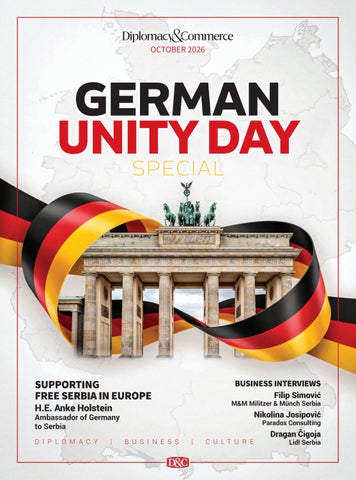
GERMAN UNITY DAY SPECIAL
SUPPORTING FREE SERBIA IN EUROPE
BUSINESS INTERVIEWS Filip Simović
M&M Militzer & Münch Serbia
H.E. Anke Holstein
Nikolina Josipović
Ambassador of Germany to Serbia D I P L O M A C Y
|
Paradox Consulting
B U S I N E S S
|
C U LT U R E
Dragan Čigoja Lidl Serbia
AMBASSADOR’S WORD
Supporting a Strong, Democratic and Free Serbia in Europe Germany remains committed to European Union enlargement and to supporting Serbia on its European path, the German Ambassador to Serbia said at the German Unity Day celebration in Belgrade.
H.E. ANKE HOLSTEIN Ambassador of Germany to Serbia
G
ermany’s reunification thirty-six years ago demonstrated that people can peacefully overcome high walls and deep divisions. Speaking at the German Unity Day celebration in Belgrade, the German Ambassador to Serbia highlighted this experience as an enduring foundation of Germany’s commitment to freedom, democracy and European cooperation. The Ambassador described reunification as a triumph of the
32
GERMANY TODAY IS A COUNTRY DEEPLY COMMITTED TO EUROPE — AND THAT COMMITMENT INCLUDES THE CONTINUED ENLARGEMENT OF THE EUROPEAN UNION desire for freedom among the people of the former German Democratic Republic. She also recalled the crucial support of international partners and friends, whose trust in Germany’s peaceful and democratic development at the heart of Europe helped make reunification possible.
“Germany today is a country deeply committed to Europe — and that commitment includes the continued enlargement of the European Union,” the Ambassador said. She identified peace and cohesion in Europe, alongside a commitment to multilateralism,
as Germany’s key priorities. These principles, she stressed, are particularly significant amid the populism, irrationality, self-interest and aggression increasingly encountered on the international stage. The celebration also provided an opportunity to reflect on seventy-five years since the establishment of diplomatic relations between the Federal Republic of Germany and the then Yugoslavia. Over the decades, the Ambassador noted, ties between Germany and Serbia have grown into a strong and diverse network of cooperation, with connections between their citizens playing a particularly important role. Close economic relations, cultural and academic exchanges, numerous projects across Serbia and sustained political dialogue demonstrate the breadth of this partnership. Further strengthening these ties, working alongside Serbian partners, remains an important task for the Embassy. “At the heart of our work is supporting Serbia on its path towards the European Union — towards a strong, democratic and free Serbia in Europe,” she emphasised. Turning to economic cooperation, the Ambassador thanked Henkel, Lidl, Mercedes-Benz, MTU, Siemens Energy, Siemens Mobility and Volkswagen for supporting the celebration. These companies, she noted, rank among Germany’s largest investors and employers in Serbia and exemplify the strength of bilateral economic relations. Thanking the Embassy team for organising the reception, the Ambassador concluded on a lighter note, inviting guests to continue the evening by watching the football match between the German and Serbian national teams in Munich.
www.diplomacyandcommerce.rs
EVENTS
German Unity Day Celebrated in Belgrade The Embassy of Germany in Serbia hosted a reception in Belgrade to mark the country’s national holiday, German Unity Day
T
he event was attended by Ana Brnabić, President of the National Assembly and Acting President of the Republic of Serbia, Tanjug reports. The reception, hosted by H.E. Anke Holstein, Ambassador of Germany to Serbia, was also attended by outgoing ministers Dragan Glamočić and Tatjana Macura, as well as Maja Gojković, President of the Provincial Government of Vojvodina. H.E. Anke Holstein noted that the Federal Republic of Germany and the Socialist Federal Republic of Yugoslavia established diplomatic relations 75 years ago. Although neither country exists today
in its former form, relations between Germany and Serbia have evolved over the years into an exceptionally diverse and strong network of ties. She also emphasised that the reunification of the Federal Republic of Germany and the German Democratic Republic 36 years ago demonstrated that people can overcome even high walls and deep divisions without violence when they are driven by a genuine desire for change. In addition to numerous members of the diplomatic corps in Belgrade, the reception was attended by Marko Čadež, President of the Serbian Chamber of Commerce, as well
as representatives of the German-Serbian Chamber of Commerce and German companies operating in Serbia. Guests also included officers from the Serbian, German and other armed forces, prominent figures from Serbian public life, and representatives of religious communities. As part of the celebrations, guests also watched the Germany–Serbia football match. German Unity Day is Germany’s national holiday, celebrated on 3 October to commemorate the country’s reunification in 1990, when the reunification process was formally completed. The day has been observed as a national holiday since that year.
33
CULTURAL INTERVIEW
by Lazar Jovanović
Learning to Be Silent in Many Languages The novel Grad Bola is being adapted into a television series, but behind this success lies a much bigger story of growing up, perseverance and the power of literature to transform a life METI KAMBERI Writer, Creator and Scriptwriter
At 25, you became the creator and screenwriter of a major television project, Grad Bola. What is it like to realise that a story you have carried within you for years is finally coming to life, with actors delivering your lines, a major production behind the cameras and Miloš Avramović working alongside you? Do you feel pride, disbelief or a sense of responsibility? I don’t feel any superficial pride, but rather a sense of responsibility. Perhaps gratitude is the strongest feeling of all. When, at the age of 25, you find yourself discussing characters and building a world with some of the biggest names in our film industry, a world you have carried in your head for years, it is difficult to explain the feeling entirely rationally.
34
THIS IS NO LONGER JUST MY STORY. IT NOW BELONGS TO THE PEOPLE WHO BELIEVED IN IT, TOO I carried Grad Bola within me for years, thinking about its characters, their lives, relationships and destinies. There is an enormous difference between imagining something in your room and arriving on set one day to hear an actor speak the lines you wrote. It is an extraordinary feeling. You look around and realise: “This is no longer just my story. It now belongs to the people who believed in it, too.” What makes this experience particularly important to me is the opportunity to work with Miloš Avramović. He has a particular kind of energy and authority when it comes to the language of film and television. He knows how to recognise what a story can become once it enters production. For me, it means a great deal that someone with his experience and reputation said, “Let’s make this happen.” Avramović has come
a long way and left his mark on Serbian cinema. That makes his faith in Grad Bola all the more meaningful to me. Grad Bola is not just another project you have written. You are its creator, the person who first imagined its world, its characters, their destinies and conflicts. How much of that world comes from your own experiences, emotions and the way you see people? When audiences meet Amiraga and the other characters, how much of you will they discover in them? A great deal, but not literally. Grad Bola is not my autobiography. I am not Amiraga; his choices are not mine, and the events in his life are not taken directly from my own. But the way he feels, the way the characters love, remain silent, suffer, struggle and try to find their place in the world, there
is certainly a great deal of me in all of that. Every writer, consciously or otherwise, leaves something of themselves in their characters. Sometimes they give them their fears, sometimes their dreams, sometimes something they wanted to say but could never find the words for. Sometimes they draw on people they have met, and sometimes simply on a feeling from a particular moment in their lives. In my case, this may be more pronounced because Grad Bola did not emerge from an abstract idea. It grew out of my relationship with the people and the world I had come to know. I learnt to observe people at an early age. When you don’t always have the security you should, you begin to notice things others might overlook. You watch how people behave when they have no money, when they are hurt, when they are in love, when they are jealous, when they lie, when they are simply trying to survive. You begin to understand that a person can rarely be explained in a single sentence. That is why there are very few characters in
www.diplomacyandcommerce.rs
Photo: Dario Konstantinović
S
ome stories are too powerful to remain confined between the covers of a book. Meti Kamberi has built his literary world around human vulnerability, the struggle for survival and the search for meaning. Now, as Grad Bola (City of Pain) makes its way to television screens, we speak to the author about the experiences that shaped his stories, his development as a writer and what it means to watch a deeply personal work take on a life of its own.
CULTURAL INTERVIEW
Grad Bola about whom I could say, “This person is good, and that person is bad.” How did you manage to preserve your creative vision while working with far more experienced professionals, and what did you learn from them? One of the most important things I learnt on this project is that having a creative vision does not mean you have to be the loudest person in the room. It means believing in yourself enough to listen to someone who knows more than you do. At a very young age, I found myself working with people who had years of experience and knowledge that cannot be acquired overnight. I felt no need to pretend I knew everything. I knew what Grad Bola was, why it had been written, who these characters were and what kind of world I wanted to create. But I also knew that it would have been completely wrong to close myself off to people with so much experience. When you believe in your story, someone else’s suggestion does not have to threaten your vision. Sometimes it helps you see that vision more clearly. What mattered most to me was preserving Grad Bola’s authentic heart. A special place in this journey belongs to Sava Pavlović, whom I met two years into the project. Today, Sava is the executive producer of Grad Bola and one of the people who helped bring it to life. What meant the most to me was his ability to recognise my vision, believe in the story I wanted to tell, and support me when it mattered most. When you carry a story within you for years, finding someone who sees not only what it is, but what it could become, makes all the difference. I am deeply grateful to Sava for his trust, dedication, and invaluable contribution. Projects like this are never the work of one person, but of people united by a shared vision and the determination to make it a reality. Many people have an idea for a television series; some even write a script, but few ever see it go into production. You achieved this at a remarkably young age. Looking back on the journey from the first idea for Grad Bola to the first day of filming, what was the greatest
PEOPLE ARE HAUNTED FAR MORE BY THE THINGS THEY GAVE UP ON THAN BY THE THINGS THEY FAILED AT obstacle you faced, and what kept you going? Did you ever feel you had to prove, both to others and yourself, that you were more than just a young man with an idea, but a writer capable of bringing a major project to life? The hardest part was when nobody else could see what I could see. When you have an idea, you live with it every day. But then you step outside your room and realise that, for everyone else, it is not yet real. It is just a piece of writing, an idea, a few pages of paper. I think that was my greatest test. Grad Bola did not happen overnight. There were moments when I questioned many things and doubted myself. Sometimes I could have said, “Well, you tried. It didn’t work. Move on.” But I couldn’t, because I knew I would spend the rest of my life wondering what might have happened if I had tried just one more time. I think people are haunted far more by what they gave up than by what they failed at. That is why I kept going. I indeed had to prove myself to others, but even more so to myself. When you are young, people can easily mistake your ambition for youthful enthusiasm. And I understand that.
I don’t expect anyone to believe in me simply because I ask them to. I had to show what I was capable of. That is why the first day of filming meant so much more to me than the beginning of production. It marked the end of one chapter of my life. Looking back today, I don’t think my greatest achievement was being allowed to create a major television project at 25. The greatest achievement was refusing to let my circumstances convince me to dream smaller. So I am grateful to the entire team and everyone who worked on this project. And I believe this is only the beginning. It is interesting that Grad Bola emerged from a period in your life when reading and writing weren’t yet accessible to you, and that the written word eventually became the very medium through which you told your story. Do you think books changed your life, or did your desire for change lead you to books? The truth is probably somewhere in between. I don’t think one could have happened without the other. Perhaps it is precisely because reading and writing were once beyond my reach that I have such
a profound relationship with the written word today. For me, a book was never just an object. It was proof that another world existed, another kind of life, and that it was possible to travel somewhere in your mind that you could never reach physically. When I began reading, I didn’t immediately understand just how much it would change my life. Books gave me words for things I had felt but could never express. They allowed me to look at my own life from a distance, to understand people, their weaknesses, their mistakes, love, anger, poverty, loneliness and loss… And then I wanted to tell stories of my own. That is why Grad Bola means so much more to me than a television series or a book. It grew out of a need to tell the stories of people we perhaps don’t notice enough, their lives, choices, wounds and need to be loved and accepted. And I believe that a part of me can be felt in those stories, even when they are not directly autobiographical. How does it feel to know that your novel has been translated into German (Stadt der Schmerzen, Anthea Verlag, Berlin, 2026)? What do you think makes a novel resonate with international readers who may be unfamiliar with the realities of our region, and where does the strength of your own novel lie in this respect? It is a very meaningful and rewarding experience to see the novel translated and sold in another language. When I was writing it, I wasn’t thinking about how it would be received by readers from outside our region. That is why I now find it fascinating to see how people who may know nothing about its social and economic context respond to the story. I don’t think a novel has to explain every circumstance from which it emerges. If a story is honest, and if its characters are universal, readers can understand the emotion even when they are unfamiliar with the setting. That is where I see my novel’s greatest strength. It is rooted in our region, our mentality and our reality, but it does not depend on them alone. A novel built around universal stories and emotions can transcend the boundaries of language and geography.
35
PHILOSOPHY
by Nikola Perišić
Jürgen Habermas — The Last Great Contemporary Thinker
G
erman culture ranks among the richest and most influential in Europe and the world. Over the centuries, the territory of present-day Germany has been the birthplace of philosophical, scientific, artistic and literary ideas that have profoundly shaped the modern world. These ideas remain central to academic debate and to our understanding of contemporary social processes. Germany’s contribution to world literature and the arts has been equally significant, with its writers and poets becoming a staple of school curricula across the globe. Choosing a single individual or idea to explore within such a rich landscape of culture and intellectual thought is therefore exceptionally difficult. German philosophical and social thought offers an almost limitless range of subjects for research and analysis. This article, however, focuses on Jürgen Habermas, one of the most significant contemporary philosophers and social theorists, both in Germany and internationally. His contribution to our understanding of the public sphere, communicative action, democracy and modern society made him a central figure in twentieth- and twenty-firstcentury social thought. His death a few months ago, at the age of 96, provides a particular occasion to revisit his ideas, marking the close of a significant chapter in European philosophy and social theory. Although his most influential work emerged in a different era, the subjects he explored seem more relevant than ever. The public sphere and the communication within it, which he valued so highly, are taking on new forms through social media
36
and the expanding digital world. Audiences are simultaneously recipients and creators of content. Democracy was another enduring concern of his work, and he showed remarkable foresight in anticipating some of the challenges facing contemporary democratic processes. We live in an age in which it is becoming easier to speak and harder to listen. Habermas’s work reminds us that democracy begins with a willingness to hear and respect other people’s views, and to revise our own.
DEMOCRACY BEGINS WITH A WILLINGNESS TO HEAR AND RESPECT OTHER PEOPLE’S VIEWS, AND TO REVISE OUR OWN This approach helped establish Habermas as one of the Frankfurt School’s most significant figures, the intellectual tradition associated with the Institute for Social Research in Frankfurt. Its members developed a critical understanding of modern society, particularly the various forms of political, economic and cultural domination. Although Habermas belonged to a later generation than the school’s early representatives, such as Theodor Adorno and Max Horkheimer, he is widely regarded as the defining figure of its second generation. He continued the tradition of critical theory while substantially developing and reshaping it. Unlike some of his predecessors, whose
assessment of the possibilities of rationality in modern society was considerably more pessimistic, Habermas believed that communication and rational public debate could provide a foundation for resolving social conflicts democratically. The idea of European unification also occupied a prominent place in his political thought. He believed European states needed stronger international cooperation and political integration, particularly in light of the twentieth century’s experiences of war, totalitarianism, and nationalism. Such a Europe, in his view, could safeguard against the resurgence of exclusionary nationalism while providing a space where democratic decisions rest on broad public debate and citizen participation. Habermas’s direct encounter with the Balkans dates back to 1963, when the German philosopher and sociologist first attended the Korčula Summer School. During the 1960s and 1970s, the school was one of the most important meeting places for philosophers, sociologists and other intellectuals from around the world. It brought together leading thinkers of the period and provided a forum for open discus-
HIS FAITH IN THE POSSIBILITY OF DIALOGUE MAY BE MORE SIGNIFICANT THAN EVER sion about contemporary society. In the decades that followed, Habermas’s relationship with the Balkans became more
closely intertwined, particularly through the wars that marked the region’s final decade of the twentieth century. His theoretical concepts offered a framework for understanding much of what was unfolding. Divided societies, powerful national identities, unresolved political disputes and limited trust in institutions — all subjects addressed in his work — were among the principal factors behind the outbreak of civil war in Yugoslavia. The idea of “constitutional patriotism”, central to Habermas’s thought and grounded in a commitment to shared democratic values and constitutional principles, offers a response to the divisions that persist across the Balkans. During the last armed conflict on the territory of the then Federal Republic of Yugoslavia, the NATO bombing campaign of 1999, Habermas addressed the legal and moral questions surrounding the intervention in interviews and contributions to the German media. He sought to examine its causes, circumstances and consequences from different perspectives. Habermas developed a particular connection with the region through his intellectual relationship with former Serbian Prime Minister Zoran Đinđić. Their friendship began during Đinđić’s academic studies in Germany and grew out of shared intellectual and philosophical interests, particularly the German philosophical tradition and critical social theory. Habermas’s ideas about communicative action, the public sphere, democratic legitimacy and rational political dialogue formed part of the broader intellectual environment in which Đinđić developed his political and philosophical views. For
www.diplomacyandcommerce.rs
Photo: Shutterstock
At a time when speaking is becoming easier and listening increasingly difficult, Habermas’s faith in dialogue remains essential to understanding democracy, Europe and the divisions within contemporary society
PHILOSOPHY
NOVEMBER 23, 2007 - BERLIN: German philosopher Jürgen Habermas speaking at a podium about Philosophy and Politics” in the Willy Brandt House in Berlin.
Habermas, Đinđić was someone he could discuss the challenges of social transformation after the fall of communism, the future of democracy, and Serbia’s place in Europe with. Đinđić’s knowledge of German philosophy and his connections with German academic life, in turn, enabled him to consider Serbia’s political and social problems within a broader European context. Habermas is also said to have played an important role in moderating Đinđić’s initially radical approach to the left-wing ideas he brought with him to Germany. Beyond their direct intellectual exchanges, Habermas’s influence on Đinđić’s subsequent intellectual and political work can be traced through the ideas and concepts on which Đinđić drew, either explicitly or implicitly. Particularly significant is Đinđić’s book Yugoslavia as an
Unfinished State, which examines the problems of the Yugoslav state, its political organisation and the relationships between its various national and political communities within the wider context of European political and philosophical thought. The work bears traces of Habermas’s reflections on the relationship between the state, political community, democracy and national identity. An estimated nine of Habermas’s books have been translated into Serbian, forming an important foundation for the study of communication in Serbia. Among the most significant is The Theory of Communicative Action, published in Serbian by Akademska knjiga. In this work, Habermas develops a theory based on the distinction between communicative and instrumental action. Communicative action is directed towards achieving mutual
understanding among those taking part, rather than solely towards accomplishing a predetermined objective. He therefore understands communication as a broader social process through which identities, attitudes, values and political legitimacy are formed. His concepts of communicative action and the public sphere also provide a basis for critically examining the media’s role in contemporary democratic societies. At the same time, they raise the question of what conditions are necessary for public communication to contribute meaningfully to democratic decision-making. Seen against the background of his life and work, Habermas’s death in March 2026 may also represent the symbolic end of a major era in European intellectual history. With the passing of a man who participated in Europe’s
most important philosophical, political and social debates for more than seven decades, the continent lost one of its last great thinkers who believed that social conflicts could be resolved through conversation, argument and rational debate. At a time of political polarisation, spreading disinformation and a growing tendency for people to retreat into ideological and information bubbles, his faith in the possibility of dialogue may be more significant than ever. The years ahead pose a fundamental question: is reasoned, rational dialogue between people who disagree still possible? Perhaps the answer should be sought not in Habermas’s books, but in contemporary society’s willingness to continue the conversation he began — the conversation he championed as one of humanity’s most important characteristics.
37
BUSINESS INTERVIEW
Reliable Logistics for Higher Value Investment FILIP SIMOVIĆ CEO, M&M Militzer & Münch Serbia President, German-Serbian Chamber of Commerce
F
ilip Simović, CEO of M&M Militzer & Münch Serbia and President of the German-Serbian Chamber of Commerce, discusses Serbia’s logistics potential, German investment and the role of technology and sustainability in building resilient regional supply chains.
38
Since its establishment, M&M Militzer & Münch Serbia has evolved alongside domestic and international markets. What have been its key milestones and what are its main competitive advantages today? When we established M&M Militzer & Münch Serbia in 2019, our vision was to build an integrated logistics partner capable of managing complex corporate supply chains from end to end. After seven years of continuous
RELIABLE LOGISTICS CAN HELP ATTRACT FURTHER GERMAN INVESTMENT IN HIGHER VALUE-ADDED ACTIVITIES
growth, we have evolved from a traditional freight forwarder into a provider of comprehensive logistics solutions. Our main advantages are infrastructure and flexibility. We now operate 36,000 m² of modern warehouse space, with cross-docking facilities and automated sorting technology. We have also established operations in Montenegro, Bosnia and Herzegovina, and North Macedonia. Combining the Militzer & Münch Group’s global
www.diplomacyandcommerce.rs
Photo: Stefan Simonović
Serbia can strengthen its place in European supply chains through integrated logistics, digitalisation and closer ties with German industry
BUSINESS INTERVIEW
network with local expertise and long-term client partnerships gives international companies the reliability and predictability they need. Serbia’s location offers the potential to connect the EU, the Western Balkans and markets beyond Europe. How effectively is it using this advantage, and what improvements are still needed in infrastructure, customs and the business environment? Location becomes a competitive advantage only when supported by efficient infrastructure and responsive institutions. Serbia has made substantial progress in developing its road and railway networks over the past decade, strengthening its role as a link between the EU, Western Balkan markets and wider global trade routes. International investors recognise this potential. To become a leading regional distribution hub, however, Serbia must address persistent operational bottlenecks. From my perspective as President of AHK Serbia, our annual member surveys show that business predictability is crucial to retaining investment. Border delays, inefficient customs procedures and manual administration remain major challenges. For companies operating just-in-time supply chains, these delays are costly. Priorities should include digitalising customs, investing further in intermodal terminals and aligning regulations with EU standards to make cross-border operations more efficient.
scale, logistics reliability directly influences investment decisions. Ensuring that high-tech components move reliably from a Serbian factory to a German automotive assembly line strengthens Serbia’s integration into European value chains. Reliable logistics can therefore help attract further German investment in higher value-added activities.
How do you assess GermanSerbian economic cooperation from a logistics perspective, and how can efficient logistics attract further German investment and strengthen Serbia’s integration into European supply chains? Germany is a central partner in Serbia’s industrial development. Bilateral trade exceeds €10 billion, while companies with German capital employ more than 80,000 people locally and make a major contribution to manufacturing and exports. The relationship is also changing: German companies increasingly invest in Serbia for its engineering and technological capabilities, alongside cost efficiency. M&M Serbia provides logistics services to major international and German manufacturers, including ZF, Boysen and VosslohSchwabe. For companies of this
Modern logistics includes warehousing, distribution, customs services, e-commerce and fulfilment. How is M&M Serbia expanding its integrated services, and which segments offer the greatest growth potential? Transport is one part of an increasingly integrated service. Our model combines road, air and sea freight with customs brokerage and warehousing. We have also invested in a nationwide distribution network capable of delivering across Serbia within 24 hours. We see the strongest growth potential in e-commerce, fulfilment and specialised contract logistics, both in Serbia and across the region. Our automated sorting system can process up to 2,000 parcels an hour, supporting high-volume B2C and B2B fulfilment. As international retailers
TECHNOLOGY AND HUMAN EXPERTISE MUST WORK TOGETHER
and digital platforms expand in Southeast Europe, demand for integrated distribution that can scale with their operations will remain a major driver of growth. How prepared is Serbia’s logistics sector for digitalisation, automation and artificial intelligence? Which innovations are you implementing, and can technology help close the gap with more developed European markets? Serbia’s logistics sector is at an important stage in its digital development. Basic digital tools are becoming more widespread, but the transition to advanced automation and integrated data needs to accelerate. Technology gives an agile market such as Serbia the opportunity to adopt modern solutions without following every stage of development that established markets went through. At M&M Serbia, digital transformation is part of our investment strategy. Alongside automated sorting, we are focusing on realtime visibility, automated data exchange and predictive inventory systems. AI is becoming a practical tool for route optimisation, demand forecasting and warehouse space management. Yet technology and human expertise must work together. Automation is most effective when guided by skilled logistics professionals who understand the complexities of cross-border operations. How is M&M responding to geopolitical tensions and disrupted transport routes?
Could nearshoring create new opportunities for Serbia, and how important is reducing environmental impact to international clients? Global supply chains now face persistent geopolitical uncertainty. Companies are increasingly supplementing just-in-time models with just-in-case strategies, building resilience and moving some operations closer to their markets. Nearshoring creates a major opportunity for Serbia as companies seek manufacturing and logistics locations close to the EU to diversify risk and shorten supply lines. Through the Militzer & Münch Group’s international network, we can deploy alternative routes and multimodal transport solutions when established corridors are disrupted. Sustainability has also become a commercial requirement. Major international clients expect logistics partners to reduce environmental impact in line with their ESG requirements. We are investing in solar energy at our logistics terminals and developing transport solutions using liquefied natural gas (LNG). Green logistics is an integral part of operational excellence. Looking ahead five years, how do you see Serbia’s role in European supply chains evolving, particularly in relation to Germany? What are M&M Serbia’s strategic priorities and investment plans? I see Serbia strengthening its position as a technology and multimodal logistics hub within European supply chains, particularly as a nearshoring partner for German industry. At AHK Serbia, we are working to help local supplier networks respond to these changing requirements. Serbia has the potential to develop further as a centre for regional decision-making and distribution in Southeast Europe. For M&M Serbia, the priorities are further investment in automation, terminal digitalisation and efficiency across the supply chain. We will continue expanding and integrating our logistics, fulfilment and e-commerce infrastructure through our regional network in Bosnia and Herzegovina, Montenegro, and North Macedonia. Deepening partnerships with international manufacturers and retailers will support our ambition to become the leading integrated logistics partner in Southeast Europe.
39
CORPORATE INTERVIEW
Strong Growth and Market Leadership Defined Our Year Lidl’s development in Serbia combines affordable quality, support for local suppliers and continued investment in efficient and sustainable retail DRAGAN ČIGOJA General Manager, Lidl Serbia
D
Eight years after entering the Serbian market, Lidl took the lead in market share in 2026. What were the decisive factors behind this success, and how has competition in Serbia’s retail sector changed over that period? Taking the lead in market share this year is the culmination of eight years of dedicated work, strategic planning and consistency. When we entered the market in 2018, we introduced a distinctive business model based on process optimisation, highly efficient logistics and simplicity. Still, I would say that the decisive factor in our success has been the trust we have built with consumers by consistently offering reliable quality at the most affordable prices, every day. Consumers in Serbia quickly recognised the value of our private labels, our transparent pricing policy, and a distinctive shopping experience that saves both time and money. I can now confidently say that Lidl’s arrival and growth over the past few years have transformed Serbia’s entire retail sector. The market had to respond quickly, prompting a broader wave of modernisation, improved product ranges, and better service across the retail industry. We are proud to have helped drive positive changes that ultimately benefit people throughout Serbia. Inflation and the rising cost of living have significantly changed people’s shopping habits. How would you assess purchasing power and consumer behaviour in Serbia today, and
40
THE DECISIVE FACTOR IN OUR SUCCESS HAS BEEN THE TRUST WE HAVE BUILT WITH CONSUMERS how challenging is it to balance price, quality and long-term profitability? Macroeconomic challenges and global inflationary pressures have put household budgets under considerable strain in recent years. Consumers now shop much more thoughtfully and plan their purchases more precisely, carefully comparing prices and seeking the best possible value for their money. In this environment, our distinctive business model has demonstrated its full strength and resilience. Maintaining this balance is challenging, but achievable. Through long-term supplier contracts, large purchasing volumes,
energy-efficient facilities and optimised logistics, we generate savings that we pass directly on to consumers through our prices. Our goal is always to be the first choice for affordable, quality shopping, while sustainable profitability also follows naturally from high efficiency and what we simply call economies of scale. Exports by Serbian suppliers through Lidl’s international network reached €22 million in 2025. What are the biggest obstacles domestic producers face when entering the European market, and how does Lidl help them overcome these challenges?
Reaching €22 million in exports through our network in 2025 alone is an exceptional achievement that directly demonstrates the potential of Serbia’s food industry. Nevertheless, for many domestic producers, the path to European shelves initially seems extremely demanding. The biggest obstacles can include rigorous international food safety and quality standards, the need to supply large volumes, and complex logistics and customs procedures. Exporters must also comply with all applicable European regulations. However, once a local producer becomes our supplier, all of this becomes easier, precisely because our company already requires high European standards of control, quality and overall business practice in Serbia. Lidl therefore acts as a reliable partner and a bridge to Europe. We do more than provide an opportunity to sell products: we actively guide our suppliers through the preparation process. Our teams
www.diplomacyandcommerce.rs
Photo: LIDL Srbija
ragan Čigoja, General Manager of Lidl Serbia, discusses the consumer trust behind the company’s growth, the role of local suppliers, and how German investment, digitalisation and sustainability are shaping its plans for the Serbian market.
CORPORATE INTERVIEW
offer expert support in implementing the highest production standards and adapting labelling and packaging. Once a Serbian producer has demonstrated its quality, opportunities open up to supply more than 30 countries in which our group operates. Purchases from domestic suppliers have risen by 16 per cent, and your range includes more than 700 domestic products. How does working with Lidl contribute to modernising Serbia’s food industry, improving production standards and ensuring the long-term stability of local supply chains? Local suppliers are the foundation of our business. This is reflected in the significant increase in purchases and sales of local suppliers’ products, as well as the presence of more than 700 domestic products on our shelves, including the dedicated “S ljubavlju domaće” range. Our cooperation with local producers goes beyond a conventional trading relationship: it is a sincere, long-term partnership based on mutual trust and stability. By committing to strict food safety, quality and sustainable packaging standards, many of our partners have modernised their production facilities and improved internal processes. An excellent example of innovative cooperation is the domestic company, Zeleni Hit. By applying state-ofthe-art production standards for Lidl, it has supplied more than 250 tonnes of fruit and vegetables with no measurable pesticide residues, almost three times the
volume recorded at the start of our cooperation in 2022. We offer clear, transparent and reliable payment terms and stable purchasing volumes. This longterm predictability enables suppliers to plan investments, expand capacity and hire new employees, directly strengthening the stability of the entire domestic food supply chain. Lidl is part of Germany’s Schwarz Group, one of Europe’s largest retail groups. How would you assess the importance of German investment in modernising Serbia’s retail sector, and what role does Lidl play in strengthening economic ties between Serbia and Germany? German investment has played a transformative role in modernising the Serbian economy as a whole, and in retail, Lidl is the most visible example of this positive change. As part of the Schwarz Group, we have brought Serbia not only capital, but also valuable expertise, state-of-the-art retail technologies and European standards of corporate governance and labour rights. Today, Lidl is a stable pillar and a reliable link connecting the economies of Serbia and Germany. On the one hand,
German standards of work organisation, sustainable business practices and operational efficiency have become a benchmark in the domestic market. On the other hand, we have enabled topquality Serbian products to reach other European countries, thereby strengthening Serbia’s trade balance. Through our presence, we seek to demonstrate Serbia’s potential for long-term business operations, sending a constructive signal to other prospective investors from Germany. Modern retail increasingly depends on digitalisation, efficient logistics and sustainable business practices. What innovations is Lidl introducing to improve its operations and reduce its environmental impact, and how important are these changes to the company’s future competitiveness? In digitalisation, our Lidl Plus loyalty programme has changed the way we communicate with consumers, enabling us to provide personalised offers and additional savings. At the beginning of the year, we also introduced digital receipts and electronic shelf labels in our stores. These are just a few examples of how we think and act across our business, putting natural resources and responsibility throughout the supply chain first.
LONG-TERM PREDICTABILITY ENABLES SUPPLIERS TO PLAN INVESTMENTS, EXPAND CAPACITY AND HIRE NEW EMPLOYEES
When it comes to sustainability, our stores and logistics centres are built to the highest environmental standards, as confirmed by EDGE and LEED certification. We use energy-efficient refrigeration systems and LED lighting, and are investing increasingly in solar panels at our stores. A solar power plant on the roof of our logistics centre in Lapovo also began operating a few years ago. Lidl Serbia is actively working to reduce plastic use, increase packaging recyclability and optimise transport routes to cut CO2 emissions. We also run numerous projects involving the local community. Lidl has built substantial business infrastructure in Serbia. What are your plans for further development, and how do you see the Serbian retail market evolving over the next five years? Our entry into Serbia was planned for the long term from day one. With 87 stores in 50 cities and two modern logistics centres in Pazova and Lapovo, we have built strong infrastructure, and we continue to develop. We are expanding our store network to bring our distinctive concept to consumers in parts of the country where we do not yet operate. One significant market and consumer need we recognise, and which is also part of our business strategy, is to promote and expand our range of products that support conscious eating. This is more than a trend increasingly embraced by younger generations: it is also a major responsibility towards both people and natural resources. At the same time, we continue to expand our range and deepen cooperation with domestic producers. This autumn, we have focused on introducing new premium products. Our stores have recently started offering premium-quality steaks from local Serbian suppliers, something we are particularly proud of. As for the future of the Serbian market, I expect modern retail chains to continue gaining market share, alongside further strengthening of private labels. Serbia’s market is becoming increasingly mature and demanding. With our infrastructure, a team of more than 3,100 employees and a clear vision, Lidl is fully prepared to keep driving positive trends and remain consumers’ first choice.
41
BUSINESS INTERVIEW
Building Trust Through Everyday Commitments Long-term partnerships, multilingual expertise and investment in people underpin Paradox Consulting’s growth in international markets NIKOLINA JOSIPOVIĆ Owner and Director, Paradox Consulting
F
rom a team of eight seeking a fresh start in 2014, Paradox Consulting has grown into a provider of multilingual customer support and business services across several markets. Owner and Director Nikolina Josipović discusses the company’s development, cooperation with German clients, recruitment challenges and plans for regional expansion.
42
How was Paradox Consulting established, what was the original business idea, and how has the company developed? What is its greatest competitive advantage today? Paradox Consulting grew out of a very specific personal and professional situation. When the German company I worked for went bankrupt, I wanted to find a way to preserve our jobs and continue doing work we already knew well. In November 2014, eight of us decided to start again together.
TRUST GROWS FROM THE SMALL PROMISES WE FULFIL EVERY DAY Our idea was to provide highquality customer support and professional services in foreign languages, combining commitment and flexibility with an understanding of clients’ needs. From
German companies play an important role in your business. How have you built trust in such a demanding market, and what do German partners expect most from Serbian companies? Building a reputation and earning respect in the German market is a demanding, long-term process that continues today. We have built trust through consistency, professionalism and results. Quality alone is not enough: you must demonstrate that you are reliable over the long term, honour agreements, meet deadlines and standards, and respond promptly to challenges. German partners particularly value quality, precision, transparent communication and accountability. They need to know they can rely on you when difficulties arise as well as when everything goes to plan. Difficult situations often provide the clearest test of trust. Serbian companies can offer expertise, flexibility and commitment, combining professionalism
www.diplomacyandcommerce.rs
Photo: Paradox Consulting
the outset, we wanted to be more than a conventional call centre: a partner that understands its clients’ businesses and helps them improve customer relationships. We developed gradually through new projects, long-term partnerships and expansion into different markets. From a small team, we built an organisation offering multilingual customer and technical support, sales services and market research. German-speaking clients remain particularly important, alongside our work in other languages and markets. Our growth reflects sustained investment in people, service quality and client relationships, supported by better processes and opportunities for employees to develop. Our greatest advantage is the combination of people, flexibility and genuine commitment. Technology and processes matter, but employees who understand customers and adapt to different markets make the difference. We see customer support as an opportunity to improve business performance and loyalty, rather than simply a cost. Looking back at our journey, our strength has been turning challenges into opportunities through teamwork, mutual trust and a willingness to keep developing.
BUSINESS INTERVIEW
competitiveness rests on service quality and mutual trust.
with a personal approach. I believe trust grows from the small promises we fulfil every day. When words are backed by action, a business relationship becomes a lasting partnership. The fact that we have worked with the same client for 11 years says a great deal about our approach. How do you find new business partners, and how important are referrals, reputation and longterm relationships to success internationally? We combine direct contact, networking and participation in international conferences and business events with cooperation with companies and professionals already active in our target markets. Understanding potential clients’ needs is essential: we need to offer practical solutions with measurable value, because expertise and results are the basis of trust. Referrals, reputation and longterm relationships nevertheless play a decisive role internationally. A satisfied client recommending us to a business partner is the strongest endorsement of our work. Reputation opens doors, while lasting relationships deepen our understanding of a partner’s business culture and requirements. Our aim is to build partnerships that develop beyond a single successful project. That means honouring agreements and continuing to support clients after a project ends. Over time, satisfied clients who already trust us become our best source of new business. How do you recruit suitable staff amid the shortage of skilled workers, and how have employers’ and employees’ expectations changed in recent years? The shortage of qualified staff has affected our sector too. We have responded in several ways. Our team includes many people returning from abroad, increasingly from German-speaking countries. Offering remote work also allows us to recruit beyond Novi Sad and the surrounding area. Finding motivated people willing to commit fully to their responsibilities is becoming harder. In my view, discussions about work increasingly focus on rights, with less attention paid to
SUCCESSFUL RECRUITMENT REQUIRES BUILDING A LASTING RELATIONSHIP BETWEEN THE EMPLOYEE AND THE COMPANY obligations. Successful recruitment therefore means more than finding someone who matches a job description: it requires building a lasting relationship between the employee and the company. Employers must also make a real effort. Good working conditions, competitive pay, bonuses and opportunities for advancement are important, alongside benefits, flexibility and professional development. Working relationships, management style and work–life balance matter too. I believe companies that provide these conditions are well placed to attract good people even in a challenging labour market. How can a company maintain its market position without compromising service quality? Is winning a new client harder than retaining an existing one? Maintaining a strong position requires continuous investment in
service quality, employees’ expertise and client satisfaction. A competitive price alone is not enough. Over time, clients value reliability, professionalism, responsiveness and the sense that their partner understands their needs. We need to follow market changes, listen to feedback and improve how we work. The challenge is to become more efficient and innovative while preserving the standards clients associate with us. Winning a new client is often harder because you must build trust, prove your quality and stand out from competitors. Retaining an existing client, however, takes sustained effort and consistency: their trust must be earned repeatedly. A satisfied client may also recommend you to others. Companies should therefore invest in both attracting new business and nurturing existing relationships. Lasting
How much of an obstacle are international payments, collecting receivables and differing business rules for Serbian companies seeking to operate in European markets? Working internationally always carries some risk, particularly when it comes to securing payment for services. Support from banks, digital platforms for checking clients’ creditworthiness, and accounting and legal advisers can help reduce risks and costs, as can automating financial processes. The key is to plan international operations in advance, assess risks before signing contracts and establish reliable systems for managing payments and receivables. Often, the greatest challenge is understanding different rules early enough and adapting the business accordingly. Companies that do this successfully can turn administrative and financial obstacles into a competitive advantage in the European market. What future do you envisage for Paradox Consulting? Are you planning new markets, additional services or stronger partnerships, and what will be your main priority in the coming years? We see our future in further business development, better service quality and long-term partnerships. We want to keep responding to market changes, identify new opportunities and provide solutions that meet clients’ needs and support their growth. Our focus will be on strengthening existing partnerships, developing additional services and expanding into regional markets, including Bosnia and Herzegovina. We will also invest in expertise, more efficient processes and modern solutions that help us become an even more reliable partner. Our main priority is sustainable growth while preserving service quality and the trust of clients and partners. Long-term success depends on our ability to keep creating value, adapt to change and build stable relationships. Expertise and partnership will remain central to our development.
43
DIGITAL 2026
by Bojana Bačić
Television Still Reigns Supreme, but Viewers Have the Final Say on What They Watch Organised by Color Media Events, the regional conference on trends in telecommunications and media, “DIGITAL 2026,” took place on 24 September 2026 at the Chamber of Commerce and Industry of Serbia.
S
ince 2014, the conference has brought together market leaders, experts from the telecommunications and media sectors, and key stakeholders from industries driving Serbia’s economy. This year’s programme focused on current and emerging trends in the media, telecommunications, and digital environment; the development and application of artificial intelligence; changes in the television market; and new formats and content shaping the media industry. This year’s programme focused on current and emerging trends in the media, telecommunications, and digital environment; the development and application of artificial intelligence; changes in the television market; and new formats and content shaping the media industry. The conference was opened by Robert Čoban, President of the Color Press Group, who noted that the Digital conference is being held for the 13th time and pointed
44
out how much the telecommunications sector has changed since its first edition in 2014. “During that time, there has hardly been an industry that has changed as much as the communications and media industry. At the Digital conference, we strive to follow these changes from year to
TELEVISION IS NOT GOING TO DISAPPEAR. IT IS STILL THE LEADING MEDIUM
year. In just one year, many things have changed in our market, from ownership structures in the media to major technological developments,” Čoban said. Predrag Nikolić, Director of the Centre for Digital Transformation at the Chamber of Commerce and Industry of Serbia, said at the opening of the conference that simply saying that “the world is changing” would tell us nothing new, and that what matters far more is what we do with those changes. According to Nikolić, artificial intelligence can increase productivity, but it can also lead to incorrect conclusions or decisions that merely appear smarter because new technology is being used. The Ambassador of Canada to Serbia, H.E. Michelle Cameron, also addressed the conference. She noted that over the years, the media industry has focused on building faster networks, better technologies, and more sophisticated platforms, while today the focus is increasingly shifting toward artificial intelligence. Borka Jeremić, Head of the United Nations Population Fund (UNFPA) Office in Serbia, noted that digital technologies are becoming increasingly important in the field of human rights and can significantly improve their implementation. At the same time, however, they also bring numerous risks, including cybersecurity threats and hate speech on social media.
FIRST PANEL “DAY AFTER TOMORROW”
The conference opened with the now-traditional panel of regional telecommunications leaders, “Day After Tomorrow,” which explored the future of telecommunications in an increasingly complex environment, covering topics such as the development of 5G networks, future investment
www.diplomacyandcommerce.rs