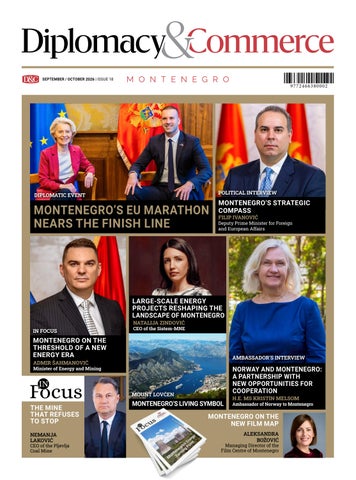
SEPTEMBER / OCTOBER 2026 | ISSUE 18
M O N T E N E G R O
9772466380002
DIPLOMATIC EVENT
POLITICAL INTERVIEW
MONTENEGRO’S EU MARATHON NEARS THE FINISH LINE
FILIP IVANOVIĆ
MONTENEGRO’S STRATEGIC COMPASS
Deputy Prime Minister for Foreign and European Affairs
LARGE-SCALE ENERGY PROJECTS RESHAPING THE LANDSCAPE OF MONTENEGRO NATALIJA ZINDOVIĆ
IN FOCUS
CEO of the Sistem-MNE
MONTENEGRO ON THE THRESHOLD OF A NEW ENERGY ERA
AMBASSADOR'S INTERVIEW
ADMIR ŠAHMANOVIĆ
NORWAY AND MONTENEGRO: A PARTNERSHIP WITH NEW OPPORTUNITIES FOR COOPERATION
Minister of Energy and Mining
MOUNT LOVĆEN
THE MINE THAT REFUSES TO STOP NEMANJA LAKOVIĆ
CEO of the Pljevlja Coal Mine
MONTENEGRO’S LIVING SYMBOL
H.E. MS KRISTIN MELSOM
Ambassador of Norway to Montenegro
MONTENEGRO ON THE NEW FILM MAP ALEKSANDRA BOŽOVIĆ
Managing Director of the Film Centre of Montenegro
FOREWORD
FOLLOW US TO STAY UPDATED
MILOŠ DRAGAŠ CEO dragasm@drafmedia.me
ALEKSANDRA TOMIĆ Editor-in-Chief aleksandra.tomic@drafmedia.me
NATALIJA PEROVIĆ Advertising Director advertising@drafmedia.me
ZORAN DRAGIĆ Design and prepress zoran.dragic@gmail.com
Translation Double L D.O.O. Contributors: Miloš Dragaš Robert Čoban Žikica Milošević
Print BIROGRAF COMP D.O.O. Atanasija Pulje 22 Zemun Republika Srbija
Published by: DRAF Media d.o.o. 81100 Podgorica, Montenegro Karađorđeva 18 VAT: 03542041 Reg. No: 51128768 Office: Karađorđeva 18 81100 Podgorica Phone: + 382 69 220 275
CIP – Katalogizacija u publikaciji Nacionalne biblioteke Crne Gore, Cetinje ISSN 2989 – 2481 = Diplomacy and Commerce Montenegro (Print) COBIS.CG-ID 26760708 International Copyright 2016-2023 Color Media Communications, Novi Sad, Serbia Copyright for Montenegro: 2023 The Media doo, Podgorica, Montenegro
Between Heritage and Ambition Dear Readers, Before you is a new edition of Diplomacy & Commerce Montenegro, once again reflecting the fact that the most important stories about Montenegro cannot be viewed in isolation. Diplomacy, the economy, European integration, culture, modern technologies, and the people whose knowledge and initiative are shaping society are all part of the same picture of a country seeking its place in a dynamic European and global environment. Diplomacy remains one of the central themes of our magazine. Our interview with the Ambassador of the Kingdom of Norway offers an insight into relations built on partnership, trust and shared values, while our conversation with Filip Ivanović and our coverage of Ursula von der Leyen’s visit to Montenegro address issues directly related to the country’s European future. The European path is not merely a matter of institutions and deadlines – it entails a transformation of society, the economy, and the way we understand our own potential. This is precisely why we devote significant attention in this issue to the economy. Our Event of the Month focuses on Montenegro’s financial markets, their potential and the challenges ahead, while interviews with Minister Admir Šahmanović and Nemanja Laković explore development, energy and resources that will play an important role in the country’s future economic positioning. We also bring the perspective of the Employers’ Union, because sustainable development cannot exist without a strong private sector, entrepreneurship and a competitive business community.Yet a country is not defined solely by its institutions and economic indicators. Above all, it is defined by its people. In this issue, we introduce Natalija Zindović and the story of Sistem MNE, Andrea Popović Milošević and her work in the civil sector, Maja Laušević Odalović of ICT Cortex, Aleksandra Božović of the Film Centre of Montenegro, as well as pianist Jovanka Višekruna Janković. Their professions, experiences and fields of work may differ, but they are united by a common idea – that knowledge, creativity,
Call us or send us request on: e-mail: pretplata-dc@color.rs Phone: +381 11 4044 960 Payment Instructions: www.diplomacyandcommerce.rs/subscription
responsibility and personal initiative can push boundaries and create meaningful change. We also wanted to present the Montenegro that cannot be expressed through numbers. Through Montenegro Beauty, we celebrate the landscapes and natural beauty that form an essential part of the country’s identity, while our historical features, including the story of Trijebač, take us back to a heritage without which we cannot fully understand the present. Between the history we preserve and the future we are yet to build stands the Montenegro of today – a small country with great opportunities, but also great responsibilities. Its strength will lie in its ability to connect tradition with modernity, domestic potential with international partnerships, culture with the economy, and ideas with the people ready to turn them into action. We hope that this edition of Diplomacy & Commerce Montenegro will offer you not only information, but also new perspectives, inspiring voices and topics worthy of further conversation.
ONLY
34 €
PER YEAR
Enjoy the read
Aleksandra Tomić Editor-in-Chief
SUBSCRIBE NOW! IN PRINT AND ONLINE 3
BESKOMPROMISNI DIZAJN
Kombinovana potrošnja goriva i emisije CO₂ po WLTP-u: 0,6 - 12,1 l/100 km i 16 - 273 g/km. Za više informacija o Range Rover modelima obratite se ovlašćenom prodavcu: British Motors Montenegro, Šeika Zaida 13, Podgorica, +382 20 682 682.
AMBASSADOR'S INTERVIEW
H.E. Ms Kristin Melsom, Ambassador of Norway
Norway and Montenegro: A Partnership with New Opportunities for Cooperation On Montenegro’s European path, NATO cooperation, green energy, investment opportunities and stronger ties between our two countries
N
orway and Montenegro share strong, friendly relations rooted in common values and close cooperation. In this interview, we discuss Montenegro's European integration, its contribution to NATO, opportunities for Norwegian investment, the green transition, and ways to further strengthen connections between the people and institutions of the two countries.
How do you see Montenegro's role in strengthening stability and security in the Western Balkans? Montenegro has an important role to play in a region where stability depends on cross-border cooperation. Constructive dialogue, good neighbourly relations and regional cooperation are essential for addressing shared challenges. As a NATO ally, Montenegro can also contribute to security beyond its own borders. I believe Montenegro is well placed to play a constructive role in bringing the region closer together and strengthening longterm stability.
How would you assess the current relations between Norway and Montenegro, and where do you see the greatest potential for further strengthening them? Relations between Norway and Montenegro are strong, built on shared values and close cooperation, not least as NATO allies. Norway has long supported projects and reforms in Montenegro and the wider Western Balkans. Looking ahead, I would particularly like to see stronger ties between our people and institutions, through education, culture and increased cooperation between Norwegian and Montenegrin organisations. As relatively small countries, we also share an understanding of the importance of international cooperation and reliable partnerships. Montenegro is on its path towards European Union membership. In what ways can Norway provide further support to this process? We strongly support Montenegro's European path and the EU integration of the Western Balkans. Although Norway is not an EU member, we are closely integrated with the Union through the EEA. Through the Knowledge for Reform (K4R) programme, Norway supported Montenegro's
6
Norway and Montenegro are both NATO members. How do you assess Montenegro's contribution to the Alliance's collective security? Montenegro is a valued NATO ally. Since joining in 2017, the country has shown that smaller allies can make meaningful contributions to collective security. Montenegro contributes to NATO activities, including KFOR in Kosovo and NATO forces in Latvia and Bulgaria, and has provided important support to Ukraine. For countries such as Norway and Montenegro, NATO also illustrates the strength of collective defence: our security is stronger when we cooperate.
H.E. MS KRISTIN MELSOM
Ambassador of Norway to Montenegro
EU accession process by providing targeted technical assistance, expert advice, and capacity building to key state institutions. The programme was designed to help Montenegro align its legislation, policies, and administrative practices with the EU acquis, partic-
ularly in agriculture, energy, the environment, and public administration. Montenegro has made significant progress and is currently entering the final phase in the accession process. Norway will continue to support the country on this path.
Which areas do you consider to have the greatest potential for developing economic relations and attracting Norwegian investment in Montenegro? Several sectors have potential, including renewable energy, sustainable tourism, maritime industries, technology, and digitalisation. Montenegro has www.diplomacyandcommerce.me
Norway is a global leader in green transition and renewable energy. What can Montenegro learn from Norway's experience in this field? Norway's experience shows that the green transition requires long-term planning, investment and cooperation between government, private and public sectors. Hydropower has played an important role in Norway for more than a century, and we have also developed expertise in electric mobility and other green technologies. Norwegian energy company NTE has established a strong presence in Montenegro through its partnership with the state-owned power utility EPCG in the joint venture Zeta Energy. Over the past years, Zeta Energy has successfully modernised and operated hydropower facilities on the Zeta River, bringing Norwegian expertise and standards to the Montenegrin energy sector. Building on this foundation, NTE and EPCG have recently reaffirmed their commitment to expanding cooperation in renewable energy, exploring new hydropower and other green energy projects that can contribute to Montenegro's energy security, economic development, and green transition. This partnership demonstrates how Norwegian know-how and long-term investment can support sustainable growth while strengthening business ties between Norway and Montenegro. Is there potential for closer cooperation between the two countries in the areas of education, innovation and youth development? Absolutely. Student exchanges, university partnerships and research cooperation can build lasting ties between Norway and Montenegro. For young people in particular, studying or working abroad provides an opportunity to exchange ideas and gain
NORWAY AND MONTENEGRO SHARE STRONG RELATIONS BASED ON COMMON VALUES, NATO COOPERATION AND A COMMITMENT TO EUROPEAN INTEGRATION. IN THIS INTERVIEW, WE DISCUSS THE FUTURE OF BILATERAL RELATIONS, MONTENEGRO'S EU PATH, GREEN ENERGY, INVESTMENT, SECURITY AND OPPORTUNITIES TO BRING OUR TWO COUNTRIES AND THEIR PEOPLE CLOSER TOGETHER
new perspectives. I would love to welcome more connections between Norwegian and Montenegrin students, researchers and educational institutions. These relationships can continue to benefit both countries long after an individual exchange or project has ended. How do you see the future of the Western Balkans and Montenegro's place in the region's European future? I see the future of the Western Balkans as European. Montenegro is currently at the forefront of the EU accession process, which gives the country an important opportunity. Continued progress towards membership would, of course, be significant for Montenegro itself, but it could also send a positive signal to the rest of the region. It can demonstrate that reforms and sustained commitment to the European path lead to tangible results. A more integrated Western Balkans will ultimately make Europe more stable and prosperous. After your experience in Montenegro, what has impressed or surprised you the most about our country? What really impresses me when visiting Montenegro, in addition to the country's natural beauty and people's hospitality, is the positive energy you meet everywhere. Montenegro's progress on its European path is an impressive achievement of hard work and confirms your country's strong ambitions for the future. At the same time, I have been pleasantly surprised by how accessible and approachable people are, both professionally and personally. What message would you like to send to the citizens of Montenegro regarding the future of relations between Montenegro and Norway? Norway is a friend and partner of Montenegro, and we want that partnership to continue growing. Our countries may be geographically far apart, but we share many similar values. I hope more Norwegians and Montenegrins will have the opportunity to get to know each other and each other's countries in the years ahead. And I am confident that the relationship between Norway and Montenegro will continue to grow stronger.
7
Photo: Goran Zlatković, Embassy Of Norway In Montenegro
resources and opportunities that could interest Norwegian businesses, while Norwegian companies can bring expertise and experience in these fields. At the same time, predictability is crucial for companies considering investments abroad. Transparent regulation and a stable business environment are important for attracting long-term Norwegian and international investment.
POLITICAL INTERVIEW
Filip Ivanović, Deputy Prime Minister for Foreign and European Affairs
Montenegro’s Strategic Compass Between NATO Security and Europe’s Future
A
t a time of geopolitical upheaval and a changing global order, Montenegro sees its future within the European and Euro-Atlantic space – as a reliable ally, a credible candidate for EU membership, and a country seeking to turn its small size into an advantage through diplomacy, stability, and a clear strategic vision. The world is entering a period of profound geopolitical change, in which established patterns of international relations are being reassessed and the boundaries between economics, security, and geopolitics are becoming increasingly blurred. For small states, in such an environment, the question of strategic direction is more important than ever.In this interview, we discuss Montenegro’s place in the emerging European and global architecture – from its NATO membership and ambition to become the European Union’s next member, to its potential to transform its geography, energy resources, Adriatic position, and diplomatic network into development and geopolitical advantages. Particular attention is given to reforms, the rule of law, attracting high-quality investment, and the role a small country can play in shaping regional processes.The message of the interview is clear: a country’s size does not necessarily determine its international influence. The credibility of its institutions, the predictability of its policies, the quality of its diplomacy, and its ability to recognise historic moments can become a small country’s most important assets. The world is entering a new phase of geopolitical relations. In this context, how do you see Montenegro’s position as a NATO member and a candidate country for membership in the European Union? The world order is indeed entering a new phase of profound geopolitical upheaval. Perhaps it would be even more accurate to say that we are witnessing an era in which the existing predictable international order is going through an existential crisis, along with the potential redefinition of global
8
FILIP IVANOVIĆ
Deputy Prime Minister for Foreign and European Affairs
spheres of influence. In such a fluid environment, the greatest danger for a small state has never been the modest size of its territory or population, but rather internal indecision, uncertainty about its own direction, and the absence of a firm strategic vision. Montenegro’s foreign policy course is, however, clear and rooted in our fundamental national interests: being a credible member of NATO, and maintaining the undisputed title of the frontrunner in the process of European integration, with
the aim of becoming the first next member of the Union. For us, these are not merely administrative labels, empty phrases, or ceremonial foreign-policy priorities; they are civilisational and existential choices that unequivocally reflect the kind of Montenegro we are – a secure, democratically mature, stable, law-governed, and economically prosperous country. In the times of turmoil, membership in NATO provides Montenegro with an indispensable security umbrella and places is within a powerful
community of states that share the responsibility for preserving global peace. Particularly today, at a time when the security of Europe and its neighbourhood can no longer be regarded as permanently guaranteed or treated as an abstract administrative concept, this has immeasurable value for a country of this size. On the other hand, the process of European integration extends far beyond the framework of traditional foreign policy or the bureaucratic fulfilment of negotiating chapters. www.diplomacyandcommerce.me
The European Union represents our most important and fundamental domestic reform project; a civilisational mechanism capable of delivering stronger, more professional, and impartial institutions, the full and uncompromising rule of law, a more competitive market economy, and broad horizons of opportunity for every generation of our citizens. For this reason, Montenegro sees NATO as the firm bulwark of our external security, while the European Union is the foundation of our long-term internal institutional transformation. In a world where the interests of great powers intersect at every turn and challenges spill across national borders, Montenegro cannot afford the luxury of becoming an arena for the competition of others. The national imperative is to be an active subject of our own policies and the master of our own destiny. In practice, this means maintaining an open and principled dialogue with everyone, developing mutually beneficial economic and political relations wherever this clearly serves the interests of our citizens, while at the same time knowing without hesitation upon which values our state is built and to which civilisational community we permanently belong. A small country neither has to nor should be small in its statesmanship, moral credibility, or vision for development. On the contrary, in times of global uncertainty, a comparative advantage and even a leadership position may belong precisely to those systems that possess a clear idea, credible institutions, and the capacity to be impeccably reliable and predictable partners on the international stage. That is why I view Montenegro’s position today with realistic yet firm optimism: geographically, we may be small, but we are a country with an unmistakable strategic and civilisational choice. Is membership in the European Union, for Montenegro today, primarily a question of economic development, or is it also a matter of long-term security and strategic orientation? It would be profoundly mistaken and even dangerous to oversimplify this complex process by reducing it exclusively to its economic dimension and administrative criteria. Certainly, the economic aspect is of exceptional and fundamental importance. For a small,
open economy such as ours, access to the European single market, predictable funding structures, and secure investment capital represents a generational development opportunity that must not be missed. However, the European Union today is far more than a traditional economic community or merely a customs and free-trade area. Recent years have demonstrated, in the most dramatic and sobering manner, that the economy, security, and geopolitics have become inseparably intertwined and now function as a single interconnected system. Today, energy policy directly determines a country’s national security; major infrastructure investments carry profound geopolitical consequences; and the protection of critical infrastructure
states in the world, and that being part of it can only be beneficial for Montenegro. Likewise, our European path is not a path of quietly renouncing our own identity, traditions, and heritage of freedom. On the contrary, it is the only secure way to permanently protect and strengthen that identity, our state sovereignty, and our vital national interests in a world that is becoming increasingly unforgiving and unpredictable. Our future, our peace, and our long-term security lie exclusively within a system that guarantees stability. And Montenegro, once again, knows how to recognise, choose, and consistently pursue the right path for the benefit of all its citizens.
“MONTENEGRO’S COURSE IS CLEAR: CREDIBLE IN NATO, AND THE FRONTRUNNER FOR EU MEMBERSHIP. THESE ARE NOT LABELS, BUT CIVILISATIONAL CHOICES THAT DEFINE US AS SECURE, DEMOCRATIC, AND PROSPEROUS.” has become a first-order strategic issue upon which the very resilience of the state may depend. Excessive dependence on a single market, a monopolistic supplier of energy resources, or a single external source of financial capital can, in an instant, expose the political sovereignty and freedom of independent decision-making of any sovereign state. That is precisely why European integration is, for Montenegro, simultaneously a development policy, a security policy, and a supreme state-building and civilisational project. Of course, we sincerely want our citizens to enjoy a better quality of life, better and more highly paid jobs, and a higher standard of living. But in the long term, the essential and immeasurable value of membership lies in permanently belonging to a space defined by legal certainty, institutional predictability, and universal rules of the game. For a small state, such an institutional shield carries immeasurable weight and represents the only true bulwark against the storms of global politics. Thus, the European Union is not merely a pragmatic opportunity for faster economic growth, but the most important state and generational project of modern Montenegro. I am convinced that the EU remains the most advanced community of
Can Montenegro, as a small country in the Western Balkans, play a greater role in European and regional processes than its size would suggest? The history of international relations and political doctrine teaches us a fundamental lesson that must never be forgotten in times of global upheaval: a country’s real political weight and geostrategic relevance have never been determined solely by its geographical size, population, or simple GDP statistics. Real and lasting influence on the international stage rests on far deeper and more substantive foundations – on the uncompromising quality of national institutions, the unquestionable credibility of state policy, the visionary ability to recognise a historic moment with precision, and, above all, the courage to assume responsibility when it is most needed. By its very nature, a small state cannot and should not aspire to become a global military or economic power. But it can be great in the way it understands, defines, and consistently fulfils its historical role. Montenegro possesses unique and specific comparative advantages. We are sufficiently institutionally compact and flexible to adapt rapidly and effectively to contemporary global developments; sufficiently open to continuously build bridges of cooperation where others see unbridgeable divides; and sufficiently
deeply rooted in the complex realities of our region to understand all of its specific characteristics in their full complexity. For decades, indeed for centuries, the Western Balkans has spent its invaluable energy replaying the past, clashing over competing narratives, and repeating historical mistakes. My conviction is that Montenegro has both a historic opportunity and a duty to demonstrate its value precisely by using its own example, mature diplomacy, and clear positions to persistently and resolutely shift the focus of the entire regional dialogue from inherited traumas toward a shared European future. We do not have to, nor can we always be, the largest or the loudest voice at the international negotiating table. But we possess every prerequisite to become those whose voice is heard with the greatest respect; a voice that is the most rational, the most stable, and whose proposed solutions are the clearest and most forward-looking. International trust and influential diplomacy, however, are neither bestowed as gifts nor guaranteed by geographical location. They are painstakingly earned and preserved solely through consistency. If you want to be taken seriously and treated as an equal interlocutor, you must be entirely predictable in your principles, firm in the international commitments you have undertaken, and prepared to shoulder the burden of state responsibility even when doing so requires short-term political sacrifices at home. Credibility is the supreme and irreplaceable capital of a small state. Great powers in the geopolitical game of chess can sometimes afford the luxury of ambiguity or political calculation because their raw power fills the vacuum that may result. Small states cannot afford such mistakes. That is why Montenegro must compensate for its physical size through the highest quality of diplomacy, the professionalism of its institutions, and the intellectual strength of the ideas it offers to its international partners. Montenegro can thus be a steadfast anchor of stability, a country that is opening the door wide to a new era of regional reconciliation, understanding, and economic prosperity, as well as the most successful example of the EU enlargement in more than a decade.
9
POLITICAL INTERVIEW
At a time of increasingly intense rivalry among major powers, how much room does a small state have to pursue an independent and pragmatic foreign and economic policy? In today’s interdependent world, no state exists in a political or economic vacuum, nor is there an absolute sovereignty or independence. That said, independence and sovereignty do not mean retreating behind a state’s borders, but possessing the capacity and freedom to define own national priorities and ensuring that every state decision arises exclusively from the protection of Montenegro’s vital interests. At the same time, in conducting modern state policy, we must make a sharp and clear distinction: pragmatism without firm principles inevitably degenerates into ordinary political opportunism – one that extinguishes today’s fire while setting the foundations of the house ablaze tomorrow. Conversely, rigid principles entirely devoid of political flexibility, tact, and realpolitik are condemned to remain nothing more than empty and unusable rhetoric. A serious and responsible state must possess both within its political arsenal: firm, unquestionable, and civilisationally defined values, as well as a high degree of pragmatic ability to implement those values in the
10
“EUROPEAN INTEGRATION IS MORE THAN ECONOMICS. IT IS OUR SHIELD OF LEGAL CERTAINTY AND INSTITUTIONAL PREDICTABILITY — THE ONLY TRUE PROTECTION AGAINST GLOBAL TURBULENCE.” most effective way at a given historical moment. Montenegro must remain fully open to the global market, attractive to high-quality investment, and receptive to new partnerships. Modern sovereignty has long ceased to be measured solely by formal markers at state borders or by the mere existence of voting rights on paper. It is measured by economic robustness, energy independence, technological stability, and firm control over national resources. The more reliable and credible partnerships we have around the world, and the more successfully we diversify our economic and political directions, the greater our genuine freedom of choice and room for manoeuvre. Montenegro’s true and substantive independence has never consisted in attempting to become a solitary warrior in a harsh world. It lies in cooperating with all those who respect our integrity while always retaining, without exception, the final, decisive, and sovereign word over our own affairs.
Montenegro wants to be among the first next members of the EU. What is the greatest obstacle on that path today—domestic reforms or the dynamics within the European Union itself? Actually, Montenegro wants to be the first next member of the EU. In relation to your question, if we want a candid, urgent, and uncompromising truth rather than diplomatic courtesy, the answer is that both factors are decisive and inseparably connected. However, our domestic share of responsibility is always the dominant one. The European Union is currently going through the most sensitive and complex period in its history since its founding. It is confronted with security issues, fierce global economic competition, and the urgent need to fundamentally redefine its own internal mechanisms of functioning and decision-making. For this reason, enlargement policy is no longer merely an ordinary administrative and technical process of fulfilling bureaucratic requirements. It has become a crucial strategic issue of geopolit-
ical vision and of the Union’s own capacity for self-preservation. We rightly expect Brussels to recognise the historic moment, properly assess the progress achieved, and ensure that the strict principle of merit remains the sole and unquestionable compass of enlargement policy. However, seeking a permanent alibi in the internal problems, enlargement fatigue, or slowness of the European Union represents the most dangerous intellectual and political trap into which Montenegro could fall. The truth, however, is entirely different: we cannot control the dynamics within the EU institutions. But we can, we must, and we know how to manage our own domestic reforms here in Podgorica. We are not cleansing our judiciary of corruption, strengthening our fundamental institutions, and establishing the rule of law in its full capacity because these requirements appear in Brussels reports or because the European Commission dictates them as conditions for negotiating chapters. We are doing so because we historically owe it to our citizens, our economy, and our children. We do it so that every entrepreneur and business owner knows that they operate within a fair and secure system; so that young and talented people can see their prospects and future in their own country; and so that the institutions of the state become incomparably stronger, more resilient, and more important than any individual holding political power. Montenegro must be fully prepared internally stable, governed by the rule of law, and economically strong, in order to step onto the great stage of a united Europe as an equal, dignified, and successful member. On the other side, the EU needs to fairly and righteously recognize this advancement, and bring Montenegro into its community without further delays or setbacks. How can Montenegro make use of its geographical position, the Adriatic Sea, and its tourism and energy potential to strengthen its international and economic positioning? Geography has undoubtedly dealt us an exceptional hand on the geopolitical and economic map. But geography alone has never, at any point in history, been an economic strategy or a guarantee of success. Montenegro must finally move beyond the outdated model in which it exists primarily as a seasonal www.diplomacyandcommerce.me
Does the changing global economic order create new opportunities for Montenegro, and where do you see the greatest potential for attracting strategic investment? Profound global economic disruptions, tectonic changes, and the fundamental restructuring of glob-
“CREDIBILITY IS THE SUPREME CAPITAL OF A SMALL STATE. MONTENEGRO MUST OFFSET ITS SIZE WITH STRONG DIPLOMACY, PROFESSIONAL INSTITUTIONS, AND THE POWER OF IDEAS.”
tion, education, and the industries of the future. The country’s long-term security will depend not only on what we possess, but also on our ability to transform knowledge into development.
al supply chains are creating enormous pressures. At the same time, however, they are opening historic windows of opportunity for those countries that know clearly what they want and where they are going. In the new and fluid global order, international capital is no longer searching exclusively for the cheapest labour or rapid profits. Above all, it seeks stability, reliable alliances, regulatory predictability, and complete political security.For Montenegro, this means an uncompromising and fundamental shift away from the quantity of investment towards the highest possible quality of investment. Speculative capital and investments that leave devastation behind, exhaust national resources, and then depart have never been and must never become our objective.Our strategic focus must be on major, sustainable investments that fundamentally transform the structure, resilience, and overall character of the Montenegrin economy. In this regard, we see the greatest potential in the field of green energy, the comprehensive modernisation of transport, port, and logistics infrastructure, and the accelerated development of the digital economy, new technologies, and innovation; sectors that neither recognise nor are constrained by the geographical limitations of small territories. In all of this, our diplomatic network and missions abroad must be given a new, strong, and measurable economic mission. Our embassies and diplomatic corps must become the first point of contact, a reliable link, and a secure gateway through which serious, highly credible, and transparent investors enter the Montenegrin system.In that sense, let me just mention a few events happening in Montenegro in 2026 – the EU-WB Summit, held in Tivat in June, a series of meetings under Montenegro’s chairing of the Berlin Process, Investment Conference in October 2026, Europe-Asia Interregional High Level Tourism Forum, as well as Montenegro’s chairing of the Council of Europe from November 2026 to May 2027. All these are extremely important political events, but are also excellent op-
Above all, I want Montenegro to become a society in which institutions inspire trust. A state is truly strong when its citizens know that the law applies equally to everyone, that justice is not selective, and that a change of government does not mean a change in the rules. This is the level of political and social maturity to which we must aspire. When it comes to the region, I do not believe that Montenegro should measure its ambitions by the size of its territory or the number of its inhabitants. Our ambition should be measured by the quality of what we are able to offer. In a region burdened by different historical experiences, unresolved issues, and frequent political tensions, the value of a country that is stable, predictable, and capable of dialogue can be far greater than its physical size might suggest. That is why I see Montenegro as a place of dialogue rather than conflict; as a country that understands the region but is not trapped by its old patterns. Our advantage may lie precisely in demonstrating that a European future is not an abstract political slogan, but a concrete model of society founded on responsibility, cooperation, and mutual respect. If we have the strength not to pass our own divisions on to future generations, Montenegro can become an example that politics does not have to be based on the constant search for enemies. I believe that the next decade will be decisive, not because history itself will simply offer us an opportunity, but because we will, perhaps for the first time, have the responsibility to demonstrate what we are capable of doing with that opportunity. Montenegro cannot change its geography, nor can or should it erase its past. But it can change the way it governs itself and the way it shapes its future. If we succeed, ten years from now we will not speak merely of a Montenegro that has become a member of the European Union. We will speak of a Montenegro that has become a country where people want to live, work, create, and raise their children, and as a country the future of which will be determined by what we ourselves are prepared to do for our own future.
portunities to raise Montenegro’s international visibility and attract significant foreign investments, as well as to build new partnerships. Thus, Montenegro is building the image of a modern state – one that openly and confidently welcomes partners who share our values and are prepared to contribute to a clear vision of development. Looking ahead over the next ten years, what kind of Montenegro would you like to see in the new Europe—and what role can our country play in shaping the future of the region? When I look ten years ahead, I want to see a Montenegro that has completed its long period of political and social transition and has become an orderly, self-confident, and successful European state. A country that has earned its place in the European Union not as a privilege, but as confirmation of its own ability to meet the highest standards of democracy, the rule of law, and institutional responsibility. But European Union membership must not, in itself, be the end of our journey. It should mark the beginning of a more demanding chapter; a moment when we stop trying to prove ourselves to others and begin demanding more from ourselves. The most important question will not be what we have gained by joining the European Union, but what we have become as a society. I want to see a Montenegro in which young people have a genuine reason to stay not because leaving is impossible, but because they see opportunities for education, professional development, and a dignified life in their own country. A society in which success is not the result of personal connections, affiliation, or political proximity, but of knowledge, ability, and hard work. I envision an economy capable of creating new value rather than merely relying on what nature has already provided. A country that uses its tourism, energy, natural resources, and geographical position wisely, while simultaneously investing in technology, innova-
11
Photo: Government of Montenegro, Saša Matić
tourist destination, narrowly dependent on a few summer months and vulnerable to adverse external shocks. Our national ambition must be directed towards year-round, high-value economic activity in which tourism is inseparably integrated with domestic agriculture, modern digital technologies, and health and conference services of the highest standard. At the same time, in an era in which energy security and the green transition represent an absolutely critical geostrategic currency for Europe as a whole, our impressive potential in renewable energy abundant sunshine, wind, and clean water provides us with a historic opportunity to develop into a serious and respected regional energy player. Connecting the north and south of the country through sustainable and modern infrastructure projects, as well as creating and strengthening a green energy corridor towards Italy and the rest of the European Union, are indispensable pillars of Montenegro’s new economic architecture. Nevertheless, none of these natural resources and strategic potentials will produce the desired long-term results without the most important and decisive element: a radical and fundamental improvement in the rule of law and complete institutional efficiency. A serious and credible foreign investor does not need only a sunny Adriatic coastline or an attractive natural resource. Investment requires absolute legal certainty, a fully predictable tax and regulatory framework, an efficient and incorrupt administration, and a stable state in which the rules of the game do not depend on daily political changes. When we combine our natural advantages and geostrategic position with strong institutions, Montenegro will finally cease to be merely a beautiful postcard on the map of Europe and become an economically and strategically indispensable partner. Our ability to manage our own resources wisely, with vision, and with the responsibility of a good steward will be the absolute key to our lasting success in the years ahead.
DIPLOMATIC EVENT
The hardest miles ahead
Montenegro’s EU Marathon Nears the Finish Line Von der Leyen signals Brussels’ readiness, but warns that political stability and reform are crucial in the final stretch FINAL STRETCH DEMANDS POLITICAL STABILITY
Prime Minister Milojko Spajić said Montenegro was on the last stretch of its road to the European Union and that the government had no intention of easing off in the final phase. "These few miles are a challenge, but we are ready for the challenge. We have sent most of the chapters to the European Commission. We are ready for assessments, we are ready for criticism," Spajić said.
U
rsula von der Leyen's visit to Montenegro confirmed that Podgorica is entering one of the most important phases of its European integration. Alongside praise for reform progress, particularly on the rule of law, Brussels delivered a clear message: the European Union is counting on Montenegro as its 28th member state, but the closing stage of negotiations will require political stability and strong support for the country's European course. As part of a tour of the Western Balkans, the European Commission President held a series of meetings with Montenegro's most senior officials. Speaking about the country's European path, she said that progress on reform had opened the way to the final phase of accession negotiations. "And this has paved the way for the final stretch. We are working now to close all remaining chapters by the end of this year," von der Leyen said. The last kilome-
12
Political stability was one of the central themes of the talks. Asked whether the current political crisis could jeopardise the plan to close all negotiating chapters by the end of the year, von der Leyen repeated that broad support from all political parties was essential and that political actors must stay focused on the European path.
“BRUSSELS COUNTS ON MONTENEGRO AS ITS 28th MEMBER, BUT THE FINAL STRETCH DEMANDS STABILITY AND UNITY.” tres of a marathon, she added, are always the hardest, which is why this stage "will require continued political stability and broad cross-party support". In the closing stage of the process, she said, Montenegro must keep strengthening its relations with EU member states and remain resilient to attempts to polarise society. She singled out Montenegro's record under the Growth Plan for the Western Balkans: with more than 90 per cent of the required reforms delivered, the country leads the region. "You are getting ready. And so are we. Because enlargement is a two-way process," the Commission President said, announcing that Brussels would present its pre-enlargement policy reviews
and assess what needs to be done for the European Union to be ready to welcome new members. Von der Leyen stressed that accession is based on merit, but that the process must not be needlessly slow. She also announced roadmaps for the most advanced candidates, including Montenegro, setting out what each country must do and by when. Asked about possible mechanisms to protect the interests of member states and about the right of veto, she said these questions were still under discussion, which was why she could not give more detail. She recalled, however, that similar safeguards had existed in earlier EU treaties.
The message from Brussels was therefore both encouraging and cautionary: the EU's door is open, but the endgame demands political responsibility, institutional stability and the ability of the state to see reforms through.
MILATOVIĆ: CLOSING CHAPTERS IS NOT ENOUGH
During the visit, von der Leyen also met President Jakov Milatović. A statement issued after the meeting stressed that Montenegro must prepare not only to complete accession negotiations but also to function as a member of the European Union from day one. Milatović said the state had to work in parallel to close negotiating chapters and prepare its institutions for the obligations membership will bring. The goal, he said, must be not merely the formal closure of chapters but the country's real readiness to function as an EU member state. www.diplomacyandcommerce.me
“WITH OVER 90% OF REFORMS DELIVERED, MONTENEGRO LEADS THE REGION — YET THE HARDEST MILES LIE AHEAD.”
MONTENEGRO'S BORDERS AS THE EU'S FUTURE BORDERS
One of the most symbolically important moments of the visit was the opening of the Border Police's new National Coordination Centre in Podgorica. Von der Leyen said the centre was an important step on Montenegro's European path and part of the preparation for the moment when its borders become the EU's external borders. "The inauguration of the new National Coordination Centre is truly a milestone towards your EU future," von der Leyen said, adding that the European
Union was already preparing for Montenegro's membership. "We are preparing for Montenegro's borders to become European Union borders," the Commission President said. Prime Minister Spajić also marked the opening, saying that Montenegro was continuing to advance on its European path. "On the road to the EU, always a step forward," Spajić wrote, noting that the new National Coordination Centre further strengthens the protection of the country's borders and prepares Montenegro for its future role as a guardian of the EU's external border. Von der Leyen's visit coincided with a stay in Montenegro by the European Commissioner for Enlargement, Marta Kos,
who attended the Berlin Process meeting of foreign ministers in Pržno, near Budva. For Podgorica, the message from these meetings was clear: in Brussels' assessment, Montenegro is the most advanced candidate in the region and is approaching the end of the negotiating process. The last leg of the European marathon could, however, also prove the most
demanding, not only because of the reforms still to be carried out, but because the political system must hold on to its stability and a shared strategic direction. If Montenegro keeps up its pace of reform and its political focus, membership by 2028 no longer looks like a distant European prospect. It looks like a concrete political and institutional task that is entering its final phase.
13
Photo: Government of Montenegro, Bojana Čupić, Đorđe Cmiljanić, Saša Matić
That message carries extra weight at a time when enlargement is increasingly judged by the institutional capacity of future members, and not only by whether they meet formal criteria.
EVENT OF THE MONTH
4th Montenegro Financial Markets
From Deposits to Growth: Montenegro’s Capital Market Awakening Tax incentives, funds, and tokenisation as new paths for channeling savings into investment and building confidence in the financial system
C
itizens should be encouraged not to keep their savings solely in deposits, but to allocate them into long-term investments, while the development of the fund industry, tax incentives, more accessible advice and confidence in the market are key prerequisites for such a shift. This was the message conveyed during the fourth International Conference “Montenegro Financial Markets”, which brought together representatives of the financial sector, regulators and the business community in Podgorica.
The possibilities for mobilising citizens’ savings were discussed by Luka Podlogar, Chief Executive Officer of NLB Asset Management in Slovenia. As he noted, Europe recognises the potential of household savings and is working to develop a selection of products that would facilitate retail investors to invest in long-term projects. “When we talk about Montenegro, one of the first steps should be to provide incentives to patient savers, including through tax exemptions. It is also important to develop the pension fund industry, establish clear rules for the distribution of investment products through banks, and establish closed-end investment funds,” Podlogar said. According to Podlogar’s words, regulation is necessary, but it is not sufficient, as confidence will be one of the most important catalysts of market development. He noted that the number of investment funds per capita in Montenegro is low compared with countries in the region and Western Europe, while funds currently account for only
14
a small proportion of household wealth. Citizens, he said, have money, but predominantly keep it in deposits. “We favour deposits, but the problem is that, even in the most favourable scenario, a deposit can only preserve value, while inflation may actually cause the real value of money to decline. If households invest exclusively in deposits, they do not have a share in the growth of companies and the economy,” Podlogar said, citing funds as a way for households to participate in the long-term growth of the economy. As an illustration of successful practice, he singled out Croatia, where the value of fund assets has increased significantly and is progressively supporting the financing of the economy, including small and medium-sized enterprises. He particularly emphasised the importance of the distribution of investment products and tax policy. In some countries in the region and the European Union, tax incentives are available for long-term investments, including multi-annual exemptions from capital gains tax. “It is important to consider the system comprehensively – from regulation and distribution to tax incentives. Only then can we anticipate savings to be channelled into investments to a greater extent,” Podlogar said.
AWARDS FOR COMPANIES
During the first day of the conference, awards were also presented to companies that distinguished themselves in terms of transparency, accountability and the quality of corporate governance. In the “Issuer of the Year – Prime www.diplomacyandcommerce.me
Market Segment” category, the award was awarded to Zetatrans AD Podgorica, while Marina Bar AD received the award in the “Issuer of the Year – Standard Market Segment” category. Lovćen banka AD Podgorica was presented with the award in the “Issuer of the Year – Free Market” category.
CRD VI INTRODUCES NEW REQUIREMENTS
The next part of the conference featured a masterclass focusing on the European CRD VI Directive, which introduces changes in the area of capital. Strategic adviser and visiting professor Roger Hartman said that this year’s masterclass had been conceived as a new conference format, focusing on topics of importance to all participants in Montenegro’s financial system. “The CRD VI Directive, adopted in 2024, is now moving into a key phase of implementation in Europe. If Montenegro achieves
CITIZENS SHOULD BE ENCOURAGED NOT TO KEEP THEIR SAVINGS SOLELY IN DEPOSITS, BUT TO ALLOCATE THEM INTO LONG‑TERM INVESTMENTS, WHILE THE DEVELOPMENT OF THE FUND INDUSTRY, TAX INCENTIVES, MORE ACCESSIBLE ADVICE AND CONFIDENCE IN THE MARKET ARE KEY PREREQUISITES FOR SUCH A SHIFT. its ambition of becoming an EU Member State in 2028, this Directive will be a very important issue for everyone here today,” Hartman emphasised Samuel Grand, who joined online, highlighted new requirements for certain institutions and the strengthening of existing requirements, particularly in the area of planning and the continuous assessment of the suitability and competence of management.
CORPORATE GOVERNANCE
The results of the annual corporate governance report covering
40 issuers were presented by Ivana Bojanić, Head of the Department for the Supervision of Issuers, Stock Exchanges and the Central Securities Depository and Clearing Company (CKDD) at the Capital Market Authority. She recalled that corporate governance has been a relevant issue in Montenegro since the 1990s, while the first code was adopted in 2009. The new Corporate Governance Code was adopted in 2025, and its implementation began in January this year. According to data from this year’s report, the total turnover of all issuers at the end of last year amounted to
just over EUR 83 million, while market capitalisation stood at approximately EUR 1.3 billion. The total share capital of the issuers amounted to EUR 2.2 billion.
TOKENISATION AS A NEW OPPORTUNITY
The second day of the conference concluded with a panel on tokenisation – the conversion of a particular real-world asset or financial instrument into a digital token that can be traded. Montenegro currently does not have the legal and technical framework that would enable the full implementation of tokenisation, but the panellists considered that this technology could represent a significant opportunity for development, particularly for markets that do not have sufficiently developed financial infrastructure. Lawyer Miroslav Đurić said that the European Union has been addressing the subject of tokenisation for years through measures in the field of digital finance.
15
EVENT OF THE MONTH
nology, while pointing out that it is necessary to ensure that the new technology delivers tangible benefits to citizens, businesses and the state.
STRONGER LINKS WITH THE BUSINESS COMMUNITY
The President of the Capital Market Authority, which organised the conference in collaboration with the Ministry of Finance and with the support of the Bankar portal, said that one of the objectives of this year’s gathering was to forge stronger links between the capital market and the business community. Particular emphasis was placed on companies that are not yet present on the capital market and are exploring new forms of financing.
16
TOKENISATION IS AN EMERGING TOPIC IN THE REGION. THIS IS STILL A REGION WHERE THERE IS CONSIDERABLE POTENTIAL FOR SOMETHING LIKE THIS. MONTENEGRO ALSO HAS ADDITIONAL ADVANTAGES, PRINCIPALLY THE FACT THAT IT USES THE EURO, AS WELL AS THE PROCESS OF ACCESSION TO THE EUROPEAN UNION. “Today, an investor seeking to purchase certain financial instruments in North Macedonia or Bosnia and Herzegovina has to engage a broker in that country and set up an account. Tokenisation could contribute
to enabling the markets in the region to be viewed as a broader, integrated market,” Drinčić pointed out. He identified lower costs and faster transactions as key drivers for the development of this tech-
The conference thus brought to the fore issues of importance for the continued development of Montenegro’s financial system – from channelling citizens’ savings into investments and improving corporate governance to the application of novel technologies and forging stronger connections between the capital market and the business community.
Photo: Media Biro
According to Đurić, developing markets can, by implementing this technology at an early stage, bypass certain stages of development through which developed financial markets have passed. “Tokenisation is an emerging topic in the region. This is still a region where there is considerable potential for something like this. It is an opportunity for all countries in the region. Montenegro also has additional advantages, principally the fact that it uses the euro, as well as the process of accession to the European Union,” Đurić emphasised. Željko Drinčić, President of the Capital Market Authority, pointed out that tokenisation should not be regarded as equivalent to conventional digitalisation. He provided a bond as an example, where the record-keeping of ownership and the calculation of interest could be consolidated into a single system. “The objective of tokenisation is for it to be as inexpensive as possible. Tokenisation does not represent the asset itself, but rather the rules governing its transfer,” Drinčić said, pointing out that one of the key challenges is coordinating the transfer of rights with the movement of money. According to Drinčić, Montenegro is currently not ready for the practical implementation of tokenisation, but this technology could support the development of the capital market and integrate the markets of countries in the region.
“We very much need the business community. These are companies that possess financial resources, that are developing and that need to identify their own way of obtaining financing through the capital market,” Drinčić said.
www.diplomacyandcommerce.me
MONTENEGRO BEAUTY
Mount Lovćen
Montenegro’s Living Symbol From Njegoš’s Mausoleum to the Bay of Kotor, a mountain where history, culture, and nature intertwine to shape the nation’s identity
T
here are places that transcend geography and become part of a collective identity. Lovćen is one of them. Rising above Cetinje, at the crossroads of Mediterranean and mountain landscapes, for centuries this mountain has been more than a natural phenomenon – it is a symbol of freedom, statehood, culture and the enduring connection between people and the land to which they belong. From its heights, Lovćen offers one of the most impressive views of Montenegro. From the Bay of Kotor to the rugged landscapes of Montenegro’s karst, its location connects the country’s diverse landscapes and historic regions. It is precisely for this reason that Lovćen holds a special place in the Montenegrin imagination – as a natural landmark, but also as a place of profound historical and cultural memory.
THE MOUNTAIN THAT BECAME A SYMBOL
Throughout history, Lovćen has transcended the boundaries of a natural landmark. Its profoundest symbolic significance is associated with Petar II Petrović Njegoš, the ruler, poet and philosopher whose work left an indelible mark on Montenegrin culture and history. Njegoš’s Mausoleum stands on Jezerski Vrh, and is one of the most significant sites of Mon-
18
tenegro’s cultural heritage. His connection with Lovćen is not only historical, but also deeply symbolic – the mountain has become a place of remembrance for the ideas, values and vision of one of the most significant figures in Montenegrin history. The Mausoleum, the work of the great Croatian sculptor Ivan Meštrović, is today a place where art, history and landscape come together. Its location at the summit of Lovćen further emphasises the distinctive character of a place that is both a cultural monument and one of the most recognisable symbols of Montenegro.
NATURAL HERITAGE BETWEEN SEA AND MOUNTAIN
Lovćen’s natural value is further reinforced by its status as a national park, established in 1952. The distinctive character of this area stems from the convergence of different climatic and geographical influences, which have created an exceptionally diverse landscape and rich flora and fauna. But Lovćen is not solely a natural landscape. Its landscape has also been shaped by people. Old katun settlements, stone houses, dry-stone walls and traditional routes bear witness to the way of life of generations who, for centuries, organised their daily lives in accordance
with the demands of this challenging yet exceptionally valuable environment. It is precisely this inextricable bond between people and nature that constitutes one of Lovćen’s greatest values. Preserving such an area today is not only a matter of protecting its natural heritage, but also of safeguarding the cultural landscape and the identity that makes it unique.
THE NEW VALUE OF AUTHENTICITY
At a time when modern tourism is increasingly shifting away from the concept of mass tourism and turning towards experience, authenticity and sustainability, Lovćen is taking on a new dimension. Its proximity to Cetinje, Kotor and the Bay of Kotor, its well-developed network of hiking and walking trails, traditional architecture and rich cultural heritage create an environment in which nature, culture, gastronomy and active tourism can be brought together. Lovćen’s potential therefore lies not only in the number of visitors it can attract, but also in the way it can contribute to the development of a higher-quality and more sustainable tourism offering. A model based on nature conservation, the involvement of local communities and the enhancement of cultural heritage can make Lovćen one of the prime examples of sustainable development in Montenegro.
www.diplomacyandcommerce.me
For a small country with a distinct identity, places such as Lovćen have a significance that extends beyond tourism. They represent the way in which a country and its society present themselves to the world – through what they preserve, what they cherish and what they wish to pass on to future generations. Lovćen is therefore both a place of the past and a source of potential for the future. Its value lies not only in the historical events associated with its slopes and peaks, but also in the possibility of natural and cultural heritage becoming a foundation for modern development. In its landscape, the Mediterranean and the continental world come together, along with nature and culture, tradition and modern tourism. Most importantly, however, Lovćen remains a symbol of Montenegro – a place where its history is not merely remembered, but continues to live on. For those who wish to discover Montenegro beyond the picture-postcard image and the tourist itinerary, Lovćen represents one of the most important starting points. For some mountains are not merely part of the landscape. They become part of a people’s identity.
19
Photo: Wikipedia
BETWEEN HERITAGE AND THE FUTURE
CORPORATE
Natalija Zindović, CEO of the SISTEM-MNE
Large-Scale Energy Projects Reshaping The Landscape Of Montenegro From Prediš and Sinjajevina to Korita, local engineering skills are playing a crucial role in establishing the groundwork for Montenegro’s energy future
M
ontenegro is embarking on a transformative journey in energy development, marked by the implementation of solar and wind power projects boasting capacities in the hundreds of megawatts, coupled with the advancement of extensive battery energy storage systems. These investments offer a chance to enhance energy security, draw in global capital, and bolster the sustainable growth of Montenegro’s economy. Among the local enterprises making significant strides in this area, SISTEM-MNE, based in Podgorica, is notable for its extensive experience spanning over twenty years in the fields of renewable energy, engineering design, and the advancement of electricity infrastructure. From its initial efforts on independent solar systems to significant energy advancements, the company has developed its own engineering skills and knowledge, which it now utilizes for projects of critical importance to Montenegro’s energy landscape. The project portfolio features the Prediš Solar Power Plant, Sinjajevina Wind Farm Part 1, Sinjajevina Wind Farm Part 2, Korita Solar Power Plant, Korita Wind Farm, as well as Bijela Wind Farm, a project developed and designed by the company. We had a conversation with Natalija Zindović, CEO of the SISTEM-MNE, regarding the potential these projects offer, the significance of local engineering skills, collaboration with global investors, and the outlook for Montenegro’s energy sector.
20
NATALIJA ZINDOVIĆ CEO of the Sistem-MNE
SISTEM-MNE is actively engaged in advancing several of Montenegro’s most significant energy projects. What is your evaluation of the ongoing advancements in the energy sector and how does your company fit into this evolving landscape? Montenegro stands on the threshold of a crucial phase in the investment landscape, particularly in the realm of renewable energy. In earlier years, the emphasis was primarily on smaller generation capacities. However, the current discourse revolves around solar and wind power plants boasting individual capacities that range from several dozen to several hundred megawatts. This signifies a significant transformation, impacting not just energy production but also financial backing, technological advancements, and structural development. SISTEM-MNE plays a crucial role in this process, largely due to the extensive experience we have gathered over more than twenty years. Our journey commenced with the conceptualization and execution of compact photovoltaic systems. Today, we are engaged in the advancement of large-scale solar and wind energy projects, energy storage solutions, and intricate grid connectivity frameworks. I would particularly emphasize that the significance of our efforts reaches well beyond the realm of power plant design. Launching a significant energy initiative requires a comprehensive approach: pinpointing and exploring appropriate locations, evaluating their energy capabilities, addressing property and land ownership challenges, drafting www.diplomacyandcommerce.me
that has advanced to this level of development holds a significantly different standing in the investment landscape compared to one that is merely an idea or an initial study. This is where the true significance of exceptional project development becomes clear. For global investors, it is crucial that a project is supported by a well-documented foundation, has a clearly defined grid connection, and minimizes any outstanding development challenges. Our mission is to assist projects in achieving this specific level of preparedness by leveraging our professional expertise and adopting a conscientious approach.
Korita Solar Power Plant
project documentation, securing urban planning and technical conditions, acquiring environmental clearances, establishing grid connection agreements, and obtaining building permits. Our aim is to transform intricate technical and administrative development processes into thoroughly prepared projects that are ready for investment. I am convinced this is exactly where local enterprises can provide an incredibly significant impact. A key investment hotspot is emerging in the Korita area, located within the municipality of Bijelo Polje, where the development of three significant energy facilities is underway. What do these investments entail? The Korita site, situated in the municipality of Bijelo Polje, serves as a prime illustration of a location where various methods for generating and storing electricity are being explored and advanced. It is crucial to highlight that this represents a cohesive energy development consisting of three distinct investments, each possessing its own investment, project development, and technical attributes. The Korita Solar Power Plant is set to have a planned installed capacity of 240 MW, marking it as one of the significant photovoltaic projects in Montenegro. The second project is the Korita Wind Farm, set to have a planned installed capacity of 88 MW, aimed at tapping into the substantial wind energy potential of the region. The third investment involves the Korita Battery Energy Storage System, which is set to have a power ca-
“MONTENEGRO POSSESSES THE POTENTIAL TO EMERGE AS A KEY REGIONAL PRODUCER OF GREEN ENERGY; HOWEVER, ACHIEVING THIS SUCCESS HINGES ON THE IMPLEMENTATION OF HIGH-QUALITY PROJECTS, DEPENDABLE INFRASTRUCTURE, AND A STABLE INVESTMENT CLIMATE.” pacity of 120 MW and an energy storage capacity of 480 MWh. This system will facilitate a more adaptable approach to electricity management, permitting energy to be stored and distributed according to the demands of the power infrastructure. Building permits have been secured for both the Korita Solar Power Plant and the Korita Wind Farm, representing a notable achievement in the progression of these projects following extensive preparatory efforts. Behind each permit is a significant amount of effort that frequently remains unnoticed by the general populace. Coordinating the demands of various institutions, technical solutions, spatial planning documentation, and infrastructure conditions is essential, all while maintaining the project’s economic viability. What makes this development particularly noteworthy is the simultaneous planning of a solar power plant, a wind farm, and a battery storage system at the same site. This fosters avenues for synchronized planning of energy and grid connection infrastructure, optimizing the utilization of existing capacity, and enhancing the integration of electricity generation and storage. I believe Korita has the potential to emerge as a significant
energy hub in northern Montenegro, showcasing a contemporary approach to the development of renewable energy. How important is the acquisition of building permits for the Korita Solar Power Plant and Korita Wind Farm? Does this signal the start of construction? A building permit marks a crucial milestone in the progression of any significant energy project. Securing a permit demands that the investor and development team navigate a complex and time-consuming process. This involves compiling detailed documentation, conducting technical evaluations, collaborating with pertinent authorities, and adhering to a multitude of legal and technical stipulations. In the instance of the Korita Solar Power Plant and Korita Wind Farm, the acquisition of building permits underscores the importance and caliber of the efforts undertaken in the earlier development phase. Certainly, obtaining a building permit does not imply that work will commence the very next day. Additional funding, financial arrangements, and structural measures are necessary, alongside the finalization of any remaining tasks essential for execution. However, a project
Two significant wind energy projects in terms of installed capacity are currently underway in the Sinjajevina mountain region. What role do they play in shaping the future of wind power generation in Montenegro? Sinjajevina stands out as a crucial wind energy resource for Montenegro, yet it poses considerable challenges for the advancement of large-scale infrastructure projects. We have two projects in our portfolio. The Sinjajevina Wind Farm Part 1, which aims for an installed capacity of 136 MW, is currently under development in the mountainous region of Sinjajevina in northern Montenegro. The Sinjajevina Wind Farm Part 2, boasting a planned installed capacity of 352 MW, marks the second significant wind energy initiative in the region. Their total planned installed capacity reaches 488 MW, clearly highlighting the magnitude of the energy potential being evaluated. However, projects of this nature should not be evaluated exclusively based on megawatt output. Their implementation necessitates careful planning of access roads, wind turbine placements, internal cable networks, substations, and transmission lines. A crucial factor to consider is the link to the 400 kV electricity transmission infrastructure, as initiatives of this magnitude need to be in harmony with the capacity and development strategies of Montenegro’s transmission system. Simultaneously, their advancement must be meticulously aligned with the mandates of environmental protection and the priorities of local populations.
21
CORPORATE
circumstances surrounding their incorporation into the electricity system.
Sinjajevina Wind Farm Part 2
If these elements are effectively aligned, Sinjajevina Wind Farm Part 1 and Part 2 could play a crucial role in advancing renewable energy initiatives and fostering economic growth in northern Montenegro. In addition to wind power, your company is engaged in the development of large-scale solar power plants. The Prediš Solar Power Plant is particularly noteworthy. Why is this a noteworthy endeavor in its field? The Prediš Solar Power Plant, currently under development at the Prediš site in the Royal Capital of Cetinje, stands out as a significant addition to our portfolio of solar projects. The planned installed capacity stands at 227.9 MWp on the DC side and 200 MW on the AC side. A facility of this scale demands far more than just the design of photovoltaic panels and inverters. For projects of this magnitude, choosing the right technology, optimizing production, implementing control and protection systems, designing substations, and developing grid connection infrastructure are all crucial elements. The Prediš Solar Power Plant is set to link with the 400 kV transmission grid, highlighting the project’s significant scale and technical intricacies. The development process takes into account the potential to incorporate battery energy storage systems, as contemporary solar initiatives must increasingly align with market demands and the operational requirements of the power grid. For our company, the Prediš Solar Power Plant stands as a clear
22
RENEWABLE ENERGY PROJECTS ARE NOT ONLY ABOUT ELECTRICITY PRODUCTION. THEY CREATE OPPORTUNITIES FOR LOCAL BUSINESSES, EXPAND ENGINEERING KNOWLEDGE, AND SUPPORT BROADER ECONOMIC DEVELOPMENT, PARTICULARLY IN REGIONS WITH STRONG RENEWABLE ENERGY POTENTIAL indicator of the advancements in local engineering capabilities, evolving from initial small-scale solar installations to large-scale projects boasting capacities in the hundreds of megawatts. The Korita Battery Energy Storage System, boasting a planned power capacity of 120 MW and an energy storage capacity of 480 MWh, signals a significant shift in energy development. What prospects do you envision for energy storage systems? I am confident that battery energy storage systems will become increasingly vital in the future of the energy sector, not just in Montenegro but throughout the European market. As the proportion of electricity produced from solar and wind sources rises, maintaining flexibility within the power system grows increasingly crucial. Solar energy is accessible at specific times throughout the day, whereas the output from wind farms fluctuates based on varying weather patterns. Electricity consumption and market demand, on the other hand, exhibit distinct trends. Battery systems enable the storage of energy during periods of availability, allowing for its delivery at a later time, contingent upon technical specifications and market dynamics. The Korita Bat-
tery Energy Storage System, designed to deliver a power capacity of 120 MW and an energy storage capacity of 480 MWh, plays a crucial role in the comprehensive Korita energy development initiative in the municipality of Bijelo Polje. Combining the battery storage system with the solar power plant and wind farm will facilitate a more effective management of generated electricity. This integration allows for the storage of surplus energy during peak production times, ensuring that it can be supplied when the power system requires it the most. It is anticipated that projects focused on generating electricity from a variety of renewable sources, paired with cutting-edge storage technologies, will become more prevalent in the near future. This method improves the adaptability, reliability, and effectiveness of the power system, optimizing the use of existing grid connection resources. In addition to their technical benefits, battery storage systems present considerable economic prospects, especially through the optimization of electricity sales in the market and the provision of ancillary services to the power grid. Their complete potential hinges on upcoming changes in market regulations, the regulatory framework, and the
Significant energy projects necessitate a well-established electricity infrastructure. Is the current transmission grid capable of supporting the anticipated increase in new generation capacity? The evolution of the transmission grid stands as a pivotal concern influencing the trajectory of Montenegro’s energy landscape. Montenegro possesses considerable opportunities for the advancement of solar and wind energy. However, the full realization of this potential hinges on the establishment of sufficient infrastructure to link new facilities to the grid and facilitate the transmission of the electricity produced. For large-scale projects, obtaining a grid connection can be as intricate as the design of the power plant itself. Substations, transmission lines, and other infrastructure functioning at 35 kV, 110 kV, and 400 kV must be designed and constructed in accordance with the technical specifications set forth by the appropriate power system operators. I believe it is crucial to perceive the growth of new generation capacity and the enhancement of the transmission grid as interrelated processes. The regulatory framework needs enhancement to facilitate a more effective utilization of both current and upcoming infrastructure. This holds significant relevance regarding the potential for collaborative utilization of specific grid connection facilities and infrastructure capacities, provided it is technically justified and allowed by the regulatory framework. Such a strategy could lower investment expenses, prevent redundant infrastructure, and promote a more effective utilization of existing land resources. The energy transition involves much more than just the construction of power plants. It necessitates a comprehensive overhaul of the entire electricity infrastructure. How important is it for domestic engineering companies to play an active role in the development of large-scale projects, particularly when the investors are international companies? I hold the view that the significance of local enterprises is paramount, and their involvement should extend beyond merely www.diplomacyandcommerce.me
MONTENEGRO HAS THE RESOURCES TO BECOME A SIGNIFICANT REGIONAL PRODUCER OF GREEN ENERGY, BUT SUCCESS WILL DEPEND ON QUALITY PROJECT DEVELOPMENT, RELIABLE INFRASTRUCTURE, AND A STABLE INVESTMENT ENVIRONMENT CAPABLE OF ATTRACTING LONG-TERM CAPITAL
Prediš Solar Power Plant
What are the key challenges hindering the progress of energy investments in Montenegro? Large-scale energy projects inherently involve protracted development timelines; however, I am convinced that there are opportunities to enhance specific processes and increase their predictability. One of the primary obstacles is the need to synchronize the efforts of various organizations and harmonize their individual processes. A project must concurrently satisfy criteria associated with spatial planning, environmental protection, energy management, construction standards, and property entitlements. Hiccups in any of these areas can profoundly affect the entire project schedule. Another significant concern is the accessibility and advancement of transmission capacity. Investors require a comprehensive grasp of the potential for grid connections, anticipated timelines, and the financial implications of the necessary infrastructure. A third key factor is the reliability of regulations and investments. Energy initiatives demand extensive timeframes for development measured in years and necessitate significant financial backing well in advance of any construction activities. It is crucial that the regulations sur-
rounding them are well-defined, consistent, and transparent. I am convinced that Montenegro can greatly enhance the progress of projects that are already well underway by fostering better collaboration among institutions and reinforcing the regulatory framework. What economic advantages do you anticipate Montenegro will realize from the execution of numerous energy projects? The advancement of renewable energy has the potential to serve as a fundamental component of Montenegro’s sustained economic progress. Significant energy investments engage local engineering and design firms, construction companies, electrical contractors, and various other enterprises, simultaneously generating fresh commercial prospects. Their implementation stands to benefit local communities significantly, especially in the northern region of the country, where a substantial portion of Montenegro’s wind energy potential is found. Nonetheless, I think it’s essential to adopt a wider viewpoint. Montenegro stands poised to enhance its electricity generation from renewable sources in the near future, potentially solidifying
its role in the regional energy market. Simultaneously, the increased availability of electricity in larger volumes may foster more advantageous conditions for the emergence of new enterprises and industrial ventures. From this viewpoint, energy initiatives ought to be seen not as standalone investments, but as integral components of a wider economic development plan. Our aim extends beyond merely constructing new power plants. It is crucial that their implementation aids in the advancement of infrastructure, bolsters local enterprises, fosters professional skills, and invigorates overall economic activity. What is your perspective on the trajectory of SISTEM-MNE and the energy sector in Montenegro in the coming ten years? I believe we are at the onset of a notably significant era for Montenegro’s energy sector. The ongoing projects have the potential to profoundly reshape the landscape of domestic electricity generation in the years ahead. For SISTEM-MNE, our objective is straightforward: to persist in advancing top-tier energy initiatives, enhance local engineering expertise, and cultivate enduring collaborations with esteemed domestic and global investors. We will focus on initiatives that integrate renewable electricity production with energy storage solutions and advanced transmission systems. I believe the future of the energy sector will hinge not just on the installed capacity of individual power plants, but more on the power system’s capability to generate, store, and deliver electricity at critical moments. Montenegro possesses considerable natural resources, yet their full potential can only be achieved through ongoing advancements in technical expertise, infrastructure, and the establishment of a stable investment climate. Our goal is for SISTEMMNE to actively engage in this transformation and to showcase that local engineering talent can compete on equal footing with international investment in advancing the nation’s largest energy initiatives. I am confident that the power plants currently being designed and developed will play a crucial role in shaping Montenegro’s energy landscape for many years ahead.
23
Photo: Sistem MNE
executing isolated tasks. The initiation of a significant energy project frequently occurs well in advance of an international investor reaching a conclusive investment decision. Identifying a suitable location involves assessing its energy potential, evaluating spatial and infrastructure constraints, and navigating the intricate procedures necessary to secure the required documentation and permits. Domestic companies hold a notable edge during these phases, owing to their familiarity with the local market, administrative framework, technical standards, and the specifics of the electricity grid. Our company is committed to engaging deeply in the entire development process, rather than just offering isolated engineering services. The Bijela Wind Farm, currently under development in the municipality of Šavnik, exemplifies this approach effectively. SISTEM-MNE has been instrumental in the comprehensive progression of the project, overseeing everything from initial evaluations and investment readiness to the drafting of project documentation and the finalization of intricate processes required for securing essential approvals and permits. The issuance of the building permit signifies the achievement of years of dedicated effort by our team, showcasing that a local engineering firm can autonomously create and design a significant energy project while adhering to rigorous technical and international standards. We take great pride in leveraging our expertise and experience to lay a solid groundwork for the investment’s execution and collaboration with esteemed international investors. Global investors provide essential funding, expertise, and connections to international markets, whereas local partners offer valuable insights and the capacity to transform intricate investment ideas into tangible projects. I am convinced that this form of collaboration exemplifies the most efficient approach to fostering significant energy investments. It is crucial that these initiatives foster the advancement of local professional skills, as the insights and expertise acquired throughout their execution will serve as a valuable resource for our economy in the long run.
CORPORATE
Dražen Bulatović, Director and Owner of Ravel Podgorica
“Everything that is built rests on what cannot be seen” From succeeding his father in a family business to leading one of Montenegro’s longest-standing infrastructure companies, Dražen Bulatović reflects on growth, trust, and long-term responsibility
W
hen a hospital loses its electricity or water supply, everything else — even the most expensive equipment and the most beautiful façade — instantly becomes irrelevant. There is a layer we do not see, yet on which literally everything that has been built rests: cables, pipes, distribution systems and installations. The world took it for granted for a long time, but today it must invest unimaginable sums in it. According to estimates, by 2040 the world will face a shortfall of around USD 15 trillion simply to ensure that infrastructure keeps pace with growth. In the coming years, Montenegro is preparing to invest around EUR 9 billion in roads and energy infrastructure.
work flawlessly, because everything that can be seen is built upon it. This is true not only in my line of work, but in everything.
So where is this market heading — in Montenegro, across the region and globally? It is moving forward, and at an accelerating pace. The International Energy Agency is already describing this period as the “Age of Electricity”: global electricity consumption is growing by more than three and a half per cent annually, two and a half times faster than all other forms of energy, and by 2030 alone, the world will add electricity demand equivalent to more than twice the current consumption of the European Union. Artificial intelligence, data centers, electric vehicles, cooling — all of these are driving demand in the same direction, and ultimately all of it runs through cables and pipes. To keep pace with all of that, investment in networks will need to increase by half. In Montenegro, this is not an abstract issue. The country will be investing heavily in transport and infrastructure in the coming years, with plans for nearly 500 kilometers of motorways and expressways, while electricity generation is growing strongly. But here is the key point, and this is what I want people to remember: there is no economic growth without infrastructure, and there is no serious infrastructure without two things — planning and the highest standards of quality. Money invested in infrastructure without planning and without the highest standards of quality is not an investment; it is literally money buried in the ground. That is why this industry lies at the very foundations of every country’s development.
“WE ARE THE BLOODSTREAM AND NERVOUS SYSTEM OF EVERY BUILDING. THIS IS CRITICAL INFRASTRUCTURE, AND THAT IS WHY I TAKE MY WORK VERY SERIOUSLY.”
“T H E R E I S N O E C O N O M I C GROWTH WITHOUT INFRASTRUCTURE, AND THERE IS NO INFRASTRUCTURE WITHOUT PLANNING AND THE HIGHEST STANDARDS
Dražen Bulatović leads Ravel, one of the few Montenegrin family businesses more than three decades old, which operates at this fundamental level and, along the way, has survived what almost no family business in Montenegro survives: the transition from one generation to the next. We spoke about why his work has become the work of the future, what happens when it is not taken seriously, and why there can be no growth without planning and the highest standards of quality. Your industry is rarely in the spotlight. Why do you consider it, in fact, one of the most important? Because everything else depends on it, imagine the most modern hospital, airport, or factory — all of it is worth exactly as much as the extent to which its electricity, water, and heating systems can function. The moment that layer fails, nothing else matters: even the most expensive equipment or technology becomes worthless. That is what we do. I like to say
24
DRAŽEN BULATOVIĆ
Director and owner of Ravel Podgorica
that we are the bloodstream and nervous system of every building. This is critical infrastructure. That's why, in this business, quality is non-negotiable. A cheap solution at the foundation always comes at a high price later— through a breakdown, downtime, or, in the worst-case scenario, a fire. What cannot be seen must
www.diplomacyandcommerce.me
Your company has been in business for three decades. Just how rare is that in our region? Rarer than people think. In some countries, family businesses have existed for centuries and have the experience and support that we are only beginning to build here. In Germany, companies are a hundred years old or more, with the fifth generation at the helm. Here, that is almost non-existent because private enterprise is still relatively new, dating back only a few decades. A company that has lasted for thirty years here has literally survived everything: the transition, crises, and the internal ups and downs that accompany growth. That represents thirty years of continuous work, promises kept, and trust built one client at a time. I am deeply aware that I did not start from scratch, but from the foundations my father spent years building. That is precisely why I feel responsible for building on everything he created and developed. “A COMPANY THAT HAS LASTED FOR THIRTY YEARS HERE HAS LITERALLY SURVIVED EVERYTHING. THAT REPRESENTS THIRTY YEARS OF PROMISES KEPT.” You took over the company from your father. Statistics show that only around one in ten family businesses survives the transition to the second generation. How did you navigate that transition? Those statistics are harsh, and many family businesses close down or are sold during the transition from one generation to the next. The reason is usually not money, but people: the founder doesn't know how to let go, while the successor doesn't know how to take over, or takes over only to preserve what is already there exactly as they found it. My father gave me something of the greatest value: his trust and the freedom to do things my own way. I quickly realized that I had inherited the company and, with it, the responsibility to develop it. I respect everything he built before me, but my responsibility is not to be the custodian of what I inherited; it is to take the company where, in his time, he had neither the tools nor the market to take it. To me, that
is the only way to repay my father for his work truly. “I INHERITED THE COMPANY, BUT WITH IT ALSO THE RESPONSIBILITY TO GROW IT. A LEGACY IS PRESERVED BY DEVELOPING IT AND BUILDING UPON IT.” In the ten years since you took over, the company has grown, while you have completed a master’s degree and become a father of three — all before the age of forty. How do you look back on those ten years? As one long training session. The company and I have grown side by side. You cannot take a company further than you have progressed yourself. When I took over the business, the company had only a handful of employees; today, it has grown into a business with highly qualified professionals, partners, projects, and standards. I don't want this to sound like boasting, because it isn't. It is something you work at every single day, both at work and at home. I am a runner myself, and running has taught me a lesson that applies equally to business: results don't come from one big step, but from a thousand small ones you keep taking even when you don't feel like it. Growth is a decision you make every morning, not an event that happens to you. “YOU CANNOT TAKE A COMPANY FURTHER THAN YOU HAVE PROGRESSED YOURSELF. GROWTH IS A DECISION YOU MAKE EVERY MORNING, NOT AN EVENT THAT SIMPLY HAPPENS TO YOU.” What has been the hardest lesson along the way? That the fastest route is not “I’ll do everything myself”. An ambitious person instinctively thinks: if I want something done properly, I have to do it myself. And that takes you a long way at first, but eventually it is precisely what holds you back. A company grows beyond what one person can keep in their head, and that is where things start to break down. Either you learn to lead people, or you remain trapped in your own company as its most expensive employee. I am still learning that myself. The hardest thing for me was accepting that my job is no longer to do everything myself, but to support people and create a system that works well even when I am not in the room. Hard work will take
you only so far; beyond that point, excellence and the trust you have earned take you further. “EITHER YOU LEARN TO LEAD P EO P LE, O R YO U R EM A IN TRAPPED IN YOUR OWN COMPANY AS ITS MOST EXPENSIVE EMPLOYEE.” You are the father of three young children. How do you combine that with running a growing company? Honestly? It is difficult, just as it is for everyone. I would not pretend to have a formula. But over time, I have changed my definition of success. There was a time when success, for me, meant only the company’s growth. Today, success means running a serious business while having the freedom to be a present father and husband. Not perfect, but present. That freedom is the real goal. And, paradoxically, this is exactly what makes me better at my job, because when you know why you are working, you work more calmly and more intelligently. “TODAY, SUCCESS MEANS RUNNING A SERIOUS BUSINESS WHILE HAVING THE FREEDOM TO BE A PRESENT FATHER AND HUSBAND AT THE SAME TIME.” Where does Ravel go from here — what is the next step? We are developing in three directions. The first is projects — refurbishment, reconstruction, and construction. Nothing gives me greater satisfaction than knowing that our work stands behind facilities Montenegro can be proud of, such as kindergartens, healthcare institutions, and major infrastructure projects. There is no room for improvisation here: we work in accordance with ISO quality standards and based on verifiable references, because in this business it takes years to build a reputation and just one bad job to lose it. The highest standards of quality are the only way to ensure that what we install lasts for decades. The second direction is people and, frankly, that is where the next stage of our growth lies. The company has reached the point where further growth no longer depends on how much I can do, but on the quality of the people I bring together. That is why we are currently building our team and looking for someone to take charge of operational management, someone who will work alongside me to keep the
most important things firmly on track: the team, tenders, and contracts. I will take this opportunity to say it publicly as well: if you are an ambitious and highly capable professional with the right profile and want to build something that lasts, get in touch with us. And the third direction is the most exciting of all: bringing the knowledge we have been applying to large systems for years down to the level of every home. The same care and standard that a hospital or factory requires should also be available to households and small businesses — because their electricity, water and heating systems also need to function flawlessly. What large systems have had for a long time, but ordinary people have not, is a single reliable partner to handle all breakdowns and regular maintenance, instead of having to panic when something stops working. We are developing services that, with digitalization, will make this simple and accessible. I can share more details once they're fully developed, but the direction is clear: we want to make the same quality we have built for the largest systems available to everyone. “IT TAKES YEARS TO BUILD A REPUTATION AND JUST ONE BAD JOB TO LOSE IT. THE HIGHEST STANDARDS OF QUALITY ARE THE ONLY WAY TO ENSURE THAT WHAT WE INSTALL LASTS.” What would you say to a young person in Montenegro who is torn between leaving and staying? That it is possible to build a serious and meaningful career here, and that not every good opportunity has to be somewhere else. I understand those who are searching for their own path, and I am not here to lecture anyone. But the truth is that there is room here, precisely because we are building and developing our country in every sense. In the coming years, billions will be invested in the kind of work we do; behind those figures are very real careers for people who want to stay and create something here. What we lack is not opportunity, but people ready to take responsibility and work toward something long-term. If you are one of them, you are needed here more than anywhere else. I stayed, I built, and I do not regret it. Find a company, an idea, or a person you believe in and commit to it. Everything that lasts — both companies and people — is built patiently.
25
Photo: Ravel Podgorica
OF QUALITY. MONEY INVESTED WITHOUT A PLAN IS NOT AN INVESTMENT; IT IS LITERALLY MONEY BURIED IN THE GROUND.”
NGO / CIVIL SOCIETY
Andrea Popović Milošević, MA, Executive Director of the European Policy Network - MASTER
Countdown to 2028
Can Montenegro transform institutions fast enough for EU entry?
A
ndrea Popović Milošević, Executive Director of the European Policy Network - MASTER, speaks to Diplomacy Magazine about the final stage of European integration, rule of law reforms, the prospects of EU membership by 2028 and the challenge of ensuring that Montenegro joins the EU as a functional and institutionally strong state. Montenegro is entering a crucial stage of European integration, in which the momentum of negotiations is increasingly being superseded by the question of the depth of institutional reforms. Andrea Popović Milošević, MA, Executive Director of the European Policy Network - MASTER, discussed with Diplomacy Magazine about how achievable the goal of membership by 2028 is, what further needs to be done and what kind of Montenegro we want to see in the European Union. Montenegro is considered the leader in European integration in the Western Balkans. How justified is that position today? That position is justified if we are talking about formal progress in the negotiation process, but it would be misleading to conclude from this that Montenegro has already reached the level of institutional readiness that membership entails. Montenegro has opened all 33 negotiating chapters, 18 of which have so far been provisionally closed, making it objectively the furthest advanced candidate country in the accession process at present. Throughout 2026, the Council of the European Union has also explicitly treated Montenegro as the frontrunner in the enlargement process, and it is additionally significant that, in April, an ad hoc Council working party was established to draft the accession treaty with Montenegro. This shows that the process is now at a qualitatively different stage from where it was a few years ago. However, it is precisely
26
ANDREA POPOVIĆ MILOŠEVIĆ
Executive Director of the European Policy Network - MASTER
“MONTENEGRO HAS OPENED ALL 33 NEGOTIATING CHAPTERS, 18 OF WHICH HAVE SO FAR BEEN PROVISIONALLY CLOSED, MAKING IT OBJECTIVELY THE FURTHEST ADVANCED CANDIDATE COUNTRY IN THE ACCESSION PROCESS AT PRESENT… HOWEVER, IT IS PRECISELY AT THIS STAGE THAT IT BECOMES PARTICULARLY IMPORTANT NOT TO EQUATE PROGRESS IN THE NEGOTIATIONS WITH THE ACTUAL INSTITUTIONAL TRANSFORMATION OF THE STATE.” at this stage that it becomes particularly important not to equate progress in the negotiations with the actual institutional transformation of the state. A chapter
can be provisionally closed once certain benchmarks have been fulfilled, but membership of the European Union requires institutions capable of applying Euro-
pean rules consistently, equally and without political supervision from Brussels. It is therefore far more important for the reforms to become sufficiently deep-rooted to withstand a change of government, a political crisis or a reduction in external pressure. The European Commission continues to point to the need to strengthen the independence, accountability and efficiency of the judiciary, ensure transparent appointments and reinforce the implementation of the anti-corruption framework, demonstrating that formal progress is not yet synonymous with the work www.diplomacyandcommerce.me
being completed. Montenegro is, therefore, the frontrunner in the negotiation process, but genuine leadership will only be confirmed when the pace at which chapters are closed is matched by an equal depth of institutional transformation. How realistic is it to expect Montenegro to become a member of the European Union by 2028? Membership by 2028 is achievable but it would not be realistic to present it as a predetermined conclusion. There is an important distinction to be made between Montenegro being technically prepared to conclude the negotiations and the completion of the entire political and legal process of its accession to the European Union. It is precisely this second dimension that is often underestimated in the domestic public discourse. Under Article 49 of the Treaty on European Union, the Council’s decision on the admission of a new member requires unanimity, with the consent of the European Parliament, while the conditions of admission are set out in an accession treaty between the Member States and the candidate country. That treaty must then be ratified by all contracting states in accordance with their respective constitutional procedures. In other words, Montenegro’s European path does not end with the closure of the final negotiating chapter. At the end of the process, the political and legal green light of all 27 Member States of the European Union is required. This significantly changes the way in which we should talk about 2028. Montenegro can implement reforms, close the remaining chapters and do everything within its power, but it does not control the political dynamics in the 27 Member States, their internal political processes, potential bilateral disputes or their constitutional ratification procedures. Enlargement has never been merely an administrative procedure. It is simultaneously a legal, institutional and distinctly political process. It is therefore important to distinguish between two types of readiness: Montenegro’s readiness for the European Union and the European Union’s readiness to accept Montenegro. The establishment of the Council working party tasked with drafting the accession treaty is a very important
political signal, as it shows that the final architecture of the process is already being considered at EU level, but even that does not in itself guarantee a date for membership. In the period ahead, it will therefore not be enough for Podgorica to convince the European Commission alone that it meets the technical criteria. It will be necessary to maintain the political confidence of all Member States, avoid raising bilateral issues that could develop into blockages, and demonstrate that Montenegro’s accession will not result in institutional problems being imported into the Union. At the same time, the EU itself must address questions concerning its own institutional, budgetary and political readiness for further enlargement. Consequently, 2028 should be viewed as an ambitious and potentially achievable political goal, but not as a date that Montenegro can unilaterally
and the public administration. This is precisely why such reforms can be relatively easily declared, but are much more challenging to implement. A professional public administration cannot exist if a large number of senior officials are replaced with every political change, or if political affiliation, personal connections and informal centres of influence remain more important than professional expertise. An independent regulatory body is not independent simply because the law says so if the way in which its leadership is appointed creates political dependence. The same applies to state-owned enterprises: if they remain a vehicle for party-based appointments and the distribution of political influence, European corporate governance rules will not, in themselves, produce European practices. Reforms of the public administration, the
“MEMBERSHIP BY 2028 IS ACHIEVABLE BUT IT WOULD NOT BE REALISTIC TO PRESENT IT AS A PREDETERMINED CONCLUSION… MONTENEGRO CAN IMPLEMENT REFORMS, CLOSE THE REMAINING CHAPTERS AND DO EVERYTHING WITHIN ITS POWER, BUT IT DOES NOT CONTROL THE POLITICAL DYNAMICS IN THE 27 MEMBER STATES, THEIR INTERNAL POLITICAL PROCESSES, POTENTIAL BILATERAL DISPUTES OR THEIR CONSTITUTIONAL RATIFICATION PROCEDURES.” guarantee. The closure of the final chapter represents the completion of one part of the process; membership becomes a reality only when it has received the political and legal green light from all 27 Member States. What are the key reforms that Montenegro must implement for membership to become a reality? The most demanding reform in the concluding stage will not be the introduction of yet another set of European laws, but rather the depoliticisation of institutions and a change in the way public authority in Montenegro has traditionally been understood and exercised. This is considerably more difficult than legislative alignment, because in practical terms depoliticisation means that political structures must voluntarily relinquish some of the power afforded to them by control over recruitment, appointments, state-owned enterprises, regulatory authorities
judiciary, the public procurement system, the governance of stateowned enterprises and regulatory institutions should therefore be viewed as interconnected parts of the same problem – the state’s ability to separate the public interest from party-political interests. This is also precisely where the political difficulty of the final stage of accession lies: it is necessary to change not only the rules, but also the system of incentives that has for decades enabled political structures to turn control over institutions into a political resource. At the same time, Montenegro must build the administrative capacity required for membership. Joining the EU does not mean the end of European obligations, but rather a transition to a system in which the state administration participates on a daily basis in the shaping, negotiation, implementation and oversight of European policies. A small administration can be efficient, but only
if it is professional, specialised and institutionally stable. If the most capable staff leave, if institutional knowledge is lost after every political change and if professional positions are treated as part of the political spoils, the country may formally become a Member State without having sufficient capacity to take full advantage of its membership. The rule of law remains one of the greatest challenges. What needs to be done to ensure that changes are substantive rather than merely formal? In the area of the rule of law, a very clear distinction needs to be made between legislative alignment and results. Over the course of the lengthy negotiation process, Montenegro has developed a substantial legal and strategic framework, but the quality of the rule of law is not determined by the number of laws, strategies and action plans adopted. It is determined by what happens when the law has to be applied to a politically, economically or socially powerful actor. In its latest report, the European Commission insisted, among other things, on merit-based and transparent appointments to senior judicial positions, further strengthening the independence and accountability of the judiciary, more efficient handling of the backlog of cases and the full implementation of the improved legal framework. In the area of corruption, the European Commission continues to assess Montenegro as moderately prepared and points to the need for more comprehensive implementation of reforms. Substantive change must therefore be measurable in terms of results: how efficiently the judiciary handles complex cases, how long proceedings take, whether there are final judgments in high-level corruption cases, how capable the system is of tracing and confiscating the proceeds of crime, how resistant the prosecution service and the judiciary are to political and other undue influence, and whether the law is applied equally regardless of the political or economic power of the person concerned. Selectivity is particularly dangerous. The rule of law does not exist if institutions act decisively towards political opponents but cautiously towards political allies – regardless of which political structure is currently in power.
27
NGO / CIVIL SOCIETY
The independence of institutions must therefore be protected not only from direct political instructions, but also from more sophisticated forms of control: appointment procedures, budgetary dependence, acting appointments, staffing pressure and informal influence. Finally, the real test of European reforms will not come while the accession process is at its peak and there is strong oversight by the European Commission. It will come after membership. Institutions that function only because there is an external condition are not reformed institutions; they are institutions that have learned to respond to conditionality. The goal must be a system that respects the rules even when there is no longer a negotiating chapter to be closed. To what extent does Montenegro’s European path depend on political will within the country, and to what extent on the European Union itself? At this stage, the greatest share of responsibility for the quality of reforms must remain with Montenegro. The European Union can set benchmarks, provide financial and expert support, monitor progress and maintain the political prospect of membership, but it cannot depoliticise the public administration, professionalise state-owned enterprises, ensure the independence of the judiciary or establish a culture of political accountability in place of domestic institutions. For too long, European integration has also been used as a political alibi in the countries of the region: when progress is made, it is presented as a domestic achievement, while when the process stalls, responsibility is sought in Brussels, enlargement fatigue or insufficient support from the Member States. Such an approach is no longer sustainable. Montenegro must take a much more critical look at its own weaknesses: partitocratic patterns, political appointments, institutional instability, frequent blockages of appointments, the short-term nature of political decision-making and the fact that European reforms are sometimes prioritised only for as long as they produce an immediate political result. At the same time, the European Union’s responsibility is not negligible. A process defined as merit-based must remain predictable: when a candidate country
28
“THE QUALITY OF THE RULE OF LAW IS NOT DETERMINED BY THE NUMBER OF LAWS, STRATEGIES AND ACTION PLANS ADOPTED. IT IS DETERMINED BY WHAT HAPPENS WHEN THE LAW HAS TO BE APPLIED TO A POLITICALLY, ECONOMICALLY OR SOCIALLY POWERFUL ACTOR… THE RULE OF LAW DOES NOT EXIST IF INSTITUTIONS ACT DECISIVELY TOWARDS POLITICAL OPPONENTS BUT CAUTIOUSLY TOWARDS POLITICAL ALLIES.” meets clearly established criteria, there must be a corresponding political response from the Union. Otherwise, the credibility of conditionality is weakened and scope is created for the argument that reforms carry no clear political reward. But here we once again come back to the 27 Member States. The European Commission may issue a positive assessment, but membership is not a decision for the Commission to make. In the final stage, the Member States have the decisive say, unanimity is essential, and the accession treaty must be ratified in accordance with their constitutional procedures. Montenegro must therefore build two types of credibility in parallel: reform credibility with the European institutions and political trust with each Member State. Finally, in the long term, it would be far more valuable for Montenegro to become a Member State whose accession no one can seriously challenge on the grounds of the quality of its institutions than to join as a result of the prevailing geopolitical circumstances with reforms that remain unfinished.
What role do civil society and organisations such as MASTER play in the European integration process? First and foremost, MASTER brings together a large number of young, well-educated and highly qualified people who envisage their future in Montenegro and who want to contribute towards positive change in the country through their knowledge and work. This is, in fact, at the very heart of what we do. We believe that it is not enough simply to wait for European integration or membership of the European Union to change the society in which we live. If we want a European Montenegro, then we must actively participate in building it. That is why we are present where policies are shaped, but equally where their effects are felt most directly – among citizens, young people and local communities. MASTER representatives are involved in the negotiating working groups for Chapter 22 – Regional Policy and Coordination of Structural Instruments, Chapter 26 – Education and Culture, Chapter 30
– External Relations and Chapter 31 – Foreign, Security and Defence Policy, while through our participation in the Public Administration Reform Council, we contribute to one of the key horizontal reform processes for Montenegro’s readiness for EU membership. In this way, we seek to translate our expertise into a concrete contribution to the institutions and the accession process, while also bringing the experience gained through that process back to citizens. A second dimension, equally important to us, is bringing European integration closer to people. The negotiation process is, by its very nature, highly technical: it involves discussions about benchmarks, the acquis, directives, absorption capacity, institutional frameworks and the provisional closure of chapters. But citizens do not live in a chapter or a directive. They experience the quality of public administration when they are waiting for a document, education policy when they are choosing a school or university, regional policy when they see how evenly different parts of the country are developing, and European rule of law standards when they seek to protect their rights. That is why, through a wide range of projects, analyses, educational programmes, public events and activities, we seek to translate this highly technical process into the language of everyday life and demonstrate that European integration is not a foreign policy issue reserved for the Government, negotiators and Brussels. Among other things, MASTER has carried out activities specifically in the areas of public administration reform and cooperation between institutions and civil society, demonstrating how important it is to link technical reforms with their actual effects on citizens. Young people are a particular focus of our work, because we believe that there is little point in talking about Montenegro’s European future if the generation that is supposed to live that future remains merely a passive observer of the process. Through our programmes and activities, more than 3,000 young people have received training in civic participation, and we see this as one of the most important investments in a European Montenegro. The aim is not to teach young people to uncritically supwww.diplomacyandcommerce.me
How can EU membership affect the position of young people and the issue of their departure from Montenegro? Membership of the European Union will not in itself solve the problem of young people leaving the country, and it would be irresponsible to create such an expectation. On the contrary, greater freedom of movement and access to a wider labour market, education and professional opportunities may initially make it even easier for young people to leave. A serious youth policy therefore cannot be based on an attempt by the state to ‘retain’ young people through adminis-
“WE BELIEVE THAT IT IS NOT ENOUGH SIMPLY TO WAIT FOR EUROPEAN INTEGRATION OR MEMBERSHIP OF THE EUROPEAN UNION TO CHANGE THE SOCIETY IN WHICH WE LIVE. IF WE WANT A EUROPEAN MONTENEGRO, THEN WE MUST ACTIVELY PARTICIPATE IN BUILDING IT… EUROPEAN INTEGRATION ONLY BECOMES FULLY MEANINGFUL WHEN IT CEASES TO BE A PROJECT OF THE ADMINISTRATION AND BECOMES A SOCIETAL PROCESS.” trative measures or emotional appeals, but rather on creating a society in which leaving is not the result of a sense that professional and life opportunities at home are limited from the outset. For a small country such as Montenegro, youth mobility does not necessarily have to represent a loss if there is a system that encourages circular mobility – enabling young people to study, work and gain experience in other European countries while also giving them genuine reasons to return, start a business, transfer knowledge or collaborate professionally with Montenegro. The problem arises when departure becomes a one-way process because high-quality education, expertise and hard work do not translate into appropriate opportunities at home. Young people will not decide whether to stay based on the number of negotiating chapters that have been closed, but on much more immediate questions: whether they can find a job based on their knowledge and skills, whether they can plan for housing and a family, whether they can start a business without unnecessary administrative barriers, whether there is a high-quality education and research system, whether public services function effectively and whether they trust institutions. The issue of young people should therefore be taken beyond the narrow confines of youth policy. It is simultaneously an issue of the labour market, education, housing, innovation, social policy, the quality of public administration and the rule of law. Young people very quickly recognise the difference between a society in which advancement is based on merit and one in which political and personal connections matter more than competence. EU membership will open up the European labour market to young people, but at the same time it
will expose the greatest domestic challenge: if Montenegro cannot compete in terms of knowledge, opportunities and the quality of its institutions, freedom of movement will make it easier for young people to leave rather than give them a reason to return. The question, therefore, is not how to retain young people, but how to build a country they do not have to leave in order to succeed and one that is worth returning to. What kind of Montenegro would you like to see as a member of the European Union, and what should its place be in the Europe of the future? Montenegro should join the European Union as a country whose membership is the result of a completed institutional transformation, rather than an instrument through which an attempt is made to bring about that transformation subsequently. Today’s geopolitical context undoubtedly gives enlargement renewed significance, but for a small country it would be particularly risky to be admitted primarily because it is a politically suitable candidate while key institutional weaknesses remain unresolved. Such membership might appear to be a success in the short term, but in the long term it would diminish the country’s ability to exercise the rights and influence the decisions that come with membership. Montenegro’s size need not be a limitation within the European Union. Small states can exercise influence that exceeds their demographic or economic weight when they have a high-quality administration, clear priorities, a professional diplomatic network, credibility and the ability to build coalitions with countries that share their interests. In the European system, influence is rarely based on size alone; it often depends on expertise, policy continuity and a country’s ability to
be a reliable partner. Montenegro could have particular credibility in policies concerning the Western Balkans and future enlargements, precisely because it will have first-hand experience of a long and demanding accession process. However, that credibility will exist only if it translates its own experience into institutional knowledge rather than political self-promotion. As a future Member State, Montenegro should advocate the European perspective of the region, while at the same time insisting that enlargement remain based on clear criteria, because lowering the criteria for other countries would also undermine the significance of the reforms that Montenegro itself has had to implement. The most important question, however, is not what kind of Montenegro the European Union will admit, but what kind of Montenegro it will remain after accession. During the negotiations, there is a strong mechanism of external conditionality: Commission reports, benchmarks, negotiating positions and the possibility of a chapter not being closed. Once membership is achieved, this form of transformative pressure weakens. Institutions must therefore be strong enough to function even when Brussels is no longer there to point out each year what has not been done. This should be the very essence of Montenegro’s membership: not the formal achievement of a European goal, but the building of a country that no longer needs European conditionality in order to respect its own laws, safeguard the independence of its institutions, professionalise its public administration and ensure that its citizens are treated equally by the state. Membership should mark the moment when Montenegro raises its own ambitions. Not for young people to leave in order to live a European way of life, but for us to build a European quality of life here; not to use membership as confirmation that our work is done, but as an opportunity to make a much greater leap forward. Montenegro is small enough to change quickly and capable enough to be far more successful than it is today. For me, that is precisely the purpose of membership – for citizens finally to experience the full potential of the beautiful country in which they live.
29
Photo: European Policy Network - MASTER; magnific.com
port any institution or policy, but to ensure that they understand how decisions are made, what rights they have, how they can participate in shaping public policies and, above all, how to hold institutions accountable. European integration only becomes fully meaningful when it ceases to be a project of the administration and becomes a societal process. And there can be no societal process without citizens who understand the reforms, ask questions, hold those in power to account and know that their role in a democracy does not end with voting once every four years. That is why we do not see MASTER’s role solely as helping Montenegro achieve membership, but also as contributing to what kind of Montenegro will enter the European Union. For us, membership is not a goal to be administratively ‘ticked off’, but an opportunity to build a country in which young people see a place for their own future, institutions possess knowledge and integrity, and citizens feel that they can influence the decisions made on their behalf. In this process, civil society must have sufficient expertise to engage with institutions on an equal footing, sufficient independence to criticise them when reforms remain only on paper, and a strong enough presence among citizens to bring European policies from negotiation documents into real life. If we reduce European integration to the closure of chapters, we may one day become a Member State of the European Union without our society having truly become European. Our task is to help ensure that this is precisely what does not happen.
HISTORICAL EVENT
A hill of memory, a duty of tomorrow
JAKOV MILATOVIĆ
President of Montenegro
Trijebač 1876–2026 The 150th anniversary of the battle was marked by a message that remembering Montenegro's heroes means more than preserving the past: it is an obligation to defend the state, freedom, and unity today, and the values that will pass to future generations.
M
ontenegro has marked 150 years since the battle of Trijebač, one of the set pieces of its national history. The anniversary was marked by the ceremony "Piperska luča slobode" ("The Piperi Beacon of Freedom"), organised by the Podgorica Association of National Liberation War Veterans and Anti-Fascists, the Association for the Development of Piperi, and the Rogami local community. Wreaths were laid at the monument on Trijebač in honour of those who took part in the events of 1876 and those who died in them.
30
“A PEOPLE THAT FORGETS THE PLACES WHERE IT DEFENDED ITS FREEDOM LOSES PART OF ITS OWN IDENTITY. IT IS OUR OBLIGATION TO KEEP THESE PLACES IN THE COLLECTIVE MEMORY, AND TO PASS ON TO THE GENERATIONS TO COME THE KNOWLEDGE OF HOW THE FREEDOM WE LIVE IN TODAY WAS MADE.” — PRESIDENT JAKOV MILATOVIĆ The ceremony was attended by the President of Montenegro, Jakov Milatović, who said that what was defended on Trijebač a century and a half ago was far more than a military position. It was Montenegro's freedom and future.
A DAY ON THE SOUTHERN GATEWAY TO PIPERI
The battle of Trijebač was fought on 6 September 1876, during the Velji rat, at the southern gateway to Piperi. After Montenegrin victories at Vučji Do and Fundina, Ottoman forces launched a
fresh offensive towards Piperi. The Montenegrin army, under the command of Vojvoda Božo Petrović, fought a hard, day-long engagement that ended with the Ottoman forces pushed back towards the Zeta. The historical record gives a special place to the Montenegrin army trumpeter Božo Vukanović, whose presence of mind at one of the battle's decisive moments helped shape its outcome. Trijebač has remained a symbol of resistance, of courage, and of the fight for the survival of a community and a state. www.diplomacyandcommerce.me
BATTLE OF TRIJEBAČ
“THE BATTLE OF TRIJEBAČ IS NOT JUST A HISTORICAL FACT WE READ ABOUT IN TEXTBOOKS. IT IS THE LIVING FOUNDATION OF OUR IDENTITY, OF OUR CODE OF HONOUR, AND OF THE FREEDOM‑LOVING GENE THAT IS PASSED DOWN FROM ONE GENERATION TO THE NEXT IN PIPERI.” — RADOVAN MILIČKOVIĆ one day hand to the generations that come after us,” the president said.
WREATHS FOR THE HEROES OF TRIJEBAČ
Wreaths were laid at the Trijebač monument to mark the 150th anniversary of the battle, in memory of those who fought in it and of all those whose struggle helped preserve Montenegro’s legacy of freedom. Among the delegations paying their respects was that of the Union of National Liberation War Veterans’ Organisations of Montenegro (SOBNOR), led by its president, Radojica Radojević, with vice-president Aleksandar Maraš and secretary Radmila Čagorović, alongside a delegation of the Podgorica Capital City Association of National Liberation War Veterans 1941–1945 (OBNOR). Radovan Miličković, a member of the
managing board of the Podgorica Capital City OBNOR 1941–1945 and a man who makes a point of his Piperi roots, also spoke to mark the anniversary. “The battle of Trijebač is not just a historical fact we read about in textbooks. It is the living foundation of our identity, of our code of honour, and of the freedom-loving gene that is passed down from one generation to the next in Piperi,” Miličković said. He also recalled the continuity of the Piperi tradition of freedom, noting that the same spirit of resistance reemerged during the 13 July Uprising of 1941. “As a man of Piperi and as a member of the managing board of OBNOR 1941–1945 of the Capital City, I feel an enormous honour, but also a responsibility to keep the memory of these giants alive. It is our sacred duty to pass
On September 6 th 1876, Montenegrin forces under Vojvoda Božo Petrović repelled an Ottoman offensive at the southern gateway to Piperi. The victory, shaped by the courage of fighters and the decisive action of trumpeter Božo Vukanović, became a lasting symbol of resistance and the survival of Montenegro’s state.
LEGACY
Trijebač stands as both battlefield and beacon — a reminder that freedom won must be remembered, and responsibility carried forward.
these ideals on to the younger generations,” Miličković said. The commemoration of 150 years since the battle of Trijebač thus joined two eras: the one in which freedom was defended on the battlefield, and the present, in which its legacy is kept through institutions, a culture of remembrance and a sense of responsibility for the future. Trijebač, together with Vučji Do, Fundina, Martinići and Krusi, remains part of the historical landscape through which Montenegro’s struggle for freedom is read.
Photo: predsjednik.me
“When we remember Trijebač today, we remember above all the people who stood on this hill that September day. People who had their families, their homes and their futures. People whose courage became part of the freedom inherited by the generations who came after them,” Milatović said. The president said that places such as Trijebač, Vučji Do, Fundina, Martinići and Krusi stand as lasting testimony to Montenegro’s history of freedom, and that preserving them is an obligation to the generations still to come. “A people that forgets the places where it defended its freedom loses part of its own identity. It is our obligation to keep these places in the collective memory, and to pass on to the generations to come the knowledge of how the freedom we live in today was made,” Milatović said. His message did not leave that heritage in the past. Remembering Trijebač, he said, takes on its full meaning when it becomes a spur to act responsibly in Montenegro today. “To guard the state we inherited. To build institutions that citizens trust. To nurture mutual respect and togetherness. To be responsible towards the country we will
31
HISTORY
Tuđemil Battle, 1042 AD
The Battle That Changed Duklja’s Relationship With Byzantium A night of deception and strategy that reshaped the Adriatic balance of power TUĐEMIL IN FACTS AND FIGURES October 7th 1042 — traditionally cited as the date of the Battle of Bar/Tuđemil. Location: the area of Tuđemil, near Bar, between the coast and Crmnica. Dukljan side: Prince Stefan Vojislav, founder of the Vojislavljević dynasty. Byzantine side: forces associated with the Theme of Dyrrhachium, under the command of Michael, the strategos of Dyrrhachium. Duklja’s decisive advantage: knowledge of the terrain, a surprise night attack and military deception. Historical significance: the victory enabled Vojislav to consolidate Duklja’s independence and lay the foundations for its further political strengthening. Today: October 7th is observed in Montenegro as Montenegro Armed Forces Day, in commemoration of this victory.
WHEN LITTLE DUKLJA OUTWITTED A GREAT EMPIRE
October 7th 1042 has gone down in history as one of the defining dates in the medieval history of the territory of present-day Montenegro. Near Bar, in the area of Tuđemil, Stefan Vojislav, Prince of Duklja, inflicted a crushing defeat on the Byzantine army that had come to suppress his uprising and re-establish imperial control over Duklja. At first glance, it was merely another battle between a local ruler and a great empire.
32
Its significance, however, was far greater. Stefan Vojislav’s victory demonstrated that Byzantium, despite its immense political, military and economic power, could not simply impose its will on the difficult terrain of Duklja. After Tuđemil, the distribution of power in the southern Adriatic was never the same again. In the preceding years, Stefan Vojislav had already attempted to free himself from Byzantine suzerainty. After being imprisoned in Constantinople, he managed to escape and return to Duklja, where he renewed the uprising. In 1042, Byzantium decided to resolve the matter by military force. The expedition was led by Michael, the strategos of Dyrrhachium, and forces from the surrounding regions also joined the Byzantine side. Vojislav, however, understood something that a great empire often could not: the advantage does not always lie with the more numerous opponent. Rather than engage in
open battle on terrain that favoured the Byzantines, the Prince of Duklja drew his opponent into the mountainous terrain between Bar and Crmnica. According to medieval sources, Vojislav used deception to create the impression among the Byzantines that they were facing a much larger army than was actually the case. The attack was carried out at night from the surrounding hills, depriving the Byzantine army of the opportunity to mount an organised response. It is precisely at this point that Tuđemil ceases to be merely a story of a military confrontation.
IT IS A STORY ABOUT THE STRATEGY OF A SMALL STATE
Duklja could not compete with Byzantium in terms of the size of its army, its resources or its international influence. It could, however, choose the terrain, the timing and the manner of confrontation. Vojislav turned that advantage into political capital. The defeat of the Byzantine army
enabled Duklja to consolidate its independence, while Vojislav expanded his influence into the surrounding regions following his victory. His reign laid the foundations for Duklja’s further strengthening under his successor, Mihailo. Almost a thousand years later, Tuđemil can therefore also be viewed through the lens of modern diplomacy: how far can a small state go when it accurately assesses the interests of the great powers, its own capabilities and the environment in which it operates? This is where its contemporary relevance lies. For the history of international relations is not merely the history of great empires. It is also the history of small political communities that survived thanks to patience, alliances, knowledge of the terrain and the ability to recognise the moment when the balance of power could shift. Tuđemil was precisely such a moment. www.diplomacyandcommerce.me
Photo: Wikipedia
O
n October 7th 1042, in the hills above Bar, a small principality stunned a great empire. Stefan Vojislav, Prince of Duklja, turned terrain, deception, and timing into weapons, defeating the Byzantine army and reshaping the balance of power in the Adriatic. Tuđemil was not just a battle—it was the moment when a small state proved it could stand independent against imperial might.
Montenegro
Montenegro’s Energy Turning Point
Photo: Pljevlja Power Plant
- 2026 -
IN FOCUS
Admir Šahmanović, Minister of Energy and Mining
ADMIR ŠAHMANOVIĆ
Minister of Energy and Mining
Montenegro on the threshold of a new energy era
From potential to investment: can sun, wind and water turn a small country into a regional energy hub?
M
ontenegro is entering a phase in which energy policy is no longer only a question of supply security, but also of development, investment, and the country's new economic position. Sun, wind, and water, together with a strategic position relative to the European market, give the country potential that reaches beyond the traditional energy sector. But potential alone is not enough. It takes a stronger grid, energy storage, a stable regulatory framework, international capital and projects that will turn renewable energy into new industrial and investment value. Talking about the next phase of Montenegro's energy sector, the minister raises a question that could define the country's economic position for decades to come: can Montenegro become a
34
“MONTENEGRO HAS CLEAN ENERGY AND A STRATEGIC EU POSITION — BUT PROJECTS, STORAGE, AND A STABLE MARKET ARE ESSENTIAL.” place where energy is not only produced, but also stored, traded and used to develop new industries? Can Montenegro turn its renewable energy potential, in sun, wind and water, into a strategic economic and investment advantage and position itself as a regional energy hub? It can. And I think the question is no longer whether we have the potential, but whether we will turn it into concrete projects quickly enough. Montenegro has what Europe will need more and more in the coming
decades: clean energy, room for new capacity and a strategic position between the region and the European Union market. But nature alone is not an investment strategy. We need projects, a grid, storage, a well-regulated market and a stable regulatory framework. That is exactly what we have been working on: putting the system in order and aligning it with European rules. We have passed key laws, completed important steps in integrating the electricity market, adopted the National Energy and Climate Plan and created a regulatory framework that gives investors
greater certainty. At the same time, we have decisively opened Montenegro to international partners. Today we are in talks and working with companies and institutions from Italy, France, the United States, Japan and the United Arab Emirates, as well as other European countries. These partnerships are not just diplomatic contacts. They must bring capital, technology, know-how, and concrete projects. With Italy, we are developing energy cooperation and working to further strengthen the links between our markets. With France, we have opened the way to cooperation on developing the electricity grid and hydropower potential, and on the energy transition. With the United States, we are discussing projects that could be important for Montenegro's longterm energy and economic security, www.diplomacyandcommerce.me
What are the most important energy projects at the moment, and how much new generating capacity do you expect over the next five to ten years? We already have an investment cycle that Montenegro has not had in a long time. We are working on new solar and wind capacity, the development and construction of the Gvozd 2 wind farm, the projects at Štedim and Kapino Polje, the modernisation of hydropower capacity, and large energy storage projects. Cooperation with international partners is particularly important. The partnership with Masdar opens the door to developing a large portfolio of solar projects, with the ambition of building capacity in the coming years measured in gigawatts rather than tens of megawatts. That is a change of scale. If we look ahead five to ten years, we are talking about the potential for several gigawatts of new renewable capacity. Still, I do not want to reduce Montenegro's energy future to a single figure. What matters more is that this capacity is connected to the grid, storage, and the market. Because a megawatt on paper is not the same as a megawatt that can be reliably delivered to the market. What needs to improve in Montenegro's electricity grid and infrastructure to absorb a larger share of renewable energy and increase electricity exports? If we want more solar and wind farms, we need a stronger grid at the same time. That is one of the most important things people often miss when we talk about the energy transition. That is why,
Can the energy transition become a new driver of Montenegro's economy, by attracting investment, developing new industries and creating quality jobs? Not only can it; I think it has to. Montenegro must not remain merely a place where electricity is produced and exported. If we have enough clean, competitive energy, we can attract other investment as well: industry, technology companies, data centres, equipment manufacturing, and a whole chain of new services. For an investor today, it is not only the price of land or the tax system that matters. What matters more and more is whether they can secure clean, reliable energy available over the long term. That is where Montenegro has its chance. The energy transition can create new quality jobs for engineers, technicians, IT specialists, operators and a whole range of new professions. That is why we have to see energy not only as a commodity, but as infrastructure for the development of the entire economy.
“THE ENERGY TRANSITION MUST DRIVE JOBS AND INDUSTRIES, MAKING ENERGY THE BACKBONE OF MONTENEGRO’S ECONOMY.” alongside new generating capacity, we are investing in transmission and distribution infrastructure: substations, power lines, grid transformation, and cross-border interconnections. The second cable to Italy is an important part of that story. By doubling the capacity of the link with the European market, Montenegro gains more scope to sell surplus energy, and also to import it when that makes economic sense. In addition, the memorandum of understanding on electricity market coupling between Italy and Montenegro is a turning point and a key step that already makes Montenegro part of the EU, at least in energy. Here, our geography becomes an advantage. We can generate when we have sun and wind, use hydropower as a key balancer, store energy, and connect to a large European market. That is the basis of an energy hub, not just of an electricity producer.
How important will new technologies, battery storage, smart grids and artificial intelligence be for the future of Montenegro's energy sector? They will be decisive. The energy system of the future will not be one with a few large power plants and a grid that carries energy from producer to consumer. It will be a far more dynamic system, with solar plants, wind farms, batteries, hydro storage, active consumers, electric vehicles and digital management. Battery storage is particularly important because it lets us use energy produced when there is most of it at the times we need it most. Artificial intelligence will increasingly help us forecast generation and consumption, manage the grid, and make better use of existing infrastructure. We do not see the energy transition only as a shift from fossil fuels to renewables. It is also a digital transformation of the energy system.
What next project or government move could prove decisive for the ambition of making Montenegro a regional energy hub? I would not say that a single project will solve everything. The decisive moment will come when we connect what we are already building: new sources, a stronger grid, storage and access to the European market. If I had to single out one direction, I would say large integrated renewable energy projects linked to storage and the grid. That is the next level. Because our task should not be to have as many power plants as possible. We need an energy system that is strong, flexible and connected enough for us to produce, store, use and export energy when it is most needed. Montenegro is a small country. But in energy, size is not the only advantage. We have sun, wind, water, the sea, the European market on our doorstep, and energy infrastructure already in place. If we combine that with capital, technology and good governance, we can build something much bigger than the energy sector itself. We can build a new economic position for Montenegro, as a country that connects the region with Europe through energy. And I think that now is exactly the moment to turn that opportunity into projects.
35
Photo: Government of Montenegro
including developing new energy capacity and infrastructure. Japan is an important partner for technology, energy efficiency, and modernising the system. The partnership with the UAE and Masdar also opens the door to large renewable projects and a new scale of investment. That shows one important thing: Montenegro is no longer merely an observer of the energy transition. It is becoming a place international partners come to discuss projects. So we have put the system in order and aligned it with European rules. Now we are entering a phase in which that foundation has to be turned into investment and a new generation. The ultimate goal is not simply to produce more electricity. We want Montenegro to be a place where energy is produced, stored, traded and used to develop new industries.
IN FOCUS
Nemanja Laković, CEO of the Pljevlja Coal Mine
The mine that refuses to stop
As Montenegro's energy sector evolves, the Pljevlja Coal Mine is pursuing a transformation that combines energy security, renewable development, new industries, and long-term opportunities for workers and the local community.
F
or the Pljevlja Coal Mine, the energy transition does not mean the end, but the start of a new business cycle. As Europe's energy landscape changes fast, the company is trying to combine a secure coal supply with the development of renewables, new business models, and job preservation. RUP's chief executive, Nemanja Laković, talks about the company's future, modernisation, a just transition, and plans to position Pljevlja as Montenegro's new energy and industrial centre. His message is clear: the aim is not to shut down one system, but to turn existing knowledge, infrastructure, and human capital into new economic value. How do you see the future of the coal mine over the next five to ten years? I see the future of the Pljevlja Coal Mine (RUP) in the transformation of the company that we have already begun, not in its closure, because the mine must remain one of the pillars of Montenegro's energy and economic stability. Our goal is clear: to build a mine that is ready for the changes the energy transition brings, while keeping its core business, which is the reliable supply of domestic coal to the Pljevlja Thermal Power Plant (TPP Pljevlja) for as long as Montenegro's power system needs it. Let me remind you that in June, July and August the coal mine and TPP Pljevlja system accounted for 64.8 per cent of EPCG's total electricity output, which is more than €51 million worth of electricity. In Montenegro's overall generation portfolio, the Pljevlja complex accounts for between 40 and 60 per cent, and that tells you what a secure supply and the continued operation of TPP Pljevlja and the coal mine really mean. So our goal is for the mine to become a modern, technolog-
36
NEMANJA LAKOVIĆ
CEO of the Pljevlja Coal Mine
ically advanced and diversified company over the next five to ten years. That means investing in the core business, but also managing the transformation responsibly by developing new business models: renewable energy, using existing infrastructure for new projects, building related production activities and creating new sources of revenue. The company's management sees the transition not as a question of closing down one business system, but as a question of how to turn existing knowledge, infrastructure, land and human resources into new economic value. Can coal still guarantee energy security during the green transition? During the transition, coal must continue to play an important role in the stability of Montene-
gro's power system. Exiting coal, in other words, fully completing the just transition, will only be possible once we find a stable energy alternative for the 220 megawatts generated by TPP Pljevlja. In the last five years alone, this system has produced more than €800 million worth of electricity at market prices. The energy transition cannot simply be a matter of switching from one energy source to another. It must protect jobs and social security while safeguarding security of supply, system stability, and economic competitiveness. The coal mine and TPP Pljevlja form a single energy and production chain. Our responsibility is to keep that chain reliable and efficient while developing new energy sources alongside it. At the same time, we have to be aware of the direction European energy policy is taking.
That is why we do not see the future in relying solely on coal, but in using the time we have for a planned and responsible transformation. That transformation can and must be an opportunity for Pljevlja to remain an important energy and economic centre of Montenegro, and for the coal mine and TPP Pljevlja, through a carefully considered transition, to keep contributing to security of supply, employment and the country's development. What are the biggest challenges the mine faces today? The biggest challenge is achieving three goals at once: maintaining production continuity, improving economic efficiency, and preparing the company for the future. The mine also faces challenges in modernising machinery, worker safety, cost www.diplomacyandcommerce.me
economic activity in Pljevlja at the same time.
management, access to finance, and increasingly demanding environmental standards. Yet these challenges also create room for development. We mustn't look at the coal mine in isolation. Its future depends on Montenegro's wider energy system: on the development of TPP Pljevlja, national energy policy, European standards and the availability of investment capital. That is why we value cooperation with national and local institutions at home, as well as with international partners. The aim is to have as many concrete, ready-togo projects as possible, not only for RUP but for development and new investment in the town itself. That is also why I pushed for EU funds to be opened up during the pre-accession negotiations, and for the projects relating to Pljevlja to be firmed up and completed. How crucial is investment in modernisation and safety to the mine's survival? Investment is a precondition for long-term sustainability. Modern mining can no longer rest on a model built only on increasing output. We must raise productivity, safety, technological efficiency, and environmental standards. Modernising mining machinery is a question in its own right. Our talks and cooperation with international equipment manufacturers are opening the way to modern electric and hybrid technologies, which matters for both safety and reducing environ-
RUP'S TRANSFORMATION PLAN SPANS 14 NEW BUSINESSES, FOCUSED ON CREATING JOBS AND NEW OPPORTUNITIES FOR PLJEVLJA mental impact. We are already well advanced on this, with the electrification of excavators, the replacement of old and wornout equipment, and investment in real business initiatives that we are pursuing both within the company and in the town. Every investment has to make clear economic sense. Our aim is not to invest for the sake of investing, but to create long-term value for the company, Pljevlja, and the northern region. How do you reconcile the need to protect jobs with ever stricter environmental standards? That is one of the key questions of a just transition. For us, a just transition is not only about closing existing jobs, but about creating new business activities and new opportunities for employees. As is well known, the RUP and TPP Pljevlja system accounts for around 3,000 jobs in Pljevlja, directly and indirectly. At the same time, the Just Transition Plan, through the Business Transformation of RUP, creates room for sustainable development in the local community through green and innovative projects. That is why Montenegro's key energy companies must be managed seriously, both in how they are run
and in how every obligation and project is implemented. The mine has human capital built up over decades. That knowledge must not be lost. Some employees can move into new activities, with additional training and retraining, while new investment will create room for new jobs. That is why we have to look at the economic and the environmental transition together. If we transform the company in a planned and timely way, we can reduce environmental impact and preserve
Is there a realistic plan for the future of the workforce if the energy transition speeds up? The future of employees must be a key and integral part of any serious energy transition plan. We cannot talk only about megawatts, investment and financial indicators and ignore the people who have carried this system for decades. Our approach is to give employees a long-term future through new business activities. That includes developing new energy projects, production capacity and services, as well as training programmes for the jobs the new business model will need. Pljevlja has knowledge, an industrial tradition, infrastructure and a workforce. That is a serious development advantage, and it must be part of the future investment model. In short, a just transition is a new chance and a new energy for the town. The coal mine has positioned itself clearly and unequivocally as an active partner in this process, not merely through declarations of support but through concrete and measurable results. The company has launched the Just Transition Plan through Business Transformation, which has created room to add new value, enter the market, and offer new opportunities to many people. The plan covers 14 new businesses, which means 14 new opportunities for our people and their families. It also means 14 new reasons for people to stay in Pljevlja. A just transition aims to leave no one behind.
37
IN FOCUS
as the basis for new manufacturing and processing activities. In this way, the mine can become an example of how industrial infrastructure from one energy cycle can be used as the foundation for a new development cycle.
38
BACKED BY MORE THAN €100 MILLION IN INVESTMENT, THE PLJEVLJA RECOVERY PLAN AIMS TO DRIVE DEVELOPMENT AND HELP KEEP PEOPLE IN THE TOWN How important is the mine for the development of the local community and the wider economy? The mine is much more than a coal company. It is a key part of the economic system of Pljevlja and northern Montenegro. Around the mine there is a whole chain of suppliers, services, transport, maintenance, construction and other activities. That is why every change to the mine's business model has a wider economic effect. Our goal is to make that effect even greater in the future. We pay particular attention to using existing capacity for new business activities. Pljevlja has the potential to grow from a traditional mining centre into a regional centre for new energy and industrial projects. A key role in transforming our municipality into a modern European community belongs to the Pljevlja Recovery Plan, launched at the initiative of the Pljevlja Coal Mine with the support of the Government of Montenegro, with an investment of more than €100 million. The district heating and new modern hospital projects now under way, worth around €60 million, are restoring trust in words such as "plan", "investment" and "progress". Projects to build a swimming pool and a
multi-purpose hall, along with the expressway between Crnča and Pljevlja, have funds approved for capital projects this year and show the government's commitment to laying the foundations for stronger infrastructure and economic development. In addition, the Pljevlja Coal Mine will soon start building a residential and commercial complex, primarily for its employees, which will provide decent living conditions and stem the outflow of residents. This shows that we can achieve much in the period ahead if we all believe in it and want to succeed. Can the existing mining infrastructure be used to develop new energy projects? Absolutely. That is precisely where we see one of the mine's greatest development potentials. We have land, energy infrastructure, transport and industrial infrastructure, skilled staff and decades of experience in delivering large industrial projects. All of that can form the basis for developing new energy capacity. One direction, as I mentioned, is developing solar power plants and other renewables, as well as exploring energy storage systems. At the same time, the existing infrastructure can serve
When you talk about the future of the mine, are you an optimist? I am, but my optimism is not based on the idea that things will sort themselves out. It rests on the mine's potential and on the fact that we can actively manage the transformation process. We have an industrial tradition, skilled people, infrastructure and experience in delivering large projects. We also have a clear reason to change: the European energy framework and the need to operate sustainably. I believe that in the period ahead, the Pljevlja Coal Mine can grow from a traditional mining company into a diversified energy and industrial company. Our aim is not only to respond to the changes ahead, but to use them to create new value. If we bring together investment, modern technology, our employees' knowledge, and international cooperation, Pljevlja can gain a new development outlook, and the mine can remain an important part of that process. We must act as one team and believe in an investment cycle that can only be delivered through joint work and cooperation; every new investment means better living conditions, more opportunities to work, and a stronger future for our town. www.diplomacyandcommerce.me
Photo: Pljevlja Coal Mine
Only a transformation of that kind can be justified and worth pursuing. We have launched solar and hydropower generation projects through the Durutovići small hydropower plant and the Grevo solar power plant, with battery energy storage. Our construction unit is successfully running an energy efficiency programme for individual houses and multi-residential buildings, along with other projects on the market. We are investing in new industry: a plant producing personal protective equipment and an asphalt plant have both been launched. The coal mine has a laboratory, the only one in Montenegro, that tests coal quality using accredited methods. New technology, electric and hybrid mining machinery, automation, the digitalisation of production, lower fuel and energy consumption, and land reclamation are among the other priorities the company's management is pursuing. I would like to single out one more important project we plan to launch in the period ahead: a wood-processing industry in Pljevlja. Given that 60 per cent of Montenegro's forests lie within the municipality of Pljevlja, it is clear what kind of resource we are dealing with, and it has gone untapped for years. All of this amounts to a realistic plan and a development opportunity for our town, one that will help offset natural population decline and allow people to stay and live in Pljevlja and the northern region.
What does the public most often fail to understand about modern mining? I think mining is still often seen through the image of the industry as it was several decades ago. Modern mining, however, is a high-tech industry that requires serious planning, modern machinery, geological exploration, digital systems, strict safety and environmental procedures, and the management of large investment projects. The second important point is that the coal mine is not an isolated dot on the map. It is part of a wider energy and economic system. Our task is to show the public that mining can be responsible towards employees, the community and the environment while remaining commercially sustainable. That transformation is the biggest challenge, but also the biggest opportunity.
IN FOCUS
Maja Laušević Odalović, Executive Director of ICT Cortex
From Outsourcing Services to Exporting Solutions: Montenegro’s AI Transformation How Artificial Intelligence Can Propel the Country’s IT Sector Beyond Labour‑Based Exports, Turning Experience with Global Clients into Scalable Products, Intellectual Property and Technology for Regional and European Markets 40
www.diplomacyandcommerce.me
Until now, Montenegro has primarily exported IT services. With the AI revolution, can we make a significant leap forward and start exporting knowledge, products and our own technology? Yes, and AI presents precisely the opportunity to make that leap. Montenegro has already built a solid foundation – we have companies operating internationally, experience in software development and an increasing number of domestic products and solutions. It is now important to build on this foundation and move from predominantly exporting services towards products, technologies and solutions with higher added value. AI can significantly accelerate this process, as it enables smaller companies to develop and test new solutions more quickly and compete in international markets with relatively small teams. The experience gained from working with international clients provides an important foundation for the next phase of development. The goal is to transform some of that knowledge, experience and those market contacts into our own IP, products and scalable solutions that can be exported. Where do you see the greatest opportunity for Montenegro in the AI industry — in developing its own products, specialised AI solutions or positioning itself as a regional hub for the European market? We see the greatest opportunity
“THE GOAL IS TO TURN SOME OF THE KNOWLEDGE, EXPERIENCE AND MARKET CONTACTS WE HAVE BUILT UP THROUGH WORKING WITH INTERNATIONAL CLIENTS INTO OUR OWN IP, PRODUCTS AND SCALABLE SOLUTIONS THAT CAN BE EXPORTED” in a combination of the latter two models: specialised AI solutions and the development of products for specific industries, while positioning Montenegro as a small, agile technology hub for the European market. I do not think we should try to create a ‘Montenegrin OpenAI’. Our advantage does not lie in developing the most expensive foundation models, but in applying AI in areas where we already have expertise, a market or a comparative advantage. ICT is a horizontal technology that can increase productivity across almost all other sectors, which is one of the reasons why the Smart Specialisation Strategy recognises it as a driver of digital and innovation transformation. Montenegro also has comparative advantages as a market for development and testing, primarily due to the lower costs of developing and testing new business and technological concepts. What are we currently lacking most in order to make that leap: capital, talent, education, infrastructure or government support? I would not say that there is one key thing we are lacking. The biggest challenge is that we need to develop several links in that chain simultaneously. First and foremost, we need people. Not only AI engineers, but also people who understand how to turn technology into a product, a business and something that can be marketed internationally. We need researchers, engineers, product managers and entrepreneurs, as well as people who understand specific industries. The second is capital for innovation. We have companies that are already actively developing solutions, but the continuous development of a company’s own product is much riskier than working for an established client. We need instruments that will help companies make the journey from a prototype to a product with a viable market. We also need to be aware of a new challenge ahead – declining demand for junior-level professionals, as AI tools are already taking over some of the tasks that have tradition-
ally served as an entry point into the IT industry. Finally, we need stronger links between government, academia and the business sector. Not merely through dialogue, but through concrete joint projects, research, pilot projects and commercialisation. That is why I would say we need an entire ecosystem. Can a small economy like Montenegro compete in the global AI race and, if so, in which niches should we seek to build a competitive advantage? It can, but not by trying to play the same game as the world’s largest economies. Our advantage cannot lie in the amount of capital available, the volume of data or the number of researchers. It can lie in speed, flexibility, specialisation and the ability to quickly connect technology with a specific market need. This could include specialised AI solutions for sectors in which we have domestic expertise and an established market base, such as tourism, finance, energy, public services and cybersecurity. Ultimately, the size of the domestic market does not have to be a limitation. If a product is developed from the outset with the aim of being applicable to the regional or European market, Montenegro can serve as a place for development, testing and scaling, rather than necessarily being the end market. Does AI pose a threat to the traditional outsourcing model of Montenegro’s IT sector, or is it actually an opportunity for domestic companies to move towards higher-value-added products? AI is both a challenge and a major opportunity. Some of the work that currently relies on repetitive programming, technical support or time-based billing will increasingly be automated. This means that the traditional outsourcing model will come under growing pressure, while clients will expect greater productivity and more value from the same level of engagement. However, this could be precisely the catalyst for the sector’s transformation. Montenegrin companies already have international
clients, experience across different industries and a good understanding of their needs. Combining that experience with AI technologies creates opportunities to move from providing services towards developing their own products, platforms and specialised solutions. AI should therefore not be viewed solely as a threat to the existing model, but as an opportunity to take existing expertise to a higher level of value – moving from exporting labour and time towards exporting technology, knowledge and intellectual property. What, specifically, should the government and the private sector do over the next five years to ensure that Montenegro truly becomes an exporter of AI knowledge and technology, rather than merely a user of solutions developed elsewhere? First, investment in people and education – from modernising formal education to reskilling, upskilling and AI talent development programmes delivered through non-formal education. We need to develop people who not only use AI, but are also capable of developing it, applying it and turning it into products. At the same time, companies also need skills that are not purely technological – sales, product development, internationalisation, management and market expansion – because high-quality technology alone is not enough to become a successful export product. Second, we need to strengthen research, innovation and commercialisation. Companies developing their own solutions need support throughout the entire journey – from the idea, prototype and testing stages to securing the first customer and entering international markets. However, it is important that we do not focus solely on increasing investment, but also on monitoring the impact of that investment, so that we know which programmes and instruments deliver the best results and can redirect resources towards the areas where they can generate the greatest value. Third, the government can play a much more active role as a first customer and as a testing environment for domestic solutions. Public services offer considerable scope for the application of AI, while pilot projects in the public sector can provide domestic companies with references, product validation and the experience required to enter other markets.
41
Photo: Private archive
M
ontenegro’s IT sector has made significant progress in recent years, building up experience through working with international clients and positioning itself as a reliable partner in the global market. However, the development of artificial intelligence is changing the rules of the game and prompting the question of what comes next for Montenegro’s technology industry. Rather than relying primarily on the export of services and human labour, AI is opening up opportunities for Montenegro to develop its own products, specialised solutions and intellectual property that can be introduced to regional and European markets. We spoke about where the greatest opportunities lie, what the domestic ecosystem is lacking and how AI can change the structure of Montenegro’s IT industry with Maja Laušević Odalović, Executive Director of ICT Cortex.
CULTURE
Aleksandra Božović, Managing Director of the Film Centre of Montenegro
Montenegro on the New Film Map
F
From international awards to new investment and European coproductions, Montenegro is building its place on the regional and European film map 15 days. We see room to improve in everything that comes after the location. Montenegro has no film studio, and the supply of equipment and post-production services is still developing, so domestic productions source some of those services through regional partners, which is natural for a small film industry like ours. That is why it matters that the support system stays competitive and that we keep track of what the countries we compete with for the same projects are offering. The amendments to the Law on Cinematography showed that Montenegro can respond quickly, and the next step is measures to encourage investment in equipment and infrastructure.
ilm is far more than art. It is a tool of cultural diplomacy, international visibility, and economic development. With Montenegrin cinema enjoying significant success abroad and a new legal framework opening the way for a stronger film industry, Montenegro has a chance to become a recognised destination for international productions and an equal partner on the European film scene. We spoke to Aleksandra Božović, Managing Director of the Film Centre of Montenegro, about new prospects, challenges and strategic priorities.
Can Montenegro become a recognised filming destination in the region and in Europe? It can, and the process has already begun. Foreign producers were choosing Montenegro for its locations even before the Film Centre and the incentive scheme existed. What has changed in recent years is that Europe now also recognises films from Montenegro. This year, To Hold a Mountain (Planina) by Biljana Tutorov and Petar Glomazić won the World Cinema Grand Jury Prize: Documentary at Sundance, the greatest international success a Montenegrin film has achieved so far. The Herceg Novi Film Festival received FIAPF accreditation, the only newly accredited festival from the region, and Montenegro became the regional RE-ACT programme's first guest partner. Recognition is built on two levels. The first is the conditions we offer foreign productions, and here the amendments to the Law on Cinematography were a major step forward. The second is a constant presence wherever decisions about films are made: Berlin, Cannes, Trieste, Rotterdam, Jihlava. A recognised destination is not a country someone discovers once. It is a country where industry people meet regularly and know how to work.
42
"A RECOGNISED DESTINATION IS NOT A COUNTRY SOMEONE DISCOVERS ONCE. IT IS A COUNTRY WHERE INDUSTRY PEOPLE MEET REGULARLY AND KNOW HOW TO WORK." What are our greatest strengths, and where do we still lag behind the competition? Our greatest strength is our locations and how close together they are. Within a small area, we have the sea, historic old towns, mountains, lakes and canyons, and a crew can move from one setting to another in a single day.
For a production, that means fewer shooting days and lower costs. The second strength is the incentive scheme, which is now competitive: a 30 per cent rebate on costs incurred in Montenegro, an additional 5 per cent for filming in less developed municipalities, and filming permits issued by the Film Centre within
How much can film contribute to Montenegro’s international image and its cultural diplomacy? Film is one of the few ways a small country can win the attention of audiences who know almost nothing about it. When a Montenegrin film is selected for a major festival, the international film press writes about Montenegro in a context unrelated to tourism or politics. This year is a good example. To mark 20 years since the restoration of independence, we presented Montenegrin cinema in Cannes, and Montenegrin films were shown in special programmes in Ljubljana, Yerevan and at the Cinehill festival in Croatia. At the end of October, Montenegro is the focus country of the industry programme at the 30th anniversary edition of the Ji—hlava International Documentary Film Festival in the Czech Republic. In December, Podgorica will host a meeting of the Eurimages Board of Management, attended by representatives of national film funds from across Europe. During Montenegro's Chairmanship of the Council of Europe's Committee of Ministers, we are preparing a programme of Montenegrin film in Strasbourg. www.diplomacyandcommerce.me
Do we want Montenegro to be just an attractive location for foreign productions, or also a country with a strong film industry of its own? I don't see that as a choice. Foreign productions and domestic cinema feed each other. The rebate applies to costs incurred in Montenegro, so foreign productions have an interest in hiring our companies, film workers and suppliers. On those shoots, our people learn, build credits, and make contacts, and later bring that experience to domestic films. A country that is only a location depends on other people's decisions. If the competition offers more, the production goes elsewhere. A national cinema is what remains: the filmmakers, the films, the audience. That is why the Film Centre invests primarily in domestic production. Last year we supported 38 projects across ten categories, totalling €1.36 million, from screenplay development to feature films and minority co-productions. The results are visible: Nikola Vukčević's The Tower of Strength (Obraz) has been seen by more than 23,000 cinemagoers in Montenegro, and To Hold a Mountain brought home an award from Sundance. How developed is the domestic film infrastructure, and do we have enough skilled crew for major international projects? Infrastructure is our weakest point, and we don't hide it. We have no film studio. Part of the technical capacity is provided by RTCG and the Faculty of Dramatic Arts, and producers often look for equipment and post-production in the region. The crew exists, but there isn't enough for several large projects at the same time, especially in specialised roles such as production design, special effects, make-up, costume, and post-production. The problem is circular: people gain experience only if there are enough projects, and projects go where experienced people are. That is why we invest in training. Through the RE-ACT programme, our professionals gain access to training and a co-development funding
"A COUNTRY THAT IS ONLY A LOCATION DEPENDS ON OTHER PEOPLE'S DECISIONS. IF THE COMPETITION OFFERS MORE, THE PRODUCTION GOES ELSEWHERE. A NATIONAL CINEMA IS WHAT REMAINS: THE FILMMAKERS, THE FILMS, THE AUDIENCE." scheme; through the Creative Europe MEDIA Desk we steer them towards European programmes; and at Montenegro Film Rendezvous in Herceg Novi we organise workshops and meetings with European producers and funds. We also work with the youngest: together with the Bureau for Education Services, we have prepared Film Culture, a subject curriculum for primary schools. Can the film industry become a serious part of Montenegro’s creative economy? It can, and the figures already show it. An analysis by the Film Centre found that every euro paid out through the cash rebate generated around four euros for the Montenegrin economy, while €1.14 came back to the state budget through taxes and contributions. Money from a shoot does not stay in the film sector. Hotels, restaurants, transport companies, car rental firms, craftspeople and shops all work for the film crew throughout the weeks of shooting. Film is part of a wider creative economy that includes series, animation, video games, advertising and post-production. These activities employ young, educated people who can work for foreign markets from Montenegro. Under the amended law, VOD service providers must now also contribute to the Film Fund, which matters because audiences are increasingly moving to streaming. For film to become a serious branch of the economy, measures beyond film policy are needed too: tax incentives for investment in equipment and infrastructure, and a predictable tax policy. How important are regional co-productions for a small film industry like Montenegro’s? For a small film industry, co-production is a condition of survival. The Montenegrin market is small, and no feature film can be financed solely from domestic sources. Co-production brings money, but also partners, equipment, crew and audiences in other countries. The region is our
natural partner because we share a language, an audience and experience, and films made through regional cooperation are watched in all our countries. The Tower of Strength, for example, was the first Montenegrin film to be released in cinemas in Slovenia. Every year, the Film Centre also supports minority co-productions; last year, it supported seven projects with €250,000, because even when we are not the majority partner, our people work on the film and the film carries Montenegro's name. Regional cooperation alone is not enough, though. Membership of Eurimages, the film co-production agreement with France signed in Cannes last year, and our partnership in the RE-ACT programme open the door to European funds and partners. We created Montenegro Film Rendezvous precisely so that Montenegrin producers can meet them at home. Last year, more than 70 per cent of our international guests started talks on co-productions and partnerships. What are the Film Centre’s key priorities for the next few years? First, implementing the amended Law on Cinematography. The amendments were adopted in July, and now the focus is on making the new rules work in practice: higher incentives, filming permits within 15 days, and a single point of contact for producers in every municipality. The second is the new Cinematography Development Plan for 2027 to 2031. The public call for participation in drafting it is open until 15 October, and we invite film professionals, associations and local governments to take part. That document will determine what we fund, and how, over the next five years. The third is continuity in our support for domestic production, from screenplay development to distribution, with particular attention to women and young filmmakers. The fourth is audiences. The cinema exhibitors’ network we set up two years ago, together with the digitisation of screening rooms in cultural centres, has brought film back to towns that had had no
cinema for years. Sold-out screenings of The Tower of Strength in Berane, Pljevlja, Bijelo Polje and Nikšić showed that the audience is there when films are brought closer to it. The fifth is international promotion through festivals, markets, and Montenegro Film Rendezvous, which we want to make a fixture of the regional film calendar. A studio would be a major step forward, but only if it had work. A studio that stands empty for most of the year is not a success but a burden. Countries with successful studios, such as Hungary or the Czech Republic, have them because they have a steady flow of large productions, experienced crews and a stable incentive system. The natural route is private investment, supported by tax incentives the state can offer. That is also one of our recommendations from the analysis of the film industry's economic impact. The Film Centre's role is to create the conditions for such investment to pay off: a competitive incentive, efficient procedures, and enough qualified people. Until then, it is more realistic to develop the smaller capacities we lack today, such as rental equipment and post-production. When we talk about a ‘new film map’, where do you see Montenegro on that map in five years? I see a country where several major foreign productions shoot every year, and not only on the coast but in the north too. I see domestic production companies that have gained experience on those projects and are equal partners in European co-productions. I expect Montenegrin films to be in the programmes of major festivals regularly, not occasionally, and a generation of filmmakers who have already been through European development programmes with their first films. With its FIAPF-accredited festival and Montenegro Film Rendezvous, Herceg Novi can become the place where the regional industry meets every August. That map depends not only on the Film Centre, but also on filmmakers, producers, municipalities, the Government, and investors. Our job is to build a system that keeps working when the people running it today have moved on. If, in five years, foreign producers are coming to Montenegro for the second and third time, we will know we have succeeded.
43
Photo: Private archive
Still, cultural diplomacy only makes sense when good films back it up. We can organise programmes, but we are remembered for the films that meant something to audiences.
CULTURE
Jovanka Višekruna Janković, Pianist
Art is a space where borders cease to exist A pianist who has spent more than twenty years building bridges between artists, institutions and audiences across the Balkans and Europe explains why Montenegro has become one of the region’s natural stages
S
ome people see culture not merely as artistic expression but as a place of encounter, dialogue and connection. Pianist Jovanka Višekruna Janković is one of them. Founder and artistic director of the Belgrade-based ArtLink and founder of the regional chamber orchestra Camerata Balcanica, she holds a Master of Arts, is a Chevalier of France's Order of Arts and Letters and has been recognised by the Western Balkans Fund for her contribution to regional cooperation. For more than two decades, she has built bridges between artists, institutions, and audiences across the Balkans and Europe. Her story of regional cooperation begins in 2004, when ArtLink was founded as part of the Nordic Balkan Cultural Switch, an interregional project supported by the Nordic Council of Ministers. The idea was simple but ambitious: to restore severed ties and open new space for collaboration between artists from the region and from the Nordic countries. ‘I was very probably among the first to start developing regional cooperation in music systematically,’ Janković recalls.
JOVANKA VIŠEKRUNA JANKOVIĆ Pianist
44
From that idea came the Nordic Balkan orchestra, which brought together the best young musicians from both regions. At the same time, a residency at one of Canada's leading international arts centres strengthened her resolve to create new opportunities for artists from the region. That vision later gave rise to Camerata Balcanica. This regional chamber ensemble is today one of the more significant artistic projects devoted to connecting the musicians and cultural spaces of the Balkans.
A NATURAL STAGE FOR THE REGION’S CULTURE
In recent years Montenegro has taken a special place in this regional cultural mosaic. In 2022, the ArtLink Festival staged a regional edition linking eleven venues across the region, aiming to present artistic programmes in settings that preserve cultural heritage and natural beauty alike. In Montenegro, a series of programmes has been staged at striking locations. Camerata Balcanica performed in Prčanj in partnership with the KotorArt festival, joined by a distinguished violinist and concertmaster of the Vienna Philharmonic. The ensemble also appeared at the Ivo Andrić House with the Belgian conductor Benjamin Haemhouts. At the same time, Braziliana Balcanica, produced with the Embassy of Brazil, brought the music of Brazil's best-known composers to audiences at the Music Centre of Montenegro. The programmes at Luštica Bay hold a special place, featuring performances by Camerata Balcanica, Italian soloists, and Egyptian pianist Mohamed Shams. Among the most striking events was The Infernal Comedy, with John Malkovich and the Orchester Wiener Akademie, which ArtLink presented at Porto Montenegro. For Janković, though, the concert that carries the most emotion is the one she gave early this year with the Portuguese tenor Carlos Faria Reis in the Church of the Holy Spirit in Kotor. The programme marked 500 years since the birth of Luís de Camões, one of Portugal's greatest poets, and KotorArt organised it with support from the Camões Institute. www.diplomacyandcommerce.me
THROUGH THE WOMEN ARTLINKS FORUM, SUPPORTED BY UNESCO, JANKOVIĆ CONNECTS WOMEN ARTISTS AND CULTURAL LEADERS WORLDWIDE, CREATING SPACE FOR COLLABORATION, SUPPORT AND NEW IDEAS
ART IN THE SERVICE OF SUSTAINABILITY
Janković also sees cultural diplomacy through the lens of social responsibility. In recent years, the ArtLink Festival has paid particular attention to the relationship between art and nature, following the UN's international initiative Artists for Nature. One project she singles out is Play for Nature, a regional programme run with the Japanese embassies in the region and Mitsubishi, designed to teach children about protecting nature through a creative, interactive approach. For the project, ArtLink devised a board game for children with more than a hundred illustrations, which was also presented through exhibitions in schools across the region. In Montenegro, the project was carried out with the Savo Pejanović Primary School, where a tournament for pupils was held in the presence of the Japanese ambassador and Mitsubishi's regional director. 'Culture can be a powerful driver of social change' is the message that runs through her work. Art steps beyond the stage and becomes a tool for education, connection, and building awareness of shared responsibility.
WOMEN CHANGING THE CULTURAL SCENE
Support for women in the arts is a chapter of its own in her work. From that commitment came the Women ArtLinks Forum, a platform whose programme UNESCO supports and which brings together women artists, cultural managers, founders of institutions, and artistic directors from many countries. Among the women she works with are the poet Maja Herman Sekulić; Kathrin Deventer, Secretary General
of the European Festivals Association; the visual artist Lilya Pavlović-Dear; Dee Penicaut; Sona Hovhannisyan; the Portuguese cellist Isabel Vaz; and many others. She also singles out Madlena Zepter, whom she regards as the region's first woman patron of the arts. For Janković, connecting women in the arts is not only about visibility. It is about building a network of support, sharing experience and creating new projects together.
WHEN ART MEETS BUSINESS
One subject that Janković is increasingly focused on is the relationship between the arts and the business sector. Contemporary culture, she believes, calls for a new model of cooperation in which artists are not merely asking for support but equal partners whose knowledge, creativity, and ideas can contribute to business. ‘Art today is also a business, but a large part of the arts sector is non-profit and struggles to survive without support from the for-profit sector.’ That is why, she argues, the stereotype of the artist who always arrives with a sponsorship request needs to change. Companies should instead recognise artists as creative partners and engage them to develop ideas, visions and strategies. In that sense, she says, artists are also entrepreneurs: people who must conceive, organise and present their work, find an audience and build a sustainable way of working.
FREEDOM AS THE FOUNDATION OF EXPRESSION
For Janković, art is also a mirror of society.
‘Artists are the most sensitive part of any society, and through their art they reflect the environment they live in.’ That is why the freedom to create and to express oneself is, for her, one of the fundamental principles of art. Music, her own
space of expression, allows her to create with artists from different countries something that transcends language, borders and political divides. Over her career, she has performed with many internationally acclaimed artists, including Alban Gerhardt, Jan Vogler, Camerata Janáček, and Igor Lazko. Today she looks forward to new collaborations, including projects with the cellists Isabel Vaz and Lina Leijala and new visits by guest artists to Montenegro. New Camerata Balcanica programmes are in preparation, including the Braziliana programme, alongside projects developed in partnership with Montenegrin institutions and European Union partners.
CULTURE AS A BRIDGE, NOT A BORDER
At a time when political and economic borders are so often the focus, cultural cooperation reminds us that the region has far more in common than divides it. A shared historical heritage,
distinct traditions and cultural ties can become the basis for a contemporary dialogue. That is where Janković sees her mission: to connect people, cities and countries through music and art. Her vision of the future is not only regional. It means closer links between artists from the Balkans and their colleagues in the European Union and beyond, new partnerships, and programmes that position culture as an important part of international cooperation.
‘I very much hope we will receive support and recognition for artistic programmes that can unite artists not only from the region but also from the member states of the European Union and beyond.’ Because when art is seen as a place of encounter, cultural cooperation stops being merely a programme. It becomes a diplomacy of people, emotions, and shared heritage.
45
Photo: Private archive
Projects like these show that cultural cooperation need not be confined to concert halls. On the contrary, historic towns, squares, shorelines and landscapes become part of the artistic experience, and culture takes on a new role in presenting the region's identity.
CORPORATE
The Future of Refined Mobility
Range Rover Electric: a New Era for the Original Luxury SUV
Q
uieter, simpler, more responsive and with more torque than any Range Rover before it, the Range Rover Electric combines peerless design with exceptional refinement and striking modernity. Electric propulsion enhances Range Rover's signature attributes of effortless performance, timeless luxury and uncompromising capability, while reducing cabin noise. Seamlessly integrating electric propulsion into a flexible architecture designed for it from the outset, the Range Rover Electric features two 260 kW permanent magnet electric motors producing up to 550 PS and 850 Nm of torque. Most Range Rover customers will be able to complete their usual daily journeys without needing to charge, thanks to a range of up to 598 km (WLTP) and a real-world range of up to 535 km. New technologies enable precise control in every environment, including Intelligent Driveline Dynamics (IDD), which distributes rear torque from 100 per cent to zero per cent to prevent loss of traction, and Integrated Traction Management (ITM), which controls motor speed every 50 milliseconds and manages wheel slip up to 100 times faster than an equivalent internal combustion engine vehicle. Integrated Traction Management works in harmony with the new Single Pedal drive mode, giving owners excep-
46
COMBINING UP TO 598 KM OF RANGE WITH 550 PS AND 850 NM OF TORQUE, THE RANGE ROVER ELECTRIC DELIVERS EFFORTLESS LUXURY, REFINED PERFORMANCE AND LEGENDARY CAPABILITY IN A NEW ELECTRIC ERA tional control and the ability to pull away with ease on gradients of up to 33 degrees, a slope as steep as the most demanding ski run, or to climb and descend gradients of up to 45 degrees. When charging away from home, using the fastest available 350 kW public DC rapid chargers, the Range Rover Electric can be charged from 10 to 80 per cent in around 22 minutes, or add 220 km in 10 minutes (WLTP), when the vehicle is charged at the maximum charging rate. The first electric Range Rover is powered by a dual-layer lithium-ion battery with a usable capacity of 118.5 kWh, comprising 344 prismatic cells and offering exceptional energy density. An advanced 800-volt architecture enables fast and adaptable parallel charging. The twin 260 kW permanent magnet electric motors deliver 20% more torque than other motors of the same size
and feature silicon carbide semiconductors that enable exceptional switching speeds measured in microseconds, striking a balance between efficiency and outstanding performance on all surfaces. The Range Rover Electric accelerates from 0 to 100 km/h in just 4.3 seconds, and its power enables 80 to 120 km/h overtaking acceleration in just 2.7 seconds.
ALWAYS CONNECTED
When away from the vehicle, customers can stay connected to their Range Rover Electric through the new Range Rover app. With a range of useful functions at their fingertips, customers can start cabin air purification or switch on the heated steering wheel, check whether the vehicle is locked and its current location, and view the current state of charge and predicted driving range. The app also offers the option of scheduling charging times while the vehicle is parked and plugged in, for example at home, to make the most of lower electricity tariffs. In the UK and Europe, customers have access to more than one million public chargers, while in North America they can use the Tesla Supercharger network, with built-in NACS compatibility. At home, an elegant new optional Range Rover home charger ensures that every journey begins with a full battery. www.diplomacyandcommerce.me
INNOVATION TESTED
The Range Rover Electric has undergone exhaustive virtual and physical testing and development around the world to ensure the familiar Range Rover experience. Tested at temperatures of −40 °C in Arjeplog, Sweden, in the desert heat of Dubai and at JLR's own facility at Eastnor Castle in the UK, the Range Rover Electric has covered more than 1.5 million kilometres and completed more than 250,000 hours of testing in the virtual and real worlds.
@rangerover
To maximise battery safety and quality, JLR's new battery test laboratory subjects live batteries to extreme multi-axis vibration and shock testing at temperatures from −40 °C to 90 °C. Combined with a high-strength aluminium enclosure, this means the Range Rover Electric is engineered to withstand severe impacts and jolts, while advanced safety features exceed industry standards.
AFTER MORE THAN 1.5 MILLION KILOMETRES OF TESTING IN SOME OF THE WORLD’S HARSHEST ENVIRONMENTS, THE RANGE ROVER ELECTRIC ARRIVES WITH ADVANCED TECHNOLOGY, RAPID CHARGING AND UNCOMPROMISING ALL-TERRAIN CONFIDENCE
For easier servicing and maintenance, every Range Rover Electric comes with a Battery Digital Twin providing more than 900 diagnostic data points which, together with JLR's leading Software Over the Air system, enables Range Rover to maintain customers' vehicles proactively. The advanced Range Rover Electric propulsion system comes with an eight-year or 160,000 km warranty.
a further 1,500 colleagues have been trained at JLR sites across the wider West Midlands.
BUILT IN SOLIHULL
To support production of the Range Rover Electric, JLR has transformed its Solihull manufacturing plant, bringing together advanced manufacturing processes, digital technology and major investment in electrification skills. As part of this transformation, 9,000 manufacturing employees in Solihull have so far been upskilled for electrification work, while
Nigel Blenkinsop, Chief Operations Officer, JLR, said: “Building the Range Rover Electric in Solihull brings together more than five decades of Range Rover manufacturing expertise with the latest electrification technology and advanced manufacturing processes. Range Rover creates significant value across the UK and Europe. Range Rover production in Solihull supports thousands of businesses, with more than two thirds of total supplier spend going to suppliers in the UK and Europe.” JLR's wider manufacturing network, including its Electric Propulsion Manufacturing Centre in Wolverhampton, will support Range Rover Electric production. Alongside internal
combustion engines, the site now also produces battery packs and electric drive units, making it the largest manufacturing facility for internal combustion engines and electric powertrains in the UK. The first phase of the redevelopment covers 40,000 m2 and required more than two million hours of planning, design, construction and commissioning over four years. The transformation has added 13 production lines for batteries and electric drive units, served by nine kilometres of conveyors and 182 kilometres of power and data cabling, longer than the River Thames. Advanced AI-supported scanning cameras form part of the quality control process during electric drive unit production, ensuring that key components fit perfectly and meet the exacting refinement standards of the Range Rover Electric. In addition, the performance of every battery cell is tested before it is inserted into the battery pack, and the integrity and performance of the pack are tested again before it is installed in the Range Rover Electric in Solihull.
ORDERS NOW OPEN
Range Rover retailers have likewise been upskilled for this new era and are ready to guide customers through the next steps of their Range Rover Electric journey. Orders for the Range Rover Electric are now open in selected markets, in short or long wheelbase body designs across SE, HSE and Autobiography specifications, as well as SV, SV Ultra and SV Black. A Curated First Edition is also available in Belgravia Green, Santorini Black or Varesine Blue with a newly introduced interior in Light Cloud UltrafabricsTM PU and KvadratTM. For clients wishing to create a truly personalised Range Rover Electric, the Range Rover Bespoke commissioning service offers an expanded choice of almost unlimited colours and finishes, premium materials, bespoke colour combinations and personalisation details, including unique stitching.
47
Photo: Range Rover
New technologies maximise its electric potential, including innovative range prediction functions and the advanced ThermAssistTM heat management system, which optimises driving range, charging speed, battery durability and performance in extreme temperatures, adding up to 40 kilometres of range and reducing the energy used for heating by 40%. More than 300 patent applications have been filed for the Range Rover Electric, the most for any vehicle in the brand's history.
CORPORATE
Marina Jovanović, Marketing and Education Adviser, Employers' Federation of Montenegro
EU Membership and Economic Readiness
As EU accession draws closer, research reveals that while businesses recognize the opportunities of membership, significant challenges in competitiveness, funding, and institutional support remain
H
ow ready are local businesses to function in the EU Single Market? This subject merits just as much consideration as fulfilling accession obligations as Montenegro approaches EU membership. Legislation must be in line with EU regulations, but this does not ensure that companies will be able to take use of the opportunities that membership provides.
adjustments to long-standing business procedures for many domestic businesses, especially micro, small, and medium-sized enterprises. It is also unrealistic to expect every company to go through this change at the same speed or to rely only on their own resources.
The report from the Montenegrin Employers Federation, titled „Montenegro’s Business Community and EU Readiness: Attitudes, Expectations and Challenges,“ draws on a survey conducted in July and August 2026. It provides a detailed examination of domestic companies' perceptions regarding the accession process, their preparedness for the European market, and the challenges they encounter. According to the results, 51.1% of the companies surveyed believe they are mostly or fully equipped for the European market, and 68.5% of them anticipate that membership in the EU will benefit their business. The findings indicate that further preparations must be made in order to operate in the EU market, even if the majority of businesses acknowledge the potential advantages of eventual membership. The fact that 73.6% of the companies examined do not export is another noteworthy statistic. Exposure to European competition will present a significant number of business-
48
MARINA JOVANOVIĆ
Marketing and Education Adviser, Employers' Federation of Montenegro
"EU ACCESSION WILL NOT BE MEASURED SOLELY BY PROGRESS IN NEGOTIATIONS, BUT BY THE READINESS OF MONTENEGRO’S BUSINESSES TO COMPETE, GROW, AND SUCCEED IN THE SINGLE MARKET." es with chances to grow their operations as well as a need to enhance efficiency, quality, and business procedures. The challenges are real. A lack of knowledge of EU market regu-
lations, the necessity to adhere to European standards, and a lack of funding for modification are some of the most often mentioned. This will require more funding, new skills, and
These results, according to the Montenegrin Employers Federation, are more than just a picture of the current state of affairs; they serve as a foundation for ongoing discussions about practical support measures with public institutions. Simplifying administrative processes, expanding funding options, and offering companies professional support in putting European standards into practice should be top priorities. In the end, the advancement of accession talks should not be the only indicator of the success of European integration. The topic of Montenegro's economy on the day of its EU membership is equally crucial.
www.diplomacyandcommerce.me
Photo: Employers’ Federation of Montenegro
Additionally, the findings call into doubt institutional preparedness. According to just 10.1% of respondents, the relevant institutions are either mostly or very well-prepared to meet the demands of the business community during the EU accession process. This result emphasizes the need for employers to be more actively involved in developing policies and support initiatives that will have a direct impact on the business climate, as well as to communicate with them more effectively.