NOVEMBER/DECEMBER 2025 | ISSUE 13
M O N T E N E G R O
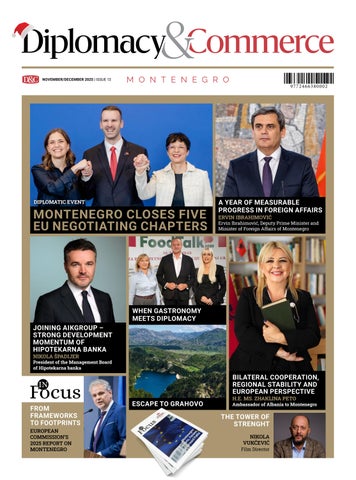
DIPLOMATIC EVENT
MONTENEGRO CLOSES FIVE EU NEGOTIATING CHAPTERS
9772466380002
A YEAR OF MEASURABLE PROGRESS IN FOREIGN AFFAIRS
ERVIN IBRAHIMOVIĆ
Ervin Ibrahimović, Deputy Prime Minister and Minister of Foreign Affairs of Montenegro
WHEN GASTRONOMY MEETS DIPLOMACY JOINING AIKGROUP – STRONG DEVELOPMENT MOMENTUM OF HIPOTEKARNA BANKA NIKOLA ŠPADIJER
President of the Management Board of Hipotekarna banka
BILATERAL COOPERATION, REGIONAL STABILITY AND EUROPEAN PERSPECTIVE
FROM FRAMEWORKS TO FOOTPRINTS EUROPEAN COMMISSION’S 2025 REPORT ON MONTENEGRO
ESCAPE TO GRAHOVO
H.E. MS. ZHAKLINA PETO
Ambassador of Albania to Montenegro
THE TOWER OF STRENGHT NIKOLA VUKČEVIĆ
Film Director
FOREWORD
FOLLOW US TO STAY UPDATED
As the owner of Diplomacy & Commerce Montenegro, I would like to express my sincere gratitude to everyone who took part in the first 13 issues and, through their genuine engagement, left a personal mark on this project. Your contribution was not only professional, but also deeply human, and it is precisely this kind of energy that creates an atmosphere of progress and optimism that Montenegro naturally strives for. Thank you for building a space of positive dialogue and trust together with us. Merry Christmas and Happy New year! Miloš Dragaš
MILOŠ DRAGAŠ CEO dragasm@drafmedia.me
PETRA ČELEBIĆ Editor-in-Chief journalist@drafmedia.me
NATALIJA PEROVIĆ Advertising Director advertising@drafmedia.me
ZORAN DRAGIĆ Design and prepress zoran.dragic@gmail.com
Translation Double L D.O.O. Contributors: Miloš Dragaš Robert Čoban Žikica Milošević
Print BIROGRAF COMP D.O.O. Atanasija Pulje 22 Zemun Republika Srbija
Published by: DRAF Media d.o.o. 81100 Podgorica, Montenegro Karađorđeva 18 VAT: 03542041 Reg. No: 51128768 Office: Karađorđeva 18 81100 Podgorica Phone: + 382 69 220 275
CIP – Katalogizacija u publikaciji Nacionalne biblioteke Crne Gore, Cetinje ISSN 2989 – 2481 = Diplomacy and Commerce Montenegro (Print) COBIS.CG-ID 26760708 International Copyright 2016-2023 Color Media Communications, Novi Sad, Serbia Copyright for Montenegro: 2023 The Media doo, Podgorica, Montenegro
T
his issue of Diplomacy and Commerce was produced in a year that held particular significance for Montenegro in the context of European integration. The European Commission’s Report recorded measurable progress, including the closure of negotiating chapters and a visible strengthening of the institutional framework, confirming that the process of accession to the European Union has once again been proceeding with more defined momentum and direction. For this very reason, the present edition has been conceived in the spirit of European values, responsibility, and longterm strategic commitment. Montenegro’s European path in this issue is considered primarily through the prism of diplomacy and international relations. Topics such as the EU Enlargement Forum, interviews with the Minister of Foreign Affairs of Montenegro and the Ambassador of Albania, as well as a report from the Doha Summit attended by the President of Montenegro, focus on the country’s international position, its visibility, and its role in contemporary global and regional processes. A special segment of the magazine is dedicated to the territory of Montenegro as its enduring diplomatic and development resource. The article on Grahovo is placed within the context of natural beauty, landscapes and authentic settings that constitute a recognisable part of the country’s identity and represent a significant element of its cultural and tourism profile. In contrast, the articles on Nikšić and Podgorica address contemporary urban and social processes: the candidature of Nikšić for the European Capital of Culture 2030 and the designation of
Call us or send us request on: e-mail: pretplata-dc@color.rs Phone: +381 11 4044 960 Payment Instructions: www.diplomacyandcommerce.rs/subscription
Podgorica as the European Youth Capital 2028, serving as examples of how European initiatives and programmes are reflected in the development of cities and local communities. The interviews in this edition are structured as a series of distinct yet complementary perspectives. Conversations with representatives of diplomacy and state institutions focus on foreign policy and international relations, while interviews with Archpriest Gojko Perović and film director Nikola Vukčević address issues of social values, identity and culture, offering a broader context for understanding contemporary Montenegro beyond a strictly political framework. I now regard my personal experience of political engagement, which marked a particular period of my professional career, as an important chapter that enabled me to gain a deeper understanding of institutions, processes and public responsibility. It was precisely this experience that directed me towards work in the field of international affairs and diplomacy, a sphere in which dialogue, continuity and the measurability of results are of fundamental importance. This issue of Diplomacy and Commerce represents a record of an important year – a year in which Montenegro further reaffirmed its European course, while at the same time strengthening its international presence and enhancing the value of its own resources, spaces and initiatives. At this intersection of diplomacy, development and identity, the magazine continues to serve as a platform for a well-founded and responsible examination of the processes shaping contemporary Montenegro.
ONLY
34 €
PER YEAR
Enjoy your reading!
Regards, Editor-in-Chief, Petra Čelebić
SUBSCRIBE NOW! IN PRINT AND ONLINE 3
DIPLOMATIC EVENT
Montenegro Closes Five EU Negotiating Chapters in Brussels Key Steps Towards Membership and the Strategic Perspective
MARIE BJERRE, MILOJKO SPAJIĆ AND MARTA KOS
D
ecember 2025 was marked by substantial steps taken by Montenegro on its path towards accession to the European Union. During the recent Intergovernmental Conference in Brussels, Montenegro achieved technical progress through the closure of five negotiating chapters, covering the areas of the legal system, market policies, agriculture and fisheries. These steps represent a continuation of the multi-annual process of harmonising Montenegrin legislation and institutions with the
4
MONTENEGRO IS OUR FRONTRUNNER… A TOP‑PERFORMING CANDIDATE WITH OUTSTANDING RESULTS AND A MAJOR STEP FORWARD
tenegrin authorities, as well as for all the citizens of Montenegro who support this process, and for us in the European Union, and it shows that hard work pays off.”
EU’s legal standards (the acquis communautaire). The European Commissioner for Enlargement, Marta Kos, congratulated Prime Minister Milojko Spajić and Montenegrin colleagues and friends on yet another significant step on Montenegro’s path towards membership of the European Union:
The provisional closure of chapters covers five priority sectors: • CHAPTER 3: Right of Establishment and Freedom to Provide Services • CHAPTER 4: Free Movement of Capital • CHAPTER 6: Company Law • CHAPTER 11: Agriculture and Rural Development
“Montenegro is our frontrunner. It is truly a top-performing candidate with the outstanding results, and today once again substantiates this. Twelve chapters closed. That is it. We have closed these chapters and we are pleased that this has been possible. This is a major step forward and an exceptional achievement for the Mon-
www.diplomacyandcommerce.me
Commissioner Kos additionally emphasised: “We are not a humanitarian organisation, and this is not a Christmas gift, as we heard today from one of the representatives of the Member States. From today’s discussion at the Intergovernmental Conference, we know that all Member States acknowledge these results. We have numerous reasons to celebrate today. Montenegro has never been closer to the European Union. However, we must also be honest – the most difficult part still lies ahead, as you yourselves have said that you wish to conclude the negotiations by the end of 2026. The European Commission supports you in this endeavour, but in order to achieve it, dear Prime Minister, you will have to run fast.” In this process, Montenegro has been recognised as a regional leader among the candidates in the Western Balkans, with a clearly defined plan to close the remaining negotiating chapters by the end of 2026. European institutions emphasise that tech-
MONTENEGRO CLOSED FIVE NEGOTIATING CHAPTERS IN BRUSSELS, ADVANCING REFORMS IN LAW, CAPITAL, COMPANY POLICY, AGRICULTURE, AND FISHERIES. nical progress in the closure of chapters requires the continuous implementation of reforms in legislation, the judiciary and public administration, in order for progress to be trustworthy and sustainable. Within this framework, the EU places particular emphasis on the consistent application of the rule of law, the effective functioning of democratic institutions and institutional transparency, which are key elements of accession. Commissioner Kos stressed that each phase of the process is merit-based, meaning that progress must be measurable and verifiable. In parallel, EU institutions provide technical and operational support to Montenegro, including advisory mechanisms, seminars for administrative capacity-building and tailored programmes for strengthening capacities in areas that are priorities for EU integration. This cooperation ensures that Montenegro’s progress remains measurable, credible and sustainable, in line with the enlargement methodology and European standards.
DOMESTIC PERSPECTIVE AND THE INSTITUTIONAL IMPLEMENTATION OF EUROPEAN STANDARDS
Following the technical progress achieved in Brussels, domestic officials underline the importance of continuity and the consistent implementation of reforms as a
key factor for the successful closure of the remaining negotiating chapters. The Prime Minister of Montenegro, Milojko Spajić, emphasises coordination among all state institutions and the importance of modernising public administration, ensuring transparency and effectively implementing legislation. These strategic steps enable the technical achievements in the accession negotiations to be permanently integrated into the country’s administrative and legal structures. Prime Minister Spajić stated that Montenegro has demonstrated the seriousness of its commitment to the integration process. “Dear citizens of Montenegro, today our country has closed more than one third of all chapters required in the negotiations and is the first to have done so since 2009, if I am not mistaken. It is precisely at this Intergovernmental Conference here in Brussels today that we have closed five chapters – Chapters 3, 4, 6, 11 and 13.” He also took this opportunity to speak directly to the citizens of the Member States of the European Union: “And, dear citizens of Europe, today, when many centres of power are attempting to pursue their agendas without precedent, we Europeans can have no greater ideal than a united Europe – a Europe of all its citizens, a Europe
of all Europeans. That is why the enlargement policy must endure and be safeguarded as one of the strongest and most important pillars of the European Union.” Montenegrin institutions also recognise the role of the economy and civil society in the process of European reforms. The active involvement of entrepreneurs and non-governmental organisations in projects related to digitalisation, the green transition and infrastructural modernisation is considered essential for successful and sustainable integration into the Single European Market. This strategy reflects the European approach, according to which a resilient economy and an engaged civil society constitute a guarantee of stability and longterm success in the implementation of the EU acquis. Through comprehensive coordination among domestic institutions and with the continuous support of the European Union, Montenegro continues to implement reforms with the aim of ensuring the credibility and sustainability of the process, particularly in the areas of the judiciary, public administration and financial institutions. The integration of a broader socio-economic spectrum, including the economy and civil society, is key to achieving measurable results that contribute to the country’s overall socio-economic development while simultaneously maintaining high standards of transparency and good governance, which are prerequisites for final membership.
5
Photo: Bojan Gnjidić, Government of Montenegro
• CHAPTER 13: Fisheries This progress reflects the alignment of Montenegrin institutions with European standards and demonstrates the administration’s capacity to implement the EU acquis in technically demanding areas. The European Commission continuously monitors the implementation of reforms in these sectors, emphasising that the process of closing chapters is the result of merit-based assessment and credible progress, rather than being driven exclusively by political momentum.
AMBASSADOR'S INTERVIEW
H.E. Ms. Zhaklina Peto, Ambassador of the Republic of Albania to Montenegro
Bilateral Cooperation, Regional Stability & European Perspective Albania and Montenegro’s joint vision for infrastructure, energy, and EU accession
A
lbania and Montenegro stand at a pivotal moment in their shared European journey. Since Montenegro’s independence in 2006, the two countries have built relations on trust, good neighbourliness, and a clear orientation toward the EU. Today, they are not only strategic partners and NATO allies, but also collaborators in energy, infrastructure, tourism, and reforms that strengthen regional stability. In this interview, H.E. Ms. Zhaklina Peto explores how bilateral cooperation is evolving, what progress Albania has made on its accession path, and how both nations envision a more connected and prosperous Western Balkans. How would you assess the current level of bilateral cooperation, and in which areas do you see the greatest potential for strengthening these ties? Since 2006, the year Montenegro declared its independence, the relations between our two countries have been built on clear political, diplomatic, and European foundations. Albania was among the first states to recognize Montenegro’s independence, giving a strong signal of support and respect for the sovereign choice of the Montenegrin people. This approach, appreciated also by the European Union, placed our relationship on the EU’s fundamental principle: good neighbourliness. Thanks to this principle, cooperation has been stable and results-oriented. Today, Albania and Montenegro are not only good neighbours, but also strategic partners and NATO members, adding an important dimension of security and regional cooperation. In economic terms, the year 2024 marked a significant increase in visitors from Montenegro to Albania:
6
H.E. MS. ZHAKLINA PETO
Ambassador of Albania to Montenegro
2024 (Jan–December): 762,684 entries from Montenegro to Albania, out of a total of 11,696,078 entries. 2025 (Jan–September): 605,135 entries from Montenegro to Albania, out of a total of 10,228,686 entries. These figures show very positive developments both in economic
terms and in bilateral relations. This means that Albania is perceived as higher-quality, safer, and more competitive compared to other destinations in the region. Both countries are intensifying efforts to further expand economic cooperation, identifying new potential sectors and creating more efficient mecha-
nisms for connecting businesses and investors. The accession of Albania and Montenegro to SEPA is an important step toward European financial integration, as it enables euro transfers under the same rules and fees applied within the EU. This mechanism reduces the costs of cross-border payments, increases transwww.diplomacyandcommerce.me
Infrastructure and regional connectivity
The Durrës–Hani i Hotit–Podgorica railway project, part of Corridor 8 and supported by the EBRD, creates a new commercial and logistical corridor.
Energy
The Ionian Adriatic Pipeline (IAP) and its connections with TAP make our region part of Europe’s new energy diversification map.
Tourism and environment
Shared natural areas such as the Buna River, Lake Shkodra, and the Albanian–Montenegrin Alps offer unique potential for
ALBANIA AND MONTENEGRO HAVE GROWN FROM NEIGHBOURS TO STRATEGIC ALLIES, WITH RISING TOURISM AND JOINT PROJECTS IN ENERGY AND INFRASTRUCTURE. THEIR PARTNERSHIP SHOWS HOW GOOD NEIGHBOURLINESS TRANSLATES INTO REAL ECONOMIC AND REGIONAL STRENGTH. the development of cross-border and sustainable tourism. Furthermore, on December 10th in Tirana, the Regional Economic Forum will take place, aiming to create a shared platform for dialogue where the highest political, diplomatic, and economic representatives of the region and the European Union will discuss the impact of global developments on security and stability in the Balkans, promote economic integration and the acceleration of the EU accession process, and highlight Albania’s role as a growing hub for investment, infrastructure, energy, and tourism. With the participation of foreign ministers, ambassadors, and leaders of international financial institutions, the forum places regional cooperation, Albania’s economic transformation, and the importance of human capital as a driving force for future development at the center of its agenda. How do you evaluate Albania’s recent progress on this path, especially following the positive report from the European Commission? The latest European Commission report is the clearest evidence of progress. On 18 November 2025, Albania opened all negotiation chapters, an important achievement that comes after deep reforms in justice, the fight against corruption and organized crime, the digitalization of public administration, and the improvement of fundamental rights standards. As I have emphasized before, the greatest challenge now is the implementation phase following the opening of the chapters. Albania needs to strengthen administrative capacities, achieve measurable results, and accelerate harmonization with the acquis in areas such as energy, environment, economy, and governance. Montenegro’s experience is extremely valuable in this process, and technical cooperation between the two countries is a true example of good neighborliness and mutual learning within the
enlargement process. This is also demonstrated by frequent technical meetings between the Albanian State Minister and Chief Negotiator, Ms. Majlina Dhuka, and the Montenegrin Minister for Europe, Ms. Maida Gorčević, where concrete experiences, best practices, and effective approaches to managing negotiation chapters are exchanged. These meetings not only strengthen the technical capacities of both sides but also once again demonstrate the very good level of our relations in fulfilling our shared European goal. Even though Montenegro is in the final stages of its chapters, its willingness to share experience and collaborate closely with Albania turns this process into a remarkable example of regional partnership and solidarity. How can Montenegro and Albania jointly contribute to a more connected and stable Western Balkans? Albania and Montenegro naturally contribute to regional stability because they share a clear European orientation and respect the EU criteria for good neighborliness, regional cooperation, and constructive dialogue. This contribution is reflected in three main pillars:
Economic connectivity and infrastructure
The Durrës–Hani i Hotit–Podgorica railway, Corridor 8, and energy projects such as IAP/ TAP enhance the region’s competitiveness, connectivity, and economic stability.
Security
The institutions of both countries cooperate in the fight against organized crime, trafficking, and money laundering, strengthening regional trust and alignment with European standards.
Social dimension
The Albanian community in Montenegro serves as a natural bridge for cooperation, contrib-
uting to legislation, governance, local development, culture, and dialogue between our people. Which priorities and reforms, in your opinion, will be most decisive for maintaining positive momentum in the accession process? Reforms related to the rule of law, judicial independence, and the strengthening of democratic institutions remain essential for the progress of negotiations— particularly in Chapters 23 and 24, which the EU considers the “foundation” of the accession process. Equally important is the enhancement of administrative capacities and the consistent implementation of policies harmonized with the acquis, as these demonstrate a country’s genuine readiness to function as an EU member. Political stability and constructive dialogue are also indispensable, and the EU views them as part of the standards for good neighborliness and good governance. For Albania, it is crucial to implement strategies following the opening of the chapters, advance the green transition, make progress in energy, and modernize infrastructure. Measurable and sustainable results are key to maintaining the positive momentum in the integration process. What would be your message to the citizens of Montenegro and Albania as both countries continue their European journey and to our readers who follow regional cooperation and integration with optimism? My message is one of confidence and a clear European orientation. Albania and Montenegro have demonstrated that cooperation in the spirit of good neighborliness delivers concrete results and creates lasting stability. I tell our citizens that the path toward the EU is an investment in stability, higher living standards, and greater economic and social opportunities. Every joint project—ranging from infrastructure to energy, from security to tourism—clearly shows that our countries move faster when they move together. The optimism for the region is realistic: the Western Balkans can become a European success story, and the cooperation between Albania and Montenegro is a clear example of this path.
7
Photo: Embassy of Albania in Montenegro
parency, and accelerates the circulation of funds, facilitating businesses, trade, investors, and diaspora remittances. The benefits are particularly significant in tourism, services, and bilateral trade, strengthening competitiveness and consolidating the economic connection of Albania and Montenegro with the European market. Albania has established two new economic and technological zones — TEDA Tirana and Durana Tech Park — which aim to provide a modern environment for industry, innovation, and services aligned with European standards. TEDA Tirana focuses on industrial and manufacturing activities, while Durana Tech Park targets technological development and start-ups. To attract investment, the government has introduced significant fiscal incentives, such as a 50% reduction of corporate income tax for the first five years, exemption from the real estate transfer tax, support for employee training, and incentives for research and development. These measures substantially reduce operating costs and increase the attractiveness of the zones for investors. These developments create new opportunities for economic cooperation with Montenegro, offering Montenegrin companies favorable conditions for opening subsidiaries, logistics centers, or joint projects. The new zones encourage the growth of trade exchanges, the creation of joint supply chains, and the strengthening of economic integration between the two countries. Three areas present exceptional potential for further deepening:
POLITICAL INTERVIEW
Ervin Ibrahimović, Deputy Prime Minister and Minister of Foreign Affairs of Montenegro
A Year of Measurable Progress in Foreign Affairs Minister Ibrahimović on Montenegro’s strengthened EU path and international credibility
ERVIN IBRAHIMOVIĆ
Deputy Prime Minister and Minister of Foreign Affairs of Montenegro
I
n an exclusive interview, Deputy Prime Minister Ervin Ibrahimović reviews Montenegro’s most dynamic year in diplomacy, highlighting milestones in EU negotiations, foreign policy commitments, and the country’s growing role on the international stage. Deputy Prime Minister and Minister Ibrahimović, how would you evaluate the year now coming to an end from the perspective of the work of the Ministry of Foreign Affairs, and to what extent are you satisfied with the results achieved and the progress made in Montenegro’s relations with international partners? The year now drawing to a close has been exceptionally dynamic and significant for Montenegrin di-
8
plomacy. From the perspective of the work of the Ministry of Foreign Affairs, I can state with full responsibility that we have achieved visible and measurable progress that has also been recognised by our international partners. At the Intergovernmental Conference between the European Union and Montenegro, held in Brussels, Montenegro closed five negotiating chapters, marking one of the most significant advances to date in the course of the accession negotiations. The closure of these chapters has further confirmed our strong commitment to reforms and strengthened Montenegro’s position as the most advanced candidate in the enlargement process. In this way, Montenegro has entered the final phase of the accession process, which opens
up the possibility of commencing work on the Treaty of Accession to the European Union. Additional confirmation of this progress is provided by the latest European Commission Report – it represents the most positive assessment Montenegro has received to date, accompanied by an unequivocal message that we are the most advanced candidate and the first next Member State of the European Union. These assessments constitute a strong encouragement for us to continue acting decisively, with dedication and in the spirit of European values. I am particularly pleased that progress has been achieved across the largest number of chapters, with very good results recorded in as many as six chapters. It is equally important to
emphasise that there has been no stagnation or backsliding in any area, which demonstrates that our European course is stable and that the Government’s policy is guided by a clear, consistent and European-based vision. As Minister of Foreign Affairs, I am proud of the fact that an exceptional result has been achieved within Cluster 6, where the Ministry has a key role: in Chapter 31 – Foreign, Security and Defence Policy – we have achieved significant progress and a very advanced level of preparedness, which represents the highest possible assessments. In Chapter 30 – External Relations – good progress and a good level of preparedness for membership have been recognised. At the same time, I remain aware that optimism must be accompanied by institutional responsibility. Chapters 23 and 24 remain the cornerstone of our accession process, and it is precisely in these areas that we must demonstrate full maturity – the appointment of judges of the Constitutional Court, members of the Prosecutorial and Judicial Councils, and of the Council of the Agency for Media are obligations that we must fulfil in order to confirm that we have stable, independent and functional institutions. Ultimately, this is also the best way for citizens to feel that the European path delivers a more just society, more reliable institutions and a more efficient judicial system. With regard to the concrete obligations arising from the Government’s Work Programme, the Ministry has so far implemented six activities, each of which is important in the context of our foreign policy priorities. We have successfully prepared the Information on the visa regime, which is key to alignment with EU policy; adopted the Action Plan for enhancing capacities for the implementation of restrictive measures, www.diplomacyandcommerce.me
thereby confirming our full alignment with the Common Foreign and Security Policy; organised the Global Forum of Young Diplomats with the participation of representatives from 53 countries, further positioning Montenegro on the international map; harmonised the Agreement on long-term support for Ukraine and security cooperation, once again confirming our reliability as a NATO Ally; as well as prepared information on the preparations for the chairmanship of the Committee of Ministers of the Council of Europe and the Western Balkans Fund, which testifies to the assumption of a responsible role within international frameworks. The exceptionally dynamic year in international relations has also been reflected in Montenegro’s engagement within multilateral frameworks of cooperation, including the United Nations, the OSCE and the Council of Europe. In conditions of highly complex and unpredictable geopolitical developments, Montenegrin foreign policy has preserved its role as a responsible and reliable international actor and partner. Montenegro has consistently advocated for and defended the rulesbased international legal order. In this regard, particular attention should be paid to our clearly articulated, internationally law-based and principled positions concerning Russia’s aggression against Ukraine, as well as the Israeli–Palestinian conflict and the resolution of the Palestinian question. These are two pressing issues with direct security implications for Europe and the Mediterranean, not to mention the catastrophic humanitarian consequences of the conflicts in Ukraine and in the Middle East. Therefore, we have consistently continued our already recognisable and highly valued overall engagement within the United Nations human rights system, primarily in the Human Rights Council in Geneva and the United Nations General Assembly in New York. For the first time, Montenegro hosted a visit by the UN High Commissioner for Human Rights in May of this year. Our commitment to continuing to engage constructively and robustly in the areas of human rights protection and the preservation of international peace and security is further confirmed by Montenegro’s prominent candidacies for membership in a number of key UN bodies and the executive organs of its agencies, including the Security Council and the Human Rights Council.
A DYNAMIC YEAR IN DIPLOMACY PLACED MONTENEGRO AT THE FOREFRONT OF EU ENLARGEMENT, WITH VISIBLE PROGRESS IN NEGOTIATIONS AND RECOGNITION FROM INTERNATIONAL PARTNERS OF ITS STEADY EUROPEAN COURSE After more than a decade, the Secretary General of the Council of Europe visited Montenegro in April of this year, at which time Montenegro, for the first time, also hosted a joint meeting of the Governing and Administrative Boards of the Council of Europe Development Bank. Throughout the year, we intensified preparations for Montenegro’s chairmanship of the Committee of Ministers of the Council of Europe, a process that provides us with a unique opportunity, in the final phase of negotiations for full membership in the European Union, to increase our visibility on the international stage and to reaffirm our commitment to European values – the strengthening and promotion of democracy, human rights and the rule of law. Through its overall engagement in multilateral frameworks, Montenegro demonstrates both the readiness and the capacity to be not only a beneficiary of international support mechanisms, but also a state that actively implements reforms and participates in processes of importance for the European continent and beyond. By the end of the year, we face intensive work on the Foreign Policy Strategy 2026–2029, the optimisation of the diplomatic and consular network, and the preparation of programmes for international development cooperation and humanitarian assistance – all with the aim of ensuring that Montenegro is ready, as the next EU Member State, to assume its obligations and to make its contribution to the European community. An exceptionally important year also lies ahead of us: in the year marking the 20th anniversary of the restoration of independence, Montenegro will chair the Berlin Process. This is a great honour, but also a confirmation of the trust we enjoy among our partners. The chairmanship will provide an opportunity to further strengthen regional dialogue, promote European values and demonstrate that Montenegro possesses the institutional and diplomatic capacities to lead processes of regional and European significance. The Berlin Process Summit and the
accompanying ministerial meetings that we will host will serve as a forum for concrete agreements, the exchange of ideas and the strengthening of trust in the region. In addition, hosting the EU–Western Balkans Summit will constitute another strong message regarding the reputation that Montenegro enjoys. It will be an opportunity for us, as leaders of European integration in the region, to encourage others to persevere along this path and to jointly reaffirm that the enlargement policy remains crucial for the stability of the European continent. It is entirely clear that the forthcoming obligations will put the capacities of the Ministry of Foreign Affairs to the test. However, it is equally clear that we are ready to meet these challenges. As it has done thus far, Montenegro will demonstrate that it is a reliable partner, a good host and a state firmly committed to European values. I am confident that the year ahead will be one in which we further consolidate our international position and demonstrate that Montenegro rightfully bears the designation of the first next Member State of the European Union. In light of the positive assessments Montenegro received in the European Commission Report, in what ways does the Ministry of Foreign Affairs contribute to further strengthening the country’s European path and alignment with the EU’s Common Foreign and Security Policy? The positive assessments contained in the European Commission Report encourage us to continue working at the same pace and with the same level of commitment. They demonstrate that Montenegro is in the final and most demanding phase of the accession process, in which the quality of our alignment with the European Union’s Common Foreign and Security Policy is of decisive importance. As Minister of Foreign Affairs, I fully understand that it is precisely through a responsible and predictable foreign policy that we confirm our political maturity and our readiness to become part of the European family of nations.
In this context, the Ministry of Foreign Affairs plays a key role in aligning foreign, security and visa policy with the EU. We have undertaken a clear commitment to fully harmonise our visa policy with European standards by the end of next year, as part of the Reform Agenda 2024–2027 and in direct connection with the final benchmarks of Chapter 24. The harmonisation process is not merely an administrative matter – it is a clear demonstration of our political consistency, as well as our readiness to assume the obligations arising from future membership. In doing so, we ensure that each step is firmly grounded in the protection of our security, economic and political interests. In the period behind us, the Government, acting on the proposal of the Ministry, has adopted a number of decisions that bring us closer to full alignment with the EU’s visa policy. By removing Kuwait from the Regulation on the Visa Regime, adding Nauru to the list of countries whose nationals do not require a visa, and suspending the temporary visa exemptions for nationals of Egypt, Armenia and Uzbekistan, we have clearly demonstrated that we are pursuing a responsible policy. Furthermore, the expiry of the temporary exemption for nationals of Kazakhstan has constituted another important step towards full harmonisation. As a result, the difference between Montenegro’s visa lists and those of the EU has been reduced to just seven countries, with the clarification that the decision concerning Turkey is temporary and based exclusively on an assessment of the security situation. All of this indicates that Montenegro has the capacity to conduct a visa policy that is fully compatible with the European one, while remaining consistently aligned with our national interests. At the same time, I am proud of the fact that this year we have made a significant step forward in strengthening the international mobility of our citizens. By abolishing visas for travel to Japan, which entered into force on 1 September 2025, we enabled Montenegrin nationals to stay visa-free for up to 90 days within a three-year period. This is the result of long-term and dedicated diplomatic efforts, as well as a confirmation that Montenegro enjoys growing trust on the international stage. At the same time, this has further enhanced the global standing of the Montenegrin passport, which is a very important element in strengthening the country’s international reputation.
9
POLITICAL INTERVIEW
With regard to alignment with the EU’s Common Foreign and Security Policy, Montenegro remains among the leading candidate countries. The high level of alignment that we have achieved for many years continues to confirm our clear strategic commitment. Negotiating Chapter 31 is today fully ready for closure – all that remains is for all Member States to agree on a common position. In the previous period, we closed several chapters precisely because our European partners recognised Montenegro as a credible and reliable ally in the European and Euro-Atlantic context. Our objective is clear – to demonstrate through our policies and actions that Montenegro not only shares European values, but also actively promotes them. For this reason, the Ministry of Foreign Affairs will continue in the period ahead to pursue a responsible, aligned and principled foreign policy, one that will bring our country as close as possible to what has long been the strategic vision of our citizens – full membership of the European Union. Given the EU membership of some neighbouring countries and the experiences arising from this, how does the Ministry plan to intensify bilateral cooperation with key EU Member States in order to improve project coordination and the exchange of best practices? In the final phase of accession negotiations, bilateral cooperation with European Union Member States assumes particular importance, as alongside technical and legal obligations, the political dimension of support becomes decisive. The experiences of our neighbours who have already gone through the accession process show that the quality and intensity of relations with key EU Member States are often a determining factor in the pace and success of integration. For this reason, the Ministry of Foreign Affairs, under my leadership, regards this form of cooperation as a strategic priority. Above all, I am aware that the greatest political weight in supporting candidate countries lies precisely with those Member States with which we share historical, geographical and economic proximity. This was clearly confirmed during our own process of accession to NATO. In this regard, the Republic of Croatia holds particular importance on
10
IN THE FINAL PHASE OF ACCESSION, MONTENEGRO DEEPENS TIES WITH KEY EU PARTNERS — FROM CROATIA TO OTHERS — THROUGH DIALOGUE, TRUST, AND SHARED EXPERIENCE, STRENGTHENING ITS PATH TOWARD MEMBERSHIP AND REGIONAL STABILITY our integration path – not only because of the experience it has gained as the EU’s newest Member State, but also because, owing to the closeness of our states and peoples, it is well acquainted with regional circumstances and challenges. For this reason, in recent months we have intensified diplomatic communication with Croatia, precisely in order to address, through open and constructive dialogue, all issues that have remained unresolved in our bilateral relations for more than three decades. We have identified key topics, established direct communication mechanisms and jointly mapped out steps that will enable us to resolve these issues in a manner that serves the mutual interest. Communication with the Croatian side is continuous and takes place at all levels. I believe that it is precisely this approach – sincere, responsible and focused on tangible results – that can lead to the resolution of all outstanding issues and to the further strengthening of the partnership between Montenegro and Croatia. This partnership is not important only for our two
countries; it directly contributes to the stability and sustainable development of the entire region, which is one of the key elements of the European enlargement policy. In a broader context, the Ministry plans to continue intensifying bilateral diplomacy with other key EU Member States as well — primarily those with long-standing experience in enlargement, as well as those that play an important role in political decision-making within the Union. Through coordinated visits, strategic consultations, the strengthening of working groups and the exchange of best practices, we seek to further reinforce trust and partnership ties, while also securing strong political support for Montenegro in the final steps of its European path. I am convinced that the combination of a responsible approach, good-neighbourly diplomacy and active engagement with all partners within the EU will enable Montenegro to remain the leader of European integration in the region and to become the next Member State of the European Union in the near future.
Regional cooperation remains one of the cornerstones of Montenegro’s foreign policy. How do you assess current relations with neighbouring countries, and what initiatives is the Ministry undertaking with the aim of strengthening trust and stability in the region? Overall, Montenegro remains firmly committed to building the best possible relations with all of its neighbours — relations grounded in the principles of good neighbourliness, mutual respect and understanding. In our bilateral relations with neighbouring countries, we consistently strive to pursue a policy of open and constructive dialogue, placing emphasis on what unites us and on what can further enhance cooperation between our countries. Bilateral political consultations represent one of the many mechanisms available to us, as the Ministry of Foreign Affairs, through which, by exchanging views and positions and by jointly considering opportunities, we can strengthen cooperation with neighbouring countries and thereby contribute to mutual trust. In addition to bilateral political consultations with the Croatian Ministry of Foreign and European Affairs, similar consultations were held this year with Bosnia and Herzegovina, with the expectation that this trend will continue with other countries in the region during 2026. www.diplomacyandcommerce.me
140 years of the automobile, 130 years of transport,
100 years of Mercedes-Benz
An anniversary year full of magic moments
Ljetopis Automotive d.o.o., Kralja Nikole 357 Podgorica, Montenegro Tel. +382 20 648 841 - www.mercedes-benz-ljetopis.me - mercedesbenz_cg Mercedes-Benz Crna Gora
An additional indication that our commitment to regional cooperation is being recognised lies in the fact that Montenegro has been elected to leading positions in two regional organisations – RACVIAC – the Centre for Security Cooperation, and the Regional Youth Cooperation Office (RYCO). Moreover, Montenegro will assume the chairmanship of the Western Balkans Fund (WBF) next year, which further confirms our willingness to contribute more actively and to assume responsibility for regional processes and cooperation. Montenegro’s proactive role in coordinating activities within the Regional Cooperation Council (RCC), as the executive body of the South-East European Cooperation Process (SEECP), as well as within the Berlin Process (BP), represents a significant catalyst for European integration. Therefore, I believe that our country is genuinely making a successful contribution to strengthening trust in the region and is setting a positive example in striving towards membership of the European Union, as a goal we all share. Today, Montenegro is recognised as one of the factors of stability and peace in the region, a reliable ally of the NATO Alliance and a leader in European integration. I believe that our accession to the European Union will send a message to other countries that the enlargement process is “alive”. This is of crucial importance for the neighbourhood, as I am convinced that only through integration into the European Union can the Western Balkans achieve lasting stability and prosperity. We wish to be the ones who inspire and encourage our neighbours to work with greater dedication on the necessary reforms along their European path. In light of public interest in Montenegro’s diplomatic network, are there plans in the coming period for the appointment of new ambassadors and the filling of vacant diplomatic positions? During my term of office, we have made a significant step forward in strengthening Montenegro’s diplomatic and consular network. To date, we have appointed 15 ambassadors and two consuls general, which clearly demonstrates our commitment to strengthening the foreign service both professionally and in terms of staffing. Nevertheless, several positions remain vacant in countries that are of political, economic and strategic
12
NEW MISSIONS EXPAND MONTENEGRO’S PRESENCE AND VISIBILITY WORLDWIDE importance to us, such as Albania, Argentina, Bosnia and Herzegovina, Greece, Germany, the Russian Federation, the Vatican, Turkey, the United Arab Emirates, the United Kingdom and Spain. The process of appointing ambassadors is, by its very nature, complex, as it involves coordination among several institutions – the Ministry of Foreign Affairs, the Government, Parliament and the President of the State – as well as strict adherence to international procedures and protocols vis-à-vis the receiving states. For precisely this reason, we insist on the quality and integrity of each candidate, fully aware that ambassadors bear the greatest responsibility when it comes to representing Montenegro on the international stage. With full responsibility, I can say that we expect the majority of the remaining appointments to be finalised in the coming period. This will ensure an almost complete staffing of our diplomatic and consular network, which is of particular importance at a time when Montenegro is in the final stage of the process of accession to the European Union. Successful and visible diplomacy is crucial for safeguarding our interests and for building a credible
position in international relations. The Ministry of Foreign Affairs will remain fully committed to strengthening our diplomatic network, so as to make Montenegro even more present, more recognisable and more influential worldwide. Is there a strategic vision for further strengthening Montenegro’s international presence through the opening of new diplomatic and consular missions or the enhancement of the work of existing missions in countries of particular economic, political or cultural significance? Our strategic vision envisages the further development of the diplomatic and consular network, in line with financial frameworks, but also with the ambition for Montenegro to be present in all key political and economic centres of the world. For this reason, at the level of the Government, we have taken a decision to open several new missions, bearing in mind a shared objective – strengthening political dialogue, encouraging economic and investment cooperation, improving the quality of consular services and increasing Montenegro’s international visibility at a time when we are in the final phase of European integration.
The opening of new embassies in European Union Member States, such as the Czech Republic and Slovakia, stems from their consistent political support for enlargement and the exceptionally good relations we have been building over many years, which also require our resident presence. In the Middle East region, the decision to strengthen our presence in Qatar and Saudi Arabia is based on their growing economic and political weight and their potential for more intensive investment cooperation. In the Far East, we approach Japan and India as two of the most important Asian countries – one with enormous technological and developmental capacities, the other as a rising global power and an important source of consular demand. Finally, the opening of an office of the Embassy of Montenegro in Belgium, with its seat in Luxembourg, reflects the importance of that country as a partner within the EU and NATO, as well as the long-standing tradition of our diaspora, which serves as a bridge of friendship between the two countries. I believe that this approach demonstrates our strategic maturity and our ability to develop the diplomatic network in a planned and thoughtful manner. Each decision to open a new mission is not merely an administrative step, but the result of a careful assessment of geopolitical, economic and cultural factors, as well as an evaluation of Montenegro’s capacity to operate effectively and visibly in each of these representations. In this way, we ensure that our diplomatic engagement is fully geared towards the protection of national interests, the strengthening of regional stability and the promotion of European values. The further development of the network also enables a more active role for Montenegro within multilateral frameworks, as a presence in strategically important countries creates opportunities for direct participation in key regional and global initiatives. In this way, we simultaneously strengthen the credibility of our state and enhance our capacity to mobilise international support, whether through economic projects, cultural initiatives or political dialogue. I am confident that this strategy, through a combination of resident presence and the modernisation of existing missions, will enable Montenegro to be even more present, more recognisable and more influential on the international stage. www.diplomacyandcommerce.me
Photo: Đorđe Cmiljanić, Saša Matić
POLITICAL INTERVIEW
DIPLOMATIC EVENT
Second United Nations World Summit on Social Development in Doha, Qatar
Montenegro at the Global Forum for Social Development President Milatović underscores solidarity, inclusion, and the role of small states in shaping global progress
PRESIDENT JAKOV MILATOVIĆ AND HIS HIGHNESS, THE EMIR OF THE STATE OF QATAR, SHEIKH TAMIM BIN HAMAD AL THANI
T
he President of Montenegro, Jakov Milatović, participated in the Second United Nations World Summit on Social Development, which was convened in Doha (Qatar) from 4th to 6th November 2025. The summit brought together high-ranking state representatives, international organisations, and experts from around the world, providing a unique platform for the exchange of experiences, the formulation of policies, and the strengthening of international cooperation in the field of social development and sustainable progress. During the summit, President Milatović emphasised Montenegro’s commitment to fair development and
MONTENEGRO REAFFIRMED ITS COMMITMENT TO FAIR DEVELOPMENT AND GLOBAL SOLIDARITY AT THE UN SUMMIT IN DOHA global solidarity, underlining the importance of social cohesion and equal opportunities for all citizens. Throughout the summit, Montenegro also showcased examples of its reforms and policies that promote inclusiveness and equality of opportunity, demonstrating that a small country can have an impact on the global stage and contribute meaningfully to international initiatives for social justice. The summit provided an opportunity for Montenegro to
strengthen its image as a constructive partner in international dialogue, highlighting that its contribution is not limited solely to the regional context, but is actively integrated into global social development policies.
COMMITMENT TO SOCIAL INCLUSION AND SUSTAINABILITY
In his speech, President Milatović highlighted that work, knowledge and solidarity are
essential to achieving fair and inclusive development, underlining Montenegro’s dedication to the principles of global solidarity and social inclusion. Montenegro demonstrated that social policy and sustainable development do not merely entail the implementation of laws, but also the active involvement of the community and the promotion of values that connect people. The country’s commitment to inclusion confirms that even a small country can make a significant contribution to defining global development standards and encouraging international consensus on key issues of social justice.
13
stage, promoting transparency and accountability within international initiatives, while ensuring that the voice of a small state is clearly acknowledged and respected. The summit further facilitated the exchange of experiences with international partners and the reinforcement of diplomatic channels, thereby confirming Montenegro’s proactive role in global initiatives and international cooperation. These exchanges contribute not only to the strengthening of bilateral and multilateral relations but also to the advancement ofMontenegro’s capacity to take an active part in defining global development policies.
MONTENEGRO AS A DEDICATED PARTNER IN GLOBAL SOLIDARITY
BILATERAL MEETINGS AND STRATEGIC PARTNERSHIPS
In addition to the official programme, President Milatović held a series of bilateral meetings with leaders and representatives of various states, including a key meeting with His Highness, the Emir of the State of Qatar, Sheikh Tamim bin Hamad Al Thani. The President extended an invitation to His Highness, the Emir of Qatar, to visit Montenegro next year, when the country will celebrate the twentieth anniversary of the restoration of its independence and the establishment of diplomatic relations with the State of Qatar—an invitation that the Emir accepted. These meetings reaffirm Montenegro’s dedication to strengthening bilateral relations and promoting international cooperation. President Milatović’s participation in informal discussions with representatives of other states and international organisations further strengthened channels of com-
14
PRESIDENT MILATOVIĆ STRENGTHENED MONTENEGRO’S INTERNATIONAL PARTNERSHIPS THROUGH BILATERAL MEETINGS AND THE PROMOTION OF INCLUSIVE POLICIES munication and the exchange of experiences. The summit demonstrated that Montenegro, through strategic and well-considered engagement, plays an active role in global initiatives and positions itself as both a relevant and reliable partner in international processes.
INNOVATION AND EXPERIENCES FROM THE REGION
The summit in Doha provided President Milatović with the opportunity to exchange experiences and innovative practices with other countries in the region and beyond. In his discussions, President Milatović shared Montenegro’s experiences with other nations on matters of social development, highlighting examples of effective practice and the country’s commitment to the principles of fair development and global solidarity. Particular attention was devoted to issues concerning the integration of youth and women’s communities into development programmes, the establishment of opportunities for education and employment, and the improvement of social services. Through these efforts, Montenegro presents a practical
example of how political leaders can design policies that combine local development with global values, demonstrating that fair development embraces all citizens and establishes a long-term, stable society.
DIPLOMATIC CHANNELS AND THE STRENGTHENING OF INTERNATIONAL COOPERATION
President Milatović’s participation in Doha also provided the opportunity for informal diplomatic discussions with leaders of other states and representatives of international organisations. Through such channels, Montenegro continues to strengthen its presence on the international
Photo: President of Montenegro / Flickr
The summit in Doha enabled Montenegro to highlight its contribution through examples of good practice in social policy and the exchange of innovative solutions with other countries. Such initiatives confirm that Montenegro acknowledges its role as an active partner within the international community, ready to share its experiences, learn from others, and contribute to shaping policies that bring tangible benefits to citizens.
President Milatović’s presence at the UN Summit in Doha reaffirms that Montenegro recognises the importance of international solidarity and collective cooperation in addressing challenges that surpass national borders. Through its participation in the summit, Montenegro demonstrates its commitment to fair development, inclusion and sustainability, and its active contribution to global efforts in promoting social cohesion and equal opportunities. The summit offered a platform to showcase Montenegro’s constructive approach to international dialogue and cooperation, illustrating that even a smaller state can make a significant contribution to global initiatives for social justice. This reaffirmed that Montenegro aligns its internal development priorities with international standards and initiatives, while at the same time promoting the values of solidarity and accountable partnership within the global community.
www.diplomacyandcommerce.me
EVENT OF THE MONTH
Podgorica FoodTalk 2025
When gastronomy meets diplomacy A feast of flavours, ideas and identities at Podgorica’s first FoodTalk
DANIJELA RADEČ, ROBERT ČOBAN, NAĐA LJILJANIĆ
A
fter Novi Sad, Belgrade, Skopje and Budva, the prestigious regional food and wine conference FoodTalk was held in Podgorica for the first time. The event was organized by Color Media Events and supported by the Secretariat for Entrepreneurship and Investments of the Capital City and it brought together the leading representatives of the regional gastronomic, diplomatic and business community on November 10th 2025 within the unique setting of the Podgorica City Museum. The conference was jointly opened by Nađa Ljiljanić, the Deputy Mayor of Podgorica, Danijela Radeč, the Secretary for Entrepreneurship and Investments and Robert Čoban, the president of the Color Press Group. In the opening remarks, the speakers emphasized the importance of such events for positioning Podgorica as a future regional hub for gastro-tourism.
16
GASTRO DIPLOMACY IN FOCUS
IN PODGORICA’S CITY MUSEUM, AMBASSADORS AND EXPERTS EXPLORED HOW CUISINE BECOMES A SUBTLE YET POWERFUL FORM OF DIPLOMACY — A TABLE THAT NEGOTIATES AS EFFECTIVELY AS ANY HALL OF POLITICS
VELIBOR ZOLAK, H.E. BRANIMIR JUKIĆ, H.E. VESELKO GRUBIŠIĆ, H.E. CHRISTIAN STEINER, ROBERT ČOBAN
The central event of the program was the panel “Taste of the planet: Diplomacy with the flavour of Podgorica”, dedicated to the diplomatic dimensions of gastronomy, which was moderated by Robert Čoban. The discussion featured His Excellency Branimir Jukić, Ambassador of Bosnia and Herzegovina; His Excellency Christian Steiner, Ambassador of Austria; His Excellency Veselko Grubišić, Ambassador of the Republic of Croatia; and tourism marketing expert Velibor Zolak. The panel opened a discussion on how national cuisines contribute to foreign-policy communication and serve as a powerful instrument of “soft power.” The diplomats spoke about Montenegrin specialties that they will, as they said, “take with them” from Podgorica, as well as about the way culinary culture is becoming an informal but a highly effective www.diplomacyandcommerce.me
diplomatic bridge. The conclusion was that, in many situations, the dining table becomes the most efficient negotiating table.
THE “HORECA” INDUSTRY AND MOTIVATION OF EMPLOYEES
The panel titled “How to Create More People like Dušan Đorđević: Motivation That Transforms Service” opened a practical discussion on how to identify, develop and keep people who truly make a difference, from the first greeting to the final bill. The conversation covered reward systems, shift organization, training that actually works, team culture, and the role of managers in day-to-day motivation, highlighting how an individual like Dušan becomes a benchmark rather than an exception. The panel was moderated by Milica Stijepović from Radio Television of Montenegro, and the participants were Muhamed Kurmemi (Harmonia Hotels Group Durrës), Jelena Đaković (HUMA Kotor Bay Hotel & Villas), Dimitrije Acevski (Eichen Group), Nikola Vesić (Dukley Hotel & Resort), Dušan Šofranac (Mamula Island by Banyan Tree), and Marija Martinović (Maestral Resort & Casino).
FOOD AS ART, IDENTITY AND A BRAND: THREE THEMATIC SESSIONS
After the main panels, the program continued with three thematic sessions that explored food through artistic, historical and business perspectives. The speakers at the session “Food, Wine & Art” were writer Nenad Novak Stefanović, art historian Ljiljana Karadžić, and Vlasta Mandić, author of the book „Boka Cuisine“, with Petra Čelebić, journalist and editor of Diplomacy and Commerce magazine, serving as the moderator. They discussed how gastronomic heritage can be transferred into a contem-
ROBERT ČOBAN, LJILJANA KARADŽIĆ, NENAD NOVAK STEFANOVIĆ
FROM THE FIRST GREETING TO THE FINAL BILL, THE HORECA PANEL REVEALED HOW MOTIVATION TRANSFORMS SERVICE, TURNING INDIVIDUALS LIKE DUŠAN ĐORĐEVIĆ INTO BENCHMARKS OF EXCELLENCE RATHER THAN EXCEPTIONS
porary expression, and how it shapes creative processes, cultural identity and modern artistic practices. The session “It was a true feast: branding destinations through food and wine” opened a discussion on how flavours shape the identity of a place, from terroir and small producers to hospitality standards and all the way to the stories which the travellers take home. The session was moderated by Vladimir Fustić. Through their own examples, the speakers, Vladimir Živanović from the Zlatibor Tourist Organization, Stevan Stešević from the Montenegro Luxury Association, Željka Radak Kukavičić, Milonja Blagojević from „Etno Selo Montenegro“, Bojana Otašević from „Mille Baci“ and Jaroslav Stupavski from the agribusiness department of Voli Trade, discussed how local products grow into recognizable brands, what truly influences guests’ choices, and how tourism, gastronomy and retail can function as a single ecosystem.
The session “The Menu: tastes of a new audience” brought a discussion on emerging guest expectations in the segment dedicated to contemporary culinary trends. The speakers were Srđan Jerinkić from “Challenge Reconstructions”, Andrej Raičević, Executive Chef at Centrale Luštica Bay by Angsana, Nikola Rosić from THYME StreetFood & Breakfast, Goran Tatar from One&Only Resorts, Duško Miladinov, Sous Chef at Lazure Hotel & Marina, Filip Nišić, Executive Chef at Gorski Hotel & Spa Kopaonik,
and Nikola Markotanović, Head Chef and co-owner of Square Portonovi. The session was moderated by Sandra Manojlović.
THE FINALE IN THE SPIRIT OF WINE: “LA TRAVIATA”
The conference was concluded with the traditional wine panel “La Traviata: the wine finale of Food Talk.” The speakers were sommelier Andrija Martinović, Goran Brnović from the restaurant „Odiva“, chef and blogger Damir Moškov, and Luka Bešić from the Association of Sommeliers of Montenegro. In an atmosphere focused on a sensory experience, the participants presented the current trends in the regional wine industry, which was accompanied by tasting of Montenegrin and regional wines. Food Talk Podgorica 2025 clearly demonstrated that gastronomy is no longer just an accompanying element in the Western Balkans, but a serious economic sector that requires strategic planning, continuous education and close cooperation between state institutions, the diplomatic community and industry professionals, who can jointly create an ecosystem in which every actor contributes to strengthening the region’s image and advancing innovative standards.
Photo: Food Talk Event Archive
NATALIJA PEROVIĆ, LAZAR DAŠIĆ, MILOŠ DRAGAŠ, PETRA ČELEBIĆ, MILOŠ MILIĆ,
SANDRA MANOJLOVIĆ, SRĐAN JERINKIĆ, ANDREJ RAIČEVIĆ, NIKOLA ROSIĆ, GORAN TATAR, DUŠKO MILADINOV, FILIP NIŠIĆ, NIKOLA MARKOTANOVIĆ 17
EVENT OF THE MONTH
International Women’s Club Diplomatic Bazaar Celebrates Solidarity and Humanity
Diplomatic Bazaar 2025: A Celebration of Giving Embassies, citizens, and the IWC join forces to support schools, hospitals, and vulnerable communities
T
he International Women’s Club (IWC) Diplomatic Bazaar, held on 6th December at Big Fashion Mall, once again proved to be one of the most anticipated and meaningful charitable events of the year. Bringing together diplomacy, culture, and humanitarian spirit, the Bazaar was a vibrant celebration of international friendship and generosity. The event was officially opened by the First Lady, Milena Milatović and IWC President Jana Cvijić, whose presence
highlighted the importance of solidarity, compassion, and community engagement. Their opening remarks set the tone for a day dedicated to giving back and supporting those most in need. This year’s Bazaar featured 37 participants, of which 29 were embassies and consulates accredited in Montenegro, showcasing a rich diversity of cultures, traditions, and cuisines. Visitors had the opportunity to experience flavors, crafts, and customs from around the world, while contributing to a meaningful cause.
IWC BOARD MEMBERS: PRESIDENT JANA CVIJIĆ RODIĆ, ZORICA MIŠKOVIĆ PAVIĆEVIĆ, ELENA-GABRIELA SEKULOVIĆ, IVANA KOVAČ BERETT, ENISA GJOKAJ, DANICA PONOMAREV CANDELA
MILENA MILATOVIĆ 18
www.diplomacyandcommerce.me
Photo: Đorđe Cmiljanić
The Diplomatic Bazaar was a resounding success, both in attendance and in impact. Funds collected at the event will be directed toward several vital initiatives, including two schools in Petrovac and Gusinje, the Clinical Center of Montenegro in Podgorica, and the Nephrology Department of the Children’s Hospital. Additional support will be provided to non-governmental organizations caring for abandoned animals, as well as to a joint program implemented in cooperation with UNICEF, reinforcing long-term support for children and vulnerable communities. The International Women’s Club extends its sincere gratitude to all participating
embassies, sponsors, volunteers, and partners whose dedication made this event possible. Special thanks go to the citizens of Montenegro, who once again demonstrated their remarkable generosity, humanity, and open hearts, attending the Bazaar in great numbers and contributing enthusiastically to its success. The Diplomatic Bazaar continues to stand as a powerful reminder that when cultures unite for a common purpose, meaningful change is possible. Through cooperation, empathy, and shared commitment, the International Women’s Club remains devoted to building a better future for communities across Montenegro.
19
MONTENEGRO BEAUTY
by Vladimir Kovač & Petra Čelebić
Grahovo Lake
Escape to Grahovo
Fresh air, living history, and breathtaking views above Montenegro’s coast
20
www.diplomacyandcommerce.me
Photo: Ozren Zogović
T
ill recently isolated and difficult to access, Grahovo has been a hidden jewel of Montenegro. Nestled among Lisac, Bijela Gora and Deljevac mountains and sitting above the magnificent Bay of Kotor at around 800 m altitude, this tranquil settlement is one of the best-kept Montenegrin secrets. Rich in history and tradition, it is a pillar of Montenegrin statehood, and the country’s rulers have recognised this by holding the title Grand Duke of Grahovo. Currently, it is held by Boris, the son of Prince Nikola of Montenegro, who is also the Grand Prince of Grahovo. Administratively, Grahovo is part of the up-and-coming Niksic municipality, which was recently awarded the title of European Capital of Culture 2030. This presents another opportunity for the European and global audience to be introduced to Grahovo, a bridge between Montenegro's hinterland and its coast. In addition, plans are in motion for further infrastructural development and construction of the area soon, with the Adriatic-Ionian motorway in the pipeline, whereby Grahovo junction would serve as the point of entry to Montenegro and access to the Bay of Kotor. The latter is about 20 minutes away, and en route, the road offers arguably the most beautiful scenery in the country, with breathtaking views as you descend. On the other hand, the planned distance by motorway to the capital, Podgorica (Gradac), is just 42 km, with the Velje Brdo project on the western side of the capital reachable within 30 minutes. The administrative groundwork is already in place, and planning permission for the Adriatic–Ionian Motorway was granted by the Ministry of Spatial Planning and Urbanism in November 2025. Grahovo has already been increasingly internationalised, with its new German, Dutch, Swiss, Czech, Serbian, Russian and Ukrainian residents finding their place under the sun in this lovely and secure village. Domestic residents have been moving to Grahovo as well, particularly since the COVID outbreak, with new arrivals mainly from the coast and the Bay of Kotor. The most prominent community among the new Montenegrin inhabitants is the one composed of former and current seafarers, with sea captains leading the way, as they do at sea. This colony is perhaps the most obvious, and it has been progressing by the month. What they all have in common is a wish for more peace and security for themselves and their families, the need for open spaces, and excellent, healthy local food, some of which they readily accept to produce themselves in their own gardens. With summer heat on the coast, people want to escape to Grahovo, where, as soon as the sun sets, the temperature suddenly drops and the air becomes fresh and brisk, restoring their bodies and souls. They want to enjoy walks and recreation through cycling, kayaking, hunting, and herb picking in the surrounding hills and mountains, as well as at Grahovo Lake. The neighbouring Bijela Gora mountain is particularly rich in flora and fauna, offering hikers endemic plants, while deeper in the thick forest, its inhabitants include bears, wolves, deer and chamois.
The signature services and wonders of Montenegro Welcome to Royal Blue Resort & Residences, a unique Hotel Apartments concept that seamlessly blends luxury, art, comfort, and the warmth of home. Ideally situated between Kotor Old Town and Tivat City Centre, our resort offers convenient access to both, with just a 10-minute drive to each and only 5 minutes from Tivat International Airport and the nearby beaches.
Our resort boasts a variety of world-class amenities, including a state-of-theart infinity pool, pool bar, the exquisite Cielo Rooftop Bar & Restaurant, a fully equipped gym and studio, a serene wellness centre, and modern coworking spaces and business stations for our guests. For larger gatherings or corporate events, we also offer a fully equipped conference hall.
Hotel ROYAL BLUE Resort and Residences Tivat • Tel. +382 68 104 703 • www.royalblueresort.me
INTERVIEW
Gojko Perović, archpriest-stavrophore of Serbian Orthodox Church, Dean of Podgorica-Kolašin Deanery, vicar of Church of St. George in Podgorica
The Church, Society, and Challenges in Montenegro Tradition and truth in contemporary Montenegro
A
rchpriest Gojko Perović has long served as the Rector of the Theological Seminary in Cetinje and is a distinguished representative of the Serbian Orthodox Church in Montenegro. Through his work in education and spiritual guidance, Perović has been actively engaged in matters concerning the preservation of tradition, the encouragement of social dialogue, and the strengthening of human relationships within contemporary Montenegrin society. In this interview, he discusses the challenges and roles of the Church in the modern context, as well as the significance of spiritual and cultural values for social cohesion.
GOJKO PEROVIĆ Archpriest
22
How do you view the role of the Serbian Orthodox Church in Montenegro today, not only as a religious institution but also as a social factor influencing identity, culture, and human relations? The Serbian Orthodox Church is a community that gathers people around God and God’s truth about humankind. I emphasise the word community. It refers not only to thecommunion of us who live today, but also to the fact that within the Church we are united—through tradition and heritage—with our ancestors, with all that we have inherited from them through our bloodline, our language, our faith, and God’s revelation. In this sense, the role of the Church is particularly important today, when we live in an era that distances people from one another—an age that, in a way, atomises us into isolated individuals who seek happiness and meaning by turning inward, absorbed in their own plans and desires. The Church’s teaching—to love others as ourselves, to bear one another’s burdens, and to have only as much as we have given—acts as a healing force in this age of self-sufficient individuals. www.diplomacyandcommerce.me
As the long-standing rector of the Theological Seminary in Cetinje, you have witnessed the formation of generations of young priests. Based on your experience, how do today’s young people in Montenegro relate to faith and spirituality? Today, many young people are returning to the Church—and this is completely natural, for at least two reasons. The first lies in the exhaustion and lack of credibility of the media, ideological, and political institutions that dominate public life today; and the second is the yearning of young people to discover the whole and unchanging truth about themselves and about life. That truth does not change with time. Just as it has always emerged from the Church and been confirmed through the lives of holy people
CHURCH OF ST. GEORGE IN PODGORICA
TRADITION IMPLIES THE IMMUTABILITY OF GOD’S TRUTH, BUT THAT TRUTH IS EXPRESSED IN DIFFERENT WAYS THROUGHOUT HISTORY. WHAT MATTERS IS ONLY THE HEART AND SOUL FROM WHICH THOSE MESSAGES ARISE. throughout past centuries, so it is today. Our so-called “modern age” has not brought us a single reason to alter our understanding of the fundamental truths of the Gospel. On the contrary, the need for those truths is even more pronounced today. For this reason, young people are turning eagerly to the Church, seeking the true and steadfast truth about life upon which they can build their future. In recent years, the Church has played an important role in maintaining social dialogue. How do you view its contribution to reconciliation and mutual understanding within Montenegrin society? The role of the Church today, like that of all social institutions, is to contribute to mutual understanding and trust among people. Although there are differing opinions in public about its activities, it is important to
view the Church’s contribution from a broader social and historical perspective. In essence, the Church stands above ideological and political divisions. From experience, I know that even those who publicly criticise the Church, when faced with a personal crisis, turn to it—not as to a former opposing camp or an adversarial side, but as to their own home. In that sense, I believe that time and patience are needed for us to truly listen to one another, and that in overcomingmisunderstandings we should begin with those enduring truths that bound our ancestors together. Finally, what would be your message to the readers of Diplomacy and Commerce regarding the values the Church seeks to convey in a modern, often divided society? In some respects, we here could draw inspiration from the principles of politics, diplomacy,
and business (as well as science and education) that prevail in the West today, which are founded on religious freedom and the presence of faith in all those areas of life. And if, in the West, certain Protestant denominations are more prominent—towards which the Serbian Orthodox Church holds deep respect—then, by that same principle, we too could and should integrate our own faith into the frameworks of our professions and the organisation of social life. We should cultivate less greed and nurture a greater sense of care for others. For, as one of my friends, a successful businessman, once said: no matter how much money I earn, I still need only one plate to have lunch and only one chair to sit on. Everything beyond that (as well as those very things) should be received with gratitude to God, while finding ways to share any “surplus” for the benefit of others. Many successful people today already do this by supporting the work of public institutions— hospitals, schools, soup kitchens, care homes for the elderly, and rehabilitation centres for those struggling with addiction, among others.
23
Photo: Igor Milić
The Church often faces the challenge of preserving tradition while at the same time understanding the spirit of the modern age. In your opinion, how can that balance be achieved? These two do not exclude one another. In preserving tradition, the Church is not enslaved by forms or modes of communication. The very fact that I am replying by email to the questions of a magazine called Diplomacy and Commerce, and the fact that today we have church websites, YouTube channels, television, and radio—all of this, compared to a hundred years ago, may seem exceedingly modern, and yet in doing so we do not in any way compromise the essence of the traditional message we seek to convey. Ultimately, the very notion of tradition does not mean something trapped in the past or something that never changes its appearance. Tradition implies the immutability of God’s truth, but that truth is expressed in different ways, through different languages, artistic and architectural forms that change throughout history. Once, a priest rode a horse; today he drives a car and has a mobile phone. Neither did that horse, by itself, guarantee greater modesty among priests of the past, nor do modern means of communication represent sin in themselves. The Apostles wrote letters on parchment; today we send emails. What matters is only the heart and soul from which those messages arise.
Montenegro
Montenegro: EU reports, Forums and Forward Paths
Photo: Shutterstock.com
- 2025 -
IN FOCUS
European Commission’s 2025 Report on Montenegro
From Frameworks to Footprints Montenegro’s EU Path Hinges on Tangible Results in Rule of Law and Reform
EU AMBASSADOR TO MONTENEGRO JOHANN SATTLER AND PRIME MINISTER OF MONTENEGRO MILOJKO SPAJIĆ
P
ublication of the 2025 Enlargement Package comes at a crucial moment for Montenegro, slightly more than a year after the country received a positive IBAR (Interim Benchmarks Assessment Report), which marked the entry of the negotiation process into a new phase focused on meeting the closing benchmarks and delivering concrete results in implementation. This year’s report of the European Commission (EC) reaffirms Montenegro’s status as the most advanced candidate country, while at the same time the EC underlines that progress is now assessed exclusively on the basis of concrete and measurable results in the implementation of reforms. The 2025 Report brings several key messages that will shape
26
THE 2025 REPORT SHIFTS FOCUS FROM ADOPTING LAWS TO DELIVERING RESULTS, URGING MONTENEGRO’S JUDICIARY TO SECURE CONVICTIONS IN HIGH‑LEVEL CORRUPTION AND CRIME CASES, STRENGTHENING LEGAL CERTAINTY Montenegro’s political and economic environment in the period ahead.
RULE OF LAW: FROM LEGISLATION TO JUDGMENTS
After the 2024 emphasis on adopting the legislative framework required for the IBAR, the 2025 Report shifts the focus toward putting those reforms into practice and delivering sustainable results. The European Commission acknowledges progress in negotiating chapters 23 and
24 but stresses the importance of strengthening the overall track record. The European Commission highlights the need for the reformed judiciary to deliver measurable results. This includes ensuring continuity in investigations and increasing the number of final convictions in cases of high-level corruption and organized crime. The assessment also sends a signal to investors that legal certainty is gradually strengthening, even though the process is still not fully complete.
GEOSTRATEGIC ALIGNMENT AS A CONSTANT
What remains Montenegro’s strongest foreign-policy asset is its high level of alignment with the EU’s Common Foreign and Security Policy. This consistency is once again highly valued in the Report. In a period of global instability, it stands as one of Podgorica’s key arguments in its dialogue with Member States, reaffirming Montenegro’s geostrategic orientation without reservation.
SECTORAL OVERVIEW
An analysis by negotiating clusters reveals a detailed picture of Montenegro’s technical readiness and institutional maturity. As in previous years, Cluster 6 (External Relations) remains stable. In Chapter 31 (Foreign, Security and Defence Policy), the www.diplomacyandcommerce.me
tainable economic growth and a more resilient labour market. On the other hand, the Report clearly identifies several areas requiring urgent attention. “Limited progress” remains the standard assessment for Chapter 8 (Competition), where Brussels continues to insist on the full independence of the state-aid control authority and greater transparency in the allocation of state aid, still one of the key structural challenges of Montenegro’s economy In Cluster 4 (Green Agenda and Sustainable Connectivity), the Commission emphasizes the need for increased investment in transport and energy infrastructure, as well as for strength-
MONTENEGRO’S UNWAVERING ALIGNMENT WITH EU FOREIGN POLICY REMAINS ITS STRONGEST ASSET, REINFORCING CREDIBILITY AS THE UNION’S MOST ADVANCED CANDIDATE ening the capacities required to fulfil obligations under the Green Agenda. In Chapter 15 (Energy), the Report notes “limited progress,” accompanied by a recommendation to accelerate the implementation of decarbonization measures and to increase the share of renewable energy sources. Chapter 27 (Environment and Climate Change) also remains financially and administratively demanding. Although there is “some progress” in the legislative framework, the Commission stresses the need for substantial investment in infrastructure (wastewater treatment, waste management) and for strengthening administrative capacities to implement the complex EU standards in this area.
ECONOMY AND ADMINISTRATIVE CHALLENGES
In the economic section, the Report notes that Montenegro has reached a good level of preparedness in developing a functioning market economy. The European Commission points to progress in maintaining macroeconomic stability, while emphasizing the need for fiscal discipline
and structural reforms to ensure long-term resilience to competitive pressures within the Union. However, the Commission warns of limited administrative capacities, particularly within the public administration, and makes it clear that a faster pace of closing negotiating chapters requires a strong, professional and depoliticized civil service. Montenegro’s ability to retain and motivate qualified staff will be crucial for completing the process and for the effective use of funds under the EU Growth Plan.
THE YEAR OF IMPLEMENTATION
The European Commission’s 2025 Report provides an overview of progress and identifies the priority areas for further implementation. The Commission confirms that the path to membership remains open and achievable, while noting that any further advancement will be measured through concrete results in applying EU standards. For Montenegro, the key message is to maintain a focused approach to implementing reforms and to consolidate the results achieved so far.
27
Photo: Đorđe Cmiljanić, Government of Montenegro
Report notes “good progress” and confirms Montenegro’s continued high level of alignment with the EU’s Common Foreign and Security Policy, a development the Commission particularly welcomes as a sign of strategic consistency in a complex geopolitical environment In Cluster 1 (Fundamentals), the Commission reports “significant progress” in the areas of statistics (Chapter 18) and financial control (Chapter 32), both of which are assessed as technically ready for closure. This outcome confirms the stability of administrative capacities in key institutional areas and strengthens the credibility of the overall negotiation process. “Good progress” has also been recorded in areas essential for the functioning of the internal market, including Chapter 5 (Public Procurement), which was provisionally closed in June 2025, accompanied by the Commission’s praise for advances in the digitalization and transparency of procedures. A positive development has also been noted in Chapter 25 (Science and Research), where continuous alignment of legislation and cooperation with European research frameworks is recorded. In Cluster 3 (Competitiveness and Inclusive Growth), the Report notes “moderate progress,” particularly in the areas of employment, social policy and digital transformation (Chapters 19 and 20). The Commission highlights the need for greater investment in skills development and support for youth entrepreneurship, which would contribute to sus-
IN FOCUS
Podgorica 2028: European Youth Capital
Young People Create the City
A milestone of innovation, inclusion, and Montenegro’s European future
P
odgorica’s designation as European Youth Capital 2028 marks a turning point not only for the city but for Montenegro as a whole. More than a symbolic accolade, the title positions Podgorica as a hub of innovation, participation, and youth leadership, strengthening the country’s European identity and accelerating its path toward integration.
Podgorica 2028 programme is focused on several key segments that will yield long-term benefits not only for the Capital City but for Montenegro as a whole. The priority is strengthening youth participation, whereby mechanisms for the direct involvement of young people in the creation of public policies will ensure that their voice is heard and that they have a genuine impact on the future of their city. A key element is the encouragement of innovation and creativity through the development of incubators, creative centres, and support programmes for startups, thereby enabling Podgorica to become a stronger hub for young entrepreneurs and artists, generating new economic value. Additionally, emphasis is placed on improving sustainability and green initiatives, as young people will be the driving force behind projects aimed at environmental protection, as well as on promoting well-being and mental health, with particular attention to social inclusion programmes.
PODGORICA 2028: EUROPEAN YOUTH CAPITAL AND A NEW PARADIGM FOR MONTENEGRO’S DEVELOPMENT
The awarding of the prestigious title “European Youth Capital 2028“ (EYC) to the Capital City of Montenegro, Podgorica, constitutes an event of exceptional strategic significance for the country, considerably strengthening its position on the European map. This recognition, conferred by the European Youth Forum, goes beyond symbolic value and is transformed into a strategic instrument for accelerating social and economic development. By prevailing in strong competition with distinguished European cities, Podgorica assumes the responsibility of becoming, throughout 2028, an epicentre of innovation, participation, and youth leadership from across Europe. The EYC 2028 project is not merely a one-year programme of events, but a platform for long-term investment in human capital and for strengthening Montenegro’s European identity, affirming its commitment to the fundamental principles of the European Union.
CONFIRMATION OF EUROPEAN COMMITMENT
Winning this title confirms that Podgorica’s vision and dedication to creating an environment tailored to the needs of young people have been recognised at the highest European level. It is a clear indication that Montenegro, as a candidate country for membership in the European
28
INVESTING IN HUMAN CAPITAL
VLADIMIR PERAZIĆ AND SAŠA MUJOVIĆ
PODGORICA’S VISION FOR YOUNG PEOPLE HAS BEEN RECOGNISED AT THE HIGHEST EUROPEAN LEVEL, AFFIRMING MONTENEGRO’S VALUES OF PARTICIPATION, INCLUSION, AND INNOVATION Union, consistently shares and applies key European values: participation, inclusion, innovation, and youth activism. The title of European Youth Capital is intended to enable young people to actively shape life in their city through innovative programmes, cultural events, and community strengthening. In this context, Podgorica has committed itself to becoming, in 2028, a dynamic hub of youth energy, creativity,
and leadership from across Europe, establishing new standards in the Western Balkans region.
YOUNG PEOPLE CREATE THE CITY
Podgorica’s candidacy for EYC 2028 was guided by the slogan “Young People Create the City”—a strategic direction that places young people at the very centre of decision-making processes and urban development. The
One of the most important effects of this title is the strategic investment in human capital and the development of adequate infrastructure. The programmes and projects planned for the year 2028 and the period leading up to it are focused on strengthening non-formal and formal education, with the aim of reducing the mismatch between the skills offered and the needs of the labour market. Through cooperation with universities and international partners, Podgorica will establish a series of mentoring programmes and placements that directly enhance youth employability, thereby directly contributing to the reduction of talent migration. In terms of infrastructure, the development of youth centres is planned, meaning the opening and equipping of new, multifunctional spaces that will serve as safe hubs for education www.diplomacyandcommerce.me
process and a country expected to become the next member of the European Union. Through these two projects, Podgorica and Montenegro are not only fulfilling their technical obligations, but also demonstrating full alignment with the European acquis in the fields of social cohesion, culture, and youth. In doing so, they prove that Montenegrin cities are fully integrated into the European cultural and youth sphere, significantly strengthening the country’s negotiating position and affirming its determination to become a full member of the EU.
LOOKING TO THE FUTURE: THE LEGACY OF EYC 2028
AN ECONOMIC AND TOURISM BOOST FOR THE CAPITAL CITY
The awarding of the title European Youth Capital 2028 will generate a significant economic and tourism boost for the Capital City and for the Montenegrin economy as a whole. Throughout the entire year, Podgorica will host a large number of international delegations, participants, and visitors from Europe and beyond, which will directly contribute to growth in the sectors of tourism, hospitality, and services. In addition, a substantial inflow of funds is expected through international programmes and European Union grants allocated for the implementation of activities and infrastructure, thereby creating opportunities for new jobs and strengthening the local economy. In the long term, improved infrastructure, a stronger international image, and a dynamic cultural life will create a favourable environment for attracting talent and foreign direct investment.
EUROPEAN YOUTH CAPITAL 2028 IS MORE THAN A TITLE — IT’S A STRATEGIC INVESTMENT IN EDUCATION, SKILLS, AND THE FUTURE OF MONTENEGRO’S YOUTH INTEGRATION AND GEOPOLITICAL MESSAGE: SYNERGY ON THE EUROPEAN PATH
The awarding of the title European Youth Capital 2028 carries exceptional geopolitical weight, given that it comes at a crucial moment of intensified European integration for Montenegro. This remarkable achievement follows immediately after Nikšić was awarded the title European Capital of Culture 2030. The
synchronisation of such accomplishments at the European level, achieved by two Montenegrin cities within a short period of time, sends an exceptionally strong message about Montenegro’s vitality, readiness, and European orientation. These titles coincide with a period of intensified activity by Montenegro on its European path. For years, Montenegro has been recognised as a frontrunner in the integration
Photo: Private archive
and idea incubation. Special emphasis will be placed on digital transformation and on enabling young people to actively participate in the development of a digital society, achieved through specialised workshops and training sessions that foster the growth of a technologically literate and innovative society.
The European Youth Capital project extends beyond the scope of a single calendar year. Its anticipated legacy will be reflected through the lasting improvement of the institutional framework for work with young people, the creation of new physical spaces dedicated to their development, and—most importantly—through increased trust of young people in institutions and in their ability to actively influence social processes. Podgorica, as the holder of this prestigious title, has a historic opportunity to prove that it is a city of youth, a city of vision, and a city of leaders. Securing the status of European Youth Capital opens a new and significant chapter in the development of the Capital City, and Diplomacy and Commerce will continue to follow and promote this remarkable journey as a symbol of a prosperous, European Montenegro.
29
IN FOCUS
Nikšić 2030: A Capital of Culture
Nikšić 2030: A Montenegrin City on the European Cultural Map Montenegro’s cultural hub prepares for a decade of transformation and international collaboration
N
ikšić, a city with a rich historical and cultural heritage, is entering a new phase of its public and cultural life with its upcoming title of the European Capital of Culture 2030. This designation creates an opportunity for local creative actors, cultural institutions and communities to connect with European programs and networks in a way that both affirms the city’s authentic identity and opens space for inter-regional cooperation. The importance of this event lies not only in the unique programs that will take place during the year itself, but also in the long-term effects that can result from systematic planning and joint action.
30
ONE OF THE CENTRAL ELEMENTS OF SUCCESSFUL EUROPEAN CAPITAL OF CULTURE BIDS IS A STRONG FOCUS ON INCLUSIVENESS AND THE CONNECTION OF DIFFERENT SOCIAL GROUPS. IN NIKŠIĆ, THIS MEANS DESIGNING PROGRAMS THAT BRING TOGETHER ESTABLISHED CULTURAL INSTITUTIONS, INDEPENDENT INITIATIVES, YOUTH GROUPS AND THE RURAL COMMUNITIES SURROUNDING THE CITY. SUCH AN APPROACH CAN INCREASE CITIZEN PARTICIPATION, EMPOWER LOCAL CREATORS AND CREATE LASTING PLATFORMS FOR EXCHANGE AND COOPERATION. Preparations for 2030 enable artists, cultural organisations and local authorities to strengthen their capacities both conceptually and in terms of infrastructure, from revitalising artistic venues
and public spaces to enhancing managerial and production skills. One of the central elements of successful European Capital of Culture bids is a strong focus on inclusiveness and the connec-
tion of different social groups. In Nikšić, this means designing programs that bring together established cultural institutions, independent initiatives, youth groups and the rural communities surrounding the city. Such an approach can increase citizen participation, empower local creators and create lasting platforms for exchange and cooperation. Through its cooperation with European cultural networks and programs, Nikšić has a strong opportunity to raise the international visibility of its local artistic production. This can be achieved by hosting artists from across Europe, developing joint projects and residency programs, www.diplomacyandcommerce.me
Although infrastructure is often at the centre of public attention, it should go hand in hand with the renewal of cultural content. Investments in performance venues, studio spaces, cultural centres and the overall accessibility of the urban environment can ensure that activities and programs remain sustainable well beyond 2030. It is important that such investments are planned with long-term use in mind, serving as platforms for continuous cultural activity, education and local development. Audience development also plays a particularly important role: programs aimed at young people, educational initiatives in schools, and partnerships with universities can broaden cultural horizons and help nurture a generation that actively participates
in creating cultural content. In this sense, Nikšić’s program can become a model of how culture contributes to social cohesion and local identity, without imposing uniform solutions. Such a cultural program can act as a catalyst for the local economy: cultural events attract visitors, stimulate creative industries and contribute to the growth of services related to tourism and hospitality. It is essential that these effects are monitored and planned in a way that supports local actors: artisans, producers, artists and small entrepreneurs — so that the economic benefits are broadly and distributed.
courage audience exchange and stimulate joint initiatives that go beyond administrative borders. Nikšić, as the European Capital of Culture 2030, represents an opportunity to showcase Montenegro’s creative energy within a European context. With thoughtful
management, a strong focus on inclusion, and partnerships that connect the local level with the European sphere, the city can become an example of how cultural initiatives strengthen social cohesion, drive economic development and enhance international visibility.
The international dimension of the project opens up the space for strengthening both diplomatic and cultural ties. Through cooperation with European partners and cultural institutions, Nikšić can showcase its distinct character within the broader landscape of European cultural diversity. It also provides an opportunity for regional visibility: reinforcing cultural links with neighbouring cities and countries can en-
Photo: Igor Milić; Andrija Vasiljević; www.niksic2030.com
and fostering exchanges with cities that share similar cultural profiles. Such partnerships tend to generate long-lasting value: they facilitate knowledge transfer, elevate professional standards, and open new markets for creative industries.
ALTHOUGH INFRASTRUCTURE IS OFTEN AT THE CENTRE OF PUBLIC ATTENTION, IT SHOULD GO HAND IN HAND WITH THE RENEWAL OF CULTURAL CONTENT. INVESTMENTS IN PERFORMANCE VENUES, STUDIO SPACES, CULTURAL CENTRES AND THE OVERALL ACCESSIBILITY OF THE URBAN ENVIRONMENT CAN ENSURE THAT ACTIVITIES AND PROGRAMS REMAIN SUSTAINABLE WELL BEYOND 2030. IT IS IMPORTANT THAT SUCH INVESTMENTS ARE PLANNED WITH LONG-TERM USE IN MIND, SERVING AS PLATFORMS FOR CONTINUOUS CULTURAL ACTIVITY, EDUCATION AND LOCAL DEVELOPMENT.
31
CULTURE INTERVIEW
Nikola Vukčević, film director
The Tower of Strength
Nikola Vukčević on cinema as a compass of humanity and moral choice
NASTASSJA KINSKI AND NIKOLA VUKČEVIĆ ZARAGOZA 2025
THE HISTORICAL SETTING PROVIDES A CULTURAL AND ETHICAL FRAME, BUT THE PROTAGONIST’S CHOICE—PROTECTING A CHILD OF ANOTHER FAITH— REMAINS UNIVERSAL. AUTHENTICITY CAME THROUGH RESEARCH, REHEARSALS, AND DESIGN, YET THE FILM’S CORE IS HUMANITY AND MORAL CHOICE IN CRISIS.
NIKOLA VUKČEVIĆ Film director
M
o nte ne g r i n d i re ctor and professor of film directing Nikola Vukčević, in his latest feature “The Tower of Strength” (Obraz), presents a powerful and universal story about humanity, moral choice and the strength of the individual in a time of social breakdown. Set against the complex historical backdrop of the Second World War at the tri-border area of Montenegro, Serbia and Albania, the film explores questions of moral integrity and
32
ethical courage, while remaining grounded in an artistic interpretation that reaches far beyond the local context. “The Tower of Strength” (Obraz) has achieved remarkable international recognition. It won the Audience Award at the San Diego International Film Festival, accompanied by praise from film critics and festival selectors. The lead actor, Edon Rizvanoli, received the Best Actor Award at a film festival in Iraq, while the film is scheduled to appear at
six international festivals worldwide in November. In total, it has been selected for 25 international festivals, including two A-list events, and the highlight of its festival journey will be its participation in the main program of the Palm Springs International Film Festival, which is one of the most significant and influential festivals in the United States. In a significant new achievement, at the recently concluded 30th International Festival of Authors Film in Rabat, Morocco, the film “Obraz” was awarded the Grand Prix Hasan II for Best Film in the main competition, and Edon Rizvanoli won Best Actor for his portrayal of Nur Doka. Vukčević, who is in charge of the academic program Film andMedia at the Faculty of Dramatic Arts in Cetinje, is recognized for making films that combine the author's vision and universal ethical messages. His approach combines the experience of a director and an educator, and The
Tower of Strength (Obraz) reaffirms his commitment to the idea that film can serve as a space for dialogue, understanding and a reminder of fundamental human values that go beyond the boundaries of language, nationality and religion. Your latest film, The Tower of Strength (Obraz), is set within the highly complex historical context of the Second World War in the tri-border area of Montenegro, Serbia and Albania. How did you approach the process of shaping this framework? What were your key starting points, and how did you balance historical accuracy with artistic interpretation? The focus is on an individual trying to preserve his moral compass as the social order collapses. The historical setting provides a cultural and ethical landscape, but the choices made by the main character, protecting a child of a different www.diplomacyandcommerce.me
As an author who works simultaneously in the film industry and the academic sphere, you are a professor and head of the Film and Media Program at the Faculty of Dramatic Arts in Cetinje, in what ways does working with students influence your artistic expression, and how does your directing experience shape your approach to teaching? Working with students encourages a creative reflection and a deeper consideration of the storytelling process, which enriches my own directorial expression. At the same time, my directing experience brings a practical perspective into the classroom, it shows students how theory operates in real
production, from preparation to the final cut, including work in co-productions and the challenges of international collaboration. What do you see as the biggest challenges for Montenegro’s film industry when it comes to international visibility and cooperation? The biggest challenges are stable funding, continuous production and access to international festivals and co-productions. Audience education and the promotion of film culture are also essential, as well as improving distribution and targeting the right audiences and partners. Through cooperation with the Film Centre of Montenegro, these areas are steadily developing, which helps ensure a sustainable presence of Montenegrin films on the international scene. When choosing a theme that grows from an intimate story into a universal message, what guides you in that selection? And is there a moment from the film-
WORKING WITH STUDENTS SPARKS REFLECTION THAT ENRICHES MY DIRECTING, WHILE MY EXPERIENCE BRINGS PRACTICAL INSIGHT TO THE CLASSROOM—SHOWING HOW THEORY MEETS REAL PRODUCTION, CO-PRODUCTIONS, AND INTERNATIONAL COLLABORATION. ing process that stands out as particularly significant for you? The story of Nuredin Doka illustrates the courage of an individual standing up to the rule of the stronger. The focus is on moral choice and humanity, which allows audiences around the world to identify with the character’s dilemmas. A key moment for me was working with actors from across the region to make the character’s inner struggle tangible, so that the protagonist’s decision, to protect a child of a different faith, would be universally understood and felt. The film also explores the “grey zone” of war, but without ambiguous moral messaging; the dramaturgy clearly defines what is right and wrong through universal ethical norms.
Looking ahead, what do you see as your mission in the coming years within the regional film landscape, and what advice would you offer to young filmmakers in Montenegro? The goal is to strengthen Montenegrin cinema through continuous production, regional cooperation and a steady presence at international festivals. The film “Obraz” promotes universal values and dialogue, and the most important support comes from the audience who connect with the film. My advice to young authors: stay true to your vision, explore human dilemmas, and believe in the power of honest stories that bring people together, regardless of language, nationality or religion.
33
Photo: private archive
faith and nationality, are universal. Working closely with the screenwriters, authors and actors made the dilemma feel real and tangible, while authenticity was reinforced through research, rehearsals, linguistic work, set design and costumes. Yet the core of the film remains humanity and moral choice in moments of crisis.
CORPORATE INTERVIEW
Nikola Špadijer, President of the Management Board of Hipotekarna banka
Joining AikGroup – strong development momentum of Hipotekarna banka ikola Špadijer, newly appointed President of the Management Board of Hipotekarna banka, speaks about the results achieved over the past year, the entry into AikGroup, plans for the period ahead, and the importance of trust and experience for the further development of the bank and its relationships with clients, the economy, and the wider community.
34
NIKOLA ŠPADIJER
You have assumed the position of President of the Management Board of Hipotekarna banka. How do you personally perceive this new professional role? Assuming the position of President of the Management Board of Hipotekarna banka holds special symbolism for me. In January, I mark 20 years since my first working day at the bank, during which time I have gained experience across almost all segments of the business and developed professionally. I particularly remember my time working at the branch in Slobode Street, which as early as 2007 represented an example of modern banking and a different, more client-focused approach. The fact that many members of that team are today in managerial positions confirms the values of continuity, teamwork and dedication, which form the foundation of my further engagement and future ambitions.
business from the very outset. For clients, this means an enhanced level of service, access to stronger resources, and a more diversified product portfolio. In other words, everything for which Hipotekarna banka is recognised remains unchanged, but is now supported by additional capacity for innovation and the continuous enhancement of the customer experience—an area in which AikGroup member banks are already well established in the markets where they operate. From the perspective of the wider economy, this creates particular scope for strengthening support for small and medium-sized enterprises, entrepreneurs and women’s entrepreneurship, as well as for regional projects, thereby contributing to the sustainable growth and resilience of the Montenegrin economy.
This year was marked by the acquisition by AikGroup. What does this represent and what does it bring to the bank and its clients? One of the most important events in the business community over the past year is, without doubt, the acquisition of our bank by AikGroup, which we view as a strategic alignment with a strong financial institution with which we have shared complementary values and a similar approach to
The end of the year is a time for reflection and an assessment of business results. How does Hipotekarna banka conclude 2025? The result of which we are, if you will allow me to say so, rightfully proud this year is perhaps best illustrated by the fact that over the past year Hipotekarna banka successfully served more than 150,000 clients, while transactions exceeding six billion euros were successfully processed
President of the Management Board of Hipotekarna banka
through our mobile application and other digital services. Behind these impressive figures lies our fundamental banking value — trust. It is precisely this trust that has enabled us to grow in line with market needs and the genuine expectations of our clients, without any compromise whatsoever in the quality of service. With the support of the EBRD, we have enabled our clients to access competitive housing loans with flexible repayment terms and favourable interest rates. In an exceptionally dynamic Montenegrin banking market, Hipotekarna banka currently holds second place in terms of total balance sheet size and deposit levels. We are continuing to invest in digital transformation and the development of online products, and we will seek to further enhance our offering for both retail clients and the corporate sector, while carefully monitoring the needs dictated by the current environment. I would conclude by saying that, strengthened by our results in 2025, clear performance indicators of success and well-considered ambitions, we continue to be exactly what our slogan conveys — a bank dedicated to you, and a reliable partner to our clients, the economy and the community.
Hipotekarna banka is recognised for its investments in digitalisation and innovation. Will this continue to be one of your priorities? For us, digitalisation has never been a matter of following trends, but rather a long-term strategic priority. Investments in digitalisation, alongside the development of a base of 40,000 active digital users, have implied continuous education—most often through the very use of digital solutions themselves, but also through a broader contribution to the development of financial literacy. In this sense, we have often been among the market pioneers who opted for substantial investments in the development of advanced online solutions, which has proven to be an excellent strategic direction. This year is also significant as Montenegro joined the SEPA area. How do you view this step forward and its importance for the banking sector and the economy as a whole? SEPA confirms that, with strong and partnership-oriented leadership and the support of the Central Bank of Montenegro, the Montenegrin banking system has managed to complete an exceptionally demanding process in record time. This represents confirmation that long-term investments in the infrastructure of the financial system deliver measurable results, which is why we can all rightly be proud of what has been achieved. This process enables faster and more cost-effective payment transactions with the EU, while the introduction of the TIPS Clone system in 2026 will further enhance instant payments and the overall operational efficiency of the financial system. Photo: Private archive
N
A Journey of Dedication, Digital Vision, and Montenegro’s Banking Future
www.diplomacyandcommerce.me
+382 67 533 873 vinarija.velimirovic@gmail.com