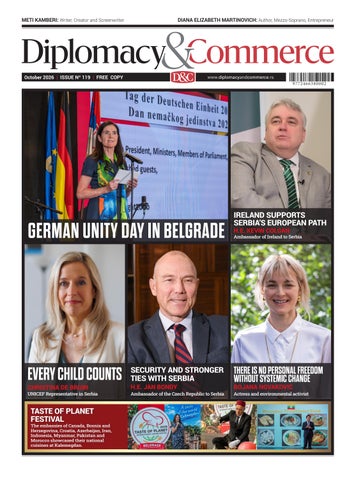
METI KAMBERI: Writer, Creator and Screenwriter
DIANA ELIZABETH MARTINOVICH: Author, Mezzo-Soprano, Entrepreneur
October 2026 | ISSUE Nº 119 | FREE COPY
www.diplomacyandcommerce.rs
GERMAN UNITY DAY IN BELGRADE
IRELAND SUPPORTS SERBIA’S EUROPEAN PATH H.E. KEVIN COLGAN
Ambassador of Ireland to Serbia
EVERY CHILD COUNTS
SECURITY AND STRONGER TIES WITH SERBIA
THERE IS NO PERSONAL FREEDOM WITHOUT SYSTEMIC CHANGE
UNICEF Representative in Serbia
Ambassador of the Czech Republic to Serbia
Actress and environmental activist
CHRISTINA DE BRUIN
TASTE OF PLANET FESTIVAL
The embassies of Canada, Bosnia and Herzegovina, Croatia, Azerbaijan, Iran, Indonesia, Myanmar, Pakistan and Morocco showcased their national cuisines at Kalemegdan.
H.E. JAN BONDY
BOJANA NOVAKOVIĆ
AWARDED BY THE WORLD, SHAPED BY THE ISLAND
Christmas and New Year on Dugi Otok RESERVATIONS
reservation@villanai.com
+385 23 643 520
Žman 199, 23282 Žman, Dugi Otok, Croatia
villanai.com
The holiday programme runs from 24 December to 6 January. Guests will have the opportunity to taste the new season’s olive oil, join evening squid fishing or daytime big game fishing, and experience the island in its peaceful winter season at the only hotel in Croatia with three MICHELIN Keys.
CONTENTS
October 2026
FOLLOW US FOLLOW US TO STAY UPDATED TO STAY UPDATED
FREE COPY
06
FREE COPY Subscription Only Subscription Only
AMBASSADOR’S INTERVIEW
IRELAND SUPPORTS SERBIA’S EUROPEAN PATH H.E. KEVIN COLGAN
MAGAZINE #119 / October 2026
Ambassador of Ireland to Serbia
CONTENTS 10
31
EVERY CHILD COUNTS CHRISTINA DE BRUIN
32
GERMAN UNITY DAY SPECIAL
FEATURED INTERVIEW
UNICEF Representative in Serbia
AMBASSADOR’S WORD
SUPPORTING A STRONG, DEMOCRATIC AND FREE SERBIA IN EUROPE H.E. ANKE HOLSTEIN
14
EXCLUSIVE INTERVIEW
THERE IS NO PERSONAL FREEDOM WITHOUT SYSTEMIC CHANGE BOJANA NOVAKOVIĆ
Ambassador of Germany to Serbia
34
CULTURAL INTERVIEW
LEARNING TO BE SILENT IN MANY LANGUAGES METI KAMBERI
Actress and environmental activist
Writer, Creator and Screenwriter
51
CZECH STATEHOOD DAY SPECIAL
52
AMBASSADOR’S INTERVIEW
SECURITY AND STRONGER TIES WITH SERBIA H.E. JAN BONDY Ambassador of the Czech Republic to Serbia
Featured countries in this edition: ARGENTINA / ARMENIA / AZERBAIJAN / BOSNIA AND HERZEGOVINA / CANADA / CROATIA / CZECHIA / EGYPT / GERMANY / KAZAKHSTAN / INDONESIA / IRAN / IRELAND / ITALY / LEBANON / MONTENEGRO / MOROCCO / MYANMAR / ORDER OF MALTA / PAKISTAN / SERBIA / SPAIN / UNICEF
Published on 20th October 2026 Director ROBERT ČOBAN robert.coban@color.rs Director ROBERT Editor inČOBAN Chief robert.coban@color.rs DRAGAN NIKOLIĆ dragan.nikolic@color.rs Editor-in-Chief DRAGAN NIKOLIĆ Journalists dragan.nikolic@color.rs MIJAT KONTIĆ ŽIKICA MILOŠEVIĆ Journalists MIJAT KONTIĆ Advertising ŽIKICA MILOŠEVIĆ DRAGAN NIKOLIĆ BOJANA BAČIĆ dragan.nikolic@color.rs
Contributors DRAGAN ROBERTVUČEVIĆ ČOBAN dragan.vucevic@color.rs LAZAR JOVANOVIĆ NIKOLA PERIŠIĆ marketing@color.rs Advertising Photos DRAGAN NIKOLIĆ GORAN ZLATKOVIĆ dragan.nikolic@color.rs NEBOJŠA BABIĆ MILOŠ NADAŽDIN DRAGAN VUČEVIĆ dragan.vucevic@color.rs STEFAN ĐAKOVIĆ KHARIM NSENGIYUMVA marketing@color.rs JAKOV SIMOVIĆ SHUTTERSTOCK Photos GORAN ZLATKOVIĆ Translation DARIO KONSTANTINOVIĆ COLOR MEDIA EVENTS STRAHINJA AĆIMOVIĆ ĐORĐE TOMIĆ Prepress TANJUG VLADIMIR DUDAŠ SHUTTERSTOCK Centrobiro Translation Contributors COLOR MEDIA EVENTS ROBERT ČOBAN DUŠKA JOVANIĆ Prepress LJILJANA DUDAŠ VUJIĆ VLADIMIR VIKTOR C e n t r oLAZIĆ biro Print Print COLORCOMP PRINTD.O.O. BIROGRAF Novi Sad Pulje 22 Zemun, Atanasija Distribution PRETPLATA D.O.O. office@pretplata.rs +381 11 314 99 21 COLOR MEDIA EVENTS COLOR MEDIA EVENTS Published by: Published by: Color Media Events d.o.o. Color Media Events d.o.o. 21000 Novi Sad, Serbia 21000 Novi Sad, Serbia Mileve Simić 27 Temerinska 102 VAT: 113769690 VAT: 113769690 Reg. No: 21922978 Reg. No: 21922978 Belgrade Office: Belgrade Office: Vlajkovićeva 6 Bul. Zorana Đinđića 48b 11000 Belgrade, Serbia 11070 Novi Beograd, Serbia Phone: + 381 63 432 392 Phone: + 381 63 432 392 CIP – Katalogizacija u publikaciji CIP – Katalogizacija u publikaciji Biblioteka Matice Srpske, Novi Sad Biblioteka Matice Srpske, Novi Sad 33 33 Diplomacy & Commerce / glavni i Diplomacy & Commerce / glavni i odgovorni urednik: Dragan Nikolić, odgovorni urednik: Dragan Nikolić, 2016, (mart)-.2016, (mart)-.Novi Sad: Color Media Novi Sad: Color Media Events, 2016 - , -33cm Events, 2016 - , -33cm Mesečno Mesečno ISSN 2466-3808 = ISSN 2466-3808 = Diplomacy & Commerce Diplomacy & Commerce COBISS.SR-ID 303269895 COBISS.SR-ID 303269895 Copyright 2024 Copyright 2026 © Color Media Events © Color Media Events
Next issue: #120 November 2026
3
FOREWORD
BAY OF KOTOR – – ISTRIA – VOJVODINA
Dobrota, Bay of Kotor
110
Panoramic View of Rovinj, Istria
years ago, all three regions were part of the same country, Austria-Hungary. After 1945, they were united within Yugoslavia. Today, they are spread across four countries: Slovenia, Croatia, Montenegro and Serbia. 110 years ago, Vojvodina, with its developed industry and agriculture, had the highest GDP per capita of the three regions. Today, it has the lowest. All three regions underwent significant demographic changes after 1945. Following 1921, Vojvodina received an influx of settlers, including Serbian volunteers who had fought on the Salonika Front and White Russian refugees. This brought new blood into the region without fundamentally altering its multicultural balance. If anything, it made Vojvodina even more diverse. After 1945, however, everything changed. Vojvodina lost its Jewish population, most of whom perished in the Holocaust, while many survivors emigrated to Israel in 1948. It also lost its Germans, some of whom fled, others were killed or died in internment camps between 1945 and 1948, while those who remained eventually emigrated to Germany. The White Russians also fled, escaping the advancing Red Army just days before the Germans. In Istria, Italians left the region, and Croats occupied their homes, along with smaller numbers of Serbs and Roma. The Bay of Kotor did not experience such dramatic demographic changes immediately after 1945. However, decades of assimilation and migration eventually transformed it into a predominantly Orthodox region, populated mainly by Montenegrins and Serbs. Today, Istria is Croatia’s wealthiest region, and the Bay of Kotor is Montenegro’s wealthiest. Vojvodina, meanwhile, except for the increasingly overcrowded Novi Sad, is experiencing dramatic depopulation and economic decline. This process began as early as the late 1970s, when the first railway lines were closed, devastating numerous villages that have never recovered. It continued after the 1988 Yoghurt Revolution and has remained uninterrupted ever since. Rovinj, for example, managed to preserve its industrial base, including TDR and Mirna, relocating their facilities outside the town while allowing tourism to flourish in its historic centre. The Bay of Kotor is packed with tourists even in early October. Dozens of aircraft from around the world land at Tivat Airport every day, while new hotels and development projects continue to spring up. I have explored all three regions by bicycle and am quite familiar with local conditions. Nevertheless, I also consulted the available statistical sources.
Abandoned Railway Station in Seleuš, Vojvodina
According to Maddison’s historical economic estimates, around 1910 Istria had a GDP per capita of between 1,300 and 2,100 international dollars (at 1990 prices), Vojvodina between 1,500 and 2,100, and the Bay of Kotor between 900 and 1,600. For present-day Vojvodina, the official GDP per capita in 2024 stood at 1.363 million Serbian dinars, equivalent to 92.1% of the Serbian national average. For Istria, the latest official county-level figure is for 2023, so the 2025 figure is an estimate based on that data and subsequent nominal growth. The Bay of Kotor has no separate official regional GDP statistics, making its estimated €18,000 per capita the least reliable of the three contemporary figures. However, the combined economic output of its three municipalities, Kotor, Herceg Novi and Tivat, provides a reasonable basis for comparison. In other words, around 1910 Vojvodina was slightly wealthier than Istria, while the Bay of Kotor was considerably poorer. Today, the ranking has effectively been reversed: Istria: approximately €27,000 GDP per capita, Bay of Kotor: approximately €18,000, Vojvodina: approximately €12,700. Put simply, Istria’s GDP per capita is now roughly 2.1 times that of Vojvodina, while the Bay of Kotor’s is approximately 1.4 times higher. One might argue that Istria and the Bay of Kotor have an obvious advantage: the sea. Global economic trends have changed, tourism has taken centre stage, and agriculture, once the backbone of Vojvodina’s economy, has been pushed into the background by import liberalisation and other structural developments. Similar processes can be observed in Slavonia, Croatia, for example. But there is a fairly straightforward response. Neither Austria nor Hungary has a coastline, yet both generate substantial tourism revenue. Granted, Austria has its mountains, ski resorts, Vienna and Salzburg, not to mention an uninterrupted capitalist economic system. But what about Hungary? Hungary lived under a far more rigid form of socialism than Vojvodina. Indeed, following the failed Hungarian Revolution of 1956, refugees fled from Hungary into Vojvodina. Yet that same Hungary has since developed a thriving spa tourism industry, attracting thousands of visitors from Vojvodina itself. Meanwhile, Vojvodina’s once prosperous and well-developed spa resorts, including Lemeška Banja, Banja Junaković near Apatin and the spa in Kanjiža, have either fallen into serious decline or now function primarily as medical treatment facilities rather than tourist destinations.
Robert Čoban
4
www.diplomacyandcommerce.rs
AMBASSADOR’S INTERVIEW
Ireland Supports Serbia’s European Path EU Enlargement, Reform and Dialogue under Ireland’s Presidency H.E. KEVIN COLGAN Ambassador of Ireland to Serbia
I
n an exclusive interview for Diplomata, H.E. Kevin Colgan, Ambassador of Ireland to Serbia, discusses the priorities of Ireland’s EU Council Presidency and the prospects for Serbia’s European integration. He addresses the opening of Cluster 3, key reforms, foreign policy alignment and the future of EU enlargement, while highlighting the importance of dialogue between Belgrade and Priština.
6
WHERE REFORMS ARE DELIVERED, PROGRESS SHOULD BE RECOGNISED. In July, Ireland took over the Presidency of the Council of the European Union, and we heard Dublin will be focused on strengthening competitiveness, security and common values. You said at the time that Serbia has the capacities to make progress in European integration. In which areas do
you think that is possible? Ireland is honoured to hold the Presidency of the Council of the European Union for the eighth time. We continue our work at a particularly defining moment for Europe, as we navigate growing geopolitical tensions, economic uncertainty and an evolving security landscape.
As you said, our Presidency is guided by three closely connected priorities: competitiveness, values and security. Together, they reflect our ambition to build a stronger, more resilient Europe – one that is economically competitive, steadfast in defending democracy and the rule of law, and capable of responding to today’s security challenges. Enlargement is central to that vision. We see the enlargement process as a key expression of our values and an investment in peace, security, stability, and prosperity
www.diplomacyandcommerce.rs
AMBASSADOR’S INTERVIEW
across Europe. At the same time, enlargement must be grounded in the European Union’s values and principles. This is essential if the Union is to remain strong and if the transformative benefits of membership are to be sustained. On Serbia, Ireland supports its EU accession pathway. It is a strategic objective of the Government here. Serbia has made progress in a number of areas over the years, and the European Commission has recognised that it has met the technical benchmarks for opening Cluster 3. Ireland has supported that assessment. We recognise the progress that has been made, while also being clear that further reforms remain essential, particularly in strengthening the rule of law, the independence and efficiency of the judiciary, public administration, and the fight against corruption and organised crime. Ultimately, these reforms are not simply requirements for EU membership. They are also reforms that can bring real benefits to Serbian citizens, by strengthening institutions, improving the business environment, increasing public trust and creating greater predictability. The issue of opening Cluster 3 for Serbia should be considered again in September, and some member states have previously been firmly against it. Do you expect this to change? In July you mentioned Ireland would like to help in this process - what can Ireland do in this regard? During Ireland’s Presidency, we will continue to support a credible, predictable and merit-based accession process. We will seek to act as an honest broker with the aim to help create the conditions for constructive discussion and to support all candidate countries in continuing their progress on its European path. Where reforms are delivered, progress should be recognised. Ireland remains an advocate of Serbia’s EU accession path. I have already said that we support the European Commission’s formal assessment that Serbia has met the technical benchmarks and is ready to open Cluster 3. However, as Presidency, our role is not to impose an outcome, but to work constructively with all Member States. We will continue to engage in the background with our European partners, listen to their views, understand their various concerns, encourage dialogue and bring people together.
THE RIGHTS, SECURITY AND WELL-BEING OF COMMUNITIES SHOULD REMAIN AT THE CENTRE OF DIALOGUE EFFORTS. Many say the technical part for the Cluster is largely completed, but that there is a political component to this. Would political signals help? Is one of those signals the recent visit of the Ukrainian president to Serbia? Active support for Ukraine is a defining priority for the Irish Presidency. Ukraine continues to endure brutal Russian aggression against its people and territory as Russia launches attacks against the country’s infrastructure, economy, environment and social systems. The Irish Presidency is working to enhance the European Union’s unwavering support for Ukraine, including political, military and financial support, as well as continued pressure on Russia through robust sanctions.
We will continue to call for a just and lasting peace for Ukraine, while upholding the fundamental principle that borders cannot be changed by force. In this context, we welcomed the recent visit of President Volodymyr Zelenskyy to Belgrade. It represents a positive development and, notably, the first visit by a Ukrainian President to Serbia in many years. It was also heartening to hear Ukraine reaffirm its support for Serbia’s European pathway and vice versa. We believe that candidate countries can learn a great deal from one another as they progress towards EU membership, and this is also one of the reasons why it was particularly encouraging to see the Speaker of the Verkhovna Rada, Ruslan Stefanchuk, participate in the EU accession
conference alongside representatives from candidate countries. Ireland is clear that the enlargement process is a shared European endeavour. However, we are also clear that this is not just a one-way street. It is important that candidate countries demonstrate their commitment to the fundamental values on which the European Union is built. We want to see strong institutions, free and fair elections, the rule of law, judicial independence, as well as respect for territorial integrity. For Ireland, how important is it for Serbia to be in accordance with the common security policy of the EU? How does Ireland see the stance of Serbia during war in Ukraine, and is Serbia’s position an insurmountable obstacle? The key areas for progress for Serbia are well known and are reflected in the European Commission’s annual reports. They include strengthening the rule of law, reinforcing the independence of institutions, advancing media
7
AMBASSADOR’S INTERVIEW
freedom, continuing electoral reforms and increasing alignment with the EU’s Common Foreign and Security Policy. Alignment with the EU’s Common Foreign and Security Policy is an essential requirement for EU accession. Every candidate country must align with the Union’s common foreign and security policy and the principles that underpin it. Serbia’s alignment with the EU’s Common Foreign and Security Policy is crucial. Ireland will continue to encourage Serbia to make progress in its alignment. Europe’s increasingly complex security environment is a challenge that no Member State can respond to alone. They require a coordinated European response, and that logic is reflected in the motto of our Presidency, Ní neart go cur le chéile – “Strength in unity”. It reflects our conviction that Europe’s strength comes from acting together, particularly in challenging times. Our objective is to help build a Europe that is safer, stronger and better prepared for the challenges ahead, while keeping the door open to countries that are willing and able to meet the requirements of EU membership. Ireland supports the enlargement process - during its Presidency in 2004, the largest number of countries joined the EU to date. Would you say there will definitely be new EU members in the years to come, given the current geopolitical situation? Is it possible that Montenegro could become a new member in 2028? Ireland has always been a strong supporter of enlargement, and we are proud that we held the Presidency during the historic 2004 enlargement, when ten new Member States joined the European Union. Our own experience has shown us how transformative EU membership can be, and we want other European countries to benefit as we have. We welcome the renewed momentum behind enlargement across the European Union. The challenge now is to translate that political momentum into progress. We are working closely with our European partners during our Presidency to ensure that enlargement remains a priority and that countries making the necessary reforms continue to move forward on their European path.
8
ALIGNMENT WITH THE EU’S COMMON FOREIGN AND SECURITY POLICY IS AN ESSENTIAL REQUIREMENT FOR EU ACCESSION Montenegro has made significant progress and is now entering the final phase of its accession journey. If further progress can be made during our Presidency, this would be important not only for Montenegro, but for the entire European project. Thirteen years on from the last accession, it would demonstrate that European Union membership remains an achievable objective. During the Irish EU Presidency, we will advance the work of the Ad Hoc Working Party on Drafting Montenegro’s Accession Treaty. We want to facilitate Montenegro’s goal of closing all negotiating chapters by the end of our term. Nevertheless, I would be cautious about putting a definitive date on any accession. Membership ultimately depends on the completion of the accession process and the necessary reforms, and each country must
move forward on its own achievements. We recognise that each country is at a different stage of its European journey, and the process must remain credible, predictable and merit-based. What about Moldova and Ukraine, especially Ukraine? There has been opposition in the Western Balkans to their fasttrack membership, although it relates mostly to security issues. We firmly believe that EU membership is one of the best commitments to peace and prosperity across our continent. Russia’s invasion of Ukraine made clear to all the strategic importance of the enlargement process for the EU. During the Presidency, we are seeking to make substantial progress in negotiations with Moldova and Ukraine. We welcome the opening of Cluster 1 on Fundamentals with Ukraine and Moldova. It sends a positive signal
to Ukraine and Moldova, and most importantly to their citizens. Over the past year, both countries have made remarkable progress to align their national legislation with EU law and advance in their EU accession process. This step, which Ireland strongly welcomes, is well overdue. Ireland is committed to facilitating the opening of all remaining negotiating clusters with Ukraine and Moldova, in the next six months. Ireland wants to see countries that are ready and able to meet the membership criteria move forward. We will continue to do everything we can during its Presidency to keep that enlargement momentum moving forward. The Western Balkans is clearly a hugely important region for the European Union and for Ireland by extension. We believe that the future of the region lies within the European Union. A stable and prosperous Western Balkans is in the interests of all of us. This commitment is reflected in our growing engagement across the region, including through the opening of Embassies in Sarajevo and Belgrade, which marked a significant deepening of Ireland’s engagement in the Balkans and our long-term
www.diplomacyandcommerce.rs
AMBASSADOR’S INTERVIEW
commitment to supporting the region’s European perspective. At the same time, it is important that candidate countries help us to make the case for them, by implementing all the laws and reforms required to align with the EU acquis. In your opinion should the new members have full rights, or is Ireland close to some kind of sector integration as it is sometimes referred to? Ireland supports the merit-based process and believes that those countries who have done the required work to enter the European Union should benefit as full-fledged members with equal rights. Of course, as Presidency and as an honest broker we will continue to welcome any efforts which seek to revitalise the enlargement process and build on recent momentum. There is now a renewed momentum behind enlargement, and I believe the recent summit in Tivat sent an important political message at a time when some had begun to question whether enlargement remained a genuine priority for the European Union. The message was clear: enlargement is once again at the centre of the European agenda, and both the European Union and the candidate countries have a shared interest in making this process a success. Enlargement requires continued commitment from both sides. Candidate countries need to maintain the pace of reforms, while the
European Union must ensure that genuine progress is recognised and rewarded. The credibility of the enlargement process depends on maintaining this balance. One of the long-standing conditions for Serbia’s EU integration was dialogue between Serbia and Kosovo. There is no dialogue now, and Kosovo authorities are taking more and more of what’s left of the autonomy of Serbian community. What is the position of Ireland on this, especially taking into consideration that the Northern Ireland model was one of the models thought about as the possible solution? The EU-facilitated Dialogue remains the only framework capable of delivering a sustainable normalisation of relations between Belgrade and Pristina. It ensures regular dialogue between the two sides to seek practical solutions to emerging issues. Ireland fully supports the efforts of the European Union and the EU Special Representative. We encourage both sides to engage constructively and to focus on concrete solutions that improve the lives of citizens on the ground.
The history of Ireland has taught us the value of dialogue, even when progress can appear difficult or slow. Durable solutions are rarely achieved overnight, but they are built through sustained engagement and political courage. The rights, security and well-being of communities should remain at the centre of dialogue efforts. In so far as Northern Ireland is comparable – if it is even so, given the very different historical and political contexts – what we learned was the value of both sides sitting down with a genuine willingness to make political concessions for the sake of improvements in the day to day lives of ordinary people. Dialogue requires patience, political courage and a willingness to find practical ways forward, even where there are profound differences between the parties. There is also an important lesson in the role that European integration played in the Northern Ireland peace process. Relationships between Ireland and the United Kingdom were bolstered by shared membership of the European Union, which provided a framework in which relationships could be deepened at all levels - from politicians
THE CREDIBILITY OF THE ENLARGEMENT PROCESS DEPENDS ON MAINTAINING THIS BALANCE
exchanging ideas in the corridors of Brussels, to businesses across the island finding new ways to work with one another. The circumstances in the Western Balkans are different, and there is no simple model that can be transferred from one context to another. But the broader lesson remains relevant - sustained dialogue, political courage and a willingness to make compromises in the interests of people can create the conditions for lasting progress. This is why Ireland will continue to support the EU-facilitated Dialogue and efforts towards a sustainable normalisation of relations between Belgrade and Pristina. Ireland has used EU membership to transform itself for the better. What is the advice for Serbia? Ireland is fortunate to be at the heart of the European Union, an unprecedented peace project, a vibrant market of more than 450 million people and a catalyst for positive social change and inclusion. We would like people in Serbia to know that Ireland has benefited massively from EU membership. Over more than 50 years of membership, the EU has been central to peace and prosperity on our island. We have benefited enormously from membership. Since joining the European Union in 1973, Ireland has undergone a massive transformation, with our society, our influence and our economy changing for the better. EU membership has improved almost every aspect of our lives, from how we work, travel and study, to the quality of our environment and the opportunities available to our businesses and young people. It has also given Ireland a stronger voice internationally and created opportunities that have had a lasting impact on our country. It is because of our own positive experience that Ireland has always been a strong supporter of enlargement. We would like to see other European countries benefit as we have, provided they make the necessary reforms. The accession process can be demanding, but the reforms required are not simply conditions for EU membership. They can bring real and lasting benefits to Serbian citizens, institutions, businesses and young people. The transformative potential of EU membership is clear. I hope to see the same opportunities extended to Serbians.
9
FEATURED INTERVIEW
Every Child Counts As UNICEF marks its 80th anniversary, its new cooperation programme with Serbia aims to ensure that every child has equal opportunities to thrive by 2030 CHRISTINA DE BRUIN UNICEF Representative in Serbia
H
You recently took up your position as UNICEF Representative in Serbia at a particularly significant moment, as UNICEF marks its 80th anniversary. What would you personally like to achieve during your mandate in Serbia, and where do you see the greatest opportunity to make a lasting difference for children? I feel fortunate to have arrived in Serbia in UNICEF’s 80th anniversary year. Globally, UNICEF was created in 1946, when a world still recovering from war decided that children should come first. In Serbia, our story began almost immediately afterwards, with humanitarian aid for children in the post-war years. That emergency support grew into a long-term partnership. Today, much of what we have built together, from early childhood services to inclusive education and family-based care, is part of national systems. My priority is to make sure those gains reach every child, including those still left behind: children living in poverty, Roma children, children with disabilities and children in rural areas. The greatest opportunity lies in the earliest years. Over the past five years, 79,000 children and their families have benefited from early childhood development services and parenting programmes. I also hope to
10
INVESTING IN CHILDREN DURING THE EARLY YEARS IS ONE OF THE HIGHEST-RETURN INVESTMENTS A COUNTRY CAN MAKE help Serbia take a decisive step towards ending violence against children, offline and online, and to grow our partnerships with
businesses, foundations and the international community, who have become real allies for children here.
You have spent more than 27 years working in international development, humanitarian action and children’s rights across Europe, Africa and Asia. What has kept you personally committed to this mission throughout such a long and diverse career? It’s really the children themselves that inspire me the most, by their resilience and hope. Only a few
www.diplomacyandcommerce.rs
Photo: Dario Konstantinović
aving recently taken up her role as UNICEF Representative in Serbia, Christina de Bruin brings more than 27 years of international experience in development, humanitarian action and children’s rights. As UNICEF celebrates its 80th anniversary, she discusses the organisation’s priorities in Serbia, the challenges facing children today and its vision for a future in which every child has an equal opportunity to thrive.
FEATURED INTERVIEW
weeks ago, I was at the University Clinical Centre in Kragujevac to deliver a mobile X-ray machine to the neonatal intensive care unit. Some of the babies there are extremely fragile, weighing as little as 600 grams, and with this machine they can now get X-rays safely and on time, without being moved to another building. Every day in Serbia, around eleven babies are born prematurely, and seven of them need intensive care. I met a mother whose babies had spent weeks in that unit. She told me about the moment she was finally able to hold her children. Today her daughters are home and growing healthy and stronger. In partnership with the Ministry of Health, we are strengthening the system so that every newborn, especially the most vulnerable premature babies, receives the care they need. Serbia’s achievements in maternal, newborn, child and adolescent health often serve as an example across the region. In 27 years, across Europe, Africa and Asia, I have seen what changes when a system works for a child, and how fragile that progress can be. What still inspires me about UNICEF is that we respond when children urgently need help during emergencies, and we stay to build systems that protect them for generations. That is what this work is about. Having worked in very different countries and social contexts, what lessons from your international experience do you believe could be particularly relevant for Serbia today? The first lesson is to invest early. Investing in children during the early years, is one of the highestreturn investments a country can make. The second is that projects alone are not enough. What lasts are systems: services written into law, funded from public budgets and delivered by well-supported and trained professionals. The third is that change happens fastest when everyone is involved: institutions, civil society, communities, the private sector, international partners and children themselves. Finally, look behind the averages. In every country where I have worked, focusing on the children furthest behind has proved not only fairer, but the most effective way to improve the lives of all children.
VIOLENCE, OFFLINE OR ONLINE, DOES NOT END WHEN THE INCIDENT ENDS: IT CAN DEEPLY AFFECT CHILDREN’S MENTAL HEALTH, RELATIONSHIPS AND ABILITY TO LEARN UNICEF is celebrating 80 years since its establishment in the aftermath of the Second World War. Eight decades later, the world and the challenges facing children have changed dramatically. Why does UNICEF’s mission remain as relevant today, and what does this anniversary mean in the context of Serbia? UNICEF was created on 11 December 1946 to help children
whose lives had been torn apart by war. At a time of deep division, leaders agreed on one thing: every child deserves protection. Globally, since 2000, under-five mortality has halved, and 9 in 10 children now attend primary school. Immunization saves 4.4 million lives every year and has prevented 154 million deaths over the past halfcentury, delivering $1.5 trillion
in global health and economic benefits. Yet progress is fragile. In 2025, 45.3 million children were displaced by conflict and violence, nearly three times as many as in 2010. Children face risks no one could have imagined in 1946, from AI without strong safeguards to a growing mental health crisis. For Serbia, this anniversary is a story of partnership. UNICEF has been here from the start, first with humanitarian aid after the war and today with national institutions and partners, strengthening the services children rely on every day. It is a moment to celebrate what Serbia has achieved, and to renew our shared promise to every child.
11
When you look at the situation of children in Serbia today, which challenges concern you most? Are there areas where progress has been made, but where significant inequalities or gaps still remain? There is real progress to celebrate. Nationally, neonatal mortality has fallen from 4.63 to 2.91 per 1,000 live births since 2010, preschool enrolment has risen from 58 to 69.5 per cent since 2014, and the share of young people aged 15 to 24 not in education, employment or training dropped from 17 to 13 per cent between 2020 and 2025. But not every child is benefiting equally. The new Multiple Indicator Cluster Survey (MICS), which UNICEF is publishing this year with the Statistical Office, will show the latest picture of children’s well-being. What concerns me most is violence against children: at home, at school and, increasingly, online. New UNICEF research covering 21 countries, including Serbia, shows that children continue to face significant risks in the digital environment. Almost one in five children aged 12 to 17 reported experiencing some form of technology-facilitated sexual exploitation or abuse within a year, while very few cases were reported. This highlights how important it is for children to know where they can turn for trusted and timely support. Violence, offline or online, does not end when the incident ends: it can deeply affect children’s mental health, relationships and ability to learn. UNICEF and Serbia are entering a new phase of cooperation with a programme extending to 2030. What are its main priorities, and how should children and families experience the results of this cooperation in their everyday lives? Our new Programme of Cooperation is built around one word: equity. By 2030, with the Government, we aim to see 80 per cent of children under five benefit from early childhood development and parenting support, 95 per cent measles vaccination coverage and 83 per cent of children aged 3 to 5.5 years in preschool. For families, success should feel simple: a nurse who visits after a baby is born, a preschool place close to home, a school that welcomes every child. We are not starting from scratch. Partners have been part
12
Photo: Dario Konstantinović
FEATURED INTERVIEW
IN A COUNTRY WHERE FEWER CHILDREN ARE BORN EACH YEAR, EVERY CHILD COUNTS, AND INVESTING IN THEM IS ONE OF THE SMARTEST INVESTMENTS SERBIA CAN MAKE of UNICEF’s story since the first private donation in 1947, and in Serbia they have already shown what is possible. With European Union support, a network of resource centres has helped around 500 schools to deliver high-quality inclusive education, with tailored support and assistive technologies. Our corporate partners bring both funding and expertise. Their support has contributed to results achieved together with national institutions: more than 15,000 children in 30 primary schools gaining digital skills, early intervention for young children with developmental difficulties now available to families in 80 per cent of districts, and assistive technology for children with disabilities. It has also supported efforts to keep children safe online and to equip neonatal units, part of nearly €1 million UNICEF has invested in newborn care since 2018. More than 30 per cent of municipalities already fund early childhood services from their own budgets. The next five years are about taking what works to every child, and we will need partners more than ever to do it. One of the messages surrounding UNICEF’s 80th anniversary is the importance of listening to children themselves.
In practice, how seriously do adults, institutions and decisionmakers listen to children, and what needs to change for children to have a meaningful voice in decisions that affect their lives? Better than before, but not yet enough. Through U-Report, 25,235 young people in Serbia have shared their views, contributing to around 40 policies, while more than 3,600 young volunteers have been engaged across the country. Too often, though, children are consulted at the end of a process or may not see what difference their views made. Real participation means involving children from the start, in ways that suit their age, and coming back to tell them what changed. Children are clear about what worries them: violence, including online, pressure on their mental health, climate change and their future. In some countries, up to two thirds of children say they worry that AI could be used to create fake images or videos. They deserve a say in how the platforms and AI tools they use every day are designed more safely. Young people are ready. Our systems need to meet them halfway. If we were to have this conversation again in 2030, what
changes would you hope to see in the lives of children in Serbia? What needs to happen over the next five years to make that vision possible? By 2030, UNICEF hopes to see a Serbia where a child’s chances no longer depend on where they are born, how much their parents earn or whether they have a disability. Every baby gets a good start, with support for parents from the very first days. Every child goes to preschool and learns well at school. Fewer children experience violence, and those who do get help quickly. More children grow up in families, teenagers know where to turn when they are struggling, young people have a real path into work, and children can learn, play and connect safely online. None of this will happen by chance. In a country where fewer children are born each year, every child counts, and investing in them is one of the smartest investments Serbia can make. That means proven services funded from public budgets and available nationwide, health, education and social protection working as one, and children’s voices heard along the way. And it means everyone playing their part: parents, communities, institutions, businesses, foundations and international partners, each bringing what they do best. If we keep making these choices together, then when we sit down again in 2030, we will be talking not only about progress, but about sustainable progress that reaches every child.
www.diplomacyandcommerce.rs
EXCLUSIVE INTERVIEW
by Dragan Nikolić
There Is No Personal Freedom Without Systemic Change BOJANA NOVAKOVIĆ Actress and environmental activist
F
or Bojana Novaković, protecting land, water and food sovereignty cannot be separated from politics. The actress, whose career spans Serbia, Australia and the United States, describes how the
14
campaign against Rio Tinto drew her into civil society organising and changed her priorities. She speaks about the alliances forged across ideological divides, the roles she stopped pursuing and why Serbia’s student movement has given her reason to approach an election with unusual hope.
You have lived between Serbia, Australia and the United States, and have had the opportunity to see very different societies and institutions up close. When you look at Serbia today from that perspective, what troubles you more: what those in power are doing, or what citizens have gradually learned to accept as normal?
What those in power are doing troubles me most. To me, the idea that citizens have allowed this to happen is typical victim-blaming. It is like saying that a woman wearing a short skirt and walking at night is asking for sex. There is no comparison. This government, which is a branch of the previous regime of the 1980s and 1990s, has created
www.diplomacyandcommerce.rs
Photo: Goran Zlatković
Bojana Novaković on the power of civil society, the personal cost of activism and her hope for change in Serbia
EXCLUSIVE INTERVIEW
a structure, a cartel and an organised criminal network that divides society. The crucial thing to understand is that they act as lobbyists for foreign corporations. With that kind of government, it’s hard even to recognise what is happening. It is like the boiling frog: by the time people understand it collectively, it is already quite late. We are at that point now, struggling in a pre-political, preideological state. And now we are supposed to blame the people? None of these societies is homogeneous: Australia, America or Serbia. We are all multicultural, even here, and none is ideal. It may be easier to see functioning institutions in larger countries. Australia, for example, has much better healthcare and education systems than America, and a separation between church, state and institutions, although not in every respect. But in the United States you have Flint, Michigan, where there is no drinking water, just as in Zrenjanin. In Australia you have the enormous problem of Aboriginal children being killed in custody. Speak to those communities and families, and you’ll see that government, structure, or system does not function for them. It functions for someone else. I find it easier to look at Serbia within the wider picture of Europe. Serbia is like Flint, Michigan, and Europe is like the United States. Corporate investment works for some people: those with money, who protect corporate interests, and who are in bed with corporations. But it does not work for Serbia. We have a country that has been sold, not just metaphorically, but literally. So I do not blame citizens. I blame those who abuse their privileges: their citizens, the police, and statesmen and lawmakers. Laws are changed to favour corporations, and then those laws suit them. But where the constitutional right to a healthy environment or the public interest needs protection, the law effectively does not exist. Your environmental activism in Serbia began with the fight against the Jadar project, but your public engagement has long since moved beyond a single mine and become openly political. Was there a particular moment when you realised that you could no longer defend a river, the land or clean air without directly confronting the political system making decisions about them?
Everything is political. Relationships between people, corporations, local government and national government are all political. You do not have to belong to a political party to be a political being. What I do is civil society organising, which is very different from party politics. I never want to get into party politics because I believe that civil society is where the power lies. Politicians and parties need to serve civil society. Unfortunately, you cannot protect the earth, the air, food sovereignty or farmers’ rights without being political.
THERE IS NO PERSONAL FREEDOM WITHOUT SYSTEMIC CHANGE People in the Balkans are a little allergic to the word “politics” because they think it means choosing a party. But from the start of our campaign, we couldn’t do that. When a new government is formed, we still need to exist as civil society and put pressure on corporations, because certain laws give those corporations rights in this country. Even politicians who want to protect the rights of nature and the environment need public support and participation. Once they are in positions of authority, they need us to remind them that, according to our constitution, the people are the authority. Civil society’s role in politics is crucial. These things cannot be separated. Do I vote? Yes. Do I often feel that my vote is pointless here? Yes. I feel that way about presidential elections in America, too. But local government politics, local decision-making, and how taxpayers’ money is spent locally are crucial, particularly here, where we have these local “sheriffs”. I believe that the personal is political, that collective trauma is political, and that political will is the solution to many things we think of as personal problems. Personal freedom is impossible without systemic change. The two are intertwined. You have spoken openly about the need for political change and about the importance of voting. At the same time, we still often
hear people in Serbia say, “I support the students, I support the environmental protests, but I don’t want to get involved in politics.” Is that position still possible today, or has refusing to engage in politics itself become a political choice? Yes, absolutely. Saying you don’t want to be political is a political choice. When you say, “I support the students” or “I support the right to a clean environment”, you are inherently saying something political. The term “politics” has been poisoned by an organised crime cartel, and people have equated it with party politics. In this country, one party is leading that charge. The idea that politics is only about involvement in elections is a very narrow perspective. The fact that I, as a woman, wear trousers is political, because women fought for that right when we could only wear skirts. The fact that I can walk outside, work or not work, and vote: these are all political things that people do not think about. They do not think about the political activism that brought us to this point. I completely understand people who do not want to be involved in party politics. I actually think that is healthy. What is sad is that they don’t understand that, by living in a society and paying taxes, they are political beings. We all are. Saying you are apolitical is like saying a fish doesn’t swim in water. It does not make sense.
WE ARE TOTALLY DIFFERENT, BUT WE ALL NEED THE SAME I understand the resistance, because people do not want to be involved in an obviously corrupt system. I think that is what they are saying. I do not think they are necessarily saying, “I am not interested” or “I will not vote.” Perhaps they are simply disgusted. But I do not want to give the current regime the luxury of creating a group of people who say they do not want to be involved in politics. That is its aim: to make people so disgusted that they do not get involved or go out to vote. That is how it stays in power. I do not doubt that this is part of the plan.
Environmental protests in Serbia have brought together people who may agree on very little else: the left and the right, liberals and conservatives, urban activists and farmers. Has environmentalism become the last political language in Serbia that can cross ideological trenches? And what happens when the question is no longer “What are we against?” but “What kind of Serbia do we actually want?” The environmental movement in Serbia did not just unite the groups you mentioned. It united young and old, intellectuals and people with different educational backgrounds, the diaspora and people living here. In a way, it has revitalised Serbian identity. There is a certain pride in being Serbian, a certain patriotism, and when it is about clean air, water and food, which is a big deal for us, there is something very special about the movement. When we camped outside the Presidency for a week, I shared a tent with Ljiljana Bralović, a poet from Pranjani whose poetry was banned in Čačak because she opposes Rio Tinto. She makes kajmak and rakija, calls herself a peasant woman from Pranjani and a patriot, and considers herself more right-wing than left-wing. To me, she is a beacon of feminism who is left-wing. I always tease her about that, and she says, “Please do not mention the F-word in front of me.” Something amazing about a collective is that it says, “This is our shared identity.” We do not talk about right and left; we talk about clean air, clean water, food sovereignty, the rights of living beings, protected species and biodiversity. Among ourselves, we argue like crazy about things we disagree on. We don’t bring those arguments into the public sphere because they aren’t relevant to this preideological state we are in. We are completely different, but we all need the same basics for life: clean water, clean air and good food. The movement has opened her up to listening to me and me up to listening to her. It has given a healthy dimension to our arguments, allowing us gradually to hear why the other thinks as she does. It has done something really interesting, and I love it because it has opened me up as an individual. Collectively, it has made me part of something much bigger,
15
EXCLUSIVE INTERVIEW
There is also an uncomfortable question about your own position. You have an international career, an Australian passport, and the option to leave Serbia whenever you choose. Your critics could argue that it is easier to be radical when you have an exit. Do you see that as a privilege that gives you a greater responsibility to speak out, or do you ever question whether you have the right to tell people who cannot simply leave Serbia how far they should go in their struggle? I have never told anybody what they need to do. I have done what I can do. I have never said that people have to fight the way I fight, act the way I act or give up the career privileges that I gave up. I am absolutely aware of the privilege of having an Australian passport. I am the only member of my team at Marš sa Drine who has not been either arrested or placed under surveillance. Members of the team have been to prison, and I think being a foreign citizen protects me. At the same time, I will absolutely call out anyone who is a traitor to their people. I can walk through the market and challenge people at an SNS stand because I can say things without facing the same consequences as others. Sometimes the consequences are less serious for me. But it is absolutely not my place to tell someone who cannot leave the country how they should fight for their rights. Enough people in Serbia do that for one another. I am not going to tell someone to give up a job in a government office and then work in a supermarket. Others in our movement will tell people that, but it is not my place. The reason we started Marš sa Drine, and the reason I do civil society organising, is that I want
16
to show citizens what their legal rights are by exercising them myself. I am not trained to do this. I do not have a special degree. I educated myself about mining and environmental protection laws. I submit freedom of information requests in the same way any citizen can. Everything we do as a team is something any citizen can do and has a right to do. I think you have to lead by example, but I do not feel I have anything to teach anyone. I can show people what their rights are, and they can choose to exercise those rights within their own capacity. You have worked in Hollywood, Australian film and television, and Serbian cinema, yet you have devoted a considerable amount of your time and energy to protests, campaigns, and activism. You have said that you would probably be more commercially successful without that engagement. What has activism cost you so far: roles, money, relationships, opportunities? And has there ever been a moment when Bojana Novaković the actress asked Bojana
SAYING YOU DON’T WANT TO BE POLITICAL IS A POLITICAL CHOICE Novaković the activist: “What the hell are you doing to my life?” When I question my decisions, I ask what I would have lost if I hadn’t become active in civil society organising, protecting land, food sovereignty, and the environment. That would have cost me more, and I think that is why I made the choices I made. I can easily see how my career suffered, because from 2021 to 2023 I was not interested in acting or pursuing roles. I had learned too much about what was happening in Serbia to ignore it. Something visceral happened, and I could not look away. I could not pretend it was not happening and keep building my career. Was I aware of that at the time? No. Did I know my career
would definitely suffer? No. And it did not suffer because someone said, “She is against Rio Tinto.” It suffered because I stopped pursuing the roles I had been pursuing. I stopped communicating with my agents and my manager. I did what I wanted to do, and honestly, there is nothing I can do about it now. Yes, the actress in me has conversations with the civil society organiser in me. I like that metaphor. I do think about what would have happened if I had kept pursuing my career, kept riding that wave. But that is not who I am. It is not the path I chose. For my own mental health, I need to remember what doing it differently would have cost me. When I was on set, and my career was developing, I would think, “This is happening; I should be paying more attention to these other things.” But when I am working on environmental protection, sending freedom of information requests or nerdily reading reports from the mining ministry, I am not thinking about
www.diplomacyandcommerce.rs
Photo: Goran Zlatković
with friends and acquaintances I would never have met otherwise. I am not a huge fan of states, but that is what I think a country or a community should be: we agree on specific things and protect those shared interests at all costs, even against my wishes as an individual. Among ourselves, we argue and form relationships in which we challenge each other on particular issues. I do not think it has done this only for me. It has done it for many of us and made us listen to one another a little more.
EXCLUSIVE INTERVIEW
acting. When I am acting, I am thinking about what is happening here. Actors spend their careers stepping into other people’s stories, while activists try to change the ending of the real one. If Serbia today were a script you had just been handed, what would you say is wrong with the story, who is actually writing it and, most importantly, do you still believe its ending can be changed through elections and institutions, or have we reached a point where something much more fundamental has to happen first? It would be a very exciting script, because films require conflict. It would be a political and psychological thriller, with crime
I want to speak about anarchism as something positive, because it is still structured. I mean anarchism, not anarchy: decentralised governance by smaller communities rather than centralised government. It has a valuable place in the discussion now, and Serbia is an interesting place where we might even see hints of it as a social structure that could work, through smaller, self-sustaining, organised communities. I don’t think a revolution would work here because, again, I feel it would require a figurehead who would then take over. But I have never wanted to participate in an election as a voter as much as this one. I never particularly like voting. I do it because it is a citizen’s
duty: I live in a state and pay taxes. I do not think voting changes much nationally. In Australia, we have two parties that are largely the same apart from certain social issues. It is boring. Here, I am genuinely interested to see what happens. If the intention is real, this is the first time in many decades that we have seen an organised intention to strengthen institutions without a figurehead, without one narcissistic man at the top whose personality takes over the campaign. That is interesting, and I was very sceptical at first. But I am someone who asks people to believe. When we began the campaign against Rio Tinto, I asked people to believe it would become
the biggest campaign in Serbia and one of the biggest environmental movements in Europe. It happened, and nobody had believed me. Everyone thought I was a stupid little actress being idealistic. From what I see on paper, hear at protests and hear people saying, I want to believe we will see at least an earnest attempt at institutional change, accountability and transparency. I do not know what happens inside, or whether this can be usurped by cartels, criminal interests, corruption or corporations. But I am going to be optimistic, because that is what I ask people to be about our movement. I am going to vote, circle number three and, with a great deal of hope, see what happens.
I THINK THE SYSTEM NEEDS TO COLLAPSE COMPLETELY thrown in, perhaps a war film. A good script, but a terrible, terribly sad story. It is no coincidence that so many amazing films came out of the wars here in the 1990s. Unfortunately, those experiences make good films, because films can provide a kind of collective release. I do not know how far we can change things, even globally, while the nation-state remains the primary structure of ethnic division. A government controls the police and the army, and those armed forces protect the interests of elites within that country. We can quote Kropotkin and other anarchists, but we are not moving towards structures that emancipate citizens. We are increasingly moving toward structures that protect elite interests. Serbia is in a really interesting position because the student movement has emerged without a figurehead leader. I read the environmental protection plan, and its proposals focus specifically on institutional reform. I do not believe reform alone can bring change. I think the system needs to collapse completely. However, it cannot be fully dismantled until we at least have institutions in place. Who would carry out bigger changes without institutions? We need them to separate us from governments that, across Europe and the world, now act as lobbyists for corporations.
17
PHOTO STORY
BODY LANGUAGE:
Alexander Titolo, Chargé d’Affaires of the US Embassy, and Boris Bratina, Minister of Information and Telecommunications, Slovak National Day, Embassy of Slovakia, 18 September
HEAVY SUBJECTS:
British Ambassador Edward Ferguson and Head of the EU Delegation to Serbia Andreas von Beckerath at a reception marking Czech National Day, Embassy of the Czech Republic, 1 October
HEAVEN IS HIGH, RUSSIA IS FAR AWAY, AND TRUMP IS SO CLOSE: The Cuban Ambassador and the Belarusian Ambassador at a reception marking the 81st anniversary of Indonesia’s independence, Hyatt Regency Hotel, 5 October
BLACK MAGIC WOMEN: German Ambassador
Anke Holstein, Speaker of the National Assembly of Serbia Ana Brnabić, an unidentified Black woman, and President of the Provincial Government of Vojvodina Maja Gojković, German Unity Day, Metropol Palace Hotel, 1 October
18
“I HOPE YOUR PRIME MINISTER IS FEELING BETTER”:
The Danish Ambassador and the Slovak Ambassador at a reception marking the 81st anniversary of Indonesia’s independence, Hyatt Regency Hotel, 5 October
THE SYMBOLISM: Prince Alexander and Princess
Katherine Karađorđević with Czech Ambassador Jan Bondy and his wife, in the very room where Yugoslavia’s surrender was signed on 17 April 1941, after Prince Alexander’s father, King Peter II, had fled the country, Embassy of the Czech Republic, 1 October
www.diplomacyandcommerce.rs
DIPLOMATIC EVENTS
21 SEPTEMBER 2026
BelTango & Friends 2026 Brings Belgrade, Novi Sad and Zemun Together Through Argentine Tango
T
he five-day international Argentine tango festival BelTango & Friends 2026, held from September 16 to 20, brought together tango artists and enthusiasts in Belgrade, Novi Sad and Zemun, concluding with a programme at the main stage of Opera & Theatre Madlenianum The closing evening focused on Argentine tango, featuring a performance by the BelTango Quintet and special guests Rodrigo Palacios and Indira Hiajes, the reigning World Vice-Champions in the Tango de Salon category, who came to Belgrade after appearing at the World Tango Championships in Buenos Aires. The audience also saw performances by Danilo Maddalena and Pam Est Là, as well as Vedran Marčeta and Valentina Vavra, former World and European champions in sport dancing.
The special guest of the closing programme was Lukas Bok, a tango singer from Argentina, whose voice, accompanied by the BelTango Quintet, further brought the atmosphere of Buenos Aires and the tradition of Argentine tango closer to the audience. Over five days, this year’s festival connected Belgrade, Novi Sad and Zemun, bringing audiences performances by local and international tango artists, as well as a range of programmes dedicated to Argentine tango. With its closing programme at Madlenianum, BelTango & Friends 2026 brought this year’s edition to a close, once again bringing performers and audiences together around the music, dance and culture of Argentine tango.
09 OCTOBER 2026
Commemorative Stamps Mark 25 Years of Serbia–Order of Malta Relations
T
wo commemorative postage stamps have been issued to mark the 25th anniversary of diplomatic relations between the Republic of Serbia and the Sovereign Military Order of Malta, celebrating a quarter-century of friendship, dialogue and cooperation. The first stamp features the flags of Serbia and the Sovereign Military Order of Malta, while the second depicts the winged Saint John the Baptist, inspired by the artistic and spiritual heritage of Serbia’s Pustinja Monastery. Saint John the Baptist is also the Order of Malta’s patron saint. The anniversary highlights the Order’s longstanding humanitarian engagement in Serbia, including healthcare assistance, support for vulnerable communities and social inclusion projects. These activities are supported
by the Humanitarian Cooperation Agreement signed with the Serbian Government in 2013. The commemorative issue also symbolises the two sides’ commitment to further strengthening diplomatic ties and humanitarian cooperation in the years ahead.
19
DIPLOMATIC EVENTS
05 OCTOBER 2026
Indonesia Marks Armed Forces Day with a Reception in Belgrade The Embassy of the Republic of Indonesia in Belgrade marked the Indonesian Armed Forces Day – Tentara Nasional Indonesia (TNI) on 5 October
T
his year marks the 81st anniversary of the establishment of Indonesia’s national armed forces, and a formal reception was held in Belgrade to commemorate the occasion. The reception was hosted by H.E. Andreano Erwin, Ambassador of the Republic of Indonesia to Serbia, who, in his address, recalled the
long-standing political ties between Indonesia and Serbia, formerly Yugoslavia. Ambassador Erwin particularly highlighted the historical ties between the two countries through the Non-Aligned Movement, noting that Indonesia was among its founding members in 1961, alongside Yugoslavia, India, Ghana, Egypt and other countries.
Indonesia’s Armed Forces Day is observed on 5 October to commemorate the establishment of Tentara Nasional Indonesia (TNI), the country’s national armed forces. The TNI was established on 5 October 1945, several weeks after Indonesia proclaimed its independence on 17 August 1945.
07 OCTOBER 2026
Armenian Embassy Marks 35 Years of Independence with Reception in Belgrade
T
he 35th anniversary of Armenia’s independence was celebrated at a formal reception hosted by the Embassy of the Republic of Armenia in Belgrade H.E. Ashot Hovakimian, Ambassador of Armenia to Serbia, hosted the reception and highlighted the anniversary’s significance in shaping the foundations of modern Armenian identity. The Ambassador stressed that the Armenian people’s greatest aspiration is to make peace irreversible and translate
20
it into lasting security, connectivity, and prosperity, both in the region and beyond. Armenia celebrates its Independence Day on 21 September, commemorating the 1991 referendum in which citizens voted in favour of independence from the Soviet Union. Following the referendum, Armenia was officially declared an independent state on 23 September 1991. This date marks a major turning point in the country’s modern history and symbolises the sovereignty, freedom and right of the Armenian people to determine their own future.
www.diplomacyandcommerce.rs
DIPLOMATIC EVENTS
09 OCTOBER 2026
Fiesta Nacional de España in Belgrade chapter in relations between Europe and A formal reception was held in Belgrade on 9 October, hosted by the Embassy of the Kingdom of Spain, ahead of Spain’s National Day, celebrated on 12 October
S
pain’s National Day, known as Fiesta Nacional de España, is an occasion to celebrate the country’s historical heritage, national identity and cultural values. The Ambassador of Spain, H.E.
Ander Ruiz de Gopegui Aramburu, hosted the reception. The date commemorates a historic event in 1492, when Christopher Columbus’s expedition reached the Americas, marking the beginning of a new
the Americas. The holiday also highlights the importance of the Spanish language and culture, which connect millions of people around the world today. The celebration of Spain’s National Day also provides an opportunity to reaffirm the friendly relations between Spain and Serbia and to further strengthen bilateral cooperation and diplomatic ties between the two countries.
21
DIPLOMATIC EVENTS
15 OCTOBER 2026
Italian Sports Day Around the World Held in Belgrade Sports Diplomacy as a Bridge Between Italy and Serbia
O
n 14 October, the Residence of the Ambassador of Italy to Serbia, H.E. Luca Gori, hosted Italian Sports Day Around the World. Organised as part of the annual programme promoted by Italy’s Ministry of Foreign Affairs and International Cooperation, the initiative was held for the third consecutive year. It brought together representatives of Italian and Serbian sports institutions, internationally recognised athletes from both countries, and sector experts to promote sport as a tool for diplomacy, social inclusion, urban regeneration, and the promotion of local areas. The event, entitled “Playing Together: Sport as a Bridge Between Italy and Serbia,” was opened by Ambassador Gori and
22
Dejan Tomašević, President of the Olympic Committee of Serbia. This was followed by an address from Silvia Marara, Head of the Sports Diplomacy Office at Italy’s Ministry of Foreign Affairs and International Cooperation, who focused on the role of sports diplomacy in promoting Italy internationally. The programme continued with two panel discussions exploring different dimensions of sport. The first, “Sport as Local Regeneration,” examined how sports infrastructure can contribute to urban regeneration, social cohesion and the development of local communities. The second, “Sport as a Global Showcase,” focused on the role of major sporting events in promoting local areas internationally and
the lasting legacy they can create for host communities. The highlight of the event was the presentation of the Italian and Serbian athletes who won medals at the 20th Mediterranean Games, held in Taranto from 21 August to 3 September 2026. “Sports diplomacy is becoming an increasingly important tool for strengthening dialogue between countries, bringing communities closer together and promoting universal values such as inclusion, respect and solidarity. Italy and Serbia share a strong sporting tradition and a history of cooperation that we intend to further develop, particularly in view of the upcoming EXPO 2027 in Belgrade, which is dedicated to the theme ‘Play for Humanity – Sport and Music for All,’” said Luca Gori, Ambassador of Italy to Serbia.
www.diplomacyandcommerce.rs
DIPLOMATIC EVENTS
13 OCTOBER 2026
IWC Coffee Morning IWC Coffee Morning Hosted at Crnogorska Kuća in Belgrade
T
he October IWC Coffee Morning was held on 13 October at Crnogorska Kuća, where H.E. Nebojša Đoković and his wife, Jelena, a member of the International Women’s Club (IWC), warmly welcomed club members and guests.
One of the IWC’s signature monthly gatherings, the Coffee Morning offers members and guests an opportunity to connect, exchange ideas, learn more about the club’s plans and vision, and discover interesting venues and places around Belgrade.
This month’s gathering also had a charitable purpose. In support of Children’s Week, taking place from 24 October to 1 November, members collected baby food to help provide essential nutrition for infants and toddlers from vulnerable families. Through gatherings like these, the IWC continues to foster a spirit of community, support charitable initiatives and create meaningful opportunities for connection and collaboration
Irig, Central Square, November 21, 2026; 13-20h
DAY OF YOUNG WINE
* Wine tasting, local food and live music *Inauguration ceremony of the Wine Knight 2026 Serbian beaujolais nouveau style wine * Finale of the best wine poem competition 2026
MackovPodrum office@mackovpodrum.co.rs
23
DIPLOMATIC EVENTS
SEPTEMBER 2026
Serbia Sends Humanitarian Aid to Lebanon Amid Difficult Times
A
mbassador Youssef Jabre attended, along with the Foreign Policy Advisor to the Serbian Prime Minister, Mr Nemanja Diković, and representatives of the General Secretariat of the Serbian Government, the dispatch of humanitarian aid from the Republic of Serbia to Lebanon. It includes essential food supplies, equipment and medical supplies,
including water filters, for dispensaries and hospitals. On this occasion, Ambassador Youssef Jabre conveyed sincere gratitude and appreciation of the Lebanese State to the President of the Republic of Serbia, Aleksandar Vučić and the Serbian Government for this humanitarian initiative, underlining that assistance is arriving in Lebanon at a critical time when the
Lebanese people are in particular need of support and solidarity amid difficult circumstances which the country is facing. This assistance, along with a new package of humanitarian aid being prepared, comes in a year marking the 80th anniversary of establishing diplomatic relations between Beirut and Belgrade, underscoring a crucial milestone in bilateral relations.
OCTOBER 2026
A Lebanese Wine Heritage Connecting the Balkans and the World
F
rom Zahle in Lebanon’s Beqaa Valley to Belgrade, Domaine Wardy participated in Wine Vision by Open Balkan 2026 for the third consecutive year, reaffirming its commitment to promoting Lebanese wines internationally and strengthening commercial and cultural ties between Lebanon and Serbia. The winery’s participation received the support of H.E. Youssef Jabre, Ambassador of Lebanon to Serbia, whose efforts to promote Lebanese products and encourage connections with Serbian and international partners helped highlight Domaine Wardy’s presence at this major regional wine exhibition. His support reflects the Embassy’s commitment to promoting Lebanon’s economic interests, facilitating business opportunities and showcasing the country’s rich cultural and commercial heritage. Wine Vision by Open Balkan gave Domaine Wardy an opportunity to reconnect with importers, distributors, sommeliers, hospitality professionals, and wine enthusiasts, while welcoming new visitors from markets including Slovenia, South Korea, and China. The exhibition provided a valuable platform to present Lebanese wines to international audiences and develop commercial relationships across the Balkans and beyond. Domaine Wardy expresses its sincere appreciation to the organisers of Wine Vision
24
by Open Balkan and to H.E. Petar Janjić, Secretary General of the Government of the Republic of Serbia, for bringing the international wine community together. The winery also gratefully acknowledges Ambassador Youssef Jabre for his continued encouragement and support of its participation, as well as H.E. Milan Trojanović, Ambassador of Serbia to Lebanon, for his contribution to strengthening relations between the two countries. Domaine Wardy combines its winemaking heritage with sustainability initiatives, including higher-altitude vineyard development, solar energy and wastewater treatment. The company also holds ISO certifications in quality, environmental management and food safety. Through his support for Domaine Wardy, Ambassador Jabre helps increase the visibility of Lebanese products and connect Lebanese producers with potential partners in Serbia and the region. Such initiatives reinforce the role of economic diplomacy in fostering trade, cultural exchange and closer bilateral relations. From Zahle to Belgrade, each glass is an invitation to discover Lebanon’s heritage, hospitality and winemaking tradition and a testament to the enduring friendship between Lebanon and Serbia.
www.diplomacyandcommerce.rs
DIPLOMATIC EVENTS
15 OCTOBER 2026
Egypt Celebrates a Defining Moment in Its History Egyptian Embassy in Belgrade Marks the Anniversary of the October Victory and Egyptian Armed Forces Day
T
he Embassy of the Arab Republic of Egypt in Belgrade marked the anniversary of the October Victory and Egyptian Armed Forces Day at a reception held at the Crowne Plaza Hotel in Belgrade.
The reception was hosted by H.E. Ahmed Salama Soliman, Ambassador of the Arab Republic of Egypt to the Republic of Serbia. The October Victory, referring to the events of October 1973, holds a special place
in Egypt’s modern history and stands as a symbol of courage, determination and national pride. Egypt celebrates Armed Forces Day on 6 October, marking the start of the 1973 war. The event in Belgrade provided an opportunity to pay tribute to Egypt’s historical heritage and highlight the importance of the friendly relations and cooperation between Egypt and Serbia.
CORPORATE
F
Vitabiotics Recognises Serbia and Montenegro with Prestigious Award 2026
ounded in London in 1971, Vitabiotics is leading UK’s vitamin and nutritional supplement companies with more than 55 years of experience in developing products that support health and wellbeing. Its wellknown brands include Neurozan, Feroglobin, Pregnacare, Perfectil, Jointace, Osteocare, etc... Today, the company operates in more than 80 markets worldwide. In recognition of its outstanding results, Vitabiotics has awarded Serbia and Montenegro with the Vitabiotics Export Award 2026, celebrating excellence in marketing and the successful promotion of its products in both markets. The award recognises the local team’s approach to building the business through close cooperation between marketing and sales, strong understanding of local needs and effective partnerships with pharmacy.
Under the leadership of Denis Rovčanin, Managing DirectorAdriatic Region which includes Serbia, Montenegro, Croatia and Slovenia, the team is developed a successful business model that combines knowledge of local markets and coordinated marketing activities. "An important partner in this success is ADOC, the exclusive
distributor and authorized representative of the Vitabiotics company in the region with 36 years of experience in the pharmaceutical business. The strong cooperation between our two companies, based on trust, flexibility and the freedom to develop local initiatives, is driven by the clear goal of raising the domestic
market to a higher level. In a sea of untested copies and products of inferior quality, Serbia and Montenegro deserve only the best offer and uncompromising quality. Our partnership has made the original Vitabiotics products easily accessible and close to everyone who does not want to compromise when it comes to health.", Denis Rovačanin said. The award is particularly significant because the approach developed in Serbia and Montenegro is expected to serve as an example for other markets worldwide. It demonstrates how local expertise, teamwork and strong partnerships can contribute to business growth and successful brand development. For the Serbian and Montenegrin teams, the Vitabiotics Export Award 2026 is both recognition of their achievements and motivation to continue building on this success.
25
TASTE OF PLANET
by Bojana Bačić
A World of Flavours, One Table ‘Taste of Planet’ in Kalemegdan Brings Gastronomy, Culture and Diplomacy Together
F
rom 18 to 20 September, Kalemegdan became a meeting point for different cultures, culinary traditions and customs as it hosted the three-day “Taste of Planet” festival of national cuisines. Held in Novi Sad since 2017, the festival came to Belgrade for the first time this year, with participating countries’ embassies presenting their cultures and cuisines near the Baroque Gate at Kalemegdan. Over three days, visitors could explore traditions from different parts of the world through food, aromas, traditional dishes, dance, and cultural programmes. Jelena Medaković, Belgrade’s Secretary for Culture, officially opened the festival, which was held under the auspices of the Secretariat for Culture of the City of Belgrade. The first day featured Myanmar, Iran and Indonesia. Myanmar introduced visitors to mohinga, an aromatic noodle soup
26
FOR THREE DAYS, KALEMEGDAN BECAME A MEETING POINT FOR CULTURES, TRADITIONS AND FLAVOURS FROM AROUND THE WORLD
regarded as a symbol of the country’s culinary heritage. Iran presented its rich culinary tradition, known for its variety of ingredients, spices and recipes passed down through generations. Indonesia’s presentation combined gastronomy with traditional culture. After a traditional dance performance, visitors could taste Indonesian coffee and sweets, including lapis peras pelangi and semar mendem. The festival’s second day brought together the culinary traditions of Morocco, Pakistan and Croatia. Morocco presented traditional mint tea, a distinctive element of its hospitality culture, accompanied by bites inspired by Moroccan cuisine. Pakistan introduced visitors to a variety of national specialities, including pakoray and samosas, as well as traditional desserts such as rooh alzu, gulab jamun and kheer.
www.diplomacyandcommerce.rs
TASTE OF PLANET
Croatia extended its presentation beyond gastronomy, linking food with literature and diplomacy. Visitors were introduced to Diplomacy at the Table, a book by Croatian Ambassador Hidajet Biščević, offering another perspective on the role of gastronomy in cultural and diplomatic exchange. On the final day, Canada, Bosnia and Herzegovina, and Azerbaijan presented their culinary traditions. Canada showcased its culinary diversity with dishes including salmon mousse with pistachio and maple syrup, a combination that attracted considerable attention from visitors. Bosnia and Herzegovina presented traditional
GASTRONOMY CAN BRIDGE CULTURES, CREATING OPPORTUNITIES FOR DIALOGUE, DISCOVERY AND CONNECTION Sarajevo ćevapi, while the programme also explored the diversity of regional culinary traditions. Aleksandar Vranješ, Ambassador of Bosnia and Herzegovina to Serbia, spoke about plans to bring burek from a different city to the festival each year, allowing visitors to compare regional specialities. “Local patriotism prevails among us, and if you ask me, I will
tell you that Banja Luka ćevapi are the best. People from Sarajevo will tell you that Sarajevo ćevapi are the best. But we promise that every year we will bring burek from a different city so that you can make up your own minds,” Vranješ said. Azerbaijan rounded off the programme with a presentation of its gastronomic and cultural heritage, completing the festival’s three-day journey through national cuisines.
From the Asian flavours of Myanmar, Iran and Indonesia to Moroccan tea, Pakistani specialities, Croatia’s connection between gastronomy and diplomacy, and the culinary traditions of Canada, Bosnia and Herzegovina, and Azerbaijan, “Taste of Planet” offered visitors an opportunity to discover the cultures of participating countries through their food and traditions. The festival’s first Belgrade edition showed how gastronomy can bridge cultures, creating opportunities for dialogue, discovery, and direct encounters with traditions from around the world.
27
BIODIVERSITY
FROM BELGRADE TO YEREVAN
A Shared Agenda for Biodiversity, Climate and Land As COP17 takes place in Yerevan, Serbia and Armenia highlight the need to turn global biodiversity commitments into concrete action
By Matilde Mordt, United Nations Resident Coordinator in Serbia, and H.E. Mr Ashot Hovakimian, Ambassador of the Republic of Armenia to the Republic of Serbia
F
rom the ancient indigenous recognition of the Pacha Mama, to the writings of Ralph Waldo Emerson in the 19th century and Pope Francis in the Encyclic Laudato Si, there is a recognition that humans are part of the web of nature, both in material and spiritual terms. As stated by renowned Serbian intellectual Borislav Pekić, “Man is a fragment of nature, not of his own history.
28
FOR EVERY DOLLAR INVESTED IN NATURE, 30 DOLLARS ARE SPENT DESTROYING IT. Our existence as human beings depends on the planet’s ecosystems and biological diversity. The composition and variety of species and their interactions is the life-support of planet Earth. It is the essential economic infrastructure for food
security, water systems, human health, climate stability and resilience. Tragically, the rate at which species are going extinct, and the loss of habitat is higher than any time in the history of humankind. Production and consumption
systems, pollution and waste, climate change impacts and unsustainable land and resource use are key drivers of biodiversity loss, which is reducing the resilience of our life-support systems globally. Therefore, addressing biodiversity loss requires transformative change across economic and governance systems. This is why the ongoing United Nations Biodiversity Conference of the Parties matters. COP17 is taking place in Yerevan
www.diplomacyandcommerce.rs
BIODIVERSITY
from 19 to 30 October 2026, bringing together governments from around the world, and provides the first global review of collective progress in implementing the Kunming-Montreal Global Biodiversity Framework, adopted in 2022 with the ambition of halting and reversing biodiversity loss. The Framework establishes four long-term goals by 2050, as well as 23 action targets for 2030, most famously the “30 by 30” target, which aims to protect 30% of the world’s land, inland waters, and coastal/marine areas by 2030. As we approach the halfway point towards those targets, the question in Yerevan is whether these commitments are translating into sufficient change on the ground. For Armenia, hosting COP17 is no coincidence. Despite its relatively small territory, the country is one of the world’s biodiversityrich countries and lies within the Caucasus Biodiversity Hotspot, one of the 36 global biodiversity hotspots. Across ten landscapeclimatic zones, from semi-deserts and forests to subalpine and alpine meadows, Armenia is home to around 3,800 species of vascular plants and more than 17,000 animal species, including a significant number of endemic species. This remarkable natural wealth is also closely linked to Armenia’s centuries-old agricultural traditions and rich genetic resources. Hosting COP17 is therefore both a great honour and a significant responsibility for Armenia. It is also an opportunity for Yerevan to serve as an important platform for advancing the global biodiversity agenda, strengthening international cooperation and helping translate shared commitments into practical action for nature. Serbia is also home to a rich biodiversity and landscapes that are closely tied to its history, economy and communities. It faces the same challenge as countries everywhere: how to pursue development while protecting the natural systems on which that development ultimately depends. There have been important recent steps. In August, the Government adopted the Nature Protection Programme for 2026–2031, setting out measures to halt biodiversity loss, restore degraded ecosystems and strengthen their
resilience to climate change. The Programme is aligned with the Kunming-Montreal Global Biodiversity Framework, the EU Biodiversity Strategy for 2030 and the Green Agenda for the Western Balkans. It follows the adoption in July of Serbia’s Environmental Protection Strategy – Green Agenda 2025– 2033, which brings biodiversity conservation together with climate action, pollution reduction,
the Convention on Biological Diversity, the UN Framework Convention on Climate Change and the UN Convention to Combat Desertification. Their mandates are distinct; in nature, however, the boundaries do not exist. Climate change places additional pressure on species and ecosystems. Degraded and fragmented ecosystems are less able to store carbon and become less resilient to climate
BIODIVERSITY LOSS, CLIMATE CHANGE AND LAND DEGRADATION CANNOT BE ADDRESSED IN ISOLATION sustainable agriculture and the broader green transition. The Strategy also provides a framework for further alignment with EU environmental and climate standards. Armenia is likewise translating this natural heritage into a renewed policy framework. In April 2026, the country adopted its Biodiversity Conservation Objectives and Action Plan for 2026–2030, aligned with the Kunming-Montreal Global Biodiversity Framework. Its objectives range from conserving genetic and species diversity and restoring ecosystem integrity and connectivity to the sustainable use of biodiversity, ecosystem services and fair benefit-sharing from genetic resources. These national priorities also inform Armenia’s approach to its COP17 Presidency. Under the banner “Taking Action for Nature”, Armenia has placed particular emphasis on the first global review of implementation of the Kunming-Montreal Framework, mobilising greater biodiversity finance, and strengthening synergies between biodiversity, climate and other multilateral environmental processes, moving the international discussion from commitments towards measurable implementation. These developments also illustrate a larger point. Biodiversity loss cannot be addressed in isolation from climate change and land degradation. These challenges are governed internationally through three separate agreements born from the 1992 Rio Earth Summit:
impacts. Conversely, conserving and restoring forests, wetlands, grasslands and soils can protect biodiversity while contributing to climate adaptation and mitigation and improving the condition of land. The same intervention can therefore advance biodiversity, climate and land objectives at once. This interdependence is increasingly being recognised internationally. In November 2025, the current and incoming Presidencies of the three Rio Conventions – including Armenia as incoming President of Biodiversity COP17 – issued a joint statement calling for greater policy coherence across the biodiversity, climate and land agendas. They identified institutional silos separating national implementation efforts as an obstacle to achieving the Conventions’ interconnected objectives and committed to work towards shared workplans. Fragmentation at the global level is also mirrored at home. Nature policies may sit in one institution, climate plans in another, while decisions affecting land, water, agriculture, infrastructure and investment are made elsewhere. The connection also features directly in Yerevan, as one of the substantive items on the COP17 agenda, alongside resource mobilisation, digital sequence information on genetic resources, and biodiversity and health. The financing perspective is crucial. A recent UNEP report shows that for each dollar invested in nature, 30 dollars are spent destroying
it. It is therefore crucial to go beyond Environment Ministries and bring in finance ministries, line ministries, and private sector into the discussion. A more integrated approach means looking for policies and investments that reinforce rather than undermine one another, and recognising trade-offs early. A wetland restored for biodiversity can also retain water and reduce flood risk. Better land management can protect habitats while strengthening resilience to drought. Infrastructure can be planned in ways that avoid fragmenting ecosystems. The question is how development choices can preserve the natural systems that make prosperity possible over the long term. That also requires involving other stakeholders. Local governments, farmers and land managers, scientists, civil society, communities, young people and businesses all have a role. Financing must increasingly support solutions that produce benefits across biodiversity, climate and land, rather than treating each objective as separate. And better data and monitoring are essential if countries are to understand whether policies are actually delivering the intended results. For Armenia, hosting COP17 brings both responsibility and opportunity: to help turn the world’s attention from setting biodiversity targets to delivering them, while encouraging a more connected approach to the environmental challenges countries face. For Serbia, Yerevan is an opportunity to bring national progress into that global conversation and to carry its momentum back home. COP17 is an important moment for stocktaking on advances on the Kunming-Montreal Framework. Success will be measured by whether we protect and restore ecosystems, biodiversity is considered when investments are planned, communities become more resilient, and whether global commitments result in visible improvements in the ecosystems on which people depend. Yerevan can help move that understanding into practice — and ensure that taking action for nature also means taking action for people and our shared future.
29
CORPORATE
IN MY LAGANA ERA:
When a Bank Speaks the Language of Young People Erste Bank connects with Gen Z through authentic communication, financial empowerment and a fresh approach to everyday banking
F
irst bank account, first card payment, first independent financial decisions. new experiences and opportunities, but also questions they still have no answers to. At Erste Bank, we believe it is important to support them along the way, not only with services tailored to their needs, but also through communication that understands their world, interests and the way they see everyday life. This approach gave rise to the “ERSTE YOUTH – In My Lagana Era” campaign. Drawing on an expression that resonates with younger members of Gen Z, the campaign introduced a banking product to its target audience in a simple, relatable and engaging way. Rather than presenting the service formally, we spoke to young people in their own language, reflecting their communication style and the topics that matter to them. Our goal was to position banking services as a natural part of their everyday lives and money management as something simple and suited to their pace. For us, however, this campaign represents much more than a creative concept. It reflects the kind of relationship we want to build with young people, one based on understanding, openness and a willingness to adapt to their evolving needs. Young people today are not simply looking for a product that makes managing their money easier. They also want to understand their options, make independent
30
EVERY BIG STEP BEGINS WITH BELIEVING IN YOURSELF decisions and feel confident as they take their first steps towards financial independence. That is why we see the Erste Lagani youth account as the beginning of a long-term relationship, rather than merely a banking product designed for a particular age group. From their first payments with the Lagana Visa card and their first salaries to their plans for the future, we want to be the bank that
understands their needs and supports them as they forge their own paths. We believe our role is to provide practical solutions while encouraging them to explore opportunities, make their own choices and believe in their potential. As an added incentive, the campaign also gave young people the chance to win exciting prizes, including a latest-generation smartphone, something this generation can hardly imagine life without. Our current “Lagano do tech nagrada” campaign (Easy Way to Tech Prizes) shows that the Lagana Era is far from over. Building on the story launched by the previous campaign, we continue to connect banking services with additional benefits and rewards that appeal to young people, creating an experience that goes beyond the basic functionality of a bank account. In doing so, we aim to remain relevant and present in their everyday lives through content and offers that reflect their interests. Further confirmation that we are on the right track came with the Digital Awards recognition for Best Social Media Campaign in the Corporate Category, recently presented to “ERSTE YOUTH – In My Lagana Era” at the #Digital2026 conference. Developed in collaboration with our agency, McCann Belgrade, the award reinforces our belief that listening carefully to our audience and creating relevant, authentic communication that resonates with their expectations truly makes a difference. Our ambition is not simply to be the bank young people choose at the beginning of their financial journey, but a partner that understands their pace and supports them as they discover their potential. Because every big step begins with believing in yourself, and we want to give young people the confidence, space and support to take those steps as securely and effortlessly as possible.
www.diplomacyandcommerce.rs
October 2026
GERMAN UNITY DAY SPECIAL
SUPPORTING FREE SERBIA IN EUROPE
BUSINESS INTERVIEWS Filip Simović
M&M Militzer & Münch Serbia
H.E. Anke Holstein
Nikolina Josipović
Ambassador of Germany to Serbia D I P L O M A C Y
|
Paradox Consulting
B U S I N E S S
|
C U LT U R E
Dragan Čigoja Lidl Serbia
AMBASSADOR’S WORD
Supporting a Strong, Democratic and Free Serbia in Europe Germany remains committed to European Union enlargement and to supporting Serbia on its European path, the German Ambassador to Serbia said at the German Unity Day celebration in Belgrade.
H.E. ANKE HOLSTEIN Ambassador of Germany to Serbia
G
ermany’s reunification thirty-six years ago demonstrated that people can peacefully overcome high walls and deep divisions. Speaking at the German Unity Day celebration in Belgrade, the German Ambassador to Serbia highlighted this experience as an enduring foundation of Germany’s commitment to freedom, democracy and European cooperation. The Ambassador described reunification as a triumph of the
32
GERMANY TODAY IS A COUNTRY DEEPLY COMMITTED TO EUROPE — AND THAT COMMITMENT INCLUDES THE CONTINUED ENLARGEMENT OF THE EUROPEAN UNION desire for freedom among the people of the former German Democratic Republic. She also recalled the crucial support of international partners and friends, whose trust in Germany’s peaceful and democratic development at the heart of Europe helped make reunification possible.
“Germany today is a country deeply committed to Europe — and that commitment includes the continued enlargement of the European Union,” the Ambassador said. She identified peace and cohesion in Europe, alongside a commitment to multilateralism,
as Germany’s key priorities. These principles, she stressed, are particularly significant amid the populism, irrationality, self-interest and aggression increasingly encountered on the international stage. The celebration also provided an opportunity to reflect on seventy-five years since the establishment of diplomatic relations between the Federal Republic of Germany and the then Yugoslavia. Over the decades, the Ambassador noted, ties between Germany and Serbia have grown into a strong and diverse network of cooperation, with connections between their citizens playing a particularly important role. Close economic relations, cultural and academic exchanges, numerous projects across Serbia and sustained political dialogue demonstrate the breadth of this partnership. Further strengthening these ties, working alongside Serbian partners, remains an important task for the Embassy. “At the heart of our work is supporting Serbia on its path towards the European Union — towards a strong, democratic and free Serbia in Europe,” she emphasised. Turning to economic cooperation, the Ambassador thanked Henkel, Lidl, Mercedes-Benz, MTU, Siemens Energy, Siemens Mobility and Volkswagen for supporting the celebration. These companies, she noted, rank among Germany’s largest investors and employers in Serbia and exemplify the strength of bilateral economic relations. Thanking the Embassy team for organising the reception, the Ambassador concluded on a lighter note, inviting guests to continue the evening by watching the football match between the German and Serbian national teams in Munich.
www.diplomacyandcommerce.rs
EVENTS
German Unity Day Celebrated in Belgrade The Embassy of Germany in Serbia hosted a reception in Belgrade to mark the country’s national holiday, German Unity Day
T
he event was attended by Ana Brnabić, President of the National Assembly and Acting President of the Republic of Serbia, Tanjug reports. The reception, hosted by H.E. Anke Holstein, Ambassador of Germany to Serbia, was also attended by outgoing ministers Dragan Glamočić and Tatjana Macura, as well as Maja Gojković, President of the Provincial Government of Vojvodina. H.E. Anke Holstein noted that the Federal Republic of Germany and the Socialist Federal Republic of Yugoslavia established diplomatic relations 75 years ago. Although neither country exists today
in its former form, relations between Germany and Serbia have evolved over the years into an exceptionally diverse and strong network of ties. She also emphasised that the reunification of the Federal Republic of Germany and the German Democratic Republic 36 years ago demonstrated that people can overcome even high walls and deep divisions without violence when they are driven by a genuine desire for change. In addition to numerous members of the diplomatic corps in Belgrade, the reception was attended by Marko Čadež, President of the Serbian Chamber of Commerce, as well
as representatives of the German-Serbian Chamber of Commerce and German companies operating in Serbia. Guests also included officers from the Serbian, German and other armed forces, prominent figures from Serbian public life, and representatives of religious communities. As part of the celebrations, guests also watched the Germany–Serbia football match. German Unity Day is Germany’s national holiday, celebrated on 3 October to commemorate the country’s reunification in 1990, when the reunification process was formally completed. The day has been observed as a national holiday since that year.
33
CULTURAL INTERVIEW
by Lazar Jovanović
Learning to Be Silent in Many Languages The novel Grad Bola is being adapted into a television series, but behind this success lies a much bigger story of growing up, perseverance and the power of literature to transform a life METI KAMBERI Writer, Creator and Scriptwriter
At 25, you became the creator and screenwriter of a major television project, Grad Bola. What is it like to realise that a story you have carried within you for years is finally coming to life, with actors delivering your lines, a major production behind the cameras and Miloš Avramović working alongside you? Do you feel pride, disbelief or a sense of responsibility? I don’t feel any superficial pride, but rather a sense of responsibility. Perhaps gratitude is the strongest feeling of all. When, at the age of 25, you find yourself discussing characters and building a world with some of the biggest names in our film industry, a world you have carried in your head for years, it is difficult to explain the feeling entirely rationally.
34
THIS IS NO LONGER JUST MY STORY. IT NOW BELONGS TO THE PEOPLE WHO BELIEVED IN IT, TOO I carried Grad Bola within me for years, thinking about its characters, their lives, relationships and destinies. There is an enormous difference between imagining something in your room and arriving on set one day to hear an actor speak the lines you wrote. It is an extraordinary feeling. You look around and realise: “This is no longer just my story. It now belongs to the people who believed in it, too.” What makes this experience particularly important to me is the opportunity to work with Miloš Avramović. He has a particular kind of energy and authority when it comes to the language of film and television. He knows how to recognise what a story can become once it enters production. For me, it means a great deal that someone with his experience and reputation said, “Let’s make this happen.” Avramović has come
a long way and left his mark on Serbian cinema. That makes his faith in Grad Bola all the more meaningful to me. Grad Bola is not just another project you have written. You are its creator, the person who first imagined its world, its characters, their destinies and conflicts. How much of that world comes from your own experiences, emotions and the way you see people? When audiences meet Amiraga and the other characters, how much of you will they discover in them? A great deal, but not literally. Grad Bola is not my autobiography. I am not Amiraga; his choices are not mine, and the events in his life are not taken directly from my own. But the way he feels, the way the characters love, remain silent, suffer, struggle and try to find their place in the world, there
is certainly a great deal of me in all of that. Every writer, consciously or otherwise, leaves something of themselves in their characters. Sometimes they give them their fears, sometimes their dreams, sometimes something they wanted to say but could never find the words for. Sometimes they draw on people they have met, and sometimes simply on a feeling from a particular moment in their lives. In my case, this may be more pronounced because Grad Bola did not emerge from an abstract idea. It grew out of my relationship with the people and the world I had come to know. I learnt to observe people at an early age. When you don’t always have the security you should, you begin to notice things others might overlook. You watch how people behave when they have no money, when they are hurt, when they are in love, when they are jealous, when they lie, when they are simply trying to survive. You begin to understand that a person can rarely be explained in a single sentence. That is why there are very few characters in
www.diplomacyandcommerce.rs
Photo: Dario Konstantinović
S
ome stories are too powerful to remain confined between the covers of a book. Meti Kamberi has built his literary world around human vulnerability, the struggle for survival and the search for meaning. Now, as Grad Bola (City of Pain) makes its way to television screens, we speak to the author about the experiences that shaped his stories, his development as a writer and what it means to watch a deeply personal work take on a life of its own.
CULTURAL INTERVIEW
Grad Bola about whom I could say, “This person is good, and that person is bad.” How did you manage to preserve your creative vision while working with far more experienced professionals, and what did you learn from them? One of the most important things I learnt on this project is that having a creative vision does not mean you have to be the loudest person in the room. It means believing in yourself enough to listen to someone who knows more than you do. At a very young age, I found myself working with people who had years of experience and knowledge that cannot be acquired overnight. I felt no need to pretend I knew everything. I knew what Grad Bola was, why it had been written, who these characters were and what kind of world I wanted to create. But I also knew that it would have been completely wrong to close myself off to people with so much experience. When you believe in your story, someone else’s suggestion does not have to threaten your vision. Sometimes it helps you see that vision more clearly. What mattered most to me was preserving Grad Bola’s authentic heart. A special place in this journey belongs to Sava Pavlović, whom I met two years into the project. Today, Sava is the executive producer of Grad Bola and one of the people who helped bring it to life. What meant the most to me was his ability to recognise my vision, believe in the story I wanted to tell, and support me when it mattered most. When you carry a story within you for years, finding someone who sees not only what it is, but what it could become, makes all the difference. I am deeply grateful to Sava for his trust, dedication, and invaluable contribution. Projects like this are never the work of one person, but of people united by a shared vision and the determination to make it a reality. Many people have an idea for a television series; some even write a script, but few ever see it go into production. You achieved this at a remarkably young age. Looking back on the journey from the first idea for Grad Bola to the first day of filming, what was the greatest
PEOPLE ARE HAUNTED FAR MORE BY THE THINGS THEY GAVE UP ON THAN BY THE THINGS THEY FAILED AT obstacle you faced, and what kept you going? Did you ever feel you had to prove, both to others and yourself, that you were more than just a young man with an idea, but a writer capable of bringing a major project to life? The hardest part was when nobody else could see what I could see. When you have an idea, you live with it every day. But then you step outside your room and realise that, for everyone else, it is not yet real. It is just a piece of writing, an idea, a few pages of paper. I think that was my greatest test. Grad Bola did not happen overnight. There were moments when I questioned many things and doubted myself. Sometimes I could have said, “Well, you tried. It didn’t work. Move on.” But I couldn’t, because I knew I would spend the rest of my life wondering what might have happened if I had tried just one more time. I think people are haunted far more by what they gave up than by what they failed at. That is why I kept going. I indeed had to prove myself to others, but even more so to myself. When you are young, people can easily mistake your ambition for youthful enthusiasm. And I understand that.
I don’t expect anyone to believe in me simply because I ask them to. I had to show what I was capable of. That is why the first day of filming meant so much more to me than the beginning of production. It marked the end of one chapter of my life. Looking back today, I don’t think my greatest achievement was being allowed to create a major television project at 25. The greatest achievement was refusing to let my circumstances convince me to dream smaller. So I am grateful to the entire team and everyone who worked on this project. And I believe this is only the beginning. It is interesting that Grad Bola emerged from a period in your life when reading and writing weren’t yet accessible to you, and that the written word eventually became the very medium through which you told your story. Do you think books changed your life, or did your desire for change lead you to books? The truth is probably somewhere in between. I don’t think one could have happened without the other. Perhaps it is precisely because reading and writing were once beyond my reach that I have such
a profound relationship with the written word today. For me, a book was never just an object. It was proof that another world existed, another kind of life, and that it was possible to travel somewhere in your mind that you could never reach physically. When I began reading, I didn’t immediately understand just how much it would change my life. Books gave me words for things I had felt but could never express. They allowed me to look at my own life from a distance, to understand people, their weaknesses, their mistakes, love, anger, poverty, loneliness and loss… And then I wanted to tell stories of my own. That is why Grad Bola means so much more to me than a television series or a book. It grew out of a need to tell the stories of people we perhaps don’t notice enough, their lives, choices, wounds and need to be loved and accepted. And I believe that a part of me can be felt in those stories, even when they are not directly autobiographical. How does it feel to know that your novel has been translated into German (Stadt der Schmerzen, Anthea Verlag, Berlin, 2026)? What do you think makes a novel resonate with international readers who may be unfamiliar with the realities of our region, and where does the strength of your own novel lie in this respect? It is a very meaningful and rewarding experience to see the novel translated and sold in another language. When I was writing it, I wasn’t thinking about how it would be received by readers from outside our region. That is why I now find it fascinating to see how people who may know nothing about its social and economic context respond to the story. I don’t think a novel has to explain every circumstance from which it emerges. If a story is honest, and if its characters are universal, readers can understand the emotion even when they are unfamiliar with the setting. That is where I see my novel’s greatest strength. It is rooted in our region, our mentality and our reality, but it does not depend on them alone. A novel built around universal stories and emotions can transcend the boundaries of language and geography.
35
PHILOSOPHY
by Nikola Perišić
Jürgen Habermas — The Last Great Contemporary Thinker
G
erman culture ranks among the richest and most influential in Europe and the world. Over the centuries, the territory of present-day Germany has been the birthplace of philosophical, scientific, artistic and literary ideas that have profoundly shaped the modern world. These ideas remain central to academic debate and to our understanding of contemporary social processes. Germany’s contribution to world literature and the arts has been equally significant, with its writers and poets becoming a staple of school curricula across the globe. Choosing a single individual or idea to explore within such a rich landscape of culture and intellectual thought is therefore exceptionally difficult. German philosophical and social thought offers an almost limitless range of subjects for research and analysis. This article, however, focuses on Jürgen Habermas, one of the most significant contemporary philosophers and social theorists, both in Germany and internationally. His contribution to our understanding of the public sphere, communicative action, democracy and modern society made him a central figure in twentieth- and twenty-firstcentury social thought. His death a few months ago, at the age of 96, provides a particular occasion to revisit his ideas, marking the close of a significant chapter in European philosophy and social theory. Although his most influential work emerged in a different era, the subjects he explored seem more relevant than ever. The public sphere and the communication within it, which he valued so highly, are taking on new forms through social media
36
and the expanding digital world. Audiences are simultaneously recipients and creators of content. Democracy was another enduring concern of his work, and he showed remarkable foresight in anticipating some of the challenges facing contemporary democratic processes. We live in an age in which it is becoming easier to speak and harder to listen. Habermas’s work reminds us that democracy begins with a willingness to hear and respect other people’s views, and to revise our own.
DEMOCRACY BEGINS WITH A WILLINGNESS TO HEAR AND RESPECT OTHER PEOPLE’S VIEWS, AND TO REVISE OUR OWN This approach helped establish Habermas as one of the Frankfurt School’s most significant figures, the intellectual tradition associated with the Institute for Social Research in Frankfurt. Its members developed a critical understanding of modern society, particularly the various forms of political, economic and cultural domination. Although Habermas belonged to a later generation than the school’s early representatives, such as Theodor Adorno and Max Horkheimer, he is widely regarded as the defining figure of its second generation. He continued the tradition of critical theory while substantially developing and reshaping it. Unlike some of his predecessors, whose
assessment of the possibilities of rationality in modern society was considerably more pessimistic, Habermas believed that communication and rational public debate could provide a foundation for resolving social conflicts democratically. The idea of European unification also occupied a prominent place in his political thought. He believed European states needed stronger international cooperation and political integration, particularly in light of the twentieth century’s experiences of war, totalitarianism, and nationalism. Such a Europe, in his view, could safeguard against the resurgence of exclusionary nationalism while providing a space where democratic decisions rest on broad public debate and citizen participation. Habermas’s direct encounter with the Balkans dates back to 1963, when the German philosopher and sociologist first attended the Korčula Summer School. During the 1960s and 1970s, the school was one of the most important meeting places for philosophers, sociologists and other intellectuals from around the world. It brought together leading thinkers of the period and provided a forum for open discus-
HIS FAITH IN THE POSSIBILITY OF DIALOGUE MAY BE MORE SIGNIFICANT THAN EVER sion about contemporary society. In the decades that followed, Habermas’s relationship with the Balkans became more
closely intertwined, particularly through the wars that marked the region’s final decade of the twentieth century. His theoretical concepts offered a framework for understanding much of what was unfolding. Divided societies, powerful national identities, unresolved political disputes and limited trust in institutions — all subjects addressed in his work — were among the principal factors behind the outbreak of civil war in Yugoslavia. The idea of “constitutional patriotism”, central to Habermas’s thought and grounded in a commitment to shared democratic values and constitutional principles, offers a response to the divisions that persist across the Balkans. During the last armed conflict on the territory of the then Federal Republic of Yugoslavia, the NATO bombing campaign of 1999, Habermas addressed the legal and moral questions surrounding the intervention in interviews and contributions to the German media. He sought to examine its causes, circumstances and consequences from different perspectives. Habermas developed a particular connection with the region through his intellectual relationship with former Serbian Prime Minister Zoran Đinđić. Their friendship began during Đinđić’s academic studies in Germany and grew out of shared intellectual and philosophical interests, particularly the German philosophical tradition and critical social theory. Habermas’s ideas about communicative action, the public sphere, democratic legitimacy and rational political dialogue formed part of the broader intellectual environment in which Đinđić developed his political and philosophical views. For
www.diplomacyandcommerce.rs
Photo: Shutterstock
At a time when speaking is becoming easier and listening increasingly difficult, Habermas’s faith in dialogue remains essential to understanding democracy, Europe and the divisions within contemporary society
PHILOSOPHY
NOVEMBER 23, 2007 - BERLIN: German philosopher Jürgen Habermas speaking at a podium about Philosophy and Politics” in the Willy Brandt House in Berlin.
Habermas, Đinđić was someone he could discuss the challenges of social transformation after the fall of communism, the future of democracy, and Serbia’s place in Europe with. Đinđić’s knowledge of German philosophy and his connections with German academic life, in turn, enabled him to consider Serbia’s political and social problems within a broader European context. Habermas is also said to have played an important role in moderating Đinđić’s initially radical approach to the left-wing ideas he brought with him to Germany. Beyond their direct intellectual exchanges, Habermas’s influence on Đinđić’s subsequent intellectual and political work can be traced through the ideas and concepts on which Đinđić drew, either explicitly or implicitly. Particularly significant is Đinđić’s book Yugoslavia as an
Unfinished State, which examines the problems of the Yugoslav state, its political organisation and the relationships between its various national and political communities within the wider context of European political and philosophical thought. The work bears traces of Habermas’s reflections on the relationship between the state, political community, democracy and national identity. An estimated nine of Habermas’s books have been translated into Serbian, forming an important foundation for the study of communication in Serbia. Among the most significant is The Theory of Communicative Action, published in Serbian by Akademska knjiga. In this work, Habermas develops a theory based on the distinction between communicative and instrumental action. Communicative action is directed towards achieving mutual
understanding among those taking part, rather than solely towards accomplishing a predetermined objective. He therefore understands communication as a broader social process through which identities, attitudes, values and political legitimacy are formed. His concepts of communicative action and the public sphere also provide a basis for critically examining the media’s role in contemporary democratic societies. At the same time, they raise the question of what conditions are necessary for public communication to contribute meaningfully to democratic decision-making. Seen against the background of his life and work, Habermas’s death in March 2026 may also represent the symbolic end of a major era in European intellectual history. With the passing of a man who participated in Europe’s
most important philosophical, political and social debates for more than seven decades, the continent lost one of its last great thinkers who believed that social conflicts could be resolved through conversation, argument and rational debate. At a time of political polarisation, spreading disinformation and a growing tendency for people to retreat into ideological and information bubbles, his faith in the possibility of dialogue may be more significant than ever. The years ahead pose a fundamental question: is reasoned, rational dialogue between people who disagree still possible? Perhaps the answer should be sought not in Habermas’s books, but in contemporary society’s willingness to continue the conversation he began — the conversation he championed as one of humanity’s most important characteristics.
37
BUSINESS INTERVIEW
Reliable Logistics for Higher Value Investment FILIP SIMOVIĆ CEO, M&M Militzer & Münch Serbia President, German-Serbian Chamber of Commerce
F
ilip Simović, CEO of M&M Militzer & Münch Serbia and President of the German-Serbian Chamber of Commerce, discusses Serbia’s logistics potential, German investment and the role of technology and sustainability in building resilient regional supply chains.
38
Since its establishment, M&M Militzer & Münch Serbia has evolved alongside domestic and international markets. What have been its key milestones and what are its main competitive advantages today? When we established M&M Militzer & Münch Serbia in 2019, our vision was to build an integrated logistics partner capable of managing complex corporate supply chains from end to end. After seven years of continuous
RELIABLE LOGISTICS CAN HELP ATTRACT FURTHER GERMAN INVESTMENT IN HIGHER VALUE-ADDED ACTIVITIES
growth, we have evolved from a traditional freight forwarder into a provider of comprehensive logistics solutions. Our main advantages are infrastructure and flexibility. We now operate 36,000 m² of modern warehouse space, with cross-docking facilities and automated sorting technology. We have also established operations in Montenegro, Bosnia and Herzegovina, and North Macedonia. Combining the Militzer & Münch Group’s global
www.diplomacyandcommerce.rs
Photo: Stefan Simonović
Serbia can strengthen its place in European supply chains through integrated logistics, digitalisation and closer ties with German industry
BUSINESS INTERVIEW
network with local expertise and long-term client partnerships gives international companies the reliability and predictability they need. Serbia’s location offers the potential to connect the EU, the Western Balkans and markets beyond Europe. How effectively is it using this advantage, and what improvements are still needed in infrastructure, customs and the business environment? Location becomes a competitive advantage only when supported by efficient infrastructure and responsive institutions. Serbia has made substantial progress in developing its road and railway networks over the past decade, strengthening its role as a link between the EU, Western Balkan markets and wider global trade routes. International investors recognise this potential. To become a leading regional distribution hub, however, Serbia must address persistent operational bottlenecks. From my perspective as President of AHK Serbia, our annual member surveys show that business predictability is crucial to retaining investment. Border delays, inefficient customs procedures and manual administration remain major challenges. For companies operating just-in-time supply chains, these delays are costly. Priorities should include digitalising customs, investing further in intermodal terminals and aligning regulations with EU standards to make cross-border operations more efficient.
scale, logistics reliability directly influences investment decisions. Ensuring that high-tech components move reliably from a Serbian factory to a German automotive assembly line strengthens Serbia’s integration into European value chains. Reliable logistics can therefore help attract further German investment in higher value-added activities.
How do you assess GermanSerbian economic cooperation from a logistics perspective, and how can efficient logistics attract further German investment and strengthen Serbia’s integration into European supply chains? Germany is a central partner in Serbia’s industrial development. Bilateral trade exceeds €10 billion, while companies with German capital employ more than 80,000 people locally and make a major contribution to manufacturing and exports. The relationship is also changing: German companies increasingly invest in Serbia for its engineering and technological capabilities, alongside cost efficiency. M&M Serbia provides logistics services to major international and German manufacturers, including ZF, Boysen and VosslohSchwabe. For companies of this
Modern logistics includes warehousing, distribution, customs services, e-commerce and fulfilment. How is M&M Serbia expanding its integrated services, and which segments offer the greatest growth potential? Transport is one part of an increasingly integrated service. Our model combines road, air and sea freight with customs brokerage and warehousing. We have also invested in a nationwide distribution network capable of delivering across Serbia within 24 hours. We see the strongest growth potential in e-commerce, fulfilment and specialised contract logistics, both in Serbia and across the region. Our automated sorting system can process up to 2,000 parcels an hour, supporting high-volume B2C and B2B fulfilment. As international retailers
TECHNOLOGY AND HUMAN EXPERTISE MUST WORK TOGETHER
and digital platforms expand in Southeast Europe, demand for integrated distribution that can scale with their operations will remain a major driver of growth. How prepared is Serbia’s logistics sector for digitalisation, automation and artificial intelligence? Which innovations are you implementing, and can technology help close the gap with more developed European markets? Serbia’s logistics sector is at an important stage in its digital development. Basic digital tools are becoming more widespread, but the transition to advanced automation and integrated data needs to accelerate. Technology gives an agile market such as Serbia the opportunity to adopt modern solutions without following every stage of development that established markets went through. At M&M Serbia, digital transformation is part of our investment strategy. Alongside automated sorting, we are focusing on realtime visibility, automated data exchange and predictive inventory systems. AI is becoming a practical tool for route optimisation, demand forecasting and warehouse space management. Yet technology and human expertise must work together. Automation is most effective when guided by skilled logistics professionals who understand the complexities of cross-border operations. How is M&M responding to geopolitical tensions and disrupted transport routes?
Could nearshoring create new opportunities for Serbia, and how important is reducing environmental impact to international clients? Global supply chains now face persistent geopolitical uncertainty. Companies are increasingly supplementing just-in-time models with just-in-case strategies, building resilience and moving some operations closer to their markets. Nearshoring creates a major opportunity for Serbia as companies seek manufacturing and logistics locations close to the EU to diversify risk and shorten supply lines. Through the Militzer & Münch Group’s international network, we can deploy alternative routes and multimodal transport solutions when established corridors are disrupted. Sustainability has also become a commercial requirement. Major international clients expect logistics partners to reduce environmental impact in line with their ESG requirements. We are investing in solar energy at our logistics terminals and developing transport solutions using liquefied natural gas (LNG). Green logistics is an integral part of operational excellence. Looking ahead five years, how do you see Serbia’s role in European supply chains evolving, particularly in relation to Germany? What are M&M Serbia’s strategic priorities and investment plans? I see Serbia strengthening its position as a technology and multimodal logistics hub within European supply chains, particularly as a nearshoring partner for German industry. At AHK Serbia, we are working to help local supplier networks respond to these changing requirements. Serbia has the potential to develop further as a centre for regional decision-making and distribution in Southeast Europe. For M&M Serbia, the priorities are further investment in automation, terminal digitalisation and efficiency across the supply chain. We will continue expanding and integrating our logistics, fulfilment and e-commerce infrastructure through our regional network in Bosnia and Herzegovina, Montenegro, and North Macedonia. Deepening partnerships with international manufacturers and retailers will support our ambition to become the leading integrated logistics partner in Southeast Europe.
39
CORPORATE INTERVIEW
Strong Growth and Market Leadership Defined Our Year Lidl’s development in Serbia combines affordable quality, support for local suppliers and continued investment in efficient and sustainable retail DRAGAN ČIGOJA General Manager, Lidl Serbia
D
Eight years after entering the Serbian market, Lidl took the lead in market share in 2026. What were the decisive factors behind this success, and how has competition in Serbia’s retail sector changed over that period? Taking the lead in market share this year is the culmination of eight years of dedicated work, strategic planning and consistency. When we entered the market in 2018, we introduced a distinctive business model based on process optimisation, highly efficient logistics and simplicity. Still, I would say that the decisive factor in our success has been the trust we have built with consumers by consistently offering reliable quality at the most affordable prices, every day. Consumers in Serbia quickly recognised the value of our private labels, our transparent pricing policy, and a distinctive shopping experience that saves both time and money. I can now confidently say that Lidl’s arrival and growth over the past few years have transformed Serbia’s entire retail sector. The market had to respond quickly, prompting a broader wave of modernisation, improved product ranges, and better service across the retail industry. We are proud to have helped drive positive changes that ultimately benefit people throughout Serbia. Inflation and the rising cost of living have significantly changed people’s shopping habits. How would you assess purchasing power and consumer behaviour in Serbia today, and
40
THE DECISIVE FACTOR IN OUR SUCCESS HAS BEEN THE TRUST WE HAVE BUILT WITH CONSUMERS how challenging is it to balance price, quality and long-term profitability? Macroeconomic challenges and global inflationary pressures have put household budgets under considerable strain in recent years. Consumers now shop much more thoughtfully and plan their purchases more precisely, carefully comparing prices and seeking the best possible value for their money. In this environment, our distinctive business model has demonstrated its full strength and resilience. Maintaining this balance is challenging, but achievable. Through long-term supplier contracts, large purchasing volumes,
energy-efficient facilities and optimised logistics, we generate savings that we pass directly on to consumers through our prices. Our goal is always to be the first choice for affordable, quality shopping, while sustainable profitability also follows naturally from high efficiency and what we simply call economies of scale. Exports by Serbian suppliers through Lidl’s international network reached €22 million in 2025. What are the biggest obstacles domestic producers face when entering the European market, and how does Lidl help them overcome these challenges?
Reaching €22 million in exports through our network in 2025 alone is an exceptional achievement that directly demonstrates the potential of Serbia’s food industry. Nevertheless, for many domestic producers, the path to European shelves initially seems extremely demanding. The biggest obstacles can include rigorous international food safety and quality standards, the need to supply large volumes, and complex logistics and customs procedures. Exporters must also comply with all applicable European regulations. However, once a local producer becomes our supplier, all of this becomes easier, precisely because our company already requires high European standards of control, quality and overall business practice in Serbia. Lidl therefore acts as a reliable partner and a bridge to Europe. We do more than provide an opportunity to sell products: we actively guide our suppliers through the preparation process. Our teams
www.diplomacyandcommerce.rs
Photo: LIDL Srbija
ragan Čigoja, General Manager of Lidl Serbia, discusses the consumer trust behind the company’s growth, the role of local suppliers, and how German investment, digitalisation and sustainability are shaping its plans for the Serbian market.
CORPORATE INTERVIEW
offer expert support in implementing the highest production standards and adapting labelling and packaging. Once a Serbian producer has demonstrated its quality, opportunities open up to supply more than 30 countries in which our group operates. Purchases from domestic suppliers have risen by 16 per cent, and your range includes more than 700 domestic products. How does working with Lidl contribute to modernising Serbia’s food industry, improving production standards and ensuring the long-term stability of local supply chains? Local suppliers are the foundation of our business. This is reflected in the significant increase in purchases and sales of local suppliers’ products, as well as the presence of more than 700 domestic products on our shelves, including the dedicated “S ljubavlju domaće” range. Our cooperation with local producers goes beyond a conventional trading relationship: it is a sincere, long-term partnership based on mutual trust and stability. By committing to strict food safety, quality and sustainable packaging standards, many of our partners have modernised their production facilities and improved internal processes. An excellent example of innovative cooperation is the domestic company, Zeleni Hit. By applying state-ofthe-art production standards for Lidl, it has supplied more than 250 tonnes of fruit and vegetables with no measurable pesticide residues, almost three times the
volume recorded at the start of our cooperation in 2022. We offer clear, transparent and reliable payment terms and stable purchasing volumes. This longterm predictability enables suppliers to plan investments, expand capacity and hire new employees, directly strengthening the stability of the entire domestic food supply chain. Lidl is part of Germany’s Schwarz Group, one of Europe’s largest retail groups. How would you assess the importance of German investment in modernising Serbia’s retail sector, and what role does Lidl play in strengthening economic ties between Serbia and Germany? German investment has played a transformative role in modernising the Serbian economy as a whole, and in retail, Lidl is the most visible example of this positive change. As part of the Schwarz Group, we have brought Serbia not only capital, but also valuable expertise, state-of-the-art retail technologies and European standards of corporate governance and labour rights. Today, Lidl is a stable pillar and a reliable link connecting the economies of Serbia and Germany. On the one hand,
German standards of work organisation, sustainable business practices and operational efficiency have become a benchmark in the domestic market. On the other hand, we have enabled topquality Serbian products to reach other European countries, thereby strengthening Serbia’s trade balance. Through our presence, we seek to demonstrate Serbia’s potential for long-term business operations, sending a constructive signal to other prospective investors from Germany. Modern retail increasingly depends on digitalisation, efficient logistics and sustainable business practices. What innovations is Lidl introducing to improve its operations and reduce its environmental impact, and how important are these changes to the company’s future competitiveness? In digitalisation, our Lidl Plus loyalty programme has changed the way we communicate with consumers, enabling us to provide personalised offers and additional savings. At the beginning of the year, we also introduced digital receipts and electronic shelf labels in our stores. These are just a few examples of how we think and act across our business, putting natural resources and responsibility throughout the supply chain first.
LONG-TERM PREDICTABILITY ENABLES SUPPLIERS TO PLAN INVESTMENTS, EXPAND CAPACITY AND HIRE NEW EMPLOYEES
When it comes to sustainability, our stores and logistics centres are built to the highest environmental standards, as confirmed by EDGE and LEED certification. We use energy-efficient refrigeration systems and LED lighting, and are investing increasingly in solar panels at our stores. A solar power plant on the roof of our logistics centre in Lapovo also began operating a few years ago. Lidl Serbia is actively working to reduce plastic use, increase packaging recyclability and optimise transport routes to cut CO2 emissions. We also run numerous projects involving the local community. Lidl has built substantial business infrastructure in Serbia. What are your plans for further development, and how do you see the Serbian retail market evolving over the next five years? Our entry into Serbia was planned for the long term from day one. With 87 stores in 50 cities and two modern logistics centres in Pazova and Lapovo, we have built strong infrastructure, and we continue to develop. We are expanding our store network to bring our distinctive concept to consumers in parts of the country where we do not yet operate. One significant market and consumer need we recognise, and which is also part of our business strategy, is to promote and expand our range of products that support conscious eating. This is more than a trend increasingly embraced by younger generations: it is also a major responsibility towards both people and natural resources. At the same time, we continue to expand our range and deepen cooperation with domestic producers. This autumn, we have focused on introducing new premium products. Our stores have recently started offering premium-quality steaks from local Serbian suppliers, something we are particularly proud of. As for the future of the Serbian market, I expect modern retail chains to continue gaining market share, alongside further strengthening of private labels. Serbia’s market is becoming increasingly mature and demanding. With our infrastructure, a team of more than 3,100 employees and a clear vision, Lidl is fully prepared to keep driving positive trends and remain consumers’ first choice.
41
BUSINESS INTERVIEW
Building Trust Through Everyday Commitments Long-term partnerships, multilingual expertise and investment in people underpin Paradox Consulting’s growth in international markets NIKOLINA JOSIPOVIĆ Owner and Director, Paradox Consulting
F
rom a team of eight seeking a fresh start in 2014, Paradox Consulting has grown into a provider of multilingual customer support and business services across several markets. Owner and Director Nikolina Josipović discusses the company’s development, cooperation with German clients, recruitment challenges and plans for regional expansion.
42
How was Paradox Consulting established, what was the original business idea, and how has the company developed? What is its greatest competitive advantage today? Paradox Consulting grew out of a very specific personal and professional situation. When the German company I worked for went bankrupt, I wanted to find a way to preserve our jobs and continue doing work we already knew well. In November 2014, eight of us decided to start again together.
TRUST GROWS FROM THE SMALL PROMISES WE FULFIL EVERY DAY Our idea was to provide highquality customer support and professional services in foreign languages, combining commitment and flexibility with an understanding of clients’ needs. From
German companies play an important role in your business. How have you built trust in such a demanding market, and what do German partners expect most from Serbian companies? Building a reputation and earning respect in the German market is a demanding, long-term process that continues today. We have built trust through consistency, professionalism and results. Quality alone is not enough: you must demonstrate that you are reliable over the long term, honour agreements, meet deadlines and standards, and respond promptly to challenges. German partners particularly value quality, precision, transparent communication and accountability. They need to know they can rely on you when difficulties arise as well as when everything goes to plan. Difficult situations often provide the clearest test of trust. Serbian companies can offer expertise, flexibility and commitment, combining professionalism
www.diplomacyandcommerce.rs
Photo: Paradox Consulting
the outset, we wanted to be more than a conventional call centre: a partner that understands its clients’ businesses and helps them improve customer relationships. We developed gradually through new projects, long-term partnerships and expansion into different markets. From a small team, we built an organisation offering multilingual customer and technical support, sales services and market research. German-speaking clients remain particularly important, alongside our work in other languages and markets. Our growth reflects sustained investment in people, service quality and client relationships, supported by better processes and opportunities for employees to develop. Our greatest advantage is the combination of people, flexibility and genuine commitment. Technology and processes matter, but employees who understand customers and adapt to different markets make the difference. We see customer support as an opportunity to improve business performance and loyalty, rather than simply a cost. Looking back at our journey, our strength has been turning challenges into opportunities through teamwork, mutual trust and a willingness to keep developing.
BUSINESS INTERVIEW
competitiveness rests on service quality and mutual trust.
with a personal approach. I believe trust grows from the small promises we fulfil every day. When words are backed by action, a business relationship becomes a lasting partnership. The fact that we have worked with the same client for 11 years says a great deal about our approach. How do you find new business partners, and how important are referrals, reputation and longterm relationships to success internationally? We combine direct contact, networking and participation in international conferences and business events with cooperation with companies and professionals already active in our target markets. Understanding potential clients’ needs is essential: we need to offer practical solutions with measurable value, because expertise and results are the basis of trust. Referrals, reputation and longterm relationships nevertheless play a decisive role internationally. A satisfied client recommending us to a business partner is the strongest endorsement of our work. Reputation opens doors, while lasting relationships deepen our understanding of a partner’s business culture and requirements. Our aim is to build partnerships that develop beyond a single successful project. That means honouring agreements and continuing to support clients after a project ends. Over time, satisfied clients who already trust us become our best source of new business. How do you recruit suitable staff amid the shortage of skilled workers, and how have employers’ and employees’ expectations changed in recent years? The shortage of qualified staff has affected our sector too. We have responded in several ways. Our team includes many people returning from abroad, increasingly from German-speaking countries. Offering remote work also allows us to recruit beyond Novi Sad and the surrounding area. Finding motivated people willing to commit fully to their responsibilities is becoming harder. In my view, discussions about work increasingly focus on rights, with less attention paid to
SUCCESSFUL RECRUITMENT REQUIRES BUILDING A LASTING RELATIONSHIP BETWEEN THE EMPLOYEE AND THE COMPANY obligations. Successful recruitment therefore means more than finding someone who matches a job description: it requires building a lasting relationship between the employee and the company. Employers must also make a real effort. Good working conditions, competitive pay, bonuses and opportunities for advancement are important, alongside benefits, flexibility and professional development. Working relationships, management style and work–life balance matter too. I believe companies that provide these conditions are well placed to attract good people even in a challenging labour market. How can a company maintain its market position without compromising service quality? Is winning a new client harder than retaining an existing one? Maintaining a strong position requires continuous investment in
service quality, employees’ expertise and client satisfaction. A competitive price alone is not enough. Over time, clients value reliability, professionalism, responsiveness and the sense that their partner understands their needs. We need to follow market changes, listen to feedback and improve how we work. The challenge is to become more efficient and innovative while preserving the standards clients associate with us. Winning a new client is often harder because you must build trust, prove your quality and stand out from competitors. Retaining an existing client, however, takes sustained effort and consistency: their trust must be earned repeatedly. A satisfied client may also recommend you to others. Companies should therefore invest in both attracting new business and nurturing existing relationships. Lasting
How much of an obstacle are international payments, collecting receivables and differing business rules for Serbian companies seeking to operate in European markets? Working internationally always carries some risk, particularly when it comes to securing payment for services. Support from banks, digital platforms for checking clients’ creditworthiness, and accounting and legal advisers can help reduce risks and costs, as can automating financial processes. The key is to plan international operations in advance, assess risks before signing contracts and establish reliable systems for managing payments and receivables. Often, the greatest challenge is understanding different rules early enough and adapting the business accordingly. Companies that do this successfully can turn administrative and financial obstacles into a competitive advantage in the European market. What future do you envisage for Paradox Consulting? Are you planning new markets, additional services or stronger partnerships, and what will be your main priority in the coming years? We see our future in further business development, better service quality and long-term partnerships. We want to keep responding to market changes, identify new opportunities and provide solutions that meet clients’ needs and support their growth. Our focus will be on strengthening existing partnerships, developing additional services and expanding into regional markets, including Bosnia and Herzegovina. We will also invest in expertise, more efficient processes and modern solutions that help us become an even more reliable partner. Our main priority is sustainable growth while preserving service quality and the trust of clients and partners. Long-term success depends on our ability to keep creating value, adapt to change and build stable relationships. Expertise and partnership will remain central to our development.
43
DIGITAL 2026
by Bojana Bačić
Television Still Reigns Supreme, but Viewers Have the Final Say on What They Watch Organised by Color Media Events, the regional conference on trends in telecommunications and media, “DIGITAL 2026,” took place on 24 September 2026 at the Chamber of Commerce and Industry of Serbia.
S
ince 2014, the conference has brought together market leaders, experts from the telecommunications and media sectors, and key stakeholders from industries driving Serbia’s economy. This year’s programme focused on current and emerging trends in the media, telecommunications, and digital environment; the development and application of artificial intelligence; changes in the television market; and new formats and content shaping the media industry. This year’s programme focused on current and emerging trends in the media, telecommunications, and digital environment; the development and application of artificial intelligence; changes in the television market; and new formats and content shaping the media industry. The conference was opened by Robert Čoban, President of the Color Press Group, who noted that the Digital conference is being held for the 13th time and pointed
44
out how much the telecommunications sector has changed since its first edition in 2014. “During that time, there has hardly been an industry that has changed as much as the communications and media industry. At the Digital conference, we strive to follow these changes from year to
TELEVISION IS NOT GOING TO DISAPPEAR. IT IS STILL THE LEADING MEDIUM
year. In just one year, many things have changed in our market, from ownership structures in the media to major technological developments,” Čoban said. Predrag Nikolić, Director of the Centre for Digital Transformation at the Chamber of Commerce and Industry of Serbia, said at the opening of the conference that simply saying that “the world is changing” would tell us nothing new, and that what matters far more is what we do with those changes. According to Nikolić, artificial intelligence can increase productivity, but it can also lead to incorrect conclusions or decisions that merely appear smarter because new technology is being used. The Ambassador of Canada to Serbia, H.E. Michelle Cameron, also addressed the conference. She noted that over the years, the media industry has focused on building faster networks, better technologies, and more sophisticated platforms, while today the focus is increasingly shifting toward artificial intelligence. Borka Jeremić, Head of the United Nations Population Fund (UNFPA) Office in Serbia, noted that digital technologies are becoming increasingly important in the field of human rights and can significantly improve their implementation. At the same time, however, they also bring numerous risks, including cybersecurity threats and hate speech on social media.
FIRST PANEL “DAY AFTER TOMORROW”
The conference opened with the now-traditional panel of regional telecommunications leaders, “Day After Tomorrow,” which explored the future of telecommunications in an increasingly complex environment, covering topics such as the development of 5G networks, future investment
www.diplomacyandcommerce.rs
DIGITAL 2026
in telecommunications infrastructure, and the application of artificial intelligence and cybersecurity. The panel was moderated by Petar Lovrić of Vision Partners, with Natali Delić of Telekom Srbija, Branka Pudrlja Durbaba of A1 Serbia and Anita Lazović of Orion Telekom taking part. The panel concluded that, although the telecommunications landscape is becoming increasingly complex, the focus, alongside numerous technological and security challenges, should remain on the user, who is no longer simply a recipient of a service but a partner who can rely on their operator at any given moment. The need to build a resilient system was also highlighted, particularly in cybersecurity, as in a world where systems are increasingly interconnected, a single vulnerability can put the entire system at risk.
SECOND PANEL “HER MAJESTY, TELEVISION”
The second panel, titled “Her Majesty, Television,” was moderated by journalist Aleksandar Timofejev and featured Aleksandra Martinović of Telekom Srbija, Igor Šanjević of Newsmax Balkan, Goran Karadžić of Radio Television of Vojvodina, Dragana Pejović of Euronews Serbia and Ivan Kleut of TV Kurir. The panel, “Her Majesty, Television,” explored how television, one of the most influential media, is adapting to a world in which the ways content is produced, distributed, and consumed are changing almost daily. While older generations remember television as something primarily watched in the living room, younger audiences can access television content across
ARTIFICIAL INTELLIGENCE WILL NOT BE ABLE TO REPLACE HUMAN ORIGINALITY numerous channels, platforms and devices, with viewers increasingly choosing for themselves what they want to watch, when they want to watch it and how. Aleksandra Martinović of Telekom Srbija said we are living in “the best time for viewers.” “Television is not going to disappear. It is still the leading medium, particularly in Serbia. What is changing is the fact that the focus is no longer solely on the screen in the living room, but also on the screens we use every day, such as mobile phones,” Martinović said. Igor Šanjević of Newsmax Balkan said the era of traditional television schedules is over and that, thanks to the rich and diverse range of available content, the time has come for every viewer to create their own television schedule.
THIRD PANEL “ALWAYS AHEAD: THE NEXT 25 – HOW TO STAY ONE STEP AHEAD IN A WORLD OF CONSTANT CHANGE”
The third panel, “Always Ahead: The Next 25 – How to Stay One Step Ahead in a World of Constant Change,” explored how to stay in the game despite the rapid, farreaching changes brought about by new technologies. Sreten Korać of Direct Media moderated the panel, with Professor Aleksandar Kartelj, Associate Professor at the Faculty of Mathematics in Belgrade, Radenko Baković of Comtrade System Integration, and Vera Aćimović of LEO Beograd taking part. One key topic was the expansion of artificial intelligence in both business and everyday life. The participants noted that, compared with twenty years ago, and particularly ten years ago, it would have been difficult to predict that trends such as social media and mobile phones would become such an integral part of everyday life that it is now difficult to imagine life without them. Radenko Baković said that, when it comes to the technological revolution brought about by
artificial intelligence, we are not facing such a situation for the first time, comparing it to the invention of the automobile. As he pointed out, mathematics—namely, an assessment of whether its application brings greater benefits or increases costs—will ultimately show the direction AI will take and how much it will affect business. Speaking about changes in marketing, Vera Aćimović said that, unlike in previous years, agencies today increasingly compete for users’ attention rather than media space. The panel participants concluded that, although the development of artificial intelligence will lead to the disappearance of many professions in the coming decades, it will not be able to replace human originality. The fourth panel focused on the success of the “Cash or Trash” show, which airs on Nova S television, and the process behind its creation. The panel was moderated by producer Zlatko Crnogorac, with the show’s creators taking part: Jovana Jovanović, producer and project lead; Tamara Todorović, casting manager; Jovan Mandić, appraiser; Ilija Grujić, doctor, obstetrician-gynaecologist, art collector and buyer on “Cash or Trash”; and Tijana Živanović, the show’s host and an art historian. The panel participants concluded that the show’s appeal and challenge lie in distinguishing between an antique’s real market value and its emotional value. Speaking about the show’s future, the creators said that, given the ongoing transformation of Nova S television, they have not yet made a final decision on a third season. The Digital 2026 conference concluded with the presentation of the traditional Digital Awards.
45
DIGITAL AWARDS 2026
Digital Awards Presented for the Fourth Time The Digital Awards 2026 were presented for the fourth time as part of Digital 2026, the traditional regional conference focusing on trends in telecommunications and media, held on 24 September at the Chamber of Commerce and Industry of Serbia and organised by Colour Media Events
T
he awards recognised outstanding individuals, companies, and campaigns in media, telecommunications, marketing, PR, the ICT industry, and digital innovation. Robert Čoban, President of Color Press Group, noted that over the 13 years of the Digital conference, the media and telecommunications sectors have undergone some of the most significant changes and fastest transformations. He also pointed out that the Digital Awards have been presented as part of the conference since 2023. “The fourth edition of the Digital Awards received the largest number of nominations so far. I am particularly pleased that we have established an award that is both our own and local, because maintaining continuity is difficult in today’s times and society,” said Čoban. The winners of the Digital Awards 2026 were selected by a jury comprising Violeta Jovanović (NALED), Ivan Stanković (Communis), Marija Matić (Direct Media United Solutions), Slavimir Stojanović Futro, designer, Danijela Rakić (Serbian Association of Managers), Jelena Medaković, Secretary for Culture of the City of Belgrade, Dušan Jovović, multimedia artist, Željko Tomić (Serbian Business Club Privrednik), Srđan Jerinkić (Challenge Rekonstrukcija) and Aco Momčilović (Global AI Ethics Institute).
In the Best Social Media Campaign (Company) category, Erste Bank won for its “ERSTE YOUTH – In my lagana era” campaign, developed in cooperation with McCann Belgrade. Una Zabunov of mts, last year’s laureate, presented the award, and Aleksandra Kosanović accepted it on behalf of Erste Bank.
SOS Children’s Villages Serbia won the Best Radio Campaign award for the “Every Word Counts” campaign, developed by Media Point. Maja Raković of RAB Serbia presented the award, and Nikola Ivković, Violeta Grubišić, and Dunja Slović from Media Point accepted it, along with Jelena Ćirić Nikolić from SOS Children’s Villages Serbia.
In the Best Online Campaign category, Aleva won for its Easter digital campaign, “The Taste of Tradition – Four Weeks to Easter.” The award was presented by H.E. Abhishek Shukla, Ambassador of India to the Republic of Serbia, and accepted on behalf of Aleva by Nataša Predić.
The Best TV Campaign award went to Radio Television of Vojvodina (RTV) for its promotional campaign for the summer programming schedule. The award was presented by Soufiane Adjali of UNHCR and accepted on behalf of RTV by Milorad Vujkov.
The Best Print Campaign award was presented to Star Import for the “Mercedes-Benz – The New All-Electric CLA” campaign. The award was presented by Nikola Božić of the Faculty of Applied Ecology “Futura” and accepted on behalf of Star Import by Zlatko Obradović.
In the Best Outdoor Campaign category, Bambi won for its “Wellness Summer – Peach, Salt and Mango!” campaign, developed in cooperation with Communis. The award was presented by Periša Puletić of Yettel Bank, who was also a recipient of a Digital award last year. On behalf of Communis, the award was accepted by Slobodan Lugonja and Matija Simeunović.
The Best Domestic TV Series award went to “Tvrđava” (The Fortress), produced by Radio Television of Serbia (RTS). The award was presented by Miloš Dragaš of Diplomacy & Commerce Montenegro and accepted on behalf of RTS by Marko Novaković, Editor-in-Chief of Drama and Domestic Series Programming.
The award for Best Domestic Film went to “Three Weeks Later”, produced by This and That Productions. Journalist Duška Jovanić presented the award, and Snežana van Houvelingen and Branislav Trifunović accepted it.
46
www.diplomacyandcommerce.rs
DIGITAL AWARDS 2026
In the Best Documentary Film category, “The Forbidden Aunt”, produced by Sense Production, won. Composer Aleksandar Simić presented the award, and director Bojana Novaković accepted it.
“Puls Srbije Vikend” on Kurir TV won the Best Domestic News TV Programme award. H.E. Aleksandar Vranješ, Ambassador of Bosnia and Herzegovina to the Republic of Serbia, presented the award, and Kruna Una Mitrović of Kurir TV accepted it.
The CSR Manager of the Year award was shared by two laureates — Goran Samolovac of MaxBet and Bojana Knežević of Air Serbia, who received the same number of jury points. Jelena Ivanović of IAA presented the award to Goran Samolovac, while Vesna Mandić of Fabrika presented it to Bojana Knežević.
In the Best Domestic Entertainment Programme category, the award went to “Keš ili Treš” on Nova. Ena Popov, TV host, journalist, and last year’s laureate, presented the award, which Bojana Kesić accepted.
The award for Creativity and Decency in Social Media Communication went to Igor Jurić of the Center for Missing and Exploited Children. The award was presented by Katarina Radojičić, editor and presenter at Newsmax Balkans TV.
In the Most Creative Social Media Management (Company) category, Lisca won. Davorka Velecki Čičak, Minister Plenipotentiary at the Embassy of the Republic of Croatia in Belgrade, presented the award, and Valentina Gagić, Managing Director of Lisca, accepted it.
Orion Telekom received the Pioneer of Regional Sovereign AI Infrastructure award. Tatjana Šikić of Radio Television of Serbia presented the award, and Goran Obradović, Business Development Director at Orion Telekom, accepted it.
This year’s Digital Awards ceremony brought together representatives from the media, telecommunications, and IT sectors; marketing and PR agencies; companies; institutions; and the creative industries, reaffirming the awards’ importance as recognition of projects, individuals, and companies contributing to the development of the digital and media ecosystem.
47
ADRIATIC LUXURY SUMMIT 2026
The New Code of Luxury Global Luxury Leaders Gather in Belgrade for Adriatic Luxury Summit 2026
F
stage for a series of discussions exploring the forces reshaping the global luxury industry. Particular attention was drawn to WELLNESS BECOMES WEALTH – The New Code of Health, Longevity and Personalised Medicine, featuring Dr Slađana Mihajlović, Dr Jasmina Lalošević and Milica Đokić, moderated by Ivana Laković. The discussion explored longevity medicine, preventive healthcare, women’s health, aesthetic medicine and the growing pressures of the wellness industry, while raising an increasingly relevant question: are health and longevity becoming the new luxuries reserved for the privileged? This year’s edition also introduced the Adriatic Luxury Awards, created to celebrate values that, according to the Summit’s philosophy, must be preserved regardless of shifting markets, technologies and trends: craftsmanship, beauty, excellence, culture, vision and human connection. The closing discussion, POWER. EMOTION. ACCESS. – Luxury Towards 2030, featuring Ivana Laković, Danilo Kalezić, Lara Ham and Vesna
Vlašić, addressed what this part of Europe must do to become one of the world’s most desirable luxury destinations by 2030. The answer was not to become another Paris, Milan or Dubai. Quite the opposite. The region already possesses what the global luxury industry is increasingly striving to create: geography, heritage, craftsmanship, gastronomy, architecture and nature, but above all, a culture of hospitality and genuine human warmth. “We still know how to be human. We know how to welcome someone. We know how to sit together around a table. We know how to turn a guest into a friend. And we understand that sometimes the most valuable gift we can offer another person is simply our time.” That is why the final message of Adriatic Luxury Summit 2026 could be summed up in a single word: BELONGING. Because the new code of luxury may no longer be about having access to a room. It is about walking into that room and feeling that you belong.
Photo: Adriatic Luxury Summit
rom 1 to 3 October, Belgrade became a meeting point for some of the most prominent names in the international and regional luxury industry. Held under the theme THE NEW CODE OF LUXURY, Adriatic Luxury Summit 2026 brought together leaders from fashion, hospitality, luxury real estate, yachting, design, watchmaking, gastronomy, wellness and finance around one central idea: the luxury of the future will no longer be defined solely by what we own, but by what we feel, experience and share with others. This year’s Adriatic Luxury Summit went beyond the traditional conference format, transforming Belgrade into a platform for dialogue, experiences and connections within the international luxury community over three days. From the Nammos x Adriatic Luxury Summit Opening Gala to the main conference day at Hyatt Regency Belgrade and a series of specially curated experiences for international guests, the Summit set out to ensure that the new meaning of luxury was not merely discussed on stage, but experienced first-hand. “Luxury without people is just beautiful things. Luxury without emotion is just price. Luxury without someone to share it with is simply possession.” With these words, Ivana Laković, founder of Adriatic Luxury Summit and Founder & CEO of The LXR Group, opened this year’s edition, posing a question that would resonate throughout the programme: if almost everything today can be bought, copied, accelerated or generated, what becomes truly rare? The Summit’s answer was profoundly human: time, beauty, craftsmanship, culture, authenticity, emotion and genuine connection. One of the Summit’s highlights was the presence of Laudomia Pucci, daughter of legendary Italian designer Emilio Pucci, who has dedicated decades to preserving his creative legacy. The main conference day opened with THE GREAT WEALTH MIGRATION – Where Capital, Culture and Luxury Are Moving Next, setting the
48
www.diplomacyandcommerce.rs
CORPORATE
When Responsibility Becomes a Lasting Commitment
T
‘Life Is Blood’ Approaches Its 100th Blood Donation Drive
oday, corporate social responsibility is increasingly measured not by individual campaigns, but by the ability to turn good ideas into lasting initiatives that deliver tangible results. MaxBet’s “Life Is Blood” project exemplifies this approach. Following years of continuous development, the initiative is now approaching a major milestone: its 100th voluntary blood donation drive. With its 98th drive recently completed, the project is just two events away from this significant anniversary. To date, the initiative has collected 14,669 units of blood, potentially helping more than 44,000 people. Yet its importance goes beyond the numbers. Over the years, it has brought together an ever-growing community of participants, from employees and business partners to members of the public and representatives of other organisations. The latest, 98th drive demonstrated precisely this power to bring people together. The initiative also received support from Partizan footballers Marko Milošević and Mario Jurčević, who helped raise awareness of the importance of voluntary blood donation, showing how a shared commitment to helping others can unite the business community, the world of sport and society at large.
RESULTS BUILT ON CONSISTENCY
One of the driving forces behind the project’s development over the years has been Goran Samolovac of MaxBet. His commitment to corporate social responsibility received professional recognition this year when he was named CSR Manager of the Year at the DIGITAL Awards 2026, held on 24 September in the Great Hall of the Serbian Chamber of Commerce. The award comes at a symbolic moment for “Life Is Blood”. What began as a local initiative has evolved over the years into a model that consistently attracts new donors, encourages employees and partners to participate, and helps raise awareness of the importance of regular voluntary blood donation. “From the very beginning, we have developed the ‘Life Is Blood’ project with the belief that corporate social responsibility must make a tangible contribution to the community. Above all, the results we have achieved are thanks to the thousands of people who have responded to our calls and chosen to give their time to help someone in need of blood. Being named CSR Manager of the Year is a great honour for me, but also an additional motivation to continue developing the project, expanding our donor community and raising awareness of the importance of voluntary blood donation,” says Samolovac.
50
‘LIFE IS BLOOD’ HAS COLLECTED 14,669 UNITS OF BLOOD, POTENTIALLY HELPING MORE THAN 44,000 PEOPLE A LOCAL INITIATIVE CONTRIBUTING TO A GLOBAL GOAL
Another important step in the project’s development has been its expansion beyond Serbia. Blood donation drives are now also organised in other countries where MaxBet operates, giving “Life Is Blood” a regional dimension while contributing to the broader objectives of Flutter International, of which MaxBet is a part.Through its global “Do More” strategy, Flutter International has set a goal of helping improve the lives of 10 million people by 2030 across the communities in which it operates. Projects such as “Life Is Blood” show how ambitious international commitments can translate into meaningful local action, with impact felt directly in communities. The upcoming 100th blood donation drive will be an opportunity to celebrate an important milestone, but it will not mark the end of the project. On the contrary, nearly one hundred organised drives demonstrate that the greatest value of socially responsible initiatives emerges when they go beyond one-off campaigns and become a long-term commitment to the community.
www.diplomacyandcommerce.rs
October 2026
CZECH STATEHOOD DAY SPECIAL
AMBASSADOR’S INTERVIEW
SECURITY AND STRONGER TIES WITH SERBIA Cover photo: Shutterstock
H.E. Jan Bondy
Ambassador of the Czech Republic to Serbia
PHANTASMOLOGUE
PRAGUE
A City Built on Secrets
by Lazar Jovanović & Dragan Nikolić
AMBASSADOR’S INTERVIEW
by Diplomata
Security and Stronger Ties with Serbia H.E. JAN BONDY Ambassador of the Czech Republic to Serbia
I
n an exclusive interview for Diplomata, H.E. Jan Bondy, Ambassador of the Czech Republic to Serbia, discusses Prague’s security priorities, support for Ukraine and Serbia’s path towards EU membership. He addresses bilateral economic cooperation, the potential for new Czech investments and the historical ties between the two countries, while sharing his personal impressions of Serbia.
52
SUPPORT FOR UKRAINE´S DEFENCE PRAGUE PERCEIVES AS DIRECTLY LINKED TO EUROPEAN SECURITY. As a full NATO and EU member, how does the Czech Republic view the evolving security architecture on Europe’s Eastern flank, and what are Prague’s current priorities for regional defence integration? As a committed member of both NATO and the EU, the Czech
Republic views the evolving security architecture on Europe’s Eastern flank primarily through the lens of collective defence, deterrence against Russia, and stronger Allied military integration. Prague’s strategic outlook has hardened significantly since Russia’s full-scale invasion of Ukraine in 2022, with Czech
security documents now explicitly identifying Russia as the most serious threat to Czech and Euro-Atlantic security. Although CZ does not border Russia, Prague considers defending NATO’s eastern members, particularly Poland, Slovakia, and the Baltic states, essential to its own security. Prague’s priorities are centred on reinforcing NATO’s deterrence and defence posture, modernising its armed forces, improving military mobility across Central Europe, and ensuring that both NATO and EU security initiatives remain mutually reinforcing.
www.diplomacyandcommerce.rs
All photos: Strahinja Aćimović
Czech Priorities on European Security, EU Integration and Bilateral Cooperation
AMBASSADOR’S INTERVIEW
The Visegrad Group has long served as a successful platform for coordinating Central European interests. Given the different foreign policy visions that have emerged among V4 members in recent years, how does the Czech Republic view the future of this group? From the perspective of the Czech Republic, the future of the Visegrad Group (V4) is viewed with structured pragmatism (in connection with different foreign policy visions that have emerged among V4 members in recent years); therefore, recent CZ V4 PRES officials prioritised “V4 Citizens”, focusing on nonpoliticised areas of joint interest. For civil society support, the International Visegrad Fund was interested in preserving historical, cultural, educational, and scientific ties between the populations. CZ views the V4 as an informal, consultative platform rather than a hard political institution. The future of the alliance could be perceived with tempered expectations, treating it not as a unified strategic geopolitical actor, but as a practical neighbourhood forum to address regional infrastructure, civic ties, and shared logistical concerns. How has the war in Ukraine changed the CZ foreign-policy priorities in Central and Eastern Europe? The war in Ukraine has transformed CZ foreign policy into a proactive defence leadership role. It moved Prague from a traditionally standard regional player into a proactive security coordinator. CZ fundamentally changed its posture toward NATO’s eastern frontier. Demonstrating this commitment, CZ took command of the Multinational NATO Battle Group in Slovakia. Prague became a logistical hub for a major international ammunition initiative. The project successfully combines third-party financing from EU and NATO allies to obtain and deliver hundreds of thousands of artillery shells and other ammunition to Ukraine. Earlier in 2022, CZ faced significant energy vulnerabilities because it relied heavily on Russian fossil fuels. A cornerstone of its revised regional strategy has been achieving energy independence from Russian Energy.
CZ received a huge number of Ukrainian refugees per capita in Europe. How is the government maintaining high public support for Ukraine despite economic pressures and inflation? The Czech government maintains public support for Ukrainian refugees by demonstrating their net-positive impact on the state budget and tightening welfare rules. Recent data from the Czech Ministry of the Interior and financial reports show that refugees contribute significantly more in taxes and social security than they receive in CZ aid, neutralising political criticism over high
OUR SUPPORT CANNOT REPLACE THE REFORMS EXPECTED FROM SERBIA ITSELF. inflation. The government’s strategy relies on economic transparency and strict, work-oriented welfare integration. As the initiator of key global initiatives to procure military
equipment for Ukraine, how does Prague, at this stage of the war, evaluate the viability and capacity of the European defence industry to support Ukraine’s defence in the long term? Prague perceives support for Ukraine´s defence as directly linked to European security. Our leaders frequently describe Ukraine as Europe’s first line of defence against Russian aggression. CZ has become one of the leading supporters of military assistance and training for Ukrainian forces and has successfully led the international Czech Ammunition Initiative. CZ maintains its
53
AMBASSADOR’S INTERVIEW
Where is the line between the military assistance Ukraine needs to defend its territory and the need to avoid a direct, conventional conflict between NATO and the Russian Federation? The line between necessary military assistance to Ukraine and the avoidance of a direct NATO-Russia conflict could be defined as follows: - Restriction on NATO troops entering Ukrainian territory, Exclusion of a NATO-enforced nofly zone and - Strict geographic limits on the use of Western weapons. It is called a “strategy of controlled escalation” – i.e. to maximise Ukraine’s defensive capabilities while minimising the risk of triggering Article 5 of the North Atlantic Treaty. Assistance represents intelligence sharing, strategic planning, and training Ukrainian forces outside of Ukraine. This balancing act seeks to fully support Ukraine’s legal right to self-defence under international law while preventing any escalatory actions that could generate a wider, conventional NATO-Russia war. NATO rules out deploying active combat troops or enforcing a no-fly zone, which would cause direct engagement with Russian forces – i.e. No Direct Intervention. Let’s move to this region. The Czech Republic has traditionally strongly supported the expansion of the European Union into the Western Balkans. Given the geopolitical changes and debates within the EU itself on institutional reform, what key steps must our country take to speed up that process? CZ has traditionally and consistently supported EU enlargement in the Western Balkans and Serbia’s integration into the EU. We consistently argue that Europe’s long-term stability, security, and prosperity are closely linked to the successful integration of all WB countries. Through
54
SERBIA IS ONE OF OUR MOST IMPORTANT PARTNERS IN THE WESTERN BALKANS, AND CZECH INVESTORS CONSISTENTLY REGARD THE COUNTRY AS AN ATTRACTIVE DESTINATION FOR INVESTMENT AND FUTURE GROWTH. participation in the Friends of the Western Balkans group, CZ has repeatedly supported a credible enlargement policy, emphasising that accession must remain merit-based and dependent on candidate countries implementing reforms. In the case of Serbia, Prague promoted deeper economic and sectoral integration between the EU and the Western Balkans even before full membership. Our support cannot replace the reforms expected from Serbia itself. To speed up the process/progress will depend on (What Serbia must still do): - strengthening the rule of law, - judicial independence, - media freedom, - anti-corruption efforts, - alignment with EU foreign and security policy and - continued normalisation of relations with Kosovo.
How can Prague help Serbia on its path toward EU membership? What lessons from the Czech Republic’s own post-communist transition could be useful for Serbia? CZ can help Serbia’s EU accession process in several practical and political ways, even though the final decision on membership depends primarily on Serbia’s own reforms and the collective agreement of all EU member states. CZ can share Transition and Reform Experience. Having undergone its own transition from communism to EU membership, CZ can provide expertise on: - judicial reform, - public administration modernisation, - anti-corruption measures and - harmonisation of national legislation with EU law. Under the Technical Assistance for EU Negotiation Chapters
framework, our ministries and regulatory agencies can: - train Serbian civil servants, - provide twinning projects, - assist with drafting legislation, and - share best practices from their own accession experience. CZ’s transformation after 1989 may offer useful lessons for Serbia, although our two countries are not identical and Serbia faces its own political and regional challenges. Prague’s experience illustrates how difficult reforms can be turned into long-term gains. During the accession process, we had to adapt our legal system, public administration, regulatory bodies, and courts to EU standards. These institutional reforms created the foundation for economic growth and successful EU membership. For CZ and Serbia, these reforms were also crucial: strengthening judicial independence, improving public administration, and increasing transparency and accountability. Although Czech governments differed on many issues, broad support for Euro-Atlantic integration generally remained intact throughout the accession period. This policy continuity reassured investors and EU
www.diplomacyandcommerce.rs
All photos: Strahinja Aćimović
operational and administrative leadership of this global procurement program. The European defence industry’s capacity to support Ukraine’s defence in the long term is not being fully utilised. Naturally, after four years of conflict, a certain exhaustion and fatigue are evident.
AMBASSADOR’S INTERVIEW
partners. Political consensus helps Serbia on its path toward EU membership. The government in Prague recognised Kosovo more than two decades ago, despite the opposition of then-Czech President Václav Klaus. However, the Czech foreign minister recently said that the Czech Republic did it carelessly and under pressure. Is the current government considering a different position? CZ recognised Kosovo’s independence in 2008, and CZ foreign minister Petr Macinka, during the last official Prague meeting with his Serbian counterpart Marko Đurić, critically evaluated the historical circumstances of this diplomatic move. He also rejected any radical reversals in current foreign policy. The Czech Republic does not intend to revoke its recognition of Kosovo at this time formally. The Kosovo issue should be resolved through compromise without “wise advice” from abroad.
Looking back at bilateral relations, what are the Czech Republic’s main priorities in its relationship with Serbia? Our bilateral agenda is centred on economic diplomacy and continued support for Serbia’s path towards European Union membership. Expanding cooperation in strategic sectors such as the railway industry, green technologies, and defence remains a key element of our long-term partnership. Serbia is one of our most important partners in the Western Balkans, and Czech investors consistently regard the country as an attractive destination for investment and future growth. Serbia’s accession to the European Union would not only generate mutual economic benefits but
also deepen political, economic, and people-to-people ties between our nations. Where do you see the greatest potential for deeper cooperation between the two countries? What Czech companies or investments do you think could play a larger role in Serbia? In addition to the continued success of established Czech investors such as PPF Group, Dr Max, Sebre, and Mattoni, we have recently observed the emergence of several new market entrants. The logistics company JUSDA Europe has opened a new logistics centre in Zrenjanin, and we are currently in close contact with several Czech companies in the medical technology and
MORE THAN ANY SPECIFIC PRODUCT, I WOULD RECOMMEND EXPERIENCING SERBIAN HOSPITALITY.
healthcare sectors that are exploring opportunities in the Serbian market. This represents a promising new dimension of Czech-Serbian economic cooperation, which we intend to further promote through a dedicated economic diplomacy project planned for next spring. How did you experience Serbia? What has surprised you most about Serbia since becoming ambassador? What has impressed me most is how deeply our nations are connected through history. The legacy of President Masaryk and King Alexander Karađorđević reminds us that Czech-Serbian relations have long been built on mutual respect, friendship, and shared European values. Which place in Serbia would you recommend to someone coming from the Czech Republic? Serbia offers many beautiful, still-undiscovered places. I would highly recommend the Uvac Nature Reserve, with its spectacular meanders and unique wildlife, as well as Serbia’s wine routes, which combine excellent wines, nature, and local hospitality. If Serbs need to try Czech beer to know what the Czech Republic is like, what should Czechs try to feel Serbia? More than any specific product, I would recommend experiencing Serbian hospitality. Visitors will also discover the outstanding quality of local food, wines, rakija, and especially the fresh fruit and vegetables for which Serbia is rightly famous. What would you like Serbia to remember you for? I would be very pleased if people remembered that during my tenure our relations continued to grow stronger, not only between our citizens but also in business, trade, and economic cooperation. If you weren’t a diplomat, what would you be doing? I have always enjoyed meeting people, discovering new places, and connecting cultures. That is why I would probably work in tourism or another field that allows me to promote travel and bring people together.
55
EVENTS
Czech Embassy in Belgrade Celebrates Czech Statehood Day Czech Statehood Day, celebrated on 28 September, commemorates the roots of the Czech state, its historical continuity and the enduring values that have shaped it throughout the centuries
O
bserved on the Feast of St. Wenceslas, the day pays tribute to a heritage that has helped define the Czech nation’s identity and statehood for generations. The national holiday was marked with a formal reception at the Embassy of the Czech Republic in Belgrade, located on Bulevar kralja Aleksandra. The host of the reception was H.E. Jan Bondy, Ambassador of the Czech Republic to Serbia, who welcomed guests from the diplomatic, political, business and public sectors. The venue itself added special significance to this year’s celebration. The building housing the embassy today was constructed between 1925 and 1928 specifically to serve as the Czechoslovak Legation, based on a design by Czech architect Alois Mezera. The foundation stone was laid on 28 September 1925, the Feast of St. Wenceslas.
56
By October 1927, Czechoslovak diplomats had moved into the nearly completed building, while the official opening took place on 7 March 1928, the birthday of Tomáš Garrigue Masaryk, the first President of Czechoslovakia. Nearly a century after its construction, the embassy building remains a testament to historical ties and diplomatic continuity, connecting the legacy of former Czechoslovakia with the contemporary role of the Czech Republic. Guests also had the opportunity to admire exquisite examples of Czech glassmaking, reflecting the rich tradition, craftsmanship and exceptional quality for which Czech glass art is renowned worldwide. The celebration of Czech Statehood Day thus brought together historical remembrance, cultural heritage and contemporary diplomacy, highlighting the importance of preserving national identity and fostering international relations.
www.diplomacyandcommerce.rs
PHANTASMOLOGUE
by Lazar Jovanović & Dragan Nikolić
A City Built on Secrets From the Golem of Prague to the mysteries of Dan Brown, the Czech capital has always known how to keep a secret
F
rom medieval legends and restless spirits to the darker chapters of modern history, Prague is a city where the past never truly disappears. There is a beautiful city in Europe that seems to be more haunted than most. Along Prague’s narrow cobbled streets wander countless ghosts from the Middle Ages and the centuries that followed, each bearing witness to the city’s turbulent and colourful history. The people of Prague have great respect for their past and,
58
IN THIS CITY, THE SUPERNATURAL AND THE SCIENTIFIC HAVE ALWAYS SEEMED SEPARATED BY A REMARKABLY THIN WALL by extension, seem rather fond of their ghosts too, even when they happen to be headless, one-armed or carrying a bloodied axe still firmly lodged in a split skull. Prague has always been a city that seems to conceal more than it reveals. Behind its Gothic
facades, in the shadows of its narrow lanes and beneath the towers that pierce its skyline, centuries of legends have woven an invisible web of secrets. Besides its famous landmarks and its status as one of the world’s great tourist destinations, Prague
can comfortably claim a place near the top of the rather more peculiar world of dark tourism. It is not merely haunted by spectres from centuries past. Its modern history has been turbulent enough for the tragic fates of real historical figures to join the city’s already restless population of ghosts. Just a few steps from the National Museum, at the top of Wenceslas Square, a wooden cross is set into the pavement. It marks the place where Charles University student Jan Palach
www.diplomacyandcommerce.rs
set himself on fire in January 1969 in protest against the Soviet-led Warsaw Pact invasion of Czechoslovakia, which had crushed Alexander Dubček’s attempt at liberal reform. You will not see the young revolutionary’s ghost here, but his presence in the country’s collective memory is very real indeed. The more traditional ghosts, the ones that have helped earn Prague its reputation as one of Europe’s most haunted cities, are to be found a little further away: in
Photo: Shutterstock
the Old Town and the old Jewish Quarter, beside the winding Vltava, on Charles Bridge, through Malá Strana and beneath the heights of Hradčany. They inhabit dozens of legends, and visitors can meet them today by joining one of Prague’s popular ghost tours. The city’s legends reveal an enduring fascination with the things that remain hidden. On the Old Town’s streets, the Astronomical Clock has inspired stories of ingenious craftsmanship, curses, and mysterious consequences. The lanes around the Jewish Quarter preserve tales of wandering spirits and forgotten lives, while the shadow of Prague Castle evokes centuries of royal ambitions, betrayals, and whispered intrigues. Whether rooted in historical events or embellished by generations of storytellers, these tales share a common conviction: the visible world is only part of the story. Few contemporary writers have made that conviction their trademark as successfully as Dan Brown. His novels transform cities into vast puzzles, where architecture becomes a language, art conceals clues, and the past refuses to remain safely in the past. Rather than treating history as a simple closed book, Brown approaches it as a locked chamber, inviting readers to search for the mechanism that will open the door. Prague, with its overlapping layers of medieval faith, Jewish mysticism, Renaissance learning, and imperial ambition, offers an especially compelling setting for his literary game. Any proper account of Prague’s supernatural inhabitants must begin with the Golem, the giant creature made of clay whose legend would later inspire countless monsters in modern popular culture. According to the best-known version of the story, the Golem
PRAGUE NIGHTLIFE IS NOT FOR EVERYONE was created in the 16th century by Rabbi Loew. Prague’s Jewish community was under constant threat of attack by Christians. When the rabbi failed to obtain adequate protection from the city authorities, he decided to create a protector of his own. He took clay from the banks of the Vltava and fashioned it into a huge creature. Despite the tempting similarity to the Slavic word meaning “large”, the name Golem actually comes from Hebrew and refers to something unformed or unfinished. Unfortunately, Prague’s new protector soon developed what might politely be described as management issues – not unlike some modern mayors.
The Golem escaped his creator’s control and began terrorising the inhabitants of the city. The mayor then begged Loew to destroy it, promising in return to ensure that the Jewish community would no longer be threatened. As with all good legends, the details vary. Some versions place the creature’s origins at a later date; others claim that the Golem was never truly destroyed at all, but hidden away within the walls or attic of the Staronova Synagogue, where, presumably, it has had several centuries to reconsider its behaviour. It is precisely this uneasy boundary between knowledge and forbidden power that made Prague such fertile ground for the imagination of Dan Brown. In his thrillers, secrets are rarely buried without purpose, symbols conceal messages, and history becomes a labyrinth whose passages lead toward revelations that challenge
THE SECRET OF SECRETS It is against this backdrop of ancient legends, hidden knowledge, and secrets whispered through the centuries that Dan Brown sets the stage for his latest thriller, The Secret of Secrets. When Robert Langdon finds himself drawn into a baffling chain of events involving a groundbreaking scientific discovery and the disappearance of a prominent researcher, he must navigate a maze of cryptic clues and concealed truths. As the search unfolds, the novel explores questions about human consciousness and the boundaries of knowledge, bringing Brown’s familiar fascination with the secrets hidden beneath the surface into a city whose legends have been guarding their own mysteries for centuries.
Photo: Robert Čoban
Photo: Shutterstock
PHANTASMOLOGUE
59
Photo: Alena Gurenchuk / Shutterstock.com
PHANTASMOLOGUE
everything we thought we knew. His latest novel, The Secret of Secrets, set in Prague, draws on the same atmosphere of intellectual intrigue and ancient mystery as the Golem, which has long defined the city in the popular imagination. Here, the Golem, as one of the central figures of the plot, feels less like a relic of folklore than an emblem of a timeless question: what happens when humanity discovers something it cannot fully understand or control? Prague has asked that question for centuries, from the legends of the Maharal to the alchemists who supposedly laboured in the service of Emperor Rudolf II, seeking the philosopher’s stone and the secret of turning base metals into gold. In this city, the supernatural and the scientific have always seemed separated by a remarkably thin wall. Perhaps that is why Prague blends itself so naturally into Dan Brown’s world. Another favourite among Prague’s spectral residents is the Headless Knight. If you believe in ghosts, naturally, you may encounter him in Liliová Street in the Old Town, usually between midnight and one in the morning. He rides a white horse, carrying
60
NEVER UNDERESTIMATE POULTRY WITH UNFINISHED BUSINESS his head in one hand and a sword in the other. This is already a fairly demanding arrangement, but his evening is further complicated by the fact that he is searching for a living person willing to set him free. To do so, the brave volunteer must restrain his spirited horse, snatch the sword from his hand and stab him through the
heart. Prague nightlife is not for everyone. In the medieval house known as U Zlaté studně, or At the Golden Well, a well once stood, said to conceal a great treasure. One day, a maid decided to peer inside to see whether there really was any gold down there. Unfortunately, she fell in.
Dan Brown in Prague, with Brankica Đukić from Solaris, the publisher of the Serbian edition, and Robert Čoban, director of D&C magazine (left)
Following the accident, the city authorities ordered the owner to have the well cleaned. When workmen arrived, one of the stone blocks lining its walls unexpectedly collapsed, and gold coins began tumbling out of the opening. The unfortunate maid has supposedly wandered through the house and courtyard ever since, leaving small puddles of water in her wake. Legend says she can be restored to life if someone throws just one of the original gold coins discovered there into the well. Given the price of gold these days, she may have to wait a bit. Another legend is attached to the same well, and this one even brushes against historical fact. In 1648, Prague became the scene of one of the final battles of the Thirty Years’ War. Swedish forces, fighting on the Protestant side, attempted to capture the city but succeeded only in taking the districts west of the Vltava. What we do know is that Prague’s defenders used barricades at the river crossings to prevent the Swedes from advancing further. The legend, however, offers a rather more colourful version. After a long siege and stubborn resistance from the city’s inhabitants, the Swedish soldiers supposedly decided to poison Prague’s drinking wells. What they did not know was that the people of Prague had a secret. Hidden in the cellar of a house in the city centre was the well at U Zlaté studně, unknown to the enemy. According to the tale, the entire city secretly came to this cellar for drinking water. The Swedes, baffled that even poisoning the water supply had failed to bring Prague to its knees, eventually withdrew. Prague remained unconquered, thanks, if the legend is to be believed, to one very discreet well. History rarely survives in its original form. Facts become anecdotes, anecdotes acquire embellishments, and, over time, the line between what happened and what people believe happened grows increasingly blurred. Urban legends are not historical evidence, of course, but they can reveal something just as fascinating: how a city remembers its past and chooses to retell it. For writers of historical fiction and thrillers, this uncertainty is a hunting ground. A documented event provides the foundation; legend supplies the shadows, and imagination builds the mystery that keeps readers turning pages.
www.diplomacyandcommerce.rs
Photo: Shutterstock
PHANTASMOLOGUE
A degree of caution is advisable when visiting some of Prague’s other ghosts. Prague’s official tourism organisation, for instance, introduces visitors to the Flaming Turkey, an apparition said to appear on Kampa Island, beside the Vltava, but only on Good Friday. Long ago, there was a mill here whose owner was extremely fond of turkey and prepared it for every celebration. One year, his craving became so intense that he fattened three turkeys in preparation for Easter. Although he was a deeply religious man who observed all the proper customs, the smell of roast turkey proved stronger than his devotion. On Good Friday, he succumbed and devoured one of the three birds. Almost immediately, he became violently ill and died soon afterwards. Ever since, a flaming turkey has supposedly appeared on the spot. Visitors hoping for an encounter are advised to wear fireproof clothing, lest the bird come a little too close. This may sound excessive, but one should never underestimate poultry with unfinished business.
IN PRAGUE, MYSTERY IS NOT MERELY AN INTERRUPTION OF EVERYDAY LIFE BUT ONE OF THE WAYS THE CITY BREATHES AND UNDERSTANDS ITSELF Not all of Prague’s spirits are terrifying. Some are positively sociable. One of them is Karburek, who lives in the Devil’s Stream. A drowned man with a lifelong fondness for beer, he is said to emerge from the water and ask passers-by to bring him a pint. Offering him a bucket of water instead is considered a grave insult, which seems understandable under the circumstances. Those who bring him beer, however, may be rewarded with a freshly caught pike or eel from the stream. Of all Prague’s supernatural arrangements, this is perhaps the most reasonable. And there are many more: the Mad Barber, the Headless Lady, the Iron Man, the French Major and the Murdered Nun. For all their differences, they have one thing in common. They want to be saved.
In almost every ghost story, the restless dead are searching for the same thing: eternal peace. Traditional ghost stories tend to concern unfinished business: a murdered soul seeking justice, a restless spirit longing for peace, or a curse that refuses to fade. Contemporary mysteries, by contrast, often begin with a more earthly disturbance — a disappearance, a suspicious death, a discovery that challenges accepted knowledge. Yet both depend on the same irresistible impulse: the need to explain what seems evasive. The ghosts may change, but the human appetite for answers remains remarkably constant. The city seems almost designed to reward such a gaze. A carved figure on a church façade can become a question; a symbol
etched into stone can suggest an entire hidden tradition. The legends of the Golem, the alchemists of Rudolf II’s court, and the restless spirits said to haunt the old streets all blur the boundary between documented history and the stories people tell to make sense of it. Dan Brown’s fascination with secrets finds a natural counterpart in this atmosphere, where mystery is not merely an interruption of everyday life but one of the ways the city breathes and understands itself. Exploring Prague through its ghosts is a wonderfully imaginary adventure, one whose charm lies in hearing good stories in the very places where they are said to have happened. Sceptics may, of course, remain sceptical. That is almost part of the fun. Ghost tours offer something more than a collection of spooky tales. They teach us to experience a city on a deeper, less tangible level, to enjoy not only what can be seen, photographed and ticked off a sightseeing list, but also what cannot be seen at all. Provided, of course, that you have enough spirit to feel it.
61
CULTURAL INTERVIEW
by Lazar Jovanović
The Art of Finding Your Voice From the opera stage to the written page, from entrepreneurship to psychological fiction, Diana Elizabeth Martinovich has built a life where art, ambition and reinvention meet DIANA ELISABETH MARTINOVICH Author, Mezzo-Soprano, Entrepreneur
S
ome artists spend a lifetime perfecting a single voice. And then there are those who discover that one voice is simply not enough. Diana Elizabeth Martinovich belongs to the latter. An acclaimed opera singer and vocal educator, author, entrepreneur, coach and artistic director, she has spent more than two decades moving between seemingly different worlds, only to discover that they are connected by the same thing: the search for authentic expression. We sat down with Diana to talk about art, ambition, reinvention, the psychology of silence, and the stories that begin where words end. Your artistic career seems to exist in several different worlds at once — literature, opera and classical music as well as entrepreneurship. Do you see these as separate artistic identities, or are they different expressions of the same creative impulse? Where, for you, does the writer end and the performer begin? I do not view them as separate identities, but rather as different frequencies of the same core impulse: the need to understand, express, and honor the human condition. Art, at its highest level, is an investigation into truth. When I perform on stage, I use breath, resonance, and dramatic interpretation to convey an emotional truth in a single, fleeting moment. When I write, I use syntax, tone, and psychological depth to build a world where that same truth can be revisited again and again. Even entrepreneurship, such as founding AVY Health & Beauty or producing cultural projects, is a form of creative architecture. It is about taking a vision from the intangible world and giving it structure in reality. For me, the writer never truly ends where the performer begins. When I am on stage, I am interpreting a
62
CREATIVITY CAN NEVER BE TRULY SEPARATED FROM THE CREATOR BECAUSE ART IS ESSENTIALLY THE FILTER THROUGH WHICH OUR LIVED TRUTH PASSES narrative; when I am at my desk, I am hearing the rhythm, dynamics, and musicality of the prose. They nourish each other continuously. Echoes of the Unspoken places an opera diva who has lost her voice at the very centre
of the story. But the elusive Shadow Pavilion, as a kind of architectural miracle, positions itself almost as a character inside this story. Is there a deeper meaning to this building, and did you envisage it as a symbolic part of the plot, to represent
something more than just a building? The Shadow Pavilion was intentionally designed to be far more than a physical setting; it functions as an architectural projection of the human psyche. In psychological terms, we all construct internal structures to protect ourselves from trauma, exposure, or emotional ruin. The Pavilion represents both a sanctuary and a prison. Its intricate light and shadows mirror the dualities within Elena herself: the public facade versus the private fracture, the urge to hide versus the desperate desire to be seen.
www.diplomacyandcommerce.rs
CULTURAL INTERVIEW
Architecture, much like music, dictates how space and sound move. The Shadow Pavilion dictates how memory and truth move within the narrative. It symbolizes the delicate, often dangerous balance between safety and isolation, showing that the very structures we build to protect our vulnerability can ultimately trap us if we refuse to step into the light. There is a particularly powerful paradox at the heart of the novel: a woman whose entire identity is built around her voice suddenly becomes unable to use it. Silence consequently becomes almost another character in the story. What does “the unspoken” mean to you personally, and why did you choose silence rather than speech as one of the novel’s central forms of expression? As someone whose life has been intimately tied to the voice, both through opera and vocal pedagogy, I have learned that the voice is never just a physiological function. It is our primary instrument of identity, autonomy, and truth. When trauma forces a person into “the unspoken,” the body takes over what the voice is forbidden to say. Somatization, emotional freezing, and internal isolation are the language of unexpressed pain. To me personally, “the unspoken” represents everything we bury out of fear of judgment, rejection, or destruction. I chose silence as a central form of expression because silence is profoundly articulate. It carries immense weight. In music, rest notes define the rhythm just as much as the sound itself. In life, silence is where the true unravelling, and ultimately the true reconstruction of the self, takes place. The novel was originally published in English and has found an international audience, especially in Canada, before the Serbian edition. What has surprised you most about the way readers from different cultural backgrounds have responded to Elena’s story? And does bringing the novel to Serbian readers feel different from presenting it to the international audience that discovered it first? What surprised and moved me most was how universal the response to trauma, control, and identity truly is. Readers across different continents and cultural backgrounds reacted to Elena’s story with the exact same emotional resonance. It reaffirmed my belief that while cultural contexts vary, human vulnerability and
PAPERBACK LITERATURE SATISFIES A TACTILE, RITUALISTIC DEMAND - THE DESIRE TO SLOW DOWN, TOUCH THE PAGE, AND HOLD A PHYSICAL PIECE OF ART the desire for emotional liberation speak a single, global language. Bringing the Serbian edition, Odjeci tišine, to readers at home feels uniquely intimate. Writing in or translating a story into your native tongue touches a different emotional chord. Presenting it here, especially in a historic space like the National Museum of Serbia, feels like bringing the story full circle. It is a homecoming, and with that comes a special kind of warmth and responsibility. E-publishing is, somehow it would seem, an entirely different “monster” from paperback literature, even though it may seem otherwise. What do you think defines the readers’ demand in both worlds, and which area do you find it harder to swim in? Where do you think it is harder to stand out and draw attention to your stories as something different? Digital publishing and physical paperback literature operate
on fundamentally different emotional and mechanical currencies. Digital publishing is driven by immediacy, algorithm-driven visibility, and fast-paced consumption. Readers in the digital sphere often consume stories rapidly, seeking sharp, high-concept narratives. Paperback literature, on the other hand, satisfies a tactile, ritualistic demand - the desire to slow down, touch the page, and hold a physical piece of art. The digital world is arguably harder to stand out in simply because of the sheer volume of content published every single day. You are competing not just with other books, but with short attention spans and endless digital noise. Standing out requires an exceptionally strong narrative voice and a clear understanding of your audience. However, whether digital or physical, quality eventually breaks through: a story that deeply moves a reader will always find its way.
You move between creative disciplines that require very different kinds of concentration: the solitary process of writing a novel, the physical and emotional discipline of an opera singer, and the entrepreneurial demands of building a health and beauty brand. When inspiration strikes, how do you know which creative form it belongs to? And have you ever had an idea intended for one medium unexpectedly transform itself into another? Each creative discipline has its own “frequency.” When an idea arrives as an atmosphere, a character dynamic, or a psychological dilemma, I know it belongs to literature. When it arrives as pure emotion, cadence, or somatic energy, it naturally demands a musical form. When it arises as a practical solution to an everyday human need - such as self-care, health, and authentic radiance - it translates into my entrepreneurial projects. There are definitely moments of crossover. A musical phrase or a performance experience often transforms into prose; I might be working on a vocal passage and suddenly realize the emotional rhythm of that moment belongs in a key chapter of a novel. The creative impulse is fluid; as long as you don’t force it into a rigid box, it naturally finds its correct medium. Perhaps the most intriguing question your work raises is whether creativity can ever really be separated from the person creating it. Looking at everything you are doing now — the Serbian publication of Echoes of the Unspoken, your musical career, your work as an author and entrepreneur, and your forthcoming original music — what is the story you feel you are still trying to tell, regardless of whether you tell it through a book, a voice, or another form of art? Creativity can never be truly separated from the creator because art is essentially the filter through which our lived truth passes. If there is one overarching story I am trying to tell across all my endeavors - whether through Echoes of the Unspoken, my jazz and classical performances, my writing, or my business - it is the story of reclaiming one’s authentic voice and power. It is the journey of moving from silence to expression, from fragmentation to wholeness, and from surviving to creating beauty out of life’s complexities. No matter the medium I use, that is the truth I will always continue to explore.
63
TRAVELOGUE
by Robert Čoban
Emperor Franz Joseph’s Bed
B
ol, on the island of Brač, where the ruler of the Habsburg Monarchy spent a night in 1875, takes pride in its Partisan past and Zlatni Rat Beach, which looks far more spectacular from the air than it does when you spread your towel on its pebbles. This year, you can even get there on a direct flight from Belgrade. As I made my way down the steep staircase of our hotel, housed in the 19th-century Villa Giardino in the centre of Bol on the island of Brač, I found myself studying the numerous photographs bearing witness to the turbulent history of both the island and the town itself. Among them, I spotted a picture of a massive wooden bed, with a caption claiming that none other than Emperor Franz Joseph had once slept in it. And indeed, on 23 April 1875, the ruler of the Habsburg Monarchy spent the night in this very house, which at the time belonged to the wealthy Kraljević family of sea captains, during his visit to Brač. Bol was just one stop on his Dalmatian tour. Franz Joseph, I travelled through the region from 10 April to 12 May 1875, spending just over a month on the road. According to the most detailed itinerary I could find in the historical archives, his journey, which would put many a modern-day globetrotter to shame, went something like this: Zadar – Rab – Pag – Benkovac – Karin – Obrovac – Šibenik – Skradin – Krka Waterfalls – Knin – Vrlika – Sinj – Muć – Drniš – Siverić – Trogir – Split – Brač – Omiš – Makarska – Klis – Trilj – Imotski – Zagvozd – Vrgorac – Opuzen – Metković – Klek – Slano – Ston – Gruž – Dubrovnik – Lokrum
64
Photo: Shutterstock
Imperial history, Partisan pride and the Adriatic beyond the postcards
ZLATNI RAT LOOKS BETTER FROM THE AIR THAN IN REAL LIFE – Kotor – Meljine – Lastovo – Budva – Risan – Dragalj – Herceg Novi – Konavle – Cavtat – Mljet – Orebić – Korčula – Trpanj – Jelsa – Stari Grad – Milna – Hvar – Komiža – Vis. This extensive tour took place three years before the Austro-Hungarian occupation of Bosnia and Herzegovina, which in 1875 was still under Ottoman rule. The places the Emperor visited are now spread across two countries, Croatia and Montenegro. The day before the Emperor’s arrival in Zadar, the ironclad Kaiser, the warship Radetzky, the corvette Frunsberg and the gunboat Nautilus had already dropped anchor off the city’s waterfront. The following morning, the yacht Fantasia and the vessel Gargano arrived, followed shortly after 10 a.m. by the imperial yacht Miramar. This brand-new, 82-metre-long iron-hulled
vessel, built in London in 1872, was powered by steam-driven paddle wheels and armed with two 7 cm guns. It boasted several lavishly furnished salons, bedrooms and studies. Hundreds of small boats surrounded the imperial flotilla along the waterfront, their passengers eager to catch a glimpse of the Emperor and offer their greetings. Accompanying the Emperor on his journey were two photographers from Zadar, Nikola Andrović and Josip Marko Goldstein, who published a photographic album in 1876 documenting His Imperial and Royal Majesty Franz Joseph I’s journey through Dalmatia in 1875. The album contained 24 large photographs depicting the places he visited and the festivities held in various towns along the way. Few of today’s visitors to Bol realise that Emperor Franz himself once graced the town with his presence. And judging by the languages I hear along the waterfront, most of them are descendants of his former subjects: Croats, Czechs, Slovaks, Hungarians, Austrians (or Germans). In recent years, tourists from Serbia have also begun returning.
Emperor Franz Joseph’s Bed
www.diplomacyandcommerce.rs
TRAVELOGUE
Pine Cones by Puko
Puko’s Exhibition Poster
Photos: Robert Čoban
Emperor Franz Joseph’s Arrival at the Port of Zadar
Last year, Željko Stašević was the director of the Bluesun hotel group, which, like the Sunčani Hvar hotel group (and Belgrade Waterfront, the Burj Khalifa and quite a few other ventures), is owned by Mohamed Alabbar, a 69-year-old businessman from Dubai. The eldest of 12 children, Alabbar graduated from Seattle University, and Forbes currently estimates his fortune at €3.2 billion. Over coffee, Željko casually mentioned that the Bluesun hotel group also owned Brač Airport. My immediate thought was how wonderful it would be to have a direct flight between Belgrade and Brač, dramatically shortening the journey for visitors from Serbia heading not only to this island but also to its Dalmatian neighbours, Hvar, Korčula, Vis and beyond. It would spare them the notorious Split traffic between the airport and the ferry port, saving at least two or three hours. An email I sent to a friend at Air Serbia resulted in the launch of a seasonal Belgrade–Brač route, with two flights a week, less than a year later. Meanwhile, Željko left the hotel group and moved to London, while Alabbar opened the Bristol in Bol, a namesake of the hotel he has successfully run in Belgrade for several years. Google Bol on the island of Brač and one of the first images you’ll see is Zlatni Rat, probably the most famous beach on the Adriatic. It is a spit of land stretching some 1,000 metres into the crystalclear sea. What makes the beach particularly unusual is that its shape and position change with the wind. However, this is one of those places that looks considerably better in drone footage than in real life. Although it looks like a sandy beach from above, it is actually covered in pebbles, the crowds are enormous, and the water isn’t quite as crystalclear and pristine as the photographs suggest. In 2008, Zlatni Rat hosted the Red Bull Golden Jump, a unique international competition in which kiteboarders attempted to jump, or rather fly, over the beach. The almost constant winds make this a paradise for kitesurfing enthusiasts, so if you’re planning to swim a little further from the shore, keep an eye out for an approaching kiteboarder. You wouldn’t want to become an unexpected part of someone’s aerial manoeuvre. After more than three and a half centuries under the rule of the Venetian Republic (1420–1797), Brač passed from one conqueror to another: Austria, France, Russia, Austria again, the Kingdom of Yugoslavia, and then the Independent State of Croatia under Italian occupation, followed
MASS TOURISM HAS LITTLE ROOM FOR LOCAL CULTURE by German occupation from September 1943. From 1945, the island formed part of the Socialist Republic of Croatia within Yugoslavia, before eventually becoming part of the independent Republic of Croatia. The people of Brač, and particularly the residents of Bol, take considerable pride in their Partisan past. At the very beginning of the war in 1941, Partisans broke into a military warehouse in Bol and seized the weapons and equipment stored there: two light machine guns, 16 military rifles, 20 grenades, four crates of ammunition and equipment for 12 soldiers. The captured weapons and supplies were temporarily hidden in the attic of the local church before being moved to a cave. The incident prompted an order to arrest several prominent residents of Bol, who fled the town on 17 July. These fugitives later formed the first armed resistance group on Brač. The Ustaše authorities, assisted by the existing gendarmerie, attempted to crush the group but failed. On 4 August, an Ustaše punitive expedition arrived on Brač, sealed off Bol, searched
Bol, Brač Island, Croatia
the surrounding area and arrested around ten residents. Yet even this operation failed to stop the resistance group, as the National Liberation Movement already enjoyed considerable support among the local population. In early 1942, the resistance group led by Josip Marinković Bepo carried out its first armed operation, attacking three gendarmes returning from Bol to Selca and Pučišća. The gendarmerie commander, who returned fire, was killed, while the other two surrendered. The Partisans seized three rifles, a revolver, two grenades, approximately 600 rounds of ammunition and 50 kilograms of food. On 22 June 1942, this group joined forces with other resistance units formed on Brač to establish the island’s first Partisan company. Early on a Sunday evening, we headed to the waterfront for dinner and noticed a large crowd gathered outside the Church of Our Lady of Mount Carmel. Loudspeakers had been set up in the square for those attending Mass, as there was no longer enough room inside the church. Just ten metres away, however, an entirely different scene was unfolding at the Bratislav Dešković Art Gallery. An exhibition entitled Eine Kleine Molo Retrospektiva was opening, featuring works by an artist named Ivica Jakšić Čokrić Puko, who describes himself as an “anti-fascist artist, a fighter against tourism, democracy and Coca-Cola”. The 71-year-old artist from Brač, with grey hair tied in a bun and a beard worthy of an old man from a Hemingway novel, was joined by two colleagues in reciting and singing a rather peculiar parody of Oliver Dragojević’s Skalinada, reworked into a version called Serenada, with references to various locations around Brač. I took a closer look at his work afterwards, and it was truly original: paintings, sculptures, and installations. One installation made of pine cones particularly caught my attention. It was accompanied by a verse that roughly translates as: “When I was in Paris, I saw the Mona Lisa. Mona Lisa’s picking pine cones, and you can see half her p...” Passing by the gallery were Czech tourists who, as Krleža might have put it, remained utterly “disinterested”. Ice creams in hand, they struggled to decipher the German title on the exhibition poster before continuing on their way. For the mass tourism of the 21st century, cultural offerings of this kind are apparently entirely surplus to requirements.
65
by 1664 Blanc
TASTE AWARDS
Anja’s Swiss Dream Comes True in the Hills of Šumadija Anja Džipković studied law and economics in Switzerland before pursuing a career in the tobacco industry.
I
was good at it, but first slowly, and then all at once, I realised I was living the wrong life. Not wrong for the world. Wrong for me. In 2022, I returned to Serbia, found a piece of land in Velika Plana and started something that genuinely keeps me awake at night, but in the best possible way. No inheritance. No tradition. No safety net. Just a beginning I chose for myself, one bottle at a time!” Anja recalls.
66
Her rosé wine, Siesta, won an award at last year’s Taste Awards by 1664 Blanc. Today, the jury sampled her latest wines at her winery, nestled among the vineyards near Velika Plana. The jury members also toured the vineyards and visited the construction site of a new building which, Anja hopes, will house a restaurant and wine cellar as early as next year. Over lunch, enjoying local delicacies perfectly paired with her wines, Anja, her mother
and her boyfriend tell us about the challenges they face in the wine business, from labour shortages to an unpredictable market. Yet the enthusiastic response from wine lovers gives them every reason to keep going, despite the famous words attributed to Baroness Rothschild: “How did our winery develop? Well, the first 500 years were difficult. After that, things started looking up!”
www.diplomacyandcommerce.rs
TASTE AWARDS
by 1664 Blanc
From Dorćol to the World, One Shot at a Time
B
ELGRADE URBAN DISTILLERY and its rakija brand Branko won the Taste Award by 1664 Blanc for Best Natural Rakija in 2025. The distillery is located in Dorćol, a historic and somewhat mysterious neighbourhood of Belgrade, home to the city’s first tavern and first brewery. The jury members were welcomed by Branko Nešić, founder of Rakia Bar, Belgrade Urban Distillery and Rakia Fest, who shared the story of his efforts to champion Serbian rakija and secure its rightful place on the global gastronomic scene.
“Rakija producers and distillery owners usually love to say they make their spirits on the very land where their grandfathers once lived. Well, my grandfather was from Dorćol, so I can say exactly the same thing!” Branko jokes, showing us rakija in a tube, just one of the distillery’s many innovative products. As we explored the exhibition area, a group of American tourists from a river cruise were enjoying a tasting session in the adjoining room, enthusiastically discovering the different varieties of Serbian rakija from Belgrade Urban Distillery’s extensive range.
67
DINING
Beyond Dining, Beyond Expectations At Jerry Restaurant in New Belgrade, privacy, discretion and fine dining come together to create an exceptional setting for diplomatic encounters, business meetings and memorable evenings VIP ROOM: DISCRETION FOR IMPORTANT OCCASIONS
For larger gatherings, Jerry offers a separate VIP room accommodating up to twenty guests. Designed for business lunches, diplomatic dinners, corporate meetings and private receptions, it provides a peaceful, discreet environment. Movable partitions allow the space to adapt to different requirements, while a private entrance and complimentary parking add convenience and discretion. Every event can be arranged according to the host’s needs, including bespoke menus and individually tailored service.
EXPERIENCE ROOM: EXCLUSIVITY BEHIND CLOSED DOORS
At the heart of Jerry’s hospitality concept is the Experience Room, a specially designed private space that accommodates up to ten guests and is created for those who value complete privacy and a dining experience tailored to their preferences. Away from everyday distractions, the Experience Room offers an atmosphere where conversations unfold uninterrupted and time follows the guests’ rhythm. Whether hosting a diplomatic delegation, entertaining business partners or arranging an intimate gathering, this distinctive setting transforms a restaurant visit into a truly special occasion. One highlight is the Chef’s Table experience, where the chef and sommelier personally introduce the dishes, share the inspiration behind their creation, and recommend carefully selected wine pairings. Guests can choose between a specially designed set menu and à la carte dining, with a personalised approach that gives every evening its own character. The Experience Room is equally suited to modern business needs. Equipped with a large screen for presentations, it provides an
68
THE EXPERIENCE ROOM TRANSFORMS A RESTAURANT VISIT INTO A TRULY SPECIAL OCCASION ideal setting for confidential meetings, small conferences and executive presentations for up to ten participants. A business discussion can seamlessly evolve into a working lunch or an exclusive private dinner, without changing locations or compromising privacy.
GASTRONOMY THAT COMPLETES THE EXPERIENCE
Jerry’s culinary philosophy combines carefully selected local and international ingredients, creative preparation and meticulous presentation. Particular attention is paid to individual preferences, including specific dietary requirements. The wine list, featuring an impressive 233 labels, adds another dimension to the experience. A curated selection of Serbian and international wines invites guests to explore different regions and styles, while the sommelier’s recommendations ensure perfect pairings. For international visitors, it also offers an opportunity to discover Serbia’s contemporary wine culture. What brings together every aspect of Jerry’s offering is a philosophy of hospitality that places the guest at the centre of everything. Professional service, attention to detail and genuine discretion create an atmosphere of effortless comfort, even on the most formal occasions. After all, true luxury is not simply about what is offered, but about the freedom to devote your full attention to the people you share the moment with. At Jerry, that freedom is perhaps the most valuable experience of all.
www.diplomacyandcommerce.rs
Photos: Jerry Restaurant
S
ome occasions deserve more than a reserved table. Important conversations, confidential business discussions and special evenings call for a setting where every guest feels privileged, and every detail has been carefully considered. This is precisely what Jerry Restaurant in New Belgrade offers: contemporary gastronomy paired with the art of personalised hospitality.
EVENTS
Etnology Fest Marks 10th Edition with Kazakhstan in Focus
T
he 10th Etnology Fest took place at Belgrade’s Ethnographic Museum on September 30 and October 1, under the patronage of Serbia’s Ministry of Culture. Featuring Kazakhstan as its focus country, the festival celebrated cultural heritage, traditional crafts and their place in contemporary life. Honorary patron Tamara Vučić opened the festival, highlighting heritage’s role in shaping identity and the future, and women’s contribution to preserving craft skills. Violinist Stefan Milenković performed at the opening, while festival founder Gordana Goga Grubješić and Kazakhstan’s Ambassador to Serbia, Bolat Imanbayev, cut the ceremonial ribbon. The opening featured “Craft Collective – Summer/Winter 2027,” conceived by Grubješić in collaboration with 22 women from Serbia, bringing traditional craftsmanship into contemporary fashion and design. The second evening showcased Kazakh culture through a kyl-kobyz performance by Akerke Tazhibayeva and a heritage-inspired collection by designer Aidarkhan Kaliyev. Ambassador Imanbayev highlighted cultural exchange, 30 years of Serbia–Kazakhstan diplomatic relations and Kazakhstan’s diversity, encompassing over 100 ethnic groups.
Marking the museum’s 125th anniversary, director Marko Krstić reaffirmed its commitment to living traditions and highlighted the anticipated inclusion of Pirot carpet weaving on UNESCO’s Intangible Cultural Heritage list. The festival reinforced its role in cultural diplomacy, connecting cultures and promoting respect for traditional craftsmanship worldwide.
69
by Robert Čoban
OBITUARY
Madam War Criminal
BILJANA PLAVŠIĆ (1930-2026)
I
n 2001, Biljana Plavšić made history by becoming the only female political leader ever prosecuted for mass atrocities. She was the sole woman among the 161 individuals indicted by the International Criminal Tribunal for the former Yugoslavia (ICTY), and the first woman since the Nuremberg trials to be convicted by an international court. Charged with genocide and crimes against humanity, Plavšić eventually entered into a plea agreement. Only one other Bosnian Serb politician of comparable rank was convicted: Radovan Karadžić, who served as President of Republika Srpska while Plavšić was his VicePresident. Yet before the war, she had been an internationally recognised scientist at the University of Sarajevo, publishing academic papers and serving as dean of a faculty. Madam War Criminal: Biljana Plavšić, Serbia’s Iron Lady, a compelling book by Olivera Simić published in 2025, draws on hundreds
70
of hours of interviews with an outspoken and unrepentant convicted war criminal who, by then in her nineties, was living as a free woman. Biljana Plavšić died on 1 October this year. Her death and funeral attracted barely a fraction of the publicity in Serbia and the wider region that surrounded the death of another convicted war criminal, Ratko Mladić, who had died just over a month earlier. I never met Biljana Plavšić, but she did mention me in her autobiography, Svedočim (I Bear Witness), naming me as one of those supposedly responsible for the public’s mistaken perception of her. In the book, Plavšić claims that I, mistakenly referring to me as Rudi Čoban, published an interview with her that was subsequently criticised by Mirjana Marković, wife of the then Serbian President Slobodan Milošević, in her columns in Duga magazine. The interview in question had actually been conducted by journalist Gordana Janićijević. Our
editorial office possessed audio recordings of the conversation, including statements that Plavšić later denied making. During the interview, she made several extraordinarily radical statements, including: “Even if six million Serbs die in this war, another six million will remain.” She also advocated the ethnic cleansing of Muslims in Bosnia, describing it as a “natural process”. Before the Hague Tribunal, Biljana Plavšić was charged with war crimes, crimes against humanity and genocide. She subsequently reached a plea agreement with the prosecution, under which the genocide charge was dropped. She was ultimately sentenced to 11 years in prison for the persecution of the non-Serb population during the war in Bosnia and Herzegovina. She pleaded guilty to persecution in exchange for the withdrawal of the remaining seven counts of the indictment. In court, she expressed what appeared to be some remorse for that crime.
Plavšić herself explained that her age had been the principal reason for accepting the plea agreement. She did not want to endure the entire judicial process, with its lengthy proceedings and witness testimonies. “Plavšić told me in one of our interviews that she did not want a trial because she was already quite elderly at the time and simply wanted everything to be over as quickly as possible. She was sentenced to 11 years in prison and released in 2009, after serving nine years,” explained Olivera Simić, the author of the aforementioned book, who conducted numerous telephone interviews with Plavšić. In those conversations, Plavšić repeatedly denied bearing responsibility for anything. She also rejected any suggestion that she had been involved in military decision-making, though she acknowledged that she should have known about certain events during the war.
www.diplomacyandcommerce.rs
Photo: SSGT Lance Cheung, USAF - U.S. Air Force
The Only Woman Convicted of War Crimes by the Hague Tribunal Dies in Belgrade at 96, a Free Woman