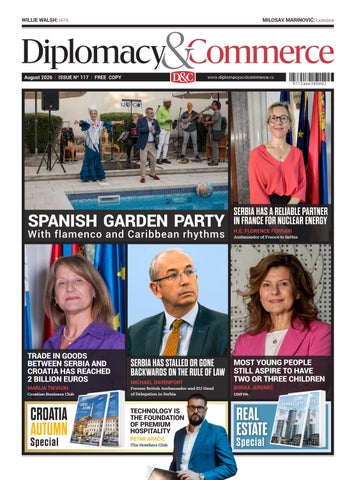
WILLIE WALSH: IATA
MILOSAV MARINOVIĆ: Liceulice
August 2026 | ISSUE Nº 117 | FREE COPY
www.diplomacyandcommerce.rs
SPANISH GARDEN PARTY
SERBIA HAS A RELIABLE PARTNER IN FRANCE FOR NUCLEAR ENERGY
With flamenco and Caribbean rhythms
Ambassador of France to Serbia
TRADE IN GOODS BETWEEN SERBIA AND CROATIA HAS REACHED 2 BILLION EUROS
SERBIA HAS STALLED OR GONE BACKWARDS ON THE RULE OF LAW
MOST YOUNG PEOPLE STILL ASPIRE TO HAVE TWO OR THREE CHILDREN
MARIJA TIKVICKI
Former British Ambassador and EU Head
BORKA JEREMIĆ
of Delegation in Serbia
UNFPA
Croatian Business Club
CROATIA AUTUMN Special
MICHAEL DAVENPORT
TECHNOLOGY IS THE FOUNDATION OF PREMIUM HOSPITALITY PETAR ARAČIĆ The Hoteliers Club
H.E. FLORENCE FERRARI
REAL ESTATE Special
CONTENTS
August 2026
FOLLOW US FOLLOW US TO STAY UPDATED TO STAY UPDATED
FREE COPY
FREE COPY Subscription Only Subscription Only
Published on 20th August 2026 Director ROBERT ČOBAN Director robert.coban@color.rs ROBERT ČOBAN robert.coban@color.rs Editor in Chief DRAGAN NIKOLIĆ Editor-in-Chief dragan.nikolic@color.rs DRAGAN NIKOLIĆ dragan.nikolic@color.rs Journalists MIJAT KONTIĆ Journalists ŽIKICA MILOŠEVIĆ MIJAT KONTIĆ ŽIKICA MILOŠEVIĆ Advertising BOJANA BAČIĆ DRAGAN NIKOLIĆ dragan.nikolic@color.rs Contributors
ROBERT ČOBAN DRAGAN VUČEVIĆ ZLATKO CRNOGORAC dragan.vucevic@color.rs Advertising marketing@color.rs DRAGAN NIKOLIĆ dragan.nikolic@color.rs Photos GORAN ZLATKOVIĆ DRAGAN VUČEVIĆ NEBOJŠA BABIĆ dragan.vucevic@color.rs MILOŠ NADAŽDIN marketing@color.rs STEFAN ĐAKOVIĆ KHARIM NSENGIYUMVA Photos JAKOV SIMOVIĆ GORAN ZLATKOVIĆ SHUTTERSTOCK MILAN RADOVANOVIĆ VUK ILIĆ Translation MILAN MEDIA RADOVANOVIĆ COLOR EVENTS IATA OSCE Prepress UNFPA VLADIMIR DUDAŠ SHUTTERSTOCK Centrobiro Translation Contributors COLOR MEDIA EVENTS ROBERT ČOBAN DUŠKA JOVANIĆ Prepress LJILJANA DUDAŠ VUJIĆ VLADIMIR VIKTOR C e n t r oLAZIĆ biro Print Print COLORCOMP PRINTD.O.O. BIROGRAF Novi Sad Pulje 22 Zemun, Atanasija Distribution PRETPLATA D.O.O. office@pretplata.rs +381 11 314 99 21 COLOR MEDIA EVENTS COLOR MEDIA EVENTS Published by: Published by: Color Media Events d.o.o. Color Media Events d.o.o. 21000 Novi Sad, Serbia 21000 Novi Sad, Serbia Mileve Simić 27 Temerinska 102 VAT: 113769690 VAT: 113769690 Reg. No: 21922978 Reg. No: 21922978 Belgrade Office: Belgrade Office: Vlajkovićeva 6 Bul. Zorana Đinđića 48b 11000 Belgrade, Serbia 11070 Novi Beograd, Serbia Phone: + 381 63 432 392 Phone: + 381 63 432 392 CIP – Katalogizacija u publikaciji CIP – Katalogizacija u publikaciji Biblioteka Matice Srpske, Novi Sad Biblioteka Matice Srpske, Novi Sad 33 33 Diplomacy & Commerce / glavni i Diplomacy & Commerce / glavni i odgovorni urednik: Dragan Nikolić, odgovorni urednik: Dragan Nikolić, 2016, (mart)-.2016, (mart)-.Novi Sad: Color Media Novi Sad: Color Media Events, 2016 - , -33cm Events, 2016 - , -33cm Mesečno Mesečno ISSN 2466-3808 = ISSN 2466-3808 = Diplomacy & Commerce Diplomacy & Commerce COBISS.SR-ID 303269895 COBISS.SR-ID 303269895 Copyright 2024 Copyright 2026 © Color Media Events © Color Media Events
05
AMBASSADOR’S INTERVIEW
SERBIA HAS A RELIABLE PARTNER IN FRANCE FOR NUCLEAR ENERGY H.E. FLORENCE FERRARI
MAGAZINE #117 / August 2026
Ambassador of France to Serbia
CONTENTS 08
10
MOST YOUNG PEOPLE STILL ASPIRE TO HAVE TWO OR THREE CHILDREN BORKA JEREMIĆ
SERBIA HAS STALLED OR GONE BACKWARDS ON THE RULE OF LAW MICHAEL DAVENPORT
FEATURED INTERVIEW
UNFPA
25
REAL ESTATE SPECIAL AUGUST 26
POLITICAL INTERVIEW
Former British Ambassador and EU Head of Delegation in Serbia
30
MEDIA INTERVIEW
SOLIDARITY IS NOT CHARITY, BUT A SUSTAINABLE SOCIAL MODEL MILOSAV MARINOVIĆ Liceulice
47
50
48
TRADE IN GOODS BETWEEN SERBIA AND CROATIA HAS REACHED 2 BILLION EUROS MARIJA TIKVICKI
CROATIA AUTUMN SPECIAL
EDITORIAL
SUN, SEA AND NOSTALGIA… WITHOUT POLITICS H.E. HIDAJET BIŠČEVIĆ Ambassador of Croatia to Serbia
INTERVIEW
Croatian Business Club
54
INTERVIEW
TECHNOLOGY IS THE FOUNDATION OF PREMIUM HOSPITALITY PETAR ARAČIĆ The Hoteliers Club
Featured countries in this edition: ALGERIA / ARGENTINA / AUSTRIA / BELGIUM / CROATIA / FRANCE / GERMANY / KAZAKHSTAN / KOREA / MALTA / MOROCCO / PAKISTAN / SERBIA / SPAIN / UK Next issue: #118 September 2026
3
FOREWORD
Mi vida la dejé entre Ceuta y Gibraltar “PA’ UNA CIUDAD DEL NORTE YO ME FUI A TRABAJAR MI VIDA LA DEJÉ ENTRE CEUTA Y GIBRALTAR”
W
e sang the lyrics of “Clandestino” by Manu Chao exactly ten years ago, in late August 2016, aboard the ferry to Ceuta. We spent two days in this magical Spanish enclave on African soil. Ceuta felt surreal to us, almost cinematic, with its monuments dedicated to Franco, its Museum of the (Francoist) Legion, its ethnic mix reminiscent of Oran or Tangier before the Second World War (Europeans, Arabs, Sephardic Jews...), and the Church of Our Lady of Africa overlooking a sandy beach... It was from Ceuta, in fact, that Franco set out 90 years ago to overthrow the Republican government in Madrid, thus setting the Spanish Civil War in motion. That is why Ceuta is still a place where museums and monuments can be seen that have disappeared from mainland Spain since Franco died in 1975. Over the past month, Ceuta has been the most frequently mentioned city in Africa. The reason is well known: on 30 July, tens of thousands of people, mostly young Moroccans, set off simultaneously from the area around Fnideq towards Ceuta, both overland and by sea. Estimates of how many actually entered vary, but figures of around 60,000 to 80,000 people have been cited. Most have since returned to Morocco, while several thousand have remained in Ceuta.
"TO A CITY IN THE NORTH I WENT TO FIND SOME WORK, I LEFT MY LIFE BEHIND BETWEEN CEUTA AND GIBRALTAR"
For days before the mass crossing, messages circulated across Morocco via TikTok, Facebook, WhatsApp and other social networks claiming that on 30 July it would be possible to cross into Ceuta en masse. These were followed by reports of alleged changes to Spanish regulations that would allow people, once they had entered Ceuta, to avoid deportation or obtain some form of legal status. Those claims were either false or based on misinterpretations, but they spread extremely quickly. The events in Ceuta gave further momentum to Europe’s right-wing parties, which for more than a decade have been winning votes by stoking fears of migrants. Videos circulated on social media purporting to show migrants killing Spaniards in the streets of Ceuta, and the hysteria reached a fever pitch. Spain, still not fully recovered from celebrating its World Cup victory, suddenly found itself facing one of the greatest crises in its recent history. When the Portuguese first seized Ceuta in 1415, followed later by the Spanish, making it the first African city to come under European rule, there were no border fences to stop them. Centuries of colonial legacy have thus come back to Spain in much the same way that France has for decades been confronting the fact that its former subjects from Algeria or Senegal are now its citizens, many of them already several generations deep in Paris, Marseille and other cities. Much the same is true of Surinamese people in the Netherlands, Congolese communities in Belgium, and Indians and Pakistanis in the United Kingdom. The fact is that Europe is ageing, and without new inhabitants, whether “white” Ukrainians or “black” Africans, it will not be able to function. I deeply believe that European countries, Serbia included, need to “refresh their blood” with new populations from Africa, Asia and other parts of the world. The entire history of humankind is a history of migration and of this kind of “renewal”, through which many great nations have survived and flourished. These flows need to be managed, but they are inevitable, and the dreams of Europe’s right wing of “racially pure” states can only end up producing “racially pure retirement homes.”
Robert Čoban
4
www.diplomacyandcommerce.rs
by Mijat Kontić
AMBASSADOR’S INTERVIEW
Serbia Has a Reliable Partner in France for Nuclear Energy Tangible Capital and Cultural Bridges: Mapping French Economic and Diplomatic Engagement in Serbia vital. Summing up current relations in a single word is challenging, but what I have felt very strongly since arriving in Serbia is the remarkable depth of our ties. They draw on a long shared history dating back to the First World War, providing a solid foundation upon which we can build. Since President Macron took office, these relations have grown even stronger, and today I would describe them as excellent. We have seen two official visits by President Macron to Serbia since 2019. Since my arrival, I accompanied President Vučić to Paris last November, and our Minister for Europe and Foreign Affairs visited Serbia in January. This high frequency of exchange underscores the strategic importance both countries attach to this relationship. Beyond high-level contacts, there is a tangible and visible French presence across Serbia— not only in Belgrade, but throughout the country, as I see during my frequent travels.
H.E. FLORENCE FERRARI Ambassador of France to Serbia
T
his edition of Diplomata features an in-depth conversation with Her Excellency Florence Ferrari, Ambassador of France to the Republic of Serbia. Marking her first year in Belgrade, Ambassador Ferrari reflects on the historic and multi-layered ties between France and Serbia, spanning shared heritage from World War I to active bilateral initiatives in infrastructure, defence, artificial intelligence, and the clean energy transition. The discussion maps out France’s vision of a sovereign Europe, structural support for Serbia’s European integration path, the expanding role of civil nuclear cooperation, and the prospective momentum leading to Belgrade Expo 2027.
To start, Ambassador, you have had a distinguished career in French foreign policy, serving in various countries across Europe and Canada. Could you tell us what has been most rewarding in representing France abroad, and what drew you to your current role here in Serbia? Indeed, I have been a diplomat for 30 years now, so I have had quite a few different postings, mainly in Europe. I am very thankful and honoured to have been appointed as the French Ambassador here in Serbia, where I arrived last October. It is truly an honour, particularly because for us in France, Serbia is a very important posting. I was already familiar with the region. I previously served as Ambassador to Slovenia for several years and worked extensively on regional issues and EU enlargement negotiations in Eastern
SERBIA’S RIGHTFUL PLACE IS WITHIN THE EUROPEAN UNION Europe, both in Brussels and in Paris. Coming to Serbia felt completely logical, and I am very glad to be here. You recently met with the France-Serbia Parliamentary Friendship Group on 13 May. Following that meeting, how do you assess the current state of bilateral relations between France and Serbia? We held that meeting because parliamentary relations form an essential component of overall bilateral ties, making direct engagement with Members of Parliament
hat are your impressions of W Serbia during your travels across the country? I love travelling throughout Serbia. As a diplomat, it is essential to venture outside the capital, even though Belgrade is vibrant, dynamic, and beautiful. To truly understand a country, one must experience its diversity. Serbia offers rich regional variations. I have already visited Novi Sad, Kragujevac, Zrenjanin, Svilajnac— where many French citizens of Serbian origin trace their roots— and recently attended the NATOSerbia exercise in southern Serbia. Serbia is a dynamic, diverse nation, and seeing a distinct French presence across these regions is deeply gratifying as Ambassador. I n your previous answer, you mentioned President Macron’s visits to Serbia. How have the agreements signed during those
5
AMBASSADOR’S INTERVIEW
high-level summits advanced our bilateral partnership? High-level visits provide essential political momentum to bilateral relations. The agreements signed span numerous sectors, primarily focused on economic cooperation, and we have seen steady progress across all tracks. Moreover, recent exchanges have highlighted the need to broaden our scope of cooperation. During our Foreign Minister’s visit in January, we expanded our engagement beyond traditional sectors such as infrastructure and green energy into cutting-edge fields such as artificial intelligence and civil nuclear energy. The Serbian government explicitly requested French support and expertise as it evaluates the future integration of nuclear energy into its national energy mix. As we celebrate the 15th anniversary of the Strategic Partnership between France and Serbia, we agreed during the Foreign Minister’s visit to establish a comprehensive roadmap. This roadmap will define our shared priorities for the coming years, and implementing it will be a central focus of my mandate. urning to foreign policy, T EU enlargement talks and the Growth Plan for the Western Balkans remain central topics across European and regional audiences. How does France’s vision of a sovereign Europe shape Serbia’s EU integration path? First and foremost, Serbia is geographically, culturally, and historically at the very heart of Europe— something you feel immediately when you are here. That reality underpins Serbia’s strategic choice to pursue EU membership. Regarding a sovereign Europe, President Macron has championed this concept with great enthusiasm. In his seminal 2017 Sorbonne address, he outlined a vision for European strategic autonomy. Significant progress has since been achieved across the three core pillars of European sovereignty: security, prosperity, and democracy, which are intrinsically linked. Serbia, whose strategic goal is EU accession, can contribute to this sovereign European framework even before becoming a full member. We already see this happening in areas such as energy
6
FRANCE IS READY TO ACCOMPANY SERBIA IN DEVELOPING ITS NUCLEAR ENERGY FRAMEWORK security, which is vital to the entire continent. Serbia’s rightful place is within the European Union, even if the reform path requires time and sustained effort. The Growth Plan serves as an essential mechanism in this process, helping to harmonise legislation, align business practices, and deliver targeted financial support. However, it is one tool among many, and France remains committed to utilising every available instrument to assist Serbia along its accession journey. I n an increasingly multipolar world marked by shifting global alliances, how does France view its role in fostering stability and facilitating dialogue among major international powers? That is a crucial question given the current geopolitical
landscape. France firmly believes in a multipolar international order built on multilateralism and remains a staunch advocate for the United Nations. We maintain that global action must be grounded in the principles of the UN Charter. France backs this commitment with concrete actions. For example, in UNIFIL peace operations in Lebanon, we recently lost two French soldiers—a tragic reminder of our tangible commitment to international peace and security. Within the European Union, we are actively driving progress toward a true European Defence initiative to strengthen collective security. In regions facing acute crisis, such as the Middle East, France consistently advocates for diplomacy as the only viable path toward sustainable peace and regional stability.
urning to economic T cooperation, where France and Serbia maintain an active partnership: Where are French companies investing in Serbia, and which emerging sectors— particularly green transition and digital tech—show the strongest potential? French investments in Serbia are concentrated in high-value, strategic sectors. While the absolute number of French enterprises operating here may be smaller than that of some other foreign partners, our footprint is highly visible and structural. When you land at Belgrade’s Nikola Tesla Airport, operated by VINCI Airports, you immediately see a major flagship project designed to serve Serbia for decades. French companies are heavily involved in key infrastructure, including the Belgrade Metro project, which moved forward following our Foreign Minister’s visit. We are equally engaged in environmental infrastructure, including wastewater treatment and modern waste management solutions.
www.diplomacyandcommerce.rs
AMBASSADOR’S INTERVIEW
During my travels across Serbia, I frequently observe municipal projects financed by the French Development Agency (AFD), which maintains an active operational presence on the ground. Major corporations like Schneider Electric and Michelin also maintain substantial operations in the country. Looking ahead, we see massive potential in digital technology, artificial intelligence, and civil nuclear energy. France has already supplied a supercomputer installed at the State Data Centre in Kragujevac. French IT firms like Atdl Advance—whose facilities I recently toured in Niš—are expanding their presence. We host a joint Innovation Forum to foster technology transfer and collaboration among startups. In energy, civil nuclear cooperation represents a long-term strategic commitment spanning decades. France is ready to accompany Serbia in developing its nuclear energy framework. These long-term structural engagements demonstrate that Franco-Serbian economic ties extend far beyond short-term ventures, reflecting a genuine and lasting friendship. egarding upcoming economic R platforms, Belgrade will host Expo 2027. How will France utilise Expo 2027 to highlight innovation and deepen economic engagement with Serbia? World Expos hold special significance for France. We have participated in every World Expo since the inaugural event in the 19th century, and the Bureau International des Expositions (BIE) has been headquartered in Paris for nearly a century. Iconic landmarks like the Eiffel Tower were originally constructed for World Expos, reflecting our long-standing commitment to these global platforms. Expos offer a premier venue for nations to showcase technological know-how, design, and cultural innovation. France will be actively participating in Belgrade Expo 2027. COFREX, the agency responsible for organising the French pavilion at global expos, is already hard at work. While exact architectural details remain confidential, the pavilion will directly address Expo 2027’s central themes of sport and music. Our goal is to present French innovation in these sectors while fostering deep creative connections with Serbia and the broader Western Balkans.
SPORTS DIPLOMACY PROVIDES AN OUTSTANDING VEHICLE FOR BRINGING OUR CITIZENS CLOSER TOGETHER Ambassador, we recently saw a unique display of cultural diplomacy in Yerevan, where President Macron sang “La Bohème” by Charles Aznavour. Given the importance of such gestures, how do you view the role of cultural diplomacy in bridging differences and strengthening partnerships? Culture is essential in international relations, and for France, it is an absolute priority. Franco-Serbian cultural ties have a long and distinguished history. I was deeply impressed during a recent visit to the Museum of Contemporary Art in Belgrade by how many prominent Serbian painters spent formative periods in Paris, leaving a clear imprint on their artistic development. Our institutional framework is equally historic. The precursor to the French Institute in Serbia operated before World War II, and our current facility in central Belgrade has been active since the early 1950s. While honouring this legacy, our goal is to build upon it. The French Institute remains exceptionally active. We recently hosted the Molière Days, bringing
prominent French authors to Belgrade for two weeks of literary debates. The annual French Film Festival takes place in June, featuring screenings across the country. Through our branch offices in Novi Sad and Niš, the Institute offers French language instruction. It hosts year-round cultural events, including a recent Agence France-Presse (AFP) photo exhibition on women in the Western Balkans. Culture also encompasses gastronomy. We recently hosted a culinary exchange that brought together French and Serbian chefs to focus on dairy product innovation. Expanding gastronomic diplomacy and showcasing our shared art de vivre will be a personal focus throughout my posting.
ports diplomacy also links our S two nations, given the shared enthusiasm for basketball, football, and team sports. How can sports diplomacy further deepen ties between France and Serbia? Sports represent a powerful common passion. Both of our nations approach sports with tremendous enthusiasm. Since arriving in Belgrade, I have attended several major sporting events. I attended the football match between Lille and Red Star Belgrade, where the atmosphere in the stadium was electric. I also watched the European Water Polo Championship match between France and Serbia, where Serbia secured the win amidst an incredible atmosphere. Numerous Serbian athletes have made major contributions to French sports clubs, particularly in handball, where stars like the Karabatić brothers achieved extraordinary success, including Olympic gold. Looking ahead, France will host major global athletic events in the coming years, offering ideal opportunities for Serbian and French athletes to compete on the international stage. Sports diplomacy provides an outstanding vehicle for bringing our citizens closer together. hat is your personal vision W for the future of Franco-Serbian relations, and what message would you share with the Serbian people? Serbia is geographically, culturally, and politically at the heart of Europe. France views our bilateral relationship through the lens of a shared European future. Serbia has made EU accession its clear strategic priority. Working together, we can strengthen the core pillars of security, prosperity, and democracy that underpin a sovereign Europe. This shared work is made possible by our long-standing friendship, and I look forward to advancing this common path throughout my time in Serbia.
The full interview is available on our website.
ow are you enjoying Serbian H cuisine? I enjoy it immensely! Having visited Serbia previously, I was already familiar with the culinary culture. I am a huge fan of sarma, ćevapi served with ajvar and kajmak, and I thoroughly enjoy high-quality rakija.
7
by Mijat Kontić
FEATURED INTERVIEW
Photo: UN Serbia / Shubuckl
and need. Second, young people are not giving up on starting families, but economic, housing, and other factors delay those choices. This creates a fertility gap—a significant difference between the desired number of children and the actual number realized by the end of their reproductive years, around ages 35 to 39. Finally, creating a supportive ecosystem requires the whole society, from institutions and local communities to the private sector, to ensure young people can make their life choices properly.
Most Young People Still Aspire to Have Two or Three Children How Structural Security and Workplace Flexibility Shape Family Planning BORKA JEREMIĆ Head of Office at the United Nations Population Fund in the Republic of Serbia
T
his edition of Diplomata features an in-depth conversation with Borka Jeremić, Head of Office at the United Nations Population Fund in the Republic of Serbia. Marking World Population Day under the slogan “A Future Without Barriers: What Drives the Decisions of Young People?”, Jeremić breaks down key findings from UNFPA’s global demographic report. The discussion explores the structural roots of the fertility gap, the implementation of family-friendly workplace standards, policy shifts toward active ageing, and the collaborative development of Serbia’s Demographic Development
8
World Population Day was commemorated in Serbia under the slogan “A Future Without Barriers: What Drives the Decisions of Young People?” What are UNFPA’s key messages in Serbia for this year? Thank you for that question and for coming to speak live about what we presented to the public last week for International Population Day. Under “A Future Without Barriers,” we examined how young people make decisions about partnership, their future, and life plans. The key message we want to highlight from the start is that young people today, despite prevailing public stereotypes, still want to become parents, desire a family, and include it in their future plans. However, we face the issue of delayed decisionmaking due to various structural factors.
YOUNG PEOPLE ARE NOT GIVING UP ON STARTING FAMILIES Last week we organized a panel discussion with societal stakeholders to hear their perspectives on this delay. The event was organized alongside our key partner, the Ministry for Demography and Family Care. The Assistant Minister for Tourism and Youth represented decision-makers, and we also had representatives from the Serbian Academy of Sciences and Arts, the private sector, and young people themselves. The primary takeaway is that youth policies must be grounded in what young people truly want
our recent global report Y surveyed demographic futures across 73 countries and territories, including 13,500 respondents aged 18 to 39 across 11 countries in Eastern Europe and Central Asia. What does this research reveal? The study benchmarked data against Nordic nations, Western Europe, and East Asia. A primary benefit of this research is that it disproved common stereotypes, particularly the myth that younger generations have lost interest in starting families or becoming parents. The research confirmed that young people still hold those same goals and desires, even though they hesitate due to various life challenges. Overall, the findings are encouraging. In Eastern Europe and Central Asia, young people look to the future with notable optimism despite ongoing concerns about conflict, economic instability, and employment. In Serbia specifically, 26% of young women and 28% of young men report the highest level of optimism regarding their personal future. This optimism provides strong inspiration for designing responsive public policies. ould you elaborate on the C “fertility gap” findings in Serbia? The fertility gap addresses the difference between the desired number of children and the actual number of children born over a person’s lifetime. The positive news is that young people still plan for families, but they encounter obstacles that lead to delays. In Serbia, over 70% of surveyed women and men expressed a desire to have two or three children. Specifically, two children are desired by approximately 42% of women and 40% of men, while three children are desired by 36% of women and 38% of men. However, data for individuals in their late 30s shows that actual
www.diplomacyandcommerce.rs
FEATURED INTERVIEW
ow does UNFPA convert these H data points into actionable programs in Serbia? We assist decision-makers in using precise evidence to design targeted policies and monitor existing measures. For instance, when the Serbian Government adopted its second Action Plan for the Youth Strategy for 2026 to 2028, we worked with the Ministry of Tourism and Youth to establish the Youth Wellbeing Index. Applied across 17 local self-governments, this index uses about 100 statistical indicators across employment, health, safety, social inclusion, and civic participation to track policy impact on young lives. We also run programs focused on health literacy, sexual and reproductive health, life skills, gender equality, and violence prevention in schools and youth offices to boost young people’s confidence in making major life choices. Furthermore, we supported the “For One More Heart” (Za srce više) campaign alongside government partners and the IVF Center association, producing educational guides on fertility preservation, preventative healthcare, and healthy habits. alancing career and family B remains a central challenge. How does UNFPA’s FamilyFriendly Workplace initiative address this? The project was created to test measures that help people reconcile their professional and family ambitions. It shows employers that supporting work-life reconciliation yields tangible economic benefits while helping employees remain dedicated to their work. About ten companies participate in our program where we test flexible working hours, working
Photo: UNFPA
childbearing falls short of these early intentions. Across the broader region, 22% of women aged 35 to 39 do not have children, despite 95% of them expressing a desire to become parents. These statistics reflect an interconnected chain of living conditions. Employment security provides the foundation for housing, which is a prerequisite for independent living and parenthood. Additional factors include kindergarten availability, equal sharing of household duties, employer understanding, and worklife balance. At UNFPA, we focus on establishing conditions that offer genuine freedom of choice and security, forming the bedrock of demographic resilience.
OUR GOAL IS TO SHIFT THE FOCUS FROM RAW POPULATION NUMBERS TO QUALITY OF LIFE AND INDIVIDUAL RIGHTS from home, additional paid leave for life events, and support for pregnant women and parents. For example, Intenz in Novi Sad introduced 50 hours of fully paid leave annually without requiring documentation or reducing salaries so employees can handle private challenges. SDPS in Belgrade provides flexible hours and additional paid leave for family milestones, alongside tailored support for employees with disabilities, who make up 80 of their 100 employees. Flo Ninja in Niš tested leave options for key milestones like a child’s first day of school or kindergarten. IKEA Serbia established mentorship programs for pregnant employees and mothers returning from maternity leave to keep them engaged professionally. Merck provides ten days of paid family care leave and offers financial support for fertility treatments. Investing in employee wellbeing is a potential financial gain for corporations rather than a loss. emographic resilience also D includes active and healthy ageing. What initiatives are underway in this domain? Currently, one in five citizens in Serbia is over the age of 65, and that share will continue to grow. Rather than treating this shift as a crisis, demographic resilience
adapts policies and services to leverage the contributions of older adults. People are living longer, healthier, and more independent lives as a result of societal development. Our prospective ageing analysis shows that chronological age is less informative than prospective age, which looks at remaining life expectancy. The fixed threshold of 65 years no longer fits modern demographic reality. Increased life expectancy cushions the economic impact of population ageing, as many individuals remain active long past 65. We helped Serbian partners draft the Strategy on Active and Healthy Ageing and its Action Plan. We also work with local communities to prevent age discrimination, set up intergenerational resource centers, and expand digital inclusion for older citizens. Serbia is preparing its new Demographic Development Strategy for 2026–2036. What is UNFPA’s role in this process? We accepted the Serbian Government’s invitation to support this strategic framework. A national Council for Family and Demography chaired by the Prime Minister has been established, supported by a technical working group. UNFPA provides technical
expertise, data analysis, and global best practices to the Ministry for Family Care and Demography. Following a baseline analysis of current societal conditions, wideranging public consultations are underway to define policy measures for the 2026 to 2036 strategy. How does Serbia contribute to international dialogue on demographic issues, and what are the priorities for UNFPA’s 2026–2030 Country Program? Serbia actively engages in global and regional forums, including high-level participation at the 59th Session of the UN Commission on Population and Development in New York and the Regional Ministerial Conference on Demographic Resilience in Skopje. Our 2026–2030 Country Program, approved by the Serbian Government and UN headquarters, focuses on empowering youth, promoting active and healthy ageing, and advancing sexual and reproductive health access, with a focus on women and girls from vulnerable groups. Our goal is to shift the focus from raw population numbers to quality of life and individual rights. The full interview is available on our website.
9
POLITICAL INTERVIEW
by Dragan Nikolić
Serbia Has Stalled or Gone Backwards on the Rule of Law Michael Davenport on Serbia’s EU Path, Democratic Backsliding, Student Protests and Britain’s Role in the Western Balkans MICHAEL DAVENPORT Former British Ambassador and EU Head of Delegation in Serbia
F
ew diplomats know Serbia and its European path as intimately as Michael Davenport. Having served both as British Ambassador to Serbia and Head of the EU Delegation in Belgrade, he witnessed first-hand some of the defining stages of the country’s political transformation. In this interview, Davenport reflects on EU enlargement, democratic backsliding and the rule of law, the significance of Serbia’s studentled protests, and the UK’s role in the Western Balkans after Brexit.
10
He also looks back on his years in Serbia and the friendships, language and poštovanje that have stayed with him. Has Brexit changed the way the United Kingdom views the Western Balkans and its role in the region? The UK has consistently supported the aspirations of Western Balkan countries to join not only the European Union, but also other European and EuroAtlantic partnerships. Leaving the European Union was a British act of self-harm which has not only slowed economic growth but also reduced British influence in Europe. However, even outside
LEAVING THE EUROPEAN UNION WAS A BRITISH ACT OF SELF-HARM the EU, the UK has a strong interest in the countries of the region resolving outstanding conflicts and working together to strengthen democratic institutions and build a stronger, more sustainable economy. In 2025, the UK and the EU established priorities for their post-Brexit strategic partnership, including for the Western Balkans. These featured a joint
Is EU enlargement still primarily a political project, or has it become a strategic necessity in light of the war in Ukraine and the current geopolitical landscape? Any European country has the right to apply for EU membership. That right is embedded in EU treaties, which provide that membership is open to any country which respects human dignity, freedom, democracy, equality, the rule of law and respect for human rights, including the rights of minorities. That said, the EU has blown hot and cold in its readiness to accept new members – in 2013, after Croatia’s accession, Commission President Juncker asserted that there would be no more enlargement for at least five years. Putin’s invasion of Ukraine finally brought home to European leaders the seriousness of the Russian threat. Sweden and Finland responded by swiftly joining NATO, while NATO and the EU are co-operating more actively and decisively on military and security matters than ever before. Unsurprisingly, countries aspiring to EU membership have grown ever more frustrated at the slow pace of the accession process. The EU may now be about to enlarge again, for the first time since 2013 – Montenegro has made the most progress, while Iceland will vote on applying for EU membership on 29th August. But the EU faces a serious dilemma. Accession procedures are slow and bureaucratic, requiring consensus support from Member States at key points along the way. Some accession states are struggling to meet criteria for EU membership, especially when it comes to fundamental values of rule of law or freedom of the media. The EU has given Ukraine and Moldova an accelerated path to the status of candidate for membership, but for both countries actual membership looks a long way off.
www.diplomacyandcommerce.rs
Photo: OSCE / Courtesy of Mr Michael Davenport
UK/EU pledge to support Western Balkans partners with internal reforms, including “the rule of law, democracy and the fight against corruption and organised crime”. My hope is that London and Brussels will live up to this important pledge with concrete actions. The next EU/UK Summit this autumn will be an opportunity to ensure that it doesn’t end up as “mrtvo slovo na papiru”.
POLITICAL INTERVIEW
Many critics argue that, for years, the European Union has prioritised stability over democratic standards in the Western Balkans. Do you believe that approach was a mistake? Such an approach is not conducive to genuine progress towards membership for the countries of the Western Balkans. Turning a blind eye to undemocratic practices, interference with the judiciary or suppression of media freedom will only make it more difficult for countries in the region to meet the standards set out in the EU Treaties. The European Commission has sometimes tended to prioritise making progress in the accession process over substantive progress against objective criteria. As Head of the EU Delegation in Serbia, I found that references to illegal actions by the Serbian authorities, such as the bulldozing of Savamala, were either being removed from draft country reports or substantially watered down. Most recently, the Commission’s recommendation to Member States to open Cluster 3 for Serbia ran counter to the Commission’s own findings on respect for the rule of law and media freedom. Interestingly, however, the European Parliament has in recent years started to provide important checks and balances, reminding the Commission of its obligations and emboldening Member States to uphold treaty provisions on enlargement. How important are domestic social and political dynamics compared to international factors and support from European partners when it comes to democratic change in EU candidate countries? Democratic change, to be sustainable, requires political will, supported by citizens, and has to be anchored in broadly respected
Photo: EU Delegation Serbia / Courtesy of Mr Michael Davenport
Earlier this year, Chancellor Merz and President Macron therefore announced a plan to accelerate accession through “gradual integration” designed to incentivise reforms. This would allow candidate countries earlier access to the EU Single Market or privileged participation in EU meetings. The unanswered question is whether such benefits would be sufficient to overcome reluctance and reverse democratic backsliding.
ULTIMATELY, IT IS CITIZENS THEMSELVES WHO ARE BEST PLACED TO HOLD GOVERNMENTS TO ACCOUNT
institutions. Ultimately, it is citizens themselves who are best placed to hold governments to account, challenge corruption and oppose interference with the judiciary or state control of the media. In both Albania and Serbia, we have recently seen how, when institutions lose legitimacy and credibility, citizens are ready to exercise their right to organise peaceful demonstrations and demand change. While there are international standards on the rule of law and respect for human rights, there is no single model for democratic institutions or an independent judiciary. Every country develops its own institutions, respecting its own traditions and diversity. International partners can offer support, but cannot provide all the answers. When you compare Serbia today with the Serbia you knew as British Ambassador and later as Head of the EU Delegation, do you believe the country is closer to or further away from EU membership than it was a decade ago? It is for the EU to judge how close Serbia is to EU membership. The question right now is whether Serbia has undertaken the reforms needed to make membership a realistic prospect. There was optimism when I was Head of Delegation that Serbia would seize the opportunity of opening accession negotiations and make rapid progress. Since then, I know from friends in Serbia that frustration has grown over the sluggishness of the EU track and the failure of
11
POLITICAL INTERVIEW
Over the past several months, Serbia has witnessed largescale student-led and civic protests. How do you view these developments from the perspective of someone who has followed Serbia’s democratic evolution for many years? The success of the student-led movement in attracting support across Serbia and from all parts of society has been remarkable. It reflected widespread dissatisfaction with corruption in the public sector, but also deeply felt disgust at the failure of the authorities to deal honestly with the students’ legitimate demands.
12
What is also remarkable has been their ability to galvanise support across the whole of Serbia. Many ordinary people clearly share their patriotic goal of creating a Serbia with strong democratic institutions where they can look forward to making their careers and bringing up their children. There are of course examples from other countries of young people making a crucial contribution to fundamental political change. Certainly, youth played a major role in the Solidarity movement in Poland and in overthrowing authoritarian regimes elsewhere. Two aspects, however, make the Serbian experience somewhat unique: firstly, the fact that student leaders have themselves been the motor and inspiration behind the protests, attracting support from a broad crosssection of society; and secondly, the organisational skill displayed by student leaders, notably in facilitating the creation of local citizens’ councils or “zborovi” throughout the country.
THE SUCCESS OF THE STUDENT-LED MOVEMENT IN ATTRACTING SUPPORT ACROSS SERBIA AND FROM ALL PARTS OF SOCIETY HAS BEEN REMARKABLE This success, which helped to motivate and inspire the movement in Hungary which brought about the downfall of Fidesz, did not come from nowhere. Students in Serbia have been able to build on a proud track record in Serbia of an active civil society promoting respect for human rights and the rule of law, academic freedom, freedom of expression and the right to protest. It is this tradition which made possible the public demonstrations which contributed to the fall of the Milošević regime. Given that the authorities have remained unbending in the face
of student demands, the challenge for student leaders now is to transform their movement from one of protest into a political platform capable of representing their supporters in parliament and, potentially, in government. Does the energy and engagement of young people in Serbia today remind you of any previous social or political movements that you have observed during your diplomatic career? You are right to point to the energy and engagement of the students leading the protests.
What do you miss most about Serbia today, and is there something Serbia taught you that has stayed with you throughout the years? There is so much that I miss! I treasure the wonderful friendships I was lucky enough to forge during my seven years in Serbia and miss Serbian friends calling to say “Hajde da idemo na kafu”, which would often take relations to a new level. I miss the language, which I started to learn as a student and grew to love, and which will remain a lifelong challenge! Living in Serbia with my family was a rare privilege and a constant learning experience for us all. Serbia is a wonderful country. If there’s one thing Serbia, and Serbs, taught me it is the importance of respect, of “poštovanje”, not just in diplomatic relations but in all human relations. This may also help to explain the extraordinarily warm hospitality we experienced wherever we went in Serbia. As a result, we endeavour to emulate both “poštovanje” and “srpsko gostoprimstvo”, conscious of course that we can never match the real thing.
www.diplomacyandcommerce.rs
Photo: OSCE / Courtesy of Mr Michael Davenport
successive governments to grasp the nettle of fundamental reform. Serbia has opened no new chapters in the negotiations since 2021, in part because the EU’s new enlargement methodology, introduced in 2020, made the opening of new chapters conditional on progress in fundamental areas, such as the rule of law. This is an area where Serbia has either stalled or gone backwards in recent years. The most recent Commission report on Serbia did not mince its words. It made clear that the pace of negotiations would depend on rule of law reforms and the normalisation of relations with Kosovo. It also stated that there had been no progress towards an independent judiciary, called for implementation of OSCE recommendations on free elections, and reported that the media environment had seriously worsened. In July, the European Parliament stressed that membership would only be possible if there was progress in all these areas. The tragic collapse of a railway station canopy in Novi Sad on 1 November 2024, killing 16 citizens, sparked understandable and widespread outrage. Moreover, this led to large-scale student-led civic protests demanding answers to questions about the corruption which contributed to this disaster. The growth of this student-led movement represents a robust public challenge to the authorities over their failure to tackle corruption effectively or ensure judicial independence. This gives grounds for optimism that Serbia can ultimately succeed in reversing the recent authoritarian trend.
PHOTO STORY
(VERY) LITTLE BLACK DRESS Damir Handanović, Dubravka Đedović Handanović, Minister of Mining and Energy, and Florence Ferrari, Ambassador of France, Bastille Day Reception, 14 July
“YOU’LL JOIN THE EUROPEAN UNION... WHEN YOU DESERVE IT! CHEERS!”
“I FORGAVE YOU FOR WHAT HAPPENED IN 1492” Spanish Ambassador Juan José Sanz
Ambassador of the Kingdom of Belgium
Aparicio, his spouse María Jesús Rivero
Frederik Develter, Belgian National Day,
Rivero, and journalist Mira Adanja Polak,
Residence of the Belgian Ambassador,
Summer Party in the Gardens of the
16 July
Spanish Residence, 17 July
RÉSERVÉ
ALWAYS THREE STEPS AHEAD
Florence Ferrari, Ambassador of France, with Ana Brnabić, Speaker
Milanka and Bogoljub Karić, Summer Party
of the National Assembly of Serbia, and members of the Serbian
in the Gardens of the Spanish Residence,
Government, Bastille Day Reception, 14 July
17 July
13
ARRIVALS
Ambassador of Austria Enno Drofenik
Ambassador of the Federal Republic of Germany Anke Holstein
Ambassador of the Republic of Kazakhstan, Bolat Imanbayev
Ambassador of the Republic of Algeria Moncef Mansri
Five New Ambassadors in Serbia Serbian President Aleksandar Vučić received the credentials of the ambassadors of Austria, Germany, Kazakhstan, Algeria and the Republic of Korea
14
The meeting also addressed the importance of maintaining regular political dialogue at all levels, Serbia’s European path, the further strengthening of economic ties, and opportunities to advance overall cooperation between the two countries. During his meeting with the newly appointed Ambassador of the Republic of Kazakhstan, Bolat Imanbayev, President Vučić highlighted the long-standing friendship between Serbia and Kazakhstan and the increasingly substantive cooperation between the two countries, supported by regular high-level contacts. President Vučić also welcomed the newly appointed Ambassador of the Republic of Algeria, Moncef Mansri, wishing him a successful mandate in Serbia. The Serbian President stressed that Serbia and Algeria share decades of friendship, forged during important historical periods and grounded in mutual respect and understanding. The two sides discussed the further development of political dialogue and
Ambassador of the Republic of Korea Jeong Hong Geun
the strengthening of economic cooperation, where there remains considerable potential for expansion. In his meeting with the newly appointed Ambassador of the Republic of Korea, Jeong Hong Geun, President Vučić discussed new opportunities for cooperation between Serbia and Korea, which has gained increasing momentum in recent years, particularly in the economic sphere. Korean companies have recognised Serbia as an attractive investment destination, while both sides see significant potential for further investment, closer economic ties, and the development of concrete joint projects. The talks also focused on intensifying political dialogue and expanding contacts between the two countries, as well as on the Republic of Korea’s participation in EXPO 2027 in Belgrade.
www.diplomacyandcommerce.rs
Source and photo: predsednik.rs
P
resident of the Republic of Serbia Aleksandar Vučić received the credentials of the newly appointed ambassadors of Austria, Germany, Kazakhstan, Algeria and the Republic of Korea, discussing with them bilateral relations, economic cooperation and opportunities for further strengthening ties between Serbia and their respective countries During his meeting with the newly appointed Ambassador of Austria, Enno Drofenik, President Vučić underlined Austria’s importance as one of Serbia’s most important economic partners and the largest foreign investor in the country. The talks focused on further strengthening economic relations, attracting new investments and continuing the successful cooperation between the two countries. In his meeting with the newly appointed Ambassador of the Federal Republic of Germany, Anke Holstein, President Vučić discussed bilateral relations and continued cooperation in areas of mutual interest. He described Germany as one of Serbia’s most important political and economic partners, stressing the significant role of German investments in the Serbian economy.
DEPARTURES
17 JULY 2026
Vučić Bids Farewell to Spanish and Azerbaijani Ambassadors
S
erbian President Aleksandar Vučić received the ambassadors of Spain and Azerbaijan for separate farewell meetings, thanking them for their contribution to strengthening bilateral relations during their mandates in Serbia. During his meeting with Spanish Ambassador H.E. Juan José Sanz Aparicio, Vučić highlighted the strong friendship between Serbia and Spain and thanked Madrid
for its consistent support for Serbia’s sovereignty and territorial integrity, as well as its European path. The two also discussed expanding economic cooperation and Spain’s participation in EXPO 2027 in Belgrade. Vučić also received Azerbaijani Ambassador H.E. Kamil Khasiyev, thanking him for his personal contribution to strengthening the strategic partnership between Serbia and Azerbaijan. The President highlighted the intensive
political dialogue, strong economic ties and progress in energy and transport infrastructure, while expressing particular appreciation for Azerbaijan’s support for Serbia’s sovereignty and territorial integrity. “I am confident that there is significant room to increase and diversify trade exchange, and I call for the acceleration of procedures that will enable key bilateral agreements to enter into force,” said Vučić.
DIPLOMATIC EVENTS
17 JULY 2026
A Summer Evening to the Rhythm of Flamenco
H
.E. Juan José Sanz Aparicio, Ambassador of the Kingdom of Spain to the Republic of Serbia, and his wife, María Jesús Rivero Rivero, hosted the Embassy’s traditional Summer Garden Reception at the Ambassador’s Residence in Belgrade on Friday, 17 July The residence’s gardens provided an elegant setting for a distinguished gathering of guests from the diplomatic corps, government institutions, the business community, the cultural sector, and the media. The evening unfolded in a relaxed summer atmosphere, blending Spanish tradition with
vibrant Caribbean rhythms, while the passionate sounds of flamenco added a distinctive touch to the celebration. Once again, the reception highlighted the value of such informal gatherings as opportunities to foster friendship, strengthen professional ties, and further enhance the close relationship between the diplomatic community and the Embassy of the Kingdom of Spain in Serbia’s partners. The reception also served as a farewell gathering, as Ambassador Juan José Sanz Aparicio is concluding his mandate in Serbia.
15
DIPLOMATIC EVENTS
14 JULY 2026
Bastille Day Celebrates a Partnership Looking Forward Bastille Day reception in Belgrade highlights the enduring Franco-Serbian friendship, Serbia’s European perspective and a new chapter in the two countries’ strategic partnership
F
rance’s National Day, 14 July (Bastille Day), was celebrated at the French Embassy in Belgrade with its traditional annual reception. Among the guests were National Assembly Speaker Ana Brnabić, Deputy Speaker Marina Raguš, Serbian government ministers Nenad Vujić, Aleksandra Sofronijević, Dejan Vuk Stanković, Ivica Tončev, and Dubravka Đedović Handanović, Commissioner for the Protection of Equality Milan Antonijević, BIA Director Vladimir Orlić, representatives of religious communities, ambassadors accredited to Belgrade, as well as members of the armed forces and police, according to Tanjug. Ahead of the reception, H.E. Florence Ferrari, French Ambassador to Serbia, told reporters that this year’s celebration carried special significance for France and Serbia, as Serbian President Aleksandar Vučić had attended the Bastille Day military parade in Paris at the invitation of French President Emmanuel Macron. “His presence on the Champs-Élysées, the first ever by a Serbian president—further confirms the enduring Franco-Serbian friendship, a brotherhood forged during the trials of the First World War, when we fought side by side, sometimes wearing the same blue uniforms, and together paid the price
16
A SECURE, STRONG, AND SOVEREIGN EUROPE CANNOT PROSPER WITHOUT THE WESTERN BALKANS, PARTICULARLY SERBIA of freedom. Today, that dynamic friendship continues to grow through numerous forms of cooperation that bring our two countries closer every day,” the ambassador said. She emphasised that the bilateral relationship is firmly oriented toward the future and toward a shared European horizon within the European Union. “That was precisely the central theme of today’s parade in Paris-Europe’s strategic awakening. We firmly believe that Serbia should be part of that strategic awakening, which is why it was invited to participate,” she added. Ambassador also reflected on the embassy’s work over the past year, noting that 2026 marks the 15th anniversary of the FranceSerbia Strategic Partnership, characterised
by a relationship built on trust and enriched by broad, practical and dynamic cooperation. “France remains a strong supporter of Serbia’s European integration. That was the key message delivered by the Minister for Europe and Foreign Affairs, Jean-Noël Barrot, during his visit to Belgrade on 16–17 January this year. A secure, strong, and sovereign Europe cannot prosper without the Western Balkans, particularly Serbia. The enlargement of the European Union to include Serbia, and the Western Balkans more broadly, is a French priority, in line with Serbia’s own stated commitment to EU membership as a strategic objective,” the ambassador said. The ambassador also paid tribute to Milovan Jovanović, a member of the Serbian Armed Forces who lost his life while serving in Lebanon. “I bow before the grief of his family and salute his commitment to the ultimate sacrifice in the service of a more just and secure world-the very world our two countries strive to build together,” she said. She added that France and Serbia had agreed to deepen their strategic partnership by adopting a Franco-Serbian roadmap. “That roadmap will help strengthen our cooperation, particularly in areas that were not high on the bilateral agenda fifteen years ago. One such example is artificial intelligence, where Serbia selected the French company Bull to provide the technology for its supercomputer in Kragujevac,” Ferrari said.
www.diplomacyandcommerce.rs
DIPLOMATIC EVENTS
14 JULY 2026
Belgium Celebrates National Day in Belgrade with Belgian Specialties and Beer
A
gainst the backdrop of Belgrade’s summer heat, the Embassy of the Kingdom of Belgium in Belgrade hosted a reception to mark Belgian National Day, bringing together numerous Serbian friends and partners, as well as members of the diplomatic corps The reception was hosted by the Ambassador of Belgium to Serbia, H.E. Frederik Develter, who mingled with guests in a festive atmosphere and once again highlighted the importance of the strong bonds of
friendship and cooperation between Belgium and Serbia. Guests had the opportunity to enjoy some of Belgium’s most recognisable culinary specialities. The Belgian fries stand was particularly popular, with guests eagerly gathering around for a taste, while generous portions of Flemish carbonnade were also served. Belgian beer added to the festive spirit, while an ice cream stand provided a refreshing sweet treat. The reception also offered an opportunity to celebrate the close ties between the
two countries and bring together the many friends, partners and fellow diplomats who contribute to strengthening relations between Belgium and Serbia. Belgian National Day is celebrated on 21 July. The date commemorates 21 July 1831, when Leopold I took the constitutional oath as the first King of the Belgians. Belgium declared its independence in 1830, while 21 July was later established by law as the country’s national holiday.
17
DIPLOMATIC EVENTS
30 JULY 2026
Morocco Marks Throne Day in Belgrade
T
he Embassy of the Kingdom of Morocco in the Republic of Serbia celebrated the 27th anniversary of the accession of His Majesty King Mohammed VI to the Throne with a reception in Belgrade, bringing together government officials, members of parliament, diplomats and representatives of the business, cultural and academic communities Addressing the gathering, H.E. Omar Amghar, Ambassador of the Kingdom of Morocco to the Republic of Serbia, reflected on Morocco’s transformation under the leadership of King Mohammed VI, emphasising the country’s economic modernisation, social reforms and growing international role. Ambassador Amghar pointed to Morocco’s sustained investment in strategic sectors, highlighting the expansion of the automotive, aerospace, pharmaceutical and agri-food industries, alongside major infrastructure projects such as Tangier Med Port, Nador West Med Port, the Noor Solar Complex, high-speed rail and renewable energy facilities. He noted that these initiatives have strengthened Morocco’s competitiveness, reinforced its position as an investment destination and supported the Kingdom’s transition toward sustainable development. The ambassador also underlined Morocco’s efforts to improve healthcare,
18
education, digital transformation and social protection, describing them as central pillars of the country’s long-term development strategy. He said these reforms have enhanced Morocco’s regional and global profile, as demonstrated by the successful hosting of the 2025 Africa Cup of Nations and preparations to co-host the 2030 FIFA World Cup with Spain and Portugal. Beyond domestic development, Ambassador Amghar highlighted Morocco’s growing engagement across Africa, citing initiatives aimed at strengthening South-South cooperation, promoting regional connectivity and advancing sustainable development. Among the flagship projects are the initiative to provide Sahel countries with access to the Atlantic Ocean and the Nigeria–Morocco Atlantic African Gas Pipeline, which he described as a strategic project for regional energy integration. Turning to foreign policy, the ambassador reaffirmed Morocco’s commitment to dialogue, international cooperation and peaceful conflict resolution based on respect for the sovereignty and territorial integrity of states. He also reiterated that safeguarding Morocco’s territorial integrity remains a national priority. A significant part of the address focused on relations between Morocco and Serbia. Ambassador Amghar described bilateral ties
as being founded on mutual respect, solidarity and shared support for each other’s territorial integrity. He expressed confidence that cooperation would continue to expand across a wide range of sectors, including industry, trade, agriculture, tourism, renewable energy, digital transformation, culture, sports, higher education and scientific research. Looking ahead, the ambassador noted that 2027 will mark the 70th anniversary of the establishment of diplomatic relations between Morocco and Serbia, describing the occasion as an opportunity to deepen political dialogue, strengthen economic cooperation and further promote people-to-people exchanges. The celebration also served as a reaffirmation of the close bond between the Moroccan people and their Sovereign, while showcasing Morocco’s vision of continued progress, modernisation and international engagement. Ambassador Amghar concluded by expressing appreciation to the Serbian authorities for their cooperation and support, and to the Moroccan community in Serbia for its contribution to strengthening mutual understanding between the two countries. The reception concluded with guests enjoying a selection of traditional Moroccan cuisine and sweets, reflecting the Kingdom’s rich cultural heritage and hospitality.
www.diplomacyandcommerce.rs
DIPLOMATIC EVENTS
14 AUG 2026
Pakistan Marks 80th Independence Day in Belgrade Embassy of Pakistan Belgrade Celebrates 80th Independence Day and 150th Birth Anniversary of Quaid-e-Azam Muhammad Ali Jinnah
T
o mark the 80th Independence Day of Pakistan and the 150th birth anniversary of Quaid-e-Azam Muhammad Ali Jinnah, the Embassy of Pakistan hosted a reception at the Hilton Hotel in Belgrade. The event brought together senior officials of the Serbian Ministry of Foreign Affairs, Ambassadors and diplomats from a wide range of countries, representatives of international organisations, members of the Serbian media, academia and religious institutions, and members of the Pakistani community in Serbia, reflecting the warmth of Pakistan’s friendship with Serbia and the international community in Belgrade.
PAKISTAN AND SERBIA REAFFIRMED THEIR STRONG AND GROWING TIES OF FRIENDSHIP Mr Damjan Jović, State Secretary at the Serbian Ministry of Foreign Affairs, graced the occasion as the Guest of Honour. In his address, Ambassador of Pakistan Syed Faraz Hussain Zaidi paid tribute to the
life and vision of Quaid-e-Azam Muhammad Ali Jinnah, recalling his leadership in the creation of Pakistan and his vision of a progressive and inclusive nation. He highlighted Pakistan’s achievements over the past eight decades and reaffirmed the strong and growing ties of friendship between Pakistan and Serbia. He also thanked the Guest of Honour and the distinguished guests for joining the celebrations, noting the depth of Pakistan-Serbia relations reflected in their presence. The reception provided an opportunity for the diplomatic community and Serbian friends of Pakistan to join in the celebrations and reflect on the enduring legacy of the Quaid-e-Azam, whose vision continues to guide the Pakistani nation.
19
AVIATION
by Dragan Nikolić
IATA: Global airline profits to halve in 2026 as fuel costs soar Willie Walsh warns that geopolitical tensions, soaring fuel prices, aircraft shortages and slow progress on sustainable aviation fuels are putting unprecedented pressure on airlines, even as passenger demand remains resilient PASSENGER RIGHTS AND INFRASTRUCTURE UNDER SCRUTINY
20
THE RESPONSIBILITY FOR DECARBONISING AVIATION CANNOT REST ON CARRIERS ALONE Walsh stressed that the situation is particularly difficult for airlines whose balance sheets have still not fully recovered from the pandemic, as well as carriers affected by the conflict in the Middle East. At the same time, consumers appear determined to continue travelling: IATA polling shows that 49% of travellers expect to spend more on travel this year, while another 43% plan to spend roughly the same amount.
AIRCRAFT SHORTAGES ADD BILLIONS TO AIRLINE COSTS
One of Walsh’s sharpest criticisms was directed at aircraft and engine manufacturers. The backlog of aircraft orders has surpassed 18,000, while the average age of the global airline fleet has reached a record 15.2 years. Airlines are operating with more than 5,000
fewer new, fuel-efficient aircraft than previously expected, resulting in higher fuel consumption, leasing costs and maintenance expenses. IATA estimates that aerospace supply-chain failures alone cost airlines at least $11 billion in 2025. Walsh accused engine manufacturers of benefiting financially despite failing to provide airlines with the products and reliability they need, calling on them to stop excessive charging and return their focus to producing durable and dependable engines. Beyond immediate financial pressures, Walsh identified three areas where the aviation industry urgently needs better government policies: regulation aligned with global standards, adequate infrastructure and credible policies for decarbonisation.
SUSTAINABLE AVIATION FUEL FALLS FAR SHORT OF DEMAND
Perhaps the most serious longterm warning concerned aviation’s commitment to achieve netzero carbon emissions by 2050.
www.diplomacyandcommerce.rs
Source: IATA
T
he global airline industry is heading into a significantly more difficult year, with profits expected to halve in 2026 as sharply higher fuel prices, persistent aircraft supply-chain problems and geopolitical instability weigh on carriers, IATA Director General Willie Walsh warned in his report on the state of the industry at the association’s 82nd Annual General Meeting. According to IATA’s latest outlook, average jet fuel prices are expected to be 70% higher than last year, adding around $100 billion to the industry’s annual fuel bill. Despite rising fares, passenger demand remains relatively robust, although growth is expected to slow to 2.1%, while air cargo is forecast to expand by just 0.7%. The impact on profitability will be substantial. IATA expects global airline net profits to fall from $45 billion in 2025 to $23 billion this year, while the industry’s net profit margin is forecast to decline from 4.2% to just 2.0%.
Walsh strongly criticised the European Union’s passenger rights regime, EU261, arguing that penalties can be disproportionate to ticket prices and that airlines are often held financially responsible for disruptions beyond their control. According to IATA research, passengers themselves place greater importance on alternative travel arrangements following disruptions than on financial compensation. IATA estimates that EU261 costs the industry around €8 billion annually, while Walsh argued that the regulation has failed to solve the underlying causes of delays and cancellations, many of which are linked to air traffic management and infrastructure shortcomings. Infrastructure is becoming an increasingly serious constraint on aviation growth. Almost 400 airports worldwide now require slot coordination because capacity cannot meet demand throughout the day. Walsh contrasted major investments in new airport capacity in Vietnam, Singapore and Australia with what he described as poorly designed airport policies and concession models elsewhere. Air traffic management represents another major source of inefficiency. According to IATA, even a modest 5% improvement in ATM efficiency could save airlines $12.5 billion annually while cutting millions of tonnes of carbon emissions. Walsh argued that modern aircraft already possess the technology needed for more efficient operations, but outdated and fragmented air traffic management systems prevent airlines from fully exploiting it.
AVIATION
Walsh said two crucial elements of the industry’s decarbonisation strategy are under threat: the CORSIA carbon-offsetting system and the development of sustainable aviation fuel, or SAF. Airlines have signed more than 180 SAF purchase agreements since 2021, demonstrating strong demand. Yet global SAF production is expected to reach only 2.4 million tonnes this year, enough to cover just 0.8% of airlines’ fuel requirements. By 2050, the industry would need around 500 million tonnes, equivalent to approximately 65% of its fuel needs. Walsh argued that governments have frequently chosen the wrong policy approach by imposing mandates before creating sufficient incentives for production. In his view, this has driven prices higher without generating adequate supply. He warned that there is currently no realistic path to achieving the ICAO target of reducing aviation emissions by 5% through SAF by 2030. Although Walsh said there is still hope of reaching net zero, he acknowledged that the prospect of doing so by 2050 is fading and called for an urgent discussion among governments, fuel
AVIATION REMAINS AN ENGINE OF GLOBAL CONNECTIVITY
AVIATION CONTINUES TO CONNECT PEOPLE, ECONOMIES AND SOCIETIES ACROSS BORDERS producers, infrastructure providers and the aviation industry about a realistic timetable. “Airlines will do their part as operators, but success
will be a team effort,” Walsh said, stressing that responsibility for decarbonising aviation cannot rest on carriers alone.
Despite the difficult outlook, Walsh concluded his address on an optimistic note. Artificial intelligence and new technologies, he said, could create major opportunities over the next five to ten years to improve efficiency, reduce costs and provide better service to passengers. The speech also had a personal dimension, as Walsh announced that he will leave IATA in the coming weeks to become CEO of IndiGo Airlines. He concluded by underlining aviation’s broader economic and social importance. The industry enables more than five billion people to travel annually, supports $4.1 trillion in global trade and generates employment opportunities for 86.5 million people worldwide. At a time when conflicts and political divisions are making the world increasingly fragmented, Walsh argued, aviation continues to perform precisely the opposite role: connecting people, economies and societies across borders.
GLOBAL AVIATION AT A CROSSROADS: IATA MEETS IN RIO The 82nd IATA AGM and World Air Transport Summit brought together global aviation leaders to discuss profitability, geopolitical risks, sustainability, infrastructure and the future of air travel
Photo: IATA
The International Air Transport Association (IATA) held its 82nd Annual General Meeting (AGM) and World Air Transport Summit (WATS) in Rio de Janeiro from 6 to 8 June, bringing together leaders of the global aviation industry to discuss the sector’s most pressing challenges and opportunities. Hosted by LATAM Airlines Group, the gathering placed particular emphasis on rising fuel costs, geopolitical instability, sustainability, infrastructure and regulation. One of the central messages of the summit was the worsening financial outlook for airlines. IATA expects global airline profitability to halve in 2026, largely as a result of disruptions related to conflicts in the Middle East and sharply higher fuel prices. Discussions also examined the wider geopolitical environment and the difficulties a
more fragmented world creates for an industry that depends heavily on global standards and international cooperation. IATA Director General Willie Walsh used his State of the Industry address to warn about the combined effects of high fuel prices, aircraft and engine supply-chain problems and insufficient infrastructure. He also called for smarter regulation and stronger government action on aviation decarbonisation, arguing that airlines cannot achieve the transition to net zero on their own.
future of passenger rights, airport capacity, air traffic management, technological innovation and the growing role of artificial intelligence were also discussed. The CEO Forum addressed issues ranging from fuel hedging and relations with engine manufacturers to industry consolidation and AI. With the meeting taking place in Brazil, special attention was devoted to the potential of Latin American aviation. A dedicated session examined Brazil’s high operating costs, taxation and extensive passenger litigation, as well as the opportunities for expanding a market in which only around 10% of the
population currently travels by air. The gathering also included the eighth IATA Diversity & Inclusion Awards, recognising initiatives and individuals contributing to a more gender-balanced aviation workforce. The next, 83rd IATA Annual General Meeting and World Air Transport Summit will take place from 30 May to 1 June 2027 in Xiamen, China, hosted by Xiamen Airlines. The event was hosted by LATAM Airlines Group, with Airbus, Boeing, Embraer and GE Aerospace as sponsors, while CNN and Airlines served as media partners.
Sustainability was among the major themes of the gathering, particularly the slow expansion of sustainable aviation fuel (SAF) production and the need for policies capable of stimulating supply rather than simply imposing mandates on airlines. The
21
ANALYSIS
by Žikica Milošević
Is a “Falklands War 2.0” a Real Possibility, and How Would Trump Respond? The World Cup in North America has brought us another instalment of one of world football’s most hostile rivalries: Argentina vs England. After the match, won by Argentina, the players took a banner from the stands reading “Las Malvinas son argentinas” – “The Falklands are Argentine” – sparking an uproar around the world, reopening the old story from 1982 and thrusting it back into the spotlight.
H
istorically, the Falklands, or Malvinas, were a territory contested by the Spanish, French and British. The French quickly withdrew in favour of Spain, but the British did not. Spain soon withdrew from Latin America as a result of the Napoleonic Wars, and its successor state, Argentina, inherited its claims to the islands. As for football, Argentina and England had been rivals since 1966, when their World Cup quarter-final at Wembley saw clashes between the English and Argentine players over the latter’s rough play. The confrontation culminated in the sending-off of an Argentine player, who refused to leave the pitch because he supposedly “did not understand” what was being asked of him. Police eventually escorted him off after ten minutes. The incident subsequently helped inspire the introduction of red and yellow cards, so that there could be no such ambiguity in future. The English branded the Argentines “The Animals”, while the Argentines dubbed the match El robo del siglo – “The Robbery of the Century”.
22
“TODAY, WHAT IS EXPECTED OF ALLIES IS NOT LOYALTY, BUT A TRANSACTION.” – Nikola Lunić In 1982, Argentina’s military junta became convinced that it could do with the Falklands what the Indonesians had done with Portuguese East Timor, the Indians with Goa, Morocco and Guinea with the Spanish territories of Western Sahara and Equatorial Guinea, or African independence movements with Portugal’s colonies: apply some pressure, seize the territory and create a fait accompli, after which the British would relinquish it. That did not happen. Britain dispatched a naval task force, defeated Argentina, sank the General Belgrano, and Margaret Thatcher cemented her reputation as the “Iron Lady”. Later, in 1986, Maradona scored his infamous handball goal, the “Hand of God”, supposedly “in
revenge for the Malvinas”. Fierce encounters followed at the 1998 and 2002 World Cups, but things went furthest in the 2026 semi-final with the appearance of this banner. The British press erupted in outrage, while in Argentina the players were once again celebrated as “avengers”. President Milei even announced that 15 July would henceforth be observed every year as a national holiday to commemorate the victory?! Things have clearly gone a little too far. Could they go further still? Could they escalate into an actual conflict? Some say this is also linked to the rise of right-wing nationalist and ultra-libertarian Javier Milei, a close friend of Donald Trump, who has once again begun talking about the “return of the Malvinas”. The British will not even entertain the idea. Still, Trump has been “flirting” with his South American friend while openly complaining about his British Labour counterparts, Sir Keir Starmer and now Andy Burnham. Which brings us to the question: is Argentina ready for another “South Atlantic adventure”, and what might such a scenario look like? Is it even remotely realistic? Our three interviewees and our X-followers were given a short multiplechoice questionnaire and asked to explain the answers they chose. I – What would happen today if Argentina attempted to seize the Falkland Islands militarily, as it did in 1982? a) The UK would respond and win (61%) b) The UK would respond and lose (13%) c) The UK would not intervene at all (26%)
www.diplomacyandcommerce.rs
ANALYSIS
Nikola Lunić
II – How would Donald Trump respond if Argentina attempted to seize the Falkland Islands, as it did in 1982? a) He would support Argentina (22%) b) He would support Britain (19%) c) He would remain neutral (4%) d) Nobody knows (56%)
Jakša Šćekić
because power has become the only currency that is recognised. Within that logic, transactional US foreign policy does not choose sides based on values, but according to interests and the price of support at any given moment. Today, what is expected of allies is not loyalty, but a transaction. Third, this is precisely where the trap of military neutrality lies. In a period of power realignment, restraint is not perceived as balance, but as the absence of allies. This means that the UK, Argentina, or any third actor attempting to remain “above” the dispute risks being treated as an adversary rather than as a neutral party. Therefore, the banner on the pitch was not a gesture of nostalgia, but a warning of what may lie ahead. In a world where borders are once again being negotiated through force, choosing sides too late is not neutrality, but a position lost in advance.
JAKŠA ŠĆEKIĆ Journalist and Media Expert
Let’s see what they had to say. The results from the X are in brackets.
NIKOLA LUNIĆ Geopolitical and Security Consultant
Both questions are typically populist in nature because they demand binary answers where the intersection of geopolitics, power projection and the transitional architecture of power does not allow for simple ones. If we have to choose, the closest answers would be 1a and 2c: Britain would have the military and technical capability to defend the Falklands, while Trump would formally remain neutral. But both answers are correct only in a static reading of a world that no longer exists. First, the UK’s ability to project power today is not the same as it was in 1982. Its fleet has been reduced, its defence budget is insufficient and spread thin, with resources simultaneously committed across multiple fronts. A successful defence would therefore require resources to be redirected from other areas, which would automatically mean abandoning some of London’s declared priorities. Second, and more importantly, we are living through a period of global power realignment in which borders, alliances and territorial arrangements are once again being put on the table. This is not because international law has changed, but
First of all, we should bear in mind that today’s world no longer has the “great statesmen” it had at the time of the Falklands War, from the Argentine president to Margaret Thatcher and Ronald Reagan. Even assuming that the UK were to launch a military operation to retake the Falklands, the element of surprise would be gone, because either Russia or China would provide Argentina with all the necessary military intelligence, and probably military assistance as well. That would represent a major risk for today’s politicians, meaning that the Falklands are likely to remain an
“IN THE MORNING, HE WOULD SUPPORT THE ARGENTINES; IN THE AFTERNOON, THE BRITISH; IN THE EVENING, HE WOULD BE AGAINST THE WAR.” – Jakša Šćekić unresolved issue for some better time. The UK is far from being the same power it was under Margaret Thatcher, let alone a stronger one. And if we consider how many prime ministers Britain has gone through within the space of just a year or two, it becomes clear that another military confrontation is highly unlikely. So, at this point, there will be no military intervention. Both sides will stop at “heated rhetoric”.
Mirko Dautović
As for how Trump would react, that is a mystery, because not even he himself knows how he would respond. It would depend on the time of day and his mood. What is certain, however, is that his reaction would not only be impulsive but also wrong. And afterwards, he would undoubtedly claim that he personally deserved the credit for ending the war, even though nobody would have the slightest idea how. In the morning, he would support the Argentines; in the afternoon, the British; in the evening, he would be against the war; and around midnight, he would send military aid, a little to one side and a little to the other... In any case, this world no longer has statesmen, only politicians. And the greater tragedy is that it has a leader of the “free world” like this one. I used to think there could hardly be anyone weaker than George W. Bush, but Trump proved me wrong. So it would hardly come as a surprise if Trump ended up taking the Falklands for himself and the United States.
MIRKO DAUTOVIĆ International Relations Analyst and Lecturer in International Relations at Webster University in Tashkent
On the first question, my answer is as follows: a military seizure would require an amphibious invasion, and that requires a fleet. The Argentine Navy has never recovered from the 1982 war. Its surface combatants consist of three destroyers and five corvettes. I am not sure it would have enough vessels to land the ground forces required to capture the islands. On the other hand, the British fleet may be larger on paper, but whether that reflects reality is another question. During the war in Iran, the Royal Navy was able to muster enough resources to send only a single destroyer to the eastern Mediterranean to defend Cyprus against Iranian missiles. Most of its ships are at bases in Britain, and their operational condition is questionable. However, Britain’s submarines are operational, and they alone would be sufficient to defend the Falklands against any attempted invasion. Argentina has indeed begun to rearm and has purchased 24 second-hand F-16 fighter jets from Denmark. These could pose a threat to British air superiority around the Falklands, currently maintained by four Eurofighter Typhoons, but only if we disregard the air-defence systems that Britain has deployed on and around the islands. Moreover, it would be relatively easy for Britain to redeploy additional aircraft to the Falklands from other parts of the world.
23
The World in 2050:
The Ten Most Populous Countries
R
ecently, we talked about the “quiet vanishing” of many rich countries around the world. People asked us – but is the whole world basically dying out since even India has the birthrate less than 2.1 this year. Well, no. Some parts of the world are indeed going to get a bit overpopulated. And it means, paired with the emptying of the rich countries, that there will be much immigration, even to those countries which deeply dislike immigrants. Namely, by 2050, the map of global population will look markedly different from today. Some countries will continue to expand rapidly, while others will face demographic stagnation or decline. The combined projected figures for 2050 reveal an increasingly important shift towards Asia and Africa, while the USA remains the only Western country among the world’s ten most populous nations. Place #10 is reserved for Bangladesh, which is projected to have around 204m inhabitants by 2050, keeping it among the world’s largest population centres despite its relatively small territory. Bangladesh faces major climate-related risks, including flooding, rising sea levels and extreme weather. With approximately 231m, Brazil (#9) will remain by far the most populous country in Latin America. Its large domestic market, natural resources, agricultural strength and industrial base give it considerable economic weight. Yet Brazil’s demographic future is changing as fertility rates decline. The DR Congo (#8) is expected to reach around 218 million people, 24
reflecting the broader population boom across sub-Saharan Africa. Thanks to that, it is already the country with most French speakers, reverting the trend of transformation of French, making it more “traditional”. Ethiopia (#7) is projected to reach approximately 225m inhabitants by 2050, making it one of Africa’s largest population centres. Its growing economy marks the trend seen in East Africa – Chinese technology and young African population can make miracles. With an estimated 321m people, Indonesia (#6) will remain Southeast Asia’s demographic giant and one of the world’s most important emerging economies. By 2050, population size could further strengthen Indonesia’s role in manufacturing, trade, digital services and consumer markets. Nigeria (#5) is projected to reach approximately 359m people, making it the world’s fifth-most populous country and Africa’s demographic giant. Its exceptionally young population could provide a huge future workforce and consumer market, reinforcing Nigeria’s importance in energy, finance and culture, including film and music. But rapid growth will also require millions of new jobs, better infrastructure, education, healthcare and reliable energy. Pakistan (#4) is expected to have around 372m people, placing it fourth globally. Rapid demographic growth also creates enormous demands for housing, water, energy, education and employment. Both of these countries will be “net exporters” of
people. The USA (#3) is projected to reach approximately 381m people by 2050, remaining the only Western country in the top ten. Immigration is expected to remain an important source of population growth, helping the US maintain a relatively favourable demographic position compared with many other developed economies. (Some sources say that Nigeria will be more populous than the USA, though). China will shrink to around 1.26 (or 1.31) billion people in 2050, remaining the world’s second-largest population. Yet its demographic story is fundamentally different from that of most countries on this list. A shrinking workforce will increase pressure for automation, technological development and robotics. Nevertheless, a population of around 1.3 billion will continue to represent one of the world’s largest consumer markets and economic bases. At the top of the ranking is India, with a projected population of approximately 1.68 billion people. Its demographic scale will be extraordinary, giving India an enormous domestic market and potentially one of the world’s largest workforces. So, try to become more tolerant. You will soon see many physiognomies in your neighbourhood. Try to learn to love curry and Afropop. Your son will introduce you to his African girlfriend, maybe. You will pass the Pakistani food shop. The world will become “one giant Singapore” – a motley place, a “goulash” of races and languages.
www.diplomacyandcommerce.rs
Photo: Shutterstock
by Žikica Milošević
INTERESTING FACTS
August 2026
REAL ESTATE SPECIAL
OVERVIEW
BELGRADE BUILDS UP: MORE PROJECTS, HIGHER PRICES by Cordon Real Estate Consultancy
LUXURY
MOVE IN TODAY TO AN OASIS OF PEACE AND LUXURY AFI Skyline Residence
INTERVIEW
MORE THAN A PLACE TO LIVE Tamara Radan BDS Properties
INTERVIEW
BUILDING ON 45 YEARS OF EXCELLENCE
Mirko Urošević IMEL
OVERVIEW
by Cordon Real Estate Consultancy
BELGRADE BUILDS UP: More Projects, Higher Prices
The overview does not include every residential project currently available. Both the selection and the stated price ranges are therefore intended for informational purposes only and should not be interpreted as a comprehensive representation of the market.
B
number of cases, move well into five figures. A substantial part of the premium and upper-middle segment is positioned between €4,000 and €6,000 per square metre, while projects in the €3,000–€4,000 range remain available across several parts of the city. More affordable new developments can still be found at around €2,500–€3,500 per square metre, predominantly outside the most expensive central and prestigious residential zones. Location remains one of the strongest determinants of price. The highest levels are generally associated with central neighbourhoods, prestigious traditional residential areas and major new developments along the rivers. At the same time, New Belgrade has established itself as another important focus of contemporary residential construction. At the same time, a considerable pipeline of projects in Zemun, Voždovac, Zvezdara, Palilula, Čukarica and other parts of the city is broadening the geographical scope of new construction. Price, however, increasingly reflects more than location and
square metres. Many new developments are competing through features that were once reserved almost exclusively for the luxury segment. Depending on the project, buyers may find heat pumps and underfloor heating, smarthome systems, reception and concierge services, 24/7 security, private parks and landscaped areas, gyms, swimming pools, spa and wellness facilities, EV chargers and dedicated amenities for families and pets. This increasingly sophisticated offer is becoming an important point of differentiation from older housing stock. This is particularly relevant because prices of existing apartments have risen substantially over the past several years, in some segments reaching levels that are difficult to justify on the basis of the properties’ quality, age, and characteristics. Against this background, new developments are increasingly able to compete not only on the appeal of newly built properties but also on energy efficiency, modern technical solutions, security, and additional services.
Another trend worth watching is the sale of fully furnished apartments in some luxury developments. For investors, this represents an additional commitment of capital and a calculated assumption about buyers’ tastes in a segment where individual preferences can be highly specific. Other developers are taking a more flexible approach by offering furnishing packages as an optional extra. It will therefore be interesting to see whether turnkey, fully furnished residences become an established feature of Belgrade’s luxury market or remain a niche proposition. In the coming period, the newbuild market can be expected to seek a new equilibrium gradually. Developers will continue to balance asking prices against the pace of sales, particularly as more projects compete for buyers. Current trends nevertheless suggest that the Belgrade market still has the capacity to absorb new supply, even as buyers gain a wider choice and become increasingly attentive to what they receive beyond location alone for the price they pay.
Photo: Shutterstock
elgrade’s residential property market continues to expand, with more new developments entering the market and an increasingly diverse range of offerings across the city. The following overview presents a selection of the most prominent current projects, alongside smaller developments in attractive locations, providing an indicative snapshot of new-build apartment prices across Belgrade. With annual residential property transactions in Belgrade worth approximately €2.5 billion, the market is both large and relatively inert, meaning that significant shifts are rarely visible over short periods. However, compared with the same period last year, more newly launched residential projects are observed. At the same time, asking prices for new-build properties have continued to rise, while discounts offered by developers remain limited. The projects included in our overview illustrate just how broad the price spectrum has become. At the upper end of the market, asking prices exceed €6,000 per square metre and, in a small
26
www.diplomacyandcommerce.rs
PRICE RANGE OVER 6000 €/m2
ALTURA RESIDENCE • • • •
Location: Dedinje Number of apartments: 6 Move in date: 2026 June Apartment price: 9.450 – 10.479 €/sqm (two remained) • Parking price: 25.000 – 30.000 €
ST. REGIS • • • • • •
Location: Belgrade Waterfront Number of apartments: 220 Move in date: Completed Apartment price: 9.200 - 10.650 €/m2 Parking price: 64.000 € Amenities: Gym, Reception, Spa center, Pool, Restaurant
DANUBE RIVERSIDE
DELTA DISTRICT
KINGS CIRCLE RESIDENCE
• • • • • •
• Location: Novi Beograd • Number of apartments: TBD (business apartments) • Move in date: 2027 July • Apartment price: 6.790 – 7.550 €/m2 • Parking price: 44.000 – 60.000 € • Amenities: Gym, Reception, Spa center
• • • • • •
Location: Novi Beograd Number of apartments: 525 Move in date: TBD Apartment price: 7.500 – 8.500 €/m2 Parking price: 46.000 - 55.000 € Amenities: Gym, Reception, Spa center, golf simulator, private cinema, pet station
Location: Slavija Number of apartments: 127 Move in date: 2026 Fall Apartment price: 6.900 – 8.900 €/m2 Parking price: 58.500 – 63.000 € Amenities: Swimming pool, gym
27
PRICE RANGE 5000-6000 €/m2
DORCOL PARK • • • • • •
Location: Dorcol Number of apartments: 22 Move in date: end of 2027 Apartment price: 5.500 – 5.610 €/m2 Parking price: 48.000 – 54.000 € Amenities: swimming pool, spa, wellness center
HADZI MELENTIJEVA 72 • • • • •
Location: Vracar Number of apartments: 12 Move in date: 2026 September Apartment price: 5.000 – 5.600 €/m2 Parking price: 45.000 €
BW HUDSON
PRIME SQUARE
BW BRISTOL RESIDENCES
• • • • • •
• • • • • •
• • • • • •
28
Location: Belgrade Waterfront Number of apartments: 199 Move in date: 2028 Apartment price: 5.500 - 6.000 €/m2 Parking price: 50.000 € Amenities: gym, spa, swimming pool
Location: Palilula Number of apartments: 23 Move in date: 2027 October Apartment price: 5.489 – 5.269 €/m2 Parking price: 30.000 – 48.000 € Amenities: -
Location: Belgrade Waterfront Number of apartments: 196 Move in date: 2027 December Apartment price: 6000 €/m2 Parking price: 50.000 € Amenities: room service, swimming pool, residence club, billiard room, gym
www.diplomacyandcommerce.rs
PRICE RANGE 4000-5000 €/m2
LA RUE 48 • • • • • •
Location: Palilula Number of apartments: 37 Move in date: 2027 June Apartment price: 4350 - 4510 €/m2 Parking price: 33 000 € Amenities: -
OZON RESIDENCE • • • • •
Location: Tosin bunar Number of apartments: 279 Move in date: end of 2026 Apartment price: 4070 – 4400 €/m2 Parking price: 25 000 – 27 000e
BW GARDEN PLAZA
SOUL 64
THE DORCOL RESIDENCE
• • • • • •
• • • • •
• • • • •
Location: Belgrade Waterfront Number of apartments: 210 Move in date: 2028 Apartment price: 4.500 – 4.700 €/m2 Parking price: 29.500 – 32.400 € Amenities: cinema room, bicycle storage, garden on the terrace
Location: Novi Beograd Number of apartments: 332 Move in date: Beginning of 2026 Apartment price: 4.400 – 5.000 €/m2 Parking price: 22.000 – 30.000 €
Location: Dorcol Number of apartments: 459 Move in date: end of 2028 Apartment price: 4.235 - 5.394 €/m2 Parking price: 30.000 €
29
PRICE RANGE 4000-5000 €/m2
LASTAVICE • • • • • •
Location: Novi Beograd Number of apartments: 424 Move in date: 2027 November Apartment Price: 3.375 – 4.730 €/m2 Parking space: 25.680 – 28.080 € Amenities: On the ground floor, a separate room for baby strollers, video surveillance 24/7
BELMONDO • • • • •
Location: Blok 40 Number of apartments: 244 Move in date: 2026 October Apartment price: 4.200 – 4.400 €/m2 Parking space: 31.600 €
NEWPORT`
NEBESSA KVART
BELGRADE ARBOR
• • • • •
• • • • •
• • • • • •
30
Location: Tadije Sondermajera St. Number of apartments: 283 Move in date: Q2 2028 Apartment price: 3.900 – 4.600 €/m2 Parking price: 28.600 – 30.600 €
Location: Novi Beograd Number of apartments: 408 Move in date: Q4 2028 Apartment price: 4.000 – 5.000 €/m2 Parking price: 25.000 – 27.000 €
Location: Novi Beograd Number of apartments: 208 Move in date: 2029 Apartment price: 3.960 – 4.580 €/m2 Parking price: 28.800 – 33.600 € Amenities: private roof park, gym
www.diplomacyandcommerce.rs
PRICE RANGE 2.500-4000 €/m2
BANOVO BRDO RESIDENCES • • • • •
Location: Banovo Brdo Number of apartments: 900 Move in date: 2025 December Apartment price: 3.850 €/m2 Parking price: 30.000 – 35.000 €
NEW MINEL • • • • •
Location: Novi Beograd Number of apartments: 521 Move in date: end of 2026 Apartment price: from 3.600+ €/m2 Parking price: 25.200 – 27.600 €
ZE PARK
VICTORY GARDENS
EVOLUTION
• • • • •
• Location: Banovo Brdo • Number of apartments: 1300 Move in date: 2028 December • Apartment price: 3.290 – 3.770 €/m2 • Parking price: from 23.000 – 27.000 € • Amenities: Private gardens, Smart Home System, Central water treatment system, Electric chargers
• • • • •
32
Location: Zemun Number of apartments: 140 Move in date: end of 2027 Apartment price: 2.585 - 2.860 €/m2 Parking price: 15.600 - 16.800 €
Location: Vozdovac Number of apartments: 384 Move in date: 2027 August Apartment price: 2.959 – 3.256 €/m2 Parking price: TBD
www.diplomacyandcommerce.rs
LUXURY
PREMIUM RESIDENCES AT AFI SKYLINE RESIDENCE
Move In Today to an Oasis of Luxury and Serenity Fully furnished, move-in-ready apartments combine panoramic views, premium amenities and exceptional comfort at one of Belgrade’s most prestigious addresses
I
n one of Belgrade’s most prestigious locations, on Kneza Miloša Street, AFI Skyline Residence is shaping the city’s contemporary skyline with its distinctive architecture and striking silhouette. Living high above the urban bustle offers a unique sense of privacy and an entirely new residential experience. From spacious terraces and through expansive glass surfaces, Belgrade reveals itself from a completely different perspective. Views stretch from Avala and the Church of Saint Sava across the rivers to Kalemegdan, blending seamlessly with the cityscape. Morning light, the outlines of the city at sunset and the evening panorama become a natural part of the ambience and atmosphere of every home. AFI Skyline Residence comprises 147 apartments across 27 floors, ranging from 52 to 226 square metres. Most apartments
34
PANORAMIC VIEWS BECOME A NATURAL PART OF EVERYDAY LIFE are fully furnished, superbly equipped and ready for immediate occupancy. The interiors are designed in a refined contemporary style, featuring natural tones, elegant lines and particular
attention to detail, with luxurious materials and finishes that bring warmth and sophistication to each space. For future owners who wish to shape their interiors according to their own taste, a
limited number of unfurnished apartments are also available. A particular advantage of life at AFI Skyline Residence is that everything is located just steps from home. Skyline Piazzetta, with its restaurants, cafés and shops, brings a pleasant urban atmosphere into residents’ everyday lives. The complex also features a landscaped green oasis, the Tri Ključa Park, while a luxury spa and wellness centre provides a dedicated space for rest and relaxation. The location on Kneza Miloša Street puts the capital’s business and social life within easy reach. At the same time, the complex’s height and privacy, together with numerous additional amenities and services, including impeccable 24/7 reception and security, create a peaceful and comfortable living environment. It is precisely this sense of effortless everyday living that gives AFI Skyline Residence its distinctive and unique character. Large terraces further open up the apartments visually and create a sense of spaciousness, with panoramic views becoming a natural part of everyday life. Attention to every detail, from spatial organisation and the quality of fittings to carefully selected amenities, contributes to a high level of comfort and a relaxed rhythm of life at the residence. Behind the project is AFI Serbia, a company with more than two decades of experience in the Serbian real estate market. During this period, AFI Serbia has developed some of Belgrade’s most recognisable commercial and residential projects and made a significant contribution to the city’s contemporary urban identity. Schedule a viewing and discover AFI Skyline Residence for yourself. Experience the space, atmosphere and views that make this address one of the most distinctive locations in contemporary Belgrade.
www.diplomacyandcommerce.rs
CORPORATE INTERVIEW
Building on 45 Years of Excellence Green Escape K2 responds to growing demand for flexible office spaces while offering clients a sound long-term investment Owner and CEO, IMEL
W
ith 45 years of experience, IMEL has built its reputation on quality, expertise and long-term partnerships. Mirko Urošević, Owner and CEO of IMEL, discusses the company’s latest projects, its approach to modern engineering and the further development of the Green Escape business complex in New Belgrade.
36
QUALITY COMES DOWN TO PEOPLE: OUR EXPERT TEAM, LONG-STANDING PARTNERS AND CLEARLY DEFINED WORK PROCESSES IMEL has been operating since 1981 and is celebrating its 45th anniversary this year. What key values and achievements would you highlight as the most important milestones on this journey?
Our mission, from the very beginning, has been to provide comprehensive engineering services, from planning and preparation to project implementation and ongoing facility operations. Our greatest asset is the recommendations of satisfied clients,
who regard our company name as synonymous with quality and go on to become our long-term partners. Your current portfolio includes several projects in Belgrade, including the Green Escape complex. What are the most significant new projects you are currently working on, and what sets them apart in the market? In addition to several completed and ongoing projects presented on our website, our current focus
www.diplomacyandcommerce.rs
Photo: IMEL
MIRKO UROŠEVIĆ
CORPORATE INTERVIEW
is on developing the K2 building within the Green Escape business complex in Block 51 in Bežanijska Kosa. It is a Class A office building designed in line with modern commercial construction standards, offering future users the option to purchase or lease individual office units, along with comprehensive property management and maintenance services provided by IMEL PROPERTIES. What particularly sets this project apart is that it has been developed in response to actual market needs. We identified growing demand for smaller office units that offer greater flexibility and more accessible investment opportunities. In cooperation with leading banks, we have arranged financing options for our clients that, through a down payment and collateral secured against individual units, facilitate the contracting process and help complete the financing structure.
GREEN ESCAPE K2 REPRESENTS THE NEXT PHASE IN THE DEVELOPMENT OF THE GREEN ESCAPE COMPLEX The Green Escape complex provides a high-quality working environment, a high level of comfort and comprehensive infrastructure for modern business operations. Our goal is to offer clients a space that also represents a sound longterm investment. IMEL is positioned as a leading engineering company in Belgrade. How do you ensure the quality of construction and services, and how do you keep pace with international standards in the design and fitout of office spaces? Quality comes down to people: our expert team, long-standing partners and clearly defined work processes. We believe that the best results are achieved through a
combination of expertise, experience and continuous professional development, which is why we closely follow and implement modern technical solutions tailored to our clients’ needs. We successfully lead a consortium of contractor partners, most of whom we have worked with for more than 35 years. This cooperation, built on trust, accountability and shared quality standards, enables us to deliver projects efficiently while maintaining a high level of reliability and quality. Our goal is to deliver prestigious office buildings that create added value for all our clients. Green Escape K2 represents a new generation of office space, featuring contemporary
architecture, a spacious lobby, underground parking and additional amenities. What does this project mean for IMEL, and how does it contribute to the development of the business environment in New Belgrade? As a continuation of the development of the Bežanijska Kosa neighbourhood, initiated by IMEL experts in the early 1980s, the Green Escape complex contributes to the further development of New Belgrade while expanding IMEL’s portfolio of premium office spaces. Through the development of all three buildings, we are broadening our portfolio by offering contemporary architecture, high functionality, flexibility and a high-quality working environment. For IMEL, the K2 building represents the next phase in the development of the Green Escape complex and a natural continuation of the success of the K3 building, where demand for “an extra square metre to lease” remains strong even today.
37
CORPORATE INTERVIEW
More Than a Place to Live Soul 64 brings the “city within a city” concept to New Belgrade, combining greenery, security, amenities and long-term value in a new generation of residential development What does the second phase, with 255 apartments, bring that is new? The second phase is a natural continuation of what we started in the first phase, while also reflecting how the experience gained during the project’s development has enabled us to improve certain aspects further. Most importantly, buyers will continue to enjoy the same distinctive Soul concept, enhanced by an even better spatial experience, a deeper understanding of future residents’ needs and an even greater focus on detail. This extends from apartment layouts and functionality to shared amenities and the integration of the buildings with the complex’s greenery. What is particularly important to us is that each new phase is not viewed in isolation, but as part of one larger whole. How did you select the tenants for the retail zone? From the outset, the retail zone was conceived differently from a traditional retail offering. Our goal was not simply to fill the commercial units, but to create a mix that genuinely reflects the everyday needs of people living at Soul 64.
QUALITY SHOULD STILL MAKE SENSE TEN OR TWENTY YEARS FROM NOW TAMARA RADAN Sales Director, BDS Properties
S
oul 64 brings a new approach to residential development in New Belgrade, combining quality housing with greenery, amenities and everyday convenience. Tamara Radan, Sales Director at BDS Properties, discusses the success of the project, its second phase and the vision of creating not just buildings, but a complete living environment.
38
What do you consider the key reasons behind the success of the first phase and the trust shown by buyers? I believe the most important factor is that, from the very beginning, Soul 64 was conceived not simply as a project offering high-quality apartments, but as an entirely different concept of living. There are many new residential developments on the market. Still, we wanted to offer something with a clear vision: a place where, once residents step outside their
apartments, they have everything they need for a high-quality everyday life. I believe buyers recognised precisely this complete concept: an exceptional location, architecture, greenery, peace and security within the complex, sports facilities, a retail zone and, of course, the quality of construction itself. It is particularly important to us that buyers’ trust was not based solely on visual appeal, but on the fact that we actually delivered what we promised.
We therefore considered several factors: quality, reliability, everyday relevance and how well the different offerings complement one another. We wanted residents to have places where they can enjoy a coffee or a meal, do their everyday shopping, access various services or take care of things they would otherwise have to leave the complex to do. One of the major advantages is that the developer retains ownership of the commercial units and manages the retail zone over the long term.
www.diplomacyandcommerce.rs
CORPORATE INTERVIEW
This allows us not only to consider what is needed today but also to maintain long-term control over the quality and mix of the offering. Construction quality – what specific materials and solutions have you used? With Soul 64, we wanted quality to be not only apparent on the day a buyer enters their apartment, but also to make sense ten or twenty years from now. Every step was carefully overseen by our technical team, taking into account the latest solutions and the highest quality standards. We personally visited manufacturers in various European countries, where we selected product lines and agreed on the details and design of the materials used in the construction of the complex. But for me, quality is not simply a list of manufacturers. It is also reflected in the way the entire complex has been designed: energy efficiency, a traffic-free environment within the development, 24/7 security, and the quality of shared spaces and landscaping. All these elements together determine how pleasant a development will truly be to live in.
WE CREATE SPACES WHERE PEOPLE GENUINELY WANT TO LIVE How does Soul 64 fit into BDS Properties’ broader strategy? Soul 64 is perhaps the best example of what we aim to achieve through BDS Properties: not simply to build square metres, but to create spaces where people genuinely want to live. BDS Group has experience across a range of business sectors, which enables us to approach real estate development from a somewhat different perspective. We do not think only about how a building will look once completed, but also about how it will function when several hundred families begin living there. That is why amenities, services, everyday functionality, maintenance, quality and longterm value are so important to us. Soul 64 was conceived as a place that enhances the
everyday lives of its residents, rather than simply another residential complex. What aspects of BDS Group’s international experience have you applied to Soul 64? One of BDS Group’s major strengths is our international experience and our ability to operate in markets with different standards and customer expectations. I believe that, above all, we have brought a particular mindset from that experience: putting residents’ needs at the heart of everything we do. Rather than creating what happens to be popular at the moment, we focus on what will continue to deliver value for years to come. Another key principle we have applied is team spirit and respect for everyone involved. We see our residents as part of one large team, working together to maintain and enhance the complex’s quality. This approach is evident throughout Soul 64, from the “city within a city” concept and the amenities integrated into the complex to the way we have approached landscaping, security,
sports facilities, retail and everyday comfort. What will be Soul 64’s greatest contribution to New Belgrade and contemporary living? I believe its greatest contribution is demonstrating that contemporary living need not mean giving up space, greenery, tranquillity, or a sense of community. New Belgrade has its own distinctive urban planning tradition, extensive green spaces and a very clear vision of planned urban living. Soul 64 is our attempt to translate that idea into a contemporary lifestyle, allowing residents to be close to everything they need, including the river, motorway, airport, and business districts, while at the same time enjoying a sense of peace and separation from the bustle of the city as soon as they enter the complex. That is why I would like Soul 64 to be seen not only as a successful project, but as an example of what a new generation of residential developments in Serbia could look like: less like a collection of buildings and more like a thoughtfully designed place to live.
39
by Dragan Nikolić
MEDIA INTERVIEW
Solidarity Is Not Charity, but a Sustainable Social Model
Photo: Private Archive
Independent journalism, social entrepreneurship and community support come together` in a model that proves solidarity can be both transformative and sustainable
MILOSAV MARINOVIĆ Liceulice
F
or more than a decade, Liceulice has combined independent journalism, social entrepreneurship and solidarity. Milosav Marinović, the magazine’s editor, talks about media freedom, community support and why solidarity can become a sustainable social model. Liceulice began as a social project, but today it is also a wellestablished independent media outlet. How difficult is it in today’s Serbia to preserve editorial independence while remaining financially sustainable? Liceulice was launched in 2009, following the street paper model (INSP), of which there are more than 120 worldwide. The concept is based on
40
MEDIA FREEDOM HAS TO BE WON THROUGH BOTH FINANCIAL INDEPENDENCE AND EDITORIAL COURAGE selling the magazine on the street through a network of vendors from marginalised and vulnerable groups, who keep half of the proceeds from every copy they sell. This social dimension, together with economic and social empowerment through work, has been at the heart of what we do from the very beginning. Since we give up 50% of our revenue in favour of our vendors, our market consists not only of traditional consumers of media content, but also of socially conscious citizens, the business community, and domestic and international funds supporting independent media and
social programmes. Alongside offline sales, we have also developed a strong online presence, including mechanisms for online donations and subscriptions, an online shop, and, more recently, a new Englishlanguage magazine, City Less Ordinary (CLO). Social impact was our first competitive advantage and our first connection with our audience. However, when it comes to our editorial concept, we have had high ambitions from day one and a desire to create a product that is authentic and unique in every respect. We wanted something new and educational,
something that would prove that topics others tend to avoid can be interesting and, above all, widely read. We wanted to bring the focus back to text and reading. Our first marketing message was, and remains: “By buying Liceulice, you help many people; by reading Liceulice, you help yourself.” In addition to becoming a voice for those who have none in the public sphere, we have focused on the public interest, environmental issues, human rights and anti-discrimination. We do not address these topics through fleeting commentary on daily events, but approach them phenomenologically, in a serious, analytical and engaging way. We have attracted readers looking for texts longer than a social media post, texts from which they can actually learn and discover something new. We have demonstrated that even in difficult circumstances it is possible to maintain a progressive stance and offer a media outlet that combines serious content with social solidarity. And let me conclude with Pulitzer: “There is no society that can progress if its media serve the powerful instead of giving a voice to those without power.” When discussing media freedom in Serbia, is the greater challenge today direct pressure on the media or economic dependence that influences editorial decisions? The primary and most dangerous challenge is always economic dependence. It operates quietly and almost imperceptibly, leading to selfcensorship and shaping editorial decisions long before there is any need for overt pressure. A financially vulnerable media outlet is more likely to accept compromises. Direct pressure, on the other hand, is generally “reserved” for those who somehow manage to build and preserve both editorial independence and economic sustainability despite the environment in which they operate. This is precisely why Liceulice avoids relying on state funding or politically aligned advertisers. We safeguard our independence through a diverse network of support comprising numerous individual donors, citizens, international funds and socially responsible companies. When you have a community behind you, you are far more resilient to both financial and political pressure. In this sense, media freedom is not something that is simply handed to you. It has to be won through both financial independence and editorial courage. George Orwell famously observed that journalism is publishing
www.diplomacyandcommerce.rs
Your model is based on the idea that magazine vendors are not recipients of traditional charitable assistance, but people who earn an income through their own work and regain dignity through employment. What has your experience with them taught you about aspects of society that often remain invisible from the perspective of newsrooms and institutions? Liceulice is a media outlet, but it is also a charity and a social enterprise. Our model draws a clear distinction between passive humanitarian assistance and active empowerment: A Hand Up, Not a Handout. When you offer people who have been excluded from the community an opportunity to fulfil their potential in a supportive environment, to work and earn their own money honestly, and to be visible in public as individuals, you are not simply providing them with financial assistance. You are restoring their dignity, self-respect and place in society. And that is without even mentioning all the other forms of continuous economic and, above all, psychosocial support we provide. Our experience of working with marginalised groups has taught us that there is an enormous wall of invisibility and prejudice in our society, one that we often fail to notice from the comfort of our newsrooms and offices. We have learned that these people are not looking for pity, but for an equal opportunity, confidence in their abilities and systematic support. We have also learned that solidarity is very much alive within our community. But for it to function and endure, it needs to be encouraged, strengthened and justified by professionalism, accountability, consistency and transparency on our part.
SOLIDARITY IS NOT A PASSIVE WORD OR A ONE-OFF GESTURE OF COMPASSION, BUT A LIVING, SUSTAINABLE AND TRANSFORMATIVE SOCIAL MODEL Liceulice brings together a large number of readers, subscribers, donors, volunteers and companies that support your work. Is it easier today to build a community around a socially responsible project than around media content itself, and how important is that community to your survival? In our case, the two aspects are inseparable. Our social mission is our initial advantage and the calling card that opens doors and draws people in, but it is high-quality, engaged and thoughtful media content that keeps them with us in the long term. That synergy has given rise to a large and active network of followers, donors, volunteers and partner companies. They are not merely passive consumers of news, but people who recognise the importance of civil society, social justice, the fight for public space and environmental
protection. Building such a community takes years of work and trust-building, but today it represents our most important pillar of support. Without a community like this, Liceulice would neither be able to survive nor preserve its complete and authentic editorial freedom and unique concept. Over the years, you have worked with numerous international organisations, foundations, embassies and cultural centres. How important has this international support been to the development of Liceulice, and does it now represent a form of recognition of the credibility you have built? Through our work and complete transparency, we have earned the trust and respect of thousands of citizens, as well as numerous domestic and international partners.
Photo: Anja Mihić
what someone else does not want published, while everything else is PR. The fact that we are a monthly publication, combined with our humanitarian mission, has given us an opportunity to adopt a somewhat different approach: rather than engaging in everyday political disputes, we do not spend our energy merely describing problems or criticising the individuals responsible for them. We analyse and criticise phenomena rather than those who exploit them. Instead of offering fleeting daily diagnoses, we provide deeper, phenomenological analyses of the contemporary world from a clearly progressive perspective. Most importantly, we always seek out and propose possible solutions.
Photo: Anja Mihić
MEDIA INTERVIEW
In an environment where systematic state support is lacking, international support was literally crucial to our survival and development, particularly during our early years and in certain periods of crisis. The vital importance of this support became most evident during major crises such as the pandemic. When street sales were no longer possible, with the help of our partners, funds, donors and socially responsible companies, we managed to preserve both our organisation and our support programme. We continued publishing print and digital editions, increased the number of subscribers, and ensured that more than 200 active vendors at the time were able to earn an income and receive hundreds of assistance packages and meals, as well as psychosocial support. One of the key lessons we learned from all those periods of crisis is that solidarity in our society has not disappeared. On the contrary, it has proved unexpectedly resilient and vibrant. In the persistent absence of state support, we have discovered that, at the very least, we still have one another. After more than a decade of work, what would you like Liceulice’s greatest legacy to be: the fact that you created a highquality independent media outlet, that you changed the lives of hundreds of people through social entrepreneurship, or that you demonstrated that solidarity can be a sustainable social model? All of these things together! It would make little sense to separate these elements, because they form a single organic whole: without social entrepreneurship, there would be no support for our vendors; without high-quality journalism, there would be no readers or impact; and without a sustainable model, it would all have remained nothing more than a short-lived experiment. Still, personally, as the founder and the creator of the editorial concept, I am proudest of the fact that we have proved that, even in our circumstances, it is possible to create and sustain for more than a decade a media outlet that combines a consistently progressive perspective, the highest journalistic and aesthetic standards, a commitment to the public interest and a fairer society, and tangible humanitarian action. Our greatest legacy is the proof that solidarity is not a passive word or a one-off gesture of compassion, but a living, sustainable and transformative social model.
41
TASTE AWARDS
by 1664 Blanc
“Sentimenti”
– Authentic Italian Cuisine in the Heart of Belgrade Members of the “Taste Awards by 1664 Blanc” jury visited Sentimenti, which received the 2025 award for Best Italian Restaurant
S
entimenti, which opened in September last year, has managed in a remarkably short time to establish itself as one of Belgrade’s most notable destinations for Italian cuisine. Without aggressive promotion or any attempt to appeal to everyone, Sentimenti attracted the attention of both diners and industry professionals within its first few months, a success confirmed by the “Taste Awards by 1664 Blanc.” The award, however, feels more like a natural consequence than a goal in itself. The restaurant’s concept creator, Katarina Marković, together with head chef Kirill Sergienko, envisioned Sentimenti as a place where Italian cuisine is approached not through clichés, but through emotion, texture, the rhythm of the meal, and the relationship with the guest. The restaurant’s very name suggests that flavour here cannot be separated from atmosphere,
42
nor the food on the plate from the space in which it is served. As Svetislav Stojanović, a jury member and editor-in-chief of CafeBar&Restoran magazine, wrote earlier this year, Sentimenti does not try to be trendy, nor does it seek to reinterpret Italian cuisine at any cost. Its strength lies in consistency, a clearly defined concept, and a team that knows exactly what it is doing. The award is a recognition of that approach, but also a sign that a restaurant with the potential to remain relevant has emerged on Belgrade’s gastronomic scene. Jury president Duška Jovanić once again praised the owner and head chef for their consistency and, in particular, for resisting the temptation to adapt their cuisine to local tastes, something that is often the case with restaurants serving international cuisines in Serbia.
www.diplomacyandcommerce.rs
CULTURAL EVENTS
Fifth Laza Telečki Day Celebrates Theatre, Tradition, and Culture The fifth annual Laza Telečki Day was held on Monday, 27 July, honouring one of the pioneers of Serbian theatre, Laza Telečki
T
he event was organised to preserve the memory of his life and work while introducing visitors to the lasting impact he made on the history of Serbian theatre. Laza Telečki was a distinguished actor, director, and prominent member of the Serbian National Theatre in Novi Sad. Although he passed away at the age of just 32, his contribution to the development of Serbian theatre secured him a lasting place in the country’s cultural history. Established in his honour, Laza Telečki Day aims to celebrate his legacy and inspire new generations to appreciate Serbia’s rich theatrical and cultural heritage through discussion, education, and community gatherings.
When the Serbian National Theatre was founded in 1861, Telečki left his position as a clerk in the office of Svetozar Miletić to devote himself entirely to acting. At a time when formal acting education did not yet exist, he developed his craft through amateur theatre, relying on his talent, dedication, and experience. His remarkable career left an indelible mark on the evolution of Serbian theatre. This historical fact served as the starting point for this year’s panel discussion, which explored the importance of amateur theatre as the foundation from which many outstanding artists emerge. The discussion on Laza Telečki’s life and legacy featured actresses Anabela Horvat Pavlović and Anastasija
Đuragić, alongside Đorđe Plavšić, founder of the amateur theatre Na pragu ravnice (“On the Threshold of the Plain”). The panel was moderated by Vesna Farkaš. Special attention was given to the value of collaboration with professional directors and to the crucial role amateur theatre plays in nurturing future generations of actors. The audience also had the opportunity to learn more about the work of the Na pragu ravnice Amateur Theatre, which has already staged several successful productions and is currently preparing a new performance. This year’s Laza Telečki Day was made possible with the support of Zepter, which is celebrating 40 years of successful business operations. For four decades, the company has promoted healthy living, clean air, pure water, and environmental responsibility. At the same time, Zepter recognises culture as one of the essential pillars of a healthy and progressive society. By supporting an event dedicated to Laza Telečki, the company once again demonstrated its commitment to preserving cultural heritage and encouraging initiatives that strengthen local communities, reaffirming that investment in culture is an integral part of its long-standing corporate social responsibility.
43
FESTIVAL
by Dragan Nikolić
GONDOLA ETHNO VIBE FESTIVAL
Partnership for a Sustainable Destination The Gondola Ethno Vibe Festival, organised by the Gold Gondola public company with media support from Diplomacy&Commerce magazine, opened in Zlatibor.
I
n addition to presentations of local products and handicrafts, the festival featured a panel discussion entitled “Destination Development: Partnership for a Sustainable Future,” held ahead of a gala dinner. The discussion was moderated by Mijat Kontić, host of the TV programme Diplomata, produced by Euronews Serbia in cooperation with Diplomacy&Commerce magazine. The panellists were Milan Stamatović, President of the Municipality of Čajetina; Vladimir Živanović, Director of the Zlatibor Tourism Organisation; Marko Marić, Director of Zlatibor’s Eko Agrar; and Igor Kovačević, Executive Director of Expo 2027. The programme was also attended by the ambassadors
44
TRADITION, LOCAL FLAVOURS, MUSIC AND HUMANITARIAN ACTIVITIES CAME TOGETHER OVER FIVE DAYS ON ZLATIBOR of Palestine, Ghana and North Macedonia, accompanied by members of their families. Held from 8 to 12 August at the Gold Gondola intermediate station on Zlatibor, the second edition of the Gondola Ethno Vibe Festival brought together tradition, local flavours, music, creative workshops and humanitarian activities over the course of five days. One of the highlights of the programme was the humanitarian
gastronomic and musical evening “Under the Stars,” held on 9 August. The event was dedicated to supporting the Multiart association from Vrbas, which runs a centre in the Zlatibor village of Željine providing free stays for children with developmental disabilities. The initiative aimed to raise support for expanding the centre’s capacity, enabling more children from across Serbia to stay on Zlatibor free of charge and take
part in developmental, educational and other activities. Numerous restaurants, hotels, food producers, wineries and distilleries joined the humanitarian evening, preparing a variety of specialities for visitors, while the band Nespremni provided the musical programme. The Ethno Bazaar also remained open for extended hours that day. The festival concluded on 12 August with the “Night of Meteors” event on Tornik. From Zlatibor’s highest peak, visitors had an opportunity to observe the Perseid meteor shower and the night sky. The programme also included time on the terraces of the Gondola Bar, refreshments and snacks, as well as an expert lecture by an astronomer.
www.diplomacyandcommerce.rs
WINE & DINE
table. This is more than a contemporary interpretation of Grašac: it is our tribute to a variety cultivated in this region for centuries.
SLOW-ROASTED LAMB
Succulent lamb from the Sjenica region is slow-roasted for eight hours to preserve its depth of flavour and achieve exceptional tenderness. It is served on a creamy bed of traditional Srem barley, gently braised with root vegetables and a rich lamb stock. A velvety sheep’s-milk cheese cream completes the composition, adding a pronounced dairy character and subtle salinity, while crisp chips made from carrot, celery and ginger provide textural contrast and a final touch of elegance. The dish is a contemporary interpretation of traditional flavours, bringing authentic Serbian ingredients together with fine-dining techniques.
LA GORA
A Place for Connection and Genuine Enjoyment Where wine meets architecture, Fruška Gora meets the Mediterranean, and every detail is designed to leave a lasting impression
46
AT LA GORA, LUXURY IS NOT DISPLAYED - IT IS FELT, FROM THE SILENCE BETWEEN SIPS TO THE VIEW ACROSS THE VINEYARD LUPO: A GENEROUS TRIBUTE TO GRAŠAC
LUPO, our white wine made from the indigenous Grašac grape variety, perhaps best embodies La Gora’s philosophy. Grašac is deeply rooted in the region’s winemaking tradition, and we believe it has the potential to become one of Fruška Gora’s most important ambassadors. In La Gora’s interpretation, LUPO shows a distinctive varietal character and pronounced minerality, with aromas of yellow apple, pear and ripe peach, subtle notes of
acacia blossom and almond, and a lively acidity that lends the wine elegance and exceptional versatility at the
Photo: La Gora
A
t La Gora Winery, they like to describe it as a place where wine meets architecture, culinary pleasure meets the horizon, light meets shadow, and a fleeting moment becomes a memory. The cuisine draws inspiration from Fruška Gora and the Mediterranean, and is served with care and without pretension. “La Gora is a place where luxury is not displayed, but felt - in the texture of the tablecloth, the silence between sips, and the view across the vineyard. It is a place where every encounter is an opportunity to give more, because we believe that is what wine and our guests deserve. Every detail is shaped with the intention of leaving a mark; everything is here not because it has to be, but because it makes a difference,” the winery team says. Starting with this issue, Diplomacy & Commerce will introduce readers to one La Gora wine and one recipe from the winery’s restaurant in every edition.
www.diplomacyandcommerce.rs
August 2026
CROATIA AUTUMN SPECIAL
Editorial
SUN, SEA AND NOSTALGIA… WITHOUT POLITICS by Hidajet Bišćević Ambassador of Croatia to Serbia
Business Interview
TRADE IN GOODS BETWEEN SERBIA AND CROATIA HAS REACHED 2 BILLION EUROS Marija Tikvicki
Croatian Business Club
Business Interview
TECHNOLOGY IS THE FOUNDATION OF PREMIUM HOSPITALITY Petar Aračić
The Hoteliers Club
Interview
FIVE YEARS ON DUGI OTOK Goran Morović Villa Nai 3.3
Weekend.19
ROVINJ GEARS UP FOR ITS BIGGEST EDITION YET
EDITORIAL
by Hidajet Bišćević
you with an excellent Malvasia; and on the tiny island of Rava, opposite Zadar, you can still enjoy peace, silence and solitude… because even the postman only comes once a week. But older generations will continue to feel nostalgic, remembering those distant days when we travelled to the seaside in a little Fićo, when we children were squeezed into the back seat, sometimes even with a pot of sarma on our laps; when somewhere in Gorski Kotar we would stop so our parents could take a break over
The author of this editorial, H.E. Hidajet Biščević, is the current Ambassador of Croatia to Serbia
Sun, Sea and Nostalgia… Without Politics A journey through the memories of Adriatic holidays and the transformation of Croatian tourism from a way of life into a vital industry
THE GALEBOVI NO LONGER PARADE ALONG THE EDGES OF THE BEACHES, BUT THE FOND MEMORIES REMAIN the region’s famous cheese and cream; when journeys lasted for hours and, I remember it as if it were today, somewhere around Gornje Jelenje above Rijeka, the view would suddenly open up over Kvarner Bay and the endless blue sea. We, children, could hardly wait to reach our destination and start jumping off the waterfront into that warm, wonderful water. Later, when we grew up, that same nostalgia would bring
N
48
Photo: Split, Croatia / Shutterstock
ostalgia is a dangerous word in this part of the world. After everything that has happened over the past few decades, many immediately associate it with political nostalgia for “the old days”, while the laudatores temporis acti remain as persistent as ever, on all sides. But this is about an entirely different kind of nostalgia. Nostalgia for tourism. For a kind of tourism that slowly disappeared and, over the years, with social change and economic progress, gradually transformed into an industry. Indeed, Croatian tourism has not yet “lost its soul”. It has not yet turned into the kind of mass tourism found in many Mediterranean countries. In the Kornati Islands, you can still stumble upon a secluded konoba; in Istria, you can still visit olive-growing estates where your hosts will welcome
www.diplomacyandcommerce.rs
After that nostalgic era came workers’ holiday resorts, hotels, apartment complexes, motorways to the coast and packed airports along the Croatian shoreline. Huge cruise ships arrived, followed by wealthy yacht owners, while marinas sprang up along the coast. In short, tourism development became a key pillar of the Croatian economy. Tourism accounts for almost 12 per cent of Croatia’s GDP, illustrating just how significant the tourism industry is to the national economy. Nor should we forget the burden tourism carried during the war years, when hotel privatisation was put on hold and hotels provided accommodation for almost 800,000 refugees. Inevitably, times change, and every era brings its own values. The habits of Croatian hosts and
Photo: Brela, Makarska / Shuttersto ck
Photo: Simun Galić / Shu
tterstock
i Muzej Bjelova Photo: Gradsk
r
EDITORIAL
back memories of countless Czech tourists, all the men wearing those blue, triangular cloth swimming trunks. The word slim meant nothing to anyone back then. After a swim, the trunks somehow sagged around their hips, which we found hilarious, probably just as hilarious as they found our youthful strutting along the edges of the beaches. They called us “seagulls”, galebovi,
CROATIAN TOURISM HAS NOT YET ‘LOST ITS SOUL’ as we tried to catch the eye of some young Czech or German girl. German girls, which puzzled us somewhat, because this nostalgic film was unfolding
barely a decade after the war, and yet there were Germans on our beaches. I will stop the nostalgic film there, before I succumb to the temptation of politics. However, a recent statistic reminded me that almost 130,000 Serbian citizens visited our Adriatic coast this summer. If nothing else, the sociology of tourism teaches us that tourism can be a welcome remedy.
foreign visitors have also changed over the years. Fortunately, and thanks to deliberate policy choices, Croatia has avoided the kind of mass tourism that, for a time, almost “devoured” tourism itself in some Mediterranean countries. So the galebovi no longer parade along the edges of the beaches, and no one carries a pot of sarma to the seaside in a little Fićo anymore… but the fond memories remain.
49
by Mijat Kontić
BUSINESS INTERVIEW
Trade in Goods Between Serbia and Croatia has Reached 2 Billion Euros Overcoming Political Noise Through Market Interdependence
MARIJA TIKVICKI President of the Croatian Business Club in Serbia
I
n an interview for the TV programme Diplomata, Marija Tikvicki, President of the Croatian Business Club, talks about the growing business ties between Croatia and Serbia, the Club’s two decades, rising bilateral trade, and new opportunities for cooperation and investment. he Representative Office of the T Croatian Chamber of Economy in Belgrade, together with the Croatian Business Club, practically works in synergy, and you find yourself at the head of that link, or connection, so to speak. Could you tell us how this division of roles works, and where the Chamber’s
50
institutional support ends, and the Croatian Business Club’s networking and operational work begins? I am glad you asked me that, considering that many people are somewhat confused and have trouble distinguishing between the Croatian Chamber of Economy and the Croatian Business Club. The Croatian Business Club is actually a product, or rather a child, of the Representative Office. It was established in 2006 by the thenEmbassy of the Republic of Croatia and the Representative Office of the Croatian Chamber of Economy. That was a period when Croatian companies began returning to this market, and where their access to institutions, ministries, and all the information they required was facilitated. It provided a more direct relationship rather than going
BUSINESS KNOWS NO BORDERS strictly through the Embassy or the Representative Office. Today, the Representative Office of the Croatian Chamber of Economy and the Croatian Business Club are fortunate to have one person occupying both positions, because there is a genuine synergy. I sometimes wonder how it would function if there were two different people, simply because all these activities intertwine, as we are ultimately working toward a common goal. The difference lies perhaps only in the fact that the Croatian Business Club also gathers companies from Serbia, not just Croatian corporations, but also
firms from Serbia that wish to cooperate with businesses in Croatia. So, it goes both ways. This year is an important one for the Croatian Business Club as it marks 20 years since its founding. When you look back at that period, how has it evolved, both in terms of perception and the realisation of Croatian investments? Yes, the Croatian Business Club is celebrating this significant milestone, 20 years, of which we are exceptionally proud. I hope it will be commemorated in the manner I envision. One of the ongoing projects is the monograph of the Croatian Business Club. Given that when it started, very little was digitised or preserved, I think this is the right moment to gather everything into one place.
www.diplomacyandcommerce.rs
BUSINESS INTERVIEW
confectionery and coffee segment. I do not know if I am allowed to mention names, but we all know the largest companies that executed acquisitions here and are highly successful. But as regional players, they often describe themselves as multinational companies headquartered in Zagreb because they truly cover such a vast market. In the food segment as well, companies have returned the right way, because these are brands we all grew up with, and they have returned to this market. But beyond that, there is plenty of room in the IT sector, the energy sector, renewable energy sources, the green transition, and agriculture. In those areas, we are firsthand neighbours relying on one another. There are still so many areas where cooperation can be deepened.
When we complete it, I will say it is one of the things I am most proud of, but let us wait until it is finished first. In this, I have great assistance from a colleague from Hrvatska Riječ in Subotica, who is working on this, collecting documents and supporting us, so I truly thank them and hope this project finishes exactly as I imagine. Another major milestone, as I mentioned, is that the club opened up to cooperate with companies from Serbia, so that we all find a common language, meaning a common business interest. Unfortunately, I will sound repetitive here, but my slogan since I entered this narrative and this line of work—and it has been quite a long time now, I dare not even say how long—is that business knows no borders. And that is definitely something that has been proven so many times until now. Regardless of certain political noises and everything else, business does not recognise the border between Serbia and Croatia, or borders with others; it follows its own narrative, its own interest, and the work gets done. If anything builds bridges beyond all else, it is precisely the economy and business. hat does that structure tell W us about the attractiveness of the Serbian market for Croatian capital? And which sectors today are the most promising or in focus? If we look at a cross-section, one of the largest acquisitions was carried out precisely in the
IF ANYTHING BUILDS BRIDGES BEYOND ALL ELSE, IT IS PRECISELY THE ECONOMY AND BUSINESS.”
he exchange between Serbia T and Croatia has its oscillations— sometimes there is a drop, sometimes growth—but it is highly active and alive. Where do you see that unexploited potential, and which of these sectors are traditionally the most successful for Serbia and Croatia? Trade in goods fluctuates slightly, but I would say, as do my colleagues from the Chamber of Commerce and Industry of Serbia, that this exchange is growing. o, it is certainly positive? S Yes, it is positive. There was a minor stagnation during the COVID period, but not due to lack of demand, rather simply due to the overall circumstances. However, trade between Serbia and Croatia continues to grow every year. Our data differs slightly depending on whether services are included, but in any case, it is increasing. According to the latest data, it amounts to nearly 2 billion euros. So neither side can be dissatisfied, because Serbia ranks among the top 10 for Croatia, and Croatia ranks among the top 10 for Serbia. I could speak a bit more freely and say perhaps even among the top 5, but certainly among the top 10 countries with which trade is conducted. I omitted to mention this earlier, but the Representative Office was closed in 2014. At that time, the Croatian Business Club and the then-ambassador and embassy took over that connecting role until the Representative Office of the Croatian Chamber of Economy was reopened in 2018. So, there
51
BUSINESS INTERVIEW
was a four-year gap when it returned to the market, simply due to a reorganisation within the Chamber itself. Regarding the exchange, as we said, food products are the primary focus. Energy, oil, electricity, copper—these are things that are always... How difficult is it today to position Croatian products on Serbian shelves, or in the opposite direction, Serbian products on Croatian shelves? Can we say that consumers in the region have essentially moved past borders when choosing products? I absolutely think they have, because when you hit the highway, Smoki is at every step, at every gas station, or Lino Lada, Vegeta... it is simply unimaginable to prepare lunch without Vegeta. And I do not mean just in Belgrade, but across Serbia’s entire territory. Of course, there are new brands, new products, and new companies entering specific fields where specialised manufacturing exists, covering the entire region outside Croatia. Since we agreed not to name names, there is a specific firm that emerged from Končar which handles signalling at railroad crossings. When you look at that... Tell us, to what extent do companies and workers from Serbia rely on the assistance of the Croatian Business Club when it comes to obtaining information or legal counselling regarding operations in Croatia? Let me tell you, we work closely and in a cooperative manner with the Chamber of Commerce and Industry of Serbia. That involves sharing information daily, whether about what is needed from Croatia or what we need here in Serbia. All those who reach out through the Chamber of Commerce and Industry of Serbia—because it often goes through that channel—receive information from us. For example, right now, what is highly relevant and what we are planning for next month are the amendments to the Law on Foreigners in Croatia, which involve the introduction of specific visas for transport vehicle drivers from the Republic of Serbia, meaning third countries. There is an important point to keep in mind here. Croatia made an evolutionary step outside of Schengen rules here. When you are in the
52
TRADE BETWEEN SERBIA AND CROATIA CONTINUES TO GROW EVERY YEAR European Union, you must comply with and follow the EU’s laws and regulations. Still, Croatia made an exception here precisely for the sake of the economy and commerce, so that goods could circulate smoothly between Serbia and Croatia. It introduced this legal amendment so that transport vehicle drivers would not fall under the current restrictive conditions regarding their limit of stay in the country. I believe a large number of them would otherwise have used up their allotted days and would not be able to drive during the second half of the year. The application of this law began on June 1st, and very soon, together with the Chamber of Commerce and Industry of Serbia and the transport community, we plan to organise a round table to explain how this will work in practice. ow does your Representative H Office cooperate with other chambers—say the Italian or Greek chambers, and you mentioned the Serbian one—to ease transit and reduce border barriers? Precisely that. I do not know how closely you have been following the work of these chambers, because over the past couple of years, the general trend has been
toward closer cooperation among the 17 bilateral chambers operating in Serbia. We organise joint events where the mutual interests of our member economies align. Thus, over the previous four years, a conference on transport and logistics was organised involving Confindustria Serbia (the Italian business association), the Slovenian Business Club, the Representative Office of the Croatian Chamber of Economy, and Greece, which joined two years ago. That represents a highly critical transit route in transport where all logistical pain points affecting them are presented. Ports, railways, and all the people practically participating in this chain gather in one place to present and exchange their experiences and problems. We also worked with the Chamber of Commerce and Industry of Serbia—I apologise for not listing them first, since everything took place at their premises—and they participated in and organised several meetings on the introduction of new terminals and on generally improving intermodal logistics, with rail transport as a vital component. As I said, it is not just up to Croatia; all those terminals are already formatted within the European Union. Specific
approvals are required, and so forth. It is not merely a matter of one country’s goodwill. an you tell us specifically C how it could influence the relaxation of bilateral relations between Belgrade and Zagreb, and whether it could be the healthiest and most stable longterm path toward building good relations? I believe that is exactly what we are doing. That is our job. And you are living proof of it. I hope we are doing it. How well we are doing it remains to be seen, but for now, given how people engage and approach us, we are working on this together. We, as a Representative Office, have truly achieved a lot, resolving issues ranging from top-level institutional friendships to the ordinary, day-today problems of companies ranging from the smallest to the largest. We are here to solve all problems together. We strive to ensure there are none, but when they arise, we resolve them collectively.
The full interview is available on our website.
www.diplomacyandcommerce.rs
AC HOTEL BY MARRIOTT SPLIT
BOUTIQUE HOTEL VENTURO
BEST BUSINESS HOTEL IN CROATIA 2025
ONLY DESIGN HOTELS™ PROPERTY IN CROATIA
urban / 214 rooms / city & sea views acmarriottsplit.com
coastal / 24 rooms / adults only 18+ hotelventuro.com
TWO ESCAPES. ONE SPLIT.
A WESTGATE GROUP EXPERIENCE - SPLIT, CROATIA
WESTGATE GROUP
BUSINESS INTERVIEW
by Dragan Nikolić
Technology Is the Foundation of Premium Hospitality
PETAR ARAČIĆ Founder of The Hoteliers Club
P
etar Aračić, founder of The Hoteliers Club, discusses the challenges facing Croatia’s hospitality industry and how technology, data and personalisation can help shape its future as a premium destination. How would you assess the current position of Croatia’s hotel industry compared with the rest of the region, and where do you see the greatest growth opportunities? I have the privilege of being in regular contact with most hotel management teams and GMs across the region, both privately and through The Hoteliers Club, so I am familiar with the real
54
figures and the real challenges, not just those presented in PR releases. When I compare Croatia with the rest of the region, I believe Croatian hotels are in a stronger position primarily due to their well-developed strategy. I am not saying this applies to everyone. Still, most major Croatian hotel companies have long-term development plans, continuous investment cycles that carry over from one season to the next, and a clear vision of where they are headed. This is reflected in the figures as well. In 2025, Croatia recorded a record 110 million overnight stays and nearly 22 million arrivals, an increase of around 2% compared with the already record-breaking year of 2024. That is no coincidence. It is the result of consistent investment over many years.
HOSPITALITY IS STILL A PEOPLE BUSINESS On the other hand, one area where the region, and Montenegro in particular, performs better than Croatia is large-scale capital investment. Porto Montenegro, Portonovi and Luštica Bay are projects worth anywhere from several hundred million to a billion euros, which have completely transformed perceptions of the Montenegrin coast and attracted brands such as One&Only. Croatia still lacks a major international luxury brand of this type. However, from what I hear through my contacts and from
recent announcements, this is finally beginning to change. The opportunity, therefore, is not to increase the number of beds, but to market and position existing capacities more effectively and to accelerate the wave of major branded investments that has already begun. I also see growth opportunities in closer cooperation with tourist boards, stronger campaigns, and the creation of better content and experiences for guests. Croatia is not the only oasis on the planet. There is plenty of competition, with beautiful destinations offering equally attractive coastlines and, in some cases, better hotels and better service. There is no room for complacency or for leaving the season and plans to chance. I believe Croatia’s hotel industry is
www.diplomacyandcommerce.rs
Photo: Private Archive
From seasonality and staffing shortages to the race for better guest experiences, Croatia’s hospitality sector faces challenges that no single hotel can solve on its own.
BUSINESS INTERVIEW
that could advise smaller hotels on exactly what they need, from digital processes to specific tools. Large companies are making good progress because they have internal teams and the budgets to test and select solutions, but smaller hotels are largely left to figure things out on their own. That is an area where I see a major opportunity for someone willing to approach it seriously.
moving in the right direction, but it is still a long way from where it should be, and from where it has the potential to be. What specific challenges do Croatian hotels face in relation to global trends? Is it seasonality, staffing or digital transformation? All three are challenges, but I would rank them differently from the way they are usually discussed. Seasonality is a chronic issue, and everyone talks about it, but I think its causes are often misrepresented, and solutions are sought in the wrong place. The problem is that there are not enough flights to certain destinations during the off-season. In contrast, the destinations themselves lack sufficient activities and experiences to keep guests there during the winter. You cannot bring guests to Brač in January if there are no flights, and even if they could get there, there may not be two restaurants open. It is a classic chicken-and-egg problem: restaurants cannot justify staying open in winter without guests, while guests will not come without things to do and adequate air connections. What I have noticed from conversations with colleagues across the region is that an individual hotel can rarely solve this problem on its own, no matter how hard it tries. I have seen hotels invest heavily in extending the season, opening wellness or conference facilities and targeting golfers or cycling tourists, only to close during the off-season anyway, simply because there was no transport, no adequate gastronomic offering and no other reason for guests to remain in the destination for more than two days. Destinations that have succeeded have done so because tourist boards, hoteliers, airlines and local authorities worked together simultaneously rather than each acting independently. It is not a lack of willingness but a lack of coordination at the destination level, rather than at the individual hotel level. The real problem, however, is staffing, and this is, frankly, what concerns me most as someone who has managed hotels. I still cannot understand how a serious hotel can find itself having to recruit as much as 80% of its workforce from scratch every season. What kind of employer are you if almost nobody comes back? It is also because salaries for certain positions remain far too low. Just
TECHNOLOGY IS THAT SYSTEM the other day, the HR director at a Croatian company told me that their GM salary was €2,300 net. Who works in that position for that kind of money? It is neither normal nor sustainable, and, of course, a four-star hotel with a GM on that salary is not going to progress because serious professionals go where their work is properly valued. In general, I think far too little is invested in developing and educating existing staff. Some hotel companies have been doing this well for years, and the results are visible, but they are still a minority. You have to invest in your workforce
just as you invest in the building and equipment. As co-owner and director of Hotel Job Fair, I can genuinely see that the trends are improving. More and more hotels are beginning to understand that a job fair is not an expense they have to endure once a year, but a marketing tool, a way of making sure candidates know you exist as an employer before they choose a competitor or, even more often, leave the hospitality industry altogether. It is partly a marketing investment, and companies that understand this have a significant advantage in attracting talent. As for digital transformation, I think it is moving in the right direction. The problem is simply that there are too many options, making it difficult to choose well. I think Croatia lacks a company
Eventlin is a platform that connects restaurants and guests. How do you see the potential for expanding similar IT solutions into Croatia’s hotel sector? I invested in Eventlin precisely because I recognised that it solves problems that are essentially universal across the hospitality and hotel industry: lost reservations due to phone calls and language barriers, no-show guests and, perhaps most importantly, the complete lack of guest data that would enable genuine personalisation. Eventlin is currently used by several hotel companies across the region, and for some of them we have also developed a sunbed reservation system. This has become a major issue across the hotel industry, because we all know what the race for sunbeds at seven in the morning looks like and how badly it can affect the guest experience from the very first morning of their holiday. When it comes to restaurants, I will use Lošinj Hotels & Villas as an example. They operate several restaurants, both within their hotels and around Čikat Bay, and each has been using Eventlin for two seasons. One of the benefits is that the moment a guest sits down at the table, you can know everything relevant about them: where they have been before, which of your other restaurants they have visited, what they like to eat and drink, when their birthday is, what kind of customer they are, how to target them later through marketing campaigns, send them a birthday greeting, know about any food allergies, or even offer them their favourite wine as soon as they arrive. Servers change from season to season, but Eventlin remembers. That means even a new server on their very first day can know everything about the guest sitting at their table. Owning that kind of information can generate significantly higher revenue by enabling hotels to unlock the full potential of their F&B operations
55
BUSINESS INTERVIEW
and provide guests with a completely different, much better experience. To answer the question about expansion directly, I see enormous potential, not as an add-on to what already exists, but as the logical next step. What we are doing today in F&B, recognising guests and understanding their habits in restaurants, should become part of a broader guest profile that follows them throughout their entire hotel stay, from the sunbed and spa treatments to their room and the reception desk. Today, this information is almost always scattered across different systems that do not communicate with one another. A hotel may know the guest in the restaurant but fail to recognise them at reception, or vice versa. I see the greatest potential precisely in connecting all these touchpoints into a single guest profile that follows them throughout the hotel, and even across multiple properties operated by the same company, much as we are already doing with Lošinj Hotels & Villas across their restaurants.
56
A HOTEL THAT DOES NOT USE GUEST DATA IS SIMPLY LOSING THE GAME a guest’s stay, because guests can receive an answer within minutes rather than waiting for a receptionist to become available. As an investor in IT projects for the hospitality industry, what do you consider the most important criterion for a digital solution to take hold in practice? Ease of implementation and integration with existing systems. Frankly, that is more important than the solution’s technological sophistication. I have seen many smart products fail because they required receptionists or servers to learn an entirely new system from scratch, during the season and under pressure. If a solution cannot fit into the system a hotel already uses and does not save
staff time from day one, it will not take hold, no matter how elegant it looks on paper. The second criterion is measurability. As a hotel director or owner, I need to see a direct impact on key performance indicators: fewer no-show reservations, higher ADR and more commission-free direct bookings. The third, and perhaps most underestimated, is local support in the user’s own language. Hospitality is still a people business, and technology that lacks reliable on-the-ground support rarely survives its first season. How can Croatian hotels differentiate themselves through digital tools? Is it through guest personalisation, smart rooms
Looking ahead over the next five years, what role do you see IT innovation playing in positioning Croatia as a premium tourism destination? For me, IT is the foundation on which premium positioning is built, not an embellishment. Croatia has natural assets, its coastline, cultural heritage and gastronomy, that have long been competitive with those of any Mediterranean destination. What it has lacked is a system capable of turning those assets into a consistently outstanding experience, from the moment a guest makes a reservation to check-out. Technology is that system. Five years from now, I expect the difference between hotels that grow and those that stagnate to be almost entirely technological. Not in terms of who has the most gadgets, but in terms of who knows their guests better and who responds more quickly to changes in demand. Croatia has an opportunity to leapfrog several stages and, instead of simply copying Western hotel chains, move directly towards integrated, data-driven systems. In doing so, it can position itself not as a cheaper alternative to Italy or Spain, but as a premium destination with an identity of its own.
www.diplomacyandcommerce.rs
Photo: Private Archive
Which innovative technologies are currently having the greatest impact on how hotels operate in Croatia? I would highlight four key areas. First, revenue management tools with dynamic pricing, which have finally become accessible to smaller hotels, not just large chains. Second, various direct booking tools that reduce dependence on OTA commissions. Third, CRM and personalisation tools that enable hotels to recognise returning guests and understand their habits and preferences directly impact loyalty. And fourth, sustainability technologies, particularly energy management systems, as guests are increasingly choosing destinations and properties based on these criteria as well. Interestingly, all four categories have one crucial thing in common: data. A hotel that does not collect and use guest data today is simply losing the game. I would add a fifth, increasingly prominent trend: artificial intelligence in direct guest communication, through chatbots for pre-stay and post-stay communication, as well as automated guest satisfaction surveys. Through my network of contacts across the region, I can see that hotels which have introduced these solutions are achieving measurably faster problem resolution during
or integration with global platforms? I would not choose just one of the three. The real question is the order of investment. I would start with integration with global platforms and personalisation, because they deliver the fastest return on investment and have a direct impact on revenue. Smart rooms are a fantastic tool for positioning a hotel in the luxury segment. Still, they require significant capital investment and only make sense once the fundamentals, in this case distribution, guest data and operational efficiency, are already in place. The reality is that guests coming to Croatia are increasingly looking for authenticity and experiences, not simply technological gadgets in their rooms. Today’s guests want quality, personalisation and an authentic experience of the destination, rather than simply ticking attractions off a list. That is why I would say personalisation, the kind that recognises and treats a guest as an individual rather than a room number, will be the greatest differentiator for Croatian hotels over the next few years.
WELLNESS
Rovinj Gears Up for Its Biggest Edition Yet
Photo: Mario Pavlović
Eight festival formats, hundreds of speakers and thousands of visitors will turn Rovinj into a regional hub for media, business, technology and ideas from 24 to 27 September
F
Photo: Marko Lopac
rom 24 to 27 September, Rovinj will once again become a regional meeting point for media, business, technology and creativity as Weekend.19 returns with its most ambitious edition to date. This year, the event will bring together eight festival
58
FOUR DAYS OF IDEAS, NETWORKING AND ENTERTAINMENT.
formats, hundreds of speakers and thousands of visitors from across the region and beyond. Over almost two decades, Weekend has grown far beyond the boundaries of a traditional conference, establishing itself as a platform where media professionals, entrepreneurs, investors, creatives, technology experts and decision-makers meet to exchange ideas and explore the forces reshaping business and society. In September, that scope will expand further with eight interconnected formats: Weekend.19, HR.Weekend, Tech.Weekend, Finance.Weekend, Investment.Weekend, Energy.Weekend, alongside the inaugural Health.Weekend and Education.Weekend. The programme will address some of the defining questions of the coming decade, from the impact of artificial intelligence on work and the changing landscape of public opinion to the future of healthcare, education, investment and energy. Among those heading to Rovinj are Silicon Valley AI expert Laura Bermudez, media leaders Miran Pavić and Ulrik Haagerup, as well as numerous experts from industries undergoing rapid transformation. Yet Weekend has always been about more than what happens on stage. Networking and spontaneous encounters between panels have become an essential part of its identity, bringing together professionals from across the region and creating opportunities for new partnerships, collaborations and friendships. The festival’s evening programme is equally integral to the experience, with concerts and parties extending the event well beyond its final daily panel. Rovinj itself provides another reason to attend. With the summer crowds beginning to fade while the Adriatic remains warm, September offers a particularly attractive setting for four days of ideas, networking and entertainment. Weekend.19 will take place in Rovinj from 24 to 27 September 2026, once again bringing together people and industries shaping the region’s future, this time on a larger scale than ever before.
Photo: Marko Lopac
WEEKEND.19
www.diplomacyandcommerce.rs
PICAL RESORT
by Valamar Collection
A new address for you on the Adriatic On Istria’s western coast, a new resort brings together family holidays, contemporary luxury, world-class wellness and destination-led experiences, creating a new way to experience the Adriatic.
60
ONE RESORT, THREE WAYS TO STAY
Pical Resort brings together three complementary accommodation concepts, each designed around a different travel style while forming part of one seamless destination. At the heart of the resort, Pical Hotel combines contemporary design with a relaxed Mediterranean atmosphere and direct access to the resort’s main facilities. Pical Family Hotel is dedicated to family holidays, offering spacious accommodation and experiences designed around the rhythm of family life, where activities and facilities naturally flow from one part of the day to the next. For guests seeking a more exclusive stay, Pical Suites offers enhanced privacy, personalised service and dedicated spaces designed for a more intimate and relaxed experience. In total, the resort features 514 accommodation units,
ranging from all-inclusive family rooms and swim-up rooms to spacious suites. Every room has been designed to allow guests to shape their stay entirely at their own pace.
A WORLD OF FAMILY FUN
For families, Pical is a destination in its own right. More than 8,000 square metres are dedicated to children and families, creating a space where learning, play and care come together naturally throughout the day. Parents can fully relax knowing their children are enjoying professional all-day care at the Maro Club, while teenagers have dedicated spaces for socialising, gaming tournaments and creative workshops. A rich programme of themed Pical academies encourages children to discover new interests and develop new skills, from sports activities and swimming lessons to creative workshops and
STEM-inspired learning experiences. The resort’s family facilities extend far beyond childcare. PlayLand, the largest indoor play and learning centre in the region, features Smart Play zones, gaming arenas and a theatre for live performances and screenings. Outdoors, SpacePark transforms astronomy into an interactive adventure inspired by the renowned Višnjan Observatory, while the JumpOn indoor trampoline park promises hours of energetic fun.
A CULINARY JOURNEY ACROSS BORDERS
Three restaurants – More, Quattro Terre and Parenzana form the foundation of the resort’s gastronomic offer. At the same time, the Dine Around programme extends the experience beyond the resort itself, connecting guests with some of the most exciting culinary destinations in Poreč and the surrounding region.
www.diplomacyandcommerce.rs
Photo: Valamar Collection
S
et between the Adriatic and the historic heart of Poreč, Pical Resort, Valamar Collection brings a new expression of contemporary hospitality to Istria. Surrounded by pine forests and just a short stroll from the UNESCO-listed Euphrasian Basilica and Poreč’s charming old streets, the resort brings together family holidays, contemporary luxury, wellness, gastronomy and destination-led experiences, all shaped by the character of the region. Its story is closely linked to the historic Parenzana railway, which once connected Poreč and Trieste and is today one of the region’s most scenic cycling and hiking routes. The spirit of Parenzana runs throughout the resort, from cycling and walking trails to wellness rituals, design details and a culinary philosophy celebrating the shared heritage of Croatia, Slovenia and Italy.
PICAL RESORT
Among them is Harry’s Piccolo Poreč, led by acclaimed chefs Matteo Metullio and Davide De Pra of the two-Michelin-starred Harry’s Piccolo in Trieste. Soon after opening, the Poreč restaurant earned its first MICHELIN Star, recognising its contemporary interpretation of the culinary traditions shared by Croatia, Italy and Slovenia. Guests can also discover JAZ by Ana Roš, a vibrant dining concept by the renowned Slovenian chef, offering a relaxed and contemporary take on regional flavours. At Miramare by Fratelli Cerea, the celebrated Italian family behind the three-Michelin-starred Da Vittorio brings its distinctive approach to Italian cuisine to a refined waterfront setting on the island of Ischia. The exploration continues at Spinnaker, known for its creative interpretation of seafood and Istrian gastronomy. At the same time, those seeking an even more relaxed atmosphere can explore Fogo by Bekal, where dishes are shaped by fire and smoke. Purobeach Club & Restaurant completes the offer with a vibrant blend of Mediterranean, Asian and Latin American influences, served in a laid-back seaside setting shaped by the brand’s signature lifestyle concept.
ESPA AT PICAL
Wellbeing holds a special place at Pical Resort. Home to Croatia’s first ESPA-branded spa, the resort introduces one of the world’s most respected wellness brands to the Adriatic coast. Inspired by the landscapes of Istria, the spa invites guests on a multi-sensory journey through carefully designed spaces that reflect the region’s diverse natural scenery. Treatments combine ESPA’s internationally renowned expertise with local ingredients such as olive oil, sea salt and Mediterranean herbs, creating a harmonious blend of global excellence and local character. Alongside signature treatments, detox programmes and recovery rituals, the spa also offers experiences tailored to families, children and teenagers, embracing a holistic approach to wellbeing that spans generations.
WHERE THE SEA SETS THE RHYTHM
At Pical Resort, the sea is an integral part of the experience. Stretching along almost a kilometre of coastline, three distinct beach zones offer different atmospheres, from tranquil pine-shaded areas and a lively seafront promenade overlooking Poreč’s historic centre
to a family-friendly beach for allday enjoyment. Eleven indoor and outdoor pools range from familyfocused areas to relaxed spaces overlooking the Adriatic. A highlight is Purobeach, the first international beach club of its kind in Croatia. Known for destinations such as Mallorca and Barcelona, it brings together the Mediterranean lifestyle, music, gastronomy, and well-being in an elegant seaside setting. Days flow from relaxed mornings by the pool to leisurely lunches, signature cocktails and evenings with resident DJs and the iconic Puro Music concept. The restaurant blends Mediterranean, Asian and Latin American influences, while the Garden Spa by ESPA brings wellbeing outdoors.
ON THE PARENZANA TRAIL
For active travellers, Pical Resort offers direct access to the 123-kilometre-long Parenzana Trail, one of the region’s most celebrated cycling routes. The resort’s Bike Centre serves as both a starting point for guided tours and a fully equipped hub featuring a pump track and professional cycling facilities for riders of all ages and abilities. Guests can also enjoy tennis courts, water sports and a varied programme of daily fitness activities.
A NEW MEETING POINT IN ISTRIA
Beyond leisure travel, Pical Resort is also home to the largest and most advanced event centre in Istria. Designed to support year-round tourism, Pical Event Centre offers 1,900 square metres of flexible event space, including a congress hall and multiple meeting rooms capable of hosting up to 1,200 delegates. Conferences, incentive programmes, corporate gatherings and private events benefit from modern infrastructure while remaining connected to the destination itself – from Istrian gastronomy and cultural heritage to the Adriatic coastline just outside the door.
A RESORT DESIGNED AROUND CHOICE
Pical Resort has been conceived as a destination where different styles of travel naturally coexist – from family adventures and active escapes to wellness retreats, gourmet experiences and evenings spent by the sea. Its defining quality lies in the freedom it offers: the freedom to shape each day according to personal preferences and create a holiday that feels entirely your own. In that flexibility and in its deep connection to the surrounding destination, Pical represents a new expression of contemporary Mediterranean hospitality.
ART AT PICAL Art has long been part of Valamar’s story, and at Pical Resort it becomes integral to the guest experience. More than 250 artworks and 200 art photographs are displayed throughout the resort, creating a visual narrative inspired by the landscapes, history and cultural heritage of Istria. The collection brings together works from Valamar’s long-standing art legacy, which dates back to the 1960s, alongside contemporary
pieces by artists from Istria and across Croatia. Inspired by the spirit of the Parenzana trail, the artworks explore themes of movement, connection and place, appearing throughout public spaces, restaurants and accommodation areas. Rather than serving as decoration, art is woven into the resort’s identity, offering guests another way to discover the destination’s stories, traditions and creative spirit.
Pical rooftop bar by Laurient Perrier
61
WELLNESS
HOTEL MATERRA
A Wellness Oasis in Eastern Croatia Just outside Osijek, contemporary luxury, nature and holistic well-being come together in a retreat designed for complete relaxation and renewal
J
ust a 15-minute drive from Osijek, in Čepin, eastern Croatia, Hotel Materra is a wellness destination surrounded by endless Slavonian fields and nature, inviting guests to slow down. Thanks to its excellent transport connections and proximity to the Serbian border, Materra is an ideal choice for anyone looking to escape the everyday routine and spend a few days dedicated to rest, relaxation and renewed energy. Guided by the philosophy of wellness & wholeness, Hotel Materra embraces a holistic approach to relaxation, where contemporary
62
A SPACE WHERE BODY AND MIND NATURALLY RETURN TO BALANCE luxury intertwines with tranquillity, nature and care for each guest’s overall well-being. One of the hotel’s highlights is its 1,500-square-metre wellness & spa centre, located on the first floor and designed as a space where body and mind can naturally return to
balance. A heated indoor pool, outdoor jacuzzi, saunas, steam bath, relaxation area and an extensive selection of massages and treatments create an environment where every moment encourages relaxation and renewal. The experience is further enhanced by carefully selected clean Korean skincare products from DIVOTE Cosmetics, used in selected treatments, provided in hotel rooms and available for purchase both at the hotel and through the webshop. Hotel Materra devotes equal attention to accommodation. Elegantly designed rooms, inspired by natural materials and warm tones, are filled with natural light and offer views of the Slavonian landscape. Every detail has been conceived to give guests a sense of privacy, tranquillity and complete connection with nature. Throughout the year, the hotel organises art workshops, wellness programmes, yoga classes and other experiences that encourage creativity, relaxation and personal development. Bicycles are also available to guests, providing an ideal way to explore the picturesque landscapes of Slavonia and Baranja. The hotel also features modern, fully equipped conference facilities, making it an excellent choice for business events, conferences and teambuilding programmes. Throughout the year, Hotel Materra offers special promotions tailored to different getaway styles. For those seeking a midweek break, the Week Retreat offer provides a 25% discount on stays from Monday to Friday. Guests who prefer shorter weekend escapes can take advantage of the Sunday Deal, offering 35% off an overnight stay from Sunday to Monday, ideal for a relaxed start to the new week. In addition to these benefits, Hotel Materra regularly introduces seasonal packages and special offers throughout the year, giving guests new reasons to return. The hotel’s commitment to quality and outstanding service was recognised with the title of Best Wellness Hotel of the Year 2025, further strengthening Materra’s position as one of the most distinctive wellness destinations in continental Croatia. Hotel Materra is more than simply a place to stay. It is a space where nature, luxury and a holistic approach to wellbeing come together to create an experience guests will want to return to.
www.diplomacyandcommerce.rs
HOTELS
HOTEL AMBASADOR
A Contemporary Symbol of Split
S
ome addresses in Split need no introduction. Hotel Ambasador is one of them. Located on Split’s West Coast, it has embodied a blend of luxury, local heritage, and an authentic Mediterranean lifestyle since 2022. As one of the city’s most recognisable hotels, it offers guests a stay just steps from the historic centre and the sea, with beautiful views over the city. In 2023, Hotel Ambasador became a member of the Preferred Hotels & Resorts L.V.X. Collection,
64
CONTEMPORARY LUXURY WITH THE UNMISTAKABLE SPIRIT OF SPLIT.” joining a global network of leading independent luxury hotels. This further strengthened its position on the international luxury hospitality scene, built on consistently high standards of service, a
www.diplomacyandcommerce.rs
Photo: Ambasador Split / Ivan Ivanišević
From its prime waterfront location to Michelin Guide recognition and acclaimed Mediterranean dining, Hotel Ambasador brings together contemporary luxury and the unmistakable spirit of Split
HOTELS
clearly defined character and an experience that moves beyond the conventional hotel model. Another important step onto the global stage came with its inclusion in the prestigious American Express Fine Hotels + Resorts® programme, an exclusive collection of carefully selected luxury hotels. As one of the first hotels in Croatia to join the programme, Ambasador ranks among destinations offering guests a specially curated experience and a range of exclusive benefits. The hotel features 100 elegantly designed rooms and suites, combining contemporary design, natural materials and understated Mediterranean aesthetics. Each space has been conceived to highlight the proximity of the sea and the surrounding city, creating an atmosphere where comfort and local character blend naturally with contemporary luxury. Particular attention has been paid to a sense of place and to art: the hotel lobby and guest rooms feature black-and-white
AN ADDRESS GUESTS WANT TO RETURN TO photographs by Feđa Klarić, one of Split’s best-known photojournalists, whose work vividly captures everyday life in Split and the spirit of Dalmatia. This approach, in which aesthetics and a strong sense of local identity play a central role, has also gained recognition beyond Croatia. With its inclusion in the Michelin Guide in 2024, Hotel Ambasador joined a select group of luxury addresses on the Croatian coast recognised for their high level of service and distinctive identity. The hotel’s culinary offering centres on the Méditerranée restaurant, which presents a contemporary interpretation of Mediterranean cuisine based on seasonal, carefully selected
ingredients sourced from local fishermen, farmers and small producers. The consistency of its culinary approach and quality of execution have also attracted professional recognition: in 2026, the restaurant was included in the prestigious Gault & Millau guide to the best restaurants, positioning it among notable fine-dining destinations. Combined with a carefully curated wine list featuring premium Croatian labels and selected
international wines, Méditerranée has carved out a special place on Split’s gastronomic map. For many guests, it is precisely this rhythm- morning coffee overlooking the harbour, quiet afternoons in a room with a sea view, and an evening rounded off with dinner and a glass of wine at Méditerranée- that makes Ambasador feel like more than just a hotel. It is an address they want to return to.
65
CORPORATE
Five Years on Dugi Otok From olive groves rooted in four centuries of family tradition to Croatia’s only three-MICHELIN-Key hotel, Villa Nai 3.3 has built its identity around the land, olive oil and an intimate approach to luxury
its uses too. The pomace becomes a pâté the spa works with, and we brew the fresh leaves as tea. One tree, several lives. Nikola Bašić set the building into the hillside using stone quarried on site. Where does the name come from? The same place as the building, from the ground. Nai is snow in the old Dalmatian dialect of this coast. A hundred years ago, the island recorded an average of 3.3 days of snow a year, and that is the number. For anyone growing olives, snow is good news, because it kills the pests. The house follows the same thinking. Stone from this site went into the walls; it runs on renewable energy, and it makes its own fresh water. Five rooms and three suites, sixteen guests at capacity. What does that number do commercially? When someone takes the villa as a whole, it becomes a house. That is the part people feel. You move through it differently, you reach every corner of it, and it belongs to you for those days. Eight rooms make that possible. Kornati National Park sits across the channel. How do guests use it? They go out by boat in the morning and come back the same day. People sail, dive, swim, kayak and walk out there, then return up the hill for dinner. Both rhythms live here, the still one and the moving one, and most guests use both in one day.
Owner, Villa Nai 3.3
V
illa Nai 3.3 opened in the summer of 2021 above the Kornati channel on Dugi Otok, inside olive groves the Morović family has worked since at least 1607. It began as a house for the olive mill. Five years on, in its sixth season, its owner talks about the land, the oil, and how the rooms came last. Nai 3.3 was established as a brand in 2018, and by March 2020 it held eleven golds and six silvers from Milan, London, Athens and Japan, with a second world title at Monocultivari in Milan. All of that came before the hotel opened. Where did the building come from? From the mill. We needed somewhere proper to press and store the oil, and at the start that was the whole idea. Once the drawings were there, I thought we might as well put a few rooms in it, so anyone who came could stay the night. That is honestly how it happened. Production, the tasting room, the kitchen and the rooms all ended up under one roof, and the order they arrived in was oil first.
Nuovo Days in the Hôtel Ritz Paris. What do those results tell you? That the grove is doing its work. We make three oils, Coratina, Drobnica and a Blend, and each behaves differently depending on what the season gives us. In the 2025 world top hundred, our Drobnica was the only Croatian oil on the list. I read a result like that as belonging to the land here more than to us. How far does the olive reach into the rest of the property? Further than people expect. We pour the oil on its own before every meal, so guests taste it the way you would taste a wine, before anything else arrives. What comes out of the press has
Three MICHELIN Keys in October 2025, the only three-Key hotel in Croatia, alongside The Leading Hotels of the World, American Express Fine Hotels + Resorts and Virtuoso. Does that feel complete? Yes and no. The global award bodies have found us, and we are grateful. What we are still working on is recognition closer to home, from the people who shape how easy it is to reach this island. What are the next five years? The same work, done better. We keep pushing on quality, we open up more of the experience for guests, and we keep it all tied to where it started: the grove and the mill..
Photo: Villa Nai 3.3
GORAN MOROVIĆ
Since then, the EVOO World Ranking has named Nai 3.3 the leading Croatian brand for 2024 and 2025, and this July your oils took six golds and two Best In Class titles at Olio
66
www.diplomacyandcommerce.rs
Meneghetti Wine Hotel & Winery 5* Bale, Istria As summer fades, Istria turns gold. Meneghetti's vineyards ripen into harvest, and centuries-old olive groves yield their first oil of the season. A member of the prestigious Relais & Châteaux, this hidden estate invites you to savor autumn's quiet abundance, grape by grape, olive by olive, in a setting where nature and elegance blend in perfect harmony.
Meneghetti Wine Hotel & Winery 5* | Stancija Meneghetti 1 | Bale - Valle, Istria | Croatia | E reservations@meneghetti.hr | T +385 52 528 800 | W www.meneghetti.hr
CORPORATE
HOTEL STARI GRAD DUBROVNIK
Historic by heritage. Contemporary by design. Personal by nature. Hotel Stari Grad is not simply a place to stay—it is Dubrovnik, beautifully experienced
M
ore than a luxury boutique hotel, Hotel Stari Grad is an intimate experience woven into the very fabric of Dubrovnik›s UNESCO-listed Old Town. Hidden within a beautifully restored 16th-century nobleman’s house, our sanctuary seamlessly blends centuries of history with contemporary elegance. Individually designed rooms and suites, warm personalised service, and meticulous attention to detail create an atmosphere where every guest feels genuinely at home. Crowning the hotel is Above 5 Rooftop—the only rooftop restaurant in Dubrovnik Old Town. Reserved exclusively for hotel guests at breakfast and welcoming visitors for lunch and dinner, it has become one of the city’s most sought-after culinary destinations. At Above 5, every plate tells the story of its origin. Seasonal produce from our family garden, fresh eggs from our free-range farm, and the signature artisan burek from our own bakery, HOLY BUREK, served fresh each morning as part of our exclusive guest breakfast, celebrate the finest local ingredients and timeless craftsmanship. At lunch and dinner, refined Mediterranean cuisine, inventive signature cocktails, genuine hospitality, and unrivalled views over Dubrovnik’s Old Town and the Adriatic Sea come together to create a dining experience that is distinctly unforgettable. Beyond the city walls, another exclusive experience awaits. Our private LÖWIN boat is available exclusively to Hotel Stari Grad guests, inviting you to discover hidden coves, the Elaphiti Islands and the crystal-clear Adriatic from a perspective few ever experience.
HIDDEN WITHIN A BEAUTIFULLY RESTORED 16th-CENTURY NOBLEMAN’S HOUSE, OUR SANCTUARY SEAMLESSLY BLENDS CENTURIES OF HISTORY WITH CONTEMPORARY ELEGANCE
Photo: Stari Grad Dubrovnik
Perfectly positioned in the very heart of Dubrovnik’s Old Town, Hotel Stari Grad places the city’s remarkable history, culture and vibrant atmosphere just moments away, while remaining a peaceful oasis of refined luxury above it all. Whether you’re watching the sunrise from your private rooftop terrace, savouring cocktails as the sun melts into the Adriatic, or setting sail aboard LÖWIN, every moment is thoughtfully crafted to be as memorable as the destination itself.
68
www.diplomacyandcommerce.rs
CULTURAL INTERVIEW
by Ljiljana Vujić
Encounter with Oneself
DUŠICA PEJIĆ Painter
T
he importance of looking within and the vital role of inner conflicts are the subjects of this conversation with Dušica Pejić, one of the leading figures in Serbia’s contemporary art scene, whose work is profoundly influenced by Jung’s ideas. A painter whose oeuvre explores inner conflicts, psychological states, and the relationship between the conscious and the unconscious, Pejić has been recognised as one of the eight most prominent abstract painters in Serbian art since 2000. She believes that everything unfolding in the external world originates within ourselves, viewing conflict not merely as opposition but as a driving force for transformation and self-discovery. “Abstract art is perhaps closer than any other form of artistic expression to portraying the unconscious and the inner world, as far as that is possible. In my series Conflict, I explore one of the psychological states that, like so many others, often remains outside our conscious awareness. The more we become aware of what truly matters to us, the
70
stronger the foundations of our lives become. Conflicts are extremely important. I am referring primarily to inner conflicts, which are the focus of my work, because they are often the source of external conflicts. They are our opportunity for growth. For art to be authentic, we must carry that experience within ourselves, and it is precisely that experience which gives strength to the work itself.” Her works are held in public and private collections in Serbia and abroad, including the Erić Collection, the Dražović Collection, the Wiener Städtische Art Collection, the MONO Group Collection (Budapest), Mandarin Oriental SAVOY (Zurich), Alex Lake (Zurich), and The Florentin by Althoff Collection (Frankfurt). How can we unlock what we carry within ourselves and become aware of our authenticity in a world that encourages us to dissolve into the collective, while artificial intelligence increasingly tells us how to think and create? What is most powerful is what is authentic. I deliberately use “authentic” rather than “original” because in professional art, the two concepts are not understood in the same way. Authenticity
ART MUST BE HONEST AND PROFOUND IF IT IS TO POSSESS REAL STRENGTH comes from what we have genuinely lived through and carry within ourselves. My Conflict series began as a process I was going through myself. There is no other way to truly explore something without entering into it yourself. That said, these works are not representations of my personal conflicts. Those experiences merely serve as the starting point, the raw material through which I seek to awaken deeper experience and greater self-awareness. To be in closer contact with myself, to be more authentic, I have to search for what lies beyond. I have to descend into the realm of the unconscious. Abstract art has, in many ways, always seemed distant and inaccessible. It contains the realm of the unconscious, yet we instinctively seek something familiar within it. We try to translate it into something recognisable, something we can define.
Abstract art is neither a rational process nor based on recognition. Since I am speaking about professional art, it is never a matter of the meaningless, uncontrolled application of paint to canvas or mere scribbling. It is neither play nor entertainment, but a disciplined artistic practice grounded in profound insight. Nor is it driven by inspiration, motivation, or the expression of emotion. Emotions are certainly present, but they are of secondary importance. They are neither its purpose nor its essence. Wherever an artwork is reduced to emotion, with emotions becoming its primary vehicle, we are no longer speaking about professional art. Abstract art is not something we recognise, even though we constantly search for familiar forms within it, consciously or unconsciously. That is only natural. When people are unfamiliar with art, the fear of not recognising what they see often leads them to reduce abstract art to emotion. Yet, to understand abstract art, there is no need to translate it into something recognisable. It’s very language speaks of that unknown dimension which every one of us carries within ourselves. That inner unknown is precious precisely because it is inexplicable
www.diplomacyandcommerce.rs
Photo: Milan Radovanović
“A person is always an individual, but not always who they truly are“ - Carl Gustav Jung
CULTURAL INTERVIEW
and mysterious. It offers the richness and fullness of life that we so often seek in rationality and in the external world. In this way, abstract art helps us confront our own unknown. Carl Gustav Jung expressed this beautifully: “It is important to have a secret, a premonition of things unknown. It fills life with something impersonal, a numinous quality. A man who has never had that experience has missed something important. He must feel that he lives in a world which is, in some respects, mysterious; that things happen and can be experienced which remain inexplicable; that not everything which happens can be anticipated. The unexpected and the incredible belong in this world. Only then is life whole.”
I WANT MY WORK TO INSPIRE PEOPLE TO REFLECT, NOT ON MY PAINTINGS, BUT ON THEMSELVES creative process, requires space, which is why I work on large-scale canvases. To be as immediate and truthful as possible, to work with as little conscious control as I can, because that is essential when
Photo: MONO
There seem to be parallel worlds today: one driven by instant solutions and the pursuit of control, and another in which people engage in deep reflection before they begin to create, where even mistakes are understood as essential. The professional practice of abstract art is always, and necessarily, far deeper than outward representation. It demands profound reflection that does not occur during the act of painting itself, but precedes it. There is always an insight, even when it cannot be fully rationalised. Art must be honest and profound if it is to possess real strength. It must also be intelligent. My paintings are a space where the conscious and the unconscious meet, where light and darkness, weakness and strength coexist. The sense of power I carry within myself, as well as the nature of my
engaging with the unconscious, I paint with my non-dominant hand, my left hand. I also attach my brushes to long poles to further reduce control. In this way, what appears on the canvas becomes a more personal and authentic part of who I am. There is always something unexpected, or what we might call a “mistake”, but that, too, is an essential part of the process. The moment I stop seeing a mistake as a mistake and accept it as something that needs to remain visible on the canvas exactly as it is, I know I am on the right path because a painting is, above all, a process. What fascinates you most as an artist? I am drawn to what cannot be readily recognised, to what is immaterial, to the realm of the unconscious and the unfinished. I am interested in opposites and the tension that exists between them.
I do not want a work of art to be fully explained. On the contrary, ambiguity and the unrecognisable are essential. They create space for the viewer, allowing each person to experience the work in their own way. An artist does not have to provide answers. Rather, we should ask questions, or at the very least avoid offering simple ones. What we do not know is often far more important than what we do know, because it leaves room for us to arrive at our own insights. There is something within me that I want to express. I do not wish to provide answers or explain things to others. I want my work to inspire people to reflect, not on my paintings, but on themselves. I want them to ask questions of themselves, not of me. What interests me is what happens within us on the unconscious level, rather than form itself. That is what truly matters to me. When people encounter my paintings, I hope they will feel the depth and strength that can awaken something within them. They do not need to rationalise the experience, but if my work encourages them to reflect on what they carry inside themselves, then it has fulfilled its purpose. Through my art, I hope to encourage people to ask themselves: What do I carry within me? What are my strengths and my weaknesses? What is truly mine? What is authentically me? So movement, whether spiritual, physical, or mental, plays an essential role in the creative process. Everything we do in life is connected with movement. Movement is life. We must keep moving spiritually, mentally, emotionally, and physically. When we stop moving, we do not simply stand still. We begin to regress. There are many days when I go to my studio and do not paint at all. I need time to think, to feel, to enter my inner world. That is just as important as painting itself. Creation is not always found in the physical act of painting. Active, intentional inner movement, rather than passive or instinctive activity, is far more important than the physical act of work itself. If that inner movement is alive, then the work itself continues to move. The time I spend actively painting may be relatively short, but it is always the result of a long process of inner, emotional, and spiritual movement.
71
TRAVELOGUE
by Robert Čoban
Do You Like Qagħaq tal-Għasel?
From Caravaggio’s painting The Beheading of Saint John the Baptist in Valletta and the noble palaces of Mdina, to Popeye Village and the sobering reminder that Daphne Caruana Galizia paid with her life for her work as a journalist, and all the way to a 1,600-seat opera house in the town of Victoria, with a population of just 6,900, Malta is full of “hidden treasures” waiting to be discovered.
T
he honey-coloured stone walls have remained etched in my memory ever since I first visited Malta in 2006. I was also captivated by the island’s turbulent history, particularly the moment when Napoleon, in 1798, a year after bringing the millennium-long existence of the Venetian Republic to an end, expelled the Knights of the Order of St John after two and a half centuries
72
of their rule over the island. The third thing you will immediately notice here is the unusual alphabet of the Maltese language, whose 30 letters emerged from a blend of Latin and “Siculo-Arabic” during 800 years of linguistic isolation between Europe and Africa. We landed at the island’s only international airport and headed towards the northernmost point of the island of Malta, though not of the
country of Malta. This time, we stayed at a hotel overlooking the port of Ċirkewwa, from where ferries depart for Gozo, the secondlargest island in the archipelago. As you sail towards Gozo, the island of Comino, the third largest, remains on your right, with a permanent population of just eight. Malta has an excellent public transport system, a legacy of British colonial rule. If you are coming for four or five days, as we did, the most economical option is to buy a “12 Single Journeys” card at the airport for €19, which
HORSE-DRAWN CARRIAGES AND CHURCH BELLS ARE THE ONLY SOUNDS THAT BREAK THE PROFOUND SILENCE OF MEDIEVAL MDINA. www.diplomacyandcommerce.rs
TRAVELOGUE
should cover your transport around the island. The buses are new, air-conditioned and equipped with Wi-Fi. The journey from Rabat and Mdina to Valletta takes about an hour, but with internet access, the time flies by. On our first day, we went to Mdina, the Silent City, the island’s medieval capital and one of the most magical places in the Mediterranean, which I visit every time I am in Malta. Mdina is also the highest city on the island, occupying a strategically important position on elevated ground above the central plain—another settlement developed below the city, Rabat, whose name literally means “suburb” in Maltese. The park in Rabat that you pass through on your way to Mdina is full of interesting monuments dating from the period of British rule. The area around Mdina was inhabited as far back as prehistoric times and remained active throughout antiquity and the Middle Ages. Thanks to its strategic position, a hill overlooking the plain, a fortified settlement had already developed here in Phoenician times. It retained its importance under Roman, Saracen and Norman rule, and during the Norman period Mdina also served as the administrative centre of the islands. The present-day city largely took shape following the arrival of the Order of St John in Malta and the Great Siege by the Ottomans in the 16th century. Mdina was struck by an earthquake in 1693, after which Malta’s rulers, the Knights of St John, rebuilt and reshaped the fortified city, adding numerous Baroque palaces. Its overall appearance changed relatively little under later rulers, whether Napoleon or the British. The city suffered damage during Nazi bombing raids in the Second World War, although considerably less than Malta’s other major settlements, and was restored after the war. Horse-drawn carriages still make their way through Mdina, their hoofbeats, together with the ringing of the bells from the city’s churches, the only sounds that break the profound silence of the Silent City.
Caravaggio’s The Beheading of Saint John the Baptist in St John’s Co-Cathedral is one of Valletta’s greatest artistic treasures
PHOTOGRAPHS OF MURDERED INVESTIGATIVE JOURNALIST DAPHNE CARUANA GALIZIA STILL STAND IN THE HEART OF VALLETTA, A REMINDER OF THE PRICE OF PROFESSIONAL JOURNALISM. We continued towards Valletta, where the final of the Malta International Fireworks Festival was taking place that evening, 30 April. I found a terrace above Victoria Gate, with a perfect view of the Grand Harbour, over which fireworks thundered throughout the night. The arrival of drones has fundamentally changed this kind of “attraction” as
well, because what they can display in the sky makes traditional fireworks seem like a somewhat outdated relic of the 20th century. The place had no waiters, with guests going to the bar themselves to order drinks and food, including platters of local cheeses and cured meats. Still, the view and atmosphere made us feel as though we were dining at one of the finest restaurants in the Mediterranean. Beneath the monument commemorating the victory in the Great Siege of Malta in 1565, in the centre of Valletta, photographs of Daphne Caruana Galizia (1964–2017) can still be seen. She was a Maltese investigative journalist who was killed by a car bomb because she investigated the involvement of numerous Maltese political officials in organised crime. Those behind her murder have still not all been brought to justice. She was married to lawyer Peter Caruana Galizia and was the mother of three sons. Her eldest son, Matthew,
Photo: Robert Čoban
Aurora Opera House
St Mary’s Tower
73
TRAVELOGUE
Justice for Daphne Monument
Saint George
VICTORIA, A TOWN OF JUST 6,900 INHABITANTS, BOASTS THE 1,600-SEAT AURORA OPERA HOUSE, STAGING EVERYTHING FROM TURANDOT TO SINGIN’ IN THE RAIN. is a member of the International Consortium of Investigative Journalists. I found myself thinking how meaningful it would be if photographs of Dada Vujasinović, for example, were displayed somewhere in Belgrade in the same way, reminding both visitors and us that 32 years ago a woman paid with her life for doing her job as a professional journalist. The Grandmaster’s Palace in the centre of Valletta was among the first major buildings erected in the new city by the Knights of the Order of St John. After Napoleon expelled them from the island, it briefly became the seat of the French administration, before serving from 1800 as the residence of the British governor and later housing the Parliament of Malta. Today, it is a museum, with free admission for holders of a press card. Next to the palace stands St John’s Co-Cathedral, home to Caravaggio’s famous painting The Beheading of Saint John the Baptist. Not far from the hotel where we were staying is Popeye Village, the film set built for the 1980 musical Popeye, starring Robin Williams in the title role. It has been a tourist attraction ever since. This classic theme park, with several cafés and restaurants, stages street performances throughout the day featuring scenes from Popeye, skilfully drawing visitors, particularly children, into the action. In a small cinema, you can also watch a
74
Popeye Village
www.diplomacyandcommerce.rs
TRAVELOGUE
documentary about how this particular spot was chosen as the film’s location, along with some fascinating stories about the production itself. The foyer displays posters for several other films that were partly shot in Malta, including Gladiator, Troy, The Count of Monte Cristo and Munich. The island’s distinctive natural scenery and well-preserved medieval architecture make it an ideal location for filmmakers. At the same time, its position in the “Christian part” of the Mediterranean means that some of the complications associated with filming under the rules and restrictions of certain Islamic countries can also be avoided.
QAGĦAQ TAL-GĦASEL, MALTA’S BELOVED RING-SHAPED PASTRY, IS THE SWEET FINALE TO A JOURNEY ACROSS THE ISLANDS.
Photo: Robert Čoban
We devoted one day to a trip to the island of Gozo, whose cliffs we could see from our hotel window. From the ferry deck, I watched St Mary’s Tower (Torri ta’ Santa Marija in Maltese) on the tiny island of Comino, between Malta and Gozo. The fort looks like some structure from a science-fiction film, but it is actually a fortified watchtower, one of six built in
Mdina Gate
Mdina
1618 by the Knights of St John during their rule over the Maltese islands. Initially, it served as a defence against pirates who frequently attacked ships in the channel between Gozo and Malta. In the 18th century, knights who had committed minor offences were sent there to serve periods of isolation. During the siege of the French garrison from 1798 to 1800, people
accused of being Napoleon’s spies were imprisoned there. Until 2002, the tower was used by the Armed Forces of Malta, after which it was handed over to a local organisation dedicated to preserving the country’s cultural heritage. We disembarked at the small harbour of Mġarr and caught a bus to Victoria, the island’s capital. One of the first things that caught my attention was the sheer number of posters advertising plays and musicals. This little town of 6,900 inhabitants has a serious opera house: the Aurora Opera House, with 1,600 seats. Its programme includes operas such as Turandot and Madama Butterfly, as well as musicals such as Singin’ in the Rain. It was built in 1976, something you would never guess from its Classical-style façade. Only once you step inside does it become apparent that the building dates from the second half of the 20th century. The town is also home to the impressive Basilica of St George, facing a small square where we stopped for lunch. My attention was drawn to a monument dedicated to Saverio Cassar (1746–1805), a clergyman from Gozo who, during the uprising against Napoleon’s troops in September 1798, proclaimed Gozo independent under the crown of Ferdinand III of Sicily. The British abolished this self-proclaimed state in 1801 and incorporated it into their Malta Protectorate. As we were leaving Victoria and heading back towards Mġarr harbour, the main street had been closed to traffic. Local people were arranging hundreds of candles along the road to form various coats of arms and decorative patterns, apparently preparing for one of the island’s festas. And finally, I have saved for last an ode to Malta’s most popular sweet treat, one that you can taste only on these islands and which I adore. It is a sweet ring-shaped pastry filled with a mixture of treacle and spices, traditionally associated with honey, which the British call a “honey ring”. At the same time, the locals use the slightly more challenging name: Qagħaq tal-Għasel.
75
FILM
All the Colours of Film in Herceg Novi The 39th Herceg Novi Film Festival – Montenegro Film Festival brings together regional and European cinema, emerging filmmakers and leading industry professionals from 22 to 28 August
76
TEN FEATURE FILMS FROM ACROSS THE REGION WILL COMPETE FOR THE GOLDEN MIMOSA TEN FEATURE FILMS COMPETE FOR THE GOLDEN MIMOSA The feature film competition, selected by journalist and film critic Vuk Perović, presents ten new works by filmmakers from
Slovenia, Serbia, North Macedonia, Croatia and Montenegro. This year’s selection brings together a diverse range of cinematic voices and films from nearly every part of the region, as well as filmmakers who closely observe the
contemporary world, its fractures, fears and longing for belonging. Two Slovenian films are in competition: Hidden People by Miha Hočevar, a story of an unusual friendship that changes the lives of its protagonists, and Everything That’s Wrong with You by Urška Menart, a film about intimacy that emerges where we least expect it. Serbia is represented by Three Weeks Later by Miroslav Terzić, following its successful appearances at the Karlovy Vary and Pula film festivals; Crack in the Ice by Maja Miloš, a provocative contemporary anti-fairy tale that refuses to compromise; and Our Father by Goran Stanković, which was screened at the Toronto International Film Festival. Three films also come from North Macedonia: Mother by Teona Strugar Mitevska, following its premiere in Venice last year; 17 by Kosara Mitić, screened at the Berlinale; and
www.diplomacyandcommerce.rs
Photo: Vuk Ilić
F
rom 22 to 28 August this year, Herceg Novi will become a hub of the regional and European film scene as it hosts the 39th Herceg Novi Film Festival – Montenegro Film Festival, the largest film festival in Montenegro and one of the most important in Southeast Europe. Over seven festival days, audiences can look forward to a rich programme under the slogan “All the Colours of Film”, featuring the latest regional productions, a selection of some of the finest works of European cinema, documentaries from around the world, student films, premieres of new TV series from the region, as well as Montenegro Film Rendezvous, a programme dedicated to film professionals. This year’s recipient of the Milan Žmukić Award for outstanding contribution to the art of film, legendary actor Bogdan Diklić, will officially open the 39th Herceg Novi Film Festival – Montenegro Film Festival. The opening will be preceded by a red-carpet ceremony in the city’s main square, giving audiences an opportunity to welcome numerous guests from the worlds of film, culture and public life. The opening ceremony will be hosted by actors Miloš Pejović and Marija Bergam. On the first evening of the festival, the Danish film Home, directed by Montenegro-born actress and filmmaker Marijana Janković, will be screened out of competition at the Kanli Kula fortress. The film is an emotional journey in search of a place, space or relationship that we can call home. The festival will close with The Mountain, by Biljana Tutorov and Petar Glomazić, a visually striking and emotionally powerful film that brought Montenegrin cinema a historic international success, winning the Grand Jury Prize for Best International Documentary at the prestigious Sundance Film Festival.
FILM
Skateboarding Is Not for Girls by Dina Duma, which arrives in Herceg Novi following its appearance at Tribeca and tells the story of girls who find freedom through skateboarding and believe in a better future. Rounding out the selection are the Croatian film Koke by Igor Jelinović, winner of four Golden Arena awards, including Best Film at the Pula Film Festival, and Montenegro’s Black Trumpet by director Bojan Stijović, a powerful drama about an individual’s conflict with their surroundings, family relationships and patriarchal patterns, which premiered at the renowned Bishkek festival. The jury deciding on the best films in the programme consists of Alissa Simon, Elena Christodoulidou, Sebastian Cavazza, Ljiljana Blagojević and Draško Dragutin Đurov.
FIVE FESTIVAL VENUES
The programme of the 39th Herceg Novi Film Festival offers much more than the main competition at Kanli Kula. The Documentary Film Selection of the 39th Herceg Novi Film Festival – Montenegro Film Festival will present 26 films by filmmakers from around the world, offering creative reflections on contemporary life. The programme in the courtyard of the Ivo Andrić House will open on Sunday, 23 August, and over five evenings will present 24 films competing for the Golden Mimosa, along with two out-of-competition titles. The programme was selected by acclaimed director Vladimir Perović, while the awards will be decided by an international jury comprising Pegah Ahangarani, Geregin Zakoyan, Rada Šešić, Miloš Jaćimović and Nikola Marković. At Mića Pavlović Square, audiences will be able to watch 30 student films under the open sky, representing film academies from Belgrade, Novi Sad, Zagreb, Sarajevo, Banja Luka, Ljubljana, Skopje and Cetinje. The student film programme was selected by young director Sara Stijović, while the jury consists of Maja Volk, Hazim Begagić and Aleksandar Radunović Popaj. The programme dedicated to regional TV series, entitled Herceg Novi – Series, which was introduced last year, offers audiences an exclusive preview of productions yet to have their television premieres. The programme
MONTENEGRO FILM RENDEZVOUS BRINGS TOGETHER FILMMAKERS, PRODUCERS AND DECISION-MAKERS FROM THE REGION, EUROPE AND BEYOND features one episode each from the series Rock Me Gently, Pupin, There Will Be New Summers and The Vault, accompanied by conversations with writers, actors, producers and directors. The programme is curated by writer, playwright and screenwriter Stefan Bošković. At the Forte Mare fortress, audiences can enjoy European films presented as part of the Adriatic Region Festival Network, as well as titles from the new New African Voices programme, which for the first time brings a selection of contemporary African films to Montenegrin audiences. The festival week will also feature numerous conversations with
filmmakers, book and publication launches, and a variety of other accompanying events.
HERCEG NOVI ONCE AGAIN BRINGS TOGETHER THE FILM INDUSTRY
A particular focus of this year’s edition will be on the development and networking of film professionals through an extensive industry programme organised by the Film Centre of Montenegro in partnership with the Festival. Over the seven festival days, the third edition of Montenegro Film Rendezvous will take place, bringing together filmmakers, producers and decision-makers from the region, Europe and around the
world to support the development of Montenegrin projects, establish partnerships and create new funding opportunities. With the support of the French Embassy and the French Institute of Montenegro, the programme will include the Female Filmmakers workshop, aimed at female directors and producers developing international co-productions. In cooperation with the International Organisation of La Francophonie (Organisation internationale de la Francophonie, OIF), the New African Voices programme will also be presented, giving audiences an opportunity to discover projects in development as well as films by prominent directors and producers from Francophone countries. The industry programme will also feature the ReActing+ Regional Acting Workshop, a new module of the ReActing as a Star programme, supported by the British Council, as well as the EAVE on Demand RE-ACT workshop within the RE-ACT programme, which Montenegro joined this year. Participants can also look forward to Creative Europe – MEDIA panels, masterclasses and an Info Day dedicated to the development of television series. The 39th Herceg Novi Film Festival – Montenegro Film Festival is supported by the Ministry of Culture and Media of Montenegro and the Municipality of Herceg Novi. The executive producer is the Herceg-fest Public Cultural Institution, with the Film Centre of Montenegro as a partner.
77
OBITUARY
by Zlatko Crnogorac
I
t is said that in the Western press, obituaries for all elderly public figures are already written, ready and waiting in hibernation. Here, however, any final judgement requires at least 24 hours, enough time to take stock of the public reaction. Olivera Katarina’s death, in a way so typical of this milieu, found itself caught somewhere between agency reports cobbled together from Wikipedia and an almost compulsive need to take the measure of her legacy. If, in searching for an apt comparison, there really is a parallel between her and, say, Brigitte Bardot, then it lies in the ideological disorientation of their later years, in a new world and a new century that came after the age of their fame and neardivine status as cinematic pop icons of the twentieth century. Rather atypically for an actress whose screen persona was defined by Oriental beauty and sensuality, Olivera was born in the very heart of Belgrade, near the Palace Hotel, in the Varoš Kapija neighbourhood. Her life would be shaped by three men, all influential and successful in their respective fields at the time, which brings to mind another, younger woman who also grew up in the shadow of Belgrade’s Cathedral Church: Elena Karaman, formerly Mijatović-Karić. Olivera’s first marriage, to Serbian writer Vuk Vuço, was the Yugoslav equivalent of Marilyn Monroe and Arthur Miller’s relationship. It was his surname that would appear on her film posters throughout much of her career. The key figure behind her meteoric rise in cinema during the 1960s, however, was film-industry mogul Ratko Dražević. She would eventually marry Miladin Šakić, deputy mayor of Belgrade, director of the Belgrade Fair and president of Red Star Belgrade. Branko Pešić was their best man. Perhaps the most significant twist of fate, however, is the seemingly trivial fact that Olivera Katarina and Milena Dravić both emerged from Ognjenka Milićević’s class of 1960. Neither completed the Academy, as extraordinary professional engagements soon took over. With Prekobrojna, Milena would become part of the so-called “Big Four” of Yugoslav cinema, while Olivera would succeed Divna Đoković as Koštana at the National Theatre. Before long, both would emerge as iconic female faces of the Yugoslav Black
78
OLIVERA KATARINA 1940 – 2026
Wave, the defining cinematic movement of the following decade. The partisan war film, meanwhile, tended to cast women almost exclusively in supporting roles. It was a period of subtle emancipation embodied by Tamara Miletić and Olga Spiridonović, alongside the archetypal territory occupied by Mira Stupica and Olivera Marković. Olivera and her namesake Katarina were rare figures of their time, combining acting and singing talent at a moment when Yugoslavia’s emerging popular music scene was still short of such performers. Olivera would effectively make her film debut alongside Olivera Marković in Soja Jovanović’s Put oko sveta (A Trip Around the World) in 1964. Olivera Katarina’s visual presence was, in fact, a kind of counterpoint, a demand for a different register from that of the newly rising star Beba Lončar, whose image had been shaped by Ljubav i moda (Love and Fashion). The rural mise-en-scène of the Black Wave was looking for an Oriental beauty. That was precisely how Aleksandar “Saša” Petrović would place her in the tripartite, and probably most iconic, tavern sequence in Yugoslav cinema, alongside Bekim Fehmiu and the handsome Jovica in Skupljači perja (I Even Met Happy Gypsies, 1967). Yet before the
Cannes triumph of Skupljači perja, Olivera Vučo had already adopted, in her first film, Milutin Kosovac and Đorđe Lebović’s Dobra kob (1964), an almost classical tragic mode, reminiscent of Antigone. She would largely perpetuate that restrained expressiveness in Vatroslav Mimica’s Ponedjeljak ili utorak (Monday or Tuesday), Mića Popović’s Roj (The Swarm) and Puriša Đorđević’s San (The Dream). In terms of her filmography, 1967 would prove impossible to repeat. Meanwhile, into the space previously occupied by Špela Rozin and Dušica Žegarac, and then entered by Olivera and Milena, came Vera Čukić and Jelena Žigon, Eva Ras and Jagoda Kaloper, Vesna Krajina and Neda Arnerić. Yugoslav cinema not only tended to stereotype women as old matriarchs or eccentric figures from the social margins; it also constantly searched for new faces and rapidly consumed the old ones. After Skupljači perja, Olivera made another important film with much of the same cast: Joca Živanović’s Uzrok smrti ne pominjati (The Cause of Death Should Not Be Mentioned, 1968). Planina gneva, Crveni udar and, finally, Derviš i smrt (Death and the Dervish, 1974) belong to what might be called the IMDb corpus of roles typical of the later phase of her career. Standing apart from them are Nikola Stojanović’s Polenov prah and Ima ljubavi, nema ljubavi, a work that returned her to her original interpretive gift and the distinctive colour of her singing voice, although by then Neda Spasojević had displaced her from the throne of that particular screen archetype. Voki Kostić’s Balada o ružama, Kornelije Kovač’s Pariski lokal, Predrag Ivanović’s Šumadijo, as well as the traditional songs Verka Kaluđerka and Đelem, Đelem, form part of Olivera’s discography by which she should be remembered. Far more so than the obscure dedication to “Brother Radovan...”, a controversy disproportionate to its actual significance at the time and one we may safely set aside. Olivera Katarina can, and should, be remembered through the myth of Salvador Dalí on his knees before her, and even through her final symbolic role in Čarlston za Ognjenku (Tears for Sale). For, as suggested at the outset, that is perhaps the true measure of our contemporary reception of cultural memory.
www.diplomacyandcommerce.rs
Photo: Wikimedia
The Last Diva of a Vanished World