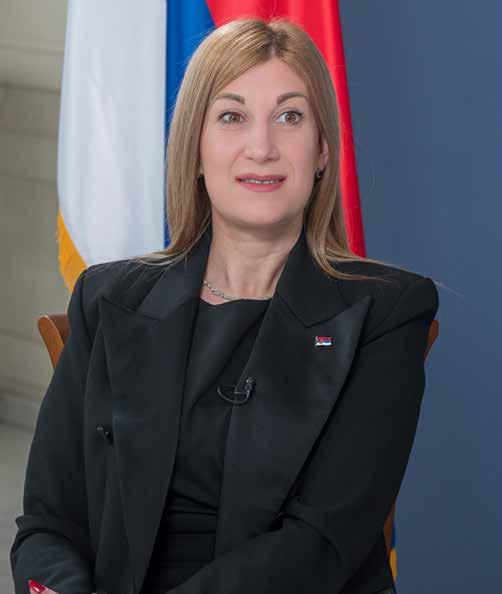
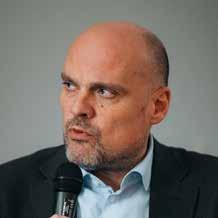
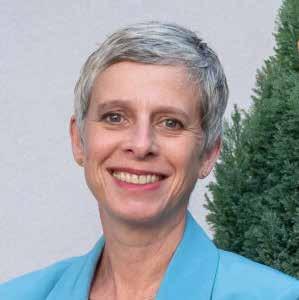
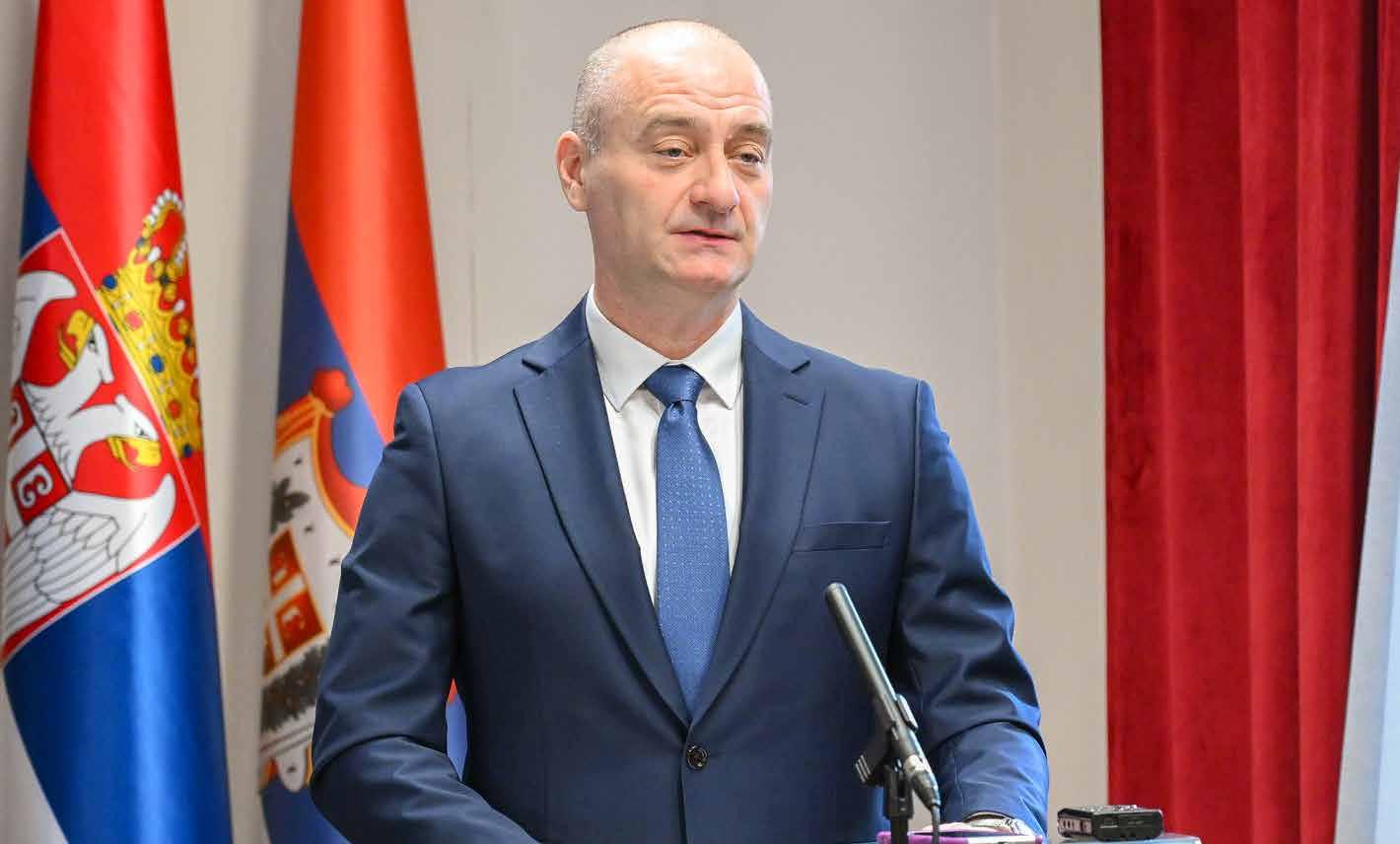
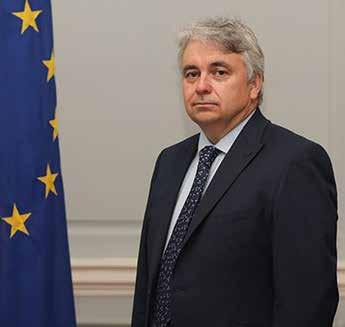
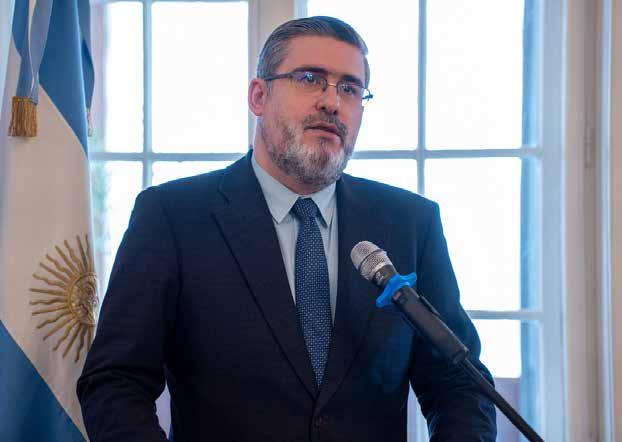
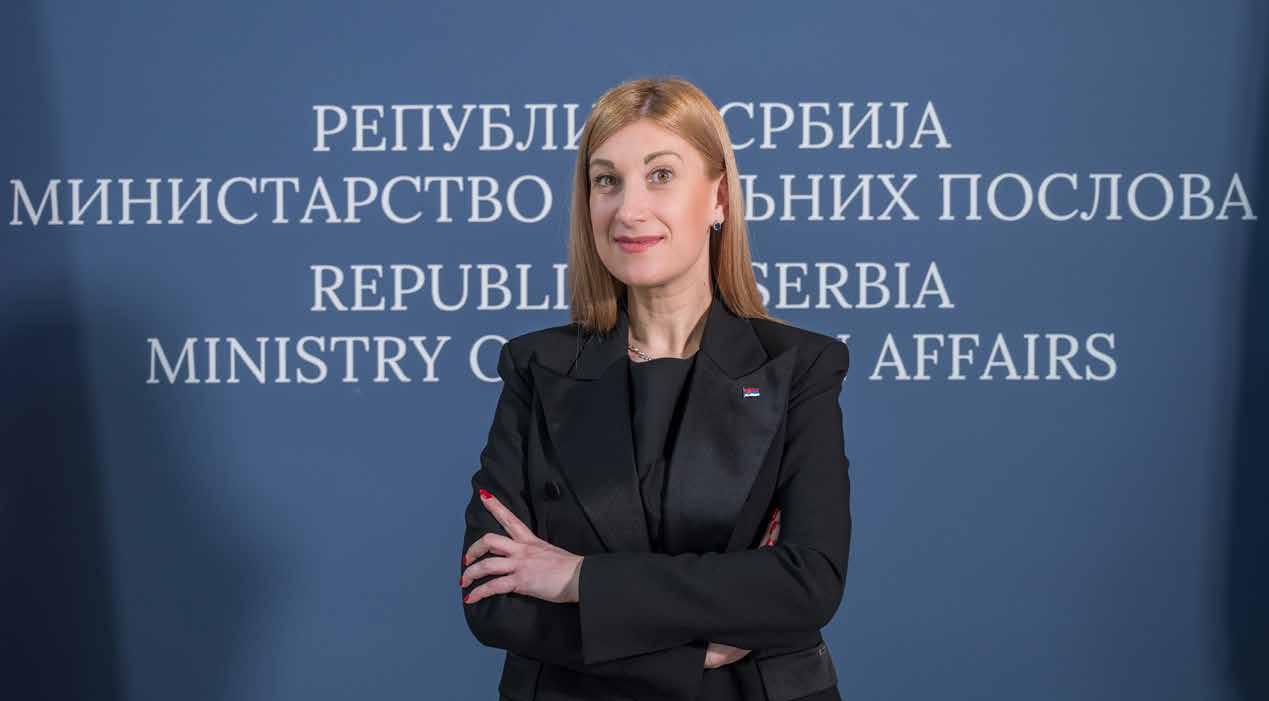
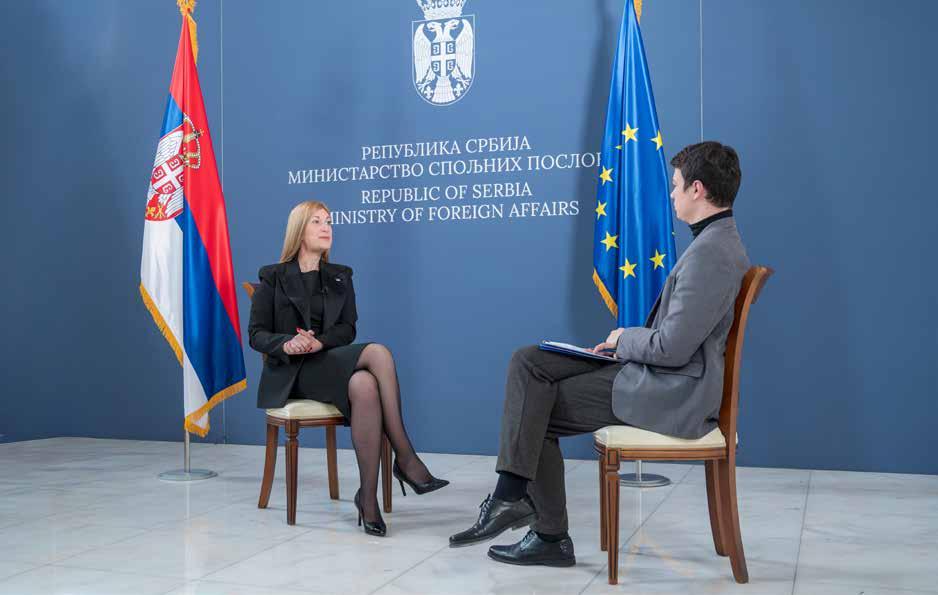
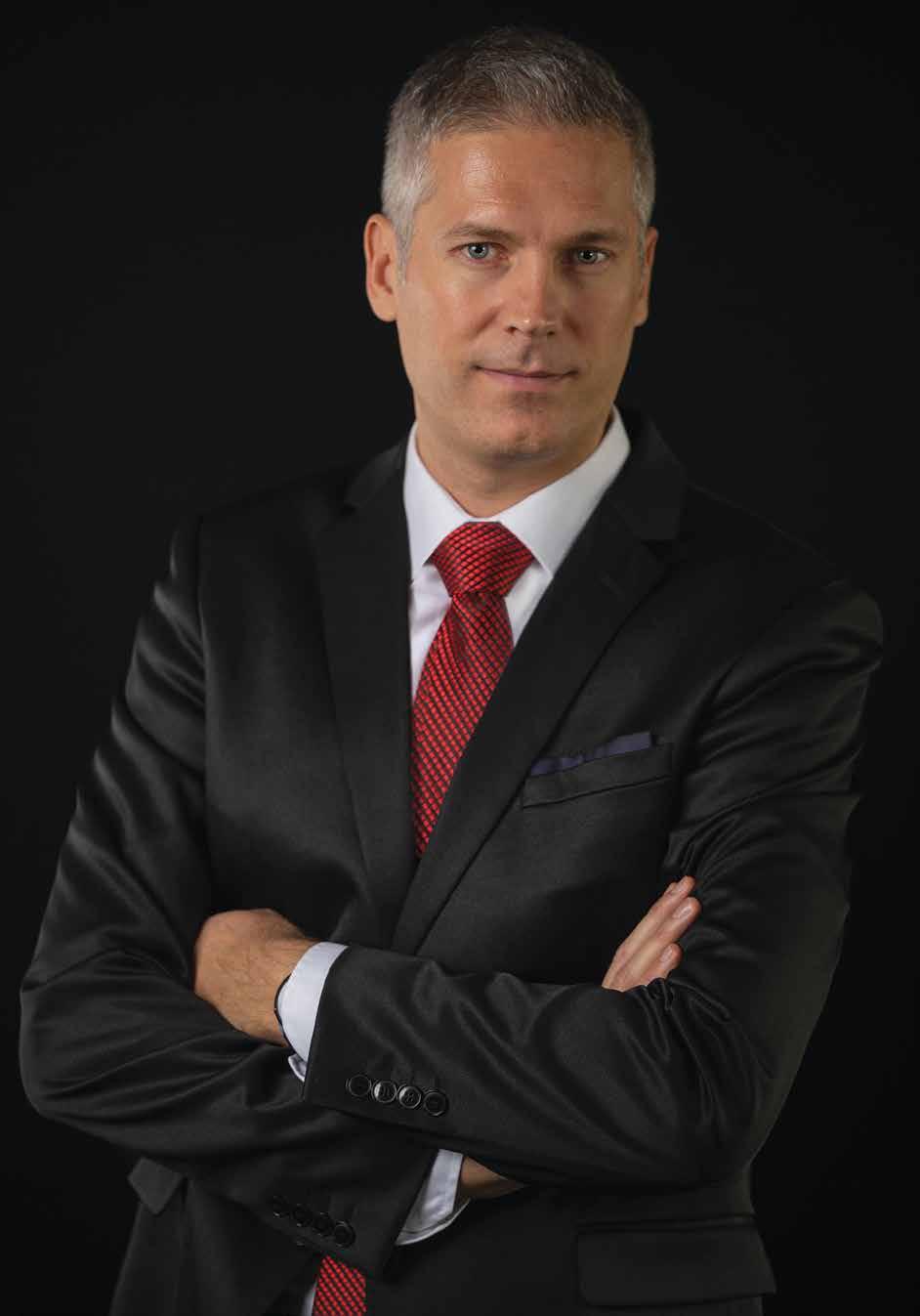
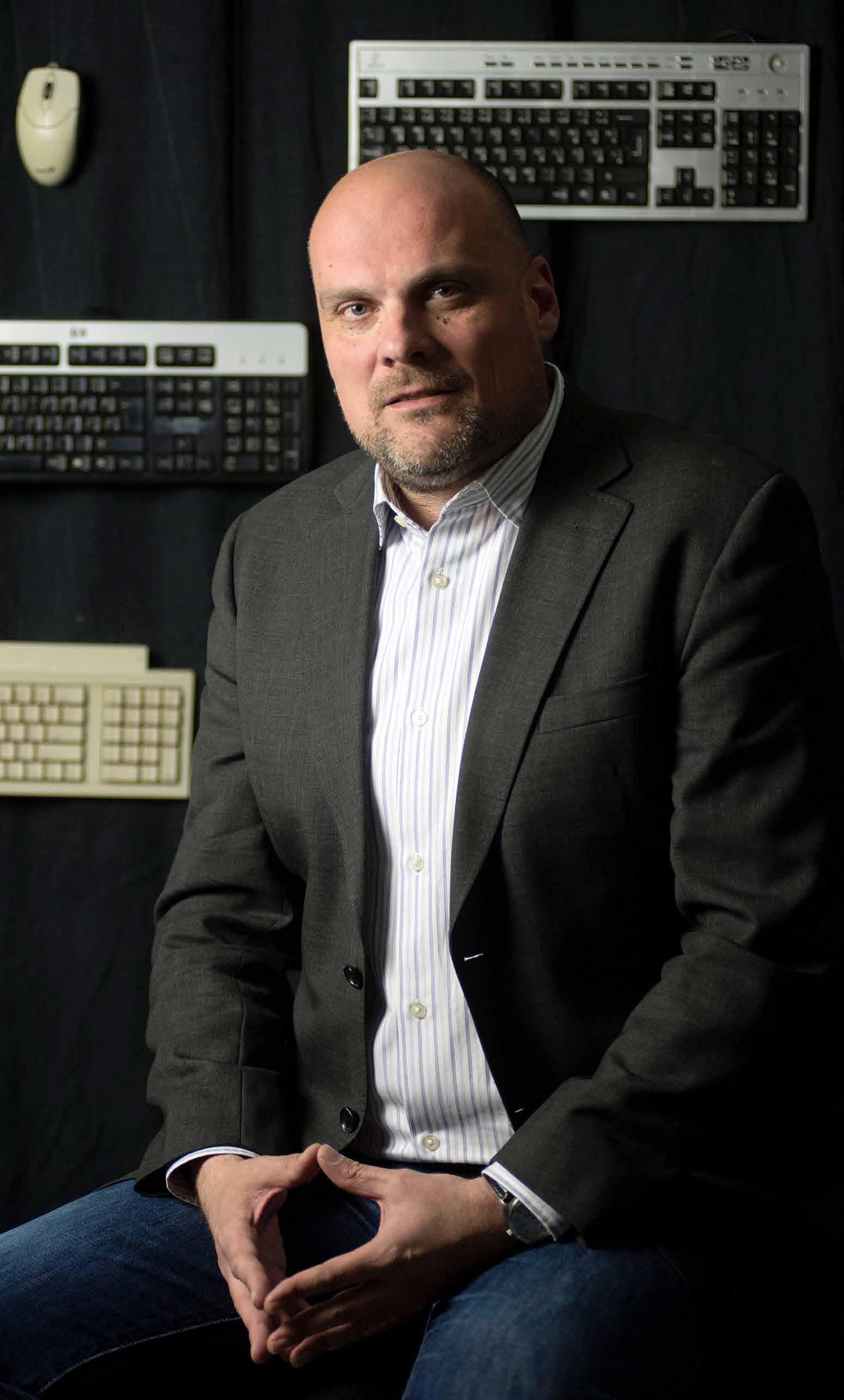
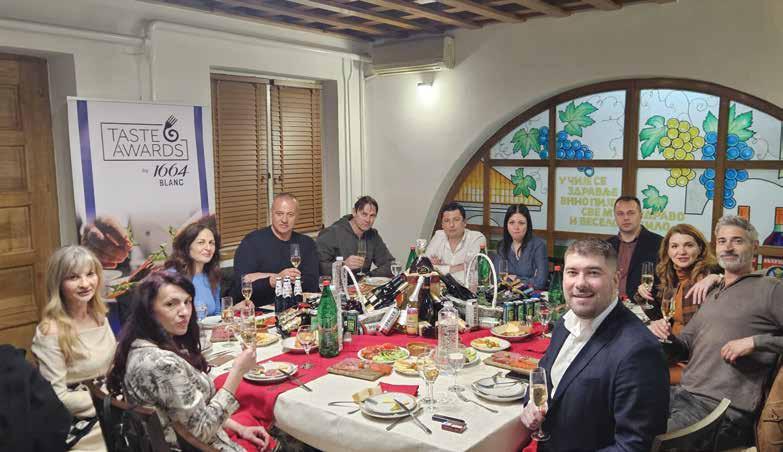
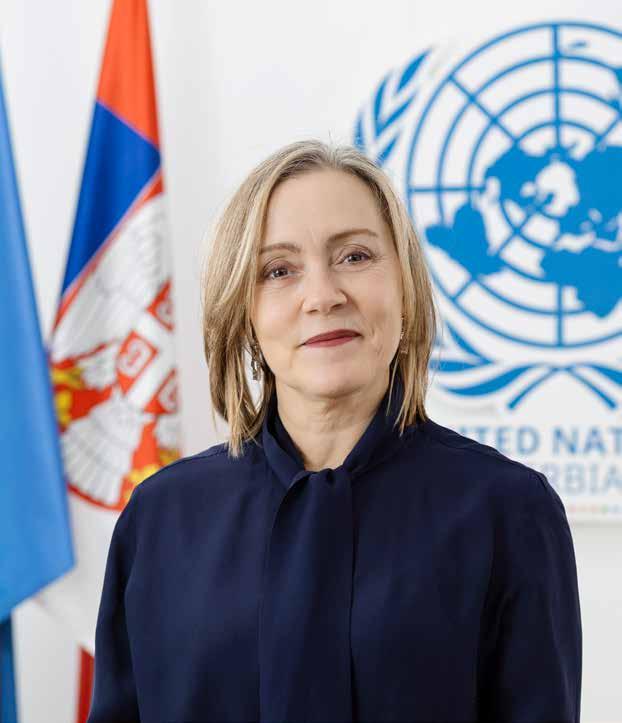
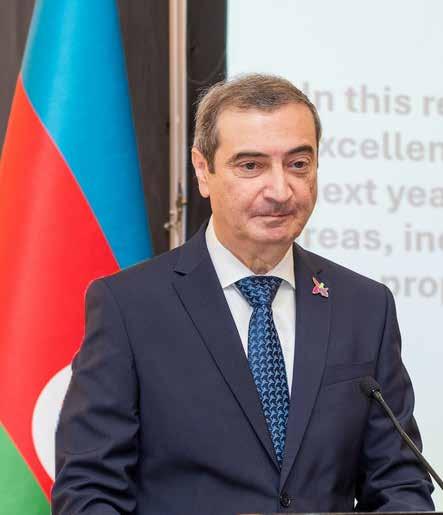
State Secretary of The Ministry of Foreign Affairs 48 MEDIA INTERVIEW A SYSTEM BUILT ON PRESSURE STEVAN RISTIĆ Vreme
APOLOGY
We would like to extend our sincere apologies to H.E. Anne Lugon-Moulin, the Ambassador of Switzerland, for the misspelling of her name on the cover of our previous issue.
We regret this oversight and have corrected it in the digital edition.
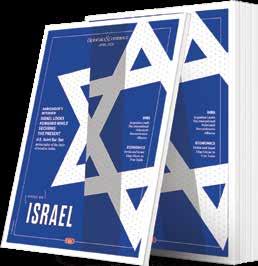
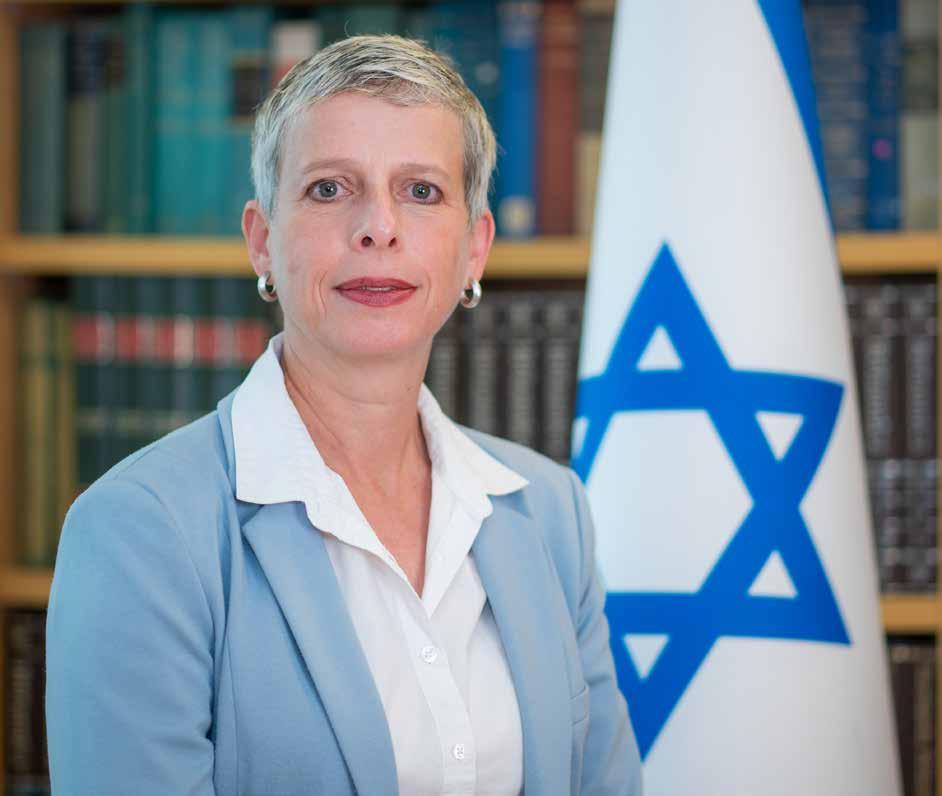
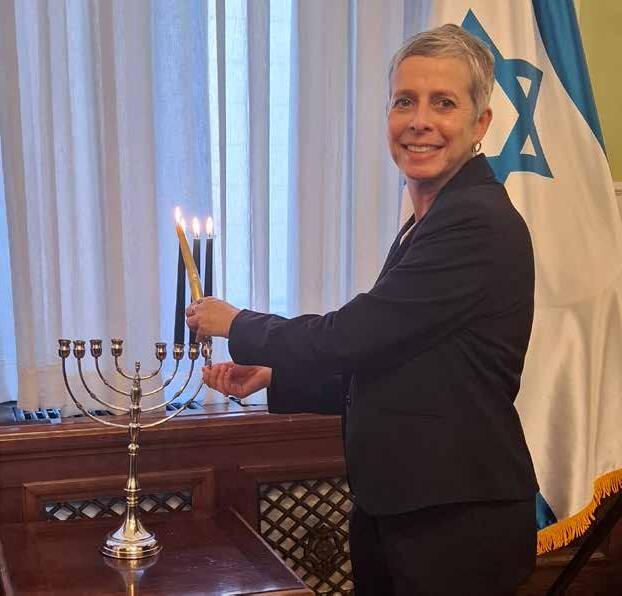
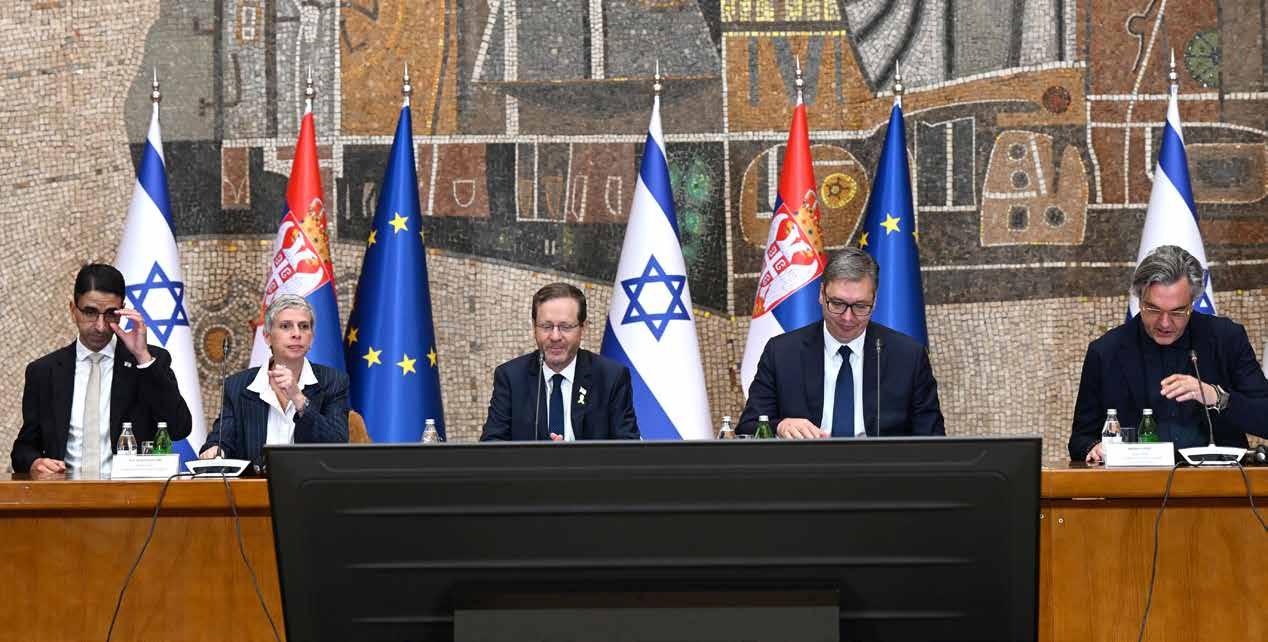
AMBASSADOR’S INTERVIEW ISRAEL LOOKS FORWARD WHILE SECURING THE PRESENT H.E. AVIVIT BAR-ILAN Ambassador of the State of Israel to Serbia
35 GREECE SPECIAL
36
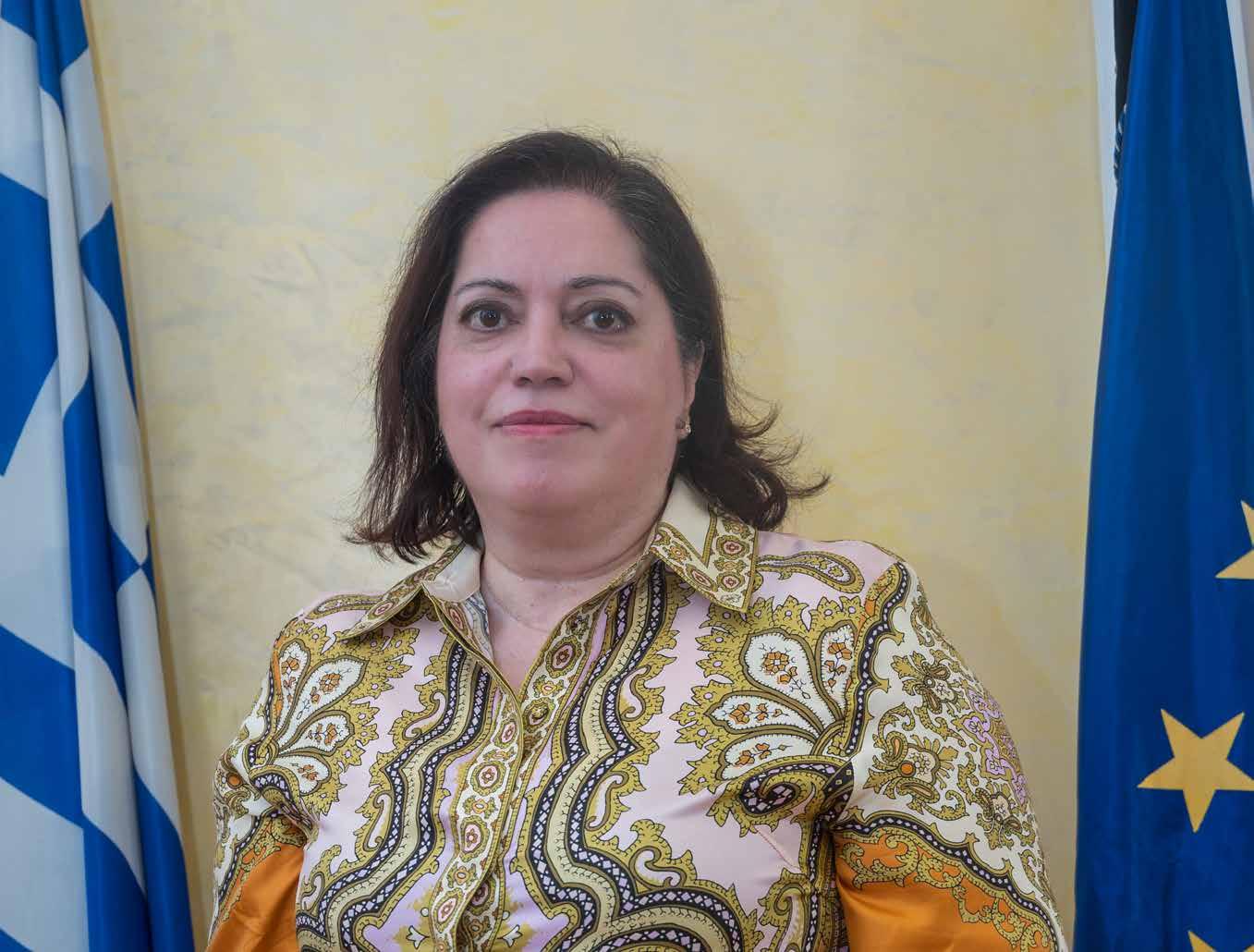
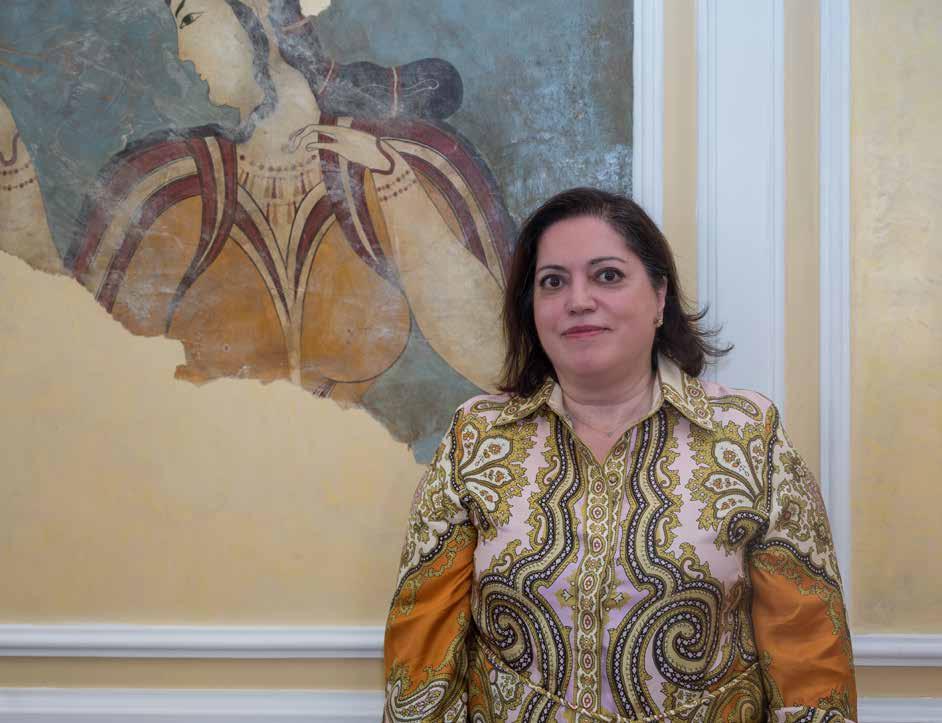
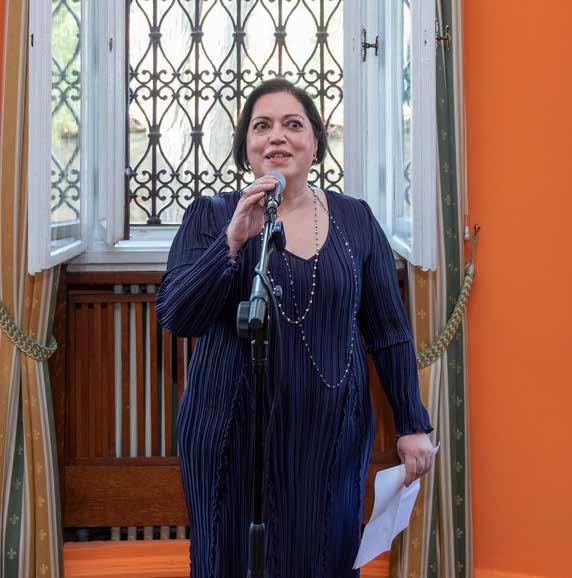
AMBASSADOR’S INTERVIEW STABILISATION, DIGITAL TRANSFORMATION, OPTIMISM FOR THE FUTURE H.E. MARIA LEVANTI The Ambassador of Greece to Serbia
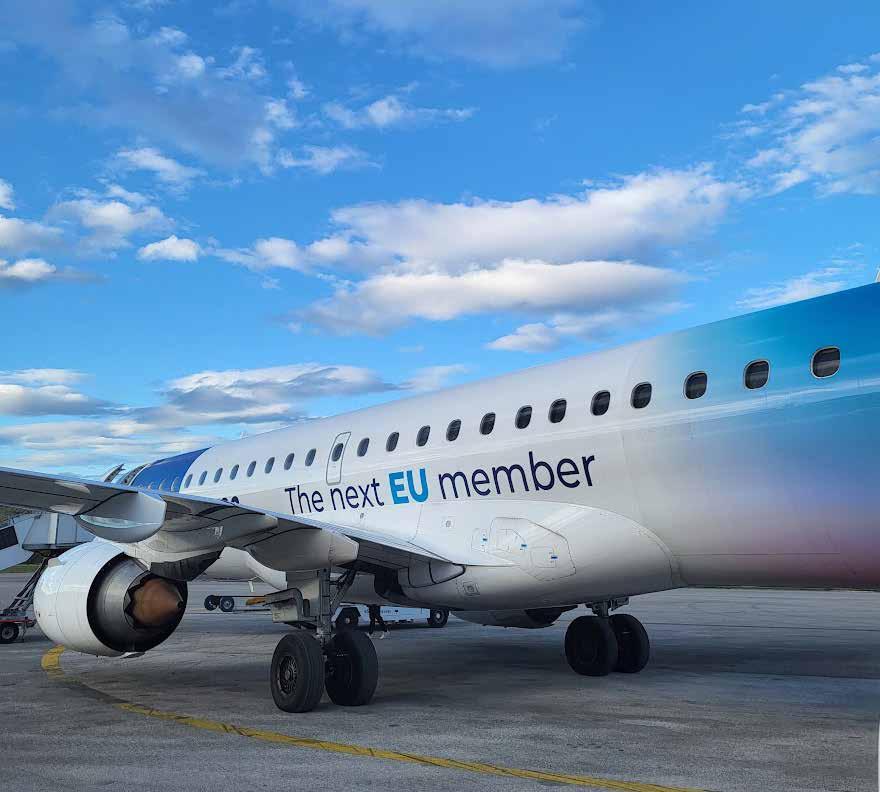
THE NEXT EU MEMBER?
Morning at Tivat Airport after the Luxury Travel Summit conference.
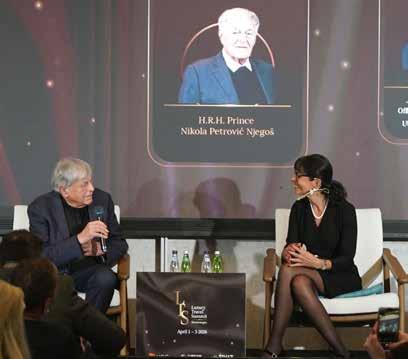
“THE NEXT EU MEMBER” is written on an Air Montenegro aircraft. Over the past three days in Podgorica and Tivat, I spoke with many Montenegrins, two ministers from different parties (Dr Tamara Vujović, Minister of Culture, and Simonida Kordić, Minister of Tourism), Prince Nikola II Petrović-Njegoš, Roko Tolić, Director of Airports of Montenegro (a native of Dubrovnik who was appointed through an international competition, previously Director of Dubrovnik Airport); I read their three daily newspapers and watched some local television.
I attended a reception hosted by the Film Centre of Montenegro on the occasion of the Montenegro Film Festival in Herceg Novi, being officially accredited by the International Federation of Film Producers Associations, thereby joining the global network of the world’s most prestigious film festivals alongside Venice Film Festival, Cannes Film Festival and Berlin International Film Festival.
As I walked from the Hilton Podgorica Crna Gora to the café garden where the Film Centre reception was held, I was overtaken by a younger
man in a tracksuit jogging through the streets of Podgorica, accompanied by three slightly breathless bodyguards. I recognised Milojko Spajić, the Prime Minister of Montenegro.
Despite all the traditional mindset-related obstacles, which, from the outside, sometimes seem charming and at other times irritating, Montenegro is moving rapidly towards the European Union, with more than 80% of the population supporting that path.
I wrote the text above on my social media profiles the day after returning from Montenegro. The reactions varied, from those who, despite all the praise, were bothered by the phrase “mindset-related obstacles”, to Eurosceptics who claim Montenegro does not belong in the EU or that the EU will collapse by then, to those who believe that support for the EU in Montenegro is far below 80%.
In the meantime, two more positive developments have come from Montenegro. The first: the companies Aman Resorts and Adriatic Properties, following the conclusion of a settlement agreement with the Government of Montenegro and the lessors, confirmed the reopening of Sveti Stefan for the 2026 summer season and expressed their satisfaction with the agreement. The decision was also shared on social media by Prime Minister Milojko Spajić, who led the negotiations. After five years, Sveti Stefan will reopen its gates.
The second piece of good news for Montenegro, though less so for Novi Sad and Serbia, is that the Government of Montenegro has adopted a decision to support international summer music festivals for 2026, creating the conditions for the country to become the new home of the EXIT Festival. Two major events are planned under the name “EXIT to Montenegro” in Ulcinj during the first half of July, and the Sea Dance Festival in Budva at the end of August. The Government stated that these events have the potential to generate significant economic benefits and a strong global promotional effect.
Prime Minister Milojko Spajić emphasised that, in the year marking the 20th anniversary of the restoration of independence, Montenegro is becoming the new home of the EXIT festival. According to him, the project could bring at least 210,000 overnight stays and more than €40 million in revenue during 2026.
In any case, see you this summer in Montenegro — more often than before, although I have been a regular visitor for years.
Public investment, digital transformation and SME support drive growth across the province
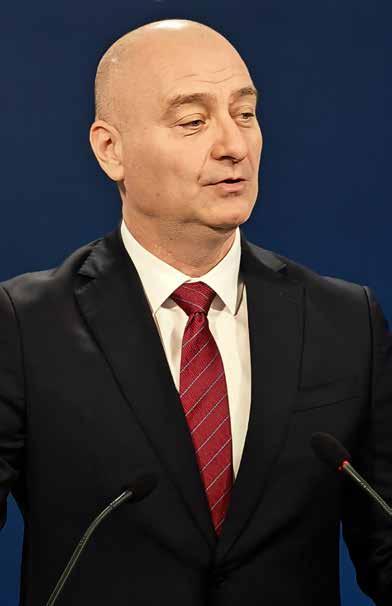
DR NENAD IVANIŠEVIĆ
Provincial Secretary for Economy and Tourism of the Government of the Autonomous Province of Vojvodina
In this interview, Dr Nenad Ivanišević, Provincial Secretary for Economy and Tourism of the Government of the Autonomous Province of Vojvodina, outlines Vojvodina’s economic priorities, focusing on tourism growth, business support, and digital transformation.
The Provincial Secretariat for Economy and Tourism, in accordance with the adopted 2026 budget, has at its disposal a total of RSD 1,5 million. Investing in tourism infrastructure and the tourism sector across
the territory of the Autonomous Province of Vojvodina is of great importance. Accordingly, half a billion dinars have been allocated to develop Vojvodina’s tourism potential, and the public call for this purpose was recently closed, receiving a large number of applications.
through its programme activities, to the Tourism Organisation of Vojvodina and to Fruška Gora National Park by investing in the rehabilitation and renovation of the Info Centre at Iriški Venac. Significant funds have also been allocated for export promotion through participation in trade
TOURISM IS RECOVERING STRONGLY, WITH CONTINUED GROWTH IN ARRIVALS AND OVERNIGHT STAYS
It is also important to highlight the support that the Provincial Secretariat for Economy and Tourism provides,
fairs. In contrast, a new concept for the regional promotion of Vojvodina’s tourism resources and capacities is currently being
implemented in cooperation with the Tourism Organisation of Vojvodina, the Novi Sad Fair, and other relevant institutions and organisations in the tourism sector.
During the year, substantial funds are planned for event tourism, intended for event organisers, which greatly supports the sustainability of numerous local manifestations. There are more than a thousand such events across the territory of Vojvodina, significantly enriching the tourist offer of individual destinations. In addition, the Secretariat will continue to support the development of religious tourism, a gem of spirituality and education and an important segment of Vojvodina’s tourism.
Through the call for incentives aimed at enhancing the economy’s competitiveness, funds totalling around RSD 230 million have been allocated. The call was announced in mid-January and closed at the beginning of February. The strong interest shown by business entities and entrepreneurs clearly indicates that the way the Secretariat designs its calls fully aligns with the needs of the private sector, namely, entrepreneurs, micro, small, and medium-sized enterprises, as well as the market.
The Secretariat has also allocated funds for financing programmes in the field of telecommunications and the information society. In the context of the call for the development of electronic communications and the information society, in cooperation with local self-governments, co-financing is envisaged for projects in these areas, including those contributing to the development of “smart and safe cities”. Plans include establishing hotspot locations in educational institutions and key public areas, as well as introducing video surveillance systems in schools.
Particular emphasis should also be placed on the funds and human resources that the Secretariat contributes to the implementation of the IPA project “Smart Tourism: a joint future of the Pannonian region”. The Secretariat is the lead partner of the project. In contrast, project partners include the Faculty of Economics in Subotica, University of Novi Sad, and DKMT DunaKörös-Maros-Tisza Eurorégiós Fejlesztési Ügynökség Nonprofit Közhasznú Kft, a non-profit organisation based in Szeged.
Looking at both the domestic and global economies and current indicators, it can be noted that, despite market challenges, economic inequalities and fragmentation within the existing geopolitical context, positive indicators were recorded in the Autonomous Province of Vojvodina’s market in 2025. This is largely due to stable public finances and significant
SUPPORTING SMES REMAINS ALIGNED WITH THE REAL NEEDS OF THE MARKET
infrastructure projects, with the Republic of Serbia and AP Vojvodina maintaining economic stability and consumer and investor confidence, alongside continuous growth in employment and wages and record-high foreign exchange reserves.
The Serbian economy has been experiencing moderate growth. According to data from the Statistical Office of the Republic of Serbia, the country recorded GDP growth of around 2% in 2025, which also affects Vojvodina, the country’s largest region.
According to the latest data for the first two months of 2026, based on macroeconomic indicators in the Autonomous
Province of Vojvodina, and as a result of the active investment policy in the tourism sector implemented by the Provincial Secretariat for Economy and Tourism, a new increase in the number of tourists has been recorded in Vojvodina.
It is particularly significant that, in the first two months of 2026, the tourism sector in Vojvodina recorded an increase in turnover of 8.8% in terms of the number of tourist arrivals and 10.2% in terms of the number of registered overnight stays, compared to the same period last year. At the level of the Republic of Serbia, an increase of 6.6% was also recorded. All of this supports the conclusion that, following very poor statistics in this sector last year, tourism, a fast-growing industry, is successfully recovering, and preparations for the new tourist season are in full swing. This is encouraging both for tourism professionals and for institutions responsible for advancing tourism and tourism infrastructure in Vojvodina,” said Ivanišević, emphasising that
interest among both domestic and foreign tourists in local destinations, particularly Vojvodina as a distinct tourist region, remains strong.
These data are highly important, as they reflect coordination and synergy in support programmes at both the national and provincial levels, as well as progress in the tourism and hospitality sectors, thereby contributing to the country’s overall economic growth and, consequently, to the region’s.
“The goal of the provincial administration is to ensure further growth and development of the tourism sector, as well as to strengthen Vojvodina’s position as an authentic tourist destination that combines rich tradition, diverse culture and contemporary trends,” Ivanišević added.
Through its incen
tive-based programme measures, the Provincial Secretariat for Economy and Tourism has continuously invested and continues to invest in the tourism and hospitality sectors. Over the past five years, approximately RSD 1.7 billion has been directed into these areas. At the beginning of this year, a new public call was also launched to support business entities, namely micro and small enterprises and entrepreneurs in tourism, for infrastructure projects in the total amount of RSD 500 million, as well as for the procurement of machinery, equipment and other items, including those related to energy efficiency.
The Secretariat plans to develop the Tourism Development Programme of the Autonomous Province of Vojvodina for the next five-year period, in line with the Tourism Strategy of the Republic of Serbia for 2026–2030, which is currently under adoption and serves as the overarching framework for the provincial programme. Trends at the beginning of 2026 indicate continued growth in employment, investment and industrial activity, although official
annual reports are not yet fully available. All of the above are indicators of a stable, active and innovative policy pursued by the Secretariat, which, in coordination with the Provincial and National Governments, the competent Ministry, as well as other institutions, organisations and funds, is actively and dedicatedly working on improving tourism infrastructure and the overall business environment in Vojvodina.
Tourism faced certain challenges in the previous year. Still, thanks to the people working in the sector, their perseverance and expertise, as well as the support of the national Ministry and the Provincial Government, namely the Provincial Secretariat for Economy and Tourism, the sector has endured. It continues to operate, further improving its products and services.
Festival and wine tourism have recorded notable growth compared to previous years. At the same time, estimates for Vojvodina indicate that the region accounts for approximately 12% to 15% of Serbia’s total tourism revenue, alongside increases in the number of categorised accommodation facilities, boutique hotels, and ethno-complexes.
On the other hand, as information and communication technologies become a global phenomenon, tourism is consistently adopting new technologies and platforms, clearly pointing to a new era in which digitalisation is reshaping society in new ways, creating benefits for all. We are fully aware of the necessity of digitalising tourism, and this is no longer merely a question of the future, as entirely new questions will arise about modern tourism. I recently quoted the founder of Telegram, who pointed out that the concept of the digital world is essentially built on blockchain technologies, artificial intelligence and social networks. All of this also applies to tourism, with content as a key element.
In addition to empowering the sector, digital transformation plays a crucial role in developing tourism potential and increasing Vojvodina’s visibility. On the path of economic development, much more must be done in digital marketing and the presentation of tourism products.
As for plans for 2026 regarding the regional tourism campaign, a new concept has been created and is already in full implementation. It is being carried out in
cooperation with the Tourism Organisation of Vojvodina. It aims to present, in the best possible way, the richness of the tourism economy of the Autonomous Province of Vojvodina, positioning it as a unified tourist destination within the wider region.
According to all available data, both statistical and based on field insights gathered through discussions with business representatives, the main challenges faced by businesses in Vojvodina over the past year have primarily been a labour shortage and unfavourable demographic trends. These include the outflow of young professionals and skilled workers not only to European Union countries but worldwide, as well as an evident ageing of the population, alongside rising labour and operating costs and inflationary pressures. Although our country is not an isolated case but part of a broader economic ecosystem, another difficulty lies in higher interest
forward-looking and committed, as a public administration body, to serving citizens in the best possible way and in line with market demand.
It is also important to highlight administrative challenges, including complex procedures that, in certain areas, require a simpler approach, depending on the category and profile of beneficiaries and recipients of funds.
Over the past five years, the Secretariat has undertaken numerous activities and initiatives to emphasise the important role of women in society, which is realised not only through formal employment but also through what is today referred to as “informal work”, which, according to conducted analyses, can be properly valued. It is essential to address equality in both society and the economy; therefore, in supporting women’s entrepreneurship, we insist on ensuring that women genuinely lead businesses, that they are real owners, and not merely “on paper”. This is particularly important to us.
We are talking about upbringing at home, where a clear boundary must be established – women must be respected. At the same time, the Secretariat places a strong emphasis on ensuring equality, particularly regarding women’s position in the economy.
DIGITAL TRANSFORMATION IS ESSENTIAL FOR THE FUTURE OF TOURISM AND THE ECONOMY
rates than in the previous period, coupled with limited access to favourable financing for SMEs and delays in collecting receivables, particularly in the construction and trade sectors.
There is also a clear need for technological modernisation and the digitalisation of business processes. In this regard, the Secretariat has recognised an opportunity and, in the previous period, adjusted its incentive measures, primarily targeting women entrepreneurs, to encourage them to digitalise their business and production processes. Once again, we have demonstrated the extent to which we are
Over the past year, we have also promoted the first regional digital platform for women’s entrepreneurship, “Osnažene”, which won first place at the prestigious European Enterprise Promotion Awards 2024 in the support for the digital transition category. The platform is dedicated to the economic empowerment of women through education, visibility and access to the market. Continued support for the “Osnažene” platform, as well as for all women who wish to become economically empowered and independent, and to venture into entrepreneurship, creates an enabling environment in which women can clearly see that they have the support to take that step and become entrepreneurs. Although women account for more than one-third of business owners, this figure should be higher.
Founded in 2023, the “OsnaŽene” platform has so far brought together more than 1,500 women from 11 countries, providing infrastructure and mentoring support, particularly to women from smaller communities and vulnerable groups.
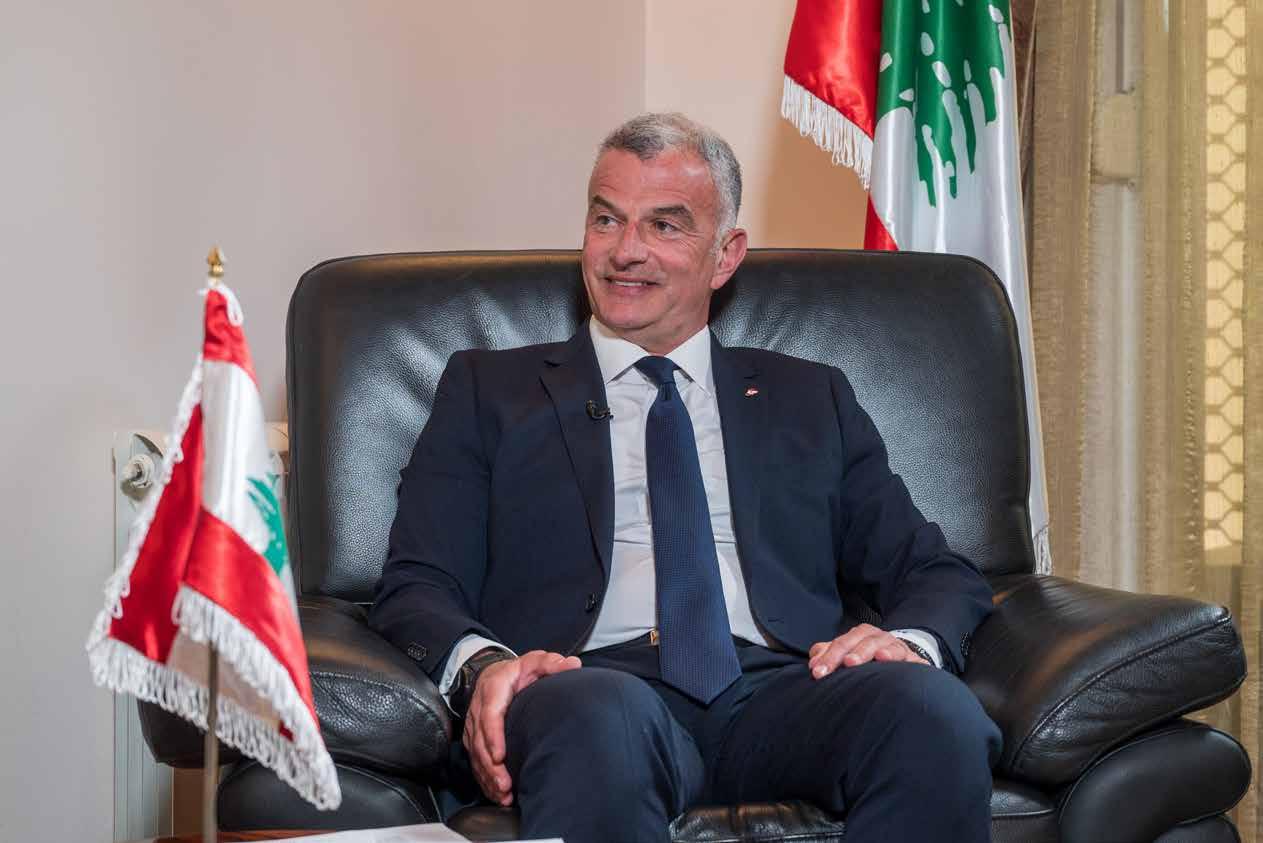
Lebanon Looks to Serbia as a Reliable Partner
From political trust to economic potential, relations set to grow despite regional challenges
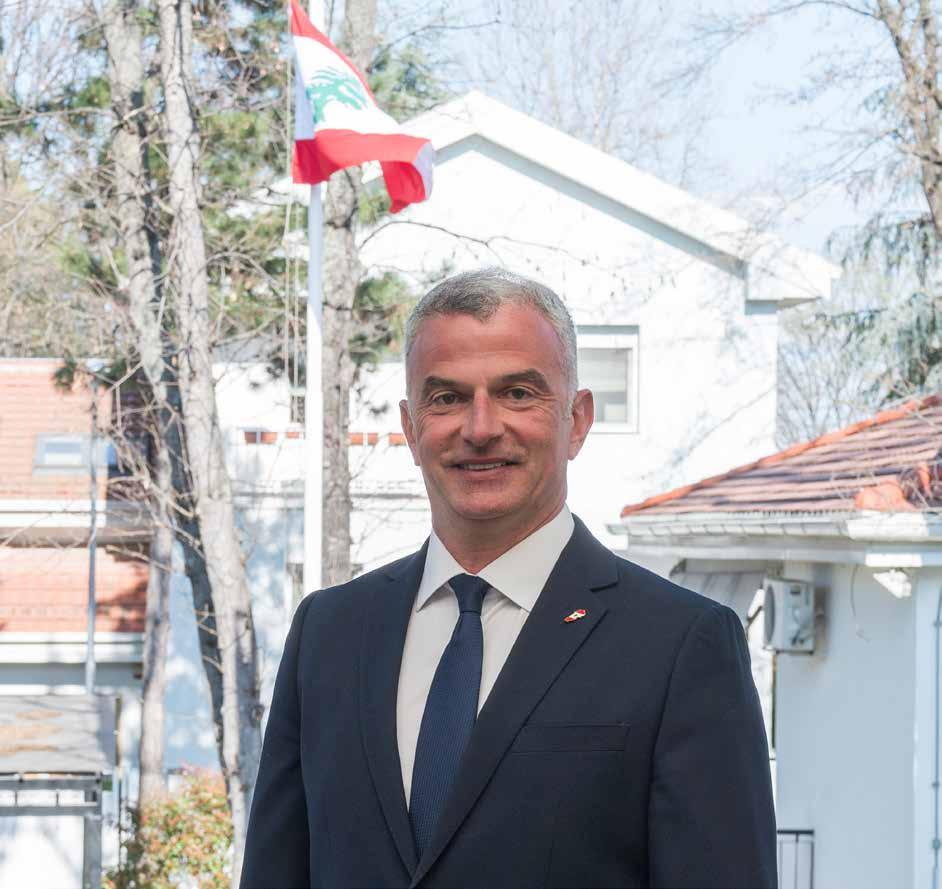
H.E. YOUSSEF JABRE
Ambassador of Lebanon to Serbia
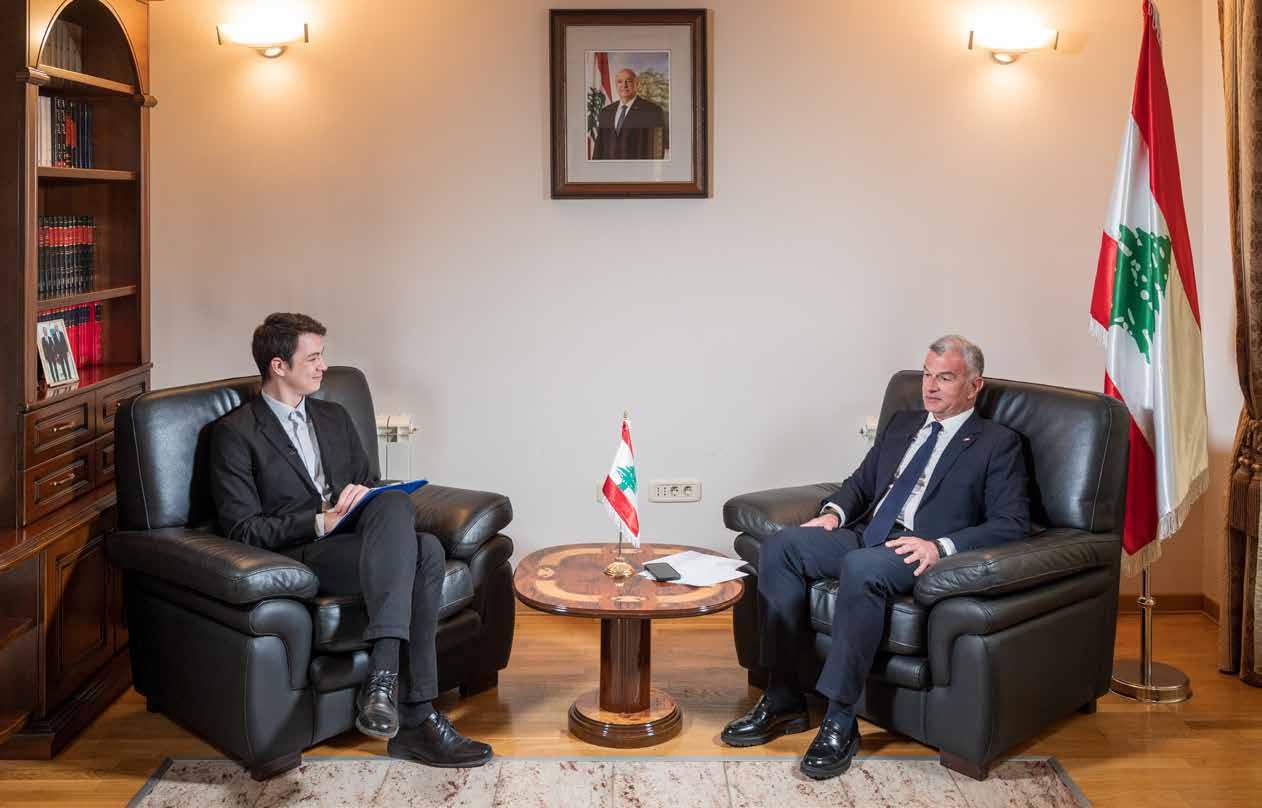
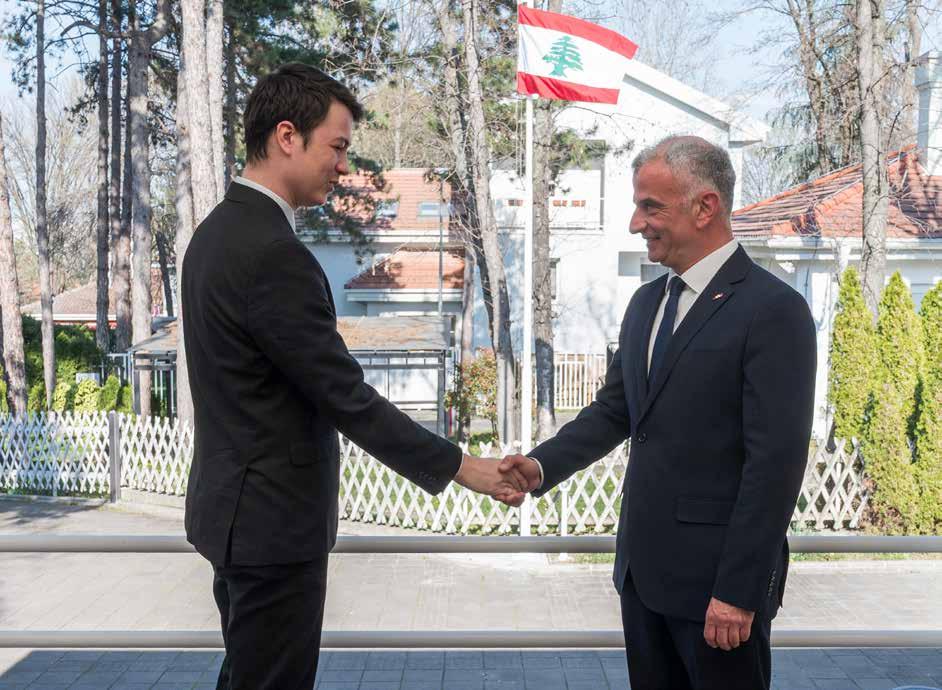
In a live interview for the TV show Diplomata, produced by Diplomacy&Commerce in cooperation with Euronews Serbia, Youssef Jabre, Ambassador of Lebanon to Serbia, spoke about the current situation in Lebanon, shifting diplomatic priorities in times of crisis, and the prospects for strengthening bilateral relations with Serbia. Reflecting on historical ties and future opportunities, he emphasised the importance of political trust, economic cooperation and cultural exchange between the two countries.
You have only recently arrived in Serbia as Lebanon’s ambassador. Could you share some details about your diplomatic career before taking up this post?
In Lebanon, I studied law and political science. I completed my master’s degree in Paris, specialising in diplomatic affairs. Before becoming a diplomat, I worked as a lawyer for four years, until 2008. That same year, I began my diplomatic career. My father was also the President of the Beirut Bar Association, so I had the opportunity to work in his law firm. However, I personally decided to pursue a career in diplomacy.
WE HAVE A VERY STRONG FOUNDATION OF FRIENDLY AND BROTHERLY RELATIONS
I served as a diplomatic attaché at the Ministry of Foreign Affairs for four years, working across several departments. I had a short mission in Kazakhstan and another brief assignment in Ankara. I was then appointed Chargé
d’Affaires in Warsaw, Poland. After that, I moved to Oman for 2.5 years, where I served as Consul. I subsequently spent five and a half years in Brussels as Deputy Head of Mission, while also serving as Chargé d’Affaires of Lebanon to Luxembourg. I returned to Beirut in 2019 and remained there for approximately five years. I served as Director of the EU Department at the Ministry of Foreign Affairs. I was then appointed to the cabinet of the then, now late, Minister of Foreign Affairs, Abdallah Bou Habib. After that, I was posted to Paris, where I served for one year and nine months. Following the election of President Aoun and the formation of a new
government, new diplomatic appointments were made, and, fortunately, I am now here. This is my first ambassadorial post, as Ambassador of Lebanon to Serbia.
Was it difficult to transition from the legal profession into diplomacy, or did it feel like a natural move?
In fact, there are many points of overlap between being a lawyer and a diplomat. Nevertheless, I did have to make a certain effort to move from legal practice into diplomacy, particularly since, as I mentioned, I come from a family of lawyers. However, I believe everything has worked out well.
What are Lebanon’s main objectives and responsibilities through its diplomatic presence here in Belgrade? And what is your personal approach to this? When I was with Minister Bou Habib, we paid our first official visit here in October 2021 to represent Lebanon at the 60th anniversary conference of the NonAligned Movement. We spent four days in Belgrade. It was during the COVID-19 pandemic, so it was not easy to fully experience the city. However, after visiting several places and meeting people,
including Serbian diplomats, I told Minister Bou Habib, “Minister, Belgrade could be a very interesting posting for a diplomat.”
So, was it your wish to come here?
In a way, yes. And then I was fortunate enough to be posted here. As for the embassy, we have very good relations with Serbia, dating back to 1946. There have been no conflicts, neither with the former Yugoslavia nor with Serbia today. We enjoy very good political relations and strong cooperation within international organisations.
My goal now is to strengthen economic ties, trade, and cultural exchange, as well as related areas. However, unfortunately, due to developments in Lebanon and the wider Middle East, our priorities have shifted. At present, we are focused on securing support and assistance for Lebanon from our Serbian friends.
OUR PRIORITY NOW IS TO SECURE SUPPORT AND ASSISTANCE FOR LEBANON
You mentioned the ties Serbia had with Lebanon through the Non-Aligned Movement during the Yugoslav era, particularly during the Cold War. Can that legacy serve as a foundation for further strengthening relations between our two countries? We have a very strong foundation of friendly and, I would say, brotherly relations. That is why neither I nor the embassy find it difficult to develop economic ties, especially as I have noticed that trade relations are not yet at a particularly high level. Total trade amounts to €17.1 million. Of that, 90% consists of exports from Serbia to Lebanon, while 10% consists of exports from Lebanon to Serbia. We need to work on increasing that figure. I have seen many opportunities for cooperation, particularly in agriculture, pharmaceuticals, medical logistics, and related sectors.
After presenting my credentials to President Vučić, I held meetings with Serbian ministers, especially those responsible for the economy and trade. We are working to establish a joint economic commission to address these issues. In addition, we also have an MoU in the field of agriculture. I hope it will be signed soon, once the war is over. There are also other
memorandums of cooperation in sport and information.
The establishment of the joint economic commission will be the starting point for drafting a free trade agreement between Lebanon and Serbia. We are moving forward step by step.
It is encouraging to hear that progress is being made. Let us also turn to the situation in your country. As you mentioned, Lebanon is facing certain pressures due to regional conflicts in its immediate surroundings. How is Lebanon addressing its internal political and economic challenges to preserve its stability?
The point is that we, the Government of Lebanon, did not start this war. We have a very clear position against dragging Lebanon into the current regional conflict. That is why, on 2 March, the Council of Ministers adopted a decision stating that the authority to decide on war and peace must rest exclusively with the Lebanese state. Unfortunately, the war began in Lebanon when Hezbollah decided to launch an operation against Israel using six rockets.
We are now enduring Israeli attacks. We are also facing very
serious social and economic consequences from this conflict. The Council of Ministers has decided to ban all Hezbollah security and military activities and has called on Hezbollah to limit its role to the political sphere.
At present, we are working to intensify diplomatic contacts with the international community and friendly countries to try to stop the Israeli attacks, establish a ceasefire and begin negotiations aimed at resolving all security issues, particularly along our borders. These ideas and initiatives have been put forward by our President, General Joseph Aoun, and our Prime Minister, Dr Nawaf Salam. Unfortunately, we are still awaiting a response from Israel.
In the meantime, we are also calling on the guarantors of the 2024 Declaration on the Cessation of Hostilities to intervene and support us in stopping this Israeli aggression and returning to negotiations, with the participation of Lebanese civil society, to find a sustainable solution.
What are the priorities of the Lebanese government in addressing the current crisis in the country?
The Lebanese government’s immediate priority is to address the crisis of displaced persons. However, first and foremost, we must achieve a ceasefire, and that urgently. This should then be followed by strengthening the Lebanese Armed Forces, particularly the army, so that it can take control of all areas in the south and begin arrangements with the Israeli side aimed at establishing stability and security along the borders. The most important priority is to reach an immediate ceasefire.
Lebanon expressed its full solidarity and support for all the brotherly Arab countries that have been targeted by the Iranian regime, and also friendly nations like Türkiye and its dear neighbour, Cyprus.
This position was transmitted in the decision of the Arab ministers of Foreign Affairs in their extraordinary meeting held on 8/3/2026.
Recently, developments have occurred regarding the UNIFIL peacekeeping forces in Lebanon. On 18 March, they stated intensified exchanges of fire, an increased Israeli presence within Lebanese territory, and new evacuation orders that most severely affect civilians. How
does Lebanon view the role of UNIFIL in maintaining stability along the Blue Line?
Lebanon cooperates with UNIFIL at a very high level. UNIFIL will remain in Lebanon until the end of 2026. As I mentioned, the Ministry of Foreign Affairs is intensifying contacts with the international community to achieve stability and security in the south, in cooperation with UNIFIL. Of course, there is also cooperation between UNIFIL and the Lebanese Armed Forces.
As for the latest crisis, the Ministry of Social Affairs is also working on several issues. So far, we have around 1,000 fatalities, 1,000 martyrs, and approximately 3,000 injured. There are one million displaced persons from the south, the Bekaa Valley and the southern suburbs of Beirut who have moved to other, safer regions. The Ministry of Social Affairs, together with other ministries, is working to provide them with shelter, food and all other necessities.
In addition, the Government of Lebanon, in cooperation with the United Nations, has launched the Lebanon Emergency Appeal
WE MUST ACHIEVE AN IMMEDIATE CEASEFIRE; THAT IS THE MOST URGENT PRIORITY
2026, aimed at securing approximately $300 million to help the country cope with the displaced persons crisis. However, the war must ultimately end to mitigate the consequences, as they are becoming more severe with each passing day.
How do local communities perceive UNIFIL and its work on the ground?
The Lebanese people support UNIFIL. I would also like to take this opportunity to thank the Serbian government, as around 160 Serbian soldiers are part of the UNIFIL mission. Many Serbian officials have told me that this contingent will remain there until the end of UNIFIL’s mandate in 2026, regardless of the circumstances.
What is Lebanon’s diplomatic strategy when it comes not only to the UN, but also to the EU?
We have very good relations with the European Union. As far back as 1977, we concluded a cooperation agreement, and in 2006, we signed an Association Agreement covering three main areas: political and security matters, economic issues, and human rights. Relations between Lebanon and the EU are truly excellent.
How would you describe the current state of our bilateral relations, and how does Lebanon view Serbia’s role, particularly in the Balkan region?
As I mentioned, political relations are excellent. There are no conflicts or disagreements between Lebanon and Serbia. What is needed is to further develop certain aspects of these relations, particularly in the fields of the economy and trade.
Which sectors show the greatest potential when it comes to economic cooperation?
I am not an expert. During a meeting at the Chamber of Commerce
here, we discussed some specifics related to this issue. We talked about agriculture, real estate investment, tourism, and, of course, hospitality. And naturally, we need a proper Lebanese restaurant in Belgrade. So, as I said, we need to work on this step by step.
Could Serbia perhaps represent an opportunity for Lebanon, serving as a gateway to the EU market, or vice versa?
Yes, and when I was in Lebanon before coming to Belgrade, I met many Lebanese investors who are interested in investing in Serbia precisely because of these advantages. After all, we know that there are numerous free trade agreements between Serbia and other countries, such as the UAE, China, CEFTA – the Central European Free Trade Agreement, and EFTA – the European Free Trade Association.
These advantages can encourage Lebanese investors to come to Serbia and explore various opportunities, not only in real estate, as I know that some Lebanese investors have already invested in property in Belgrade. We also need to work on other types of investment.
Speaking of economic cooperation, it is also important to mention Expo 2027. What are Lebanon’s expectations from this event, and how can the exhibition strengthen economic
cooperation between our two countries?
We are pleased to be participating in Expo 2027 next year. I hope that circumstances will be better by then than they are today. Lebanon will take part through two ministries — the Ministry of Culture and the Ministry of Youth and Sports. We attended the first two preparatory meetings, and the Lebanese government has appointed a commissioner, who is the Director General of our Ministry of Culture.
He was here two weeks ago and took part in the second preparatory meeting. I want to thank the Serbian side for all the facilities and support provided to ensure our participation. Lebanon will take part in the Expo, and it will be a very good opportunity to strengthen our bilateral relations, not only in the economy but also in culture and sport.
In your opinion, how can cultural exchange serve as a tool for building closer ties between our countries, alongside
LEBANESE CUISINE IS OUR SOFT POWER, OUR INTERNATIONAL ADVANTAGE
economic cooperation? How can it contribute to better mutual understanding?
I have noticed many similarities between the Lebanese and Serbian cultures. The music is similar, and in Lebanon we also have a traditional dance called dabke, which is very similar to the Serbian kolo. Even the traditional costumes bear a resemblance. The music, the clothing and the style of dancing are truly alike.
I first observed this during the celebration of Saint Sava. In addition, there are many other social and cultural similarities, such as the hospitality and kindness of both peoples. This makes my mission here significantly easier.
So, we can say that people who take part in these cultural exchanges — through food, music and similar forms — become ambassadors of relations between our countries, further strengthening those ties? Exactly. You know, some Lebanese even refer to our cuisine as our “soft power”, our international advantage. Lebanese food is present everywhere, wherever you go. But we are still waiting for an authentic Lebanese restaurant in Belgrade.
How do you like Belgrade so far? What do you enjoy the most — the people, the food, or how do you find our cuisine?
The people are wonderful. My Serbian colleagues are very kind. I have been warmly welcomed here by both the public and officials. The cuisine is excellent, although it is quite rich in calories, so one has to be careful — and remember to stay active. The climate is pleasant. I had a different experience in Poland, Brussels and Paris, where it is often cloudy and rainy. Here, it can be cold, but it is sunny, which is a positive. I have been here since 14 October.
I am beginning to discover more about Serbia’s culture, society and customs. Another similarity between Lebanese and Serbian people is the strong attachment to family. We have that in Lebanon as well — family gatherings are very important. The family is a key element of social life in Serbia. We are not geographically far apart. If there were a direct flight, as there once was, we would be only two hours away.
Can we expect the direct flight route to be reinstated in the future, once the situation stabilises? I hope so. I have spoken twice with the CEO of Air Serbia, and we discussed the possibility of re-establishing the route between Belgrade and Beirut. However, the war then began, and we had to put everything on hold and focus on our priorities.
When we speak about the future, how do you see relations between Serbia and Lebanon over the next decade? Relations will be excellent. Lebanon’s positions on issues concerning Serbia will not change, starting from respect for Serbia’s territorial integrity to economic cooperation, cultural exchange, sport and beyond.
I am also confident that cooperation within international organisations, through voting and mutual support, will continue. Serbia supported Lebanon during the COVID-19 pandemic and after the explosion at the Port of Beirut. I hope that we will receive further assistance soon, as it is needed in the current crisis.
The Unexpected New World (Looming)
The world will most likely never be the same again, and these are the possible consequences of the war, regardless of how it ends on the ground
The attack by Israel and the United States on Iran was meant to be a “final reckoning” with what Iran calls the “Axis of Resistance” in the Middle East, and what the U.S. has for more than 20 years labeled as “rogue states” - states or organisations that Israel, for its part, considers existential threats not only to its progress survival but certainly to its very survival: the Islamic Republic of Iran, the Houthis in Yemen, Hamas in Gaza, Hezbollah in Lebanon, and the Baath in Syria under Assad. After Assad’s fall, a firm coalition with the Syrian Druze and the crackdown on Hamas, Israel was left with a few remaining “main adversaries” to deal with. There is nothing particularly new about that. What was different, however, is that for the first time a critical mass of allies emerged in the White House - ranging from pro-Israel politicians to “modern crusaders,” Christian Zionists, endtimes preachers, and those who simply wanted to seize the oil and extend American global - or at least energy - hegemony. Then came 28 February, and with it the beginning of what may be one of the most dangerous moments for global peace since 1945.
How is the situation evolving? It changes by the day, by the hour - driven both by the unpredictability of the American president and by the internal dynamics that every war, as a “living organism,” inevitably develops. Once a war begins, it becomes difficult to control, even though wishful thinking pushes decisionmakers to start with confidence and the belief that it will be short-lived. There is an interesting parallel here: Putin launched his “special military operation” in 2022 after a short and successful intervention in Kazakhstan to quell unrest - admittedly at the invitation of the Kazakh government - and that likely lulled him into believing Ukraine would also be quick and successful. Trump’s “Kazakhstan” was Venezuela - although no one invited him there. And so the idea that everything would be “easy and fast” collapsed. Rather than predicting how this entire tragic mess - costing human lives - will unfold, it may be more useful to examine how the world will be shaped by it. Here are some possible consequences.
THE GREEN TRANSITION ACCELERATES?
If there is one certainty, it is that markets dislike uncertainty - and energy markets despise it. The disruption or serious threat to roughly 20% of global oil and gas flows from the Persian Gulf acts as an alarm far beyond the Strait of Hormuz. Europe, having already learned a painful lesson with Russian gas, no longer has the luxury of gradual adjustment. Asian economies, which have built decades of growth on stable energy supplies, are also searching for alternatives. The “green transition” is no longer an ideological project or an ESG buzzword from corporate presentations - it is becoming a matter of national security. Paradoxically, a war partly driven by fossil fuels may accelerate a world beyond them. Trump may have raged against wind farms, but he may well have helped them multiply.
IS THE PERSIAN GULF NO LONGER THE
“FUTURE
CENTRE
OF THE WORLD”?
Dubai, Doha, Abu Dhabi - these were laboratories of the future: places where capital, tourism, logistics, and geopolitics met inside a perfectly air-conditioned bubble of stability. That stability was their core product. A war in the immediate neighbourhood shatters that illusion. Investors may not flee outright, but they are looking for alternatives. Megaprojects—including high-tech ventures like data centres—no longer appear as safe bets but as expensive experiments in a region once again reminding the world why it was synonymous with risk for decades. Influencers have already left. Will they return? Global sport has been pouring into the region—Saudi leagues with Ronaldo, the 2034 FIFA World Cup in Saudi Arabia, Guggenheim Abu Dhabi, Formula 1… Will the world still flock to the Dubai Mall and transit through Doha? The Persian Gulf will not disappear as a global hub—but it will have to prove itself all over again.
THE CONTINUED RISE OF CHINA?
THE WHOLE WAR WAS A PR DISASTER FOR AMERICA
If the goal was to cut China off from Iranian oil and slow its growth, the effect may be the opposite. In a fragmenting world, China becomes the “neutral” partner—powerful enough to help, cautious enough to avoid confrontation. An old Chinese proverb says: “Do not interrupt your enemy while he is making a mistake.” In this case, Beijing can watch as Washington spends resources, political capital, and alliances. At the same time, more and more countries are turning to China - not because they want the Chinese model, but because they want an alternative. Even within the United States, especially among younger generations, fascination with Chinese efficiency is growing - a phenomenon the internet has already dubbed “Chinamaxxing.” For many Americans aged 18 to 29, the “Chinese dream” is starting to look like the new American dream: high-speed trains, metros, cleanliness, efficient public services, and politicians executed for corruption. For Trump and his allies, that is nothing short of a nightmare. The whole war was a PR disaster for America, we ought to say.
A SPLIT WITHIN THE MAGA MOVEMENT?
One of the core tenets of MAGA ideology was isolationism: fewer wars, more roads, bridges, and factories at home. War with Iran strikes directly at that premise. A rift is already emerging between the hardcore who follow Trump regardless of direction and those who believe the movement’s founding principle has been abandoned. Voices like Tucker Carlson are growing louder in their criticism of interventionism, while politicians balance
loyalty with political survival. This is not just a tactical disagreement - it is an ideological test. If the movement fractures, the consequences for American domestic politics will be long-term. We may see a “True MAGA” faction around JD Vance and a “Trump MAGA” faction around Marco Rubio. Perhaps it is also time for the United States to move beyond the two-party system altogether. Republicans could cease to function as a unified GOP and split into three currents, including a “classic Republican” anti-Trump faction. Democrats, too, may formalise their divide between “Democratic Socialists” led by Bernie Sanders and AOC, and the mainstream “Clinton Democrats.” Even Britain’s de facto twoparty system is unravelling: Labour and the Conservatives are no longer alone, as Reform UK and the Greens gain ground alongside the Liberal Democrats. Five parties now compete for power, with regional forces rising. This may be a true paradigm shift.
WEAKENING NATO COHESION?
NATO was already under pressure, but this conflict deepens the cracks. Alliances function on trust and predictability—both now in question, especially since Trump’s earlier rhetoric about Greenland. While he has spoken about withdrawing from NATO, U.S. presidents can no longer do so unilaterally, and there is no two-thirds majority in Congress. Europe, which has developed a degree of strategic autonomy, is now thinking even more seriously about its own security architecture. The United States, on the other hand, may respond - out of frustration - by cutting funding or relocating military assets to more “compliant” allies. NATO will not disappear, but it may become a formal structure with diminishing real cohesion.
THE WORLD AFTER THIS WAR WILL NOT BE THE SAME, NOT BECAUSE ONE SIDE WILL WIN, BUT BECAUSE EVERYONE WILL HAVE TO ADAPT TO NEW RULES OF THE GAME
THE PETRODOLLAR UNDER PRESSURE?
The global financial system, since the collapse of Bretton Woods and the 1973 oil crisis, has rested on the petrodollar - the foundation of American financial power. Its erosion has already begun, with the dollar’s declining share of global reserves, and this trend may accelerate. Since the 1970s, and especially under Nixon, the system has relied on one quiet but crucial assumption: energy is priced in dollars. This has allowed the U.S. to finance deficits and maintain global dominance. However, “quiet de-dollarisation” has been underway for years, and this conflict speeds it up. Suppose major players begin trading energy in alternative currencies - whether yuan, currency baskets, or even digital arrangements - the petrodollar loses its central role. This will not be a sudden collapse but a gradual erosion. History shows that great systems rarely fall overnight - they slowly lose relevance, much like the peso or the pound once did.
THE ENDGAME
Perhaps the ultimate “endgame” is an America that turns inward - something Tucker Carlson frames as a potential
victory after decades of endless wars. Since 1991, when Gorbachev announced the end of the USSR, the world has lived through what could be called a “lost American third of a century,” during which unmatched hegemony was misused, while China built itself into something resembling science fiction. Much of global politics has revolved around control of oilwhether in pipelines from the Gulf to Israel or elsewhere - but this may prove to be one of the last wars fought over it.
Perhaps the future lies in a new kind of “Congress of Berlin,” where all actors would have to acknowledge that others exist and will not disappear - and that attacking them is futile. Five major regional players - Turkey, Israel, Iran, Saudi Arabia, and the UAE - pursue very different interests and wage proxy wars, from Libya, Sudan, and Somalia to Yemen and Syria. The result is always the same: human suffering and destruction, with no real winners. It may be time to recognise that all groups have a right to existence and (autonomous or federal) self-governance (not full independence): Shiites and Sunnis, Kurds and Druze, Alawites, Houthis, Israelis and Palestinians, Christians and Assyrians, Turkmens and Ibadis, Wahhabis and… you get the point.
Perhaps the greatest irony of all is that many actors entered this conflict believing it would strengthen their position in a changing world. Instead, they have accelerated changes that may soon be beyond anyone’s control. The world after this war will not be the same - not because one side will win, but because everyone will have to adapt to new rules of the game. And as always in history, the biggest losers will be those who believed the rules were permanent.
European Solidarity and Cultural Connections
Opening of the Irish Embassy in Serbia and Plans for the Future
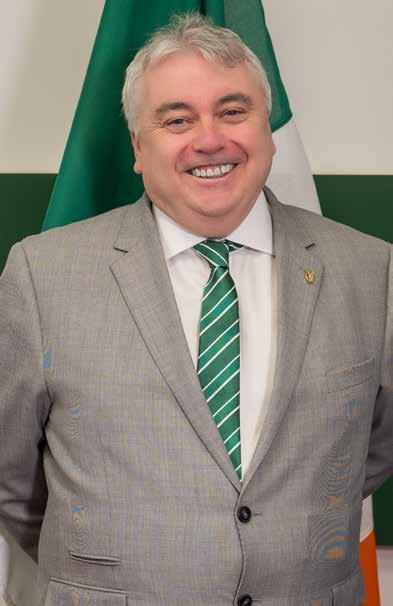
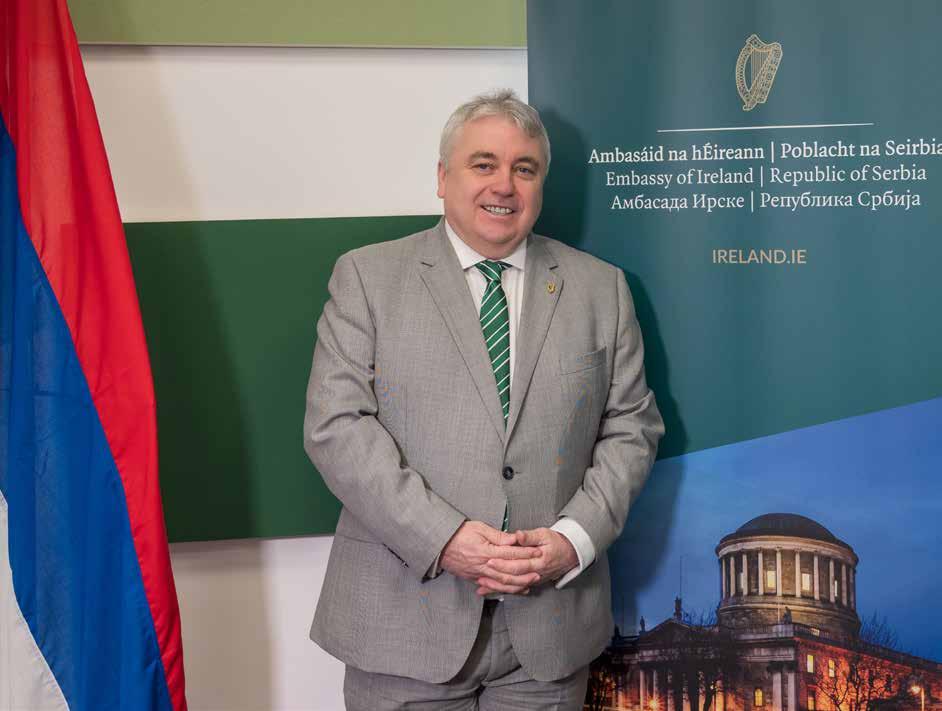
H.E. KEVIN COLGAN
Ambassador of Ireland to Serbia
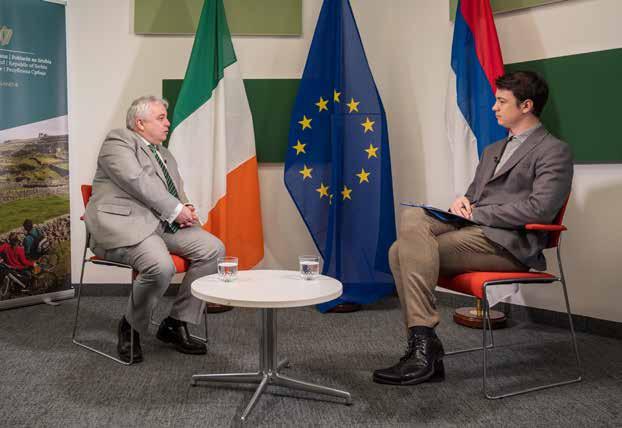
For the TV programme Diplomata, we spoke with H.E. Kevin Colgan, Ambassador of Ireland to Serbia and the country’s first resident representative in Belgrade. In this interview, we explore political, economic and cultural relations, Serbia’s European perspective, and the ties between our societies through tradition, literature and film.
As the first resident Ambassador of Ireland to Serbia, what opportunities do you see for further strengthening bilateral relations in the future?
We opened our embassy here in Belgrade with three main objectives. The first is to enhance political, economic and cultural ties between Ireland and Serbia. The
second is to provide services to our community here in Belgrade — both the Irish community and Serbian citizens who wish to travel to Ireland, particularly in terms of visas and consular support. The third reason is that we will assume the Presidency of the European
WE
ARE
NOW
what motivated this decision and when we can expect the embassy to be fully up and running?
We are already fully operational. We can provide all the services expected of an embassy, such as issuing visas and offering consu-
ON THE GROUND AND ALREADY BUILDING STRONG CONNECTIONS IN THE BUSINESS SECTOR
Union later this year and wish to support the accession in the Western Balkans.
Ireland announced the opening of this embassy in 2024, and now, in 2026, we expect it to become fully operational at any moment. Can you tell us
we have opened 26 new diplomatic missions. This year, we opened embassies in Belgrade, Sarajevo and Chișinău, and we plan to open two more next year.
We recently saw St Patrick’s Day being celebrated around the world, almost like a global festival. How important is it for Ireland to see its traditions embraced abroad, including here in Serbia?
It is a great pleasure for us to see people enjoying our culture and traditions and celebrating together with Ireland across the world. As you mentioned, we have 105 diplomatic missions worldwide, and each of them organises 10 to 12 events, which means around 1,500 events are held globally to mark St Patrick’s Day. For us, it is a wonderful way to bring Ireland closer to people, to share our history, and also to show that Ireland is a country where everyone is welcome.
Ireland is part of the European family, and you highlighted its importance upon your arrival in Serbia. Ireland chose to remain in the European Union, while your neighbour, the United Kingdom, decided to leave during Brexit. How has that decision affected Ireland’s identity and its position in Europe?
lar assistance. This is a temporary location, but we plan to remain here for the next number of years before beginning the search for a permanent solution.
In recent years, Ireland has recognised the need to expand its diplomatic presence worldwide, and over the past five to six years,
We decided to join the European Union many years ago, and that decision has been extremely important to us. We have developed as a state, as a society and as a people through our membership of the EU. We are not the largest country in the world, but as part of the European Union, we can play a more significant role on the global stage. The EU has been of great benefit to us in terms of access to markets, access to labour, the exchange of ideas, and the solidarity shown to us during the financial crisis in 2010. The European Union, the European Central Bank and the Member States supported Ireland during that period. So, Europe has been a strong and reliable partner for Ireland throughout these years.
What role can Ireland play in supporting Serbia on its path towards the European Union? I believe Ireland can serve as a strong example for countries like Serbia regarding the benefits of
EU membership. We demonstrate how belonging to a larger community can be both important and a successful strategy. We are ready to support Serbia, primarily in a technical capacity — by sharing our experience and lessons learned in public policy and development. We do not intend to tell Serbia what it should do; Serbia is aware of what it needs to do, but rather to assist as much as we can. I believe we are a good example of the advantages of European Union membership.
Ireland has historically been known as a progressive society, particularly its people. It was the first country to legalise samesex marriage by referendum. It also elected its first female president, Mary Robinson, and legalised divorce and abortion — all through direct public voting. How do these developments reflect Ireland’s broader social transformation, and what lessons might countries like Serbia draw from this experience?
Ireland, 40 or 50 years ago, was a very different country in terms of social values and attitudes. All the changes you mentioned are part of our progress. The key element was that we fostered open dialogue — often outside traditional political frameworks. Difficult issues, such as abortion and divorce, were addressed through what we call citizens’ assemblies.
This is a very systematic way of bringing citizens together to discuss key issues and make recommendations to the government, whether a referendum should be held and how the specific question should be framed. In this way, we moved sensitive topics out of the political arena
and enabled citizens to engage directly with one another, which is often far more effective for issues that are difficult to resolve through conventional political processes.
One of the key ways to strengthen relations between countries is through the economy. Which sectors of cooperation between Serbia and Ireland do you see as the most promising — IT, agriculture, perhaps green energy?
There are already significant Irish investments in Serbia, as well as Serbian investments in Ireland, particularly in the IT sector. During the Irish festival week in Belgrade, I had the opportunity to meet some Irish investors who came
pharmaceutical industry, machinery, and water-related equipment. In any case, there are many areas where we can further strengthen our cooperation.
Are there plans to encourage investment from Ireland to Serbia, or vice versa?
We are ready to support any investor, whether from Serbia or Ireland, and we encourage them to explore opportunities in both countries. Last week, during our minister’s visit, we had an excellent meeting with the SerbianIrish Chamber of Commerce and Enterprise Ireland, the state agency that promotes investment in Ireland and Irish investment abroad, including here in Serbia.
THESE
RELATIONS WILL CONTINUE TO STRENGTHEN AND DEVELOP OVER THE NEXT FIVE TO TEN YEARS
here, as well as Serbian investors based in Ireland. It was an excellent opportunity to see what is actually happening on the ground.
So, in addition to IT, tourism is also an important sector. We have a very successful tourism industry, as do you, and there are many points of contact. Tourism is one of the pillars of our economy and could also be further developed in Serbia.
Agriculture is another key area. We have developed our agricultural sector significantly since joining the EU, which has helped us improve efficiency and standards.
There are three areas in particular where we are seeing growth and exchange — the
recently had the opportunity to attend a reading of his poetry.
We were also delighted to host Neil Jordan, an international film director. Both Stephen Rea and Neil Jordan were presented with the Golden Seal Award.
It is truly wonderful to see Irish culture recognised and appreciated here in Serbia. I was particularly impressed during the Beckett readings — especially by the questions that followed. Serbian audiences are remarkably well informed about Irish culture, and especially about Beckett. The questions raised were of a very high level and clearly demonstrated a deep understanding of the subject.
The Belgrade Irish Festival has been held for the 14th time and has a long tradition. It brings Irish film, theatre and literature to local audiences. Could you tell us what role film and theatre play in Ireland’s broader diplomatic approach to connecting Serbian and Irish citizens through culture?
I think Ireland, like Serbia, is truly fortunate in that regard. That is where one of our key similarities lies. You have a very rich tradition in theatre and literature, just as Ireland does. And we are very pleased to share that culture with others, whether here in Serbia or around the world.
We also use it as a diplomatic tool, if I may put it that way. This year, we had some truly excellent events. And as an Irish ambassador arriving in Serbia, where the festival already exists, that provides a very strong foundation.
Belgrade is a wonderful city — truly an excellent place. As for the festival, we hosted more than 30 events over 10 days. Film, poetry, literature, music — a very diverse programme. We also welcomed some truly renowned figures from the Irish acting scene, such as Ruth Negga and Stephen Rea, who performed readings of Samuel Beckett. Beckett was at the heart of this year’s festival. It was here in Belgrade that Waiting for Godot was first performed, and we
We can say that there are certain connections and similarities between our cultures. There certainly are. And we could not conclude this interview without mentioning the Celtic connection. One of the events was a lecture on the similarities between Irish and Serbian names. There are also the Orthodox Celts, who are quite significant in that sense.
But for me, what truly connects us is a deep love of literature, of family, and of storytelling. And there is also a particular sense of humour that we share — something subtle, a little dry, but always very human.
How do you see the development of bilateral relations between Ireland and Serbia over the next five to ten years?
I believe they can only deepen. We are now on the ground and already building strong connections in the business sector. We also have solid ties in the field of culture. Politically, we are very pleased with the relationships we have established, both with the Government and with political stakeholders here. In my view, these relations will continue to strengthen and develop over the next five to ten years.
19 MARCH 2026
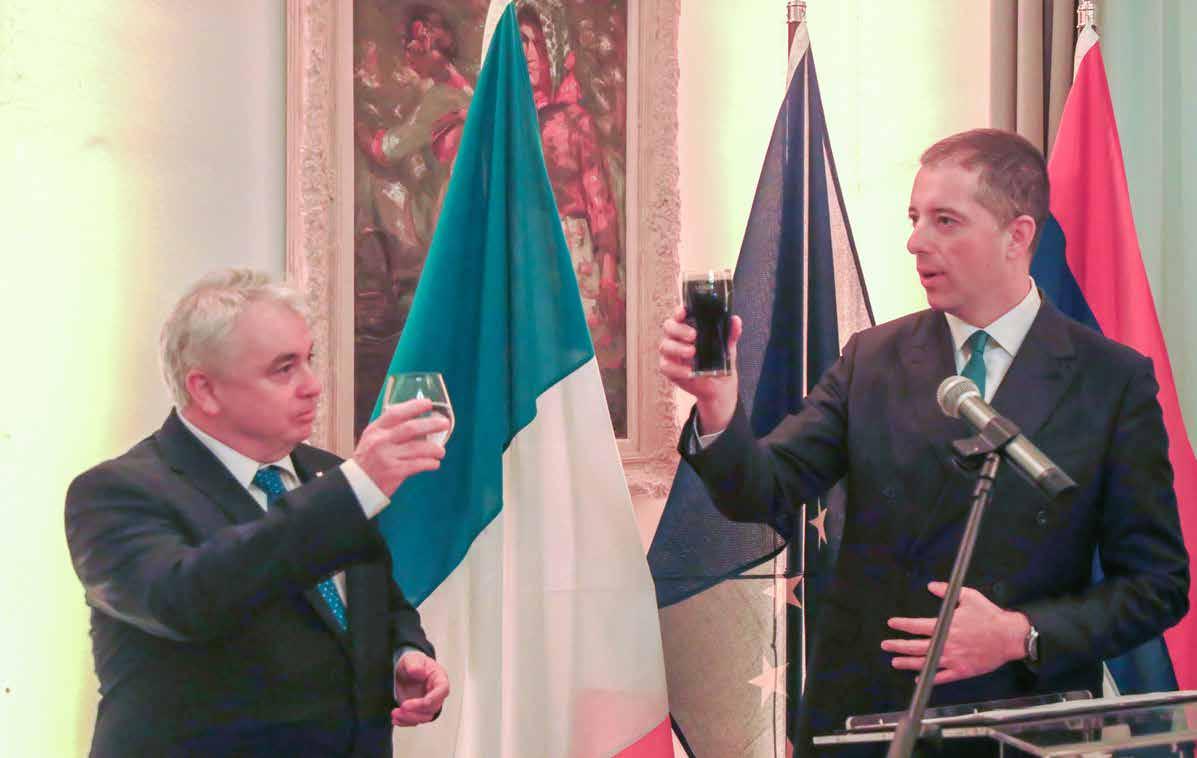
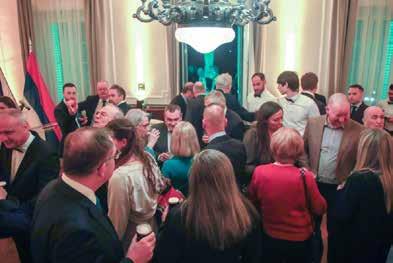
The Irish Ambassador hosted a reception in Belgrade on the occasion of St. Patrick’s Day
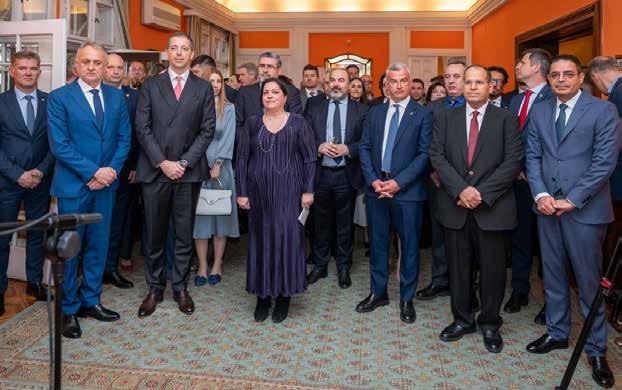
Aformal reception marking St. Patrick’s Day was held in Belgrade last night, organised for the first time by the Embassy of Ireland, the youngest embassy in the Serbian capital, which was opened last year.
The host of the reception was H.E. Kevin Colgan, Ambassador of Ireland to Serbia. The event brought together numerous guests from diplomatic, cultural, and public life, including Serbia’s Minister of Foreign Affairs, Marko Đurić.
In his address, the Irish Ambassador expressed his pleasure at celebrating this important date in the Irish calendar in the capital of Serbia, highlighting the importance of strengthening cultural and bilateral ties between Ireland and Serbia. He particularly emphasised the role of the newly established embassy in promoting Irish culture and supporting events such as the Belgrade Irish Festival.
During the reception, guests enjoyed a warm and festive atmosphere, with the ceremony complemented by symbolic elements characteristic of St. Patrick’s Day, including green-themed decorations.
The event further enriched the Belgrade Irish Festival’s program, which is traditionally held in Belgrade and serves as an opportunity to promote Irish culture, arts, and traditions.
H.E. KEVIN COLGAN
The Ambassador of Ireland to Serbia
Ireland has appointed a new Ambassador to Serbia, Kevin Colgan, who will lead the diplomatic mission in Belgrade and work on strengthening bilateral relations. Colgan is also accredited to Montenegro, giving the Embassy in Belgrade an additional regional role.
Prior to his appointment, he served as Ireland’s Ambassador to Uganda and Rwanda from 2021 to 2025. During his career, he held a number of diplomatic and development positions in Africa, including roles in Kampala and Maputo, as well as an advisory post in Zambia.
Within Ireland’s Department of Foreign Affairs, he served as Director of the Property Management Unit and as Deputy Director for policy, planning and development effectiveness.
By training, he is a mechanical engineer, having started his career in the United Kingdom and Zambia before moving into diplomacy. His mandate will focus on strengthening political, economic and cultural ties between Ireland and Serbia, as well as supporting Irish citizens and businesses in the region.
ARRIVALS
20 MARCH 2026
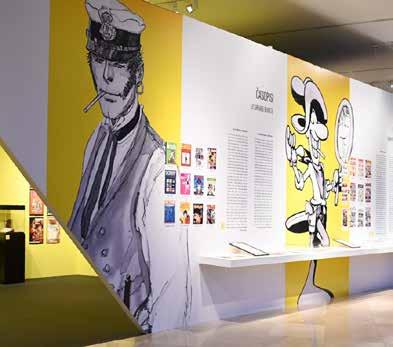
Italian Comics Exhibition Opens
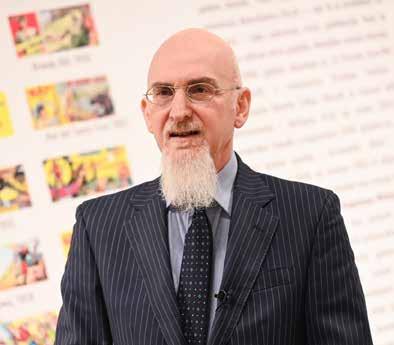
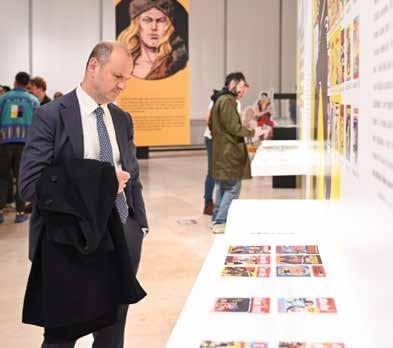
The exhibition “Strip made in Italy – Generations” has opened at the Museum of Yugoslavia. H.E. Luca Gori, Ambassador of Italy to Serbia, emphasised at the opening that comics represent a true “excellence” of Italian culture and, quoting Umberto Eco, highlighted that they are a form of high art.
“The development of comics has further strengthened the relationship between Italy and Serbia. Since the 1930s, there has been continuous cultural dialogue between our countries through this medium. In Serbia, Italy is loved and read through comics,” Gori said, as reported by Tanjug.
The Director of the Museum of Yugoslavia, Neda Knežević, described the exhibition as more than a guest display, calling it a continuation of an important cultural conversation.
“This is proof that the heritage we preserve lives on through new encounters, new readings, and new collaborations,” Knežević said.
Comic historian and publisher Gianni Bono defined the bond between Belgrade and Italy in three words: history, stories, and passion.
25 MARCH 2026
“For decades, young people in Serbia grew up with Blek Stena and Zagor, and later began writing and illustrating comics themselves, like Bane Kerc. Italy and Serbia have together paved the way for the dignity and artistry of comics,” Bono noted, highlighting the significance of magazines such as Linus and Eureka, and the influence of intellectuals like Umberto Eco.
The exhibition is organised by Lucca Crea, the magazine Fumo di China, and the Italian Cultural Institute in Belgrade, with support from the Italian Embassy. “Strip made in Italy – Generations” will be on display at the Museum of Yugoslavia until 30 June.
Mexico Day Marked Alongside 80 Years of Diplomatic Relations Between Serbia and Mexico
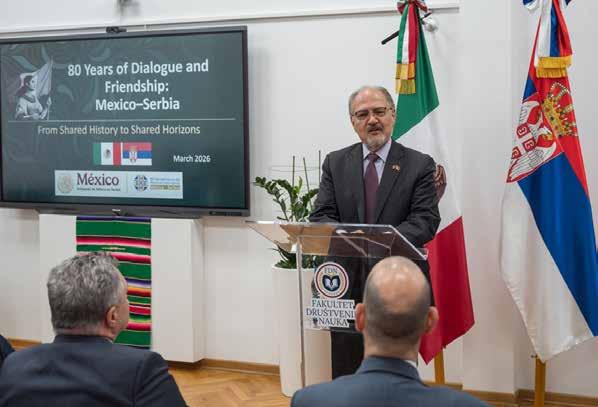
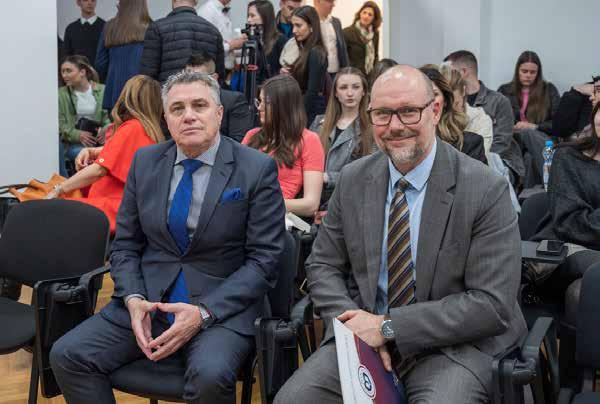
Mexico Day was marked at the Faculty of Political Sciences in Belgrade on 26 March, as part of the celebration of 80 years since the establishment of diplomatic relations between Serbia and Mexico.
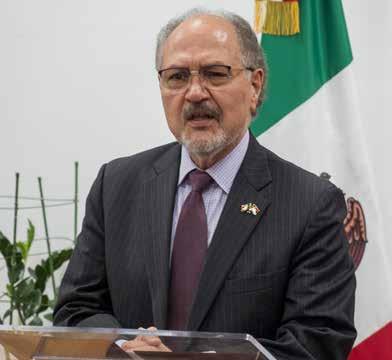
The event was organized in cooperation between the Faculty of Political Sciences and the Embassy of Mexico in Belgrade The Ambassador of Mexico to Serbia, H.E.
Carlos Isaur Félix Corona, delivered a lecture titled “80 Years of Dialogue and Friendship: Mexico–Serbia – From Shared History to Common Horizons,” in which he highlighted the importance of bilateral relations and the potential for further cooperation.
This event is part of a series of activities marking eight decades of diplomatic ties between the two countries this year, including cultural and academic initiatives.
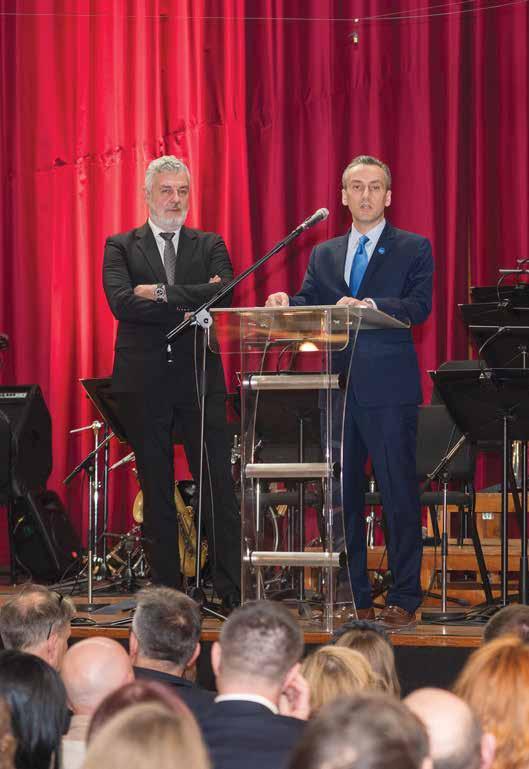
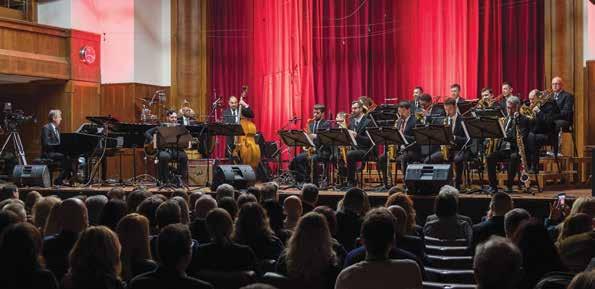
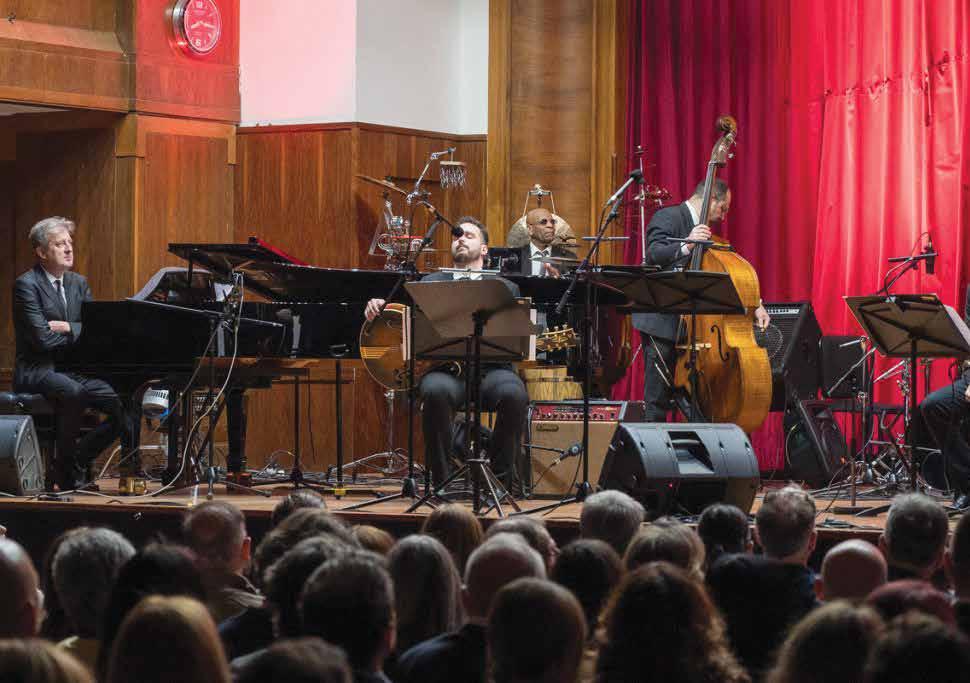
American jazz pianist Deni Griset and the RTS Big Band performed a concert of American classics at Kolarac in honour of the launch of the “Freedom 250” program.
The Chargé d’Affaires of the U.S. Embassy, Alexander Titolo, stated ahead of the concert that it was a great honour for him to welcome guests to the gala event.
“This is a jubilee year for us—250 years since the U.S. Declaration of Independence. It is a fitting occasion to celebrate what America stands for: freedom, democracy, and
prosperity, but also an opportunity to highlight the strong relationships we have built around the world, including our deep ties with Serbia,” Titolo said, as reported by Tanjug.
He announced that throughout the year, the U.S. Embassy would organise a series of events, bringing American culture, history, and innovation to cities across Serbia—from Belgrade and the “Ložionica” complex to Niš, Novi Sad, Kragujevac, Novi Pazar, and Bujanovac.
The concert was also attended by Milovan Drecun, Chairman of the Parliamentary Committee on Defence and Internal Affairs, as well as numerous members of the diplomatic corps and distinguished figures from the worlds of culture and politics.
This event is part of the year-long “Freedom 250” program, which includes a wide range of cultural, educational, business, and sporting activities across Serbia, aimed at highlighting shared values and further strengthening ties between Serbia and the United States.
The concert was organised by the U.S. Embassy in Belgrade in partnership with the Ilija M. Kolarac Endowment.
The Group of Francophone Ambassadors in Serbia marked the Month of Francophonie through a meeting of flavours and cultures
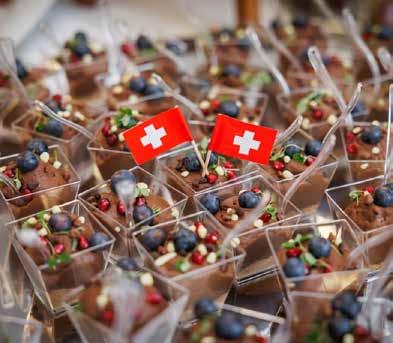
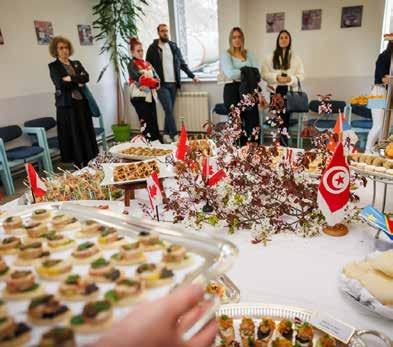
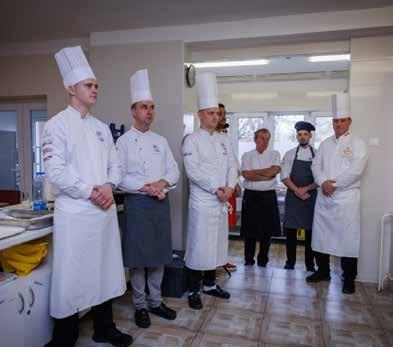
On the occasion of the Month of Francophonie, the Group of Francophone Ambassadors in Serbia (GAF), in cooperation with the Hospitality College (VHŠ), organised the Francophone Gastronomy Day.
During the event, students of the Gastronomy program, together with chefs from the embassies of Canada, Switzerland, and France, prepared national dishes from Francophone countries. Attendees had the opportunity to taste specialities from Tunisia, Congo, France, Switzerland, and Canada, as reported by Tanjug.
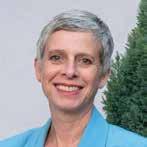
Swiss Ambassador Anne LugonMoulin stated that, for Switzerland, the Francophonie represents a space of cultural and linguistic diversity, as well as one where the values of peace and dialogue hold great importance.
“Today, we celebrate cultural exchange through food. Switzerland has chosen very simple specialities rooted in our mountain tradition, as we were once a mountain people,” Lugon-Moulin said, as reported by Tanjug.
Deputy Head of Mission and Counsellor at the Embassy of Canada, Ashley Durek, speaking on behalf of Ambassador Michelle Cameron, emphasised that VHŠ is one of the most distinguished regional institutions in the field of hospitality and culinary management, and that Francophonie is one of the most dynamic and culturally rich communities in the world.
“What makes Francophonie so exceptional is its diversity. From Europe to Africa, from the Caribbean to Southeast Asia, all 88 of its members bring their own cultural rhythms, artistic expressions, and culinary heritages. Francophonie is not a single bloc, but a living tapestry woven from indigenous knowledge,
shared history, contemporary innovation, and centuries of cultural exchange. Nowhere is this richness felt more strongly than in gastronomy,” Durek noted.
Deputy Ambassador of France, Natacha Ephimoff, speaking on behalf of Ambassador Florence Ferrari, stated that Francophonie brings together more than 400 million people worldwide, across more than 100 countries on five continents.
“It is the language of life, diplomacy, cuisine and gastronomy, but also of literature, science, and sport. It is also a language that is constantly evolving, changing, and facing new challenges of the modern world,” Ephimoff said.
She added that Francophonie promotes multilingualism and cultural diversity, and that an event such as the Francophone Gastronomy Day exemplifies this dynamic exchange.
30 MARCH 2026
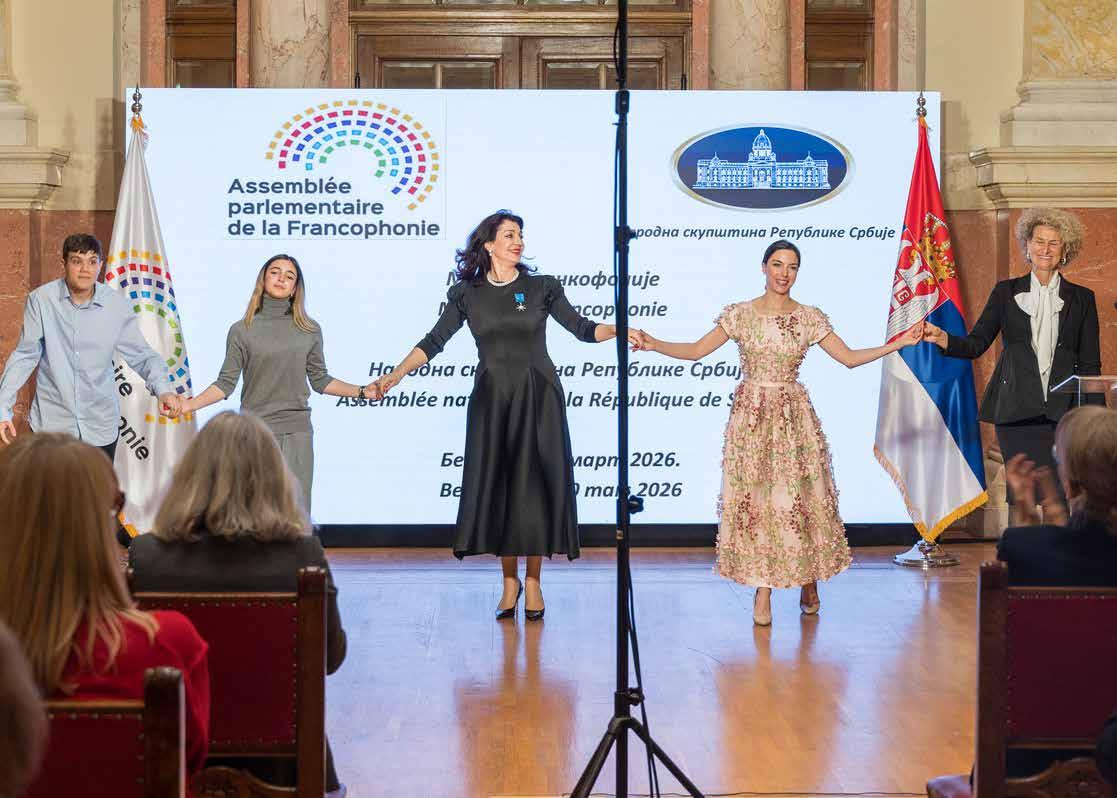
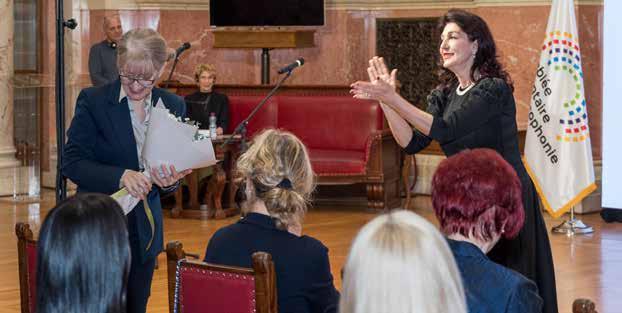
Francophonie Month marked at the Serbian Parliament
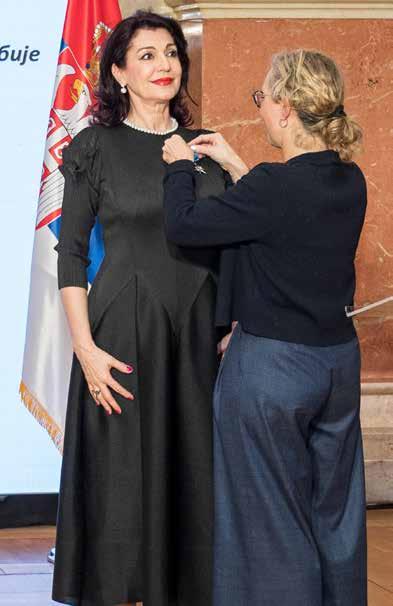
Order awarded to Jadranka Jovanović
Aformal reception marking Francophonie Month was held this evening at the National Assembly of Serbia, where the host—Head of the Standing Delegation of the National Assembly to the Parliamentary Assembly of the Francophonie (APF), Jadranka Jovanović—stated that Serbia’s goal remains clear: full membership in the International Organisation of La Francophonie.
French Ambassador Florence Ferrari recalled that, throughout March, Serbia, together with the embassies of Francophone countries, marked its commitment to Francophonie through numerous events – school programs, film screenings, humanitarian actions, gastronomy, competitions, conferences, theatre performances, and exhibitions.
31 MARCH 2026
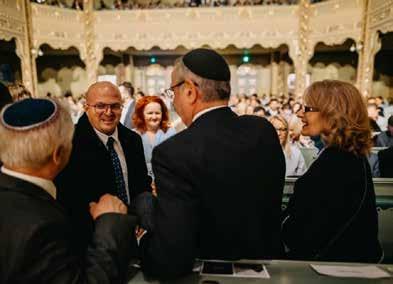
Candlelit Concert at the Subotica Synagogue
Vivaldi’s The Four Seasons Captivates the Audience
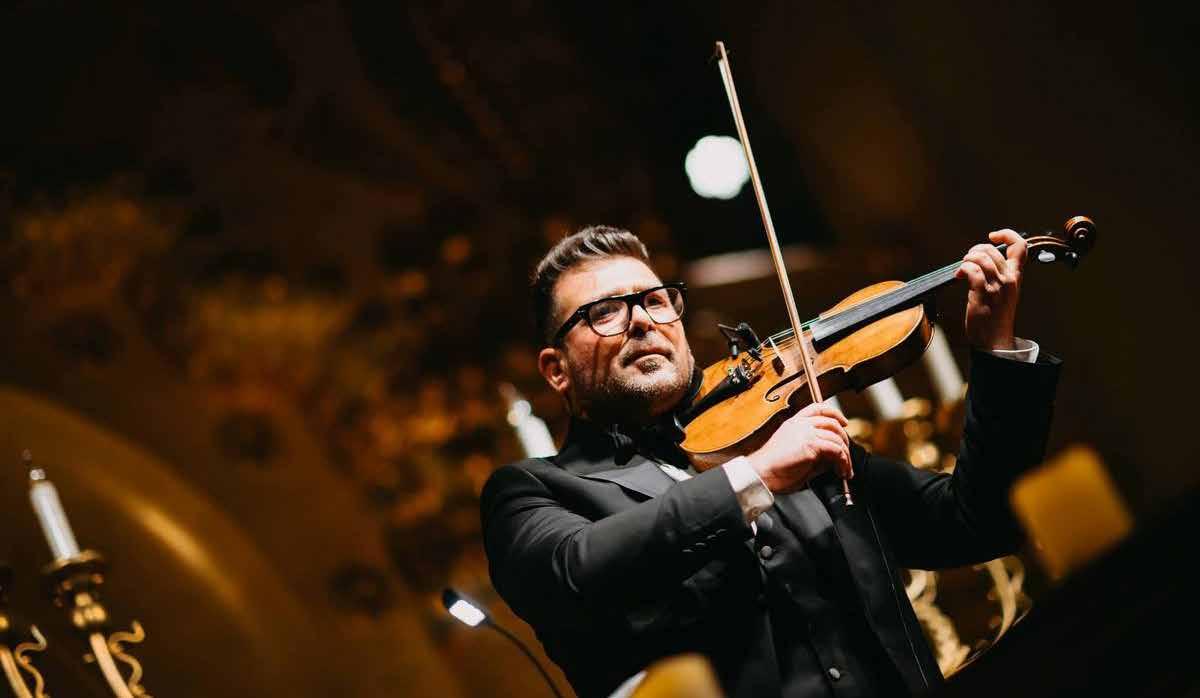
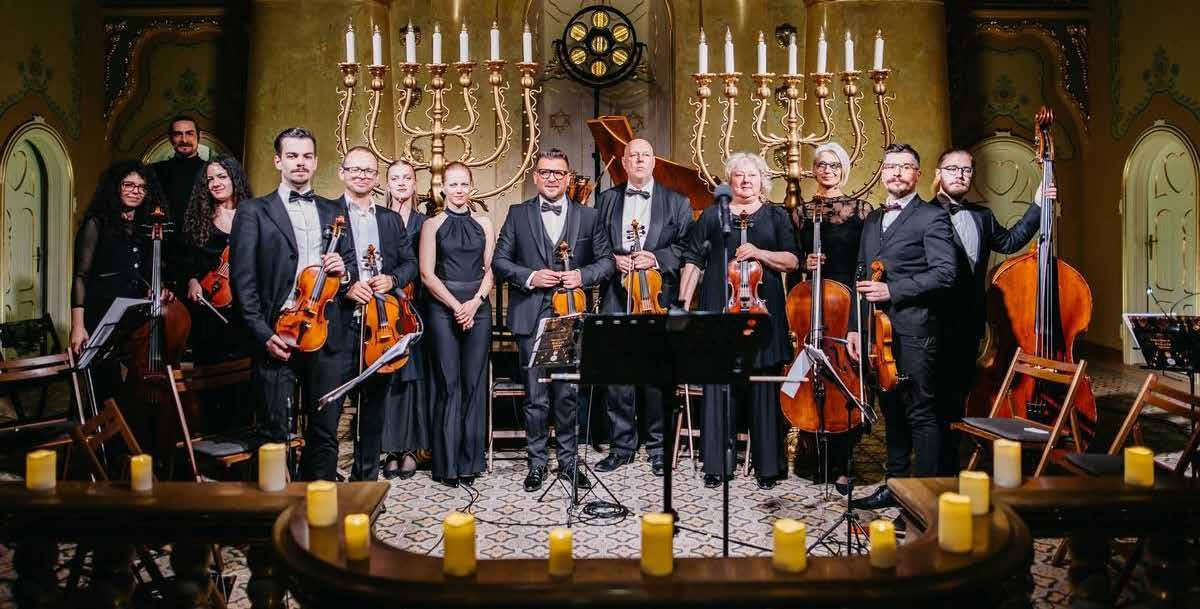
Organised by the Subotica Synagogue Foundation and the Hungarian National Council, the first candlelit concert was held at the Subotica Synagogue, offering the audience a unique artistic experience through a performance of Antonio Vivaldi’s renowned The Four Seasons
The venue, illuminated by hundreds of candles, created a distinctive and ceremonial atmosphere within one of the region’s most significant architectural landmarks. The concert featured the Virtuoso Orchestra, with violinist Pál Žiga performing as both soloist and concertmaster, noting that the piece requires exceptionally serious and long-term preparation.
An additional artistic dimension of the evening was provided by the performance of the sonnets that accompany Vivaldi’s concertos. Interpreted by actor Gábor Mészáros, the verses brought audiences closer to the essence and emotion of each season, seamlessly connecting music and literature into a unified experience.
The concert was opened by Zsolt Németh, Chair of the Foreign Affairs Committee of the Hungarian National Assembly, who emphasized the importance of historical reconciliation, highlighting that it also encompasses Hungarian–Serbian–Jewish reconciliation. During the evening, Dr Bálint Pásztor, President of the Alliance of Vojvodina Hungarians, also addressed the audience, underscoring the enduring significance of Vivaldi’s work for European cultural heritage.
Distinguished guests included József Magyar, Ambassador of Hungary to Belgrade; Eszter Csallóközi, Consul General of Hungary in Subotica; Marina Raguš, Vice President of the National Assembly of the Republic of Serbia; Árpád Fremond, President of the Hungarian National Council; Isaac Asiel, Chief Rabbi of Serbia; Róbert Szabados, President of the Jewish Community of Subotica; Monsignor Mirko Štefković, Bishop of the Diocese of Zrenjanin; Dániel Gyivánovity, President of the Subotica City Assembly and Chairman of the Board of the Subotica Synagogue Foundation; as well as
Csilla Góli, Deputy Mayor of Subotica, and Dr. Bálint Pásztor, President of the Alliance of Vojvodina Hungarians.
Hajnalka Ileš, Coordinator of the Subotica Synagogue Foundation, emphasised that this was the first concert of its kind in Subotica, realised following international examples and with unanimous support from the Foundation’s Board.
Ákos Hajvert, a member of the Executive Board of the Hungarian National Council responsible for culture, highlighted that the goal of such programs is to bring classical music closer to a wider audience and to create a shared cultural experience.
The concert attracted remarkable public interest, underscoring strong demand for high-quality cultural content and keen interest in classical music in Subotica.
The organisers expressed their gratitude to the artists of the Virtuoso Orchestra for their outstanding performance, as well as to soloist Pál Žiga for a superb artistic achievement that further enriched this unique evening.
Source: Subotica Synagogue Foundation
Photos: Marko Miščević, Nikola Kličković
31 MARCH 2026
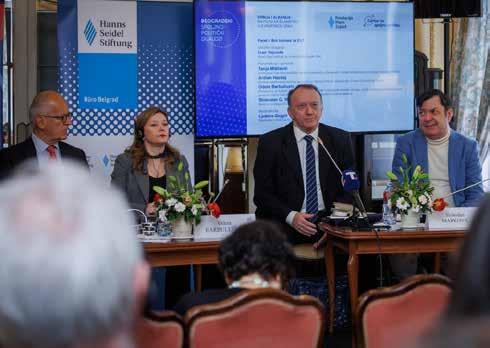
Conference “Serbia and Albania”
On the Path to the European Union” Held in Belgrade
The crisis within the European Union has significantly affected its enlargement policy, and there is no fast-track procedure for Serbia and Albania to join the bloc, it was said during the panel discussion “Fast Track to the EU?” held as part of the conference “Serbia and Albania: On the Path to the European Union,” Tanjug reported.
Ivan Vejvoda, a permanent fellow at the Institute for Human Sciences in Vienna, assessed that relations between Serbia and Albania have deep historical roots. He recalled that between the 1960s and 1980s, Albania was considered one of the most isolated countries in the world, while Yugoslavia was seen as the first country likely to join the European Community.
“The wheel of history has turned in such a way that Albania is now ahead of Serbia in this process. This shows that we shape our own destiny and that we can go against the ‘winds of fate’ if we have the ability to steer it,” Vejvoda explained.
Ardian Hackaj, Research Director at the Institute for Cooperation and Development in Tirana, stressed that in his view, there is no fast track to EU membership.
Commenting on the joint idea of Serbian President Aleksandar Vučić and Albanian Prime Minister Edi Rama on a form of limited EU membership for the two countries,
Hackaj said the aim of the letter was to raise public awareness that the path toward the EU should be faster and different, not to initiate a new accession procedure.
Aleksandra Joksimović, President of the Centre for Foreign Policy, stated that the global order has not been unravelling this rapidly at any point since the end of World War II, and that the world now stands at a crossroads between multilateralism and multipolarity.
Speaking at the opening of the conference, Joksimović noted that the EU—where there has been no enlargement since 2013— is under significant pressure from both allies and adversaries, and must find renewed strength for the future.
Plamena Halacheva, Deputy Head of the EU Delegation to Serbia, said that EU enlargement today is about stability and global competitiveness, and that the world in which negotiation chapters simply opened and closed has disappeared.
She added that the new geopolitical reality is generating a certain level of tension and that an urgent debate on the future model of enlargement is needed.
“We must be honest, because the current system is under considerable strain. As Marta Kos recently said, neither the status quo nor radical enlargement ideas are
acceptable to most of our member states. We are now at a moment of institutional honesty: the old model is not delivering results, but there is still no appetite for revolutionary change,” Halacheva explained, as reported by Tanjug.
According to her, a “third way” is now emerging—one that would allow faster access to EU markets, investments, and programs, while enabling gradual integration.
“This is not a theory; it is already reflected in the Growth Plan and in ideas coming from the region itself, primarily from Serbia and Albania, where participation in Schengen and the single market is being prioritised before full membership. We need to be cautious here, as such models have already existed in Europe—for example, the European Economic Area. Iceland is already integrated into our single market. So the question is not whether such models exist, but whether they are politically and strategically acceptable as a solution, rather than just a transitional phase,” Halacheva emphasised.
She added that Albania has opened all negotiating clusters and has fully aligned its foreign policy with that of the EU, while Serbia—despite its economic dynamism and strategic weight—has not yet fully aligned its foreign policy with the Union.
“HE SAID IT WOULD LAST ONLY A FEW WEEKS”
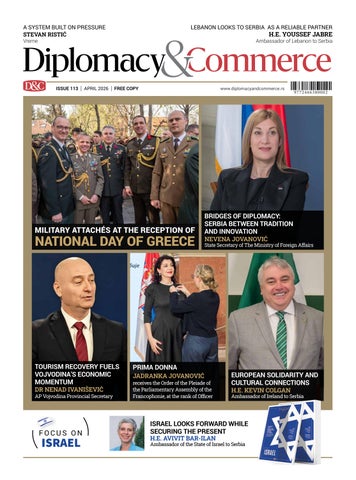
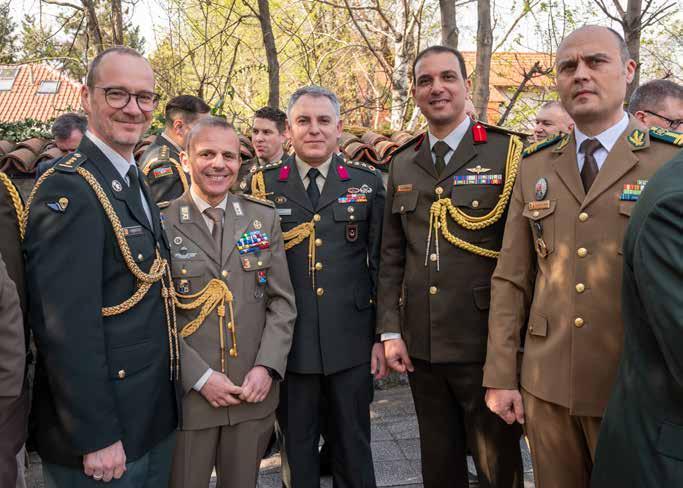
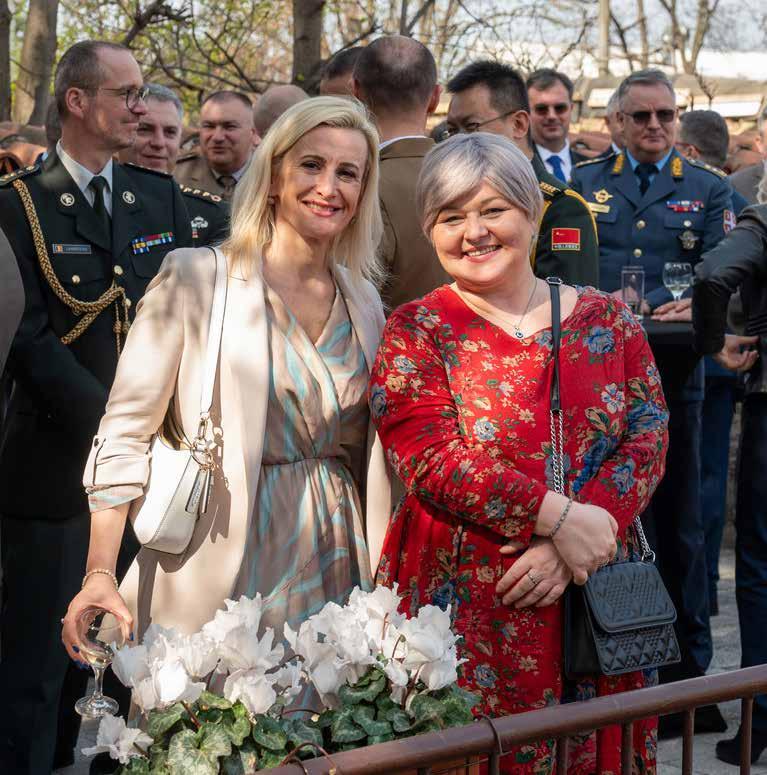
Alexander Titolo, Deputy Chief of Mission at the US Embassy, and Avivit Bar-Ilan, Ambassador of Israel, at the reception marking Greece’s National Day, Residence of the Greek Ambassador, 25 March
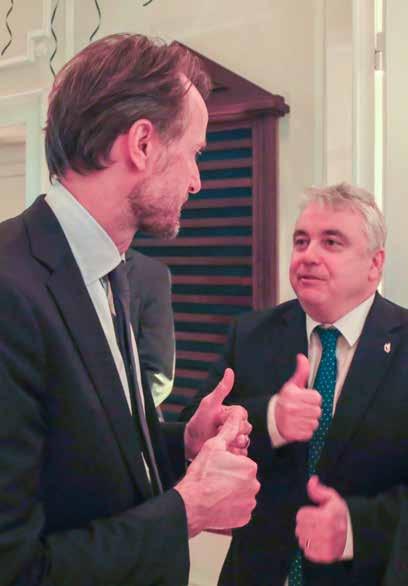
THUMBS UP
Andreas von Bekerath, Head of the EU Delegation to Serbia, and Kevin Colgan, Ambassador of Ireland to Belgrade, St Patrick’s Day Reception, Privrednik Club, 19 March
DIFFICULT TIMES
UAE Ambassador to Serbia Ahmed Almenhali at the reception marking Greece’s National Day, Residence of the Greek Ambassador, 25 March
GEORGE WILL BE PLEASED
Sonja Liht, Belgrade Fund for Political Excellence, Conference “Serbia and Albania on the Path to EU Membership”, Aero Club, 31 March
READY EVEN FOR THE 300TH ANNIVERSARY
Journalist Mira Adanja Polak and Princess Jelisaveta Karađorđević, Concert marking the 250th anniversary of the US Declaration of Independence, Kolarac Endowment, 25 March
PRIMA DONNA AND BLACK SWAN
Opera singer Jadranka Jovanović and Marina Raguš, Vice President of the National Assembly of Serbia, Francophonie Month celebration in Serbia, National Assembly of Serbia, 30 March
PHOTO STORY
AMBASSADOR’S INTERVIEW
ISRAEL LOOKS FORWARD WHILE SECURING THE PRESENT
H.E. Avivit Bar-Ilan Ambassador of the State of Israel to Serbia
April 2026
ISRAEL
IHRA
Argentina Leads
The International Holocaust Remembrance Alliance ECONOMICS
Serbia and Israel Edge Closer to Free Trade
Israel Looks Forward While Securing the Present
Strategic partnership with Serbia, innovation-led cooperation and a changing regional landscape
In an interview for the special Focus In edition dedicated to Israel, H.E. Avivit Bar-Ilan, Ambassador of the State of Israel to Serbia, discusses the current challenges shaping Israel’s foreign policy, the security context in the Middle East, and Serbia’s role within that framework. The interview also highlights the development of bilateral relations, the economic and innovationdriven potential for cooperation, and the broader political and cultural ties connecting the two countries.
In light of the current developments in the Middle East, how does Israel today define its key foreign policy priorities, and where do you see Serbia’s role within that framework?
the security of its citizens and preventing any existential threat to the state. In recent weeks, Israel has been actively confronting the threat posed by Iran and its regional proxies, to
SERBIA IS SEEN AS A GENUINE AND STEADFAST PARTNER, WITH A LONGSTANDING RECORD OF TRUE FRIENDSHIP TOWARD ISRAEL
In light of the current developments in the Middle East, Israel defines its foremost foreign policy priority as safeguarding
neutralise this danger and restore stability.
Within this context, Serbia is seen as a genuine and steadfast
partner. Over the years, it has consistently demonstrated its true friendship toward Israel, providing a strong foundation for closer cooperation.
Strengthening coordination among like-minded countries in addressing the challenges posed by the Iranian regime can contribute to broader regional stability. Such cooperation may also help create the conditions for expanding frameworks like the Abraham Accords, which offer a pathway toward greater regional integration and dialogue. At the same time, recent attacks on European sites underscore that these threats are not confined to the Middle East alone. The development of long-range ballistic capabilities by Iran highlights the growing threat of these risks to Europe as well, reinforcing the need for coordinated international action. This moment presents not only a challenge, but also an opportunity—to counter immediate threats while advancing a vision of a new, more stable, secure, and cooperative Middle East.
In what ways does the current regional situation influence Israel’s diplomatic activities worldwide, including its relations with countries such as Serbia?
I firmly believe that, as with many crises before it, the current conflict in the Middle East will ultimately catalyse the emergence of stronger, more resilient regional partnerships.
In this evolving landscape, Serbia has a unique opportunity to enhance its strategic connectivity by engaging in multilateral cooperation frameworks such as the India-Middle East-Europe Economic Corridor (IMEC) and similar initiatives, positioning itself as a proactive and forwardlooking partner in shaping future regional and interregional cooperation.
H.E. AVIVIT BAR-ILAN Ambassador of the State of Israel to Serbia
How would you assess the current level of bilateral relations between Serbia and Israel, and in which areas do you see the greatest potential for further development?
Israel and Serbia enjoy strong and friendly bilateral relations, based on mutual respect and cooperation. Those have been demonstrated through a series of high-level visits between the two countries during the last year. Last autumn, Foreign Minister Gideon Saar visited Belgrade. Before that, we had two visits to Israel by high-ranking Serbian officials: one by the president of the Parliament, Ana Brnabić, and the other by the Foreign Minister, Đurić, to Jerusalem.
The shared destiny of our two nations was also reflected in the joint efforts and calls for the release of Alon Ohel, the Israeli citizen who also holds Serbian nationality. We were all deeply gratified to witness the joyous images of his release from Hamas captivity. This moment reaffirmed our common commitment to human life, solidarity and the enduring friendship between Israel and Serbia.
The close friendship between Israel and Serbia was also evident over the past two years, when the Serbian government allowed Israeli sports teams to host their home games in Belgrade. This gesture quickly made the city their “second home.”
Israeli companies are already present in the Serbian market. Which sectors do you consider the most promising for new
THIS MOMENT PRESENTS NOT ONLY A CHALLENGE, BUT ALSO AN OPPORTUNITY TO ADVANCE A MORE STABLE AND COOPERATIVE MIDDLE EAST
investments, and is there interest in expanding business operations in Serbia?
I am happy that the trade exchange has shown an upward trend over the last year, with a total increase of 62 per cent, i.e., the exchange amounted to 325 million euros at the end of the year.
We are confident that with the future signing of a free trade agreement between our two countries,
we will witness further growth in bilateral trade. We look forward to what the future will bring us in this regard.
Last year, we held the firstever MASHAV in-house training, “Empowering Innovation: Strategic Leadership for Science & Technology Park Managers,” aimed at raising the capacities of teams and staff within the Science and Technology Parks
in Niš and Belgrade. The training was organised and successfully implemented in close cooperation with the Ministry of Science, Innovation and Technological Development of Serbia. Round 40 people attended the courses. MASHAV is Israel’s Agency for International Cooperation and Development, which usually organises various training courses in Israel. This was a special occasion, hosting their (MASHAV) experts in Serbia for the first time for this specific course. Last December, at the MCTC centre in Haifa, we had a group of professionals from Serbia on the AI&Cyber for Good course, which we are very proud of. The embassy’s contribution to the evolution of the Serbian innovation ecosystem is ongoing and evident through support for events and conferences related to biotechnology, such as the BIO 4 AI for Life conference, as well as the Digital Forensics Forum. Therefore, if you ask which sectors are most interesting to Israeli business people, they are: cyber, renewable energy, biotechnology, and IT.
Serbia is preparing to host Expo 2027 in Belgrade. How important is participation in such global events for Israel, and what can visitors expect from Israel’s presentation?
The State of Israel attaches great importance to its participation in Expo events in general, and even more so when they are hosted by a friendly country such as the Republic of Serbia. We place particular value on taking part in international forums that allow us to present the true face of the State of Israel. Expo 2027 provides a unique and powerful platform in this respect—a vibrant global celebration that brings together nations and cultures. It enables each country to share its story, identity, and achievements with both local and international audiences. Within this framework, we will showcase Israel’s distinctive accomplishments, first and foremost its position as a global leader in innovation, spanning fields such as medicine, sports, renewable energy, cybersecurity, accessibility, and beyond. At the same time, we will highlight the rich cultural diversity of Israeli society—a dynamic nation of immigrants that serves as a living bridge between East and West—while emphasising the deep, historic, and enduring ties with the Jewish community in Serbia.
Cultural and scientific cooperation often plays a vital role in connecting countries. Are there any particular joint projects or initiatives between Serbia and Israel that you would highlight?
As in all other segments of cooperation between our two countries, we also have beneficial cooperation in this field. Last year, the Cooperation Program between the Government of the Republic of Serbia and the Government of the State of Israel for the period 20252028 in the fields of education, science, culture, youth and sports was signed.
This will enable the continuation of joint projects such as the now-traditional Belgrade dance Festival, which we have been at since its foundation, that is, for 23 years, and in which Israel has been a participant and one of the sponsors. We proudly support Israeli musicians participating in Jazz festivals in Serbia. When it comes to film and the film industry, our embassy has a long–standing tradition of participating in nearly all film festivals, which is both an honour and a pleasure for us. In the publishing industry, we contribute by actively helping the translation and publication of books by Israeli authors in Serbia. We know that the Serbian readership is well acquainted with our writers and that this sensibility appeals to them. You know, I have always thought of the Jewish people as a people of the book and written word, but I now
THE SECTORS THAT ATTRACT THE STRONGEST INTEREST FROM ISRAELI BUSINESSES ARE CYBER, RENEWABLE ENERGY,
BIOTECHNOLOGY AND
IT
realise that the same is true of the Serbian people as well.
It is well known that during your mandate, you have taken the opportunity to travel across Serbia and explore different
parts of the country. Which places have left the strongest impression on you, and what has perhaps surprised or particularly inspired you about Serbia?
Hiking in Serbia is one of the most rewarding ways to truly
experience the country’s natural beauty. What surprises many visitors at first is just how lush and green it is—rolling hills, dense forests, and an abundance of hidden gems waiting to be discovered. One particularly magical route follows the Gradac River, where the trail winds through shallow, crystal-clear water. Walking here feels almost otherworldly, especially as you approach the serene Ćelije Monastery, nestled quietly among the trees. The combination of untouched nature and spiritual heritage creates a peaceful, almost meditative atmosphere. Another standout destination is Povlen Mountain. Its gentle peaks, panoramic viewpoints, and quiet, uncrowded trails make it ideal for hikers looking to disconnect and immerse themselves in nature. The landscapes here shift beautifully with the seasons, offering something unique year-round.
What makes hiking in Serbia especially memorable is the sense of authenticity. Even in the most remote areas, it’s common to stumble upon traditional Etno restaurants—rustic spots serving homemade Serbian dishes prepared with local ingredients. These unexpected culinary stops add warmth and flavour to any hiking adventure.
Altogether, Serbia offers a rare blend of unspoiled nature, cultural richness, and genuine hospitality—making every hike not just a journey through landscapes, but a deeper connection to the country itself.
Serbia and Israel Edge Closer to Free Trade
Serbia and Israel move closer to free trade amid strong growth in exports, tourism, and
strategic c ooperation
Economic relations between Serbia and Israel are entering a phase of intensified development, marked by several parallel processes – the expansion of trade, strengthening of institutional ties, growing tourism flows, and, most importantly, ongoing negotiations on a Free Trade Agreement. These mutually reinforcing dynamics point to a comprehensive deepening of relations and a clear strategic rapprochement between the two countries.
Over the past four years, Israel has emerged as one of Serbia’s most significant export markets outside Europe. Serbian exports to
SERBIAN EXPORTS TO ISRAEL HAVE INCREASED BY MORE THAN 56 PER CENT IN THE PAST FOUR YEARS, WITH TOTAL TRADE REACHING RECORD LEVELS
Israel have increased by 56.2 per cent, while total trade has reached record levels, estimated at around USD 250 million. Even more striking is that overall trade between the two countries has quadrupled during this period, confirming a stable, long-term upward trend.
The structure of trade indicates considerable potential for further
growth. Serbia primarily exports agri-food products and industrial goods to Israel, while the Israeli market is increasingly interested in high-quality Serbian products. At the same time, Israeli companies are increasingly recognising Serbia as a reliable partner and a potential base for expanding their operations across the region.
It is within this context that the negotiations on a Free Trade Agreement should be viewed, as they represent the central pillar of future relations. The agreement is expected to provide Serbian companies with more favourable access to the Israeli market, including reduced or eliminated tariffs, simplified product certification procedures, and access to defined quotas. For domestic exporters, this would mean a more competitive position and a strong incentive to expand production and investment.
The importance of this agreement is further underscored by the fact that Israel rarely enters
into such arrangements and is highly selective in choosing its partners. For that reason, the negotiations with Serbia carry broader political and economic significance, reflecting a high level of mutual trust and recognition of Serbia as a relevant regional partner.
The Serbian Chamber of Commerce plays a significant role in this process, actively participating in negotiations, supporting the business community, and identifying concrete barriers faced by companies. Through institutional mechanisms and direct communication with Israeli counterparts, the Chamber helps create the conditions for more efficient and dynamic cooperation.
Alongside the negotiations, the institutional framework supporting bilateral relations continues to develop. One of the key steps in this direction is the planned opening of an Israeli business representation office in Serbia. This office is expected to serve as a central hub for connecting companies, facilitating information exchange, initiating joint projects, and strengthening business ties.
The opening of this office represents a natural continuation of existing cooperation mechanisms, including the Serbian Chamber of Commerce’s presence in Jerusalem. Together, these initiatives establish a two-way communication channel that enables faster information exchange, better coordination, and more effective resolution of practical business challenges.
While economic relations deepen at the institutional level, another equally important dimen sion of cooperation is gaining momentum – tourism. Israeli tourists are among the largest non-European visitor groups to Serbia. In 2025, they accounted for more than 95,000 overnight stays, representing an increase of 61.5 per cent compared to the previous year.
This growth is no coincidence. Direct flights between Belgrade and Tel Aviv have ensured conti nuity in both tourist and business travel. At the same time, Serbia, with its combination of urban vibrancy, natural landscapes, and rich gastronomy, has become an increasingly attractive destination for Israeli visitors.
Although Belgrade remains the primary destination, growing interest is also being recorded in mountain and spa resorts.
Zlatibor, Divčibare, and Vrnjačka
THE PLANNED FREE TRADE AGREEMENT IS EXPECTED TO GIVE SERBIAN
COMPANIES
EASIER ACCESS TO THE ISRAELI MARKET AND A STRONGER COMPETITIVE POSITION
conventional bilateral cooperation. Trade, tourism, institutions, and innovation form an integrated system in which each segment reinforces the development of the others.
The forthcoming Free Trade
Reception Marking Argentina’s IHRA Presidency
The First Latin American c ountry to Lead the International Organisation
Areception marking Argentina’s Presidency of the International Holocaust Remembrance Alliance was held on 26 March at the Ambassador’s Residence in Belgrade, attended by members of the diplomatic corps, representatives of state institutions, and organisations dedicated to the culture of remembrance.
By assuming this role, Argentina has become the first Latin American country to chair the International Holocaust Remembrance Alliance, further highlighting the importance of a global approach to preserving the memory of the Holocaust and combating antisemitism and historical revisionism.
The reception was hosted by the Ambassador of Argentina to
ARGENTINA HAS BECOME THE FIRST LATIN AMERICAN COUNTRY TO CHAIR THE INTERNATIONAL HOLOCAUST REMEMBRANCE ALLIANCE
Serbia, H.E. Osvaldo Mársico, who addressed the guests on behalf of the incoming Presidency.
The official programme also featured remarks by the Minister for European Integration, Nemanja Starović, the representative of the outgoing Presidency from the Embassy of Israel, H.E. Avivit Bar-Ilan, as well as Holocaust survivor Jozef Baruhović.
Speakers emphasised the importance of international cooperation in Holocaust education, the preservation of historical memory, and the fight against contemporary forms of antisemitism.
The role of personal testimonies in conveying the truth about suffering, as well as the importance of continuous education of younger generations, was particularly highlighted.
Bridges of Diplomacy: Serbia Between Tradition and Innovation
Serbia’s foreign policy priorities in a shifting global landscape, from EXPO 2027 to EU integration and strategic partnerships
NEVENA JOVANOVIĆ
State Secretary of The Ministry of Foreign Affairs
State Secretary Nevena Jovanović, in a live interview for the show “Diplomat,” produced by Diplomacy&Commerce magazine in cooperation with Euronews Serbia, reflects on her professional journey and outlines the key priorities of Serbian diplomacy in a complex global environment. The conversation places special emphasis on major initiatives such as EXPO 2027 and the EU integration process, as well as on the ongoing challenge of safeguarding national interests amid shifting geopolitical dynamics.
Can you tell us how your educational background influences your approach to diplomacy and public communication?
calling that let you fight for the common good. Still, later life circumstances led me to diplomacy, offering me the chance to contribute to that public good in a com-
AS A DIPLOMAT, YOU ARE AT THE DISPOSAL OF YOUR STATE 24 HOURS A DAY.
The desire to study at the Faculty of Political Sciences emerged very early and stemmed from my broader interest in socio-political events; the Faculty of Political Sciences is the best place to fulfil those desires and ambitions. I initially wanted to pursue journalism, firmly believing it was a
pletely different way. Studying journalism and communication makes you realise very early on that words are a powerful tool but also a great responsibility, and that is one of the things I brought with me into diplomacy. The opportunity to serve my country through a diplomatic calling is an
exceptional honour and privilege, and I am convinced that lifelong learning is vital for this profession. This is a process that never ends; to serve your country properly, it is important to realise that you must continuously improve yourself and be a little better every day in the job you perform.
You mentioned my background. I finished my schooling in Kragujevac, where I spent a large part of my life. Still, my roots actually go much further to the Gruža region—one of the most beautiful parts of Šumadija, where hardworking and honourable people, good Serbian hosts, still live. Growing up there, I learned the verses of Dobrica Erić very early on: “My dear land, you and your
sisters Truth and Justice”. When you carry that sense of the trinity to strive for from childhood, it somehow defines your path in the future.
During your work at the Ministry of Foreign Affairs, you held numerous positions, the most recent of which was serving as the Ambassador of Serbia to North Macedonia. Looking back at your career, what do you consider to have been your most important professional turning point? Representing your country anywhere in the world is an extraordinary privilege, honour, and, above all, a responsibility. But representing your country in the immediate neighbourhood, in a neighbouring state, our brotherly North Macedonia, was a transformative professional experience for me. I can proudly say that after four years there, we achieved something truly important for the future development of our relations, considering it is one of Serbia’s closest neighbours. I would venture to say that all phases of my professional career have left a mark on my development, but when you ask, what was the turning point? I believe it was the moment I realised that this is not just a job, but a lifelong calling— that when you are a diplomat, you have no working hours; you are at the disposal of your state 24 hours a day. Every gesture, every action, and every word can contribute to defending the interests of your country and its better representation in the eyes of the world. The position of State Secretary is certainly the pinnacle of my career so far, and being part of the team led by Foreign Minister Marko Đurić is an immense honour and an opportunity to raise Serbian diplomacy to a higher level.
You recently met with United Nations representatives regarding EXPO 2027, during which they noted that it is a great opportunity to promote Serbia. Which areas specifically do you plan to promote, and what are the benefits for citizens that they might not be aware of?
EXPO represents a historic chance for Serbia. Hosting the specialised EXPO 2027 next year is a huge opportunity to showcase our potential to the world. It is a major development opportunity, the positive results of which we are already feeling. This is likely the most important event in our
modern history for presenting Serbia on a broader scale. We will present the best of what we have: development potential, wonderful young people, and our achievements in artificial intelligence, where we can match even much larger countries. The fact that we won against strong competition speaks volumes about how much we have progressed as a state. I am personally involved in the Government’s coordination body for this event.
President Vučić identified EXPO as one of the most important projects in the “Serbia 20302035” Strategy. Last week, we also met with a high-ranking UN official who served as the UN’s Special Representative at EXPO in Osaka. As a Ministry delegation, we had the privilege of visiting our pavilion in Osaka, and we are truly proud that our national pavilion achieved a record number of visitors and even won a silver medal. You can imagine how hard we will work to present ourselves at our best in Belgrade.
The Ministry recently introduced an instrument known as the “Traffic Light,” which classifies countries by travel safety. Do you believe such instruments could increase citizens’ trust in the Ministry’s
recommendations?
The so-called “Traffic Light” for travel recommendations has attracted considerable attention. This is an initiative by Minister Marko Đurić to provide our citizens with guidelines and relevant information on current security conditions. We believe this is our duty as a Ministry. This traffic light, above all, has an advisory role for our citizens, who also have our network of diplomaticconsular missions at their disposal. It is important to note that it was not created as a means of sending political messages, but as an instrument of support for our citizens, based on precise analyses provided by our missions on the ground.
What also drew public attention is that Croatia ended up in the “Orange Zone”. Is this an indicator that there is room to discuss the safety of our citizens with Croatia?
It is a fact that information about Croatia being in the orange category—countries where travel is recommended only in cases of extreme necessity—received the most attention. It is somewhat ironic, given that the topic was actualised due to the crisis in the Middle East and our desire to warn citizens there about the
OF EVERYTHING MAN HAS BUILT IN HIS LIFE’S EFFORT, THERE IS NOTHING MORE IMPORTANT THAN BRIDGES
worsening security situation. While there was some politicisation regarding Croatia, our criteria are based on detailed analyses and on our having witnessed various incidents targeting Serbian citizens or members of the Serbian people living in Croatia. It is our duty to point out potential dangers, especially during holidays or vacations, when commemorations of events take place about which we hold different views.
You have stated several times that Serbia remains on its European path but must develop relations with other partners. How does this reflect on the Ministry’s work, and is it difficult to explain cooperation with the East to Western partners, and vice versa?
EU membership remains one of our most important foreign policy priorities and a central element of our strategic orientation. It is a fact that there is much more to be done on the reform path, just as it is a fact that we have already done a lot without being adequately rewarded by member states and the Brussels administration. If you look at the fact that Serbia has not opened a single chapter since 2022 despite reforms, you realise the process is deeply politically motivated, dictated by the war in Ukraine and subsequent events. Despite everything, we remain firmly committed, as evidenced by the formation of a new “operational team” to accelerate reform processes. Simultaneously, we carefully position Serbia in the new geopolitical reality. This is why
the joint letter signed by President Vučić and Prime Minister Edi Rama regarding our region’s readiness to join the single market even before full membership should not come as a surprise. We believe economic connectivity leads to long-term peace. Serbia pursues an autonomous, independent foreign policy rooted in a long tradition of nurturing relations with key partners: the EU, the USA, the Russian Federation, the People’s Republic of China, and numerous states from the NonAligned Movement. These relations are still very much alive today. They are based on respect for international law, the UN Charter, and territorial integrity—values that are, unfortunately, often questioned through double standards.
In the past, one of your roles in Brussels was monitoring the Belgrade-Pristina dialogue. How does the Ministry view the course of this dialogue, and what could be the ultimate scope of these negotiations?
The dialogue under the auspices of the EU remains the most effective mechanism for reaching a sustainable solution that protects our interests in Kosovo and
SERBIA REMAINS FIRMLY ON ITS EUROPEAN PATH, WHILE CAREFULLY BALANCING RELATIONS WITH GLOBAL PARTNERS
Metohija and the rights of the Serbian people. Unfortunately, we have witnessed a stalemate caused by the unilateral and escalatory measures of Albin Kurti’s regime. Our people have faced continuous pressure and attempts to shut down Serbian institutions.
On our part, we are always ready to continue talking as responsible partners. Minister Marko Đurić likes to say that we have turned every one of our embassies into a “small office for Kosovo and Metohija,” and we strive to clearly point out human rights violations to our international partners and seek their support and clear condemnation of unilateral measures.
A recent draft report from the European Parliament expressed concern that Serbia is stagnating on its path to the European Union. How does the Ministry respond?
evacuation of our citizens from crisis areas there. Can you describe that coordination?
Our capacities were fully focused on protecting our citizens and evacuating them back to Serbia. With the support of the Government and the President’s office, we managed to return nearly 2,500 people through organised Air Serbia charter flights. The Ministry worked around the clock, forming a crisis staff to ensure our citizens felt they were not alone. In the early days of the crisis, it was extremely important that citizens could also return from the UAE via commercial flights, made possible by the excellent bilateral relations and the personal relationship between President Vučić and Sheikh Bin Zayed. Serbia remains a country that strongly advocates for peace and diplomatic solutions.
For the end of our conversation, looking into the future, which foreign policy initiatives do you consider key?
Our long-term plan is to strengthen Serbia economically, because we believe that only an economically strong Serbia can defend its vital national interests. Preserving peace and stability remains a key priority, and we strive to present Serbia as a reliable partner standing for international law. Our position at the crossroads offers geostrategic potential that we must use to protect our vital interests.
I feel the need to be more precise. For the fourth consecutive year, Serbia has received a positive recommendation from the European Commission to open Cluster 3, but further progress is stalled by decisions by individual member states. Regarding the European Parliament, it represents a wide range of political groups, and some assessments deeply interfere with the internal political issues of a sovereign state, which is inappropriate. EP recommendations are advisory, not binding; we try to respect them, but when they take on an inappropriate tone, we have the right to say so clearly. Minister Đurić recently received an EP delegation in a constructive atmosphere, confirming our resolve to remain a credible partner. Now it is the EU’s turn to do its part.
The situation in the Middle East continues to escalate. The Ministry conducted an
Minister Marko Đurić is also working to strengthen our diplomatic network by recruiting new staff in the coming months. Our activities will focus on building bridges with our international partners toward a prosperous future for the whole region. As the great Ivo Andrić said, reminding us of the importance of connecting: “Probably of everything man has built in his life’s effort, there is nothing more important than bridges”. We will strive to implement our foreign policy by building those bridges to create a better future for our citizens and generations to come.
The
25th of MARCH 2026
AMBASSADOR’S INTERVIEW STABILISATION, DIGITAL TRANSFORMATION, OPTIMISM FOR THE FUTURE
H.E. Maria Levanti
The Ambassador of Greece to Serbia
POLITICS
Strengthening Cooperation Between Serbia and Greece
EVENTS
Spring in Belgrade, Greece in the Spotlight
TRADITION
Cutting of the Vasilopita
Stabilisation, Digital Transformation, Optimism for the Future
A shared vision for stability, growth and deeper economic and cultural cooperation in Southeast Europe
H.E. MARIA LEVANTI
The Ambassador of Greece to Serbia
Greece is one of the closest countries to Serbia, not only geographically but also culturally and economically, with strong ties
GREECE IS INTERNATIONALLY RECOGNISED AS A RELIABLE INTERLOCUTOR AND A PILLAR OF STABILITY IN A PARTICULARLY SENSITIVE REGION OF THE WORLD
that have endured numerous challenges. Following a decade of austerity, the pandemic and global crises, we speak with H.E. Maria Levanti, Ambassador of Greece to Serbia, about the current state of affairs and bilateral relations.
In today’s increasingly turbulent geopolitical environment, how does Greece perceive its role as a stabilising factor in Southeast Europe and the Eastern Mediterranean? How does this position influence Greece’s diplomatic priorities and regional partnerships? The Eastern Mediterranean is obviously geopolitically significant and faces significant challenges. Aware of the new realities in the international landscape and of the particularities of our immediate neighbourhood, Greek foreign policy remains principled, firmly committed to the unwavering respect for International Law, including the Law of the Sea, the UN Charter, and the UN Security Council Resolutions. We have succeeded in ensuring that Greece is internationally recognised as a reliable interlocutor and a pillar of stability in a particularly sensitive region of the world - a fact reflected, inter alia, in our landslide election to the UN Security Council for the 2025-2026 term. Also, as the region’s oldest European Union member, Greece has always had a vision for the Western Balkans within the European Union family. It was Greece, after all, that pioneered the Thessaloniki Agenda of 2003 for the accession of the Western Balkans to the European Union as the only way to consolidate stability and security in the region.
After more than a decade marked by austerity measures and deep economic restructuring, Greece is often cited as an example of recovery. What were the most difficult lessons learned during this period, and what indicators best illustrate that Greece has truly turned the page? Greece has “navigated the turbulent seas of economic crisis,” and the main obstacles we have encountered have been fiscal consolidation, tax compliance, low consumption, non-performing loans, and a weakened banking sector.
Today, the Greek economy continues to expand even in the current uncertain global environment, outperforming the euro area average. The country is registering satisfactory growth rates, overperformance of fiscal aggregates, a significant decline in the debt-to-GDP ratio (expected to fall below 120% by 2030), and overall resilience of the Greek economy amid global uncertainty. All of these have led
IT WAS GREECE THAT PIONEERED THE THESSALONIKI AGENDA OF 2003 FOR THE ACCESSION OF THE WESTERN BALKANS TO THE EUROPEAN UNION AS THE ONLY WAY TO CONSOLIDATE STABILITY AND SECURITY IN THE REGION.
to further significant upgrades to Greece’s credit rating in 2025. Indicatively, the overall positive fiscal performance led to Greece’s sovereign credit rating upgrade by Fitch Ratings in November 2025 to one notch above the investment-grade threshold. Thus, by now, Greece has obtained that rating from most international rating agencies. Foreign direct investment (FDI) rose markedly in 2024, coming to about 2.5% of GDP, and overall private investment is growing at a rate of 5.7% in 2025 and an estimated 10.2% in 2026.
In this spirit, I must mention the election of Greece’s Minister of National Economy and Finance, Kyriakos Pierrakakis, to the Eurogroup Presidency, marking a significant political and symbolic moment for the country. Maintaining macroeconomic and financial stability and a strong fiscal position are key to sustaining the country’s positive course.
How would you assess the current state of economic cooperation between Greece and Serbia? Are there specific sectors - such as energy, infrastructure, logistics or digital services - where you see the greatest potential for further growth?
Over the last few years, we have achieved trade transactions of over €1b, with signs of further growth in 2026, reflecting our excellent level of cooperation. There are excellent opportunities across multiple sectors, from traditional ones such as tourism, logistics, infrastructure, and agrifood, to new ones such as energy, manufacturing, life sciences, and technology. Greek investments in Serbia are estimated at €1.5 billion, with accumulated capital of €2.5 billion over the last 20 years. Greece is undergoing a profound digital transformation aimed at fully digitising the country. The Information and Communications Technology (ICT) sector plays a
central role in the Greek government’s efforts to reduce bureaucracy, simplify procedures, and boost the country’s digital economy. Greece could be a partner in Serbia’s evolving digital landscape and innovation ecosystem. The potential for partnerships in ICT infrastructure is an important consideration. Greece also has a well-established pharmaceutical and healthcare industry. These are sectors that could offer ample space for collaboration, both institutionally and at the private business level, in addition to the already existing ones. Greece and Serbia are focused on developing our investment relations, and we look forward to further strengthening them through our participation in a national pavilion at EXPO 2027 in Belgrade, an international event we strongly support.
In recent years, both countries have been navigating complex energy and supplychain challenges. Do you see opportunities for closer GreekSerbian cooperation in the fields of energy security and regional connectivity?
Energy is clearly becoming a top priority. Greek companies are increasingly involved in renewable energy projects — particularly solar and wind. Greece has indeed been extremely successful in adding renewables, both
solar and wind, to our energy mix, and we produce more than 50% of our electricity from renewables. Our national energy strategy aims to transform Greece from a net importer to a net exporter of green electricity produced solely by Renewables, in response to growing market demand for clean energy in the EU and the SEE Region. Greece has also emerged as an energy hub for Southeastern Europe. Athens actively promotes the implementation of the “Vertical Gas Corridor”, a network of existing and future natural gas infrastructure projects, greatly enhancing energy security in SEE and across Europe. Furthermore, the inauguration of the Natural Gas Interconnector Greece-Bulgaria (IGB) in Sofia in 2022, as well as the inauguration of the Natural Gas Interconnector BulgariaSerbia (IBS) in December 2023, are game-changers for our region, marking an important era in the diversification of energy security and supplies. Another strategic project of importance to both Greece and Serbia is the Natural Gas Interconnection between Greece and North Macedonia. The construction sector and real estate also continue to draw strong interest, especially with Serbia’s ongoing infrastructure boom. Logistics is another key area, as demand for warehousing, transport, and supply-chain services is growing. At the same time, we have seen a significant interest in technology and innovation, as Serbia is a growing market and an important regional hub.
Tourism remains one of the strongest bridges between Greece and Serbia. How important are Serbian tourists for the Greek tourism sector, and how is Greece adapting its offer to the evolving expectations of visitors from Serbia?
Greek tourism is growing steadily, and the footprint is strongly felt across the economy as a whole, from public finances to businesses in the sector. We are delighted that Greece remains the most desirable vacation spot for travellers from Serbia, and we are grateful for the strong support of our Serbian friends in further developing tourism in Greece. Our effort will continue, focusing on extending the tourist season, opening new destinations, promoting mountain tourism equally, and emphasising new investments and innovative
OUR EFFORTS IN TOURISM WILL CONTINUE, FOCUSING ON EXTENDING THE TOURIST SEASON, OPENING NEW DESTINATIONS, PROMOTING MOUNTAIN TOURISM EQUALLY, AND EMPHASISING NEW INVESTMENTS AND INNOVATIVE ACTIONS.
actions. Greeks are also mesmerised by Serbia’s compelling mix of hospitality, delicious cuisine, vibrant cities, and stunning natural beauty. Greek tourism to Serbia is experiencing a steady rise, driven by an increased interest in city breaks in Belgrade, even for a long weekend, and visits to mountain resorts, to name but a few. I believe that Greece and Serbia share a common vision for the future
of tourism. By joining forces and leveraging our comparative advantages, we can create new opportunities for collaboration, innovation and growth.
Finally, beyond economics and tourism, people-to-people ties play a crucial role in bilateral relations. What initiatives or cultural exchanges do you
believe could further strengthen the already close relationship between the Greek and Serbian peoples?
There is no need to say how close the ties between our two countries are. Our excellent ties are based on the solid friendship between our peoples, and on our common cultural and religious heritage. Greeks and Serbs have always stood by each other, in good and in bad times. We also share our vision of a Europe of security, peace, and prosperity for our countries and for the wider region. There are many things we can do together. It is therefore very important to cherish our ties and underscore our commitment to further strengthening this very close relationship.
Spring in Belgrade, Greece in the Spotlight
Reception in Belgrade marking Greece’s Independence Day, hosted by Ambassador Maria Levanti
Aceremonial reception was held in Belgrade, organised by the Embassy of Greece, to mark Greece’s national holiday, Independence Day, observed on 25 March. The host of the reception was the Ambassador of Greece, H.E Maria Levanti
The event was attended by Serbian officials, members of the foreign diplomatic corps, representatives of the Greek business community, as well as representatives of educational and cultural institutions, together with numerous friends of the Embassy from
25 MARCH STANDS AS ONE OF THE MOST POWERFUL SYMBOLS OF GREEK NATIONAL IDENTITY, MARKING THE BEGINNING OF THE STRUGGLE THAT SHAPED THE MODERN GREEK STATE
both Greece and Serbia. The strong turnout and warm atmosphere characterised this year’s celebration, underscoring the enduring bonds of friendship and cooperation between Greece and Serbia.
Greece’s national holiday is observed on 25 March, commemorating the beginning of the 1821 uprising, which marked the start of the Greek struggle for liberation from the Ottoman Empire and the creation of the modern Greek state. The date stands as one of the most significant symbols of Greek national history and identity.
Strengthening Cooperation Between Serbia and Greece
Strategic Balkan Outward & Bilateral c ooperation Forum held in Belgrade
On the occasion of the visit of the Greek Deputy Minister of the Interior, responsible for the Sector of Macedonia and Thrace, Konstantinos Gioulekas, the “Strategic Balkan Outward & Bilateral Cooperation Forum” was held in Belgrade at the Metropol Palace Hotel
The Forum brought together representatives from the business, tourism, and academic sectors to enhance cooperation between
CONTINUOUS DIALOGUE AND CONNECTIVITY AT ALL LEVELS ARE ESSENTIAL FOR THE STABLE AND SUSTAINABLE DEVELOPMENT OF BILATERAL RELATIONS
Serbia and Greece and strengthen ties among the regional and local authorities of the two countries.
Discussions focused on concrete models for developing
economic partnerships, boosting tourism flows, and deepening academic exchange and institutional cooperation.
Following the opening of the event, Deputy Minister Gioulekas addressed the media, emphasising the importance of continuous dialogue and connectivity at all levels as a key prerequisite for the stable and sustainable development of bilateral relations.
The Forum was organised with the support of the Embassy of Greece in Belgrade, which gathered numerous representatives of the media and relevant institutions on this occasion.
Cutting of the Vasilopita
The Hellenic Business Association of Serbia marked the beginning of the business year in a traditional way
In the presence of the Ambassador of Greece to Serbia, H.E. Maria Levanti, and the Ambassador of Cyprus to Serbia, H.E. Andreas Fotiu, the Hellenic Business Association of Serbia (HBA) held its traditional annual reception “Cutting of the Vasilopita” for its members, marking the beginning of a successful business year
The event was held on 27 February 2026 at the residence of the Embassy of Greece in Belgrade.
The attendees were addressed by the President of the HBA, Mr Nikolaos Sliusaregko, who emphasised that the Association will continue to support and promote the Greek business presence in Serbia. He underlined that in the coming period, the HBA will continue to align its activities and priorities with the needs of its member companies, through the organisation of various events and initiatives, both in cooperation with institutions and other bilateral chambers of commerce.
The Ambassador of Greece to Serbia, Maria Levanti, welcomed the guests and stated that the Embassy will continue to support
THE ASSOCIATION WILL CONTINUE TO SUPPORT AND PROMOTE THE GREEK BUSINESS PRESENCE IN SERBIA, ALIGNING ITS ACTIVITIES WITH THE NEEDS OF ITS MEMBER COMPANIES THROUGH VARIOUS INITIATIVES AND PARTNERSHIPS
the work of Greek companies in Serbia, highlighting the exceptionally strong and comprehensive relations between the two countries at all levels.
During the evening, the Hellenic Business Association of Serbia traditionally awarded plaques to member companies marking significant anniversaries of long-standing membership.
In recognition of 20 years of membership and support, a plaque was awarded to ALUMIL YU INDUSTRY, one of the Association’s oldest members. For 10 years of membership and contribution, plaques were awarded to GLOBE WILLIAMS and SIAMKO GROUP.
The reception concluded with the traditional cutting of the Vasilopita, during which MINOAN BINDING LAMINATING found the lucky coin in the cake and was awarded the Association’s golden coin.
Filoxenia on a Plate
From Thessaloniki roots to local favourites, Meze by Elliniko blends tradition, flavour, and the joy of gathering
GIORGOS KARAPETSAS
Meze by Elliniko Chef
There is a certain kind of restaurant where a meal quietly turns into a ritual. Plates arrive, conversation lingers, and time loosens its grip just enough for people to remember why they gathered in the first place. At Meze by Elliniko, that ritual has a name—filoxenia—and at its centre stands chef Giorgos Karapetsas, translating tradition into something both precise and deeply human.
In this conversation, he discusses the philosophy behind Greek cuisine, the balance between authenticity and local flavour, and how a restaurant in Belgrade can carry the spirit of Thessaloniki without losing its own voice.
Since when has Meze by Elliniko been in Belgrade?
Meze by Elliniko officially opened in October 2022, after several months of aligning with the detailed standards of the renowned parent restaurant chain “To Elliniko” from Thessaloniki. From day one, our goal has been to be recognised as a synonym for the highest-quality authentic Greek cuisine, and the reception from our guests continues to motivate us to stay dedicated to that goal— just as we were at the beginning.
What dishes are prepared in the restaurant?
All dishes on the Meze by Elliniko menu are prepared in our restaurant without exception—at the highest level of culinary craftsmanship. The flavours and aromas of the finest ingredients and raw materials from Greece and our region—prepared with love and dedication by our chefs—are reflected in a wide selection of favourite recipes from across mainland and island Greece. Some of our regular guests’ favourites include fried zucchini, baked feta wrapped in pastry, fried calamari, Greek salad, and chicken souvlaki.
GREEK CUISINE IS ABOVE ALL ABOUT SIMPLICITY, QUALITY INGREDIENTS, AND THE JOY OF SHARING FOOD
What is traditionally eaten on this day?
A traditional dish served on tables in restaurants and homes across our country, eaten in honour of 25 March—Greek Independence Day—is cod with a spread called “skordalia.” It consists of battered and fried cod served with a puree made from potatoes, bread, and garlic. At Meze by Elliniko, you can also toast with traditional Greek wine—retsina—which is commonly enjoyed on this day.
Greek cuisine is among the best and most popular in the world. How would you describe it? What is the secret?
There are as many answers to this question as there are lovers of Greek cuisine worldwide. In recent years— beyond its already strong and steady popularity—it has also gained a kind of cult status in the most prestigious gastronomic circles.
Greek cuisine is above all extremely healthy, diverse in origin
and flavours, approachable in its format, based on simple recipes, and rooted in the concept of “filoxenia”—the enjoyment of sharing food in good company.
The key ingredients that define Greek cuisine include high-quality feta cheese, Greek yoghurt, olive oil, seasonal vegetables, and fish and seafood. The country’s diverse geography, climate, and cultural heritage have contributed to the creation of a wide range of regional cuisines, each with its own flavours, ingredients, and cooking techniques. Our parent restaurant, “To Elliniko” from Thessaloniki, brought all these influences together decades ago in its rich and diverse menu.
Photos: Meze by Elliniko
Are you familiar with Serbian cuisine, and what similarities and differences does it share with Greek cuisine?
I believe I have become sufficiently familiar with Serbian cuisine, which is largely based on meat specialities. There are also many similarities between our traditional cooked dishes and Greek and regional cuisine—such as sarma, pickled vegetables, moussaka, various pies—and it is certain that our shared history within the Ottoman Empire in the Balkans greatly influenced our cuisines. For both Serbs and Greeks, going to a restaurant is an opportunity for socialising, gathering for a special occasion, or a business meeting— always something special.
FILOXENIA IS NOT JUST HOSPITALITY; IT IS A WAY OF BRINGING PEOPLE TOGETHER AROUND THE TABLE
How do you evaluate the offer of international cuisines in Belgrade (in terms of selection and diversity), and how is your Greek restaurant positioned on the local market?
Although Belgrade and Serbia are known for a very strong national cuisine—recognised worldwide— the local scene is also characterised by a rich and diverse selection of international cuisines from almost every continent.
I have had the opportunity to visit the excellent Mexican restaurant “Buena Vida.” I am a frequent guest at “Pizza Bar”—especially when Champions League matches are shown there—and I also enjoy the excellent Neapolitan pizzas at “Bosiljak” lately.
“Meze by Elliniko” is part of the international restaurant group “To Elliniko” from Thessaloniki, led by Mr Manolis Tsermias. Our
universal mission is to provide our guests with an authentic experience of top-quality Greek cuisine and a warm, homely atmosphere, offering them a unique Greek ambience steps away from their home.
Over the past three and a half years, our guests in Belgrade have, in many ways, become hosts together with us, and we are extremely proud of everything we have achieved in making our restaurant and dishes part of their everyday lives. We look forward to continuing to create together in the future, as Belgrade and Serbia continue to develop dynamically into one of Europe’s most attractive destinations.
What Awaits Us in the Age of Artificial Intelligence?
Those who change the rules will win, not those who know more
ACO MOMČILOVIĆ
AI educator and expert in the ethics of artificial intelligence and its societal implications
Once the privilege of large technology companies, artificial intelligence has today become an everyday tool for almost everyone, from teenagers seeking advice about love to those using it for the simplest decisions like what to cook for lunch, all the way to professionals who rely on it to solve complex technological challenges.
Just like in football, where every fan is also a coach, the same applies to artificial intelligence -the more people use it, the more “AI experts” there seem to be.
Still, only a small number of people today address the key question: in what ways will artificial intelligence shape and transform the world we live in?
This very question was the focus of the webinar “AI: The End of Cognitive Privilege,” held on 19 March by Aco Momčilović, an AI educator and expert in the ethics of artificial intelligence and its societal implications, as well as a long-time speaker and participant in international initiatives dedicated to the responsible development and application of AI systems.
A JUNIOR, RELYING ON AI TOOLS, CAN TODAY OUTPERFORM AN ISOLATED SENIOR
The key message of this webinar is grounded in the idea that the future belongs to those who manage to redesign meaning.
“If we look at history, literacy was once rare and extremely valuable. Today, when we all know how to read and write, that
Photo:
ability is no longer a differentiator. The same is now happening with intelligence. As AI democratizes analysis, creativity, and decisionmaking, what was once an elite capability becomes infrastructure,” says Aco Momčilović.
According to him, at that point, the winners are no longer those who analyse better, but those who redefine the game.
“Netflix didn’t win because it distributed films better, but because it redefined what it means to ‘watch content.’ Airbnb didn’t optimise hotels- it redefined what it means to ‘stay somewhere.’”
In the age of artificial intelligence, a similar question becomes essential: not “how to do a job better,” but “what that job actually means when intelligence is no longer scarce.”
This is precisely the topic that, it seems, all managers, leaders, and entrepreneurs will have to engage with seriously, learning to ask the right questions and find answers. It is a new field that brings together leadership, futurology, artificial intelligence, and broader technological shifts, this AI expert notes.
All signs suggest that we are living through a transition from the old world to a new one - a time that will be measured as before and after artificial intelligence.
In that context, as Aco Momčilović noted during the webinar “AI: The End of Cognitive Privilege,” for centuries, our careers, economies, and social status have rested on four pillars that shaped the “old world” and its illusion of stability.
The first pillar rests on the assumption that intelligence is a scarce resource, meaning it is not evenly distributed among people. The second assumption is that knowledge spreads slowly, because expertise requires years, often even decades of learning and experience. The third is that specific expertise also confers power; those who possess knowledge can dictate price, pace, and the level of influence in society and the economy. The fourth assumption relates to “competency walls,” meaning organisations that were built around strictly separated and isolated fields of expertise.
However, it is precisely on these foundations that today’s “shock of exponential growth” is emerging. If in the “old world” knowledge was limited, slow, and hierarchically distributed, in the era of artificial intelligence, it has become accessible, scalable, and
almost instantly transferable. AI infrastructure, as current investments show, does not represent only a technological advancement but a systemic shift in the way knowledge is produced and distributed.
In this way, the idea that intelligence is a privilege of individuals or institutions is gradually being dismantled. Instead, it becomes infrastructure- something embedded in the everyday processes of work, decision-making, and value creation.
With the use of artificial intelligence, intelligence ceases to be a scarce resource and becomes widely accessible - much like electricity or the internet. At the moment when processing power and problem-solving capability are practically everywhere, simply having the right answers loses its market value. What once represented a competitive advantage is today becoming a baseline standard.
Such a shift inevitably leads to the democratisation of expertise. Knowledge and expertise are no longer the exclusive privilege of years of experience or hierarchical position. A junior, relying on AI tools, can today outperform an isolated senior. According to estimates from scientific circles, artificial intelligence is already taking over between 70 and 90 per cent of complex analytical and research work. At the same time,
either do not use this technology at all or use it superficially, without a real understanding of its potential.
Many involved in the development of artificial intelligence believe this year is a turning point and could determine the direction AI will take.
The first scenario implies a concentration of power. Artificial intelligence becomes a tool of large organisations and states. Those who control data, models, and infrastructure further strengthen their advantage. Cognitive privilege disappears at the individual level but is re-concentrated at the systemic level. According to our interlocutor, this scenario currently appears the most likely.
INTELLIGENCE IS NO LONGER A COMPETITIVE ADVANTAGE, BUT A BASELINE
generative models solve tasks at the level of gold medal winners in international competitions.
The result of this is a dramatic increase in the efficiency of performing complex professional tasks -from 38 to as much as 83 per cent in just one year. However, artificial intelligence delivers top-tier results only to those who possess domain knowledge and a welldeveloped mental model for structuring a problem. In that sense, the ability to change one’s own mental models becomes more important than knowledge itself.
In practice, artificial intelligence does not equalise people. On the contrary, it accelerates the formation of a “two-speed” society, dividing the market into cognitive multipliers and those who fall behind. According to available data, only about 17 per cent of people use AI daily, while just a small percentage turn to advanced, paid models -precisely those who exponentially increase their cognitive capacities day by day.
In contrast stands the majority, which stagnates those who
The second scenario is democratisation. As AI becomes widely accessible, individuals and small organisations gain capabilities that were previously reserved for elites. This leads to an explosion of new ideas, but also to increased competition, as everyone has access to similar tools. This process has already begun; the key question remains: who will have access to the most advanced models, and what consequences these differences will have.
The third, most interesting scenario, is the redefinition of value. In this scenario, a true “end of cognitive privilege” occurs. Intelligence ceases to be the primary currency. Value shifts toward other dimensions: trust, context, interpretation, identity, and the ability to make decisions under conditions of uncertainty. In other words, the question is no longer “who knows more,” but “who better understands what that knowledge means.”
The biggest mistake many organisations make today is attempting to fit artificial intelligence into existing models. Reality, however, is the opposite— AI not only change processes, but also the very logic on which those processes are based.
A recent report, “GenAI ReportCroatia,” produced in cooperation with the company Valicon, shows that despite significant growth in interest, only a small number of companies use AI tools in a strategic, high-quality way.
That is why the “end of cognitive privilege” is less a threat than a filter: those who continue to play by old rules will lose. Those who redefine the game itself will win, concludes the interlocutor of “Diplomacy & Commerce.”
Why ESG Matters for Public Utilities
From water losses to investment appeal, local enterprises hold the key to Serbia’s sustainable transition
DR ANA JOLOVIĆ Director of the RELOF3 Project
In recent months, the first ESG training sessions specifically designed for local public and other municipally owned enterprises have been held across Serbia, organised by the Local Finance Reform Project 3 (RELOF3).
At the initial eight sessions in a series planned for this year, aimed at strengthening the internal capacities of local public enterprises for non-financial reporting, participants were introduced in greater detail to all ESG aspects—from environmental, through social, to governance. They were also informed about the relevant legal framework and the
practical application of ESG principles in the day-to-day operations of public enterprises. Particular emphasis was placed on concrete steps such as implementing standards, identifying relevant data, and establishing internal procedures that enable high-quality and transparent reporting.
“The success of all companies, both large and small, in both private and public ownership, is no longer measured solely by financial results. Increasingly, it is also assessed based on what they do to protect the environment, improve service quality, ensure employee health and safety,
meet the needs of the local community, and strengthen corporate governance and ethical business practices. The implementation of ESG standards and preparation for nonfinancial reporting by local public and other enterprises owned by municipalities and cities is all the more important given their direct impact on citizens’ quality of life and on the operations of businesses that rely on their services,” said Dr Ana Jolović, Director of the RELOF3 Project, supported by the Swiss Government.
Comparative international experience shows that public enterprises which adopt ESG standards and are
recognised as both good employers and good “neighbours” tend to deliver higher-quality services to citizens while using budgetary resources more efficiently and rationally. Such enterprises enjoy greater trust from partners and the public, attract more investment, and draw in higherquality talent. ESG represents a step towards translating sustainable policies into practice.
“At present, the obligation to prepare and submit an ESG report applies only to large legal entities and public-interest companies with more than 500 employees. It is important that the legislator, in the forthcoming amendments to accounting and auditing regulations, recognises the importance of non-financial reporting by smaller, locally owned public enterprises as well. The adoption of ESG standards and non-financial reporting is not merely a matter of regulatory compliance. A non-financial report is not an end in itself, but a tool for more efficient operations, resource savings, cost reduction, im-
ESG IS NOT AN OBLIGATION, BUT A TOOL FOR MORE EFFICIENT OPERATIONS, COST SAVINGS, AND SUSTAINABLE GROWTH
proved risk management, monitoring progress, and achieving sustainable development,” said Professor Kosana Vićentijević, a lecturer at the RELOF3 ESG trainings and a mentor to local public enterprises in establishing non-financial reporting systems.
Vićentijević emphasises that it is particularly important for enterprises owned by municipalities and cities to engage in this process early, rather than waiting for it to become a legal obligation.
Enterprises that begin voluntary reporting now will have a clear advantage. They will gain time to develop internal systems and gradually
Photo:
improve their processes, rather than facing sudden regulatory obligations and demanding adjustments later on. The sooner they transition to ESGbased operations, the more rationally they will use resources, generate savings, operate more efficiently, and raise the quality of services provided to both citizens and businesses. As the professor notes, this is also a matter of responsibility for enterprises founded by municipalities and cities towards their users, particularly regarding service quality and pricing. “Why should citizens and businesses pay higher prices for water due to network losses—which in Serbia amount to 50 per cent, compared to 20–25 per cent in the EU—or for more expensive heating caused by heat losses in district heating systems during transmission?”
The Director of RELOF3 adds that it is crucial “for these reports to be published, transparent, and binding.”
“ESG criteria, even when an ESG report is not explicitly required, are mandatory when enterprises apply for EU funding for infrastructure modernisation or large-scale projects. ESG performance is also becoming an increasingly important criterion for commercial banks,” Jolović emphasised.
The impact of municipally and city-owned enterprises—particularly utility companies—on businesses across all production and service sectors, from agri-food and manufacturing to services, as well as on local development and the national economy, is even more complex, our interlocutors point out.
“For both existing companies and prospective investors, public utility services must be of high quality and provided without interruption—that there are no disruptions in the supply of water, gas, or heat—and that pricing is predictable, both in terms of calculation methods and price levels. Furthermore, for exporters to the EU, who must demonstrate sustainability throughout their entire supply chain, it is especially important that public enterprises, as their suppliers, comply with ESG standards. Otherwise, this will affect the ESG performance of the economy—for example, its carbon footprint—and the competitiveness of its products,” said Ana Jolović.
Improving ESG practices in public enterprises also directly impacts the quality of the business environment and the attractiveness of municipalities and cities as business and investment destinations.
“Today, investors carefully assess whether a local environment has adequate utility infrastructure and reliable, sustainable, high-quality public
PROFESSOR KOSANA VIĆENTIJEVIĆ lecturer at the training sessions
PUBLIC
ENTERPRISES THAT ADOPT ESG STANDARDS DELIVER BETTER SERVICES, BUILD TRUST, AND ATTRACT MORE INVESTMENT
services. Local communities that are well equipped in terms of infrastructure, manage carbon emissions responsibly, have effective systems for waste collection, processing and storage, and are transitioning from fossil fuels to greener alternatives are becoming increasingly attractive for investors in industry, real estate, logistics, and tourism,” Vićentijević noted.
Although ESG is not the only tool, it significantly contributes to more efficient operations and improved financial performance of municipally and city-owned enterprises.
But where do Serbian public enterprises currently stand on the ESG path? How aware are they of its importance, how prepared are they, and what are the initial impressions following the completed training sessions?
“Almost every local public enterprise already carries out some form of ESG-related activity, but most managers do not recognise these as part of ESG, nor are such activities systematised or interconnected. Most have collective agreements, fulfil legal obligations, such as those related to occupational health and safety, and provide scholarships for pupils and students. To a greater or lesser extent, they are working to improve communication with users and implement individual measures
to improve energy efficiency and resource savings. The training sessions will, from the outset, help dispel the misconception that ESG is something entirely new that they will be dealing with for the first time,” Vićentijević explains.
According to Jolović, local enterprises may not yet have sufficient information or extensive expertise, but the number of those willing not only to learn more but also to apply this knowledge in practice is growing.
Without hesitation, both Jolović and Vićentijević point to Pirot as an example of good governance practice, as confirmed by the RELOF index. This is also reflected in the performance of its public enterprises.
“Precisely at the initiative of public enterprises in Pirot—the District Heating Company Pirot and the Regional Landfill Pirot—we organised the first ESG training sessions and provided mentors who will guide public enterprises in practice through the process of non-financial reporting. They will help them establish teams and procedures, assess their current situation, and prepare their first voluntary ESG reports next year. We do not doubt that Pirot will inspire and support others to join the ESG community,” Jolović explains.
The ESG training sessions for local enterprises are only one part of RELOF3’s broader activities aimed at
raising awareness of the importance of corporate governance and directly strengthening these enterprises’ capacities to improve their governance practices.
“In recent years, among other things, we have developed the RELOF Index—a unique methodology worldwide that measures governance accountability—and have tested and applied it both in Serbia and in Switzerland. This year, in cooperation with the Ministry of Economy and the Standing Conference of Towns and Municipalities, we will conduct a comprehensive analysis of all enterprises owned by municipalities and cities,” Jolović says.
The analysis is expected to result in the creation of a dedicated register within the Serbian Business Registers Agency (APR), which will provide a clearer picture of the number and status of these enterprises, as well as a new legislative framework that, in addition to local public enterprises, would also cover other companies founded by municipalities and cities.
“We will also propose measures to improve their functioning and support sustainable development, with a particular focus on the governance component, which is just as important as the environmental and social aspects of ESG standards,” Jolović announces, adding that RELOF3 is simultaneously working on a model for monitoring subsidies and grants from municipal budgets allocated to municipally and city-owned enterprises, to determine the volume of these funds and enable an analysis of their impact.
A System Built on Pressure
How political influence, financial pressure and institutional fragility define the reality of media in Serbia
STEVAN RISTIĆ
Vreme
In a media landscape shaped by political pressure, economic constraints and fragile institutions, questions of freedom and professional integrity have become more pressing than ever. In this interview, Stevan Ristić, Director of Vreme and President of the Media Association, speaks candidly about the systemic challenges facing journalism in Serbia. From the blurring of lines between media and propaganda to the role of
THE MEDIA IN SERBIA ARE NOT FREE
financial control and institutional weakness, he offers a clear-eyed assessment of a sector under sustained pressure, while reflecting on the resilience that has allowed independent voices to endure.
How would you, from your position as Director of the weekly Vreme and President of the Media Association, describe the actual state of media (un) freedoms in Serbia – are we dealing with a systemic problem or with isolated incidents? The media in Serbia are not free. It is enough for someone who does not understand Serbian and is unfamiliar with the country’s political context to watch television for just one day. When they see that speeches from party rallies and the daily addresses of Aleksandar Vučić are broadcast live by around twenty television channels, or that almost every news bulletin begins with a report on his activities, it becomes clear that something is wrong with the media system.
Organisations that support and amplify government narratives are difficult to describe as media in the professional sense; they grow and develop with strong political and financial backing. At the same time, a small number of professional and independent outlets are struggling to survive on every level – financially,
Photo:
institutionally, and in terms of security. In such an environment, it is difficult to speak of isolated incidents – this is a systemic problem that has persisted for years and continues to deepen.
In public discourse, there is often talk of a divide between “progovernment” and “independent” media. Is that division an oversimplification, or is it the most accurate description of Serbia’s media landscape today? Are there any “shades of grey”? I do not believe that shades of grey are decisive today. The thesis of “media polarisation” is often used as a political narrative through which authorities present the situation to international actors as a kind of balance, suggesting that there are media outlets that support the government and those that are critical, and that this merely reflects a broader social divide.
In reality, the key line of division is not political, but professional. Journalism, by definition, serves the public interest. In Serbia, the public interest in public information is clearly defined by Article 15 of the Law on Public Information as “truthful, impartial, timely and comprehensive information for all citizens of the Republic of Serbia.” The Constitution of Serbia further guarantees freedom of information, prohibits censorship, and ensures the right of access to information of public importance.
When one examines the state of the media landscape, it becomes evident that a large proportion of organisations registered as media outlets do not operate in accordance with these principles. I believe that at least 90 per cent of them fail to meet the basic professional standards prescribed by law and the Constitution, and instead function as propaganda instruments of the government.
You have repeatedly pointed to the political background of certain processes in the media market, such as the strengthening of state actors in content distribution and production. To what extent is economic control today the key instrument of political influence over the media, particularly
THE KEY LINE OF DIVISION IS NOT POLITICAL, BUT PROFESSIONAL
given that the regime effectively exercises near-total control over financial flows?
Economic pressure is one of the key instruments of political influence over the media. Professional outlets that are not aligned with the authorities are effectively denied access to the advertising market. Vreme, for example, generated around 65 per cent of its total revenue from advertising until 2013, while already the following year that share dropped to below 10 per cent. Advertisers themselves openly told us that by placing ads in Vreme, they would be exposed to accusations of acting against the government.
At the same time, the highestranking representatives of the authorities have for years been creating an atmosphere of public vilification against professional media and journalists. Through constant disparagement, insults, and accusations that they are “enemies of the state”, “foreign mercenaries”, or “traitors”, a clear message is being sent that directly affects journalists’ safety. The result is a large number of threats and attacks against journalists, a trend that has become particularly
pronounced over the past year and a half, since the beginning of the mass protests.
It is often said that the state influences media editorial policy through project co-financing and advertising. Is the problem in the model itself, or in the way it is abused in practice?
State co-financing of projects in the public interest is a good example of how a fundamentally sound idea can, in practice, become its opposite. The model itself was not flawed; on the contrary, it was conceived as a way for the state to support the production of content in the public interest, particularly in areas where the market cannot ensure the sustainability of media outlets.
The problem is that this model has been systematically abused. Instead of supporting professional journalism and the public interest, a large portion of these funds ends up with media outlets that openly serve as propaganda channels for the authorities. In this way, project co-financing has become yet another mechanism for rewarding political loyalty and obedience, both at the local and national levels.
The weekly t has lasted for more than 35 years, surviving changes in political systems, governments and the market. What has been its key survival strategy – editorial consistency, its audience, or something else?
The people working at Vreme have developed a particular kind of resilience: the kind that emerges when journalism is understood as a calling rather than merely a job, and when it is practised honestly and professionally. Over the decades, our journalists have faced serious pressures: they have been kidnapped, beaten, run over by cars; a bomb was once planted at a journalist’s window and exploded, with shrapnel ending up just above his head. Salaries were often low and irregular, but what sustained us was a strong belief that we were doing something important and right.
That is precisely why the most important survival strategy has been consistency – consistency in upholding professional standards and in maintaining the trust of our audience. Readers recognise this, and it is thanks to that trust that Vreme has endured for more than 3.5 decades.
In recent years, we have also carried that tradition into the digital environment. Our digital products are growing, our audience across the website and social media is expanding, and we are reaching new generations of readers. Paradoxically, in what has been one of the most difficult periods for independent media, we have not only survived but also become more visible, more widely read, and more influential than before.
How could the state of media freedoms in Serbia be improved under the current circumstances? Is there anything that could “liberate” the media even in such conditions? In Serbia, almost everything is a political issue and a matter of political will, and media freedom is no exception. It was precisely strong political will that led to the establishment of a system in which the media cannot operate freely and professionally. In such an environment, citizens do not receive the information they need to make rational political decisions; instead, they are exposed to a narrative in which the authorities are portrayed as the sole guarantor of stability and protection, while anyone who criticises them is labelled a traitor and an enemy of the people and the state.
White Lotus, Black Flags
A paradise of luxury resorts shadowed by unrest, revolutions and one Serbian dream of an island that slipped back into the ocean
The Maldives, a nation of 1,192 islands strung across 26 atolls, long synonymous with exotic beauty and luxury tourism, has, over the past quarter century, experienced a remarkably turbulent history marked by repeated unrest and political upheavals. Among the more curious footnotes of this period is the involvement of Serbia’s Otpor movement, whose members were, at one point, reportedly promised an entire island in exchange for their “consulting services.”
The seaplane of Trans Maldivian Airways kissed the glassy surface of the Indian Ocean just off the Gaakoshibee Island, where our hotel lay waiting like a well-kept secret. The company proudly boasts the largest seaplane fleet in the world, with no fewer than 65 De Havilland Twin Otters ferrying guests from Malé International Airport to their island retreats. Gakošinbi, home to the Sirru Fen Fushi resort, sits at the very northern edge of the Maldivian archipelago, on roughly the same latitude as Sri Lanka, from where, as I later learned, a significant number of the country’s hospitality workers originate.
The journey to our island took about an hour. Once we touched down and stepped out onto the dock, we were greeted with a welcome scene uncannily reminiscent of the now-iconic series The White Lotus.
The Maldives remained a British colony until 1965 and a sultanate until 1968. That year, following a referendum in which 93% of voters supported the abolition of the monarchy, the republic was proclaimed. The last sultan, Muhammad Fareed Didi, unlike his counterpart in Zanzibar, did not flee the country. Instead, he quietly left
THE MALDIVES SELL PARADISE, BUT THEIR RECENT HISTORY READS LIKE A CHRONICLE OF UNREST
the royal palace and spent the rest of his life in his own home.
The first hotel opened as late as 1972. Today, nearly two million tourists arrive annually, spread across more than 100 hotels and resorts.
Tourism in the Maldives follows a distinctive model: one island, one resort. In 2023, the largest number of visitors came from India, followed by Russia, China, the United Kingdom and Germany. Among the transitional economies of Eastern Europe, Poland stands out as the leading source of tourists.
Not as blood-soaked as Zanzibar, where the Zanzibar Revolution of January 1964 descended into the mass killing of Arabs, these idyllic tropical islands have nonetheless endured a restless and often volatile recent history, marked by protests and political upheaval over the past quarter-century.
The death of Hassan Evan Naseem in Maafushi prison in 2003 ignited a wave of antigovernment demonstrations after his mother revealed signs of torture on his body. Three protesters were killed during clashes outside the prison, and several government buildings were set ablaze.
A year later, on Friday, 13 August 2004, a new surge of unrest erupted, becoming known as the Black Friday Protests. Protesters demanded the resignation of President Maumoon Abdul Gayoom, who had been in power since 1978. What began the day before as a peaceful gathering spiralled into one of the darkest days in the archipelago’s modern history. The president declared a state of emergency to suppress the protests, suspended civil liberties, temporarily shut down internet and SMS services across the islands, and ordered the arrest of 250 demonstrators.
The following year brought yet another wave of unrest. Between 12 and 14 August 2005, renewed protests led to the arrest of 160 people, further underlining the depth of political tensions simmering beneath the Maldives’ postcard-perfect surface.
The tsunami that struck Thailand and many of the countries lining the Indian Ocean on 26 December 2004 claimed 82 lives in the Maldives, while 24 people were declared missing. Within the first few hours of impact, two-thirds of the capital, Malé, was submerged.
In the aftermath, early-warning systems were installed across the ocean, with sensors mounted on buoys designed to detect and signal the approach of future tsunamis. All island resorts now have clearly marked evacuation routes. At our hotel, evacuation would lead not inland, but upward — to the rooftops of staff housing, as all guest villas sit at ground level, barely above the sea.
In 2007, Islamic extremists planted a bomb in Sultan Park, near the Islamic Centre in Malé, injuring seven foreign tourists.
In a rather unexpected twist, the Maldives also found its way into the pages of the Serbian daily Politika. Writing in 2011, journalist Aleksandar Apostolovski recounted a story that sounds almost too surreal to be true. Instead of medals or formal honours, the founders of the Serbian resistance movement Otpor! were, for their “consulting” role in supporting the Maldivian president, Mohamed Nasheed — dating back to his days as an imprisoned opposition leader — allegedly rewarded with nothing less than a tropical island.
Covered in jungle and surrounded by the turquoise sweep of the Indian Ocean, the tiny island of Thinadhoo, with its 14 houses, 37 inhabitants, two narrow streets, a modest guesthouse, a rainwater collector and a generator, was to become a maritime outpost for Serbian theorists of nonviolent resistance.
The young men behind the clenched fist symbol had already proven to be a decisive ingredient in the explosive mix that toppled Slobodan Milošević’s regime. But they did not stop there. Exporting their revolutionary know-how through the Centre for Applied Nonviolent Action and
EVEN IN PARADISE, POWER SHIFTS FASTER THAN THE TIDE
Strategies, they played notable roles in political transformations in Georgia, Ukraine, Lebanon and Egypt. Yet, in the shadow of these headlinemaking revolutions, their unlikely overseas chapter in the postcard paradise of the Maldives has remained largely overlooked.
“The story begins in 2006. I was sitting at an unbearably dull NGO conference in Nantes when a young woman and a man approached me. They said, ‘We know you from the film, you are a great hero in our country.’ They had, in fact, watched a documentary about the Serbian revolution,” recalled Srđa Popović at the time. Together with Slobodan Đinović, he had cofounded Otpor in 1998. To anti-globalists, they are an extension of American influence; to opposition movements in authoritarian regimes around the world, they are nothing short of rock stars of democratic revolution.
Slobodan Đinović arrived in Malé, the capital of the Maldives, where he was met by a group of young activists determined to launch a campaign against the long-standing autocrat Maumoon Abdul Gayoom. After more than three decades in power as the unchallenged ruler of a glamorous, exotic destination for the wealthy and the famous, Gayoom had, instead of building a welfare state, presided over a country marked by poverty. More than 40 per cent of the population lived below the poverty line, arrests were widespread, yet much of the world chose to look away from the rigidity of his rule.
Upon arriving in the Maldives, Đinović wasted no time. For two days, he openly conducted training sessions, held public forums, and explained how nonviolent movements are organised. Yet the Maldivian leader, it seemed, was not quite of the mould of figures like Alexander Lukashenko or Mahmoud Ahmadinejad, whose border controls might go on high alert at the mere mention of Otpor activists. In a twist worthy of a political thriller, the young rebels
Photo:
Robert Čoban
Mohamed Fareed I, the last Sultan of the Maldives
Photo: Wikimedia
smuggled Slobodan past the police and brought him to meet the opposition leader, who was under house arrest.
“It was Mohamed Nasheed! He told me: ‘Tell Srđa — when we win, we will give you an island. You can build a training centre. It will be an island of democracy,” Đinović later recounted. Nasheed, too, had become familiar with the Belgrade activists through a documentary about the Serbian revolution.
The following year, in 2007, twelve months ahead of the scheduled presidential elections, Srđa Popović arrived in Sri Lanka, which served for the Maldivian opposition much the same role that Budapest had played for DOS and Otpor during the Milošević era. The plan worked in the Maldives as well. Nasheed won the presidential election, backed by a wave of youthful, democratically minded activists, some wearing summer T-shirts emblazoned with slogans like “Exit” or “Guča”.
A year later, in 2009, he invited the Belgrade group to the Maldives. “I promised you an island, and you will have it,” he told them. After a twohour boat ride from Malé, Srđa and Slobodan were welcomed on an island measuring 680 by 270 metres by the village head, a Muslim cleric.
WE WILL GIVE YOU AN ISLAND — AN ISLAND OF DEMOCRACY
TOURISM IN THE MALDIVES FOLLOWS A DISTINCTIVE MODEL: ONE ISLAND, ONE RESORT
“Under the Maldivian constitution, the island cannot be owned by us, but concessions here last 35 years. We will build summer schools together with local NGOs. We will bring professors from Serbia, as CANVAS runs a programme with the Faculty of Political Sciences in Belgrade called ‘Political Analytics and Management’, and we also cooperate with several American universities, such as the University of Colorado and Columbia University,” Popović announced at the time.
The article I am quoting, published by Politika in September 2011, was followed by a swift turn of events. Barely half a year later, in February 2012, President Mohamed Nasheed was forced to resign after months of protests. With that, the CANVAS island project in Thinadhoo quietly dissolved into the tide.
Nasheed’s political troubles did not end there. He was later arrested for failing to respond to a court summons. In 2021, he was seriously injured in an assassination attempt when a bomb hidden on a motorcycle exploded outside his home.
And so, in a twist that feels almost literary in its irony, yet another political shift in the Maldives left Serbia, once again, without its improbable outlet to the sea.
TEZGA
54
Flavours of the Sea at Đeram Market
A market-driven concept where daily inspiration shapes bold seafood street food
The winner in the Street Food category for 2025 was the restaurant “Tezga 54” at Đeram Market. The jury of the Taste Awards by 1664 Blanc visited the venue and experienced the skill of its outstanding chefs firsthand.
Behind this concept stand
Boris Šiljić and Filip Gačić, a duo who have channelled years of experience in restaurants into this unique concept. The menu is
written daily, shaped by the market, the freshest ingredients and the inspiration of the moment.
“Tezga 54” has only a few tables in the garden and a handful indoors, an open kitchen, and direct interaction with guests. Their inspiration for the menu comes from the moment itself — from what they find at the market that day, what is fresh in supply, from the energy of the guests, and even from
THE MARKET IS OUR THIRD TEAM MEMBER
the weather. This is how one day the board may feature a tartare of fresh Adriatic squid, and the next a gregada with pistachio paste.
When they opened the venue in August 2024, they started with just a few items on the menu, including the now-famous “Hob Dog” — an octopus sandwich that quickly became a sensation. “The market is our third team member,” Boris and Filip like to say.
As the warm March afternoon unfolded, the jury enjoyed seafood specialities in the atmosphere of one of Belgrade’s most iconic old markets.
RUBIN
Vronsky in the Spotlight
Award-winning sparkling wine from Rubin reflects tradition, craftsmanship and heritage
Members of the Taste Awards by “1664 Blanc” jury visited “Rubin” in Kruševac last week, whose wine “Vronsky” won the 2025 award in the Best Sparkling Wine category. The jury had the opportunity to tour the impressive facilities at “Rubin”, Serbia’s largest producer of alco-
“Rubin” owns 1,200 hectares of vineyards across 19 locations: Ravnjak, Dedina, Lučina, Bačina, Suvaja, Grevci, Karađorđevo Brdo,
LENGTHY, COMPLEX AND DEMANDING, THE CHAMPENOISE METHOD DELIVERS SPARKLING WINES OF TRULY EXCEPTIONAL QUALITY
Founded in 1955, “Rubin” is located in the West Morava wine region and produces grapes, wine and spirits. Its most famous
product is “Rubinov Vinjak”. In 2005, “Rubin” was acquired by “Invej”, a Serbian company owned by Predrag Ranković, for € 30 million.
As for the award-winning sparkling wine, “Vronsky” is produced using the traditional Champenoise method, where
secondary fermentation takes place in the bottle, exactly as it has been done for centuries in its homeland, the renowned Champagne region. It is made from Chardonnay grapes grown in vineyards in Preševo. This production method is lengthy, complex and relatively costly, requiring a great deal of manual work, but it results in sparkling wines of truly exceptional, top quality.
A defining feature of its production is the addition of a special ingredient to the finished wine, a signature of each sparkling wine – in this case, Archive Vinjak. This refined wine is intended for special, celebratory moments and pairs well with desserts and light meals. It is best served chilled at 7–9°C.
The name of this authentic sparkling wine is a tribute to Russian Colonel Nikolai Nikolayevich Raevsky, known as Count Vronsky in Leo Tolstoy’s novel Anna Karenina, who lost his life fighting for the liberation of Serbia from the Ottoman Empire. In honour of this great hero and the love he held for Anna Karenina, “Rubin” decided to name this special wine Vronsky.
GLOBAL URBAN FORUM
Shaping sustainable cities: From Serbia to Azerbaijan
How urban dialogue — from national forums to the World Urban Forum in Baku — is redefining the future of cities
The future rarely arrives through grand declarations. More often, it takes shape in quieter, tangible shifts — a renovated neighbourhood, a new tram line, a park where concrete once stood. Today, the direction of economic growth, environmental stability and social cohesion is increasingly determined not in distant policy arenas but in the daily life of cities. As urban populations expand and expectations rise, the way cities evolve is becoming one of the clearest measures of how societies adapt to change. These questions will be in sharp focus next May, when the World Urban Forum convenes in Baku under the auspices of the United Nations. Over the past two decades, the Forum has developed into one of the leading global platforms
TODAY, THE DIRECTION OF ECONOMIC GROWTH, ENVIRONMENTAL STABILITY AND SOCIAL COHESION IS INCREASINGLY DETERMINED NOT IN DISTANT POLICY ARENAS BUT IN THE DAILY LIFE OF CITIES
for dialogue on sustainable urban development. Governments, city leaders, planners and investors gather not only to exchange perspectives but to identify practical responses to mounting pressures — from housing shortages and ageing infrastructure to climate risks and social inequality. By placing housing at the centre of its upcoming session, Azerbaijan is helping to highlight a challenge that increasingly shapes both economic
resilience and quality of life. In this context, Azerbaijan’s ongoing urban development efforts — including large-scale planning initiatives across cities and settlements — increasingly emphasise sustainability, energy efficiency and the revitalisation of communities.
Urban development today is also an arena of international cooperation. Beyond being administrative centres, cities act as
vibrant nodes in networks of innovation, investment and policy exchange. Global platforms such as the World Urban Forum allow local experience to inform international debate while enabling global ambitions to translate into action on the ground. In this sense, urban diplomacy — the ability of cities and countries to learn from one another — is gaining strategic importance.
Across South-Eastern Europe, including in Serbia, the pace of urban transformation is accelerating. Cities such as Belgrade, Novi Sad and Niš are strengthening their role as engines of entrepreneurship and cultural exchange, attracting new economic activity and talent. Yet this momentum also reveals structural challenges that require careful planning and
MATILDE MORDT UN Resident Coordinator in Serbia
H.E. KAMIL KHASIYEV Ambassador of the Republic of Azerbaijan to Serbia
long-term vision. Much of the housing stock was built decades ago and now demands substantial renovation, while urban expansion must be managed in ways that protect environmental quality and social inclusion.
Addressing these pressures increasingly depends on integrated approaches to planning and investment. Improving energy efficiency in residential buildings, revitalising neighbourhoods, and modernising mobility systems are emerging as priorities — not only for social and environmental reasons but also for their potential to stimulate local economies and create jobs. Efforts to strengthen spatial planning frameworks and support municipalities in managing growth are gradually reshaping how cities respond to climate risks, demographic change and evolving economic patterns.
This is particularly visible in areas undergoing post-conflict recovery, where reconstruction efforts are increasingly aligned with principles of sustainability and long-term urban resilience. In Azerbaijan, redevelopment initiatives across a significant number of cities and settlements have been accompanied by the preparation of comprehensive planning frameworks, with a strong emphasis on green energy, modern infrastructure and the restoration of cultural heritage — including the rehabilitation of historically significant urban centres such as Shusha.
In April, policymakers, mayors, planners and investors will gather in the southern city of Vranje for Serbia’s third National Urban Forum — a platform designed to connect national reforms with global urban debates. By bringing together stakeholders from government, academia, civil society and development partners, the Forum encourages dialogue on how cities can balance economic growth with environmental responsibility. Its alignment with the themes of the World Urban Forum underscores the interconnected nature of local priorities and international agendas, particularly as sustainable cities and communities continue to gain prominence within global development frameworks.
Environmental sustainability is becoming a defining factor in urban competitiveness. From greener public transport corridors to nature-based solutions that mitigate urban heat and pollution, cities across the region are testing new
ULTIMATELY, THE FUTURE OF DEVELOPMENT WILL BE SHAPED IN CITIES — IN HOW THEY MANAGE EXPANSION, RESPOND TO ENVIRONMENTAL PRESSURES AND CREATE OPPORTUNITIES FOR THEIR RESIDENTS
approaches to resilience. These initiatives reflect a broader recognition that the long-term success of urban economies depends on healthier living environments and stronger social inclusion.
At the same time, the evolving partnership between Serbia and Azerbaijan reflects a shared focus on housing modernisation, sustainable planning and green infrastructure. Azerbaijan has also positioned itself as an active partner in global urban dialogue, including through cooperation
with UN-Habitat and the organisation of national urban forums. Hosting the Thirteenth Session of the World Urban Forum (WUF13) in Baku from 17 to 22 May 2026 underscores this growing engagement and offers an opportunity to contribute to global discussions on sustainable urbanisation.
Major international events can also serve as catalysts for transformation. Preparations for the specialised Expo 2027 in Belgrade are already prompting new thinking about
infrastructure, public space and sustainable design. When strategically planned, such initiatives can leave a lasting urban legacy, reinforcing the idea that cities are not only centres of growth but also laboratories for innovation and collaboration.
Ultimately, the future of development will be shaped in cities — in how they manage expansion, respond to environmental pressures and create opportunities for their residents. From Serbia to Azerbaijan, urban communities are searching for ways to combine ambition with resilience, and innovation with inclusion. Strengthening dialogue, sharing experience and investing in thoughtful planning will be essential if cities are to become drivers of a more sustainable and connected future — one defined less by isolated progress than by cooperation across borders.
Photo:
Photo:
The Belgrade Irish Festival as a Mirror of the Contemporary World
A vibrant cultural dialogue where Irish art meets contemporary global questions
Between Dublin and Belgrade, the Belgrade Irish Festival has for years shaped a space for the meeting of two rich cultures. Rooted in Ireland’s vibrant heritage, it has become a place where art refracts the questions of our contemporary moment.
“The Belgrade Irish Festival has for 14 years served as a bridge between Irish and Serbian culture and is part of a broader cultural dialogue that Irish art maintains with the world. Irish culture has, through literature, theatre, and film, strongly shaped contemporary art precisely because it speaks about universal themes - identity, social change, historical memory, and the consequences of conflict - through local experiences. These themes continue to resonate strongly in contemporary Irish cinema and art,” says festival director Jaš Kaminski.
Photo: Bojan Kovačević
According to him, this year’s festival program once again showcased the diversity of the contemporary Irish scene.
“The Serbian audience had the opportunity not only to see a selection of significant Irish films but also to engage with artists who have left their mark on European and global culture. We are particularly pleased that the festival hosted director Neil Jordan and actor Stephen Rea, and that Atelje 212 hosted the European premiere of the play “Beckett | Poetry”, which brings a contemporary focus back to one of the most influential Irish authors of the 20th century,” Kaminski told Diplomacy&Commerce”.
He adds that the recent opening of the Irish Embassy in Serbia will undoubtedly contribute to further development of cultural cooperation between the two countries.
“The Belgrade Irish Festival has so far enjoyed strong support from Irish cultural institutions, and with the embassy now present, we expect cultural ties between Serbia and Ireland to grow even more intensively in the coming years,” Kaminski emphasised.
Meanwhile, the Irish Ambassador to Belgrade, Kevin Colgan, stated at the festival opening that the Irish government, in collaboration with Serbian partners, the British Council, and the European Union, is pleased to support this event.
“Since arriving in Belgrade, I have attended more cultural events than in my entire 35-year diplomatic career. My friends here understand culture, literature, and music, as well as the significance these hold for the soul of a nation. When we share our cultures, it gives us a common humanity and creates a connection. That breaks down barriers, which is even more important,” he shared, reflecting on his first impressions of Belgrade and his diplomatic service in the Serbian capital.
The festival opened with the exhibition “Siege in the Room” at Balkan Cinema, dedicated to Beckett and marking the 70th anniversary of the first performance of his most famous work, “Waiting for Godot”, at Atelje 212. One of the participating artists, Aleksandar Denić, presented his visual response inspired by the writer, connecting it to the contemporary moment the world is experiencing, summed up in two words: “wounded world.”
Exhibitions like this demonstrate that great artists such as
Beckett never remain confined to their own time; they remain relevant, and contemporary artists can recognise, learn from, and carry forward much from their work.
“Intimacy with discomfort and hopeless situations is where we recognise the author’s ongoing relevance. The exhibition “Siege in a Room” develops different visual approaches and focuses on particular Beckett themes. For Vana Urošević and Zoran Todović it involves building textures and
ART CONNECTS CULTURES BY REVEALING OUR SHARED HUMANITY
anatomy, expressed through body parts and hand anomalies, set against pure white silk. For Denić, a series of photographs and the displayed sculpture “Monument to Maloa – Chair”, which shows
visible deformation and loss of function, brings us back to physical deficiencies, bodily sensitivity, and long-term states of decay, the ‘wounded world,’ as the artist himself emphasises. At the same time, it names loneliness in the room’s topography, as a space of isolation under duress. In this narrative, each work functions as a microstudy of a type of siege of the body, space, and time…” concludes Ksenija Samardžija, art historian and director of the Saša Marčeta Foundation.
A five-day showcase of connection, experience, and ambition, positioning Montenegro on the global luxury travel map
From March 31st to 4 April 2026, Boka Bay hosted the second edition of Luxury Travel Summit Montenegro, welcoming 60 top luxury travel buyers, organisations, and experts from 25 countries, from North America to Asia. Among them were Forbes Travel Guide, Quintessentially, Les Clefs d’Or, and Turkish Airlines. The Summit was created with a clear purpose: to open doors and build lasting relationships between our destination and the most influential players in global luxury travel.
What made it different was not only who attended, but how Montenegro was presented through a lived experience built around meaningful connections and destination discovery.
PREDAY
MARCH 31st: HERCEG NOVI
Early arrivals began with a pre-FAM in Herceg Novi, visiting Winery Savina and Tawerna Domestika - an immediate reminder that luxury is about story, place and authenticity. The evening continued at Lazure Hotel & Marina with Welcome Event: “Taste Montenegro”, bringing together top producers of wines, olive oil, prosciutto and cheeses, alongside artisan chocolate and ice cream crafted from Montenegrin fruits.
DAY 1
APRIL 1st: BOUTIQUE TRADE SHOW
The official opening took place at One&Only Portonovi, where H.E. Minister of Tourism, Ms Simonida Kordić, formally opened the LTSM, confirming the Ministry’s role as Main Strategic Partner. The day was structured
around curated one-to-one meetings, networking moments and site inspections, with international positioning reinforced through Quintessentially and Katarina Larisa Ham.
After the networking lunch at exceptional restaurants in Portonovi Marina, signature Boka Bay transfers turned logistics into an experience, with Speedboats operated by Montenegro Submarine. The wind and rain were not making it easy, but guests arrived at Luštica Bay with smiles, rested and prepared for a special night at Hotel Centrale Luštica Bay by Angsana - Bar Quiz and Karaoke night: Montenegro, nice to meet you.
DAY 2
APRIL 2nd: THE CONFERENCE AND EXCLUSIVE DINNERS
The conference day at The Chedi Luštica Bay brought together a diverse line-up of speakers across topics shaping luxury travel today: destination positioning, brand and promotion, standards and service culture, air connectivity, and innovation. The day was officially opened by Mr Ernad Suljević, Minister of Regional Investment Development and Cooperation with NGOs, with a special signing of the Memorandum of Understanding between the Ministry and the Montenegro Luxury Association, a step toward deeper public–private collaboration.
The evening closed with three parallel Exclusive Dining Experiences in different locations. One especially highlighted by guests at the St. Nicholas Monastery complex, featuring a private-dining concept led by Travel Twitch DMC and chef Damir Moškov.
DAY 3
3 APRIL: GRAND
FINALE
Three parallel FAM routes showcased Montenegro’s range, from Kotor Old Town to rural parts of the Luštica Peninsula, enriched with Montenegro Charter Luxury Yachts. The Summit concluded with a Red Carpet Closing Ceremony at Regent Porto Montenegro, led creatively by Andreja Vukovic Weddings & Events and supported by the Tourist Organisation of Tivat as a key institutional partner, making it a spectacular ending to this extraordinary gathering.
POSTDAY
APRIL
4th: A FINAL MONTENEGRO IMPRESSION
A final post-FAM offered a quieter closing for those who stayed longer, visiting Moric Farm, The Golf at Luštica Bay and winery Storia di Pietra. At the same time, other guests were graciously transferred to airports by Montenegro Limousine Service.
This was not just a Summit, it was a collective statement. With 40+ partners contributing to a five-day experience, it showed what happens when a destination works as one. This is how we move forward: through collaboration that strengthens confidence and positions Montenegro among the world’s top destinations.
Photo:
Bojan Suđić
— participant of the Trans-Siberian Art Festival in Russia
The distinguished conductor performed with the symphony orchestras of Novosibirsk and Krasnoyarsk at the invitation of Vadim Repin
Conductor Bojan Suđić took part in the XIII TransSiberian Art Festival, where his performances with the Novosibirsk and Krasnoyarsk Symphony Orchestras were met with an outstanding reception from both audiences and critics.
Leading cultural platforms in Russia, including the official portal of the Ministry of Culture of the Russian Federation, note: “At the podium of the Novosibirsk Symphony Orchestra is the distinguished Serbian conductor Bojan Suđić, who, according to critics, possesses a talent marked by exceptional style and one of the most beautiful conducting techniques among today’s conductors.”
The concerts took place at the invitation of the festival’s founder and artistic director, the legendary Vadim Repin — one of the greatest violinists of our time and a key figure in the global music scene.
“Truly the best, the most perfect violinist I have ever heard,” said Yehudi Menuhin about him.
major platform that brings together leading artists and outstanding ensembles.
From the very beginning, the festival was conceived as a “crossroads of the arts” and, as Vadim Repin notes, “we always strive to create something new.” A special place in the festival’s programme is devoted to new music — with world premieres of works by Sofia Gubaidulina, Arvo Pärt, Lera Auerbach and other distinguished composers.
Over the years, the festival has featured artists of the highest international standing, including Charles Dutoit, Kent Nagano, Leonard Slatkin, Svetlana Zakharova, Pinchas Zukerman, Vladimir Fedoseyev, Rudolf Buchbinder, Nicholas Angelich, Mario Brunello, Ivry Gitlis, Jean-Yves Thibaudet, Daniil Trifonov, Mischa Maisky, Gidon Kremer and many others.
The festival has also presented its programmes at some of the world’s most prestigious venues, including Carnegie Hall (New York) ,La Scala (Milan), Berliner Philharmonie and Suntory Hall (Tokyo).
“The performances within the TransSiberian Art Festival were a real pleasure for me,” says Sudjic. “In Novosibirsk and Krasnoyarsk, I encountered orchestras of exceptional quality — strong individual personalities, outstanding musicians with impressive virtuosity, yet at the same time highly disciplined and instantly responsive to every gesture of the conductor. Sometimes a single remark is enough — and everything changes, adjusts, and falls into place. It is a rare experience when the orchestra literally ‘breathes’ with you.”
The festival’s General Producer Oleg Bely noted: “Each year the festival brings together artists of the highest calibre, and Bojan Sudjic’s participation became an important part of this year’s artistic programme.”
In January, Bojan Sudjic assumed the position of Director of the Belgrade Philharmonic Orchestra.
In March, the Neue Philharmonie Hamburg appointed Sudjic as Principal Guest Conductor, starting from the 2026/27 season.
Founded by Vadim Repin in 2014, the festival has quickly established a special place on the international musical map, becoming a
Storm Rider Touches Down in Belgrade
First regional premiere draws a packed audience ahead of the film’s cinema release across the region on 9 April
On Tuesday, 7 April, the Hollywood-Serbian feature film “Storm Rider” premiered at MTS Hall in Belgrade, attended by a large number of distinguished guests and members of the public.
The red carpet was graced by producer and Hollywood actor Neb Chupin, director-screenwriter duo Zoran Lisinac and Domagoj Mažuran, the film’s star Ivana Dudić, actress Danica Nedeljković, and producers Miroslav Mogorović, Vladimir Lisinac and Stefan Mladenović.
Following its glamorous world premiere in Beverly Hills in early March, this marked the first regional premiere of “Storm Rider”. The film will be released in cinemas across Serbia, Montenegro and the wider region from 9 April.
Speaking on the occasion of the Serbian premiere, producer Neb Chupin, whose original idea inspired “StormRider”, said: “I am glad to be back in Belgrade, as I served my military duty here back in 1984. I am returning to show my film to our people, as this is ultimately a regional co-production. I believe this is a fine
example of cooperation between two countries, making a significant leap forward and showing Hollywood and the world what we are capable of. We have made a film that stands shoulder to shoulder with any Marvel or any sci-fi production.”
The director-screenwriter duo Zoran Lisinac and Domagoj Mažuran worked for several years to develop the project, skilfully leading a renowned international team of creators both behind and in front of the camera.
A REGIONAL CO-PRODUCTION THAT PROVES THE INDUSTRY CAN DELIVER A FILM ON A TRULY GLOBAL SCALE
“I feel great about the Belgrade premiere, the atmosphere is wonderful, and we are truly enjoying it here. The film is unique in the way it was made and in how it looks,” said Zoran Lisinac.
Director and screenwriter Domagoj Mažuran added, “The film has been very well received in the United States. It is often compared to Mad Max, Dune, and similar films. We have many friends in Belgrade, and we need to be here because of the team that worked with us.”
Alongside major international stars from the United States and Europe, including James Cosmo (GameofThrones), Caroline Goodall (Schindler’sList), Marco Ilsø (Vikings) and Sara Sofie Boussnina (Dune:Sisterhood), the film also features prominent regional and Serbian actors such as Goran Bogdan, Sergej Trifunović, Ivana Dudić and Danica Nedeljković.
After its premiere at the Saban Theatre in Beverly Hills, “Storm Rider” was screened in more than 300 cinemas across the United States, marking a kind of record for regional cinema.
The story is set three hundred years after a Great Flood, in a world fragmented into scattered islands permanently exposed to the threat of a vast, endless Storm. The islanders see their only hope of safety in the fortified city-state of Argos — a refuge that can be reached only by passing through perilous trials known as Storm Riding. Yet among them persists a defiant current of those who believe that true salvation lies not in Argos, but beyond the Storm itself.
Zoran Lisinac, Ivana Dudić, Domagoj Mazuran, Storm Rider premiere