AJA JUNG
GORDON FLAKE
Be the Dance You Want to See
The World Is No Longer Unipolar
ISSUE 110 | DECEMBER 2025 / JANUARY 2026 | FREE COPY
www.diplomacyandcommerce.rs
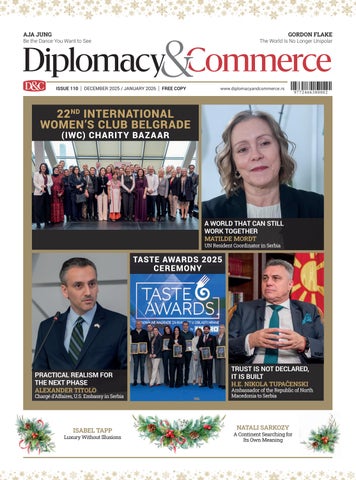
22 ND INTERNATIONAL WOMEN’S CLUB BELGRADE (IWC) CHARIT Y BAZA AR
A WORLD THAT CAN STILL WORK TOGETHER MATILDE MORDT
UN Resident Coordinator in Serbia
TASTE AWARDS 2025 CEREMONY
PRACTICAL REALISM FOR THE NEXT PHASE ALEXANDER TITOLO
Chargé d’Affaires, U.S. Embassy in Serbia
ISABEL TAPP
Luxury Without Illusions
TRUST IS NOT DECLARED, IT IS BUILT
H.E. NIKOLA TUPAČENSKI
Ambassador of the Republic of North Macedonia to Serbia
NATALI SARKOZY
A Continent Searching for Its Own Meaning
Zima, s ljubavlju. Isplanirajte svoju zimsku čaroliju danas. Trg Josifa Pančića 12, Kopaonik vks.reservations@viceroy.com +381 (0)36 515 5500
CONTENTS
Dear readers,
DECEMBER 2025 / JANUARY 2026
FOLLOW US FOLLOW US TO STAY UPDATED TO STAY UPDATED
Enjoy this special holiday edition of Diplomacy&Commerce magazine, featuring a selection of engaging topics and thoughtful conversations. We wish you health and love throughout the winter holiday season, and we look forward to meeting again around the themes you value most in the year ahead. The next issue of the magazine will be published in February 2026.
Happy holidays!
FREE COPY
FREE COPY Subscription Only Subscription Only Director ROBERT ČOBAN Director robert.coban@color.rs ROBERT ČOBAN
robert.coban@color.rs Editor in Chief DRAGAN NIKOLIĆ Editor in Chief dragan.nikolic@color.rs DRAGAN NIKOLIĆ dragan.nikolic@color.rs Journalists
MIJAT KONTIĆ Journalists ŽIKICA MILOŠEVIĆ BOJANA BAČIĆ MIJAT KONTIĆ Advertising ŽIKICA MILOŠEVIĆ DRAGAN NIKOLIĆ dragan.nikolic@color.rs Advertising DRAGAN DRAGAN VUČEVIĆ NIKOLIĆ dragan.vucevic@color.rs dragan.nikolic@color.rs marketing@color.rs DRAGAN VUČEVIĆ dragan.vucevic@color.rs Photos GORAN ZLATKOVIĆ marketing@color.rs NEBOJŠA BABIĆ MILOŠ NADAŽDIN Photos STEFAN ĐAKOVIĆ GORANNSENGIYUMVA ZLATKOVIĆ KHARIM MILOŠ LUŽANIN JAKOV SIMOVIĆ SHUTTERSTOCK SHUTTERSTOCK Translation COLOR MEDIA EVENTS Prepress VLADIMIR DUDAŠ Ce en n tt rr o ob b ii rr o o C Contributors Contributors ROBERT ČOBAN ČOBAN ROBERT DUŠKA LJILJAJOVANIĆ VUJIĆ LJILJANA VUJIĆ NATALI SARKOZY VIKTOR LAZIĆ Print Print BIROGRAF COLORCOMP PRINTD.O.O. Zemun, Atanasija Novi Sad Pulje 22 Distribution Distribution PRETPLATA D.O.O. office@pretplata.rs +381 11 314 99 21 COLOR MEDIA EVENTS COLOR MEDIA EVENTS Published by: Published by: Color Media Events d.o.o. Color Media Events d.o.o. 21000 Novi Sad, Serbia 21000 Novi Sad, Serbia Mileve Simić 27 Temerinska 102 VAT: 113769690 VAT: 113769690 Reg. No: 21922978 Reg. No: 21922978 Belgrade Office: Belgrade Office: Vlajkovićeva 6 Bul. Zorana Đinđića 48b 11000 Belgrade, Serbia 11070 Novi Beograd, Serbia Phone: + 381 63 432 392 Phone: + 381 63 432 392 CIP – Katalogizacija u publikaciji CIP – Katalogizacija u publikaciji Biblioteka Matice Srpske, Novi Sad Biblioteka Matice Srpske, Novi Sad 33 33 Diplomacy & Commerce / glavni i Diplomacy & Commerce / glavni i odgovorni urednik: Dragan Nikolić, odgovorni urednik: Dragan Nikolić, 2016, (mart)-.2016, (mart)-.Novi Sad: Color Media Novi Sad: Color Media Events, 2016 - , -33cm Events, 2016 - , -33cm Mesečno Mesečno ISSN 2466-3808 = ISSN 2466-3808 = Diplomacy & Commerce Diplomacy & Commerce COBISS.SR-ID 303269895 COBISS.SR-ID 303269895 Copyright 2024 Copyright 2025 © Color Media Events © Color Media Events
5
8
TRUST IS NOT DECLARED, IT IS BUILT H.E. NIKOLA TUPAČENSKI
A WORLD THAT CAN STILL WORK TOGETHER MATILDE MORDT
AMBASSADOR’S INTERVIEW
Ambassador of the Republic of North Macedonia to Serbia
FEATURED INTERVIEW
UN Resident Coordinator in Serbia
CONTENTS 32
48
THE WORLD IS NO LONGER UNIPOLAR GORDON FLAKE
FLAVOURS SHAPING THE FUTURE
GEOPOLITICAL INTERVIEW
TASTE AWARDS 2025
The Perth USAsia Centre
44
50
DIALOGUE FOR THE FUTURE
CONVERSATIONS THAT OPEN THE DIPLOMATIC WORLD MIJAT KONTIĆ
WORLD IN 2026
MEDIA INTERVIEW
Journalist / TV Diplomata
54
CULTURAL INTERVIEW
BE THE DANCE YOU WANT TO SEE AJA JUNG
Belgrade Dance Festival
Featured countries in this edition: ALGERIA / ARMENIA / ARMENIA / AUSTRALIA / CANADA / FINLAND / FRANCE / HUNGARY / ISRAEL / ITALY / LEBANON / LIBYA / MEXICO / NIGERIA / NORTH MACEDONIA / PORTUGAL / ROMANIA / SLOVENIA / SPAIN / UAE / UN / USA
3
FOREWORD
Insieme
I
agree that the EU should be the final destination for the entire Western Balkans. However, we will already be waiting for you there from 2028, and we are cheering for you to genuinely hurry up and accelerate the remaining candidates from the region,” Montenegrin Prime Minister Milojko Spajić wrote on X. Spajić reacted after Serbian President Aleksandar Vučić said that on Wednesday, he would have an important meeting in Brussels with EU leaders Ursula von der Leyen and António Costa, adding that he would propose that the EU admit the entire Western Balkans together. I agree with the Prime Minister of Montenegro. Indeed, the EU is where all of us in the Western Balkans belong. Some are working towards this goal more, while others are working less. Of all the countries that declaratively aspire to EU membership, Serbia has the lowest share of public opinion in favour of that idea. According to the latest CeSID surveys, 46 per cent of citizens would vote “in favour”, while 44 per cent would currently vote against Serbia’s membership of the European Union. In all other countries – Montenegro, Albania, North Macedonia, Bosnia and Herzegovina, Georgia and Moldova – this percentage is significantly higher. I recently told Newsmax Balkans that the case involving Federica Mogherini is, for me, not a sign of
4
an EU crisis, as Maria Zakharova claims. It is a sign that in the EU there are no untouchables, whether they are senior EU officials such as Mogherini, former prime ministers such as Sanader, or presidents such as Sarkozy. Unlike the country Zakharova comes from, where only opposition leaders or disobedient tycoons end up in prison. Corruption exists everywhere and has existed in all societies; the only question is how willing those societies are to punish those responsible, regardless of how high the positions they hold or once held may be. I recommend the Belgrade Museum of the 1990s (at the corner of Knez Aleksandar Boulevard and Kneza Miloša Street, diagonally opposite Ćacilend) to all readers, both foreigners seeking to familiarise themselves with the subject and locals, as a reminder. The first installation at its entrance is a screen showing the song Insieme: 1992, performed by Italian singer Toto Cutugno at the Eurovision Song Contest in Zagreb in the spring of 1990. Most European countries that dreamed of joining the EU back in 1990 eventually fulfilled that dream – some 14, some 17, some 23 years later. The countries of the Western Balkans still have not. The question is whether that dream has turned into a nightmare here, and whether it will ever be dreamt to its end.
Robert Čoban
www.diplomacyandcommerce.rs
by Mijat Kontić
AMBASSADOR’S INTERVIEW
Trust Is Not Declared, It Is Built A live TV Diplomata conversation on Europe, regional closeness and the slow work of diplomacy H.E. NIKOLA TUPAČENSKI Ambassador of the Republic of North Macedonia to Serbia
T
his interview with H.E. Nikola Tupančeski, Ambassador of the Republic of North Macedonia to Serbia, is published by Diplomacy & Commerce magazine as a transcript of a live interview aired on the TV Diplomata programme, produced in cooperation with Euronews Serbia. In a candid and thoughtful conversation, the Ambassador reflects on diplomacy as a human practice, regional trust, European integration and the values shaping the future of the Western Balkans. Your biography spans academic work, international cooperation and legal reforms. Looking back, what would you say has shaped your professional identity the
most? Was it the classroom, international institutions, or domestic legal practice? When I look back on my professional journey, I would say that my identity has been shaped precisely by the combination of all three dimensions: the classroom, international institutions and domestic legal practice. Academic
how vital it is to translate theory into practice and to ensure the legal system serves as a pillar of society. Engagement in international organisations, notably the Council of Europe, broadened my perspective on universal values and on the need to align national experience with European standards.
DIPLOMACY BEGINS WITH LISTENING, NOT WITH SPEAKING work gave me the ability to reflect on the principles and values of law, to place them within a broader context, and to pass on to younger generations a belief in the importance of knowledge. Work within national institutions and on legal reforms showed me
For that reason, I would say there is no single place that shaped me. The true value of my path lies in connecting knowledge, experience, and responsibility, and in applying them across different contexts, always with the aim that law should serve people and society.
Before becoming Ambassador to Serbia, you served as a former Minister of Justice and worked to align North Macedonia’s legal system with EU law. How did you experience the transition from an expert role to a diplomatic one? Was it a natural continuation of your career, or an entirely new chapter? For me personally, the transition from a ministerial and expert role to a diplomatic role represented both continuity and a new challenge. As Minister of Justice, I had the opportunity to work directly on aligning legislation with the European Union’s legal acquis, which required a thorough understanding of European standards and strong skills in dialogue and negotiation with various partners. These very skills are equally valuable in diplomacy: the ability to listen, to seek common ground and to build bridges.
5
AMBASSADOR’S INTERVIEW
At the same time, an ambassadorial mission brings an additional dimension. Here, you are no longer only a legal expert but a representative of the entire state. That entails a broader responsibility, extending beyond law to encompass politics, culture, the economy and human relations. In that sense, I would say it is a natural continuation of my previous path, but also an entirely new chapter that offers space for both personal and professional growth. Given your experience in aligning Macedonian law with EU law, which lessons from that process would you single out as applicable for countries still aspiring to membership, such as Serbia? As someone who had the privilege of following from the inside and actively participating in the process of aligning Macedonian legislation with the European Union’s legal acquis, I can say that it is a long, complex, yet profoundly transformative journey. It goes far beyond the technical adoption of laws; it is, at its core, a political and societal reform. One key lesson is the need for strategic vision and political consensus. European integration cannot be treated as a short-term political project. It requires a long-term vision and broad political agreement that rises above day-to-day politics. In North Macedonia, we often wasted valuable time on internal political disputes rather than channelling our energy into reforms. Another crucial aspect is institutional resilience and administrative capacity. Harmonisation with EU law is not about copying legislation. What truly matters is having institutions capable of implementing those laws, supported by a professional, independent and well-trained administration. Without this, rules remain little more than words on paper. The rule of law must be the foundation. The European Union places particular emphasis on Chapters 23 and 24, which cover the judiciary, human rights, freedoms, and security. This is no coincidence. Without citizens’ trust in justice and equality before the law, there can be no sustainable progress, neither economic nor social. Transparency and public inclusion are equally important. Reforms should be carried out openly, with consultations involving civil society, the academic community and the business sector. This creates a
6
EUROPEAN INTEGRATION IS A REFORM OF SOCIETY, NOT A FORMALITY TOWARD BRUSSELS sense of shared ownership of the process and strengthens public trust that integration is not an imposed project, but a path towards a better quality of life. Finally, good neighbourly relations and regional cooperation are essential. Our experience has shown how bilateral issues can become serious obstacles on the road to the EU. Serbia should continue to foster good neighbourly relations and invest in regional cooperation, as the European Union values regional political stability as much as each country’s technical readiness. In conclusion, from the perspective of a former minister and ambassador, I would emphasise that the European path is not merely a destination. It is a process through which a society matures, institutions are strengthened, and the culture of political decision-making evolves. When reforms are understood as a domestic responsibility towards citizens, rather than an obligation to Brussels, success comes much closer and much faster. North Macedonia has been a NATO member for four years, while Serbia maintains military neutrality. How do you assess
the impact of NATO membership on North Macedonia’s security and international standing, and does this difference in strategic orientation complicate or enrich relations with Serbia? North Macedonia’s NATO membership, now in its fifth year since 27 March 2020, represents a significant step toward strengthening our national security and international standing. It confirmed our strategic commitment to Euro-Atlantic integration, reinforced guarantees of stability and security for our citizens, and contributed to the collective security of the region. We are fully aware that the Republic of Serbia pursues a clearly defined policy of military neutrality, which we respect. We believe that differences in strategic orientation are not an obstacle, but rather an opportunity to complement one another through dialogue, the exchange of experience and concrete projects of mutual interest. Our two nations are bound by geographic proximity, shared history, and intensive cooperation, so it is only natural to seek ways to enrich these relations further, whether through economic, cultural, or securityrelated cooperation.
I am convinced that different strategic choices need not be a source of misunderstanding. On the contrary, they can contribute to regional stability and demonstrate that the Balkans has the capacity to nurture good relations despite taking different paths. This is also the strongest message we can send regarding our shared European future. North Macedonia has, for the first time since gaining independence, elected a woman as President. Much larger countries cannot claim such an achievement. How important is this fact for the development of democracy and for gender equality in politics? For us in North Macedonia, the election of the first woman President since independence carries multiple layers of symbolism and significance. It is a strong confirmation that democratic processes in our country are maturing and that citizens’ trust can be placed in different generations and leadership profiles. Democracy, after all, is precisely about ensuring that everyone has an equal opportunity to be elected and to serve society. From the perspective of gender equality, this step demonstrates that women, who have long made immense contributions to society, science, culture, and diplomacy, are now receiving their rightful place within the highest political structures. As her colleague at the university, I can personally attest
www.diplomacyandcommerce.rs
AMBASSADOR’S INTERVIEW
to her dedication, expertise, and integrity, and I am confident that, through her work, she will not only strengthen institutions in North Macedonia but also serve as an inspiration to young women across the region and beyond. This is not merely a political milestone, but an important step towards a society in which equality and inclusiveness are embedded in everyday life. According to data from the Serbian Chamber of Commerce, total trade between Serbia and North Macedonia reached EUR 1.39 billion in 2024, with the growth trend continuing into 2025. Which sectors or products are driving this growth? The growth in total trade between our two countries is not accidental. It is the result of increasingly strong economic ties and the complementarity of our sectors. The main drivers of this growth are the food and beverage industry, agricultural products, the energy sector, the metal and electrical industries, and pharmaceuticals and construction materials. It is particularly encouraging that products with higher added value are taking up an ever-greater share, reflecting the modernisation of our economies. This trend is more than a statistical figure. It is clear evidence that regional cooperation, through initiatives such as the Open Balkan and CEFTA mechanisms, is delivering tangible results. I am confident that further diversification of production and new investments will ensure that, in the years ahead, this trade balance grows not only in quantitative terms but also in quality, to the mutual benefit of citizens and businesses alike. In September this year, the customs administrations of Serbia and North Macedonia announced upgrades to their IT systems and the simplification of procedures. How necessary are such technical steps for broader economic integration in the region? Upgrading IT systems and simplifying customs procedures are fundamental to strengthening economic integration in the region. Faster, more efficient flows of goods and services reduce costs for businesses, encourage investment, and increase the competitiveness of our markets. These technical steps lay the practical foundations for deeper
DIFFERENT STRATEGIC CHOICES CAN STRENGTHEN, RATHER THAN WEAKEN, REGIONAL STABILITY cooperation between Serbia and North Macedonia, as well as for broader connectivity across the Western Balkans. In March 2025, the tragedy at a nightclub in Kočani became a powerful demonstration of solidarity between our two countries, both among citizens and at the state level. What factors contribute to sustaining the close relationship between North Macedonia and Serbia? The tragedy in Kočani in March 2025 was a painful moment, but it also revealed the depth of solidarity and mutual support between our peoples. North Macedonia and Serbia are connected not only by geographical proximity but also by deep historical, cultural, and linguistic ties, as well as shared values and a tradition of mutual respect. It is precisely in difficult moments that it becomes clear that the friendship between our states is not based solely on formal relations, but on genuine human closeness. This places upon us a responsibility to continue developing our relations in a spirit of understanding, trust and a shared European future. Another example of solidarity between the two countries was during the COVID-19 pandemic,
when the Republic of Serbia, on several occasions, donated vaccines to North Macedonia and enabled free vaccination for North Macedonian citizens in Serbia. How do such actions, taken in times of crisis, contribute in the long term to building trust and political closeness among countries in the region? Such gestures have immeasurable value, as they show that solidarity and mutual assistance transcend all borders. In moments of crisis, such as the pandemic, Serbia’s support for our citizens helped strengthen mutual trust and bring our peoples closer together. This is the foundation upon which we build long-term political closeness and cooperation in the region. When you look at the broader picture of the Western Balkans, politically, economically and culturally, what would you like to see as the dominant value in regional relations over the next ten years? As Ambassador of the Republic of North Macedonia, within the broader context of the Western Balkans, I would like mutual trust and sincere cooperation to become the dominant values in regional relations over the next
decade. This means strengthening political dialogue, deepening economic connectivity, and investing more in joint projects that improve citizens’ quality of life. Cultural exchange and respect for our rich and diverse heritage can further solidify these ties. I am convinced that only through solidarity and a shared vision of the future can we build a region of peace, stability and prosperity. Diplomacy is often described as the art of negotiation, bridgebuilding and balancing interests. How do you personally define diplomacy, not as a profession, but as a human practice? I do not see diplomacy merely as a profession, but as a human practice that teaches us how to listen, understand and build trust. It is the art of the possible, as Henry Kissinger once said, and the ability to find a point of balance within a complex web of differing interests. In that sense, diplomacy is like a bridge, a bridge that belongs not only to those who build it, but also to those who cross it every day. In human relations, diplomacy is patience transformed into dialogue, and the willingness to shape one’s own positions without undermining the dignity of others. The Romans used the phrase festina lente, “make haste slowly”. That, precisely, is the essence: diplomacy is not a sprint, but a marathon in which every word, gesture and even silence carries its own weight.
7
FEATURED INTERVIEW
by Mijat Kontić
A World That Can Still Work Together Why multilateral cooperation, climate action and social inclusion remain essential in an era of global uncertainty MATILDE MORDT Resident Coordinator of the United Nations in Serbia
I
n this interview for TV Diplomata, a programme produced by Diplomacy & Commerce magazine in cooperation with Euronews Serbia, Matilde Mordt, the United Nations Resident Coordinator in Serbia, reflects on the UN’s role at a pivotal moment. Marking the 80th anniversary of the United Nations, she speaks about its mission, relevance, and priorities in today’s complex global and local context.
When you look back on eight decades of work, what do you consider to be the most important ways in which the United Nations have evolved,
8
and why do you believe its role is particularly important today? The United Nations were founded in 1945 with the aim, as stated in the Charter, “to save succeeding generations from the scourge of war.” The preservation of peace remains at the very core of its mandate, alongside socio-economic development and human rights as key pillars. From the original 51 founding states, the UN has grown into a global platform bringing
GLOBAL CHALLENGES CANNOT BE SOLVED BY ANY COUNTRY ACTING ALONE together 193 countries, and it remains the only forum where every state has a voice.
This interview is an edited transcript of the conversation broadcast on the TV Diplomata programme on Euronews Serbia on 29 November 2025, adapted for publication in the print edition. The full interview is available on our YouTube channel via the QR code.
The evolution of the UN has been marked by several major milestones, beginning with the Charter itself and the adoption of the Universal Declaration of Human Rights in 1948, followed by the Convention relating to the Status of Refugees and the development of broader mechanisms of global governance. An important turning point came thirty years ago with the Beijing Declaration on women’s rights and the sustained focus on gender equality since then. More recently, the Paris Agreement on climate change and the 2030 Agenda, with its Sustainable Development Goals, have become the foundation of the UN’s contemporary development work. While Member States remain at the centre of the UN system,
www.diplomacyandcommerce.rs
FEATURED INTERVIEW
the role of other actors is also important. Civil society organisations, the private sector and academia actively contribute to shaping and implementing global agendas. At the same time, UN institutions on the ground translate agreed policies into action and provide technical expertise. In this sense, the United Nations is not only a community of states but a platform for continuous global dialogue and inclusive international engagement. You referred to the 2030 Agenda as a shared global framework for achieving the Sustainable Development Goals. How would you assess Serbia’s current progress, and what role can the United Nations play in speeding up its delivery? In the broader context, the process of shaping the 2030 Agenda was one of the most important moments in contemporary development policy. For decades, development was viewed primarily through an economic and social lens, while environmental issues existed in parallel without real integration. This is precisely why the Sustainable Development Goals were created as a single framework that brings together economic, social and environmental dimensions of development. The 2030 Agenda is the result of a three-year negotiation process that involved not only UN Member States, but also civil society, the private sector, academia and UN institutions. It was not imposed but represents a rare global consensus on what humanity needs for the future and a strong example of how the United Nations functions at its best. Although crises and conflicts have slowed progress globally, there are still 5 years left to accelerate the achievement of the goals. In Serbia, overall progress towards the Sustainable Development Goals is solid. Notable advances can be seen in health, particularly in maternal and child health, as well as in gender equality, where women hold a relatively strong position in society. At the same time, there are areas where progress has been slower. Inequality remains a challenge, especially among the most vulnerable groups, including Roma communities, people living in rural areas, and older persons, particularly older women. Addressing these gaps requires
IMPLEMENTATION IS NOW THE REAL TEST OF CLIMATE AMBITION targeted programmes and more precise forms of support. Challenges are also evident in education, where results have stagnated, particularly in access to quality education in rural areas and Roma communities. The greatest potential for accelerated progress lies in environmental protection. While advances have been made in recent years, the energy transition and energy efficiency need to move much faster, and climate adaptation must become a stronger priority, particularly in agriculture and in strengthening cities’ resilience. Are there concrete United Nations initiatives in Serbia that have had a direct impact on people’s lives and are aligned with the Sustainable Development Goals?
There are many concrete examples. The work of the United Nations in Serbia focuses on three main areas: the economy and the environment; social protection and human welfare; and the rule of law, human rights, and gender equality. Several UN development agencies operate in the country, each with its own technical expertise, and whenever possible, work in an integrated manner. One of the core messages of the 2030 Agenda is that complex development challenges cannot be addressed through narrow, sector-based approaches alone. They require cooperation across institutions and ministries, as well as strong coordination between national and local levels. In the social sphere, the 2030 Agenda is grounded in the principle of “leaving no one behind,” which provides a powerful framework for development policy. In line with this approach, the United Nations in Serbia supports, among other initiatives, housing programmes for Roma communities, which have benefited more than 28,000 people over the years. However, these programmes go
beyond providing housing alone. They are accompanied by efforts to improve access to employment, ensure that children attend school, and expand access to healthcare services, including through the work of health mediators. This integrated set of activities is designed to enable sustainable progress for the most vulnerable groups and to create equal opportunities for all. With COP30 in Brazil bringing renewed focus to climate action, what are your expectations from this conference, and how can it help countries such as Serbia accelerate the green transition? COP30, which was still underway at the time of our conversation, placed a strong emphasis on one key word: implementation. This matters because there is often scepticism about whether international climate conferences deliver real results, especially given that greenhouse gas emissions have continued to rise for decades. A turning point was the Paris Agreement, which for the first time required all countries, not only the largest emitters, to
9
FEATURED INTERVIEW
present national climate plans. Serbia has also developed such plans, with support from the United Nations. If the measures contained in these plans are fully implemented, emissions will decline. If they are not, climate disruption will continue to intensify. This is why the focus must now shift from commitments to action. As with all COP conferences, climate finance remains central. Countries need substantial financial support to implement climate measures, and the responsibility for providing this support lies largely with the major emitters. For Serbia, this is particularly important, as the energy transition is essential but cannot be achieved without adequate financing. While available resources still fall short of actual needs, some progress has been made. Another key focus of COP30 is adaptation. We know that global warming is happening and climate instability will continue. Increasingly frequent extreme weather events highlight the need to strengthen resilience across sectors such as agriculture, urban development, and public health. A third important element of the Brazilian presidency is the concept of “Mutirão,” which can be understood as collective community action. This approach emphasises the role of citizens, local governments and communities in driving climate action through changes in everyday production and consumption patterns. Estimates suggest that up to 70 per cent of emissions could be reduced through such changes, from more sustainable transport to shifts in dietary habits. The core message is that climate action must come from both the bottom up and the top down — from individuals and local communities, through national policies, to international cooperation. Only a combination of political commitment, effective implementation and individual responsibility can deliver lasting results. Serbia has updated its national climate commitments. From the UN perspective, how can these commitments be turned into opportunities for a green transition and the creation of green jobs, particularly in sectors such as energy, agriculture and urban development? First of all, it is important to recognise the increased level of ambition, which is precisely the objective of the UN Climate
10
become more resilient to climate impacts such as floods and heatwaves. For example, we have supported the development of a green infrastructure plan for Belgrade to strengthen the city’s resilience. Its implementation could bring tangible benefits, particularly in addressing extreme summer heat through more green spaces, trees and shade, which are essential for improving quality of life in urban environments.
POVERTY IS NOT ONLY ABOUT INCOME, BUT ABOUT ACCESS, DIGNITY AND OPPORTUNITY Convention. Countries are expected to raise their ambition over time, and Serbia’s third Nationally Determined Contribution does exactly that. While Serbia’s first NDC envisaged an emissions reduction of around 9 per cent, the current target is a 40 percent reduction by 2035 in comparison to 1990 levels, which is a significant step forward and closely linked to ongoing and planned investment projects. This ambition is strongly tied to the energy transition. Serbia aims to reach 45 per cent renewable energy by 2030, which is only five years away. This creates a major opportunity to accelerate the transition and generate thousands of new jobs. At the same time, the gradual phase-out of coal is unavoidable, not only from a climate perspective but also because of its
impacts on air pollution, which have clear effects on public health and the economy. The challenge is to shift jobs from coal-based sectors into new renewable energy industries, which will require reskilling, training and the adoption of new technologies. The United Nations supports this transition in several practical ways. One example is support for investments by small and medium-sized enterprises to improve their environmental performance. Access to finance is often the biggest obstacle for these businesses. Through technical assistance and in partnerships with the European Investment Bank, local banks are providing funds to SMEs to support greener production and innovation. Agriculture is another critical area. We support adaptation measures, including more resilient crop varieties and climateresilient farming practices, to increase productivity. Recent years of severe drought have shown how vulnerable Serbian agriculture is, making this transition both urgent and necessary. Finally, urban development plays a key role. Cities must
You mentioned gender equality as one of the United Nations’ key areas of work. While Serbia has achieved relatively good results in some areas, significant gaps remain. How does the UN, together with partners in Serbia, work to empower women and combat gender-based violence, particularly in the context of the “16 Days of Activism” campaign? Serbia certainly deserves recognition for the progress it has made in advancing gender equality. Women are highly educated and strongly represented in public life. One of the important contributions of the United Nations, , has been the introduction of gender-responsive budgeting. This approach ensures that public resources are directed to where women and girls need them most, both at the local and national levels. Serbia is globally recognised for this model, which is an achievement to be proud of. At the same time, challenges persist. Women have more limited access to the labour market, and those who are employed often carry a double burden of paid and unpaid work, reflecting unequal divisions of responsibilities within households. Gender-based violence remains a particularly serious issue, with devastating consequences for women and children. The United Nations in Serbia addresses this challenge on multiple levels, with a strong focus on prevention, changing harmful social norms and stereotypes, and promoting behaviour change, including through engagement with men and boys. When it comes to response mechanisms, we support coordinated, multi-sectoral action involving the police, healthcare services, social welfare institutions and the justice system. This response must be survivorcentred rather than institutioncentred, and grounded in empathy and respect. In the context of the “16 Days of Activism against Violence against
www.diplomacyandcommerce.rs
FEATURED INTERVIEW
Women and Girls” campaign, this year’s focus is on the digital space. Online attacks against women and girls are increasing, affecting not only teenagers but also journalists, activists and women in politics. Ensuring safer digital environments requires both regulation and responsible behaviour online, as well as active reporting of violence, support for survivors and challenging harmful narratives. Another important issue you mentioned is poverty, and the United Nations emphasises that poverty is multidimensional. It is not only about income, but also about access to healthcare, education and social inclusion. What are the main drivers of poverty today, and how can policies respond more effectively? That is correct, and this is a global reality. Poverty is indeed multidimensional. Income is an important and commonly used indicator, but it is not the only one. Poverty also includes housing conditions, access to education and access to healthcare. One fact that particularly struck me when I arrived in Serbia is that the life expectancy of Roma communities is 12 years lower than the national average. This is a huge gap and a clear illustration of the multidimensional nature of poverty, reflecting lower incomes, inadequate housing, weaker access to healthcare and education, as well as other factors such as early marriage.
These challenges cannot be addressed by a single sector alone and require the involvement of multiple institutions working together. In terms of income, around 20 per cent of the population in Serbia is at risk of poverty, which means that even a slight shock can push a family into poverty. Employment is therefore crucial, as it reduces vulnerability, but it must be complemented by strong social protection systems that build resilience. This includes daily social services and targeted support programmes for the most vulnerable groups.
such as Serbia in shaping that future? This brings us back to the global level where our conversation began, and that is fitting, because the past 80 years have shown that global cooperation does work. We have achieved remarkable results, sometimes without fully realising their scale. Smallpox was eradicated through collective global action. During the Millennium Development Goals period, 1 billion people were lifted out of poverty in just 15 years because the world came together around a shared objective.
GENDER EQUALITY ADVANCES WHEN POLICY, FINANCING AND SOCIAL NORMS MOVE TOGETHER Particular attention must be given to vulnerable populations and the risks they face. For example, in a health emergency, high out-of-pocket healthcare costs can quickly deepen poverty. This is why effective safety nets and additional programmes are essential to ensure access to healthcare services and protect people from falling into poverty. As the United Nations marks its 80th anniversary, which lessons from the past eight decades should guide global cooperation in the years ahead? And what role do you see for countries
In the environmental sphere, the Montreal Protocol is another powerful example. Although it is not widely discussed today, it played a decisive role in reversing damage to the ozone layer. A few decades ago, the ozone hole was a major global concern; once harmful substances were phased out, the situation began to improve. These examples show how joint action can deliver extraordinary outcomes. The major challenges we face today, from climate change to inequality, are inherently global and cannot be solved by any country acting alone. This will remain true in the future. At the same
time, important discussions are underway about reforming the United Nations, both politically and operationally. Much attention is focused on the Security Council, whose structure reflects the realities of 1945 rather than today’s world. Reforms are also being considered in other areas, including how mandates are defined, reviewed and implemented. Over time, many mandates have accumulated without being reassessed, making it increasingly difficult both for the UN to deliver and for Member States to oversee its work. This is why reform efforts are now examining operational efficiency, mandate rationalisation and organisational structure, especially in light of current financial pressures. Proposals will be presented to Member States, and it will be up to them to decide how the UN should evolve to meet future needs. When it comes to Serbia, expectations are high. Serbia has a strong tradition of multilateralism, dating back to Yugoslavia’s membership in the UN since 1945, and remains an active and constructive partner. Beyond cooperation at the country level, Serbia contributes globally, including through participation in peacekeeping missions and engagement in international dialogue. This active role positions Serbia well to help shape the future of multilateral cooperation and the United Nations in the decades ahead.
11
ARRIVALS
NATIONAL DAYS
H.E. YOUSEF JABRE
JANUARY 2025
New Ambassador of Lebanon in Serbia
L
ebanon has appointed a new ambassador to the Republic of Serbia. His Excellency Yousef Jabre presented his credentials and assumed his duties in late October 2025, officially taking office on 14 October. He succeeds Her Excellency Nada Al Akl, who paid a farewell visit to Belgrade in August 2025.
Liberation Day
1
SUDAN Independence Day
1
SLOVAKIA Independence Day
DEPARTURES
4
MYANMAR H.E. VOLODYMYR TOLKACH Former Ambassador of Ukraine to Serbia
I
n November 2025, the President of Ukraine, Volodymyr Zelenskyy, appointed Oleksandr Lytvynenko as the new Ambassador of Ukraine to Serbia, who will soon assume office, succeeding H.E. Volodymyr Tolkach. During his mandate, Ambassador Tolkach made a significant contribution to the development of bilateral relations between the two countries. Thanks to his efforts, the Ukrainian voice on Russia’s aggression against Ukraine was heard in Serbia, and in his frequent media appearances, he consistently emphasised the solidarity shown by the Serbian people and the Republic of Serbia towards Ukraine. He leaves Belgrade as a great friend, and the editorial team of Diplomacy & Commerce magazine wishes him continued success in his future professional endeavours.
12
1
CUBA
Student’s Protest Day
UKRAINE Day of Unity of Ukraine
22
ROMANIA Unification Day of Wallachia and Moldavia
AUSTRALIA National Day
INDIA Republic Day
24 26
26
www.diplomacyandcommerce.rs
www.grandkopaonik.com
AMBASSADOR’S POSTCARD
Between Ljubljana and Belgrade, the Distance Is Never Far
H.E. DAMJAN BERGANT Ex Ambassador of Slovenia to Serbia
H
.E. Damjan Bergant, former Ambassador of the Republic of Slovenia to Serbia, concluded his diplomatic mandate in Belgrade in February 2024. After returning to Slovenia, he served as Foreign Policy Adviser to the President of the Republic of Slovenia. Drawing on decades of personal and professional ties with Serbia, he shares his reflections and memories in this postcard sent after his return from Belgrade.
What have you been doing since you left Belgrade? I left Belgrade this February, for the second time. The first farewell took place almost 36 years ago, upon completing my compulsory military service in the former country. The second farewell came this February, at the conclusion of my term as Ambassador of the Republic of Slovenia to the Republic of Serbia. On both occasions, I carried memories and experiences that will stay with me for a long time and will certainly not be forgotten. After returning to Slovenia, I assumed the position of Foreign Policy Adviser to the President of the Republic of Slovenia. Following an exciting experience in Serbia, I
14
found myself facing new challenges and opportunities that are once again highly engaging and inspiring. At times, it isn’t easy to keep pace with oneself while reliving everything as it unfolds. Nevertheless, it is wonderful to return home, among friends and to a familiar environment. At the same time, one recalls all
What (and who) do you miss the most from Serbia? Serbia has left a very positive impression on me. I am always happy to return, and this year alone I have already visited Belgrade twice. There is always a reason for a visit, whether a celebration, a sporting event, or a cultural occasion. This is clear proof of our closeness and of how much I genuinely enjoyed my time in Serbia, where I made many friends with whom I have remained in contact. In addition to travelling, either alone or with my wife, through much of Serbia and discovering many beautiful places not found in tourist guidebooks, I promised myself that I would return. I therefore intend to return whenever possible and whenever there is once again a reason to do so. Naturally, I miss Belgrade, where I spent most of my time during my term of office. Living in Dedinje, a quieter part of the city, allowed me to find peace whenever I sought it. When I longed for a bit more bustle, I would head to the city centre, where I actually spent a great deal of time each day, as the Embassy of the Republic of Slovenia is located in Dorćol, one of the most picturesque parts of Belgrade. At weekends, I often took advantage of the peaceful setting in Dedinje, where colleagues and friends from the neighbourhood would gather for various social occasions, either in restaurants or cafés. On Saturdays, I enjoyed visiting the market in Banjica, where I would buy fresh fruit and vegetables of exceptionally high quality in Serbia, not to mention the cultural and sporting events I frequently attended, including basketball games and concerts at Kolarac or Madlenianum. I also miss the excellent cuisine, not only grilled dishes, but also the incredibly flavorful fish soups and the taste of freshwater fish served in restaurants along the Danube and the Sava. Of course, I must not forget the friendliness and openness of the local population, as well as their remarkable sense of enjoyment and celebration, often accompanied by music during dinners. I also greatly appreciate the exceptionally positive attitude the locals showed towards me as a Slovenian. All of this truly takes root in one’s heart and is something I would gladly relive from time to time. Fortunately, we are so closely connected, and the distance between Ljubljana and Belgrade is not great.
www.diplomacyandcommerce.rs
Photo: Private Archive
the beautiful moments experienced during the term of office, which remain very vivid. My permanent return to Slovenia has also allowed me to spend more time with friends whom I had seen only briefly in recent years, as well as to make more frequent visits to the seaside and the mountains, something that is more difficult when living in Belgrade.
LIMO SERVICE
ON THE LINE OF PROTOCOL AND PRESTIGE
BGDiplomat Behind the Most Important Delegations and Missions in Serbia A Reliable Partner to Diplomacy, International Organizations, and the Business Community
B
GDiplomat once again confirms its role as a trusted partner of diplomatic missions, international organizations, and high-level delegations visiting Serbia. Thanks to its commitment to meticulous organization, discretion, and the highest protocol standards, the company continues to strengthen its position in the sector of specialized transportation services. In recent months, BGDiplomat has successfully executed a series of large-scale and logistically demanding projects. In addition to its engagement during the UEFA Congress—where coordinating a large fleet required maximum precision—the team recently had the opportunity to provide full support to the delegation of the Democratic Republic of Congo. A significant number of vehicles with professional chauffeurs were deployed for their visit, and the entire operation was carried out in complete accordance with protocol and to the highest standard. These projects once again demonstrate the company’s capability to adapt to diverse requirements and reliably execute complex operations. It is particularly important to emphasize that despite such extensive engagements, the company’s regular activities continue to run smoothly. BGDiplomat provides daily services to both long-standing and new clients, including airport transfers, intercity trips, and premium car rental. Even during periods of the
Continuous improvement of services remains a key component of the company’s strategy. BGDiplomat consistently introduces new operational procedures, modernizes its fleet, and enhances chauffeur training programs in order to meet the growing needs of the market and the expectations of clients from diplomatic and business environments. Each innovation is implemented with a clear objective: to ensure a flawless client experience and a service standard that exceeds expectations. As the year draws to a close, it is natural to reflect on the achievements behind us. Despite numerous challenges, the year brought a significant number of successful projects, new collaborations, and strengthened partnerships. Regardless of obstacles, BGDiplomat achieved substantial growth, expanded its scope of engagements, and completed assignments that further solidified the company’s reputation. These results DISCRETION, PRECISION AND ABSOLUTE RESPECT FOR testify to the expertise of the team, consistency in PROTOCOL DEFINE EVERY BGDIPLOMAT OPERATION execution, and the trust that clients continuously place in the company. most intensive protocol duties, including the embassies of China, With such accomplishments, the company maintains a high India, Ghana, the Democratic BGDiplomat enters the new year level of organization, ensuring Republic of Congo, Norway, and ready to continue its growth, imthat all segments of its operations the United Kingdom. The longprove its processes, and deliver function efficiently and without term trust of these institutions services at an even higher level. interruption. confirms the stability and high The mission remains clear: to be Cooperation with the diplolevel of professionalism that the the first choice of diplomatic mismatic community holds a special company upholds in every aspect sions, international delegations, place in the company’s developof its work. Such partnerships and clients who expect absolute ment. Over the years, BGDiplomat have shaped a business model professionalism, safety, and tophas had the privilege of supgrounded in precision, safety, and quality transportation. porting numerous embassies, a discreet approach.
15
PHOTO STORY
“WITH NATO, IT IS STILL EASIER TO BREATHE” Swedish Ambassador Charlotta Samelin and Finnish Ambassador Niklas Lindqvist at the National Day of Finland reception, 4 December.
HOW TO MAKE MINCE PIE Caroline Ferguson, the wife of the British Ambassador, reveals traditional English Christmas recipes to Minister Tatjana Macura and Andrea Pavukova, President of the IWC (Sava Center, 7 December).
WINE OF HOPE The Ambassador of Israel to Serbia, Avivit Bar-Ilan, with her husband, presents a
The Ambassadors of Slovakia and Greece
bottle of Israeli wine named after Alon
at the celebration marking the opening
Ohel, a hostage who was recently released
of Mexico Street in Belgrade (Belgrade
from Hamas captivity.
16
“THEY GAVE US SURČIN, YOU GOT BEŽANIJSKA KOSA…”
Waterfront, 21 November).
ALL THE PRESIDENT’S MEN
“THE CROWN”, SERBIAN EDITION
year the largest number of Serbian officials ever seen at a diplomatic
Princess Danica, Prince Filip, Prince Aleksandar and Princess
the Republic of Serbia, the President of the Government of the
Katarina at the celebration of Romania’s National Day
Autonomous Province of Vojvodina, as well as no fewer than eleven
(White Palace, 27 November).
government ministers (St. Regis Hotel, 28 November).
The 54th Eid Al Etihad Reception of the UAE brought together this reception: the President of the Republic, the Prime Minister of
www.diplomacyandcommerce.rs
DIPLOMATIC EVENTS
19 NOVEMBER 2025
Twenty Years of Portuguese in Belgrade An Exhibition on Translators Who Shaped a Dialogue Between Cultures
T
he exhibition “Translator– Enchanter: Texts in Transit Between Portuguese and Serbian” has opened at the National Library of Serbia. The Ambassador of Portugal, José Veles Caroso, said that the NLS is paying proper tribute and respect to those who perform the honourable work of translation. According to him, the posters and books presented at the exhibition show that only thanks to the work of translators can something written in another language reach us. “A translator must know not only the language, but also the culture — even the soul — of the person whose work they are translating,” Caroso emphasised, adding that the exhibition also features books by authors who write in Portuguese and come from Angola, Mozambique, Brazil, and other countries.
21 NOVEMBER 2025
Symbol of Friendship: Belgrade Gets a Mexico Street
T
he President of the City Assembly, Nikola Nikodijević, the Ambassador of Mexico, Carlos Félix Corona, and the Minister of the Interior, Ivica Dačić, formally unveiled the sign bearing the name of Mexico Street, located in Belgrade Waterfront The Ambassador of Mexico, Carlos Félix Corona, said that today is a historic day for
the relations between Mexico and Serbia, especially for the citizens of Belgrade. “This honourable naming of a street in this beautiful city, which will bear the name Mexico Street, is a powerful symbol that reflects the strong bond between the peoples and governments of our two countries. It is an act of great kindness and generosity by the Belgrade City Assembly toward
Mexico, and it represents a historic legacy that will continue to strengthen the relations between our nations and future generations. This friendship has been built for more than eight decades, thanks to many Mexicans and Serbs who have worked with dedication to bring our peoples and governments closer in various fields,” Ambassador Corona said.
17
DIPLOMATIC EVENTS
24 NOVEMBER 2025
A Royal Gift from Ife Arrives in Belgrade: The Bronze Head of Ori Olokun at the Museum of African Art
T
he Museum of African Art in Belgrade had the distinct honour of welcoming Her Royal Highness Olori Adesegun Temitope Enitan-Ogunvusi and the delegation of the Ooni of Ife, His Royal Majesty Ooni Adelejimi Enitan Ogunwusi – Ojaja II. During the visit, Olori Adesegun presented the museum
with an official gift: a bronze head of Ori Olokun, an ancient emblem of royal heritage, along with a contemporary work of art. The gift symbolises Nigeria’s rich history and vibrant culture. The Serbian delegation included Their Royal Highnesses Prince Philip and Princess Danica, Stanko Blagojević, Assistant Minister
of Culture, and other representatives from official institutions. This visit marked a significant cultural event, strengthening bilateral ties between Serbia and Nigeria and giving the public in Belgrade a unique opportunity to engage with African art. The visit took place within the framework of the official trip of the Nigerian Royal House of Oduduwa to the Karađorđević royal family.
25 NOVEMBER 2025
Israel Showcases Its Wines at Wine Vision by Open Balkan 2025
A
t this year’s Wine Vision by Open Balkan 2025, held from 22 November to 25 at the Belgrade Fair, Israel presented its finest wines. Visitors had the opportunity to explore a variety of wine types reflecting the rich tradition and innovation of Israeli winemakers. The presentation was also attended by Israel’s Ambassador to Serbia, Avivit Bar-Ilan,
further highlighting the significance of Israeli winemakers’ presence at this international fair. This participation by Israeli winemakers is part of the fair’s broader initiative to promote international wine culture, bringing together exhibitors from around the world and allowing visitors to enjoy wines rarely found on the local market.
27 NOVEMBER 2025
Romania Celebrated Its National Day
W
ith a formal diplomatic reception at the White Palace in Belgrade, within the royal complex in Dedinje, the Embassy of Romania in Serbia marked its national holiday, the Day of Unification. The Romanian Ambassador to Serbia, H.E. Silvia Davidoiu, in her welcoming speech, emphasised that her country is today a respected and esteemed member of the EU and NATO, proudly standing within the democratic, liberal, transatlantic
18
community. Ambassador Davidoiu particularly highlighted the importance of strong bilateral relations between Romania and Serbia, recalling 145 years of diplomatic ties. “Our relations naturally grow, regardless of political overtones or circumstances in the two countries, based on mutual respect and traditional friendship,” Davidoiu stressed. The reception was attended by a large number of guests from the public and cultural life of the country, including
representatives of political authorities, Crown Prince Alexander Karađorđević with his wife, Prince Heir Filip Karađorđević with his wife, numerous representatives of the Romanian minority in Serbia, foreign diplomatic representatives, high-ranking clergy, military attachés, and others. The holiday is celebrated in remembrance of 1 December 1918, when, following the end of the First World War, the unification of the Kingdom of Romania with Transylvania, along with the annexation of Bukovina and Bessarabia, fulfilled the dream of a single state inhabited by nearly all Romanians.
www.diplomacyandcommerce.rs
DIPLOMATIC EVENTS
28 NOVEMBER 2025
Celebration of the UAE National Day Held at Belgrade Waterfront
T
he Embassy of the United Arab Emirates (UAE) in Belgrade marked the 54th National Day of the UAE today, and Serbian President Aleksandar Vučić attended the celebration. In addition to the President of the Republic, the National Day celebration at the St. Regis Hotel at Belgrade Waterfront was attended by the Prime
Minister of Serbia, Prof. Dr. Đuro Macut, ministers, members of parliament, and ambassadors of several countries in Serbia. UAE Ambassador Ahmed Hatim Bargash Al Menhali expressed his satisfaction that the 54th anniversary of the founding of the state is being celebrated together in Belgrade, a friendly country.
The United Arab Emirates was founded after six emirates in the Persian Gulf — Abu Dhabi, Dubai, Sharjah, Ajman, Umm Al Quwain and Fujairah — signed an agreement establishing the federation. The agreement entered into force in 1971, and the emirate of Ras Al Khaimah joined the federation the following year.
30 NOVEMBER 2025
Parisian Night on the Danube: Chansons of Lebanon and France in the Heart of Belgrade
W
All photos: Courtesy of the Embassy of Canada in Serbia
hen French chanson is sung at a Serbian address, and a Lebanese artist stands on the stage of a Belgrade salon, we realise how much greater music is than geography At the Guarnerius Centre for Fine Arts, with the support of the Embassy of Lebanon, we felt the magic of Ghassan Yammine’s voice and the piano elegance of French pianist Guillaume Vincent in an evening dedicated to Aznavour, Bécaud, Piaf, Montand, Brel, and songs that will never be forgotten. Two concerts were sold out long before the lights dimmed in the hall, a quiet proof that Belgrade still protects its romantic heart — and that there is always too little space for a truly good song. As stories of love, lost cities, and secret Parisian nights
unfolded on stage, Guarnerius became a small French cabaret on the Danube, and
the audience a part of a warmer, gentler image of the world.
3 DECEMBER 2025
Direct Belgrade–Toronto Flights Announced by Air Serbia at the Canadian Embassy
T
he Embassy of Canada in Belgrade and Air Serbia jointly organised a conference at the Canadian Embassy to announce the introduction of direct flights between Belgrade and Toronto. The event gathered Canada’s Ambassador to Serbia, Michèle Cameron, Air Serbia’s CEO, Jiří Marek, and Serbia’s Deputy Foreign Minister, Nevena Jovanović.
Ambassador Cameron described the new route as one of the most powerful and tangible ways to enhance bilateral relations, strengthen mutual trust, and generate shared prosperity. She emphasised that the direct connection is expected to boost further trade, economic cooperation, and opportunities for people and businesses on both sides.
Air Serbia’s CEO, Jiří Marek, said that launching the Belgrade–Toronto service represents a strategic step in expanding the airline’s presence in North America. He highlighted that the new route will not only ease travel for the Serbian diaspora but also improve connectivity and encourage greater exchange between Serbia and Canada.
19
DIPLOMATIC EVENTS
4 DECEMBER 2025
CEBAC Conference “Serbia Investment Compass”: Serbia Has a Real Opportunity for Accelerated Economic Growth Driven by Innovation
S
erbia has a unique opportunity to define a new phase of development based on sustainability, innovation, a highly skilled workforce, and a stable business environment. Achieving this goal requires strong policies, clear regulations, and a modern approach to technology and vocational education. CEBAC is ready to support this process and help remove obstacles to unlock the full potential of the Serbian economy — this was the key message of the conference organised by the Council of European Business Associations and Bilateral Chambers — CEBAC, held at the Embassy of Italy in Belgrade. The aim of the conference, which brought together numerous officials and high representatives of Serbian and European institutions, the diplomatic and business community, business leaders and financial institutions, was to provide a comprehensive insight into the key factors shaping the modern investment environment in Serbia, analysis of current and future investment trends, presentation of new financial instruments, examination of the role of innovation as a driver of growth and competitiveness,
20
as well as the identification of major opportunities and challenges for attracting investments in the coming years, Events Portal reports. “Serbia has the opportunity to define a new stage of development — one in which innovation, sustainability, technological progress and a stable business environment are the main drivers of growth. To fully realise this potential, it is necessary to improve the regulatory framework, modernise approaches to supporting innovation and technology, accelerate the reform of vocational education, and create policies that keep pace with rapidly evolving economic opportunities. CEBAC remains committed to this process,” said Silvija Rakić, Secretary General of CEBAC, as reported by Events Portal. Luca Gori, the Ambassador of Italy to Serbia, stated that Italy’s presence in Serbia is both historic and significant. “With almost 4 billion euros in investments, around 1,200 registered Italian companies, Italy as Serbia’s third-largest trading partner, and trade exchange reaching 3.5 billion euros by the end of September 2025 (an 8% increase), while in 2024 it amounted to 4.5 billion euros. The current phase the country is undergoing
represents both a challenge and an opportunity, and Italy stands by its companies, supporting them with a wide range of instruments and initiatives,” Ambassador Gori noted. “The EU Delegation to Serbia stands ready to support CEBAC, this young business council, in strengthening its role as a platform for dialogue on economic policies and coordinating issues related to the business environment, EU investments, and the application of EU standards in Serbia. The future of Serbia and the Western Balkans lies in the European Union — and the time for investment, reforms, and growth is now. The EU is here to move forward on this path together with Serbia, as its largest investor, its largest trading partner, and its closest economic ally,” emphasised Andreas von Beckerath. Conference participants drew special attention to the analysis of economic opportunities presented by Pasquale De Micco, Head of the European Integration and Economic Section at the EU Delegation to Serbia. During the three panel discussions, it was highlighted that Serbia has the opportunity to develop an economy based on innovation, sustainability, and technological progress, according to Events Portal. The panellists emphasised that diversifying financial instruments, such as minibonds and green bonds, can stimulate corporate growth, while innovation has become a necessity.
www.diplomacyandcommerce.rs
HEALTHCARE
Confident
– the Place Where You Regain Trust in Your Smile Expert care, innovative solutions, and a personalised approach to your perfect smile
Confident Team
C
onfident is a modern dental clinic founded by Dr Vesna Vukajlović Vasilić and Dr Nikola Vasilić, experts whose knowledge and experience in jaw orthopaedics, prosthetics, periodontology, and implantology come together in a unique, interdisciplinary approach.
CONFIDENCE BEGINS WHERE EXPERTISE MEETS CARE, AND WHERE EVERY SMILE IS TREATED AS SOMETHING DEEPLY PERSONAL. Their vision is dentistry that delivers outstanding results. At Confident, the patient always
comes first. Every treatment begins with a thorough consultation, detailed analysis, and a
clear plan, ensuring that patients are informed, confident, and actively involved in decisionmaking at every step. The process culminates in a visualisation of the future smile, tailored to reflect the patient’s individual character. Special emphasis is placed on treatment predictability, fostering a sense of full control and trust. The clinic’s contemporary, thoughtfully designed environment is intended to reduce the stress and anxiety often associated with dental visits. Bright interiors, carefully selected details, and ergonomic design create a sense of comfort and relaxation from the very first visit. At the same time, the latest technologies ensure the highest standards of safety and precision. Through the annual Confident Event, the clinic nurtures a community that brings together patients, collaborators, and partners, creating a space for exchange and connection among those who share common values—quality, elegance, and a culture of well-being. By continuously refining their skills and keeping pace with modern innovations, Dr Vesna Vukajlović and Dr Nikola Vasilić have developed Confident into a clinic where expertise, technology, and a human-centred approach combine to create an experience that restores confidence, self-assurance, and a radiant smile.
Photo: Conident Clinic
Confident Dental Clinic is located at Skyline Belgrade, Tower C, Kneza Miloša 90, Belgrade.
H.E. Christian Ebner, Dr Vesna Vukajlović Vasilić and Dr Nikola Vasilić
21
DIPLOMATIC EVENTS
4 DECEMBER 2025
Finland’s Independence Day Celebrated in Belgrade
F
inland’s Independence Day was solemnly celebrated at the Embassy of Finland in Belgrade, with numerous guests from Serbia’s diplomatic, cultural, and public spheres in attendance. The hosts of the reception were Ambassador H.E. Mr Niklas Lindqvist and Ms Tracy Dolan. Among the guests were the Minister of Education, Dejan Vuk Stanković, as well as diplomats from other embassies, including the Ambassador of the United Kingdom, Edward Ferguson, and the Ambassador of Italy, Luca Gori. “We celebrated Finland’s Independence Day together with our partners, colleagues, and friends, enjoying authentic Finnish cuisine and selected local wines. The evening was filled with inspiring conversations and sincere exchanges of ideas, and we already look forward to continued cooperation and joint projects in the year ahead,” the Embassy of Finland stated. Finland’s national holiday is celebrated each year on 6 December. On this day in 1917, the Finnish Parliament adopted the Declaration of Independence, ending decades of belonging to the Russian Empire and proclaiming the Nordic country a sovereign state.
9 DECEMBER 2025
Budapest Roma Symphony Orchestra Performs in Belgrade: “One Hundred Gypsy Violins” at the Sava Center
T
he Budapest Roma Symphony Orchestra, known worldwide as “One Hundred Gypsy Violins,” performed at the Sava Centre, bringing the Belgrade audience a fusion of exceptional virtuosity and rich musical heritage. The concert was attended by the Hungarian Ambassador to Serbia, József Zoltán Magyar. For more than three decades, this unique ensemble has served as a classical symphony orchestra, preserving an authentic Roma musical expression within the classical music framework. Today, the orchestra numbers 138 members and is the recipient of the highest honours in Hungary, including the Hungarian
22
Heritage Award and the prestigious Hungaricum title. Their outstanding significance was further recognised in 2000, when they were entered into the Guinness Book of Records. The ensemble’s repertoire includes works by great composers of classical music such as Franz Liszt, Béla Bartók, Zoltán Kodály, Jenő Hubay, Ferenc Erkel, Johannes Brahms, Pyotr Ilyich Tchaikovsky, Pablo de Sarasate, and Johann Strauss, as well as traditional Hungarian Roma music, folk melodies, and songs deeply rooted in the collective memory of the Roma people. Throughout their career, they have given more than a thousand concerts
worldwide, ranging from smaller cultural centres to the most prestigious concert halls. They performed at the opening of the World Exhibition in Lisbon before an audience of 20,000, won an award at the 45th International Music Festival in Carthage, and between 2002 and 2014 achieved as many as 55 successful performances at the Théâtre des Champs-Élysées in Paris. They are regular guests in France and Monaco, and have also brought their music to Africa, the Americas, Asia, and Australia. The orchestra’s rich discography comprises 21 CDs and 5 DVDs, 8 of which have achieved platinum status and 14 gold status. Special attention is also devoted to the future. Through a junior ensemble of 25 young musicians, the orchestra systematically passes on its knowledge and tradition to new generations, ensuring the continuity of this unique musical phenomenon.
www.diplomacyandcommerce.rs
Where protocol meets perfection Professional chauffeured service, tailored for diplomats, embassies, and those who demand discretion and exceptional comfort.
Executive vehicles
VIP airport reception
Protocol-trained chauffeurs
International transfers
24/7 discreet service
Event & delegation logistics
Book Now
+381 69 666 040 bgdiplomatlimo.net
DIPLOMATIC EVENTS
7 DECEMBER 2025
Bridge of Diplomacy and Solidarity The 22nd IWC Charity Bazaar Held in Belgrade
T
he 22nd International Women’s Club (IWC) Charity Bazaar was held on Sunday at the Sava Centre, bringing together the diplomatic community and numerous visitors in a humanitarian mission to support women. Minister without portfolio responsible for gender equality and the political and economic empowerment of women, Tatjana Macura, stated that the traditional annual bazaar represents an important bridge between the diplomatic community and local society, promoting humanitarian work, intercultural dialogue, and social responsibility. Macura reminded that the funds raised at the bazaar are directed to organisations that support women facing poverty, gender-based violence, social exclusion, and other challenges, giving the event a strong social dimension, Tanjug reported. “International cooperation and humanitarian work play a key role in strengthening social cohesion,” she said. Macura added that no country can respond to modern challenges on its own. “Humanitarian work reminds us that the values of empathy and care are universal,” she noted, thanking ambassadors and their families for bringing a piece of their culture, tradition, and identity, thus enriching Serbian society and deepening mutual understanding.
24
She emphasised that charity is not only an act of giving but also an act of connection, building a community where people feel good, supported, and dignified. “Diplomacy can also be humane, through small gestures that have a significant impact on the lives of individuals, especially those who often remain unseen,” she said, adding that this event once again confirms that solidarity, mutual respect, and cooperation are essential for creating a society where the contribution of every woman is recognized and supported, and where humanitarian work gains its full value through concrete, visible results. The minister invited everyone to “feel a piece of the sky of the countries participating in the Bazaar and take it home with them,” to enjoy delicacies from Libya, toast with drinks from the Armenian stand, decorate their homes with ornaments from Slovakia, and seize the unique opportunity to receive from UK Ambassador Edward Ferguson the recipe for a traditional lemon specialty to take home. Ambassador Ferguson told Tanjug that their stand offered a wide range of items for purchase, including T-shirts with the British flag and English-language books. “We also had some special British recipes, such as lemon curd. The recipe is very
simple: butter, eggs, sugar, lemon zest and juice… You mix it all well and get a unique, delicious cream,” Ferguson explained. The Ambassador’s wife, Caroline Ferguson, who also speaks Serbian, expressed her satisfaction that they had rejoined the charity bazaar after an entire decade, noting that its significance lies in the international community coming together in Serbia. “And this is a day of women — not our day, not a British day, but a day for Serbia,” she said. The traditional annual Charity Bazaar, the 22nd organised by the International Women’s Club, gathered 30 embassies and once again attracted great public interest. Among the visitors were members of the diplomatic corps and figures from public and cultural life, including the Belgrade Archbishop, Cardinal Ladislav Nemet. Tanjug’s interlocutors agreed on one point — the Bazaar is more than charity; it is a true kind of magic that brings together tradition, culture, and the big-hearted spirit of nations from around the world. Last year’s bazaar raised €40,000, which was used to support 11 projects dedicated to preventing gender-based violence, creating economic pathways for women, and providing essential assistance to help them rebuild their lives. According to IWC representatives, their goal this year — after collecting around €750,000 over the years — was to surpass last year’s success and make an even greater impact in empowering those who need it most.
www.diplomacyandcommerce.rs
DIPLOMATIC EVENTS
11 DECEMBER 2025
Armenian Ambassador Lays Wreath in Memory of Fallen Yugoslav Airmen
I
n memory of the Yugoslav airmen who lost their lives during a humanitarian mission to assist the Armenian people, wreaths were laid at the Khachkar memorial in Zemun Park. The commemorative event honoured seven members of the Yugoslav People’s Army who perished on 12 December 1988, when an aircraft delivering humanitarian aid to Armenia, heavily affected by a catastrophic earthquake, crashed. The airmen who lost their lives in the tragedy were Vladimir Erčić, Predrag Marinković, Milenko Simić, Milan Mićić, Boriša Mosurović, Milisav Petrović, and Jovan Zisov. The ceremony in Zemun was attended by H.E. Ashot Hovakimian, Ambassador of
the Republic of Armenia to Serbia, as well as representatives of the Serbian Armed Forces, underscoring the importance of preserving shared memory and paying respect to a sacrifice that transcended borders and nations. As a lasting symbol of the unbreakable bond between the Armenian and Serbian peoples, two khachkars were sent from Armenia to Serbia in the early 1990s. One was installed in Zemun Park, near the entrance to the Church of St. Archangel Gabriel, while the other was placed in the centre of Novi Sad, at the site of the former Armenian church. Both memorials were erected in 1993 as a gesture of gratitude and eternal remembrance of the pilots who lost their lives while aiding the Armenian people, following
the earthquake on 7 December 1988, which claimed approximately 25,000 lives. The Zemun Khachkar is the work of Armenian sculptor Ruben Nalbandian. It features the Crucifixion of Christ above a rosette with interlaced patterns, while the entire composition is framed with characteristic stylised floral semi-rosettes, reflecting the traditional Armenian artistic style. As part of the commemoration, the Ambassador of Armenia also laid a wreath at the khachkar in Novi Sad, symbolically uniting the remembrance of this shared tragedy and the humanitarian spirit that connects the two nations. These acts serve as a powerful example of a diplomatic culture of remembrance, fostering solidarity, historical responsibility, and lasting friendship between Serbia and Armenia.
25
DIPLOMATIC EVENTS
12 DECEMBER 2025
Libya’s Independence Day Marked in Belgrade, with the Reopening of the National Museum in Tripoli Also in Focus
T
he Libyan Embassy in Belgrade hosted a ceremonial reception on the occasion of Libya’s Independence Day, traditionally celebrated on 24 December. The reception was held at the Hilton Hotel in Belgrade and brought together numerous guests, including representatives of Serbia’s public, political, and social life, members of the diplomatic corps, senior church officials, and military representatives. Addressing those present, the Libyan Ambassador to Serbia, H.E. Mohamed O. A. Ghalboun, emphasised the importance of the long-standing relations between the two countries.
26
“On this festive occasion, we cannot but express our deep respect to the President, the Government and the friendly Serbian people for the historical relations, support for joint initiatives and the strengthening of prospects for cooperation in the service of our mutual interests,” the ambassador said, Simptom.rs reports. As part of the celebrations in Belgrade, special attention was also given to the reopening of the Libyan National Museum in Tripoli, also known as the Red Castle Museum, which reopened its doors to the public after more than 14 years. Senior state officials and diplomatic representatives
attended the ceremonial event in Tripoli, and the occasion was described as one of the most significant cultural and civilizational moments for modern Libya, Reuters reports. The National Museum in Tripoli is Libya’s national cultural institution and a symbol of efforts to restore and preserve the country’s rich historical heritage. Built in the 1980s, the museum covers 10,000 square meters of exhibition space, featuring mosaics and murals, sculptures, coins and numerous artefacts that testify to Libya’s history — from prehistory, through the Roman and Greek periods, to the Islamic era. Libya’s Independence Day is celebrated on 24 December in commemoration of 1951, when Libya gained independence, and this year’s celebration in Belgrade once again confirmed the close and friendly relations between the two countries.
www.diplomacyandcommerce.rs
REFUGEES
Refugee Integration as a Shared Responsibility
Conference “Refugees in Local Communities – From Reception to Integration”
T
he integration of refugees into host societies is increasingly recognised as a two-way process that benefits not only those forced to leave their homes, but also the host communities that receive them. In Serbia, where tens of thousands of displaced people have lived, worked and built new lives for decades, integration is no longer an abstract humanitarian concept, but a concrete development and social issue. This very dimension of integration was the focus of recent events organised by UNHCR Serbia, which highlighted the role of local communities and access to basic economic rights, such as banking services. At the conference “Refugees in local communities: from reception to integration”, held at the
28
INTEGRATION IS A TWO-WAY PROCESS THAT STRENGTHENS BOTH REFUGEES AND THE COMMUNITIES THAT RECEIVE THEM United Nations House in Belgrade, attention was placed on local selfgovernments as key actors in integrating refugees into social and economic life. The event brought together representatives of municipalities and cities, including Bujanovac, Sjenica, Obrenovac, Vranje, Novi Sad, Tutin and Preševo, as well as representatives of state institutions, the private sector and international partners, to initiate a dialogue on how to make integration sustainable and long-term.
During the conference, it was emphasised that access to education, employment, housing, social protection, language learning and legal assistance forms the foundation of any successful integration process. Although these rights are guaranteed by law in Serbia, their practical implementation often depends on the capacity and engagement of local authorities. UNHCR noted that national policies provide the framework, but integration is “lived” at the local level, where
decisions directly affect people’s everyday lives. It was particularly stressed that refugees should not be viewed as a burden, but as a potential. Once they are granted international protection it is essential to ensure conditions for a dignified life, stable employment and long-term inclusion in the community. In this context, experiences from European countries were highlighted, along with the role of the private sector in creating inclusive working environments.
FINANCIAL INCLUSION OF REFUGEES
The roundtable “Financial Inclusion of Refugees: Next Steps” shed light on another, often overlooked yet essential dimension of integration – access to banking
www.diplomacyandcommerce.rs
Photo: UNHCR
Local communities and access to economic rights as key pillars of refugee inclusion in Serbia
REFUGEES
Photo: Goran Zlatković
services. Held on 27 November in Belgrade, the meeting brought together representatives of UNHCR, the banking sector, relevant state institutions, and other international partners to review progress to date and define concrete next steps. The roundtable opened with introductory remarks by Soufiane Adjali, UNHCR Representative in Serbia, and by representatives of the Association of Banks of Serbia and the EU Delegation to Serbia, who underlined the shared responsibility of institutions, financial actors, and international partners in advancing refugee financial inclusion. A key part of the agenda focused on the presentation of the Commissioner for the Protection of Equality’s recommended measures and on banks’ responses, which confirmed that significant progress has been made over the past year in enabling refugees and asylum seekers to open payment accounts with Serbian banks. It was highlighted that 18 of 20 banks expressed their readiness to provide services without discrimination. “We express our sincere appreciation to the Commissioner for the Protection of Equality for the recommended measures, as well as to other partners, because we can gladly state that all individuals who sought UNHCR’s support this year successfully opened payment accounts,” underlined Soufiane Adjali, UNHCR Representative in Serbia, further noting that it will be important to enable refugees to open accounts independently, without the need for mediation, as well as to facilitate access to other products, such as credit and
The roundtable “Financial Inclusion of Refugees - Next Steps”
Soufiane Adjali, Head of the UNHCR Representation in Serbia
ACCESS TO ECONOMIC RIGHTS, INCLUDING BANKING SERVICES, IS ESSENTIAL FOR REFUGEES’ INDEPENDENCE AND LONG-TERM INCLUSION IN SOCIETY savings. Access to payment accounts was recognised as a basic prerequisite for employment, receiving wages or financial assistance, as well as a key step towards economic independence and social inclusion.
The discussion also addressed practical challenges related to personal documentation, with representatives of the Ministry of Interior presenting recent improvements and remaining obstacles in recognising refugee
documents. During the extended roundtable discussion with banks, institutions and professional associations, participants exchanged views on further steps needed to ensure that refugees can access banking services independently. Particularly encouraging was the expressed willingness of some banks to provide mentoring and credit support to refugee entrepreneurs, thereby strengthening their contribution to the local economy. Although the two events addressed different aspects of integration, they conveyed a shared message: sustainable integration requires coordinated action by institutions, local communities, the private sector and international partners. From local development policies to access to bank counters, integration is achieved through concrete, everyday mechanisms that enable people to regain a sense of security, dignity and belonging.
This article was produced within the project “EU Support to Migration Management: Fostering the Integration of Refugees and Migrants”, implemented by UNHCR Serbia in partnership with IOM Serbia and SCRM with the support of the European Union. The article’s author is solely responsible for the content, which does not necessarily reflect the official views of the European Union.
29
A Decade of Migration Management in Serbia From the Frontlines to Strategic Policy Makers” ZEYNAL HAJIYEV Head of the IOM Mission in the Republic of Serbia
Z
eynal Hajiyev, Head of the IOM Mission in the Republic of Serbia, speaks about how the country has transformed its migration system over the past decade, the role of EU and IOM support, and the new challenges Serbia faces as it shifts from crisis response to long-term migration governance.
Over the past decade, Serbia has been at the heart of major migration movements in Europe. Can you describe how the country’s approach to migration management has evolved since 2015?
30
In 2015, Serbia was faced with a need to provide an emergency response to massive mixed migration flows, when the country
management system and ensure humanitarian assistance for people on the move. More than a million individuals have passed
MORE THAN A MILLION INDIVIDUALS HAVE PASSED THROUGH SERBIA IN SEARCH OF SAFETY AND OPPORTUNITY became a key transit point for migrants and refugees from the Middle East, North Africa, and beyond. With the support of the European Union (EU), the International Organization for Migration (IOM) worked closely with national institutions to strengthen the migration
through Serbia in search of safety and opportunity, each with a unique story and pursuit. The initial challenge was sheer scale—thousands of migrants arriving daily, requiring urgent humanitarian support. The EU provided substantial financial and technical assistance, enabling Serbia
to expand reception capacities, improve border management, and develop protection mechanisms for vulnerable groups. IOM played a significant role in the first response in cooperation with the key partner institutions, primarily the Ministry of Interior and the Commissariat for Refugees and Migration of Republic of Serbia. In addition to direct support to thousands of men, women and children arriving daily, we supported institutional training of frontline staff in psychosocial support, cultural mediation and protection. In parallel, we helped At the same time, we must not of capacities for humanitarian border management and registration, establishing information management and data systems and informed, evidence-based strategic planning. This partnership helped Serbia in building a rights-based and protection-oriented migration management system, but also to transition from crisis response to well-coordinated, more sustainable framework for migration governance. What was the role of IOM in Serbia’s migration management?
www.diplomacyandcommerce.rs
Photo: Danijel Rakić / Propulsion
MIGRATION
MIGRATION
IOM has been present in Serbia since 1992, and its support to the Government of Serbia has evolved in different migration contexts – from working together to provide emergency humanitarian assistance to a comprehensive migration management partnership. Its activities include direct technical and expert support in capacity building and policy development for migration governance and management, including humanitarian assistance, counter-trafficking programmes, assisted voluntary return and reintegration, and support for labour migration and development. How has Serbia’s migration management system changed in terms of policy and legislation? Serbia has made significant strides. The Migration Management Strategy and the Law on Migration Management laid the foundation for coordinated action across ministries and agencies. Over the past decade, the policy and legal framework on migration and asylum evolved further to also include the Strategy for Integrated Border Management, and Strategy on Economic Migration, among other. Recent reforms, such as amendments to the Law on Foreigners and the Law on Employment of Foreigners, have streamlined residence and work permits, extended temporary protection, and improved access to labour markets for migrants and asylum seekers. These changes reflect Serbia’s commitment to aligning with international standards and the EU best practices. What has been the impact of EU and IOM support on Serbia’s migration management? The EU has provided over €250 million since 2015, supporting border security, access to reception and asylum, social protection, health services and education for migrants, and combating human trafficking and smuggling. Strategic alignment with the EU acquis on migration and asylum, including the New Pact on Migration and Asylum, Action Plan on the Western Balkans and cooperation with Frontex have enhanced Serbia’s capacity to manage migration safely and effectively. Since 2015, the Republic of Serbia has been commanded for its humane, organized, and wellmanaged approach to migration management. During the period of increased migratory movements, Serbia organized a rapid
inter-institutional response to the large influx of migrants in an extremely short period of time, with substantial support of international institutions and donors. The country can be cited as an example of good practice in the region, which is confirmed by the European Commission’s recent reports highlighting that Serbia significantly contributes to the management of mixed migration flows and cooperates effectively with EU member states and neighboring states. How does Serbia ensure the protection and integration of migrants? Serbia operates multiple reception and asylum centres, providing accommodation, food and non-food items, healthcare, psychosocial support, and legal assistance. In this domain, the Commissariat for Refugees and Migration is our key strategic partner. In the reception and asylum centers, IOM frontliners have played an important role over the years in identifying vulnerable migrants, referring them to competent institutions and ensuring access to protection services. In addition, IOM implements the Voluntary Return and Reintegration Program (AVRR), enabling migrants who wish to return to their country of origin to do so in a safe, dignified and informed manner. Integration programmes focus on education, employment, and social inclusion, with special attention directed toward vulnerable groups such as children and victims of trafficking. Communication strategies are in place to foster positive narratives and strengthen social cohesion. Seven years ago, the international community, including Serbia, adopted the Global Compact for Safe, Orderly and Regular Migration — a significant initiative to maximize the benefits of migration while managing the challenges it brings. The partnership between the Government of Serbia, IOM, and the EU has been instrumental in building capacity, strengthening governance, and ensuring protection and assistance for people on the move. What are the current migration trends in Serbia? Mixed and especially irregular migration flows have shifted and significantly decreased in response to changing conditions in countries of origin, as well as other transit countries on the WB and
eastern Mediterranean routs. Most migrants in these movements are young men, with women and children representing a smaller proportion. Countries of origin include Afghanistan, Syria, Pakistan, Bangladesh, Morocco, and Egypt. At the same time, Serbia has also seen a sharp rise in regular arrivals of migrant workers from some of these countries, as well as from Russia, China, and Turkey, where the most newcomers arrive from. Emigration remains a challenge, as many Serbians continue to leave for better opportunities abroad.
MIGRATION IS A POWERFUL DRIVER OF PROGRESS What are the main challenges and opportunities facing Serbia’s migration management today? Key challenges include harmonising border management with EU standards, , sustaining adequate reception capacities and access to protection and ensuring effective coordination across institutions. Regulatory and procedural gaps remain in ensuring legal pathways for migration as well as integration and longer-term support for most vulnerable individuals. Addressing these remains crucial also in the changed migration landscape we witness today, where the shift to regular and labour migration brings new protection risks and challenges. In this regard, involvement of all partners, including the private sector, is crucial to ensure the rights of migrant and domestic workers are equally protected, and to prevent labour exploitation of foreigners. At the same time, migration also brings opportunities for labour mobility, economic growth, and sustainable development. Serbia can further benefit by harnessing the potential of its diaspora - a significant source of skills, investment, knowledge transfer, and international connections that can contribute to national development and innovation. Forging mobility partnerships with the EU member states, other countries in the Western Balkans, as well countries of origin is crucial to meet new needs and for strengthening Serbia’s capacity to continue managing migration effectively. Equally important is fostering closer cooperation
between the Government and the private sector, as employers and businesses play a key role in shaping labour mobility policies, identifying skills needs, and creating sustainable opportunities for both domestic workers and migrants. How would you describe Serbia’s transformation in migration management over the past decade? Serbia has moved from emergency response to a comprehensive, rights-based, and developmentoriented migration management system. The partnership between the Government of Serbia, IOM, and the EU has been instrumental in building capacity, strengthening governance, and ensuring humanitarian assistance for people on the move. As migration trends continue to evolve, Serbia faces ongoing challenges but also significant opportunities to harness migration for economic growth, social cohesion, and sustainable development. How does Serbia mark the International Migrants Day (IMD) this year? We are marking the International Migrants Day in Serbia this year by going down a migration memory lane, from the outbreak of the massive arrivals of migrants in the summer of 2015 all the way to Serbia emerging as a destination country for foreign workers in 2025. IMD is increasingly becoming one of the important dates observed in Serbia, reflecting the growing role that migration plays in the country’s socio-economic development and the recognition of migrants’ contributions to Serbian society. As migration trends continue to evolve, Serbia faces ongoing challenges but also significant opportunities to harness migration for economic growth, social cohesion, and sustainable development. In its very fabric, migration is a powerful driver of progress — fuelling economies, enriching cultures, and benefiting societies and communities. At the same time, we must not forget that when mismanaged, it can impose risks or aggravate already vulnerable situations of migrants, and foster negative narratives, discrimination and xenophobia. IOM recognizes that every person on the move has a worthwhile story - the one of resilience, courage, opportunity, and hope.
31
by Ljiljana Vujić
GEOPOLITICAL INTERVIEW
The World Is No Longer Unipolar We need to strengthen deterrence to maintain the peace and stability of our world as we navigate an uncertain era. PROFESSOR GORDON FLAKE The Perth USAsia Centre
P
rofessor Gordon Flake, CEO of The Perth USAsia Centre and one of the leading experts on the Indo-Pacific, visited Belgrade as a guest lecturer at the Faculty of Political Sciences, in a visit facilitated by the Embassy of Australia in Belgrade. In an interview with Diplomacy & Commerce magazine, he discusses the changing nature of Chinese power, the uncertainty surrounding the role of the United States, the growing importance of deterrence, and why developments in the IndoPacific matter as much to Europe and the Balkans as they do to Asia-Pacific allies. You are widely regarded as an expert on the Indo-Pacific region. How would you define the region’s most significant strategic shift in the past decade, and what does this mean for Europe and the Balkans? So there’s no question the biggest strategic shift in the Indo-Pacific over the last day is not the rise of China. China has been rising economically for the last 30 years. It is the changing nature of Chinese power, and particularly over the last 10 years, which means that under Xi Jinping, China is less transparent, have prioritized military spending in a non-transparent way, and have been challenging the interests of their near neighbors, Japan, Korea, the Philippines, Vietnam, Malaysia, India, and challenging the regional system that we’ve come to rely upon. So why does that matter for Europe? Well, Europe actually has a very important role in the region. France actually has the secondlargest EEZ in the Indo-Pacific. So what happens in the Indian Ocean and in the South Pacific, where China is increasingly active, is of direct interest to France. But countries like Germany, the UK, and even Italy have also been sending military assets to
32
WE ARE NO LONGER IN A UNIPOLAR MOMENT WHERE THE UNITED STATES CAN SOLVE THE WORLD’S PROBLEMS ALONE the region to participate in our military exercises, because they benefit from the economic stability and peace of the Indo-Pacific. And right now, that status quo has been upended by two big trends. As I mentioned, the rise of China and its use of power, along with the increasing uncertainty about the role of the United States, are of concern.
In other words, we are no longer in a unipolar moment. We are no longer in a moment where America will solve all the region’s problems. And in that context, treaty allies like Australia, Japan, Korea, and the Philippines, of course, still rely on and work closely with the United States. But they also recognise that we need like-minded partners. And
we need capable, like-minded partners. And so the UK, the EU more broadly, Germany, France, specifically Sweden, and Canada are all countries we want to work closely with because we share a common interest in preserving what we would call the rules-based order in our system. What roles do you see the United States and Australia playing in shaping security and economic patterns in the Indo-Pacific, and how should smaller players (such as those from the Balkans) position themselves? The United States is a country whose role is diminishing. I’m not
www.diplomacyandcommerce.rs
GEOPOLITICAL INTERVIEW
yet willing to say that it is over. Still, the international rules-based order, not just in the Indo-Pacific but globally, was built on a foundation of American-provided security after World War II. I’m not yet willing to say that it’s over, that it’s gone, but it’s certainly no longer unquestioned. And so, as a result, every country in the world, facing the fact that we can no longer talk about postwar Europe, a hot war, a territorial war in the middle of Europe, which goes against the entire post-World War II consensus on sovereignty, coupled with increasing Chinese military buildup and capability and aggression in the region, has meant that every country is going to be increasing their defense spending. America alone can’t solve the world’s problems. And so, it really requires countries working together to both hold on to whatever remnants or vestiges of the rules-based order we can, but also to think creatively about how we can build a better world for the future. Digital connectivity, supply chains and technology transfer are becoming increasingly important in the region. What are the biggest opportunities and risks for European businesses in engaging with the Indo-Pacific? There has been an increasing concentration of both technology, manufacturing and resources in the Indo-Pacific region, which are essential not just to the Indo-Pacific or the Americas, but also to Europe. So if you look at the total percentage of high-end chips made in Taiwan, it impacts European companies the same way it impacts Japanese or American companies. Similarly, the fact that the rare earth elements in every cell phone and in most modern technologies are now increasingly concentrated in midstream processing in one country, China, means that what’s happening in the Indo-Pacific is a threat to Europe but also an opportunity for Europe. We also need to build new supply chains external to China on critical minerals more broadly, rare earth elements more specifically, including processing, right? And so that is an opportunity for Europe to work with the United States, Japan, and others around the world to help us have more choice and greater supply diversity. And so it is an opportunity, but it is also a necessity.
best maintain autonomy while still building meaningful partnerships? I am not a fan of the term “middle power.” This is something academics often use to explain the behaviour of nation-states. But, you know, a country like Australia is small in population, 27 million people, large in geography, and much larger in certain sectors. And so are we a middle power? We’re the 12thlargest economy in the world, and in some sectors we’re number one, two, or three. And so if you assume there are 190 countries in the world, we are certainly not middling. So I don’t like the term. And so, essentially, the question you’re asking is: how do we work to guarantee our sovereignty in a world where we cannot do it on our own strength? To go back to ancient philosophy, how do we avoid what Thucydides described as a world in which the strong do what they will and the weak suffer what they must? In other words, a world in which might makes right. That really has been the collective action of the last century. We do not want to live in a world where might makes right, whether it’s the United Nations or a whole range of what we call the rules-based order, the standards, institutions, norms, treaties, organisations, and multilateral and many lateral institutions and relationships.
All of those are designed to create a complex world where the fundamental consideration is not power alone. So, not surprisingly, a country like Australia, of course, has a treaty alliance with the United States, which is a very important pillar of our national strategy. We also have our own very capable armed services. But we are also full-throated advocates for the multilateral system, for the rules-based order, because we don’t want to live in a world where might makes right. And right now, unfortunately, one leg of our national strategy, which relies on the United States, has proven a little shaky. And more importantly, it seems to be attacking the other elements of our national strategy, the rules-based order, multilateralism, and all of those formats, right? So that’s a tough spot for Australia. And we’re not alone. I think most countries would feel that way. In fact, I’d guess most European countries would feel that way. Looking ahead to the next 5-10 years, what are the key developments you anticipate in Indo-Pacific diplomacy, and what practical advice would you give decision-makers in Europe and the Balkans to prepare? Well, this is a question that is hard to be more optimistic about. Because if you ask me what I anticipate for the next five to ten years, it
DETERRENCE FAILED IN CRIMEA AND UKRAINE, AND THE INDO-PACIFIC CANNOT AFFORD THE SAME MISTAKE
is a very dangerous and uncertain time. I am very confident that during this era, there will be continued anxiety about the United States’ reliability. There will be growing concern about the way China exercises its power, and increasing efforts to find partners to address those two big uncertainties. There is justifiable and deep concern about a Taiwan contingency. The president of China has told his armed forces to be prepared to take Taiwan militarily by force by 2027. Recently, China has also issued explicit threats toward Japan, making clear that participation in any Taiwan contingency would trigger a direct response. Big picture, over the next five years, the world, including Europe, needs to reacquaint itself with the concept and strategies behind deterrence. After the end of the Cold War, we experienced a long peace dividend, but that era is now dead or dying. While I would prefer global resources to be spent on healthcare, education, and climate action rather than defence, that is no longer the world we live in. What happened in Crimea in 2014 and what is happening in Ukraine are failures of deterrence, and if we do not learn that lesson, we risk a similar failure in the Indo-Pacific. For Europe to assume that a Taiwan contingency would not affect it is a misunderstanding of reality; economically, such a crisis could have an even greater impact than the war in Ukraine. Over the next five years, strengthening deterrence will be essential to preserving peace and stability in an increasingly uncertain world.
Given rising competition among major powers in the Indo-Pacific, how do middle-power countries
33
DANUBE RIVERSIDE
Where the Most Beautiful Dreams Live
T
he ideal home is where dreams come alive with ease. And what could be more inspiring than views of Kalemegdan, the Pannonian Plain, Avala, and Belgrade’s rolling skyline - scenes that elevate every moment as converging winds bring clarity, light, and freshness? The Danube and the Great War Island add natural balance to everyday life, while the lively riverbank, just steps away, infuses urban energy and enriches life with countless experiences. This unique blend of nature and city, past and present, tradition and exceptional architectural vision makes Danube Riverside a project that, at the meeting point of Novi Beograd and Zemun, reshapes the capital’s skyline and introduces a new concept of contemporary living. This ultramodern 21st-century complex opens a new chapter in Belgrade’s development, offering future residents unmatched harmony, inspiration, and the highest standards of comfort and lifestyle.
34
On the site of the former “Jugoslavija,” a luxurious hotel of the renowned The Ritz-Carlton brand will rise, becoming a new hospitality landmark while honouring the legacy of the original building. The complex will also include two impressive towers, each soaring 155 meters. The 35-story tower, located closer to Zemun, will serve as a business hub and become one of the city’s premier commercial centres. A new concept of urban living is taking shape in a 43-story residential
tower on the southern side of the complex, near the historic city centre. A masterpiece of contemporary architecture, spatial and interior design, it spans 76,000 m² of aboveground living space and includes a three-level underground garage with 905 parking spaces - nearly two per apartment. The tower will house 525 residences, averaging 95 m² each. With breathtaking views of the Danube, Novi Beograd, and Zemun, Danube Riverside sets a new standard for comfort and refined urban
living, thanks to its striking exterior and abundant amenities. Yet these impressive numbers only hint at the richness of what this residential landmark will offer. Its true signature lies in an elevated standard of exclusive, resident-only amenities. A home at this address includes access to a state-of-the-art fitness centre, a spa & wellness zone with a 25-meter swimming pool, and a separate children’s pool. All complemented by a spacious sundeck, which fills the interior with natural light and creates an inviting atmosphere for recreation and relaxation. Danube Riverside’s residential tower will also feature a private cinema reserved exclusively for residents. For golf enthusiasts, a modern indoor golf simulator will be available. Within the complex, a dedicated private dining area will allow residents to host unforgettable culinary experiences, complete with the option to bring in a chef of their choice. In addition, social lounges, meeting rooms, a gastro bar, and a private wine vault will round out the offering, elevating everyday living to a new level of refinement. In the underground section, besides parking, residents will have access to a range of auxiliary facilities: dedicated bicycle and stroller storage, plus pet-care areas for washing and cleaning pets after walks, before entering the building. A private park will also be available exclusively to residents, providing a serene space for relaxation and quality time with pets. All amenities will be under mandatory monitoring and roundthe-clock security, ensuring that residents feel safe, free, and comfortable at every moment of their living, working, and leisure routines. A strong link to the city’s vibrant rhythm is created through a new pedestrian corridor connecting Nikola Tesla Boulevard directly to the Danube promenade through a modern overhead passage beneath The Ritz-Carlton. Designed as a lively space for meeting, socialising, shopping, and relaxation, it will feature stores, restaurants, cafés, seating areas, entertainment options, and a brand-new Danube pier - an ideal spot for boating and riverside living enthusiasts. The facades of the buildings will be adorned with rich green oases, creating a pleasant ambience and allowing the architecture to blend seamlessly with its natural surroundings. The complex’s vegetation draws inspiration from the native plant species of Great War Island, blending natural beauty and urban elegance.
www.diplomacyandcommerce.rs
EXCLUSIVE SALES REPRESENTATIVE
by Ljiljana Vujić
Photo: Ron Adar / Shutterstock
ANALYSIS
Zohran Mamdani
– the Democrats’ new brand Socialism in New York is a test run, but it remains uncertain whether this spark will catch and spread across the United States ahead of the next presidential election
T
he last time Americans experienced political excitement on this scale was when Barack Obama was elected president; they felt it again recently with Zohran Mamdani’s arrival at the helm of New York. Is this enthusiasm well-founded, or will it once more evolve into other, less pleasant feelings? The new mayor of America’s financial heart is indeed young (a significant shift by local standards) and an unusual choice, but why does the belief persist, repeatedly and without grounding in experience, that someone will bring epochal change simply because they are aesthetically different from the established order? In this case, the differences are darker skin, Muslim faith, and migrant Indian heritage. Different, yet nothing new. The world is buzzing that a “migrant of Indian origin and Muslim faith” has become the head of New York, even though the city crossed that river long ago. As early as the 1930s, the city was led by Fiorello La Guardia,
36
WITH THEIR “NEW BOXER IN THE RING” SEIZING NEW YORK, THE DEMOCRATS ARE STRIKING BACK AT TRUMP the child of Italian immigrants, at a time when Italians were viewed as third-class citizens. One might say the matter is quite simple. Citizens, not only in the United States, are tired of the worn-out, familiar faces of their political scene and require nothing more than for that same political elite to occasionally hand them new hope from within the party. Let us recall the thrill surrounding Barack Obama’s arrival in the White House, despite his membership in the Democratic establishment; or the moment when Emmanuel Macron, previously politically unknown, became the
youngest president of France. What would those who greeted him with such excitement for breaking the stale Socialist-Republican dichotomy say now? Can Britons even notice, in the behaviour of their government, that it is no longer the elitist Conservatives they were eager to remove, but the Labour Party of their onceidolised Jeremy Corbyn? What changes did Rishi Sunak bring as the first British prime minister of Indian origin and migrant background, other than introducing the harshest immigration and asylum measures in British history? Or will Mamdani, in fact, be different? What is his appeal? How did a young Democratic socialist of Muslim faith and migrant background become the mayor of New York? Firstly, by crafting precisely those “cosmetic” distinctions. Many argue that it is far more than cosmetic that Mamdani comes from a family that migrated to New York, that it is significant he is Muslim, that he understands ordinary people, and that it is not negligible that he, despite Trump and Congress, sides with the Palestinians and says he would arrest Benjamin Netanyahu should he set foot in New York. It is indeed a visible departure from the behaviour of the Democrats’ gerontocratic establishment. It is only logical that a city of migrants, diversity and colourfulness would identify with him; a city of young, educated and hard-working corporate employees with strong salaries and even stronger ties, yet barely tolerating the cost of living in the metropolis. Rents are outrageous. Indeed, he is the first Muslim of Indian origin to run New York, and this in the middle of Donald Trump’s term. It is both fascinating and disheartening that previous administrations did so much damage that citizens now need so
www.diplomacyandcommerce.rs
ANALYSIS
Photo: Lev Radin / Shutterstock
little to be promised in exchange for their vote. So little for a vote given to someone who, at least superficially, resembles them because they no longer trust anyone else. Mamdani ran his campaign by stopping people in the street and asking them what was wrong with New York. They all said transport was expensive, that the cost of living and housing was enormous. When he asked whether they would vote for someone who promised to resolve that, they said they would, regardless of who that person was or what colour their skin happened to be. Mamdani made that promise and won. So little, in fact, reveals such a deep problem that makes life in New York unbearable. The city has become harsh and prohibitively expensive. Mamdani was necessary to them just as he is necessary to the Democratic Party after its recent catastrophic defeat in the Biden– Kamala Harris episode. Not to mention the generational reset and the party’s disastrous approval ratings.
DO YOU REMEMBER VIRGINIA RAGGI?
A HERALD OF THE PARTY’S AWAKENING
The young mayor of Indian origin, direct in his dealings with citizens, cheerful, charming and sharp-tongued when criticising Republican President Trump, is not supported by conservative Democrats. His backing comes from younger, more alternative party colleagues,
THE FIRST MUSLIM MAYOR PROMISES RENT FREEZES, FREE KINDERGARTEN, FREE CITY BUS TRANSPORT, AND HIGHER TAXES FOR THE WEALTHIEST NEW YORKERS. from urban residents, and from educated corporate taxpayers. For them, he is a herald of the beginning of the end for the party’s “old guard”. Perhaps Mamdani intends, by promising to transform New York, to trigger tectonic shifts both within himself and within the party. Through Trump’s shadow, the Democrats are already looking towards the next mandate and do not wish to see anything resembling the Biden–Kamala Harris episode on the horizon. They need someone to push their boat out,
Photo: Lev Radin / Shutterstock
The Mamdani factor irresistibly takes me back to Rome. Do you recall how the first woman ever to lead Rome became mayor and how she promised to revive the city whose “eternal” spirit had begun to fade? Renewal – that magical word that young Zohran will also deploy. I hope he delivers more than Virginia Raggi did, for she departed and the city still struggles with public transport, rubbish on the streets, potholes in the asphalt. You can guess that she, too, was “written into history as the first” on the same pain points and the same promises. The first woman, the first Black person, the first migrant, a homosexual, an Indian… Political marketing plays on the terrain where the system has failed.
just as Trump did for the Republicans. After all, rhetoric aside, with the two sides flinging words like “communist” and “fascist” at one another, they share more similarities than they care to admit. Enchanted by the idea that they see themselves in him, New Yorkers forget that Mamdani is not a migrant like those who cannot afford to pay rent. They overlook that he comes from a higher social class, that he is the son of a respected professor and the renowned Indian filmmaker Mira Nair. A child of the elite. Trump also criticised the establishment and rode that wave to victory, despite being part of the elite himself. Whether Zohran, like Trump, will go beyond palatable marketing cannot yet be said, even though Trump’s Republicans suffered heavy defeats not only in New York, but also in Virginia and New Jersey. In the complex and diverse United States, New York is no mirror. Yet, as experts say, the city can, like the Statue of Liberty at the harbour entrance, demonstrate the strength of an open, humane America. New York is becoming a proving ground for a new era of the Democratic Party, one in which Mamdani could build a political future at the national level. The Democrats’ triple victory – former CIA officer Abigail Spanberger easily won the race for governor of Virginia, while former naval officer and prosecutor Mikie Sherrill triumphed in New Jersey, significantly increasing Democratic support compared with the Trump–Harris presidential contest. Still, this threefold victory is not the result of a referendum on Trump’s politics. Only the 2026 midterm elections for Congress will show what Americans think of the president and his unpredictable style of governance. Moreover, some argue that the Democrats should remain cautious, as attempting to defeat right-wing populism with left-wing populism is a risky strategy. They believe that the optimism surrounding Mamdani’s potential influence far beyond New York amounts to “unrealistic fantasies”, and that the person most pleased with his rise sits in the White House. It turns out Trump wins even when he loses.
37
From responsible business to measurable community impact ESG today is far more than a regulatory obligation – it represents an opportunity to enhance competitiveness, strengthen local economies and empower communities.
T
he CSR & ESG Forum, the largest conference on corporate social responsibility in Serbia, brought together representatives of the private and public sectors, international organisations and sustainability and responsible-business experts to address current issues and trends in these fields. The opening session featured speakers from the diplomatic, business and philanthropic sectors. “Growth must never come at the expense of dignity and equality. Companies that truly follow ESG principles and social responsibility not only meet standards – they drive innovation and build longterm resilience,” said Charlotte Sammelin, Ambassador of Sweden. Jelena Savanović, Manager of the Sidro Foundation, added: “The role of this Forum is of great importance. It brings us together to create
38
GROWTH MUST NEVER COME AT THE EXPENSE OF DIGNITY AND EQUALITY
an economy based on responsibility, cooperation and a clear understanding that development must be inclusive and that further investment is needed to empower local communities.” The conference was also addressed by Violeta Jovanović, Executive Director of NALED, and Neven Marinović, Director of Smart Kolektiv and Executive Director of the Responsible Business Forum, who highlighted the importance of cross-sector cooperation in creating better conditions for society and advancing sustainable business practices. Two major panel discussions were held during the event. The first explored how companies, by purchasing from social and impact enterprises, contribute to the growth of local economies and strengthen the social impact of business. The second panel focused on ESG criteria and the regulatory framework, both of which support and offer opportunities to improve business processes and societal impact. A special segment of the conference was dedicated to young participants of the Sustainability Starter programme, who presented their practical solutions to sustainability challenges set by their mentors. The conference concluded with the CSR & ESG Forum Awards, recognising companies, leaders and initiatives with the strongest social, environmental and inclusive impact. Discover which socially significant initiatives were honoured this year! Smart Kolektiv and the Responsible Business Forum organise the CSR & ESG Forum. It is part of the project “Sustainable Communities: Strengthening Social Enterprises for Local Development,” implemented by Smart Kolektiv in partnership with Evrokontakt Kruševac and the Kolping Society of Serbia, with financial support from the European Union. This year’s Forum is supported by the Sidro Foundation and the project “More Efficient Public Procurement and Sustainable Supply Chains (ESG) for Enhanced Competitiveness,” financed by the Government of Sweden and implemented by NALED. Partners of the conference include Coca-Cola HBC Serbia, Elixir Group, Lidl Serbia and Delhaize Serbia through the “Kupuj dobro” product range of social enterprises. Media partners of the event are CorD, BizLife, Održi me, Nova ekonomija, Bonitet, Diplomacy & Commerce, InStore and Daily Green.
www.diplomacyandcommerce.rs
Photo: Nemanja Knežević
CSR & ESG FORUM
AUTOMOTIVE
BYD’s Electric Push in Serbia Strategic expansion, new models and rising consumer confidencetitle
W
e spoke with Miloš Jevtić, Director of TDV Automotive doo, the importer and distributor of BYD vehicles, about the brand’s ambitions in Serbia, the key models for 2026 and its plans for regional expansion. How do you view BYD’s positioning in Serbia in relation to the brand’s European strategy and the company’s global expansion? BYD’s positioning in Serbia is directly aligned with the brand’s European strategy while also adapted to the specific characteristics of the local market. Globally, BYD is undergoing one of the fastest expansions in the automotive industry, while in Europe, the company is building a strong network that combines electric and plug-in hybrid vehicles. Our role is to implement this model in a rapidly developing market that is only now entering a full phase of electrification. Which BYD models will be key for our market in 2026, and what level of customer response do you anticipate for each? Looking at 2025, it is clear that our focus will remain on the models that have already proven highly relevant
SERBIA’S ACCELERATING SHIFT TO ELECTRIFICATION PUTS BYD IN A PIVOTAL MARKET POSITION to the needs of customers in Serbia and the region. First and foremost, I would highlight our “hero” model of this year – the Seal U DM-i. Beyond that, 2026 will be a year of several strategic innovations that we are introducing to the market. To begin with, there is the Seal 5 DM-i, a model that represents BYD’s new generation of plug-in hybrid system. We will also launch the Atto 2 DM-i, a B-segment SUV that is particularly important for the Serbian market due to its size, efficiency and accessible total cost of ownership. Another model we expect to attract considerable interest is the Dolphin Surf, a compact, fully electric city car which is set to become a benchmark in its segment. Serbia is experiencing strong demand for BEV models, particularly in urban areas. While these models will be the most visible and most appealing to Serbian customers in 2026, interest in all our existing models remains
strong, showing that the market is maturing and that BYD is uniquely positioned to meet the needs of every customer type. What do you consider the biggest obstacle to transport electrification in Serbia, and how does BYD plan to help overcome it? The biggest obstacle to faster electrification in Serbia today is a combination of several factors, but I would particularly highlight the subsidy system and the development of charging infrastructure. As for subsidies, the state’s budget remains limited and does not keep pace with market growth. However, an even greater issue lies in the process itself, which is slow and complicated. Customers wait up to 2 months for approval and often receive negative responses, creating uncertainty and delaying their purchase decisions. On the other hand, importers face significant liquidity and planning
pressures, as sales cannot be completed until the administrative procedure is finalised. The second major challenge is the charging infrastructure, which is still not at a level that would enable widespread use of electric vehicles. Although the situation is gradually improving, the public charging network remains insufficient, especially outside major cities. This raises a real concern among customers about the availability of charging points during travel, which in turn affects their decision to switch to fully electric vehicles. What is the level of customer interest in Serbia? Customer interest exceeds our expectations. When we launched the brand in Serbia, we had ambitious projections, but the market responded even more strongly than we could have anticipated. BYD arrived at exactly the right moment, with a portfolio that includes both fully electric vehicles and plug-in hybrids, and both segments are experiencing extremely rapid growth today. Customers in Serbia respond very positively to BYD technology, particularly the Blade battery, the DM-i hybrid systems, the safety standards and the exceptionally high level of equipment that is not typical for this price range. For many customers, BYD represents the ideal balance of innovation, practicality and total cost of ownership. We are especially pleased that interest is coming from all parts of the country, not only from Belgrade. What are your plans for expansion beyond Belgrade? Our strategy is obvious – BYD in Serbia must be present in all key regional centres. This is why we have already signed three strategic agreements with partners who will open BYD showrooms over the next four months. In Belgrade, we are opening another sales showroom in cooperation with our partners Alpros/EVision, located in one of the most attractive areas of the city, Belgrade Waterfront. In northern Serbia, our partner ACIS will open its BYD sales and service centre in Novi Sad, a city of strategic importance due to its regional role and strong market potential. In the south, our partner Ravex Group in Niš will also open a BYD showroom within the same period. We are preparing the brand’s launch on the Montenegrin market, with our first BYD showroom in Podgorica set to open at the end of the first quarter of 2026.
39
Ivo Andrić as a Diplomat The Point Where Reality and Illusion Meet
T
he only Nobel Prize laureate in literature from this region, the great writer Ivo Andrić, also had a distinguished diplomatic career. He began his diplomatic service in 1920, when he joined the Ministry of Foreign Affairs of the Kingdom of Serbs, Croats and Slovenes, and ended it in 1941. During his twenty-year career, he was stationed in Rome, Bucharest, Trieste, Madrid, Berlin, Geneva, and Belgrade. The exhibition “Spain in the World of Ivo Andrić”, held at the Cervantes Institute in Belgrade, reveals Andrić’s diplomatic side during his service in this Iberian country. Andrić spent a relatively short time in Madrid—from 1928 to 1929. However, Spain held a special place in his diplomatic career. Madrid was not the most dramatic destination in his diplomatic life, but it was a key site of his internal consolidation. “This was a period when Andrić was still learning the skills of his profession, and he had a natural talent for it. He was a very composed man, always inclined to analyze situations, both his personal circumstances and political or other developments”, says Krinka Vidaković Petrov, author of the exhibition, a Hispanist who in her own right, was also a diplomat, serving as the Ambassador of the
40
Federal Republic of Yugoslavia to Israel (2001–2006), in an interview for Diplomacy&Commerce. As a diplomat, Andrić knew how to separate his professional career from his private life. He was aware that diplomatic service is a public profession, but he never allowed his private life to become public.
“In him, there was a tendency to perceive depth in everything, and this is visible in his travel writings. When he describes a landscape, he does so by searching for depth, something beyond what is seen and heard, beyond what the senses can register. I believe he brought the same approach to diplomacy, with
THE EXHIBITION “SPAIN IN THE WORLD OF IVO ANDRIĆ” WILL REMAIN OPEN UNTIL 25 JANUARY
by Bojana Bačić the proviso that diplomacy is a profession in which one does not act as an individual but as an element of a larger institution that one represents,” our interlocutor adds. And how would Ivo Andrić fare today as a diplomat in the modern world? “He would certainly manage well because he was an excellent diplomat, but the era we live in is extremely complicated. On the other hand, the time when he reached the peak of his diplomatic career was even more complicated; this was the beginning of the war in 1939. We cannot compare 1939 with today’s world, but this moment is indeed complex because significant changes are taking place in the global structure of relations. Many things are still unresolved, and this process would represent a major challenge for any diplomat, including Andrić,” says the curator. What contemporary diplomats might learn from Andrić is his unique sense of restraint. “They can learn a great deal from his measured restraint and his deliberate reflection before anything is undertaken, spoken, or committed to writing. It is always important to keep in mind that a diplomat, in performing his duties, does not represent himself but his country,” the curator tells Diplomacy&Commerce. The exhibition consists of three major themes. The first follows Andrić’s short Madrid notes (1928– 1929) and the Spanish rhythm of everyday life. The central theme focuses on the Sephardim, Spanish Jews in Bosnia, through whom Andrić discovered Spain even before setting foot on its soil. A special place is given to his friendship with Kalmi Baruh, a pioneer of Hispanic studies, whose years in Belgrade and Madrid opened new connections for Andrić between Bosnia, Castile, and Sephardic heritage. The highlight of the exhibition is his encounter with Goya’s work. A major exhibition held at the Prado Museum in 1928 left the deepest impression on Andrić. From it came his essay “Goya” (1929) and the short story “A Conversation with Goya” (1935), a kind of literary dialogue about the meaning of art, evil, and human endurance. The exhibition “Spain in the World of Ivo Andrić” will remain open until 25 January. It also serves as an introduction to the anniversary celebrated in 2026—110 years since the establishment of diplomatic relations between Serbia and Spain, as well as half a century since their restoration following the establishment of democracy in Spain.
www.diplomacyandcommerce.rs
Photo: Instituto Cervantes
EXHIBITION
AFRICA
Algiers Declaration Signals a New Phase in Addressing Colonial-Era Crimes Africa moves toward a unified framework for historical justice and institutional accountability.
T
understanding of the damage inflicted across the continent. Discussions focused on the spectrum of colonial practices, including resource extraction, forced displacement, imposed
administrative systems and the erosion of cultural identities. Delegates stressed that these practices continue to shape social and economic realities in many African countries and therefore
A CONTINENTAL INITIATIVE GAINS MOMENTUM AS AFRICAN STATES CALL FOR FORMAL RECOGNITION OF COLONIAL CRIMES.
Photo: Courtesy of the Algerian Embassy in Belgrade
he international conference held in Algiers at the end of 2025 brought together government representatives, researchers and institutional experts to examine the legacy of colonialism in Africa and to outline a coordinated response to its long-lasting consequences. Over two days, participants explored the political, economic, and cultural dimensions of colonial-era abuses, emphasising the need for a consistent, shared
require a structured, continentwide approach. The main outcome of the conference was the adoption of the Algiers Declaration. This document encouraged African states to adopt a unified position on colonial crimes and to work collectively toward their formal recognition as crimes against humanity. The declaration proposes the creation of a specialised body tasked with gathering historical material, harmonising documentation standards and preparing the foundations for future legal and diplomatic initiatives. One of its key provisions is the proposal to mark 30 November as a day of remembrance for the victims of colonialism. The intention is to create a continental symbol of reflection and acknowledgement, ensuring that the historical record remains visible and that the experiences of affected communities are formally recognised. Delegates argued that reparations should be viewed not as a political concession but as an essential element of historical justice. They noted that the structural impact of colonial policies—economic imbalance, social fragmentation and cultural loss— continues to influence the development trajectory of many states. The declaration is expected to be submitted to the African Union for consideration in the coming months, potentially forming the basis for a long-term institutional framework. The Algiers conference has been described as a significant step in shaping a common African stance on the legacy of colonialism. Organisers expressed confidence that the adopted declaration will help consolidate legal, political and historical efforts, creating a platform for more coherent international engagement on this issue.
41
ANALYSIS
by Natali Sarkozy
A Continent Searching for Its Own Meaning
Photo: Werner Lerooy / Shutterstock
Europe between migration, geopolitics and the loss of a shared narrative
H
istory offers useful warnings, if handled with care. Rome is the analogy most often invoked when Europe confronts its moments of doubt. The comparison is imperfect, yet a central lesson remains: empires do not fall simply because their borders become porous or their populations diverse; they collapse when they can no longer organise that diversity, maintain the infrastructures that bind them together, or sustain a coherent narrative of who they are. Rome was not defeated from the outside. It weakened itself first. Europe will not crumble because it admits newcomers; it will crumble if it forgets why it welcomes, how it integrates, how it protects, and what it hopes to become.
42
EUROPE IS NOT OVERWHELMED BY NUMBERS. IT IS OVERWHELMED BY INCOHERENCE This question is pressing because the Europe of today is torn between contradictory impulses. In Brussels, ministers have approved the toughest migration measures in decades: external processing centres beyond EU territory, longer detention periods, and financial
penalties for member states that refuse relocations. What was once politically unthinkable is now treated as a pragmatic necessity. Italy demands tougher controls, Denmark pushes further still, France hesitates between principle and political pressure, and Spain openly rejects offshore “return hubs” that have failed elsewhere. Europe is not overwhelmed by numbers. It is overwhelmed by incoherence. And while Europeans argue among themselves, the outside world has begun to redefine us. The United States’ new National Security Strategy describes Europe as a continent at risk of “civilizational erasure,” burdened by falling birthrates, unruly migration, stifling regulations and elites supposedly out of touch
www.diplomacyandcommerce.rs
EUROPE’S FRACTURING IS NOT CAUSED BY MIGRATION ITSELF, BUT BY THE REFUSAL TO TREAT MIGRATION AS A CONTINENTAL CHALLENGE REQUIRING CONTINENTAL SOLUTIONS Europe of losing its identity or stifling dissent through regulation, it is not an accurate diagnosis, yet it reveals something important: Europe no longer explains itself well. Its story, once rooted in peace, prosperity and reconciliation, has become bureaucratic, procedural, and technocratic. Young Europeans still experience Europe as a space of possibility — of study, work and mobility — but the political narrative that justifies this space is
Photo: Shutterstock
with their peoples. The language is provocative and unmistakably borrowed from Europe’s far right, yet it reflects something deeper than rhetorical aggression. It signals a shift in how Washington perceives its oldest ally: no longer as the stable pillar of the liberal order, but as a fractured space uncertain of its geopolitical future. Emmanuel Macron often warns that Europe must stop believing it operates in a sheltered environment where its security and relevance are guaranteed by others. Rarely has that warning felt so accurate. To understand where Europe stands, one must begin with what Europe actually is. It is not a civilisation in the ethnic or cultural sense that its critics, or some of its defenders, like to imagine. It is a political civilisation — a voluntary construction where law outstrips force, where individuals can challenge states before supranational courts, where one can live and move across borders with unprecedented ease. I have myself migrated from one European country to another; the shift in language, bureaucracy and culture is real, but the sense of belonging remains intact. That experience — ordinary for millions of Europeans — is what makes the continent unique. It is proof that Europe is not just an aspiration. It is a lived reality. Yet this reality depends on a delicate balance: internal freedom of movement matched by a shared responsibility for the external border. And that is precisely where Europe falters. We have created a vast zone without internal barriers, but we have not agreed on what it means to police the edge of that space. Twenty-seven national migration policies clash with each other inside a structure that, paradoxically, requires coherence to survive. The Mediterranean states absorb the pressure; the northern ones prefer to pay rather than host; eastern states reject any notion of mandatory solidarity. Europe’s fracturing is not caused by migration itself, but by the refusal to treat migration as a continental challenge requiring continental solutions. The deeper crisis, however, is one of meaning. When American strategists accuse
Photo: 1000 Words / Shutterstock
ANALYSIS
fading. A project without a story becomes vulnerable to those who promise easier, simpler answers. Meanwhile, geopolitics is reshaping the world around us. Russia has revived imperial warfare on our continent. China expands its influence into our ports, technology and infrastructure. The United States oscillates between partnership and reproach, depending on who occupies the White House. In such an environment, no European state — not France, not Germany, not Italy — carries sufficient weight alone. But Europe, if it speaks and acts collectively, still has the potential to be a global actor with its own strategic voice. The question is whether it wants to. Protecting Europe, therefore, cannot mean barricading it behind walls, nor indulging in fantasies of cultural decline. It means protecting its capacity to act — its political agency. It means acknowledging that the continent needs a migration policy that is neither paralysis nor panic, neither naive openness nor defensive cruelty. It requires investment in integration that avoids the creation of permanent margins where people live without belonging. It requires recognising that Europe’s security, economic resilience and technological autonomy cannot rely indefinitely on allies whose priorities fluctuate with domestic politics. Most importantly, it requires the courage to articulate what Europe stands for. Not as a nostalgic ideal, but as a project suited to the century it inhabits. A project capable of organising complexity rather than fearing it; of defending its borders without betraying its values; of participating fully in the geopolitical world rather than reacting to it. To be European is not to cling to a civilisation at risk. It is to choose a political community that believes cooperation can be stronger than domination, that dignity is non-negotiable, and that peace is not a natural state but a shared achievement. This choice is still possible. It remains within reach. But it requires honesty about our weaknesses, ambition for our future, and clarity about the kind of Europe we want to remain.
43
WORLD IN 2026
Dialogue for the Future Leaders from government, business and diplomacy on risks, reforms and opportunities ahead
O
n 9 December, the conference “The World in 2026” was held at the Serbian Chamber of Commerce, bringing together representatives of the government, the diplomatic corps, the business community and international organisations. The aim was to examine, through open dialogue, the challenges and opportunities the coming year will bring – from geopolitical turbulence to demographic policies and economic strategies. The opening addresses set the tone for the entire event. Robert Čoban, President of Color Press Group and organiser of the conference, reminded participants of the unpredictability of global trends: “In 2015, most analysts predicted that the British would vote to remain in the EU and that Americans would elect Hillary Clinton. The opposite happened. That is why every December we
44
must come together and try to understand what lies ahead.” Marko Čadež, President of the Serbian Chamber of Commerce, highlighted the importance of institutional cooperation and practical initiatives: “I would like to thank the representatives of the Government, as this year we worked intensively on solving problems through primary initiatives. The year we are entering brings new rules – let us see how we can make use of them.”
Robert Čoban, President of Color Press Group
Đuro Macut, Prime Minister of the Republic of Serbia, spoke about the state’s readiness to respond to challenges: “We are entering 2026 without illusions, but with realistic optimism. We know where we are strong, where we can do more and how we can do better. No result is possible unless we all work together – the government, the business sector, the scientific community and international partners.” Jelena Žarić Kovačević, Minister for Family Welfare and
Demography, emphasised a strategic approach to demographic issues: “For the first time, Serbia is adopting a comprehensive document for demographic development through to 2036. The vision is clear – systemic support for every family, accompanied by an increase in the budget for key measures.” Đorđe Milićević, Minister without Portfolio in charge of relations with the diaspora, reflected on global instability: “The world we see today is not a stable place. Serbia will need the unity of all resources within the country and all the capacities we have in the diaspora. Their capital, knowledge and influence will be crucial.” Usame Zukorlić, Minister without Portfolio responsible for reconciliation, regional cooperation and social stability, underlined the importance of trust and reconciliation: “Reconciliation today is a political necessity and an economic
www.diplomacyandcommerce.rs
WORLD IN 2026
interest. Without trust, there are no stable institutions; without justice, there is no lasting peace. People want their children to have a future in this country.” Nenad Ivanišević, Provincial Secretary for Economy of the Autonomous Province of Vojvodina, referred to the potential of Vojvodina and Serbia: “The year behind us was marked by significant investments in tourism and the economy – from hotels in Palić worth over 80 million euros to new capacities in Subotica, Novi Sad and other cities. All of this shows that investors recognise the potential of Vojvodina and Serbia. I would particularly highlight the importance of Sremski Karlovci, as a place that preserves tradition while opening space for future development.” Alexander Titolo, Chargé d’Affaires of the Embassy of the United States of America in Serbia, said: “The United States and Serbia
Marko Čadež, President of the Serbian Chamber of Commerce
Đuro Macut, Prime Minister of the Republic of Serbia
Jelena Žarić Kovačević, Minister for Family Welfare and Demography
Đorđe Milićević, Minister without Portfolio in charge of relations with the diaspora
Usame Zukorlić, Minister without Portfolio responsible for reconciliation, regional cooperation and social stability
Nenad Ivanišević, Provincial Secretary for Economy of the Autonomous Province of Vojvodina
share a vision of a stable and prosperous future. Our partnership is already reflected in military cooperation, joint exercises and the presence of American companies such as Microsoft, Coca-Cola and Oracle, which employ thousands of people in Serbia. Expo 2027 will be an opportunity for Serbia to show the world that it is a regional leader in innovation and industrial development.”
45
WORLD IN 2026
Following the opening addresses, the conference continued with thematic panel discussions and case studies. The first panel focused on aligning work and parenthood: from family responsibility to a business and social advantage. The discussion was moderated by Borka Jeremić, Head of the UN Population Fund Office in Serbia, and the participants were Ambassador of Sweden Charlotte Sammelin, Minister for Family Welfare and Demography Jelena Žarić Kovačević, Violeta Jovanović from NALED, Sanja Ivanić from CCI France Serbie, and Aleksandra Voštinić from SDPS. The second panel, moderated by politician Goran Svilanović, addressed how to improve Serbia’s investment climate. Participants included Chad Blewitt from Rio Tinto, Mihailo Vesović from the Serbian Chamber of Commerce, Professor Veljko Mijušković from the Faculty of Economics in Belgrade, and Dragan Šagovnović from the SKP Business Councils. As part of the case study segment, Miroslav Gligorijević, General Director of Titan Cement Plant, spoke about the cement industry’s role in the local economy. At the same time, Jelena Marković, Group Executive Director for Corporate Affairs at Mozzart, presented the evolution of corporate responsibility – from quality standards to an integrated ESG strategy. The final panel, titled “Business as (un)usual,” was dedicated to expectations for 2026 and was moderated by Žikica Milošević from Diplomacy&Commerce. The participants were Zoran Popović from Vista Rice, Savo Bakmaz from MaxBet, Ivan Bošnjak from Millennium Team, and public administration expert Mihajlo Rabrenović. As part of the “The World in 2026” conference, between
the second panel and the case study presented by Miroslav Gligorijević, a ceremonial awards presentation was held for companies that particularly distinguished themselves through their contribution to economic and business development, the improvement of business processes, social responsibility and sustainability.
46
The ESG Excellence Award was presented to Titan Cement Plant Kosjerić, and the recognition was accepted on behalf of the company by General Director Miroslav Gligorijević. The award was presented by Žikica Milošević, Editor of The Economist: World Ahead. The award for Corporate Social Responsibility was given to Novi Sad – Gas, and accepted by
General Director Milan Đukić. On behalf of the organisers, the award was presented by Dragan Nikolić, Editor of Diplomacy&Commerce magazine. The “The World in 2026” conference once again confirmed its role as a platform for strategic dialogue and the exchange of ideas shaping Serbia’s development paths in the years to come.
www.diplomacyandcommerce.rs
WORLD IN 2026
Practical Realism for the Next Phase US–Serbia relations shaped by stability, investment and shared interests at the World in 2026 Conference ALEXANDER TITOLO Chargé d’Affaires of the Embassy of the United States of America in Serbia
A
lexander Titolo, Chargé d’Affaires of the Embassy of the United States of America in Serbia, said in the opening remarks of the World in 2026 Conference that Serbia and the United States share a common vision of a stable and prosperous future, stressing that bilateral relations are entering a phase of “practical realism”, grounded in concrete cooperation, shared interests and long-term goals. Speaking about the regional context, Titolo underlined that the future must be built on peace and stability, noting that Serbia has the potential to drive regional stability and economic growth. In his view, the current moment offers an opportunity to deepen the partnership between the two countries.
He emphasised the strengthening of strategic dialogue, reiterating that the United States remains committed to renewing and advancing political, economic and business relations with Serbia. According to Titolo, Washington seeks to cooperate with countries that are actively investing in their future, adding that Serbia has demonstrated such an approach through numerous examples of cooperation in recent years.
the Ohio National Guard, which has enabled joint training, the exchange of expertise and the development of lasting institutional ties. He further pointed to broader security cooperation, including training programmes conducted by US experts with Serbian border services, public officials and private-sector employees in the fields of counterfeit detection and specialised criminal activities.
WE WANT OUR RELATIONSHIP TO GROW THROUGH PRACTICAL REALISM AND CONCRETE COOPERATION Titolo also referred to longstanding military cooperation, highlighting nearly two decades of partnership between the Serbian Armed Forces and
Economic relations were described as a key pillar of bilateral cooperation. Titolo noted the strong presence of American companies in Serbia, including
Coca-Cola, Microsoft, NCR and Oracle, which employ tens of thousands of people, contribute to economic growth and strengthen business links between the two countries. A stable and predictable investment environment, he added, would encourage even more US companies to explore business opportunities in Serbia. Special attention was given to the upcoming EXPO 2027, which Titolo described as a major opportunity for Serbia to present itself to the world as a regional leader in industrial and technological innovation. In this context, he also referred to the recent opening of the American Resource Centre (ARC) at the Ložionica complex in Belgrade, describing it as a visible and tangible sign of the United States’ longterm commitment to Serbia. According to Titolo, the ARC will serve as an open platform for programmes dedicated to education, business, science, environmental issues and cultural exchange, accessible to the wider public. He described the centre as a symbol of the importance the United States attaches to its relationship with Serbia and to creating opportunities beneficial to both countries. Addressing global challenges, Titolo said that the United States is entering a period ahead marked by significant changes on the international stage, but with a clear commitment to leadership and to addressing global crises. He highlighted the administration’s efforts to end conflicts worldwide, including the war in Ukraine, as well as intensified action against drug trafficking and support for fair trade and responsible business practices. In this process, he noted, the United States cannot act alone and therefore relies on cooperation with partners and allies, including Serbia. Looking ahead, Titolo recalled that the United States will mark the 250th anniversary of its independence in 2026. To commemorate the occasion, he announced a series of public events and initiatives, both globally and in Serbia, to celebrate American history, culture, innovation, and international friendship. Concluding his remarks, Titolo expressed confidence that relations between Serbia and the United States have strong potential for further development, underpinned by shared interests and a common outlook towards a stable and prosperous future.
47
TASTE AWARDS 2025
Flavours Shaping the Future Subtitle subtitle subtitlesubtitle subtitlesubtitle subtitlesubtitle subtitlesubtitle subtitlesubtitle subtitlesubtitle subtitlesubtitle subtitle
I
n a ceremonial setting at the Serbian Chamber of Commerce, the Taste Awards 2025 were presented on 9 December, bringing together leading figures from Serbia’s culinary, cultural and media scenes. The event was opened by Robert Čoban, organiser of the awards and President of Color Press Group, alongside Duška Jovanić, President of the Taste Awards Jury, who emphasised gastronomy as a key cultural and economic pillar of Serbia’s identity. This year’s edition celebrated excellence across 23 categories, honouring restaurants, products and professionals who reflect the dynamic blend of tradition and innovation shaping Serbia’s gastronomic landscape. The evening concluded with a cocktail reception, allowing guests to sample the award-winning products of the 2025 laureates.
Italian spirit in Belgrade was represented by Sentimenti, named Best Restaurant (Italian Cuisine). The award was accepted by owner Katarina Marković and presented by jury member Goran Kovačević.
48
In the category Best Restaurant (Fine Dining), the award went to Belgrade-based Delirijum Silence, with the prize presented to founder and co-owner Vladimir Kučera by Duška Jovanić, President of the Jury.
The title Best Restaurant (International Cuisine) was awarded to T•I•S•I Global Cuisine from Galerija Shopping Centre. The award was accepted by Eni Diponegoro from the restaurant’s management team and presented by jury member Nikola Božić.
Fans of traditional flavours celebrated the award for Best Restaurant (Serbian National Cuisine), which went to Dragoljub. The recognition was presented to restaurant owner Vanja Puškar by journalist Žikica Milošević.
In the Best Restaurant (Street Food) category, the winner was Tezga 54 from Đeram Market, with the award presented by jury member Svetislav Stojanović.
The award for Best Restaurant (Asian Cuisine) went to Thyme Indian Cuisine, with the recognition presented by jury member Veljko Mijušković to co-owner Krsta Simović.
The title Best Chef was awarded to Aleksandar Bućan of Hotel Mona Plaza, with the prize presented by journalist and editor Nemanja Velikić (TV Pink).
www.diplomacyandcommerce.rs
TASTE AWARDS 2025
The award for Best Chef Under 30 went to Nikola Šorak from La Gora Winery, presented by Dragan Nikolić, Editor of Diplomacy&Commerce magazine.
In the world of desserts, Petar Žuljević won the Best Pastry Chef award, with the prize presented by jury member Maja Petrović.
In the food and agrotourism segment, the award for Best Food (Agrotourism) was given to Paštrić Rural Household from Mionica. The recognition was presented to Predrag Petrović by jury member Srđan Jerinkić.
Eva juice from Deurić Winery won the Best Product (Fruit and Vegetable Processing) award, presented by jury member Dimitrije Acevski.
Aqua Gala was named Best Product (Natural Mineral Water), with the award accepted by Mina Mišović and presented by Mia Medaković (RYL Magazine).
In the Best Product (Meat Industry) category, the winners were Levački Štapići by Yuhor, with the award accepted by Marija Urošević and presented by painter Jelena Blečić.
Zaječarsko Beer was named Best Product (Industrial Beer), with the award accepted by Marija Grkavac (Marketing) and presented by Slađan Plavšić and Anđela Abalić of Fleur de Sel, Atelier Vina Šapat, Taste Awards Laureates 2024.
The title Best Craft Beer went to The Black Turtle Lager, with the award accepted by owner Dejan Smiljanić and presented by Filip Nišić of Gorski Hotel & Spa, Taste Awards Laureate 2023.
Branko Plum Brandy from Belgrade Urban Distillery won the award for Best Natural Brandy from Serbia. The award was accepted by Sales Manager Željko Nikolić and presented by Radoš Đorđević of Saint Ten Hotel, Taste Awards Laureate 2024.
In the wine categories, Veritas from Aurus Winery was named Best Wine from Serbia (Red). The award was accepted by winery founder and owner Miloš Škrbić and presented by Marija Matić from Direct Media.
Parus Sauvignon Blanc from Lakićević Winery won Best Wine from Serbia (White), with the award accepted by Slaviša Lakićević and presented by painter Gala Čaki.
Siesta from Džipković Winery was named Best Wine from Serbia (Rosé). The award was accepted by owner Anja Džipković and presented by Jelena Drača from Metro Serbia, the general sponsor of Taste Awards 2025.
Vronsky from Rubin received the title Best Wine from Serbia (Sparkling), with the award accepted by Brand Manager Marija Đurđević and presented by Predrag Matović of Kafana kod Mira in Bogutovac, Taste Awards Laureate 2023.
Amber Cuvée from Lakićević Winery was named Best Wine from Serbia (Orange). The award was once again accepted by Slaviša Lakićević, this time presented by Đorđe Pavlov Cortina, restaurateur and model.
The Special Award for Best Service went to Olympus Plaza – Food Parks, with the award accepted by General Director Nataša Savić and presented by actress Vjera Mujović.
A Special Award was presented to Garaža kod Rokija in Batajnica, with the recognition accepted by Jagoš Lopušina Roki and presented by journalist and editor Mihajlo Pavić (NewsMax Balkans).
49
MEDIA INTERVIEW
by Dragan Nikolić
Conversations That Open the Diplomatic World From the first byline to a television format that brings diplomacy closer to the public MIJAT KONTIĆ
my courage and took my first step into the unknown. To this day, I remember the pride I felt when I saw my first signed article. In retrospect, it was just an ordinary report, but for me, an inexperienced journalist at the time, it was my small “magnum opus”. It always reminds me of a guitar salesman who once told me, “You can always learn to play other people’s songs, but when you create your own melody from scratch, even if it lasts only three seconds, that’s a pride you will never forget.” That thought has motivated me throughout my journalistic work, whether in print, on television, in front of the camera, or in my approach to life. My “three-second melody” gradually became an entire “album”. From a single report, I arrived at a television show where I had the opportunity to speak on screen with ambassadors and representatives of international organisations from all over the world.
Journalist, TV Diplomata
A
s a journalist at Diplomacy & Commerce magazine and the host of the TV programme TV Diplomata on Euronews Serbia, Mijat Kontić is today one of the recognisable faces of the contemporary diplomatic scene in the media. Through conversations with ambassadors and representatives of international organisations, his programme opens space for calm, informed and substantive dialogue on global topics that directly resonate with Serbia. In an interview for Diplomacy & Commerce, Kontić speaks about his professional development, the transition from print to television, the challenges of diplomatic protocol and his vision for the future development of the programme. As a young journalist who has already become one of the recognisable faces of Euronews Serbia and the signature face of Diplomacy&Commerce magazine in its TV format, how do you see this moment in your career? What motivates you most in working in front of the camera? The opportunity to host my own television show represented an important life-changing moment for me. I remember how it all began. My first text published on the Diplomacy & Commerce portal was a report from an exhibition at the Gallery of Matica Srpska, “Paja Jovanović and Gustav Klimt”. That was when I bought my first dictaphone, because no smartphone can compare with a classic, and boarded a train to Novi Sad. My “baptism of fire” was taking statements from curators from Vienna’s Belvedere Gallery, who had come for the official opening. As I watched the crowd barely managing to enter the gallery, I thought, “Will anyone even have time for me? How will I recognise them in the crowd?” Still, I gathered
50
DIPLOMATA SHOWS A WORLD THAT THE PUBLIC RARELY GETS THE CHANCE TO SEE UP CLOSE
The TV Diplomata programme is distinctive in that it features interviews with ambassadors and diplomats, people from very different cultural and communication backgrounds. How challenging was it to adapt to the diplomatic mode of communication and the protocol such conversations require? Diplomacy&Commerce is a magazine that has always matched my profile, as someone who, before working in journalism, had the opportunity to travel across our region, Europe and the world through nonformal education and work in the non-governmental sector. Through youth activism, I became acquainted with numerous countries, their differences, the culture of their peoples, their political systems and other specificities of foreign states. I believe this largely prepared me for interaction with the diplomatic scene that exists in Serbia. On the other hand, working with all my colleagues at DC magazine was the best way to learn through
www.diplomacyandcommerce.rs
MEDIA INTERVIEW
practice what it truly means to engage in dialogue with diplomats. Through my collaborations, I gained the knowledge and self-confidence to speak as an equal with ambassadors in front of the cameras. The time we spent together at diplomatic receptions opened a window for me into a world that largely implies absolute professionalism and moderation. Thanks to this, I was able to overcome the challenges that this job brings with ease. You come from the world of print journalism, yet today you work in a highly dynamic television environment. What are the biggest differences in approach, pace and preparation? What does television demand from you that print never did? Moving from print to television certainly brings certain changes in approach, both for the journalist and for the interviewees. Still, I believe that every journalist should try writing before stepping in front of a television camera. I see my work in print journalism as an excellent foundation for working in a medium that not only records your words, but also captures your tone, your movements and your emotions. Diplomacy is a very sensitive field, which is why it is important to know your interlocutor and the country they represent. You must be familiar with the official positions of their government, their relations with other states, their position on the international stage and all other factors that influence the way you will conduct that conversation. One colleague once told me that it is always important to treat interviewees as if you were welcoming them into your own home, regardless of where they come from or whether I agree with their views. That is why I strive to make my “home” a place for dialogue that addresses concrete topics and can tangibly explain to our viewers how foreign countries position themselves, how they perceive Serbia, and on what different levels cooperation with our country functions. In that sense, my approach is the same in both print and television journalism; what changes is how the conversation is presented. The diplomatic scene often appears formal, yet behind the cameras, there are many nuances. How would you describe ambassadors and diplomats once the camera is off? Are there any charming
DIALOGUE IS THE ONLY TOOL THAT CAN TRULY EXPLAIN HOW COUNTRIES SEE SERBIA AND POSITION THEMSELVES GLOBALLY situations or interesting moments from filming that have stayed with you? We all see ambassadors as highly measured individuals who must carefully weigh every word and represent their country’s interests concisely and unambiguously. On the other hand, ambassadors are also human beings, which is why the opportunity to speak with them off the record is very important in helping interviewees feel comfortable and in getting to know you as a journalist. One of the most striking experiences so far was filming an episode with a queen from Nigeria, Olori Temitope Enitan-Ogunvusi, where, for the first time, I witnessed a stark difference between the cultures of one country and Serbia. During the recording, someone rang the doorbell, which forced us to stop the conversation. A gentleman then entered the room, dressed in traditional white robes and holding a large white staff. As the queen explained in the programme, he was her traditional aide, who symbolises the presence of the great king, His Imperial Majesty, and as such must always be with the queen, even during the filming of an interview. Explaining his sudden appearance in the frame in the middle of the programme to
the viewers was a challenge. Still, in the end, we had a natural, charming moment that enriched our conversation. Protocol is an integral part of every diplomatic encounter. From the choice of location to filming restrictions, everything is precisely defined. What is personally the most demanding part of that process for you, and what, perhaps surprisingly, makes your job easier? Arranging a shoot with an embassy is far more demanding than scheduling a standard interview. An additional factor contributing to this is that filming in embassies or residences requires stringent security measures. Embassies must always be informed of every detail of your arrival, from the filming crew you are coming with to the equipment you are bringing inside. What makes this job easier for me is all the colleagues who take part in producing the programme, both from the Euronews production team and from Diplomacy&Commerce. From cameramen who ensure that embassies and residences are shown in the best possible light, to those who cover all relevant diplomatic receptions in Belgrade, to our editors who assemble everything into
a final product, and to the translators who ensure that not a single word spoken by an ambassador is misinterpreted. I am grateful for the opportunity to work with these people, as they have greatly eased my transition from print to television. How do you see the further development of TV Diplomata? Do you have the ambition for the programme to grow into a broader format or to introduce new elements that would further bring the diplomatic world closer to the domestic audience? I see Diplomata as a unique product on our television scene, and I believe it has great potential for further development. In addition to interviews that allow us to meet ambassadors face to face, our programme also covers numerous diplomatic events and receptions, allowing our viewers to see first-hand what the work of embassies and international organisations in Belgrade entails. Thanks to this, our programme transparently presents a world that the public does not always have the chance to experience up close. I am proud to know that ambassadors in Belgrade follow our programme’s work, which also enables them to monitor the diplomatic corps in Serbia. Diplomata provides a platform for dialogue that primarily informs viewers and insists on its use as a tool for building bridges. In the future, I would like to have the opportunity to speak with our ambassadors abroad as well, as I believe this would be an important addition to our programme’s content.
51
CORPORATE INTERVIEW
Leading global brands such as Aperol and Campari delivered double-digit growth, confirming the relevance and success of the company’s strategic approach. Beyond distribution, G3 has made a significant contribution over the years to the development of bar and cocktail culture in Serbia by organising numerous educational programmes, workshops and events for bartenders and professionals in the HoReCa sector. The year 2020 is remembered as the moment when G3 Spirits took an important step towards building its own brand with the launch of Šamar rakija, the company’s first authentic product, developed through an innovative approach that combined two fruit varieties, plum and quince. Looking back, each of these moments represents not only a business success but also a clear confirmation of G3 Spirits’ mission: to nurture a culture of premium spirits consumption, build long-term trust with partners and actively shape the future of the market.
G3 SPIRITS SERBIA
Two Decades of Leadership in the World of Premium Spirits G3 Spirits Serbia celebrates twenty years of business, during which it has built a reputation as one of the leading distributors of premium alcoholic beverages SLAVKO SARIĆ G3 Spirits Serbia, Managing Director
G
3 Spirits marks two decades of operations this year, and its CEO, Slavko Šarić, reflects on the company’s journey from a local distributor to a regional leader in premium spirits, the evolution of consumer culture, and the strategic priorities shaping its next phase of growth.
Which key moments and decisions do you see as having shaped the company’s journey? G3 Spirits Serbia celebrates twenty years of business, during which it has built a reputation as one of the leading distributors of premium alcoholic beverages in the country. Since its founding in 2005, G3 Spirits has consistently built strong partnerships with global brands, while its local teams’
52
expertise has advanced bar and cocktail culture in Serbia, consistently applying socially responsible practices and standards. G3 Spirits has positioned itself firmly as a partner to prestigious international brands, most notably within the William Grant & Sons portfolio. This includes some of the most respected names in the global spirits industry: Hendrick’s Gin, the leading super-premium gin on the domestic market; Glenfiddich, the world’s bestselling single malt whisky; and Monkey Shoulder, which ranks second globally in sales within its segment. The company’s financial results for 2024 represent another major milestone, as G3 Spirits Serbia achieved record revenues since its establishment. Growth was recorded across multiple categories, with particular emphasis on its strategic partner Jägermeister,
G3 SPIRITS SUCCESS IN THE WESTERN BALKANS IS THE RESULT OF A DEEP UNDERSTANDING OF LOCAL MARKETS, CONTINUOUS INVESTMENT IN PEOPLE, BRANDS, AND DISTRIBUTION, AS WELL AS STRONG PARTNERSHIPS! which delivered record results. Strong performance was also achieved by brands from the Campari Group portfolio, which G3 distributes across the region.
The G3 Spirits portfolio today includes globally recognised brands. How did you build trust with such strong partners, and what standards must you meet to serve as their exclusive distributor? Successful planning, leadership and a carefully selected, well-balanced portfolio within an efficient organisational structure are the reasons why we are now one of the leading companies in the region. The trust we build with global brands is based on consistent professionalism, strict adherence to agreed standards, and open, transparent communication. Each brand requires a high level of expertise, from precise logistics and controlled storage conditions to strategic marketing support and continuous education of sales teams and hospitality professionals. Our ability to consistently meet all of these criteria at the highest level makes us a reliable and sought-after partner. Local expertise, deep market understanding and the flexibility to respond quickly and independently to change are among the key strengths of our organisation. This is precisely why our longterm partnerships with brands such as Jägermeister, Campari, Mionetto, Hendrick’s, Glenfiddich, Courvoisier and others confirm that quality, integrity and commitment always deliver results.
www.diplomacyandcommerce.rs
CORPORATE INTERVIEW
The spirits market in Serbia and the region has undergone significant changes over the past 20 years. What were the biggest challenges, from regulation to consumer habits, and how has G3 Spirits managed to stay ahead of trends? Over the past two decades, the spirits market in Serbia and the region has undergone a profound transformation, driven by changes in regulation and fiscal policy, as well as the evolution of consumer habits and the development of modern retail and the HoReCa scene. The main challenges were stricter legal frameworks, changes in excise duty dynamics, and the need to educate the market and foster a responsible consumption culture simultaneously. G3 Spirits has managed to stay ahead of these changes thanks to several key factors: constant monitoring of global trends, strong cooperation with international brands, and continuous education of bartenders, hospitality professionals and consumers through workshops, masterclasses and support for the development of cocktail culture. The key to success has been the ability to anticipate changes in consumer tastes and habits, flexibility in the offer and portfolio, and reliance on local resources and teams that have effectively embraced new technologies and sales channels. ŠAMAR is the company’s only original brand, and this year marks its fifth anniversary. What motivated you to launch your own spirit? How did that process unfold, and why was Šamar conceived from the outset as a rakija designed for modern cocktails? A strategic approach, business flexibility, a deep understanding of the local market, and the ability to anticipate change were crucial to maintaining our leadership position in distribution. At the same time, the development of proprietary projects such as the Šamar brand demonstrated our ability to recognise market needs before they become mainstream. This combination of expertise, innovation and responsible strategy has enabled us to grow alongside the market and often stay one step ahead of it. Šamar was created with the ambition to change the perception of rakija, positioning it alongside global categories such as whisky, rum or gin. Its distinctiveness lies in the combination of two fruit
INTEREST IN CRAFT AND LOCAL PRODUCTS WITH A MODERN EXPRESSION IS INCREASING varieties, plum and quince, which together deliver a smooth and approachable profile, challenging the traditional belief that rakija quality depends solely on strength. Over its five years, Šamar has become a symbol of contemporary rakija culture, proving that tradition and innovation can go hand in hand. Prestigious awards, including top ratings from the International Taste Institute in Brussels, have confirmed its quality. In addition, Šamar has received the Gold Medal from the Serbian Rakija Producers Association, further confirming its distinctive quality. Through its slogan Rakija Revolution, Šamar signals a future in which rakija is no longer just part of tradition, but a modern lifestyle choice, equally at home in restaurants and bars around the world. The growing popularity of aperitivo culture, the cocktail scene and the premium segment
is significantly reshaping the market. How is G3 Spirits adapting to these trends, and what do you see as the next major shift in consumer habits? Our role today goes far beyond simply delivering products to shelves or hospitality venues. We build brands, invest in the education of hospitality professionals and end consumers, and create value together with our partners that is not measured solely by sales. What we increasingly notice is a change in how, when and why people consume alcohol. Today, it is increasingly about small, everyday rituals: a drink at home, a weekend gathering with friends, or an aperitif after work. Quantity is no longer the focus; the quality of the experience is. The rise of aperitivo culture, the development of the modern cocktail scene and the growing demand for premium and super-premium categories
have entirely changed the way consumers approach drinking. G3 Spirits responds to these trends by strengthening its portfolio, particularly brands such as Aperol, Campari, Hendrick’s and Monkey Shoulder, as well as through continuous bartender education, support for bar programmes and the development of innovative activations within the HoReCa channel. We see further growth of the aperitivo category, a continued shift towards lower-alcohol beverages, and the expansion of cocktail culture across a broader hospitality segment, not only in specialised bars. Interest in craft and local products with a modern expression is also increasing, as is demand for authentic brands that offer a clear identity and a premium experience. After 20 years of successful operations, what are your priorities for the next phase of development? Do you plan to expand your portfolio, introduce new brands, or perhaps launch another domestic project similar to Šamar? We expect the future to be active, dynamic and strategically driven. In the coming years, G3 Spirits will play not only the role of a distributor, but also that of a brand creator, market educator and an active partner to the community. As one of the leading distributors of alcoholic beverages in Serbia and the region, G3 Spirits has a clearly defined growth strategy on several fronts. Portfolio innovation will focus on introducing new categories aligned with global and local trends, including low-ABV and no-ABV beverages, special editions, and ready-todrink products, to respond to changing consumer habits and the growing demand for diversity, authenticity, and functionality. Regional presence and knowledge exchange will be strengthened through further development in existing markets and the sharing of expertise and experience across the countries in which G3 operates, representing one of the key directions for the company’s continued growth. Digital expansion will include a stronger presence across online and digital sales channels, through partnerships with e-commerce platforms, applications and branded e-commerce campaigns. At the same time, HoReCa partnerships will be reinforced through more intensive support, including education, specialised equipment and exclusive products.
53
by BDF
CULTURAL INTERVIEW
Be the Dance You Want to See
Photo: Miloš Lužanin
A conversation with the Belgrade Dance Festival on risk, change and global stages
A
ja Jung, Director of the Belgrade Dance Festival, speaks about artistic risk, global collaboration and the power of dance to transform both audiences and creators. This interview was conducted ahead of the next edition of the Festival, scheduled for March 2026.
The audience is used to seeing bold and innovative works at the Festival. What do the artists who make up this year’s selection have in common — is there a thread that connects their works? I believe that a serious international festival must be a platform for different voices. Even for those artistic approaches and conclusions, themes or aesthetics with
54
which the selector does not necessarily agree. In that sense, there is no connecting link among the works, and that is the only way to bring together diverse audi-
and goals of its editions. The new motto, “Be the dance you want to see,” unequivocally reflects the inner strength of unique artistic phenomena, that is, choreog-
PROGRAMME CREATION IS A CONTINUOUS PROCESS. A TRAINING IN PERSEVERANCE ences and to endure. Long ago, we adopted the rule that we do not create the programme for ourselves, and therefore we are not bound by either our own or anyone else’s tastes. The only condition is quality. On the other hand, it seems that over all these years, the Belgrade Dance Festival has stood behind its complex slogans that quite simply define the course
raphers and dancers who have something to tell us, changing us as observers at the same time through their creativity and their view of the world. Openness and the desire to change ourselves are today the mark of the rare. Such, too, is the dance that the Festival brings. From Akram Khan and Jasmin Vardimon, who have arranged some anthology scenes
from their productions and boldly changed their context and idea, to new figures on the world stage such as Chiara Bartl, who instead of a ballet floor chooses a heated terrain where movements are underlined by sparks, or Kale Nio, who tests our patience with perfect techniques that defy gravity. After all, the Festival has permanently changed generations of its audience, as well as the course of dance art in this region. This is confirmed by numerous critics of international reputation. Had we not changed ourselves from the ground up, risking everything and believing in the best dance, I am sure we would not have counted so many years. Giving up was never an option, even though there were always many reasons for it.
www.diplomacyandcommerce.rs
What, personally, moved you the most in this year’s repertoire – which piece or author surprised or touched you in a way you did not expect? As I will discover most of the programme together with the audience in Belgrade or Novi Sad, this question will only truly make sense after the Festival. However, I find one seemingly smaller production particularly interesting, entitled “Sport” by Salvo Lombardo. This is a performance I managed to see in Italy. As sport was not part of my upbringing, and especially not those sports that directly confront their groups
GIVING UP WAS NEVER AN OPTION, EVEN THOUGH THERE WERE ALWAYS MANY REASONS FOR IT or protagonists, even calling virtues into question and placing violence in the foreground, I went to see this work with some reluctance. However, it was truly worth it. Although I feared that part of the tension from the beginning
might spill over into nervousness, the artist used time with great precision. The entire concept of the piece carries an exceptionally strong message, which makes this work a must-see. I am also intrigued by the piece “RoZeo” by
Photo: Miloš Lužanin
How difficult is it, organisationally, to bring in large companies and complex productions, and are there performances you have been waiting for a long time that are now finally part of the programme? There are always titles we have wanted, but the stars simply did not align. Programme creation is a continuous process. A training in perseverance. Sometimes you are lucky and artists and works find you on their own, and sometimes you spend months researching or negotiating. I am very much looking forward to the performance by María Campos and Guy Nader, which has been crowned with an incredible number of the most prestigious European awards. For a long time, we worked to find a date and a stage in order to present this piece to our audience. I would also mention the work by the Italian company Aterballetto, signed by Marcos Morau. It is a performance that has long been on our wish list, inspired by the life of the famous Ennio Morricone. Music from the cinema seems to run onto the theatre stage, bringing astonishing images to life. Critics state that it is “an exceptionally emotional work, representing the finest homage to a great artist”. Of course, the world premieres being prepared for the Festival are also important. These are pieces that always carry a certain risk, but confirm its relevance. Next year, thanks to our cooperation with the Stavros Niarchos Foundation, we will unveil a completely new work for which the National Ballet of Athens has engaged as many as four choreographers, one renowned composer, and then 10 dancers and 10 musicians. All of them will intertwine their skills for the first time in Belgrade.
Photo: BDF
CULTURAL INTERVIEW
the French company Gratte Ciel, whose mastery of performing at a height of over 12 metres we will reveal at the open swimming pools of Belgrade’s Tašmajdan. This is at the same time a bold step by our Festival out of the enclosed theatre space and under the open sky, with the hope that the weather in April will indeed be good and sunny. The Festival has become an important platform for cultural diplomacy. How do you assess this year’s cooperation with embassies, and which countries have made a particular contribution to the realisation of the programme? The Festival is certainly one of the best examples of cultural, but also regular diplomacy, in continuous existence for 23 very complex years, both in local and global circumstances. We are grateful for the cooperation and support of everyone who has been, or today is, part of that story. We have built remarkable friendships precisely through the Festival. Even today, all over the world, I meet diplomats who served in Serbia and who vividly remember the festival performances, as well as all the difficulties that we turned into anecdotes. Because when the audience’s applause bursts out, all that was complicated or seemingly impossible is mostly forgotten. The next edition includes the participation of 15 companies from 12 countries. These are Canada, Germany, Greece, Italy, Finland, Austria, Spain, the United Kingdom, Brazil, Switzerland, Israel and France.
55
ARCHITECTURE
When Space Follows Ambition Desk&More flexible solutions for business growth
56
business community an alternative to traditional long-term leases and to create flexible workspaces that keep pace with the rhythm and
ambitions of any business. Thanks to this early understanding of market needs, Desk&More is today rightfully positioned as one of the
FULLY SERVICED OFFICES WITHIN FLEXIBLE SPACES NOW OFFER LONGTERM LEASES WITH PREDICTABLE, ALLINCLUSIVE COSTS pioneers of flexible office solutions in Serbia. Over the years, Desk&More has grown beyond the classic coworking concept and evolved into a comprehensive platform encompassing private offices, corporate zones for larger teams, and increasingly sought-after
www.diplomacyandcommerce.rs
All Photos: Marera Properties
T
he dynamics of contemporary business show that even the best-planned working models can change almost overnight. Shifts in workload, team structures and ways of working directly shape the need for office space, which is why long-term commitments to fixed capacities, especially within a hybrid model, increasingly lose their purpose. This is precisely why flexible leasing models are becoming essential, allowing space to be quickly and easily adapted to a business’s real needs. Even before hybrid work became the norm, Marera Properties, one of the leading investors in the commercial real estate market, recognised this paradigm shift and founded the Desk&More brand in 2018. The idea was clear: to offer the
ARCHITECTURE
fully serviced offices suitable for multi-year leases. This model enables Desk&More to respond equally successfully to the needs of start-ups and small teams, as well as to the requirements of larger, established companies seeking a long-term yet flexible
DESK&MORE LEVERAGES MARERA’S PROPERTY PORTFOLIO, UNITING FLEXIBLE WORKSPACES, DISTINCTIVE LOCATIONS AND A CURATED BUSINESS COMMUNITY
portfolio, covering more than 4,400 square metres. “The uniqueness and true value of the Desk&More brand lies in the fact that our spaces are not just offices measured in square metres, but places with an authentic story. Each location bears a name symbolically linked to the building or the surrounding area, further emphasising the connection between the space, the city and its identity. We have paid particular attention to interior design, which, through distinctive details, pays tribute to the buildings’ cultural and historical heritage. In this way, the working environment goes beyond the standard office concept and becomes an inspiring setting in which businesses can grow and develop their full potential,” emphasises Bojan Ljubičić, Portfolio Director at Marera Properties. In addition to thoughtfully designed spaces, Desk&More places great emphasis on the people who
solution. Particular value lies in complete cost transparency, with no hidden fees, which further contributes to business security and predictability. Today, Desk&More manages more than 14,000 square metres of flexible workspace within the Marera Properties portfolio, which in total comprises over 100,000 square metres of commercial properties. All locations are situated at prestigious, central-city addresses, in iconic buildings with rich histories and strong cultural identities. These include Kalemegdan Business Centre (The Zoo), Beograđanka, Kondina and Kod Vuka in Belgrade, as well as Desk&More Bulevar in Novi Sad. A special highlight is the newest, sixth location, housed in the legendary BIGZ building, which is also the largest flexible office space in the work in them. The brand’s philosophy goes beyond the idea of the office as a place intended solely for daily work. The focus is on building a community, a space where people connect, exchange experiences and grow together. In cooperation with partners, Desk&More adds a social dimension through carefully curated community events such as Desk&Coffee, Desk&Talk and Desk&Fitness, which often serve as starting points for new partnerships, business collaborations and knowledge exchange. Ultimately, thanks to its strategic locations and a diverse offering that includes private offices, corporate zones, and fully serviced offices, combined with an inspiring community, Desk&More is the address for a unique workspace where companies grow, innovate, and achieve their goals.
57
TRAVELOGUE
A Vastness Measured in Meaning A journey through Israel’s landscapes of water, wine and human ingenuity
Dome of the Rock, Temple Mount, Jerusalem
B
efore I set off for Israel for the second time, I told the ambassador that her country was vast. She looked at me in surprise, because Israel is in fact so small that it can barely be seen on the map. Compared to the combined territories of the Arab world, Israel accounts for less than one per cent, and of the former British Mandate of Palestine, which included today’s Jordan, Israel covers only about 22 per cent. Most countries in the world are true giants when set beside Israel. And yet, if there were some magical scale on which the importance of places tied to culture, the identity of humankind and the world’s religions were weighed, from museums and sacred sites to archaeological finds, Israel’s significance would far exceed the size of its territory. Israel is a holy land and the cradle of three great religions: Judaism, Christianity, and Islam.
58
ISRAEL IS SMALL ON THE MAP, BUT IMMENSE ON ANY SCALE THAT MEASURES MEANING What is more, Israel is among the most important countries when one considers its wealth, from cultural landmarks and its geostrategic position to natural wonders such as the Dead Sea and the volcanic crater in the Negev. The beaches of Tel Aviv, the Negev Desert and the fertile hills where fine wine is grown are merely the most familiar facets of this vast treasury. What God did not grant Israel in material abundance, He bestowed in strength and in the
minds of people capable of turning even the driest desert into a fertile oasis. Israel has grown into a global power of invention and technology. The USB flash drive was invented here, the humble cherry tomato was refined into a flavoursome and edible variety, and some of the world’s best-known applications for travel and online communication, such as ICQ, Waze and Viber, were created here. What impressed me most were the plants that transform seawater into drinking water, so that in one of the driest regions on the planet, there is enough water for Israelis to supply other countries as well. They soon plan to replenish the Sea of Galilee, which is under threat of drying up. Where Jesus once turned water into wine, skilled winemakers today blend sun, holy soil and grapes into refined drinks sought after around the world. On the slopes of Mount
www.diplomacyandcommerce.rs
TRAVELOGUE
Carmel, or rather the hill of Carmel, archaeologists have established that humans have lived here continuously for as long as 600,000 years. The latest research by the University of Haifa has confirmed that this is precisely where the oldest known grinding tool was found, a modest three hundred and fifty thousand years old, along with ancient wine and olive presses. Few places in the world can rival the Holy Land when it comes to the depth of its wine history. Wine was produced here 6,000 years ago. Thus, a seemingly naïve question, “How long have you been exporting wine?”, can be met with an unexpected reply: “At least since 3150 BCE, when the oldest evidence to date of exports to Egypt can be traced.” Yet historians have established that the ancient peoples of the Holy Land did not cherish only the magical red drink. In one cave, a form of prehistoric beer was discovered, dating back around 13,700 years. Many imagine Israel as an endless desert. It is well known that temperatures in this region are unforgiving, and that the soil is nowhere near as fertile as in many other parts of the planet. Through remarkable perseverance, deserts and rocky hillsides have been crisscrossed with irrigation channels and pipelines. Water arrives from plants that, using cuttingedge technologies developed or refined here, process seawater and wastewater from sewage systems. “When wastewater passes through the entire process we have designed, it becomes chemically cleaner than standard drinking water. But because people still have prejudices and are reluctant to drink water that was once in a toilet bowl, we mostly use it for irrigation in agriculture,” Archie Beavis tells me. A water management expert, he took part in the construction of Belgrade’s most important water reservoir, Makish, and was also part of the management of the Tel Aviv waterworks. Because of the enormous agricultural needs, Israel is probably the only country on the planet to suffer from a shortage of wastewater. The result is astonishing: nowhere else on Earth is the desert as green as it is in Israel, transformed into an endless expanse of lawns, orchards and forests.
HERE, THE DESERT IS NOT DEFEATED BY NATURE, BUT PATIENTLY REDESIGNED BY HUMAN INTELLIGENCE “In the desert, you will rarely see ordinary forests. We have genetically modified them to be highly resistant to fire,” Beavis explains. The story of Zikhron Ya’akov, a small settlement on the holy Mount Carmel, is closely linked to the Balkans. The settlement was founded in 1882 by Romanian Jews with the support of Baron Edmond James de Rothschild. It was named after his father, Jacob. Rothschild did not merely purchase land and provide financial assistance to the settlers; he was directly involved in the revival of winemaking and viticulture. With his funds, a factory for producing wine bottles was built, the first factory in Ottoman Palestine, and under his supervision, the first two wineries were established. Thanks to his investments, the land of only modest
fertility could support a population ten times larger. The Rothschild name does not always enjoy a good reputation elsewhere in the world, as great wealth often attracts various machinations, suspicions and conspiracy theories. Yet on Mount Carmel, monuments have been erected in his honour, and tens of thousands of people still express their gratitude for his help almost a century after his death. That is why both he and his wife found their final resting place here, in a spacious park atop the hill with a magnificent view. Among those who help maintain their grave is a Serbian Jew, Paja Beno from Novi Sad. When I spoke to him on the phone, I was delighted by his strong Banat accent. Carmel Winery, founded by Rothschild in 1882, the same year as the town itself, is the first and oldest Israeli winery. Its industrial facilities dominate the city; it is Israel’s largest winery and commands almost half the market. With 15 million bottles produced annually, exports to 40 countries, and 1,400 hectares of vineyards, the winery is a marvel of technology, success, and quality. It is a litmus test of
Ohel Ya'akov Synagogue, Zikhron Ya'akov
59
TRAVELOGUE
Ohel Ya'akov Synagogue, Zikhron Ya'akov
the country’s progress: it was the first factory to receive electricity and a telephone, and the first prime minister of independent Israel, David Ben-Gurion, once worked here as an employee. The winery is deeply committed to history. Vineyards have been restored in the desert at sites some five hundred metres above sea level, with freezing nights and scorching days, where archaeologists have confirmed that wine was made in the distant past. It comes as no surprise that the small town is entirely devoted to viticulture. The walls are covered with graffiti and drawings of girls eating grapes and old men with long moustaches drinking wine; one of the main streets is called Wine Street, and the Carmel Winery exhibition bears the title Wine and Culture. Around the town, photographs of winemakers, old taverns and wine warehouses at least a hundred years old are plastered on walls. Even bakeries and restaurants are adapted to serve desserts best enjoyed with a glass of a precisely chosen wine produced just around the corner. Old machines are displayed as monuments, while countless bottles of fine wine are exhibited as prized artefacts in museums and restaurants alike. Somek Winery is the complete opposite of Carmel Winery. A single family, which also arrived here from Romania a century and a half ago, decided to produce wine in the courtyard of their own home. Remarkably, they have been cultivating vineyards since 1882, making five generations of outstanding work and flavourful grapes sold to other wineries and factories. The Somek family found their model and inspiration while travelling across Europe and visiting wineries in France. “A few decades ago, the idea of a small private winery was virtually unknown in the Middle East. Large manufacturers produce all the wine. We were true pioneers in 2003,” Hila Somek tells me. Viticulture fascinated her so deeply that she went on to study it in Australia, before returning to help her family realise their dreams.
60
WE MAKE GOOD WINE, AND WE ENJOY DOING IT The Somek family went a step further. They make wine exclusively from their own grapes, grown on a precisely defined site, and in the leading winery, only family members work: husband, wife and their two children. They produce thirty thousand bottles a year and have no intention of increasing production despite strong demand, choosing instead to raise quality. In total, they produce thirteen different wine varieties. “The Mediterranean climate is ideal for viticulture, so we grow typical Mediterranean grape varieties. As long as we have water for irrigation, temperatures are not a problem. Strong sea winds blow across our vineyards,
and there are only two seasons: eight months are warm, and four months are very warm!” Hila Somek says, describing both winemaking and life on Mount Carmel. Their wine is aged in French oak barrels, which they replace every five or six years. She explains how the wine draws flavours from the barrels, how the same variety is distributed among barrels of different ages and then blended to achieve a balanced taste, and how they know exactly which wine belongs in a barrel of a specific age. Matching wine to barrel is a true craft, one in which they have become masters. Hila describes how the barrels impart notes of chocolate and espresso to the wine, and how, when they want fruitier flavours to stand out, they add real fruit that they also grow here. Alongside viticulture, they are also fruit growers: their pomegranates, nectarines, guavas and peaches are in high demand. “Up to sixty per cent of the wine we produce is sold right here, on the spot, in our home,” Hila tells me. She readily organises a proper feast for large groups, during which the wines are tasted, while most of the desserts are prepared by her elderly mother-in-law. “Restaurants buy twenty per cent of our production, and the remaining twenty per cent is exported to the United States, Germany and Japan.” I was surprised. How did distant Japan come to source wine from here for its most exclusive restaurants? “They found us themselves. They sent experts around the world to seek out quality wines, and a few years ago, they arrived at our home as well.” Hila goes on to explain that they produce only dry wines, delving into technical details and describing the grape harvest, which, despite modern technology, is carried out entirely by hand, and exclusively in the early morning. The grapes for each wine variety are harvested on a separate day. She sums up their entire life and work in a single sentence: “We make good wine, and we enjoy doing it.”
Bahai Gardens, Haifa
www.diplomacyandcommerce.rs
RETAIL
How BIG Shaped the Retail Market in 2025 Lev Weiss on the expansion of the BIG network in Serbia and the Region LEV WEISS BIG CEE, CEO
B
IG CEE is among the most relevant players in the retail sector in Serbia and the region. The past year has been both demanding and exceptionally productive — a year in which BIG achieved remarkable growth, delivered several strategic projects, and continued expanding its network. CEO Lev Weiss reflects on one of the company’s most dynamic years, during which acquisitions and new retail park openings created more than 1,000 new jobs across the country. The year 2025 was highly intense for BIG. You rebranded the former Promenada into BIG Fashion Novi Sad in April, and in the second half of the year, you opened three new centres in Serbia. How challenging was this, and how would you describe the year in one word? The past year has been the most dynamic one for BIG in Serbia. We entered 2025 with a clear ambition for growth, which began with the rebranding of one of the most significant shopping malls in the country — BIG Fashion Novi Sad. Within only 56 days, from September, we opened three new retail parks in Cacak, Sabac, and Bor, strengthening our presence across Serbia. This pace requires a high level of discipline, strong team coordination and clear processes. Opening three centres in such a short period was a stress test for our system, but it demonstrated how strong and well-aligned the organisation is. We invested roughly €60 million in these projects, and early results already confirm that the decisions were right. If I had to choose one word to describe this year, it would be Vision. Everything achieved is the result of long-term strategy, a clear plan and people who execute it every day. Most importantly, the results are visible immediately — through footfall, tenant
62
GROWTH IS ONLY MEANINGFUL WHEN IT CREATES VISIBLE VALUE FOR CITIES AND COMMUNITIES performance and consumer feedback. You manage a portfolio of 20 assets in Serbia and Montenegro. Are you considering new markets, and where do you see BIG in five years? Today we operate a portfolio of 20 assets — 18 shopping centres, one mixed-use project and one office building. Seventeen of our
shopping centres are in Serbia, including the only two open-air lifestyle projects in the market. Our growth will certainly not stop here. In Serbia, we remain open to new opportunities and plan to expand several existing centres, along with a few more surprises. In Montenegro, we have just secured zoning approvals for the extension of our Podgorica mall — a development that will position
it among the most modern in the region — as well as for a new retail park project in Niksic. As for new markets, we will have a project in Shkodra, Albania — one of the fastest-growing economies in the region and a highly promising landscape for BIG’s further expansion. We hope to develop a few retail parks there as well. In five years, we see BIG as the undisputed regional leader — a company that sets retail standards and a brand recognised in every household for delivering the best shopping experience and a broad range of free activities for visitors.
www.diplomacyandcommerce.rs
RETAIL
This year, more than 100 stores opened within your newly launched centres. While most tenants are not new to the market, it is significant that BIG enables them to expand into cities where they were not previously present. How do you assess BIG’s impact on local economies? Opening over 100 new stores is an important achievement, but equally important is the arrival of brands in cities where they had no prior presence. A strong example is Eastern Serbia, where the opening of BIG Bor retail park completely transformed the region’s shopping landscape. Similarly, IKEA in Cacak is now accessible to consumers in central Serbia — one of the most highly demanded retail offers on the market. We also opened the only cinemas in Čačak and Šabac, as well as Fashion & Friends, Buzz, and many more. In addition, we introduced a modern culinary experience that was previously unavailable. At first, many tenants were surprised by the level of vision and investment in certain cities, but we believed in these locations,
and early performance has shown that the belief was justified. Results are strong from day one, and the potential for further expansion is significant. Our impact on local economies is concrete and multidimensional: we create new jobs, bring new brands, increase market competitiveness and contribute to the overall development of regions and communities.
approach — whether it is a retail park, a large shopping mall, or an outlet format. This is how we can elevate the experience in every project we’ve purchased. We operate centres across different formats and countries, yet our standards remain unified. Achieving this requires operational discipline, but also flexibility, since every market has its specific characteristics. Maintenance,
RETAIL LEADERSHIP TODAY IS BUILT ON VISION, DISCIPLINE AND PEOPLE, NOT SQUARE METRES ALONE From an internal perspective, what do you consider BIG’s most outstanding achievements, given that a relatively small team operates a large-scale system across different countries and various retail formats? Our most outstanding internal achievement is our people. BIG has around 80 employees, but each centre has its own operational team dedicated to every detail, with a powerful, hands-on
cleanliness, navigation, green areas, parking, overall customer experience — these are all elements we treat with equal importance to ensure excellence and to make visiting our centres feel effortless and seamless. What can we expect from BIG going forward, and what is your message to partners and the communities in which you operate?
Today, BIG is no longer a foreign investor operating from afar — we are a company deeply rooted in the region. After more than a decade of investment, growth and presence in almost every part of Serbia, we are essentially a domestic company. We understand the market, the consumers and the needs of each community. We see enormous long-term potential in the Balkans, and we believe a period of stable, continuous growth lies ahead. But for us, expansion is never just about the number of assets — it is about creating value for communities, partners and consumers. To our partners, I want to say that BIG will continue to be a reliable and predictable system — one that builds long-term trust and stands by them in both good and challenging times. That has been our approach from day one, and it will remain the foundation of our business. And to our consumers, I can promise that BIG will continue to raise shopping standards and develop centres that reflect modern lifestyles. In the cities where we operate, we strive to be more than a place to shop — we want to be part of everyday life.
63
by Bojana Bačić
Photo: Wiener Philharmoniker / Dieter Nagl
TRADITION
The Vienna New Year’s Concert From a Family Ritual to Europe’s Cultural Identity
W
e may not be able to predict in which direction the world will move in 2026, but one thing we can say with certainty is that tens of millions of people across more than 90 countries will spend the very first day of the year enjoying the traditional Vienna New Year’s Concert. Just as the Vienna Philharmonic has upheld its New Year’s tradition for decades, millions of people around the world maintain their own first-January family ritual: immersing themselves in the music of Johann Strauss. The luckiest among them, quite literally the luckiest, since tickets are allocated by lottery due to overwhelming demand, will sit in the famous Musikverein concert hall. But where does the secret of the Vienna New Year’s Concert’s dazzling enchantment lie?
64
„The Vienna New Year’s Concerts will never disappoint you because you know exactly what to expect from them. First of all, they take place in one of
the Radetzky March, yet we still eagerly await it because it is the crown of the concert, as important as the top of the Christmas tree beside our televisions.
A RITUAL THAT BEGINS THE YEAR BY REMINDING MILLIONS THAT TRADITION STILL HAS THE POWER TO UNITE. the most important concert halls, both historically and to this day, the magnificent Golden Hall of the Musikverein. And of course, the Vienna Philharmonic itself a synonym for top-tier musical performance. However, the secret of the New Year’s Concert’s success lies in the perfect balance between a strong tradition that never changes and what is new each year. We all know it will end with
On the other hand, we impatiently await the announcement of the conductor who will lead the concert, a sweet uncertainty, but also the novelty that makes each concert different from the others. This duality is also evident when it comes to accessibility: on one hand, it is almost impossible to get tickets, which constantly creates “hype” and a demand frenzy, but on the other, there is the
international television broadcast, which makes it widely accessible,“ says Jelena Milašinović from the Belgrade Philharmonic. The conductor’s name is always awaited with great anticipation. This time, it is Yannick NézetSéguin, the fifty-year-old Canadian whose energy and vision captivate audiences around the world. Some might even say he is “quite extravagant by Viennese musical standards.” “This year, I was genuinely curious to see the spectacular and exceptionally authentic Yannick Nézet-Séguin take the podium for the first time. We can also look forward to a continuation of the repertoire shift, featuring more works by female composers, given that, in terms of gender representation, the Vienna Philharmonic has been a dramatically poor example. I hope the program choices won’t serve merely as ‘New Year’s
www.diplomacyandcommerce.rs
TRADITION
my favourite rituals on the first day of January, sharing “vanilice” (a close relative of Linzer cookies) with my family while enjoying beautiful, light-hearted classical music. Today, my first associations with the Vienna New Year’s Concert are the Strauss family, the waltz, and the great joy of celebrating the New Year,” says Miloš Topalović, a concert pianist from Belgrade who lives and works in Austria. But is the New Year’s Concert experienced in the same way in Austria, the country where it originated, as it is in this region? “In Austria, this concert is part of the nation’s rich heritage and is, above all, a cultural and historical celebration. From that perspective, it is certainly more significant for Austria, yet this in no way diminishes its global message. Music brings people together. The concert program traditionally features works by Johann Strauss I and Johann Strauss II, a father and son
whose relationship was turbulent. Despite this, Johann Strauss II preserved his father’s legacy and continued to perform his music after his death. That is why one of the concert’s underlying messages and one that also resonates deeply in Serbia is that family is paramount, and that unity brings greater happiness. For me personally, this concert gives me the strength to move through life as if through a waltz: to enjoy it, but with discipline, always to take a step forward,” says the young concert pianist. There is no doubt that everyone will agree that the Vienna New Year’s Concert represents the pinnacle for all lovers of classical music, but what is particularly interesting is that this top-tier musical spectacle manages to attract a remarkably diverse audience. Nele Karajlić, a rock musician who, with the band Zabranjeno pušenje, marked the coming of age of many generations in
AN UNTOUCHABLE CULTURAL MOMENT WHERE REPETITION, EXPECTATION AND EMOTION FORM EUROPE’S MOST ENDURING MUSICAL IDENTITY
Yannick Nézet-Séguin / Photo: Paola Kudacki
decor,’ just as I expect that the brilliant maestro will remain true to himself, holding his baton with fingers whose nails have, until now, always been painted,” says a spokesperson from the Belgrade Philharmonic. Undoubtedly, the Vienna New Year’s Concert performed by the Vienna Philharmonic represents an ideal for any orchestra. Yet, the worst thing that could happen is for someone to dare to imitate it. “For any musical institution, I believe the least inventive thing it could attempt would be to replicate the Vienna New Year’s Concert. Removed from the context of the Golden Hall of the Musikverein and the waltz tradition tied to a specific culture, what remains is a pale copy, miles away from the original. This is especially true if we bear in mind that the original itself is not multidimensional, as the waltz has always served entertainment and “Unterhaltung” within its own cultural environment. Transplanting this concept into a context where it does not belong ultimately results in comic kitsch. Creative institutions such as the Belgrade Philharmonic have built their brand by positioning themselves in opposition to “polished” tradition. In that spirit, our Philharmonic has developed a distinct character, articulated in part through unconventional New Year’s concerts designed to present the performance of art music in a different light. This is why Belgrade Philharmonic New Year’s programs have featured disco music performed on classical instruments, virtuoso musical comedies, and many other themes that have trained audiences always to expect the unexpected. None of this diminishes the stature of the Vienna Concert, which remains a point of reference even when one seeks, in every possible way, to stand in contrast to it”, says the interviewee for Diplomacy & Commerce. For most people across the former Yugoslavia, the Vienna New Year’s Concert is not merely a symbol of outstanding classical music performance, but an emotional experience that shapes them throughout their lives, from childhood into adulthood. “It is difficult for me to define my earliest memories of the Vienna New Year’s Concert, as it has been an integral part of my upbringing. What I can say with certainty is that it brought warmth into my home and became one of
this region, and who later, together with violin virtuoso Stefan Milenković, created the Rock el Clasiko project in which those same songs were given classical music arrangements, explained his personal relationship with this musical event. “My memories of the Vienna Concert go back to my early youth, because in my family, 1 January was observed as a kind of serious celebration. First came the Vienna New Year’s Concert, and afterwards we would watch live ski jumping. My first association with this event is Russian salad, which my mother prepared the day before and which my brother, the rest of the family, and I would eat for breakfast the next morning, before the Vienna New Year’s Concert began. I felt a certain reverence toward this celebration because I believed the Strauss family represented the greatest achievement of humankind in classical music. Only later did I realise that Bach and Mozart also existed. However, sometime around the beginning of my high school years, naturally as a young punk, I began to despise this manifestation and saw in it everything I disliked about a certain kind of blasé attitude, a kind of human conditionally speaking arrogance. As a young punk, of course, I viewed it as a great deception, as something that once went under the name of ‘k.u.k.’—a sort of Austro-Hungarian, supposedly high culture, or Central European so-called culture. Yet, as I gradually grew older and began to understand music from a different perspective, thanks to my own musical experience, a sense of respect for the Vienna New Year’s Concert somehow returned not only because I came to realize that the Strauss family was truly brilliant, and that everything they created stands, in a way, on the edge of kitsch (but Roxy Music also stands on the edge of kitsch, and I adore that band), but also because I understood just how important tradition is. How important it is for a cultural event to enter the collective code of a nation, and for that nation, through such an event, to shape its identity. The Austrians are the best example of this: they do not even have their own language, yet they possess a strong national identity. And it does not trouble them that they do not have their own language and that they say they speak German, precisely because they have Mozart and the Strauss family.”
65
AGRICULTURE
Investing in the Future of Agriculture How Treesury connects Funding, Technology, and Market Access JOVAN PAUNOVIĆ
The process is quite straightforward. An individual registers on our platform, completes the verification procedure and purchases the desired number of tokens either during a public offering or via the secondary market. Each token represents a share in the plantation and is linked to a real tree (one token equals one tree). All rights and obligations are defined in the White Paper, which the Securities Commission has approved. After the purchase, investors gain transparent insight into the condition and performance of the plantation through the Treesury platform. Once the hazelnut trees begin to bear fruit, revenues from crop sales and carbon credits are distributed according to a predefined structure.
J
ovan Paunović, CEO of Treesury, explains how this Serbia-based platform is reshaping agricultural investment by combining regulated digital finance, sustainable farming and real assets. In this interview, he discusses democratising access to agriculture, balancing profitability with ecology, and building a long-term model that serves both investors and the future of food production. Treesury brings together finance, sustainable agriculture, technology, and ecology, which, at first glance, sounds rather complex. How did the idea to connect these fields into a single project come about? The idea for Treesury emerged when we realised that investing in agriculture is unnecessarily complicated and accessible almost exclusively to large institutional and wealthy investors. Our goal was to change that, to “democratise” agriculture as an asset class and make it available to everyone, because the return potential is clearly there. Today, only around 3% of investors invest in agriculture, for several reasons: high initial capital requirements, low liquidity, the complexity of integrating agriculture into supply chains, a lack of agronomic knowledge among investors, and limited transparency in agricultural operations. Such a fundamental industry can no longer rely on gradual, incremental improvements. This is precisely where Treesury comes in. We decided to apply modern technologies, already successfully used in other industries, to improve agriculture, which still largely operates according to last-century models despite being one of humanity’s most important industries. In practice, this took the following form: using capital from our investors, currently around 150 of them, we planted our first “smart” hazelnut plantation covering 53 hectares. The plantation
66
WE ARE BUILDING A NEW ASSET CLASS DEFINED BY INSTITUTIONAL-GRADE RIGOUR AND BROAD MARKET ACCESSIBILITY is tokenised under the “one tree equals one token” principle, and Treesury fully manages production and sales to industrial buyers. Investors receive a share of the profits, while the entire process is transparent, automated and monitored in real time. The model also works in reverse. We enable farmers to raise capital to modernise their plantations, gain access to the best agri-technologies and secure direct placement in global supply chains. To ensure a solid legal foundation, we chose blockchain, but within a fully regulated framework. The Treesury token is a financial instrument, a green bond in digital form, regulated under
the Law on Digital Assets and approved through a White Paper by the Securities Commission of the Republic of Serbia. In short, we have combined finance, technology, agriculture and sustainability into a single system that gives investors access to real assets, farmers access to capital and markets, and delivers greater transparency and stability to one of the most important industries for the future of humanity. If someone in Serbia is hearing about Treesury for the first time and wants to invest, what does that process look like in practice, from the very first click to the moment they see the results of their investment?
Sustainable agriculture has a strong ethical dimension, but investors are ultimately most interested in returns. What does the balance between ecology and profitability look like in practice? For us, sustainability and profit are equal components of a model that guarantees long-term return stability. We designed and organised the plantation to maximise resilience through regenerative practices, state-of-the-art technology, and the involvement of top-tier experts. Soil regeneration, responsible resource use, and advanced technologies such as precision irrigation, weather stations, and drone monitoring directly contribute to the long-term sustainability of yields. We believe this approach creates more stable production over the long term and delivers the returns investors are looking for. Blockchain still sounds abstract to many people. How would you explain why you chose this technology and what it practically means for your investors? At Treesury, blockchain serves as a digital ledger where all key information is recorded: token ownership, transfers between parties, and transaction history. It is important to emphasise that our tokens are not cryptocurrencies.
www.diplomacyandcommerce.rs
Photo: Treesury
CEO of Treesury
AGRICULTURE
The Treesury token is a financial instrument, a green bond, regulated under the Law on Digital Assets and approved by the Securities Commission of the Republic of Serbia. In practice, this gives investors greater transparency, lower costs and efficiency, with transactions being almost instantaneous, as well as liquidity through tokenisation, where the plantation is divided into small, easily transferable units (“one tree equals one token”). In short, blockchain allows us to make real assets practical, simple, accessible and liquid, while giving investors the security, control and flexibility that traditional models cannot offer. Serbia is not typically seen as a natural environment for platforms of this kind. How do you assess the level of interest among domestic investors today, and how willing are they to engage in something that is still relatively new for the local market? There is definitely interest, as best demonstrated by the first issuance of Treesury tokens. More than 150 investors across three continents, totalling EUR 1.5 million in issued tokens, have shown that regulated, legally defined digital instruments are becoming increasingly attractive. At the same time, capital markets in the region remain underdeveloped, offering individuals minimal options. Investments are still primarily focused on purchasing apartments and garages, familiar models that deliver low returns and involve extremely long payback periods. In real estate, this is often more than 30 years. In contrast, under the Treesury model, the expected return on investment is around nine to ten years, with long-term income generated throughout the entire lifecycle of the plantation. What is particularly important is that the first phase of the project has demonstrated the model’s sustainability. Our first plantation is developing successfully, allowing the wider public to see that this is a real business, based on actual production and tangible assets, rather than abstract, virtual tokens.
OUR TOKENS REPRESENT REAL ASSETS, REAL PRODUCTION AND LONG-TERM VALUE When it comes to risks typical of agricultural projects, such as climate and phytopathological risks, crop price volatility and operational risks, we have implemented comprehensive risk management measures. These range from careful selection of plantation locations and hazelnut varieties to insurance of plantations and yields, the use of precision technologies, including satellites, smart sensors, and AI, and cooperation with research and academic institutions. As for market-related risks, it is important to note that we work with the largest industrial buyers, who reward premium quality and reliable large-scale supply with premium
purchase prices and long-term offtake agreements. Financial risk is shared through the return and revenue distribution model, all of which is detailed in the White Paper and the project’s operational documents. I would also highlight the fact that Treesury does not take any profit until investors have fully recovered their initial investment, after which profit sharing begins, reflecting our confidence in the sustainability of this business model. When you look five years ahead, where do you see Treesury, and what kind of change would you like to leave behind, not only in investing but also in
our relationship with food and nature? In five years, we see Treesury as a recognised model for the tokenisation of agricultural assets, with a significantly larger area of hazelnut plantations, visible ecological results, as hazelnut forests create favourable habitats that enhance biodiversity, and a standardised process that allows investors from a broad spectrum to participate. At the same time, we would like to begin cooperating with producers who cultivate other crops. Our goal is a comprehensive transformation of agriculture that will enable investors to diversify their agricultural portfolios. In short, we see this model as a catalyst for transforming an industry that urgently needs fundamental, immediate change. If we shift our mindset away from annual production cycles and towards long-term, sustainable systems that preserve soil and local resources, we are on the right path. The regulator has already approved our new White Paper, and the issuance is expected to begin in the coming days. All interested parties can review the offer in the White Paper and prepare for the start of the sale.
Every investment carries risk, but attractive projections often overshadow this. What are the realistic risks of investing through Treesury today, and how do you address them?
67
TRAVEL
Luxury Without Illusions
Photo: Luxury Travel
How destinations stay desirable in a world of crowds, screens and sudden fame
Luxury Travel, Tourism & Hospitality Advisor, Board Member & Chair
I
n a world where luxury travel is being reshaped by emotion, sustainability and restraint, Isabel Tapp offers a clear-eyed view of what truly makes destinations endure.
You are originally from Malta, an island that lives largely on tourism. How risky is it for a country to base the largest part of its economy on tourism in a world where pandemics, terrorist attacks and major conflicts are an everyday occurrence? You are absolutely right that the world feels increasingly turbulent — with terrorist attacks, geopolitical tensions and extreme weather events becoming more frequent. Yet despite all of this, global tourism is not only resilient but also flourishing. In 2023, there were roughly 1.286 billion international tourist arrivals, a 34% increase over 2022. The industry contributed around
68
USD 10.9 trillion to global GDP and supported approximately 357 million jobs worldwide. International visitor spending rose sharply, and all indicators suggest that we may be entering a new
accelerating the desire to “cross things off the bucket list.” That psychological shift continues to fuel travel demand today — despite global uncertainty.
growth cycle rather than simply rebounding from the global pandemic. The pandemic also shifted human behaviour: it reminded people that life is unpredictable,
NEW LUXURY IS DEFINED BY FEELING, NOT BY EXCESS
Photo: Foster + partners
ISABEL TAPP
In March, you were in Montenegro at the Montenegro Luxury Tourism Summit. What are your impressions of the tourism potential of Montenegro and the wider Balkans? This was my first visit to Montenegro, and I immediately fell in love with the country. The natural beauty is breathtaking — crystal-blue Adriatic waters, dramatic mountains, forests, lakes, and of course the spectacular Boka Bay, the southernmost fjord in Europe. Montenegro truly seems to have it all, yet remains one of the Mediterranean’s best-kept secrets. The tourism potential is enormous. I have not yet visited all the neighbouring Balkan countries, but I look forward to doing so soon. The region has tremendous cultural richness and natural diversity, and I believe it will become increasingly popular on the global tourism map.
www.diplomacyandcommerce.rs
You are an expert in luxury tourism marketing. What new trends have we seen in the past year? In 2025, several trends have reshaped luxury tourism. Travellers are increasingly drawn to experiential and authentic journeys, seeking meaningful, immersive experiences rooted in culture, healing, wellness and nature. At the same time, offbeat and sustainable destinations have gained appeal, with eco-friendly, responsible stays and lesser-known places becoming more desirable. Slow travel and wellbeing have moved to the forefront as life speeds up and becomes more stressful. Travellers now prioritise mental balance, calm, and time over physical relaxation. Technology and artificial intelligence are also transforming how luxury travellers research and plan their trips, although the human touch at the destination remains essential. Another defining shift is the rise of blended travel lifestyles. The boundary between work and leisure continues to blur, with longer stays that combine remote work and rest creating demand for environments that offer comfort, inspiration and a sense of connection.
DESTINATIONS MUST BE PROTECTED FROM THEIR OWN SUCCESS What trends can we expect in 2026? Travellers are becoming increasingly frustrated with overcrowded cities and resorts. As a result, 2026 will bring more off-season and shoulder-season travel, greater interest in under-the-radar destinations, and heightened demand for personalised, off-the-beatenpath experiences, alongside deeper cultural immersion and authentic storytelling. The idea of “new luxury” is no longer defined by price or opulence, but by how a place makes you feel. Families in particular are seeking screen-free, enriching experiences in nature, as well as travel rooted in heritage and history. While classic destinations such as London, Paris and Italy remain hugely popular, strong growth is also being seen in Scandinavia,
Greenland and Iceland, mainly driven by cooler summer climates. At the same time, there is a rising interest in high-value, low-volume destinations such as Bhutan. Saudi Arabia is also emerging as a destination of genuine interest, especially AlUla and the Red Sea region. How do you view the “White Lotus effect” — or the influence of movies and series on the popularisation of destinations? Koh Samui reportedly saw a 68% jump in bookings after Season 3. Does this type of promotion have pitfalls? Film- and series-driven tourism has become one of the most powerful travel trends of recent years, and in 2025 its impact is stronger than ever. Surveys show that between 40 and 55 per cent of global travellers choose a destination because of a TV series or a
Photo: Banyan Tree, Al Ula, Saudi Arabia
What would you advise the authorities in Montenegro to change or improve? Following my participation in the first Montenegro Luxury Association Summit, I was honoured to be invited by its visionary founder, Stefan Stešević, to Chair the MLA Advisory Board. The Board brings together global experts in tourism, luxury travel and hospitality who meet quarterly to help prioritise and address Montenegro’s most pressing challenges as it shapes its ambition to become a world-class luxury destination. The work is progressing very well. In October, we held a Destination Excellence Forum that brought together public- and private-sector stakeholders to discuss issues and work toward practical solutions openly. This collaborative and strategic approach is highly encouraging and will continue at the second Luxury Travel Summit Montenegro 2026, scheduled for April next year. The foundations for long-term destination excellence are being put in place — and that is the key to building a sustainable future for luxury tourism.
Photo: Montenegro Travel
TRAVEL
film. Among Millennials and Gen Z, that figure rises to 60-70 per cent. Countries that gain major exposure through film and television can experience tourism growth of 10 to 30 per cent almost overnight. Several productions continue to shape travel choices in 2025. Game of Thrones still boosts tourism in Dubrovnik by around 30 per cent annually. Emily in Paris is driving increased demand for specific Paris neighbourhoods. The White Lotus has generated demand of more than 300 per cent for selected resorts in Hawaii and Sicily. The Crown has led to a rise in visits to royal residences across the United Kingdom. Korean dramas are attracting 200-300 per cent more visitors to specific filming locations. Travellers increasingly want to step inside the story. They seek out filming locations, choose hotels featured on screen, and dine at the same restaurants as the characters they follow. However, the impact is not always positive. Hugely popular series such as The White Lotus can overwhelm small destinations or places built around luxury and privacy. Sudden spikes in visitor numbers put pressure on infrastructure. Every day, local life becomes overcrowded, eroding authenticity. Prices rise sharply, pushing residents out and breeding resentment. Hotels lose their core clientele as privacy and tranquillity disappear. The surge is often short-lived, and when the hype fades, destinations risk being abandoned by the very audience that once sustained them. When a luxury destination turns into an Instagram hotspot, it risks losing the qualities that made it desirable in the first place.
69
Voices of Remebrance and Peace Serbian – Jewish Choral Society as a living bridge of heritage, dialogue and cultural resilience
T
he Serbian–Jewish Choral Society (SJPD) was founded in Belgrade in 1876, in the spirit of tolerance and intercultural/interfaith dialogue. Many consider it the oldest choir of its kind in the world. The idea of multiculturalism and inter-confessional cooperation defines the SJPD — both through its very origin and through its authentic, rich programme and diverse membership. Throughout its long history, the choir has taken part in the most important festivals and competitions in Serbia and abroad, as well as in various state ceremonies, book promotions, exhibition openings, and commemorations (today these appearances are far less frequent due to a lack of financial support and a broader lack of understanding of the importance of preserving authentic culture, as opposed to kitsch and commercial music). Alongside these performances, humanitarian concerts play a special role for the choir, including events such as Endless Music, dedicated to children with cancer, children without parental care, residents of elderly homes, and to promoting friendship, intercultural and interfaith dialogue, and peace. These values culminate
70
in the traditional December concert Peace, Love, Hope, marking Hanukkah, Christmas and the New Year, featuring a unique programme in over 20 languages that blends spiritual, traditional, opera and contemporary music from diverse traditions. Another key event is Esperansa – Hofenung – Nada, held for the European Day of Cultural Heritage, where Sephardic and klezmer music highlights the shared roots, diversity and intertwined cultural heritage of Jewish and Serbian traditions. A priority is the preservation and promotion of Jewish
musical heritage. The choir performs a wide range of Ashkenazi, Sephardic, Hasidic, and synagogue compositions; it sings in Ladino, Yiddish, and Hebrew, as well as in Old Slavic, Serbian, English, Latin, Spanish, German, and more. A significant part of its work is musical education and professional development, realised with conductors from abroad through workshops, masterclasses and festivals in Serbia and internationally (the Netherlands, Israel, Spain, Croatia). At the same time, Serbian artistic music is nurtured and promoted.
by Marlena Weinberger Pavlović The SJPD has performed internationally across Europe, the Middle East and the United States, including a historic appearance at Carnegie Hall in 1978. Particularly significant are concerts dedicated to reconciliation, such as the 2014 performance in Dubrovnik, when the choir became the first to sing there after the war and the only one to perform Orthodox and Jewish music in the Cathedral, as well as appearances in Sarajevo, Vienna, Skopje and Opatija. In all these contexts, the choir has acted as a cultural ambassador of Belgrade and Serbia. Over the decades, the choir has been conducted by some of the most important figures in Serbian music, including Stevan Mokranjac, Josif Marinković and Oskar Danon, and today collaborates with rotating conductors and distinguished guest artists from the opera and classical music scene. The ensemble has released several CDs and DVDs and has received numerous awards, among them the HELLO Award for humanitarian work and recognition from the State of Israel for its contribution to Serbian–Israeli relations, and the educational project “Never Forget, Holocaust, Never Repeat – Music Writes Memories, combating prejudices, discrimination, Antisemitism, racism, violence”. The project has gained broad international recognition as a model of good practice, having been presented at major European and global forums, including the European Parliament, the Sorbonne, Yad Vashem, the Council of Europe, and UNESCO-related conferences. Nearly 20,000 people have participated directly in its 98 educational workshops held in Serbia and abroad, with tens of thousands more reached through media coverage. The Serbian–Jewish Choral Society and its accompanying ensemble of remarkable musicians represent a group recognised for its outstanding vocal quality, unique programme, and original stage expression Mrs Marlena Weinberger Pavlović, President of the SerbianJewish Choral Society, has for more than two decades been the driving force behind the ensemble, serving simultaneously as its PR manager, artistic director and producer, conceiving and organising all concerts, securing funding, shaping the stage and leading internationally recognised educational initiatives such as the project That It May Never Be Forgotten.
www.diplomacyandcommerce.rs
Photo: SJDP
CULTURE
Pokreni svoj svet zabave
Omiljeni domaći i strani TV kanali i bogat video klub, uz brz i intuitivan interfejs, od sada za sve mts korisnike. Preuzmi MOVE aplikaciju i gledaj televiziju na svoj način. Saznaj više na mts.rs
INTERVIEW
THE STEAK HOUSE by
The Mountain is calling.
Trg Josifa Pančića 12, Kopaonik vks.reservations@viceroy.com +381 69 3322 550 72
www.diplomacyandcommerce.rs