www.diplomacyandcommerce.hr
Autumn 2026 >> ISSUE Nº 61 >> FREE COPY
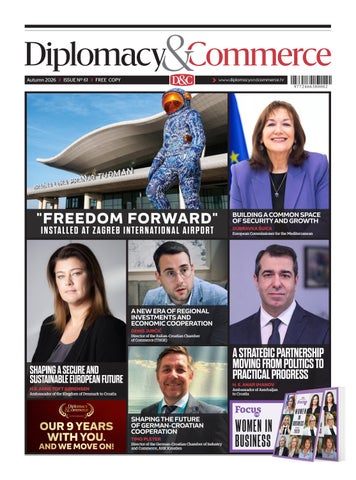
"FREEDOM FORWARD" INSTALLED AT ZAGREB INTERNATIONAL AIRPORT
BUILDING A COMMON SPACE OF SECURITY AND GROWTH DUBRAVKA ŠUICA
European Commissioner for the Mediterranean
A NEW ERA OF REGIONAL INVESTMENTS AND ECONOMIC COOPERATION DENIS JURČIĆ
Director of the Italian-Croatian Chamber of Commerce (THGK)
A STRATEGIC PARTNERSHIP MOVING FROM POLITICS TO PRACTICAL PROGRESS
SHAPING A SECURE AND SUSTAINABLE EUROPEAN FUTURE
H. E. ANAR IMANOV
H.E. ANNE TOFT SØRENSEN
Ambassador of Azerbaijan to Croatia
Ambassador of the Kingdom of Denmark to Croatia
A N N I V E R SE RY
OUR 9 YEARS WITH YOU.
AND WE MOVE ON!
SHAPING THE FUTURE OF GERMAN-CROATIAN COOPERATION TIMO PLEYER
Director of the German-Croatian Chamber of Industry and Commerce, AHK Kroatien
WOMEN IN BUSINESS
Korak naprijed u liječenju bolesnika s rakom dojke
AstraZeneca d.o.o. Ulica Vjekoslava Heinzela 70, 10000 Zagreb +385 1 4628 000 www.astrazeneca.com
VEEVA ID: HR-10569 listopad 2026.
FOREWORD
BOBAN SPASOJEVIĆ Director and Editor-in-Chief
Dear readers, ay by day, month by month, event by event, year by year, and just like that—here we are! It has been 9 incredible years since Diplomacy&Commerce magazine first came to life in Croatia. I remember it as if it were yesterday. On a rainy November evening nine years ago, my colleagues and I
D
were filled with a mix of nervous anticipation, excitement, and immense pride. We were waiting to launch the magazine at the residence of the British Ambassador at the time, the wonderful Mr. Andrew Dalgleish. Everything turned out beautifully—so beautifully, in fact, that we are now looking back on nearly a whole decade together. It certainly wasn’t an easy ride. Alongside the usual unpredictability of our industry, we had to navigate a pandemic, earthquakes, and global conflicts. But we never thought of giving up. We kept pushing forward because we believed then, just as we do now, that we are on the right path—being the only media outlet that brings diplomacy and business together under one roof. As a B2B publication, our heart is in connecting the dots. We strive to bring you a complete picture of everything that shapes our world: the corporate community, the economy, diplomacy, and the politics that ties it all together. We’ve grown and evolved along the way, too. We started our journey as part of the region’s largest publishing house, Color Media Communications, where we learned, networked, and built our foundation. Since then, our ownership structure has changed, but our spirit remains exactly the same— unique, insightful, and, I hope, truly useful to you. Our goal was never to be just another conventional business magazine filled with the kind of
daily news you can find anywhere else. Instead, we want to keep raising the bar—not just with the depth of our content, but with the layout, the feel of the paper, the colors, and the design. I hope you thoroughly enjoy the stories and topics in this issue. This time, I am especially proud to introduce our special supplement, “Women in Business.” Data confirms that female-led companies achieve stable and longterm profits, yet invisible barriers and a financing gap continue to slow their path to the absolute top. In the contemporary corporate and entrepreneurial landscape, the question of gender equality has long ceased to be a topic of declarative political debate and has become a key indicator of economic sustainability and competitiveness. At the end of the day, everything we do only truly makes sense because of you. Reading your feedback and knowing that you value our work is what keeps us going. I am already looking forward to the beginning of next year as we approach our grand 10th anniversary milestone. We will take the journey step by step, issue by issue, four times a year, leading up to a big celebration this time next year.
Autumn 2026
FOLLOW US TO STAY UPDATED
www.diplomacyandcommerce.hr
Diplomacy&Commerce Croatia
@Diplomacyandcommerce_hr
FREE COPY Subscription Only* BOBAN SPASOJEVIĆ Magazine Director Croatia and Editor in Chief boban@diplomacyandcommerce.hr VLADIMIR
Having a clear purpose and a meaningful mission makes every step of the journey worthwhile, and everything that lies ahead is simply the next beautiful chapter.
DUDAŠ Centrobiro Art Director GORANKA MILOŠEVIĆ Translation
A N N I V E R SE RY
OUR 9 YEARS WITH YOU. AND WE MOVE ON!
GORAN ANIČIĆ
CONTENTS
Web Coordinator
26
Publisher under license
BEYOND FLEETING TRENDS
Registry number of the
JOSIP MARUŠIĆ
BS MEDIA trade 99377667 Responsible person:
Country Manager, Miele Croatia
Boban Spasojević
28 COMBINING TECHNOLOGY AND COMMUNICATIONS TO COMBAT LABOUR MARKET INACTIVITY
*The publication is not available for commercial sale
www.diplomacyandcommerce.hr
Autumn 2026 >> ISSUE Nº 61 >> FREE COPY
TOMISLAV DOMINKOVIĆ CEO of Algebra Bernays University "FREEDOM FORWARD" INSTALLED AT ZAGREB INTERNATIONAL AIRPORT
48
BUILDING A COMMON SPACE OF SECURITY AND GROWTH DUBRAVKA ŠUICA
European Commissioner for the Mediterranean
A NEW ERA OF REGIONAL INVESTMENTS AND ECONOMIC COOPERATION DENIS JURČIĆ
Director of the Italian-Croatian Chamber of Commerce (THGK)
THE EPICENTER OF ZAGREB STYLE AND URBAN HEDONISM
A STRATEGIC PARTNERSHIP MOVING FROM POLITICS TO PRACTICAL PROGRESS
SHAPING A SECURE AND SUSTAINABLE EUROPEAN FUTURE
H. E. ANAR IMANOV
H.E. ANNE TOFT SØRENSEN
Ambassador of Azerbaijan to Croatia
Ambassador of the Kingdom of Denmark to Croatia
A N N I V E R SE RY
OUR 9 YEARS WITH YOU.
AND WE MOVE ON!
SHAPING THE FUTURE OF GERMAN-CROATIAN COOPERATION TIMO PLEYER
Director of the German-Croatian Chamber of Industry and Commerce, AHK Kroatien
WOMEN IN BUSINESS
CENTAR CVJETNI
50 EXCLUSIVE BRITISH COLLECTION ARRIVES IN ZAGREB RANGE ROVER LONDON EDITIONS
4
www.diplomacyandcommerce.hr
INTERVIEW/POLITICS
Building a Common Space of Security and Growth The new Pact for the Mediterranean marks a shift toward equal partnerships and strategic investments, intertwining energy resilience, effective migration management, and the right to stay
DUBRAVKA ŠUICA
European Commissioner for the Mediterranean
he geopolitical and demographic architecture of modern Europe is increasingly shaped along its southern borders. The Mediterranean basin
T
6
has once again emerged as the epicentre of European security, green energy independence, and demographic sustainability—a reality strongly echoed at the MED9 Summit. For Diplomacy&Commerce magazine European Commissioner for the Mediterranean Dubravka Šuica breaks down the Un-
ion’s strategic shift in its southern neighborhood. Through the lens of the new Pact for the Mediterranean, the EU is moving beyond traditional donor-recipient dynamics to forge partnerships of equals rooted in shared interests and concrete projects. From the ambitious T-MED initiative designed to mobi-
lize €25 billion in clean technologies to a historic €42.5 billion budget proposal for the region and science-driven demographic tools, Commissioner Šuica outlines how shared challenges are turning into joint opportunities, highlighting Croatia’s pivotal role in this new energy and connectivity map.
www.diplomacyandcommerce.hr
INTERVIEW/POLITICS
How would you assess the current situation in the EU when we talk about the Mediterranean area, bearing in mind the problem of migration? To what extent are today’s instabilities in the Mediterranean - from the Middle East to North Africa - changing the priorities of the European Union?
For the EU, the Mediterranean is at the heart of our security, resilience and prosperity. This was also one of the key messages of the leaders at the MED9 Summit in Split: what happens across the Mediterranean directly affects the whole of Europe. Croatia and other Mediterranean EU Member States often experience these challenges first – from migration and security to energy, climate and water pressures. This is why we need to bring a stronger Mediterranean perspective into European decision-making and work more closely with our partners to address common challenges and find joint solutions. Protecting our external borders is a shared responsibility. We cannot manage migration effectively alone. Illegal border crossings have fallen to their lowest level since 2021, down 55% over the past two years and by more than a third this year alone. The EU approach to migration management continues to deliver concrete results. Our response is to go beyond crisis management. We need to continue preventing illegal entries and fight smugglers, while investing in skills, jobs and opportunities and developing safe and legal pathways. And for that, we need stronger, long-term partnerships for greater security and more opportunities across our region. What is essentially new that the Pact for the Mediterranean brings in relation to the current policy of the European Union towards the southern neighborhood?
The Pact changes the way we work with our Mediterranean partners. Its starting point is simple: partnership among equals, based on shared interests and concrete benefits. When we talk about the future of the Mediterranean, our partners must be around the table and part of the solutions. We have moved beyond traditional donor-recipient relationships towards partnerships combining political engagement and concrete projects - from energy
WE HAVE MOVED BEYOND TRADITIONAL DONOR-RECIPIENT RELATIONSHIPS TOWARDS PARTNERSHIPS COMBINING POLITICAL ENGAGEMENT AND CONCRETE PROJECTS— FROM ENERGY AND CONNECTIVITY TO WATER, SKILLS, JOBS, TRADE AND SECURITY and connectivity to water, skills, jobs, trade and security. For countries such as Croatia, the Pact also opens opportunities for stronger economic cooperation and investment across the region. The objective is very practical: projects implemented, investments mobilised and opportunities created for people and businesses. Demography is one of your priorities. Can Europe maintain its economic and political strength without a more serious demographic renewal?
Demography is one of Europe’s defining challenges, directly affecting our competitiveness, labour markets, public services and the sustainability of our communities. Our societies are ageing and our working-age population is shrinking. But these trends do not have to spell disaster if we act in time.
What is important to understand is that demographic change does not affect everyone in the same way. Challenges differ not only between Member States, but also within countries and regions. Rural, island and coastal communities, for example, often face particularly strong demographic pressures. There is no single solution. We need affordable housing and childcare, quality jobs, better work-life balance and greater opportunities for young people. We also need to invest in skills and make better use of the talent already present in our societies. The Commission is addressing these challenges through its Demography Toolbox, which provides concrete measures to support Member States. Our Third Demography Report, published in July 2026, offers an updated picture of demographic trends,
helping us shape policies based on solid scientific evidence and indepth research. If we want a competitive and resilient Europe, we must put people at the centre of our policies. This means creating the conditions for people to build their future where they live, without feeling forced to leave because of a lack of opportunities. People should have a genuine choice about where to live and build their lives. Without that choice, frustration and a sense of being left behind will only grow. This is also the ambition behind our Right to Stay initiative. How to reconcile security challenges, economic cooperation and European values in the partnerships that the EU is building in the Mediterranean?
Security, prosperity and our values are not competing objectives. In the long term, they reinforce each other. We cannot have prosperity without security. Businesses need stability to grow, invest and create jobs. Our partnerships must therefore be comprehensive. We cooperate on security and migration, but we also invest in education, jobs, renewable energy, connectivity, water resilience and economic development. 7
INTERVIEW/POLITICS
At the same time, our engagement remains firmly grounded in respect for international law and the fundamental values and principles on which the European Union is built. This is precisely the approach behind our Pact for the Mediterranean: building long-term partnerships based on mutual respect, shared interests and shared responsibility. Let me give you a concrete example. This summer, I launched the T-MED initiative, which aims to mobilise up to €25 billion in investments in renewable energy and clean technologies across the Southern Mediterranean by 2035. This will help accelerate the green transition, strengthen energy security and create new economic opportunities on both shores of the Mediterranean. This is how we turn our shared challenges into shared opportunities, while building a more secure, prosperous and interconnected Mediterranean. Where does the EU see space for Croatia in the new Mediterranean policy politically, energy-wise and in terms of traffic?
8
IF WE WANT A COMPETITIVE AND RESILIENT EUROPE, WE MUST PUT PEOPLE AT THE CENTRE OF OUR POLICIES. THIS MEANS CREATING THE CONDITIONS FOR PEOPLE TO BUILD THEIR FUTURE WHERE THEY LIVE, WITHOUT FEELING FORCED TO LEAVE Croatia is both a Mediterranean and Central European country, which gives it a particularly valuable perspective. Its first Presidency of MED9 has demonstrated its capacity to bring Mediterranean priorities into the wider European debate. At the same time, its chairmanship of the Three Seas Initiative has helped strengthen the link between the Mediterranean and Central Europe. Croatia is not simply part of this Mediterranean story. It can actively help shape Europe’s strategic approach, drawing on its experience, geographic position and strong European commitment. There is considerable potential, particularly in energy and connectivity. Europe needs diversified energy supplies, resilient infrastructure and stronger links with
North Africa and the Middle East. Croatia’s strategic position on the Adriatic makes it an important partner in these efforts. The Pact for the Mediterranean also opens up concrete opportunities for Croatian companies, particularly in renewable energy, infrastructure, maritime transport, digital connectivity and other strategic sectors. I am pleased to see Croatia playing such an active role in shaping this new chapter of Europe’s engagement with the region. It is often said that Europe must react faster to the global crisis. Does the European Union today have enough political power to act as a true geopolitical actor?
Europe has considerable political and economic weight. The real
question is how we translate that strength into collective action and concrete results. This requires political unity, strong partnerships and the resources to deliver on our ambitions. That is why the next EU budget is so important. The Commission has proposed to double funding for the Middle East and North Africa to €42.5 billion, a crucial investment to support our ambition of creating a Common Mediterranean Space. Negotiations are ongoing, and I hope the Council and the European Parliament will recognise the strategic importance of this proposal. But geopolitical influence is not only about financial resources. Europe must also be a reliable partner and a strong defender of international law and effective multilateralism. In an increasingly divided world, our strength lies in building bridges, fostering cooperation and developing lasting partnerships. This is also at the heart of my mandate: strengthening Europe’s engagement with countries across North Africa, the Middle East and the Gulf, and turning our shared interests into concrete cooperation and results.
www.diplomacyandcommerce.hr
Odjeća koju volite trebala bi trajati cijeli život. Jednom Miele, uvijek Miele.
INTERVIEW/DIPLOMACY
Shaping a Secure and Sustainable European Future From ancient Salona excavations to cutting-edge energy efficiency agreements, a dynamic alliance leverages historical ties to build economic resilience and defend collective European security
H.E. ANNE TOFT SØRENSEN
amounted to DKK 6.4 billion, while our app. 50 Danish subsidiaries employed more than 3,000 people in Croatia, contributing to local employment and economic growth. Denmark has considerable experience in renewable energy and green solutions, and I see opportunities to share this expertise with Croatian partners, particularly in energy efficiency, sustainable technologies, and the green transition. Energy security and reliable supplies are increasingly important across Europe, making cooperation in these areas especially relevant. The Embassy is already supporting this agenda. In 2022, we signed a memorandum of understanding with the City of Zagreb on green transition cooperation. We have also presented Green Together, an exhibition showcasing Danish and Croatian green solutions in Zagreb, Pula, and Split. I hope these initiatives will encourage further exchanges and practical partnerships between our countries.
Ambassador of the Kingdom of Denmark to Croatia
ilateral relations between Denmark and Croatia are anchored by deep historical ties and a highly active contemporary partnership within the EU and NATO. With bilateral trade reaching DKK 6.4 billion ( around 860 million euros) and Danish subsidiaries employing thousands of people in Croatia, the economic synergy between the two nations continues to yield tangible results. As Europe navigates complex geopolitical shifts, the common agenda increasingly focuses on energy security, sustainable development, and regional stability. In this exclusive interview for Diplomacy&Commerce, H.E. Anne Toft Sørensen, Ambassador of the Kingdom of Denmark to Croatia, discusses Denmark’s role in accelerating Croatia’s green transition, the unexpected parallels of hygge found in Croatian coffee culture, and how Copenhagen balances local autonomy with global security interests in the Arctic following a milestone trilateral defense agreement.
B
How do you assess the current bilateral relations between Denmark and Croatia, and in which areas do you see the greatest potential for deepening political dialogue during your mandate?
Denmark and Croatia enjoy very good bilateral relations and cooperate closely within the EU and NATO. Our partnership is well established, with historical ties that extend beyond the 30th anniversary of diplomatic relations, which we marked in 2022: From the Danish naval commander Hans Birch Dahlerup, who helped develop the port of Pula, to the archaeologist Ejnar Dyggve, who led excavations of ancient Salona near Split. 10
DENMARK HAS CONSIDERABLE EXPERIENCE IN RENEWABLE ENERGY, AND I SEE GREAT OPPORTUNITIES TO SHARE THIS EXPERTISE WITH CROATIAN PARTNERS, PARTICULARLY IN ENERGY EFFICIENCY AND SUSTAINABLE TECHNOLOGIES During my mandate, I intend to maintain an active dialogue on European affairs, security, support for Ukraine, and the future direction of the EU. I also see considerable potential for closer economic cooperation, particularly in trade, investment, and partnerships between Danish and Croatian businesses.
Denmark is renowned for its green transition, sustainable development, and digitalization. How can Danish experience and investments assist Croatia in achieving its goals regarding energy and the green economy?
Economic cooperation between Denmark and Croatia is already well established. In 2025, bilateral trade
As NATO allies, how do Denmark and Croatia cooperate to strengthen shared security, particularly in the context of current geopolitical challenges on the European continent?
Denmark and Croatia cooperate closely within NATO, sharing responsibility for collective defence and European security. Russia’s war against Ukraine has further underlined the importance of strong allied cooperation and continued support for Ukraine. Our common priorities include maintaining credible defence capabilities, strengthening NATO’s readiness, and responding to emerging security threats. This also involves addressing cybersecurity risks, protecting critical infrastructure, maritime security and improving resilience against hybrid threats. Continued coordination within NATO remains essential to our shared security.
www.diplomacyandcommerce.hr
INTERVIEW/DIPLOMACY
What is Denmark’s perspective on the key challenges facing the European Union today, such as further enlargement, migration policy, and strengthening the Union’s economic resilience?
Denmark’s priorities include strengthening the EU’s security, competitiveness, and capacity to respond to a changing geopolitical environment. Denmark supports further EU enlargement, provided that the process remains merit-based and candidate countries meet the established membership criteria. Enlargement can contribute to greater stability and prosperity across Europe. Migration requires effective management of the EU’s external borders and close cooperation among Member States. A coordinated European approach is essential to addressing this challenge effectively. The Danish concept of *hygge* and the welfare state model are highly esteemed worldwide. What cultural and educational initiatives do you plan to launch to bring Danish culture and the Danish way of life closer to Croatian citizens?
The Embassy works to bring Danish culture closer to Croatian audiences through art, film, literature, design, gastronomy, and educational exchanges. A recent cultural agreement with the City of Zagreb will provide further opportunities to strengthen these exchanges. One of our initiatives is Traces of Denmark, which explores the historical and contemporary connections between our two countries in culture, trade, and politics. Following successful editions in Pula and Split, we are planning the next edition in Dubrovnik. We have also recently opened The Eighth Sea, an exhibition by Bosnian-Danish artist Ismar Čirkinagić, at the Museum of Contemporary Art in Zagreb. Since arriving to Croatia, I have already noticed how elements of hygge are reflected in Croatian everyday life, particularly in the coffee culture and the importance placed on spending time together. A visit to Zagreb’s Dolac Market also highlights the appreciation of good food and local traditions. I look forward to discovering more of these shared experiences while continuing to introduce Croatian audiences to Danish culture. 12
THE RECENT TRILATERAL AGREEMENT BETWEEN THE USA, DENMARK, AND GREENLAND STRENGTHENS OUR COMMON DEFENSE WITHIN NATO WHILE FULLY RESPECTING THE SOVEREIGNTY AND TERRITORIAL INTEGRITY OF THE KINGDOM Greenland holds a unique autonomous status within the Kingdom of Denmark but also possesses growing geopolitical and climatic significance. What is the current dynamic of relations between Copenhagen and Nuuk, and how does Denmark balance local autonomy with global interests in the Arctic?
The Faroe Islands and Greenland are parts of the Danish Realm. Due to their special status nationally,
historically and geographically, these parts of the realm have an extensive type of self-government. The Self-Government Arrangements allows the Faroese and the Greenlandic political authorities to transfer political competence and responsibility from the Danish political authorities. The Faroese and Greenlandic authorities administer the tasks taken over from the state, enact legislation in these specific fields and have the
economic responsibility for these tasks. The Danish state provides an annual grant to the Faroese and the Greenlandic authorities. According to the Danish Constitution, the authorities of the Kingdom of Denmark have the authority to enter into obligations under international law as well as responsibility for conducting foreign policy. The Danish Government, the Faroese Government and Naalakkersuisut - the Government of Greenland - share the desire for close, respectful and equal cooperation on matters related to foreign, security and defense policy with particular relevance to the Faroe Islands and Greenland. The recently signed trilateral agreement in New York between the USA, Denmark and Greenland has successfully calmed months of tension. How does official Copenhagen balance American strategic demands with preserving its own territorial integrity in the Arctic?
As the Danish Prime Minister Mette Frederiksen has stated, we have signed a good agreement in September. For Greenland, the Kingdom of Denmark and the United States. And for NATO and Europe. The agreement strengthens our common defence and security. And it is deeply rooted in the NATO Alliance. The agreement acknowledges and respects the sovereignty and territorial integrity of the Kingdom of Denmark and the Greenlandic people’s right to self-determination.
www.diplomacyandcommerce.hr
The right choice. When you want more than just a card, Premium Visa opens the door to a world of benefits, from Premium offers and the Premium Rewards loyalty programme to instalment payments over 36 months.
* The benefit is valid for the first year of use, for applications received between October 1 and December 26 2026. This advertisement is for informational purposes only and does not constitute a binding offer by Privredna banka Zagreb d.d. or PBZ Card d.o.o.
BECOME A USER WITHOUT REGISTRATION AND MEMBERSHIP FEES*
PREMIUM VISA
INTERVIEW/DIPLOMACY
A Strategic Partnership Moving from Politics to Practical Progress As Azerbaijan solidifies its role as a key energy and logistics provider for the European Union, Croatia’s advanced infrastructure—from the Krk LNG terminal to JANAF and the Port of Rijeka—is positioned to act as a vital gateway to Central and South-Eastern European markets
H. E. ANAR IMANOV
Ambassador of Azerbaijan to Croatia
eopolitical shifts driven by the war in Ukraine and instability in the Middle East have profoundly reshaped the South Caucasus, emphasizing the critical need for secure energy corridors and resilient supply chains. In this evolving regional architecture, the strategic partnership between Croatia and Azerbaijan has gained significant momentum. With Azerbaijan boosting its natural gas exports to the EU by approximately 65 percent, Croatia’s geostrategic position offers a natural extension for these vital flows into Europe. We talk with the H. E. Anar Imanov, Ambassador of Azerbaijan to Croatia about the expansion of bilateral trade, the unused potential of the Middle Corridor, the current state of the peace process with Armenia, and the joint ten-year vision of turning political trust into tangible commercial success.
G
Croatia and Azerbaijan define their relations as a strategic partnership. What is its most concrete result today, and in which areas do you see the greatest scope for deepening it— trade, investments, infrastructure or energy?
Azerbaijan and Croatia enjoy a strategic partnership built on mutual respect and trust. In recent years, our relations have gained momentum through reciprocal visits at the highest political level and bilateral events in Baku and Zagreb. Energy remains the cornerstone of our cooperation. Azerbaijan is a reliable supplier of crude oil to Croatia, contributing to its energy security and supply diversification. We are determined to broaden our partnership beyond energy into trade, investment, transport, infrastructure, and tourism. The fourth session of the Azerbaijan–Croatia Intergovernmental Commission, held in Zagreb on 30 September 2026, represented an important step forward in translating political commitments 14
IN 2025, AZERBAIJAN EXPORTED 12.8 BILLION CUBIC METRES OF NATURAL GAS TO EU MEMBER STATES, REPRESENTING AN INCREASE OF APPROXIMATELY 65 PER CENT COMPARED WITH PREVIOUS VOLUMES into practical economic initiatives and encouraging direct engagement between business operators. The greatest untapped potential lies in combining our energy partnership with stronger trade links and enhanced transport connectivity. Both countries possess complementary strengths and strategic geographical positions. By utilizing these advantages, we can build a resilient economic relationship. The coming years will bring tangible progress in bilateral trade, reciprocal investments, and joint projects, demonstrating clear economic benefits for both countries.
Azerbaijan has become an important gas supplier to the European Union. What role can Croatia play in this strategy, particularly considering the LNG terminal on Krk, Croatia’s gas infrastructure, and the potential for further increasing supplies via the Southern Gas Corridor?
Energy is a strong pillar of Azerbaijan– Croatia cooperation, with considerable opportunities in the natural gas sector. Azerbaijan has demonstrated its reliability as an energy partner to Europe, especially since the 2022 energy crisis. In 2025, Azerbaijan exported 12.8 billion
cubic metres of natural gas to EU member states, representing an approximate 65 per cent increase compared with previous volumes. Croatia has the potential to become a significant regional partner due to its strategic location, developed energy infrastructure, and the LNG terminal on Krk. Expanding the terminal’s capacity, alongside developing Croatia’s gas transmission network and crossborder interconnections, could create new opportunities for gas diversification across Central and South-Eastern Europe. Azerbaijan is also exploring LNG-related commercial activities to diversify exports. Future deliveries will depend on available production, export capacity, infrastructure, and commercial arrangements. The July 2022 Memorandum of Understanding on a Strategic Partnership in the Field of Energy between Azerbaijan and the EU established a framework to double Azerbaijani gas supplies to the EU by 2027 compared with 2021 levels. Achieving this requires continued investment in production and transmission infrastructure. Croatia can play an important role by combining its regional connectivity with Azerbaijan’s supply capabilities to benefit the wider European energy market. Is there scope for stronger integration of Azerbaijan with Croatia’s oil and transport infrastructure—including JANAF and the Port of Rijeka— and can Croatia become a more important link between Azerbaijan and Central European markets?
Absolutely. There is substantial potential to deepen cooperation in energy, transport, and logistics. The challenge is to translate this into concrete commercial projects through closer cooperation between institutions, infrastructure operators, and private companies. In the oil sector, the JANAF pipeline system and the Port of Rijeka offer an important basis for cooperation. Croatia acts as both a destination and a transit country through which Azerbaijani crude oil reaches Central European markets like Hungary and Slovakia.
www.diplomacyandcommerce.hr
International British School Bright Horizons HIGH-QUALITY BRITISH EDUCATION High school: Harambašićeva street 19 Primary school: Sveti Duh 122
info@britishschool-zagreb.hr / www.britishschool-zagreb.hr
INTERVIEW/DIPLOMACY
There is scope to use this existing infrastructure and regional networks more effectively to strengthen supply reliability at a time when European countries seek resilient supply chains. Beyond energy, transport connectivity is highly promising. Azerbaijan is a key transit country along the Middle Corridor, connecting Asia and Europe via Central Asia and the South Caucasus. Croatia occupies a strategic position at the crossroads of Central and SouthEastern Europe, with Adriatic access and transport connections to the hinterland. During Croatia’s chairmanship of the Three Seas Initiative, particular attention was paid to the Middle Corridor and its potential links with transport projects in the Three Seas region. Closer cooperation could encompass maritime transport, port logistics, rail, road, intermodal freight solutions, and digital transport procedures. By improving links between the Caspian and Adriatic regions, Azerbaijan and Croatia can create efficient trade routes between Asia and Central Europe, acting as regional hubs and practical bridges between markets. What is the current status of the peace process between Azerbaijan and Armenia, and what needs to be done to prevent a new escalation and ensure lasting peace?
The peace process has entered a crucial phase, creating an opportunity for peaceful coexistence and regional cooperation. The high-level meeting in Washington in August 2025, mediated by US President Donald Trump, represented an important milestone. Since then, both countries have continued working towards establishing peaceful relations. From Azerbaijan’s perspective, a comprehensive peace agreement requires resolving outstanding issues that could undermine its implementation. Specifically, Azerbaijan considers the provisions of Armenia’s Constitution referring to its Declaration of Independence incompatible with the mutual recognition of sovereignty and territorial integrity. Addressing this constitutional issue is essential to removing legal and political obstacles to a durable peace. A lasting settlement depends on the consistent implementation of commitments, the rejection of territorial claims or revanchist rhetoric, and building mutual confidence. The international community should support the peace process rather than narratives that revive confrontation. Peace can deliver tangible benefits through opening regional transport links and restoring economic connections. Azerbaijan has unilaterally lifted restrictions on trade and transit to Armenia that were imposed during the occupation of our territories. Today, various goods are transported to Arme16
CROATIA ALREADY PLAYS A ROLE NOT ONLY AS A DESTINATION FOR AZERBAIJANI CRUDE OIL BUT ALSO AS A TRANSIT COUNTRY THROUGH WHICH AZERBAIJANI OIL CAN REACH OTHER EUROPEAN MARKETS, INCLUDING HUNGARY AND SLOVAKIA nia via Azerbaijan, and we sell gasoline and diesel fuel to Armenia. Azerbaijan demonstrates its commitment to goodneighborly relations through practical action and looks forward to serious steps from Armenia, notably the mentioned constitutional changes. The war in Ukraine, relations between Russia and the West, and instability in the Middle East are altering the geopolitical position of the South Caucasus. How does Azerbaijan view its role amid Russia, Turkey, Iran, and the European Union—and where do you see Croatia fitting into this new regional architecture?
The war in Ukraine and instability in the Middle East have reshaped the geopolitical landscape surrounding the South Caucasus, highlighting the importance of reliable energy supplies, diversified transport routes, and constructive diplomacy. Azerbaijan pursues a pragmatic, independent, and multi-vector foreign policy. Our geographical position places us at the intersection of Europe and Asia, enabling us to contribute to regional connectivity and energy security. Following the 2022 energy crisis, Azerbaijan responded to European requests for additional gas supplies, reinforcing its position as a reliable partner. Concurrently, the changing environment has increased the strategic importance of the Middle Corridor connecting China and
Central Asia with Europe. Azerbaijan has invested significantly in its ports, railways, roads, and logistics facilities, as demonstrated by the growing volume of freight moving through the country. Our relations with Turkey, Russia, Iran, and the EU are shaped by distinct geographical and strategic considerations. Azerbaijan seeks to maintain constructive relations with neighbours while expanding cooperation with European partners. In an uncertain international environment, connectivity and economic interdependence serve as instruments of stability. Croatia can play a valuable role in this architecture. As an EU member with an Adriatic position, developed energy infrastructure, and links to Central European markets, it is a natural partner to enhance connectivity between the Caspian and Adriatic regions. We see potential for cooperation in energy diversification, port and railway connectivity, logistics, and investment. Although geographically distant, our strategic interests converge around resilient supply chains and stronger links between Europe and Asia. Looking five to ten years ahead, what concrete project or result would demonstrate that the Croatian– Azerbaijani strategic partnership is not merely a political declaration but a genuine strategic partnership?
Our strategic partnership is already reflected in energy cooperation, regu-
lar high-level exchanges, and mutual support within international organisations. Over the next five to ten years, I would like to see this evolve into a comprehensive, economically integrated relationship supported by major investments and tangible projects. One primary objective is to significantly increase bilateral trade and reciprocal investment. We encourage companies to explore opportunities in energy, infrastructure, transport, logistics, tourism, agriculture, and information technology. Establishing stronger business-to-business contacts and improving access to investment information are important steps. Energy cooperation should remain a central pillar while becoming more diversified, including oil transportation, natural gas supplies, and new projects strengthening connectivity between the Caspian and Adriatic regions. Another concrete ambition is establishing efficient transport links through enhanced maritime, rail, and road connections, alongside greater coordination between infrastructure operators. I also attach great importance to establishing direct air links between Baku and Zagreb, subject to market demand and commercial sustainability. Direct flights would facilitate business travel, tourism, and cultural exchanges, bringing our societies closer together. Ultimately, a truly strategic partnership should be measured by results visible to citizens and businesses: higher trade volumes, joint ventures, increased investment flows, and a growing number of students, tourists, and professionals travelling between our nations. Achieving substantial reciprocal investments and direct connectivity within the next decade will demonstrate that the Azerbaijan–Croatia partnership has matured into a lasting, mutually beneficial relationship.
www.diplomacyandcommerce.hr
WHY e-LEADERSHIP MBA? MBA program for experienced professionals who want to develop leadership and strategic competencies. ACCREDITED MBA PROGRAM – 120 ECTS
Develop strategic and business understanding for leadership in the digital age.
LECTURERS FROM KELLEY SCHOOL OF BUSINESS
Learn from internationally recognized professors and experts.
STRONG NETWORKING OPPORTUNITIES
Connect with leaders, entrepreneurs and professionals from different industries.
PRACTICAL AND INNOVATIVE LEARNING
Real-world business cases, simulations and teamwork turn knowledge into practice.
DESIGNED AROUND YOUR PROFESSIONAL COMMITMENTS
Classes are held one weekend a month, with winter and summer breaks.
ALGEBRA BERNAYS UNIVERSITY BUSINESS SCHOOL
INTERVIEW/ECONOMY
A New Era of Regional Investments and Economic Cooperation Expanding networks through regional decentralization and removing administrative barriers accelerate economic cooperation, while bilateral trade reaches a historic EUR 8.45 billion
DENIS JURČIĆ
euros. In which sectors—beyond the traditional manufacturing industry and finance—are you seeing the greatest increase in interest from Italian companies looking to enter the Croatian market?
Director of the Italian-Croatian Chamber of Commerce (THGK)
uilding solid business bridges and identifying hidden potential within dynamic European markets requires a strategic approach and operational agility on the ground. These are the guiding principles for Denis Jurčić, Director General of the Italian-Croatian Chamber of Commerce (THGK), who, since assuming the role, has been actively working to strengthen ties between Italian investors and the local economy. In line with the strategic direction set by President Aldo Di Biagio, recently reconfirmed at the helm of the Chamber, and by the Board of Directors, the Chamber is carrying out a historic decentralization by opening new regional offices, spanning from Zadar to Osijek. In this interview with Diplomacy&Commerce, this agile manager speaks candidly about the Chamber’s new objectives within the international business landscape, attracting capital to the Slavonia region, overcoming bureaucratic hurdles, and preparing local small and medium-sized enterprises (SMEs) to meet rigorous European ESG criteria.
B
The THGK is actively expanding its presence on the ground; following the opening of an office in Zadar, a new representative office was recently opened in Osijek to strengthen the Chamber’s presence in Slavonia. What are the main strategic goals of this decentralization, and what potential do Italian investors see in Eastern Croatia?
In 2025, the President of the Italian-Croatian Chamber of Commerce, Aldo Di Biagio, together with the Board of Directors, decided to open three representative 18
DENMARK HAS CONSIDERABLE EXPERIENCE IN RENEWABLE ENERGY, AND I SEE GREAT OPPORTUNITIES TO SHARE THIS EXPERTISE WITH CROATIAN PARTNERS, PARTICULARLY IN ENERGY EFFICIENCY AND SUSTAINABLE TECHNOLOGIES offices across the country. We opened the Zadar office in June 2026 and the Osijek office in September, and we will open in Rijeka by the end of the year.The goal is to be closer to local business communities. Having representatives on the ground means we can engage directly with our member companies and with local authorities, take part in conferences, trade fairs and events, and organise local activities in coordination with our headquarters in Zagreb. Each region has its own specific features,
needs and requirements, and truly understanding them requires being close to businesses and working actively with the stakeholders in the area. Our task, supported by the new offices, is to inform investors about the characteristics of Croatia’s different regions and help them identify the one best suited to their business. Italy is one of Croatia’s key economic partners, with trade volumes reaching billions of
Italy has historically ranked among Croatia’s top two trading partners. According to official data from the Croatian Bureau of Statistics, bilateral trade reached around EUR 8.45 billion in 2025, a slight increase on the EUR 8.41 billion recorded in 2024. In the first half of this year, trade grew by around 14% year on year, with Croatian imports from Italy rising by almost 20%, a very positive signal. Manufacturing and finance remain the historic pillars of the bilateral relationship. Beyond them, we are seeing growing interest from Italian companies above all in four macro-sectors. We see this in the data, but also in the requests we receive every day as a Chamber. The first is agri-food, which accounts for around 15% of Italian exports to Croatia and is one of the most dynamic sectors. This growth is driven by domestic demand linked to tourism and the restaurant sector, which is looking for quality and recognisable products. The second is the tourism and hospitality supply chain, from hotel and restaurant supplies to furniture and the nautical sector. The third is construction and infrastructure, in particular the modernisation of the country’s railway network, supported by EU funds and the National Recovery and Resilience Plan. The fourth, more recent but rapidly accelerating, is renewable energy and the digital transition. This sector is driven by the EU’s decarbonisation targets and by the digitalisation of businesses and public administration, and it is an area where Italian companies can bring well-established technologies and expertise. Italian
www.diplomacyandcommerce.hr
PIONIRI PRIRODNE I HOLISTIČKE KOZMETIKE EST 1984.
ALQVIMIA Store & Spa, Augusta Cesarca 4, Zagreb alqvimia.hr
INTERVIEW/ECONOMY
companies are present in all these sectors worldwide, and Italian know-how and expertise are highly valued and sought after, particularly in complex, high-value projects. We are especially pleased that Croatia is among these countries of interest, and we are here, ready to offer our support.
seeing a stronger push towards machinery and automation, which can create more specialised and less physically demanding jobs. The other key element is training. As a Chamber, we promote international internship programmes that bring young people and universities closer to the business world. With the ITA CRO Academy, a new programme we are currently developing, we will offer professional development courses for managers in Croatia. We believe that cooperation between companies, educational institutions and the Chamber is the key to building the skills the market needs.
You have previously pointed out that Italian investors in Croatia still face practical challenges, such as administrative paperwork and tender documentation that is often available exclusively in Croatian. How does the THGK help overcome these obstacles, and do you see room for improvement regarding the digitalization of public administration in Croatia?
Companies mainly report two difficulties: administrative procedures that can sometimes be lengthy, and documentation, including tender documents, that is often available only in Croatian. For a company entering the market for the first time, this can be a real obstacle. The Chamber supports companies on several levels. We provide initial guidance on procedures, we help companies understand tender documentation, and through our network we connect them with qualified professionals who assist them with the steps they cannot handle on their own. Our role is to reduce the time and risk involved in entering the market. As for the digitalisation of public administration, Croatia has made significant progress in recent years, for example with the e-Građani system and the electronic public procurement platform. There is still room for improvement, particularly in making information and documentation available in English for foreign investors and in further simplifying procedures. These measures would make the country even more competitive in attracting investment. Through initiatives like the GENERALI SME EnterPRIZE competition, the Chamber actively emphasizes sustainable business practices. In your experience, how prepared are small and medium-sized enterprises (SMEs) in Croatia to adopt ESG criteria and the green transition, and what benefits does cooperation with Italian partners bring them in this area?
We are seeing growing attention among Croatian SMEs to ESG criteria and the green transition. 20
IN AN ENVIRONMENT OF SHORTENED PLANNING HORIZONS AND LABOR SHORTAGES, THE AVAILABILITY OF SKILLED STAFF HAS BECOME A DECISIVE FACTOR IN ATTRACTING NEW INVESTMENTS However, their level of preparedness remains uneven. More structured companies, and those already part of international supply chains, are further ahead, while many small businesses are still at an early stage. Cooperation with Italian partners can make a real difference. Large European companies, including Italian ones, increasingly require sustainability data and standards from their suppliers. For a Croatian SME, adapting therefore also becomes a condition for entering or remaining in international supply chains. In addition, working with Italian companies that already have experience in areas such as the circular economy speeds up the adoption of good practices. Initiatives such as the Generali SME EnterPRIZE, of which we are a partner, are designed precisely to raise awareness and bring SMEs closer to these topics. Beyond being an important showcase for companies to present themselves and their ESG practices, the award gives the winners the opportunity to take part in the international event in Brussels in May 2027. In 2026, the initiative involved 8,500 SMEs from eleven European countries: Austria, Bulgaria, Croatia, the Czech Republic, France, Germany, Hungary, Italy, Portugal, Slovenia
and Spain. I would like to renew the invitation to all SMEs reading this to take part. The shortage of skilled labor is a pressing issue across the entire region. Given that Italian companies in Croatia employ over 20,000 people, how does this issue affect the planning of new investments and the attraction of new companies from Italy?
The shortage of skilled labour is a challenge common to the entire European Union. In Croatia it comes on top of other factors: rising labour and energy costs and the inflationary pressures of recent years. In an uncertain geopolitical environment, companies have become more cautious and have shortened their planning horizons. Where they once planned five to seven years ahead, the standard practice today is around three years. For Italian companies already operating in Croatia, which employ over 20,000 people, and for those considering investing, the availability of skilled staff has become a decisive factor in choosing where to locate and how much to invest. This is not, however, a barrier to new Italian companies coming to Croatia; rather, it changes the type of investment. We are
The Chamber organizes projects such as “We Make Future” and publishes ITA CRO BUSINESS NEWS. What are the THGK’s plans for the remainder of this year and for the coming year regarding B2B platforms and initiatives such as We Make Future, aimed at connecting businesses, startups and innovators from both shores of the Adriatic?
We have several initiatives planned between now and the end of the year: • ITA CRO Business Awards: the traditional gala dinner on which we honour the best Italian investors in Croatia and Croatian investors in Italy, recognised not only for their economic results but also for innovation and job creation. • Event on Italian agri-food excellence: a day of B2B meetings between Italian and Croatian operators in the sector, designed to connect companies directly. • Generali SME EnterPRIZE: we are a partner of the competition, which promotes a culture of sustainability among SMEs, with a focus on environmental and social aspects. • Week of the Italian Language in the World: in collaboration with the Consulate General of Italy in Rijeka, we will award prizes to students of Italianlanguage secondary schools in Istria and Kvarner. This year’s theme is “Lingua geniale: ideare, progettare, creare con l’italiano” (Ingenious Language: Conceiving, Designing and Creating with Italian). We also continue to keep companies informed about market opportunities through our ITA CRO BUSINESS NEWS publication and our other communication channels.
www.diplomacyandcommerce.hr
It begins at the scalp.
It begins at the scalp.
Healty root. Strong hair. Complete wellbeing.
Healty root. Strong hair. Complete wellbeing.
Advanced scalp care formulated to support the natural hair growth cycle. Trichological scalp and hair care Dermatologist-developed
.�����...
INTERVIEW/ECONOMY
Shaping the Future of German-Croatian Cooperation Croatia remains an attractive business location, with AHK Kroatien supporting companies as they explore new partnerships, strengthen competitiveness and plan their next investments
TIMO PLEYER
Director of the German-Croatian Chamber of Industry and Commerce, AHK Kroatien
n an interview for Diplomacy&Commerce, Timo Pleyer, Director of AHK Kroatien, discusses GermanCroatian business cooperation and the Chamber’s support for companies in both markets. He shares insights into specialised delegation programmes, renewable energy and industrial technologies, alongside initiatives that connect professionals and promote the visibility of women in engineering.
I
AHK’s recent Economic Survey indicated that while companies in Croatia view their current business situation as stable, there is a growing caution regarding new investments and hiring. What are the main drivers behind this restraint, and how is the Chamber helping its members navigate this period of economic cooling in key European markets?
A company can have a solid order book today and still hesitate to expand tomorrow. That is the distinction our survey captures. Businesses continue to see Croatia as an attractive location, but higher operating costs and less predictable demand make the next investment decision more difficult. For companies connected to German customers and supply chains, developments in Germany inevitably influence planning here. If a customer postpones a project, a Croatian supplier has to reconsider its own capacity and recruitment. Add higher labour and energy costs, and the margin for error becomes smaller. Waiting can seem the safer choice, even when the company’s underlying business is sound. Our role is to help members assess their options. We support the search for business partners, provide access to market expertise 22
SUPPORTING SUSTAINABLE WAGE GROWTH ALSO MEANS STRENGTHENING PRODUCTIVITY AND HELPING COMPANIES INVEST IN TECHNOLOGY, SKILLS AND MORE EFFICIENT PROCESSES and organise exchanges with companies facing similar decisions. Programmes such as European EnergyManager also address costs directly by helping employees
identify viable efficiency projects. We cannot remove uncertainty from the market. We can help a company understand where it has room to act.
According to the same survey, the focus of managers has shifted from a pure labor shortage toward high labor costs and energy prices. In what ways is AHK engaging in dialogue with political decision-makers in Croatia to ease these pressures on economic competitiveness?
Higher wages are important for living standards and for retaining people in Croatia. Supporting sustainable wage growth also means strengthening productivity and helping companies invest in tech-
www.diplomacyandcommerce.hr
IRALTONE IRALTONE IRALTONE INNOVATION INNOVATION INNOVATION DRINKABLE DRINKABLE FORMULA FORMULA DRINKABLE FORMULA
Formula_ Formula_
Nº 092025Nº 092025
Formula_ Nº
092025
REDUCES REDUCES REDUCES SEASONAL SEASONAL SEASONAL HAIRHAIR LOSSLOSS AND HAIR AND LOSS AND STIMULATES STIMULATES STIMULATES GROWTH. GROWTH. GROWTH. Science that Science cares. that cares.
Science that cares.
SEASONAL SEASONAL HAIRLOSS LOSS11 HAIR
1 1 hanks to zinc, biotin and selenium, Thankswhich toThanks zinc, keep biotin hair and into selenium, normal zinc, condition. whichbiotin keep hair in normal andcondition. selenium, which keep hair in normal condition.
LABORATORY LABORATORY Nº 1 DERMATOLOGICALLY Nº 1 PRESCRIBED DERMATOLOGICALL BRAND* Y PRESCRI LABORATORY Nº 1 DERMATOLOGICALLY PRESCRIBED BRAND*
antabria Labs: Nº. 1 laboratory *Cantabria in dermatological *Cantabria Labs: Nº. 1 laboratory prescription. Labs: in dermatological Interviews Nº.with prescription. 1 laboratory 150 dermatologists: Interviews with in IQVIA 150dermatological dermatologists: Analysis, Spain IQVIA June Analysis, 2024. Spain prescription. June 2024. Interviews with 150 dermatologists: IQVIA Analysis, Spain June 2024
INTERVIEW/ECONOMY
nology, skills and more efficient processes. These improvements enable businesses to offer better pay while maintaining their competitiveness. The priorities identified by our members provide a constructive basis for dialogue with policymakers: a predictable tax framework, legal certainty and efficient administrative procedures. Clear and timely processes help companies plan with confidence and devote more resources to modernisation, employee development and investment. Our German-Croatian Economic Forum brings business representatives together with policymakers and diplomatic partners. It provides an opportunity to exchange perspectives and discuss practical improvements to the business environment. Our contribution is to bring members’ experience into that dialogue and help identify solutions that support investment, employment and long-term economic development. The Chamber has strongly positioned itself as a patron and partner of major sustainability initiatives, including the Green Energy Fair in Zagreb. How strong is the actual interest of German investors in Croatia’s renewable energy sector, and where do you see the biggest obstacles to a faster realisation of these projects?
There is tangible German involvement in Croatia’s renewable energy sector. But we should distinguish between a developer committing capital to a project and a technology company looking for customers. Both matter, and our energy programmes support business cooperation, but they tell us different things about investment. Croatia’s renewable resources offer opportunities. To turn those opportunities into an investment decision, a developer needs a credible timetable and a financial calculation based on reliable assumptions. Grid capacity, connection conditions and the coordination of permits are therefore central. A project becomes harder to finance when essential costs or completion dates remain uncertain. AHK organises highly specialised projects, such as the Defence Innovation Tour to Germany and the From Smart Factory to Industrial AI delegation programme. Does this indicate a strategic shift in German-Croatian cooperation
24
A RENEWABLE ENERGY PROJECT BECOMES HARDER TO FINANCE WHEN ESSENTIAL COSTS OR COMPLETION DATES REMAIN UNCERTAIN DUE TO ADMINISTRATIVE HURDLES toward high-tech and defence industries, and how ready are local companies for such advanced integration?
These programmes reflect where we see opportunities for closer industrial cooperation. For a Croatian company, the relevant question is very concrete: what capability can it offer a German partner, and what would it need to improve to qualify for that business and the other way round. The Defence Innovation Tour creates access to companies and technologies that are difficult to understand from a distance. The opportunities extend to specialised suppliers in areas such as electronics, software and precision manufacturing. Entering these supply chains requires careful preparation. Technical quality has to be supported by reliable delivery, documentation and the ability to meet the requirements of the individual customer. The same practical approach applies to industrial AI. Our programme in Baden-Württemberg is designed around visits to companies and production sites, where
participants can examine actual applications. A manufacturer needs to understand what a technology can do for its process before deciding whether it is worth the investment. Readiness varies considerably. Some Croatian companies can already contribute advanced expertise; others need to strengthen their production processes or digital capabilities first. A useful delegation helps both groups identify a realistic next step. A small supplier does not need to manufacture an entire system to become a valuable partner. The Female Engineer of the Year initiative has now reached its fourth year in Croatia. How do you assess its long-term impact on the visibility of women in technical professions, and do partner companies recognise it as a vital tool for talent development?
A young woman considering engineering should be able to picture the career that might follow. Our finalists make that possible. They show what engineers actually do,
how different their careers can be and how much responsibility women already carry in technology and industry. In 2026, the initiative marked its fourth year, and Jelena Jurišić, CTO of Ericsson Nikola Tesla Group, received the award. All ten finalists provide a wider picture of engineering careers. That visibility matters because an unfamiliar profession can be dismissed long before a young person reaches the point of choosing a university course. We provide a sustained platform that gives these women greater visibility and brings their work to a wider audience. The involvement of partner companies reflects their commitment to supporting this effort. Giving women opportunities to develop, lead technical projects and progress into senior roles makes the public message credible. I would like the initiative to encourage that conversation as much as it encourages young women to consider engineering. As we further develop the project, we will complement the “Inspire.ing” aspect with a new element, “Empower.ing”. As global economic trends and supply chains continuously shift, business associations must adapt as well. In which direction do you plan to further develop the services and support formats that AHK Kroatien provides, ensuring the Chamber maintains its position as the key accelerator of business and diplomatic ties between Germany and Croatia?
Our priority is to provide practical support that reflects the needs of our members, whether they are looking for a business partner, exploring a market opportunity or preparing their employees for technological change. Our newly established networking formats for Personal Assistants, HR Experts and Marketing Directors further strengthen the ties within our business community and provide a dedicated platform for meaningful exchange and networking. We continue to build on our specialised delegations and projects, with more opportunities for focused exchange and follow-up after initial meetings. Close cooperation with institutional and diplomatic partners will remain an important part of this work, helping us address shared challenges and support business cooperation between Germany and Croatia.
www.diplomacyandcommerce.hr
INTERVIEW/BUSINESS
Beyond Fleeting Trends While the market dictates a race to the bottom on prices, a strategic shift towards appliances built to last two decades proves that true luxury lies in sustainability and trust
JOSIP MARUŠIĆ
Of course, we must also be mindful of purchasing power in the Croatian market. That is why we strive to offer products to suit different needs within the premium segment, while selected promotional activities help make highquality appliances more accessible. I do not expect every customer to choose Miele. But I want those who do to still feel, many years later, that they made the right decision.
Country Manager, Miele Croatia
hen you buy a household appliance, you do not choose it for just one season. It is precisely this understanding of long-term value that sets Miele apart in the domestic premium appliance market. At the helm of this successful operation, which now accounts for a quarter of the region’s total turnover, is Josip Marušić, Country Manager of Miele Croatia. Rather than pursuing growth at any cost, he insists on introducing the Japanese philosophy of small, continuous improvements within his team and preparing a state-of-the-art flagship centre in Zagreb. In an interview with our magazine, Marušić reveals how to earn and maintain customers’ trust in times of inflation, why sustainability must be more than a marketing gimmick, and how he is building a service network despite the chronic shortage of technical professionals in the labour market.
W
Miele Croatia has delivered strong business results in recent years, with revenue reaching almost €17 million in 2025. What lies behind this success, and what role does Croatia play in the company’s regional and global operations?
Above all, these results are built on consistency. Miele is a brand built on long-term customer trust, and that kind of trust cannot be earned overnight. In 2025, we generated almost €17 million in total revenue, a result we can be satisfied with. Since the beginning of 2025, Croatia has been part of Miele Cluster Adria Aegean, a regional organisation in which we account for approximately 25 per cent of total cluster revenue. This clearly demonstrates the importance of our market to the company’s regional operations. Globally, Miele generated revenue of €5.16 billion in 2025. Croatia is part of that broader story, but our success is measured primarily by what 26
Sustainability is one of Miele’s key priorities. How much attention do Croatian consumers pay to energy efficiency and appliance longevity? Are they willing to pay more for these benefits?
OUR GOAL IS NOT GROWTH AT ANY COST, BUT A HEALTHY BUSINESS, LONG-TERM CUSTOMER SATISFACTION AND A STABLE MARKET POSITION we achieve here. Our goal is not growth at any cost, but a healthy business, long-term customer satisfaction and a stable market position. Miele is globally recognised as a premium brand. How do you communicate the value of premium appliances to customers amid inflation and rising living costs?
Price matters, and that is entirely understandable. Today, we all think more carefully about where and how we spend our money, regardless of our purchasing power. Miele is positioned in the premium segment, and it is our re-
sponsibility to clearly demonstrate to customers what underpins that positioning. It is not just about design or a particular feature, but also about the quality of materials, reliability, energy efficiency and support throughout the appliance’s lifetime. When you buy a washing machine or dishwasher, you are not buying it for just a year or two. You expect it to perform well, be energy-efficient and, should anything go wrong, to have access to appropriate servicing and spare parts. This is where the difference between the initial purchase price and long-term value really becomes apparent.
I believe consumers are paying increasing attention to energy and water consumption, although I would not say that sustainability is everyone’s top purchasing criterion. Price and functionality still play a major role. For me, sustainability begins with a very simple question: how long will an appliance continue to do its job well? During development, Miele subjects most of its household appliance series to testing designed to simulate 20 years of use. This is not a guarantee that every appliance will last that long, but it demonstrates how seriously we approach quality and reliability. Repairability is equally important, which is why Miele provides for the long-term availability of key original spare parts, for at least 15 years after production of the relevant series ends. Our commitment to sustainability has also been recognised globally. In 2026, Miele was awarded a Gold Medal in the EcoVadis sustainability assessment, placing it among the top two per cent of companies evaluated. Ultimately, however, what matters most to customers is something very tangible: an appliance that works reliably, consumes fewer resources and does not need to be replaced prematurely. I believe this is the best way to make sustainability more than just a buzzword.
www.diplomacyandcommerce.hr
INTERVIEW/BUSINESS
Miele Experience Centres in Zagreb and Split offer a different experience from a traditional retail store. How important is direct, in-person interaction with the brand today, how are you developing digital channels, and are you planning to open new locations?
Physical and online sales should not be viewed as competing channels. Customers often begin their purchasing journey online, researching models and comparing features, but before making a final decision, they want to see the product in person and speak to someone who knows it well. This is particularly true of builtin kitchen appliances, where it is important to understand the customer’s needs, how they use their kitchen and the possibilities offered by the available space. At our Miele Experience Centres, customers can see the appliances, try out their features, attend culinary demonstrations and receive practical advice. Reading about what a particular oven can do is one thing; seeing it in action is quite another. Digital channels, on the other hand, allow customers to shop whenever and wherever it suits them. Our task is to ensure that the experience is equally good, regardless of the channel. You have announced the opening of a new flagship Miele Experience Centre in Zagreb in the first quarter of 2027. What can you tell us about the Avenue V project, and what will it mean for your customers?
We are preparing to open our most modern Miele Experience Centre in Croatia at the Avenue V location in Zagreb. We want to establish it as a new benchmark for the premium home appliance experience on the domestic market. Our aim is to create a place where customers can experience Miele in a way that best reflects what our brand stands for, from design and technology to culinary experiences, product demonstrations and personalised consultations. It is particularly important to me that this should be more than just a place to shop. It should be a source of inspiration, where customers can find ideas for their homes, see appliances in real-life use and talk to our experts. Our international teams are also involved in bringing the project to life, ensuring that the new centre meets Miele’s global standards.
Croatia has been part of Miele Cluster Adria Aegean since 2025. What has this organisational change brought to the Croatian business, and what advantages do you see in regional integration?
The eight markets within the cluster differ considerably in size, purchasing power and consumer habits. However, the challenges they face are often very similar. That
the idea of continuous improvement through small, everyday changes. I do not believe that progress always has to come through major projects and reorganisations. Sometimes, it is enough to simplify a process, eliminate an unnecessary task or change the way we communicate. It is also important to me that people understand the bigger pic-
you maintain a high level of expertise and ensure access to service support?
Service is one of the most important aspects of our business. Customers rightly expect expertise, availability and clear communication. In Croatia, these challenges are compounded by the geographical spread of the market and the shortage of qualified technicians. That is why continuous training, technical support and the availability of spare parts are so important. Simply arranging a service visit is not enough. The goal must be to resolve the problem effectively, ideally during the first visit. Our task is to continuously improve our processes so that customers receive timely information, high-quality support and a solution to their problem. Artificial intelligence is increasingly making its way into the world of household appliances. Which of Miele’s innovations have particularly caught your attention, and how do you see the brand developing in Croatia through to the end of the decade?
FOR ME, SUSTAINABILITY BEGINS WITH A VERY SIMPLE QUESTION: HOW LONG WILL AN APPLIANCE CONTINUE TO DO ITS JOB WELL? THAT IS WHY MIELE SUBJECTS ITS APPLIANCES TO TESTING DESIGNED TO SIMULATE 20 YEARS OF USE is precisely why it makes sense to share experiences, develop certain processes together and learn from one another. At the same time, I do not believe that all countries should operate in exactly the same way. What works well in Greece cannot necessarily be applied in Croatia or Slovenia. Personally, I value the fact that we now have more opportunities to exchange knowledge, compare different approaches and develop our people within the regional organisation. I believe this kind of collaboration can deliver the greatest benefits in the long run. Miele is a family-owned company with more than 125 years of tradition and a distinctive “Immer Besser” philosophy. How do you communicate these values to your local team, and what is your personal approach to leadership?
Personally, I try to follow the Kaizen philosophy, which is based on
ture of the business, rather than focusing solely on their own area of responsibility. Sales, marketing, service and administration are not separate worlds. Ultimately, the customer sees one Miele. One of the greatest challenges in running a business is finding time for improvements while dealing with day-to-day operational tasks. That is why I constantly try to return to a simple question: are we doing something because it is genuinely necessary, or simply because that is how we have always done it? For me, that is exactly what “Immer Besser” means: never stop learning, questioning established ways of working and looking for opportunities to improve every single day. A premium appliance also requires high-quality aftersales service. Given the shortage of technical professionals in the Croatian market, how do
When it comes to new technologies, there is one question I always ask: what tangible benefit will the customer actually gain? At this year’s IFA trade fair in Berlin, Miele presented several particularly interesting innovations. These included the new generation of G8 Diamond dishwashers, which use a camera and intelligent systems to detect how the appliance is loaded and adapt the washing process accordingly. The company also introduced CulinaryCoach, an AI-powered digital assistant that helps users prepare meals and select the appropriate oven settings. Another innovation is the new generation of W2/T2 laundry care appliances. These innovations are being introduced gradually across selected markets and models, so their availability in Croatia should be considered in the context of specific launch plans. What I find particularly interesting is the change in how we approach technology. In the past, we used to talk about how many new features an appliance offered. Today, what matters more is how much those features simplify our lives. As far as Croatia is concerned, we want to continue growing the business, strengthening our relationships with partners and further enhancing the customer experience, from the very first interaction through to after-sales service. 27
INTERVIEW/EDUCATION
Combining Technology and Communications to Combat Labour Market Inactivity By bringing together two leading institutions and establishing a strategic partnership with Goldsmiths, University of London, Zagreb is positioning itself as a regional hub for exporting modern, internationally recognised education tailored to the AI era
TOMISLAV DOMINKOVIĆ
CEO of Algebra Bernays University
t a time when generative artificial intelligence and rapid market changes are redefining the business world overnight, inertia has become the greatest risk facing any education system. Driven by this challenge, the founders of Algebra made a major business and academic leap by establishing the integrated Algebra Bernays University. This unique fusion of technology, digital business and communications is not only transforming the domestic educational landscape but also demonstrating, through an employment rate of 96% within three months and a record influx of international students, that Croatia can offer a competitive and globally relevant educational product. We discuss how to preserve an agile startup mindset within a large organisation, integrate AI tools into the classroom, and collaborate with the private sector with Tomislav Dominković, CEO of Algebra Bernays University.
A
Bringing Algebra and Bernays together under the umbrella of Algebra Bernays University has created a unique synergy between technology and communications. How is this new dynamic reflected in your programmes, and what does it specifically offer students of the new generation?
28
By bringing Algebra and Bernays together, we wanted to make a leap forward that would be reflected not merely in the institution’s name or the number of degree programmes, but above all in the knowledge students acquire and the competencies they bring to the labour market. Technology, business and communications are so interconnected today that it no longer makes sense to view them as separate worlds. When a company develops a new digital product, a good programmer alone is not enough. It also needs people who understand users, know how to design the user experience, recognise market opportunities and communicate the product’s value ef-
IN THE FUTURE, THE DECISIVE DIVISION WILL NOT BE BETWEEN HUMANS AND AI, BUT RATHER BETWEEN THOSE WHO KNOW HOW TO USE THE TECHNOLOGY MEANINGFULLY AND THOSE WHO HAVE NOT LEARNED HOW TO DO SO
fectively. These are precisely the connections we want to establish more firmly within our study programmes. In practical terms, this means that we do not approach programme development exclusively from the perspective of individual professional fields, but also consider the opportunities for bringing them together. Alongside our existing programmes in technology, digital business and communications, we are developing fields such as Psychology and Interior Design, which open up new possibilities for combining knowledge of people, creativity and technology. For example, understanding human behaviour is important when developing digital products, designing user experiences and leading teams. On the other hand, design today involves much more than a creative idea – it requires familiarity with digital tools, an understanding of users’ needs and the ability to turn an idea into a practical solution. For students, the most important benefit is that this kind of environment enables them to step outside the boundaries of their own disciplines during their studies. In addition to acquiring specialised knowledge in their chosen field, we want them to learn how to work in diverse teams, alongside people who think differently, understand the bigger picture and take responsibility for solutions. This is particularly important in project-based learning, working on practical assignments and collaborating with employers, where it quickly becomes clear that a good result depends not only on individual knowledge, but also on the ability to collaborate and bring together different perspectives. We want to equip students to adapt to change, acquire new knowledge and recognise opportunities that we may not even be able to anticipate today. Technologies such as generative artificial intelligence are changing the labour market literally overnight. How are you and your team addressing AI at all levels of education, and to what extent does AI help or hinder business and education?
Today’s debates about artificial intelligence remind me of the early days of the Industrial Revolution and the Luddites, workers who rebelled against the way machinery was being introduced into textile production. They are often simplistically portrayed as opponents of technology, even though they were also fighting against the loss of income and control over their own work. It is an instructive parallel. Even today, it is not enough to ask what technology can do; we must also ask who benefits from it, who bears the cost of adapting to it, and how we can prepare people for the changes ahead. AI will increase productivity and create new business opportunities, but it will also transform existing occupations and make some tasks and jobs redundant. There is little point in denying these consequences or trying to halt progress. The greatest risk for individuals, companies and countries is passivity. Competitiveness will increasingly depend on how quickly we can acquire new knowledge and turn it into tangible value. At Algebra Bernays University, we are integrating AI into our curricula, exploring its business applications and training teaching staff in the responsible use of AI tools. In business, AI can help us eliminate routine tasks, while in education it can help us adapt learning materials and provide additional support for students. However, efficiency is not the same as knowledge. If a student uses AI to produce an excellent essay that they do not understand, the education system has failed to fulfil its purpose. That is why we must change both the way we teach and the way we assess knowledge. Critical thinking, understanding problems, verifying results and taking responsibility will become increasingly important. I do not believe the decisive division will be between humans and artificial intelligence, but rather between those who know how to use the technology meaningfully and those who have not learned how to do so.
www.diplomacyandcommerce.hr
INTERVIEW/EDUCATION
Public universities in Croatia are tuition-free, while global online platforms and micro-credentials offer an alternative. In this competitive landscape, how do you position Algebra Bernays University, and how do you convince students and parents that investing in private education is the best choice?
For many students, studying at a public university is free at the point of enrolment, but the system, of course, comes at a cost, most of which is borne by taxpayers. A private institution must justify that cost to students and their families much more directly. I see this as a healthy obligation rather than a drawback. It is our responsibility to demonstrate what students gain: a relevant curriculum, accessible lecturers, hands-on projects, strong links with employers, and career support. According to the data we publish, 96 per cent of our students find employment within three months of graduation. This is not a guarantee of employment for every individual, but it is an important indicator of how seriously we take educational outcomes. We do not see online platforms and micro-credentials as an alternative to degree programmes, but rather as a complement to the knowledge and skills acquired by many people who are already employed and looking to take the next step in their education. They are an excellent way to acquire specific skills quickly, and lifelong learning is one of the founding principles on which Algebra was built. Nevertheless, completing a few courses is not the same as obtaining a comprehensive higher education. A university must foster breadth of knowledge, the ability to connect ideas across disciplines, critical judgement, and professional relationships that extend beyond any single tool or technology. Your students find employment in record time, often even before defending their theses. What exactly is the role of your Career Centre, and what do you pay particular attention to at Algebra when bringing leading industry professionals into the classroom?
The success of education does not begin and end with the awarding of a degree. If our first serious conversation with a student about employment takes place only at the end of their studies, we have missed a significant part of the opportunity. That is why our Career Office connects students with employers through professional placements, career counselling, workshops and meetings with companies. This allows students to familiarise themselves with the business environment while still studying, while employers have the opportunity to recognise their potential. We are further developing this collaboration through a project focused on modernising professional placements and career development, which envisages at least 865 modernised placements over a three-year period. We also attach great importance to who teaches our students. We bring into the classroom people who understand real-world business challenges, but we insist that industry expertise must be accompanied by the ability to impart knowledge effectively. An outstanding manager or software developer does not automatically make an outstanding lecturer. At the same time, we do not want our educational programmes merely to respond to today’s job advertisements. Companies help us understand the direction in which their industries are evolving, while the academic community must provide the foundations for professions that do not yet exist. That is the right balance in cooperation between universities and the business sector. Collaboration with institutions such as Goldsmiths, University of London, and attracting international students are high on your agenda. What are your
THE CROATIAN MARKET IS TOO SMALL FOR LONGTERM DEVELOPMENT. OUR GOAL IS TO EXPORT AN EDUCATIONAL PRODUCT THROUGH PROGRAMMS THAT STUDENTS FORM OTHER COUNTRIES WILL CHOOSE INTENTIONALLY plans for further internationalising the campus and exporting Croatia’s educational offering?
The Croatian market is too small for us to base the longterm development of Algebra Bernays University solely on domestic students. That is why we are pursuing internationalisation in three directions: attracting international students to Zagreb, building partnerships with international universities, and taking our educational programmes to other markets. Our collaboration with Goldsmiths, University of London, is a concrete example of this approach. On selected programmes, students can earn both a Croatian and a British degree, with instruction delivered in English. This academic year, we enrolled a record 65 international students. We want to continue growing, expand our range of English-taught programmes, and develop partnerships that provide students with internationally recognised qualifications and better employment opportunities. We also want internationalisation to be visible in the everyday life of our campus. When domestic and international students work together on projects, they begin preparing for the international labour market while still studying. At the same time, international students get to know Zagreb, Croatian companies and our business environment, creating connections that can last well beyond graduation. Croatia cannot compete with the world’s largest education systems in terms of scale, but it can compete on quality, specialisation and close links with industry. Our goal is to develop programmes that students from other countries will actively choose and to offer our expertise beyond Croatia. In this way,
education becomes not only an export product, but also a means of connecting the Croatian economy with international markets. As the recipient of the EY Entrepreneur of the Year award, you lead Algebra Bernays University with a distinctive entrepreneurial spirit. How do you maintain agility, innovation and a startup culture in an organisation that has grown over the years into a large, well-established university?
When my colleagues Hrvoje Josip Balen, Mislav Balković and I founded Algebra, we had to quickly identify market needs, devise solutions and test whether they worked in practice. You have to understand that, at the time, even we could not have imagined just how large our institution would eventually become. But today, with more than 240 full-time employees, we are determined to preserve the mindset that drove us in those early days, because it remains valuable even in significantly more complex organisations such as Algebra Bernays University of today. In practice, this means that we do not want to wait until market changes become obvious to everyone. We monitor employers’ needs, technological developments and shifts in student interests, and use these insights to adapt our programmes and develop new areas of study. It is important to us that ideas do not remain confined to meetings, but that we assess what we can actually implement and what value it will bring to students. As an organisation grows, it is essential to prevent procedures from slowing down decision-making. Academic standards and quality must remain rigorous, but within that framework, people need the freedom to propose changes, take responsibility and try out new solutions. We can no longer operate like a small company, but we can preserve our ability to learn quickly and our willingness to question the way we work. I see the EY Entrepreneur of the Year Award, which we received jointly in 2020, as a great recognition of our work to date, particularly given the calibre of the competitors vying for the award each year. However, as gratifying as it is to receive awards, they should not be an invitation to maintain the status quo or stagnate. In education, the greatest risk is believing that what worked yesterday will continue to work tomorrow. Our task is precisely the opposite: to develop a university that can grow and maintain high standards while continuously evolving alongside industry and the needs of new generations of students. 29
PHOTO: Office of the President of the Republic of Croatia / Tomislav Bušljet
DEPARTURES AND ARRIVALS
President of the Republic of Croatia Zoran Milanović received the credentials from the Ambassadors of New Zealand, Panama, Lao People’s Democratic Republic, Lithuania, Saudi Arabia, France and Denmark
PHOTO: Office of the President of the Republic of Croatia / Marko Beljan
PHOTO: Office of the President of the Republic of Croatia / Marko Beljan
H.E. Anais Anna Skye Kedgley Laidlaw, Ambassador of New Zealand to the Republic of Croatia, presented her credentials to the President of the Republic of Croatia Zoran Milanović.
H.E. Khampheng Douangthongla, Ambassador of the Lao People’s Democratic Republic to the Republic of Croatia, with residence in Vienna, presented his credentials to the President of the Republic of Croatia.
H. E. Lina Gubrevičiūtė, Ambassador of the Republic of Lithuania to the Republic of Croatia, with residence in Zagreb, presented her credentials to the President of the Republic of Croatia Zoran Milanović.
H.E. Claudia Scherer-Effosse, Ambassador of the French Republic to the Republic of Croatia, was accompanied by Jean-Jacques Effosse, her husband, and Thibault Cornut-Gentille, First Counsellor to the Ambassador.
H.E. Ambassador of the Kingdom of Saudi Arabia to the Republic of Croatia, with residence in Sarajevo, presented his credentials to the President. The Ambassador of the Kingdom of Saudi Arabia was accompanied by Naif bin Khalid AlSaqabi, attaché and Head of the Cabinet of the Ambassador.
H.E. Anne Toft Sørensen, Ambassador of the Kingdom of Denmark to the Republic of Croatia, with residence in Zagreb, presented her credentials to the President of the Republic of Croatia Zoran Milanović . The Ambassador of the Kingdom of Denmark was accompanied by her husband, Dimitry Morozov.
PHOTO: Office of the President of the Republic of Croatia / Marko Beljan
PHOTO: Office of the President of the Republic of Croatia / Marko Beljan
PHOTO: Office of the President of the Republic of Croatia / Dario Andrišek
PHOTO: Office of the President of the Republic of Croatia / Tomislav Bušljeta
H.E. Javier Enrique Caraballo Salazar, Ambassador of the Republic of Panama to the Republic of Croatia, with residence in Vienna, presented his credentials to the President Milanović.
30
www.diplomacyandcommerce.hr
Andreja Vukojević
WOMEN
Gea Kariž
IN BUSINESS SPECIAL
Katja Fašink
Zrinjka Paštar
2026
Milena Prodanić Tišma
Ana Ljevar
Marija Radulović
WOMEN IN BUSINESS
Breaking the Glass Ceiling Data confirms that female-led companies achieve stable and long-term profits, yet invisible barriers and a financing gap continue to slow their path to the absolute top
n the contemporary corporate and entrepreneurial landscape, the question of gender equality has long ceased to be a topic of declarative political debate and has become a key indicator of economic sustainability and competitiveness. Entering the second half of the current decade, statistics show steady but still unequal progress. Women in business worldwide are taking the initiative faster than ever before, yet structural barriers, access to capital, and traditional division of roles continue to dictate the pace of this evolution. We bring you a comprehensive analysis of the economic position of businesswomen across three levels—the global picture, European standards, and the specific characteristics of the market in Croatia.
I
32
THE GLOBAL PERSPECTIVE: THE GROWTH OF ENTREPRENEURSHIP AND THE “DROP TO THE TOP” PHENOMENON According to data from leading global institutions, such as the World Economic Forum (WEF), the share of women in the total global workforce has reached around 41.8%. At the same time, the share of women in senior management positions globally stands close to 29.6%. However, global trends reveal a paradox known as the “drop to the top”. While nearcomplete gender parity exists at entry-level positions in corporations (around 46% women), representation drops drastically with each step up the corporate ladder. At the executive (C-suite) level, this share is halved, sitting at
WHILE WOMEN HOLD 46% OF ENTRY-LEVEL POSITIONS, THEIR REPRESENTATION IS SLASHED TO JUST 23% AT THE EXECUTIVE C-SUITE LEVEL just around 23%. Even within senior management, women are more frequently found in Chief Marketing Officer (CMO) or Chief Human Resources Officer (CHRO) roles, while positions that serve as traditional stepping stones to the CEO role—such as Chief Financial Officer (CFO) or Chief Operating Officer (COO)—remain dominantly male.
www.diplomacyandcommerce.hr
WOMEN IN BUSINESS
The world of entrepreneurship offers a somewhat different picture. The latest report from the Global Entrepreneurship Monitor (GEM) states that about 12% of women worldwide actively participate in starting or running new businesses (compared to 14% of men). What is encouraging is that women lead about 40% of newly founded businesses classified as “high-potential” in terms of innovation and job creation. Capital Challenges: The biggest bottleneck for global female entrepreneurship remains the financial gap. According to reports from the OECD, companies founded exclusively by women receive only about 2% of total Venture Capital (VC) globally. Even when they do secure investments, women receive an average of about 70% of the funding amount that their male counterparts get in the same developmental stages.
THE EUROPEAN UNION: LEGISLATIVE REGULATION VS. TRADITIONAL SEGREGATION The European Union positions itself as a leader in normatively addressing gender disparities, but practice reveals regional unevenness. According to official Eurostat data, women hold around 35.2% of management positions in the EU. European countries with the highest share of women in leadership roles are: • Sweden: 44.4% • Latvia: 43.8% • Estonia: 43.1% On the opposite side of the spectrum are economies like Germany, where the share of women in management stands at just about 30.3%, which is below the European average despite a high general employment rate for women. When it comes to entrepreneurship in the EU, data from the European Commission shows that women account for 33% (one-third) of small and medium-sized enterprise (SME) owners. The core issue in Europe is a pronounced sectoral segregation of the workforce. Female-owned businesses remain heavily concentrated in traditional, lower-paying sectors: • Personal services: 69% • Healthcare and social work: 65% • Education: 57% Conversely, in fast-growing and highly profitable fields such as ICT (information and communication technologies) and the STEM sector, women remain in the minority. The European Commission estimates that retaining women in about 45% of digital sector jobs by 2027 could boost the European Union’s GDP by between 260 and 600 billion euros, showing that equality yields direct macroeconomic benefits. Relationship with Men and Balance: European female entrepreneurs are more likely to operate solo—74% of them work without any employees (compared to 66% of men). Additionally, women are statistically 1.5 times more likely to close a business due to family responsibilities compared to men, which demonstrates that the burden of family and childcare in Europe still falls disproportionately on women.
CROATIA: CATCHING UP SLOWLY AND THE PRESSURE OF NEW EU DIRECTIVES Croatia finds itself in a specific position: on one hand, it records outstanding successes by individual female leaders and entrepreneurs, while on the other hand, overall statistics show that the domestic market still lags behind European averages.
CAPITAL REMAINS THE ULTIMATE BOTTLENECK FOR FEMALE ENTREPRENEURSHIP— COMPANIES FOUNDED EXCLUSIVELY BY WOMEN RECEIVE A MERE 2% OF TOTAL GLOBAL INVESTMENTS According to data from the European Institute for Gender Equality (EIGE), the average share of women on the boards of the largest publicly listed companies in the EU is 35.8%. In Croatia, this percentage stands at 23.81%, which clearly maps out the ground that domestic companies still need to cover to ensure Metric / Geographical Level
equality at the top. The view toward the very top of the pyramid is even more restrictive: the share of women in CEO positions within companies making up the CROBEX stock index has stagnated at just a few names for years (currently accounting for four companies). Croatian Female Entrepreneurship: Analysis from financial agencies and platforms such as Financije.hr shows that women are the sole owners of about 21.4% of companies in Croatia (specifically 31,689 firms), while they hold another 30.5% of business entities in co-ownership. Business stability metrics reveal that female-owned firms frequently achieve healthy, stable, and continuous three-year profit growth alongside high credit ratings, indicating that Croatian female entrepreneurs choose sustainable and long-term risk management strategies over aggressive expansion. An additional tailwind for equality in Croatia will come from the implementation of new European Union legal frameworks that mandate a compulsory representation of at least 40% of women on the supervisory boards of publicly listed companies. This directive will force the domestic corporate sector into a faster transformation, opening doors to talented female professionals. Text by The editorial team of Diplomacy&Commerce magazine Croatia
Global Level
European Union
Croatia
29.6%
35.2%
23.81%
Share of women in business ownership
~12% (active entrepreneurs)
33%
21.4% (sole ownership)
Main sectors of concentration
Admin, HR, Marketing
Services, Healthcare, Education
Trade, Services, Pharma/FMCG
Share of women in management / boards
33
INTERVIEW/BUSINESS
A Leadership Vision Transforming Croatia’s Premium Business Sector Making decisions outside her comfort zone and taking responsibility at critical moments have shaped the career of a businesswoman who is now strategically steering the Croatian economy towards global competitiveness
ANDREJA VUKOJEVIĆ Vice President of HGK
uccess in a dynamic business environment does not come from following well-trodden paths, but from constantly pushing one’s own boundaries and managing complex systems with a clear objective. These are precisely the principles that have guided Andreja Vukojević, Vice President of the Croatian Chamber of Economy (HGK), who has built a strong reputation as an influential businesswoman and leader over the years. From the helm of Croatia’s leading business institution, she is now driving the transformation of the domestic market towards high-value segments, with premium tourism generating €1.4 billion annually. In this interview with Diplomacy&Commerce for its Women in Business feature, she speaks candidly about developing her leadership skills, addressing labour shortages and expanding the national Stories platform into prestigious markets in the United States and the Caribbean.
S
From your personal perspective, what has changed most in Croatian tourism over the past decade, and where do you believe we have made the greatest progress?
I believe the biggest change over the past decade has been in the way we view tourism itself. For a long time, we measured success by the number of arrivals and overnight stays, whereas today we increasingly focus on the quality of our offering, the revenue tourism generates and the value it brings to the economy and local communities. During this period, we have made significant progress in the quality of accommodation, infrastructure and the development of new tourism products. We have an increasing number of high-quality hotels, campsites, marinas, villas and restaurants, as well as an increasingly appealing range of experiences encompassing gastronomy, culture, wellness and active holidays. Croatia now has tourism products that can compete in highly demanding international markets. Nevertheless, I would say our greatest progress lies in the fact that we have begun to recognise more clearly that we cannot build long-term success solely on increasing visitor numbers. Our resources have their limits, which is why we must generate greater value from every tourist visit. The 34
A LUXURY HOTEL IS AN IMPORTANT PART OF THE OFFERING, BUT IT DOES NOT, ON ITS OWN, MAKE A DESTINATION TO BE A PREMIUM ONE next step is to bring everything we already have together more effectively and turn it into a distinctive, integrated tourism product. This is precisely one of the key objectives of the Croatian Chamber of Economy and its Stories – Experience Premium Croatia platform: to connect high-quality Croatian service providers and show international markets what Croatia can offer when its strengths are presented as part of a unique, cohesive experience.
Premium tourism is becoming an increasingly important segment of Croatia’s tourism offering. Where does Croatia have the greatest potential to attract high-spending visitors—in luxury accommodation, gastronomy, nautical tourism, wellness, experiences or something else?
Croatia’s potential lies not in any single segment, but in the combination of them all. Croatia has what is highly sought after in today’s premium market: exceptional natural beauty, the sea and islands, rich cultural heritage, high-quality gastronomy, wine, nautical tourism and authentic local experiences. This is also confirmed by research conducted by HGK in cooperation with the agency 505 Savjetovanje, examining the potential and competitiveness of premium tourism in Croatia. International experts identified natural resources, cultural heritage and the quality of authentic gastronomic offerings as some of Croatia’s key competitive advantages.
www.diplomacyandcommerce.hr
INTERVIEW/BUSINESS
This does not mean we can neglect infrastructure. It is important to continue investing in highend hotels, quality campsites, villas and marinas. However, what guests experience beyond their accommodation is equally important: where they dine, which local products they discover, what kind of experiences they take home with them and how strongly they feel that the destination has been designed with them in mind. High-spending visitors are not necessarily looking for a more expensive product alone. They seek quality, authenticity, a personal approach and experiences they cannot find just anywhere. I see a tremendous opportunity for Croatia here. If we succeed in bringing accommodation, gastronomy, culture, nautical tourism and local experiences together in a cohesive offering, we can establish a much stronger position in the premium market. This is precisely the idea behind Stories Croatia, through which we aim to present destinations as complete experiences rather than merely a collection of individual tourism products. Croatia has an increasing number of high-end hotels and luxury products, but can premium tourism become much more than an offering of expensive accommodation? What else do we need to develop to position ourselves as a serious premium destination?
According to estimates from the aforementioned research into the potential of premium tourism, this segment generates around €1.4 billion in annual revenue in Croatia. This shows that we already have a solid foundation. Our goal is to make even better use of this potential, primarily by generating greater value per visitor rather than simply increasing visitor numbers. If we want to establish ourselves as a serious premium destination in the long term, a luxury hotel is an important part of the offering, but it does not, on its own, make a destination to be a premium one. Guests do not judge their experience solely on the basis of accommodation. They also care about how they reach the destination, the quality of service, the experiences available to them, the gastronomic offering, how well everything is organised and how closely the overall experience meets their expectations. That is why we talk about developing several elements simultaneously: gastronomy, culture, design and wellness, as well as nautical tourism, outdoor activities, transport connectivity and the quality of public infrastructure. The people who create this offering and the standard of service they provide are equally important. For us, premium is not simply a matter of price, but of value. It means offering something of high quality, distinctive and authentic, while acting responsibly towards the local environment, natural and cultural resources, and the community. What else do we need to develop? We are continuing to expand the offering itself while working on positioning Croatia and strengthening its presence in international markets. By exhibiting at specialised trade fairs such as ILTM (International Luxury Travel Market) and WTM (World Travel Market), and by building connections with international agents and partners, we are providing Croatian companies with access to buyers seeking precisely this type of offering. We want Croatia to be recognised as a destination with a clear identity, high-quality products and experiences that inspire visitors to return.
From the Croatian Chamber of Economy’s perspective, what specific challenges do Croatian tourism companies face most often when seeking to improve the quality of their offering and attract premium guests?
I would say the greatest challenges are related to people, integrating the tourism offering and accessing international markets. The first challenge is ensuring a consistently high-quality experience throughout the guest journey. Croatia has many excellent individual products, but premium guests expect everything to operate to a high standard – from arrival at the destination and accommodation to gastronomy, transport, activities and communication. There is still room for improvement in this area, particularly when it comes to connecting different service providers. The second challenge is people. The quality of premium tourism depends to a great extent on employees’ knowledge, professionalism and personal approach. Investment in training, skills development and retaining talented people must therefore be just as important as investment in facilities and infrastructure. The third challenge is adapting to the expectations of today’s travellers. A certain level of digitalisation, the ability to plan a trip easily and personalised communication are now seen as standard. Technology should support high-quality service, however, rather than replace the human interaction that is particularly important in premium tourism. Finally, companies need more opportunities to connect with the right business partners and buyers in international markets. Having a highquality product is one thing; knowing how to position it, present it and sell it in the premium
I WAS SHAPED BY MANY SMALL MOMENTS IN WHICH I HAD TO TAKE RESPONSIBILITY AND MAKE DECISIONS OUTSIDE MY COMFORT ZONE
tourism market is quite another. This is where our role is particularly important. Through Stories Croatia, we organise destination showcases, B2B meetings, familiarisation trips and participation in specialised international trade fairs. Our goal is to help Croatian entrepreneurs establish relevant contacts and secure concrete business opportunities. For example, over the past month alone, we have presented the platform twice in the US market. First at a business forum in New York, and shortly afterwards at ILTM North America, a luxury and premium travel trade show held in the Bahamas. Through B2B meetings, we connected Croatian premium tourism service providers with American travel agents and specialists in luxury and premium travel. The point is that no single company or sector can build a premium destination on its own. It takes cooperation among hotel operators, hospitality professionals, nautical tourism operators, local producers, the cultural sector, transport providers and local communities. HGK’s role is to foster this kind of collaboration and turn it into tangible value for the Croatian economy. Looking back on your professional journey to the position you hold today, which decisions or experiences have had the greatest influence on your development as a leader?
It is difficult to pinpoint any major defining moments now. I was shaped by many small moments and situations in which I had to take responsibility, step outside my comfort zone and make decisions even when I did not have all the answers. Looking back on my professional journey to the position I hold today, I would say that the decisions to embrace challenges even when I did not have all the answers, as well as the people I had the opportunity to learn from, had the greatest influence on my professional development. Every new responsibility, particularly situations that required me to make decisions under pressure and take responsibility for their outcomes, helped me develop confidence in my own judgement. I also consider my experience working with different people and teams important, because it taught me that good leadership is not just about making decisions, but also about knowing how to listen, bring people together around a common goal and give them the space to do their best. If you could give one concrete piece of advice to a young woman who wants to build a successful career and eventually reach a leadership position like yours, what would you tell her to start doing today?
Don’t wait for an opportunity – create one! I would tell a young woman who wants to build a successful career not to wait until she feels completely ready to take the next step. I would encourage her to put herself forward for challenging projects, take responsibility and continuously invest in her knowledge and relationships with others. It is equally important to learn how to communicate your value clearly and have the courage to say, “I want this opportunity, and I am ready to work for it.” A career is not built overnight, but through a series of decisions, experiences and relationships with the people we work with. So I would tell her to stay curious, seek out learning opportunities and never be afraid to claim her seat at the table when she knows she has something to contribute. 35
INTERVIEW/BUSINESS
Leading the Digital Frontier Stepping outside comfort zones and taking responsibility in pivotal moments have built a career that today strategically guides the domestic economy toward global competitiveness
GEA KARIŽ
Country Manager, Mastercard Croatia
avigating the rapid convergence of finance and technology requires leaders who possess both sharp strategic foresight and the agility to drive systemic change. Standing at the forefront of this evolution is Gea Kariž, Country Manager at Mastercard Croatia, a prominent businesswoman who has carved out a highly successful career by transforming cutting-edge technology into powerful tools for economic growth. Leading the operations of a global financial technology giant, she orchestrates the shift toward a frictionless, cashless economy while introducing innovative payment security systems tailored to modern user habits. In this exclusive interview for Diplomacy&Commerce Women in business, she shares insights into her personal professional evolution and outlines how authentic leadership remains the ultimate engine behind digital innovation.
N
Which people, experiences or turning points have had the greatest influence on you as a leader, and what have they taught you about yourself?
I believe that what shapes us most as leaders are situations 36
in which we do not have all the answers, yet are expected to make a decision, take responsibility and guide others. These situations ultimately turn out to be our greatest professional lessons. Throughout my career, I have learnt how important it is to surround yourself with people who think differently from you, who will challenge you with sound arguments and offer a perspective you might not have considered yourself. I have had the opportunity to learn from many different
How do you work on your own development today — which skills or qualities do you still want to improve, and how much has your definition of success changed throughout your career?
The business environment, technology and people’s expectations are changing so quickly that continuous learning has become an integral part of responsible leadership. Personally, I find it particularly important to stay curious, remain open to feedback and be willing to question my
I WAS SHAPED BY MANY SMALL MOMENTS WHERE IT WAS NECESSARY TO TAKE RESPONSIBILITY AND MAKE DECISIONS OUTSIDE OF MY COMFORT ZONE people, and I think openness to other people’s experiences is one of the qualities that distinguish a good manager from a good leader. In general, I believe the biggest mistake we can make in our professional development is to think we know everything and that, as leaders, we have to control every process. Quite the opposite: what matters more is having good experts around you and trusting them.
own decisions. In an industry like ours, where innovation is constantly changing the way people and businesses operate, adaptability is extremely important. At the same time, I think it is equally important to develop skills that technology cannot replace: empathy, effective communication, judgement and an understanding of people. My definition of success has certainly changed over the years. Early in your career, it is natural to associate success with
personal achievements, career progression and meeting goals. Today, I take a much broader view. Of course, business results matter, and no business can succeed without them. But I care just as much about the team we have built, whether we have created something of lasting value and whether the people we work with have had the opportunity to fulfil their potential. For me, success today also means sitting down on the sofa with my family at the end of the day and feeling fulfilled. That is when everything feels right. In your experience, what are the biggest obstacles women face on their path to leadership positions, and what can help them overcome them?
Obstacles do exist, and it would be wrong to pretend otherwise. Women and men still face different expectations, their behaviour is judged by different standards, and there are still situations in which women have to do more to receive the same recognition. But I think we also need to take some responsibility ourselves. Sometimes we accept what is expected of us too readily. To be more available, more accommodating, not to be ‘difficult’, to wait a little longer, not to ask for too much, or to put ourselves forward for an opportunity only once we are absolutely certain we are ready. Social expec-
www.diplomacyandcommerce.hr
INTERVIEW/BUSINESS
tations are real, but we must not automatically allow them to define our decisions. From my own experience, I would say it is important to learn to state clearly what you want, stand up for your work and not wait for someone else to recognise your ambition. We do not have to be perfectly prepared for every next step. Very often, confidence does not come before we do something, but precisely because we have dared to take that step. Of course, organisations have a major responsibility to create equal opportunities, recognise talent and remove systemic barriers. But I believe we also need to send women a very clear message: do not close doors on yourself before you even try, simply because you have been taught that you must first meet everyone else’s expectations. We cannot always choose the expectations society places on us, but we can choose how much we allow them to determine our ambitions. What personally motivated you to take the lead of the Women’s Leadership Network in the SEE region, and what specific changes would you like this initiative to bring about?
What particularly motivates me is the belief that professional development depends not only on individual abilities and ambitions, but also on the opportunities we have, the people we meet and the support we receive throughout our careers. And this is precisely where organisations and leaders can make a real difference. The Women’s Leadership Network is Mastercard’s global community that connects employees, encourages the sharing of knowledge and experience, and empowers women in their professional development. In Southeastern Europe, we bring together colleagues from different countries and professional backgrounds, united by the goal of creating a working environment in which everyone has the opportunity to develop and advance. For me, the value of this initiative lies in creating space for conversations that we may not find time for in our day-to-day working lives. About the challenges we face, the decisions we make, the experiences we learn from, and the ambitions we sometimes do not voice clearly enough. I would like WLN to further strengthen a culture in which sharing knowledge, recognising other people’s potential and supporting colleagues in their development come naturally. Through conversations about
leadership, building connections and sharing experiences, we can create value that extends beyond any single event or initiative. If a single conversation gives someone the courage to take on a new challenge, recognise their own worth or take the next step in their career, we have already done something important. How important are visibility, networking and support from other women in developing women’s leadership — and how does WLN turn these elements into tangible career development opportunities?
They are extremely important, but I think we need to understand what each of these elements actually means. Visibility is not just about how much someone is talked about, but whether we recognise their work, knowledge and potential.
Professional networking is not just about exchanging contact details, but about building relationships of trust that allow us to learn, share experiences and discover opportunities that might otherwise be out of reach. Support from other women is particularly valuable because someone who has faced similar challenges can often offer a perspective you will not find in any business handbook. These are the very foundations on which Mastercard’s Women’s Leadership Network operates. Through conversations with leaders, panel discussions, webinars, in-person gatherings and connections between colleagues from different countries and business areas, we create space for learning, inspiration and professional development. I feel particularly strongly that support should not be reserved for moments when someone explic-
WE WILL NOT ACHIEVE EQUALITY SIMPLY BY TELLING WOMEN THEY CAN DO MORE. WE WILL ACHIEVE IT WHEN WE ALL WORK TOGETHER TO CREATE THE CONDITIONS IN WHICH THEY TRULY CAN
itly asks for help. As leaders, we need to actively recognise other people’s potential, involve them in important conversations, give them opportunities to present their ideas and encourage them to take on new responsibilities. Talent matters, but talent that goes unrecognised and is never given an opportunity is unlikely to reach its full potential. That is why it is important not only to support one another, but also to open doors for one another. What role do men and other allies play in creating a more inclusive working environment, and what specific steps can each of us take to create more opportunities for women to advance?
We cannot view equality as an issue for women alone. It concerns all of us, particularly those responsible for making decisions, leading teams and shaping organisational culture. Men have an extremely important role to play; they must be active participants. This means recognising situations in which someone’s contribution is not sufficiently visible, ensuring that different voices are heard in important discussions, questioning their own assumptions and making sure that opportunities for development and advancement are based on ability and results. Sometimes it is the small, everyday decisions that make the biggest difference over time. Who do we give the floor to in a meeting? Whose idea do we acknowledge? Who do we put forward for a new project? Who do we give the opportunity to take responsibility and show what they can do? That is precisely why it matters to me that the Women’s Leadership Network is open to all Mastercard employees, regardless of gender. We want to build a community in which everyone can contribute to creating a better, more inclusive working environment. Ultimately, I think this is also a matter of good leadership. Diversity of perspectives is not simply something to accept, but an advantage we need to know how to use. Organisations in which people feel that their voices are heard and their contributions valued are better placed to innovate, collaborate and achieve lasting success. We will not achieve equality simply by telling women they can do more. We will achieve it when we all work together to create the conditions in which they truly can. 37
INTERVIEW/BUSINESS
A Media Platform Built Exclusively on Expertise Is on the Horizon While populism seeks to bypass issues of security and energy, a global network of independent voices is bringing science and tangible results back to the heart of the public sphere
KATJA FAŠINK
position. When experts yield to management’s opinion, which tends to downplay the importance of necessary measures, the number of crises, their costs, and their consequences actually increase. If you can’t or don’t want to make decisions yourself, please listen to the experts. Management’s reputation depends heavily on experts’ opinions. Experts have a clear view of key mistakes and slip-ups and understand their causes. It’s time for management to recognize the seriousness of today’s disruptive world. I acknowledge the outstanding individuals, managers, and owners who understand that, in today’s complex world, they need to hire the best experts in the industry.
CEO of Key7 Communications & Cyber Security, CEO of Gmedia, President of the PRCA for Slovenia, Forbes Communications Council Crisis Group Member Leader authorized representative of foreign capital in the region, global strategist for individual and institutional communications, safety, and cyber security, specialized in critical infrastructure and dual-use.
e live in a complex and unpredictable world where populism and cyber threats constantly test the resilience of critical infrastructure, the economy, and society as a whole. While managers may sometimes ignore warnings— whether to cut costs or protect their own positions—the consequences of poor decision-making today manifest as damages running into the millions, disrupting the daily lives of citizens. We discuss how to navigate this digital minefield, how to apply the innovative “Rubber Bullet” theory, and how the new platforms Gmedia and Gcouncil are set to transform the global media landscape with Katja Fašink—President of PRCA Slovenia, a member of the Forbes Council, and recipient of a prestigious award in Davos recognizing her as a top crisis manager.
W
What are the latest crisis communication findings and recommendations regarding critical infrastructure, crisis communication, and resilience in our region and internationally?
As we all see, the situation is complicated, largely because smart solutions and best practices don’t get much global dialogue and space for collaboration, discussion, or comparison. Security conferences focused on resilience against cyberattacks, fraud, and communication that ties these complex issues together are key to sharing solutions 38
WHEN EXPERTS YIELD TO PRESSURE FROM MANAGEMENT THAT DOWNPLAYS THE IMPORTANCE OF SAFETY MEASURES, THE NUMBER OF CRISES, THEIR COSTS, AND THEIR DEVASTATING CONSEQUENCES INCREASE DRASTICALLY and results. More than ever, we need to connect and build on good practices. I have high expectations for our region. I hope we will be more than successful in managing the risks that burden us. First recommendation: don’t avoid NIS2 to save money; inadequate audits can lead to, for instance, mass-hacked refrigerators in stores and compromised payment and logistics systems, which seriously affect customers’ everyday lives. It is to listen to the experts. Nowadays, being a leader or manager is tough, with so many risks
that everyday business exposes you to. Trust the experts, even when they give you answers you don’t really like. Listen to the experts and the latest solutions because the consequences can be huge, and the confidence that helped you make the right decision can fade. Second recommendation: don’t constrain, isolate, or fire people who point out that something is off and needs action. Don’t fool yourself into thinking there’s still time to seek alternative solutions and to negotiate with experts in a way that pressures them to comply just to keep their
You are launching Gmedia and Gcouncil, ambitious global platforms that unite policymakers, innovators, and experts in the fields of infrastructure, energy, dual use, and crisis readiness. What motivated you to establish this ecosystem, and in what ways will these platforms reshape how critical industries prepare for global challenges and build international trust?
After 25 years working in and with the media, I realized no one had yet launched a media platform made entirely of opinions. When I was looking for answers, I first sought out the opinions of the best experts in the field I was interested in. Naturally, I assumed others would also want a media space where expert opinions are published without censorship. That’s why I founded Gcouncil, which brings together experts and opinion leaders, and those who want to become one. For those who request anonymous profiles, we’ll make that possible too. For those who share all their details and opinions, I’ll help (even outside of Gmedia and Gcouncil) to make sure they’re heard and noticed glob-
www.diplomacyandcommerce.hr
INTERVIEW/BUSINESS
ally. Topics like infrastructure, IT, dual-use technology, AI, and energy are future-focused, so I’m glad to be the first to create a platform for the opinions of valuable people, whose written thoughts will appear on the front page of the media. I don’t know if you know this, but on average, only about up to 5% of media output is scientific. This is wrong because populism tries to bypass even security, dualuse, and the energy industry, but with an online media like my Gmedia, based on human expertise, it will be much harder. And believe me, both people and corporations will decide to collaborate based on opinions and recommendations, and, of course, mainly on results. Gmedia and Gcouncil will include experts from all continents, and the editorial team is divided into the EU, USA, Africa, and India. What’s special about my media is that you can’t advertise with us in the traditional way. We can only collaborate in a connected way: we select experts to represent your company or solution in our media, then plan meaningful events or targeted, results-driven promotions for your services or products, including exceptional experts from my working group, Key7, and Gcouncil. You were awarded the prestigious Best Crisis Communications Leader award at the World Communication Forum in Davos. How much has this global recognition shifted the perception of regional experts on the international stage, and what does this validation mean to you personally in such a high-stakes field?
I sent my work on corporate and crisis communication from the company where I led communications to the commission boards for expert feedback. I didn’t know where we stood, how good we were, or what I still needed to fix or improve. With the first submission and feedback, I was really surprised. I ended up receiving first place for crisis and corporate communication multiple times, and of course, I’m very proud. But more than pride, I feel the need to inspire younger generations and encourage them to follow us not only in the industry and our profession’s mission, but also in excellence, in representing our region admirably, and in managing risk processes courageously and uncompromisingly. The awards brought me recognition, opened bigger and more important doors, and added responsibility. That’s why I approach our industry with even greater dedication. Next year,
I plan to co-author a book on riots, wildfires, and related crises with two crisis communicators, Amanda Coleman and Andre Williams, from the USA and GB. As the author of the innovative “Rubber Bullet” communication theory, could you break down its core concept? How is it applied in today’s hyper-digitalized world, where reputational crises ignite and spread in seconds?
Rubber Bullet is my scientific theory, which I will round off with a PhD when I’m older. It’s about the idea that in uncertain, unpredictable times, men give women difficult, risky jobs or roles that are “in the line of fire” with the aim of making these women their shield or target. As a result, these women become targets of interest and attack, available for hits and malice from dissatisfied, interest-driven individuals or organizations. They become a good shield for the man, whose job and reputation are preserved because he is considered very important. This is common, and I experienced it firsthand (after publishing this theory) just a few years later, when
IN UNPREDICTABLE TIMES, SUCCESSFUL WOMEN ALL TOO OFTEN BECOME BOTH A SHIELD AND A TARGET IN THE POWER GAMES OF OTHERS I read a false blog article in my country by a controversial blogger, known for commissioned writing, claiming I had forged a signature while working as CCO in system operator. It was a complete lie and funny nonsense, and the blogger didn’t even check that he was publishing my personal signature. However, not even one single serious media outlet or news source covered the liar or reposted his lies, and his shallow plan fell apart within a few days. Anyway, every successful woman needs to be better prepared for interest games so she can more easily, quickly, and smartly deflect the bullets flying at her. I called them rubber ones, after the rubber
bullets authorities use against protesters, because they don’t want to kill you or “extinguish” you; they just want to get your attention, or to rearrange the chair you’re sitting in for someone else, or you end up as collateral damage when they’re attacking the board. I’ve proven to everyone that I’m a steel target and a bulletproof shield; now I’ll teach others these skills, too. As a prominent lecturer and Forbes Communications Council member, you frequently address the impact of artificial intelligence. How do you see crisis communication evolving under the influence of AI tools— do they offer more solutions for threat prevention, or do they create greater risks through deepfakes and disinformation?
The answer is as complex as the challenge. I am proud that part of my team includes Dr. Aleks Jakulin, a globally recognized AI expert, and that his project, DataFlowers, is the most important foundation we must start with. It’s all about the data and who is responsible for it. I wrote about this in my last
article 4 Questions Your Data Has to answer before AI can use it for FORBES Communications Council. This service is quite popular lately and our references list is so cool that I am very proud off. To build long-lasting, AI-resilient assistance, you need to define and align every event, down to the smallest detail. That’s hard, unpopular work. But nobody can do it better for you than my team. So yes, if we build your AI system, you will get great benefits. If someone who won’t care about every detail builds it, you’re finished, and you’ll regret even starting. And you have to start. AI is here, and change is inevitable. As the President of the PRCA Southeast Europe Network (Slovenia Chapter), how do you leverage your position to strengthen regional economic cooperation and business ties, and how are today’s geopolitical shifts reshaping corporate diplomacy across the Balkans?
PRCA is the biggest association for communicators in the world. Serving as chair for Slovenia is a special honor, and I find it interesting that when I conduct security-check interviews and security checks for families or corporations, where I take care of their capital and overall safety, almost everyone asks me about it. They see it as a good reference and brag that their representative chairs such a prestigious organization. Unfortunately, journalists in the region contact me too little, and not often enough on important topics, to give them broader insights. Propaganda and a lack of a substantive scientific approach show clearly in geopolitical tensions and our high costs, which result from inadequate communication and negotiation. Since it won’t happen otherwise, I specialized in dual-use communication and will be more active in the arms or dual-use industry in the future. Coming from a region where we know what wars are, I avoid a philosophical approach to calling for peace and believe we must organize for peace, as well as for those who do not want it. I hope, wish, and expect that we are excellently prepared for all scenarios. Only then can we say that we are managing risk processes responsibly, advanced, and autonomously. We need to empower the region in every area where it is weak; otherwise, innocent people will again pay the price for the weaknesses of those responsible. Together we can do it! 39
INTERVIEW/BUSINESS
Scientific Precision and Entrepreneurial Agility Are A Formula for Success The combination of an analytical mind and the courage to take risks creates leaders who do not simply follow trends, but shape markets responsibly and for the long term
ANA LJEVAR
How important are formal and informal education for a modern female executive who wants to stay ahead of market trends?
Managing Director at Humed pharma
uccessfully transitioning from scientific research to the dynamic world of entrepreneurship requires a rare combination of analytical thinking and the courage to make decisions under uncertainty. Dr Ana Ljevar, Managing Director and Owner of Humed pharma, has achieved precisely that, turning her academic background in pharmacy and human nutrition, complemented by an MBA, into her greatest business asset. Under her leadership, Humed pharma has established itself as a stable and trusted leader in the aesthetics and pharmaceutical sectors in the domestic and regional markets, representing renowned global brands and continuously raising the standards of professional education. In an open conversation with our magazine, Ana Ljevar reveals how she filters global innovations, why taking genuine responsibility is essential to team growth, and why her definition of success today is inextricably linked to the concept of freedom.
They are extremely important, but simply collecting qualifications is not enough. Formal education provides breadth of knowledge, a structured way of thinking and discipline. My studies in pharmacy, PhD and MBA gave me three distinct perspectives: healthcare, science and business. However, the market is changing so rapidly today that most learning takes place through everyday work: conversations with doctors, pharmacists, international partners, employees and customers; attending conferences; keeping up with new technologies; and, perhaps most importantly, learning from our own mistakes. For me, education is not a life stage that ends with a degree. If you run a company, you have to keep learning continuously. The moment you think you know enough, the market has very likely already overtaken you.
S
Given your academic background and PhD, what was the transition from scientific research to the fast-paced world of entrepreneurship like? Which scientific skills have proved to be your greatest asset in business?
The transition was not as significant for me as it might seem. Science and entrepreneurship share one important characteristic – you need to know how to ask the right questions, analyse data, distinguish facts from assumptions and make decisions based on your findings. My scientific background – first in pharmacy and then through a PhD in human 40
MY SCIENTIFIC BACKGROUND GAVE ME DISCIPLINE AND ANALYTICAL THINKING, WHILE ENTREPRENEURSHIP HAS TAUGHT ME THAT YOU HAVE TO MAKE DECISIONS EVEN WHEN YOU DON’T HAVE 100% OF INFORMATION nutrition – gave me discipline, analytical thinking and a healthy dose of scepticism. I do not accept something simply because it sounds good or happens to be a trend. I want to understand the underlying mechanisms, the evidence and the actual value. Entrepreneurship, on the other hand,
has taught me that you have to make decisions even when you do not have all the information. You need to assess the risks, make a decision and take responsibility for it. This combination of scientific precision and entrepreneurial agility is probably my greatest asset.
Humed Pharma has established itself as a recognised partner in the aesthetics and pharmaceutical sectors. Which key strategic decisions and values have positioned the company as a stable and trusted leader in the domestic and regional markets?
One of our most important decisions was to build Humed Pharma not around a large number of products, but around carefully selected brands that we can confidently stand behind with our professional expertise. Today, our portfolio includes IBSA, with Profhilo and Aliaxin; Cantabria Labs, with Heliocare, Endocare, Neoretin, Biretix and Iraltone; Skinbetter Science; TSK; Skin Tech Pharma, with its chemical peel and mesotherapy range; Tricopat, which focuses on stimulating hair growth;
www.diplomacyandcommerce.hr
INTERVIEW/BUSINESS
and Novaclinical devices for gynaecologists. We have been working with many of these partners for more than ten years, which, in our industry, is one of the strongest indicators of trust. For the Alqvimia brand, we have also opened our own Alqvimia Store & Spa in Zagreb, at 4 Augusta Cesarca Street, in a beautiful location right in the city centre. It is open to everyone who wants to experience the brand firsthand. In our line of work, distribution is about much more than importing and selling products. In aesthetic medicine, dermatology and medical devices, you need to understand the products, educate physicians and the market, and develop the category over the long term. That is why a significant part of our work involves training and providing professional support to clinics, rather than simply selling products. Another important decision was to adopt a regional outlook. Croatia is our home market, but from the outset, we have looked beyond its borders, towards Slovenia and Bosnia and Herzegovina, where we see considerable potential for further growth. And thirdly - we are consistent. In entrepreneurship, there is a great deal of talk about vision and innovation, but too little about day-today execution. Reliability is built by delivering on what you promise, year after year. Our partners recognise this very quickly, which is why they choose to maintain long-term relationships with us. You once stated that people are the greatest challenge in business. With your vast experience, how do you balance the pursuit of ambitious business goals with building a motivated, loyal team?
I still believe that people are both the greatest asset and the greatest challenge for any company. Over time, I have learned that a good team is not one in which everyone is constantly happy. A good team is one in which people know what is expected of them, have a sense of responsibility, are given room to grow and feel that their work has meaning. I have high expectations, first and foremost of myself, and then of the people I work with. I believe people grow the most when they understand what is expected of them, when they receive honest feedback and can discuss important matters openly, even when those conversations are uncomfortable. At the same time, I believe people deserve respect,
jects I take on and how I want to live. I did not gain that freedom by working less, but by building a team and processes that do not depend on my being in the office every day. For me, that is also the best indicator of a company’s maturity. As for work-life balance, I do not place much faith in its idealised version. When you are building a company, there are periods when work inevitably takes up more of your time, and others when you can slow down. I find the concept of integrating work and life more realistic than striving for perfect balance every single day. Today, I am more conscious about protecting my time, energy and privacy. Perhaps the greatest luxury that success brings is precisely the ability to set my own priorities.
CONFIDENCE DOES NOT COME BEFORE EXPERIENCE. IT DEVELOPS AFTER SITUATIONS IN WHICH YOU DID NOT KNOW SOMETHING, MADE A DECISION ANYWAY, SOLVED THE PROBLEM AND MOVED FORWARD clear communication, fair working conditions and recognition when they do a good job. The most important lesson I have learned over the years is that my role is to build a team and a system that do not depend on me for every decision. When people take genuine responsibility, both they and the company grow. The aesthetic medicine and pharmaceutical sectors are evolving extremely rapidly. How do you identify global innovations and bring them to the local market at the right time while maintaining high standards of safety and quality?
We continuously monitor global markets, international congresses, scientific publications and the development of new technologies, but we do not try to bring every innovation we come across to the market. That would be a mistake. In aesthetic medicine, many trends become popular very quickly, but disappear just as fast. That is why, when evaluating any new technology or product, we consider several factors: whether it is supported by scientific
evidence, its safety profile, who is behind the product, whether it complies with regulatory requirements, and whether it addresses a genuine need among doctors and patients. Only then do we assess its commercial potential. A distributor’s responsibility is to act as a filter between the global market and the local healthcare system, rather than merely serving as a logistics channel. Our goal is not to be first at any cost, but to identify high-quality innovations early enough and bring them to market responsibly and with the necessary expertise. What does success mean to you personally today? How do you balance the demanding role of company owner and managing director with your private life and time for yourself?
My definition of success has changed considerably. In the past, I associated it more with growth, results and achieving goals. Results still matter to me — I enjoy building, creating and winning — but freedom has become equally important. The freedom to choose whom I work with, which pro-
As a successful businesswoman, what would you identify as the greatest obstacle and the greatest advantage women face in leadership positions in Croatia? What is your key message to young women entrepreneurs who are just starting to build their careers?
Women today have far more opportunities than previous generations, but they still often create one obstacle for themselves: they wait until they feel completely ready. I often see outstanding women postponing a decision, an application or a new step until they are certain they meet every single criterion. That moment rarely comes. On the other hand, women have a significant advantage in their ability to bring different perspectives together and read people and situations particularly well. When these qualities are combined with competence and determination, they create a powerful combination. My advice to young women entering entrepreneurship is not to wait for anyone’s permission. You do not need to know every step before you get started. Not every project will succeed, not everyone will support you, and you will certainly make mistakes. But confidence does not come before experience. It develops after situations in which you did not know something, made a decision anyway, solved the problem and moved forward. And there is one more thing that matters to me: another woman’s success takes nothing away from you. As women, we gain far more by opening doors for one another than by seeing each other as competitors. 41
INTERVIEW/BUSINESS
Science in the Service of Premium Entrepreneurship A distinguished physician and university professor reveals how she translated years of clinical experience into an authentic manufacturing business, guided by the principle that market trust is built through uncompromising quality rather than loud marketing
ZRINJKA PAŠTAR, MD, PhD Specialist in Dermatology and Venereology, Founder of EASTOK [ˌiːstˈɔtɔk]
ermatology and venereology are professions that demand continuous learning and absolute dedication to the patient, yet few experts manage to materialize their scientific knowledge into a tangible and competitive product. Assoc. Prof. Zrinjka Paštar, MD, PhD, successfully balances an academic career, daily clinical practice at the Dentaderm clinic, and managing a new manufacturing business. The EASTOK [ˌiːstˈɔtɔk] brand grew out of her desire to offer patients scientifically grounded home hair care—a project that seamlessly brings together botany, premium design, and uncompromising medical expertise. In a conversation about her business journey, this multi-faceted woman reveals how she mastered the laws of the market, why she does not view herself as a conventional entrepreneur, and how to remain true to the principle that substance always matters more than form in an era of loud media.
D
As an established and respected expert in medical and academic circles, what inspired you, as a successful businesswoman, to step out of your comfort zone and into the entirely
42
new and uncertain domain of entrepreneurship, and more recently manufacturing?
I would rather call it a departure from homeostasis. In biology, it is precisely an optimal external stimulus that drives growth and adaptation, and it was much the same with me. Dermatology is a profession that demands continuous learning, and EASTOK [ˌiːstˈɔtɔk] grew naturally out of that learning, without any grand plan. Alongside my clinic and my work at the Uni-
EASTOK [ˌIːSTˈƆTƆK] GREW NATURALLY OUT OF YEARS OF CLINICAL PRACTICE AND CONTINUOUS LEARNING, DRIVEN BY A SENSE OF RESPONSIBILITY TOWARD PATIENTS RATHER THAN THE MERE CHALLENGE OF ENTREPRENEURSHIP versity of Zadar ,entrepreneurship is not something I need, nor something I strive for. I see EASTOK [ˌiːstˈɔtɔk] as part of my work at the clinic: for years I have been hearing the same concerns from patients, and this was a way to offer the knowledge I share in conversation in a form they can also use at home. If anything drove me, it was a sense of responsibility towards my patients, not the challenge of entrepreneurship itself.
Many experts remain strictly within the realm of providing services, whereas you decided to turn your knowledge into a physical product. How did the idea of creating the EASTOK brand develop, and how did you recognise a market niche in which your expertise could become a competitive advantage?
The idea was not born of a business plan, but of moments of
“boredom”, which is when I am most creative. Behind it, of course, lie years of clinical practice, ongoing education, following the scientific literature with a critical eye, the inspiration that travel brings, and a return to my roots. Trichology showed me how saturated the market is with products that lack a clear scientific basis. That is why, from the very beginning, I wanted a niche product that brings together a scientific foundation, proven botanical ingredients, precise concentrations, quality packaging and results. People are looking for natural products, but they also want the assurance that a profession stands behind them. The inspiration was the dictionary of the island of Ist, published by Matica hrvatska, which my father and I leafed through together. The name EASTOK [ˌiːstˈɔtɔk] came only at the end, as a play on words. www.diplomacyandcommerce.hr
INTERVIEW/BUSINESS
How do you, from your own perspective, assess the position of and opportunities for successful businesswomen and female entrepreneurs in Croatia, particularly in manufacturing and innovation? Do you find adequate support within the domestic business ecosystem, and what do you see as the greatest challenge for women who want to start their own production?
Running a clinic is focused on patients, whereas launching shampoo production requires managing supply chains, marketing, finance and negotiations with distributors. What internal and external obstacles did you face in this transformation, and which new business skills did you have to master most quickly?
I believe that everything falls into place when the time is right. And so, at the right moment, which was also a moment of my own creativity, I recognised a person who has her own brand and who truly understood my idea. No recommendations, no connections; it was purely about recognised value and quality. Today we are bound by creativity and honesty. In business, a great deal cannot be predicted, so I am learning the language of procurement, pricing, distribution and negotiation as I go. The external obstacles are to be expected: regulation, production costs, finding the right partners. The most valuable lesson I have learned is to surround myself with people, mostly women, who know what I do not, and with whom I truly connect. As a businesswoman with successful projects behind you, how do you define goals and success today for EASTOK and Dentaderm, which you own? Are your priorities at this stage focused on financial stability and rapid market share, or on building long-term trust and premium brand recognition?
I measure success not by speed, but by endurance. For Dentaderm, that means patients who return because they trust us; for EASTOK [ˌiːstˈɔtɔk], a product people choose because it works and because it stands behind what it promises.
IN AN ERA WHEN THE MEDIA ARE LOUDER THAN EVER, WE ARE GUIDED BY THE LATIN PROVERB ESSE QUAM VIDERI – TO BE, RATHER THAN TO SEEM. TRUST IS BUILT SLOWLY AND LOST QUICKLY Financial stability is essential, but I do not build it on compromises in quality. That is why I chose selective, premium distribution: fewer places, but the right ones. The foundation is dedicated work and a principle I hold to: Age quod agis – Do what you are doing
(Latin proverb). At a time when the media are louder than ever, and when truth is often taken to be whatever is repeated most, we are guided by Esse quam videri – To be, rather than to seem (Cicero). Trust is built slowly and lost quickly.
I am not an entrepreneur, and I do not see myself as one. I would say I am creative, and that this is part of my profession and my calling. I also find support in the design ecosystem, which is stronger than is often thought: the people in it, however different they may be, are united by a love of design and quality. Opportunities for women are greater today than before, but the path is still steeper than it should be. Women do not lack knowledge, courage or ideas; what they more often lack is access to capital, support networks and time, as many carry several roles at once. Manufacturing is particularly demanding. Yet the greatest challenge is not external but internal: allowing yourself to try, with no guarantee of success. The Croatian language, rich as it is, has a saying: “Whoever fears the wolf should not go into the forest.” Given that you successfully balance clinical practice, an academic career and the management of a new manufacturing business, what are your personal plans for further development as a leader?
Clinical practice, work with students and EASTOK [ˌiːstˈɔtɔk] are not three separate worlds for me, but one: they all stem from the same calling. This is possible partly because my husband, with whom I share the clinic, takes on a large part of running it, which allows me to devote myself to the creative side. At the clinic, I want to remain equally dedicated to every patient; at the University, to be guided by the principle “by teaching, we learn” (Seneca); and to develop EASTOK “like a star, unhasting, yet unresting” (Goethe). I do not see myself as a leader; it is too strong a word. Still, I often see the direction before it becomes obvious, and when others join me, I am genuinely glad. To me, leading means knowing how to listen, taking responsibility and creating a space in which others can grow too, for “by their fruits ye shall know them” (Matthew 7:16). 43
INTERVIEW/BUSINESS
The Business of Building Minds Balancing top-tier pedagogy with a sustainable corporate strategy to break geographic barriers in international education
MILENA PRODANIĆ TIŠMA Founder and Principal of the Bright Horizons, International British School
n the highly competitive world of private entrepreneurship, building a successful enterprise from the ground up requires vision, resilience, and sharp strategic thinking. When that enterprise is an educational institution, the stakes are even higher. Milena Prodanić Tišma, owner and director of the British school Bright Horizons, has achieved what few women in Croatia have—transforming a single kindergarten opened in 2006 into a complete educational complex. As a pioneering businesswoman who also serves as the first COBIS board member from this region, she spoke with Diplomacy&Commerce, Women in business, about managing a sustainable business model in education, navigating global market shifts, and preparing the next generation of leaders for the era of rapid global change.
I
Given that you are one of the few women owning private schools in Croatia, what did your journey look like from opening a kindergarten in 2006 to building an entire educational complex today, and what do you consider your greatest personal driver?
It has been a journey of vision and continuous learning. Building an educational institution is never simply about constructing buildings or expanding programmes. It is about building trust, developing a strong team, establishing values, and creating an environment in which children feel safe, inspired, and encouraged to reach their full potential. Every stage of our development has brought new challenges but at the same time opportunities to grow. 44
As a woman leading and developing a private educational institution in Croatia, I have learned the importance of believing in your vision, even when the path ahead is uncertain. There have been moments when decisions required a willingness to step outside my comfort zone. However, I have always believed that meaningful progress begins with the determination to do things differently and the commitment to see your ideas through. My greatest personal driver has always been our students and the belief that education can genuinely shape their lives. I want our students to leave school not only with strong academic knowledge, but also with confidence, curiosity, resilience, empathy, and the ability to think independently. I want them to understand that they have choices, that their voices matter, and that they can contribute positively to the world around them. Running a private international school requires balancing top-tier pedagogy with a stable business model; how do you manage this balance and ensure that business decisions always align with the school’s educational vision?
I have always believed that educational excellence and a sustainable business model are not opposing goals. In fact, they must support one another. A school needs financial stability in order to invest in excellent teachers, high-quality learning resources, professional development, facilities, and the wider experiences that enrich children’s education. At the same time, financial decisions must never lose sight of the school’s educational purpose. For me, every important business decision begins with a simple question: does this contribute to the quality of education we want to
TRUE LEADERSHIP MEANS BELIEVING IN YOUR VISION WHEN THE PATH IS UNCERTAIN AND HAVING THE COURAGE TO STEP OUTSIDE YOUR COMFORT ZONE provide and to the long-term wellbeing of our students and school community? I also believe that the quality of a school ultimately depends on its people. Recruiting, supporting, and retaining talented teachers is one of the most important investments a school can make. A strong educational institution needs professionals who share its values, are committed to continuous learning, and understand that every child develops differently. Education is constantly evolving, and a school must be willing to reflect, adapt, and make informed decisions. Our vision must remain the guiding principle, while management ensures that we can continue delivering on that vision in a sustainable way. Ultimately, I see the school not simply as a business, but as a long-term educational responsibility where I also find my purpose as the founder of the institution.
As the first board member of the prestigious COBIS organisation from this region, how much does international networking help in positioning Bright Horizons within the European education market?
International collaboration has always been an important part of our development because I believe that education becomes stronger when we learn from one another. Being involved with COBIS and contributing as a board member have been particularly meaningful milestones in my professional journey. I am also incredibly proud that our school is an accredited COBIS member school, reflecting our commitment to quality, continuous improvement, and internationally recognised educational standards. For me, international networking is about much more than visibility or prestige. It provides opportunities to exchange ideas, learn
www.diplomacyandcommerce.hr
INTERVIEW/BUSINESS
from different educational systems, discuss shared challenges, and build relationships with professionals who are equally committed to improving education. It also allows us to reflect on our own practices and consider how we can continue to develop. Our international connections help us remain informed about developments in education and understand the expectations of a wider academic community. They also reinforce the importance of maintaining high standards, reviewing our practices, and ensuring that our students receive an education that prepares them for an increasingly interconnected world. I am particularly pleased that a school from our region can contribute to these conversations. Our COBIS accreditation, together with our Cambridge International educational pathway and our role as a UCAS centre for our students, strengthens our international outlook and supports our ambition to provide students with broader educational opportunities. These milestones are not an endpoint, they are an invitation to continue learning, collaborating, and raising our ambitions for the future. I am proud of the journey that has brought us here, and I see our international engagement as both recognition of the progress we have made and motivation to keep improving. Bright Horizons Primary School is known for integrating the British curriculum with programmes like Mindfulness and a focus on emotional intelligence; how do you measure the success of this approach in practice?
At Bright Horizons, we believe that education must address the whole child. Academic achievement is essential, but it is only one part of a successful educational experience. Children also need to develop selfawareness, emotional regulation, empathy, resilience, and the ability to build healthy relationships. The British curriculum provides a structured academic framework that encourages critical thinking, communication, independence, and active engagement in learning. Our focus on mindfulness and emotional intelligence complements this framework by helping children understand themselves and others more effectively. Mindfulness, for example, can help children recognise their emotions, pause before reacting, and develop strategies for managing stress or frustration. Emotional intelligence helps them communicate
MEANINGFUL PROGRESS BEGINS WITH THE DETERMINATION TO DO THINGS DIFFERENTLY AND THE ABSOLUTE WILLINGNESS TO STEP COMPLETELY OUTSIDE YOUR COMFORT ZONE their needs, appreciate different perspectives, resolve disagreements, and approach relationships with greater understanding. These are not abstract concepts; they are skills that children can practise and use in their everyday lives. We assess the success of this approach through a combination of academic progress, classroom observations, teacher feedback, student engagement, and communication with parents. We also pay attention to how children respond to challenges, how confidently they express themselves, how they work with others, and how they develop greater independence over time. No single measure can capture a child’s development in its entirety. That is why we believe in looking at the broader picture and recognizing that children progress at different rates. The true validation of our approach is seen when our alumni step into their futures as balanced, empathetic, and highly capable individuals who can lead with clarity and confidence. Seeing our students thrive as whole human beings is the ultimate measure of our success. By opening the International British Secondary School, you completed the full educational vertical; what was the main trigger for this step, and how do the Cambridge programmes (IGCSE and A-Levels) you offer
change the perspectives of local and international students in Zagreb?
Opening the International British Secondary School was a natural step to provide families with educational continuity. Parents who trusted us in the early years wanted their children to remain in an environment that shared the same philosophy and commitment to individual development. Secondary education is a critical stage where young people begin making decisions that shape their future. Our Cambridge International programmes, including IGCSE and A-Levels, offer an internationally oriented academic pathway. IGCSE builds a broad foundation, while ALevels allow students to specialize according to their interests and university ambitions. For local students, this pathway provides an excellent route to international universities. For international families in Zagreb, it ensures continuity through a globally recognized framework. Additionally, our status as a UCAS centre allows us to offer structured guidance to students applying to higher education in the United Kingdom. Together with our Cambridge curriculum, this status strengthens our commitment to opening a wide range of global opportunities for our graduates. Completing this vertical from kindergarten to secondary
school is a milestone that represents years of work and belief in a vision that began in 2006. Looking ahead at the next ten years, how do you see the evolution of the Bright Horizons system, and in what direction must private education move to remain relevant in the era of artificial intelligence and rapid global changes?
Over the next decade, I see Bright Horizons growing as a learning community that seamlessly combines academic excellence with personal development and international opportunities. Every milestone so far—from our COBIS accreditation to our Cambridge pathway and UCAS centre status—serves as a foundation to further invest in our teachers, our learning environment, and our students. Artificial intelligence will undoubtedly reshape how we learn and teach. However, the future of education is not just about introducing technology, but using it thoughtfully and responsibly. Students will need digital literacy, but they will equally require critical thinking, creativity, and sound judgment to question information, recognize bias, and understand ethical implications. Private education must stay responsive to these shifting needs by innovating with purpose rather than following trends. Over the next decade, Bright Horizons will deepen its international connections and create more opportunities for students to discover their strengths, while preserving the core belief that has guided us since 2006: that education should open doors, build confidence, and inspire lifelong curiosity. 45
INTERVIEW/BUSINESS
The Power of Female Leadership How the first woman at the helm of the CBC guides regional investors through digital transformation and economic challenges
MAG.OEC. MARIJA TIKVICKI
President of the Croatian Business Club
n a regional business world marked by constant economic and political shifts, rare are the platforms that manage to preserve full continuity, stability, and reputation for two entire decades. This year, the Croatian Business Club marks this significant milestone. As a leader who builds her authority on knowledge, integrity, and concrete results, the President of the CBC, in an interview for Diplomacy&Commerce – Women in Business, reveals how she manages an organization that connects the markets of Croatia and Serbia, the ways in which the Club supports investors in the era of digital transformation, and the core values that guide her through her successful managerial career.
I
In times of frequent political and economic fluctuations, how do you manage to preserve the operational continuity and stability of the Croatian Business Club? To what extent does economic cooperation manage to remain independent of current political relations?
The operational continuity of the Croatian Business Club is built upon a clear goal—connecting businesspeople, encouraging commercial cooperation, and creating the necessary conditions for long-term partnerships between Croatian and Serbian companies. We cannot ignore political circumstances, as they impact the business environment, confidence, and investment decisions; however, economic relations possess their own internal dynamics, driven by concrete interests, market demands, and opportunities for joint development. This is precisely why I believe that the role of business associations becomes particularly vital during periods of uncertainty. Our task is to maintain communication, connect people and enterprises, and foster dialogue even when the broader circumstances are far from simple. Business cooperation cannot be completely detached from politics, but it can be more resilient to its shifts if it is anchored in professionalism, mutual respect, and long-term interest. The Croatian Business Club strives to serve as a stable platform for this type of cooperation. I truly believe that trust is built through continuous effort, open communication, and tangible results. It is our responsibility to create a space where businesspeople can discuss commercial opportunities, share experiences, and develop partnerships regardless of current challenges. The economy plays a major role in maintaining good relations, as shared business interests create additional incentives for cooperation, stability, and long-term connectivity. In what ways does the Croatian Business Club assist companies and entrepreneurs who are just entering the Serbian market to overcome initial hurdles and achieve stable business success?
Entering a new market requires thorough preparation, a deep understanding of the local business environment, and the development of a reliable network of contacts. 46
AUTHORITY IN THE BUSINESS WORLD DOES NOT COME WITH A FUNCTION, BUT WITH KNOWLEDGE, RESPONSIBILITY, AND CONSISTENCY In the beginning, entrepreneurs often face questions regarding regulations, finding business partners, assessing market opportunities, and understanding the specific nuances of the local corporate culture. In such situations, having access to the right information and the right people can significantly ease those first steps. The Croatian Business Club provides its members with opportunities to connect with other business professionals, exchange experiences, and meet potential partners. Through business meetings, professional gatherings, and
themed events, we aim to open up a space for discussing current challenges, as well as developing concrete business initiatives. Collaboration with institutions and other business associations is equally important, as it provides companies with broader access to information and relevant contacts. I find it particularly valuable when entrepreneurs can learn firsthand from the experiences of those already operating in the market. This kind of exchange frequently helps them avoid initial mistakes and more quickly identify business growth opportunities. Our role is not to replace expert advisors or regulatory institutions, but rather to connect business professionals and help them access the required expertise and contacts more efficiently. My advice to companies entering the Serbian market would be to look beyond short-term results and focus instead on investing in relationships, understanding local needs, and planning for the long term. A successful market entry does not rely solely on the quality of a product or service, but also on the ability to build trust. It is precisely in this area that the Croatian Business Club can be an invaluable partner.
www.diplomacyandcommerce.hr
INTERVIEW/BUSINESS
What are the greatest challenges currently facing investors and companies in the region, and how is the Club helping its members adapt to digital transformation and new economic trends?
Today, companies face a series of interconnected challenges: shifts in international markets, rising costs, a shortage of qualified personnel, accelerated technological development, and increasing demands regarding competitiveness and sustainability. In addition, investors expect a stable and predictable business environment, high-quality infrastructure, and clear conditions for long-term planning. Digital transformation is particularly vital because it directly impacts productivity, labor organization, and the ability of companies to respond to market needs. Artificial intelligence, automation, digital tools, and information security are no longer topics reserved solely for large tech corporations. They are becoming an integral part of operations across almost all sectors—from industry and commerce to finance and service activities. The Croatian Business Club strives to identify the topics that matter to our members and grant them access to expert knowledge and practical experiences. Through themed gatherings and meetings, we want to encourage the exchange of ideas, open up discussions on new trends, and connect companies with experts who can help them navigate these changes. The Croatian Business Club is marking 20 years of work and connecting business professionals in Serbia. What do you consider to be the greatest capital that the Club has built over the past two decades?
Twenty years of operations for the Croatian Business Club is an important milestone and an opportunity to look back at everything we have built together, but also to think about the future. Since our founding, the business environment has changed significantly, yet the need to connect businesspeople, exchange information, and build trust has remained equally vital. I consider trust and the network of business relationships developed over the years to be the Club’s greatest capital. The value of a business association is not measured solely by its number of members or organized events, but by the quality of the partnerships that emerge, the knowledge that is shared, and the opportunities that open up for its members. It is particularly important that the Club represents a space where diverse experiences, business perspectives, and ideas converge. I also view this jubilee as a recognition for everyone who has invested their time, knowledge, and energy into the Club’s work over the past two decades. This is a joint achievement of our members, partners, and everyone who contributed to the development of our business community. At the same time, the twentieth anniversary is not the conclusion of a chapter, but rather the foundation for new goals. We want to continue developing the Club, expanding our cooperation network, and creating even more opportunities for concrete business results.
AS THE FIRST WOMAN AT THE HELM OF THE CLUB, I STRIVE TO SHOW THAT SUCCESSFUL LEADERSHIP RESTS ON THE ABILITY TO MAKE DECISIONS AND CREATE A STIMULATING ENVIRONMENT As a woman at the helm of a business association, what do you consider to be your greatest professional achievement, and which values helped you build authority and trust?
I consider my greatest professional achievement to be the very fact that I am the first woman at the helm of the Club following three male presidents. My biggest success lies in my contribution to connecting people, ideas, and business interests, as well as the opportunity to foster cooperation that can yield concrete business opportunities through my work. I am particularly motivated when I see an initial contact turn into a long-term partnership, and when members recognize the Croatian Business Club as a reliable interlocutor and a place where they can find support. I believe that authority in the business world is not based solely on the function we hold, but primarily on knowledge, responsibility, consistency, and results. For me, the core values are professionalism, integrity, open communication, and respect for the people I work with.
It is essential to be ready to listen to different opinions, understand the needs of others, and persevere in achieving goals even when circumstances are not simple. As a woman in a leadership position, I believe it is important to demonstrate that quality leadership rests on the ability to make decisions, connect people, and create a stimulating environment. Diverse experiences and perspectives can be a major advantage for the business community, and success should be evaluated based on knowledge, contribution, and results. To women who want to build careers and take on leadership roles, I would tell them to continuously invest in their knowledge, remain open to new challenges, and never give up on their professional ambitions. I advocate for knowledge, capability, and quality to overcome gender and other barriers. It is important to build your own leadership style, develop quality relationships, and be ready to take on responsibility. Longterm trust does not happen overnight; it is built through daily work, consistency, and the ability to stand behind your words with concrete actions. What is your vision for the development of the Croatian Business Club in the coming period, and which new segments of cooperation between Croatian and Serbian companies do you plan to open up?
My vision is for the Croatian Business Club to further strengthen its role in the coming period as a platform for connecting businesspeople, exchanging knowledge, and launching concrete business initiatives. Guided by the needs of the business community and changes in the economy, we want to continue growing our membership, attracting new companies, and improving the content of our activities. I see significant opportunities for cooperation in the fields of digital technologies and artificial intelligence, energy and the green transition, industry, logistics, tourism, the food sector, and innovation. Potential also exists in connecting small and medium-sized enterprises, which can more easily develop new products, expand markets, and participate in larger business initiatives through joint projects. One of our priorities will be further networking with business associations, chambers of commerce, institutions, and experts. We want to introduce topics that will help companies prepare for future challenges, from the application of new technologies and skill development to sustainable business and risk management. Croatia and Serbia share geographical, economic, and commercial links that represent a solid foundation for further cooperation. It is up to us to transform this potential into new business results and partnerships. This is exactly where I see the future role of the Croatian Business Club: being a reliable partner to business professionals, a meeting place for ideas and initiatives, and an active participant in building stronger business relations between the two countries. 47
CORPORATE
CVJETNI CENTER
The Epicenter of Zagreb Style and Urban Hedonism Where high fashion, art, and premium sweets meet a new gastronomic revolution, creating the city’s favorite destination for everyday enjoyment and carefree outings hen you think of the heart of Zagreb, the first image that comes to mind is likely Cvjetni Trg (Flower Square)—a vibrant, historic, and essential landmark of city life where culture, art, and the iconic Zagreb “špica” converge. Right at this prestigious location, at Trg Petra Preradovića 6, lies Centar Cvjetni, also known as Supernova Cvjetni. This is no ordinary shopping center; it is a visionary architectural and lifestyle project that redefines urban shopping in Croatia. Spacious, modern, and elegant, Centar Cvjetni is a unique response to the needs of the contemporary, cosmopolitan individual seeking premium service, flawless style, and an unforgettable culinary experience right in the center of the metropolis. It is a microcosm where the historic charm of the Lower Town (Donji Grad) effortlessly blends with the dynamic rhythm of the twenty-first century. The multi-layered offerings spanning three spacious and beautifully designed floors provide visitors with much more than a traditional shopping trip—this is a carefully curated experience designed to fascinate. From the moment you step from Flower Square into this modern complex, you enter a world where every detail is dedicated to your pleasure, comfort, and aesthetic appreciation. Whether you are looking for the latest runway pieces, premium cosmetics, technological innovations, inspiring literature, or simply want to do some quick, high-quality daily grocery shopping, this center
W
48
HEDONISM WITH A VIEW OF THE “ŠPICA” becomes your ultimate all-day destination. It combines maximum convenience and pure hedonism in a way rarely experienced elsewhere in Zagreb.
For all lovers of refined style and authentic fashion expression, the center offers a carefully selected mix of brands that confidently rule the global scene. The ground and upper floors have been transformed into a true fashion mecca celebrating a diversity of styles tailored for any time of day. Here, the beloved Swedish giant H&M awaits, with a large and spacious store offering the latest collections for women, men, and children, perfectly blending street fashion, sustainability, and high design. Right next to it is s.Oliver, recognized for its dynamism, premium materials, and cuts that effortlessly keep pace with an active lifestyle. For those looking for a step up in elegance, sophistication, and business attire, the selection features Comma and s.Oliver Black Label, bringing a touch of timeless aesthetics directly to the streets of Zagreb. Fashion accessories and luxury details give any style its final, authentic signature, and Centar Cvjetni offers a breathtaking selection in this segment. Lovers of premium watches and precious jewelry will find their sanctuary in Dicta and Krona, both synonymous with Swiss precision, prestige, and elegance. Every visit to these luxury oases turns into a search for the perfect detail to mark your special life milestones. After refreshing your wardrobe, it is time to indulge in the charms of premium care and beauty rituals. Cvjetni hosts leading names in the beauty and health industry,
www.diplomacyandcommerce.hr
CORPORATE
making self-care easy and accessible. The drugstore leader dm ensures a wide range of facial and body care products, premium eco-friendly brands, and all the essentials for your home. For lovers of luxurious scents, high-end cosmetics, and cult beauty brands, the Douglas perfumery is an inevitable stop, offering personalized consultations and the latest skincare trends. The natural essence of the French Provence is accessible through the fragrant textures of L’Occitane en Provence, while the iconic New York apothecary legend Kiehl’s Since 1851 delights with its highly effective, scientifically backed formulas for the skin. Round off your grooming visit at the prestigious Reneskins by Bagatin oasis, where advanced technology, expertise, and premium aesthetic treatments meet. However, the Center goes a step beyond classic body aesthetics, offering top-tier care for your spirit, talents, and intellect. The center proudly hosts the prestigious Husar & Tomčić School of Singing, led by celebrated Croatian artists Ivana Husar Mlinac and Martina Tomčić Moskaljov. Located within this modern complex, the school is an elite educational center that shapes new generations of musical talent through innovative vocal training methods, musical theater workshops, and mentorship. Having such an esteemed artistic institution in the very heart of a shopping center confirms that Cvjetni is a true cultural and social hub of the city, a place where premium shopping and premium art intersect. After feeding your soul with music, you can continue your mental relaxation and spiritual growth at the iconic Planetopija bookstore, which provides carefully selected literature and a beautiful, peaceful ambiance that invites you to slow down the hectic pace of everyday life. For those who nurture a healthy and sustainable lifestyle, there is bio&bio, a pioneer of organic products in Croatia with a rich selection of certified organic food, while sports enthusiasts and advocates of active living will be delighted by Polleo Sport, the regional leader in the sports nutrition segment.
FLAVORS OF THE WORLD ON ZAGREB ASPHALT A major renovation of the food court is underway! Following the latest global architectural and culinary trends, the center is set to completely transform its dining area into a futuristic, aesthetically flawless, and cutting-edge space. Soon, Cvjetni Square will be filled not only with the scent of fresh flowers but also with the aroma of the most delightful, perfectly balanced gastronomic specialties. As part of this transformation, the gastro-platform *Bites and Beyond* is bringing two of its major hit brands to Cvjetni: *Foodie* — This beloved local brand has undergone a complete makeover! Look forward to even more fragrant and delicious local specialties—from succulent *sarme* (cabbage rolls) and nourishing soups to hearty, traditional stews (*čušpajzi*). *Purple Monkey* — A well-known Asian brand that has already won over palates across Croatia and become a social media sensation is now arriving at Centar Cvjetni. Travel to distant Asia through flavor—no plane ticket required— and enjoy premium Asian specialties, as well
as the ever-popular classic: the “build-yourown-wok” option. Bites and Beyond thus offers a perfect blend of the seemingly incompatible: in one place, you can enjoy the warmth of traditional home-style cooking or opt for exotic Asian flavors. Shining within the center is a gem that has already won over the palates of the most discerning Zagreb residents—the famous Cacao. This exclusive pastry shop and café represents a temple of premium confectionery, where French precision, Italian passion for flavors, and pure visual art come together. What truly makes Centar Cvjetni indispensable to the urban fabric of Zagreb is its unparalleled, strategic micro-location. Situated right in the pedestrian zone, the center is a natural extension of the city’s most important routes— from Ban Jelačić Square, across Ilica, all the way to Bogovićeva, Teslina, and Preradovićeva streets. Accessibility is flawless, with all major tram lines just a minute’s walk away. For those who need to do quick daily grocery shopping, the underground floor houses a spacious, excellently equipped Konzum supermarket that offers maximum freshness and a rich assortment. Tech enthusiasts can satisfy their cravings at the authorized iStore, which brings the latest Apple innovations, while your pets have their own place thanks to the unique HUNTER powered by ZOOCITY concept. Pepco at Centar Cvjetni is the ideal destination for family and home, where you can find the most affordable modern clothing, toys, and creative home decorations all in one place. This store brings smart and relaxed shopping right to the heart of Zagreb. The greatest comparative advantage for everyone arriving at the center by car is undoubtedly the spacious underground garage exten ding beneath the complex itself. In a city where finding an open parking spot downtown is often an impossible mission, the Supernova Cvjetni garage, with as many as 292 parking spaces, represents a lifesaver. Regardless of the weather conditions—whether autumn rain is pouring outside or the summer sun is scorching—you can park in a safe, dry, and secure space and take the elevator directly to the shops, restaurants, or your singing lesson. This is the ultimate luxury of urban mobility that saves your time and energy, making every arrival at the center a completely relaxed and carefree experience. 49
CORPORATE
RANGE ROVER LONDON EDITIONS
Exclusive British Collection Arrives in Zagreb An exclusive series inspired by the British capital and the celebratory Sport TWENTY model make their premiere in the historic setting of the Zagreb City Museum
W
50
THE MASTERY MARKET CONCEPT BROUGHT TOGETHER AUTOMOBILES, DESIGN, AND CRAFTSMANSHIP THROUGH A COMMON THREAD— UNCONDITIONAL ATTENTION TO MATERIALS, DETAILS, AND SUPREME SKILL
editions – Hoxton, Belgravia, Westminster, and Battersea – tells a completely distinct story of design, aesthetics, and character. Meanwhile, special emphasis was placed on the celebratory Range Rover Sport TWENTY Edition, a jubilee model embodying two decades of pure sporting luxury and technological evolution.
FOUR LONDON BOROUGHS AS DESIGN INSPIRATION The London Editions collection delivers four distinct interpretations of the British capital, translating the unique identity of its most famous streets and neighborhoods into tangible design elements. www.diplomacyandcommerce.hr
Photo: Range Rover/ Marko Lopac
hen the historic ambiance of Zagreb’s Upper Town meets the refined spirit of contemporary London, the result is an authentic spectacle of design and master craftsmanship. The Atrium of the Zagreb City Museum hosted an exclusive presentation where Range Rover introduced its special London Editions collection to the domestic audience. Built upon the original London concept, The Mastery Market, the event successfully brought the pulse of the British metropolis alive through a local interpretation. Here, automobiles seamlessly blended with premium leather craftsmanship, floral design, specialty coffee, and signature cocktails. Each of the four showcased
CORPORATE
The Range Rover Evoque Hoxton Edition celebrates one of the main hubs of London’s creative and fashion scene. Inspired by innovators and trendseters, this urban model stands out with its striking 20-inch Satin Gold wheels and Platinum Atlas accents. Inside, its individual character is highlighted by leather seats with contrast stitching, illuminated tread-
FROM THE CREATIVE ENERGY OF HOXTON TO THE REFINED ARCHITECTURE OF BELGRAVIA, EACH UNIQUE EDITION CHANNELS THE AUTHENTIC SPIRIT OF THE NEIGHBORHOOD IT IS NAMED AFTER THROUGH DISTINCTIVE DESIGN DETAILS
plates, and dark brushed aluminum trim featuring a unique graphic texture. For those who prefer timeless elegance, the Range Rover Velar Belgravia Edition blends classic Georgian architecture with a contemporary luxury lifestyle. The connection between the Velar and London runs deep—this model originally made its global debut at the London Design Museum. The Belgravia edition brings ultimate sophistication with 20-inch Dark Agate Diamond Turned wheels with a Satin Black finish, while discrete edition signatures adorn both the exterior and the refined cabin.
HISTORIC HERITAGE AND INDUSTRIAL TRANSFORMATION The Range Rover Westminster Edition pays homage to the very core of British tradition and its most recognizable landmarks. This model embodies supreme elegance through massive 22-inch Diamond Turned wheels. Its interior conceals a true aesthetic treat for detail enthusiasts—Natural Black Birch veneer featuring a ten-line inlay, a subtle yet powerful nod to the British Prime Minister’s official address, 10 Downing Street. A premium driving 51
CORPORATE
THE INTERIOR OF THE WESTMINSTER EDITION MODEL DELIVERS A SUBTLE AND POWERFUL HOMAGE TO BRITISH HERITAGE—A TENLINE VENEER INLAY SERVING AS A DIRECT REFERENCE TO 10 DOWNING STREET
TWENTY YEARS OF PURE PERFORMANCE: TWENTY EDITION Alongside the London collection, the star of the Zagreb evening was the exclusive Range Rover Sport TWENTY Edition. This jubilee model marks exactly two decades since the Range Rover Sport redefined the concept of a high-performance luxury SUV. Across three generations, this vehicle has evolved from a robust sports performer to today’s symbol of minimalist luxury. The celebratory edition honors this rich history both visually and technologically. Customers can choose from special exterior colors, highlighted by the striking Sanguinello Orange—a direct nod to the original Range Stormer concept and the legendary Vesuvius Orange First Edition model. Alongside it, Santorini Black and Ostuni White are also available. A powerful visual impression is completed by the Black Exterior Pack and massive 23-inch wheels. The interior offers top-tier luxury equipment: Ebony Windsor seats taken directly from the extreme SV model, exclusive Forged Carbon details, illuminated TWENTY treadplates, and a commissioned badge on the center console. Equal brilliance is hidden under the hood. The model is available with a powerful 4.4-liter Twin Turbo V8 mild hybrid delivering 540 hp, as well as an ad-
Photo: Range Rover/ Marko Lopac
experience is rounded out by the Meridian 3D surround sound system and a sliding panoramic roof. On the other hand, the Range Rover Sport Battersea Edition draws inspiration from the mix of raw industrial heritage and the vibrant, new creative energy for which this district is famous today. Once-iconic art déco industrial architecture has been transformed into modern cultural spaces, a contrast of old and new reflected in the vehicle’s design. A black contrast roof, the Black Exterior Pack, and 22-inch forged black wheels give it a highly dynamic and aggressive stance on the road.
52
www.diplomacyandcommerce.hr
CORPORATE
THE CELEBRATORY RANGE ROVER SPORT TWENTY EDITION EMBODIES TWENTY YEARS OF EVOLUTION—FROM RAW PERFORMANCE TO TODAY’S MINIMALIST LUXURY FEATURING A HYBRID POWERTRAIN WITH UP TO 550 HP
vanced P550e plug-in hybrid with a total output of 550 hp, enabling an all-electric driving range of up to 120 kilometers according to WLTP standards. Zagreb’s interpretation of The Mastery Market thus perfectly connected automotive avantgarde with local craftsmanship, proving that true luxury always rests on the same premise— a passion for details and flawless execution.
53
PEOPLE&EVENTS
October 21 Zagreb International Airport
“FREEDOM FORWARD” – 7-METER SPACEMAN SCULPTURE AT ZAGREB AIRPORT
T
The installation follows Croatia’s accession to the Artemis Accords September 23rd, highlighting the growing U.S.-Croatia partnership in this exciting new frontier. Standing approximately 7-meters tall and weighing 1,365 kilograms, Freedom Forward is finished in striking reflective chrome and covered with Murphy’s distinctive handwritten formulas, equations, symbols and words.
Brendan Murphy, U.S. Ambassador to Croatia Nicole McGraw David Gabelica, deputy CEO of Zagreb Airport, minister Radovan Fuchs
Brendan Murphy and U.S. Ambassador to Croatia Nicole McGraw
Photo: US Embassy
.S. Ambassador to Croatia Nicole McGraw and internationally renowned American contemporary artist Brendan Murphy unveiled Freedom Forward, a monumental new BOONJI Spaceman sculpture at Zagreb International Airport on October 21. The U.S. Embassy in Zagreb and Ambassador McGraw supported the installation as part of the Freedom 250 celebration of America’s 250th anniversary.
September 29 Bangkok
ESPA AT PICAL WINS PRESTIGIOUS INTERNATIONAL SPA OF THE YEAR 2026 AWARD SPA at Pical won the “Spa of the Year 2026” award at the Destination Deluxe Awards & Wellness Summit in Bangkok, a leading international event in the wellness and luxury travel sectors. The competition featured over 1,000 nominations, with participation from some of the world’s most renowned luxury hotels, resorts, spas, and wellness brands across top global tourist destinations. The finalists were evaluated by an international jury of 21 distinguished ex-
Source: Public Relations, Valamar
E
perts in the field of wellness, tourism and luxury hotel industry, according to the criteria of quality, originality and completeness of the offered spa and wellness experience. The award additionally confirms the top quality of the wellness offer of Pical Resort, which stands alongside the best international spa and wellness centers and contributes to the positioning of Poreč and Istria among the recognizable destinations of premium and luxury tourism in the Mediterranean.
54
www.diplomacyandcommerce.hr
PEOPLE&EVENTS
October 7 Croatian National Theatre
MOST SUCCESSFUL CROATIAN COMPANIES HONORED WITH THE “ZLATNA KUNA” FOR THE 30TH TIME latna Kuna—an award presented by the Croatian Chamber of Economy for business excellence—was awarded to the most successful Croatian companies based on their business results achieved in 2025. At a ceremony held at the Croatian National Thea-
Z
tre, marking the 30th anniversary edition of the Zlatna Kuna, awards were presented to companies that, through their results and innovation, strengthen the competitiveness of the national economy and enhance its visibility on the international market.
Luka Burilović, President of the Croatian Chamber of Economy
Winners of „Zlatna kuna“
September 18 MSU – Museum of Contemporary Art Zagreb
COOPERATION BETWEEN THE EMBASSY OF DENMARK AND THE CITY OF ZAGREB anish Ambassador Anne Toft Sørensen and the Mayor of Zagreb, Tomislav Tomašević, signed an agreement on further cultural collaboration between the Danish Embassy and the City of Zagreb. The opening of “The Eight Sea” by Danish-Bosnian artist Ismar Čirkinagić is a great example of how culture can create connections across borders. The exhibition is open until
D
November 8 at MSU Zagreb. The Eighth Sea is a solo exhibition by Ismar Čirkinagić, to be presented at MSU – Museum of Contemporary Art Zagreb. Through works that invite reflection on our relationship with nature, history and political reality, the exhibition explores humanity’s growing loss of direction in a world shaped by war, political conflict and ecological crisis.
Danish Ambassador Anne Toft Sørensen and the Mayor of Zagreb, Tomislav Tomašević
55
TRAVELOGUE
by Robert Čoban
Emperor Franz Joseph’s Bed
ol, on the island of Brač, where the ruler of the Habsburg Monarchy spent a night in 1875, takes pride in its Partisan past and Zlatni Rat Beach, which looks far more spectacular from the air than it does when you spread your towel on its pebbles. This year, you can even get there on a direct flight from Belgrade. As I made my way down the steep staircase of our hotel, housed in the 19th-century Villa Giardino in the centre of Bol on the island of Brač, I found myself studying the numerous photographs bearing witness to the turbulent history of both the island and the town itself. Among them, I spotted a picture of a massive wooden bed, with a caption claiming that none other than Emperor Franz Joseph had once slept in it. And indeed, on 23 April 1875, the ruler of the Habsburg Monarchy spent the night in this very house, which at the time belonged to the wealthy Kraljević family of sea captains, during his visit to Brač. Bol was just one stop on his Dalmatian tour. Franz Joseph, I travelled through the region from 10 April to 12 May 1875, spending just over a month on the road. According to the most detailed itinerary I could find in the historical archives, his journey, which would put many a modern-day globetrotter to shame, went something like this: Zadar – Rab – Pag – Benkovac – Karin – Obrovac – Šibenik – Skradin – Krka Waterfalls – Knin – Vrlika – Sinj – Muć – Drniš – Siverić – Trogir – Split – Brač – Omiš – Makarska – Klis – Trilj – Imotski – Zagvozd – Vrgorac – Opuzen – Metković – Klek – Slano – Ston – Gruž – Dubrovnik – Lokrum – Kotor – Meljine – Las-
B
56
Photo: Shutterstock
Imperial history, Partisan pride and the Adriatic beyond the postcards
ZLATNI RAT LOOKS BETTER FROM THE AIR THAN IN REAL LIFE tovo – Budva – Risan – Dragalj – Herceg Novi – Konavle – Cavtat – Mljet – Orebić – Korčula – Trpanj – Jelsa – Stari Grad – Milna – Hvar – Komiža – Vis. This extensive tour took place three years before the Austro-Hungarian occupation of Bosnia and Herzegovina, which in 1875 was still under Ottoman rule. The places the Emperor visited are now spread across two countries, Croatia and Montenegro. The day before the Emperor’s arrival in Zadar, the ironclad Kaiser, the warship Radetzky, the corvette Frunsberg and the gunboat Nautilus had already dropped anchor off the city’s waterfront. The following morning, the yacht Fantasia and the vessel Gargano arrived, followed shortly after 10 a.m. by the imperial yacht Miramar. This brand-new, 82-metre-long
iron-hulled vessel, built in London in 1872, was powered by steam-driven paddle wheels and armed with two 7 cm guns. It boasted several lavishly furnished salons, bedrooms and studies. Hundreds of small boats surrounded the imperial flotilla along the waterfront, their passengers eager to catch a glimpse of the Emperor and offer their greetings. Accompanying the Emperor on his journey were two photographers from Zadar, Nikola Andrović and Josip Marko Goldstein, who published a photographic album in 1876 documenting His Imperial and Royal Majesty Franz Joseph I’s journey through Dalmatia in 1875. The album contained 24 large photographs depicting the places he visited and the festivities held in various towns along the way. Few of today’s visitors to Bol realise that Emperor Franz himself once graced the town with his presence. And judging by the languages I hear along the waterfront, most of them are descendants of his former subjects: Croats, Czechs, Slovaks, Hungarians, Austrians (or Germans). In recent years, tourists from Serbia have also begun returning.
Emperor Franz Joseph’s Bed
www.diplomacyandcommerce.hr
TRAVELOGUE
Photos: Robert Čoban
Emperor Franz Joseph’s Arrival at the Port of Zadar
Last year, Željko Stašević was the director of the Bluesun hotel group, which, like the Sunčani Hvar hotel group (and Belgrade Waterfront, the Burj Khalifa and quite a few other ventures), is owned by Mohamed Alabbar, a 69-year-old businessman from Dubai. The eldest of 12 children, Alabbar graduated from Seattle University, and Forbes currently estimates his fortune at €3.2 billion. Over coffee, Željko casually mentioned that the Bluesun hotel group also owned Brač Airport. My immediate thought was how wonderful it would be to have a direct flight between Belgrade and Brač, dramatically shortening the journey for visitors from Serbia heading not only to this island but also to its Dalmatian neighbours, Hvar, Korčula, Vis and beyond. It would spare them the notorious Split traffic between the airport and the ferry port, saving at least two or three hours. An email I sent to a friend at Air Serbia resulted in the launch of a seasonal Belgrade–Brač route, with two flights a week, less than a year later. Meanwhile, Željko left the hotel group and moved to London, while Alabbar opened the Bristol in Bol, a namesake of the hotel he has successfully run in Belgrade for several years. Google Bol on the island of Brač and one of the first images you’ll see is Zlatni Rat, probably the most famous beach on the Adriatic. It is a spit of land stretching some 1,000 metres into the crystal-clear sea. What makes the beach particularly unusual is that its shape and position change with the wind. However, this is one of those places that looks considerably better in drone footage than in real life. Although it looks like a sandy beach from above, it is actually covered in pebbles, the crowds are enormous, and the water isn’t quite as crystal-clear and pristine as the photographs suggest. In 2008, Zlatni Rat hosted the Red Bull Golden Jump, a unique international competition in which kiteboarders attempted to jump, or rather fly, over the beach. The almost constant winds make this a paradise for kitesurfing enthusiasts, so if you’re planning to swim a little further from the shore, keep an eye out for an approaching kiteboarder. You wouldn’t want to become an unexpected part of someone’s aerial manoeuvre. After more than three and a half centuries under the rule of the Venetian Republic (1420– 1797), Brač passed from one conqueror to another: Austria, France, Russia, Austria again, the Kingdom of Yugoslavia, and then the Independ-
Puko’s Exhibition Poster
MASS TOURISM HAS LITTLE ROOM FOR LOCAL CULTURE ent State of Croatia under Italian occupation, followed by German occupation from September 1943. From 1945, the island formed part of the Socialist Republic of Croatia within Yugoslavia, before eventually becoming part of the independent Republic of Croatia. The people of Brač, and particularly the residents of Bol, take considerable pride in their Partisan past. At the very beginning of the war in 1941, Partisans broke into a military warehouse in Bol and seized the weapons and equipment stored there: two light machine guns, 16 military rifles, 20 grenades, four crates of ammunition and equipment for 12 soldiers. The captured weapons and supplies were temporarily hidden in the attic of the local church before being moved to a cave. The incident prompted an order to arrest several prominent residents of Bol, who fled the town on 17 July. These fugitives later formed the first armed resistance group on Brač. The Ustaše authorities, assisted by the existing gendarmerie, attempted to crush the group but failed. On 4 August, an Ustaše punitive expedition arrived on Brač, sealed off Bol, searched
Bol, Brač Island, Croatia
Pine Cones by Puko
the surrounding area and arrested around ten residents. Yet even this operation failed to stop the resistance group, as the National Liberation Movement already enjoyed considerable support among the local population. In early 1942, the resistance group led by Josip Marinković Bepo carried out its first armed operation, attacking three gendarmes returning from Bol to Selca and Pučišća. The gendarmerie commander, who returned fire, was killed, while the other two surrendered. The Partisans seized three rifles, a revolver, two grenades, approximately 600 rounds of ammunition and 50 kilograms of food. On 22 June 1942, this group joined forces with other resistance units formed on Brač to establish the island’s first Partisan company. Early on a Sunday evening, we headed to the waterfront for dinner and noticed a large crowd gathered outside the Church of Our Lady of Mount Carmel. Loudspeakers had been set up in the square for those attending Mass, as there was no longer enough room inside the church. Just ten metres away, however, an entirely different scene was unfolding at the Bratislav Dešković Art Gallery. An exhibition entitled Eine Kleine Molo Retrospektiva was opening, featuring works by an artist named Ivica Jakšić Čokrić Puko, who describes himself as an “anti-fascist artist, a fighter against tourism, democracy and Coca-Cola”. The 71-year-old artist from Brač, with grey hair tied in a bun and a beard worthy of an old man from a Hemingway novel, was joined by two colleagues in reciting and singing a rather peculiar parody of Oliver Dragojević’s Skalinada, reworked into a version called Serenada, with references to various locations around Brač. I took a closer look at his work afterwards, and it was truly original: paintings, sculptures, and installations. One installation made of pine cones particularly caught my attention. It was accompanied by a verse that roughly translates as: “When I was in Paris, I saw the Mona Lisa. Mona Lisa’s picking pine cones, and you can see half her p...” Passing by the gallery were Czech tourists who, as Krleža might have put it, remained utterly “disinterested”. Ice creams in hand, they struggled to decipher the German title on the exhibition poster before continuing on their way. For the mass tourism of the 21st century, cultural offerings of this kind are apparently entirely surplus to requirements. 57
CORPORATE
TAMAN BUREK
A New Era of Tradition in the Heart of Zagreb A blend of family heritage and uncompromising quality creates a new gourmet destination at Tuškanova 22, where hand-stretched phyllo dough and premium local ingredients transform into an experience of pure, light pleasure free of additives o you remember the aromas that used to waft from our grandmothers’ kitchens as they rolled out dough on large tables with indescribable ease and love? Those warm memories of times past, the sincerity of family gatherings, and the search for authentic flavors without compromise were the key spark that ignited the idea to open TAMAM burek in early 2023. Located just a few steps from Kvaternik Square, at Tuškanova 22, this oasis of artisanal baking has completely redefined the Zagreb street food scene in a short span of time. Despite fierce competition in the neighborhood, TAMAM burek has raised the flavor bar for traditional pies and bureks to a completely new, modern level, attracting not only local food enthusiasts but also gastro nomads from all over the world—from London and Germany to Portugal, Australia, and beyond.
D
WHERE MASTERY IS ON FULL DISPLAY What sets TAMAM apart from any classic burek shop is complete transparency and trust. Inside a charmingly designed space of just 43 square meters, the entire magical process unfolds— from the careful storage of raw ingredients to the sale of freshly baked, golden, and crispy pastry swirls (zvrkovi). The entire production process is fully visible to guests, creating a unique “gastro theater” that leaves no visitor indifferent. Watching the time-honored technique of hand-stretching the dough until it becomes translucent like the finest silk, the precise filling with rich stuffings, and the arrangement into hot ovens are sights that daily delight visitors. There are no hidden ingredients, industrial mixes, or shortcuts here; every pie is a small work of art created by the hands of master artisans. PREMIUM LOCAL INGREDIENTS FOR A FEELING OF LIGHTNESS TAMAM’s culinary philosophy is rooted in uncompromising quality and the absolute absence of additives. The recipes are designed with a visionary goal—to ensure that after enjoying a burek or a pie, the guest feels nothing but energy and satisfaction, without the usual heaviness in the stomach, bloating, or unpleasant garlic aftertaste. The secret lies in top-tier, local ingredients sourced from trusted Croatian producers: • 100% beef completely free of additives or fillers • Fresh cottage cheese from the legendary local dairy farm “Veronika” 58
RESPONSIBILITY TOWARD TRADITION MEANS THERE ARE NO SHORTCUTS—WE USE EXCLUSIVELY 100% BEEF, VERONIKA CHEESE, AND LUKAČ EGGS, ENSURING EVERY SINGLE PIE IS A LIGHT AND PREMIUM GASTRONOMIC PLEASURE • Free-range eggs from the “Lukač” farm • Premium flour of proven quality from the “Pesla” mills • Natural seasonings—exclusively pure salt, black pepper, and mild garlic powder Thanks to this clean and balanced recipe, these products are the perfect choice for all ages and occasions. Whether it is a quick breakfast for a successful start to the day, a quality break
at work, a family lunch, or an exclusive corporate event and holiday party—for which TAMAM provides catering and delivery services throughout the year—these flavors guarantee the delight of everyone present.
LUXURY TO TAKE HOME To ensure you can enjoy these flawless flavors in the warmth of your own home whenever you desire, TAMAM has introduced an exclusive line of frozen pies and bureks. Each 300-gram swirl, made strictly to order, goes directly into top-of-the-line Foster EcoPro G2 professional freezers immediately after preparation. This advanced technology ensures maximum freshness while maintaining the highest hygiene and safety standards. Once the frozen texture is achieved, the products are vacuum-sealed and ready for your oven—bringing the scent of a premium artisan bakery straight to your kitchen. Treat yourself to your perfect, personal “TAMAM five minutes” of pure indulgence and discover why everything truly aligns with the meaning of the word—TAMAM.
www.diplomacyandcommerce.hr
n m tu Au
26 20
>>
E SU IS
Nº
61
>>
E FR
E
PY CO
m lo ip .d w w w
n ya ac
r .h ce er m om dc
E AC H SP T N W an O O e M GR rran e M D dit CO AN e Me h A Y rt G IT fo IN R ICA er D U U sion IL C A Š is U E K m B F S RAV n Com O UB pea E
D uro
D fC o
tia oa Cr
Ć an ČI li K) R Ita HG JU the (T IS r of erce EN to D irec omm
to
n ia at ro -C
r be am Ch
" D T R OR A AIRP W AL R TION A F OR N E T L A M IN N N O IO O REB TI EG R D RA D AG F N E O SA P E TZ A NT OO E DA ER E C C M I R ALLE EW T M N ES O A NV ON " FI N S T I C E
k ar
N m SE Den EN of
om gd Kin
RE D UTU AN N F RE PEA ECU RO A S EU
or ad ss ba m A
e th of
A
N
IV
R
SE
R
D
Y
N
E
A
N
A
to
C
IN MEN SS WO USINE B
V O an N aij A rb IM ze R fA A o N dor . A sa . E as ia H mb roat
IP RSH TO TNE ICS AR OLIT SS IC P P RE TEG ROM ROG TRA G F L P A S OVIN CTICA M RA P
T irec Co D d
an
E ry R N st A du TU TI f In ro FU A be E CRO am Ch TH - N n ia G N O at N A TI ro n -C atie PI M A A ER ER R rman Kro K E SH F G OP LEY he Gee, AH O O P of t erc C IMO tor mm
E S NG BL SØR R API INA OFT A U. N! SH TA NE T SUS.E. AN YE O O H 9 Y VE R H O U IT E M O W W
Zri njk a
Pa š
r ta
M
a ile n
Pro
nić da
a Tiš m
Ka tja
Fa š
k in
M ari ja
Ra d
ulo vić
6
SP
EC
IA
L
An a
Vu ko je vić
Lje va r re
ja
WO
M BUS IN E N IN 2 0 ESS 2 An d
ea G
Ka riž
A
N
N
IV
E
R
SE
R
Y
U R A 9 N Y D E W AR E S M W O IT V H E O YO N U ! . O
Kombinirana potrošnja goriva i emisije CO₂ po WLTP-u: 0,6 – 12,1 l/100 km i 16 – 273 g/km. Za više informacija o Range Rover modelima obratite se ovlaštenom prodavaču: Auto Benussi, Ul. Velimira Škorpika 32, Zagreb, +385 1 6463 800.
croatia.landrover.com