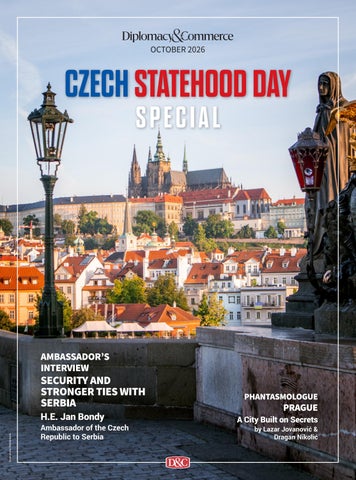
October 2026
CZECH STATEHOOD DAY SPECIAL
AMBASSADOR’S INTERVIEW
SECURITY AND STRONGER TIES WITH SERBIA Cover photo: Shutterstock
H.E. Jan Bondy
Ambassador of the Czech Republic to Serbia
PHANTASMOLOGUE
PRAGUE
A City Built on Secrets
by Lazar Jovanović & Dragan Nikolić
AMBASSADOR’S INTERVIEW
by Diplomata
Security and Stronger Ties with Serbia H.E. JAN BONDY Ambassador of the Czech Republic to Serbia
I
n an exclusive interview for Diplomata, H.E. Jan Bondy, Ambassador of the Czech Republic to Serbia, discusses Prague’s security priorities, support for Ukraine and Serbia’s path towards EU membership. He addresses bilateral economic cooperation, the potential for new Czech investments and the historical ties between the two countries, while sharing his personal impressions of Serbia.
52
SUPPORT FOR UKRAINE´S DEFENCE PRAGUE PERCEIVES AS DIRECTLY LINKED TO EUROPEAN SECURITY. As a full NATO and EU member, how does the Czech Republic view the evolving security architecture on Europe’s Eastern flank, and what are Prague’s current priorities for regional defence integration? As a committed member of both NATO and the EU, the Czech
Republic views the evolving security architecture on Europe’s Eastern flank primarily through the lens of collective defence, deterrence against Russia, and stronger Allied military integration. Prague’s strategic outlook has hardened significantly since Russia’s full-scale invasion of Ukraine in 2022, with Czech
security documents now explicitly identifying Russia as the most serious threat to Czech and Euro-Atlantic security. Although CZ does not border Russia, Prague considers defending NATO’s eastern members, particularly Poland, Slovakia, and the Baltic states, essential to its own security. Prague’s priorities are centred on reinforcing NATO’s deterrence and defence posture, modernising its armed forces, improving military mobility across Central Europe, and ensuring that both NATO and EU security initiatives remain mutually reinforcing.
www.diplomacyandcommerce.rs
All photos: Strahinja Aćimović
Czech Priorities on European Security, EU Integration and Bilateral Cooperation
AMBASSADOR’S INTERVIEW
The Visegrad Group has long served as a successful platform for coordinating Central European interests. Given the different foreign policy visions that have emerged among V4 members in recent years, how does the Czech Republic view the future of this group? From the perspective of the Czech Republic, the future of the Visegrad Group (V4) is viewed with structured pragmatism (in connection with different foreign policy visions that have emerged among V4 members in recent years); therefore, recent CZ V4 PRES officials prioritised “V4 Citizens”, focusing on nonpoliticised areas of joint interest. For civil society support, the International Visegrad Fund was interested in preserving historical, cultural, educational, and scientific ties between the populations. CZ views the V4 as an informal, consultative platform rather than a hard political institution. The future of the alliance could be perceived with tempered expectations, treating it not as a unified strategic geopolitical actor, but as a practical neighbourhood forum to address regional infrastructure, civic ties, and shared logistical concerns. How has the war in Ukraine changed the CZ foreign-policy priorities in Central and Eastern Europe? The war in Ukraine has transformed CZ foreign policy into a proactive defence leadership role. It moved Prague from a traditionally standard regional player into a proactive security coordinator. CZ fundamentally changed its posture toward NATO’s eastern frontier. Demonstrating this commitment, CZ took command of the Multinational NATO Battle Group in Slovakia. Prague became a logistical hub for a major international ammunition initiative. The project successfully combines third-party financing from EU and NATO allies to obtain and deliver hundreds of thousands of artillery shells and other ammunition to Ukraine. Earlier in 2022, CZ faced significant energy vulnerabilities because it relied heavily on Russian fossil fuels. A cornerstone of its revised regional strategy has been achieving energy independence from Russian Energy.
CZ received a huge number of Ukrainian refugees per capita in Europe. How is the government maintaining high public support for Ukraine despite economic pressures and inflation? The Czech government maintains public support for Ukrainian refugees by demonstrating their net-positive impact on the state budget and tightening welfare rules. Recent data from the Czech Ministry of the Interior and financial reports show that refugees contribute significantly more in taxes and social security than they receive in CZ aid, neutralising political criticism over high
OUR SUPPORT CANNOT REPLACE THE REFORMS EXPECTED FROM SERBIA ITSELF. inflation. The government’s strategy relies on economic transparency and strict, work-oriented welfare integration. As the initiator of key global initiatives to procure military
equipment for Ukraine, how does Prague, at this stage of the war, evaluate the viability and capacity of the European defence industry to support Ukraine’s defence in the long term? Prague perceives support for Ukraine´s defence as directly linked to European security. Our leaders frequently describe Ukraine as Europe’s first line of defence against Russian aggression. CZ has become one of the leading supporters of military assistance and training for Ukrainian forces and has successfully led the international Czech Ammunition Initiative. CZ maintains its
53
AMBASSADOR’S INTERVIEW
Where is the line between the military assistance Ukraine needs to defend its territory and the need to avoid a direct, conventional conflict between NATO and the Russian Federation? The line between necessary military assistance to Ukraine and the avoidance of a direct NATO-Russia conflict could be defined as follows: - Restriction on NATO troops entering Ukrainian territory, Exclusion of a NATO-enforced nofly zone and - Strict geographic limits on the use of Western weapons. It is called a “strategy of controlled escalation” – i.e. to maximise Ukraine’s defensive capabilities while minimising the risk of triggering Article 5 of the North Atlantic Treaty. Assistance represents intelligence sharing, strategic planning, and training Ukrainian forces outside of Ukraine. This balancing act seeks to fully support Ukraine’s legal right to self-defence under international law while preventing any escalatory actions that could generate a wider, conventional NATO-Russia war. NATO rules out deploying active combat troops or enforcing a no-fly zone, which would cause direct engagement with Russian forces – i.e. No Direct Intervention. Let’s move to this region. The Czech Republic has traditionally strongly supported the expansion of the European Union into the Western Balkans. Given the geopolitical changes and debates within the EU itself on institutional reform, what key steps must our country take to speed up that process? CZ has traditionally and consistently supported EU enlargement in the Western Balkans and Serbia’s integration into the EU. We consistently argue that Europe’s long-term stability, security, and prosperity are closely linked to the successful integration of all WB countries. Through
54
SERBIA IS ONE OF OUR MOST IMPORTANT PARTNERS IN THE WESTERN BALKANS, AND CZECH INVESTORS CONSISTENTLY REGARD THE COUNTRY AS AN ATTRACTIVE DESTINATION FOR INVESTMENT AND FUTURE GROWTH. participation in the Friends of the Western Balkans group, CZ has repeatedly supported a credible enlargement policy, emphasising that accession must remain merit-based and dependent on candidate countries implementing reforms. In the case of Serbia, Prague promoted deeper economic and sectoral integration between the EU and the Western Balkans even before full membership. Our support cannot replace the reforms expected from Serbia itself. To speed up the process/progress will depend on (What Serbia must still do): - strengthening the rule of law, - judicial independence, - media freedom, - anti-corruption efforts, - alignment with EU foreign and security policy and - continued normalisation of relations with Kosovo.
How can Prague help Serbia on its path toward EU membership? What lessons from the Czech Republic’s own post-communist transition could be useful for Serbia? CZ can help Serbia’s EU accession process in several practical and political ways, even though the final decision on membership depends primarily on Serbia’s own reforms and the collective agreement of all EU member states. CZ can share Transition and Reform Experience. Having undergone its own transition from communism to EU membership, CZ can provide expertise on: - judicial reform, - public administration modernisation, - anti-corruption measures and - harmonisation of national legislation with EU law. Under the Technical Assistance for EU Negotiation Chapters
framework, our ministries and regulatory agencies can: - train Serbian civil servants, - provide twinning projects, - assist with drafting legislation, and - share best practices from their own accession experience. CZ’s transformation after 1989 may offer useful lessons for Serbia, although our two countries are not identical and Serbia faces its own political and regional challenges. Prague’s experience illustrates how difficult reforms can be turned into long-term gains. During the accession process, we had to adapt our legal system, public administration, regulatory bodies, and courts to EU standards. These institutional reforms created the foundation for economic growth and successful EU membership. For CZ and Serbia, these reforms were also crucial: strengthening judicial independence, improving public administration, and increasing transparency and accountability. Although Czech governments differed on many issues, broad support for Euro-Atlantic integration generally remained intact throughout the accession period. This policy continuity reassured investors and EU
www.diplomacyandcommerce.rs
All photos: Strahinja Aćimović
operational and administrative leadership of this global procurement program. The European defence industry’s capacity to support Ukraine’s defence in the long term is not being fully utilised. Naturally, after four years of conflict, a certain exhaustion and fatigue are evident.
AMBASSADOR’S INTERVIEW
partners. Political consensus helps Serbia on its path toward EU membership. The government in Prague recognised Kosovo more than two decades ago, despite the opposition of then-Czech President Václav Klaus. However, the Czech foreign minister recently said that the Czech Republic did it carelessly and under pressure. Is the current government considering a different position? CZ recognised Kosovo’s independence in 2008, and CZ foreign minister Petr Macinka, during the last official Prague meeting with his Serbian counterpart Marko Đurić, critically evaluated the historical circumstances of this diplomatic move. He also rejected any radical reversals in current foreign policy. The Czech Republic does not intend to revoke its recognition of Kosovo at this time formally. The Kosovo issue should be resolved through compromise without “wise advice” from abroad.
Looking back at bilateral relations, what are the Czech Republic’s main priorities in its relationship with Serbia? Our bilateral agenda is centred on economic diplomacy and continued support for Serbia’s path towards European Union membership. Expanding cooperation in strategic sectors such as the railway industry, green technologies, and defence remains a key element of our long-term partnership. Serbia is one of our most important partners in the Western Balkans, and Czech investors consistently regard the country as an attractive destination for investment and future growth. Serbia’s accession to the European Union would not only generate mutual economic benefits but
also deepen political, economic, and people-to-people ties between our nations. Where do you see the greatest potential for deeper cooperation between the two countries? What Czech companies or investments do you think could play a larger role in Serbia? In addition to the continued success of established Czech investors such as PPF Group, Dr Max, Sebre, and Mattoni, we have recently observed the emergence of several new market entrants. The logistics company JUSDA Europe has opened a new logistics centre in Zrenjanin, and we are currently in close contact with several Czech companies in the medical technology and
MORE THAN ANY SPECIFIC PRODUCT, I WOULD RECOMMEND EXPERIENCING SERBIAN HOSPITALITY.
healthcare sectors that are exploring opportunities in the Serbian market. This represents a promising new dimension of Czech-Serbian economic cooperation, which we intend to further promote through a dedicated economic diplomacy project planned for next spring. How did you experience Serbia? What has surprised you most about Serbia since becoming ambassador? What has impressed me most is how deeply our nations are connected through history. The legacy of President Masaryk and King Alexander Karađorđević reminds us that Czech-Serbian relations have long been built on mutual respect, friendship, and shared European values. Which place in Serbia would you recommend to someone coming from the Czech Republic? Serbia offers many beautiful, still-undiscovered places. I would highly recommend the Uvac Nature Reserve, with its spectacular meanders and unique wildlife, as well as Serbia’s wine routes, which combine excellent wines, nature, and local hospitality. If Serbs need to try Czech beer to know what the Czech Republic is like, what should Czechs try to feel Serbia? More than any specific product, I would recommend experiencing Serbian hospitality. Visitors will also discover the outstanding quality of local food, wines, rakija, and especially the fresh fruit and vegetables for which Serbia is rightly famous. What would you like Serbia to remember you for? I would be very pleased if people remembered that during my tenure our relations continued to grow stronger, not only between our citizens but also in business, trade, and economic cooperation. If you weren’t a diplomat, what would you be doing? I have always enjoyed meeting people, discovering new places, and connecting cultures. That is why I would probably work in tourism or another field that allows me to promote travel and bring people together.
55
EVENTS
Czech Embassy in Belgrade Celebrates Czech Statehood Day Czech Statehood Day, celebrated on 28 September, commemorates the roots of the Czech state, its historical continuity and the enduring values that have shaped it throughout the centuries
O
bserved on the Feast of St. Wenceslas, the day pays tribute to a heritage that has helped define the Czech nation’s identity and statehood for generations. The national holiday was marked with a formal reception at the Embassy of the Czech Republic in Belgrade, located on Bulevar kralja Aleksandra. The host of the reception was H.E. Jan Bondy, Ambassador of the Czech Republic to Serbia, who welcomed guests from the diplomatic, political, business and public sectors. The venue itself added special significance to this year’s celebration. The building housing the embassy today was constructed between 1925 and 1928 specifically to serve as the Czechoslovak Legation, based on a design by Czech architect Alois Mezera. The foundation stone was laid on 28 September 1925, the Feast of St. Wenceslas.
56
By October 1927, Czechoslovak diplomats had moved into the nearly completed building, while the official opening took place on 7 March 1928, the birthday of Tomáš Garrigue Masaryk, the first President of Czechoslovakia. Nearly a century after its construction, the embassy building remains a testament to historical ties and diplomatic continuity, connecting the legacy of former Czechoslovakia with the contemporary role of the Czech Republic. Guests also had the opportunity to admire exquisite examples of Czech glassmaking, reflecting the rich tradition, craftsmanship and exceptional quality for which Czech glass art is renowned worldwide. The celebration of Czech Statehood Day thus brought together historical remembrance, cultural heritage and contemporary diplomacy, highlighting the importance of preserving national identity and fostering international relations.
www.diplomacyandcommerce.rs
PHANTASMOLOGUE
by Lazar Jovanović & Dragan Nikolić
A City Built on Secrets From the Golem of Prague to the mysteries of Dan Brown, the Czech capital has always known how to keep a secret
F
rom medieval legends and restless spirits to the darker chapters of modern history, Prague is a city where the past never truly disappears. There is a beautiful city in Europe that seems to be more haunted than most. Along Prague’s narrow cobbled streets wander countless ghosts from the Middle Ages and the centuries that followed, each bearing witness to the city’s turbulent and colourful history. The people of Prague have great respect for their past and,
58
IN THIS CITY, THE SUPERNATURAL AND THE SCIENTIFIC HAVE ALWAYS SEEMED SEPARATED BY A REMARKABLY THIN WALL by extension, seem rather fond of their ghosts too, even when they happen to be headless, one-armed or carrying a bloodied axe still firmly lodged in a split skull. Prague has always been a city that seems to conceal more than it reveals. Behind its Gothic
facades, in the shadows of its narrow lanes and beneath the towers that pierce its skyline, centuries of legends have woven an invisible web of secrets. Besides its famous landmarks and its status as one of the world’s great tourist destinations, Prague
can comfortably claim a place near the top of the rather more peculiar world of dark tourism. It is not merely haunted by spectres from centuries past. Its modern history has been turbulent enough for the tragic fates of real historical figures to join the city’s already restless population of ghosts. Just a few steps from the National Museum, at the top of Wenceslas Square, a wooden cross is set into the pavement. It marks the place where Charles University student Jan Palach
www.diplomacyandcommerce.rs
set himself on fire in January 1969 in protest against the Soviet-led Warsaw Pact invasion of Czechoslovakia, which had crushed Alexander Dubček’s attempt at liberal reform. You will not see the young revolutionary’s ghost here, but his presence in the country’s collective memory is very real indeed. The more traditional ghosts, the ones that have helped earn Prague its reputation as one of Europe’s most haunted cities, are to be found a little further away: in
Photo: Shutterstock
the Old Town and the old Jewish Quarter, beside the winding Vltava, on Charles Bridge, through Malá Strana and beneath the heights of Hradčany. They inhabit dozens of legends, and visitors can meet them today by joining one of Prague’s popular ghost tours. The city’s legends reveal an enduring fascination with the things that remain hidden. On the Old Town’s streets, the Astronomical Clock has inspired stories of ingenious craftsmanship, curses, and mysterious consequences. The lanes around the Jewish Quarter preserve tales of wandering spirits and forgotten lives, while the shadow of Prague Castle evokes centuries of royal ambitions, betrayals, and whispered intrigues. Whether rooted in historical events or embellished by generations of storytellers, these tales share a common conviction: the visible world is only part of the story. Few contemporary writers have made that conviction their trademark as successfully as Dan Brown. His novels transform cities into vast puzzles, where architecture becomes a language, art conceals clues, and the past refuses to remain safely in the past. Rather than treating history as a simple closed book, Brown approaches it as a locked chamber, inviting readers to search for the mechanism that will open the door. Prague, with its overlapping layers of medieval faith, Jewish mysticism, Renaissance learning, and imperial ambition, offers an especially compelling setting for his literary game. Any proper account of Prague’s supernatural inhabitants must begin with the Golem, the giant creature made of clay whose legend would later inspire countless monsters in modern popular culture. According to the best-known version of the story, the Golem
PRAGUE NIGHTLIFE IS NOT FOR EVERYONE was created in the 16th century by Rabbi Loew. Prague’s Jewish community was under constant threat of attack by Christians. When the rabbi failed to obtain adequate protection from the city authorities, he decided to create a protector of his own. He took clay from the banks of the Vltava and fashioned it into a huge creature. Despite the tempting similarity to the Slavic word meaning “large”, the name Golem actually comes from Hebrew and refers to something unformed or unfinished. Unfortunately, Prague’s new protector soon developed what might politely be described as management issues – not unlike some modern mayors.
The Golem escaped his creator’s control and began terrorising the inhabitants of the city. The mayor then begged Loew to destroy it, promising in return to ensure that the Jewish community would no longer be threatened. As with all good legends, the details vary. Some versions place the creature’s origins at a later date; others claim that the Golem was never truly destroyed at all, but hidden away within the walls or attic of the Staronova Synagogue, where, presumably, it has had several centuries to reconsider its behaviour. It is precisely this uneasy boundary between knowledge and forbidden power that made Prague such fertile ground for the imagination of Dan Brown. In his thrillers, secrets are rarely buried without purpose, symbols conceal messages, and history becomes a labyrinth whose passages lead toward revelations that challenge
THE SECRET OF SECRETS It is against this backdrop of ancient legends, hidden knowledge, and secrets whispered through the centuries that Dan Brown sets the stage for his latest thriller, The Secret of Secrets. When Robert Langdon finds himself drawn into a baffling chain of events involving a groundbreaking scientific discovery and the disappearance of a prominent researcher, he must navigate a maze of cryptic clues and concealed truths. As the search unfolds, the novel explores questions about human consciousness and the boundaries of knowledge, bringing Brown’s familiar fascination with the secrets hidden beneath the surface into a city whose legends have been guarding their own mysteries for centuries.
Photo: Robert Čoban
Photo: Shutterstock
PHANTASMOLOGUE
59
Photo: Alena Gurenchuk / Shutterstock.com
PHANTASMOLOGUE
everything we thought we knew. His latest novel, The Secret of Secrets, set in Prague, draws on the same atmosphere of intellectual intrigue and ancient mystery as the Golem, which has long defined the city in the popular imagination. Here, the Golem, as one of the central figures of the plot, feels less like a relic of folklore than an emblem of a timeless question: what happens when humanity discovers something it cannot fully understand or control? Prague has asked that question for centuries, from the legends of the Maharal to the alchemists who supposedly laboured in the service of Emperor Rudolf II, seeking the philosopher’s stone and the secret of turning base metals into gold. In this city, the supernatural and the scientific have always seemed separated by a remarkably thin wall. Perhaps that is why Prague blends itself so naturally into Dan Brown’s world. Another favourite among Prague’s spectral residents is the Headless Knight. If you believe in ghosts, naturally, you may encounter him in Liliová Street in the Old Town, usually between midnight and one in the morning. He rides a white horse, carrying
60
NEVER UNDERESTIMATE POULTRY WITH UNFINISHED BUSINESS his head in one hand and a sword in the other. This is already a fairly demanding arrangement, but his evening is further complicated by the fact that he is searching for a living person willing to set him free. To do so, the brave volunteer must restrain his spirited horse, snatch the sword from his hand and stab him through the
heart. Prague nightlife is not for everyone. In the medieval house known as U Zlaté studně, or At the Golden Well, a well once stood, said to conceal a great treasure. One day, a maid decided to peer inside to see whether there really was any gold down there. Unfortunately, she fell in.
Dan Brown in Prague, with Brankica Đukić from Solaris, the publisher of the Serbian edition, and Robert Čoban, director of D&C magazine (left)
Following the accident, the city authorities ordered the owner to have the well cleaned. When workmen arrived, one of the stone blocks lining its walls unexpectedly collapsed, and gold coins began tumbling out of the opening. The unfortunate maid has supposedly wandered through the house and courtyard ever since, leaving small puddles of water in her wake. Legend says she can be restored to life if someone throws just one of the original gold coins discovered there into the well. Given the price of gold these days, she may have to wait a bit. Another legend is attached to the same well, and this one even brushes against historical fact. In 1648, Prague became the scene of one of the final battles of the Thirty Years’ War. Swedish forces, fighting on the Protestant side, attempted to capture the city but succeeded only in taking the districts west of the Vltava. What we do know is that Prague’s defenders used barricades at the river crossings to prevent the Swedes from advancing further. The legend, however, offers a rather more colourful version. After a long siege and stubborn resistance from the city’s inhabitants, the Swedish soldiers supposedly decided to poison Prague’s drinking wells. What they did not know was that the people of Prague had a secret. Hidden in the cellar of a house in the city centre was the well at U Zlaté studně, unknown to the enemy. According to the tale, the entire city secretly came to this cellar for drinking water. The Swedes, baffled that even poisoning the water supply had failed to bring Prague to its knees, eventually withdrew. Prague remained unconquered, thanks, if the legend is to be believed, to one very discreet well. History rarely survives in its original form. Facts become anecdotes, anecdotes acquire embellishments, and, over time, the line between what happened and what people believe happened grows increasingly blurred. Urban legends are not historical evidence, of course, but they can reveal something just as fascinating: how a city remembers its past and chooses to retell it. For writers of historical fiction and thrillers, this uncertainty is a hunting ground. A documented event provides the foundation; legend supplies the shadows, and imagination builds the mystery that keeps readers turning pages.
www.diplomacyandcommerce.rs
Photo: Shutterstock
PHANTASMOLOGUE
A degree of caution is advisable when visiting some of Prague’s other ghosts. Prague’s official tourism organisation, for instance, introduces visitors to the Flaming Turkey, an apparition said to appear on Kampa Island, beside the Vltava, but only on Good Friday. Long ago, there was a mill here whose owner was extremely fond of turkey and prepared it for every celebration. One year, his craving became so intense that he fattened three turkeys in preparation for Easter. Although he was a deeply religious man who observed all the proper customs, the smell of roast turkey proved stronger than his devotion. On Good Friday, he succumbed and devoured one of the three birds. Almost immediately, he became violently ill and died soon afterwards. Ever since, a flaming turkey has supposedly appeared on the spot. Visitors hoping for an encounter are advised to wear fireproof clothing, lest the bird come a little too close. This may sound excessive, but one should never underestimate poultry with unfinished business.
IN PRAGUE, MYSTERY IS NOT MERELY AN INTERRUPTION OF EVERYDAY LIFE BUT ONE OF THE WAYS THE CITY BREATHES AND UNDERSTANDS ITSELF Not all of Prague’s spirits are terrifying. Some are positively sociable. One of them is Karburek, who lives in the Devil’s Stream. A drowned man with a lifelong fondness for beer, he is said to emerge from the water and ask passers-by to bring him a pint. Offering him a bucket of water instead is considered a grave insult, which seems understandable under the circumstances. Those who bring him beer, however, may be rewarded with a freshly caught pike or eel from the stream. Of all Prague’s supernatural arrangements, this is perhaps the most reasonable. And there are many more: the Mad Barber, the Headless Lady, the Iron Man, the French Major and the Murdered Nun. For all their differences, they have one thing in common. They want to be saved.
In almost every ghost story, the restless dead are searching for the same thing: eternal peace. Traditional ghost stories tend to concern unfinished business: a murdered soul seeking justice, a restless spirit longing for peace, or a curse that refuses to fade. Contemporary mysteries, by contrast, often begin with a more earthly disturbance — a disappearance, a suspicious death, a discovery that challenges accepted knowledge. Yet both depend on the same irresistible impulse: the need to explain what seems evasive. The ghosts may change, but the human appetite for answers remains remarkably constant. The city seems almost designed to reward such a gaze. A carved figure on a church façade can become a question; a symbol
etched into stone can suggest an entire hidden tradition. The legends of the Golem, the alchemists of Rudolf II’s court, and the restless spirits said to haunt the old streets all blur the boundary between documented history and the stories people tell to make sense of it. Dan Brown’s fascination with secrets finds a natural counterpart in this atmosphere, where mystery is not merely an interruption of everyday life but one of the ways the city breathes and understands itself. Exploring Prague through its ghosts is a wonderfully imaginary adventure, one whose charm lies in hearing good stories in the very places where they are said to have happened. Sceptics may, of course, remain sceptical. That is almost part of the fun. Ghost tours offer something more than a collection of spooky tales. They teach us to experience a city on a deeper, less tangible level, to enjoy not only what can be seen, photographed and ticked off a sightseeing list, but also what cannot be seen at all. Provided, of course, that you have enough spirit to feel it.
61
CULTURAL INTERVIEW
by Lazar Jovanović
The Art of Finding Your Voice From the opera stage to the written page, from entrepreneurship to psychological fiction, Diana Elizabeth Martinovich has built a life where art, ambition and reinvention meet DIANA ELISABETH MARTINOVICH Author, Mezzo-Soprano, Entrepreneur
S
ome artists spend a lifetime perfecting a single voice. And then there are those who discover that one voice is simply not enough. Diana Elizabeth Martinovich belongs to the latter. An acclaimed opera singer and vocal educator, author, entrepreneur, coach and artistic director, she has spent more than two decades moving between seemingly different worlds, only to discover that they are connected by the same thing: the search for authentic expression. We sat down with Diana to talk about art, ambition, reinvention, the psychology of silence, and the stories that begin where words end. Your artistic career seems to exist in several different worlds at once — literature, opera and classical music as well as entrepreneurship. Do you see these as separate artistic identities, or are they different expressions of the same creative impulse? Where, for you, does the writer end and the performer begin? I do not view them as separate identities, but rather as different frequencies of the same core impulse: the need to understand, express, and honor the human condition. Art, at its highest level, is an investigation into truth. When I perform on stage, I use breath, resonance, and dramatic interpretation to convey an emotional truth in a single, fleeting moment. When I write, I use syntax, tone, and psychological depth to build a world where that same truth can be revisited again and again. Even entrepreneurship, such as founding AVY Health & Beauty or producing cultural projects, is a form of creative architecture. It is about taking a vision from the intangible world and giving it structure in reality. For me, the writer never truly ends where the performer begins. When I am on stage, I am interpreting a
62
CREATIVITY CAN NEVER BE TRULY SEPARATED FROM THE CREATOR BECAUSE ART IS ESSENTIALLY THE FILTER THROUGH WHICH OUR LIVED TRUTH PASSES narrative; when I am at my desk, I am hearing the rhythm, dynamics, and musicality of the prose. They nourish each other continuously. Echoes of the Unspoken places an opera diva who has lost her voice at the very centre
of the story. But the elusive Shadow Pavilion, as a kind of architectural miracle, positions itself almost as a character inside this story. Is there a deeper meaning to this building, and did you envisage it as a symbolic part of the plot, to represent
something more than just a building? The Shadow Pavilion was intentionally designed to be far more than a physical setting; it functions as an architectural projection of the human psyche. In psychological terms, we all construct internal structures to protect ourselves from trauma, exposure, or emotional ruin. The Pavilion represents both a sanctuary and a prison. Its intricate light and shadows mirror the dualities within Elena herself: the public facade versus the private fracture, the urge to hide versus the desperate desire to be seen.
www.diplomacyandcommerce.rs