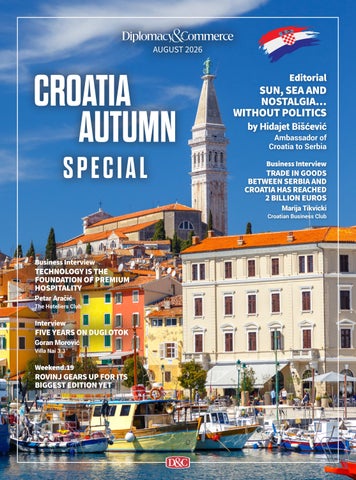
August 2026
CROATIA AUTUMN SPECIAL
Editorial
SUN, SEA AND NOSTALGIA… WITHOUT POLITICS by Hidajet Bišćević Ambassador of Croatia to Serbia
Business Interview
TRADE IN GOODS BETWEEN SERBIA AND CROATIA HAS REACHED 2 BILLION EUROS Marija Tikvicki
Croatian Business Club
Business Interview
TECHNOLOGY IS THE FOUNDATION OF PREMIUM HOSPITALITY Petar Aračić
The Hoteliers Club
Interview
FIVE YEARS ON DUGI OTOK Goran Morović Villa Nai 3.3
Weekend.19
ROVINJ GEARS UP FOR ITS BIGGEST EDITION YET
EDITORIAL
by Hidajet Bišćević
you with an excellent Malvasia; and on the tiny island of Rava, opposite Zadar, you can still enjoy peace, silence and solitude… because even the postman only comes once a week. But older generations will continue to feel nostalgic, remembering those distant days when we travelled to the seaside in a little Fićo, when we children were squeezed into the back seat, sometimes even with a pot of sarma on our laps; when somewhere in Gorski Kotar we would stop so our parents could take a break over
The author of this editorial, H.E. Hidajet Biščević, is the current Ambassador of Croatia to Serbia
Sun, Sea and Nostalgia… Without Politics A journey through the memories of Adriatic holidays and the transformation of Croatian tourism from a way of life into a vital industry
THE GALEBOVI NO LONGER PARADE ALONG THE EDGES OF THE BEACHES, BUT THE FOND MEMORIES REMAIN the region’s famous cheese and cream; when journeys lasted for hours and, I remember it as if it were today, somewhere around Gornje Jelenje above Rijeka, the view would suddenly open up over Kvarner Bay and the endless blue sea. We, children, could hardly wait to reach our destination and start jumping off the waterfront into that warm, wonderful water. Later, when we grew up, that same nostalgia would bring
N
48
Photo: Split, Croatia / Shutterstock
ostalgia is a dangerous word in this part of the world. After everything that has happened over the past few decades, many immediately associate it with political nostalgia for “the old days”, while the laudatores temporis acti remain as persistent as ever, on all sides. But this is about an entirely different kind of nostalgia. Nostalgia for tourism. For a kind of tourism that slowly disappeared and, over the years, with social change and economic progress, gradually transformed into an industry. Indeed, Croatian tourism has not yet “lost its soul”. It has not yet turned into the kind of mass tourism found in many Mediterranean countries. In the Kornati Islands, you can still stumble upon a secluded konoba; in Istria, you can still visit olive-growing estates where your hosts will welcome
www.diplomacyandcommerce.rs
After that nostalgic era came workers’ holiday resorts, hotels, apartment complexes, motorways to the coast and packed airports along the Croatian shoreline. Huge cruise ships arrived, followed by wealthy yacht owners, while marinas sprang up along the coast. In short, tourism development became a key pillar of the Croatian economy. Tourism accounts for almost 12 per cent of Croatia’s GDP, illustrating just how significant the tourism industry is to the national economy. Nor should we forget the burden tourism carried during the war years, when hotel privatisation was put on hold and hotels provided accommodation for almost 800,000 refugees. Inevitably, times change, and every era brings its own values. The habits of Croatian hosts and
Photo: Brela, Makarska / Shuttersto ck
Photo: Simun Galić / Shu
tterstock
i Muzej Bjelova Photo: Gradsk
r
EDITORIAL
back memories of countless Czech tourists, all the men wearing those blue, triangular cloth swimming trunks. The word slim meant nothing to anyone back then. After a swim, the trunks somehow sagged around their hips, which we found hilarious, probably just as hilarious as they found our youthful strutting along the edges of the beaches. They called us “seagulls”, galebovi,
CROATIAN TOURISM HAS NOT YET ‘LOST ITS SOUL’ as we tried to catch the eye of some young Czech or German girl. German girls, which puzzled us somewhat, because this nostalgic film was unfolding
barely a decade after the war, and yet there were Germans on our beaches. I will stop the nostalgic film there, before I succumb to the temptation of politics. However, a recent statistic reminded me that almost 130,000 Serbian citizens visited our Adriatic coast this summer. If nothing else, the sociology of tourism teaches us that tourism can be a welcome remedy.
foreign visitors have also changed over the years. Fortunately, and thanks to deliberate policy choices, Croatia has avoided the kind of mass tourism that, for a time, almost “devoured” tourism itself in some Mediterranean countries. So the galebovi no longer parade along the edges of the beaches, and no one carries a pot of sarma to the seaside in a little Fićo anymore… but the fond memories remain.
49
by Mijat Kontić
BUSINESS INTERVIEW
Trade in Goods Between Serbia and Croatia has Reached 2 Billion Euros Overcoming Political Noise Through Market Interdependence
MARIJA TIKVICKI President of the Croatian Business Club in Serbia
I
n an interview for the TV programme Diplomata, Marija Tikvicki, President of the Croatian Business Club, talks about the growing business ties between Croatia and Serbia, the Club’s two decades, rising bilateral trade, and new opportunities for cooperation and investment. he Representative Office of the T Croatian Chamber of Economy in Belgrade, together with the Croatian Business Club, practically works in synergy, and you find yourself at the head of that link, or connection, so to speak. Could you tell us how this division of roles works, and where the Chamber’s
50
institutional support ends, and the Croatian Business Club’s networking and operational work begins? I am glad you asked me that, considering that many people are somewhat confused and have trouble distinguishing between the Croatian Chamber of Economy and the Croatian Business Club. The Croatian Business Club is actually a product, or rather a child, of the Representative Office. It was established in 2006 by the thenEmbassy of the Republic of Croatia and the Representative Office of the Croatian Chamber of Economy. That was a period when Croatian companies began returning to this market, and where their access to institutions, ministries, and all the information they required was facilitated. It provided a more direct relationship rather than going
BUSINESS KNOWS NO BORDERS strictly through the Embassy or the Representative Office. Today, the Representative Office of the Croatian Chamber of Economy and the Croatian Business Club are fortunate to have one person occupying both positions, because there is a genuine synergy. I sometimes wonder how it would function if there were two different people, simply because all these activities intertwine, as we are ultimately working toward a common goal. The difference lies perhaps only in the fact that the Croatian Business Club also gathers companies from Serbia, not just Croatian corporations, but also
firms from Serbia that wish to cooperate with businesses in Croatia. So, it goes both ways. This year is an important one for the Croatian Business Club as it marks 20 years since its founding. When you look back at that period, how has it evolved, both in terms of perception and the realisation of Croatian investments? Yes, the Croatian Business Club is celebrating this significant milestone, 20 years, of which we are exceptionally proud. I hope it will be commemorated in the manner I envision. One of the ongoing projects is the monograph of the Croatian Business Club. Given that when it started, very little was digitised or preserved, I think this is the right moment to gather everything into one place.
www.diplomacyandcommerce.rs
BUSINESS INTERVIEW
confectionery and coffee segment. I do not know if I am allowed to mention names, but we all know the largest companies that executed acquisitions here and are highly successful. But as regional players, they often describe themselves as multinational companies headquartered in Zagreb because they truly cover such a vast market. In the food segment as well, companies have returned the right way, because these are brands we all grew up with, and they have returned to this market. But beyond that, there is plenty of room in the IT sector, the energy sector, renewable energy sources, the green transition, and agriculture. In those areas, we are firsthand neighbours relying on one another. There are still so many areas where cooperation can be deepened.
When we complete it, I will say it is one of the things I am most proud of, but let us wait until it is finished first. In this, I have great assistance from a colleague from Hrvatska Riječ in Subotica, who is working on this, collecting documents and supporting us, so I truly thank them and hope this project finishes exactly as I imagine. Another major milestone, as I mentioned, is that the club opened up to cooperate with companies from Serbia, so that we all find a common language, meaning a common business interest. Unfortunately, I will sound repetitive here, but my slogan since I entered this narrative and this line of work—and it has been quite a long time now, I dare not even say how long—is that business knows no borders. And that is definitely something that has been proven so many times until now. Regardless of certain political noises and everything else, business does not recognise the border between Serbia and Croatia, or borders with others; it follows its own narrative, its own interest, and the work gets done. If anything builds bridges beyond all else, it is precisely the economy and business. hat does that structure tell W us about the attractiveness of the Serbian market for Croatian capital? And which sectors today are the most promising or in focus? If we look at a cross-section, one of the largest acquisitions was carried out precisely in the
IF ANYTHING BUILDS BRIDGES BEYOND ALL ELSE, IT IS PRECISELY THE ECONOMY AND BUSINESS.”
he exchange between Serbia T and Croatia has its oscillations— sometimes there is a drop, sometimes growth—but it is highly active and alive. Where do you see that unexploited potential, and which of these sectors are traditionally the most successful for Serbia and Croatia? Trade in goods fluctuates slightly, but I would say, as do my colleagues from the Chamber of Commerce and Industry of Serbia, that this exchange is growing. o, it is certainly positive? S Yes, it is positive. There was a minor stagnation during the COVID period, but not due to lack of demand, rather simply due to the overall circumstances. However, trade between Serbia and Croatia continues to grow every year. Our data differs slightly depending on whether services are included, but in any case, it is increasing. According to the latest data, it amounts to nearly 2 billion euros. So neither side can be dissatisfied, because Serbia ranks among the top 10 for Croatia, and Croatia ranks among the top 10 for Serbia. I could speak a bit more freely and say perhaps even among the top 5, but certainly among the top 10 countries with which trade is conducted. I omitted to mention this earlier, but the Representative Office was closed in 2014. At that time, the Croatian Business Club and the then-ambassador and embassy took over that connecting role until the Representative Office of the Croatian Chamber of Economy was reopened in 2018. So, there
51
BUSINESS INTERVIEW
was a four-year gap when it returned to the market, simply due to a reorganisation within the Chamber itself. Regarding the exchange, as we said, food products are the primary focus. Energy, oil, electricity, copper—these are things that are always... How difficult is it today to position Croatian products on Serbian shelves, or in the opposite direction, Serbian products on Croatian shelves? Can we say that consumers in the region have essentially moved past borders when choosing products? I absolutely think they have, because when you hit the highway, Smoki is at every step, at every gas station, or Lino Lada, Vegeta... it is simply unimaginable to prepare lunch without Vegeta. And I do not mean just in Belgrade, but across Serbia’s entire territory. Of course, there are new brands, new products, and new companies entering specific fields where specialised manufacturing exists, covering the entire region outside Croatia. Since we agreed not to name names, there is a specific firm that emerged from Končar which handles signalling at railroad crossings. When you look at that... Tell us, to what extent do companies and workers from Serbia rely on the assistance of the Croatian Business Club when it comes to obtaining information or legal counselling regarding operations in Croatia? Let me tell you, we work closely and in a cooperative manner with the Chamber of Commerce and Industry of Serbia. That involves sharing information daily, whether about what is needed from Croatia or what we need here in Serbia. All those who reach out through the Chamber of Commerce and Industry of Serbia—because it often goes through that channel—receive information from us. For example, right now, what is highly relevant and what we are planning for next month are the amendments to the Law on Foreigners in Croatia, which involve the introduction of specific visas for transport vehicle drivers from the Republic of Serbia, meaning third countries. There is an important point to keep in mind here. Croatia made an evolutionary step outside of Schengen rules here. When you are in the
52
TRADE BETWEEN SERBIA AND CROATIA CONTINUES TO GROW EVERY YEAR European Union, you must comply with and follow the EU’s laws and regulations. Still, Croatia made an exception here precisely for the sake of the economy and commerce, so that goods could circulate smoothly between Serbia and Croatia. It introduced this legal amendment so that transport vehicle drivers would not fall under the current restrictive conditions regarding their limit of stay in the country. I believe a large number of them would otherwise have used up their allotted days and would not be able to drive during the second half of the year. The application of this law began on June 1st, and very soon, together with the Chamber of Commerce and Industry of Serbia and the transport community, we plan to organise a round table to explain how this will work in practice. ow does your Representative H Office cooperate with other chambers—say the Italian or Greek chambers, and you mentioned the Serbian one—to ease transit and reduce border barriers? Precisely that. I do not know how closely you have been following the work of these chambers, because over the past couple of years, the general trend has been
toward closer cooperation among the 17 bilateral chambers operating in Serbia. We organise joint events where the mutual interests of our member economies align. Thus, over the previous four years, a conference on transport and logistics was organised involving Confindustria Serbia (the Italian business association), the Slovenian Business Club, the Representative Office of the Croatian Chamber of Economy, and Greece, which joined two years ago. That represents a highly critical transit route in transport where all logistical pain points affecting them are presented. Ports, railways, and all the people practically participating in this chain gather in one place to present and exchange their experiences and problems. We also worked with the Chamber of Commerce and Industry of Serbia—I apologise for not listing them first, since everything took place at their premises—and they participated in and organised several meetings on the introduction of new terminals and on generally improving intermodal logistics, with rail transport as a vital component. As I said, it is not just up to Croatia; all those terminals are already formatted within the European Union. Specific
approvals are required, and so forth. It is not merely a matter of one country’s goodwill. an you tell us specifically C how it could influence the relaxation of bilateral relations between Belgrade and Zagreb, and whether it could be the healthiest and most stable longterm path toward building good relations? I believe that is exactly what we are doing. That is our job. And you are living proof of it. I hope we are doing it. How well we are doing it remains to be seen, but for now, given how people engage and approach us, we are working on this together. We, as a Representative Office, have truly achieved a lot, resolving issues ranging from top-level institutional friendships to the ordinary, day-today problems of companies ranging from the smallest to the largest. We are here to solve all problems together. We strive to ensure there are none, but when they arise, we resolve them collectively.
The full interview is available on our website.
www.diplomacyandcommerce.rs
AC HOTEL BY MARRIOTT SPLIT
BOUTIQUE HOTEL VENTURO
BEST BUSINESS HOTEL IN CROATIA 2025
ONLY DESIGN HOTELS™ PROPERTY IN CROATIA
urban / 214 rooms / city & sea views acmarriottsplit.com
coastal / 24 rooms / adults only 18+ hotelventuro.com
TWO ESCAPES. ONE SPLIT.
A WESTGATE GROUP EXPERIENCE - SPLIT, CROATIA
WESTGATE GROUP
BUSINESS INTERVIEW
by Dragan Nikolić
Technology Is the Foundation of Premium Hospitality
PETAR ARAČIĆ Founder of The Hoteliers Club
P
etar Aračić, founder of The Hoteliers Club, discusses the challenges facing Croatia’s hospitality industry and how technology, data and personalisation can help shape its future as a premium destination. How would you assess the current position of Croatia’s hotel industry compared with the rest of the region, and where do you see the greatest growth opportunities? I have the privilege of being in regular contact with most hotel management teams and GMs across the region, both privately and through The Hoteliers Club, so I am familiar with the real
54
figures and the real challenges, not just those presented in PR releases. When I compare Croatia with the rest of the region, I believe Croatian hotels are in a stronger position primarily due to their well-developed strategy. I am not saying this applies to everyone. Still, most major Croatian hotel companies have long-term development plans, continuous investment cycles that carry over from one season to the next, and a clear vision of where they are headed. This is reflected in the figures as well. In 2025, Croatia recorded a record 110 million overnight stays and nearly 22 million arrivals, an increase of around 2% compared with the already record-breaking year of 2024. That is no coincidence. It is the result of consistent investment over many years.
HOSPITALITY IS STILL A PEOPLE BUSINESS On the other hand, one area where the region, and Montenegro in particular, performs better than Croatia is large-scale capital investment. Porto Montenegro, Portonovi and Luštica Bay are projects worth anywhere from several hundred million to a billion euros, which have completely transformed perceptions of the Montenegrin coast and attracted brands such as One&Only. Croatia still lacks a major international luxury brand of this type. However, from what I hear through my contacts and from
recent announcements, this is finally beginning to change. The opportunity, therefore, is not to increase the number of beds, but to market and position existing capacities more effectively and to accelerate the wave of major branded investments that has already begun. I also see growth opportunities in closer cooperation with tourist boards, stronger campaigns, and the creation of better content and experiences for guests. Croatia is not the only oasis on the planet. There is plenty of competition, with beautiful destinations offering equally attractive coastlines and, in some cases, better hotels and better service. There is no room for complacency or for leaving the season and plans to chance. I believe Croatia’s hotel industry is
www.diplomacyandcommerce.rs
Photo: Private Archive
From seasonality and staffing shortages to the race for better guest experiences, Croatia’s hospitality sector faces challenges that no single hotel can solve on its own.
BUSINESS INTERVIEW
that could advise smaller hotels on exactly what they need, from digital processes to specific tools. Large companies are making good progress because they have internal teams and the budgets to test and select solutions, but smaller hotels are largely left to figure things out on their own. That is an area where I see a major opportunity for someone willing to approach it seriously.
moving in the right direction, but it is still a long way from where it should be, and from where it has the potential to be. What specific challenges do Croatian hotels face in relation to global trends? Is it seasonality, staffing or digital transformation? All three are challenges, but I would rank them differently from the way they are usually discussed. Seasonality is a chronic issue, and everyone talks about it, but I think its causes are often misrepresented, and solutions are sought in the wrong place. The problem is that there are not enough flights to certain destinations during the off-season. In contrast, the destinations themselves lack sufficient activities and experiences to keep guests there during the winter. You cannot bring guests to Brač in January if there are no flights, and even if they could get there, there may not be two restaurants open. It is a classic chicken-and-egg problem: restaurants cannot justify staying open in winter without guests, while guests will not come without things to do and adequate air connections. What I have noticed from conversations with colleagues across the region is that an individual hotel can rarely solve this problem on its own, no matter how hard it tries. I have seen hotels invest heavily in extending the season, opening wellness or conference facilities and targeting golfers or cycling tourists, only to close during the off-season anyway, simply because there was no transport, no adequate gastronomic offering and no other reason for guests to remain in the destination for more than two days. Destinations that have succeeded have done so because tourist boards, hoteliers, airlines and local authorities worked together simultaneously rather than each acting independently. It is not a lack of willingness but a lack of coordination at the destination level, rather than at the individual hotel level. The real problem, however, is staffing, and this is, frankly, what concerns me most as someone who has managed hotels. I still cannot understand how a serious hotel can find itself having to recruit as much as 80% of its workforce from scratch every season. What kind of employer are you if almost nobody comes back? It is also because salaries for certain positions remain far too low. Just
TECHNOLOGY IS THAT SYSTEM the other day, the HR director at a Croatian company told me that their GM salary was €2,300 net. Who works in that position for that kind of money? It is neither normal nor sustainable, and, of course, a four-star hotel with a GM on that salary is not going to progress because serious professionals go where their work is properly valued. In general, I think far too little is invested in developing and educating existing staff. Some hotel companies have been doing this well for years, and the results are visible, but they are still a minority. You have to invest in your workforce
just as you invest in the building and equipment. As co-owner and director of Hotel Job Fair, I can genuinely see that the trends are improving. More and more hotels are beginning to understand that a job fair is not an expense they have to endure once a year, but a marketing tool, a way of making sure candidates know you exist as an employer before they choose a competitor or, even more often, leave the hospitality industry altogether. It is partly a marketing investment, and companies that understand this have a significant advantage in attracting talent. As for digital transformation, I think it is moving in the right direction. The problem is simply that there are too many options, making it difficult to choose well. I think Croatia lacks a company
Eventlin is a platform that connects restaurants and guests. How do you see the potential for expanding similar IT solutions into Croatia’s hotel sector? I invested in Eventlin precisely because I recognised that it solves problems that are essentially universal across the hospitality and hotel industry: lost reservations due to phone calls and language barriers, no-show guests and, perhaps most importantly, the complete lack of guest data that would enable genuine personalisation. Eventlin is currently used by several hotel companies across the region, and for some of them we have also developed a sunbed reservation system. This has become a major issue across the hotel industry, because we all know what the race for sunbeds at seven in the morning looks like and how badly it can affect the guest experience from the very first morning of their holiday. When it comes to restaurants, I will use Lošinj Hotels & Villas as an example. They operate several restaurants, both within their hotels and around Čikat Bay, and each has been using Eventlin for two seasons. One of the benefits is that the moment a guest sits down at the table, you can know everything relevant about them: where they have been before, which of your other restaurants they have visited, what they like to eat and drink, when their birthday is, what kind of customer they are, how to target them later through marketing campaigns, send them a birthday greeting, know about any food allergies, or even offer them their favourite wine as soon as they arrive. Servers change from season to season, but Eventlin remembers. That means even a new server on their very first day can know everything about the guest sitting at their table. Owning that kind of information can generate significantly higher revenue by enabling hotels to unlock the full potential of their F&B operations
55
BUSINESS INTERVIEW
and provide guests with a completely different, much better experience. To answer the question about expansion directly, I see enormous potential, not as an add-on to what already exists, but as the logical next step. What we are doing today in F&B, recognising guests and understanding their habits in restaurants, should become part of a broader guest profile that follows them throughout their entire hotel stay, from the sunbed and spa treatments to their room and the reception desk. Today, this information is almost always scattered across different systems that do not communicate with one another. A hotel may know the guest in the restaurant but fail to recognise them at reception, or vice versa. I see the greatest potential precisely in connecting all these touchpoints into a single guest profile that follows them throughout the hotel, and even across multiple properties operated by the same company, much as we are already doing with Lošinj Hotels & Villas across their restaurants.
56
A HOTEL THAT DOES NOT USE GUEST DATA IS SIMPLY LOSING THE GAME a guest’s stay, because guests can receive an answer within minutes rather than waiting for a receptionist to become available. As an investor in IT projects for the hospitality industry, what do you consider the most important criterion for a digital solution to take hold in practice? Ease of implementation and integration with existing systems. Frankly, that is more important than the solution’s technological sophistication. I have seen many smart products fail because they required receptionists or servers to learn an entirely new system from scratch, during the season and under pressure. If a solution cannot fit into the system a hotel already uses and does not save
staff time from day one, it will not take hold, no matter how elegant it looks on paper. The second criterion is measurability. As a hotel director or owner, I need to see a direct impact on key performance indicators: fewer no-show reservations, higher ADR and more commission-free direct bookings. The third, and perhaps most underestimated, is local support in the user’s own language. Hospitality is still a people business, and technology that lacks reliable on-the-ground support rarely survives its first season. How can Croatian hotels differentiate themselves through digital tools? Is it through guest personalisation, smart rooms
Looking ahead over the next five years, what role do you see IT innovation playing in positioning Croatia as a premium tourism destination? For me, IT is the foundation on which premium positioning is built, not an embellishment. Croatia has natural assets, its coastline, cultural heritage and gastronomy, that have long been competitive with those of any Mediterranean destination. What it has lacked is a system capable of turning those assets into a consistently outstanding experience, from the moment a guest makes a reservation to check-out. Technology is that system. Five years from now, I expect the difference between hotels that grow and those that stagnate to be almost entirely technological. Not in terms of who has the most gadgets, but in terms of who knows their guests better and who responds more quickly to changes in demand. Croatia has an opportunity to leapfrog several stages and, instead of simply copying Western hotel chains, move directly towards integrated, data-driven systems. In doing so, it can position itself not as a cheaper alternative to Italy or Spain, but as a premium destination with an identity of its own.
www.diplomacyandcommerce.rs
Photo: Private Archive
Which innovative technologies are currently having the greatest impact on how hotels operate in Croatia? I would highlight four key areas. First, revenue management tools with dynamic pricing, which have finally become accessible to smaller hotels, not just large chains. Second, various direct booking tools that reduce dependence on OTA commissions. Third, CRM and personalisation tools that enable hotels to recognise returning guests and understand their habits and preferences directly impact loyalty. And fourth, sustainability technologies, particularly energy management systems, as guests are increasingly choosing destinations and properties based on these criteria as well. Interestingly, all four categories have one crucial thing in common: data. A hotel that does not collect and use guest data today is simply losing the game. I would add a fifth, increasingly prominent trend: artificial intelligence in direct guest communication, through chatbots for pre-stay and post-stay communication, as well as automated guest satisfaction surveys. Through my network of contacts across the region, I can see that hotels which have introduced these solutions are achieving measurably faster problem resolution during
or integration with global platforms? I would not choose just one of the three. The real question is the order of investment. I would start with integration with global platforms and personalisation, because they deliver the fastest return on investment and have a direct impact on revenue. Smart rooms are a fantastic tool for positioning a hotel in the luxury segment. Still, they require significant capital investment and only make sense once the fundamentals, in this case distribution, guest data and operational efficiency, are already in place. The reality is that guests coming to Croatia are increasingly looking for authenticity and experiences, not simply technological gadgets in their rooms. Today’s guests want quality, personalisation and an authentic experience of the destination, rather than simply ticking attractions off a list. That is why I would say personalisation, the kind that recognises and treats a guest as an individual rather than a room number, will be the greatest differentiator for Croatian hotels over the next few years.
WELLNESS
Rovinj Gears Up for Its Biggest Edition Yet
Photo: Mario Pavlović
Eight festival formats, hundreds of speakers and thousands of visitors will turn Rovinj into a regional hub for media, business, technology and ideas from 24 to 27 September
F
Photo: Marko Lopac
rom 24 to 27 September, Rovinj will once again become a regional meeting point for media, business, technology and creativity as Weekend.19 returns with its most ambitious edition to date. This year, the event will bring together eight festival
58
FOUR DAYS OF IDEAS, NETWORKING AND ENTERTAINMENT.
formats, hundreds of speakers and thousands of visitors from across the region and beyond. Over almost two decades, Weekend has grown far beyond the boundaries of a traditional conference, establishing itself as a platform where media professionals, entrepreneurs, investors, creatives, technology experts and decision-makers meet to exchange ideas and explore the forces reshaping business and society. In September, that scope will expand further with eight interconnected formats: Weekend.19, HR.Weekend, Tech.Weekend, Finance.Weekend, Investment.Weekend, Energy.Weekend, alongside the inaugural Health.Weekend and Education.Weekend. The programme will address some of the defining questions of the coming decade, from the impact of artificial intelligence on work and the changing landscape of public opinion to the future of healthcare, education, investment and energy. Among those heading to Rovinj are Silicon Valley AI expert Laura Bermudez, media leaders Miran Pavić and Ulrik Haagerup, as well as numerous experts from industries undergoing rapid transformation. Yet Weekend has always been about more than what happens on stage. Networking and spontaneous encounters between panels have become an essential part of its identity, bringing together professionals from across the region and creating opportunities for new partnerships, collaborations and friendships. The festival’s evening programme is equally integral to the experience, with concerts and parties extending the event well beyond its final daily panel. Rovinj itself provides another reason to attend. With the summer crowds beginning to fade while the Adriatic remains warm, September offers a particularly attractive setting for four days of ideas, networking and entertainment. Weekend.19 will take place in Rovinj from 24 to 27 September 2026, once again bringing together people and industries shaping the region’s future, this time on a larger scale than ever before.
Photo: Marko Lopac
WEEKEND.19
www.diplomacyandcommerce.rs
PICAL RESORT
by Valamar Collection
A new address for you on the Adriatic On Istria’s western coast, a new resort brings together family holidays, contemporary luxury, world-class wellness and destination-led experiences, creating a new way to experience the Adriatic.
60
ONE RESORT, THREE WAYS TO STAY
Pical Resort brings together three complementary accommodation concepts, each designed around a different travel style while forming part of one seamless destination. At the heart of the resort, Pical Hotel combines contemporary design with a relaxed Mediterranean atmosphere and direct access to the resort’s main facilities. Pical Family Hotel is dedicated to family holidays, offering spacious accommodation and experiences designed around the rhythm of family life, where activities and facilities naturally flow from one part of the day to the next. For guests seeking a more exclusive stay, Pical Suites offers enhanced privacy, personalised service and dedicated spaces designed for a more intimate and relaxed experience. In total, the resort features 514 accommodation units,
ranging from all-inclusive family rooms and swim-up rooms to spacious suites. Every room has been designed to allow guests to shape their stay entirely at their own pace.
A WORLD OF FAMILY FUN
For families, Pical is a destination in its own right. More than 8,000 square metres are dedicated to children and families, creating a space where learning, play and care come together naturally throughout the day. Parents can fully relax knowing their children are enjoying professional all-day care at the Maro Club, while teenagers have dedicated spaces for socialising, gaming tournaments and creative workshops. A rich programme of themed Pical academies encourages children to discover new interests and develop new skills, from sports activities and swimming lessons to creative workshops and
STEM-inspired learning experiences. The resort’s family facilities extend far beyond childcare. PlayLand, the largest indoor play and learning centre in the region, features Smart Play zones, gaming arenas and a theatre for live performances and screenings. Outdoors, SpacePark transforms astronomy into an interactive adventure inspired by the renowned Višnjan Observatory, while the JumpOn indoor trampoline park promises hours of energetic fun.
A CULINARY JOURNEY ACROSS BORDERS
Three restaurants – More, Quattro Terre and Parenzana form the foundation of the resort’s gastronomic offer. At the same time, the Dine Around programme extends the experience beyond the resort itself, connecting guests with some of the most exciting culinary destinations in Poreč and the surrounding region.
www.diplomacyandcommerce.rs
Photo: Valamar Collection
S
et between the Adriatic and the historic heart of Poreč, Pical Resort, Valamar Collection brings a new expression of contemporary hospitality to Istria. Surrounded by pine forests and just a short stroll from the UNESCO-listed Euphrasian Basilica and Poreč’s charming old streets, the resort brings together family holidays, contemporary luxury, wellness, gastronomy and destination-led experiences, all shaped by the character of the region. Its story is closely linked to the historic Parenzana railway, which once connected Poreč and Trieste and is today one of the region’s most scenic cycling and hiking routes. The spirit of Parenzana runs throughout the resort, from cycling and walking trails to wellness rituals, design details and a culinary philosophy celebrating the shared heritage of Croatia, Slovenia and Italy.
PICAL RESORT
Among them is Harry’s Piccolo Poreč, led by acclaimed chefs Matteo Metullio and Davide De Pra of the two-Michelin-starred Harry’s Piccolo in Trieste. Soon after opening, the Poreč restaurant earned its first MICHELIN Star, recognising its contemporary interpretation of the culinary traditions shared by Croatia, Italy and Slovenia. Guests can also discover JAZ by Ana Roš, a vibrant dining concept by the renowned Slovenian chef, offering a relaxed and contemporary take on regional flavours. At Miramare by Fratelli Cerea, the celebrated Italian family behind the three-Michelin-starred Da Vittorio brings its distinctive approach to Italian cuisine to a refined waterfront setting on the island of Ischia. The exploration continues at Spinnaker, known for its creative interpretation of seafood and Istrian gastronomy. At the same time, those seeking an even more relaxed atmosphere can explore Fogo by Bekal, where dishes are shaped by fire and smoke. Purobeach Club & Restaurant completes the offer with a vibrant blend of Mediterranean, Asian and Latin American influences, served in a laid-back seaside setting shaped by the brand’s signature lifestyle concept.
ESPA AT PICAL
Wellbeing holds a special place at Pical Resort. Home to Croatia’s first ESPA-branded spa, the resort introduces one of the world’s most respected wellness brands to the Adriatic coast. Inspired by the landscapes of Istria, the spa invites guests on a multi-sensory journey through carefully designed spaces that reflect the region’s diverse natural scenery. Treatments combine ESPA’s internationally renowned expertise with local ingredients such as olive oil, sea salt and Mediterranean herbs, creating a harmonious blend of global excellence and local character. Alongside signature treatments, detox programmes and recovery rituals, the spa also offers experiences tailored to families, children and teenagers, embracing a holistic approach to wellbeing that spans generations.
WHERE THE SEA SETS THE RHYTHM
At Pical Resort, the sea is an integral part of the experience. Stretching along almost a kilometre of coastline, three distinct beach zones offer different atmospheres, from tranquil pine-shaded areas and a lively seafront promenade overlooking Poreč’s historic centre
to a family-friendly beach for allday enjoyment. Eleven indoor and outdoor pools range from familyfocused areas to relaxed spaces overlooking the Adriatic. A highlight is Purobeach, the first international beach club of its kind in Croatia. Known for destinations such as Mallorca and Barcelona, it brings together the Mediterranean lifestyle, music, gastronomy, and well-being in an elegant seaside setting. Days flow from relaxed mornings by the pool to leisurely lunches, signature cocktails and evenings with resident DJs and the iconic Puro Music concept. The restaurant blends Mediterranean, Asian and Latin American influences, while the Garden Spa by ESPA brings wellbeing outdoors.
ON THE PARENZANA TRAIL
For active travellers, Pical Resort offers direct access to the 123-kilometre-long Parenzana Trail, one of the region’s most celebrated cycling routes. The resort’s Bike Centre serves as both a starting point for guided tours and a fully equipped hub featuring a pump track and professional cycling facilities for riders of all ages and abilities. Guests can also enjoy tennis courts, water sports and a varied programme of daily fitness activities.
A NEW MEETING POINT IN ISTRIA
Beyond leisure travel, Pical Resort is also home to the largest and most advanced event centre in Istria. Designed to support year-round tourism, Pical Event Centre offers 1,900 square metres of flexible event space, including a congress hall and multiple meeting rooms capable of hosting up to 1,200 delegates. Conferences, incentive programmes, corporate gatherings and private events benefit from modern infrastructure while remaining connected to the destination itself – from Istrian gastronomy and cultural heritage to the Adriatic coastline just outside the door.
A RESORT DESIGNED AROUND CHOICE
Pical Resort has been conceived as a destination where different styles of travel naturally coexist – from family adventures and active escapes to wellness retreats, gourmet experiences and evenings spent by the sea. Its defining quality lies in the freedom it offers: the freedom to shape each day according to personal preferences and create a holiday that feels entirely your own. In that flexibility and in its deep connection to the surrounding destination, Pical represents a new expression of contemporary Mediterranean hospitality.
ART AT PICAL Art has long been part of Valamar’s story, and at Pical Resort it becomes integral to the guest experience. More than 250 artworks and 200 art photographs are displayed throughout the resort, creating a visual narrative inspired by the landscapes, history and cultural heritage of Istria. The collection brings together works from Valamar’s long-standing art legacy, which dates back to the 1960s, alongside contemporary
pieces by artists from Istria and across Croatia. Inspired by the spirit of the Parenzana trail, the artworks explore themes of movement, connection and place, appearing throughout public spaces, restaurants and accommodation areas. Rather than serving as decoration, art is woven into the resort’s identity, offering guests another way to discover the destination’s stories, traditions and creative spirit.
Pical rooftop bar by Laurient Perrier
61
WELLNESS
HOTEL MATERRA
A Wellness Oasis in Eastern Croatia Just outside Osijek, contemporary luxury, nature and holistic well-being come together in a retreat designed for complete relaxation and renewal
J
ust a 15-minute drive from Osijek, in Čepin, eastern Croatia, Hotel Materra is a wellness destination surrounded by endless Slavonian fields and nature, inviting guests to slow down. Thanks to its excellent transport connections and proximity to the Serbian border, Materra is an ideal choice for anyone looking to escape the everyday routine and spend a few days dedicated to rest, relaxation and renewed energy. Guided by the philosophy of wellness & wholeness, Hotel Materra embraces a holistic approach to relaxation, where contemporary
62
A SPACE WHERE BODY AND MIND NATURALLY RETURN TO BALANCE luxury intertwines with tranquillity, nature and care for each guest’s overall well-being. One of the hotel’s highlights is its 1,500-square-metre wellness & spa centre, located on the first floor and designed as a space where body and mind can naturally return to
balance. A heated indoor pool, outdoor jacuzzi, saunas, steam bath, relaxation area and an extensive selection of massages and treatments create an environment where every moment encourages relaxation and renewal. The experience is further enhanced by carefully selected clean Korean skincare products from DIVOTE Cosmetics, used in selected treatments, provided in hotel rooms and available for purchase both at the hotel and through the webshop. Hotel Materra devotes equal attention to accommodation. Elegantly designed rooms, inspired by natural materials and warm tones, are filled with natural light and offer views of the Slavonian landscape. Every detail has been conceived to give guests a sense of privacy, tranquillity and complete connection with nature. Throughout the year, the hotel organises art workshops, wellness programmes, yoga classes and other experiences that encourage creativity, relaxation and personal development. Bicycles are also available to guests, providing an ideal way to explore the picturesque landscapes of Slavonia and Baranja. The hotel also features modern, fully equipped conference facilities, making it an excellent choice for business events, conferences and teambuilding programmes. Throughout the year, Hotel Materra offers special promotions tailored to different getaway styles. For those seeking a midweek break, the Week Retreat offer provides a 25% discount on stays from Monday to Friday. Guests who prefer shorter weekend escapes can take advantage of the Sunday Deal, offering 35% off an overnight stay from Sunday to Monday, ideal for a relaxed start to the new week. In addition to these benefits, Hotel Materra regularly introduces seasonal packages and special offers throughout the year, giving guests new reasons to return. The hotel’s commitment to quality and outstanding service was recognised with the title of Best Wellness Hotel of the Year 2025, further strengthening Materra’s position as one of the most distinctive wellness destinations in continental Croatia. Hotel Materra is more than simply a place to stay. It is a space where nature, luxury and a holistic approach to wellbeing come together to create an experience guests will want to return to.
www.diplomacyandcommerce.rs
HOTELS
HOTEL AMBASADOR
A Contemporary Symbol of Split
S
ome addresses in Split need no introduction. Hotel Ambasador is one of them. Located on Split’s West Coast, it has embodied a blend of luxury, local heritage, and an authentic Mediterranean lifestyle since 2022. As one of the city’s most recognisable hotels, it offers guests a stay just steps from the historic centre and the sea, with beautiful views over the city. In 2023, Hotel Ambasador became a member of the Preferred Hotels & Resorts L.V.X. Collection,
64
CONTEMPORARY LUXURY WITH THE UNMISTAKABLE SPIRIT OF SPLIT.” joining a global network of leading independent luxury hotels. This further strengthened its position on the international luxury hospitality scene, built on consistently high standards of service, a
www.diplomacyandcommerce.rs
Photo: Ambasador Split / Ivan Ivanišević
From its prime waterfront location to Michelin Guide recognition and acclaimed Mediterranean dining, Hotel Ambasador brings together contemporary luxury and the unmistakable spirit of Split
HOTELS
clearly defined character and an experience that moves beyond the conventional hotel model. Another important step onto the global stage came with its inclusion in the prestigious American Express Fine Hotels + Resorts® programme, an exclusive collection of carefully selected luxury hotels. As one of the first hotels in Croatia to join the programme, Ambasador ranks among destinations offering guests a specially curated experience and a range of exclusive benefits. The hotel features 100 elegantly designed rooms and suites, combining contemporary design, natural materials and understated Mediterranean aesthetics. Each space has been conceived to highlight the proximity of the sea and the surrounding city, creating an atmosphere where comfort and local character blend naturally with contemporary luxury. Particular attention has been paid to a sense of place and to art: the hotel lobby and guest rooms feature black-and-white
AN ADDRESS GUESTS WANT TO RETURN TO photographs by Feđa Klarić, one of Split’s best-known photojournalists, whose work vividly captures everyday life in Split and the spirit of Dalmatia. This approach, in which aesthetics and a strong sense of local identity play a central role, has also gained recognition beyond Croatia. With its inclusion in the Michelin Guide in 2024, Hotel Ambasador joined a select group of luxury addresses on the Croatian coast recognised for their high level of service and distinctive identity. The hotel’s culinary offering centres on the Méditerranée restaurant, which presents a contemporary interpretation of Mediterranean cuisine based on seasonal, carefully selected
ingredients sourced from local fishermen, farmers and small producers. The consistency of its culinary approach and quality of execution have also attracted professional recognition: in 2026, the restaurant was included in the prestigious Gault & Millau guide to the best restaurants, positioning it among notable fine-dining destinations. Combined with a carefully curated wine list featuring premium Croatian labels and selected
international wines, Méditerranée has carved out a special place on Split’s gastronomic map. For many guests, it is precisely this rhythm- morning coffee overlooking the harbour, quiet afternoons in a room with a sea view, and an evening rounded off with dinner and a glass of wine at Méditerranée- that makes Ambasador feel like more than just a hotel. It is an address they want to return to.
65
CORPORATE
Five Years on Dugi Otok From olive groves rooted in four centuries of family tradition to Croatia’s only three-MICHELIN-Key hotel, Villa Nai 3.3 has built its identity around the land, olive oil and an intimate approach to luxury
its uses too. The pomace becomes a pâté the spa works with, and we brew the fresh leaves as tea. One tree, several lives. Nikola Bašić set the building into the hillside using stone quarried on site. Where does the name come from? The same place as the building, from the ground. Nai is snow in the old Dalmatian dialect of this coast. A hundred years ago, the island recorded an average of 3.3 days of snow a year, and that is the number. For anyone growing olives, snow is good news, because it kills the pests. The house follows the same thinking. Stone from this site went into the walls; it runs on renewable energy, and it makes its own fresh water. Five rooms and three suites, sixteen guests at capacity. What does that number do commercially? When someone takes the villa as a whole, it becomes a house. That is the part people feel. You move through it differently, you reach every corner of it, and it belongs to you for those days. Eight rooms make that possible. Kornati National Park sits across the channel. How do guests use it? They go out by boat in the morning and come back the same day. People sail, dive, swim, kayak and walk out there, then return up the hill for dinner. Both rhythms live here, the still one and the moving one, and most guests use both in one day.
Owner, Villa Nai 3.3
V
illa Nai 3.3 opened in the summer of 2021 above the Kornati channel on Dugi Otok, inside olive groves the Morović family has worked since at least 1607. It began as a house for the olive mill. Five years on, in its sixth season, its owner talks about the land, the oil, and how the rooms came last. Nai 3.3 was established as a brand in 2018, and by March 2020 it held eleven golds and six silvers from Milan, London, Athens and Japan, with a second world title at Monocultivari in Milan. All of that came before the hotel opened. Where did the building come from? From the mill. We needed somewhere proper to press and store the oil, and at the start that was the whole idea. Once the drawings were there, I thought we might as well put a few rooms in it, so anyone who came could stay the night. That is honestly how it happened. Production, the tasting room, the kitchen and the rooms all ended up under one roof, and the order they arrived in was oil first.
Nuovo Days in the Hôtel Ritz Paris. What do those results tell you? That the grove is doing its work. We make three oils, Coratina, Drobnica and a Blend, and each behaves differently depending on what the season gives us. In the 2025 world top hundred, our Drobnica was the only Croatian oil on the list. I read a result like that as belonging to the land here more than to us. How far does the olive reach into the rest of the property? Further than people expect. We pour the oil on its own before every meal, so guests taste it the way you would taste a wine, before anything else arrives. What comes out of the press has
Three MICHELIN Keys in October 2025, the only three-Key hotel in Croatia, alongside The Leading Hotels of the World, American Express Fine Hotels + Resorts and Virtuoso. Does that feel complete? Yes and no. The global award bodies have found us, and we are grateful. What we are still working on is recognition closer to home, from the people who shape how easy it is to reach this island. What are the next five years? The same work, done better. We keep pushing on quality, we open up more of the experience for guests, and we keep it all tied to where it started: the grove and the mill..
Photo: Villa Nai 3.3
GORAN MOROVIĆ
Since then, the EVOO World Ranking has named Nai 3.3 the leading Croatian brand for 2024 and 2025, and this July your oils took six golds and two Best In Class titles at Olio
66
www.diplomacyandcommerce.rs
Meneghetti Wine Hotel & Winery 5* Bale, Istria As summer fades, Istria turns gold. Meneghetti's vineyards ripen into harvest, and centuries-old olive groves yield their first oil of the season. A member of the prestigious Relais & Châteaux, this hidden estate invites you to savor autumn's quiet abundance, grape by grape, olive by olive, in a setting where nature and elegance blend in perfect harmony.
Meneghetti Wine Hotel & Winery 5* | Stancija Meneghetti 1 | Bale - Valle, Istria | Croatia | E reservations@meneghetti.hr | T +385 52 528 800 | W www.meneghetti.hr
CORPORATE
HOTEL STARI GRAD DUBROVNIK
Historic by heritage. Contemporary by design. Personal by nature. Hotel Stari Grad is not simply a place to stay—it is Dubrovnik, beautifully experienced
M
ore than a luxury boutique hotel, Hotel Stari Grad is an intimate experience woven into the very fabric of Dubrovnik›s UNESCO-listed Old Town. Hidden within a beautifully restored 16th-century nobleman’s house, our sanctuary seamlessly blends centuries of history with contemporary elegance. Individually designed rooms and suites, warm personalised service, and meticulous attention to detail create an atmosphere where every guest feels genuinely at home. Crowning the hotel is Above 5 Rooftop—the only rooftop restaurant in Dubrovnik Old Town. Reserved exclusively for hotel guests at breakfast and welcoming visitors for lunch and dinner, it has become one of the city’s most sought-after culinary destinations. At Above 5, every plate tells the story of its origin. Seasonal produce from our family garden, fresh eggs from our free-range farm, and the signature artisan burek from our own bakery, HOLY BUREK, served fresh each morning as part of our exclusive guest breakfast, celebrate the finest local ingredients and timeless craftsmanship. At lunch and dinner, refined Mediterranean cuisine, inventive signature cocktails, genuine hospitality, and unrivalled views over Dubrovnik’s Old Town and the Adriatic Sea come together to create a dining experience that is distinctly unforgettable. Beyond the city walls, another exclusive experience awaits. Our private LÖWIN boat is available exclusively to Hotel Stari Grad guests, inviting you to discover hidden coves, the Elaphiti Islands and the crystal-clear Adriatic from a perspective few ever experience.
HIDDEN WITHIN A BEAUTIFULLY RESTORED 16th-CENTURY NOBLEMAN’S HOUSE, OUR SANCTUARY SEAMLESSLY BLENDS CENTURIES OF HISTORY WITH CONTEMPORARY ELEGANCE
Photo: Stari Grad Dubrovnik
Perfectly positioned in the very heart of Dubrovnik’s Old Town, Hotel Stari Grad places the city’s remarkable history, culture and vibrant atmosphere just moments away, while remaining a peaceful oasis of refined luxury above it all. Whether you’re watching the sunrise from your private rooftop terrace, savouring cocktails as the sun melts into the Adriatic, or setting sail aboard LÖWIN, every moment is thoughtfully crafted to be as memorable as the destination itself.
68
www.diplomacyandcommerce.rs
by Ljiljana Vujić
CULTURAL INTERVIEW
Encounter with Oneself
CROATIA AUTUMN
“A person is always an individual, but not always who they truly are“ - Carl Gustav Jung
DUŠICA PEJIĆ Painter
T
he importance of looking within and the vital role of inner conflicts are the subjects of this conversation with Dušica Pejić, one of the leading figures in Serbia’s contemporary art scene, whose work is profoundly influenced by Jung’s ideas. A painter whose oeuvre explores inner conflicts, psychological states, and the relationship between the conscious and the unconscious, Pejić has been recognised as one of the eight most prominent abstract painters in Serbian art since 2000. She believes that everything unfolding in the external world originates within ourselves, viewing conflict not merely as opposition but as a driving force for transformation and self-discovery. “Abstract art is perhaps closer than any other form of artistic expression to portraying the unconscious and the inner world, as far as that is possible. In my series Conflict, I explore one of the psychological states that, like so many others, often remains outside our conscious awareness. The more we become aware of what truly matters to us, the
70
stronger the foundations of our lives become. Conflicts are extremely important. I am referring primarily to inner conflicts, which are the focus of my work, because they are often the source of external conflicts. They are our opportunity for growth. For art to be authentic, we must carry that experience within ourselves, and it is precisely that experience which gives strength to the work itself.” Her works are held in public and private collections in Serbia and abroad, including the Erić Collection, the Dražović Collection, the Wiener Städtische Art Collection, the MONO Group Collection (Budapest), Mandarin Oriental SAVOY (Zurich), Alex Lake (Zurich), and The Florentin by Althoff Collection (Frankfurt). How can we unlock what we carry within ourselves and become aware of our authenticity in a world that encourages us to dissolve into the collective, while artificial intelligence increasingly tells us how to think and create? What is most powerful is what is authentic. I deliberately use “authentic” rather than “original” because in professional art, the two concepts are not understood in the same way. Authenticity
ART MUST BE HONEST AND PROFOUND IF IT IS TO POSSESS REAL STRENGTH comes from what we have genuinely lived through and carry within ourselves. My Conflict series began as a process I was going through myself. There is no other way to truly explore something without entering into it yourself. That said, these works are not representations of my personal conflicts. Those experiences merely serve as the starting point, the raw material through which I seek to awaken deeper experience and greater self-awareness. To be in closer contact with myself, to be more authentic, I have to search for what lies beyond. I have to descend into the realm of the unconscious. Abstract art has, in many ways, always seemed distant and inaccessible. It contains the realm of the unconscious, yet we instinctively seek something familiar within it. We try to translate it into something recognisable, something we can define.
Abstract art is neither a rational process nor based on recognition. Since I am speaking about professional art, it is never a matter of the meaningless, uncontrolled application of paint to canvas or mere scribbling. It is neither play nor entertainment, but a disciplined artistic practice grounded in profound insight. Nor is it driven by inspiration, motivation, or the expression of emotion. Emotions are certainly present, but they are of secondary importance. They are neither its purpose nor its essence. Wherever an artwork is reduced to emotion, with emotions becoming its primary vehicle, we are no longer speaking about professional art. Abstract art is not something we recognise, even though we constantly search for familiar forms within it, consciously or unconsciously. That is only natural. When people are unfamiliar with art, the fear of not recognising what they see often leads them to reduce abstract art to emotion. Yet, to understand abstract art, there is no need to translate it into something recognisable. It’s very language speaks of that unknown dimension which every one of us carries within ourselves. That inner unknown is precious precisely because it is inexplicable
www.diplomacyandcommerce.rs
Photo: Milan Radovanović
SPECIAL