SE 2050 | 2026
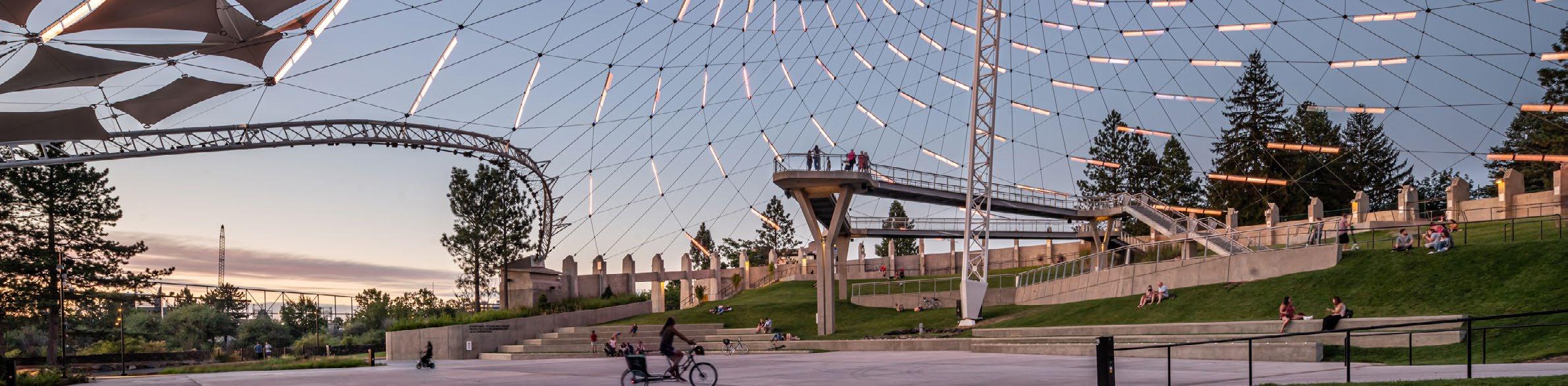
©Lincoln Barbour Studio
SE 2050 | 2026
DCI Engineers is a national firm with 20+ regional offices, providing structural, civil, bridge, survey, specialty engineering, and sustainability services. While our structural division has taken on the primary efforts for our SE 2050 goals, we see sustainability as a full-spectrum service, informing best practices across disciplines internally and across the industry.
It’s with this mindset that we have the opportunity to effect change in the built environment and build for a more sustainable future across the board.
Since signing onto SE 2050 in 2021, we’ve been more committed than ever to understanding the environmental impact of our structural engineering decisions and using that knowledge to impact meaningful change in the building industry. Since our 2025 ECAP report, we’ve made strides to educate staff, develop internal infrastructure to more readily influence embodied carbon reductions, and standardize our life cycle assessment processes while advocating for net zero embodied carbon initiatives in our practice.
Look for this icon on the following pages for our achieved electives and additional accomplishments since our last ECAP.




























DCI’s
Education Goal focuses on disseminating
knowledge
to all
of DCI’s regional offices, making information and access to resources more accessible. Here are some strides we made recently and what we’re focusing on for 2026:
Converted low-carbon concrete webinar into learning module on the firm’s digital education platform.
Expanded material specific guidance resources on the firm’s internal platform to highlight new low-carbon technologies and improve procurement strategies.
Identified opportunities to incorporate sustainability language and goals into the firm’s internal Project Manager Training Courses.
Continue compiling company-wide webinar on compiled lessons learned & resources for embodied carbon reduction based on project experience and internal research.
Improve annual Embodied Carbon 101 On-boarding webinar based on past feedback and expand course requirement to all DCI employees for continuing education.
Hold regular panels and roundtables with frequent clients to discuss importance of sustainability work, strategies for improved collaboration, and share lessons learned.
Part of DCI’s Continued Education efforts will include regional hands-on research and activities to deepen the firm’s understanding of embodied carbon reduction strategies. These include:
• Review industry research, resources and lessons learned
• Monitor green rating systems, codes, incentive programs and regulations updates for applicability
• Collaborate with industry groups and material suppliers to further our understanding of potential embodied carbon reduction strategies
• Perform research to identify effective embodied carbon strategies and technologies across several regions, materials and building types
This past year we focused on internal education, streamlining our previously recorded educational content into courses with quiz questions that new staff are required to take (and pass). This proved beneficial because new hires were not only engaging with the material, but they were also providing us feedback on what resonated and what felt irrelevant or needed further elaboration. We also incorporated sustainability content into our project management training, and the most common feedback we received is that sustainability checklists and summaries of sustainability considerations would be useful in project decision-making.
Looking ahead, DCI’s sustainability group is committed to translating our widespread knowledge into tangible, user-friendly resources for staff of all experience levels and titles.
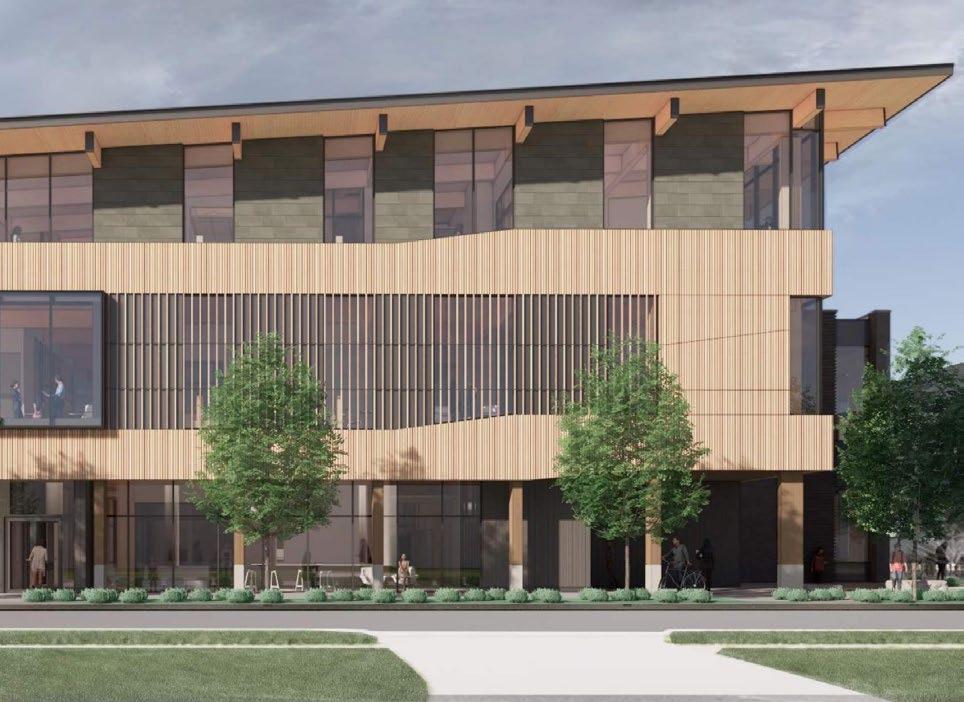
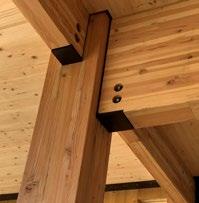
DCI is looking to lead the industry in low-carbon design. This includes experience in 180+ mass timber projects (and counting), along with circularity, adaptive reuse, and top-down structural design efficiencies as overseen by our regional sustainability leaders. See below for some of our goals for 2026!
Last year, DCI developed our embodied carbon baseline to establish a benchmark for tracking progress as we target net-zero by 2050. Over the next year, we plan to utilize our new regional leadership group to expand our reporting and oversee projects at a wider scale. Using a new standardized sustainability review system, our regional leaders will be able to achieve embodied carbon reductions faster, which will increase the number of projects reviewed. As we grow our pool of data, we will continue to identify active steps for reducing our design impacts and improve internal standards.
Revitalized structure of sustainability leadership with new regional leaders and expanded committee roles to better support every office and projects nationwide.
Developed internal reduced carbon structures checklist for sustainability reviews that span all design phases and utilized the checklist on five (5) pilot projects.
Collaborated with industry partners on case studies to identify opportunities to greatly reduce embodied carbon on high-mass building types such as data centers, parking garages, and warehouses.
Work alongside our industry collaborators to improve our low carbon specifications to encourage low embodied carbon procurement strategies while being mindful of material health requirements necessary for circularity and reuse (such as avoiding red-listed ingredients).
Conduct internal sustainability reviews for all major projects exceeding 100,000-gsf at the 100% Design Development or permit-stage milestones, with the aim of establishing an embodied-carbon baseline for every building over 100,000gsf.
Actively participate in project design sustainability charrettes to identify potential design considerations impacting embodied carbon and provide recommendations.
Continue to collaborate with concrete suppliers to reduce embodied carbon through coordinated discussions with the architect and contractor to optimize performance criteria and mix design efficiency.
Maintain current GWP targets in project specification templates, updating as new EPD data becomes available.
Develop concrete commissioning services for projects to mitigate risk, decrease costs, and reduce embodied carbon in concrete.

Developed Embodied Carbon Reduction Kick-off Checklist for staff use.
Developed Reduced Carbon Concrete Design Checklist for staff use.

Incorporated (Data analytics platform) sustainability dashboards into project sustainability review process to better visualize data.
Expanded GWP targets for materials beyond concrete/cement based on recent industry average EPDs.
Updated dashboards on for project level assessments, comparisons, and tracking alongside our internal embodied carbon baseline.
Develop multi-approach design guidelines based on Carbon Leadership Forum’s “Embodied Carbon Pathways to 2050 for the United States” report, for a holistic approach incorporating our current efficient design practices with material substitution, circularity, carbon capture, and beyond.
Create low-carbon concrete design checklist with bestpractices for all engineers to reference during early project design.
Compile regional rules of thumb & guidance for the most common structural materials and building types based on lessons learned from project experience & LCA research.
Expand guidelines and resources, from whole-building new construction to tenant-improvement projects, site structures, and adaptive reuse.
Established purchasing guidelines to reduce singleuse plastics in all offices, as well as clear signage for recycling, composting, and trash disposal as applicable in all 20+ DCI offices.
Update staff biannually on company progress towards 2050 net-zero target utilizing tableau benchmarking dashboards.
Develop travel guidelines to reduce carbon emissions on site-visits, conferences, and retreats, while exploring carbon offset programs.
As a national firm, DCI recognizes that embodied carbon reduction strategies are not one-size-fitsall solutions. Location, occupancy, and construction type significantly influence material selection, requiring us to draw on both project-specific insight and regional market experience to identify the most effective structural systems. When engaged early in the design process, our teams consistently uncover design efficiencies that reduce embodied carbon while also delivering cost savings.
To support this approach, DCI has established regional sustainability leaders to drive embodied carbon reduction through internal knowledge sharing, sustainability reviews, project-level implementation of reduction strategies, and the advancement of more sustainable internal operations. Their involvement in local projects enables stronger relationships and more impactful outcomes, while also progresses lessons learned to future projects—both within their communities and across the firm.
With five years of data as our foundation, DCI leverages quantitative insights to assess current performance and drive the integration of design standards. This data-driven approach will refine our understanding and position us for continuous improvement and innovation in 2026 and beyond.
Increased data reporting from five projects in 2021 to six in 2022, 11 in 2023, 13 in 2024, and eight in 2025.
Reduced data gaps realized in the 2025 benchmarking exercise to better identify trends for reduction paths moving forward.
Continue developing Reduction & Reporting Targets from internal embodied carbon baseline, project averages, and high-level takeaways.
Report data for at least five projects from each of our seven regions overseen by the recently-appointed regional sustainability leaders.
Developed a report template for both internal and external distribution of embodied carbon data, to streamline reporting efforts.
Matched new SE2050 template inputs to other DCI data visualizations, such as dashboards, spreadsheets, and internal embodied carbon tools.
Case Studies Published:
• Knife River Precast Data Center
• Woodworks’ 1510 Webster Report
• Woodworks’ Light-frame LCA Optimization
Continue to refine Revit-to-LCA software workflow and project date entry with assistance from our second sustainability intern as part of NZELI grant program.
Develop internal database of material EPD’s and regional design assumptions based on aggregated historical data.
Increase number of engineers conducting LCA’s on projects to boost reporting and education with oversight from regional sustainability leaders.
Upcoming Case Studies:
• University of Washington’s Heartwood and R&D Modular Mass Timber LCA White Paper
• WoodWorks’ LCA Reports for
• Beacon Hill
• Bush Middle School
• Knife River Precast Parking Garage Case Study

ACHIEVEMENTS SINCE 2025 ECAP 2026+
We primarily utilize industry average product information in our analyses per CLF’s Baseline Reports. When industry-wide data sources don’t exist, we coordinate with manufacturers and industry groups to determine proxies that most accurately represent the material’s impact. For our embodied carbon baselines, we use One Click LCA’s Life Cycle Carbon tool and report modules A1-A5 (only estimated material wastage), B1-B5, C & D. Currently, we’re integrating projects into our baseline at the end of construction documents but are starting to gather more information at the Design Development stage and using this to advise on design decisions in schematic design & conceptual design.


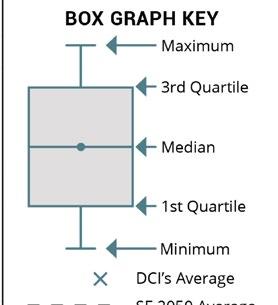
Last year, we stepped back to establish an internal embodied carbon baseline, evaluating Global Warming Potential (GWP) impacts across our projects by area, primary material type, and building sector. This baseline provides a benchmark for tracking progress as we advance toward net-zero embodied carbon structures.
Our current average cradle-to-gate (stages A1-A3) impact is approximately 173 kg CO2e/m²—about 36% lower than the SE 2050 reported average of 270 kg CO2e/m² (Source: Executive Summary of the SE 2050 Commitment Program 2023 Data Analysis and Findings Report). The 43 projects included in this dataset represent a meaningful step toward our goals, and with the inclusion of more recent submissions, we are demonstrating a 10% reduction relative to last year’s baseline.
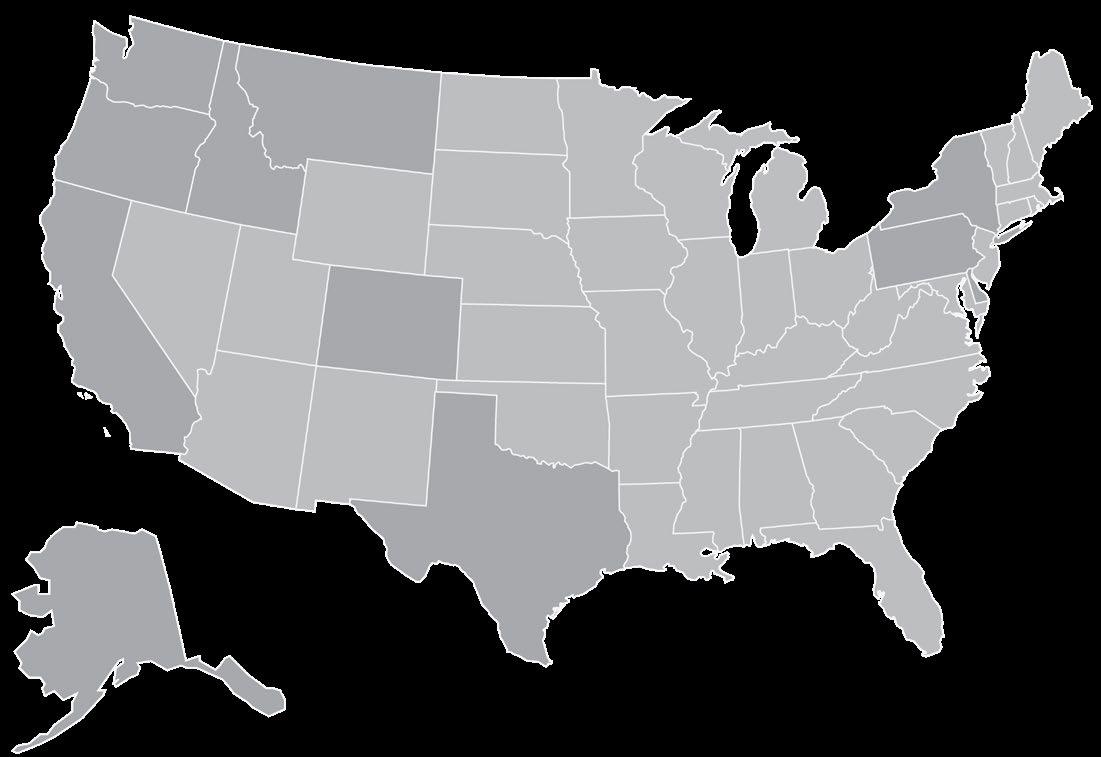
We recognize that, given our national footprint and diverse project portfolio, gaps remain in our data coverage. These gaps will be addressed in the coming years as participation expands. Early indicators suggest that as our dataset grows, overall performance across our portfolio is exceeding initial expectations. As illustrated in the accompanying map and graphs, several regions and project types are not yet represented. Moving forward, we will continue to increase the number of projects analyzed annually to capture this work, diversify the dataset, and more accurately reflect the full scope of DCI’s portfolio.
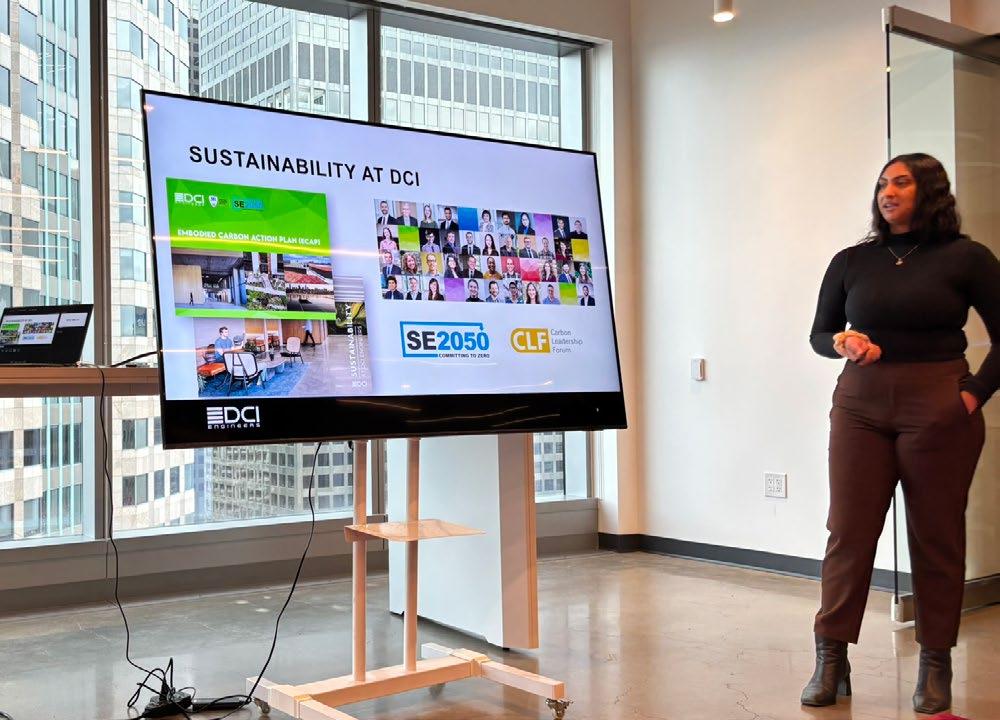
We hold industry-wide knowledge sharing in high regard and will continue to seek out opportunities that allow us to share our knowledge with a wide variety of clients, peers, and industry groups. Learn about what we focused on in 2025 and what we’re expanding on moving forward:
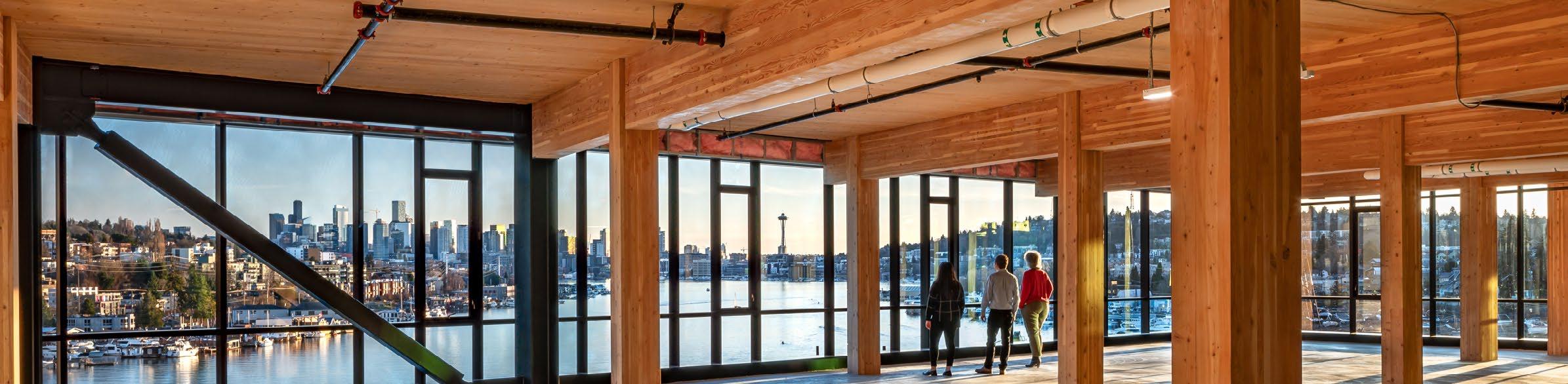
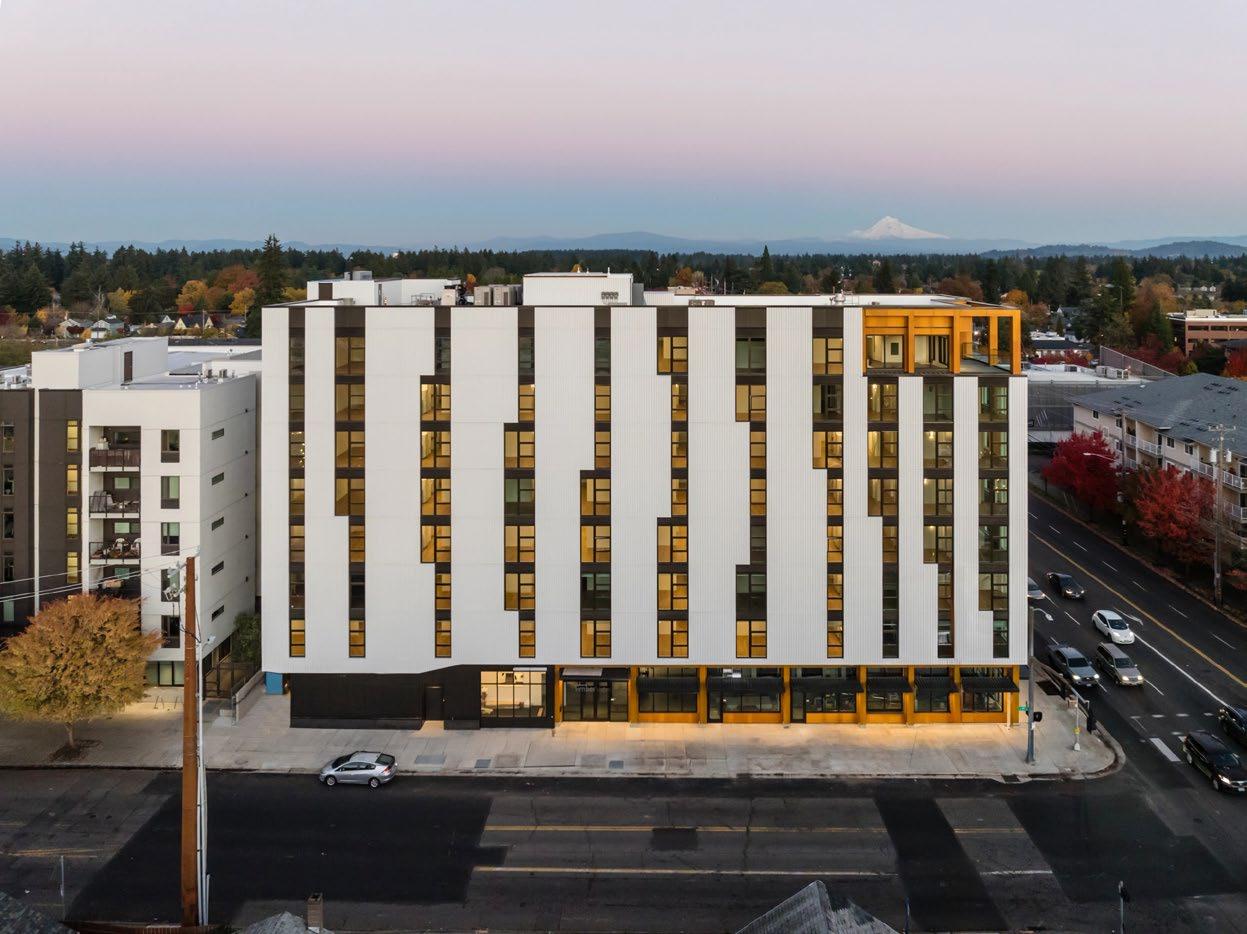
Achieved material reduction through layout efficiencies on 11111 Jefferson project in Culver City, CA by reducing firetreated lumber demands at exterior walls through cantilevering wood diaphragms and running joists parallel to exterior walls, utilizing a partial podium to reduce concrete quantity, and eliminating seismic gaps at hybrid concrete-wood podium.
Provided feedback for LEEDv5.
Provided feedback and advocated for the inclusion of the WA State Building Code Embodied Carbon Appendix proposal.
Participated in the New York City Mass Timber Accelerator Program
Industry Presentations
• Nucor National Webinar
• AIA 2025 Conference
• International Mass Timber Conference (2025)
• Mass Timber Plus Conference
ADVOCACY
We can’t stop bragging about our SE 2050 Commitment! We’ve been mentioning our involvement in our email signatures, in all our company-wide fee proposal templates, on our company website, and during client lunch & learns since signing onto the program in 2021.
DCI teamed up with several higher education institutions to spread the message of reduced embodied carbon, including: University of Washington, University of Colorado Boulder, Cal Poly, the University of Southern California & the Southern California Institute of Architecture. We worked with Foundation Communities (an affordable housing developer in Austin) on red-list free material specifications, and advocated for MEP2040 and design for freedom through partnership with CLF.
Sustainability Specialist and Senior Project Manager, Arizona Dabrusin Co-Leads the steering committee for the CLF Austin hub while also helping lead the policy group in the larger CLF Texas HUB. He participated in the inaugural CLF Embodied Carbon Policy Summit in Boston with other industry leaders across North America to learn new advocacy strategies for better policies and legislation moving forward.
Senior Project Manager and Sustainability Committee Co-chair, Salma Syed is involved in the CLF Los Angeles hub. She is also an adjunct faculty at SCI-Arc, teaching structures 1 and 2 to Masters of Architecture 2 students. Salma recently dedicated one whole lecture to sustainability/embodied carbon reduction.

We continue to offer a range of AIA-approved presentations and regularly update our educational resources, incorporating lessons learned from project experience, client feedback, and new industry developments.
Upcoming Presentations
• RIOS and AC Martin embodied carbon educational presentations
• Data Center & Investment Conference & Expo (DICE) *in planning, but not confirmed
• NASCC 2026 Case Study Presentation
• 1.5dC Climate Symposium, Los Angeles 2026 (Sponsorship)
Support of Washington State Building Code & International Building Code Embodied Carbon Appendix proposals.
Support for new Mass Timber accelerator programs across the country.
Support proposed California SB 755 - California Contractor Climate Transparency Act legislation.
Support proposed legislation in Connecticut, NY, and Pennsylvania calling for embodied carbon reduction plans and promotion of low-carbon material procurement
Through our advocacy efforts at DCI, we recognize the urgency of addressing embodied carbon across the industry and the importance of sharing knowledge with our peers. As new requirements emerge through green building rating systems, regulations, building programs, and incentive initiatives, we apply our practical experience to thoughtfully review these frameworks and share lessons learned and recommendations for effective implementation.
DCI will continue to pursue advocacy opportunities within our communities through engagement with higher education programs, conference presentations, client lunch-and-learns, participation in local industry groups, and support of embodied carbon legislation. Through these efforts, we aim to accelerate industry-wide progress and help propel the built environment toward the 2050 decarbonization goal.