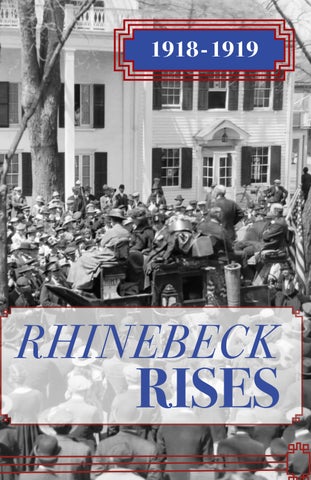
1918 - 1919
rhinebeck
RISES
Starr Cinema at Upstate Films
We are doubly favored by Upstate Films allowing us to hold this event at Starr Cinema. First is the obvious generosity of their support. Second is that it was within these walls, during World War I itself, Rhinebeck came to learn about the War. In the first week of April 1917, with a declaration of war only days old, the pictures shown in this hall added a one-reel film called Making a U. S. Soldier on the screen, and the Rhinebeck Gazette printed its opening title: “if you value that priceless heritage of freedom, you should be prepared to defend it.” Through the two years that followed, residents came here to be educated; they came to be entertained. They came to celebrate. They came to find comfort in difficult tim The building was already old by then. The Starr Institute opened in 1862, in the middle of the Civil War, the gift of Mrs. Mary R. Miller in memory of her husband, Congressman William Starr Miller. She had tried the idea of rented rooms in 1857, then built this hall and deeded it to its trustees for “the intellectual and moral improvement of the inhabitants of the town of Rhinebeck,” with a library, a reading room and a performance hall where the Village gathered for a century of lectures, concerts, meetings and, in time, moving pictures.
This cinema, among the earliest places in Rhinebeck to see movies, is the oldest continuously operating cinema in the Village. The library moved to its own building on the hill in 1975; Upstate Films opened three years earlier, in May 1972, and has kept the lights on ever since. Tonight, the very hall that helped the Rhinebeck community get through the “Great War” helps us appreciate the men, women and children, who rose to the challenge to do so, including the many veterans who served. Bill Jeffwa , Executive Director Dutchess County Historical Society
We Are Very Grateful For Our Generous Sponsors
$1,500 Ulster Savings Bank
$1,000 Beekman Arms Lisa Ford Harry H. Hill III Rouse &Co Real Estate Rhinebeck Bank Illiana van Meeteren
$500 Elijah and Christiane Bender Dutchess County Agricultural Society Foster’s Coach House Tavern Kirshon and Company, P.C. Law Offices of Rodenhausen Chale & Polidoro LLP Stewart’s Shops Teahan & Constantino LLP Upstate Down Village Construction W.A. Smith and Son, Inc. Insurance $250 Calvert Vaux Preservation Alliance Burton Kassell Hudson River Heritage Law Office of Karen Tobias The Law Offices of Steven M. Melley, P.L.L.C. In Memory of Arthur, Chet and Desa Haen From the Traudt Family
Special thanks to the Board of Trustees of the Dutchess County Historical Society and to Trustee Harry H. (Huck) Hill III for leading the Sponsorship Campaign.
Welcome to Rhinebeck in 1914 Memorial Day 1914 found the Village of Rhinebeck on the precipice of dramatic transformation. From the Village’s beginning as the settlement of Rhinebeck Flatts in 1688 through its incorporation as Dutchess County’s second village in 1834, Rhinebeck enjoyed steady growth. As a seat of power for the County’s leading families during the colonial era, Gilded Age elites transformed adjacent areas of the town into a line of riverside estates. Located at the intersection of key transportation routes, roads, ferries, docks, and the railroad fed towards the Village. The demands of commerce and the”River Elite” ensured the Village remained a prosperous place. The geography of the Village we know today had largely been established by 1914. Three of the four corners of the Village Center remained unchanged. The Beekman Arms was where it stood since the 18th century, with 19th century commercial buildings on two of the other corners. The fourth, now vacant, known as the White Corner in 1914, was home to buildings. The streetscapes were much the same as today. Running north and south was Post Road/Montgomery Street, while Market Street followed the line of the 19th century turnpike. The latest addition was what we now know as the Dutchess County Fairgrounds. Originating in the Van Keuren Farm of the late 18th century, the site boasted a race track by 1876. At a meeting at the Starr Library in 1901, leading citizens formed the Springbrook Driving Club to operate the venue, then owned by the Reed Family. In 1907, other local leaders established the Rhinebeck Realty Company, with the intent of securing vital parcels of land to serve the Village. Its first official act was to p chase the Van Keuren-Reed Farm, which would host the Dutchess County Fair of 1919. The enduring built environment of Rhinebeck may lead some to view the film footage as an ode to the illage’s timeless nature. While continuity is present visually, these reels have a powerful message about how change is possible over a short space of time. On that Memorial Day in 1914, the surviving Civil War veterans could have told stories overheard from their grandparents speaking about service and sacrifice during the Revolution. The children listening to those stories could go on to live and fight through later wars. Technological innovation was arriving in the area; later that year, the new Rhinecliff Station would open to connect automobile traffic to the Kingston Fer .
Created in a Rhinebeck more 19th century than 20th, the films showing airplanes, modern cargo trucks and a tank are harbingers of the fast-paced change ahead. An enduring value of these films is the window into the spirit of Rhinebeck between 1914 and 1919. We see an outpouring of community spirit against a background of a rapid technological and societal shift. Residents of all ages parade across the screen, participating in civic festivals and patriotic rallies. There is an undeniable sense of excitement and pride in locality, even in the face of the crushing costs of the First World War. The example given to us by our ancestors reminds us that by understanding the “local past,” we can better understand our own time and how our choices inform the parameters of the lives that come after us. These films einforce that Rhinebeck endures as a vibrant, vital community that represents the very best of Dutchess County. William P. Tatum III Dutchess County Historian
Booklet articles contributed by William P. Tatum III, Melodye Moore, Michael Boden, and Haley Brown. Edited by Melodye Moore. We are always grateful for our members, who make all our programming possible. To learn more about becoming a member, please visit our Ways to Join page: https://dchsny.org/secure-pay/
Introducing the Pathéscope The original film material befo e you today is the remarkable digitization of an unusual film format: 28 millimete . An extension of the French Pathé company, the new Pathéscope ecosystems of 28 mm cameras were distributed and marketed in the United States beginning in 1913. The Pathéscope offe ed several advantages to the film format, a elatively new concept. Firstly, the models of cameras being sold were explicitly marketed to amateur filmmakers. Many regard 1917 as the inception of classical Hollywood, and by 1918, film had g own to the United States’ fifth largest industr , but the migration of the camera into the home was slow to follow. Film cameras were expensive, cumbersome, and dangerous: the standard format of film was 35 millimete , which up until the 1950s was made with cellulose nitrate, the same active ingredient as gunpowder. Pathé developed a unique product ecosystem built around 28mm film, a safer and non-flammable alt native. Any video taken on 28mm could be shot for longer than average 35mm toy cameras on the market, and the safety of the film stock itself allowed or the construction of home film libraries and a chives. Released in 1912, the 28mm Pathé-Frères KOK Cine Camera was advertised for amateur audiences, selling for roughly $39.00 dollars, or $1,354 dollars today. Film reels were 20.5 frames per foot, a highly economical advantage to other film formats, allowing for long t kes and longer films. The camera was equipped with a tripod and a 45 mm lens that could be focused at normal range, meaning that the filmmaker could c eate visual records of family, community, and events with relatively little construction and set-up. The Pathé company would develop with the amateur filmmaker in mind, eproducing Hollywood films to play on the ne , safe 28 mm format in Pathé projectors. By 1918, the KOK Cine Camera had sold over 10,000 models, with over 25 million feet of positive film. Kodak s development of the 16mm format in the 1920s, and a World War economy, would lead to the eventual phasing out of the Pathé company’s innovations, but digitizing efforts allow us to view these films. The democratic nat e of the amateur films continues into mode nity as we watch these recovered materials, allowing insight into a preserved moment in time and history not lost to technological development.
The Liberty Ball Comes To Rhinebeck When the United States finally ente ed the First World War on April 6, 1917, Americans who were previously critical of the Country’s role in world affairs came together with a unity of purpose that would be necessary if the war were to be won. To do so would require what Secretary of the Treasury William McAdoo said in a speech to the nation shortly after war was declared: “We must be willing to give up something of personal convenience, something of personal comfort, something of our treasure – all, if necessary, and our lives in the bargain, to support our Noble sons who go out to die for us.”
Money was needed to fund the war. One of McAdoo’s solutions was to tap into patriotism and launch what the Federal Reserve called, “the greatest advertising effort ever conducted.” McAdoo’s plan was to convince the public to buy Liberty Bonds through transactions called Liberty Loans. Essentially, the money exchanged for a bond was a loan to the federal government. That money would be used to finance the wa , and when the bond matured, the bond purchaser would be paid back with interest. There were four Liberty Loan campaigns during the Great War, two in 1917 and two in 1918. Each of the campaigns lasted between four to six weeks.
Rhinebeck’s goal for the Third Liberty Loan Campaign was set at $98,400 and Tracy Dows was tapped to be the chair of the Campaign Committee. Subscriptions for bonds could be made at the 1st National Bank, the Rhinebeck Savings Bank or the Rhinebeck Gazette office. The campaign detailed what could b funded at the various levels of subscriptions: a $50 bod would underwrite one rifle; 400 ounds of ammo or 16 gas masks; a $1000 bond could buy two machine guns or 150 woolen blankets; and a 6” gun could be purchased by a $10,000 bond. The headline in the April 13, 1918 Rhinebeck Gazette drove the urgency of the campaign home – “LIBERTY BONDS OR GERMAN BONDAGE, Subscribe Now.” A large clock was erected at the northeast corner of the 1st National Bank to record the progress of the campaign. Lit at night, it was visible and inspirational to all passing by. Innovative promotional and propaganda strategies inspired patriotism and opened pocketbooks. One of the most innovative ways of involving the average citizen in the fundraising effort for the Thi d Liberty Loan Drive was created by the Second Federal Reserve District that spanned New York. The idea was for a “Liberty Ball” to cross the state, travelling the 459 miles from Buffalo to New ork City, and literally rolling through twenty-one counties and more than 80 communities.
The ball was seven feet in diameter, built of steel, covered with canvas painted in alternate red and white strips. It was accompanied by a colorful flag that bo e the message “Help Push the Liberty Ball from Buffalo to New ork. Every Bond You Buy is a Push Towards Winning the War. Keep the Ball Rolling.” Escorting the ball was an elegant coach named “Liberty,” that was drawn by four white horses. The turnout was the property of Mrs. Alfred Vanderbilt, whose husband had died in the sinking of the Lusitania in 1915. At every stop along the way, cities, towns and villages rolled out the red carpet to outperform their neighbors. The Liberty Ball rolled into Rhinebeck at 5 p.m. accompanied by the Boy Scouts on Saturday, April 27, having crossed the Hudson River from Kingston on the 4:30 ferry. One hundred and twenty decorated cars were reported to have met the Ball at the Rhinecliff Ferry Landing. The Ball was exhibited in Beekman Square until 7 p.m. when it was carefully stored in the Beekman Arms stable. Early Sunday morning, Village officials went to Kingston t meet the coaching party and Mueller’s Military Band of Kingston which joined the parade lineup on West Market Street. The Rhinebeck Police led the parade, followed by the military band, and an enormous American flag carried by the boys of the Chorister’s School. Seven dollars in coins were tossed into the flag during the parade and the money was given to the Rhinebeck Branch of the Red Cross. Next in line was the Liberty Ball, pulled by the Boy Scouts, followed by the “Liberty” coach. Every organization in the village and town was represented in the parade – churches, schools, fraternal organizations, Boy Scouts, the Red Cross and municipal officials. Chil en from the Holiday Farm, the Astor Home for Children, established by Vincent Astor in 1914, were thrilled to participate in the parade in two auto stages. The entire parade, described in the Rhinebeck Gazette as an “endless ribbon of red, white, and blue” stretched two miles as it wove through the village. Following the parade, a public concert was held while the dignitaries lunched at Beekman Arms. At 2 p.m., the coaching party departed the village for its next stop in Hyde Park while the band played the “Star Spangled Banner.” The day ended with a patriotic service held at the Rhinebeck Reformed Church.
The May 4th edition of the Rhinebeck Gazette reported that the “monster celebration and parade exceeded all expectations’ and over $30,000 was subscribed. Previously no community had raised more than $11,000 through bond sale. When the campaign ended, the citizens of Rhinebeck and northern Dutchess had subscribed $277,950, nearly trebling its allotment. There were 641 subscribers and the average subscription was $433. The community had come together in an extraordinary way and far surpassed any expectations it might have had prior to the end of the 3rd campaign. A most surprising postscript – Staff of the Rhinebeck Savings Bank and the Dutchess County Historical Society have recently discovered the original subscription ledger that was kept by the Bank during the 3rd Campaign. Research will undoubtedly uncover invaluable new information.
The First World War and Rhinebeck Film Reels
A particularly unique feature of the films is the p esence of so much military equipment, not to mention the frequent observation of men in US Army uniforms, both in formation, as during the parade, and elsewhere. Of the equipment, the M1917 Tank stands out. First produced in late 1917, permission to produce the 2-man M1917 was provided by the French government, based on the expected need for the US Army to develop its own tank force during the First World War. The model is based on the popular Renault FT-17, widely considered to be one of the most revolutionary tank designs in history, primarily due to its rotating turret. The M1917 earned distinction as the first US-built tank to be mass-p oduced. As production of the M1917 slowed throughout 1918, US forces turned toward the original French Renaults to equip the nascent American armored force in France, eventually utilizing about 200 of them in combat operations. The M1917 itself never appeared on the battlefield, and only 10 of them even arrived in France, the first ones 9 days after the Armistice was signed ending the war. Eventually, about 950 M1917s were produced before production was halted in late 1919. Those produced saw post-war service throughout the United States as part of domestic policing (anti-riot) operations. Given that these tanks were prevalent throughout the US in the immediate aftermath of the war, it is not surprising that one should find its way to Rhinebeck While very similar to the original Renault, the tank in the movies can be clearly seen to be an M1917 by two features: the polygon turret (Renault turrets are round), and the left-hand engine exhaust (Renault exhausts are on the opposite side). The main armament of each vehicle was also dissimilar, although the primary weapon of this vehicle has been removed to facilitate the Tank Commander’s vision.
Additionally, the appearance of so many 3-5 ton Liberty Trucks is also noteworthy. In a similar fashion to the M1917, Liberty Trucks (officially the “Class-B Stand dized Military Truck”) were the first motor vehicles p oduced and adopted solely by the US military, and eventually somewhat around 14,000 of them were built, across 15 factories in the US, 3 of them in New York (Cortland, Rochester, and Buffalo). Of those, just over 9,000 were produced prior to the armistice, and few of those ever saw front line service. It is also of note that Liberty Trucks were the largest and “heaviest” of American military trucks during the war, and its capacity would not have been able to bear the 7.5-ton load of the M1917. The truck that the tank drives onto in the film, then, is a non-military, commercial vehicle, and not an Army vehicle, let alone a Liberty Truck. The airplane featured in the film, Arthur Haen s Curtiss JN-4 Jenny, was an aircraft that could serve many purposes. The Curtiss JN series, particularly the JN-4 series, was a workhorse for the United States, before, during, and after American involvement in the First World War, with almost 7,000 produced between 1915 and 1927. The Jenny could be used in a variety of functions, most commonly as a training aircraft for the developing US Army Signal Corps, Aviation Section, but also as an observation platform and occasional bomber.
These aircraft were also the first to deliver air mail for the postal service, and after the war were favorites of barnstormers and stunt pilots. Perhaps the most striking feature of each of these three vehicles we see in the film is way each would have been perceived by the people of Rhinebeck. Tanks were a new battlefield phenomenon and had only been in the public’s eye since the Fall of 1916, so the opportunity to see one – and an American-built armored vehicle at that – would have been a remarkable opportunity. The novelty of such a tool of war being in town was certainly a major contributing factor to the crowd that was in constant motionaround the tank, getting disconcertingly close to the tracked vehicle, whose driver had only a limited sightline from his compartment. Likewise, while automobiles and trucks were regular sights, it cannot be overstated how awe-inspiring it would have been to see dozens of the Army’s largest trucks, and backbone of the American motorized war effo t, driving around town. Even the opportunity to see an aircraft in flight must have been a rare opportunity for the people of Dutchess County. It cannot be overstated how amazing it must have been to the people we are watching to be able to interact with these particular pieces of American military ingenuity. Some of these reels were filmed at the end of the wa , and some shortly after its completion. In either case, during a time of great change in America, the First World War was still at the forefront of people’s minds, and having pieces of that conflict so close to home must have been a remarkable experience.
“Rhinebeck’s Daring Young Birdman” Who was the smiling young aviator? Arthur D. Haen. One of John and Marguerite Haen’s ten children, Arthur was born in Rhinebeck, graduated from Albany High School and enrolled at Cornell University, a member of the class of 1919. But on June 14, 1917, he entered the Aviation Section of the US Signal Corps and trained at the Princeton Ground School. He traveled to Tennessee, West Point, Mississippi, and finally to Mitchel Field on Long Is and, where hundreds of aviators trained for the war effort and Curtiss JN-4 Jennies were a common sight in the sky. Haen became a skillful and daring aviator, and he was invited back to his hometown to help promote ongoing fundraising efforts for the war as part of the September 14, 1918 field da exercises of the Red Cross at Springbrook Park, today’s Dutchess County Fairgrounds.
He was invited back to his hometown to help promote ongoing fundraising efforts for the wa . Haen and another pilot would fly from Hempstead, N.Y. on Friday with the exhibition scheduled for 2 p.m. Saturday. Admission was $.25 with the proceeds to be divided between the Red Cross and the Home Defense Corps. Members of the Defense Corps would to protect the valuable plane. A band of sixteen pieces was scheduled to play. And, in light of the rarity and importance of the event, local shopkeepers agreed to close their businesses between 1 and 5 p.m. The September 21st edition of the Rhinebeck Gazette gave a full account of the the day’s activities. After an one hour and twenty-minute flight to Rhinebeck, Haen then took off to fly ov Kingston and Poughkeepsie, dropping handbills announcing the exhibition. Fifteen hundred people and 250 automobiles poured into the park to see the “fancy flying” of the Curtiss training planes. The flight was not without mishap; Haen s propellor broke after landing and luckily, a new one arrived the following day. After repairs were made, the two pilots prepared to leave and as Haen reached 3000 feet, he observed the second plane land in a corn field along the state oad in Astor Flats, north of the Village. The problem engine was overhauled on Monday but bad weather on Tuesday delayed their departure.
In the meantime, Haen entertained the residents by executing his “best flight,” which included a tail spin. So thrilled ere the Red Cross and the Home Defense Corps of Rhinebeck that they presented Lieutenant Haen with a Boston Bull pup as a mascot for the 51st Aero Squadron. How the pup got to Camp Mitchel is unknown, but he was decorated with ribbons and a collar, and accompanied with a poem which read “To Arthur Haen I’m tagged to go, A whole town’s gratitude to show, That’s some ambition for a pup, I’ll do my best as I grow up, If any one had asked of me, The thing I liked the best to be, an airman’s mascot I would say, I’ll never fail him night or day.” The euphoria of that September weekend was not to last. The December 24th edition of the Poughkeepsie Eagle-News carried the sad news that “Lieut. Haen Succumbs to Pneumonia. The Young Aviator’s Spirit Crosses Life’s Horizon in Final Flight.” The pneumonia was likely a result of the Spanish Flu pandemic that was gripping the world. His body was returned to Rhinebeck with a military escort and his funeral took place at the Rhinebeck Reformed Church. He was 25 years old and was survived by five brothers and four sisters, his parents having both recently passed away. The Eagle-News article, referencing his visit home in September, summed it up – “The daring young birdman held the crowd spellbound by his feats in the air.”
Lieutenant Haen’s military footlocker was kept by his brother A. Chester Haen, a prominent Rhinebeck businessman, and is now in private ownership. Haen’s broken propellor was saved and is now in the collections of the Museum of Rhinebeck History.
The Welcome Home At the 11th hour, 11th day, 11th month of 1918 the Great War ended, leaving 9 million dead and 21 million wounded. While the “war to end all wars” was over, it took until mid-1919 for many to actually return home. It wasn’t until September of 1919 that the last American combat units left Europe.
As the summer of 1919 approached the citizens of Rhinebeck, began planning what the Rhinebeck Gazette would later call “the most picturesquely bewildering parade” ever in the history of the town. “Welcome Home Day” was appropriately set for July 4th, 1919, and a professional decorator was hired to plan the decorations that would grace Beekman Square, the Town Hall, the Beekman Arms, the Realty Building, the banks, the Women’s Exchange Building, and most of the village shops. Twenty-eight columns were constructed to form a colonnade surrounding Beekman Square. The columns, between 10 and 16 feet high were to serve as sentinels at the village center which was also to be illuminated with lights of various colors. A “Welcome Home” banner was to stretch across the street. It was expected that the parade would draw the largest crowd ever assembled in Rhinebeck.
The day dawned hot and humid, typical of the Hudson Valley even then. Due to precise planning, the parade stepped off as planned at precisely 1 p.m. with Grand Marshall Wallace W. Foster in the lead. He was followed by floats, decorated cars, ma chers, and the town motor truck, which was transformed into a float in honor of those from the area who had died in service. The local Red Cross branch was chosen to escort the returning soldiers and sailors. There were four divisions in the parade, each with their own band, and it followed a meandering route through the village allowing for the greatest number of residents to watch the parade from their own front yards. Villagers offe ed lawn space to those not along the parade route for parking and picnicking. In addition to the 120 returning soldiers and sailors, veterans of the Civil War and the Spanish American War were included in the procession. In all, there were 35 units. Many considered the equipage of Warren Delano to be the most exciting part of the parade. Under Delano’s skillful hands four handsome and spirited cream-colored Norwegian ponies pranced along the route drawing a high wheeled “brake.” The parade ended at 3 p.m. at Springbrook Park where panoramic photos and moving pictures were taken. A formal welcome home was offe ed by Supervisor Harry Pottenburgh, concerts continued throughout the afternoon, a ball game was played at 4:30 and at 5:30 the honored guests were treated to a clam bake. Following the clam bake folks had their choice of evening entertainment – a dance at town hall or moving pictures. Perhaps the most poignant remarks of the day were those given by Sgt. Ralph Brown, who spoke on behalf of the honored guests– the returning soldiers and sailors. Brown spoke of “going over the top” and being wounded. He recounted telling the hospital surgeon that he came from a place named Rhinebeck. Since the surgeon had not heard of the place, Brown informed him that Rhinebeck was a town that had doubled, and even trebled, its Liberty Loan subscriptions and other war work quotas. “Well, if all that is true” the Sgt. quoted the doctor, “then Rhinebeck must be a damned good place to live.” Those in attendance felt the same way.
The First Rhinebeck Fair In 1806, a group of the most prominent County residents formed an organization to promote the agricultural interests of the county. The first fair organized by the Society took place in Poughkeepsie on May 3rd, 1809. Highlights of the fair included exhibitions of cattle and sheep. Occasional fairs appear to have taken place in subsequent years, but it is not until 1841, following the passage by the New York State Legislature of “An Act To Promote Agriculture,” that the roots of the modern Dutchess County Fair were established. The act was the impetus for the formation of the Agricultural Society of Dutchess County, and officers w e elected at a meeting held on October 16th at the home of Daniel P. Emigh in the Town of Washington. On March 16th, 1842 it was determined that the Society would hold a fair of domestic animals, manufactures and articles, and produce from farm and garden. The fair was to take place on the first Wednesday in October. With a few exceptions due to World Wars I and II, economic pressures on the Society, adverse weather, and health related circumstances, a fair has been held every year since 1842. In the early years, the location of the fair alternated between Washington Hollow and Pougkeepsie. Interest in establishing a permanent home for the fair solidified in 1851, pledges we e solicited and seven acres of land in Washington Hollow were purchased in the vicinity of the current Barracks of Troop K of the New York State Police near the intersection of Routes 82 and 44. Over the next 35 years, the fair continued in this location. In 1888, the Agricultural Society’s Board of Directors made a decision to relocate the fair to Poughkeepsie. The “Queen City of the Hudson,” with a burgeoning population of 20,207, was more easily accessible, and was the home of the Hudson River Stock Farm and Driving Park. Annual fairs continued in this location until 1916 and 1917 when, during WW I, enthusiasm waned. By 1918, the Society, suffering f om the loss of fair revenue, was unable to prepay the rental fee for the Driving Park and the fair was cancelled. The following year, beer magnate Jacob Ruppert Jr., who had inherited the property in 1915, refused his consent for the Society to hold their annual fair there and the Society was at risk of losing its charter. The fair was at a crossroads. Sensing an opportunity to raise the profile of their community,
members of the Agricultural Society, who were residents and business leaders of Rhinebeck, moved quickly to ensure that the fair of 1919 would be held in Rhinebeck under the auspices of the Rhinebeck Realty and Development Corporation at the Springbrook Race Track. A total of $5,000 was secured for cash prizes, and the events focused prominently on farm exhibits rather than amusement attractions. Livestock entries and the vegetable and fruit displays would be expansive, and horse races would be a very popular feature of the fair. It turned out the most successful event of the fair was the mule race between Mrs. Roland Delano Redmond and Mrs. J. Griswold Webb, two ultrafashionable New York women with homes in the Rhinebeck area. The mules and the drivers were so evenly matched that several heats had to be run before the mule driven by Mrs. Redmond, was declared the winner over the one driven by Mrs. Webb. The New York Herald reported that “This unusual race ranks among the events that made this year’s fair memorable.”
The first day of the fair was cloudy, drizzly, and damp, but the second day dawned fair and clear, and lines of automobiles stretched for blocks. Ticket sales at the gate tallied more than 10,000 as people had poured onto the fairgrounds. Herds and exhibitors had come from all over- from the estates of millionaires and the smaller farms of average farmers. The September 20 Rhinebeck Gazette marveled that the livestock enclosure resembled a stock yard in a “city of tents.” There was general agreement that the fair should return to Rhinebeck the following year, and it has been there ever since.
The Dows Photographic Collection of the Dutchess County Historical Society Tracy Dows was an influential Rhinebeck leader in the early decades of the 20th century. He moved here in 1907 following his marriage to Alice Olin, and together they developed Foxhollow Farm, south of the Village. Dows was active in many local and civic organizations, such as the Rhinebeck Realty Corporation, the Cemetery Association, the Rhinebeck Savings Bank, the WW I Draft Board, and the Dutchess County Historical Society. He was one of members of the Dutchess County Agricultural Society that was instrumental in bringing the fair to Rhinebeck, and was instrumental in the renovation of the Beekman Arms in 1917, just prior to the events depicted in the movie reels. Dows was an avid photographer and he can be seen in the movie reels, in some cases with his camera in hand. From the early 1900s through the 1930s, he filled over two dozen photograph albums with images of his family, his property, his travels, and his hometown – Rhinebeck. Many of the still images incorporated into the movie were taken by Dows. In 1994, his daughter, Deborah Dows, bequeathed her father’s albums to Hudson River Heritage. In May of 2022 the Hudson River Heritage Board of Directors voted to relocate the Dows Collection, including photographs, diaries, countless letters, and books, to the Dutchess County Historical Society. A comprehensive catalogue of the 1,757 individual photographic images has been completed by volunteer Sharon Sherrod. The next step is the digitization of the photographs so that they can be fully accessible to researchers. Bids for this work are being obtained and DCHS will be seeking grants and donations to undertake the project. These albums are an irreplaceable depiction of Rhinebeck in the early years of the 20th century. Your support would be greatly appreciated. For further information please contact Executive Director Bill Jeffway at bill.jeffway@dchs .org. You may also make a secure donation online at dchsny.org.
The Third Liberty Loan outside the building that is today Foster’s. Photo by Tracy Dows.
Outside the Starr Institute building during the Third Liberty Loan parade. Photo by Tracy Dows.
Rhinebeck Historical Society Newspaper Digitization Project
Much of the research for this booklet and the movie script was made possible by access to relevant issues of the Rhinebeck Gazette, the local newspaper that was published weekly from 1846 – 2009. Thanks to the Rhinebeck Historical Society, all issues up to 1947 have been scanned and are searchable at no cost at https://www.rhinebeckhistoricalsociety.org/archives. By December of 2026 the RHS will post the years from 1948 – 1968. To complete the project another $85,000 needs to be raised. Contributions by check payable to RHS would be most welcome, mailed to RHS, PO Box 291, Rhinebeck, N.Y. 12572. Designed & produced by Haley Brown