

The Edge Supplement
The Edge State of Play
Cooling at the Edge
> Liquid cooling took over data centers, now it’s coming to the Edge
The Edge criteria
> How AI’s success hinges on the success and flexibility of Edge infrastructure
Educating at the Edge
> Duos Edge wants to close the digital divide at rural schools in the US Sponsored
Contents
4. Liquid Cooling: The Edge of reason How liquid cooling has become the great enabler for high-density compute deployments at the Edge
8. Mastering the Edge How Viavi is revolutionizing network monitoring with AI-powered analytics, real-time insights, and automation to help businesses master their operations
10. Not a cookie cutter approach: The criteria for a robust Edge infrastructure How AI’s success hinges on the success and flexibility of Edge infrastructure
12. Educating at the Edge Duos Edge wants to close the digital divide experienced by schools in rural locations across the US

Sponsored by
An AI future at the Edge
As the AI market matures, the focus for many businesses is likely to shift from the training of models and tools to inference, the process of running these tools so that they can benefit businesses and consumers.
And as inference grows in importance, Edge computing could come into its own, with infrastructure located close to end users potentially offering a low latency solution to efficiently deliver AI-powered services.
Building for this AI future at the Edge will require a high degree of flexibility, according to Luca Beltramino, chief data center officer at Italian media infrastructure provider Rai Way. Required specifications are likely to vary wildly from deployment to deployment, so open minds will be needed to come up with the optimal solution, he says.
In this supplement, we feature more insights from Beltramino and Cambridge Management Consulting’s Duncan Clubb, who spoke to DCD about the requirements for building robust Edge infrastructure. As well as AI, the duo covered optimal locations for Edge data centers, as well as security, data sovereignty, and sustainability.
Cooling will also be a key consideration for anyone wishing to deploy AI at the Edge. With the market still in its infancy, a dominant cooling technology has yet to emerge, but proponents of liquid cooling say it is the obvious choice to keep Edge AI infrastructure chilled.
One of the reasons for this, the vendors say, is that
it can potentially be installed more easily in small spaces, making it ideal for remote or repurposed spaces often used for Edge infrastructure. However, splashing out on a liquid cooling unit may not be the most costeffective solution if you already have air cooling in place that can do the job. Charlotte Trueman takes a look at liquid cooling’s Edge potential.
Away from AI, Edge infrastructure is being used to help bolster the education system in rural Texas. Despite being one of the epicenters of the AI revolution, with myriad AI data center developments planned for the state, many Texans struggle for even basic Internet connectivity, and this impacts businesses and government services, including education.
A new venture, Duos Edge AI, says it has the solution with a network of containerized data centers that can be set up quickly and relatively cheaply by school districts to enable pupils to access online learning tools. It has already made its first deployment, in Amarillo, Texas, and has plans to expand its network to other school districts.
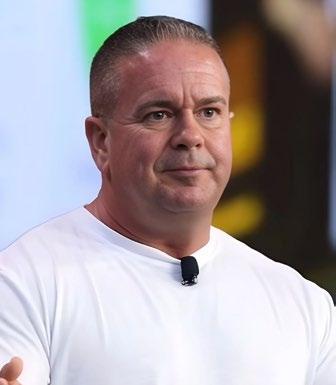
The company, launched as a subsidiary of rail technology firm Duos, is headed up by Doug Recker, an Edge veteran who has already built and sold two data center businesses. Matthew Gooding spoke to him about his mission with Duos Edge AI, and why he thinks the company can make a real difference and level up education opportunities for many young people.
Liquid cooling: The Edge of reason

Charlotte Trueman Compute, Storage, and Networking Editor
How liquid cooling has become the great enabler for high-density compute deployments at the
In 2020, then Iceotope CEO David Craig wrote an article for DCD in which he argued “the Edge has needs which only liquid cooling can satisfy.”
“As companies across almost every vertical sector begin the deployment of IT in the myriad of locations where data processing and access is required close to people and things,” Craig wrote. “These new Edge environments will not be uniform in nature but common to all will be the
need to keep the IT equipment cool.”
Five years later, Craig has retired from the liquid cooling company, but it would appear his predictions have come to fruition.
Neil Edmunds, Iceotope’s VP of product management, describes Edge as anything outside of that “super highly controlled white space that data centers typically have,” meaning that pretty much anywhere could be considered for Edge deployments, given access to the right technology.
Edge
While the AI revolution has been characterized by daily headlines about the hyperscalers increasing their data center footprint to house all their AI compute needs, high-powered infrastructure is not just the preserve of those with the deepest pockets or the largest data centers. For example, in February 2024, Supermicro partnered with Nvidia to launch applicationoptimized Edge AI servers that support a host of different Nvidia hardware deployments, including multiple H100s
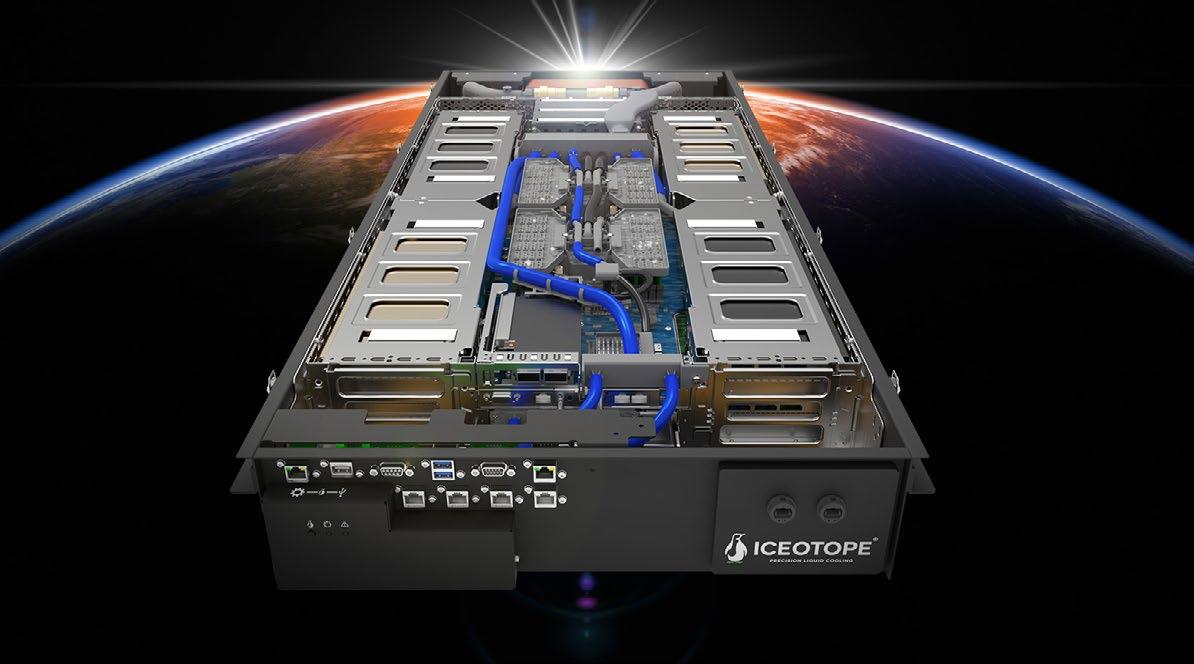
Iceotope’s KUL AI liquid cooling offering credit: Iceotope
- although according to Supermicro’s website, all those servers are air-cooled.
That being said, the Edge is continuing to grow in popularity, especially as companies continue to shift from AI training to inferencing – where the model applies its learned knowledge – as most of this work can take place in an Edge environment, reducing the time required to send data to a centralized server and receive a response.
As a result, not everyone who has managed to get their hands on some Nvidia H100s wants to keep them in a data center in Virginia, US, or Slough, UK.
Edmunds says Edge deployments can be found anywhere from up a pole or lamp post, where the IT equipment is exposed to wind, rain, or even snow, to an office block or repurposed building. A company might also be considering an Edge deployment in an environment, such as the Nordic nations or South America, where it could be subject to extreme temperatures.
All this means that while, in some cases, the Edge location could be clean and well-lit, it’s unlikely to have all the amenities you’d find in a traditional data center. With such a wide range of potential Edge locations, versatile cooling solutions are needed, and this is where liquid comes into play.
Edging out air cooling
Liquid cooling isn’t a new concept, having been used in some capacity to chill compute hardware since the 1960s. However, while most conversations around the technology relate to its role in helping to sustain and grow the increasingly dense racks required for AI workloads, for those looking to deploy compute infrastructure at the Edge, it’s also a practicality.
Proponents of liquid cooling say it is particularly suited to Edge deployments because it is easier to install than air-based systems. This could make converting an abandoned building, for example, much easier, Edmunds says.
“There may not be very much space to put an external heat rejection system of traditional size and scale for an air-cooled facility,” he explains. “So typically, certainly for Iceotope and I would presume for other liquid-cooled
technologies, the outdoor infrastructure needed for heat rejection of liquidcooled designs to air is much more compact than air-to-air infrastructure.
“On typical data centers, you have huge cooling towers that evaporate loads of water, big air-to-air heat rejection systems, or a fresh air system to blow through. All of these things are going to be very challenging to deploy at the Edge because they usually come with tons of filtration, lots of space requirements, and potentially lots of power requirements to operate them. The need for a compact, almost portable, deployable heat rejection system is going to be pretty important to enable people to utilize previously occupied spaces which are now abandoned.”
Liquid cooling at the
“The world talks about AI, but even at aggressive projections, it's only going to be 20 percent of the entire data center market.
“So, when you start talking about traditional workloads, it's not going to be all AI, it's not all going to be high density,
However, Sean Graham, research director for cloud to Edge data center trends at IDC, said that, while it certainly has its benefits for some deployments, the case for liquid cooling at the Edge is perhaps not quite as cut and dry as one might be led to believe.
Graham feels that, when it comes to the various types of liquid cooling technologies on offer, immersion is best suited for the Edge. But, ultimately, the answer to which cooling option is best always depends on deployment.
“It really becomes down to what compute you have,” Graham says.
“Imagine how much it's going to cost to convert a potentially tenanted or rented space into something that can have a traditional air-cooled system deployed in it"
and air is still an appropriate cooling method. You even have liquid-to-air, these hybrid solutions. So air still has a very valid place in the market.”
Furthermore, Graham notes that if your Edge location is already set up for air cooling and your densities are low, splashing out on liquid cooling might not necessarily make the most sense.
Australian geophysics company DUG, previously known as DownUnder GeoSolutions, has chosen to eschew air and bring liquid cooling to the Edge.
Originally founded to process seismic data at mining locations, since 2003 DUG has been providing immersion-cooled high-performance computing (HPC) solutions for scientific data analysis.
Ron Schop, EVP at DUG, says two factors fueled the company’s decision to dive into the world of immersion cooling.
“The first thing was the data was becoming denser and bigger, so our compute requirements were getting bigger,” he says. “The second was that we were working on new technologies to do seismic imaging, and that also required even more compute.
“So the bottom line was, for
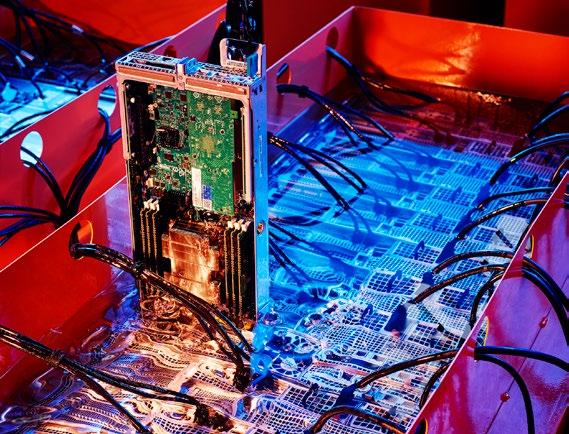
DUG immersion cooling offering credit: DUG
everything we were looking to do in the future, we just needed more and more compute. Then we looked at our power bill and thought, this is not sustainable.”
While Schop says the company did look at other technologies (“liquid-tochip is interesting, but probably on the scale we need, not applicable”) it was immersion cooling that could offer DUG the cooling and efficiency it so desperately needed.
“For us, it was just initially about the dollars, because the compute we had was too expensive [to run] and yet we needed more of it,” says Schop. “So we really seriously started looking at alternatives, and immersion cooling for us was the clear winner.”
Immersion cooling exists in two forms, single-phase and two-phase, and is the practice of immersing the servers directly into a tub of dielectric fluid and using the high heat-carrying potential of these fluids to move the heat away from the IT equipment, offering an extremely high cooling efficiency.
It is far from the only liquid cooling technology on the market. Iceotope, by comparison, combines both immersion and direct-to-chip cooling for its liquid cooling offering – precisely targeting the hottest components compute with a small amount of dielectric fluid, a model which the company says allows it to
recapture nearly 100 percent of the heat generated.
But once DUG had decided to throw its weight behind immersion, it encountered another problem - the solutions on the market at the time didn’t quite live up to their promise, particularly when deployed at scale.
Schop recalls: “It became quite clear that we wanted a single-phase solution, where the fluid just stays in the tank, because as soon as fluid moves out of the tank, that's a whole other set of problems.
“We started out in a garage, we’re very much a ‘can-do’ sort of company, and we thought, well, we can't see the immersion solution that we need so let's build it ourselves. So we started building our own cooling tanks.”
“Edge deployments could range from up a pole, or on a lamp post or a street corner, where the deployment would be exposed to wind, rain, and even snow"
Consequently, DUG became known as an early adopter of immersion-cooled data center designs. Schop says he occasionally still has arguments with “die-hard air-cooled proponents” but his response is simply to show them the data DUG has collected to back its offering, telling the nay-sayers that the company spends half the amount on electricity, its compute doesn’t break down, and it sees hardly any outages.
He adds when you have so much equipment, the “logical choice” is to use immersion cooling, and says: “The Edge compute we offer would be very hard to put together in an air-cooled solution. And, on top of that, by having [the compute] sitting in a tank, we can put it in some of the most extreme places in the world.”
How low can you go?
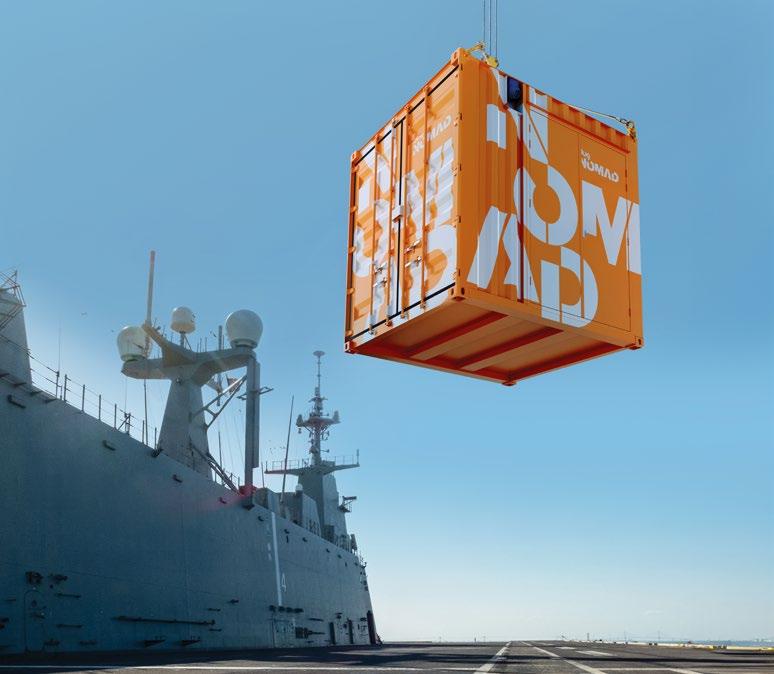
In October 2024, DUG deployed a prototype immersion cooling data center container, dubbed Nomad, at the Adacen data center in Silver Spring, Maryland.
“We’ve got a Nomad 10, a 20, and a 40 - that's a 10-foot, a 20-foot, and a 40-foot,” Schop explains. The 10 model contains a single immersion tank, and though the larger Nomads are still at the design phase, the 20 is likely to have six tanks, while the 40 will have 12.
Schop says that while DUG’s solution might not look as attractive as other immersion cooling tanks on the market, “they’re built to work,” and as a result are “pretty robust," which could be music to the ears of those looking to deploy at the Edge
Nomad has moved from prototype to product, with Schop saying the Nomad 10 has roughly around 50-60kW of heat rejection capacity.
“We’re still working on the 40-foot container but it’ll probably have about 750kW of heat rejection, and we’re hoping to get that up to 1MW,” he says.
DUG has been using a PAO6 fluid but is now moving its tanks to PAO8 as PAO8 is a higher-viscosity fluid for better wear protection under load. (PAO is a
DUG Nomad deployment - credit: DUG
dielectric fluid called Polyalphaolefin.)
Schop says the fluid used by DUG in its tanks has been “a great investment” because not only can you use it for a really long time, but it also brings the energy costs down and the compute components that are immersed in the fluid don’t move, meaning they run even more efficiently.
“We get the most value out of our expensive GPUs because they sit immersed in oil therefore they don't degrade,” he says. “We only upgrade because we get better CPUs and GPUs available on the market.”
Schop says customers often ask DUG how much compute can you put in Nomad, to which he says the answer depends on what you want and what you can afford.
“The interesting thing is that often, in the past, your amount of compute was directed by the space that you had,” he explains. “In our tank, we’ve got 26 rack units and that would be the thing that determined what kind of compute you could put in there. Now, it's not about the rack units you have, it's about how much heat you can reject. Because if you can use 26 rack units and stuff them with GPUs, which we're close to doing, then you're getting a lot of compute for your buck.”
Bringing whitespace to the Edge
At present, Iceotope’s liquid cooling offerings fall into three main categories: KUL Data Center, KUL AI, and KUL Edge. The latter comes in three different designs that the company says has been optimized for “high-density, low latency Edge computing.”
Iceotope says its KUL Edge solution can provide a 40 percent energy reduction and requires no water, while the KUL RAN – designed to meet the needs of high-density, low-latency vRAN, Open RAN, and 5G services offered by telcos – can deliver 20 percent energy savings, or 40 percent when compared to traditional air-cooled systems.
Edmunds says that when it comes to Edge deployments, typically customers approach Iceotope when they don't want to over-invest in a white space build out in an Edge location – “imagine
"So the bottom line was, for everything we were looking to do in the future, we just needed more and more compute. Then we looked at our power bill and thought, this is not sustainable"
how much it's going to cost to convert a potentially tenanted or rented space into something that can have a traditional air-cooled system deployed in it,” he says
He says that Iceotope has been working with one customer looking to deploy “a significant amount of AI racks” in obsolete office spaces around the UK and has consequently been contending with these types of issues, particularly how to reject the heat from 200-300kW of compute.
“Instead, they would rather spend the money on the compute and the relatively low additional cost of Iceotope and the rack with its liquid-cooled infrastructure,” Edmunds says.
When it comes to cost, IDC’s Graham says that while liquid cooling at the Edge does have “compelling value,” it might not be the best financial choice for every company.
“With liquid at the Edge, there are definitely scenarios where it could have a lower total cost of ownership (TCO),” Graham says. “Deploying liquid is going to be more expensive just out of the box, but can present a lower TCO, not just from the heating and cooling expense or from the electricity needed to cool the compute, but it can also be beneficial support for IT infrastructure because there's a lot of reports out there that say once you have the device immersed in a fluid, it doesn't have as many problems.”
But, that doesn’t mean there aren’t potential barriers to deploying liquid at the Edge. Graham says that while liquid could have a lower TCO over its lifetime, it can also be expensive to deploy upfront, meaning that companies need to consider if they have the budget for it right now, or if the money could be better invested elsewhere in the business.
“You also have to consider the workloads and whether this going into an existing environment, in addition to your budget,” he says.
What Graham does agree with is that when it comes to solutions like Iceotope’s, whose liquid-cooled racks are delivered to customers as a sealed chassis to protect the compute components against potential contamination issues, the “value proposition is real.”
For example, Iceotope says in the “rare event of a service-related incident, only one server is affected, preserving the integrity of the remaining infrastructure.”
“I've heard complaints about leaves, cobwebs, or other stuff getting sucked in through fans and things like that, blocking the air ducts on servers and causing them to overheat or go down,” Edmunds says. “Then you have to send the service technician out to fix it, and that costs a lot of money.”
“There are so many elements rolled up into this Iceotope sealed solution,” he adds, suggesting it essentially means Iceotope’s racks become the data center white space, but closer to the IT itself, helping to address another question he says customers often have about Edge deployments – how do I put that amount of compute in an unusual space?
The answer, Edmunds says, always comes back to performance and efficiency, with liquid cooling acting as the great enabler when it comes to allowing these huge AI-focused compute deployments to run without issue.
And he says the way the company’s liquid cooling technology has been developed for Edge environments can also be a boon for traditional data centers. “In the mainstream data center we’re also enclosing and cooling extremely high-powered equipment in a very tight package, in a very small form factor,” he says.
“It's like a Venn diagram of technological benefits. Some apply over here but it’s the same over there too. And we really are going to continue pushing the limits on cooling performance and efficiency.”
Mastering the Edge
How Viavi is revolutionizing network monitoring with AI-powered analytics, real-time insights, and automation to help businesses master their operations
As enterprise cloud services and AI continue to evolve, the role and importance of Edge networks are growing rapidly. To meet performance and service level requirements, maintaining these networks is crucial.
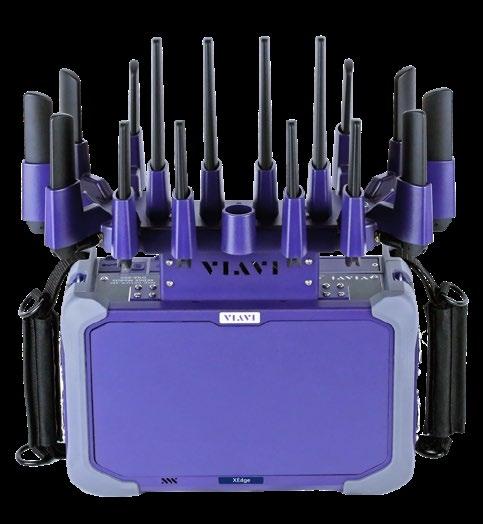
DCD spoke with Ilya Samokhin, global product lead at Viavi Solutions, to explore the challenges involved and the solutions available, including their recently launched XEdge – an industry-first, all-in-one solution for continuous Edge network testing and monitoring at scale.
Elevating network monitoring with AI and automation
As AI adoption continues to accelerate, Samokhin has observed a growing demand for computing solutions to keep pace:
“As companies implement more AIdriven applications, they’re noticing shifts in traffic patterns, including an increase in uplink traffic and a greater need for realtime data processing.”
This shift is driving the demand for advanced network monitoring, enabling sophisticated analytics across multiple networks simultaneously. Samokhin notes that as monitoring needs evolve, service-level agreements (SLAs) are
becoming more stringent, emphasizing the importance of ensuring networks meet or exceed agreed-upon performance standards.
With Viavi’s recent XEdge launch, Samokhin highlights how the solution addresses these demands, offering a range of advanced features that leverage Edge computing and AI technologies:
• AI-driven analytics to optimize network performance
• Active testing for Wi-Fi, 5G, and LTE
• Edge-based testing for real-time, location-specific insights
• Machine learning for predictive analytics, detecting network anomalies before they affect service quality
• Drive and walk test functionality for on-site testing in specific facilities, such as manufacturing plants.
Since monitoring and troubleshooting can be time-intensive (often taking hours, if not days), Samokhin explains that XEdge automates these processes, delivering realtime SLA monitoring that reduces testing time by up to 80 percent. This solution helps alleviate some of the complexities and pain points traditionally associated with radio network management:
“It eliminates the need for an in-house
radio frequency expert by automating both active and passive network monitoring. It also reduces troubleshooting time with real-time data analytics. Because our data comes from real sensors, we can detect network events instantly. This data is accessible via REST API, allowing seamless integration with existing management and monitoring systems.”
This means a single control center can monitor and manage hundreds of remote locations, e.g., warehouses, with immediate visibility into network conditions.
“It also supports multi-operator environments,” Samokhin adds. “This means enterprise customers who rely on multiple cellular operators – either instead of or alongside private networks – can use XEdge. We support up to four SIM cards simultaneously, so customers can monitor mobile networks, private networks, and Wi-Fi at the same time.”
Cutting costs and carbon footprints
In private networks and data centers, deploying infrastructure often requires a plethora of manual site visits for tasks like installation, troubleshooting, upgrades, compliance checks, and staff training –each of which is time-consuming and costly. Applying the benefits of XEdge to real-life applications, Samokhin explains that instead of having 20 site visits per year,
remote monitoring and automation tools help reduce the need for frequent on-site presence, cutting it down to about two visits per year.
Naturally, each customer and country defines the cost of these visits differently, but considering that each visit often involves a highly specialized professional with specific expertise, the savings can be significant. By reducing the number of site visits and performing much of the data processing locally, unnecessary data transfers and energy-intensive cloud processing are also reduced, indirectly supporting sustainability goals.
“What we aim to achieve is enabling professionals to remotely manage multiple sites. For example, rather than sending a specialist to visit 50 different locations, they can manage them all from a central location,” says Samokhin. He adds:
“We’ve observed that up to 70 or 80 percent of remote site visits can be eliminated using our solution, thanks to automation and remote monitoring.”
Error: Human
With all the focus on the automation capabilities of XEdge, Samokhin takes a moment to clarify that there is still an important human element in the data collection portion of monitoring. He explains that while network monitoring can be automated, data collection is often still a manual task, particularly in wireless networks. In complex networks where devices aren’t fully connected, manual intervention is a crucial and necessary step.
However, Samokhin explains that with a system that ensures all devices are connected and operating properly, automation becomes much easier:
“Our solution reduces the need for manual involvement in data collection and processing by up to 99 percent, minimizing the need for human action in most cases.”
This way, XEdge integrates companies’ legacy tools and systems, centralizing data collection through APIs. This reduces the need for costly managed services, eliminates many human errors, and ultimately lowers operational costs.
Metrics monitored include signal strength, interference, network
“Because our data comes from real sensors, we can detect network events instantly” >> Ilya Samokhin
throughput, and network KPIs like latency, jitter, and packet loss, which are closer to the application layer.
“In addition, we track SLA compliance parameters, including availability and performance thresholds, and apply predictive analytics and anomaly detection.”
Locking down security
As an ISO 9001-certified company, Viavi adheres to strict privacy and cybersecurity standards across the organization, ensuring everything it builds aligns with the latest regulations.
To address customer security concerns, Samokhin reassures that Viavi employs industry-standard encryption, secure API-based access, and multi-layered authentication to safeguard data privacy.
“Each customer also has a dedicated access controller, ensuring that their data
remains isolated and protected from unauthorized access.”
While XEdge operates autonomously, it is supported by real-time alerts, predictive analytics, and its own telemetry, which monitors metrics such as temperature, GPS, and other vital data to track device health:
“You can control the device via Wi-Fi or one of its modems, and if an issue arises, the system triggers an automated diagnosis and notifies the administrator. In most cases, physical access isn’t required, but it may be needed in specific instances, such as when syncing issues occur.”
“The device also has a battery, so in case of power loss, it continues operating for several hours,” he adds.
Guiding customers every step of the way
Samokhin emphasizes that to support the customer journey in implementing a new, high-tech system like XEdge, Viavi provides comprehensive training, online user guides, and a global network of partners to assist customers.
Once the XEdge controller and platform provide root cause analysis to help users identify potential issues, Viavi offers additional products to extend analytics and guide the next steps.
In conclusion, for any company transitioning from Wi-Fi to mobile networks, Samokhin highlights that Viavi understands how non-telco businesses often find traditional telco solutions overly complex. XEdge is designed with simplicity in mind, enabling enterprise teams to monitor mobile networks as easily as they would Wi-Fi networks, making it an ideal solution for companies moving into the mobile space.
>> More information on Viavi Solutions and XEdge can be found at www. viavisolutions.com
Not a cookie cutter approach: The criteria for a robust Edge infrastructure
How AI’s success hinges on the success and flexibility of Edge infrastructure
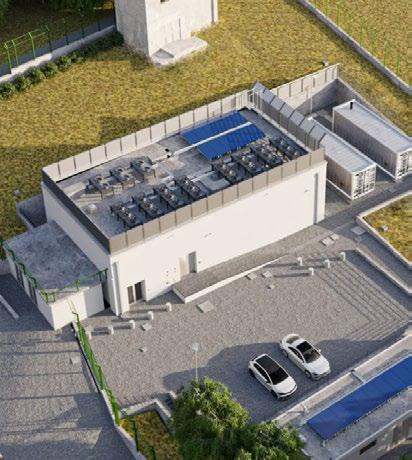
Edge data centers are set to become increasingly important in the AI era, offering solutions for increased latency, real-time data processing, more secure data privacy, and sustainability.
Some may even say AI’s potential depends on the success of Edge facilities, with much of the crucial inferencing work required by AI’s end users well suited to Edge processing.
Duncan Clubb, senior partner at Cambridge Management Consulting, believes staying flexible is the most important consideration for deploying AI at the Edge.
Speaking as part of a broadcast on DCD’s Edge channel, Clubb said: “Not everything will look like big, fat Nvidia Blackwell servers.”
Luca Beltramino is chief data center officer at Rai Way, a publicly listed company that operates the digital infrastructure used by Italy’s state-owned TV channel, Rai. He told the audience that operators cannot predict the future of AI so must keep the infrastructure as flexible as possible. Creating Edge infrastructure is not a simple formula, with specifications varying depending on whether the facility has been designed for colocation, cloud, or high-performance computing.
Deploying AI at the Edge is still in its infancy, said Clubb. He explained that

Niva Yadav Junior reporter
currently, the primary AI Edge application has been for video analytics and in the manufacturing industry; environments where there is a requirement to transmit high amounts of data at low latency.
In the sporting world, Edge computing has been deployed both at the F1 and during the 2024 Olympics to enable real-time analysis of various sports and fixtures.
Clubb added that latency is often the deciding factor for Edge deployments. Where AI is being used to generate interactions with humans in virtual environments, such as online gaming, latency must replicate that of a human’s built-in latency between the eye and brain. In other words, it has to be very low.
In environments where AI can be used to improve efficiency, such as in manufacturing, ultra-low latency requirements will continue to drive infrastructure to the Edge, Clubb said.
In Edge deployments, cooling options must remain flexible, the pair believe. Clubb said cooling will largely be dictated by chip manufacturers, with liquid cooling likely to remain the most popular choice. Air cooling will not be sufficient to cool racks larger than 50kW, added Beltramino. Even liquid cooling can produce heat, making room cooling an equally important consideration, Clubb said, and designing cooling systems with fixed densities seems a recipe for disaster.
Images credit: Rai Way
Operators should, instead, take a variety of measures to support a range of workloads.
Beltramino said that he has seen examples of operators adding liquid cooling onto existing data centers, as a means of retrofitting. Other companies have brought in “modular containerized type solutions” to cater specifically for high-density racks. In the case where data centers have created rigid and fixed deployments, but have access to power, the operators can bring in modules to provide customers with some highdensity capacity. However, it will always be easier to do this from scratch.
“We need to produce infrastructure that can cope with changes in hardware,” Beltramino said. While it is not clear what the future will bring, data center operators are likely to allocate specific rooms in facilities for AI workloads and bring in external units for higher densities.
Clubb explained densities are expected to grow, but the industry has gotten carried away with giant deployments. He suggested the industry will see growth in smaller modules, with Edge deployments averaging around the 5-20MW range, depending on the industry and use case.
Away from AI, Edge is becoming especially important for other use cases too, which means that in turn the need for mixed-purpose data centers still exists, but the priority is to remain flexible.
Where redundancy has become increasingly important for most data center operators, Clubb suggested that the industry might have to ask itself if it can be satisfied with reduced resilience in the Edge environment.
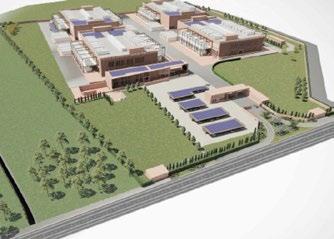
He believes it is possible not everything will need to be built to Tier IV standards, with training models for AI at the Edge, for example, requiring lower levels of resilience. However, for companies like banks, uptime remains crucial. Beltramino adds that Edge opens the door for building redundancy and resiliency across multiple sites and coordinating this across several Tier II or Tier III facilities. Rai Way is currently planning to build 18 Edge data centers across 20 Italian regions, as part of its Edge network project.
Beltramino explained that regional data
The
criteria for a robust Edge infrastructure
centers are going to become increasingly popular. Location is a big factor in Edge deployments, he said. In the UK, “80 percent of data centers are located around London, and the majority of the remainder are in Newport,” Clubb said. “Yet 90 percent of activity happens outside of those locations.” It is no longer useful to have data centers concentrated around FLAP-D markets - Frankfurt, London, Amsterdam, Paris, and Dublin, Clubb said.
“There is a new paradigm for compute that is requiring operators to be more distributed,” he added.
Beltramino told viewers the industry has seen people moving data closer and

closer to the Edge in efforts to repatriate their data. Even in Europe, where repatriation may not seem an issue, the distance between Milan and Paris is such that people want to bring their data to the Edge for processes where latency becomes a requirement because quick decisions need to be made.
On the topic of repatriation, Clubb says data sovereignty will drive Edge infrastructure as enterprises begin to want control, compliance, and accreditation of their data processing. However, this brings with it some challenges.
Delivering inference for regulated bodies means that Edge security, both physical and cyber, must be robust, says Clubb. For investment banks, LLMs can be located anywhere; their primary concern is their proprietary data and that is where security and compliance become important.
Physical security is another challenge the Edge environment is likely to face, says Beltramino. As it is not possible to have a full workforce across every Edge site 24/7, the sites will need to be remotely controlled. It is at this point that software enters the equation. It will become crucial in running infrastructure in an Edge environment, ensuring security and uptime for customers.
“Not everything will look like big, fat Nvidia Blackwell servers”
>> Duncan Clubb
Sustainability could be a big boon for Edge deployments. Clubb explained that it offers an opportunity for “using electrons twice,” with the possibility of using waste data center heat for district heating networks. Beltramino said Google is an example of an operator in the hyperscale market using waste heat to warm an industrial park in Finland. With Edge, deployments can be located closer to communities and this can make reusing waste heat even easier. Whether for drying wood pulp, district heating, greenhouses, fish farms, or agriculture, the uses for waste heat are vast.
AI at the Edge may still be in its infancy, but the priority will be to remain flexible. Operators should refrain from a cookiecutter approach and embrace flexibility and change.
View the full broadcast, entitled The criteria for a robust Edge infrastructure, on the DCD Edge computing channel
Educating at the Edge
Duos
Edge wants to close the digital divide experienced by schools in rural locations across the US

TMatthew Gooding Features Editor
Texas has become one of the epicenters of the AI data center boom.
Already home to Tesla’s 50,000-GPU supercomputer, Cortex, it will soon host the first stage of OpenAI’s ambitious Stargate project, which will see an initial $100 billion poured into AI infrastructure. Myriad other data center developments are in the works as the hyperscalers look to take advantage of the plentiful space - and power - on offer in the Lone Star State.


(credit HABesen/Getty Images
Palo Duro Canyon, just south of Amarillo in rural Texas (credit Hundley_Photography/Getty Images)
But as unprecedented amounts of data are set to whizz to and from Texas data centers at speeds of hundreds of gigabits per second, the contrast with the connectivity woes experienced by many residents of the state, particularly those in rural communities, could hardly be more stark. According to the most recent US census data, some seven million people in Texas lack broadband access, while poor connections hamper the ability of government agencies to deliver basic services.
In a letter to residents highlighting the issue, Texas Comptroller Glenn Hegar, the senator who oversees the state’s accounts, said: “23 percent of Texans are unable to attend online classes, see a healthcare provider from their living room, fill out a job application online, start a business or access online marketplaces from their kitchen table. These barriers negatively affect Texans’ quality of life and limit economic opportunities for people and the state overall.”
The struggle for connectivity extends to school classrooms in many parts of Texas, where slow and unreliable networks often mean pupils are being denied access to valuable resources that are available to their peers elsewhere in the US. Now a new company, Duos Edge AI, wants to close this digital divide with a network of Edge data centers which it believes can be transformational.
Getting Duos Edge AI on track
Duos Edge AI is a subsidiary of Duos Technologies, a business that has traditionally been as concerned with shunters as it has with servers.
Founded in 2001 and based in Jacksonville, Florida, Duos Technologies uses machine vision-based solutions to automate inspections of trains and trucks while in motion. What this means in practice is that a train passes through an examination portal which is equipped with multiple cameras that take pictures of each individual wagon. The company’s software then brings all these images together to conduct an automated remote inspection, flagging up mechanical problems that may need addressing.
As part of this work, Duos had already deployed Edge data centers adjacent to
“I’ve been to rural schools where I can’t even get any phone signal, or the network is down so they can’t access the normal curriculum”
>> Doug Recker
Educating at the Edge
its scanners on railroads across the US, through a partnership with rail operator Amtrak. The pods apparently enable data to be captured from trains traveling at speeds of up to 125 miles per hour, and deliver safety information about these trains within 60 seconds.
The company spotted an opportunity to sell these data centers to third parties, but to do that they needed someone who knew the Edge computing business. So they teamed up with Doug Recker.
The avuncular Recker had previously built and sold two data center businesses. He launched Colo5 in 2008, setting up two large-scale data centers in Jacksonville and Lakeland, Florida. After flogging this business to Cologix in September 2014, Recker resurfaced in 2017 at the helm of EdgePresence, which rolled out 100kW Edge data centers, housed in 12ft by 30ft containers, across the US.
EdgePresence quickly made its mark, supporting telecoms infrastructure firm American Tower in its Edge computing program, and drawing a $30 million investment from DataBank. It wasn’t long before larger suitors came calling, and in April 2023 Ubiquity acquired the company for an undisclosed sum.
Recker stayed on at Ubiquity for a few months to aid the transition, but was soon looking to build a new Edge business. While his experience of the data center industry was undoubtedly vital to his decision to join Duos Edge AI, he says the time he spent abroad while in between jobs was the biggest influence on his current career trajectory.
With a non-compete clause preventing him from joining another data center company after he left Cologix in 2014, Recker headed to Africa, where he worked with an NGO, Matter, in Zimbabwe and other countries, deploying its Innovation Hub Pods. These are air-conditioned classrooms housed in converted shipping containers that use solar energy to provide power and connectivity, enabling children to access a computing curriculum and other forms of online learning.
“We’d drop these pods in and have 15 kids sitting around tables and learning,” says Recker, who is Duos Edge AI president. “These kids were like sponges, they would absorb everything, and even
Doug Recker, CEO
credit Duos Edge AI
though they had never used a computer before they would be coding within two days. That experience gave me the drive to do what I’m doing now - children need opportunities to learn and we have similar problems here in our backyard.
“If I ever make it big I’ll be going back there to support those guys because they do a lot of great work and I learned a lot.”
Problems in US schools may be slightly different to those experienced by pupils in developing nations, but Recker says they can be just as disruptive. “I’ve been to rural schools here where I can’t even get any phone signal, or the network is down so they can’t access the normal curriculum and are sharing books,” he says. “It’s not fair to those children because they’re not getting the same education as kids in a major city.”
The poor connectivity in rural America was highlighted in the Covid-19 pandemic, Recker says. With classes being held online, even pupils who had reliable broadband or wireless Internet connections at home were unable
to access platforms such as Google Classroom because they were hosted on school district servers in the nearest big city. And given the sheer size of states such as Texas, the nearest settlement is often pretty far away.
“During the pandemic the kids found they couldn’t get onto the servers because they were down or overloaded,” Recker says. “In District 16 in Amarillo,
Texas, where we first deployed, you had more than 50 schools linking back to a data center in Dallas, 500 miles away. Connectivity was terrible for them.”
Show me the way to Amarillo
“It’s like we’ve built a major data center there, it’s just they’ve spent $1 million on it rather than $30 million” >> Doug Recker
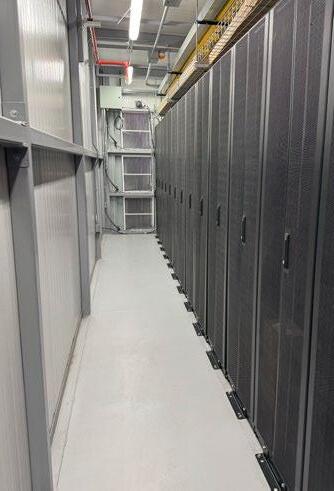
This is where the Duos Edge AI solution comes in. Launched in June 2024, the company’s Edge data centers contain 15 cabinets housed in a 55ft by 13ft (13m by 4m) pod. These can be set up on municipal land and connect to the area’s schools, providing much faster access to online services.
Referring to the company’s first project, in Amarillo, Recker explains: “We took a small piece of the School District central office’s parking lot and dropped the pod in. We then partnered with a big company called FiberLight, which had been given a grant to build fiber connections to the school district, and brought in multiple carriers to that pod.
“Now you have all the schools connecting back to the hub. The longest distance is nine miles, rather than 500.”

The fiber connection into the pod allows it to service multiple carriers, Recker says, offering more choice for end users. “Before this, AT&T was the only player in town, so if its network went down, the whole city was down,” he says. “Now we have a minimum of four carriers in the box, which brings additional resilience and competitiveness to the market.”
Cabinets within the pod are currently low density, Recker explains, due to the nature of the applications they run. “These are learning platforms that don’t require a lot of power,” he says. “The average we’re seeing is 5-6kW per cabinet, but the pod has the potential to go up to 300kW at 15 cabinets, we would just need to switch the cooling system out because at the moment it’s DX with hot and cold aisle containment. If we switched that out for a chiller, we could go to a higher density, but we don’t see the need for that with this application.”
This low density means that, unlike developers of larger data centers, Duos Edge is not engaged in a quest to find more power. “We’re putting our pods at hubs for the education districts, which are where everyone who is part of the education sector but isn’t connected to a school comes to work,” Recker says. “These are often housed in old grocery stores or warehouses, so what we’re finding is that they already have plenty of power to them, and I only want to take 300kW off there. It’s nothing.”
Duos Edge AI’s pods are manufactured by a company Recker has worked with in his previous data center companies. Made with a steel frame, he says they are capable of handling cabinets weighing up to 10,000lbs, and can withstand wind speeds of up to 160 mph. Getting the pods up and running takes three months, from signing the contract to installation, Recker adds.
The system appears popular in Amarillo. Speaking last year when the pod was launched, Michael Keough, Region 16’s CTO, said: "Introducing Edge data centers in our area is a critical step in ensuring that our students have the resources and connectivity they need to succeed. In such a rural area, this solution serves as a vital catalyst for digital equity, ensuring that our schools and communities remain competitive both
within Texas and across the nation."
Recker says this popularity extends beyond the education sector. “What we thought was going to happen was that the 15 cabinets would just be focused on the schools,” he says. “But we’ve had clinics and the local hospital calling us for space, as well as the city government, the fire and police services, and the local university. It’s like we’ve built a major data center there, it’s just they’ve spent $1 million on it rather than $30 million.”
The future is farming
Duos intends to sell its Edge data centers to more school districts in Texas and, eventually, further afield. Recker is also looking to other, underserved, markets in rural areas.
“An area I think we’re going to see pick up in the next few months is farming,” he says. “Farmers are using drones and AI systems to monitor cattle and crops, looking out for signs of disease or predators. All that data that they gather has to go and be computed somewhere, so they can connect back into our box and enjoy a high level of connectivity to a hub that’s only a few miles away. I had no idea that Amarillo was one of the largest cattle-producing regions, we’re learning about these markets as we go, which has been really cool.”
All this means Recker has plenty to keep him occupied. He has staffed Duos Edge AI with some people he has worked with in his previous ventures, but says being part of the wider Duos operation has brought big benefits too.
“In my career so far I’ve gone out and raised some money, built a business then sold it four or five years later,” he says. “What I learned when I started looking at this opportunity was that I needed help to install these pods, particularly at scale. Duos was actually a colo tenant of mine at Colo5, so I’ve known about them for a while and they’ve got a ton of smart people who have experience of installing these huts, which are like mini data centers, along railway lines.
“They have all the knowledge we need when it comes to deploying the pods and getting things like permits in place. We’re a separate subsidiary of the ‘mothership,’ but we’re also able to call on some top talent when we need it, so it’s been a great fit.”
AI AT THE EDGE?
Beyond
the Edge, Duos also has grander data center ambitions, and in December announced it would be deploying four 50MW data centers at the Pampa Energy Center, a 500-acre site northwest of Amarillo.
These data centers will be supported by on-site energy generation, with 500MW coming from a natural gas plant and 200MW from wind turbines and other alternative energy sources.
Recker’s unit will be tasked with building the data center infrastructure for the site, while another Duos subsidiary, Duos Energy, is responsible for getting the required power up and running, working in partnership with Fortress Investment Group.
While the company sees supplying school districts with the low-density infrastructure they require as its main purpose, Recker believes there is also an opportunity to turn its pods into Edge AI installations. He says Duos is working on a design for a 2MW pod that will house 10 cabinets designed for AI workloads.
“The reason we’re doing 2MW is that it’s easier to find that much power at several of these buildings that are unoccupied than it is for a company like CoreWeave to find hundreds of megawatts in one place,” he says. “We can say to customers, ‘we’ll give you 40 sites at 2MW each deployed over the next six months’.”
He adds: “It’s a lot easier to get a permit for 2MW installations, and the good thing is that with remote working there are a lot of vacant buildings with 5MW-10MW of power to them. I can drop two pods in the parking lot and have them up and running really quickly.
“Our core focus is on education, but this could be an interesting sideline.”