magazine
How 7-Eleven networks Taiwan together
Dissecting MRC with OpenAI’s networking guru AMD’s networking lead on Ethernet AI RAN with Verizon’s CTO
SDxCentral magazine
6 8 10 14 20 23 26 30 33 36 39 43
How OpenAI made the network dumb for AI Dissecting MRC with OpenAI’s networking guru
UK AI investment will depend on networks to avoid ‘stranded compute’
Never bet against Ethernet Four decades in networking taught Soni Jiandani to back Ethernet, not on any single company owning the stack
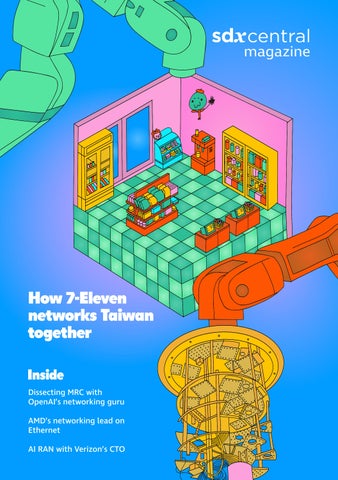
How 7-Eleven networks Taiwan together SDxCentral travels to Asia to understand the networking behind Taiwan’s backbone and shop in 7-Eleven’s convenience store of the future
C-suite sitdown: Verizon CTO Yago Tenorio Laying out the AI and RAN plan
Terakraft: From water to token – a sustainable new frontier for artificial intelligence Ericsson US 5G smart factory tour shines light on what’s possible Ericsson US 5G smart factory tour shines light on what’s possible
Starlink and the dawn of space-age SASE How geopolitics and network scarcity are driving SD-WAN via LEO satellite players – with possible ramifications for telecom
What’s in a neocloud? A search for consensus from the new infrastructure elite
Fiber optic cable construction Putting the critical pieces together
The quantum revolution parked next to a garage On a nondescript Barcelona backstreet, meet the startup betting on analog quantum computing, multimodal networking, and Europe’s last shot at sovereign compute
Can AI finally help telecom operators monetize their networks? Extracting value is about becoming an ecosystem player
SDxCentral magazine
Subscribe to our newsletter Subscribe here
From the editor Ben Wodecki, Senior Editor
Inside the backbone of the backbone To many, 7-Eleven is one of those stores you just don’t give a second thought to. It’s just there. Like how we breathe, you don’t think about it, but it’s essential. Like networking, it’s a kind of background infrastructure, except instead of bandwidth, it provides bread, late-night snacks, or a morning coffee.
How 7-Eleven networks Taiwan together
For our cover feature (p14), we take a look at the network powering 7-Eleven stores in a nation more obsessed with them than their homeland of America: Taiwan. We got the inside track on the AI-infused technologies powering its futuristic X-line of convenience stores, and how the retail giant makes use of an open-source and edge-based framework to keep deployment costs low and customer experiences seamless.
OpenAI’s supercharged networking protocol
Engineers behind Multipath Reliable Connection (MRC) explain how its adaptive
packet spraying and microsecond failover keep hyperscale-sized AI mega clusters connected (p6).
The road to autonomous RAN
Verizon CTO Yago Tenorio on how the carrier’s history of virtualizing core and network assets is helping feed its AI ambitions (p20).
Ericsson smart factory visit
Take a peek behind the curtain at Ericsson’s USA 5G Smart Factory in Lewisville, Texas, a futuristic world of automation, autonomous mobile robots, and renewable energy (p26).
What’s in a neocloud?
The darlings of the AI infrastructure buildout story, but what constitutes a neocloud? And do these players even like the moniker afflicted upon them? (p33).
Inside a quantum data center
On a sleepy Spanish street, a multimodal quantum revolution is taking place that could well provide AI developers with the means to solve next-generation problems (p39).
Group Publisher Sebastian Moss Senior Editor Ben Wodecki Executive Editor Dan Meyer News Editor Giacomo Lee Contributors Berenice Baker Laurence Russell Head of Partner Content Claire Fletcher Partner Content Manager Farah Johnson-May Copywriters Erika Chaffey Amber Jackson Designer Katherina Bradshaw Media Marketing Stephen Scott Josh Hannon Content Director Alex Dickins Head of Channels – Compute Kat Sullivan Commercial Director Charles Sheppard Business Development Manager – Compute, Storage & Networking Alex Pritchard Group Commercial Director Erica Baeta Director of Marketing Services Nina Bernard CEO Dan Loosemore SDxCentral magazine | xx
SDxCentral magazine
Image: OpenAI
How OpenAI made the network dumb for AI Dissecting MRC with OpenAI’s networking guru
I
Giacomo Lee News Editor
"AI training is the worst possible workload you can think of to put onto a network” 6
n Mark Handley’s view, you should never bet against Ethernet. A member of OpenAI’s core networking team and a key mind behind the AI giant’s Ethernet-based Multipath Reliable Connection (MRC) protocol, Handley has pedigree in the field, with his work on Broadcom’s AI networking architecture helping lay the groundwork for the Ultra Ethernet Consortium (UEC). “Ethernet was always likely to be a big player … with the scale of the whole industry driving forward a common, shared technology,” Handley told SDxCentral. “And as a transport protocol, we want MRC to be in the same space for its niche.” MRC is built on remote direct memory access (RDMA) over converged Ethernet (RoCE) and 800 Gb/s (800G) Ethernet interfaces. Officially revealed by OpenAI earlier this year, the transport protocol accelerates massive-scale AI model training with greater graphics processing unit (GPU) efficiency and reliability. The protocol was created with support from AMD, Broadcom, Intel, Microsoft, and Nvidia, with the shared goal to make huge fleets of GPUs behave like one tightly synchronized machine, even if failures beset the underlying network. “What we call synchronous pre-training, which is the first stage of AI training, is the most computeintensive piece,” Handley explained. “When you’re doing this kind of AI training … everybody starts talking
at exactly the same time, which is the worst possible workload you can think of to put onto a network, because there’s no degree of statistical multiplexing that happens here.”
RDMA and packet sprays
Handley explained that systems traditionally rely on RDMA where each communication takes one pass through the network and is pinned to a single path. But pinning each flow to a path risks exposure to collisions when pseudorandomly selected paths happen to coincide on one link and slow down operations. “Each of them goes at half speed … if 10 of them collide, then each of them is going at a 10th of the speed,” Handley said. MRC overcomes this slowdown by breaking down each path into many small packets, each of which takes a different path through the network. As Handley put it, when every transfer is sprayed across hundreds of paths, “you end up load balancing the network beautifully smoothly” by avoiding congestion in the core. The MRC method doesn’t just spray packets blindly; it also tracks conditions per path, being able to avoid congested ones until the path is no longer broken. “Now my flow is taking hundreds of paths. If one of those links fails, it’s a very small impact on that flow. And so any network failure that happens above the first top switches is basically not consequential to us,” Handley said.
Dumbing down the network
Beyond traffic patterns and topology, MRC also changes the control plane. Normally, switches run dynamic routing protocols to figure out which links are up and to route around failures. But with an endpoint-driven system that sprays across many paths and avoids failures autonomously, routers no longer need to communicate with one another. IPv6 segment routing helps endpoints select exact paths so the network adapter instructs the packet exactly where the path wants it to go. “All the switches will do is blindly follow their orders,” Handley said. “That moves a whole set of complexity out of our networks that we don’t need anymore. Usually as you scale up, you care more and more about the network being smart in routing around failure. And actually, we did exactly the opposite, and made the network dumb. It doesn’t even try to route around failures, because MRC can route around them for us.” Such self-healing properties fundamentally change how OpenAI coordinates with infrastructure partners such as Oracle and Microsoft, Handley said. Because MRC can detect failed or degraded paths within microseconds and immediately stop using them, network maintenance no longer requires tight synchronization with running training jobs, and as such, a lot less constant human vigilance. “Previously, we needed to coordinate with the people running the jobs in order to say,
"We did exactly the opposite, and made the network dumb”
Oracle’s Stargate supercomputer. Image: OpenAI
is this a good time to reboot a switch? Now it says you can just reboot a switch. Doesn’t matter. MRC won’t care. So this gives us a whole bunch more flexibility in terms of trying to operate these really huge networks with small teams,” Handley said.
Fewer switches, more paths
Regarding switches, MRC splits an 800G interface into smaller links, allowing one interface to connect to eight different switches, creating eight parallel 100G planes instead of a single network. Rather than linking 64 high-speed connections, it can link 512 smaller ones; with each switch reaching more GPUs, the whole cluster can be built in a less complex way. In practice, more than 130,000 GPUs can be connected using only two layers of switches instead of the traditional three or four layers, helping to reduce power use and the number of switches and optics – “there’s actually less stuff to fail, which helps,” Handley explained. “It also gives me more GPUs connected with only one switch in the middle, which gives me a lower latency,” Handley added. “But the thing I really care about is now from the same GPU, I have eight immediate paths. And so if I lose a link that connects directly to the GPU, I still have seven paths available … We stop using that particular path, but we can recover those packets really quickly, and we’re back up to full speed very fast. This basically means that we no longer really have to worry about failures.” Today, MRC is deployed across all of OpenAI’s largest supercomputers, including the Oracle Cloud Infrastructure (OCI)-built supercomputer and Microsoft’s Fairwater supercomputers. Infrastructure players like Nokia, Hewlett Packard Enterprise (HPE), and Arista Networks tout MRC’s benefits, as Dell’Oro Group research predicts Ethernet will generate nearly $80 billion in data center switch sales by 2030. In the shorter term, Handley promised future generations and ongoing collaboration with OpenAI partners to “keep rolling this ball forward” amid the ongoing AI buildout. “I’ve worked through a lot of exciting changes on the internet over the years, but the crazy scale of the things we’re trying to do right now is really difficult, and coming up with the right way of solving them is a huge challenge. It’s a lot of fun,” Handley said. SDxCentral magazine | 7
SDxCentral magazine
UK AI investment will depend on networks to avoid ‘stranded compute’
F
Ben Archer, Virgin Media Business Wholesale
or much of the cloud era, data center development happened at a pace that broadly aligned with the expansion of the infrastructure around it. Power, connectivity, and data center capacity tended to grow together. Growing compute demand from AI and high-performance computing is upending that pattern. Power availability is increasingly influencing where new capacity can be built. At the same time, AI itself is starting to move from the centralized training of large models towards a much more distributed world of inference, where those models are applied to real-world business data. Both shifts have major consequences for network design.
Compute is only useful if you can reach it
The race to secure GPUs, power, and data center capacity has understandably dominated much of the AI infrastructure conversation. But there is a danger in solving those challenges while treating connectivity as something that can simply be procured quickly and with limited capex. The challenge is no longer simply connecting established data center hubs, but ensuring high-capacity, low-latency, and resilient connectivity across a much more diverse set of locations. For network buyers, that raises some immediate questions. Is there sufficient fiber close to the site? Are genuinely diverse routes available? Can capacity scale from 10G to 100G to 400G and beyond without a complete redesign? And how quickly can that capacity actually be brought online? The answers to these will increasingly determine not just how well an AI facility performs, but how quickly its owners can turn infrastructure investment into revenue. 8
AI’s new geography creates a network challenge
The emergence of new AI infrastructure outside traditional data center locations adds another complication. When developers choose sites based on available power and land, they cannot assume that the same depth of network infrastructure will already exist around them. That creates the risk of what we might call ‘stranded compute’: valuable AI capacity that cannot easily be connected to the customers, cloud environments and other facilities that need to use it. This is why network reach matters differently in the AI era. It is no longer enough simply to have high-capacity routes between the biggest established data center markets. Providers increasingly need deep metro and regional infrastructure capable of reaching the next generation of locations too. Virgin Media Business Wholesale’s extensive U.K. fiber footprint gives us infrastructure in
Advertorial and around both established and emerging digital infrastructure locations, backed by a large, established network build capability. That means we can support customers not only between major data center hubs, but increasingly into the regional locations where new AI capacity is being developed.
Sovereignty adds another layer
Alongside this redistribution of AI infrastructure is another increasingly important consideration: sovereignty. For sectors handling particularly sensitive data, including financial services, healthcare, government and defense, there are big questions over who ultimately controls that data. That has pushed sovereign AI from concept towards practical deployment, with growing demand for U.K.-based compute and cloud environments designed to keep sensitive workloads under domestic jurisdiction. But data rarely stays in one place. AI environments depend on information moving between compute clusters, storage platforms, applications, data centers and enterprise locations. A truly sovereign AI architecture doesn’t just consider where data sits, but where it goes when it’s used. That means understanding how traffic is routed, who operates the infrastructure carrying it, what operational access exists and whether the organization can demonstrate that its requirements are being met.
Designing the connective tissue for AI
Global hyperscalers continue to play a major role in AI, while specialist neocloud providers are emerging to deliver GPU and inference capacity. Enterprises will consume services from multiple environments depending on their workloads. What connects those major players is the network; the foundation that forms the basis of making AI work to its full capacity. Different buyers will need different levels of capacity and control. For some, managed optical connectivity will provide the performance and scalability required. Others will want dark fiber and greater control over the underlying infrastructure, while the most demanding environments may require a managed optical fiber network built around dedicated fiber and optical equipment.
That breadth of requirement is the infrastructure challenge Virgin Media Business Wholesale has invested to address. Our extensive U.K. fiber footprint already reaches established and emerging digital infrastructure locations across the country. We are also proactively adding capacity where we expect demand to grow. That includes pre-provisioned 10G capability across more than 200 sites, 100G capability at strategic data centers, extensive metro infrastructure and connectivity into regional data center environments. With higher capacity to come soon. We are also continuing to invest in the physical infrastructure underneath those services, from diverse fiber routes into strategic data centers to additional fiber capacity across major U.K. cities. Across dark fiber, optical and managed optical fiber network solutions, that gives network buyers a choice of infrastructure models depending on the capacity, control and operational model they need.
Bring the network into the conversation earlier
What is clear is that compute is becoming more distributed. Inference is creating new traffic patterns. Sovereignty will place greater emphasis on control and visibility. And bandwidth requirements are continuing to increase. All of those trends lead back to the network. For organizations planning their next AI, cloud or data center investment, that means connectivity should no longer be the final piece added once the location, power and compute decisions have already been made. It needs a seat at the table from day one. Because in the next phase of AI infrastructure, securing the compute may only be half the challenge. Connecting it securely, resiliently and at scale will determine how useful that compute ultimately becomes. Planning your next U.K. AI, cloud or data infrastructure deployment? Discover how Virgin Media Business Wholesale can help you build connectivity into your infrastructure strategy from the start. SDxCentral magazine | 9
SDxCentral magazine
Never bet against Ethernet
Four decades in networking taught Soni Jiandani to back Ethernet, not on any single company owning the stack
I
Ben Wodecki Senior Editor
10
t’s not often you can spend decades in an industry and have things stay the same, but that’s the story for Soni Jiandani and Ethernet. From her salad days at Ungermann-Bass (UB) Networks to helping grow Cisco’s multibillion-dollar modular switch business all the way to cofounding a company sold to AMD for a cool $1.9 billion, Ethernet has been that constant companion. By no means the same beast technologically following evolution after evolution, but what has remained the same for Ethernet is openness and interoperability: concepts that Jiandani is now a champion of in her role at AMD. Where a certain green-colored rival proudly bills itself as being “the largest networking company in the world,” Jiandani and the team at AMD are just as hungry, but taking that drive and honing a more open, systems-level approach with Ethernet at the center. “There’s no single company that owns the networking landscape in the AI arena,” Jiandani told SDxCentral. “AI infrastructure is just too large and complex for one size or one vendor to make it fit in all forms and shapes.” She described AMD’s approach
as community building, creating an “ecosystem” spanning multiple industry groups across both scaleup networks (inside the rack) and scale-out (rack-to-rack). But for the copious consortium acronyms that she and her team find themselves having to remember, that one continued constant is, again, Ethernet. UALink over Ethernet (UALoE) offers improved resilience characteristics. And Ethernet for scale-up networking (ESUN) brings improved throughput through targeted optimizations. All of those standards-based evolutions are key in Jiandani’s view as they bring operational process cadence, familiarity, and consistency that customers have long been used to with Ethernet, while having the means to build high-performance networks capable of meeting the needs of AI. Like Jiandani’s personal story, innovation architectures and designs that have been around for decades are evolving ever more rapidly because of AI, with her noting: “It’s happening at least three- or four-times faster than I have seen on the other side during my pre-AI days.” In a sense, though, the exec’s
"Programmability is a baseline architectural element. It’s our moat, so to speak” - Soni Jiandani, SVP and GM of AMD’s Networking Technology and Solutions Group
path to a company that prides itself on openness and commonality is almost at odds with a career that saw her building the kind of tightly integrated stack she now finds herself positioning against. For two decades, she was the one convincing the market that Cisco’s closed, vertically integrated stacks were the smart bet. Only now Jiandani is doing the opposite for AMD. In her words, the “foundational nucleus element” between both her time at Cisco and with AMD was, you guessed it, Ethernet. “You never bet against Ethernet,” Jiandani said. “The beauty about Ethernet is that the Ethernet from four decades compared to three decades to two decades to one decade to now are very different. It continues to evolve.” She continues: “The other common element is multiprotocol; the ability to take an agnostic approach that what rides on top of that Ethernet transport ought to be multiprotocol in nature. At Cisco, we did innovations while allowing for industry-standard evolutions to occur in parallel. Think about the same way here: the protocols we [AMD] support on Ethernet … support multipathing, driving a lower total cost of ownership for customers like OpenAI, Oracle, and Microsoft.”
architectural nous it obtained through purchasing the Jiandani-co-founded Pensando as well as the acquisition of Xilinx. Where Pensando provided the high-speed, processordriven software programmability element, the Xilinx heritage brought hardware-level adaptivity through its field-programmable gate arrays (FPGAs) and later Versal chiplets. Having a fully programmable pipeline allows the chip giant’s networking team to not only keep pace with Ethernet evolution but also define it. “Even when speeds are going up and not coinciding with the evolution of those protocols, I can just … write a P4 program, adapt to the evolving standard,” she said. “I don’t tell my customers, ‘wait for the next silicon while I burn the new gates for that new enhancement in the protocol,’ because the evolution of AI workloads is so fast. You need that capability.” The philosophy of having networking devices built atop foundational, programmable architectures ties right back into her view that no one company can go it alone when it comes to ruling the AI infrastructure roost. Instead, Jiandani argues it provides the opportunity to partner with both customers and the channel community more effectively, “and innovate at the speed of what I call AI.” That philosophy isn’t hypothetical, as less than 24 hours before this interview, AMD’s role in helping Meta build its own custom transport protocol, MetaRoCE, came to light. Underpinning it was the same programmable pipeline that let Jiandani’s team co-develop multipath reliable connection (MRC) with OpenAI and others. Two hyperscalers, two bespoke transport layers, both built on
Programmability as the moat
If the moat at Jiandani’s former employer, Cisco, is its vast partner network and even more massive existing install base, what does her current employer have? Nvidia boasts tight integration with proprietary hardware, for example. The AMD exec admitted: “Programmability is a baseline architectural element. It’s our moat, so to speak.” AMD’s networking offers to truly entrench that idea of programmability, leaning on
Jiandani at AMD’s Advancing AI event in San Francisco | Image: Sebastian Moss SDxCentral magazine | 11
SDxCentral magazine
The AMD-aided MetaRoCE compared to contemporary transport protocols | Image: Meta the same underlying silicon, making for a quiet rebuttal to the idea that “open” and “custom” are opposites. In Jiandani’s telling, programmability is precisely what lets AMD do both at once.
Chips down on collaboration, not a single technology
Perhaps the biggest change to networking in Jiandani’s career may yet be on the way through optical interconnects. The days of copper aren’t limited by any means but are set to be complemented by silicon photonics, using light to transmit and process data at speeds traditional interconnects could only dream of. AMD is set to join the optical connectivity party in 2027 through its Instinct MI500. Information about what that would look like is thin on the ground at the time of writing, and Jiandani stood firm, opting not to get ahead of AMD’s own roadmap disclosure. What she did say, however, was that optical technologies will play an important role in AI infrastructure as it scales. “We have always maintained that in increasing the bandwidth, allowing for larger scale-up domains, and not just to play a role in optical across racks, but also even within the rack.” AMD’s approach to that next evolution of the networking stack takes it back once again to the open and interoperable stance we’ve heard so much about. The company was a founding member of the Optical Compute Interconnect Multi-Source Agreement consortium, or OCI-MSA, working on interoperable open standards for optical interconnects for scale-up networks. But instead of racing toward the next big thing, Jiandani 12
described the shift to optical connectivity as less of a leap and more of a “phased transition.” “We don’t think one day the world is electrical, then tomorrow it’s going to be optical … the company has put a stake in the ground at advancing AI [but], stay tuned; more details to be revealed,” Jiandani said. More generally on the move toward optics and next-generation networking, Jiandani stressed a focus on getting the basics right: focusing on delivering reliability and performance rates across each level of bandwidth rather than forcing customers to wait once they make hefty upgrades. “The evolution of applications and the appetite of our customers is such that you have to have a programmable infrastructure that can not only keep evolving in terms of speeds and feeds, but can give you programmability at its underlying architecture,” she said. “You’re not telling the customer, I can give you this functionality on 800G (800 Gb/s), but for 1.6T (1.6 Tb/s) functionality, you need to wait. You can continue to innovate.” Asked to bet on what actually moves the needle first – optics, open scale-up standards, or software-defined rack scale intelligence – Jiandani declined to pick a lane, pointing instead to programmability and industry collaboration as the real constants. “Collaboration across the industry is more important than ever before. If there’s one thing that we can do and do faster, [it] is to continue to collaborate and move faster because that is what the market is expecting of us and is expected of every player in the AI space. It’s moving so fast.” A fitting note then to end on for an executive who’s spent more than four decades betting on Ethernet’s ability to keep reinventing itself without breaking what came before.
Check out our supplements
SDxCentral magazine | xx
SDxCentral magazine
Image: Getty
How 7-Eleven networks Taiwan together
T
SDxCentral travels to Asia to understand the networking behind Taiwan’s backbone and shop in 7-Eleven’s convenience store of the future
Giacomo Lee News Editor
14
o witness the 7-Eleven Taiwan experience of the future, I had to travel through the past. My taxi driver took the scenic route as I trailed through country roads on a hot June afternoon, past the rice fields and rustic-looking houses of rural Taoyuan to reach 7-Eleven’s convenience store of the future: X-Store 9, to use its official name. Well, “x” does mark the spot after all. In front of me during the journey was a backseat TV displaying commercials, reminding me of my flight to Taiwan, where I watched a documentary on another backseat screen on the silicon history of the nation. That show highlighted the foundational work of the Industrial Technology Research Institute (ITRI) in that history, and it would be
ITRI I’d soon be meeting at the end destination. In a way, the past, present, and future of 7-Eleven Taiwan provide an encapsulation of the nation’s technology players, along with a tech flexibility that may be overlooked when solely looking at Taiwanese silicon prowess. While the country’s localized version of 7-Eleven may not be an ecosystem linchpin akin to Taiwan Semiconductor Manufacturing Co. (TSMC), it is an integral part of the nation’s backbone that relies on networking and fleet-footed innovation to an extent that’s almost unrecognizable from the American original. 7-Eleven Taiwan also places edge AI in the public eye, providing a rare opportunity to see the muchbandied tech in action.
Not-so-‘Little 7’
Affectionately known as “Little 7” by locals, 7-Eleven’s presence is anything but little in Taiwan. With more than 7,300 stores, the country has the highest density of 7-Elevens in the world, coming out ahead of more sprawling neighbors in the region – Thailand and Japan – as well as North America, where 7-Eleven originated almost a hundred years ago. Since 1987, 7-Eleven Taiwan has been owned by local food conglomerate President Chain Store Corporation (PCSC), part of the Uni-President group. The first store opened in 1980, as licensed through 7-Eleven’s U.S. owner The Southland Corporation, which would ultimately be bought by the Japanese franchise earlier this century. Japan was the first Asian country to license the chain from America and launched 7-Eleven in 1974. Some time after, future PCSC president Chung-jen Hsu would be struck by these “very strange” stores while studying business in Japan. With their airy and bright environments and organized aisles of items, they were a world away from the “kám-á-tiàm” of his homeland. These small and dimly lit shops are essentially the Taiwanese equivalent of America’s mom-and-pop stores. The story goes that when 7-Eleven first came to Taiwan, shoppers thought they should take off their shoes when entering to keep the floor clean. Hsu was inspired by what he saw in Japan, and Uni-President Enterprise soon launched 14 shops under his guidance. But with the
concept so alien to locals, it took the launch of the hundredth store in 1986 for 7-Eleven to finally become profitable in Taiwan.
From hot grub to wartime hubs
Today, 7-Eleven operates 24 hours a day, seven days a week and is woven through virtually every strand of Taiwanese life, as explained by long-term Taiwan resident and marketing executive Daniel Cunningham. “Convenience stores like 7-Eleven and FamilyMart are everywhere in Taiwan,” said Cunningham, who currently resides in Taipei. “You don’t just go there to buy drinks, microwave meals, or ice cream, you go there to pay your bills, print concert tickets, collect online purchases, send packages, and access a surprising range of everyday services. They’re more than convenience stores; they’re an essential part of Taiwan’s civic infrastructure and daily life.” There’s also their sheer ubiquity. Taiwan boasts more than 14,000 convenience stores across the island, averaging 1 store every 2.57 square kilometers. With this coverage, the government has suggested stores like 7-Eleven and main rival FamilyMart could be used as wartime hubs providing rations and medical supplies should China ever attack. These would be delivered by the chains’ dependable logistical transport systems; in 7-Eleven’s case, it handled 330 million parcel transactions in 2021 during the wartime-analog that was the pandemic. That works out to roughly 904,000 deliveries and pickups per day.
7-Eleven Taiwan’s X-Store 9, Taoyuan Image: 7-Eleven Taiwan
SDxCentral magazine | 15
SDxCentral magazine “In the event of a major disaster, convenience stores continue to play a role in supporting community stability, demonstrating operational resilience,” a 7-Eleven Taiwan spokesperson told this title. Arguably the jewel in 7-Eleven’s crown is its Ibon service. Introduced two decades ago, these are the digital kiosks that provide the front end for external systems belonging to the likes of government departments, banks, utilities, and telecom providers. More than 400 partners and 800 services are networked in Ibon’s integration and transaction gateway, with 250 million instances of use per year. Ibon – a name that is an Apple homage mixed with the onomatopoeic word for an explosion – is unique to Taiwan. While South Korea has the highest concentration of convenience stores in the world, just ahead of Taiwan, its flagship CU chain doesn’t offer the same socially integrated and unified experience. Nor do other major chains and 7-Eleven franchises in China, Thailand, the Philippines, and Japan. They come close, but differences remain in reach, ease, and reliance. Ibon is powered by a centrally operated, API-connected platform run by PCSC subsidiary An-Yuan, using data center infrastructure, monitored network connections, and some cloud services. 7-Eleven’s representative added that its stores operate an edge-based AI ordering system that promptly predicts product sales and meets ordering and replenishment needs.
X-perimental
Outside of the PCSC stable, research giant ITRI plays a crucial role in supporting 7-Eleven
"They’re more than convenience stores; they’re an essential part of Taiwan’s infrastructure and daily life” - Daniel Cunningham, SiliconAuto Taiwan’s tech evolution. ITRI was established by the Taiwanese government in 1973, and is perhaps best known as the incubator for TSMC. The research institute was responsible for building Taiwan’s first three-inch wafer fab in 1975, before spinning out TSMC as a commercial venture in the 1980s. Fast forward to 2026, and I’m meeting ITRI at 7-Eleven’s ninth iteration of its X-Store chain-within-a-chain. As you can guess by the name, these stores are where 7-Eleven experiments with the latest technologies. The first X-Store opened in 2018 as part of PCSC’s headquarters in Taipei. While a few can be found in metropolitan locations, most operate in controlled environments: mainly university campuses and one can be found in ITRI’s Hsinchu headquarters. Across Asia and beyond, 7-Eleven stores dabble with new retail technologies, but the Taiwan franchise is the only one to be systematic in its approach by rolling out one to two labs every year. Successfully validated technologies – for example, the aforementioned AI-based ordering system – are later rolled out into conventional stores. Its latest X-Store opened last year in Taoyuan, the Taipei satellite city perhaps best known for hosting the country’s national airport.
Ibon kiosk. Image: Giacomo Lee 16
X-Store 9 can be found at National Central University (NCU), a public research university in Taoyuan’s Zhongli district. Coming out of my taxi, I was greeted at the store by En Tzu Wang, a lab director for data engineering at ITRI. The shop itself resides in a student dormitory building, sharing floor space with a few vending machines and a restroom. To enter, one walks through an automated turnstile with the tap of a membership card; unlike China’s QR code hegemony, Taiwan mostly prefers NFC card-based tangibility. Inside, the shop is identical to any local 7-Eleven store, stocked with everything you’d expect, bar its popular hot eats. The chain’s extraterrestrial dog mascot “Open-Cha” adorns various walls, alongside other “kawaii” mascots in the 7-Eleven family. The biggest visual difference is the presence of 140 cameras fixed to the ceiling that watch me as I pick out various items to test out the system. Wang explained that the store’s closedcircuit TV (CCTV) uses lidar-based skeletal recognition to determine whether I’ve picked something up; I was shown instant playback on a laptop of my arm monitored by a tracking line that picked out the joints across my wrist, elbow, and shoulder. Also watching me is an anonymous tracking system that follows customers via doublecamera geometry. Other cameras count and recognize products as they come off the shelves. The other big difference: a row of selfcheckouts stands where you’d expect cashiers, a counter, hot tea eggs, and oden. X-Store 9’s sole worker comes in as and when needed for restocking shelves and perhaps some troubleshooting. When I got to the checkout, all the items in my basket were logged and ready to be paid for. Throughout this whole process, AI followed me every step of the way. While most recent X-Stores relied heavily on lidar, X-Store 9 is very much of the current AI era. Wang explained a micro data center in the back of the store runs open-source AI models and handles all the visual data for inferencing. In other words, everything relies on an edgebased network, unlike the failed Amazon Go/Fresh stores, which ran off Amazon Web Services (AWS) with a little help from around 1,000 remote human contractors in India. To put everything into context, the ITRI
Image: Giacomo Lee
director explained that typical events on a customer journey – grabbing stock, perusing something, then returning it to the shelf – last between half to one second per instance. “We use edge and not cloud because of the latency,” Wang said. “When you try to transmit these kinds of videos or images into a cloud for inference, it will have some latency, so you will [invariably] lose some events.” An open-source and edge-based framework also works out cheaper for retail companies who are often “very limited on their budget,” with the X-Store 9 concept also cutting down on the profit pressure of human labor. Wang argued that X-Store locations require the sort of 24‑hour convenience that entails aroundthe-clock staffing. I was told that the next great experiment – X-Store 10 – will rely heavily on robotics, opening up a new dimension of edge-operated AI and network connectivity for 7-Eleven. The question remains whether X-Stores mainly exist to improve the customer experience or to automate 7-Eleven away from human labor. 7-Eleven’s representative confirmed that while it plans to open a new X-Store every year “to further explore the possibilities of future convenience stores,” it is primarily interested in serving students who are more welcoming of the “grab-and-go” shopping experience than your traditional retail consumer.
Chunghwa connectivity
It’s easy to see X-Store as an extension of the convenience and automation the SDxCentral magazine | 17
SDxCentral magazine Taiwanese have become accustomed to in their daily transactions by way of Ibon. But it’s worth appreciating that such network interdependence is something of a miracle for the country. First up, not only is Taiwan an island dependent on subsea cabling, but its habitable and industrial areas are compressed into a relatively narrow western corridor due to the formation of its mountains. Taiwan’s eastern side is rugged and seismically active, and its submarine cable landings are vulnerable to earthquakes, submarine landslides, and geopolitical risks. Despite these networking pressures, Taiwan ranks No. 10 in the Global Connectivity Index with a baseline download speed of 185.6 Mb/s and 92.4 Mb/s in upload speeds. As a point of comparison, Indonesia and the Philippines, which have similarly tricky terrain for networking due to their archipelagic nature, sit at No. 109 and No. 113, respectively. All of 7-Eleven’s broadband connectivity is serviced by Chunghwa Telecom. The relationship dates back to 2002, when Chunghwa installed ADSL-based broadband for the chain to speed up payment processing and ATM functions in its stores. This foundational work ultimately prepped 7-Eleven to launch its Ibon kiosks nationwide in 2006. Today, all 7,300-plus 7-Eleven stores are connected on the same network. Its representative said the retailer worked with Chunghwa Telecom to “ensure the most stable connection for store operations and create a high-quality shopping experience for consumers, ensuring uninterrupted transmission, and enhancing digital resilience.” 7-Eleven’s system resembles an example of Chunghwa’s HiLink VPN architecture in which two fixed circuits operate simultaneously and are provisioned over different physical routes or network equipment. This is in addition to active-standby configurations in which traffic automatically switches to a secondary circuit when the primary connection fails. This service can also combine a fixed broadband or leased-line connection with 4G backup, giving the primary and standby links different transmission media and physical paths. 7-Eleven added that during an outage, the network switches to mobile networks or microwave communications for outlying islands and remote areas. Chunghwa’s 18
The author shopping in 7-Eleven’s store of the future | Image: Giacomo Lee
microwave-based arrangements for Taiwan’s outlying islands were put into action in 2023 when both submarine cables serving the China-adjacent Matsu Islands were severed by Chinese vessels. Traffic initially failed over between the cable routes and was subsequently transferred to Chunghwa’s microwave system as a second layer of backup, helping to preserve voice communications and priority connections. Overall connectivity in the archipelago saw an extra boost in June when Chunghwa launched a new subsea cable in the region. 7-Eleven has a presence in Matsu; other remote stores include its Alishan National Forest branch, which sits at an elevation of approximately 2,200 meters above sea level, while one on Lanyu Island is roughly 80 kilometers off the coast of mainland Taiwan. It’s worth noting that despite being far-flung, these stores all operate 24/7. According to a story told by PCSC’s Chungjen Hsu, the 24-hour nature of 7-Eleven was a happy accident. One night, when a store was about to call it a day, its metal shutter got stuck while closing. With the door open, they kept operating, and business was so good during the night that it eventually convinced the higher-ups to keep 7-Eleven open nonstop. This anecdote sums up the Taiwanese franchise’s fleet-footedness and willingness to experiment. The same spirit of innovation arguably explains 7-Eleven Taiwan’s success and its mode of operations, and why even if it has a “little” workforce in the future, Little 7 will likely stand as tall as ever.”
Send us your opinions Submission guidelines
SDxCentral magazine | xx
C-suite sitdown: Verizon CTO Yago Tenorio Laying out the AI and RAN plan
V
Dan Meyer Executive Editor
"It’s important that your platform is modular, so we can actually plug in any LLM” - Yago Tenorio, Verizon 20
erizon is rapidly ramping its use of AI to power internal operations, a process that CTO Yago Tenorio said is also quickly gaining steam toward helping the carrier start to embed autonomous control of its radio access network (RAN). In an interview with SDxCentral, Tenorio explained that Verizon’s steps toward this control began with its initial push on virtualization of network assets a decade ago. This included virtualizing core and network assets, with the former running on the carrier’s own private cloud and the latter leading to the deployment of virtualized (vRAN) open RAN components.
Verizon CTO Yago Tenorio Image: Verizon
Verizon mobile edge compute unit | Image: Verizon
The executive further fleshed out the importance of that history, how it’s helping to feed current efforts, and where Tenorio sees those efforts moving into the future. This interview has been edited for clarity. SDxCentral: How has Verizon’s long-standing virtualization journey fed into its most recent AI-RAN success? Yago Tenorio: If we take one step backward before autonomy became automation … if it wasn’t for the infrastructure, our own private cloud, and the skills, and the first steps that we took on automation, I don’t think we would be speaking about autonomy because I don’t think there is a way that you can skip that phase. Second, we are also, to my knowledge and I may be wrong on this, but I think we are the biggest open RAN deployment that there is now. That also has a lot to do with this because one aspect of open RAN is open interfaces, and open interfaces are something that is an essential component for you to
throw automation on top, particularly if you’re going to do it yourself. You’re going to buy it from a vendor; maybe you can just stay within the vendor envelope and buy the intelligence from the vendor, but that’s not what we’re doing. What we’re doing is to train an AI model ourselves on our own architecture and our own platform. So if you’re going to do that, the ability to interface to your own systems and your own network through open and standard interfaces becomes essential. SDxCentral: So, this is really an internally developed AI platform that’s just having to take advantage of the open architecture you’ve already had in place, and you’re not using somebody else’s platform for this? Tenorio: [There are] different components you can plug them from, in some cases, different vendors. For instance, there is a lot that came from Anthropic, and the story started with the rollout of Claude Code, and that’s a massive enablement. We’re also using [Google] Gemini. It’s important that your platform is modular, so we can actually plug in any LLM [large language model], and we think, today, Gemini and Anthropic are particularly useful for this. But, watching this space and the speed at which it’s changing, maybe like the computer model, in six months’ time there will be something else, so we need to be the platform that we own and control, and then we can plug a different language model without changing everything else. SDxCentral: Due to the complexity of these models, was there a challenge or any trepidation in having your employee base use these models? Tenorio: We started with developers, so the team that had this at the beginning was the team that was developing customer-facing applications, and when we realized what it can do and how flexible it was, that’s the moment that we started to think that, hang on a second, this could actually be useful for people who are not software developers, turn them into software developers so you change the question from “Can you develop software?” to “Do you know what needs to be done?,” and then Claude will code for it. That paradigm shift is important, even beyond and outside the community of people developing software, because even if all you’re
doing is configuring routers and deploying them in operations, well, suddenly instead of five days to configure a router, it’ll take you half an hour. Who doesn’t want something like that? The answer that we found out in the field is everyone wants that. That’s why the reception has been amazing, and people know what they need better than anyone, and they know what they need to make their job more productive better than anyone, so suddenly you are enabling them with a tool that gives them superpowers. Now, as long as you can have a platform and a control plane that ensures that there are security guard rails and everything is in place, then you’re fine. Your problem suddenly is to cope with a lot of software development as a nice problem to have. SDxCentral: What was the timing of the Claude Code rollout? Tenorio: We started at the end of January with the pilot, and we were done by March. And then we started accelerating our journey toward autonomous networks in April and May. Had you asked me a year ago, I would probably be humbled now by watching my response. This is a massive enablement for everybody, and if you know how to use it and if you know what to do – which is the important thing – it gives you real power to move fast. SDxCentral: How are you tackling token costs? Tenorio: We are picking up the pace in these early days, so you need to allow for some storming before you start norming costs right now because now is when people are getting creative. Of course, we’re watching, we’re monitoring, we have a budget, we’re looking at it, but I don’t want anyone worried about that just yet because, frankly speaking, the return on investment so far is crystal clear. For the majority of it, what we are doing is to shift and to displace external costs, so money that would go to contractors and third parties before for services that we needed to run our network is getting replaced by homegrown intelligence skills, training, and scripts that we develop ourselves. Okay, that’s fantastic. The return on investment is clear. So, let’s keep going. There are a few things that I think you need to have in place if you’re doing something like that. The first one is the ability SDxCentral magazine | 21
“What we’re doing is to train an AI model ourselves on our own architecture and our own platform” - Yago Tenorio, Verizon
Verizon office | Image: Getty Images
to monitor and understand the direction, and you know how much you’re spending every day and every week. The second one is you may want to start setting up a framework that you observe the shape things are taking, and you start thinking, okay, so these look a lot like this type of a scope and guardrails for this type of job, which is they’re not the same as the scope and guard rails for these other types of jobs, and you kind of start seeing the shape things are taking. And last but not least, you need to start putting a lot of effort and resources into developing, as part of your platform, a cost optimization model that brokers the tasks to the optimal model, optimal in the sense of cost as well, so you have the best performance and the best cost. If you’re using Anthropic, you’ll not be surprised. You don’t need Opus 4.8 for everything. Not only can you use 4.6, but you can also use Sonnet or even Haiku for a lot of things; it depends on the nature of the task. How do you systematically and programmatically optimize that and make sure that you’re programming the task to the optimal model is going to do a lot for your cost. SDxCentral: How is this integration helping to advance future plans? Tenorio: I showed you a visualization of input data, and we’ve embedded agents inside that tool, and we turned it into almost 22
a training camp for agents, so that’s where we’re training the agents. In any building that I showed you before, I can ask the agent a question: “What do you think is wrong with this building?” And it will come up with root-cause analysis and explanation, but also solutions. Now we’re using that to iterate and train the AI to get better at our job using that. The next step is to graduate the agents from university and have them specialize in different tools that we operate in a system that we currently have in prototype, so I want to put that in production in the next three months. What kind of level does that make us? I don’t know. Do we call it 3.5? I have no idea. The important point is it’ll be a complex network of agents and sub-agents that are monitoring the network 24/7, spotting patterns and anomalies, and then calling a network of sub-agents specialized on different tasks to come up with a root-cause analysis and a solution autonomously. The first kind of prototypes that we built, we’ve seen them taking on real-life tasks that would take us before five to eight hours to resolve, down to 90 seconds. So I want that in production before the end of the year. We’ll probably start with radio, but very quickly we will take on transport and core, so hopefully within the next six months my agents will graduate from university, and they will find a job in operations.
Image: Terakraft
Terakraft: From water to token – a sustainable new frontier for artificial intelligence
T
erakraft is redefining the relationship between digital infrastructure, natural resources, and the development of artificial intelligence. As the rapid expansion of AI data centers triggers strong local opposition – often delaying or halting projects entirely – critical concerns regarding energy usage, ecological footprint, community impact, and technological sovereignty can no longer be ignored for the sake of speed. The company proposes an alternative model: leveraging renewable energy, local communities, and water into an efficient, circular, and responsible infrastructure for AI. Through its Water-to-Token paradigm, Terakraft is not simply building data centers.
Instead, it envisions a new generation of AI factories capable of combining technological innovation, environmental stewardship, and regional economic development.
How does the Water-to-Token model create a more sustainable AI infrastructure?
According to Terakraft, Water-to-Token is much more than a slogan – it represents a new paradigm of efficiency and sustainability designed to convert nature’s potential energy directly into digital value. Unlike conventional data centers, which draw large amounts of electricity from national power grids and consume significant volumes of water for cooling, Terakraft has developed an SDxCentral magazine | 23
integrated, circular, and locally self-sufficient infrastructure. The process begins with water from a high-altitude reservoir flowing through a hydroelectric turbine to generate 100% renewable electricity for powering AI servers. The same water is then used within a closedloop liquid cooling system that maintains optimal operating temperatures for highperformance processors. The result is an AI computing platform that delivers high performance with a substantially reduced environmental footprint (peak PUE <1.1 and WUE = 0).
What are the main technical and operational challenges in converting a decommissioned hydroelectric power plant into an AI Factory?
Terakraft explains that the greatest challenge lies in departing from conventional industry practices. Today’s data center market largely relies on standardized, prefabricated facilities designed for greenfield developments. Even when existing industrial sites are reused, the common approach is often to demolish and rebuild from scratch using standardized modules. Terakraft instead embraces industrial regeneration, adapting existing industrial/ energy facilities through highly customized engineering solutions. Rather than forcing the site to fit a predefined design, the company develops infrastructure around the site’s unique characteristics, preserving structural strengths while addressing technological limitations through tailored solutions. Operationally, implementing a closed-loop liquid cooling system has required overcoming demanding environmental conditions. In Norway, construction work took place during winter at temperatures as low as -18°C, requiring excavation through frozen ground and concrete work under extreme weather conditions. Remote locations also created a human capital challenge. Terakraft invested in training local workers with little previous experience in advanced digital infrastructure, helping them develop specialized skills needed for the AI economy. How does Terakraft demonstrate that its 24
renewable energy and closed-loop water cooling system reduces environmental impact? To understand Terakraft’s approach, it is useful to consider current industry practices. Today, approximately 90% of requests processed by large AI models are handled in the U.S., where hyperscale data centers are frequently built near major natural gas pipelines, particularly in states such as Texas. Many facilities rely on dedicated gas-fired power generation, resulting in substantial greenhouse gas emissions. Cooling represents another major environmental challenge. Conventional cooling systems can account for up to 30% of a data center’s total electricity consumption. To reduce energy use, many operators employ adiabatic cooling, which sprays water into incoming air to lower its temperature before it reaches the cooling equipment. While effective, this method consumes enormous quantities of water, often in regions already facing severe drought. Additional water consumption also occurs at gas-fired combined-cycle power plants, which themselves require extensive evaporative cooling systems. Terakraft’s Water-to-Token model addresses these issues through a closedloop liquid cooling system integrated with naturally cold mountain lake water. According to the company, this delivers three measurable benefits: • •
•
Cooling energy consumption is reduced to less than 5% of total electricity use. Greenhouse gas emissions associated with electricity generation are eliminated because power comes entirely from hydroelectric sources. Net water consumption is effectively zero, since the cooling water does not evaporate into the atmosphere but is returned to its original reservoir.
How does Terakraft involve local communities and regional partners? Terakraft argues that many large infrastructure projects follow an extractive economic model: international contractors arrive, complete construction, and leave without creating lasting local economic value.
Advertorial
Image: Terakraft
The company has chosen a different strategy. During construction, contracts are deliberately divided into smaller packages, enabling local small and medium-sized enterprises to compete within their areas of expertise. This approach supports regional businesses by generating new contracts and helping companies invest in equipment and long-term growth. During operations, AI infrastructure requires highly specialized expertise that is often unavailable in rural areas. Terakraft therefore deploys experienced professionals who work alongside local electricians, technicians, and plumbers, transferring knowledge through hands-on training. The company is also developing educational partnerships with local technical institutes to establish a new professional role – the data center operator – capable of managing all aspects of AI infrastructure, including IT systems, electrical equipment, and liquid cooling technologies. Students will gain practical experience through internships at operational facilities.
Can this model be replicated across Europe?
Terakraft believes scalability should not be confused with standardization. If scaling means deploying identical infrastructure on undeveloped land, the company deliberately rejects that approach. Instead, it views every location as unique, requiring engineering solutions adapted
to existing environmental and industrial conditions. Although this strategy may not enable the rapid expansion pursued by some competitors, Terakraft argues that it provides three significant competitive advantages. -First, projects that regenerate existing infrastructure while delivering measurable environmental and social benefits are generally more likely to receive community support and regulatory approval. -Second, repurposing existing industrial facilities can significantly reduce construction timelines compared with building entirely new data centers. -Third, the company challenges what it calls the “gigawatt illusion.” As AI hardware and algorithms continue to become more efficient, today’s race to secure massive amounts of electrical capacity may ultimately prove unnecessary. Rather than investing in oversized energy infrastructure based on uncertain long-term forecasts, Terakraft focuses on maximizing efficiency and sustainability with the resources available today. Terakraft presents a vision of AI infrastructure built on renewable energy, responsible water management, industrial regeneration, and regional economic development. Through its Water-to-Token model, the company seeks to demonstrate that high-performance artificial intelligence can coexist with environmental sustainability, technological sovereignty, and long-term value creation for local communities. Learn more about Terakraft. SDxCentral magazine | 25
Ericsson US 5G smart factory tour shines light on what’s possible
S
Local production targeted at local consumption
Dan Meyer Executive Editor
26
tepping through the doors of Ericsson’s Lewisville “smart factory” gave off more of a “smart” than “factory” impression, though a full tour showed that this facility is an important factory cog in the Swedish vendor’s U.S. operations and that the concept of U.S.-based manufacturing is alive and well. Ericsson touts a 100-plus-year history of manufacturing products in the U.S., but its more relevant network equipment-related efforts are somewhat younger. The firm initially hinted at its U.S. manufacturing plans to this publication in mid-2018, when thenEricsson North America CEO Niklas Heuveldop said it planned to put company resources and innovation closer to important customers in one of Ericsson’s largest markets. Heuveldop noted at that time that the U.S. had accounted for at least
25% of the vendor’s overall sales for the previous seven years. “I’ve been impressed with the activity in the U.S., especially with IoT and industrial IoT,” Heuveldop told SDxCentral. “And there’s a lot of excitement in the investment community as well. The U.S. is on fire.” This heat was generated by U.S. operators quickly moving to deploy 5G networks and underlying tension during the first Trump administration when efforts began to build toward banning telecom equipment from China. Analysts at that time noted that Ericsson’s move signaled a significant shift in production geography for the Swedish vendor. An Omdia report from the same period indicated Ericsson manufactured 45% of its equipment in China compared to only 10% for its Nordic rival Nokia. Ericsson’s foray initially began through a deal with manufacturing
"It’s been a great opportunity for us to be able to talk up the value of the 5G private network”
- Josh Cave, Ericsson
The facility has since continued to expand its scale and scope toward its current footprint of 300,000 total square feet, 80,000 square feet dedicated to production, and a workforce of approximately 565 employees.
Smart + factory
Image: Ericsson
partner Jabil to construct equipment at a Jabil facility in St. Petersburg, Florida. That work quickly resulted in Ericsson radio equipment emerging from that facility by the end of 2018. Ericsson shortly after announced specific plans for its Lewisville facility, with an initial $100 million investment resulting in ground being broken by September 2019. The facility was initially near a production plant for antenna-maker Kathrein, which Ericsson acquired in 2019, and less than 20 miles from its North America headquarters in Plano, Texas. The vendor also had a tower training facility in Lewisville, and has since opened a software development center alongside an ASIC design center in Austin. The Lewisville plant officially opened in March 2020, helped by approximately 100 employees supporting work to pump out its first offering – Ericsson’s millimeter-wave (mmWave) Street Macro, a product that was delivered to Verizon for its initial 5G deployment. Lacey Mehl, senior improvement manager at the facility, explained that Ericsson quickly expanded its portfolio, and by 2022 had added multiple platforms and completed its first full-scope new product introduction. The facility expanded by 27,000 square feet in 2023, backed by an additional $50 million in investment, with space added for testing, prototyping, and early validation activities. The facility that year also garnered its first “certified made in the USA” recognition.
The facility itself is located in a fairly nondescript warehouse-heavy area of this Dallas suburb. However, pulling into the facility’s parking lot finds towering flags of the United States, Texas, and Sweden in front of a prominent Ericsson sign that sets the building apart from the plethora of white-on-white buildings dotting the surroundings. That impression continues walking into the facility’s main doors, where a large video screen towers within the multistory entryway, with office space taking up much of the upper levels and meeting rooms on the lower floor. We quickly move into one of those meeting rooms where Mehl provided a brief rundown of the facility. Mehl explained that Ericsson’s current production at the facility included “a range of 5G terminals exclusively for U.S. customers in deployments within the U.S.,” with a current focus on radio access network (RAN) compute basebands; multiple-input, multiple-output (MIMO) mid-band antennas; and remote radio heads to support low-band spectrum and “open RAN-ready products.” The location helps feed a “matched speed and resilience in the supply chain,” with products emerging from the factory feeding deployments by all three nationwide operators. The “smart” aspect of the factory floor was apparent the moment we walked into the production area. A low-level hum was the main audible feature, with sounds coming from the dozens of automated machines and numerous autonomous vehicles running around the factory floor in an orderly manner. Matt Hume, production manager at Ericsson, explained that the factory ran 24/7 with shifts structured from 7 a.m. to 7 p.m., and 7 p.m. to 7 a.m. People work on alternating schedules of three days one week, SDxCentral magazine | 27
SDxCentral magazine
Image: Ericsson
four days the next, something that Hume said allows “people to do all sorts of other stuff for the other half of their week.” “Go to school, have a side gig, run a small business, do all sorts of things, which has also really helped with the profile of folks that we have working here,” Hume said. Those employees are central to the production process, overseeing the numerous steps involved in the manufacturing of the radios and ensuring quality control over the end products during each stage of that process. Key pieces of that process include the substantial radio boards that form the foundation of the radio baseband units and the thousands of components that are attached to those boards. One of the more interesting areas of the production floor are the reels of components, with each individual piece needed to be inserted into a board being packaged in a way that allows for them to be fed into the specific automated machine for installation. Those component reels include capacitors, resistors, and system chips. “Right now we are running about a dozen-ish unique products, about 20 different boards,” Hume said. “Within those dozen products in those 20 boards we have a little over 2,000 unique components right now.” Those boards and components are transported the short distance between the storage areas and the production lines 28
by the factory’s automated vehicles. These flat-topped, shin-high rovers maneuver around the facility in an autonomous fashion thanks to their inherent mobility, powerful onboard compute, and 5G-based connectivity capabilities. Josh Cave, manager of data and analytics at Ericsson, explained that the facility uses a pair of private 5G networks. This included a “mid-band” network using C-band spectrum with signals beamed from the vendor’s Dot radios and that is used to connect the facility’s 25 autonomous mobile robots (AMRs) and autonomous guided vehicles (AGVs), something that Cave said took a bit of negotiation with the AMR manufacturer. “We got an agreement from the vendor – Otto – that we could open up the robots and start playing around inside of it and they would still support them,” Cave said. “We did figure out a way to use the robot’s power supply to power the 5G modem,” which Cave added is a repurposed Ericsson Cradlepoint R980 modem. The other private 5G network is a millimeterwave (mmWave)-based configuration using 28 GHz spectrum and radios actually built within the facility. Ericsson initially used that network to support a high-definition (HD) videoembedded drone tasked with “indoor logistics inventory reconnaissance,” but Cave noted that they found the C-band network was able to provide sufficient performance for that use
"As a manufacturer, this is what you should be doing. You should be giving your people these opportunities, so they want to stay with you”
Image: Ericsson
Matt Hume, Ericsson
case, thus the mmWave network is currently sitting fallow. The facility does also have a Wi-Fi network, though that is used specifically for employee device connectivity, and Ethernet connectivity for the stationary production machines. The facility’s private 5G network also provides Ericsson with a live use case that it can show potential customers. “It’s been a great opportunity for us to be able to talk up the value of the 5G private network, but we also got a huge win for ourselves in being able to move stuff a lot faster,” Cave said, with Hume adding that includes being able to show return-oninvestment benefits. “Everybody’s trying to ramp up production to make the cost make sense, so when you’re running 24/7, there’s never a good time for downtime,” Hume said, noting that continuous updates to Wi-Fi-based systems cause disruptions. “You have something that breaks down three times less. That’s real money. And you have something that hands over way less, is way faster; it seems like a no-brainer to us.”
Smart factory needs creative minds
While smart, the factory does remain very reliant on its more than 500 employees. Touring the floor showed how deeply integrated they were into the production process, with Hume pointing to specific skillsets of some of the employees that made them key cogs in the process. Hume also explained that those employees have been key to submitting new ideas in how to make the factory more efficient, and the dynamic nature of the facility afforded by its “smart” nature provides a more compelling production experience for those employees. Hume noted that the facility’s employee “attrition rate” is about 9%, “which is pretty good for a production facility” where “typically in U.S. manufacturing it’s somewhere between 20 and 30%.” “Every single person here is a full-time Ericsson employee,” Hume said. “About 225 of
the 565 people that work here are referrals, so like their friends started, and then they were like, ‘hey, come work at this cool place,’ which changes the dynamic quite a bit.” Hume added that just over 100 of the employees started in a “frontline” position somewhere within the facility, and “has been promoted at least once into something else. … Our team leads, our supervisors, our trainers, our IT department, our quality inspection department, our troubleshooting department are mostly made up of former operators. The pre-troubleshooting group is 94% former operators from production.” Mehl noted that the facility had launched an in-house training program as part of its early expansion, “that enables someone with no prior manufacturing experience to become an independent operator in as little as four to six weeks.” “As a manufacturer, this is what you should be doing,” Hume added. “You should be giving your people these opportunities, so they want to stay with you.” Those employees are key to driving the continued expansion of domestic mobile networks. Ericsson is a key piece of AT&T’s $14 billion open RAN-based network overhaul program that will also feed into its 6G network deployment. The vendor also remains a key supplier to Verizon and T-Mobile US, as well as providing equipment to regional and rural telecom operators. More significantly, those employees and the facility show that with the right mindset, U.S. manufacturing can continue to grow. “Every time somebody else is like, ‘oh, we can’t set up manufacturing in the U.S. I can’t find enough people with like tiny little hands to deal with the tiny little screws and whatever,’ I’m like, ‘why? I can. Why can’t you?’” Hume countered. “They’re all over. What do you mean? Just be more creative.” SDxCentral magazine | 29
SDxCentral magazine Image: Giacomo Lee
Starlink and the dawn of spaceage SASE
How geopolitics and network scarcity are driving SD-WAN via LEO satellite players – with possible ramifications for telecom
Giacomo Lee News Editor
"Satellite provides the road, SD-WAN decides which route it takes, and SASE decides who can go on the road” - Julian Skeels, Expereo 30
T
hink of Starlink and the following are likely to come to mind: low-Earth orbit (LEO) satellites, direct-to-device (D2D) connectivity, SpaceX’s space-set data centers, and controversial tech moguls. You’re probably less likely to think of the somewhat less glamorous area of secure access service edge (SASE). And yet a growing number of managed service providers (MSPs) are touting Starlink and other satellite connectivity options to power security at the SASE and SD-WAN edge, a market that according to Gartner represents an $18 billion market opportunity in 2026. Salem, Massachusetts-based MSP WEI recently introduced its Connect platform, an enterprise-friendly offering for deploying internet via Starlink transmission across
fixed or mobile sites. The service expands on WEI’s SD-WAN and SASE integration services by validating and integrating Starlink with platforms from Palo Alto Networks, Cisco, Cato Networks, Fortinet, and Hewlett Packard Enterprise (HPE). Dutch network-as-a-service (NaaS) provider Expereo has offered similar services through a Starlink reseller partnership. Customers to date include U.S. manufacturer LP Building Solutions and European physical security specialist Heras, which rely on Starlink satellites as resilient backup for sites prone to regular terrestrial-network outages. Away from Starlink-specific integrations, Europe’s Vodafone Business embeds satellite access directly into its SD-WAN and SASE portfolio via a partnership with AST SpaceMobile, while satellite/ SASE connectivity can be found in solutions from Broadcom’s VeloSky,
Nitel, and Ericsson. For Greg LaBrie, VP of technology solutions at WEI, the LEO attraction is simple: connectivity now, not later. “I have a robotics customer that is putting robots in customer warehouses, and a lot of these million-square-foot warehouses are in the middle of nowhere and they’re told it’s 180 days to get a fiber connection. … This is ridiculous. What do they do? They were promised it next month, and they need connectivity,” LaBrie explained. LaBrie said the firm was already “slapping a WEI credit card down” to buy Starlink for temporary connectivity until fiber arrived. “When the opportunity came up to invest in Starlink and partner, there wasn’t any hesitation there from a technology perspective, because in talking with Starlink, their direction and seeing what they’ve done, it seemed like a big gap that we could fill, which is to take good commercial off-the-shelf products and deliver them to a customer enterprise-ready, and this just fit that same mold,” LaBrie said. According to LaBrie, those early discussions required “some convincing” of Starlink parent SpaceX that WEI was the right company to partner with on account of it not being a telecom operator. “We weren’t a telco, and my argument with them was that’s exactly why you want us, because we are a value-added reseller,” LaBrie said. “We’re going to build a better platform, and right out of the gate they noticed the difference and they started bringing us customers right away.”
Stealthy, space-beamed SASE
On the security front, LaBrie explained that for one customer, WEI built a kit for drone deployments that includes a SASE layer for strong security alongside multiple 5G and Starlink connections in one box. Teams can place the box on a vehicle, launch their drones, and securely send photos and videos over the internet for tasks like facial recognition, all without relying on the kit to control the drone itself. Julian Skeels, chief digital officer of Expereo, stressed that running enterprisegrade Starlink requires a very different setup to the consumer experience. Large enterprises using SASE platforms expect fixed, static IP
addresses for their security and access policies to work properly, something that consumercentric LEO usually doesn’t provide. “We work with highly regulated businesses, financial services, where for us to be able to work with them we have to help them demonstrate to regulators the security and resilience of their networks,” Skeels said. In Expereo’s case, customers don’t necessarily come to them for an out-of-the-box Starlink connection, but a spread of network options to ensure constant connectivity. “We put LEO on the table as part of their portfolio mix before customers even realize that they should use it, or actually it works in their use case,” Skeels said. “In a world right now where geopolitics is particularly front of mind, that resilience, that diversity of options is more important than it’s ever been.” Like WEI, Expereo sees LEO as helping with customers across primary industries that are “spinning up global sites very, very fast in hardto-reach areas where lead times on traditional terrestrial infrastructure don’t fit in with their schedule.” “Just recently, a major global manufacturer that we work with experienced a significant outage on a primary service and the LEO automatically kicked in as the resilient fallback. And actually, the customer wasn’t even aware that that switchover had happened,” Skeels said.
Fiber-less future?
As Skeels put it, Expereo aims for transparent failover, so sites keep running even as the network silently shifts between fiber, LEO, or 5G behind the scenes. This is why the exec believes claims of future fiber extinction are a distraction. “There’s a lot of discussion on whether LEO is going to replace fiber and I think that’s the wrong question. LEO is not SD-WAN, and it’s not SASE. It’s another way of reaching a site; let’s say the satellite provides the road, SD-WAN decides which route it takes, and SASE decides who can go on the road.” One player with both a telecom and MSP view on the matter is AT&T Business. The AT&T division offers managed SASE connections through the likes of Palo Alto Networks, Cisco, and Fortinet. Andy Foerstner, director for edge/ cybersecurity products at AT&T Business, SDxCentral magazine | 31
SDxCentral magazine "We’re pretty comfortable that the glass we put in the ground with the fiber investments that we made is superior” - Andy Foerstner, AT&T Business
Image: Ben Wodecki
said they are seeing “significant interest” in satellite, but only as a secondary connection due to LEO’s latency limitations. “Because of latency, the SD-WAN component starts to become more important because there are certain remediation capabilities, which everybody does a little bit differently,” Foerstner said. The director acknowledged things may change, nodding to AT&T’s partnership with AST SpaceMobile for satellite coverage, calling it “a pretty powerful capability.” “But from an AT&T perspective, we’re pretty comfortable that the glass we put in the ground with the fiber investments that we made, which is a superior product for connectivity, augmented by our 5G network for fixed wireless,” Foerstner said. “We’re in a good position to have some great conversations with our customers about not only that immersed and diverse transport, but also the managed services and security with this best-in-class technology we can provide.” 32
But WEI’s LaBrie argued telecom should take heed, seeing Starlink as part of a structural change in enterprise connectivity where everybody at some point will have the combination of a LEO connection with a 5G one, making for the standard WAN mix of the future. “We have a big pharmacy chain that we have deployed in hurricane areas first as a pilot. Now they’re doing it everywhere. They learned very quickly that when they lost their fiber, they lost their cellular too. So, what good is having cellular if it’s never available when you need it?” LaBrie said. “Starlink has gone through the hurricane season last year with this organization, and we didn’t have any failures.” “Ten years from now we’ll say, ‘really, you had wires?’ … I remember someone on LinkedIn recently put out a message saying, ‘warning to telcos, you might get replaced if you don’t pay attention.’ And for the first time, I think that could be true,” LaBrie added.
What’s in a neocloud?
N
A search for consensus from the new infrastructure elite
Ben Wodecki Senior Editor
eoclouds. Neoscalers. Whatever you call them, a new breed of infrastructure player has captured the industry’s attention. Everyone wants to sell to them. Or be seen working with them. More agile than their hyperscale counterparts. More financially flush than Mr. Monopoly. And more willing to double down on AI. These are the providers of tomorrow, today. But what exactly constitutes a so-called neocloud? Neo comes from the ancient Greek word néos, meaning new. Does that mean Meta would constitute a neocloud, given it’s believed to be entering the cloud game? Or how about CoreWeave or Crusoe, vendors that started life as cryptocurrency mining operations before later pivoting to AI? Are they only neoclouds now that they’ve taken on a largely AI focus? And, more importantly, how do such players want to be seen?
Definitions and denominations Analyst giant Gartner defines neoclouds as “cloud providers built specifically for AI and high-
"Our customers don’t come to us to rent GPUs. They partner with us to run production AI on our purposebuilt stack” - Chen Goldberg, EVP at CoreWeave
Chen Goldberg, EVP at CoreWeave
performance workloads” – with such vendors projected to capture 20% of the $267 billion AI cloud market by 2030. An explainer from Cisco goes one further, stating said players leverage high-performance hardware compute accelerators – “primarily graphics processing units (GPUs)” – to support AI application needs of enterprises, model builders, and even hyperscalers. Meanwhile, a similar Equinix outline points to neoclouds offering more than just GPUs and compute infrastructure, referencing an array of services including AI-optimized object and file storage; model training and fine-tuning; and lowlatency, high-bandwidth networking and connectivity. The consensus then centers around one key factor: AI. These players put AI at the forefront of everything they do and offer, differentiating themselves from general-purpose players by riding the wave of AI intensity, while also ensuring agility given their size when it comes to buildout that their monolithic competitors simply cannot compete with. Another key differentiating factor as to what exactly constitutes a neocloud is how they use their networks. While traditional internet traffic has a “uniqueness” to it, with a larger number of data centers and a mix of workloads resulting in an array of outputs, Backblaze’s quarterly “Network Stats” analysis reveals neoclouds make use of fewer, more sizable datasets moving in short, sustained bursts across persistent endpoints and pipelines. The vendor’s “Q2 2026 report,” for example, found that neocloud SDxCentral SDxCentral magazine magazine || xx 33
SDxCentral magazine
Image: Ben Wodecki
traffic shows a more moderate, synchronized volatility, with ingress and egress scaling together in sustained, business-hour patterns. That’s in comparison to hyperscalers which enjoyed sharper volatility, with egress swinging between 50 and 150 gigabits per second (Gb/s) against a stable, tightly controlled ingress baseline.
Challenging the neocloud narrative
Gleaning an accurate perspective on how these emerging players envision their own position requires a view direct from the source. At the vanguard of the neocloud boom is CoreWeave, perhaps the darling of specialized infrastructure. Boasting a market cap hovering around the $50 billion mark at the time of writing, the New Jersey-based outfit has solidified its status through massive, multiyear capacity agreements with the likes of Meta and OpenAI. Its meteoric rise was epitomized in its placement on the first-ever Gartner Magic Quadrant for cloud AI infrastructure, with CoreWeave coming out as the top-ranking “visionary” player – a segment that included old hacks like IBM. Despite forcing its way into the emerging player limelight, CoreWeave isn’t too much of a fan of the neocloud name. “Think about categories in tech that actually stuck: Internet of Things, mobile apps, cloud computing, search engine, database, container orchestration, machine learning platform, etc. Each one tells you what it does. ‘Neocloud’ tells you when it showed up. 34
There’s no purpose in the name. Just newness, which is the one thing guaranteed not to last,” Chen Goldberg, CoreWeave’s EVP and former Googler, wrote in an impassioned LinkedIn article. Goldberg even took issue with the pattern of industry framing toward such features like GPU access and flexible pricing, arguing the vendor’s place in the world was more “a story about connecting systems in unconventional ways.” “Connecting the technology stack endto-end. Every layer is built with intent, for workloads that look nothing like what the cloud was originally designed to run,” Goldberg wrote. “Our customers don’t come to us to rent GPUs. They partner with us to run production AI on our purpose-built stack.” Goldberg’s framing of where CoreWeave stands leaned on something said at this year’s GTC event by none other than Nvidia CEO Jensen Huang, who instead likened CoreWeave to a “new generation of AI-native clouds.” Corey Sanders, CoreWeave’s SVP for product management, outlined the framing further to SDxCentral, contending it was less about being just a newcomer and more of a cloud built specifically for AI workloads. While hyperscale rivals are all building comparable AI-native stacks, Sanders, a Microsoft alum, argued it was difficult for those players to copy such offerings without redesign or redeployment of existing cloud infrastructure or cloud solutions, adding: “It’s a little bit trickier to deliver a very specific AI solution focused on storage, caching, and
"We prefer to describe Megaport as an automated infrastructure platform. The common thread across our compute and network businesses is the automation of global physical infrastructure – making what would traditionally take months to deploy available on demand in seconds” - Michael Reid, CEO at Megaport throughput if you need to support a wide range of different services solutions.” “From my perspective, we’re in a place where we’re still new, we’re still innovating, but it feels very temporal a way to describe us. And AI cloud for us at least fits better,” Sanders added.
Building from the network inward
One such player who would qualify the neocloud name is Megaport. The Michael Reid-led firm started as a network-as-a-service (NaaS) provider, but in a little less than a year has supplemented its core remit with a bare metal compute stack from Latitude.sh. Megaport offers compute services following its acquisition of Latitude – given that its provisioning, monitoring, and routing operations are handled autonomously – that tick the baseline neocloud box. Gui Soubihe, founder of Latitude and now part of Megaport’s leadership, put it that the company “enabled customers to go to our platform, provision one physical server in Japan, and have it spun up in five seconds, and then … reinstall this machine and allocate [it] back to the cloud pool, so another customer could use it.” But unlike compute-focused CoreWeave and company, Megaport started with the network and built outward. Megaport CEO Reid said this approach allowed the company to take its existing global network and add compute capacity quickly, “without negotiating every agreement or building the supporting infrastructure from scratch.” “Companies starting from the opposite end first need to secure the facilities, power, and space to house their compute clusters, and then solve the network on top of that. That is an unavoidable, time- and capital-intensive undertaking,” Reid said. Soubihe went deeper, reminding that scaling high‑end AI clusters requires an entire extra level of networking capability: “The deployment of GPUs requires a lot of networking, not to the outside world but inside the data centers. You have to interconnect
these all together as a cluster.” The Latitude founder described Megaport’s NaaS heritage as a differentiator rather than an add‑on. And in fact, the acquired brand “didn’t have this expertise” in building those GPU fabrics at scale, so Soubihe admitted the combined company “pulled talent from Megaport to help us implement and deliver this east and west connectivity that these GPUs required inside [the] data center.” “Power is being a constraint in the U.S. and globally, and Latitude would not be able to do the kind of deployments that we are doing without Megaport,” Soubihe added. That combination of pre‑existing global network reach and bare‑metal automation is now being turned toward large‑scale AI, with Soubihe suggesting Latitude’s business has grown six‑fold following the acquisition, adding Nvidia GPUs and a powerful, Vast Datasupported storage layer on top of its historic central processing unit (CPU) footprint. While CoreWeave’s reluctance stems from what it sees as a vague, temporary tag that doesn’t reflect its long-term positioning, Reid too tempered his view on Megaport’s potential moniker in that while it fits the bill for what a neocloud is, such a definition is “simply too narrow.” “We prefer to describe Megaport as an automated infrastructure platform. The common thread across our compute and network businesses is the automation of global physical infrastructure – making what would traditionally take months to deploy available on demand in seconds,” Reid said. The ultimate debate over neocloud naming conventions is secondary to the actual structural shifts these emerging vendors are forcing upon the market. Whether they define themselves as AI-native stacks or automated infrastructure platforms, the common denominator is a shared intent to break the monolithic, general-purpose grip of the big boy hyperscalers. As the market matures, terminologies will likely fade, but more agile, purpose-built blueprints for AI compute will remain. SDxCentral magazine | xx 35
SDxCentral magazine
Fiber optic cable construction
Putting the critical pieces together
F
Dan Meyer Executive Editor
36
iber optic cables are the hidden link essential to connecting virtually every transmission mode for communication networks. Whether that’s backhaul for cellular towers, the development and construction of the scale-across data center ecosystem, or something as basic as a lighting medium, fiber optic cables are an increasingly important component. But what exactly goes into creating these thin fiber strands tasked with carrying everything from information-dense AIgenerated data down to a simple white light beam? A lot, actually. The process begins with silica sand that is the same basic ingredient that goes into the creation of regular glass. That might undersell the actual material used for fiber cables, which require a very pure glass base. Jon Fitz, director of fiber management at Prysmian, explained
Employee manufacturing optical fiber at a Corning optical fiber manufacturing facility | Image: Corning
that conventional glass, “like something you might make a bottle out of,” is more than 100,000 times “darker than the glass we need for fiber.” That darkness might not be a big issue for containing soda or for transmitting a basic light wave but is too dark for fiber optic communications. To get the purity needed for fiber optic cables, Fitz said, “we have to make it synthetic glass. In other words, we don’t find it in the wild, so to speak. We have to produce it from scratch using ultra-pure chemicals.” Those chemicals vary by the end product being produced and specific vendor secrets, but the key is to produce a glass substance virtually free of impurities. Fitz added that this work takes the fiber optic glass base to another level, noting “to call it glass is a bit like calling filet mignon meat.” Manufacturers then add varying amounts of dopant to the glass
and heat are used to pull the thin line of glass into a fiber the thickness of a human hair. Fitz explained that this drawing is done at “hundreds and hundreds of meters per minute and we’re controlling the tolerance of this diameter as a fraction of a micron.” This process is highly automated to maintain the level of quality control needed. Each preform can produce hundreds of kilometers of fiber optic cable, though the actual production amount is often limited by the capacity of the equipment used to make the cables.
Glass clothing Jon Fitz, Director of Fiber Management, Prysmian | Image: Prysmian
base that alters its index of refraction, or how it steers the light signal being passed through the fiber. However, the amount of dopant used is regulated so as not to impact the overall performance of the fiber. “The key is to get ultra-pure materials so that you’ve got that precision,” Sharon Bois, director and VP of cable product line management at Corning, explained. “You’re carrying light, and you can’t let anything really get in the way. It doesn’t take much of an issue to impact that and impact how that light is transmitted.”
Forming the preform
Once the glass material recipe is perfected, it’s made into a preform, which Fitz likened to a “big loaf of baloney.” There are various ways to make a preform, but one of the basics is to start with a hollow tube; burn different mixtures of gases, like silicon tetrachloride and oxygen, that then form silicon dioxide and water as what Fitz called “combustion products.” The soot from this combustion consists of ultrafine droplets of glass that are passed through the hollow tube and deposited on the wall of the preform tube. This depositing gradually builds inward, creating what Corning’s Bois more succinctly described as “basically, a big cylinder.” That cylinder is then taken to a draw tower, which can be several stories tall, where gravity
While the glass fiber is being drawn from the preform, it’s also being wrapped in a polymer or glass cladding. This cladding can be applied in several layers with varying hardness, but the ultimate goal is for that cladding to protect the fragile glass core and also serve as a reflection barrier for the light beams being transmitted within the fiber core. Quality and performance testing is also conducted during the production process to ensure that each component meets specific requirements. This includes pressure testing from the outside and attenuation testing on the fiber core itself. Once the cladding-encapsulated cables are produced, they are woven into various configurations within an outer protective jacket to form the deployable cabling element. This jacket can also include other protective components to further protect the fiber cables depending on need.
Feeding the surging fiber demand
And that need is exploding alongside the surge in data center expansions. “These data centers can’t really do what they need to do if they don’t have the longhaul backbones connecting them,” Bois said. “So it’s really critical that those get installed in time and do what they need to do.” Brooke Ford, senior director of product management at fiber cable systems provider Leviton, added that this demand is also bolstering the need for combining more fiber strands into each cable system, demand coming specifically from AI-focused data centers. “The new currency now in these AI networks are 144, 288, 576 fibers, and those are the types SDxCentral magazine | 37
SDxCentral magazine "We have to produce it from scratch using ultra-pure chemicals” - Jon Fitz, Prysmian
Fiber optic production and testing | Image: Prysmian
of solutions we’re getting asked more and more for and that’s part of the expansion that we’ve done and what we’ve been focused on is to be able to supply those,” Ford said. “If you think about it, they’re investing billions of dollars in active equipment, and if I were doing that, I would want to be able to get a return on that investment as fast as I can. They’re under a lot of pressure to turn these systems up and our role as an infrastructure provider is to be able to support those deployments and provide them products on time as committed, and making sure that we’re partnering with them so that they’re successful in turning up those networks.”
What about the fiber future?
While single-core fiber optic cable remains the staple of today’s network deployments, there are new technologies being developed. Two of the most talked about are multicore fiber and hollow-core fiber (HCF). Multicore fiber combines multiple fiber strands inside of a single sheath, which provides for more capacity per line. This is viewed as ideal for short-haul links as typically seen within a data center environment but does require different production processes. “Now I’m putting two cores or four cores into that same space,” Bois explained. “By 38
definition, that has to be a little bit of a different process. I’m not dealing with one big preform that I’m drawing into one piece of glass. I’ve got to get that into four separate cores within that glass, so there’s some unique kind of process steps that have to happen there.” HCF is a different animal in that, as its name implies, it has a hollow core within the fiber strand. This air channel provides less resistance than glass to the transmission of light in support of higher speeds and longer distances but remains difficult to produce at length and scale due to production and durability challenges. “It’s a completely different manufacturing process for that and not as fast as traditional single mode fiber,” Ford said of HCF. “To make it is more complex and expensive, and you’ve got very specific applications where the economics make sense, and others where you know the standard single mode fiber is going to be much more economical to deploy, faster to deploy, and more available.” As such, Ford said that at least for the near term, single-core fibers are likely to remain core to the fiber market. “We foresee demand for that continuing for years to come, and it’s just continuing to increase,” Ford said.
The quantum revolution parked next to a garage
Image: BSC-CNS
Q
On a nondescript Barcelona backstreet, meet the startup betting on analog quantum computing, multimodal networking, and Europe’s last shot at sovereign compute
Ben Wodecki Senior Editor
uantum computing. It’s that next big thing that’s perpetually on the horizon, and yet simultaneously years away. A combination of both the next stage of computing and yet the most inherently complex concept you’ve ever tried to wrap your head around. To help put the concept into perspective, theoretical physicist Jim Al-Khalili in his seminal Quantum, a Guide for the Perplexed, suggests that in a hypothetical chess match between a quantum and a classical computer, the former would be capable of calculating billions of potential moves. That sheer gulf in class is why quantum represents not just a step change for compute problem solving, but another level that’s altogether unfathomable. With such sci-fi proportions of performance then, it’s easy to imagine the futuristic labs housing these monstrous machines. But on a sleepy street in downtown Barcelona, nestled near an indoor padel court and vehicle repair shop, sits an unassuming building. Behind
its gray facade hides one of the most technologically advanced units on the continent. This quiet Catalan street is home to Qilimanjaro, a firm spun out of a group of institutions that include the Barcelona Supercomputing Center (BSC), Spain’s national supercomputing center and operator of arguably the most beautiful supercomputing facility in the world (more on that later). But what Qilimanjaro’s headquarters lacks in external beauty, the work going on inside would fill computing nerds with delight. They’re building full-stack analog quantum computers, which feature quantum processing units (QPUs) that use fluxonium qubits, which, without going into a headache-inducing science lesson, provide longer coherence times than traditional systems. On top of that, they’ve built a cloud platform providing access to hybrid quantum-classical systems. On this unassuming Spanish street, then, a quantum revolution is steadily coming to life. SDxCentral magazine | 39
SDxCentral magazine Inside the data center itself
Qilimanjaro’s site spans two floors. The first is a series of meeting and conference rooms featuring whiteboards with equations even Will Hunting couldn’t decipher, let alone solve. But on the ground floor is where the real magic happens: the quantum data center. The second you step inside, that classic buzzing or fizzing noise you hear if you’ve ever been near a quantum computer hits your eardrums. It’s not like the droning hum you’d hear inside a traditional data center, but instead a sporadic, almost laser-chirplike metronome of sound tells you this is altogether another world. On display are a handful of metal frames holding ice white cylinders aloft. Expecting the gold-plated chandelier-like structure to be on view? They’re inside those tubes – quantum computers require temperatures that are among the coldest in the known universe in order to preserve the delicate quantum states of qubits, and those cylinders keep them below sub-zero cool. And in a room off to the side of the data hall sits an equally impressive room. Here, Qilimanjaro’s engineers get hands-on designing and testing hardware components destined for its systems. Though photography was strictly forbidden in this inner sanctum, one might envision the workspace of a Doc Brown type within the sterile confines of a surgical suite. Fragments of silicon and intricate hardware components are strewn across workspaces where specialists scrutinize the very building blocks of the system powering the work in the very next room. It’s a space that manages to feel simultaneously
Image: Ben Wodecki
40
Im chaotic and yet remarkably precise. But in addition to that infamous buzzing, the moment you step onto the downstairs level, you come face to face with the underlying chip doing all the heavy lifting: Qilimanjaro’s QPUs. While they bear resemblance to Earth Nation coins from Avatar: The Last Airbender, these golden silicon discs use the Spanish firm’s “flip chip” architecture, which essentially stacks the processor’s brains vertically to conquer quantum computing’s biggest scaling bottleneck. Instead of spreading everything out flat on a single layer, Qilimanjaro splits the workload into an almost three-dimensional sandwich. Here, delicate qubits sit safely on the top layer, while a dedicated control chip (or C-Chip) is tucked directly underneath it. Signals are routed vertically between the two layers using tiny microscopic bumps, allowing the processor to handle a high volume of control lines without crowding or overheating the fragile quantum zone. What makes Qilimanjaro’s particular setup so special is that it’s custom-built to host fluxonium qubits. While most mainstream quantum companies use transmon qubits, the vendor has instead bet on fluxonium because these qubits inherently have a much longer coherence time and are significantly more resistant to environmental noise. Qilimanjaro’s decision to go with fluxonium over transmons lies in its analog quantum efforts, opting for an approach that looks to continuously manipulate a quantum system to solve specific optimization problems directly. Victor Canivell, co-founder and chairman at Qilimanjaro Quantum Tech, argues that the analog over digital quantum approach could avoid the need for full quantum error correction, which would allow for useful quantum computation to arrive much earlier. “Transmon qubits are the simplest of superconducting qubits, which is great because if you have something simple, it’s easier to build and easier to control. But it’s not amenable to analog control, so it doesn’t really help us,” Canivell explained to SDxCentral. “One of our differences with our competition is the fact that our qubits, because of their nature, have much longer coherence times and much longer means orders of magnitude, and therefore this will enable us to do many more calculations in the same cycle as the competition.”
Image: Ben Wodecki
“The vision of the quantum internet is where you will be able to communicate between quantum computers across the globe, as we are doing today with the internet, but with quantum information – but it is much more complex to do” - Victor Canivell, Qilimanjaro Quantum Tech
The network nobody’s built … yet
For all the talk of fluxonium and transmons and qubits, the pièce de résistance of Qilimanjaro’s quantum data center is its “multimodal” infrastructure. Up to 10 quantum computers – spanning a combination of analog and digital systems – are being paired with classical compute to provide the most appropriate hardware to the customer’s workloads. It means that AI developers or researchers running molecule or material simulations can make use of the right computing stack for their specific needs. The multimodal infrastructure acts as the basis for its cloud-based quantum-as-a-service (QaaS), SpeQtrum, due to go live later this year. Through a single interface, customers will be able to run workloads across all three backends, letting them match the problem to the machine. But the clearest example of a multimodal network stack in action today is Qilimanjaro’s deployment at the BSC as part of EuroQCS. That deployment is a quite literal monument to compute, in that it’s housed partially in a deconsecrated church and integrates the quantum system with one of Europe’s worldclass supercomputers to enable a hybrid classical–quantum architecture. The quantum firm’s QPU-based systems are attached as additional resources via their software stack to a conventional high-performance compute/ AI data center fabric, though Canivell stopped short of naming the physical interconnects. Pressed on whether Qilimanjaro’s multimodal fabric runs on NVQLink – Nvidia’s QPU-GPU interconnect standard, whose builder ecosystem already includes Rigetti,
Quantinuum, and Atom Computing – Canivell didn’t confirm or deny it, instead distinguishing between QPU-to-classical networking and the harder, unsolved problem of QPU-to-QPU networking, the subject he spent most of his answer on. Engineers working on NVQLink itself have described the underlying transport as RDMA over converged Ethernet (RoCE) rather than a bespoke quantum fabric, suggesting the industry’s near-term answer to QPU-classical networking may sound less sexy than the qubits it’s connecting to. Connecting QPUs, though, is a different problem entirely, and one that remains an active research challenge. Unlike quantum key distribution (QKD), the already-commercial technique for securing cryptographic keys over fiber or satellite, true QPU-to-QPU networking means preserving entanglement between systems and not just moving bits. Whatever the underlying qubit, be it superconducting (including the fluxonium variant Qilimanjaro favors), trapped-ion, or topological, the network layer converges on a single carrier: photons. Cisco is pursuing this with IBM, while Qilimanjaro says it’s working with unnamed European startups on the same problem. The prize, per Canivell, is a genuine “quantum internet,” where entangled QPUs communicate globally. For now, it remains one of the industry’s most consequential unsolved problems. “You ideally should be able to use the existing fiber optics layout, but the technology is still under development, and this is a very significant part of the future of data centers, and probably even SDxCentral magazine | 41
SDxCentral magazine beyond,” Canivell said. “The vision of the quantum internet is where you will be able to communicate between quantum computers across the globe, as we are doing today with the internet, but with quantum information – but it is much more complex to do.”
Europe’s quantum gamble
It’s fair to say that for most technology races this century, Europe – and the rest of the world, for that matter – lost out to the Americans. In AI alone, U.S. companies are the pillars on which we all stand. Designs for most of the semiconductors we use, the AI tools we deploy, and the cloud services we leverage every single day are American. U.S. supercomputers dwarf Europe’s largest, while the financial support available to European industry remains a mere fraction of the capital our North American cousins can mobilize. To put it bluntly, Europe is behind in almost everything. So it’s a bit of a surprise that with quantum creeping ever closer, Europe has raced ahead to try and secure a lead. The continent’s ambitious quantum strategy seeks to make Europe a global leader in quantum by 2030 – a year after Google, and later Cloudflare, projected Q-Day would arrive. Funding foundational research, developing a quantum design facility, backing quantum chip pilots, and forming a dedicated site for “the European Quantum Internet” are just some of the initiatives outlined by the European Commission to get ahead of rival nations. Prior to the strategy’s development, however, the European Union (EU) had been funding continental quantum projects for some time, with Qilimanjaro a recipient of such funding. It’s also received money from the Spanish government to support its efforts. Surpassing the juggernaut that is the U.S. aside, Qilimanjaro and other quantum players in Europe find themselves in the unique position where they can use another buzzword to their advantage: sovereignty. Bandied about of late, the idea plays into the wider idea of reducing reliance on nonEuropean tech for critical infrastructure, while also being of genuine security and economic importance. Unlike classical chips, quantum hardware is still early enough in its lifespan that European 42
players like Qilimanjaro can plausibly build sovereign platforms, not just contribute research papers. Canivell said that already on the research side, Europe is “at the forefront at the same level as North America or China,” but the open question is whether that research gets translated into industrial champions. The answer to that question, in Canivell’s view, will culminate in either one or a few European quantum players scaling and consolidating, or a more coordinated “quantum Airbus” model where multiple firms and governments align and specialize across the stack. As a result, the co-founder said Europe finds itself in a unique opportunity where it can “build up champions” for quantum, with continental opportunities extending beyond companies in EU member states to those in the U.K. and Switzerland. “It’s beyond the economic importance of having an important [quantum] player here in Europe because there are also all these security implications. Cryptography, which is not really quantum, is different mathematics but is impacted by what quantum computers can do or cannot do.” Canivell warned, though, that North American companies and investors will “eventually slowly take over” and try to repeat what has already been done with other technologies. Not a week before SDxCentral’s trip, President Trump signed executive orders aimed at accelerating U.S. leadership in the nascent quantum space. Referencing the President’s orders, Canivell cited Boston Consulting Group (BCG) research of a “winner-takes-most” dynamic, in which a mere 10% of early pioneers are positioned to seize roughly 90% of the total economic value created by the quantum era, leaving latecomers to fight over the remaining scraps. “By the time the others cannot catch up and are also using quantum computers, the value will have evaporated,” Canivell said. “This industry needs to continuously communicate to the outside world that [quantum] is true, it is happening, that we are making progress … we are focusing on chemistry, we are focusing on AI training, and we believe we’ll begin to see some of the real competitive results in the industry in the next 18 to 24 months.”
Can AI finally help telecom operators monetize their networks?
T
Extracting value is about becoming an ecosystem player
Dan Meyer Executive Editor
"6G is not going to just be 5G on steroids, but it’s also going to give us all sorts of opportunities like edge AI and physical AI” - Srini Gopalan, T-Mobile US
elecom operators generate a massive amount of revenue from their operations but are often blasted for not providing the same operating margins as the latest technology companies, a long-standing dichotomy sharpened by the need for operators to heavily invest in physical infrastructure. However, some note that operators are sitting on a golden opportunity to mine network insights toward those profit goals, with AI viewed as an accelerator of that digging. Arun Santhanam, EVP and business unit head for telco, media, and entertainment at Capgemini, plainly linked this financial opportunity to what energy companies have begun to offer in the market. Santhanam explained to SDxCentral in an interview that shortly after purchasing an electric vehicle, he received a message from the local power company that had noticed a surge in power usage, tied that usage to an electric vehicle, and recommended a switch to an overnight charging plan with lower per-watt pricing. “I was very impressed that, okay, this is an insight that I’ve been on the same plan for 30 years, but I never migrated,” Santhanam said. “But that insight is, oh, now you know what is going on with my life, and you are able to use my network usage behavior for something.” Santhanam noted that telecom operators are sitting on a similar throne of insight and need to find ways to use that information in a
Arun Santhanam Image: Capgemini
constructive way to provide value to customers and also pad that throne. “The more the operators are able to migrate to that kind of value-added service, the reliability absolutely is important, but this gives them the customer base that say, ‘Hey, I like the engagement model I have with you. You’re not a pure commodity provider. You are more of a business partner. You understand my strategy, and I would love to actually ask you more for what else you’re seeing,’” Santhanam explained. This model is not anything new for most operators, many of whom have for years been touting their cache of rich information. However, various hurdles – both self-made and from the outside – have tripped up those monetization efforts. “That transformation is still a struggle, and that transformation is on their mind. But it is in the stages of product development and getting their arms around it and how do they do it,” Santhanam said. “They believe that is the path in front of SDxCentral magazine | 43
them. They believe that it is not something they are doing today in a scalable way. They are still trying to figure out the product ecosystem.”
Are APIs enough?
One step in that direction has been through APIs. These efforts have revolved around various models, both ecosystem-led and those from specific operators. The idea is to find a way for telecom operators to consolidate the vast amount of data embedded in their networks into easy-to-consume packages that application developers could access … for a price. While that all sounds simple, the challenge for many operators has been the decades of legacy equipment and processes in those networks that made extracting that data difficult. Analysts have repeatedly tied telecom network monetization efforts to the ability for rapid charging for access to network resources and data. This has been mostly tied to building out an API ecosystem that would allow enduser-facing application and service developers to glean the necessary information and insight to power their offerings. This model has started to gain traction. IDC predicts the worldwide telecom and network API market will generate north of $6 billion in revenues per year by 2028. This includes the market surging at a 57.1% compound annual growth rate (CAGR) from the approximately $700 million in revenues generated in 2023 to more than $6 billion in 2028. “While the telecom industry has a mixed history of API monetization, its latest focus on novel network APIs is being championed by all leading telecom service providers to include global support from key API aggregators, such as the hyperscale cloud providers and leading [communication platform as-a-service] entities,” Patrick Filkins, research manager for IoT and telecom network infrastructure at IDC, noted in the report. “Even so, the long-term success of these efforts is expected to largely fall to the broader ecosystem consisting of API aggregators and systems integrators that can generate the value propositions required for market education and adoption to take place.” Santhanam concurred that there is opportunity, but that operators need to think broader than just simple API integrations. 44
Image: Getty Images
“I think API, in my opinion, is important, don’t get me wrong. But that is a very basiclevel thing that everybody can do,” Santhanam said. “But it’s how do you mix that context and everything. [Operators] need to lead and create a platform where others also feel that there is money to be made and then they back off so that they don’t have to manage every little thing. They have to be the one that has to invest because the insights you want to give to a retail store is very different from a hospital and from a manufacturing plant, and a network is used by everybody. But if you don’t have that context you’re going to completely be coming up with totally nonsensical insights. People are going to be like, ‘I don’t even know what it means.’ So how … you cater to that customer base is where it’s not possible for everybody to go and invest. … They have to think beyond the API more from a business perspective.”
Can AI help monetization efforts?
Santhanam explained that this “beyond” way of thinking needs to include AI. “AI is absolutely something that can help them a lot because earlier this may not be possible, but now you can literally put an AI agent that can watch for everything that is happening and make an assumption and say, ‘Hey, you know, here are the insights,’” Santhanam said, noting that this can work similarly to how “health” applications are able to provide actionable insights. “My Oura band is able to tell me. The operator can do the same thing based on the network. That’s the transformation I see in the marketplace.” Analysts have noted that operators are starting to look at these AI-related opportunities. Julie Schindler, principal analyst for service provider strategy at Omdia, recently noted in a report that operators are “showing growing interest in consumer AI infrastructure monetization, with AI token plans highlighting
a potentially significant new opportunity. Over time, AI could evolve into a metered consumer utility that is bundled with telecom services.” This was highlighted during the recent Mobile World Congress (MWC) event where vendors like Cisco and Hewlett Packard Enterprise (HPE) touted the ability of telecom operators to empower their connectivity footprints with token “toll-collecting” abilities. Ian Fogg, research director at CCS Insights, explained in a recent blog post that “networks play an important part in AI.” “There’s a shift to distributed AI with models and agents living on users’ devices, as well as throughout the network as part of an AI grid, and in large cloud data centers,” Fogg wrote. “Each AI instance will have different access to information. Those on devices will be able to act on personal or private information. In the cloud, AI models can be larger and draw on the enormous range of ever-changing information about the world. Similarly, in companies, AI will have privileged access to confidential information such as customer lists, pricing, suppliers, or stock levels. Telecom networks are essential for connecting AI agents together and enabling these models to interact.” This model is also migrating to the enterprise space through the development of physical AI models and applications. Jim Rowan, U.S. head of AI at Deloitte, penned in a recent contribution to SDxCentral that “physical AI is quickly becoming operational infrastructure.” Rowan noted that “58% of companies report already using it to some extent, with adoption projected to hit 80% within two years. Manufacturing, logistics, and defense lead the way globally, and Asia-Pacific markets are driving widespread integration of robotics, autonomous vehicles, and drones.” Amir Rao, global director for telecom solutions at Amazon Web Services (AWS) furthered this notion, though did state that
the cost structure needs to be refined. “Physical AI is a key opportunity besides just optimizing the operational cost, and in the context of physical AI, what would be needed is … a bit more than just having the GPU [graphics processing unit] access because you need to have SLA connectivity. You need to have ability to meet the uplink throughput SLAs on demand, and then the opportunity set that a little narrower because if you are like a $90,000 Tesla, you don’t mind putting the GPU on the Tesla because there is both power and space budget as well as the cost budget,” Rao explained. “But if you are like a $500 or $1,000 assisted living dog, all of a sudden you may not have the power, the heat dissipation budget, or you may not have the enough space to put a physical GPU in that assisted living robot or humanoid. So that’s where I think the physical AI opportunity is one piece of the opportunity from a top-line perspective, which is driving a lot of those AI conversations.” Telecom operator executives are aware of this opportunity and need, with many insisting they remain central to the success of such systems. “We believe our network will become the connective tissue for physical AI with inferencing at the edge,” T-Mobile US CEO Srini Gopalan recently said during an earnings call. “I am so excited by the opportunity here, highlighting what a low-latency, high-capacity network can deliver.” Gopalan later added that this opportunity will accelerate once operators start to deploy 6G-based network technology. “6G is not going to just be 5G on steroids, but it’s also going to give us all sorts of opportunities like edge AI and physical AI, and we’re in a place where we’re looking at this and going, ‘look, this is a time for us to drive this differentiation even further,’” Gopalan said. However, to capitalize on this market opportunity and gain that differentiation, operators need to move smartly to ensure they garner a permanent piece of the financial rewards. “How they migrate to that model. How they build that ecosystem inside that network. How they do that is the journey that they are going through,” Capgemini’s Santhanam said. “In my opinion, the line between operators becoming a utility company versus becoming a services company is this critical ingredient. It’s how do they become an ecosystem player. SDxCentral magazine | 45
SDxCentral magazine
Think the memory crunch is bad? This is only the beginning
T
he memory shortage. Component crunch. RAMageddon. Whatever you call it doesn’t matter; you’ve been affected by it in the past year. Your new PC parts and gaming consoles are more expensive than ever before. Budget and entry-level phones have soared in price. And your infrastructure project costs have likely never been higher. Bean counting was never the sexy part of the coveted AI buildout many of us envisioned when we began this journey, but today, it’s more prevalent than ever. Right now, if the digital infrastructure industry’s costs were on a graph, they’d belong to Disco Stu: “Record sales were up 400% for the year ending 1976, ‘If these trends continue... A-y-y-y!” Poor Stu failed to grasp the concept of linear extrapolation, falsely assuming that a temporary trend would last forever. Disco music went on to crash harder than the crates blown up at Comiskey Park in July 1979 (we only do references for the young’uns here). Now you might say, well, the memory prices will go the way of Stu’s rhinestone jumpsuit; things will be cheaper soon. What you fail to grasp is that things can get far worse before they get better. SK Hynix thinks memory woes are projected to 2028, and that’s a best case scenario. The reality is that supply chain crises will spill over. Already, we’re tracking electroabsorption modulated lasers used in optical transceivers as the next potential crisis, along with glass substrates for chip packaging, and programmable logic devices for networking and storage controllers. And that’s before we even bring power and future headaches like copper in the early to late 2030s. If you think costs are biting now, just you wait and see. And what’s worse is the unintended consequences of regulations designed to improve the industry. A purported ban on Chinese optical transceivers – of which 46
Ben Wodecki Senior Editor
Image: Getty Images most of the big boys rely on to keep their high-speed networks running – would send costs for “trusted” optics skyrocketing. Do you really think Google or Microsoft are going to be happy that the transceivers they’ve used for years are suddenly unavailable, and the only alternatives available to them are way more expensive? The industry is going to have to get comfortable with the hardware we’ve got, avoid pitfalls of unserviceable demands from higher-ups to have the next shiny thing, and get innovative. Meta’s recent storage rearchitecture, for example, is a testament to what engineering minds can do to beat rising costs while improving infrastructure efficiency. The ultimate threat to the AI bubble then is not Nvidia overpromising on performance or the shenanigans of the rather dubious financial merry-go-round; it’s fundamentally having access to components to keep that money train chugging. And if you think that’s going to be affordable for customers in the coming years, then you may as well be the fish trapped in Disco Stu’s platform shoes.
Your ad here Work with us
Driving scalable AI Infrastructure from silicon to software Trusted by:
17-18 May, 2027 Marriott Marquis, Times Square, New York