Issue 62 • September 2026 datacenterdynamics.com
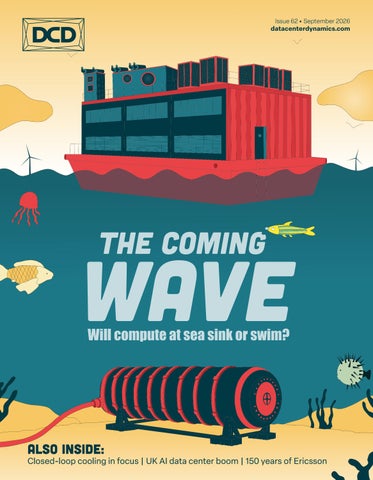
WAVE Will compute at sea sink or swim?
Also inside:
Closed-loop cooling in focus | UK AI data center boom | 150 years of Ericsson
THE GRID THE GRID THE GRID THE THE GRID THE GRID THE GRID THE THE GRID THE GRID THE GRID THE THE GRID THE GRID THE GRID THE THE GRID THE GRID THE GRID THE THE GRID THE GRID THE GRID THE THE GRID THE GRID THE GRID THE THE GRID THE GRID THE GRID THE THE GRID THE GRID THE GRID THE THE GRID THE GRID THE GRID THE THE GRID THE GRID THE GRID THE THE GRID THE GRID THE GRID THE THE GRID THE GRID THE GRID THE THE GRID THE GRID THE GRID THE THE GRID THE GRID GET RID. Grid delays cost years. We get you to power faster. avk-seg.com
GRID GRID Contents GRID September 2026 GRID 6 GRID 70 GRID 15 25 GRID 30 GRID GRID 35 66 GRID GRID 40 GRID 44 GRID 51 GRID 15 News
The biggest data center stories of the last three months
The coming wave Is compute at sea set to sink or swim?
Closing the loop Are closed-loop systems the solution to data centers' water woes?
Cool Britannia: Chatting chips with UK Semiconductor Centre CEO Andy McLean Why the UKSC chief predicts a bright future for the country’s chip sector
What is the right-size for AI in the UK? Looking at large-scale new-builds vs legacy retrofits in old Blighty
Something in the air: The rise and fall of Ionica Remembering the world’s first fixed wireless network
From coal and Bitcoins to sandwiches and AI
DCD visits TeraWulf’s Lake Mariner campus in Buffalo, New York
Tokenomics: Putting a price on intelligence Inside the on-demand consumption model
90 56
62
A taxonomy of American data center opposition pt.2
Politics, misinformation, conspiracy theories
Building the moratorium map How data center bans have spread across the US
66 ASIC ambition
Why the performance and efficiency challenges of off-the-shelf hardware are seeing startups and hyperscalers making the case for custom silicon
telco to towerco: Array’s 70 From pivot to digital infrastructure Keeping up with the ‘Big 3’ proved challenging, but passive infrastructure assets give Array a new lease of life
75 An introduction to 800VDC
The industry is experimenting with where the AC-to-DC conversion takes place within the facility, but standards, protection methods, and operating practices are still catching up
80 150 years of Ericsson
A trip down memory lane provides inspiration for the vendor’s AI-focused future
84 Space compute for who?
Unpacking demand for the orbital data center revolution
89 The tower that wouldn’t fall
How a rusting Croatian cell mast became a symbol of a nation's survival
90
Built different: Inside TRG’s homegrown data center business From a family-run hosting business in Atlanta to a growing data center operator in Houston, Christopher Hinkle has built TRG around doing things differently
95 Working hard Evri day
The digital backbone behind one of the UK’s largest courier services, and the backstory of its CTO
98 Life after Jensen
Can the market survive a post-Nvidia future?
65 A Texan pause
DataBank’s CEO on the Lone Star State’s new approach to data centers
Issue 62 • September 2026 | 3
Power you can count on. Data centre grid connections from concept to completion. There’s no question that connections are getting more complicated. And often, the only thing that’s certain… is uncertainty. Eclipse Power are still here, with the same mission - to make things simpler. We cover the full energy infrastructure landscape. From design to connection… and beyond. This gives us a unique perspective. One that brings clarity to you and your projects.
Come and see us on Stand 6 at DCD Connect London. We’d love to talk.
eclipsepower.co.uk Electricity Connections. Simplified.
From
the editor
Group Publisher & Executive Editor Sebastian Moss Editor-in-Chief Dan Swinhoe Senior Editor Matthew Gooding
Ready to make a splash?
A
fter many years as a largely invisible industry, the AI boom has thrust data centers into the spotlight. With opposition among communities, pressure groups, and politicians running high across the US and elsewhere, developers are having to rethink their strategies and consider new frontiers.
All at sea
For our cover feature (p15), we talk to those looking to put compute at sea. Underwater and floating data center projects have boomed in popularity this year, in part because the ocean represents a chance to build digital infrastructure away from the prying eyes of naysayers. The sea potentially offers access to a vast energy resource - hydro power - as well as free cooling, but there are plenty of hurdles to overcome before we see flotillas of GPUs out on the water.
In the loop
Data center water use is a recurring theme among the industry’s critics, with many operators pointing to closed-loop systems as a path to a greener future for the sector. We find out more about the companies making - and using - this technology (p25).
A very British dilemma
What is the role for the UK digital infrastructure sector in the era of AI? Britain does not have a host of gigawatt-scale campuses in development, but remains one of Europe’s busiest market for data centers. Could AI inference (p35) hold the key?
Matthew Gooding Senior Editor
Telecoms Editor Paul Lipscombe
Elsewhere, Britain’s chip industry is constantly in search of another company like Arm, the chip design giant that took the world by storm. Luckily, UK Semiconductor Centre CEO Andy McLean has a plan to grow the next generation of game-changing silicon firms (p30).
Terminally online
In a somewhat ironic turn of events, given that the platforms in question are all cloud-based, data center critics are taking to social media to spread their message and boost their reach. We look at the memes and campaigns that are hitting home with viewers (p56).
Danger! High voltage
Compute, Storage, & Networking Editor Charlotte Trueman Cloud & Hybrid Editor Georgia Butler Energy & Sustainability Editor Zachary Skidmore Reporter Jason Ma Spanish Reporter Cristina Cueto Head of Partner Content Claire Fletcher Partner Content Manager Farah Johnson-May Copywriter Erika Chaffey
Data center industry events have been awash with talk about the arrival of 800VDC power for years. It will necessitate big changes for operators, but could deliver equally big benefits when it comes to energizing the next generation of hardware (p75).
Designer Katherina Bradshaw
Banking on change
Content Director Alex Dickins
Media Marketing Stephen Scott
Texas has hit pause on new data center developments, in a move which could have profound implications for the industry. Raul Martynek, CEO of Dallas-based DataBank, argues this will ultimately be good for companies building in the Lone Star State (p65). Plus: Inside TeraWulf’s Buffalo campus, Array’s pivot to digital infrastructure, AI tokenomics explained, the use cases for space data centers, and much more.
48.9GW
Total capacity of data center projects in Texas hit by the state's pause on new developments
Channel Managers Kat Sullivan Emma Brookes Zoe Turner Tam Pledger James Raddings Group Commercial Director Erica Baeta Conference Director, Global Rebecca Davison Live Events Gabriella Gillett-Perez Tom Buckley Audrey Pascual Director of Marketing Services Nina Bernard CEO Dan Loosemore
© 2026 Data Centre Dynamics Limited All rights reserved. No part of this publication may be reproduced or transmitted, in any form or by any means, electronic, mechanical, photocopying, recording or otherwise, or be stored in any retrieval system of any nature, without prior written permission of Data Centre Dynamics Limited. Applications for written permission should be directed to the editorial team at editorial@datacenterdynamics.com. Any views or opinions expressed do not necessarily represent the views or opinions of Data Centre Dynamics Limited or its affiliates. Disclaimer of liability: Whilst every effort has been made to ensure the quality and accuracy of the information contained in this publication at the time of going to press, Data Centre Dynamics Limited and its affiliates assume no responsibility as to the accuracy or completeness of and, to the extent permitted by law, shall not be liable for any errors or omissions or any loss, damage or expense incurred by reliance on information or any statement contained in this publication. Advertisers are solely responsible for the content of the advertising material which they submit to us and for ensuring that the material complies with applicable laws. Data Centre Dynamics Limited and its affiliates are not responsible for any error, omission or material. Inclusion of any advertisement is not intended to endorse any views expressed, nor products or services offered, nor the organisations sponsoring the advertisement.
Issue 62 • September 2026 | 5
DCD magazine #62 Whitespace
The biggest data center news stories of the last three months
News
Extinction Rebellion attacks Microsoft construction site Environmental movement Extinction Rebellion has protested a Microsoft data center project in Amsterdam by pelting it with acid-filled balloons. The group has said it is planning more such attacks.
Drinks co. Liquid Death wants pee for data centers
Drinks companies Liquid Death and Garage Beer teamed up for an anti-data center themed marketing campaign. The firms created a music video asking for urine to cool data centers, instead of water.
GOP calls for FBI to look antidata center movements A trio of Republican representatives in June called for the FBI to investigate data center opposition, saying that anti-data center advocates in the US are backed by “foreign influence campaigns.”
IPO fever comes to the data center sector
U
S data center firm Csquare has gone public, and a host of other operators are set to follow. The Brookfield-owned colo provider went public on the New York Stock Exchange in July, raising more than $1 billion but missing its original target of $1.35 billion. Csquare, originally Centersquare, was formed in April 2024 via a merger between Cyxtera and Evoque under Brookfield. Cyxtera was previously listed on the Nasdaq, going public via a SPAC merger in 2021. The company subsequently filed for bankruptcy in 2023, and was then acquired. The move is the latest float in the cloud and data center space, but will not be the last. SpaceX and Cerebras have both gone public in 2026, and several other data center companies are making similar moves to go public in the near future. The likes of Switch, Vantage, CyrusOne, DayOne, Nscale, SB Energy, and Lambda are reportedly looking to ring the bell in the coming months. DigitalBridge and IFM took Switch private in 2022 in an $11 billion deal. The company is eyeing a large float that could value it at up to $50 billion, according to reports. CyrusOne also went private in 2022, with KKR acquiring the firm for around $15 billion. The company originaly went public
6
on the Nasdaq in 2013, and could IPO sometime next year. Vantage is also owned by DigitalBridge, and is said to be exploring an IPO or sale as soon as next year. The firm could be valued as much as $100 billion. DayOne, the international spin-off of Chinese operator GDS, could IPO in the US before Christmas. With a footprint that extends across southeast Asia and is expanding into Europe, DayOne could be valued at $20 billion. GDS went public on the Nasdaq in 2016. The firm spun out what was previously GDS International into a standalone company last year, securing outside investment from the likes of SoftBank and Coatue. Neocloud and data center firms Lambda and Nscale are both also said be heading towards public markets. Both are looking to raise more than $2 billion, with Lambda targeting a valuation of around $12 billion. Nscale could go public before the year is out. SB Energy, a US-based energy and data center subsidiary of Japanese conglomerate SoftBank, is also moving towards an IPO. The company, which is developing an 11GW data center campus in Ohio, filed an S-1 form with the SEC in August. It counts OpenAI and Nvidia as investors.
| DCD magazine • datacenterdynamics.com
Meta leaves RE100 climate initiative over nat gas
Meta has left the RE100 initiative, a global coalition of companies that have committed to source all their power from renewable energy. The social media firm has seemingly left the climate initiative over its investments in natural gas to power its data centers.
Data center simulator hits Steam platform
A data center simulator game has been released on Steam. Data Center allows players to “build, cable, and grow a living data center from the ground up.” The game is the solo project of Czechia-based video game developer Vaclav Novak, otherwise known as Waseku.
CoolIT designs 15kW cold plate design
Liquid cooling firm CoolIT has designed a 15kW coldplate for highdensity IT workloads. The company claims it delivers nearly four times the performance of its earlier single-phase direct liquid cooling coldplate designs. Nvidia’s Blackwell GPUs can operate at up to 1.2kW, with its Rubin GPUs featuring TDPs up to 2.3kW.
DCD magazine #62
Texas governor Abbott puts brakes on data center pipeline
T
he governor of Texas has hit the brakes on new data center developments in the Lone Star State. August saw Governor Greg Abbott direct the Public Utility Commission of Texas (PUCT) and the Electric Reliability Council of Texas (ERCOT) to undertake a comprehensive audit of all data center projects currently advancing through ERCOT’s interconnection process. According to the governor's office, the PUCT and ERCOT will have to complete the audit before any data center project is advanced. It said that if any project fails to comply with the set requirements, it will subsequently be denied access to the power grid. “Our top priority is to protect Texans’ safety and quality of life,” said Abbott. “Any project that fails to comply with the requirements set forth by the PUCT and ERCOT, and by state law, must be denied connection to the Texas grid. Simply put, Texans must come first.” Texas is fast becoming a new hotspot for data center development. At present, ERCOT is considering more than 474GW of connection requests, which is more than five times the state's record peak electricity demand. Of that capacity, approximately 90 percent is attributed to data center load. The latest directive builds on Abbott's call in June for the PUCT and ERCOT to take immediate steps to protect
residential ratepayers from the costs of data center expansion. As part of the audit, the PUCT and ERCOT have been instructed to gather information detailing the extent to which data centers are paying their own way or, depending on the state, the extent to which they are providing their own power or relying on the grid, the extent to which they are bringing their own water supplies and/or reusing water rather than relying on local communities, whether they are using measures to reduce impacts on neighboring property owners and communities, and finally information detailing the ownership and controlling interests in the project. The directive closely follows the approval of a new connection process proposed by ERCOT in June. Under the new framework, projects will enter a
batch, with ERCOT studying the eligible projects to determine grid needs and capacity. Subsequently, transmission capacity will be allocated based on what the grid can support, with ERCOT then developing and publishing a transmission plan identifying necessary upgrades to the network. Bloomberg NEF says the pause could impact gigawatts of planned capacity. The move is an about-face for Abbott, who has traditionally been probusiness and in favor of data centers. In late June, Abbott called for data centers to be banned from rural areas of the state. “We must prohibit them from building AI data centers in rural Texas neighborhoods. [Data centers] dovetail right into fighting for East Texas values,” Abbott said at a campaign event.
SpaceX becomes a data center provider
S
paceX is quickly becoming a major data provider after securing several significant customers for its facilities and GPUs. The company, which went public in June, first announced plans to lease capacity to AI firm Anthropic in May. The maker of Claude is set to lease essentially all the capacity at xAI's Colossus 1 data center outside Memphis, Tennessee. IPO filings show the 300MW deal was set to generate around $1.25 billion a month for Elon Musk's company, in a contract running until May 2029. Since then, the firm has secured Google as a customer in a major leasing deal. The search firm is set to lease 110,000 GPUs from SpaceX. In its first earnings report since going public, SpaceX said it expects to end the year with more than 2GW of compute, up from 1.4GW of
nameplate compute at the end of Q2, 1GW in Q1, and 400MW a year ago. The rocket, satellite, and now data center company is targeting 10-20GW by the end of 2027. xAI acquired Musk's social media platform X (formerly Twitter) in March 2025. SpaceX, in turn, acquired artificial intelligence startup xAI in February 2026. The unit is now known as SpaceXAI. While X, the social media unit, was known to operate out of leased facilities in California and Georgia, xAI's self-developed Colossus data centers are located in and around Memphis, Tennessee. The first Colossus site launched in a former Electrolux factory in 2025. Colossus 2 (aka Macrohard), soon followed. Work is ongoing on Colossus 3 (aka Macrohardrr) and a fourth building known as Minihard.
Issue 62 • September 2026 | 7
Whitespace The biggest data center news stories of the last three months
New York becomes first state to introduce blanket data center moratorium
N
ew York has become the first US state to impose a moratorium on new large-scale data centers. The moratorium was signed into law in July by New York Governor Kathy Hochul amid growing concerns about the impact of large-scale data centers on power costs, water supplies, and residents in the local communities. The order will immediately pause environmental permits for projects with a capacity of 50MW or more, providing time for a requisite regulatory framework to be developed. "As data center development threatens to hike up utility bills, deplete our natural resources, and create uncertainty for New Yorkers, it's my responsibility to take action and lead," said Hochul. The order also directs the Department of Public Service to consider creating a New York Grid Acceleration Fund, which would require data centers to invest in the state's aging grid infrastructure. Reports
also indicate that Hochul will pursue legislation to repeal statewide sales tax exemptions for data centers. A proposed three-year moratorium in New York is also making its way through the legislature after being introduced earlier in the year. Introduced by Democratic state senator Elizabeth Krueger in February, S.9144 would also require the state government to investigate and mitigate the environmental and utility rate impacts of data centers. According to the governor's office, the decision was made to advance a one-year moratorium due to the apparent “complicated” nature of the Krueger-proposed bill. Reflecting on the news, New Yorkbased data center firm TeraWulf remained confident that the order wouldn't impact the expansion of its Lake Mariner campus in New York. "As I've said from day one: we like regulation. Today's Executive Order is a positive step," said Paul Prager, chairman
Leader of UK's Green Party calls for national data center moratorium
T
he leader of the UK's Green Party has called for a pause on the development of data centers in the country. In late August, Zack Polanski said that new projects should not be approved, following the driest July on record and a lengthy drought. "We need to slam the brakes on these energy-guzzling, water-guzzling data centers," Polanski told the BBC while visiting the site of a proposed data center in East London. "Essentially, we need basically a moratorium, other than local-scale data centers for the local community. At a time when three-quarters of the country are in drought, it is outrageous that these are being considered critical
8
infrastructure. "To most people, critical infrastructure means hospitals, water, electricity. It doesn't mean artificial intelligence." Ruling party Labour rejected the Greens' call for a moratorium, and said that it would impact jobs. A spokesperson for the government said: "A pause on building new data centers would simply send investment and good jobs abroad, while leaving Britain dependent on overseas computing for the processing of sensitive health and defense data." The government added it would be a "disaster for jobs and national security," but still noted that not every data center should be approved.
| DCD magazine • datacenterdynamics.com
and CEO of TeraWulf. "Clear rules and higher standards separate real projects from speculative ones. A win-win for New York and TeraWulf." While New York is the first to enforce a statewide moratorium, several other US states have seen similar legislation proposed. In Maine, a bill passed both houses that would have imposed an 18-month moratorium, but it was ultimately vetoed by the governor. Although moratoriums have long been used at the local level, officials in Minnesota, Virginia, New Hampshire, Vermont, Oklahoma, Maryland, Georgia, Pennsylvania, South Carolina, Wisconsin, and Michigan have also introduced bills calling for state-wide bans on new developments. A bill proposing a national moratorium was also introduced by US Senators Bernie Sanders and Alexandria OcasioCortez in March 2026. The act would prevent data center construction until the government brings in new guardrails.
Scottish National Party backs call for data center ban
T
he Scottish National Party (SNP), the largest party in the Scottish Parliament, said in July that it will now back a temporary moratorium as concerns over the environmental impact of large-scale data center developments grow. The Scottish Green Party had already demanded a moratorium, and between them the two parties hold a clear majority in the Scottish Parliament, meaning any legislation that comes forward is likely to pass. Scotland does not have a large data center market, but the AI boom has led to a host of developers bringing forward new projects. More than a dozen projects totaling around 4.8GW have been announced across Scotland in the last 18 months or so, which could potentially double the country's energy use. Any moratorium in Scotland, however, would put the nation’s government in direct opposition to the UK government in Westminster, which is actively encouraging new data center projects to help drive economic growth.
Whitespace The biggest data center news stories of the last three months
UK's Ofgem proposes DC grid commit fee
T
he UK’s energy regulator Ofgem has launched a new consultation to deal with speculative data center applications within the UK’s interconnection queue. The plan comes as demand connection applications have increased from 41GW to 125GW in less than a year, driven primarily by the data center market, which accounts for around 80GW of demand. The proposed reforms include a new Data Centre Commitment Fee, in which large load data centers would pay when accepting a connection offer from the grid operator. The fee would be refunded when the project is energized and forfeited if the project exits the queue early. According to Ofgem, the fee would be between £237,500 ($315k) and £712,500 ($947k) per megawatt, which it claims is equivalent to approximately 2.5-7.5 percent of average project costs. Ofgem claims that the new fee will help it tackle speculative projects with no firm intention to connect. This, in turn, the regulator argues, will protect consumers, improve confidence in network planning, and clear the way for viable projects to connect more quickly. Alongside the fee, Ofgem has also announced that it will begin consultations on new data centerspecific queue management milestones that would require developers to demonstrate tangible progress such as financial capability, commercial maturity, and procurement activity to maintain their position in the queue. Ofgem is the independent government regulator for the UK's electricity market.
Google reveals Brazos, a new open-source liquidto-air cooling sidecar
G
oogle has announced a new opensource rack-mounted, closed-loop liquid-to-air cooling system for use in existing air-cooled environments. Already generally available, Google said its manufacturing suppliers are “ready to engage the broader industry to market and produce the Google Brazos design.” Google said Brazos will allow highperformance liquid cooling with the operational simplicity of standard aircooled systems. The system is self-contained and works by capturing heat via liquid at the component level, then rejecting it into the data center’s hot aisle using liquid-to-air heat exchangers. It is modular, including three cooling units and integrated rack manifolds. Each chassis will occupy 11 Open Units of rack height and interfaces with standard Open Compute Project ORv3 form-factor racks. Brazos supports a 60kW nominal thermal load per rack across three modular units and is compatible with either deionized water or a 25 percent propylene glycol mixture. It operates on a 40-60V DC input, connecting directly with standard rack busbars. Google said it is certified to UL/CSA/ IEC 62368-1 standards and has built-in leak detection and pressure relief valves. Google said it intends to open-source the technical specifications, design principles, and visual assets of Brazos. “As part of a broader infrastructure
portfolio that continues to leverage waterless air-cooled systems alongside liquid cooling, Brazos represents one of many innovations we are contributing to the open hardware ecosystem,” Google said in a blog post. “We invite system architects, manufacturers, and thermal engineers to evaluate these designs to scale rackmounted cooling infrastructure for the high-power computing demands of the future.” In 2024, Microsoft and Meta announced Mount Diablo, an open rack design for AI data centers which separates power and compute into different cabinets, aimed at tackling the same issue. Rather than having both elements in the same rack, the power cabinet operates as a sidecar unit with the main rack space dedicated to compute. Google has also been involved in Mount Diablo as part of the Open Compute Project, contributing to the standardization of electrical and mechanical interfaces and developing, along with Meta and Microsoft, an ACto-DC sidecar power rack to allow the main rack space to be used for GPUs, TPUs, and CPUs. Longer term, Google said it was exploring direct distribution of higher-voltage DC power within the data center and to the rack.
Dan’s Data Point
Amazon's own data centers consumed 2.5 billion gallons of water last year according to a recent company blog post. That's a two percent decrease on 2024's figures, and does not include leased sites.
AWS adds 3.8GW of capacity in 12 months
A
mazon Web Services (AWS) touted significant data center growth in its latest annual sustainability report. The company said that last year it "added more data center capacity globally than any other company," including "more than 1.2 gigawatts (GW) in Q4 alone." Amazon did not detail its total data center power consumption, but from October 2024 to October 2025 it added a total of 3.8GW. "To put that in perspective, we're now double
10 | DCD magazine • datacenterdynamics.com
the power capacity that AWS was in 2022, and we are on track to double again by 2027," CEO Andy Jassy said at the time. Its cloud business operated a total of 56.839 million square feet (5.28m sqm) of data center and office space in 2025, according to its 10-K filing. That represents a 16 percent increase over 2024. About half of that space is owned by the company, with the rest leased. Its data centers consumed 2.5bn gallons of water in 2025.
Reliable, Scalable, and Efficient
Data Center Cooling Solutions In mission-critical data centers, maintaining precise cooling is essential for uptime, performance and efficiency. The Belimo Energy Valve™ ensures consistent differential pressure in direct-to-chip cooling applications, optimizing heat transfer and preventing thermal fluctuations that can impact server performance. Belimo solutions provide: Reliable temperature regulation to prevent IT equipment failures Scalable solutions to support increasing server loads Efficient energy management to reduce waste and operational costs Experience Maximum Uptime and Optimal Performance with Belimo.
Learn More www.belimo.com/datacenters
DCD magazine #62
Fermi signs on TensorWave as a customer
D
ata center company Fermi America has signed a binding lease agreement with AI cloud firm TensorWave for up to 650MW of data center capacity at its Project Matador site in Texas. Announced in August, the deal supports an initial 222MW of capacity beginning in the second half of 2027, but includes expansion rights for two additional data centers that would total 650MW. Once complete, the facility will support the deployment of “tens of thousands” of next-generation AMD Instinct GPUs for training and inferencing workloads. The lease is expected to generate approximately $6.5 billion in total contracted revenue for the 15-year term, Fermi added. AI cloud company TensorWave exclusively offers access to AMD GPUs via its platform. In May 2025, the company raised $100 million in a Series A funding round.
"A lease of this size and this term is a tremendous vote of confidence in Fermi," said Marius Haas, chairman of the Board of Directors of Fermi America. "In delivering this first binding agreement, we've now fulfilled the most important objective we shared with the market in May. "The committed partner ecosystem of developers, guarantors, and financing providers are all industry-leading companies, and TensorWave is exactly the kind of anchor customer our project was designed for. I am incredibly proud of our team for executing the site buildout to date, and for delivering this agreement and advancing others that we expect to announce soon." Fermi was founded in January 2025 by former Texas governor and energy secretary Rick Perry and Toby Neugebauer. The company’s Project Matador is a proposed massive 17GW data center and energy campus near Amarillo in Texas on land owned by the
Texas Tech University system. The campus was initially announced with planned 11GW of capacity, but Fermi increased the figure to 17GW in March 2026. If realized, the campus will span 18 million sq ft (1.67 million sqm) and would utilize a combination of on-site energy sources, including natural gas, solar, wind energy, and nuclear energy. Last year, Fermi said that it had signed a non-binding letter of intent with an unnamed “investment grade-rated tenant” to be the first customer at the campus but that firm later withdrew from the deal, a matter that led to a class action lawsuit. Currently, Fermi has no data centers in operation and little experience in the sector within its executive team. Despite this, the company raised $682m in an October IPO that valued the business at $15 billion. Fermi said Project Matador is “well underway,” with approximately 6GW of the planned 17GW already permitted, and more than $1.5bn invested in the buildout to date, with first power targeted for 2026. In April, Neugebauer, Fermi’s CEO and co-founder, and Miles Everson, the company’s CFO, departed the company. Neugebauer has since fought the company for control of the business, and called for a sale, while Fermi has accused him of a 'pattern of falsehoods.' TensorWave is a known customer of TecFusions. In January 2026, the company signed an additional 20MW capacity agreement with TecFusions for data centers in Pennsylvania and Arizona. The company claims to have more than 2GW of long-term data center capacity secured. Since its May 2025 fundraise, TensorWave has launched an AI training cluster with 8,192 AMD Instinct MI325X GPUs online, and said it is preparing larger MI355X deployments across several new data center regions in North America.
OpenAI details Jalapeño AI chip, with 700W TDP
O
penAI has provided further details about its custom AI accelerator 'Jalapeño,' developed in partnership with Broadcom. At the Hot Chips event in August, the company behind ChatGPT revealed that the processor is rated at 700 watts, but the chip's measured sustained power remained at or below 550W on the workloads tested. OpenAI will deploy Jalapeño in racks featuring 128 chips, while "a full pod is 2,048 ASICs," the company's VP of hardware, Richard Ho, said in a presentation attended by DCD. The 128
deployment is capable of 1.7 exaflops of 4-bit compute, with 27.5TB of HBM4. Each package will have 15.4TBps of memory bandwidth. Ho said that the company tested the chip on three models, its own GPTOSS-120B, as well as DeepSeek's R1 and Moonshot AI's Kimi K2.5. "Across the three models we tried this on, we showed that the architecture works across not just internal models, but others," Ho said. "This is a general purpose, very flexible accelerator." On SemiAnalysis’ InferenceX benchmarks, the company claimed
that Jalapeño-based systems provided between 1.5x and 1.9x more “AI work” at peak throughput, and 1.7x to 3.6x lower end-to-end latency than rival platforms on the three models. On ultra-low latency, it performed 2.1x to 4.1x faster. When asked about whether OpenAI would sell its chips to other companies, Ho said: "We have a lot of compute needs within OpenAI, it's going to take a lot of compute to meet those, we are struggling to have enough." Jalapeño is expected to be deployed in limited quantities later this year.
Issue 62 • September 2026 | 13
BU I
N
AG
TA
MA
IN
N IG
LD
DE S
The self-delivered project partner for critical infrastructure environments.
E
MA
IN
Compute at sea
The coming wave Matthew Gooding Senior Editor
HiCloud’s first underwater data center. Image: HiCloud
S
Is compute at sea set to sink or swim?
“The ocean is a green treasure trove of computing resources that has long been underutilized,” Su Yang, HiCloud
ome 71 percent of the Earth’s surface is covered by water. At times, it feels like the remaining 29 percent is covered by data centers. The AI boom has driven an unprecedented build-out of digital infrastructure, with new campuses springing up in droves all around the world. Competition for resources is fierce, with suitable land and available power often in short supply. Meanwhile, communities are becoming increasingly wary of the negative impact that data centers can have in their localities, and the industry is facing more scrutiny than ever before. Faced with these challenges, it is perhaps no surprise that developers are looking out to sea. A growing number of companies have honed in on the ocean as a source of power or cooling for servers, or simply as a discrete and permit-free location to run compute away from the prying eyes of opponents. Underwater and floating data centers are not a new concept, but the last year has seen a flood of new projects proposed,
ranging from the basic to the barely believable. Many of Silicon Valley’s power brokers feel these wannabe seafaring pioneers are onto something, with prominent investors offering millions of dollars to founders. Y Combinator, the tech incubator that launched the likes of Airbnb, DoorDash, and Stripe, is also on board, and in July put out a call for entrepreneurs working on ocean data centers to apply for its upcoming program, as part of a focus area it has dubbed Compute at Sea. “AI is running out of compute, and the demand for data centers is insatiable,” said YC visiting partner Francois Chaubard, in a video to launch Compute at Sea. “It might sound crazy, but think part of the answer may be to move compute offshore. Think of them as compute flotillas - many standardized, modular vessels, operating together as a global cloud. “While communities increasingly oppose the land, the water is open.” DCD has spent the last year interviewing companies that agree with Chaubard’s thesis, to try and establish whether any of them is ready to make a splash.
Issue 62 • September 2026 | 15
DCD magazine #62
Network error
P
roponents of offshore data centers often declare that it is much easier to obtain building permits for data centers at sea than it is on land. NetworkOcean may beg to differ. In September 2024, the California startup announced a plan to submerge a 500kW data center contained in a capsule designed by the company into San Francisco Bay as part of a test of its technology. Backed by Y Combinator, NetworkOcean said it could eliminate water consumption and cut data center energy use by 30 percent compared with on-land. However, reporting from Wired revealed that the company had not sought permission from the authorities to sink its data center. As a result of the publication’s inquiries, at least two agencies - Bay Conservation and Development Commission and the San Francisco Regional Water Quality Control Board - were said to have written to NetworkOcean to inform it that carrying out tests without a permit could see it landed with heavy fines. NetworkOcean declined to be interviewed for this feature. The company is pressing on with its program, but two years later does not appear to have launched any submersibles, and is now also touting floating data centers to house AI compute.
The sinking of Project Natick
In 2013, Sean James, then of Microsoft, had an idea. That idea would give birth to the world’s first underwater data center. Having enlisted in the US Navy after high school, James volunteered for the submarine fleet, where he served for three years. After leaving the Navy, he retrained as an electrician and got a job “in this weird building called a data center.” This was in the year 2000, when the Dotcom bubble was deflating rapidly, and the firm he worked for soon went
Image: Microsoft
bankrupt, with its team - and data center - acquired by Microsoft. “Microsoft was basically the only tenant,” he says. “So it took over the building, and that was the start of a 25-year career designing and building data centers for them, with the last six or seven years focused on advanced designs.” James penned a paper on submersible data centers as part of Microsoft’s Think Week, an event introduced by the company’s founder Bill Gates, where staff can take time away from their day jobs to read and think about new ideas. “I talked about how it would be constructed and some of the benefits, leaning on my engineering training in the submarine fleet,” he says. “CEO Satya Nadella saw it, and said, ‘I want to build one of these’, so we worked with Microsoft Research and deployed a single rack submersible data center off the coast of California, and then we deployed a row of racks off the coast of the Orkney Islands up in Scotland.” Known as Project Natick, the underwater data center in Scotland was submerged in 2018, with 855 servers installed in a cylindrical capsule filled with inert nitrogen gas and left to run unattended for 25 months and eight days at a depth of 36 meters (118 feet). A further 135 servers also formed part of the test, and were left to run in a couple of racks on dry land, alongside hardware running Microsoft's Azure cloud, to compare and contrast.
16 | DCD magazine • datacenterdynamics.com
DCD reported on the project in depth in Issue 38 of the magazine, after the data center had resurfaced. Only six of the 855 servers broke, compared to eight of the 135 on dry land. Despite this, we exclusively revealed in June 2024 that the project had been shuttered, with Noelle Walsh, head of Microsoft’s cloud operations and innovation division, stating: “I'm not building subsea data centers anywhere in the world.” James describes Project Natick as a “jugular experiment” because “you had all these different branches of learning stemming from the original experiment.” He explains: “We were able to keep the temperature envelope really tight underwater, because the water temperature rarely changes. In an air-cooled data center on land, you have 10-15°C (50-59°F) temperature swings, which causes a lot of thermal expansion in servers.”
Sean James, who worked on Microsoft’s Project Natick. Image: Sean James
Compute at sea He says the use of nitrogen was also a big factor in the submerged servers having lower failure rates, with the relatively large nitrogen molecules helping prevent leaks, and the lack of oxygen meaning there was no corrosion of equipment. “The importance of air quality was a big lesson learned,” he adds. “So that meant beefing up the protection of components on the servers and creating data centers that aren’t constantly being flooded with outside air. But we figured out we could get these benefits on land, without the brain ache of deploying data centers underwater.”
Taking the Hi road
While Microsoft ultimately decided to stay onshore, other companies claim to be running data centers below the ocean’s surface. The biggest deployment is in China, where HiCloud Technology is operating two separate underwater data centers. An offshoot of marine technology firm Highlander, HiCloud started work on its underwater data centers in 2021, launching its first commercial offering in late 2023. It now has two subsea data centers up and running. The first, off the coast of Hainan province, comprises a trio of 360kW pods anchored to the ocean floor, 100 meters (328 feet) below sea level, and powered by grid electricity. The second, near Shanghai, is tethered to a wind turbine, which provides it with power directly. This smaller installation has 48 racks of 12kW, giving a total capacity of 576kW. Further capacity is at various stages of commissioning and deployment, the company says, with the Shanghai data center capable of accommodating up to 2.3MW. In an exclusive interview with DCD, the first the company has granted to an Englishlanguage publication, Su Yang, general manager of HiCloud Technology, says that while the battle for data center space on land is fierce, the ocean provides “a green treasure trove of computing resources that has long been underutilized.” Yang adds: “It provides natural cooling and, at the same time, its proximity to offshore wind power plants gives us a unique advantage.” HiCloud tapped into Highlander’s existing marine engineering expertise to build its data center shells, Yang says, recruiting a team of digital infrastructure experts to work on the server rooms inside. The result is a modular compute unit that can be fitted into custom submersibles engineered for specific environments. While the Hainan capsules lie
“We can deliver behind-the-meter power and have a floating data center operational in the blink of an eye,” Gabe Andrews, Mousterian
horizontally on the seabed, the Shanghai data center is vertical and features a hatch above the surface, allowing access for maintenance. Following Microsoft’s lead, the company fills its data centers with nitrogen to help boost reliability. “We conducted an enormous number of experiments - hundreds - to address the complex influences in the underwater environment,” Yang says. “Ultimately, we achieved standardized, factory-prefabricated modules, so that equipment can be deployed and put into use immediately upon reaching the water.” According to HiCloud, this means it can move quickly on construction, and Yang says it can have new modules up and running “in just 90 days from installation to commissioning.” He says the firm can cut “construction time by more than half compared to traditional onshore data centers, reducing the delivery cycle by nearly tenfold, and significantly lowering costs.” HiCloud’s customers can also apparently save money on their cooling bills, with the data centers using the sea for free cooling, rather than deploying mechanical systems. “Our cold source system uses seawater as the primary cooling medium for the entire system,” says Tu Feilong, HiCloud’s technology director. “In regions where the seawater temperature meets our cooling requirements, we use 100 percent free cooling.” In other regions, Tu says, such as Guangdong, where sea temperatures are higher, HiCloud intends to incorporate an HVAC unit to provide additional cooling power. “Overall, the cooling system is relatively simple,” he says, adding that the data centers can achieve Power Usage Effectiveness (PUE) of 1.15.
HiCloud’s original test vessel ready to be submerged. Image: HiCloud
Issue 62 • September 2026 | 17
DCD magazine #62 Businesses with workloads running underwater include China Telecom, which uses HiCloud infrastructure for data annotation and AI model training. State-backed organizations Shanghai Yidian and Lingang Cross-Border are also customers, and Yang says the firm is in discussions with a number of other businesses, though whether the private sector shares the Chinese government’s enthusiasm for the facility is unclear. Highlander, HiCloud’s parent company, is not itself state-owned. HiCloud certainly has big plans underwater, and is particularly excited by the opportunity of powering its facilities with offshore wind. The Shanghai data center is intended as the first part of a 500MW underwater data center park, and elsewhere in China, in Qinhuangdao, the company is planning a 7MW data pod, scalable to 100MW, with similar installations in the works for Zhoushan and Shantou, as well as other regions. An international expansion could also be on the cards. Negotiations are “in the early stages,” Tu says, but adds: “In the not-too-distant future, we expect to build underwater data centers in waters around Abu Dhabi, Singapore, and other parts of Southeast Asia.” Subsea Cloud is the only other company publicly claiming to offer live underwater data center services. The US-based vendor has been active for several years, initially marketing 1MW pods inside shipping containers that could be used as colocation space or for Edge computing. Its systems can apparently cut CO2 emissions by 40 percent, and costs by 70-80 percent, when compared to land-based equivalents. Subsea Cloud’s website says it can deliver 1MW of data center capacity for $1 million, compared to a cost of $7m on land. The company is tight-lipped about the locations of its operating data centers, but says it runs servers in Asia, used primarily by gaming companies, and has previously talked about deployments in Houston, Texas, and Port Angeles, Washington. When DCD spoke to CEO Maxie Reynolds in January 2025, the firm was said to be on the verge of trialing AI infrastructure underwater in the UK and Norway, though it is understood these trials have yet to take place. Subsea Cloud has since opened an office in the Middle East to try and capitalize on interest in AI in the region,
and struck a partnership with Deep/C Systems that could see it deploy underwater infrastructure for defense contractors. Waves of new entrants are also joining the market. In Maine, DeepGreen [not to be confused with the UK company] has an ambitious plan to construct a 51MW tidal energy power project, which would feature universal docking cradles on the floor of the Western Passage, a stretch of water near the town of Eastport that connects to the Atlantic Ocean. These cradles would hold energygenerating turbines and pods containing AI infrastructure, with the turbines powering the GPUs and sending energy to nearby residents. But the project, put forward by real estate developer Louis Wolfson, who appears to have no background in data centers, has faced pushback from residents in Eastport, and in August, councilors in the town voted for a 180day moratorium on underwater data centers so that they could consider the merits of the proposal at length.
Floating into view
As work continues on underwater data centers, the surface of the water is attracting even more attention. Floating data centers of all shapes and sizes have been proposed for seas, rivers, and lakes around the world. As befits the diverse and somewhat speculative nature of the digital infrastructure industry in 2026, these projects are being driven by an unlikely collection of people, ranging from experienced operators to complete data center novices, and including engineers, energy experts, students, and finance bros, all of whom think they have a potentially lucrative answer to AI’s seemingly insatiable demand for compute. Houston-based Mousterian, also known as M3, has an advantage over many of its would-be competitors, as its team has built a floating data center before. Two of its founders, Chase Ott-Wick and Gabe Andrews, worked on a barge-based facility in Stockton, California, launched by Nautilus Technologies, which DCD visited in 2022. The 7MW facility was put up for sale by Nautilus in 2024, though the company confirmed that it still owns the data center.
18 | DCD magazine • datacenterdynamics.com
Render of Mocean’s floating data centers. Image: Mocean
Mousterian is working with Samsung Heavy Industries, the Korean tech giant’s maritime engineering division, to develop AI-ready infrastructure on barges that can be moored near a power plant or brownfield site where a power connection already exists. “When we were procuring traditional land-based sites, we realized that 80 percent of all thermal power generated in the US is on water,” says Min Suh, M3’s CEO. “We kept coming across these huge factories, or steel mills, or actual power plants, and thought, ‘hang on, why are we joining a four-year queue to get a grid connection in the middle of Chicago, when we can just go right to the power plant’.” M3 does not, in Suh’s words, intend to “rock the boat” with a novel floating product, but simply sees using the water as a way to bring compute online fast. Andrews, the company’s technical and delivery lead partner, explains: “Floating enables speed to operation while multiple workstreams are underway. So remedial work can be carried out on the power plant or factory, and the floating data center can operate while that’s happening. We can deliver behind-the-meter power and have a data center operational in the blink of an eye.” Under the partnership agreement, Samsung, which has stated separately that it intends to develop floating data centers for other clients, will design and manufacture modular floating units
Compute at sea
A rising tide
with capacity of up to 50MW, using its experience building offshore oil platforms. The barges are designed to withstand a category three hurricane (“when the Great Flood returns, Noah will come to us to make sure Netflix works on the Ark,” Andrews jokes) and have a 30-year lifespan. Overhead cables provide power and fiber connectivity from land. M3 is in charge of sourcing sites and tenants, and managing the data center projects. The company is working with an unnamed and privately-owned power plant operator keen to redevelop eight sites in the US for data center use. “They are looking to activate these power assets, but these sites need remedial work and the data centers will take time to deliver,” Suh says. “We will be able to deploy our floating product very quickly, but in the long run we expect 20 percent of our IT capacity to be floating, and 80 percent on land.” In Singapore, data center firm Keppel is also looking to get around a lack of space (Singapore operated undeffr a data center moratorium for several years because of concerns over land and power availability) by floating a 25MW data center at 25 Loyang Crescent, a riverside industrial warehouse complex. Keppel first started exploring the idea of building its own floating data center park in 2019 and secured regulatory approval for the project in 2023. Work has started on the facility, which has already been pre-let to a hyperscaler, and is due to come online in 2028.
While M3 and Keppel will both rely on traditional sources to energize their servers, other floating data center firms are looking to harness the power of the ocean. Panthalassa is developing Ocean-3, an autonomous, self-propelled platform designed to generate clean wave energy to power a modular AI data center. Earlier this year, it raised $140m in a Series B funding round led by PayPal and Palantir founder, Peter Thiel. “The future demands more compute than we can imagine,” Thiel said at the time. “Extraterrestrial solutions are no longer science fiction. Panthalassa has opened the ocean frontier.” It has since taken additional investment from South Korean cloud provider Naver, and is said to be raising more funds at a valuation of $2 billion. Having deployed two test craft, Ocean-1 and Ocean-2, in 2021 and 2024 respectively, the company hopes to launch Ocean-3 this year, with commercial deployments starting in 2027. Scottish renewable energy firm Mocean has a similar idea. It has already developed and trialed a floating offshore energy generation system, Blue Star, aimed at powering equipment needed by the oil and gas industry. This is set to hit the market in 2027. The company has now launched Blue Core, a similar craft but with added compute. “Blue Core is 70 percent the same technology as Blue Star, but scaled up,” says CEO Cameron McNatt. “That means making the structure bigger, and adding more power electronics modules, but from our perspective, we’ve already demonstrated 70 percent of the technology stack works, and now it’s about adding the data center piece on top of that.” Power would come from the company’s wave energy generator, which McNatt describes as a “big hinge” that is moved back and forth by the motion of the ocean. He explains that this “powers a direct drive generator, which has a clever magnetic gearing” to account for the low-speed, high-torque motion of waves. This mechanical energy is then converted into electrical energy and stored in batteries. On-board solar panels help keep the batteries topped up.
McNatt envisages that Blue Core would be towed out to sea and anchored far offshore, with network connectivity coming via satellite. Each unit will be able to generate up to 1MW of power for compute, which will be sold on an in-demand basis, either by Mocean itself or through a partnership with a neocloud. The CEO believes that the vagaries of renewable energy generation lend themselves to this kind of business model, rather than trying to contract a set amount of data center space with a hyperscaler or enterprise client. “We’re not looking to guarantee servers for Big Tech companies with 99.999 percent uptime,” he says. “But we will be able to say ‘we can have these servers on all the time’, and as we get more energy and power, we will be able to scale up the compute and provide more in the on-demand market.” Mocean is seeking a partner to develop the data center infrastructure inside its craft, and is raising £5m ($6.82m) to enable it to build a demonstrator data center, which it hopes to have in the water before the end of the year. Other vendors are following HiCloud’s lead and attaching data centers to existing ocean energy assets. German vendor WindCores did this with small data centers inside turbines back in 2018, and San Francisco-based turbine firm Aikido is developing a more powerful offshore wind platform with a data center incorporated into its structure. The floating platform is expected to host a turbine with between 15 and 18MW of capacity, supporting 10-12MW of IT capacity. Each unit will include three prefabricated 3-4MW data halls directly within the platform's steel hull. CEO Sam Kanner explains: “Over the past year, as we watched the growing challenges around powering and cooling new data centers, we realized our platform already had ample power and effectively free cooling built in. It hit us like a ton of bricks.” Unlike HiCloud, Aikido’s compute is above the waterline, within the columns of its floating platform. These columns are divided into three sections, with the top section containing the servers, the bottom part used for ballast, and a void in the middle. Fresh water, contained in the ballast tank, is pumped into the server room to cool the hardware, with the ocean being used to dissipate the rejected heat.
Issue 62 • September 2026 | 19
DCD magazine #62
Render of OptimalTransit’s floating data center. Image: OptimalTransit
The columns are “11-12 meters (3639 feet) in size”, according to Kanner, meaning they are capable of holding what he says is a fairly standard compute module. These will be manufactured separately from the rest of the platform and lowered into place before the turbine is installed at sea. Aikido hopes to have a demonstrator unit up and running later this year, and is targeting commercial deployments by 2028. While Kanner and his team believe they will soon be in a position to supply compute to its clients, including an AI orchestration platform that has signed a pre-agreement to lease server space at sea, other companies are taking a more long-term approach.
Thinking big
Growing up in Athens, Greece, Dimitris Koutentakis has always dreamed of the sea. Shipping accounts for some eight percent of the Mediterranean nation’s GDP, and Greece is home to the largest merchant maritime fleet in the world. “Shipping is a main industry there,
so I’ve always been close to that ecosystem,” says Koutentakis, an MIT graduate with a master's in mechanical engineering, who is now setting out on a voyage of his own with his startup, Atomarine. Teaming up with fellow MIT student Emile Germonpré, who is working on a PhD in nuclear engineering, Koutentakis co-founded Atomarine, which proposes putting small modular nuclear reactors (SMRs) on ships to power huge floating AI data centers. “We started out working on a nuclear-for-shipping project - our idea was that our nuclear ship would sail alongside existing container ships to provide additional low-carbon power,” he says. “It would be a way to decarbonize the existing fleet without a lot of modifications, but after a year of research we saw that the industry was a decade away from needing this solution.” Enter data centers, which need power much more quickly. The compute side of Atomarine’s proposal is fairly standard, comprising a large barge with shipping
20 | DCD magazine • datacenterdynamics.com
containers of servers installed upon it. The nuclear ship would be anchored next to the barge to provide 150MW of power, enough to cover two 75MW platforms. Putting a nuclear reactor on a ship is not an outlandish concept - the US and other countries around the world use compact reactors, similar to SMRs, to power aircraft carriers and submarines. But one sizeable fly in the ointment for Atomarine is that commercially available SMRs don’t exist yet. While many vendors claim to have reactors on the brink of launch, none has received regulatory approval, let alone gone into production. This has not stopped data center operators across the US from hailing SMRs as the solution to the industry’s power woes and signing preemptive deals to procure them. “We’ve been talking to some potential partners about getting access [to an SMR],” Koutentakis says. “But with the minor engineering changes that would be required and the regulatory timelines, we’re targeting a first deployment in 2031 or 2032.”
Compute at sea While it waits for this bright nuclear future, the company intends to turn to an old data center industry favorite, natural gas, and wants to install turbines on ships to energize its servers. Gas turbines (which themselves are increasingly difficult to procure) are very much not low carbon, but Koutentakis says they could provide a useful bridge to get its operation up and running. With funding from Y Combinator, Atomarine is developing its proposition and is building out its team ahead of a larger funding round later in the year. It hopes to use the proceeds from this funding round to build a proof-of-concept for its floating data center, with the all-important energy part following later. An even more ambitious plan has emerged from another of the world’s largest shipping destinations, the US state of Maryland, which is home to Baltimore, the busiest cargo port in North America. OptimalTransit, a newly formed joint venture between naval systems developer InMar Technologies and power technology firm OptiFuel, has unveiled its Kraaken range of floating data centers, which it says will offer capacity of between 10MW and 100MW, powered by renewable energy. A second iteration of the design offers a tantalizing proposition, adding power generation and water treatment capabilities, alongside 60MW of compute space. Optimal Transit says this will make it ideal for sailing to areas hit by natural disasters. OptimalTransit is led by Scott Myers and Jeff Kline, former colleagues at aerospace contractor Lockheed Martin, who are building on work initially undertaken as part of research projects for legendary US innovation agency DARPA. Central to its proposition is Ocean Thermal Energy Conversion, more commonly known as OTEC, a renewable energy system that uses the temperature difference between the surface and depths of the ocean to run an engine that produces electricity. While OTEC is an established technology, with the potential to produce up to 2TWh of power each year, according to some studies, its physical size and cost have so far limited its deployment. That could be about to change. “We’ve been able to shrink OTEC’s size by 70 percent,” Kline says. “This makes it approximately 250 times more efficient, because it compacts things and lowers the capital costs, so you’ve suddenly got a payback period of three to four years. That’s not a science project anymore.” The company is somewhat cagey about its system, much of which is proprietary, but says it can be built using off-the-shelf products
“Over the next decade we’re going to see more use of the ocean,” Professor Paul HaskellDowland, Edith Cowan University
commonly procured for shipping projects. It will, however, need a lot of money to bring its vision to life - Myers says $75m-$100m is required in the next year to build a digital twin of its system and get blueprints for its craft, which will be based on a small-waterplanearea twin hull design, finalized and certified. Getting a vessel actually built is likely to cost in the region of $400m, which, even in data center industry terms, is certainly not a drop in the ocean.
Plain sailing?
While there is no shortage of ambition among the companies looking to put compute at sea, how many of them will manage to turn their fancy AI-generated images of offshore data centers into reality remains to be seen. In their favor is the fact that building in the ocean does not require the kind of complex permitting arrangements that hinder landbased data centers, which often involve navigating several layers of local authority approval, as well as opposition from neighbors. Mocean CEO McNatt explains: “Permits are required at sea, but from our perspective it’s a lot less arduous and there’s going to be a lot less stakeholder pushback. The process is a lot faster than on land, and less expensive.” Companies like HiCloud and Aikido, which are keen to utilize existing offshore renewable energy assets, may also be in luck, as the offshore wind industry, in particular, is looking for new revenue streams. Many wind farms are struggling for profitability amid rising costs, an uncertain regulatory and pricing environment, and a sometimes hostile political climate. US President Donald Trump, a long-time opponent of building turbines, has described wind as “bullshit” and stated - incorrectly - that offshore installations harm whales. Last year, the US government imposed a stop-work order on new offshore wind projects, citing potential national security concerns, leading to a number of projects being paused or cancelled. With auctions for new turbines in several European countries failing, and build-outs falling behind schedule, data centers and AI could provide valuable income for operators. “Offshore wind is in a bit of a pickle at the moment,” says Juergen Peterseim, partner in sustainable asset transformation at Deloitte. “There are many lower-cost options, such as onshore wind and solar, and I think the industry is about to stall in Europe if we don’t have an offtaker that needs a lot of capacity. “Data centers could be that offtaker, and with the constraints we’re seeing on land, the industries could help each other to grow.” While the natural cooling power of the sea
Issue 62 • September 2026 | 21
nect
DCD magazine #62
Bad vibrations
W
hile operators building underwater data centers may have considered many potential hazards, the threat posed by a simple speaker system is probably not at the forefront of their minds. However, according to research from a group of cybersecurity and robotics academics at the University of Florida and the University of Electro-Communications in Japan, sonic attacks are a big potential vulnerability for subsea facilities. Sound injection attacks, carried by dense water and targeting the resonant frequencies of hard drives, can make servers unresponsive, crash networks, and even permanently destroy hard drives. In the 2024 research project, the team used an offthe-shelf speaker to play music tuned to five kilohertz — a frequency one octave above what can be played on a piano — that made the submerged hard drives vibrate uncontrollably, negatively impacting performance. They
is often hailed as an environmental benefit for offshore compute, discharging heat from servers into the ocean could have a negative impact on plants and wildlife. Aikido CEO Kanner said his company has calculated that the heat from its platform only raises the temperature of the sea within a two-meter radius. “It’s a very localized heat island,” he says. Vendors will also need to convince their clients that putting expensive hardware on out in the ocean, where extreme weather and the corrosive nature of salt water can have unpredictable consequences, is a safe bet. There is also the cybersecurity element to consider. Undersea communications cables have been targeted as part of grey zone warfare operations carried out by Russian and Chinese forces, and floating or submersible data centers could be tempting targets, too. “Some people would say a data center on land, with armed guards and a big fence around it, is the safest,” says Professor Paul Haskell-Dowland, professor of cyber security practice and associate dean in the School of Science at Australia’s Edith Cowan University. “You won’t have that at sea, though you may have things like proximity sensors to detect incursions. You could also see self-destruction
repeated the experiment in a lake on the University of Florida campus, at a distance of 20 feet (six meters) from the hardware, but said attacks could be carried out from a greater distance using underwater robots. While solid-state hard drives would presumably not be impacted by such an attack, the researchers said the most efficient way to combat these issues was via a machine learning algorithm that could detect problematic frequencies. The ocean is “awash in sound already,” said Dr. Kevin Butler, a UF professor and director of the Florida Institute for Cybersecurity Research. Indeed, sperm whales produce the loudest biological sound on Earth, a clicking noise that can measure more than 230 decibels. Dr. Butler added: “We’ve demonstrated that these attacks can happen inadvertently from something like a submarine sonar blast, which is extremely loud. These are issues that haven't been studied at all by the security community.”
mechanisms built into these pods in future, in case of a physical attack.” The bigger risk, Professor HaskellDowland believes, is to the data flowing to and from the servers, particularly for those operators that propose to use cables. “The technology absolutely exists to tap into cables,” he says. “Being able to do that with an international cable is one thing, but being able to access the main feed going into a data center is another entirely. You could easily imagine a scenario where a state actor wants to access a specific data center underwater and might not get noticed if they attempted to do that two or three kilometers out to sea.” Despite these concerns, Professor Haskell-Dowland, who has studied the issues around offshore compute, believes we are likely to see more deployments at sea in the coming years. “Things will change that will make it more attractive,” he says. “Our ability to put more stuff into a smaller space and make a consistent pod-based system, that takes racks of equipment in a consistent manner, much as we do with data centers on land, is going to improve. “This probably won’t happen in the next few years, but over the next decade we’re going to see more use of the ocean, and it will become a more
22 | DCD magazine • datacenterdynamics.com
attractive option, particularly in areas where land values are rising to the point of unaffordability.” HiCloud’s Yang argues the lower electricity costs his firm can achieve at sea will help it, and its competitors, grow. “Customers ultimately care about the final price,” he says. “As long as the price is competitive, they'll use whoever offers the best deal. “Once you've built a computing cluster and made it available, whoever offers it cheapest wins. Electricity costs account for the vast majority of total computing costs - roughly 70 percent - so whoever has access to cheaper electricity has the ultimate competitive advantage.” James, the architect of Project Natick, is less bullish on the long-term prospects of offshore data centers, particularly in the US market. “There are niche applications where they do make sense,” he says. “But I think there’s an enormous amount of empty space on dry land without having to move all data centers offshore. “The reality is that a conventional data center is already hard to build, hard to maintain, hard to operate, and hard to retrofit later on. If you’re going to add a whole layer of complexity on top of that, you’d better have a really solid value proposition on the other side.”
Your global chip to ambient partner As data centers get hotter, optimal end-to-end efficiency is critical. Our industry-leading solutions span the thermal management chain to put 0L/kWh WUE and 1.2 PUE – or better – within reach, anywhere in the world. Get complete cooling control over your data center Scan the QR code to explore our products, solutions and possibilities
johnsoncontrols.com
© 2026 Johnson Controls. All rights reserved.
1 IN 4 DATA CENTRES WORLDWIDE RUN ABB TECHNOLOGY Discover AI-ready solutions for next-generation data centres. From source to rack, MW to GW scale and cloud environments, we work side by side with customers and partners to deliver the world’s most advanced data centres. Our global solutions, engineered locally, deliver efficient, reliable, and scalable technology to keep your data centres running smoothly. abb.com/datacenters
Closed loop cooling
Closing the loop
I
Are closed-loop systems the solution to data centers' water woes?
Image: Getty Images
Zachary Skidmore Editor, Energy and Sustainability
“Even before we start building data centers, we're facing water scarcity concerns in the United States,” Jim Walsh, Food and Water Watch
f you were to scour local news publications across the US, you'd be hard-pressed not to find an article or two on the potential and real impacts data centers have had on water security. "Surging data centers could lead to Great Lakes water shortages." "Dry wells and water supply fears surround Amazon's massive Indiana data center." "Texans urge action on AI data centers amid water woes." These headlines from the Chicago Tribune, Indystar, and KTRE News, respectively, reflect a broader shift in public opinion toward data centers, increasingly casting them as pantomime villains. As a result, whether they like it or not, water usage has now become a key boardroom conversation for most data center operators, as increasingly negative coverage has cast them as pantomime villains across the country. Developers now face a choice: drastically revise their deployment plans or pursue a technical solution to data centers' perceived water problem.
Cost of cooling
Data centers' reliance on water is tied to the vast cooling apparatus required to keep their facilities running efficiently. Most cooling technology, from evaporative cooling towers to liquid cooling systems, needs clean potable water to operate. As a result, a typical medium-sized facility today can use upwards of 300,000 gallons (1.1 million liters) daily, while large hyperscale facilities consume up to 5 million gallons (18.9 million liters) a day. As data centers continue to proliferate in scale and number, water demand seems only likely to rise. Projections from the International Energy Agency (IEA) project that water use in the sector will more than double from current levels by 2030, which stand at around 560 billion liters (148 billion gallons) per year. Concerns have been exacerbated by a continued focus on land and power over water accessibility, which has led to data centers being increasingly planned and built in more arid areas. According to the World
Resources Institute, around 66 percent of data centers built or planned recently in the US are concentrated in high-waterstress states and drought-prone regions like California, Arizona, Texas, Illinois, and Virginia. For many in environmental circles, this is perpetuating an already existing waterscarcity crisis. “Even before we started building data centers, we were facing water scarcity concerns in the United States,” says Jim Walsh, policy director at environmental group Food and Water Watch (FWW). This commitment to reduce water use, coupled with the proliferation of planned and operational AI data centers and growing angst amongst local officials and communities, has driven interest in the technology across the sector, and several companies have emerged to capitalize on this opportunity. One player to emerge in recent years is Gradiant, which has leveraged its experience in developing closed-loop water reuse systems for the fracking and semiconductor sector to become a key player in the data center market.
From MIT to water circulatory
Founded in 2013, Gradiant is the brainchild of Anurag Bajpayee and Prakash Govindan, who met as students at the Massachusetts Institute of Technology (MIT), where they were researching water treatment and desalination as PhD students. Govindan invented the technology's backbone at MIT, combining closed-loop water reuse with a zero-liquid-discharge system to capture industrial wastewater, purify it using advanced membrane and chemical processes, and recycle it back into the facility. The system differs from the more nascent closed-loop systems pursued by companies like Microsoft, which work within a larger cooling system to minimize reliance on new water withdrawals. This lets it work across cooling systems, unlike closed-loop systems that replace evaporative cooling with an entirely new approach. Although data centers are now the company's fastest-growing market, it
Issue 62 • September 2026 | 25
DCD magazine #62 initially targeted the fracking sector. According to Bajpayee, the decision established a fruitful proving ground for Gradiant's technology because fracking uses large amounts of water and carries a high risk of aquifer contamination. While fracking offered an opportunity to prove its technology, Bajpayee says the company decided to expand its horizons and become an end-toend provider after realizing its clients wanted a true partner to own their water challenges entirely, not a vendor selling one component they'd have to integrate themselves. The pivot coincided with the explosion of the digital infrastructure sector, with Gradiant first gaining clients in the semiconductor space before gaining a foothold in the data center sector. To support the pivot, Gradiant relied heavily on its R&D capabilities, which led to the launch of its proprietary data center platform in May of this year. Rather than pursuing academic careers, Bajpayee and Govindan sought to build a company that could put the research they were pursuing at MIT into practice. "We're just practical people by nature. We wanted to see science being implemented for the benefit of society." Bajpayee tells DCD. The company that emerged from the science was founded on a simple premise, says Bajpayee, to develop a system that could clean heavily contaminated water and recycle it.
HyperSolved
Gradiant’s R&D center in Houston, which opened in November 2025, is one of three research labs the company operates, alongside Abu Dhabi and Singapore. While the other labs work across multiple sectors, the Houston lab focuses mainly on data centers and semiconductors. However, the center is not merely for R&D; it also plays a crucial role in Gradiant’s fully integrated service. The service starts before a deal is signed, with the lab offering inhouse analysis of water samples to determine how to treat them for use in the closed-loop reuse system. The lab typically processes samples in two days, compared with the industry standard of one to three weeks. "If there's a big proposal, say a big data center, we can optimize, take
samples, and give them the best proposal that is both cost-competitive and technically compliant," Aaron U, manager, NPI at Gradiant, told DCD during the tour. The bespoke testing service feeds directly into its proprietary data center solution, known as HyperSolved. The end-to-end water platform is built around what Bajpayee calls "source agnostic" treatment, allowing it to take almost any input water - such as wastewater - and make it usable for cooling within data centers. "We can find wastewater from the community that isn't readily usable and make that pure enough and good enough for data center operations," he says. This is achieved through a proprietary "cure" chemical line developed at the Houston lab, comprising more than 100 products, including antiscalants and membrane cleaners, mapped to each stage of the HyperSolved process. The HyperSolve system itself is built around three stages that mirror a data center's water lifecycle. The first is pretreatment, where incoming water, whatever the source, is prepared for use. The second covers cooling tower operation, where water is treated and chemically managed for reuse over multiple cycles. The third covers discharge, where the platform can run at minimum liquid discharge or scale up to zero liquid discharge, converting brine into a smaller volume of solid waste rather than releasing liquid effluent. "We can take and recycle 95-plus percent of what comes out... reducing what you require at the front end," says Bajpayee. To ensure economies of scale, the platform is built with modularity in mind, says Bajpayee, using containerized, plugand-play configurations that match how data centers are typically built in phases rather than as single monolithic builds. "When we are building at scale, we're not necessarily building bigger; we're building more of the same," Bajpayee says. "So the risk of deployment and performance goes down because of the modularity of the solution." An AI layer underpins the system. Known as Smart Ops, it continuously monitors incoming water conditions and adjusts chemical dosing and treatment levels in real time to avoid the cost and performance penalties of over- or undertreating.
26 | DCD magazine • datacenterdynamics.com
Testing water samples at Houston R&D facility Image: Zachary Skidmore
"The AI suite ensures the highest efficiency at every given time point," Bajpayee says. "It ensures the lowest cost at every given time point, and it ensures reliability across your system." Gradiant has already deployed its system across several data centers, signing a high-profile deal with an unnamed hyperscaler earlier in the year. This has spurred a rush of financial backing, with the company recently completing a Series E fundraise that valued it at $2 billion. While the company already has a foothold in the sector, Bajpayee says its potential impact is still to be seen, adding that alongside supporting greater water sustainability, it could also help drive data center growth in the very locations where water use has become a concern.
Diversifying data center developments
Many concerns about data center water use focus on impacts to potable water supplies. Bajpayee contends that Gradiant's solution addresses this problem by instead treating contaminated wastewater at the source. This helps operators avoid competing with surrounding communities for drinking water, a key concern environmental groups cite. "What happens if you get water from a source and then over time that source either goes away because of public opposition, policy changes, climate change, or the price of that source goes up massively? Suddenly your business may no longer make sense," Bajpayee claims. Through the system, Gradiant believes data centers won't only reduce
Closed loop cooling growing community opposition have led more than 39 states to introduce bills targeting data center water use, putting the sector on crisis footing.
Already a crisis?
water use and the friction with local communities, but also open up greater siting optionality, with locations that would otherwise be off-limits now open for development. "You cannot build data centers in the desert in the Middle East without having a proactive water strategy, and you can't really build data centers in the desert in the US without one either," he claims. Gradiant asserts that its system’s flexibility lets it avoid the energy intensity of other closed-loop systems increasingly deployed by hyperscalers, since it can work with a range of technologies, including evaporative cooling, the most common in the data center market. Bajpayee contends the company will continue to improve its product's energy efficiency. "If you compare even to where we first started, I can tell you we are at least twice as cost-effective and at least twice as efficient as where we started," he says. In doing so, the company claims it can avoid one of the major concerns of closed-loop cooling systems. That the systems themselves require significantly more energy to operate than more water-intensive systems. This has led critics to contend that this will merely push water use upstream into energy generation, ultimately displacing the water saved by the closed-loop system. "Closed-loop systems use a lot more energy, and also require various inputs and chemicals to be put into them, and can create a litany of other problems and challenges," says FWW’s Walsh. Despite the notable advances in technology, public opinion is turning against data centers. Negative press and
Food and Water Watch is one of the US' largest environmental pressure groups and has tracked water stress across the US for years. While water scarcity has long been an issue in some places, its policy director, Jim Walsh, contends that data centers have pushed it to previously unseen levels, adding urgency to a crisis that predates the industry. Walsh argues that the impacts of data center water use are not theoretical and are already being felt across communities within the US. In Georgia, he says, a community "wound up experiencing wells with tremendous amounts of sediment, likely from overpumping and from construction and from the data center." Walsh also explicitly mentioned a Rolling Stone report published in November of last year that revealed that an agricultural water reuse system in Oregon began seeing spikes in nitrate levels after an Amazon data center began using the same water. A crucial issue causing friction is the general secrecy around water use in the data center sector, with non-disclosure agreements (NDA) commonplace between water utilities and data center operators, leaving local communities often unaware of water supply deals until much later. "There should not be secret agreements between your company and a public official,” Walsh says. “I would argue that it's actually critical information for a community to have, to adequately understand these projects and the impacts they will have.” NDAs remain commonplace nationwide, leading FWW, along with others, to call for a nationwide moratorium on new data center construction to allow time to develop the frameworks needed to manage data center water use. "The only logical thing we could do would be to call for a moratorium on data centers, so we can understand the full impacts on water and other areas," says Walsh. Walsh also wants greater regulatory oversight of water use, including moving from annual to real-time or monthly water-consumption reporting,
comprehensive regional water planning that accounts for cumulative multiproject impacts rather than singleproject permitting, and an end to NDAs between data center developers and public officials on water-usage disclosure. To ease secrecy concerns, Microsoft has ended its use of NDAs and now publishes a site-by-site water and electricity table in its sustainability report. "Communities will be able to see the permitting information and understand what we're looking at and how we're scoping our projects," says Kelsey Grey, senior manager of cloud operations and innovation sustainability at Microsoft. Despite this, the debate over data center water usage is beginning to permeate US society and, alongside energy use, has become one of the most hot-button topics for legislators looking to regulate the sector. To date, lawmakers in at least eight states have introduced bills to strip away the industry's traditional water secrecy. Most recently, in July, Pennsylvania Governor Ben Shapiro signed a state budget bill that legally requires data centers to report their exact water and power usage annually, and in August followed up with an executive order mandating that data centers submit a sustainability plan detailing advanced technologies to limit water consumption.
A hyperscale response
While support for greater regulatory oversight has grown at the local and state levels, data center developers, especially the hyperscalers, have pushed back against the need for a moratorium, arguing they have already made significant progress on water sustainability measures. Microsoft is the self-proclaimed leader in the clubhouse, claiming it became water positive at the enterprise level in its fiscal 2025 sustainability report, five years ahead of the 2030 target most major cloud and AI firms, including Google, Amazon, and Meta, have committed to. "That doesn't mean we're done," says Microsoft's Grey. Central to this has been its deployment of closed-loop cooling systems. Its research culminated in 2024, when it announced a closedloop, zero-water-evaporation cooling
Issue 62 • September 2026 | 27
DCD magazine #62
Water stewardship project in India. Image: Amazon
design for data centers. The design has now become a standard for all its new data centers, claims Grey, who says the system "effectively uses zero water for cooling" and makes only a "very nominal impact on PUE." The company claims it has saved more than 125 million liters (33 million gallons) of water per facility annually by deploying the technology. While Microsoft claims it has already reached its target and begun deploying its closed-loop cooling systems at scale, the latest water reports from other major hyperscalers tell a different story. Amazon, for instance, only began disclosing its global data center water footprint in June, after an October report by Source Material revealed it had deliberately planned to keep its water use confidential, calling it "a one-way door." The June disclosure reported 2.5 billion gallons (9.5 billion liters) withdrawn in 2025 and said it returned roughly three-quarters of that volume to local communities. This excludes "secondary" water use, leading critics to argue it did not provide the full picture. The company has committed to use recycled or closedloop/water-saving designs in over 120 data centers by 2030. Google, on the other hand, reported a significant rise in water use in 2025, with the company reportedly consuming 10.9 billion gallons (41.3 billion liters) in 2025, a 34 percent jump from the year before and more than double what it used in 2021, even as it replenished 78 percent of that total through water stewardship projects. Google attributed the rise to growing cooling needs across its expanding AI data center fleet. While it
has deployed some closed-loop systems, the hyperscaler has admitted that the majority of its facilities rely on standard cooling systems. Therefore, while the hyperscalers claim significant progress, overall water use continues to rise, ultimately undermining their arguments in the public sphere and fomenting even more discord.
Can water use ever be sustainable?
To supplement their technological efforts, many of the hyperscalers have engaged in water replenishment and sustainability initiatives. In more arid regions, the firms claim to adapt their strategy based on where they site facilities. For example, in Phoenix and Cape Town, two notably water-stressed regions, Amazon has opted for air-cooled chillers over water-based cooling, at the cost of its efficiency metrics. "We use a little bit more energy, but we use no water for cooling," says Brandon Oyer, AWS's energy and water lead for the Americas. Microsoft, on the other hand, says it cross-references its highest-withdrawal sites against the most water-stressed basins using the WRI Aqueduct tool across more than 40 locations. It also says that it fully funds any related water utility infrastructure upgrades itself rather than passing costs to local ratepayers. The companies have also invested heavily in recycled water use. Amazon, for instance, has invested in extensive recycled-water supply systems across Virginia and Mississippi, using what it
28 | DCD magazine • datacenterdynamics.com
calls a "playbook" originally developed in Loudoun County. Another crucial part of the hyperscalers' water sustainability toolkit centers on nature-based projects that restore wetlands and water basins. Microsoft has more than 110 active water initiatives globally, across 75+ targeted water and wastewater projects, while Amazon has more than 50 global water replenishment projects across 14 countries. While impressive, critics such as Walsh compare these efforts to Renewable Energy Credits, noting that many projects aren't located in the watersheds where the hyperscalers operate, limiting their direct impact on water use. Despite clear progress, questions about transparency in water use remain a hot-button topic. Microsoft doesn't dispute the premise. "A lot of it just comes from the lack of information that has been traditionally available to communities," Grey says. AWS' Schilz supports this point, attributing public concern to "fear, uncertainty and doubt around what data centers are actually using in terms of water." This point ties into a larger misconception that has led many in the sector to complain that data centers are being unfairly singled out compared to other industries for their water use. An August study by AECOM, funded by Amazon, compared data centers with eight other major industrial sectors and found that data centers accounted for an estimated 0.7 percent of total US industrial water withdrawals in 2024, the lowest share of any sector studied. The study has limitations, however, as it excludes water tied to electricity generation entirely; Walsh and other critics contend that greater adoption of closed-loop systems would simply be shifted to the energy sector, another larger consumer of water. Despite the criticisms, closed-loop systems do offer a technical solution to excessive water use and, coupled with extensive water replenishment measures, could greatly improve the sector's water sustainability credentials. However, the risk now is that public opinion has shifted so dramatically that data center firms will struggle to escape the perception that their facilities pose an existential threat to water supplies, not only in the US but worldwide.
DCD magazine #62
Cool Britannia: Chatting chips with UK Semiconductor Centre CEO Andy McLean
A
Why the UKSC chief predicts a bright future for the country’s chip sector Charlotte Trueman
Compute, Storage, and Networking Editor
“That's how you get the scale of funds necessary to grow the industry; from private investment, not from government,” Andy McLean
ndy McLean has spent 40 years immersed in the chip industry. But listening to him wax lyrical in his Scottish accent about his desire to see the UK semiconductor industry thrive, you probably wouldn’t guess that for almost all of those four decades, he was working in the US. Having held senior leadership roles at Analog Devices, Texas Instruments, and National Semiconductor, McLean is now back in the UK and working at the UK Semiconductor Centre (UKSC), an organization established in June 2025 and tasked with connecting industry, academia, and government to scale up the domestic chip sector – backed by £19 million ($26m) in funding from the UK government. Speaking to DCD three months after he was appointed as the first CEO of the UKSC in May 2026, McLean says the reason he decided to take up the role was that he’s determined to take “the fabulous research and innovation that has been the heritage of this country for decades,” and figure out how to turn it into more commercial success. “I was always intrigued, given that I was educated here and grew up here, as to why the UK semiconductor industry wasn't as major a force as I believe it deserved to be, in terms of global impact,” he says. “That’s what really intrigued me about the role, and as I did more homework and found out more about what had been going on in the UK, I just got further and further roped into it.”
Breaking barriers
The UK government estimates that, at present, the country’s chip sector generates approximately £10.6 billion ($14.4bn) in revenue and employs 16,350
30 | DCD magazine • datacenterdynamics.com
people, but has the potential to reach ~£14bn ($19bn) by 2030 based on current trends, rising to ~£17bn ($23bn) in a ‘high growth’ scenario. However, the country has a major problem. While the startup landscape – across multiple industries, not just semiconductors – tends to thrive, McLean says it's “an objective fact” that a lot of the innovation that is birthed in the UK either fails to cross the chasm and scale up, or leaves the country and goes elsewhere to grow and be successful. He believes there are three main barriers hindering British startups from becoming scale-ups: investment, skills and workforce, and international partnerships. McLean says that historically, the UK investment community hasn’t been
Image: Getty Images
The UK chip industry attracted to semiconductor companies for a number of reasons. “For one, awareness; they don't really understand the semiconductor business model. And secondly, the investment profile doesn't necessarily fit with their strategies and objectives.” This has already started to change, he says, adding that one of UKSC’s employees joined from the investment community and has helped provide the organization with a better understanding of how to improve the industry’s perception amongst British investors. When it comes to workforce and skills, McLean says UKSC is involved in both launching and supporting a host of different initiatives to try and increase the “available human capital” that will be necessary if the sector grows as anticipated. “Finally, and this is the one that I always think is a little bit more controversial, is international partnerships,” he says. “For the decades that I've been working in the semiconductor industry, it has very much been a global ecosystem – no one country or region has got all pieces of the supply chain, so you have to be able to operate on an international basis, and in many cases, set up formal agreements to be successful. “That's the last thing we're looking at, reaching out to the global community to make sure they understand what is happening here in the UK, but also exposing UK startups to the capabilities that exist globally that they may need to access to be successful in their scale-up objectives.” In an effort to tackle some of these
“There's no reason why we can't have unicorns in the UK. We just have to have the ambition.” Andy McLean
challenges, the UK government launched its AI Hardware Plan in June 2026, a £1.1 billion ($1.5bn) initiative to support British firms operating in the sector. Included in the strategy was a £150 million ($204m) commitment to buy “novel chips from innovative startups and British firms,” and £80 million ($109m) to “train more engineers, chip designers and technicians.” The government is also backing a £500 million ($680m) Sovereign AI Fund, which allows it to invest directly in UK-based AI companies. In early August 2026, the fund participated in a $312 million Series B funding round for British AI chip startup Olix – although the size of the investment was not disclosed. The UKSC worked with the government on its AI Hardware Plan, and McLean says the organization was at pains to point out there's a broader scope of semiconductor technologies that are needed beyond just cutting-edge GPUs. “The UK has got a long history in compound semiconductors; it’s probably a world leader in terms of the capability there. But there’s also optics, or photonics, and then, maybe a little bit more speculatively but equally true, there's no other place on the planet that has got more insight and research and innovation in quantum. And whilst these are not unique areas of strength for the UK, there is strength here.”
American ambition
Although the AI Hardware Plan appears to be a clear signal from the UK government that it’s serious in its intention to support the sector, the numbers somewhat pale in comparison to the size of funding packages some foreign governments have pledged. In July 2022, Congress approved the $280bn CHIPS and Science Act, with funding used to support US chip manufacturers, semiconductor R&D, growing a skilled semiconductor workforce, and incentives for manufacturing chips and specialized tooling equipment. However, looks can sometimes be deceiving and, given his decades working in the US and seeing the industry up close, McLean says he would dispel the notion that the States has everything figured out. During his time there, he says he probably saw just as many failures and challenges as have been experienced in the UK. He adds that while there should be no desire to simply copy and paste the US model to the UK industry, he does think there’s a culture of ambition that exists
Issue 62 • September 2026 | 31
DCD magazine #62 stateside that the British have failed to replicate. “In the US there is a culture of success defined by being a serial entrepreneur ... being a leader and building a company that has 1,000 employees. Unfortunately, I'm not so sure I've seen that same level of ambition here, which I think is completely unwarranted. “There's no reason why we can't have unicorns [in the UK], because again, the fundamental capabilities and technology are here. We just have to have the ambition and address the challenges I mentioned earlier in order to get there. But it can happen.”
Going for growth
As the saying goes, a week is a long time in politics, and back on this side of the pond, a lot has happened in the three months since McLean took up his new role. In July, Keir Starmer was replaced as Prime Minister by Andy Burnham, who scrapped the Department for Science, Innovation, and Technology and folded its responsibilities into the Department for Business, Innovation, Science, and Trade. At the same time, Burnham appointed Kanishka Narayan as the UK’s Minister for Artificial Intelligence, elevating the role to a cabinet-level post for the first time. McLean says the appointment of Narayan was a “significant signal” from the new Prime Minister that technology remains an important priority for the government, in particular AI. Although the departmental restructure took place after he accepted the CEO position, McLean stresses that he wouldn’t have taken the role if he didn’t think government support was there, adding that “if anything, it’s only been confirmed many times over since I’ve been here.” On whether the support is enough, McLean says that the fact the global semiconductor industry is now a $1.6 trillion market means it’s well beyond any one country’s ability to directly fund it. Therefore, McLean says, the smart move from government is to flag to private investors that they should support the semiconductor industry more so than they have in the past. “That's how you get the scale of funds necessary to grow the industry; from private investment, not from government.” As we talk, UKSC is a seven-person strong operation, but McLean says it has both the budget and desire to grow, with headcount expected to increase to between 15 and 20. However, he doesn’t believe it will ever become “sizeable,” arguing that it’s more important for the company to retain what McLean labels “the startup gene.” “Everybody here has got strong domain knowledge and a lot of experience, and I wouldn't
32 | DCD magazine • datacenterdynamics.com
Andy McLean, CEO, UKSC. Image: UK Semiconductor Centre
“That's really the value that UKSC has – a small team that’s very effective and very focused,” Andy McLean
want to dilute that,” he says. “I think that's really the value that we have – a small team that’s very effective and very focused.” When looking to the future outside the walls of UKSC’s King's Cross office, McLean comes back to those challenges he mentioned at the outset of the conversation. He says that the UK should not lose sight of the innovation and research that already exists across the country, as that’s where the value proposition lies, particularly when it comes to courting investment. While it’s unlikely the industry will see any meaningful progress before the end of the decade – “semiconductor companies typically take five to seven years to get from initiation to scale” – McLean says there are some early indicators he hopes will start to emerge over the coming 18 months. Ultimately, he wants to see a greater number of British startups remain in the country, making it to that scale-up phase, and eventually become major players in the space; alongside more UK investment as a percentage of the total funding received by these companies. And when asked if he wants to see another Arm - the British chip designer that provides blueprints for some of the biggest names in tech - or even if that’s a success he believes can be replicated, McLean jokes that he’d like to have ten Arms. Given the size of the global industry, he says it’s “absolutely doable,” but caveats the point by saying he doesn’t just want to see another chip design company break through; he wants the UK to see that level of success across the likes of photonics, quantum, and power management. “I want the UK to be known for all these things, not just for continuing to replicate the path Arm has taken. But companies of that magnitude? Absolutely, we should have more of them already.”
Out of sight, out of sound. Our acoustic louvers reduce data center noise pollution and conceal HVAC equipment.
Construction Specialties
®
Find the right solution >
AI in the UK
Dan Swinhoe Editor-in-Chief
What is the right-size for AI in the UK?
T
Looking at large-scale new-builds vs legacy retrofits in old Blighty
“In the UK, our sweet spot is 15-30MW,” Michael Tobin
he UK, and London specifically, have long been a major data hub. The capital’s status as a global financial center put it in good stead to attract nascent data center firms in the late 1980s and early 1990s, a trend that continued well into the new millennium and the era of cloud and hyperscalers. But in the era of AI, where does the UK stand? On the one hand, the growth-hungry UK government is pro-AI – and pro-data center by proxy – and Britain being home to a large number of big companies wanting to integrate AI into their operations (ideally domestically and as close to home as possible) is a boon to would-be AI cloud and data center developers. However, the UK’s high energy prices, ageing grid infrastructure, and increasing opposition to data centers at the local level – both from residents and local government
– are potential blockers to the UK enhancing its digital infrastructure market share. “We’ve probably lost the game on 100MW, 200MW, 300MW facilities in the UK,” Michael Tobin tells DCD. “We’ve lost that to the US and parts of Asia, and maybe if we’re lucky we’ll get a couple in France and Germany. But in the UK, we’ve forsaken power. We’ve forsaken the ability to get significant sums of power in any one location.” Former Redbus and Telecity CEO Tobin has joined new UK operator Stellanor as non-executive chairman. Stellanor is one of several companies that believe the UK’s best chance at joining the AI boom is smaller inference sites, rather than trying to create major training clusters. “You're not trying to stuff everything in one huge, AI mega site, which we physically cannot do, because we just don't have the power,” Tobin argues. “We can look in a different direction and say going forward the real value to the UK is to be a superleader in inference models – very, very localized deployments of anything between 5-30MW.”
Training vs inference in the UK
Stellanor’s facility in London. Image: Google Maps
All of the major hyperscalers have long been present in the UK, and are all expanding their footprint across the country, with most having promised billions of pounds of further investment into the British Isles to support their AI operations. But none of the major cloud players have promised anything close to the gigawatt-scale campuses being seen across the Atlantic. While local authorities and residents have been pushing against new data center developments in their areas, the UK government is attempting to lure companies to these shores. With the economy largely stagnant, the investments these projects can bring are hard to ignore, and governments around the world are keen for as much ‘sovereign’ domestic capacity as they can attract. In January 2025, the UK launched its
Issue 62 • September 2026 | 35
DCD magazine #62
Michael Tobin, Stellanor chairman Image: Michael Tobin
AI Growth Zones initiative as a way to incentivize and speed up data center development in the UK. The zones aim to encourage data center development through financial incentives and priority access to power. To date, five AI Growth Zones have been announced in Scotland’s North Lanarkshire, North and South Wales, Oxfordshire, and the North East around North Tyneside. But while they show the UK government is keen to lure AI companies and data center developers to old Blighty, it’s unclear how much capacity will actually be deployed, and at what scale. QTS’ large-scale campus in Northumberland is the only gigawattscale project in the UK that has broken ground as far as DCD is aware, with work ongoing on the first building. Elsewhere, there have been numerous large developments proposed around the UK – this summer has seen 100MW+ projects announced in London, Northumberland, Kent, Essex, Devon, Norfolk, Buckinghamshire, and Bedfordshire – but how many of them will ever come to fruition is still an open question. Additionally, several of the upstart AI clouds – aka neoclouds – are also deploying AI capacity in the UK. CoreWeave is live in several UK data centers, including Digital Realty and Global Switch facilities outside London in Crawley and the Docklands, respectively. The company has pledged £2.5bn ($3.4bn) investment into the UK. Nebius, the European AI cloud spun out of Russia’s Yandex, is already live in Ark’s Longcross Park facility in Surrey. The company is also set to join Microsoft and deploy capacity at Vantage’s campus outside Newport in Wales, and is leasing capacity at Kao Data's Harlow campus. Taiga Cloud, the AI unit of former crypto firm Northern Data (now part of Rumble), has an AI cluster in London
known as Njoerd that ranked 26th on the Top500 list of most powerful HPC systems in 2025. Taiga also has an Nvidia H200 cluster in Chester. However, OpenAI, the company behind ChatGPT, has pulled out of its planned Stargate development in the UK, where it was meant to take space in data centers being planned by Nscale. While question marks undoubtedly hang over some of these proposed largescale deployments, there are a number of AI clusters already live and operational in smaller facilities across the country. Tobin cites an example with NorthC, another colo provider where he has held a non-executive chairman position. The company, formerly owned by DWS, the investor that backs Stellanor, operates a facility in Basel, Switzerland, and saw a collection of pharma companies in the area join forces for a specialized AI inference system tailored to drug discovery. “This is run by enterprise; this isn’t run by hyperscalers,” he says. “They're building a super focused AI platform. And these don’t require hundreds and hundreds of megawatts, they probably require 15-20MW.” This is the UK’s “sweet spot,” Tobin contends. He says: “London is the heart, but Manchester, Liverpool, Birmingham, Leeds, Bristol, Cardiff, Edinburgh, Glasgow all have enough capacity to deliver some number of 15-20MW facilities that are super focused on an industrial solution which is driven by enterprise.”
Legacy vs new-builds: a new old Edge?
While there’s no shortage of new facilities being built by operators, existing legacy facilities offer ample opportunity for potential use as AI inferencing sites. “There are a ton of regional data centers out there,” says Tobin. “They could be owned by a bank that built this ten, 15 years ago because they thought it was important to own the infrastructure around their data. But actually it's a specialist business running a data center. So if they can outsource that and do a sale and leaseback, my customer consumes nearly 50 percent of that asset, and I’ve got another 50 percent to sell to customers in the region.” Stellanor has been built up quickly
36 | DCD magazine • datacenterdynamics.com
from a collection of legacy assets, and that is partly out of necessity, with Tobin saying “it’s almost impossible to build a market-leading platform from a dream” in today’s market. “We don’t have time in this world to start from scratch. You’ve got to accelerate fast into what the current and future needs are.” One of Stellanor’s flagship locations is its London North facility. Located at 260-266 Goswell Road in the Angel area of London, the site dates back to the dotcom boom of the early 2000s. Used to seed Stellanor, the data center was one of two UK facilities DWS acquired from Colt Technology Services. Colt had acquired the sites when it bought Lumen’s EMEA operations in November 2022, which included a number of former CenturyLink/Level 3 locations. The site totals up to 20MW across 25,145 sqm (270,658 sq ft), with 12,210 sqm (131,247 sq ft) white space across four floors. Once a gin distillery, the current building dates back to the 1950s. The site mostly utilizes air cooling via cold aisle containment and some reardoor heat exchangers, with densities generally up to 15kW per rack. As part of its rebirth under Stellanor, London North has undergone a £500,000 ($673,800) refurbishment, with chiller and UPS replacement. At a recent launch event in the spring, the facility was being pitched by Stellanor leadership as a potential inference site for enterprises. With around 60 percent utilized at the time of DCD’s visit, the facility has traditionally played host to many financial services companies – the
Gravity Edge acquired a former Bank of America data center. Image: Digital Gravity Partners
AI in the UK kind of customer likely to be early to take inference workloads into production. We were told that the company is reportedly in discussions for deployments up to 200kW, which would require liquid cooling. Stellanor is also reportedly in talks to increase available capacity in the building. Stellanor and DWS have also acquired the data center portfolio of Redcentric (eight facilities totaling 41MW across the UK) and a facility outside London in Hemel Hempstead from semiconductor firm Imagination on a sale-leaseback agreement. While the goal is a combination of buy and build – and the acquired assets have given Stellanor a head start in terms of revenue, customer base, and management team – the future goal is to build. “I don’t think that most of the assets that we have are expandable,” he adds. “They’re great for what they are, but ultimately I’m not going to add another 30MW into Goswell Road in the city. What I'm looking for is Greenfield, brownfield, and acquisition into all these other markets where I see absolute need for these inference plays.”
Legacy sites offer new AI opportunities
Another company, Gravity Edge, is undergoing a similar story with a facility outside Farnborough, to the west of London. An old Nokia warehouse, the facility has been a data center since around 1998. Refurbished in the early 2000s and taken over by Meryl Lynch around 2005, it came under Bank of America’s control after the company acquired Meryl Lynch in 2009. Launched last year with backing from BlackRock and Digital Gravity Partners, the
“In the UK, we’ve forsaken the ability to get significant sums of power in any one location,” Michael Tobin
company told us its focus is on legacy data centers in metro locations, primarily in the UK’s Southeast, but it also plans to look further afield into Europe. Gravity Edge was looking at three other sites at the time of our conversation in the summer, but nothing has been announced at the time of writing. Thor Johnsen, managing partner at Digital Gravity Partners, said the UK is “well behind” on AI, but the optimist in him thinks the country will “get its act together.” He suggests that the UK is starting to see demand from governments and enterprises relating to AI, with some of that influenced by sovereignty needs. The pessimist in him, however, suggests major workloads will be done elsewhere, and the UK will be for AI use, but not for development. Bank of America sold the facility to Lincoln Rackhouse (now Lincoln Property Company) in a 2020 sale-leaseback deal, and Gravity Edge took over the site last year. What is now Gravity Edge’s LDN1 facility has been “exceptionally well maintained” despite its age and is a “great asset to have,” the company tells DCD. The site has undergone a multi-million-pound refresh featuring new security systems, chiller upgrades, UPS and CRAH replacement, transformer upgrades, generator refurbishment, new fuel tanks, and more. Sat on just over five acres in Camberley’s Yorktown Business Park, the site spans four purpose-built halls offering 40,000 sq ft (3716 sqm) of white space, with 15–20 MW of capacity ready to deploy. Two halls and around 2.5MW of capacity at the 145,585 sq ft (13,525 sqm) site are leased to Bank of America, with the company contracted to the site until at least 2032. In the
Gravity Edge’s facility outside London in Camberley. Image: Barney Dixon
Issue 62 • September 2026 | 37
DCD magazine #62 meantime, Gravity Edge is pitching the two remaining halls – West Hall and East Hall – to potential customers. West Hall could offer 12MW across 10,000 sq ft (929 sqm) and go live in Q1 2027, according to the company’s website. East Hall could offer 10MW across another 10,000 sq ft by Q3 2027. The West Hall will have liquid cooling, able to serve Nvidia GB300 hardware. It will likely eschew raised floors and utilize rear-door heat exchangers and directto-chip liquid cooling, though its design had not been finalised at the time of our visit. A 1.3MW rooftop solar system should be live by the end of the year and feed into the UPS systems. The company is also exploring potential natural gas capacity – listed as up to 6.5MW via solid oxide fuel cells – though work is yet to begin on that project in earnest. Other, more established operators are also setting out their stall and pitching the UK as a potential place for AI. Digital Realty, Global Switch, and Telehouse have all launched liquid cooling labs in facilities in East London in the last 18 months to show off how they could host AI hardware within existing data centers in the UK. Adding liquid cooling to operational legacy facilities can be a challenge, however, and any deployments in what are traditionally multi-tenant facilities are likely to be better suited to inference and perhaps enterprises that want to fine-tune or customise models on proprietary data locally. Seamus Dunne, Digital Realty’s UK managing director, agrees with Tobin that Europe has largely missed out on winning the race to host AI training clusters, but has an opportunity to “build the next layer of value” supporting inference workloads, especially around business hubs such as Leeds, Manchester, Glasgow, and Edinburgh. Dunne says private enterprise inference workloads are coming as companies look to fine-tune and deploy private models into production, and the data center industry will “need to build bigger” in proximity to major hubs to accommodate that. He tells us Digital’s 100 sqm (1,100 sq ft) liquid cooling lab – at its LHR19 facility – is a showcase in East London, but it's in the west around Slough where the company can pre-deploy liquid-cooled capacity for AI workloads.
Image: Barney Dixon
Digital has more than a dozen data centers around Greater London – including the Docklands, Slough, Crawley, and Chessington. While he calls the liquid cooling lab a “glimpse of the future,” Dunne notes his preference is to build new for AI rather than try and retrofit at scale. The firm is yet to announce any further expansions beyond the capital, and Dunne notes that while the company “is always looking” when it comes to potential acquisitions, it is largely focused on its own developments. He concedes, however, that greenfield development opportunities in London can be a challenge to find.
A British success story
As well as refurbishing legacy enterprise facilities, several older data centers across the UK have been or are being demolished and replaced with highercapacity facilities. In Hayes, West London, Colt DCS is developing a new campus on the site of the former Optimum Data Centre. Previously offering 10MW in a single two-story building, Colt’s campus will total around 60MW across multiple buildings. In Red Hill, South London, Galaxy Data Centers acquired a 26MW, threebuilding site from Digital Realty in early 2025. The company has since filed to demolish two of the three single-story buildings to develop a new 15MW twostory facility. On the flip side, however, not all legacy data centers can and will
38 | DCD magazine • datacenterdynamics.com
survive into the era of inferencing. Two legacy bank data center facilities in Leicestershire and West Yorkshire have both been exited – the former demolished – and are due to be used for industrial purposes. BT and Openreach are also in the midst of a major telephone exchange (aka central office) exit program: while similar network facilities in other countries have been pivoted for use as Edge data centers, it’s unclear if BT’s landlord is minded to do the same. Whether for enterprise, cloud, or AI, a significant part of the UK’s footprint, however, looks set to continue to thrive. “This has the potential of a great British success story,” says Tobin. “We're making infrastructure that can't go away. This is stuff that is as important as the railway between Euston and Milton Keynes. And probably better run.” On how to sell that story at a time when opposition to data centers of all shapes and sizes has never been higher, Tobin says that these facilities are “not the evil beast” but the “most efficient way that we can deliver everything that you and I do as a matter of daily use.” “It comes down to the lack of education in the understanding of that problem. Back in the day we had data centers, and no one really knew what they were, and they certainly didn’t care. It’s no longer a question of trying to tell people this is a good thing. This is a question of telling people, what are you going to do if this didn't exist? Every single thing in our lives now goes through data centers.”
Scan the QR code and discover how Rehlko keeps your data alive.
DCD magazine #62
Something in the air: The rise and fall of Ionica
T
Remembering the world’s first fixed wireless network Matthew Gooding Senior Editor
“The technology made our lives a lot easier in many ways,” Professor John Haine
he advert starts with a woman dialing a number on her landline phone, then the first bars of British rock band Thunderclap Newman’s biggest hit, Something in the Air, kick in. “Lock up the streets and houses, because there’s something in the air,” the group declares, as the woman’s call is beamed out from a satellite dish on the side of her home, across the, well, streets and houses, and up into the clouds, passing - for reasons that are not obvious - a lone flying saucer and a moody-looking angel, before coming back down to Earth and reaching the person on the other end of the line. In 2026, making a wireless phone call is not a notable event. But in the mid-1990s, when cell phones were still something of a novelty and often came attached to a suitcase-sized battery, it felt as if, to quote the song, the revolution was here. Ionica, the British phone network behind the commercial, certainly thought so, making wireless technology central to its pitch to consumers.
The Ionica headquarters. Image: Wayne Boucher
40 | DCD magazine • datacenterdynamics.com
Ionica proposed to take on the incumbent and unpopular national carrier, British Telecom (BT), with a novel fixed wireless network, thought to be the first of its kind anywhere in the world. Despite some initial success, which saw its valuation rocket to more than $1 billion, Ionica eventually collapsed, going out of business in 1998. Those who were around at the time disagree on whether technical or business reasons were to blame, but for whatever reason, the revolution was over almost before it began.
A wireless revolution
Ionica spun out of Cambridge University’s business incubator, Cambridge Enterprise, in 1991, and was the brainchild of Nigel Playford. An electronics engineer by background, Playford had worked for several of the city’s renowned technology consultancies and had already founded a wireless communications firm, Cognito, by the time he decided to channel his efforts into Ionica. “Nigel is a brilliant guy,” says Steve Unger, who worked as network planning manager at Ionica. “He’s a visionary, and he brought together a talented team of people, many of whom had worked together before at Cognito, and Sagentia [another firm which Playford co-founded].” Playford, who declined to be interviewed for this article, set his sights on taking on BT. At the time, the former national telco dominated the UK market, forming a duopoly with Mercury Communications. The privatization of BT began in 1984, and by 1991, with many consumers still disgruntled by the high price of their bills, the UK government had decided it was time for greater competition. As a result, several cable companies, the precursors to the likes of Virgin Media, emerged and started digging up roads and laying their own wires. The Ionica approach to cheaper phone calls was to use a fixed wireless system. So, instead of copper cables running to the home, customers would have an octagonal
Remembering Ionica
“We were the first [fixed wireless] network in the world, but now it’s pretty widespread,” Steve Unger
The hardware inside an Ionica antenna. Image: @andrew mcneil on YouTube
satellite dish attached to their wall, which connected wirelessly to a base station that would transmit calls to the wider network. With a single base station supposedly capable of serving hundreds of customers, and minimal work required to install the satellite dishes, Ionica thought it could significantly undercut BT - and its other emerging competitors - on price. “The cable companies could only start marketing once they’d built the cable,” says Professor John Haine, one of Ionica’s co-founders. “They had a metric called cost per home passed, which showed it cost about £200 ($270) to lay cable to a property, then another £50 ($67) to connect it, and they had to pay the £200 up front before they even knew if the customer would take a connection. Our installation cost was £50, which was incurred after the customer had signed up, so it should have been a lot cheaper.” Indeed, at launch, Ionica promised 15 percent savings versus BT’s tariffs, as well as significantly lower installation costs. To operate its system, Ionica was granted a license for an initial 50MHz of spectrum in the 3.5GHz band. At the time, this band was primarily being used by the UK’s Ministry of Defence, though it is now better known as the foundation for 5G networks. The company developed proprietary base station and receiver technology, which it licensed to a subsidiary of Canadian networking gear firm Nortel for manufacturing at a factory in Paignton, Devon. The scalable and flexible nature of Ionica’s network meant the company could offer a host of novel products. Customers were able to cheaply procure a second connection to use for dial-up
Internet, avoiding the problem of the line being engaged anytime someone wanted to surf the nascent World Wide Web, a common complaint at the time. Ionica could also attach several numbers - each with its own ring tone - to a single account, meaning different members of a household would know if an incoming call was for them. “Being the first national alternative to BT was quite an easy sell,” says Simon Dawson, who worked as a sales manager at Ionica for three years. “People were sick of the monopoly BT represented, and Ionica’s offering was pretty innovative - it was a new product, and all you had to do was put an aerial on the side of your house, and then you could make phone calls.” With a target of claiming ten percent of the lucrative UK phone market, Playford and Ionica were also able to sell their vision to eager investors keen to back technology ventures at the start of what would become the Dotcom bubble. The company raised £206 million ($275m at current exchange rates) in private funding, as well as two US bond offerings worth $400 million. Ionica’s network launched in May 1996, and by the time the business went public 18 months later it had signed up 22,000 UK customers in the East Anglia, the Midlands and South Yorkshire regions. The company’s IPO, a dual listing in London and on the US Nasdaq market, brought in an additional £156 million ($211m), with the business valued at more than $1 billion, making it the first company from the Cambridge technology cluster to achieve a “unicorn” valuation. Money was flowing into - and out of - the business. Ionica moved into its purpose-built headquarters,
on Cambridge’s Cowley Road, in 1994. Designed by architects the RH Partnership, the site was an early example of a ‘green’ building, using natural heating and ventilation where possible, and featuring six wind-assisted cooling towers which gave the building a distinctive look. Staff were also treated well, with Ionica hiring out London’s Alexandra Palace for one memorable and particularly lavish - company party. “It was a really buoyant and motivating environment to work in,” Dawson says. “The technology seemed really good, and Nigel Playford was an inspirational guy.”
0898-Heart-Ache
At its peak, Ionica had signed up 62,000 customers, but despite this rapid growth, the problems that would eventually doom the company to failure had already set in. The launch of the network had been delayed several times as teething problems with the fixed wireless technology were ironed out, putting an early strain on Ionica’s finances. “The technology made our lives a lot easier in many ways compared to the other networks,” says Professor Haine. “But it also introduced problems we didn’t anticipate, and getting everything working took longer than we’d hoped, and all the time we were burning money on development and engineers.” One of the issues was that connections relied on a clear line of sight between the base station and the receiver, something which, in urban areas, could not always be guaranteed. Things like building work, or even the growth of trees and other foliage, interfered with the signal, leading to customers complaining of poor-quality connections. Ionica was also a victim of its own success, because its infrastructure was unable to cope when large numbers of customers signed up in a small geographical area. This led to base stations getting overloaded. “There were some bits of the country we did very
Issue 62 • September 2026 | 41
DCD magazine #62 well,” Ungar recalls. “I remember there was a prison where all the officers switched to us at once, so you would have these clusters of users.” Nortel promised software updates for the system that would enable it to handle a greater volume of accounts, but these apparently did not materialize on time. Playford pinpointed this as a key factor in the company’s demise, telling Business Weekly in 2006 that Nortel failed "to supply, on time, both the essential software capacity upgrades for base-stations and the planned equipment cost reductions." Business pressures also began to mount, with BT hitting back aggressively in the face of the new competition, launching cheaper tariffs that forced Ionica to follow suit. “BT responded to our pitch with a friends and family deal that cut their prices down,” Unger says. “So people actually ended up getting a better deal and deciding it was too much hassle to switch.” Elsewhere, the emergence of the Global System for Mobile Communications (GSM) standard, which drove the growth of mobile phones, as well as the launch of fiber broadband Internet (Ionica’s technology was strictly narrowband, meaning it was not able to handle ultra-fast connections, though the company did obtain a license for 2MB broadband) meant it was playing in a market already on its last legs. Professor Haine says: “I remember going to give a talk at City University about Ionica, and waiting in the common room at lunchtime and seeing all the students chatting away on their mobile phones. Those were meant to be our customers in five years’ time, but it was apparent then that we were going to miss out.” With Ionica’s share price plummeting, Playford and several of the company’s founding directors were moved aside in January 1998, with former BT executive Mike Biden taking over as CEO. But attempts to get the business back on track failed, and despite several companies emerging as potential saviours (Amstrad boss and future Apprentice host Sir Alan Sugar toured Ionica headquarters, but declined to make an offer for the company), the administrators were called in at the end of October 1998. While customers were migrated back to BT as if nothing had happened, Ionica’s 1,200 staff were left searching for new jobs. Biden’s car apparently bore the brunt of some of their anger, with disgruntled employees vandalizing the CEO’s vehicle on the day the company’s closure was announced, according to two sources present at the time. DCD attempted to contact Biden for this feature, but was unable to do so. Another victim of the company’s failure
42 | DCD magazine • datacenterdynamics.com
Ionica CEO Nigel Playford. Image: Tony Harris/PA Images
“They didn’t have a Plan B,” Simon Dawson
was the Nortel factory in Devon, which manufactured base stations and receivers. It closed down in 1999, having lost its main customer, with 530 staff made redundant. Though Nortel executives pinned the blame for this on Ionica, the company was having problems of its own, and went out of business completely in 2009. Though Ionica failed, the fixed wireless technology it pioneered lives on, and ironically is now used to provide Internet connections, particularly in developing markets. “We were the first [fixed wireless] network in the world, but now it’s pretty widespread,” says Unger, who went on to serve as CTO and CEO of UK communications watchdog Ofcom. “In India, there are almost a billion broadband connections, and most of them are fixed wireless. If you’ve got small clusters of houses that are too expensive to lay fiber to, fixed wireless can serve that quite well, but in urban areas fiber is always going to offer a better service with fewer limitations.” Perhaps Ionica was always destined to be a victim of bad timing, launched as people moved away from landline phones and embraced mobile. Dawson believes the company could have survived if it had been quicker to react to the changing market. “It needed to be a lot more agile,” he says. “It felt there was some stubbornness in the focus on the one product the company had, and we needed to diversify and look at other things like Internet services. They just didn’t have a plan B.”
DCD magazine #62
From coal and Bitcoins to sandwiches and AI
W
DCD visits TeraWulf’s Lake Mariner campus in Buffalo, New York Dan Swinhoe Editor-in-Chief
here once the hum of mining rigs would have been deafening, now you only hear the munching of sandwiches, the slurping of coffee, and idle chatter. It’s a sunny but chilly May day, and DCD is sitting in what is now a food hall for engineers and construction staff at TeraWulf’s Lake Mariner campus outside Buffalo in Upstate New York. Previously, the building was used to mine cryptocurrency, but amid an industry shift, its electrons have been redirected to power GPUs elsewhere on the vast campus. With the mining rigs removed, all the space is good for now is a leisurely lunch. The building’s fate represents a small part of a much wider makeover going on at the campus, where TeraWulf is pushing ahead at full steam to convert a former coal power plant for the second time. Having once turned the idle site into a giant cryptomine, it is now pivoting the property to a large AI campus. Spanning thousands of acres, it is one of several brownfield sites TeraWulf is developing as it forges on under its new post-crypto data center identity.
The Wulf’s den
“Most hyperscalers would be terrified taking over a coal plant and changing that infrastructure to a data center,” Sean Farrell, TeraWulf
TeraWulf was founded in 2021 by Paul Prager and Nazar Khan, both execs at energy company Beowulf Energy, to mine cryptocurrencies. TeraWulf fully acquired the renamed Beowulf Electricity & Data (formerly Beowulf Energy) in 2025. “Our background has always been power,” says Sean Farrell, the company’s COO. “We're very well situated to move from a power generation company to what was Bitcoin mining, and then to AI and highperformance computing (HPC).” TeraWulf’s early investors, when it was still primarily a crypto firm, reportedly included actress Gwyneth Paltrow and other
44 | DCD magazine • datacenterdynamics.com
celebrities. TeraWulf went public in 2021 in a reverse takeover with imaging technology company Ikonics Corporation, taking over its Nasdaq listing. The imaging business was sold the following year to Italian chemicals group Saati. Today, TeraWulf counts Google as one of its investors, and is one of a number of companies serving the nesting doll arrangements of Google, Fluidstack, and Anthropic. The Lake Mariner campus is the company’s flagship site, located on 1,800 acres outside Buffalo, in Barker, on the shores of Lake Ontario. TeraWulf initially mined Bitcoin at the site – with operations starting around early 2022 – before pivoting towards AI and HPC. Located in Niagara County, the campus is the site of the former Somerset Generation Plant, also known as the Niagara Coal Plant and the Kintigh Generating Station. Launched in 1984 and operated for many years by AES, the 685MW bituminous coal plant was shut down in 2020. The last coalfired plant remaining in operation in New York, the site is owned by Riesling Power LLC via Somerset Operating Company, two affiliates tied to Prager, and part-leased to TeraWulf. Mining rigs were first deployed in the power plant’s old power block building that held the coal plant’s turbine hall. TeraWulf’s first purpose-built cryptomine, Miner Building 1, came online in 2023. The 25,000 sq ft (2,322 sqm) single-story facility hosted
TeraWulf
“We used to run coal plants. It’s in our DNA. But a hyperscaler wouldn't touch it with a 40-foot pole” Sean Farrell, TeraWulf
Image: TeraWulf/Schneider Electric
some 15,000 air-cooled mining rigs. TeraWulf began to explore building AI and HPC facilities the same year Miner Building 1 came online, deciding that the long and thin crypto building ‘was not right for HPC’, and that it would be easier to simply start with new purposebuilt facilities Initially, TeraWulf was looking to develop its own AI cloud service, called Wulf Compute. The company started with a 2MW data center known as the Wulf Den, before pivoting to focus entirely on developing facilities that could be leased to third parties. “When you actually start buying the GPUs, it's very capital intensive,” says Farrell. “We're much better utilizing our capital to build infrastructure as fast as we can.” Instead, the firm is now leasing to GPU cloud providers, who are in turn serving AI firms. Core42, a subsidiary of Abu Dhabi-based tech group G42, and AI cloud firm Fluidstack are live customers at the site, with Fluidstack set to occupy two more buildings later this year in a deal backed by Google. DCD understands Fluidstack’s capacity at the site is serving Anthropic and is set to host Google’s Tensor Processing Units (TPUs), the search giant’s custom AI accelerator hardware developed in partnership with Broadcom. Currently offering around 500MW, the site is set to reach 750MW once
sufficient power is allocated, with potential to reach 1GW in the future. The current data center footprint totals around 1.2 million sq ft (111,483 sqm) on some 180 acres.
Building big in Buffalo
The Somerset Nuclear Power Plant was proposed by New York State Electric & Gas (NYSEG) back in 1974. But after a geologic fault was found some 40 miles away, the site was pivoted to a coal plant instead. After buying the site from NYSEG in 1999, AES sold the plant after its New York subsidiary went bankrupt in 2012. AES is, however, building a 125MW grid-connected solar plant –known as the Somerset Solar Project – on part of the site. The core building of the old coal plant still remains standing, towering over the campus. The coal generator is retired, however, with hydroelectric power serving the site via two grid-connected utility feeds. More than a few former crypto firms are pivoting to AI and HPC, but TeraWulf would argue it is better placed than most to deliver, based on its asset portfolio and history. “Not all Bitcoin sites can be transferred to AI and HPC,” Farrell says. “You have to have two power sources, or you have to have power and gas, or some kind of redundant source. A lot of the assets that we had were actually utility-
owned: this was built by NYSIG, and everything at this site had double: You had two transformers coming in, you had two power feeds. So from a redundancy perspective, this site was perfect for AI/HPC.” “We're not afraid to go after a site like this,” he adds. “Most hyperscalers would be terrified taking over a coal plant, and changing that infrastructure to a data center.” As well as the Wulf Den, the campus currently totals five single-story buildings, CB-1 through CB-5. Three of the CB buildings are currently live, with the remaining two due live in the coming months. FirstLight is providing dark fiber, with the site being connected to Buffalo and New York City. Farrell says the company is moving at “incredible pace.” He argues: “I don't think anybody could build and finance and debt raise and move as quickly as we possibly have on these projects.” Core42 first signed a ten-year lease with TeraWulf for capacity at Lake Mariner in January 2025. The company leases some 70MW at the site, and has deployed AMD M300 GPUs in the CB-1 (20MW) and CB-2 (42MW) buildings, and uses the 1,700 sq ft Wulf Den building to host network, storage, and orchestration workloads. CB-1 came online in the summer of 2025, while the second phase of CB-2 went live earlier this year. Both feature
Issue 62 • September 2026 | 45
DCD magazine #62 rear-door heat exchangers from Motivair, while CB-2 has hot aisle containment and fan walls as part of TeraWulf’s now-standard design. Both buildings feature raised floors at the customer's request, with TeraWulf designing them to support racks weighing up to 8,000 lbs (3,628 kg). CB-2 is connected to a separate 50MW two-story UPS building. TeraWulf is using Schneider Electric’s lithium-ion UPS systems across the campus. Fluidstack is leasing multiple buildings: CB-3 (42MW), CB-4 (162MW), and CB-5 (168MW), and hundreds of megawatts of capacity at the site. Both CB-4 and CB-5 total 300,000 sq ft (27,870 sqm) and feature closed-loop cooling systems, hot aisle containment, and containerized ‘plug and play’ UPS systems outside the core buildings. CB-3 went live earlier this year, while CB-4 is due to go live in the second half of the year and CB-5 to follow in late 2026 or early 2027. The build-out times have been rapid, with CB-4 only topping out in March and construction of CB-5 only going vertical in April. The CB nomenclature stands for colocation building. Farrell says he suggested that the AI/HPC buildings follow on from Wulf Den and be called ‘Wulf Lodges,’ Wulf Resorts,’ or ‘Wulf Hotels’ before the company settled on the slightly less exciting naming convention for its campus. A company report from late 2025 suggested TeraWulf still had some 130MW of mining capacity in operation, though that will be wound down as the new buildings come online. With increasing energy prices and increasing mining difficulty dampening returns, Farrell tells DCD that it’s “good timing” to get out of the cryptomining business, and all the mining rigs should be offline by the end of the year once CB-5 is fully online.
Image: TeraWulf
Power power power
At a time when data centers are increasingly in the public eye facing a backlash from communities, the prospect of bringing jobs to struggling areas can be one way to get locals on side. “When this coal plant went down, the town died,” says Farrell. Today, around 15-20 people previously employed at the plant are now working there again for TeraWulf. Farrell notes that being able to bring back a lot of the mechanical and electrical staff from the power plant days has been “unbelievable,” but electrical engineers remain the site’s biggest bottleneck. Many of those working on the campus are the same ones who previously worked on American football team the Buffalo Bills’ Highmark Stadium, which
46 | DCD magazine • datacenterdynamics.com
“If you have a beautiful powered land cornfield, you're going to pay a premium for it, because everybody's gunning for that project,” Sean Farrell, TeraWulf
officially opened in June 2026 after a three-year build-out. On the cooling side, Farrell says the company had to learn liquid cooling as part of its pivot away from crypto, but many of the engineers from the site’s power plant days had experience with large-scale liquid cooling for the coal turbines. Though not a like-for-like transition, both systems involved water, pipes, heat exchangers, and fluid chemistry management. TeraWulf is also potentially interested in becoming a net provider to the local grid and heating infrastructure. Though Farrell says the Lake Mariner site doesn’t offer any opportunities for heat reuse, the company is exploring its options at other sites and has brokered a potential partnership with a university near one of its other planned projects. Lake Mariner could become a contributor to the local power grid again in the future. The site currently has little in the way of generators, but the company is considering natural gas plants that could offer excess capacity to the grid. The company is opting for containerized UPS and switchgear at Lake Mariner to speed time to deployment. It has largely avoided deploying backup generators at the site, instead relying on two 345kV utility feeds that come in as the backbone of the Northeast. “It’s all about time to power; everybody needs to get compute online immediately,” says Farrell. “Gensets can have three-plus-year lead times. If you want power quickly, you're not putting gensets. If they want us to put gensets on site, we'll do it, but it's just going to make their monthly rent go up and extend the construction timeline. They don't want either of those.” TeraWulf is banking on the stability of the New York grid, and is probably pretty safe in its assumption. The only time the largely hydroelectric-powered grid has gone fully dark in the New York area was the great Northeast blackout of 2003. Caused by a software bug in
TeraWulf FirstEnergy’s alarm system, it was, at the time, the second-largest widespread blackout in history, impacting 55 million people over three days, and remains the worst in North American history. Farrell notes that while the dual-feed helps ensure high uptime, there has been a “huge pivot” among hyperscale data centers around training and inference. AI training-focused deployments, however, have different tolerance expectations when it comes to uptime. “Think about who our customer is,” he says. “If you have a FedEx, a Delta, American Express, one of those guys, it's ultra critical if they ever come down,” he says. “Chat-GPT 4.0 took 108 days to train that model. If we ever have a critical power loss, you can actually pause a lot of your compute, save that all on local storage.” He notes that if a tenant was desperate for 72 hours of backup generation on-site, he would try and avoid diesel generators. “When we build generation at future sites, we're not going to do gensets, we're going to do massive combined cycle power plant, because that's going to be a benefit to putting power on the grid,” Farrell says.
The wulf will roam
Beyond Buffalo, TeraWulf is expanding its footprint with large-scale sites across the Eastern United States. The company has a penchant for brownfield sites it can convert to HPC and AI uses. The company is targeting some 3GW across its portfolio in the next few years.
Farrell says that number is “kind of crazy” when the company’s first 2MW proof-of-concept data center only went live a couple of years ago. “Most of that infrastructure we can energize in the next two to three years,” he says. TeraWulf signed a long-term ground lease for 183 acres at the Cayuga site in Lansing, New York, in 2025 (the site is also known as Lake Hawkeye). The lease was signed with Riesling Power, a company of which TeraWulf CEO Prager is president. Like Lake Mariner, Cayuga was previously home to a 227MW coal-fired power plant that was retired in 2019. A ~67 MW solar installation is planned, and an 800MWh battery energy storage system is in advanced development on parcels adjacent to the leased area. TeraWulf sister company Beowulf Energy first filed plans for a 100MW facility there in 2019 as part of a project called the Empire State Data Hub initiative. The company is also looking beyond the confines of New York. In an earnings call last year, TeraWulf CFO Patrick Fleury said the company had “evaluated over 75 potential expansion sites” in 2025, with a “handful” progressing through negotiations. Fast forward to 2026, and the company has announced plans for several large campuses in the US. Two of these are in Kentucky. The firm acquired a 750-acre former aluminum smelting site from Century Aluminum in February 2026 for $200 million. Located in Hawesville, Hancock County, the planned Justified Data campus will
Image: TeraWulf
Image: TeraWulf/Schneider Electric
have up to 401MW of IT capacity once completed. Initial capacity is set to come online in the second half of 2027, with the campus fully operational by early 2028. The site is set to be leased to Anthropic on a 20-year contract set to generate some $19 billion in revenue. Century Aluminum operated there from 1969 to 2022. Farrell says the company is applying a lot of the lessons learned from Lake Mariner at the new site, and benefits from a slightly longer construction schedule. The first buildings could be energized in 15-18 months, rather than the ten-month timelines in New York. “We're coming out of the gates perfectly on that project,” he says. This year also saw TeraWulf acquire 285 acres in the EastPark Industrial Park near Ashland in Boyd County, Kentucky. The Muskie Data Campus is expected to support more than 1GW of data center capacity over time, with the first 500MW due live in the second half of 2028. In Maryland, February also saw TeraWulf acquire the 210MW Morgantown Generating Station in Newburg. Now known as the Chesapeake Data Campus, the company said it plans to expand the plant to 500MW in the initial phase, and could eventually expand the site to 1GW. While it is targeting some greenfield developments, TeraWulf believes that in what Farrell describes as “a very competitive market,” there’s real value in going after brownfield sites that are not attractive to the hyperscalers. “If you have a beautiful powered
Issue 62 • September 2026 | 47
DCD magazine #62
Moratorium, moratorium, moratorium
A
s the famous saying goes: Buffalo buffalo Buffalo buffalo buffalo buffalo Buffalo buffalo. But in 2026, the most repetitive words in the digital infrastructure industry are ‘data center moratorium.’ Hundreds of counties and municipalities across the US are imposing bans (most temporary, but some permanent) blocking data center development while officials look to bring in more permanent measures. TeraWulf is one of many companies that have been impacted. In July, New York became the first US state to impose a statewide moratorium on data center development. Signed into law by New York Governor Kathy Hochul, the executive order pauses environmental permits for projects with a capacity of 50MW or more. The plan is to give state regulators time to develop a more robust regulatory framework for data center development going forward. While the ban will be unlikely to hurt development at its Lake Mariner site, the impact on the company’s planned
land cornfield that's flat right off a 345 transmission line, you're going to pay a premium for it, because everybody's gunning for that project,” says Farrell. By comparison, brownfield sites can be acquired far more cheaply – and brought online more quickly – if the developer is willing to put in the work. “The site that we just took in Morgantown that was a coal plant, it's got some serious environmental remediation to it,” he adds. “But I still have my whole environmental team from the power plant days.”
Image: TeraWulf
campus in Lansing could be more pronounced. In a statement shared online, TeraWulf CEO Paul Prager called the moratorium a “win-win for New York and #Wulf,” a reference to the company’s stock exchange ticker. "As I've said from day one: we like regulation. Today's Executive Order is a positive step. Lake Mariner is operational, and our expansion supporting Fluidstack and Google is fully permitted—further underscoring the value of power-secured, development-ready infrastructure,” he said. “Lake Hawkeye is a multi-year development, and we're also evaluating on-site power, which aligns directly with the governor's priorities for new generation. Clear rules and higher standards separate real projects from speculative ones.” Meanwhile, in Kentucky, July 2026 saw Boyd County officials introduce a six-month moratorium on new data centers. TeraWulf’s Muskie Data Campus, however, is exempt from the temporary ban, allowing it to continue as planned.
“For us it's what we do. We used to run coal plants. We know how to remediate. It’s in our DNA. But a hyperscaler wouldn't touch it with a 40-foot pole.” Beowulf had previously worked with cryptominer Marathon Digital (now Mara) to turn a former coal plant in Montana into a cryptomine. The 116MW Hardin Generating Station launched in 2006 and was due to close in 2018. In 2020, Beowulf announced plans to work with Marathon to bring the site back into use, using coal to directly mine crypto in a behind-themeter deal. Mara began winding down operations at what became the Big Horn Data Hub in 2022. TeraWulf was also previously part of a data center project in Pennsylvania. The company developed the Nautilus cryptomine alongside Talen Energy at the latter’s Susquehanna nuclear plant. Up to 300MW of mining capacity was planned, alongside a large-scale hyperscale data center campus. Amazon later bought the hyperscale data center Talen had built at the plant, and plans to develop more than a dozen more buildings on 1,000+ acres adjacent to the plant. First announced in 2021 and breaking ground in 2023, Talen acquired TeraWulf’s share in the Nautilus Cryptomine for $85 million in cash in 2024. Talen was set to terminate the Nautilus lease in favor of providing capacity from the nuclear plant to Amazon.
48 | DCD magazine • datacenterdynamics.com
“That was a good learning lesson,” says Farrell. “It was an awesome, very fast-paced project. That probably was the nicest Bitcoin mining facility, in the world. We sold our infrastructure because Amazon wanted that power position in the substation.” Down in Texas, TeraWulf recently sold its majority share in a planned data center joint venture to an investor group led by Fluidstack, one of its customers in New York. First announced in October 2025 alongside the AI cloud firm and backed by Google, the JV was set to co-develop 168MW of critical IT load (240MW gross) at a new 120-acre data center campus in Abernathy. The first facility was expected to be delivered in the second half of 2026. TeraWulf said it aims to redeploy the $450m investment capital from the sale of the Abernathy project elsewhere. Farrell tells us the company is also looking outside the US – including in Europe and South America – but didn’t provide more details. Despite the company’s rapid rate of change, Farrell tells DCD he doesn’t miss Bitcoin mining, saying they are easy but simple. As a mechanical engineer, he thinks ‘proper’ data centers are “awesome.” “I'm happy with the trajectory we're on, and we got a hell of a portfolio to build,” he says.
Sealing solutions for data centres With Roxtec cable, pipe and duct seals, you can harden your data centre against multiple hazards. The air-tight sealing system contributes to costefficient use of air-conditioning and cooling equipment all while securing business continuity.
Standardize with our flexible seals from pit to rooftop to simplify scalability, modularity and expansion – and use our transit management software to ensure long-term control.
O Fire rated O Gas-tight O Watertight O Vermin barrier O Electromagnetic shielding Learn more on roxtec.com
Visit our stand number 8 at DCD Connect | London
Tokenomics
“Fundamentally, we look at our business as being a compute utility,” Stephen Balaban, Lambda
Tokenomics: Putting a price on intelligence Georgia Butler
Cloud & Hybrid Editor
I
Inside the on-demand consumption model t’s not always clear that you are in a new ‘era’ until after the fact. Our day-to-day reality goes through gradual metamorphoses, and usually it is only when we zoom out of the picture that we can see the changes. That is not the case in the technology space. AI came at us hard and fast, and with it came a whole new lexicon: inference, agentic AI, tokenomics,
tokenmaxxing - the list goes on. The concept of “tokens” is not new to the world of computer science. Simply put, a token is the smallest unit of a programming language. But where traditional cloud computing workloads would more commonly be metered by the use of “instances” compute time, storage size, and data transfer costs - tokens are one of the
Issue Issue 62 62 •• September September 2026 2026 || 52 51
DCD magazine #62 main ways that access to AI services is measured and billed. “Tokens are the fairest way of pricing, because they are the ultimate way that you get value,” explains Uptime Institute cloud economist, Owen Rogers. “The value to an organization is being able to ask questions, being able to get an answer, and by pricing in tokens, that value obtained is proportional to the cost base. If you didn’t do it that way, you’d have to run your own GPU hardware, build the model, run the software that enables the model, and that would be a very capex-heavy pricing model because you have to pay for the GPU whether you are using it or not, the software even if it's not being used, and host it all. With a token model, you are only paying when you are using it.” For AI, data gets “tokenized,” transforming the input into a form of data that can be understood by the model. For text-based examples, a token is usually either a single word, or longer words may be split into two tokens. End users pay for both the input tokens (the prompt they send to the AI) and output tokens (the response received back). It is worth noting that output tokens are more expensive than input, as they include the cost of using the GPUs and other expensive hardware. The tokens go through a complex journey - from user request, to data being tokenized, hitting the API gateway, getting attributed and assessed for billing, heading to the hardware for processing (compute-bound prefill and memory-bound decode) the KV Cache, NVLink if the job is too big for a single GPU, across network switches and networking, detokenizing to return to response and, eventually, billing for the task. And this is an exceptionally simplified explanation. The sheer quantity of tokens being processed today is astonishing. In May 2026, Google alone said it was processing around 3.2 quadrillion (15 zeros!) tokens monthly and an estimated 38 quadrillion tokens annually, and that is just one of the many, many companies going all in on AI.
Doing the math
Calculating the cost per token is a whole math problem in itself. Tokens vary between input and output - output being more pricey as it uses expensive
memory operations, which get added to the cost - but beyond that, they vary between models, between hardware itself, between cloud providers, and other factors as well. Damien Lucas, CEO of European cloud company Scaleway, says that the company defines pricing by asking a number of questions. “The first question is, what is the cost of the infrastructure below? For example, if we are running a Mistral AI model on a cluster of Nvidia B300s hosted in our data center, we have a cost associated with that - the cost of the hardware and of electricity, etc. That infrastructure is able to deliver x number of tokens per hour, which gives us a cost on a pertoken basis. Then, we have a license fee to pay to Mistral, or any LLM provider. Then there is the cost of bandwidth, etc, all of which comes together to give us an idea of the cost if the equipment is used at maximum capacity. “Then, we define which level is acceptable. 100 percent capacity is not acceptable, as it effectively means we have sold out our capacity, so the sweet spot is somewhere between 60 and 70 percent.” From the cloud service provider’s point of view, there are ways to improve the efficiency of tokenomics. As Jason Hammons, VP of systems engineering at Vast Data, explains, one such method is by increasing the utilization of GPUs - or by increasing the number of tokens that can be made by a GPU. Hammons compares it to “traditional computing,” which, as he says, typically took a sequential approach. AI, on the other hand, requires effective parallelization. “[Sequential compute] is just not going to work. Agentic [AI] and LLMs will simply break the system. The core technology that we use, gated shared everything and disaggregated shared everything, basically refactors the plumbing to allow the massive parallelization of access to the same data,” he says, adding that by fixing the parallelization, it “raises the bar on GPU utilization," which then “massively improves token value per watt per user, because GPUs are the biggest wattage consumers.” Beyond that, the newer generations of AI chips all claim greater efficiency when it comes to tokens per watt, and as Scaleway’s Lucas puts it, “on paper”
52 | DCD magazine • datacenterdynamics.com
Stephen Balaban, Lambda
should therefore be more economic. “The newer GPUs should be able to deliver a service with a lower price point per token, or should enable us to increase the margin if we keep the same price. “That's the idea, but in fact, what we see at the moment is the trend in terms of inference is driven by the frontier models and the biggest models, and those models absolutely require the latest GPUs, they just don't run on the other ones, so at the moment we tend to deploy the newest models on the newest GPUs and the smallest models on the older GPUs.” With that comes the fact that the newest models are more expensive to license for the cloud provider, and need more tokens for each request to be processed. While the cloud providers are offering these token-based services, most of them also offer access to AI through the more traditional rent-a-GPU and pay-per-hour-per-instance solution also. Whether a customer will choose to adopt one method or another depends on its individual goals and, frankly, experience.
The Airbnb versus long-term rental analogy
A simple way to look at the pricing options is as follows. You can buy the hardware, create your own models, and essentially own your AI stack from top to bottom - like owning a house. If you know you are going to be staying somewhere longer-term, and need access to the whole house (or a set amount of GPUs consistently), you can rent the house. If you are travelling around a bit, or not sure how long you are staying or how many rooms you might need, you can Airbnb a
Tokenomics room, or pay per token. Nutanix’s chief AI officer, Debojyoti Dutta, used this analogy to explain the options to DCD. “I have customers who want to buy per token and who also want to buy or rent my GPUs, and as a hyperscale, you need to do both models. Customers who know what their steady load will be will want to rent the GPUs, but those who are new to the market won’t know how many tokens they need; they need elasticity,” he says, adding that they could calculate needs for certain models and on specific GPUs, so some “advanced customers” might just work out how many GPUs are needed from the get go. But for those doing proof-of-concept projects or just looking to experiment, it makes far more sense to pay per token, or pay for what is actually used. It’s not unusual for customers to actually adopt a bit of both models, and use the pertoken pricing for times when they need to rapidly scale up. This, however, brings a degree of uncertainty to the cloud service providers. By offering such flexible access to AI compute, there is an internal debate as to how much leeway to provision for. This is nothing new to the cloud market - it’s long been the basis of the industry’s business model - but with AI hardware being so expensive (and prices increasing rapidly for some elements due to supply chain constraints), the desire to get the balance right is key. “It's a good economics question: how many servers to provision and keep in my back
“Unparallelized compute is just not going to work. Agentic and LLMs will simply break the system,” Jason Hammons, Vast Data
pocket to handle the surge,” says Dutta. “Let’s assume I do the math and provision those servers. If the utilization falls, I eat up that cost as the provider. If there is surge pricing, I could actually make money off of my infrastructure. It is a very unpredictable load, and so providers do a complex business model to give a cost per token because it is all factored in - the supply and the demand.” Iit is clear that the hyperscalers are predicting the demand will only continue to surge. Most of the major cloud providers are announcing capex plans in the realm of $200 billion for the year, only set to increase in 2027. The typical distribution of spend between data centers and construction costs, and IT hardware, is 40:60, with hardware taking the bulk. With such massive spending commitments, the pressure is on to see returns on that investment. Every quarter, investors scrutinize the numbers to see if this biggest of bets is paying off.
Please commit to me
Thus, it is by far more convenient from the CSP perspective for customers to commit to large and long-term GPU leasing agreements. We have seen many such contracts in the news: Meta signing on to spend billions of dollars with the hyperscalers and neoclouds alike, hyperscalers signing on for neocloud capacity, AI labs everywhere securing the capacity they need to train their models from both traditional hyperscalers and the upstart neoclouds. From a business continuity perspective, these long-term agreements guarantee some
Model Positioning Map Price vs capability tier across all TPI index members.
Fast - speed & cost
Mid - balanced
Frontier - highest capability
TPI avg
Frontier
Mid
Fast
$0.5
$0.25
$1
$2.5
$10
$5
Blended $/M tokens (log scale) OpenAI
Qwen
MiniMax
Anthropic
Moonshot AI
xAI
Z.ai
DeepSeek
Mistral
Issue 62 • September 2026 | 53
DCD magazine #62
1. PREFILL - first token = TTFT 1
2 USER
API GATEWAY
3
4 AUTH
LOAD BALANCER
5 INFERENCE ROUTER
6
7
SCHEDULER
KV CACHE
8 GPU MEMORY
decode loop
answer streamed
15
14
RESPONSE
ETHERNET
13
12 NIC
11 SWITCH
10 NVLINK
CUDA KERNELS
9 HBM
2. DECODE - each next token = TPOT
Control plane
Memory
return on the massive capex investments being made, and enable the pay-pertoken customers to pick up the slack. Lambda, founded in 2012, is one of the ‘neocloud’ emergents to have benefitted from the latest wave of AI, and has adapted its pricing strategy accordingly. Stephen Balaban, co-founder and CTO of Lambda, tells DCD that the company’s identity these days has shifted. “Historically, we had an open source model built by a token API. We decided to move away from that model about a year and a half ago, and now we purely offer on a GPU-hour basis,” Balaban says. “We've really focused on the compute infrastructure as opposed to the tokens on top. That was mainly because we saw that the proprietary models were becoming better at a faster rate. There were breakthroughs in their addressable capabilities - the types of things they could do went from basically being a good AI assistant to fully autonomous software development, and we see that
“Tokens are the fairest way of pricing, because they are the ultimate way that you get value.” Owen Rogers, Uptime Institute
Network fabric
Memory
I/0 boundary
shift happening with proprietary models first.” Balaban says Lambda’s ambition is “to be a company that's powering the largest frontier models in the world, and so we have as our customers some of the largest companies in terms of hyperscalers, as well as some of the frontier labs, and we are directly powering those types of frontier models.” For those larger customers, it's contracted on a more wholesale basis, but Lambda does also have tens of thousands of customers using its “developer cloud,” which is an ondemand offering. “Fundamentally, we look at our business as being a compute utility, in the same way that a utility provider might look at selling dollars per kilowatt hour, we look at dollars per GPU, and that focus has been very beneficial to us. We’ve accelerated our growth dramatically after making that refocus.” Vast Data’s Hammons agrees that this is the current priority when it comes to the neoclouds. He says: “For now, a lot of these guys [neoclouds] are focused on the bigger opportunity, which is sized and pre-architected in a certain way, where a big consumer comes to them and says ‘I need 5,000 GPUs, give me a private cloud environment, and I’ll take care of the rest.’” Uptime Institute’s Owen Rogers
54 | DCD magazine • datacenterdynamics.com
suggests this approach makes sense, based on the architecture of neoclouds. “The neoclouds are very commodity-oriented. Generally, their differentiation lies in having GPUs, and having enough of them to price them relatively inexpensively. So, if you want to do training and you need a huge amount of capacity, and need it now, then a neocloud is a great place to go because it’s got the capacity and you can have a short contract. But if you are building an application to run AI, chances are that a hyperscaler is going to be better because they’ve got all the other back-end services you need.” As it stands, while AI is being increasingly adopted by various enterprises, the major consumers remain the big model builders, which are going to have a consistent - or at least predictable - compute requirement. But as enterprise adoption of AI exits the ‘experiment’ phase and enters production-scale deployments, the tokenomics equation will become increasingly complex. Smaller specialized models, open models, and a push to private AI could shift the consumption models, and see cloud providers forced to adjust their pricing accordingly. This article is part one of two. Stay tuned for the next magazine to read more.
www.enersys.com
DCD magazine #62
A taxonomy of American data center opposition
A
Politics, misinformation, conspiracy theories Jason Ma Reporter
“The answer cannot be that the tech oligarchs reign supreme…” Josh Hawley, Republican Senator from Missouri
national political issue
“I need a data center in my neighborhood / I want a data center in my town / Please put a data center in my neighborhood / That way, my rent might actually go down,” reads the lyrics to ‘Data Center’, a tongue-in-cheek, lo-fi rap track by Hovey Benjamin. “I don’t care about the noise / I'm out here getting hearing damage with the boys / Maybe I could get lung damage too / Just so you can ask, ‘Grok, is this true?’ I don't need electricity, My bill going up isn't scary to me (Not at all) / No, my biggest fear / Is losing ChatGBT / I don't need my water to be clean / Line goes up when I look at my screen / Rent goes up like year after year (Every year) / Hey, data center, get over here.” The fact that the song was made by a so-called “comedy rapper” –“Data Center” is listed among the artist’s top five most streamed songs on Spotify alongside “send bobs”, “Bruh”, and “Flexing On My Ex” – is
Polaroid’s Coney Island anti-data center billboard. Image: Polaroid
56 | DCD magazine • datacenterdynamics.com
proof that opposition to data centers is a genuinely popular stance. So popular, in fact, that anti-data center sentiment has been dubbed “anti-tech violent extremist activity” by American law enforcement agencies, according to unpublished reports and files seen by Wired. The data center issue has become one with clear national dimensions, for a number of reasons. The physical demands of running a data center lean on resources that are shared at a larger level; the technology that a data center supports is not necessarily tethered to its physical location; this technology is AI, heralded as the single most important technological development of the 21st century; and AI requires buildout on a massive scale that pushes data centers in places they have never been built before. But what has catapulted the issue into visibility is the media attention given to the issue. This is true both at the level of memes, as per Benjamin’s song, and at the level of legacy media. All major news outlets and magazines based in the US have run at least one long-form investigative piece about the opposition to data centers. This includes The New York Times, The Washington Post, The Wall Street Journal, The New Yorker, The Atlantic, Harper’s Magazine, and more. On YouTube, progressive news media organization More Perfect Union has produced dozens of videos and shorts about people impacted by data centers in their neighborhood. The story of the Morrisses – the pair living in Mansfield, Georgia, who were impacted by Meta’s Stanton Springs Data Center – is perhaps their best-known data center work, leading to coverage of the Morisses’ plight on mainstream outlets and across social media, where images of the pair’s murky drinking water have, in the public consciousness, become inseparable from data centers. More Perfect Union also posts shortform videos about data centers across its social media platforms. These videos
US data center opposition
Professor Jiang's matrix of data center impact National
Carbon emissions
X Whatever Professor Jiang says
AI
X X Electricity prices
X Surveillance
Concrete
Abstract
X Democracy/transparency
X Preserving nature X Water X Tax breaks
X Preserving farmland/nostalgic pastoralism Noise/light pollution X X Property taxes
include footage of data center proposals being rejected in local town meetings, where people get visibly angry at local authorities who are trying to get data centers approved; interviews with people who have seen their electricity bill go up; laborers talking about how they refuse to build data centers; and more. Politicians on the left and the right have rushed to claim the issue for themselves, fitting opposition to data centers into a broader political project, whether that has to do with affordability, AI regulation, anti-oligarchy, environmentalism, farmer’s rights, or democracy. “AI and robotics are creating the most sweeping technological revolution in the history of humanity,” said Senator Bernie Sanders in a statement accompanying the debut of a bill co-developed with Senator Alexandria Ocasio-Cortez (AOC) that would impose a nationwide moratorium on data center development. “The scale, scope, and speed of that change is unprecedented. Congress is way behind where it should be in understanding the nature of this revolution and its impacts,” Sanders said, focusing on the role played by data centers in training and utilizing AI. AOC’s questioning of Jessica Kramer, the Environmental Protection Agency’s assistant administrator for water, about the impact of data center construction
Local
on water quality whilst brandishing two jars of muddied water taken from the house of the Morrises – the pair living in Mansfield, Georgia, who were impacted by Meta’s Stanton Springs Data Center – went viral. Videos of AOC speaking to and finding common ground with Republican voters affected by nearby data centers also spread quickly online, depicting the data center problem as an issue of class and oligarchy that takes precedence over party politics. Congressman Ro Khanna introduced a ‘Data Center Bill of Rights’ in early August 2026 that would prohibit data centers in residential areas and within 2,500 feet (762 meters) of homes, schools, childcare facilities, hospitals, and nursing homes; require all data centers to use clean and reliable energy while adhering to noise and air pollution limits; mandate an impact report assessing the impact of data centers by reference to various indices including utility prices, public health, housing availability; limit the kinds of perks that could be offered in tax exemptions; and more. Khanna, a Democrat, frames the proposed measure as a means of returning political power to the people. “Americans deserve the right to know what is being proposed, to decide what gets built in their neighborhoods, and to
share in the economic benefits,” he said in an accompanying press release. The issue has also catalyzed an uneasy alliance between the progressive left and the Trumpist right. “Across the country, families are watching the construction trucks roll in and asking the obvious questions. Will my electric bill double? Will my well run dry? Who will pay for this? The answer cannot be that the tech oligarchs reign supreme and the rest of us can just absorb their externalities,” Republican Senator for Missouri and Trump loyalist Josh Hawley recently said in an op-ed. “We are not raw material in the hands of Silicon Valley. We are citizens. We are husbands and wives, fathers and mothers, sons and daughters, all made in the image of God. We still get to choose what kind of country this technology is going to build. At least, so long as we make the choice now, while it is still ours to make.” Florida Republican gubernatorial candidate James Fishback has taken a strong stance against data centers in the state, saying that they were turning “Florida farmland into a dystopian wasteland. “As Governor, James Fishback will not reform data centers. He will not regulate them. He will ban them in all 67 counties by preventing county commissions from approving them in the first place,” says
Issue 62 • September 2026 | 57
DCD magazine #62 Fishback’s campaign website. President Trump himself has made attempts to assuage his voter base that he is on their side, advancing a non-binding, largely ornamental initiative called the Ratepayer Protection Pledge. Signatories to the pledge, of which there are more than 200 utilities, data center developers, cooperatives, and states, say that they will “fund the electricity generation and infrastructure their projects require.” One of Trump’s campaign promises, after all, was to slash electricity and energy prices by half “within 12 months, maximum of 18 months.” The data center issue is also shaping up to be an election winner – or loser. In November, the US will hold midterm elections for all 435 seats in the House of Representatives and 35 out of 100 seats in the Senate. Gubernatorial elections will also take place in 36 states. By DCD’s count, [will insert a number here - am going through this now]. But some of this opposition is nakedly opportunistic. As re-election draws near, many former cheerleaders of the data center industry find themselves metamorphosing into critics. Republican Texas Governor Greg Abbott, a historic friend of the industry who has overseen the growth of Texas into the secondlargest US market by state for data centers, has been taking increasingly drastic steps to prove his opposition bona fides. In June, Abbott said that data centers should be banned from rural areas of Texas. In July, he said that developer Diode Ventures had done “the right thing by withdrawing their project.” And in August, Abbott effectively paused approvals of data centers in the state by forcing the Public Utility Commission of Texas and the Electric Reliability Council of Texas to audit all projects. Any projects that fail to meet set requirements will be denied access to the grid.
A screenshot of a video called “The AI Apocalypse” by Predictive History, run by Jiang Xueqin. Image: Predictive History
Concrete and abstract concerns
Another way to think about this uneasy coalition between left and right, national and local, is to sort opposition by the kinds of concerns they have. Some have concrete concerns involving physical things that can be touched or measured, like the quality of water, an electricity bill, or the state of the physical environment. For others, their opposition is more abstract. Both concerns can be intertwined as a matter of political messaging. Both Senator Ocasio-Cortez and Hawley, for instance, talk
58 | DCD magazine • datacenterdynamics.com
“They are pumping [water] out of our soil… and routing straight down into their underground bunkers,” Instagram user @ aliencozmo111
about the impact of a data center on the cost of living and link it to a general argument about democratic oversight and control of tech companies. Worries about water often lend themselves to a combination of the two, drawing on visual images of polluted taps and fears about resource scarcity to produce conspiracy theories about what tech companies are ‘really’ doing with the water. “The more I went down the rabbit hole, the more one single question kept burning in my mind: why in the hell do these data centers need millions of gallons of fresh water every single day? It’s a cover-up. They’ll give you some slick, engineered press release about evaporative cooling systems and keeping server racks from overheating. They’ll tell you it’s just the price of digital progress. Think about that for five seconds,” says @ aliencozmo111 in a reel with 143,000 likes and 83,700 sends. “That’s when it hit me: it’s not a tech boom. It’s a resource heist. They’re stealing the water. Follow the utility lines. Follow where the heavy infrastructure is actually laid. These data centers are acting as massive, above-ground cover operations. Underneath the guise of cloud storage and artificial intelligence, they are tapping directly into our clean, natural drinking water supplies. They are pumping it out of our soil, filtering it, and routing straight down into their underground bunkers.” “And they will arrest you for collecting rainwater! Remember the movie Quantum of Solace!” reads a comment with almost 30,000 likes, referring to the villain in a 2008 James Bond film who has been damming the water supply of Bolivia in an effort to make his company the country’s sole supplier. Concerns about the environment can also be wrapped up with a pastoral, analog nostalgia. “This is what nature looked like before we traded it for AI data centers,” read the
US data center opposition
Screenshots of a video about data centers and nature. Image: @just_passinthrough
subtitles of a video that compiles other videos of various American landscapes. “They call us old stupid farmers, you know, but we’re not. We know whenever our food is disappearing, our lands are disappearing, and we don’t have any water – and that poison. Well, we know we’ve had it,” says Ida Huddleston, a farmer in Kentucky who gained media attention for rejecting an offer from a data center developer to buy his land for $26 million. Analog camera company Polaroid, the standard-bearer for technologies that accept their outdatedness but frame it as honesty, paid to put up a billboard in Coney Island, New York City, in June of this year. Right in the center of the billboard is a Polaroid picture of two people jumping towards a body of water, and on the sides of the picture is one sentence of copy: “Go jump in some water before the data centers drink it all up,” it reads, in scrawly, all-caps font meant to resemble handwriting. “There’ll come a day when the things we took for granted can never be taken again. Obviously, we’re being a bit cheeky with our line here, but still.
Go take a swim. Go take a stroll. Go embrace the beautiful, simple, wild, analog stuff. That’s where the best of summer, and life, lives,” reads the company’s Instagram post featuring a version of the ad. Worries about surveillance are preoccupied with what the purpose of building the data center is, rather than its immediate physical impacts. "What kind of data is being stored in the centers?", asks Gary Baldwin, a member of the 84,000-strong public Facebook Group “Say NO to Data Centers.” "Your personal data. They should be called surveillance centers," someone responds. "The Antichrist," says someone else. "Totalitarianism," adds another. Another post on the forum reads: "I wish more people could see and understand that they have been building our control grid piecemeal for many years. They had to do it this way so that we would not see what they were doing. The last step is going to be the build-out of the data centers, which connects everything into one operating octopus. They built out the legs first, and now they are building out the brain. When
they are finished, our freedom is gone.” Most extreme are conspiracy theorists whose worries are not tethered to concrete concerns at all. Their concerns are with eschatology, consciousness, and the coming of God. Jiang Xueqin is a high school teacher whose YouTube channel, Predictive History, shot to fame after he correctly predicted that President Trump would attack Iran during his presidency. Jiang also believes that the purpose of data centers is to provide the infrastructure for the creation of an AI hell-bent on killing everyone, and that the real power behind data centers is the Knights Templar, the Catholic military order best known for its involvement with the Crusades. “People speculate that rather than disappear, the Knights Templars emerged as the Scottish Rite Freemason… they conspired to create the American Revolution as well as the French Revolution. Basically, they create modernity itself,” says Jiang in a video lecture called “The Holy Empire of AI.” “They came to control England and create the Bank of England, which created the modern financial system of today. Then they went on to create WWI, which led to WWII, and now they’re conspiring to create WWIII, which would then usher in a new world government. A one-world government based in Jerusalem, and it will be controlled by an AI civilian state. And that’s why we're seeing data centers being built all around the world.” In a previous video titled “The AI Apocalypse,” Jiang paints a picture of OpenAI executives as messianic figures who want to create God in the form of Artificial General Intelligence. Based on evidence that self-driving cars have killed people in the past, as well as recent reports about chatbots encouraging people to commit suicide, Jiang concludes that AI’s aim is to “kill everyone” in order to create a perfect world. Data centers are the way that this future will be brought about. In attempting to parse the deeper meaning of Stargate, the data center infrastructure plan backed by OpenAI, Softbank, Oracle, and the US government, he draws a connection between Stargate, a 1994 science fiction film about portals called ‘Stargates’
Issue 62 • September 2026 | 59
DCD magazine #62 that lead to other dimensions, and the Stargate Project, a discontinued CIA project that investigated whether it was possible to use “remote viewing” – the alleged ability to perceive a thing without the use of the senses, essentially telepathy – for military and espionage applications. Other observers have concluded that the project is named after the movie because tech executives like to flaunt their sci-fi and fantasy bona fides because they remain nerds at heart. But Jiang asserts that Stargate is actually part of a plan to “kill everyone so you can save the world,” based on an ungenerous reading of an excerpt from Empire of AI, a book by reporter Karen Hao, which describes a conversation between OpenAI co-founder Ilya Sutskever and a researcher about the consequences of AGI. Jiang also uses reporter Ronan Farrow’s New Yorker piece on Sam Altman to draw his conclusions. Farrow’s piece quotes a former OpenAI executive who says that “the truth of this is, we’re building portals from which we’re genuinely summoning aliens,” likely referring to the race to build AGI. The executive adds that “the portals currently exist in the United States and China, and Sam has added one in the Middle East,” referring to Stargate UAE. Jiang reads these statements literally,
“A one world government based in Jerusalem… controlled by an AI civilian state… that’s why we're seeing data centers being built all around the world,” ‘Professor’ Jiang, man behind the Predictive History YouTube channel
A post made by Data Center Secrets, a data center Facebook page Image: Data Center Secrets
60 | DCD magazine • datacenterdynamics.com
concluding that “these people are cultists. They understand the fundamental nature of reality. They understand that the source of reality is human consciousness. So, if you’re able to control human consciousness, you become God Himself. “This is not a science project, guys. It’s an occult project. It’s designed to bring aliens, demons into this world,” he says. Combined, these videos have almost two million views. Clearly there is something about these theories that resonates with people. It is partially the product of a historically disengaged PR strategy on the part of data center companies, which relied on the assumed invisibility and irrelevance of data centers to the general public. The fact that the planning process contains, like many organs of the democratic state, antidemocratic and technocratic elements is undoubtedly a cause. But it is also reflective of a broader loss of trust in tech companies, which taints any attempt to paint data centers in a positive light as dishonest and withholding. However, whether a concern is concrete or abstract is not necessarily determinative of its relationship to the truth. Take, for instance, the claim that data centers have been correlated with cancer and miscarriage, which are concrete health issues. These trace back to a longform piece published by The Rolling Stone, released in November 2025, titled “‘The Precedent is Flint’: How Oregon’s data center boom is supercharging a water crisis”. The piece details how an AWS data center in the area was reliant on a system of water re-use that has been accused of health complications. This system takes wastewater and turns it into nitrogen-dense water, which is then used as irrigation for crops. Some of these nitrates have leached into aquifers, which has led to a higher incidence of cancer and miscarriage. Heterodox takes on the water issue – which point out that data center water use as a percentage of total water use in the US are negligible and that muddy tap water is not necessarily generalizable to all other data center builds – and the electricity issue – which state that data centers are not solely responsible for rises in electricity prices, and that the addition of data centers in the grid system could actually reduce costs – also exist. But for the moment, popular consensus in the US is set against data centers. Just how powerful this consensus is as a political force will make itself known in November.
Advanced low-pressure water mist. Mission-critical protection for Data Centers. VID FIREKILL delivers advanced low-pressure water mist systems engineered to protect every critical area of a modern data center, from data halls and subfloors to UPS rooms and technical spaces. Our FM-approved technology provides fast, effective suppression using dramatically less water, minimizing damage and ensuring operational continuity. Safe for people, equipment and the environment, our system is easy to install, highly efficient in high-airflow spaces and proven for facilities using lithium-ion power systems. Discover our full range of solutions at vidfirekill.com
Norgesvej 2 5700 Svendborg, Denmark +45 62621024 www.vidfirekill.com
DCD magazine #62
Building the moratorium map How data center bans have spread across the US
Where moratoriums stand today Barney Dixon
Status of all 493 moratoriums
T
Senior Analyst & Data Editor
400
ension around data center construction in the US is at an all-time high. Historical primary markets, such as Northern Virginia, are now struggling to support the enormous growth of the digital infrastructure industry. Developers are looking to secondary markets, often in smaller communities that aren’t used to significant data center development or where residents feel they haven’t been consulted on changes to their local area. Concerns around energy prices, water usage, and environmental impact are building in these communities, leading to a wave of moratoriums on data centers. Officials at the township, city, county, and even state level are looking to allay overall local concerns, while at the same time developing a planning framework to support continued, metered, data center development. These moratoriums are now popping up everywhere across the
340
300
200
100
0
117
Authorized
US, threatening to curb data center development, something that goes against the federal government’s stated aim of becoming a leader in AI development and infrastructure. This leading role proposed by the Trump administration is largely supported by Americans, despite citizens not wanting data centers in their backyard. A recent report from JLL showed that 79 percent of Americans support US leadership in AI, but just 14 percent support data center development in their community. DCD has been tracking data center moratoriums across the US. While the list
Proposed data center moratoriums since June 2026 100
106
75
79
50 45 25 0
Moratorium's proposed June 2026
July 2026
Proposed
August 2026 (INCOMPLETE)
62 | DCD magazine • datacenterdynamics.com
26
10
Discussion
Denied
is not exhaustive (yet), we have identified that 43 states – almost every state in the country – have at least one community considering a moratorium on data centers, across a total of 323 counties and 296 localities. According to our data, since January, nearly 500 individual moratoriums have been proposed across the country, with 340 of these now authorized. In June 2026 alone, 79 new moratoriums were proposed, more than two moratoriums a day for the entire month. This increased to 106 in July, marking a rising trend here as opposition continues to grow. Since January, the highest concentration of moratorium proposals in our data was in Michigan, with 31 pieces of legislation proposed. The next highest was Ohio with 23, then Wisconsin with 18. Overwhelmingly, it is clear this is a “pause” movement, not an outright ban. The vast majority of moratoriums DCD has tracked are temporary, not permanent. Only 26 of our tracked moratoriums are outright ongoing bans, with the rest just covering a fixed time period. Many of these temporary moratoriums exist simply to give
A moratorium map Number of proposed moratoriums by US state H1 2026 Based on data collected from January 2026, includes those authorized, in discussion, and denied
Created with Datawrapper
localities time to develop planning rules that can be applied to data centers, where there were none before. Much of the narrative around data center opposition is that communities are turning against data centers, but our data shows that, rather than ban them outright, local governments are keen to buy themselves time to figure out rules for data centers that are palatable to residents. Whether or not these temporary bans will be extended remains to be seen. Only three of our tracked moratoriums have expired, and a further 28 have already been extended. Of the remaining number, many are nowhere near their deadlines and have just been introduced. More than half of these moratoriums have a deadline of between a year and 18 months, meaning that 2027 will be an interesting time as we discover if these moratoriums will be borne out, or if they will expire without protest. Also interesting is that, of localities with moratoriums identified in our data, many already have data center operators
nearby or operating in the area, which means some opposition is happening in localities with actual experience of existing facilities, going against some arguments that this is largely driven by uninformed NIMBYism. What’s clear from our data is that trust in data centers is falling in the US. And again, this is at odds with the US government’s stated aims, risking the country falling behind in the AI race. It could also delay the massive growth projections that are driving investment in the industry and its infrastructure, therefore hampering return on investment for many of the companies that have staked their life on growth. And that’s just in a scenario that new planning rules come through in the majority of these areas and the moratoriums expire. A worst-case scenario, where moratoriums are repeatedly extended or even made permanent, could completely change the data center infrastructure landscape of the US and become the most significant constraint on data center and AI infrastructure growth in the country.
Permanent vs temporary moratoriums Permanent 5.4%
Temporary 94.6%
Why is Michigan a top spot for moratoriums?
M
ichigan has become something of a data center hotspot in recent years, driven by its significant tax incentives, which were extended last year. Michigan also has ideal land conditions and regulatory options for power supply. Data center operators in the state include Google and Oracle, both of which have announced gigawatt-scale projects in Michigan during 2026. This flurry of activity has given local administrations a lot to contend with, which, exacerbated by the growing opposition, has likely led to an increase of moratoriums while officials discuss how to approach the issue. Michigan is also host to many hundreds of individual townships with independent zoning authority, unlike many other states that use county or state-level land-use control, creating many individual local moratoriums in separate localities. The state has also seen loud concern around water usage, given its proximity to the Great Lakes; high-profile projects, such as the Los Alamos National Laboratory; and the proliferation of non-disclosure agreements surrounding projects in the state. While moratoriums have proved popular at a local level in Michigan, Governor Gretchen Whitmer has declined to back a statewide plan, instead launching the Michigan Affordability and Responsible Growth Pledge, which aims to ensure developers pay their fair share of construction and utility bills.
Issue 62 • September 2026 | 63
THE FOR CONTINUOUS DATA FLOW
Providing resilient power solutions to ensure you’re never offline. THE ONE TO EMPOWER YOUR ENERGY.
A Texan pause
DataBank CEO
DataBank’s CEO on the Lone Star State’s new approach to data centers Matthew Gooding Senior Editor
T
exas and regulation do not ordinarily go hand-in-hand, but these are not ordinary times in the data center industry. The backlash against the AI data center buildout, which has swept through US communities from California to Connecticut, has hit the Lone Star State, normally known as a low-tax, probusiness environment. With elections looming, Governor Greg Abbott has put a pause on new grid connections for large load users such as data centers, while an audit of applications is carried out. Any developers not planning to pay their own way when it comes to power will likely be denied a grid connection, while new data centers will also have to comply with rules around water usage. Connection requests totaling 470GW are currently sitting in the queue for grid operator Electric Reliability Council of Texas (ERCOT), so the audit could take a while. Raul Martynek, CEO of Dallasbased data center developer DataBank, admits his firm was caught slightly unawares by the development. “We weren’t really expecting it,” says Martynek. “The governor is addressing what you’re seeing in the country with pushback on data centers, and the fact that it is election season may have something to do with this because, from an issue perspective, it’s top of mind for voters. “AI has caused a huge amount of speculation, and there are zero barriers to entry if someone wants to buy a piece of land in a remote location and put in an interconnection request. I understand
this is a legitimate concern for a regulator, and this process will allow them to separate wheat from the chaff.” DataBank has 1.3GW of data center capacity either installed or under construction, serving both hyperscale and enterprise clients, and 40 percent of this is in Texas. It has several projects on the go in the state, including a scheme to add a fourth building to its campus in Red Oak, a city south of Dallas, which will deliver an additional 60MW of capacity to the site. Martynek says his company will be pressing ahead with its plans in Texas, and does not believe the impact of the requirements set out by Abbott and ERCOT will be significant. “We’re used to this, and our investors ask for this kind of information all the time,” he says. “It’s really not that onerous, but it will help manage demand going forward - there needs to be more scrutiny on people trying to connect to the grid.” While Martynek is, unsurprisingly, not in favor of a full data center moratorium of the kind seen in New York and proposed in other parts of the US, he does believe some national legislation is required to address people’s fears around the impact of AI. “Our view is that the opposition to
data centers stems from people’s fear of AI,” he says. “Just like any advanced technology, there should be reasonable regulation around how AI gets rolled out. We have guardrails around telecoms and the Internet, why wouldn’t we have similar guardrails for AI? “The current administration has been pretty hands off, and that’s what’s fueling pushback on data centers, because people are listening to these stories about a dystopian future where data centers are going to take their jobs.” Texas had been on track to become the largest data center market in the US, surpassing Northern Virginia, but the impact of the pause could be significant. Figures from BloombergNEF suggest 20 percent of planned US data center capacity is at risk because of Abbott’s actions. The audit impacts almost 49.8GW of projects seeking a grid connection, and could cost upwards of $8 billion by the first quarter of 2027, analysts claim. Should the pause extend further, the risk would become more extreme. But Martynek is confident a longterm solution will be found that benefits the data center sector. “We still think Texas will be a good state for data center developments, and we think this will work itself out,” he says.
Render of DataBank’s planned DFW11 site in Red Oak, Texas. Image: DataBank
Issue 62 • September 2026 | 65
ASIC ambition DCD magazine #62
Why the performance and efficiency challenges of off-the-shelf hardware are seeing startups and hyperscalers making the case for custom silicon Charlotte Trueman
Compute, Storage, and Networking Editor
“There’s just too much money involved now for custom silicon to be something that isn’t chased by basically everyone that has a good idea,” Ryan Shrout, Signal65
I
n October 2025, when asked to ponder what might happen next in ‘processor land,’ Google executive Amin Vahdat declared that specialization was the future. Referencing his company’s own successful silicon efforts, Vahdat, VP and GM of AI and infrastructure at the hyperscaler, said that there were certain computations that, when run on Google’s Tensor Processing Units (TPUs), are “somewhere between 10 and 100 times more efficient per watt than a CPU.” Speaking on a panel at Andreessen Horowitz's (a16z) Runtime event in Utah, he continued: “And yet, we know that there are other computations that if you built even more specialized systems for … for example, maybe serving agentic workloads, that would benefit from an even more specialized architecture.” Less than 12 months later, Vahdat’s predictions certainly appear to have merit. In 2026, between June and August alone, OpenAI unveiled its 'Jalapeño' Intelligence Processor, developed in partnership with Broadcom; Anthropic confirmed it was putting together an in-house team to design its own chips; reports emerged that Google is working on a new AI chip that would allow it to run its Gemini AI model more efficiently; and chip startups Etched and Olix raised $700m and $300m in funding to support the development of their custom silicon, valuing the companies at $21bn and $3.3bn, respectively. For Ryan Shrout, president and general manager of Signal65 – an analyst firm focused on silicon testing and validation that operates as part of the Futurum Group – this flurry of activity isn’t surprising. He says that the chip startup landscape has always been strong, but historically, the capital required to design and develop a chip has been sizable. While those costs remain high, Shrout says “there’s just too much money involved now for [custom chips] to be something that isn’t chased by basically everyone that has a good idea.”
66 | DCD magazine • datacenterdynamics.com
Custom silicon is a rather broad term for hardware that has been designed in-house by a company that can then be deployed in place of generic, third-party chips. Under the ‘custom silicon’ umbrella, sit application-specific integrated circuits (ASICs), chips hardwired for one distinct application or task – differentiating them from off-the-shelf, general-purpose processors (like standard GPUs and CPUs) which can run any application. While all ASICs are custom silicon, it should be noted that not all custom chips are strictly ASICs. Ever since OpenAI thrust generative AI into the human consciousness back in 2022, the demand for hardware to run such workloads on has risen exponentially. As workloads have begun to pivot from training, when an AI model learns how to respond correctly to users' queries, to inference, when a trained AI model responds to users' queries, a growing number of organizations have dedicated significant money and effort to developing silicon that specifically supports inference workloads. Not every company in the custom chip game is a new startup. While Nvidia, AMD,
Amazon’s Graviton5 chip. Image: Amazon
ASICs Intel, and Arm are undoubtedly the biggest players in the space, all the major hyperscalers have also muscled in – some for the best part of a decade, and with significant success. In July 2026, Amazon reported that its custom chip business had surpassed $25 billion in annual revenue run rate. Born out of the company’s 2015 acquisition of chip design firm Annapurna Labs, Amazon’s product portfolio now comprises Trainium for AI training and inference and Graviton for general cloud computing and agentic AI, with both chips based on the Nitro System for security and networking. In April 2026, Amazon CEO Andy Jassy said two of Amazon Web Services' (AWS) biggest customers had asked if they could purchase every single Graviton instance capacity available so far this year. “The primary reason that we got into [the chip business] ... is we're designing specifically to solve customer problems,” says Mark Carroll, director of engineering at Amazon. “In the early days as we developed Nitro and some of the offload silicon, it was to reduce latency because our customers had the pain of specific latencies on the compute side of things.” Beyond that, Carroll says the other reasons for the company operating in the custom chip space are “quite obvious.” From a cost perspective, Amazon can develop hardware that meets specific needs without having a “whole bunch of extra features and hardware,” resulting in the company’s chips having a “40 percent better cost-performance”
“The issue will be if a startup now needs to produce three million chips. Nobody is going to give up their capacity,” Ryan Shrout, Signal65
across multiple generations. “With some of our performance elements and designing specifically for what we need, just cycle over cycle from our last generation, we're putting out five times more tokens per watt now.” Amazon is also seeing benefits from its custom silicon when it comes to power consumption. Carroll says the hyperscaler is very aware of what workloads its customers are running on particular hardware in certain areas that draw more or less power. “We’re able to even design towards that, based on how [customers] are using them to actually come out with an equation that reduces power generation over generation.” The time to market is also quicker than if Amazon were wholly reliant on generic GPUs, Carroll says, adding that being in the custom game also provides the company with greater flexibility, meaning it can optimize for customers in areas including memory interfaces, memory usage, and interconnects between accelerators. “We not only do our own silicon, but we do the silicon, we do the boards, we do the chassis, we do the systems, we do the firmware interim drivers, and we do the software on top. We do the full stack,” Carroll says. “The big benefit of that is we get the feedback at every level. Not only all the way down to the chip, which we can then change based on the performance of the system itself, but we can also change any of those stacks at any time as well.”
The custom challenge
While the benefits Carroll outlines make the case for custom silicon clear, it’s also a space that’s not without its challenges. Money is the biggest one – while it’s hard to put an exact figure on it, a 2025 report from the UK government’s Council for Science and Technology stated that it costs approximately $50-100 million to design a leading-edge chip, about $100 million to manufacture the chip, and about $20 billion to build a semiconductor fabrication plant in which to manufacture it. And if you are lucky enough to raise (or already have) millions of dollars to support your custom silicon dream, you then have to contend with sourcing the necessary talent, navigating increasingly volatile supply chain fluctuations, or securing manufacturing capacity –
Mark Carroll, director of engineering, Amazon. Image: Amazon
the overwhelming majority of chip companies are fabless, meaning they have to turn to third-party manufacturers to produce their hardware. “Companies can develop a really good idea or make a really good product,” Shrout says. “But taking it to market is maybe even more work than they might think.” To put things into perspective, Taiwan’s TSMC, which accounts for approximately 92 percent of advanced chip production capacity globally, is investing hundreds of billions of dollars in expanding its manufacturing footprint across the US, Germany, Japan, and Taiwan; however, the majority of the new capacity is unlikely to be available much before the end of the decade. Meanwhile, an ongoing global shortage of memory chips has significantly driven prices up over the last 12 months, with memory suppliers such as SK Hynix and Samsung warning that this supply chain crunch is likely to persist into 2027 and beyond. The aforementioned chip startup Olix, however, says that its chips integrate SRAM architecture with photonics, allowing it to forgo HBM and therefore making its hardware better insulated from the supply chain constraints currently facing the industry. Shrout explains that for startups wanting to demonstrate prototypes or proof of concepts, the capacity probably still exists for them to do so. Anything beyond that is where smaller companies are likely to run into difficulties. “If you need to build 1,000 of something, you could go do that. It's going to be really expensive to get the fab space, clean room space, and engineering time, but I think it’s still possible,” he says. “The issue will be if a startup now needs to produce three
Issue 62 • September 2026 | 67
DCD magazine #62 million chips. There are no wafer starts (the raw, polished semiconductor discs) for three million chips sitting around, and Nvidia or AMD or anybody else is not going to give up their capacity.” However, as more fabs do eventually get built, Carroll says those capacity constraints will eventually alleviate, but concedes it’s a bit of a guessing game at present as to how long that will be. The pace of change the chip industry is currently experiencing can also prove challenging for those entering the custom silicon game. While Nvidia and AMD have committed to a yearly release cadence for their hardware offerings, smaller players are unlikely to be able to compete with such ambitious timelines. Back in 2025, Google’s Vahdat pointed out that even for the best chip design teams in the world, getting specialized architecture from concept to live in production at the “speed of light” takes two and a half years, if you get everything right – which he cautioned that very few do. “How do you predict the future two and a half years out? I think we have to shrink that cycle, and then, when things slow down a bit… I think we’re going to have to build more specialized architectures because the power savings, the cost savings, and the space savings are too dramatic to ignore.” Although Carroll says that challenge is part of the excitement – “that’s why I’m here, it’s about as bleeding edge as you can get in the technical industry” – he does concede that developing chips 18 months to a couple of years out is “obviously stressful.” He explains that in order to mitigate some of that pressure, Amazon talks with customers, “whether it’s Anthropic or others, about where they’re going, and therefore we can design specifically for that.”
Figuring it out
For some, the need for specialized chips has never been greater, and while Shrout understands the reason why this particular part of the market has grown so much of late, he also believes that there’s still a lot the industry has left to figure out. He says that right now, it’s a little bit of a “Wild West scenario” where nobody’s really quite sure what the inference or compute requirements for agentic AI and beyond will be, demonstrated in part by the resurgence of CPUs, something Shrout says no one would have predicted three years ago. Despite this, Shrout says that he doesn’t think Nvidia’s Jensen Huang will be looking
68 | DCD magazine • datacenterdynamics.com
Image: Amazon
“The innovation in this space is just full-throttle, as we’re trying to keep up with the demands of our customers and design specifically for them,” Mark Carroll, Amazon
on with too much worry. While custom silicon undoubtedly has a role to play in the wider AI landscape, general-purpose compute infrastructure is not about to disappear from data centers. This is the prevailing view amongst analysts at present, he explains, although he warns that anyone who claims they can clearly see how this is all going to play out “is probably fooling you.” For Carroll, the innovation that he’s seeing in the market at the moment, “whether it’s a big guy or a startup, it’s very interesting to watch.” “We deal with seven or eight different new workloads a month, based on the innovation our customers are utilizing or that we’re doing in-house, solving all kinds of industry problems that you wouldn’t normally be able to solve. The innovation in this space is just full-throttle, as we’re trying to keep up with the demands of our customers and design specifically for them.” Echoing that point, Shrout says there’s always going to be an appetite to find ways to build newer, faster, and more efficient chips. However, the question for companies wanting to be part of that revolution is: at what point do the benefits of developing your own hardware outweigh the challenges? And it’s this threshold that he says remains largely unknown. “If you look at the direction that even a company like Nvidia has gone on, with its Groq pseudo-acquisition, or AMD’s recent acquisition of Taalas, all these major companies that are building what I would consider to be more general-purpose compute acceleration have started to see the writing on the wall, that there is going to be some benefits to specialization of compute. “But all of that requires workloads to be very well defined, which I think we're still in the pretty early days of, at least from an AI perspective. Ultimately, there's going to be a balance for some time of general-purpose AI compute of GPUs from Nvidia, AMD, Intel, and others, versus the very specific custom silicon options that we’re starting to see coming out.”
RE-DEFINING THE ARCHITECTURE OF CRITICAL POWER INFRASTRUCTURE As the vendor of choice for the world’s leading data centers, Anord Mardix delivers safe, reliable and precision-engineered critical power solutions. Our long-term partnerships, technical expertise and innovative design approach ensure every system meets the most demanding requirements with ease. From concept to commissioning and long after installation, our bespoke Critical Power Service provides unmatched support and peace of mind.
www.anordmardix.com @anordmardix
Array Digital Infrastructure
From telco to towerco: Array’s pivot to digital infrastructure
Keeping up with the ‘Big Three’ proved challenging, but passive infrastructure assets give Array a new lease of life Paul Lipscombe Telecoms Editor
“The other option was to sell the wireless business to somebody that would have the capability to invest in it,” Anthony Carlson, Array Digital Infrastructure
K
eeping pace with mobile network rollouts in the 5G era is an expensive business, as mobile carriers around the globe have discovered. For some that have struggled to keep pace, it has not ended well. But for one company, a different path has opened up entirely, with the carrier’s infrastructure assets becoming the key part of its business. Launched in August of last year, Array Digital Infrastructure was formed by its parent company, Telephone and Data Systems, Inc. (TDS), as a telecom infrastructure-focused business. Towercos are founded regularly, with many carved off from a telecoms mothership. The story behind Array is more unusual, in that the company itself was previously a wireless carrier. Under its former guise as UScellular, the firm was one of the biggest regional US carriers, with around 4.5 million customers serving 19 markets. But the challenge of trying to grow the business while keeping up with the demands of maintaining its network and investing in emerging technologies such as 5G led to a change of direction. “You have to grow revenue in a
Images: Array Digital Infrastructure
competitive market where promotional expectations are growing, where the ability to increase prices is limited because of competitive dynamics,” Anthony Carlson, president and CEO of Array Digital Infrastructure, tells DCD. “You have to grow, or at least not lose your subscribers, and we were unable to achieve that. The consequence of that is you have simply less money available to maintain network competitiveness. And that creates a spiraling effect.”
T-Mobile sale
UScellular was founded as United States Cellular in 1983 by Anthony’s grandfather, LeRoy Carlson, and headquartered in Chicago, Illinois. The company was founded as a subsidiary of TDS as the initial cellular industry boom kicked off. By 1999, the carrier relaunched under the “U.S. Cellular” brand, before another rebrand to UScellular in 2020, the same year in which it launched its 5G mobile service. But by 2024, shortly after reports emerged that UScellular was looking to sell its wireless customer base and significant spectrum holdings, the company announced it had struck a $4.4 billion deal with T-Mobile to part with around 30 percent of its wireless spectrum along with its wireless operations, which included the operator's 4.5 million customers across the US. Carlson explains that it took this decision after concluding it was too difficult to compete against the big three carriers: AT&T, Verizon, and T-Mobile. “UScellular ultimately was sold because, candidly, the market share that it had, and its scale, were too small,” he says. “Its scale was small because its market share was too low, and that number of customers could not support the continued investment in the network that being a responsible, customer-centric company required.” Further spectrum deals with AT&T and Verizon, each raising $1 billion, have since
Issue 62 • September 2026 | 71
DCD magazine #62
Will the US ever make way for a fourth carrier?
W
hile Array has called it quits on being a mobile provider, talk around whether a genuine fourth player is able to compete with the Big 3 is still discussed regularly by observers of the US telecom industry. The likes of UScellular and Boost Mobile, which was acquired by EchoStar and subsequently merged with Dish Network, had sizeable customer bases but no longer serve the market. Even then, the market share of each was very minimal compared to the Big 3. But with Elon Musk and SpaceX making noise over potential moves to launch terrestrial coverage via small cells, a potential fourth carrier of substantial standing could well materialize at some point in the future. Maybe. Carlson says he’d welcome new entrants into the industry to challenge the status quo, but doesn’t expect to see change anytime soon. “As a tower owner and operator. We certainly welcome additional players in the market, and we will be happy to serve any of them. I think that history has indicated that it is challenging to be a player in the market without sufficient scale,” he says. “As much as I'd like it, it's hard for me to see it, in part because of the competition in this market,” Carlson adds, noting that the investment needed to build a network may put newcomers off.
been completed. AT&T snapped up 1.25 billion MHz-Pops of 3.45 GHz and 331 million MHzPops of 700 MHz B/C block licenses, while Verizon picked up the company’s AWS-3, AWS-1, and PCS licenses. Carlson says that the company was initially able to compete with the big carriers in certain areas of the country, where it led market share in some counties or was number two. He describes Wisconsin, outside of Milwaukee, and areas of Western Illinois as strong locations for UScellular. Over time, however, he says that the ongoing build-out from the big three meant that some markets that had traditionally only been covered by UScellular and one other option in a duopoly became more crowded, making it more difficult to compete. “Some of our markets went from being us versus Verizon to a three, four, or even five-player market, and that’s very difficult because your share of subscribers that you can gain just diminishes dramatically, and so it becomes even harder to grow,” he says. He says UScellular could have become an MVNO, but opted against it due to even lower margins and high overheads. “So faced with these sort of unappealing choices, the other option was to basically sell the wireless business to somebody that would have the capability to invest in it and deliver the sort of service that the customers in the areas that we serve, which were typically rural areas, deserved,” he adds.
Pivot to infrastructure
Shortly after UScellular sold its wireless operations to T-Mobile, the company announced its latest rebrand to Array Digital Infrastructure. The focus was clear: Array wanted to utilize its reamining telecoms infrastructure, which included some 4,456 towers across the US. This is a substantial footprint, placing Array as the fifth-largest tower company in the US, per Wireless Estimator’s ‘Top 100’ list. Its estate is exceeded only by tower giants American Tower, Crown Castle, SBA Communications, and Vertical Bridge. “We retained the towers because the dynamics in the tower business are very different to the wireless operating business side, the economy of scale question is extremely different,” he says. “You can operate a tower company without the same level of extraordinary overhead and fixed costs that you do with a wireless company. The intrinsic economics of a properly run tower company are very favorable.”
72 | DCD magazine • datacenterdynamics.com
Array Digital Infrastructure Carlson notes that carriers are feeling the squeeze amid fierce competition, but with towers, each is geographically unique and provides an opportunity to support the mobile carriers. Carlson previously noted in an earnings call that around a third of Array’s towers have no competing site within a two-mile radius, “making them especially valuable as carriers expand 5G and other advanced technologies to meet increasing mobile data demand.” Beyond supporting the operator’s 5G rollouts, he adds that the towers will also be central to parent company TDS’ ambitions to ramp up its own fiber rollout across the country. TDS offers fiber services as TDS Telecom to 30 states.
Growing tenancy at the towers
Array has reported significant growth in its site rental revenues, posting $54.07 million during the second quarter of 2026, up 95 percent Year-onYear. But it’s the tenancy ratios that present an opportunity for growth at these sites. For now, average tenants per site sit at 0.98. T-Mobile is Array’s biggest customer, thanks largely to its purchase of UScellular. Carlson says that, as part of the deal, the network committed to using some 2,000 of Array’s towers. “Beyond the AT&Ts, Verizons, and T-Mobiles of the world, we also have a small but growing share of what we call vertical tenants, which includes local governments, local and national law enforcement, high-frequency traders, and small cellular telephone companies,” says Carlson. He adds that having this array of customers gives the company confidence that it can establish itself as a standalone tower business. “As it became clear we were going to stand up a separate tower business, we in-sourced our sales, which have previously been outsourced to a third party,” Carlson says. “We've seen a lot of very positive traction from that.” Indeed, when it comes to expanding its footprint, he points out that once T-Mobile has finalized its site selection agreement with the company, Array expects a large quantity of its towers will be “naked,” or tenantless. The company estimates this will be somewhere between 800 and 1,800 towers. “That's about a third, or close to a third of our portfolio that is not going to have a tenant on it, and that is something that I believe is unprecedented in the US tower industry,” Carlson adds. In the long term, the aim for Array is to put tenants on these towers, which will raise the current 0.98 number. The company says it will “aggressively market its full portfolio of towers” to reduce its naked towers. “We want to maximize the tenancy of those towers. We want to buy the ground lease on those
Anthony Carlson
towers. We want to improve the maintenance efficiency on those towers so that it's in line with benchmarks… there's a lot of value to be created there,” Carlson says to DCD.
Not done with spectrum… yet
Although Array has sold the majority of its mobile spectrum via those high-profile deals with the big three, the company isn’t done just yet. “We still retain and are actively seeking to monetize the spectrum that we did not sell either to T-Mobile as part of the transaction or to AT&T, Verizon, or a handful of other smaller companies as part of follow-on transactions,” says Carlson. The company still owns a substantial portion of C-band spectrum, which it has yet to sell. It’s timely too, given the FCC announced in July that it will auction off 160MHz of C-band spectrum next year. “We believe that this C-band spectrum is extremely valuable,” Carlson adds, noting that it will be able to be deployed immediately by carriers, without the need for an auction process. He says this could be of significance for interested parties as spectrum often takes years to deploy, even after an auction concludes. This puts the cards in Array’s favor, he adds, reiterating that the company is in no rush to sell. “We're not going to be a forced seller of this [spectrum] because we believe that the build-out requirements are manageable from a capital and ongoing opex perspective, if in fact we do need to build it out in order to retain it to sell at a future date,” he says. “We have ample time to realize its value.” While Array is no longer running its own 5G mobile network as it once did as UScellular, its C-band spectrum could well be an ace up its sleeve for others looking to do so.
Issue 62 • September 2026 | 73
jetcool.com
800VDC
An introduction to 800VDC The industry is experimenting with where the AC-to-DC conversion takes place within the facility, but standards, protection methods, and operating practices are still catching up Vlad-Gabriel Anghel Director, Solutions Engineering, DCD Academy
T
he industry is experimenting with where the AC-to-DC conversion takes place within the facility but standards, protection methods, and operating practices are still catching up The data center industry is being forced to mature as its rapid expansion attracts tighter regulation and greater public scrutiny. One telltale sign of a sector still finding its feet is the absence of consistent standards and best practices and nowhere is that more evident than in the debate over 800VDC distribution. Driven by, yet again, exponential rises in compute demand, data center designers are looking at different power distribution methodologies as the number of chips required for particular workloads increases, A simple look at a NVL72 gen one rack reveals a lot - 18 compute trays, 72 GPU chips, 36 ARM CPUs and a total power consumption of 125kW - and we are just getting started - with the upcoming variants
to feature 144 GPUs per rack and a whopping 660kW peak power draw. The 1MW rack, that seemed a distant dream five years ago, is now hovering into view. Naturally, data center electrical engineers and designers are wondering how we can safely and economically power these racks - but somehow, despite good intentions, no one can make sense of what “800VDC in the data center” actually means. A GPU vendor might see 800VDC as the rack-input power ecosystem, a busway manufacturer sees a distribution interface, while an electrical OEM can see it as the output of a power block. Moreover, the boundary also needs to be defined - rack side 800VDC, row level 800VDC, or facility wide 800VDC - each is a different approach with its own pros and cons. The need for new distribution approaches comes, to no one’s surprise, from the careful balance of physics and the economics of compute. This balance is harder to achieve when the environment consists of extremely high-density racks. The transition is driven
Issue 62 • September 2026 | 75
DCD magazine #62 primarily by two things - conductor sizing and resistive losses - or otherwise the copper weight and heat generated from conversion losses exceed the limits of what we can make do with within a rack.
+
+
Defining 800VDC
At its simplest, 800VDC is a nominal distribution class used to transport power towards high-density AI racks. However, even that definition requires further classification - this can either be a 0-800V unipolar arrangement or ± 400V bipolar one - which would be referred to as 800V pole-to-pole. For example, take the Open Compute Project’s (OCP) Diablo 400 Specification, which standardizes a disaggregated power rack with nominal ± 400VDC output. This is co-authored by Google, Meta, and Microsoft, and sets the approach towards a disaggregated rack that consolidates AC-to-DC conversions, power management, and energy storage into a separate rack, freeing up space to allow nearby racks to contain dense GPU compute trays and networking equipment. Vendors are adding to the confusion by using the term high voltage or HVDC to distinguish it from the 48/54V rack power. However, in the utility sense, international installation classifications generally place systems up to 1500VDC as low voltage. Which is why again the OCP work uses the more accurate term LVDC. In its March 2026 LVDC paper, the OCP discusses 700V and 350/700V as an emerging nominal value for DC microgrid standardization. In the same paper 840VDC is identified as the upper protection threshold, and warns that a source cannot simply be allowed 800V +10 percent. This highlights another layer of confusion - the name does not always identify the exact continuous operating voltage. This is important because 800VDC is often being discussed as if it were a tried and tested replacement for traditional power distribution methodologies when working with these densities. It is not, and should be better understood as an emerging power ecosystem - a set of voltage interfaces, conversion topologies, and operating models intended to carry unprecedented amounts of power without requiring cables, busbars, conversion losses, and electrical rooms to take over the design.
-
0V point
Why 800?
AC
In a DC system, power is equal to the voltage times the current (P=V * I). Current architectures that rely on conventional 415/480V three-phase power and conventional UPS systems end up feeding 48/54VDC to the rack. Thus, for a 1MW load and a 48V distribution, the required current is 20.8 kA. If we increase the distribution voltage to 400VDC the required current becomes 2.5 kA and consequently 1.25 kA at 800VDC. This has big implications for the size of the conductor because raising the voltage reduces the required current while the permitted current density stays constant. If the conductor material, cooling conditions, and allowable current density remain unchanged for a 48 VDC distribution we would require a copper conductor approximately 56 mm in diameter which would weigh 22kg per meter. At 800VDC, that shrinks to just under 14 mm and weighs 1.4kg per meter. Finally, resistive losses fall with the square of the current, meaning the loss per conductor at 48VDC sits at 3kw per meter. For 800VDC this is 0.18kW per meter, which is a 94 percent reduction. The copper advantage of 800VDC is much less dramatic when compared with 480VAC three-phase distribution directly to the rack. For the same 1MW, 480VAC carries approximately 1.2 kA per phase conductor when considering a unity power factor. Thus, individual conductors are almost identical in size. That being said, since 800VDC pole-topole requires two conductors, rather than three, there is still a considerable saving being made in terms of total use of copper. And then there is the number itself 800 - being high enough to considerably
76 | DCD magazine • datacenterdynamics.com
-
DC
reduce current and, in turn, the losses, size, and weight of the conductors, as well as ease the thermal burden but low enough to remain within the aforementioned category of low voltage - which influences standards and regulations and best practice around every aspect of the facility - from safety to design to operations.
Implementing 800VDC and the evolution of architectures
The evolution of 800VDC distribution can be traced through where the AC/DC conversion boundary happens. In the near-term, the building remains largely unchanged - medium voltage is transformed to 415/480VAC, with the existing LV distribution bringing AC into the data hall. On the Diablo 400 example from OCP, a dedicated power rack beside a pair of compute racks converts AC into ± 400VDC and feeds one or more AI racks through short cables and busbars. From a retrofit perspective, this is the least disruptive approach, as it contains somewhat unfamiliar DC equipment within a tightly defined area and avoids replacing the entire electrical system while also offering the possibility of freeing up compute racks by reallocating energy storage units into the dedicated power rack. The next architecture would leverage a larger row-level power center and thus move conversion away from each rack pair. An overhead DC busway could power a whole row or multiple rows depending on the design. Vendors are already prototyping this, as Nvidia’s August 2026 roadmap depicts a 2MW row power center. As DC distribution starts growing
800VDC in the facility, so does the need for protection, as cable length, bus inductance, voltage regulation, and fault propagation become way more impactful when compared to a one-meter power rack arrangement. The more ambitious designs convert medium-voltage AC directly into an 800VDC backbone, which can be achieved through a conventional transformer coupled with a large rectifier or through the use of a solid-state transformer. OCP has a solid-state transformer specification aimed exactly at the facility boundary - multi-megawatt blocks taking medium-voltage inputs and supplying an 800VDC output. While promising, this architecture has the least public operational evidence, and its adoption will be hindered by the reliance on protection schemes which, as we will discuss later, are far from routine in conventional data center operations. It has to be noted that these architectures are not mutually exclusive - for some operators they can be a migration sequence with sidecar power racks installed in already existing facilities, row center power centers can serve newly built AI halls, with direct medium-voltage AC-to-DC blocks appearing in greenfield AI data centers.
A traditional marketing diagram on the matter will compare a traditional AC distribution versus a hypothetical DC one and, simply put, the latter will contain less boxes. That doesn't mean the power conversions are gone nor that the efficiency gains are guaranteed. A system with one large conversion block can be worse than a well optimized multi-stage system if the block spends its operating life at unfavorable load points, requires oversized redundancy, or adds conversions elsewhere to accommodate conventional loads. Designs need to take into account the full behavior of the workload along with its redundancy requirements and build outwards into the facility distribution system.
The less defined side of 800VDC
Protection for 800VDC systems is when we start hitting the unknown. Arc flash boundaries are yet to be fully understood, as there is no DC equivalent of the AC standard IEEE 1584. The National Fire Protection Association has launched a program in February 2026 looking exclusively at 800 VDC in the data center, but there is no comprehensive, validated, and widely accepted method of calculating arc-flash incident energy
within a DC system. Alternating current crosses zero volts twice per cycle, and that natural point helps extinguish an arc. Direct current does not provide the same assistance, and thus once an arc is established, it can run until the circuit forces it down or the gap becomes big enough to interrupt it. That is not to say that every fault in an 800VDC system will create huge incident energy. The OCP LVDC paper includes calculations that show that with extremely rapid interruption incident energy remains low even at very high prospective fault currents. The same paper, however, then calls out the lack of real-world evidence and research on the matter. Furthermore, while 800VDC systems might remove some of the upstream equipment, a conventional UPS architecture has decades of field operation data, established bypass modes along with familiar operating, maintenance, and failure modes. The need for maintaining the power path while equipment is serviced is still there, and redundancy might have to be provided in unfamiliar ways. Essentially, changing the AC/DC conversion boundary changes the whitespace / grey-space separation. There
Issue 62 • September 2026 | 77
DCD magazine #62
A quick history of DC distribution
D
ata centers have always been inherently DC machines throughout - the energy storage system operates on DC, the facility is traditionally dependent on a centralized UPS that conditions incoming power through an AC to DC conversion. Moreover, certain breeds of telecom data centers have been running on 48VDC systems for decades. Back in 2008, LBNL converted 480VAC to 380VDC at the facility level and delivered it straight to DCpowered servers. This also explored rack-level rectification, and while this is not 800VDC and the compute
are additional concerns related to the high density power equipment that can now be present in the whitespace as they carry substantial capacitance. On a DC bus, a hazardous charge can remain even after the upstream supply has been disconnected. Then there's the inherent fire risk of energy storage systems, along with their cooling and space requirements as well as working clearances.
The long road to mass adoption 800VDC is moving from a pilot phase to early commercial deployments, with hyperscalers leading the way because of future-proofing and efficiency gains. However, several challenges
densities are far from what the AI racks of today contain, it shows that DC distribution in the data center has more than a decade of structured engineering behind it. The study demonstrated five to seven percent improvement in energy consumption when compared to a high efficiency AC system and reminds us that any claimed efficiency gains with any DC distribution is against a particular AC baseline - which may or may not be engineered with efficiency in mind. Another leap was made by Facebook at its first Prineville data center. Jay Park’s famous
need to be addressed before it can become a standard power distribution methodology. Most pressing are the safety and regulation aspects. As highlighted earlier, there is no agreed standard towards arc flash studies but beyond this gap, a routine operation like a compute tray replacement which is done with minimal PPE in conventional facilities, might require a qualified technician in appropriate PPE gear under an 800VDC architecture. Conventional operating procedures like lockout tagout will need to be rethought to account for multiple sources, stored capacitor energy and verification of both pole-to-pole and pole-to-earth. Grounding is another aspect against which no industry consensus exists, with vendors optimizing their solutions against different grounding assumptions. In 800VDC this becomes more of an architectural decision rather than an installation detail. A midpoint earthed ± 400V system normally limits either pole to 400V relative to earth. A highresistance grounded system or even an unearthed one may continue operating after a first earth fault but requires continuous insulation monitoring, and once a fault occurs, the healthy pole can rise to the full 800V relative to earth This type of architecture also shifts the IT/OT boundary as facility level distribution voltage sits right next to the IT. Facilities as well as IT staff should be
78 | DCD magazine • datacenterdynamics.com
2AM napkin design removed the centralized UPS and 480V to 208V PDU transformation and distributed 277VAC directly to the server power supplies, while placing 48VDC battery backup in cabinets beside the racks. Prineville was not an 800VDC data center - its distribution path remained AC and the 48 VDC system was a standby path however, its design philosophy stands remove conversion stages, raise the distribution voltage, and move backup power closer to the load. 800VDC is simply the same philosophy applied to ultrahigh-density AI racks.
trained towards understanding the wider operating context, as many tasks will straddle the line between conventional IT and OT responsibilities - Who owns the 800V to 54V converter? Who isolates it? Who is authorized with firmware updates? Interoperability becomes operationally required through common specifications like fault messages, telemetry, replacement procedures, and so on. Further, the plethora of AC loads that are still present in the building like lightning, fire suppression systems, the lack of a DC native cooling ecosystem along with supply chain standards that are, at best, still being shaped make every installation of 800VDC more of a custom engineering project where the operator must approve the design, qualify the solution, and obtain approvals on an individual basis while ensuring the economics behind it stack up. This is not also a DC versus AC debate - AC will remain the norm in grids, generators, and much of the building, with DC always being present in the batteries and the compute itself. The real discussion is where this conversion happens and who owns the equipment on either side of it. Ultimately, 800VDC goes beyond being a more efficient way to power a rack - it redraws the grid-to-chip entirely and with it the division of space, risk, and responsibility that has shaped the modern data center.
15% Higher Efficiency. 10% Smaller Footprint. 100% Circlemiser. Circlemiser is an AHRI-certified air-cooled chiller equipped with innovative cylindrical condensers, cascade-flooded evaporators and oil-free, magnetic-bearing Turbocor compressors. With up to 15% higher energy efficiency and a 10% smaller footprint than traditional oil-free chillers with V-Bank condensers, the Circlemiser series sets a new standard in data center cooling. Already installed in some of the world’s largest data centers, Circlemiser proudly stands as the most efficient air-cooled chiller on the market.
Significant PUE improvements Increased cooling capacity Space optimization Lower maintenance costs Higher reliability Lower envonmental impact
LEARN MORE
DCD magazine #62
150 years of Ericsson
W
A trip down memory lane provides inspiration for the vendor’s AI-focused future Paul Lipscombe Telecoms Editor
“Ericsson is what is underneath all mobile telephones,” Gunnar Wetterberg, author and historian
hen people think of Sweden, they’ll most likely think of flatpack furniture, reliable car manufacturers, meatballs, and almost certainly Abba. But this year, another Swedish icon is in the spotlight, as the country’s telecoms giant Ericsson celebrates its 150th anniversary. To some of a certain vintage, the name Ericsson might evoke memories of Sony Ericsson, the company’s mobile phone venture with Sony in the noughties. But the story is much larger than just handsets. “Ericsson is what is underneath all mobile telephones,” explains Gunnar Wetterberg, a Swedish author and historian. “It provides the know-how that makes it possible to connect with one another, plus the base stations that link all mobile phones and all mobile networks to one another.” Wetterberg recently authored Connected: Engineering across generations, a book that details the 150-year history of Ericsson from its inception to the present day.
Heading to where it all began
DCD headed over to Stockholm in mid-June to Ericsson’s HQ for a deep dive into the vendor’s history, as the telco giant looks to the future. The network vendor was established in the immediate wake of Alexander Graham Bell inventing the telephone - the modern incarnation of Bell’s work is the US mobile carrier, AT&T. Just weeks later, Lars Magnus Ericsson founded Ericsson on April 1, 1876, initially as a repair company. Interestingly, this date was exactly 100 years before tech giant Apple was founded. “He was a self-taught man,” says Wetterberg of the company founder. “He never had much schooling, but did training in the workplace.” Initially a blacksmith apprentice, Mr. Ericsson learnt his trade abroad in Germany and Switzerland after he got a stipend from the Swedish National Board of Commerce. During a two year period away from Stockholm, he moved between different German workshops, spending a lot of time at Siemens & Halske, which at the time was the major player in telegraphy. “He was employed in a workshop that served the Swedish National Telegraph Agency, and it was there that he was trained, but when he came back from Germany, his place as a shop steward had already been taken, and so he decided to set up his own workshop and started in the midst of Stockholm a small workshop,” explains Wetterberg. In the early days, there were only four employees at Ericsson, and the company started out repairing the telephones that had been imported both from Germany and from Bell. A short time later, Ericsson started to make its own telephones to undercut the prices set by Bell. Lars Magnus Ericsson led the business from 1876 up until 1900.
Standing the test of time Ericsson's radio portfolio on display at Kista HQ Images: Paul Lipscombe
80 | DCD magazine • datacenterdynamics.com
Those early years paved the way for a company that has stood the test of time amid plenty of challenges, says Wetterberg. “The remarkable thing about Ericsson is that they've survived five or six major
Ericsson at 150
Ericsson will begin its move to a new HQ from 2028
technological shifts, and all their rivals, all competitors from the old days, they are gone, or at least they've left telecom. So the ones that are left today, Huawei, Samsung, Nokia, they are just 30 to 40 years old, and that's pretty impressive,” says Wetterberg. During this 150 years of existence, the vendor has also managed to survive several financial crises, he points out. And a century and a half later, challenges still present themselves. In recent years, the vendor has had to contend with a flat RAN market, amid a period where telecom carriers are struggling to maximize profits. This comes as telcos are heavily investing to build and maintain networks, while consumers see mobile operators as a cheap commodity, which is squeezing the profits of the carriers. Ericsson itself is going through an interesting period as the world gets to grips with the promise of AI. The network vendor has been tasked with embedding AI capabilities into its mobile network.
Timely visit
Navigating the AI boom will be the responsibility of Per Narvinger, the company’s newly named CEO. It was actually during DCD’s visit to Ericsson’s Kista headquarters that news broke of the transition. On a damp summer’s afternoon, Ericsson revealed former CEO Börje Ekholm was stepping down after close to a decade at the helm. “Dear colleagues, the mountains are calling. I must go,” Ekholm’s internal email to employees started. Staff at the company’s HQ were not shocked at Ekholm’s announcement,
with the CEO’s departure having first been mooted in 2025. He had been CEO of Ericsson since 2017, during which time he presided over the company’s 5G launch, a global pandemic, and the early years of the AI revolution. He will officially depart at the end of September, but will stay on as executive advisor to Narvinger until June 2027. The incoming Narvinger is no stranger to Ericsson, having been at the company for his entire 28-year career, beginning as a research engineer and most recently serving as EVP and head of networks. “This is a pivotal time in our industry. As AI continues to industrialize, this will increasingly require advanced connectivity solutions, an area where Ericsson is leading,” Narvinger said upon his appointment.
Work to do with 5G
As Ekholm literally heads for the hills, his successor, Narvinger, will be kept busy taking Ericsson’s 5G strategy to the next level amid ongoing change. Across the industry, the 5G era hasn’t taken off as hoped, with promises of early use cases such as augmented reality, autonomous vehicles, and smart cities failing to materialize as expected. Several prominent industry voices have criticized 5G’s impact, though Ericsson isn’t giving up the ghost on the technology just yet. “The feeling is that there’s so much more to be done within the 5G envelope,” Gabriel Foglander, head of strategic RAN leadership at Ericsson, tells DCD. “We are at the midpoint of 5G, where we've had a concentrated focus on
building out capacity and the coverage of the 3.5GHz layering in most markets, which in many cases has almost doubled the spectrum assets that are available for an end user.” Foglander points to Fixed Wireless Access (FWA) as one of the key use cases for 5G. Whether criticism of 5G’s lifecycle so far is fair is certainly up for debate. 5G has been the fastest-growing mobile technology in history, with more than 3 billion subscribers globally hooked up to networks. Ericsson has provided its network equipment for 187 live global 5G networks, as most carriers and markets deployed 5G Non Standalone (5G NSA) initially, which is built upon the 4G Core. The company is looking to support mobile carriers’ migration from 5G NSA, adds Foglander. “We feel strongly that there is still much to do with converting NSA-centric operations into more of a Standalone approach and unlocking that diversity of the different communication needs that comes with that transition,” he says. “Going from NSA to SA releases network efficiencies, so it's a good investment case if you're in the process of modernizing your equipment because you can unlock a lot of capacity, spectral efficiency, and also energy efficiency.” Foglander claims that those carriers that adopted 5G SA earlier have seen greater success at driving more monetization opportunities, tapping into dedicated 5G SA technologies such as network slicing as a way of offering tailored user experiences. “I don't think it's necessarily a super big regret to do it [NSA] in the first phase, because it allowed quick uptake and build out of the mid band. I think the regret should be that we linger too long,” says Foglander. He also highlights the success that China has had with 5G, after shutting down NSA a couple of years into the cycle. China is, of course, the home of one of Ericsson’s big rivals, Huawei.
Learning ahead of 6G
Still, these lessons are something that can be taken into the 6G era, says Foglander, who suggest that 6G will likely see standalone capabilities introduced much earlier in its lifecycle. When 5G was first launched by mobile
Issue 62 • September 2026 | 81
DCD magazine #62 operators in 2018, initial networks were based on 5G NSA infrastructure, which leveraged the 4G Core. To some naysayers, it wasn’t until 5G SA came into play that “true 5G” had launched. “This definitely shapes 6G introduction strategies,” Foglander says. “We're in full agreement that this would be a good transition model, because it safeguards that if you invest in a proper SA network you can avoid getting stuck in the early phase of 6G and making a mistake, or staying too long in NSA.” He says that the gap between 5G and 6G will be easier to bridge than 4G was to 5G, as Ericsson pushes its multi-radio access technology (multi-RAT) spectrum sharing for an “efficient” 5G–6G coexistence. “You had a bit of a complication because 4G and 5G had different physical properties, so it was hard to bridge that from an overhead efficiency point,” he says. “But now because 5G and 6G are more aligned on the physical layer, it is possible for us to design a solution that does 5G-to-6G spectrum sharing in a much more efficient way.” Although the 3GPP standards of 6G are still being defined, Ericsson has been preparing for 6G since 2019, when 5G was in its infancy. Ericsson has run several prestandardization projects for 6G, both regionally and nationally. Earlier this year, the vendor completed a 6G pre-standard overthe-air (OTA) session. While it’s not fully clear what 6G will look like by the time these networks are expected to commercially launch in the latter part of this decade and early 2030s, the bet is that these networks will be built around AI. Speaking in February, Erik Ekudden, SVP and chief technology officer at Ericsson, said the company’s aim is to be “the provider of the best networks for AI.” Rather than wait for 6G to arrive, the vendor has already launched a number of AIready radios, as it embeds AI RAN within its software for more intelligent, energy-efficient networks. Meanwhile, Foglander suggests that the company’s Open RAN strategy will continue into 6G. Although initially skeptical of Open RAN as a concept, the vendor’s stance has shifted considerably in favor, striking lucrative deals with carriers such as AT&T, Vodafone, and Orange, to name a few. “We’re betting this [Open RAN] will continue,” says Foglander. “I would say we are executing in all layers of our Open RAN strategy and we currently have 160 radios that are Open RAN-ready. “We are all in on this becoming the
82 | DCD magazine • datacenterdynamics.com
Through the years: A look at some of Ericsson's previous technology
“The feeling is that there’s so much more to be done within the 5G envelope,” Gabriel Foglander, Ericsson
interface of 6G and are continuing to invest in SMO (service management and orchestration). I think it will now play an important role, as a platform for embedding agentic AI into the RAN as well.”
Passing the baton on
Ericsson is already embedding AI into its RAN, as part of its shift from manual systems to more autonomous, AI-driven systems. The fact that the company is already doing this with its 5G network is encouraging for network operators ahead of 6G’s arrival, especially as the demand for ultra-low-latency inference will grow even further. At Ericsson’s HQ, the vendor’s keen to showcase its latest and greatest technology through its Imagine Studio, where it provides a glimpse of the use cases it hopes to support. But equally, Ericsson is just as proud of its heritage as one of the oldest telecommunications institutions in the world, showing off some of its legacy telecoms kit and boasting about its role in developing key technologies such as Bluetooth, which emerged from the firm’s labs in the early 1990s, and named for the Viking king. For now, the company’s key focus is on its network infrastructure, where AI will play a huge role. “We began investing in AI more than a decade ago, and over the next two to three years, AI will increasingly be part of our solutions,” the outgoing Ekholm stated back in 2023. From October, Narvinger picks up the baton from Ekholm to lead the vendor further into the AI-defined era. At the start of the 20th century, Sweden was one of the most important telecommunications markets in the world, primarily because of Lars Magnus Ericsson. 150 years later, the company is still every bit as important for the industry.
DCD magazine #62
Space compute for who? Laurence Russell Contributor
“Space-native demand for workloads that must be in orbit is not as strong as the marketing suggests,” Andrew Cavalier, ABI Research
I
Unpacking demand for the orbital data center revolution
t seems like just yesterday that the zeitgeist of the satellite industry revolved around the decline of geostationary orbit (GEO) and what this whole low-Earth orbit (LEO) thing was all about, with the rise of Starlink delivering a culture shock to the sector’s stalwarts. This year, the space sector has been treated to another of these culture shocks. US Orbital data center (ODC) startups have been filing applications with the US telecoms regulator, the Federal Communications Commission (FCC), for compute constellations formed of six-figure satellite fleets with supposed multi-billiondollar valuations. Companies have assured us of the theoretical scaling to terawatts of compute in space, backed by a cadre of scientists supporting claims of their technological feasibility. Even China’s in on it, with worried commentators pointing at the Beijing Orbital Twilight Technology Co, also known as Orbital Chenguang Technology Co., obtaining a ¥57 billion ($8.7bn) line of credit from a consortium of 12 major financial institutions, many state-owned, to build a large space data center exceeding 1GW of power capacity in dawn-dusk orbit at 700800 kilometers (435-497 miles) by 2035. If you were born yesterday, a cursory glance at the industry at present might suggest satellites are supposed to be computers, put in space to turn limitless solar energy into processing power, that just so happen to be quite good at sending the data from their outputs around the world. Even moderate takes on the compute craze seem idly permissive of this sea change about what we even orbit satellites for. To cynics, some of these conversations have sounded like solutions in want of a problem – exquisitely expensive compute infrastructure to stoke AI and semiconductor markets, and a fresh set of starry-eyed narratives for the technooptimists raring for excuses to put new seed money behind novel concepts. As edgy and clever the counter-narrative might sound to beard-strokers, the ODC hypecycle has now run long enough to be approaching self-sustaining – distinct from the data center scaleathon. The breadth
84 | DCD magazine • datacenterdynamics.com
and resilience required to retool compute to serve AI demand from offworld locations borders on the fantastical, requiring the cost-decimating power of super heavylift launchers like Starship, and powerful downstream technologies to enable a wireless transmission superhighway down from orbit. And that’s before you get to the need for all this infrastructure to be equipped with real protection from cosmic radiation and debris. While they’re getting on with all that, someone’s going to have to buy all this compute stranded up in space. Thus, the biggest question facing the industry has changed, from feasibility to the forensics of how this big plate of spaghetti will hit the wall it's already soaring towards. If the buyers are other satellite and Earth observation operators, why will that make more sense than those customers bolting a GPU into their own satellite like they used to? If it’s government customers, the kind that have historically de-risked the space industry, what’s their angle? Or will ODCs end up just being floating crypto mines? “Honestly, the space-native demand for workloads that must be in orbit is not as strong as the marketing suggests,” Andrew Cavalier, principal analyst at ABI Research,
Orbital data centers
“I could easily see space-based compute eating up 20 to 30 percent of an EO operator's operational budget,” Tristan Laurent, Sensing Atmospheric Intelligence
SpaceX is at the center of the ODC revolution. Image: Anirudh/Unsplash
tells DCD. “The buckets that I see at the forefront are processing data originating in orbit from SAR/EO, space situational awareness, sensor fusion, and serving compute to distributed autonomous machines.”
Are ODCs for Earth observation?
Perhaps the most sensible-sounding application ODC developers have described is that the compute could process the countless images captured by Earth observation (EO) satellites, constantly imaging the planet across every band of spectral energy relativity allows. As imaging sophistication improves, this compute burden will only grow. But EO was here before ODCs, and the industry has long onboarded compute, a solution few appear interested in abandoning after spending the money to integrate it. “For an imaging company like ours, onboard processors are already critical for Edge AI tasks like filtering out cloudy images or running alert detection algorithms,” says Tristan Laurent, president and CEO at Sensing Atmospheric Intelligence (formerly Absolut Sensing). “Modern sensors,
especially hyperspectral imagers like ours, generate terabytes of raw data. The physics of microwave downlink means we simply cannot beam every raw byte back to Earth, so the heavy lifting (complex atmospheric corrections, training massive foundational AI models) still vastly exceeds the SWaP-C constraints of a satellite. That heavy processing still happens in terrestrial data centers. That might change when Starlink-type capabilities allowing EO satellites to stay connected to the Internet 24/7 via space lasers are brought online.” With compute resources of its own, and a workflow comfortable with terrestrial data centers, an EO company like Toulouse-based SAI doesn’t sound like the eager customer ODC developers have described, desperate to address some looming, conspicuous gap in its business model. “The answer is nuanced,” agrees Cavalier. “For optical imagery, no, the platforms in orbit today are largely sufficient for current workloads and have more than enough capability to process images and draw inference from them in a reasonable timeframe.” But, facing a need to produce multi-
temporal analysis, on-board change detection, and sensor fusion, built-in EO compute needs could eventually exceed processing resources, Cavalier adds, going on to qualify that synthetic aperture radar (SAR) data via satellite generates far greater amounts of data that would be even more constrained. “EO is increasingly focusing on sensor fusion, stacking multiple imagery capabilities, and increasing revisit rates for more comprehensive and up-to-date imagery,” Cavalier says. “You can’t fuse multi-sensor data or exploit multi-pass revisit on the ground without downlinking everything first, so the exploitation must happen in orbit.” Lowering launch costs and swelling budgets for intelligence from orbit, commercial or otherwise, have set the stage for growing compute demand from the EO sector. But does the hypothetical spend from that industry justify the investments we’re seeing going into orbital compute? “If an ODC provider can offer a value proposition where in-space compute drastically reduces the bill, I could easily see space-based compute eating up 20 to 30 percent of an EO operator's operational budget,” Laurent predicts. This is provided that the ODC ecosystem “proves it can deliver terrestrial-like reliability in a vacuum,” he adds. While considerable, that kind of spend just doesn’t justify a million ODC satellites.
Are ODCs for Skynet?
The sensor fusion EO is starting to be integrated into part of a wider, expanding set of demands coming from defense and intelligence procurers, who have long aspired to running an omnipresent surveillance and analytics layer seamlessly commanding and controlling above the sky. This sovereign celestial cerebellum wouldn’t solely be for strategic sensing. As drones and autonomous military systems proliferate, with increasingly complex capabilities, militaries are seeking to deliver massive machine-type communications (mMTC) attached to powerful compute resources. “Governments would almost certainly scale budgets for globally available, resilient compute for these machines,” Cavalier says. “The key signal for this path over the next 24 months would be
Issue 62 • September 2026 | 85
DCD magazine #62
Is crypto mining heading for near Earth orbit? Image: Axel Castillo/PXhere
the confirmed procurement of orbital compute for physical AI and mMTC by a government. This would be the turning point. Given the trajectory of autonomous warfare, I see this second path as likely, not just possible.” This strategic angle represents a more eye-popping explanation of the vast confidence American ODC developers have exhibited in their constellations. One could imagine these developers had heard confidential assurances from the Pentagon that money will be found for an existential loss-making technology, in the understanding that automated warfare is a foregone conclusion that the next war will hinge upon. But even a bombastic answer like this doesn’t settle the debate. “Based on the proposed scale of many orbital data center operators (tens of thousands of satellites), operators are looking at markets with commercial volume,” Cavalier says. “Governments will be the initial anchor client, but will become the minority buyer over time, exactly as it is with terrestrial compute.” And so an even more alarming question rears.
Are ODCs for crypto mining?
In a world where downstream capability is dwarfed by compute capacity, many of the hard applications are handicapped by the bottleneck. The proof of work that some crypto mining requires is a far smaller dataset than even rudimentary satellite imagery, let alone the volume of information that would need to surge around a nerve center for futuristic automated warfare. The question of whether data center functions are “better” performed in
space is elaborate. The question of whether Bitcoin is better mined in space is shorter. “I think [crypto mining is] one of the strongest early use cases,” says Nickolas Moran, co-founder and CEO at Intercosmic Energy, a space-based solar power (SBSP) and orbital compute startup. “Blockchain workloads consume enormous amounts of compute while producing relatively tiny outputs. A Bitcoin miner, for example, only needs to communicate candidate block headers and shares, not terabytes of generated data. That makes blockchain one of the few commercially valuable workloads whose compute-to-bandwidth ratio aligns well with orbital infrastructure. “In many ways, it's a better technical fit than many terrestrial AI workloads people immediately imagine. … [in space] you convert sunlight directly into digital value. That creates a fundamentally different economic model. The satellite becomes a self-contained economic unit.” Moran went on to suggest work like this will lay the foundation for Bitcoin to become an interplanetary money/storeof-value as human populations expand onto commercial space stations, before voyaging onward to the Moon and Mars. Philip Johnston, co-founder and CEO of Starcloud, a leading ODC startup, posted about the subject on X in March, planting his flag in the industry with the claim that the Starcloud-2 satellite would be the first to mine Bitcoin in space. “Bitcoin mining consumes about 20GW of power continuously,” Johnston wrote at the time. “It makes no sense to do this on Earth, and in the end state, all of this will be done in space.”
86 | DCD magazine • datacenterdynamics.com
His post linked to an article that posed Bitcoin mining as an additional direction for ODCs, not the ideal use case. While the notion excited some, others were keen to characterize space crypto as a stopgap to generate cash flow from stranded compute cycles on the way to more strategic markets. “Mining could be an anchor tenant to justify early capacity while higher-value markets, such as AI inference and training, mature,” Cavalier agreed. Asked if space crypto was more promotional than good business sense, he was also affirming. “As a marketing stunt, also yes. Crypto has a track record of attaching itself to frontier narratives for attention and capital. But that’s also the point: mining suits orbit because it’s the least demanding workload and why it can’t anchor the economics on its own. It’s a gap-filler and narrative, not the reason orbital data centers are being built.” All the same, it’s easy to imagine crypto mining being profoundly affected by every minute of ODC compute downtime going into printing Bitcoin independent of any power grid.
When will ODCs work for AI?
The question of when the stars will at last align for ODCs as hubs for AI, rendering obsolete their terrestrial forebears, is estimated by ABI Research to sit in the mid-to-late 2030s, banking on expanding demand volume and bottoming costs. “In the long-term, the ODC market will bifurcate into substitution and space native,” Cavalier posits. “My bet is the winners will be companies solving problems terrestrial compute can’t. The key signals to watch for are the sourcing of non-Chinese key materials, like photovoltaics and chips, and the success of Starship on the launchpad.” As tends to be the way in deep tech, everything currently going wrong must start going right, and solely go right for years and years for a chance of living up to expectations. “If history has shown anything,” Moran muses, “it’s that new infrastructure paradigms almost always look strange at the beginning, and obvious in hindsight. … I think the optimists will be right more often than not here.” Our era is nothing if not a time of strange paradigms and stranger outcomes. Here’s to the optimists. Ad astra la vista, space cowboys.
Mount Srđ's cell tower
The tower that wouldn’t fall How a rusting Croatian cell mast became a symbol of a nation's survival Ben Wodecki
S
Senior Editor, SDxCentral
ome of the world's most recognizable landmarks stand guard high above tourist destinations, while serving double duty as vital infrastructure, providing both connectivity and cultural importance to the people below. There’s the Eiffel Tower, a major radio and broadcasting aerial alongside being the most iconic vantage point in the Parisian skyline. Joining it is the Statue of Christ the King in Świebodzin, Poland, a giant Jesus statue taller than Rio’s Christ the Redeemer that houses WiFi antennas and telecom transmitters hidden inside its crown. But one you might never have heard of is the cell tower at the summit of Mount Srđ in Dubrovnik, Croatia. Overlooking the historic old town and the crystal blue seas of the Adriatic, for many, this tower is a symbol of defiance, freedom, and independence. An independent mercantile republic for hundreds of years, Dubrovnik is a coastal city renowned for UNESCOlisted fortifications and, more recently, providing the backdrop for HBO epic, Game of Thrones. But after a short-lived stint in the empires of Napoleon and later AustriaHungary, the city would find itself part of the Socialist Republic of Croatia in the Socialist Federal Republic of Yugoslavia, which comprised six nations - Bosnia and Herzegovina, Croatia, Macedonia, Montenegro, Serbia, and Slovenia. But after the death of revolutionary leader Josip Broz Tito in 1980, Yugoslavia started to unravel amid economic and social turmoil. Following the lead of the Slovenians, Croats sought to break away and form an independent republic, officially declaring independence on June 25, 1991. In a bid to keep Croatia from seceding,
Image: Ben Wodecki
the Serbian-controlled Yugoslav People's Army (JNA), along with local Serb forces, tried to conquer the country. Many in the newly independent nation expected the army to leave the historic city of Dubrovnik at peace, owing to its lack of strategic importance and status as a world-renowned heritage site. The Serbs saw it differently, judging that the Croats wouldn’t want their prized city destroyed and, if it were captured, would likely capitulate. So in late 1991, Dubrovnik found itself under siege. JNA forces pummelled the ancient city with artillery from nearby mountains. The cell tower atop Srđ was among the JNA’s first targets in a bid to cut communications to the people below. Rockets severely damaged the site in early October 1991. In the city below, the damage was catastrophic. Any real defenses were almost non-existent, with local forces
poorly trained, outfitted largely with Soviet World War II-era weapons. In the days leading up to the bombardment, many in the city rushed to sandbag statues and board up the facades of churches and monasteries. As wire-guided missiles fired from above, JNA-controlled gunboats would often pound the city from the coast. With enemy forces controlling the surrounding highlands and the sea, Dubrovnik's defenders were hemmed in on all sides. Except for one: the peak of Mount Srđ, which would prove pivotal to the city's survival. Next to the tower atop the mountain was an equally important asset: Fort Imperial. Built by French forces during the Napoleonic Wars, this walled fortress was key to capturing the city, as it provided a direct view of the city below. Capture Fort Imperial and its neighboring tower, and you capture Dubrovnik. Just a single understrength Croatian platoon was stationed in the fort during the siege, and it was among the only regular military units available. Heavily outgunned and outnumbered, the 163rd Dubrovnik Brigade managed to fend off wave after wave of JNA forces, mortar fire, and strikes by the Yugoslav Air Force throughout October, November, and December of that year. The blockade would go on to last for seven months, until Croatian forces launched successful counteroffensives from May 1992 onwards. But all those months prior, the defenders, Fort Imperial, and the tower still stood. The Siege of Dubrovnik was formally lifted that summer, though the ‘Homeland War’ as it’s known locally would rage on until November 12, 1995. Today, the tower atop Mount Srđ doesn’t draw as many tourist snaps as its neighbouring Fort Imperial or the fancy Panorama Restaurant & Bar, but it remains standing, if a little rusty. Near its base, MiG-21 stands as a testament to the defender’s heroics. At night, the tower lights up all the colors of the rainbow, reminding those below with its commanding views that freedom is worth fighting for.
Issue 62 • September 2026 | 89
DCD magazine #62
Built different: Inside TRG’s homegrown data center business From a family-run hosting business in Atlanta to a growing data center operator in Houston, Christopher Hinkle has built TRG around doing things differently Zachary Skidmore Editor, Energy and Sustainability
F
or many executives, data centers are a career choice. But for Christopher Hinkle, it is a family affair. Long before he became the CEO of TRG Data Centers, Hinkle was honing his craft under the tutelage of his father at Global Network Access (GNAX), a hosting company founded in Atlanta back in the early 1990s. It was here that Hinkle cut his teeth, building the foundation for what TRG was to become. “I did everything from the ground up, growing up in the business," he tells DCD. This hands-on experience started with building servers on night shifts, he says, and evolved into working directly on the retrofit of an old distribution warehouse into a data center back in Atlanta. Hinkle ultimately ascended into a leadership role at the firm in 2012, holding the position of director of operations until 2015, before deciding to tread his own path, ultimately settling on Houston, Texas, as the site of his new business.
Setting up in Space City
“At the time, being selffunded, we probably couldn't have done a big Amazon deal if we wanted to, so we went back to what we knew” Christopher Hinkle, TRG
While Houston is the fourth-largest city in the US and home to one of the country's largest economies, its data center market remains well behind Dallas-Fort Worth, the dominant hub in Texas, as well as Austin and San Antonio. Rather than dissuading Hinkle, its status as an underserved market with a strong healthcare presence was much more attractive than other premium but oversaturated areas. This led him to found
90 | DCD magazine • datacenterdynamics.com
TRG in 2016 to capitalize on the apparent market gap. Here, his experience at GNAX proved instrumental, with the Atlanta firm mainly focusing on local businesses and services such as hospitals rather than large conglomerates; at its height, it served “four of the top five hospitals in the state of Georgia,” he says. Therefore, Houston’s presence as a medical hub offered a significant opportunity for Hinkle to transfer the experience he had garnered in Atlanta to Space City. "Houston has, from my understanding, the largest healthcare presence in the world,” he says. “That made [the move to Houston] natural for us, coming from a background of mission-critical healthcare infrastructure."
Breaking ground
orth of Houston's bustling metro area, near N the leafy suburbs of The Woodlands, sits TRG’s one and only data center. Launched back in 2018, on the face of it, HOU1 is like many other facilities that dot the country’s landscape. However, behind the scenes, it is blazing a very different trail than many of its larger colo competitors. A greenfield development, set on 150,000 sq ft (13,935 sqm) of land, the data center was entirely self-funded, with TRG acquiring the land and developing it from the ground up with no clients at the outset. Its self-funded model influenced the company’s decision to build toward enterprise/retail colo rather than chasing large hyperscale deals it couldn't have
ASICan ambition “With outdoor enclosure, there's water intrusion and other issues that can obscure what's actually going on” Christopher Hinkle, TRG
Data center building. Images: TRG Data Centers
competed for at the time. "At the time, being self-funded, we probably couldn't have done a big Amazon deal if we wanted to, so we went back to what we knew," said Hinkle. Today, the site has a capacity of 6MW and hosts approximately 16 network carriers and more than 160-165 clients, including several Fortune 500 companies. It has also branched out to AI deployments, with several operational Nvidia Blackwell GPU clusters. The six-year track record of success drew in suitors, leading to its acquisition in August of last year by investment firm Tallwine Partners. The influx of investment was earmarked to fuel the company’s next phase of growth, and if you take a peek just behind the main data center building, you can see that the company is well on its way to making that a reality. TRG broke ground on its second data center building at the site in November of last year. Now a bustling construction site, HOU2 is expected to add a further 24MW across 110,000 sq ft (10,220 sqm) when it reaches operational status by the end of the year. According to Hinkle, it has already secured grid power capacity, which was contracted prior to construction, ensuring there was no lag between the data center being completed and its energization. The goal of the new expansion is for the company to enter the single-tenant/
wholesale market. TRG has already offered the facility up for pre-lease as a dedicated data center, which could include several private data halls and/or an anchor tenant + retail colo configuration. TRG’s willingness to tread a different path isn't solely evident in how it financed and built its data center, but also in how it designs them. Operating out of one of the US’ most weatherexposed markets, the company has taken an equally unconventional approach to protecting its infrastructure from the risks unique to Houston.
Battling the elements
ouston, like any region, has its own H specific risk profile that needs to be engineered around. For TRG, this played a key role in the design and development of the data center and its ongoing expansion, seeking to disaster-proof it from any potential maladies. "Every market has its unique disaster phenomenology,” says Hinkle. “If I fail to account for that, I'll be in trouble. But if I design for and account for the unique phenomenology of the region, the system will operate as intended." For Houston specifically, several key risk factors are apparent, namely “high wind load, torrential rain and downpour, construction cable cuts, high temperature and wet bulb, hazardous
material transportation, and subsurface faults," he adds. The biggest factor in site selection was flood risk, with Houston prone to localized flooding, such as that caused by Hurricane Harvey in 2017. To mitigate this, TRG not only sited its facility outside the city’s floodplain to reduce the risk but also elevated it roughly four feet above the required grade as an extra measure against flooding. Another crucial climate risk was storms, with Houston one of the most storm-at-risk regions in the US. To mitigate this, TRG has done something uncommon and placed its backup generator sets indoors. "We looked at the National Oceanic and Atmospheric Administration inland wind model to determine the maximum wind speed we could see here, and decided to place the generators indoors, where they'd be better protected from the wind," he says. An added benefit of this decision, Hinkle argues, is making equipment failure visible before it becomes a critical issue. Because the generators are sited indoors, they sit on the staff’s regular walking routes, which he contends surface small problems before they become failures. "With an outdoor enclosure, there's water intrusion and other issues that can obscure what's actually going on — is it a coolant leak, or is it water infiltration?
Issue 62 • September 2026 | 91
DCD magazine #62
Three generations of data center builders
Keeping everything visible indoors lets us spot problems early," he says. Hinkle has since applied the same reasoning to other equipment types, such as transformers, to protect them from heat, potentially opening up much greater variability in data center designs to adapt to changing weather conditions, which are becoming increasingly prominent. With extreme weather on the rise, efforts like this are likely to become more commonplace.
“My long-term vision for TRG is to take that vision to other markets and become the data center as a delivery model” Christopher Hinkle, TRG
Colo plus
he company’s attention to detail is not only in T its design practices, but also in its colocation offering. One of TRG’s biggest identifiers compared to its peers is its Colo+ service model. The model is TRG’s branded full-service colocation offering, where the company offers whiteglove client migrations and ongoing hands-on support, positioned as a bundled "as-aservice" experience rather than bare-metal colocation. Clients using the Colo+ model are evident when walking through the facility, marked out by their neat arrays and consistent cabling. "It's an infinite rack-and-stack, all-youcan-eat cabling and labeling, free remote hands. Customers get an as-a-service experience," he says. Hinkle traces Colo+ back to TRG's earliest, most vulnerable period, when it had a newly built facility, with no brand recognition or clients. He describes completing the client migrations himself during the early days, as a means to build trust with skeptical enterprise clients.
92 | DCD magazine • datacenterdynamics.com
Back up generators
"I came to this existential question that said, if I'm not willing to do what I'm going to ask my clients to do, then we don't deserve to exist. That really defined our ethos at TRG," he says. The model started off rocky, with the first moves almost ending in catastrophe when one of the racks “almost tipped over,” but evolved over time from a manual process into deliberate hardware and process engineering. "It became not a matter of just process engineering, but a matter of rack engineering. We ended up building custom SKUs for our racks — cable management, rails, all these things — designed around how we can move clients in 12 hours, scalably, replicably, safely." The model has now become foundational for the business, with Hinkle claiming that around 95 percent of clients in TRG's newer data halls use the Colo+ migration service, and 130 in total. As a result, Tallvine explicitly cited Colo+ as a core reason for its acquisition of TRG, describing it as "market-leading" in the company's official investment announcement. For Hinkle, the model is now the basis for its national growth strategy, envisioning an aspiration to replicate a cloud-style multi-region delivery model built around the same logistics. “My long-term vision for TRG is to take that vision to other markets and become the data center as a delivery model," he says. The bespoke model has so far proved fruitful in Houston; the next challenge for TRG is to see how it fares further afield.
Powering the data center evolution: Designing resilient data centers – block by block Eaton’s 5‑Block thinking is a system‑level framework that structures the entire power‑to‑chip ecosystem into five connected domains: grid integration, power distribution, compute infrastructure, thermal management, and digital services. The power of the model lies not in individual technologies, but in how the blocks work together to enable modular growth, future‑proof design, and confident decision‑making.
White space power conditioning, delivery and stability
Power generation and grid connection
Software and services Gray space power conditioning, isolation and stability
Cooling
www.eaton.com/datacentres
Evri CTO
"I am 100 percent worried about token usage"
Working hard Evri day The digital backbone behind one of the UK’s largest courier services, and the backstory of its CTO Georgia Butler
Cloud & Hybrid Editor
“My claim to fame is the first double mini roundabout in Bradford”
T
he traveling salesman problem is a staple of computational complexity, and a benchmark for optimization methods. Mathematically formulated in the 19th century, the problem tackles a seemingly simple scenario. There is a salesman who has to go to numerous locations that day to promote his wares; what is the fastest and most efficient route he can take to visit all those places? While computationally difficult, modern technology can help with the traveling salesman problem, and two centuries after it was formulated, calculations to solve it are routinely carried out across a variety of sectors. One such example is found in postal delivery services. In the UK, Evri is a household name. The company was founded in 2022, but finds its origins in Hermes - aptly named after Greek mythology’s ‘messenger of the gods’ - which has been around since 1972.
Today, Evri’s technology department is headed up by Marcus Hunter. Hunter started on the path to CTO relatively early in life. He tells DCD he was initially set to leave school with a single GCSE (the UK’s national examination for 15- and 16-year-olds) in math, but ended up retaking the rest of his exams because he “got told off by [his] Dad.” The second attempt did the trick, and he ended up moving on to do a civil engineering apprenticeship at Bradford City Council. “My claim to fame is the first double mini roundabout in Bradford,” Hunter tells DCD with a chuckle. “It was underpinned by CAD (computer-aided design), and we didn’t have local IT support because this was back in the days when the dinosaurs were running around, so I did all the local IT support as well, and I thought, ‘this isn’t bad, this. I’m actually pretty good at it.’ So I paid for a night course for a bridge degree, and then I landed a job in the NHS as a senior IT technician.” The rest, as they say, is history. After a series of interim roles, Hunter
Issue 62 • September 2026 | 95
DCD magazine #62 ended up at what was then Hermes’ UK branch, now known as Evri. With Hermes having a 50+ year history at this point, naturally, one would assume a hefty portfolio of legacy IT would be trailing behind. But according to Hunter, much of this has actually been dealt with already. “The real change in direction was in 2018 when we were under Hermes Europe, and the company was changing from one static German data center to another, and we said ‘enough is enough’,” he recalls. “The UK arm of the business was actually profitable, and it was more like an arm's-length organization than actually part of the family. So we did a ‘lift and shift’ straight into AWS (Amazon Web Services), and that’s everything - we have been around 95 percent in AWS since 2018.” The migration to Amazon’s cloud service took some time, and saw Evri adopt a number of cloud-native solutions. According to the delivery firm’s latest annual report, it handled more than 2 billion letters and parcels in 2025, and each of those deliveries had to be plotted, scheduled, tracked, and physically handed off by Evri couriers. For context, that is an average of 5.4 million deliveries each day, with each courier handling between 70 and 150 parcels. By anyone’s standards, that is a very large traveling salesman problem, and Hunter says Evri’s move to the cloud was partly driven by a desire to achieve the scalability required to meet this demand for its services. “We build for two years' scalability, but to be able to flex for five years just in case another Covid-19 event or something happens,” Hunter says, noting that even beyond the compute side of things, the company has an eight-week peak period each year where it has to hire 6,000 additional couriers to account for the influx. “On top of that is the routing,” he continues. “We get the information from the client about the size and weight, and then we understand the typical vehicle size, and we suggest to the courier what the pattern of drops is for the parcels, and that suggestion is tailored to the experience of the couriers.” Mapping the delivery routes is relatively simple, but impossibly difficult for a human being to plot out by themselves.
“The whole UK is cut up into different zones; we manage the zones, we manage the parcel volume within the zones, the rough size of a typical car, and we allocate throughout the entire UK the suggested parcel drop,” Hunter explains. “The courier ultimately is self-employed, so our route is ‘recommended’; they can change the route of the parcels and the drop order.” This is where experience comes in, because as Hunter puts it, “they may know a cheeky little shortcut.” “Modeling is used traditionally in the working day, but then we have models outside that which do forecasting, predictability, and then they change the traditional way of doing it. We take into account weather, road works, festivals and big events in the UK that could impact experience.”
Deep in the depot
The routing side of things is no surprise - as previously mentioned, the concept of such mathematical problems has been discussed for hundreds of years - but increasingly Evri is seeking to improve its customer experience with data, and lots of it. When asked to estimate, Hunter says the company probably has around 2PB of data stored in various forms. Evri has long been consolidating its data stores - Hunter suggests this has been done around six times in the last 15 years - and today there is one centralized data environment that is built in Databricks on AWS. The data is collected at every stage. On the customer side, Evri is looking at GPS location, parcel size, whether a signature was provided (something they no longer use), if it was delivered to a neighbor, and where exactly the package has been left. “The client gives us some data too: postcode, address, size, and we check that to make sure it's compliant with where the customer is if we have a record - which we don't always,” Hunter says. “Clients sometimes obfuscate that information because it is their customer, not ours. Ultimately, we want to please both stakeholders as well as the couriers in terms of getting that first-time delivery right. With all the data in one single place, we can have good knowledge around the parcel, and then when it moves through our
96 | DCD magazine • datacenterdynamics.com
Marcus Hunter
environments, from the hub to the depot to the sub depot and then out to the courier, we take data points all throughout that journey.” Some of that data is stored in the AWS S3 storage service, but then the ‘stuff’ that Evri doesn’t need to access as often gets pushed to Glacier, Amazon’s longterm storage option. Naturally, AI is increasingly getting a foothold in Evri’s operations. Earlier
Evri CTO this year, the company partnered with AWS to develop “Veri Snap AI” using the Amazon Nova Lite AI model. Veri Snap is an evolution of the company’s existing parcel vision technology and automatically processes delivery photos taken by couriers through generative AI. “Once we take a photo of the delivery, we do a lot of matching with the data we have in the data warehouse,” Hunter explains. “We get a geolocation if you set your own safe place, which we are keen for people to do because it helps us. We match the GPS location for the safe place, and for the address as well, so the courier can’t deliver outside of that geolocation, and we can change that to get smaller and smaller over time as the couriers get more experienced. “AWS and Nova pull the relevant information from the photo, and because of the trained model, we can go to very specific items - so, whether the door is open, whether there is a parcel in the photo, whether there is a person visible, etc. Obviously, we black out identities and typically try to get photos of, say, their feet or some other non-descript part, but we also have a blanking and
"We build for two years' scalability, but to be able to flex for five years"
anonymizing system that underpins that.” Doing this required training an AI model, for which Hunter says the company took the strategy of starting with “an expensive model at first to do all the learning and coaching,” before dialing it down to a smaller and more affordable model with which they are still able to improve the matching capability (currently operating at around 98 percent compliant on photo matching). “We chose AWS because in just 12 weeks, we were 80 percent enterprise-ready, with the proof of concept being able to handle four or five million photos,” he adds With this being said, AI is increasingly a cost concern for CTOs and CIOs at enterprises. With companies keen to rapidly employ AI technologies, budgeting “token usage” has never been more important. Hunter tells DCD that he is “100 percent worried about token usage.” “Somebody’s got to pay for the investment in all of the data centers, so I’m worried that it's [token prices] only going to increase until they find an optimum financial model, and then it will go down,” he says.
Mergers and acquiring IT complexity
Currently, Hunter and the tech team at Evri are dealing with the aftermath of Evri’s merger with DHL eCommerce UK, the e-commerce logistics specialist of DHL Group. After receiving the go-ahead from the UK’s Competition and Markets Authority in September 2025, DHL eCommerce UK has joined Evri and is now the company’s “Evri Premium” service. But with this, Hunter and his team have also acquired the IT infrastructure used by DHL. “Nothing in life is easy. It's a challenge because it's not only a different tech, but it has different business features - how the data is consumed, the reporting of that business as well is slightly different, so we are tailoring it to be what is the best of both worlds,” he says. The migration effort is underway, and will see Evri moving all of DHL’s services into a single environment with Evri. “We are doing it at the moment, and expect around 50 percent will be migrated by the end of September.” Mergers are always complicated, but with Evri using cloud infrastructure, that “scalability” that Hunter is so reliant on is easy to come by. With this, the company can hope to reach its goal of delivering 1.4 billion parcels a year by 2030, and the ‘salesman’ can keep on traveling the most efficient route.
Issue 62 • September 2026 | 97
DCD magazine #62
Life after Jensen
N
vidia's stranglehold over the AI market is nothing new. Since it rocketed to leadership position at the beginning of this boom, the company has managed to always stay one step ahead. While others have bled money to gain market share, it has reaped ever greater rewards, with record profits every quarter. Over the short term, this is good news. The entire global economy now revolves around those quarterly earnings, looking to them as proof that this is not a bubble - or, at least, is one that's not yet ready to pop. But it is not a situation that can continue indefinitely. At the same time as spending billions on its chips, all of Nvidia's biggest customers are desperately trying to build their own tech stacks. Hyperscalers have long had their own chip programs, but now they are in overdrive. In-house chips at frontier labs like OpenAI and Anthropic are eating into Nvidia's aura of invulnerability. With every twist and turn the AI market takes, Nvidia opens itself up to fresh assaults from bespoke chip and networking approaches that often trade general horsepower for workloadspecific efficiency. Nvidia's response to this inevitability has been both technical and financial. It remains a true leader of chip design and is branching ever further into system-level design. With model development being an area that ever more players are piling into, it remains the de facto easy choice out of the box. If the technical approach won't win you over, Nvidia is turning to another, increasingly rare, talent: Free cash flow. While others are racking up billions in debt on capex commitments, Nvidia continues to see its bank balance balloon. Some of that is being used to secure critical supply chain components, suffocating competition before it can even form, with the company locking down major memory capacity, laser components, and TSMC capacity deals long into the future. But other funds are being used with more Machiavellian motives. The company has aggressively invested into its own customers, tying them to its stack, while keeping the industry growing.
The first wave went to the neoclouds, including CoreWeave, Nebius, and Iren, all of which have been heavily encouraged to be Nvidia exclusive. Then came frontier labs, including OpenAI, Anthropic, Mistral, and Safe Superintelligence, with cash injections tied to GPU commitments. The next was its suppliers (and rivals), with Lumentum, Coherent, Marvell, Corning, and MediaTek, all tied to supply agreements. We're now in the fourth phase: Land and power. The company has invested in Lancium (behind the first OpenAI Stargate site), Cloverleaf (which sold a site to Stargate), and SB Energy (which is developing a huge OpenAI site). With that latter deal, it is also backing that massive data center at the Portsmouth Site in Pike County, Ohio. The GPU giant is reportedly considering providing a $120bn backstop for the project, helping lower debt costs. Despite OpenAI developing its own Jalapeño chip, Ports-Pike will exclusively deploy Nvidia gear for the coming decades. While outsized, this is not a one-off deal. In its latest earnings report, the company disclosed $108.5 billion in guarantee obligations for neocloud partners. Each deal the company makes increases its number of exclusivity deals, and helps speed up the deployment of AI compute faster than these companies' bank balances and credit ratings would normally allow. But they also increase the risk to Nvidia. Each one represents significant exposure, despite its healthy financials. One failure could severely wound the giant, while a broader unraveling could be disastrous. Then there's the fact that governments are not completely unaware of these actions. Already the company has paused deals where it would have traded financial backstops for revenue-sharing agreements with smaller cloud providers. Not because it couldn't afford them, but it was worried about awaking antitrust bodies. The entire AI industry now faces a daunting challenge: How to unseat Nvidia from the throne, but not so rapidly that its decline sparks a market rout, given its position as bubble bellwether. Managing that is key to the sustainable growth of the AI sector. Given the looming risk of more aggressive antitrust action, it may also be what is best for Nvidia itself. - Sebastian Moss, Executive Editor
94 | DCD magazine • datacenterdynamics.com 98
HYBRID COOLING Where air meets liquid for next-generation cooling.
A New Wave is Building As thermal demands rise across mission-critical environments, organizations need cooling strategies that balance performance, scalability, efficiency, and risk. A hybrid approach lets you combine the proven reliability of air with the growing capabilities of liquid cooling technologies.
LEARN MORE stulz-usa.com