Issue 61 • June 2026 datacenterdynamics.com
ON
LIF
AT
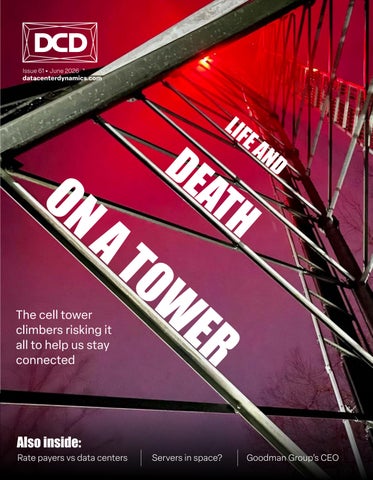
The cell tower climbers risking it all to help us stay connected
Also inside:
Rate payers vs data centers
DE AT H
OW
EA
ND
ER
Servers in space?
Goodman Group’s CEO
See what’s next in faster, scalable power for data centers. Hitachi Energy provides standardized, factory-built solutions that reduce complexity, compress timelines, and deliver power when it’s needed most.
Explore more
Inspire the next
Contents June 2026
6 News
The biggest data center stories of the last three months
15 Life and death on a tower
Telecom tower climbers across the US are risking their lives to make always-on connectivity a reality
15
28 Rate of play
Data center capacity is outstripping the regulations designed to control it. Now, states are beginning to change the rules of the game.
taxonomy of American 35 Adata center opposition, pt.1
48
Who sits in the shadows cast by these two-story buildings?
42
War and peace in the Middle East How the data center market is faring, and being impacted, by the Iran War
illusion: Is co48 Optical packaged optics the savior
the data center industry has been waiting for? As demands on data center networks continue to increase, is the much-lauded CPO finally ready to take center stage?
68
53 To the Moon and back
Optical communication could transform the space industry, if it can beat the weather
it orbital data centers, or 57 Isdistributed LEO compute? As the marketing pageantry around new space innovation pervades, strategic priorities may be cementing demand
76
In-Line Amplifiers 61 Are ready for the age of AI?
68 It’s all Good, man
Goodman Group CEO Greg Goodman on why data centers are his firm’s “natural habitat”
extra time to video 70 Giving content
How sports teams are looking to tap into decades of archived video content
76 Can we power it? Yes we GaN As rack densities continue to creep towards 1MW, is the data center industry finally catching up to the promise of gallium nitride?
by design, 80 Containment simplification by outcome
As AI workloads break the assumptions behind traditional data center design, racklevel containment offers heat isolation, reduced risk, and more scalable highdensity compute
the Flag for subsea 83 Flying connectivity in the AI era
Flag, the company formerly known as GCX, has a new name and is honing in on serving AI data centers
86 Low latency, high drama
The backbone behind cloud gaming, according to Boosteroid’s SVP of infrastructure
uptime, insuring 91 Ensuring downtime
As the ballooning growth of the data center industry continues, the insurance industry is warning that it can’t keep up
94 The people vs data centers
It's election season, and the industry is in the firing line
ILA fiber huts have changed little in the last 30 years, but do they now need to?
Issue 61 • June 2026 | 3
TOMORROW’S DATA CENTRES TODAY
Smart automation, integrated safety, and scalable security for resilient energy-efficient data centres As AI, cloud, and edge computing grow, so do the demands on your data centre’s resilience, efficiency, and security. Honeywell integrates building management, fire safety and physical/cyber security into one seamless system, offering: Unified access control to mitigate evolving threats
Energy and emission control to help you meet EED and net-zero targets
Advanced fire detection and remote compliance tools
Redundancy and uptime to meet Tier 4 standards
Honeywell has deployed systems for top-tier hyperscale and colocation data centres in six continents. By leveraging advanced building intelligence, we can help you increase infrastructure and accelerate velocity at scale.
Elevate your data centre operations today
From
the editor
The engineers who risk it all
M
obile connectivity is something we take for granted in 2026, but the job of keeping the networks running is a sizeable and difficult one. For those on the front line, it can have dangerous sometimes deadly - consequences.
Life and death on a tower
For our cover feature (p17), we hear a series of hair-raising stories from climbers who maintain the cell towers used by mobile networks. These brave engineers spill the beans about the dangers they face and the pressures they are under. The job is one of the most perilous in the world, with climbers regularly sustaining life-changing injuries or even suffering fatal accidents. While this risk is, to an extent, part of the job, many argue that not enough is being done to protect these workers, and that operating conditions must improve to ensure that better safeguards are put in place.
Power payments
Data centers use a lot of power, and the question of whether they pay their fair share to access this power is one that is preoccupying the minds of politicians across the US and beyond. We look at what is being done to protect rate payers from bearing the cost of digital infrastructure (p28).
Opposing views
Anti-data center campaigners are going online to reach a larger audience (p35).
Sebastian Moss Executive Editor
This time it's war
As the conflict in the Middle East rumbles on, the data center industry is considering its options for future growth in the region (p42).
Space is the place
A realistic prospect for the future of AI compute? Or a classic Muskian fantasy? Experts weigh in on the prospect of space data centers (p57).
In the shed
ILA sheds are all around us, but you wouldn't know it. We find out more about this vital piece of digital infrastructure (p61).
Good times
Goodman Group's CEO on building digital infrastructure and industrial property side-by-side (p68).
GaN we fix it?
With semiconductor manufacturers constantly looking for ways to make their chips more powerful, novel materials like GaN could provide a solution (p76).
Insuring the future
Data center projects are becoming more and more expensive, meaning they need larger and larger insurance premiums. Can the industry keep up? (p91).
Plus:
Co-packaged optics, a look at Flag's plans for subsea cables, cloud gaming provider Boosteroid's CIO, and much, much, more!
Number of cell tower climber deaths recorded since 2003
Group Publisher & Executive Editor Sebastian Moss Editor-in-Chief Dan Swinhoe Senior Editor Matthew Gooding Telecoms Editor Paul Lipscombe Compute, Storage, & Networking Editor Charlotte Trueman Cloud & Hybrid Editor Georgia Butler Energy & Sustainability Editor Zachary Skidmore Reporter Jason Ma Spanish Reporter Cristina Cueto Head of Partner Content Claire Fletcher Partner Content Manager Farah Johnson-May Copywriter Erika Chaffey Designer Katherina Bradshaw Media Marketing Stephen Scott Channel Management Team Lead Alex Dickins Channel Managers Kat Sullivan Emma Brookes Zoe Turner Tam Pledger James Raddings Group Commercial Director Erica Baeta Conference Director, Global Rebecca Davison Live Events Gabriella Gillett-Perez Tom Buckley Audrey Pascual Director of Marketing Services Nina Bernard CEO Dan Loosemore
Cover image: Dan Hovey © 2026 Data Centre Dynamics Limited All rights reserved. No part of this publication may be reproduced or transmitted, in any form or by any means, electronic, mechanical, photocopying, recording or otherwise, or be stored in any retrieval system of any nature, without prior written permission of Data Centre Dynamics Limited. Applications for written permission should be directed to the editorial team at editorial@datacenterdynamics.com. Any views or opinions expressed do not necessarily represent the views or opinions of Data Centre Dynamics Limited or its affiliates. Disclaimer of liability: Whilst every effort has been made to ensure the quality and accuracy of the information contained in this publication at the time of going to press, Data Centre Dynamics Limited and its affiliates assume no responsibility as to the accuracy or completeness of and, to the extent permitted by law, shall not be liable for any errors or omissions or any loss, damage or expense incurred by reliance on information or any statement contained in this publication. Advertisers are solely responsible for the content of the advertising material which they submit to us and for ensuring that the material complies with applicable laws. Data Centre Dynamics Limited and its affiliates are not responsible for any error, omission or material. Inclusion of any advertisement is not intended to endorse any views expressed, nor products or services offered, nor the organisations sponsoring the advertisement.
Issue 61 • June 2026 | 5
DCD magazine #61 Whitespace
The biggest data center news stories of the last three months
News
QTS founder Williams back with new venture
Chad Williams, the founder and former CEO of data center firm QTS, has launched a new powered land venture. He launched QII in May, aiming to provide powered industrial campuses for data center users.
Keppel 'breaks ground' on floating data center
Keppel has started construction on its floating data center project in Singapore. The ~20MW project could go live in 2028 and is reportedly already committed to an unnamed global hyperscaler.
Musk plans $20bn Terafab
Elon Musks is planning a $20 billion chip fabrication venture known as Terafab. Musk is partnering with Intel on the project, and will use the chip manufacturer's 14A node process. First mentioned last year, the plant will be located in Austin, Texas.
Google and Blackstone team up for TPU cloud
B
lackstone has established a joint venture with Google to create a new US-based cloud platform offering Google's Tensor Processing Units (TPUs). ple data centers have been hit by drones or missiles in the wake of the US and Israel bombing Iran. Together, this will enable customers to access the TPUs as a compute-as-aservice offering via a platform other than Google Cloud. Under the joint venture, Blackstone will invest $5 billion in equity capital from its funds, and the two aim to bring 500MW of capacity online in 2027 with plans to expand over time. Google, meanwhile, will supply the hardware and TPUs as well as software and services. Benjamin Treynor Sloss has been named as the CEO of the JV, having worked at Google for more than two decades, most recently as the company's chief programs officer. Google revealed plans to start offering its TPUs outside of its Google Cloud Platform during its latest earnings call. At the time, CEO Sundar Pichai said that they would "begin to deliver TPUs to a select group of customers in their own data centers in the hardware configuration to expand our addressable market opportunity."
6
Google did not reveal which companies would fall into the "select group of customers," but later several neoclouds, including Nebius, Lambda, and CoreWeave, said they had no immediate plans to adopt the chips. Anthropic is set to use gigawatts worth of TPU capacity, with Google securing several large data center sites alongside AI cloud firm Fluidstack in order to serve the maker of the Claude language model. Google unveiled the eighth generation of its TPUs in April, detailing two chips. Dubbed the TPU 8t (for training) and the TPU 8i (for inference), Google said the hardware was designed in partnership with Google DeepMind and has “purposebuilt architectures” to support model training, agent development, and inference workloads. A single TPU 8t superpod can scale to 9,600 chips, delivering 121 exaflops of FP4 compute performance. The TPU8i, by comparison, is scalable to 1,152 chips in a single pod and can delivers 11.6 exaflops of FP8 performance. Made by Broadcom, both the TPU 8t and 8i run on Google’s Axion Arm-based CPU host and support liquid cooling technologies. They will be generaily available later this year. The previous generation of TPU, Ironwood, launched in April 2025.
| DCD magazine • datacenterdynamics.com
Bernie suggsts data center ban, AI tax
US Senator Bernie Sanders has plans to ban data centers and tax AI companies in new legislation. Sanders aims to introduce a temprorary nationwide moratorium on new data centers, and impose a 50 equity tax on companies such as OpenAI, Anthropic, and xAI.
Data center simulator hits Steam platform
A data center simulator game has been released on Steam. Data Center allows players to “build, cable, and grow a living data center from the group up.” The game is the solo project of Czechia-based video game developer Vaclav Novak, otherwise known as Waseku.
Shoe company pivots to AI and data centers
Shoe brand Allbirds is pivoting towards becoming an AI cloud provider in a major pivot. The company has sold off most of its assets and begun raising funds as part of a move towards becoming a GPU-as-a-Service provider. Founded in 2015, the company is changing its name to NewBirdAI as part of the change.
DCD magazine #61
SoftBank plans 5GW of projects in France, 10GW in Ohio
S
oftBank is seto to develop gigawatts of new data center capacity in Europe and the US. In Europe, the company was selected as one of the companies to develop on land owned by French utility EDF that previously housed power stations. The Japanese conglomerate has been chosen as the preferred bidder to design, build, and run a 400MW data center in Bouchain, Northern France. The Bouchain site is on land at a power plant outside the city of Valenciennes. The site is home to an operating combined cycle power plant generating 585MW, as well as a shuttered coal plant that generated 250MW before it went offline in 2015. SoftBank will build a data center on the site under a lease-to-build agreement, EDF said. Full details of the development haven't been shared. The deal is part of a wider move by EDF to offer land with close to 2GW in available near-term capacity to data center developers. That agreement is part of a wider 5GW, €75 billion data center build-out program by SoftBank in France. The company is also targeting developments in Dunkirk (Loon-Plage) and Bosquel in northern France. In the US, SoftBank subsidiary SB Energy was selected by the US Department of Energy (DOE) to develop
Credit: atNorth
a multi-gigawatt campus on federal land in Ohio. Under the agreement, SB Energy will build 10GW of new power generation including 9.2GW of natural gas generation – that will connect to the local grid and provide power to a new 10GW data center development at the Portsmouth Gaseous Diffusion Plant in Pike County. Full details of the development haven't been shared. Constructed in the 1950s and located south of Piketon, the plant previously produced enriched uranium, including highly enriched weapons-grade uranium, for the United States Atomic Energy Commission, the US nuclear weapons program, and Navy submarines. In later years, it produced low-enriched uranium for fuel for commercial nuclear reactors. The former gaseous diffusion plant
covers 640 acres of the 3,775-acre site. Much of the site, including the diffusion plant, has been shut down and is undergoing decontamination, though other parts of the wider campus continue to operate. It is one of more than a dozen sites on federal land the DOE has earmarked for potential data center development. SB Energy was founded as a subsidiary of SoftBank in 2011. The company predominantly develops solar and battery storage projects. SB Energy is set to public via IPO in the near future. The company has deals to build solar farms in the US for Google, and is developing a large data center project in Texas. SoftBank is a major investor in OpenAI and its Stargate data center program.
Anthropic overtakes OpenAI valuation
A
nthropic, the AI firm behind Claude, has overtake OpenAI in value and filed go public via IPO. The company raised $65 billion at the end of May for a $965 billion valuation, overtaking ChatGPTmarker OpenAI in the process. OpenAI was valued at $852bn in March of this year. The start of June saw Anthropic file plans for an IPO with the SEC. Full details of the planned float have not been shared yet. At the time of announcing the Series H funding round, Anthropic said that its run-rate revenue crossed $47 billion in May 2026, up from $9bn at the end of last year. May saw Anthropic sign an agreement with Elon Musk's SpaceX/ xAI to lease essentially all the capacity at xAI's Colossus 1 data center outside Memphis, Tennessee.
Anthropic has previously signed cloud capacity deals with Anthropic, Google, Amazon Web Services, and AI cloud firm CoreWeave, totaling gigawatts of compute. Google has signed a number of deals to lease large amounts of capacity from former crypto firms including Hut 8, TeraWulf, and Cipher - via AI cloud firm Fluidstack, in order to serve Anthropic's compute needs. Primarily US-based, Anthropic is known to be looking to expand its compute footprint into Europe and APAC, posting jobs for data center roles in those regions. As well as signing a large-scale deal to use gigawatts worth of Google's Tensor Processing Unit AI acceletor chips, Anthropic is reportedly exploring the possibility of developing its own AI chip, though details are sparse.
Issue 61 • June 2026 | 7
Whitespace The biggest data center news stories of the last three months
Acquisition news: Blackstone acquires controlling stake in Rowan Digital
I
nvestment giant Blackstone has acquired a “significant minority stake” in US data center firm Rowan Digital Infrastructure from Quinbrook. Terms were not shared, but reports suggest Blackstone has acquired a 49 percent stake in the firm, which has projects in development in Maryland, Oregon, and Texas. The company was founded in 2021 by Quinbrook Infrastructure Partners. Meanwhile, Blackstone-owned AirTrunk has acquired Lumina CloudInfra, another Blackstone owned platform. Terms were not shared, but the deals give APAC-focused AirTrunk a footprint in India, taking over planned sites across Mumbai, Pune, Hyderabad, and Chennai. Luminar was founded in late 2022. Those Blackstone deals were part of a busy quarter in the acquisition space, which also saw Goldman Sachs acquire Canadian data center firm QScale from US-based operator Aligned. Announced in May, terms of the deal
were not shared. QScale will continue to be led by its existing management team, who will remain shareholders in the business alongside Goldman Sachs Alternatives. QScale was founded in 2018, and has previously received investment from Aligned Data Centers and the governement of Québec It began construction on its first campus, QScale Q01, in Levis, Quebec, in 2021. The construction of the second building began in 2022. The site is expected to have 142MW of IT capacity at full build-out. The company also has plans for a facility in the Ecoparc de Saint-Bruno-de-Montarville, Montreal. Aligned was acquired last year by a consortium including BlackRock and MGX in record-breaking $40bn deal. May saw US investment firm Sqaured Capital acquire ten data centes from fiber firm Cogent. Acquired for $225 million, the 53MW portfolio will be used to seed a new US-
NorthC data center in Netherlands brought offline by fire
E
uropean data center firm NorthC has suffered a fire at one of its facilities in the Netherlands. A fire broke out at the comany's data center on Rondebeltweg in Almereon the morning of May 7. The fire was brough under control the same day, but brought the facility offline for almost a week. There were no reported injuries. The three-story Almere facility offers 11MW across two buildings, totaling 26,000 sqm (279,860 sq ft). Customers of the facility incldued IBM Cloud, Utrecht University, the local water board, and Transdev. No IT gear was damaged by fire, which was concentrated around the site's
8
power infrastructure. Built in 2008 for KPN, Keppel has owned the site since 2013, currently through its Keppel DC REIT division. Temporary power and cooling supplies were installed and activated on May 13. Customers in Almere 2 have been reconnected to grid power. Almere 1 should be able to be connected to the grid by the end of June, and fully running on grid power again by the end of July. An invesitgation into the cause of the fire is ongoing. NorthC was formed in 2019 from the merger of several Dutch data center firms. Antin Infrastructure Partners acquired the company in December 2025 from DWS.
| DCD magazine • datacenterdynamics.com
based data center platform focused on inference at the Edge. The acquired facilities span nine US markets: Chicago, Atlanta, Phoenix, Los Angeles, Kansas City, Baltimore, Houston, Nashville, and Stockton. Cogent had acquired the facilities for just $1 in 2022 when it bought T-Mobile's wireline business. The deal included a large portfolio of switch sites previously used as part of Sprint's legacy long-haul fiber network, with Cogent setting about to repurpose around 100 for colocation use. Work is ongoing to sell around a dozen more. And finally, US cloud and data cetner firm Iren has expanded into Europe with the acquisition of Nostrum. In May the former cryptominer announced plans to acquire the Spanish operator, taking over approximately 490MW of secured, grid-connected power in Spain. Iren has data center sites live and in developments in the US and Canada.
Hyperscaler capex to reach almost $1trn by 2027
H
yperscale capex will reach $785 billion this year and close in on $1 trillion in 2027, according to projections from Moody’s Ratings. This is a significant rise from March, when the ratings agency forecast that hyperscaler capex would reach $700bn this year. Marc Ganzi, with the deal expected to close in the second half of 2026. Microsoft, Amazon, Meta, Alphabet, Oracle, and CoreWeave were included in the forecast. Moody’s noted that AWS capex was an estimate, as Amazon does not report AWS-specific capex. Of these, AWS, Microsoft Azure, and Alphabet’s Google Cloud Platform are making the biggest investments in AI infrastructure. Combined, the revenue growth rate of AWS, Microsoft Azure, and Google Cloud in Q1 2026 was the fastest it has been since Q2 2021, when their combined cloud revenue was a third of what it is today. Moody’s said this growth in backlog, growing adoption of AI, and compute shortages are indicating a multi-year growth trajectory in AI infrastructure.
Whitespace The biggest data center news stories of the last three months
Compass backs out of PW Gateway
T
he proposed PW Gateway Campus in Virginia is looking increasingly set to fail. QTS and Compass had filed to develop thousands of acres of greenfield land in Manassas for a massive data center development totaling dozens of buildings and around 1GW of capacity. However, the project's zoning was invalidated by a judge over a technicality, after ruling proper public notice was not given through the correct channels. The Virginia Court of Appeals held up the ruling in April, leading county officials to announce they would no longer back any appeals, effectively dropping support of the project. Compass then announced it was backing off the project, saying ongoing hurdles left it without a viable path forward. QTS, however is continuing on alone. The firm has filed an appeal to the Virginia Supreme Court in an effort to reinstate the original zoning. QTS argues that the Court of Appeals committed several errors of law when it upheld the previous ruling invalidating the project’s original zoning authorization. At the same time, QTS is facing an lawsuit from the landowners it is buying land from as they seek to nullify their contracts. Several landowners contracted with QTS for the project are now seeking to terminate their agreements, filing a lawsuit to do so. QTS has filed a counter-suit against the plaintiffs, claiming damages in an effort to prevent “wrongful termination.”
Microsoft takes over capacity earmarked for OpenAI in Texas
M
icrosoft has signed on to take capacity previously earmaked for OpenAI and Oracle in Texas. March saw Crusoe confirm that Microsoft has signed on to take the remaining capacity at its Abilene, Texas, campus. Microsoft has signed an agreement for 900MW of capacity, including two new buildings and an on-site power plant. Each of the two new buildings will offer 336MW of IT capacity. The lease will bring the total projected capacity at the site to 2.1GW. Microsoft's data centers will sit on land adjacent to the existing Abilene campus, being used by OpenAI and Oracle. Land works are already underway, and the first building is expected to be energized in mid-2027. Oracle and OpenAI were previously expected to take up all the capacity at the campus as part of the latter's Stargate initiative, but scaled back their plans earlier this year, instead opting to call it quits at 1.2GW - or around eight data center buildings. OpenAI said of the decision that they would be putting the additional capacity in other locations. Microsoft has been expanding its footprint rapidly and brought 1GW of data center capacity online in the first quarter of 2026 alone. In 2025 as a whole, 2GW were stood up by the company. While Microsoft has been busy on the data center build-out front, the company may well be rolling back some of its
sustainability efforts. The cloud giant has reportedly paused all new carbon removal purchases. Reports surfaced in April that the company has begun informing suppliers and partners that it is suspending all future purchases of credits, with it unclear whether the company will resume such purchases. In response to the news, Microsoft denied that it was indefinitely pausing all purchasing, saying its carbon removal program "has not ended." At times we may adjust the pace or volume of our carbon removal procurement as we continue to refine our approach toward sustainability goals. Any adjustments we make are part of our disciplined approach not a change in ambition," the company said Any retreat from the company would a major blow to the carbon removal industry. Microsoft is by far the largest corporate buyer of carbon removal credits, anchoring the industry with numerous deals totaling millions of tons of carbon. One Microsoft-related carbon deal has been announced since the news surfaced, but its unclear if this was aggreed prior to the reported freeze. Other carbon removal buyers in the sector include NTT, Amazon, Google, Meta, Netflix, and Salesforce.
Dan’s Data Point
The market cap of Fermi America has dropped from a peak of around $15 billion in the wake of its IPO in October to just $4 billion at time of writing. The wheels have seemingly come off this 11GW data center venture, with the outsted CEO at war with the board.
EU releases first EED data
T
he European Commission (EC) has published its aggregated data relating to the energy performance of data centers under the Energy Efficiency Directive (EED), reporting 6.4GW of installed IT power demand across the bloc. As part of the EED, the EC published an assessment of the first tranche of data, and has now shared numbers in an interactive dashboard. The directive aims to add transparency around the energy
10 | DCD magazine • datacenterdynamics.com
use of data centers in the European Union, requires data centers to report key indicators of energy efficiency, water use, and heat reuse. The published data currently spans 2023 and 2024 across 18 countries, including primary markets such as Germany, the Netherlands, and France. Figures shows total installed IT power demand across the bloc was 6.4GW across 776 facilities, with a total energy consumption of 16.7TWh.
Home of Data
Modular Containment from Tate A Smarter Way to Scale The demand for high density and AI driven workloads isn’t slowing down. Your infrastructure shouldn’t either. Tate’s modular containment solutions are designed for the speed and density demands of todays AI driven workloads. Pre-engineered, pre-integrated and precommissioned to reduce on site complexity so you can scale faster with confidence. • Built to scale with your evolving needs from day one • Seamless power and liquid cooling integration • Floor or ceiling supported configurations Pre Engineered Systems, Built for High Density Environments.
Talk to a member of our team today.
tateglobal.com
Scan here to learn more
DCD magazine #61
Meta signs deal to use AWS' Graviton chips
S
ocial media firm Meta has signed a deal with Amazon Web Services (AWS) to deploy “tens of millions” of Graviton5 cores in order to support of agentic AI workloads. The exact financial terms or timeline were not shared, but in response to a DCD request for comment, AWS said the agreement represented a "multibilliondollar deal over several years." In a separate, pre-prepared statement, Meta said the deal will make it one of the largest Graviton customers in the world. Following the initial deployment, the social media giant said it will have the ability to expand its procurement to meet its AI compute needs. The announcement came just weeks after Amazon president and CEO Andy Jassy revealed in a letter to shareholders that two large AWS customers had asked to purchase every single Graviton instance capacity available up to that point this year. “We can’t agree to these requests given other customers’ needs, but it gives you an idea of the demand,“ he wrote in the letter.
AWS launched its Graviton5 CPUs in December 2025, claiming the hardware has an "efficient design" that reduces inter-core communication latency by up to 33 percent. Graviton5 also has a five times larger cache than the previous generation, enabling customers to scale up workloads while reducing infrastructure costs, the company said at the time. Each chip has 192 cores, meaning if Meta were to deploy exactly 10 million cores, that would represent just over 52,000 chips. In response to a DCD request for clarification regarding the size of the deployment, AWS said it would not be disclosing the exact number of chips. Apple is also a known users of Amazon's Graviton chips, following an announcement in 2024. CPUs are processors with a limited number of cores, making them best suited for serial computing tasks. GPUs, by comparison, have thousands of smaller cores and are used for parallel computing tasks, such as AI and highperformance computing. Demand for CPUs has increased
significantly of late, as companies seek out hardware that can support agentic AI workloads. This is the latest CPU-focused deal Meta has inked in recent months. In February 2026, the company signed an agreement with Nvidia that represents the first “large-scale” Nvidia Grace-only deployment, with Meta also committing to an additional “large-scale deployment” of Nvidia’s forthcoming Vera CPUs in 2027. In March, it was revealed that Meta had partnered with Arm for the chip company’s first-ever data center CPU, designed to support “agentic AI infrastructure.” On the GPU front, March saw Meta sign a mammoth $21 billion AI infrastructure deal with AI cloud firm CoreWeave. The agreement will see CoreWeave providing Meta with AI cloud capacity through to December 2032. This follows a previous deal signed between the two firms, totaling $14.2 billion and running until December 2031. Meta has also signed a five-year deal with European AI cloud firm Nebius valued at up to $27 billion. The capacity will be based on what the companies described as one of the first "large-scale" deployments of the Nvidia Vera Rubin platform, starting in 2027. Earlier in April, Meta announced it was partnering with Broadcom for the development of multiple generations of the hyperscaler’s MTIA (Meta Training and Inference Accelerator) chips, designed to support generative AI inference workloads. The deal includes a commitment to deploy more than 1GW of the chips in its first phase, eventually reaching mulitple gigawatts.
DigitalBridge to acquire energy investor ArcLight Capital for $1bn
D
igital infrastructure investor DigitalBridge is acquiring energy investor ArcLight Capital Partners. Announced in May, the $1.05 billion deal includes a base purchase price of $650 million, plus up to an additional $400 million. Founded in 2001, ArcLight has owned, controlled, or operated more than 70GW of generation assets and 48,000 miles of electric and gas transmission and storage infrastructure, and claims a pipeline totaling 15GW. Its investments include natural gas plants, hydroelectric capacity, solar farms, battery storage systems, and natural gas pipelines. After the deal closes, ArcLight will operate as a separately managed business as part of the DigitalBridge platform. ArcLight founder Daniel Revers will serve as vice chairman of DigitalBridge and ArcLight managing
partner Angelo Acconcia will remain in his role to continue day-to-day leadership of the firm.The deal, however, contingent on Digitalbridge's own acquisition by SoftBank completing. DigitalBridge is a major investor in data centers, fiber, and cell towers, with some $115 billion in assets under management across more than 45 companies. Companies under DigitalBridge's ownership include Vantage, Switch, DataBank, Takanock, AtlasEdge, Scala, Yondr, AIMS, JTower, Zayo, VerticalBridge, and others. The two firms aren't strangers. ArcLight previously acquired a stake in a portfolio power generation from DigitalBridge’s InfraBridge division. ArcLight and DigitalBridge both invested in Takanock last year. That firm aims to develop behind-the-meter data center projects across the US.
Issue 61 • June 2026 | 13
Your total thermal management partner As data centers get hotter, optimal end-to-end efficiency is critical. Our industry-leading solutions span the thermal management chain to put 0L/kWh WUE and 1.2 PUE – or better – within reach. Get complete cooling control over your data center Scan the QR code to explore our products, solutions and possibilities
johnsoncontrols.com
© 2026 Johnson Controls. All rights reserved.
DCD magazine #61
Cryptominer Riot pivots to AI, secures AMD
C
ryptomine firm-turned HPC data center provider Riot has signed two capacity deal with chip designer Advanced Micro Devices (AMD). Riot announced a pivot towards HPC data centers in January, securing AMD as a customer. The chip firm is set to lease capacity at Riot’s campus in Rockdale, Texas. The company then announced AMD had exercised its option to lease an additional 25MW from the data center firm, bringing its total contracted capacity to 50MW of critical IT capacity. As well as retrofitting one of its existing buildings at the campus, Riot acquired 200 acres of additional land at the site to serve AMD. The initial 25MW of capacity is to be delivered in phases beginning in January 2026 (5MW) and completing in May 2026. The additional 25MW is set to be delivered by May 2027. The expanded capacity will be in the same building as the original 25MW. The original AMD lease totals ten years, with three five-year extension options, and is expected to generate approximately $311 million in base rent
over the initial term. The additional lease also totals ten years with three five-year extension options, and is expected to generate $325m over the initial term. The January agreement with AMD included the potential to expand to a total of up to 200MW of critical IT load capacity at the campus. This includes an expansion option for an additional 75MW (now 50MW) of critical IT load capacity and a right of first refusal for another 100MW. Work started on the seven-building Rockdale site in 2020, completing in 2023. Two buildings, totaling 200MW, utilize immersion cooling, while the remaining five buildings (500MW) use air cooling. Easements have also been secured for potential expansion beyond 700MW of capacity. Formerly known as Riot Blockchain, Riot is one of the world's largest Bitcoin miners, but has been in discussions about a pivot towards AI and HPC data center since 2024. Riot owns and manages more than 1,100 acres and 1.7GW of power capacity
across its two Texas facilities. The other site – known as Corsicana – is located outside Dallas. Construction is ongoing on the first two 56MW buildings. The site could eventually total 11 buildings and 672MW, with potential to expand further to 1GW. It also owns two operational sites in Kentucky, totaling 60MW, after acquiring Block Mining in July 2024. The sites could total more than 300MW at full build-out. Greenpeace previously accused Riot of operating the “largest, and one of the most energy and carbon-intensive, Bitcoin mines in the US.” Riot is one of many cryptomine firms that have pivoted to serving AI and HPC. In recent months, the pivot has proved successful, with many former crypto companies securing large, long-term contracts with major names. Core Scientific is probably the most sucessful, having secured a number of large contracts with AI cloud provider CoreWeave - itself a former cryptominer. Other companies making the pivot include TeraWulf, Galaxy Digital, Applied Digital, Iren, Cipher Digital, Bitfarms (now Keel Infrastructure), Hut 8, Northern Data, Ionic Digital, Hive, and others. In other cryptomine news, US aluminium producer Alcoa Corp. is in advanced talks to sell its former Massena East aluminum smelter in upstate New York to Bitcoin mining firm NYDIG. The prospective sale comes as Alcoa seeks buyers for ten former smelter sites across the US, with a major focus to sell to data center users. Alcoa closed the smelter in 2014, citing a lack of competitiveness.
President Trump personally invests millions in data center industry firms
U
S President Donald Trump has bought millions of dollars worth of shares in data center industry firms this year, newly released financial records reveal. The 113-page public financial disclosure from the president details hundreds of publicly-traded companies he has taken a stake in during 2026. As well as a host of tech stocks, Trump’s portfolio includes data center power and cooling firms Trane and Eaton. On March 17, he purchased between $1 million - $5m worth of shares in each company. These are among Trump's largest purchases of the year so far. He had previously made five smaller investments in Eaton, and four in Trane, since the turn of 2026. Also counting Trump as a shareholder is colo giant Equinix. The record shows
that on February 10 he bought between $500,000 - $1 million of shares in the data center operator. Trump’s share portfolio is enormous, and includes many of the biggest names in tech, including GPU maker Nvidia, and the hyperscalers. Critics have claimed his financial position in these companies represents a conflict of interest, with the values of the firms being heavily influenced by government policy, regulation, and, in some cases, Trump’s personal stance towards them. Trump purchased between $25,000$50,000 of shares in memory chip maker Micron Technologies on March 25. The following day, he appeared on Fox News show The Five, describing Micron as “one of the hottest companies.” Trump says the accounts are managed by a third party independently.
Issue 61 • June 2026 | 15
DCD magazine #61
equansdatacenters.com
O N E PA R T N E R . E V E R Y M E G A W A T T. ACROSS EUROPE.
EQUANS DATA CENTERS PROVIDES THE FULL GENERAL CONTRACTING SCOPE FOR HYPERSCALE AND COLOCATION DATA CENTRES ACROSS EUROPE.
17
+785
+342,000
+25
MW of IT power
m² of IT space
years of heritage
| DCD magazine • datacenterdynamics.com
Image: Dan Meyer
Life and death on a tower
Life and death on a tower Paul Lipscombe Telecoms Editor
“I
Telecom tower climbers across the US are risking their lives to make always-on connectivity a reality
n this industry, you are your brother's keeper. You depend on each other up on a tower,” says Chase Goins, a cell tower climber turned broadcast tower technician. Goins’ view was echoed by several of the telecom tower climbers that DCD spoke with for this feature. Brotherhood is a recurring theme, as if those in this profession feel a part of a club that many wouldn’t dream of joining. Having spent most of his career climbing cell towers, Goins is well aware of the dangers of the job. Scaling cell towers, which can reach several hundred feet, is a daunting prospect. Broadcast towers are often taller, with the tallest, a KRDK-TV mast, spanning 2,060 feet (627.9 meters), located in Galesburg, North Dakota.
It’s these sorts of heights that make the job of climbing a tower one of the most dangerous in the world.
Safety concerns
The stats back this up. A study carried out by the Communications Workers of America (CWA) union revealed 65.3 percent of respondents had been on a site where someone was injured. The same study found that a quarter of people have come across on-site injuries on at least five occasions, while 17 percent have worked with someone who has been fatally injured on a site. Four percent of respondents, including Goins, have witnessed a death while on a job. “I had a co-worker pass away on the tower with me last year,” he says. “It was horrific.” Goins was there when Toby Coles, 62, fell
Issue 61 • June 2026 | 17
DCD magazine #61 from about 200ft (61m) from a cell tower in Little Rock, Arkansas, on September 12, 2025. “He was a great man. It’s just another situation where I have no idea how or why it ended up happening. A moment of carelessness led to someone losing their life,” says Goins. The Occupational Safety and Health Administration (OSHA) found the incident to be an accident, closing its investigation into the case earlier this year. Last year, a total of six tower-related fatalities were recorded, up from two deaths in each of the previous two years. Wireless construction publication Wireless Estimator has been tracking these fatalities since 2003, noting 2006 as the record high for fatalities with 19. In total, since tracking these fatalities, 176 deaths have been recorded. Daniel Hovey, a distributed antenna systems lead technician at Alpha 8 Communications and previously a tower foreman of eight years, has also witnessed a co-worker and friend fall to their death while on site. Devon Collins, 29, fell from 107ft (33m) after he had connected his lanyard to the open end of a nylon sling that was serving as an anchorage point and stepped out of the personal basket, and then fell backwards. Despite falling nearly 110ft (34m) from the tower, it was another seven hours before Collins succumbed to his injuries. “You work so long up there you forget you’re 100ft (30m) off the ground,” says Hovey. “All you’re focused on is the task at hand. The other guy on the tower with us quit. He realized that that could be him, he said, ‘I’m too comfortable’ - it’s that complacency that kills.” These climbers are propping up the lucrative industry of telecoms, supporting the build-out of mobile networks that keep all of us connected. According to the Wireless Infrastructure Association, the US cellular industry invested more than $10.2 billion in expanding network capacity and coverage last year, and this is excluding expenditures on spectrum, maintenance, and ongoing operations. In total, operating expenses for US cellular networks reached nearly $54.7 billion in 2025, while total wireless infrastructure investments – including construction, maintenance, and operations – amounted to nearly $65 billion.
Image: Tommy Schuch
“Tower climbing is a critically important and needed role,” says Patrick Halley, president and CEO, Wireless Infrastructure Association. “Reliable connectivity for Americans doesn’t happen by magic – it’s built by skilled tower technicians. We’re grateful to the tower technicians who are on the frontlines every day to keep us all connected.”
Getting into this career
Given the dangers of the job, it’s fair to say that the average person wouldn’t fancy scaling several hundred feet up a tower for several hours at a time. So, who does this sort of job? “I actually first learned about tower climbing from a segment I saw on TV. I remember early on thinking, ‘wow, these guys must be some of the most highly skilled professionals out there,’” Tommy Schuch, founder and president, Climber Protection Group, explains to DCD. A passion for climbing and adventure is what got Schuch into the tower industry. This sort of path into the sector isn’t uncommon. A lot of climbers enjoy being high up, scaling structures that would seem unthinkable to most, and it is
18 | DCD magazine • datacenterdynamics.com
a crucial trait for the job. “It's incredible,” Schuch adds. “Being up that high, seeing those views, the challenge of it's like nothing else. I especially loved climbing at night or in the cold. The more challenging the environment, the more I got out of it.” Schuch doesn’t climb towers anymore. He spent 12 years performing antenna installations and maintenance, and led crews as a foreman. Although he enjoyed his job, he quit the industry – as a climber anyway – in January 2021. “The reason I stopped climbing is pretty simple,” he says. “I realized the industry doesn't care about the people actually doing the work. Climbers are being sacrificed for speed and profit, placed consistently in unnecessarily dangerous situations, and being taken advantage of in the process.” Indeed, his view is echoed by other climbers too. William Stone, who describes himself as a freelance tower climber, tells DCD that it’s important to make people aware, outside of the industry, of the challenges that climbers face. “I’ve worked with Tommy a lot of times to try and bring stories to light and get climbers to talk, because the facts
Life and death on a tower
“It’s about holding each other accountable, making sure we are using our safeties properly, that we are paying attention to each other,” Chase Goins, tower technician
are, the industry as a whole has created a silence. It's a hush-hush kind of job,” says Stone. He has been climbing for close to 15 years, getting into the profession after seeing a post on Facebook advertising a job. Within a day of his application, he was offered the role. “I wasn’t scared of heights, and was previously a rock climber, so I decided to apply for the job. It wasn't even 24 hours, and I had a message to go to Montana,” he says. Stone recalls that his first trip took him to “Cherry Peak” in Missoula, Montana. He says that on his first assignment, one of his colleagues was injured and had to be rescued by the fire department, amid a polar vortex. “It was pretty gnarly conditions. We were on a 10,000ft (3,048m) mountain in Missoula. I watched the accident happen when my foreman cut his leg,” explains Stone. Despite this, he was hooked from day one.
Each day is different
The job itself is seen as one that takes workers across the US, usually far away from home, and often for weeks at a time. Day-to-day work will differ somewhat, depending on the task at hand, though it usually begins in the early hours of the morning. Climbers will work in groups, usually made
“Reliable connectivity for Americans doesn’t happen by magic - it’s built by skilled tower technicians,” Patrick Halley, Wireless Infrastructure Association
of three to five-person crews. The working hours differ depending on the tasks, meaning the job is not your typical 9-5. An average day is more likely to be 12 hours, and that’s only if things go according to plan. The strength required to not only climb these structures, but to do so whilst carrying up heavy telecoms equipment, means that it’s also a physically demanding job. The average pay for the job could be anywhere between $20 to $25 per hour, though most climbers DCD spoke with say that tower climbing only pays off because of overtime, as working weeks often stretch up to 60 or 80 hours. Night shifts aren’t uncommon either. Furthermore, given the wide-ranging weather conditions across the US, tower climbers will encounter a diverse variety of conditions they must contend with. This could be a heatwave or heavy rain, sleet, or even snow. However, OSHA regulations state that climbing is prohibited under certain conditions, such as storms or when winds exceed a certain speed. Not that this deters most climbers. “If an antenna goes down, or a light needs to be fixed, somebody has to get up there, no matter what the conditions,” explains Schuch. “It might be at night, and it may be very cold, but as long as it's safe enough – and I say that lightly – to work, climbers will do that.” Recalling his own experiences climbing in inclement weather, Schuch says he’s climbed cell towers in the middle of snowstorms in sub-zero temperatures. Goins notes that the situation could depend on an individual crew’s view of the weather. “You're not going to be out here working when it’s thunder and lightning. You’re not going to be forced to work in those types of conditions,” he says. Before climbing any tower, crews have to carry out a Job Hazard Analysis (JHA) to assess current conditions and review an emergency rescue plan. While on the tower, the industry adheres to a strict "100 percent tie-off" rule, meaning a climber must always be attached to a secure anchor point using their safety harness, even when moving.
Complacency
Pressure to meet deadlines can have an impact on the performance of tower climbers, notes Hovey, who says complacency can also creep in, even for the older, more experienced workers. “When you just get too used to being up
Issue 61 • June 2026 | 19
DCD magazine #61 there, and you jump around quickly without taking the proper precautions,” he says. “That combines with the major push companies puts on everyone.” He says there’s pressure to get jobs done quickly, which in turn leads to longer hours. Hovey claims to have spent up to 72 hours on a tower structure during one occasion. “We were up there for three days without coming down, which is obviously dangerous with the lack of sleep and food,” he recalls. “They [the carriers] don't care, especially when 5G first kicked off, which put a major rush on everything, so safety just went right out the window.” Hovey even claims that inexperienced tower climbers were being used to try to keep up with the demand for 5G installations. “They were hiring guys to work with us that had never climbed before, and just putting them to work as quickly as possible. You’ve got to slow down, take time. Speed comes with time. Practice the right way and then learn efficiency.”
Does the industry have a voice?
Since hanging up his climbing harness, Schuch is still involved in the tower industry. He has his own YouTube channel that documents the tower industry’s workforce, providing a platform for people to share their experiences on the job, while highlighting the need for conversations around safety. He’s embarked on arguably his biggest challenge since leaving the industry, and that’s the creation of Climbers Protection Group (CPG), a not-for-profit organization that seeks to give tower climbers a voice over issues the workforce is faced with. CPG provides members with a safe whistleblowing platform to report job hazards and unsafe conditions anonymously. Schuch set up the group alongside tower veteran Richard Bell and Dr. Brigette M. Hester, president of Hubble Foundation, another not-for-profit organization that aims to highlight the trials and tribulations of the telecommunications industry, in particular the towers segment. “The reason I started CPG comes from everything I saw during my years in the industry, such as the shortcomings, the risks, and the lack of real representation for tower climbers,” says Schuch. “There wasn’t any organization giving climbers a voice, and nobody was actually listening to them.” He says that the lack of a union led him to create the group, which currently stands at 150 members since launching in July of last year. “I was also one of the key people working to
“If an antenna goes down, or a light needs to be fixed, somebody has to get up there, no matter what the conditions,” Tommy Schuch, Climbers Protection Group
Image: Dan Hovey
20 | DCD magazine • datacenterdynamics.com
build a tower climbers' union. I spent nearly two years working on that effort, but then that ultimately fell apart,” he adds. It was at this point that he decided to document these challenges via his YouTube channel. These issues included a range of things, such as workers' pay, long hours, a lack of adequate training, plus the challenging conditions around the structures themselves, and all weather conditions. “CPG is not anti-industry. It's proaccountability, pro-transparency, and profairness. Our mission is to reform the system and not destroy it, and look after the ones that cannot,” Schuch says.
NATE’s view
One of the largest bodies that covers the telecom tower industry is NATE, an acronym for the National Association of Tower Erectors (NATE). Founded in 1995, NATE is a non-profit trade association that seeks to position itself as the voice of the telecom tower industry, tackling issues such as safety, pricing, and improved communications. The group is made up of more than 1,000 member
Life and death on a tower companies, mostly based in the US. “We represent the contractor firms that do all the wireless broadband, broadcast, and fiber deployments,” says Todd Schlekeway, executive director, NATE, adding that NATE was founded after the death of a tower worker in the 1990s. “There was a fatality in Arkansas, and the owner of the company who experienced that fatality was one of the founders of NATE,” says Schlekeway. “One of his employees fell, and so they started NATE several years later.” The group sets out critical safety guidelines, training, and resources for telecommunications technicians who work on comms towers and antenna arrays. “We facilitate safety training. We have safety committees that have written all the national consensus safety standards that govern the industry…so safety is our core pillar as an organization, in large part because so much of the work is done at heights and then the work at the same time is getting more technical and skilled as well,” he adds. CPG founder Richard Bell – a tower industry veteran – has since retired from the industry, but recalls how NATE has changed over the years, since its founding, when tower erector companies joined the association at first. Over time, he says that the association grew to include safety manufacturer companies and engineering firms as associate members. Others have been critical of NATE, including Schuch, who has previously said that NATE “shields corporations from liability,” while ignoring tower climbers’ concerns. Meanwhile, Doug Delaney, a former climber and author of the book Tower Dog, says that NATE’s focus has deviated from its original purpose. “NATE started out as an advocate for the climber, but they quickly became an advocate for the carrier because that's where the money was,” says Delaney.
Calling out the carriers
One of the more notable voices in support of tower workers is the Communications Workers of America (CWA), a union for telecommunications workers across the US, which represents approximately 700,000 employees. CWA created a union for tower
Overloaded cell tower. Image: Tommy Schuch
technicians in 2022 called Tower Climbers Union/CWA, with the aim of holding wireless carriers and tower owners to account for the industry’s biggest challenges. Indeed, in 2023, a petition was launched by tower climbers to improve their safety standards and work conditions. Then CWA president Chris Shelton sent letters to the CEOs of AT&T, Verizon, T-Mobile, Dish, American Tower, SBA, and Crown Castle, calling out the carriers and tower owners. “Our country's wireless networks would not function properly without their labor. Yet, instead of taking responsibility for their working conditions, you have helped to create a network of contractors engaged in cutthroat competition that puts tower technicians at the bottom, their safety at risk, and far too often their very lives on the line,” wrote Shelton in the letters. Interestingly, Schuch was one of the
names quoted in the press release that the CWA put out at the time, reiterating his concerns for tower workers' safety and working conditions. DCD has tried to contact the CWA several times, but has not heard back regarding the group’s focus on tower safety, while the last press release on the Tower Climbers Union/CWA website dates from May 2024. Schuch is no longer working the CWA and has since channelled his own efforts into CPG. “I was involved with the effort and believed they were attempting to address legitimate concerns in the industry,” he says. “Ultimately the workforce is extremely fragmented, climbers move between employers frequently, and organizing a national workforce like this proved challenging. Today my focus is on Climber Protection Group and building a grassroots worker voice independent of any union affiliation.”
Issue 61 • June 2026 | 21
DCD magazine #61
Life of a Tower Dog
S
uch is the fascination with telling the story of what tower climbers do, a book was published that fleshed out the details of what it’s like to work in the industry. Tower Dog: Life inside the deadliest job in America, written by Douglas Delaney, was published in 2017, the same year he stopped climbing. “I wrote it because I was very angry that these guys were dying. We were losing a lot of guys, mostly kids, and they had families,” he says. Most people tend to fall into the industry “sideways,” usually through a friend of a friend. Delaney says he joined the industry in the 1990s as the cellular build-out gathered momentum, joining a company set up by a friend. “I started when the real boom started in the early 90s, when the cellular first boom hit, back then it was like the Wild West,” says Delaney. “We were hiring people out of bus stops, meeting them in bars. There was no organization for this.” Such are the challenges of the profession, Delaney explains that most
people would barely last in the role. “We needed bodies. And our washout rate was incredible. I'd say 80 percent of the people who showed up didn't last a week, and the ones who did usually stayed a long time.” In the book, Delaney recalls some of his own past experiences within the industry, while also documenting other stories told by tower climbers, exposing the dangers of the job and some of the industry’s failings. On the subject of fatalities, Delaney, like most climbers, believes that most deaths are usually caused by climbers making an error. However, this isn’t always the case. “There are times, and these are the worst times, when climbers die, and it's not their fault,” he says. “Those are the things that scare the hell out of a climber when it's not your fault, when there's a structural issue on a tower that was never addressed, or that was reported and inspected but never fixed.” He adds that it is often caused by overloading towers. While deaths in the industry are lower than they once were, notes
22 | DCD magazine • datacenterdynamics.com
Image: Dan Hovey
Delaney, two deaths in one week last year were a reminder that there’s still work to be done. He doesn’t believe anything has changed since he published Tower Dog in 2017. “I don't think they're getting paid more, and I don't think they're getting treated well. I think the middlemen are sucking up more money than ever.” As Delaney suggests, industrial action might get people to sit up and take notice. “You want to get attention? Have every tower worker in America have a sick day. Don't show up for work… Boy, this country, the streets would come to a halt,” he says. “I can't make a phone call. Why can’t I do this? All of a sudden, it's these little inconveniences… that have to be repaired.” He’s not confident the industry will unionize, despite Schuch’s best efforts with CPG, of which he’s full of praise for. “We can't even agree on banning frickin assault weapons for the last 30 years, what chance do we have with supporting tower workers?”
Life and death on a tower
Silence from the carriers and towercos
The silence stretches to the country’s three main mobile carriers: AT&T, Verizon, and T-Mobile. All three declined to comment to DCD about the struggles the industry faces. It’s not just the carriers that have been quiet; the tower companies have been too, not replying to requests for input on this feature. One source told DCD during a previous meeting where CEOs of tower companies were present that one executive was dismissive of the workforce’s concerns. He and a fellow tower climber expressed concerns about radio frequency (RF) while working on towers, making climbers unwell. “Another climber and I brought this up to him, specifically a tower site where an AM tower was in close proximity to a cell tower, and that there was a crew up on that tower that was getting sick from this,” he claimed. While the source did note that he’s not an expert on RF waves, he says that this can affect the tower climbers while they’re carrying out their work. “So we brought this up to the CEO, noting that there's no communication between the different carriers or whoever owns the equipment on this tower to shut that off while we're working around it. And essentially he said, ‘Yeah, not our problem, talk to the carriers about that.’” It’s this lack of communication that leaves a lot of the tower climbers feeling neglected, where the responsibility falls back on them, he adds. “A lot of people want to just pass the buck off and say that it's the dumb tower climber's fault,” the source adds, noting that tower climbers are not engineers and don’t fully understand the complexities of these systems. None of the tower companies DCD contacted responded to discuss this feature. However, NATE’s Schlekeway says that tower owners are well briefed on the tower assets they own. “The tower owner companies are very good about knowing their assets. These are very valuable real estate assets, and so they are pretty good about ongoing maintenance to make sure that they're safe to ascend,” he says.
Setting the standards
Safety standards for the telecommunications industry are set out by the American National Standards Institute (ANSI).
“We've been up there for three days before without coming down. They [the carriers] don't care,” Daniel Hovey, Alpha 8 Communications
ANSI sets out the guidelines for the tower industry to ensure that towers can withstand severe weather, seismic events, and safely support heavy equipment. “That is the playbook that companies use to operate safely at tower sites in the US, and so many of the customers, the tower owners, carriers have required adherence to that safety standard,” explains Schlekeway. Although ANSI sets out the safety guidelines for the industry, the implementation of training practices is provided by third-party training companies, says Schlekeway. Contractor firms will do their own training, he says, via someone who is certified under the trainers model, mainly focusing on competent climber rescue training, RF safety, and OSHA 10-hour training. While these foundational training courses might be commonplace now, this hasn’t always been the case for the industry, says Bell. “We didn't wear any safety equipment in those days,” says Bell. “When we started in the late 1950s, contractors were not obligated to wear a bunch of safety equipment; it wasn’t necessary. It was left to the iron workers to do it safely, as safely as could be done.” Halley notes that the level of training has improved, but does acknowledge that there’s still work to be done. “Training has improved significantly over the past decade, and WIA is proud to have contributed to that progress through our Registered Apprenticeship program,” he says. “However, we would be the first to say that the work is not finished. The pace of technological change - new equipment, new network architectures, new safety requirements – means that training must continuously evolve.” When it comes to safety and training, Goins says that various types of towers should be approached differently. He says that it’s important for climbers to be aware of where they should be mounting equipment. Training in this instance doesn’t just include guidance for working safely on your own, but also ensuring climbers are able to respond to help rescue efforts if necessary, adds Schuch. “I've watched good climbers risk their lives, not because they're reckless people, but because saying no would cost them their jobs. Add that to a lack of proper training, especially when it comes to rescue training, a lot of the guys aren't very well trained in rescue, which is a huge deal, because most of the time you're working in extremely remote
Issue 61 • June 2026 | 23
DCD magazine #61 areas, far from any help,” he says. The industry’s high turnover rate is also a real issue for safety, adds Schuch, who suggests that underskilled climbers end up training newcomers. “This leads to a workforce of very under-skilled individuals, where you might have a guy that's up on top of a tower he's only been climbing for a year, and he's training a guy that just started,” he says.
Pressures to deliver, amid “overloaded” towers
Strict deadlines to match the carrier’s ambitious network rollout targets are leading to mistakes being made by tower climbers, suggests Schuch. “Climbers make personal mistakes and fall, that happens,” he says. “But the bigger picture is far more complicated… when it comes to unrealistic deadlines, non-stop pressure, climbers working 12-18-hour days, and spending seven days a week on the road away from their families.! One of his biggest grievances is that a lot of these tower sites are structurally not fit for purpose or safe for climbers. Schuch mentions that cellular towers are overloaded with several carriers’ telecoms equipment, with these radios pushing weight limits and space on these towers. “A lot of the time, working as a tower climber, you'll be up on structures that are under-maintained. They're overloaded. Those are the type of things that really create the real danger, and those are the situations that really can scare you because they're out of your control,” recalls Schuch. Because of this, Schuch says that it can be difficult for climbers to appropriately follow safety procedures at all times. “You're constantly working around live equipment, or you might have equipment that was shut down, that suddenly gets powered back up, and that's actually the number one reason climbers are overexposed to non-ionizing radiation in the industry.” Overloading of towers is something that Brendon King, a former tower climber, has also encountered, which he says has become a common problem for climbers and a huge safety concern. “Look at how many times OSHA has changed the standards, or the
manufacturers have changed the standards on what's considered overloaded and not,” he notes. King mentioned that on one such occasion, a Tier 1 carrier had a number of overloaded sites, but standards such as weight limits changed, meaning these sites were no longer considered overloaded. “Overcrowding is a huge issue that you deal with nowadays, especially on the smaller sites. There are a lot of times when you just straight up do not have a place to tie off to, and the company will want you to do it anyway,” he adds. On one such occasion in 2014, two tower climbers were removing tubular diagonal bracing from a communications tower when the tower in Clarksburg, West Virginia, collapsed, causing both men, Kyle Kirkpatrick and Terry Lee Richards Jr, to die on impact. Firefighter Michael Dale Garrett, who attempted to rescue two other workers, died at the scene when a second tower in close proximity also collapsed. Bell, who was called in as an expert
24 | DCD magazine • datacenterdynamics.com
witness for the investigation, noted in an interview that both towers were old structures. “Both the towers were old, but had not been well maintained. There was a lot of rust, and it hadn’t been painted. The guy wires were rusty, and neither of the towers was well-maintained,” said Bell in an interview last year. “The towers were obviously overloaded… Two of the faces of the tower were solid lines. There was no place to stand or move to work on the opposing faces. The climbing facility was given little consideration by previous installers; there were lines and antenna mounts and obstructions… It was just a heap of steel piled up.” Tower climber Stone agrees that pressure for what he calls “unrealistic deadlines” has led to corners being cut. “We’ve faced a lot of outbreaks of bad weather, which common sense tells you would delay projects, but it's a dog-eatdog world,” he says. He notes that there have been instances where workers have been told to climb in between breaks in
Image: Dan Hovey
Life and death on a tower the weather to take photos and make progress on the site. “We had tornado watches in place… You take safety into your own hands out here. It's pretty hectic right now, when it comes to the speed at which sites are being done, and because of this, it’s definitely jeopardizing safety.” Overloading towers hasn’t been the only issue, adds Bell, who notes that with each generation change, the need to modify the towers is crucial. “With every new generation, it meant that those antennas get a little bit bigger,” he says. “When they got into 4G, they realized that the original towers were designed to support four or five carriers. And then 5G was introduced, and now those antennas are about as big as a door,” adds Bell. Bell says that Bell Tower Corporation, a tower manufacturing company, started receiving orders to deal with these modifications. “I got one modification where it was so extensive that the modification steel that was just going to be welded up to the existing structure, and the steel going into the modification actually weighed more than the entire original tower did,” says Bell.
FCC: Elevated in the media
While the towercos and carriers remain largely silent on the tower industry, the Federal Communications Commission’s (FCC) chairman, Brendan Carr, has had plenty to say. Carr, who has been chair of the FCC since January 2025, has form for climbing towers for photo ops, and recently ascended a 2,000ft (610m) broadcast tower in North Carolina. While on the mast, Carr told the press of the importance of these tower climbers, saying he wanted to highlight the work of tower crews across the US. Carr told reporters that he’s climbed around 30 towers in total. “These crews are the salt of the earth,” Carr said at the time, before stating that climbers will be busy as President Donald Trump’s administration delivers its “Build America” infrastructure agenda. Goins has climbed alongside Carr on a previous occasion. “It was an honor for me to climb with an elected official,” he says. “He had no reason to come up the tower, even when he just did it a couple
A cellular industry problem
W
hile cell towers have been around since the 1980s and the launch of the first commercial networks (1G), radio towers have been around significantly longer, dating back to the late 1800s, ahead of the early days of AM radio broadcasting in the early 1900s. By the 1950s, the introduction of FM radio and television broadcasting created a need for even taller masts. Richard Bell, a tower industry veteran, recalls this era, long before cell phones had arrived on the scene. “I’m 84 now, but I started when I was 15,” Bell told DCD. He founded the tower manufacturer company Bell Tower Corporation, but in the earlier part of his career, he worked as an ironworker who would build tower structures, working specifically on the guy wires of AM radio towers. The emergence of FM radio led to a big growth in tower companies, he says. “As we got into the years when the FM radio business started emerging, which was in the 60s, most of the people who ran the AM business got a license for an FM radio station. So there was just another boom completely,” says Bell. “As the different booms kept going, more tower companies and manufacturing
of weeks ago. He has no reason to go up there. The average person isn't just going up a 2,000ft tower and climbing a double-stack antenna. “I'm hoping it brings awareness to the climbers, and that him doing that helps bring awareness to all of us, whether it's broadcast or cellular.” During Carr’s interview with the press atop the tower, he suggested that some salaries for climbers are as high as $100,000, when the truth is that most tower climbers make around $50,000. Zip Recruiter estimates that the average salary is $52,357. However, Schuch is not convinced that this is the reality. “When people hear $50,000 a year, generally they don't realize that's often with quite a bit
operations started emerging.” The next boom came via cellular, notes Bell, when mobile phones were launched in the 1980s. This meant that more towers were required to support the rollout of the 1G network across the US. While the initial take-up of mobile phones was slow, due to the high cost of the devices, by the end of the decade, the demand for cell towers grew. “It really started picking up momentum, with orders coming in in the late 80s, and then there was such a demand so quickly that the carriers started ordering towers by the hundreds,” recalls Bell, who says the carriers would place blanket orders. “The manufacturers were really fighting tooth and nail to get these large contracts, and they were all trying to compete for that business.” These towers would be built with the intention of serving multiple carriers per site, effectively collocating space on the towers. Bell notes that this mentality to speed up tower projects puts pressure on the industry to meet the demands, adding that as more generations of mobile networks come out, the towers would need to be modified to support the additional weight. of overtime,” Schuch says. “In today's economy, that's not really a livable wage for someone supporting a family like a lot of these guys have out in the field.” He added that most cell tower climbers won’t be making near six figures.
Dwindling workforce
A Wireless Estimator report found that there were around 29,000 US tower climbers in 2015. Just over a decade later, in 2026, that number is estimated to be around 20,000. It should be noted that telecommunications carriers have significantly slimmed down in the past decade, too; for example, Verizon had around 177,000 employees a decade ago.
Issue 61 • June 2026 | 25
DCD magazine #61
Image: Dan Hovey
That figure is around 85,000 now. Schuch is far from the only tower climber to leave the industry. Another leaver is King, who spent 12 years doing the job before quitting the profession in June last year. He explains that he got into this career because his father was also a climber. “I did it for 12 long years because I'm a second-generation tower hand. My dad did it, and from the age of 14, I knew that that's what I wanted to do. I would still be doing it if it weren't for some of the things that need to change,” he says. King says that he chose to leave because the money in the industry has dried up, something he blames on the matrix pricing for cell tower contractors, which is set by wireless carriers and general contractors. “I was running my own company in this because it was so lucrative, and it was amazing to do. But now there are these things called line item pricings, where everything's matrixbased,” claims King. “So what I used to be able to charge $4,500 for in a single day is now $75 worth of work. The carriers have squeezed and nickled and dimed every penny out of it.” A report last year by NATE, in partnership with Brattle Group, outlined concerns that the Big 3 US carriers have too much power over the US wireless infrastructure services industry. Brattle's survey found that mobile network operators "impose rigid, non-negotiable matrix pricing agreements that fail to cover the actual costs of labor, equipment, and regionspecific deployment conditions." The report found that this has contributed to the industry slimming down. More than half (54 percent) of the survey respondents said
26 | DCD magazine • datacenterdynamics.com
“There wasn’t any organization giving climbers a voice, and nobody was actually listening to them,” Tommy Schuch, Climbers Protection Group
they have reduced employee counts in the past three years, while some experienced firms are exiting altogether. The need for these engineers will be required in order to drive the rollout of wireless infrastructure, adds Halley of the WIA. “As carriers accelerate their 5G densification strategies and begin laying the groundwork for future network evolutions, the demand for qualified tower technicians will increase. It is essential that we have well-trained tower technicians to get the job done, professionals that perform safe and high-quality work.”
Driving standards
While the industry hopes to see changes in the pricing system, the main priority for these tower climbers remains a safe working environment. “It’s about holding each other accountable, making sure we are using our safety equipment properly, that we are paying attention to each other, that we're not being judgmental or rude about things that we say to each other,” says Goins. “It’s about saying, ‘I’m here for you, I'm trying to make sure that you're aware of what you're doing, I want you to be safe. I want you to go home to your family.’” Schuch, who has also emphasized the importance of the shared brotherhood in this industry, ultimately wants to see change for the better that serves society. “The crazy thing is these changes would benefit everyone, the climbers, the carriers, the tower owners, I mean, the entire digital infrastructure, everyone who uses cell phones. It would be a better system. Why would you not want to make it better?” says Schuch.
Your Data Centre Can’t Wait 10 Years for Power With electricity grid connection wait times in some markets now stretching beyond a decade, data centre developers are being forced to rethink how they secure power for the digital infrastructure of tomorrow. Gas-fired microgrids offer a fast and proven route to deployment, but risk locking in carbon emissions for decades to come. Biomethane changes the fuel, not the infrastructure. Delivered through the existing gas network under auditable chain-of-custody arrangements, 24 hours a day, 365 days a year, it supports resilient behind-the-meter power without requiring colocation with production. Operators can deploy proven generation infrastructure now, while building a fuel strategy that is renewable, additional, traceable and compatible with long-term net-zero commitments.
Data centres can be part of the solution or part of the problem. Whether the future is sustainable depends on the choices we make today.
Brings you online in 18 months Scales at 10MWe equivalent per new site
Resilient power behind the meter - without the carbon footprint.
Supports Scope 1 & 2 decarbonisation goals Provides long term pricing certainty
Need resilient power before your grid connection is ready? Let’s talk at our stand (#13) futurebiogas.com
+44 (0)7485 997 574
suneel.appan@futurebiogas.com
Rate of play DCD magazine #61
Data center capacity is outstripping the regulations designed to control it. Now, states are beginning to change the rules of the game. Zachary Skidmore Editor, Energy and Sustainability
S
peed and scale are two buzzwords often used in the data center sector. However, both are now harbingers of concern across the US, with data center growth outpacing the very frameworks designed to regulate them. Across the US state legislatures, utility companies, and regulatory bodies have responded with not a trickle but a cascade of bills targeting the industry's growing energy demand and its composite impact upon infrastructure build-out. As of early 2026, more than 300 pieces of legislation regulating data centers have been filed at the state and federal levels, with more likely to come. Some have sought moratoriums, others have proposed new rate classes, and a handful have attempted both. The specifics have varied from state to state, but the underlying concern is consistent. Grid infrastructure built over the last century to serve residential homes and industrial manufacturers is being asked to absorb loads it was never designed to handle, necessitating large-scale build-out of transmission, distribution, and generation infrastructure to meet the new demand. Someone would have to pay the difference. The question is who?
attention. With the rise of generative AI, that started to change in a big way." The system that failed to anticipate this is not complicated in its design. In the current model, utilities serving defined geographic territories are legally obligated to serve customers within those territories. Under normal conditions, a developer contacts the utility, declares its energy needs, and the utility reports to its state regulator for preliminary approval of associated infrastructure costs. It is a model that functioned reliably for more than a century of incremental load growth. What it was not built for was facilities ranging from a couple of hundred megawatts to more than a gigawatt arriving in concentrated clusters. The consequences for ordinary ratepayers have not been hypothetical, with compounding pressure on household bills occurring across several states. This has already been reflected in data center hotspots such as Columbus, Ohio, where household electricity bills have
Not fit for purpose
“The only thing the employees wanted to talk about, after hearing what I did, was why their bills were so high because of data centers,” Josephus Allmond, Virginia's chief of energy
For years, the question had been bubbling in the background with no discernible action. The arrival of AI thrust it into the limelight, bringing a new scale of data center development not seen before, and catching most stakeholders completely off guard. Tyson Slocum, director of lobbying group the Public Citizen's Energy Program, puts it plainly. "Almost all stakeholders, including some within the AI industry itself, were surprised at the very sudden and spectacular projected growth of data centers," he says. "Traditionally, they were never the subject of significant regulatory
28 | DCD magazine • datacenterdynamics.com
Image: Getty Images
Data centers vs rate payers increased by between $10 to $16 a month, causing significant anxiety among the general population. The bill increases have been mainly driven by the expected investments required in new transmission, distribution, and generation assets required to power the new data centers. The scale of anxiety is best seen not in legislative dockets, but at a T-Mobile store in Richmond, Virginia, where Josephus Allmond, Virginia's newly appointed chief energy officer, describes walking into a T-Mobile store during the state's sixty-day legislative session. "The only thing the employees wanted to talk about, after hearing what I did, was why their bills were so high because of data centers," he says. While these concerns have begun to permeate society, data center developers have fought back over accusations of cost shifting. A recent report, commissioned by the Data Center Coalition, argued there is no historical evidence that data centers are driving increases in residential electricity costs under existing rate structures. Instead, Kush Patel, senior partner at E3, the consultancy firm that completed the report, says: "The key point our analysis makes is that residential electricity costs are driven by a range of economic, policy, and market factors, and those factors play out differently across regions.” While there has been pushback to the
impact of data centers on cost shifting, an undeniable pressure has been placed on regulators and legislators to take action. The legislative and regulatory landscape that has emerged from this pressure divides broadly into two camps: States that have already seen substantial data center development, such as Virginia, Ohio, and Oregon, and those that have yet to see significant developments, namely, Maine. For states already with substantial data center development, the approach has broadly been a regulate-andmanage model, with regulators and legislators rolling up their sleeves to design new rate classes that can accommodate large loads without exposing existing customers to cost shifts. States observing those struggles from a distance, without yet facing the same immediate development pressure, have reached for a temporary moratorium, a pause long enough to build the regulatory framework before development arrives.
Cleaning house
Ohio was one of the first states to respond to the pressure of data center energy demand with concrete action, led by its main distribution utility, American Electric Power (AEP) Ohio. The utility first recognized the issue in 2021, says Zach Miller, director of economic development and data center integration
at the company, when it began receiving data center capacity study requests at a rate its systems were not designed to handle. This peaked in 2023, when the total volume of inquiry reached 30GW, an amount entirely disproportionate to any realistic buildout. The major factor in this unrealistic pipeline was the proliferation of developers who treated interconnection queues as placeholders rather than commitments, submitted applications without clients, and counted the same projects across multiple states simultaneously. AEP Ohio's response was deliberate. In early 2023, it paused data center load studies entirely while it developed a new framework. "The goal of the tariff was to protect all of our customers and separate the speculative from the real projects," says Miller. The tariff, approved in July 2025, set a clear 25MW threshold for rate class applicability. Customers that fall into this class face a take-or-pay structure requiring payment for 85 percent of contracted capacity, regardless of actual consumption. They must also demonstrate creditworthiness verified by Moody's and S&P and post collateral equal to or greater than the full infrastructure buildout cost, or 50 percent of the minimum charges over the contract term. Contract terms were set between eight and twelve years, depending on the load rate. The filtering effect was immediate. By September, the 30GW had been whittled down to only 13GW, which submitted formal applications. Of those, 5.2GW progressed to the first round of cluster studies, 18 percent of the starting volume. A second round is currently underway at the time of writing. "The data center tariff is working," says Miller. "It's separated the speculative projects from the real projects, and we're not overbuilding infrastructure and putting those costs on the backs of our ratepayers." According to Miller, the decision was underpinned by a clear operational principle within the utility. AEP Ohio builds infrastructure only for signed, executed agreements, with nothing constructed based on forecasted demand or queue position. This principle seeks to solve rate design's biggest problem: the stranded asset risk created by the fundamental mismatch between data center
Issue 61 • June 2026 | 29
DCD magazine #61
Image: Zachary Skidmore
“Ten percent is infinitely better than zero percent. Once you identify the real projects, the utility can plan the right amount of infrastructure,” Rob Gramlich, Grid Strategies
depreciation timelines and the useful life of the utility infrastructure built to serve them. A modern data center can be completely reconfigured with new chipsets in the span of a weekend; the transmission and generation assets built to serve them, however, operate on century-long economic assumptions. A take-or-pay structure means that a developer cannot simply walk away from its infrastructure obligations when its load profile changes. "If there's no rationing of which projects move forward, the process can grind to a halt and zero percent of them move forward," asserts Rob Gramlich, founder and CEO of Grid Strategies. "Ten percent is infinitely better than zero percent. Once you identify the real projects, the utility can plan the right amount of infrastructure." A caveat worth noting in the AEP Ohio rate case is that it addresses only the distribution side, as the utility is a wires-only business builds and operates distribution infrastructure - in a deregulated state. Whether its principles can be translated into more complex regulated utility environments is what Oregon and Virginia have been working to answer.
Act of power
Oregon has always been a leader in clean energy integration. In 2021, it passed a 100 percent clean-energy mandate, covering roughly 75 percent of the state served by investor-owned utilities. However, two years after the act's passing, legislators noticed a trend of data centers targeting developments
30 | DCD magazine • datacenterdynamics.com
“The governor sacrificed the protections of 1.4 million Mainers for a promise of 100 jobs that was never verified,” Melanie Sachs, Maine State Representative
in the 25 percent of the state served by cooperatives and municipal utilities to avoid the clean energy mandate. Initially, legislators sought to pass a bill requiring data centers within the cooperatives to meet the same standards. However, the bill failed to pass, with communities hosting or considering data centers interpreting the move as state interference in their economic development decisions. Representative Pam Marsh, who chairs the Oregon House Energy and Environment Committee and had led the clean electricity legislation, drew clear lessons from the experience. "We started to understand that the issues around data centers were way bigger than we'd seen to that moment," she says. "This was not on our radar in 2023 - and then it became an overwhelming issue in 2024 and 2025." What emerged was the Power Act, which was signed into law in June of last year and approved by regulators last month. The bill attracted Republican co-sponsors, passed without the partisan opposition that has marred similar legislation elsewhere, and has since generated calls from legislators and advocates in other states seeking to understand its design. Marsh is candid about its origins. "We weren't setting out to be a model for anybody else," she says. "We were setting out to solve a problem for Oregon consumers." In designing the act, Marsh drew direct influence from the very same unregulated utilities that had blocked the clean energy bill. These companies had ensured that cost recovery measures were included in every contract they signed with data center operators, recognizing the potential polarization the facilities could cause if they led to bill increases for regular ratepayers. "They were not going to allow an Amazon to come in and see significant increases to other customers," says Marsh. "The Power Act was essentially emulating what we saw already happening in the unregulated utilities." The bill that emerged had two primary functions. Firstly, it created a new rate class for data centers and crypto mining operations of 20MW and above, requiring the rate to reflect the full cost of providing energy to those facilities. Secondly, it mandated long-term contracts between the utility and the incoming facility to address stranded-asset risk. "If data centers have huge energy demands that require expansion of the system, those data centers need to pay the cost so it doesn't spill over to other consumers," says Marsh. "That's really what the Power Act does, and it's really that simple." For Marsh, the act's success is a rebuttal to
Data centers vs rate payers the argument that ratepayer protection and data center development are incompatible goals. "We're really not anticipating that the Power Act will scare people off,” she says. “Our consumerowned utilities were already doing this, and they're getting plenty of data center activity.”
Regulation in the data center capital of the world
Virginia is not at the forefront of a new data center boom. The state, home to the world’s largest data center market, has lived with one for more than a decade, with little chance of the growth slowing down. In Dominion Energy's most recent Integrated Resource Plan, 30 percent of planned transmission investments were directly tied to data centers, with the costs currently being socialized across the broader rate base. Josephus Allmond, who came into his role as Virginia's chief energy officer from the Southern Environmental Law Center, acknowledges that, until now, data center growth has had a leveling effect on bills, providing additional revenue across the system that has prevented rates from rising faster than they otherwise would have. However, the state has now reached an inflection point. "I think if we hadn't had this data center growth for the last five years, our rates would have increased significantly
more," he says. "But we're at that inflection point now where the leveling effect may be about to change." In response, in March of last year, Dominion filed a review application proposing a new rate structure for large load customers. After direct witness testimony across a range of stakeholders and several hearings, the Virginia State Corporation Commission (SCC) approved the GS-5 rate class in November, effective January 1, 2027. The new rate class is applicable to customers with a capacity of 25MW, capturing most of the commonwealth's roughly 450 data centers and the vast majority of any new facilities being planned. Those that fall into the class are locked into 14-year contracts with minimum demand charges of 85 percent for transmission and distribution infrastructure and 60 percent for generation, meaning facilities pay for the power headroom they reserve, whether they consume it or not. Early modeling suggests the cost shift will push data center bills up roughly 15.8 percent while trimming the average residential customer's monthly rate by around $5.52. While the legislation is groundbreaking, representing the first major large load rate class to cover an entire state, Allmond remains measured about its overall prospects. "We'll see when the rates kick in how effective it
Image: Zachary Skidmore
“There is a tsunami of data centers coming at us with an enormous appetite for energy. This was not on our radar in 2023 — and then it became an overwhelming issue in 2024 and 2025,” Pam Marsh, Oregon State Representative
is," he says, "and the function it serves in weeding out speculative projects." The rate class has seen opposition from both data center lobbyists and environmentalists. In response to the new regulations, a coalition of data center operators filed a counterproposal during the SCC process, pushing for lower minimum charges of 50 percent on generation and 75 percent on new transmission and distribution costs, which was ultimately rejected. On the other side of the aisle, many argue that GS-5 does not go far enough and argue GS-5 is merely a partial and delayed measure unlikely to have a concerted impact on ratepayer protection in the state. Piedmont Environmental Council president Chris Miller argues that while the decision "alleviates some financial risk," the SCC's choice to continue current cost allocation among rate classes for two years "is still unfair and does not go far enough to protect the average Virginian ratepayer." One major difference between Virginia and Ohio is that, unlike Ohio's deregulated wires-only structure, Virginia, through Dominion Energy, works as a regulated monopoly utility, with the SCC as the primary regulatory body. This means the options available to Allmond's office extend well beyond legislation. "We've got more levers to pull than just the legislative route," he says, describing a multi-agency approach involving the utility directly, the SCC rate case process, and coordination with the Attorney General's Division of Consumer Counsel. "You can still attract data centers to Virginia and capitalize on the benefits they bring, but also place more stringent requirements on what they have to do and how they engage with communities. It's important that we do both." Whether this is possible under GS-5 will be answered when the provisions come into force next year.
Issue 61 • June 2026 | 31
DCD magazine #61
Moratorium in Maine
While Virginia is one of the most densely populated data center locations, Maine is at the other end of the scale, with relatively few developments in the pipeline. But legislators in the small northeastern state have kept a keen eye on data center developments across the US, knowing that they, too, could soon face huge interest from the sector. For Melanie Sachs, a representative in the Maine House of Representatives, this posed a clear and present danger due to the complete absence of data centers as a category of development in its current frameworks. As a result, in February 2025, Sachs proposed a new bill in the House, which called for an 18-month statewide moratorium on new data center developments. Sachs described the moratorium as less of a blunt instrument and more of a precise tool. Rather than banning data centers in perpetuity, LD 307 combined a temporary, targeted 18-month pause on new data center development, alongside the creation of a 13-member collaborative council drawn from state energy, environment, municipal, and tribal representatives, utilities, labor, and the state's public advocate for ratepayers. Notably, data center industry lobbyists were entirely excluded from the council. The 18-month timeline was deliberate, says Sachs, as it was reverse-engineered from the approximately six months that Maine's Public Utilities Commission requires to complete formal rulemaking, allowing the council time to report to the legislature to act and regulators time to put rules in place before a single new project could break ground. "Every project would have clarity around whether they'll be made to pay for grid upgrades, whether they'll face an impact fee, whether they'll be put in a rate class, and whether they'll be required to use renewables," she says. While the bill passed with bipartisan support through both the Maine House and Senate, it caused a stir among data center developers looking to call the Pine Tree State home. Several data center proposals popped out of the woodwork when it became abundantly clear that the bill could pass. "The bill surfaced projects that had been entirely silent," says Sachs. The most consequential of these
projects was a data center proposed in the town of Jay, which became the primary rationale of the bill's ultimate veto by Governor Janet Mills earlier this year. In her statement explaining the decision, she stated: "A moratorium is appropriate given the impacts of massive data centers in other states on the environment and on electricity rates. But the final version of this bill fails to allow for a specific project in the Town of Jay that enjoys strong local support from its host community and region." Jay's case is an interesting one. The site of the proposed data center had originally been planned to feature a compressed board factory, which collapsed in part due to the impact of US President Donald Trump's tariff regime, which increased costs. The developer subsequently pivoted to a data center, but did not inform the local community of its decision until LD 307 made disclosure unavoidable. The permits the governor cited as evidence that the project had proceeded properly were, in fact, issued for the board factory. The job figures promised, which Mills cited as a deciding factor, have shifted between 30 and 150. In addition, the end energy user has yet to be disclosed, and the developer Sentinel Data Centers' green energy commitment rests on a planned solar field, likely three to four years down the line, with the grid expected to bridge the gap. "In my view," says Sachs, "the governor sacrificed the protections of 1.4 million Mainers for a promise of 100 jobs that was never verified." While Mills vetoed the moratorium, she did advance the creation of a 13-member collaborative council to analyze the impact of data centers. However, rather than remaining unpartisan, according to Sachs, the lobbying firm that the legislature had explicitly voted to exclude from the council was subsequently awarded a seat on the governor's replacement advisory body. Days after the veto, the lobbyist was reported by the Maine press in connection with fundraising for the governor's prospective Senate campaign. "You can't make this stuff up," exclaims Sachs. Slocum, who has tracked data center lobbying patterns across multiple states, places what happened in Maine within a broader context. "The data center and AI
32 | DCD magazine • datacenterdynamics.com
Image: Getty Images
industry has a lot of resources, resources to make campaign contributions, resources to lobby, to run ads," he says. Sachs sought a path to secure approval of the bill, drafting an amendment to exempt the Jay project from the moratorium. "I tried," she says. "I truly tried." The override attempt fell short, and it was defeated 115 to 29 in the House. The practical implications of the bill's failure are already coming into focus. The Jay project, estimated to have a capacity of 150-225MW, is moving ahead. A larger 500MW project in Sanford is also advancing, and a third project in Limestone with a capacity of around 20MW is expected to advance. For a state as small as Maine, the combined capacity would have a huge impact on the approximately 5.6GW the state uses during peak times. Without the framework that LD 307 would have provided the time to develop, the projects will face no dedicated rate class, no cost-causation principle for grid upgrades, and no impact fee mechanism. In response, individual communities are now moving to enact their own local restrictions. This has been reflected across several communities within the US, with local councils increasingly seeking to enact moratoriums. "We had the opportunity. We really could have done something," laments Sachs.
Data centers vs rate payers
Image: Getty Images
Fifty solutions, one problem
Our four-state tour arrives at an uncomfortable destination. Ohio, Oregon, and Virginia have each developed frameworks that work at varying stages of implementation for their specific regulatory structures, load profiles, and political environments. Maine produced a framework that worked, but it was vetoed. However, none of it adds up to an answer to a very national question. Those in favor of more uniformity contend that if regulations vary from state to state, it could create an uneven patchwork of rules, leading to a fragmented landscape and ultimately shifting developments to lessregulated states. Willie Phillips, a former commissioner with the Federal Energy Regulatory Commission (FERC), draws a historical parallel in which federal oversight could be a force for good. In the 1950s, inconsistent and underfunded roads were adversely affecting the national economy. In response, President Eisenhower established federal rules and funding while allowing states to plan and build their own sections of highway. "I believe that same level of federal leadership can be applied here," says Phillips. "I never discount the ability for great things to happen when leaders step up and the public demands it.” Since the turn of the year, the Trump administration has made a more concerted effort to place more federal oversight on data center growth. In March, Trump brought Amazon, Google, Meta, Microsoft, OpenAI, Oracle, and xAI together to sign the Ratepayer Protection Pledge, under which the companies agreed to build, bring, or buy new generation resources and cover the cost of all power delivery infrastructure upgrades required for their data centers. However, many argue that the pledge has significant limitations since
“I never discount the ability for great things to happen when leaders step up and the public demands it,” Willie Phillips, former chair of the Federal Energy Regulatory Commission
the commitment lacks any legal enforcement mechanisms. These concerns have been compounded by apparent counterintuitive moves by the federal government against state-level protections. For example, in October last year, Energy Secretary Chris Wright lodged a petition at FERC seeking to establish federal jurisdiction over data centers of 20MW and above connected to the FERC-jurisdictional grid. The plan has drawn the ire of many states and utility companies, which contend that the standards could intrude upon traditional state jurisdiction. "There is such a difference among states in terms of whether utilities are regulated or deregulated, and how that implicates cost allocation," says Allmond. "A one-size-fitsall federal approach is going to miss a lot of important nuance." Slocum is even more forceful in his rejection of federal inference as a force for good. "States are proving to be extremely active and factbased in trying to figure out how to manage data center load," he says. "But at the drop of a hat, the Trump administration could say this is a national security issue, and any state law inhibiting AI is now a national security threat. That sounds crazy, but it's consistent with everything else this administration does." While federal interference will hang over the heads of states for the foreseeable future, the tide of new state-specific regulations and legislation facing data centers shows no sign of abating. California, Ohio, and Utah have enacted laws surpassing the federal Ratepayer Protection Pledge. South Carolina, Maryland, and Oklahoma have enacted rate-negotiation laws, and 27 states are advancing legislation that requires developers to cover energy costs and report usage. For the data center industry, the message is simple: the rules have changed, and from here on out, you pay to play.
Issue 61 • June 2026 | 33
American data center opposition Anti-data center advocates at meeting in Decatur, Indianapolis
A taxonomy of American data center opposition
N
Who sits in the shadows cast by the AI campuses springing up across the US? Jason Ma Reporter
owadays, it seems like everyone in the US hates data centers. In a deeply polarized nation, opposition to digital infrastructure projects has stitched together a temporary coalition of wildly differing politics, ideology, and
geography. The list of personalities inveighing against data centers is startling for its diversity. Senators Alexandria Ocasio-Cortez and Bernie Sanders, the two most recognizable figures in progressive American politics,
recently proposed a national moratorium on data centers. President Donald Trump, who constantly surrounds himself with Big Tech CEOs and has personally invested millions of dollars in data center industry firms, has made half-hearted attempts to appease the concerns of data center opponents in fear of electoral retribution. The Pope – himself an American – has highlighted the environmental impacts of data centers in a broadly critical encyclical about AI. Many more celebrities, comedians, podcasters, YouTubers, and politicians – local, state, and federal of all shades – have come out against these facilities.
Issue 61 • June 2026 | 35
DCD magazine #61 Moratoriums on data center applications have been proposed and adopted in local governments across most states, and in 2026 alone, state lawmakers in Georgia, Maine, Maryland, Michigan, Minnesota, New Hampshire, New York, Oklahoma, Pennsylvania, South Carolina, South Dakota, Vermont, Virginia, and Wisconsin attempted and failed to impose state-wide moratoriums. Perhaps the most prominent name on that list of opponents is the Internet. Although it is often meaningless to say that “the Internet”, probably the most diverse place on planet Earth, likes or dislikes something, the sheer quantity of anti-data center content that gets posted there and the reception with which it is met does seem to be indicative of the general vibe, especially when contextualized with the broader anti-data center mood. Part of the reason is that criticism of data centers naturally dovetails with other popular sentiments about wealth inequality and tech overlordship. “People over profit” is a common refrain that can be found in the comment sections of Reels and TikToks, many of which depict local council meetings in which attendants are chanting the same phrases in real life. It has since taken root in meme culture, which treats the subject with irreverent, absurdist humor. “The hoard [sic] of Bill Gates ticks trying to stop my 2006 Honda Oddesey
[sic] from crashing into the nearest Palantir data center”, reads the caption of an Instagram post by meme account @onlyshitpostsig. The post is a clip from the final set piece in Guardians of the Galaxy (2014) which sees the villain’s spaceship – representing the Honda 2006 Odyssey – crashing through a forcefield made up of smaller ships – representing the ticks. But at its core, all of this antidata center action is an outgrowth of grassroots, bread-and-butter concerns about the impacts of data centers on people’s lives at the individual level. According to 1,000 randomized telephone interviews conducted by American pollster Gallup in March, 71 percent of interviewees said they would oppose the construction of an AI data center in their area: 48 percent said they were strongly opposed, with the remaining 23 percent saying they were somewhat opposed. Of the 27 percent in support, only 7 percent were strongly in favor. A majority of respondents belonging to all political party groups said that they would oppose the construction of a data center – an indication that political bipartisanship at the elite level is fuelled by bipartisanship at the local level. Not everyone shares the same priorities. If someone lives close to a data center, they might be more worried about light pollution, noise pollution, air pollution, the impact on property values,
AOC displays murky drinking water taken from near a data center in Georgia Image: YouTube
Data center meme example
and the impact on their view. If they don’t, then they might be more worried about utility rates, impact on local wildlife, or the use of fossil fuels. Most national figures are equally concerned with AI as they are with data centers, but some locals have little qualms about using AI to produce graphics for antidata center meetings and protests. But at the local level one thing is becoming clear. In the controversial words of Lyndi Stone, a principal corporate counsel representing Microsoft, “nobody really wants a data center in their backyard.”
Living right next to a data center
On March 27, 2025, More Perfect Union, a progressive media organization, released a video called “I Live 400 Yards from Mark Zuckerberg’s Massive Data Center.” It depicts how two residents of Morgan County, Georgia - Beverly and Jeff Morris - have been impacted by the construction and operation of Meta’s Stanton Springs data center, around 350 meters from their house. All of the complaints described are quality-of-life issues that are easy to sympathize with. The video includes footage proving that the data center is clearly visible from their home. The light
36 | DCD magazine • datacenterdynamics.com
American data center opposition from the campus streams through the couple’s home at night, and the wind blows dust from the construction site to the house, severely lowering visibility. The pine trees that used to surround their home were felled as part of the campus’ construction. The water from their taps now runs murky. “Being in the country has always just been my piece and my therapy. When we found this place, we decided that this was it. It was perfect… It’s been a struggle. Every month is a struggle,” said Beverly Morris. The Morrises’ story has become an easily recognizable example of the impact of data centers on those who live right next to them. It has been covered in most major news outlets, and most recently, Senator Alexandria OcasioCortez brandished two jars of murky water sourced from the county whilst questioning an Environmental Protection Agency official. The pair also represent an archetype of a local data center opponent – the kind who live very close to a proposed or existing data center, are impacted by its immediate physical footprint, and are therefore easy to sympathize with. There are several ways that this physical footprint can appear – a data center might block an existing view; it might not fit with the vibe or feel of the environment; it might contribute to increased traffic owing to construction – but its clearest manifestation is pollution. The National Association for the Advancement of Colored People and the Southern Environmental Law Center, for instance, have sued xAI for its operation of 27 gas turbines at its Colossus 2 data center in Southaven, Mississippi, alleging that it is operating these turbines in contravention of the Clean Air Act and polluting the air. The organizations allege that xAI’s power plant will release harmful amounts of nitrogen oxide, particulate matter, carbon monoxide, and formaldehyde. A less dangerous but more pernicious form of pollution is noise pollution, which can be created by backup generators, cooling systems, and onsite power plants, and can exceed levels that are considered harmful to hearing. In May 2026, residents of Hood County, Texas, filed a lawsuit against cryptomine company MARA Holdings over alleged noise pollution from its data center near Granbury, Texas, alleging that it has contributed to numerous health issues, including cardiac problems, tinnitus, permanent hearing loss, and insomnia. The lawsuit also linked the unexplained deaths of chickens in the area to noise pollution from the data center, though there appears to be little evidence to back this up. The NAACP’s lawsuit against xAI also mentions pollution and cites the example of a
“Nobody really wants a data center in their backyard,” Lyndi Stone, Microsoft
NAACP member living less than one mile from the turbines who has “had to wear earplugs at night to prevent the noise from the turbines from interrupting her sleep.”
Living close, but not next to, a data center
But data centers are also capable of exerting an impact on residents in a local town who do not live right next to it. The best-known example of this is a data center’s use of shared resources, which has translated into one of the most recognizable and successful manifestations of the antidata center movement: the use of legislative and regulatory tools in Maryland, North Carolina, Ohio, Oregon, Oklahoma, Virginia, Wisconsin, and more that effectively protect electricity ratepayers from price hikes that would otherwise be incurred by companies passing off the cost of new infrastructure onto consumers. Lesser-known is the degree to which the courtship of a data center developer can play on a town’s historical grievances with other infrastructure projects. Abre’ Conner, director of the Center for Environmental and Climate Justice, draws a direct line from the historical practice of redlining – where certain civic and financial services were denied to areas home to large numbers of racial minorities – to the creation of ‘sacrifice zones’, which is a term used to describe deprived areas that have become dumping grounds for infrastructure with highly localized negative impacts and de-localized positive effects. The most notorious example of a ‘sacrifice zone’ is Cancer Alley, an 85-mile stretch of the Mississippi River between Baton Rouge and New Orleans in Louisiana that is home to more than 200 petrochemical plants that process around a quarter of the American petrochemical industry’s products. The area’s majority-Black population also sports some of the highest cancer risks in the US. “Some of the ‘best practices’ that were told to some of these tech companies and data center operators was to go to places where there is already industrial buildout. What does that mean if you have places that have literally been deemed sacrifice zones?,” Conner tells DCD. In Martindale-Brightwood, a neighborhood northeast of Indianapolis, Indiana, accusations of “environmental racism” have been levied against a $500 million proposal to build a 72MW, 154,000 sq ft (14,307 sqm) data center. “Data centers are being pushed into black legacy neighborhoods like Martindale
Issue 61 • June 2026 | 37
DCD magazine #61 Brightwood. Not because it’s right, but because decision-makers and predatory developers think we’ll accept the burden,” said an Instagram post made by Protect Martindale Brightwood, an anti-data center organization. A separate case study is the example of St. Joseph County, Indiana, which has a complicated relationship with solar energy companies. In 2024, an application to build a 2,500acre solar farm filed by energy company Hexagon Energy attracted opposition from locals who were worried about the proximity of the panels to their homes. “Solar was something that we actually pushed back on,” Amy Drake, a councilwoman in St. Joseph County, Indiana, tells DCD. “A lot of us were concerned that our county was making it so easy for solar to come in. You didn’t have to have a permit to build – you could go right onto [agricultural] land and just put up solar without any kind of zoning hearing. So we actually went and changed that. “A big solar company was coming in, and they literally had a plan that weaved around people’s houses with solar. And so their houses were surrounded by solar panels. “There’s a similarity in the fact that they’re both taking over large swathes of farmland with industrial building materials. The solar farms are probably not as intense as the data centers, obviously, but still changing that farmland that always was. And that worries a lot of people.”
non-disclosure agreements (NDAs) signed by developers and local governments, which are perceived mildly as confusing and most acutely as anti-democratic and nefarious. The intense opposition towards these agreements, which hide the identities of end-users and further strain an already tense relationship between developer and resident, led to Microsoft announcing in March that it was no longer asking local governments to sign NDAs. “Our neighbors deserve to know when we are coming to their community. They deserve transparency about what we are building and why. This shift is about strengthening public trust, enabling better dialogue, and ensuring that our growth is matched by meaningful engagement,” said Rima Alaily, the head of Microsoft’s infrastructure legal affairs team. But it seems clear there is something wrong with the administrative and civic
Having a say
All of these concerns crystallize into a feeling that the inhabitants of an area have no way to control what happens there. They feel like their voices have gone unheard, with decision-making powers invested in planning boards and town committees that are seen, fairly or otherwise, as unrepresentative and corrupt. “One of the things that really gives me hope about this issue specifically is the fact that it is an issue of democracy and selfgovernance and people being able to make decisions that impact their lives and their livelihoods moving forward,” says Conner. These issues of representation can flare up at various points and about numerous issues. The debate can be about whether a data center should be built, but it can also concern finer details like tax abatements and zoning conditions. The most controversial manifestation of these concerns about transparency are the
38 | DCD magazine • datacenterdynamics.com
A graphic about Festus, Missouri, posted by a member of “No AI Data Centers in Franklin County”, a Facebook group against data centers in Franklin County, Missouri
American data center opposition infrastructure of the local town or county when it comes to data centers. For starters, it has become common for planning or county council meetings to be postponed because it would be unsafe to let all interested attendees into the originally proposed venue. These meetings, when they do go ahead, are often rowdy and combative. All it takes is dozens of residents to sign up for public comment, and a meeting can drag on well into the night: the December 12, 2025 meeting of the St. Joseph County Council lasted for ten hours, and the March 17, 2026 meeting of the Franklin County planning and zoning commission lasted for 11 hours. In these tense environments, law enforcement sometimes escalate the situation by using violence when removing members of the public. In early May, the use of profanity during a public comment section of the Andover Township Committee meeting led to law enforcement tackling a man to the floor, and last December, three women were dragged out of a meeting in Port Washington, Wisconsin, after one of them spoke for slightly longer than their allotted time. The use or threat of violence against officials has also become a real threat to the fabric of local life. In January, Anthony P. Hinojosa, a resident of Troy, Illinois, was arrested after he threatened to use a firearm to kill City of Troy officials or contractors who were considering a data center proposal put forth by Cloverleaf Infrastructure. April saw the home of a city councilor in Indianapolis was shot 13 times by an unknown attacker. A “NO DATA CENTER” sign was found at the doorstep. In May, Jennifer Zink, the treasurer of Saline Township, Michigan, announced that she would be resigning her post after receiving death threats. The township initially voted against a rezoning application filed by Related Digital for a 250-acre data center, but Related sued the Township for its decision, bringing it to a settlement allowing the project to go ahead. “I can’t take it any more. The threats. The ‘I’m going to tar and feather you. I hope you get bit by a [tick]’ – it’s so disgusting,” said Zink in a public meeting. The intensity of anti-data center sentiment has caught the attention of the Trump administration’s security
NO DATA CENTERS: A sign left outside Ron Gibson's house Image: Ron Gibson
apparatus. Wired reported on May 26 that it had obtained unpublished reports from the Department of Homeland Security, FBI, and fusion centers indicating that law enforcement was surveilling alleged threats against data centers. These documents also show that law enforcement has written reports about local government meetings in Arlington and Fairfax County, Northern Virginia, according to Wired’s reporting. But it is important to recognize that local opposition to data centers takes its current form because public meetings become the primary outlet for disgruntled citizens to express anger at their representatives, even when there are no data center items on that day’s agenda. For instance, the decision to approve a data center is almost never put up to a local referendum. In the case of Independence, Missouri, an attempt to file a referendum petition that would challenge the city council’s decision to approve tax incentives for an 800MW Nebius data center campus was shot
Ron Gibson's door, post-shooting Image: Ron Gibson
Issue 61 • June 2026 | 39
DCD magazine #61 down by the courts in late March. Calls for local officials to impose moratoriums or to change zoning regulations in order to regulate data center developments are common, but this only works if local officials choose to listen, and even the threat or act of voting a local official out will do little to change the legal status of a data center project that has already been approved. If every government decision were put to a direct vote by the people, governments would cease to function. It would be unduly obstructive and onerous for both officials and citizens to get the public to vote on every stage of the planning process for all projects. But it is also clear that the planning process needs to find ways to address the political volatility of data center proposals. It seems strange to consider a conditional use permit for a gigawatt-scale campus right after a rezoning proposal for a hair salon or car park. Locals are unable to vote directly for or against developments and can only affect the decisions of officials through pressure campaigns or threats to unseat them. Some communities have begun mandating that data centers go through separate planning processes that allow for greater community input. “A lot of communities in Virginia have
Image: Adobe
40 | DCD magazine • datacenterdynamics.com
“Solar farms are probably not as intense as the data centers, but still changing that farmland that always was. And that worries a lot of people,” Amy Drake, Indiana
shifted from allowing data centers as a right in their zoning code to requiring them to go through a special use permitting process,” says Amanda Garcia, a senior attorney with the Southern Environmental Law Center. “It allows community members to raise concerns during the process. It allows data center developers to propose mitigation, to address those concerns on the front end, and it allows the local government to balance the concerns of the community and the needs of the community with the needs of the data center developer.” It is unclear whether opposition to data centers now means that there will be opposition to data centers forever. “Some communities are adopting or pressing pause,” explains Garcia. “They’re saying: we need a little bit of time to figure out the right approach in terms of whether and on what terms to allow data centers into our community. That’s part of a legitimate democratic process, particularly when you’re talking about an industry that does require a huge amount of water and power and hasn’t been transparent about those things up to this point.” But whether opposition to a data center in one’s local community necessarily means that one would be opposed to building a data center in someone else’s is an open question. Those seeking to discredit the anti-data center movement as parochial, narrow, and selfish will highlight the aspects of the movement which seem to be playing an extended game of hot potato – not in my backyard, but yes in yours. After all, in public anti-data center Facebook groups, it is not uncommon to find posts, posters, or graphics with anti-data center messages that bear the artistic imprint of AI (an alternative explanation would be that these people are simply unaware that the AI boom is powered by data centers). But just because a person is opposed to a data center in their local area does not mean that they are only opposing it for reasons limited to their locality. More crucially, the consensus over whether data centers are necessary for the functioning of daily life is still up in the air, and it is why the notion of a ‘sacrifice zone’ – which rests on the assumption that the infrastructure being placed in an area is useful for the nation or state – is slightly less applicable to data centers. The heart of local opposition, therefore, is not only about the balance between national and local interests, but also whether the nation and the locality will benefit at all.
Full lifecycle services DCIM and EPMS software
AI-enabled systems from grid to chip
Grid-interactive uninterruptible power supply
Follow us on social media to get the latest product and support information.
We make what matters work.*
DCD magazine #61
War and peace in the Middle East
I
How the data center market is faring, and being impacted, by the Iran War Georgia Butler
Cloud & Hybrid Editor
“The importance of these kinds of facilities to the global economy and to everything we do and how we live our lives, cannot be understated,” David Sandars
t was the morning of February 28, 2026, when destruction fell from the skies over Iran. The US and Israel launched numerous airstrikes on the Middle Eastern nation on Saturday, while active negotiations were ongoing over the country’s nuclear program. The Israeli Air Force claimed to have dropped more than 1,200 bombs that day, while the US said it conducted dozens of strikes from planes under what it called “Operation Epic Fury.” The naming was apt, for Iran indeed responded with some epic fury of its own and, notably, the targets of its wrath have been in part US-owned data centers across the region. For the general population, the conflict has been devastating, and its outbreak was something of a surprise. Yes, tensions had been escalating, and yes, the leaders of the countries involved have not been known to shy away from confrontation, but one doesn’t simply expect war. The data center industry was caught similarly unawares. David Sandars, regional director EMEA at analyst firm DataCenterHawk, tells DCD that shortly before the outbreak, “a very large deal was signed in the UAE, and some large deals were signed in Israel. At that time, there was no real indication that any conflict was going to start - it really happened pretty quickly,” Sandars says. Before the conflict, he explains, “there was a lot of activity in the Middle East and Israeli markets. There’s a lot of energy available, many new subsea cables are being developed and planned for the area, and there has been a lot of appetite to get into these regions.” This has certainly been reaffirmed by many market analyses, with Mordor
42 | DCD magazine • datacenterdynamics.com
Intelligence estimating in 2025 that the hyperscale data center market in the Middle East was valued at around $4.61bn, predicting it will grow to $16.38bn by 2031 with a CAGR of around 23.53 percent. While the exact numbers differ from analyst to analyst, the message is consistent. There is a lot of interest in the region, and it has been growing. Companies have made massive commitments to develop in the region, including gigawatt-scale campuses. G42’s campus in the UAE, which will be used by OpenAI, is but one example. In Saudi Arabia, the “Neom” megaproject that previously was planned as a 170km linear city is set to pivot towards becoming a data center hub,
Oxagon. Image: Neom
Data centers in a war zone with DataVolt planning a 1.5GW campus in the Neom Oxagon industrial area. Humain, backed by the deep pockets of Saudi Arabia’s sovereign wealth fund, has secured 211 plots of land in the Kingdom for data centers and is working with the Saudi National Infrastructure Fund (Infra) to build 250MW of data center capacity. And the US hyperscalers - Google, Microsoft, Amazon, and Oracle - all have regions either in operation or under development across the region, all of which represent billions in investment. Many nations in the Middle East are publicly courting such projects and investment from overseas companies - the UAE has an AI strategy in which it aims to become a “global leader” by the 2030s, and both Qatar and Saudi Arabia have similar national AI strategies which they are throwing their weight (and money) behind. Slowly but surely, the region had been evolving its economy to embrace AI. But then war broke out. Within days of airstrikes launched on Iran, the Iranian military responded with attacks that included Amazon data centers in the Middle East. On March 1, Amazon Web Services (AWS) confirmed that two data centers in the UAE had been directly struck by drones, and a
third site in Bahrain was impacted by a "drone strike in close proximity" that damaged the facility. In April, the Bahrain cloud region was hit yet again, with a fire breaking out. As of May 10, AWS lists both its UAE region and Bahrain regions as “disrupted,” with the company “strongly recommend[ing] customers migrate” to other regions, with restoration expected to take months. Oracle has also had a data center in Dubai impacted by shrapnel. In return, the US has also targeted data centers in Iran, hitting at least two. An SES satellite teleport in Israel has also been struck by missles. Iran’s Islamic Revolutionary Guard Corps (IRGC), in late March, listed 18 US tech companies with locations in the Middle East as “legitimate targets” due to the alleged use of technology from those companies to aid the attacks in Iran. Shortly after, the IRGC specifically threatened G42’s planned data center in the UAE, which is under construction. At least 1GW of capacity at that campus is set to be used by OpenAI. In a video on X, Iran's Khatam al-Anbiya Headquarters said: "Nothing is hidden from our sight. All ICT companies in the region will be considered legitimate targets for us." Within days of threatening OpenAI, a ceasefire was agreed.
Gary Wojtaszek, Pure DC
While drawing direct links between the threat to UAE Stargate and the agreement of a ceasefire would be speculation, it is hard not to look at the close relationships between Big Tech firms and both the US government and Israel’s leadership. Both the US and Israeli economies are built around technological development, and destroying data centers represents the devastation of billions of dollars. As Sandars puts it: “The importance of these kinds of facilities to the global economy and to everything we do and how we live our lives, cannot be understated. Although it's being delivered by a local company, its customers are basically very large technology companies from the US.” In the course of writing and researching this article, DCD contacted several AI labs and all of the US hyperscalers, including Amazon Web Services (AWS), Google, Microsoft, and Oracle. AWS, Microsoft, and Oracle declined to provide an interview or comment. The rest did not respond to DCD’s attempts to contact them. The cease-fire has proved extremely tenuous, however, and calls into question the future of numerous data center projects. Sandars reiterates the risk for communications infrastructure in conflict. “The primary targets in any conflict are communication systems, and data centers now house these systems, and they are very large and very sophisticated.” “The Ukraine War showed the importance of the Starlink system, for example, and the fact that Musk made
Issue 61 • June 2026 | 43
Render of Pure DC's Abu Dhabi data center
DCD magazine #61
that available to Ukraine has enabled them to keep moving and progressing because they have kept communication links live. That’s one of the factors, and the same would be true of any armed conflict, however sophisticated and whatever form the comms technology takes.”
Lessons from Israel
For Eli Matara, CCO of MedOne, a data center firm based in Israel, to not be prepared for such an outcome was naive when looking at the market. “People are not learning from other people’s experience, and this is why history is repeating itself. If you look back at the past 2,000-odd years, we’ve had the Greeks, the Roman Empire, the Byzantines, and the Ottoman Empire. There have been so many fights on this land over the past two millennia that it shows us this will happen again. This isn’t the UK or Spain, where the last war was hundreds of years ago,” he points out. Pure DC CEO, Gary Wojtaszek, disagrees. “It’s always easy to play ‘Monday morning quarterback’ and figure out what could, would, or should have happened,” he says. “But no one expects that there’s a war that’s going to break out when designing these things. If you were really concerned about a war breaking out, then you probably shouldn't have been building a data center there to begin with. I think everyone thinks that, long term, this is a region that has a lot of potential.” Whether it should or should not have been predicted, Israel specifically is familiar with
44 | DCD magazine • datacenterdynamics.com
“People are not learning from other people’s experience, and this is why history is repeating itself,” Eli Matara
operating in the circumstances of conflict. The nation is known in the data center industry for its fondness for underground data centers - a design practice that MedOne specializes in. MedOne’s Matara explains to DCD: “The boom of data centers started in Israel around 2006, and we evaluated that there were two kinds of threats. We have what we call natural disasters: earthquakes, tsunamis, etc, and then we have man-made disasters. Man-made disasters are missiles falling from the sky. So, when we built the data centers, we said to ourselves, ‘Why not increase the capital invested in the project and make it safer for our customers and more appealing to move in? So we built it underground.” He notes, however, that most data centers in the country are not in fact built in bunkers. “If you look at the Google region, it's not underground, the Amazon region is also above ground. The Oracle region is on the side of a hill. And, well, we’ve seen what happened to the AWS data center in the Emirates. “In Israel, it is not mandated by the government to build underground, and Amazon and Microsoft, etc., tried to avoid this by saying, ‘Guys, redundancy is between sites and not within the site,’ but we thought it was best practice to build underground, and make it more protected,” he adds, though concedes that you can’t protect a data center against every threat. Oracle, at least, does have some data centers underground. The company is known to use a Bynet Data Communications data center
Data centers in a war zone in Jerusalem, which is in a 14,000 sqm (460,000 sq ft) bunker located below five parking levels and a 17-story building in Jerusalem’s Har Hotzvim tech hub, and in 2024 revealed plans to establish another data center that would be nine floors underground. DCD previously spoke to other firms in the region about building conflictresistant data centers prior to the latest outbreak of war. NED is a relatively new data center developer based in Israel, and broke ground on its debut Alpha Campus in April 2025. A $350 million project, the data center will be located on the coast around 20km (12.42 miles) from the Tel Aviv metropolitan area. Speaking to DCD in 2023, prior to Israel’s invasion of Gaza, NED CEO Daniel Efrati said: “In Israel, we have very different threats than other parts of the world. Unfortunately, every year or so, we have something which is called the campaign, where our neighbors are throwing missiles at us.” With this in mind, NED is building its data center partly above ground and partly below ground, to serve both government clients and the private sector. This, however, was not the only consideration. Efrati said: “We want to pick an area that is ‘relatively safe.’ We have two main missile threats: first of all, from the south, from the Gaza Strip, and secondly from Lebanon in the North, so you want to stay at least 30 kilometers from both of those fronts.” In the time since this interview, around 80 to 90 percent of Gaza’s infrastructure has been damaged or destroyed, as per the United Nations, as a result of Israel’s attacks on Palestinians. Israel is conducting ongoing bombing campaigns in Lebanon at time of writing. NED similarly said that the majority of competitors in the region aren’t planning to build underground, adding that it is possible to properly protect a data center without doing so, but they chose to adopt the solution.
its Israel data center was its first ever greenfield site, and instead of deciding to dig deep underground, it built its data center into the side of a hill, meaning it is “physically protected by the natural gradient of the land.” The company stated that they were able to build a 10.5MW data center in around 13 months by taking this approach and meeting “protection requirements.” “It comes primarily from how you architect the building, how you create blast zones, for example, between the outer perimeter, which could be a concrete wall, and the building envelope, and then you put blast zones within the building envelope as well - making decisions about how you segregate data halls in relation to service corridors. “The main issue from a resilience perspective is actually protecting all of the external plant. In theory, you could house chillers and generators underground, but it becomes costprohibitive and operationally restrictive that there are only a few organizations that would sum up that particular cost, and for the vast majority of the market, they aren’t prepared to pay for that level of protection.” Times have, perhaps, changed. MedOne’s Matara tells DCD that the
Eli Matra , MedEra
company has seen an influx of interest in its data center capacity since the outbreak of conflict, to the tune of around a 200 percent increase. “We are seeing a booming request from new customers, it's amazing how many are approaching us now, and because it's not an unlimited space or unlimited power, we are juggling between customers. “Even from hyperscalers, they are coming back to us and saying ‘actually, we would like at least one site underground to make sure it’s safer and not all sites in the region are being targeted.’” Microsoft president Brad Smith
To dig, or not to dig?
Serverfarm is one of the companies that opted to keep its head - and its data centers - out of the sand. Arun Shenoy, CMO of Serverfarm, previously told DCD - also in 2023 and prior to the current Gaza conflict - that
PDC Abu Dhabi External Building
Issue 61 • June 2026 | 45
DCD magazine #61
told Nikkei Asia in April that it was reevaluating how it designs and builds data centers in high-risk regions following Iran’s targeting of data centers. He said that attacks would “have some influence over time on the design and construction of data centers, and it may not be the same everywhere.” The company has yet to elaborate on what this will look like in practical terms. From Matara’s perspective, the choice to not have even one underground region is little more than a “gamble,” but he theorizes: “I think they were very sensitive to the price.” Naturally, building an underground data center comes with greater cost due to the need to physically dig out the land, but to gain the same level of protection for an above-ground data center requires a massive investment in thick and reinforced concrete walls. “In the last war against Iran, they sent missiles with one ton of TNT. To protect yourself against one ton of TNT, you need a wall thickness of four meters of reinforced concrete. That is a huge investment. Usually, concrete is some 10 to 20 percent of the cost of construction; in that scenario, it becomes around 50 percent,” Matara explains, adding that this is even with taking into account the recently rising costs for generators and other equipment. “Building underground isn’t really for those kinds of missiles - but smaller ones, if they land within, say 10m of the data center, you are protected. The data center will continue working. It’s a balance between cost and needs.”
Two roads diverged in a yellow desert
It does not seem that current construction projects in the region have wavered as a result of the conflict. Sandars tells DCD that one of DataCenterHawk’s analysts based in
the region has been attending a large data center project site in Abu Dhabi throughout, and told Sandars that he is at work every day and nothing has changed - “They haven’t been sent home or told that construction is set to stop. The opposite is in fact true, and they are now ahead of schedule on the data center project he is working on, and that same customer has just made an award for the next phase to the general contractor.” This was reiterated by local data center operator Khazna’s CCO, Greg Jasmin, who told DCD in an email that the company’s active projects and builds have continued, adding: “Where conditions required it, we operated with a controlled, risk-based posture focused on safety, continuity, and disciplined change control,” but for the time being, delivery remains as planned. Pure DC hit the spotlight after CNBC reported that its data center in the UAE had been hit by shrapnel, with Wojtaszek saying that investment decisions had been paused on all data center opportunities, and that others would be unlikely to develop new data centers in the region until things are settled. “No one’s going to run into a burning building, so to speak,” he said at the time, adding that the company was not “mandating anyone be in the facility.” Speaking later to DCD, Wojtaszek clarified these statements. The data center was not, in fact, hit by shrapnel; some debris was found on the grounds of the facility, but no damage was done, and while the company had indeed not mandated anyone go to the facility (“God forbid something happened”), everyone on staff decided to go to work regardless. No construction work was paused at the site; as construction was already finished, but Wojtaszek said: “We continue to do lots of planning, and we have efforts underway to develop other facilities. Conversations with customers have not stopped, and in the last month
46 | DCD magazine • datacenterdynamics.com
or so, we have been pulled into more to discuss expanding further.” As for whether this will lead to greater adoption of protections for coming data center projects, Wojtaszek says that such decisions come down to what the customer wants, and if they demanded those types of “enhanced fortifications,” then the company would come to an agreement with them. But he noted such measures could make a project expensive and commercially unviable. “It’s going to depend on the use case of what is actually stored in the data center.” DataCenterHawk’s Sandars says of these types of design considerations: “It’s a bit early to say. It's something that will be taken into consideration for future projects, but an awful lot of capacity through the Gulf States is already under construction, and so to change such a fundamental element of the design at this stage would cause, first, a huge delay, but secondly, it would come at vast expense.” While MedOne’s Matara is seeing increasing interest in underground data centers from Europe, and maintains that Israel will insist on underground data centers “no matter what happens,” he thinks wider adoption across the Middle East will depend heavily on how tight any long-term peace agreement is made. “If Trump achieves his goals, then I expect interest in underground data centers in, say, Saudi Arabia, will actually decrease slightly.” Regardless of how negotiations resolve, and what this means for data centers, AI, and big tech’s bottom line, it is reassuring to hear that Matara understands what is truly important. He tells DCD: “We hope this business will die. We hope we will sign peace agreements, and the region will transform and be much more peaceful. “I’m willing to gamble on my business in order for that to happen.”
Stabilized BTM Power for the AI Era
PowerOn@langleyholdings.com
Power Solutions – a Division of Langley Holdings plc
Issue 61 • June 2026 | 47
DCD magazine #61
Image: Sebastian Moss
Optical illusion: Is co-packaged optics the savior the data center industry has been waiting for? Charlotte Trueman
Compute, Storage, and Networking Editor
“I would say the industry response at that time ranged from indifference or a yawn to fairly negative,” Bill Gartner, Cisco
W
As demands on data center networks continue to increase, is the much-lauded CPO finally ready to take center stage? hen Cisco took to the stage at the Optical Fiber Conference (OFC) 2023 to demonstrate co-packaged optics (CPO) on a 3.2TB switch, it is fair to say the technology did not receive a rapturous reception. “I would say the industry response at that time ranged from indifference or a yawn to fairly negative,” Bill Gartner, SVP & GM, optical systems and optics at Cisco, tells DCD. It wasn’t that three years ago the world didn’t care about the potential benefits of CPO. Rather, as Gartner explains it, the negative response stemmed from a number
48 | DCD magazine • datacenterdynamics.com
of concerns, one being that the technology would introduce vendor lock-in to an environment that traditionally allowed for a multi-vendor approach. “There’s a switch, which makes up the bulk of the router and its costs, and then there are ports on the face plate into which you plug these pluggable optics,” Gartner explains. “But a customer has a choice of which pluggable optic they want to use, and there are many providers of pluggable optics. That gives them negotiating leverage and the ability to make sure that they've got supply chain diversity, which gives them a lot of benefit.” In 2023, customers were fearful that CPO would force them into an all-Cisco or all Broadcom world, Gartner says, although he stresses that while Cisco is one of the
Co-packaged optics
Bill Gartner
aforementioned providers of pluggable optics, the company is not in the habit of forcing its customers to buy Cisco. “Multi-vendor gives customers leverage, and customers like that leverage. It gives them peace and comfort that they're not going to be held hostage by a single source.” While vendor lock-in remains an issue that CPO has yet to fully resolve three years later, it appears that the indifference Gartner witnessed on the OFC stage has vanished, replaced by an industry ready to shrug off all concerns and welcome the technology with open arms.
What is co-packaged optics?
Co-packaged optics emerged as a concept around the start of the decade, when the data center industry began discussing the need for a solution to the power and bandwidth bottlenecks it was increasingly experiencing. “In the old days, your electrical connections were copper. Your data center networks were connected by Ethernet, and everything was good,” says Roy Chua, founder and industry analyst at AvidThink. “Then, as speeds increased, copper became unable to handle the volume of traffic, so the industry turned to fiber optics,” which Chua notes was also good, until it wasn’t quite good enough anymore. Fiber optics requires the use of lasers to convert electrical signals into optics, or photons, so they can be transported over the glass fiber, then reconverted from optical signals back to electrical ones when they reach the other side. “So that's all wonderful, except that all takes
a certain amount of energy,“ Chua says. In today’s data center environments, most electrical to optical conversions take place via pluggable optical transceivers, known as digital signal processors (DSP), which connect to the switch. However, DSPs are expensive and power hungry, meaning that although they have clear benefits over copper interconnects, they are not quite the power-efficient option the industry is looking for. Enter: Co-packaged optics. On a very basic level, unlike pluggable optics, where the transceivers are kept separate from the main chips, CPO integrates optical and electrical components, such as optical engines and switching ASICs, on a single packaged substrate. “What co-packaged optics does is move the conversion onto the actual silicon itself. It moves those lasers onto the silicon, eliminating the need for any external units,” Chua explains. “And by putting those lasers inside the silicon, you are able to save power. By copackaging these elements, it allows for more consolidation while lowering costs and energy use.” However, while the concept might seem relatively straightforward, the practicalities are less so. “As you can imagine, manufacturing of co-packaged optics can be complicated because you have to manufacture everything – your wave guides and your modulators – all together.” Therefore, it's unsurprising that another early concern regarding the technology was its potential cost, with Chua noting that “people felt it would not be sufficiently reliable and cost-effective enough to produce and take to market. “ The reliability of the technology has also come under scrutiny from customers, with questions arising as to how to go about replacing a laser that has failed when it's part of a monolithic structure, particularly given the so-called blast radius of optics, and the high failure rate of lasers. The industry has responded by developing a hot-swappable laser source known as an External Laser Small Form-Factor Pluggable (or ELSFP) while keeping everything monolithically integrated. Gartner says that although this solution certainly helps to address the challenge, it’s something of a half measure that doesn’t succeed in solving the issue entirely.
The shifting optical landscape
According to AvidThink’s Data Center Networking in 2026 report, CPO is one of several new architectures that are driving a “structural shift” in the optical interconnect landscape, namely removing the need for DSPs from optical transceiver modules. In addition to CPO, there’s what Chua describes as a half-step, known as linear pluggable optics (LPO), and a threequarter step called near-packaged optics, with LPO currently the most popular of the three. There’s also eXtra-dense pluggable optics, or XPO, which was developed by Arista but described by Chua as less of a pure technology and more of a packaging form factor. [See Box Out]. While co-packaged optics is not a new concept, AvidThink’s report notes that the technology reached a milestone this year, transitioning from “perpetual promise to production deployment,” with both Chua and Gartner agreeing this has been largely driven by announcements made by Nvidia CEO Jensen Huang at GTC 2026. At the March conference, Huang indicated that Nvidia’s Spectrum-X CPO switches would be in production in H2 2026, and officially announced that the chip giant’s 2028 Feynman architecture would introduce NVLink 8 CPO, bringing silicon photonics directly to the GPUto-GPU scale-up interconnect for the first time. AvidThink says this is architecturally significant as, until now, CPO has been applied to scale-out switch-to-switch connections. Applying it to the latencycritical scale-up domain signals that CPO technology has achieved the maturity and performance required for the most demanding interconnect tier. “Until Jensen said CPO, no one cared about CPO. No one had any idea what CPO was, and now I get asked that question all the time,” Chua laughs. He also questions whether anyone in the industry would have been saying widespread adoption of the technology would take place in 2028 had Huang not gotten on stage and made the Feynman announcement. “Without Jensen sort of stoking the fire, I think it would have been the 2027 2028 conversation, and Jensen basically made it the 2025 - 2026 conversation,” Chua says, adding that “to be frank, I wasn't expecting it.” While Chua says Huang has put a rocket under the industry – with Broadcom in particular being incredibly aggressive
Issue 61 • June 2026 | 49
DCD magazine #61 around its timelines for deployment in the wake of Huang’s comments – the AvidThink report does highlight that there have been a number of other notable CPO announcements from the last 18 months. These include AMD’s January 2025 acquisition of Enosemi; Lightmatter unveiling Passage L200, the world’s first 3D co-packaged optics product; Broadcom announcing its Tomahawk 6 CPO variant ‘Davisson’; Marvell’s acquisition of Celestial AI; Coherent demonstrating multi-technology CPO at OFC 2026; and Ayar Labs and Wiwynn announcing a joint reference design for optically connected, rack-scale AI systems. Furthermore, in March 2026, Ciena, Coherent, Marvell, Molex, Samtec, and TeraHop announced the formation of the Open CPX MSA (Open Co-packaging Multi-Source Agreement) to develop the specifications for optical engines “required to enable a broad ecosystem of interoperable co-packaged and near-package interconnect solutions.”
“Until Jensen said CPO, no one cared about CPO. No one had any idea what CPO was, and now I get asked that question all the time,” Roy Chua, AvidThink
Where are we now?
While all of these announcements appear to indicate significant demand, Gartner says it's important to note that a lot of work in the CPO space was initially vendor, not customer, driven, as demonstrated by those poor early responses. “[In 2023] Cisco and Broadcom announced these CPO demos and didn't get a great customer response. Then Nvidia announced that they were going to deploy CPO and, quite honestly, stimulated a lot of excitement in the industry – I think maybe irrational exuberance is the way I would characterize it though.”
Image: Sebastian Moss
50 | DCD magazine • datacenterdynamics.com
Good optics
C
o-packaged optics is not the approach currently making waves in the optical interconnect landscape. Linear-pluggable optics (LPO), near-packaged optics (NPO), and also eXtra-dense pluggable optics (XPO) have all become part of the network interconnect conversation. But what are the differences between each offering? Linear-pluggable optics work by replacing the digital signal processing (DSP) chip from the optical module and replacing it with high-linearity analog components. However, unlike co-packaged optics, LPO has a pluggable form factor, meaning that while it has a lower power consumption than traditional optics, it’s not as efficient as CPO. Viewed as a three-quarter step on the way to co-packaged optics, nearpackaged optics is an approach that sees the optical engine sit on the host board very close to the processor, whilst still maintaining its own separate, independent packaging. While highly efficient, it still loses a small amount of power due to the need for a short copper trace on the printed circuit board. Touted as the most efficient optical interconnect approach, copackaged optics integrates all the optical and electrical components directly onto a single substrate. However, the reliability of the technology has been called into question, and there remain some concerns about the maintenance of CPO given its monolithic architecture. And finally, there’s XPO. Introduced by Arista Networks and supported by an industry MultiSource Agreement that includes LightMatter, the high-density, liquidcooled optical transceiver form factor has been designed specifically for large-scale AI and machine learning clusters. It’s claimed that when compared to traditional pluggable transceivers, this approach enables a 4x increase in switch rack density.
Co-packaged optics
Image: Sebastian Moss
Although Cisco had already demoed a co-packaged optics prototype back in 2023, Gartner says the company has not yet announced a commercial CPO line, although he says that it does have CPO technology under development. “We're playing this a bit cautiously,” he explains. “We don't want to come across to our customers like we're not going to give them a choice.” Gartner says Cisco’s initial CPO offering will likely be in the 100-terabit switch capacity range, and the company will continue to give customers a choice between pluggables and an embedded option, be that CPO or NPO. “Again, we have not announced a product yet; this is something that's under development, and we're really going to be cautious about launching it based on customer demand. We want
Roy Chua
to see the customers are really pulling for this, as opposed to it being a vendor push.” In the meantime, the company is developing LPO options for its Silicon One portfolio, with the first commercially available 800G LPO modules for its Nexus 9000 series switches and 8000 series routers released in February 2026. “I think the challenge that we have to acknowledge here is that the industry ecosystem is evolving around CPO, but it’s not mature. The ecosystem around silicon is highly mature – we know how to put a package and substrates around silicon, and we know how to do that around optics, and build a pluggable optics module, but we don’t have an ecosystem that’s mature and can put those two together,” Gartner says. “There's a lot of invention right now around things like connectors for CPO, substrates that support the optics, and optical chiplets, but that's an immature ecosystem, and it really has to mature pretty significantly before we'll see this technology make sense at volume. Anybody can produce a hundred of these things, but when we have to talk about delivering thousands or millions, that ecosystem really needs to be mature, and that's going to take some time.” Despite all the excitement, Chua also acknowledges that, at the moment, CPO is being deployed at “a very small scale.” However, he says all early signs are promising, and the data show that the technology will be able to scale up and be deployed into production.
In particular, Meta’s deployment of the Broadcom Tomahawk 5 ‘Bailly’ CPO switch in its data centers resulted in a 0.34 percent annual link failure rate during the first million hours of testing, making it roughly five times more reliable than traditional pluggable transceivers that were used as control groups. As a result, Chua says he can’t see anything on the horizon that would block the mass adoption of co-packaged optics in the near future, and he expects to see some level of volume shipments from Broadcom of its Tomahawk 6 ‘Davisson’ CPO variant. For Gartner, however, whether the reality of CPO lives up to the hype remains to be seen, especially with regard to the timelines being touted by vendors such as Nvidia and Broadcom. While shiny and new will be enough for some people to jump on board the co-packaged optics train, for him, the real turning point for the technology will be when all the other technologies currently on offer hit their ceiling, making CPO a necessity. “Today, the SerDers rate coming off the silicon is 200G per line, and at that rate, in my view, its a toss up as to whether CPO or LPO makes sense,” he says. “Once we get to 400G per line, then LPO becomes much more challenging ... that is where the ability for LPO to continue serving the market diminishes, and the need for CPO becomes more real.”
Issue 61 • June 2026 | 51
MARKING 25 YEARS OF THE WINVIC WAY
BUILDING CERTAINTY FOR A DIGITAL AGE
SCAN ME
A multidisciplinary main contractor, led by a dedicated leadership team and partnering with experienced data centre supply chain and leading MEP partners to deliver data centres across the UK.
650+ Direct Employees
UK Based
What we do:
GC1/GC2 Data Centre CSA works Full Turnkey OFCI Management White Space Fit-Out MEP Integration
£1BN Annual Turnover
80% Repeat Business
25
Years Experience
Get in touch to see how we’re helping build the next generation of digital infrastructure. Danny Cross, Director Head of Data Centre Delivery dannycross@winvic.co.uk winvic.co.uk/data-centres
ZERO Carbon Neutral Business
Free space optics
To the Moon and back
A
Optical communication could transform the space industry, if it can beat the weather s the world marvelled at the incredible 4k video being beamed back from lunar orbit by NASA’s Artemis II Moon mission earlier this year, team members from optical communications startup Azora were sitting anxiously in a California parking lot. They had driven some 600 miles from their base in Phoenix, Arizona, to a location adjacent NASA’s Optical Communications Laboratory outside Los Angeles, in a bid to prove the capabilities of their portable ground receiver. Designed to enable cost-effective optical communications between space and Earth, the machine had been conceived during a two-week sprint, and had previously only been tested successfully on a link to a geostationary satellite some 22,000 miles away. Would it work over a much greater distance? At 2.50am, the team got their answer. As NASA’s Orion capsule, carrying the astronauts on the Artemis II mission, emerged from behind the Moon, Azora’s system was able to latch on to its signal, proving, the company says, that it can enable an optical communications link at a distance of 240,000 miles. The success of the Artemis II mission was a boon for free space optics, the idea that light, rather than radio waves, can be employed to transmit information from space back to Earth. This could enable much greater throughput of data to and from satellites, opening the door to a larger space economy, including space data centers. But several big challenges remain if the technology is to be adopted, not least that optical signals are susceptible to being disrupted by adverse weather conditions. While companies like Azora are trying to address issues of cost and deployability, a new laboratory set up at the University of Suffolk in the UK will provide a testbed to develop more reliable laser beams that could help make optical communication a reality for the space industry.
Image: University of Suffolk
Matthew Gooding Senior Editor
“The ultimate goal is to turn space communications into something much more like what we’re used to on Earth today,” James Schalkwyk, Azora
Free and easy?
Information is traditionally sent back to Earth from space via radio frequency (RF) connections. The technology has served the industry well since the first Apollo missions in the 1960s, and is widely used by defense and communications companies, both terrestrially and in orbit. But RF is limited in the amount of information that it can handle, meaning the kind of high-definition video delivered by Artemis II (it transmitted live footage from the mission for ten days) would not be feasible via a traditional link. There are security issues, too. “RF denial is a big problem,” says Professor Martin Lavery, leader of the Structured Photonics Research Group and professor of optics at the University of Glasgow, and Azora’s CTO. “If you fly anywhere over Ukraine, you can’t connect to the rest of the world because Russia is blocking all radio signals to stop drone attacks. “It’s likely any future conflicts will involve some form of RF denial, because that in turn hits GPS, and our communication with
Issue 61 • June 2026 | 53
DCD magazine #61
Image: Matthew Gooding
satellites and other units.” Enter free space optics. Using light, or more accurately, laser beams, to transmit information is not only much faster, as demonstrated by Artemis II, but also, according to Professor Lavery, completely un-jammable. “The only way to stop it is to stand right in the middle of the beam,” he says. “No one is going to want to do that in a war setting.” Researchers have been studying the use of optical communication for this purpose for some time, and as a result, several established vendors and startups are bringing ground stations that can transmit and receive optical signals to market. These include established aerospace technology firms such as Honeywell and Airbus. Honeywell has a Transportable Optical Ground Station, or TOGS, that it says can provide a 1 Gbps link to low Earth orbit (LEO) satellites, of the kind used by Elon Musk’s Starlink and other space-
based communications vendors. TOGS, which is housed in a shipping container with a retractable telescope that can be unfurled to track satellites, also supports quantum secure communications, meaning data can be transmitted protected by algorithms that can withstand quantum computing-powered decryption. Many experts consider that quantum computers will be powerful enough to decrypt traditional security algorithms in a matter of years, so new, quantum-safe, standards are being developed, and TOGS is built to support the BB84 quantum key distribution standard. UK startup Archangel Lightworks, meanwhile, has developed an optical ground station that is a lot smaller, with an optical head standing just 1.1m tall and 0.7m in diameter. This, the company says, is designed to be portable, and has successfully connected to a LEO satellite in trials held earlier this year. According
54 | DCD magazine • datacenterdynamics.com
to Archangel, the field trials “used the US Space Development Agency laser communication standard and were repeated across multiple passes to prove reliability.” Azora has also designed its system with portability in mind, but, as its recent connection to the Artemis mission shows, is setting its sights higher than low Earth orbit. It has come up with a modular system, with a powerful array of sensors and a telescope with an aperture size of just seven centimeters. This compares to aperture sizes of up to a meter used by NASA to connect with the Artemis II optical signal, Lavery says. This means a single module is small enough to be carried around in a large rucksack. Several modules can be connected together to make a more powerful system - Azora used two, connected together like a pair of binoculars, to communicate with the Artemis mission. The company claims this portability could be useful in rapidly changing situations, like conflicts, where a satellite link needs to be quickly set up and moved around, but its system could have domestic uses, too. “The ultimate goal is to turn space communications into something much more like what we’re used to on Earth today,” says James Schalkwyk, Azora’s CEO. “This means having near-constant access to any data and any assets from any location. To do that, you need a network of hundreds of nodes around the world, because LEO satellites move very quickly. “Space communications has typically been run via a few large, bespoke, expensive systems. We want to move away from that to this technology that can be mass-manufactured, and massdeployed, at a low price point.” Azora says its units require just 200W of power, meaning they can be plugged into the mains if located in an urban environment, such as a building rooftop, or run off a battery in a more remote location. The company is currently raising seed funding to help refine its proposition before taking the ground stations to market.
Testing times
Optical communications are already widely used in other settings. DCD has reported extensively on the growing range of photonic products being
Free space optics marketed for data centers, promising to deliver more efficient networking in data halls by allowing information to flow via light, rather than electrical signals. In space itself, Starlink uses optical networks to send information between its constellation of satellites. However, these are relatively controlled environments when compared to sending information down through the atmosphere, where laser beams encounter the biggest enemy of optical communication: the weather. “Wind and fog are the main things that interfere with optical signals,” explains Professor Lavery. “Rain can also affect it, but this will likely just cause some static loss rather than a complete dropout of the connection.” Turbulence caused by wind is a particular problem, because it causes small movements in the laser beam, meaning it cannot connect to the receiver on the ground. “For highspeed communications, you’re typically connecting into a small detector or singlemode fiber,” Professor Lavery says. “If your beam is dancing around in the wind, it doesn’t necessarily connect into that receiver.” Scientists, and companies like Azora, are working on ways to get around this problem, but their efforts have been hampered by the fact that the weather changes like, well, the weather. “If you’re in the UK developing a system, you’re stuck with the weather in the UK,” Professor Lavery says. “You have no idea what’s going to happen if you take it to Saudi Arabia.” To solve this issue, the University of Suffolk, funded by a £6.2 million ($8.3m) grant from
Image: University of Suffolk
“Optical communications technology will play an increasingly important role in the secure transfer of data and information,” Professor Daryl Newport, University of Suffolk
Image: Matthew Gooding
the UK Space Agency (UKSA), has set up a Quantum Optics Discovery (QOD) lab. Based at BT’s Adastral Park research facility, outside the town of Ipswich, it is being used by both Azora (which is also backed by the UKSA) and Honeywell to test their ground stations, and provide a quantum-secure link via satellite between Suffolk and Heriot-Watt University in Glasgow. Professor Darryl Newport, project lead and director of the Suffolk Sustainability Institute at the University of Suffolk, said: “The QOD Lab represents a significant opportunity for Suffolk and the East of England to play a vital role in the future testing, research and development of optical communications – technology which will play an increasingly important role in the secure transfer of data and information.” Inside the lab, researchers can access two long tunnels, through which laser beams can be fired. A series of heaters and chillers control air being pushed into the tunnel, so that its impact can be monitored. “We can generate specific turbulence at any of the contact points on the inside,” says Professor Lavery. “That means we can change the configuration to simulate Earth-to-space turbulence, or other conditions, such as when a beam hits hot tarmac.” The latter will presumably come in handy next time Azora decides to take a trip to NASA’s car park.
Issue 61 • June 2026 | 55
DATA CENTER SOLUTIONS
Structural Ceiling Grids Engineered to your project requirements
End-to-end support Hilti supports construction projects from start to finish through our Integrated Project Solutions: BIM design and engineering, best-in class support systems and fasteners, and trusted on-site support. · BIM designed and value engineered · Higher loads and liquid cooling ready · Faster installation with prefabrication offsite · More sustainable with lower CO2 footprint · The usual Hilti support!
· Accommodates heavy loads above and below the grid · Cost-saving through direct attachment to the ceiling – no need for secondary steel · Simple and fast assembly with the modular MT system. Plus, the grid can be prefabricated offsite · Seismic design available
www.hilti.group
Space data centers
Image: Aetherflux/Cowboy Space Corp
Is it orbital data centers, or distributed LEO compute?
T
he year is star-date 2026. A manila envelope crosses the fine mahogany desk of Federal Communications Commission (FCC) chairman Brendan Carr, requesting permission to develop humanity’s furtherance as a species. “Like steam power in the 19th century and the Internet in the 20th century, AI is a revolutionary technology,” prophesizes Cowboy Space Corporation COO Joseph Yaffe in the company’s new application to the FCC. “By putting the silicon next to the sunlight, Stampede [a 20,000 satellite orbital data center (ODC) constellation] can skip the terrestrial power grid entirely and bypass the costs and delays associated with building data centers on Earth.” It’s nothing new to the FCC chairman, who is more than comfortable with hyperbole. Just that January, a filing from Elon Musk’s SpaceX declared: “A constellation of a million satellites that operate as orbital data centers is the first step towards becoming a Kardashev II-level civilization.” It was soon joined by another from Jeff Bezos-backed Blue Origin, proposing its “Project Sunrise”. The answers to humanity’s advancement are piling up at the US communications regulator, it appears, just waiting for a canny disruptor to grease up his rubber stamp and smash through the red tape shackling American greatness, and propel mankind into the future. Silicon Valley’s billionaires and space nerds have forgotten about Martian colonies, asteroid mining, and space tourism, and have decided to direct their
As the marketing pageantry around new space innovation pervades, strategic priorities may be cementing demand
Laurence Russell Contributor
“I do not think broad AI training in orbit is imminent. Inference is the near-term opportunity,” Rob DeMillo, Sophia Space
efforts to in-orbit data centers. Though many firms have been eyeing orbital compute for a number of years, enthusiasm for the idea gained momentum in late 2025 after Amazon founder Bezos shared his take at Italian Tech Week in Turin last October during a fireside discussion. "[Data centers] will be better built in space, because we have solar power there, 24/7," he remarked. In the ensuing months, the idea gained popularity among the investment community and the tech market’s entrepreneurial crowd, leading to Musk advocating for the concept as an ambition of the merged SpaceX/xAI company. In November 2025, Google unveiled Project Suncatcher, which CEO Sundar Pichai claimed would see Google place ‘data centers’ in space as early as 2027. In March this year, Blue Origin followed suit, announcing Project Sunrise. And so, a steady stream of applications to permit tens of thousands of new data center satellites began to stream through the FCC letterbox. “Over a five- to ten-year horizon, orbital compute can become a multi-billion-dollar infrastructure layer, much the way terrestrial cloud evolved from specialized workloads into general-purpose infrastructure,” Rob DeMillo, Sophia Space co-founder and CEO, tells DCD. “This is not a distant market. Over the next three to five years, I expect early revenue to be driven primarily by defense and government use cases, with commercial adoption following as the infrastructure matures.” While the feasibility of ODCs remains highly questionable, investment flows and political will are solidifying behind the
Issue 61 • June 2026 | 57
DCD magazine #61 trend, which may be manifesting it into iteratively more pragmatic shapes than the astral data centers initially imagined. “Orbital hyperscalers, like SpaceX, Starcloud, and Blue Origin, aim to put tens of thousands of satellites into orbit dedicated to orbital compute. Based on historical execution timelines, we expect gigawatt-scale capacity will be reached in the early 2030s,” ABI Research’s principal analyst Andrew Cavalier says.
Heads in the clouds?
Popular concerns around the orbital data center craze have bordered on the incredulous, spoken of by some of the tech world’s most highly regarded hegemons, among them OpenAI’s Sam Altman and research house Gartner. Infamous investment manager Jim Chanos, known to some as the “catastrophe capitalist” for his success short-selling disastrous enterprises, reposted a SpaceX video unpacking its space data center aspirations with scathing remarks. "This is more AI snake oil from the Silicon Valley promoter class,” he wrote. Speaking with media in New Delhi, India, earlier this year, Altman drew laughter from a crowd after explaining, "I honestly think the idea with the current landscape of putting data centers in space is ridiculous. Space is great for a lot of things. Orbital data centers are not something that's going to matter at scale this decade.” This discourse isn’t rooted in the fear, uncertainty, and doubt (FUD) so often dismissed in tech bro circles. Meaningful scaling of compute in orbit means bigger space-capable solar capacity, and likely the specialist cooling technologies to support processors. This, combined with the hard limitations of Earth downstream volumes and the ionization risk from cosmic radiation, compounds the complexity. “The cost of gallium arsenide photovoltaic solar panels – the spacegrade standard – runs two to three orders of magnitude more than terrestrial solar panels, and that sits alongside launch costs and cooling system requirements that make the current economics challenging to justify,” ABI’s Cavalier explains. “These barriers will be eroded over time, however, as launch costs fall and manufacturing and supply chains adjust for the scale of these systems.”
Falling launch costs have tended to prove out, not least with breakthroughs like SpaceX’s Starship well underway. However, other issues, like those that hinge upon fundamental material science, could prove fatal. “The challenges are real,” Sophia Space’s DeMillo agrees. “But they are not hard barriers. Space punishes assumptions borrowed from Earth. Thermal management, radiation, power, communications, and autonomy all matter. But if you design for orbit from the beginning, some of those constraints can become architectural advantages.” It’s a challenge even constellation engineers are austere about. In an S-1 filing from SpaceX discussing its orbital AI compute, industrialization in orbit, lunar, and interplanetary endeavors, the company said these efforts would “involve significant technical complexity and unproven technologies, and may not achieve commercial viability." One semantic aspect to this conversation has been the widespread phasing out of the literalism of the orbital data center, replaced with a more disaggregated vision of orbital compute in which multi-role satellites with expanded compute capacity perform in-orbit processing that optimizes satellite imaging – one of the more taxing demands of the modern satellite industry. “You don’t need a single, monolithic ‘space data center’ to make this work,” Cowboy Space’s Yaffe tells DCD. “You start small, iterate quickly, and scale through thoughtful design. … These are solvable problems, and they’re already being worked across the industry.”
Iterating into what?
It can be easy to rationalize this push for orbital compute as a means of clutching at the coattails of the AI and data center boom, ably joining dots into the equally exciting world of space markets. That cynicism is most potent when you consider the topic from the angle of a solution in want of a problem – besides the optimization and categorization of JPEGs of Earth, and other demanding data operations, what is an order of magnitude jump in orbital compute supposed to do? “For defense users, the value is straightforward: faster access to intelligence,” DeMillo says. “Reduced
58 | DCD magazine • datacenterdynamics.com
dependence on ground infrastructure, more autonomous operations, better resilience, and the ability to process sensitive data closer to where it is collected.” Yaffe builds upon that offer, proposing the electrical powering of persistent military operations “whether that’s powering remote bases, supporting autonomous systems, or enabling real-time data processing in contested environments.” He refers to Cowboy Space’s origins as Aetherflux, a spacebased solar power (SBSP) startup founded in 2024 before it rebranded in May, originally seeking to beam power to where it is needed planetside. Both execs recall the history most space technologies possess, originating as government and military programs and commercializing after being sufficiently incubated by defense revenues. They also both agree that this trajectory suggests a roadmap that eventually places AI capability into space. “[After compute demonstrations] we will see more AI inference in orbit,” DeMillo suggests. “I do not think broad AI training in orbit is imminent. Inference is the near-term opportunity. Specialized training or model adaptation may come later. Longer term, orbital compute becomes a complementary extension of terrestrial data centers, not a replacement.” Joseph Yaffe is more bullish. “Space-based AI is not a distant concept – early systems are already being tested and deployed,” he says. “Over the next few years, we’ll see advancements and refinements in scale, reliability, and economic viability. Longer term, as AI demand continues to outpace terrestrial constraints, orbital compute shifts from an alternative to a necessary layer of global infrastructure.”
What’s China’s deal here?
China’s propensity to both advance steadily into strategic industries and maintain cognisance with American tech markets puts it on a collision course with this race for orbital compute. In fact, it can be argued that the country has already assumed a modest lead. “China was the first to put up a dedicated multi-satellite constellation focused on orbital compute,” reports Cavalier, who has tracked Chinese developments from ABI Research’s
Space data centers
Image: Sophia Space
Singapore office. “China has the talent, manufacturing base, and funding to brute force their orbital data centers into reality. I expect that orbital data centers will become as much about sovereignty as any other technology in the stack.” Cavalier refers to the ‘Three-Body Computing Constellation’, curiously anglicized to recall the Liu Cixin award-winning science fiction novel ‘The Three-Body Problem.’ Also known as 星时代 (romanized Xingshidai) 16, the 12-satellite “AI Cloud” constellation designed by Chengdu Guoxing Aerospace Technology Co. (or ADA Space), which reports aspirations to eventually scale to a 2,800-strong fleet. China expert Dr. Brendan Mulvaney, director of the China Aerospace Studies Institute of the US Air Force, defines Xingshidai as a leading project, but adds that it is not well-defined. Led by Zhijiang Laboratory, it is backed by big sino-sphere investors such as Alibaba. Wang Jian a veteran of AliCloud without a space background, heads the scheme. “The project does not really have a clear vision of what they're trying to do, how they're going to do it, etc., and they've had trouble attracting top talent. After launching the first 12 satellites in May 2025, they haven't done anything substantial since. That being said, for a number of reasons, we should expect a steady development of on-orbit computing in China,” Mulvaney told DCD. He identifies three such reasons: strategic utility, the difficulty with which China is finding access to ground stations overseas (motivating a stronger orbital layer to route data), and the nation’s likelihood of successfully deploying at least one large nongeostationary constellation like Guowang or SpaceSail. Another mysterious, enterprising company, Orbital Chenguang Technology Co., recently
“Space-based AI is not a distant concept – early systems are already being tested and deployed,” Joseph Yaffe, Cowboy Space
obtained a ¥57 billion (US$8.7bn) line of credit from a consortium of state-owned banks, another development Mulvaney admits does not possess immediately clear terms, though with a shocking headline figure. “There are a lot of other, smaller efforts of startups raising money for on-orbit data centers,” he adds. “Well-established companies like Galaxy Space also seem quite bullish about space computing. In short, it's a very hot topic in China today.” This advancement hasn’t been lost on orbital compute technologists in the West. “[China’s] activity reinforces the point that orbital compute is not just a technical curiosity,” Sophia Space’s DeMillo says. “It is becoming geopolitically relevant. The question is not whether the technology will matter, but who sets the standards, controls the infrastructure, and builds the trusted systems that other countries and companies are willing to use. That makes it important for the US and its allies to move quickly, but also thoughtfully.” Mulvaney describes the Chinese market as extremely excited by orbital compute, but has seen the same reservations about the technology too, reporting signs that Beijing has been wary of the over-exuberance of the private market, hoping to rationalise enthusiasm. “The Economic Daily [a state-owned newspaper] published a piece about space computing that was somewhat optimistic, but also talked about the limitations of space computing, making it clear that it's fairly niche for now,” he says. Whether or not orbital compute is a good idea, or can work as its advocates expect it to, China appears set on putting its weight behind it, which tends to mean it's going to get done come hell or high water. “China absolutely has examples of waste, overcapacity, and failed industrial policy, but we also consistently underestimate China’s ability to sustain long-horizon industrial coordination, absorb inefficiency in pursuit of strategic capability, and iterate after failure,” Mulvaney notes. “If the CCP, PLA, or PRC sees a long-term strategic benefit, they are willing to forgo some (or all) profitability in order to achieve those gains. By 2030, I would expect China to demonstrate some level of orbital compute, which will probably include larger-scale orbital AI constellations, likely with some autonomous onboard processing for ISR missions.” Before we know it, the argument for orbital data centers could turn from promises of transhuman utopia into a caustic facet of the new space race.
Issue 61 • June 2026 | 59
DCD magazine #61
$750m
2030 Growth Strategy
25 Years
Modular and Integrated Power Solutions PODS / Skids / Package Substations
LV Switchgear / switchboards IEC and UL/CUL
Power Distribution Units Mega PDUs up to 3MVA
Remote Power Panels RPPs flexible to your load profiles 3000A and below 63 | DCD magazine • datacenterdynamics.com
550,000 SqFt
of Mission Critical Delivery
of scalable manufacturing capacity
Where we operate Dublin, Ireland
Williamsburg, VA
130,000 sq ft
400,000 sq ft
Phoenix, Arizona
Kerala, India
EMEA HQ
USA Sales Hub Commercial Operations
US Manufacturing
Engineering Support 25% + in engineering
DC Blox ILA
Are In-Line Amplifiers ready for the age of AI? Dan Swinhoe Editor in Chief
“What we are doing in one ILA now is probably three or four times what we were doing a few years ago in terms of capacity,” Jose Armada, Exa
ILA fiber huts have changed little in the last 30 years, but do they now need to?
W
hile you’ll often hear that the modern world won’t run without data centers, it’s just as true that the world won’t function without the fiber routes connecting people and their devices to those data centers. And dotted along the world’s terrestrial fiber routes are thousands of tiny data centers that go unnoticed by the world and largely unmentioned even in the industry. In-line amplifier sites, the shelters that host repeaters that strengthen signals along long-haul fiber routes, have remained largely unchanged since they were first deployed in the 1970s. In the age of AI, however, this largely forgotten part of the network may need an update.
What are In-Line Amplifiers and what do they do?
In short, an ILA site is a small network POP located along a long-haul fiber route. Its primary purpose is to provide space, power, and cooling infrastructure to support Inline amplifier hardware used within DWDM systems. These ILA sites are located every 80– 100km to compensate for signal attenuation and ensure network performance and reliability. They keep optical signals strong enough to travel hundreds of kilometers without needing to be converted back into electrical signals, allowing fiber networks to carry more data over longer distances. The amplifiers inside these sheds, also known as repeater shelters, typically comprise small modules with coils of fiber infused with erbium isotopes, and are what give the huts their names. Lasers irradiate
Issue 61 • June 2026 | 61
DCD magazine #61 the isotopes, which release energy that re-power the signal. These ILA sites are a far cry from modern data centers. Most are simple nondescript fiber huts – a mix of containers, pre-cast concrete, or other pre-fabricated huts – yet they are critical to the world’s fiber networks. Like their larger data center cousins, ILAs house racks of networking gear, and are equipped with redundant air-cooled units, UPS systems, backup generators, and security monitoring systems. Uptime is essential for these sites, as without them, the fiber networks will fail, and long-haul inter-city connectivity between data centers will go down. “They are crucial,” says Patrik Gylesjö, head of tech and delivery at Nordic fiber firm GlobalConnect. “They have everything that a big data center has, but in a smaller format. They have that A and B power. They have an uninterruptible power supplies. They have diesel generators.” Power requirements for ILAs are low. Early designs supported around 600–800W per rack, with today’s typically drawing around 2–4kW per rack. Future designs are expected to reach 5–6kW, and up to 12kW per cabinet for high‑density hyperscaler deployments. ILAs generally total around 24 racks (though six and 12-rack designs are available), so less than 100kW might be needed to power all the networking gear in a single shelter. While ILAs can be provided by traditional containerized/prefab data center providers, there are also specialist telecoms-focused firms, including Thermo Bond, Unified Building Group, Decomm Systems, Sabre Industries, Network Connex, CellSite, Module X Solutions, Shelter One, BHC, Northstar Enterprise, and others, that make the units.
Growing fiber, growing ILAs
Each long-haul fiber network operator operates its own portfolio of ILAs, meaning there are thousands of them across the US and globally. US fiber firm Zayo has more than 1,300 ILA sites across its 148,000-mile network. According to Zayo’s SVP of engineering, Aaron Werley, the company deployed more ILAs in 2025 than in any other year, largely driven by AI needs. He expects growth to be “on par or above”
BHC ILA
An Edge case?
D
o ILAs potentially offer a new option to deliver Edge computing services? In reality, probably not. ILA huts are small, low-power, and designed to host networking gear – meaning often distributing DC power. Few, if any, realistically have the space or power to accommodate any worthwhile computing equipment. “I don’t think they’re fit for that purpose,” says GlobalConnect’s Gylesjö. “They’re too small. They don’t have the power density needed for that type of equipment. It’s 48v DC power; they are designed for telco equipment.” Some operators, however, are potentially looking to use the land ILAs are sat on to develop new colocation facilities alongside the existing fiber huts. Speaking at DCD’s Connect event in New York in March, Joe Reele, VP for solutions architects at Schneider Electric, said that with “a little bit more power in these places,” ILAs can “start to do some other things other than just pump up the light.” In a follow-up discussion, Reele said his company has at least one client that is looking at adopting ILAs
62 | DCD magazine • datacenterdynamics.com
for alternative uses, with a little more than a quarter of that company’s ILAs identified as having potential – largely focused in growth markets. While that is still in the early phases, he predicts more will be heard about that project later this year or early next. “We’re leaving the cloud era and entering the autonomous age, and the ILA hats could play a very important part in the scalability of that,” Reele says “How do you get same-day delivery drones and robots that walk your dog? More network. Currently, we don't have the network, but I believe that in the future, the ILA becomes a multi-function piece of real estate, not just amplifying data traffic.” He concedes, however, many sites will be constrained on space and power, so he doesn’t see every ILA as having potential for greater utility. “There's not a whole lot of flexibility and adaptability in the base designs. Each site is going to have to be looked at strategically,” he says. “It’s going to depend on how willing and open companies are to work within the ecosystem. If everything is proprietary, that’s a limiting factor.”
In-Line Amplifiers 2025’s numbers for the next few years. Lumen, amid a major fiber build-out program, had building works underway at around 176 ILA sites in 2025. Kye Prigg, EVP, chief commercial operations officer at the US operator, tells DCD the company was previously building maybe ten per year before the current AI boom. Prigg notes the company is seeing “AI corridors” pop up, sometimes along preexisting fiber routes that can be upgraded, and sometimes in newer areas that will need new connectivity routes deployed. In Europe, UK fiber provider CityFibre has deployed more than 100 of its FEX fiber exchanges, while GlobalConnect has more than 100 ILAs across the Nordics and Northern Europe. GlobalConnect’s Gylesjö says the rapid growth of data centers in Northern Europe in recent years has seen a “huge increase in pace” in terms of the number of fiber pairs and the capacity of its fibers across the network. “All the data centers need multiple diverse routes in and out, so there’s a lot of new routes and new ILA sites, but also expansion of existing routes with more capacity and more rack space,” he says. Exa Infrastructure, a pan-European fiber firm, operates more than 300 ILA sites across its 96,300-mile network. Jose Armada, project manager at Exa, notes that the majority are located outside, but some might be located inside buildings, for example, inside basements. Armada notes that the company is expanding its footprint into new markets across Europe, which means negotiating a range of regulatory regimes and grappling
A Cityfibre fex
A Cityfibre FEX'
“These shelters do not scale. The approach right now is to simply add more and more shelters, which is costly and timeconsuming,” Kye Prigg, Lumen
with different environmental conditions. “We are deploying about 2,000km of new fiber every year, often at the edges of the network,” he says. “That means we are going into more remote countries, and we have to consider the difficulties of every country and evolve the design of the ILAs.”
Evolution of the ILA
ILA sites date back to the 1970s and the deployment of the first fiber routes. Their designs were generally modeled on Bell Telephone central offices, creating a shrunken-down version that has changed little in the interim years. For years, this was acceptable, as vendors like Nokia and Ciena focused on pushing more and more capacity through existing fibers. These gains meant existing ILA designs had little need to evolve. Fast forward to today’s AI boom, however, and things have changed. “There has been rapid development,” says GlobalConnect’s Gylesjö. “Just a few years back, there was a rack for maybe every one or two fiber pairs. Today, you can host up to 15 fiber pairs in one rack, and not consume too much power either.” Exa’s Armada says what the firm can do in a single ILA now is “probably three or four times what we were doing a few years ago in terms of capacity.” He adds: “That affects the cooling, and the number of batteries.” This dual issue means that ILA sites are also growing in size. “ILAs have gotten larger and supporting infrastructure grew proportionately, all to allow quicker growth and delivery of capacity,” adds Zayo’s Werley. “Modern ILAs are built out with additional power and cooling to support future needs. Lots which house the ILAs have grown as well.”
Issue 61 • June 2026 | 63
DCD magazine #61 He adds: “The fiber demands we are seeing can require more space and power than a single ILA can support without a notable improvement in efficiency in amplifiers. We are designing new ILAs to allow for easier expansion and partnering with hardware manufacturers on improving amplifier technology.” For Rob Shore, head of optical networks solution marketing at Nokia, “density is the name of the game.” Shore says: “The amount of information that needs to be transmitted between data centers is growing at such a rapid pace, but the amount of information that can be put on a single fiber is not growing that much. “We've pretty much reached the limit on the amount of information you can put on a single fiber. Operators are having to deploy more fibers to support the amount of traffic required between locations, and we're going from deployments that used to be in the maybe 100 to 200 range to maybe as many as 7,000 fiber pairs.” Previously, there had been “very little” innovation in this area because it “hadn’t been a driver,” according to Shore. Most of the focus had been on driving fiber capacity rather than overall fiber numbers. But now fiber capacities are nearing the Shannon limit – the theoretical maximum amount of data that can be transmitted over a communication
medium - meaning there will soon be no more gains to be had from simply improving fiber capacity efficiencies. This will, eventually, further drive up the number of fibers needed on a route. This will require “a shift in innovation,” Shore says. “We're going from focusing on as few fibers as possible with as much information per fiber, to lots of fibers,” he explains. Nokia and other OEMs are trying to meet the challenge of densifying network racks and amplifying more signals in the same amount of space. Currently, the company can repeat four fiber pairs in an eight rack-unit system, but recently announced a new solution that can amplify four fiber pairs in a single rack unit, for a total of 160 fiber pairs per full rack. Shore notes with that comes a greater focus on energy efficiency to keep ILA power needs manageable – its latest offering requires around 93 watts per rail (or fiber pair) compared to 175 watts per rail in the previous generations, and down from 800 watts per rail in years prior. A rack of 160 fiber pairs at 93 watts per pair suggests total rack densities of just under 15kW. Shore notes that that is still not super power hungry, but most huts weren’t designed to host cooling equipment for that level of rack densities, and so will require some reconfiguration at a minimum to allow for better air
circulation. He notes there often “wasn’t a lot of strategy and thought” put into optimizing the cooling of ILA huts in previous years. Lumen’s Prigg says the problem has “always been there but never been apparent” until today’s rapid highcapacity build-outs: “Previously you would add maybe a couple of fibers here and there and light them up, and it would be a very progressive deployment of capacity,” he says. “Now, we’re doubling the size of our network.” For now, many operators are simply managing the growth in fiber by placing more ILA modules at existing sites. The relatively low power requirements mean adding modules isn’t as taxing on the grid as a new full-blown data center might be. But if fiber counts continue to grow at a rapid clip, dropping increasing numbers of modules at sites starts to become difficult. GlobalConnect’s Gylesjö says that his company often secures land blocks large enough to support multiple ILA modules being deployed in the future. He says his company is taking a “build as you grow” model for growth. “This [growth] can be managed within the existing ILA building portfolio to an extent, but as space is consumed additional buildings will be deployed,” says James Flitton, VP network development and optimisation, Colt Technology Services. “We plan for additional buildings to offer higher density per rack with solutions available through the supply chain.” Jeff Mundt, senior director for optical transport planning at Verizon, spoke on this issue at the OCF event in March, saying: “A practical question that we're facing is, if I'm looking at a new fiber build right now, how much land do I buy at all of these ILA sites? Am I building and or buying an acre… because I plan on putting two shelters and two generators there, or am I going to have to have ten shelters there for all of these ILAs?”
A new design?
Inside a Cityfibre FEX
64 | DCD magazine • datacenterdynamics.com
Nokia’s Shore expects fiber densities in ILAs could still be improved further in the coming years, suggesting another doubling of density is possible in the next five years. Even with efficiency gains on the energy side, that could still see rack power densities increase significantly. This could well necessitate
In-Line Amplifiers
"ILAs are crucial. They have everything that a big data center has, but in a smaller format,"
A Eurofiber ILA
Kye Prigg, Lumen
a significant change in ILA designs for new or significantly upgraded fiber routes – though this would likely be a minority of locations in the grand scheme of things. Meta, however, is keen to get ahead of the game and change things. In 2025, the social media firm outlined its plans to update how these legacy fiber shed sites are built and deployed in the modern age. ILA sites “have received little attention” compared to other areas of network innovation, the company said in a blog. “Over the past year, Meta has been on a journey to reimagine fiber optic in-line amplifier (ILA) sites. We plan to create and broadly share blueprints, bills of material, and analyses that show our path and help seed operators’ own research, engineering, and technical real estate product development.” The company hopes to reduce the effort needed to install ILAs – including removing the need for a crane – and improve the energy efficiency of these sites. The PUE of ILAs is often still around the 2.5 mark, compared to 1.1 for the most efficient data
“There's a shift in innovation: We're going from focusing on as few fibers as possible with as much information per fiber, to lots of fibers,” Rob Shore, Nokia
center facilities being deployed. On the build side, Meta is looking towards lightweight designs that can be flat-packed and unloaded quickly. They would include buildings composed of fiberglass-reinforced polymer (aka glass-reinforced polymer) wall and roof panels that are light enough for two people to handle. For the foundations, Meta is looking to utilize low- or no-concrete options, enabled by lighter designs. Inside, the social media firm is looking to develop a pre-assembled six-rack system that can be rolled into the ILA buildings. The company suggests each building could consist of 24 racks. Meta is also looking to improve the PUE of these sites through the deployment of a loop thermosyphon system coupled with a compressor, as well as deploying liquid cooling. To replace the backup diesel generators, the company is exploring H2 fuel cells, capacitors, and other solutions. The company didn’t reply to our request for an interview. “These shelters do not scale,” says Lumen’s Prigg. “The approach right now is
Issue 61 • June 2026 | 65
DCD magazine #61
Thermo Bond ILA
Unmanned en masse
I
LA huts are usually unmanned and located in rural areas. Colt’s Flitton notes that because optimal spacing rarely aligns with cities, ILAs are often found in rural fields, farmland, roadside or railway corridors, or utility rights‑of‑way following pipelines or power lines. Managing a fleet of hundreds of facilities potentially spanning hundreds or even thousands of miles, where uptime is imperative, can be difficult. Zayo’s Werley says the logistics of operations and maintenance of ILAs can be a “huge challenge,” explaining that they require “remote monitoring and a nationwide field support staff, along with numerous vendor contractors on call to support emergency dispatch and maintenance needs.” Some operators outsource a lot of that maintenance to third parties, while others keep the majority of it in-house. Lumen’s Prigg notes the company has “a lot of technicians” at locations across the country, who can respond in a few hours if there is a problem. He even notes the company has access to helicopters for facilities that are
unreachable by road in winter. “The team is out there all the time, checking on the facility, changing out filters, testing generators, just keeping an eye on things. They visit the sites regularly, looking after air conditioners, rectifiers, batteries, etc.” Colt’s Flitton notes, however, that these are “simple locations” with monitoring systems in place. “We’re agile and respond quickly to react to issues,” he notes. “In a complete disaster recovery situation, such as fire or flood, we have experience in recovering entire sites within just a few days.” Lumen’s Prigg notes that the company has at least one generator per site alongside several days of fuel, and the systems are tested regularly. “Power outages are quite a common thing in the remote areas that these ILAs operate in, and the network is architected in a way that the traffic can flow in different directions if you were to lose a site,” he says. Having multiple diverse routes, however, is also helpful, allowing operators to bypass any ILAs that are down via alternative paths.
66 | DCD magazine • datacenterdynamics.com
to simply add more and more shelters, which is a very costly and timeconsuming endeavor. We need to get these things to be much more dense, and we are actively working on how many fibers can be lit per rack, per shell.” While denser ILA equipment will reduce the number of buildings per site, the knock-on effect is that the racks in the updated ILA shelters are denser, which has impacts on the design and build of the huts themselves. “If you can get the equipment manufacturers to produce equipment that is a lot denser than today in terms of the fibers it can handle per rack,” says Prigg, “you then have the problem of how much power per rack is needed and how do you take away all of the heat that is generated out of the space?” “There are a number of designs being looked at at the moment. We're looking at everything: the materials used to build the ILA, whether we actually build facilities rather than prefabricating and trucking in a large building, and then how we cool and power it.” Change is afoot in the ILA space. But most won’t even notice, if they even know they’re there at all. Fiber firms are more than happy for their larger data center cousins to attract all the attention, even if they are just as important to our modern digital world.
Issue 61 • June 2026 | 67
DCD magazine #61
Render of Goodman FRA02, planned for Frankfurt, Germany
It’s all Good, man
G
Goodman Group CEO Greg Goodman on why data centers are his firm’s “natural habitat” Matthew Gooding Senior Editor
"Within the fabric of a ‘tin shed’, you’ve got all these highly mechanized systems, and they all need compute,”
reg Goodman resides in two parallel universes. The CEO and co-founder of Goodman Group is leading his company as it develops warehouses and data centers side-byside. Australia’s biggest commercial real estate firm, Goodman Group has seen its valuation soar in recent years as the AI boom has driven growth in its data center sector. The company now has its sights set on projects around the world, with digital infrastructure developments underway in the US and Europe, as well as down under and across Asia. “The next 10 years are going to be pretty exciting when it comes to compute,” Goodman tells DCD. “AI is already driving productivity in our warehouses, with AI software for supply chain, autonomous forklifts, and robotics. Within the fabric of what is effectively a ‘tin shed’, you’ve got all these highly mechanized systems, and they all need compute. “Because of this, the ecosystems of e-commerce warehouses and data centers run in parallel. We’re building e-com for Amazon, and we do data centers for them too. It’s a parallel universe for us.”
68 | DCD magazine • datacenterdynamics.com
Good beginnings
Goodman founded the company in 1989, paying AU$20 million (US$14.3m) for a property on Mitchell Road, in the Erskineville suburb of Sydney. Initially focused on traditional industrial property - the aforementioned “tin sheds” - the business listed on the Australian Stock Exchange in 1995, and has been through various iterations since then, initially with the support of Australian investment giant Macquarie. It took its current name in 2007, when Macquarie Bank sold its remaining shares in the company. Having navigated the global financial crisis (“we lived through it, but not particularly well,” Goodman admits), the cloud computing and AI booms have seen Goodman turn its hand to developing data centers. It is the latter that has been particularly transformative - Goodman Group’s market cap was AU$36.7 billion (US$26.3bn) in November 2022, when ChatGPT was first ushered into the world. Less than four years later, the company’s value has almost doubled, to AU$64.6 billion (US$43bn). When it comes to data centers, Goodman Group’s most recent financial report, for Q3 2026, shows the company has a total power
"Data centers are a bit of a natural habitat for us,”
bank of 6.4GW for digital infrastructure projects, with 3.6GW of this power secured, and the rest at various stages of discussion. It notes it has already delivered 700MW of compute capacity, with a further 400MW of work in progress. The breakdown of Goodman Group’s data center pipeline shows that its power bank is mostly concentrated in Australasia (2.1GW) and Europe (2.2GW), with 1.3GW in Japan, 500MW in Hong Kong, and 300MW in the US. Completed sites include the Goodman Business Park in Tokyo, which offers 300MW, and the 225MW Tsuen Wan West facility in Hong Kong. Recently, Goodman Group announced it was joining forces with a coalition of local companies to deliver a data center in
Greg Goodman
Goodman Group Sagamihara City, in Japan’s Kanagawa Prefecture. In the US, it has formed a joint venture (JV) with Databank for a 32MW data center in Vernon, California. And in December 2025, Goodman set up a JV with the Canada Pension Plan Investment Board to establish a €8 billion (US$9.4bn) European data center partnership, which will initially deliver facilities in Amsterdam, Frankfurt, and Paris. The company has plenty of other projects, not least those in Australia itself, and Greg Goodman says building in established metro areas is key to ensuring his firm’s sites have longevity - and avoid too much risk of being negatively impacted in the event of the AI bubble bursting. “You’re not going to see us building an LLM training data center in the middle of nowhere in the US, or in the north of England and whacking a nuclear power station in to drive it,” he says. “But owning a data center in Park Royal in London, or having a couple in Paris, works well for us. Most of the business we're doing around the world is cloud-based, in markets that are under-supplied by two or three times at the moment. Demand for that basic compute product that we all use every day is growing and will continue to grow.” Nonetheless, Goodman says the advent of AI has changed the time horizons for thinking about new facilities, with the hyperscalers, who he says are his firm’s main target customers, demanding that data centers be built faster than ever before. “If you have a conversation with the hyperscalers today, they’re talking about starting in 2027, rather than in 2028 or 2029,” he says. “That’s different to how it was two or three years ago, where people were planning three years out. They’re not doing that anymore, and we’re building into that demand. We’re starting with shells with the ability to build through the MEP (mechanical, electrical, and plumbing) on the basis that we need to get the building as close to market as we can. Then we sit down with the hyperscaler and say ‘we can deliver a first phase in 12-18 months.’” Goodman says this approach is not cheap. “It requires a lot of money, and you can’t use leverage when you don’t have pre-commitments,” he says. “We have about AU$6 billion (US$4.3bn) in
liquidity that we’re using to forward fund the program, then we’ll bring in partners, such as sovereign wealth funds, and other people we do business with around the world, to keep the machine moving without using a lot of leverage.”
The main man
Working across so many different jurisdictions presents a challenge for Goodman, who, as CEO, has to knit all these projects together into a coherent package to keep his investors happy. He says having the right people in place is key to achieving this. “You can’t run a global data center program from Sydney,” he says. “We’ve got good infrastructure in all the markets, with specialists and people who understand the individual markets. “The needs of the European countries are very different to those of Japan, for example - in Tokyo, if you don’t have a Japanese team, you might as well not bother turning up, because you’re not doing any business.” The level of involvement Goodman Group has in a project differs from country to country, and the CEO says he is “agnostic” as to whether his firm ends up running the facilities it builds. “We want to be the guys that are good at building global infrastructure, whether it's industrial or data centers,” he says. “Delivering infrastructure is where our real expertise lies, and then if we end up operating it as well, we’ll do that. We've got an operating team in Europe because we think we’ll need it. The US? Not so much.” Goodman himself says he spends a lot of time on planes, scoping out potential sites and visiting markets where his company needs to ramp up or down its operations to match demand. The group is not the only industrial property business to make the move into data centers, with rivals such as Prologis and Segro also eyeing digital infrastructure as a profitable market. For Goodman, the move is an obvious one, and he believes there are plenty of opportunities for his firm and its rivals. “You’ve got to adapt,” he says. “There’s a massive strain on digital infrastructure that creates an opportunity for Goodman Group and the others. We have big landbanks, good people, and experience of complex buildings. Data centers are a bit of a natural habitat for us.”
Issue 61 • June 2026 | 69
DCD magazine #61
Giving extra time to video content How sports teams are looking to tap into decades of archived video content
Dan Swinhoe Editor in Chief
“Sports organizations around the world want to uncover hidden gems from their content,” David Boland, Wasabi
“T
hey think it’s all over, it is now!” is perhaps the most iconic moment in English football (aka soccer). Uttered by BBC commentator Kenneth Wolstenholme as Geoff Hurst scored the winning goal to see England beat West Germany in the final of the 1966 FIFA World Cup, fans stormed the pitch before the goal had even gone in. It might have happened 60 years ago, but that clip is etched in the memory of football fans born long after the event. The excitement happens in real time, but sporting moments become iconic after being endlessly repeated on TV, film, and increasingly online. Legends and villains are created through endless highlight reels showing the greatest (and worst) moments
70 | DCD magazine • datacenterdynamics.com
of athletes and their teams. In today’s world, there’s more video content than ever; hours and hours of footage all painstakingly tagged and repackaged for fans to consume. There are also huge amounts of video analytics information designed to eke out minute gains from athletes already close to their peak. At the same time, there are decades of archive footage still yet to see the light of day, waiting to be put online. Content on a VHS might be stored relatively safely – though likely slowly degrading – on-site, but each tape is a mysterious black box. It might be housing a long-lost gem of a moment, or a lesser-known player’s greatest achievement – there’s no way to know until someone checks. Sports teams are eager to digitize this content to secure its long-term future, but also find ways to provide greater context without the need to manually tag each second
Giving extra time to video content
“We are the most successful team in English football, and we have a huge archive, terabytes of data going back over decades that we can call upon,” Andy Fletcher, LFC
Image: Liverpool Football Club
of libraries that go back decades. Football team Liverpool Football Club, baseball team the Boston Red Sox, and ice hockey team Boston Bruins all boast more than 100 years of history. They also all have large historical content archives, generate huge amounts of video content at today’s games, and manage complicated IT estates. The Red Sox, the Bruins, and LFC are all customers of Wasabi, using the cloud storage provider to host large portions of their audiovisual content.
The Red Sox look to the cloud
The Boston Red Sox are a baseball team based in Boston, Massachusetts. Founded in 1901, the team has called Fenway Park its home since 1912 and is one of the most successful teams in Major League Baseball (MLB).
For the Red Sox, more than 50 highspeed cameras throughout Fenway Park mean a single game can generate terabytes of data. Known as The Olde Towne Team, the Sox also has to contend with video captured and produced at six additional ballparks from instructional, minor, and major league facilities. As well as game day footage, the team relies on video coaching systems to analyze players. The Red Sox utilizes Azure and Google Cloud, alongside a number of cloud software providers. But there are still a number of things that need to stay local, such as networking and some baseballrelated operations, and the group hosts infrastructure in Markley’s One Summer Street facility in downtown Boston. “One of the more strategic projects that we have going is the native cloud migration of almost every missioncritical service that we have,” says Randy George, Boston Red Sox SVP of technology. “But we’re still a mid-sized on-prem compute footprint; we’re a Broadcom shop, we have 12 hosts, 400 cores across 7TB of memory on-prem. For on-prem, we’re a Dell partner. There’s probably 3PB of on-prem spinning disk still at Fenway Park.” George tells us that the organization’s video content – which includes player highlights and content shown on the in-stadium jumbotron, as well as the critically important player tracking content that includes scouting and biomechanical platforms – is “mission-critical.” Content is generally initially saved to a spinning disk environment on-premises, and then uploaded to the cloud after a period of time, once it is less likely to be needed regularly. “We have whole separate environments: an array of very high frame rate, and high resolution cameras capturing frame by frame video of a player’s mechanics,” he says. “It’s a lot of video, and we need it. We don’t really ever want to let it go because it has video coaching and analytics value for us.” George notes that if the team didn’t have cloud storage, it would be forced to make “really difficult decisions” on what content to keep. “As we were scaling out our onprem storage, we were contemplating whether to add an LTO library into the mix. The MLB has a massive Grass Valley tape library. But the economics aren’t
necessarily that advantageous versus S3compatible cloud storage.” There’s still work to be done, though. The Red Sox has video content dating back to the 1940s and 1950s, and George notes that the organization still has “about 2,000 VHS tapes stuck in a bin upstairs in the Fenway Park control room” that the group needs to be digitized and stored. “It’s a treasure trove, but imagine your family history locked in a VHS tape that is going to decay at some point,” he says. “There has to be some hidden gems in these 2,000 tapes.” There does, however, need to be a balance when it comes to archived footage. On the one hand, it is incredibly important to the history of every sports organization. On the other, it’s not material that is core to the current sporting or financial goals, and isn’t accessed super frequently, so choosing the right way to store and protect the material is important. “We have all this content, but there’s no real burning business need to digitize it. But as an archivist, we know this content likely doesn’t exist anywhere else,” says George. “So we do feel some urgency to get to the point where we’re starting to digitize that content. This is effectively a living museum. I look at us as like the Smithsonian of Major League Baseball, and the content we have sitting on tape is important from that perspective.”
LFC - video success follows sporting success
Liverpool Football Club (LFC) is one of the titans of English football. Founded in 1892, the Merseyside team has played at Anfield for its entire history, winning a joint-record 20 league titles, more than 30 domestic trophies, and 14 international trophies. The Red Sox and LFC are owned by Fenway Sports Group (FSG), an American multinational sports holding conglomerate. FSG was founded as New England Sports Ventures in 2001 as the vehicle to acquire the Red Sox, subsequently purchasing LFC in 2010. Having previously relied on storing media and video on-premise, LFC started using Wasabi for cloud storage during the Covid-19 pandemic to make it easier to manage content without having staff on-site. “We are the most successful team in English football, and we have a huge
Issue 61 • June 2026 | 71
DCD magazine #61
Image: Boston Bruins
archive, terabytes of data going back over decades that we can call upon,” says Andy Fletcher, VP tech & products, LFC. Adopting a cloud-based archive has allowed LFC to create new content from its archives much more quickly, speeding up what was “historically a very manual, elongated process” to find the perfect moment to share. LFC has its own TV channel that is broadcast to around 90 countries globally, alongside a large social media presence that is “very reliant” on the team’s video and picture library. Each game day will have pre- and post-match coverage, as well as highlights – now all of that can be made more quickly thanks to easier content analysis. “We can pull out some great moments from specific points in the game. We can target specific players, or moments, and be able to cut to that, rather than VT editors saying ‘I think it happened around 50 minutes.’” The team still retains a hybrid approach, keeping some content onprem while also using the cloud. LFC has a data center at Anfield Stadium, its AXA Training Center, and at its offices in the city, but declined to provide further info. Fletcher did note, however, that the team has ‘cupboards full of videotapes’ at one of the sites.
The Bruins look to preserve 100 years of history
The Boston Bruins are an ice hockey team competing in the National Hockey League (NHL). Founded in 1924, the Bruins are one of the "Original Six" NHL teams. Jeremy M. Jacobs, billionaire owner of hospitality and food service business Delaware North, owns the team, acquiring it back in 1975 for $10 million. Delaware North also owns and manages TD Garden, the home of the Boston Bruins and the Boston Celtics since 1995. The Bruins has some 50TB of archival storage in the cloud – along with another 210TB locally. “You never really know what piece of footage is going to come back to either haunt you or laud you,” jokes Josh Carley, VP of technology for the Boston Bruins and TD Garden. “It's not something that you're going to go back and tap into on the constant, but when you do need it, you've got to get it.” Previously, the company had “external hard drives that were stacked in a safe,” before it began moving data into the cloud. “The local storage we were using is packed to the gills, and so they were offloading it onto external drives
72 | DCD magazine • datacenterdynamics.com
and putting it into a safe,” he says. “We started trying to expand that infrastructure and bought a little bit of extra disk space to give them a little bit of leeway. But then it became pretty clear that we were not going to have external hard drives sitting in a safe: Let's get literal history out of a closet and put it somewhere safe.” Carley calls the Bruins/TD Garden IT estate a “mixed marriage,” consisting of the Bruins’ systems, TD Garden’s own infrastructure that is managed by Delaware North Corporate, and the onsite day-to-day operations on the game presentation side. Delaware North is also known to use Amazon, and TD Gardens has an on-site data center, partly serving AT&T’s stadium connectivity. Carley notes TD Garden is a 30-yearold building in downtown Boston. While he says that the Bruins are “not going anywhere,” he calls the venue a “gorgeous historical object” with limited room to grow. “Even if I did want to increase my storage footprint, I don't have the room,” he adds. “We've got limited capability in the building to expand. I've got nowhere to go. My storage location is very, very small, and I've got to keep it that way. Cloud storage has to be a part of the conversation: They’d laugh me out
Giving extra time to video content of the room if I told them I need to expand my data center.” Carley adds that the Bruins, which celebrated its centenary in 2024, is going so far as to reach out to broadcast partners searching for historical content relating to the Bruins, then digitizing and storing it for posterity. “We thought it was incredibly important for us to celebrate our history that way,” he says.
Adding AI to sporting history
As well as ensuring the long-term survival of footage, sports groups are adding context to historical content archives, adding new levels of detail to games and events going back decades and previously largely lost to time. “What we’ve been hearing from sports organizations around the world is they want to add value to their fan base, and a lot of that has to do with uncovering hidden gems from the content,” says David Boland, VP innovation marketing and market intelligence at Wasabi. “There’s a lot of value in taking that archive footage, moving it to the cloud, and making it readily accessible for folks.” He noted an unnamed US ice hockey team that had terabytes of video and data from the 1970s to 1990s that doesn’t have metadata attached to it, and so “they don’t know how to find content in there.” “They want to bring up those moments and share those, but it takes hours or days to find,” says Boland. “They have to take it off the local drive to an on-prem environment, move it to the cloud, and tag everything – faces, jersey numbers, transcriptions, etc. – and then create that fan content.” Carley of the Bruins says the ability to find just the right moments for ‘sizzle reel’ promotional videos for events like jersey retirements or celebrations can be difficult without the right metadata. And even though the company has people who have worked with the team for decades, relying on superfan employees isn’t a long-term strategy. “If we went to certain people in the game presentation world, and said, ‘I'm looking for that 1996 triple overtime goal in game six of the Stanley Cup Finals,’ they're going to know where that's at and go get it,” says Carley. “That institutional memory is great. We love those kinds of people. But they aren’t going to be around forever, and we have to find different ways to gain access to that footage.” And even beyond just tagging, Wasabi’s Boland says organizations are now looking at how they can add even greater value to their archives by combining that content with homegrown large-language models, potentially allowing people to query AI agents about the
“We’re at an inflection point in the broadcast world. The need for local storage is going to become less and less over time, and I don't see the need for it to grow again,,” Josh Carley, Boston Bruins/TD Garden
content. An example he gives would enable people to ask: ‘When was the last time a specific player scored a hole-in-one at a specific golf course?’ and it would be able to show that moment. The storage company’s latest innovation is Wasabi’s AI Recognition service (Wasabi AiR), a new AI metadata service that allows customers to automatically add context to stored content. The system can offer frameby-frame facial detection, transcription and translation, character and logo recognition, audio classification, and other tags and descriptors. The core AiR models have been trained on various foundational LLM models, and each instance is then customized and trained on individual customer data to create a custom model. Wasabi said AiR is trained and delivered to customers via GPU clusters from cloud GPU providers. The company declined to share information on the types of GPUs the system was trained on or its GPU providers. In LFC’s case, the organization is retroactively using AiR to tag its cloud-based archives – including the women’s and under18s and academy games, training the model to recognize not only the household names like
Image: Adobe
Issue 61 • June 2026 | 73
DCD magazine #61
Image: Red Sox
“We have about 2,000 VHS tapes stuck in a bin upstairs in the Fenway Park control room that we need to digitize and store. It’s a treasure trove,” Randy George, Red Sox
Mo Salah but many youth team players yet to break through. Finding moments from matches years ago can now be done in minutes, rather than hours. On the commercial side, the models can be trained to recognize logos, so sponsors can be quickly shown if their brand is visible in important moments likely to be widely shared by fans. Boland notes another US sports organization has an archive featuring a lot of historical content with cigarette and alcohol sponsorships on its race cars, but doesn’t want to show those logos anymore when publishing that legacy content. They are using AI to find those unwanted logos and blur or write over them when needed. Baseball team, the Red Sox, aims to add an AI layer on top of its content to automatically add metadata and tag and understand what they have once it is all moved up to the cloud. The team is using
Scoreplay, a sports-focused media asset management solution firm, alongside Wasabi AiR, to add that context. “That’s really empowering our marketing department,” says George, “which traditionally has to go to video production to ask for content on a given player if you’re ever looking to highlight that player or tell a story about something. Now we can empower them with direct access to that archive; they can ask the question and retrieve the content.” Boland notes that around “90 percent” of its customers use a hybrid approach to their content, keeping the most recent valuable content local, before moving older material up to the cloud for more long-term storage. And while adding moving historical archives to a more reliable storage medium than VHS is useful, it is the future of content that needs planning for today. More cameras, more angles, more pre- and post-game analysis, more interviews and footage than ever – storage needs for sports organizations of all stripes are growing more than ever. “When I started in 2002, we could record a whole season's worth of baseball games on like 2GB,” says the Red Sox’s George. “Today, the rate of growth of our video production team is
74 | DCD magazine • datacenterdynamics.com
in the 60-70PB per year range, but it’s going to grow.” He notes that with the growth of 4K content in the short term and cameras moving towards 8K in the longer term, the growth of captured content is likely to go up by orders of magnitude. That might mean getting more chances than ever to see iconic sporting moments, but they will survive in perpetuity if they are properly looked after. “One of the reasons why we don't have everything in a cloud is because of the speed of access,” says Carley. “It’s often easier to go to the local archive and grab what they need, rather than having delays and latency from grabbing that particular file from another location.” But, he adds: “We’re at an inflection point in the broadcast world, where you can do game presentation and broadcast remotely. If I had a crystal ball, I would say that the need for local storage is going to become less and less over time. When that speed of access becomes greater, we can keep everything in the cloud and don't have to have anything on premises. I don't see the need for on-premises data storage to grow again, provided it's cost-effective, and it's available, and I think that you're going to see a lot of organizations moving that way.”
DATA CENTRE SOLUTIONS
UNIQUE TO YOU Designed with Your Needs in Mind
VISIT US AT
BOOTH 116 TO LEARN MORE
Sumitomo Electric is not just a supplier; we are your strategic partner in navigating the ever-evolving information and communications landscape. From network planning to design and integration, we offer a comprehensive suite of solutions tailored to the unique challenges posed. SUPPORTING YOU AT EVERY STEP •
Network infrastructure expertise
•
Technical consultation and support
•
Customer-tailored innovations and solutions
SumitomoElectricLightwave.com
•
US & Global Manufacturing and supply chains
•
Product training & warranties
DCD magazine #61
Can we power it? Yes we GaN As rack densities continue to creep towards 1MW, is the data center industry finally catching up to the promise of gallium nitride? Charlotte Trueman
Compute, Storage, and Networking Editor
“The more we dug into those power challenges in the data center, the more we realized that vertical GaN is very uniquely suited to solving a lot of those problems at once,” Cynthia Liao, Vertical Semiconductor
“I
would say 2026/27 will really be when we see GaN ramp into mass production,” proclaims Antoine Jalabert, vice president, GaN division at semiconductor supplier Onsemi. “When you look at Nvidia’s roadmap, there’s no other way than to use GaN that will allow you to reach those kinds of power densities.” GaN - otherwise known as Gallium Nitride - is a wide-bandgap material famed for its ability to handle higher temperatures and voltages. It is comprised of gallium, a soft, silvery metal predominantly used in electronics, and nitrogen. The compound material loses much less energy to heat than other materials – such as silicon or silicon carbide – during power conversion, as its electrons are able to move faster. “Wide bandgap materials have lower losses, which simply means that when
they switch on/off, they dissipate less heat, allowing us to bring them to higher frequency,” Jalabert explains. “That helps because when you have a system that works at a higher frequency, especially switch-mode power supplies, the smaller that system can be.” The compound has been in the hands of scientists since the early 1930s, but the first GaN-based transistors weren’t developed until the mid-1990s. At present, GaN transistors are largely found in chargers (for everything from your phone to electric vehicles). However, due to the ever-growing power needs of servers, the material is now setting its sights firmly on the data center industry, bringing with it a promise of efficiency, durability, and fast switching capabilities that silicon simply can’t match. Despite the known benefits of the technology, Jalabert says the adoption of Gallium Nitride has been surprisingly slow, particularly in the data center space where it is likely to have the biggest impact. “The world has been expecting GaN to ramp into the server and telecom space since we started talking about this technology around 10 – 15 years ago. Why? Because that is where you really need power density. And did it? No. Instead, it ramped somewhere nobody was looking: in charging adapters,“ he laughs.
Lateral vs. vertical
Jalabert’s firm Onsemi, is one of a modest Image: Vertical 76 |Semiconductor DCD magazine • datacenterdynamics.com
Image: Onsemi
Image: Getty Images
number of companies currently offering GaN-based power semiconductors. Founded in 1999 as a spinoff of Motorola's Semiconductor Components Group, the Scottsdale, Arizona-based Onsemi unveiled a vertical gallium nitride (vGaN) semiconductor offering in October 2025. Unlike traditional Gallium Nitride, which is built laterally on silicon or sapphire substrates, vertical Gallium Nitride semiconductors have a 3D structure, which enables them to conduct electricity vertically through the GaN substrate. While lateral GaN still has benefits over silicon – chargers containing the compound work incredibly fast, although can sometimes get a bit hot – vertical GaN allows the current to flow through the chip rather than across its surface, meaning you can increase the device's voltage capacity without also having to increase its physical footprint. Onsemi describes its architecture as ‘GaN-on-GaN’ and has been manufacturing the devices at its fabrication plant in Syracuse, New York, although it is still about a year out from mass production. According to the company, its vGaN technology can handle more than 1,200 volts and has the ability to increase power density for 800V DC-DC converters when deployed in AI data centers. In December of last year, the
company partnered with GlobalFoundries to develop lateral GaN devices starting at 650V, the top end of what commercially available lateral GaN devices can currently scale to. With the world finally catching up to the applications of the technology, when it comes to Gallium Nitride’s position in the data center stack, Jalabert explains that we will not start seeing entire servers become GaN-based, but rather just the transistors or some of the electronic components within power supply units. “You're not going to replace everything silicon or silicon carbide with GaN, but today, with AI, for example, where we see value with GaN, it's with what we call the high voltage primary side intermediate bus converter.” To illustrate this further, he points to Nvidia’s announcement that starting in 2027, the chip giant would be transitioning towards 800-volt direct current (VDC) rack systems and power architectures to support 1MW racks and beyond. As a result, Jalabert says GaN will have a role to play on the primary side conversion, particularly within power supply units where the direct current input will need to be converted to 6V, 12V, and 50V (often referred to as 48V) voltage lines. While he notes that there are still some intermediate stages, below 40V for example, where it doesn’t yet make
GaN chips sense to use GaN, because at that level silicon is still cost-performant, for those wanting to make Nvidia’s 1MW racks a reality, GaN is the only option. Vertical Semiconductor is another company looking to bring vGaN-based semiconductors to the data center masses. Founded in 2024, the MIT spin-out’s offering is based on research undertaken by the university’s Palacios Group – a “world-leading” GaN research lab. In October 2025, the startup raised $11 million to support the development of its vertical GaN transistors and, at the time, said it would be using the funds to support real-world deployments of the technology for devices from 100 volts to 1.2kV. Speaking to DCD from the company’s headquarters in Cambridge, Massachusetts, co-founder and CEO Cynthia Liao says Vertical Semiconductor was born out of a need to provide the data center industry with better power conversion delivery solutions. Liao does not have a power electronics background, but, in 2023, found herself partnered with Vertical co-founders Josh Perozek and Tomas Palacios while undertaking her MBA at MIT. The lab was trying to figure out how to commercialize the GaN power transistors it had developed, and, after speaking with different industry and customer segments, Liao says she noticed that there was an urgent need to confront the upcoming power challenges in the data center market, but no one seemed sure quite how. “The more we dug into those challenges, the more we realized that vertical GaN is very uniquely suited to solving a lot of those problems at once,” she says. The research undertaken by the MIT lab over the course of a decade not only proved that vGaN is “extremely compelling in terms of performance,” but also that the technology could be manufactured at a wafer level using an entirely fabless model, Liao explains. Vertical Semi also differentiates itself from other companies offering vertical GaN by taking the technology to market using an entirely CMOS-compatible approach. Following the 2025 fundraising announcement, the startup said it had already demonstrated its technology on eight-inch wafers using standard silicon CMOS semiconductor manufacturing methods.
Issue 61 • June 2026 | 77
DCD magazine #61
Image: Vertical Semiconductor
“We made these vertical GaN devices in a CMOS fab using silicon tools, and not even state-of-the-art silicon tools, demonstrating that we can not only make this technology highly performant, but also very cost-effective and scalable. “We are able to go to market in any CMOS tool set,” she adds, “and that could be both 200mm, which is what we're focused on right now, but also in the future for 300mm … and we think that our approach of leveraging great CMOS tools, especially ones that are somewhat out of date at the 200mm level, but making state of the art technology using them is an incredible way to really, truly scale.” Liao goes on to note that Vertical has also added design features to its offering that have made manufacturing its hardware much more possible, with the company claiming that even its early prototypes have demonstrated performance gains. “We are working now to scale this with a commercial foundry partner … and while we’re in the early stages, that transfer to a commercial fab will help us to bring this to market and address the data center power challenges.”
Going for GaN
That being said, the GaN-based future being promised is not without its challenges.
Although Jalabert claims that raw materials are not an issue, it should be noted that gallium is not a material that naturally occurs in a pure form. Rather, it is primarily extracted as a trace byproduct during the industrial processing of bauxite (to make aluminum) and zinc ores. Additionally, a February 2026 report from the US Geological Survey noted that the United States has not mined any gallium domestically since 1987. And although China lifted its ban on gallium exports to the US for a 12-month period starting November 2025, the country currently accounts for 99 percent of worldwide primary low-purity gallium production. Both Jalabert and Liao acknowledge the current geopolitical state of play. But for Vertical Semi, being a fabless chip company means the startup does not ever interface with raw gallium, instead sourcing gallium epitaxial wafers – wafers which have a layer of gallium nitride grown on the substrate via epitaxy (a type of crystal growth or material deposition). “We take all that and bring it into a fab, and we do the processing, the design, and the packaging, all those things. So far, we have had no issues with sourcing the native materials,” Liao says. “Because our approach specifically does not leverage bulk GaN (pure
78 | DCD magazine • datacenterdynamics.com
crystal wafers as opposed to GaN that has been grown on substrates like silicon or sapphire), rather we use an engineered substrate that does not have gallium nitride in it, we're not sensitive to price shocks in the raw material. There's actually very little GaN in our vertical GaN devices. “We've done the modeling around a 1,000x or 10,000x increase in the cost of the raw material, and it has very little impact on our end or on the cost at a per-device level, just because of how little of the material there is in each of our devices.” Meanwhile, for Jalabert and Onsemi, the biggest challenge facing the company is the epitaxy process. Not only is it a complex undertaking, but the US currently has limited epitaxy capacity, with China unsurprisingly operating the majority of facilities capable of the process. “This is the challenge,” he says. “This is actually the secret sauce, it's what you hide from your competition – how you’re developing this technique, how to grow your GaN on top of the substrate, because everything else is very close to standard chip manufacturing.” Despite these potential speed bumps, the road to GaN is paved with good intentions, and interest in the technology is only getting stronger, Liao claims. “Across the board, whether that's low voltage or high voltage, I would say that as we move towards 100V DC racks and beyond, there's a big recognition that silicon carbide just isn't really sufficient for this purpose, and that's really because of the need to be able to drive, high voltage, high efficiency, and high density at the same time. None of those is less important than the other, because if you can’t do all those things at the same time, then you're having to really change how the rack is being designed. “My hypothesis is that as technologies like ours and others become more readily available, the market will be ready to bet on the adoption of GaN. And, of course, technology rollout is always dependent on how well we can deliver a solution that meets our customers' needs, so that's what we as an industry on the GaN side need to be laser-focused on. How do we do this both well and reliably, because this is an amazing opportunity for gallium nitride to achieve the impact that it was always meant to achieve.”
PRACTICAL SOLUTIONS TO AI INFRASTRUCTURE CHALLENGES With customizable solutions and collaborative engineering, see how Legrand’s approach to AI infrastructure can help your data center address: •
Rising power supply and thermal density
•
Heavier, larger rack loads
•
Challenges with cable management and connectivity
•
Increasingly critical management and monitoring
Click on the URL below to find out more about our solutions for resilient, agile AI data centers. www.legrand.us/ai-data-center
DCD magazine #61
Containment by design, simplification by outcome As AI workloads break the assumptions behind traditional data center design, racklevel containment offers heat isolation, reduced risk, and more scalable high-density compute raditional data centers were built Rethinking the data hall amid on the logic of broad environmental the AI boom control. Maintain stability at the room
T
“When you contain that rack, it’s only servicing itself. We place a dedicated heat exchanger designed specifically to meet that rack’s load profile. ” Bob Hicks, DDC
level and the rest would remain within tolerable bounds. Most facilities were engineered around raised-floor cooling systems, where pressurized air circulated beneath the floor and rose through perforated tiles to cool racks and rows. For years, that model worked effectively because operators could work on the assumption that density requirements would remain relatively modest – typically between 100 and 200 watts per square foot, or roughly 2.5-5kW per cabinet. Workloads were stable, predictable, and rarely prone to dramatic fluctuations. “In the old days, you would fire up an IT stack in a rack, and once everything was installed and turned on, it hit a power draw level and stayed there – plus or minus ten percent – forever,” says Bob Hicks, chief revenue officer at DDC. But as GPUs and AI-centric workloads become more prevalent, that equilibrium begins to break down. Traditional data center designs struggle to cope with highly concentrated, rapidly shifting thermal loads, and the assumption of room-scale stability no longer holds. In this new environment, individualized rack-level containment becomes an increasingly transformative strategy.
80 | DCD magazine • datacenterdynamics.com
GPU racks operate at dramatically higher power densities than traditional enterprise infrastructure. That step-change demands substantially greater heat rejection and airflow management than conventional raised-floor plenums were ever designed to support, as Hicks explains: “Today, the loads in GPU AI racks range from 10kW this minute to 80kW a minute later. That rapid acceleration in power draw creates a proportionate acceleration in heat rejection from the equipment – something traditional data centers weren’t built to handle.” This exposes a broad industry problem: the continued reliance on legacy assumptions about how environments should be controlled. Rather than managing the data center as a single macroenvironment, DDC argues that many of today’s challenges are better addressed by shifting to a model in which each rack operates as an independent, tightly-controlled microenvironment. That philosophy underpins DDC’s S-Series rack containment platform – evolving across the S4, S5, and GPUVault models. Each system is designed around the operational realities of modern GPU infrastructure, accounting for the specific hardware being deployed, the complexity of cable management, and the airflow requirements associated with increasingly dense compute environments. “The S-Series was designed to support NVIDIA’s forthcoming Vera Rubin platform, which requires additional space for components like the heat exchanger mounted on top,” says Hicks, adding: “In modern facilities with 20-foot ceilings, that isn’t a problem. But many legacy data centers were built with ceiling heights closer to 10 feet. The GPUVault places the heat exchanger unit in the middle rather than on top, allowing operators to support higher densities even in retrofit deployments inside older data centers.”
DDC | Advertorial consumption can increase tenfold within a matter of seconds. By continuously monitoring thermal conditions and adjusting cooling intensity in real time, the system can neutralize heat surges, while operating in reverse to scale back energy use during lower-demand periods, improving overall efficiency.
Benefits of independent racklevel containment
Containment itself is not a new concept within the data center industry. Traditionally, however, containment strategies have been deployed at the row level – enclosing multiple racks within a single data center hall environment rather than treating each rack as an independent thermal zone. Hicks explains that this approach increasingly breaks down under modern AI workloads. Even within a contained row, a single rack operating at 100kW can create airflow and thermal demands that overwhelm the shared environment around it. “You don’t get proportional energy use or heat output distributed evenly across the row. Instead, you see a fluctuating pattern – high, low, high, low. Containing one unit removes that variability entirely,” he says. 1. A precise microenvironment By isolating each rack into its own contained unit, operators can create what Hicks describes as “a mini data center in a box” – a self-regulating microenvironment engineered specifically around the thermal characteristics of the hardware inside it. “When you contain that rack, it’s only servicing itself. We place a dedicated heat exchanger designed specifically to meet that rack’s load profile.” This individualized approach allows airflow, water flow, and fan speeds to be adjusted dynamically based on real-time demand. Each rack is equipped with a programmable logic controller (PLC) running DDC’s proprietary predictive cooling algorithm, enabling the system to anticipate and respond to sudden spikes in GPU power draw before that excess heat becomes operationally dangerous. That predictive capability is increasingly important in AI environments, where power
2. Reducing risk within smaller footprints Independent rack-level containment also introduces a significant layer of operational risk mitigation. Modern AI racks represent an entirely different order of investment compared with previous generations of infrastructure. “If you’ve got 100 cabinets with $3 million of GPUs in each, that’s a $300 million deployment. Our largest site is 324 cabinets, so you’re approaching a billion dollars’ worth of IT that’s already hard to replace because the GPU supply chain is so constrained.” The challenge is compounded by the growing dependence on liquid-assisted cooling systems. Water is increasingly essential for managing AI thermal loads, yet remains one of the greatest risks to sensitive computing equipment. Traditional open cabinet environments become especially vulnerable during fire emergencies whereby sprinklers are activated and dry pipes fill with water. Because standard racks are designed for unrestricted airflow, water and air can travel together directly into active systems. “Water and computers don’t mix. DDC’s containment modules use NEMA 3R-rated enclosures, so if a water pipe breaks or sprinklers go off, that equipment remains protected,” says Hicks. “If there’s a fire inside a server, the cabinet also has its own clean-agent suppression system that extinguishes the fire within the contained enclosure before it impacts the next rack.” 3. A more incremental economic model Beyond thermal control and risk reduction, Hicks argues that independent containment fundamentally changes the economics of data center deployment. Traditional facilities require operators to engineer and build the entire thermal environment upfront – including raised floors, airflow systems, and room-scale cooling infrastructure – regardless of how much the space is actually occupied on day one.
In greenfield deployments, modular scaling allows operators to expand capacity incrementally, avoiding the burden of major upfront infrastructure investment. In retrofit environments, containment provides a practical path to supporting high-density AI infrastructure inside buildings never originally designed for it, as Hicks illustrates: “As long as you give it water and power, you can run 100kW in that rack surrounded by all those five kW racks that were installed 15 years ago. That modularity makes it an ideal retrofit or hybrid solution for older data centers.”
Simplification through containment
Ultimately, this transformative model for data center design and operation comes down to well-established engineering principles adapted for a new era of compute; taking an increasingly complex problem and restructuring it for greater precision, efficiency, and operational control. In conventional open deployments, failure is rarely contained. When something goes wrong, operators don’t just risk losing the equipment itself – they risk disrupting the entire economic ecosystem surrounding it. Rack-level containment offers a fundamentally different architectural approach. It protects GPUs more directly, enables more precise and efficient cooling, reduces infrastructure overhead, and can be rapidly deployed as demand scales. At its core, the shift reduces reliance on legacy room-level cooling infrastructure designed around worst-case thermal scenarios. And as AI platforms continue to redefine expectations across everything in its wake, this move toward modularity is increasingly compelling. The key is in the containment.
Explore the S-Series rack containment platform here.
Issue 61 • June 2026 | 81
If you have at least a 10 rack data center create a free PUE health check for you. In the health check we will estimate your PUE and propose changes to your data center to improve your PUE. We create a 3D drawing of your data center, input the sensor values using your already installed sensors. In some cases we will lend you sensors to improve the accuracy of the report. We use patent pending sensorCFD to create the raw data to input to sensorCFD AI. The AI analyzes the pattern of air flow and temperatures and creates recommendations for improving your PUE.
www.akcp.com sales@akcp.com
Flying the Flag for subsea connectivity in the AI era Paul Lipscombe Telecoms Editor
Flag, the company formerly known as GCX has a new name and is honing in on serving AI data centers
I
n September, it will be four years since Flag (Fibre Links Around the Globe) came back from the dead. The subsea cable operator, then known as Global Cloud Xchange (GCX), had filed for bankruptcy in 2019 with debts of $350 million. In 2021, GCX reemerged, before being snapped up by investment firm 3i Infrastructure in September 2022 for $512 million. “I've been at Flag now for six years as of July, when it had just come out of bankruptcy,” says Carl Grivner, CEO, Flag. “Since then, we reshaped it, rebuilt it, and then we sold it to a private equity firm here in London.” Flag owns one of the world’s largest private subsea fiber optic networks and provides end-to-end high-speed digital connectivity solutions, including colocation capacity, dark fiber, and Layer 2 and 3 services for hyperscalers, telcos, OTT content providers, and enterprises across its interconnected platform of seven subsea and six terrestrial cable systems.
Planting the Flag
A part of the company’s revival has been its rebrand, which was announced in April of last year. Flag’s previous name was a point of contention, Grivner says. “It’s quite comical,” he laughs. “The original name was Global Cloud Xchange, which was then translated into GCX… a lot of the OTT players hated it,” explains Grivner. “It was a ‘wait a minute, you're not in the cloud business and not in an exchange in any way, so why
Issue 61 • June 2026 | 83
DCD magazine #61
Carl Grivner
are you called GCX?’ It was a painful discussion to have.” It’s from here that Flag was the obvious choice, says Grivner, who noted the name’s prominence within the industry resonates with people. The company now shares its name with several of its subsea cables, including the FLAG Europe-Asia, FLAG-Atlantic, and FLAG North Asia Loop systems. “We decided to go back to Flag, which was a historical and very successful brand in the industry,” says Grivner. “When you’re at events, it seems like everybody worked at Flag at one point or another. People cherish the little memorabilia, such as the pins you put on your jacket, or the silly socks that say Flag and things like that.” Grivner knows a thing or two about what makes a successful brand. He was previously CEO of Colt Technology Services for four-and-a-half years, and has also served as chief executive of Singapore-based telco Pacnet.
Growing out its terrestrial focus
In total, Flag’s subsea cable network covers 66,000km (41,010 miles), from North America to Asia. It offers capacity on the FA-1, HAWK, Falcon, MEDEX, FEA, IEX, and FNAL systems, and operates and/or arranges capacity at cable landing stations in Taiwan, Japan, France, the UK, and the US, as well as offering modular data center services. Last year, Flag also acquired capacity on Google’s Echo cable, snapping up a fiber pair on the route that connects Singapore to the US via landing stations at Eureka, California; Piti, Guam; and Changi, Singapore. Grivner explains that while the company’s focus has traditionally been
subsea cable routes, there’s more of an interest to grow out its terrestrial footprint. Those fiber assets link the company’s subsea assets directly to terrestrial networks, data centers, and cable landing stations across Europe, the Middle East, and Asia. “The business right now is about 90 percent subsea and 10 percent terrestrial, and we're changing that model to about 60-40,” he adds, pointing to the opportunities that lie in the data center market. “We’re currently adding routes in Iraq and Saudi Arabia, and we'll continue to add more terrestrial routes as we see fit.” He argues that this will provide data centers in the region with more redundancy. According to Paul Abfalter, chief strategy and revenue officer at Flag, the end of 2026 will have seen the company invest $250 million since being acquired by 3i Infrastructure in 2022, with the cash spent on Flag’s network and new capabilities. “With 3i’s leadership, we’re looking to dramatically change the way that the business is architected from the network architecture point of view, as well as obviously investing in a whole bunch of new systems and capabilities to make it a bit more ready for the AI era,” explains Abfalter.
AI demands reshape subsea connectivity
Since joining the company in 2020, the backdrop of the telecoms world has changed, explains Grivner, with the focus shifting from cloud to AI. “I've been around technology for a long, long time, and I've seen different waves come and grow,” he says. “Around the 2020 timeframe, a lot of the growth from a Flag perspective was driven by cloud and the rollout of cloud. And in the last 24 months, it's been driven by AI.” The emergence of AI has led to a huge demand for subsea cable capacity. According to Grivner, AI workloads have altered expectations and demands for bandwidth, claiming that this demand is up 10 times compared to a cloud perspective. “The AI boom is here,” Grivner says. “It's an arms race amongst all of the providers to come up with the best latency, the response times, the redundancy, the diversity, the capacity
84 | DCD magazine • datacenterdynamics.com
in terms of network, and we're at the beginning of that.” Adding to this, Abfalter says that the demand for AI is putting pressure on the need to develop more routes, such as inter-region routes, rather than focusing necessarily on just long-haul networks.
Route diversity
The need for more cable capacity ties into the need for more diverse connectivity. The changing geopolitical landscape means offering a variety of routes has never been more important. While subsea cable operators such as Flag have always had to contend with accidental damage to their cables, there are more severe challenges to deal with. Recent instability in the Middle East has brought this discussion to the fore, with various technology companies seeing their infrastructure across parts of the region attacked (see page 41, War and Peace in the Middle East). Data centers have been targeted in parts of the region, with facilities operated by AWS and Oracle apparently being hit by drone strikes. The unrest is being closely monitored by the subsea cable industry as well, with ocean infrastructure regularly targeted as a means of disrupting communications, particularly as uncertainty continues around the Strait of Hormuz, which has been subject to various barricades and threats of military action. “We have not seen any impact to connectivity at this point in time,” Grivner tells DCD when asked if Flag has noted any consequences of the war. The company has cables spanning parts of the Middle East, including its Falcon and FEA routes. While the disruption has been minimal so far, the conflict has highlighted the need for route diversity, adds Grivner, who says the need for a ‘Plan B’ route is essential for customers. “There’s a need for diversity and redundancy in the Middle East right now, with the concerns about different locations being threatened or weakened,” says Grivner. “With the diversity of routes that we're built, building in from a terrestrial perspective, we have ways of circumventing if a break were to happen in a particular location, I think that's going to be the norm. That's why I say
Low latency, high drama “I haven't mentioned the Atlantic and won't,” he says. “We think our bread and butter is primarily in the other part of the world. I’m not saying the Atlantic is saturated, but we’re just seeing the demand from the other side of the world right now.” Meanwhile, Abfalter anticipates that there are more terrestrial opportunities in the Middle East for Flag, notably in Saudi Arabia. In June of last year, the company secured a $340m refinancing package, stating at the time it was “set to announce significant investments from Asia to Europe and throughout the Middle East.” “We're definitely seeing big investments in Saudi Arabia in making that terrestrial path happen, which will become the main path of the Red Sea,” he says. “We’re stepping up our presence in Iraq as well, and in Syria as things continue to stabilize there. You’re going to see that pop up as an important terrestrial market.”
“We decided to go back to Flag, which was a historical and very successful brand in the industry,” Carl Grivner, Flag
I don't think anybody's going to be purely a subsea business anymore. I think the balance between both subsea and terrestrial is going to be an important element of success moving forward.” Abfalter tells DCD that the uncertainty in the region has paused building projects. “The concern for us is that it slows down and pauses some of the build projects, including, obviously, some of the build projects in the Gulf and some of the projects that we're all working on, so that part is painful,” he says. Flag is keen to plant its flag in more locations, with Grivner identifying further routes. He says that there are opportunities for more routes between Singapore and Australia to the US, plus demand for India to Europe, while intra-Asia will be important for the firm. Grivner, however, does appear to rule out more routes across the Atlantic, for now.
Paul Abfalter
Middle Eastern Edge
“I think the balance between both subsea and terrestrial is going to be an important element of success moving forward,”
Carl Grivner, Flag
It’s not just new routes that Flag is hoping to connect, the company has also got its eyes on expanding its Edge data center presence. Flag owns and operates some small modular Edge data centers, including a deployment in Japan. The company declined to reveal publicly how many of these Edge data centers it operates. Grivner says that it hopes to build more of the data centers across the Middle East, in line with its plans to grow its presence in the region. “We're looking to expand, with more of those in the Middle East,” he says. “We see this as part of the data sovereignty and [lower] latency opportunities,” he says. Given their modular nature, it is no surprise that Grivner says Flag’s upcoming data centers will not offer gigawatts of capacity. “They'll be in the 5MW-20MW size, modular units that we can build and transport to a customer location in just a few months,” he explains. These Edge data centers offer an alternative to deploying the larger 100MW data centers that may not be appropriate for a certain location, as demand grows for data closer to the Edge. When it comes to AI, Grivner says Flag needs to build for the future, while keeping pace with the rapid changes the industry is in the midst of. “I used to say that telecoms was about 10 years ahead of its hype,” he adds. “Now it's more like 10 months ahead of its hype in terms of how fast things are rolling out.”
Issue 61 • June 2026 | 85
DCD magazine #61
Low latency, high drama
I
The backbone behind cloud gaming, according to Boosteroid’s SVP of infrastructure Georgia Butler
Cloud & Hybrid Editor
“Obviously, we are looking at where the users are and there is a demand, but it’s not the only metric ”
t takes a certain boldness to take on the likes of Nvidia, Microsoft, and Amazon. Cloud gaming has been around in some form since before the widespread concept of cloud computing even garnered attention. In 2005, Finnish company G-Cluster rolled out a ‘gaming-on-demand’ technology on its IPTV network.More than 20 years later, G-Cluster is no more, but cloud gaming as a concept has gained greater traction. Boosteroid is a ‘player’ in this market, having emerged in 2010 and, despite its smaller brand presence than say Nvidia or Microsoft, is counting the biggest technology companies among its competitors, Boosteroid’s SVP of infrastructure, Antonina Batova, tells DCD. Cloud gaming, at its core, enables players to run resource-intensive games that would usually require “the latest GPU on the market and a gaming rig” instead on a server in a data center, effectively streaming the game using infrastructure operated by a cloud gaming provider. This is where Boosteroid comes in, allowing players to stream through Windows, macOS, Android, iOS, and TV boxes. “We deploy servers with the latest GPUs on the market. It’s not only GPUs, but they are a core value to the server because it does most of the processing and most of the rendering,” explains Batova. “We are deploying those GPU servers in data centers, and then the processing takes place on a server, rather than your computer or laptop.” Some of the most popular games played on Boosteroid’s platform include Fortnite, Arc Raiders, Call of Duty, and Overwatch. In essence, this is something like how Netflix works, but more complicated. As Batova puts it, with Netflix, the ‘stream’ is one way, but with gaming, “we [Boosteroid] need to have your answer and your input too. If you make a move, shoot a gun, run somewhere - we need to receive this input back,” and thus the infrastructure requirements are very specific - and highly latency sensitive.
86 | DCD magazine • datacenterdynamics.com
At present, Boosteroid has deployed in 29 data centers - largely in Europe and North America, but also with two locations in Brazil - and operates somewhere around 30MW of capacity. The number of locations and capacity in them is also continually growing, with Boosteroid adding server capacity to France, Poland, and the Czech Republic in March 2025 to meet its “growing player base.” Currently, Batova tells DCD that the scale of these deployments varies significantly but is usually in the “hundreds of kilowatts.” What is surprising is that player demand in the region is not necessarily the primary driver of a new data center location.
Choose your spawn point
“There’s a lot of nuance in it,” Batova says. “Obviously, we are looking at where the users are, and there is a demand, but it’s not the only metric - it's not even really a metric at all - because we first have to look at the data center market. What are the players [companies] out there? What do they offer?
BO7-Onsen
Cloud gaming And how can we cooperate with them to offer low-latency gaming to our users?” Ultimately, it seems that when it comes down to location, cloud gaming is not so special. As with many data center deployments, power is king. Batova says that the company first has to weigh up how much power they will need and where they can find it, including whether the “economics would work” before the thought of user location really comes into play. What is a little special is how the company goes about evaluating this. “The standard approach in the market is that you take the nominal values from the data sheet that the vendor provides, and calculate how much power you need. What we do instead is, before anything else, when the hardware is ‘architecturally ready,’ we do artificial stress tests. “We also complement this with tests where a human is in the loop - the lucky employee who gets to play a game instead of their usual day-to-day tasks (Is Boosteroid hiring? DCD wonders) - and that gives us a real-time value of what our demand would be.” From there, it comes to looking at where the user demand is and thus where the best location is that triangulates all those requirements. This approach really proved its
value, Batova says, during the Covid-19 pandemic. While all was chaos at this time, gaming was certainly getting a growing customer base as, frankly, people were stuck inside and paralyzed with boredom and fear. Boosteroid was looking for new data center locations, but simultaneously contending with the inflation related to the pandemic and skyrocketing power costs. “When Covid hit, the supply and demand chain was impacted, and there was inflation. A lot of things changed, and most of the data centers nearly doubled power prices seemingly overnight, and this was exactly when we were looking to expand to new locations. Naturally, Boosteroid turned to the Nordics - the GOAT of cheap and stable power supply, and as Batova noted, it didn’t have the same constraints as the tier I markets like London, Amsterdam, and Frankfurt. Ultimately opting for Sweden, that data center location covered the entirety of the Nordic region.
Min/max builds
Latency is a key issue when it comes to cloud gaming, as player experience is highly dependent on it feeling seamless - pressing a button and the action happening in real-time. For Boosteroid, the acceptable latency is up to 20 milliseconds, which Batova says “allows for quite decent gaming unless you are hardcore and require zero ‘microfreezes’.” However, ‘up to 20 milliseconds’ doesn’t really cover it, as the company is always aspiring to get as low latency as possible, but it depends on a number of factors - and not necessarily always distance related. The laws of physics are not up for negotiation. A signal can only travel through fiber as fast as the speed of light, and longer distances simply mean greater latency, but this is not the be-all and end-all. “You can be located as close to the server as possible - in the same city as the data center - but still have lots of latency issues. It’s dependent on the Internet connectivity
"Data centers nearly doubled power prices, seemingly overnight, and this was exactly when we were looking to expand to new locations. "
Antonina Batova
provider, both on our end and the user's end. “In some cases, say, there are 1,000 players with no issues during their streaming session, but there is one player with the same data, in the same city, and they are experiencing issues. What we are doing is trying to communicate with the users, get information from them, and then our network engineers go to the Internet provider and collaborate with them to try to improve the routes because, historically, Internet providers are using ‘traditional’ routes that aren’t really optimized for every user out there, and it can make a mess for us sometimes. “The Internet providers aren’t aiming for the lowest latency for every customer - because normally, it's not necessary. It doesn’t have to be as low latency for Netflix, or Google Docs, for example.” Beyond the latency, another consideration when it comes to the data center specifications is density, though Batova notes that while this used to be a problem when racks above 10kW or 15kW were hard to come by, today it is far more common to find densities in the 30-40kW region due to the AI boom. “There is a physical barrier to how many units or servers you can put in the rack. We are not an AI company, after all, but we still operate GPU servers where most of the power draw comes from the GPU. But it's not always the best decision for us to take the most powerful rack in the building. “We always have to consider these little trade-offs. We could take the easy path of taking as much as is indicated in the data sheet, but then we would pay for ‘ghost kilowatts’ of capacity that we
Issue 61 • June 2026 | 87
DCD magazine #61 would never actually use. We need to tailor every little bit of our infrastructure - how many units and how many kilowatts of power our servers need.” For now, Batova says that air cooling is sufficient for Boosteroid’s deployments, but said that she isn’t sure if it will remain the same “even in the near future.”
Epic specs
What is interesting about the gaming industry is that players are some of the few in ‘genpop’ with an awareness of data center infrastructure and hardware. “I think in our case, infrastructure is part of the final product and it's quite living and breathing, because everything depends on the location and on the GPU grade,” Batvoa says. On the storage side, Boosteroid is currently storing around 15,000 TB of gaming data and configuration settings, but the more exciting side of things is definitely in the compute. Games are often designed with a specific GPU in mind, and new games require Boosteroid to continually look to upgrade its fleet - which it does with customized hardware. According to the company, it is the only cloud gaming provider offering customized desktop-grade GPUs. “We are working with Asus and AMD. Our latest servers are based on AMD GPUs, but we used to run on Nvidia GPUs. One of the reasons we moved to AMD was that AMD has a customized desktop-grade GPU, so this is a GPU that would run in a home-base like a PC computer, but we customized it for data center use. This allows us to give users 4k quality with 120 frames per second. This is not usually the case with data center-grade GPUs and enterprise GPUs, because they are just built for a different purpose. The current configuration used by Boosteroid includes AMD Epyc Zen 4 processors on the CPU side, for example the 9374F with 32 cores/64 threads, up to 4.1GHz boost clock, and 384MB L3 cache,
Fortnite Star Wars Galaxy of Games
88 | DCD magazine • datacenterdynamics.com
Boosteroid Data Centers
Boosteroid network of GPU hardware is one of the largest in the world
Europe
N. America
Europe, partially Turkey
the US, Canada, Mexico
• United Kingdom • France (4x) • Germany • Italy • Spain • Sweden • Poland • Czech Republic • Ukraine • Slovakia • Romania (3x) • Serbia • Bulgaria
• Washington • Florida (2x) • Texas • North Carolina • Pennsylcania (2x) • Illinois • Nebraska
S. America
Brazil, partially Colombia, Argentina, Uruguay
• Brazil (2x)
Source: Boosteroid
"You can be located as close to the server as possible - in the same city as the data center - but still have lots of latency issues. "
and the AMD Radeon RX 7900 XT (RDNA 3 architecture) with 20GB GDDR6 VRAM at 20Gbps for 800 GBps bandwidth, 80MB Infinity Cache, and 5,120 shaders with up to 2.5GHz game cloc The company is working on a new highend tier that will be based on the AMD Ryzen 9 9900X CPUs (Zen 5, 12 cores and 24 threads with high single-thread performance) combined with AMD Radeon RX 9070 XT GPUs, which will also be paired with around 50GB of DDR5 memory capacity per instance to provide for “heavier titles” and more demanding users. “Because there are new games coming out designed for that GPU, so we need to start integrating it. We need to continue upgrading all the time. We still use our old GPU servers for some indie games or games that don’t need that much processing power. But to run the latest releases, we have to keep up with the game developers,” she says.
Upcoming patch notes
The future for Boosteroid is thus to be expected - newer hardware, and more of it. But this in itself is in a challenging place. Experienced across the data center industry is the issue of memory shortages, not to mention power capacity and data center demand simply outpacing supply. “The prices for RAM are skyrocketing, and it takes longer to get equipment now. It’s taking longer than usual to plan deployments, from hardware lead times to procuring power from the data centers,” says Batova. Regardless of the obstacles, Boosteroid will continue to see new opportunities, whether it’s seeking opportunities to upgrade storage servers or improve the network health. For Batova, the industry is always in a state of flux, and that won’t change any time soon. She tells DCD: “We are always in this state of development and testing new solutions, and planning for where the capacity can go.”
RE-DEFINING THE ARCHITECTURE OF CRITICAL POWER INFRASTRUCTURE As the vendor of choice for the world’s leading data centers, Anord Mardix delivers safe, reliable and precision-engineered critical power solutions. Our long-term partnerships, technical expertise and innovative design approach ensure every system meets the most demanding requirements with ease. From concept to commissioning and long after installation, our bespoke Critical Power Service provides unmatched support and peace of mind.
www.anordmardix.com @anordmardix
Data center insurance
Ensuring uptime, insuring downtime As the ballooning growth of the data center industry continues, the insurance industry is warning that it can’t keep up Barney Dixon
Senior Analyst & Data Editor
I
magine there’s a real estate sector growing globally at a CAGR of 14 percent, with the promise of near-guaranteed returns, stable rent-based cash flows, and enough demand that supply can barely keep up. Investing in such a fertile field would be a no-brainer. In reality, you don’t need to imagine. That fertile land and its promise exists in today’s data center market. While, in some cases, data centers are already delivering on this dream, no investment is without risk. And, from the pressure of high uptime standards, to uncertainty around AI returns, or even the threat of destruction from enemies and saboteurs, data centers are facing increasing and varied risks across the globe. The obvious and traditional choice to mitigate that risk is insurance. But with data center hype reaching a fever pitch, and alchemical growth following, the slowmoving insurance markets are struggling to keep up.
“The reality is that the demand for insurance that has not been historically provided is only starting to come.” Charles-Marie Delpuech, S&P Global Ratings
Image: Getty Images
In their reticence to miss out on a sure thing, those involved in data center construction and operation are leaving themselves somewhat exposed to new avenues of loss and risk, as an insurance protection gap emerges in the industry shield wall, leaving investors exposed to a hail of jeopardy.
As above, so below
The huge investments in AI infrastructure over the past few years have given all sectors serving the data center industry a significant boost. Insurance is no slouch here, seeing significant growth in global re/ insurance for data centers. Demand for this infrastructure is nowhere near slowing yet, and there are still further opportunities for insurers to carve an even bigger parcel of land in the data center market. Charles-Marie Delpuech, insurance analyst at S&P Global Ratings, estimates a total insurable asset base of over $2 trillion in the data center sector. “Based on our projection and average annual investments of $300 billion, this asset base could double in six to seven years,” he adds. In a recent report on insurable risks for data centers, S&P Global Ratings says that demand for data center insurance coverage could generate $10bn in new premiums in 2026. The research firm contextualizes this against another large insurance market, global aviation, which has annual premiums of around $5 billion. Hyperscale data centers today are significantly larger and more complex than the more traditional deployments that predated the emergence of generative AI and machine learning. This presents a wealth of opportunities for insurers, who will be able to offer services to the entire ecosystem that
Issue 61 • June 2026 | 91
DCD magazine #61 goes into the construction of such a data center. Developers, builders, utilities providers, investors, and lenders will all have insurance needs going into a project. As hyperscalers continue to increase their capex, which is forecast to reach $700bn in 2026, they are looking to external funding sources. Delpuech says these investors may require high insured limits, and will likely continue to drive demand for insurance, both to protect assets or cash flows, such as rental income. However, with such a high level of demand, some insurers are facing more supply than they can handle. One example of this is insurance firm Parametrix, which provides a range of insurance products, including servicelevel agreement insurance for data centers. Jonathan Hatzor, co-founder and CEO of Parametrix, argues that the insurance market has been slow to adapt. “You have a risk that is growing, and usually when you have that, the insurance market is there to try to minimize this risk,” he explains. “But in data centers, we still see a lot of demand but not enough supply of insurance, which is also increasing the entire risk factor.” Hatzor uses the example of investors offering a loan to purchase GPUs for a data center project: “Think about a debt provider or investors that provide a $10bn loan or equity to buy GPUs. The insurance market can not provide a $10bn property coverage for GPUs. “There is no historical example of insuring properties with equipment worth $10bn inside of it,” he says. “It’s not just the risk that investors are concerned about; it’s also the fact that the insurance market is slow to adapt.” He jokes: “It’s not just because we’re dinosaurs or because insurance companies are very old, there’s just no historical records of how resilient those GPUs are.” Hatzor adds that the insurance market needs to catch up and offer a proper insurance ecosystem in order to really “unleash the potential” of the data center sector. Despite its slowness, the insurance market is rising to meet growing demand on multiple fronts. Delpuech says insurers are increasing available capacity or adapting their insurance products to match. “Nonetheless, as we may expect from
the insurance industry, before taking additional risks we expect underwriting standards and discipline to remain the focus,” he explains. Many data center companies today are covered by existing general business insurance, but data center-specific exposures are necessitating more defined coverage. When it comes to these specialized coverages, insurers will remain cautious about their offerings, Delpuech says, and in the meantime, hyperscalers may need to look to selfinsure uncovered risks. One way of doing this, for example, is with captive insurance – a form of selfinsurance whereby a company creates its own licensed insurance subsidiary, allowing them to better manage hard-toplace risks and their associated costs. Corroborating Hatzor’s earlier point, Delpuech states that data center projects now have coverage limits that go “beyond historical larger infrastructure projects like bridges and tunnels, which could have required a maximum $5-$10bn in coverage.” “Some commercial insurers are now offering per-risk limits in the low singledigit billions for data center exposures, still short of the exposure that is coming to the market.” But he adds: “Collaboration will be key. Given the size and complexity of these projects, insurers are increasingly working together to share risks, and we have seen many broker-led facilities increasing their aggregate capacity in recent months.”
Always on, sometimes covered
Another growing avenue for data center insurance is SLA insurance. Downtime risk is a direct threat to operational incomes and returns because of the various financial penalties that are built into tenancy agreements. SLA insurance is a solution to this, turning the volatility of an SLA into an insurable risk. Parametrix says solutions such as this are providing the predictability that will attract the capital required to build out the data center sector. Hatzor says that, in the past, operators were simply trying to convince investors that downtime is extremely rare, especially in a Tier III or Tier IV data center. But with growing interest in the sector from investors, those coming
92 | DCD magazine • datacenterdynamics.com
Image: Getty Images
from more predictable asset classes, wanted something more stable. Institutional buyers are therefore increasingly requiring SLA insurance as part of M&A and refinancing deals. These sorts of risks and exposures – downtime, power dependency, or operational disruption – are increasingly becoming a focus for insurers as opportunities to provide more coverage. These risks are becoming as challenging, or in some cases more challenging, than risks associated with physical assets. However, when it comes to AI infrastructure, SLA insurance is still an emerging service. Delpuech predicts that this type of insurance will become an even bigger topic in the coming years, as the facilities being built today start operation. “Insurers already have a strong presence in the typical data centers property insurance space,” he explains, “what we are seeing is the new complexity and scale of the hyperscale data centers where we expect insurers will expand for risk and limits they are comfortable with.” “The reality is that the demand for insurance that has not been historically provided is only starting to come.” Downtime is tricky to insure, especially when you consider interconnectedness with other data centers. Some specialized insurers will likely look to increase their
Data center insurance
capacity to meet these insurance demands. But, in some cases, it is likely that larger data center operators will look to cover these exposures with captive insurance systems. In any case, no single insurer will be able to absorb all of the risks associated with data centers, which are in and of themselves collaborative structures. It is likely that insurers will look to partner to share the risk associated with data centers. S&P Global Ratings says it expects collaborative structures to “play an increasingly central role in scaling up the insurance market’s response,” and that alternative capital will start providing capacity as the market develops.”
Exposures and risks
Common concentration risks can often simply come from the geographical footprint of the data center, which can often mean exposure to natural disasters, especially if there are many high-value assets concentrated in a single location. For example, a recent report from MS Amlin found that half of planned US data centers, which are now increasingly being built in the south of the country, are at risk from severe convective storms, hurricanes, winterstorms, and earthquakes. Delpuech says it is “pretty standard” for the industry to be able to locate
and accumulate property exposure as they would do across all of their insured properties, not just data centers. However, building a data center requires integration of multiple stakeholders: the end-user, developers, builders, utilities providers, and investors. With so many affected parties in the same space, and as this complexity increases with more complex data centers, providing multiple insurance products to participants in the same data center can cause concentration. Insurers will need to be careful to avoid concentration and aggregation risk. Delpuech says data quality and tracking will be important in avoiding and dealing with these exposures. In order to deal with more specialized risks, specialized commercial insurers generally take the lead on data center projects, Delpuech says, with “great expertise” in engineering and construction risk. “The traditional property risk where most capacity is deployed is well understood by the industry,” Delpuech notes, “where it becomes more complex is everything related to business interruption or cyber. This is where we could expect growing demand over the coming years.” “These are not new risks for the industry, but the interconnectedness of data centers across the economy means that the financial exposure can be significant. We understand that coverage is provided, but we would expect limits to be relatively modest, with exclusion regarding non-physical damage like power outage being standard. Also, the waiting period for business interruptions means that hyperscalers should be ready to cover the losses in the first hours or days.” Operators will also need to consider less forgiving exposures when it comes to data centers. For example, as data centers increasingly become military targets as war infrastructure, as seen in the recent US-Iran war, operators may find themselves adrift with no coverage. For example, some reporting has suggested that Amazon Web Services data centers in Bahrain and the UAE that have been hit by drone strikes linked to Iran will not be able to claim insurance on their losses, as existing policies typically don’t cover war. Standard property and cyber insurance policies generally contain
war exclusions, with the insurer note required to pay out. This is obviously more of a problem in high-exposure zones, such as Ukraine and Eastern Europe, or Israel and the broader Middle East. And as these conflicts have become more of a problem for data centers, re/insurers have generally tightened war exclusion language and required explicit carve-outs.
Cautious expansion
While the data center market continues to rapidly grow, insurers are cautiously expanding to match demand, creating a gap in insurance protection. Rapid construction timelines and large asset values will continue to be a mismatch with how the insurance sector operates, and S&P Global Ratings says insurers will maintain “strong underwriting discipline as they assess increasingly large and complex risks,” in the face of the pace of the industry. Delpuech explains: “Because of this shortage of capacity, third-party capital outside of the insurance industry may be interested in covering the gap but this will require new innovative structures that make economic sense for all parties.” The data center market is offering an immense opportunity for both investors and insurers, but where insurers are lagging, investors may follow suit. There already exist fears of an AI bubble. If it were to burst, it has the potential to be catastrophic to global markets, bigger than even the dot com bubble. The data center insurance industry is yet another example of an adjacent sector struggling under the pressure of the industry’s growth, as it builds the superstructure before the foundations are set. If this insurance protection gap persists, investors in the industry might be less likely to throw all their eggs in one AI-shaped basket. And, given the magnitude of investment required to fund this industry, with some predicting around $3trn of required investment over the next five years, wavering now could spell disaster. Equally, as Delpuech argues, third-party capital may look to cover this gap and help to solve this issue, but as of yet those new and innovative structures are yet to be formed, and data center construction shows no signs of slowing.
Issue 61 • June 2026 | 93
DCD magazine #61
The people vs data centers
T
he data center industry is waking up to an unpleasant realization - people don’t like it. NIMBYs have always been a fact of reality, but data centers have historically been able to fly under the radar. The sub-100MW data centers of yesteryear attracted little attention, and those few projects that did were able to move to other districts to gain approval. Now, data centers dominate headlines. Every community has heard of them, and many are inundated with numerous massive proposals, making it increasingly difficult to find a locale that doesn’t already have a burgeoning anti-data center movement (see page 35). The question of whether data centers should be permitted in a community has become a key campaign issue across the US and elsewhere, as politicians tap into the growing fear and despair about AI. Industry figures have tried to comfort themselves by complaining that protesters’ conceits are wrong - they point to closed-loop systems that use little water, dismiss the flimsy research on heat islands, and try to tell a broader narrative of indirect job creation. But when have facts ever mattered in politics? Big Tech is an easy target, especially after years of
tax avoidance, economic disruption, and political interference. The new faces of AI are no better, with Sam Altman and his ilk oozing unlikability on the world stage. The underlying message they push - that AI will lead to job destruction, that it could imperil the planet, that it will wrest self-determination away from the individual - is all useful at boosting the sense of awe in their product portfolio ahead of an IPO. But they do little to engender support for the physical infrastructure that makes the AI possible. Data centers are the face of AI’s disruption, the local manifestation of a global uncertainty. Those in the sector thinking that this will go away are tragically misinformed. The genie is out of the bottle; the national narrative has been lost. But the local one can still be won. Yes, significantly more care will be needed in site selection, but there are still areas that welcome investment and construction projects. Data centers can represent jobs and tax revenue, but they are not right for all communities. Some industry figures have taken excessive tax breaks, have cut environmental corners, and used evaporative cooling at scale. Like it or not, the industry will always be judged by the worst actors. Those pushing for a better way will have to push harder, shout louder, and fight more aggressively. It’s campaign season. - Sebastian Moss, Executive Editor
94 | DCD magazine • datacenterdynamics.com
CONNECT WITH US 1 in 4 data centers worldwide run ABB technology. At ABB, we deliver complete electrification solutions – from source to rack – engineered to scale with AI’s growing power demands. With local expertise to meet each project’s unique demands, our global solutions maximize efficiency, scalability and availability. Wherever your strategy takes you, we’re here to get your next project running, sooner.
abb.com/datacenters
ENGINEERED TO OUTRUN
Liquid Cooling AI Next-generation cooling systems for high-performance computing and AI from Chip to Chiller. Schneider Electric is the only company with the AI-ready portfolio and experience to deliver every part of the solution that includes the IT infrastructure, Software and Services.
Network Operations & Controls Room
5
EcoCare Services & Advisors
11
HV/MV & MV/LV Transformers
6
8
10
12
9
7
LV Switchboards
1 Network Connectivity & Cable Management
2 3
4
Cooling Solutions Cooler, smarter and faster. Scan the QR code to explore our cutting-edge, AI-ready cooling solutions today.
1
2
3
4
Room cooling
In Row
Liquid cooling
Heat rejection /Chiller
Power Solutions
5
6
7
8
9
10
11
12
Building Management System
MV & LV switchgear
Uninterruptable power supplies
Busway
Racks & enclosures
Automatic transfer switches
Data Center Infrastructure Management (DCIM)
Sensors & meters
se.com