T H E B I - M O N T H LY P U B L I C AT I O N O F T H E D I S T R I B U T I O N C O N T R A C T O R S A S S O C I AT I O N
NEWS MAY / JUNE 2024
DCA & AGA Utility Contractor Workshop DCA Safety Congress
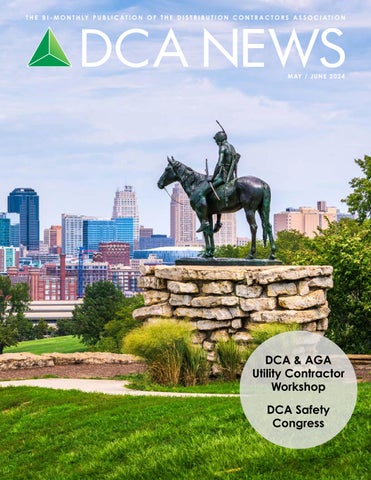
Plaza Fountain, Kansas City
CONTENTS 04
DCA & AGA Utility Contractor Workshop
13
Workforce News
14
DCA Safety Congress
17
Calendar
18
DCA Leadership Development Program
20
Insights
24
DCA Mid Year Meeting
26
Member News
04 14 20 26 May/June 2024
03
Massoud Tahamtani
Eighth Annual DCA & AGA Workshop Held in Kansas City by Eben Wyman, Wyman Associates
DCA and the American Gas Association (AGA) held the eighth annual DCA & AGA Workshop at the InterContinental Kansas City, Kansas City, Missouri, on March 18-20, 2024. The joint workshop was established to bolster communication and cooperation between local distribution companies (LDCs) and the contractors who build gas distribution infrastructure for them. At a time when America is in the midst of the largest infrastructure buildout in history and recognizing that the vast majority of construction work is contracted out, ensuring strong relationships between LDCs, other facility owners, and contractors is more important than ever. 04
www.dcaweb.org
The 2024 workshop brought some 140 industry representatives to Kansas City for a day and a half of presentations and panel discussions on a range of industry issues, including: • Underground damage prevention • State-of-the-art facility mapping • Operator qualification • Pipeline safety management systems (SMS) • Cyber and physical security • Workforce development efforts in the gas distribution industry.
• Legislative and regulatory activities facing the industry at the state and federal level PHMSA Kicks Off Workshop with Strong Messages of Partnership, Safety Culture Following introductory remarks and a “safety moment” by industry representatives from the utility sector and the contracting community, Massoud Tahamtani, Deputy Associate Administrator for Policy and Programs of the U.S. Department of Transportation’s Pipeline and Hazardous Materials Safety Administration (PHMSA) provided an overview of the nation’s pipeline safety program. PHMSA is responsible for regulating more than 2.3 million miles of natural gas and hazardous liquid pipelines through development of safety regulations, research and development, strong enforcement, and working with several industry organizations on a range of safety initiatives. PHMSA’s presentation focused on excavation damage prevention, which continues to be one of the leading causes of pipeline failures. PHMSA works with its state
partners and other organizations such as the Common Ground Alliance (CGA) to advance damage prevention effectiveness at both the federal and state level. According to PHMSA, “taking this responsibility seriously is particularly important now that, through the Bipartisan Infrastructure Law, thousands of infrastructure projects are underway in every state and territory that will serve to bolster our economic security and prosperity for decades to come.” Public utility commissions and other entities that oversee state damage prevention programs can apply for several sources of federal grant dollars intended to help improve state efforts to reduce damages, such as PHMSA damage prevention grants, technical assistance grants, and base grants. Because of the importance of protecting underground facilities, PHMSA encourages states to take advantage of these resources to implement several elements deemed necessary to maintain an effective state damage prevention program. Although the “blame” for excavation damage is often unfairly assigned to the excavator, PHMSA’s presentation noted the responsibilities of the facility operators and the contract locators who work for them. Compliance with damage prevention responsibilities is fundamental to complying with Distribution Integrity Management Program (DIMP) requirements, but PHMSA described another problem in the damage prevention process – the overburdening of contact locators with unrealistic numbers of 811 tickets to clear in a short timeframe. Assigning unworkable numbers of tickets to already overworked locators results in mismarked facilities, late marking, or even no marking of some facilities at all. This leads to contractors calling in too many tickets for one simple reason: they don’t know what is going to be located and located on time. More effective ticket scheduling is needed, and increased communication between operators and contractors will be key to solving the problem. It was suggested that bringing contract locators into these initial discussions should be considered. PHMSA also believes that instilling and maintaining a culture of safety is critical. Operators should consider communicating their expectations regarding safety management systems (SMS) with their contractors sooner rather than later. PHMSA also recognizes the need for effective damage prevention as federal dollars from the bipartisan infrastructure law continue to flood into several underground infrastructure markets.
(continued on pg. 06)
May/June 2024
05
(L to R) Brad Heck, Heather Stein, Andrea Martinez, Christina Sames
OQ Integrity Coalition Advancing Pilot Programs The Operator Qualification Integrity Process (OQIP) is an industry effort spearheaded by DCA and AGA with the goal of standardizing OQ processes while raising the bar on pipeline integrity. The process has been integrated and tested in three initial pilot programs in New Mexico, Michigan, and Washington state. A panel of gas utility operators running these pilots provided an update on the progress and challenges they’ve experienced while working to continuously improve their OQ programs. Following background on the OQIP and the progress made since the coalition was established 10 years ago, the panel discussed what the coalition refers to as ‘phase 2.’ This will consist of an evaluation of lessons learned during the pilots and how to expand participation in OQIP pilot programs or encourage implementation of OQIP approaches in existing OQ programs. Panelists focused on several common themes: • The need to standardize OQ factors to the extent possible while understanding the “80/20” ratio of common covered tasks versus operator-specific OQ activities. • The importance of both internal and third-party audits. • The increasing importance of implementing SMS approaches related to operator qualification. • The strong interest in maintaining OQIP practices long term.
06
www.dcaweb.org
White papers on each of the current pilots are provided on the OQIP website (oqip.org. The OQ Coalition looks forward to advancing the OQIP as the coalition confirms its governance and plans for next steps. Interested parties are encouraged to contact DCA or AGA for more information. Significant Progress Related to Pipeline SMS Since the release of API Recommended Practice 1173, Pipeline Safety Management Systems, in 2015, the pipeline industry has done a lot of great work to voluntarily transition toward the top-to-bottom, cyclical process of ensuring continuous improvement in the safety of pipeline operations. In 2020, the Pipeline SMS Industry Team invited contractors to the table, and progress has been made on several fronts. DCA’s SMS “template” was distributed to several industry groups, and the association helped develop the Industry Team’s contractor guidance document. DCA is now participating in multiple assessments of their own SMS programs and approaches. Contractor Assessment Programs A panel of contractors and operators discussed the contractor role in Pipeline SMS and the Industry Team’s recent release of its “Contractor Assessment Tool,” as well as the best ways contractors can learn more about implementing an SMS program. The chief operating officer of a leading utility contractor enthusiastically described how contractors now have a real voice in
(L to R) Ashley Donnini, Jesus Soto, Colin Frazier, William Cunningham, Adam Lanier, Kevin Miller
the SMS discussion and how the contracting community appreciates the Industry Team inviting a DCA member to serve as vice chair of the Industry Team. Implementation of SMS is now happening in a collaborative way. The panel discussed efforts to revise and release the next edition of API RP 1173, especially regarding if and how to provide more content related to contractor SMS. Operators on the team understand that API 1173 is directed at pipeline operators, and that some of elements related to quality management systems (QMS) might be appropriate when considering contractor SMS. With the help of gas distribution contractors, the team was able to take 56 key “shall statements” from the 234 included in API RP 1173. Depending on a contractor’s scope of work, operators can focus on these 56 “shall statements” while ensuring alignment with their SMS program. Following release of the contractor guide, the Industry Team produced a tool aimed at helping contractors gauge their own implementation of SMS approaches. The Industry Team’s contractor assessment program is providing contractors the opportunity to work with operators to evaluate where they are in terms of the maturity of their SMS program. Establishing a culture of safety throughout the company is fundamental, and contractors were encouraged to “start now – don’t wait” when it comes to looking at SMS and to ask customers about their expectations regarding SMS approaches in pipeline construction.
The Industry Team looks forward to reviewing the pending investigation and report expected from the National Transportation Safety Board (NTSB), and will develop a response to NTSB, depending on the board’s findings and possible safety recommendations. A report on implementation of SMS in the industry is also expected from PHMSA. In the meantime, there are resources on the Pipeline SMS website (pipelinesms.org) to provide contractors more information on the Industry Team’s work and all resources available to both contractors and operators. Perspective from an LDC Later in the workshop program, a project manager from a leading gas utility described his company’s journey toward effective pipeline safety management. SMS has a proven track record in other industries such as aviation, nuclear power, and chemical manufacturing, and is being effectively implemented in the pipeline industry. This operator integrated SMS approaches in the company’s Operational Excellence Program, and now has the company’s entire SMS team working on implementation, including utilization with contract personnel. An original gap analysis set the stage for this operator, which led to setting up an SMS framework and process to assess the maturity of their SMS in the future. While human (continued on pg. 08)
May/June 2024
07
(L to R) Luke Litteken, Todd Lakatos
error is inevitable, operational excellence should strive to exceed expectations of customers, regulators, and other stakeholders. SMS can and should be a big part of that. Priorities for this operator included: ensuring for fully trained and qualified personnel; use of ‘train-the-trainer’ and on-the-job training; centralized oversight of key procedures, continuous communication with all relevant workers, and elaborate performance reviews; updated inspection manuals and reliable equipment; and robust reporting and opportunities to provide feedback. Monitoring the company’s safety culture and developing a work risk matrix were also described by this operator. To say the least, sentiments about the need to instill and maintain a strong safety culture and to continue the transition to SMS in the industry were shared by operators and contractor panelists alike. Leadership Development Helps Address Workforce Capacity Challenges The gas distribution construction industry continues to face serious workforce capacity challenges and there doesn’t seem to be any light at the end of the tunnel. If quality candidates interested in working in the energy sector are not able to secure a job based on their existing qualifications, they will go elsewhere and our industry will miss opportunities of adding quality workers to a struggling workforce. A panel of DCA’s Workforce 08
www.dcaweb.org
Development Committee provided a lively discussion of how the industry can come together to increase opportunities to bring talent into the workforce through the “sharing” of candidates. The energy and construction industries continue to face an aging workforce, a mismatch of needed skills, and a general decline of interest in some quality careers. Supply chain challenges that were more than disruptive following the pandemic, uncertainty over available child care, lack of flexible work schedules, anxiety over available transportation, and other concerns have led to certain positions remaining open for prolonged periods of time. This panel asked the question: can and would employers share information regarding potential workers through “talent sharing?” Specifically, sharing of information about job candidates in a collaborative way among competing companies and even the associations that represent them. Can associations serve as repositories of this shared information through creation of a joint website and/or other venues? The concept of talent sharing was well received, although full transparency will be needed in the process. In addition, possible benefits and challenges will need to be fully discussed. At the very least, this panel on workforce development provoked significant discussion on an enduring problem.
Barb Cederberg
Legislative and Regulatory Challenges This year, Congress and the Biden regulatory agencies are considering several legislative and regulatory actions impacting the gas distribution industry. A leading industry lobbyist representing gas utilities provided the lay of the land for the energy industry on Capitol Hill at essentially “halftime” in what is shaping up to be an undoubtedly consequential election year. Workshop attendees were not likely surprised to hear that not much in terms of legislative productivity is expected this year, when a historic rematch of two unpopular presidential candidates and an unquestionably toxic environment in Congress will exacerbate the already slim chances of anything substantial passing in the remaining months of the 118th Congress. For our industry, the ongoing attack on the natural gas industry is expected to continue. At the same time, tens of thousands of new gas distribution lines are being built, the industry has reduced emissions by some 70%, and demand, production, and storage of natural gas continue to increase. The fight over “fuel choice” versus banning or restricting access to natural gas and other fuel sources continues. States are talking about gas bans, but demand is still rising in “problem” states such as New York. Gas and electric coordination is a factor, and the Biden
Administration’s regulatory agenda continues to threaten the future of natural gas, despite steady or increasing demand. Permitting processes are not getting any easier, and the president’s shortsighted ban on liquified natural gas exports is adding insult to injury. Pipeline safety legislation is currently being considered in the House, but different approaches are being employed. One House bill is bipartisan and would likely pass while another is considered much more partisan. The Senate has yet to introduce its version of pipeline safety reauthorization legislation. The key takeaway: This industry faces multiple challenges, but a strong gas distribution market will be needed for the foreseeable future. CGA/DPI Presentation Damage prevention is a common topic at these workshops, and both DCA and AGA are strong supporters of the Common Ground Alliance (CGA). In recent years, CGA’s Damage Prevention Institute (DPI) created an innovative opportunity for the industry to address systemic inefficiencies in the damage prevention process through a metrics-focused, peer-reviewed model of shared accountability that serves all stakeholders.
(continued on pg. 10)
May/June 2024
09
10
Sam Hall
George Lowe
The creation of the DPI was announced in April 2022, and was formally launched in January 2023. DPI’s mission builds on the industry-leading insights of CGA’s Next Practices Initiative. Its mission also uses a stakeholdercentered approach to develop performance metrics that reflect commitment to CGA best practices and dedication to improving damage prevention. CGA has more than 1,500 members and 16 stakeholder groups and promotes shared responsibility in damage prevention. Priorities include excavation data collection, promoting innovative technologies, and identifying and promoting existing damage prevention best practices. CGA also launched its “Next Practices” initiative, where future issues, practices, and technologies are evaluated. Seventy-six percent of all damages are caused by six root causes: no notification to 811 by the excavator; facilities not marked due to locator error; failure to verify and/or maintain facility marks; mismarked facilities; improper excavation; and problems associated with potholing. While CGA is embarking on an effort to reduce damages by 50% in five years, damages are currently increasing. The industry is in dire need of better mapping of underground facilities. CGA provided specifics regarding DPI. Excavators represent the largest stakeholder group in CGA, and most are now participating in DPI activities.
Eligible participants must agree to adhere to multiple requirements, including:
www.dcaweb.org
• Comprehensive accreditation • Monthly reporting into CGA’s Damage Information Reporting Tool (DIRT) • Participation in DPI peer reviews. Cybersecurity and On-Site Security in the Gas Distribution Industry Since the Colonial Pipeline cyberattack, the issue has been front and center at industry conferences. AGA provided a thorough description of cybersecurity challenges and what industry is doing to address physical threats to pipeline infrastructure. The old adage of “the adversary only needs to be right once, but defenders must be right all the time,” is relevant here, and no contractor or utility is too small to be targeted. Bad actors continue to take advantage of lax cyber and physical security measures in all sized companies to gain access to critical energy system infrastructure and information. (Occasionally, though, impacted facilities may not have been the intended target.) Although it’s not realistic to be fully physical and cyber secure 100% of the time, actions can be taken to minimize the impact of an attack and make a measurable difference for utilities and their customers.
Kimberly Denbow
Devin Rascon
It’s important to remember that the main prize of cyberattacks is no longer intellectual property; it is causing service disruption. Cyber ‘adversaries’ are looking to engage systems under the guise of being an employee, and they want to attack when least expected. Cyber physical attacks are on the rise, and regulation is widely expected. In other sectors subject to federal cybersecurity requirements, contractors and subcontractors are having to move toward cyber certification. This could be burdensome, but understanding the increased threats to the security of critical infrastructure, it is an issue industry should be mindful of.
was to create a revolutionary process that would allow damage prevention stakeholders to access underground utility maps by leveraging widely accessible technology while also protecting sensitive information about a given pipeline’s specific location. The MN UMP began in 2019 and has been a case study monitored by CGA since 2020. GSOC worked with the advisory council to generate high-quality GIS imaging, providing real time viewing of subsurface utility systems. All viewing access and time periods allowing access are at the operator’s discretion. The pilot was completed in 2022 and GSOC is now advancing the program in Minnesota.
GIS in the Pipeline Industry As discussed in several of the sessions on damage prevention, underground facility mapping is in dire need of improvement. Use of technologies like geographic information systems (GIS) is gaining attention in multiple industries, including the gas distribution sector. Barb Cederberg of Gopher State One-Call gave a presentation about a promising pilot program established to improve the 811 process through digital visualizations of underground facilities using GIS mapping. The Minnesota Utilities Mapping Project (MN UMP) was developed by Gopher State One-Call (GSOC) and the Minnesota Geospatial Advisory Council. The goal
Impacts and Considerations: Artificial Intelligence Continuum Capitol closed out the workshop with an insightful market overview regarding gas distribution and other sectors. According to Continuum, we stand on the precipice of the largest wave of underground utility construction activity across all utility markets over the next three to seven years. In addition, the potential for the integration of hydrogen and renewable natural gas along with CO2 capture, transport, and storage activity presents new opportunities. Of course, there are challenges and change that come with them, the most interesting of which is artificial intelligence (AI).
(continued on pg. 12)
May/June 2024
11
Mark Bridgers
According to Continuum, we’re now heading toward times of “volatility, uncertainty, complexity, and ambiguity” (VUCA), and industry should be prepared for it. Geopolitical conflicts in several “hot spots” around the globe, the ongoing partisan fights over America’s energy future, and the general political landscape certainly make the case for industry stakeholders to take a hard look at VUCA considerations. Continuum provided an entertaining video demonstrating Hollywood examples of AI from the 1960s through the 2020s, and then real-life examples of how AI, machine learning, and robotics are changing the game in terms of augmenting our existing (and struggling) workforce. While there are benefits offered by AI, from maximizing operational effectiveness to addressing workforce capacity issues, there are serious factors to consider.
12
www.dcaweb.org
All proprietary information applied in AI and machine learning will become “part of the answer.” This and other concerns related to cybersecurity, dissemination of false information, and other new ‘issues of the day’ are now key considerations. Our industry needs to pay full attention. The DCA/AGA workshop is a unique event in the utility construction industry, and the need for strong and reliable relationships between utilities and their contractors has never been more essential. The fact that most construction operations are contracted out and that the industry faces serious workforce issues is enough to warrant these discussions. Recognizing that hundreds of billions of dollars are on the way to virtually all utility markets, we need a lot more of them. s
Workforce News American Gas Association Construction Operations Committee
Rob Darden
DCA EVP Rob Darden was invited by the American Gas Association Construction Operations Committee to present on DCA and the multitude of things the organization does for its members and the industry, including OQIP www.oqip.org and PSMS. Rob described the operations of the associations and shared several
aspects of the work DCA does on workforce development www.dcaletsgettowork.com including the Take Action Playbook and the job role videos. Rob encouraged the operators to first ask prospective contractors if they are members of DCA, the best in the business! s
May/June 2024
13
Safety News Tim Schmitt Receives DCA 2023 Safety Director Award; Dewayne Ward is the Safety Person of the Year
DCA named Tim Schmitt Safety Director of the Year for 2023 and honored Dewayne Ward as Safety Person of the Year at the 2024 DCA Safety Congress, April 22-24, at the InterContinental Hotel in Kansas City, Missouri. DCA President Mark Albert of AGI Construction presented the awards. Safety Director of the Year Tim Schmitt is the director of HSE for Michels Utility Services Inc., in Brownsville, Wisconsin, and has been with the company for over 10 years. Schmitt is credited with developing and implementing a Preventable MVI Accountability Plan that details the response and communication expectations following a preventable
14
www.dcaweb.org
motor vehicle incident (MVI) across all groups of Michels Utility Services. In 2023, Michels Utility Services, Inc. experienced a 48% decrease in all auto incident occurrences and a 56% decrease in their preventable MVIs. Schmitt’s dedication as a safety professional goes beyond the Michels organization. He participates in several industry organizations, including the DCA Safety Congress and INGAA PCSR, and has attended many customer events, making meaningful contributions. Through Schmitt’s efforts, Michels Utility Services, Inc. has won the DCA Arthur T. Everham Safety Award each of the past three years. The driving force behind this continued success is a passionate and tenacious safety
(L to R) DCA President Mark Albert, AGI Construction; Tim Schmitt, Michels Utility Services
director working together with operational leadership to make safety personal for each team member. In addition to Schmitt, 2023 Safety Director of the Year nominees were: • James Goble, InfraSource • Levi Lamp, R&R Pipeline • Savannah Robin, Vector Force Development Safety Person of the Year Dewayne Ward is director of operations at InfraSource in Columbus, Ohio. He has been with the company three years. Ward is an accomplished professional who has dedicated more than three decades to the natural gas industry. He began his career as a laborer, and through hard work, determination, and a focus on safety, rose through the ranks. He was an operator, foreman, general foreman, superintendent, and area manager before being promoted to his current position. Ward has consistently emphasized the importance of implementing safe driving techniques and has personally overseen several initiatives that have improved the safety culture at InfraSource. Ward is acutely aware of how dangerous driving can be, especially in the congested urban environments
of Philadelphia where his team works. He has made it his mission to educate and remind his crews about the importance of following safe driving practices. His efforts have reduced vehicle-related general liability claims by 12% year over year (YOY) and vehicle-related worker’s compensation damages by 28% YOY. As a direct result of Ward’s outstanding safety leadership, training efforts in the field, and gate checks, his operating area was able to reduce motor vehicle accidents (MVA) by 13% YOY. His commitment to safety and quality has earned him the respect and admiration of his colleagues and peers, and his contributions to the industry will undoubtedly have a lasting impact for years to come. 2023 Safety Person of the Year nominees also included: • Daniel Hopkins, Miller Pipeline • Ryan Mounts, Q3 Contracting • Cameron Segura, Carson Corp. The DCA Safety Director of the Year award began in 1998 to recognize the importance of the safety director’s role in today’s construction industry. Company management nominates their candidate then finalists are selected by members of the DCA Safety & Risk Management Committee and voted on by their DCA
(continued on pg. 16)
May/June 2024
15
(L to R) DCA President Mark Albert, AGI Construction; Dewayne Ward, InfraSource
peers. The winner receives a $1,000 cash prize and plaque. The Safety Person of the Year award, which recognizes an individual who has made a lasting impact on safety, was suggested at a Safety Congress 10 years ago. Nominees can come from any department within a DCA member company. The winner also receives a $1,000 cash prize and plaque. The 2024 DCA Safety Congress This year’s Safety Congress attracted more than 55 construction industry safety professionals who gathered to network, share creative training concepts, discuss trends, and hear from leading safety training consultants, other safety directors, and risk management executives. The event included presentations on important issues affecting the industry and the U.S. Topics included: • “Supersonic Success,” Jack Becker, U.S. Navy Fighter Pilot & Speaker. • “Cutting-Edge Integration of Conversational AI in Hazard Recognition,” Barry Nelson, FactorLab.
16
www.dcaweb.org
• “Keeping our Workforce and the Public Safe,” Justin Steele & Chuck Bradley, NiSource. • “Embracing the Audacity to be Resilient,” Erika Rothenberger, Henkels & McCoy. • “Active Assailant,” Sargeant Matthew Payne, Kansas City Police Department. There were also panel discussions on the Pipeline Safety Management System. DCA wishes to thank 2024 Safety Congress co-chairs Eric Egelhoff of InfraSource and Ileah Henchel of Precision Pipeline for their efforts in organizing this year’s event. The dates and venue for the 2025 Safety Congress will be announced soon. s
Calendar 2024 & 2025 DCA & Industry Events 2024
2025
JULY 14-17 DCA Mid Year Meeting Fairmont Chateau Whistler Whistler, British Columbia www.dcaweb.org
FEBRUARY 4-8 2025 PLCA Convention Marriott Marco Island Marco Island, Florida www.plca.com
SEPTEMBER 9-13 IPLOCA 2024 Convention Hilton Sorrento Palace Sorrento, Italy
FEBRUARY 24 - MARCH 1 DCA 2025 Annual Convention Fairmont Scottsdale Princess Scottsdale,, Arizona www.dcaweb.org
SEPTEMBER 25-27 HDD Rodeo Independence, Missouri www.hddrodeo.com SEPTEMBER 30 - OCTOBER 2 DCA Leadership Development Conference Session 1 Hyatt Regency DFW International Airport Dallas, Texas www.dcaweb.org OCTOBER 23-25 DCA Fall Meeting Hilton Park Plaza Boston, Massachusetts www.dcaweb.org
JUNE 23-27 SkillsUSA TechSPO Georgia World Congress Center Atlanta, Georgia www.nlsc.skillsusa.org JULY 14-17 DCA Mid Year Meeting Grand Geneva Resort & Spa Lake Geneva, Wisconsin www.dcaweb.org OCTOBER 29-31 DCA Fall Meeting Gaylord Texan Resort & Convention Center Grapevine, Texas www.dcaweb.org
OCTOBER 28-30 DCA Leadership Development Conference Session 2 Hyatt Regency DFW International Airport Dallas, Texas www.dcaweb.org
ATTENTION ALL DCA MEMBERS! So you do not miss out on future meeting and event notices, please have your company’s IT representative whitelist all emails from dcaweb.org. If you have any questions, please contact Teri Korson at tkorson@dcaweb.org.
May/June 2024
17
DCA Leadership Development Program
Spring 2024 LDP Graduates
Twenty-five DCA contractor and associate members attended the Spring Leadership Development Program at the Hyatt Regency DFW Airport. DCA once again partnered with ATW Training Solutions for a program aimed at professionals working in the distribution contracting industry who want to enhance their leadership abilities and advance their careers in the field. This program equips managers to engage and empower their teams to make an impact. Through focused learning and group activities, participants grow their skills needed to manage and lead their teams. The event has mandatory training split into several sections, both virtually and in person.
The Fall Leadership Development Program is scheduled for: • September 18, 2024 – Introduction (Virtual) • October 1-2, 2024 – Session One • October 29-30, 2024 – Session Two • January 10, 2025 – Post Program Continuance (Virtual) The event will once again be held at the Hyatt Regency DFW Airport and will be limited to 25 attendees. Registration will open in late June. A second level course is being developed for DCA members who attended the Fall 2023 and Spring 2024 Leadership Development Programs. s
Registration for the Fall 2024 LDP Opens Soon!
May/June 2024
19
Insights
Industry Pushes Back, But Braces for Biden Revisions to Bedrock Environmental Law In June 2023, President Biden signed into law the Fiscal Responsibility Act, which increased the debt ceiling and, among other things, amended the National Environmental Policy Act (NEPA). NEPA is the foundation on which much environmental policy is based. It is also one of the primary mechanisms for project opponents to challenge projects and is by far the most litigated federal statute. The NEPA amendments, commonly referred to as the “Builder Act,” attracted support from a wide range of lawmakers and industry organizations looking to improve NEPA reviews in order to facilitate construction of essential infrastructure. Whether or not the Builder Act accomplished that goal is still in question. Most people in the energy and construction industry believe it is more of a “down
20
www.dcaweb.org
payment” on long-needed reforms to the federal permitting process, and that more needs to be done. On May 1, 2024, the Council on Environmental Quality (CEQ) promulgated a final rule known as “Phase 2” of the Biden Administration’s planned revisions to NEPA regulations. While CEQ describes the changes in the final rule as promoting efficient and effective environmental review and increasing regulatory certainty, many industry representatives disagree. Given the history of NEPA litigation and the significant changes in the recent final rule, it is widely expected that these changes will lead to litigation and legislative measures intended to delay implementation or even overturn the “Phase 2” final rule altogether. Many of the significant changes to NEPA in the final rule are designed to modernize the regulations and provide additional clarity for applicants and agencies conducting NEPA review, including:
• Expanding the role of NEPA to require agencies to identify an “environmentally preferable alternative” to projects (and other “actions”) in their environmental impact statements (EIS). • Requiring agencies to consider a project’s potential effects on climate change and consider the effects of climate change on the project. • Requiring agencies to analyze disproportionate and adverse health and environmental health effects on communities with environmental justice concerns. Specifically, this means the “treatment and meaningful involvement of all people, regardless of income, race, color, national origin, Tribal affiliation, or disability, in agency decision making and other Federal activities that affect human health and the environment…” The Final Rule also encourages agencies to adopt mitigation measures that specifically address impacts to communities with environmental justice concerns. • Requiring agencies to publish NEPA documents and supporting materials on their websites and establish tracking numbers for environmental documents in order to provide opportunities for meaningful public engagement. • Allowing agencies to designate categorical exclusions for activities not requiring an environmental assessment or EIS. The final rule also allows agencies to establish these exclusions jointly with other agencies. This is intended to facilitate complex federal permitting processes with multiple federal agencies. Industry groups banded together to push back on these harmful changes to longstanding NEPA policy. In May, dozens of industry organizations (including DCA) sent a letter of support for legislative measures that use the Congressional Review Act (CRA) to overturn the Phase 2 final rule. The CRA allows Congress to disapprove an agency rule using fast track procedures during a specific window of time following the rule’s promulgation. Importantly, these special fast-track resolutions of disapproval cannot be filibustered. In its letter, the industry called for a more efficient permitting process to facilitate timely project development and economic growth, while at the same time ensuring environmental protection and public engagement. However, regarding Phase 2 of the president’s NEPA revisions, “the new regulation introduces
unnecessary complexity to a host of permitting process steps and agency decision-making. It reverts to many of the permitting process inefficiencies from the 1970s that led to the broken permitting process we have today, with permitting decisions taking years and sometimes decades.” A main objection to the rule is that it seems to alter the process from one focused on evaluating environmental impacts to one seeking to force specific outcomes, thereby overturning decades of NEPA permitting practices. Among the problems raised in the industry letter are provisions that would: • Lower the threshold for when an agency should conduct a more extensive level of NEPA review and analysis. • Expand the scope of analysis to include environmental effects that may be remote and far removed from a project. • Add multiple layers of subjective criteria to the public outreach process. • Place a thumb on the scale in favor of some categories of projects while disfavoring others. While litigation is expected, industry groups are expected to encourage Congress to use the CRA to send this rule back for reevaluation for future NEPA adjustments. DCA has weighed in and will continue to support congressional efforts to overturn these recent changes to NEPA and other shortsighted environmental policy. OSHA Walkaround Rule Allows More Outsiders to Worksite Inspections Most construction employers have dealt with safety inspections conducted by OSHA. Under the Biden administration, OSHA inspections are about to become potentially more problematic. Past OSHA policy specified that in the event of an on-site OSHA inspection, “a representative of the employer and a representative authorized by [its] employees shall be given an opportunity to accompany [OSHA] during the physical inspection of any workplace… for the purpose of aiding the inspection.” In April, OSHA published a final rule that reinterprets rules related to employee representation rights. Previously, the regulation specified that the employee-
(continued on pg. 22)
May/June 2024
21
authorized representative “shall be an employee(s) of the employer” or, if the OSHA inspector deemed necessary, a third party “such as an industrial hygienist or a safety engineer.” Under the revised regulation, authorized representatives may be an employee “or a third party.” Third parties now potentially include outside entities, including community activists, industry watchdog groups, union representatives, or other stakeholders. While OSHA’s regulations have long permitted an employee to accompany parties during inspections, third parties have only been allowed to participate when the individual “is reasonably necessary to the conduct of an effective and thorough physical inspection of the workplace.” This policy enabled inspectors to balance the need for outside expertise, when necessary, with employer property rights. DCA has been a member of the Coalition for Workplace Safety (CWS) for more than 10 years. CWS represents associations and employers who support workplace safety policy that employs cooperation, assistance, transparency, clarity, and accountability. This coalition believes that workplace safety is fundamental, and improving safety can only happen when all parties – employers, employees, and OSHA – have a strong working relationship. CWS has encouraged OSHA to revisit this policy adjustment from the beginning, and DCA continues to push back on this and other overzealous OSHA policies as they arise. In May, DCA signed a CWS letter in support of a congressional resolution to nullify OSHA’s final rule, which was published in early April, using the above mentioned CRA to do so. The resolution would also prevent the agency from issuing a substantially similar rule in the future. According to CWS, however, the final rule “abandons this balance with no justification and no explanation as to how the change would increase workplace safety. It contradicts the plain language of OSHA’s governing regulations, longstanding agency guidance, and past interpretations… and could very likely result in unmanageable OSHA inspections with many different third-party representatives whose goals are to harm the employer.” According to CWS, the new policy may even compromise safety. OSHA inspections would no longer be solely focused on upholding workplace safety standards, but would become opportunities for individuals with grievances against the employer to further their own
22
www.dcaweb.org
agenda. OSHA inspectors will be put in the middle of disputes between employers and other third parties. This will add the responsibility of policing these third-party individuals’ behavior during inspections, should they attempt to disrupt the workplace or interfere with the inspection. Inevitably, this will pull OSHA’s attention away from the overall mission of finding and remedying hazards in the workplace. Put simply, the rule presents more questions than clarity to the regulation, including: • How will employees authorize walkaround representatives? • How many walkaround reps will be allowed on a given inspection? • Will advance notice be provided regarding third-party participants? • How will OSHA police inevitable and potentially intense disputes, for which OSHA inspectors are not trained to do? DCA will continue to work as an active member of CWS to encourage action through the Congressional Review Act or other measures to overturn OSHA’s new walkaround inspection policy. DCA Launches Regional Advocacy Effort In 2023, DCA established regional advocacy teams to expand both the association’s influence and opportunities for member involvement in DCA’s advocacy efforts. The teams are based in different regions of the country and consist of DCA contractor and associate members. They are helping deliver the messages used in DCA advocacy efforts, including conducting Washington, D.C. ‘fly-in’ events during the second session of the 118th Congress. Pipeline safety reauthorization is a key DCA priority this year, and has been the focus of DCA regional advocacy so far. This is especially important because this year’s pipeline safety debate addresses the enduring problem of damages to underground facilities during excavation activity. The legislation includes language that would take significant steps toward improving pipeline mapping and underground facility locating, and requiring all stakeholders to participate in the 811 process. Specifically, the Promoting Innovation in Pipeline Efficiency and Safety (PIPES) Act would require states applying for PHMSA damage prevention grant dollars to
demonstrate their damage prevention programs have or will include several leading practices, including: • Examining and limiting exemptions, including municipal exemptions • Requiring a “positive response” from the facility owner prior to excavation • Requiring operators/owners of underground facilities to locate and mark, provide an “all clear” notification, or otherwise notify excavators that underground facilities have been located • Requiring marking of all lines and laterals, including sewer lines and laterals
• Encouraging training for locate professionals • Applying damage prevention requirements to other underground infrastructure markets • Encouraging the use of technologies to locate underground facilities, specifically GIS-grade mapping DCA teams from the Midwest and Northeast regions have had their day on Capitol Hill, and DCA thanks all participants in the effort so far. Fly-in events from other regions are coming up as we head into the summer of a critical election year. s
Eben M. Wyman Principal eben@wymanassociates.net
Save the Date for The Fall Meeting
October 23 - 25, 2024 • Boston Park Plaza, Boston, MA
Visit the DCA Government Relations Website at www.DCAGovRelations.com
May/June 2024
23
DCA MID YEAR J U LY 1 4 - 1 7, 2 0 24
W H I ST L E R , C A N A DA
Register Now at www.dcaweb.org
Member News and now the Pathways to Sustainability program are all about – learning and working together toward a brighter future. We are proud to support our customers every step of the way as they design their own unique paths and goals, now and through the energy transition.”
Caterpillar
Caterpillar Launches ‘Pathways to Sustainability’ Caterpillar Inc. has announced the formation of a new educational program designed to support mining, quarry, and aggregate industry customers on their energy transition journeys. The Pathways to Sustainability program is a four-year, multi-pronged experience that provides participants with holistic learning opportunities, energy transition project advisement, and additional benefits related to sustainable product access. The company says that the emphasis of the program is on: • Understanding each participating company’s sustainability objectives. • Providing participants with information and tools that will help them understand where they are on their own unique journeys. • Determining where energy transition strategies may need to be customized to support individual actions. The program includes in-person and virtual training opportunities centered on six strategic areas impacted by the energy transition: strategy, people, product, process, technology, and infrastructure. “To make a step-change, it will take the industry coming together,” Marc Cameron, Caterpillar Senior Vice President, said. “That is what our Early Learner program
26
www.dcaweb.org
Vermeer Corporation
Vermeer’s Self-Propelled Baler Wins “Coolest Thing Made in Iowa” Contest According to Quad Cities Regional Business Journal, the coolest of the cool products manufactured in the Hawkeye State is an innovative piece of equipment designed to make the grueling work of baling hay a much easier job for today’s farmers. Vermeer Corporation, a third-generation, familyowned company based in Pella, Iowa, won the bragging rights — and a shiny trophy — when its ZR51200 self-propelled baler was named winner of the firstever Coolest Thing Made in Iowa contest. The honor was announced during the recent Iowa Association of Business & Industry (IABI) “Taking Care of Business Conference” in Davenport, Iowa. Vermeer beat out three other finalists — and dozens of original nominees— in a public voting process to capture the new award created by IABI and sponsored by MidWestOne Bank. The Vermeer self-propelled baler, the first in the world, reduces the steps needed to make a bale and maximizes productivity through zero-turn capabilities.
Third-generation Vermeer leader Mindi Vanden Bosch, Vice President of Operations, accepted the honor on behalf of the industrial and agricultural equipment company that was founded 75 years ago by her grandfather, Gary Vermeer. “My grandfather was a farmer. He founded Vermeer on a spirit of innovation by simply searching for a better way to do hard work,” she told the IABI luncheon crowd. “Receiving this award is incredibly special, as it indicates his legacy continues on.”
misaligned. It alleviates fatigue and the potential for additional strain by mitigating any need for workers to have to carry solar panels or lift them over their heads, also reducing wind gust concerns. With the SPL, fewer laborers are required to complete the same task. Less downtime between lifts is promoted with greater efficiency all around. Users of the compact and portable SPL have already been finding additional benefits in features such as foldable legs for storage and alignment tips to keep cups parallel to the panel during difficult terrain situations.
Vacuworx Michels Launch of New Vacuworx Solar Panel Lifter Leading to Easier Handling of Modules In-Field Vacuworx, a global leader in vacuum lifting technology, announced the launch of a new material handling innovation eliminating the need for manual lifting of solar panel modules in the field. For 25 years, Vacuworx has been designing and manufacturing industry and application-specific vacuum lifting systems and material handling devices to meet customer needs. The Solar Panel Lifter (SPL) is perfectly suited to operate in conjunction with mini excavators, efficiently supplied by a 12V system powered by the excavator’s charging system. The SPL offers captured ball joint vacuum pad connections, quick change adapters available for use with various host equipment, and a 300-lb. standard lift capacity. It was conceptualized and precision engineered to allow for easier manipulation of delicate solar panel modules – safely, gently, and more efficiently handling them with less strain on workers. The advantage of the SPL and its proprietary technology is safety and efficiency, with soft silicone vacuum pads preventing any damage to solar panel modules, 360° of rotation to facilitate precise handling and alignment, and 5 inches of vertical vacuum pad travel for additional protection if a module becomes
Michels Brings New Life to Empty Quarry Michels Pipeline, Inc., working with Michels Construction, Inc., collaborated to convert an abandoned rock quarry in West Milford, New Jersey into a 20-acre natural gas compressor station. A key component of the East 300 Upgrade Project, Compressor Station 327 ties into one 24-inch and one 30-inch mainline, increasing capacity for the region that needed additional gas supply. The project also included the installation of a 19,000-horsepower electric motor drive compressor with ventilation and lube oil systems, three gas filter separators, four bays of high-pressure gas coolers and other equipment. The work, completed in November 2023, encompassed more than 3,800 cubic yards of concrete and more than 160 tons of reinforcing steel used to erect three buildings on-site. Established in 1959 in Brownsville, WI, Michels is an international leader in energy and infrastructure construction. The Michels Family of Companies is a collection of wholly owned infrastructure and energy companies providing contracting solutions under the Michels brand flagship.
(continued on pg. 28)
May/June 2024
27
Wyo-Ben Expands Global Footprint with Launch of Wyo-Ben Pet Canada in Toronto Wyo-Ben, a leading provider of high-quality pet products proudly announces the grand opening of Wyo-Ben Pet Canada, located in the vibrant city of Toronto, Ontario. This expansion marks a significant milestone in Wyo-Ben’s commitment to delivering exceptional pet care solutions to customers worldwide. The new facility, strategically situated in Toronto, will serve as a pivotal hub for finishing, packaging, and
distributing premium cat litter products to discerning pet owners across North America and Europe. Wyo-Ben’s dedication to innovation, sustainability, and pet wellbeing shines through in every aspect of this venture, reflecting the company’s intent to enhance the lives of pets and their owners. “We are thrilled to unveil Wyo-Ben Pet Canada, an integral addition to our global network,” said David Brown, CEO & President at Wyo-Ben. “With this expansion, we aim to meet the growing demand for our exceptional cat litter products in both North America and Europe while reinforcing our commitment to excellence and customer satisfaction.” Wyo-Ben Pet Canada is equipped with state-of-the-art facilities and adheres to the highest standards of quality control and environmental responsibility. By leveraging cutting-edge technologies and sustainable practices, the facility ensures that every bag of cat litter leaving its premises upholds Wyo-Ben’s hallmark of superiority.
Supporting your jobsite in and out of the trenches. Keep your worksite safety compliant without sacrificing efficiency. At United Rentals, our trench safety solutions help make jobs of every size safer and more productive. With top-of-the-line protective systems and support, you can keep workers protected while finishing projects on time and under budget. United Rentals Trench Safety has the equipment, service, and expertise to ensure your project is completed safely, on time and on budget.
VAC BY POPULAR DEMAND.
UnitedRentals.com/Trench 800.UR.RENTS © 2022 United Rentals, Inc.
You told us you wanted a hydrovac that delivers full-sized capacity with maneuverability in tight urban spaces. We listened. AVAIL ABLE SOON IN THE USA
brandt.ca
28
www.dcaweb.org
Welcome New Members CONTRACTOR MEMBERS
CONTRACTOR MEMBERS (cont.)
Flagger Force 8170 Adams Dr. Hummelstown, PA 17036 (717) 482-8800 www.flaggerforce.com
W.A. Rasic Construction Co. Inc. 4150 Long Blvd. Long Beach, CA 90807 (562) 928-6111 www.warasic.com
Mike Doner, CEO & President Alyssa Martelli, Marketing Manager; marketing@flaggerforce.com Shea Zwerver, Workforce Relations & Public Affairs Manager
Pete Rasic, President David Lee, Vice President – Operations Anthony Aguilar, Head of Gas Operations; anthonyaguilar@warasic.com
(continued on pg. 30)
DCAPlatinumSponsorAd.indd 2
3/5/24 8:58 AM
May/June 2024
29
American Augers
American Augers’ New HDD Maxi Rig Maximizes Productivity Horizontal directional drill (HDD) operators can improve their jobsite uptime and meet a variety of new jobsite requirements with the new DD600 Maxi Rig Directional Drill from American Augers. Replacing American Auger’s
DD440T, the DD600 was designed with customer-focused features to enhance the power and performance of the current industry standard in HDD maxi rigs. One of the most notable features of the new DD600 is the 755 HP Stage V/T4F/T3 CAT C18 engine that does not require diesel exhaust fluid (DEF), the only machine of its kind in this class. The simple exhaust system increases uptime and reliability, eliminating daily jobsite struggles with DEF. With ease of transportation in mind, the weight of DD600 meets standard transportation requirements, meaning no special permits are required to transport the machine. The DD600 can also be transported without removing the wrenches, saving hours in assembly and disassembly time. “The new DD600 Directional Drill incorporates many features and updates that came at the request of our customers,” said Richard Levings, American Augers Product Manager. “This latest drill further increases the power and performance capabilities that come with owning an American Augers drill.” s
JOBS
DCA MEMBERS - SEND US YOUR NEWS! DCA would like to publish your company news in upcoming issues of the DCA newsletter and on the DCA website. Please send news items, press releases, images or videos to cgreen@dcaweb.org.
30
www.dcaweb.org
Featured DCA Member Websites
Atlas Trenchless, LLC www.atlas-trenchless.com Atlas Trenchless, LLC is recognized as a preferred contractor specializing in Horizontal Directional Drilling (HDD) and Tunnel Boring techniques in complex and environmentally sensitive terrain. Their team includes some of the most experienced, dedicated, and highly motivated drillers in the nation. Atlas has successfully built a reputation for delivering high quality results on time and on budget within a SAFE work environment.
CETCO www.mineralstech.com/cetco The complete line of professional products is specially designed to enhance the cost-effectiveness of drilling operations by controlling and improving drilling fluid properties. Each drilling product is supported by experienced field engineers and research scientists. Offering a wide assortment of high-quality bentonite drilling fluids, grouts, sealants, polymers, and additives, CETCO can help maximize your drilling efficiency and meet your needs in the field.
Express 4x4 Truck Rental www.express4x4truckrental.com Express 4x4 Truck Rental provides truck rental services that help customers across multiple sectors get their work done. Whether that’s hauling debris away from a construction site, delivering crews to remote renewable power projects or carrying equipment for telecom maintenance, the company has the truck rental solutions for the job.
May/June 2024
31
DCA NEWS is a bi-monthly publication of Distribution Contractors Association 101 West Renner Road, Suite 460 Richardson, Texas 75082 972-680-0261 www.dcaweb.org
RobertG. G.Darden Darden Robert ExecutiveVice VicePresident President Executive CandaceGreen Green Candace Directorof ofCommunications Communications Director