T H E B I - M O N T H LY P U B L I C AT I O N O F T H E D I S T R I B U T I O N C O N T R A C T O R S A S S O C I AT I O N
NEWS
MAY / JUNE 2023
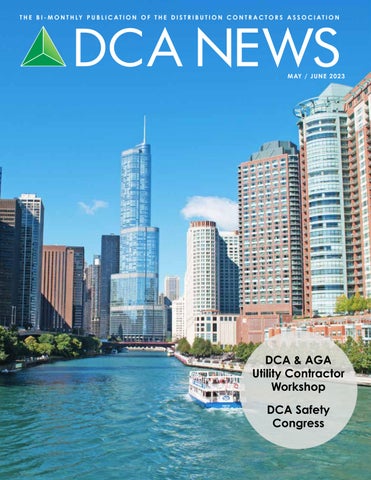
DCA & AGA Utility Contractor Workshop DCA Safety Congress
CONTENTS 04
DCA & AGA Utility Contractor Workshop
13
Calendar
14
DCA Safety Congress
17
Workforce News
18
DCA Mid Year Meeting
20
Insights
24
DCA Fall Meeting
26
Member News
04 14 20 26 May/June 2023
03
DCA & AGA Workshop Provides Forum on Wide Range of Topics by Eben Wyman, Wyman Associates
In late March, the DCA and the American Gas Association (AGA) held the 8th Annual DCA & AGA Workshop in Chicago, Illinois. The event brought together some 150 gas distribution operators, contractors, manufacturers, and other service providers to discuss and evaluate ways to communicate and collaborate effectively. The workshop also offered a forum to address the more impactful issues facing the industry and hear from participating stakeholders. The 2023 workshop featured presentations and panel discussions on enduring challenges related to operator qualification requirements, workforce development in the gas distribution construction industry, pipeline safety 04
www.dcaweb.org
management systems, and damage prevention. Also included were new subjects gaining national attention: increased use of hydrogen as a sustainable energy source, and promoting carbon capture, use, and storage efforts. The hope was that by the end of the workshop attendees better appreciated how distribution companies and the contractors who work for them felt about these issues. Opening Session Returns to Workshop Roots After introductions and opening remarks by DCA and AGA executives, workshop participants heard from a panel of local distribution companies (LDC) describing
that both parties can lock in prices for the entire project and/or over a set period of time. Operators who bring in contractors early in these discussions will find these processes more beneficial.
specific strategies to improve productivity, safety, and risk management, and to facilitate regulatory compliance. The central message of this session was that better collaboration — including a clear scope of work and pre-construction and monthly meetings with contract personnel and other open-door policies — can result in higher levels of both safety and effectiveness. When contractors feel they are considered an extension of the utility workforce, they will feel more comfortable collaborating. Collaboration is especially important now as the nation begins to turn toward electrification of utilities and increased use of clean energy sources such as hydrogen and captured carbon dioxide. Operators who focus on the quality of contractor crews and key personnel (foremen, crew leaders, project managers, etc.) will benefit most. The panel also addressed compensation methods. Master services agreements (MSA) were compared with other compensation approaches. Panelists felt that while the ‘back-and-forth’ about specific job functions can slow the agreement process, the advantage of MSAs is
Legislative Issues at the Federal and State Level AGA provided an extremely informative presentation on legislation facing the natural gas and pipeline industry. While there has been significant action within the federal government, much of the debate over the future of natural gas is happening at the state and local levels. Some municipal and state policies are currently pushing to ban or restrict access to new natural gas connections, while others are doing what they can to prevent such restrictions from being enacted through preemptive measures that ensure “fuel choice” for consumers. The fact that the number of new gas customers continues to grow nationwide does not seem to pair with shortsighted efforts to restrict access to natural gas. The discussion began with the good news: Natural gas remains popular with the American people, including in states pushing for mandatory electrification. For example, residents in New York — where in recent history, transporting natural gas has been next to impossible because of permit restrictions — strongly support natural gas. Recent polling found that 87% of New Yorkers want access to natural gas and 77% oppose efforts to move away from gas service. In addition, stakeholders who rely on natural gas service, such as restaurants, expressed even higher levels of support for continued gas service. Several other states have also taken significant action. For example, in parts of Oregon, there is a gas ban on the state ballot, meaning that consumers have the opportunity to actually vote on a gas ban and not have it imposed on them by sometimes unelected officials. Scrutiny of line extensions and even pipe replacement continues to increase. While 23 states have enacted some type of ‘fuel choice’ legislation, with another six in play, efforts to quash consumer choice through mandatory electrification are expected to continue. However, while the majority of states have indicated that they want fuel choice and the untenable goals of some overzealous activists are becoming more transparent, this is no reason for the industry to rest on its laurels. The need to continue efforts to rebut unwarranted and sometimes blatantly false claims relating to post-meter gas emissions with harmful health impacts remains. As far as the bad news, much of it is coming out of federal agencies such as the U.S. Department of Energy
(continued on pg. 06)
May/June 2023
05
Rob Darden, DCA
Christina Sames, AGA
and the Consumer Product Safety Commission, which have proposed (or implied the need to propose) policy that would either ban gas stoves and other appliances or set emission standards at levels that would essentially invalidate use of natural gas. In addition, the industry has seen negative actions out of several other federal authorities, including the Environmental Protection Agency and the Federal Energy Regulatory Commission. The debut of the movie “How to Blow Up a Pipeline,” which premiered in several states with big college towns, has motivated pipeline operators to pay special attention to some of the security measures taken to keep trespassers off of pipeline job sites. Associations are advising state and federal agencies about the film and possible criminal activities by misguided advocates that may follow.
service as natural gas but without emissions. Operators in Utah, Ohio, and North Carolina are conducting pilot projects to test the reliability, sustainability, and affordability of different blending percentages. Bringing in academia, operators, contractors, and other stakeholders as part of the decision-making process, 20% hydrogen blending is the level most commonly used, although some are already talking about 40%. The task force conducting these pilots is including standard operating procedures, operator qualifications, training, and safety procedures as part of these tests. Hydrogen hubs are also being formed and expanded to see if they may serve to minimize the cost of infrastructure. Impacts on steel lines are getting an increasingly hard look, both in possible percentage levels and possible impacts on welding procedures. Much is still unknown, but increased attention to hydrogen is expected to lead to more opportunities afforded to it. Questions remain about future hubs and whether states will “go it alone” or band together with other states to create regional hubs.
Hydrogen Pipelines Viewed as a Promising Alternative to Traditional Fossil Fuels Hydrogen is gaining a lot of attention as utilities consider carbon reduction initiatives. A session led by an AGA member company described how hydrogen pipeline systems and blending higher levels of hydrogen in existing natural gas pipeline infrastructure can efficiently and effectively create, capture, transport, and utilize hydrogen at much higher levels in the future. On the “path to net-zero,” hydrogen offers a range of benefits. Considered by some as the “Swiss Army Knife” of energy, hydrogen can essentially provide the same 06
www.dcaweb.org
Operator Qualification Integrity Process (OQIP) The OQ Integrity Coalition continues to pilot test the OQIP approach and raise the bar on operator qualification. Pilot programs in the Southwest, Northwest, and the state of Michigan are ongoing. A panel of representatives from the OQIP pilots discussed the status of their programs, their initiatives,
(L to R) Matthew Peterson, Chicago Department of Transportation; Sam Hall, Common Ground Alliance
and contents identified in their recently released “white papers” related to each pilot, which are available on the OQIP website. Panelists discussed their implementation processes, lessons learned, and other points discovered during their pilot execution and deployment. The OQIP effort put together operators, contractors, service providers, and government representatives to improve the integrity of the OQ process through increased consistency. The hope is that contractor OQ programs will be more acceptable to a wider range of operators and bolster OQ integrity at the same time. The panel of OQIP pilot representatives discussed the status of their pilot, including: • New Mexico – Based on the B31Q model, the New Mexico pilot includes several contractors focusing on written plans, performance evaluations, and regular, comprehensive audits. Participants are identifying covered tasks considered to carry higher risks. In addition, they are paying special attention to ensuring clear communication with Spanish-speaking workers; all OQIP materials are provided in Spanish. The operator is also soliciting and receiving feedback on the new processes and expectations of the OQIP approach. • Washington – The OQIP pilot in the western states is focusing on training modules in several areas, including mutual aid. The panelist from this pilot noted the OQ Coalition’s transition from pursuing portability of OQ programs to increasing integrity through higher
standardization. Participants are taking ‘baby steps’ to implement a new OQ approach, defining objectives, identifying key personnel (inspectors, evaluators), and developing appropriate training. Risk-based audits, gap analyses, and providing consistent rules have paid off. Written tests cover all areas of the program and the process is starting to show that OQ is really all about risk management. Documentation is critical and usually the first thing regulators ask for. • Michigan – This pilot is using traditional OQ service providers but focusing on training content to ensure the program is running as it was intended to. The operator is focusing on the 20% of OQ requirements that are usually specific to each operator, as well as how training is deployed, using safety management system approaches to leverage OQ effectiveness. Cyber and Security Initiatives Gaining Higher Profile Workshop attendees heard from an LDC operator about how known cybersecurity threats are addressed, the importance of cyber hygiene, pending regulation, and tools to help mitigate rising security threats. Following the Colonial Pipeline ransomware incident, the Transportation Safety Administration is strongly interested in pipeline cybersecurity. Directives are intended to provide for quick and effective mitigative (continued on pg. 08)
May/June 2023
07
(L to R) Panel Moderator Kevin Parker, Mears Group; Stu Buhrendorf, Hallen Construction; Steve Allen, Energy Worldnet
measures that address both cyber and physical security threats. Meanwhile, AGA and other pipeline groups are holding roundtables and meeting with government entities to share information and provide authorities with material about their security programs (cyber and physical). Right now the scope of these efforts may be too broad, and narrowing dependence on IT networks should be considered. On-site compliance audits are always a good idea, and many stakeholders are holding monthly meetings with regulators. There are legislative efforts to increase criminal penalties for physical attacks on pipelines. Congressional offices are asking for evidence that this is still a problem in the industry. AGA indicated they have supporting data and agreed to share it with DCA when that data is available. Workforce Development Efforts Include Leadership Development Workforce capacity challenges continue to threaten all stakeholders in the gas distribution industry. A panel of contractors, operators, and service providers described their innovative solutions associated with recruiting, developing, retaining, and rewarding a new age workforce. Efforts include a leadership development program 08
www.dcaweb.org
that distinguishes between management and leadership, considers emotional intelligence, provides feedback and coaching, and responds to worker needs and inquiries. On-the-job training videos and other ways to grow leadership skills need to be continually refined and improved in order to explain leadership opportunities for all interested. Recognizing that most contact personnel are located on construction sites, leadership programs must be set up to identify who is excelling in the field. Barriers to effective leadership development include costs to initiate, maintain, and improve leadership opportunities, time needed to fully advance opportunities, and budget cuts where leadership development is an easy target. Remote work is doable, but virtual learning is different and effective leadership programs will reflect that. The panelists closed by encouraging stakeholders to consider leadership development programs as a way to retain the best of the best in our industry. Implementation of SMS in the Gas Distribution Construction Industry The cyclical, top-to-bottom approach offered by pipeline safety management systems (SMS) continues to be embraced and promoted by all sectors of the pipeline industry. LDCs continue to integrate SMS into
(L to R) Kevin Miller, Miller Pipeline; John Bentley, Infrasource; Nate Healy, Michels Corporation
their operations, and are increasingly working with their contractors to provide a cohesive transition to safety management. DCA established a task force in 2018 to support SMS efforts from a contractor perspective and developed an SMS template for contractors who are considering SMS approaches. Working with several industry associations, the task force has made a variety of tools available to contractors. A panel of task force members provided an update on contractor efforts to implement SMS in the gas distribution construction industry. The discussion began by describing some of the misperceptions of SMS, starting with concerns that SMS is overly prescriptive. SMS is fundamentally about instilling and maintaining a culture of safety and striving for continuous improvement and should not be considered just another safety requirement to comply with. Contractors need to know that it’s alright to recognize that they are not fully engaged in SMS. “Just learn that and act on it,” one panelist said. Gap analyses are imperative and contractors need to take a hard look at the “plan-do-check-act” process that is central to initiating any management system. SMS starts with the safety department then must spread throughout the organization. All personnel must be engaged. Panelists discussed the difference between SMS and operator qualification requirements. OQ is much more prescriptive, with specific requirements regarding covered tasks and acceptable methods to qualify
individuals, while SMS is all about creating a safety culture as a “way of doing business.” When it comes to the best available resources, panelists suggested that contractors start with their LDC customers, who are increasingly bringing contract personnel in to discuss and even help advance their SMS programs. The SMS Industry Team, which DCA is a member of, maintains a wide range of resources (contractor guidance, assessment tools, etc.). In addition, the DCA SMS template — which was based on API 1173, API 1177 on quality management systems (QMS), and an AGA white paper on QMS — is available to all contractors. There is also an industry team on LinkedIn that provides virtual roundtables featuring SMS experts. The panel also discussed safety culture surveys, which with gap analyses attempt to gauge where a company is on its SMS journey. Quality management is critical to a contractor’s SMS. QMS factors address construction operations as much as (or even more than) API 1173, which focuses on pipeline operations. The panel wrapped up by reminding the audience about the need for an effective gap analysis, attention to QMS factors, and to start engaging in SMS now if they haven’t already done so. (continued on pg. 10)
May/June 2023
09
Sue Forrester, AGA
Mark Guth, Nicor Gas
Mutual Aid Mutual aid helps provide supplies, personnel, materials, and equipment when a disaster hits a region. An AGA member provided a thorough presentation about mutual aid coordination and lessons learned from recent events, specifically regarding a case study in Colorado. During the Colorado wildfires 6,000 acres in Boulder County burned in less than 24 hours, destroyed 1,100 structures and cut gas service off for 13,000 customers. The operator was able to respond very quickly, starting with providing 10,000 free space heaters and a dedicated hotline to communicate with customers. Main and service lines were replaced, and door-to-door relights were provided with ample support from utility partners and a wide range of contractors. The mutual aid process worked very well, with details of needed resources, logistics, and clear descriptions of protocols/procedures provided to all involved. The AGA member said it’s essential to infuse emergency management into the fabric of the effort, with attention paid to environmental protections, strong preparation (“educate, train, drill”), and a concerted effort to drive collaboration. Solid procedures must be developed and checked regularly.
designed to merge the efforts of CGA and the Gold Shovel Association (GSA) into a metrics-focused, peerreviewed model of shared accountability that serves all stakeholders. DPI is looking to provide systematic approaches to damage prevention, using CGA best practices, data from CGA’s DIRT program, root causes of damages, and some of the previous work of the GSA. According to DPI, 75% of damages are attributed to six root causes, and a few critical issues are now the primary focus at CGA, including effective use of 811, problems with responses to locate requests (failure to mark/mismarks), and failure to pothole. Excavators say that locating problems is the leading challenge and they regularly report downtime as a result. DPI believes there are opportunities in areas such as electronic white-lining and increased utilization of geographic information systems (GIS). GIS offers one of the best mapping technologies available, but there have been security/privacy concerns associated with it. These issues are being addressed through efforts such as a pilot program in Minnesota, where GIS data is stored by the 811 center and provided to stakeholders (contractors, locators) who are allowed access to that information for only a limited amount of time (life of the 811 ticket). Participation in DPI is completely voluntary, but participants will have to demonstrate accreditation and transparency. Importantly, DPI is not punitive, and success will depend on the data provided and participation by a balanced number of key stakeholders
Damage Prevention Institute (DPI) The second day of the workshop began with a presentation on the Common Ground Alliance’s (CGA) Damage Prevention Institute (DPI), which was
10
www.dcaweb.org
Joshua Davis, Dominion Energy
Lauren Gilliland, Xcel Energy
(operators, contractors, and locators). Initial metrics being evaluated include mapping quality and time taken to update maps and damages per certain number of man-hours (for both contractors and locators). Peer reviews, while still under development, will be a critical part of measuring performance.
investigations, where success is based on technologies, resources, stakeholder participation, and the damage prevention statute.
Leadership and Innovation in Damage Prevention Workshop participants then heard from the City of Chicago, which operates a separate 811 system from the State of Illinois with unique characteristics that have resulted in superior operation and successful damage prevention. This presentation explored how GIS and global positioning system tools factor into the city’s system management and how data tracking and monitoring efforts drive both management and damage prevention performance of the 811 system in Chicago. Chicago has an enormous public right-of-way (ROW) with significant construction underway. The presentation included information about locate requests, hit ratios, and data transmissions, and issues related to workflow, project coordination, and excavation review. Interaction with project owners and other stakeholders is critical because city permits are not okayed in a public ROW without a plan approved by the city. Approved excavators have access to all needed data. This seems rudimentary, but lack of accurate mapping and facility location information is an enduring problem for the excavation community. Chicago oversees an evaluation panel that reviews damage
Retention of Gas Distribution Workers Retention of talent is an issue facing the entire industry. A panel discussion included information about the factors required to build a high-performance, “people first,” collaborative culture among LDCs and contractors. Corporate culture is the focus, and frontline leaders are usually the ones driving it. Every company has a workplace culture, whether intentional or not. Workplace culture includes community, leadership, and personal elements. Values, communication, and accountability (or lack thereof) contribute to those elements. The panel said that diversity is a good thing, but not at the expense of values. The best frontline leaders “are able to take people where they want to go but wouldn’t without you.” Instilling an effective workplace culture can carry positive impacts on company budgets, increased diversity, and staying up to date with multiple areas of a given industry. The panel encouraged the audience to define a culture to create healthy habits, implement the vision of the culture through pilot programs, and to identify and benchmark actions of those responsible for driving the culture. (continued on pg. 12)
May/June 2023
11
Mark Bridgers, Continuum Capital
Workshop Ends with Description of “Market Crystal Ball” The final session of the workshop was provided by the management consulting firm Continuum Capital. They believe the industry stands on the precipice of the largest wave of underground utility construction activity in all markets, which will occur over the next three to seven years. The potential for the integration of hydrogen, carbon capture/use/storage, and renewable natural gas pipeline activity is opening up a new era. Opportunity is created out of disruption, not stability, and the anticipated growth and new market development will be uneven and bumpy rather than smooth. This disruption originates from the pandemic aftermath with a concept of VUCA – volatility, uncertainty, complexity, and ambiguity. VUCA qualities make a situation or condition difficult to analyze, respond to, or plan for. Understanding how to mitigate those qualities can greatly improve the strategic abilities of a leader and can lead to better outcomes. VUCA can also provide a checklist of the key factors an organization should consider when making decisions. It provides clarity about relevant issues and helps to focus on the knowns and unknowns in the context of internal and external business challenges. COVID-19 and the subsequent lockdown, supply chain challenges (rising costs of fuel and materials), geopolitical conflicts, political instability, cascading inflation, and potential recession, have defined this VUCA period.
12
www.dcaweb.org
Continuum Capital encouraged attendees to consider a number of issues: • Immigration has been and will continue to be a contributing factor in all construction booms. • Non-construction spending in gas distribution is rising faster than capital expenditures. • Contractors are currently being squeezed by expenses that are not included in unit pricing. • New construction is likely to flatten over the next five to 10 years. • Distribution replacement programs will grow and then flatten over 10 to 20 years as replacement of cast iron and bare steel lines continues. • As the influence of hydrogen grows, contractors will have to be prepared to work where the hydrogen hubs exist and where future hubs are established. • Renewable natural gas and the potential offered by landfills, agricultural sources, and wastewater treatment plants will create new opportunities. Importantly, none of this will be accomplished without pipelines, and extensive construction will be needed. The DCA/AGA Workshop was established to enhance communication and cooperation between gas utilities and contractors. This year’s attendees left with a better sense of both the challenges and opportunities in the gas distribution industry. s
Calendar DCA & Industry Events 2023
2024
JULY 24-27 DCA Mid Year Meeting The Lodge at Spruce Creek Stowe, Vermont www.dcaweb.org
JANUARY 30 - FEBRUARY 3 2024 PLCA Convention Grand Hyatt Baha Mar Nassau, Bahamas www.plca.org
SEPTEMBER 11-15 IPLOCA 2023 Convention Hilton Hotel Vancouver, British Columbia Canada www.iploca.com
FEBRUARY 12-17 DCA 2024 Annual Convention Fairmont Orchid Kohala Coast, Hawaii www.dcaweb.org
SEPTEMBER 26-28 The Utility Expo Hilton Hotel Kentucky Exposition Center Louisville, Kentucky www.theutilityexpo.com
OCTOBER 23-25 DCA 2023 Fall Meeting Fairmont Olympic Hotel Seattle, Washington www.dcaweb.org
MARCH 7-12 PCCA Annual Convention Turtle Bay Resort Kakuku, Hawaii www.pccaweb.org
MARCH 18-20 2024 DCA & AGA Workshop InterContinental Kansas City at The Plaza Kansas City, Missouri www.dcaweb.org
ATTENTION ALL DCA MEMBERS! So you do not miss out on future meeting and event notices, please have your company’s IT representative whitelist all emails from dcaweb.org. If you have any questions, please contact Teri Korson at tkorson@dcaweb.org.
May/June 2023
13
Safety News DCA Honors Safety Award Winners Joe Searl, Jacob Beauchamp, and Marie Boyll
Joe Searl was named 2022 Safety Director of the Year and Jacob Beauchamp and Marie Boyll tied for the Safety Person of the Year honors at the 2023 DCA Safety Congress, April 16-18, at the Royal Sonesta in New Orleans. DCA President Ray Swerdfeger of K.R. Swerdfeger Construction LLC presented the awards. Searl’s Leadership Helps Reduce Incidents and Injuries Searl is the Senior Director of HSE for Michels Utility Services Inc., Brownsville, Wisconsin, and has been with the company for over 10 years. He is credited with improving Michel’s safety digging practices by creating a ground disturbance checklist and with upgrading training and education throughout the company. Searl and his team reduced the number of employee
14
www.dcaweb.org
injuries in 2022, cutting the total recordable incident rate (TRIR) by nearly 15%. He also used a threepronged approach of training, communication, and accountability to reduce preventable motor vehicle incidents by 80% in 2022 compared to the previous year. In addition, Searl is the driving force behind Michels’ SMS implementation. He sat on SMS panels at DCA, AGA, and other industry events. In addition to Searl, 2022 Safety Director of the Year nominees included: • Greg Dumpert, Carson Corp • Cameron Gardel, InfraSource • Levi Lamp, R&R Pipeline • Savannah Robin, Vector Force Development
(L to R) Joe Searl, Ray Swerdfeger
The DCA Safety Director of the Year award began in 1998 to recognize the importance of the safety director’s role in today’s construction industry. The winning safety director must be nominated by the management of their company. The finalists are selected by members of the DCA Safety Committee and then voted on by their DCA peers. The winner receives a $1,000 cash prize and plaque. Beauchamp Empowers Employees to View Safety Differently Jacob Beauchamp has been in the gas distribution industry for 10 years and quickly rose from project manager to operations manager at InfraSource LLC. His passion for Quanta Services’ Capacity Model, which focuses on human performance and building capacity to fail safely, has empowered employees to look at safety differently. Beauchamp leads the near-miss and good-catch program as a tool to empower the field crews to recognize and report leading indicators in the field before incidents occur. Because of his interest in safety, Beauchamp has been selected to facilitate at InfraSource’s Leadership Academy, the best-in-class leadership training program. The program provides emerging leaders with training in safety, leadership, and communications as they continue to grow within the company and has graduated over
160 employees throughout the organization. Beauchamp has implemented a review for all new employees at 30, 60, and 90 days to check on how things are progressing, what they have learned, and what they may need assistance with. Beauchamp has also created and implemented a mentorship program based on feedback from employee reviews. The program provides every crew with at least one mentor so new hires know who they can ask questions of when they have them. Boyll Developed DOT Safety Improvement Plan Marie Boyll has been a member of the Mears Group, Mt. Pleasant, Michigan, for 19 years. As Senior Manager - Safety, Training, & DOT, in 2022 she led a staff of 14 people that administers programs for eight divisions, approximately 5,000 people, and 1,193 fleet vehicles and trailers. As the DOT expert at Mears, Boyll was instrumental in developing, rolling out, and maintaining the Mears DOT safety improvement plan, which added processes and controls to reduce Mears’ BASIC score, better protect drivers and the public, and permanently transformed how Mears approaches FMCSA compliance. The plan consists of several steps to ensure compliance and training regarding people and vehicles, and culminates (continued on pg. 16)
May/June 2023
15
(L to R) Jacob Beauchamp, Marie Boyll, Ray Swerdfeger
in the Mears gate check. The document is an actionable item that keeps front-line leadership involved in driver and vehicle inspection. In 12 months, unsafe driving went from 4% to 1%; hours of service 36% to 12%; vehicle maintenance 42% to 29%; and driver fitness 95% to 75%, below the action threshold. Safety Person of the Year nominees also included: • Matt Obloy, R&R Pipeline • Jeremy Ophus, InfraSource Services • Steven Ryan, Miller Pipeline The Safety Person of the Year award, which recognizes an individual who has made a lasting impact on safety, was suggested at a Safety Congress ten years ago. Nominees can come from any department within a DCA member company. The winner also receives a $1,000 cash prize and plaque. Safety Congress Includes Far-Ranging Presentations The 2023 event attracted about 60 construction industry safety professionals who gathered to network, share creative training concepts, discuss trends, and hear from leading safety training consultants, other safety directors, and risk management executives. The New Orleans event also included an evening on the Steamboat Natchez, the only steam paddleboat in New Orleans floating on the Mississippi River.
16
www.dcaweb.org
This year’s Safety Congress included presentations on important issues affecting the industry and the U.S., including: • “You Can’t Fix Your Mental Health with Duct Tape” by clinical psychologist Dr. Sally Spencer-Thomas. • “Shattering the Stigma: Building A Resilient Culture for Today’s Veteran Employee” by Josh Bieler and John Hotek, Vector Force Development. • “Data Driven Solutions to Making Construction Safety Decisions” by David Leslie, MEng, GSP, CUSP, Quanta. • “Human Trafficking Awareness in the Energy Industry” by Annie Sovcik, Truckers Against Trafficking, and Lindsey Mattson and Ileah Henchel, Precision Pipeline. • “Noise-Induced Hearing Loss and Tinnitus Prevention“ by Brian Felsen, COHC, Your Ears Rock. • “How to Tame Your Elephant” by Allan J. Moore, M.A., CRSP, safety and leadership speaker. • “4 Domains of Safety Leadership” by Justin Ganschow, Caterpillar Safety Services DCA wishes to thank 2023 Safety Congress co-chairs Jason Baker of Mears Group and John DeVito of The Hallen Construction Co. for their efforts in organizing this year’s event. The 2024 Safety Congress will be held April 22-24 at the InterContinental Kansas City in Kansas City, MO. s
Workforce News DCA participated in the Celebration of Construction on the National Mall (CCNM) on May 14-16 hosted by the Association of Equipment Manufacturers.
May/June 2023
17
DCA MID YEAR
The Lodge At Spruce Peak, Stowe, V T July 24 - 27, 2023 Register Now at www.dcaweb.org Early Registration Ends June 21
18
www.dcaweb.org
May/June 2023
19
Insights
The outdated process related to approving infrastructure projects has been a sharp thorn in the side of the energy industry for decades, and this is especially true in the gas distribution industry. DCA has worked with industry allies to promote and advance legislation that would expedite the project permitting process — a process that until recently, has faced considerable scrutiny and sometimes outright opposition. According to most of the energy industry, the permitting process to approve pipeline projects remains the biggest hurdle to delivering valuable energy to communities that need it, and the problem. Although the Federal Energy Regulatory Commission (FERC) had traditionally been the lead organization in overseeing the transmission pipeline permitting process, many of the seemingly countless federal and state agencies also involved in the permitting process sometimes delay consideration of permit applications for illegitimate reasons. Section 401 of the Clean Water Act (CWA 401) is especially problematic. CWA 401 provides states the authority to determine whether discharges from infrastructure projects comply with state water quality
20
www.dcaweb.org
standards. While the intent is to ensure that states can more effectively regulate local land and infrastructure, in several states this has become a method to delay or create cost-prohibitive roadblocks to the development of interstate natural gas and oil pipelines. In January, DCA met with House leadership staff to develop strategies to advance the Lower Energy Costs Act (HR 1), which includes several permit reform provisions DCA has supported in the past. HR 1 aims to restore energy independence by increasing domestic energy production; reforming the permitting process for all industries; reversing anti-energy policies advanced by the Biden administration; streamlining energy infrastructure and exports; and boosting the production and processing of critical minerals. DCA supports most provisions in HR 1, including: • Ending the abuse of the water quality certification process by streamlining the permitting process under Section 401 of the Clean Water Act and limiting review to water quality impacts only. • Prohibiting President Biden from banning hydraulic fracturing, leaving policy decisions related to fracking to the states.
• Reforming the National Environmental Policy Act (NEPA) permitting process to streamline federal reviews for all sectors of the economy, including at international borders. • Limiting the scope of environmental review under NEPA to foreseeable and economically feasible impacts. • Setting deadlines for completing NEPA reviews. • Encouraging concurrent review of project permit applications by federal and state entities. • Repealing the $6 billion natural gas tax established in the Inflation Reduction Act. • Requiring the Department of the Interior to resume lease sales on federal lands and waters. As written, HR 1 passed the House easily but doesn’t stand much of a chance of passing in the Senate, which is controlled by a stubborn Democratic majority. However, permit reform measures are gaining significant traction. There are competing bills that would take real steps toward improving the overall process of getting important projects off the ground. Recently, the Biden Administration outlined policy priorities for permitting reform to accelerate the buildout of America’s energy infrastructure “faster, safer, and cleaner.” A fact sheet provided by the White House in May endorses the Building American Energy Security Act of 2023, establishes several major objectives for permitting reform, provides recommendations to streamline federal permitting processes, and urges Congress to include the objectives and recommendations as part of bipartisan permitting reform legislation. More and more voices acknowledge that the fate of our clean energy future hangs on whether clean energy projects can be approved in a timely, efficient manner. After working with Democratic leaders over the last two years, the Biden administration brags about passing the largest and most ambitious climate investments in American history through the Inflation Reduction Act and Infrastructure Investment and Jobs Act (IIJA). While these laws authorize unprecedented investments to fight climate change, even the White House concedes that barriers to permitting prevent or slow the pace of project development. As the fact sheet states, “building clean energy projects in the U.S. at the speed and scale needed to adequately address the climate crisis requires strategic reforms that improve the way such projects are sited and permitted at the federal, state, and local levels.”
Should Congress act, the White House lays out areas where progress can be made to make permitting processes more efficient while protecting our environment, communities, and standing in the global economy. The administration’s major objectives for permitting reform, recommendations for Congressional action, and examples of steps the administration is taking or has already taken to accelerate permitting using its existing authorities. Administration Objectives The White House supports reforms contained in the Building American Energy Security Act of 2023. The bill, introduced by Sen. Joe Manchin (D-WV), encourages including several priorities in a permitting reform package: • Deploy hydrogen and carbon dioxide infrastructure. This priority urges Congress to address the siting of hydrogen and carbon dioxide pipelines and storage infrastructure. • Accelerate energy project permitting on federal lands. The White House fact sheet calls for Congress to update provisions of the Energy Act of 2020 to facilitate renewable energy development zones and site necessary transmission to attach new power generation to the grid. The administration priority also urges Congress to authorize environmental reviews and direct agencies to develop categorical exclusions to facilitate faster development. • Accelerate deployment of critical electric transmission. The fact sheet makes several recommendations to address the need to expand transmission capacity to move electric power. • Modernize old mining laws and develop domestic critical minerals. The White House calls for expansion and acceleration of domestic production of critical minerals in a manner that upholds strong environmental, labor, safety, and community engagement standards and encourages America to set a global standard for responsible mineral development. • Incentivize redevelopment for clean energy deployment. The fact sheet urges Congress to protect clean energy developers from liability for existing contamination when they develop clean energy facilities on formerly contaminated sites, old mining sites, closed landfills, and related brownfield sites.
(continued on pg. 22)
May/June 2023
21
Recommendations to Streamline the Permitting Process The White House makes several recommendations for Congress to streamline federal permitting processes, including: • Improve permitting efficiency. The White House encourages Congress to “improve coordination of federal data sharing and reviews, expand the use of programmatic and tiered reviews, reduce the length of federal decision documents, and set reasonable decision time frames” for new developments. • Enhance data collection. The administration calls for coordinated review and permitting among federal agencies by using an automated, joint electronic permit application, automated tools, and new permitting technologies to facilitate more efficient environmental reviews and permitting processes. • Cut duplicative and burdensome reviews. This recommendation encourages Congress to provide for projects to rely on “analysis included in corridorwide programmatic reviews” to limit multiple analysis of resources and impacts that have already been considered. • Improve community engagement. The administration calls on agencies to meaningfully engage with local communities in environmental review and permitting processes and identifies several reforms Congress could make to improve community engagement. • Address gaps in the permitting workforce. This recommendation calls for Congress to continue efforts “to ensure that the federal government has a sufficient workforce and sufficient resources” to conduct project reviews and evaluate permit applications. • Establish clear requirements for mitigating environmental harms. The administration urges Congress to direct agencies to use their authority to require mitigation efforts and make clear those efforts are able to satisfy environmental review requirements to enhance efficiency and improve certainty for developers. • Incentivize state / local permitting reform. The administration calls for legislation that either standardizes state-level permitting processes or provides financial incentives for states that adopt best practices to accelerate the deployment of both public and privately funded projects.
22
www.dcaweb.org
Permitting Actions for Renewable Energy The administration also outlines instances where it is using or has used existing authorities to accelerate permitting, especially for electrification and clean energy projects. Specifically, the White House announced a new interagency memorandum of understanding (MOU) to facilitate the timely, responsible, and equitable permitting of electric transmission infrastructure to accelerate transmission line permitting. The MOU directs the Department of Energy to coordinate onshore transmission planning and permitting nationally. It also directs various federal agencies to conduct permit decisions and environmental reviews for transmission within two years and provides a way for applicants to petition the administration directly in instances where permitting schedule milestones are missed or if an authorization is denied. The administration says it is on track to achieve expedited goals to permitting renewable energy on public lands over the next few years, and to set a national offshore wind deployment strategy. For these reasons, permit reform has become a bipartisan issue on Capitol Hill. Although project permit reform legislation failed to pass before the end of 2022 and the 117th Congress, lawmakers have the opportunity to advance project permit reform legislation in the next Congress. PHMSA Proposes Rule to Increase Leak Detection Requirements, Address Methane Escapes In early May, the U.S. Department of Transportation’s Pipeline and Hazardous Materials Administration (PHMSA) announced it is proposing a new rule to improve the detection and repair of leaks from gas pipelines. As directed by the PIPES Act of 2020, PHMSA believes the proposed rule would create jobs, deploy pipeline workers across the country to keep more product in the pipe, and prevent pipeline accidents. The PIPES Act of 2020 mandated the issuance of a rulemaking requiring the development of advanced leak detection programs capable of identifying, locating, and categorizing natural gas leaks from pipeline infrastructure for timely repair. PHMSA’s Notice of Proposed Rulemaking (NPRM) is intended to enhance public safety and to lower methane emissions from more than 2.7 million miles of gas transmission, distribution, and gathering pipelines, more than 400 underground natural gas storage facilities, and 165 liquefied natural gas facilities. The NPRM
will update older federal leak detection and repair standards. It also adds safety measures by deploying commercially available technologies to find and fix leaks of methane and other flammable, toxic, and corrosive gases. PHMSA believes these health and safety provisions will advance environmental justice in communities where gas pipeline infrastructure is disproportionately sited. The proposed rule follows another White House announcement to invest $196 million in grants for 37 pipeline modernization projects spread across 19 states, as part of the Natural Gas Distribution Safety and Modernization Program, provided in the IIJA in 2021. “Quick detection of methane leaks is an important way to keep communities safe and help curb climate change,” said U.S. Transportation Secretary Pete Buttigieg. “We are proposing a long-overdue modernization of the way we identify and fix methane leaks, thereby reducing emissions and strengthening protections for the American people.” Identifying and addressing wasteful and dangerous pipeline leaks is a core part of the Biden Administration’s U.S. methane emissions reduction plan, aimed at cutting energy waste and pollution, boosting efficiency, and creating good-paying jobs. Overall, the rule looks to reduce emissions from covered pipelines by up to 55%. It will require pipeline operators to establish advanced leak detection programs aimed at detecting and repairing all gas leaks by:
• Strengthening leakage survey and patrolling requirements by increasing the frequency of surveys and requiring the use of commercially available advanced leak detection technology. • Reducing the volume of gas released due to unintentional emissions like leaks and equipment failures and requiring earlier reporting to detect smaller leaks rapidly. • Minimizing intentional releases, such as those caused by equipment venting or blowdowns, associated with pipeline maintenance, repair, and construction. • Establishing explicit criteria and timeframes for the timely repair of all leaks that pose a risk to public safety or the environment. “On a bipartisan basis, Congress came to the common-sense conclusion that it is finally time to deploy modern technologies to find and repair pipeline leaks to prevent waste of valuable products and protect people and the environment,” said PHMSA Deputy Administrator Tristan Brown. “This rule will deploy pipeline workers across the country to find and repair leaks that will improve safety for the public—and will ensure America continues to be the global leader in methane mitigation, which is one of the most potent greenhouse gases threatening the economy and our planet today.” s
Eben M. Wyman Principal eben@wymanassociates.net
May/June 2023
23
Save the Date for the DCA Fall Meeting Fairmont Olympic Hotel, Seattle, WA October 23-25, 2023
24
www.dcaweb.org
SEPTEMBER 26-28 | 2023 | LOUISVILLE, KY
Where the Utility Industry Goes to Grow The largest and fastest growing trade show for the utility infrastructure and construction industry is back. Experience the latest technologies, innovations and trends through live talks and hands-on demos in our expansive layout. 1.4 MILLION square feet of exhibits
OVER 19,000 attendees
32 ACRES of equipment and services
Learn more today! theutilityexpo.com UE 8.5x10.875 Ad 012323.indd 1
May/June 2023 11:08 25AM 1/23/23
Member News
Vacuworx
Vacuworx To Support Folds of Honor Nonprofit With New Initiative Vacuworx, the global leader in vacuum lifting technology, has begun wrapping its flagship, iconic RC Series vacuum lifting systems in support of the non-profit organization Folds of Honor. Folds of Honor is a nonprofit organization that provides educational scholarships to the spouses and children of military members who have fallen or been disabled while serving in the United States armed forces. In 2022, the organization expanded its mission to include first responders, now also providing scholarship opportunities in support of K-12, as well as post-secondary tuition. Vacuworx, founded in 1999, is known for its commitment to safety, efficiency and productivity in multiple industries. The company has slated to wrap no fewer than X lifters in the Folds of Honor colors and brand standards – in admiration for an organization that’s awarded over 44,000 educational scholarships since 2007 – with more than 40% of these going to minority recipients. With a shared commitment to aiding those in need, Vacuworx is wrapping the lifting equipment to raise awareness, simultaneously pledging to donate a minimum of 10% of the proceeds from the rental or sale of these pieces of equipment to Folds of Honor. This aligns significantly with their mission to empower people from every walk of life through education.
26
www.dcaweb.org
In 2009, Bill Solomon, President of Vacuworx, founded the Eagle Gift Foundation, and has been involved with a variety of organizations through donations, partnerships and grassroots events. With Folds of Honor, he is expanding the company’s philanthropic efforts and encouraging peers to jump onboard. One objective has always been building more synergy between the commercial sectors and non-profit world by creating better alignment that helps businesses realize the significant, direct impacts of their giving on local families, local lives. “This partnership with Folds of Honor is about educating those in our industry about what it is all about,” Solomon said. “This is happening locally in Oklahoma and globally, wherever we operate.” “Families often find themselves in situations they never thought they’d be, through no fault of their own,” Solomon continued. “They didn’t ask to be where they are, but they want to get out. We’re trying to provide the resources to help them escape, help them get out. Here’s an opportunity to help. Working together, they can be lifted.”
Ring-O-Matic Expands Dealer Coverage in Several Major Markets Industrial vacuum equipment supplier Ring-O-Matic has expanded dealer coverage in Montana, Michigan, Texas, and the Southeast, improving product availability and machine application expertise.
Ring-O-Matic is focused on providing the industry best products through world class dealers to make work sites safe and efficient. New dealers include: NorMont Equipment, Great Falls, Montana, which has been selling, renting, and servicing special purpose and general construction equipment for over 75 years. Jet-Vac Equipment Company, LLC, serving industrial, municipal, and environmental markets in Tennessee, Georgia, North Carolina, South Carolina, and Florida. MacAllister Machinery, the leading construction and heavy equipment dealer in Michigan, with 15 locations. Landsdowne-Moody, a Kubota Elite dealer that has been serving the Houston area since 1917 with nine locations. U.S. Shoring & Equipment, the largest distributor of Barbco boring machines in the United States, now offers the Ring-O-Matic’s industry-leading vacuum excavation machines in the Dallas-Fort Worth Metroplex.
frequency and power outputs from up to 500 feet (152.4 meters) away using a wireless connection. Saved data from the locator is transferred using Bluetooth 5.0 to the G3+ Map app. The data can also be uploaded to the Vermeer Projects bore planning tool. This latest generation of Vermeer utility locators replaces the standard Verifier™ G3 utility locator and comes with three-year coverage.
Caterpillar
Vermeer
Vermeer Introduces GPS-Enabled Vermeer Verifier G3+ Utility Locator Vermeer continues to support the utility industry with the new-generation Vermeer Verifier G3+ utility locator. The Verifier G3+ utility locator pairs with smartphones using the G3+ Map mobile app to plot location information, including depth, current index, GPS data, utility type, device name, and the operator who performed the work. The data-capturing ability of the Verifier G3+ locator allows contractors and utility owners to capture, store, and provide information about construction projects,to their teams and customers. The GPS-enabled Verifier G3+ utility locator can determine underground current direction against adjacent signals from other utilities. It can detect ambient noise so the operator can switch to a different frequency for a particular jobsite. Also, operators can adjust transmitter
Caterpillar Named to USA Today’s Inaugural List of America’s Climate Leaders 2023 Caterpillar was recognized by USA Today as one of America’s Climate leaders for 2023. The inaugural list recognizes companies that cut their carbon footprint in recent years. “Caterpillar has a long-standing commitment to sustainability,” states Chief Sustainability Officer Dr. Lou Balmer-Millar. “As we support our customers in their sustainability journey, we remain focused on reducing greenhouse gas emissions within our own operations. We appreciate this recognition of our progress.” USA Today reviewed companies headquartered in the United States that achieved the greatest reduction in their emissions intensity – Scope 1 and 2 greenhouse gas emissions relative to revenue – between 2019 and 2021. Caterpillar announced their first sustainability goals in 2006 and refined them in 2013 to include a 50% reduction in Scope 1 and 2 GHG emissions intensity from 2006 to 2020. A 51% reduction was achieved against this goal. In 2021, seven new sustainability goals were established for 2030. Among them is a goal to reduce absolute Scope 1 and 2 GHG emissions by 30% between 2018 and 2030. The 2022 Sustainability Report announced a 33% reduction in Scope 1 and 2 GHG emissions from 2018. Learn more about Caterpillar’s focus on building a better, more sustainable world by visiting the 2022 Sustainability Report.
(continued on pg. 28) May/June 2023
27
Hammerhead University Online Brings Training To Your Jobsite, On Your Schedule HammerHead Trenchless brings their industry-leading training directly to you when you need it with
WATCH VIDEOS
COLLEGE DEBT? NO THANKS. sUCCESS LOOKS LIKE THIS.
28
www.dcaweb.org
HammerHead University (HHU) Online. This online learning platform is a one-stop-shop for learning resources. Offerings include eLearning courses covering a variety of HammerHead’s products (e.g., Bluelight CIPP, PB30, point repair and pipe bursting), user guides with short, easy-to-follow instructions, and checklists for customers who need a refresher. HHU Online allows participants to receive certification, maintain their certification with short eLearning courses and recertify, if necessary. Certification combines online training with an instructor-led course onsite or at HHU campus. HHU Online is now available at no cost to all customers. The platform is mobile friendly and can be used on any computer, tablet, or phone, whether on the jobsite or in the office. To begin learning and experience all HHU Online has to offer, visit training.hammerheadtrenchless.com or call 920-648-4848.
Program Set to Expand to Louisiana, Georgia and North Dakota For Abigail Parsons becoming a high school welding apprentice at John Deere Davenport Works was a lifechanging experience. It not only inspired her to finish high school but led to a career that provided her the stability she’d always wanted. “Without the welding program, I probably would have dropped out of school,” Parsons said. “I felt like the program helped provide me with the necessary tools needed for becoming an adult. I bought a car. I own a house.” In recent years many high school students in communities with a John Deere facility, have found their future career through an apprenticeship program that introduces them to skilled trades. It’s a program that was born five years ago out of a need to find more skilled workers. “It was clear, if we didn’t do anything different, we were not going to have enough people to do the type of work that needed to get done,” said David Ottavianelli, director for workforce and community growth.
A Vision of Success The apprenticeship program was created to help grow a student candidate pipeline, targeting young adults who were unaware a need — and an opportunity — sat in their home communities. “There are studies that show a good portion of the population gets their high school diploma but has no plans for higher education,” Ottavianelli said. “It’s about one-third of those aged 25-64. The question is how do we identify and engage that group earlier in life?” Career conversations start as soon as seventh and eighth grade, he said. “It’s about providing them with a vision of success,” Ottavianelli added. And that vision is equally shared by the school, the student, and their parents. John Deere has community outreach teams in locations where we have factories with Waterloo and Dubuque, Iowa, and the Quad Cities (which includes Davenport, Iowa, and Moline, Illinois), Ottavianelli said. “This is attractive to the schools because it provides an option for students who don’t plan on going to college and it gives them a path to a career,” he said. In early 2019, a model program was established in the Pella (Iowa) School District. By May of that year, nine high school juniors from the Davenport and North Scott (Eldridge, Iowa) districts formed the first class. “It’s important to know this isn’t a Deere program. The schools are the sponsors,” Ottavianelli said. “They know the candidates, they know the student body, they own the connection to the local businesses. This allows the schools to engage with multiple business partners and with more opportunities, more students get a chance. Everybody wins.”
(continued on pg. 30)
THE WORLD’S LARGEST ALL TERRAIN DRILL. DITCHWITCH.COM/AT120
©2023 The Charles Machine Works, Inc.
May/June 2023
29
Success Built on Success The schools register the program through the U.S. Department of Labor. From 2019-2021 a total of 60 students started in the program with 42 receiving fulltime employment. Abigail Parsons was one of those first students. A Davenport Central High School student, Parsons started in the vocational program because trade work was in her background, having come from a family of roofers and carpenters. “From the time I could walk, I was out working with all the guys,” she said. By her senior year, she was splitting her school day between classes and welding at Deere. A 2021 graduate, Parsons has worked as a Deere employee for over two years, crediting the apprenticeship program with giving her the beginnings of a life she wasn’t sure was possible. Parsons said her friends now look to her for advice because of her experiences. “The apprenticeship program can change lives regardless of if you want to actually do that work,” she said. “If you’re interested in those trades this program gives you an opportunity. And that’s important. I appreciate having a stable household. That was something I really wanted when I grew up and I’ve given it to myself with this job.”
The Future of the Program In 2022, the program had 50 students participating with May graduations on the horizon. And for 2023? Well, that starts soon. “It begins May 10 in the Quad Cities, and our goal is 80-100 students for the year,” Ottavianelli said. “We’ve expanded similar programs to our factories in Louisiana, Georgia, and North Dakota and the more that we get into Deere the more we’re seeing a benefit beyond filling roles. Our current employees have shown tremendous engagement with the students.” James Hotchkiss, a Davenport Works production employee serving as the factory’s community integration liaison, agrees. “Some of these students are coming from some underserved areas of our community,” Hotchkiss said. “These are students who may never have finished school and now they’re out on our shop floor. Our employees maybe see a bit of themselves in these students or maybe they see their child in them. Either way, they can help can mentor a student in learning a trade while, maybe, also providing an opportunity to just grow by giving advice. But most importantly, we’re also seeing the future and that’s pretty cool.” s
JOBS
DCA MEMBERS - SEND US YOUR NEWS! DCA would like to publish your company news in upcoming issues of the DCA newsletter and on the DCA website. Please send news items, press releases, images or videos to cgreen@dcaweb.org. 30
www.dcaweb.org
Featured DCA Member Websites AGI Construction www.agiconstruction.com AGI Construction is one of New England’s premier underground utility contractors. For over 25 years they have provided a comprehensive range of contracting services for natural gas, telecommunications, and electric underground utility installations. They have grown to become an industry leader and are proud to call the major gas utility companies in New England our customers.
Wyo-Ben www.wyoben.com Wyo-Ben, Inc., a privately held family-owned business, has been providing high quality drilling fluid products since 1951. Wyo-Ben’s knowledgeable customer service, sales and research people bring industry leading products and support to the horizontal directional drilling (HDD) marketplace. The innovative products are the result of field-driven solutions and dedication to the customer’s goals.
HammerHead Trenchless www.hammerheadtrenchless.com HammerHead Trenchless manufactures and delivers a unique combination of equipment and consumables for the rehabilitation, replacement and installation of underground utility infrastructure. HammerHead products are used for trenchless applications including pipe bursting, CIPP lining, pipe slitting, pipe ramming and more. HammerHead also offers unmatched field support, comprehensive training services and project consultation to its customers worldwide.
May/June 2023
31
DCA NEWS is a bi-monthly publication of Distribution Contractors Association 101 West Renner Road, Suite 460 Richardson, Texas 75082 972-680-0261 www.dcaweb.org
RobertG. G.Darden Darden Robert ExecutiveVice VicePresident President Executive CandaceGreen Green Candace Directorof ofCommunications Communications Director