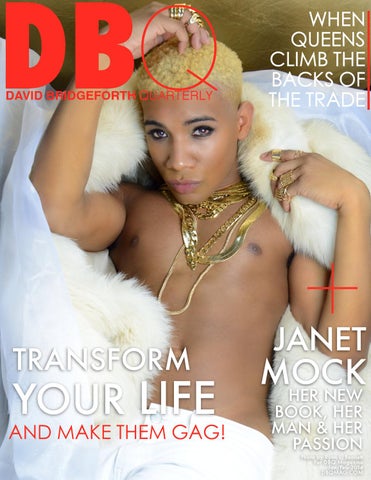
DBQ DAVID BRIDGEFORTH QUARTERLY
WHEN QUEENS CLIMB THE BACKS OF THE TRADE
+
TRANSFORM
YOUR LIFE
AND MAKE THEM GAG!
JANET
MOCK HER NEW BOOK, HER MAN & HER PASSION Photo by Ryan L. Bennett For DBQ Magazine Jan/Feb 2014 DBQMAG.COM
HOME DELIVERY 6 Autographed Issues A Year For $20 MAILED TO YOUR DOOR!
Plus Our Newest Issue
FREE!
SUBSCRIBE TODAY AT
DBQMAG.COM
Take DBQ Magazine EVERYWHERE ABOVE THE RAINBOW INTRODUCING...
The
DBQ App
Download it Today for FREE!
GAY CULTURE... EVERY ISSUE AT YOUR FINGER TIPS
E
very January, we bring in the New Year with a set of resolutions we seek to fulfill, garnering change to better our bodies and lives. We wish to transform the old us into a more thorough, refine, and fully realized self that receives and acknowledges the ample blessings a new year can bring. And the best way to learn true transformation would be from our transgender brothers and sisters of the LGBT community. For decades, they along with our gender-bending brethren have been making people gag from their looks and the way they succeed in life without allowing society to dictate. To honor and celebrate this the for the January cover I transformed myself into someone no one has ever seen me be.
Our exclusive interview with Janet Mock gives us insight on her journey from harmonizing her internal and mental identity with that of her physical appearance. She teaches us about the difference between the transgender community in Hawaii, the contiguous US, and within major cities. Her new memoir Redefining Realness, which debuts on February 4th, further discusses her life as a transgender woman of color in NYC and how she became a successful writer and fell in love with her boyfriend.
Tiq Milan describes his life as a transgender man of color—something that isn’t as sensationalized as his female counterparts. But his voice has a purpose for all those trans men that feel as though they don’t have someone telling people about their narrative.
Abraham Tomo Jr. analyzes the construct of gender expression among gay men with ‘When Queens Climb The Back of Trade.’ His account details his affinity with masculine men and how they are regarded as “proper tops” while describing it’s disparaging effects on feminine men, raising the question, “Can queens be tops?”
Here We Go!
While you’re making your resolutions for the New Year, keep in mind all of the transformative lessons this issue discusses. You can step out of the narrow and rigid classifications that define you. So, when you finally come into your fully realized self and walk out of your door, be sure to MAKE THEM GAG.
–David Bridgeforth Twitter: @DBridgeforth
TEAM DBQ
The Contributors
David A. Bridgeforth Jr. Editor-In-Chief / Publisher
Abraham Tomo, Jr. attends Pace University in New York City where he studies English, Graphic Design, and graduate Publishing. He has written for many online publication and currently is an intern editor for DBQ.
Nathan James is an author, screenwriter, radio personality, and journalist. He is Executive Editor of the LGBT multimedia resource GBM News, and writes exclusively on LGBT issues and affairs.
Stanley Bennett Clay is an award winning filmmaker, novelist, director and playwright. His documentary "You Are Not Alone" is currently screening throughout the country. He recently directed the stage adaptation of "B-Boy Blues." His latest novel "Hollywood Flames" (Book 2 of his 5-book "Dominican Heat" series) is currently on the market.
Art Director Executive Administrator
Dave Bridgeforth Sr.
Jacqui Tanner
Intern Editor
Contributing Editor
Abraham Tomo Jr.
Stanley Bennett Clay
Photography/Retouch
Consulting Cover Editor
Ryan Bennett
Reggie Wells
Makeup Artist
Copy Editor
Jasmine Perry
Baldwin Rivers DBQ Magazine is a nationally distributed bimonthly lifestyle publication. Published and printed in Indianapolis, Indiana. For more information on advertisement contact Rivendell Media at 908.232.2021, for editorial inquires or any other business please visit us at www.DBQMAG.com Or 908.656.6218.
DBQ Magazine JAN/FEB 2014 • VOL 4 / ISS 1 • DBQMAG.COM
21
15
10
5. Behind The Scenes 7. Politics 8. Books 10. FRONT ROW/ Tiq Milan 12. When Queens Climb The Backs of the Trade 15. Feature/ JANET MOCK 21. Fashion/ The New Normal 25. What I've Come To Know / Transform Your Life DBQMAG.COM | @DBQMAG
DBQ Magazine
Jan/Feb 2014
Page 4
Everywhere
FOR THE LATEST NEWS, HAPPENINGS,PHOTOS, and VIDEOS, FOLLOW
@DBQMAG
ABOVE THE RAINBOW
~ The Transformation ~ It took 3 days of hair dyeing, clothing pulls and hours of makeup to transform me into this femme blonde bombshell. Special thinks to cover photographer Ryan Bennett and his team of makeup artist, stylist, and videographers. For more behind the scene videos go to DBQMAG.COM
ADTV AfterHours INTERVIEW
Mr. Bridgeforth gave a very raw and open interview to founder and owner of ADTV [Derrick Briggs] for their new ADTV AfterHours series. To read the interview or to see picture from the sexy shoot. Go to DBQMAG.COM
Page 5
DBQ Magazine
Jan/Feb 2014
DBQMAG.COM | @DBQMAG
Everywhere
Los Angeles
ABOVE THE RAINBOW
1
DBQMAG.COM | @DBQMAG
3
2
4
5
DBQ Magazine
1. LA party promoter Brandon Anthony and Mr. Bridgeforth. 2. Dave Bridgeforth with celebrity stylist Ty Hunter and reality tv star Draya at the DBQ Magazine LOUD 100 party in LA. 3. Dave with Stonnee Goodman, Allo, and gogo dance Flexx in LA at Brandon Anthony's Magnum Thursdays event. 4. Leo 'the illest' Macintosh. 5. Dave With his friend Ty Hunter. 6. Dave with Nolan Garcon in LA. SPECIAL THANKS TO LA IT BOY, BRANDON ANTHONY, FOR HIS SUPPORT OF DBQ Magazine AND HOSTING THE LA 2013 LOUD 100 Party.
6
Jan/Feb 2014
Page 6
T
POLITICS Editor/ Nathan James
Moving Forward, Falling Back
he beginning of a new year is a good time for reflection, to take stock of how far we’ve progressed in the past twelve months, or, in some places, fallen back from where we were. Here at home in the United States, 2013 was a watershed year for the LGBT community. The Supreme Court declared the federal Defense Of Marriage Act (DOMA), and California’s Proposition 8, unconstitutional, reaffirming marriage equality as a sound concept in American law. Sixteen states, and the District of Columbia, now have gay marriage. Several Republicans crossed the aisle to join Senate Democrats in passing the Employment Non-Discrimination Act (ENDA). President Obama pledged $100 million to the National Institute of Health, with the express purpose of finding a cure for HIV, and continued to be an outspoken advocate for LGBT rights. At December’s memorial service for former South African President Nelson Mandela, Obama, before a global audience, noted that “people are still being persecuted for what they look like, how they worship, or who they love.” Around the world, LGBT people enjoyed gains, as in England and Australia, where same-sex marriage was legalized, and transgender individuals were newly able to serve in Israel’s armed forces, joining the UK, Australia and Canada. But even as these advances made headlines, we are reminded of the ways in which we fell back this past year, even as we sprang forward. In the Russian Federation, homophobia swept the nation as Parliament approved legislation making “the spreading of gay propaganda” a crime, in the interests of “protecting Russia’s children”. With the 2014 Winter Olympic Games being played in Sochi, controversy has arisen over the International Olympic Committee’s (IOC) decision to “punish” athletes who defy the law, by making gestures such as holding hands with other players of the same gender, or wearing rainbow-flag pins. Russian President Vladimir Putin said anyone found violating the law—which extends even to discussing gay issues or gay relationships “in the presence of minors”—will be prosecuted, whether an Olympic athlete or spectator. This sudden shift towards institutionalized homophobia in the former Soviet Union, signals a shift back towards anti-LGBT persecution endemic to the Cold War regime. Although protests of all kinds against the Games and their corporate sponsors have been announced, the IOC steadfastly refused to change the venue. This fearful regression on the part of the Russians is indicative of old attitudes made new again in a country still struggling with severe domestic issues.
Page 7
DBQ Magazine
In India, the world’s largest democracy, however, the return to more repressive times is even more pronounced. In early December, the highest court in that nation re-criminalized gay and lesbian sex, returning India to its former status as potentially a very dangerous place for its LGBT community to live. In its ruling, which overturned a Delhi High Court decision in 2009 that declared Section 377 of the Penal Code unconstitutional, the Supreme Court held that only India’s parliament could legalize homosexuality, reinstating 10-year prison terms for anyone convicted of such “crimes against nature”. With a conservative Hindu majority likely to regain control of Parliament this year, there is little chance the law will be changed in the legislature. For India’s huge LGBT community, this amounts to a sudden relegation back to the fringes of their society, after several years of progress towards acceptance among the country’s one billion citizens. By turns both frightening and instructive, these developments in Russia and India tell us how quickly the victories we achieve can be reversed, or even ended outright, by those still determined to keep us, as a community and a culture, subjugated and marginalized. 2014, then, presents us with unparalleled opportunities, and hard challenges. Here at home, there are midterm Congressional elections that will determine the future of LGBT rights on the federal level. Calling ENDA an example of “frivolous legislation”, House Speaker John Boehner his indicated the bill will not be voted upon in his Republicancontrolled Congress. Your vote could change all that. At stake, as President Obama put it, “are the millions of Americans who just want to be able to go to work”, but can’t, because it’s still legal in 29 states to fire, or refuse to hire, someone based on their sexual orientation alone. If you live in one of these states, it’s especially important to know which candidates support passing ENDA. We can help that critical bill to pass! Your vote will also send a message to the world, to countries like India and Russia, by electing leaders here, who will make these nations improve their human-rights records. Both these countries (and many more that persecute LGBTs) depend on us for vital trade and defense; if our elected officials let them know that our continued support is conditional on better treatment of their LGBT communities, we can restore some of the gains that have been achieved—but were then taken away. Another issue for us to tackle in 2014, as we strive to keep stepping forward, is in the area of gay marriage. As more and more states legalize our nuptials, it’s time to get these weddings recognized universally, just as straight marriages are worldwide. It helps us little if we can marry in State “A”, but are complete strangers in the eyes of State “B”’s laws. This kind of legal hodgepodge is an example of how we still live as second-class citizens in a country that holds itself out as an exemplar of human rights to the world. As with so many other things, here, too, your vote will make all the difference. Let’s make 2014 a year history will remember as one in which the LGBT community made its greatest strides yet, to securing for itself a true, full, and free place at the table of civilization. It’s a new year. Let’s dream big, and make those dreams come true.
Jan/Feb 2014
DBQMAG.COM | @DBQMAG
BOOKS Editor/ Stanley B. Clay
An Excerpt of
Closets, Combat, & Coming Out By ROB SMITH
O
ne late Saturday night, I found myself alone at local gay club Hide and Seek when a cute redhead approached me on the dance floor. I danced with him relaxed and carefree like I did with all the others, but I stopped in my tracks when I noticed two very familiar faces through the neon-blue haze of the club. Right next to the bar, standing beside two women, were Sergeant Kane with PFC Lopez, another soldier from my platoon. Though Hide and Seek was known mostly as a gay club, it was also one of the few after-hours spots in the city. It wasn't uncommon for straight couples to come if they wanted to extend the night past 2AM. I had no doubt that Kane and Lopez belonged in this category. I froze in fear. My first instinct was to leave the club right then and there, but they’d already made eye contact with me. I cringed as they smiled, turned to each other, and started to laugh as if a long- held theory had finally been proven. I panicked, wondering how much they saw. I felt my entire body go slack. I knew it was over. I knew I'd return to base that Monday morning to find my discharge paperwork waiting for me because I'd been seen “telling” by two soldiers in my platoon. The DADT policy was sneaky like that. I'd recently done a little digging, and learned that I didn't
DBQMAG.COM | @DBQMAG
DBQ Magazine
have to come out to anyone to get kicked out. If I were seen “engaging in homosexual conduct” I could have charges brought down upon me. I was quite certain that the amount of pelvis-grinding that I was engaged in with the cute redhead easily qualified. Unfortunately, there was only one exit from the basement, and using it required the need to walk directly past Kane and Lopez. Maybe it was possible that they hadn't seen me do anything. I rushed past with my head down, but heard the unmistakable "Smith!" booming from Kane's loud voice right before I hit the stairs.
My shoulders fell. I was caught. I turned around and looked in Kane's direction, everywhere but in his face because I couldn’t bring myself to look him in the eyes. In that moment I felt deeply ashamed. I felt as if everything I'd done thus far to try to be a good soldier was nullified. I knew I was an average soldier and nothing special in that respect. I knew that I just got the job done and nothing more, but I'd managed to stay out of trouble for the past three years. I'd avoided the legal pitfalls of other soldiers who got arrested for domestic abuse, DUIs or public intoxication. Even after all of that work, my military career would be killed because I got caught in a sleazy gay bar in a desperate search for somewhere to express myself.
Jan/Feb 2014
Page 8
“Yes, Sergeant?” I said.
whispers, but heard nothing. I wasn't called into the Company Commander's office and wasn't “First of all, fucking relax, man," he said.“You reprimanded for anything. It was a normal day, come here a lot?” just like any other day. Later on Editor/ Stanley B. Clay in the afternoon, I spied Sergeant Kane signing in some I continued to look down, equipment, and I approached e m b ar r a s s e d a n d fr ig ht ened him. He looked at me sternly. beyond belief. "What's up, Specialist? he said. “From time to time," I said. “Uh, nothing much, “Where you heading off to in such Sergeant,” I said. a hurry?” His look relaxed a bit. “You have fun dancing? It was “Home. Guess I gotta start interesting running into you,” packing.” he said, and I froze. He seemed perplexed by this, and he furrowed his brow as if trying to Another soldier from the figure out a complicated platoon, PFC Conch, was mathematical theorem. within earshot, and came over to join in on the conversation. Conch was a young, jovial “Look, just calm down. I'm not white kid from Kentucky, which gonna...Look, man, just chill out, was a source of never ending okay? he said. You wanna go, then teasing from some of the go, but I'm not forcing you to go platoon members. anywhere.” “Okay, I said. “Yeah, where were you guys at? he asked. I turned around to make my way up the stairs and out of the At this, Sergeant Kane turned club. I felt deeply ashamed in that to him. "None of your damn moment. I didn't know whether it business!" he said jokingly, in an was because I was gay or because exaggeratedly annoyed I got caught. The rules made being manner. gay such a punishable secret that it was hard to see the boundaries sometimes. If being gay were “Hey, my bad, Sarge, my normal or natural, certainly it bad!”Conch said in the same wouldn't be legally punishable in jovial manner, and walked the military. In a place deep within me I knew there wasn't away. I looked at Sergeant Kane and smiled hesitantly. He anything normal or natural about what I'd been doing for the cocked his head up and looked at me with a mischievous past few years. It wasn’t because of the gay aspect but of smile. the lack of any type of real connection to the various bodies I’d become accustomed to giving myself over to. “Motherfuckers be so goddamned nosey at times,” he said. “Ain't that right, Smith?” I drove home in stunned silence. The traffic lights were blurry blobs of red, green, and yellow through my tears. I was I smiled widely, filled with a sense of relief.“Roger that, just over a year from my end date, and this was how it was Sergeant,”I said.“Nosey as shit.” going to end? Caught at a gay club and railroaded out without hopes of seeing even a penny of the fifty thousand in That exchange ended my fears of Sergeant Kane college funds that I was contracted to receive. I cursed being and/or PFC Lopez turning me in. Those two were thick as gay, cursed the Army, and cursed the fact that I'd even thieves. I knew that if Sergeant Kane wasn't going to say decided to go out that night. Maybe my mother was right. anything, Lopez wouldn't. I respected Kane a great deal for Maybe it really wasn't what God intended, and I was getting that, and was glad that he didn't decide to make things hard what I deserved for being this way. It just seemed so deeply, for me. I wondered if it would’ve been any different had fundamentally unfair. I had no control over my sexual Sergeant Norman seen me at the club. I never wanted to find orientation. I didn't ask to be born like this, so why was it making out. After the incident with Kane, I gathered that most soldiers things so hard? I stayed in bed for most of that Sunday, scared wouldn't care much if they knew, but I still needed to keep my shitless at what the next day would bring. guard up. I wondered if there would ever be a day when it just didn't matter. When I didn’t have to do so much sneaking around, but I knew that day was very far away. That Monday morning after PT, I walked into the unit headquarters expecting to enter a sea of cutting glances and
BOOKS
Page 9
DBQ Magazine
Jan/Feb 2014
DBQMAG.COM | @DBQMAG
FRONT ROW
Q&A with
TransFormer TIQ
MILAN
When did you realize you were transgender and what was your
questions. Ultimately love is love. And most trans people I’m friends
process like?
with they have really big relationships with their families—some better
I don’t think I really knew I was trans until my mid twenties—I’m thirty-
than others.
three now. I just [felt] uncomfortable in my identity. Just being butch didn’t feel right to me. Identifying as a lesbian didn’t feel right to me.
So, for you, being a “stud” or butch wasn’t fulfilling enough?
There’s was just something missing, and I found an online yahoo
Did you feel like you were in the wrong body?
group like “urban trans men” and it was all these black trans guys. I
It wasn’t never that I felt like I was in the wrong body. Sometimes it’s
had no idea that this was an option in my life. I came to terms with it.
deeper than that.
And back in 2007 is when I started hormones. I gradually came out to
something that psychologically starts in your spirit. I wanted all the
my family and they’ve been very supportive and accepting.
masculinity energy that I felt on the inside to be [discovered] on the
Is that unusual for family to respond in that manner?
disconnection from my identity as a female. I love my body. I love my
I think you have to change the narrative in some aspects. And one of
body still—I loved it then, I love it now. It was a complicated thing to
those aspects is that it’s not all tragic for trans people and their family.
go through alone.
I definitely had my bumps in the road [for] two years—those silly
share it with people until you have a grasp on it.
DBQMAG.COM | @DBQMAG
outside.
DBQ Magazine
It’s something that starts in your head.
It’s
It wasn’t this disconnection from my body; it was a
Jan/Feb 2014
You trying to figure this out and you can’t really
Page 10
So it wasn’t enough to act and be masculine but you needed
don’t have the language for. But I think that’s kind of the beauty of
the outward appearance as well?
sexuality and gender.
I wanted who I knew I was inside to reflect on the outside.
I was
always male in my head. I wanted all of the masculinity that comes
Why do you believe more individuals sensationalize trans
with it. It’s not just that; it’s not just the physicality of it. But it’s also
women more than they do trans men?
understanding my role as a man. This is the role that I wanted in my
I think that it really gets down to gender. It really gets down to what a
life. I wanted to be a man in this world. Being a back man is not easy.
woman is in this world outside of being trans.
But it’s something that I choose and it’s something that I needed for
women of color, are usually just seen as pieces and not a whole
myself to make me feel whole.
person. Their femininity is really based on their body politics and how
So it’s much deeper than just the
Women, particularly
attractive they are to men. Women, in our society, that’s who they are,
physical part of it.
which is really unfortunate. Then on top of it you have fetishizing trans
Did you also do surgery after hormones, and how long did it
[women] on top of this systemic misogyny and sexism. They see them
take for hormones to alter the body?
as something other than human. People don’t really understand what
I started on hormones in 2007.
And it’s something that I do every
being trans is. And the work that I do at GLAAD is focusing on getting
week. And in 2011 I decided to do top (chest) surgery. Some trans
positive images of trans people in the media. Trans women are the
people don’t.
most vulnerable population in this country, particularly trans women of
Some people don’t need surgery to feel they’re fully
identified. I think people think that being trans means that you have to have all this body modification, and that’s to necessarily the truth for some of us. But I decided to have top surgery in 2011 and my mother
color.
Why?
There’s an interception of oppression there.
What is your experience with discrimination like as a
sexism, and transphobia, and homophobia, and it just turns into this
transgender man?
nasty muck and they’re in the thick of things. Seventeen trans women
My experience as a black man there’s discrimination. Not really overt
were murdered in the United States last year and sixteen of them were
discrimination. I can’t say that I’ve really been a victim in such a way.
black.
I’ve definitely had some hard times where a lot of [discrimination]
another trans woman. It’s devastating.
was very supportive.
There’s race, there’s
gender, and there’s being transgender. So, you talking about racism,
centers around race more so than me being trans because a lot of people don’t know that I’m trans out in the world other than people
A trans woman [of color] is eleven times more likely than
What needs to happen for the perception that our world has
who I work with and the communities I work with. So, I get profiled as
conditioned to change?
a black man does. And I don’t disclose [me being trans] if there’s no
That’s such a large question. There’s so much that has to be done.
need to.
Basically, you have to change the story. We have to change the story
Is it difficult to date as a trans man, and were you getting
are only there for entertainment. [They can be] mothers and daughters
approach by heterosexual women, lesbians, or what?
and sisters; they are human begins and they need to be treated as
Identity is a complicated thing. I was in a relationship with a woman
such. In order to do that, people have to start having conversations
who was lesbian identified during my transition. And then we broke
and opening up their minds. And then we have to make sure there are
up.
And now the woman that I’m dated now is basically straight
images of trans people on TV and in the magazines that are positive
identified—she doesn’t identify as a lesbian or anything really. Identity
and are whole. And doing things like this, just having conversations in
can be really tricky. It’s up to the person. If a woman wants to identify
your community. Trying to build some understanding.
that black trans women are only prostitutes, are only sex workers, and
as a lesbian but be with a trans man, I guess it can work. But there’s has to be deeper conversations around identity on how you socialized
How favorable are the laws for the transgender community?
and it can get really complicated. Identity politics is a very real thing,
[We have to] make sure there are laws that protect trans people as far
and people take [their identity] really personal.
as adequate healthcare and being protective in our schools.
Women who are
In
lesbian, they’ve probably had to go through a lot to be able to carry
California there’s a bill that allows for trans identified youth to
that and to come out to their family. And then [they meet] this person
participate in the sport that is of their gender and use the facilities of
who is a man but it’s someone from your community, it might take
the gender they identify with. It is hard to get your name changed and
away from some of that—the coming out, the pride, all of these things.
your gender marker changed. In some places, particularly NYC, it’s
And not all trans guys are straight. I identify as straight, but I know lots
really rather easy and that’s just one of the beauties of living in a big
of trans men that are gay and that are queer. They exist, too. There’s
city. But I know for folks down in the South or these red states it has
a lot of queerness in the community. I think that comes into play too
to be really difficult. Just like the movement back in the 80’s and 90’s
when we talk about lesbian identified women who are dated trans men
when the gay revolution started it was about changing the narrative.
and there’s a queerness here. There’s something else that we really
Page 11
DBQ Magazine
Jan/Feb 2014
DBQMAG.COM | @DBQMAG
WHEN QUEENS CLIMB THE BACKS OF TRADE In my early gay years, I remember being organically and engrossingly
responses. But what does one’s personality and sexual orientation
attracted to the more masculine male—tall, slender, muscular build,
have to do with their sexual orientation? Is there a correlation between
light skin (at the time), angular bones, deep voice, fascination with
exhibiting effeminate behaviors, enjoying makeup, and wanting to
sports, and the ability to pick me up. I still desire to see some of these
bottom for your partner, or are these stereotypes we’ve been
things in possible mates—specifically the height and ability to lift me.
conditioned to accept as truth due to femininity’s long history of being
But as I’ve gotten older, some of my preferences have shifted. Even
submissive? Would you allow a man with a beat face and a fierce
the desire to bottom has diminished somewhat, and I’m finding a new
pump to climb your back and blow it out?
enthrallment with butts—big, juicy, round, smooth ones that make my
There’s no doubt we would look at my muscular Sissy and still
I met two guys last year that varied greatly. One was tall (6’2”),
his bottom, grabbing tightly at his hips, and thrust passionately. But
muscular, amazing facial structure, and the fattest ass I’d ever seen on
what if my Sissy wanted to bottom (versatile or complete)? Would we
someone with his physicality; I loved holding onto it any time we
deny him that desire? Do muscular/masculine men not have the
hugged. And the other was an inch or so taller than me, slender, beat
yearnings for some prostate massaging or a long, thick dick in their
his face lightly, wore colored contacts, and did drag. Even with their
mouth? Or what if the small, drag queen wanted to penetrate a hole;
differences, I was still attracted to both. Oddly, the more masculine
would we laugh at him? I think the alleged correlation between
one introduced me to a phenomenon named after an episode of
personality and sexual orientation shifts away from our preconceived
RuPaul’s Drag Race where a contestant teamed up with a rather
notions when we begin asking these questions.
mouth water.
determine him to be a top. We would want him to stand strong behind
feminine army man calling him a Sissy. Sissies, to me, are men who have very muscular, “masculine” builds, but have a little swivel in their
Let’s define these terms for the sake of this essay. Your sexual
walk and a little twirl in their wrists. They’re also known as butch
orientation is defined by which gender you are romantically and/or
queens, but we’re going to get a bit more specific. There are many
sexually attracted to; preference is the attraction to tall or short men,
variances of butch and even femme. The Sissy is one of those
light skin vs. dark skin, masculine or feminine, etc.; and personality is a
variances that fall under the “butch” umbrella. If you can’t picture it,
combination of emotional, attitudinal, and behavioral responses of an
think of Shaun T of the Insanity workout DVDs. He is the perfect
individual. These terms constantly intersect. Someone will see a
example of a Sissy, and yes, I would bottom for him down. My Sissy
feminine behavioral response paired with makeup and heels and
slurred his S’s and spoke with his hands, and I enjoyed every bit of it.
automatically correspond that individual with being a homosexual that
And I knew—if it came to that point—I would definitely bottom for him.
prefers to bottom—or in the straight world, the woman of the
But the smaller gay, I would definitely top. This is where the lines of my
relationship. I am not saying this theory is completely untrue, but I
preconceived ideas of sexuality and preference began to blur.
want to enlighten you to the fact that it may NOT be true.
The homosexual spectrum contains large varieties and scales of
But what if our masculine man is a raging bottom? What if we
“gayness”: butch queens who wear makeup or don’t, men who do
encounter a butch queen that can beat a face like no other and dick a
drag, athletes and body builders who pass as trade and those that put
man down all in the same breath? Why is this odd? If sexuality is so
a little sissy in their walk, and very masculine men that even deny
diverse, as explained in the paragraphs before, why is this considered
being gay—because they believe gay to be behavioral and attitudinal
an anomaly?
DBQMAG.COM | @DBQMAG
DBQ Magazine
Jan/Feb 2014
Page 12
H
etero and homosexuals alike don’t like to
denigrated, influencing both heterosexuals and homosexuals to
consider the fact that sexuality is more fluid than
develop an aversion toward the feminine male. Janet Mock states in
all these terms allow it to be. As Dustin Ross,
an interview with David Bridgeforth, “The difference between gender
actor of The Skinny, writes, “Sexuality is the one
identity and sexuality is that gender identity is visible—people can see
part of the human experience that cannot be
my gender, they can see I’m a woman.” The same can be said for gay
sanctioned or specified. It's free. It's fluid. It's
men who “perform” as feminine—it’s harder to hide.
organic. It's also the epitome of subjective. There is no formula. There is no rubric. We enjoy
But what is wrong with the idea of feminine dominance? Is it a difficult
sex and all things related because they are pleasurable and personal.”
concept to grasp that a feminine person can dominant during sex
If we begin to disconnect sexuality from gender (male/female), gender
(e.g., topping or S&M practices)? If we continue with the disconnect of
expression (masculine/feminine), personality, and preference, only then
sexuality, gender expression, personality, and preference, then we can
will we be able to accept the reality of my Sissy as a bottom. We have
conclude that topping is a role that elicits different sexual responses
to stop associating being male with our rigid ideas of masculinity; it
than bottoming and is the only reason why someone—masculine or
limits and rejects all men who don’t fit these criteria. Because there are
feminine—would want to take part in the act. Gay men want to top for
men that lie outside of these standards we placed on men, we
the sake of topping and reaching orgasm not because they are
discriminate against them and seek to objectify and ostracize.
masculine and meant to perform as such. Ross also writes, “Tops/
I have only encountered one masculine male that liked to bottom and
speak. It does not have to denote a LIFESTYLE. Some have chosen to
that was in passing via social media. We chatted for a short time, and
mimic what we know as the heterosexual experience by associating
during our conversation, I was awestricken when he disclosed he was
preference (top/bottom/versatile) with lifestyle and relationship roles.
a bottom. It was as if I thought it impossible—an abomination.. Why
Therein lies the perception that tops cannot be feminine and bottoms
would this tall man with all these muscles and cute, angular face bend
should not be masculine.”
bottoms/versatile is all a choice. Choose your own adventure, so to
over for another? Oddly, he wasn’t surprised I was confused, suggesting he’d encountered similar reactions before. And his
Ideally, it is not impossible for a feminine man to top a masculine male
response was slightly offended, which helped open my mind to the
with disregard to expression. We are ultimately attracted to males,
possibility of his “existence.” I didn’t know it worked that way, and I’m
denoted by our orientation. But it is our preference that tells us if we
sure many people think the same way I used to. But he was different;
are attracted to masculinity or femininity and topping or bottoming.
he preferred masculine men like himself so it made sense to some
Having a masculine-feminine relationship does not denote a man-
degree and being attracted to a feminine top would have been out of
woman relationship since we’re both men, so it won’t be like your
the question.
“woman” is dominating you in the bedroom, which really wouldn’t be a
We can consider the cause for this stereotype—feminine gays being
hold onto these “natural roles” and binaries of men and women we
bottoms and vice versa—sourced by the confusion of gender, gender
used to define masculinity and femininity, pairing them for centuries
identity, and gender performance/expression. Gender is the social
and making them rigid constructs.
bad thing if “she” were. Because of heteronormative standards, we
construct that combines the physical, biological, mental, and behavioral characteristics of masculinity and femininity. Biologically, we
We have adopted that in the gay community, but sometimes it isn’t as
are all born male and female, but there are social constructs that
easy as we believe it to be. Although the binaries masculine/feminine
further identify our gender, making us “men” and “women.” If your
and top/bottom as a pair makes sense to us, we still have that
biological sex is male, then you are “required” by society to perform as
aversion toward femininity because it’s difficult to disguise, making it
a man (i.e., be dominant, wear masculine clothing, support your family,
easy to be subjected to adversity. And, we can admit, masculinity may
take out the trash, etc.) But your gender identity is how you view
be more attractive. So, even though a top finds a bottom, if he’s too
yourself (man/woman), and gender performance/expression is how
feminine, he may be disregarded. This creates a paradox and a lose-
you perform as such (masculine/feminine). Essentially, just because we
lose battle. Masculine and feminine are the “norm,” but no one wants
are born male/female it doesn’t necessarily mean we have to be a
to be seen outside of closed doors with a feminine man because they
man/woman or masculine/feminine respectively.
“offend the gender;” therefore, we have the birth of the masculine-
As previously stated, any indication of femininity is regarded inferior
dislike for femininity. And since gender expression and sexuality are
and submissive due to the historical role of the female. This is why it is
ambiguous within a masculine-masculine relationship, it is easier for
very difficult for feminine gay men to assimilate or be accepted
these men to navigate roles in the relationship and the bedroom
because they’re perceived as though they are denying their innate
without prejudice from either partner or outside influence. As C.
dominance and power as a man to become something society
Maddox of YouTube says in his video Drunk In Love, “We need to get
regards as a subservient and an impotent role. We are ostracized and
off of Grindr and Adam4Adam and Manhunt and Scruff.
Page 13
masculine relationship, which can be genuine and not guided by a
DBQ Magazine
Jan/Feb 2014
DBQMAG.COM | @DBQMAG
ou know why we need to get off of them?
bottom,” with which my friend responds, “Yes.” And to that, his
Because eight out of ten times I go and I look at
boyfriend tells him, “Then stay in your place.”
Y
someone’s profile, and you know what it says? ‘No blacks. No fem. No Asians. No fats. Masc.
Trust me, it is much harder to act masculine than it is feminine. When I
dom. top for same.’ A lot of these gay guys just
used to go to the barber, I would put on an act. I would walk slowly,
want to date themselves. And, I’m one of a kind.
being conscious of how much my hips swayed or how poised I was
So, if you want to date yourself, you can’t date
from my years of dancing. I made sure not to speak too much
me because no one is like me. Who is looking
because I didn’t want others hearing the high tones and slurs my voice
for a person who is exactly like them? What can
carries. I sat in the chair with my legs opened wide or my forearms on
you learn from that? Who are you? What’s wrong with you? You’re an
my thighs. And I made sure not to make too much eye contact with
asshole.”
the men there because I didn’t want them to be able to perceive the
gay that lied within me and within that space to subject me to
This may be why it is also difficult for many feminine gay men to find
discrimination or adversity or worse. Putting on that mask felt unnatural and heavy. It felt lonely. So I ask,
mates and build healthy relationships since everyone appears to be looking for that perfect masculine man. This is why most people I have encountered say it’s better to claim versatile and find other versatile men to be with, because it almost suggests you won’t be so invested in searching for a masculine/feminine man or top/bottom, but rather a man with whom your personality engages well. But, if we’re versatile without acknowledgment of expression, then it will not matter if you’re feminine because if your
“We tend to police the gender of women. Men don't get policed in that same way because there's this whole spectrum of how men can look. But women, there's a very distinct mold of how we're supposed to look.”
why am I not allowed to be feminine and to whose standards? Why am I condemned by my sexuality and gender expression from both heterosexual and homosexual people? Why does my love have to be defined by my gender, my gender expression, and my personality? Love should be unconditional and authentic since it is our ultimate goal. But we insist on placing stipulations on it that deter us from dating and finding love.
As a feminine man, I’m going to take it upon
masculine boyfriend likes his prostate tickled
myself to begin shattering these constructs that just don’t fit within
Janet Mock also states, “We tend to police the gender of women. Men
categories that define sexuality. These binaries we have set up don’t
don’t get policed in that same way because there's this whole
essentially work for us, and we need to abolish all of them. I like men—
spectrum of how men can look. But women, there’s a very distinct
romantically and sexually. I want to have a boyfriend and then get
mold of how we’re supposed to look.” This may be true as far as
married and be his husband. But I limit myself when I begin to only
physicality because men, as a whole, don’t get as much judgment for
search for masculine partners. I limit myself when I believe that a
being overweight, too thin, or having other physical variances—not
feminine man cannot fulfill the role of my lover. I limit myself when I
true for the gay community at times. And this is also true for her
believe I won’t be able to or won’t find pleasure bending over my
because she’s speaking about being a heterosexual woman in a
dream masculine guy if he wants me to be his top momentarily. We
heterosexual male dominated world. But, feminine men are policed.
limit ourselves when we ostracize feminine men for being feminine,
We are meant to speak without slurring our words or snapping our
which is something they cannot change and should not. I obviously
necks or our fingers. We are meant to walk with our chest and not our
have to be comfortable with myself and with femininity to attract
hips. Our wrists are not meant to twirl when we speak or be limp when
someone who is comfortable in his expression and personality, so we
relaxing. We can’t show disagreement through side eye glances or
can then both appreciate one another and our preferences. And that’s
glares. We can’t cross our legs when sitting in chairs. We can’t put on
all that matters. The homosexual spectrum is too broad for some of it
feminine attire even if it fits or appears somewhat sexually ambiguous
to be wrong because then we would never find love. And why do we
or just looks good on us. We can’t have purses no matter how
allow others to dictate our lives?
and massaged, he’ll bend over backwards for you without hesitation.
homosexuality. The LGBT community is vast with a plethora of
convenient they are to carry the many things we need on a regular basis ranging from cell phones to wallets to tissues to books or
The next time a queen with a beat face taps you on the shoulder and
personal products to clean ourselves before sex or what have you. We
extends a compliment, initiate conversation to see if you connect
can’t wear makeup to hide blemishes or to enhance certain features
mentally and emotionally instead of being offended by his makeup
on our face. Our hair cannot contain long weave or too many colors.
skills. Don’t worry about what your peers or others might think seeing
And we are definitely not meant to be dominant or be tops. My friend
you two speak. And if you do, and you go back to whomever’s home
once told me a story of how he had an argument with his then
and he wishes to top you, revel in it because it may be the best dick
boyfriend. After making his point, his boyfriends asks, “Aren’t you a
you’ll ever have.
DBQMAG.COM | @DBQMAG
DBQ Magazine
Jan/Feb 2014
Page 14
T
he decision to include Janet Mock in DBQ’s annual list of the Loud 100 LGBT People of Color was no decision at all. It was a given. The thirty-year-old Hawaiian native graduated with honors from the University of Hawaii and New York University’s graduate school of journalism. She is the former staff editor of People magazine’s website. In 2011 Marie Claire magazine
profiled her and her coming out experience. Although she is not gay—she is transgender—GBM News named her one of the “15 Most Powerful Gay Celebrities of 2012.” A frequent contributor to the Huffington Post, Ms. Mock delivered the Lavender Commencement keynote speech honoring LGBT students at the University of Southern California, was co-chair and presenter at the GLAAD Media Awards, and received the 2012 Sylvia Rivera Activist Award. Her memoir—Redefining Realness: My Path to Womanhood, Identity, Love & So Much More—the first autobiography by a trans woman of color published by a major publishing house (Simon & Schuster), will be released February 4th. And she has been a proud advocate for transgender rights since realizing she was a girl born in a boy’s body. Janet Mock is a happy and accomplished young woman living in her dream city of New York with her handsome boyfriend, filmmaker and photographer Aaron Tredwell. It was an enlightening experience to have this candid conversation with so distinguished an individual.
David Bridgeforth: When did you realize you were in the wrong body? What was it like for you?
Eventually I had access to medical care that enabled me to change the things I didn’t quite like. By the time I graduated from high school I had “reinvented” myself, or, as I like to say, I “realized” myself.
Janet Mock: It’s so much more nuanced than that; how media tends to make it—the wrong body. Yes, some people may have those real feelings. But the wrong body? I didn’t really feel that. I just thought
there were things that weren’t quite right. And some of it had to do
Do you feel you were afforded supportive guidance during your
with my body. But a lot of it had to do with how society sees gender.
transitioning process, unlike so many who deal with contention from family and peers?
As a very young child, three or four, I wasn’t okay with how my parents told me I needed to act as their “son.” I just rebutted against them
I think it can be an incredibly lonely experience for many people. I was
telling me I needed to act more masculine. I was very vocal as a very
lucky. Let’s just take how you were introduced to me. Through
young person. Somehow the process of self-realization was very
community. [Political Correspondent] Keith [Boykin] mentioned my
evident to me, and I was able to share that with the people I felt safest
name to you. Then [Ballroom legend] Twiggy [Garcon] mentioned my
around; the friends you ultimately make, your loved ones, family if
name. It became something that manifested into a blessing resulting in
they’re accepting.
you and me meeting. That’s what community is.
I was lucky enough to have a family that was
accepting to a certain extent.
It was the same for me growing up in Honolulu—it all came through
And of course when puberty comes, and all those attended issues, the
community. There is a strong trans women’s community there, similar
body becomes more of a vehicle for change. You start noticing things.
to Harlem and the Bronx. These women with very little resources were
I started noticing things I didn’t quite like. I learned from older girls
able to create a system where we could share with each other.
what to do, which doctor to go to.
Initially I just started using
hormones from my best friend who had started before me. I was about fifteen at the time—my freshman year of high school. Before that we had experimented in different other ways; how we dressed, wearing makeup—playing around, being silly, being young, being [experimental] about our gender, about our identities, about what we wore. Baby steps.
Page 15
DBQ Magazine
We had one doctor in Waikiki who did hormones for trans girls and who was kind to us, who didn’t treat us unkindly. And because of the culture and community that existed before I was even born, I was able to tap into that system. A lot of it is luck; I got lucky that I came of age in Hawaii. My best friend, with whom I went to high school, was also trans. So I wasn’t alone.
Jan/Feb 2014
DBQMAG.COM | @DBQMAG
JANET MOCK transforming heart and minds as a transgender woman a David Bridgeforth Interview Editor: Stanley Bennett Clay
DBQMAG.COM | @DBQMAG
DBQ Magazine
Jan/Feb 2014
Page 16
I was also blessed to have a family that loved me unconditionally. They may not have had a lot of money and resources but they were
How does the transitioning process differ in Hawaii and NYC, or the contiguous US for that matter?
able to love me, and give me all that comes with that love. They didn’t These laws are different state to state. In Hawaii it’s easier to change
kick me out. They didn’t abandon me.
your gender marker on your ID. In NYC it’s still an expensive process. I also had older trans women that I looked up to. They had beautiful
A lot of transgender people, if we’re talking about trans women
lives they had created for themselves. They determined who they
specifically or trans people of color, don’t tend to have jobs and
were. They realized their dreams.
economic stability. So telling someone who is poor to pay $300 to change their name is not doable. Even though the law is there, who’s
They didn’t grow up feeling less than. Of course there were moments of insecurities.
there to help them pay for that change?
But I grew up in the
Who’s there to help them pay for the
midst of trans women who were
filing fees and fill out the forms? When
surviving and who were thriving. They
we talk about transgender identities
created this blueprint that I could then
and transgender lives, we have to talk
follow.
about the barriers we create in our society, state by state, that make it
I was also naturally gifted in school. I
difficult for trans people to live their
got scholarships to college. It wasn’t
best lives. Then you start throwing on
as if my being trans was an obstacle
race, you start throwing on class, and
that made it easier for people to target me for bullying and teasing.
you start throwing on economics,
I had a
education.
level of self-assurance that armored
The barriers for trans
people especially trans people of color
me, that enabled me to navigate any
are stacked so high against them.
hostile places like high school.
This is why we have to continually
When I did end up in NYC to go to
push forward and push through as
graduate school in NYU, I didn’t talk
activists and advocates.
about being trans.
It wasn’t
Stereotype or harsh reality? Many
something that I felt everyone needed to know.
transgender women resort to
When you walk up to
prostitute because they can’t get
someone you don’t say, “Hi, I was
work anywhere else.
assigned male at birth.” I was there to be a student, to soak in the city, to
Yes. In our society we create a
learn about journalism from some of
systemic oppression that pushes trans
the best journalist in the world, to learn
women into doing the only job that’s
about writing, to discover who I was as
available to them. They’re not going to
a young woman; to be twenty-one
be able to pay for hormones by
years old living in the city of my
working at Jamba Juice.
dreams. I wasn’t thinking about hiding
Jamba Juice or Starbucks wants to
my trans-ness.
I was just thinking
hire trans people.
It’s great if
But you have to
about, for the first time, being able to walk into a [place] and not have
think about the harassment that comes everyday if you’re so visible in
people whispering about me.
a role like retail and you’re a trans woman and people are coming in
The disclosure idea of trans-ness is interesting. People think that you have to come out as trans. The difference between gender identity
calling you out of your name. Especially if you’re clockable as they say.
and sexuality is that gender identity is visible—people can see my gender, they can see I’m a woman. They don’t need to know I’m a
If you don’t conform to our narrow views of what a woman is
trans woman. That’s for me to choose based on the intimacy of our
supposed to look like.
relationship, whether it’s friendship or romantic.
women—who “don’t look passable.” We tend to police the gender of
There are cisgender women—non-trans
women. Men don’t get policed in that same way because there's this But I did come to a point in my life where I felt that my “success,” the
whole spectrum of how men can look.
things that I’ve been blessed with in my life—a great career, a great
distinct mold of how we’re supposed to look. So that makes it very
boyfriend, a great support system—I can credit to the community.
difficult for trans women to exist in the daytime in this world, especially
That’s what made me step forward publicly as a trans woman.
in New York City.
Page 17
DBQ Magazine
Jan/Feb 2014
But women, there’s a very
DBQMAG.COM | @DBQMAG
DBQMAG.COM | @DBQMAG
DBQ Magazine
Jan/Feb 2014
Page 18
You have to go back all the way down to the education level.
It’s
are, whether they’re friendships or romantic relationships or
dangerous for trans women to be in school. How then do you expect
partnerships. They’re supposed to make you look at yourself honestly.
them to get a college education, which then makes them more
That’s what my boyfriend Aaron has been able to help me do. He’s
qualified to have a “corporate job”? These are constant barriers. And
been able to help me love myself more because there’s this amazing
then you throw in race and class and it becomes even more
person in my life who values me, adores me, and listens to me. It’s
insurmountable. So that’s why it’s mostly trans women of color that
one of the greatest gifts in my life—to love. And I think that’s what
tend to be profiled as sex workers. Often times it’s the easiest way to
we’re here for; to love all kinds of people. I value him just as much as I
pay for healthcare, hormones, “gender affirming surgeries,” in addition
value my friends and my family. I think partnership is what I always
to paying for rent, car, transportation, all these other things.
craved; partnership and creating a home together.
It
becomes the easiest road to survival. How did you attract your “equal”? At what point did you go from journalist to a dedicated activist Aaron and I were both in a space where we were looking to grow. We
within the community?
wanted to be in a partnership that would challenge us, makes us see I think it happened when I started working at People magazine. I was
the world differently, and make us see ourselves differently. We had
there for five years and I would always pay attention to LGBT issues.
both been in relationships before.
We learned through that.
notice there was a gap between the resources for gay and lesbian youth and trans youth although it was LGBT. There was no portrait of a young trans person, especially one of color, a “role model” or a “success story.” After a while I was like I’m not reading this story anywhere, and I was like maybe it’s time for me to create t h i s s t o r y.
To n i
Morrison always says that what made her write books is that “I needed to write the books that I wanted to read.”
That’s what I
We’d
both been through
But I would always
"When you're authentically you, your path tends to open up and energy comes in and drops what you need into your life. When you recognize it, you realize your life is to use the talents and skills that you've developed and those that you've been given for a greater purpose beyond self, a promotion, or fame. When you tap into that energy of authenticity and service and good intent, your life develops in service of that purpose."
heartbreak.
We both
grew up “biracial” and multicultural. We were both artists.
He’s a
great listener.
I’m a
great speaker.
We
learned those skills from each other. I see it as a balance. There’s a symmetry that helps.
What I
don’t have and what I’m not good at he’s very good at, and vice versa. In terms of attracting him, I did nothing to be honest [laughs]. All I know is that I was open to the idea of being in a relationship.
had to do. I needed to
I wanted a relationship.
create the portrait that
I journaled about it.
I wanted to see of young thriving trans women, specifically one of
But I was also scared of it.
color, one who grew up poor, one that made it out of the “ghetto” and
connection in my life because I knew it would force me to look at
poverty, and created her best life. I made the decision in 2010 and in
myself, and at that time I was not looking to do that work.
2011 was when my big profile in Marie Claire magazine came out.
I was scared of having that kind of
But I think the universe put someone in my life who would challenge and really make me do that work. We dated for a year before we were
Tell me how it feels to be a woman in love.
together as a couple. We had this deep friendship at first, even though [Laughs] It’s so funny because I grew up so much around romantic
it started off romantic and I disclosed to him I was trans. And then we
comedies. I was in a world of books that talked about these things.
navigated that together and discussed it.
Their Eyes Were Watching God is my favorite novel. As Zora Neale
conversations, and I never had a friend like that in my life.
Hurston writes, a soul crawling love—something that would make me
eventually we decided to have a partnership and really be together.
We had these great Then
so affirmed and also look at myself. Because that’s what relationships
Page 19
DBQ Magazine
Jan/Feb 2014
DBQMAG.COM | @DBQMAG
People always say if you’re not looking, that’s when it shows up
hard for people to articulate how they’ve attracted love and how
for you. Did you ever find yourself looking for love or did it just
they’ve learned to love themselves, especially if you grow up in families
happen?
that are lacking in love but have a lot of care.
I wanted it. But I wasn’t looking for it. But I made myself available to it.
I think queer LGBT people have done this very well. They go out in the
I wrote about it all the time, I journaled about it all the time, I talked
world and find families. That is a revolutionary course; to go out into
about it with girlfriends, about how great it would to have a
the world, forget your birth family, move on, and create your own
partnership. But, I knew it wasn’t something I could actively pursue.
family of people. And that’s love there.
And what I also realized was I needed to fill my life up outside of a
What is your message?
romantic relationship with love. So my friendships needed to be full of I created this censor on myself where I wasn’t craving love.
Be authentically you. When you’re authentically you, your path tends
Specifically I wasn’t craving a man. I had love. I had great friends,
to open up and energy comes in and drops what you need into your
great girlfriends, great family, and connections. I came fully formed as
life. When you recognize it, you realize your life is to use the talents
a person who was loving when Aaron walked into my life in that bar.
and skills that you’ve developed and those that you’ve been given for
love.
a greater purpose beyond self, a promotion, or fame. When you tap I read a book by bell hooks called All About Love.
She takes love
into that energy of authenticity and service and good intent, your life
She
develops in service of that purpose. My biggest dreams were to be a
says love is the process of action in which you help someone
writer, to live in New York City, and to be myself, which was a woman.
spiritually grow. So you have to come already filled up before you even
And I got to do those three things. And then I wanted to advocate. I
outside of partnership, outside a sexual romantic relationship.
come to that meeting.
We have a culture that’s obsessed with
romance, not necessarily with love, because love is work. To just love
wanted to be of service. Now I want to dream even bigger. I want to dare to ask for even more, because I am deserving of that.
yourself is work. I think we’ve bastardized what love is. And I think it’s
DBQMAG.COM | @DBQMAG
DBQ Magazine
Jan/Feb 2014
Page 20
The New Normal Photographer: Ryan L. Bennett Make-up: Jasmine Perry Red Dress: Nikki Blaine White Dress: Runway Diva Male: Rickey Terry Female: Kim Jones
Page 21
DBQ Magazine
Jan/Feb 2014
DBQMAG.COM | @DBQMAG
DBQMAG.COM | @DBQMAG
DBQ Magazine
Jan/Feb 2014
Page 22
Page 23
DBQ Magazine
Jan/Feb 2014
DBQMAG.COM | @DBQMAG
DBQMAG.COM | @DBQMAG
DBQ Magazine
Jan/Feb 2014
Page 24
What I've Come To Know
A
DAVID BRIDGEFORTH
true transformation is not easy, it requires amongst other things a giving up of who you are in exchange for who you can become. My journey to becoming this fictitious cunt blonde bombshell for January cover started months ago with a simple idea.
In September 2013, my team brought to my attention an idea of celebrating the trans community and including it in our January issue. Along with the idea of transgender people featured and profiled in DBQ, my team felt I should transform myself on the cover. During the meeting I could feel that they were suggesting that I get up in drag to celebrate our transformers. They quickly realized by my facial expression that I wasn't about that life and that the most I would do would be to wear a pink shirt and a leopard bandana. Interestingly enough, weeks later I was still thinking about what I wanted to do for the January cover. I began to interrogate myself as to why I was so resistant to the idea of any kind of femininity being expressed on my cover, especially since I am a huge feminist.
changed my life because it showed me the steps necessary in transforming one's self. I believe we all have a burning desire deep within to be better, bigger and brighter. We have a longing to fulfill our callings and to live with purpose and many of us each year set goal so that we can be a step closer to fulfilling our destinies.
I slowly began to see that my resistance to showing femininity on the cover of my magazine was the same prejudice and discrimination that many of the straight and LGB (Lesbian, Gay & Bisexual) community feel towards the transgender community. I saw that my dislike and rejection was based off of my fear of what people would think and oddly enough this same fear and rejection towards the trans community is why they have been pushed to the margins and overlooked.
What I've come to know is that we get to decide what we will be in this life and how proud we will be of it. Many of us can taste the benefits that come with changing ourselves into that which serves our highest purpose, but fear keeps us in the boat. In order to walk on water this year –in order to achieve our highest goals we must be daringly courageous. Courageous enough to where we keep our commitments to ourselves first. Daring enough to vogue in the presence of fear. Daringly courageous is giving up all of our excuses in exchange for all of our dreams.
I then made the commitment to myself to transform my look for January, to embody what it means to be a man that is feminine and fabulous... to be in-touch with my feminine side. In order to keep that commitment, I had to give up who I was for who I could become. The difficult part of this process was surrendering my fear of people not approving of me. I didn't realize how much the opinions of strangers really meant to me. I thought I was surely past that stage in my life; I've always been very clear and confident and have done what I've wanted to in my life with or without peoples approval, but this was different. This transformation was out of the box, but in the words of Kanye West, "I had to get off the boat so I could walk on water".
When you transform yourself so that you can transform your life, you then become the possible. You live in the realm of miracles and your capacity for everything is greater than ever before. Anais Nin said, "Life shrinks or expands in proportion to one's courage", and that I know for sure.
So I shaved my facial hair off, they dyed my hair 3 times to get it that shade of blonde, I let a stylist drape me in gaudy gold jewelry and wrap my in a $7,000 full length white mink coat with a white fox collar. My Indianapolis makeup artist beat my face within an inch of its life and gave me serious eye lashes for days. I had to get off the boat, it was the only way I could make the statement I needed too in order to be in service to the LGBT community.
Although this transformation is one that was done to make a serious point and isn't one I have intentions in keeping; the process has
Page 25
DBQ Magazine
Instagram: @Bridgeforth Twitter: @DBridgeforth
Jan/Feb 2014
DBQMAG.COM | @DBQMAG