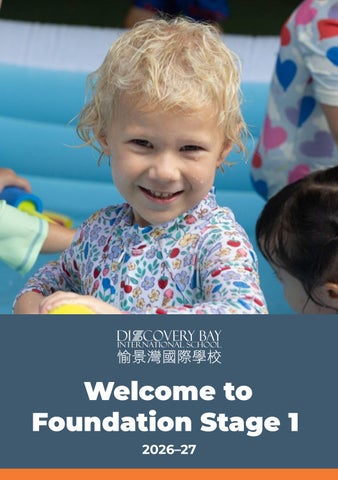
Welcome to Foundation Stage 1 2026–27
Our Mission To empower every student to develop their full potential and achieve personal excellence in all endeavours, enabling them to lead successful, fulfilling lives and enrich the world. Our DBIS Mission is enacted through our values of Courage, Respect and Integrity.
Our Core Values Courage We embrace challenges, persevere and work hard to reach our full potential. We are resilient and always striving to learn and grow.
Respect We value our diverse community, appreciating their unique contributions, needs and rights. We foster positive relationships through kindness and empathy, embracing a global mindset.
Integrity We act with honesty and make responsible choices, understanding the impact of our actions on ourselves and others. We are self-aware, compassionate and accountable.
Contents 02
WELCOME TO THE EARLY YEARS FOUNDATION STAGE
04
WELCOME TO FOUNDATION STAGE 1
05
THE EYFS TEACHING TEAM
06
KEY STAFF MEMBERS
08
THE DBIS LEARNER PROFILE
09
DBIS CHARACTER & CULTURE
10
PASTORAL & COMMUNITY
11
STUDENT SAFETY & WELLBEING
12
DAY-TO-DAY SCHOOL LIFE
16
UNIFORM
18
ATTENDANCE & ABSENCE
20
COMMUNICATION
23
HOW PARENTS CAN GET INVOLVED
24
ADVERSE WEATHER
25
THE FS-1 CURRICULUM
WELCOME TO THE EARLY YEARS FOUNDATION STAGE The Early Years Foundation Stage (EYFS) at Discovery Bay International School (DBIS) consists of Foundation Stage 1 (FS-1) and Foundation Stage 2 (FS-2) and is the first part of the children’s learning journey in our Primary School. The EYFS campus is located close to Discovery Bay South Plaza and is purposefully designed to meet the needs of children between the ages of three and five years old. Our FS-1 and FS-2 children follow the EYFS Curriculum of England. Our curriculum/learning experience is adapted and personalised to suit our international context and is delivered through an inquiry-based pedagogy that is progressive in nature as children move through the Primary School. The nonstatutory ‘Birth to 5 Matters’ guidance is used to support the delivery of our curriculum in EYFS. Our Primary School places the children at the centre of all that we do. In EYFS, our approach to teaching and learning is inspired by the principles of Reggio Emilia, where respect, responsibility and community lie at the heart of our practice. We view children as having extraordinary potential for learning and the ability to form their own understandings of the world around them. Our focus is upon nurturing creative, resilient and independent learners who are excited and confident to experiment and explore through active learning. The Characteristics of Effective Learning and the DBIS Learner Profile provide the foundations to support our children in becoming lifelong learners and critical thinkers. Supporting the development of different learning dispositions, behaviours and habits is an important part of our approach to teaching and learning in EYFS as this builds strong foundations for future learning. Our children are supported to take risks, think critically and develop understandings through exploration and inquiry. This experience is underpinned by our child-centred, personalised learning approach, which supports the development of the whole child and recognises the wonder of childhood. Teachers and educational assistants are seen as partners and co-constructors in the children’s learning journeys, ensuring learning is continually placed in a meaningful context by engaging with the children’s interests and ideas. Our children experience
02
authentic learning opportunities such as woodwork, Forest School and Beach School, and we pride ourselves on our child-led, Reggio Emilia-inspired learning environments, which support opportunities for open-ended inquiry. We place great importance on positive relationships and interactions amongst all members of our school community as these support our holistic and inclusive approach. We derive much of our strength from the surrounding community; therefore, establishing and maintaining supportive relationships is key to the ethos of our Primary School. By working together, we can ensure that all children in EYFS value and enjoy their time here, that they are sufficiently challenged and supported in their learning and that they secure strong foundations for their entire learning journey in a happy, nurturing environment. After reading this booklet, you will gain a sense of how our warm and caring environment, as well as the provision of opportunities for stimulating, inquiry-based learning, inspire our children to become curious, independent learners who are motivated to achieve their full potential. Hannah Tait Head of EYFS & Primary
03
WELCOME TO FOUNDATION STAGE 1 Dear Parents and Guardians, We are excited to welcome your children as they begin their learning journey at DBIS. Our staggered start programme ensures a smooth transition for the children, enabling them to feel happy, safe and secure as they begin their EYFS learning journey. We place a great deal of importance on how our children learn, and we support them in the development of the DBIS Learner Profile Attributes and the Characteristics of Effective Learning. Developing these attributes and dispositions will enable them to become lifelong learners who are confident to explore, persevere and think critically. In FS-1, our children follow the EYFS Curriculum of England, tailored towards our international context and enhanced by our Discovery units, which enable the children to explore concepts as well as acquire key knowledge and skills. Our children experience a range of adult-led and child-initiated learning opportunities taught in purposefully planned learning environments that reflect the children’s interests, the curriculum and a sense of belonging. The learning experience is complemented by specialist teaching in Music, Mandarin, Physical Education (PE) and Learning Technologies (LT). In addition, the children visit the library once a week. Experiential learning is also an important part of our FS-1 programme. The children attend Forest School and Carpenters’ Cabin (woodwork), which provide them with authentic learning experiences and support opportunities to develop and apply a range of skills, including problem-solving and critical thinking. We look forward to supporting your child’s learning journey in FS-1 and working in partnership with your family to ensure a happy, successful year of learning and development for your child. Best wishes, Ms Laura Bell, Ms Bronwen Baynes, Mrs Sharon Hubber & Mrs Deirdre McCarthy The FS-1 Teaching Team 04
THE EYFS TEACHING TEAM FS-1 TEACHERS Rainforest Class (Head of Year)
Laura Bell
lbell@dbis.edu.hk
Farm Class
Sharon Hubber
shubber@dbis.edu.hk
Seaside Class
Deirdre McCarthy
dmccarthy@dbis.edu.hk
Sunflower Class
Bronwen Baynes
bbaynes@dbis.edu.hk
FS-1 EDUCATIONAL ASSISTANTS Rainforest Class
Virlie Hyde
Farm Class
Reshani Mendis
Seaside Class
Ananya Basu
Sunflower Class
Rachel Campbell
FS-1 EA
Lea Hadfield
FS-2 TEACHERS Safari Class (Head of Year)
Emma Chambers
echambers@dbis.edu.hk
Airport Class
Nicholas Grimes
ngrimes@dbis.edu.hk
Garden Class
Helen Reid
hreid@dbis.edu.hk
Harbour Class
Chloe Foster
cfoster@dbis.edu.hk
FS-2 EDUCATIONAL ASSISTANTS Safari Class
Rasarin Rudall
Airport Class
Mari Collier
Garden Class
Julie Simon
Harbour Class
Michelle Rajudin
05
KEY STAFF MEMBERS LEADERSHIP TEAM Principal
Marc Morris
mmorris@dbis.edu.hk
Head of EYFS & Primary
Hannah Tait
htait@dbis.edu.hk
Deputy Head (EYFS & Primary)
Anna Christiansen
achristiansen@dbis.edu.hk
Assistant Head (EYFS & Primary) Ruth Brislen-Patel
rbrislen-patel@dbis.edu.hk
Assistant Head (EYFS & Primary) Lewis Peck
lpeck@dbis.edu.hk
Senior Curriculum Lead
arae@dbis.edu.hk
Amie Rae
WHOLE-SCHOOL CURRICULUM LEADERS Chinese & MFL
Myra Mi
mmi@dbis.edu.hk
Learning Enhancement
Serena Clark
serenaclark@dbis.edu.hk
Learning Technologies
Nicholas Ng
nng@dbis.edu.hk
Library
Melanie Foti
mfoti@dbis.edu.hk
Music
Christopher Preddy
cpreddy@dbis.edu.hk
PE & Sport
James Lugg
jlugg@dbis.edu.hk
PRIMARY CURRICULUM LEADERS Head of English
Bryony Wilson
bwilson@dbis.edu.hk
Head of Mathematics
Liam Bowden
lbowden@dbis.edu.hk
Head of Discovery
Amie Rae
arae@dbis.edu.hk
Head of Experiential Learning
Chloe Foster
cfoster@dbis.edu.hk
Phonics Lead
Nicholas Grimes
ngrimes@dbis.edu.hk
Learning Enhancement
Kristine Wills
kwills@dbis.edu.hk
Learning Enhancement
Ruth Brislen-Patel
rbrislenpatel@dbis.edu.hk
Learning Technologies
Bernard McNerney
bmcnerney@dbis.edu.hk
Library
Nilangi Thotawatte
nthotawatte@dbis.edu.hk
Mandarin
Jenah Luo
jluo@dbis.edu.hk
Music
Liao Liao Liang
lliang@dbis.edu.hk
Physical Education
Natalie Fashade
nfashade@dbis.edu.hk
SPECIALIST STAFF
06
ADMINISTRATION EYFS Administration Officer
Joey Lee
dbiseyfs@dbis.edu.hk
PE, Sport & ECA Administrator
Fanny Lo
flo@dbis.edu.hk
ECA Administrator
Yikki Lee
ylee@dbis.edu.hk
WELLBEING & PASTORAL STAFF Head of Wellbeing
Jess Hickling
jhickling@dbis.edu.hk
School Counsellor
Sarah Dunham
sdunham@dbis.edu.hk
Tamara Quinn
ey.medical@dbis.edu.hk
MEDICAL STAFF Health & First Aid Coordinator
07
THE DBIS LEARNER PROFILE The DBIS Learner Profile further supports the children to grow as learners and global citizens. In EYFS and KS1, our Learner Profile characters support the children in becoming familiar with each attribute and with how the attributes support their growth as a learner. Our children are positively recognised as they develop competence and capability in the different attributes.
COMMITTED LEARNERS I am curious and motivated to learn. I am committed, adaptable and resilient, and I learn from my mistakes.
BALANCED INDIVIDUALS I am reflective and thoughtful and consider how my actions impact myself and others. I believe that more effort or a different approach will pay off.
MINDFUL LEADERS I am empowered to lead others. I respectfully communicate with others and demonstrate flexibility. I value honesty, kindness and equality.
RESPONSIBLE CITIZENS I am aware of my responsibilities, and I courageously make good choices to help other people, my community and the environment.
PROBLEM SOLVERS I enjoy finding out new things. I am a risk-taker and learn by trial and error. I set myself goals, and I plan to find solutions.
CREATIVE THINKERS I am inquisitive and imaginative. I make connections to further my understanding, which helps me to create new ideas.
EFFECTIVE COLLABORATORS I can work independently. I can work collaboratively with others to achieve an end goal.
CONFIDENT COMMUNICATORS I organise and share my ideas clearly and confidently, and I show active listening to others.
08
Logos designed by our children
FOR DBIS STUDENTS DBIS students will be supported in enacting our Learner Profile Attributes as well as our Core Values of Courage, Respect and Integrity.
FOR DBIS STAFF DBIS staff members are here to guide and support the holistic development of all learners across all phases of the school.
DBIS CHARACTER & CULTURE The DBIS Character and Culture policy illustrates our restorative approach to behaviour, detailing steps to success and our shared language. Our focus is on promoting positive choices and behaviours so that every student feels supported, happy and secure. We recognise that part of our role as practitioners is to work in partnership with parents to support emotional regulation and ensure personal, social and emotional development. By empowering children through choices and using a shared and consistent vocabulary, our children understand that their actions have an impact on themselves and others. We aspire for our children to take responsibility for their actions, make positive choices and have opportunities to reflect and repair when behaviour does not align with our school values and expectations.
If we witness choices that contravene our school’s character and culture, we address the situation and support students through a restorative approach. The role of a staff member is to embed and support expected character and culture, using common language and role modelling the values expected of us and our students.
FOR DBIS PARENTS DBIS endeavours to build a supportive dialogue between home and the school, and we inform parents immediately if we have concerns about their child's choice(s). If our school has to use reasonable responses, we ask parents to support the actions of the school. If parents have any concerns about the way their child has been treated, they would initially contact the class teacher.
PASTORAL & COMMUNITY THE DBIS HOUSE SYSTEM All students in FS-1 to Year 13 are assigned to one of the four whole-school houses: Dragon (blue), Griffin (green), Goldhorn (yellow) or Phoenix (purple). Students are recognised for their achievements with house points, and they also compete in various disciplines to collect house points throughout the year. The awarding of house points links directly with the DBIS Learner Profile, and they are awarded when students demonstrate the different attributes. Each house has two Year 6 House Captains.
STUDENT COUNCIL The EYFS Student Council is made up of representatives from FS-1 and FS-2 who are selected by their class teachers. Student Councillors work on projects that are important to the EYFS children. Further information about the EYFS Student Council can be found in the EYFS & Primary Student Leadership Booklet.
SCHOOL AWARDS Each year, the school celebrates the achievements of our students through an awards ceremony, which takes place in June. The awards recognise and celebrate students across EYFS and Primary for academic achievement, progress in learning and service to others in the school community.
10
STUDENT SAFETY & WELLBEING Student safety is paramount to us here at DBIS, and even within our extremely safe Discovery Bay community, we need to ensure that children are ready to act calmly and appropriately in the event of an emergency. Key DBIS policies can be found HERE.
FIRE DRILLS Fire drill procedures are carried out each term and involve all staff and students. In the event of a fire, all EYFS staff and children are evacuated to the court in front of the school gates, where class rolls are taken. An email and SMS are sent to all parents following a successful fire drill or evacuation, informing them that all students are safe.
LOCKDOWN PROCEDURES Lockdown procedures are usually carried out once or twice a year and involve all staff and students. In the unlikely event that the school campus needs to be locked down, all blinds and windows are closed, and all staff and students stay silently and safely in a locked area until the all-clear is given over the school tannoy system. Again, parents are informed by email and SMS that all students are safe following any drill.
GUEST VISITORS TO SCHOOL Any visitor, including ex-students as well as family members or helpers of students attending DBIS, must sign in to the EYFS Campus at the front desk. All visitors are required to wear a visitor’s pass at all times whilst on school grounds. Visitors are not permitted to attend classes with students. This is to ensure learning is not disrupted as well as for insurance liability reasons.
OUR DBIS THERAPY DOG Bonnie, our qualified therapy dog, supports our wellbeing programme by taking part in various initiatives, such as 'Books with Bonnie'. Bonnie also attends counselling sessions as a comforting presence for our students.
11
DAY-TO-DAY SCHOOL LIFE SCHOOL HOURS The school gates open at 8.45am to give the children time to organise their school belongings and have a few minutes to greet their friends. This enables them to be ready to walk confidently into the class when the bell rings at 8.55am. We encourage the children to be as independent as possible, so we ask that you allow them to put their bag, lunchbox and water bottle away independently. If children arrive at school after 9am, please ensure that they go to the office to sign in.
SNACK & LUNCHTIME The school provides a daily snack of fruit, vegetables and crackers for the children to eat in their classes. Lunchtime starts at 11.30am and lasts for one hour. The children have a supervised lunch break in the dining hall before they go out to play. To support your child’s learning and development, please read our Food and Nutrition Policy, which provides guidance on which foods are appropriate for a school lunch. Helpful Hints ● ● ●
Drinks should be in a spill-proof, child-friendly container. An ice pack or insulated lunch box can help keep lunches cool. We encourage all children to be environmentally friendly and bring a lunch with as little packaging as possible.
END OF THE SCHOOL DAY The children are dismissed by their teachers at the classroom door. The school day ends for FS-1 children at 2.40pm. All children in FS-1 are to be collected by an adult, who must show a parent/carer ID card for their child. Adults who cannot show an ID card must sign their child out with their class teacher, who will double check that the person collecting is an agreed adult.
PARENT/CARER ID CARDS In order to maintain the highest standards in safeguarding and child protection, you will need to apply for DBIS photo identity cards for those who will pick your child up on a
12
regular basis. The names of these adults should be communicated to your child’s class teacher. If you arrange for your child to go on a play date or to be picked up by someone who is not on the regular pick up list, you will need to inform your child’s class teacher and ensure you provide their full name as they will need to verify their identity when collecting your child. Anyone (including those on the pick up list) who arrive at school without the card will need to sign the child out with the class teacher once all other children have been safely dismissed. We will never release a child to someone who is not on the pick up list without arrangements being made prior. To apply for a parent/carer ID card, please complete the form HERE.
EXTRACURRICULAR ACTIVITIES & CLUBS A range of extracurricular activities (ECAs) are available to all children at DBIS. Each term, you will be notified of the ECAs available to your child’s age group and provided with information on how to register an interest in joining, via SchoolsBuddy. Please note some ECAs have a maximum capacity. The majority of ECAs at DBIS are offered free of charge; however, there may be some paid activities delivered by external providers. Any paid selections will be invoiced to parents directly by the external service provider. ECAs for FS-1 children start in Term 2, once they have settled into school and are completely settled into all the new routines that come with attending school for full days. From time to time, ECAs may need to be cancelled. The most common cause of this is inclement weather. In the event of cancellation, parents will be notified via SchoolsBuddy. If your child does not attend an ECA, an email will be sent to confirm this.
13
NECESSARY EQUIPMENT The school provides FS-1 children with pencils, crayons, books and stationery. Parents are asked to provide: ●
A named school bag (this can be purchased from the uniform shop);
●
One A3-sized reading folder (plastic, zipped wallet).
To support the children’s independence, they should be encouraged to be responsible for their own belongings and to pack their own school bag. Class teachers will share the days that reading and library folders are needed in school.
TOYS We recognise the importance of engaging with the children’s interests in order to enhance the learning process, so please do keep us up to date with your child’s interests as they emerge so we can reflect these within the learning environment. We kindly ask that unless requested specifically for a topic by your child’s teacher, personal toys remain at home.
BICYCLES, SKATEBOARDS, SCOOTERS & PUSHCHAIRS We are very fortunate in Discovery Bay that so many of our children are able to make their way to school via environmentally friendly means. It is our utmost priority that our children, as well as their belongings, remain safe at all times, and we kindly request that parents/caregivers ensure children who cycle, skate or scoot to and from school wear a helmet whilst doing so. Please note that the school is not responsible for any accident or injury arising from students travelling to or from school. The school is also not responsible for damage to, or loss of, bicycles, skateboards, scooters or other personal property. If you are bringing your child to school in a pushchair, please note that we do not store pushchairs during the school day. We therefore request that they are taken home.
SMART WATCHES Children in EYFS are not permitted to wear smart watches. If your child begins to show an interest in telling the time, we recommend purchasing a simple analogue wrist watch. 14
LOST PROPERTY At the EYFS campus, all lost and found items are handed to the EYFS administrator at the front desk. We ask that all student clothing is clearly labelled with your child’s name. At specific times throughout the year, we will put all lost and found items on display, and if unclaimed, we will donate these items to one of our school charities.
MEDICAL CARE If a child becomes unwell whilst at school, they will be taken to the school nurse. The school nurse will evaluate the child’s medical condition and decide if they need to be collected from school. The time of handover to a parent or caregiver is noted, and the classroom teacher is made aware. If a child has a minor complaint or accident, the school nurse will administer first aid and care in the medical room. In the case of a more serious concern, the school will contact the parents and/or emergency services and will make medical decisions based on doctor’s recommendations. Parents will be systematically informed if the school contacts emergency services, but it may not always be possible to do this in advance of making an emergency call.
The school’s nurse is not authorised to administer mild medications, such as paracetamol, without parental permission. Prescribed medication can be administered on completion of the Prescribed Medicines Permission Form linked HERE. Please note that although the school provides limited medical insurance for all students whilst they are in our care, the insurance may not cover all medical costs. Therefore, parents should make sure that students have sufficient medical coverage in addition to what the school provides.
15
UNIFORM DBIS has a compulsory school uniform. Information regarding uniforms can be found on the Parent Hub HERE. Our uniform shop is located on the Main Campus and is open on Tuesdays and Thursdays from 8.15am to 11.30am and on Wednesdays from 1.30pm to 4pm during term time. If possible, we ask you to please bring your own carrier bag with you to take away uniform items. Some key points to remember:
School Shoes All children must wear plain black school shoes or navy or black sandals. High-top or canvas shoes are not acceptable.
Sun Hats All students must have a school hat for outdoor PE and playtime. We have a ‘no hat – no play’ policy.
Jewellery Watches and small stud earrings are permitted (but must be covered or removed for PE). No other jewellery items, other than religious or cultural pieces, are permitted to be worn to school.
Physical Education (PE) Uniform Children in EYFS wear their PE kit all day on PE days. Please refer to the Parent Hub for further information on the PE uniform list.
Sports Shoes Students should wear appropriate footwear that adequately supports their feet during PE lessons and sports activities. Sports shoes should be free from flashing lights or obvious pictures.
Make-up Make-up, nail varnish and temporary tattoos are not permitted to be worn to school. Parents will be asked to ensure these are removed if a child arrives at school wearing any of the items listed above.
16
Hair Hair longer than shoulder length must be tied back. Hair dye is only allowed if a natural colour. Parents will be asked to wash out unnatural hair products. Coloured hair braids must also be removed for school.
Cold Weather During colder months, please ensure you purchase items from the cold weather uniform list for your child to wear. Non-uniform items should not be worn.
DBIS Rucksack The DBIS rucksack is an optional part of the school uniform. All children in FS-1 and FS-2 are required to purchase this from the uniform shop.
Waterproof Clothing All children in FS-1 and FS-2 need to bring in a pair of Wellington boots, waterproof trousers and a coat.
17
ATTENDANCE & ABSENCE Regular attendance at school is essential for students to achieve their full potential, and we appreciate your support in helping us maintain high attendance rates at DBIS. We expect all students to aim for 100% attendance and to make every effort to attend school every day. We closely monitor attendance to ensure that students are attending school regularly. For your information, please see the statistics below: ● ● ● ● ●
96% attendance = 7 learning days lost 95% attendance = 9 learning days lost 90% attendance = 19 learning days lost 89% attendance = 21 learning days lost 85% attendance = 28 learning days lost
If we notice that a student is missing school frequently or for an extended period of time, we will reach out to their parents to discuss the situation and provide support. We reserve the right to intervene when we feel it is necessary to support a student's attendance and academic progress. This includes situations where a student has been absent for an extended period of time or has repeatedly missed school. The school office will send an automated email if a child's attendance goes below 90% or 80%.
NOTIFICATION OF ABSENCE If your child is absent from school, it is important that you let us know why. You can report your child’s absence using our online forms, which can be found on the Parent Hub. There are two forms: one for planned absence and one for unplanned absence. Alternatively, you can call the school office and leave a message. Please do not email the class teacher.
LATE ARRIVAL AT SCHOOL If your child is late for school and arrives any time after 9am, they need to be brought to the EYFS office to be registered and signed in to school. They can then go and join their class. This way, we know your child will be safely registered without interrupting the learning that will already have started in the classrooms.
18
EARLY DISMISSAL If a student needs to leave school before the end of the day (2.40pm), parents are required to inform the class teachers and exit via the EYFS school office, where they must sign their child out with the administration officer before leaving the school premises.
PARENTAL ABSENCE We know that our families have commitments all over the world, and this often requires travel. Please notify the school if you are planning to take a trip out of Hong Kong for more than a day. We know that parental absence, even for the shortest of periods, can sometimes unsettle children at school, so letting the school know when you are away from home helps ensure your child is fully supported when in school. The school office will require details of appointed guardians and emergency telephone numbers in case we need them, and we will be able to keep a close eye on your child in your absence.
19
COMMUNICATION OUR COMMUNICATION SYSTEM We view our parents as the children’s first teachers; therefore, clear communication between home and school is essential. Our communication system utilises the following platforms to communicate with our parent community:
The Parent Hub The Parent Hub is our main platform for communication between school and home. All communication to parents regarding upcoming events and information can be found on the Parent Hub. Any calendared event will have a parent bulletin on the Hub approximately two weeks prior to the event taking place. All bulletins are sent to parents in a consolidated email each Saturday so that parents can organise the forthcoming two weeks. The Parent Hub also contains the current DBIS school calendar, which details term dates as well as the dates of upcoming school events.
iSAMS Parent Portal Parents can access student-specific information via the iSAMS Parent Portal. This platform is used to communicate confidential information about your child, such as school reports and attendance data. The Parent Portal is browser based; however, an app-style shortcut can be added to your mobile phone home screen for ease of access. Please see the guide HERE for information on how to access the Parent Portal and set up a shortcut. You will need your personal iSAMS username and password to log in.
Electronic Learning Journey (Seesaw) Throughout your child’s time in FS-1, we will record their learning in an electronic learning journey (Seesaw) to celebrate their experiences. Over time, it will tell a story about your child and their learning, their friends and the activities they enjoyed sharing with others. The electronic learning journey may include: ● ●
20
Photographs and videos – these capture moments and sequences of your child’s learning, interests and explorations; Your child’s creations – these could be photos of models, their role play, marks they have made, writing or artwork – with a comment to explain what your child did or said.
SchoolsBuddy Platform All information about your child’s ECAs can be found via the SchoolsBuddy platform. A personal username and password to log in to SchoolsBuddy will be shared with you. Once you are logged in, you will be able to see all of the activities your child is involved with.
School Newsletter Each Friday, the school’s newsletter is emailed to parents. The newsletter provides a snapshot of the week’s events across all phases of the school.
DBIS Website The school’s website, linked HERE, is a window into the school, giving parents access to information on all aspects of the school’s operations as well as teaching and learning approaches. The website also provides parents with a link to the Parent Hub.
Parent–Teacher Conferences & Reports We have an open-door policy at DBIS, and parents are welcome to pass on information at the door each morning and afternoon. For matters that require longer discussion, parents are encouraged to make appointments with the teachers to ensure we can give you the time and space required. In addition to the ongoing contact with class teachers, we have a number of formal times for parents and teachers to discuss the children’s progress and set targets. We also provide a detailed, written report at the end of the academic year. Parent–teacher conferences occur three times a year (twice in Term 1 and once in Term 2). In addition, open mornings are held for the children to share their learning with parents. These opportunities enable our children to develop their communication skills by articulating their learning journey throughout the year.
21
KEEPING SCHOOL INFORMED Contacting Teachers We operate an open-door policy at DBIS, and you will see your child’s teacher each morning and afternoon when you drop off and collect your child. This is a great time for short, incidental conversations. If you wish to arrange a longer meeting, please do so by emailing them directly. As teachers are in class with students all day, please allow up to 24 hours for a response to emails. For time-sensitive issues, please email the school office at dbiseyfs@dbis.edu.hk, and the message will be conveyed directly to the teacher.
Permission Forms School trips form an integral part of our school curriculum, and we like to immerse our students in learning outside the classroom wherever we can. We have immediate access to the mountains and beaches here in Discovery Bay, and the children love to learn outside. All parents are asked to sign an annual online permission form, which gives students advance permission to attend all local school trips.
Personal Information It is very important for the school to have complete, up-to-date information about all of our students and those whom we may need to contact in case of emergency. Please make sure that you inform the school immediately of any changes to contact details, names, telephone numbers or addresses. The Student Contact Details Change Form for this can be found on our Parent Hub HERE. It is also imperative that you let the school know of any allergies, medical conditions or ongoing medication your child has. Student medical profiles can also be updated via the our Parent Hub HERE. These details must be kept up to date at all times.
WITHDRAWAL OF STUDENTS To withdraw a student, parents must give notice in writing to the Principal using the form HERE not less than 60 days (excludes July and August) before the student leaves the school. If students are not returning to DBIS after the summer holidays, official notice must be given 60 days before the last day of term. The school will charge school fees in lieu if the above notice period is not adhered to.
22
HOW PARENTS CAN GET INVOLVED PARENT PARTNERSHIPS We actively recognise that parents are a child’s first – and most important – teachers, and we work hard to build strong, positive and supportive relationships between school and home. Working in partnership with parents enables us to provide the best support possible for every child.
CLASS PARENTS Every year, we are delighted to welcome one or two class parents for each class. These parents are a huge support for us, welcoming new families, helping out with trips and organising parental support for many of the activities undertaken by the students. Class parents are a link between the wider parent group and the school and are invaluable. If you are interested in becoming a class parent, please approach your class teacher at the start of the academic year.
PTSA We have a very active Parent–Teacher–Student Association (PTSA) who work tirelessly to support our school. More information about the PTSA can be found on the Parent Hub HERE, and they can be contacted at ptsa@dbis.edu.hk.
PARENT FOCUS GROUP There is a Parent Focus Group which meets with the Head of EYFS & Primary each term to discuss different areas of school life. Do register your interest at the start of each year by emailing Hannah Tait, Head of EYFS & Primary, at htait@dbis.edu.hk if you would like to join this group.
23
ADVERSE WEATHER As you will be aware, Hong Kong is subject to extreme weather conditions from time to time. The Education Bureau of the Hong Kong government stipulates that when certain rain warnings and typhoon signals are in place, we are to follow their directives:
●
Typhoon Signal Number 1 All phases of the school will operate as normal.
●
Typhoon Signal Number 3 or Above DBIS EYFS Campus will be closed. DBIS Primary and Secondary Schools will operate as normal.
●
Typhoon Signal Number 8 or Above DBIS EYFS, Primary and Secondary Schools will be closed. Static learning activities will be available for the children to access remotely by 10am on the morning of a T8 school closure.
●
Amber Rainstorm Warning DBIS EYFS, Primary and Secondary Schools will operate as normal.
●
Red or Black Rainstorm Warning If a Red or Black Rainstorm Warning is issued before the start of the day, DBIS EYFS, Primary and Secondary Schools will be closed for students. Static learning activities will be available for the children to access remotely by 10am on the morning of a rainstorm school closure. In the event of a Red or Black Rainstorm Warning being issued during the day, the school will continue until the end of normal hours and children will be retained until conditions are safe for them to return home.
SCHOOL CANCELLATION Please familiarise yourself with the school’s Severe Weather Policy regarding the closure of school. The school website will display weather warnings and notification of school closure where applicable.
24
THE FS-1 CURRICULUM THE AREAS OF LEARNING & DEVELOPMENT There are seven areas of learning and development that shape the EYFS curriculum. All are important and interconnected. Three of the areas are particularly important for building a foundation for igniting the children’s curiosity and enthusiasm for learning, forming relationships and thriving. These are called the prime areas. They are: ● ● ●
Communication & Language Physical Development Personal, Social & Emotional Development
Communication & Language Young children depend on interactions with responsive others to become confident communicators and language users. Communication and language are the foundations for learning and development, supporting independent thinking and emerging literacy skills. A language-rich environment is crucial for supporting children as they explore sounds, symbols and words in their everyday world. Through ongoing, varied and positive experiences, we give our children opportunities to develop their confidence and skills in expressing themselves and to speak and listen in a range of situations. We recognise that for many of our children, English is a second or third language and that that their first language provides the roots to learning additional languages. With this in mind, we encourage parents to continue to use their home language as it strengthens their child’s language proficiency when they engage with new environments. Physical Development Children’s learning and development is underpinned by physical development. Engagement with extensive physical experiences supports the development of neurological, sensory and fine motor skills that are essential for positive body image. Physical development includes health, wellbeing and self-care. We help our children to understand the importance of physical activity and to make healthy choices in relation to food. Twice a week, under the guidance of a specialist teacher, our children participate in physical activities whilst practising the rules of safety, cooperation and gross motor skills development. Throughout the day, our children are engaged in activities that promote the development of fine and gross motor skills, which must develop together so that children can achieve what they set out to do. These activities are also crucial to building firm foundations for mark-making and writing.
25
Personal, Social & Emotional Development (PSHE) Who we are, our relationships with others and how we feel are the foundations for our lives. Developing a positive sense of self is key to children’s wellbeing and resilience, which we know have a significant impact on their learning and achievement. Children’s self-confidence and their potential to think and learn are influenced by their sense of self, their emotional understanding and the quality of their relationships. Personal, social and emotional development are therefore crucial to children in EYFS as they are fundamental to all other aspects of lifelong learning. Our PSHE curriculum is further enhanced and supported with the ‘Talk PANTS’ programme, which introduces the concepts of bodily autonomy, consent, and help-seeking. Through teaching relevant, age-appropriate knowledge, understanding and skills, these lessons introduce the children to key concepts designed to safeguard and equip them with vital skills and education from an early age. The other areas of learning and development are the four specific areas, through which the three prime areas are strengthened and applied. The specific areas are: ● ● ● ●
Literacy Mathematics Understanding the World Expressive Arts & Design
Literacy In FS-1 and FS-2, literacy focuses on understanding and being understood. This is achieved by developing in the children the skills to interpret, create and communicate meaning through writing and reading in different media. Our children have access to a wide range of reading materials (books, poems and other written materials) to ignite their interest and to encourage a love of reading. In FS-1 and FS-2, the children link letters and sounds and begin to read and write. Our phonics programme is inspired by Read Write Inc. (RWI), which is a synthetic phonics programme that ensures reading, writing and spelling success. In FS-1, we ensure plenty of opportunities for the development of pre-phonics skills, such as listening to environmental sounds, remembering and repeating rhythms and rhymes and discriminating between sounds. These opportunities continue to be available for the children to engage with as they begin the formal phonics programme, supporting the continued development of skills relating to phonics, reading and writing.
26
Mathematics Early mathematical understanding is acquired through repeated experiences using hands-on materials in enjoyable, meaningful contexts. In FS-1 and FS-2, we support the children in developing their own understanding of number, quantity, shape and space. We nurture the children’s natural interests through playful exploration and high-quality interactions, and we provide them with plenty of opportunities to revisit, develop and make sense of mathematical concepts for themselves in order to build a strong mathematical foundation. We place much importance on supporting the children to develop an understanding of the value of numbers and ‘number sense’ through subitising and the use of five and ten frames. Our aim is to ensure the children in EYFS work towards ‘number sense mastery’ as this will enable them to approach the concepts and ideas that emerge in Key Stages 1 and 2 with greater confidence. Understanding the World Through our Discovery units and concept-based planning, we guide our children to explore and make sense of their expanding world and their community. Children in EYFS learn through regular and direct contact with the natural, man-made and virtual environments by collaborating with others, inquiring, problem-solving and shared sustained thinking. Our active involvement with the local community supports the children in developing responsibility and respect for diversity. Our experiential learning opportunities, including Forest School and woodwork (Carpenter’s Cabin), provide children with first-hand involvement with the natural world, developing a sense of ecological balance, environmental care and sustainability. ‘Understanding the World’ supports learning about our culturally, socially, technologically and ecologically diverse environment and how to stay safe within it. Expressive Arts & Design We enable our children to explore and experiment with a wide range of media and materials; we also provide opportunities and encouragement for the children to share their thoughts, ideas and feelings through a variety of experiences in art, music, drama and imaginative play. Our ateliers play an important role in facilitating opportunities for exploration and creativity. The children visit the ateliers to learn new skills as well as to experiment with different forms of media and materials. ‘Expressive Arts & Design’ fosters imagination, curiosity, creativity, cognition and critical thinking. Through engagement with the arts, our children are able to improvise, collaborate, interact and engage in shared, sustained thinking.
27
THE CHARACTERISTICS OF EFFECTIVE LEARNING The Characteristics of Effective Learning are: ● ● ●
Playing & Exploring – children investigate and experience things and ‘have a go’ Active Learning – children concentrate and keep on trying if they encounter difficulties, and they enjoy achievements Creating & Thinking Critically – children have and develop their own ideas, make links between ideas and develop strategies for doing things
DISCOVERY Discovery is a bespoke, inquiry-based curriculum that DBIS has developed to support our children in becoming independent, active learners and to cover the critical content of the Science curriculum and foundation subjects of History, Geography, Art and Design & Technology. It is concept based, which means the learning is not locked in time or place; instead, it is transferable. Through identified subject material and conceptual understandings, children have opportunities to develop deeper conceptual thinking. The Discovery units are underpinned by Learning Technologies and internationalism and provide a contextual learning experience for the development of skills in English and Mathematics.
28
OUR DISCOVERY UNITS Through holistic inquiry units, children are nurtured to engage with all seven areas of learning by exploring big ideas through play, active engagement and interconnected learning experiences. For further information, please see the FS-1 Curriculum Intent document linked HERE.
FS-1 Units of Inquiry
Concepts
NEW BEGINNINGS! WHERE DO I BELONG?
Process, Learning, Growth Mindset, Beliefs, Values, Relationships, Psychology, Potential, Technology, Systems
In this unit, through play and interactions, the children develop their sense of self, relationships with others and belonging to their class.
WORLD OF WOW! CELEBRATIONS In this unit, which is covered throughout the year, the children learn that people celebrate their traditions and values in a variety of ways and that through celebrations, people express their beliefs and values.
MAGICAL MARKS In this unit, the children explore various art forms and techniques. They explore colours and how they can be changed.
LET’S PRETEND In this unit, the children explore storytelling and how they can act out or retell stories in different ways.
SHARING THE PLANET In this unit, the children learn about sharing our planet with people, plants and animals that all grow and change. They learn that we have a role to play and responsibility to take care of, and appreciate, our planet.
MOVING FORWARD: CHANGES AND JOURNEYS In this unit, the children explore the concept of movement and transportation within their community.
Power, Force, Communication, Transition
Creativity, Imagination, Pattern, Materials
Expression, Imagination, Creativity, Interactions, Relationships Sustainability, Relationships, Interdependence
Power, Force, Communication, Transition, Trust
05
SPECIALIST TEACHING Mandarin FS-1 children attend Mandarin each week, with both Mandarin immersion in their usual classroom environment and specialist teaching. Native speakers have an additional native speaking class each week. The end-of-year expectations for FS-1 can be found below:
Native Speakers The children can understand and follow classroom instructions and sing songs in Mandarin. They can understand and retell the rhymes and short stories they are exposed to in school. The children can recognise the characters of the numbers 1–5. By the end of FS-1, we expect the children to have a basic understanding of Chinese culture and traditional festivals and make connections to other cultures.
Non-Native Speakers The children can understand and follow basic instructions and are familiar with pronunciation in Mandarin. They can sing and dance to Mandarin songs and are able to count to 10. The children can understand and say words from each unit of learning, including greetings, numbers, the Chinese New Year festival, fruits and colours. They are able to express the fruit and colours they like, following verbal and non-verbal clues. By the end of FS-1, we expect the children to have an initial understanding of Chinese culture and traditional festivals and make connections to other cultures. Music In EYFS Music, the children explore their voices and a range of percussion instruments through simple songs and music games, and are introduced to orchestral music. In FS-1, children build confidence in using their voices by singing a range of simple tunes that extend their understanding of dynamics, tempo and rhythm. The children are also encouraged to use their imagination, adopting a range of voices and movements for characters in songs.
30
05
Physical Education (PE) To foster the physical development of our students, we provide opportunities for them to engage in physical activity and interactive play that improve their coordination, strength and movement. By focusing on locomotor skills such as running, jumping and skipping, we help our children develop balance and control of their bodies, which are important for their overall development, whilst reinforcing the importance of physical activity as an integral part of a healthy lifestyle. By the end of FS-1, we aim for the children to develop confidence in the following areas: ● Running with spatial awareness and negotiating space successfully, adjusting speed or direction to avoid obstacles ● Balancing on one foot or in a squat momentarily, shifting body weight to improve stability ● Grasping and releasing with two hands to throw and catch a large ball, beanbag or object ● Climbing stairs and steps and moving across climbing equipment using alternate feet; maintaining balance using hands and body to stabilise Learning Technologies In FS-1 and FS-2, the children cover a range of practical and theoretical content to enhance their understanding of technology. This includes learning about appropriate device use and maintenance whilst interacting with different technologies. In FS-1, learning focuses on creating multimedia and using technology to enhance the learning experience in the classroom. The children begin to explore early coding and how instructions can be used to control a variety of floor robots. The children learn to interact fluently and independently with some essential software that they will continue using in the following years. All of this is underpinned by a digital citizenship programme that guides the children towards a balanced, responsible and productive relationship with technology.
LIBRARY Promoting a love of reading is a mindset we are dedicated to at DBIS, and our library plays an essential role in this. The children will visit the library weekly with their teacher to borrow books and develop their library skills. The library is open from 8.15am until 3pm daily. Children can visit the library with parents before or after school. The library catalogue can also be accessed online HERE.
31 05
19 05
THE EARLY LEARNING GOALS (ELGs) At the end of each child’s time in FS-2, a summary of their development and achievement in response to the ELGs as defined in the EYFS is produced in the format of an EYFS Profile (EYFSP). This supports the children’s transition to Key Stage 1. In the EYFSP, your child will be given an attainment level for each of the 17 aspects of learning. Each child will be assessed as either 'working towards', 'working at' or 'working at greater depth' for each ELG. They EYFSP is separated into seven areas of learning and development, which are broken down further into the 17 specific aspects of learning:
Personal, Social & Emotional Development Self-Regulation Children at the expected level of development will: ● Give focused attention to what the teacher says, responding appropriately even when engaged in activity, and show an ability to follow instructions involving several ideas or actions; ● Set and work towards simple goals, being able to wait for what they want and control their immediate impulses when appropriate; ● Show an understanding of their own feelings and those of others, and begin to regulate their behaviour accordingly.
Managing Self Children at the expected level of development will: ● Be confident to try new activities and show independence, resilience and perseverance in the face of challenge; ● Explain the reasons for rules, know right from wrong and try to behave accordingly; ● Manage their own basic hygiene and personal needs, including dressing, going to the toilet and understanding the importance of healthy food choices.
Building Relationships Children at the expected level of development will: ● Form positive attachments to adults and friendships with peers; ● Show sensitivity to their own and others' needs; ● Work and play cooperatively and take turns with others. 33 05
Communication & Language Listening, Attention & Understanding Children at the expected level of development will: ●
● ●
Listen attentively and respond to what they hear with relevant questions, comments and actions when being read to and during whole-class discussions and small-group interactions; Make comments about what they have heard and ask questions to clarify their understanding; Hold conversation when engaged in back-and-forth exchanges with their teacher and peers.
Speaking Children at the expected level of development will: ●
●
●
Express their ideas and feelings about their experiences using full sentences, including use of past, present and future tenses and making use of conjunctions, with modelling and support from their teacher; Offer explanations for why things might happen, making use of recently introduced vocabulary from stories, non-fiction, rhymes and poems when appropriate; Participate in small-group, class and one-to-one discussions, offering their own ideas, using recently introduced vocabulary.
Physical Development Gross Motor Skills Children at the expected level of development will: ● ● ●
34
Demonstrate strength, balance and coordination when playing; Move energetically, such as running, jumping, dancing, hopping, skipping and climbing; Negotiate space and obstacles safely, with consideration for themselves and others.
05
Fine Motor Skills Children at the expected level of development will: ● ● ●
Begin to show accuracy and care when drawing; Hold a pencil effectively in preparation for fluent writing – using the tripod grip in almost all cases; Use a range of small tools, including scissors, paint brushes and cutlery.
Literacy Comprehension Children at the expected level of development will: ● Demonstrate understanding of what has been read to them by retelling stories and narratives using their own words and recently introduced vocabulary; ● Anticipate (where appropriate) key events in stories; ● Use and understand recently introduced vocabulary during discussions about stories, non-fiction, rhymes and poems and during role play.
Word Reading Children at the expected level of development will: ● Read aloud simple sentences and books that are consistent with their phonic knowledge, including some common exception words; ● Read words consistent with their phonic knowledge by sound-blending; ● Say a sound for each letter in the alphabet and at least 10 digraphs.
Writing Children at the expected level of development will: ● Spell words by identifying sounds in them and representing the sounds with a letter or letters; ● Write recognisable letters, most of which are correctly formed; ● Write simple phrases and sentences that can be read by others.
35 05
Mathematics Number Children at the expected level of development will: ●
● ●
Automatically recall (without reference to rhymes, counting or other aids) number bonds up to 5, including subtraction facts, and some number bonds to 10, including double facts; Have a deep understanding of number to 10, including the composition of each number; Subitise (recognise quantities without counting) up to 5.
Numerical Patterns Children at the expected level of development will: ● ● ●
36
Compare quantities up to 10 in different contexts, recognising when one quantity is greater than, less than or the same as the other quantity; Explore and represent patterns within numbers up to 10, including evens and odds, double facts and how quantities can be distributed equally; Verbally count beyond 20, recognising the pattern of the counting system.
05
Expressive Arts & Design Creating with Materials Children at the expected level of development will: ● ● ●
Make use of props and materials when role playing characters in narratives and stories; Safely use and explore a variety of materials, tools and techniques, experimenting with colour, design, texture, form and function; Share their creations, explaining the process they have used.
Being Imaginative & Expressive Children at the expected level of development will: ● ● ●
Invent, adapt and recount narratives and stories with peers and their teacher; Perform songs, rhymes, poems and stories with others and, when appropriate, try to move in time with music; Sing a range of well-known nursery rhymes and songs.
Understanding the World Past & Present Children at the expected level of development will: ● ● ●
Know some similarities and differences between things in the past and now, drawing on their experiences and what has been read in class; Talk about the lives of the people around them and their roles in society; Understand the past through settings, characters and events encountered in books read in class and storytelling.
37 05
People, Culture & Communities Children at the expected level of development will: ● ●
●
Describe their immediate environment using knowledge from observation, discussion, stories, non-fiction texts and maps; Know some similarities and differences between different religious and cultural communities in this country, drawing on their experiences and what has been read in class; Explain some similarities and differences between life in this country and life in other countries, drawing on knowledge from stories, non-fiction texts and, when appropriate, maps.
The Natural World Children at the expected level of development will: ● Explore the natural world around them, making observations and drawing pictures of animals and plants; ● Know some similarities and differences between the natural world around them and contrasting environments, drawing on their experiences and what has been read in class; ● Understand some important processes and changes in the natural world around them, including the seasons and changing states of matter.
38
05
EYFS CAMPUS CONTACT DETAILS Website:
www.dbis.edu.hk
Telephone:
+852 2914 2142
General Email:
dbis@dbis.edu.hk
EYFS Office Email:
dbiseyfs@dbis.edu.hk
dbis.edu.hk