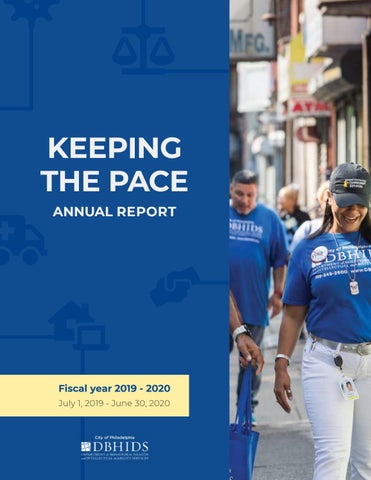
KEEPING THE PACE ANNUAL REPORT
Fiscal year 2019 - 2020 July 1, 2019 - June 30, 2020
THE PHILADELPHIA DEPARTMENT OF
BEHAVIORAL HEALTH AND INTELLECTUAL DISABILITY SERVICES OUR COMMITMENT
We take an active role in promoting the health and wellness of all Philadelphians through our population health approach. By empowering the entire community to take charge of their health, DBHIDS helps create a Philadelphia in which every resident can thrive.
MESSAGE FROM THE
COMMISSIONER Dear Philly, Looking back on the past year, I am in awe of all DBHIDS has been able to accomplish on behalf of the people of Philadelphia and the communities we serve. Our nation and our city have undoubtedly been faced with many unprecedented challenges during this past year. A global pandemic, civil unrest, multiple incidents of racial injustice, and historic rates of community violence elevated the need for mental health services and supports for the entire city. During this past year, our system also faced several significant transitions. We quickly and successfully pivoted to a nearly total remote work environment while continuing to support the vast provider network to ensure access to vital lifesaving services. And in October 2020, we said farewell to the former commissioner, David T. Jones. I was appointed commissioner in December 2020 after serving as deputy commissioner for nearly three years. This is a great deal of change, particularly during a time when many aspects of our everyday lives remained so uncertain. The accomplishments of our system over this past year would not have been possible without the resilience, hard work, and innovation of all of our employees across the seven divisions within DBHIDS, our vast provider network, our City partners, our community stakeholders, and — most importantly — the people we serve. DBHIDS is a comprehensive system guided by a commitment and a willingness to do whatever is necessary to ensure the people of Philadelphia receive high-quality supports, services, and treatment. We spent the past year firming up our strategic plan, Prioritizing to Address our Changing Environment, or P.A.C.E. This has served as a foundation to the critical work at hand: aligning with City partners and agencies, enhancing our efforts to meet people where they are, and ensuring quality services for those across our continuum of care. In my role as commissioner, I feel so fortunate to work with incredible staff who consistently go above and beyond to ensure all Philadelphians have the opportunity to thrive. While I am so proud of all we have done, there is still so much to do. This report serves to highlight where we are and where we aim to go. We are “Keeping the P.A.C.E.” to ensure behavioral wellness and health for all Philadelphians. Sincerely,
Jll Bowen, PhD Commissioner
4
RECOVERY RESILIENCE SELF-DETERMINATION
The People We Serve During the COVID-19 pandemic, I received Food Bank resources from the Community Wellness Engagement Unit. This connection has helped our family put food on the table during some rough financial periods.”
— Community Resident
DBHIDS understands the earlier we intervene with behavioral health issues, the faster we are able to provide professional care as a community. This requires paying attention to social determinants of health, which include the availability of support, experiences of trauma, access to behavioral health care, educational and economic opportunities, and the social and physical environment. We do this by partnering with city agencies including the justice, housing, school, and child welfare systems, as well as the behavioral health treatment system and the general public. Today, we are striving to serve everyone in the community— not just those with a diagnosis. By empowering the entire community to take charge of their health, DBHIDS helps to create a Philadelphia in which every resident can thrive.
I had a lot going on and I generally bounce back pretty quickly, but this time was different. I wasn’t sleeping well, and making a meal took a lot of effort. I took the screening, and the results confirmed for me what I was thinking but couldn’t admit. I was able to talk a little about what was going on, and I made an appointment with my doctor right there on the spot.” — Community Behavioral Health Member
I would like to recognize every therapist on my consultation calls who has transitioned to providing Trauma Focused Cognitive Behavioral Therapy (TF-CBT) via telehealth so quickly, creatively, and successfully. I have told many people around the country how amazed and inspired I am by my PACTS clinicians for continuing to provide TF-CBT to children who are so in need of trauma treatment during this very challenging time. I am so grateful to work with all of these wonderful and dedicated professionals.” — Judith A. Cohen, MD TF-CBT Co-developer
It has been difficult during the pandemic. We don’t go many places except for work. I love my job. My job coach helps me safely interact with my coworkers. They remind me to keep my mask on, wash my hands, and keep everything clean like the lockers, equipment, and mirrors. I always stay professional and my boss says I do a great job.” — Participant at SPIN, Inc.
5
ANNUAL REPORT 2019 - 2020
Mission
Vision
Values
To educate, strengthen, and serve individuals and communities so all Philadelphians can thrive.
We envision a Philadelphia where every individual can achieve health, well-being, and self-determination.
Equity Equality Excellence Integrity Outcomes Commitment to the whole population Right to recovery, resilience, and self-determination
Leadership Team DBHIDS Executive Management team members help chart the course for person-driven behavioral health and intellectual disability services. Jill Bowen, Ph.D. Commissioner*
Andrea L. Brooks, MSW, LSW Director of Strategic Initiatives
Kleckner J. Charles Director, Intellectual disAbility Services
Nicole Connell, M.Ed. Chief of Staff and Operations
Roland Lamb Deputy Commissioner, Planning Innovation
Odysseus Marcopolus Chief Digital Officer
Tierra M. Pritchett, Ed.D. Deputy Commissioner, Administration, Finance, and Quality
Sosunmolu Shoyinka, MD Chief Medical Officer
Sandy Vasko Director, Behavioral Health
Faith DysonWashington, Ph.D., MBA Chief Executive Officer, Community Behavioral Health
H. Jean Wright II, Psy.D. Director, Behavioral Health and Justice Division
*Effective December 17, 2020; David T. Jones served as Commissioner FY 2019-2020
6
RECOVERY RESILIENCE SELF-DETERMINATION
DBHIDS Advisory Board Members Angelita Alomar-Gilbert Public Health Management Corp. Hector Ayala Hispanic Community Counseling Services Josephine Barilotti The Consumer Satisfaction Team, Inc. Rebecca Bonner The Bridge Way School Laura Boston Jones Be Well Center Frances Conwell Alliance of Black Social Workers, Inc. Ronald Crawford Stop & Surrender/Honesty Hurts P&C Mary K. Doherty CORA Services, Inc. Eric Edi, Ph.D. The Coalition of African Communities Brandon Evans 1199C Mark Fraser Philadelphia Family Voices Minority Ramona Griffiths Northeast Parent Support Group Beverly J. Herberle The Council of Southeast PA/PRO-ACT Frank A. James Biblical Theological Seminary Emily Loscalzo, Psy.D. Philadelphia FIGHT Priya Mammen, M.D., Ph.D. Dept. of Emergency Medicine, Thomas Jefferson University Nicole Mitchell The Consumer Satisfaction Team, Inc. Sara Molina-Robinson Public Health Management Corp. Frank Mount Gaudenzia Elise Schiller Author/Family Member Barbara Nattile Vision for Equality, Inc. Pascal Scoles Community College of Phila. Cheryl Nichols DBHIDS Laura Sorensen RHD Morris Home Stephen A. Pina SW NuSTOP, Inc. Chris Sweeney Self-Employed Andre Reid Philadelphia NAMA/NIAC S. Reno Wright The House of Prestige, LLC
Community Behavioral Health (CBH) Board of Directors Jill Bowen, Ph.D. President* Roland Lamb Vice President Kimberly Ali Thomas Farley M.D., M.P.H Eva Gladstein Keir Bradford Grey Liz Hersh
William Hite, Jr., Ed.D. Deborah Irby Nicole Mitchell Sandy Vasko
Minority
*Effective December 17, 2020; David T. Jones served as President of the Board of Directors FY 2019-2020
7
ANNUAL REPORT 2019 - 2020
Who We Are The Department of Behavioral Health & Intellectual disAbility Services is a department under the City of Philadelphia’s Health and Human Services cabinet that oversees behavioral health care, intellectual disability supports, and early intervention services in one integrated system. We function as a single-payer public behavioral health and intellectual disability service system utilizing federal, state, and local dollars including Medicaid. Our seven divisions oversee services to help create a Philadelphia where every resident can thrive.
City of Philadelphia Department of Behavioral Health and Intellectual disAbility Services
Intellectual disAbility Services
Planning Innovation
Administration and Finance
Behavioral Health and Justice
Chief Medical Officer
Behavioral Health
Community Behvaioral Health
PHILADELPHIA BEHAVIORAL HEALTH SYSTEM
Administrative Divisions Administration and Finance supports the provision of services in a fiscally responsible manner to ensure the sustainability of programs and the ability to continually improve. Chief Medical Officer oversees and directs clinical strategies and policies while serving as liaison to Philadelphia’s provider community. The Division is responsible for the coordination and integration of initiatives, ensuring clinically sound approaches built upon evidence-based practices. Planning Innovation develops and implements strategies to advance the transformation of Philadelphia’s behavioral health system to a recovery-oriented system of care.
Operational Divisions Division of Behavioral Health includes the Office of Mental Health and the Office of Addiction Services and, through an extensive network, provides services to people requiring medical, social, and educational services. Community Behavioral Health is a not-for-profit 501(c)(3) corporation contracted by the City of Philadelphia to provide mental health and substance use treatment services for Philadelphia County Medicaid recipients. Intellectual disAbility Services is responsible for oversight, planning, administering, and coordinating the Infant Toddler Early Intervention Program and Intellectual disAbility and Autism supports and services. Behavioral Health and Justice Division works to improve treatment outcomes in the community for people reentering from incarceration and decreasing criminal recidivism through a collaboration with the Philadelphia justice systems.
8
RECOVERY RESILIENCE SELF-DETERMINATION
DBHIDS At a Glance
DBHIDS plays an important role in improving the overall health status of all Philadelphians.
Of the 1.5 million Philadelphians, over 735,000 are eligible for Medicaid. This equals 49% of the population.
1.5 million
46%
Outreach & Engagement
DBHIDS directly served over 183,000 individuals annually.
116,236 Inpatient Treatment
Community Settings
49,663 17,312
We oversee a network of more than 200 providers offering a full continuum of services.
Community Behavioral Health managed Medicaid, mental health, and substance use services for 116,236 members in CY 2019.
Division of Behavioral Health (DBH) managed services for 49,663 uninsured individuals in FY 2020.
Intellectual disAbility Services (IDS) division managed services for 17,312 in FY 2020.
9
ANNUAL REPORT 2019 - 2020
Our Population Health Approach Population Health = Community Health DBHIDS seeks to improve the health status of all Philadelphians, not just those who experience stigma as a result of their intellectual disability and/or behavioral health challenges.
Social Determinants of Health Poor health and health disparities do not result from medical causes alone. In fact, environment and lifestyle factors have seven times more impact on overall population wellness than health care (see pie chart below). A population health approach seeks to address these factors to reduce health disparities and safeguard everyone’s right to optimal health and self-determination.
Health Status Factors Population Health at DBHIDS By providing excellent clinical care as well as community-level interventions and services, a population health approach helps us create a Philadelphia in which every member — not just those who seek out behavioral health or intellectual disability services — can thrive.
We achieve these outcomes through a wealth of internal initiatives and external community-based partnerships.
Personal health practices and coping skills
Health services
Income and social status
Social support networks
Employment and working conditions
Determinants of Health
Biology and genetic endowment
Physical environments
Healthy child development
Education
Determinants of Health Health Behaviors Smoking Obesity
Social SocioEconomic economic Factors Factors
40%
Stress
30%
Nutrition Blood Pressure Alcohol Drug Use
10% 10% 10% Clinical Care
Genes & Biology
Physical Environment
10
RECOVERY RESILIENCE SELF-DETERMINATION
Impact by the Numbers Financial
DBHIDS generates cost savings and economic impact for Philadelphia. HealthChoices Behavioral Health Program Funding Stream
Federal
Commonwealth of Pennsylvania
54% 54% State
Community Behavioral Health
of DBHIDS payments are to nonprofit agencies.
45%
1% General Fund
DBHIDS
45% State Over 90% 1% General Fund
Federal
Federal
City of Philadelphia
DBHIDS is a $1.6 billion single-payer system operated by the City of Philadelphia. According to a recent analysis by the Scattergood Foundation and Drexel University on the impact public spending has on behavioral health in Philadelphia, every $1 spent by DBHIDS results in an additional $2.50 in economic activity.
Quality of Care DBHIDS is committed to ensuring our network provides quality clinical care for our members. We achieve this through:
Healthier People
• Evidence-based practices • Incentivizing high-quality services: Pay for performance and value-based purchasing
HIGH QUALITY LOW COST
Better Care
Smarter Spending
• Integrated oversight and monitoring teams; Network Improvement and Accountability Collaborative and Community Behavioral Health compliance
11
ANNUAL REPORT 2019 - 2020
Employment
705 63 355
individuals received employment supports through DBHIDS’ division of Intellectual disAbility Services in 2020 resulting in employment for 540 individuals with intellectual disabilities or autism. individuals were employed in 2020 through DBHIDS’ partnership with First Step Staffing, an agency that connects individuals in recovery to entry-level employment. individuals accessed 1,704 paid work opportunities in 2020 through Color Me Back: A Same Day Work and Pay Program. This program is managed by Mural Arts’ Porch Light community wellness program, a collaboration with DBHIDS. Color Me Back was designed in partnership with the Scattergood Foundation, SEPTA, and Mental Health Partnerships.
Housing DBHIDS provided 2,494 individuals with DBHIDS Recovery Housing through Housing and Homeless Services in FY 2019-2020. Recently expanded capacity of the DBHIDS Recovery House Network from 160 beds to 470 beds.
Support Team for Education Partnership Launched the Support Team for Education Partnership (STEP) in collaboration with the School District of Philadelphia, the City of Philadelphia, and CBH. It was fully implemented in 21 public schools and one charter school in September of 2019. School Based Services include: Prevention Services Early Intervention Support Services Student Assistance Programs Medication Assistance Treatment Services
Community Behavioral Heath contracts with:
27
providers
250 schools
44
zip codes
12
RECOVERY RESILIENCE SELF-DETERMINATION
Operational Divisions Division of Community Behavioral Health Philadelphia is the only county in Pennsylvania that opted to create its own 501(c)(3) Behavioral Health Managed Care Organization. CBH provides reinvestment opportunities that advance the system in priority areas. In CY2019:
23.1% 52.6%
African American
• 735,387 eligible members • 116,236 members served
Hispanic
18.6%
51.1% Male
48.9% Female
White
2.5% Asian 3.2% Other Based on Utilisation
Behavioral Health and Justice Division The Behavioral Health and Justice Division (BHJD) launched in 2020 after years as the Behavioral Health and Justice Related Services unit. Its mission is to address behavioral health and justice-related issues that impact the individuals served by DBHIDS. BHJD seeks to reduce stigma, increase behavioral health awareness across systems, strengthen community and cross-system capacity, support recovery and resilience, and increase early intervention and access to behavioral health services. BHJD goals include: • Improving communication and collaboration internally and externally (e.g., Criminal Justice Advisory Board, Philadelphia Prison System, Philadelphia Court, Philadelphia Police Department) • Reducing of justice involvement among individuals with behavioral health needs • Improving of treatment outcomes in the community for people reentering from incarceration • Improving of making a successful recovery in the community • Decreasing criminal recidivism Post-Arrest Crisis Screener placed in the Northwest Division, screens arrestees for symptoms of suicidal ideation or serious mental illness, drug and alcohol needs and co-occurring challenges to connect them with behavioral health services. Forensic Peer Specialist Initiative uses a certified peer specialist to work with individuals. The coordinator is a certified peer specialist that currently works with individuals with behavioral health needs and criminal justice involvement. First Judicial District Mental Health Court serves as a specialized reentry court designed to decrease length of incarceration for nonviolent offenders with mental illnesses, including individuals with co-occurring substance use disorders. PA Jail Diversion and Trauma Recovery Program for Veterans provides a Veterans Court that has enhanced and expanded the partnership between the DBHIDS with the Philadelphia VA. A Veterans Jail Diversion Coordinator and Veteran Forensic Peer Specialist assist VA and Non-VA eligible veterans to link to needed behavioral health services and supports.
13
ANNUAL REPORT 2019 - 2020
Division of Intellectual disAbility Services The division of Intellectual disAbility Services is responsible for oversight, planning, administering, and coordinating intellectual disability and autism supports and services. IDS is an administrative entity under contract with the Pennsylvania Department of Human Services, Office of Developmental Programs to administer services in Philadelphia County for persons with an intellectual disability or autism. IDS works with the Commonwealth, who provides the funding and service providers to offer quality supports and services so individuals will have choices in their lives, meaningful relationships, and participation in their community as valued citizens. Early Intervention Services The Philadelphia Infant Toddler Early Intervention Program is an entitlement program for infants and toddlers from birth to three years of age who have or are at risk for having a developmental delay.
People and their family members want to have an “everyday life” that is typical of the general population, and DBHIDS supports these values. We offer quality supports and services so individuals will have choices in their lives, meaningful relationships, and participation in their community as valued citizens.
Division of Behavioral Health The Division of Behavioral Health (DBH) includes the Office of Mental Health and the Office of Addiction Services. Through an extensive network, DBH provides mental health and substance use treatment services for uninsured and under-insured adults and children requiring medical, social, and educational services. The office provides these services through an extensive network of contracted provider agencies located throughout Philadelphia. This network of services includes: 11 Community Mental Health Centers
30+ Specialized Behavioral Health Agencies
5 Crisis Response Centers
In partnership with these contracted providers, the Division of Behavioral Health offers access to a comprehensive range of behavioral health services. These services include but are not limited to: • • • • •
Emergency and crisis intervention Social and psychiatric rehabilitation Individual and group counseling Family support Residential support
• • • • •
Outreach Recovery support Person-driven service Early intervention Substance-use prevention
14
RECOVERY RESILIENCE SELF-DETERMINATION
Prioritizing to Address Our Changing Environment Prioritizing to Address Our Changing Environment (P.A.C.E.) is the DBHIDS strategic plan to unite our efforts, sharpen our focus, and move us forward. Our strategic plan is centered around five priority areas. Each of the priority areas is assigned a strategic goal as well as a key performance indicator (KPI) to ensure we remain internally aligned and our progress is measurable. In 2020, DBHIDS collectively identified over 35 projects supporting our united commitment to move forward toward our P.A.C.E. goals. These projects are just the beginning, as we continue to learn more about measuring success with metrics and allocating resources toward our priorities.
Diversity, Equity, and Inclusion To create a more diverse, equitable, and inclusive workplace, DBHIDS created the Senior Director of Clinical Quality for the Management of Diversity, Equity & Inclusion (DEI) position. The DEI Senior Director has worked diligently to ensure the integration of DEI best practices, principles, and values into the DBHIDS strategic framework. Recognizing the significance, DBHIDS expanded and is the first City department to have an entire DEI team oversee its internal and external DEI agendas. City leaders have recognized the DBHIDS DEI approach as a replicable model and rely on the team to support, coordinate, and lead City-wide initiatives to include facilitating “Healing Spaces,” developing and facilitating the City’s first employee pre-and-post election-related stress management sessions in October and November 2020. The team also partnered with the Police Advisory Commission (PAC) and DBHIDS thought-leaders to draft police reform anti-racist and implicit bias training recommendations. The DEI team continues to be active contributors to the City’s DEI efforts.
Data Highlights
283
4,908
Community Wellness Engagements
Narcan kits distributed
39,660
people trained who live, work, or study in Philadelphia
11,137
received free overdose awareness and reversal training
ANNUAL REPORT 2019 - 2020
15
Highlights and Accomplishments Committed to improving the lives of all Philadelphians COVID-19 Pandemic Response The COVID-19 pandemic elevated DBHIDS’ work and responsibilities. DBHIDS led several of the City’s emergency pandemic response efforts related to its priority of strategic, coordinated efforts among city departments, systems, and stakeholders. This included: quarantine and isolations sites, work-from-home supports, public resource campaigns, Intensive Behavioral Health Services (IBHS), and community engagement events. • Transitioned over 1,000 employees to a remote work capacity • Collaborated with partners to develop a quarantine site for those experiencing homelessness • Developed an alternative payment arrangement in partnership with Office of Mental Health and Substance Abuse Services to support our provider network’s continued services
Work from Home A Work From Home (WFH) Survey was conducted in 2020 to assess how DBHIDS staff were feeling about the transition to a remote work environment. The results showed that the majority of staff felt supported, connected and confident in the changes that were put in place. • 89% of respondents were satisfied with WFH arrangement • 86% of respondents thought that DBHIDS managed COVID-19 work challenges successfully • 80% of respondents were optimistic with WFH arrangement by the end of quarantine • 88% of respondents agreed they had enough contact with supervisor while working from home
#mindPHLtogether Campaign An ongoing resource and awareness digital and print campaign led by DBHIDS and Independence Blue Cross to emphasize the importance of mental health and reduce stigma. • 127 million potential total audience reach in May and June 2020 • Awarded the Pepper Pot and Ladle awards from the Philadelphia Chapter of the Public Relations Society of America • 10 million audience reach from 86 media mentions with a publicity value of almost $800,000 • 13,000 page views at mindPHLtogether.com
Empowering Philadelphians to Thrive
Jefferson Tower 1101 Market St. Philadelphia, PA 19107 215-685-5400 DBHIDS.org
@DBHIDS
Photo credit: Steve Weinik, Sonia Little, Serge Levin