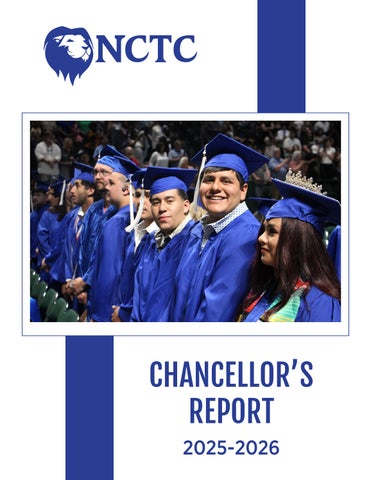
CHANCELLOR’S REPORT 2025-2026
MESSAGE FROM THE CHANCELLOR It is my privilege to present the 2025–2026 Chancellor’s Report for North Central Texas College. This report reflects not only the accomplishments of the past year, but also the unwavering commitment of our faculty, staff, students, alumni, and community partners who work every day to advance the mission of this institution. Together, we continue to strengthen North Central Texas College’s role as a transformative force in higher education, workforce development, and community advancement throughout our service region. As we reflect on the past year, we recognize that higher education continues to evolve rapidly. Community colleges are increasingly called upon to address workforce shortages, provide affordable pathways to economic mobility, support diverse student populations, and respond to the changing needs of employers and communities. North Central Texas College has embraced these challenges as opportunities to innovate, collaborate, and lead. Throughout the 2025–2026 academic year, NCTC remained steadfast in its commitment to student success. Across our campuses and online learning environments, thousands of students pursued their educational goals with determination and resilience. Whether seeking a certificate, workforce credential, associate degree, university transfer pathway, or personal enrichment opportunity, our students remained at the center of every decision we made. Our faculty continued to demonstrate excellence in teaching, mentoring, and innovation. They adapted instructional strategies, integrated emerging technologies, and maintained rigorous academic standards while fostering supportive learning environments that encourage student achievement. Their dedication is reflected in the success of our graduates and the confidence employers place in NCTC alumni. Equally important, our staff members provided critical support services that help students persist and succeed. Through advising, financial aid assistance, tutoring, career services, counseling, and countless other efforts, they created pathways that empower students to overcome obstacles and achieve their goals. The collective commitment of our employees remains one of the institution’s greatest strengths. Workforce development continued to be a defining priority for North Central Texas College during the year. By working closely with employers, economic development organizations, school districts, and industry leaders, we expanded educational opportunities that align with regional workforce needs. New partnerships and enhanced training programs ensured that students gained the knowledge and skills necessary to compete in a rapidly changing economy. Through these efforts, NCTC continued to serve as an essential contributor to the economic vitality of North Texas. The College also strengthened its relationships with K-12 partners throughout the region. Dual-credit and early college opportunities allowed students to begin their college journeys while still in high school, reducing educational costs and accelerating pathways to degree completion. These partnerships not only expand access to higher education but also help cultivate a college-going culture across our communities. 2
Financial stewardship remained a cornerstone of institutional leadership. Throughout the year, we carefully managed resources while making strategic investments in facilities, technology, student services, and workforce initiatives. Our focus on responsible fiscal management enabled us to maintain affordability while continuing to enhance the educational experience for our students. Technology and innovation also played an increasingly important role in advancing our mission. Investments in digital learning tools, cybersecurity, classroom technology, and student support systems expanded access and improved the quality of instruction across all learning modalities. These initiatives positioned NCTC to better serve current students while preparing for future growth and innovation. As we celebrate the accomplishments detailed in this report, we recognize that our success is built upon strong partnerships. We are grateful for the guidance and leadership provided by the Board of Regents, whose commitment to excellence continues to shape the future of the College. We also extend our appreciation to our community partners, donors, legislators, and supporters who share our vision for expanding educational opportunity throughout the region. The achievements highlighted in this report represent more than statistics and milestones. They represent lives changed, opportunities created, careers launched, and communities strengthened. Every graduate who crosses our commencement stage, every student who earns a workforce credential, and every individual who discovers new possibilities through education reflects the profound impact of North Central Texas College. As we look toward the future, we remain committed to building upon our successes while embracing new opportunities for growth and innovation. We will continue to focus on student achievement, workforce alignment, operational excellence, community engagement, and strategic partnerships that support our mission. Together, we will ensure that North Central Texas College remains a trusted educational leader and a catalyst for positive change across North Texas. Thank you for your continued support, leadership, and dedication to North Central Texas College. I am proud of what we have accomplished together and excited about the opportunities that lie ahead. Respectfully submitted,
Dr. G. Brent Wallace Dr. G. Brent Wallace Chancellor North Central Texas College
3
THE YEAR AT A GLANCE
TRANSFORMING LIVES THROUGH EDUCATION
For more than a century, North Central Texas College (NCTC) has served as a cornerstone of educational opportunity, workforce development, and community advancement throughout North Texas. As one of the state's oldest continuously operating community colleges, NCTC provides accessible, affordable, and high-quality educational pathways that prepare students for academic achievement, career success, and lifelong learning. Serving a diverse and growing region, NCTC offers associate degrees, workforce certifications, transfer programs, dual-credit opportunities, continuing education, and customized workforce training designed to meet the evolving needs of students, employers, and communities. Through a commitment to innovation, student success, and community engagement, the College continues to strengthen the economic and social vitality of the region it serves. Today, NCTC educates thousands of students annually across multiple campuses and online learning environments, providing flexible pathways that support traditional students, working adults, first-generation college students, veterans, and lifelong learners. 4
MISSION
NCTC is committed to transforming lives and strengthening our communities through accessible, high-quality education and training.
VISION NCTC envisions a future where students thrive, connections are made and communities benefit from strong educational partnerships with purpose. NCTC will continue to redefine what is possible by connecting people and ideas, while working to build stronger communities for generations to come.
CORE VALUES OPPORTUNITY NCTC creates and expands access to education opportunity and career advancement. COMMUNITY NCTC builds and supports strong regional relationships that uplift people and places. STUDENT EMPOWERMENT NCTC supports learners in achieving their goals with tools, guidance and encouragement. LEARNING NCTC provides structured, guided pathways to help students earn degrees, credentials, transfer opportunities and career success. ENGAGEMENT & ENRICHMENT NCTC fosters belonging and relationships that strengthen the college experience. INNOVATION NCTC embraces new tools, technology and ideas to prepare students for the future. 5
STRATEGIC PLAN OBJECTIVES COMMUNICATION STRATEGY Internal Communication & Coordination NCTC strengthens collaboration across departments & leadership levels. • Open/Click rates on digest emails • Employee feedback survey results • Number of staff referencing org charts or resource documents
Campus-Specific & Geographic Alignment NCTC promotes consistent communication across all locations, including rural and satellite campuses. • Satisfaction surveys by campus • Participation in local events and alerts • Visibility of updated signage and communications
Technology, Tools & Platforms NCTC modernizes communication systems for greater integration, functionality and ease of use. • Site analytics (time-on-site, bounce rate) • Support request resolution time • Usage of centralized communication tools
Leadership Visibility & Transparency NCTC increases meaningful communication between senior leadership and the NCTC community. • Number of updates delivered • Staff awareness from surveys • Participation in leadership sessions or Q&As
Event, Crisis & Facilities Communication NCTC enhances preparedness and responsiveness through clear protocols and reliable updates. • Response time to incidents • Student, staff, and faculty feedback post-incident • Usage of contact flowcharts and/or boards
6
RESOURCE NEEDS Human Resources & Staffing NCTC expands staffing capacity in critical areas and ensures balanced workload distribution. • Staff-to-student ratios • Turnover rates • Workload balance
Technology & Systems NCTC invests in up-to-date, user-friendly platforms that support teaching, learning and operations. • System uptime • Technology support resolution • Training participation
Facilities & Equipment NCTC maintains and enhances learning spaces and infrastructure across all campuses. • Lab usage • Condition reports • Equipment availability
Student Resources & Services NCTC broadens access to advising, wellness, academic support and career development services. • Tutoring/counseling usage • Pantry access • Student surveys
Academic Programs & Faculty Support NCTC provides faculty with the tools, training and flexibility needed to innovate in the classroom. • Course fill rates • Faculty retention rates
STUDENT INVOLVEMENT & EXPERIENCE
BRAND & COMMUNITY Brand & Community Community Engagement and Visibility NCTC builds strong partnerships with local businesses, schools and civic organizations.
Campus Identity & Belonging NCTC cultivates welcoming environments where every student feels a sense of pride and connection. • Connection surveys • Spirit event attendance • Focus group feedback
Student Life & Campus Engagement NCTC expands opportunities for students to connect, lead and participate in campus activities. • Event attendance • Facility usage rates • Food vendor satisfaction
Communication & Access NCTC streamlines communication to reduce confusion and enhance participation in college life. • Number of updates delivered • Email and app usage rates • Club and organization sign-ups • Shuttle/virtual participation rates
Student Support & Infrastructure NCTC coordinates services such as advising, onboarding and mentorship to provide seamless student support. • Engagement ratios • Faculty involvement • Tutoring usage rates
LOOKING AHEAD
• Event/partner participation • Board formation • Tracking and recognition of community engagement hours performed by faculty, staff, and students
Brand Identity and Promotion NCTC refreshes and promotes its image to reflect its values, diversity and innovation. • Merchandise distribution • Event counts • Recognition surveys to community stakeholders
Digital Presence and Communication NCTC enhances its website, social media and digital outreach to connect with broader audiences. • Site stats • Social media engagement • Calendar usage • Website redesign and content refresh
Institutional Alignment and Culture NCTC ensures its internal design is reflective of its external commitments and reinforces a shared sense of purpose. • Comp time adoption • Event attendance • Ambassador program data
As North Central Texas College continues to grow and evolve, its mission remains unchanged: to provide transformational educational opportunities that improve lives, strengthen communities, and contribute to the prosperity of North Texas. Guided by its mission, vision, and strategic priorities, NCTC remains committed to preparing students for success in an increasingly dynamic and competitive world. 7
ALIGNING EDUCATION WITH WORKFORCE DEMAND PREPARING THE WORKFORCE OF TOMORROW ACROSS NORTH TEXAS
One of the most important responsibilities of North Central Texas College is ensuring that educational opportunities align with the workforce needs of the communities we serve. As the North Texas region continues to experience unprecedented growth, employers are seeking highly skilled workers who possess both technical expertise and the adaptability required in a rapidly evolving economy. Through credit programs, workforce certificates, continuing education, customized training, and strategic partnerships, NCTC is helping to build the talent pipeline necessary to support regional economic growth. The College serves a diverse service area that includes Denton, Cooke, and Montague counties and Graham ISD—communities that vary
8
significantly in population, industry concentration, and workforce needs. Despite these differences, all three counties share a common challenge: the growing demand for skilled workers in healthcare, advanced manufacturing, information technology, business, logistics, public safety, and skilled trades. NCTC's workforce strategy is built upon continuous engagement with employers, workforce development boards, economic development organizations, school districts, and community leaders. By monitoring labor market trends and maintaining active industry advisory committees, the College ensures that programs remain responsive to workforce demand and emerging employment opportunities.
REGIONAL GROWTH DRIVING WORKFORCE DEMAND
North Texas remains one of the fastest-growing regions in the nation. The North Central Texas Council of Governments estimates that the region added more than 200,000 residents during 2025 alone, bringing the regional population to nearly nine million residents. This sustained growth continues to increase demand for housing, healthcare services, transportation infrastructure, public safety personnel, educators, and skilled workers across nearly every industry sector. Denton County Denton County continues to be one of the fastest-growing counties in Texas and the nation. The U.S. Census Bureau estimates the county's population exceeded 1.06 million residents in 2025, representing approximately 18 percent growth since 2020. This remarkable growth is creating workforce demand across multiple sectors, particularly healthcare, professional services, logistics, construction, advanced manufacturing, education, and technology. Denton's strong business climate and expanding economic base continue to attract new employers while generating opportunities for existing businesses to expand. Healthcare and social assistance remain among the largest employment sectors, reflecting the growing need for nurses, allied health professionals, medical assistants, and healthcare technicians. In response, NCTC continues to expand healthcare pathways, workforce certifications, transfer programs, and continuing education offerings that support both immediate employment and long-term career advancement.
technologies and automation, workforce requirements are changing. Today's manufacturing environment requires employees who possess technical skills, problem-solving abilities, digital literacy, and specialized industry credentials. Demand continues to grow for industrial maintenance technicians, welders, machinists, production supervisors, logistics specialists, and quality assurance professionals. NCTC's workforce and continuing education programs are designed to address these needs by providing flexible training opportunities, short-term certifications, and academic pathways that prepare students for careers in advanced manufacturing and skilled trades. Montague County While Montague County remains more rural in character, workforce challenges are equally significant. The county's workforce is supported primarily by healthcare, retail, education, agriculture, and small business sectors. Local leaders continue to identify workforce availability, succession planning, and skills development as critical economic development priorities. As many experienced workers approach retirement, employers increasingly seek new talent prepared to enter healthcare occupations, skilled trades, public service careers, and technical professions. Expanding access to workforce training is essential to supporting economic sustainability and helping residents secure high-quality employment opportunities without leaving their communities. Through its Bowie Campus and regional outreach efforts, NCTC provides educational access that supports both workforce readiness and community vitality throughout Montague County.
Cooke County Cooke County's economy is supported by a diverse mix of manufacturing, energy, healthcare, agriculture, and small business activity. Manufacturing remains one of the county's most important employment sectors, with companies engaged in aerospace, machining, plastics, coatings, and industrial production. As employers increasingly adopt advanced 9
WORKFORCE EDUCATION THROUGH CREDIT AND CONTINUING EDUCATION PROGRAMS NCTC recognizes that workforce development requires multiple pathways to meet the needs of students and employers. Some individuals seek traditional degree programs that provide long-term career opportunities, while others require short-term training that allows them to quickly enter the workforce or upgrade existing skills. To address these diverse needs, NCTC offers a comprehensive portfolio of workforce-focused educational opportunities including: Credit Workforce Programs • Nursing and Allied Health • Emergency Medical Services • Information Technology and Cybersecurity • Business and Management • Criminal Justice • Industrial Technology • Advanced Manufacturing • Logistics and Supply Chain Management These programs provide students with industry-relevant knowledge while creating clear pathways toward certificates, associate degrees, university transfer, and career advancement. Continuing Education and Workforce Training NCTC's Continuing Education division plays a critical role in meeting immediate workforce needs by providing: • Industry certifications • Healthcare credentials • Commercial Driver's License training • Skilled trades instruction • Professional development programs • Leadership training • Customized employer training • Small business support services These flexible training opportunities enable workers to rapidly acquire skills that are directly aligned with employer demand while helping businesses remain competitive in an evolving economy. 10
Building a Regional Talent Pipeline A key component of NCTC's workforce strategy is collaboration. Through partnerships with local employers, Workforce Solutions, chambers of commerce, school districts, economic development organizations, and the North Central Texas Small Business Development Center, the College helps strengthen the region's talent pipeline and support economic growth. The North Central Texas Small Business Development Center, headquartered at NCTC, serves businesses across Denton, Cooke, and Montague counties and contributes to job creation, entrepreneurship, and business expansion throughout the region. Looking ahead, workforce demand is expected to remain strong as population growth, business investment, technological innovation, and infrastructure development continue across North Texas. NCTC remains committed to ensuring that educational programs evolve alongside employer needs, creating opportunities for students while supporting the long-term prosperity of the communities we serve. By aligning academic programs, workforce certifications, and continuing education with regional labor market demand, North Central Texas College is helping to build a stronger workforce, a stronger economy, and a stronger future for North Texas.
11
NAVIGATING CHANGE: NCTC & TEXAS’ NEW COMMUNITY COLLEGE FUNDING MODEL OPPORTUNITIES, CHALLENGES, AND THE PATH FORWARD
The 2025–2026 academic year marked a period of significant transition for community colleges across Texas as institutions continued adapting to the state's new outcomes-based funding model established through House Bill 8 and subsequently refined through additional legislative action. This historic transformation fundamentally changed how community colleges are funded, shifting from a model largely based on student enrollment and instructional contact hours to one focused on measurable student outcomes, workforce credentials, transfers, and dual-credit success. The intent of the new model is clear and commendable: align public investment with student success and workforce outcomes while supporting the state's long-term economic development goals. Colleges now earn state funding based on outcomes such as credentials awarded, credentials in high-demand fields, successful transfers to universities, and dual-credit students completing meaningful college coursework while still in high school. While North Central Texas College strongly supports the goal of improving student outcomes and workforce readiness, the transition has created both opportunities and challenges, particularly for rural and regional community colleges serving geographically diverse populations.
12
A Different Way of Measuring Success Under the previous funding system, colleges received much of their state support based on student enrollment and instructional activity. The new model rewards outcomes that occur months or even years after students begin their educational journey. Degrees, certificates, workforce credentials, transfers, and dual-credit milestones now play a much larger role in determining institutional funding. For NCTC, this shift aligns with many of the College's long-standing priorities. Student completion, workforce preparation, transfer success, and employer engagement have been central to the institution's mission for decades. However, the model also introduces new financial pressures that require careful planning and resource allocation. Community colleges often invest substantial resources in recruiting, advising, tutoring, mentoring, and supporting students long before measurable outcomes are achieved. Because funding is increasingly tied to those final outcomes, institutions must absorb many of the upfront costs associated with student success while waiting for the corresponding state funding to materialize.
Challenges Facing Rural and Regional Colleges NCTC serves a unique service area that includes both rapidly growing communities and rural regions across North Texas. The College operates campuses in Gainesville, Corinth, Flower Mound, Denton, Bowie, and Graham while serving students across Cooke, Denton, Montague, and surrounding counties. Unlike some urban institutions that benefit from large populations concentrated within a single metropolitan area, NCTC must provide educational access across hundreds of square miles. This requires maintaining facilities, technology infrastructure, student services, workforce programs, and instructional offerings in multiple communities regardless
of enrollment fluctuations. The new funding model does not always fully recognize the realities associated with serving geographically dispersed populations. Rural-serving colleges frequently face higher operational costs per student while maintaining programs that are essential to local workforce needs but may enroll smaller cohorts than programs offered in major metropolitan areas. Additionally, many NCTC students balance employment, family responsibilities, and financial challenges while attending college part-time. These students often require longer periods to complete credentials, which can delay the outcomes that generate funding under the new model.
13
Workforce Education and Funding Alignment One of the most significant benefits of the new funding model is its emphasis on workforce credentials and high-demand occupations. Texas has intentionally designed the system to encourage colleges to produce graduates in fields that address critical labor shortages and support economic growth.
Dual Credit and Growing Expectations The new funding model also places significant emphasis on dual-credit education, rewarding colleges when high school students successfully complete meaningful college coursework. Dual-credit participation has expanded dramatically across Texas and throughout NCTC's service area.
This focus aligns closely with NCTC's mission and regional workforce needs. The College has invested heavily in programs supporting healthcare, advanced manufacturing, industrial technology, public safety, information technology, logistics, and skilled trades. These programs directly support employers throughout Cooke, Denton, and Montague counties and Graham ISD, while creating pathways to family-sustaining careers for students.
NCTC has long been a leader in providing dual-credit opportunities through partnerships with school districts across North Texas. While these programs support college access and affordability, they also require extensive coordination, faculty oversight, curriculum alignment, and student support services.
However, workforce programs often require significant investments in specialized equipment, laboratory space, simulation technology, industry certifications, and highly qualified faculty. Maintaining program quality while responding to rapidly changing workforce demands presents ongoing financial challenges. In many cases, colleges must make substantial investments before workforce outcomes are realized. This creates a timing gap between expenditures and the funding generated through student completion and credential attainment.
14
As participation continues to grow, colleges must balance increasing expectations with the operational resources necessary to sustain high-quality academic experiences for dual-credit students.
LOOKING AHEAD Despite the challenges associated with the transition, NCTC remains committed to the principles underlying the new funding model. The College believes that student success, workforce readiness, credential attainment, and transfer achievement are worthy measures of institutional performance. At the same time, continued dialogue with state leaders will be essential to ensure that the funding system recognizes the unique role community colleges play in serving diverse populations and regions. Rural service areas, workforce program costs, multi-campus operations, and the realities facing part-time and nontraditional students must remain part of the conversation as the model evolves. North Central Texas College will continue to adapt, innovate, and invest in student success while maintaining its commitment to educational access, workforce development, and community impact. Through strategic planning, strong partnerships, and responsible stewardship of resources, NCTC is positioned to navigate these changes while continuing to fulfill its mission of transforming lives through education. The transition to outcomes-based funding represents one of the most significant changes in Texas community college history. While challenges remain, NCTC is committed to ensuring that the College not only adapts to the new environment but thrives within it, continuing to serve students, employers, and communities throughout North Texas for generations to come.
15
CLARK HALL: EXPANDING STUDENT OPPORTUNITY THROUGH RESIDENTIAL LIFE One of the most significant milestones for North Central Texas College during the 2025–2026 academic year was the continued development and opening of Clark Hall, a transformative addition to the College’s residential and student life infrastructure. More than simply a residence hall, Clark Hall represents NCTC’s commitment to creating a comprehensive college experience that supports student success both inside and outside the classroom.
16
Research consistently demonstrates that students who live on campus are more likely to engage in campus activities, build meaningful relationships with peers and faculty, utilize academic support services, and persist toward degree completion. Clark Hall was designed with these outcomes in mind, providing spaces that encourage collaboration, study, leadership development, and student interaction.
As enrollment continues to grow and students increasingly seek educational opportunities that combine academic excellence with a vibrant campus experience, the need for additional student housing became a strategic priority. Clark Hall was developed to address this need while enhancing NCTC’s ability to attract, retain, and support students from across Texas and beyond.
The new residence hall also supports NCTC’s broader strategic goals related to student success and enrollment growth. By expanding housing options, the College is better positioned to serve students from rural communities throughout the service area as well as those who may not otherwise have access to higher education opportunities. For many students, on-campus housing removes transportation barriers and creates an environment that supports both academic focus and personal development.
The addition of Clark Hall expands residential capacity and provides students with a modern, safe, and welcoming living environment designed to foster academic achievement, personal growth, and community engagement. The facility offers students convenient access to classrooms, campus resources, student activities, and support services, helping to create a stronger sense of connection and belonging within the college community.
In addition to enhancing the student experience, Clark Hall contributes to the long-term vitality of the Gainesville Campus by creating a more dynamic residential community. The facility serves as a catalyst for increased student engagement, expanded campus programming, and greater participation in extracurricular and leadership opportunities. These experiences play an important role in preparing students for success in their future careers and communities.
The development of Clark Hall reflects the College’s commitment to strategic investment and responsible stewardship of resources. Through thoughtful planning and collaboration, NCTC has created a facility that will serve generations of students while supporting the institution’s mission of providing accessible, high-quality educational opportunities. As North Central Texas College continues to grow and evolve, Clark Hall stands as a visible symbol of the institution’s dedication to student success, campus life, and the future of higher education in North Texas. The facility represents more than additional housing capacity—it represents an investment in students, an investment in community, and an investment in the continued growth and excellence of North Central Texas College.
17
NCTC AND SAFRAN SEATS LAUNCH MACHINING AND WELDING BOOTCAMPS North Central Texas College (NCTC), in partnership with Safran Seats, welcomed three Safran employees to campus on June 1, 2026, to begin an intensive summer training program focused on advancing technical skills in machining and welding. These employees represent the inaugural cohort in a new workforce development collaboration designed to strengthen the region’s manufacturing talent pipeline. The training initiative was developed through a collaborative effort between NCTC’s Continuing Education and Industrial Technology departments and Safran Seats, a leading aircraft seating manufacturer. The program provides participants with both foundational and advanced instruction in machining and welding, combining classroom learning with hands-on technical training. Coursework includes equipment operation, blueprint interpretation, technical mathematics, and other competencies identified as critical workforce needs within the advanced manufacturing sector. Under the leadership of Sara Flusche, Dean of Instruction for Continuing Education and eLearning, and Darrell Smith, Dean of Instruction for Career and Technical Education – Industrial Technology, NCTC worked closely with Safran Seats to develop customized training pathways aligned with industry demands. The summer bootcamps are designed not only to enhance immediate workplace skills but also to provide participants with opportunities for continued professional development through additional coursework scheduled for Fall 2026 and Spring 2027. “These trainings provide participants with valuable technical skills that support both educational achievement and career advancement,” said Sara Flusche, Dean of Instruction for Continuing Education and eLearning at NCTC. “Investing in workforce training is essential to meeting the demands of today’s industries and preparing individuals for long-term success. NCTC remains committed to developing responsive training solutions that serve businesses and industry partners of all sizes throughout our service region.” This partnership demonstrates NCTC’s ongoing commitment to workforce excellence, regional economic development, and the creation of educational opportunities that directly address employer needs. By working alongside industry partners such as Safran Seats, the College continues to strengthen workforce pipelines and ensure that North Texas employers have access to a highly skilled and competitive workforce. 18
MUENSTER VFW POST 6205 AUXILIARY VISITS THE MOHHCP MUSEUM AT NCTC The Medal of Honor Host City Program Museum recently welcomed members of the Muenster VFW Post 6205 Auxiliary for a tour and luncheon, creating an opportunity to honor the service and sacrifice of America’s heroes while fostering community connection and remembrance. During their visit, guests explored the museum’s exhibits and learned more about the courageous stories and enduring legacy of Medal of Honor recipients. The private tour provided a meaningful experience centered on patriotism, service, and the preservation of military history. The Medal of Honor Host City Program Museum continues to serve as a place of education, reflection, and inspiration for visitors of all ages, honoring the values of courage, sacrifice, and service that define Medal of Honor recipients.
19
NCTC DEDICATES NURSING SIMULATION CENTER TO ESPINOZA NCTC celebrated the opening of its new Licensed Vocational Nurse (LVN) to Associate Degree Nursing (ADN) transition program and officially dedicated the Enoc Espinoza LVN-ADN Simulation Center at the Graham campus Health Science Center. The state-of-the-art simulation lab features hospital-grade equipment, cameras, and observation technology that allows students to gain hands-on clinical experience in a realistic healthcare environment while receiving immediate instructor feedback. The naming of the simulation center honors Enoc Espinoza for his lifelong commitment to nursing, leadership, and service to the Graham community. Community leaders, faculty, and healthcare partners recognized Espinoza as an inspiring role model whose dedication reflects the compassion, excellence, and commitment NCTC strives to instill in future generations of nurses. The celebration also highlighted NCTC’s continued investment in nursing education. The first cohort of students is currently enrolled in the LVN-to-RN transition program, which was created in response to strong community demand. Looking ahead, NCTC announced plans to launch its first Bachelor of Science in Nursing (BSN) program in Fall 2027, providing Graham-area nursing graduates with a local pathway to advance their education and careers while strengthening healthcare throughout the region.
20
NCTC WELCOMES HOME 2001 NJCAA NATIONAL CHAMPIONSHIP BASEBALL TEAM North Central Texas College (NCTC) proudly welcomed back its 2001 NJCAA National Championship Lions Baseball Team during a special recognition ceremony held Saturday, March 28. The championship team was honored ahead of the afternoon games against Grayson College, bringing together former players, coaches, and fans to celebrate one of the most significant achievements in the college’s athletic history. Members of the 2001 team were recognized on the field, where they were greeted with applause and appreciation from the crowd. The reunion served as both a celebration of past success and a reminder of the tradition of excellence that continues to define NCTC athletics today.
21
CAPUCHINA REPRESENTS NCTC AT CRLA 58TH ANNUAL CONFERENCE IN SAN FRANCISCO Cheryl Capuchina, Tutoring Services Coordinator at North Central Texas College (NCTC) and a dedicated volunteer with the College Reading and Learning Association (CRLA), recently attended CRLA’s 58th Annual Conference, held November 12–15, 2025, in San Francisco, California. The conference brought together tutoring and learning support professionals to share best practices, strengthen collaboration, and address emerging challenges in the field. At the conference, Capuchina co-hosted a pre-conference session, “CRLA ITTPC Tutor Training Requirements,” highlighting best practices for tutor training programs. She also serves as ITTPC Assistant Coordinator, helping review tutor training programs for International Tutor Training Program Certification (ITTPC). In addition, Capuchina chairs the search committee for the 2025 Rick Sheets Outstanding Tutor of the Year Award, contributing to the selection of an outstanding student tutor who exemplifies the values of the ITTPC.
NCTC WELCOMES
COMMISSIONER DR. WYNN ROSSER TO CORINTH CAMPUS North Central Texas College (NCTC) recently welcomed Dr. Wynn Rosser, Commissioner of the Texas Higher Education Coordinating Board, to its Corinth Campus. During his visit, Dr. Rosser toured campus facilities, observed classroom activities, and connected with students, faculty, and staff. The visit highlighted NCTC’s dedication to student success and the meaningful work happening across its programs. College leadership expressed their appreciation for Dr. Rosser’s time and ongoing support of higher education initiatives throughout Texas. The visit also highlights the ongoing collaboration between NCTC and the Texas Higher Education Coordinating Board in advancing educational opportunities and ensuring that students have access to high-quality programs and resources. NCTC extends its gratitude to Dr. Rosser for his insights, engagement, and support of higher education in the state. 22
ALUMNI SPOTLIGHT
LEXI BROYLES EDUCATION GRADUATE
Lexi began her college journey at North Central Texas College through Gainesville ISD’s dual credit program, earning an Associate of Arts degree with a focus in education. Drawn to NCTC for its convenience and supportive learning environment, she credits faculty members like Mrs. Swarner with helping shape her future by introducing her to the Honors Program and encouraging her involvement in research. Those experiences strengthened her communication, research, and leadership skills while building the confidence she carried into her future education and career. After graduating from NCTC, she earned both a Bachelor of Science and a Master of Arts in Applied Behavior Analysis from the University of North Texas. Today, she serves as a Clinical Director for Action Behavior Centers, leading a team that provides evidence-based therapy to children with autism. She credits NCTC with providing the strong academic foundation that prepared her for advanced education and a rewarding career. Her advice to current students is to take advantage of every opportunity, seek mentorship, and build meaningful connections. To her, being an NCTC alum represents opportunity, perseverance, and the power of accessible education.
23