

INVESTMENT OUTLOOK



OPTIMISM REIGNS IN THE EQUITY MARKET
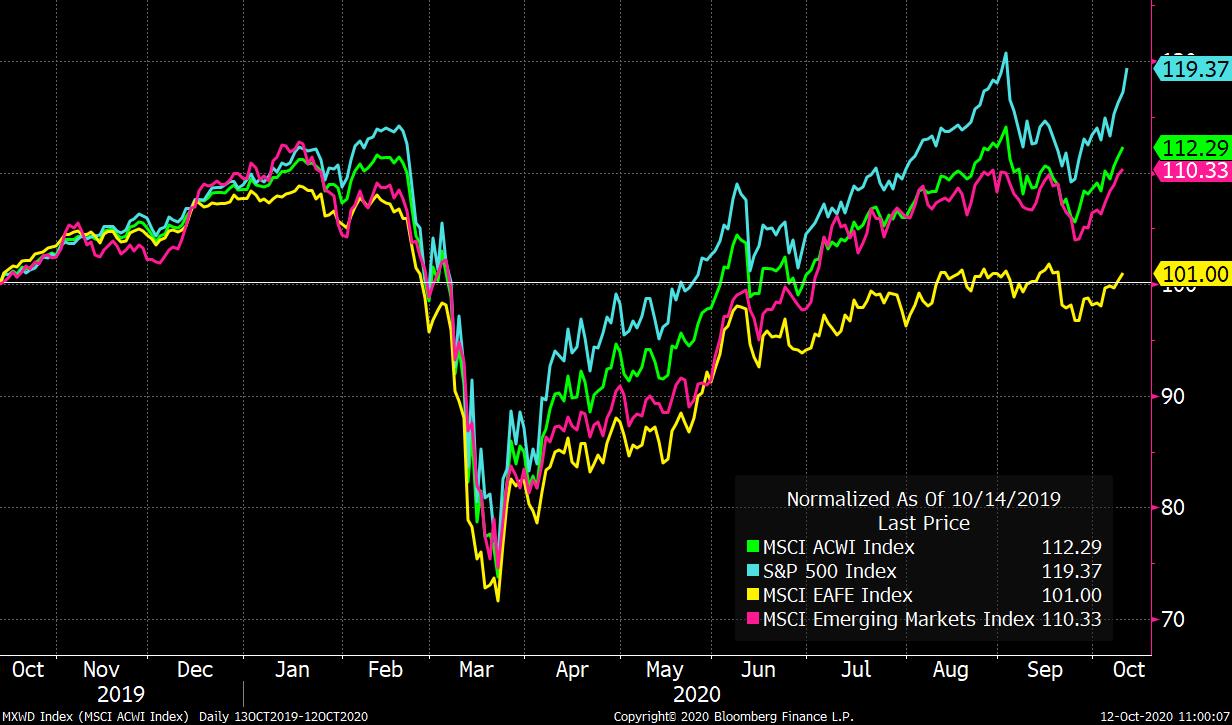
Equities rallied in the third quarter as investors remained optimistic that a COVID-19 vaccine will be approved in the first half of 2021, and dramatic U.S. Federal Reserve stimulus brought interest rates to historic lows. The MSCI All Country World Index, a measure of the global stock market, rose 8.25% during the quarter and has returned 1.77% year-to-date through September. The Russell 3000, which measures the broad U.S. stock market, was up 9.21% in the quarter and is up 5.41% year-to-date. Despite the decent results of these large-cap heavy indexes, there has been significant dispersion of performance across regions and sectors, with international, value, and small cap stocks all underperforming significantly this year.
government in some form, with significant policy changes unlikely during the next two-year government cycle. In recent weeks there have been minor moves downward in some sectors viewed as having worse prospects in a Democratic-controlled government (defense and health insurance companies, for example), but these moves have been mild.
Investors still see divided government and continued gridlock as the most likely election outcome. Recent moves in options markets indicate the potential for increased volatility during the weeks after the election on November 3rd, as investors weigh the possibility that results may be disputed in the courts. Most investors
view this as a relatively minor issue, however, and secondary to the main question of who will take power in late January 2021.
The election will be interesting to watch, but the main issue impacting the financial markets today remains the COVID-19 health crisis.
Investors are spending most of their time attempting to answer COVID-19 -related questions, the first and most important of which is how long the health crisis will last. The general consensus today among investors is that a vaccine is likely to be available in the first half of 2021, with a rampup of immunizations occurring through the second half of the year.
Equity Returns Last 12 months (normalized)
First, a word on the upcoming elections in the U.S. Most investors have viewed the election this year with a shrug, assuming that the most likely outcome is divided
Source: Bloomberg
The outcome of vaccine trials is obviously uncertain and risks remain, but optimism here explains much of the market’s rebound from last March. Markets are likely to move in the coming months as this expectation is realized (or not).
A second issue for investors is the level of further government support and how this will impact the economic recovery in the longer term. Fiscal stimulus enacted in the second quarter was meaningful, but negotiations have stalled on the next round of aid. Investors are forecasting that more fiscal stimulus will be enacted once the election is over, though the size and timing of the package is in doubt. Given the deep shock to the economy this year, investors will see a large package as positive for stocks.
The Federal Reserve (Fed) has already answered questions regarding monetary stimulus in the U.S. during
the health crisis – it will be massive and overwhelming. The Fed took dramatic action in March when the risks of the health crisis became obvious, promising significant monetary stimulus (and other actions designed to ensure the orderly functioning of markets) that will last for years. Questions regarding government support involve fiscal stimulus, not monetary stimulus.
In addition to the longevity of the health crisis, investors are also grappling with potential long-term changes to consumer habits once the health crisis ends. The technology and consumer staples sectors are commonly viewed as potential long-term winners from new consumer habits, with financial, energy, and small cap stocks seen as laggards. These beliefs are already included in asset prices and moves from here will be driven by deviations from these commonly held expectations.
FIXED INCOME: FED DOMINATES AS YIELD CURVE STEEPENS SLIGHTLY
The U.S. Treasury yield curve steepened during the third quarter, with short-term Treasury yields falling a few basis points and long-term yields up slightly. Even with this slight steepening, Treasury yields are little changed since late March when tensions in the financial markets caused by the onset of the COVID-19 health crisis were still very high. This stability is due largely to the impact of the Federal Reserve, which remains a
dominant factor in the bond markets.
The Fed has continued to purchase U.S. Treasuries, agency mortgagebacked securities (MBS), and corporate bonds, resulting in low and stable yields across the investment-grade bond market. Fed policymakers are promising further monetary stimulus to boost the economy through the duration of the health crisis.
As evidence of bond investors’ belief in the credibility of Federal Reserve policymakers’ promises, longer-term Treasury yields were little changed in the third quarter despite inflation expectations rising considerably. However inflation expectations fluctuate, most bond investors believe the Fed will continue to work to keep Treasury yields low across the curve (there is even discussion by policymakers of “yield curve control” as has been im-
plemented in Japan, in which long-term government bond yields are explicitly targeted by the central bank).
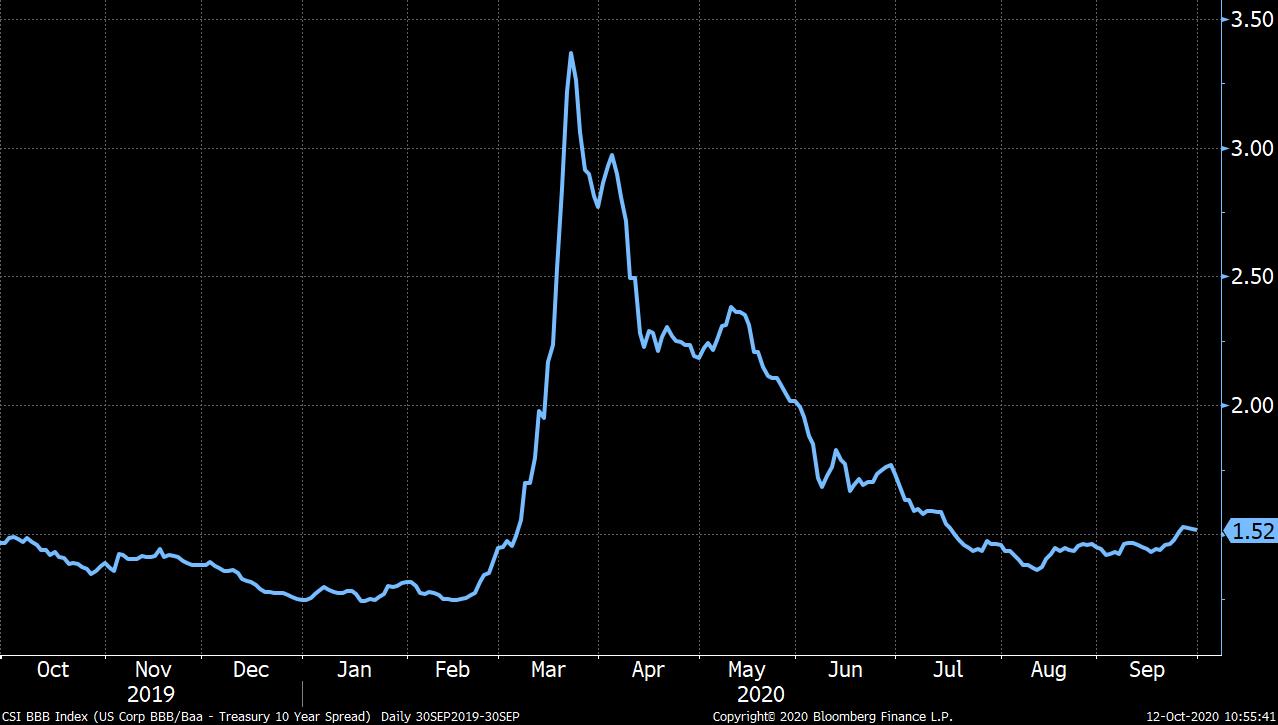
Corporate bond spreads tightened early in the third quarter, continuing the decline of the second quarter, before ticking up in September. The significant decline in credit spreads after the panic-driven days of March was largely a result of forceful Fed action to calm the financial markets, and increasing belief that the health crisis would not be as severe as originally feared. It should be noted, however, that the pickup in corporate spreads in September was concurrent with an increase of COVID-19 infection rates around the world. It’s clear that the health crisis will remain an important factor in the bond markets despite policymakers’ best efforts.
Lower interest rates this year have impacted agency mortgage-backed security prepayment speeds and have led to higher MBS option-adjusted spreads over Treasury yields. MBS with 2018 and 2019 collateral have been especially impacted, as borrowers of these recently issued mortgages have seen heightened prepayment incentives. Earlier issued “vintage” MBS have experienced slower increases in prepayment speeds this year and, hence, have outper-
formed the broader MBS market. With interest rates remaining low in the third quarter, however, even vintage MBS have seen higher prepayment speeds recently. Looking through the coupon stack of the MBS market, prepayment speeds have recently slowed in higher coupon (3.5% – 4.5%) MBS, while picking up in lower coupons (2.5% - 3.0%). Prepayment speeds have not yet risen much in 2.0% coupons, though this is likely to change soon if interest rates remain at current levels.
Our intermediate duration bond portfolios have seen performance numbers close to that of the Bloomberg Barclays U.S. MBS Index this year, as the benefit of an underweight position to Ginnie Mae securities was largely offset by an overweight to more recently issued
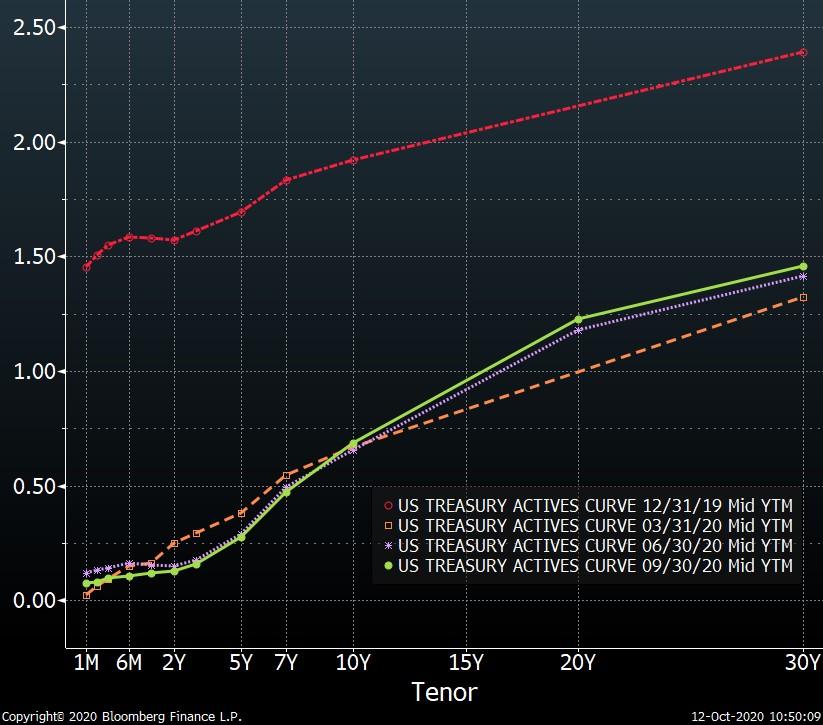
U.S. Treasury Yield Curve
Source: Bloomberg
MBS. As the fourth quarter begins, our intermediate duration portfolios are positioned with a tilt to higher coupon MBS and an underweight to Ginnie Maes, which continue to be impacted by forbearance requests. Our short duration bond portfolios have outperformed shortterm Treasury indexes this year, as their yield advantage and higher durations earlier in the year overcame the drag of increased option-adjusted spreads in the MBS market.
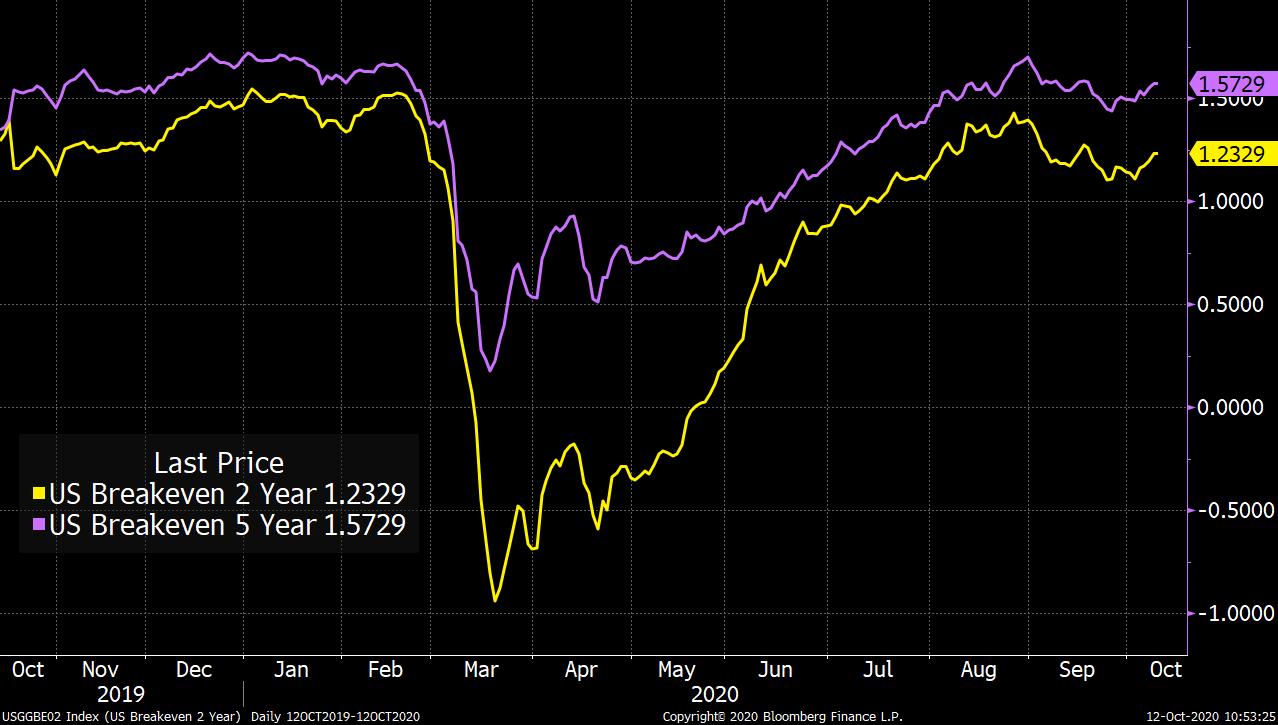
U.S. Inflation Breakeven Rates
Bloomberg Barclays BBB Corporate Option-Adjusted Spread
Agency MBS have underperformed similar duration Treasury and corporate bond indexes this year, but MBS are attractive compared to these fixed income alternatives as the fourth quarter begins. Agency MBS yields today are significantly higher than similar duration U.S. Treasury yields, and agency MBS don’t face the credit risk of the corporate bond market. Our bond portfolios are positioned conservatively in terms of credit exposure, with an underweight position to corporate bonds and an emphasis on high credit ratings and shorter maturities. Our plan is to maintain this posture in the
Source: Bloomberg
Source: Bloomberg
coming weeks barring a significant change in credit spreads. We see increasing risk in the credit markets in the fourth quarter as the health crisis – and its impact on the economy – rolls on.
BrandonFitzpatrick,CFA

THIS PUBLICATION IS FOR INFORMATIONAL PURPOSES ONLY. THIS PUBLICATION IS IN NO WAY A SOLICITATION OR OFFER TO SELL SECURITIES OR INVESTMENT ADVISORY SERVICES, EXCEPT WHERE APPLICABLE, IN STATES WHERE DB FITZPATRICK IS REGISTERED OR WHERE AN EXEMPTION OR EXCLUSION FROM SUCH REGISTRATION EXISTS.
INFORMATION THROUGHOUT THIS PUBLICATION, WHETHER STOCK QUOTES, CHARTS, ARTICLES, OR ANY OTHER STATEMENT OR STATEMENTS REGARDING MARKET OR OTHER FINANCIAL INFORMATION, IS OBTAINED FROM SOURCES WHICH WE AND OUR SUPPLIERS BELIEVE RELIABLE, BUT WE DO NOT WARRANT OR GUARANTEE THE TIMELINESS OR ACCURACY OF THIS INFORMATION. BLOOMBERG FINANCE L.P. IS THE SOURCE UTILIZED FOR GRAPHS THROUGHOUT THIS PUBLICATION. THE GRAPHS ARE USED WITH PERMISSION OF BLOOMBERG FINANCE L.P. NEITHER WE NOR OUR INFORMATION PROVIDERS SHALL BE LIABLE FOR ANY ERRORS OR INACCURACIES, REGARDLESS OF CAUSE, OR THE LACK OF TIMELINESS OF, OR FOR ANY DELAY OR INTERRUPTION IN THE TRANSMISSION THEREOF TO THE USER. THERE ARE NO WARRANTIES, EXPRESSED OR IMPLIED, AS TO ACCURACY, COMPLETENESS, OR RESULTS OBTAINED FROM ANY INFORMATION CONTAINED IN THIS PUBLICATION.
NOTHING IN THIS PUBLICATION SHOULD BE INTERPRETED TO STATE OR IMPLY THAT PAST RESULTS ARE AN INDICATION OF FUTURE PERFORMANCE.