

INVESTMENT OUTLOOK



FED’S DOVISH EMBRACE LARGELY PRICED IN
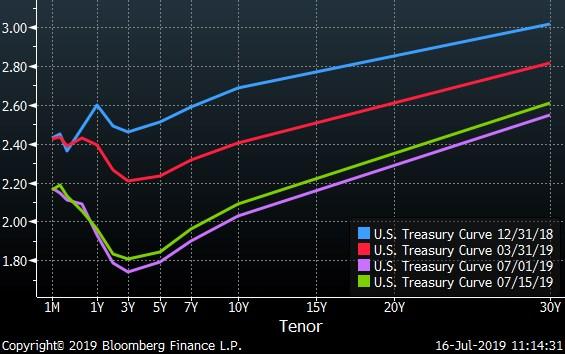
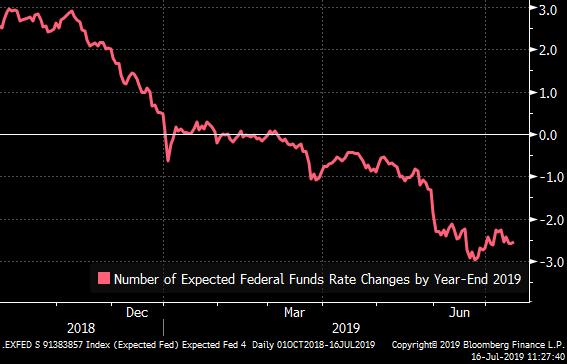
The combination of tight monetary policy and an increased probability of a prolonged trade war has resulted in materially lower interest rates this year. The term structure of interest rates has inverted, with the Federal Reserve (Fed) anchoring shortterm rates, and long-term rates declining due to a weakening global economy. The inverted yield curve provides strong evidence that current monetary policy is too tight, resulting in slower economic growth and falling inflation expectations. As a consequence of the increased probability of a recession, investors have priced in three Fed rate cuts for 2019. Furthermore, the market implies a 100% probability that the Fed will cut the fed funds rate by at least 25 basis points at its July meeting.
Policymakers have been reluctant to cut rates so far this year because unemployment remains below the natural rate, and they have generally viewed the recent decline in inflation as transitory. Fed leaders moved
closer to implementing rate cuts at their latest meeting, however, by removing the reference to being ‘patient’ (regarding expectations that low inflation would rise) from their statement and downgrading their
Source: Bloomberg Source: Bloomberg
inflation forecast. Most investors viewed this as an acknowledgment of the inevitable.
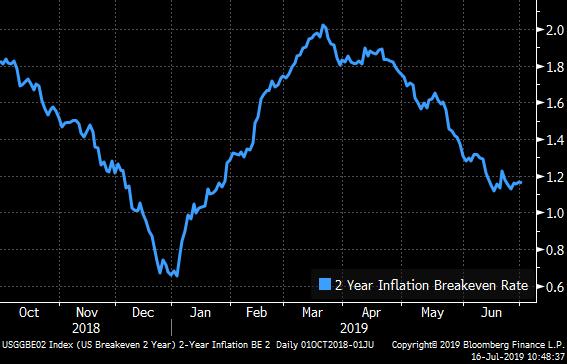
Inflation breakeven rates are often a harbinger of Fed moves, and the recent decline in the 2-year inflation
Source: Bloomberg
breakeven rate also supports a dovish Fed. If the Fed were to ignore the market at its July meeting and forego cutting rates (not something we expect), investors would very likely view this a policy mistake, resulting in higher market volatility and wider credit spreads.
In addition to slower growth and inflation, uncertainty in the trade war with China is another factor weighing on Fed policymakers. This conflict has already drawn out beyond what most investors expected, and there is an increased probability that China might seek to prolong talks throughout 2020 (hoping that President Trump is not reelected). Given the political incentives for President Trump facing reelection, we still believe it likely that a deal will ultimately be reached in the coming months. If a deal is not reached and tensions escalate,
however, there will be a heightened probability of a recession occurring next year.
Despite the risks previously described, we believe the fall in interest rates (nearly 125 basis points in the 10-year Treasury yield since last November) is overdone and have recently decreased duration in our fixed income portfolios. Investors have already priced in three Fed rate cuts for 2019, quite a change from early Q4’2018 when investors were pricing in a hawkish Fed and three rate hikes in 2019. Announcement of a trade deal between the U.S. and China could also be a catalyst for higher interest rates. With a slowing global economy and increased dovishness at the Fed largely priced in, we favor mortgage-backed securities over corporates, where spreads are near twelve month lows.
EQUITIES: DEFENSIVE TACK AS BULL MARKET AGES
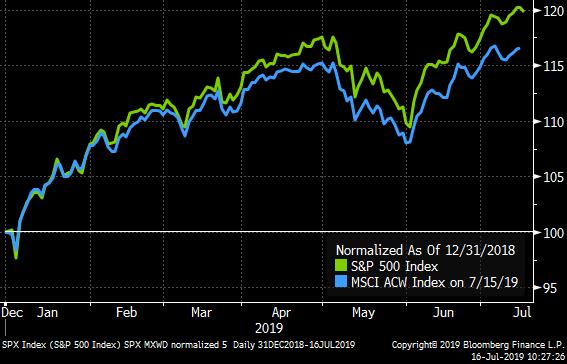
The second quarter saw a continuation of the bull market for equities, as expectations for loosened monetary policy overcame worries regarding trade tensions between the U.S. and China. The S&P 500 gained 4.3% during the quarter, while the MSCI All Country World Index gained 3.8%. Year-to-date through June the S&P 500 was up 18.5% and the MSCI All Country World Index rose 16.6%, representing a very strong start to the year.
All major sectors of the equity market are up this year. Technology stocks have been the best performing sector, with the Dow Jones U.S. Technology Index up 24.3% through the end of the second quarter. The industrial and consumer discretionary sectors have also been
good performers, with the Dow Jones U.S. Industrial Sector Index and the Consumer Discretionary Sector Index returning 24.0% and 21.2%, respectively. Relative underperforming sectors include energy (the Dow Jones U.S. Energy Sector returned 12.1%) and utilities (the Dow Jones U.S. Utilities Sector Index was up 14.0%).
The expectation of significantly loosened monetary policy in the U.S. has provided much of the fuel for the stock market in recent weeks and months. Investors today see a cut to the fed funds rate in late July as a fait
accompli, and a good likelihood of two more cuts by year-end. If in coming months policymakers show any reticence toward embracing the dovish path that investors expect, the equity market is likely to see turbulence.
The ongoing posturing among trade discussions between the U.S. and China has largely been viewed by equity investors with a shrug, though the stock market has been affected in the short-term by news indicating possible breakthroughs in negotiations (pushing equities higher) or setbacks
(with stocks falling). The consensus view today among investors is that a deal will ultimately be agreed to in the coming months. The principal basis of this conclusion is the perceived political calculus of President Trump, who would obviously prefer a growing economy and strong equity market as the November 2020 election draws closer. A trade war in 2020 would make the path to reelection much more perilous. We hold with the optimism of the consensus in this case.
Given our view that the Fed’s dovish pivot is largely priced into the financial markets, we have positioned our equity portfolios more defensively, reducing exposure to industrial and other cyclical sectors, while increasing exposure to consumer staples and healthcare companies. These moves may allow us the chance to rebalance back into more cyclical areas of the equity market should stocks tumble in the short term. With investors having moved quite far in their hopes for dovish monetary policy in the U.S. this year, and the S&P trading at 17.8x expected full-year 2019 earnings, it would not be surprising to see such an opportunity present itself sometime soon.
Justin Packard and Brandon Fitzpatrick

THIS PUBLICATION IS FOR INFORMATIONAL PURPOSES ONLY. THIS PUBLICATION IS IN NO WAY A SOLICITATION OR OFFER TO SELL SECURITIES OR INVESTMENT ADVISORY SERVICES, EXCEPT WHERE APPLICABLE, IN STATES WHERE DB FITZPATRICK IS REGISTERED OR WHERE AN EXEMPTION OR EXCLUSION FROM SUCH REGISTRATION EXISTS.
INFORMATION THROUGHOUT THIS PUBLICATION, WHETHER STOCK QUOTES, CHARTS, ARTICLES, OR ANY OTHER STATEMENT OR STATEMENTS REGARDING MARKET OR OTHER FINANCIAL INFORMATION, IS OBTAINED FROM SOURCES WHICH WE AND OUR SUPPLIERS BELIEVE RELIABLE, BUT WE DO NOT WARRANT OR GUARANTEE THE TIMELINESS OR ACCURACY OF THIS INFORMATION. BLOOMBERG FINANCE L.P. IS THE SOURCE UTILIZED FOR GRAPHS THROUGHOUT THIS PUBLICATION. THE GRAPHS ARE USED WITH PERMISSION OF BLOOMBERG FINANCE L.P. NEITHER WE NOR OUR INFORMATION PROVIDERS SHALL BE LIABLE FOR ANY ERRORS OR INACCURACIES, REGARDLESS OF CAUSE, OR THE LACK OF TIMELINESS OF, OR FOR ANY DELAY OR INTERRUPTION IN THE TRANSMISSION THEREOF TO THE USER. THERE ARE NO WARRANTIES, EXPRESSED OR IMPLIED, AS TO ACCURACY, COMPLETENESS, OR RESULTS OBTAINED FROM ANY INFORMATION CONTAINED IN THIS PUBLICATION.
NOTHING IN THIS PUBLICATION SHOULD BE INTERPRETED TO STATE OR IMPLY THAT PAST RESULTS ARE AN INDICATION OF FUTURE PERFORMANCE.