
INVESTMENT OUTLOOK



EQUITIES: “PANDEMIC TRADE” LOOKS A BIT TIRED
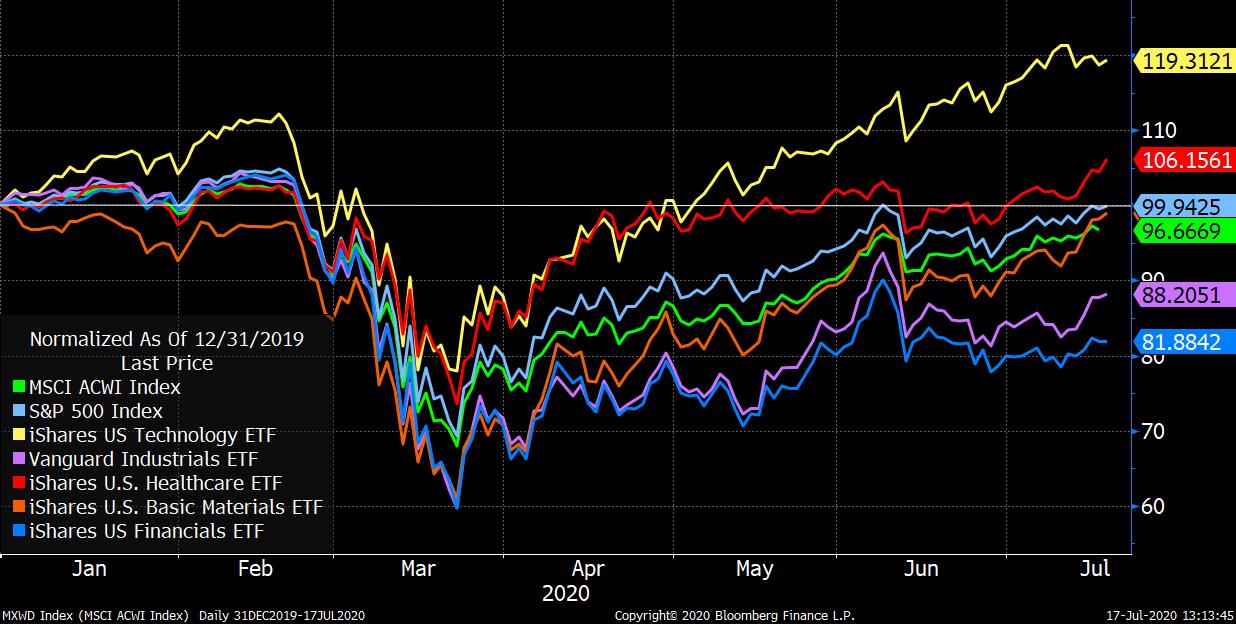
It’s been a volatile time for stocks so far this year, with the market down sharply in February and most of March before rallying in the second quarter. The MSCI All Country World Index, a measure of the global stock market, is down roughly 3.0% year-to-date through mid-July, a relatively modest loss given the dire mood of the markets in the first quarter.
The source of this volatility, of course, is the COVID-19 health crisis. Investors were very wary of the economic implications of COVID19 in March and there remains great uncertainty regarding the longevity of the crisis, the potential for further
stay-at-home orders in some parts of the country, and changing consumer habits during the short and long term. In spite of this uncertainty, investors have taken heart from the immense stimulus measures undertaken in the U.S. and Europe. Most notably, the U.S. Federal Reserve has implemented broad and farreaching measures designed to ease the extreme tension the fixed income and equity markets experienced in mid-March. The path of the virus is unknown but investors feel good about one thing: policymakers at the Federal Reserve understand the seriousness of the issue and it’s very likely they will follow through with necessary stimulus.
Equity Returns Year-to-Date
This has been a big part of the equity market’s recent recovery.
Monetary policy can’t stop a disease, however, with the crisis set to endure until an effective treatment or vaccine is found. There are many candidate vaccines in trials but it will take further months of study to understand their efficacy and side effects. Timing is of course unknown but recent equity performance indicates investors are optimistic that an effective treatment or vaccine will eventually be found.
The technology sector has outperformed all other major sectors in the equity market so far this year, with
Source: Bloomberg
investors seeing tech companies as beneficiaries with so many people working from home. The healthcare sector has been somewhat of a mixed bag since COVID -19 struck in March, with hospitals and some medical device companies struggling (as elective surgeries are delayed), while other medical device companies have benefitted from coronavirus testing and continued strong demand for essential services such as dialysis. Financials have been the worst performing sector this year, with the health crisis upending some insurance companies’ payout projections and lower interest rates curtailing asset returns for insurance companies and banks.
Source: Bloomberg
healthcare and industrial stocks, with underweights to the financial, consumer discretionary, and energy sectors. We have recently decreased our allocation to technology stocks, and rotated money into the defense, transportation, and financial sectors. The “pandemic trade” of rising technology stocks and other companies seen as beneficiaries during the health crisis appears to us to be overdone, at least in the near term.
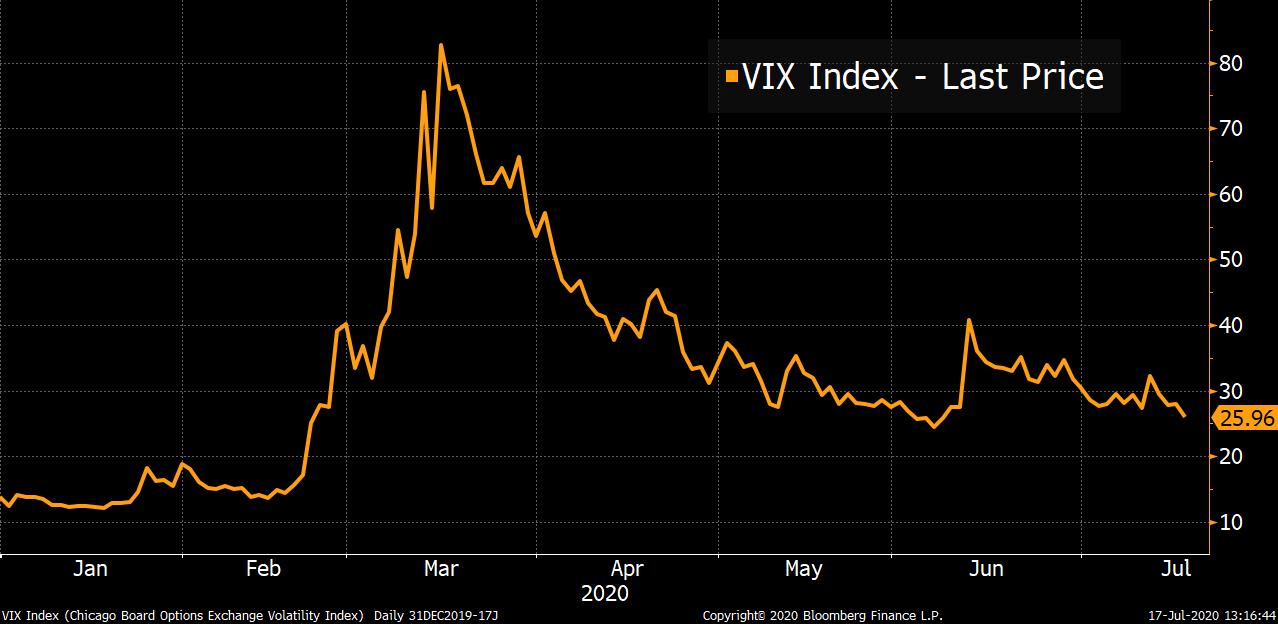
Volatility has decreased since March, as seen in the Chicago Board Options Exchange Volatility Index (VIX), but, interestingly, is still higher than preCOVID levels in January and February. This indicates that options traders see the potential for increasing volatility in coming months.
Our equity portfolios have overweight positions to
We consider most of our positions to be long-term investments, but stand ready to adjust our portfolios as the health crisis – and investors’ interpretation of it –plays out in the coming months. An increase of volatility in the financial markets would not come as a surprise.
Brandon Fitzpatrick, CFA
FIXED INCOME: FED ACTIONS HAVE RESTORED ORDER AFTER TOUGH Q1
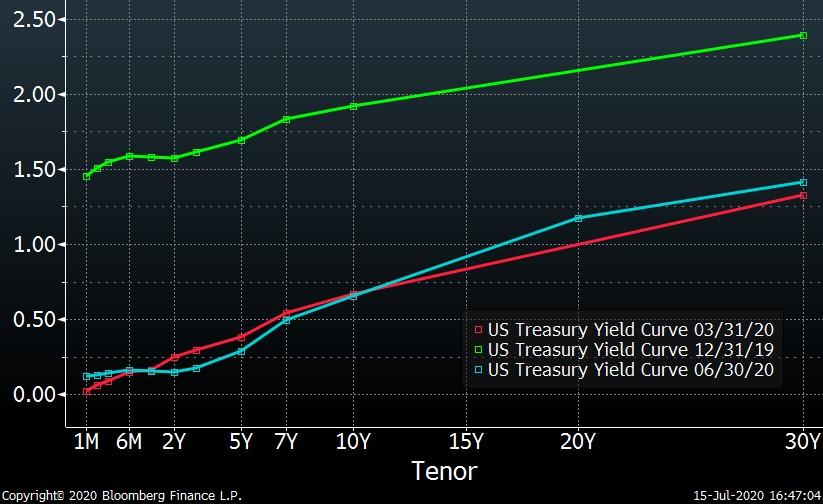
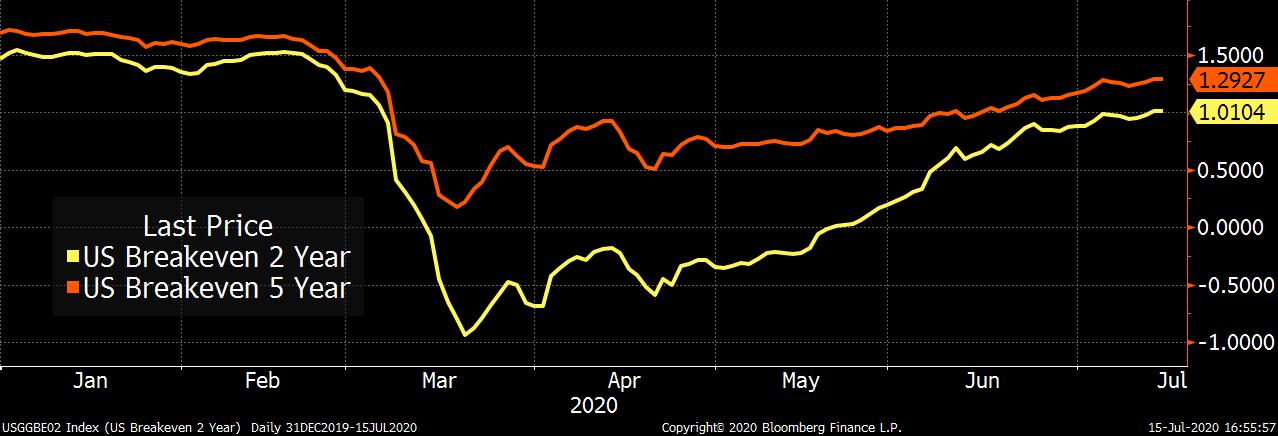
The coronavirus health crisis has caused the economy to fall into recession, resulting in unprecedented stimulus from the Federal Reserve and U.S. Treasury. Despite the Fed doing an admirable job of restoring market liquidity, fixed income investors are indicating that both economic growth and inflation will be low in the near-term and possibly in the longer-term as well. Long-end U.S. Treasury yields remain near historic
lows as market participants fear a prolonged recovery and the potential for additional economic shutdowns.
U.S. Treasury Yield Curve
The Fed’s accommodative monetary policies since early March (growing its balance sheet from $4.2 to $7.1 trillion through security purchases, central bank swaps, repurchase agreements, and lending facilities) are a direct response to historic unemployment figures and the risk of deflation caused by the COVID-19 health crisis. Crucially, policymakers have successfully convinced investors that they are committed to doing whatever it takes to restore economic growth.
The current stimulus is different from past recessions as the Fed and U.S. Treasury have established credit facilities to lend directly to corporations and municipalities. This unprecedented stimulus has restored market liquidity and significantly benefitted risk assets. It has the potential to weaken the dollar and could lead to future inflation, though
Source: Bloomberg
inflation expectations remain quite low and significantly below the Fed’s 2.0% target.
Corporate credit has benefitted from the Fed’s policies of directly purchasing corporate bonds and fixed income exchange traded funds, with credit spreads on high quality corporate bonds tightening 225 basis
U.S. Inflation Breakeven Rates
Source: Bloomberg
Bond Spreads
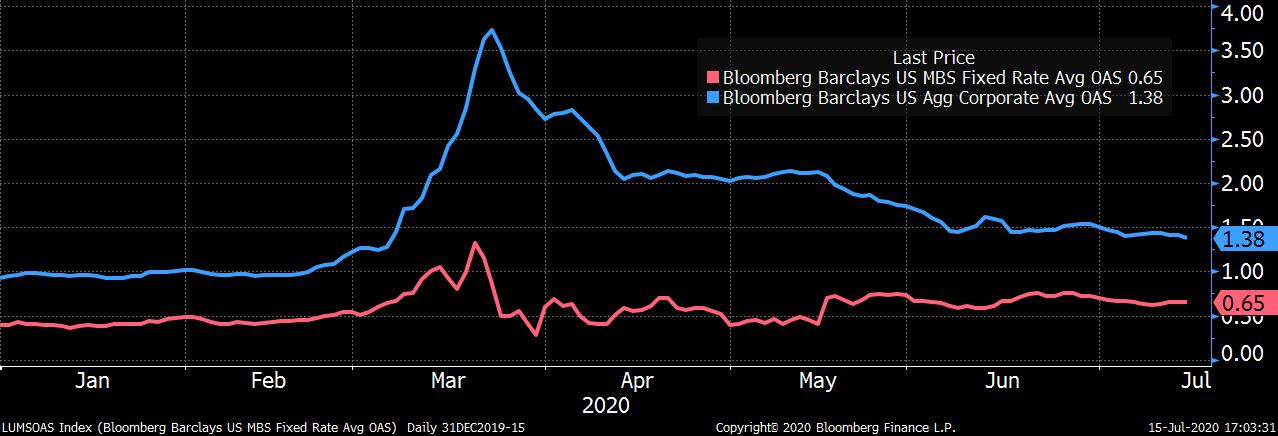
points since March. In portfolios allowed to hold corporates, we increased our exposure as spreads widened out, but we are now cautious on the sector as spreads have tightened materially even though economic uncertainty remains elevated.
Source: Bloomberg
Spreads on agency mortgage-backed securities tightened as the Fed conducted open-ended security purchases in late March and April, but have since widened with prepayment speeds increasing materially as the Fed tapered its purchases. The combination of record low mortgage rates combined with the economy’s reopening has caused refinances to pick up, particularly for loans originated in 2018 and 2019. The issue of mortgage forbearance is also impacting agency MBS, as currently around 9% of the market is utilizing forbearance as allowed in the recently enacted Coronavirus Aid, Relief, and Economic Security Act. Investors believe that this level of forbearance will eventually lead to higher prepayment rates in the coming quarters.
Given the yields available on agency MBS today, however, we believe investors are getting compensated for this heightened prepayment risk and that MBS spreads could tighten as the Fed continues to increase its holdings.
As the third quarter begins, our fixed income portfolios remain up in credit quality with mortgage positioning slightly up in coupon, though close to benchmarks.
Given the uncertainty of the health crisis in the shortterm, we think it prudent to stay reasonably close to benchmark weights today. Mortgage-backed securities look relatively attractive within the fixed income universe, with any rise in interest rates slowing prepayment speeds and likely proving very positive for the asset class.
Justin Packard, CFA

THIS PUBLICATION IS FOR INFORMATIONAL PURPOSES ONLY. THIS PUBLICATION IS IN NO WAY A SOLICITATION OR OFFER TO SELL SECURITIES OR INVESTMENT ADVISORY SERVICES, EXCEPT WHERE APPLICABLE, IN STATES WHERE DB FITZPATRICK IS REGISTERED OR WHERE AN EXEMPTION OR EXCLUSION FROM SUCH REGISTRATION EXISTS.
INFORMATION THROUGHOUT THIS PUBLICATION, WHETHER STOCK QUOTES, CHARTS, ARTICLES, OR ANY OTHER STATEMENT OR STATEMENTS REGARDING MARKET OR OTHER FINANCIAL INFORMATION, IS OBTAINED FROM SOURCES WHICH WE AND OUR SUPPLIERS BELIEVE RELIABLE, BUT WE DO NOT WARRANT OR GUARANTEE THE TIMELINESS OR ACCURACY OF THIS INFORMATION. BLOOMBERG FINANCE L.P. IS THE SOURCE UTILIZED FOR GRAPHS THROUGHOUT THIS PUBLICATION. THE GRAPHS ARE USED WITH PERMISSION OF BLOOMBERG FINANCE L.P. NEITHER WE NOR OUR INFORMATION PROVIDERS SHALL BE LIABLE FOR ANY ERRORS OR INACCURACIES, REGARDLESS OF CAUSE, OR THE LACK OF TIMELINESS OF, OR FOR ANY DELAY OR INTERRUPTION IN THE TRANSMISSION THEREOF TO THE USER. THERE ARE NO WARRANTIES, EXPRESSED OR IMPLIED, AS TO ACCURACY, COMPLETENESS, OR RESULTS OBTAINED FROM ANY INFORMATION CONTAINED IN THIS PUBLICATION.
NOTHING IN THIS PUBLICATION SHOULD BE INTERPRETED TO STATE OR IMPLY THAT PAST RESULTS ARE AN INDICATION OF FUTURE PERFORMANCE.