
INVESTMENT OUTLOOK



THE EQUITY MARKET CONFRONTS COVID-
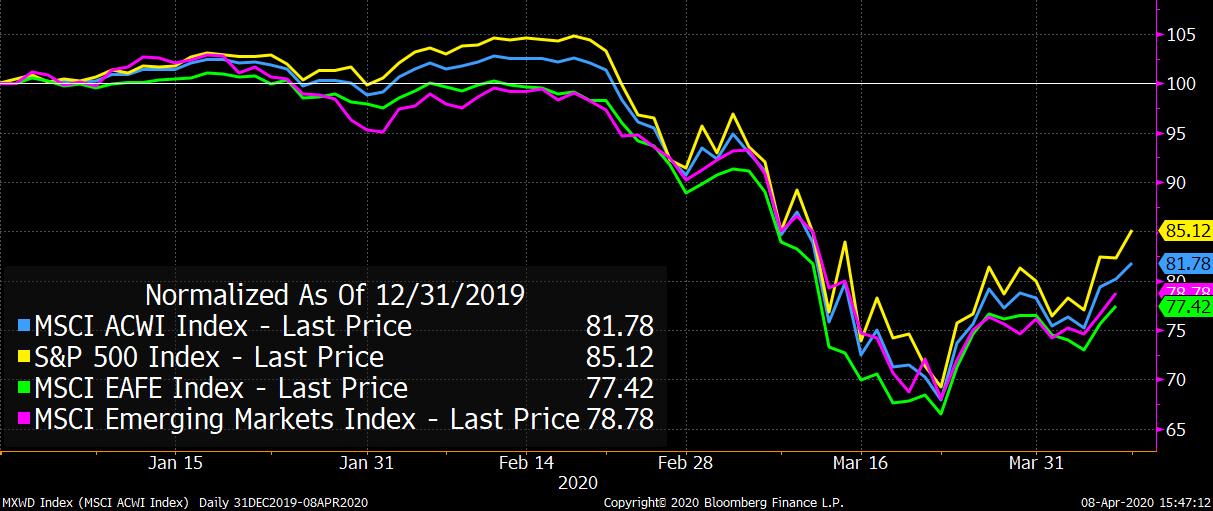
The market did not begin to see the risk presented by COVID-19 until late February, and fell in the following weeks with extremely high volatility before bottoming March 23rd. Underperforming sectors during this period included financials, materials, industrials, and energy, while the consumer staples, healthcare, and technology sectors outperformed the broader market. These sector moves were consistent with what typically occurs during bear markets, with only energy showing abnormal performance. In addition to lower oil demand, an economic conflict between Russia, Saudi Arabia, and U.S. oil producers has resulted in increased supply, pushing the price of oil down more than 60%. The S&P
Global Energy index ended the quarter down 45%.
Stocks bounced back in the last week of March as the U.S. Federal Reserve announced significant moves to bolster liquidity in the fixed income markets, and a stimulus bill was passed in Washington. It’s clear now that policymakers in Washington and around the world recognize the seriousness of the threat to the economy and have taken appropriate action to bolster demand. Investors have taken solace in that and it explains a lot of the rally late in the quarter.
For the full first quarter the MSCI
All Country World Index, a measure of the global stock market, fell 21%,
19
while the S&P 500 (U.S. based large cap stocks) fell 20%. The MSCI EAFE (international developed) and the MSCI Emerging Market indices were down 23% and 24%, respectively.
Periods of crisis always produce opportunities, and with this in mind we rebalanced our equity portfolios into the severely beaten up financial and industrial sectors in March as the market fell.
Subsectors of the financial universe look attractive today, as do certain industrial, consumer discretionary, and healthcare stocks. Our equity portfolios have overweight positions to the healthcare and industrial sectors, with underweight positions in energy and consumer
Source: Bloomberg
discretionary. We are overweight U.S. stocks, with underweight positions in the international developed and emerging market regions.
The COVID-19 virus has created a global health crisis and economic downturn the market was not anticipating, but the investment world now has a rough outlook of the coming weeks and months. This includes the certainty of continuing dire headlines regarding new confirmed cases, as well as a sharp recession occurring during the first half of 2020. The market now expects this, and is attempting to gauge the probability of various scenarios of the economy opening up as selfisolation eventually winds down. This is the key issue
facing the market today: the timing of the end of self-isolation and how it will ultimately look (a gradual phase-in or something quicker). In our view, the market has already priced in a continuation of self-isolation policies across the country until sometime in mid or late May at the earliest, with a gradual relaxation after that. This crucial issue is obviously inextricably linked to the evolution of the health crisis itself and to policymakers’ responses.
Along with addressing the short-term issues of the health crisis and its effects on the markets, as investors we’re keeping an eye to the longer run, as this crisis will eventually end. The timing of market rebounds is as uncertain as the timing of downturns.
BOND MARKET: SAFE HAVENS REIGN SUPREME IN Q1
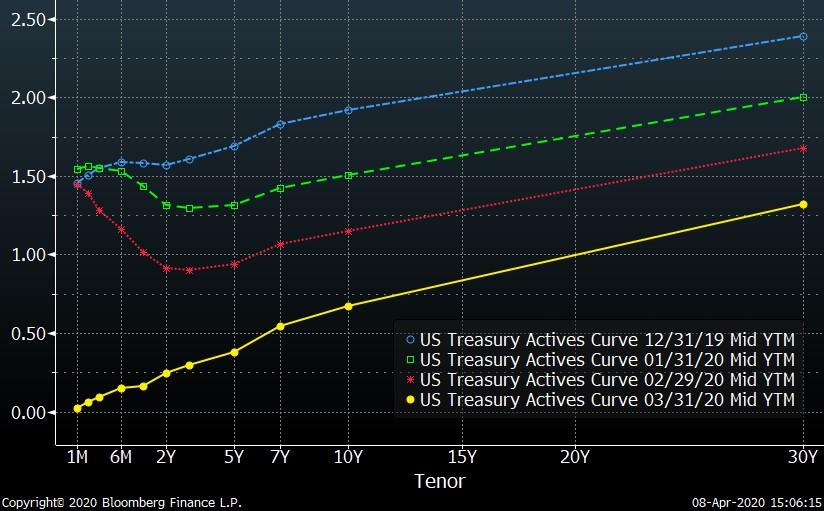
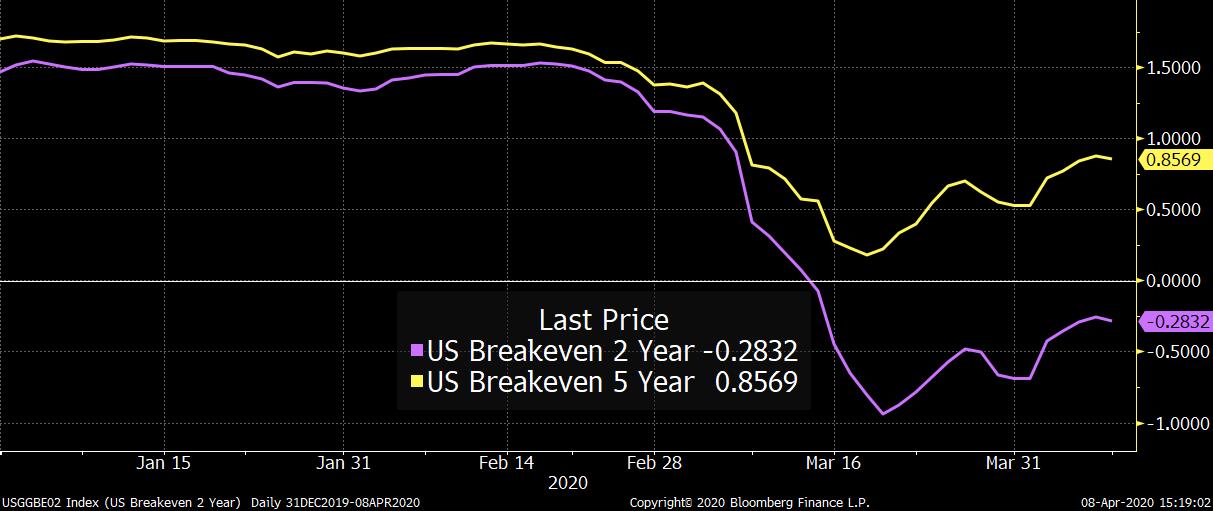
The health and economic crises caused by COVID-19 hit the fixed income markets during the first quarter as well, with U.S. Treasury yields falling and credit spreads widening significantly. Inflation breakeven rates also fell as investors gauged the potential severity of the economic shock caused by the self-isolation period. We’re anticipating continued volatility in the fixed income market throughout the second quarter.
The long end of the U.S. Treasury yield curve fell early in the first quarter, with the short end eventually falling in March after
U.S. Federal Reserve policymakers lowered the lower bound fed funds rate to 0.0%. The Fed also announced various measures to help contain the economic effects of the crisis, including the purchase of as many U.S. government bonds and mortgagebacked securities as needed to “support smooth market functioning”, new lending facilities designed to aid the corporate debt market, measures to support bank lending, and a lending program for small and medium-sized businesses. The market views the Fed’s actions, along with a fiscal stimulus bill passed in Washington,
as sufficient, at least for the time being.
Corporate and agency MBS optionadjusted spreads widened considerably as the health crisis began to overtake the U.S. in March. Interest rate volatility spiked and liquidity was significantly curtailed for all parts of the bond market, barring ultrasafe havens such as U.S. Treasuries. During the last week of March – after U.S. policymakers announced their actions – credit spreads and agency OAS eased, though they are still significantly higher than they were before the crisis began.
Our fixed income portfolios entered this period of heightened volatility with conservative corporate bond positioning. As credit spreads widened significantly in mid-March we increased our exposure to corporates, while retaining ample room to buy more should spreads widen further. All of our fixed income portfolios with a mortgage focus have an underweight position to Ginnie Maes and an overweight to conventionals (Fannie Mae and Freddie Mac). This had a slightly negative impact on performance in the first quarter relative to benchmarks, with Ginnie Maes outperforming as is typical when interest rate volatility is extremely high. Over the longer run, we expect conventional MBS to outperform Ginnie Maes and we are maintaining our underweight position.
U.S. Treasury Yield Curve
Source: Bloomberg
U.S. Inflation Breakeven Rates
Source: Bloomberg
As the second quarter begins, our fixed income portfolios remain up in credit quality with mortgage positioning slightly up in coupon, though close to benchmarks. Given the uncertainty of the severity and longevity of the health crisis (and the uncertainty regarding how an end to self-isolation will eventually play out), we think it prudent to stay reasonably close to benchmark weights, while holding a slightly defensive tilt. Agency MBS look especially attractive today, with any let up in interest rate volatility likely
Option-Adjusted Spreads
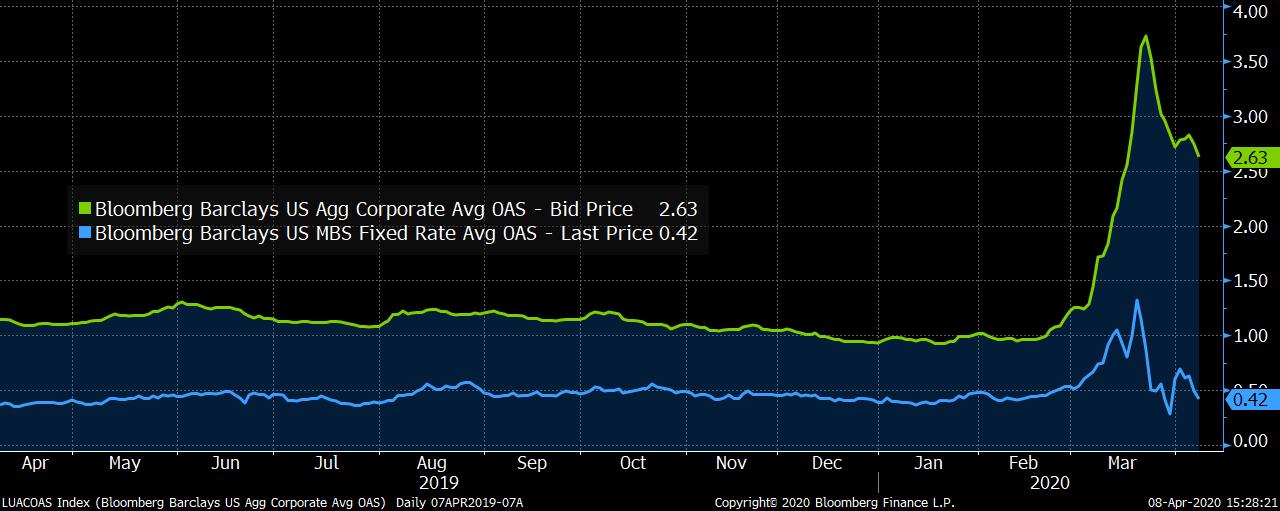
to be very positive for the asset class. The outlook for corporate bonds in the short term is more uncertain, though today we see good value in many high quality names. We will be watching the corporate bond market closely in the quarter, with an eye toward increasing exposure should market stresses resume.
— Brandon Fitzpatrick, CFA
Source: Bloomberg

THIS PUBLICATION IS FOR INFORMATIONAL PURPOSES ONLY. THIS PUBLICATION IS IN NO WAY A SOLICITATION OR OFFER TO SELL SECURITIES OR INVESTMENT ADVISORY SERVICES, EXCEPT WHERE APPLICABLE, IN STATES WHERE DB FITZPATRICK IS REGISTERED OR WHERE AN EXEMPTION OR EXCLUSION FROM SUCH REGISTRATION EXISTS.
INFORMATION THROUGHOUT THIS PUBLICATION, WHETHER STOCK QUOTES, CHARTS, ARTICLES, OR ANY OTHER STATEMENT OR STATEMENTS REGARDING MARKET OR OTHER FINANCIAL INFORMATION, IS OBTAINED FROM SOURCES WHICH WE AND OUR SUPPLIERS BELIEVE RELIABLE, BUT WE DO NOT WARRANT OR GUARANTEE THE TIMELINESS OR ACCURACY OF THIS INFORMATION. BLOOMBERG FINANCE L.P. IS THE SOURCE UTILIZED FOR GRAPHS THROUGHOUT THIS PUBLICATION. THE GRAPHS ARE USED WITH PERMISSION OF BLOOMBERG FINANCE L.P. NEITHER WE NOR OUR INFORMATION PROVIDERS SHALL BE LIABLE FOR ANY ERRORS OR INACCURACIES, REGARDLESS OF CAUSE, OR THE LACK OF TIMELINESS OF, OR FOR ANY DELAY OR INTERRUPTION IN THE TRANSMISSION THEREOF TO THE USER. THERE ARE NO WARRANTIES, EXPRESSED OR IMPLIED, AS TO ACCURACY, COMPLETENESS, OR RESULTS OBTAINED FROM ANY INFORMATION CONTAINED IN THIS PUBLICATION.
NOTHING IN THIS PUBLICATION SHOULD BE INTERPRETED TO STATE OR IMPLY THAT PAST RESULTS ARE AN INDICATION OF FUTURE PERFORMANCE.