
INVESTMENT OUTLOOK



YIELD CURVE INVERTED, BUT YIELDS LIKELY TO RISE FROM HERE
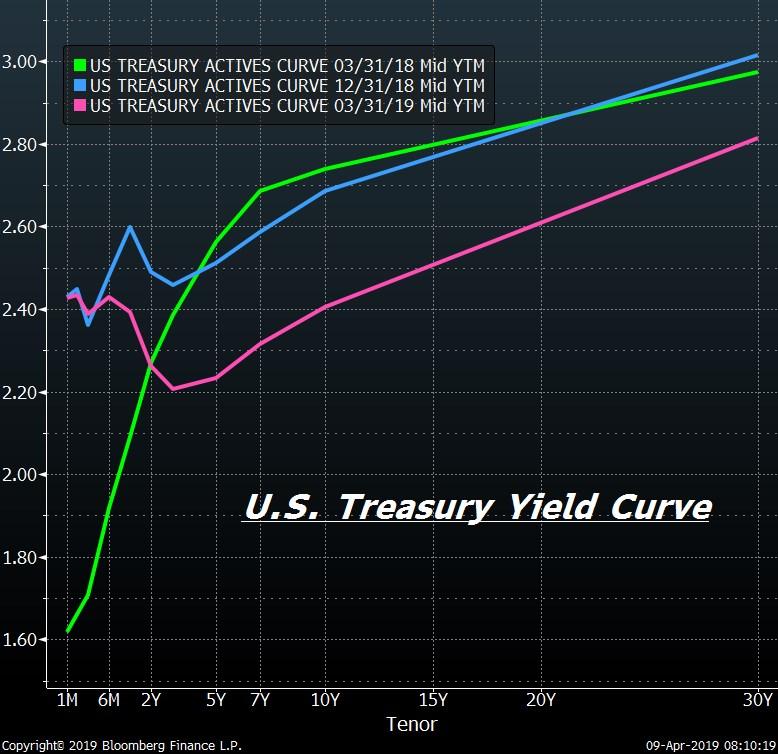
The inverted U.S. Treasury yield curve is the most widely discussed aspect of the fixed income market today. The flattening of the yield curve is largely a result of the Federal Reserve (Fed) increasing the fed funds rate nine times since 2015 to 2.25% - 2.50% today. Longterm U.S. Treasury yields have increased less rapidly as investors have anticipated slower economic growth and continued low inflation. In response to market volatility and widening credit spreads, the Fed made a major change in monetary policy in January by placing a pause on its rate hiking cycle and stressing patience on future policy actions.
This has resulted in short-term U.S. Treasury yields remaining anchored, while long-term yields have declined with investors anticipating slower global growth. Yields in the three and five year tenors have fallen most of all.
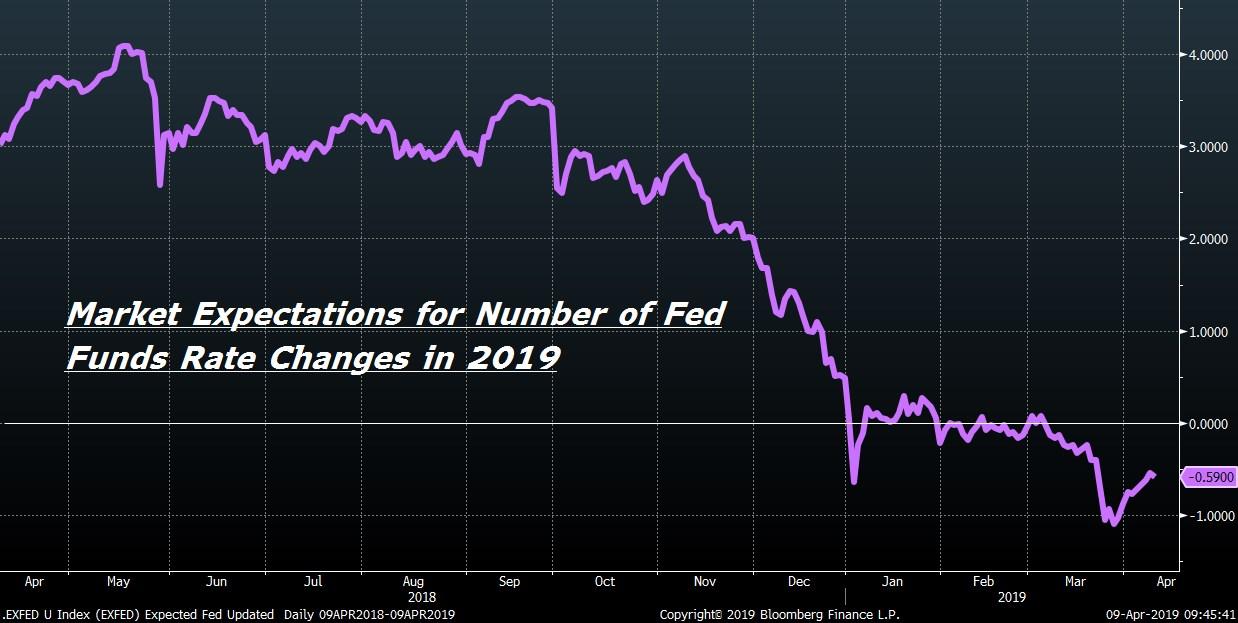
We anticipate that the Fed will not increase the fed funds rate in 2019 and may actually cut rates later in
the year (the market implies a 63% probability that the Fed will cut the fed funds rate by at least 25 basis points in 2019). Fed policymakers also stated after their March meeting that they will reduce the pace of their monthly balance sheet runoff from a maximum of $50 billion to $35 billion in May, and will no longer reduce the balance sheet after September. All cash flows will then be reinvested in U.S. Treasuries. The Fed’s
reinvestment program will be designed to match the U.S. Treasury market’s outstanding maturity composition.
In addition to the Fed’s reversal in monetary policy, it appears that the Trump administration and China are very close to consummating a major trade agreement. Long-term U.S. Treasury yields have declined recently, along with investor
Source: Bloomberg
expectations of slower economic growth. However, the combination of easier monetary policy and a breakthrough in trade may lead to increased global economic stability, with an elevated risk of higher long-term U.S. Treasury yields and a steepening yield curve.
Source: Bloomberg
As a result, we have reduced the duration of our fixed income portfolios since December.
MBS: SINGLE SECURITY PLATFORM UPDATE
With the recovery in the housing market post the 2008 financial crisis, the Federal Housing Finance Agency (FHFA) and the Trump administration are moving towards government sponsored enterprise (GSE) reform. Although reform has not happened legislatively and the GSEs have remained in conservatorship since 2008, taxpayer risk has been reduced through the issuance of credit risk transfer securities. These securities effectively trans-
fer credit risk from the GSE balance sheets to the private market. Additionally, the FHFA is taking steps to improve the liquidity of the overall mortgage-backed security market by implementing the so-called single security platform.
The launch date for the single security platform is June 3, 2019 and will allow the GSEs to issue a single security (called a ‘uniform mortgage-backed security’). Fed-
eral National Mortgage Association (Fannie) and Federal Home Loan Mortgage Corporation (Freddie) will still independently source the mortgages that will be issued to the market through this platform. However, historical price differences between the two securities due to different prepayment performance should no longer exist as there will only be one security issued to the market. Additionally, the single security platform is expected to elimi-
nate the historical liquidity difference between Fannie and Freddie securities.
Investors will have the option to exchange their existing Freddie
securities to the uniform mortgage -backed security (UMBS), which will share the same characteristics as existing Fannie securities. The IRS has ruled that the conversion of Freddie securities to UMBS will not constitute a taxable event. Our plan is to convert our managed Freddie securities to UMBS as the liquidity in these legacy securities is likely to be significantly reduced.
EQUITIES: OUTLOOK DIMINISHED AFTER STRONG START IN Q1
Following a tough end to 2018 the equity market rebounded sharply during the first quarter. A newly found dovishness at the Federal Reserve was the principal driver of the recovery, as monetary policymakers were forced to backtrack from hawkish statements made in December. The second factor driving stocks higher in the first quarter was a fairly steady stream of news indicating that progress was being made on trade negotiations between the U.S. and China. The trade conflict between the two
countries had been a headwind for the stock market for several quarters, and investors now expect a deal to be reached.
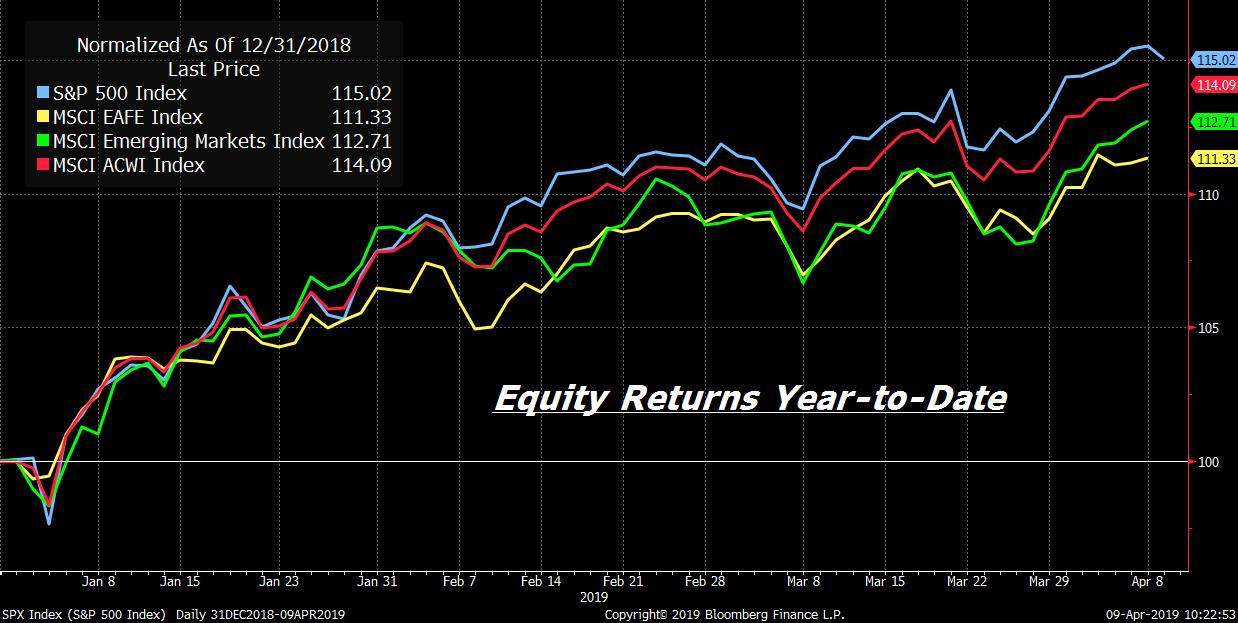
The MSCI All Country World Index, which measures the global stock market, returned 12.3% during the first quarter. Domestic stocks outperformed, with the S&P 500 returning 13.6% and the MSCI EAFE Index (international developed) and MSCI Emerging Market Index returning 10.2% and 9.9%, respectively. Among
Source: Bloomberg
sectors of the equity market, technology, industrial, and energy stocks outperformed, while more defensive sectors such as healthcare and consumer staples lagged broad indices. All major sectors of the equity market rose during the quarter.
We believe it is prudent to be cautious as the second quarter gets underway. Even though Federal Reserve policymakers appear fairly locked into a dovish policy path for the next few months, their messaging to investors is likely to be more hawkish. Inflation breakeven rates (what investors expect inflation to be in the future) rose significantly during the first quarter, and this is likely to weigh significantly on policymakers’ minds in the coming weeks. Additionally, we believe that a trade deal between the U.S. and China is already largely and appropriately discounted by equity investors.
President Trump, facing reelection, needs the trade conflict with China resolved as some of his core constituencies have been negatively impacted by
tariffs during the last two years. Investors know this, of course, and have bid up stocks in anticipation of the ultimate announcement, widely believed to come sometime during the second quarter. We don’t believe that additional news pointing toward a deal will have much impact on equity prices.
Finally, bond investors are predicting (through an inverted yield curve) a significant possibility of an economic slowdown occurring in 2020. With the S&P 500 and MSCI All Country World Index trading at 17.2x and 15.5x expected 2019 earnings, respectively, it doesn’t appear that equity prices have fully discounted this possibility.
Given this outlook, we see short-term risk for stocks and will be looking to take a more defensive tack with our equity strategies in the upcoming weeks.
Justin Packard and Brandon Fitzpatrick

THIS PUBLICATION IS FOR INFORMATIONAL PURPOSES ONLY. THIS PUBLICATION IS IN NO WAY A SOLICITATION OR OFFER TO SELL SECURITIES OR INVESTMENT ADVISORY SERVICES, EXCEPT WHERE APPLICABLE, IN STATES WHERE D.B. FITZPATRICK & COMPANY IS REGISTERED OR WHERE AN EXEMPTION OR EXCLUSION FROM SUCH REGISTRATION EXISTS.
INFORMATION THROUGHOUT THIS PUBLICATION, WHETHER STOCK QUOTES, CHARTS, ARTICLES, OR ANY OTHER STATEMENT OR STATEMENTS REGARDING MARKET OR OTHER FINANCIAL INFORMATION, IS OBTAINED FROM SOURCES WHICH WE AND OUR SUPPLIERS BELIEVE RELIABLE, BUT WE DO NOT WARRANT OR GUARANTEE THE TIMELINESS OR ACCURACY OF THIS INFORMATION. BLOOMBERG FINANCE L.P. IS THE SOURCE UTILIZED FOR GRAPHS THROUGHOUT THIS PUBLICATION. THE GRAPHS ARE USED WITH PERMISSION OF BLOOMBERG FINANCE L.P. NEITHER WE NOR OUR INFORMATION PROVIDERS SHALL BE LIABLE FOR ANY ERRORS OR INACCURACIES, REGARDLESS OF CAUSE, OR THE LACK OF TIMELINESS OF, OR FOR ANY DELAY OR INTERRUPTION IN THE TRANSMISSION THEREOF TO THE USER. THERE ARE NO WARRANTIES, EXPRESSED OR IMPLIED, AS TO ACCURACY, COMPLETENESS, OR RESULTS OBTAINED FROM ANY INFORMATION CONTAINED IN THIS PUBLICATION.
NOTHING IN THIS PUBLICATION SHOULD BE INTERPRETED TO STATE OR IMPLY THAT PAST RESULTS ARE AN INDICATION OF FUTURE PERFORMANCE.