ECONOMIC FORECAST
Prabhab Banskota
Continued weakness in China’s economy and the clearly stated desire of the U.S. Federal Reserve to raise interest rates are the two principal dynamics driving markets today. Both have coincided to cause market turbulence in the third quarter, though stocks have rallied in the first days of the fourth quarter. The good news is that the U.S. economy is continuing to exhibit
consistent improvement, and the European economy is also showing signs of life. Further growth will be required before global interest rates return to more normal levels, however, and until this occurs there is likely be to a continuation of elevated volatility in the financial markets
CHINA’SECONOMY
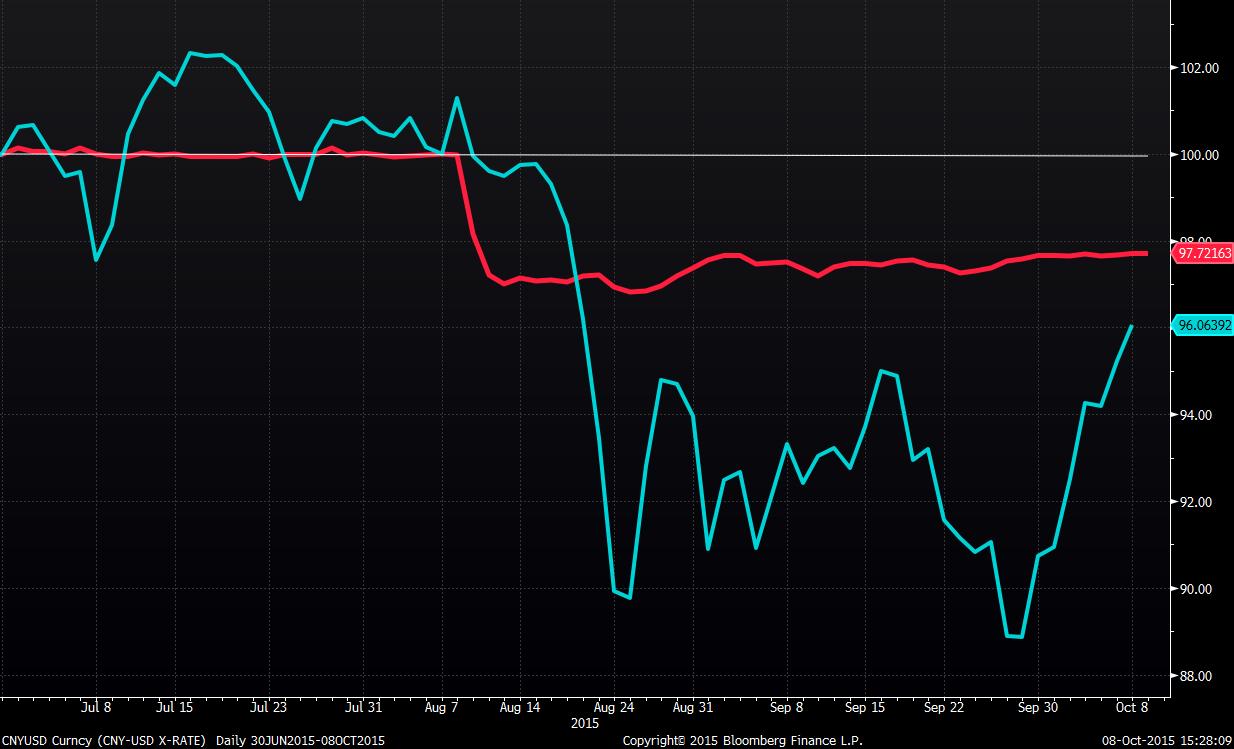
Most of the discussion in the financial press during the third quarter addressed the Federal Reserve and interest rates. The real mover of markets during the quarter, however, was news out of China. Chinese policymakers surprised investors by depreciating their pegged currency in August, and this was taken as evidence that China’s economy had weakened beyond the expectations of the leadership. China today is closely linked to the global economy and investors believe that further slowdown there will impact global growth. The depreciation led to a selloff of equities and heightened volatility continued in September. The MSCI All Country World Index, a measure of the global stock market, fell 9.3% during the third quarter, erasing gains from the first half of the year, and was down 6.6% yearto-date through September. Stocks have rallied in the first days of October, however.
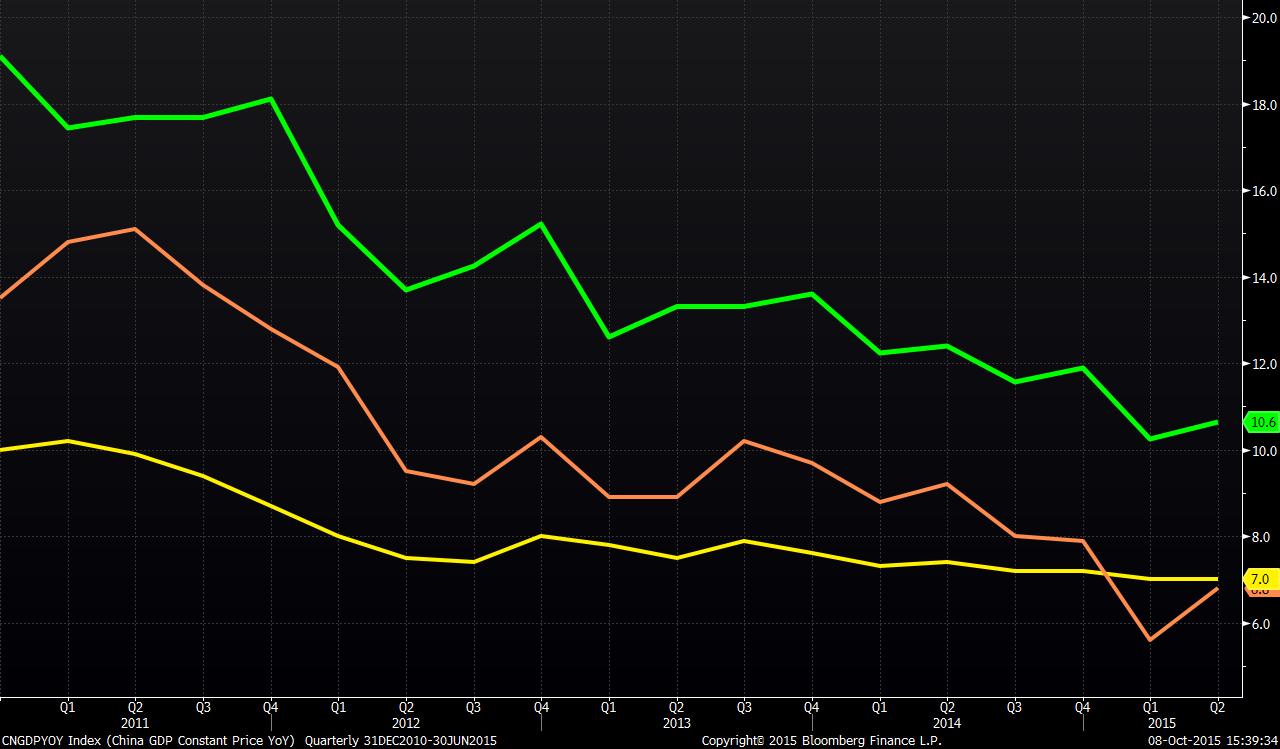
China’s GDP growth rate has fallen consistently since 2010, and this year is
expected to breach 7.0%. Growth of 7.0% would be a fantastic result for almost any country, of course, but in this case investors are concerned. China’s political leaders have been forced to lower their own estimates and 7.0% was seen as a number they didn’t want crossed. Investors are worried that the issues facing the Chinese economy might be deeper and harder to manage than originally thought. Industrial production growth has been falling since 2010, as has retail sales growth. It is not to say that the data in China are all terrible – definitely there is much to encourage optimism as well – but a bottom to this cycle of economic slowdown has not yet been reached, and this
has investors somewhat nervous.
Additionally, Chinese policymakers’ responses to a falling stock market earlier this year have further shaken investor confidence. A series of unorthodox measures which most investors viewed as destined to fail, including restrictions on sales and a ban on short selling, were implemented in the spring and summer as Chinese stocks began to fall after a big increase earlier in the year. Predictably, the new rules failed to arrest the descent and have left the leadership with diminished credibility in the eyes of the global investing community.
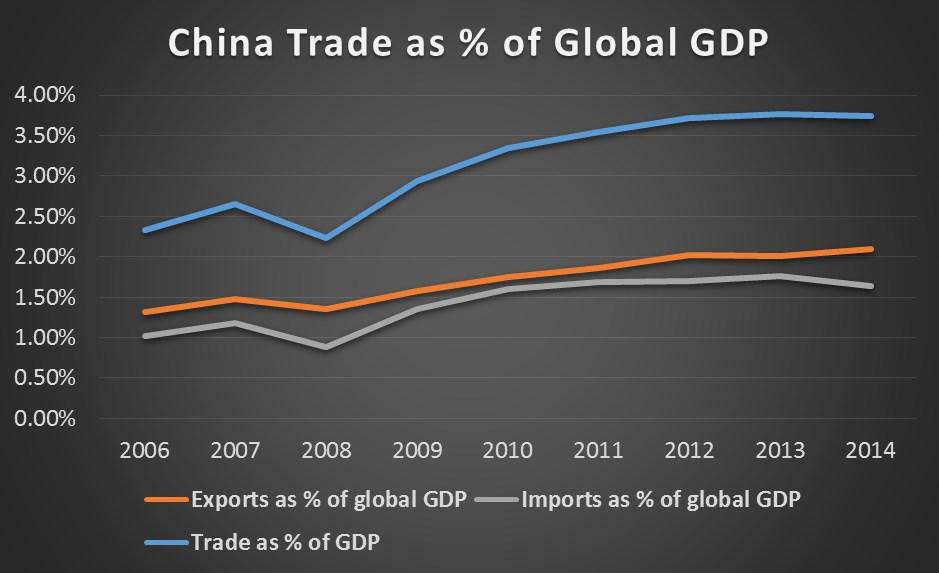
The repercussions of China’s slowdown for the global economy are clear, as China’s trade with the rest of the world (including imports) has grown steadily and today amounts to over 3.5% of global GDP.
China’s Economy
Commodity producing countries in southeast Asia and Latin America are especially vulnerable to diminished demand from China, but many American and European companies also have considerable exposure to sales in China. All of this led to a dour mood in the global equity markets in the third quarter.
There is reason for optimism in the fourth quarter and into 2016, however. The Chinese government has reserves of US$3.5 trillion, and can dip into this both to stabilize the Chinese currency and to spend on fiscal stimulus. In fact, it has already begun doing so.
Chinese policymakers have considerable control over the levers that drive growth in the short-term,
including bank lending, and there is much more they can try in the coming months. Ultimately, economic growth is one of the pillars of the government’s legitimacy, and the political leadership is likely to do what it takes to turn the tide in the economy. We expect additional stimulus to be announced in the fourth quarter.
INTERESTRATESANDU.S.ECONOMY
During the last five years the U.S. economy never did exhibit the brisk growth that is typical after a recession, but it continues to report strong and steady progress nonetheless. The labor market is improving, with the unemployment rate down to 5.1% and the underemployment rate falling to 10.0%, its lowest level since 2008.
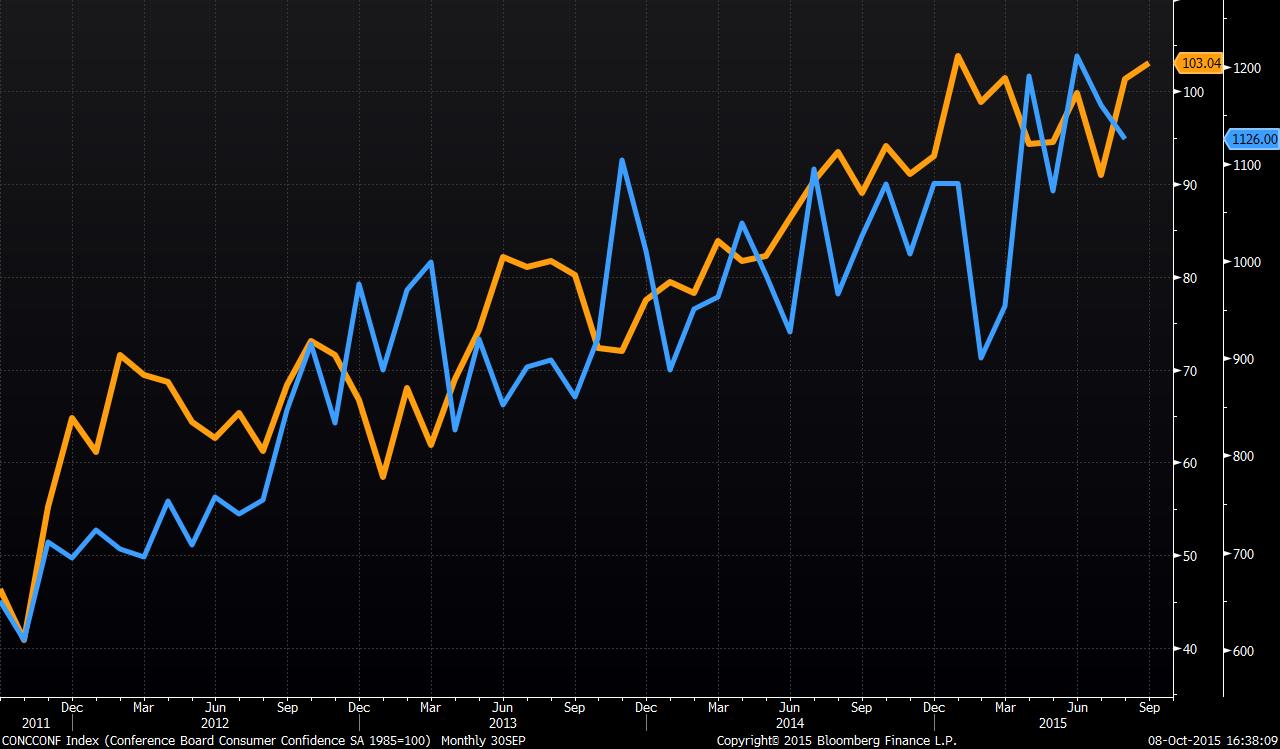
Consumer confidence is up, and the housing sector, such a critical part of the economy, continues to strengthen. Home prices, as measured by the Case-Shiller index are up 5.0% year-over-year, and housing starts are also up.
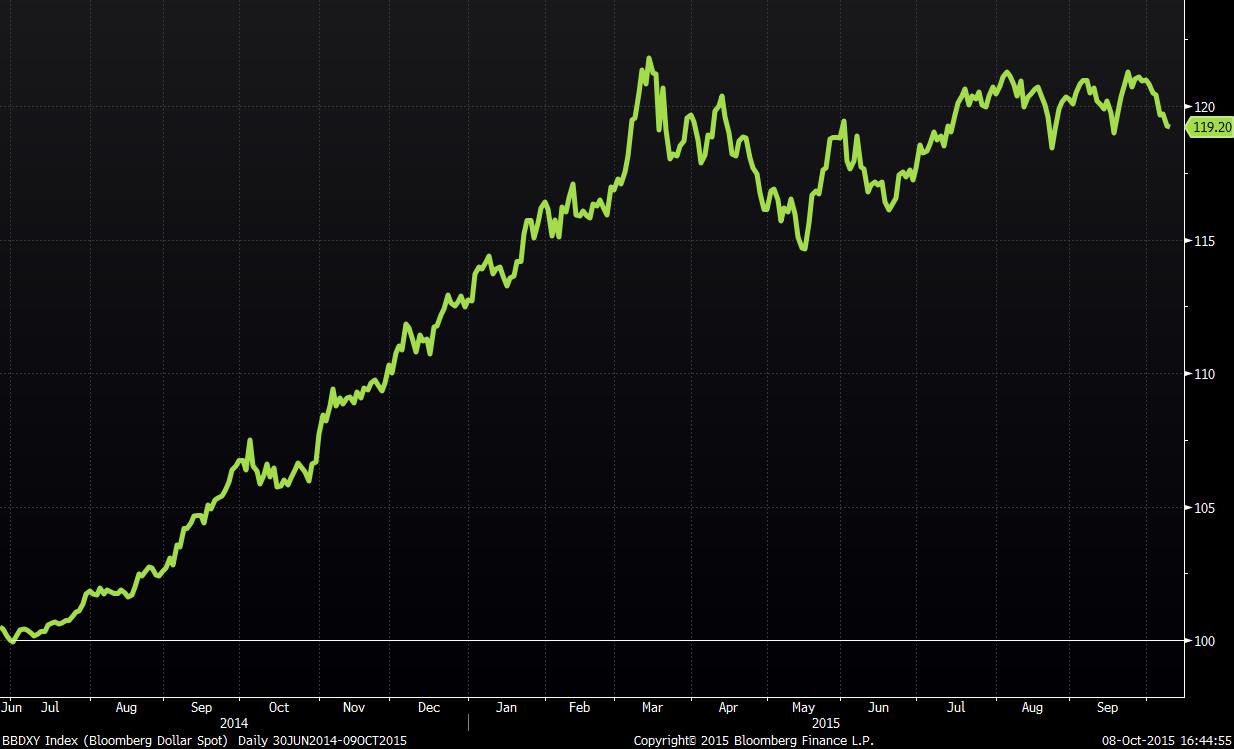
The improved domestic economy has encouraged Federal Reserve policymakers to begin raising interest rates, which have been near zero since 2008. During the last year Fed leaders have repeatedly declared their intention to raise rates to more normal levels, and investors’ expectations of higher rates have already had a major effect on asset prices. The U.S. dollar has risen considerably versus almost all major currencies during the last 12 months, and this has resulted in weakened profits (in dollar terms) for companies with sales outside the U.S. The strong dollar has also resulted in lower inflation in the U.S., as import prices have fallen.
Fed policymakers are facing a conundrum. As they prepare the market for higher interest rates, the dollar is pushed higher and, subsequently, inflation falls as import prices drop. Lower inflation then makes the case for raising rates less compelling. This is the dynamic today: inflation has fallen this year and is significantly below the Fed’s 2.0% target, which makes a rate increase difficult to justify.
Further complicating the issue is the fact that the U.S. is the only major country today whose central bank is preparing to tighten monetary policy. Both the European Central Bank (ECB) and the Bank of Japan are implementing their own quantitative easing programs, and the ECB in particular has no plans to end the program any time soon. Continued loose monetary policy abroad has helped to boost the dollar, and has
made the Federal Reserve’s position increasingly precarious and delicate.
In the end it will take a boost in global growth to escape the present trap. If the global economy picks up in
2016, deflationary pressures will ease and the Fed will have considerably more room to maneuver. If global growth remains muted, the Fed will be forced to delay interest rate hikes deep into next year.
EQUITIES
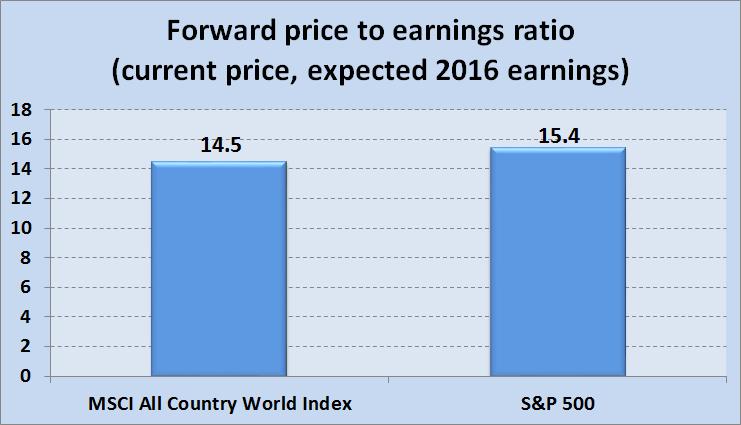
Stocks today are trading at attractive valuations, especially given the very low interest rates available in the bond market. The S&P 500 is trading at 15.4x expected 2016 earnings, while the MSCI All Country World Index is trading at 14.5x. Heightened volatility in the stock market is likely to continue until the path of interest rates is more clear, but prices today represent good value for investors with a longer time horizon.
Companies with international sales have underperformed this year, as a strong U.S. dollar has made sales abroad relatively less valuable than domestic sales. Currency movements of the type we are seeing, however, are transitory.
Most of the best-run companies, and those with the best long-term prospects, have international exposure, and will be good performers over the long term.
Industrials are especially attractive today. The earnings multiples of most industrial stocks today are far below the broader market (often in
FIXEDINCOME
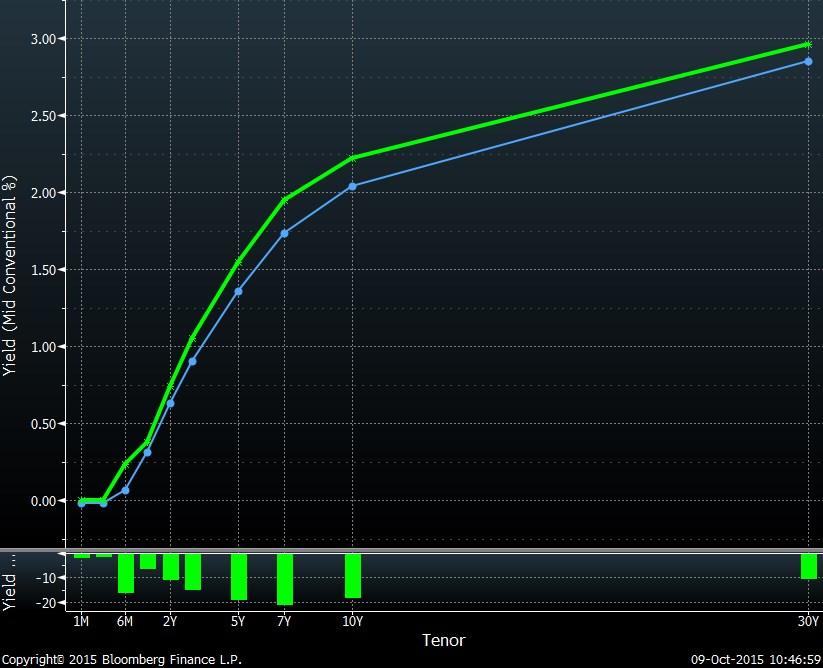
U.S. Treasury yields declined after the frustrated Federal Open Market Committee (FOMC) left the federal funds rate unchanged at 25 basis points on September 17. As yields declined, the Barclays U.S. Aggregate index returned 0.68% for the month. Within the U.S. Aggregate Index, corporates returned 0.75%,
the range of 20 – 40%), and also lower than their historic averages. The healthcare sector is also attractive, as demographic changes both domestically and abroad offer significant growth potential for companies throughout the sector.
Brandon Fitzpatrick
while Treasuries and MBS returned 0.88% and 0.58%, respectively. Energy and metals and the mining sector dragged down performance, returning -1.88% and -0.60%, respectively. The metals and mining sectors have been hurt by the slowdown in China, which consumes almost half of the world’s steel, nickel, zinc,
copper, and aluminum production. Energy sector credits have been impacted by the drop of the price of oil during the last year. Credit spreads have widened steadily in the last six months. For example, the yield to maturity of the Merrill Lynch U.S. Corp 57 year index has widened by 44 basis points since April. As a result, investment grade credits today offer yield pick-up as high as 1.5% over similar duration Treasuries. However, caution is warranted. We see pockets of opportunity but investors should realize that financial markets are discounting the possibility of rising default rates.
8/31/2015 9/30/2015
U.S. Treasury Yield Curve
Agency MBS underperformed Treasuries by 0.17% in September as demonstrated by the Barclays U.S. Government Intermediate Index and the Barclays U.S. MBS Index. This relative underperformance can be attributed to higher agency MBS issuance and expectations of higher prepayments due to the recent decline in yields. Agency MBS issuance has increased by 46% to $1,025 billion as of September 2015, up from $701 billion in the same period last year. With the recent underperformance, MBS now offer better value with a yield pick-up as high as 1% vis-à-vis similar duration U.S. Treasuries.
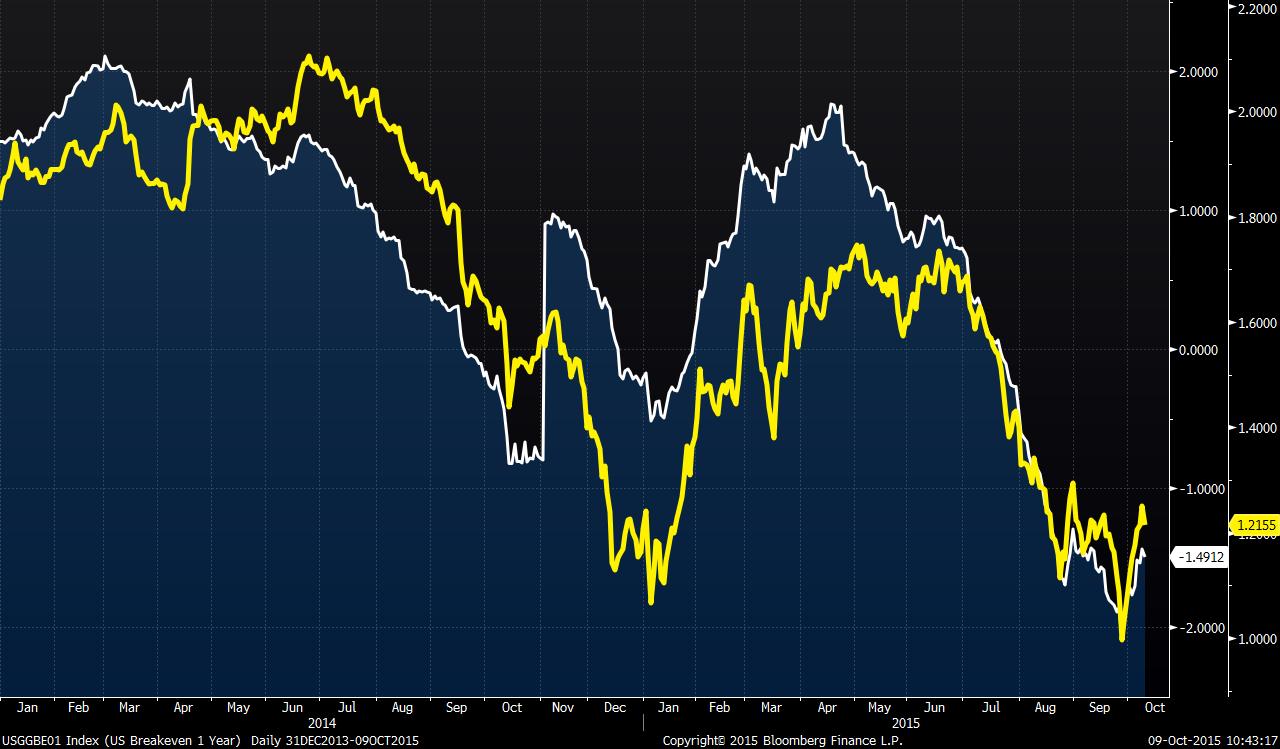
Inflation Breakeven Rates
Market-based inflation expectations have declined dramatically since June, and the latest year-over-year
non-seasonally adjusted CPI Urban Consumer index was just 0.2%. The market is forecasting annualized deflation during the next 6 months of 1.49%, and a 1.22% annualized inflation rate during the next five years.
Declining inflation expectations have resulted in negative returns from Treasury Inflation Protected
Securities (TIPS) in recent months. In the long run, however, we don’t expect very low inflation in the U.S. to persist. This bodes well for TIPS in 2016 and beyond.
Prabhab Banskota
THIS PUBLICATION IS FOR INFORMATIONAL PURPOSES ONLY. THIS PUBLICATION IS IN NO WAY A SOLICITATION OR OFFER TO SELL SECURITIES OR INVESTMENT ADVISORY SERVICES, EXCEPT WHERE APPLICABLE, IN STATES WHERE D.B. FITZPATRICK & COMPANY IS REGISTERED OR WHERE AN EXEMPTION OR EXCLUSION FROM SUCH REGISTRATION EXISTS.
INFORMATION THROUGHOUT THIS PUBLICATION, WHETHER STOCK QUOTES, CHARTS, ARTICLES, OR ANY OTHER STATEMENT OR STATEMENTS REGARDING MARKET OR OTHER FINANCIAL INFORMATION, IS OBTAINED FROM SOURCES WHICH WE AND OUR SUPPLIERS BELIEVE RELIABLE, BUT WE DO NOT WARRANT OR GUARANTEE THE TIMELINESS OR ACCURACY OF THIS INFORMATION. NEITHER WE NOR OUR INFORMATION PROVIDERS SHALL BE LIABLE FOR ANY ERRORS OR INACCURACIES, REGARDLESS OF CAUSE, OR THE LACK OF TIMELINESS OF, OR FOR ANY DELAY OR INTERRUPTION IN THE TRANSMISSION THEREOF TO THE USER. THERE ARE NO WARRANTIES, EXPRESSED OR IMPLIED, AS TO ACCURACY, COMPLETENESS, OR RESULTS OBTAINED FROM ANY INFORMATION CONTAINED IN THIS PUBLICATION.
NOTHING IN THIS PUBLICATION SHOULD BE INTERPRETED TO STATE OR IMPLY THAT PAST RESULTS ARE AN INDICATION OF FUTURE PERFORMANCE. ALL RETURNS ARE MODEL RETURNS FROM A COMPOSITE. ALL RETURNS ARE NET OF FEES AND ANNUALIZED.