ECONOMIC FORECAST
Third Quarter in Review
Equities
Government Shutdown / Debt Limit Debate
Global Economy
Fixed Income
THIRDQUARTER2013INREVIEW
Interest rates rose early in the third quarter as speculation mounted that the U.S. Federal Reserve would curtail its $85 billion a month purchase of Treasuries and mortgage backed securities. The yield on the 10-year Treasury bond briefly touched 3.0% in early September, a historic rise from 1.62% in May. The Barclays Aggregate bond index fell 5.1% from the start of May through early September, surprising many bond investors. Rising rates caused some turbulence in the equity markets in August, especially in emerging economies with large current account deficits. U.S. economic data released in late August and early September, however, showed that the economic recovery was weaker than the Fed had expected. Following this, Fed chairman Ben Bernanke announced a postponement to the “tapering” of quantitative easing (QE) that triggered a sharp rise in stocks and bonds. Those that were down the most in early August were up the most in September.
President Obama’s announcement October 9 of Janet Yellen as his nominee to be the next chair of the Federal Reserve was applauded by the capital markets. Former Treasury Secretary Lawrence Summers – who
The equity markets are concerned about the strength of the economic recoveries in the U.S. and Europe, and are worried that a premature withdrawal of monetary stimulus will throw both back into serious recessions. More fiscal stimulus in the U.S. and Europe would probably help economic growth, but any suggestion of it is a political nonstarter. This makes monetary policy all the more important in the opinion of the equity markets, and stocks in recent months have been greatly impacted by anticipated changes in interest rates.
has publicly questioned the effectiveness of quantitative easing – withdrew his name from consideration in the face of Democratic opposition in the Senate. His withdrawal cheered the stock and bond markets, which want – and think the economy needs – further monetary stimulus. Yellen is Vice Chair of the Federal Reserve System’s Board of Governors and is widely expected to continue Bernanke’s quantitative easing program until the U.S. labor market shows significant improvement. Unfortunately, that is unlikely to happen before early 2014, at the earliest.
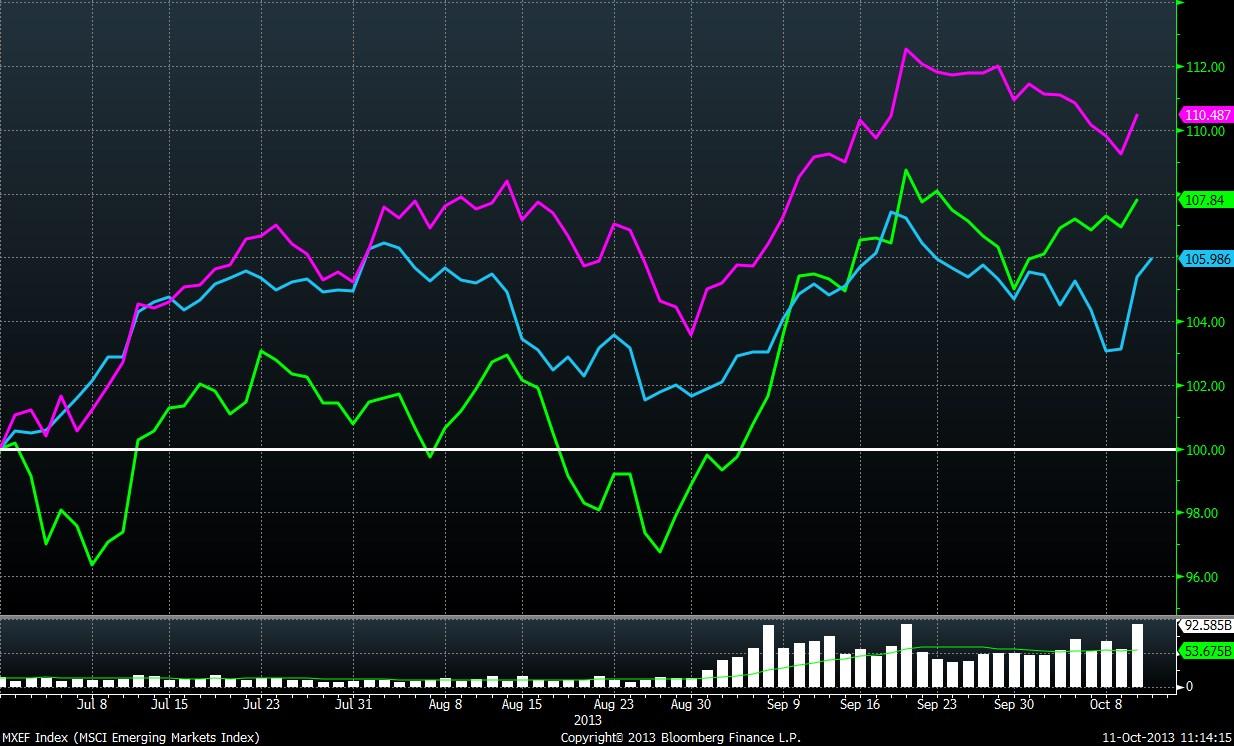
Stocks were up in the third quarter, with international and emerging markets outperforming the S&P 500. The MSCI EAFE index rose 11.7%, the MSCI Emerging Market index was up 5.9%, and the S&P 500 rose 5.2%. Bond yields have risen in the first days of October, with the 10-year Treasury yield at 2.68%. We believe interest rates are likely to consolidate in the short term, but will rise in 20142016 to 4.0-5.0%. In our equity portfolios we are maintaining our emerging market positions and added to our European positions during the third quarter.
EQUITIES
It began in May when Fed chair Ben Bernanke hinted that a “tapering” of quantitative easing might occur if warranted by economic data. Bernanke’s comments were meant to be innocuous but the market reacted violently, with bond yields rising and stock prices falling in May and June. Market fears about Fed tapering sprung up anew in August, and stocks fell again. Stocks rallied, however, in September when Bernanke announced a delay to tapering and Summers’ withdrawal paved the way for Yellen, assuring the stock market that QE was here to stay for a while longer. This is good news for stocks in the short term. In the longer term, however, the stock market will be driven by economic growth and earnings, which we expect to improve steadily during the next year. The stock market’s dependence on interest rates and monetary policy will eventually end, but it appears likely to stay with us for a while longer.
Emerging market stocks were up 5.9% in the quarter, outpacing the S&P 500’s return of 5.2%. International developed stocks, as measured by the MSCI EAFE index rose 11.7%, as investors have gained optimism regarding Europe. The
Third Quarter Performance
MSCI Emerging Market Index
most dangerous period for the euro is over, and recent German elections virtually assure that Europe will continue on the path toward political and economic integration. The eurozone economy is showing signs of life, though it is still in a mild recession.
We are optimistic about European stocks, as earnings in the coming years are likely to be higher than the market’s current mildly pessimistic expectations. There is significant value in emerging market stocks as well, and we are maintaining our positions in this sector. The MSCI Emerging Market index trades at
10.3 times 2014 earnings, while the FTSE Developed Europe index trades at 12.5 times, and the S&P 500 at 13.8 times.
Sectors most dependent on economic growth – which had underperformed in the first half of this year –outperformed the broader market in the third quarter. The Dow Jones Basic Materials index rose 12%, the S&P Global Industrials index was up 11%, and the Consumer Discretionary Select Sector Index rose 8% in the quarter. The Consumer Staples Select Sector index, on the other hand, was flat through the end of the quarter (this was one of the best performing sectors in the first half of the year).
We expect stocks to continue to outperform bonds, as bond yields are still very low and stock valuations are reasonable. The MSCI All Country World Index, the best measure of the global stock market, has an earnings yield of 7.9 (using expected 2014 earnings), while the 10-year Treasury currently yields 2.68%. Stocks are the better investment today.
GOVERNMENTSHUTDOWN/DEBTLIMITDEBATE
As the fourth quarter begins the major news in the capital markets is the U.S. government shutdown and political battle over the government debt limit. The shutdown (as of this writing in week two) threatens to hurt consumer confidence and will lower economic growth in the short run. The damage should not be long -lasting, however, if the shutdown does not drag on much longer. Of much more importance to the capital markets is the debate over the debt limit, which must be raised by October 17 or the U.S. will miss payments on Treasuries.
The politicians appear to be inching toward a solution. It is very likely that the debt limit will be raised on time, but significant damage to U.S. credibility has already occurred, as the markets now view these periodic and dangerous crises over the debt limit as a routine part of American politics.
Yield on 10-year government bond
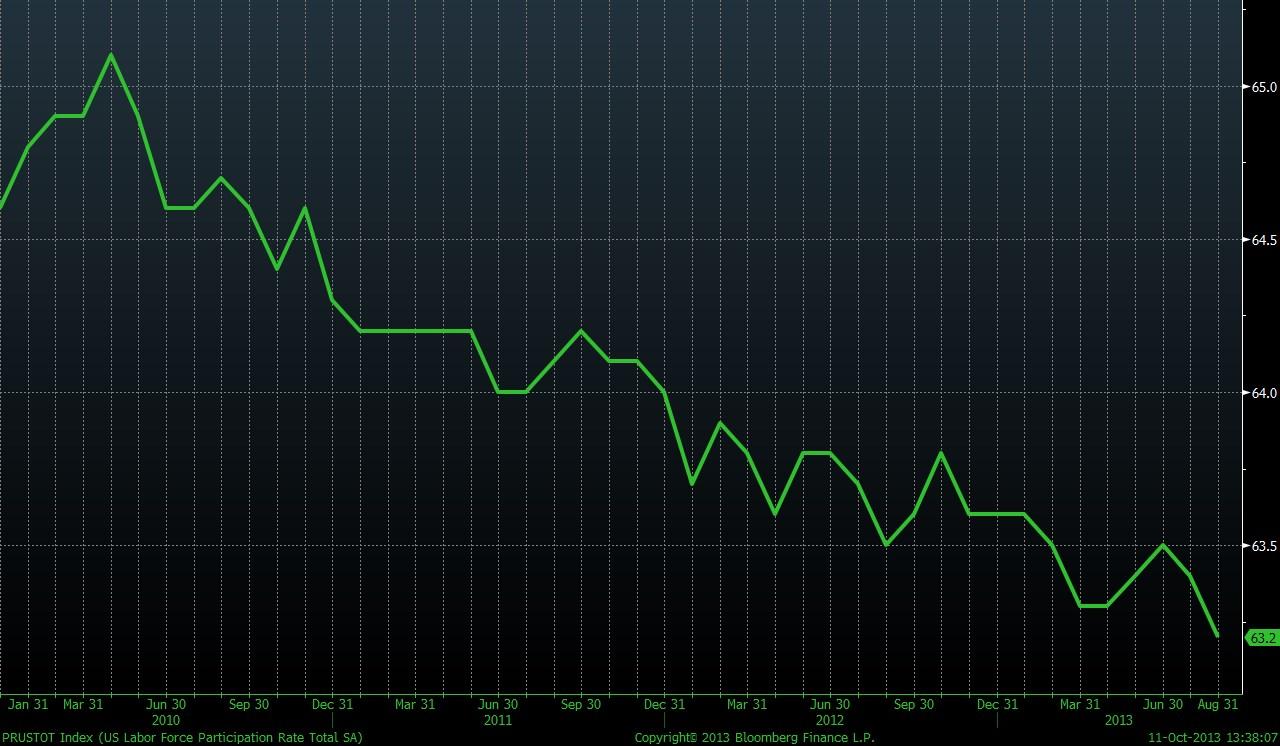
The U.S. economy showed some signs of weakness in the third quarter. The unemployment rate fell to 7.3% in August, which would have been encouraging news, but the labor participation rate also fell to 63% (the lowest level since the early 1980s), as discouraged workers gave up looking for jobs and left the labor force. In a more robust economy the labor participation rate would be increasing, and the unemployment rate might stay stable or even increase as people get off the sidelines and begin looking for jobs.

The yield of the Treasury bill maturing in September of 2014 rose four basis points in the last few days. This is not a crippling move, to be sure, but represents a real cost to the Treasury department and demonstrates that the market is factoring increased risk of default into Treasury prices. A German 10-year sovereign bond yields 1.86%, compared to 2.68% for a 10-year Treasury bond. Canada’s 10-year bond has a yield of 2.59%, Holland’s yields 2.23%, while France’s has a yield of 2.37%, all lower than the U.S. 10-year. Investors are demanding a premium to hold U.S. debt.
GLOBALECONOMY
The U.S. labor force participation rate has fallen steadily since the financial crisis in 2008-2009.
Manufacturing, industrial production, and durable goods data were reasonably positive in the third quarter, but were disappointing for this stage of an economic recovery. The news isn’t all gloomy, however. Housing starts continue to rise steadily, as do building permits and existing home sales. Meanwhile, inflation is still low, giving the Fed more room to maneuver as it continues to try to stimulate the economy. U.S. Urban Consumer Price Index was 1.5% year-over-year in August. U.S. GDP will rise about 2.0% in 2013, which is a continuation of the slow but steady recovery that’s been in place since 2010.
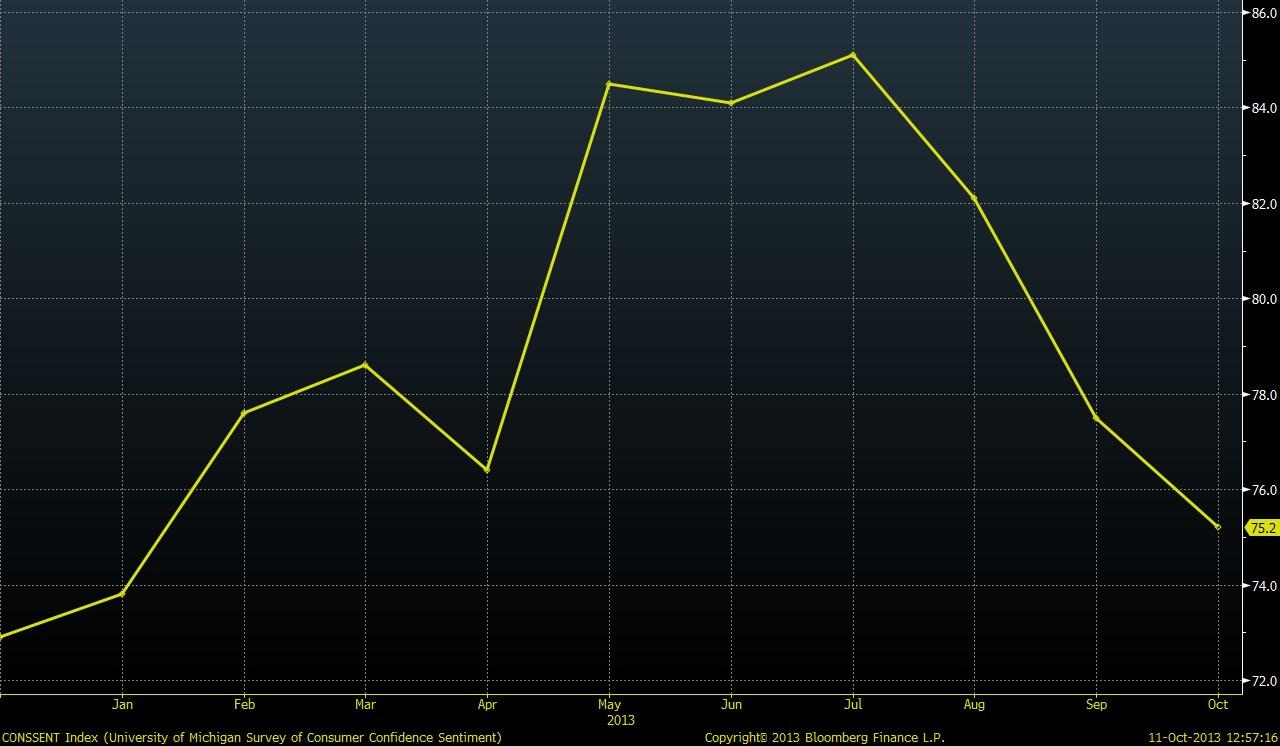
There were continued signs of improvement in the eurozone in the third quarter. Europe is still in a mild recession, but growth figures are improving. Industrial production is up this year, as is consumer confidence. Meanwhile, Mario Draghi, chairman of the European Central Bank, has promised to keep interest rates low for the foreseeable future. The inflation rate in the eurozone is currently just 1.1%, and has fallen this year, so the ECB has further room to stimulate. Chancellor Angela Merkel came out the winner in German elections in September, after campaigning to strengthen the euro and to work for further political and economic integration in the continent. Eurozone leaders are continuing the push toward a banking union as an important step in this direction.
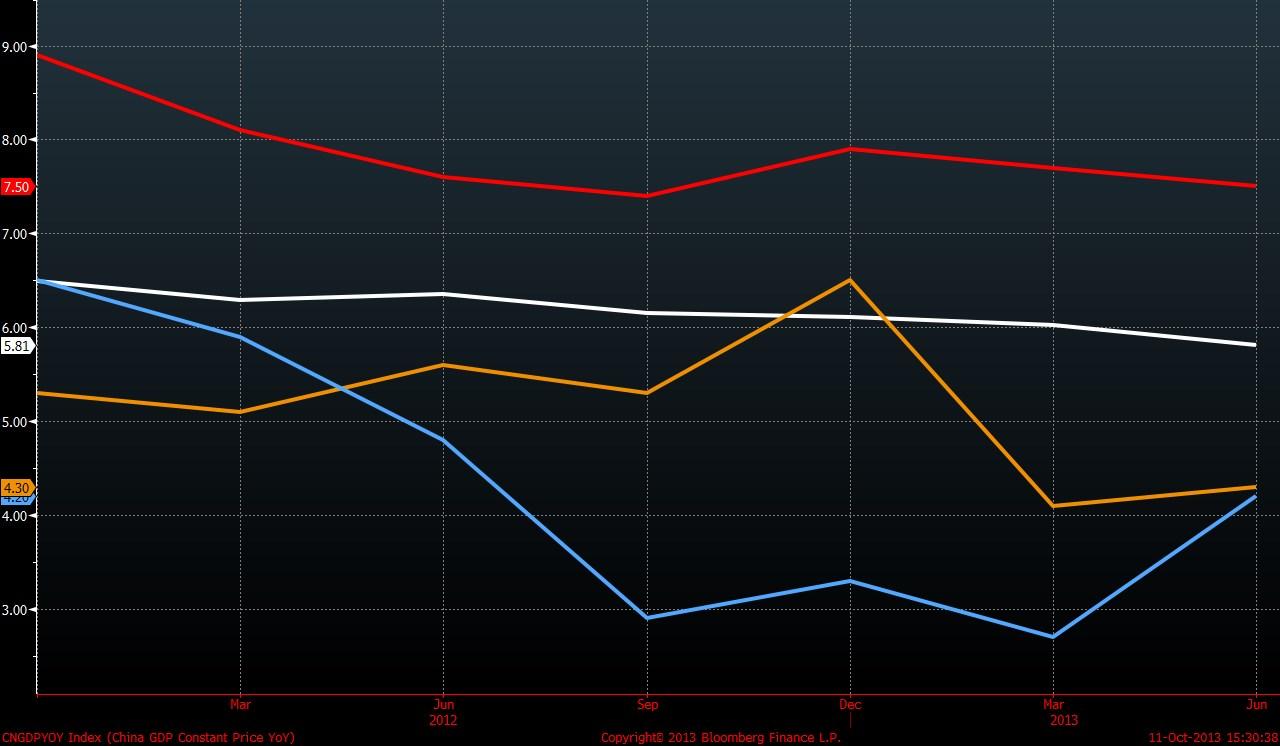
The Chinese economy is improving as well. Industrial production was up in the third quarter, as was manufacturing. GDP growth bottomed out at 7.5% in the second quarter, and is picking up as we begin the fourth quarter. This bodes well not just for China, but for other emerging economies that trade with China, including Indonesia (set to grow 5.5% this year), Malaysia (4.5%), and Colombia (4.0%), among others
Brandon Fitzpatrick
FIXEDINCOME
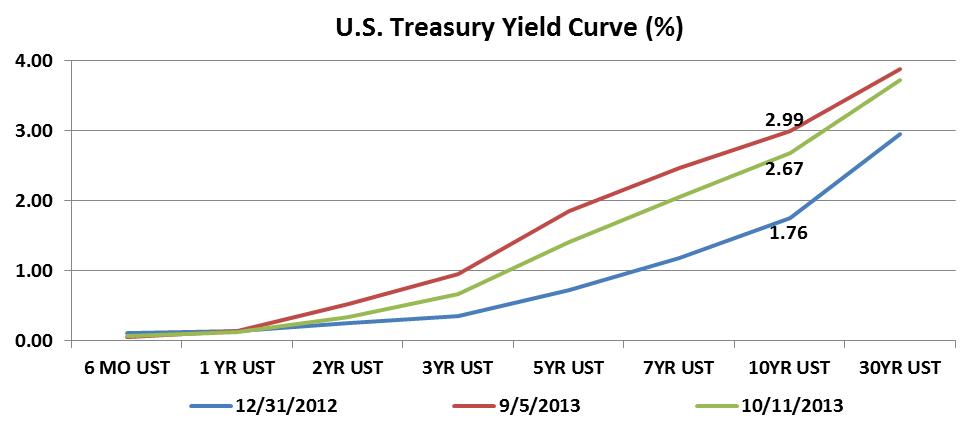
After experiencing one of the biggest sell-offs in the last 40 years starting last May, the bond market rallied in September. This was caused by the FOMC’s (Federal Open Market Committee) dovish stance and the decision announced September 18 not to taper the current bond buying program, known as Quantitative Easing 3 (QE3). As a result, the U.S 10-year Treasury, after reaching a high of 3.0 percent on September 5, has retreated to 2.67 percent on October 11.
The broad U.S. Investment grade bond market, as measured by the Barclays U.S. Aggregate Index, fell 1.89 percent through the end of the third quarter. Similarly, U.S. mortgage backed securities (MBS), U.S. Treasury, and Corporate Bond indices were down 1.00, 2.01, and 2.62 percent, respectively, during the same period.
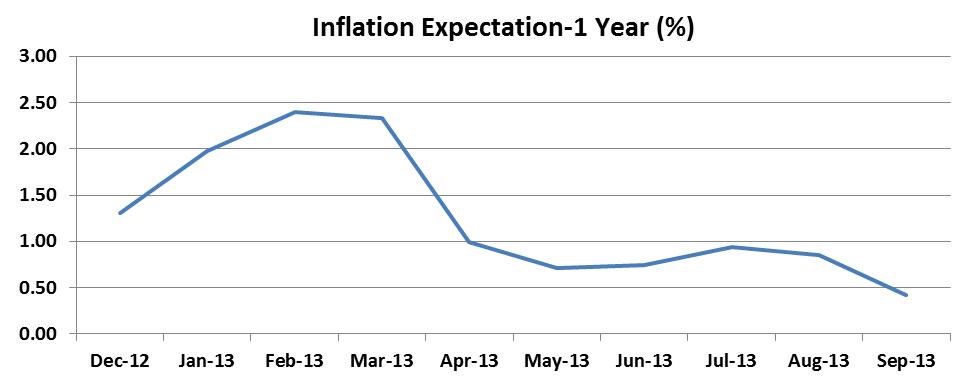
The FOMC’s decision on tapering was affected by the sustained high unemployment rate, currently at 7.3 percent, low inflation expectations, and mixed economic data. The Fed is committed to keeping rates low and any tapering of QE3 will be data driven. We believe that the unemployment rate has to fall to 6.5 - 7.0 percent, concurrent with an increase in the labor participation rate, before the FOMC decides to taper. We expect this to occur in early to mid-2014.
Rates are likely to pause at current levels and the 10-year U.S. Treasury yield should stay within a range of 2.5 –3.0% through the end of 2013. Current Treasury yields already reflect the heightened political uncertainty caused by the impasse between the U.S. House and the White House on the budget and debt ceiling debate. Any agreement on this issue may cause yields to rise. The yield curve will likely flatten, with short term rates rising
faster than long term rates in 2014, provided we have a more healthy economy in the U.S. We expect interest rates to rise in the longer term, with the yield on the 10-year Treasury at 4.0-5.0% in 2014-2016.
Prabhab Banskota
THIS PUBLICATION IS FOR INFORMATIONAL PURPOSES ONLY. THIS PUBLICATION IS IN NO WAY A SOLICITATION OR OFFER TO SELL SECURITIES OR INVESTMENT ADVISORY SERVICES, EXCEPT WHERE APPLICABLE, IN STATES WHERE D.B. FITZPATRICK & COMPANY IS REGISTERED OR WHERE AN EXEMPTION OR EXCLUSION FROM SUCH REGISTRATION EXISTS.
INFORMATION THROUGHOUT THIS PUBLICATION, WHETHER STOCK QUOTES, CHARTS, ARTICLES, OR ANY OTHER STATEMENT OR STATEMENTS REGARDING MARKET OR OTHER FINANCIAL INFORMATION, IS OBTAINED FROM SOURCES WHICH WE AND OUR SUPPLIERS BELIEVE RELIABLE, BUT WE DO NOT WARRANT OR GUARANTEE THE TIMELINESS OR ACCURACY OF THIS INFORMATION. NEITHER WE NOR OUR INFORMATION PROVIDERS SHALL BE LIABLE FOR ANY ERRORS OR INACCURACIES, REGARDLESS OF CAUSE, OR THE LACK OF TIMELINESS OF, OR FOR ANY DELAY OR INTERRUPTION IN THE TRANSMISSION THEREOF TO THE USER. THERE ARE NO WARRANTIES, EXPRESSED OR IMPLIED, AS TO ACCURACY, COMPLETENESS, OR RESULTS OBTAINED FROM ANY INFORMATION CONTAINED IN THIS PUBLICATION.
NOTHING IN THIS PUBLICATION SHOULD BE INTERPRETED TO STATE OR IMPLY THAT PAST RESULTS ARE AN INDICATION OF FUTURE PERFORMANCE. ALL RETURNS ARE MODEL RETURNS FROM A COMPOSITE. ALL RETURNS ARE NET OF FEES AND ANNUALIZED.