ECONOMIC FORECAST
Q3 2013 JULY11
Fixed Income
Equities
U.S. Economy
Emerging Markets
Europe
DBF Strategies
Dennis Fitzpatrick Founder, CEO, and Chairman
SUMMARY
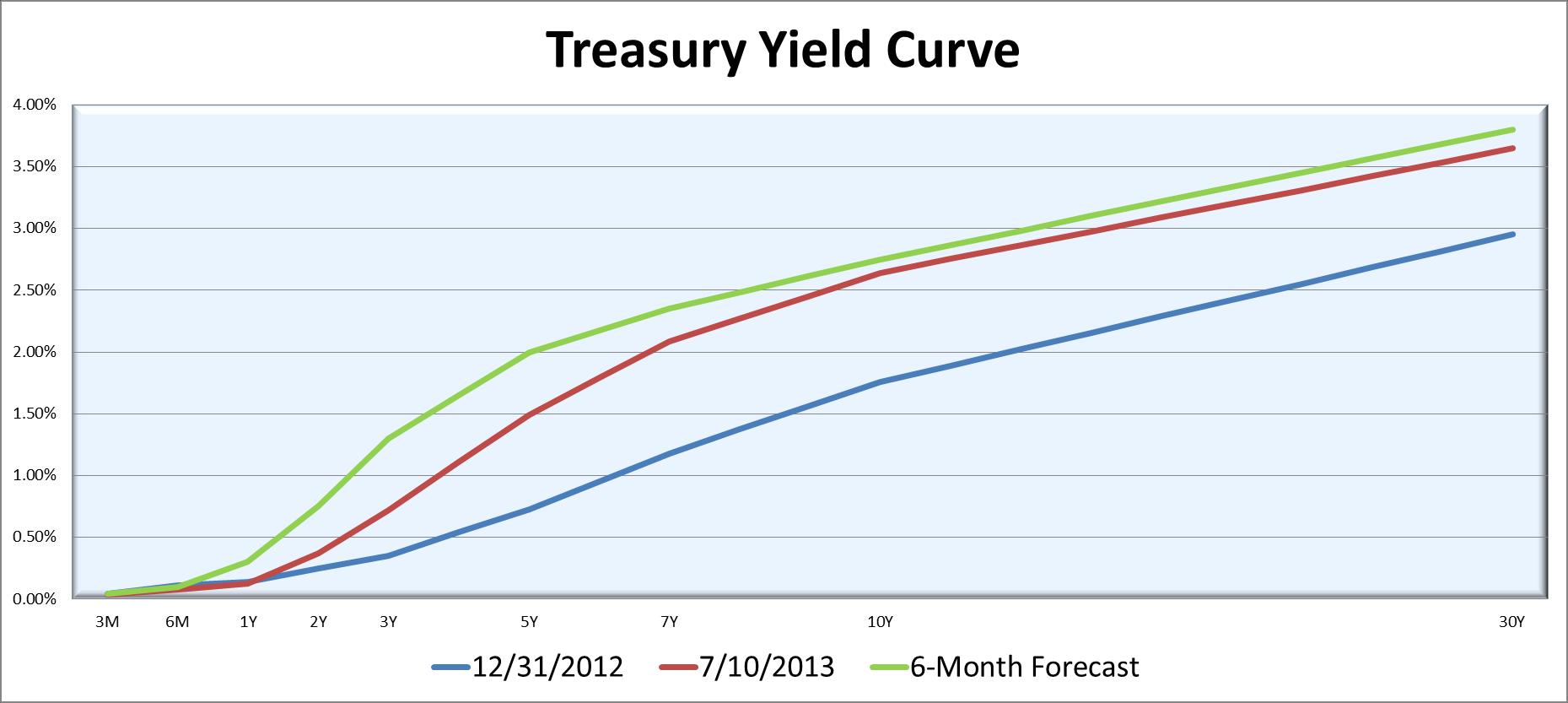
Fed chairman Ben Bernanke’s comments in mid-May that the Fed would “taper” monetary stimulus as the economic recovery gains strength spooked the financial markets, sending both stocks and bonds lower in the last weeks of the second quarter. Bernanke’s announcement was meant to be innocuous, and in truth was not much different from what he had said in previous speeches. Nonetheless, the bond market was shaken by the prospect of an early end to the quantitative easing program, and the yield curve steepened. The yield on a 10-year Treasury rose from 1.60% in April to 2.60% in June. The yield on a 30-year Treasury rose from 3.10% at the end of March to 3.50% at the end of June. The real interest rate (the nominal rate minus the rate of inflation) rose in the quarter, as market expectations for inflation fell and nominal yields rose. The real rate on a 10-year Treasury was –0.67% at the end of March, before rising to 0.46% at the end of June.
We expect interest rates to fall somewhat from current levels, as bond investors take a break from the selling. In the longer term, however, interest rates are very likely to climb further as the economy continues to heal from the financial crisis, housing bust, and recession of 2008-2011. There is still a lot of danger in the fixed income markets, and we’re avoiding low quality credits and long duration bonds. Stocks are more attractive than bonds today, with attractive value in industrials, financials, and some out of favor emerging markets.
FIXEDINCOME
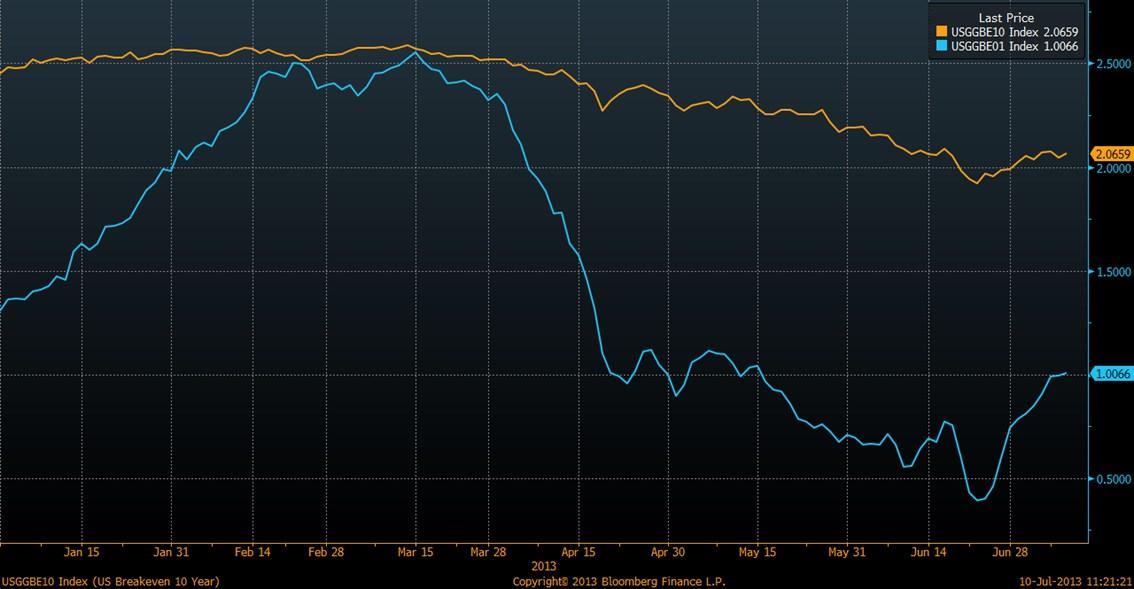
The big action in the second quarter occurred in the bond market. Bernanke’s comments prompted bond selling and sent interest rates sharply higher. The yield curve steepened and long duration bonds bore the brunt of the damage. TIPS (Treasury Inflation Protected Securities), were not spared, with inflation breakeven rates falling dramatically in the second quarter. Market expectations for inflation during the next year fell from 2.35% at the end of March to 0.74% at the end of June, while inflation expectations during the next 10 years fell from an annualized rate of 2.52% to 1.99%. The market is sending a message that it doesn’t expect much inflation without continued large-scale monetary stimulus. The market is also sending a clear warning that interest rates are set to rise as the unemployment rate falls, Fed bond purchases slow down, and the economy finally returns to a more
1-year inflation expectations
10-year inflation expectations
“normal” environment, five years after the financial crisis began.
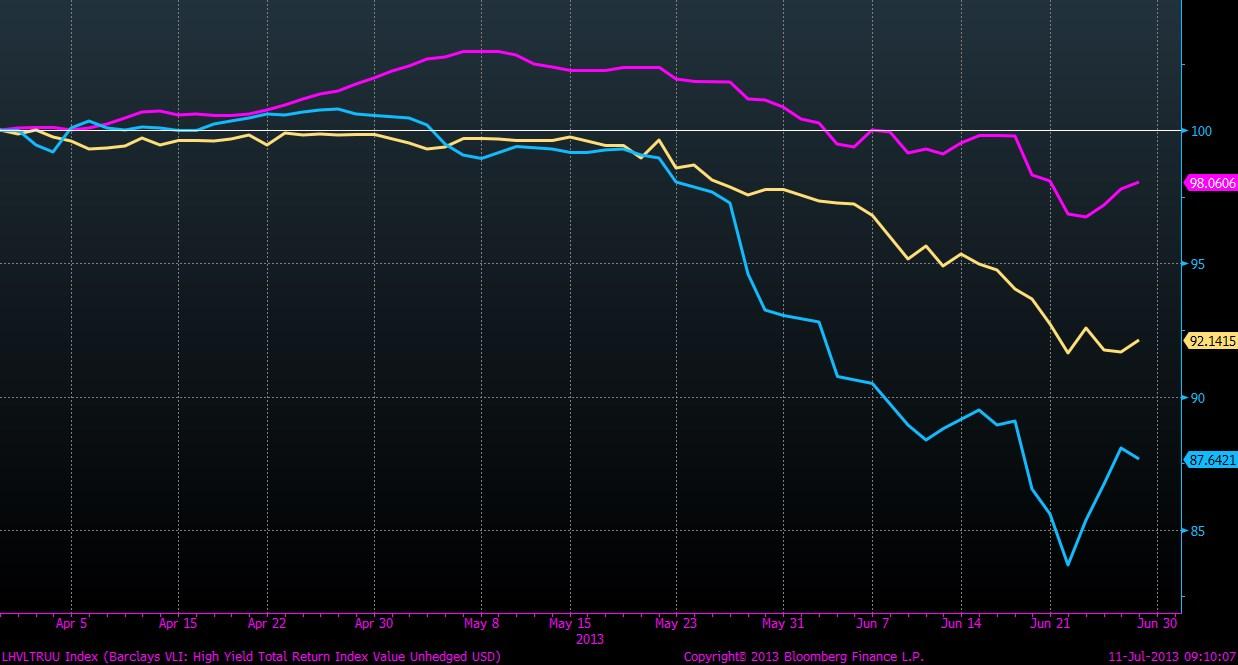
Bonds of lower credit quality were hit even harder than Treasuries in the second quarter. The Barclays High Yield Very Liquid Bond Index, which tracks high-yield corporate bonds, was down 5% from early May to late June. Emerging market sovereigns – both U.S. dollar denominated and local currency – were down sharply in the quarter, and the damage was widespread. A Mexico sovereign U.S. dollar bond maturing in 2022, for example, fell 7% in the quarter, while an Indonesian U.S. dollar bond due in 2019 fell 8%. Local currency debt was hit even harder. A Colombian local currency sovereign due 2022 was off 12% in the three months through June, while a Philippines 10-year local currency sovereign fell 12%. Additionally, emerging market currencies were down virtually across the board.
Indonesia U.S. dollar sovereign due 2019
Colombia local currency sovereign due 2022
Lower quality bonds were hit hard in the second quarter
Barclays High Yield Very Liquid Bond Index
on a 30-year mortgage rose from 3.40% at the end of April to 4.61% on July 10.
The MBS (mortgage backed securities) market also fell in the second quarter. Mortgage rates rose, following Treasury yields, and prices of low coupon pools fell the most as duration extended. The expected maturity of low coupon pools increased significantly, as the underlying mortgages are much less likely to be refinanced now that mortgage rates have risen. The rate
In the beginning days of the third quarter interest rates have continued their march higher, with the 10-year Treasury yield reaching 2.60% on July 11. Recent economic data have generally been positive, which the bond market views as giving the Fed more justification to slow down its purchase of Treasuries and MBS. We expect interest rates to pause somewhat, taking a break from their steady increase. The yield curve is likely to flatten by the end of the year, however, and in the longer term interest rates are very likely to rise. Our fixed income portfolios are positioned defensively, with an emphasis on high quality and short duration bonds.
EQUITIES
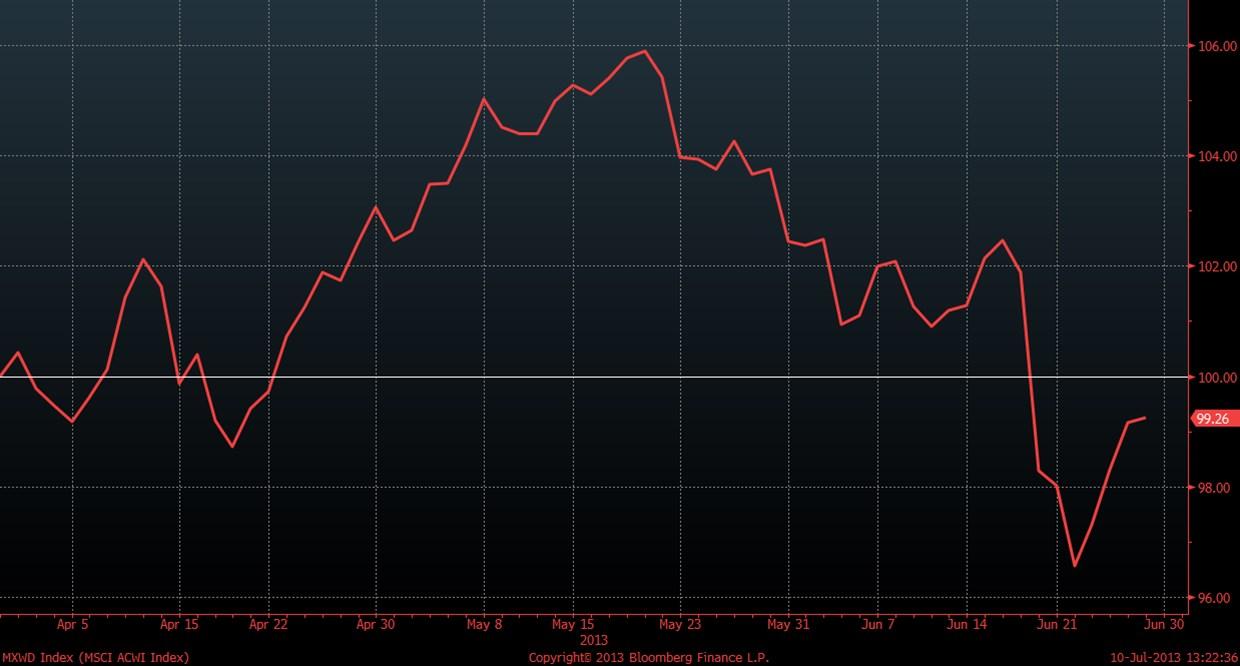
Stocks, as measured by the MSCI All Country World Index, fell 0.2% in the second quarter, after being up over 5% in mid-May. Stocks were affected by two principal factors late in the quarter: 1) the prospect of less central bank stimulus made investors somewhat less sanguine about economic growth and corporate profits, and 2) the market’s discount rate rose along with bond yields, pressuring stock prices. Rising bond yields had their most severe impact on utility and consumer staple stocks, which are viewed by the market as substitutes for bonds, due to their steady cash flows and noncyclical businesses. These sectors had outperformed recently, starting in 2012, but in the second quarter fell further than more cyclical sectors such as financials and industrials.
European stocks are flat for the year and, though they fell at the end of the second quarter with the broader global stock market, have by and large shrugged off recent worries about political turmoil in Portugal. The Nikkei index had a volatile second quarter but is still up 37% since the end of 2012 (though this is only 15% in U.S. dollar terms, as the yen has seen a sharp depreciation).
Emerging market stocks fell 9% in the second quarter and are down 11% since the start of the year, as investors worry that less monetary stimulus in the U.S.
will result in lower capital flows to the emerging world. There is also a nagging concern in the financial markets that the economic slowdown in China will worsen. Southeast Asian equities were hit especially hard in the second quarter, with the Thai, Indonesian, and Philippine stock markets all down sharply. Brazilian and Turkish stocks were down as well, though with these countries investors were responding more to protests and political uncertainty, not to slower growth in China and lower commodity prices. We took advantage of the turmoil in the stock markets to add exposure to Indonesian and Brazilian stocks.
The longer term story of the emerging economies is intact: growing middle classes, increased dependence on domestic demand, and strong government balance sheets. Emerging market valuations are compelling, with the MSCI Emerging Markets Index trading at 10.2 times 2013 earnings, versus 14.8 for the S&P 500 and 13.2 for EAFE (international developed stocks). With slower growth in China, however, managers will have to be more choosy with their EM positions as the tide of rising commodity prices seen in the 2000s is unlikely to be repeated in the next decade. We have exposure to Chilean, Colombian, Brazilian, Indonesian, and Chinese stocks.
The MSCI All Country World Index ended the second quarter down slightly
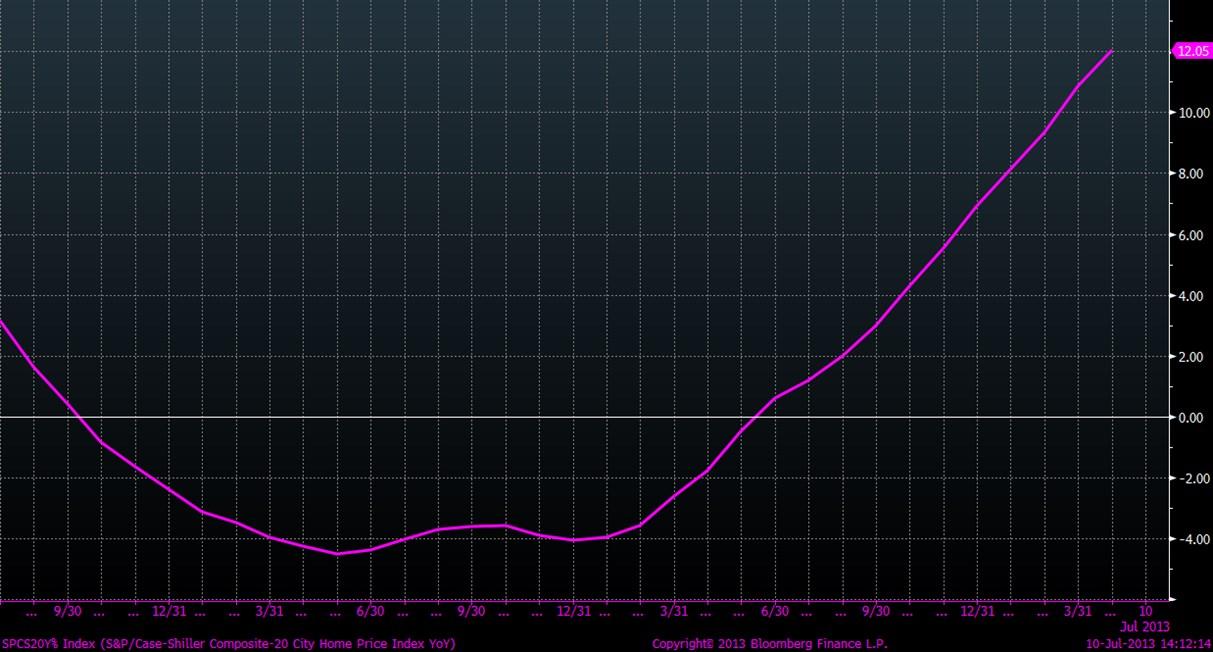
The U.S. economic recovery is continuing with many positive signs, but without the breakthrough growth number many have been waiting for since the recession ended in 2011. Probably the brightest sign is the housing market, which has shown continued strength during the last 12 months. Housing prices are up across the country, including previously very hard hit areas such as south Florida and Las Vegas. Housing starts are also up. Higher mortgage interest rates in the second quarter threaten to lower housing demand somewhat, but we think a robust housing recovery will continue in spite of higher rates. In fact, higher rates may be the impetus needed to get marginal buyers off the fence, as they fear the prospect of missing out on still low rates.
U.S.ECONOMY
The Case Shiller index of house prices is up as the housing sector improves
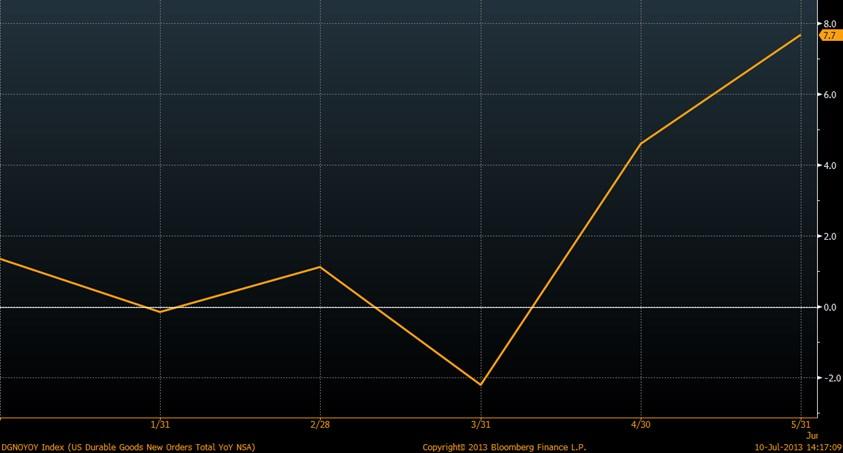
Durable goods orders were up in the second quarter
Durable goods orders are up, as is consumer confidence as consumers feel more upbeat about the housing market and their personal balance sheets. Initial jobless claims have been consistently below 400k, which most economists believe indicates that the economy is adding jobs. Higher interest rates typically are bad for economic growth, but in the present environment they
might be positive if they prompt banks to increase lending.
We expect the U.S. economy to grow 2.0% this year before accelerating to 2.5% in 2014.
EMERGINGMARKETS
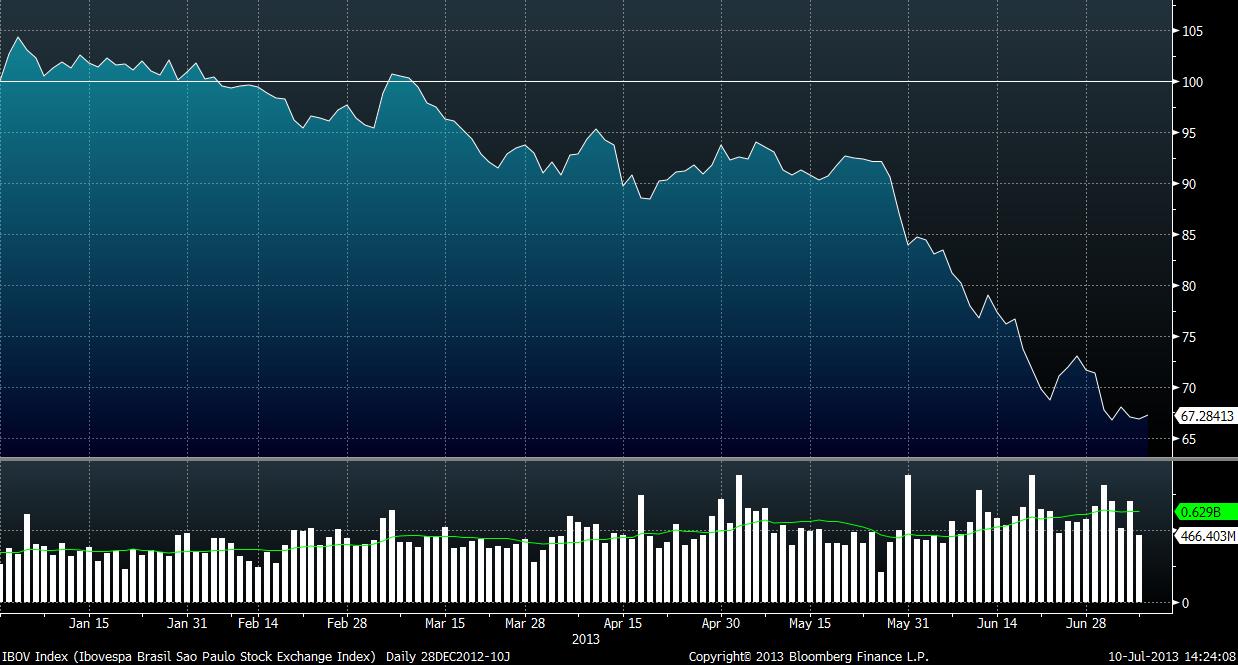
There was significant political turmoil in some notable emerging market countries in the second quarter. Higher bus fares in São Paulo sparked what turned into a nationwide protest against endemic corruption, political atrophy, and massive inequality. Aspirations have been raised as the country’s middle class grows, and change is not coming fast enough for many. President Rousseff was caught off guard by the strength of the protests, but seems now to have regained her political footing. She has promised a series of reforms that, at least for now, have assuaged protestors. President Rousseff is facing reelection next year, and the political situation is becoming dire, as it will be very difficult to win without a stronger economy. Further complicating the situation is the fact that inflation is above the central bank’s target, which limits the policies available to both Rousseff and the central bank. Brazilian policymakers are now trying to encourage foreign investment and strengthen the real, though they are surely hopeful that the real’s recent depreciation will boost exports in the short run. Investors have soured on Brazilian securities both stocks and bonds and there are currently some good values in Brazil. Taking advantage of this opportunity, we recently added exposure to Brazilian stocks to our equity portfolios.
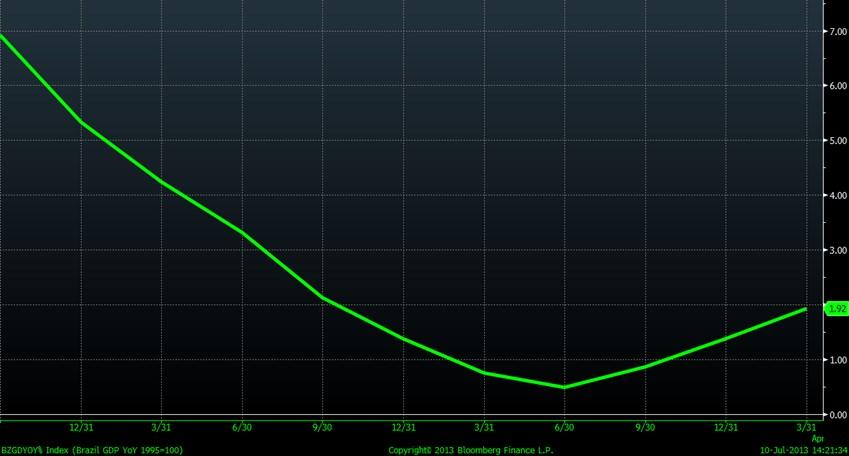
Brazil’s GDP growth is below 2%. Policymakers are working to stimulate as the 2014 election looms.
Most economies in Latin America have slowed down, largely as a result of lower commodity prices, but some countries such as Colombia and Chile are still set to grow at least 4% this year. The largest economies in southeast Asia have also slowed down, but growth there is still much better than what the U.S. and Europe can muster. Indonesia is set to grow 5% this year, while Malaysia’s economy will expand 4%. The correlation among equities in these countries has been very high in the last few weeks, and many good stocks are trading at very attractive valuations. We’ve also recently added exposure to Indonesian stocks.
Brazil’s Bovespa Index is down sharply this year
EUROPE
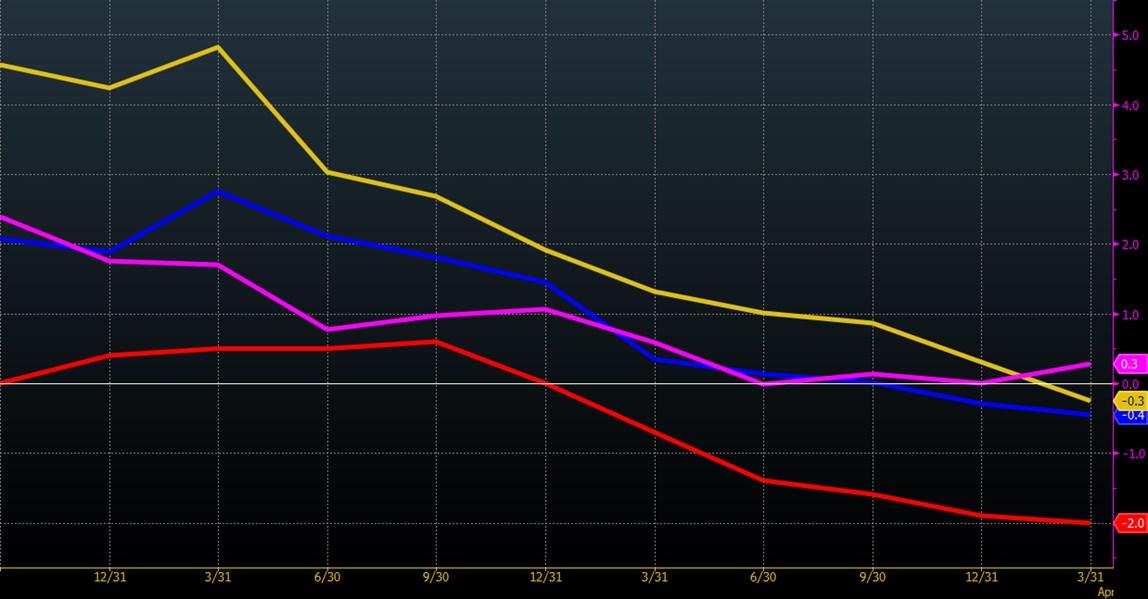
European markets have been fairly quiet this year, with investors satisfied that the European Central Bank will serve as a backstop to prevent sovereign bond yields from spiraling out of control. Recent troubles in Portugal have not spread to the rest of Europe, and it appears that there is little risk of a further conflagration in the near term. Economic growth, however, is anemic across the continent and unemployment rates are unacceptably high.
There seems to have been somewhat of a change in attitude across the continent against “austerity” – fiscal tightening designed to bring national budgets under control – though admittedly not in Germany. There is
certainly a lot of empirical evidence indicating that austerity has not helped spur economic growth, and probably has even worsened national budget deficits (the UK is a case in point).
German elections in August offer new hope, as Chancellor Merkel, after winning a new mandate, may feel freer to inch away from austerity and instead support measures designed to encourage economic growth. Certainly that would be beneficial for Europe. We have an underweight in European stocks, though there are some good European value stocks with decent valuations, and we do have some exposure within our equity portfolios.
GDP growth in Europe
U.S. stocks are fairly valued while Japanese stocks and other deep value sectors still look overpriced. Emerging market stocks are generally attractive, but careful country and security selection is needed as growth in China slows down. We’re overweighting emerging market stocks, though we’re not emphasizing BRIC countries (Brazil, Russia, India, China). We have a neutral weight in financials, an underweight in utilities, healthcare, and consumer staples, and an overweight in industrials.
There is still a lot of risk in the bond market, even after the recent dramatic rise in interest rates. We are steering clear of low quality bonds and have positioned our fixed income portfolios defensively as we expect interest rates to rise further.
Brandon Fitzpatrick
THIS PUBLICATION IS FOR INFORMATIONAL PURPOSES ONLY. THIS PUBLICATION IS IN NO WAY A SOLICITATION OR OFFER TO SELL SECURITIES OR INVESTMENT ADVISORY SERVICES, EXCEPT WHERE APPLICABLE, IN STATES WHERE D.B. FITZPATRICK & COMPANY IS REGISTERED OR WHERE AN EXEMPTION OR EXCLUSION FROM SUCH REGISTRATION EXISTS.
INFORMATION THROUGHOUT THIS PUBLICATION, WHETHER STOCK QUOTES, CHARTS, ARTICLES, OR ANY OTHER STATEMENT OR STATEMENTS REGARDING MARKET OR OTHER FINANCIAL INFORMATION, IS OBTAINED FROM SOURCES WHICH WE AND OUR SUPPLIERS BELIEVE RELIABLE, BUT WE DO NOT WARRANT OR GUARANTEE THE TIMELINESS OR ACCURACY OF THIS INFORMATION. NEITHER WE NOR OUR INFORMATION PROVIDERS SHALL BE LIABLE FOR ANY ERRORS OR INACCURACIES, REGARDLESS OF CAUSE, OR THE LACK OF TIMELINESS OF, OR FOR ANY DELAY OR INTERRUPTION IN THE TRANSMISSION THEREOF TO THE USER. THERE ARE NO WARRANTIES, EXPRESSED OR IMPLIED, AS TO ACCURACY, COMPLETENESS, OR RESULTS OBTAINED FROM ANY INFORMATION CONTAINED IN THIS PUBLICATION.
NOTHING IN THIS PUBLICATION SHOULD BE INTERPRETED TO STATE OR IMPLY THAT PAST RESULTS ARE AN INDICATION OF FUTURE PERFORMANCE. ALL RETURNS ARE MODEL RETURNS FROM A COMPOSITE. ALL RETURNS ARE NET OF FEES AND ANNUALIZED.