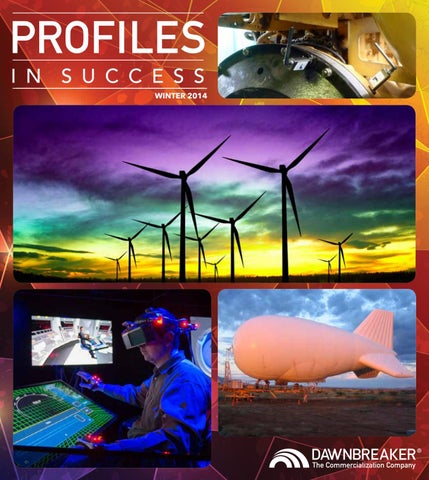
WINTER 2014
CONTENTS
01 02 03 04 05 06 07 2 • Profiles in Success
First RF Corporation | Topic Number: N08-175 KCF Technologies | Topic Number: N093-190 Lynntech, Inc. | Topic Number: N092-132 PhaseSpace, Inc. | Topic Number: N09-T021 SA Photonics | Topic Number: N09-T031 Sentient Science Corporation | Topic Number: N101-006 Syntonics, LLC | Topic Number: N07-149
SUCCESS
Success is the consequence of countless steps executed both consciously and sometimes capriciously by a committed team driving its technology forward. For the successful company, success isn’t achieved when the research is complete - but when the product is sold. The successful company develops a tenaciousness, a philosophy which seeps into the fabric of the firm and proclaims that commercialization is their goal and that they must push forward, developing relationships with customers in both targeted and tangential applications until the benefits of their innovation are understood and embraced. A marketable innovation requires numerous rounds of funding. In the case of the Small Business Innovation Research (SBIR) program as a funding source, this implies that a company will have received many awards each addressing a part of the technology platform under development. In this issue, we have highlighted some firms where the revenue secured from sales was not the result of just one award – but of multiple awards knit together over a number of years (See Syntonics and First RF). Other stories reflect the efforts companies have made to find commercial customers. Such was the case with Sentient Science Corporation, which while building a diagnostic sensor system for UAVs under funding provided by the Office of Naval Research (ONR), found customers from the wind turbine industry which started investing in the technology. And over at PhaseSpace, Inc., the President himself proactively contacted large corporations while its technology was still in the Phase II project just to stir some interest and gain some valuable feedback in the process. In this issue we also highlight firms that are moving their technology forward with subsequent rounds of R&D funding from programs such as the Rapid Innovation Fund (RIF) and funding from other Services. EXECUTIVE EDITOR Dr. Jenny C. Servo WRITER Julie Scuderi GRAPHIC DESIGNER Adrienne Stiles Annie Browar COMMENTS We welcome comments and questions from our readers. Please feel free to email us at: profileseditor@dawnbreaker.com Profiles in Success • 3
4 • Profiles in Success
FROM THE EDITOR In this issue of Profiles in Success, we celebrate the achievements of companies that participated in the 2011-2012 Navy Transition Assistance Program (TAP). Sponsored annually by the U.S. Department of the Navy’s Small Business Innovation Research (SBIR) Program Office, the TAP assists companies in achieving more rapid transition of their technologies to the fleet. Each year, at the conclusion of the 10-month TAP, participants are invited to present their technologies at the Navy Opportunity Forum®. With an audience comprised of members of the acquisition community, prime contractors, first and second tier suppliers, and potential investors; the Forum creates a unique platform for companies to showcase their latest innovations. Of the 197 projects that presented at the 2012 Navy Opportunity Forum®., 51% reported having received Phase III funding within the 18-month period following program completion. Collectively, the total Phase III dollars received during this period was $101,089,938. This number represents a much larger trend, in that according to the Central Contractor Registry (CCR), 70% of the companies that participate in the TAP receive some sort of Phase III funding, as opposed to only 41% of those firms that do not participate in the Transition Assistance Program. Dawnbreaker uses a highly interactive approach focused on developing specific tools, opportunities and relationships that facilitate commercialization or transition in a way that is appropriate for that Agency. Since 1990, we have assisted over 6,500 SBIR/STTR firms with commercialization assistance through funding provided by multiple Agencies. Following the completion of the program, Dawnbreaker collects data from participating firms at 6, 12, and 18 months post-TAP in an effort to tangibly measure success. Success may come from official Phase III contracts with the Department of Defense, or it could come from commercial sales, licensing, private investments, or from corporate acquisition. The success stories featured in this Winter edition of Profiles in Success are a subset of the companies that have achieved over $2 million in Phase III revenue within the 18-month evaluation period, following the completion of the 2011-12 Navy Transition Assistance Program. Many companies find themselves being profiled year after year – this is a huge testament to their continued efforts and success in transitioning technologies to the fleet. We’d like to extend congratulations to all of the TAP participants for their dedication and persistence, and for exemplifying the value of the SBIR/STTR program time and time again.
Of the 197 presenting firms at the 2012 Navy Opportunity Forum®, 51% (100 projects) reported funding within an 18-month follow-up period for a total of $101,089,938 in Phase III revenue.
Jenny C. Servo, Ph.D. President, Dawnbreaker, Inc. The Commercialization Company
Profiles in Success • 5
01
FIRST RF Corporation
Visit FIRST RF Corporation online at: www.firstrf.com
Phase III Success: $6.5 million through contracts with the Navy, Army, Air Force, DARPA and USSOCOM Topic Number: N08-175 WITH SIX PHASE III CONTRACTS under
its belt and military demand for its antenna and RF product lines increasing every month, First RF has the knowledge and expertise to successfully transition technologies to the fleet. But it was a chance encounter during the 2010 Navy Opportunity Forum® that further fueled demand within the DoD and revealed a previously unknown opportunity. While browsing booth displays during the Forum, key personnel from the Office of Naval Research (ONR) caught a glimpse of First RF’s newly unveiled phased array antenna technology. Even though the initial antenna was designed for use on the Marine’s Expeditionary Fighting Vehicle (EFV), ONR wondered if the same technology could be applied to military helicopters. Within a week, First RF engineers found themselves at the U.S. Naval Air Test Center in Patuxent River, Maryland, where they were invited to further demonstrate their innovation to personnel at NAVAIR. With the goal The FRF-170 KuBand Phased Array System integrates amplifiers and phase shifters at the element level to greatly improve data link performance.
6 • Profiles in Success
of providing a full video upgrade to UH-IY and AH-1Z Naval helicopters, First RF spent about 5 weeks modifying the existing design of the antenna and putting it through strict shock and vibration testing. The end result was an antenna that could not only be used on helicopters, but multiple assets. The antenna allows both ship and ground personnel to view full motion video, which increases situational awareness, and gives troops more data on what lies ahead in the battlefield. The small and lightweight design increases range, reduces weight, and is portable enough to be applied to a wide array of platforms. First RF has fulfilled an order of 20 antennas to NAVAIR, and is set to deliver 50 more this year, resulting in $4.4 million of revenue for the Boulder, Colorado-based small business. A Navy TAP participant since 2007, First RF is keen to take advantage of the benefits and assistance the Transition Assistance Program (TAP) provides to small businesses. “Going through the TAP process, with the market research provided, and the interface with the Business Acceleration Managers, and time with the customer is invaluable to a small business,” says Dave Massey, Director of Business Development for First RF. “It enables the transition of the technology to happen within 3 to 4 years, as opposed to it sitting on the shelf for years, or never happening at all.” During the 2012 Navy Opportunity Forum®, First RF was presenting its Phase II project under Topic N08-175 – Wideband Conformal Antenna. First RF developed a broadband multi-function antenna system and an innovative beam forming technique to address Navy needs. This led to a Rapid Innovation Fund with USSOCOM, along with a Phase III contract for its conformal antennas to be used with the Army’s Blue Force. Founded in 2003, FIRST RF has already secured 66 Phase I SBIR awards and has successfully transitioned 41 of these to Phase II programs. They have also transitioned Phase II SBIR projects in electronic warfare (EW) and Radar antenna systems to Phase III and full-scale pro-
duction. The largest antenna production program in DoD history began as a Phase I program in 2004 with First RF, and since then, over 120,000 antennas have been produced that support ultra-wideband Electronic Warfare against radio-IED threats in the Middle East. Their recent contract with the Army resulted in over 160,000 tactical vehicular antenna systems being delivered to support operations in Iraq and Afghanistan. This multidecade antenna technology became the first antenna designated as the Army “Common Antenna” capable of performing multiple communications and EW functions critical in the Global War on Terror. It was because of this technology that First RF received the National Army SBIR Commercialization Excellence Award in 2010 for outstanding commercialization success of an SBIR program. Sales of advanced ultra-broadband antenna products for the company are in the $200 million range. First RF is a woman-owned small business and offers a wide range of commercial off the shelf antenna products and COTS components for airborne, vehicular,
fixed site, space, and man-portable applications. FIRST RF, in collaboration with multiple prime contractors, has developed advanced antenna and radio frequency (RF) technologies for future airborne and ground-based sensors. The company has successfully transitioned the technology developed under several projects to various systems integrators, including SRC, ITT, Raytheon, Northrop Grumman, Lockheed Martin, General Dynamics, Cubic, Argon ST, BAE Systems, Sierra Nevada Corp., Cobham, LGS, and Honeywell. Government customers include the U.S. Army, Air Force, Navy, Marine Corps, MDA, DARPA; NASA, NOAA; Johns Hopkins University Applied Physics Laboratory and the Jet Propulsion Laboratory. First RF was awarded the Raytheon Missile Systems 3-Star Excellence Award and The Tibbetts Award in 2011.With a commercialization achievement index of a perfect 100, First RF has earned a stellar reputation in the industry.
Ku-Band phased arrays and multi-band antenna systems developed by FIRST RF have demonstrated greatly improved range and coverage on Navy helicopters. (Photo courtesy of the U.S. Navy)
Profiles in Success • 7
02
KCF Technologies
Visit KCF Technologies online at: www.kcftech.com
Phase III Success: $17.5 million through contracts with the Navy Topic Number: N093-190 KCF TECHNOLOGIES has made headlines the
past several years with its energy harvesting innovations and wireless sensor technologies. After successfully implementing their technologies on the Navy’s Black Hawk and H-53 helicopters, the next natural question was…why not submarines? Energy harvesters work by capturing wasted energy from a machine’s normal operation. The harvested energy is typically used to power devices such as wireless sensors. In many applications these sensors generate key information related to the health or condition of their host asset. The health and condition information can then be used to support data-driven and targeted maintenance activities. This self-contained harvester-powered sensor approach is essential to enabling the DoD’s Condition-Based Maintenance Plus (CBM+) initiatives because high value data can
Condition-based maintenance performed on information received from self-powered wireless sensors installed on UUVs is a goal of the DoD. (Photo courtesy of the U.S. Navy)
8 • Profiles in Success
be procured at a low lifecycle cost. CBM+ is allowing the DoD to move away from an overly conservative preventative maintenance schedules to an optimized on-demand maintenance model. After winning several SBIR awards to evolve its energy harvester technologies, KCF then embarked on a Phase I and II project with NAVSEA to harvest energy from the ambient electromagnetic environment that exists on submarines. The harvester developed under this SBIR project used a specialized magneto-electric transducer. During the Phase II program, KCF participated in the Navy Transition Assistance Program (Navy TAP) and presented at the 2012 Navy Opportunity Forum®. As part of the TAP, each company is matched with a Business Acceleration Manager (BAM) to assist them every step of the way. As a regular TAP participant, KCF knows the value that comes from the specialized attention. “I think any small business can benefit from it,” says Jeremy Frank, President of KCF Technologies. “The value comes from working with the BAMS – and the contacts you meet at the Forum can prove to be invaluable.” The baseline technology of wired sensors on submarines is similar to that of other DoD platforms like helicopters. Ubiquitous application of wired sensor systems is limited by installation cost and complexity, faults, and maintenance of the wires for supplying power and communication. A routine task like adding a new wire route could cost over $1 million just to get the plans drawn. Sustaining the wire route throughout the life of the submarine is also costly each time you add a wire. Batteries present a competitive alternative, but they bring their own costs and complexities. Batteries must be replaced on a regular basis before failure to ensure continuous sensor monitoring, and that drives labor and material cost especially considering that many sensors will be located in areas that are difficult to access. Over the course of the SBIR project, the magnetoelectric harvester proved to be applicable to certain locations in the submarine. To more broadly address the
need for sensors throughout the submarine, the SBIR work was refocused on reducing the power consumption of the sensor components. By optimizing the wireless sensor electronics, the project resulted in hardware that requires a very low power budget and enables a long 8 year battery life. This key technology advancement enables battery replacements to be aligned with submarine depot maintenance cycles. The demand for these new self-powered wireless sensors stems from the basic DoD-wide push for Condition-Based Maintenance. This technology essentially gives machines a “voice” to communicate how close they are to a failure condition. Maintenance is only performed when it is needed, as opposed to being performed on an aggressive schedule. The ability to detect problems and prevent failure has significant safety and cost benefits, since the cost of failure is extremely high, both in lives and dollars. Although implementation on submarines with the goal of continuous machine monitoring has a lengthy transition path, KCF continues to supply its condition monitoring product line to the commercial marketplace, while furthering its development on subs. The success of KCF’s SmartDiagnostics® commercial product line is in-part built around the ability to send large amounts of data using an extremely low power budget, which was furthered under this SBIR topic. This equates to enabling continuous monitoring of machines and low sensor lifecycle cost through minimizing battery replacements. Machines in commercial industry typically fail unexpectedly and over short time periods, which is why continuous monitoring is essential to practically enabling Condition-Based Maintenance. KCF’s suite of commercial products can be found on large industrial fans/air handling units, water pumps, mud pumps, paper plants, and within industries like natural gas, food processing, steel, and chemical plants. The objective always remains the same, and that is to optimize maintenance practices. The power generation industry is a natural fit for Condition-Based Maintenance and self-powered sensors, since failure of any of the large, moving parts results in costly downtime. Transitioning technologies to the commercial marketplace is one of the fundamental components of KCF’s business strategy and it has served them well. Every Phase II project KCF has embarked upon has resulted in a successfully launched commercial product.
KCF’s SmartDiagnostics® wireless sensor
Profiles in Success • 9
03
Lynntech, Inc.
Visit Lynntech, Inc. online at: www.lynntech.com
Phase III Success: $2 million through contracts with the Navy Topic Number: N092-132 UNMANNED UNDERWATER VEHICLES (UUV) are typically powered by batteries, which limits mission endurance and capability. Relied upon by the Navy for high-priority missions such as fleet protection, oceanography, communication and navigation, it is becoming increasingly important to turn to alternative energy sources for sustained performance. Lynntech has specialized in electro-chemical power for over two decades, with a strong focus on fuel cell technology. When the Navy wanted to develop a flexible hybrid energy system for long endurance UUVs, the small business located in College Station, TX knew it had the tools and knowledge to deliver results. While batteries keep a UUV running for several hours, Lynntech envisioned a system that would enable run times of 50% to 400% longer. This goal was right in line with the Navy’s express desire to conduct fully independent UUV missions with durations of two months by 2017.
Lynntech went to work to develop a system that was flexible, modular, and consisted of a proton exchange membrane (PEM) fuel cell, a commercial offthe-shelf battery, and advanced power management system architecture. This hybrid battery provides power for short-term high-power transient loads, while the fuel cell provides stable base load power and battery recharging. This allows the UUV to operate for longer periods of time and could support a more extensive sensor capability compared with current vehicles. Although Lynntech began work on its fuel cell hybrid energy system following a Phase I SBIR award from NAVSEA, this technology was built upon years of earlier work building fuel cells for high altitude long range, long endurance operations within the Department of Defense. The challenge was now to put a fuel cell battery system into such a small piece of equipment, measuring just 12 ¾ inches. During the subsequent Phase II
Fuel Cell, Balance of Plant, Electronics, and Hybrid Battery Reactants and Product Water Storage
Sensor Section
Propulsion
Energy Section
10 • Profiles in Success
Payload Section
project, Lynntech presented its innovation at the 2012 Navy Opportunity Forum®, following its participation in the Navy Transition Assistance Program (Navy TAP). Having attended the Forum five years in a row, Lynntech knows the value of getting in front of the right audience. “We devote a lot of resources to our time in the TAP because we see the value,” says John Stocker, Lynntech’s Senior Vice-President of Federal Solutions. “We know that we get adequate coverage with our customers – both within the DoD and other government agencies, and the Navy does a fantastic job of showing people what these SBIR-funded technologies can do.” Lynntech’s system garnered enough interest that the company won a Phase II.5 award worth $2 million to continue the development of the technology. During the upcoming 2015 Navy Opportunity Forum®, Lynntech will present a demo of the updated system, which does not have a detectable noise and thermal signature. It is closed to the environment to maintain neutral buoyancy and avoid detection, is fully air-independent to allow operation in subsea environments, and allows rapid refueling. Lynntech has identified a target platform which contains highly advanced sonar and could potentially benefit from the system. Their goal for transitioning technology to the fleet involves identifying and developing relationships with program offices and contractors who need long endurance, safe energy systems for UUVs, buoys, and submersibles. Other potential platforms include autonomous underwater vehicles (AUVs), auxiliary power units (APUs) and ground transportation vehicles. Lynntech believes that the fuel cell market is highly specialized, and currently prefers to tailor its work to government customers exclusively. Because of this, the company has focused mainly on projects within the Navy and NASA, which uses Lynntech’s fuel cell technologies on NASA vehicles and power systems for satellites. That’s not to say commercially, Lynntech hasn’t identified potential applications. Undersea oil exploration, including drilling operations, oil field servicing as well as environmental monitoring are all areas that require greater power for duration and payload uses, and could benefit from fuel cell technology. Other potential government applications of Lynntech’s hybrid energy system include stationary underwater power sources for sensor networks and UUV recharging, man portable power supplies for primary power and battery charging, as well as powering other unmanned vehicles such as Unmanned Ground Vehicles, Unmanned Aerial Vehicles, and Unmanned Surface Vehicles.
An unmanned underwater vehicle leaves the surface to search for mines as part of a training exercise during the International Mine Countermeasures Exercise (IMCMEX). Lynntech’s flexible hybrid energy system will allow UUVs to achieve longer missions. (Photo courtesy of the U.S. Navy)
The company is currently involved in several SBIR projects with the Navy, NASA, and the Army. They have developed materials for improved infrared missile domes, as well as new material for a non-flammable electrolyte that is being tested at Carderock for the F-35 Lightning II. This same technology is also being used to produce non-flammable electrolytes for lithium ion lite batteries for undersea applications. In addition, the company’s work with the Army involves reducing weight on re-breathers, which are used in non-oxygenated environments. Lynntech’s aspiration is to move toward lowvolume manufacturing, utilizing internal investments. “Historically, we’ve always been involved in the SBIR program,” adds Stocker. “The great thing about SBIRs is that it allows you to develop new technologies, and it gives you a launch pad to help move those technologies into the marketplace.”
Profiles in Success • 11
04
PhaseSpace, Inc.
Visit PhaseSpace online at: www.phasespace.com
Phase III Success: $20 million in contracts with the Navy and commercial sales Topic Number: N09-T021 VIRTUAL REALITY (VR) and Augmented Reality
Gait analysis at the University of Michigan
(AR) are increasingly becoming the go-to training technologies in many areas of the Department of Defense. Complex training is a part of many DoD activities from repair and maintenance of aircraft, ground vehicles and shipboard systems, to interaction with combatant and non-combatants. As VR and AR rapidly evolve, the need increases to accurately and inexpensively track the position of the individual and his weapon. The individual’s head, limbs, and weapons must be tracked in real time so that a virtual representation of the individual can be rendered. PhaseSpace and the University of Southern California (USC) envisioned enhanced tracking capabilities as a technology that would improve virtual-reality training experiences for military personnel, providing evaluators with better data as they analyze troop actions in various scenarios. PhaseSpace knew the system had to be very robust, since the training environments provide the individual with significant movement and shock. The system should also be able to track multiple users operating in a shared space without loss of accuracy or individual identification. This is where its Phase II SBIR project began with ONR, and the results have taken the company far beyond the government sector.
12 • Profiles in Success
“When we were in the Phase II project, we proactively contacted Disney, Boeing, and many other companies,” explained Tracy McSheery, President of PhaseSpace, Inc. “We practiced an open exchange of information and that transparency allowed us to get valuable feedback from people and companies that we otherwise could not afford.” This approach is fitting for the Oakland, Californiabased small business, which since Day 1 has had a business philosophy to reinvest all its revenues from product sales into future innovations. This has resulted in PhaseSpace manufacturing its own products, while still being able to devote about 40% to research and development. PhaseSpace has excelled in the virtual reality market since the company recognizes that time is as important as resolution in terms of tracking, and this translates to better imagery. With a higher resolution and higher frame rate solution than the competition at 12 megapixels at 960 frames per second, this precision gives the company an edge. PhaseSpace’s VR technology also has applicability across the commercial marketplace. Let’s say that a major university wants to visualize a space that doesn’t actually exist yet - they want potential investors to be able to actually walk around inside it, turn lights on and off, and make turns down a hallway. This technology allows the “what if” to come to life. A “visitor” may see what the building looks like at sunset, or at noon, or even look out the windows to neighboring structures. During the 2012 Navy Opportunity Forum®, PhaseSpace presented its innovation to a crowd of very interested attendees across the DoD. “The Forum for us was excellent,” added McSheery. “We were very pleased and surprised with the level of engagement.” PhaseSpace soon began work on the highly publicized BlueShark project for ONR. Developed with the help of USC, BlueShark leverages several techniques and technologies, including virtual and augmented reality, virtual humans, artificial intelligence, and humancomputer interfaces to create a vision for what future workspaces and collaborations will look like.
Shortly thereafter, PhaseSpace sold two systems to Boeing for robotic applications. The company’s robotics work is finding its niche in both defense sectors and the entertainment world. Using its patented Impulse X2 motion capture system with lightweight linear detector based cameras, robots are being built for use in movies, music videos, and more. PhaseSpace’s Active LED technology and sophisticated real-time processing eliminates marker-swapping and significantly reduces dropouts. The Impulse X2 is the next step in the evolution of the Impulse Motion Capture System, which is recognized as the industry’s most advanced tracking solution. The company’s silver screen work includes the Amazing Spiderman and the Smurfs 2.
PhaseSpace employs a dozen people, mostly from UC Berkeley, with degrees in programming, engineering, and science. The company focuses on the affordable development of tools for training, sensing, and tracking that meet DoD needs, and that simultaneously have commercial potential. PhaseSpace is pursing another successful project with the Office of Naval Research to take motion capture to the next level and has already garnered feedback and interest from universities, Disney, and other commercial entities.
BlueShark leverages virtual and augmented reality, virtual humans, artificial intelligence, and humancomputer interfaces to create a vision for what future workspaces and collaborations will look like.
Profiles in Success • 13
05
SA Photonics
Visit SA Photonics online at: www.saphotonics.com
Phase III Success: $6 million through contracts with the Army, Navy, Air Force, and commercial sales Topic Number: N09-T031 TO PREPARE FOR high-stress battlefield situations,
the United States Marine Corps Fire Support Teams (FiSTs) undergo extensive live fire training. The need for realism and high definition imagery is critical, and current technology has not been able to keep up with the demands. Live fire training is expensive and requires numerous resources that are in limited supply, such as firing ranges, targets, live rounds, and aircraft. As a result, a need exists for an alternative training method. The Office of Naval Research (ONR) had a vision to incorporate an advanced augmented reality head mounted display (HMD) system to help train USMC FiSTs. When SA Photonics saw the SBIR solicitation, they responded immediately. The small business, located in Los Gatos, California, specializes in the design and development of advanced photonics systems for military and commercial customers. The result was a collaborative effort titled LARS – short for a Low-Cost Augmented Reality System. This technology provides augmentation via symbology and video imagery over a very wide 76 degree field of view. LARS’ high-resolution (1920 x 1200) color OLED microdisplays provide for an extremely sharp image. The
SA Photonics’ LARS system is a wide field of view augmented reality head mounted display that provides Marines with the opportunity to train where they fight. LARS was designed for maximum resolution and minimum peripheral obscuration for seamless overlay of generated symbology and imagery on the real world. SA Photonics has leveraged LARS to develop other seethrough HMDs. 14 • Profiles in Success
needed training can now be completed without using live fire. LARS simulates lifelike targets and allows for realistic battle damage assessment, for more effective training at a lower cost. SA Photonics’ innovative prism eyepiece design has virtually no peripheral obscuration, so FiSTs can see an unobstructed view of the battlefield. The system was designed to be mounted to either a helmet or a soft-mount using a standard commercial off-the-shelf interface plate. LARS can be easily flipped up out of the way to a secure stowage position when not in use. Adjustments for fore/aft, vertical position and interpupillary distance allow for the perfect fit for each individual user. “The primary benefit of LARS is that it enhances dismounted solider training by simulating lifelike battlefield situations without using expensive actors, live fire, aircraft, or other costly and limited resources,” explains SA Photonics General Manager of Vision Products Dr. Michael Browne. “It also enables instructors to give soldiers direct and real-time feedback during training.” Of course, any technology this utilitarian will find demand across the Department of Defense. That is precisely what happened when the Army and Air Force saw
the resulting innovation. One of the reasons for the added visibility was the company’s participation in the Navy Transition Assistance Program (Navy TAP). Presenting the technology at the 2012 Navy Opportunity Forum® realized the company some prime exposure they could not have gotten elsewhere. “By far, the biggest benefit of the Forum was the opportunity to meet with so many influential decision makers in one place, at one time,” added Browne. “On my own, it would take me six months or longer to meet with them all. In this way, I met with everybody I needed to in a span of just a few days.” Through subsequent Phase III contracts with the Navy and other agencies across the DoD, SA Photonics is continuing to develop state-of-the-art augmented reality products, all thanks to the original SBIR funding that propelled this technology. The company is now developing a a wide field of view digital night vision head mounted display for NAVAIR. That display will dramatically increase the situational awareness of pilots in both military and commercial aviation. SA Photonics has lev-
eraged their initial ONR SBIR program to develop head mounted displays for use in Army aviation and for future concept HMDs for the USAF. The work at SA Photonics also includes solving other complex man-machine interface problems using custom designed digital data gloves, specialty ruggedized smartphone attachments and a number of other innovative head mounted display systems. SA Photonics has assembled a world-class team of high-speed photonics, optical, electrical, and mechanical engineers, many with over 20 years experience in building complex, ruggedized systems for a variety of applications across the military and commercial industry. In 2011, the company was awarded the coveted Tibbetts Award for excellence in the commercialization of SBIR-funded technologies. SA Photonics has been listed multiple times in the Inc. 500|5000 list of fastestgrowing private companies in the United States and on the Deloitte Fast 500 list of fastest-growing technology companies in the United States and Canada.
A Sailor assigned to Riverine Squadron (RIVRON) 2 mans a .50-caliber machine gun during a live-fire exercise off the coast of Virginia aboard a Riverine Command Boat. Since live fire training is costly and requires limited resources, SA Photonics developed an alternative training method. (Photo courtesy of the U.S. Navy)
Profiles in Success • 15
06
Sentient Science Corporation
Visit Sentient Science Corporation online at: www.sentientscience.com
Phase III Success: Over $2 million through contracts with the Navy, Air Force, and Commercial Sales Topic Number: N101-006 THE CHALLENGE WITH unmanned aerial vehicles
is that in the event of an emergency, there is nobody inside the cockpit making split second decisions on how to avoid a disaster. Suppose the UAV is disabled, runs out of fuel, or a wing is damaged - somebody or something needs to communicate with the vehicle, telling it how to curtail itself to get home safely. Originally, a team of decision makers was stationed on the ground, doing exactly that. Yet this resulted in the “unmanned” vehicle actually being more “manned” than ever before, which was costly and inefficient. What if a machine located on the UAV could do that job, and with more preciseness and accuracy than any individual? That was the goal of Sentient Science, a Buffalo, NYUsing its patented based small business that has continually transitioned DigitalClone® techSBIR-funded technologies to both military and commernology, Sentient’s technology is able cial customers. With a new prognostic approach, the to offer the fleet a technology could calculate the point in time when critiprognostic approach cal components and systems will begin to fail and make to managing the recommendations to extend the life of these compohealth of UAVs (Photo courtesy of nents, systems and assets, creating substantial financial the U.S. Navy). benefits for its customers.
16 • Profiles in Success
Sentient’s proven research is based on the foundation that all materials have their failure information coded into their microstructure at the grain and sub-grain level - much like capturing and decoding the human genome. Sentient is able to decode these grains (genes) under actual operating conditions, so they can identify the failure grain and its signature. It is with this technical approach that Sentient has provided computational performance testing and life extension services to increase the remaining useful life of industrial assets in the energy, heavy machinery, and defense markets. As UAVs become more advanced, integration of the typical Prognostics & Health Management (PHM) System from a manned platform is not always optimal. UAVs present unique challenges in the diagnostics, prognostics and health monitoring of engines and drive systems, sensors (electro-optical/infrared (EO/ IR), radar, etc.), electro-mechanical actuator (EHA), and communications, during endurance missions. Without a pilot, the PHM system on UAVs must be relied upon to a greater extent to report propulsion faults and drive maintenance actions. Sentient calls its simulated tech-
nology DigitalClone®, the world’s first low cost and quick to build ground truth physics life model which contains the probabilistic crack initiation and propagation data. It can be further simulated with machine data, HUMS, FADEC or SCADA data to provide the specific real time autonomous tail number life prediction, life extension and machine control. “Current 2nd generation diagnostics systems predict failure after they see historic failures,” explains Sentient President Ward Thomas. “This new generation of PHM uses material sciences to predict crack initiation and propagation, before a failure is ever seen by sensors, an approach that allowed us to win the Phase II award.” Sentient Science participated in the Navy Transition Assistance Program (Navy TAP) during the Phase II project. Presenting at the 2012 Navy Opportunity Forum® proved to be a great success for the company. It’s no wonder that after demonstrating the technology at the Forum, the energy market showed interest. DOE-NRELNYSERDA and NSF provided additional funding to help commercialize the technology to wind turbine operators and owners, to solve premature gearbox and blade failure. The company signed a contract with First Wind to deploy a new generation of autonomous, predictive, condition maintenance, monitoring systems that enable First Wind to monitor the life of their wind turbines. The capability will calculate the remaining useful life of 150 Clipper Wind Liberty 2.5MW turbine gearboxes and 68 out-of-warranty GE 1.5MW SLE wind turbine gearboxes.
Sentient Science will deploy its new cloud-based prediction software and sensor products that feature Sentient’s DigitalClone Live technology. In June, 2014 Sentient was awarded a contract with the Air Force to develop an add-on to their DigitalClone family of software services that computationally predict the final stages of material, component, and system life for small and long crack effects for both fixed wing and rotorcraft vehicles. British Petroleum (BP) also enlisted Sentient as the trusted third party to inform their prospective wind farm buyers what the operational and maintenance costs would be for the life of the machinery. Other clients include John Deere, Sikorsky Aircraft, Energy Northwest, Boeing, Minnesota Power, Broadwind Energy, Pattern Energy, Eaton Vehicles Group, GE, Penoles, The National Science Foundation, Genpact, and the U.S. Army. “Using Sentient’s technology, we believe the performance of UAVs can be optimized for the next 20 years,” added Thomas. “Users will now have accurate maintenance costs and a better control of business outcomes.” Sentient was recently awarded the Tibbetts Award for excellence in driving innovation into the industrial and energy marketplaces. The award is the highest given by the U.S. Government to honor outstanding technical and commercial achievements of small businesses under the SBIR and Small Business Technology Transfer (STTR) programs.
Sentient is currently deploying a new generation of autonomous, predictive, condition maintenance monitoring systems that enable users to monitor the life of wind turbines.
Profiles in Success • 17
07
Syntonics, LLC
Visit Syntonics, LLC online at: www.syntonicscorp.com
Phase III Success: $35 million through contracts with the Army, Air Force, Marines, Department of Homeland Security, Civilian Agencies, and the Canadian Special Operations Forces Topic Number: N07-149
FOR RADIO SIGNALS to travel between the radio
and the antenna, coax cables or wave guides are usually used. But what happens when the antennas need to fly overhead? Heavy coax cables cannot be used on the ground to transmit information back to the radio – the power would simply get lost. This prompted the DoD to implement an “aerial layer” of Radio Frequency (RF) network communications to provide wide-area connectivity from the tactical edge to the forward operating bases. The aerial layer extends the range of line-of-sight (LOS) communications radios and reduces the volume of network traffic that must flow via satellite links. However, to implement the aerial layer, network radio relays must be fielded on aircraft, unmanned aerial vehicles, tethered aerostats and tall towers, which is usually undesirable due to reduced data rates. Syntonics came to the table with a solution. They ran the radio signals over an optical fiber. This requires active electronics at both ends of the fiber. At the radio end, the signal must be converted to a light signal. And The HARC-WNW Antenna Interface Unit mounted just above the camera’s electronics.
18 • Profiles in Success
at the other end, you must convert the light back into an electric signal. They call this specialized technology “RFover-Fiber”, which refers to the general issue of putting the radios and the antennas in different places. The system Syntonics developed during the Phase I and II SBIR programs through SPAWAR is named FORAX-HARC. It is a lightweight aerostat/tower-top RFover-Fiber system that uses a single optical fiber to connect lightweight airborne antennas to multiple radios in the tactical operations center or the command post. FORAX-HARC implements the aerial layer without flying the radios. By using HARC, the radios stay on the ground and only the antennas are high in the air. It was during its Phase II project work that Syntonics participated in the Navy Transition Assistance Program (Navy TAP), which culminated in the 2012 Navy Opportunity Forum®. Although the original RF-over-Fiber technology was bred in 2007, each new SBIR has fed the innovation and helped it to evolve to where it is today. “The market exposure you get from the Forum is a very positive thing,” says Bruce Montgomery, President of Syntonics. “When you’re a small business, you want to be sure that when government personnel talk to each other about your company, that it’s always positive, and that they’ve seen you exhibit.” The technology has received a surge of excitement from the DoD and other federal agencies. Shortly after the first aerostat was flown in Bagdad,
HARC-WNW on a Persistent Ground Surveillance System (PGSS) aerostat at dawn in the desert.
the Senior NCO of the Army wondered if they could put some of their antennas in the air, since the Army’s radios were line of sight. This meant that if the antennas couldn’t see each other, they couldn’t talk. She knew that if they could put their antennas in the sky, all of the units could communicate with one another. She did some research and discovered Syntonics. The company received a purchase order in less than 24 hours. Syntonics was subsequently awarded a Phase III contract worth $14 million with the U.S. Army to deliver 50 production systems. The Army saw the potential and wanted to use the technology on tethered blimps and fly them directly over the forward operating base. This significantly improves force protection for the Army and specifically in aiding the IED detection operations in Iraq.
“We make our own antennas and the technology,” explains Montgomery. “Lightweight antennas simply did not exist – so we invented them.” The systems are currently coming back from Afghanistan for refurbishment. Syntonics may be adding additional capabilities to HARC over the coming years. The company also has a demonstration going on along the Texas border to watch the Rio Grande. Adding antennas in the sky enables border patrol to talk 50-70 miles down the border, as opposed to only a few feet away. The company is also honing its Sniper Detection Radar Product named SPiDR, which they hope will be the next great thing in law enforcement.
Profiles in Success • 19
ABOUT DAWNBREAKER速
Dawnbreaker速 is a professional services firm providing commercialization assistance to both government agencies and advanced technology firms. Dawnbreaker速 specializes in business planning, marketing, and customized market research in the commercial and defense sectors through our unique blend of individualized consulting, website and graphic design services, and training seminars. Our focus within the DoD and other government agencies include transition planning conducted by our skilled team of technical experts with a focus on Phase III success. Since 1990, we have worked with over 6,500 SBIR, STTR, and ATP funded projects. The combined sales and investment in the firms we have assisted total in excess of $2.5 billion.
THERE IS MORE TO
DAWNBREAKER
速