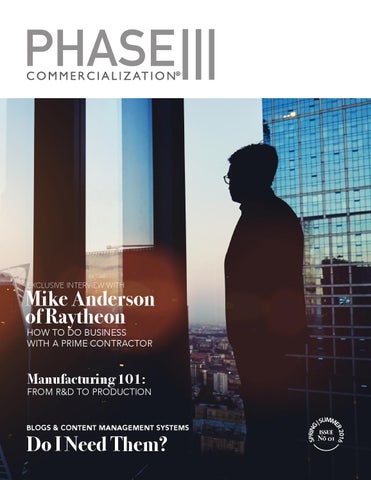
Mike Anderson of Raytheon EXCLUSIVE INTERVIEW WITH
HOW TO DO BUSINESS WITH A PRIME CONTRACTOR
Manufacturing 101:
FROM R&D TO PRODUCTION
BLOGS & CONTENT MANAGEMENT SYSTEMS
Do I Need Them?
ISSUE
Nō ��
F E AT U RES
6
BY ROBERT LARSEN
What is Phase III?
How to Do Business with a Prime Contractor
Manufacturing 101: From R&D to Production
MANAGING EDITOR Julie Scuderi
2
PHASE III
14
BY JULIE SCUDERI
EXECUTIVE EDITOR Jenny Servo, Ph.D.
DESIGNER Annie Browar
10
BY JENNY SERVO, PH.D.
18
22
25
BY PETE HUNT
BY JULIE SCUDERI
BY DAVID HUNT
Competitive Intelligence Blunders
Do I Need a Blog on My Website? (Probably Not!)
What is a CMS and Do I Need One?
TALK TO US
We welcome comments and questions from our readers. Email us at phase3editor@dawnbreaker.com
DIGITAL EDITION
Download our digital edition for a closer look at www.dawnbreaker.com/phase.php
FOLLOW US
@Dawnbreaker
PHASE III COMMERCIALIZATION速 Phase III Commercialization magazine is a publication of Dawnbreaker, Inc. and is meant to provide information, gleaned from our highly knowledgeable staff, to advanced technology firms, prime contractors, program managers and investors in the areas of medical, energy, defense and space exploration. All mail should be sent to: Editor, Phase III Commercialization Dawnbreaker, Inc. 2117 Buffalo Road, Suite 193, Rochester NY 14624 www.dawnbreaker.com PHASE III
3
F R OM THE EDI TOR
PHASE III
is the ultimate goal of small businesses, Federal agencies and service providers participating in the Small Business Innovation Research (SBIR) and the Small Business Technology Transfer (STTR) programs. Although Phase III is the common goal, confusion abounds regarding its definition. What exactly is Phase III? Does the definition vary depending upon the Agency with which you work? How do you know if you have achieved Phase III status? How do you get there and how do you measure the impact of assistance programs designed to facilitate Phase III success? This Phase III Commercialization publication is produced by Dawnbreaker and is dedicated to addressing these questions. Our approach cuts across agencies, industries and disciplines, focusing on three broadly defined content areas—medical, energy and defense— as well as highlighting Phase III issues and financing options. Our goal is to provide insight and information to those who are intent on being successful in transitioning, commercializing or infusing their technology into the marketplace. Enjoy this publication and feel free to send suggestions for future articles of interest to you.
Jenny C. Servo, Ph.D. President, Dawnbreaker, Inc. The Commercialization Company
ABOUT US
Dawnbreaker specializes in providing commercialization assistance to small advanced technology firms and their investors. Since 1990, we have worked with over 8,000 projects that have received funding from the Small Business Innovation Research (SBIR) program, the Small Business Technology Transfer (STTR) program, the Advanced Technology Program (ATP), and others. Dawnbreaker’s depth is in understanding the intent, method and objectives of the SBIR and STTR programs. Having worked within large corporations and small businesses, our staff understands the perspective and financial imperatives of both and is uniquely wellprepared to assist companies in planning for and succeeding in transitioning to Phase III (Commercial phase). The success of our services is reflected not only in our track record, but also in the percentage of companies that receive investment and/or increased sales within 12–18 month of a programs’ culminating Opportunity Forum®. To date, over $2.5 billion has been secured by participating firms. For more information, visit our website at www.dawnbreaker.com.
4
PHASE III
CO N T RIBUT O R S
JENNY C. SERVO, PH.D. President Dr. Servo is the founder and president of Dawnbreaker. She has written extensively on the topic of innovation with articles appearing in The Futurist, Entrepreneurial Excellence, and Innovation in the Work Place. Dr. Servo is also the senior author on the books that are used with our clients including Business Planning for Scientists and Engineers; Knock Their Socks Off: Making Winning Presentations to Investors; and Indicators of Commercial Potential. Within Dawnbreaker, Dr. Servo specializes in the design of programs for Federal and State Agencies and in assisting small, advanced technology firms with business planning, market research, strategic planning, and organizational development. She is a frequent speaker at many national and state-related SBIR Conferences.
JULIE SCUDERI, MA Business/Technical Writer Julie joined Dawnbreaker in 2013 and brings a wealth of experience writing for multinational corporations. At Dawnbreaker, Ms. Scuderi works with federal agency clients with the goal of helping SBIR/ STTR funded companies communicate their technologies and proficiencies. In addition to working with NASA on writing success stories, she produces several publications on SBIR/STTR success stories for the Navy, Department of Homeland Security, Department of Energy, and the Small Business Administration. Ms. Scuderi also handles the marketing and public relations efforts of the new DOE Phase 0 Assistance Program.
ROBERT LARSEN Dawnbreaker Larsen’s 25 year professional career has been spent directing the growth of domestic and international original equipment manufacturing and service businesses. He was general manager and senior vice president for multiple divisions of Lockheed Martin, and at TransTechnology and Puritan Bennett. His B.S. in business is from New York Institute of Technology. During the Vietnam War, Larsen served as crew chief for a U.S. Army helicopter gun team.
PETE HUNT, MBA Business Acceleration Manager Pete Hunt joined Dawnbreaker in 2007 and currently serves as a Business Acceleration Manager (BAM), providing guidance to small businesses that have won SBIR/STTR awards through the National Science Foundation, Department of Energy, Department of Transportation (DOT), and Department of Homeland Security. In addition, Mr. Hunt is the Program Manager for Dawnbreaker’s contract with the DOT, executing their Commercialization Assistance Program for small businesses. He has a strong background in project management, strategic planning, research and development, and customer service with over 10 years experience in the pharmaceutical and chemical capital equipment industry.
DAVID HUNT Web/Graphic Designer David Hunt joined Dawnbreaker in 2013 and serves as the company’s lead web developer/designer. Mr. Hunt has worked with dozens of SBIR/STTR firms helping them to build user friendly and dynamic websites, as well as working with federal agency clients on various initiatives. Mr. Hunt has built the website for the highly publicized Small Business Administration (SBA) SBIR Road Tour, the Department of Energy Phase 0 program, and the Navy Opportunity Forum® websites, in addition to many others. He also takes the lead for the award winning Dawnbreaker Design team, which helps small R&D technology firms make their mark on the web.
PHASE III
5
PHASE III
What is
Phase III?
Knowing when commercialization has been achieved. BY JENNY SERVO
From the outset, the Small Business Innovation Research (SBIR) program has been conceptualized as a three-phase process. Phases I and II are funded by Federal agencies participating in the SBIR program, while Phase III is hallmarked by funding from non-SBIR sources—specifically, the private sector or federal and/or state agencies that purchase goods and/or provide funding subsequent to completion of Phases I or II of an SBIR award.
6
PHASE III
M
any aspects of this initial conceptualization have contributed to the confusion regarding, “What is Phase III?” One would naturally assume that if a program is described as a 3-phase process, that each phase would be funded by funds from that program. However, this is clearly NOT the case. Phase III, by definition, is NOT funded by the SBIR program.
Phase III is also often referred to as the “commercialization phase,” making it appear that commercialization is something that you attend to after Phases I and II are complete. However, commercialization should be attended to from the outset. Commercialization should never be an afterthought, but rather pursued from the start. Further confusion also arises because Phase III can follow Phase I and not just Phase II. It is also curious that most agencies do not consider self-funding, subsequent to the completion of Phases I and/or II, to be Phase III. However, sales are considered Phase III irrespective of the organization that funded further development (the company itself, private sector or the Federal government utilizing non-SBIR funding). According to the Small Business Innovation Research Policy Directive, a Phase III is funded work that “derives from, extends, or completes” prior SBIR work and is funded with non-SBIR funds. Thus, a Phase III is any funded effort that promotes progress on Phase I and II work along the commercialization continuum. At best, however, funded Phase III work is only one subset of the myriad activities that constitute the “commercialization continuum” and must occur to achieve the end goal of a commercialized product or service. While Phase III customarily refers to funding additional efforts, commercialization of a product may also involve regulatory, procurement, tax, corporate, organizational, patent, licensing, joint venturing, teaming, further technology advancement and other issues and activities.
Small Business Innovation Research (SBIR) Technology Lifecycle
Phase I
Phase II
SBIR Funded
Phase III
Phase III–Commercialized
“Commercialization” Non-SBIR Funded
Products available to government and/or on the free market
Commercialization as incremental funding SBIR solicitations describe commercialization as “the process of developing products, processes, technologies, or services and the production and delivery (whether by the originating party or by others) of the products, processes, technologies, or services for sale to or use by the Federal government or commercial markets..” Because commercialization is a process, it happens incrementally. Robert Cooper, in a landmark book entitled Winning with New Products, described the stages that successful companies go through between conceptualization and product introduction. His 13 stages are listed in Table 1. PHASE III
7
A Commercialization strategy is a clarification Dawnbreaker expanded upon Cooper’s work, stating that a “commercialization strategy” is a clarification of the series of financing options that a company entertains to move a potential product or service from concept to product introduction. The stages in between do not have to be limited to those described by Cooper. In fact, Dawnbreaker recommends that others be added that are pertinent to that industry, technology or market. Examples of pertinent milestones to add include Phase II Clinical Trials and FDA approval for those working with the National Institutes of Health. When “commercialization” is operationalized in this fashion, many advantages accrue. First, it becomes apparent that Phase III, the commercialization phase, can be said to have occurred when a company receives additional funding [subsequent to completion of Phases I and or II] from non-SBIR sources to further mature a technology towards the ultimate goal of product introduction. Therefore, when a company receives funding, utilizing non-SBIR dollars, to further mature a previously funded SBIR technology—it is a Phase III. When a company licenses out the SBIR-funded technology to another entity, it is a Phase III. When a company receives an equity investment in a spin-off, built around the SBIR funded technology, it too is a Phase III ... so is a sale.” These are all examples of Phase III. When can you say a technology has been commercialized? Is it sufficient to say that a product has been commercialized when it receives incremental funding? The answer to this is “No.” Many R&D projects do not make it to the marketplace, even though they have garnered additional support, subsequent to completion of a Phase I and/or Phase II SBIR award. Clearly, the goal of the SBIR program is producing and delivering products or services for sale, but there exists a financial and a business gap between the Phase II R&D award and the ability of a small business to move through all of the stages that Cooper references. A technology will have been commercialized only when it is brought to market in its final form by the SBIR funded firm or others. Funding agencies are most interested in seeing technologies commercialized, transitioned or infused. However, commercialization can be a lengthy process, sometimes bridging many years and requiring incremental Phase III funding. While a commercialized product is the ultimate goal of this process, it may be useful to differentiate between early indicators of potential commercial Phase III funding and ultimate success in the marketplace.
8
PHASE III
of the series of financing options that a company entertains to move a potential product or service from concept to product introduction.
Table 1 Stages in the Commercialization Process – Robert Cooper Step 1:
Initial Screening
Step 2:
Preliminary market assessment
Step 3:
Preliminary technical assessment
Step 4:
Detailed market study
Step 5:
Predevelopment business/financial analysis
Step 6:
Product development
Step 7:
In-house product test
Step 8:
Customer test of products
Step 9:
Trial sell
Step 10: Trial production Step 11: Precommercialization business analysis Step 12: Production start-up Step 13: Market launch Table 2 Sample Commercialization Strategy: Equity Investment in Parent Company Milestone
Financing Method
Concept Development SBIR Phase I
Sweat Equity
Prototype Development SBIR Phase II
Science for Hire
Product Introduction
Private Placement
Market Penetration
Debt Financing from equity Investors
In this publication and in subsequent issues, expanded discussions of potential sources of financing will be highlighted. Figure 1 serves as an organizing tool. In this premier issue we will focus on business angels, as well as state and federal funding initiatives. Figure 1: Roadmap of Financial Options
SBIR & STTR Funding Basic Science Mission
Founders > > > INCREASED TECHNOLOGY MATURITY > > >
Sweat Equity
On spec
NIH NSF
DoD NASA
Hybrid
Applied
DOE
DHS DOC DOT ED EPA USDA
Federal Science for Hire
State Corporations
SBDC. Economic Dev. Licensing Partnerships Subcontracts
Family / Friends Debt
Banks Leasing
Equity
Accountants Brokers
Business Angels
Association
Consultants
Venture Capital
Attorneys
Databases
Bankers
Print Media
Investment Banker
Profit PHASE III
9
B U S IN ESS
EXCLUSIVE INTERVIEW WITH MIKE ANDERSON OF RAYTHEON
How to Do Business Prime Contractor WITH A
BY JULIE SCUDERI
10
PHASE III
W
inning a Phase I SBIR or STTR award and doing business with a major prime contractor like Raytheon may seem like two very opposite ends of the spectrum. While the former entails merely conceptualizing an idea to fulfill the needs of a particular government agency, the latter insinuates that solution has not only been developed, but is being sought after by huge industry players. But how does one get from point A to point B? When does the process start? And how can a small R&D firm increase their chances of attracting the attention of one of the largest defense contractors in the nation? We sat down with Mike Anderson, Sr. Principal Systems Engineer at Raytheon, and his team to get their perspective on these common questions, with the goal of providing small businesses the timeline and guidance needed to form a connection.
PHASE III
11
1 Many small businesses believe they can’t reach out until they have a proven product. Is this the case? What is the appropriate timeline? MA: Raytheon absolutely encourages small businesses to reach out to us, and earlier is better. Small businesses may contact us at any point during the SBIR process. The most common starting place is for small businesses to reach out to Raytheon asking for a Phase 1 letter of support, though we also have small businesses we did not work with in Phase 1 reaching out for a Prime partner for a Phase II, second Phase II or Phase II.5. There have been instances where a small business has an idea for a new SBIR topic and they are just looking for guidance on navigating the topic submission process. Once there is a trusted relationship between the prime contractor and the small business, the small business will often approach the prime contractor with other additional technologies, which may be of interest.
2 What are the methods Raytheon uses for engaging with a small business? MA: Raytheon is always looking for ways to leverage new game-changing small business-developed technology for its programs and pursuits. To do this, it uses a variety of methods for finding and engaging with small businesses. »» Targeted market research and engagement by groups like Integrated Defense Systems’ Supplier Innovation Center and corporate Tech Networks »» Flow-down of SBIR/STTR topics of interest to our small business mailing list
»» Referrals from government program managers »» Referrals from existing small business partners »» Public database searches »» Patent research »» Company Web site
3
When should a small business expect to hear back from you? If you are not interested, will you let them know? MA: Because we value the trusted relationships we develop with our small business partners, we set realistic goals and expectations around technology transition. If the proposed technology does align with our technology or product roadmaps, we will connect the Principal Investigator to a Raytheon Subject Matter Expert (SME), who will act as our technical champion for the research. However, if we do not think we have an opportunity to transition a technology to a Raytheon program, we will not support the small business on that proposal. To that end, if a small business approaches Raytheon about SBIR with a technology portfolio that is not a good match for our product roadmaps, we will communicate that to them. Raytheon leaves the door open for future collaboration opportunities by encouraging the small business to reach out as new ideas and partnership opportunities arise. Note that the insertion points need not be into large multi-million dollar programs but includes research and development collaborations and partnerships to capture smaller, forward looking opportunities such as DARPA BAAs.
»» Sharing product and technology roadmaps with our existing small business partners
4
»» Industry conferences & business associations
What is the best material to share when reaching out to you? MA: Small businesses reaching out to us for the first time should have a presentation or brochure available highlight-
»» ‘Sources sought’ notices to industry on technologies of interest »» Invite-only, focused technology forums 12
»» Outreach events
PHASE III
ing their core capabilities, SBIR awards and experience and non-proprietary (if not under NDA) abstracts and/or quad charts that provide insight into their approach to the topic.
5 Should small businesses always go through Supplier Diversity? MA: The link on the Supplier Diversity Web page (http://www.raytheon.com/ suppliers/supplier_diversity/) is one of many ways to engage with Raytheon. Small businesses can approach anyone at Raytheon regarding the SBIR program (Engineering, Supplier Innovation, Business Development, Advanced Technologies, Supplier Diversity, and Supply Chain). But most employees will point back to our SBIR POCs, so we recommend that businesses save time by just starting with the contact list of SBIR points of contact that we provide. For example, the POC at Raytheon IDS is the IDS Supplier Innovation team because this team is well versed in SBIR and manages the SBIR activities throughout IDS.
6 How are SBIR data rights protected? MA: Raytheon is seeking a long-term relationship with small businesses for teaming on many opportunities, therefore trust and protection of data rights is very important to us. After an initial shaping meeting that identifies where the opportunities exist, Raytheon will request that a Two-Way Proprietary Information Agreement be in place before more in depth technical discussions take place. We will also need to ensure that the small business has appropriate processes and firewalls in place to handle export-controlled data before sharing any potentially ITAR-controlled technical data. Small businesses should always be sure to mark documents appropriately with SBIR data rights language and/or
proprietary markings so that all recipients are sure to afford their information the protections it deserves.
7 If a company is seeking a Letter of Support and nothing else, how should they go about getting that? MA: To obtain a Phase I letter of support, the small business should send Raytheon a non-proprietary abstract plus quad chart, white paper, and/or slide deck describing their approach to a specific topic. However, sending an abstract does not guarantee a letter of support, because we are looking for a fit. Typically we will ask to set up an initial phone call with Raytheon subject matter experts to discuss the technical approach and see if there is a fit with our technical roadmaps. A proprietary information agreement may be helpful to allow Raytheon to obtain more data to aid in the decision making process. Note that it is not uncommon for Raytheon to receive abstracts from multiple small businesses for the same topic. In this case, the Raytheon technical subject matter expert(s) must decide which companies to support based on the abstract, as well as knowledge gleaned from telephone conferences. Raytheon reserves the right to support more than one submission if more than one company has a valid and technically diverse approaches to the problem. Because Raytheon values a collaborative relationship with the small businesses, we encourage an open dialog with our small business partners through all phases of the SBIR cycle. We do a lot more than provide letters of support. Raytheon wants to hear how the feasibility study is going in Phase I and receive updates on conversations our small business partners are having with the government Technical Point of Contact (TPOC). It is in the interest of both the small business and Raytheon for
our subject matter experts to stay connected, offer advice, and flow down requirements so that the technology / product has the best chance of insertion.
8 How do the roles change in Phase II? MA: During Phase II, Raytheon often engages as a subcontractor to the small business. Here, Raytheon is providing engineering services to the small business to help position the Phase II effort for successful transition to a Raytheon program. Note that Raytheon does not set any minimum threshold for that subcontract. Rather, Raytheon’s level of involvement is set by whatever value we can create for the particular effort.
9 Does Raytheon publish a list of topics they are interested in? MA: Yes. We vet the SBIR/STTR topics internally then flow that out to our small business mailing list. We are also looking into options for publishing these topics on our public Web site.
10 What is the profile of a small business that you prefer to work with? MA: There is no typical small business partner. The small businesses we partner with range in size from two to over 250 employees and offer a wide range of innovative technologies from nanopowders to cyber hardening to alternative energy. Open communication and an honest approach towards a common goal of customer satisfaction and commercialization are the formula for a successful working relationship. The opportunities are found at the intersection of the capabilities that a small business provides, and the technology gaps that need addressed. So the best way to see if your novel capability meets a need is to reach out to our SBIR points of contact.
Raytheon SBIR/STTR Contacts Integrated Defense Systems ERIN FOPIANO Supplier Innovation, SBIR Coordinator 978.604.9586 erin.j.fopiano@raytheon.com MAUREEN FREITAS Supplier Diversity Business Lead 339.645.6169 IDS.Supplier.Diversity@raytheon.com Intelligence, Information and Services Lindsay Ewing Product Development Engineer 317.306.7489 lindsay.a.ewing@raytheon.com CRYSTAL KING Supplier Diversity Business Lead 571.250.3725 crystal_l_king@raytheon.com JOHN MOORE Engineering and Product Development 317.306.4090 john.s.moore@raytheon.com Raytheon Missile Systems KENNETH PRESTON SBIR/STTR Project Manager 520.794.7906 kenneth_g_preston@raytheon.com JOANNE ARVIZU Supplier Diversity Business Lead 520.665.5919 jnarvizu@raytheon.com Space and Airborne Systems DEVON CROWE Principal Engineering Fellow 310.607.6931 devon@raytheon.com CAROL WOODEN Supplier Diversity Business Lead 972.344.4266 carol_wooden@raytheon.com MARK PALLA Mentor Protégé and SBIR Coordinator 972.344.7500 palla@raytheon.com PHASE III
13
M A N UFACTURI NG
MANUFACTURING 101:
From R&D to Product Production
BY ROBERT LARSEN
14
PHASE III
As a technology matures, R&D firms often consider whether they should become a manufacturer, contract-out production to a third party, or license the technology to another entity. What should an R&D firm consider in making this decision? How does the starting point for an R&D firm differ from that of a manufacturer deciding whether or not to take on another product line?
A mature manufacturer is well-versed in contracts, contract requirements and associated risks. Before production begins, the company will have a mutual, written agreement in place with the contracting office (customer). A mature manufacturer also understands fully the steps to be taken during production and the necessary business infrastructure required to support the new opportunity. During the planning stage, the design and development process is prepared and the tooling required for the program identified. The specifications needed for procurement are ready and the selection of qualified suppliers and sub-contractors is accomplished. All of these items are addressed before production begins. If, by contrast, a company is new to production, the organization must learn to address these issues and put in place risk mitigating processes. The company must decide how to best address Low Rate Initial Production (LRIP) and Full Rate Production (FRP) – both of which will need to be approached analytically and with full documentation. While the aspiration and desire to manufacture a product may be present in an R&D firm, the necessary resources and the aptitude for this business function may not be present. What to do? What are the next steps? What options are available? It is necessary that a small business identify and review core competencies and skills – making certain that this assessment is grounded in reality, not in aspirations for the future. Long and short-term goals should be laid out with the necessary manufacturing capabilities and the funding requirements assessed. Once this is accomplished, a plan of action can and must be developed. It should be kept in mind that a bad decision at this point can throw a business off its game, possibly causing irreparable damage.
The Options So, what options are open to small R&D firms looking to break into manufacturing? Three options should be considered, each of which has its own distinct risk factors (see Table 1).
Manufacturing Options for Small R&D Firms
Risk Level
Financial Return
In-house Manufacturing and Marketing
High
High
Contract-out production to an established Manufacturing Firm
Mid to High
Mid
License Rights to a Manufacturing Firm
Low
Low
Table 1 The company could decide to manufacture and market the product itself utilizing in-house resources. This option carries with it potentially high risk, especially if the company is new to manufacturing. The cost of entry will be significant, requiring an investment in personnel, facilities, capital equipment and material. Ensuring at the outset that the company has both the human and financial resources that will be required is critical for successful delivery of quality products, on time and on budget. A second option is to partner with an established manufacturing company, which could serve as a contract manufacturer. For a small firm, this option has mid-tohigh level risk. The small business still has contractual obligations. However, the small business can avoid the costs associated with scale-up and may also be perceived as a more credible supplier, if a reputable third party is used. The third option open is to license the rights to a manufacturing and distribution company. This option is low risk, and depending on the agreement, synergy with the licensee, the strength of the intellectual property, and the industry - licensing may yield a low to modest return on investment. A small business can negotiate the transfer of contract liability to the licensee, as long as the customer and contracting officer are in agreement. This would relieve the small business of most, if not all, contractual liability. Small businesses with limited manufacturing knowledge and/or experience may find it beneficial to engage a third party to assist in deciding which option works best. Critical to the decision-making process is a design for manufacturing review, the development of a model manufacturing process, and the costing and simulation
Low Rate Initial Production (LRIP) is the phase of initial, small-quantity production of the product, for a defined period of time, typically after the prototype has been fully qualified (tested and accepted). This process tests the manufacturing and produce-ability process and will surface any issues that need to be addressed before full rate production.
Full Rate Production (FRP) is the phase when a standard amount of product quantity is required per month by government or contracting agent, as outlined by the contract or purchase order.
PHASE III
15
of the manufacturing process at different production levels (LRIP and FRP), including both inventory and logistics considerations. This effort can ensure both the customer and investor feel secure with the launch of a new product. Once the manufacturing option has been decided upon, there are guidelines to be followed to ensure success in the manufacturing sector. Key Success Factors For those firms that are looking to become a Phase III supplier either commercially and/or to the Department of Defense, the road to success begins with a very careful reading of the contract and mapping deliverables and performance expectations to the contract. Ambiguity in a contract and making assumptions can prove to be 16
PHASE III
expensive and detrimental to a business. Failure to deliver on the terms of a contract can result in contract default. No matter which manufacturing option you decide upon, it is vital that performance expectations be written into an agreement that is acceptable to and understood by both parties. The most basic and fundamental step a company should make, at the outset, is to tie deliverables and performance requirements back to the contract. If this is not done, assumptions will be made and the relationship will go awry. If any of the production is to be outsourced to a manufacturing firm, be sure to select a company with a quality reputation for
the sustainable production of a product of this type. Selecting a manufacturing partner should be done via a systematic and well-documented process. The potential partner should be financially viable, have a compatible culture and have appropriate engineering staff, facilities and manufacturing capabilities. Irrespective of the strategy selected, it is vital to maintain consistent customer/ supplier contact via e-mail, phone, and face-to-face meetings. While the meetings may only be twice a year, quarterly or monthly, there is no substitute for meeting in person. Doing so reduces miscommunication which can ultimately result in considerable cost savings.
Planning is Imperative for Manufacturing Success Engineering Design Plan This is the design plan for the product to be manufactured. It should be well thought out, detailed and documented. The plan should be mapped to product performance and/or product contract deliverables.
Manufacturing Engineering Plan The manufacturing engineering plan will include the blueprints, tooling/ floor space schematics and work instructions to ensure the product makes a seamless transition from design engineering to manufacturing. Manufacturing Plan The manufacturing plan must consider manufacturing floor space for uninterrupted flow, the control, evaluation and calibration of all tools, jigs and test figures, as well as material handling processes training and environmental issues.
“
The road to success begins with a very careful reading of the contract and mapping deliverables and performance expectations to the contract. Failure to deliver on the terms of a contract can result in contract default.
“
Quality Plan The quality plan should be mapped to the product performance and/or contract deliverables and should consider all aspects of the process, from design through final testing/qualification. Procurement Plan This plan should consider alternative suppliers, sole source suppliers and/or international suppliers. There needs to be a supplier qualification and rating process in place. Configuration Control (Traceability) This contractual requirement necessitates a documented plan to maintain configuration control by finished product serial number and a documented audit process to ensure control is maintained. Life Cycle Support Plan This may be a contractual requirement, which means that the company needs to have and maintain sufficient amounts of spare parts and support mechanism. This is to ensure the customer will have a functioning product over a predetermined period of time. PHASE III
17
M A R K ET RESEA RCH
Competitive Intelligence Blunders HOW TO AVOID BECOMING A STATISTIC
BY PETE HUNT
18
PHASE III
D
oes your firm perform competitive intelligence (CI) activities? If not, why not? Many respond that it costs too much, or that they already know their competitors, their customers and market, so they do not need to bother. But consider this: perhaps these businesses do not fully understand the benefits that can be acquired from competitive intelligence activities, as Dr. Fred R. David, noted author of strategic business management text books and articles, claims in an article titled Competitive Intelligence Activity Among Small Firms, which appeared in the SAM Advanced Management Journal.
Competitive intelligence is information you gather through various means about different aspects of the business, markets, products, trends, competitor activities and capabilities, to name a few. Gathering the information is only the first step. It means nothing until it has been thoroughly analyzed. Used appropriately, CI will allow firms to make strategic decisions as they guide the business forward.
PHASE III
19
Succinctly put, competitive intelligence does not involve spying or crystal balls, and it requires much more than a simple Internet search, rumor chasing or perusal of business publications. Competitive Intelligence has been defined by CI pioneer and Fuld & Company president Leonard Fuld as, “Information that has been analyzed to the point where you can make a decision.” The importance of performing a complete competitive analysis when launching a product or moving into a new market is demonstrated by the following story of Duncan Hines, as told by Eric Garland, president of Competitive Futures.
“
My favorite story is the Duncan Hines product launch into Japan. A major producer of cake mix in the United States, they discovered that Asia was an untapped market. They did great market research on the Japanese per capita income, grocery spending, even consumer tastes to determine the right level of sweetness in their baked goods. A check of potential competition showed that there were virtually NO competitors in this space – an incredible Blue Ocean of profit just waiting! The product launch was a failure. It turns out the Japanese generally do not have OVENS in their apartments.
20
PHASE III
”
Without the knowledge to act on, a firm will inevitably continue on its current course of action. What would it have been worth to Duncan Hines if they had performed a little extra work up front, conducted primary research interviews with end-users, asking questions related to how they bake? Primary research would have saved Duncan Hines not only a little embarrassment, but more importantly, it would have saved them a good deal of money. Obtaining information to perform competitive intelligence analysis activities takes on many forms. Two key components in the development of CI are primary research and secondary research. Secondary research involves gathering information from already published sources. This information can be gathered from several sources, which are available to the public at large, including the library, the internet and government agency reports, i.e. those provided by Congressional Research Service and the Government Accountability Office. There are also subscription/fee-based databases of information and targeted reports. Some of the best known databases are provided by groups such as Frost and Sullivan, BCC Research and Hoovers. Secondary research requires little, if any, face to face interactions. A skilled market researcher can glean appropriate information from secondary sources related to markets of interest and prepare a report that will provide the following key information: »» Major players »» Market share of participants »» Total market size and projected growth rates »» Major drivers and barriers to market entry »» Emerging trends »» Required regulations/certifications »» Intellectual property protection A caveat to using secondary research is ensuring that the data is current and not outdated. This will depend on how rapidly the market of interest changes. Also, some reports may provide information that is somewhat related to, but not a perfect fit
to what your firm is seeking to learn. Primary research, on the other hand, involves talking directly with market participants, by conducting interviews with customers, end-users, and other market participants, by taking surveys or running focus groups, etc. Primary research may also involve making field observations or networking at appropriate conferences. And while many people, in general, have an aversion to this type of “cold calling” interaction with the market, these activities allow for garnering the most current, customized information from the specific marketplace in question. The combination of primary and secondary research provides for the strongest competitive intelligence analysis of a market. One without the other can leave potential holes in an analysis – like it did for Duncan Hines. That being said, extensive primary research can be cost-prohibitive, which is why many small firms do not attempt it. However, it is not necessary to hire a large expensive marketing firm to gain some valuable insight into a targeted market. It can be accomplished by performing a small sample of phone interviews with targeted groups, conducted either within the firm or, if there are time/comfort restraints, by utilizing smaller firms that are understanding of and specialize in serving small businesses with limited budgets. If a small firm decides to take on primary research in house, it must be understood that this call should not be treated as a sales pitch. If the interviewee expresses interest in the product/service during the call, that is an added bonus, but should not be the focus of the call. If the caller perceives the interviewer to be making a sales pitch, they will become less forthcoming and more defensive, limiting the research information that can be obtained. Since the intent of the call is to extract information from the interviewee for analysis, an attempt to make a sale can be a detriment. Another objection to conducting interviews with industry participants is the concern of divulging proprietary information, but that level of detail should
never be included when questioning market participants. There is a wealth of knowledge to be gained about the marketplace without ever mentioning the specific technology/product.
now it is worth noting that in order to be efficient and effective at primary research, an analytical approach is required. To do that, a list of discrete assumptions should be developed to address product / technology sales and associated financial projections. However, if a description of the technol- These assumptions are the hypotheses ogy is necessary to extract the specific that are being tested, which is not much information sought, different than what it can be done in researchers do in a non-proprietary the lab – they cremanner. The prepaate a hypothesis ration of a non-proand then conduct prietary abstract to experiments to test use as a discussion the hypothesis. guide for the interIn creating the list viewer, is a helpful of assumptions tool in reigning in that require validathe discussion and tion, write down as avoiding revealing many assumptions too much informaas needed, being . tion to the subject. careful not to lump together more So how is it done? than one assumpFirst the type of tion. Then, turn the information to be assumptions into acquired and the objectives. Objectype of people to tives formalize the be targeted must be OTTO VAN BISMARK assumptions into defined. Below are specific items to be some sample, introductory questions that tested. From each objective, generate may be asked by a firm researching the questions to be asked during an interprospects of commercialization of a new view. A core list of 10 questions or less is technology. The focus of the research is recommended, so as not to exceed time acquiring information concerning the per- constraints. ceived benefits of the new technology and the level of market pull it may create. Keep in mind, it may take 15 to 20 calls to get 2 or 3 informative interviews, but even »» What is currently done to solve the a small subset of responders (5 to 10) can problem? provide a wealth of information. A variety »» How urgent is the need for this tech- of potential data to be gained includes: nology? »» Fair Market Pricing »» How would you use the technology?
detailed analysis, it can provide some valuable nuggets of information for the small firm taking a new product to market. Combining this primary research with a well-rounded secondary research report can prevent any small business from knowingly launching a product for a market that has “no ovens in which to bake their cake.”
“
Only a fool learns from his own mistakes. The wise man learns from the mistakes of others
“
»» Who are the key decision makers?
»» Valuable Product Attributes
»» How big is the market?
»» Potential Competitive Products
»» Are there any major regulations?
»» Market Limiting Regulations/Obstacles
»» Are you aware of alternative solutions being developed?
»» Additional Technology Uses
»» What product features are the most desired and price points? Although a more complete guideline will be presented in a subsequent article, for
»» Potential Customers
Industry research shows that 75 percent of new product launches fail in the marketplace. Competitive intelligence will not guarantee success, but it will increase the likelihood that the market will respond positively to a product.
In some cases, a caller may even be interested enough to become an eventual customer or partner. While a small number of calls does not provide for an over-arching, PHASE III
21
W E B SI TES
SHOULD I INCLUDE A
Blog on My Website? (PROBABLY NOT!) BY JULIE SCUDERI
22
PHASE III
I
t’s a question we web developers and content writers have to answer all the time. Should my company have a blog? It’s only natural to ask - after all, you’ve resolved to update or even build a brand new, sparkling website that will no doubt ascend the search engine rankings faster than any of your competitors. You want the best features – the content management system, the responsively designed layout that appears brilliantly on any old device, and of course, a blog. But while the advantages of those first few elements are apparent, a blog’s appeal is somewhat murkier. It sounds cool, and we all seem to want one – but why? First, let’s take a look at what blogs are supposed to do. It was long believed if the coveted top spot of a search engine ranking page serves as the desired destination, a blog would be the vehicle by which one is transported there. This is all intertwined with Search Engine Optimization (SEO) – strategies one employs on a website to help with search engine rankings. Without delving too deep into the logistics of SEO, regularly updating content is one trick of the trade developers use to get that extra boost in Google, or other popular search engines. Google’s main goal is to give its users exactly what they’re searching for. So for the sake of this article, let’s say you sell specialized binoculars designed to view UFOs. Amateur alien hunters and your potential customers using Google to find such a product would most likely type in something along the lines of “UFO binoculars” or “how to spot extraterrestrial spacecraft.” In the flash of less than a second, Googlebots scour millions of websites with related content and rank the sites for the user in a standard Search Engine Results Page (SERP). The rankings are based on a few key fundamentals within a website. Updated content is a big one. That is why blogs became so prevalent. If one could ideally update a blog with relevant, targeted information chock full of PHASE III
23
strategic keywords, then their website was viewed all the more favorably by Google and the ultimate goal of driving traffic to their business was well underway. After all, everybody wants more traffic. Based on this desire, a blog is usually up there on the wish list. But before you go and make it happen, here are a few questions to ask yourself first:
a conversational style. If all you want to do is talk and not listen, then you don’t need a blog to accomplish this. This can once again be accomplished by posting ordinary content, or even overly obnoxious headers. First, take a look at what it is you want to say. An announcement of a new product, for instance, wouldn’t really warrant a response, or at least wouldn’t warrant one that kicks off an entire conversation. That kind of information would be best suited for a press release – not a blog. Side note – press releases are a great way to add updated content to your website, and you don’t need a professional writer to construct one. Have your web developer create a designated “News” page in your navigation, and post your self-written press releases right there through your very own aforementioned
of journalistic integrity was obsolete. In the ever objective world of investigative journalism, blogs provided a real channel for pretend reporters to spew their theories without the monotonous tasks of fact checking and proof reading. As blogs became more mainstream, obviously this mentality somewhat faded, but any reader sitting down to read a blog today still knows to take it with a grain of salt. If you are sharing say, a brand new patent you were awarded, would a blog really be the best vehicle for this? Alternately, if you have a message to share that is highly targeted to only a small number of Ph.D.’s in the electrochemical community, a blog is much too broad to achieve that kind of specialized focus. A direct email to that particular contact group would be a better choice to get your message across. Always take into account the message you want to share and ask yourself – is this best communicated via blog? with
Do you have the manpower and the dedication to update the blog on (at minimum) a bi- weekly basis? An unattended and forgotten blog is one of the saddest things on the web. It is at best a dead end for a user and at worst, gives the erroneous impression that you’ve shut down shop. The first thing I like to do when working with a client is inquire – what is it you want to accomplish with a blog? If the goal is really to share news and/or updates with your audience and potential customers, then a blog could be a successful way to do it. If one could ideally update a blog But that goal can also be accomrelevant, targeted information chock full of plished simply by updating existing copy within a webpage using a strategic keywords, then their website was content management system.
After all is said and done, if you still have your heart set on a blog, by all means, go for it. Here is my viewed all the more favorably by Google and one suggestion. Hire an intern or A content management system a staff member who has some exthe ultimate goal of driving traffic to their (or CMS) is designed to give the tra time to nurture the blog and business was well underway. After all, every- get it off the ground. Maybe you user full access to update content on their website. But the content have good ideas but writing isn’t body wants more traffic. is not dated or posted in reverse your strong point. Get a desigchronological order as it would be nated writer and provide them in a blog – it’s just plain old web with the facts – even if it’s just copy that won’t seem archaic if it’s not content management system. To supple- bullet points. The writer will do the rest. touched for two weeks. Google will still ment content in a news section (if you’re It’s OK to have several contributors, essee (and appreciate) the updated content, not producing newsworthy instances on a pecially if you have many experts in your and will consider it in your rankings. daily basis) syndicate news that is relevant company on varying topics. But one writer to your industry. But be sure to always give should give the blog a coherent voice and This is a good spot to add a note to those credit to the author/source. take charge of the posting schedule. Get who are looking back on their wilted and a nice timeline of activity before you ofleft-for-dead blog. Have your developer Do you know who your audience is? ficially “launch” it – nobody is going to remove the link from your navigation, and More importantly, is your audience inter- bookmark a blog with one post. Give it call it a day. Pretend it never existed. If ested in reading your blog? Once again, some time and love and when you have a there’s a renewed vigor in your spirit, start we find ourselves contemplating the in- few weeks of creative posts and engaging a brand new blog. Don’t go forward with a formalities of such a medium. In my own content, shout it from the roof. Tell your two-year gap between posts. unscientific opinion, blogs were only cre- friends. Send an email to your contact list. ated so that certain journalists could have Post an update on LinkedIn. Be proud that Is this a one-way conversation? an easy out – “Hey, it’s not an article. It’s a you gave it love and attention and your A blog, by definition, is content written in blog!” and all accountability for any sort audience will appreciate the effort. 24
PHASE III
WEBS IT E S
<CMS> WHAT IS A
AND DO I NEED ONE? BY DAVID HUNT
PHASE III
25
A
Content Management System – commonly referred to as a CMS – is an application that allows the owner of a website to update, edit and manage the content. Sans a CMS, owners either have to 1) be proficient in the language used to write the website, for example, HTML, or 2) be at their developer’s whim (and expense) for common website updates. Before we get into whether or not a CMS is right for you – let’s first begin with by considering why you want to keep your website updated. Google has one job and one job only: To give its users what they are looking for. When a user types in a search term, the Google search engine scours the Internet trying to deliver the sites the user wants to see. But how does the search engine determine the rankings? This all plays into Search Engine Optimization (SEO) and while there are hundreds of components to the algorithms used by Google and other major search engines, one very important factor is updated content. Google doesn’t want to deliver a tenyear-old website in its rankings, for fear the website might be old, outdated, or even out of business. Continually updated content is ranked favorably by Google, and communicates that your business is not only up and running, but on top of its game in the website department. How often should you update content on your website? I like to recommend a refresh every two months. It’s enough to keep content fresh, but not enough where you are scrambling for information. So with a two-month goal in mind, let’s now turn to the Content Management System.
26
PHASE III
In order to facilitate website updates, a CMS is comprised of a user-friendly interface that guides you through adding or editing content. No HTML language is needed – everything is written in plain text. Imagery on the website can be swapped out or added, new pages can be created, along with new image galleries, news, and homepage content. If developed correctly you will have the ability to make adjustments to the navigation, homepage imagery and even the page structure (to an extent). In-depth changes to both structure and functionality will still need to be done by your developer, however most of the changes that users usually request are easily accomplished by a CMS. You might be thinking – great! How do I get a CMS? Here is the reality – you cannot “get” a CMS – a CMS is essentially the platform on which your site is built. So unless your site was built using a CMS in the first place, this is not an add-on accessory. It’s almost like building a bigger basement after your house is built – you just can’t do it. But here’s the good news – if you are considering a website upgrade/redesign, request that it be developed in a CMS right off the bat. Another piece of good news is that most CMS’s are completely free – that’s right - FREE! You just have to find a developer who will build the site using a common CMS such as WordPress. You of course, would need to pay for the website redesign and construction. Let’s look at the benefits and cost savings associated with starting fresh.
BENEFITS OF BUILDING A NEW SITE WITH A CMS Obviously, there are many factors that go into the decision to build a brand new website. Timing, budget, and manpower are just a few of the things that must be right in order to justify the investment. But when you are ready, and feel that some of these benefits may apply to you, then seeking out a developer who routinely builds websites with Content Management Systems is the way to go when hiring your next contractor!
You take charge of your own SEO We discussed this right off the bat. Google doesn’t want to deliver a ten-year-old website in its rankings, for fear the website might be old, outdated, or even out of business. Continually updated content is ranked favorably by Google, and communicates that your business is not only up and running, but on top of its game in the website department. Google will reward updated content accordingly by assigning the site a more favorable ranking.
You can better inform your customers/clients We’re not talking about sitting down every few months and re-writing your entire content. Maybe you have a press release you just put out; maybe your firm got highlighted in the local business section; maybe you won a Tibbetts award; or maybe you just have a very cool announcement you’d like to put on your homepage. All of these things are possible to communicate with a CMS. Your customers and potential clients can be well-informed of all that you are doing, and are not left to wonder what is going on.
Empowers you to update content without doling it out to contractors The first thing I ask when a company requests that we update their website is – Who will be hosting your site? Often a client may not know the answer, but “hosting” is charged on a monthly or yearly basis and it’s a way to keep your website “live.” So getting a hosting bill every month or every year is normal and expected. However, the person who hosts your site is rarely the person who updates your content. While you may have hired a developer up front to design your website, chances are the website is not being updated, unless you have somebody designated within your firm who can handle this. This is why you should NOT be getting continually billed from your developer, unless you are on some sort of maintenance plan. If content has not been updated since you built the site, then a CMS would be right for you. This allows you to shift the task from a contractor to somebody within your firm, perhaps the writer or person responsible for press releases.
You can easily take advantage of plug-ins Does your website require a certain functionality that seems like it may be a costly addition? The beauty of plug-ins is that most of these functionalities have already been written and can be added to your site at any time through the CMS. Whether it is a calendar to show all upcoming events, an extensive gallery featuring your portfolio of products or a simple search functionality to help users find what they are looking for on your site, these are all easily integrated into your website via your CMS. These plug-ins are all available, and many are FREE to use.
PHASE III
27