ISSUE
NĹ? 11
TALK TO US
FOLLOW US
MANAGING EDITOR
Comments/questions phase3editor@dawnbreaker.com dawnbreaker.com
@Dawnbreaker
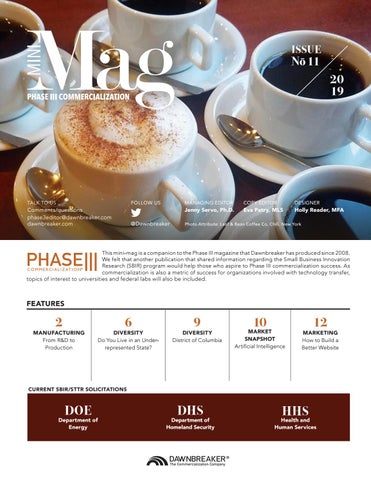
Photo Attribute: Leaf & Bean Coffee Co, Chili, New York
Jenny Servo, Ph.D.
COPY EDITOR
Eva Patry, MLS
20 19
DESIGNER
Holly Reader, MFA
This mini-mag is a companion to the Phase III magazine that Dawnbreaker has produced since 2008. We felt that another publication that shared information regarding the Small Business Innovation Research (SBIR) program would help those who aspire to Phase III commercialization success. As commercialization is also a metric of success for organizations involved with technology transfer, topics of interest to universities and federal labs will also be included.
FEATURES
2
MANUFACTURING From R&D to Production
6
DIVERSITY Do You Live in an Underrepresented State?
9
DIVERSITY District of Columbia
10
MARKET SNAPSHOT Artificial Intelligence
12
MARKETING How to Build a Better Website
CURRENT SBIR/STTR SOLICITATIONS
DOE
Department of Energy
DHS
Department of Homeland Security
HHS
Health and Human Services
M A N UFACTURI NG
MANUFACTURING 1 From R&D to Product Production
2
MINI-MAG
Visit Dawnbreaker TABA
101: By Robert F. Larson
A
s a technology matures, R&D firms often consider whether they should become a manufacturer, contract-out production to a third party or license the technology to another entity. What should an R&D firm consider in making this decision? How does the starting point for an R&D firm differ from that of a manufacturer when deciding whether or not to take on another product line? A mature manufacturer is well versed in contracts, contract requirements, associated risks and often has an ISO 9000 certification. Before production begins, the company will have a mutual, written agreement in place with the contracting office (customer). A mature manufacturer also understands fully the steps to be taken during production and the necessary business infrastructure required to support the new opportunity. During the planning stage, the design and development process is prepared and the tooling required for the program identified. The specifications needed for procurement are ready and the selection of qualified suppliers and sub-contractors is accomplished. All of these items are addressed before production begins.
“The road to success begins with a very careful reading of the contract and mapping deliverables and performance expectations to the contract. Failure to deliver on the terms of a contract can result in contract default.”
If, by contrast, a company is new to production, the organization must learn to address these issues and put in place risk mitigating processes. The company must decide how to best address Low Rate Initial Production (LRIP) and Full Rate Production (FRP) (see term definitions on page 4)— both of which will need to be approached analytically and with full documentation. While the aspiration and desire to manufacture a product may be present in an R&D firm, the necessary resources and the aptitude for this business function may not be present. What should you do? What are the next steps? What options are available? It is necessary that a small business review core competencies and skills — making certain this assessment is grounded in reality, not in aspirations for the future. Long and short-term goals should be laid out with the necessary manufacturing capabilities and the funding requirements assessed. Once this is accomplished, a plan of action can and must be developed. It should be kept in mind that a bad decision at this point can throw a business off its game, and could possibly cause irreparable damage.
MINI-MAG
3
P L A N N I N G I S I M P E R AT I V E FO R M A N U FAC T U R I N G S U CCE S S
Engineering Design Plan This is the design plan for the product to be manufactured. It should be well thought out, detailed and documented. The plan should be mapped to product performance and/or product contract deliverables. Manufacturing Engineering Plan The manufacturing engineering plan will include the blueprints, tooling/floor space schematics and work instructions to ensure the product makes a seamless transition from design engineering to manufacturing. Manufacturing Plan The manufacturing plan must consider manufacturing floor space for un-interrupted flow, the control, evaluation and calibration of all tools, jigs and test figures, as well as material handling processes, training and environmental issues. Quality Plan The quality plan should be mapped to the product performance and/or contract deliverables and should consider all aspects of the process, from design through final testing/qualification. Procurement Plan This plan should consider alternative suppliers, sole source suppliers and/or international suppliers. There needs to be a supplier qualification and rating process in place. Configuration Control (Traceability) This contractual requirement necessitates a documented plan to maintain configuration control by finished product serial number and a documented audit process to ensure control is maintained. Life Cycle Support Plan This may be a contractual requirement, which means that the company needs to have and maintain sufficient amounts of spare parts and support mechanisms. This is to ensure the customer will have a functioning product over a predetermined period of time. Low Rate Initial Production (LRIP) is the phase of initial, small quantity production of the product, for a defined period of time, typically after the prototype has been fully qualified (tested and accepted). This process tests the manufacturing and produce-ability process and will surface any issues that need to be addressed before full rate production.
Full Rate Production (FRP) is the phase when a standard amount of product quantity is required per month by government or contracting agent, as outlined by the contract or purchase order.
THE OPTIONS So, what options are open to small R&D firms looking to break into manufacturing? Three options should be considered, each of which has its own distinct risk factors (see Table 1). The company could decide to manufacture and market the product itself, utilizing in-house resources. This option carries with it a potentially high risk, especially if the company is new to manufacturing. The cost of entry will be significant and will require an investment in personnel, facilities, capital equipment and material. Ensuring, at the outset, that the company has both the human and financial resources that will be required is critical for successful delivery of quality products, on time and on budget. A second option is to partner with an established manufacturing company, which could serve as a contract manufacturer. For a small firm, this option has a mid to-high level risk. The small business still has contractual obligations. However, the small business can avoid the costs associated with scale-up and may also be perceived as a more credible supplier, if a reputable third party is used. The third option is to license the rights to a manufacturing and distribution company. This option is low risk, and depending on the agreement, the synergy with the licensee, the strength of the intellectual property and the industry — licensing may yield a low to modest return on investment. A small business can negotiate the transfer of contract liability to the licensee, as long as the customer and contracting officer are in agreement. This would relieve the small business of most, if not all, contractual liability. Small business with limited manufacturing knowledge and/ or experience may find it beneficial to engage a third party to assist in deciding which option works best. Critical to the decision-making process is: a design for manufacturing review, the development of a model manufacturing process, and the costing and simulation of the manufacturing process at different production levels (LRIP and FRP), including both inventory and logistics considerations. This effort can ensure both the customer and investor feel secure with the launch of a new product. Once the manufacturing option has been decided upon, there are guidelines to be followed to ensure success in the manufacturing sector.
FIGURE 1: MANUFACTURING OP
MANUFAC TUR I NG KEY SUCCESS FACTORS For those firms that are looking to become a Phase III supplier, either commercially and/or to the Department of Defense, the road to success begins with a careful reading of the contract and/or purchase order, followed by the mapping of deliverables and performance requirements to the contract. Ambiguity in a contract and making assumptions can prove to be expensive and detrimental to a business. Failure to deliver on the terms of a contract can result in contract default. No matter the manufacturing option decided upon, it is vital that performance requirements be written into an agreement that is acceptable to and understood by both parties. The most basic and fundamental step a company should make, at the outset, is to tie deliverables and performance requirements back to the contract. If this is not done, assumptions will be made and the relationship will go awry. If any of the production is to be outsourced to a manufacturing firm, be sure to select a company with a quality reputation for the sustainable production of a product of this type. Selecting a manufacturing partner should be done via a systematic and well-documented process. The potential partner should be financially viable, have a compatible culture and have appropriate engineering staff, facilities and manufacturing capabilities. Irrespective of the strategy selected, it is vital to maintain consistent customer/supplier contact via e-mail, phone and face-to-face meetings. While the meetings may only be twice a year, quarterly or monthly, there is no substitute for meeting in person. Doing so reduces miscommunication which can ultimately result in considerable cost savings. Manufacturing Quality: ISO Defined ISO is a network of the national standards institutes of 157 countries, with one member per country, and a Central Secretariat in Geneva, Switzerland. Its purpose is to facilitate international trade by providing a single set of standards that are recognized and respected. ISO is a nongovernmental organization that occupies a special position between the public and private sectors.
PTIONS FOR SMALL R&D FIRMS MINI-MAG
5
DIV E RSI TY
Do You Live In An
Underrepresented State? By Tina Allen, MLS
The term “underrepresented state” is used by several Federal programs. Whether a state is labeled as “underrepresented” depends on who is doing the talking.
6
MINI-MAG
Visit Dawnbreaker State Resources
T
SBIR/STTR and “Underrepresented States” he Policy Directives for the Small Business Innovation Research (SBIR) and the Small Business Technology Transfer (STTR) programs call for each Federal agency that participates in the SBIR and STTR programs to devote a portion of its funds toward efforts to increase participation by small businesses in States with a historically low level of SBIR/STTR awards. To this end, the various Federal agencies that offer SBIR/STTR awards periodically review awardee statistics to determine which states historically have had disproportionately fewer awards from their agency. These low-award states are often referred to as “Underrepresented States.” Each agency has its own criteria for determining which states are underrepresented by its SBIR/STTR program. For example, the U. S. Department of Energy (DOE) looks at both the number of applications received and the number of grants awarded to determine which areas are underrepresented. Currently, the following states, districts and territories are identified by the DOE SBIR/STTR Program Offices as underrepresented: Alaska, Arkansas, District of Columbia, Georgia, Hawaii, Indiana, Iowa, Kansas, Louisiana, Maine, Minnesota, Mississippi, Missouri, Nebraska, New York, North Carolina, North Dakota, Oklahoma, Pennsylvania, Puerto Rico, Rhode Island, South Carolina, Tennessee, West Virginia, and Wisconsin. NASA’s SBIR and STTR programs focus on number of award dollars that the programs invested in each state through Phase I and II awards, to determine which states are underrepresented. To increase participation in underrepresented states, the 11 Federal agencies that participate in the SBIR/STTR program use a portion of their budget each year to conduct outreach and provide technical assistance to entrepreneurs in such states. And, to help them do so, each year the U.S. Small Business Administration (SBA) sponsors an SBIR Road Tour, focused on these underrepresented areas. Representatives from the agencies can participate in some or all of the Tour events as it travels around the country in an effort to reach out to small business owners who reside in underrepresented states — as well as women, and individuals who are socially and economically disadvantaged — as all these groups are currently underrepresented in the program. EPSCOR and “Underrepresented States” Another program from which you may hear talk of “underrepresented states” is the Established (formerly Experimental) Program to Stimulate Competitive Research, or EPSCoR. EPSCoR was established in 1979 by the National
Science Foundation (NSF) in response to concern over the uneven distribution of Federal research and development grants. Currently, five Federal agencies conduct EPSCoR programs, including NSF, DOE, NASA, the Department of Defense (DoD), and the National Institutes of Health (NIH). However, again, whether a state is considered “underrepresented” depends on which EPSCoR agency you’re looking at. Each has its own formula and state eligibility criteria can change. The DoD EPSCoR program, known as DEPSCoR, for Defense Established Programs to Stimulate Competitive Research, uses the following eligibility criteria:
“The authorization legislation for DEPSCoR included a formula to determine whether a state/territory, is eligible based on how much DoD S&E Research and Development funds were obligated to IHE [institutions of higher education] within the state/territory over a three-year average. Thus, thirty-four states, the Commonwealth of Puerto Rico, Guam, and the U.S. Virgin Islands are eligible to participate in DEPSCoR.”
The specific congressionally directed eligibility DEPSCoR formula currently used is: “States or territories that received less than 60% of 1/50th of the total DoD S&E research obligations to U.S. IHE are eligible if a commitment to developing S&E research is demonstrated.“ Currently DEPSCoR eligible states and territories include thirty-four states, the Commonwealth of Puerto Rico, Guam, and the U.S. Virgin Islands. In another example, for the NASA EPSCoR program, EPSCoR jurisdictions in 2017 were linked to NASA activities and were described as “those jurisdictions that have not in the past participated equably in competitive aerospace and aerospace-related research activities.” More recently, in the NASA September 2019 EPSCoR Rapid Response Research announcement, NASA used the same criteria as the National Science Foundation for its EPSCoR eligibility:
As stated in NASA EPSCoR legislation, jurisdictions eligible to compete for this opportunity are those jurisdictions eligible to compete in the National Science Foundation (NSF) EPSCoR Research Infrastructure Improvement Grant Program (RII). The NSF eligibility is based on whether the MINI-MAG
7
D IVER SIT Y most recent three-year level of NSF research support is equal to or less than 0.75 percent according to the NSF FY 2019 eligibility table. “Proposals will be accepted from the resident institution of the NASA EPSCoR Director in each jurisdiction. The 28 jurisdictions that are eligible for this opportunity are: Alabama, Alaska, Arkansas, Delaware, Guam, Hawaii, Idaho, Iowa, Kansas, Kentucky, Louisiana, Maine, Mississippi, Montana, Nebraska, Nevada, New Hampshire, New Mexico, North Dakota, Oklahoma, Puerto Rico, Rhode Island, South Carolina, South Dakota, US Virgin Islands, Vermont, West Virginia, and Wyoming.” Note: The NSF EPSCoR program recently re-examined
By Allen,methodology MLS its Tina eligibility and is implementing changes
“to ensure that it is simple, transparent, fair, and stable.” NSF states that “These changes incorporate stakeholder feedback and are supported by robust data analyses. The new eligibility table utilizing the improved methodology will be published in January 2020 and will apply to the FY 2021 EPSCoR competitions. The FY 2020 Eligibility Table will be the same as FY 2019.” Are There Other Programs for Underrepresented Areas? Yes. Another example of a Federal program focused on bringing Federal dollars to researchers and entrepreneurs in underrepresented areas is NIH’S IDeA States program. IDeA States The National Institutes of Health, the nation’s medical research agency, is a major participant in the SBIR and STTR programs. In addition to its efforts through those programs, NIH has established the Institutional Development Award (IDeA) program to build research capacities in states that historically have had low levels of NIH funding.
“The Institutional Development Award (IDeA) program builds research capacities in states that historically have had low levels of NIH funding by supporting basic, clinical, and translational research; faculty development; and infrastructure improvements. The program also enhances the ability of investigators to compete successfully for additional research funding and serves the research needs of medically underserved communities.”
Currently, the IDeA states include 23 states and Puerto Rico that historically have had disproportionately few SBIR and STTR awards. This program has five components, one of which is the STTR Regional Technology Transfer Accelerator Hubs for IDeA States. 8
“The STTR program at the Division for Research Capacity Building supports the commercialization of innovative technologies and methodologies developed at IDeA states. A collaborative endeavor, the accelerator hubs would act as regional consortia to provide infrastructure and build an entrepreneurial culture at the IDeA institutions in that
MINI-MAG
region. The goal of the program is to promote entrepreneurship, technology transfer, management, small business finance, and other skills needed to move discoveries and technologies out of the lab and into commercial products that address human health.”
The current IDeA States can be seen in the Directory of STTR Regional Technology Transfer Accelerator Hubs for IDeA States. More Opportunities for Companies in Underserved Areas Finally, while you may not be in an “underrepresented state”, as defined by various agencies and programs, if you are in an underrepresented area of a well represented state, there may still be some supportive opportunities available to your company. For the past five years, through the Growth Accelerator Fund competition, the SBA has awarded funding to innovative small business accelerators and incubators — many of which are in underserved areas of an otherwise well represented state. For example, this year the Southern Illinois Research Park was awarded a $50,000 growth accelerator award to support the needs of university spin-offs and emerging or expanding technology-based companies south of Interstate 64. Said Deborah Barnett, Research Park associate director, “Although Illinois is not an underrepresented state as it related to SBIR/ STTR funding, the southernmost part of the state has not had the same success. The SBA Growth Accelerator Fund will be instrumental to changing this.” In 2019 accelerators and incubators across 39 states and territories won SBA Growth Accelerator Fund awards. In another effort to assist entrepreneurs in underrepresented areas, the Federal and State Technology (FAST) Partnership Program provides one-year funding to organizations to execute state/regional programs designed to increase the number of SBIR/STTR proposals from underrepresented groups and areas. While applicants have to be support organizations — such as economic development agencies, Small Business Development Centers, accelerators, incubators, Women’s Business Centers, Procurement Technical Assistance Centers and colleges and universities — the awarded funds can be used for outreach, financial support, and technical assistance to next generation R&D focused small businesses. There were 24 FAST awardees for 2019. Lots of Opportunities for Assistance For scientists and engineers looking to make the journey to entrepreneurship, there’s lots of opportunities for assistance. So, if your entrepreneurial spirit is in need of support — reach out to one or more of these agency programs. They will be more than willing to help.
D IVER SIT Y
Washington D.C. underrepresented
CURRENT ECONOMY
QUICK FACTS
411.9M Jobs
711,571
Approximately in Total Population
5.4%
$82,372
Unemployment Rate
The Smithsonian Museums House a Collection of
156M Items
Median Household Income
1791
Est. From Territory Ceded by Maryland and Virginia
16.6%
Poverty Rate
68
Square Miles Covers the Entire District
Did You Know Washington D.C. is … • 22nd most populous city in the US with 711,571 residents in 2019 • Very small area — 68 sq miles of land and water • One million commuters a day from Virginia and Maryland • Over 177 embassies are located in the District of Columbia • The DC metro is the second busiest subway system in the nation • 15% of DCs residents speak a language other than English • 32.77% of residents have a graduate degree • 17.39% overall poverty rate • Median Household income $77, 649 • The Library of Congress is the largest library in the world • Tourism generates more than $5.5B in visitor spending MINI-MAG
9
M A R K ET RESEA RCH
AR T IF IC I A L INTELLIGENCE A
By Eliza Gough, MLS
s recently as a decade or two ago, the concept of artificial intelligence (AI) becoming a part of our everyday lives seemed like a bit of a stretch to the average person, however, today many of us use it to accomplish everyday tasks. Whether its Siri answering your questions, Netflix recommending what to watch, or Nest knowing just how warm you like your house, AI has become a part of our lives. To quantify this, MarketsandMarkets reports that the artificial intelligence market was valued at $21.5 billion in 2018 and is expected to reach $190.6 billion by 2025, at a compound annual growth rate (CAGR) of 36.6%. This growth is largely driven by the increasing adoption of cloud-based applications and services, and an increase in demand for intelligent virtual assistants. Whereas the major restraint for the market is surprisingly human, the limited number of AI technology experts is seen as a major restraint. Furthermore, concerns regarding data privacy and the unreliability of AI algorithms are also seen as pain points within the market. Underlying opportunities in the artificial intelligence market include improving operational efficiency in the manufacturing industry and the adoption of AI to improve customer service. Visit Dawnbreaker Market Research
While we see the use of AI growing in our daily lives, the manufacturing industry is expected to grow at the highest CAGR– AI-based solutions are adopted in manufacturing facilities to improve the productivity by maximizing asset utilization, minimizing downtime, and improving machine efficiency. The enabling concepts of deep learning, natural language processing, context awareness, and computer vision are the major technologies used for data mining, image analysis, signal analysis, decision-making, and execution. Frost & Sullivan also points to the evolution of AI as the industry has shifted away from developing intelligent devices to addressing the next goal of developing AI solutions that can learn from data, just as humans do. In November 2019 the Department of Energy announced $15 Million for Development of Artificial Intelligence and Machine Learning Tools. The major players in this market include Intel (US), NVIDIA (US), Xilinx (US), Samsung (South Korea), Facebook (US), Micron(US), IBM (US), Google (US), Microsoft (US), and AWS (US). Healthcare is another vertical that is rapidly adopting and seeing the benefits of AI, Frost & Sullivan expects AI and cognitive computing to generate savings of over $150 billion for the healthcare industry by 2025. Analysts see automated disease prediction, personalization of treatment pathways,
intuitive claims management, and real-time supply chain management, as potential benefits of AI. However, the uptake in healthcare IT tends to be slow. In early 2019 the Defense Department (DoD) launched its American Artificial Intelligence Strategy in conjunction with an Executive Order from the White House. The Joint Artificial Intelligence Center (JAIC) is the DoD’s Artificial Intelligence (AI) Center of Excellence that integrates technology development, policy, knowledge, processes and relationships to ensure growth in this area. According to MarketsandMarkets, AI in the military market was valued at $5.54 billion in 2016 and is projected to reach $18.82 billion by 2025, at a CAGR of 14.75% during the forecast period. Within the defense sector, AI is able to handle massive amounts of military data in a more efficient manner as compared to conventional systems. Analysts note that this improves the self-control, self-regulation, and self-actuation abilities of combat systems, using inherent computing and decisionmaking capabilities. Additionally, increases in funding from military research agencies and a rise in R&D activities to
develop advanced AI systems are major driving factors in the adoption of AI systems in the military sector. Based on application, artificial intelligence in military market has been classified into information processing, warfare platforms, threat monitoring & situational awareness, planning & allocation, cyber security, simulation & training, logistics & transportation, target recognition, battlefield healthcare, and others (NBC scenario monitoring and fire monitoring). However, the unreliability of AI algorithms and unavailability of structured data are key challenges to the growth of the artificial intelligence in military market.
AI in the military market was valued at $5.54 billion in 2016 and is projected to reach $18.82 billion by 2025
Key players operating in the artificial intelligence in military market range from defense contractors to software firms, including: Lockheed Martin (US), Raytheon (US), IBM (US), BAE Systems (UK), Thales Group (France), NVIDIA (US), Leidos (US), SAIC (US), Northrop Grumman (US), SparkCognition (US), Harris Corporation (US), General Dynamics (US), and Charles River Analytics (US). Interested in learning more? Try attending an AI conference or event in 2020! MINI-MAG
11
DAWNBREAKER’S GUIDE TO
Building a Better Website In today’s world there is no debate that every business needs a strong web presence; but for many, it’s difficult to know where to start. Let Dawnbreaker show you how. 1
LESS IS MORE
4
Use readable and professional-looking fonts and colors. Text that is small or has poor color contrast can be difficult to read.
Simplicity and ease of navigation is key to keeping the interest of a potential client. 2
CREATE A INTUITIVE STRUCTURE Create a logical and intuitive structure for your site, with sections and subsections that make sense to the target audience and stay consistent throughout.
3
APPEAL TO THE TARGET AUDIENCE
FONTS, COLORS & ACCESSIBILITY
5
IMPORTANCE OF WHITE SPACE Appropriate use of white space provides balance to a website and helps keep the page from page looking clutered and confusing.
6
Design your visuals to appeal to your target audience, while staying within your brand and conveying the qualities you’d like associated with your business.
MAKE IT QUICK Test your front page. If it takes longer than 5 seconds to load, you are going to lose business.
A leading service provider to high-tech firms, Dawnbreaker is now offering professional web design services to private, small business clients. Questions? We’re happy to answer any questions about our services. Drop us a message & we’ll be in touch soon!
design.dawnbreaker.com
lbarnett@dawnbreaker.com
WISHING YOU HAPPY
Holiday Season New Year! AND A HAPPY
Your friends at