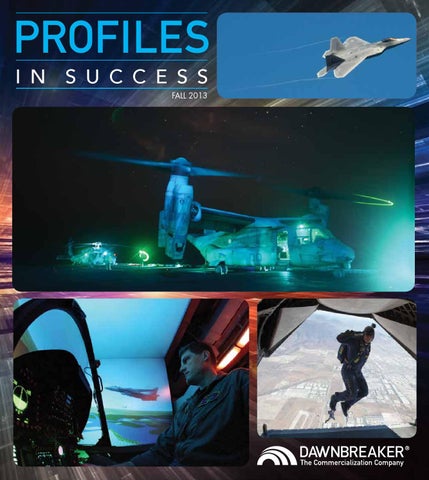
PROFILES I N S U C C E S S FALL 2013
CONTENTS
01 02 03 04 05 06 07 08 09
Princeton Power Systems | TOPIC NUMBER: N07-130 OptiPro Systems | TOPIC NUMBER: N04-172 Diamond Visionics | TOPIC NUMBER: N07-T005 Aptima | TOPIC NUMBER: N07-099 C3I | TOPIC NUMBER: N04-081 Inovati | TOPIC NUMBER: N07-122 Adaptive Technologies | TOPIC NUMBER: N04-255 KCF Technologies | TOPIC NUMBER: N07-076 Thermal Wave Imaging | TOPIC NUMBER: N06-T011
SUCCESS
The definition of success is highly debated and often takes a protracted period of time to achieve. For the Department of Defense, success is often measured by the ability of a technology to protect the warfighter and to minimize the occasions when put in harm’s way. Others would say substantial market pull and demand across an industry are the best metrics for measuring success. In an effort to put a label on the intangible and to do so in a shorter timeframe, we focus on revenue. While money certainly isn’t everything, it’s always an accurate gauge for how a technology is performing. Each year, the federal government injects $2 billion into small businesses through the SBIR and STTR programs, with the hopes that these research and development companies can achieve transition. Maybe an innovation is picked up by the government and it provides sought-after solutions across the Department of Defense. Or perhaps success takes another route when a technology originally intended for the military is better suited in the commercial marketplace and garners the attention of a major prime contractor. Whatever the course, money – or Phase III revenue – is increasingly indicative of success.
EXECUTIVE EDITOR Dr. Jenny C. Servo WRITER Julie Scuderi GRAPHIC DESIGNER Adrienne Stiles COMMENTS We welcome comments and questions from our readers. Please feel free to email us at: profileseditor @dawnbreaker.com Cover photos courtesy of U.S. Department of Defense and U.S. Navy
4 • Profiles in Success
FROM THE EDITOR In this issue of Profiles in Success, we celebrate the achievements of companies that participated in the 2009-2010 Navy Transition Assistance Program (TAP). Of the 204 presenting firms at the 2010 Navy Opportunity Forum®, 57% reported funding within an 18 month follow-up period for a total of $130,967,640 Phase III revenue. In a time of ubiquitous budget cuts and the reality of sequestration, this is a remarkable feat! Sponsored annually by the U.S. Department of the Navy’s Small Business Innovation Research (SBIR) Program Office and developed and managed by Dawnbreaker, Inc., the TAP assists companies in achieving more rapid transition of SBIR and Small Business Technology Transfer Program (STTR)-funded technologies to the fleet. Companies that participate in the TAP are invited to present their technologies to potential customers, partners, and investors at the Navy Opportunity Forum.® Since 1990, Dawnbreaker has had the pleasure of assisting over 6,500 SBIR and STTR-funded firms, using a methodology that is highly interactive and focused on developing specific tools, opportunities and relationships that facilitate transition. Dawnbreaker believes that success should be measured, and as such, collects data from participating firms at 6, 12 and 18 months following the Navy Opportunity Forum..® On average, 50 percent of participants in the Transition Assistance Program receive Phase III funding within this time period. The success stories highlighted in this issue of Profiles in Success are a subset of the companies that individually achieved more than $1 million in sales, Phase III contracts and/or investments during the 18-month evaluation period. Funding came from a wide variety of sources including Phase III contracts with the Department of Defense, or prime contractors, corporate acquisitions, equity investment, licensing, partnering, and sales. Congratulations are extended to all of the program participants for their Phase III achievements.
Of the 204 presenting firms at the 2010 Navy Opportunity Forum®, 57% reported funding within an 18 month follow-up period for a total of $130,967,640 Phase III revenue.
Jenny C. Servo, Ph.D. President, Dawnbreaker, Inc. The Commercialization Company Profiles in Success • 5
01
Princeton Power Systems
Visit Princeton Power Systems online at: www.princetonpower.com
Phase III Success: $25,000,000 in commercial sales Topic Number: N07-130 PRIOR TO THE SUMMER OF 2009, the famed Alcatraz Island, located 1.5 miles off the coast of San Francisco, couldn’t shake its dependence on foreign fossil fuels. Over 2,000 gallons of diesel fuel were being imported every week to keep the historical site up and running, at a cost of $0.76 per kWh. While talks had been in the works for years to install a solar-powered microgrid on the island, the feasibility of the project seemed too costly and complicated. However, when Princeton Power Systems demonstrated its expertise and highly sought-after clean energy technology using solar arrays and a battery bank, the project was given the green light. Today, Alcatraz Island runs almost entirely on renewable energy, saving taxpayers 80% on fuel use, and setting the stage for a massive mainstream conversation about microgrids and energy storage systems. While Princeton Power has certainly reaped the rewards – to the tune of over $25 million in commercial sales – its humble beginnings were
Princeton Power’s systems can run with or without an electric grid, and are therefore safe from power outages. Users can “disconnect” from the grid using a combination of solar arrays and batteries, which are part of their microgrid technology.
6 • Profiles in Success
funded by various research and development grants, as clean energy was not at the forefront of everyone’s mind. In 2009, Princeton Power won a Phase II SBIR award from NAVSEA to develop a system for future all-electric warships. These ships would have a greater demand for compact power conversion equipment, high conversion efficiency, and electrical system flexibility and reliability. The goal was to increase the power density of power converters without compromising the functional performance. AC-link power conversion technology and high-voltage silicon carbide (SiC) switches allowed for a small, more efficient and more flexible product that provided simplified ship design, improved ship efficiency, and improved electrical system control. While presenting at the 2010 Navy Opportunity Forum®, Princeton Power got the chance to demonstrate its vision and put itself front and center of many eager large contractors, which would end up utilizing the same form of technology for many commercial applications. “The Forum allowed us to interact with several companies, system integrators, prime contractors, and representatives from the Navy and Army,” says Darren Hammell, Chief Strategy Officer at Princeton Power Systems. “In general, it was helpful in our branding and to get our message out and make the community aware of who we are and what we’re doing. We are definitely seeing the benefits of that now.” Princeton Power continued its development of a whole platform of power conversion technologies, and it was met with high demand in the commercial marketplace, enabling a very high transition rate (90%) for its product line. Today, the company is working in three main sectors – microgrids, energy storage systems, and electric vehicle charging, which all utilize the same underlying platform. Similar systems to the Alcatraz microgrid have been constructed in the Caribbean, Europe and other parts of North America, including military bases. Princeton Power is currently working with Lockheed
Martin and Northrop Grumman on other projects involv- For instance with lithium ion or advanced batteries – as ing microgrids. There is a huge interest today for these performance continues to go up, and prices come down, systems in the Northeast, after the devastation caused there has been increasing demand for stationary energy by Super Storm Sandy. Solar arrays still require electric storage. Princeton’s technology provides the interface begrids to generate power, so users are still prone to losing tween those batteries and the electric grid. power. Princeton’s systems can run with and without an Electric vehicle charging is becoming more dynamic electric grid, and are therefore safe from power outages. and Princeton Power is working on new standards for Instead, users can “disconnect” from the grid using a car chargers, including moving more towards a univercombination of solar arrays and batteries, which are part sal “fast” car charger that is compatible with all electric of their microgrid technology. There is also a large de- cars. Recently, the City of San Diego and Clean Tech San mand for this in San Diego and across California, due to Diego partnered to complete the “Solar-to-EV Project” the large wildfires that have been sweeping across the - a one-of-a-kind, 90-kilowatt solar canopy in the zoo land and destroying power lines. parking lot shared by the San Diego Zoo and Balboa Stationary battery banks can also be tied up directly Park. The innovative system uses Princeton Power to the electric grid. In addition to providing back up pow- Systems’ DRI-100, an inverter specifically designed to er for local businesses, these batteries can be dispatched enable fast charging of electric vehicles from renewable to provide services to the electric utility companies and sources. The very first of its kind in the country, the Solargrid operators by correcting irregularities in the grids. to-EV Project allows electric vehicles to operate directly One battery system can provide a number of different ser- from renewable solar energy, and could prove to be the vices, leveraging recent advances in battery technology. platform for future sustainable energy solutions.
The famed Alcatraz Island now runs almost entirely on solar energy thanks to Princeton Power’s clean energy technology. The solar arrays seen here are tied to battery banks, saving taxpayers 80% on fuel use. Photo Courtesy of the National Park Service.
Profiles in Success • 7
02
OptiPro Systems
Visit OptiPro online at: www.optipro.com
Phase III Success: $5 million through contracts with the U.S. Navy, prime contractors, and private sales Topic Number: N04-172
NEXT GENERATION MISSILES, with their aerodynamic infrared domes, provide reduced drag, increased angle of regard for the sensor, and the improved ability to fly through rain and sand. This is accomplished by using new materials such as Spinel and Polycrystalline Alumina, and by utilizing refined aerodynamic shapes, such as the tangent ogive. However, commercial grinding and finishing equipment were limited to processing spherical and hemispherical domes. These systems were typically 3-axis machines, and were not designed for the complex aspheric and conformal shapes that are being designed into next generation military requirements. A new process was needed that could be applied to these shapes, especially the deep concave infrared domes. OptiPro’s unique finishing process is designed specifically for next generation missiles, with their newly desired aerodynamic and aspherical shapes.
8 • Profiles in Success
OptiPro, with the help of the Navy SBIR program, set out to develop its UltraForm® Finishing technology, with 5 axes of computer controlled motion and long-arm tooling design. This finishing process has the unique ability to deterministically finish these newly designed complex geometries. The technology utilizes a large variety of grinding and polishing abrasives and belts that allow for the finishing of a broad range of glass and crystalline materials. In addition, the UltraWheel diameters range from 3/8 inch to several inches, making it very flexible to finish a variety of shapes and contours, and the long extension arm of the wheel allows finishing inside deep concave ogives. While presenting its now patented technology at the 2010 Navy Opportunity Forum® and other trade shows along the way, OptiPro realized the huge potential that UltraForm® Finishing could provide to a wide range of companies and government agencies. “The biggest value of the Forum for us has been the exposure and the opportunity to get in front of primes,” explains Mike Bechtold, President of OptiPro. “You also meet other companies and talk to other small businesses, and there may be an opportunity to collaborate or to utilize their technologies and learn how to troubleshoot problems together.” Once NASA saw how the Navy was using UltraForm® Finishing to provide solutions to warfighter needs, they realized this new technology made sense for them. OptiPro soon won a Phase I award with NASA to use UltraForm® Finishing as a processing technique for several projects, including polishing tapered toroidal shaped mandrels for the International X-ray Observatory (IXO). They are now working on a Phase II SBIR with NASA for this project and other off-axis parabolic mirror applications. OptiPro has sold 12 of its UltraForm® Finishing machines, ranging from $275,000 to $375,000. Several large prime contractors are also using OptiPro’s technology internally to fabricate uniquely shaped optical components. These real-world applications are
OptiPro, with the help of the Navy SBIR program, set out to develop its UltraForm® Finishing technology, with 5 axes of computer controlled motion and long-arm tooling design. This finishing process has the unique ability to deterministically finish these newly designed complex geometries. The technology utilizes a large variety of grinding and polishing abrasives and belts that allow for the finishing of a broad range of glass and crystalline materials.
providing solutions to the U.S. Department of Defense – in fact, one subcontract customer used their technology to finish the night vision optics that were used by the U.S. Navy Seals during Operation Neptune Spear. Another success that stemmed from its various SBIRs was OptiPro’s UltraSurf non-contact measuring system. While the company originally set out to develop a way to accurately measure aspherical shapes such as ogives, its accuracy has far exceeded the original goals for the project. The UltraSurf technology is now being viewed as a viable solution for measuring freeform shapes. Through additional Navy contracts, OptiPro is maturing its UltraForm® Finishing process to incorporate a complimentary UltraSmooth Finishing process, in addition to developing OptiSonic, an ultrasonic technology implemented on automatic tool-changing grinding machines. Funding from the U.S. Navy has allowed OptiPro to develop new concepts of machines and also the new process capabilities to go with it. The Navy has been extremely supportive in OptiPro’s quest to mature these technologies, even though offshore competition may
be stiff in some cases. The company shares this “Made in the USA” pride and takes efforts to keep its unique finishing technology in the United States. OptiPro is currently working on 5 SBIR projects with the Navy. OptiPro has a unique position in that it is currently the only U.S.-based company providing CNC optical grinding, polishing and metrology solutions for the precision optics industry, including more than fourteen different commercially available products. Sales of OptiPro equipment rapidly grew, as new and innovative products were developed. The impact of OptiPro machine sales has greatly affected the U.S. optical market. Many of its current customers are implementing OptiPro’s Computer Controlled optical machining solutions for their production of optics for military night vision, infrared, and missile dome requirements. Military suppliers currently utilizing OptiPro’s optical fabrication solutions include numerous defense contractors, small-to-large precision optics manufacturers, and universities across the United States.
Profiles in Success • 9
03
Diamond Visionics LLC
Visit Diamond Visionics online at: www.diamondvisionics.com
Phase III Success: $6M in contracts with the U.S. Navy, the Canadian Dept. of National Defense, Boeing and others Topic Number: N07-T005
FLIGHT SIMULATORS, which are instrumental
in military aircraft training programs, require complex computer generated graphics in order to accurately represent the world for pilots. Topography, coastlines, landmarks and even the exact markings on airfields all have to be on point in order to create a realistic and recognizable world-view. Six years ago, the incredible amount of computer resources needed to make this happen were not possible. This led the team at Diamond Visionics to develop their texture synthesis-based image generation technology that would soon change the face of geospatial visual simulation. Realizing customers were always seeking improvement in image generator graphics, Diamond Visionics applied for and won a Navy STTR contract via NAVAIR to help them bring this idea to life. Traditional simulator graphics at the time required an extensive and timeconsuming database design process whereby the areas
10 • Profiles in Success
of interest were created offline. Designers would start off with imagery, elevation, and feature data, then run it through expensive tools to create an open flight format database, which is a static file that must be loaded and compiled into memory. Diamond Visionics’ innovation starts off with that same data, but the data are directly loaded onto a raw source data file during run time and rendered on the fly. This real-time rendering allows the user to rapidly change data sets with continuity so all that is required is a refresh. This eliminates the need to create an offline database, which can take weeks or months to complete. The main benefit to this technology, which later evolved into the GenesisRTX product line, is the ability to load raw source data on the fly. It allows the user to have complete control of the rendering; they can optimize performance by holding a 60-hertz refresh rate, thus displaying the maximum amount of content in the scene. In addition, whereas past flight simulators would “jump” from city to city, say if a pilot were flying from Jacksonville to Hawaii, the GenesisRTX graphics allow for a continuous flight representation to and from anywhere in the world. If airfields are of particular interest, the software can create an exact replica of the airfield, including signs, navigation aids, runway lengths, markings of taxiways and exact lighting patterns. Diamond Visionics’ relationship with Boeing helped propel the GenesisRTX into the commercial marketplace. The connection began at a trade show in Orlando several years ago. Top executives and engineers from Boeing walked by just as Diamond Visionics was giving a live demonstration. While Boeing realized this had the potential to save them a lot of time and money, they were highly skeptical of the technology. After all, Diamond Visionics was challenging the traditional idea of what was necessary. Boeing began an extensive evaluation with a sample product and was able to use the software successfully, subsequently becoming one of Diamond Visionics’ biggest supporters. Boeing saved millions of
dollars, and is currently using the system in many different divisions all over their North American enterprise. The 2009-10 Navy Opportunity Forum®, which was the culmination of the 10-month Navy Transition Assistant Program (Navy TAP), was another opportunity for Diamond Visionics to showcase its coveted technology. They were met with many interested attendees and potential customers. “One thing that helped, in preparing for the Navy Opportunity Forum®, was building a quad chart – which is a condensed, crystalized message of what we are doing,” explains Tim Woodard, Director of Research and Development at Diamond Visionics. “This helped us to communicate more clearly to the customer what the distinguishing characteristics are of what we’ve done. The
final report on an STTR could be 40-50 pages of technical info – how do you boil that down into a marketable message? Having to pull it down into a quad chart was a great exercise.” In addition to large commercial contracts and the sale of over 2,000 licenses to prime contractors, Diamond Visionics has also entered into agreements with the U.S. and Canadian Governments. The U.S. Navy will use GenesisIG this year on a P3C simulator. This is the same product being fielded by the Canadian Department of National Defense as part of their Canadian Advanced Synthetic Environment (CASE) program. Other clients include top companies in the aerospace industry, and a variety of Fortune 500 corporate clients and commercial airlines.
Diamond Visionics’ texture synthesisbased image generation technology helps to recreate real-world images seen out of an aircraft. Here, a south-facing view of the Manhattan skyline gives pilots a realistic and recognizable world-view.
Profiles in Success • 11
04
Aptima, Inc.
Visit Aptima online at: www.aptima.com
Phase III Success: $2.8 million from contract with NAVAIR Topic Number: N07-099
SIMULATORS ARE CRUCIAL FOR TRAINING
civilian and military personnel, and they have evolved over the years to provide varying levels of fidelity and training utility. Prior to this SBIR however, there was no standard tool for determining the appropriate level of fidelity in simulators to achieve specified training objectives, maintain trainee acceptance, and fit within budgetary constraints. Since adjusting fidelity to the right level drives budget and optimizes readiness, the team at Aptima was motivated by one simple question – is all that fidelity really necessary? While most pilots would say “yes,” Aptima challenged this widespread opinion. Specifically, they wanted to measure the correlation between fidelity and training effectiveness, and how much fidelity could be dialed down without compromising the integrity of the training. This led to the development of PREDICT – Predicting Requirements for Instructional Environment Design to Improve Critical Training. All simulator-based training programs struggle with
Currently, Aptima is in its second year of a 4-year Future Naval Capabilities project with ONR, focused on Live, Virtual, Constructive (LVC) training. Aptima is leading the research to figure out how much the fidelity would have to be increased and how in order to complete a significant portion of aircraft carrier landing training in a simulator.
12 • Profiles in Success
the same problem—identifying which objectives can be trained in lower- or higher-fidelity simulators, and which require training in the actual aircraft. Aptima’s vision was that PREDICT would be a tool that combines fidelity requirements defined by end-users, existing theory and research about fidelity, and objective performance data from fidelity experiments to support more informed decisions regarding the acquisition and use of training simulators. This was a vast difference from the baseline technology at the time, which provided data exclusively from end-users. This approach is problematic since it typically results in specifications for a simulator that exceed the amount of money available for development and/or acquisition. As a result, acquisition and training professionals must make difficult fidelity trade-off decisions. PREDICT provides two main capabilities. First, the user can provide information on the fidelity of a simulator and the tool predicts the training effectiveness of that simulator on specific training outcomes. Second, the user can compare the predicted training effectiveness of multiple simulators side-by-side. After entering into the Navy Transition Assistance Program (Navy TAP), Aptima discovered that a growing number of customers shared its conviction of looking at the relationship between fidelity and training effectiveness, and also the need to measure results objectively. This led to some key conversations with personnel at ONR and NAVAIR. “The most beneficial aspect of the TAP for us was the chance to get to know the folks in the Navy community, and as a result, recognizing there was a very good match between what they needed and what we could provide,” says Webb Stacy, Corporate Fellow at Aptima, Inc. “We discovered there was a strong interest in a number of quarters to understand more about fidelity and training effectiveness, and the Navy Opportunity Forum® allowed us to connect with others who shared our perspectives.” PREDICT was initially designed to support the F/A18 community with simulator fidelity trade-off decisions.
With its mission-focused approach, PREDICT supports all aircraft platforms that fly the same mission as the F/A-18, including the F-35, F-16, and F-22. Photo courtesy of U.S. Department of Defense.
However, since PREDICT is mission focused (e.g., air-toground), versus platform focused, it can assist all aircraft platforms that fly the same missions as the F/A-18, including the F-35, F-16 and F-22. Aptima entered into a $2.8 million contract with NAVAIR to use PREDICT in landing carrier training. Currently, Aptima is in its second year of a 4-year Future Naval Capabilities project with ONR, focused on Live, Virtual, Constructive (LVC) training. This time, they are on the other end of the fidelity equation, investigating how fidelity can be dialed up for difficult tasks such as an F/A18 landing on a carrier. Currently, there is no way around the fact that carrier landing training must happen in an actual aircraft. Aptima is leading the research to figure
out how much the fidelity would have to be increased and how in order to complete a significant portion of this training in a simulator. Aptima brings together a unique team of people experienced at applying and evaluating applications of cutting-edge technologies in the military, national security, aviation and medical communities. The collective expertise of the firm’s staff has been applied in multiple engineering domains including military command and control, complex information display, decision support, emergency preparedness, organizational design, technology evaluation, performance measurement, and cognitive skills and cultural training. Over 85% of Aptima’s contracts have been from agencies across the Department of Defense. Profiles in Success • 13
05
C3I, Inc.
Visit C3I, Inc. online at: http://c3i-usa.com
Phase III Success: $8.1 million in contracts with the Navy and commercial sales Topic Number: N04-081 WHEN C3I EMBARKED on its original SBIR with
NAVSEA, the company had a goal to develop an integrated, re-configurable, flexible lighting control system for shipboard applications. Existing flight deck lighting equipment at the time was comprised of stand alone, non-integrated equipment that required a large number of personnel to meet the safety requirements and operational demands of deck personnel and flight crews operating in specialized warfare conditions. Additionally, there was a specific need to develop a system for vessels performing both air operations and well-deck operations. The complexity and tempo of operations indicated they would require a highly integrated lighting and equipment control system to be capable of safely and efficiently controlling divergent systems from a common centralized control station, with a reduced number of personnel. The result was C3I’s patented Advanced Lighting System (ALS®)/Advanced Communication and Control System (ACCS®) – a comprehensive ship-wide integrated lighting control system that incorporated the required elements of a mature system. The ALS® can be used in Visual Landing Aid/Next Generation Visual Landing Aid (VLA/NGVLA) systems aboard helicopter carrying ships, and can be used for fixed wing ships. The system can also integrate related and supporting ship systems into a common control and communication system. The ALS®/ACCS® provides an integrated software suite including all closed loop device driver software, communication algorithms, application programs, and control panel Graphical User Interfaces (GUIs). The ALS®/ ACCS® software suite provides embedded lighting/control system configuration tools, designated the ALS®/ ACCS® “Tool Box” which gives the system designer the ability to design, customize, and maintain the shipboard lighting/control system without the need to write new software. This includes the ability to create new groups; design and layout group control pages; assign controlled devices to specific super-groups, groups and sub-groups; define control transfer methodologies; and
14 • Profiles in Success
configure individual device capabilities. “We believe the market cap for our technology is very large and we are aggressively pursuing those opportunities,” says Michael J. Curry, President of C3I. “At the time we won this SBIR, we were a $300,000 company, and today we are over $3.5 million and growing at double digits each year. “ ALS®/ACCS® technology is currently being fielded by the U.S. Navy for control of navigation lights, personnel safety barriers, flight deck visual landing aides including deck lighting, glide slope indicators, large screen displays, boat launch and recovery lighting, ship interior lighting and robotic firefighting systems. A test suite of C3I’s technology is currently being installed onboard the USS WASP (LHD-1), a large deck amphibious ship for the Joint Strike Fighter (JSF-35) Program. The company has installed a flight deck lighting system at Eglin Air Force Base in Florida for JSF-35 training and is pursuing other JSF training locations to market the technology. In addition, other commercial companies such as Temeku Technologies, Remote Source Lighting, Akron Brass, and Maritime Applied Physics Corporation have all partnered with C3I to utilize its lighting and control system technology. C3I also received a contract in early 2012 from General Dynamics Bath Iron Works to integrate their flight deck equipment and systems on the DDG 1000 into ACCS®. “We are still following up on many of the initiatives that started at the Navy Opportunity Forum®,” says Charles Wagner, CEO and CTO of C3I. “There is a very good chance of collaboration and working with other companies you meet through the Forum. We are currently pursuing some very large contracts that we feel are a good fit for our technology.” After working with individuals in the Navy and particularly within NAVAIR, C3I was able to further develop its technology, and the result has been high demand among very eager consumers, especially within the Department of Defense. C3I believes its ALS®/ACCS®
Photo courtesy of U.S. Department of Defense
technology results in significant construction and manpower savings in shipboard applications, while at the same time enabling U.S. Navy vessels to meet high tempo operations that employ rapidly re-configurable lighting technologies successfully and safely. In addition, it significantly reduces high power cable quantities, reduces and simplifies control cable requirements, reduces operational manpower requirements, reduces lighting maintenance, improves lighting system reliability and situational awareness, and dramatically improves lighting flexibility and capability. C3I is continuing its work with NAVAIR through the Aviation Lighting System Control Panel Set (ALS CPS). “We were enormously fortunate to have worked with people at NAVAIR who are national treasures,” says Curry. “They helped us to develop our technology, and if they hadn’t been there, we would not be here today.” Curry went on to thank Kim Reymann, George Bray, Kurt Harting, Cathy Malvasio, and the entire Command team at NAVAIR Lakehurst for their support and guidance during the SBIR process and during follow-on contracts. C3I’s expertise includes real time, embedded systems using COTS platforms, as well as software development, energy management technology, shipboard control and navigation equipment, and directed thrust control systems. C3I’s equipment and systems support submarines, surface ships, gas turbine and nuclear power plants, autonomous vehicles, and passenger ferries. They have designed and manufactured precision, critical controls and instruments in four major products lines: Advanced Communication and Control Systems, Interior Communications, Distributed Data Acquisition, and Bridge Display Systems.
TOP: C3I Technician Sue Dupuis builds a control panel. Bottom: C3I Engineer Ben Driver and Paul Hemond, Director of Engineering, test ACCS® in C3I Integration Center.
Profiles in Success • 15
06
Inovati
Visit Inovati online at: www.inovati.com
Phase III Success: Over $10.5 million in contracts with the U.S. Navy and private sales Topic Number: N07-122 WHEN COMPLEX COMPONENTS on Navy air-
craft are damaged by corrosion, wear, or other mechanical failures, repairs must happen immediately in order for the parts to be put back into service. The current field repair process for Ion-Vapor-Deposition Aluminum (IVDAl) coatings, however, is environmentally problematic, as well as potentially harmful to the repair personnel. The process required involves brush electroplating of hazardous cadmium or using variations of nickel-based materials to repair these IVD-Al coatings. When the Navy expressed a desire to reduce human exposure to cadmium and eliminate the entire electroplating process, Inovati embarked on several SBIR projects – first in 2006, and again in 2009 - to introduce a much sought-after solution. This solution was called Kinetic Metallization (KM), which is a process that performs dimensional restoration of holes, grooves and defects in magnesium and aluminum alloy materials and repairs corrosion-protective coatings on high-strength steels. Kinetic Metallization is a solid-state process that does not metallurgically alter the properties of the coatings or the substrate. Inert gas is used to spray metallic powders, which eliminates deposition-induced oxide formation. In addition, KM implemented with a debris recovery system is ecologically sustainable and does not chemically degrade the environment. Inovati knew its technology had huge potential benefits to both the Department of Defense and within the commercial marketplace. Kinetic Metallization technology for in-service field and depot repairs of minor damage or corrosion control coatings on aircraft components reduces maintenance costs and allows military aircraft to remain in operational service for longer periods before major overhaul. Commercial deployment of both fixed and portable Kinetic Metallization systems and powder alloy formulations allow repairs of minor defects in magnesium and aluminum alloy castings and parts and provides a method of applying or restoring corrosion control coatings on many types of products.
16 • Profiles in Success
In 2009, Inovati completed its second stint in the Navy Transition Assistance Program (Navy TAP) with the goal of maturing the KM process and finding the right customers. The 2010 Navy Opportunity Forum® followed the 10-month program, and Inovati got its first big break. After making a very strategic connection with interested attendees from Aerojet, Inovati aligned itself with the prime contractor and subsequently developed ceramic composite materials together. “Our experiences with the TAP allowed us a greater customer base for our KM products,” says Howard Gabel, Inovati President. “It has helped us to acquire Phase III funding for Kinetic Metallization systems for deployment at the NAVAIR Fleet Readiness Center in San Diego and in our development and repair of the F-18 Hornet. Overall, our experiences with the Navy have been positive, and the Navy has helped us expand our customer base and funding efforts.” The Navy came onboard when they learned of the cost savings that KM technology provides. To illustrate, the replacement cost for F-18 AMAD Gearbox housing is $80,000. These units can be repaired for approximately $2,500 using the KM process, resulting in a net savings of $77,500 per unit. Turn-around schedules for refurbishment and repair of F-18 AMAD housing is reduced from 15 months for replacement to one month for repair. Currently, the NAVAIR Fleet Readiness Center at North Island has applied for capital equipment funding in 2014 to procure a KM system, which would permit dimensional restoration repairs of the F-18 AMAD housings at the depot. KM technology was recently used to restore worn and damaged surfaces on Super Hornet hydraulic gear pump shafts with a wear resistant tungsten carbide cobalt coating. Additional developments are underway to dimensionally restore damage to journal bearing shafts for F-18 electrical generators and to provide a wear and corrosion resistant protective coating on the tail hook pivot assembly.
In addition to the Naval Aviation depots, other DoD branches including the Air Force and Army depots can directly benefit from providing an environmentally sustainable method of repairing damaged coatings and non-structural components on fixed-wing and rotary aircraft or other ground-based vehicles at depot or fieldlevel. Many of the IVD-Al plating manufacturers have expressed a need for repairing damaged OEM IVD-Al coatings on aircraft parts without having to rework the entire component.
Inovati has leveraged its proprietary solid-state coating process to develop eco-friendly turnkey KM systems for deposition of low temperature coatings and materials for repair and protection of components. Current customers span a large market spectrum including electronics, aerospace, oil and gas, power generation, military, medical, and automotive. Inovati has developed and commercialized several models of KM Coating Systems, which are currently marketed to industry, government, and academic entities.
Overview: Damaged F18 AMAD Gear Box
Closeup: Hydraulic pad damage
In Process: Kinetic Metallization repair
Post machining: Ready for the fleet
Profiles in Success • 17
07
Adaptive Technologies, Inc.
Visit Adaptive Technologies, Inc. online at: www.adaptivetechinc.com
Phase III Success: $5.56 million in contracts with NAVAIR, Air Force, and commercial sales Topic Number: N04-255 MAINTAINERS WORKING ON flight decks
have the critical responsibility to maintain flight operations for the U.S. Navy. Working side by side with massive machines, they are exposed to some of the most hazardous and demanding conditions on Earth. This high-stress work environment requires advanced personal protective equipment to keep maintainers safe. Flight Deck Cranial (FDC) systems, designed to provide head and hearing protection to the maintainer workforce, have not kept pace with advancements in aircraft power, velocity and noise. FDCs are also unable to cope with the introduction of night vision devices (NVD), since they were designed at a time before NVDs were introduced, and therefore only hearing protection was considered. The result was an unsuccessful attempt at properly adjusting NVDs for use during night operations while adjusting the Hearing Protection Devices (HPD) for proper hearing protection. The two facets Adaptive Technologies’ Flight Deck Cranial System dramatically improves hearing protection, speech intelligibility, and impact protection, as well as provides a stable mounting platform for use of Night Vision Devices.
18 • Profiles in Success
were being forced to work together even though neither was designed with the other in mind. Poor fit, bad hygiene, and the fact that these systems have never met any form of industry or military standard for head protection, all led Adaptive Technologies, Inc. (ATI) to embark on an SBIR funded by NAVAIR for improved safety and system integration for the FDC. ATI’s FDC system dramatically improves hearing protection, speech intelligibility, and impact protection, as well as provides a stable mounting platform for use of Night Vision Devices. A modular design allows for specific tailoring of hearing protection and speech intelligibility performance to meet mission needs. The FDC may also be used with Chemical, Biological, and Radiological protection equipment, as well as current and future communication interfaces. Noise generated in and around military aircraft presents a significant risk to short and long-term hearing health and creates an environment in which communication becomes intractable. Improved hearing protection addresses the Veterans Administration’s growing hearing related injury claims, which exceeded $2 billion in 2010. The FDC technology was originally sought to address this growing issue. As the program progressed, the Navy recognized an additional need to upgrade its head protection. Fueled by SBIR funding, ATI defined three distinct levels of hearing protection and communications performance, followed by a comprehensive list of features required to bring head and hearing protection in line with modern standards and ancillary man-mounted systems. The resulting system currently meets all requirements for head impact protection, hearing protection and speech intelligibility in these extremely dangerous environments. The compatibility features of the design permits use with current and future hearing protector designs and communication systems, as well as flight deck goggle systems. It also addresses comfort of fit across a wide anthropometric range.
Maintainers working on the Navy flight deck are exposed to some of the most hazardous conditions in the world. The highstress work environment requires advanced personal protective equipment to keep maintainers safe. Photo courtesy of U.S. Navy.
ATI’s FDC system, which is comprised of the DC-2 sin- Joint Strike Fighter Program, and Lockheed Martin has gle hearing protector and the Argonaut Communications purchased hundreds of Digital Active Noise Reduction Headset, was tested aboard multiple Navy assets, includ- (DANR) Double Hearing Protector (DHP) systems from ing the USS Kearsarge and the USS Enterprise. After a Aegisound, which are designed to be used in extreme 2-and-a-half week deployment and multiple professional noise environments such as jet noise up to 140 dB(A). Although ATI’s contacts with prime contractors preassessments by the fleet, ATI demonstrated wide acceptance of the technology. As a result, ATI transitioned all ceded the Navy Opportunity Forum®, the company still systems to Aegisound LLC, from whom all systems are recognizes the benefits of such a platform. “Overall, the now available for procurement. Different parts of the TAP does a good job of educating companies on what product suite are in production and being sold to both they need to do to get to Phase III,” says Mike Abbott, the U.S. Navy and other partner countries. President & Director of New Product Development at Aegisound product sales of DC-2 and CTE30X hear- Adaptive Technologies. “The Forum is a great opportuing protectors to NAVAIR and APC-2G head protectors to nity for small businesses to showcase their technologies.” the Air Force, have exceeded $5.3 million. The Air Force Adaptive Technologies, Inc. is a small business lohas also provided another $3 million in Phase II funding cated in Blacksburg, VA. Since 1997, the engineering staff to Aegisound to support further manufacturing improve- has completed numerous consulting contracts and has ments in digital active noise reduction technologies de- been awarded Phase II SBIR contracts by all of the variveloped by ATI during NAVAIR sponsored SBIR programs. ous DOD agencies. Adaptive Technologies, Inc. provides Today, there are tens of thousands of Aegisound hearing R&D, design and engineering, and consultation on prodprotectors incorporating ATI’s technologies aboard Navy ucts and problems associated with noise control, hearing ships. ATI also partnered with Lockheed Martin on its protection, signal processing, and control theory.
Profiles in Success • 19
08
KCF Technologies, Inc.
Visit KCF Technologies online at: www.kcftech.com
Phase III Success: Over $3 million from commercial contracts Topic Number: N07-076 IN RECENT YEARS, information infrastructure has grown dramatically based on providing new opportunities for cost savings and performance enhancements across a wide range of systems and devices. A key part of the new information infrastructure enabling this revolution is cost effective and reliable acquisition and dissemination of information. At an asset level, this is being facilitated by the transition from hardwired sensors to energy harvester powered wireless sensors, which addresses four implementation barriers: 1) weight, 2) installation time/cost, 3) reliability, and 4) opportunity for temporary fit. For example, energy harvester powered wireless sensors are enabling the expansion of Health and Usage Monitoring Systems (HUMS) on rotorcraft to provide comprehensive condition monitoring, thereby enhancing safety and reducing maintenance costs. KCF acquired a Phase II contract with ONR for further development of its energy harvesting technology, and subsequently joined the Navy Transition Assistance Program (Navy TAP). By collaborating with NAVAIR
20 • Profiles in Success
technical experts, KCF matured its technology - an ultracompact power harvesting device enabled by singlecrystal piezoelectric material. Single-crystal piezoelectric materials are a key technology in reducing the size and weight of vibration energy harvesters. The high, singlecrystal piezoelectric coupling coefficient and low elastic compliance result in a four-fold improvement in device power density over conventional solutions. The compactness and high power of single-crystal piezoelectric materials particularly benefit aircraft applications where weight reductions and high reliability are critical. KCF has filed 2 patents on the technology. KCF successfully showcased its technology at the 2010 Navy Opportunity Forum®. A significant outcome of the Forum for KCF was the initiation of development partnerships based on the TAP’s one-on-one sessions. These partnerships have since evolved into very mature relationships that are leveraging its energy harvester work. Today, almost one third of KCF’s business is specific to supporting sensor development efforts that resulted from the Navy Opportunity Forum®. “Developing strong working relationships with OEMs provides the best transition opportunities for a company of our size, and that is one of the main benefits of the TAP,” says Dr. Jacob Loverich, Director of Engineering for KCF. “From a technical standpoint, this ONR sponsored SBIR development has led to energy harvesting, which has become a key enabling technology to support truly wireless communication for helicopter vibration monitoring.” The success with the energy harvester development is supporting not only military specific applications but also commercial applications. One such application is Condition Based Maintenance (CBM) in industrial facilities. Thanks to the energy harvesting and wireless communication, vibration sensors for characterizing the condition of machines can now be deployed at a fraction of the life cycle cost of conventional sensors. Reactive maintenance processes inherently lead to unplanned downtime and lost production – inefficiencies
that cost the United States economy as much as $2.5 Trillion per year (as estimated by the DoE Industrial Technologies Program). To help companies eliminate these costs and enhance productivity, KCF Technologies introduced an energy harvester powered wireless CBM sensor system called SmartDiagnostics®. KCF SmartDiagnostics® was designed using innovative low power energy management technology that is fundamental to energy harvester powered devices to provide an affordable and integrated suite of products that puts predictive maintenance within practical reach of medium and small operations - anyone that demands the best protection and longest life from key machinery. In addition to the single crystal vibration energy harvester, SmartDiagnostics® includes other harvester options such as thermal and solar which use some of the core technology in the single crystal vibration harvester. The harvesters are all designed to deliver nearcontinuous power to wireless sensors or other low power devices. They can be mixed and matched so you choose the right harvester for the environment. The harvesters leverage KCF’s patent pending technology to ensure rapid charge-up for initial sensor readings and long energy storage of excess harvested energy to ensure sensor operation for times when environmental energy is not available. The harvesters are engineered to be very robust -- suitable out-of-the-box for installation in harsh industrial settings. To ensure high-bandwidth, high-reliability wireless communication at the lowest possible energy budget, KCF’s SmartDiagnostics® sensors utilize a highly efficient, proprietary wireless protocol. The protocol is optimized to transmit full dynamic vibration spectrum using only the power available from KCF’s energy harvesters. KCF Technologies’ leadership has demonstrated a strong track record of commercializing technology from SBIR-funded projects. Every Phase 2 SBIR/STTR project completed by KCF has resulted in a successfully launched commercial product. KCF’s SmartDiagnostics® product line incorporates technology that was developed under the SBIR program. It is providing improved uptime and reduced maintenance costs in a wide range of markets including waste water, pulp and paper, industrial chillers, and oil and gas. The KCF Smart Tether, initiated with Navy ONR STTR funding, is currently available as an underwater GPS navigation system for VideoRay ROVs and divers. After a product launch in 2008, over 180 systems have been delivered for use by police departments, port secu- Condition Based Maintenance enabled by harvester powered wireless sensors rity units, and the U.S. Coast Guard. reduces maintenance burden and improves operational availability. Photo courtesy of U.S. Navy.
Profiles in Success • 21
09
Thermal Wave Imaging, Inc.
Visit Thermal Wave Imaging online at: www.thermalwave.com
Phase III Success: $3,600,000 from sales to prime contractors and development funding Topic Number: N06-T011
LIKE MANY SMALL BUSINESSES, Thermal
Wave Imaging, Inc. (TWI) had an idea and a product that they felt could provide huge potential benefits to the Department of Defense. The challenge was finding its entry-point into the market. Turbine blade manufacturing requires numerous inspections at several stages of the manufacturing process, each requiring different technology, equipment, training and personnel. Based on their experience in providing thermographic inspection systems to the turbine industry, scientists at TWI realized that their thermography technology could perform nearly all of the required inspections. The race was on to develop a single system that could consolidate all of these inspections, and streamline the entire manufacturing process. When the U.S. Navy heard its proposal, an initial STTR was granted to TWI. As market research progressed, the team at TWI learned that clients were usually focused on a single inspection task, and were not likely to purchase an allin-one system. As a result, they came to a pragmatic decision to make the system modular. They also learned about an aspect of the inspection process that was widely regarded as particularly tedious and time consuming. In the typical inspection for blockages in cooling holes, inspectors manually insert a wire probe through every single hole. If TWI could provide a solution to this labor intensive and cost inefficient process, the team knew they could attract industry attention. And that is exactly what happened. After proving that their Thermal Air Flow Inspection System (TAFIS) could eliminate this manual inspection and reduce inspection time to less than 15 seconds, TWI suddenly found its entry into the market and gained widespread attention from industry leaders. From there, Pratt & Whitney and Rolls-Royce helped TWI understand the specialized requirements of the aircraft turbine blade manufacturing environment, and TWI was able to demonstrate they could easily exceed existing inspection requirements.
22 • Profiles in Success
While developing the TAFIS system, TWI recognized another opportunity – the detection of residual ceramic core, where the conventional inspection solution, neutron radiography, was creating a logjam in the blade manufacturing process. TWI realized the patented technology that TAFIS was built on could perform this inspection using thermography. Whereas neutron radiography reveals the presence of the core residue, the TWI approach shows the change in performance of the blade due to the presence of core, which the company feels is far more valuable, since the process works in a thermodynamic space as opposed to just the structural space. Throughout the Phase II development process, TWI worked with the Navy Transition Assistance Program (TAP) to assist them in their market research and marketing initiatives. “Primes and other large companies are able to separate the technical focus of their work from the marketing, and the marketing begins in the early development stages. Small technology companies can’t always do that; they just don’t have the resources,” explains Dr. Steven Shepard, President and Founder of Thermal Wave Imaging, Inc. “Consequently, the same people who are developing the technology have to think about how to market it, but they often don’t, until the projects are far along technically. The TAP program forces the small company to start thinking about marketing much earlier in the process. It teaches the small company to think and act more like a big company.” The modular T3S system that emerged from the STTR uses TWI’s advanced thermography to detect hole and channel blockages, measure Thermal Barrier Coating (TBC) and wall thickness, detect TBC delamination and detect cracks for land and aerospace-based turbine components. T3S can replace many time-intensive inspections currently performed on multiple test systems. Its modular architecture can be configured to meet specific turbine inspection requirements. It uses a single test station for multiple applications, and its non-contact
LEFT: T3S provides a consolidated platform for a comprehensive suite of turbine airfoil/ bucket/vane inspections – thermal barrier coating (TBC) disbonds, wall thickness measurement, cooling hole and channel blockage, cracks, and flaws in ceramic matrix composites (CMC). RIGHT: TAFIS is a focused solution for inspecting blocked cooling holes in turbine airfoils/buckets/vanes with unprecedented accuracy and speed, and replaces conventional time-consuming testing methods.
inspection design increases speed, accuracy and reliability. The net benefit is increased inspection sensitivity, increased throughput, and significant cost reduction and return on investment. “The Navy community speaks a very specific language that includes, but is broader than the language that scientists speak,” says Shepard. “As a result, we sometimes don’t effectively communicate what we have to offer in the language of the customer. As scientists who spend a lot of time describing what we do, that’s not a criticism we like to hear, but the TAP addresses that and teaches us to speak and understand that language effectively.” Both TAFIS and the T3S are currently being used in military and commercial aircraft platforms. TWI has acquired over $3 million in Phase III revenue as a result of these innovations, including $2.8 million in sales to prime contractors and another $1.6 million in equity and direct development funding.
Profiles in Success • 23
ABOUT DAWNBREAKER速
Dawnbreaker速 is a professional services firm providing commercialization assistance to both government agencies and advanced technology firms. Dawnbreaker速 specializes in business planning, marketing, and customized market research in the commercial and defense sectors through our unique blend of individualized consulting, website and graphic design services, and training seminars. Our focus within the DoD and other government agencies include transition planning conducted by our skilled team of technical experts with a focus on Phase III success. Since 1990, we have worked with over 6,500 SBIR, STTR, and ATP funded projects. The combined sales and investment in the firms we have assisted total in excess of $2.5 billion.
THERE IS MORE TO
DAWNBREAKER www.dawnbreaker.com
速