CONTENTS NAQEZ BOARD MEMBERS - P3 EARLY CHILDHOOD EDUCATION GASPING FOR HELP - P4 GEAR PROJECT - P5 NAQEZ MEDIA TEAM - P7 EDITORIAL COMMENT - P8 PRESENTEEISM IN SPECIAL AND INCLUSIVE EDUCATION: A CONDUIT FOR QUALITY EDUCATION IN ZAMBIA - P9 COMPUTERS AND INTERNET IN RURAL AREAS - P11 LETTERS TO THE EDITOR - P13 WHY DO WE NEED FINANCIAL LITERACY? - P14 NGOs IN SADC UNITE AGAINST QUANTITY EDUCATION - P17 THE BIRTHDAY - P19
2
Contact Details: Plot No: P76/7 C5 Estates - Kafue Lusaka/ Zambia
ACROSTIC TITLE - P20
qualityeducationzambia@gmail.com www.naqez.org
COVID - 19 HOLDS SCHOOL SPORTS TO RANSOM - P21
0977409810 0977442301
Education in Zambia Mag
I N T R O D U C I N G
NAQEZ BOARD MEMBERS
CHIBWE MULENGA BOARD CHAIRPERSON
MARY NYIRENDA BOARD VICE CHAIRPERSON
KINGSLEY HAKABULO SECRETARY
JUDGE MWANZA VICE SECRETARY
SANSELE MUKUMBUTA MEMBER
REV. MOSES MWALE TREASURER
Education in Zambia Mag
3
EARLY CHILDHOOD EDUCATION GASPING FOR HELP By DR. SAMPA JEFF
E
arly childhood education is the kind of education offered to children to prepare them for primary education. It is transitional between learning in the home and learning in the school. It also supplements the extensive learning that occurs in a child’s home and within the environment. As children approach the age of school entry, their activities at preschool become less spontaneous and more ordered, in preparation for life at school, while purposeful play remains the main mode of learning. This, however, can be meaningfully achieved if this sector of education is adequately taken care of. Early childhood education has recorded remarkable progress in terms of its expansion and spread to other parts of the country like the rural and remote areas. The demand for early childhood services is on the increase too as many parents realise the essence of preparing a child for school life. This is characterised by the sudden increase in numbers witnessed during enrolment triggered by the declaration of free education.
4
Education in Zambia Mag
Despite this milestone achievement in early childhood education, the sector currently faces multifaceted challenges that may deter quality development and enhance more of quantitative development if left unchecked. These challenges range from lack of facilities such as play parks, age suited furniture, toys, suitable infrastructure, lack of trained teachers and above all inadequate funding. Government has a bounded duty to promote the highest standards of education and learning for all. This simply means that all learners should be facilitated in the attainment of the highest standards of learning through teaching of excellent quality. Quality can only be brought about by maximising the efforts of all those responsible for the education of learners and by coordinating all learning activities. Government must also commit to provide measures to promote equality that will include allocating resources to those areas of greatest need as stipulated in the policy document (1996). The ministry must also recognise that early childhood education is very beneficial for the development
of the child and useful as a preparatory stage for entry into basic school. Henceforth, with early childhood education having spread to almost all rural and remote primary schools, government must begin thinking of establishing preschool as a condition for entry to Grade 1. While the secondary and primary schools countrywide jubilate and applaud government for the hefty support they have received from the new dawn government through (grants) funding, the early childhood sector feels abandoned and neglected. The funding received at early childhood is indeed inadequate and can hardly fit into the stipulated breakdowns (percentages) in the finance management guideline or rather address any major challenge faced by the sector. What the general populous may wish to find out from our able government is whether the scanty funding at early childhood is as a result of policy number three (3) of chapter two, page 8 of the policy document 1996 (Educating Our Future) which stipulates that “The provision and funding of early childhood and pre-
school education will be the responsibility of councils, local communities, non-governmental organizations, private individuals and families”. If this is the case, will schools providing ECE be directed to councils for funding from the CDF chunk? Remember always that early childhood is characterised by rapid brain development and acquisition of foundational skills and competences. Investment in early
childhood interventions accrue long-term economic and social returns, including making the early start fair to all, and the provision of equal opportunities for both girls and boys. Even though teachers, caregivers and practitioners are among the most influential players to ensure equity, access and quality in ECE, various studies demonstrate that the ECE workforce in Africa is one of the most neglected in terms of training, professionalization, status and working and living
conditions. May the listening government of the new dawn encumber help to the drowning early childhood education sector in a jiffy.
The author is DR. SAMPA JEFF (Ph.D., ARU). HEAD TEACHER PRIMARY, NORTHWESTERN PROVINCE.
GEAR PROJECT By AARON CHANSA
I
n 2020, NAQEZ, SAYWHAT from Zimbabwe, GAYO from Malawi and FACET from Zimbabwe formed an alliance called Girls Education Advocacy in the Region (GEAR). This was after the 4 Organizations realized that rural girls in the 3 Countries were facing same problems in accessing quality education. It was also discovered that Governments in these countries were not funding education adequately. It was feared that the 3 nations risked failing to meet most targets of the SDG 4, if citizens and stakeholders did not come together to demand for more money into
Education. Among the problems faced by girls, especially those in rural areas, were: Long distances to schools, early marriages, teenage pregnancies, lack of sanitary pads, poor teaching/ learning environments and bad traditional practices. To regionally collaborate and help to address the above educational afflictions, the four organizations crafted the Girls Education Advocacy in the Region (GEAR) Project. This project started in early 2022 and will end in 2024.It was funded by Global Campaign for Education (GPE).
Education in Zambia Mag
5
The project is centered around Sustainable Development Goal number 4. It is about holding Governments accountable for all the international, continental, regional and national treaties and laws they have signed. Because the problems that force girls in rural areas to be out of schools in Zimbabwe, Malawi and Zambia are the same, the GEAR project aims at Advocating for national educational systems that shall make it possible for rural girls to easily access quality education. It is not a project for providing items such as books, shoes, desks etc but influencing policy and program changes to benefit girls in rural areas. It is also not a project of visiting rural schools or various provinces but about engaging policy makers in order to influence policy making in education. It is about mobilizing critical
6
Education in Zambia Mag
stakeholders for a stronger voice for education .The GEAR project is about participating in Voluntary National Reviews, National Budget formulation, Formulation of National Development Plans , Monitoring implementation of Sustainable Development Goal number 4 , participation in Universal Peer Reviews , Participation in Technical Educational Reviews ,Budget tracking, Reviewing policies and extensive use of the media to raise awareness on the plight of girls in marginalized communities . NAQEZ will extensively involve strategic CSOs in implementing the GEAR project. It is assumed that the project will sensitive a lot of citizens in the 3 Countries in order for them to begin to demand for more Educational spaces for poor girls. The thinking of the project is that people must make their
Government to provide Education to all because everyone, regardless of where they live, deserves to consume quality education. It is also hoped that after all the above engagements, the policy environments in education for Zambia, Zimbabwe and Malawi will be favourable for girls to easily access quality education.
Thank you for reading the above article. Author: Aaron Chansa Executive Director
I N T R O D U C I N G
NAQEZ MEDIA TEAM
PETER KALENGA Media Director
AARON MUNTHALI
MILIMO MUYANGA
CHIFITA M. MARGARET
BENJAMIN KAJOBA
DAVY MANDA
FRANK SAKALA
VALLEN CHIKOMBE Education in Zambia Mag
7
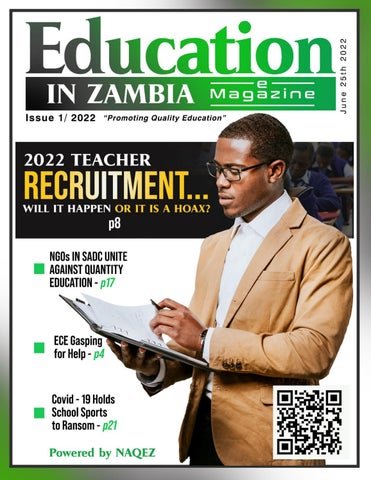
EDITORIAL COMMENT 2022 TEACHER RECRUITMENT….. WILL IT HAPPEN OR IT IS A HOAX?
O
n Friday, 29th October, 2021, Finance Minister,Dr Situmbeko Musokotwane,while presenting the estimates of revenue and expenditure for 2023 [national budget] ,emphatically announced that Government had secured funds for recruitment of 30,000 teachers. This announcement spurred a wave of excitement in Zambia, especially among thousands of unemployed teachers. In 2022, Minister of Education,Hon.Douglas Siakalima,assured the nation about the recruitment exercise by laying down the recruitment road map. The Government plan, which was shared with citizens, was to employ teachers in May, 2022.All of us were very excited and heavily supported the planned undertaken. When the month of May approached, the Teaching Service Commission postponed the publication of the list of selected candidates from May to June, 2022.Up to now, nothing is being said about teacher recruitment. All Government institutions, including the Ministry of Education, are loudly mute. This has raised a lot of speculations and toxic rumours in the country.
8
Education in Zambia Mag
As NAQEZ, we urge the New Dawn Government to embrace the culture of communicating with citizens to avoid causing social confusion. What is happening around this teacher recruitment can be avoided if Government was to care about effective communication to the Zambian people. If there are serious challenges regarding this process, we encourage the Chief Government Spokesman to address the citizens. This will rekindle the lost confidence which all stakeholders had in this important national exercise. Keeping mute is not health, is torturous to more than 100,000 unemployed teachers, their families and all educational stakeholders. If the exercise is not a hoax, we plead with the Teaching Service Commission to immediately publish names of selected candidates. If the process is indeed a hoax, still Government must tell us.
EDITORIAL STAFF 1. Aaron Chansa - Chief Editor 2. Peter Kalenga - Senior Editor 3. Davy Manda - Editor
PRESENTEEISM IN SPECIAL AND INCLUSIVE EDUCATION: A CONDUIT FOR QUALITY EDUCATION IN ZAMBIA By EVANS LWIMBA
P
resenteeism discourse in Special and Inclusive Education in Zambia is on ‘neck and neck’ with absenteeism, with the later contending the efforts of the former. Absenteeism from class by learners with Special Educational Needs and/or Disabilities (SEN/D) is a common trend in both Special education and mainstream establishments, and this problematic is growing out of hand especially in mainstream schools where this learner receives little attention from the regular classroom teacher. Further, late coming and absconding (dodging) from classes is rampant and has climaxed on an alarming level. Absenteeism has diverse effects on academic performance in schools and leads to ‘poor’ working culture in employment. There
are certain cases however, under which absenteeism would be permitted such as illness, the death of a relative or close associate, and attending certain special days that are significant but are not enshrined as public holidays such as the International Day for Persons with Disabilities including local Religious and Traditional ceremonies among other educative and inspiring events. Absenteeism would be combated through the enforcement of presenteeism practices in education. In this framework, presenteeism is a practice of being present in school/class for learning. It is an effort used by institutions of education to foster academic breakthrough in learners and make them productive citizens in a given society through the application
on a wide range of experiences, the same knowledge and skills acquired via adherence to regular attendance and unwavering participation in the learning context. The Importance of Presenteeism Presenteeism is significant in Special/Inclusive Education on the premise that these learners are prone to make a lot of mistakes in their learning, they need support in order to learn, and that it is difficult for many of them to interpret the learning information for themselves once they miss initial class or lecture instructions. For this, they need consistent attendance, a panorama of attention and support from the instructor and the whole learning climate. Regular attendance thus, enhances the quality of the
Education in Zambia Mag
9
learning experiences and this leads to improved academic outcomes for example, acceptable grades (credits) and demonstration of aptitude in life interaction and experiences. Given that some learners with diverse learning needs are under different sponsorships from the government and other stakeholders, Individual learner is not only responsible to attend class in order to attain the purpose for sponsorship but also to exhibit a sign of commitment to learning and respect to school’s authority including parents, and sponsors of their education, through presenteeism. Furthermore, regular attendance also prepares learners to be punctual and promote ethical professional competence at work and in day-today life practices. Adverse Effects of Absenteeism Absenteeism has an array of effects on a learner with SEN/D including the gifted and talented. One of the immediate effects is low achievement in academic work, and lack of competence in problem solving skills among other negations. This explains that, irregular attendance has a harmful
10
Education in Zambia Mag
effect on learner’s holistic learning, development and attainment in school. Again, the onus for sponsorships and government’s investment in education is to produce responsible and capable citizens for individual, societal and national growth. Thus, the inability to attend class regularly and the subsequent underachievement in school, and the failure to live independently or contributes to societal and national development after leaving formal education implies-a sheer waste of resources e.g. funding, and self-defeating by the individual, private sector / sponsors and the government’s investment in the provision and sustenance of education e.g. Free Education Policy (FEP) in Zambia. Combating Absenteeism in Schools The school has a moral duty to monitor, and enforce obligation to a stable attendance so that learners can successfully transit to the next level in education and eventually, complete their studies with useful knowledge and skills. This calls for school/institutions of learning to tutor learners on the benefits of regular attendance, and by consistently conducting class registration using a class register
and awarding learners who are punctual and do not wilfully miss class, with attractive incentives whereas making absentees and those who abscond from learning accountable for their own actions. Further, imposing more stringent attendance requirements for instance, making regular attendance part of formative School Based Assessment’s academic grade (e.g. calculating on average the number of days a learner has attended class against a specific percentage), and involving parents who are the primary factors in contesting absenteeism among SEN/D would bolster attendance thereby achieving the all intents and purposes of promoting quality Special/Inclusive Education in schools.
The Author is Hearing Impaired and Special Education Teacher> Holds a MSc. Inclusive Education (Bristol, UK). For Comments, Please Contact: WhatsApp/text +260 977 716 297
By HOWARD KIRKMAN
Computers and Internet in Rural Areas Date Created Feb 2022
Reviewed June 2022
17 March 2022
Version 2
Description: Notes on computers and the internet in rural areas
Computer Old PC £0 - £50
COMPUTER COMPARISONS IN RURAL AREAS Pros Cons None They should be recycled here not donated. Waste disposal High Energy costs Very Slow Large and heavy Difficult to transport Lack of support
New PC £250 - £800
Reliable and easy to use Windows is a common o/s and many people think this is “a sign of development” Can be bought in country
High Energy costs Large and difficult to transport Future waste issue Lack of support Windows versions vulnerable to Viruses
Old Laptop £0 - £50
Cheap Generally not available in country Runs Linux reasonably well
Difficult to run Windows Lack of Support Windows versions vulnerable to Viruses
Notes Most old PCs are well past their sell by date and will struggle with Windows. Some are usable if Linux is installed but overwhelmingly the power issue will lead to damage of batteries in most solar schools in remote areas. Overwhelmingly the power issue will lead to damage of batteries in most solar schools in remote areas.
Power issues overcome to a large extent if it has a good battery and can be charged off site.
Education in Zambia Mag
11
Computer New Laptop £250 - £850
COMPUTER COMPARISONS IN RURAL AREAS Pros Cons Reliable and easy to Windows versions use vulnerable to Viruses Can be bought in country
Notes Power issues overcome to a large extent if it has a good battery and can be charged off site.
Raspberry Pi 400 £75
Low energy requirement Designed with Education in mind. Cheap Up to 4GB Memory Reliable and easy to use
Difficult to find in country Lack of support
One PC is equivalent to approximately ten Raspberry Pis in terms of energy consumption
Raspberry Pi 4 £55
Low energy requirement Designed with Education in mind. Cheap Up to 8Gb memory Reliable and easy to use
Difficult to find in country Lack of support
One PC is equivalent to approximately ten Raspberry Pis in terms of energy consumption
Raspberry Pi Zero 2 £13
Low energy requirement Designed with Education in mind. Very cheap Reliable and easy to use Excellent to teach pupils computing and control concepts
Difficult to find in country Requires extra accessories to function as a normal computer Lack of support
One PC is equivalent to approximately twenty Raspberry Pis in terms of energy consumption
Internet Access Internet Access in any rural area can be a nightmare, Ask anyone in Llanybydder in Wales! There are some tools that can make your search for that elusive signal much easier. We use several apps to determine which provider to use and where the best place for the kit to
12
Education in Zambia Mag
go is. The most useful was Network Cell Info Lite. This will tell you the signal strength of the Internet provider you are connected to Zamtel, MTN, Airtel etc. and also the signal strength of the Wi-Fi you are connected to. It is downloadable from the Store on Android (Linux) devices, in terms of the Broadband signal anything below -80 iDb is great anything above -90 iDb is poor.
Broadband Router Any router will work best if the Mast is in line of sight and the Router is outside the building. Of course this presents issues of security and environment. It is almost compulsory to have the Router physically in the building. If the router performance is acceptable then job done! We used several routers from different providers though the best by far was the TP-Link MR600AC12004G+ Cat6 at around $150 (An alternative low cost router would be the Huawei 311 at $75).
One nice feature of this Router, the TP-Link, is that it can be monitored from anywhere in the world with an App. If the performance is poor then an antenna may be the solution.
Antenna Our February 2022 visit to Siavonga gave us the opportunity to test several low cost antenna. The Poynting 4G-XPOL-A0002 $150 antenna proved the best. Though it was the most effective It also cost a lot.
Environment As with any electrical device it is very important to keep out the damp! This can be achieved by keeping the device indoors or in a suitable waterproof container outdoors. In particular devices such as routers and antenna should be kept away from metal objects such as galvanised roofs or other electrical equipment (At least 1metre). These materials will reduce the received signal strength.
/home/howard/Documents/ Computers and Internet in Rural Areas June 2022.odt
LETTERS TO THE EDITOR Dear Editor, My name is Josphat Phiri writing from Sinda Eastern Province. Thank you so much NAQEZ for speaking on our behalf as jobless teachers. We have really suffered. I graduated with a Degree in Geography from UNZA in 2017 and have been applying for a Government job but to no avail. The announcement by the New Dawn Government that 30,000 teachers would be recruited gave most of us hope for jobs. But we are getting very worried that the Teaching Service Commission is now mute over the process. Please remind Government that we
are ready to go and teach, even in rural areas of our country. We love this Country and our President must give us chance to prove this. When is the list for successful candidates coming out? Thank you once more for being our mouth piece.
Views expressed here are independent comments, they do not in any way represent the official position of the Education in Zambia e-Magazine or NAQEZ, but that of the individual contributor. However, the editor reserves the right to edit all comments or letters. You can send contribution on any educational related topic via whatsApp to 0977409810/ 0977442301.
Education in Zambia Mag
13
WHY DO WE NEED FINANCIAL LITERACY? By BBAALO KABELEKA
S
ocial media has in the past few weeks seen a lot of discussion around what civil servants earn with the common “fili pin fo” (K3,400) memes been shared all over. Comments ranged from taunting civil servants to praising them for the good work they do despite getting what they get. Whether that is enough or not is a discussion for another day. We have seen a good number of civil servants build houses and acquire other valuable assets; including growing businesses from the little they earn. Others waste their money on wreckless expenditure because they feel it is too little to do anything meaningful with it. All this borders on how financially literate one is. The knowledge of financial literacy makes the difference between those that do
14
Education in Zambia Mag
something meaningful with their money and those who waste it. Financial literacy is gaining knowledge that helps one to make decisions about saving, budgeting, investment, debt management, spending and other decisions to do with money. It also helps to prepare for retirement and protect oneself from money scams. To do all this, one does not need to have an accounting degree. With basic knowledge in financial literacy, one is able to lay a strong foundation for financial success. The ups and downs we all experience with our finances are easier to deal with for those that have some financial literacy than those without. Reading of financial literacy materials, watching programs and attending events to do with
finances help acquire knowledge in managing finances. From these interactions the benefit is that one is able to have financial goals, which help them plan their journey to financial success. A lot of people merely sail through life without any financial plans because they do not know how to go about it. Others do not have any plans in any area of their lives. Knowledge in finances helps one to plan and map out ways to achieve those plans. Debt management which has proved to be a problem for a lot of people is usually funned by a lot of factors. These factors include but are not limited to living beyond one’s means to poor financial planning and management. There is need to roll out financial literacy information to ensure people
acquire skills in debt management. Other benefits include succession planning i.e. planning on how your children will take over your assets when you grow old or die. Some people amass a lot of wealth, only to be lost when they are gone and have left the wealth for their children. Can your children effectively manage what you are building now? Have you equipped them to continue your plans with the wealth you have worked so hard to acquire? Some children sell of houses, farms and other valuables left behind by their parents. Knowledge of financial literacy can help one prepare their children to continue building generational wealth for the benefit of the future family. The importance of financial literacy cannot be overemphasized. We all just need to jump on the bandwagon and make the future generations better. Remember that our financial wellbeing affects our performance as educators.
“We all just
need to jump on the bandwagon and make the future generations better” Author of article is a Teacher at Shifwankula Secondary School, Author and proprietor of Moolah Buddy Solutions
Education in Zambia Mag
15
Importaant Details about NAQEZ NAQEZ is a leading champion of quality Education in Zambia. It has leadership and membership in all the 116 Districts of Zambia. Contact Details: Plot No: P76/7 C5 Estates - Kafue Lusaka/ Zambia qualityeducationzambia@gmail.com www.naqez.org +260 979 552 885
NGOs IN SADC UNITE AGAINST QUANTITY EDUCATION By NAQEZ MEDIA TEAM
F
OR the sake of quality education and meaningful social/ economic development in the SADC region, more than 20 educational NGOs converged in Lilongwe, the capital of Malawi, between 13th and 17th June, 2022.Zambia was represented by NAQEZ.
After careful analyses, below are some of the recommendations made by the NGOs:
The purpose of this NGO conference was to share best practices, identify gaps in various education systems among SADC member states and come up with a strong position paper for submission to all 16 SADC Ministers of Education.
2. SADC member countries to raise more money for education through Introduction of education levy
During the NGO conference, it was greatly feared that most SADC countries are currently offering poor quality of education, mainly due to inadequate funding to the sector and lack of progressive policies and Programs. The CSOs also agreed that Teachers in the region, especially in Zimbabwe and Malawi, are gravely demotivated due to slavery salaries. For Zimbabwe, teachers generally get about K950(Zambian Kwacha) while their counterparts in Malawi get around K2000 (Zambia Kwacha).
1. That SADC member countries must avoid surrendering education programs to donor funding but mobilize more local resources for education.
3. All member states to increase budgetary allocation to education (between 15% and 20%) or 4 to 6% of GDP. 4. SADC to come up with a minimum wage of USD 350 for Government teachers 5. All SADC member countries to introduce competency based curricular. 6. SADC to include ECE in the SADC protocol on education, making sure that this sub- sector begins to receive reasonable financial attention. 7. All member countries to make sure all
Education in Zambia Mag
17
schools have some form of electricity, have enough desks and proper infrastructure.
national levels and regional level, to raise the bar of educational standards.
8. All SADC member states to formulate *child* *protection* *Policies* and seriously attend to issues affecting special education units.
We believe that NGOs spoke for the teachers, learners and for quality education in our region. Another belief is that what was submitted, if implemented, will have colossal positive effects on SADC and Africa as a whole.
9. NGOs demanded for decent houses for teachers and improvement in the teaching / learning environments in schools, especially in rural areas. The position paper drafted by NGOs was successfully submitted to SADC Ministers on Thursday,16th June, 2022. As NGOs, we have done our part, the onus is now on our Ministers in SADC to begin to work on some of the recommendations and demands made in Malawi this week. No one will accuse us of not fulfilling our mandate as non-state actors. The Ministers now have a huge task at
18
Education in Zambia Mag
NAQEZ is very proud to be part of men and women who met in Lilongwe and produced one of the best position papers to have come out of Southern Africa. May God bless our NGOs, our Ministers of Education and all Presidents in SADC.
THE BIRTHDAY T By MUBANGA CHANSA
he Birthday is one of the most important days in a person’s life-time. On this particular day, many people usually reflect on their experiences and all sorts of achievements, and probably, failures too. Unfortunately, it seems that many people celebrate their birthday pre-maturely, and on ‘wrong’ days altogether. It’s a fact that if the 20th day of May falls on Friday this year, the 20th day of May next year will be on Saturday. This is usually the case with any other day of the year except two days – the 28th and 29th days of February. Since there are seven days in a week, it is also logically true that for the 20th day of May to come and fall on a Friday again, it will take seven years, just as the case with any other day, but not with the 28th and 29th February. Therefore, if a person was born on Friday, 20th day of May this year, his or her next birthday will be after seven years. For those who are born on 29th February, theirs fall once every 28 years. This is because the 29th February falls once every four years; in a Leap Year. Hence, if the 29th day of February falls on a particular day of the week, for it to come and fall on the same day again, will be after 28 years. This can be calculated as follows:
The 28th day of February is unique in that, if it falls on a particular day of the week, for it to come and fall on that same day again, it would either take seven or fourteen years. These variations are due to the Leap Year which disturbs the sequence. Hence, one can attain six years, but never attained one’s next birthday; just as one born on 29th February can go 27 without celebrating their birthday. Nevertheless, people can celebrate their Birth Anniversaries every year, but not the Birth Day.
You can get in touch with the author: mubangachansa1@gmail.com
4 years (to make the Leap Year) x 7 days (a week) = 28 years
Education in Zambia Mag
19
ACROSTIC TITLE
By MONDE SINYANGWE
Teaching from teething to old age is a task for any nation’s proper prosperity, Have you ever imagined a nation without a ferocious desire for better posterity? Each nation whether in good or bad weather has a desire for a better continuity. Teaching and learning is the preoccupation of our keen organization In all that we do, we stand to protect quality education in our nation. Transforming mere education to quality education is our motivation. Leaders in our nation and continent are not foes but a sure companion. Education quality is the essence of our existence without procrastination. In all that we do, we are like a pride of lions, our Achilles’ heel is desire for quality Services in education provision, our sincerity ever against quantity without quality. National Action for Quality Education in Zambia is what we’re and dedicated! Action for quality education and not quantity is our earnest desire so desired. Quality entails an idyllic and euphoric formal educational environment deserved. Engrossed in quality is our minds, this dream is for mother Zambia and is old. Zambian educationists, leaders, learners and all advocates, lets fight for quality. Attempt the following two questions. 1. What is the title of this poem? A. Acrostic Title B. NAQEZ C. National Action for Quality Education in Zambia D. Quality education 2. What is the meaning of ‘Achilles’ heel’ in this poem? A. Sincerity against quantity education B. Quality services in education provision C. A weakness of NAQEZ D. A pride of lions Thanks for your participation and don’t miss the answers in next issue!!
20
Education in Zambia Mag
COVID - 19 HOLDS SCHOOL SPORTS TO RANSOM
By MISHECK CHOOLA
T
he advent of the Covid -19 pandemic in Zambia in 2020 Continues to spell doom for school sports. Since its incursion in 2020, all sports activities have come to a virtual standstill. Traditionally, all Schools have participated in various disciplines encompassing athletics and ball games. These have actually taken place starting in the first term at school level running through inter - school, Inter district to the grand finale at inter- provincial or national level. It is at the national level where promising talents such as Leicester City’s Patson Daka are identified. Ideally, the leading top two schools are mandated to pick the best talents from other schools in the district for the eventual district team. Consequently, the provincial teams are selected from these district teams. Therefore, the ultimate Inter provincial tournament becomes a platform
for future luminaries like the late indomitable Godfrey ‘Ucar’ Chitalu and Janin Simulambo. But ever since that fateful year of 2020, these ground- breaking tournaments for our future stars have become mere heresies. Earlier this in this second school year term, some exciting news filtered through schools that the Republican President, His Excellency, Mr. Hakainde Hichilema had made a passionate directive to resume activities like Sports and NASAZ.
This gloomy picture indicates that whatever, has remained of the already deplorable sports Standards in Zambia is at the mercy of Covid-19. There is need to urgently save the future of sports in Zambia.
The author is a Sports Correspondent based at Shikoswe Secondary School 0973487279 Cholamisheck091@gmail.com
But we still see Covid-19 being a drag on the heels of sports. So, “ What kind of dint can we use to get things going?” wondered one exasperated sports teacher. “Surely, somebody has to let Plot 1 know that there is nothing doing, going by his directive. Indeed, our children need to play, they need something to keep them away from the rampantly proliferated drugs” he concluded.
Education in Zambia Mag
21
POWERED BY NAQEZ
Contact Details: Plot No: P76/7 C5 Estates - Kafue Lusaka/ Zambia qualityeducationzambia@gmail.com www.naqez.org 0977409810 0977442301