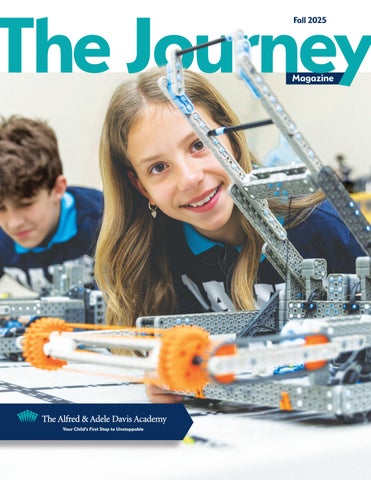
The Journey Fall 2025
Magazine
Your Child’s First Stop to Unstoppable
Contents 06
03 Leadership Letter 04 Home 06 Around Campus 12 Beyond the Classroom 15 The Science and Soul of Writing 18 Fail Forward, Think Bigger 22 Learning Community
04
President Jeff Hopkins Vice Presidents Bennett Kaplan Kevin Levingston Stacey Rothberg Secretary Jason Tessler Treasurer Russell Falkenstein Immediate Past President Micah Goldstein
Trustees Abby Bechler-Karsch Barbie Bregen Lauren Bricks Steven Cohen Elizabeth Davis Mark Edelstein Jonathan Epstein Lisa Freedman Julia Galanti Susan Goldberg Murray Goldman Jonathan Habif Lisa Haynor David Herskovits Maggie Gallant Isenberg Lee Katz
2 > The Davis Academy | davisacademy.org
15
Brad Ladden Meryl Macune Josh Perlstein Amy Robinson Michelle Rosenberg Emily Silberman Stanley Sonenshine Evan Toporek Beth Warner Drew Zucker Trustees for Life (in order of appointment) William Breman (z’l) Jay Davis Sidney Kirschner (z’l) Dulcy Davis Rosenberg Ann Davis
Past Presidents (in order of service) Jan Epstein 1990-1992 Carol Nemo 1990-1996 Dean Benamy 1996-1999 Harriet Zoller 1999-2000 Bryan Fields 2000-2003 Ben Sillins 2003-2005 Billie Greenberg 2005-2007 Tonia Sellers 2007-2011 Sam Tuck 2011-2014 Debbie Kurzweil 2014-2016 Jon Leven 2016-2018 Evan Toporek 2018-2020 Lisa Freedman 2020-2023 Micah Goldstein 2023-2025
2025-2026 Board of Trustees
Dear Davis Academy Families, We write this letter during an emotional time for our entire community. While this issue of The Journey magazine celebrates the incredible learning, vibrant experiences and emotional and spiritual growth of our students during our first semester, it also marks the return of the living hostages to Israel, a moment we have all been praying for these last two years. Since October 7, 2023, we have shared sadness and have mourned the loss of life, and we have also shared feelings of connectedness, strength and hope, knowing that our sacred work continues at The Davis Academy as we nurture the next generation of proud, spirited and educated Jews. The pages ahead highlight how our students have not only been celebrating Jewish holidays and engaging in various Israel-themed activities, but have also been active in fall athletics, have collaborated on innovative engineering projects, explored scientific theories, and have had amazing shared learning experiences beyond the classroom and even beyond Atlanta. With growth in our program offerings and the number of new families who are excited to be joining our school community, we continue to count each day at The Davis Academy as a blessing and celebrate the transformative power of the Davis experience.
Amy Shafron Head of School
We truly believe the years from Kindergarten Prep through 8th Grade are special, consequential, and deserving of intentional focus. These are the years when children are most open to exploring: as students, athletes, artists, friends, and leaders. It’s a time when students set great expectations for themselves and realize that personal growth is as important as academic achievement. It’s when children recognize their critical role within their family, their community, and the greater world. These are the formative years – and at The Davis Academy, they mean everything. Read along to see how our students are undeterred by challenge, understood as children and learners, unafraid to explore their purpose, and united by Davis L.O.V.E. This is the start of their journey to an unstoppable future.
Amy Shafron
Jeff Hopkins
Head of School
President, Board of Trustees
Jeff Hopkins President, Board of Trustees
The Journey Magazine | Fall 2025 > 3
By Rabbi Micah Lapidus, Director of Jewish and Hebrew Studies
For 738 days, our Davis community carried a shared prayer in our hearts: that the hostages taken on October 7 would one day return home. Each Shabbat, each moment of silence, each conversation about Israel echoed with that hope. And now, after more than two years, we have finally witnessed the longawaited homecoming of the final living hostages— reunited with their families in Israel.
What made the moment truly powerful was witnessing the unfiltered joy in the faces of our children. Their voices rang out with pride and love for Israel, unburdened by the weight of history but deeply connected to the spirit of our people. In their singing, we could see the promise of a new generation—rooted in empathy, faith, and a profound sense of belonging.
As is often the case in Jewish life, our celebration is layered and complex. It is marked by joy and gratitude, by tears of relief and tears of sorrow. We are filled with hope for the future, even as we grieve for those who did not return. At The Davis Academy, we gathered as a community to honor this moment with special prayers, heartfelt songs, and the proud singing of Hatikvah—the anthem of Israel and of enduring hope.
For our Israeli families at The Davis Academy, and for our many friends and loved ones in Israel, this moment offers the chance to breathe a little easier, even as the path ahead remains uncertain. We do not know what the future holds, but we know who we are: a community that stands, always, with Israel and with all who yearn for peace. May this moment of homecoming inspire us to keep building a world where every person can live safely and freely, at home.
Shinshinim Lead Tribute for Peace In honor of the two-year anniversary of October 7th, Middle School students participated in a meaningful commemoration led by our Shinshinim Shir Raz and Itai Yaniv. Together, they paused to reflect, listen, and hold space for both the pain of what was lost and the hope for what can still grow. As part of the tribute, students created origami flowers—each one dedicated to a hostage and carrying a personal wish for peace. These creations are displayed in the halls, serving as symbols of remembrance, resilience, and hope for a more peaceful future.
4 > The Davis Academy | davisacademy.org
Watch the excitement
The Journey Magazine | Fall 2025 > 5
Around Campus Book Detectives on the Case
The Davis library transformed into a crime scene as first graders stepped into the role of book detectives! In this creative, hands-on activity, students investigated “damaged” library books—examining clues like spilled juice, crayon marks, and even dog treats—to determine what happened and how the damage could have been prevented. Each crime scene was designed to teach students the importance of proper book care in a fun and memorable way. Working in teams, they collected evidence, shared theories, and learned the impact of everyday actions on library materials. Along the way, they also explored the basics of forensic science. We might have some future detectives and forensic scientists among us!
Inspiring the Leaders Within Eighth graders attended the annual leadership retreat at URJ Camp Coleman in Cleveland, GA—a meaningful tradition that adds depth to the Davis experience. Through reflection and team-building, students explored their passions, identified their strengths, and considered how they can make a lasting impact in their final year and beyond. This retreat empowers students to step into leadership roles with confidence and purpose, reinforcing values of community, responsibility, and action. It’s a powerful milestone in their journey, preparing them to lead with heart both at Davis and in the years to come.
6 > The Davis Academy | davisacademy.org
Cross-Curricular Experience: Walking Through History, Reading Into Self Sixth graders visited Ocmulgee Mounds National Historical Park, beautifully linking their Language Arts and Social Studies curriculum in a meaningful, hands-on way. While exploring over 12,000 years of Native American history and archaeological artifacts, students made connections to the novel I Can Make This Promise by Christine Day, which explores cultural identity and family heritage through the eyes of a young Native American girl. The experience deepened students’ understanding of the book and sparked thoughtful parallels to Jewish culture—shared values of community, spirituality, and respect for tradition and nature. This cross-curricular approach enriched their learning and encouraged reflection on personal identity and cultural roots.
Unmatched After-School Opportunities This fall, the After-School Program reached record enrollment, with students diving into a wide variety of interests. They stayed active through athletics and wellness activities such as yoga, ballet, volleyball, tennis, and pickleball. Creative expression thrived in programs like theatre, crochet, and creative writing, while students who enjoy strategy and critical thinking found challenge and fun in chess. With so many engaging opportunities, every student found a space to explore their passions, develop new skills, and nurture their unique talents beyond the classroom.
The Journey Magazine | Fall 2025 > 7
Connecting with Israel: From Pen Pals to Lifelong Bonds Davis 8th graders have started forming personal connections with their Israeli pen pals at the Nili School in Zikhron Ya’akov by sharing meaningful Shana Tova greetings. Guided by Davis faculty, this and other creative learning experiences help students develop friendships, increase cultural understanding, and build a stronger connection to Israel and its people. Later this year, the students will deepen these bonds by meeting their pen pals in person, visiting the Nili School, and experiencing daily life in Israel. These experiences make their connection to Israel more authentic, joyful, and lasting, strengthening their ties to both the country and the global Jewish community.
Brushstrokes and Blessings Visual arts students transformed the Middle School lobby with a stunning, collaborative window painting inspired by Jewish themes and symbols of the season. Working together, students sketched, outlined, and painted a vibrant scene that reflected the spirit of reflection, renewal, and hope. From shofars and apples to swirling colors of teshuvah (repentance) and growth, each brushstroke brought new meaning to their understanding of the holidays. The final result not only brightened our school space, but also served as a beautiful reminder of how creativity and tradition come together to enrich the Davis experience.
8 > The Davis Academy | davisacademy.org
Loaves of Learning Fifth graders had a delightful and delicious experience with Mrs. Gimpelevich as they rolled up their sleeves to prepare round challah in celebration of Rosh Hashanah. The room was filled with the sweet aroma of dough and excitement as students learned the techniques of kneading, braiding, and shaping the symbolic round challah, which represents the cycle of the year and the hope for a sweet new beginning. As they worked, Mrs. Gimpelevich shared the cultural significance of each step, turning the activity into a rich, hands-on learning experience.
Kindergarten Raises Butterflies Kindergarteners brought science to life in the most exciting way as they explored the difference between living and non-living things. Their investigation began with a fun and surprising comparison—gummy worms vs. real caterpillars. With wide eyes and curious minds, students observed the real caterpillars up close as they wriggled, ate, and eventually formed their delicate chrysalides. Each day brought new discoveries, building anticipation as they watched the amazing transformation unfold. When the butterflies finally emerged, the students gathered in the nature sanctuary to gently release them, celebrating the wonder of life cycles and the beauty of the natural world.
The Journey Magazine | Fall 2025 > 9
The Trout Are Here! The Davis Academy Trout Hatchery is officially up and running—and our third graders couldn’t be more excited! As part of this year-long environmental science project, students are raising trout from eggs right inside our Davis aquarium. This hands-on experience will allow them to observe the full life cycle of trout, from egg to freeswimming fry, while learning about aquatic ecosystems, biodiversity, and conservation. Students will be responsible for maintaining proper water quality and temperature, creating the perfect habitat for their fish. Be sure to stop by the carpool lobby to see the eggs, and check back as they hatch, grow, and prepare for their big release into a local stream this spring!
Welcome to Our Newest Davis Grandparents It was a true joy to welcome our newest Davis Academy grandparents! They joined us for a spirited Kabbalat Shabbat filled with song and ruach, followed by coffee, conversation, and a special tour of the school. One of the most heartwarming moments was seeing grandchildren proudly hug their grandparents and share their favorite spaces, stories, and smiles. We are looking forward to many moments full of warmth, connection, and nachas—including Grandparent & Special Friends day—and we’re so grateful to officially welcome these wonderful grandparents into the Davis family!
10 > The Davis Academy | davisacademy.org
When the Farm Becomes the Classroom Autumn came alive for our Mechina students during an exciting fall adventure at Cagle’s Farm in Holly Springs, GA! From picking the perfect pumpkin to navigating the corn maze and meeting friendly farm animals, every moment was filled with discovery and delight. This handson field trip brought classroom learning to life—deepening students’ understanding of nature, seasons, and living things while strengthening early math, science, and language skills through exploration and play. The day wrapped up with a joyful hayride through the crisp autumn air—a perfect celebration of curiosity, learning, and the beauty of fall.
Save the Date The Davis Academy Production of
March 22 & 23, 2026 Get ready, the swamp is calling! The Davis Academy performing arts team is gearing up for an unforgettable, all-school production of Shrek The Musical Jr. With big laughs, soaring music, unforgettable characters, and cast members from every grade, this heart-filled, high-energy show will be a magical, must-see experience!
The Journey Magazine | Fall 2025 > 11
Beyond the Classroom When One Shines, We All Shine The Davis Academy on National Stage The Davis Academy celebrates Rabbi Micah Lapidus, recipient of the 2025 Covenant Award, and the extraordinary educators whose passion and purpose bring the spirit of Jewish learning to life and illuminate our community every day. In September, The Davis Academy proudly took the national stage at the Museum of Jewish Heritage in New York City, as Rabbi Micah Lapidus received the highest honor in Jewish education: The 2025 Covenant Award. In an auditorium filled with more than 450 Jewish leaders and educators, the moment shined not only for Rabbi Micah but for the entire Davis community.
service-learning experiences. Beyond the classroom, he conducts weekly schoolwide t’filah services, guides interfaith learning, and inspires acts of justice and kindness rooted in Jewish values. His work is driven by a deep conviction that Jewish education can—and must—touch the heart, strengthen community, and call us to be our best selves.
Presented annually by The Covenant Foundation, this prestigious award honors just three educators across North America whose work represents the pinnacle of excellence, innovation, and impact in Jewish education. Rabbi Micah Lapidus, Director of Jewish and Hebrew Studies and School Rabbi, joins this distinguished circle in recognition of his visionary leadership, spiritual guidance, and nearly 18 years of transformative influence at The Davis Academy. Since joining Davis in 2008, Rabbi Micah has shaped the school’s Jewish life with creativity, compassion, and an unwavering belief in the power of learning to nurture both intellect and soul. His leadership has reimagined how Jewish identity, spirituality, and social justice are woven into the fabric of daily life at Davis. As Director of Jewish and Hebrew Studies, he leads a team of outstanding educators who bring to life a rich tapestry of Jewish learning through Torah study, Hebrew language, t’filah, holiday celebrations, music, and
The Covenant Award is more than just recognition— it’s a celebration of the powerful impact one educator can have, and a reflection of what makes The Davis Academy truly exceptional: a community where learning, leadership, and love of Jewish life come together to inspire generations.
“Like so many Jewish educators, I’ve benefited from the extraordinary work of previous Covenant Award recipients, and I’m so grateful to the Foundation for this recognition. I’m also deeply blessed to be part of The Davis Academy, to work each day alongside such dedicated, inspiring educators. My entire rabbinate has unfolded here, and yet, after 17 years, I still feel like a student, still learning, still growing.” — Rabbi Micah
12 > The Davis Academy | davisacademy.org
A Team that Inspires Every Day Rabbi Micah and a remarkable team of Judaic and Hebrew educators bring The Davis Academy’s mission to life each day through a rich tapestry of experiences:
“With this significant honor, Rabbi Micah joins so many Davis faculty and staff whose work extends beyond our campus, elevating the field of education as a whole. I am proud that our light shines not just on Roberts Drive, but far beyond—lifting up and strengthening our shared purpose. And I am grateful to spend my days right here, basking in that light alongside all who call The Davis Academy home.” — Amy Shafron, Head of School
A short film screened at the ceremony, produced by an Emmywinning filmmaker (follow QR code to watch), offered a glimpse into the spirit-filled life of The Davis Academy, highlighting the profound impact of Rabbi Micah, particularly focusing on his role in our school. In his closing remarks, he invited everyone to embrace the words that guide his life’s work: “Be Thou a Blessing.”
• Torah study that encourages deep questioning and moral reflection. • Hebrew language learning that connects students to the words and heart of Jewish life. • T’filah and music that fill the school with spirit, joy, and song. • Holiday celebrations that transform classrooms into sacred spaces of community. • Service-learning projects that inspire empathy, leadership, and social responsibility.
Together, this extraordinary team nurtures a generation of learners who see their Jewish identity as a source of strength, purpose, and belonging. Pictured (top from left to right): Louie Dane, 3rd- 6th Grade Hebrew Studies; Galia Sabbag, 1st and 2nd grade Hebrew and Jewish Studies; Gila Levy Middle School Hebrew Studies; Rich O’Dell, Middle School Jewish Studies; Sara Measroch, 3rd and 4th Grade Jewish Studies, 3rd- 5th Grade Hebrew Studies; Harrison Bleiberg, Mechina and Kindergarten Hebrew and Jewish Studies; (center) Michelle Gimpelevich, 5th grade Jewish Studies, Jewish Music Specialist; (bottom left to right) Rabbi Micah Lapidus; Sigal Tzoref, Middle School Hebrew Studies; Mira Eden, 2nd grade Jewish Studies, 2nd- 5th grade Hebrew; Nina Kuriansky, Middle School Jewish Studies Not Pictured: Adam Griff, Jewish Music Specialist; Revital Korchi, Middle School Hebrew Studies
The Journey Magazine | Fall 2025 > 13
3
The Science and Soul of Writing How Davis students learn to write with purpose, creativity, and confidence. By Julie Weiser, Davis Learning Center Coordinator and Literacy Specialist, and Stacy Brown, Director of Innovation and Professional Learning
Every writer starts with a blank page—and at The Davis Academy, that page is filled with possibilities. From the first strokes that ultimately form into letters in Mechina to essays that challenge ideas in Middle School, writing is taught as both a science and a playground for ideas. Here, research-based instruction meets imagination, giving students the tools to write with clarity and the courage to write with heart. At The Davis Academy, our approach is rooted in research and evidence-based practices, providing students with a strong foundation to write clearly and intentionally. Equally important, we nurture writing as a space for creativity, exploration, and voice, a space where students can take risks, use grammar rules thoughtfully, and find their own ways to connect with others and create meaning. From Mechina through Middle School, each stage of learning gradually grows more complex and is filled with opportunities for students to express their voice and develop empathy.
14 > The Davis Academy | davisacademy.org
The Science of Writing – The Foundation Behind every confident writer is a thoughtful process— and at The Davis Academy, that process is rooted in research. The science of writing refers to the growing body of evidence that explains how people learn to write and which teaching methods best support their development. Strong writing is a blend of fine motor control, spelling, grammar, vocabulary, sentence structure, organization, and the ability to generate and refine ideas. At Davis, teachers use The Writing Rope™, a framework that integrates each of these strands into a single, cohesive approach. The framework emphasizes critical thinking, syntax, text structure, writing craft, and transcription—the essential components of skilled writing. As Julie Weiser, Davis Learning Center Coordinator and Literacy Specialist, explains, “The Writing Rope™ weaves together each thread to cultivate a skilled writer. When teachers intentionally strengthen each strand, students learn how to write with clarity, purpose, and voice. This approach is evident across the Davis curriculum.”
1
From Scribbles to Self-Expression – The Evolution If the science of writing provides the foundation, the story of how Davis students grow as writers unfolds one page at a time. From the moment a Mechina (Photo 1) student proudly shows their first letter formations, they begin to understand that lines have meaning. What starts as playful yet intentional experimentation soon becomes one of the most powerful tools for thinking, learning, and self-expression.
The Writing Rope From: The Writing Rope: The strands that are woven into skilled writing. © 2019 by Joan Sedita. All rights reserved. (Graphic in The Writing Rope: A Framework for Explicit Writing Instruction in All Subjects, by Joan Sedita. (2023); Paule H. Brookes Publishing Co., Inc.)
The Journey Magazine | Fall 2025 > 15
In Mechina and Kindergarten, our Emergent Writers (Photo 2) discover that letters and words can become their thoughts and stories. Through drawing, labeling, and storytelling, they connect spoken and written language. With the Bridge to Writing program, teachers guide students step by step from talking about their ideas to writing them down in complete sentences. They help students understand how sentence organization and structure influence meaning, basic punctuation rules, and how writing practice develops the skills and confidence to lay a strong foundation for writing. As students enter First Grade (Photo 3), they become Early Writers, transforming imaginative writing into purposeful composition. They explore the writing process, such as brainstorming, drafting, revising, and publishing, while naturally applying grammar to strengthen their sentences. Whether crafting stories, opinions, or informational pieces, they discover that their words can communicate ideas, creativity, and personality. By Second Grade (Photo 4), our Transitional Writers learn to plan, draft, and revise with greater intention. Using graphic organizers and model essays, they practice organizing ideas clearly and logically, which are skills that support both writing and critical thinking across subjects. Writing begins to feel purposeful and empowering as they build habits that prepare them for more advanced expression. In Third through Fifth Grade (Photo 5 and 6), students become Fluent Writers through The Writing Revolution, an evidence-based program that strengthens clarity and structure. They learn to expand sentences, add meaningful detail, and craft cohesive paragraphs
“Writing is a tool for thinking. As Mary Tedrow, Director of the Shenandoah Valley Writing Project, said, ‘Reading is the inhale; writing is the exhale.’ When students write, they think more deeply, read more thoughtfully, and make meaningful connections across ideas and subjects.” — Julie Weiser.
and essays. Writing becomes a tool for thinking, helping students connect concepts across disciplines and use facts and evidence to write expository essays, analyze texts, and reflect on their own growth as writers and thinkers. By Middle School (Photo 7), students evolve into Proficient and Purposeful Writers, using writing not only to communicate but to connect, persuade, and inspire. They move seamlessly across genres and subjects: explaining reasoning in math, reflecting on Jewish values in Judaic Studies, and describing discoveries in science. Beyond grammar and structure, they learn how rhetoric can shape perspective, how storytelling can build empathy, and how argument can inspire change. At this stage, writing becomes both art and discipline—a playground for curiosity and creativity. Davis students learn that their words matter, their voices have power, and their writing can make a difference in how they understand themselves and the world around them.
The Davis Difference Every great story begins with a strong voice. At The Davis Academy, students discover the power within themselves. Writing is more than a skill; it’s a way of thinking, creating, and connecting. What sets Davis apart is our intentional blend of research-based instruction, crosscurricular writing, and a culture that celebrates imagination and individuality. From the earliest grades through middle school, students learn that writing is both a craft to be refined and a form of self-expression to be celebrated. They leave Davis not only with strong skills, but with the confidence and conviction that their words have power— to inform, to inspire, and to make a difference.
2 4
5
6
7
The Journey Magazine | Fall 2025 > 17
1
Fail Forward, Think Bigger 18 > The Davis Academy | davisacademy.org
Inside The Davis Academy’s engineering program, where every challenge is an invitation to learn, create, and grow. by Amanda Tinch, Markerspace and Innovation Teacher, and Erin Dunkle, Middle School Technology & Innovation Teacher
What does “mastery” really mean in a world of constant change and AI-driven technology? That’s a question our faculty considered recently while reading The Depth Advantage: Deeper Learning In a Distracted World by Dr. John Spencer. Dr. Spencer, who visited The Davis Academy in 2024, shares a powerful idea in his book: “real mastery isn’t about reaching some perfect, final state. It’s about staying curious, staying humble, and realizing that no matter how much you know, there’s always more to discover.” This is the ethos of how we approach engineering at The Davis Academy. Our goal is to cultivate lifelong learners who are not only curious about how the world works but are empowered to use their knowledge and experience to build and create a better world. Starting in Mechina, students come to their weekly CSE (Computer Science & Engineering) class not just to learn about engineering, but to become engineers. Our program is a carefully scaffolded journey. In the early years, the focus is on playful exploration: building simple machines with LEGOs (Photo 1), coding basic animations, and solving hands-on puzzles that introduce the design cycle. In class, students frequently discuss the value of mistakes and the benefits of challenging activities. When projects feel arduous, they know that they are being challenged and learning how to fail forward.
“The atmosphere is one of joyful experimentation, where a ‘failed’ prototype is just a crucial step on the path to a better solution.” — Amanda Tinch, Makerspace and Innovation Teacher As students move through the Lower School, they continuously build on this foundation. For instance, when studying simple machines, 2nd and 3rd graders use
the VEX GO Robotics (Photo 2) system to build different machines that incorporate these simple concepts into their designs. As further enrichment, we offer the VEX GO Robotics club after school to allow students a deeper dive into advanced building and coding. Students learn to tackle challenging projects that connect engineering to real-world applications. For example, students built magnetic robots that simulated assembly-line work, a functional spirograph, and a robot that could be programmed to navigate an obstacle course. In fourth and fifth grade, students have the opportunity to refine their Computer-Aided Design (CAD) skills. Using TinkerCAD 3D modeling software (Photo 3), students connect geometric shapes to world landmarks. Students are challenged to analyze the construction of the landmarks and to identify the geometric shapes they recognize within them. Our student engineers consider how they might replicate these landmarks using the skills they are building upon in TinkerCAD. By Middle School, engineering becomes a space where students take their foundational skills and tackle openended, real-world challenges. The focus shifts from teacher-directed projects to student-driven design, invention, and problem-solving. Along this progression, students become their own project managers. In sixth grade, students construct miniature golf courses (Photo 4) with the goal of programming a robotic Sphero to navigate them. With this objective in mind, the design phase is influenced by the golf course’s usability for the Sphero. The width of the tunnels, the degree of angles for the turns, and the ramp’s slope ratio must all be taken into consideration. Projects are evaluated for structural integrity, ease of navigation, and the student’s ability to clearly articulate their understanding of the engineering process to achieve their end goal. This challenge exposes participants to authentic engineering standards, fosters teamwork under constraints, and simulates a real-world scenario in which engineers are contracted to complete a project within defined parameters.
The Journey Magazine | Fall 2025 > 19
In seventh grade, students lean further into 3D modeling and design creativity. Again, building upon their TinkerCAD skills in lower school, they create projects, such as custom maker coins (small, personalized tokens that demonstrate design precision and creativity) and interactive ball mazes (Photo 5), where problem-solving and play intersect. These projects emphasize iteration, as students test and refine their designs.
Eighth Grader, William M., shows his project. Follow QR code:
this course is the engineering design process in which students brainstorm, prototype, test, and refine their ideas to create meaningful, real-world solutions.
“This agile development process requires learners to work in short cycles of continuous adaptation with routine feedback, valuing adaptability and collaboration over rigid, long-term planning. This process emphasizes skills critical for innovators, such as persistence and imagination.” — Erin Dunkle, Middle School Innovation and Technology Teacher In eighth grade, students may choose to take Foundations of Technology and Engineering, a high school credit course focused on hands-on problem solving. At the heart of
One example project is a student-designed version of Simon Says (Photo 6), aimed at helping young children improve their listening and concentration skills through play. The project combined multiple engineering disciplines: electrical engineering to wire the microcontroller, LED lights, buttons, and buzzer; software engineering to program the game’s rules and difficulty levels; and mechanical engineering to design and 3D-model a custom game base that housed all components. This capstone course transforms students into confident makers. They apply engineering principles with purpose, creativity, and a sense of ownership, bringing their ideas to life in a supportive and collaborative environment. Students discover that engineering is not simply about using tools or learning techniques. It is about creativity, resilience, and purposeful problem-solving. By the time they leave The Davis Academy, our students don’t just see themselves as learners of engineering; they see themselves as engineers, ready to design, innovate, and impact the world.
2
3
20 > The Davis Academy | davisacademy.org
4
5
Watch robots in action Follow QR code:
6 Middle Schoolers Engineer Lifelike Robots
7
See robots in action! Follow QR code:
Middle School Tech Pioneers took their engineering skills to the next level on a field trip to System Technology Works, LLC. Using steel, servos, sensors, and 3D-printed parts, students engineered their own robots and programmed them in Python to move, speak in English (and Hebrew!), and even challenge each other to rock-paper-scissors. They were amazed to learn that some of these bots have appeared in Marvel films and were inspired by how real-world robots are built to make life easier for humans. Through hands-on exploration, students understood how the power of AI and their own problem-solving skills are key to harnessing technology to its fullest potential. (Photo 7)
The Journey Magazine | Fall 2025 > 21
Learning
Community
2
Learning Never Stops
1
“This choice-based model of professional learning reflects what research confirms: learning is most powerful when it’s handson, personally meaningful, and connected to real-world application.” — Stacy Brown, Director of Innovation and Professional Learning.
4 3
22 > The Davis Academy | davisacademy.org
Have you ever wondered what happens when the students go home and Davis teachers take their place in the classroom? On October 3rd, Davis educators gathered for a day of professional learning: Davis style. The day was designed around the same principles that shape student learning: choice, relevance, and reflection. Instead of sitting through traditional lectures or slide presentations, teachers chose sessions that spoke to their own passions and goals. Just as Davis students are encouraged to explore, take risks, and follow their curiosity, our teachers did the same, discovering fresh ideas and inspiration to bring back to their classrooms.
5
Exploring the Science of Creativity In her session on Neuroaesthetics and Creativity, Kendrick Phillips, Director of Visual & Performing Arts, demonstrated how creative expression, such as rhythm, movement, and visual storytelling, activates multiple neural pathways, fostering empathy and supporting well-being. By understanding the science behind creativity, teachers can more intentionally design learning experiences that ignite curiosity and cultivate joy. (Photo1)
Innovation and Design Thinking
Mindfulness and Connection
That same spirit of discovery was filled in Fab Lab, with Erin Dunkle, Middle School Technology & Innovation Teacher, and Daniel Jones, Technology & Innovation Strategist. Participants used 3D printers, laser cutters, and 3D pens to tackle relevant challenges grounded in their curriculum: from building Native American dwellings in social studies to designing Punnett square board games for science and creating visual timelines for Judaics. The experience showcased how maker-centered learning fosters creativity, collaboration, and deeper understanding, equipping teachers to design meaningful, real-world learning experiences.
Amid the day’s energy, teachers also paused for mindfulness and reflection. Michelle Stein guided Mindfulness in the Classroom, using Emory University’s CBCTⓇ program to teach strategies for emotional selfregulation, staying present, and managing stress and anxiety, skills that go beyond academics. (Photo 4) Meanwhile, in the Nature Sanctuary, Rabbi Micah Lapidus led “Marking Two Years Since October 7th,” a session on leading with courage, empathy, and shared responsibility as a Jewish community. (Photo 5) And because no Davis day is complete without a touch of Jewish sweetness, in Babka Prep, Michelle Gimpelevich and Lisa Mirsky guided participants in measuring, kneading, and braiding dough, a delicious reminder that, like baking, learning rises best when infused with heart, connection, and community. (Photo 6)
Enhancing Teaching with Digital Design Librarian and Instructional Technology Specialist Melissa Shenk and Lower School Teaching Assistant Caitlyn Schoen demonstrated digital design tools for creating visually engaging materials that appeal to diverse learners. Participants explored customizable templates, cohesive color schemes for clearer communication, and AI tools to make lesson creation more efficient, creative, organized, and effective. (Photo2)
Reading, Reflection, and Deeper Learning Stacy Brown, Director of Innovation and Professional Learning, led the book club, The Depth Advantage: Deeper Learning in a Distracted World by John Spencer. Teachers modeled a science lesson — designing a school on Mars — an exercise that captured the heart of deep learning: balancing rigor and creativity while keeping student engagement at the center. (Photo3) Meanwhile, humor and history came together in another book club session with Middle School Jewish Studies teacher Rich O’Dell and author Rob Kutner, who shared insights from his new book JEWS: 5,000 Years and Counting. Participants reflected on how humor can make even the most complex lessons relatable and enduring.
The October professional learning day represented what makes The Davis Academy exceptional: a community of educators committed to growth and impact. Through curiosity, creativity, and collaboration, teachers modeled what it means to be lifelong learners. The day was filled with laughter, insight, and renewed purpose, reminding us that at Davis, learning is truly unstoppable.
DAVIS FUND 2025-2026 Fueling What Makes Us Unstoppable! Scan the QR code or visit www.davisacademy.org/give! Join us today in supporting the Davis Fund and make it a philanthropic priority for your family. #Priority Davis
Honor Someone Special with a Tribute Tributes are a way to celebrate, honor, or memorialize significant moments in the lives of people we care about.
Make your gift today:
6
The Journey Magazine | Fall 2025 > 23
NONPROFIT ORG. U.S. POSTAGE PAID ATLANTA GA PERMIT NO. 1084
8105 Roberts Drive, Atlanta, GA 30350 770-671-0085 | davisacademy.org
Save the Date The Davis Academy 27th Annual Community Golf Tournament Monday, May 11, 2026 The Golf Club of Georgia Volunteers are welcome. Ready to play a round with us? Join us in the tournament by becoming a sponsor. Contact Lauren Baker at 678-527-3291 or lbaker@davisacademy.org