SWT/KWS TSAVO MOBILE VETERINARY UNIT DECEMBER 2019
Introduction
1 Case in December
1 Rhino Case
19 Rhinos Ear Notched
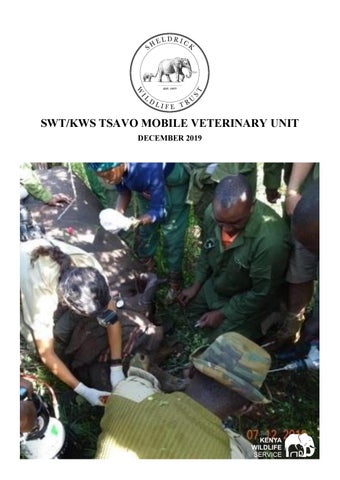
December Report by Dr. Jeremiah Poghorn The Tsavo Unit conducted one rhino ear-notching case in December before going on leave. The black rhino population in the Kenya’s Tsavo ecosystem was estimated at 6,000 to 8,000 in the 1970s (Walpole et al., 2001). By 1989, there were no more than 20 remaining. Of all of Africa’s endangered species, the black rhino is unique because almost 100% of its decline is attributed to poaching. Today, resurgence in poaching has left the black rhino more vulnerable than never before. Rhino horn has been over-prized in many Asian countries where it is purported to cure cancer and other diseases, and although it is illegal with no proven medicinal value, the demand for rhino horn only continues to grow. The Kenya Black Rhino Action Plan (BRAP) 2017-2021 outlines that at least 60% of rhinos in a population should be individually identified through ear notching. The effective monitoring of rhinos involves collection of good quality data on population status, dynamics and reproductive health as well as factors that may affect performance such as density of competing browsers and ecological carrying capacity in fenced areas. Monitoring of individual movement patterns, changes in social behaviour, home-range sizes and body condition are also necessities for assessing population performance. Monitoring of rhino populations is mostly based on individual animal recognition and use of appropriate monitoring equipment and technology. Ear notching is, therefore, an important tool in rhino monitoring which aids positive identification of individual rhinos. Routine ear notching operations are carried out by KWS in collaboration relevant conservation partners. Individual rhinos to be ear notched were selected prior to commencement of the exercise. This mainly involved the scrutinizing the rhino population by the monitoring teams to identify individuals aged three years and above that had never been notched before for both the Ngulia Rhino Sanctuary (NRS) and Intensive Protection Zone (IPZ) populations. The age-based selection criterion aimed to minimize risk associated with post immobilization separation of calves still dependent on their mothers for nutrition and protection. There were, however, some isolated cases of dependent rhinos younger than three years. Acknowledgement We thank Kenya Wildlife Service senior management for approval to conduct the exercise. We would also like to thank the KWS Rhino Program and Tsavo West management for coordinating the planning of the exercise, and the Veterinary Department for their professionalism during implementation of the exercise. We are indebted to our conservation partners, Conservation Alpha. Many thanks to all the personnel from KWS HQ, KWS Air wing, ZSL and TT who participated in the exercise. Special thanks to the Tsavo West National Park Ngulia and IPZ rhino monitoring teams for their dedication to rhino monitoring upon which the operation was a success
Map of Tsavo West National Park
. Case
1 – 30th – November – 7th December 2019
Rhino
Ear-Notching
IPZ, Tsavo West NP
The exercise was aimed at enhancing rhino monitoring in the Tsavo West rhino population by rhino ear notching and fitting transmitters to black rhinos in the NRS and IPZ rhino populations Immobilisation, examination and treatment Fitting with horn transmitters was only targeted for the IPZ population, where, in addition to the selected candidates for ear notching, every adult rhino that was opportunistically sighted and did not have an active transmitter was fitted. Effort was however made to search for a few individuals that monitoring teams had difficulty sighting on a regular basis. The process started with an aerial search for the suitable candidates by experienced spotters using both fixed
wing planes and the helicopter. Candidates were identified on the basis of their territories, individual attributes such as age, notch patterns, size and sex. After positive identification of a target individual, where possible, attempts were made to drive it to the open fields for darting. This aimed to ease the accessibility to the immobilized rhino and thus quickening the process. Immobilization was achieved using a combination of Azaperone 80mg and Etorphine Hcl 4.5 mg for the adults and 2.5-3.5mgs Etorphine Hcl with 40-60 mgs Azaperone for the young and sub-adult rhinos. Induction time ranged from 3 to 12 minutes and it took 7 - 10 minutes for to ear notch and fit the transmitter. After being immobilized, the ground team moved in quickly to process the animal. A butterfly catheter was immediately inserted into one of the ear veins and this was used to determine oxygenation levels as well as to administer respiration enhancing drugs such as Doxapram and Butorphanol tartrate. Vital parameters including respiration rate, pulse, heart rate, temperature, carbon dioxide levels and arterial blood pressure were monitored routinely on the immobilized animals. After confirming that the animal was in a stable condition, ears were notched using a predetermined pattern. Haemostatic forceps were used to control bleeding and topical antibiotic spray (Alamycin, Norbrook ltd) applied on wounds. Four transponders (microchips) were fitted to the animal; one in each horn, one in the neck and another at the base of the rump. The following samples were collected: blood for haematology and serological analysis, tissue samples (notched ear tissue), horn and nail scraping for RhODIS database. At the same time, body morphometric measurements were taken for each immobilized rhino. After each operation, a signal was given for all equipment and participants to return to the cars except for the vet and the security team. The vet then gave the reversal drug Diprenorphine Hcl, administered through the ear vein at three times the Etorphine dose. The r4hino was then observed until it was fully awake and walking before the team embarked on the next animal.
Ear-Notching Exercise Out of the total 19 rhinos captured during the exercise, six (6) were in NRS while13 were in IPZ. All the rhinos six in the NRS were only targeted for ear notching and had an average age of 3.5 year, ranging from 2.8 – 9.1 years. In the IPZ, all the 13 rhinos captured were fitted with transmitters but only four (4) were ear candidates for ear notching (Table 1). More than 63% of the rhinos captured during the exercise were males. During the exercise, a rhino in the IPZ with a superficial wound about 8cm in diameter on its right abdomen was treated. After being immobilized, the wound was washed with water mixed with hydrogen peroxide at a ratio of 1:1, wound doused with tincture of iodine and finally sprayed with Oxytetracycline antibiotic spray. A cover of wetted green clay with wound healing properties was smeared on the wound to keep off flies and aid quick healing. Long acting antibiotics and Dexamethasone was administered by deep muscle injections. Anesthesia reversal was done as explained before and the Rhino woke up well. Prognosis is good. Due to the high recruitment rate in Tsavo West, and that some potential candidates were not notched, it is recommended that another notching exercise is conducted within a year to avoid the proportion of clean independent rhinos that might be difficult to identify.