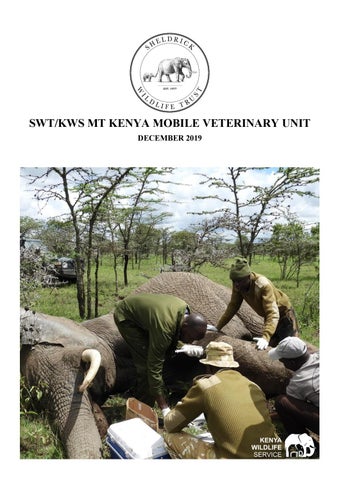
SWT/KWS MT KENYA MOBILE VETERINARY UNIT DECEMBER 2019
Introduction
9 Cases in December
3 HWC Cases
67% Success
December Report by Dr Domnic Mijele During the month of December 2019, the Mt Kenya Wildlife Veterinary Unit attended to several wildlife cases that required urgent veterinary intervention in Laikipia ecosystem and Mt. Kenya region. Cases attended to include repeat treatment of an adult male elephant with a deep arrow wound, post-mortem examination of two white rhinos, treatment of a bongo with chronic emaciation and sub-mandibular swelling, immobilization and release of a problem leopard, immobilization and examination of an adult lion with severe traumatic injuries, treatment of a juvenile male bongo with ulcerated (peeling off) wounds on the tongue , immobilization and collection of oocytes (Ovum) from 2 female Northern White rhinos andl immobilization, collaring and release of a leopard. Acknowledgement We acknowledge Sheldrick Wildlife Trust (SWT), KWS and other partners for their support that has enabled the Mt Kenya Veterinary Unit to respond promptly and offer medication to all wildlife emergency cases that required veterinary intervention during the month. This has made it possible for the team to respond to many wildlife cases that required urgent veterinary attention.
Case Details Date
Species
Area Found
07-Dec-19
Rhino White
Lewa Conservancy
Bullet Wound
Two rhinos died at the same spot. Both of them had the front horn removed
Poaching Death
07-Dec-19
Rhino White
Lewa Conservancy
Bullet Wound
Two rhinos died at the same spot. Both of them had the front horn removed
Poaching Death
11-Dec-19
Elephant
Mutara Ranch
Arrow
A deep penetrating wound on the left carpal joint, the wound had started healing and the swelling had decreased.
Successfully Treated
12-Dec-19
Antelope
Mt Kenya Game Ranch
Natural Causes
A bongo was reported to have poor body condition, rough hairs and swelling
Successfully Treated
13-Dec-19
Leopard
Ol Jogi Ranch
Human Wildlife Conflict
This was a sub-adult female leopard that was stuck in a poultry house
Task Successful
13-Dec-19
Lion
Sosian Ranch
Natural Causes
Sustained severe traumatic injuries during a fierce territorial fight with other lions
Died
15-Dec-19
Antelope
Mt Kenya Game Ranch
Human Wildlife Conflict
A bongo that had injuries to the tongue which was swollen and inflamed
Successfully Treated
17-Dec-19
Rhino White
There are only two females (Najin and Fatuh) left any they require assisted reproduction
Task Successful
it had gotten into a tourism facility and was a threat to staff and visitors
Task Successful
18-Dec-19
Leopard
Reason for Intervention
Ol Pejeta Technical Conservancy Cases Ol Pejeta Conservancy
Human Wildlife Conflict
Outcome
SWT/KWS Mt Kenya Mobile Vet Unit Treatment Locations December 2019
Case 1 and 2 – 7th December 2019 Rhino White
Bullet Wound
Lewa Wildlife Conservancy
This case was a postmortem examination of two male white rhinos that died on the night of 6 th December. Observations The two rhinos died next to each other and the carcasses were found fresh. Both rhinos had several bullet wounds to the shoulder and head and several spent bullet cartridges were found at the scene. Other items found at the scene included an empty water bottle, webbing, an empty bullet magazine, knife packet and footprints. The two rhinos were siblings (mother is ‘Jakwai’) and stayed together, until both were shot and killed at the same time. Those present at the scene included KWS area assistant director, senior KWS security and investigation officers, Senior KWS veterinary officer, capture rangers and forensic laboratory teams, Lewa security officers and police officers. Rhino 1 This was the older brother and was found dead lying on the left side. Its front horn was chopped off and missing, the small rear (caudal) horn was intact with some superficial cuts suggesting that someone had attempted to remove it but failed. It was in good body condition at the time of death. Three bullet heads were traced and retrieved from this rhino Rhino 2 This was the younger brother and was also found dead lying on the left side.It also had the front horn chopped off, the small rear horn was intact but also with some superficial cuts suggesting that someone had attempted to remove it but failed. It was also in good body condition at the time of death. This young rhino had two bullet wounds one on the right shoulder and neck. Cause of Death The immediate cause of death for the 1st rhino was extensive injuries to the brain that killed the rhino instantly. The second rhino died due to hypovolemic shock because of extensive internal haemorrhage caused by bullet traumatic injuries on to the major blood vessel (aorta) and heart.
. Case
3 – 11th December 2019
Elephant
Arrow
Mutara Ranch
This was a case of an adult male elephant in Mutara ranch in Laikipia County which had a deep penetrating wound on the medial side of the left carpal joint. The elephant was had been treated a month ago and had made remarkable improvements but required a repeat treatment to help enhance the healing process. Immobilisation, examination and treatment The injured elephant was found in a fairly open area where it was approached with a vehicle and darted. The elephant got adequately immobilized after about 7 minutes and went down on lateral recumbency. The elephant had a deep penetrating wound on the left carpal joint, the wound had started healing and the swelling had decreased. Long forceps to remove all the necrotic tissue then the wound was cleaned with water, Hydrogen peroxide and iodine. Chlortetracycline pessaries were inserted into the wound before Opticlox ointment, Oxytetracycline spray and green clay were applied. The elephant was also given an injection of Amoxicillin Trihydrate and Flunixin meglumine to support the wound healing process. Prognosis Prognosis was good because the elephant had regained much strength and was able to move around and easily access feeds and water. The KWS security rangers and community scouts were informed to monitor the progress and report to the veterinary team in case it required further treatment.
Case 4 – 12th December 2019 Bongo
Natural Causes
Mt Kenya Wildlife Conservancy
One of the adult female bongo antelopes was reported to have poor body condition, rough hairs and submandibular swelling. This required veterinary attention to treat the animal and collect samples for further laboratory analysis. Immobilisation, examination and treatment The bongo was in a small enclosure where it was darted using 6mgs of Etorphine combined with 50mgs of Azaperone. It became immobilized and recumbent after about 6 minutes. It was then blindfolded and loaded onto a pick-up van and transferred to another enclosure where it could be supplemented with feed concentrates and water, as well as for easy monitoring. Before treatment, blood samples were collected from the jugular vein in EDTA coated tubes and plain tubes, skin scrapings were collected and preserved in 70% Ethanol and blood smears collected for further laboratory analysis and to establish the cause of infection. The animal was then treated using Procaine penicillin, Vitamin B12 (Cyanocobalamine) administered intramuscularly and Ivermectin subcutaneous injection. The skin was sprayed using FrontlineÂŽ to eradicate all ectoparasites. Prognosis Prognosis was good after treatment and the animal has since recovered.
Case 5 – 13th December 2019 Leopard
Human-Wildlife Conflict
Ol Jogi Ranch
This was a sub-adult female leopard that entered a poultry house in Ol jogi Wildlife Conservancy, it was unable to get out of the poultry house and attacked and killed 22 chickens and 3 ducks. The management at Ol jogi called for emergency veterinary assistance to anaesthetize the leopard and remove it from the building and release it back to the wild.
Immobilisation The leopard was darted at close range while in the poultry house using 100mgs of Ketamine combined with 1.0mgs of Medetomidine, the anaesthesia took effect after about 5 minutes and the leopard became recumbent. Transport and Release The leopard was examined and found healthy without any traumatic injury, it was then loaded onto a stretcher and put into a transport crate. It was driven out of the office compound, revived from anaesthesia and safely released back to the wild just within Ol jogi.
Case 6 – 13th December 2019 Lion
Natural Causes
Sosian Wildlife Conservancy
This was an adult lion that sustained severe traumatic injuries during a fierce territorial fight with other lions. It was lying recumbent and was not able to stand or walk, this required very urgent veterinary intervention. Immobilisation and examination The lion was darted using 350mg Ketamine combined with 6mgs Medetomidine the drugs took effect after 10 minutes and the lion was fully anaesthetised. The lion was examined and found with 6 fractured ribs on the right rib cage; it had a very deep open wound extending into the stomach, an intense haemorrhage and had become anaemic. It was not able to stand or support itself hence a decision was made to euthanize it in order to relieve pain and suffering. Prognosis The lion was in a lot of pain and had no chances of recovery from the fractured ribs and other serious injuries. It was euthanized using Pentobarbitone and the animal died instantly without struggling.
Case 7 – 15th December 2019 Bongo
Human-Wildlife Conflict
Mt Kenya Wildlife Conservancy
One of the juvenile bongo antelopes was reported to have hypersalivation and frequent smacking of the mouth. It was also not feeding well and required urgent treatment. Immobilisation, examination and treatment The bongo was physically restrained by hand and examined, the tongue was peeling, swollen and inflamed. The cause of this condition was not immediately established but is likely that the animal ate an erosive substance. The bongo was treated using Procaine penicillin, Dexamethasone intramuscularly and Ivermectin subcutaneous injection. The skin was sprayed with Frontline to eradicate all ectoparasites. Before treatment, blood samples were collected from the jugular vein in EDTA coated tubes and plain tubes for further laboratory analysis to establish the cause of infection. Prognosis Prognosis was good after treatment, it will be closely monitored and observed in case it requires further treatment.
Case 8 – 17th December 2019 Rhino White
Technical Case
Ol Pejeta Conservancy
Northern white rhinos are a highly endangered wildlife species which are currently facing extinction. There are only two females (Najin and Fatuh) left and they are aging and not able to get pregnant naturally. They require assisted reproduction in which an ovum is collected using artificial means and then in-vitro fertilization using stored semen. The embryo is implanted into a surrogate mother, most likely a Southern white rhino species, who will then give birth to a Northern white rhino calf. This is the second time the females were immobilized for collection of oocytes. This is the last option towards recovery of this species before they go extinct. This is a joint operation between KWS, Sheldrick Wildlife Trust (SWT), Ol Pejeta Wildlife Conservancy, Zech republic, and other veterinary experts from Germany. Immobilisation, examination and treatment The two rhinos were anaesthetised then the rhino’s respiratory rate, pulse rate, heart rate, body temperature and capillary refill time were monitored closely. Additional drugs were administered depending on the rate of the above physiological parameters. Oxygen was also supplemented throughout the oocyte collection process that took an average of one and half hours in each animal. The oocytes were collected using a one-meter long probe inserted through the rectum connected to an ultrasound machine screen used to observe the follicles and pick the oocyte. The process was quite successful and each rhino produced at least 5 oocytes which will be used for in-vitro fertilisation.
Case 9 – 18th December 2019 Leopard
Human-Wildlife Conflict
Ol Pejeta Conservancy
An adult male leopard in Ol Pejeta Wildlife Conservancy was trapped after it became stuck in a tourism facility and was a threat to staff and visitors in Ol Pejeta. A decision was made to fit it with a GPS collar and release it in the far southern side of Ol Pejeta where it will not be able to cause more conflict. Immobilisation and examination The leopard had some lacerative wounds on the paw and at the tip of the tail, these injuries were treated using Lugol’s iodine and Opticlox eye ointment, Betamox injection and Dexamethasone injection. The leopard was then fitted with a GPS collar and revived from anaesthesia. Reversal and prognosis The leopard was revived from anaesthesia and it got up after 10 minutes. The cage was transported to the southern part of Ol Pejeta Conservancy and the leopard was safely released into a good area.