SWT/KWS MERU MOBILE VETERINARY UNIT DECEMBER 2019
Introduction
4 Cases in December
1 Black Rhino Case
1 White Rhino Case
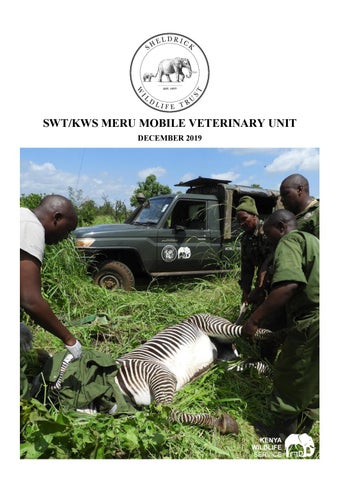
December Report by Dr. Bernard Rono This report describes activities of the Meru Veterinary Unit in December 2019. Northern Kenya recorded heavy rains in November and early December hence plenty of vegetation and water for wild animals. In low lying areas of Meru National Park, localized flooding was reported. This poses a hazard to wild animals and a black rhino was reported to have been stuck in a swamp and drowned. An old white rhino which showed loss of body condition died and a post-mortem was carried out while a Grevy zebra in Meru National Park was immobilized to investigate the cause of lameness. In Westgate Conservancy the Unit attended to a subadult Grevy zebra which showed severe lameness. Acknowledgement The Meru Veterinary Unit is supported by Sheldrick Wildlife Trust which provides financial and logistical support. We also acknowledge support of KWS management and rangers in the field who monitor wildlife and report cases for treatment
Case Details Date
Species Area Found
Reason for Intervention
15-Dec-19
Rhino Black
Meru National Park
Postmortem
17-Dec-19
Rhino White
Meru National Park
Postmortem
17-Dec-19
Zebra
Meru National Park
Natural Causes
19-Dec-19
Zebra
West Gate Conservancy
Natural Causes
The resident veterinarian visited and found a black rhino carcass in a swamp A white rhino in Meru National Park was reported to have lost its body condition, weak and reluctant to move when approached. It was an old rhino Examination showed a swollen coronary band, laminar failure, foul smell with pus discharge and puncture wound proximal to the hoof. Laminitis was diagnosed. This Grevy zebra is reported to have shown severe lameness on its right forelimb for the past one week. Diagnosis: Fracture of humerus.
Outcome Died
Died
Prognosis Poor
Died
SWT/KWS Meru Mobile Vet Unit Treatment Locations December 2019
. Case
1 – 15th December 2019
Rhino Black
Post-Mortem
Meru National Park
The company commander in charge of Meru National Park reported a dead rhino. A full post-mortem examination was conducted to document the cause of death and collect forensic samples. Examination • •
The animal had an intact front and rear horn The animal weighed approximately 1000 kilograms when it was alive and had a good body condition score of 4 on a scale of 1 – 5. The carcass showed absence of rigor mortis
• • • • • •
All thoracic and abdominal organs were autolyzed into a thick, slimy black mass due to decomposition The carcass was partly eaten by carnivores on the rib areas and the entire right gluteus was eaten Maggots were seen in the rib region as well as in the head The carcass was lying in a pool of mud which was 60 cm deep in the middle of Bernard brown Swamp Water was observed in the on both nostrils. Margot and fky samples were collected for forensic parasitology and aging of the carcass
Cause of Death The rhino was last sighted in the records on 13th November. The entire county has been experiencing abnormally high rainfall. The rhino died as a result of being stuck in the swamp. It has probably used the area for many years but the recent rains have made the swamp very soggy/soft and dangerous for heavy animals.
Case 2 – 17th December 2019 Rhino White
Post-Mortem
Meru National Park
A white rhino in Meru National Park was reported to have lost its body condition, weak and reluctant to move when approached. It was an old rhino initially translocated from the republic of South Africa to Lake Nakuru National Park as part of founder population of Southern white rhino in Kenya. In 2003, it was translocated to Meru NP where it has 6 recorded births. At present it has a two-year-old calf. In September 2019 during the dry season, this rhino showed low body score and diarrhea. Examination On 13/12/2019 a clinical assessment of this rhino was carried out. It was lethargic, emaciated and reluctant to move when approached. On its left rump decubitus ulcers were observed due to prolonged recumbency. Due to its condition, this animal could not be safely anesthetized for examination and treatment, therefore regular monitoring was advised. This rhino was found dead on 16/12/2019; both horns were intact. A post-mortem examination of the carcass was conducted. It was in poor body condition, the skin on mandible was bruised due to struggle before death. There were also bruises on both flanks inflicted by its calf and decubitus ulcers on the ventral aspect. Pneumonia; emphysematous lungs, froth in the bronchi and trachea were found. Ascites and necrotic enteritis was also noted. Although its teeth were worn out, its stomach was filled with lush grass and water. Cause of Death Immediate cause of death was cardiopulmonary failure due to septic shock. Its possible that consumption of lush pasture led to changes in gut microflora with subsequent necrosis of small intestines and endotoxemia.
Case 3 – 17th December 2019 Zebra
Natural Causes
Meru National Park
On 16/12/2019 a female Grevy’s zebra found in a group within the rhino sanctuary in Meru NP showed severe lameness. It lagged behind the group and was lying down. Immobilisation, examination and treatment Immobilization was achieved using a combination of Etorphine hydrochloride 5mg and Azaperone tartate 80mg. It was approached with a vehicle and was calm; only running a short distance after darting before resting. Down time was 6 minutes. It was blindfolded and positioned on left lateral recumbence for examination and treatment. Examination showed a swollen coronary band, laminar failure, foul smell with pus discharge and puncture wound proximal to the hoof. Laminitis was diagnosed. Wounds were washed and debrided with Hydrogen peroxide and povidone Iodine. Systemic antibiotics and anti-inflammatory drugs were also injected. Prognosis To reverse the effect of anaesthesia, an intravenous injection Diprenophine hydrochloride 24mg was given through the jugular vein. Three minutes later the zebra was in standing position. Prognosis for this case is guarded due to involvement of the hoof laminar.
Case 4 – 19th December 2019 Zebra
Natural Causes
West Gate Conservancy
This Grevy zebra is reported to have shown severe lameness on its right forelimb for the past one week. Grevy Zebra Trust Scouts in Naisunyei, West Gate Conservancy reported that a herd of zebra recently migrated to this area at the beginning of the rainy season. It was immobilized for examination on 19/12/2019. Immobilisation and examination Immobilization was achieved using a combination of Etorphine hydrochloride 4mg and Azaperone tartate 60mg in a single 3cc Dan-Inject dart. This animal was shy and fled on approach. Darting to down time was 16 minutes. Examination showed a swollen right elbow, deformity and on manipulation crepitus was felt. Diagnosis: Fracture of the humerus. Cause of Death Prognosis was poor. The zebra was euthanized to relief pain and suffering.