SWT/KWS MARA MOBILE VETERINARY UNIT DECEMBER 2019
Introduction
3 Cases in December
2 Lion Cases
100% Success
December Report by Dr. Campaign Limo Like most of the other areas in the country, the Mara Conservation area experienced normal to above normal precipitation with floods seen in most areas. Some areas within the Mara Reserve and its surrounding Conservancies were completely inaccessible due to floods. Big herds of elephants trooped back to the Reserve where currently there is plenty of food and water to utilise. Few cases were handled during the period as follows; Acknowledgement The Mara Mobile Veterinary Unit would like to thank all the stakeholders who participated and helped in various rescue and treatment occasions during the year. Thanks to Minara Foundation through SWT for their continued support and facilitation to the unit. Thanks to KWS management for their technical support. Merry Christmas and happy new year to you all!
Case Details Date
Species Area Found
Reason for Intervention
08-Dec-19
Zebra
Soysambu Conservancy
09-Dec-19
Lion
Mara Triangle
Natural Causes
11-Dec-19
Lion
Lake Nakuru National park
Human Wildlife Conflict
Snared
A plain wire snare was tightly around her left fetlock joint. Luckily the tendons and bony structures were intact Examination revealed a dehydrated lioness with several fight wounds with a deep bite near the lumbar section of the spine. This was clearly caused by other lions. This lion was captured in Kruger farm in Uasin Gishu County after straying into the farm from an unknown location and killing several livestock
Outcome Successfully Treated Successfully Treated
Task Successful
SWT/KWS Mara Mobile Vet Unit Treatment Locations December 2019
Case 1 – 8th December 2019 Zebra
Snared
Soysambu Conservancy
This zebra was seen with a tight snare round her left hind leg by the Conservancy Rangers. It was initially reported four zebras had snares but after a long day search, only one was found to have a snare, the others appeared to have suspected sprains with a slight limp. The snared zebra was traced to a small bushy area, isolated from the rest of the zebras with obvious pain on the affected limb. Immobilisation, examination and treatment The zebra was darted from a vehicle with 5mgs Etorphine hydrochloride and 50mgs Azaperone tartarate with the drugs taking four and half minutes to take full effect. After being placed in a more comfortable position, an examination was conducted. A tight wire snare around her left fetlock joint was removed and luckily the tendons and bony structures were intact. The snare could have been there for less than a week. The resultant wound was debrided with Hydrogen peroxide and rinsed clean with water. Tincture of iodine was used for disinfection then Oxytetracycline wound spray was applied topically. Other treatments given included parenteral administration of Amoxicillin antibiotics and Flunixin meglumine anti-inflammatories. Prognosis Reversal of the anaesthetic was achieved with 18mgs Diprenorphine hydrochloride given intravenously through the jugular vein. She rose up in two minutes to join the other zebras a short distance away.
Case 2 – 9th December 2019 Lion
Natural Causes
Mara Triangle
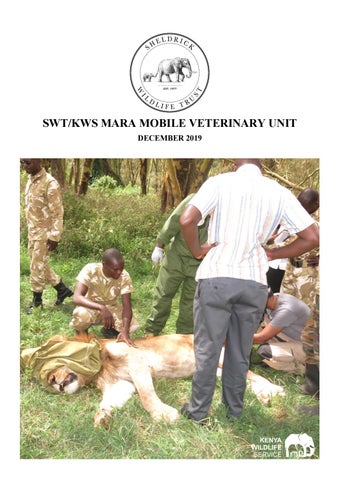
This lioness with several bite injuries by Mara Triangle rangers on patrol. She was reported to have remained in one location for a long time. The Vet Unit found the lioness lying by the side of the road in great pain. She took time to stand up when agitated finally did so slowly. Multiple bite wounds could be seen on her back. Immobilisation, examination and treatment Immobilization was achieved with a combination of 5mgs Medetomidine hydrochloride and 200mgs Ketamine hydrochloride. It took ten minutes for this lioness to be fully anaesthetized. She was taken to a shaded area after a blindfold was put in place. Examination revealed a dehydrated lioness with several fight wounds with a particularly deep one near her lumbar section of the spine. This was clearly caused by other lions. These wounds were beginning to get septic and were all managed the same way. Hydrogen peroxide was applied for debriding before copious amount of water was used for lavaging. Tincture of Iodine was then used as a disinfectant and Cloxacillin ointment was infused as an antibiotic to prevent further sepsis. Other treatments given included intramuscular administration of 3000mgs Amoxicillin antibiotic to prevent sepsis and subcutaneous administration of Polyionic ringers lactate fluids to help in rehydration. Prognosis Reversal of the anaesthetic was achieved by administration of 15mgs Atepamezole hydrochloride one hour after immobilization. She woke up seven minutes later and retreated deeper into the shade.
Case 3 – 11th December 2019 Lion
Human-Wildlife Conflict
Lake Nakuru National Park
This lion strayed from an unknown location into Kruger farm in Uasin Gishu County and killed several livestock before eventually being trapped. He was taken to Lake Nakuru National Park to be released. KWS management decided that it would be good to collar him before release to ease his monitoring.
Immobilisation, examination and treatment He was darted within the cage with a combination of 6mgs Medetomidine hydrochloride and 240mgs Ketamine hydrochloride. It took ten minutes for the drugs to take full effect. This lion was removed from the cage and examined before collar deployment. He had several bruises from struggling with the cage, all of which were cleaned and sprayed with Oxytetracycline wound spray. Amoxicillin antibiotics were also given intramuscularly. A GSM collar was deployed and its functionality ascertained before this lion was released. He was taken to an already identified site within the park for release. Prognosis Reversal of the anaesthetic was achieved with administration of 20mgs Atepamezole hydrochloride intramuscularly into the shoulder muscles. It took eight minutes for him to wake up and he was stable after nine minutes. He took off immediately into the bushy parts of the park. He is being monitored and management will be advised on his movements for mitigation.