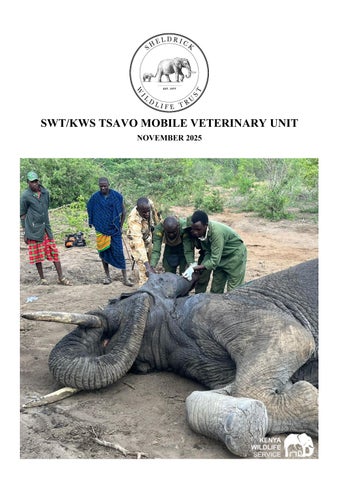
SWT/KWS TSAVO MOBILE VETERINARY UNIT NOVEMBER 2025
Introduction
12 Cases in November 2025
2 Poaching Cases
5 Elephant Cases
November Report by Dr. Campaign Limo The conservation area experienced significant precipitation at the beginning of the month. A few water pans are full and the vegetation in most areas is lush. Both grazers and browsers have enough food and are in good body condition. Acknowledgement # TMVU would like to appreciate everyone that aided in reporting cases that required veterinary intervention. Special thanks to the Sheldrick wildlife trust for their unwavering support to the unit and KWS for technical support and advice to the unit.
Case Details Date
Species
Area Found
2-Nov-25
Zebra
Tsavo East NP
5-Nov-25
Elephant
8-Nov-25
Reason for Intervention
Outcome
Arrow
An arrowhead was found lodged in the wounded area
Successfully Treated
Tsavo East NP
Postmortem
Due to advanced autolysis the cause of death could not be grossly determined
Died
Elephant
Shumba Valley
Natural Causes
This bull was found stuck in the mud in a dam in Nyango area
Prognosis Poor
9-Nov-25
Buffalo
Tsavo East NP
Natural Causes
This buffalo stuck in mud near Galdessa camp
Task Successful
9-Nov-25
Lion
Tsavo East NP
Natural Causes
Examination revealed several deep septic bite wounds
Died
9-Nov-25
Lion
Tsavo East NP
Rescue
Rescue following death of the mother
Taken to Orphanage
16-Nov-25
Elephant
Lunga Lunga
Postmortem
The cause of death of the elephant could not be grossly determined
Died
21-Nov-25
Leopard
Tsavo West NP
Natural Causes
The leopard was malnourished with little muscle mass
Prognosis Poor
23-Nov-25
Elephant
Tsavo East NP
Arrow
Examination revealed that the bull had a septic arrow wound on the left chest area
Successfully Treated
25-Nov-25
Buffalo
Taita Ranches
HWC
This male buffalo was trapped within the fenced off area of the SGR
Task Successful
27-Nov-25
Elephant
Tsavo East NP
Natural Causes
Examination revealed a shallow fight wound on the right rump area
Successfully Treated
28-Nov-25
Other
Diani
Technical Cases
Vaccination to prevent rabies within this captive facility
Task Successful
SWT/KWS Tsavo Mobile Vet Unit Treatment Locations November 2025
Case 1 – 2nd November 2025 Zebra
Arrow
Ndii, Tsavo East NP
This injured zebra was spotted along the highway by the KWS/SWT teams during routine patrols. He had a wound on the left thoracic area.
Immobilisation, examination and treatment The zebra foal was successfully immobilized using a combination of 2mg Etorphine and 30mg Azaperone. Darting was done from the vehicle, and it took 6 minutes for the drugs to achieve its full effect. Examination revealed a septic arrow wound on the left chest area. An arrowhead was found lodged in the wounded area which was successfully retrieved. The wound was thereafter cleaned with water, flushed with Hydrogen peroxide, rinsed and infused with Iodine. Topical antibiotic spray was applied on the wound. The foal was given parenteral antibiotics and anti-inflammatories. Prognosis Prognosis full recovery is good.
.
Case 2 – 5th November 2025 Elephant
Postmortem
Mwasui Ranch
This elephant carcass was found by KWS rangers in Mwasui ranch during routine patrols. TMVU was requested to determine the cause of death. Postmortem examination An elephant carcass of an approximately 40- 45 years was found on left lateral recumbency. The tusks had been retrieved a day before and was taken for safekeeping by the KWS team. The carcass was approximately 4 days old, bloated and autolysed. There were no external wounds seen on flipping the carcass. There was scavenger activity on the carcass. Cause of death Due to advanced autolysis and significant post-mortem changes, the cause of death could not be grossly determined. Both tusks were intact and were taken by the KWS team for safekeeping.
.
Case 3 – 8th November 2025 Elephant
Natural Causes
Shumba Valley
This bull was found stuck in the mud in a dam in Nyango area. The KWS/SWT team in the area had helped him out of the mud but he was unable to get up on his own. The Vet Unit were called to assist. Rescue The elephant was found on right lateral recumbency, he was exhausted but still made attempts to rise without success. He had scavenger inflicted wounds on his ears and on the withers. These wounds were cleaned thoroughly, infused with tincture of Iodine and topical antibiotic spray applied. He was given metabolic stimulants and immediately started on intravenous fluids to rehydrate and reverse hypoglycaemia. He showed significant improvement after a few minutes of intravenous fluid administration. With rejuvenated and stronger attempts to get up the team supported him with a rope placed on one of his tusk and successfully helped him up. He slowly walked away into the bushes. Prognosis Prognosis is guarded.
.
Case 4 – 9th November 2025 Buffalo
Natural Causes
Galdessa, Tsavo East NP
This buffalo was spotted by KWS/SWT team during patrols, he was stuck in mud near Galdessa camp. Immobilisation, examination and treatment He was successfully immobilized using a combination of 6mg Etorphine hydrochloride and 50mg of Azaperone delivered remotely in a 3cc Dan inject dart. 6 minutes later full anaesthesia was achieved, and the buffalo was helped out of the mud using tow ropes. Examination revealed the bull had septic predator inflicted wounds (lion predation attempt) on the rump. The wounds were debrided thoroughly, flushed with Hydrogen peroxide, rinsed with water and infused with tincture of Iodine. Green clay was thereafter applied on the wound followed by topical antibiotic. He additionally received shots of Amoxicillin antibiotics and Flunixin anti-inflammatories parenterally. Prognosis He was reversed from anaesthesia using 60 mg of Naltrexone hydrochloride given intravenously via the jugular vein. He rose few minutes later and walked away with a favourable prognosis.
.
Case 5 – 9th November 2025 Lion
Natural Causes
Ngutuni, Tsavo East NP
This lioness was spotted weak and wounded near Ngutuni lodge by the lodge staff. The lioness had been treated on the 22nd of October for severe bite wounds. She had 2 cubs.
Immobilisation, examination and treatment The lioness was successfully immobilized using a combination of 4mg Medetomidine and 180mg Ketamine delivered remotely in a 3cc Dan inject dart. She was darted from a vehicle, and it took 10 minutes for full anaesthesia to be achieved. Examination revealed several deep septic bite wounds on the right hip, base of the tail, left gluteus, and medial left and right thigh. She also had a porcupine quill on her neck. The lioness was in very poor body condition and dehydrated. The wounds were thoroughly cleaned with water, flushed with Hydrogen peroxide, infused with Iodine, applied with an antibiotic powder and then sprayed with a topical antibiotic. Prognosis Prognosis was grave and she succumbed later on despite treatment.
.
Case 6 – 9th November 2025 Lion
Rescue
Ngutuni, Tsavo East NP
The mother was treated earlier, but despite treatment she succumbed to her injuries leaving her milk dependent cubs alone. Rescue The 2 female cubs were found approximately 6kms from where the lioness was found, they were weak and in very poor body condition. They were immediately rehydrated and fed. The cubs were rescued and sent to Nairobi animal orphanage for fostering and specialized care.
.
Case 7 – 16th November 2025 Elephant
Postmortem
Lunga Lunga, South Coast
This female adult elephant was found dead in Lunga-lunga on the evening of 15th November. TMVU was requested to conduct a postmortem examination on the elephant to determine the cause of death. Postmortem examination The carcass was found in left lateral recumbency. •
No visible wounds were seen.
• • • •
There was minimal scavenger activity. The carcass was approximately 6 days old and in advanced stages of autolysis and decomposition. There was advanced entomology hierarchy with tissue fluids maximally produced. The tusks had been retrieved by KWS rangers in the area and taken for safe keeping.
Cause of death Due to advanced autolysis and decomposition of the carcass, the cause of death of the elephant could not be grossly determined. .
Case 8 – 21st November 2025 Leopard
Natural Causes
Kilaguni, Tsavo West NP
This young malnourished leopard was seen frequenting Kilaguni lodge, Tsavo west for almost a week. KWS team in Kamboyo trapped her and notified TMVU.
Immobilisation, examination and treatment The leopard was successfully anaesthetised using a combination of 0.8mg Medetomidine and 70mg Ketamine. This was delivered in a 3 cc Dan inject dart. It took 10 minutes for full anaesthesia to be achieved. Examination revealed that the leopard was malnourished with little muscle mass, she also had bilateral corneal opacity, heavy tick load and was dehydrated. The leopard was given intravenous fluids, antibiotics, anti-inflammatories, metabolic stimulants and sprayed with frontline spray for tick control. Prognosis She was revived using 4.5mg Atepamezole given intramuscularly. She was up and alert 15 minutes later and given supplementation and clean drinking water. Prognosis was guarded. She was recommended to be transferred to Mt. Kenya wildlife conservancy for rehabilitation.
.
Case 9 – 23rd November 2025 Elephant
Natural Causes
Ndara, Tsavo East NP
This injured bull was spotted by the SWT pilot during routine patrols. He had a wound on the left chest area.
Immobilisation, examination and treatment The bull was successfully immobilized using 19mg Etorphine hydrochloride delivered in a 3cc Dan inject dart. Darting was done from the vehicle, and it took 8 minutes or the drugs to achieve its full effects. Examination revealed that the bull had a septic arrow wound to the left chest area. The wound was thoroughly cleaned and derided, this was followed by flushing with Hydrogen peroxide, rinsing with clean water and infusing with tincture of Iodine. Antibiotic pessaries were packed in the wound followed by topical antibiotic spray. The bull also received Amoxicillin antibiotics and anti-inflammatories parenterally. Prognosis The bull was revived from anaesthesia using 190 mg of Naltrexone hydrochloride given intravenously via a prominent ear vein. He rose and slowly walked away 3 minutes later with a good prognosis.
.
Case 10 – 25th November 2025 Buffalo
Human-Wildlife Conflict
Manga, Taita Ranches
This male buffalo was spotted by the SGR management near Manga substation, he was within the fenced off area of the SGR.
Rescue The bull was immobilized using a combination of 7mg Etorphine hydrochloride and 50mg Azaperone delivered remotely in a 1.5cc Dan inject dart. Darting was done from the vehicle, and it took 6 minutes for full anaesthesia to be achieved. The bull was safely placed on sternal recumbency and a section of the fence opened. He was thereafter moved out of the confines of the electric fence into Tsavo East National Park. Prognosis He was revived from narcosis using 70mg Naltrexone hydrochloride given intravenously. He rose and walked away 3 minutes later. Prognosis is good.
.
Case 11 – 27th November 2025 Elephant
Natural Causes
Tabagunji, Tsavo East NP
This elephant bull was spotted by KWS/SWT team in Tabagunji, he had a wound on his right rump area. Immobilisation, examination and treatment This bull was successfully immobilized using 20mg Etorphine hydrochloride delivered remotely in a 3 cc Dan inject dart. Darting was done from the helicopter, and it took 10 minutes for the drug to achieve it full effect. Examination revealed a shallow fight wound on the right rump area. The wound was thoroughly cleaned. This was followed by flushing with Hydrogen peroxide, rinsing with clean water and infusing with tincture of Iodine. The wound was then sprayed topically with an antibiotic spray. The bull also received a shot of Amoxicillin antibiotics and flunixin anti-inflammatories parenterally. Prognosis The bull was revived from anaesthesia using 200mg Naltrexone hydrochloride given intravenously via a prominent ear vein. He rose and walked away 2 minutes later. He had a good prognosis. .
Case 12 – 28th November 2025 Mixed Species
Technical Case
Bora Bora, Diani
On 28th November 2025, TMVU vaccinated a total of 14 animals in Bora Bora Park, Diani. This was done to protect the various species of wildlife that reside within this captive facility against Rabies. This was a protocol followed after 2 incidences of rabies in common zebras was recorded in the park 2 months earlier. The animals on the table below were given intramuscular shots of the Rabies attenuated vaccine. 1 ml of the vaccine was administered remotely in a 1.5cc dart paired with plain 30mm needles for easy drop off.
Species
No of individuals
Masai giraffe
2
Warthogs
8
Wild hog
1
Cape buffalo
3