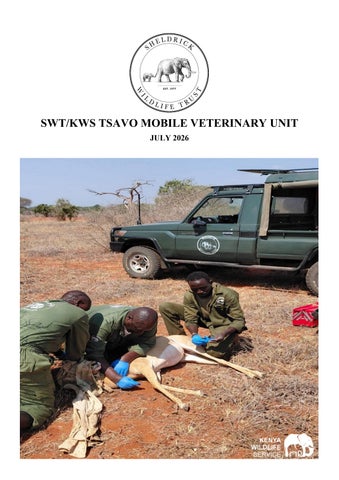
SWT/KWS TSAVO MOBILE VETERINARY UNIT JULY 2026
Introduction
5 Cases in July 2026
1 Poaching Case
4 Elephant Cases
July Report by Dr. Campaign Limo The Conservation area did not receive any rainfall during the month under review. However, most water pans still have water, and there is still enough vegetation for browsers and grazers to utilize which may be why there is a reduction in cases this month. The Unit attended to 5 cases, 4 of which involved elephants. This included the examination of 4 elephant carcasses that likely died due to suspected poisoning in retaliation for crop raiding, as well as one with an arrow wound, an infant calf with predator injuries which had to be rescued and another juvenile with traumatic injuries to the spine. An impala was also treated for predator related injuries. Acknowledgement The TMVU team would like to appreciate all the stakeholders who assisted in reporting all the cases that required veterinary intervention. Special thanks to KWS for the technical assistance and Sheldrick wildlife trust for the continuous facilitation to the unit.
Case Details Date
Species
Area Found
1-Jul-26
Elephant
Tsavo East NP
2-Jul-26
Elephant
Taita Ranches
3-Jul-26
Reason for Intervention
Outcome
Natural Causes
Rescued after attempted predation and brought for close monitoring
Successfully Treated
Arrow
Examination revealed a wound on the left biceps with a poisoned arrowhead inside
Prognosis Poor
Elephant
Tsavo East NP
HWC
Some of the elephants were observed to be staggering then falling and becoming recumbent. Others were found already lying helplessly
HWC Death
14-Jul-26
Elephant
Tsavo East NP
Natural Causes
The calf was in lateral recumbency and the efforts to make him stand were fruitless
Died
18-Jul-26
Impala
Tsavo East NP
Natural Causes
The impala had a wound as a result of an attempted predation
Successfully Treated
SWT/KWS Tsavo Mobile Vet Unit Treatment Locations July 2026
Case 1 – 1st July 2026 Elephant
Natural Causes
Meru Environs
A previously treated elephant calf who was rescued after attempted predation and brought to Rhino Base (Apollo Base) for close monitoring was reported to be having a symmetrical bow-legged stance on her hind limbs, marked soft tissue swelling and the wounds were becoming septic. Immobilisation, examination and treatment The calf was physically restrained with the help of the keepers. Examination revealed that both tarsal joints were still swollen, more so on the right side. The close bite wounds on the lateral aspect were septic. One wound penetrated the right latero-dorsal through the tarsal joint to the latero-ventral side. A bone fragment was removed from latero-ventral side. All wounds were thoroughly cleaned with water, flushed with Hydrogen peroxide, rinsed with water and Iodine, packed with Antibiotic pessaries and a topical antibiotic spray applied. In addition, the calf was given antibiotics (Amoxicillin and Clindamycin) and anti-inflammatory (Flunixin meglumine) all administered parenterally. Prognosis Fair to good. The injuries were traumatic but since she had close monitoring and was feeding well, with repeat checkups, she is likely to respond well.
.
Case 2 – 2nd July 2026 Elephant
Arrow
Rukinga, Taita Ranches
KWS rangers based in Rukinga ranch spotted and reported a bull elephant which was limping and dragging his left forelimb that was entirely swollen. In collaboration with the Wildlife Works team with their gyrocopters, they monitored the injured animal closely.
Immobilisation, examination and treatment The bull elephant was successfully immobilized using 20mg Etorphine delivered remotely in a 3cc Dan inject dart. Darting was done from foot, and it took 7 minutes for the animal to be fully anaesthetised Examination revealed a wound on the left biceps with a poisoned arrowhead inside. The swelling covered the entire left limb and was firm. The arrowhead was removed manually using pliers and the wound cleaned thoroughly with water, flushed with Hydrogen peroxide, rinsed with water and then infused with Iodine. Antibiotic pessaries were then packed in and a topical antibiotic spray applied. In addition, he was given Amoxicillin antibiotics and Meloxicam anti-inflammatory both administered parenterally. Prognosis Prognosis is poor. The animal was struggling to walk and close monitoring was advised for repeat treatment.
.
Case 3 – 20th April 2026 Elephant
Human – Wildlife Conflict
Meru Environs
The Tsavo Mobile Veterinary Unit were requested by KWS Head vet to join Amboseli Mobile Veterinary Unit to offer assistance in containing and intervening on an emergency situation in Amboseli national park and its surrounding conservancies involving a number of elephants who suddenly became paralysed, recumbent and most of them eventually dying. Examination Some of the elephants were observed to be staggering then falling and becoming recumbent. Others were just found already lying helplessly. All manifested with similar signs on general examination. They had flexed carpal joints, and they could not raise the upper part of their bodies on their own. All of them appeared to be in good body condition suggesting acute onset. The efforts to assist them to rise up were unsuccessful as the forelimbs could not support weight and they could not lift their heads because of muscular paralysis. All of them responded poorly on the interventions given and ended up succumbing a few days after becoming recumbent with acute toxic insult. Tissue samples were collected for toxicological analysis. Prognosis The post-mortem findings were inconclusive. The samples collected were submitted to laboratories for further investigation to help determine the cause of their deaths
Case 4 – 14th July 2026 Elephant
Natural Causes
Tsavo East National Park
A report was made to TMVU team by SWT officers based in Tiandaza area regarding a recumbent elephant calf who was left by his mother. Examination The Team attempted to help him to stand but he could only manage a dog sitting position as his hind limbs could not support any weight. Examination revealed that, he had not urinated or defecated since the onset of the recumbency. Tests conducted to ascertain functions of the hind limbs, the tail, the sacral and lower lumbar region were also negative. This indicated the animal had complete paralysis of the lower back region. Prognosis and postmortem The prognosis was grave and to alleviate him from further suffering, a decision to euthanize him was arrived at on grounds of animal welfare. The significant findings of the post-mortem were; haemorrhage on the entire lumbar vertebra, transverse fracture of the 3rd lumbar vertebrae that spanned the entire length of the body of the vertebrae and displacement between the 2nd and 3rd lumbar vertebrae which extended deeply resulting in haemorrhage in the vertebral discs. The conclusion was, this was a traumatic injury which compressed and damaged the lumbar and sacral nerves causing complete posterior paralysis.
Case 5 – 18th July 2026 Impala
Natural Causes
Tsavo East National Park
Mr Trevor Jennings of SWT reported an adult male Impala with large swelling on the neck. Immobilisation, examination and treatment The Impala was successfully anaesthetised using a combination of 4mg Etorphine and 40mg Azaperone. Darting was done from a vehicle and it took 8 minutes for the full anaesthesia to be achieved. Examination showed that the Impala had a large abscess swelling on the ventral neck region with an opening that was leaking pus. The cause of the injury was suspected to be as a result of an attempted predation. The abscess was drained out completely and the wound was then cleaned thoroughly with water, debrided with Hydrogen peroxide, rinsed with water then dried with swabs and infused with tincture of Iodine. A topical antibiotic spray was thereafter applied. In addition, Amoxicillin antibiotics and Meloxicam anti-inflammatory were administered parenterally. Prognosis He rose 2 minutes after reversal of anaesthetic and walked away to join his herd. Prognosis is good as he was in good body condition and should respond well following treatment.
.