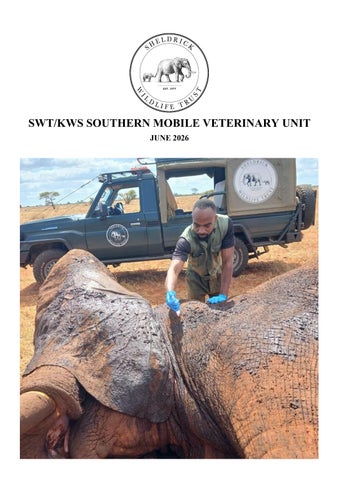
SWT/KWS SOUTHERN MOBILE VETERINARY UNIT JUNE 2026
Introduction
10 Cases in June 2026
5 Poaching Cases
6 Elephant Cases
June Report by Dr. Lawi Kimutai The conservation area received no meaningful precipitation during the month. However, a few water pans are full, and the vegetation is rapidly drying off. Some areas still have good vegetation cover and both grazers and browsers have enough food and are in good body condition. Of the cases attended to 5 were poaching attempts involving 1 snared zebra and giraffe as well as 3 elephants with arrow or spear injuries. Two other elephants were attended to for natural causes, and a postmortem was carried out were cause of death was deemed natural. The Unit also rescued an impala from a deep pit and attended to a zebra with an open fracture that sadly had a poor prognosis, and the zebra was euthanised on welfare grounds. Acknowledgement The Southern Mobile Veterinary Unit would like to appreciate each and every stakeholder that aided in reporting and monitoring cases that required veterinary intervention. Special thanks to Kenya Wildlife Service for the technical support to the unit and Sheldrick Wildlife Trust for their unwavering support.
Case Details Date
Species
Area Found
3-Jun-26
Elephant
Tsavo East NP
3-Jun-26
Elephant
4-Jun-26
Reason for Intervention
Outcome
Arrow
Revealed a septic arrow wound on the left chest area. Pus was oozing from the injury
Successfully Treated
Tsavo West NP
Postmortem
The elephant died of complications associated with intestinal torsion
Died
Giraffe
Tsavo West NP
Snared
A winch wire snare was found loosely tied around the neck of the giraffe
Successfully Treated
6-Jun-26
Zebra
Tsavo East NP
Natural Causes
Examination revealed that the zebra had suffered an open, complete fracture
Died
7-Jun-26
Elephant
Tsavo East NP
Spear
Examination revealed a deep septic spear injury on his distal left hind limb
Prognosis Poor
10-Jun-26
Antelope
Kaluku
HWC
An impala was rescued from a deep pit and taken to the Kaluku stockades
HWC Death
11-Jun-26
Zebra
Taita Ranches
Snared
The winch wire was tightly strangulating the proximal portion of the neck
Poaching Death
23-Jun-26
Elephant
Tsavo West NP
Natural Causes
Examination revealed an intact sole with a bulge at the centre
Successfully Treated
25-Jun-26
Elephant
Tsavo East NP
Natural Causes
On examination the calf was observed to have deep septic bite wounds
Prognosis Poor
25-Jun-26
Elephant
Tsavo East NP
Arrow
Examination revealed that the bull had a septic arrow injury on the left distal flank
Successfully Treated
SWT/KWS Southern Mobile Vet Unit Treatment Locations June 2026
Case 1 – 3rd June 2026 Elephant
Arrow
Ithumba, Tsavo East
This ex-orphan bull returned to SWT Ithumba stockades with an injury on his left chest area. The keepers promptly reported this to SMVU.
Immobilisation, examination and treatment This bull was successfully immobilized using 20mg Etorphine hydrochloride delivered remotely in a 3cc Dan inject dart. Darting was done from the vehicle, and it took 10 minutes for full anaesthesia to be achieved. Examination revealed a septic arrow wound on the left chest area. Pus was oozing from the injury. The injury was thoroughly debrided and all devitalized tissues removed. The injury was thereafter flushed with Hydrogen peroxide, rinsed with water and infused with tincture of Iodine. Antibiotic pessaries were then packed into the wound followed by a topical antibiotic spray. Additionally, the bull received shots of Amoxicillin antibiotics and anti-inflammatory medication parenterally. Prognosis Prognosis for a full recovery is good.
Case 2 – 3rd June 2026 Elephant
Postmortem
Tsavo West National Park
This elephant was found dead on the afternoon of 3rd June 2026. He was among the translocated elephants from Laikipia to Tsavo West National Park on the 29th May and was released at hippo pool (Rhino valley). Postmortem examination The carcass was on right lateral recumbency and had a distended abdomen with clear signs of struggle at the site. Both tusks were intact. There was scavenger activity on the carcass, on the perineum, trunk and the inguinal area. The elephant had a collar that had been deployed on translocation. The entomology hierarchy was advanced with estimated postmortem interval of 36- 48 hours. There was fibrinopurulent exudate lining the intestinal serosa with adhesions. Portion of the large intestine was full of ingesta that was leaking into the peritoneum. There was torsion of the small intestines with significant congestion of the serosa and the duodenum. Cause of death The elephant died of complications associated with intestinal torsion and subsequent perforation of the intestines as well as peritonitis due to seepage of intestinal content into the peritoneum.
Case 3 – 4th June 2026 Giraffe
Snared
Tsavo West National Park
The SWT/KWS team reported an adult male giraffe with a snare bound to its proximal neck.
Immobilisation, examination and treatment The giraffe was sedated using 12mg Etorphine Hcl and 40mg Azaperone. The combination was delivered using a 3cc Dan Inject dart from a helicopter and it took ten minutes for full anaesthesia to be achieved. On examination, a winch wire snare was found loosely tied around the neck of the giraffe. Luckily the snare had not inflicted any soft tissue injury. It was immediately cut loose with wire cutters. No further treatment was required so the anaesthetic was reversed. Prognosis Good - The giraffe had not sustained any injury as a result of the snare around its neck.
Case 4 – 6th June 2026 Zebra
Natural Causes
Tsavo East National Park
The SWT/KWS team patrolling the Tsavo East National Park reported having observed a limping zebra in a herd within the pipeline area. Immobilisation and examination This stallion was sedated using a combination of 6mg Etorphine Hcl and 50mg Azaperone. The drug combination was delivered using a 1.5cc Dan Inject dart from a vehicle and it took six minutes for full anaesthesia to be achieved. Examination revealed that the zebra had suffered an open, complete mid diaphyseal fracture of the left third metacarpal bone. This was likely as a result of running on irregular terrain. Prognosis Due to the grave prognosis of such injuries. The team saw it fit to euthanize the zebra on animal welfare grounds to alleviate further suffering.
Case 5 – 7th June 2026 Elephant
Spear
Ngutunyi, Taita Ranches
The SWT/KWS team reported an adult bull elephant that was observed limping near Ngutunyi Lodge. The elephant was reported to be in a water hole within the vicinity of the lodge.
Immobilisation, examination and treatment The adult bull elephant was sedated using 20mg Etorphine Hcl delivered using a 3cc Dan Inject dart. Darting was done from a vehicle, and it took ten minutes for the animal to be fully subdued. Examination revealed a deep septic injury on his distal left hind limb. The injury was deep to the level of the metatarsal with bone fragments pulled from the injury. The fracture was suspected to be as a result of a spear blow to the distal metatarsal. Pus and devitalized tissues were removed from the injury followed by flushing with Hydrogen peroxide, rinsing with water and infusing with tincture of Iodine. Antibiotic pessaries were also packed in the wound followed by topical antibiotic spray. Additionally, the bull was given parenteral antibiotics and anti-inflammatories parenterally. Prognosis Guarded – close monitoring recommended due to the severity of the injury.
Case 6 – 11th June 2026 Zebra
Snared
Teital, Taita Ranches
The Teita sisal management reported having observed a zebra with a snare on its neck. The animal was reported to lag behind the herd and was unable to lift its head. Immobilisation and examination The zebra was sedated using a combination 6mg Etorphine Hcl and 50mg Azaperone. The zebra was approached with a vehicle and darted using a drug combination was delivered using a 1.5cc Dan Inject dart. It took ten minutes for full anaesthesia to be achieved. On examination, the winch wire was tightly strangulating the proximal portion of the neck. The snare had completely cut through his nuchal ligament and eventually severed the right carotid artery during anaesthesia induction. The dorsal neck region was grossly oedematous. Cause of death Grave: This zebra was unable to raise its neck due to the extent of its injuries. Surgical repair of the completely severed carotid artery was not feasible in the field. The A decision to euthanize the zebra on animal welfare grounds was made. This was executed immediately to alleviate him from further suffering.
Case 7– 11th June 2026 Impala
Human – Wildlife Conflict
Kaluku
This injured impala was rescued from a deep pit and taken to Kaluku stockades. She was reported to be recumbent and unable to bear weight on her hindlimbs. Examination The impala was found still recumbent with loss of coordination and reflexes on the hind quarters. Bruising was observed on the medial left thigh. The impala was suspected to have suffered a spinal injury during the fall into the pit leading to severe nerve damage and subsequent loss of coordination. Prognosis Due to the grave prognosis of such injuries, the team saw it fit to euthanize the impala on animal welfare grounds to alleviate further suffering.
Case 8 – 23rd June 2026 Elephant
Natural Causes
Komboyo, Tsavo West
This injured bull was spotted by the SWT pilot during routine patrols around Kamboyo. He had weight bearing lameness on his right forelimb.
Immobilisation, examination and treatment The bull was successfully immobilized using 20mg Etorphine hydrochloride. This was delivered remotely in a 3-cc Dan inject dart from the helicopter and it took 13 minutes for full anaesthesia to be achieved. Examination revealed an intact sole with a bulge at the centre. The sole was scanned and all foreign bodies cleared. On aspiration the swelling yielded purulent material. The abscess was lanced followed by thorough debriding with Hydrogen peroxide, rinsing with water and flushing with Iodine. Topical antibiotic spray was also applied and finally the bull received parenteral Amoxicillin antibiotics and flunixin anti-inflammatories. Prognosis Prognosis is good and the elephant should make a full recovery.
Case 9– 25th June 2026 Elephant
Spear
Tsavo East National Park
This injured calf was spotted by KWS rangers near pipeline area. He had severe injuries on both his hind limbs and was struggling to ambulate and keep up with the herd. Immobilisatoin, examination and rescue The calf and his mother were both successfully immobilized using 1mg and 16mg Etorphine hydrochloride. Darting was done from the vehicle, and it took 7 minutes for full anaesthesia to be achieved. On examination the calf was observed to have deep septic bite wounds on both tarsal joints. The injuries were likely due to an unsuccessful predatory attempt. On the right tarsal joint, a fracture fragment was retrieved from the wound. The wounds were thereafter debrided thoroughly followed by flushing with Hydrogen peroxide, rinsing with water and infusing with tincture of Iodine. Antibiotic pessaries were packed in the wound followed by topical antibiotic spray. Amoxicillin and Clindamycin antibiotics and antiinflammatory medication were given parenterally. Prognosis and rescue Due to the severity of his injuries, and a grave prognosis, the team with requested KWS for rescue of the calf for close monitoring and repeat treatments. He was thereafter rescued and taken SWT stockades.
Case 10 – 25th June 2026 Elephant
Arrow
Dika Plains, Tsavo East National Park
This injured elephant was spotted by the KWS/ Tsavo trust team with an injury on his left flank
Immobilisation, examination and treatment This bull was successfully anaesthetized using 20mg Etorphine hydrochloride delivered in a 3cc Dan inject dart. Darting was done from the vehicle, and it took 8 minutes for the drug to achieve its full effects. Examination revealed that the bull had a septic arrow injury on the left distal flank. On probing the injury a metallic foreign body was felt, after careful retrieval it was positively identified to be an arrowhead. The injury was then debrided thoroughly and all pus evacuated, flushed with Hydrogen peroxide rinsed with water and infused with tincture of Iodine. Antibiotic pessaries were then packed into the wound followed by topical antibiotic spray. The bull was additionally given Amoxicillin antibiotics and Flunixin antiinflammatories parenterally. Prognosis He rose and slowly walked away 3 minutes following anaesthic reverasl with a good prognosis.