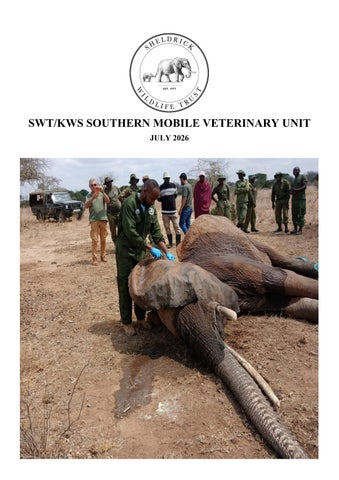
SWT/KWS SOUTHERN MOBILE VETERINARY UNIT JULY 2026
Introduction
8 Cases in July 2026
2 Poaching Cases
2 Elephant Cases
July Report by Dr. Lawi Kimutai The conservation area received no meaningful precipitation during the period under review. A few water pans are full, and the vegetation is rapidly drying off though some areas still have good vegetation cover. Both grazers and browsers have enough food and are in good body condition. There was a reduction in elephant and poaching cases during July. With only 1 elephant treated for spear wounds and 1 for natural causes as well as a zebra for a snare injury. A lion carcass was also found with spear injures, most likely due to Human – Wildlife Conflict. The other cases were all considered natural in nature. Acknowledgement The Southern Mobile Veterinary Unit would like to appreciate each and every stakeholder that aided in reporting and monitoring cases that required veterinary intervention. Special thanks to Kenya Wildlife Service for the technical support to the unit and Sheldrick Wildlife Trust for their unwavering support.
Case Details Date
Species
Area Found
8-Jul-26
Zebra
Tsavo East NP
17-Jul-26
Antelope
22-Jul-26
Reason for Intervention
Outcome
Snared
A braided nylon rope snare was tightly bound to the left hindlimb
Successfully Treated
Mombasa
Natural Causes
He was dull, inactive and had marked hindlimb ataxia
Prognosis Poor
Elephant
Taita Ranches
Natural Causes
Severe delaminating wounds affecting the foot pads of all the four limbs
Prognosis Poor
25-Jul-26
Giraffe
Tsavo East NP
Natural Causes
She had an open septic wound likely from an unsuccessful lion attack
Successfully Treated
27-Jul-26
Antelope
Kaluku
Natural Causes
The animal had a small open wound with pus on its right metacarpal bone
Successfully Treated
27-Jul-26
Antelope
Lake Jipe
Postmortem
Two adults female Oryx’s that had died in close proximity. They were among the translocated oryxes from Galana-Kulalu
Died
28-Jul-26
Lion
Tsavo West NP
HWC
Spear wounds and missing trophies
HWC Death
30-Jul-26
Elephant
Taita Ranches
Spear
The bull had a septic spear wound on the left lateral abdominal region
Successfully Treated
SWT/KWS Southern Mobile Vet Unit Treatment Locations July 2026
Case 1 – 8th July 2026 Zebra
Snared
Ndii, Tsavo East
The common zebra was observed grazing in a herd with a snare tightly bound to its rear limb by the SMVU on a patrol. The team immediately attended to the zebra. Immobilisation, examination and treatment The juvenile zebra was immobilised using 4mg Etorphine and 30mg Azaperone delivered remotely using a 1.5cc Dan Inject Dart. Darting was done from foot, and it took ten minutes for full anaesthesia to be achieved. On close examination, a braided nylon rope snare was tightly bound to the left hindlimb on the metatarsal bone. The snare was cut away, and the resulting wound was cleaned thoroughly using clean water, debrided with Hydrogen peroxide and infused with tincture of Iodine. A topical antibiotic spray was then applied. In addition, she was treated by parental administration of antibiotics (Amoxicillin) and NSAIDs (Meloxicam). Prognosis She rose up and was guided to join the herd. She has a good prognosis as the juvenile was in good body condition and with the removal of the snare and treatment of the wound she is expected to heal fully.
Case 2 – 17th July 2026 Kudu
Natural Causes
Haller Park, Mombasa
The Haller Park team reported a thirteen-year-old male lesser Kudu named Ijara that had developed hindlimb weakness, wobbliness on walking, reduced activity and was anorexic. Immobilisation, examination and treatment He was weak and a decision to physically restrain was made to allow the SMVU team to carefully examine and treat the kudu. On close examination, he was dull, inactive and had marked hindlimb ataxia with a characteristic unsteady gait. He presented in sternal recumbency and was reluctant to move but on agitation he was able to walk with characteristic lack of the righting reflex of both rear limbs. He had a few ticks on the pinna. A blood sample was collected for further analysis but did not yield any findings relating to the clinical signs exhibited. He was treated by administration of antibiotics (Oxytetracycline), NSAIDS (Dexamethasone), multi-vitamin, fluid therapy and Ivermectin. Prognosis Poor prognosis: The animal’s inability to coordinate its rear limbs is an indicator of neurological pathology. The Haller Park management team was advised to closely monitor him and provide mineral supplementation.
Case 3 – 22nd July 2026 Elephant
Natural Causes
Kuakenyi, Taita Ranches
The SWT/KWS/Lualenyi Management reported sighting a female elephant observed struggling to walk, with a penetrating wound on the left rump region and abrasion on the proximal trunk.
Immobilisation, examination and treatment This adult female elephant was immobilized using 13mg Etorphine from a vehicle. It took ten minutes for full anaesthesia to be achieved. On close examination the SMVU team found: • • • •
Severe delaminating wounds affecting the foot pads of all the four limbs Deep septic penetrating wound on the left rump This adult female elephant had a poor body condition Abrasion wound on the proximal trunk region
She was treated by thoroughly cleaning the soles and the left rump with water, Hydrogen peroxide, Iodine and green clay. The abrasions on the trunk were cleaned using Hydrogen peroxide, Iodine and sprayed with an antibiotic. She was given Amoxicillin antibiotic, NSAID (Flunixin meglumine) and a metabolic stimulant. Prognosis Very poor to grave: the lesions on the soles were severe resulting in excruciating pain and reduced mobility.
.
Case 4 – 25th July 2026 Giraffe
Natural Causes
Tsavo East National Park
The SWT/KWS teams had filed a report of an infant giraffe that was observed limping with a wound oozing pus on the right thigh region Immobilisation, examination and treatment This infant giraffe was immobilized by administration of 2.5mg Etorphine and 25mg Azaperone administered using a Dan-Inject dart from a vehicle and it took ten minutes for full anaesthesia to be achieved. On close examination it was noted she had an open septic wound on the right stifle joint. The injury was likely from an unsuccessful lion attack. The injury was thoroughly cleaned and debrided using clean water, followed by flushing with Hydrogen peroxide, infusing with Iodine, packing with uterine pessaries and spraying with topical antibiotics spray. She additionally received parental antibiotics (Amoxicillin) and NSAIDS (Meloxicam). Prognosis Good Prognosis: This giraffe had a good body condition score of 2.5/5 and with the timely intervention full recovery will be achieved.
Case 5 – 27th July 2026 Kudu
Natural Causes
Kaluku, Tsavo
The SWT/KWS teams reported a limping lesser Kudu that was actively nursing.
Immobilisation, examination and treatment This Lesser kudu was immobilized using 3.5mg Etorphine HCL and 30mg Azaperone. The animal was darted from foot, and it took ten minutes for full anaesthesia to be achieved. On close examination, the animal had a small open wound with pus on its right metacarpal bone. There was also presence of callus tissue on the region indicating active healing from a fracture. There was proper alignment and union of the fractured bone. The fracture was likely attributed to predator-prey interactions. The wound was thoroughly cleaned and pus debrided using Hydrogen peroxide and povidone Iodine then topical antibiotic spray was applied. She additionally was given parental antibiotics (Amoxicillin), NSAIDS (Meloxicam) and a metabolic stimulant. Prognosis Good prognosis: This adult female Lesser kudu was able to bear slight weight on the limb. With the treatment administered she should be able to recover.
.
Case 6 – 27th July 2026 Oryx
Postmortem
Lake Jipe, Tsavo West
The Lake Jipe management team reported two adult females Oryx’s that had died in close proximity, less than 100 meters apart. They were among the translocated oryxes from Galana - Kulalu. One female was rescued from a water channel that directed water flow into a dam near the Galana at Kulalu. Postmortem examination • • •
There was moderate tick infestation on the carcass The carcasses’ incisors were loosely attached to her gums Severe bruises on the sternal musculature
• •
The carcass was bloated with maggots and generalized soft tissue necrosis There was characteristic generalized lymphadenopathy, with all the examined lymph nodes appearing swollen (Prescapular, Precrural, mesenteric). All internal organs had autolysed.
•
Cause of death Due to the progressive state/stage of autolysis the carcass had attained, it was difficult to determine the cause of death. However, this particular Oryx must have sustained injuries to the sternal area and the incisors during its rescue from the trench.
Case 7 – 28th July 2026 Lion
Human-Wildlife Conflict
Kitani, Tsavo West
The lion carcass was found by the KWS teams on routine patrol of the Tsavo West National Park. Postmortem examination • • • • • •
He had attained a progressive state of decomposition with signs of scavenging The lion’s limbs from the level of the carpal and tarsal joints had been chopped off and were missing The lion’s tail had been completely cut off at the base of the tail and was missing The carcasses rostral head had been hacked off at the level of the mandible and maxilla bone This carcass had multiple penetrating spear wounds, one deep penetrating wound on the left lateral abdominal area, dorsal neck region, the ventral aspect of the right ear pinna. The carcass had deep puncture wounds on the right lateral abdominal region.
Cause of death Due to the severity of the spear wounds observed and missing limbs, tail and rostral maxilla and mandible it is highly likely this was due to Human - Wildlife Conflict. However, the immediate cause of death was not clear due to the progressed stage of decomposition the carcass had attained and scavenger activity.
Case 8 – 30th July 2026 Elephant
Spear
Choke Ranch, Taita Ranches
The KWS and Wildlife Works mobile teams reported an adult bull elephant with a wound on its left lateral abdominal region that was oozing pus. Immobilisation, examination and treatment This bull was immobilized using 20mg Etorphine HCL administered remotely using a 3cc Dan Inject Dart. He was darted from a helicopter and took ten minutes to be fully subdued. On close examination the bull had a septic spear wound on the left lateral abdominal region. The wound was thoroughly cleaned and debrided using Hydrogen peroxide, clean water and povidone Iodine then packed with uterine pessaries and topical antibiotic spray applied. The bull was given parental antibiotics (Amoxicillin) and anti-inflammatories (Meloxicam). Prognosis The elephant was given a good prognosis after treatment, and this bull was in a good health.