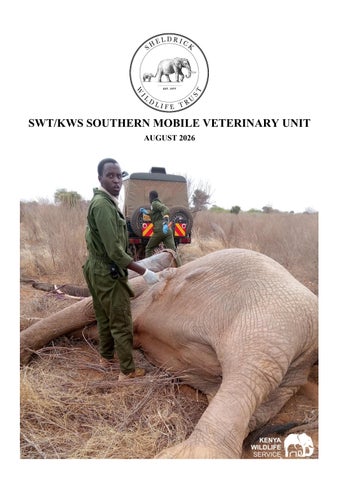
SWT/KWS SOUTHERN MOBILE VETERINARY UNIT AUGUST 2026
Introduction
8 Cases in August 2026
3 Poaching Cases
3 Elephant Cases
August Report by Dr. Lawi Kimutai For yet another month, the conservation area has not received any rain The water pans and vegetation are quickly drying off, and we hope to welcome the rains to rejuvenate the ecosystem soon. Despite these challenges some sparse areas still have adequate vegetation, and the wildlife remain in fairly good condition. Most of the cases attended to were natural in nature but not related to environmental conditions; such as fight wounds, abscesses and injuries. The poaching cases involved two snared zebras, and an elephant with an arrow wound. All the animals, except the zebra with a broken leg, were given a good prognosis. Acknowledgement The SMVU team would wish to appreciate all the stakeholders who assisted in reporting all the cases that required veterinary intervention. Special thanks to KWS for the technical support and the Sheldrick wildlife trust for the continuous facilitation to the unit.
Case Details Date
Species
Area Found
2-Aug-26
Zebra
Tsavo East NP
2-Aug-26
Zebra
2-Aug-26
Reason for Intervention
Outcome
Snared
A Zebra with wire snare bound to his neck
Successfully Treated
Taita Ranches
Natural Causes
Suffered a complete dislocation of her left carpus joint
Died
Zebra
Taita Ranches
Snared
He had sustained a snare injury on the left pastern joint
Successfully Treated
3-Aug-26
Lion
Taita Ranches
Natural Causes
He had suffered a puncture wound fight injury on his proximal right limb
Successfully Treated
4-Aug-26
Elephant
Tsavo East NP
Arrow
She had a swelling on her left lateral abdominal wall
Successfully Treated
4-Aug-26
Lion
Taita Ranches
Natural Causes
Not immobilized as thel assessment revealed the animal was able to ambulate
Successfully Treated
11-Aug-26
Elephant
Tsavo East NP
Natural Causes
She had a swollen left knee joint the mass was firm and had an opening
Successfully Treated
11-Aug-26
Elephant
Tsavo East NP
Natural Causes
Examination revealed that the calf had an abscess on his left knee.
Successfully Treated
SWT/KWS Southern Mobile Vet Unit Treatment Locations August 2026
Case 1 – 2nd August 2026 Zebra
Snared
Lualenyi, Taita Ranches
The SWT/KWS/ Lualenyi teams reported of having sighted a zebra with wire snare bound to his neck.
Y
Immobilisation, examination and treatment This adult male zebra was immobilized using 5mg Etorphine Hcl and 40mg delivered remotely from a vehicle. It took seven minutes for full anaesthesia to be achieved. On examination the SMVU found he had a cable wire snare on his proximal neck region. The snare was loosely bound on his neck and caused abrasion wounds. He was treated by removal of the cable snare from his proximal neck followed by thorough cleaning of the resulting wounds with clean water, rinsing of hydrogen peroxide, irrigation with iodine and application of an antibiotic spray. In addition to this, he received parental antibiotic (Amoxicillin) and NSAID (Meloxicam). Prognosis Good prognosis – with the snare removed the injury will heal.
.
Case 2 – 2nd August 2026 Zebra
Natural Causes
Lualenyi, Taita Ranches
The SWT/KWS Ground teams reported a female juvenile zebra that had been observed limping severely and had a swollen right rear limb and a wound on the left forelimb. Immobilisation, and examination She was successfully immobilized using a combination of 1.5 mg Etorphine Hcl and 20mg Azaperone. On examination the SMVU found she had characteristic limb favouring lameness especially on the left forelimb that was evident when she stood still. She also had a swollen left carpal joint which had been dislocated and was severely infected on the medial aspect that oozed copious amount of pus material and a severe dislocation at the left carpal joint.She also presented with a uniformly swollen right rear limb with the swelling extending from the femur to the pastern bone region with a characteristic pitting response on palpation. On attempt to aspirate the swollen right rear limb, copious amounts of pus. Prognosis, postmortem and cause of death A decision to humanely euthanize her on animal welfare grounds due to severity of her injuries was arrived at. A postmortem examination confirmed she had suffered a complete dislocation of her left carpus joint with extensive oedema proximal to the dislocated bone with pus pockets extending to three quarters of the proximal limb. These were likely cause by running over rugged terrain or avoiding predation.
Case 3 – 2nd August 2026 Zebra
Snared
Lualenyi, Taita Ranches
The SWT/KWS Ground teams reported an adult female zebra sighted within one small harem with an injury on its left pastern that affected her resultant gait. Immobilisation, examination and treatment The zebra was successfully immobilized using 5mg Etorphine Hcl and 40mg Azaperone delivered remotely from a vehicle. It took seven minutes for full anaesthesia to be attained. Examination revealed the zebra had sustained a snare injury and septic arthritis affecting the left pastern joint. He was treated by thoroughly cleaning the resultant wound with dilute Hydrogen peroxide, rinsed with clean water and infused with povidone iodine. His wound was sprayed using an antibiotic spray and a parental antibiotic (Amoxicillin) and NSAID (Meloxicam) administered. Prognosis A good prognosis was given due to the good body condition score of 3/5 and the timely treatment which will enable her to recover.
.
Case 4– 3rd August 2026 Lion
Natural Causes
Satao, Taita Ranches
The SWT/KWS teams reported an adult male lion limping on his right forelimb. Immobilisation, examination and treatment He was immobilized with 5.1mg Medetomidine and 200mg Ketamine Hcl that was delivered remotely from a vehicle. It took ten minutes for full anaesthesia to be achieved. A physical examination revealed he had suffered a puncture wound fight injury on his proximal right limb. His wound was thoroughly cleaned using clean water, dilute Hydrogen peroxide then rinsed povidone Iodine and finally a topical antibiotic spray was applied. He also received a parental antibiotic (Amoxicillin) and NSAID (Meloxicam). Prognosis He was able to bear weight using the affected limb and treatment would hasten his recovery. Therefore, he was given a good prognosis.
Case 5 – 4th August 2026 Elephant
Natural Causes
Sentrim, Tsavo Est National Park
The KWS patrol teams reported of an adult female elephant who had been observed with an abdominal swelling which was oozing pus from her neck.
Y
Immobilisation, examination and treatment She was darted from a vehicle with 20mg Etorphine, and it took ten minutes for full anaesthesia to be achieved. On close examination the SMVU found that she had a swelling on her left lateral abdominal wall which was firm on palpation with the wound being shallow containing scanty pus material. She was treated by thorough cleaning of the wound with water, dilute Hydrogen peroxide for pus extruding, rinsed with water and dried using swabs, irrigated with povidone iodine, and infused with pessaries and topical antibiotic spray applied. She was also administered antibiotic [Amoxicillin] and NSAID [Meloxicam]. Prognosis Good Prognosis: The wound was suspected to have been an old injury that was healing and treatment would hasten her recovery.
.
Case 6 – 4th August 2026 Lion
Natural Causes
Lualenyi, Taita Ranches
The Lualenyi team reported of having sighted one adult lioness that was limping. Examination This adult lioness was not immobilized as the initial assessment revealed the animal was able to ambulate with no visible injuries. She was remotely administered with systemic anti-inflammatories [Meloxicam] from a vehicle was. The KWS teams in the area were advised to monitor her progress and report any changes. Prognosis A good prognosis: She was in good was body condition and her injuries were not severe, the treatment given would help her in her recovery journey. A repeat treatment will be made if the monitoring team report any decline in her heath.
Case 7 – 11th August 2026 Elephant
Natural CausesJab
Kanderi Swamp
The SWT/KWS teams reported two injured elephant calves that belonged to the same herd. Only one of the calves was found accompanied by the mother.
Y
Immobilisation, examination and treatment To facilitate treatment and reduce risk to the team, both the mother and calf were successfully immobilized using 18mg and 1.5 mg of etorphine. •The calf had had a swollen left knee joint the mass was firm and had an opening on the distal aspect of the knee joint. The wound contained scanty pus material. The wound was thoroughly cleaned with water, dilute Hydrogen peroxide was introduced to dislodge pus, rinsed with clean water, irrigated with iodine then uterine pessaries were infused and a topical antibiotic spray applied. She also received parental antibiotic (Amoxicillin) and NSAID[Meloxicam]. Prognosis Good prognosis – with the snare removed the injury will heal.
.